Volume 48 [2013–14]

Crime and politics

10

steve@sfbg.com

San Franciscans awoke March 26 to the surprising news that state Sen. Leland Yee (D-SF) had been arrested on federal corruption charges as part of early morning police raids targeting an organized crime syndicate based in Chinatown, along with reputed gangster Raymond “Shrimp Boy” Chow and two dozen others.

Yee had a reputation for sometimes trading votes for campaign contributions, a perception that had only gained strength in recent months as he launched his first statewide campaign, running to lead the Secretary of State’s Office, casting key votes for landlords and big industries that he refused to explain to local activists.

So in a year when two other Democratic Senators have also been stung by federal corruption and bribery probes, the televised image of Yee in handcuffs wasn’t beyond the realm of possibilities. It was surprising, but not shocking.

Yet by the mid-afternoon when the 137-page federal criminal complaint was unsealed and journalists started reading through what undercover FBI agents had discovered during their five-year criminal investigation, it read more like a sensational organized crime and espionage novel than a court document, a real page-turner that just got more wild and incredible as it went on.

timelineYeeWhat began with the FBI investigating a murder and leadership transition in the San Francisco branch of the ancient Chinese organized crime syndicate known as the Triad, led by an undercover FBI agent who had infiltrated the group, evolved into a widening investigation accusing Yee of arranging an illegal arms trafficking deal with a Muslim rebel group in the Philippines in exchange for $100,000 funneled into his campaign, on top of smaller favors that Yee allegedly did in exchange for envelopes with $10,000 in cash.

It was even worse for local political consultant Keith Jackson, a key Yee fundraiser who was also on contract with Lennar Urban for its Bayview-Hunters Point development projects, with the undercover FBI agents allegedly drawing Jackson into big cocaine deals, money laundering, bribery, and even a murder-for-hire plot. If the complaint is to be believed, Jackson seemed willing to do just about anything to enrich himself and raise money for Yee.

Meanwhile, the public image that Chow has been cultivating for himself since his 2003 release from federal prison — that of a reformed career gangster turned Chinatown civic leader, someone praised by local politicians for inspiring fellow ex-convicts to turn their lives around — was replaced the complaint’s description of a powerful “Dragonhead” overseeing a vast criminal enterprise involved in drugs, guns, prostitution, protection rackets, moving stolen booze and cigarettes, and money laundering.

“I think the whole city is in shock at the moment,” Board of Supervisors President David Chiu, who represents Chinatown and ran against Yee in the 2011 mayor’s race, told the Guardian that afternoon. “Today’s widespread law enforcement actions are incredibly disturbing. The detail and scale of the criminal activities are shocking.”

In the days that followed, Yee withdrew his candidacy for Secretary of State and was suspended by his colleagues in the California Senate. But where this wild tale of crime and corruption goes next — and who else gets implicated as these powerful and well-connected defendants look to cut deals to avoid the lengthy prison sentences they all face — is anyone’s guess.


THE CRIMINAL

Chow, 54, was raised a criminal, telling the History Channel’s “Gangland” that he stabbed someone in Hong Kong at the age of nine before moving to San Francisco in 1977 and getting involved in the Hop Sing Boys gang and Chinatown’s criminal underworld.

He survived the Golden Dragon Massacre, a shooting between rival Chinatown gangs that left five dead, but he was arrested in 1978 for a robbery and sent to prison for the first time, released in 1985. The next year, he was sent back to prison for attempted murder and more gang mayhem, released in 1989.

“I did time with Charles Manson, a good friend of mine. Kimball, a serial killer. I did time with a bunch of amazing people. Each person you talk to you learn something from. Ain’t no stupid people inside the prison, you can say that,” Chow told Gangland.

In 1991, a gangster named Peter Chong was sent from Hong Kong to San Francisco to extend the reach of the Wo Hop To Triad. He enlisted Chow as his right-hand man, and together they extended the reach of the Wo Hop To across the Western United States, trying to create an all encompassing gang named the Tien HaWui, “The Whole Earth Association.”

Chow was arrested again in 1995 on a variety of racketeering and other criminal charges and sentenced to 25 years in prison. But he later testified against Chong and got his sentence reduced, and he was released from federal prison in 2003.

After his release, Chow publicly claimed to go legit, working on book and movie deals about his life, as well as building connections in the political world. Chow posed for photos with then-Mayor Gavin Newsom and other local political figures.

But the latest criminal complaint said that even as Chow pretended to be moving on, he continued to make incriminating statements to the undercover agents “confirming his knowledge of and involvement in criminal activity.”


THE COMPLAINT

The criminal complaint alleges that “Chow is currently the Dragonhead, or leader, of the San Francisco-based Chee Kung Tong organization,” which it described as a criminal syndicate connected to Hung Mun, a criminal dynasty that began in 17th century China, “also referred to as a Chinese secret society and the Chinese Freemasons.”

It says Chow was sworn in as CKT head in August 2006, soon after the still-unsolved murder of CKT head Allen Leung. Chow’s swearing-in was reported in local Chinese media sources, so SFPD and FBI conducted surveillance there and launched an investigation.

The FBI says it began infiltrating CKT five years ago, including an undercover FBI agent dubbed UCE 4599, who in May 2010 was introduced to Chow, who “then introduced UCE 4599 to many of the target subjects.” UCE 4599 told Chow he was a member of La Cosa Nostra, the Italian mob.

In March 2012 he was inducted into CKT as a “Consultant,” the complaint alleges. It says that Jackson — a former San Francisco school board member and political consultant — had also be inducted into CKT as a “Consultant,” participating in various criminal conspiracies.

The gang members are accused of laundering money made from “illegal activities, specifically illegal gambling, bookmaking, sports betting, drugs, and outdoor marijuana grows.” They allegedly laundered $2.3 million between March 2011 and December 2013 for UCE 4599, with members collecting a 10 percent fee for doing so.

The complaint says Jackson “has a long-time relationship with Senator Yee,” and “has been involved in raising funds for” Yee’s run for mayor “and for Senator Yee’s current campaign in the California Secretary of State election.” And much of the complaint details deeds allegedly committed by Jackson and Yee.

In fact, the second person named in the complaint, right after Chow, is Yee, “aka California State Senator Leland Yee, aka Uncle Leland.”

As the complaint alleges, “Senator Yee and Keith Jackson were involved in a scheme to defraud the citizens of California of their rights to honest services, and Senator Yee, [Daly City resident Dr. Wilson] Lim, and Keith Jackson were involved in a conspiracy to traffic firearms.”


THE POLITICIAN

Yee and Jackson met UCE 4599 through Chow, and then Jackson allegedly solicited him to make donations to Yee’s 2011 San Francisco mayoral campaign “in excess of the $500 individual donation limit. UCE 4599 declined to make any donations to Senator Yee, but introduced Keith Jackson and Senator Yee to a purported business associate, UCE 4773, another undercover FBI agent,” who made a $5,000 donation to Yee’s mayoral campaign.

Yee had $70,000 in debt after that mayor’s race and worked with Jackson on ways to pay off that debt. “This included soliciting UCE 4773 for additional donations and in the course of doing so, Senator Yee and Keith Jackson agreed that Senator Yee would perform certain official acts in exchange for donations from UCE 4773.”

Yee allegedly agreed to “make a telephone call to a manager with the California Department of Public Health in support of a contract under consideration with UCE 4773’s purported client, and would provide an official letter of support for the client, in exchange for a $10,000 donation.”

Meanwhile, it says Jackson and Yee continued raising money for his Secretary of State race by soliciting donations from UCE 4599 and UCE 4180, another undercover agent. “They agreed that in exchange for donations from UCE 4599 and UCE 4180, Senator Yee would perform certain officials acts requested by UCE 4599 and UCE 4180.”

That included Yee issuing an “official state Senate proclamation honoring the CKT in exchange for a $6,800 campaign donation, the maximum individual donation allowed by law.” Yee allegedly did so, and it was presented by one of his staff members at the CKT anniversary celebration on March 29, 2013.

Yee and Jackson are also accused of introducing a donor to unidentified state legislators working on pending medical marijuana legislation, the donor being another undercover agent who claimed to be a medical marijuana businessman from Arizona looking to expand into California, “and in payment for that introduction, UCE 4180 delivered $11,000 cash to Senator Yee and Keith Jackson on June 22, 2013.”

In September, after making another introduction, Yee and Jackson allegedly received another $10,000 cash donation for their services. Then Jackson allegedly had an idea for getting even more money.

“Jackson told UCE 4599 that Senator Yee, had a contact who deals in arms trafficking.” Jackson then allegedly requested UCE 4599 make another donation “to facilitate a meeting with the arms dealer with the intent of UCE 4599 to purportedly purchase a large number of weapons to be imported through the Port of Newark, New Jersey.”

That deal for up to $2.5 million in weapons involved automatic weapon and shoulder-fired missiles, the complaint said, and “Senator Yee discussed certain details of the specific types of weapons UCE 4599 was interested in buying and importing.”

The complaint says that Yee expressed discomfort with how openly UCE 4180 discussed overt “pay to play” links between cash donations and official actions. “I’m just trying to run for Secretary of State. I hope I don’t get indicted,” Yee allegedly told two undercover FBI agents during a walk on June 20, 2013, urging them to be less explicit about connecting official favor with campaign donations.

“Despite complaining about UCE 4180’s tendency to speak frankly and tie payment to performance, and threatening to cut off contact with UCE 4180, Senator Yee and Keith Jackson continued to deal with UCE 4180 and never walked away from quid pro quo requests make by UCE 4180,” the complaint said. “In fact, Senator Yee provided the introductions sought by UCE 4180 and accepted cash payments which UCE 4180 expressly tied to the making of the introductions.”

Yee’s attorney, Paul DeMeester, told reporters they will contest the charges: “We will always in every case enter not guilty pleas, then the case takes on a life of its own.”


Joe Fitzgerald Rodriguez contributed to this report.


Bloodshed in Bernal Heights

34

rebecca@sfbg.com

On Friday morning, March 21, the day that Alejandro Nieto was shot and killed by San Francisco Police Department officers, he went to the gym with his friend Byron Pedroza. It was something they did often, Pedroza said; the two of them had signed up for gym memberships together. “He’d be like, ‘B, get up. Let’s go work out.'”

Nieto and Pedroza had met at El Toro nightclub, where Nieto worked as a security guard for nearly two years. The club, which attracts Latino clientele and hosts live performances on Mondays, has tight security: There are several guards equipped with Tasers.

“He was the type of person who’d help me a lot,” Pedroza said. “Thanks to him, I went to college,” enrolling at City College of San Francisco.

Nieto was a semester away from completing his degree in administration of justice. He was studying on scholarship, in pursuit of his goal to become a youth probation officer. Nieto drove a ’95 Chevy Caprice — an old police car, Pedroza said — and they fixed it up together.

Ramiro Del Rio, Nieto’s co-worker at El Toro, described him as punctual and considerate. He’d seen Nieto in stressful situations before, when dealing with drunk and rowdy bar patrons. “He was very calm,” Del Rio said of Nieto. “He would always want to talk to the person without using aggressive force.”

Nieto favored juice and soda instead of alcohol, he said, but after he started working out, “it was straight water.” Also, “He was Buddhist.”


HIS WORK TASER

Nieto had been scheduled to work that night, March 21. Instead, he was killed in Bernal Heights Park from multiple gunshot wounds inflicted by rounds fired by at least four officers. It’s unknown exactly how many bullet wounds Nieto sustained; friends said they believed at least 14 rounds had been fired.

As of March 31, the San Francisco Medical Examiner still had not released autopsy results. The officers involved had been placed on paid leave. Nieto’s community remained stunned by his sudden death, staging a march through the Mission the following weekend to protest what they viewed as an unjust use of deadly force.

According to a transcript from a 911 call placed minutes before the shooting, which Police Chief Greg Suhr read aloud during a March 25 public meeting at Leonard Flynn Elementary School held to discuss the incident, officers opened fire within three and a half minutes of arriving at Bernal Heights Park.

Police were responding to calls reporting a man “with a gun on his hip. A black handgun,” according to the call record, which Suhr read aloud. Police did not reveal the identity of the caller, but noted that the caller was not a police officer.

A neighbor who declined to be named told the Bay Guardian that shortly before the shooting, two men walking down the pedestrian pathway on the park’s north slope alerted a jogger of a man ahead with a gun on his hip. The jogger, who came within 50 feet of the man, reported noticing that he was “pacing back and forth” and “air boxing.”

The person who phoned 911 also initially reported seeing a man pacing back and forth. But minutes later, the anonymous caller reported to 911 dispatchers, “He is eating chips … but resting his hand on the gun.”

In reality, there was no gun — it was Nieto’s Taser, carried in a holster. Friends who spoke at a March 24 vigil said they believed Nieto had headed up there to eat a burrito while looking out at the city from the top of the hill, a place he often went to clear his head.

A sergeant from the Ingleside station and other police officers arrived at the scene minutes after receiving reports of a man with a gun, Suhr said at the public meeting. Police faced Nieto from a distance of about 75 feet, up a hill.

“When the officers asked him to show his hands, he drew the Taser from the holster,” Suhr said. Nieto then told police to show their hands, and pointed the Taser at the officers, Suhr told a large crowd in attendance. Due to the distance, the chief said, the officers did not see the yellow markings that would have alerted them that it was a Taser and not a gun.

“These particular Tasers, as soon as they’re drawn, they emit a dot, a red dot,” Suhr said. “When the officers saw the laser sight on them, tracking, they believed it to be a firearm, and they fired at Mr. Nieto.” Believing he had a gun, Suhr said, police “fired in defense of their own lives.” In a later interview, he confirmed that officers would not have used lethal force had they known Nieto possessed a Taser instead of a firearm.

Both Pedroza and Del Rio said Nieto had shown them his new Taser, and said it emits a red dot only when one pushes a button to turn it on. According to a Taser operating manual, the stun gun has a range of 15 feet.

Asked how many 911 calls were placed, Suhr said he did not have that information. When the Bay Guardian contacted the Department of Emergency Management to request audio from 911 calls, it was denied on the grounds that “it is part of an ongoing criminal investigation.”


COMMUNITY OUTRAGE

For several hours following Suhr’s explanation, friends and community members took turns at the microphone to vent outrage, frustration, and sadness over Nieto’s death. Many referenced an overarching trend of police violence directed against black and Latino youth.

Some voiced skepticism of the police account. Benjamin Bac Sierra — an English instructor at City College and friend of Nieto’s, who had once driven down Mission Street with him during a low rider parade, shouting “si se puede!” to cheering onlookers — told the Guardian, “In my heart, I do not believe that he pointed his Taser at the officers.”

At the gym, on the morning of the day Nieto died, Pedroza said, “I could tell he had a lot on his mind.” Nieto had told him it had to do with a woman he’d been seeing, a mother of three. “He was in love with her,” Pedroza said.

Yet Nieto’s relationship with Yajaira Barrera Estrada had created a conflict between him and Arthur Vega, Barrera Estrada’s three children’s father, whom Nieto had once been friends with. Public records list Vega as Barrera Estrada’s husband, and show the two living at separate addresses. It had culminated in a physical confrontation outside Barrera’s home several weeks earlier, during which Nieto allegedly stunned Vega with his Taser. Vega’s account, as described in a court filing requesting a temporary restraining order, suggests this was unprovoked; Pedroza said Nieto had believed Vega was going to harm him and might have a gun. Vega could not be reached for comment.

After that incident, Pedroza described Nieto as seeming worried and easily distracted. Pedroza believed that in the weeks leading up to the shooting, the conflict had caused Nieto to fear for his life.

Court records show that Barrera Estrada had also filed a request for a temporary restraining order against Nieto stemming from that incident, which was partially granted pending an April 11 hearing. When we reached Barrera Estrada by phone, she declined to discuss it, saying only: “Alex was an excellent person. I don’t know why the media is writing bad things about him. I don’t know why the police shot him. He was an excellent person with me.”

At the meeting, Suhr noted that Nieto was prohibited from owning a firearm due to a history of mental illness. Del Rio said he hadn’t seen evidence of this in Nieto’s behavior at the nightclub, where he spent five or six nights a week. “He never seemed crazy or mentally ill when he was working.” According to state records, Nieto obtained registration to work as a guard/patrolperson in June of 2007, which required completion of a 40-hour course.

As the crowd listened at the town hall meeting, Nieto’s father, Refugio, told Sup. David Campos that police had arrived at his home in the afternoon the day after the shooting, then questioned him about his son prior to revealing that he had been killed. Then police confiscated his car, Refugio Nieto told Campos, saying it was needed for an investigation. Then, according to Pedroza, police also went to Barrera Estrada’s residence, notified her of his death, and searched the premises.

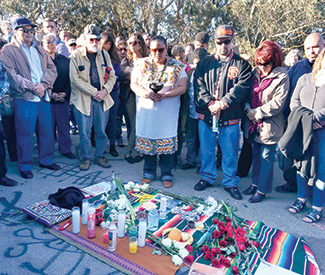
Just before sunset on March 24, about 150 friends and community supporters gathered for a vigil in memory of Nieto. They lit candles, sang, burned incense, and conducted Buddhist chants in honor of his spiritual practice.

Sup. John Avalos said he’d known Nieto through Coleman Advocates for Children & Youth. “What we saw in Alejandro was that he had a really big heart,” Avalos said. He added, “Blood’s been shed, in this case, by people we’re supposed to trust. But … we have a lot of difficulty trusting our police, because from time to time, these things happen.”

Massage therapists hope for a happy ending

3

The California Massage Therapy Council, a statewide body that licenses massage practitioners, may expire at the end of this year unless extended by the California Legislature. Some anti-prostitution crusaders say reverting to local control will make it easier to shut down covert brothels, but the practitioners fear a return to the bad old days, when stigmas and stereotypes overcomplicated their lives.

On one side of the debate are the massage therapists, who say that the council protects them from unfair discrimination, replaces a patchwork of local ordinances, and provides a greater level of respectability to their profession. However, an array of city officials, police departments, and powerful groups such as the League of California Cities argue that the CAMTC makes it easier for illicit massage parlors to get away with prostitution and human trafficking.

“I receive complaints from neighbors all the time about certain establishments,” said Sup. Katy Tang about her supervisorial district in San Francisco’s Sunset District. “We can inspect, but we have no ability to enforce any of our regulations. If there are any penalties, we can’t enforce them.”

Tang’s frustration stems from Senate Bill 731, legislation that was signed into law in 2008. That bill created the CAMTC, a nonprofit organization that has the authority to certify massage practitioners and therapists in California. Prior to the creation of this body, each city and county enacted its own certification procedures, leading to a messy patchwork of rules all over the state.

Before the CAMTC, “there were 550 different kinds of regulations from city to city,” said Ahmos Netanel, CEO of the organization. “Within a radius of one mile, you can have a situation where different cities have their own standards. One city may require no training, and another right next door may require 1,000 hours.”

A massage provider working in California pre-2009 not only had to be savvy with the medley of laws, but also needed to purchase expensive licenses for each city he or she planned to practice in. The CAMTC creates a universal—though voluntary—system, where licensed practitioners can travel and work freely around the state.

The contentious part of the law comes from the protection that it offers to licensed practitioners. Any establishment that employs all CAMTC-certified massage providers is exempt from city ordinances that target massage businesses. Law enforcement agencies claim that these restrictions impede their ability to crack down on illegal parlors, but the massage therapists say that they are necessary to fight off discriminatory laws.

Some of these unfair regulations targeted entire establishments, such as zoning rules that forced all massage businesses into run-down or dangerous parts of town, with the assumption that they were brothels. Massage providers argued that this was neither fair nor safe for, say, a 75-year-old woman seeking out massage for arthritis, or a soon-to-be mom trying to obtain a pre-natal massage.

Other laws targeted the therapists themselves. Stacey DeGooyer, a certified massage therapist in the Bay Area, remembers times when practicing massage meant mandatory STD testing and reminders from police to not wear undergarments as exterior clothing.

“I remember thinking, ‘Wow, this is for my profession?'” DeGooyer said, decrying being subjected to “archaic prostitution laws.” Most massage providers aren’t looking to be on par with physicians, but they also don’t want to be on par with prostitutes.

Currently, San Francisco has its own certification program that is regulated by the Department of Public Health. To practice massage in the city, the provider must have a license from either the city or the CAMTC. However, only those who have the state CAMTC license can legally call themselves a “licensed massage” therapist or practitioner.

Tang has been one of the most outspoken critics of the CAMTC in San Francisco, urging the Legislature to let the body sunset at the end of the year.

“I wouldn’t say that I’m against [the CAMTC], but there are structural flaws in how it was designed,” Tang said. “It was created for good reasons, since there were so many jurisdictions and they wanted to standardize it and create a cohesive process. But there are jurisdictions like San Francisco where we have our own robust process.”

The number of massage establishments have surged since the adoption of the CAMTC, which critics use as evidence for a growing number of illicit parlors. But Netanel said his group’s worked to prevent prostitutes from getting licensed in the first place. Out of over 63,000 applicants, Netanel said, the group has never certified a single person who has been convicted of illicit activities. It also utilizes an online complaint form to report questionable behavior, and respond to all complaints within 24 hours.

“Even with those who criticize [the CAMTC], we share the same goals,” Netanel said. “We want a safe, healthy, and reliable certification process, so consumers can trust their therapists. Even more, we want to put an end to illegal massage parlors so they are no longer categorized with honest providers.” (Brian McMahon)

HOT MAIL

Last week’s Bay Guardian featured a cover story on homelessness in San Francisco (“San Francisco’s untouchables”), including communications between local residents and the city’s Homeless Outreach Team, which we obtained in a public records request. So we thought we’d share a few message from the more than 100 we received.

“I don’t know where to begin,” one resident wrote. “I feel between mad, disgusted, and frustrated. This homeless encampment keeps growing. … The city has put up wire fencing only to be cut through by the homeless. … It is within 100 yards of my $1.2M condo.”

Another said: “Something is deeply wrong with San Francisco policy. Cultivating the Bohemian San Francisco style is nice but … it is as if we were in a deteriorated undeveloped country. We live in downtown San Francisco, not in the favelas, which is what it feels like.”

Still another complainant wrote: “Bags distributors are installed in the parks in order to help dog lovers clean up after their dogs, which is completely normal, but nothing is done for all the human beings who stroll, do drugs, eat, sleep, urinate, defecate and so on, on the sidewalks.”

Sometimes these complaints result in HOT visits to homeless encampments. But the emails suggest that while the HOT does approach homeless folks to try and persuade them to access services or go to a shelter, the service workers don’t always have full services to direct them to if the homeless individuals agree to do so.

Psychiatric social worker Jason Albertson, who is part of the HOT, explained this dilemma in an email sent in mid-January. His email noted that the HOT had encountered some homeless people in the vicinity of Harriet Alley and Manolo Draves Park, in response to a neighbor’s urging.

They’re “primarily in transit, meaning that they camp in different places each night and are not regulars,” he explained. “So far, nobody has wanted to enter into shelter or discuss other access to treatment or services.” But even if they had, he said, there wouldn’t be too many options for moving forward with recovery.

“At this time, our case management support is limited with identified clients waiting,” he wrote. “So capacity for full service is limited.” (Rebecca Bowe)

WHITHER GOOGLE BUSES

As the Board of Supervisors prepared for an April 1 hearing to consider an environmental appeal of the San Francisco Municipal Transportation Agency’s program for regulating Google buses and other private shuttles to the Silicon Valley, which charges them one dollar per stop, both sides marshaled their troops.

The pro-business Bay Area Council released a poll of San Franciscans claiming that most of us love tech, we’re totally cool with the Google buses, and we care more about job creation than the cost of living. The group wrote: “Despite what it may look like from recent media coverage, a majority of voters have a positive opinion of the shuttle buses and support allowing buses to use Muni stops.”

SF.citi, an alliance of San Francisco tech companies, touted the poll as it sent out an email blast that reads like a call to arms: “Divisive shuttle opponents are now suing the City to challenge this pilot program before it has the chance to get off the ground. We need YOU to tell the Board of Supervisors in person that you want them reject this lawsuit and let the pilot program go forward.”

Progressive activists countered in a similar tone: “Please join us to support the appeal and to tell the city to hold Big Tech accountable for the actual impact they have on our communities and neighborhoods.”

The hearing was scheduled after Guardian press time, so check www.sfbg.com/politics to find out what happened. (Joe Fitzgerald Rodriguez)

Appeal to the Giants

0


By John Farrell

OPINION We all love our 2010 and 2012 World Champion Giants and wish them all the best in 2014. But I also want to see the team do right by San Franciscans.

The Giants organization built its ballpark for over $350 million in 2000 and leased land from the Port. The 2012 property assessment was approximately $196.8 million, at least $200 million under value in my opinion, resulting in a property tax loss to the city of over $2.3 million annually.

Yet the Giants are appealing even this $196.8 million assessment, seeking to reduce the value to $140 million, an additional revenue loss to the city of over $650,000 annually.

When I worked in the San Francisco Assessor’s Office years ago, one of my assignments was to value the Giants ballpark. After construction was completed in 2000, a principle appraiser, a senior manager, and I met with Giants management in 2003 to finalize the ballpark value. I have worked with the Giants management numerous times in the past and they have always been professional, courteous, and fair.

Both parties agreed that a cost approach would be the preferred method of valuation and agreed on costs of around $350 million up to that point. The only difference in the final valuation being challenged was a marketing cost of $7 million in assessed value, reflecting $80,000 in tax revenue.

The Giants agreed to a middle ground to increase the assessment by $4 million. I advised the senior manager to accept this middle ground since it was reasonable and since the Giants already agreed to the approximate $350 million construction cost. It was a win-win for both the Giants and the city.

But this senior manager refused and would not budge on the $7 million assessed figure, reflecting a difference of only $35,000 in revenue. Giant’s management left the office very upset. I looked at the principle appraiser and he also couldn’t get over that we wouldn’t work with the Giants.

I had worked closely with this principal appraiser over the years and we always got the best and fairest value for the city. I left the office a year later and the Giants subsequently appealed and received a reduction of $200 million in assessed value and have been receiving a reduced assessment ever since.

When a taxpayer files an appeal for a reduction in property value under Proposition 8, it is generally due to a decrease in value as the result of a stagnant economy. I can understand the Giants asking for a reduction if their revenues were going down and justify it.

Without the ballpark, the Giants would not receive its revenues from the tickets, vendors, restaurants, advertising, cable TV, etc. Its revenues continue to grow, which is wonderful. But in my opinion and experience, the Giants should have never received such a reduction in assessment.

The proposed reduction to $140 million makes no sense. The land assessment alone is at least $40 million, from the capitalization of lease payments to the Port leaving the balance of $100 million for the improvements.

Naming rights were never assessed. Pacific Bell paid $45 million for naming rights in 2000, which was subsequently transferred to AT&T. What are these naming rights worth today? Keep in mind that the 49ers/York and Levi Strauss & Co recently entered into a naming rights agreement for a 20-year, $220 million deal at $11 million annually. Are you telling me the Giants naming rights are not worth at least half this amount when its contract with AT&T expires?

I appeal to the Giants owners and management to withdraw all their assessment appeals, which are insulting to the taxpayers of San Francisco, and continue to be the class act that they are. This appeal is from a fifth generation San Franciscan who has been a Giants fan since I can remember and had the privilege to see the two Willies, Juan, the Clarks, the Bonds and other Giants greats along the way.

John Farrell, MBA, Broker/Realtor®, former Assistant Assessor, Budget and Special Projects


Cap and frown

1

joe@sfbg.com

Just in time for baseball season, Giants hats may be allowed back into San Francisco public schools. A new Board of Education resolution may change the school district dress code to allow hats to be worn indoors in classrooms, a resolution that is also sparking conversations about cultural sensitivity.

The resolution, which the board will likely vote on April 8, would eliminate a San Francisco Unified School District no-hats policy, allowing schools to set their own dress codes individually as long as they’ve considered community input.

Some schools currently allow hats in schools in violation of district policy, but others have no-hat rules due to long standing conflation of hats with gang clothing, Board of Education Commissioner Matt Haney, who authored the resolution, told us.

“Our students should not be treated as a threat or a gang member because they wear hats,” Haney said. “If the message we send to them is that the way they dress in their communities is somehow a threat, we should not be sending that message as a school system.”

Hats seem like an unlikely starting point for a discussion about race and social justice, but Haney connects freedom of dress to the story of Trayvon Martin, whose tragic slaying many connected to negative assumptions due to wearing a hoodie, sparking a national “Million Hoodie Movement for Justice.”

Haney said allowing hats in classrooms is one step of many ensuring students know they’re accepted, and not viewed as a threat.

“When I went to a middle school to visit, they asked ‘why we can’t wear hats?’ I said it’s because people may think they’re in gangs,” Haney told the Guardian. “They looked at me like they had never heard anything so crazy or disrespectful in their lives.”

In a world where some people view those dressed in a simple hoodie as a reason to fear a teenager, the change in dress code rules could be seen as rebellious. But not everyone is a fan.

“I’m both ways on it,” Jackie Cohen, co-founder of the student tutoring program 100 Percent College Prep Institute, told the Guardian. “They should be able to express themselves as young people, but I don’t think they’re ready for the consequences that come with it.”

The institute offers many workshops to youth in the Bayview, but one offered last October taught kids to be what Cohen calls a “social chameleon.” The class taught code switching, when Cohen as how people change behavior based on social surroundings.

It’s a concept that youth of color in her neighborhood grapple with every day. Do they wear a hoodie to a job interview? A hat in the classroom? How much slang should be used in any given conversation? How does the media portray them?

boysmeet

Teenage (and younger) members of 100 Percent College Prep Institute learn about code switching from adult peers in a workshop held in October. Photo courtesy of Jackie Cohen.

San Franciscans were treated to a glaring moment of code-switching violation at last year’s NFC championship, when the 49ers were defeated by the Seattle Seahawks, whose cornerback Richard Sherman dissed 49ers player Michael Crabtree loudly in a TV interview, shouting, “Well, I’m the best corner in the game! When you try me with a sorry receiver like Crabtree, that’s the result you gonna get! Don’t you ever talk about me.”

The moment drew fire from football fans and commentators nationally; many called Sherman a thug due to his aggressive speech. In interviews later, Sherman equated the “thug” label with a racial epithet.

The message? Men of color have to act and dress within certain boundaries, and young persons especially can have trouble navigating those social boundaries, just or not. Young people of color’s clothing and speech styles can often be an impediment to breaching white-dominated power structures, Cohen said.

“If you put that resolution on the table, [Haney] should expand that to teach the other side,” she told us. “The code switching class should be part of that resolution.”

Haney, for his part, agrees that families should have a say in how their children dress at school.

“I think it’s a fair point,” he said. “The resolution doesn’t say schools must allow hats, it says it should be up to the school community and can be up to the school staff.”

But in a way, the resolution is pushing back against the need for code switching, and even mentions that the school district should recognize different forms of dress as a part of a community’s culture.

The resolution states: “A District-wide, positive, relationship-based culture is best supported by contemporary, culturally relevant Dress and Appearance standards with consistent application.”

And in San Francisco, as other big cities with pride in their sports team, saying hats are “culturally relevant dress” is an understatement.

Len Kori is a 26-year-old design major at California State University East Bay. But first and foremost, he is a San Francisco native, born and raised — he went to Thurgood Marshall High School, one of the schools affected by the resolution on hats.

He remembers the ban on hats well, which makes sense since Kori owns more than 200 of them, most bearing that unbeatable abbreviation: SF.

lenhat

Kori stands amidst some of his hat collection. Photo courtesy of Len Kori.

“You’d be surprised how deep the philosophy of collecting caps goes, as far as why people collect what they collect,” he told us. “My collection is solely based on who I am, and how important for me it is to acknowledge my roots,” Kori told the Guardian.

Hats defined his identity as a San Franciscan since he was a youngster, and as an adult he channeled his passions into designing hats himself.

One has the peninsula of the city dead center on the front of the cap, half the city aqua blue and the other half a gold dusky land mass. It reads “Bay Era,” a play off of the name of the popular New Era hats. Reflecting a love of city sports, some of his designs hearken back to San Francisco’s original baseball team, the Seals, sporting the original 1903 team colors of blue and white.

He’s happy to see the hat ban lifted because he feels “it’s important for kids to be able to express themselves.” Hats expressing city pride have long been a part of urban San Francisco culture, he said, but they are especially important now.

With so many displaced in the city’s housing crisis, there are too few of his former schoolmates around anymore. It makes the need to declare his love of San Francisco through hats especially poignant.

“It’s just really sad to see so many of my friends who have gone and left elsewhere,” Kori said. “I take pride in my city.”

Aloha, partner

0

culture@sfbg.com

THE WEEKNIGHTER Weekends are for amateurs. Weeknights are for pros. That’s why each week Broke-Ass Stuart (www.brokeassstuart.com) will be exploring a different San Francisco bar, bringing you stories about the places and people who make San Francisco one of the most phenomenal cities in the world. Who wants a drink?

It was nighttime in North Beach and that series of New York Magazine articles had come out earlier in the day. You know the ones: They were saying how San Francisco was more New York than New York, and then demonstrated it by needling us on how tech was ruining our wonderful town. I was bummed.

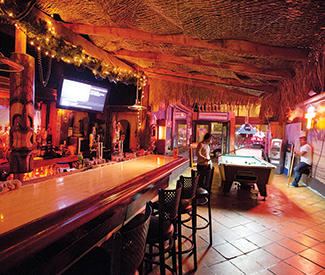
It was like reading about the reasons they closed Tu-Lan a while back: You knew terrible things were happening, but up until then you were able to suspend your disbelief. I’d finished a vodka soda at Mr. Bing’s with a friend and then decided to see what else I could drink my way into. I imagine it’s that same sentiment that lands most people in Hawaii West (729 Vallejo, SF. 415-362-3220).

Even though I’d miraculously never been there before, this divey North Beach tiki bar felt like home as soon as I walked in. A guy was face-timing with his girlfriend while playing himself at pool, soul and funk emanated from the Music Choice channel on the TV, and a legless foosball table sat abandoned on a side table. It was my kind of rundown, my kind of weird. The bartender asked my name and then introduced me to the six or seven other patrons sitting at the bar. Their friendliness was overwhelming.

“How the fuck have I never been in here before?” I asked myself as I looked at the scores of pool trophies, tiny drink umbrellas, and the laminated poster suggesting a slew of different tropical cocktails. Hawaii West had been around for roughly 50 years, the bartender told me, but she didn’t know much about its history. I gave her my info and asked her to have the owner contact me so I could find out.

A few days later I got a text from Nolan Kellet, Hawaii West’s owner, a union roofer who’s been a building inspector on military bases throughout the US for the past decade. In our conversation he told me how his grandmother moved from Hawaii to SF in the early ’60s and opened the Aloha Café. His father, one-time president of Amalgamated Transit Union Local 1225, reopened the place in 1969 naming it Hawaii West, while his mother worked there serving longshoremen in the ’70s and ’80s and Academy of Art students in the ’90s.

“I remember as young boy in the early ’70s,” Kellet told me, “Hells’ Angels frequented the bar until the police station moved in across the street. I remember motorcycles lined up and down both sides of Vallejo Street. Wish I had some pics. They gave me rides through the Broadway tunnel and around Fisherman’s Wharf at a young age.”

Old bars are like the rings inside a tree trunk, they’re witnesses to history and become a record of it simply by existing. Hawaii West exemplifies this brilliantly. Walking in, you know great stories live there, you just have to dig a little deeper to get them.

“You guys get busy?” I asked the bartender as I was leaving. “Not really,” she told me. “You can pretty much come here with a group of friends anytime and take over the place.” I walked out of there drunk and smiling because I realized New York Magazine had missed a crucial point: We still have Hawaii West.

Stuart Schuffman aka Broke-Ass Stuart is a travel writer, poet, and TV host. You ca find his online shenanigans at BrokeAssStuart.com 

State of possession

0

arts@sfbg.com

THEATER In one of the more arresting moments in Aaron Davidman’s new solo play, Wrestling Jerusalem, the Bay Area actor-playwright and former Jewish Theatre artistic director recounts being in a West Bank café with his Palestinian host when four young Israeli IDF soldiers enter in full battle gear. It’s an estranging moment for Davidman, a liberal American Jew on a hunt for answers to his quandary over Israel and its relation to occupied Palestine. But the estrangement he feels is complex, slippery: His first response is to feel estrangement from the soldiers; then a look of recognition from one of the soldiers opens up the difference between Davidman and his new Arab friends; but then Davidman also feels himself very much an American, not an Israeli — just where does he belong?

A self divided among multiple, conflicting affiliations and ideals is a general condition in this complex and stressful world, but it achieves a concentrated poignancy here for the artist son of progressive parents who rooted their liberal values in Judaic tradition. As a young man visiting Israel for the first time in 1992, Davidman had finally to face the contradictions that this would entail in the context of Israel as a Jewish homeland but also as a nation state and, especially, as a colonial power occupying Palestinian land. At the same time, criticism of Israel on the left alienates him when he sees it slipping into a broader pit of anti-Semitism — as he did during an antiracism rally at UC Berkeley’s Sproul Plaza in the immediate aftermath of 9/11.

Many return trips to Israel only made matters worse, more complicated, as his excursions became more purposeful — geared to interviewing people on both sides of the conflict — and his vantage extended into the occupied territories themselves. Grim details of that occupation come out in the course of this sure 85-minute solo performance, but so do voices justifying or qualifying the excesses of the Israeli state in the name of security and historical or political circumstance. While cleaving to core values of equity and justice throughout, Davidman respectfully represents views that range to extreme points on either side of the messy debate.

At the same time, the act of doing so becomes its own trauma. As if in a state of possession, Davidman manifests the inner and outer turmoil in a physical performance marked by often-anguished gestural passages, stirring liturgical verses, unexpected humor, and a series of neatly etched characters. These come all the more forcefully across for being set in an intimate thrust stage arrangement, carved into the central space at Intersection for the Arts. There the play unfolds against scenic designer Nephelie Andonyadis’s beautiful cloth backdrop, dyed in muted desert tones that come atmospherically alive in Allen Willner’s blood-and-earth–hued lighting design.

On one hand, Wrestling Jerusalem‘s airing of opposing views is as timely as ever. News of human rights abuses and more violence in and around the occupied territories comes almost daily, while the US State Department once again meanders down its long and winding road to nowhere with respect to jump-starting “peace talks.” Meanwhile the growing BDS (Boycott Divestment Sanctions) movement across US campuses and around the world is meeting with increasing right-wing pushback (most recently at Northeastern University). And new books by prominent American Jews and gentiles — most recently the New Republic’s John B. Judis — dissent from the usual narratives around Israel-Palestine, stirring charges of apostasy (and anti-Semitism).

On the other hand, for these very reasons Davidman’s measured search for understanding and balance can seem slightly behind these urgent, increasingly polarized times. Directed by Michael John Garcés of Los Angeles’s Cornerstone Theater, the play rehearses mostly familiar, albeit still charged and important, arguments. Its most persuasive aspects instead lie in Davidman’s representation of his personal journey, the expansion of conscience and understanding it spurs. While its mingled voices intentionally unsettle the mind and emotions, they achieve a tentative truce in the play’s final affirmation.

That affirmation — a recommitment to core values that are both traditional and universal — in turn opens common ground in which all might enter. Far from over at this point, the conversation is just getting under way. Pairing performances with something he calls the Peace Café, an opportunity for direct dialogue among audiences members, as well as other post-show discussions moderated by professional mediator Rachel Eryn Kalish, Wrestling Jerusalem is less a political argument (though it contains several) than an invitation to dialogue. Maybe more importantly still, it’s an invitation to listen. *

WRESTLING JERUSALEM

Through April 6

Thu-Sat, 7:30pm; Sun, 2pm, $20-$30

Intersection for the Arts

925 Mission, SF

www.theintersection.org


Life through the lens

0

cheryl@sfbg.com

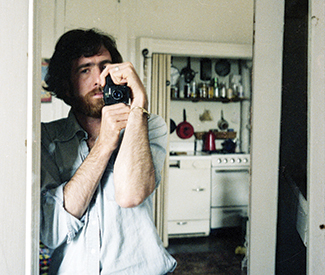
FILM It’s been nearly 30 years since documentarian Ross McElwee made Sherman’s March — usually written without its lengthy, if accurately descriptive, subtitle: A Meditation on the Possibility of Romantic Love In the South During an Era of Nuclear Weapons Proliferation. It picked up the Grand Jury prize at Sundance in 1987, years before the festival became a career-maker for the likes of Steven Soderbergh (whose Sex, Lies, and Videotape premiered at the 1989 fest). If McElwee didn’t go on to become a household name, he did begin his Harvard teaching career during the Sherman’s March era. He currently holds the title “Professor of the Practice of Filmmaking” — a suitably important job for an artist whose practice has informed the work of countless filmmakers over the past three decades.

Two of McElwee’s key works, along with short films by his Harvard colleagues, make up “Afterimage: Ross McElwee and the Cambridge Turn,” a three-day Pacific Film Archive series that has McElwee in conversation with author Scott MacDonald (American Ethnographic Film and Personal Documentary: The Cambridge Turn). Sherman’s March is not included, but Backyard (1984) ably demonstrates his trademarks: first-person voice-over (delivered in his unmistakable Carolina drawl); turning the camera on friends and family, most of whom are willing subjects; and crafting a plot of sorts out of a personal journey. (At 40 minutes, Backyard was presumably easier to program than Sherman’s March, which runs 155.)

His most recent feature, 2011’s Photographic Memory, retains all of these characteristics; it also incorporates cinema verité footage first glimpsed in Backyard. The films are ideal companion pieces. Both address father-son relationships, with a focus on the son’s lurching entry into adulthood. In Backyard — shot in the summer of 1975, when McElwee was on summer break from his filmmaking grad program at MIT — the artist documents his brother Tom’s preparations for medical school, a career choice that delights his conservative, Southern-gentleman surgeon father. To his other son, the one with scraggly long hair and a camera attached to his face, Dr. McElwee admits, “I’ve resigned myself to your fate.”

Backyard can also be read for its themes of race in the mid-1970s South, where segregation is still a way of life, and its exploration of grieving, since at the time of filming McElwee’s mother had recently died. It’s as multilayered as the many lives it captures, in a time when filming people just going about their everyday business was pretty uncommon. Dr. McElwee, for one, wonders why his son is wasting expensive film shooting his father puttering around the yard. Back then, home movies were just that — certainly not made for public consumption, and the relaxed demeanor of McElwee’s subjects bears this out.

By contrast, Photographic Memory — one of 16mm devotee McElwee’s first ventures into digital filmmaking — is very much a product of the 21st century. The son from Backyard is now the father, fretting over his own directionless son, Adrian. We see Adrian (in footage no doubt repurposed from earlier McElwee films) as an adorable kid, calling his father “Da-da” and comfortably emoting in front of the lens. Present-day Adrian, an emo 21-year-old, is a glowering poster child for the Selfie Generation, forever tapping on his phone, slurping on iced coffee, and giving off an air of unearned superiority. He avoids eye contact. He’s no longer interested in being filmed, unless he — a budding filmmaker himself — is the one calling the shots. “What makes me think he’s hearing anything I say?” McElwee wonders after trying, and failing, to break through.

At wit’s end, McElwee digs up old journals and photographs from his early 20s, pre-Backyard, when he took a year off college to bum around France (his father was, naturally, aghast). There, he met a charismatic man who became his photography mentor, and a woman with whom he had a significant affair. “It’s admittedly painful to try and penetrate the purple haze of my prose,” he says over a scene where he flips through his youthful scrawlings as his son holds the camera. “I feel a little embarrassed at showing Adrian these pages.”

Admitting embarrassment is a dying art in these narcissistic times (Ugly photo? Just throw a filter over it! Made a mistake? Blame the haters!) — and it’s one reason why McElwee’s films resonate so powerfully. He’s keenly self-aware in a way that’s refreshingly old-fashioned. He knows when to let his images do the talking, and when to let forces beyond his control steer his narrative. There’s much to take in when he returns to sea-swept Brittany, a place he’s romanticized in his memory. “The whole experience was so … French,” he wryly notes, realizing how vague and clichéd that sounds.

As McElwee immerses himself in the scenery he’s dreamed of for decades, he reflects on what kind of person he was back then. Turns out the atmosphere awakens the essence of his younger self far better than his old photos, which are filled with places and faces he doesn’t recognize. (If only he’d had a movie camera back then!) If the stealth mission of his trip is to grasp onto something, anything, that will help him relate to his moody son, it goes mostly unfulfilled — witness a Skype conversation between the US and France, as cluttered with technological difficulties as it is attitude problems.

But there are no tidy endings in McElwee films, because that’s how life is. In the last scene, it’s revealed that Adrian has decided to attend film school, mirroring Tom McElwee’s decision to follow in his father’s footsteps. Is there another McElwee legacy in the making? Stay tuned for the inevitable next chapter. *

“AFTERIMAGE: ROSS MCELWEE AND THE CAMBRIDGE TURN”

March 30-April 2, $5.50-9.50

Pacific Film Archive

2575 Bancroft, Berk

bampfa.berkeley.edu


Lost in space

2

FILM It’s so seldom a film of major scale and budget is made without at least some standard commercial aspirations — however misguided — that the rare exceptions seem as curious, improbable, and wonderful as unicorns. (And about as useless, any bottom-line-oriented producer might say.) We’re not talking Heaven’s Gate (1980), Ishtar (1987), or Battlefield Earth

It’s rare enough for an artist to complete one such project. Alejandro Jodorowsky stands nearly alone in having made at least two. A Chilean émigré to Paris, he had avant-garde interests that led him from theater and comic book art to film, making his feature debut with 1968’s Fando y Lis — a low-budget, little-seen harbinger of things to come, based on a play by likeminded Spanish stage and screen surrealist Fernando Arrabal. Undaunted by its poor reception, he created El Topo (1970), a blood-soaked mix of spaghetti western, mysticism, and Buñuellian parabolic grotesquerie with the director playing a messianic lone gunman whose spiritual path requires violent cleanup of a corrupt society. It gradually became the very first “midnight movie” sensation, playing for years to audiences of stoned hippies — no doubt causing some bad trips en route.

After that success, he was given nearly a million dollars to “do what he wanted” with 1973’s The Holy Mountain. It was, essentially, El Topo redux, albeit without the western motifs and with a staggering Pop-Op-surreal pictorialism to its less-Leone-more-Hesse vision quest. He played the Alchemist, a seer-trickster who leads nine representatives of the modern world on a journey to their own souls. It ended with the camera turning on itself and cast turning toward the audience, “breaking the illusion” because “real life awaits us.”

This extraordinary, singular, pretentious, crazy epic was a big hit in Europe. (Rather strangely, it utterly flopped in the US, and its revival was tied up in legal woes for years; before one announced SF screening at the old York Theater, a private collector’s print was seized and impounded.) French producer Michel Seydoux asked Jodorowsky what he’d like to do next. Dune, he said — though as he confesses in Frank Pavich’s fascinating new documentary, he hadn’t actually read Frank Herbert’s cult science-fiction novel yet, though a friend “told [him] it was fantastic.”

In many ways it seemed a perfect match of director and material. Yet Dune would be an enormous undertaking in terms of scale, expense, and technical challenges. What moneymen in their right mind would entrust this flamboyant genius/nut job with it?

They wouldn’t, as it turned out. So doc Jodorowsky’s Dune is the story of “the greatest film never made,” one that’s brain-exploding enough in description alone. But there’s more than description to go on here, since in 1975 the director and his collaborators created a beautifully detailed volume of storyboards and other preproduction minutiae they hoped would lure Hollywood studios aboard this $15 million space phantasmagoria. From this goldmine of material, as well as input from the surviving participants, Pavich is able to reconstruct not just the film’s making and unmaking, but to an extent the film itself — there are animated storyboard sequences here that offer just a partial yet still breathtaking glimpse of what might have been. Intending to create “a cinematographic god … a prophet to change the minds of all the young people in the world,” Jodorowsky’s plans were more fabulously grandiose even than Herbert’s fantasy of galactic war over a planet producing hallucinogenically enlightening “spice.” (The author himself did not appreciate all the director’s ideas.) His cast, to be led by son Brontis (like dad, an eerily ageless interviewee), would include such outsize personalities as Mick Jagger, Orson Welles, Salvador Dali, and David Carradine. Music would be provided in part by Pink Floyd; designers included H.R. Giger, Moebius, and Dan O’Bannon. Not everyone met the filmmaker’s requirements for collaborative “spiritual warriors” — Douglas Trumbull, the FX wizard for 2001: A Space Odyssey (1968), was rejected for being all business.

As the documentary details, this dazzling package did indeed impress the Hollywood suits needed to complete its financing. They had just one quibble: Jodorowsky. It was his vision, but he was too much of a wild card for a commercial gamble of this scale.

Finally, bitter defeat was admitted. Screen rights were later acquired by Dino De Laurentiis’ company. Hired after numerous other directors jumped ship, David Lynch still considers 1984’s Dune his worst, most creatively compromised film. (Thirty years later it’s still awful, despite some stubborn defenders.) Jodorowsky, who admires Lynch, admits he was perversely relieved at how abysmally that costly flop turned out.

His own filmic career took a hard hit from which it never really recovered. 1980’s Tusk and 1990’s The Rainbow Thief were incongruous, barely-seen, half-hearted stabs at the mainstream; 1989’s Santa Sangre a welcome return to form, yet it also a somewhat pale imitation of earlier work. (His forthcoming first feature since, The Dance of Reality, has elicited similar responses.) He busied himself in other projects, notably writing fantasy comics. His Dune became a mostly forgotten industry tale — ah, the Seventies, when they were that crazy. (But not that crazy, alas.)

Yet the incredible storyboard tome got circulated around. As vividly suggested here via clips, its influence is unacknowledged yet hard to deny in umpteen subsequent movies and other media, from the Star Wars and Alien films to recent releases. As the now 85-year-old Jodorowsky serenely observes, “[My] Dune is in the world like a dream. But dreams change the world, also.” *

JODOROWSKY’S DUNE opens Fri/28 in San Francisco.

Hills are alive

0

marke@sfbg.com

SUPER EGO I am absolutely terrified — terrified — to tell you that one of the most insanely fun (and also insanely packed, watch your dress) nondance parties of the week is Musical Mondays at the Edge in the Castro (7pm, free. 4149 18th St, SF. www.qbarsf.com/edge). Well, technically nondance: with huge screens playing nothing but show tune videos surrounding you, feel free to break out your inner Belle and sweep that Beast around your imaginary ballroom-of-the-mind, sweets.

I’m terrified because, like this sudden onset of late-period Cher worship, my love for anything musical-related is a complete and scary surprise. As a gay, I’m far more Sonic Youth than Sondheim. “Gleek” was the Wonder Twins’ monkey on Super Friends, right? Yet sling me a couple-four two-for-one drinks, and I’m Mizzing up “All That Jazz” for five hundred twenty five thousand six hundred minutes. At the top of my lungs, no less. Hey, maybe it is genetic. Hasa diga eebowai!

PARADIGM

Looking for the latest in post-wub-wub dub? Can’t misstep with this monthly electro-bass and heavy beats blast. UK’s Sukh Knight and Squarewave headline, with our own Nebakaneza and Lud Dub .

Thu/27, 10pm, $10. F8, 1192 Folsom, SF. www.feightsf.com

TT THE ARTIST

“Pussy Ate” was one of last year’s ultimate jams, but this B-more rapper’s got more than wiggy cunilingus anthems up her sleeve. A fierce take on gender politics, for one. Outrageous duo Double Duchess open up with a release celebration for new EP Nocturnal.

Fri/28, 10pm, $15. Public Works, 161 Erie, SF. www.publicsf.com

DJ HARVEY

Everybody’s funny uncle: The wild UK-LA man of disco-house is a zany global inspiration and a full-fledged genius on the decks. If you’re looking for someone to lead you into another dimension via the longest, most cosmic remix of “I Feel Love” imaginable, come find him.

Sat/29, 9:30-3:30, $20. Public Works, 161 Erie, SF. www.publicsf.com

MR. OIZO

Harvey’s gonna be up against another grand name in the annals of bonkers daddies: Parisian Quentin Dupieux, aka Mr. Oizo. Oizo’s more on the electro tip though, so you’ll be bouncing like a fuzzy-haired puppet into the morn.

Sat/29, 9pm-late, $15–$20. Mezzanine, 444 Jessie, SF. www.mezzaninesf.com

GAVIN AND ROBBIE HARDKISS

Scott Hardkiss’s sudden passing last year robbed SF of one of its legends. But his two Hardkiss brothers in music, Scott and Robbie, still light up the scene with joy. New album 1991 — a title playing off the Hardkiss family’s roots — promises to deliver more of their trademark intelligently funky SF house sound.

Sat/29, 9pm, $12–$15. Monarch, 101 Sixth St., SF. www.monarchsf.com

SWEATER FUNK REUNION

Awww, Sweater Funk: the cutest little weekly Chinatown basement funk ‘n’ soul throwdown that ever was? Yes! The whole crew will be in town to soak your cashmere, guesting at Elbo Room’s weekly Saturday Night Soul Party.

Sat/29, 10pm, $10. Elbo Room, 647 Valencia, SF. www.elbo.com

LEXINGTON 17

Fantastic dyke bar the Lexington Club — one of the few queer spaces left in the city outside the Castro and SoMa, and our only dedicated lesbian bar — is celebrating its 17-year anniversary in typical gritty-fabulous style: An “edge of seventeen” party, duh. DJs Rapid Fire and Jenna Riot take control, hotness abounds. Sat/29, 9pm, free. Lexington Club, 3464 19th St., SF. www.lexingtonclub.com


Natural selection

0

arts@sfbg.com

DANCE Looking at ODC/Dance choreographers Brenda Way and KT Nelson’s first evening-length collaboration, boulders and bones, proved to be both fascinating and frustrating. Fascinating, because the work beautifully addressed a question probably going back to when we first took a chisel to a rock and stamped a dancing circle into the ground. In order to create, apparently, you must disturb nature’s order; you break down what’s there to make room for what will be. Frustrating, because boulders’ balancing act between visuals, music, and dance didn’t push the work far enough beyond the inspiration provided by RJ Muna’s documentary about the making of Andy Goldsworthy’s stunning Culvert Cairn.

boulders opens with Muna’s time-lapse film, which follows Goldsworthy tearing up the earth, rearranging it, and ending with an exquisitely embedded sculpture. Muna is a gifted photographer but the rhythm he imposed on the visuals felt unmusical and top-heavy. I almost wish that the choreographers had not shown the film, since it put an underpinning of narrative implications on the dance’s structure that at times felt restrictive. boulders is also an hour long, probably not a time frame Way and Nelson are all that comfortable with yet.

Still, despite some plodding moments, boulders soars when it finds its own voice, starting with the transition from the film to the stage. We find Music (Zoë Keating and her magic cello) and Dance (Anne Zivolich at her most evanescent) in Alexander Nichols’ black-hole set that emerged from Goldsworthy’s Culvert.

Each of the women gets a major solo. Having been moved downstage right, Keating displays playing that blooms into exquisite, melodic raptures that are about as rhythmically dancey as anything I have heard of hers. Zivolich, caught in a large spotlight — a mirror image of Nichols’ hole against a soft landscape — seems like a spirit trying to find a place to alight. The intensity of her searching, flipping, flying almost looked like a duet with that blackness. It’s a long, risky solo, performed in silence but Zivolich was free like the wind and twitchy as a nervous wreck. She pulled on all of her considerable technical and emotional resources to bring off a remarkable tour de force.

Despite the fact that Way and Nelson have different creative sensibilities, for boulders they have found a common language, in which individuals often disappear in pileups, and rolls on the floor or small units coalesce into larger ones only to explode. Balances are fragile except when Maggie Stack freezes in the middle of a run and has to be released, or Natasha Adorlee Johnson throws herself against Jeremy Smith and just about knocks him over.

Much of the choreography consists of small unison duets that suggest a sense of order that is constantly undermined. The dancers line up until somebody squeezes into a space between, or Yayoi Kambara nonchalantly squeezes their proper straight line into a muddle. People drag themselves, or crawl close to the ground. They end between each other’s legs or flat on their back hoisting a partner overhead. They are pushed like brooms or swung in whipping circles. Some of the maneuvers suggest animal, or at least non-biped, behavior.

Zivolich and Kambara’s duet emphasizes their different personalities, with Kambara towering over the petite Zivolich, though without a note of rancor. Zivolich and Dennis Adam again and again meet up as if getting to know each other. He swings her overhead like a helicopter propeller; she precariously leans against his lower arm, and in the end he sprinkles her with some red dust and caresses her cheek.

In its third part, boulders radically changes gears. With the dancers dressed in white gossamer garments, and the women in spring-green bodices, they look like celebrants, perhaps of some ancient rite. They again line up; this time with feet that deliver unison staccato stomps, but arms that fly all over. Then they spread in easily flowing sequences that stream out of that black hole like water. It’s a celebration of new life, perhaps love, certainly the power of dance.

boulders is an honorable tribute to Goldsworthy — but ultimately it’s no competition to the force, resonance, and weightiness of what looked like a teardrop quarried out of the earth.

boulders and bones will be shown again in ODC’s program A (Wed/26, Fri/28, and Sun/30). Program B (Thu/27 and Sat/29) includes Kimi Okada’s delightful Two If By Sea; Way’s dystopic Unintended Consequences: A Meditation, set to Laurie Anderson; and the exuberant Triangulating Euclid, choreographed by Way, Nelson, and Kate Weare. *


“ODC/Dance Downtown”

Wed/26-Thu/27, 7:30pm; Fri/28-Sat/29, 8pm; Sun/30, 4pm, $20-75

Yerba Buena Center for the Arts Theater

700 Howard, SF

www.ybca.org.

Unanswered question on SF housing

3

Nobody has a good answer to San Francisco’s most basic housing problem: How do we build the housing that existing city residents need? It was a question the Guardian has been posing for many years, and one that I again asked a panel of journalists and housing advocates on March 14, again getting no good answers.

The question is an important one given Mayor Ed Lee’s so-called "affordability agenda" and pledge to build 30,000 new housing units, a third of them somehow affordable, by 2020. And it’s a question that led to the founding 30 years ago of Bridge Housing, the builder of affordable and supportive housing that assembled this media roundtable.

"There really isn’t one thing, there needs to be a lot of changes in a lot of areas to make it happen," was the closest that Bridge CEO Cynthia Parker came to answering the question.

One of those things is a general obligation bond measure this fall to fund affordable housing and transportation projects around the Bay Area, which Bridge and a large coalition of other partners are pushing. That would help channel some of the booming Bay Area’s wealth into its severely underfunded affordable housing and transit needs.

When I brought up other ideas from our March 12 Guardian editorial ("Lee must pay for his promises") for capturing more of the city’s wealth — such as new taxes on tech companies, a congestion pricing charge, and downtown transit assessment districts — Parker replied, "We’d be in favor of a lot of that."

Yet it’s going to take far more proactive, aggressive, and creative actions to really bridge the gap between the San Francisco Housing Element’s analysis that 60 percent of new housing should be below-market-rate and affordable to those earning 120 percent or less of the area median income, and the less than 20 percent that San Francisco is actually building and promoting through its policies. (Steven T. Jones)


No charges in CCSF protest

The two formerly jailed City College student protesters can now breathe a sigh of relief, as they learned March 19 that the District Attorney’s Office won’t be filing criminal charges against them.

Otto Pippenger, 20, and Dimitrios Philliou, 21, were detained by SFPD following a violent clash during a City College protest on March 13. Their ideological and physical fight for democracy at their school is also the subject of one of our print articles in this week’s Guardian ("Democracy for none," March 18). Philliou’s attorney confirmed to the Guardian that charges were not pursued by the District Attorney’s Office.

"The charges have been dropped for now, in terms of the criminal case," said Rachel Lederman, president of the San Francisco chapter of the National Lawyers Guild, which is representing Philliou.

But, she noted, they’re not out of the fire yet.

"The fight is not over for them," she said, "as it’s possible they’ll face school discipline."

Heidi Alletzhauser, Pippenger’s mother, told the Guardian that Vice Chancellor Faye Naples indicated the two would face some sort of disciplinary hearing, though Naples told Alletzhauser that Pippenger would not be expelled. (Joe Fitzgerald Rodriguez)


Activists cross the border

Last November, the Guardian profiled Alex Aldana, a queer immigration activist who was born in Mexico but came to Pomona, California with his mother and sister on a visa at the age of 16 ("Undocumented and unafraid," 11/12/14).

On March 18, Aldana joined a group of undocumented immigrants in a protest at the US border crossing at Otay Mesa in San Diego. Chanting together as a group, they marched over the border and presented themselves to U.S. Immigration and Customs and Border protection agents, whom they asked for asylum.

Among the immigrants who surrendered to immigration agents were women, children, and teens. Some are separated from their husbands, children, and families in the US and, like my own mother (see "They deported my mom," March 11), wish to be reunited.

The youth protesters were brought to the US earlier in childhood, but deported to Mexico after being taken into custody and detained by US Immigration and Customs Enforcement. Some would have qualified to remain under the Dream Act, but were forced to leave the country before it was signed into law.

The protesters marched toward the turnstiles that separate Mexico and the US, chanting "Yes we can," and "No human is illegal."

A few feet from the gates, the group paused to listen to a final pep talk from Aldana.

The action was captured and recorded in real time on U-Stream. About 16 minutes into the video, he can be seen addressing the crowd, fist raised. "We have nothing to lose but our chains," Aldana told the group. Then, in Spanish, he said, "Without papers," to which his fellow protesters responded, "without fear."

They made their way to the turnstiles and one by one they walked through, straight into custody of US border guards. As they crossed the border, they told a cameraperson where they hoped to go. They named cities, such as Phoenix and Tucson, and states, such as Alabama, Oregon, and North Carolina. But each one said, in English or Spanish, "we’re going home."

It was part of a series of organized border crossings by the National Immigrant Youth Alliance, to highlight the experiences of young people who lived for years in the United States but were deported due to their immigration status. In Aldana’s case, he traveled to Mexico voluntarily, due to a family emergency. (Francisco Alvarado)


Oakland settles with injured Occupier

Iraq War veteran and injured Occupy Oakland protester Scott Olsen, 26, won a settlement of $4.5 million from the city of Oakland in a federal lawsuit, his attorneys announced March 21.

At the tail end of a thousands-strong 2011 Occupy Oakland protest, an Oakland Police Department officer fired a beanbag directly into Olsen’s head, causing serious and lasting brain injury. His attorney, Rachel Lederman, said that was why the payout was so high.

"His bones were shattered, part of his brain was destroyed," she told the Guardian. "He’d been working as a computer system network administrator. He’s not going back to that kind of work, and it compensates him for his wage loss for his lifetime."

But in the end, she said, "No amount of money can put his head back together." (Joe Fitzgerald Rodriguez)


Guardian seeks columnists

The Bay Guardian is looking for a pair of new freelance writers to do separate monthly columns covering the technology industry and economic/social justice issues. The two new columns would go into a rotation we’re tentatively calling Soul of the City, along with Jason Henderson’s Street Fight column and a new environmental column by News Editor Rebecca Bowe that we’ll debut in our Earth Day issue.

For the technology column, we want someone with a deep understanding of this industry, its economic and personality drivers, and the role it could and should play in the civic life of San Francisco and nearby communities. We aren’t looking for gadget reviews or TechCrunch-style evangelizing or fetishizing of the tech sector, but someone with an illuminating, populist perspective that appeals to a broad base of Guardian readers.

The other column, on economic and social justice issues, would cover everything from housing rights to labor to police accountability issues, with an eye toward how San Francisco can maintain its diversity and cultural vibrancy. We want someone steeped in Bay Area political activism and advocacy, but with an independent streak and fearless desire to speak truth to power.

We strongly encourage candidates of color, young people, and those representing communities that need a stronger voice in the local political discourse to apply.

If you’re interested, please sent your qualifications and concepts, along with one sample column and ideas for future columns, to Editor-in-Chief Steven T. Jones at steve@sfbg.com. Help us escalate this fight for the soul of the city by adding your voice to the Guardian’s mix.

Reduce sex trafficking by addressing demand

2


By Ellyn Bell and Minouche Kandel

OPINION

Many people know that the Bay Area is one of the most popular tourist destinations in the US. What most people do not know is that the FBI ranks the Bay Area as one of the worst 13 areas in the country for child sex trafficking.

Many of these children have been abused or neglected, and the majority have involvement with the child welfare or juvenile justice systems. Lesbian, gay, and transgender youth are more likely to have engaged in commercial sexual activity, in part due to homophobic home lives that pushed them onto the street.

Some youth may not have a pimp, and engage in “survival sex” to meet their basic needs. Sex work can be a dangerous occupation, often resulting in serious trauma. This is particularly true for persons who enter into sex work before the age of 18.

Both federal and state law specifically define youth involved in commercial sex work as victims of human trafficking, even if no force or coercion is present. The “Two views of sex work” described in the Feb. 18 article in the Bay Guardian oversimplifies the issue.

San Francisco is undergoing a systemic change in our response to commercially, sexually exploited youth, as we recognize that they have experienced abuse, homelessness, and/or homophobia, and should not be treated as criminals.

For the past year, through the Mayor’s Task Force on Human Trafficking, city departments, and nonprofit organizations that work with trafficking survivors of all ages have been meeting to develop policies and better coordinate the response to human trafficking in San Francisco, with a particular focus on child sex trafficking. It is a holistic effort, staffed by the Department on the Status of Women, with participation from law enforcement, public health, child welfare, the school district, and community-based organizations.

Intervening with these youth can be challenging. They may not recognize themselves as “victims,” or identify as exploited. The person exploiting them may combine affection with tactics of power and control, which can confuse a youth into perceiving their exploiter as the only person who cares about them. Yet everyone agrees we need to find other options for minors who engage in commercial sexual activity, whether by “choice” or by being trafficked by an exploiter.

The conversation becomes more complicated when it implicates adults who have entered into the sex industry. These adults may have been sexually abused minors or trafficked youth, but simply by being over the age of 18, they are considered willing sex workers. This may be true for some sex workers, and not true for others.

The SAGE Project, which has a 20-year history as a peer-led, peer model program, has a unique perspective from working with the continuum of issues that affect youth and adults whose lives have intertwined with the sex industry. SAGE does not believe “that all sex work abuses women” as stated in the Bay Guardian’s Feb. 18 article. In fact, SAGE works with all people to define for themselves their needs and choices, and utilizes a harm reduction philosophy throughout its programs.

Intervening with trafficking survivors is not enough. We cannot ignore the role of demand in creating a market for human trafficking. Without demand for sex work, there would not be a sex industry that creates a venue for those who exploit people for profit. However, we do need to be mindful about efforts to curb demand that inadvertently put sex workers at risk of more harm.

The SAGE Project and the Department on the Status of Women welcome the participation of sex worker rights groups in anti-trafficking and demand efforts. Sex worker voices are needed to give important input on the risks posed by certain strategies. We can only effectively address the complexities of human trafficking if we engage all the communities affected.  

Minouche Kandel, Director of Women’s Policy San Francisco Department on the Status of Women; Ellyn Bell, Executive Director, the SAGE Project, (Standing Against Global Exploitation) 

A fine dilemma

3

Police have heavily increased sweeps of homeless campers in Golden Gate and Buena Vista parks since January as city officials discuss the next 10-year homeless plan, targeting a specific population of the city’s homeless: youth 25 years old and under, kids who often make those parks their homes.

Officials estimate there are as many as 1,902 homeless unaccompanied children and transitional age youth (ages 18-24) in San Francisco. The Haight’s young homeless often identify themselves colloquially as “street kids.” Although not all street kids desire to stop roaming, those striving to stabilize their lives find camping citations a major barrier in escaping homelessness.

“There’s been a big step up in police force in the Haight,” Jefferson Fellows, a manager of outreach at Larkin Street Youth Services, told us. On the early morning of Jan. 24, Park Station police officers cited over 30 campers in Buena Vista and Golden Gate parks, according to police records. The numbers are higher than usual, but month-by-month comparisons are difficult due to the seasonal changes in homeless populations.

At its satellite office, Fellows works with Haight street youth to reduce their citations and maintain court dates. “There’s a real struggle our youth are facing, and a lack of options,” he said.

The youth and police both verify that enforcement has increased lately.

Capt. Greg Corrales of Park Station told the Guardian he’s increased sweeps of campers in the two parks in response to increased community complaints. When we asked him to produce email copies of those complaints, he said many of them were made in person at community meetings.

A recently formed petition, “Restore and Improve Buena Vista Park,” specifically calls on local police to step up patrols, increase enforcement of no camping laws, and to place police at key points around Buena Vista Park at 5pm to prevent campers from setting up in the evening. It has 748 signatures.

The neighbors view increased police action as the solution to dissolving campsites, but the citations issued to those campers can be a barrier for these youth to find permanent housing.

Walking into Larkin Street Youth’s satellite office on Haight Street is akin to stumbling into a Thanksgiving dinner. Teenagers and 20-somethings gather around a table brimming with food: strawberries, pastries, cheese, and more. Many know each other, and rejoice in their reunions after spending months apart on the road. As we walked in, a girl named Stormy shouted “Ace!” happily and wrapped her arms around a dreadlocked friend.

They may or may not have homes, but it’s clear many consider each other family. Among their many common bonds (a love of dogs is a popular one), they all have one thing in common they don’t celebrate: an abundance of citations for sleeping or camping in parks.

One of them is Skye David Chase, 23, a tan and bearded native San Franciscan. He has “blood family” out in the Presidio. “My mom was a black sheep, she hung out with the hippies and the Deadheads down here (in the Haight),” he said. “My soul is here.”

Chase pulled out a stack of citations an inch thick. They’re mostly from camping in Golden Gate Park, but other citations are peppered in as well, he said. Altogether they tally about $2,000.

“Now I have a lot of fines built up, I might have jail time, I don’t know. That’s just for four months of sleeping here,” he said. “In that time, I was coming [to Larkin] for services, I was going to counseling, getting my medical stuff. The cops would show me respect, shake my hand sometimes, but they’d still give me the ticket.”

Not all street kids want out, but Chase is tired of roaming. He says he kicked his heroin habit, and now spends his time educating himself in libraries and looking for a steady job. He dreams of becoming a librarian.

Most importantly, he’s seeking a permanent place to call home. But he’s in a hole he can’t dig out of: if he doesn’t find housing he’ll keep accruing camping citations, and finding housing is difficult as long as the citations burden him financially. Applying for certain types of housing can be difficult with the specter of criminal history hovering over you.

“Many programs turn people away who have warrants,” Jennifer Friedenbach, the executive director of the Coalition on Homelessness said. As citations go unpaid, youth are issued arrest warrants. And although some programs work to clear records of offenders, like the Public Defender’s Office’s Clean Slate program, camping violations are often infractions — Clean Slate advertises helping offenders reduce felonies to misdemeanors.

A San Francisco Civil Grand Jury report last year put the problem succinctly: “The current system of issuing citations for nighttime sleeping and camping in the Park has not been effective in reducing the number of park dwellers.”

Bevan Dufty, the director of the mayor’s homeless program, HOPE, said he understands the need to enforce the law, but that perhaps that enforcement is detrimental to permanent housing solutions.

“Citations more often than not result in a barrier to housing people,” he said. But camping citations are just one of many types of citations harrying the homeless, he said. Dufty told us of a young woman who is now 23, but has been homeless since she was 15. He went with her to court to try to minimize her many citations, which made her ineligible for some services.

“The fundamental goal,” he said, “should be trying to get people housed.”

Dufty said he would try to help Chase personally, and we’re now in efforts to connect them.

Chase may have many fines built up, but a pro bono attorney he met through Project Homeless Connect is helping him navigate the legal system. Recently, his effort to find housing and get a job have taken on a dangerous edge of necessity. Chase recently learned he is HIV-positive.

“I just found out six months ago,” he said. It’s forced him to make decisions about where to camp, based on his energy levels and proximity to services. “If I walk too much I’m not utilizing my food and energy properly.”

Many of the street kids are roamers, but for those like Chase who want to find permanency and stability, it can almost seem like the city is giving them a help up with one hand and pushing them back out onto the street with another.

But Chase maintains positivity about life.

“I was here a few months ago and someone had a telescope out here, we could see the nine moons of Jupiter lined up. It was powerful,” Chase said. “I have an empathetic viewpoint now that I’ve been through all this. I don’t have a choice.”

San Francisco’s untouchables

64

Rebecca@sfbg.com

In one sense, San Francisco’s homeless residents have never been more visible than they are in this moment in the city’s history, marked by rapid construction, accelerated gentrification, and rising income inequality. But being seen doesn’t mean they’re getting the help they need.

Not long ago, Lydia Bransten, who heads security at the St. Anthony’s Foundation on 150 Golden Gate, happened upon a group of teenagers clustered on the street near the entrance of her soup kitchen. They had video cameras, and were filming a homeless man lying on the sidewalk.

“They were putting themselves in the shot,” she said.

Giggling, the kids had decided to cast this unconscious man as a prop in a film, starring them. She told them it was time to leave. Bransten read it as yet another example of widespread dehumanization of the homeless.

“I feel like we’re creating a society of untouchables,” she said. “People are lying on the street, and nobody cares whether they’re dead or breathing.”

Condominium dwellers and other District 6 residents of SoMa and the Tenderloin are constantly bombarding Sup. Jane Kim about homelessness via email — not to express concern about the health or condition of street dwellers, but to vent their deep disgust.

“This encampment has been here almost every night for several weeks running. Each night the structure is more elaborate. Why is it allowed to remain up?” one resident wrote in an email addressed to Kim. “Another man can be found mid block, sprawled across the sidewalk … He should be removed ASAP.”

In a different email, a resident wrote: “The police non-emergency number is on my quick dial because we have to call so often to have homeless camps removed.”

It’s within this fractious context that the city is embarking on the most comprehensive policy discussions to take place on homelessness in a decade.

In 2004, city officials and community advocates released a 10-Year Plan to Abolish Chronic Homelessness. One only needs to walk down the street to understand that this lofty objective ultimately failed; people suffering from mental illness, addiction, and poverty continue to live on the streets.

Most everyone agrees that something should be done. But while some want to see homelessness tackled because they wish undesirable people would vanish from view, others perceive a tragic byproduct of economic inequality and a dismantled social safety net, and believe the main goal should be helping homeless people recover.

“The people living in poverty are a byproduct of the system,” said Karl Robillard, a spokesperson for St. Anthony’s. “We will always have to help the less fortunate. That’s not going to go away. But we’re now blaming those very same people for being in that situation.”

sabrina

Sabrina: “The streets can be mean.”

Guardian photo by Rebecca Bowe


HOMELESS MAGNET?

A common framing of San Francisco’s “homeless problem” might be called the magnet theory.

The city has allocated $165 million to homeless services. Over time, it has succeeded in offering 6,355 permanent supportive housing units to the formerly homeless. Nevertheless, the number of homeless people accounted for on the streets has remained stubbornly flat. The city estimates there are about 7,350 homeless people now living in San Francisco.

Since the city has invested so much with such disappointing results, the story goes, there can only be one explanation: Offering robust services has drawn homeless people from elsewhere, like a magnet. By demonstrating kindness, the city has unwittingly converted itself into a Mecca for the homeless, spoiling an otherwise lovely place for all the hardworking, law-abiding citizens who contribute and pay taxes.

That theory was thoroughly debunked in a Board of Supervisors committee hearing on Feb. 5.

“The idea of services as a magnet, … we haven’t seen any empirical data to support that,” noted Peter Connery of Applied Survey Research, a consultant that conducted the city’s most recent homeless count. “The numbers in San Francisco are very consistent with the other communities.”

He went on to address the question on everyone’s mind: Why haven’t the numbers decreased? “Even in this environment where there have obviously been a tremendous number of successes in various departments and programs,” Connery said, “this has been a very tough economic period. Just to stay flat represents a huge success in this environment.”

As former President Bill Clinton’s campaign team used to say: It’s the economy, stupid.


LIFE OUTSIDE

For Sabrina, it started with mental health problems and drug addiction. She grew up in Oakland, the daughter of a single mom who worked as a housecleaner.

“Drugs led me the wrong way, and eventually caught up with me,” she explained at the soup kitchen while cradling Lily, her Chihuahua-terrier mix.

“I had nothing, at first. You have to learn to pick things up. Eventually, I got some blankets,” she said. But she was vulnerable. “It can get kind of mean. The streets can be mean — especially to the ladies.”

She found her way to A Woman’s Place, a shelter. Then she completed a five-month drug rehab program and now she has housing at a single room occupancy hotel on Sixth Street.

“You don’t realize how important those places are,” she said, crediting entry into the shelter and the drug-rehab program with her recovery.

Since the 10-year plan went into effect, Coalition on Homelessness Director Jennifer Friedenbach told us, emergency services for homeless people have been dramatically scaled back. Since 2004, “We lost about a third of our shelter beds,” she explained. About half of the city’s drop-in center capacity was also slashed.

“Between 2007 to 2011, we had about $40 million in direct cuts to behavioral health,” she said at the Feb. 5 hearing, seizing on the lack of mental health care, one of the key challenges to reducing homelessness.

“The result of all three of these things, I can’t really put into words. It’s been very dramatically negative. The increase in acuity, impact on health,” she said, “those cannot be overstated.”

The need for shelters is pressing. The city has provided funding for a new shelter for LGBT homeless people and a second one in the Bayview, but it hasn’t kept up with demand. And for those who lack shelter, life is about navigating one dilemma after another, trying to prevent little problems from snowballing into something heinous.

Consider recent skirmishes that have arisen around the criminalization of homelessness. Department of Public Works street cleaning crews have sprayed homeless people trying to rest on Market Street. Sitting or lying on the sidewalk can result in a ticket. There are few public restrooms, but urinating on the street can result in a ticket. There are no showers, but anyone caught washing up in the library bathroom could be banned from the premises. Sleeping in a park overnight is illegal.

“The bad things that happen are when people don’t see homeless people as people,” said Bevan Dufty, the mayor’s point person on homelessness. “That’s the core of it — to be moved away, to be pushed away, citing people, arresting people.”

Friedenbach said the tickets and criminalization can ultimately amount to a barrier to ending homelessness: “You’re homeless, so you get a ticket, so they won’t give you housing, because you wouldn’t pay the ticket. And so, you’re stuck on the streets.”


ORDINARY EMERGENCIES

A man slumped over his lunch tray and fell to the floor. Within minutes, a medical crew had arrived on the scene, set up a powder-blue privacy screen, and cleared away a table and chairs to administer emergency care.

Throughout the dining hall, most continued lifting forkfuls of mashed potatoes, broccoli, and shredded meat to their mouths, unfazed. Volunteers clad in aprons continued to set down heaping lunch trays in front of diners who held up laminated food tickets. At St. Anthony’s, where between 2,500 and 3,000 hot meals are served daily to needy San Franciscans, this sort of thing happens all the time.

“A lot of our guests are subject to seizures, for one reason or another,” Robillard told me by way of explanation. Behind him, a pair of medics hovered over the man’s outstretched body, his face invisible behind the screen. “In almost all cases, they’re fine.”

Seizures are just one common ailment plaguing the St. Anthony’s clientele, a mix of homeless people, folks living on the economic margins, and tenants housed in nearby single room occupancy hotels.

Jack, an elderly gentleman with a gray beard and stubs on one hand where fingers used to be, told me he’d spent years in prison, battled a heroin addiction, and sustained his hand injury while serving in the military. He previously held jobs as a rigger and a train operator, and said he became homeless after his mother passed away.

St. Anthony’s staff members mentioned that Jack had recently awoken to being beaten in the head by a random attacker after he’d fallen asleep on the sidewalk near a transit station.

A petite woman with a warm demeanor, who introduced herself as Kookie, said she’d been homeless last August when she faced her own medical emergency. “I was in the street,” she said. “I didn’t know I was having a stroke.”

She’d been spending nights on the sidewalk on Turk Street, curled up in a sleeping bag. When she had the stroke, someone called an ambulance. Her emergency had brought her unwittingly into the system. At first, “They couldn’t find out who I was.”

She said she’d stayed in the hospital for six months. Once she’d regained some strength, care providers connected her with homeless services. Now Kookie stays at a shelter on a night-by-night basis, crossing her fingers she’ll get a 90-day bed. She’s on a wait-list to be placed in supportive housing.

Kookie unzipped a tiny pouch and withdrew her late husband’s driver’s license as she talked about him. Originally from Buffalo, NY, she lived in Richmond while in her early 20s and took the train to San Francisco, where she worked as a bartender. She’s now 60.

“When I was not homeless, I used to see people on the ground, and I never knew I would live like that,” she said. “Now I know how it is.”

kookie

Kookie: “I used to see people on the ground, and I never know I would live like that.”

Guardian photo by Rebecca Bowe

HOUSING, HOUSING, HOUSING

Way back in 2003, DPH issued an in-depth report, firing off a list of policy recommendations to end homelessness in San Francisco once and for all. The product of extensive research, the agency identified the most important policy fix: “Expand housing options.”

“Ultimately, people will continue to be threatened with instability until the supply of affordable housing is adequate, incomes of the poor are sufficient to pay for basic necessities, and disadvantaged people can receive the services they need,” DPH wrote. “Attempts to change the homeless assistance system must take place within the context of larger efforts to help the very poor.”

Fast forward more than a decade, and many who work within the city’s homeless services system echo this refrain. The pervasive lack of access to permanent, affordable housing is the city’s toughest nut to crack, but it doesn’t need to be this way.

At the committee hearing, Friedenbach, who has been working as a homeless advocate for 19 years, spelled out the myriad funding losses that have eviscerated affordable housing programs over time.

“We’ve had really huge losses over the last 10 years in housing,” she said. “We’ve lost construction for senior and disability housing. Section 8 [federal housing vouchers] has been seriously cut away at. We’ve lost federal funding for public housing. There were funding losses in redevelopment.”

A comprehensive analysis by Budget and Legislative Analyst Harvey Rose found the city — with some outside funding help — has spent $81.5 million on permanent supportive housing for the formerly homeless.

That money has placed thousands of people in housing. Nevertheless, a massive unmet need persists.


WAITING GAME

Following the hard-hitting economic downturn of 2008 and 2009, San Francisco saw a spike in families becoming homeless for the first time. Although a new Bayview development is expected to bring 70 homeless families indoors, Dufty said 175 homeless families remain on a wait-list for housing.

Yet the wait-list for Housing Authority units has long since been closed. And many public housing units continue to sit vacant, boarded up. Sup. London Breed said at a March 19 committee hearing that fixing those units and opening them to homeless residents should be a priority.

DPH’s Direct Access to Housing program, which provides subsidized housing in SROs and apartments, was also too overwhelmed to accept new enrollees until just recently. Since the applicant pool opened up again in January, 342 homeless people have already signed up in search of units, according to DPH. But only about a third of them will be placed, the results of our public records request showed.

Meanwhile, the city lacks a pathway for moving those initially placed in SROs into more permanent digs, which would free up space for new waves of homeless people brought in off the street.

City officials have conceptualized the need for a “housing ladder” — but if one applies that analogy to San Francisco’s current housing market, it’s a ladder with rungs missing from the very bottom all the way to the very top.

In the last fiscal year, HSA allocated $25 million toward subsidized housing for people enrolled in the SRO master-lease program. “It’s often talked about as supportive housing,” Friedenbach notes. “But supportive housing under a federal definition is affordable, permanent, and supportive.”

In SROs, which are notoriously rundown — sometimes with busted elevators in buildings where residents use canes and wheelchairs to get around — people can fork over 80 percent of their fixed incomes on rent.

“An individual entering our housing system should have an opportunity to move into other different types of housing,” Dufty told the supervisors. “It’s really important that people not feel that they’re stuck.”

Amanda Fried, who works in Dufty’s office, echoed this idea. “Our focus has to be on this ladder,” she told us. “If people move in, then they have options to move on. What happens now is, we build the housing, people move in, and they stay.”


START OF THE CYCLE

Homelessness does begin somewhere. For Joseph, a third-generation San Franciscan who grew up in the Mission and once lived in an apartment a block from the Pacific Ocean, the downward spiral began with an Ellis Act eviction.

After losing his place, he stayed with friends and family members, sometimes on the streets, and occasionally using the shelter system (he hated that, telling us, “I felt safer in Vietnam”). He now receives Social Security benefits and lives in an SRO.

Homelessness is often a direct consequence of eviction. Last year, the city allocated an additional $1 million for eviction defense services. Advocates hope to increase this support in the current round of budget talks. The boost in funding yielded measurable results, Friedenbach pointed out, doubling the number of tenants who managed to stave off eviction once they sought legal defense.

There’s also a trend of formerly homeless residents getting evicted from publicly subsidized housing. Since 2009, the Eviction Defense Collaborative has counted 1,128 evictions from housing provided through HSA programs. Since most came from being homeless, they are likely returning to homelessness.

Dufty said more could be done to help people stay housed. “Yes, we’re housing incredibly challenged individuals. And we have to recognize that allowing those individuals to be evicted, without the city using all of our resources to intervene to help that person, that’s not productive,” he said. “It’s debilitating to the person. It’s just not good.”

Fried said the city could do more to provide financial services to people who were newly housed. “You were homeless on the street — you know you didn’t pay some bill for a long time. Really that’s the time, once you’re housed and stable, to say, ‘let’s go back and pull your credit.’ Once we have people in housing, how are we increasing their income?”

Gary

Gary: “If I knew how to fix it, I would.”

Guardian photo by Mike Koozmin

SEARCH FOR SOLUTIONS

The reopening of [freespace], a community space at Sixth and Market temporarily funded by a city-administered grant, attracted a young, hip crowd, including many tech workers. A girl in a short white dress played DJ on her laptop, against a backdrop where people had scrawled their visions for positive improvements in the city. Some of the same organizers are helping to organize HACKtivation for the Homeless, an event that will be held at the tech headquarters of Yammer on March 28. The event will bring together software developers and homeless service providers to talk about how to more effectively address homelessness.

“The approach we’re talking about is working with organizations and helping them build capacity,” organizer Ilana Lipsett told us. The idea is to help providers boost their tech capacity to become more effective. And according to Kyle Stewart of ReAllocate, an organization that is partnering on the initiative, “The hope is that it’s an opportunity to bridge these communities.”

Other out-of-the box ideas have come from City Hall. Sup. Kim, who stayed at a homeless shelter in 2012 during a brief stint as acting mayor, said she was partially struck by how boring that experience was — once a person is locked into a shelter, there is nothing to do, for 12 hours.

She wondered: Why aren’t there services in the shelters? Why isn’t there access to job training, counseling, or medical care in those facilities? Why are the staffers all paid minimum wage, ill-equipped to deal with the stressful scenarios they are routinely placed in? Her office has allocated some discretionary funding to facilitate a yoga program at Next Door shelter, in hopes of providing a restorative activity for clients and staff.

More recently, Sup. Mark Farrell has focused on expanding the Homeless Outreach Team as an attempt to address homelessness. Farrell recently initiated a citywide dialogue on addressing homelessness with a series of intensive hearings on the issue. He proposed a budgetary supplemental of $1.3 million to double the staff of the HOT team, and to add more staff members with medical and psychiatric certification to the mix.

But the debate at the March 19 Budget and Finance Committee hearing grew heated, because Sup. John Avalos wanted to see a more comprehensive plan for addressing homelessness. “I’m interested in people exiting homelessness,” he said. “I’d like there to be a plan that’s more baked that has a sense of where we’re going.”

Farrell was adamant that the vote was not about addressing homelessness in the broader sense, but expanding outreach. “We have to vote on: do we believe, as supervisors, that we need more outreach on our streets to the homeless population or do we not?” he said.

Sup. Scott Wiener defined it as an issue affecting neighborhoods. “When we’re actually looking at what is happening on our streets, it is an emergency right now,” he said. “It’s not enough just to rely on police officers.”

When other members of the board said homeless advocates should be integrated into the solution, Wiener said, “The stakeholders here are not just the organizations that are doing work around homelessness, they are the 830,000 residents of San Francisco … It impacts their neighborhoods every day.”

Asked what she thought about it, Kim told us she believed sending more nurses and mental-health service providers into the city’s streets was a good plan — but she emphasized that it had to be part of a larger effort.

“If you’re just going to increase the HOT team, but not services,” she said, “then you’re just sending people out to harass homeless people.”


STILL OUT THERE

Mike is 53, and he’s lived on the streets of San Francisco for five years. He was born in Massachusetts, and his brothers and sisters live in Napa. We encountered him sitting on the sidewalk in the Tenderloin. “I don’t like shelters,” he explained. “I got beat up a couple times, there were arguments.” So he sleeps under a blanket outside. “It’s rough,” he said. “I do it how I can.”

A few blocks away we encountered Gary, who said he’s been homeless in San Francisco for 17 years. He was homeless when he arrived from Los Angeles. He said he’d overdosed “a bunch of times,” he’s gone through detox five times, and he’s been hospitalized time and again. “Call 911, and they’ll take care of you pretty good.”

Gary is an addict. “If I knew how to fix it, I would,” he said. “Do yourself a favor, and lose everything. It’s like acting like you’re blind.”

Gary and Mike, chronically homeless people who have been on the streets for years, are HOT’s target clientele. “My slice of the pie is the sickest, the high-mortality, they’re often the ones that are laid out in the street,” said Maria Martinez, a senior staff member at DPH who started the HOT program.

“I went through years of the 10-Year plan,” she added. “Do I feel like I could take this money [the HOT team supplemental] and do something effective with it? Yes. Do I think there’s a lot of other things that we could address? Yes.”

Pressed on what broader solutions would look like, she said, “There has to be an exit into permanent housing. I’ve seen that we’ve been creative around that. We can make lives better. I say that vehemently. And permanent housing is critical to exiting out of homelessness.”

Mike

Guardian photo by Mike Koozmin

Draining the tank

0

rebecca@sfbg.com

When University of California Berkeley students Ophir Bruck and Victoria Fernandez first made contact with the University of California Board of Regents, it was a far cry from the genial hobnobbing they engaged in over lunch at the March 19 Regents meeting in San Francisco, as special guests called Student Advocates to the Regents.

About a year ago, they were outside a Regents meeting in Sacramento and, joined by about 60 other students, symbolically locked to a pair of handmade, 10-foot-tall models of oil rigs they’d set up outside the conference center.

“The idea was the symbolism of us being chained to an extractive economy that’s not sustainable,” Bruck explained to us. The message they hoped to impart to the Regents was: “They have the keys to our fossil freedom.”

Taking advantage of the public comment session to get their point across, the students were there to call on the Regents to withdraw UC investment holdings in companies such as Exxon, Chevron, BP, and other leading fossil fuel companies. The campaign, Fossil Free Cal, is just one of dozens of student-led efforts nationwide seeking to convince campus administrations to withdraw funds from oil and gas companies as a way of curbing greenhouse gas emissions and fighting climate change.

Some local institutions of higher education have already committed to divestment from fossil fuels. Oakland’s Peralta Community College District, the Foothill-DeAnza Community College Foundation, and the San Francisco State University Foundation have made commitments to divest.

But other prominent schools have declined. Last October, Harvard University announced that it would not honor students’ request to withdraw investment holdings from the fossil fuel sector, saying such a move would “position the university as a political actor rather than an academic institution,” and could “come at a substantial economic cost.” A student effort to have Brown University divest from fossil fuels also went down the tubes.

Divestment by California’s flagship public university system would have a significant impact. UC Berkeley’s endowment is $3 billion, while the total UC system endowment is $11 billion. Fossil Free Cal organizers estimate that about 5 percent of that money is tied up in the fossil fuel sector.

Beginning with the kickoff to their divestment campaign at that first Regents’ meeting in Sacramento, the students’ message seems to have resonated. In the time since, they’ve attended every Regents meeting, met individually with certain board members, submitted reports in support of divestment, and earned an official endorsement from the UC Students’ Association, a student government that spans all UC campuses. Some individual regents have been receptive — but so far, the powerful UC governing board has not seriously taken up the question of divestment.

“We’re worried about what our future looks like, and what they are doing with our money,” Fernandez said. “We’re saying, if we’re invested in fossil fuels, we’re inherently invested in the destruction of students’ future.”

Nationwide, the campaign to divest from fossil fuels is a proactive, youth-led movement hinged on a moral argument: Since climate scientists have said it is dangerous to continue burning fossil fuels at current rates, universities have an ethical obligation to withdraw support from those corporations sticking to existing business models for extracting and burning fossil fuels.

To argue their case, the students are highlighting a quandary. There’s global scientific consensus that burning fossil fuels is the reason climate change is occurring, and this has led the international community to take action. In 2010, members of the United Nations agreed to take steps to prevent an average global temperature increase above 2 degrees Celsius.

But according to a 2012 report issued by the Carbon Tracker Institute, a London-based think tank, the amount of carbon stored in reserves by the world’s leading 200 leading fossil fuel companies is enough to trigger that temperature increase five times over, if all the reserves were extracted and burned. That would severely alter the global climate with dangerous and irreversible impacts, according to climate modeling scenarios.

To lessen that damage, students are advising their campus administrators to withdraw from fossil fuels, arguing that it makes good business sense. Internationally, some economists have begun referring to a “carbon bubble,” with Green Party members of the European Parliament releasing a study last month to warn of the effect it could have on the pension funds, banks, and insurance companies in the European Union.

Even with the dawning realization that fossil fuel companies’ holdings can’t be burned if the international community is to meet its goals to fight climate change, the UC Regents have yet to make any clear indication on whether they will continue to keep millions of dollars tied up in that sector.

“All successful student movements took sit-ins and mass mobilizations,” Bruck said during an interview at UC Berkeley’s Free Speech Café, named for the historic campus movement.

It may well go there, but at this stage, organizers are still hoping the Regents will take leadership in response to their campaign. Specifically, they’re pushing for UC to drop all existing investments in fossil fuel companies over the next five years, and roll out a climate change investment strategy.

On April 4, organizers behind this effort will host 300 students representing 100 schools from across the United States and Canada, for a conference on the fossil fuel divestment movement. The two-day strategy session, which will be held at San Francisco State University, aims to strengthen the youth-led movement to fight climate change by getting at the economic root of the problem, through divestment.

“Our goal is divesting in the next two semesters,” Fernandez said. But since students cycle out of the universities over four years, and Regents are appointed for terms lasting 12 years, she realizes accomplishing this goal might mean relying on newly engaged students: “Maybe our freshmen right now will have to bring it home.”

Bicycling and equity: Heed the call, expand the movement

87

STREET FIGHT In the face of increased gasoline prices and congestion, more public awareness of the relationship between greenhouse gas emissions and driving, and interest in physical activity, bicycling has experienced a mini-boom throughout the US. Chicago, Minneapolis, New York, Pittsburgh, Portland, Seattle, Washington, DC, and many smaller university cities, such as Boulder and Madison, have seen impressive increases in utilitarian bicycling.

In San Francisco, 3.5 to 6 percent of all trips are made by bicycle, amounting to roughly 150,000 bicycle trips in the city each day, a jump from around 1 percent of trips in the 1990s. The majority of these trips are for utilitarian purposes such as shopping and commuting, not recreation. Stand on Market and 10th streets on any weekday and you’ll see that bicycling has surged in San Francisco. In parts of Hayes Valley, the Mission, and Upper Market, over 10 percent of commuting is by bicycle. The city’s official goal — 9 percent of all citywide trips by 2018 and 20 percent in the next decade — is important for making San Francisco more livable.

But it’s also fundamental for making San Francisco more equitable. That’s right, equitable.

In many respects, bicycling is among the most equitable forms of urban transportation because it is affordable and accessible to almost everyone. Bicycling is far cheaper, safer, healthier, and cleaner than driving, and when considering global equity, far saner for a national climate policy. And for many low income workers, bicycling is also an affordable conveyance that enables not just physical mobility but also financial stability.

Indeed, US Transportation Secretary Anthony Foxx points out that nationally, a third of all bike trips are made by adults making under $30,000 and that the bicycle can have a substantial role in reducing the overall cost of living for the working class. But unfortunately lower class, non-white cyclists are also more likely to be in fatal collisions.

Speaking at the annual National Bicycle Summit in Washington, DC, earlier this month, Foxx, an African American former mayor of Charlotte, N.C., said that the federal government needs to devote more attention to making bicycling part of everyday life for the working class. Emphasizing the need for safety and convenience, Foxx was especially enthused about cycletracks — bikeways that are fully separated from automobiles and offer space for women, children, and older Americans to safely navigate cities by bike.

Foxx’s address followed a day of equity-themed panels and plenaries attended by more than 700 people. The League of American Bicyclists, focused on lobbying Congress and the White House, announced a new equity agenda to reach out to women, people of color, and to focus on reinvigorating a more progressive and egalitarian tone for bicycle advocacy.

Social justice advocates and community organizers had a strong presence at the summit, which has historically reflected a whiter, upper-middle-class male constituency. One presenter discussed bicycling and women’s prison rehabilitation, sharing how women who suffered from abuse, drug addiction, and imprisonment found bicycle riding to be normalizing and helpful for personal growth and for managing depression and anxiety.

A panel session titled “Learning from Los Angeles” showed how advocacy for bicycling can also come from community-based organizations, not just bicycle groups. Social justice issues are fundamental to LA’s inner city bicycle movement; over a third of South Central Los Angeles households are car free, and community organizers there have made a clearer connection between economic inequity and environmental problems.

Advocates from New York City chimed in that it was time for a “minority bicycle coalition” to advocate for women, minorities, and immigrant bicycle delivery workers. They pointed out that New York’s new and much-vaunted bike infrastructure has mainly spread in more affluent, white parts of Manhattan and Brooklyn, while Queens is overlooked. A speaker from the NAACP put obesity and public health at the center of the civil rights agenda and remarked on how the bike lifestyle should be brought to African American neighborhoods.

A discussion of emerging bike share systems asked how to expand to minority populations, and provided examples of how Boston subsidizes bike share membership for low income members. Boston also relaxes the charges for exceeding 30-minute rides and is figuring out ways to enable those without credit cards to participate.

Once a cynic about bike share, I experienced firsthand the benefits of a truly extensive, practical bike share system in Washington, DC (note to San Francisco — it was NOT covered in Wells Fargo or Google corporate logos). If bike share is extended to the Excelsior, Bayview, Balboa Park, Daly City, and SF State, it will work for the working class and students.

One of the most inspiring personas at the Bike Summit was Terry O’Neill, director of the National Organization for Women, who asked that bicycle advocates get beyond simply advocating for bikes. O’Neill prodded cyclists to ask: What do we need to do to make bicycling useful to women? And then she laid it out eloquently. Build affordable housing — lots of it — in areas where it is most needed, such as affluent Montgomery County, a suburb of DC, or in places like Hayes Valley and Silicon Valley. By creating the spatial proximity that makes cycling practical, women (and men) can incorporate cycling while balancing jobs, household chores, and children. This would do more to increase bicycling (and equity) than simply striping new bike lanes.

Her point is that for cycling to be logical for women, especially in complex metropolitan areas like DC or the Bay Area, well-planned and centrally located affordable housing is key. Perhaps it is time for the San Francisco Bike Coalition and Silicon Valley Bike Coalition, with their wealth of talent and donors, to create staff positions focusing on the bicycle-housing nexus and build strong partnerships with those who are fighting to build and preserve affordable housing in job- and amenity-rich areas.

Dovetailing from that, the newly elected mayor of Pittsburgh, Bill Peduto, himself a convert to bicycling, urged bicycle advocates to be an active partner in local progressive political coalitions and to work with non-bike groups such as labor unions and housing advocates. Peduto was among a handful of prominent politicians, mostly mayors and members of Congress, espousing the wisdom of linking bicycling and equity as part of the urban agenda.

The overall message is clear. Cities need to move beyond the neoliberal creative class storyline about bicycling, which says that a successful city is one that has a youthful, fit, but affluent stratum for bicycles. We need to be careful about praising the bicycle as a profitable economic development strategy for Realtors who up the rent as part of a commodified package of livability.

Sure, it’s great to see a bike lane on mid-Market, and there should definitely be more. But a successful city is not one where developers and Realtors see bike lanes and gentrify the neighborhood. A successful city is one where working class women feel safe to bike, where teachers, construction workers, and nurses can use the bicycle for many local trips, where African Americans and Latinos feel included in the bicycling movement, and where service workers and immigrants can safely maneuver the city and region by bicycle without fear of being hit by a car or truck. And the true mark of success is when all of these people can afford to live in the city and travel by bicycle.