youth

SFPD to answer questions on fatal shooting of Alejandro Nieto

San Francisco Police Chief Greg Suhr will be on hand this evening [Tue/25] for a town hall meeting to discuss last week’s officer-involved shooting in Bernal Heights Park. The shooting victim, 28-year-old Alejandro Nieto, was a City College of San Francisco student, a Latino, and Bernal Heights resident who had hoped to become a youth probation officer.

Just before sunset last night [Mon/24], a group of about 150 friends, family members, and community supporters gathered for a vigil at the spot where he was gunned down by multiple police officers.

The community members lit candles, sang, burned incense, and conducted Buddhist chants in honor of his spiritual practice. Those who knew Nieto, whom they called Alex, described him as caring, ambitious, and committed to nonviolence.

“He was such a bright person,” said Ben Bac Sierra, an author and instructor at City College who knew Nieto through shared ties in the neighborhood. Nieto had been helping Bacsierra organize community events and book readings, he said. They’d rolled down Mission Street together in a classic low-rider for a parade, shouting “si se puede!” while onlookers cheered them on.

Torrance Bynum, former dean at City College’s Evans and Southeast Center campus and a former instructor of Administration of Justice, described himself to the Bay Guardian as Nieto’s mentor. “I would give him rides home from class,” he said. Nieto would stop by to visit him, and “if I was in a meeting, he would wait for me.” Bynum said he’d phoned Nieto on his birthday just a few weeks ago, March 4.

On Monday night, major questions still lingered about the events leading up to Nieto’s death.

A statement issued by the SFPD on March 21, about three hours after the shooting, said officers had arrived at the park in response to “911 calls of a male subject with a gun.” Police “encountered a male subject with a weapon,” the statement went on. “The male subject pointed a weapon at the officers, and multiple officers discharged their firearms.” (In an interview with the San Francisco Chronicle, Deputy Police Chief Lyn Tomioka indicated that he “appeared to draw a weapon.”) He was pronounced dead, the statement noted, “and an additional weapon was found.”

In the days following the shooting, however, friends and family members told reporters that Nieto had a stun gun, not a firearm, because he worked as a security guard at a nightclub. They also said Nieto was peacefully eating a burrito just before the shooting occurred.

According to California Bureau of Security and Investigative Services records, Nieto obtained registration to work as a guard/patrolperson in June of 2007, and obtained a permit to carry a baton in September of 2013. Security guards must complete a 40-hour course of required training before registering with the state.

A report in the San Francisco Chronicle suggested that just before the shooting, Nieto was “acting erratically and threatening passersby,” quoting an unnamed witness who said a man had threatened his dog with a “pistol-type stun gun” and yelled profanities. It also referenced a past incident involving Nieto’s alleged use of a stun gun.

A person who declined to be named told the Bay Guardian that about half an hour before the shooting occurred, two men who were walking down the pedestrian pathway on the north slope of Bernal Heights Park alerted a jogger that there was a man ahead wearing a gun on his hip.

They told the jogger that they had called the police. The jogger, who was about 50 feet from the man and started moving away from him after receiving the warning, was too far away to see whether he had a weapon but noticed that he was “pacing back and forth” and “air boxing.”

When the Bay Guardian phoned the SFPD to ask what sort of weapon had been discovered, Sgt. Danielle Newman said she could not release that information.

“He was never arrested in his life,” Bac Sierra said of Nieto during the vigil. “He wanted to be a good person – and he was.”

Bac Sierra later told the Bay Guardian he’d first heard the news Saturday night, and spoke with members of Nieto’s family the following day. The family was not notified of what happened until 3pm the day after the shooting, he said. The report was that Nieto had been shot 14 times.

Sup. John Avalos, who represents the Excelsior District, said he had worked with Nieto in the past and knew him from Coleman Advocates for Children & Youth. “I was making sure that his life was going in a positive direction, and what we saw in Alejandro was that he had a really big heart,” Avalos said at last night’s vigil. “He gave it to a lot of people, and often probably didn’t give it enough to himself.”

He added, “Blood’s been shed, in this case, by people we’re supposed to trust. But … we have a lot of difficulty trusting our police, because from time to time these things happen.”

Avalos also mentioned that when it comes to dealing with subjects who are mentally ill, SFPD has an established protocol. Under a program that began in 2011, specially trained officers with the department’s Crisis Intervention Team are to be dispatched to the scene when calls involve a mentally ill individual.

At tonight’s meeting, Suhr is expected to answer questions from community members. Friends and supporters of Nieto are still in shock from the news.

“I don’t know what it’s going to take, but I think all of us here should call on the Office of Citizen Complaints, and make sure they do an investigation,” Avalos said. “We need to make sure that the officer who – I really hope, despite all the shots that were fired, are having trouble with their consciences right now. Because taking anybody’s life, or hurting anyone in such a way, is unconscionable. This young man, he deserves that from all of us, to make sure the senseless taking of his life was not done in vain, that it leads to something better.”

Avalos said he was also there on behalf of Mission District Sup. David Campos, who was unable to attend because he was in a hearing.

The SFPD town hall is scheduled for 6pm at Leonard Flynn Elementary School, located at 3125 Cesar Chavez Street.

Bac Sierra urged everyone gathered at the vigil to attend the town hall meeting. “Those cops have to feel this,” he said. “This neighborhood has to feel this.”

Youth immigration activists cross the border to protest deportations

Last November, the Guardian profiled Alex Aldana, a queer immigration activist who was born in Mexico but came to Pomona, California with his mother and sister on a visa at the age of 16.

Yesterday [Tue/18], Aldana joined a group of undocumented immigrants in a protest at the U.S. border crossing at Otay Mesa in San Diego.

Chanting together as a group, they marched over the border and presented themselves to U.S. Immigration and Customs and Border protection agents, whom they asked for asylum.

Among the immigrants who surrendered to immigration agents were women, children, and teens. Some are separated from their husbands, children, and families in the US and, like my own mother, wish to be reunited.

The youth protesters were brought to the U.S. earlier in childhood, but deported to Mexico after being taken into custody and detained by U.S. Immigration and Customs Enforcement. Some would have qualified for the Dream Act, but were forced to leave the country before it was signed into law.

The protesters marched toward the turnstiles that separate Mexico and the U.S., chanting “Yes we can,” and “No human is illegal.”

A few feet from the gates, the group paused to listen to a final pep talk from Aldana.

The action was captured and recorded in real time on U-Stream. About 16 minutes into the video, he can be seen addressing the crowd, fist raised. “We have nothing to lose but our chains,” Aldana told the group. Then, in Spanish, he said, “Without papers [documents],” to which his fellow protesters responded, “without fear.”

They made their way to the turnstiles and one by one they walked through, straight into custody of U.S. border protection agents. As they crossed the border, they told a cameraperson where they hoped to go. They named cities, such as Phoenix and Tucson, and states, such as Alabama, Oregon, and North Carolina. But each one said, in English or Spanish, “we’re going home.”

It was part of a series of organized border crossings, organized by the National Immigrant Youth Alliance, to highlight the experiences of young people who lived for years in the United States but were deported due to their immigration status.

In Aldana’s case, he traveled to Mexico voluntarily, due to a family emergency.

“After ten years in California, Alex traveled to Mexico three months ago to care for his ill grandmother,” notes an online petition addressed to President Barack Obama and Secretary of Homeland Security Jeh Johnson, circulated by the Dream Activist network in support of allowing Aldana to return.

The Gay-Straight Alliance network has also voiced support, saying LGBT deportees are in especially precarious situations because they are more likely to be targeted with violence.

“Over these past few months, [Aldana] has been shocked to discover how crime and corruption make life particularly difficult for the LGBTQ community in Mexico,” the Dream Activist petition notes. “In Guadalajara alone, 128 gay and lesbian people have been killed, and none were reported as hate crimes. Now he wants to return to La Quinta because his mother and siblings need him.”

Activist Yordy Cancino Mendez, who also participated in an organized border crossing, become a target of violence in Mexico due to his sexual orientation. “He has been followed from the metro to his house trying to be kidnapped. He fears daily for his life,” according to the petition written in his support.

Here’s a video of him speaking about what life has been like in Mexico, uploaded by the National Immigrant Youth Alliance.

As a teenager in the U.S., Aldana and his family faced severe domestic violence at home at the hands of their father, who harassed him for being gay and tried to stop him from going to school. For a time, he lived in shelters to escape that abusive situation.

Now Aldana wishes to return to the U.S., to continue his education and support his sister, who qualifies for the California Dream Act. As an activist, he’s widely admired as a “courageous and visionary leader in both the LGBT and immigrant rights communities,” said Jon Rodney of the California Immigrant Policy Center.

A birds’ eye view of the Otay Detention Facility, from Google maps.

Media representatives from the U.S. Department of Homeland Security could not be reached for comment. Officials at the Otay Detention Facility, where Aldana was reportedly being held as of Tue/18, declined to comment.  

Theater Listings: March 19 – 25, 2014

0

Stage listings are compiled by Guardian staff. Performance times may change; call venues to confirm. Reviewers are Robert Avila, Rita Felciano, and Nicole Gluckstern. Submit items for the listings at listings@sfbg.com.

THEATER

OPENING

Lottie’s Ghosts Brava Theater Center, 2781 24th St, SF; www.brava.org. $20. Previews Thu/20, 8pm. Opens Fri/21, 8pm. Runs Thu-Sat, 8pm (no show March 28); Sun, 3pm. Through April 6. Dancer, storyteller, and Brava artist-in-residence Shakiri presents a new work based on her novel of the same name.

Pearls Over Shanghai Hypnodrome Theatre, 575 10th St, SF; www.thrillpeddlers.com. $30-35. Opens Thu/20, 8pm. Runs Thu-Sat, 8pm. Through May 31. Thrillpeddlers present the fifth anniversary revival production of its enormously popular take on the 1971 Cockettes musical.

She Rode Horses Like the Stock Exchange Thick House, 1695 18th St, SF; www.crowdedfire.org. $15-35. Previews Thu/20-Sat/22, 8pm. Opens Mon/24, 8pm. Runs Wed-Sat, 8pm. Through April 12. Crowded Fire kicks off its 2014 season with the world premiere of Amelia Roper’s dry comedy about financial disaster.

The Two Chairs Bindlestiff Studios, 185 Sixth St, SF; www.performersunderstress.com. $10-30. Previews Thu/20-Fri/21, 8pm. Opens Sat/22, 8pm. Runs Thu-Sat, 8pm; Sun, 2pm. Through April 13. Performers Under Stress performs Charles Pike’s new play, described as “No Exit as a love story set in Napa on the Silverado Trail.”

Venus in Fur Geary Theater, 415 Geary, SF; www.act-sf.org. $20-120. Previews Wed/19-Sat/22 and Tue/25, 8pm (also Sat/22, 2pm); Sun/23, 7pm. Opens March 26, 8pm. Runs Wed-Sat and Tue, 8pm (also Sat, 2pm; April 1, show at 7pm); Sun, 7pm. Through April 13. American Conservatory Theater performs a new production of David Ives’ 2012 Tony-nominated play.

BAY AREA

The Coast of Utopia Ashby Stage, 1901 Ashby, Berk; www.shotgunplayers.org. $20-35 (three-show marathon days, $100-125). Previews March 20-28. Opens March 29. Part Three: Salvage runs March 20-April 27; Part One: Voyage runs March 26-April 17; Part Two: Shipwreck runs March 27-April 19. Three-play marathon, April 5 and 26. Through April 27. Check website for showtime info. Shotgun Players performs Tom Stoppard’s epic The Coast of Utopia trilogy, with all three plays performed in repertory.

ONGOING

Bauer San Francisco Playhouse, 450 Post, SF; www.sfplayhouse.org. Previews Wed/19-Fri/21, 8pm. Opens Sat/22, 8pm. Runs Tue-Thu, 7pm; Fri-Sat, 8pm (also Sat, 3pm); Sun/23 and April 13, 2pm. Through April 19. San Francisco Playhouse presents the world premiere of Lauren Gunderson’s drama about artist Rudolf Bauer.

Children Are Forever (All Sales are Final!) Stage Werx Theatre, 446 Valencia, SF; www.brownpapertickets.com. $15. Fri/21-Sat/22, 8pm. Writer-performer and comedian Julia Jackson’s well acted and consistently funny autobiographical solo show details her and her female partner’s attempt to adopt a newborn girl from a young African American mother in Florida. Along the way, Jackson’s smart script details the trials, red tape, and unexpected market incentives in the field of adoption for a same-sex, interracial couple. If the generally involving story nevertheless attenuates a little across its two-act structure, Coke Nakamoto’s precise direction (which builds on original direction by W. Kamau Bell) offers a lively framework for Jackson’s excellent characterizations as well as her frank and interesting commentary on the social, political messiness of certain natural urges. (Avila)

Crystal Springs Eureka Theatre, 215 Jackson, SF; www.crystalspringstheplay.com. $20-65. Fri/21-Sat/22, 8pm; Sun/23, 2pm. Eureka Theatre presents Kathy Rucker’s world-premiere drama about parenting in the digital age.

Feisty Old Jew Marsh San Francisco Main Stage, 1062 Valencia, SF; www.themarsh.org. $25-100. Sat, 8pm; Sun, 7pm (March 30 show at 2pm). Extended through May 4. Charlie Varon performs his latest solo show, a fictional comedy about “a 20th century man living in a 21st century city.”

Foodies! The Musical Shelton Theater, 533 Sutter, SF; www.foodiesthemusical.com. $32-34. Fri-Sat, 8pm. Open-ended. AWAT Productions presents Morris Bobrow’s musical comedy revue all about food.

Hundred Days Z Space, 450 Florida, SF; www.zspace.org. $10-100. Wed and Sun, 7pm; Thu-Sat, 8pm. Through April 6. Married musical duo the Bengsons (Abigail and Shaun) provide the real-life inspiration and guiding rock ‘n’ roll heart for this uneven but at times genuinely rousing indie musical drama, a self-referential meta-theater piece relating the story of a young couple in 1940s America who fall madly in love only to discover one of them is terminally ill. As an exploration of love, mortality, and the nature of time, the story of Sarah and Will (doubled by the Bengsons and, in movement sequences and more dramatically detailed scenes, by chorus members Amy Lizardo and Reggie D. White) draws force from the potent musical performances and songwriting of composer-creators Abigail and Shaun Bengson (augmented here by the appealing acting-singing chorus and backup band that also feature El Beh, Melissa Kaitlyn Carter, Geneva Harrison, Kate Kilbane, Jo Lampert, Delane Mason, Joshua Pollock). Playwright Kate E. Ryan’s book, however, proves too straightforward, implausible, and sentimental to feel like an adequate vessel for the music’s exuberant, urgent emotion and lilting, longing introspection. Other trappings of director Anne Kauffman’s elaborate production (including an inspired set design by Kris Stone that echoes the raw industrial shell of the theater; and less-than-inspired choreography by the otherwise endlessly inventive Joe Goode) can add texture at times but also prove either neutral figures or distracting minuses in conveying what truth and heft there is in the material. Ultimately, this still evolving world premiere has a strong musical beat at its core, which has a palpable force of its own, even if it’s yet to settle into the right combination of story and staging. (Avila)

Lovebirds Marsh San Francisco Studio, 1062 Valencia, SF; www.themarsh.org. $15-50. Thu-Fri, 8pm; Sat, 8:30pm. Extended through April 12. Theater artist and comedian Marga Gomez presents the world premiere of her 10th solo show, described as “a rollicking tale of incurable romantics.”

Mommy Queerest Exit Studio, 156 Eddy, SF; www.divafest.info. $15-25. Fri-Sat, 8pm. Through March 29. Sex scenes in solo shows might sound a little onanistic, but in the right circumstances a door jam or a love seat can serve as a fine co-star. Stand-up comic and actor Kat Evasco demonstrates as much in this raunchy and high-spirited story of her sexual awakening as a lesbian-identifying bisexual, coming out in a household dominated by her closeted mother, a Filipina American drama queen with a long-term female companion she insists is the “gay” one. Presented by Guerrilla Rep and the Exit Theatre’s DIVAfest, and directed by Guerrilla Rep’s John Caldon (who co-wrote the play with Evasco), the story follows a familiar and predictable arc in some ways — familial hypocrisy giving way to inspirational cross-generational understanding — and the characterizations and set-ups (including a family feud on Jerry Springer) come with not always inspired choices. Moreover not all the jokes land where they should in a performance that starts as stand-up but immediately shifts into the style of a solo-play confessional. (A more thoroughgoing subversion of the stand-up format might have produced more complex, less foreseeable results.) At the same time, there’s no denying Evasco’s charm and energy, or her buoyant comedic talent, which makes it easier to forgive the play’s structural shortcomings. (Avila)

“Risk Is This … The Cutting Ball New Experimental Plays Festival” Exit on Taylor, 277 Taylor, SF; www.cuttingball.com. Free ($20 donation for reserved seating). Fri-Sat, 8pm. Through March 29. Five new works in staged readings, including two from Cutting Ball resident playwright Andrew Saito.

The Scion Marsh San Francisco, 1062 Valencia, SF; www.themarsh.org. $15-60. Thu-Fri, 8pm; Sat, 5pm. Through April 18. In his latest solo show, Brian Copeland (Not a Genuine Black ManThe Waiting Period) explores an infamous crime in his hometown of San Leandro: the 2000 murder of three government meat inspectors by Stuart Alexander, owner of the Santos Linguisa Factory. The story is personal history for Copeland, at least indirectly, as the successful comedian and TV host recounts growing up nearby under the common stricture that “rules are rules,” despite evidence all around that equity, fairness, and justice are in fact deeply skewed by privilege. Developed with director David Ford, the multiple-character monologue (delivered with fitful humor on a bare-bones stage with supportive sound design by David Hines) contrasts Copeland’s own youthful experiences as a target of racial profiling with the way wealthy and white neighbor Stuart Alexander, a serial bully and thug, consistently evaded punishment and even police attention along his path to becoming the “Sausage King,” a mayoral candidate, and a multiple murderer (Alexander died in 2005 at San Quentin). The story takes some meandering turns in making its points, and not all of Copeland’s characterizations are equally compelling. The subject matter is timely enough, however, though ironically it is government that seems to set itself further than ever above the law as much as wealthy individuals or the bogus “legal persons” of the corporate world. The results of such concentrated power are indeed unhealthy, and literally so — Copeland’s grandmother (one of his more persuasive characterizations) harbors a deep distrust of processed food that is nothing if not prescient —but The Scion’s tale of two San Leandrans leaves one hungry for more complexity. (Avila)

Shit & Champagne Rebel, 1772 Market, SF; shitandchampagne.eventbrite.com. $25. Fri-Sat, 8pm. Open-ended. D’Arcy Drollinger is Champagne White, bodacious blond innocent with a wicked left hook in this cross-dressing ’70s-style white-sploitation flick, played out live on Rebel’s intimate but action-packed barroom stage. Written by Drollinger and co-directed with Laurie Bushman (with high-flying choreography by John Paolillo, Drollinger, and Matthew Martin), this high-octane camp send-up of a favored formula comes dependably stocked with stock characters and delightfully protracted by a convoluted plot (involving, among other things, a certain street drug that’s triggered an epidemic of poopy pants) — all of it played to the hilt by an excellent cast that includes Martin as Dixie Stampede, an evil corporate dominatrix at the head of some sinister front for world domination called Mal*Wart; Alex Brown as Detective Jack Hammer, rough-hewn cop on the case and ambivalent love interest; Rotimi Agbabiaka as Sergio, gay Puerto Rican impresario and confidante; Steven Lemay as Brandy, high-end calf model and Champagne’s (much) beloved roommate; and Nancy French as Rod, Champagne’s doomed fiancé. Sprawling often literally across two buxom acts, the show maintains admirable consistency: The energy never flags and the brow stays decidedly low. (Avila)

The Speakeasy Undisclosed location (ticket buyers receive a text with directions), SF; www.thespeakeasysf.com. $70 (gambling chips, $5-10 extra; after-hours admission, $10). Thu-Sat, 7:40, 7:50, and 8pm admittance times. Extended through May 24. Boxcar Theater’s most ambitious project to date is also one of the more involved and impressively orchestrated theatrical experiences on any Bay Area stage just now. An immersive time-tripping environmental work, The Speakeasy takes place in an “undisclosed location” (in fact, a wonderfully redesigned version of the company’s Hyde Street theater complex) amid a period-specific cocktail lounge, cabaret, and gambling den inhabited by dozens of Prohibition-era characters and scenarios that unfold around an audience ultimately invited to wander around at will. At one level, this is an invitation to pure dress-up social entertainment. But there are artistic aims here too. Intentionally designed (by co-director and creator Nick A. Olivero with co-director Peter Ruocco) as a fractured super-narrative — in which audiences perceive snatches of overheard stories rather than complete arcs, and can follow those of their own choosing — there’s a way the piece becomes specifically and ever more subtly about time itself. This is most pointedly demonstrated in the opening vignettes in the cocktail lounge, where even the ticking of Joe’s Clock Shop (the “cover” storefront for the illicit 1920s den inside) can be heard underscoring conversations (deeply ironic in historical hindsight) about war, loss, and regained hope for the future. For a San Francisco currently gripped by a kind of historical double-recurrence of the roaring Twenties and dire Thirties at once, The Speakeasy is not a bad place to sit and ponder the simulacra of our elusive moment. (Avila)

Tipped & Tipsy Marsh Studio Theater, 1062 Valencia, SF; www.themarsh.org. $15-50. Sat, 5pm; Sun, 7pm. Through April 6. Last fall’s San Francisco Fringe Festival began on a high note with Jill Vice’s witty and deft solo, Tipped & Tipsy, and the Best of Fringe winner is now enjoying another round at solo theater outpost the Marsh. Without set or costume changes, Vice (who developed the piece with Dave Dennison and David Ford) brings the querulous regulars of a skid-row bar to life both vividly and with real quasi–Depression-Era charm. She’s a protean physical performer, seamlessly inhabiting the series of oddball outcasts lined up each day at Happy’s before bartender Candy — two names as loaded as the clientele. After some hilarious expert summarizing of the do’s and don’ts of bar culture, a story unfolds around a battered former boxer and his avuncular relationship with Candy, who tries to cut him off in light of his clearly deteriorating health. Her stance causes much consternation, and even fear, in his barfly associates, while provoking a dangerous showdown with the bar’s self-aggrandizing sleaze-ball owner, Rico. With a love of the underdog and strong writing and acting at its core, Tipsy breezes by, leaving a superlative buzz. (Avila)

Twisted Fairy Tales Shelton Theater, 533 Sutter, SF; www.leftcoasttheatreco.org. $15-25. Thu-Sat, 8pm. Through April 5. Left Coast Theatre Co. performs the world premiere of seven one-act LGBT-themed plays based on classic children’s stories.

The World of Paradox Garage, 715 Bryant, SF; www.paradoxmagic.com. $12-15. Mon, 8pm. Through April 7. Footloose presents David Facer in his solo show, a mix of magic and theater.

Wrestling Jerusalem Intersection for the Arts, 925 Mission, SF; www.theintersection.org. $20-30. Thu-Sat, 7:30pm; Sun, 2pm. Through April 6. Intersection for the Arts presents Aaron Davidman in his multicharacter solo performance piece about Israel and Palestine.

Yellow New Conservatory Theatre Center, 25 Van Ness, SF; www.nctcsf.org. $25-45. Wed/19-Sat/22, 8pm; Sun/23, 2pm. Playwright Del Shores (Sordid Lives, Southern Baptist Sissies) returns to his native South — while detouring from previous camp-comedy treatments — with this affirming family drama set in Vicksburg, Miss., about a progressive white couple whose marriage and family are rocked in the wake of their son’s illness. Kate (Dana Zook) and Bobby (Andrew Nance) are celebrating 19 years together. Their oldest son, Dayne (Damion Matthews), is a handsome high school senior and football star; their daughter, Gracie (Ali Haas), is his high-strung younger sister, a drama devotee in more ways than one with plans to be the next Meryl Streep. Gracie’s best friend, Kendall (Maurice André San-Chez), is an effeminate young man with a golden singing voice but a strict fundamentalist mother (Linsay Rousseau) from whom he must hide his plan to join Gracie in the school’s production of Oklahoma! Kendall’s fractured family encourages his tight orbit around Gracie’s — including Dayne, on whom Kendall has an impossible-to-disguise crush — all of whom accept the closeted, innocent youth unequivocally. But when Dayne comes down with a rare liver disease (the title has nothing to do with race, which is not explored here, but references, at a literal level, the sickly color that overcomes Dayne at one point), the seemingly ideal family itself fractures along lines of a deeply buried secret regarding his paternity. Amid their worry for Dayne’s future, and the painful dynamic opened between Kate and Bobby, Kendall’s mother moves in with proselyting zeal, alienating her son to the point of total rejection, but also adding to an already volatile tension between his adoptive parents. Helmed by New Conservatory Theatre Center’s founding artistic director, Ed Decker, the production achieves (after some initial warming up) decent performances across the cast, which, along with Shores’ careful plotting and consistent humor, helps keep this sentimental, somewhat too neat story involving until the end. (Avila)

BAY AREA

Accidental Death of an Anarchist Berkeley Repertory Theatre, Roda Theatre, 2015 Addison, Berk; www.berkeleyrep.org. $29-99. Tue and Thu-Sat, 8pm (no show April 18; additional 2pm shows Thu/20 and April 17; also Sat, 2pm, but no matinee Sat/22); Sun, 2 and 7pm. Through April 20. Berkeley Rep presents comic actor Steven Epp in Dario Fo’s explosive political farce, directed by Christopher Bayes,

Arms and the Man Barn Theatre, 30 Sir Francis Drake, Ross; www.rossvalleyplayers.com. $13-26. Thu, 7:30pm; Fri-Sat, 8pm; Sun, 2pm. Through April 13. Ross Valley Players perform George Bernard Shaw’s romantic comedy.

Bread and Circuses La Val’s Subterranean, 1834 Euclid, Berk; www.impacttheatre.com. $20-25. Thu-Sat, 8pm; Sun, 7pm. Through April 6. Impact Theatre performs “a cavalcade of brutal and bloody new short plays” by various contemporary playwrights.

Fool For Love Pear Avenue Theatre, 1220 Pear, Mtn View; www.thepear.org. $10-35. Thu-Sat, 8pm; Sun, 2pm. Through April 6. Pear Avenue Theatre performs Sam Shepard’s iconic play, about a pair of former lovers who reunite at a lonely desert motel.

Geezer Marsh Berkeley, 2120 Allston, Berk; www.themarsh.org. $25-50. Thu, 8pm; Sat, 5pm. Through April 26. Geoff Hoyle moves his hit comedy about aging to the East Bay.

The Lion and the Fox Berkeley City Club, 2315 Durant, Berk; www.centralworks.org. $15-28. Thu-Sat, 8pm; Sun, 5pm. Through March 30. Central Works performs a prequel to its 2009 hit, Machiavelli’s The Prince, which depicts a face-off between Niccolo Machiavelli and Cesare Borgia.

The Music Man Julia Morgan Theater, 2640 College, Berk; www.berkeleyplayhouse.org. $17-60. Thu/20-Fri/21, 7pm; Sat/22, 1 and 6pm; Sun/23, noon and 5pm. There’s trouble in River City! See it unfold amid all those trombones at Berkeley Playhouse.

Once On This Island Lucie Stern Theatre, 1305 Middlefield, Palo Alto; www.theatreworks.org. $19-73. Tue-Wed, 7:30pm; Thu-Sat, 8pm (also Sat, 2pm); Sun, 2 and 7pm. Through March 30. TheatreWorks performs the Tony-nominated musical about a star-crossed love affair in the tropics, inspired by Hans Christian Andersen’s The Little Mermaid.

PERFORMANCE/DANCE

“Attractive Camp” Lost Weekend Video, 1034 Valencia, SF; www.eventbrite.com. Sun/23, 8pm. $10. Stand-up comedy, sketch comedy, and short films with Greg Edwards, Sean Keane, Lydia Popovich, and others.

“Awaiting Dawn” Dennis Gallagher Arts Pavilion, 66 Page, SF; internationalsf.org/awaiting_dawn. Thu/20-Sat/22 and March 27-28, 7pm; March 29, 2pm. $10-30. The French-American International School presents this series of performances exploring the intersections of art, education, and democracy.

Caroline Lugo and Carolé Acuña’s Ballet Flamenco Peña Pachamama, 1630 Powell, SF; www.carolinalugo.com. Sat/22, March 30, April 6, 12, 19, and 30, 6:15pm. $15-19. Flamenco performance by the mother-daughter dance company, featuring live musicians.

“Comedy Returns to El Rio” El Rio, 3158 Mission, SF; www.brownpapertickets.com. Thu/20, 8pm. $7-20. Stand-up with Steve Lee, Bob McIntyre, Johan Miranda, Kat Evasco, and Lisa Geduldig.

Feinstein’s at the Nikko Hotel Nikko, 222 Mason, SF; www.feinsteinssf.com. This week: Jason Grae’s “49 1/2 Shades of Grae,” Thu/20, 8pm, $25-35; Vonda Shepard, Fri/21, 8pm, $40-55.

Flamenco Del Oro Emerald Tablet, 80 Fresno, SF; www.emtab.org. Fri/21, 8pm. $15 suggested donation. Flamenco dance and music.

“Izzies Dance Awards” Brava Theater Center, 2781 24th St, SF; www.brava.org. Mon/24, 6-8pm. Free. The 28th annual Isadora Duncan Dance Awards honors achievements by members of the Bay Area dance community, with awards for choreography, performance, visual design, and other categories.

Richard Lewis Cobb’s Comedy Club, 915 Columbus, SF; www.cobbscomedyclub.com. Fri/21, 8pm; Sat/22-Sun/23, 7pm (also Sat/22, 9:15pm). $25. The comedian performs.

“Luster: An American Songbook” Davies Symphony Hall, 201 Van Ness, SF; www.sfgmc.org. March 25-26, 8pm. $25-75. San Francisco Gay Men’s Chorus performs works by Gershwin, Porter, Ellington, and Berlin, as well as the world premiere of a tribute to Tyler Clementi.

“Magic at the Rex” Hotel Rex, 562 Sutter, SF; www.magicattherex.com. Sat, 8pm. Ongoing. $25. Magic and mystery with Adam Sachs and mentalist Sebastian Boswell III.

Mona Khan Company Garage, 715 Bryant, SF; ticketfly.com/event/475517. Sun/23 and March 30, 7:30pm (also March 30, 5:30pm). $20. The Indian contemporary dance company presents Soch, a night of vignettes.

“The Naked Stage” Bayfront Theater, B350 Fort Mason Center, SF; www.improv.org. Sat, 8pm. Through March 29. $20. BATS Improv performs a completely improvised play.

“ODC/Dance Downtown” Yerba Buena Center for the Arts Theater, 700 Howard, SF; www.ybca.org. Thu/20-Sat/22 and March 28-29, 8pm; Sun/23 and March 30, 4pm; March 26-27, 7:30pm. $20-75. The acclaimed contemporary dance company marks its 43rd season with world premiere boulders and bones, inspired by the work of artist Andy Goldsworthy, among other works.

“Paper Wing” NOHspace, 2840 Mariposa, SF; www.theatreofyugen.org. Fri/21-Sat/22, 8pm. $15-35. Sculptural costume artist Sha Sha Higby presents a new solo performance.

“Point Break Live!” DNA Lounge, 373 11th St, SF; www.dnalounge.com. April 4, 7:30 and 11pm. $25-50. Dude, Point Break Live! is like dropping into a monster wave, or holding up a bank, like, just a pure adrenaline rush, man. Ahem. Sorry, but I really can’t help but channel Keanu Reeves and his Johnny Utah character when thinking about the awesomely bad 1991 movie Point Break or its equally yummily cheesy stage adaptation. And if you do an even better Keanu impression than me — the trick is in the vacant stare and stoner drawl — then you can play his starring role amid a cast of solid actors, reading from cue cards from a hilarious production assistant in order to more closely approximate Keanu’s acting ability. This play is just so much fun, even better now at DNA Lounge than it was a couple years ago at CELLspace. But definitely buy the poncho pack and wear it, because the blood, spit, and surf spray really do make this a fully immersive experience. (Steven T. Jones)

“Sausage Fest Comedy Show” Club OMG, 43 Sixth St, SF; www.clubomgsf.com. Tue/25, 8pm. $10. Charlie Ballard hosts this night of shirtless comedy, with Mark Smalls, Hayden Greif-Neill, Mark Burg, Noah Gain, and others.

Sidra Bell Dance New York Dance Mission Theater, 3316 24th St, SF; www.dancemission.com. Fri/21-Sun/23, 8pm. $12-20. The NYC-based movement arts company performs garment and STELLA as part of its San Francisco season.

“Silenced” and “The CONTACT Project” CounterPULSE, 1310 Mission, SF; www.counterpulse.org. Thu/20-Sat/22, 8pm; Sun/23, 2pm. Counterpulse’s Artist Residency Commissioning Program presents a double bill by its winter residents. Dancer-choreographer Charya Burt’s Silenced blends traditional and modern dance as well as live music in a pointed homage to Cambodian pop star Ros Sereysothea, an iconic face and voice of the swinging Cambodian Sixties who ended up among the two million Cambodians murdered during the genocide under Pol Pot and the Khmer Rouge (1975–1979). Backed by dancers Sandra Ruano and Ravy Mey and guitarist Nahuel Bronzini, Burt creates charming moments within a limited narrative arc, embodying in dance and song the artistry and resilience of her subject, who brought Cambodian sensibilities to Western popular musical forms. An enveloping montage of archival images by video designer Olivia Ting and a period score of Sereysothea’s hits supplemented by composer Alexis Alrich add further context and atmosphere. Choreographer Krista DeNio’s The CONTACT project reconfigures the theater space in an intimate exploration of the experiences and perspectives of male and female American military veterans. Created in collaboration with the performers (Daniel Bear Davis, Sonia Decker, Katarina Eriksson, Remi Frazier, Stephen Funk, Hope Hutman, Daniel Lippel, William McQueen, Utam Moses, Susan Pfeffer, Misty Rose Snyder, and Tina Taylor), some of whom are actual veterans, the piece is perhaps necessarily jagged in shape and execution, but DeNio offers connective tissue in the form of group movement and staging. Some of this brings audience members into the fold and even literally following in the steps of the vets, here the subjects and agents of an artificial and unraveling conformity. The emphasis on validating the personal experience of veterans is a political act in itself, and can make for some emotionally potent moments, although the rough balance strived for here can also inhibit a more rigorous political understanding and critique of ever-expanding American militarism. (Avila)

“Sister Spit 2014” Elbo Room, 647 Valencia, SF; www.radarproductions.org. Wed/19, 8pm. $10. Also Thu/20, 8pm, free, Mills College, Student Union, 5000 MacArthur, Oakl. Also Fri/21, 8pm, $10, Rock Paper Scissors Collective, 2278 Telegraph, Oakl. Michelle Tea hosts the 2014 “spring fling” performances by the groundbreaking queer and feminist literature series. Performers include Rhiannon Argo, Dia Felix, Chinaka Hodge, Beth Lisick, Jerry Lee Abram, and Virgie Tovar, plus special guests.

“Sorya! 2014: We Are Still At It” NOHspace, 2840 Mariposa, SF: www.brownpapertickets.com. Sat/22-Sun/23, 2pm; Mon/24, 7pm. Theatre of Yugen presents its 35th anniversary season with a performance by founder Yuriko Doi in the kyogen play Kawakami.

BAY AREA

“Fleetwood Mask: The Ultimate Tribute to Fleetwood Mac” Live Oak Theatre, 1301 Shattuck, Berk; www.theatrefirst.com. Sat/22, 8pm; Sun/23, 2pm. $30. Theatrical tribute to the iconic rock band.

“MarshJam Improv Comedy Show” Marsh Berkeley, 2120 Allston, Berk; www.themarsh.org. Fri, 8pm. Ongoing. $10. Improv comedy with local legends and drop-in guests.

Pilobolus Marin Veterans’ Memorial Auditorium, 10 Avenue of the Flags, San Rafael; www.marincenter.org. Sat/22, 8pm. $20-75. The dance company performs an eclectic program of past work and three Bay Area premieres.

“Poetry Express” Himalayan Flavors, 1585 University, Berk; poetryexpressberkeley.blogspot.com. Mon, 7pm. Free. Ongoing. This week: Ambrose Mohler, plus open mic. *


Cops on campus

0

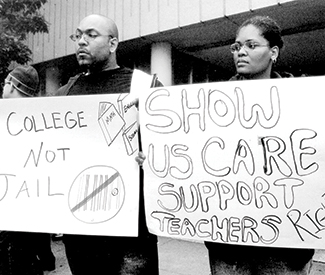
Historic new protections are now in place for children facing police action in the San Francisco Unified School District.

Reforms include having a parent present when police question a child, tracking police presence in schools, and using a more lenient approach than simply dragging kids off to the police station or juvenile hall. All of these may be strengthened by a new memorandum of understanding (MOU) between the SFUSD and SFPD.

The MOU, passed by the Board of Education at its Feb. 25 meeting, places new restraints on police officers when they come into schools, with specific outlines for when schools should call police, board President Sandra Lee Fewer told the Guardian.

“It’s about changing student behavior, versus punishment,” she said. The agreement dovetails with the district’s new restorative practices initiative aimed to decrease reliance on suspensions to correct behavioral problems (see “Suspending judgment,” 12/3/13).

All sides say the MOU is strong, but one section was weakened shortly before it was voted on. In the final hour before the MOU was brought before the Board of Education, the police revised the language of the agreement.

One important word was changed in a section describing how police are to respond to student crime on school grounds: a “shall” became a “should.” Critics say that change transforms the contract from a legally binding agreement signed in goodwill to a mere suggestion of cooperation from the police.

“To a civilian, those are everyday words. To a police officer, they’re the difference between always and never,” Police Chief Greg Suhr told the Guardian.

At a Jan. 14 Board of Education meeting, members of Coleman Advocates for Children and Youth told the board that this contract was no mere suggestion: It is vital to the safety of children.

Kevine Boggess of Coleman Advocates worked on the agreement for over two years, explaining to the board why “shall” was so important: “We feel like this is something that’s necessary for this document to really stand true, to make sure students are treated with respect and not introduced to the criminal justice system.”

Boggess said cops need stringent rules. But to see why those rules are necessary, we need to revisit a dark day in San Francisco history, when police discretion turned a school brawl into a riot.


MELEE PROMPTS REFORMS

To those who remember, that day in 2002 is known as 10/11. Board of Education member Kim-Shree Maufus remembers that day well.

Maufus was sitting at work when her friend, a teacher, emailed her alarming news: Maufus’ daughter was in danger. She was a sophomore at Thurgood Marshall High School, and the entire school was under attack.

Barriers blockaded the streets around Thurgood Marshall and helicopters swarmed the skies. At least 100 armored officers stormed the school, weapons at the ready.

“They were beating them. When my daughter got on the phone, I couldn’t understand her. It wasn’t English. Later, I understood it was a nervous breakdown,” Maufus told the Guardian.

The book Lockdown High recounted the incident in which Maufus’ daughter and dozens of other students, as well as teacher Anthony Peebles, were batoned by police and injured.

The San Francisco Bay View’s article on the incident quoted a student who saw the violence escalate: “‘We were coming out of the office as the fight was going on, and an officer took his gun out at one of the students and told him, ‘Don’t make me use this,’ said Ely Guolio, a student. ‘I was shocked.'”

The police allege they responded to a riot, and although four students and a teacher were arrested, all charges were later dropped, according to a San Francisco Chronicle report from 2003.

In the incident’s wake, Coleman Advocates and other groups called for change. Proposition H was passed by San Francisco voters in 2003, reforming the Police Commission to provide better civilian oversight of the SFPD.

But negotiations around an MOU between the police and the school district stalled for years. The tensions between the two bodies were high.

“Police would come to schools and arrest students, saying the students were re-igniting incidents from Thurgood Marshall,” Maufus told us. “The Thurgood Marshall melee was absolutely the catalyst to get the conversation started on how to structure police on school property.”

In 2005, an MOU was crafted, but many viewed it as ineffectual. Although this new agreement between the SFPD and SFUSD has many strong new rules, one rule was weakened that pertains to the violence of 10/11.

The section in question reads: “Subject to the exception described below, when SFPD officers make a school based arrest they should (emphasis ours) use the graduated response system outlined below.”

The graduated response system sets rules for police officers when they enter a school to make arrests for low-level offenses. It’s a “three strikes” rule: the first offense warrants admonishment or counseling, the second offense asks for the same or a diversionary program, and the third recommends a juvenile be placed in probation or a community counseling program.

“It’s definitely less binding,” Fewer told the Guardian. “But the police chief would not sign it with more binding language.”

Suhr said he doesn’t want his officers restricted in an emergency. “You can’t take all discretion away from a police officer, and expect that officer to assume liability (for the situation),” Suhr said.

Some said the SFPD of today is easier on students than 12 years ago. Juvenile arrests are down, with just over 600 felony juvenile arrests in 2012 compared to 1,100 in 2003, according to SFUSD data.


COOPERATIVE APPROACH

Implementing a restorative justice model and new standards for police in the schools isn’t just a matter for the SFPD, but for individual school administrators as well, with Fewer noting that the SFUSD sometimes calls the police for routine disciplinary matters.

The Guardian profiled one such student in “Suspending Judgment,” telling the story of a school official who called on the police to discipline a kindergartner throwing a tantrum. Suhr agreed, “You can’t have police officers enforcing school discipline.”

The MOU now seeks to address that problem in a section directing school administrators to only call the police for public safety concerns and crimes. And though the MOU is not as ironclad as advocates may have wished, there are still many wins for reformers.

One of the authors of the agreement, Public Counsel’s Statewide Education Rights Director Laura Faer, said the new mandate for data collection is one of the key sections of this MOU. Now, the SFPD will report how many times officers have entered school grounds to arrest students.

“There will be a regular dialogue with the community about arrests,” she said. “It’s extraordinary.”

The agreement also has mandates for training with the SFPD on school policies. And, as Fewer reminded the Guardian, this is a living document. All parties now have new promises to live up to.

“This is the beginning,” Faer said, “this is not the end.”

Dispatches from SXSW: Day 2 – Fader Fort, Future Islands, and Waiting in Lines

0

I’m pretty sure the Fader Fort is where I want to spend the rest of my youth and possibly my life. This makeshift village is probably as close to cool heaven as it gets. It’s got free music, free drinks, and people-watching galore. Did I mention it’s also got charging stations, free ice cream, and a first aid tent? You really could spend the rest of your youth and/or life here.

The Fader Fort is that illustrious castle on the hill of peak hipness. You can absorb the coolness into your skin via osmosis. For entrance into this Hearst Castle for the Snapchat crowd, you must either know somebody who knows somebody, have a pass (like I do), or get in line at the ungodly hour of no later than 12:30pm. Seriously, if you don’t get in line by at 1pm, you’re doomed to a fate of sunburns and sobriety. So get in line early, your brand depends on it.

As much I want to conduct an anthropological study on the impossibly hip 20-somethings lounging and fluttering all over the Fort, I have to force myself over to music stage.

fader fort

The first act is British crooner Sam Smith. He’s most known for his feature on Disclosure’s “Latch.” Without the Disclosure brothers at his side, Mr. Smith and his rad pompadour unleash an acoustic rendition of the dance hit, which the crowd and I found equally pleasing. As per SXSW custom, Smith busts out 20 minutes of work, packed up, and bounces to his next gig.

I go re-up on free pineapple juice and rum.

When I get back, Theophilus London is about to come on. I’ve been listening to this guy for a while and I still don’t get his deal. I feel like he’s been stuck on the come up for a while, which contradicts the very idea of being on the come up. He presents his mix of electro funk, pop, and hip-hop, all while wearing torn yellow pants, a yellow tank top, jean jacket, and that Pharrell/Arby’s hat. Towards the end of his set, he brings onstage a woman from the crowd and they do some sort of seductive dance that’s kind of novel and cool, but immediately takes a turn for the worse when London creepily starts grope-dancing with her. He almost sucks all the cool from the air, leaving everyone baffled and awkward. She goes back to the crowd and we all breathe a sigh of relief.

theo

Theophilus London
Pineapple juice and rum time.

Collaborators Shlomo and Jeremih are up next. Shlomo warms up the crowd with a DJ set of percolating electro rhythms. I begin to worry Jeremih might not show up, but he does. The two are collaborating for an upcoming album, but their performance makes me think they should establish this as a permanent arrangement. Jeremih’s suave and soothing nu-R’nB vocals hypnotizes the crowd into a state of mindfulness. But Jeremih knows what the crowd wants to hear, they want to hear “Birthday Sex,” and you do not deny what the good people at Fader Fort want. Jeremih plays “Birthday Sex” and the audience reacts in a way that it makes seem it like they enjoy “Birthday Sex” more than actual birthday sex.

Headlining the Fader Fort is electro-funk impresarios Chromeo, aka the self-proclaimed “most successful Jewish-Muslim collaboration ever.” Even though everyone in the concert tent is shoulder to shoulder and butt to butt, we all erupt in cathartic dance when Chromeo belt out “Night by Night.” There aren’t too many acts worthy of being a headliner at the Fader Fort, but Chromeo rises to the challenge and then some. They decimate the audience with 30 straight minutes of the old hits and some new tracks from their upcoming LP, White Women. Then the clock strikes midnight on the Fort and now we all have to face the daunting reality of not being in the Fort. But wait, Chromeo comes back for an encore! Encore finishes. OK, now the Fader Fort is done.

I grab a quick dinner and speed-walk over to Congress Ave, where the entire Heart Break Kids gang are playing, but unfortunately when I get there, there’s a 100-foot line, and from what I can tell, the entire club is packed to brim. Even badge people like myself aren’t being allowed in. I give up on HBK and speed-walk across town again to the Mad Decent Garage shows. Half an hour  later I arrive, and there’s a short but extremely slow-moving line. I give up and go meet up with friends at some rave tent with no line.

Turns out, there’s a real good reason there was no line. I’m subjected to blaring and soul-killing dubstep. The filthy and warbled bass jackhammers my very-being. Time to get out of there.

I wander around this part of town looking for my next show, while also being in awe of the massive herd of drunk revelers tripping flyers and empty drink cups.

I then happen upon Cheer Up Charlie’s to catch the end of indie-rockers Merchandise and then indie-poppers Future Islands. I didn’t catch enough of Merchandise to formulate an impression. At this point I’m just happy to be away from the dubstep. Future Islands come on and are the saviors I’ve been waiting for in this post-Fader Fort landscape.

future islands
Future Islands

Future Islands’ frontman Samuel T. Herring immediately grabs the crowd with a loud growl, jabbing dance moves, and pointed stares. Every band should have a Samuel T. Herring. His chaotic energy is more infectious than a breakout of pink-eye. He sneers, jumps up and down, and makes disfigured looks on his face for the entire set, and it makes for a surprisingly good complement to Future Islands’ bouncy and sunny pop. I honestly have never seen someone as turned up as this guy. I couldn’t think of a better way to end the day.

Music Listings: March 19-25, 2014

0

WEDNESDAY 19
ROCK
Bottom of the Hill: 1233 17th St., San Francisco. Yellow Ostrich, Pattern Is Movement, Paint the Trees White, 9pm, $12-$14.
Brick & Mortar Music Hall: 1710 Mission, San Francisco. Thumpers, Solwave, 9pm, $10.
The Chapel: 777 Valencia, San Francisco. Sam Roberts Band, Kris Orlowski, 9pm, $15-$18.
Hemlock Tavern: 1131 Polk, San Francisco. Hellbeard, Serial Hawk, Sludgebucket, 8:30pm, $7.
The Knockout: 3223 Mission, San Francisco. Terra Moans, The Krypters, My Name Is Joe, 9:30pm, $6.
Slim’s: 333 11th St., San Francisco. Me First & The Gimme Gimmes, La Plebe, The Joey Show, DJ Big Nate, 9pm, sold out.
Thee Parkside: 1600 17th St., San Francisco. Spirit Caravan, Pilgrim, Waxy, 8pm, $15.
DANCE
Beaux: 2344 Market, San Francisco. “BroMance: A Night Out for the Fellas,” 9pm, free.
The Cafe: 2369 Market, San Francisco. “Sticky Wednesdays,” w/ DJ Mark Andrus, 8pm, free.
Club X: 715 Harrison, San Francisco. “Electro Pop Rocks: EPR’s Spring Break,” 18+ dance night with Frank Nitty, D Menis, DJ Audio1, more, 9pm
DNA Lounge: 375 11th St., San Francisco. Go Chic, Blok, Violent Vickie, 9pm, $10-$12.
F8: 1192 Folsom, San Francisco. “Housepitality,” w/ Kenneth Scott, Max Gardner, Sean Murray, Tony Watson, 9pm, $5-$10.
Infusion Lounge: 124 Ellis, San Francisco. “Indulgence,” 10pm
Lookout: 3600 16th St., San Francisco. “What?,” w/ resident DJ Tisdale and guests, 7pm, free.
Madrone Art Bar: 500 Divisadero, San Francisco. “Rock the Spot,” 9pm, free.
Make-Out Room: 3225 22nd St., San Francisco. “Burn Down the Disco,” w/ DJs 2shy-shy & Melt w/U, Third Wednesday of every month, 9pm, free.
MatrixFillmore: 3138 Fillmore, San Francisco. “Reload,” w/ DJ Big Bad Bruce, 10pm, free.
Q Bar: 456 Castro, San Francisco. “Booty Call,” w/ Juanita More, Joshua J, guests, 9pm, $3.
Showdown: 10 Sixth St., San Francisco. “Nokturnal,” w/ DJs Coyle & Gonya, Third Wednesday of every month, 9pm, free.
HIP-HOP
Neck of the Woods: 406 Clement, San Francisco. “Over the Hump,” w/ Children of the Funk, 10pm, free.
Skylark Bar: 3089 16th St., San Francisco. “Mixtape Wednesday,” w/ resident DJs Strategy, Junot, Herb Digs, & guests, 9pm, $5.
ACOUSTIC
Cafe Divine: 1600 Stockton, San Francisco. Craig Ventresco & Meredith Axelrod, 7pm, free.
Hotel Utah: 500 Fourth St., San Francisco. Jeb Havens & Tawnee Kendall, Lee Aulson, 8pm, $10.
Plough & Stars: 116 Clement, San Francisco. Michael Mullen, 9pm
The Rite Spot Cafe: 2099 Folsom, San Francisco. Goh Nakamura, 9pm, free.
JAZZ
Balancoire: 2565 Mission, San Francisco. “Cat’s Corner,” 9pm, $10.
Burritt Room: 417 Stockton St., San Francisco. Terry Disley’s Rocking Jazz Trio, 6pm, free.
Cigar Bar & Grill: 850 Montgomery, San Francisco. Jack Mosbacher Duo, 8pm
Club Deluxe: 1511 Haight, San Francisco. Patrick Wolff Quartet, 9pm, free.
Le Colonial: 20 Cosmo, San Francisco. The Cosmo Alleycats featuring Ms. Emily Wade Adams, 7pm, free.
Sheba Piano Lounge: 1419 Fillmore, San Francisco. Fran Sholly, 8pm
Top of the Mark: One Nob Hill, 999 California, San Francisco. Ricardo Scales, Wednesdays, 6:30-11:30pm, $5.
Yoshi’s San Francisco: 1330 Fillmore, San Francisco. Four80East, Matt Marshak & Marcus Anderson, 8pm, $21.
Zingari: 501 Post, San Francisco. Chris Duggan, 7:30pm, free.
INTERNATIONAL
Bissap Baobab: 3372 19th St., San Francisco. “Baobab!,” timba dance party with DJ WaltDigz, 10pm, $5.
Cafe Cocomo: 650 Indiana, San Francisco. “Bachatalicious,” w/ DJs Good Sho & Rodney, 7pm, $5-$10.
The Independent: 628 Divisadero, San Francisco. Ana Tijoux, Kumbia Queers, Como Asesinar a Felipe, 9pm, $15.
Pachamama Restaurant: 1630 Powell, San Francisco. Cafe Latino Americano, 8pm, $12.
BLUES
Biscuits and Blues: 401 Mason, San Francisco. Tommy Odetto, 7:30 & 9:30pm, $15.
Pier 23 Cafe: Pier 23, San Francisco. Wendy DeWitt, 6pm, free.
The Saloon: 1232 Grant, San Francisco. Craig Horton, 9:30pm
SOUL
Monarch: 101 Sixth St., San Francisco. “Color Me Badd,” coloring books and R&B jams with Matt Haze, DJ Alarm, Broke-Ass Stuart, guests, Wednesdays, 5:30-9:30pm, free.
The Royal Cuckoo: 3202 Mission, San Francisco. Freddie Hughes & Chris Burns, 7:30pm, free.

THURSDAY 20
ROCK
Boom Boom Room: 1601 Fillmore, San Francisco. Lonesome Locomotive, Twin Engine, 9:30pm, $5-$7.
Bottom of the Hill: 1233 17th St., San Francisco. Skaters, Team Spirit, Panic Is Perfect, 9pm, $10-$12.
Brick & Mortar Music Hall: 1710 Mission, San Francisco. CAAMFest Directions in Sound: Korean Showcase, w/ Love X Stereo, Rock n Roll Radio, Glen Check, No Brain, Kero One (host), DJ Relic, 9pm, $20.
DNA Lounge: 375 11th St., San Francisco. Truckfighters, Crobot, The Devil in California, Blackwülf, 8:30pm, $10-$12.
Hemlock Tavern: 1131 Polk, San Francisco. Nubs, Atlantic Thrills, Scraper, 8:30pm, $7.
Hotel Utah: 500 Fourth St., San Francisco. The English Language, The Lolos, 9pm, $8.
The Knockout: 3223 Mission, San Francisco. Iron Chic, The Shell Corporation, Civil War Rust, 10pm, $8.
Milk Bar: 1840 Haight, San Francisco. Haight-Ashbury Street Fair Fundraiser: Battle of the Bands #1, w/ Kingsborough, Battery Powered Grandpa, High & Tight, Them Creatures, 9pm, $5.
Rickshaw Stop: 155 Fell, San Francisco. “Popscene,” w/ The Lonely Forest, Semi Precious Weapons, Breakdown Valentine, DJ Aaron Axelsen, 9:30pm, $10-$12.
S.F. Eagle: 398 12th St., San Francisco. The Whoa Nellies, Muñecas, Thith, 9pm, $5-$7.
Slim’s: 333 11th St., San Francisco. The Sword, Big Business, O’Brother, 8pm, $21.
The Stud: 399 Ninth St., San Francisco. Starbeast II, Grendel’s Claw, Kurly Something, 9pm, $5.
Thee Parkside: 1600 17th St., San Francisco. Disappearing People, Wreck & Reference, Hollow Sunshine, So Stressed, 9pm, $8.
DANCE
1015 Folsom: 1015 Folsom, San Francisco. Autojak’d Tour, w/ Autoérotique, Uberjak’d, Frank Nitty, Krishna Lee, DJ Audio1, 10pm, $10 advance.
Abbey Tavern: 4100 Geary, San Francisco. DJ Schrobi-Girl, 10pm, free.
Beaux: 2344 Market, San Francisco. “Men at Twerk,” 9pm, free.
The Cafe: 2369 Market, San Francisco. “¡Pan Dulce!,” 9pm, $5.
Cat Club: 1190 Folsom, San Francisco. “Class of 1984,” ’80s night with DJs Damon, Steve Washington, Dangerous Dan, and guests, 9pm, $6 (free before 9:30pm).
The Cellar: 685 Sutter, San Francisco. “XO,” w/ DJs Astro & Rose, 10pm, $5.
Club X: 715 Harrison, San Francisco. “The Crib,” 9:30pm, $10, 18+.
DNA Lounge: 375 11th St., San Francisco. Go Gold, Childhood cancer research benefit party with Lazy Rich, Paul Anthony, DJ Denise, Forest Green, Carlos Alfonzo, Ross.FM, John Beaver, Infected Frequencies, The Doctor, Arize, Adept, and more., 8pm, $15-$20.
Elbo Room: 647 Valencia, San Francisco. “Afrolicious,” w/ DJs Pleasuremaker, Señor Oz, and guests, 9:30pm, $5-$8.
F8: 1192 Folsom, San Francisco. “Beat Church,” w/ resident DJs Neptune & Kitty-D, Third Thursday of every month, 10pm, $10.
Harlot: 46 Minna, San Francisco. Bloody Mary & Jozif, 9pm, free.
The Independent: 628 Divisadero, San Francisco. Break Science, ChrisB., 9pm, $15-$17.
Infusion Lounge: 124 Ellis, San Francisco. “I Love Thursdays,” 10pm, $10.
Madrone Art Bar: 500 Divisadero, San Francisco. “Night Fever,” 9pm, $5 after 10pm
Mezzanine: 444 Jessie, San Francisco. “House of Mezzanine,” w/ Marc “MK” Kinchen, Matrixxman, Epicsauce DJs, 9pm, $10.
Monarch: 101 Sixth St., San Francisco. “Hey Young World,” w/ Soul Clap & Nick Monaco, 9:30pm, $15 advance.
Public Works: 161 Erie, San Francisco. “Deep Blue,” w/ Marco Carola, Rooz, Bo, 9pm, $15-$25.
Raven: 1151 Folsom, San Francisco. “1999,” w/ VJ Mark Andrus, 8pm, free.
Ruby Skye: 420 Mason, San Francisco. “Awakening,” w/ GTA, What So Not, 9pm, $25-$35 advance.
Underground SF: 424 Haight, San Francisco. “Bubble,” 10pm, free.
Vessel: 85 Campton, San Francisco. “Base,” w/ H.O.S.H., 10pm, $5-$10.
HIP-HOP
Eastside West: 3154 Fillmore, San Francisco. “Throwback Thursdays,” w/ DJ Madison, 9pm, free.
Showdown: 10 Sixth St., San Francisco. “Tougher Than Ice,” w/ DJs Vin Sol, Ruby Red I, and Jeremy Castillo, Third Thursday of every month, 10pm
ACOUSTIC
Amoeba Music: 1855 Haight, San Francisco. Chuck Ragan, 6pm, free.
Atlas Cafe: 3049 20th St., San Francisco. Bermuda Grass, 8pm, free.
Bazaar Cafe: 5927 California, San Francisco. Acoustic Open Mic, 7pm
The Chapel: 777 Valencia, San Francisco. Bear’s Den, 9pm, $12-$15.
Plough & Stars: 116 Clement, San Francisco. John Caufield, 9pm
The Rite Spot Cafe: 2099 Folsom, San Francisco. Devine’s Jug Band, 8pm, free.
JAZZ
Blush! Wine Bar: 476 Castro, San Francisco. Doug Martin’s Avatar Ensemble, 7:30pm, free.
Cafe Claude: 7 Claude, San Francisco. Nova Jazz, 7:30pm, free.
Jazz Bistro at Les Joulins: 44 Ellis, San Francisco. Eugene Pliner Quartet with Tod Dickow, First and Third Thursday of every month, 7:30pm, free.
Le Colonial: 20 Cosmo, San Francisco. Steve Lucky & The Rhumba Bums, 7:30pm
The Lucky Horseshoe: 453 Cortland, San Francisco. Ralph Carney’s Serious Jass Project, 9pm
Pier 23 Cafe: Pier 23, San Francisco. Citizen’s Jazz, 7pm, free.
The Royal Cuckoo: 3202 Mission, San Francisco. Charlie Siebert & Chris Siebert, 7:30pm, free.
Savanna Jazz Club: 2937 Mission, San Francisco. Savanna Jazz Jam with David Byrd, 7pm, $5.
Top of the Mark: One Nob Hill, 999 California, San Francisco. Stompy Jones, 7:30pm, $10.
Yoshi’s San Francisco: 1330 Fillmore, San Francisco. NaJe, in Yoshi’s lounge, 6:30pm, free.
Zingari: 501 Post, San Francisco. Barbara Ochoa, 7:30pm
INTERNATIONAL
Bissap Baobab: 3372 19th St., San Francisco. “Pa’Lante!,” w/ Juan G, El Kool Kyle, Mr. Lucky, 10pm, $5.
Cafe Cocomo: 650 Indiana, San Francisco. VibraSÓN, El DJ X, 8pm, $12.
Cigar Bar & Grill: 850 Montgomery, San Francisco. Carlitos Medrano Quartet, 8pm
Pachamama Restaurant: 1630 Powell, San Francisco. “Jueves Flamencos,” 8pm, free.
Sheba Piano Lounge: 1419 Fillmore, San Francisco. Gary Flores & Descarga Caliente, 8pm
Verdi Club: 2424 Mariposa, San Francisco. The Verdi Club Milonga, w/ Christy Coté, DJ Emilio Flores, guests, 9pm, $10-$15.
Yoshi’s San Francisco: 1330 Fillmore, San Francisco. Dudu Tassa & The Kuwaitis with Yair Dalal, 8pm, $30-$32.
REGGAE
Pissed Off Pete’s: 4528 Mission St., San Francisco. Reggae Thursdays, w/ resident DJ Jah Yzer, 9pm, free.
BLUES
50 Mason Social House: 50 Mason, San Francisco. Bill Phillippe, 5:30pm, free.
Biscuits and Blues: 401 Mason, San Francisco. Bill Magee, 7:30 & 9:30pm, $20.
The Saloon: 1232 Grant, San Francisco. Chris Ford, Third Thursday of every month, 4pm; Cathy Lemons, 9:30pm
COUNTRY
The Parlor: 2801 Leavenworth, San Francisco. “Twang Honky Tonk & Country Jamboree,” w/ DJ Little Red Rodeo, 7pm, free.
EXPERIMENTAL
The Luggage Store: 1007 Market, San Francisco. Gosling, Gestaltish, 8pm, $6-$10.
SOUL
Amnesia: 853 Valencia, San Francisco. Baby & The Luvies, The Ironsides with Gene Washington, 8pm, $7-$10.
Make-Out Room: 3225 22nd St., San Francisco. “Soul: It’s the Real Thing,” w/ The Selecter DJ Kirk & Jon Blunck, Third Thursday of every month, 10pm, free.

FRIDAY 21
ROCK
50 Mason Social House: 50 Mason, San Francisco. Spidermeow, Shot in the Dark, Gnarboots, Be Brave Bold Robot, The Bottle Kids, 8pm
Bottom of the Hill: 1233 17th St., San Francisco. Guy Fox, Big Tree, The Districts, Young Moon, 8:30pm, $10-$12.
Brick & Mortar Music Hall: 1710 Mission, San Francisco. The Family Crest, Milagres, 9pm, $12-$14.
The Chapel: 777 Valencia, San Francisco. Bart Davenport, Danny James, Anna Hillburg, DJ Robert Spector, 9pm, $12-$15.
El Rio: 3158 Mission, San Francisco. Friday Live: The Ghost Ease, DJ Emotions, 10pm, free.
Elbo Room: 647 Valencia, San Francisco. The Asteroid No. 4, Joel Gion & The Primary Colors, Daydream Machine, DJ Jodie Artichoke, 9:30pm, $5-$8.
Hemlock Tavern: 1131 Polk, San Francisco. Rykarda Parasol, The Tunnel, So What?, 9pm, $8.
Hotel Utah: 500 Fourth St., San Francisco. JoyCut, Running in the Fog, Feral Fauna, 9pm, $10.
Milk Bar: 1840 Haight, San Francisco. The Belle Game, Ski Lodge, Lords of Sealand, 9pm, $8-$10.
Neck of the Woods: 406 Clement, San Francisco. Heavenly Beat, Seatraffic, Survival Guide, on the upstairs stage, 9pm, $10-$12.
Rickshaw Stop: 155 Fell, San Francisco. Perfect Pussy, Wild Moth, Happy Diving, 9pm, $10-$12.
The Riptide: 3639 Taraval, San Francisco. The Ray City Rollers, Powder, 8pm, free.
Slim’s: 333 11th St., San Francisco. Lacuna Coil, Kyng, Eve to Adam, Nothing More, 8pm, $21.
Sub-Mission Art Space (Balazo 18 Gallery): 2183 Mission, San Francisco. Safe & Sound, Singled Out, Eternal Sleep, Stay Scared, Dust Off, 7:30pm, $8.
Thee Parkside: 1600 17th St., San Francisco. Shake Before Us, The Arabs, Greg Hoy & The End, 9pm, $7.
DANCE
1015 Folsom: 1015 Folsom, San Francisco. “Witness 5.0,” w/ Juan Atkins, Kastle, Le Youth, Djemba Djemba, Sweater Beats, Touch Sensitive, Krampfhaft, Kit Clayton, J-Boogie, Mikos Da Gawd, MPHD, Chris Clouse, more, 10pm, $15-$25 advance.
Audio Discotech: 316 11th St., San Francisco. Uner, Shonky, Glade Luco, Marija Dunn, 9pm, $10 advance.
BeatBox: 314 11th St., San Francisco. “U-Haul: Bromance Edition,” w/ DJs China G & Ms. Jackson, 10pm, $5-$10.
Beaux: 2344 Market, San Francisco. “Manimal,” 9pm
Cat Club: 1190 Folsom, San Francisco. “Dancing Ghosts: 7-Year Anniversary,” w/ DJs Xander, Daniel Skellington, Melting Girl, and Owen, 9:30pm, $7 ($3 before 10pm).
DNA Lounge: 375 11th St., San Francisco. “Band Saga,” w/ Metroid Metal, Rekcahdam, Anova, Kozilek, 8pm, $8-$13.
The EndUp: 401 Sixth St., San Francisco. “Trade,” 10pm, free before midnight.
Infusion Lounge: 124 Ellis, San Francisco. “Flight Fridays,” 10pm, $20.
Lookout: 3600 16th St., San Francisco. “HYSL: Handle Your Shit Lady,” 9pm, $3.
Mercer: 255 Rhode Island, San Francisco. “SoulHouse,” w/ Jeremiah Seraphim, Didje Kelli, Jaime James, Dylan Mahoney, 9pm, $10-$15.
Mezzanine: 444 Jessie, San Francisco. “Lights Down Low,” w/ Tensnake, Huxley, Cooper Saver, Brian Tarney, Split, 9pm, $20-$22.
Mighty: 119 Utah, San Francisco. “Set,” w/ John Digweed, Atish, Matt Hubert, 10pm, $35-$40 advance.
Public Works: 161 Erie, San Francisco. Crossfire: Synaptic Equinox, Flaming Lotus Girls benefit with DJs Aaron Pope, Billy Seal, Brad Robinson, Cosmic Selector, Darren Grayson, Drew Drop, Dulce Vita, J-Rod, Kapt’n Kirk, Layne Loomis, Matt Kramer, and Shissla., 9:30pm, $15-$20 advance.
Q Bar: 456 Castro, San Francisco. “Pump: Worq It Out Fridays,” w/ resident DJ Christopher B, 9pm, $3.
Ruby Skye: 420 Mason, San Francisco. Syn Cole, Human Life, DJ Vice, 9pm, $20 advance.
Supperclub San Francisco: 657 Harrison, San Francisco. “The Midas Touch,” w/ Gavin Hardkiss, Michael Anthony, The Golden Gate Dolls, more, 7pm
Temple: 540 Howard, San Francisco. “Resonance,” w/ Alex M.O.R.P.H., Mitka, Jake DeSilva, more, 10pm, $20.
Underground SF: 424 Haight, San Francisco. “Studio 3AM,” w/ Michael Perry, Darrell Tenaglia, Soft & Crispy, 10pm, free.
Vessel: 85 Campton, San Francisco. Kryder, 10pm
HIP-HOP
John Colins: 138 Minna, San Francisco. “Juicy,” w/ DJ Mark DiVita, 10pm
Showdown: 10 Sixth St., San Francisco. “Fresh to Def Fridays: A Tribute to Yo! MTV Raps,” w/ resident DJs Boom Bostic, Inkfat, and Hay Hay, Third Friday of every month, 10pm
ACOUSTIC
Bazaar Cafe: 5927 California, San Francisco. Emily Zisman & Marty Atkinson, 7pm
Dolores Park Cafe: 501 Dolores, San Francisco. Storm Florez, 7:30pm
Pa’ina: 1865 Post, San Francisco. Ben Ahn, 7pm, free.
Plough & Stars: 116 Clement, San Francisco. “Bluegrass Bonanza,” w/ The Bearcat Stringband, 9pm, $6-$10.
JAZZ
Atlas Cafe: 3049 20th St., San Francisco. Jazz at the Atlas, 7:30pm, free.
Cafe Royale: 800 Post, San Francisco. Cyril Guiraud Trio, 9pm
The Palace Hotel: 2 New Montgomery, San Francisco. The Klipptones, 8pm, free.
Savanna Jazz Club: 2937 Mission, San Francisco. Bill Kwan, 7:30pm, $8.
Sheba Piano Lounge: 1419 Fillmore, San Francisco. Steve Snelling Quartet, 9pm
INTERNATIONAL
Asiento: 2730 21st St., San Francisco. “Kulcha Latino,” w/ resident selectors Stepwise, Ras Rican, and El Kool Kyle, Third Friday of every month, 9pm, free.
Cafe Claude: 7 Claude, San Francisco. Trio Garufa, 7:30pm, free.
Cigar Bar & Grill: 850 Montgomery, San Francisco. Montuno Swing, 10pm
The Emerald Tablet: 80 Fresno, San Francisco. Flamenco del Oro, 8pm, $15 suggested donation.
Pachamama Restaurant: 1630 Powell, San Francisco. Cuban Night with Fito Reinoso, 7:30 & 9:15pm, $15-$18.
Pier 23 Cafe: Pier 23, San Francisco. Danilo y Universal, 8pm, free.
Slate Bar: 2925 16th St., San Francisco. “Chevere: 4-Year Anniversary,” w/ DJs WaltDigz, Epic, and Leydis, 9:30pm
REGGAE
Gestalt Haus: 3159 16th St., San Francisco. “Music Like Dirt,” 7:30pm, free.
The Independent: 628 Divisadero, San Francisco. The Wailers, 9pm, sold out.
BLUES
Biscuits and Blues: 401 Mason, San Francisco. Chris Cain, 7:30 & 10pm, $22.
Lou’s Fish Shack: 300 Jefferson, San Francisco. Robert “Hollywood” Jenkins, 6pm
The Royal Cuckoo: 3202 Mission, San Francisco. Big Bones & Chris Siebert, 7:30pm, free.
The Saloon: 1232 Grant, San Francisco. West Coast Blues Revue, 4pm; Chris Cobb, 9:30pm
FUNK
Yoshi’s San Francisco: 1330 Fillmore, San Francisco. Sinbad with Memphis Red & The Stank Nasty Band, 8 & 10pm, $35.
SOUL
Boom Boom Room: 1601 Fillmore, San Francisco. The Nibblers, The Mark Sexton Band, DJ K-Os, 9:30pm, $10-$15.

SATURDAY 22
ROCK
Amnesia: 853 Valencia, San Francisco. “Rajeev’s Big Night Out,” w/ We Will Be Lions, The Cuss, Rafa’s One Man Band, plus stand-up comedy, 9pm, $7-$10.
Bender’s: 806 S. Van Ness, San Francisco. Lecherous Gaze, Dirty Fences, Buffalo Tooth, 10pm, $5.
Bottom of the Hill: 1233 17th St., San Francisco. DonCat, Split Screens, Scary Little Friends, 9:30pm, $10.
Brick & Mortar Music Hall: 1710 Mission, San Francisco. Wakey!Wakey!, Jillette Johnson, 9pm, $12.
The Chapel: 777 Valencia, San Francisco. Lost in the Trees, Icy Demons, 9pm, $12-$15.
Connecticut Yankee: 100 Connecticut, San Francisco. The Wearies, The Sweet Bones, Modern Kicks, 10pm
El Rio: 3158 Mission, San Francisco. White Cloud, Talk of Shamans, DJ Awnode, 9pm, $2-$5.
Hemlock Tavern: 1131 Polk, San Francisco. Kids on a Crime Spree, Yea-Ming & The Rumours, Eternal Drag, 9pm, $6.
Hotel Utah: 500 Fourth St., San Francisco. Abatis, The Straight Ups, Alabasta Jack, 9pm, $8.
The Knockout: 3223 Mission, San Francisco. Fracas, VKTMS, RocketShip RocketShip, Kick Puppy, 4pm, $6.
Milk Bar: 1840 Haight, San Francisco. Keystone Revisited, Pam, Just Passing Through, 9pm, $10.
Rickshaw Stop: 155 Fell, San Francisco. Weekend, Cities Aviv, Surf Club, 9pm, $12-$14.
Slim’s: 333 11th St., San Francisco. INVSN, Wax Idols, 9pm, $13-$15.
Thee Parkside: 1600 17th St., San Francisco. Great Apes, Hard Girls, Canadian Rifle, Acid Fast, 9pm, $7.
DANCE
Audio Discotech: 316 11th St., San Francisco. Goldfish, 9pm, $20-$25.
BeatBox: 314 11th St., San Francisco. “Chaos,” w/ DJs Dan DeLeon & Erik Withakay, 9pm, $10-$20.
DNA Lounge: 375 11th St., San Francisco. “Bootie S.F.,” w/ Pepperspray, A+D, Haute Mess, Marky Ray, Keith Kraft, Lucio K, more, 9pm, $10-$15.
The EndUp: 401 Sixth St., San Francisco. Shangri-La, Asian queer dance party., Fourth Saturday of every month, 10pm, $15-$20 (free before 11pm).
Harlot: 46 Minna, San Francisco. “Set,” w/ Hernan Cattaneo, Pedro Arbulu, Franccesco Cardenas, Zita Molnar, 9pm, $15-$25.
Infusion Lounge: 124 Ellis, San Francisco. “Set,” Fourth Saturday of every month, 10pm, $20.
The Knockout: 3223 Mission, San Francisco. “Galaxy Radio,” w/ PlaZa, Roche, Smac, Lel Ephant, Holly Bun, 10pm, free.
Lookout: 3600 16th St., San Francisco. “Bounce!,” 9pm, $3.
Madrone Art Bar: 500 Divisadero, San Francisco. “Blunted Funk,” w/ resident DJs Sneak-E Pete & Chilipino, Fourth Saturday of every other month, 9pm, $5 (free before 10pm).
Mighty: 119 Utah, San Francisco. Nightmares on Wax, Bläp Dëli, Mophono, 9pm, $15 advance.
Monarch: 101 Sixth St., San Francisco. Jimmy Edgar, Danny Daze, Papa Lu, 9:30pm, $25-$30.
Public Works: 161 Erie, San Francisco. “Dance Mania,” w/ Paul Johnson, Jammin Gerald, Parris Mitchell, more (in the main room), 9pm, $15 advance; “Mister Saturday Night,” w/ Eamon Harkin, Justin Carter, more (in the OddJob Loft), 9pm, $15 advance.
Ruby Skye: 420 Mason, San Francisco. Fedde Le Grand, Cazzette, Moguai, DJ Zya, 9pm, $50+ advance.
S.F. Eagle: 398 12th St., San Francisco. “Sadistic Saturday,” w/ Mystic Ray, 9pm
Slate Bar: 2925 16th St., San Francisco. “Electric WKND,” w/ The Certain People Crew, Fourth Saturday of every month, 10pm, $5.
The Stud: 399 Ninth St., San Francisco. “Planet Squrrrl,” w/ DJs Trevor Sigler, Joe Pickett, and Ben Holder, 9pm, $5.
Temple: 540 Howard, San Francisco. “Life,” w/ Feldy, Animal Control, Christophe, Jeff Morena, Glade Luco, more, 10pm, $20.
Vessel: 85 Campton, San Francisco. Scooter & Lavelle, 10pm, $10-$30.
W San Francisco: 181 Third St., San Francisco. “Spring: Celebrating the Persian New Year,” w/ DJ Aykut, Dr. T, Nitro, 9pm, $10-$25.
HIP-HOP
111 Minna Gallery: 111 Minna, San Francisco. CAAMFest Directions in Sound: Here Comes Treble, w/ Suboi, Rocky Rivera, Cynthia Lin & The Blue Moon All-Stars, DJ Umami, DJ ThatGirl, DJ Roza, 9:30pm, $20.
John Colins: 138 Minna, San Francisco. “Nice,” w/ DJ Apollo, Fourth Saturday of every month, 10pm, $5.
Showdown: 10 Sixth St., San Francisco. BYOB Live Beat Battle, w/ Ghettosocks & Timbuktu, 9pm, $7-$10.
ACOUSTIC
Bazaar Cafe: 5927 California, San Francisco. “Sing Out of Darkness: The Return of the Bird,” American Foundation for Suicide Prevention benefit with Julie Mayhew and many musical guests, 10am-10pm
Make-Out Room: 3225 22nd St., San Francisco. Chris Mills & The Distant Stars, Chris von Sneidern, 7:30pm, $8.
Plough & Stars: 116 Clement, San Francisco. Savannah Blu, 9pm
The Riptide: 3639 Taraval, San Francisco. The Lady Crooners, 9:30pm, free.
Steven Wolf Fine Arts: 2747 19th St., San Francisco. A Record Is a Record: Bill Orcutt, 6pm, free.
JAZZ
Cafe Claude: 7 Claude, San Francisco. Terrence Brewer Trio, 7:30pm, free.
Peacock Lounge: 552 Haight, San Francisco. Leon Joyce Jr., 6pm, $15.
The Royal Cuckoo: 3202 Mission, San Francisco. Steve Lucky & Carmen Getit, 7:30pm, free.
Savanna Jazz Club: 2937 Mission, San Francisco. David Byrd Ensemble, 7:30pm, $8.
Sheba Piano Lounge: 1419 Fillmore, San Francisco. The Robert Stewart Experience, 9pm
Yoshi’s San Francisco: 1330 Fillmore, San Francisco. Kurt Elling, 8 & 10pm, $24-$28.
Zingari: 501 Post, San Francisco. Anya Malkiel, 8pm, free.
INTERNATIONAL
1015 Folsom: 1015 Folsom, San Francisco. “Pura,” 9pm, $20.
Cafe Cocomo: 650 Indiana, San Francisco. Pacific Mambo Orchestra, 8pm, $15.
Cigar Bar & Grill: 850 Montgomery, San Francisco. Latin Rhythm Boys, 10pm
El Rio: 3158 Mission, San Francisco. “Mango,” Fourth Saturday of every month, 3pm, $8-$10.
OMG: 43 Sixth St., San Francisco. “Bollywood Blast,” Fourth Saturday of every month, 9pm, $5 (free before 10pm).
Roccapulco Supper Club: 3140 Mission, San Francisco. Hector Acosta, 8pm, $55.
Space 550: 550 Barneveld, San Francisco. “Club Fuego,” 9:30pm
St. Gregory’s Church: 500 De Haro, San Francisco. Veretski Pass, 8pm, $30.
REGGAE
The Independent: 628 Divisadero, San Francisco. The Wailers, 9pm, sold out.
Neck of the Woods: 406 Clement, San Francisco. One Drop, Midnight Raid, Saane, on the upstairs stage, 9pm, $10-$12.
BLUES
Biscuits and Blues: 401 Mason, San Francisco. Delta Wires, 7:30 & 10pm, $22.
Lou’s Fish Shack: 300 Jefferson, San Francisco. Willie G, 6pm
The Saloon: 1232 Grant, San Francisco. Dave Workman, Fourth Saturday of every month, 4pm; Ron Hacker, 9:30pm
EXPERIMENTAL
Noisebridge: 2169 Mission, San Francisco. Godwaffle Noise Pancakes, noon.
FUNK
Mezzanine: 444 Jessie, San Francisco. Rebirth Brass Band, The Loyd Family Players, 9pm, $25.
Pa’ina: 1865 Post, San Francisco. Chocolate Rice, 7pm, free.
SOUL
Boom Boom Room: 1601 Fillmore, San Francisco. Wicked Mercies, DJ K-Os, 9:30pm, $10 advance.

SUNDAY 23
ROCK
Brick & Mortar Music Hall: 1710 Mission, San Francisco. Future Twin, Daydream Machine, DJ Joel Gion, 8pm, $7-$10.
The Chapel: 777 Valencia, San Francisco. Death, Audacity, 8pm, $22-$25.
DNA Lounge: 375 11th St., San Francisco. Broken Hope, Oceano, Fallujah, Rivers of Nihil, Kublai Khan, 6pm, $13-$15.
El Rio: 3158 Mission, San Francisco. The Desert Line, The Night Falls, Phosphene, 8pm, $8.
Hemlock Tavern: 1131 Polk, San Francisco. Religious Phase, Cloud Becomes Your Hand, Jordan Glenn, 8:30pm, $6.
Hotel Utah: 500 Fourth St., San Francisco. Andy Suzuki & The Method, The Weather Machine, 8pm, $10.
The Independent: 628 Divisadero, San Francisco. Toadies, Supersuckers, Battleme, 8pm, $22.
Slim’s: 333 11th St., San Francisco. The Orwells, Twin Peaks, Criminal Hygiene, 8pm, $14-$16.
DANCE
Audio Discotech: 316 11th St., San Francisco. “London Calling: Chapter 3,” w/ D’Julz, Ben Annand, Bells & Whistles, Nikita, more, noon, $10 advance.
Beaux: 2344 Market, San Francisco. “Full of Grace: A Weekly House Music Playground,” 9pm, free.
The Chapel: 777 Valencia, San Francisco. “Sunday Mass,” 9pm
The Edge: 4149 18th St., San Francisco. “’80s at 8,” w/ DJ MC2, 8pm
Elbo Room: 647 Valencia, San Francisco. “Dub Mission,” w/ Jahdan Blakkamoore, Relic Secure, Deejay Theory, DJ Sep, 9pm, $11-$14.
F8: 1192 Folsom, San Francisco. “Stamina,” w/ Lukeino, Jamal, guests, 10pm, free.
MatrixFillmore: 3138 Fillmore, San Francisco. “Bounce,” w/ DJ Just, 10pm
Otis: 25 Maiden, San Francisco. “What’s the Werd?,” w/ resident DJs Nick Williams, Kevin Knapp, Maxwell Dub, and guests, 9pm, $5 (free before 11pm).
The Parlor: 2801 Leavenworth, San Francisco. “Sunday Sessions,” w/ DJ Marc deVasconcelos, 9pm, free.
Q Bar: 456 Castro, San Francisco. “Gigante,” 8pm, free.
S.F. Eagle: 398 12th St., San Francisco. “1982,” w/ DJs Ben Holder & Chaka Quan, 7pm, $5.
The Stud: 399 Ninth St., San Francisco. “Cognitive Dissonance,” Fourth Sunday of every month, 6pm
Temple: 540 Howard, San Francisco. “Sunset Arcade,” 18+ dance party & game night, 9pm, $10.
Wish: 1539 Folsom, San Francisco. “Electric B.A.S.E.,” w/ Beau Kelly, Anya Timofeeva, Remy J, 7pm, free.
HIP-HOP
Boom Boom Room: 1601 Fillmore, San Francisco. “Return of the Cypher,” 9:30pm, free.
Bottom of the Hill: 1233 17th St., San Francisco. K.Flay, Air Dubai, Itch, 9pm, $12-$14.
Mezzanine: 444 Jessie, San Francisco. Bun B & Kirko Bangz, 8pm, $22.
Thee Parkside: 1600 17th St., San Francisco. Astronautalis, Playdough, Transit, Low Country Kingdom, 8pm, $14.
ACOUSTIC
The Lucky Horseshoe: 453 Cortland, San Francisco. Bernal Mountain Bluegrass Jam, 4pm, free.
Plough & Stars: 116 Clement, San Francisco. Seisiún with Marla Fibish, Erin Shrader, and Richard Mandel, 9pm
JAZZ
Revolution Cafe: 3248 22nd St., San Francisco. Jazz Revolution, 4pm, free/donation.
The Royal Cuckoo: 3202 Mission, San Francisco. Lavay Smith & Chris Siebert, 7:30pm, free.
Yoshi’s San Francisco: 1330 Fillmore, San Francisco. Kurt Elling, 7 & 9pm, $24.
Zingari: 501 Post, San Francisco. Hubert Emerson, 7:30pm, free.
INTERNATIONAL
Amnesia: 853 Valencia, San Francisco. Sol Tevél, 8pm
Bissap Baobab: 3372 19th St., San Francisco. “Brazil & Beyond,” 6:30pm, free.
Cana Cuban Parlor: 500 Florida St., San Francisco. “La Havana,” w/ resident DJs Mind Motion, WaltDigz, and I-Cue, Sundays, 4-9pm
El Rio: 3158 Mission, San Francisco. Salsa Sundays, Second and Fourth Sunday of every month, 3pm, $8-$10.
BLUES
Lou’s Fish Shack: 300 Jefferson, San Francisco. Sam Johnson, 4pm
The Saloon: 1232 Grant, San Francisco. Blues Power, 4pm; The Door Slammers, Fourth Sunday of every month, 9:30pm
Sheba Piano Lounge: 1419 Fillmore, San Francisco. Bohemian Knuckleboogie, 8pm

MONDAY 24
ROCK
The Independent: 628 Divisadero, San Francisco. Japan Nite 2014: Happy, Zarigani$, Vampilla, Jungles from Red Bacteria Vacuum, 8pm, $15.
The Knockout: 3223 Mission, San Francisco. Guantanamo Baywatch, Courtney & The Crushers, 10pm, $5.
DANCE
DNA Lounge: 375 11th St., San Francisco. “DGXXI: Death Guild 21st Anniversary,” w/ DJ Decay, Melting Girl, Joe Radio, Sage, Lexor, Intoner, Identity Theft, Veil, RPTN, Daniel Skellington, 9pm, $5-$21.
Q Bar: 456 Castro, San Francisco. “Wanted,” w/ DJs Key&Kite and Richie Panic, 9pm, free.
Underground SF: 424 Haight, San Francisco. “Vienetta Discotheque,” w/ DJs Stanley Frank and Robert Jeffrey, 10pm, free.
ACOUSTIC
Brick & Mortar Music Hall: 1710 Mission, San Francisco. Jeremy Messersmith, The Parmesans, 9pm, $10-$12.
Fiddler’s Green: 1333 Columbus, San Francisco. Terry Savastano, 9:30pm, free/donation.
Hotel Utah: 500 Fourth St., San Francisco. Open Mic with Brendan Getzell, 8pm, free.
Osteria: 3277 Sacramento, San Francisco. “Acoustic Bistro,” 7pm, free.
The Saloon: 1232 Grant, San Francisco. Peter Lindman, 4pm
JAZZ
Jazz Bistro at Les Joulins: 44 Ellis, San Francisco. Eugene Pliner Quartet with Tod Dickow, 7:30pm, free.
Le Colonial: 20 Cosmo, San Francisco. Le Jazz Hot, 7pm, free.
Sheba Piano Lounge: 1419 Fillmore, San Francisco. City Jazz Instrumental Jam Session, 8pm
Zingari: 501 Post, San Francisco. Nora Maki, 7:30pm, free.
REGGAE
Bissap Baobab: 3372 19th St., San Francisco. “Raggada,” 9pm, $5.
Skylark Bar: 3089 16th St., San Francisco. “Skylarking,” w/ I&I Vibration, 10pm, free.
BLUES
The Saloon: 1232 Grant, San Francisco. The Bachelors, 9:30pm
SOUL
Madrone Art Bar: 500 Divisadero, San Francisco. “M.O.M. (Motown on Mondays),” w/ DJ Gordo Cabeza & Timoteo Gigante, 8pm, free.

TUESDAY 25
ROCK
Amnesia: 853 Valencia, San Francisco. Cellar Doors, Cool Ghouls, 9:15pm continues through, $7-$10.
Bottom of the Hill: 1233 17th St., San Francisco. Sea Knight, Babes, Wag, 9pm, $8.
Brick & Mortar Music Hall: 1710 Mission, San Francisco. High Cliffs, The Wave Commission, Yours, 8pm, $5-$8.
The Chapel: 777 Valencia, San Francisco. Daniel Rossen, 9pm, $20-$22.
El Rio: 3158 Mission, San Francisco. Hungry Skinny, Saturn Cats, The Impersonations, 7pm, $6.
The Knockout: 3223 Mission, San Francisco. Musk, Freak Vibe, Burning Curtains, DJ Tosh, 9:30pm, $6.
Rickshaw Stop: 155 Fell, San Francisco. Small Black, Snowmine, Yalls, 8pm, $12-$14.
DANCE
1015 Folsom: 1015 Folsom, San Francisco. Annie Mac, Skream, Jacques Greene, 10pm, $12-$15 advance.
Aunt Charlie’s Lounge: 133 Turk, San Francisco. “High Fantasy,” w/ DJ Viv, Myles Cooper, & guests, 10pm, $2.
Monarch: 101 Sixth St., San Francisco. “Soundpieces,” 10pm, free-$10.
Q Bar: 456 Castro, San Francisco. “Switch,” w/ DJs Jenna Riot & Andre, 9pm, $3.
Underground SF: 424 Haight, San Francisco. “Shelter,” 10pm, free.
Wish: 1539 Folsom, San Francisco. “Tight,” w/ resident DJs Michael May & Lito, 8pm, free.
HIP-HOP
Boom Boom Room: 1601 Fillmore, San Francisco. Vokab Kompany, Tropo, 9:30pm, $7 advance.
Double Dutch: 3192 16th St., San Francisco. “Takin’ It Back Tuesdays,” w/ DJs Mr. Murdock & Roman Nunez, Fourth Tuesday of every month, 10pm, free.
ACOUSTIC
Bazaar Cafe: 5927 California, San Francisco. Songwriter in Residence: Lonnie Lazar, 7pm continues through.
Plough & Stars: 116 Clement, San Francisco. Song session with Cormac Gannon, Last Tuesday of every month, 9pm
The Rite Spot Cafe: 2099 Folsom, San Francisco. Toshio Hirano, 8pm, free.
JAZZ
Beach Chalet Brewery & Restaurant: 1000 Great Highway, San Francisco. Gerry Grosz Jazz Jam, 7pm
Blush! Wine Bar: 476 Castro, San Francisco. Kally Price & Rob Reich, 7pm, free.
Burritt Room: 417 Stockton St., San Francisco. Terry Disley’s Rocking Jazz Trio, 6pm, free.
Cafe Divine: 1600 Stockton, San Francisco. Chris Amberger, 7pm
Jazz Bistro at Les Joulins: 44 Ellis, San Francisco. Clifford Lamb, Mel Butts, and Friends, 7:30pm, free.
Le Colonial: 20 Cosmo, San Francisco. Lavay Smith & Her Red Hot Skillet Lickers, 7pm
Revolution Cafe: 3248 22nd St., San Francisco. West Side Jazz Club, 5pm, free.
Sheba Piano Lounge: 1419 Fillmore, San Francisco. Michael Parsons, 8pm
Tupelo: 1337 Green, San Francisco. Mal Sharpe’s Big Money in Jazz Band, 6pm
Verdi Club: 2424 Mariposa, San Francisco. “Tuesday Night Jump,” w/ Stompy Jones, 9pm, $10-$12.
Wine Kitchen: 507 Divisadero St., San Francisco. Hot Club Pacific, 7:30pm
Yoshi’s San Francisco: 1330 Fillmore, San Francisco. Roberta Gambarini, 8pm, $24-$29.
Zingari: 501 Post, San Francisco. Brenda Reed, 7:30pm, free.
INTERNATIONAL
Cafe Cocomo: 650 Indiana, San Francisco. Salsa Tuesday, w/ DJs Good Sho & El de la Clave, 8:30pm, $10.
The Cosmo Bar & Lounge: 440 Broadway, San Francisco. Conga Tuesdays, 8pm, $7-$10.
F8: 1192 Folsom, San Francisco. “Underground Nomads,” w/ rotating resident DJs Amar, Sep, and Dulce Vita, plus guests, 9pm, $5 (free before 9:30pm).
REGGAE
Milk Bar: 1840 Haight, San Francisco. “Bless Up,” w/ Jah Warrior Shelter Hi-Fi, 10pm
BLUES
Biscuits and Blues: 401 Mason, San Francisco. Two-Tone Steiny & The Cadillacs, 7:30 & 9:30pm, $15.
The Saloon: 1232 Grant, San Francisco. Powell Street Blues Band, 9:30pm
EXPERIMENTAL
Center for New Music: 55 Taylor, San Francisco. sfSoundSalonSeries, w/ Benjamin Kreith & Travis Andrews Duo, Matt Ingalls, 7:49pm, $10-$15.
SOUL
Make-Out Room: 3225 22nd St., San Francisco. “Lost & Found,” w/ DJs Primo, Lucky, and guests, 9:30pm, free. 2


This Week’s Picks: March 12 -18, 2014

0

WEDNESDAY 12

Freddie Rainbow Presents “Gender Night”

It’s no secret that comedy is a male-dominated business. For years, there’s been this stereotype that women aren’t funny. Honestly, how often do you see a comedy with a female lead? While movies like Bridesmaids and Ghost World are few and far between, over the past couple of years, women in entertainment have been speaking out against this double standard. “Gender Night” is the most recent development. Comedian and ardent supporter of gender equality Freddie Rainbow presents an encore presentation of comedy from California’s finest comediennes. Expect jokes about shopping and love as well as fart jokes. Girls fart too, get over it. “The only reason to miss this show is if you hate women,” says the comedy club website. “Please don’t hate women.” (Laura B. Childs)

8pm, $15

Punch Line Comedy Club

444 Battery, SF

(415) 397-7573

www.punchlinecomedyclub.com


THURSDAY 13

Shpongle

For more than 15 years, English DJ and producer Simon Posford and Australian flutist Raja Ram have collaborated to produce expansive, mind-bending, psychedelic music. Fans are still raving about how Shpongle rocked Oakland’s Fox Theatre just before Halloween 2011, when Posford and Ram played with a live band and an ensemble of colorful dancers. Posford, who takes to the decks for this show in support of the duo’s latest album Museum of Consciousness (Twisted Records), was a major contributor to the frenetic psy-trance scene that blossomed in Britain in the early ’90s. Those early musical influences shine through in the track “How the Jellyfish Jumped the Mountain,” an intricate, mid-tempo, 10-minute journey through filtered melodies, distorted vocal samples and catchy basslines. (Kevin Lee)

With Desert Dwellers, Vokab Kompany

8 pm, $27.50 presale, $30 at the door

The Regency Ballroom

1300 Van Ness, SF

(415) 673-5716

http://www.theregencyballroom.com


IDEO’s David Kelley

IDEO founder David Kelley and his brother Tom Kelley believe that we are watered-down versions of what we could be. On the heels of their bestselling The Art of Innovation, the businessmen brothers have written Creative Confidence, a book that challenges the idea that only some people are creative, suggesting that creativity is not innate but rather a skill. At this JCC event, the IDEO founder and Stanford University professor will speak about unlocking our creative potential; the night will also include a guest lecture by the pioneer for modern journalism and story-telling, Douglas McGray, editor-in-chief of Pop-Up Magazine and the brand new California Sunday Magazine. (Childs)

7pm, $25

Jewish Community Center of San Francisco

3200 California, SF

(415) 292-1200

www.jccsf.com


Little Minsky’s Burlesque Cabaret

Boasting what some have called both the best pizza and jazz in the city (can you really beat that combination?), Club Deluxe is bringing back Little Minsky’s Burlesque Cabaret every second Thursday of the month. If you like your cocktails stiff and your burlesque dancers flexible, this is the night for you. Take a trip back in time with a lovely lineup of vintage cabaret performers and Prohibition-era jazz musicians. The night is sure to get hot and heavy, but in the classiest of ways, of course. (Childs)

10pm, $5

Club Deluxe

1511 Haight, SF

(415) 552-6949

www.pizza-deluxe.com


FRIDAY 14

Screen Printing for Newbies – Late Night Edition

Remember the good old days, when your parents signed you up for various art classes or random activities just so they didn’t have to deal with you on the weekends or school breaks? Workshop SF is oddly reminiscent of summer camp. With Jameson lamps, metallic saws, and only the necessary amount of clutter, the NoPa studio offers awesome classes from Sewing 101 to Hair Bootcamp to Pickling 101. Tonight, they offer a special late night edition of “Screen Printing for Newbies.” Learn the basics of silkscreen printing with an hour-long, hands-on tutorial and two hours of time to print. Bring your own printing supplies or come empty-handed — either way you’ll walk out with some cool designs printed on paper, T-shirts, and even beer koozies. (Childs)

8pm, $42

Workshop

1789 McAllister, SF

(415) 874-9186

www.workshopsf.org


Stephen Petronio

It’s been a while since we have seen Stephen Petronio’s dancers fill a local stage with the interlocking complexities of choreography so fiercely layered — and performed at such speed — that the mind sometimes had difficulties in absorbing it all. Apparently, given the newest work’s name, we can expect some slower passages. In Like Lazarus Did, Petronio and his 10 dancers are dancing about death and resurrection, not exactly a hot topic on the traveling dance circuit. But perhaps the subject makes sense for a dancer-choreographer who is close to 60, who was the first male dancer with Trisha Brown — whose troupe is currently on life support — and whose own company is celebrating its 30th anniversary this year. So happy birthday and many more to come. (Rita Felciano)

March 14-15, 7:30pm, $35-50

Yerba Buena Center for the Arts

700 Howard St. SF

(415) 978-2787

www.ybca.org


SATURDAY 15

Magic, Color, Flair: The World of Mary Blair

With a keenly creative outlook and modernist style mixed with bold, beautiful colors, artist Mary Blair helped inspire and design some of the most beloved films and attractions made by Walt Disney Studios during the 1940s and ’50s, including Peter Pan, Cinderella, and Alice In Wonderland. This new exhibit features 200 works that examine not only her seminal time and iconic output with Disney but also her early years, as well as her later work as an illustrator for advertising, theatrical sets, clothing, children’s books, and much more. (Sean McCourt)

Through Sept. 7, 2014

10am-6pm, Wed-Mon, $10 for Blair exhibit only, museum combo ticket $17-$25

The Walt Disney Family Museum

104 Montgomery, SF

www.waltdisney.org


Sureando: Rambling through the South

There is a difference between listening through your ears and listening through your heart. For the latter, there’s nothing better than the voice of Chilean cellist Mochi Parra. This performance will see Parra teaming up with Peruvian native bass virtuoso and Berkeley Jazz School teacher David Pinto to present a concert of South American musical jewels that will undoubtedly set a precedent for the possibilities of these two instruments. There’s nothing sparse about this: Pinto’s six-stringed bass seems to dialogue with Mochi commanding interpretations, and the duo’s original arrangements combine to create an exquisite orchestration right at the edges of the unpredictable nueva canción styles. (Fernando A. Torres)

7pm, $15

Red Poppy Art House

2698 Folsom, SF

(415) 826-2402

www.redpoppyarthouse.org


The San Francisco International Chocolate Salon

In the market for a sugar rush? Now in its 8th year, this annual smorgasbord of all things cocoa-based promises “55,000 square feet of chocolate,” in the form of tastings, demonstrations, new product launches, author talks, wine pairings, a “Chocolate Art Gallery,” and more. Artisan chocolatiers, confectioners, and self-proclaimed chocolate aficionados from all over the globe will converge at the Fort Mason Center to hear from locals like John Scharffenberger, chocolate maker at, yes, Scharffen Berger Chocolate, as well as chocolate-obsessed celebrities from the cooking show world. Let’s get real: It’s been a month since we had any heart-shaped truffles and there are still a few weeks to go until Cadbury Creme Eggs. Our sweet tooth needs this. (Emma Silvers)

10am, $20 -$30, discounts for kids

Fort Mason Center

2 Marina Blvd, SF

www.sfchocolatesalon.com


SUNDAY 16

Portland Cello Project

Compelling mysteries arise whenever the Portland Cello Project is slated to perform. What sort of ensemble will participate? Will they go all cellists, or will they incorporate some combination of vocals, horns, winds, and percussion? Moreover, what sort of music will they play? Known as an “indie music orchestra,” PCP (an affectionate nickname from fans) unabashedly reappropriates rap, rock, and pop artists, from Kanye West’s upbeat “All of the Lights” to Radiohead’s melancholic “Karma Police,” into provocative covers that defy easy genre classification. The Project’s most stirring renditions seem to come from slowing down a track and teaming up with a powerful voice, which seems to naturally emphasize the emotional power of the cello. Accompanied by vocalist Chanticleer Tru, the Project’s take on Beck’s “Don’t Act Like Your Heart Isn’t Hard” is a particularly devastating, soul-laden heartbreaker. (Lee)

8pm, $22 presale, $26 at the door

Yoshi’s San Francisco

1330 Fillmore, SF

(415) 655-5600

www.yoshis.com


Sunday Sampler at the Berkeley Rep School of Theatre

If you’ve spent more time practicing your Oscar acceptance speech than you’d perhaps like to admit, come out of hiding: Three times a year, the professional thespians at the Berkeley Repertory’s School of Theatre hold an afternoon of free acting workshops that are entirely open to the public, to serve as a preview of the school’s upcoming programming. Classes for youth, teens, and adults are available, from Beginning Acting and Musical Theatre to Playwriting and “Acting Violence” — aka how to stage a swordfight without actually injuring your coworkers or yourself. Even if you never go pro, you never know when that last one could come in handy. (Silvers)

1pm, free

Berkeley Repertory School of Theatre

2071 Addison, Berkeley

(510) 647–2972

www.berkeleyrep.org


MONDAY 17

Crossroads Irish-American Festival with Katherine Hastings

For those whose ideal St. Patrick’s Day celebration is a little more literary, a little less passing-out-in-your-own-green-puke, this evening honoring the legacy of Irish-American poetry, featuring Sonoma County Poet Laureate Katherine Hastings, should be just the ticket. With her recently published Nighthawks, Hastings has established herself as a poet unafraid to tackle controversial current events in her work, but there’s a constant undercurrent of appreciation for nature — she previously edited What Redwoods Know: Poems from California State Parks as a benefit for the struggling California State Parks Foundation. And because poets do know how to have fun: Irish soda bread and other Irish treats will be served. (Silvers)

7pm, free

BookShop West Portal

80 West Portal, SF

www.irishamericancrossroads.org


TUESDAY 18

Free to Play advance screening

This feature-length documentary, produced by video game developer Valve, takes viewers inside the world of competitive gaming — sorry, e-sports — as three professional gamers travel the world, competing for a $1 million prize in the first Dota 2 International Tournament. What was once considered a niche interest is now serious business, with trading and politics that mirror professional sports; Dota 2, a five-person team sport, is especially big in China, where one wealthy man recently bought an entire team for $6 million. This premiere will feature a live Q&A with the film’s creators and other special guests. (Silvers)

8pm, $25

Castro Theatre

429 Castro, SF

www.castrotheatre.com


The Guardian listings deadline is two weeks prior to our Wednesday publication date. To submit an item for consideration, please include the title of the event, a brief description of the event, date and time, venue name, street address (listing cross streets only isn’t sufficient), city, telephone number readers can call for more information, telephone number for media, and admission costs. Send information to Listings, the Guardian, 225 Bush, 17th Flr., SF, CA 94105; or email (paste press release into email body — no attachments, please) to listings@sfbg,com. Digital photos may be submitted in jpeg format; the image must be at least 240 dpi and four inches by six inches in size. We regret we cannot accept listings over the phone.

Theater Listings: March 12 – 18, 2014

0

Stage listings are compiled by Guardian staff. Performance times may change; call venues to confirm. Reviewers are Robert Avila, Rita Felciano, and Nicole Gluckstern. Submit items for the listings at listings@sfbg.com.

THEATER

OPENING

Bauer San Francisco Playhouse, 450 Post, SF; www.sfplayhouse.org. Previews March 18-21, 8pm. Opens March 22, 8pm. Runs Tue-Thu, 7pm; Fri-Sat, 8pm (also Sat, 3pm); March 23 and April 13, 2pm. Through April 19. San Francisco Playhouse presents the world premiere of Lauren Gunderson’s drama about artist Rudolf Bauer.

Twisted Fairy Tales Shelton Theater, 533 Sutter, SF; www.leftcoasttheatreco.org. $15-25. Opens Fri/14, 8pm. Runs Thu-Sat, 8pm. Through April 5. Left Coast Theatre Co. performs the world premiere of seven one-act LGBT-themed plays based on classic children’s stories.

Wrestling Jerusalem Intersection for the Arts, 925 Mission, SF; www.theintersection.org. $20-30. Previews Wed/12-Fri/14, 7:30pm. Opens Sat/15, 7:30pm. Runs Thu-Sat, 7:30pm; Sun, 2pm. Intersection for the Arts presents Aaron Davidman in his multicharacter solo performance piece about Israel and Palestine.

BAY AREA

Arms and the Man Barn Theatre, 30 Sir Francis Drake, Ross; www.rossvalleyplayers.com. $13-26. Previews Thu/13, 7:30pm. Opens Fri/14, 8pm. Runs Thu, 7:30pm; Fri-Sat, 8pm; Sun, 2pm (no show Sun/16). Through April 13. Ross Valley Players perform George Bernard Shaw’s romantic comedy.

ONGOING

Children Are Forever (All Sales are Final!) Stage Werx Theatre, 446 Valencia, SF; www.brownpapertickets.com. $15. Fri-Sat, 8pm. Through March 22. Writer-performer and comedian Julia Jackson’s well acted and consistently funny autobiographical solo show details her and her female partner’s attempt to adopt a newborn girl from a young African American mother in Florida. Along the way, Jackson’s smart script details the trials, red tape, and unexpected market incentives in the field of adoption for a same-sex, interracial couple. If the generally involving story nevertheless attenuates a little across its two-act structure, Coke Nakamoto’s precise direction (which builds on original direction by W. Kamau Bell) offers a lively framework for Jackson’s excellent characterizations as well as her frank and interesting commentary on the social, political messiness of certain natural urges. (Avila)

Crystal Springs Eureka Theatre, 215 Jackson, SF; www.crystalspringstheplay.com. $20-65. Fri-Sat, 8pm; Sun, 2pm. Through March 23. Eureka Theatre presents Kathy Rucker’s world-premiere drama about parenting in the digital age.

Feisty Old Jew Marsh San Francisco Main Stage, 1062 Valencia, SF; www.themarsh.org. $25-100. Sat/15, 8pm; Sun/16, 7pm. Charlie Varon performs his latest solo show, a fictional comedy about “a 20th century man living in a 21st century city.”

Foodies! The Musical Shelton Theater, 533 Sutter, SF; www.foodiesthemusical.com. $32-34. Fri-Sat, 8pm. Open-ended. AWAT Productions presents Morris Bobrow’s musical comedy revue all about food.

Hundred Days Z Space, 450 Florida, SF; www.zspace.org. $10-100. Wed and Sun, 7pm; Thu-Sat, 8pm. Through April 6. Married musical duo the Bengsons (Abigail and Shaun) provide the real-life inspiration and guiding rock ‘n’ roll heart for this uneven but at times genuinely rousing indie musical drama, a self-referential meta-theater piece relating the story of a young couple in 1940s America who fall madly in love only to discover one of them is terminally ill. As an exploration of love, mortality, and the nature of time, the story of Sarah and Will (doubled by the Bengsons and, in movement sequences and more dramatically detailed scenes, by chorus members Amy Lizardo and Reggie D. White) draws force from the potent musical performances and songwriting of composer-creators Abigail and Shaun Bengson (augmented here by the appealing acting-singing chorus and backup band that also feature El Beh, Melissa Kaitlyn Carter, Geneva Harrison, Kate Kilbane, Jo Lampert, Delane Mason, Joshua Pollock). Playwright Kate E. Ryan’s book, however, proves too straightforward, implausible, and sentimental to feel like an adequate vessel for the music’s exuberant, urgent emotion and lilting, longing introspection. Other trappings of director Anne Kauffman’s elaborate production (including an inspired set design by Kris Stone that echoes the raw industrial shell of the theater; and less-than-inspired choreography by the otherwise endlessly inventive Joe Goode) can add texture at times but also prove either neutral figures or distracting minuses in conveying what truth and heft there is in the material. Ultimately, this still evolving world premiere has a strong musical beat at its core, which has a palpable force of its own, even if it’s yet to settle into the right combination of story and staging. (Avila)

Lovebirds Marsh San Francisco Studio, 1062 Valencia, SF; www.themarsh.org. $15-50. Thu/13-Fri/14, 8pm; Sat/15, 8:30pm. Theater artist and comedian Marga Gomez presents the world premiere of her 10th solo show, described as “a rollicking tale of incurable romantics.”

Mommy Queerest Exit Studio, 156 Eddy, SF; www.divafest.info. $15-25. Fri-Sat, 8pm. Through March 29. Sex scenes in solo shows might sound a little onanistic, but in the right circumstances a door jam or a love seat can serve as a fine co-star. Stand-up comic and actor Kat Evasco demonstrates as much in this raunchy and high-spirited story of her sexual awakening as a lesbian-identifying bisexual, coming out in a household dominated by her closeted mother, a Filipina American drama queen with a long-term female companion she insists is the “gay” one. Presented by Guerrilla Rep and the Exit Theatre’s DIVAfest, and directed by Guerrilla Rep’s John Caldon (who co-wrote the play with Evasco), the story follows a familiar and predictable arc in some ways — familial hypocrisy giving way to inspirational cross-generational understanding — and the characterizations and set-ups (including a family feud on Jerry Springer) come with not always inspired choices. Moreover not all the jokes land where they should in a performance that starts as stand-up but immediately shifts into the style of a solo-play confessional. (A more thoroughgoing subversion of the stand-up format might have produced more complex, less foreseeable results.) At the same time, there’s no denying Evasco’s charm and energy, or her buoyant comedic talent, which makes it easier to forgive the play’s structural shortcomings. (Avila)

“Risk Is This … The Cutting Ball New Experimental Plays Festival” Exit on Taylor, 277 Taylor, SF; www.cuttingball.com. Free ($20 donation for reserved seating). Fri-Sat, 8pm. Through March 29. Five new works in staged readings, including two from Cutting Ball resident playwright Andrew Saito.

The Scion Marsh San Francisco, 1062 Valencia, SF; www.themarsh.org. $15-60. Thu-Fri, 8pm; Sat, 5pm. Through April 18. In his latest solo show, Brian Copeland (Not a Genuine Black ManThe Waiting Period) explores an infamous crime in his hometown of San Leandro: the 2000 murder of three government meat inspectors by Stuart Alexander, owner of the Santos Linguisa Factory. The story is personal history for Copeland, at least indirectly, as the successful comedian and TV host recounts growing up nearby under the common stricture that “rules are rules,” despite evidence all around that equity, fairness, and justice are in fact deeply skewed by privilege. Developed with director David Ford, the multiple-character monologue (delivered with fitful humor on a bare-bones stage with supportive sound design by David Hines) contrasts Copeland’s own youthful experiences as a target of racial profiling with the way wealthy and white neighbor Stuart Alexander, a serial bully and thug, consistently evaded punishment and even police attention along his path to becoming the “Sausage King,” a mayoral candidate, and a multiple murderer (Alexander died in 2005 at San Quentin). The story takes some meandering turns in making its points, and not all of Copeland’s characterizations are equally compelling. The subject matter is timely enough, however, though ironically it is government that seems to set itself further than ever above the law as much as wealthy individuals or the bogus “legal persons” of the corporate world. The results of such concentrated power are indeed unhealthy, and literally so — Copeland’s grandmother (one of his more persuasive characterizations) harbors a deep distrust of processed food that is nothing if not prescient —but The Scion’s tale of two San Leandrans leaves one hungry for more complexity. (Avila)

Shit & Champagne Rebel, 1772 Market, SF; shitandchampagne.eventbrite.com. $25. Fri-Sat, 8pm. Open-ended. D’Arcy Drollinger is Champagne White, bodacious blond innocent with a wicked left hook in this cross-dressing ’70s-style white-sploitation flick, played out live on Rebel’s intimate but action-packed barroom stage. Written by Drollinger and co-directed with Laurie Bushman (with high-flying choreography by John Paolillo, Drollinger, and Matthew Martin), this high-octane camp send-up of a favored formula comes dependably stocked with stock characters and delightfully protracted by a convoluted plot (involving, among other things, a certain street drug that’s triggered an epidemic of poopy pants) — all of it played to the hilt by an excellent cast that includes Martin as Dixie Stampede, an evil corporate dominatrix at the head of some sinister front for world domination called Mal*Wart; Alex Brown as Detective Jack Hammer, rough-hewn cop on the case and ambivalent love interest; Rotimi Agbabiaka as Sergio, gay Puerto Rican impresario and confidante; Steven Lemay as Brandy, high-end calf model and Champagne’s (much) beloved roommate; and Nancy French as Rod, Champagne’s doomed fiancé. Sprawling often literally across two buxom acts, the show maintains admirable consistency: The energy never flags and the brow stays decidedly low. (Avila)

The Speakeasy Undisclosed location (ticket buyers receive a text with directions), SF; www.thespeakeasysf.com. $70 (gambling chips, $5-10 extra; after-hours admission, $10). Thu-Sat, 7:40, 7:50, and 8pm admittance times. Extended through May 24. Boxcar Theater’s most ambitious project to date is also one of the more involved and impressively orchestrated theatrical experiences on any Bay Area stage just now. An immersive time-tripping environmental work, The Speakeasy takes place in an “undisclosed location” (in fact, a wonderfully redesigned version of the company’s Hyde Street theater complex) amid a period-specific cocktail lounge, cabaret, and gambling den inhabited by dozens of Prohibition-era characters and scenarios that unfold around an audience ultimately invited to wander around at will. At one level, this is an invitation to pure dress-up social entertainment. But there are artistic aims here too. Intentionally designed (by co-director and creator Nick A. Olivero with co-director Peter Ruocco) as a fractured super-narrative — in which audiences perceive snatches of overheard stories rather than complete arcs, and can follow those of their own choosing — there’s a way the piece becomes specifically and ever more subtly about time itself. This is most pointedly demonstrated in the opening vignettes in the cocktail lounge, where even the ticking of Joe’s Clock Shop (the “cover” storefront for the illicit 1920s den inside) can be heard underscoring conversations (deeply ironic in historical hindsight) about war, loss, and regained hope for the future. For a San Francisco currently gripped by a kind of historical double-recurrence of the roaring Twenties and dire Thirties at once, The Speakeasy is not a bad place to sit and ponder the simulacra of our elusive moment. (Avila)

Tipped & Tipsy Marsh Studio Theater, 1062 Valencia, SF; www.themarsh.org. $15-50. Sat, 5pm; Sun, 7pm. Through April 6. Solo performer Jill Vice performs her Fringe Festival hit.

The World of Paradox Garage, 715 Bryant, SF; www.paradoxmagic.com. $12-15. Mon, 8pm. Through April 7. Footloose presents David Facer in his solo show, a mix of magic and theater.

Yellow New Conservatory Theatre Center, 25 Van Ness, SF; www.nctcsf.org. $25-45. Wed-Sat, 8pm; Sun, 2pm. Through March 23. Playwright Del Shores (Sordid Lives, Southern Baptist Sissies) returns to his native South — while detouring from previous camp-comedy treatments — with this affirming family drama set in Vicksburg, Miss., about a progressive white couple whose marriage and family are rocked in the wake of their son’s illness. Kate (Dana Zook) and Bobby (Andrew Nance) are celebrating 19 years together. Their oldest son, Dayne (Damion Matthews), is a handsome high school senior and football star; their daughter, Gracie (Ali Haas), is his high-strung younger sister, a drama devotee in more ways than one with plans to be the next Meryl Streep. Gracie’s best friend, Kendall (Maurice André San-Chez), is an effeminate young man with a golden singing voice but a strict fundamentalist mother (Linsay Rousseau) from whom he must hide his plan to join Gracie in the school’s production of Oklahoma. Kendall’s fractured family encourages his tight orbit around Gracie’s — including Dayne, on whom Kendall has an impossible-to-disguise crush — all of whom accept the closeted, innocent youth unequivocally. But when Dayne comes down with a rare liver disease (the title has nothing to do with race, which is not explored here, but references, at a literal level, the sickly color that overcomes Dayne at one point), the seemingly ideal family itself fractures along lines of a deeply buried secret regarding his paternity. Amid their worry for Dayne’s future, and the painful dynamic opened between Kate and Bobby, Kendall’s mother moves in with proselyting zeal, alienating her son to the point of total rejection, but also adding to an already volatile tension between his adoptive parents. Helmed by New Conservatory Theatre Center’s founding artistic director, Ed Decker, the production achieves (after some initial warming up) decent performances across the cast, which, along with Shores’ careful plotting and consistent humor, helps keep this sentimental, somewhat too neat story involving until the end. (Avila)

BAY AREA

Accidental Death of an Anarchist Berkeley Repertory Theatre, Roda Theatre, 2015 Addison, Berk; www.berkeleyrep.org. $29-99. Opens Wed/12, 8pm. Runs Tue and Thu-Sat, 8pm (no show April 18; additional 2pm shows March 20 and April 17; also Sat, 2pm, but no matinee March 22); Sun, 2 and 7pm. Through April 20. Berkeley Rep presents comic actor Steven Epp in Dario Fo’s explosive political farce, directed by Christopher Bayes,

Bread and Circuses La Val’s Subterranean, 1834 Euclid, Berk; www.impacttheatre.com. $20-25. Thu-Sat, 8pm; Sun, 7pm. Through April 6. Impact Theatre performs “a cavalcade of brutal and bloody new short plays” by various contemporary playwrights.

Geezer Marsh Berkeley, 2120 Allston, Berk; www.themarsh.org. $25-50. Thu, 8pm; Sat, 5pm. Through April 26. Geoff Hoyle moves his hit comedy about aging to the East Bay.

The House That Will Not Stand Berkeley Repertory Theatre, Thrust Stage, 2025 Addison, Berk; www.berkeleyrep.org. $29-59. Wed/12, 7pm; Thu/13-Sat/15, 8pm (also Thu/13 and Sat/15, 2pm); Sun/16, 2 and 7pm. July 4, 1836: As a white New Orleans patriarch (Ray Reinhardt) passes from the scene, under somewhat mysterious circumstances, his longtime mistress, Beartrice (an imposing, memorable Lizan Mitchell), and their daughters (the charmingly varied trio of Joniece Abbott-Pratt, Flor De Liz Perez, and Tiffany Rachelle Stewart) — all free women of color — vie for dominance while trying to secure their respective futures in Berkeley Rep’s sumptuous and beautifully acted world premiere. Nationally acclaimed playwright and Oakland native Marcus Gardley (And Jesus Moonwalked the Mississippi; This World in a Woman’s Hands) brews up a historically rich and revealing, as well as witty and fiery tale here, based on the practice of plaçage (common-law marriages between white men and black Creole women), grounding it in the large personalities of his predominately female characters — who include a nosy and angling intruder (played with subtlety by Petronia Paley) — and lacing it all with a delirious dose of magical realism via the voodoo charms of Beartrice’s slave, Makeda (Harriett D. Foy, who with Keith Townsend Obadike also contributes lush, atmospheric compositions to the proceedings). Gardley delves productively into the history overall, although he sometimes indulges it too much in awkward and ultimately unnecessary expository dialogue. When he allows his characters full scope for expression of their personalities and relationships, however, the dialogue sails by with brio and punch —something the powerhouse cast, shrewdly directed by Patricia McGregor, makes the most of throughout. (Avila)

Lasso of Truth Marin Theatre Company, 397 Miller, Mill Valley; www.marintheatre.org. $37-58. Wed/12, 7:30pm;Thu/13-Sat/15, 8pm (also Sat/15, 2pm); Sun/16, 2 and 7pm. Marin Theatre Company performs Carson Kreitzer’s new play about the history of Wonder Woman.

The Lion and the Fox Berkeley City Club, 2315 Durant, Berk; www.centralworks.org. $15-28. Thu-Sat, 8pm; Sun, 5pm. Through March 30. Central Works performs a prequel to its 2009 hit, Machiavelli’s The Prince, which depicts a face-off between Niccolo Machiavelli and Cesare Borgia.

The Music Man Julia Morgan Theater, 2640 College, Berk; www.berkeleyplayhouse.org. $17-60. Fri and March 20, 7pm; Sat, 1 and 6pm; Sun, noon and 5pm. Through March 23. There’s trouble in River City! See it unfold amid all those trombones at Berkeley Playhouse.

Once On This Island Lucie Stern Theatre, 1305 Middlefield, Palo Alto; www.theatreworks.org. $19-73. Tue-Wed, 7:30pm; Thu-Sat, 8pm (also Sat, 2pm); Sun, 2 and 7pm. Through March 30. TheatreWorks performs the Tony-nominated musical about a star-crossed love affair in the tropics, inspired by Hans Christian Andersen’s The Little Mermaid.

PERFORMANCE/DANCE

Caroline Lugo and Carolé Acuña’s Ballet Flamenco Peña Pachamama, 1630 Powell, SF; www.carolinalugo.com. Sun/16, March 22, 30, April 6, 12, 19, and 30, 6:15pm. $15-19. Flamenco performance by the mother-daughter dance company, featuring live musicians.

Companhia Urbana de Dança Yerba Buena Center for the Arts, 701 Mission, SF; www.ybca.org. Thu/13-Sat/15, 8pm. $25-35. Brazilian dance troupe under the direction of Sonia Destri Lie.

“Dream Queens Revue” Aunt Charlie’s Lounge, 133 Turk, SF; www.dreamqueensrevue.com. Wed/12, 9:30pm. Free. Drag with Collette LeGrande, Ruby Slippers, Sophilya Leggz, Bobby Ashton, and more.

Feinstein’s at the Nikko Hotel Nikko, 222 Mason, SF; www.feinsteinssf.com. This week: Cheyenne Jackson with musical director Ben Toth, Fri/14, 8pm; Sat/15-Sun/16, 7pm, $60-75.

Greg Fitzsimmons Punch Line Comedy Club, 444 Battery, SF; www.punchlinecomedyclub.com. Thu/13, 8pm; Fri/14, 8 and 10pm; Sat/15, 7:30 and 9:30pm. $23.50. The comedian performs.

“The Garden Party” Phoenix Theatre, 414 Mason, SF; www.overcasttheatre.com. Fri/14-Sat/15 and March 19-22, 8pm; Sun/16, 5pm. $11-13. Overcast Theatre performs Václav Havel’s 1963 comedy.

“LEVYdance Presents: The Salon” LEVYstudio, 19 Heron, SF; www.levydance.org. Sat/15, 8:30pm. $10. Performing arts showcase featuring 10 local artists of various disciplines.

“LOL Mondays at OMG” OMG, 43 Sixth St, SF; www.clubomgsf.com. Mon/17, 7pm. Free. Comedy show hosted by Valerie Branch, with featured performers Imran G., Samantha Gilweit, and Barry Fischer, plus an open mic.

“Magic at the Rex” Hotel Rex, 562 Sutter, SF; www.magicattherex.com. Sat, 8pm. Ongoing. $25. Magic and mystery with Adam Sachs and mentalist Sebastian Boswell III.

“The Naked Stage” Bayfront Theater, B350 Fort Mason Center, SF; www.improv.org. Sat, 8pm. Through March 29. $20. BATS Improv performs a completely improvised play.

“New Winter: Winter Choreographers Showcase” Dance Mission Theater, 3316 24th St, SF; www.brownpapertickets.com. Fri/14-Sat/15, 8pm. $14. Works by Tika Morgan’s Reggaeton Fusion Performance Workshop, Allan Frias’ Hip-Hop Performance Workshop, Maurice Stokes, Natasha Carlitz Dance Ensemble, and more.

“Paper Wing” NOHspace, 2840 Mariposa, SF; www.theatreofyugen.org. Fri-Sat, 8pm. Through March 22. $15-35. Sculptural costume artist Sha Sha Higby presents a new solo performance.

“Point Break Live!” DNA Lounge, 373 11th St, SF; www.dnalounge.com. April 4, 7:30 and 11pm. $25-50. Dude, Point Break Live! is like dropping into a monster wave, or holding up a bank, like, just a pure adrenaline rush, man. Ahem. Sorry, but I really can’t help but channel Keanu Reeves and his Johnny Utah character when thinking about the awesomely bad 1991 movie Point Break or its equally yummily cheesy stage adaptation. And if you do an even better Keanu impression than me — the trick is in the vacant stare and stoner drawl — then you can play his starring role amid a cast of solid actors, reading from cue cards from a hilarious production assistant in order to more closely approximate Keanu’s acting ability. This play is just so much fun, even better now at DNA Lounge than it was a couple years ago at CELLspace. But definitely buy the poncho pack and wear it, because the blood, spit, and surf spray really do make this a fully immersive experience. (Steven T. Jones)

“Shotz: Featuring a Strong Female Lead” Tides Theatre, 533 Sutter, SF; www.amiosnyc.com. Tue/18, 8pm. $10. Seven plays, five minutes each, created in less than a month, and united under the theme “Featuring a Strong Female Lead.”

“Silenced” and “The CONTACT Project” CounterPULSE, 1310 Mission, SF; www.counterpulse.org. Fri-Sat and March 20, 8pm; Sun, 2pm. Through March 23. Performance works by Charya Burt and Krista DeNio.

“Sorya! 2014: We Are Still At It” NOHspace, 2840 Mariposa, SF: www.brownpapertickets.com. Sat-Sun, 2pm; Mon, 7pm. Through March 24. Theatre of Yugen presents its 35th anniversary season with a performance by founder Yuriko Doi in the kyogen play Kawakami.

SOULSKIN Dance Joe Goode Annex, 401 Alabama, SF; soulskindance.brownpapertickets.com. Fri/14-Sat/15, 8pm. $20. A multimedia pop culture journey directed by Adrianna Thompson.

“Speechless” Public Works SF, 161 Erie, SF; www.speechlesslive.com. Wed/12, 7:30pm. $20. One-year anniversary special of the PowerPoint-based comedy show.

Stephen Petronio Company Yerba Buena Center for the Arts Theater, 700 Howard, SF; www.sfperformances.org. Fri/14-Sat/15, 7:30pm. $35-50. The company performs the West Coast premiere of Like Lazarus Did.

BAY AREA

“An Evening of Relentless Humor in Multiple Formats from SOB” 142 Throckmorton Theatre, 142 Throckmorton, Mill Valley; www.142throckmorton.com. Sat/15, 8pm. $25-35. Sketch and improv comedy.

Savion Glover Marin Veterans’ Memorial Auditorium, 10 Avenue of the Flags, San Rafael; www.marincenter.org. Fri/14, 8pm. $20-60. The tap dancer performs his new work, StePz.

“The Ironbound” Marin Theatre Company, 397 Miller, Mill Valley; www.marintheatre.org. Mon/17, 7pm. Free. Staged reading of a new play by Martyna Majok.

“MarshJam Improv Comedy Show” Marsh Berkeley, 2120 Allston, Berk; www.themarsh.org. Fri, 8pm. Ongoing. $10. Improv comedy with local legends and drop-in guests.

“Mortified: March Madness” Uptown, 1928 Telegraph, Oakl; www.getmortified.com. Thu/13, 7:30pm. $20. Also Fri/14, 7:30pm, $21. DNA Lounge, 375 11th St, SF. Fearless storytellers share their most adorably embarrassing childhood writings.

Oakland Interfaith Gospel Choir’s Annual Spring Musical First Congregational Church of Oakland, 2501 Harrison, Oakl; www.oigc.org. Sat/15, 7:30pm. Free. OIGC performs spiritual and gospel music under the direction of Terrance Kelly, with special guest Calvin B. Rhone.

“Poetry Express” Himalayan Flavors, 1585 University, Berk; poetryexpressberkeley.blogspot.com. Mon, 7pm. Free. Ongoing. This week: Richard Silberg, plus open mic. Next week: Ambrose Mohler, plus open mic.

“Some Girl(s)” Dragon Theatre, 2120 Broadway, Redwood City; www.dragonproductions.net. Fri/14-Sat/15, 8pm (also Sat/15, 2pm); Sun/16, 2pm. $15. Dragon Theater’s 2nd Stages Program kicks off with this production of Neil LaBute’s dark comedy. *


Film Listings: March 12 – 18, 2014

0

Film listings are edited by Cheryl Eddy. Reviewers are Kimberly Chun, Dennis Harvey, Lynn Rapoport, Sam Stander, and Sara Maria Vizcarrondo. For rep house showtimes, see Rep Clock.

CAAMFEST

The Center for Asian American Media’s CAAMFest runs March 13-23. Major venues include the Castro Theatre, 429 Castro, SF; Great Star Theater, 636 Jackson, SF; New Parkway Theater, 474 24th St, Oakl; New People Cinema, 1746 Post, SF; Pacific Film Archive, 2575 Bancroft, Berk; and Sundance Kabuki Cinemas, 1881 Post, SF. For tickets (most shows $12) and complete schedule, visit www.caamedia.org. For commentary, see “The Art of Martial Arts,” “Telling Tales, ” and “Woman With a Movie Camera.”

OPENING

Better Living Through Chemistry Sam Rockwell, Olivia Wilde, and Michelle Monaghan star in this dark comedy about a mild-mannered pharmacist whose life is upended when he meets a pill-addicted trophy wife. (1:31) Balboa.

Elaine Stritch: Shoot Me See “Shooting Straight.” (1:21) Opera Plaza, Shattuck.

The Face of Love Five years after her husband, Garrett (Ed Harris), drowns while on vacation for their 30th anniversary, Nikki (Annette Bening) chances upon his exact double, Tom (Harris again). She pretends to be a divorcée and hides all photographic evidence that would out her reason for pursing Tom, an easygoing art professor and painter who actually is divorced (he’s buddies with his ex, a low-key Amy Brennemen). To her delight, he reciprocates her interest — but as their relationship grows, it becomes harder to conceal the, uh, doppelgänger situation from Nikki’s adult daughter (Jess Weixler) and neighbor (Robin Williams), a widower who’s jealous of Nikki’s new love. Harris and especially Bening are great — and they’re great together — but The Face of Love, from director and co-writer Arie Posin (2005’s The Chumscrubber), is the romantic melodrama equivalent of a one-joke comedy, with at least one Vertigo-inspired scene, and a drippy score that underlines every emotional story beat. (1:32) Embarcadero. (Eddy)

Generation War German import Generation War was originally called Our Mothers, Our Fathers, to underline the relevancy of the discussion it’s presumably trying to stir at home — even if for many viewers the war generation would have been their grandparents’. Directed by Philipp Kadelbach and written by Stefan Kolditz, it starts out in dismayingly hackneyed fashion as we’re introduced to our youthful protagonists. Celebrating a birthday in 1941 near the war’s start, when Axis victory seems assured, they pose for a photo you know damn well is going to be the heart-tugging emblem of innocence horribly lost for the next 270 minutes. Fast-paced yet never achieving the psychological depth of similarly scaled historical epics, Generation War grows most interesting in its late going, when for all practical purposes the Allies have already won the war, but Germany continues to self-destruct. Imminent peace provides no relief for protagonists who’ve survived only to find themselves fucked no matter what side they stay on, or surrender to. That moral and situational complexity is too often missing in a narrative that aims for sympathy via simplicity. The underrated recent film version of The Book Thief (2013) was criticized for soft-pedaling the era, but it was about (and from the viewpoint of) somewhat sheltered Aryan children living in a civilian wartime. Generation War‘s characters are of exactly the age to be fully indoctrinated young zealots, yet none of them seems touched by National Socialist dogma. Of course such naiveté is designed to maximize their later disillusionment. But War doesn’t even try to approach the serious analysis of national character in something like Ursula Hegi’s great novel Stones from the River, in which we come to understand how time, propaganda, and preyed-upon weaknesses can turn a town of perfectly nice Germans into fascists capable of turning a blind eye toward the Final Solution. (4:30) Embarcadero, Opera Plaza. (Harvey)

The Grand Budapest Hotel Is this the first Wes Anderson movie to feature a shootout? It’s definitely the first Anderson flick to include a severed head. That’s not to say The Grand Budapest Hotel, “inspired by” the works of Austrian novelist Stefan Zweig, represents too much of a shift for the director — his intricate approach to art direction is still very much in place, as are the deadpan line deliveries and a cast stuffed with Anderson regulars. But there’s a slightly more serious vibe here, a welcome change from 2012’s tooth-achingly twee Moonrise Kingdom. Thank Ralph Fiennes’ performance as liberally perfumed concierge extraordinaire M. Gustave, which mixes a shot of melancholy into the whimsy, and newcomer Tony Revolori as Zero, his loyal lobby boy, who provides gravitas despite only being a teenager. (Being played by F. Murray Abraham as an older adult probably helps in that department.) Hotel‘s early 20th century Europe setting proves an ideal canvas for Anderson’s love of detail — the titular creation rivals Stanley Kubrick’s rendering of the Overlook Hotel — and his supporting cast, as always, looks to be enjoying the hell out of being a part of Anderson’s universe, with Willem Dafoe, Jeff Goldblum, and Adrien Brody having particularly oversized fun. Is this the best Wes Anderson movie since 2001’s The Royal Tenenbaums? Yes. (1:40) California. (Eddy)

Love and Demons A man (Chris Pfleuger) in the midst of a midlife crisis, a woman (Lucia Frangione) starting to realize she’s completely dissatisfied with her life — does this relationship have a chance? Enter each partner’s personal demon, eager to have a hand in shaping events in what turns into a not-so-friendly competition. At first, the intervention seems helpful; the male demon encourages the man, a wannabe screenwriter, to get a better job, clean up the apartment, and blurt out feel-good-isms like “I want to build something together.” But what’s this about murder? Meanwhile, the female demon (Arnica Skulstad Brown) appears to be the ultimate gal pal, stroking the woman’s ego by telling her she could do so much better, going on shopping sprees with her, and sharing her stay-skinny coke stash. Temptations ahoy! Written, directed by, and costarring local filmmaker JP Allen (as the male demon, he’s the cast’s cigarette-smoking, smirking high point) this intriguing look at modern love earns bonus points for its excellent use of SF locations — and creative editing that helps break up the film’s many voice-overs and fourth-wall-breaking moments. (1:24) Opera Plaza. (Eddy)

Need for Speed Breaking Bad‘s Aaron Paul stars in this tale of a breakneck cross-country car race, an adaptation of the popular video game. (2:10)

Particle Fever “We are hearing nature talk to us,” a physicist remarks in awe near the end of Particle Fever, Mark Levinson’s intriguing doc about the 2012 discovery of the Higgs boson particle. Earlier, another scientist says, “I’ve never heard of a moment like this in [science] history, where an entire field is hinging on a single event.” The event, of course, is the launch of the Large Hardon Collider, the enormous machine that enabled the discovery. Though some interest in physics is probably necessary to enjoy Particle Fever, extensive knowledge of quarks and such is not, since the film uses elegant animation to refresh the basics for anyone whose eyes glazed over during high-school science. But though he offers plenty of context, Levinson wisely focuses his film on a handful of genial eggheads who are involved in the project, either hands-on at the European Organization for Nuclear Research (CERN), or watching from afar as the mighty LHC comes to life. Their excitement brings a welcome warmth to the proceedings — and their “fever” becomes contagious. (1:39) Embarcadero, Shattuck. (Eddy)

Veronica Mars The cult-beloved TV show hits the big screen, with Kristen Bell reprising her breakout role as the titular sleuth. (1:43)

ONGOING

About Last Night (1:40) Metreon.

American Hustle David O. Russell’s American Hustle is like a lot of things you’ve seen before — put in a blender, so the results are too smooth to feel blatantly derivative, though here and there you taste a little Boogie Nights (1997), Goodfellas (1990), or whatever. Loosely based on the Abscam FBI sting-scandal of the late 1970s and early ’80s (an opening title snarks “Some of this actually happened”), Hustle is a screwball crime caper almost entirely populated by petty schemers with big ideas almost certain to blow up in their faces. It’s love, or something, at first sight for Irving Rosenfeld (Christian Bale) and Sydney Prosser (Amy Adams), who meet at a Long Island party circa 1977 and instantly fall for each other — or rather for the idealized selves they’ve both strained to concoct. He’s a none-too-classy but savvy operator who’s built up a mini-empire of variably legal businesses; she’s a nobody from nowhere who crawled upward and gave herself a bombshell makeover. The hiccup in this slightly tacky yet perfect match is Irving’s neglected, crazy wife Rosalyn (Jennifer Lawrence), who’s not about to let him go. She’s their main problem until they meet Richie DiMaso (Bradley Cooper), an ambitious FBI agent who entraps the two while posing as a client. Their only way out of a long prison haul, he says, is to cooperate in an elaborate Atlantic City redevelopment scheme he’s concocted to bring down a slew of Mafioso and presumably corrupt politicians, hustling a beloved Jersey mayor (Jeremy Renner) in the process. Russell’s filmmaking is at a peak of populist confidence it would have been hard to imagine before 2010’s The Fighter, and the casting here is perfect down to the smallest roles. But beyond all clever plotting, amusing period trappings, and general high energy, the film’s ace is its four leads, who ingeniously juggle the caricatured surfaces and pathetic depths of self-identified “winners” primarily driven by profound insecurity. (2:17) Metreon, 1000 Van Ness, Piedmont, Shattuck, Sundance Kabuki. (Harvey)

Beijing Love Story Writer-director-star Chen Sicheng adapts his 2012 Chinese TV series, adding movie stars Carina Lau and Tony Leung Ka-fai to the cast to up the big-screen wattage. The film follows an array of couples, starting with Chen and real-life wife Shen Yan as a young couple forced to make some hard choices after an unplanned pregnancy. “What’s love? It’s like a ghost. Everyone’s heard of it, nobody’s seen it,” the reluctant father-to-be’s cynical friend tells him. Said friend has been hitched for years; the film’s next storyline follows what happens when his wife finds out he’s been cheating (as it turns out, she has some secrets of her own). At one point, the action shifts from Beijing to Greece (for the Lau-Leung segment), before returning to the city for a teenage love story involving a cello prodigy who wants to compete on TV, and a boy who can “see auras,” among other fanciful talents. Finally, an elderly man embarks on a series of blind dates, looking for a second chance at love, with a twist that’s obvious to anyone who’s ever seen a rom-com before. By the time this flowery Valentine’s card of a movie reaches its melodramatic conclusion, it’s abundantly clear that Chen knows his target audience — see: the film’s multiple Titanic (1997) references — and that he’s a huge fan of the romance genre himself. (2:02) Metreon. (Eddy)

Bethlehem Teenaged Sanfur (Shadi Mar’i) is the younger brother of Ibrahim (Hisham Suliman), a leader in Palestinian militant group al-Aqsa Martyrs’ Brigades. When the latter claims responsibility for a suicide bombing in the center of Jerusalem, the Israelis want Ibrahim dead or in custody, immediately. That ought to be easy enough, since Sanfur is not just a potential freedom fighter himself but also, contrarily, an informant to Israeli Secret Service officer Razi (Tsahi Halevy). Their relationship is complex, to say the least, with an aspect of genuine paternal bonding even as Razi’s superiors pressure him to treat the youth as an expendable asset; Sanfur in turn resents the position he’s been cornered into. Just how he got there isn’t revealed until near the end of this taut thriller, co-written by Palestinian Ali Waked and Israeli director Yuval Adler, and acted with considerable power by non professional leads. Bethlehem isn’t quite as strikingly accomplished or ingeniously plotted as the concurrent, similarly themed Omar. But it delivers its own cumulative punch as characters likewise cross ethical and political lines in increasingly desperate efforts at self-preservation that can only end one bleak, bitter way. (1:39) Opera Plaza. (Harvey)

Dallas Buyers Club Dallas Buyers Club is the first all-US feature from Jean-Marc Vallée. He first made a splash in 2005 with C.R.A.Z.Y., which seemed an archetype of the flashy, coming-of-age themed debut feature. Vallée has evolved beyond flashiness, or maybe since C.R.A.Z.Y. he just hasn’t had a subject that seemed to call for it. Which is not to say Dallas is entirely sober — its characters partake from the gamut of altering substances, over-the-counter and otherwise. But this is a movie about AIDS, so the purely recreational good times must eventually crash to an end. Which they do pretty quickly. We first meet Ron Woodroof (Matthew McConaughey) in 1986, a Texas good ol’ boy endlessly chasing skirts and partying nonstop. Not feeling quite right, he visits a doctor, who informs him that he is HIV-positive. His response is “I ain’t no faggot, motherfucker” — and increased partying that he barely survives. Afterward, he pulls himself together enough to research his options, and bribes a hospital attendant into raiding its trial supply of AZT for him. But Ron also discovers the hard way what many first-generation AIDS patients did — that AZT is itself toxic. He ends up in a Mexican clinic run by a disgraced American physician (Griffin Dunne) who recommends a regime consisting mostly of vitamins and herbal treatments. Ron realizes a commercial opportunity, and finds a business partner in willowy cross-dresser Rayon (Jared Leto). When the authorities keep cracking down on their trade, savvy Ron takes a cue from gay activists in Manhattan and creates a law evading “buyers club” in which members pay monthly dues rather than paying directly for pharmaceutical goods. It’s a tale that the scenarists (Craig Borten and Melisa Wallack) and director steep in deep Texan atmospherics, and while it takes itself seriously when and where it ought, Dallas Buyers Club is a movie whose frequent, entertaining jauntiness is based in that most American value: get-rich-quick entrepreneurship. (1:58) Embarcadero, Presidio, Shattuck, Sundance Kabuki. (Harvey)

Frozen (1:48) Metreon, 1000 Van Ness, Shattuck.

Gloria The titular figure in Sebastian Lelio’s film is a Santiago divorcee and white collar worker (Paulina Garcia) pushing 60, living alone in a condo apartment — well, almost alone, since like Inside Llewyn Davis, this movie involves the frequent, unwanted company of somebody else’s cat. (That somebody is an upstairs neighbor whose solo wailings against cruel fate disturb her sleep.) Her two children are grown up and preoccupied with their adult lives. Not quite ready for the glue factory yet, Gloria often goes to a disco for the “older crowd,” dancing by herself if she has to, but still hoping for some romantic prospects. She gets them in the form of Rodolfo (Sergio Hernandez), who’s more recently divorced but gratifyingly infatuated with her. Unfortunately, he’s also let his daughters and ex-wife remain ominously dependent on him, not just financially but in every emotional crisis that affects their apparently crisis-filled lives. The extent to which Gloria lets him into her life is not reciprocated, and she becomes increasingly aware how distant her second-place priority status is whenever Rodolfo’s other loved ones snap their fingers. There’s not a lot of plot but plenty of incident and insight to this character study, a portrait of a “spinster” that neither slathers on the sentimental uplift or piles on melodramatic victimizations. Instead, Gloria is memorably, satisfyingly just right. (1:50) Opera Plaza. (Harvey)

Gravity “Life in space is impossible,” begins Gravity, the latest from Alfonso Cuarón (2006’s Children of Men). Egghead Dr. Ryan Stone (Sandra Bullock) is well aware of her precarious situation after a mangled satellite slams into her ship, then proceeds to demolition-derby everything (including the International Space Station) in its path. It’s not long before she’s utterly, terrifyingly alone, and forced to unearth near-superhuman reserves of physical and mental strength to survive. Bullock’s performance would be enough to recommend Gravity, but there’s more to praise, like the film’s tense pacing, spare-yet-layered script (Cuarón co-wrote with his son, Jonás), and spectacular 3D photography — not to mention George Clooney’s warm supporting turn as a career astronaut who loves country music almost as much as he loves telling stories about his misadventures. (1:31) Castro, Metreon, 1000 Van Ness, Presidio. (Eddy)

The Great Beauty The latest from Paolo Sorrentino (2008’s Il Divo) arrives as a high-profile contender for the Best Foreign Language Film Oscar, already annointed a masterpiece in some quarters, and duly announcing itself as such in nearly every grandiose, aesthetically engorged moment. Yes, it seems to say, you are in the presence of this auteur’s masterpiece. But it’s somebody else’s, too. The problem isn’t just that Fellini got there first, but that there’s room for doubt whether Sorrentino’s homage actually builds on or simply imitates its model. La Dolce Vita (1960) and 8 1/2 (1963) are themselves swaying, jerry-built monuments, exhileratingly messy and debatably profound. But nothing quite like them had been seen before, and they did define a time of cultural upheaval — when traditional ways of life were being plowed under by a loud, moneyed, heedless modernity that for a while chose Rome as its global capital. Sorrentino announces his intention to out-Fellini Fellini in an opening sequence so strenuously flamboyant it’s like a never-ending pirouette performed by a prima dancer with a hernia. There’s statuary, a women’s choral ensemble, an on-screen audience applauding the director’s baffled muse Toni Servillo, standing in for Marcello Mastroianni — all this and more in manic tracking shots and frantic intercutting, as if sheer speed alone could supply contemporary relevancy. Eventually The Great Beauty calms down a bit, but still its reason for being remains vague behind the heavy curtain of “style.” (2:22) Opera Plaza. (Harvey)

Her Morose and lonely after a failed marriage, Theodore (Joaquin Phoenix) drifts through an appealingly futuristic Los Angeles (more skyscrapers, less smog) to his job at a place so hipster-twee it probably will exist someday: beautifulhandwrittenletters.com, where he dictates flowery missives to a computer program that scrawls them onto paper for paying customers. Theodore’s scripting of dialogue between happy couples, as most of his clients seem to be, only enhances his sadness, though he’s got friends who care about him (in particular, Amy Adams as Amy, a frumpy college chum) and he appears to have zero money woes, since his letter-writing gig funds a fancy apartment equipped with a sweet video-game system. Anyway, women are what gives Theodore trouble — and maybe by extension, writer-director Spike Jonze? — so he seeks out the ultimate gal pal: Samantha, an operating system voiced by Scarlett Johansson in the year’s best disembodied performance. Thus begins a most unusual relationship, but not so unusual; Theodore’s friends don’t take any issue with the fact that his new love is a machine. Hey, in Her‘s world, everyone’s deeply involved with their chatty, helpful, caring, always-available OS — why wouldn’t Theo take it to the next level? Inevitably, of course, complications arise. If Her‘s romantic arc feels rather predictable, the film acquits itself in other ways, including boundlessly clever production-design touches that imagine a world with technology that’s (mostly) believably evolved from what exists today. Also, the pants they wear in the future? Must be seen to be believed. (2:00) 1000 Van Ness, SF Center, Shattuck, Sundance Kabuki. (Eddy)

The Lego Movie (1:41) 1000 Van Ness, Presidio, SF Center.

The Lunchbox Ila (Nimrat Kaur) is a self-possessed housewife and a great cook, whose husband confuses her for another piece of furniture. She tries to arouse his affections with elaborate lunches she makes and sends through the city’s lunchbox delivery service. Like marriage in India, lunchbox delivery has a failure rate of zero, which is what makes aberrations seem like magical occurrences. So when widow Saajan (Irrfan Khan) receives her adoring food, he humbly receives the magical lunches like a revival of the senses. Once Ila realizes her lunchbox is feeding the wrong man she writes a note and Saajan replies — tersely, like a man who hasn’t held a conversation in a decade — and the impossible circumstances lend their exchanges a romance that challenges her emotional fidelity and his retreat from society. She confides her husband is cheating. He confides his sympathy for men of lower castes. It’s a May/December affair if it’s an affair at all — but the chemistry we expect the actors to have in the same room is what fuels our urge to see it; that’s a rare and haunting dynamic. Newcomer Kaur is perfect as Ila, a beauty unmarked by her rigorous distaff; her soft features and exhausted expression lend a richness to the troubles she can’t share with her similarly stoic mother (Lillete Dubey). Everyone is sacrificing something and poverty seeps into every crack, every life, without exception — their inner lives are their richness. (1:44) Albany, Clay. (Vizcarrondo)

The Monuments Men The phrase “never judge a book by its cover” goes both ways. On paper, The Monuments Men — inspired by the men who recovered art stolen by the Nazis during World War II, and directed by George Clooney, who co-wrote and stars alongside a sparkling ensemble cast (Cate Blanchett, Matt Damon, John Goodman, Jean Dujardin, Bob Balaban, Hugh “Earl of Grantham” Bonneville, and Bill Fucking Murray) — rules. Onscreen, not so much. After they’re recruited to join the cause, the characters fan out across France and Germany following various leads, a structural choice that results in the film’s number one problem: it can’t settle on a tone. Men can’t decide if it wants to be a sentimental war movie (as in an overlong sequence in which Murray’s character weeps at the sound of his daughter’s recorded voice singing “White Christmas”); a tragic war movie (some of those marquee names die, y’all); a suspenseful war movie (as the men sneak into dangerous territory with Michelangelo on their minds); or a slapstick war comedy (look out for that land mine!) The only consistent element is that the villains are all one-note — and didn’t Inglourious Basterds (2009) teach us that nothing elevates a 21st century-made World War II flick like an eccentric bad guy? There’s one perfectly executed scene, when reluctant partners Balaban and Murray discover a trove of priceless paintings hidden in plain sight. One scene, out of a two-hour movie, that really works. The rest is a stitched-together pile of earnest intentions that suggests a complete lack of coherent vision. Still love you, Clooney, but you can do better — and this incredible true story deserved way better. (1:58) 1000 Van Ness, Piedmont, SF Center, Shattuck, Sundance Kabuki. (Eddy)

Mr. Peabody and Sherman Mr. P. (voiced by Ty Burrell) is a Nobel Prize-winning genius dog, Sherman (Max Charles) his adopted human son. When the latter attends his first day of school, his extremely precocious knowledge of history attracts jealous interest from bratty classmate Penny (Ariel Winter), with the eventual result that all three end up being transported in Peabody’s WABAC time machine to various fabled moments — involving Marie Antoinette, King Tut, the Trojan Horse, etc. — where Penny invariably gets them in deep trouble. Rob Minkoff’s first all-animation feature since The Lion King 20 years ago is spun off from the same-named segments in Jay Ward’s TV Rocky and Bullwinkle Show some decades earlier. It’s a very busy (sometimes to the brink of clutter), often witty, imaginatively constructed, visually impressive, and for the most part highly enjoyable comic adventure. The only minuses are some perfunctory “It’s about family”-type sentimentality — and scenarist Craig Wright’s determination to draw from history the “lesson” that nearly all women are pains in the ass who create problems they must then be rescued from. (1:30) Four Star, 1000 Van Ness, Presidio, SF Center. (Harvey)

Non-Stop You don’t want to get between Liam Neeson and his human shield duties. The Taken franchise has restyled the once-gentle acting giant into the type of weather-beaten, all-business action hero that Harrison Ford once had a lock on. Throw in a bit of the flying-while-addled antihero high jinks last seen in Flight (2012) and that pressured, packed-sardine anxiety that we all suffer during long-distance air travel, and we have a somewhat ludicrous but nonetheless entertaining hybrid that may have you believing that those salty snacks and the seat-kicking kids are the least of your troubles. Neeson’s Bill Marks signals the level of his freestyle alcoholism by giving his booze a stir with a toothbrush shortly before putting on his big-boy air marshal pants and boarding his fateful flight. Marks is soon contacted by a psycho who promises, via text, to kill one person at a time on the flight unless $150 million is deposited into a bank account that — surprise — is under the bad-good air marshal’s name. The twists and turns — and questions of who to trust, whether it’s Marks’ vaguely likeable seatmate (Julianne Moore) or his business class flight attendant (Michelle Dockery) — keep the audience on edge and busily guessing, though director Jaume Collet-Serra doesn’t quite dispel all the questions that arise as the diabolical scheme plays out and ultimately taxes believability. The fun is all in the getting there, even if the denouement on the tarmac deflates. (1:50) 1000 Van Ness, Presidio, SF Center, Shattuck. (Chun)

Omar Palestine’s contender for Best Foreign Language Film is a mighty strong one, with a top-notch script and direction by previous nominee Hany Abu-Assad (2006’s Paradise Now). After he’s captured following the shooting of an Israeli soldier, the titular freedom fighter (a compelling Adam Bakri) is given an unsavory choice by his handler (Waleed F. Zuaiter): rot in jail for 90 years, or become an informant (or “collaborator”) and rat out his co-conspirators. The situation is further complicated by the fact that Omar is in love with Nadia (Leem Lubany, blessed with a thousand-watt smile), the younger sister of his lifelong friend, Tarek (Iyad Hoorani), who planned the attack. Betrayals are imminent, but who will come out ahead, and at what price? Shot with gritty urgency — our hero is constantly on the run, ducking down alleys, scaling walls, scrambling across rooftops, sliding down drainpipes, etc. — Omar brings authenticity to its embattled characters and setting. A true thriller, right up until the last shot. (1:38) Shattuck, Smith Rafael. (Eddy)

Philomena Judi Dench gives this twist on a real-life scandal heart, soul, and a nuanced, everyday heft. Her ideal, ironic foil is Steve Coogan, playing an upper-crusty irreverent snob of an investigative journalist. Judging by her tidy exterior, Dench’s title character is a perfectly ordinary Irish working-class senior, but she’s haunted by the past, which comes tumbling out one day to her daughter: As an unwed teenager, she gave birth to a son at a convent. She was forced to work there, unpaid; as supposed penance, the baby was essentially sold to a rich American couple against her consent. Her yarn reaches disgraced reporter Martin Sixsmith (Coogan), who initially turns his nose up at the tale’s piddling “human interest” angle, but slowly gets drawn in by the unexpected twists and turns of the story — and likely the possibility of taking down some evil nuns — as well as seemingly naive Philomena herself, with her delight in trash culture, frank talk about sex, and simple desire to see her son and know that he thought, once in a while, of her. It turns out Philomena’s own sad narrative has as many improbable turnarounds as one of the cheesy romance novels she favors, and though this unexpected twosome’s quest for the truth is strenuously reworked to conform to the contours of buddy movie-road trip arc that we’re all too familiar with, director Stephen Frears’ warm, light-handed take on the gentle class struggles going on between the writer and his subject about who’s in control of the story makes up for Philomena‘s determined quest for mass appeal. (1:35) Albany. (Chun)

Pompeii There’s not a single original idea in Resident Evil series prolonger Paul W.S. Anderson’s take on the legendary volcanic eruption, but what did you expect? Among its cast, only Kiefer Sutherland (as a lasciviously evil Roman senator) seems to be enjoying himself, camping it up alongside deeply serious young leads Emily Browning and Kit Harington. The mop-topped Game of Thrones stud doesn’t expand his brooding act beyond what we’ve seen him do in Westeros — though it’s likely he expanded his workout routine, what with all the muscular emoting he gets to do in the gladiator ring. The tissue-thin plot involves forbidden romance, revenge, a couple of swipes at big-city corruption, and male bonding ‘twixt Harington and Lost‘s Adewale Akinnuoye-Agbaje, who brings a certain amount of gravitas to his one-dimensional slave character. But the film’s most interesting player is giant Mount Vesuvius, which grumbles in the background as it readies for its big scene — reassuring the audience that deadly chunks will eventually spew all over this mediocre movie and hasten its necessary conclusion. (1:45) Metreon, 1000 Van Ness. (Eddy)

The Rocket When a terrible accident befalls a Laotian family already in a bad situation — they’re being displaced from their home thanks to a massive dam-building project — 10-year-old Ahlo (Sitthiphon Disamoe) is blamed, with particular malice coming from his superstitious grandmother, who believes the boy has been cursed since birth. In the squalid relocation camp, Ahlo finds a buddy in Kia (adorbs Loungnam Kaosainam), who lives with her James Brown-obsessed uncle (Thep Phongam), who provides drunken comic relief — but not without a certain sadness, since he’s a former soldier still suffering, like Laos itself, from the aftereffects of war. Ahlo may be unlucky, but he’s also crafty and fearless, and when he hears about a rocket-building competition offering a much-needed cash prize, he seizes the chance to prove to his family that he’s no bad penny. Though The Rocket was made in Laos, it’s from Australian writer-director Kim Mordaunt, who frames his simple story with gorgeous photography and an admirable lack of sentimentality. He’s also found a winner in first-time actor Disamoe, who’s a natural. (1:36) Shattuck, Smith Rafael. (Eddy)

RoboCop Truly, there was no need to remake 1987’s RoboCop, Paul Verhoeven’s smart, biting sci-fi classic that deploys heaps of stealth satire beneath its ultraviolent imagery. But the inevitable do-over is here, and while it doesn’t improve on what came before, it’s not a total lost cause, either. Thank Brazilian filmmaker José Padilha, whose thrilling Elite Squad films touch on similar themes of corruption (within police, political, and media realms), and some inspired casting, including Samuel L. Jackson as the uber-conservative host of a futuristic talk show. Though the suit that restores life to fallen Detroit cop Alex Murphy is, naturally, a CG wonder, the guy inside the armor — played by The Killing‘s Joel Kinnaman — is less dynamic. In fact, none of the characters, even those portrayed by actors far more lively than Kinnaman (Michael Keaton, Gary Oldman, Jackie Earle Haley), are developed beyond the bare minimum required to serve RoboCop‘s plot, a mixed-message glob of dirty cops, money-grubbing corporations, the military-industrial complex, and a few too many “Is he a man…or a machine?” moments. But in its favor: Though it’s PG-13 (boo), it’s also shot in 2D (yay). (1:50) Metreon, 1000 Van Ness. (Eddy)

7 Boxes If Paraguayan cinema can make such a splash with wheelbarrow chases, one wonders what Outer Mongolia can do with dolly races. Despite its determinedly lo-fi look and feel — US reality TV looks downright slick in comparison — and some very camp acting, 7 Boxes demands respect, like the scruffy street urchins it champions, for its will to cobble together movie magic out of gritty, street-level material. The scene is Asunción’s municipal marketplace. Fascinated by the pirated DVD crime dramas playing out on the screens around him, wheelbarrow delivery boy Victor (Celso Franco) is determined to get a camera of his own — attached, of course, to a way-too-expensive phone. It seems far out of reach, until butchers offer him a US $100 bill to cart seven mysterious boxes away until the coast is clear. The meat purveyors’ regular cart-pusher Nelson (Victor Sosa Traverzi) is desperate to get those boxes — and get paid — instead, and Victor has to depend on his mouthy, spunky friend Liz (Lali Gonzalez) to help him out, as they grapple with cops and robbers, attempt to collect, and uncover the boxes’ nasty secrets. Like charismatic leads Ferreira and Gonzalez, 7 Boxes is full of promise. Directors Juan Carlos Maneglia and Tana Schembori pour considerable energy into 7 Boxes‘ somewhat absurd wheelbarrow high jinks and attempt to humanize their characters while capturing some of the multicultural, screen-laden complexity of anarchic 21st-century urban life in Paraguay. Detracting from the cause are some of the more OTT, unintentionally laughable performances, gratuitous narrative twists, and the alternately jerky and fluid video work — which, appropriately enough, looks to be shot from a phone and, in spite of the moviemakers’ moments of bravura editing and inventive swings in and out of the marketplace labyrinth, never manages to rise above the unlovely. (1:45) Roxie. (Chun)

Stalingrad Behold, Russia’s highest-grossing blockbuster of all time, which presents (in 3D IMAX) a very small story contained within the enormous titular World War II battle, previously dramatized by the West in 2001’s Enemy at the Gates. Stalingrad begins in the aftermath of the 2011 Japanese earthquake, in which an aid worker tells stories to a group of trapped German tourists as they await rescue. Seems the man’s mother, a Russian teenager during the Battle of Stalingrad, met five Red Army soldiers who bonded while fighting the invading Nazis, and helped her survive while all kinda, sorta, falling for her at the same time. There are plenty of lavish battle scenes for war-movie buffs — likely the only people who will seek out this film during its limited US run, and it is interesting to see a WW2 tale with zero American perspective or involvement — but the film is earnest to a fault, with plot holes that may or may not be a result of cultural and language barriers. And speaking of the plot: isn’t the bloody, epic tale of Stalingrad compelling enough without awkward romance(s) shoehorned in? Eliminate that, and you eliminate the need for that ham-fisted frame story, too. (2:15) Metreon. (Eddy)

3 Days to Kill (1:40) Metreon, 1000 Van Ness.

300: Rise of An Empire We pick up the 300 franchise right where director Zack Snyder left off in 2006, with this prequel-sequel, which spins off an as-yet-unreleased Frank Miller graphic novel. In the hands of director Noam Murro, with Snyder still in the house as writer, 300: Rise of an Empire contorts itself, flipping back and forth in time, in an attempt to explain the making of Persian evil prince stereotype Xerxes (Rodrigo Santoro) —all purring androgyny, fashionable piercings, and Iran-baiting, Bush-era malevolence — before following through on avenging 300‘s romantically outnumbered, chesty Spartans. As told by the angry, mourning Spartan Queen Gorgo (Lena Headey of Game of Thrones), the whole mess apparently began during the Battle of Marathon, when Athenian General Themistokles (Sullivan Stapleton) killed Xerxes’s royal father with a well-aimed miracle arrow. That act ushers in Xerxes’s transformation into a “God King” bent on vengeance, aided and encouraged by his equally vengeful, elegantly mega-goth naval commander Artemisia (Eva Green), a Greek-hating Greek who likes to up the perversity quotient by making out with decapitated heads. In case you didn’t get it: know that vengeance is a prime mover for almost all the parties (except perhaps high-minded hottie Themistokles). Very loosely tethered to history and supplied with plenty of shirtless Greeks, taut thighs, wildly splintering ships, and even proto-suicide bombers, Rise skews toward a more naturalistic, less digitally waxy look than 300, as dust motes and fire sparks perpetually telegraph depth of field, shrieking, “See your 3D dollars hard at work!” Also working hard and making all that wrath look diabolically effortless is Green, who as the pitch-black counterpart to Gorga, turns out to be the real hero of the franchise, saving it from being yet another by-the-book sword-and-sandal war-game exercise populated by wholesome-looking, buff, blond jock-soldiers. Green’s feline line readings and languid camp attitude have a way of cutting through the sausage fest of the Greek pec-ing order, even during the Battle of, seriously, Salamis. (1:43) Balboa, Marina, Metreon, 1000 Van Ness, Sundance Kabuki. (Chun)

Tim’s Vermeer “I’m not a painter,” admits Tim Jenison at the start of Tim’s Vermeer. He is, however, an inventor, a technology whiz specializing in video engineering, a self-made multimillionaire, and possessed of astonishing amounts of determination and focus. Add a bone-dry sense of humor and he’s the perfect documentary subject for magicians and noted skeptics Penn & Teller, who capture his multi-year quest to “paint a Vermeer.” Inspired by artist David Hockney’s book Secret Knowledge: Rediscovering the Lost Techniques of the Old Masters, Jenison became interested in the theory that 17th century painters used lenses and mirrors, or a camera obscura, to help create their remarkably realistic works. He was especially taken with Vermeer, feeling a “geek kinship” with someone who was able to apply paint to canvas and make it look like a video image. It took some trial-and-error, but Jenison soon figured out a way that would allow him — someone who barely knew how to hold a brush — to transform an old photograph into a strikingly Vermeer-like oil painting. He decides to recreate The Music Lesson (1662-65), using only materials Vermeer would have had access to, and working from an exact replica of the room in Vermeer’s house where the painting was made. A few slow moments aside (“This project is a lot like watching paint dry,” Jenison jokes), Tim’s Vermeer is otherwise briskly propelled by the insatiable curiosity of the man at its center. And Jenison’s finished work offers a clear challenge to anyone who subscribes to the modern notion that “art and technology should never meet.” Why shouldn’t they, when the end results are so sublime? (1:20) Balboa. (Eddy)

12 Years a Slave Pop culture’s engagement with slavery has always been uneasy. Landmark 1977 miniseries Roots set ratings records, but the prestigious production capped off a decade that had seen some more questionable endeavors, including 1975 exploitation flick Mandingo — often cited by Quentin Tarantino as one of his favorite films; it was a clear influence on his 2012 revenge fantasy Django Unchained, which approached its subject matter in a manner that paid homage to the Westerns it riffed on: with guns blazing. By contrast, Steve McQueen’s 12 Years a Slave is nuanced and steeped in realism. Though it does contain scenes of violence (deliberately captured in long takes by regular McQueen collaborator Sean Bobbitt, whose cinematography is one of the film’s many stylistic achievements), the film emphasizes the horrors of “the peculiar institution” by repeatedly showing how accepted and ingrained it was. Slave is based on the true story of Solomon Northup, an African American man who was sold into slavery in 1841 and survived to pen a wrenching account of his experiences. He’s portrayed here by the powerful Chiwetel Ejiofor. Other standout performances come courtesy of McQueen favorite Michael Fassbender (as Epps, a plantation owner who exacerbates what’s clearly an unwell mind with copious amounts of booze) and newcomer Lupita Nyong’o, as a slave who attracts Epps’ cruel attentions. (2:14) Embarcadero, Four Star, Marina, 1000 Van Ness, Shattuck, Sundance Kabuki. (Eddy)

The Wind Rises Hayao Miyazaki announced that Oscar nominee The Wind Rises would be his final film before retiring — though he later amended that declaration, as he’s fond of doing, so who knows. At any rate, it’d be a shame if this was the Japanese animation master’s final film before retirement; not only does it lack the whimsy of his signature efforts (2001’s Spirited Away, 1997’s Princess Mononoke), it’s been overshadowed by controversy — not entirely surprising, since it’s about the life of Jiro Horikoshi, who designed war planes (built by slave labor) in World War II-era Japan. Surprisingly, a pacifist message is established early on; as a young boy, his mother tells him, “Fighting is never justified,” and in a dream, Italian engineer Giovanni Caproni assures him “Airplanes are not tools for war.” But that statement doesn’t last long; Caproni visits Jiro in his dreams as his career takes him from Japan to Germany, where he warns the owlish young designer that “aircraft are destined to become tools for slaughter and destruction.” You don’t say. A melodramatic romantic subplot injects itself into all the plane-talk on occasion, but — despite all that political hullabaloo — The Wind Rises is more tedious than anything else. (2:06) California, Embarcadero, Sundance Kabuki. (Eddy)

The Wolf of Wall Street Three hours long and breathless from start to finish, Martin Scorsese’s tale of greed, stock-market fraud, and epic drug consumption has a lot going on — and the whole thing hinges on a bravado, breakneck performance by latter-day Scorsese muse Leonardo DiCaprio. As real-life sleaze Jordan Belfort (upon whose memoir the film is based), he distills all of his golden DiCaprio-ness into a loathsome yet maddeningly likable character who figures out early in his career that being rich is way better than being poor, and that being fucked-up is, likewise, much preferable to being sober. The film also boasts keen supporting turns from Jonah Hill (as Belfort’s crass, corrupt second-in-command), Matthew McConaughey (who has what amounts to a cameo — albeit a supremely memorable one — as Belfort’s coke-worshiping mentor), Jean Dujardin (as a slick Swiss banker), and newcomer Margot Robbie (as Belfort’s cunning trophy wife). But this is primarily the Leo and Marty Show, and is easily their most entertaining episode to date. Still, don’t look for an Oscar sweep: Scorsese just hauled huge for 2011’s Hugo, and DiCaprio’s flashy turn will likely be passed over by voters more keen on honoring subtler work in a shorter film. (2:59) Marina, 1000 Van Ness, Sundance Kabuki. (Eddy) *


Telling tales

0

cheryl@sfbg.com

CAAMFEST The feel-good movie of last year’s Center for Asian American Media film festival was The Cheer Ambassadors, a documentary charting the high-flying accomplishments of Bangkok University’s cheerleading team. This year’s The Road to Fame taps the same performance theme, but there’s an undercurrent of melancholy that tugs at each of its peppy subjects. The setting is Beijing’s Central Academy of Drama, where young adults envision careers like those of celebrity alums Gong Li and Zhang Ziyi. The reality, of course, is that the majority of them will struggle to get any job after graduation, much less realize their show-biz fantasies.

Added pressure is applied by the kids’ parents. Though Chinese youth may have adopted Western-style dreams of the spotlight, many in the older generation were denied the chance to go to college or experience any freedom of occupational choice. All of The Road to Fame‘s featured subjects are in the 19-to-21 age range, born in the era of China’s one-child policy, so the incentive to succeed is particularly urgent, for both financial and emotional reasons. With two parents and four grandparents looking on, “There are six pairs of eyes on only one child,” points out drama teacher Liu Hongmei, whose own martial-arts movie career was supplanted by her desire to work with students.

http://www.youtube.com/watch?v=uzaI2IW0hLk

Given all of these factors, the choice of musical Fame — about a performing-arts school teeming with wannabe stars — as the kids’ final showcase is wonderfully apt. As a bonus, American teachers with Broadway bona fides (the lead has a hint of Corky St. Clair flair) have come to China to work with the students, including standouts like charismatic Chen Lei, who comes from “a simple family” that expects her to take care of them, frustrating her desires to work abroad; and Wu Heng, a talented singer with luxuriant pop-star hair whose parents joke (or are they joking?) about him supporting them. Tension arises during casting, and the expected backstage drama ensues as “A” and “B” casts are chosen and the kids — already fearing the uncertainty of life post-graduation — start to get a sense of how difficult making it will be. On a side note, The Road to Fame is the latest from Chinese-born, US-educated blogger and filmmaker (2005’s Beijing or Bust) Hao Wu, who was detained by Chinese authorities in 2006 while filming a documentary on Christian Chinese house churches. (Presumably, the government viewed musical theater as a more “appropriate” topic.)

Along with The Road to Fame, CAAMFest’s documentary competition is composed almost entirely of urgently contemporary tales. In American Arab, Iraqi American filmmaker Usama Alshaibi takes a deeply personal look at what it’s like to live in the US — specifically, small-town Iowa — post-9/11 with the first name “Usama.” (The results are not entirely surprising.) More compelling is Dianne Fukami and Eli Olson’s Stories From Tohoku, a sensitive study of Japanese still struggling to rebuild after the devastating 2011 earthquake and tsunami. Interviews with survivors, as well as Japanese Americans (including Kristi Yamaguchi, who visits the region to lend support), illuminate the incredible resilience of people whose communities were completely flattened.

“My history has disappeared, so at this point, all I can do is enjoy my life,” says one woman as she points out where her house used to stand. Though not everyone reacted with such calmness — a chef who volunteered at a relief center recalls becoming resentful amid increasing demand for his services — there’s an overall sense that the culture’s embrace of what Zen Buddhism terms “Gaman,” or “enduring the seemingly unbearable with patience and dignity,” helps Japanese recoup from tragedy, be it war, internment camps (in the case of Japanese Americans), or natural disaster.

Less elegantly crafted but no less searing is Duc Nguyen’s Stateless, about the handful of Vietnamese people still holding out hope for resettlement after years or even decades of living as illegal aliens in the Philippines. Aided by a determined lawyer whose practice seems to be their only source of advice and hope, the refugees — unable to return home and live under a post-war regime that’s marked them as troublemakers — struggle to get by, with the golden promise of asylum in the US shimmering just out of reach. It’s a moving tale, but it’s compressed into a 55-minute film that sometimes comes up short on context.

The sole film with experimental leanings in the documentary competition is Lordville, a quiet exploration of the nearly abandoned town of Lordville, NY. Though a few determined eccentrics have kept the population of the oft-flooded burg from dipping to zero, it’s the past that filmmaker Rea Tajiri, a Lordville resident, is most interested in, thanks to her ownership of a home owned by one of the town’s founders. Native American history, misty roads, broken-down houses, ever-present flowing water, and the musings of neighbors, a genealogist, and an environmental scientist fill in this portrait of a place where natural and human history are often at odds, and yet are inextricably bound.

The remaining films in the doc competition: Tenzin Tsetan Choklay’s Bringing Tibet Home, about a Tibetan artist who smuggles soil out of his embattled homeland for an installation in India; Masahiro Sugano’s Cambodian Son, about Cambodian American poet and activist Kosal Khiev; and Esy Casey’s Jeepney, about the Philippines’ iconic public-transport buses. *

CAAMFEST

March 13-23, most shows $12

Various SF and East Bay venues

www.caamedia.org


This Week’s Picks: March 5 -11, 2014

0

WEDNESDAY 5

San Francisco International Ocean Film Festival

Between Jaws (1975), Shark Week, and last year’s campy hit Sharknado, pop culture’s fascination with sharks is nearly as mighty as the predators themselves. Expand your knowledge beyond fact, fiction, and science fiction at the 11th San Francisco International Ocean Film Festival, which devotes an entire program (Sat/8) to our toothy friends, with a shorts program capped by hourlong doc Extinction Soup, about efforts to ban shark fin soup, followed by a panel of filmmakers and marine experts discussing “Shark Sanctuaries and Ecotourism.” Elsewhere in the fest, you’ll also find films about whales, surfing, and diving, as well as a spotlight on youth filmmakers. (Cheryl Eddy)

Through Sun/9, most programs $8-$15

Bay Theater

Pier 39, SF

www.oceanfilmfest.org


“Castro Theatre Remembers Philip Seymour Hoffman (1967-2014)”

In a time when nobody can agree on anything, a single event in recent weeks united us all: grief over the sudden, shocking loss of Philip Seymour Hoffman, one of the most universally beloved

actors of our time. He commanded respect (while also seeming like a cool, regular dude) by making interesting choices and fully committing himself to every role, even in sillier movies like Twister — which is, alas, not part of the Castro Theatre’s tribute. What is, however: his Oscar winning turn in Capote (2005), as well as The Master (2012), Boogie Nights (1997), Doubt (2008), Happiness (1998), and several others, all offering indelible performances. (Cheryl Eddy)

Wednesdays through March 26, plus March 28

Tonight, Capote, 7pm; The Master, 9:30pm, $8.50-$11

Castro Theatre

429 Castro, SF

www.castrotheatre.com


Personal & the Pizzas or The Pizza Underground (feat. Macaulay Culkin)

The “Pizza War” shows have grabbed San Francisco headlines like an appetite with the munchies does a Little Caesar’s “Hot-N-Ready.” It’s funny how local punk band Personal and the Pizzas had been laying low for a bit, but the recent news of former-child actor, one-time MJ playmate Macaulay Culkin forming a Velvet Underground-Lou Reed cover band seems to have awakened a sleeping giant. Everybody loves a good turf battle and high-profile beef. On March 5, SF has an opportunity to either swear allegiance to local favorites — or they can take a walk on the wild side and see how Hollywood does. (Andre Torrez)

The Pizza Underground

With Windham Flat and Toby Goodshank

Early show 6pm, $12

Neck of The Woods

406 Clement, SF

www.neckofthewoodssf.com

Personal & The Pizzas

9pm, free

Hemlock Tavern

1131 Polk, SF

www.hemlocktavern.com


THURSDAY 6

Glasvegas

Glasgow’s Glasvegas is Europe’s best-kept secret. The doo-wop tinged indie rockers have had albums chart at number two in the UK, number two in Sweden, have a platinum and a gold record under their belt, and are in total obscurity here in the colonies (despite spending half a year living on the best coast in 2010). Thank God they remain beautifully under-the-radar stateside, because who doesn’t want to see a band this good in a venue as small as the Rickshaw Stop? Old-school melody and new wave melancholy dominate the foursome’s body of work, perfect for slow dancing or single tears. If you’re not already sold, take into consideration the delicious thickness of James Allan’s brogue and the importance of supporting totally rad female drummers (Jonna Löfgren is a total badass). (Haley Zaremba)

With Popscene DJs

10pm, $17

Rickshaw Stop

155 Fell, SF

(415) 861-2011

www.rickshawstop.com


Midday Veil, White Cloud, 3 Leafs

A show can benefit greatly from atmospheric conditions. Lights, visuals, and sound are all conducive elements to what could enable the perfect night out. Seattle’s Midday Veil have played SF before and despite a name that might suggests a laid-back tone, it’s actually a slow burn that warms up to an incendiary frenzy that will get your attention. Expect visuals, experimental mind-melting noise and a solid bill of opening bands to bring the energy. (Torrez)

With White Cloud and 3 Leafs

9:30pm, $6

Knockout

3223 Mission, SF

www.theknockoutsf.com


“Meditations on Silk” Opening Reception

The ancient discipline of silk painting goes back thousands of years in Tibet. Silk painting, also known as “thangka” served as important teaching tools in Buddhism and the path to enlightenment. Ellen Brook has been creating silk designs in California for over 15 years. Focusing on the art form’s long tradition of enlightenment, the SF-based artist has created a collection of colorful abstract paintings on silk canvas, on display at the Hilliard Architects Gallery. Through her explorations with meditation, Brook discovered the parallels between painting and consciousness, and the vibrant hues and refined abstract composition pay homage to her meditative approach to art. The contemporary designs are a direct result of “getting out of the way” and “letting it flow,” as the artist puts it. “It’s a truly enlightening experience.” (Laura B. Childs)

5pm – 7pm, free

Hilliard Architects & Gallery

251 Post, Suite 620, SF

www.ellen-brook.com


FRIDAY 7

Ani DiFranco

When Ani DiFranco hit the scene in 1990 with a shaved head and a battered acoustic guitar, singing raw and emotive folk songs in noisy bars, she was easily and quickly pigeonholed as radical-lesbian-angry-women-with-guitars-man-hater music. Twenty years and nearly as many albums later, DiFranco is still oft-dismissed for the same small-minded reasons, but to this I say: Good. Because a) I love me some angry womanist music and b) any concert that repels people who have a problem with angry womanist music sounds like a great concert to me. DiFranco’s DIY ethic and career-long resistance to major labels is an inspiration. Her fierce autonomy, social activism, and brutally honest storytelling have inspired an uncountable number of artists and fans over several decades. Now in her forties, DiFranco is more of a Righteous Babe than ever. This show is not to be missed. (Zaremba)

With Jenny Scheinman

9pm, $33.50

The Fillmore

1805 Geary, SF

(415) 346-3000

www.thefillmore.com


Pump & Dump: A Parentally Incorrect Comedy Show

Postpartum depression be damned! Shayna Ferm and MC Doula are two new mothers who don’t take motherhood too seriously. Together, the comedian duo has created “Pump & Dump,” a two-hour “parentally incorrect” show filled with comedy, inappropriate music, drinking, swearing and commiseration. Through standup and song, they maintain that you don’t have to give up your life BC — before children. It’s not therapy per se, but the comedy show will prove to be quite cathartic. With segments including “Never Have I Ever – Parents Edition” and “Fucked up Things Your Kids Did This Week,” the live comedy event is designed to celebrate motherhood in all its throw up-filled glory. Don’t take parenthood too seriously: these MILFs embrace the insanity of motherhood with a musical set including songs like “Eat Your Fucking Food” and “I Wanna Come Back as a Dad.” “I’ve got a baby on my nip almost 24 hours a day. Sometimes I just wanna take a sip of my husband’s Tanqueray,” sings Ferm in the show’s theme song. “So I pump and dump, I’m not trying to get my baby drunk.” Go ahead mama, order another drink. (Laura B. Childs)

8pm, $20

Verdi Club

424 Mariposa, SF

www.verdiclub.net


SATURDAY 8

Nick Waterhouse

In this digital age, when many of us are scouring Spotify or Soundcloud to learn about artists and music, Nick Waterhouse credits Lower Haight’s cherished Rooky Ricardo’s Records as his primary source for inspiration and education. “I got my Master’s and my Ph.D in American music there,” Waterhouse told Seattle’s KEXP-FM in 2012. “All I wanted to do was hang out there and listen to records.” The troubadour’s dissertation, 2012’s “Time’s All Gone” (Innovative Leisure), embraces listeners with a soulful blend of R&B, blues and rock along with its warm, analog production. Waterhouse manages to evoke the electric rock style of Jim Morrison and the vocal power of James Brown, all while summoning a sound that is fresh and all his own. (Kevin Lee)

With Boogaloo Assassins, DJ Donnell

9 pm, $21

Great American Music Hall

859 O’Farrell, SF

(415) 885-0750

www.slimspresents.com


Midnite Snaxxx, The Shanghais, Quaaludes, No Bone, Bestfriend Grrlfriend

The Deli Magazine and The Process Records have come together to pack SUB/Mission with the Bay Area’s best grrl power punk rock. Headed by Oakland-based punk trio Midnite Snaxxx, this show is an opportunity not only to support the current local scene but to ensure the presence of female-fronted rock in the future. Proceeds from the show will go to the Bay Area Girls Rock Camp, an Oakland nonprofit organization striving to create a safe space where students can build confidence and learn to creatively collaborate with one another while challenging gender stereotypes. Spend 7 bucks on a show that passes the Bechdel test so that more young girls can get the opportunity to take stages and break boundaries. What could be a better cause than that? (Kirstie Haruta)

8pm, $7

SUB/Mission

2183 Mission, SF

(415) 255-7227

www.sf-submission.com


SUNDAY 9

Scarlett Fever

Calling all greasers, punks, hot rodders or anyone who just wants to have a blast while supporting a good cause — check out Scarlett Fever 2014 this afternoon and evening, a benefit for Miss Scarlett James, who suffers from Rett Syndrome, a childhood neurodevelopmental disorder. The annual benefits help pay for her care and for research into the disease, and this year’s outstanding lineup includes live music from The Chop Tops, Memphis Murder Men, Stigma 13 and more, along with burlesque, art shows, car clubs in attendance and raffle prizes from several TV shows and even Scarlett’s godfather Mike Ness’ band Social Distortion. (Sean McCourt)

1-9pm, $15

DNA Lounge

375 11th St, SF

(415) 626-1409

www.dnalounge.com


Richie Ramone

Though he was in the Ramones for only five years, Richie Ramone’s contributions to the iconic punk band have had a lasting impression on their legacy—in fact, the late Joey Ramone once said that he felt that the drummer had saved the group in the early 1980s. First hitting the skins on Too Tough To Die, Richie also wrote several songs that are now considered classics during his brief but important tenure, including “Somebody Put Something In My Drink.” He released his first solo record—Entitled—late last year—here’s your chance to hear the new material, and joyously sing along with some old favorites as well. (Sean McCourt)

8pm, $12-$15

Brick and Mortar Music Hall

1710 Mission, SF

(415) 800-8782

www.brickandmortarmusic.com


TUESDAY 11

Litquake Presents: Scott O’Connor and Eddie Muller at the Epicenter

Set in Cold War-era San Francisco, Half World, the new novel from LA-based writer Scott O’Connor was inspired by a program that sounds like the work of a conspiracy theorist but did, in fact, exist: Project MKULTRA, a CIA-run series of mind-control experiments on Americans that lasted for two decades. O’Connor’s literary thriller takes readers into one agent’s tug-of-war between duty and conscience, then transports us to 20 years later, when, against the backdrop of the Vietnam War, another troubled government worker risks everything to uncover the crimes and secrets of the past. Eddie Muller, filmmaker and director of the Noir City Film Festival will interview the author. (Emma Silvers)

7pm, $5-$15 suggested donation

Glass Door Gallery

245 Columbus #B, SF

www.litquake.org


The Guardian listings deadline is two weeks prior to our Wednesday publication date. To submit an item for consideration, please include the title of the event, a brief description of the event, date and time, venue name, street address (listing cross streets only isn’t sufficient), city, telephone number readers can call for more information, telephone number for media, and admission costs. Send information to Listings, the Guardian, 225 Bush, 17th Flr., SF, CA 94105; or email (paste press release into email body — no attachments, please) to listings@sfbg,com. Digital photos may be submitted in jpeg format; the image must be at least 240 dpi and four inches by six inches in size. We regret we cannot accept listings over the phone.

Rep Clock: March 5 -11, 2014

0

Schedules are for Wed/5-Tue/11 except where noted. Director and year are given when available. Double and triple features marked with a •. All times pm unless otherwise specified.

ARTISTS’ TELEVISION ACCESS 992 Valencia, SF; www.atasite.org. $5-10. “OpenScreening,” Thu, 8. “Mission Eye and Ear,” new music/sound and film collaborations curated by Lisa Mezzacappa and ATA, Fri, 8. Other Cinema: Pussy Riot: A Punk Prayer (Pozdorovkin and Lerner, 2013), Sat, 8:30.

BALBOA THEATRE 3630 Balboa, SF; cinemasf.com/balboa. $7.50-10. “Popcorn Palace:” Labyrinth (Henson, 1986), Sat, 10am. Matinee for kids.

BAY THEATER Pier 39, SF; www.oceanfilmfest.org. Most programs $8-15. San Francisco Ocean Film Festival, ocean-themed films from over 17 countries, plus discussions and special events, Wed-Sun.

BERKELEY CITY COLLEGE 2050 Center, Berk; www.mecaforpeace.org. $5-10. Middle East Children’s Alliance presents: A World Not Ours (Fleifel, 2012), Wed, 7.

CASTRO 429 Castro, SF; (415) 621-6120, www.castrotheatre.com. $8.50-11. “Philip Seymour Hoffman (1967-2014):” •Capote (Miller, 2005), Wed, 7, and The Master (Anderson, 2012), Wed, 9:10. American Hustle (Russell, 2013), Thu-Fri, 2:30, 5:30, 8:30. Call for Sat-Tue shows and times.

CHRISTOPHER B. SMITH RAFAEL FILM CENTER 1118 Fourth St, San Rafael; (415) 454-1222, www.cafilm.org. $6.50-$10.75. times. Omar (Abu-Assad, 2013), call for dates and times. America the Beautiful 3: The Sexualization of Our Youth (Roberts, 2014), Wed, 6:15. Benefit for Beyond Hunger; advance tickets ($25-50) at www.beyondhunger.org. Femme: Women Healing the World (Itier, 2013), Thu. 7. The Rocket (Mordaunt, 2013), March 7-13, call for times.

“EAST BAY INTERNATIONAL JEWISH FILM FESTIVAL” Various venues in Pleasant Hill, Livermore, and Orinda; www.eastbayjewishfilm.org. Most programs $8-11. Featuring more than 40 international movies.

EXPLORATORIUM Pier 15, SF; www.exploratorium.edu. Free with museum admission ($19-25). “After Dark: Extended Cinema,” Thu, 6-10.

GOETHE-INSTITUT SAN FRANCISCO 530 Bush, SF; goethe.de/ins/us/saf/enindex.htm. $5. 11 Freundinnen (Cho, 2013), Wed, 6:30.

KANBAR HALL JCCSF, 3200 California, SF; www.jccsf.org. $12-25. SF Jewish Film Festival presents: “Hummus, Falafel, and Brisket — Oh, My!”: Make Hummus Not War (Graham, 2012), Sun, 1; Meat Hooked! (Wasserman, 2012), Sun, 2:30; Falafel! Give Peas a Chanse (Cohen, 2012), Sun, 3:45.

MECHANICS’ INSTITUTE 57 Post, SF; milibrary.org/events. $10. “CinemaLit Film Series: Mystique of the City: Films Shot in San Francisco:” After the Thin Man (Van Dyke II, 1936), Fri, 6.

OSHER MARIN JCC 200 N. San Pedro, San Rafael; www.marinjcc.org. $10. “Best of the San Francisco Jewish Film Festival:” American Jerusalem: Jews and the Making of San Francisco (Shaffer, 2013), Tue, 7.

PACIFIC FILM ARCHIVE 2575 Bancroft, Berk; (510) 642-5249, bampfa.berkeley.edu. $5.50-9.50. “Film 50: History of Cinema:” Early Summer (Ozu, 1951), with lecture by Emily Carpenter, Wed, 3:10. “Jokers Wild: American Comedy, 1960-1989:” What’s New Pussycat? (Donner, 1965), Wed, 7; The Producers (Brooks, 1967), Fri, 7; Take the Money and Run (Allen, 1969), Fri, 8:50. “The Brilliance of Satyajit Ray:” Kanchenjungha (1962), Thu, 7; Charulata (1964), Sat, 6; The Hero (1965), Sun, 3. “Jean-Luc Godard: Expect Everything from Cinema:” Masculine Feminine (1966), Sat, 8:30; Pierrot le fou (1965), Sun, 5:30. “Inside the BAM/PFA Film Collection,” recently acquired short films, Mon, 7:30. “Documentary Voices:” Body of War (Spiro and Donahue, 2007), Tue, 7.

ROXIE 3117 and 3125 16th St, SF; (415) 863-1087, www.roxie.com. $6.50-11. The Men’s Story Project: Out Loud! (Lehrer, 2013), Wed, 7. 7 Boxes (Maneglia, 2014), Wed-Thu, 7, 9. Stranger by the Lake (Guiraudie, 2013), Wed, 9:30; Thu, 9:15. Groove Move (Coleman, 2014), Thu, 7. “Teenage Mutant Ninja Turtles All-You-Can-Eat Pizza Party:” •Teenage Mutant Ninja Turtles (Barron, 1990), Sat, 8, and Teenage Mutant Ninja Turtles II: The Secret of the Ooze (Pressman, 1991), Sat, 9:45. Tickets ($25) include hella pizza (including vegan options).

“SAN FRANCISCO INTERNATIONAL WOMEN’S FILM FESTIVAL” New Parkway, 474 24th St, Oakl; www.sfiwff.com. Free. “First Friday Shorts,” short films by local female filmmakers, Fri, 6. Also March 29, awards reception (1pm) and global shorts program

UNITY IN MARIN 600 Palm, Hamilton Center, Novato; www.unityinmarin.org. $10. Rebels With a Cause (Kelly, 2013), Fri, 7.

YERBA BUENA CENTER FOR THE ARTS 701 Mission, SF; www.ybca.org. $8-10. “Design and Architecture Films Showcase:” 16 Acres (Hankin, 2012), Thu and Sat, 7:30; Lost Rivers (Bacle, 2013), Sun, 2. *


Film Listings: March 5 – 11, 2014

0

Film listings are edited by Cheryl Eddy. Reviewers are Kimberly Chun, Dennis Harvey, Lynn Rapoport, Sam Stander, and Sara Maria Vizcarrondo. For rep house showtimes, see Rep Clock.

OPENING

Bethlehem Teenaged Sanfur (Shadi Mar’i) is the younger brother of Ibrahim (Hisham Suliman), a leader in Palestinian militant group al-Aqsa Martyrs’ Brigades. When the latter claims responsibility for a suicide bombing in the center of Jerusalem, the Israelis want Ibrahim dead or in custody, immediately. That ought to be easy enough, since Sanfur is not just a potential freedom fighter himself but also, contrarily, an informant to Israeli Secret Service officer Razi (Tsahi Halevy). Their relationship is complex, to say the least, with an aspect of genuine paternal bonding even as Razi’s superiors pressure him to treat the youth as an expendable asset; Sanfur in turn resents the position he’s been cornered into. Just how he got there isn’t revealed until near the end of this taut thriller, co-written by Palestinian Ali Waked and Israeli director Yuval Adler, and acted with considerable power by non professional leads. Bethlehem isn’t quite as strikingly accomplished or ingeniously plotted as the concurrent, similarly themed Omar. But it delivers its own cumulative punch as characters likewise cross ethical and political lines in increasingly desperate efforts at self-preservation that can only end one bleak, bitter way. (1:39) Embarcadero. (Harvey)

The Lunchbox Ila (Nimrat Kaur) is a self-possessed housewife and a great cook, whose husband confuses her for another piece of furniture. She tries to arouse his affections with elaborate lunches she makes and sends through the city’s lunchbox delivery service. Like marriage in India, lunchbox delivery has a failure rate of zero, which is what makes aberrations seem like magical occurrences. So when widow Saajan (Irrfan Khan) receives her adoring food, he humbly receives the magical lunches like a revival of the senses. Once Ila realizes her lunchbox is feeding the wrong man she writes a note and Saajan replies — tersely, like a man who hasn’t held a conversation in a decade — and the impossible circumstances lend their exchanges a romance that challenges her emotional fidelity and his retreat from society. She confides her husband is cheating. He confides his sympathy for men of lower castes. It’s a May/December affair if it’s an affair at all — but the chemistry we expect the actors to have in the same room is what fuels our urge to see it; that’s a rare and haunting dynamic. Newcomer Kaur is perfect as Ila, a beauty unmarked by her rigorous distaff; her soft features and exhausted expression lend a richness to the troubles she can’t share with her similarly stoic mother (Lillete Dubey). Everyone is sacrificing something and poverty seeps into every crack, every life, without exception — their inner lives are their richness. (1:44) Clay. (Vizcarrondo)

Mr. Peabody and Sherman The time-traveling characters from the 1960s animated Rocky and Bullwinkle Show finally get their own feature film, with voices by Modern Family co-stars Ty Burrell and Ariel Winter. (1:30) Four Star, Presidio.

The Rocket When a terrible accident befalls a Laotian family already in a bad situation — they’re being displaced from their home thanks to a massive dam-building project — 10-year-old Ahlo (Sitthiphon Disamoe) is blamed, with particular malice coming from his superstitious grandmother, who believes the boy has been cursed since birth. In the squalid relocation camp, Ahlo finds a buddy in Kia (adorbs Loungnam Kaosainam), who lives with her James Brown-obsessed uncle (Thep Phongam), who provides drunken comic relief — but not without a certain sadness, since he’s a former soldier still suffering, like Laos itself, from the aftereffects of war. Ahlo may be unlucky, but he’s also crafty and fearless, and when he hears about a rocket-building competition offering a much-needed cash prize, he seizes the chance to prove to his family that he’s no bad penny. Though The Rocket was made in Laos, it’s from Australian writer-director Kim Mordaunt, who frames his simple story with gorgeous photography and an admirable lack of sentimentality. He’s also found a winner in first-time actor Disamoe, who’s a natural. (1:36) Opera Plaza, Shattuck, Smith Rafael. (Eddy)

Run & Jump San Francisco-born director Steph Green’s first feature is a likable seriocomedy about an Irish family trying to adjust to some drastic, unforeseen changes. After suffering a stroke and coming out of a coma, Conor Casey (Edward MacLiam) is a changed man — uncommunicative, sometimes volatile, seldom at all like the beloved husband and father he was. As wife Venetia (Maxine Peake) and their two kids tiptoe around him, they get a houseguest in the form of American neurologist Ted (Will Forte), who’s here to study Conor’s recovery (or lack thereof) with clinical detachment. The reserved, emotionally withdrawn Yank finds himself drawn into the Caseys’ shared warmth, particularly in its current need for a fill-in adult male — opening up to the children and, more riskily, striking romantic sparks with the Mrs. A bit formulaic but a crowd-pleaser nonetheless, the film is perhaps most notable for its winning dramatic turn by Saturday Night Live alum Forte, after another excellent showing in last year’s Nebraska. (1:42) Vogue. (Harvey)

300: Rise of An Empire Sequel to the 2006 action fantasy, because yelling “Spartaaaa!” never gets old. (1:43) Balboa, Marina.

Visitors Godfrey Reggio, the man behind the Qatsi Trilogy (1982’s Koyaanisqatsi, 1988’s Powaqqatsi, 2002’s Naqoyqatsi), delivers a new feature-length serving of chicken soup for the soul — this time aimed at a more scopophillic society. A procession of viewers (watching what, it’s never revealed) get patient close-ups, giving us time to observe the observers as their expressions change from elation to disappointment, rapture to ennui. The first observer is Triska, the famous gorilla on loan from the Bronx zoo, whose expressions are like a familiar foreign language conveyed by another species. Interpreting Triska begins a process that director Godfrey Reggio renews with every new take, and demands a degree of audience involvement that’s not to everyone’s taste — the Phillip Glass score throughout is a draw but is another factor for acquired tastes. Discretely we transition to a hollowed out building, an abandoned amusement park, the surface of the moon; in black and white the images have a coolness that undermines their grandeur. A slow moving camera circumnavigates an Louisiana swamp, and in the slits between the cypress roots you see new views of the distant terrain as if through a zoetrope, and the most mundane, ancient landscape is somehow new again. In an ocean of media, how often does a movie do that? (1:27) Embarcadero, Shattuck. (Vizcarrondo)

ONGOING

About Last Night (1:40) Metreon, 1000 Van Ness.

American Hustle David O. Russell’s American Hustle is like a lot of things you’ve seen before — put in a blender, so the results are too smooth to feel blatantly derivative, though here and there you taste a little Boogie Nights (1997), Goodfellas (1990), or whatever. Loosely based on the Abscam FBI sting-scandal of the late 1970s and early ’80s (an opening title snarks “Some of this actually happened”), Hustle is a screwball crime caper almost entirely populated by petty schemers with big ideas almost certain to blow up in their faces. It’s love, or something, at first sight for Irving Rosenfeld (Christian Bale) and Sydney Prosser (Amy Adams), who meet at a Long Island party circa 1977 and instantly fall for each other — or rather for the idealized selves they’ve both strained to concoct. He’s a none-too-classy but savvy operator who’s built up a mini-empire of variably legal businesses; she’s a nobody from nowhere who crawled upward and gave herself a bombshell makeover. The hiccup in this slightly tacky yet perfect match is Irving’s neglected, crazy wife Rosalyn (Jennifer Lawrence), who’s not about to let him go. She’s their main problem until they meet Richie DiMaso (Bradley Cooper), an ambitious FBI agent who entraps the two while posing as a client. Their only way out of a long prison haul, he says, is to cooperate in an elaborate Atlantic City redevelopment scheme he’s concocted to bring down a slew of Mafioso and presumably corrupt politicians, hustling a beloved Jersey mayor (Jeremy Renner) in the process. Russell’s filmmaking is at a peak of populist confidence it would have been hard to imagine before 2010’s The Fighter, and the casting here is perfect down to the smallest roles. But beyond all clever plotting, amusing period trappings, and general high energy, the film’s ace is its four leads, who ingeniously juggle the caricatured surfaces and pathetic depths of self-identified “winners” primarily driven by profound insecurity. (2:17) Castro, Metreon, 1000 Van Ness, Sundance Kabuki. (Harvey)

Beijing Love Story Writer-director-star Chen Sicheng adapts his 2012 Chinese TV series, adding movie stars Carina Lau and Tony Leung Ka-fai to the cast to up the big-screen wattage. The film follows an array of couples, starting with Chen and real-life wife Shen Yan as a young couple forced to make some hard choices after an unplanned pregnancy. “What’s love? It’s like a ghost. Everyone’s heard of it, nobody’s seen it,” the reluctant father-to-be’s cynical friend tells him. Said friend has been hitched for years; the film’s next storyline follows what happens when his wife finds out he’s been cheating (as it turns out, she has some secrets of her own). At one point, the action shifts from Beijing to Greece (for the Lau-Leung segment), before returning to the city for a teenage love story involving a cello prodigy who wants to compete on TV, and a boy who can “see auras,” among other fanciful talents. Finally, an elderly man embarks on a series of blind dates, looking for a second chance at love, with a twist that’s obvious to anyone who’s ever seen a rom-com before. By the time this flowery Valentine’s card of a movie reaches its melodramatic conclusion, it’s abundantly clear that Chen knows his target audience — see: the film’s multiple Titanic (1997) references — and that he’s a huge fan of the romance genre himself. (2:02) Metreon. (Eddy)

Dallas Buyers Club Dallas Buyers Club is the first all-US feature from Jean-Marc Vallée. He first made a splash in 2005 with C.R.A.Z.Y., which seemed an archetype of the flashy, coming-of-age themed debut feature. Vallée has evolved beyond flashiness, or maybe since C.R.A.Z.Y. he just hasn’t had a subject that seemed to call for it. Which is not to say Dallas is entirely sober — its characters partake from the gamut of altering substances, over-the-counter and otherwise. But this is a movie about AIDS, so the purely recreational good times must eventually crash to an end. Which they do pretty quickly. We first meet Ron Woodroof (Matthew McConaughey) in 1986, a Texas good ol’ boy endlessly chasing skirts and partying nonstop. Not feeling quite right, he visits a doctor, who informs him that he is HIV-positive. His response is “I ain’t no faggot, motherfucker” — and increased partying that he barely survives. Afterward, he pulls himself together enough to research his options, and bribes a hospital attendant into raiding its trial supply of AZT for him. But Ron also discovers the hard way what many first-generation AIDS patients did — that AZT is itself toxic. He ends up in a Mexican clinic run by a disgraced American physician (Griffin Dunne) who recommends a regime consisting mostly of vitamins and herbal treatments. Ron realizes a commercial opportunity, and finds a business partner in willowy cross-dresser Rayon (Jared Leto). When the authorities keep cracking down on their trade, savvy Ron takes a cue from gay activists in Manhattan and creates a law evading “buyers club” in which members pay monthly dues rather than paying directly for pharmaceutical goods. It’s a tale that the scenarists (Craig Borten and Melisa Wallack) and director steep in deep Texan atmospherics, and while it takes itself seriously when and where it ought, Dallas Buyers Club is a movie whose frequent, entertaining jauntiness is based in that most American value: get-rich-quick entrepreneurship. (1:58) Embarcadero, Presidio, Sundance Kabuki. (Harvey)

Endless Love Just about everything about this very, very loose rework of the 1981 Franco Zeffirelli schmaltzathon-slash-cinematic stab at Scott Spencer’s well-regarded novel — apart from Alex Pettyfer’s infallible chest — is endlessly laughable. The Zeffirelli effort was dedicated to the nation’s sexualization of all things Brooke Shields, with an added Reagan-era rebuff of perceived loosey-goosey boomer mores. Mixed messages, certainly, but that was a different time and place, and instead of viewing youthful sexual obsession-cum-romance as an almost-anarchic force of nature, threatening life, limb, and everything we hold dear, this venture defuses much of that dangerous passion and turns it all into a fairly weak broth of watered-down Romeo and Juliet. Here, Jade (Gabriella Wilde) is the privileged, golden-girl bookworm who has no social life — her family, headed by control-freak doctor dad (Bruce Greenwood), has been preoccupied with the care and finally passing of her beloved, cancer-striken brother. Enter hunky po’ boy David (Pettyfer), who finds a way into a lonely girl’s heart, with, natch, his social savvy and fulsome pecs. Standing in the way of endless love? A great medical internship for Jade and a bossy pants father who worked very hard to get that internship for her. Pfft. Love finds its work-around amid those low stakes, and we’re all left marveling at Wilde’s posh, coltishly thin limbs and Pettyfer’s depthless dimples. (1:44) Metreon. (Chun)

Frozen (1:48) Metreon, 1000 Van Ness, Shattuck.

Gloria The titular figure in Sebastian Lelio’s film is a Santiago divorcee and white collar worker (Paulina Garcia) pushing 60, living alone in a condo apartment — well, almost alone, since like Inside Llewyn Davis, this movie involves the frequent, unwanted company of somebody else’s cat. (That somebody is an upstairs neighbor whose solo wailings against cruel fate disturb her sleep.) Her two children are grown up and preoccupied with their adult lives. Not quite ready for the glue factory yet, Gloria often goes to a disco for the “older crowd,” dancing by herself if she has to, but still hoping for some romantic prospects. She gets them in the form of Rodolfo (Sergio Hernandez), who’s more recently divorced but gratifyingly infatuated with her. Unfortunately, he’s also let his daughters and ex-wife remain ominously dependent on him, not just financially but in every emotional crisis that affects their apparently crisis-filled lives. The extent to which Gloria lets him into her life is not reciprocated, and she becomes increasingly aware how distant her second-place priority status is whenever Rodolfo’s other loved ones snap their fingers. There’s not a lot of plot but plenty of incident and insight to this character study, a portrait of a “spinster” that neither slathers on the sentimental uplift or piles on melodramatic victimizations. Instead, Gloria is memorably, satisfyingly just right. (1:50) Opera Plaza. (Harvey)

Gravity “Life in space is impossible,” begins Gravity, the latest from Alfonso Cuarón (2006’s Children of Men). Egghead Dr. Ryan Stone (Sandra Bullock) is well aware of her precarious situation after a mangled satellite slams into her ship, then proceeds to demolition-derby everything (including the International Space Station) in its path. It’s not long before she’s utterly, terrifyingly alone, and forced to unearth near-superhuman reserves of physical and mental strength to survive. Bullock’s performance would be enough to recommend Gravity, but there’s more to praise, like the film’s tense pacing, spare-yet-layered script (Cuarón co-wrote with his son, Jonás), and spectacular 3D photography — not to mention George Clooney’s warm supporting turn as a career astronaut who loves country music almost as much as he loves telling stories about his misadventures. (1:31) Metreon, 1000 Van Ness, Presidio. (Eddy)

The Great Beauty The latest from Paolo Sorrentino (2008’s Il Divo) arrives as a high-profile contender for the Best Foreign Language Film Oscar, already annointed a masterpiece in some quarters, and duly announcing itself as such in nearly every grandiose, aesthetically engorged moment. Yes, it seems to say, you are in the presence of this auteur’s masterpiece. But it’s somebody else’s, too. The problem isn’t just that Fellini got there first, but that there’s room for doubt whether Sorrentino’s homage actually builds on or simply imitates its model. La Dolce Vita (1960) and 8 1/2 (1963) are themselves swaying, jerry-built monuments, exhileratingly messy and debatably profound. But nothing quite like them had been seen before, and they did define a time of cultural upheaval — when traditional ways of life were being plowed under by a loud, moneyed, heedless modernity that for a while chose Rome as its global capital. Sorrentino announces his intention to out-Fellini Fellini in an opening sequence so strenuously flamboyant it’s like a never-ending pirouette performed by a prima dancer with a hernia. There’s statuary, a women’s choral ensemble, an on-screen audience applauding the director’s baffled muse Toni Servillo, standing in for Marcello Mastroianni — all this and more in manic tracking shots and frantic intercutting, as if sheer speed alone could supply contemporary relevancy. Eventually The Great Beauty calms down a bit, but still its reason for being remains vague behind the heavy curtain of “style.” (2:22) Opera Plaza. (Harvey)

Her Morose and lonely after a failed marriage, Theodore (Joaquin Phoenix) drifts through an appealingly futuristic Los Angeles (more skyscrapers, less smog) to his job at a place so hipster-twee it probably will exist someday: beautifulhandwrittenletters.com, where he dictates flowery missives to a computer program that scrawls them onto paper for paying customers. Theodore’s scripting of dialogue between happy couples, as most of his clients seem to be, only enhances his sadness, though he’s got friends who care about him (in particular, Amy Adams as Amy, a frumpy college chum) and he appears to have zero money woes, since his letter-writing gig funds a fancy apartment equipped with a sweet video-game system. Anyway, women are what gives Theodore trouble — and maybe by extension, writer-director Spike Jonze? — so he seeks out the ultimate gal pal: Samantha, an operating system voiced by Scarlett Johansson in the year’s best disembodied performance. Thus begins a most unusual relationship, but not so unusual; Theodore’s friends don’t take any issue with the fact that his new love is a machine. Hey, in Her‘s world, everyone’s deeply involved with their chatty, helpful, caring, always-available OS — why wouldn’t Theo take it to the next level? Inevitably, of course, complications arise. If Her‘s romantic arc feels rather predictable, the film acquits itself in other ways, including boundlessly clever production-design touches that imagine a world with technology that’s (mostly) believably evolved from what exists today. Also, the pants they wear in the future? Must be seen to be believed. (2:00) 1000 Van Ness, SF Center, Sundance Kabuki. (Eddy)

In Secret Zola’s much-adapted 1867 novel Thérèse Raquin is the source for this rather tepid period melodrama with Elizabeth Olsen as that character, dumped by the seafaring father she never sees again on the doorstep of a joyless aunt (Jessica Lange). The latter pretty much forces Thérèse to eventually marry her own son, sickly Camille (Tom Felton), and even a move to Paris does little to brighten our heroine’s dreary existence. Until, that is, she meets Camille’s contrastingly virile office coworker Laurent (Oscar Isaac), with whom she’s soon more-or-less graphically doing all the sweaty sexy thangs Zola could only hint at. When their passion becomes more than they can bear maintaining “in secret,” they find themselves considering murder as one way out. The original author’s clever plot mechanizations create some suspense in the late going. But despite good performances around her, Olsen doesn’t make her heroine very interesting, and director-adaptor Charlie Stratton is all too faithful to the depressing nature of this classic tale — visually the film too often seems to be crouching beneath a heavy, damp cloak, proud to be saving on candle wax. (1:47) Metreon. (Harvey)

The Lego Movie (1:41) 1000 Van Ness, Presidio, SF Center.

The Monuments Men The phrase “never judge a book by its cover” goes both ways. On paper, The Monuments Men — inspired by the men who recovered art stolen by the Nazis during World War II, and directed by George Clooney, who co-wrote and stars alongside a sparkling ensemble cast (Cate Blanchett, Matt Damon, John Goodman, Jean Dujardin, Bob Balaban, Hugh “Earl of Grantham” Bonneville, and Bill Fucking Murray) — rules. Onscreen, not so much. After they’re recruited to join the cause, the characters fan out across France and Germany following various leads, a structural choice that results in the film’s number one problem: it can’t settle on a tone. Men can’t decide if it wants to be a sentimental war movie (as in an overlong sequence in which Murray’s character weeps at the sound of his daughter’s recorded voice singing “White Christmas”); a tragic war movie (some of those marquee names die, y’all); a suspenseful war movie (as the men sneak into dangerous territory with Michelangelo on their minds); or a slapstick war comedy (look out for that land mine!) The only consistent element is that the villains are all one-note — and didn’t Inglourious Basterds (2009) teach us that nothing elevates a 21st century-made World War II flick like an eccentric bad guy? There’s one perfectly executed scene, when reluctant partners Balaban and Murray discover a trove of priceless paintings hidden in plain sight. One scene, out of a two-hour movie, that really works. The rest is a stitched-together pile of earnest intentions that suggests a complete lack of coherent vision. Still love you, Clooney, but you can do better — and this incredible true story deserved way better. (1:58) 1000 Van Ness, SF Center, Sundance Kabuki. (Eddy)

Non-Stop You don’t want to get between Liam Neeson and his human shield duties. The Taken franchise has restyled the once-gentle acting giant into the type of weather-beaten, all-business action hero that Harrison Ford once had a lock on. Throw in a bit of the flying-while-addled antihero high jinks last seen in Flight (2012) and that pressured, packed-sardine anxiety that we all suffer during long-distance air travel, and we have a somewhat ludicrous but nonetheless entertaining hybrid that may have you believing that those salty snacks and the seat-kicking kids are the least of your troubles. Neeson’s Bill Marks signals the level of his freestyle alcoholism by giving his booze a stir with a toothbrush shortly before putting on his big-boy air marshal pants and boarding his fateful flight. Marks is soon contacted by a psycho who promises, via text, to kill one person at a time on the flight unless $150 million is deposited into a bank account that — surprise — is under the bad-good air marshal’s name. The twists and turns — and questions of who to trust, whether it’s Marks’ vaguely likeable seatmate (Julianne Moore) or his business class flight attendant (Michelle Dockery) — keep the audience on edge and busily guessing, though director Jaume Collet-Serra doesn’t quite dispel all the questions that arise as the diabolical scheme plays out and ultimately taxes believability. The fun is all in the getting there, even if the denouement on the tarmac deflates. (1:50) 1000 Van Ness, Presidio, SF Center. (Chun)

Omar Palestine’s contender for Best Foreign Language Film is a mighty strong one, with a top-notch script and direction by previous nominee Hany Abu-Assad (2006’s Paradise Now). After he’s captured following the shooting of an Israeli soldier, the titular freedom fighter (a compelling Adam Bakri) is given an unsavory choice by his handler (Waleed F. Zuaiter): rot in jail for 90 years, or become an informant (or “collaborator”) and rat out his co-conspirators. The situation is further complicated by the fact that Omar is in love with Nadia (Leem Lubany, blessed with a thousand-watt smile), the younger sister of his lifelong friend, Tarek (Iyad Hoorani), who planned the attack. Betrayals are imminent, but who will come out ahead, and at what price? Shot with gritty urgency — our hero is constantly on the run, ducking down alleys, scaling walls, scrambling across rooftops, sliding down drainpipes, etc. — Omar brings authenticity to its embattled characters and setting. A true thriller, right up until the last shot. (1:38) Opera Plaza, Smith Rafael. (Eddy)

“Oscar Nominated Short Films 2014: Animated” Five nominees — plus a trio of “highly commended” additional selections — fill this program. If you saw Frozen in the theater, you’ve seen Get a Horse!, starring old-timey Mickey Mouse and some very modern moviemaking techniques. There’s also Room on the Broom, based on a children’s book about a kindly witch who’s a little too generous when it comes to befriending outcast animals (much to the annoyance of her original companion, a persnickety cat). Simon Pegg narrates, and Gillian Anderson voices the red-headed witch; listen also for Mike Leigh regulars Sally Hawkins and Timothy Spall. Japanese Possessions is based on even older source material: a spooky legend that discarded household objects can gain the power to cause mischief. A good-natured fix-it man ducks into an abandoned house during a rainstorm, only to be confronted with playful parasols, cackling kimono fabric, and a dragon constructed out of kitchen junk. The most artistically striking nominee is Feral, a dialogue-free, impressionistic tale of a foundling who resists attempts to civilize him. But my top pick is another dialogue-free entry: Mr. Hublot, the steampunky tale of an inventor whose regimented life is thrown into disarray when he adopts a stray robot dog, which soon grows into a comically enormous companion. It’s cute without being cloying, and the universe it creates around its characters is cleverly detailed, right down to the pictures on Hublot’s walls. Embarcadero. (Eddy)

“Oscar Nominated Short Films 2014: Live Action” With the exception of one entry — wryly comedic The Voorman Problem, starring Sherlock‘s Martin Freeman as a prison doctor who has a most unsettling encounter with an inmate who believes he’s a god — children are a unifying theme among this year’s live-action nominees. Finnish Do I Have to Take Care of Everything?, the shortest in the bunch, follows a cheerfully sloppy family’s frantic morning as they scramble to get themselves to a wedding. Danish Helium skews a little sentimental in its tale of a hospital janitor who makes up stories about a fanciful afterlife (way more fun than heaven) for the benefit of a sickly young patient. Spanish That Wasn’t Me focuses on a different kind of youth entirely: a child soldier in an unnamed African nation, whose brutal encounter with a pair of European doctors leads him down an unexpected path. Though it feels more like a sequence lifted from a longer film rather than a self-contained short, French Just Before Losing Everything is the probably the strongest contender here. The tale of a woman (Léa Drucker) who decides to take her two children and leave her dangerously abusive husband, it unfolds with real-time suspense as she visits her supermarket job one last time to deal with mundane stuff (collecting her last paycheck, turning in her uniform) before the trio can flee to safety. If they gave out Oscars for short-film acting, Drucker would be tough to beat; her performance balances steely determination and extreme fear in equally hefty doses. Embarcadero. (Eddy).

Philomena Judi Dench gives this twist on a real-life scandal heart, soul, and a nuanced, everyday heft. Her ideal, ironic foil is Steve Coogan, playing an upper-crusty irreverent snob of an investigative journalist. Judging by her tidy exterior, Dench’s title character is a perfectly ordinary Irish working-class senior, but she’s haunted by the past, which comes tumbling out one day to her daughter: As an unwed teenager, she gave birth to a son at a convent. She was forced to work there, unpaid; as supposed penance, the baby was essentially sold to a rich American couple against her consent. Her yarn reaches disgraced reporter Martin Sixsmith (Coogan), who initially turns his nose up at the tale’s piddling “human interest” angle, but slowly gets drawn in by the unexpected twists and turns of the story — and likely the possibility of taking down some evil nuns — as well as seemingly naive Philomena herself, with her delight in trash culture, frank talk about sex, and simple desire to see her son and know that he thought, once in a while, of her. It turns out Philomena’s own sad narrative has as many improbable turnarounds as one of the cheesy romance novels she favors, and though this unexpected twosome’s quest for the truth is strenuously reworked to conform to the contours of buddy movie-road trip arc that we’re all too familiar with, director Stephen Frears’ warm, light-handed take on the gentle class struggles going on between the writer and his subject about who’s in control of the story makes up for Philomena‘s determined quest for mass appeal. (1:35) Embarcadero, Sundance Kabuki. (Chun)

Pompeii There’s not a single original idea in Resident Evil series prolonger Paul W.S. Anderson’s take on the legendary volcanic eruption, but what did you expect? Among its cast, only Kiefer Sutherland (as a lasciviously evil Roman senator) seems to be enjoying himself, camping it up alongside deeply serious young leads Emily Browning and Kit Harington. The mop-topped Game of Thrones stud doesn’t expand his brooding act beyond what we’ve seen him do in Westeros — though it’s likely he expanded his workout routine, what with all the muscular emoting he gets to do in the gladiator ring. The tissue-thin plot involves forbidden romance, revenge, a couple of swipes at big-city corruption, and male bonding ‘twixt Harington and Lost‘s Adewale Akinnuoye-Agbaje, who brings a certain amount of gravitas to his one-dimensional slave character. But the film’s most interesting player is giant Mount Vesuvius, which grumbles in the background as it readies for its big scene — reassuring the audience that deadly chunks will eventually spew all over this mediocre movie and hasten its necessary conclusion. (1:45) 1000 Van Ness, SF Center. (Eddy)

Ride Along By sheer dint of his ability to push his verbosity and non-threatening physicality into that nerd zone between smart and clueless, intelligent and irritating, Kevin Hart may be poised to become Hollywood’s new comedy MVP. In the case of Ride Along, it helps that Ice Cube has comic talents, too — proven in the Friday movies as well as in 2012’s 21 Jump Street — as the straight man who can actually scowl and smile at the same time. Together, in Ride Along, they bring the featherweight pleasures of Rush Hour-style odd-couple chortles. Hart is Ben, a gamer geek and school security guard shooting to become the most wrinkly student at the police academy. He looks up to hardened, street-smart cop James (Cube), brother of his new fiancée, Angela (Tika Sumpter). Naturally, instead of simply blessing the nuptials, the tough guy decides to haze the shut-in, disabusing him of any illusions he might have of being his equal. More-than-equal talents like Laurence Fishburne and John Leguizamo are pretty much wasted here — apart from Fishburne’s ultra lite impression of Matrix man Morpheus — but if you don’t expect much more than the chuckles eked out of Ride Along‘s commercials, you won’t be too disappointed by this nontaxing journey. (1:40) Metreon. (Chun)

RoboCop Truly, there was no need to remake 1987’s RoboCop, Paul Verhoeven’s smart, biting sci-fi classic that deploys heaps of stealth satire beneath its ultraviolent imagery. But the inevitable do-over is here, and while it doesn’t improve on what came before, it’s not a total lost cause, either. Thank Brazilian filmmaker José Padilha, whose thrilling Elite Squad films touch on similar themes of corruption (within police, political, and media realms), and some inspired casting, including Samuel L. Jackson as the uber-conservative host of a futuristic talk show. Though the suit that restores life to fallen Detroit cop Alex Murphy is, naturally, a CG wonder, the guy inside the armor — played by The Killing‘s Joel Kinnaman — is less dynamic. In fact, none of the characters, even those portrayed by actors far more lively than Kinnaman (Michael Keaton, Gary Oldman, Jackie Earle Haley), are developed beyond the bare minimum required to serve RoboCop‘s plot, a mixed-message glob of dirty cops, money-grubbing corporations, the military-industrial complex, and a few too many “Is he a man…or a machine?” moments. But in its favor: Though it’s PG-13 (boo), it’s also shot in 2D (yay). (1:50) Metreon, 1000 Van Ness. (Eddy)

7 Boxes If Paraguayan cinema can make such a splash with wheelbarrow chases, one wonders what Outer Mongolia can do with dolly races. Despite its determinedly lo-fi look and feel — US reality TV looks downright slick in comparison — and some very camp acting, 7 Boxes demands respect, like the scruffy street urchins it champions, for its will to cobble together movie magic out of gritty, street-level material. The scene is Asunción’s municipal marketplace. Fascinated by the pirated DVD crime dramas playing out on the screens around him, wheelbarrow delivery boy Victor (Celso Franco) is determined to get a camera of his own — attached, of course, to a way-too-expensive phone. It seems far out of reach, until butchers offer him a US $100 bill to cart seven mysterious boxes away until the coast is clear. The meat purveyors’ regular cart-pusher Nelson (Victor Sosa Traverzi) is desperate to get those boxes — and get paid — instead, and Victor has to depend on his mouthy, spunky friend Liz (Lali Gonzalez) to help him out, as they grapple with cops and robbers, attempt to collect, and uncover the boxes’ nasty secrets. Like charismatic leads Ferreira and Gonzalez, 7 Boxes is full of promise. Directors Juan Carlos Maneglia and Tana Schembori pour considerable energy into 7 Boxes‘ somewhat absurd wheelbarrow high jinks and attempt to humanize their characters while capturing some of the multicultural, screen-laden complexity of anarchic 21st-century urban life in Paraguay. Detracting from the cause are some of the more OTT, unintentionally laughable performances, gratuitous narrative twists, and the alternately jerky and fluid video work — which, appropriately enough, looks to be shot from a phone and, in spite of the moviemakers’ moments of bravura editing and inventive swings in and out of the marketplace labyrinth, never manages to rise above the unlovely. (1:45) Roxie. (Chun)

Stalingrad Behold, Russia’s highest-grossing blockbuster of all time, which presents (in 3D IMAX) a very small story contained within the enormous titular World War II battle, previously dramatized by the West in 2001’s Enemy at the Gates. Stalingrad begins in the aftermath of the 2011 Japanese earthquake, in which an aid worker tells stories to a group of trapped German tourists as they await rescue. Seems the man’s mother, a Russian teenager during the Battle of Stalingrad, met five Red Army soldiers who bonded while fighting the invading Nazis, and helped her survive while all kinda, sorta, falling for her at the same time. There are plenty of lavish battle scenes for war-movie buffs — likely the only people who will seek out this film during its limited US run, and it is interesting to see a WW2 tale with zero American perspective or involvement — but the film is earnest to a fault, with plot holes that may or may not be a result of cultural and language barriers. And speaking of the plot: isn’t the bloody, epic tale of Stalingrad compelling enough without awkward romance(s) shoehorned in? Eliminate that, and you eliminate the need for that ham-fisted frame story, too. (2:15) Metreon. (Eddy)

Stranger by the Lake Franck (Pierre Deladonchamps) is an attractive young French guy spending his summer days hanging at the local gay beach, where he strikes up a platonic friendship with chunky older loner Henri (Patrick d’Assumcao). Still, the latter is obviously hurt when Franck practically gets whiplash neck swiveling at the sight of Michel (Christophe Paou), an old-school gay fantasy figure — think Sam Elliott in 1976’s Lifeguard, complete with Marlboro Man ‘stache and twinkling baby blues. No one else seems to be paying attention when Franck sees his lust object frolicking in the surf with an apparent boyfriend, one that doesn’t surface again after some playful “dunking” gets rather less playful. Eventually the police come around in the form of Inspector Damroder (Jerome Chappatte), but Franck stays mum — he isn’t sure what exactly he saw. Or maybe it’s that he’s quite sure he’s happy how things turned out, now that sex-on-wheels Michel is his sorta kinda boyfriend. You have to suspend considerable disbelief to accept that our protagonist would risk potentially serious danger for what seems pretty much a glorified fuck-buddy situation. But Alain Guiraudie’s meticulously schematic thriller- which limits all action to the terrain between parking lot and shore, keeping us almost wholly ignorant of the characters’ regular lives — repays that leap with an absorbing, ingenious structural rigor. Stranger is Hitchcockian, all right, even if the “Master of Suspense” might applaud its technique while blushing at its blunt homoeroticism. (1:37) Roxie. (Harvey)

3 Days to Kill (1:40) 1000 Van Ness, SF Center.

Tim’s Vermeer “I’m not a painter,” admits Tim Jenison at the start of Tim’s Vermeer. He is, however, an inventor, a technology whiz specializing in video engineering, a self-made multimillionaire, and possessed of astonishing amounts of determination and focus. Add a bone-dry sense of humor and he’s the perfect documentary subject for magicians and noted skeptics Penn & Teller, who capture his multi-year quest to “paint a Vermeer.” Inspired by artist David Hockney’s book Secret Knowledge: Rediscovering the Lost Techniques of the Old Masters, Jenison became interested in the theory that 17th century painters used lenses and mirrors, or a camera obscura, to help create their remarkably realistic works. He was especially taken with Vermeer, feeling a “geek kinship” with someone who was able to apply paint to canvas and make it look like a video image. It took some trial-and-error, but Jenison soon figured out a way that would allow him — someone who barely knew how to hold a brush — to transform an old photograph into a strikingly Vermeer-like oil painting. He decides to recreate The Music Lesson (1662-65), using only materials Vermeer would have had access to, and working from an exact replica of the room in Vermeer’s house where the painting was made. A few slow moments aside (“This project is a lot like watching paint dry,” Jenison jokes), Tim’s Vermeer is otherwise briskly propelled by the insatiable curiosity of the man at its center. And Jenison’s finished work offers a clear challenge to anyone who subscribes to the modern notion that “art and technology should never meet.” Why shouldn’t they, when the end results are so sublime? (1:20) Balboa, Embarcadero, Sundance Kabuki. (Eddy)

12 Years a Slave Pop culture’s engagement with slavery has always been uneasy. Landmark 1977 miniseries Roots set ratings records, but the prestigious production capped off a decade that had seen some more questionable endeavors, including 1975 exploitation flick Mandingo — often cited by Quentin Tarantino as one of his favorite films; it was a clear influence on his 2012 revenge fantasy Django Unchained, which approached its subject matter in a manner that paid homage to the Westerns it riffed on: with guns blazing. By contrast, Steve McQueen’s 12 Years a Slave is nuanced and steeped in realism. Though it does contain scenes of violence (deliberately captured in long takes by regular McQueen collaborator Sean Bobbitt, whose cinematography is one of the film’s many stylistic achievements), the film emphasizes the horrors of “the peculiar institution” by repeatedly showing how accepted and ingrained it was. Slave is based on the true story of Solomon Northup, an African American man who was sold into slavery in 1841 and survived to pen a wrenching account of his experiences. He’s portrayed here by the powerful Chiwetel Ejiofor. Other standout performances come courtesy of McQueen favorite Michael Fassbender (as Epps, a plantation owner who exacerbates what’s clearly an unwell mind with copious amounts of booze) and newcomer Lupita Nyong’o, as a slave who attracts Epps’ cruel attentions. (2:14) Embarcadero, Four Star, Marina, Vogue. (Eddy)

The Wind Rises Hayao Miyazaki announced that Oscar nominee The Wind Rises would be his final film before retiring — though he later amended that declaration, as he’s fond of doing, so who knows. At any rate, it’d be a shame if this was the Japanese animation master’s final film before retirement; not only does it lack the whimsy of his signature efforts (2001’s Spirited Away, 1997’s Princess Mononoke), it’s been overshadowed by controversy — not entirely surprising, since it’s about the life of Jiro Horikoshi, who designed war planes (built by slave labor) in World War II-era Japan. Surprisingly, a pacifist message is established early on; as a young boy, his mother tells him, “Fighting is never justified,” and in a dream, Italian engineer Giovanni Caproni assures him “Airplanes are not tools for war.” But that statement doesn’t last long; Caproni visits Jiro in his dreams as his career takes him from Japan to Germany, where he warns the owlish young designer that “aircraft are destined to become tools for slaughter and destruction.” You don’t say. A melodramatic romantic subplot injects itself into all the plane-talk on occasion, but — despite all that political hullabaloo — The Wind Rises is more tedious than anything else. (2:06) Embarcadero, Sundance Kabuki. (Eddy)

The Wolf of Wall Street Three hours long and breathless from start to finish, Martin Scorsese’s tale of greed, stock-market fraud, and epic drug consumption has a lot going on — and the whole thing hinges on a bravado, breakneck performance by latter-day Scorsese muse Leonardo DiCaprio. As real-life sleaze Jordan Belfort (upon whose memoir the film is based), he distills all of his golden DiCaprio-ness into a loathsome yet maddeningly likable character who figures out early in his career that being rich is way better than being poor, and that being fucked-up is, likewise, much preferable to being sober. The film also boasts keen supporting turns from Jonah Hill (as Belfort’s crass, corrupt second-in-command), Matthew McConaughey (who has what amounts to a cameo — albeit a supremely memorable one — as Belfort’s coke-worshiping mentor), Jean Dujardin (as a slick Swiss banker), and newcomer Margot Robbie (as Belfort’s cunning trophy wife). But this is primarily the Leo and Marty Show, and is easily their most entertaining episode to date. Still, don’t look for an Oscar sweep: Scorsese just hauled huge for 2011’s Hugo, and DiCaprio’s flashy turn will likely be passed over by voters more keen on honoring subtler work in a shorter film. (2:59) 1000 Van Ness, SF Center, Sundance Kabuki. (Eddy) *


Alerts: February 26 – March 4, 2014

0

WEDNESDAY 26

Hoodies Up! A Day of Remembrance for Trayvon Martin Fruitvale BART Plaza, Oakl. www.stopmassincarceration.net. 4pm, free. On the two-year anniversary of Trayvon Martin’s death, join others in sending a message that we will not stand by in silence while youth of color are brutalized, locked up, and murdered. Now is the time for youth, professors and students, artists and writers, athletes, musicians and prominent voices of conscience to rise up in spirited resistance with the clear objective of stopping mass incarceration, criminalization, and the murder of our youth. Wear your hoodie and join the rally to commemorate Trayvon and the many others like him.


Protest the NSA Four Seasons Hotel, 757 Market, SF. codepink.nancy@gmail.com. 6:30-7:30pm, free. National Security Agency Deputy Director Chris Inglis stepped down from his post last month, but he continues to defend the work of the NSA and criticizes the important documents leaked by Edward Snowden. Documents leaked by Snowden show that the NSA created a formula for generating random numbers to create a “back door” in encryption products. RSA became a distributor of that formula by putting it into a software tool called Bsafe that is used on personal computers and other products. Inglis will be in San Francisco to attend the RSA Conference.


THURSDAY 27


Keep the Warriors off the Waterfront Unitarian Universalist Center, 1187 Franklin, SF. sanfranpda@aol.com. 7pm, free. Former San Francisco Mayor Art Agnos will be speaking against the proposed building by the Golden State Warriors which will include a 12-story basketball and entertainment complex, a 175 feet high residential tower, a hotel, a 500 space private parking garage, and a 90,000 feet shopping mall on the waterfront and on the Bay itself. Is this what we want for San Francisco’s future? Come hear Agnos challenge the corporate vision of our city.


FRIDAY 28

The Congo in Crisis 2969 Mission, SF. www.answercoalition.org/sf. 7pm, $5-10 suggested donation (no one turned away for lack of funds).More than 5 million people have been killed in the Democratic Republic of Congo (formerly Zaire) over the past 15 years. Why is this history rarely reported in the corporate media here? What is the role of the U.S. government and its allies in this ongoing crisis in the Congo and the region? Come listen to speakers Maurice Carney and Akbar Muhammad discuss this little known tragedy.


SATURDAY 1

March Against Corruption: San Francisco Justin Herman Plaza, Market and The Embarcadero, SF. tinyurl.com/marchcorruption. 12pm, free. The March Against Corruption is an international campaign to raise awareness about the corrupting influence of money in politics, to organize the public to speak out against and resist the power of special interests, and to work toward abolishing the corrupt relationship between private wealth and public policy. We welcome all individuals and groups to participate in this nonviolent struggle to create the mass movement we need to end the corruption of our corporate plutocratic state.

Film Listings: February 26 – March 4, 2014

0

Film listings are edited by Cheryl Eddy. Reviewers are Kimberly Chun, Dennis Harvey, Lynn Rapoport, Sam Stander, and Sara Maria Vizcarrondo. For rep house showtimes, see Rep Clock.

OPENING

HUMP! Tour This new touring program pulls together a best-of collection from the first eight years of the annual Seattle-Portland amateur porn festival founded, curated and hosted by Savage Love columnist and queer pundit Dan Savage. “Amateur” is a slippery term here, as the general quality has improved greatly since HUMP! started in 2005 — maybe the truer distinction to make is that these movies are made by mostly anonymous (presumed) non-pros for shared amusement rather than profit. Or, frequently, arousal: Shorts like the mockumentary Mythical Proportions: Centaur Love in Contemporary America (“My fantasy often takes place in a meadow, and he emerges from a mist … his cum tastes like mountain spring water”) or hilarious time-travel fantasy Go Fuck Yourself are just comedies, period, with no real sexual content. On the other hand, humor and actual sexy-making match up in the likes of self-explanatory Dungeons & Dragons Orgy, as well as more straightforward porn mini-scenarios like Hot N’ Saucy Pizza Boy (yes, he makes a large delivery). Highlights in terms of both filmmaking and content include the genuinely erotic Edged (about a conditional blind date with restraints), Ouroboroughs (a hookup rewound from climax to first eye contact), the stop-motion fun of Magic Luv 2000, and Krutch (a woman demonstrates some private uses for the cane she needs to walk publicly). In the fetish realm, an eye-opener is Fun With Fire, whose happily hyperventilating thrill seeker at one point rationalizes “It’s just a fireball on my cunt, that’s all, no big deal.” Other shorts are just one-joke prospects, some clever, some not. But there’s a so-what-we’re-just-goofing-anyway esprit even to the dumbest among them that makes this a pleasant 75 minutes or so. Since SF is already the capital of “alternative” porn, HUMP! may not seem so transgressive here as it plays up north. Still, should inspiration strike, you have plenty of time yet to craft your own entry for the 2014 edition in November. Roxie. (Harvey)

If You Build It See “Constructing Change.” (1:25) Opera Plaza, Shattuck, Smith Rafael.

Non-Stop An air marshal (Liam Neeson) battles to save a plane full of passengers when a texting terrorist (textorrist?) starts issuing high-stakes demands. (1:50) Presidio, Shattuck.

Stalingrad Behold, Russia’s highest-grossing blockbuster of all time, which presents (in 3D IMAX) a very small story contained within the enormous titular World War II battle, previously dramatized by the West in 2001’s Enemy at the Gates. Stalingrad begins in the aftermath of the 2011 Japanese earthquake, in which an aid worker tells stories to a group of trapped German tourists as they await rescue. Seems the man’s mother, a Russian teenager during the Battle of Stalingrad, met five Red Army soldiers who bonded while fighting the invading Nazis, and helped her survive while all kinda, sorta, falling for her at the same time. There are plenty of lavish battle scenes for war-movie buffs — likely the only people who will seek out this film during its limited US run, and it is interesting to see a WW2 tale with zero American perspective or involvement — but the film is earnest to a fault, with plot holes that may or may not be a result of cultural and language barriers. And speaking of the plot: isn’t the bloody, epic tale of Stalingrad compelling enough without awkward romance(s) shoehorned in? Eliminate that, and you eliminate the need for that ham-fisted frame story, too. (2:15) 1000 Van Ness. (Eddy)

7 Boxes If Paraguayan cinema can make such a splash with wheelbarrow chases, one wonders what Outer Mongolia can do with dolly races. Despite its determinedly lo-fi look and feel — US reality TV looks downright slick in comparison — and some very camp acting, 7 Boxes demands respect, like the scruffy street urchins it champions, for its will to cobble together movie magic out of gritty, street-level material. The scene is Asunción’s municipal marketplace. Fascinated by the pirated DVD crime dramas playing out on the screens around him, wheelbarrow delivery boy Victor (Celso Franco) is determined to get a camera of his own — attached, of course, to a way-too-expensive phone. It seems far out of reach, until butchers offer him a US $100 bill to cart seven mysterious boxes away until the coast is clear. The meat purveyors’ regular cart-pusher Nelson (Victor Sosa Traverzi) is desperate to get those boxes — and get paid — instead, and Victor has to depend on his mouthy, spunky friend Liz (Lali Gonzalez) to help him out, as they grapple with cops and robbers, attempt to collect, and uncover the boxes’ nasty secrets. Like charismatic leads Ferreira and Gonzalez, 7 Boxes is full of promise. Directors Juan Carlos Maneglia and Tana Schembori pour considerable energy into 7 Boxes‘ somewhat absurd wheelbarrow high jinks and attempt to humanize their characters while capturing some of the multicultural, screen-laden complexity of anarchic 21st-century urban life in Paraguay. Detracting from the cause are some of the more OTT, unintentionally laughable performances, gratuitous narrative twists, and the alternately jerky and fluid video work — which, appropriately enough, looks to be shot from a phone and, in spite of the moviemakers’ moments of bravura editing and inventive swings in and out of the marketplace labyrinth, never manages to rise above the unlovely. (1:45) Roxie. (Chun)

ONGOING

About Last Night (1:40) Metreon, 1000 Van Ness.

American Hustle David O. Russell’s American Hustle is like a lot of things you’ve seen before — put in a blender, so the results are too smooth to feel blatantly derivative, though here and there you taste a little Boogie Nights (1997), Goodfellas (1990), or whatever. Loosely based on the Abscam FBI sting-scandal of the late 1970s and early ’80s (an opening title snarks “Some of this actually happened”), Hustle is a screwball crime caper almost entirely populated by petty schemers with big ideas almost certain to blow up in their faces. It’s love, or something, at first sight for Irving Rosenfeld (Christian Bale) and Sydney Prosser (Amy Adams), who meet at a Long Island party circa 1977 and instantly fall for each other — or rather for the idealized selves they’ve both strained to concoct. He’s a none-too-classy but savvy operator who’s built up a mini-empire of variably legal businesses; she’s a nobody from nowhere who crawled upward and gave herself a bombshell makeover. The hiccup in this slightly tacky yet perfect match is Irving’s neglected, crazy wife Rosalyn (Jennifer Lawrence), who’s not about to let him go. She’s their main problem until they meet Richie DiMaso (Bradley Cooper), an ambitious FBI agent who entraps the two while posing as a client. Their only way out of a long prison haul, he says, is to cooperate in an elaborate Atlantic City redevelopment scheme he’s concocted to bring down a slew of Mafioso and presumably corrupt politicians, hustling a beloved Jersey mayor (Jeremy Renner) in the process. Russell’s filmmaking is at a peak of populist confidence it would have been hard to imagine before 2010’s The Fighter, and the casting here is perfect down to the smallest roles. But beyond all clever plotting, amusing period trappings, and general high energy, the film’s ace is its four leads, who ingeniously juggle the caricatured surfaces and pathetic depths of self-identified “winners” primarily driven by profound insecurity. (2:17) Metreon, 1000 Van Ness, Piedmont, Presidio, Shattuck, Sundance Kabuki. (Harvey)

August: Osage County Considering the relative infrequency of theater-to-film translations today, it’s a bit of a surprise that Tracy Letts had two movies made from his plays before he even got to Broadway. Bug and Killer Joe proved a snug fit for director William Friedkin (in 2006 and 2011, respectively), but both plays were too outré for the kind of mainstream success accorded 2007’s August: Osage County, which won the Pulitzer, ran 18 months on Broadway, and toured the nation. As a result, August was destined — perhaps doomed — to be a big movie, the kind that shoehorns a distracting array of stars into an ensemble piece, playing jes’ plain folk. But what seemed bracingly rude as well as somewhat traditional under the proscenium lights just looks like a lot of reheated Country Gothic hash, and the possibility of profundity you might’ve been willing to consider before is now completely off the menu. If you haven’t seen August before (or even if you have), there may be sufficient fun watching stellar actors chew the scenery with varying degrees of panache — Meryl Streep (who else) as gorgon matriarch Violet Weston; Sam Shepard as her long-suffering spouse; Julia Roberts as pissed-off prodigal daughter Barbara (Julia Roberts), etc. You know the beats: Late-night confessions, drunken hijinks, disastrous dinners, secrets (infidelity, etc.) spilling out everywhere like loose change from moth-eaten trousers. The film’s success story, I suppose, is Roberts: She seems very comfortable with her character’s bitter anger, and the four-letter words tumble past those jumbo lips like familiar friends. On the downside, there’s Streep, who’s a wizard and a wonder as usual yet also in that mode supporting the naysayers’ view that such conspicuous technique prevents our getting lost in her characters. If Streep can do anything, then logic decrees that includes being miscast. (2:10) Four Star, Shattuck, Sundance Kabuki. (Harvey)

Beijing Love Story Writer-director-star Chen Sicheng adapts his 2012 Chinese TV series, adding movie stars Carina Lau and Tony Leung Ka-fai to the cast to up the big-screen wattage. The film follows an array of couples, starting with Chen and real-life wife Shen Yan as a young couple forced to make some hard choices after an unplanned pregnancy. “What’s love? It’s like a ghost. Everyone’s heard of it, nobody’s seen it,” the reluctant father-to-be’s cynical friend tells him. Said friend has been hitched for years; the film’s next storyline follows what happens when his wife finds out he’s been cheating (as it turns out, she has some secrets of her own). At one point, the action shifts from Beijing to Greece (for the Lau-Leung segment), before returning to the city for a teenage love story involving a cello prodigy who wants to compete on TV, and a boy who can “see auras,” among other fanciful talents. Finally, an elderly man embarks on a series of blind dates, looking for a second chance at love, with a twist that’s obvious to anyone who’s ever seen a rom-com before. By the time this flowery Valentine’s card of a movie reaches its melodramatic conclusion, it’s abundantly clear that Chen knows his target audience — see: the film’s multiple Titanic (1997) references — and that he’s a huge fan of the romance genre himself. (2:02) Metreon. (Eddy)

Dallas Buyers Club Dallas Buyers Club is the first all-US feature from Jean-Marc Vallée. He first made a splash in 2005 with C.R.A.Z.Y., which seemed an archetype of the flashy, coming-of-age themed debut feature. Vallée has evolved beyond flashiness, or maybe since C.R.A.Z.Y. he just hasn’t had a subject that seemed to call for it. Which is not to say Dallas is entirely sober — its characters partake from the gamut of altering substances, over-the-counter and otherwise. But this is a movie about AIDS, so the purely recreational good times must eventually crash to an end. Which they do pretty quickly. We first meet Ron Woodroof (Matthew McConaughey) in 1986, a Texas good ol’ boy endlessly chasing skirts and partying nonstop. Not feeling quite right, he visits a doctor, who informs him that he is HIV-positive. His response is “I ain’t no faggot, motherfucker” — and increased partying that he barely survives. Afterward, he pulls himself together enough to research his options, and bribes a hospital attendant into raiding its trial supply of AZT for him. But Ron also discovers the hard way what many first-generation AIDS patients did — that AZT is itself toxic. He ends up in a Mexican clinic run by a disgraced American physician (Griffin Dunne) who recommends a regime consisting mostly of vitamins and herbal treatments. Ron realizes a commercial opportunity, and finds a business partner in willowy cross-dresser Rayon (Jared Leto). When the authorities keep cracking down on their trade, savvy Ron takes a cue from gay activists in Manhattan and creates a law evading “buyers club” in which members pay monthly dues rather than paying directly for pharmaceutical goods. It’s a tale that the scenarists (Craig Borten and Melisa Wallack) and director steep in deep Texan atmospherics, and while it takes itself seriously when and where it ought, Dallas Buyers Club is a movie whose frequent, entertaining jauntiness is based in that most American value: get-rich-quick entrepreneurship. (1:58) California, Embarcadero. (Harvey)

Endless Love Just about everything about this very, very loose rework of the 1981 Franco Zeffirelli schmaltzathon-slash-cinematic stab at Scott Spencer’s well-regarded novel — apart from Alex Pettyfer’s infallible chest — is endlessly laughable. The Zeffirelli effort was dedicated to the nation’s sexualization of all things Brooke Shields, with an added Reagan-era rebuff of perceived loosey-goosey boomer mores. Mixed messages, certainly, but that was a different time and place, and instead of viewing youthful sexual obsession-cum-romance as an almost-anarchic force of nature, threatening life, limb, and everything we hold dear, this venture defuses much of that dangerous passion and turns it all into a fairly weak broth of watered-down Romeo and Juliet. Here, Jade (Gabriella Wilde) is the privileged, golden-girl bookworm who has no social life — her family, headed by control-freak doctor dad (Bruce Greenwood), has been preoccupied with the care and finally passing of her beloved, cancer-striken brother. Enter hunky po’ boy David (Pettyfer), who finds a way into a lonely girl’s heart, with, natch, his social savvy and fulsome pecs. Standing in the way of endless love? A great medical internship for Jade and a bossy pants father who worked very hard to get that internship for her. Pfft. Love finds its work-around amid those low stakes, and we’re all left marveling at Wilde’s posh, coltishly thin limbs and Pettyfer’s depthless dimples. (1:44) Metreon, 1000 Van Ness. (Chun)

Frozen (1:48) Metreon, 1000 Van Ness, Shattuck.

Gloria The titular figure in Sebastian Lelio’s film is a Santiago divorcee and white collar worker (Paulina Garcia) pushing 60, living alone in a condo apartment — well, almost alone, since like Inside Llewyn Davis, this movie involves the frequent, unwanted company of somebody else’s cat. (That somebody is an upstairs neighbor whose solo wailings against cruel fate disturb her sleep.) Her two children are grown up and preoccupied with their adult lives. Not quite ready for the glue factory yet, Gloria often goes to a disco for the “older crowd,” dancing by herself if she has to, but still hoping for some romantic prospects. She gets them in the form of Rodolfo (Sergio Hernandez), who’s more recently divorced but gratifyingly infatuated with her. Unfortunately, he’s also let his daughters and ex-wife remain ominously dependent on him, not just financially but in every emotional crisis that affects their apparently crisis-filled lives. The extent to which Gloria lets him into her life is not reciprocated, and she becomes increasingly aware how distant her second-place priority status is whenever Rodolfo’s other loved ones snap their fingers. There’s not a lot of plot but plenty of incident and insight to this character study, a portrait of a “spinster” that neither slathers on the sentimental uplift or piles on melodramatic victimizations. Instead, Gloria is memorably, satisfyingly just right. (1:50) Embarcadero, Smith Rafael. (Harvey)

Gravity “Life in space is impossible,” begins Gravity, the latest from Alfonso Cuarón (2006’s Children of Men). Egghead Dr. Ryan Stone (Sandra Bullock) is well aware of her precarious situation after a mangled satellite slams into her ship, then proceeds to demolition-derby everything (including the International Space Station) in its path. It’s not long before she’s utterly, terrifyingly alone, and forced to unearth near-superhuman reserves of physical and mental strength to survive. Bullock’s performance would be enough to recommend Gravity, but there’s more to praise, like the film’s tense pacing, spare-yet-layered script (Cuarón co-wrote with his son, Jonás), and spectacular 3D photography — not to mention George Clooney’s warm supporting turn as a career astronaut who loves country music almost as much as he loves telling stories about his misadventures. (1:31) Metreon, Presidio. (Eddy)

The Great Beauty The latest from Paolo Sorrentino (2008’s Il Divo) arrives as a high-profile contender for the Best Foreign Language Film Oscar, already annointed a masterpiece in some quarters, and duly announcing itself as such in nearly every grandiose, aesthetically engorged moment. Yes, it seems to say, you are in the presence of this auteur’s masterpiece. But it’s somebody else’s, too. The problem isn’t just that Fellini got there first, but that there’s room for doubt whether Sorrentino’s homage actually builds on or simply imitates its model. La Dolce Vita (1960) and 8 1/2 (1963) are themselves swaying, jerry-built monuments, exhileratingly messy and debatably profound. But nothing quite like them had been seen before, and they did define a time of cultural upheaval — when traditional ways of life were being plowed under by a loud, moneyed, heedless modernity that for a while chose Rome as its global capital. Sorrentino announces his intention to out-Fellini Fellini in an opening sequence so strenuously flamboyant it’s like a never-ending pirouette performed by a prima dancer with a hernia. There’s statuary, a women’s choral ensemble, an on-screen audience applauding the director’s baffled muse Toni Servillo, standing in for Marcello Mastroianni — all this and more in manic tracking shots and frantic intercutting, as if sheer speed alone could supply contemporary relevancy. Eventually The Great Beauty calms down a bit, but still its reason for being remains vague behind the heavy curtain of “style.” (2:22) Opera Plaza. (Harvey)

Her Morose and lonely after a failed marriage, Theodore (Joaquin Phoenix) drifts through an appealingly futuristic Los Angeles (more skyscrapers, less smog) to his job at a place so hipster-twee it probably will exist someday: beautifulhandwrittenletters.com, where he dictates flowery missives to a computer program that scrawls them onto paper for paying customers. Theodore’s scripting of dialogue between happy couples, as most of his clients seem to be, only enhances his sadness, though he’s got friends who care about him (in particular, Amy Adams as Amy, a frumpy college chum) and he appears to have zero money woes, since his letter-writing gig funds a fancy apartment equipped with a sweet video-game system. Anyway, women are what gives Theodore trouble — and maybe by extension, writer-director Spike Jonze? — so he seeks out the ultimate gal pal: Samantha, an operating system voiced by Scarlett Johansson in the year’s best disembodied performance. Thus begins a most unusual relationship, but not so unusual; Theodore’s friends don’t take any issue with the fact that his new love is a machine. Hey, in Her‘s world, everyone’s deeply involved with their chatty, helpful, caring, always-available OS — why wouldn’t Theo take it to the next level? Inevitably, of course, complications arise. If Her‘s romantic arc feels rather predictable, the film acquits itself in other ways, including boundlessly clever production-design touches that imagine a world with technology that’s (mostly) believably evolved from what exists today. Also, the pants they wear in the future? Must be seen to be believed. (2:00) Four Star, 1000 Van Ness, Piedmont, SF Center, Shattuck, Sundance Kabuki. (Eddy)

In Secret Zola’s much-adapted 1867 novel Thérèse Raquin is the source for this rather tepid period melodrama with Elizabeth Olsen as that character, dumped by the seafaring father she never sees again on the doorstep of a joyless aunt (Jessica Lange). The latter pretty much forces Thérèse to eventually marry her own son, sickly Camille (Tom Felton), and even a move to Paris does little to brighten our heroine’s dreary existence. Until, that is, she meets Camille’s contrastingly virile office coworker Laurent (Oscar Isaac), with whom she’s soon more-or-less graphically doing all the sweaty sexy thangs Zola could only hint at. When their passion becomes more than they can bear maintaining “in secret,” they find themselves considering murder as one way out. The original author’s clever plot mechanizations create some suspense in the late going. But despite good performances around her, Olsen doesn’t make her heroine very interesting, and director-adaptor Charlie Stratton is all too faithful to the depressing nature of this classic tale — visually the film too often seems to be crouching beneath a heavy, damp cloak, proud to be saving on candle wax. (1:47) Shattuck, Sundance Kabuki. (Harvey)

The Lego Movie (1:41) Metreon, 1000 Van Ness, Presidio, SF Center.

Like Father, Like Son A yuppie Tokyo couple are raising their only child in workaholic dad’s image, applying the pressure to excel at an early age. Imagine their distress when the hospital phones with some unpleasant news: It has only just been learned that a nurse mixed up their baby with another, with the result that both families have been raising the “wrong” children these six years. Polite, forced interaction with the other clan — a larger nuclear unit as warm, disorganized, and financially hapless as the first is formal, regimented and upwardly mobile — reveals that both sides have something to learn about parenting. This latest from Japanese master Hirokazu Koreeda (1998’s After Life, 2004’s Nobody Knows, 2008’s Still Walking) is, as usual, low-key, beautifully observed, and in the end deeply moving. (2:01) Shattuck. (Harvey)

The Monuments Men The phrase “never judge a book by its cover” goes both ways. On paper, The Monuments Men — inspired by the men who recovered art stolen by the Nazis during World War II, and directed by George Clooney, who co-wrote and stars alongside a sparkling ensemble cast (Cate Blanchett, Matt Damon, John Goodman, Jean Dujardin, Bob Balaban, Hugh “Earl of Grantham” Bonneville, and Bill Fucking Murray) — rules. Onscreen, not so much. After they’re recruited to join the cause, the characters fan out across France and Germany following various leads, a structural choice that results in the film’s number one problem: it can’t settle on a tone. Men can’t decide if it wants to be a sentimental war movie (as in an overlong sequence in which Murray’s character weeps at the sound of his daughter’s recorded voice singing “White Christmas”); a tragic war movie (some of those marquee names die, y’all); a suspenseful war movie (as the men sneak into dangerous territory with Michelangelo on their minds); or a slapstick war comedy (look out for that land mine!) The only consistent element is that the villains are all one-note — and didn’t Inglourious Basterds (2009) teach us that nothing elevates a 21st century-made World War II flick like an eccentric bad guy? There’s one perfectly executed scene, when reluctant partners Balaban and Murray discover a trove of priceless paintings hidden in plain sight. One scene, out of a two-hour movie, that really works. The rest is a stitched-together pile of earnest intentions that suggests a complete lack of coherent vision. Still love you, Clooney, but you can do better — and this incredible true story deserved way better. (1:58) California, Marina, 1000 Van Ness, Piedmont, SF Center, Sundance Kabuki. (Eddy)

Nebraska Alexander Payne may be unique at this point in that he’s in a position of being able to make nothing but small, human, and humorous films with major-studio money on his own terms. It’s hazardous to make too much of a movie like Nebraska, because it is small — despite the wide Great Plains landscapes shot in a wide screen format — and shouldn’t be entered into with overinflated or otherwise wrong-headed expectations. Still, a certain gratitude is called for. Nebraska marks the first time Payne and his writing partner Jim Taylor weren’t involved in the script, and the first one since their 1996 Citizen Ruth that isn’t based on someone else’s novel. (Hitherto little-known Bob Nelson’s original screenplay apparently first came to Payne’s notice a decade ago, but getting put off in favor of other projects.) It could easily have been a novel, though, as the things it does very well (internal thought, sense of place, character nuance) and the things it doesn’t much bother with (plot, action, dialogue) are more in line with literary fiction than commercial cinema. Elderly Woody T. Grant (Bruce Dern) keeps being found grimly trudging through snow and whatnot on the outskirts of Billings, Mont., bound for Lincoln, Neb. Brain fuzzed by age and booze, he’s convinced he’s won a million dollars and needs to collect it him there, though eventually it’s clear that something bigger than reality — or senility, even — is compelling him to make this trek. Long-suffering younger son David (Will Forte) agrees to drive him in order to simply put the matter to rest. This fool’s mission acquires a whole extended family-full of other fools when father and son detour to the former’s podunk farming hometown. Nebraska has no moments so funny or dramatic they’d look outstanding in excerpt; low-key as they were, 2009’s Sideways and 2011’s The Descendants had bigger set pieces and narrative stakes. But like those movies, this one just ambles along until you realize you’re completely hooked, all positive emotional responses on full alert. (1:55) Opera Plaza, Piedmont, Shattuck. (Harvey)

Omar Palestine’s contender for Best Foreign Language Film is a mighty strong one, with a top-notch script and direction by previous nominee Hany Abu-Assad (2006’s Paradise Now). After he’s captured following the shooting of an Israeli soldier, the titular freedom fighter (a compelling Adam Bakri) is given an unsavory choice by his handler (Waleed F. Zuaiter): rot in jail for 90 years, or become an informant (or “collaborator”) and rat out his co-conspirators. The situation is further complicated by the fact that Omar is in love with Nadia (Leem Lubany, blessed with a thousand-watt smile), the younger sister of his lifelong friend, Tarek (Iyad Hoorani), who planned the attack. Betrayals are imminent, but who will come out ahead, and at what price? Shot with gritty urgency — our hero is constantly on the run, ducking down alleys, scaling walls, scrambling across rooftops, sliding down drainpipes, etc. — Omar brings authenticity to its embattled characters and setting. A true thriller, right up until the last shot. (1:38) Clay, Shattuck. (Eddy)

“Oscar Nominated Short Films 2014: Animated” Five nominees — plus a trio of “highly commended” additional selections — fill this program. If you saw Frozen in the theater, you’ve seen Get a Horse!, starring old-timey Mickey Mouse and some very modern moviemaking techniques. There’s also Room on the Broom, based on a children’s book about a kindly witch who’s a little too generous when it comes to befriending outcast animals (much to the annoyance of her original companion, a persnickety cat). Simon Pegg narrates, and Gillian Anderson voices the red-headed witch; listen also for Mike Leigh regulars Sally Hawkins and Timothy Spall. Japanese Possessions is based on even older source material: a spooky legend that discarded household objects can gain the power to cause mischief. A good-natured fix-it man ducks into an abandoned house during a rainstorm, only to be confronted with playful parasols, cackling kimono fabric, and a dragon constructed out of kitchen junk. The most artistically striking nominee is Feral, a dialogue-free, impressionistic tale of a foundling who resists attempts to civilize him. But my top pick is another dialogue-free entry: Mr. Hublot, the steampunky tale of an inventor whose regimented life is thrown into disarray when he adopts a stray robot dog, which soon grows into a comically enormous companion. It’s cute without being cloying, and the universe it creates around its characters is cleverly detailed, right down to the pictures on Hublot’s walls. Embarcadero, Shattuck. (Eddy)

“Oscar Nominated Short Films 2014: Live Action” With the exception of one entry — wryly comedic The Voorman Problem, starring Sherlock‘s Martin Freeman as a prison doctor who has a most unsettling encounter with an inmate who believes he’s a god — children are a unifying theme among this year’s live-action nominees. Finnish Do I Have to Take Care of Everything?, the shortest in the bunch, follows a cheerfully sloppy family’s frantic morning as they scramble to get themselves to a wedding. Danish Helium skews a little sentimental in its tale of a hospital janitor who makes up stories about a fanciful afterlife (way more fun than heaven) for the benefit of a sickly young patient. Spanish That Wasn’t Me focuses on a different kind of youth entirely: a child soldier in an unnamed African nation, whose brutal encounter with a pair of European doctors leads him down an unexpected path. Though it feels more like a sequence lifted from a longer film rather than a self-contained short, French Just Before Losing Everything is the probably the strongest contender here. The tale of a woman (Léa Drucker) who decides to take her two children and leave her dangerously abusive husband, it unfolds with real-time suspense as she visits her supermarket job one last time to deal with mundane stuff (collecting her last paycheck, turning in her uniform) before the trio can flee to safety. If they gave out Oscars for short-film acting, Drucker would be tough to beat; her performance balances steely determination and extreme fear in equally hefty doses. Embarcadero, Shattuck. (Eddy)

“Oscar Nominated Short Films 2014: Documentary (presented in two separata programs)” Opera Plaza.

The Past Splits in country, culture, and a harder-to-pinpoint sense of morality mark The Past, the latest film by Asghar Farhadi, the first Iranian moviemaker to win an Oscar (for 2011’s A Separation.) At the center of The Past‘s onion layers is a seemingly simple divorce of a binational couple, but that act becomes more complicated — and startlingly compelling — in Farhadi’s capable, caring hands. Ahmad (Ali Mosaffa) has returned to Paris from Tehran, where he’s been living for the past four years, at the request of French wife Marie (Bérénice Bejo of 2011’s The Artist). She wants to legalize their estrangement so she can marry her current boyfriend, Samir (Tahar Rahim of 2009’s A Prophet), whose wife is in a coma. But she isn’t beyond giving out mixed messages by urging Ahmad to stay with her, and her daughters by various fathers, rather than at a hotel — and begging him to talk to teen Lucie (Pauline Burlet), who seems to despise Samir. The warm, nurturing Ahmad falls into his old routine in Marie’s far-from-picturesque neighborhood, visiting a café owned by fellow Iranian immigrants and easily taking over childcare duties for the overwhelmed Marie, as he tries to find out what’s happening with Lucie, who’s holding onto a secret that could threaten Marie’s efforts to move on. The players here are all wonderful, in particular the sad-faced, humane Mosaffa. We never really find out what severed his relationship with Marie, but in the end, it doesn’t really matter. We care about, and end up fearing for, all of Farhadi’s everyday characters, who are observed with a tender and unsentimental understanding that US filmmakers could learn from. The effect, when he finally racks focus on the forgotten member of this triangle (or quadrilateral?), is heartbreaking. (2:10) Albany. (Chun)

Philomena Judi Dench gives this twist on a real-life scandal heart, soul, and a nuanced, everyday heft. Her ideal, ironic foil is Steve Coogan, playing an upper-crusty irreverent snob of an investigative journalist. Judging by her tidy exterior, Dench’s title character is a perfectly ordinary Irish working-class senior, but she’s haunted by the past, which comes tumbling out one day to her daughter: As an unwed teenager, she gave birth to a son at a convent. She was forced to work there, unpaid; as supposed penance, the baby was essentially sold to a rich American couple against her consent. Her yarn reaches disgraced reporter Martin Sixsmith (Coogan), who initially turns his nose up at the tale’s piddling “human interest” angle, but slowly gets drawn in by the unexpected twists and turns of the story — and likely the possibility of taking down some evil nuns — as well as seemingly naive Philomena herself, with her delight in trash culture, frank talk about sex, and simple desire to see her son and know that he thought, once in a while, of her. It turns out Philomena’s own sad narrative has as many improbable turnarounds as one of the cheesy romance novels she favors, and though this unexpected twosome’s quest for the truth is strenuously reworked to conform to the contours of buddy movie-road trip arc that we’re all too familiar with, director Stephen Frears’ warm, light-handed take on the gentle class struggles going on between the writer and his subject about who’s in control of the story makes up for Philomena‘s determined quest for mass appeal. (1:35) Albany, Embarcadero, Sundance Kabuki. (Chun)

Pompeii There’s not a single original idea in Resident Evil series prolonger Paul W.S. Anderson’s take on the legendary volcanic eruption, but what did you expect? Among its cast, only Kiefer Sutherland (as a lasciviously evil Roman senator) seems to be enjoying himself, camping it up alongside deeply serious young leads Emily Browning and Kit Harington. The mop-topped Game of Thrones stud doesn’t expand his brooding act beyond what we’ve seen him do in Westeros — though it’s likely he expanded his workout routine, what with all the muscular emoting he gets to do in the gladiator ring. The tissue-thin plot involves forbidden romance, revenge, a couple of swipes at big-city corruption, and male bonding ‘twixt Harington and Lost‘s Adewale Akinnuoye-Agbaje, who brings a certain amount of gravitas to his one-dimensional slave character. But the film’s most interesting player is giant Mount Vesuvius, which grumbles in the background as it readies for its big scene — reassuring the audience that deadly chunks will eventually spew all over this mediocre movie and hasten its necessary conclusion. (1:45) 1000 Van Ness, SF Center. (Eddy)

The Pretty One Examined from a certain remove, the premise of writer-director Jenée LaMarque’s first feature is a pretty bizarre exercise in wish fulfillment. Zoe Kazan plays a pair of identical twins who, if you swirled their DNA together, would make up one pretty decent manic pixie dream girl, but separate out into perfectly drawn foils: awkward, stay-at-home oddball Laurel and LA professional hipster Audrey — aka the pretty one, who left their small hometown while Laurel hung back to look after their father in the long wake of their mother’s death. Laurel is clearly stuck. But it’s unfortunate that it takes a fiery car wreck that kills Audrey and leaves her body burned beyond recognition, while flinging Laurel to safety, to get her to move forward — which she does by letting everyone believe that she died and taking on Audrey’s identity, as well as her job, her BFF, the mortgage payments on her two-unit bungalow in L.A., and her tenant, scruffy charmer Basel (New Girl‘s Jake Johnson). Turning these circumstances into romantic comedy gold doesn’t sound likely. But in LaMarque’s sweet, funny, slightly off-center film, the oddity of the situation begins to give way, or rather to make some room for an odd girl to fumble around in. The glare of the artifice dims a bit, revealing a peculiar, affecting manifestation of grief and loss. And while LaMarque cuts a few corners in steering her protagonist toward a life of her own, Laurel and Basel’s engaging, comic rapport, as they begin keeping company, is pleasurable to watch. (1:30) Metreon. (Rapoport)

Ride Along By sheer dint of his ability to push his verbosity and non-threatening physicality into that nerd zone between smart and clueless, intelligent and irritating, Kevin Hart may be poised to become Hollywood’s new comedy MVP. In the case of Ride Along, it helps that Ice Cube has comic talents, too — proven in the Friday movies as well as in 2012’s 21 Jump Street — as the straight man who can actually scowl and smile at the same time. Together, in Ride Along, they bring the featherweight pleasures of Rush Hour-style odd-couple chortles. Hart is Ben, a gamer geek and school security guard shooting to become the most wrinkly student at the police academy. He looks up to hardened, street-smart cop James (Cube), brother of his new fiancée, Angela (Tika Sumpter). Naturally, instead of simply blessing the nuptials, the tough guy decides to haze the shut-in, disabusing him of any illusions he might have of being his equal. More-than-equal talents like Laurence Fishburne and John Leguizamo are pretty much wasted here — apart from Fishburne’s ultra lite impression of Matrix man Morpheus — but if you don’t expect much more than the chuckles eked out of Ride Along‘s commercials, you won’t be too disappointed by this nontaxing journey. (1:40) Metreon. (Chun)

RoboCop Truly, there was no need to remake 1987’s RoboCop, Paul Verhoeven’s smart, biting sci-fi classic that deploys heaps of stealth satire beneath its ultraviolent imagery. But the inevitable do-over is here, and while it doesn’t improve on what came before, it’s not a total lost cause, either. Thank Brazilian filmmaker José Padilha, whose thrilling Elite Squad films touch on similar themes of corruption (within police, political, and media realms), and some inspired casting, including Samuel L. Jackson as the uber-conservative host of a futuristic talk show. Though the suit that restores life to fallen Detroit cop Alex Murphy is, naturally, a CG wonder, the guy inside the armor — played by The Killing‘s Joel Kinnaman — is less dynamic. In fact, none of the characters, even those portrayed by actors far more lively than Kinnaman (Michael Keaton, Gary Oldman, Jackie Earle Haley), are developed beyond the bare minimum required to serve RoboCop‘s plot, a mixed-message glob of dirty cops, money-grubbing corporations, the military-industrial complex, and a few too many “Is he a man…or a machine?” moments. But in its favor: Though it’s PG-13 (boo), it’s also shot in 2D (yay). (1:50) Metreon, 1000 Van Ness. (Eddy)

Stranger by the Lake Franck (Pierre Deladonchamps) is an attractive young French guy spending his summer days hanging at the local gay beach, where he strikes up a platonic friendship with chunky older loner Henri (Patrick d’Assumcao). Still, the latter is obviously hurt when Franck practically gets whiplash neck swiveling at the sight of Michel (Christophe Paou), an old-school gay fantasy figure — think Sam Elliott in 1976’s Lifeguard, complete with Marlboro Man ‘stache and twinkling baby blues. No one else seems to be paying attention when Franck sees his lust object frolicking in the surf with an apparent boyfriend, one that doesn’t surface again after some playful “dunking” gets rather less playful. Eventually the police come around in the form of Inspector Damroder (Jerome Chappatte), but Franck stays mum — he isn’t sure what exactly he saw. Or maybe it’s that he’s quite sure he’s happy how things turned out, now that sex-on-wheels Michel is his sorta kinda boyfriend. You have to suspend considerable disbelief to accept that our protagonist would risk potentially serious danger for what seems pretty much a glorified fuck-buddy situation. But Alain Guiraudie’s meticulously schematic thriller- which limits all action to the terrain between parking lot and shore, keeping us almost wholly ignorant of the characters’ regular lives — repays that leap with an absorbing, ingenious structural rigor. Stranger is Hitchcockian, all right, even if the “Master of Suspense” might applaud its technique while blushing at its blunt homoeroticism. (1:37) Four Star. (Harvey)

That Awkward Moment When these bro-mancers call each other “idiots,” which they do repeatedly, it’s awkward all right, because that descriptor hits all too close to home. Jason (Zac Efron) and Daniel (Miles Teller) are douchey book-marketing boy geniuses, with all the ego and fratty attitude needed to dispense bad advice and push doctor friend Mikey (Michael B. Jordan), whose wife recently broke it off after an affair with her lawyer, into an agreement to play the field — no serious dating allowed. The pretext: Anything to avoid, yup, that awkward moment when the lady has the temerity to ask, “So — where is this going?” How fortuitous that Jason should run into the smartest, cutest author in NYC (Imogen Poots), all sharp-tongued charisma and sparkling Emma Stone-y cat eyes; that Daniel would get embroiled with his Charlotte Rampling-like wing woman (Mackenzie Davis); and Mikey would edge back into bed with his ex. That’s the worst — or best — these tepid lotharios can muster. The education of these numbskulls when it comes to love and lust aspires to the much-edgier self-criticism of Girls — but despite the presence of Fruitvale Station (2013) breakout Jordan and the likable Poots, first-time director Tom Gormican’s screenplay lets them down. (1:34) 1000 Van Ness. (Chun)

3 Days to Kill (1:40) Marina, 1000 Van Ness, SF Center.

Tim’s Vermeer “I’m not a painter,” admits Tim Jenison at the start of Tim’s Vermeer. He is, however, an inventor, a technology whiz specializing in video engineering, a self-made multimillionaire, and possessed of astonishing amounts of determination and focus. Add a bone-dry sense of humor and he’s the perfect documentary subject for magicians and noted skeptics Penn & Teller, who capture his multi-year quest to “paint a Vermeer.” Inspired by artist David Hockney’s book Secret Knowledge: Rediscovering the Lost Techniques of the Old Masters, Jenison became interested in the theory that 17th century painters used lenses and mirrors, or a camera obscura, to help create their remarkably realistic works. He was especially taken with Vermeer, feeling a “geek kinship” with someone who was able to apply paint to canvas and make it look like a video image. It took some trial-and-error, but Jenison soon figured out a way that would allow him — someone who barely knew how to hold a brush — to transform an old photograph into a strikingly Vermeer-like oil painting. He decides to recreate The Music Lesson (1662-65), using only materials Vermeer would have had access to, and working from an exact replica of the room in Vermeer’s house where the painting was made. A few slow moments aside (“This project is a lot like watching paint dry,” Jenison jokes), Tim’s Vermeer is otherwise briskly propelled by the insatiable curiosity of the man at its center. And Jenison’s finished work offers a clear challenge to anyone who subscribes to the modern notion that “art and technology should never meet.” Why shouldn’t they, when the end results are so sublime? (1:20) Embarcadero. (Eddy)

12 Years a Slave Pop culture’s engagement with slavery has always been uneasy. Landmark 1977 miniseries Roots set ratings records, but the prestigious production capped off a decade that had seen some more questionable endeavors, including 1975 exploitation flick Mandingo — often cited by Quentin Tarantino as one of his favorite films; it was a clear influence on his 2012 revenge fantasy Django Unchained, which approached its subject matter in a manner that paid homage to the Westerns it riffed on: with guns blazing. By contrast, Steve McQueen’s 12 Years a Slave is nuanced and steeped in realism. Though it does contain scenes of violence (deliberately captured in long takes by regular McQueen collaborator Sean Bobbitt, whose cinematography is one of the film’s many stylistic achievements), the film emphasizes the horrors of “the peculiar institution” by repeatedly showing how accepted and ingrained it was. Slave is based on the true story of Solomon Northup, an African American man who was sold into slavery in 1841 and survived to pen a wrenching account of his experiences. He’s portrayed here by the powerful Chiwetel Ejiofor. Other standout performances come courtesy of McQueen favorite Michael Fassbender (as Epps, a plantation owner who exacerbates what’s clearly an unwell mind with copious amounts of booze) and newcomer Lupita Nyong’o, as a slave who attracts Epps’ cruel attentions. (2:14) Embarcadero, Four Star, Presidio, Shattuck. (Eddy)

The Wind Rises Hayao Miyazaki announced that Oscar nominee The Wind Rises would be his final film before retiring — though he later amended that declaration, as he’s fond of doing, so who knows. At any rate, it’d be a shame if this was the Japanese animation master’s final film before retirement; not only does it lack the whimsy of his signature efforts (2001’s Spirited Away, 1997’s Princess Mononoke), it’s been overshadowed by controversy — not entirely surprising, since it’s about the life of Jiro Horikoshi, who designed war planes (built by slave labor) in World War II-era Japan. Surprisingly, a pacifist message is established early on; as a young boy, his mother tells him, “Fighting is never justified,” and in a dream, Italian engineer Giovanni Caproni assures him “Airplanes are not tools for war.” But that statement doesn’t last long; Caproni visits Jiro in his dreams as his career takes him from Japan to Germany, where he warns the owlish young designer that “aircraft are destined to become tools for slaughter and destruction.” You don’t say. A melodramatic romantic subplot injects itself into all the plane-talk on occasion, but — despite all that political hullabaloo — The Wind Rises is more tedious than anything else. (2:06) California, Embarcadero, Sundance Kabuki. (Eddy)

Winter’s Tale Adapted from Mark Helprin’s fantastical 1983 novel of the same name, but with most of the sense and all of the wonder drained from it, Winter’s Tale follows the fortunes of Peter Lake (Colin Farrell), a mechanic turned expert thief on the run from evil incarnate in early-19th-century New York City. Having incurred the wrath of one Pearly Soames (Russell Crowe) — presiding boss of the five boroughs and dedicated minion of Lucifer (Will Smith) — Peter Lake scrapes acquaintance with a magical white horse and then, while burglarizing her mansion home, with a lovely, doomed young consumptive named Beverly (Downton Abbey‘s Jessica Brown Findlay), with whom he falls in love. A marvelous destiny is much hinted at, and something about the balance of good and evil in the world, but it’s hard to connect these exalted bits, or a series of daffy voice-overs by the ethereal Beverly about light and stars and angels’ wings, with the tortured plotline. First-time feature director Akiva Goldsman, whose writing and producing credits include A Beautiful Mind (2001), I Am Legend (2007), and the TV show Fringe, has written a screenplay that attempts to rein in Helprin’s sprawling, complicated epic — and in doing so, simplifies his tale to the point of nonsensicality. The metaphysics are fuzzy, while the miraculous is so insistently heralded that when we see it, it doesn’t leave much of an impression.(1:58) 1000 Van Ness, SF Center. (Rapoport)

The Wolf of Wall Street Three hours long and breathless from start to finish, Martin Scorsese’s tale of greed, stock-market fraud, and epic drug consumption has a lot going on — and the whole thing hinges on a bravado, breakneck performance by latter-day Scorsese muse Leonardo DiCaprio. As real-life sleaze Jordan Belfort (upon whose memoir the film is based), he distills all of his golden DiCaprio-ness into a loathsome yet maddeningly likable character who figures out early in his career that being rich is way better than being poor, and that being fucked-up is, likewise, much preferable to being sober. The film also boasts keen supporting turns from Jonah Hill (as Belfort’s crass, corrupt second-in-command), Matthew McConaughey (who has what amounts to a cameo — albeit a supremely memorable one — as Belfort’s coke-worshiping mentor), Jean Dujardin (as a slick Swiss banker), and newcomer Margot Robbie (as Belfort’s cunning trophy wife). But this is primarily the Leo and Marty Show, and is easily their most entertaining episode to date. Still, don’t look for an Oscar sweep: Scorsese just hauled huge for 2011’s Hugo, and DiCaprio’s flashy turn will likely be passed over by voters more keen on honoring subtler work in a shorter film. (2:59) 1000 Van Ness, SF Center, Shattuck, Sundance Kabuki. (Eddy) *


Find some poetry

0

arts@sfbg.com

In a world populated by all too many singer-songwriters, where guitar ballads seem to have exhausted all their possibilities, Mark Kozelek continues to confound and disarm audiences. From his harmonically rich open-tunings, to his spacious, deeply resonant vocals, there’s a lush quality to Kozelek’s recorded output that’s rarely found in such unadorned, acoustically driven music. It’s no wonder, then, that his formative recordings with Red House Painters in the ’90s made room for a singer-songwriter’s approach on the 4AD label, defined by its densely-layered, heavily electronic atmospherics.

Kozelek’s subsequent recordings as Sun Kil Moon have gradually pared the layers down further. Ghosts of the Great Highway (2003) traded the dreamy, slowcore tendencies of the Red House Painters’ discography for a more physical, earthbound approach, reflected in its overarching theme of boxers throughout history. Its 14-minute opus, “Duk Koo Kim” remains Kozelek’s most full-bodied, musically vibrant work to date. April (2008) leaned more heavily on extended compositions, maintaining the luminous, shimmering quality of his previous work, despite its starker instrumentation. With the introduction of his own label, Caldo Verde Records, Kozelek — who’ll be performing at Noise Pop March 1 — was given the leeway to pursue other avenues, from full albums of AC/DC and Modest Mouse covers to a collection of live releases that continues to grow with jam band-worthy prolificacy.

The release of Admiral Fell Promises (2010) marked a significant turning point in Kozelek’s career, with a nylon-string acoustic guitar providing its sole instrumentation, while 2012’s Among the Leaves announced a jarring shift in his lyrical style, finding inspiration in an off-the-cuff, stream-of-consciousness approach, a focus on the mundane, and a tendency towards blunt honesty: most infamously, deriding his audience as a bunch of “guys in tennis shoes.” These past couple records have found Kozelek in a transitional period, grasping for something slightly beyond his reach and, as a result, they weren’t as deeply satisfying or rewarding as his best work.

With the release of this year’s Benji, however, all is forgiven. Here, the desolate instrumentation and frank lyricism of his recent output is instilled with a greater sense of purpose. It’s Kozelek’s most autobiographical work to date, as well as his saddest. Death looms over each song. Good people die in freak accidents before their time, while criminals die of old age. Despite his determination to “find some poetry to make some sense of this, and give some deeper meaning,” as stated on the record’s opening track “Carissa,” the banalities found on Among the Leaves continue to show themselves. Panera Bread is mentioned at least twice, while a trip to Berkeley’s Greek Theatre can’t be recounted without a reference to the back pain-inducing walk up that steep hill.

This thematic balance between tragedy, profundity, and the utterly mundane brings the listener into Kozelek’s thought process in the rawest, most unrefined way imaginable. His lyrical style here is jarringly straightforward, approaching character studies with blunt language, and little need for metaphor. Bruce Springsteen’s Nebraska is an obvious comparison, in its bleakly worded yet ultimately dignified portrayals of humanity at its messiest and most desperate.

“Richard Ramirez Died Today of Natural Causes” tells the story of the California serial killer dying on his own terms, while “Pray for Newtown” eulogizes shooting victims who met their ends too soon. “Dogs” explores the dark side of young love, in all its humiliation and emotional turmoil, with startling intimacy and brutal honesty. The boomer-rock of “I Love My Dad” mercifully, yet briefly, lightens the mood, while the record’s 10-minute centerpiece, “I Saw the Film the Song Remains the Same” strikes a gorgeous balance between the central themes of brooding meditations on death, and casual observations of life.

https://www.youtube.com/watch?v=UgaquGird4w

“The way this song drifts in and out of different realities and memories is a lot like the movies,” Kozelek wrote in a recent piece for the New York Times, “weaving documentary, imagination and memory throughout, always coming back to the music.”

“I loved the thunder of John Bonham’s drums,” Kozelek sings, describing his experience watching Led Zeppelin’s The Song Remains the Same at the theater as a teenager, “but even more I liked ‘No Quarter”s low Fender Rhodes hum.” In reflecting upon his preference for Zeppelin’s balladry over its rock pyrotechnics, he draws a connection to the melancholy that has defined his life from a young age. From the deaths of relatives and mere acquaintances that continue to haunt him, to his first record deal, with the similarly downcast 4AD label that helped reinforce his identity, Kozelek expands on one small anecdote to encompass the profundities of life, with a deftness of prose that his entire career has seemingly been working toward.

In spite of occasional contributions from singer-songwriter Will Oldham, former Sonic Youth drummer Steve Shelley, and Advance Base keyboardist Owen Ashworth, Kozelek’s nylon-string fingerpicking remains squarely at the heart of this record, along with the ever-increasing rasp of his voice. More than any album in Kozelek’s deep catalog, Benji lends itself intuitively to his solo live strategy, making this coming Saturday’s Noise Pop appearance at the Great American Music Hall absolutely essential to understanding the inspiration and motivation behind one of the Bay Area’s finest living songwriters.

Noise Pop: An Evening with Mark Kozelek of Sun Kil Moon & Red House Painters

Sat/1, 8pm, $28

Great American Music Hall

859 O’Farrell, SF

415-885-0750

www.slimspresents.com

Constructing change

2

arts@sfbg.com

FILM Two of the most deep-rooted national-character-defining American tropes are a) that we are a profoundly self-reliant people, and b) the Horatio Alger myth that anyone can go from “rags to riches” if they have a good heart and a tireless work ethic.

Despite their enduring popularity, neither has aged very well in terms of real-world application of late. Globalization has moved offshore many of the jobs and services that corporatization had already removed from the small businesses that sustained smaller communities. And the Horatio Alger myth? Please. It was a highly effective weapon of mass distraction 150 years ago, and it’s even more so now.

As the musical chairs of sustainable life in our society are steadily winnowed, hope continues to be pegged on education — where funding for music classes went away long ago, and probably chairs are next — because, really, what else is out there for most people? But public K-12 gets worse and worse, while higher education gets ever more expensive and less valuable. (Of course, without it you’re even more screwed.) Recent years’ legislated focus on test scores has helped make lower education grindingly tedious for most students at a time when they more desperately need to succeed at it than ever to have any chance at an adulthood that doesn’t pledge allegiance to Sam Walton (and food stamps). Even if there were money for it, who is interested in innovating (rather than just privatizing) public education?

http://www.youtube.com/watch?v=j9XZHmD-2f4

If You Build It is a documentary about two people who, in fact, are actively interested in just that: Emily Pilloton and Matthew Miller are partners in Project H Design, which runs Studio H, a program that draws on their architecture and design training to train middle-to-high schoolers in those disciplines while hopefully bettering their personal futures and communities as a whole. They get a chance to put their ideals (and curriculum) into practice when they’re hired for a year by Chip Zullinger, the “visionary” new superintendent of schools in Bertie County, North Carolina’s poorest. It’s so badly off that the opening of a Domino’s Pizza in county seat Windsor represents a major boon to area employment. There’s “no reason to stay here” for local youth, no opportunity and little hope of any developing, making Bertie a perfect laboratory for H’s experiment in ground-up community self-improvement.

But this “design bootcamp” has barely begun when Zullinger is canned by the school board for unspecified “numerous disagreements,” and all his new projects are immediately shut down. In desperation, Pilloton and Miller offer to continue without salaries (foundation grants are in place to cover their basic equipment and materials), so they’re given the go-ahead. Why not? They’re a freebie, now.

The 10 junior class members who’ve signed up are a racial mix. Expecting “a class where we’d make little toys or somethin’,” they’re instead challenged to figure out the basic tenets of design themselves in a series of increasingly complex, locally relevant projects. The first is to create individual boards for “cornholing” — something that hereabouts does not mean what you’re thinking right now, being more a sort of beanbag-toss game — the next constructing idiosyncratic chicken coops. (This is taken seriously enough that chickens are kept in the shop studio in order to study their behaviors and preferences.) Finally, there’s a competition to design a downtown farmers market building — something the area badly needs, as there’s no outlet for local produce and the sole available supermarket’s monopoly allows it to price-gouge.

For the students — despite varying discipline, some admittedly due to the oppressively hot weather during actual market construction — Studio H is a complete win, empowering and inspiring, engaging like nothing else available at school. The completed market is, it seems, a triumph, generating new businesses and jobs even outside its own roof. Yet even after a successful second academic year, the school board again declines to budget salaries for Pilloton and Miller. Maybe, as the latter learned after building a “gift” house in Detroit that ended up abandoned and trashed, people simply can’t appreciate, feel a sense of ownership or responsibility toward something they’ve been given for free.

At least that’s the lesson suggested by Patrick Creadon’s documentary. But for a movie about a program that in turn is about rebuilding communities, If You Build It doesn’t really seem interested in this particular community. Of course we get the usual establishing shots indicating that, yes, this is a certifiable Hicksville. But we never hear from school board members, from Zullinger after he’s fired, or from parents aside from the grateful ones of Project H students. When we see kids passively digesting various curricula at computer monitors (even phys ed is partly online), we’re left to assume this is simply a matter of bad, even stupid adult judgment: Can’t they see these teenagers are dangerously unengaged?

On the other hand, maybe Bertie County simply doesn’t have money for more than a bare minimum of on-site teaching staff. Maybe the supe’s innovations didn’t fly with the board because they meant cutting other essential programs. Who knows? We don’t, because that kind of key info isn’t here. Nor, really, is much character insight — we see little of the students’ lives outside class, and the Studio H duo (partners personally as well as professionally) come off a bit colorlessly, because they’re not viewed very fully, either.

Despite these flaws, If You Build It nonetheless demonstrates how public education still has near-infinite potential to shape lives and whole communities for the better — at least if it pretty much does a full 180 from the direction it’s been headed in for some time. Pilloton and Miller are currently doing their thing at a charter school right here, in Berkeley. That’s great, but also somewhat disappointing, because it’s precisely places like Bertie County that need their like so much more critically, and are drastically less likely to get it. *

IF YOU BUILD IT opens Fri/28 in Bay Area theaters.

Muni fare shakedown

43

Update: Just a day after the release of this article, advocacy group POWER announced that Google pledged to pay for Free Muni For Youth for two years. “This validates both the success and necessity of the Free Muni for Youth program,”said Bob Allen, leader in the FreeMuni for Youth coalition, in a press release. “We need tech companies in San Francisco and throughout the region to work with the community to support more community-driven solutions to the displacement crisis.” 

The funding though is promised only for two years, and when that timeframe is up the question will still remain — will Muni’s operating budget pay for something Mayor Ed Lee could find funding for elsewhere? Additionally, Google hasn’t announced funding for free Muni for seniors or the disabled, another program up for consideration in the San Francisco Municipal Transportation Agency’s new budget. That may change if and when it is approved by the SFMTA for the next budget year. 

“I think it’s a positive step in the right direction,” Superivsor David Campos, the sponsor of Free Muni For Youth, told us. “But there are still questions about what it means in terms of the long term future of the program. It’s only a two year gift.” 

“We have asked for a meeting with Google and the mayor’s office and the coalition to talk about long term plans, to find out more information about what this means.” 

There’s a tie that binds all Muni riders. From the well-heeled Marina dwellers who ride the 45 Union to Bayview denizens who board the T-Third Sunnydale line, we’ve all heard the same words broadcast during sleepy morning commutes.

“Please pay your fare share.”

The play on words (also seen on Muni enforcement signage) would be cute if it didn’t perfectly represent how Muni riders may now be stiffed. A slew of new budget ideas hit the San Francisco Municipal Transportation Agency Board of Directors last week (Feb. 18), and who will pay for it all is an open question.

The first blow to riders is a proposed single-ride fare hike from the current $2 to $2.25.

Other proposals include expanding the Free Muni for Youth program, rolling out a new program offering free Muni for seniors and the disabled, and a fare hike to $6 for the historic F streetcar.

The odorous price jumps (and costly but promising giveaways) are moving forward against a backdrop of a Muni surplus of $22 million, which the board has until April to decide how to use, and a controversial decision by Mayor Ed Lee to make a U-turn on charging for parking on Sundays.

The meter decision would deprive Muni of millions of dollars.

“We’re not proposing anything here, just presenting what we can do,” SFMTA Director Ed Reiskin told the SFMTA board at City Hall last week.

There’s still time to change the SFMTA board’s mind on the proposals between now and final approval of the budget in April. But who will end up paying for a better Muni?


FARE HIKES NOT FOUGHT

In 2010, the SFMTA instituted a policy to raise Muni fares along with inflation and a number of other economic factors, essentially putting them on autopilot. The SFMTA board still has to approve the fee hikes, which may rise across the board.

fares One-time fares may jump to $2.25. Muni’s monthly passes would see an increase by $2 next year and more the following year. The “M” monthly pass will be $70 and the “A” pass (which allows Muni riders to ride BART inside San Francisco) will be $81.

Muni needs the money, Reiskin said.

“To not have (fares) escalate as fuel and health care costs increase, you can’t just leave one chunk of your revenues flat,” he told the Guardian. Muni’s operating budget will expand from $864 million this year to $958 million in 2016. “Salary and benefit growth is the biggest driver of that,” Reiskin said.

Mario Tanev, spokesperson for the San Francisco Transit Riders Union, said the hike was expected.

“We’re not necessarily against the inflation increase,” he said. “But though the parking fines SFMTA levies are inflation adjusted, other rates (against drivers) are not. There are many things in our society that disincentivize transit and incentivize driving.”

Drivers enjoy heavy subsidies to their lifestyle on the federal, state, and local levels, from parking lot construction, the cost of gasoline, and now it seems, renewed free Sunday parking meters. The new fare increases are hitting transit riders just as the mayor is poised to yank funding from Muni to put in the pockets of drivers.


PLAYING POLITICS

When the paid Sunday meter pilot began in early 2013, it was a rare flip in a city that often treats Muni like a piggy bank: money was floated from drivers and dropped onto the laps of transit.

A report from SFMTA issued December 2013 hailed it as a success for drivers as well: Finding parking spaces in commercial areas on Sundays became 15 percent easier, the study found, and the time an average driver spent circling for a space decreased by minutes.

Even some in the business community call it a success, since a higher parking turnover translates to more customers shopping.

Jim Lazarus, senior vice president of public policy at the Chamber of Commerce, is a supporter of the paid Sunday meters. “You can drive into merchant areas now where you couldn’t before,” he told us.

Eliminating Sunday meter fees would punch a $9.6 million hole in Muni’s budget next year, by SFMTA’s account.

The timing couldn’t be worse. On the flip side the Free Muni for Youth program, which targets low-income youth in San Francisco, may expand next year at an estimated cost of about $3.6 million, and a program to offer free Muni for the elderly and disabled would cost between $4 and $6 million — close to the same the same amount that would be lost by the meter giveback.


BOOSTING SAN FRANCISCO FAMILIES

“As an 18-year-old in high school it was a struggle to get to school, it was a struggle to find 75 cents or two dollars to get home,” Tina Sataraka, 19, told the SFMTA board last week. As a Balboa High School student, Sataraka had a 30-minute commute from the Bayview. She’s not alone.

A study by the San Francisco Budget & Legislative Analyst’s office found that 31,000 youth who faced similar financial hurdles had signed up for the Free Muni for Youth pilot program, a resounding success in a city where the youth population is dwindling. Authored by Sup. David Campos, the program may redefine “youth” to include 18-year-olds, who are often still in high school.

But initial grant funding for the program has dried up, so now Muni will foot the bill.

Not one to say “I told you so,” Sup. Scott Wiener said there were reasons for objecting to the program a year ago.

“My biggest, fundamental objection to the program was less that they were giving free fares to kids, and more that they were taking it out of Muni’s operating budget,” Wiener told us. “They need to find a way to pay for it, perhaps from the General Fund, and not just taking the easy and lazy way out.”

The Budget & Legislative Analyst recommended several options for alternative funding: special taxes on private shuttle buses (Google buses), or an increased vehicle license fee specially earmarked for the youth bus program. So far, Mayor Ed Lee hasn’t shown an interest.

“There haven’t been discussions of having the Board of Supervisors fund free Muni for youth,” Reiskin told us. The same goes for the mayor. And though Reiskin was cautious and political about the possibility of Sunday meters becoming free again, he didn’t sound happy about it.

“As for what’s behind [the mayor’s] call for free Sunday parking, that didn’t come from us,” Reiskin told us. “That came from him.”


NOVEMBER RISKS

Mayor Lee’s office didn’t answer our emails, but politicos, including Wiener and Chronicle bromance Matier and Ross, indicated the mayor may be reversing on Sunday parking meters to appease the driving voter electorate.

There are two measures up on the November ballot, and one is aimed right at drivers’ wallets.

The two measures, a $1 billion vehicle license fee hike, and a $500 million transportation bond, are both aimed at shoring up the SFMTA’s capital budget. An October poll paid for by the mayor showed 44 percent of San Franciscans in favor of a vehicle fee hike, and 50 percent against, according to the San Francisco Chronicle.

Reiskin said the loss of those two ballot measures would be crippling to Muni’s future.

“The improvements we’re trying to make to make Muni more reliable, more attractive, those won’t happen. This is our funding source for that,” he said.

The mayor is busy smoothing the potholes towards the bonds’ success in the November election, but it seems he’s willing to pile costs onto Muni and its riders to do it.

Correction 2/26: An editing error led to the erroneous calculation of Free Muni For Youth at near $9 million. Free Muni For Youth is only estimated to cost the SFMTA $3.6 million. It is the combination of Free Muni For Youth and free Muni for the disabled and elderly that equal about $9 million. 


The spectacular docs of Sundance and Slamdance 2014

0

Hilla Medalia and Shosh Shlam’s Web Junkie (Israel-China-US) is an eye-opening investigation into China’s declared number-one threat against youth: internet addiction. The doc observes as kids are sent (often against their will) to video-game rehab — and the takeaway is that many generation-gapped parents are even more clueless about emotions than their sons.

http://www.youtube.com/watch?v=bOR77tWVxKc

On a similar note was Kate Logan’s Kidnapped For Christ (US/Dominican Republic), which screened at Slamdance. As the film shows, thousands of unmonitored rehabilitation schools have popped up over North America that are filled with kids who are sent (again, often against their will) by their parents. Logan, a young evangelical filmmaker, was granted unprecedented access inside one of these controversial “Christian behavior modification programs,” and finds that things are most definitely not what they are suppose to be. Haunting and extrememly upsetting, the film’s similarities to Heidi Ewing and Rachel Grady’s Jesus Camp (2006) are inevitable. But Logan’s own safety being put on the line adds a more urgent note of danger as events unfold. 

Back at Sundance, Göran Olsson’s Concerning Violence (Sweden/Finland/Denmark/US) was easily the standout from the World Cinema Documentary category this year. Similarly structured to his 2011 film The Black Power Mixtape 1967–1975, this jawdropping “fly on the wall” archival journey lets the viewer piece together the struggles of African liberation of the 1960s and 1970s. Psychologist-philosopher Frantz Fanon’s seminal anticolonial text, The Wretched of the Earth, is the only narration for this visual narrative (read by Lauryn Hill). Watch this at all costs. 

Don’t let Tony Gerber and Maxim Pozdorovkin’s The Notorious Mr. Bout (Russia/US) fall in between the cracks of festival mania this year. Bout follows the man who inspired one of Nicolas Cage’s best dramatic turns in Andrew Niccol’s Lord of War (2005), and it will send tingles down your spine. 

But nothing can prepare you for the winner of this year’s US Documentary Grand Jury Prize winner: Tracy Droz Tragos and Andrew Droz Palermo’s Rich Hill (US). Following three struggling youths in a Missouri small town, the filmmakers have created the perfect allegory for our “United” States of America. Broken-down homes and families are housing complex and confused young kids whose futures are terrifyingly bleak. The filmmakers’ unobtrusive, Wiseman-esque camerwork allow the quietest of moments to suddenly turn on a dime. And we the audience are forced to confront a dilemma that does not just get fixed by placing a website at the end of the credits.

Favorite Narratives of 2014 Park City

1. Memphis (US) – Tim Sutton

2. Boyhood (US) – Richard Linklater

3. Ida (Poland) – Paweł Pawlikowski

4. The Guest (US) – Adam Wingard/Simon Barrett

5. The One I Love (US) – Charlie McDowell

6. Nymphomaniac: Part One (Denmark/Germany/France) – Lars Von Trier

7. White Shadow (Italy/Germany/Tanzania) – Noaz Deshe

8. Love Is Strange (US) – Ira Sachs

9. The Better Angels (US) – A.J. Edwards/Terence Malick

10. The Trip to Italy (UK/Italy) – Michael Winterbottom

11. Kumiko, The Treasure Hunter (US/Japan) – The Zellner Brothers

12. Cold In July (US) – Jim Mickle

13. A Girl Walks Home Alone at Night (US) – Ana Lily Amirpour

14. Listen Up Phillip (US) – Alex Ross Perry

Slamdance Film Festival 2014 report!

4

Twenty years ago, a few filmmakers — including Dan Mirvish, Peter Baxter, and Paul Rachman — rented out a room in a Prospector Square hotel, creating the first Slamdance Film Festival

Their motivation: “the other film festival in Park City” had perhaps lost some of its independent spirit. Over the years this “little festival that could” has continued to showcase emerging filmmakers. Some of those upstarts have achieved A-list status since their Slamdance debuts: Christopher Nolan (more on him below) and Marc Forster, for example. 

Nolan was given Slamdance’s inaugural Founder’s Award. The acclaimed director arrived with his entire family in tow to accept the award, including wife Emma Thomas, who has been his producing partner in crime since his 1998 debut, Following

“We’ve grown up together in every sense but particularly in filmmaking,” Nolan said. “We began making 16mm films together and that’s evolved into studio work. As a filmmaker the best thing you can possibly have is somebody close to you who can support you, but who also knows your weaknesses and your strengths and has no other agenda than to make the best film it can be and see you do the best work as a director. That’s what Emma’s been for me.” 

Nolan softly spoke about how this DIY film festival helped him and his ultra low-budget ($6,000) first feature. “What Slamdance teaches you is that while it’s wonderful to have a great community of filmmakers around you, you have to be prepared to do everything yourself. That’s something that never goes away. You have to be prepared to carry the flag for the film because if you’re not, nobody else is going to bother.”

This year’s Slamdance opener was Bill Plympton‘s Cheatin’ (US), which showcased 40,000 hand drawn pictures. Holding true to the imperfect beauty of his drawing style, Plympton used Kickstarter funds to create a genuinely surreal and delightful feature amongst a sea of VFX and CGI animated films that rule the cinematic schools these days. 

The nostalgic story of a couple’s relationship woes as they desperately groan and grumble through life’s complications has the possibility to be Plympton’s biggest crossover to date, particularly among Pixar-fan types who have recognized that cartoons aren’t just for kids. French audiences seem to already be celebrating Cheatin’ and you should do the same at your first opportunity.

Monja Art and Caroline Bobek’s Forever Not Alone (Austria) is an hypnotic ‘tween documentary that allows its subjects to speak for themselves. It throws the viewer into the thick of what it’s like to be a young girl today. While it explores the trials and tribulations of being young, fun, and hopelessly in love, it also captures youth’s melancholy side. The end result is not only a time capsule for its subjects, but also a haunting reminder of a time older audiences may have forgotten.

Slamdance’s Jury Prize Winner also screened at the recent SF IndieFest: Fernando Frias’ Rezeta (Mexico), a small, wonderful film. An Albanian (well, it’s complicated) woman named Rezeta finds herself in Mexico City, bouncing around from one modeling gig to the next. As she looks for love in all the wrong places she befriends metal dude Alex, who talks to her like a human being while sporting a Neurosis hoodie. The honest conversations, difficult egocentric dilemmas, and a memorably unsentimental structure make Frias’ debut feature a must-see.

But perhaps my favorite film at Slamdance this year was Paul Rachman’s six-minute Zoë Rising (US) which continues his exploration into the life and death of exploitation star Zoë Tamerlis Lund, this time interviewing her mother. Her claim to fame was starring in Abel Ferrara’s X-rated masterpiece Ms. 45 (1981) as well writing the original screenplay to his most critically acclaimed gem, the NC-17 Bad Lieutenant (1992). Rachman, who previously helmed the wonderful punk/no wave documentary American Hardcore (2005), has massive plans over the next couple of years to dive deeper into this character study, hoping to include interviews with Ferrara, Harvey Keitel, other of Lund’s close friends and family members. 

What’s so unique about both short films — the first film, Zoë XO (2006),  interviewed her ex-husband — is that Rachman allows the interviewees to be working on their own projects while they discuss Lund. It’s reminiscent of Penelope Spheeris’ interview technique in her Decline of Western Civilization films. He also experiments with sound and image, suggesting an aesthetic that feels like Richard Kern eating the montage pioneer Slavko Vorkapich. It is a rare kind of cinema and it has the possibility of blossoming into something truly special.

Speaking of short films, 2014’s “other film festival in Park City” is worth revisiting one last time for its true standouts. Sundance’s best short was Andre Hyland’s seven-minute screwball laugh-riot Funnel (US) which follows a guy on his cell phone. Bob Odenkirk has put his name on the film which will hopefully get Hyland an entire TV series, because I could watch this dude’s ramblings all day. 

Janicza Bravo’s Gregory Go Boom (US), starring a wheelchair-bound Michael Cera, rides a thin line towards a Todd Solondz/Harmony Korine-esque Americana, which may or may not hit the mark. Either way, this 17-minute trek most definitely is a great calling card for its young director. 

Todd Rohal’s Rat Pack Rat (US) won a Special Jury Prize at Sundance for its “unique vision.” Eddie Rouse delivers a memorable performance as a Sammy Davis Jr. impersonator — and let’s just say Eastbound and Down‘s scene-stealing Stevie (Steve Little) takes things to an oddly dark comedy zone. Like Gregory Go Boom, Rat Pack Rat may or may not hit the mark for some. But I have found myself thinking about this 18-minute short long after the festival.

Film Listings: February 19 -25, 2014

0

Film listings are edited by Cheryl Eddy. Reviewers are Kimberly Chun, Dennis Harvey, Lynn Rapoport, Sam Stander, and Sara Maria Vizcarrondo. For rep house showtimes, see Rep Clock. Due to the Presidents’ Day holiday, theater information was incomplete at presstime.

OPENING

Barefoot Tonight, the part of manic pixie dream girl will be played by Evan Rachel Wood. (For another MPDG option, see The Pretty One, below.) (1:30)

Hank: Five Years from the Brink This latest doc from Joe Berlinger (the Paradise Lost trilogy) follows the template favored by Errol Morris in films like 2003’s The Fog of War and last year’s The Unknown Known, surrounding an extended sit-down interview with news footage and home movies reflecting on a political subject’s career. On the hot seat is former Treasury Secretary and Goldman Sachs CEO Hank Paulson, who walks us through the 2008 financial crisis (Jon Stewart referred to him as “Baron Von Moneypants”) with the benefit of hindsight, and a certain amount of self-effacing humor. Whether or not you agree with the guy’s actions, he’s actually pretty likeable, and Berlinger’s decision to include interviews with Paulson’s no-nonsense wife, Wendy, adds a human angle to the decisions behind the “too big to fail” fiasco. (1:25) Roxie. (Eddy)

In Secret Zola’s much-adapted 1867 novel Thérèse Raquin is the source for this rather tepid period melodrama with Elizabeth Olsen as that character, dumped by the seafaring father she never sees again on the doorstep of a joyless aunt (Jessica Lange). The latter pretty much forces Thérèse to eventually marry her own son, sickly Camille (Tom Felton), and even a move to Paris does little to brighten our heroine’s dreary existence. Until, that is, she meets Camille’s contrastingly virile office coworker Laurent (Oscar Isaac), with whom she’s soon more-or-less graphically doing all the sweaty sexy thangs Zola could only hint at. When their passion becomes more than they can bear maintaining “in secret,” they find themselves considering murder as one way out. The original author’s clever plot mechanizations create some suspense in the late going. But despite good performances around her, Olsen doesn’t make her heroine very interesting, and director-adaptor Charlie Stratton is all too faithful to the depressing nature of this classic tale — visually the film too often seems to be crouching beneath a heavy, damp cloak, proud to be saving on candle wax. (1:47) (Harvey)

Love & Air Sex Convinced his life has gone nowhere since/because they broke up, Stan (Michael Stahl-David) hops the next plane to Austin upon hearing that his ex girlfriend Cathy (Ashley Bell from the Last Exorcism movies) is headed there to visit BFF Kara (Sara Paxton), the ex-gf of his BFF Jeff (Zach Cregger). Cathy isn’t over him, either. But the other duo are apparently really, really over each other, as they have a full weekend of hopeful revenge sex with as-yet-unmet strangers planned out. Jeff is taking it even further by participating in the Alamo Drafthouse’s Air Sex Championship. (This is an actual event, and better yet, it tours. Best name for a team competing against Jeff: Insane Clown Pussy.) This raunchy independent comedy doesn’t stray too far from formula, coming up with a Mr. (Justin Arnold as a romance-novel-grade old school Southern gentleman) and Ms. Right (Addison Timlin, playing a Fiona Apple-like song with cello) for heroine and hero to be distracted by. Never mind that you have to accept two almost churchy-nice types like Cathy and Stan would be friends with the incredibly crass, filter-free likes of Kara and Jeff — if you expect credibility from a rom-com, you are barking up the wrong genre. Bryan Posner’s film is a bit hit-and-miss, but the cast is excellent, and there are a fair share of hilarious bits. Special honors go to native Austinite Marshall Allman as Ralphie, a very dim bulb with one extra-large virtue. (1:31) Roxie. (Harvey)

Omar Palestine’s contender for Best Foreign Language Film is a mighty strong one, with a top-notch script and direction by previous nominee Hany Abu-Assad (2006’s Paradise Now). After he’s captured following the shooting of an Israeli soldier, the titular freedom fighter (a compelling Adam Bakri) is given an unsavory choice by his handler (Waleed F. Zuaiter): rot in jail for 90 years, or become an informant (or “collaborator”) and rat out his co-conspirators. The situation is further complicated by the fact that Omar is in love with Nadia (Leem Lubany, blessed with a thousand-watt smile), the younger sister of his lifelong friend, Tarek (Iyad Hoorani), who planned the attack. Betrayals are imminent, but who will come out ahead, and at what price? Shot with gritty urgency — our hero is constantly on the run, ducking down alleys, scaling walls, scrambling across rooftops, sliding down drainpipes, etc. — Omar brings authenticity to its embattled characters and setting. A true thriller, right up until the last shot. (1:38) Embarcadero, Shattuck. (Eddy)

Pompeii Game of Thrones‘ Kit Harington stars as a gladiator in this action epic about Mount Vesuvius erupting all over you-know-which ancient city. (1:45)

The Pretty One Examined from a certain remove, the premise of writer-director Jenée LaMarque’s first feature is a pretty bizarre exercise in wish fulfillment. Zoe Kazan plays a pair of identical twins who, if you swirled their DNA together, would make up one pretty decent manic pixie dream girl, but separate out into perfectly drawn foils: awkward, stay-at-home oddball Laurel and LA professional hipster Audrey — aka the pretty one, who left their small hometown while Laurel hung back to look after their father in the long wake of their mother’s death. Laurel is clearly stuck. But it’s unfortunate that it takes a fiery car wreck that kills Audrey and leaves her body burned beyond recognition, while flinging Laurel to safety, to get her to move forward — which she does by letting everyone believe that she died and taking on Audrey’s identity, as well as her job, her BFF, the mortgage payments on her two-unit bungalow in L.A., and her tenant, scruffy charmer Basel (New Girl‘s Jake Johnson). Turning these circumstances into romantic comedy gold doesn’t sound likely. But in LaMarque’s sweet, funny, slightly off-center film, the oddity of the situation begins to give way, or rather to make some room for an odd girl to fumble around in. The glare of the artifice dims a bit, revealing a peculiar, affecting manifestation of grief and loss. And while LaMarque cuts a few corners in steering her protagonist toward a life of her own, Laurel and Basel’s engaging, comic rapport, as they begin keeping company, is pleasurable to watch. (1:30) Metreon. (Rapoport)

3 Days to Kill McG directs, Luc Besson produces, and Kevin Costner plays the dad-by-day, Secret-Service-agent badass by night. What, Liam Neeson had something better to do? (1:40)

The Wind Rises Hayao Miyazaki announced that Oscar nominee The Wind Rises would be his final film before retiring — though he later amended that declaration, as he’s fond of doing, so who knows. At any rate, it’d be a shame if this was the Japanese animation master’s final film before retirement; not only does it lack the whimsy of his signature efforts (2001’s Spirited Away, 1997’s Princess Mononoke), it’s been overshadowed by controversy — not entirely surprising, since it’s about the life of Jiro Horikoshi, who designed war planes (built by slave labor) in World War II-era Japan. Surprisingly, a pacifist message is established early on; as a young boy, his mother tells him, “Fighting is never justified,” and in a dream, Italian engineer Giovanni Caproni assures him “Airplanes are not tools for war.” But that statement doesn’t last long; Caproni visits Jiro in his dreams as his career takes him from Japan to Germany, where he warns the owlish young designer that “aircraft are destined to become tools for slaughter and destruction.” You don’t say. A melodramatic romantic subplot injects itself into all the plane-talk on occasion, but — despite all that political hullabaloo — The Wind Rises is more tedious than anything else. (2:06) Embarcadero. (Eddy)

ONGOING

About Last Night (1:40)

American Hustle David O. Russell’s American Hustle is like a lot of things you’ve seen before — put in a blender, so the results are too smooth to feel blatantly derivative, though here and there you taste a little Boogie Nights (1997), Goodfellas (1990), or whatever. Loosely based on the Abscam FBI sting-scandal of the late 1970s and early ’80s (an opening title snarks “Some of this actually happened”), Hustle is a screwball crime caper almost entirely populated by petty schemers with big ideas almost certain to blow up in their faces. It’s love, or something, at first sight for Irving Rosenfeld (Christian Bale) and Sydney Prosser (Amy Adams), who meet at a Long Island party circa 1977 and instantly fall for each other — or rather for the idealized selves they’ve both strained to concoct. He’s a none-too-classy but savvy operator who’s built up a mini-empire of variably legal businesses; she’s a nobody from nowhere who crawled upward and gave herself a bombshell makeover. The hiccup in this slightly tacky yet perfect match is Irving’s neglected, crazy wife Rosalyn (Jennifer Lawrence), who’s not about to let him go. She’s their main problem until they meet Richie DiMaso (Bradley Cooper), an ambitious FBI agent who entraps the two while posing as a client. Their only way out of a long prison haul, he says, is to cooperate in an elaborate Atlantic City redevelopment scheme he’s concocted to bring down a slew of Mafioso and presumably corrupt politicians, hustling a beloved Jersey mayor (Jeremy Renner) in the process. Russell’s filmmaking is at a peak of populist confidence it would have been hard to imagine before 2010’s The Fighter, and the casting here is perfect down to the smallest roles. But beyond all clever plotting, amusing period trappings, and general high energy, the film’s ace is its four leads, who ingeniously juggle the caricatured surfaces and pathetic depths of self-identified “winners” primarily driven by profound insecurity. (2:17) (Harvey)

August: Osage County Considering the relative infrequency of theater-to-film translations today, it’s a bit of a surprise that Tracy Letts had two movies made from his plays before he even got to Broadway. Bug and Killer Joe proved a snug fit for director William Friedkin (in 2006 and 2011, respectively), but both plays were too outré for the kind of mainstream success accorded 2007’s August: Osage County, which won the Pulitzer, ran 18 months on Broadway, and toured the nation. As a result, August was destined — perhaps doomed — to be a big movie, the kind that shoehorns a distracting array of stars into an ensemble piece, playing jes’ plain folk. But what seemed bracingly rude as well as somewhat traditional under the proscenium lights just looks like a lot of reheated Country Gothic hash, and the possibility of profundity you might’ve been willing to consider before is now completely off the menu. If you haven’t seen August before (or even if you have), there may be sufficient fun watching stellar actors chew the scenery with varying degrees of panache — Meryl Streep (who else) as gorgon matriarch Violet Weston; Sam Shepard as her long-suffering spouse; Julia Roberts as pissed-off prodigal daughter Barbara (Julia Roberts), etc. You know the beats: Late-night confessions, drunken hijinks, disastrous dinners, secrets (infidelity, etc.) spilling out everywhere like loose change from moth-eaten trousers. The film’s success story, I suppose, is Roberts: She seems very comfortable with her character’s bitter anger, and the four-letter words tumble past those jumbo lips like familiar friends. On the downside, there’s Streep, who’s a wizard and a wonder as usual yet also in that mode supporting the naysayers’ view that such conspicuous technique prevents our getting lost in her characters. If Streep can do anything, then logic decrees that includes being miscast. (2:10) (Harvey)

Dallas Buyers Club Dallas Buyers Club is the first all-US feature from Jean-Marc Vallée. He first made a splash in 2005 with C.R.A.Z.Y., which seemed an archetype of the flashy, coming-of-age themed debut feature. Vallée has evolved beyond flashiness, or maybe since C.R.A.Z.Y. he just hasn’t had a subject that seemed to call for it. Which is not to say Dallas is entirely sober — its characters partake from the gamut of altering substances, over-the-counter and otherwise. But this is a movie about AIDS, so the purely recreational good times must eventually crash to an end. Which they do pretty quickly. We first meet Ron Woodroof (Matthew McConaughey) in 1986, a Texas good ol’ boy endlessly chasing skirts and partying nonstop. Not feeling quite right, he visits a doctor, who informs him that he is HIV-positive. His response is “I ain’t no faggot, motherfucker” — and increased partying that he barely survives. Afterward, he pulls himself together enough to research his options, and bribes a hospital attendant into raiding its trial supply of AZT for him. But Ron also discovers the hard way what many first-generation AIDS patients did — that AZT is itself toxic. He ends up in a Mexican clinic run by a disgraced American physician (Griffin Dunne) who recommends a regime consisting mostly of vitamins and herbal treatments. Ron realizes a commercial opportunity, and finds a business partner in willowy cross-dresser Rayon (Jared Leto). When the authorities keep cracking down on their trade, savvy Ron takes a cue from gay activists in Manhattan and creates a law evading “buyers club” in which members pay monthly dues rather than paying directly for pharmaceutical goods. It’s a tale that the scenarists (Craig Borten and Melisa Wallack) and director steep in deep Texan atmospherics, and while it takes itself seriously when and where it ought, Dallas Buyers Club is a movie whose frequent, entertaining jauntiness is based in that most American value: get-rich-quick entrepreneurship. (1:58) (Harvey)

Endless Love Just about everything about this very, very loose rework of the 1981 Franco Zeffirelli schmaltzathon-slash-cinematic stab at Scott Spencer’s well-regarded novel — apart from Alex Pettyfer’s infallible chest — is endlessly laughable. The Zeffirelli effort was dedicated to the nation’s sexualization of all things Brooke Shields, with an added Reagan-era rebuff of perceived loosey-goosey boomer mores. Mixed messages, certainly, but that was a different time and place, and instead of viewing youthful sexual obsession-cum-romance as an almost-anarchic force of nature, threatening life, limb, and everything we hold dear, this venture defuses much of that dangerous passion and turns it all into a fairly weak broth of watered-down Romeo and Juliet. Here, Jade (Gabriella Wilde) is the privileged, golden-girl bookworm who has no social life — her family, headed by control-freak doctor dad (Bruce Greenwood), has been preoccupied with the care and finally passing of her beloved, cancer-striken brother. Enter hunky po’ boy David (Pettyfer), who finds a way into a lonely girl’s heart, with, natch, his social savvy and fulsome pecs. Standing in the way of endless love? A great medical internship for Jade and a bossy pants father who worked very hard to get that internship for her. Pfft. Love finds its work-around amid those low stakes, and we’re all left marveling at Wilde’s posh, coltishly thin limbs and Pettyfer’s depthless dimples. (1:44) (Chun)

Frozen (1:48)

Gloria The titular figure in Sebastian Lelio’s film is a Santiago divorcee and white collar worker (Paulina Garcia) pushing 60, living alone in a condo apartment — well, almost alone, since like Inside Llewyn Davis, this movie involves the frequent, unwanted company of somebody else’s cat. (That somebody is an upstairs neighbor whose solo wailings against cruel fate disturb her sleep.) Her two children are grown up and preoccupied with their adult lives. Not quite ready for the glue factory yet, Gloria often goes to a disco for the “older crowd,” dancing by herself if she has to, but still hoping for some romantic prospects. She gets them in the form of Rodolfo (Sergio Hernandez), who’s more recently divorced but gratifyingly infatuated with her. Unfortunately, he’s also let his daughters and ex-wife remain ominously dependent on him, not just financially but in every emotional crisis that affects their apparently crisis-filled lives. The extent to which Gloria lets him into her life is not reciprocated, and she becomes increasingly aware how distant her second-place priority status is whenever Rodolfo’s other loved ones snap their fingers. There’s not a lot of plot but plenty of incident and insight to this character study, a portrait of a “spinster” that neither slathers on the sentimental uplift or piles on melodramatic victimizations. Instead, Gloria is memorably, satisfyingly just right. (1:50) Smith Rafael. (Harvey)

Gravity “Life in space is impossible,” begins Gravity, the latest from Alfonso Cuarón (2006’s Children of Men). Egghead Dr. Ryan Stone (Sandra Bullock) is well aware of her precarious situation after a mangled satellite slams into her ship, then proceeds to demolition-derby everything (including the International Space Station) in its path. It’s not long before she’s utterly, terrifyingly alone, and forced to unearth near-superhuman reserves of physical and mental strength to survive. Bullock’s performance would be enough to recommend Gravity, but there’s more to praise, like the film’s tense pacing, spare-yet-layered script (Cuarón co-wrote with his son, Jonás), and spectacular 3D photography — not to mention George Clooney’s warm supporting turn as a career astronaut who loves country music almost as much as he loves telling stories about his misadventures. (1:31) (Eddy)

The Great Beauty The latest from Paolo Sorrentino (2008’s Il Divo) arrives as a high-profile contender for the Best Foreign Language Film Oscar, already annointed a masterpiece in some quarters, and duly announcing itself as such in nearly every grandiose, aesthetically engorged moment. Yes, it seems to say, you are in the presence of this auteur’s masterpiece. But it’s somebody else’s, too. The problem isn’t just that Fellini got there first, but that there’s room for doubt whether Sorrentino’s homage actually builds on or simply imitates its model. La Dolce Vita (1960) and 8 1/2 (1963) are themselves swaying, jerry-built monuments, exhileratingly messy and debatably profound. But nothing quite like them had been seen before, and they did define a time of cultural upheaval — when traditional ways of life were being plowed under by a loud, moneyed, heedless modernity that for a while chose Rome as its global capital. Sorrentino announces his intention to out-Fellini Fellini in an opening sequence so strenuously flamboyant it’s like a never-ending pirouette performed by a prima dancer with a hernia. There’s statuary, a women’s choral ensemble, an on-screen audience applauding the director’s baffled muse Toni Servillo, standing in for Marcello Mastroianni — all this and more in manic tracking shots and frantic intercutting, as if sheer speed alone could supply contemporary relevancy. Eventually The Great Beauty calms down a bit, but still its reason for being remains vague behind the heavy curtain of “style.” (2:22) (Harvey)

Her Morose and lonely after a failed marriage, Theodore (Joaquin Phoenix) drifts through an appealingly futuristic Los Angeles (more skyscrapers, less smog) to his job at a place so hipster-twee it probably will exist someday: beautifulhandwrittenletters.com, where he dictates flowery missives to a computer program that scrawls them onto paper for paying customers. Theodore’s scripting of dialogue between happy couples, as most of his clients seem to be, only enhances his sadness, though he’s got friends who care about him (in particular, Amy Adams as Amy, a frumpy college chum) and he appears to have zero money woes, since his letter-writing gig funds a fancy apartment equipped with a sweet video-game system. Anyway, women are what gives Theodore trouble — and maybe by extension, writer-director Spike Jonze? — so he seeks out the ultimate gal pal: Samantha, an operating system voiced by Scarlett Johansson in the year’s best disembodied performance. Thus begins a most unusual relationship, but not so unusual; Theodore’s friends don’t take any issue with the fact that his new love is a machine. Hey, in Her‘s world, everyone’s deeply involved with their chatty, helpful, caring, always-available OS — why wouldn’t Theo take it to the next level? Inevitably, of course, complications arise. If Her‘s romantic arc feels rather predictable, the film acquits itself in other ways, including boundlessly clever production-design touches that imagine a world with technology that’s (mostly) believably evolved from what exists today. Also, the pants they wear in the future? Must be seen to be believed. (2:00) Castro. (Eddy)

Inside Llewyn Davis In the Coen Brothers’ latest, Oscar Isaac as the titular character is well on his way to becoming persona non grata in 1961 NYC — particularly in the Greenwich Village folk music scene he’s an ornery part of. He’s broke, running out of couches to crash on, has recorded a couple records that have gone nowhere, and now finds out he’s impregnated the wife (Carey Mulligan) and musical partner of one among the few friends (Justin Timberlake) he has left. She’s furious with herself over this predicament, but even more furious at him. This ambling, anecdotal tale finds Llewyn running into one exasperating hurdle after another as he burns his last remaining bridges, not just in Manhattan but on a road trip to Chicago undertaken with an overbearing jazz musician (John Goodman) and his enigmatic driver (Garrett Hedlund) to see a club impresario (F. Murray Abraham). This small, muted, droll Coens exercise is perfectly handled in terms of performance and atmosphere, with pleasures aplenty in its small plot surprises, myriad humorous idiosyncrasies, and T. Bone Burnett’s sweetened folk arrangements. But whether it actually has anything to say about its milieu (a hugely important Petri dish for later ’60s political and musical developments), or adds up to anything more profound than an beautifully executed shaggy-dog story, will be a matter of personal taste — or perhaps of multiple viewings. (1:45) (Harvey)

Labor Day Sweet little home repairs, quickie car tune-ups, sensual pie-making, and sexed-up chili cookery — Labor Day seems to be taking its chick-flick cues from Porn For Women, Cambridge Women’s Pornography Cooperative’s puckish gift-booklet that strives to capture women’s real desires: namely, for vacuuming, folded laundry, and patient listening from their chosen hunks of beefcake. Let’s call it domestic close encounters of the most pragmatic, and maybe most realistic, kind. But that seems to sail over the heads of all concerned with Labor Day. Working with Joyce Maynard’s novel, director-screenwriter Jason Reitman largely dispenses with the wit that washes through Juno (2007) and Up in the Air (2009) and instead chooses to peer at his actors through the seriously overheated, poetically impressionistic prism of Terrence Malick … if Malick were tricked into making a Nicholas Sparks movie. Single mom Adele (Kate Winslet) is down in the dumps over multiple miscarriages and her husband’s (Clark Gregg) departure. Son Henry (Gattlin Griffith) becomes her caretaker of sorts — thus, when escaped convict Frank (Josh Brolin) forces the mother-and-son team to give him a ride and a hideout, it’s both a blessing and a curse, especially because the hardened tough guy turns out to be a compulsively domestic, hardworking ubermensch of a Marlboro Man, able to bake up a peach pie and teach Henry to throw a baseball, all within the course of a long Labor Day weekend. Hapless Adele is helpless to resist him, particularly after some light bondage and plenty of manly nurturing. Ultimately this masochistic fantasy about the ultimate, if forbidden, family man — and the delights of the Stockholm Syndrome — is much harder to swallow than a spoonful of homemade chili, despite its strong cast. (1:51) (Chun)

The Lego Movie (1:41)

Like Father, Like Son A yuppie Tokyo couple are raising their only child in workaholic dad’s image, applying the pressure to excel at an early age. Imagine their distress when the hospital phones with some unpleasant news: It has only just been learned that a nurse mixed up their baby with another, with the result that both families have been raising the “wrong” children these six years. Polite, forced interaction with the other clan — a larger nuclear unit as warm, disorganized, and financially hapless as the first is formal, regimented and upwardly mobile — reveals that both sides have something to learn about parenting. This latest from Japanese master Hirokazu Koreeda (1998’s After Life, 2004’s Nobody Knows, 2008’s Still Walking) is, as usual, low-key, beautifully observed, and in the end deeply moving. (2:01) (Harvey)

The Monuments Men The phrase “never judge a book by its cover” goes both ways. On paper, The Monuments Men — inspired by the men who recovered art stolen by the Nazis during World War II, and directed by George Clooney, who co-wrote and stars alongside a sparkling ensemble cast (Cate Blanchett, Matt Damon, John Goodman, Jean Dujardin, Bob Balaban, Hugh “Earl of Grantham” Bonneville, and Bill Fucking Murray) — rules. Onscreen, not so much. After they’re recruited to join the cause, the characters fan out across France and Germany following various leads, a structural choice that results in the film’s number one problem: it can’t settle on a tone. Men can’t decide if it wants to be a sentimental war movie (as in an overlong sequence in which Murray’s character weeps at the sound of his daughter’s recorded voice singing “White Christmas”); a tragic war movie (some of those marquee names die, y’all); a suspenseful war movie (as the men sneak into dangerous territory with Michelangelo on their minds); or a slapstick war comedy (look out for that land mine!) The only consistent element is that the villains are all one-note — and didn’t Inglourious Basterds (2009) teach us that nothing elevates a 21st century-made World War II flick like an eccentric bad guy? There’s one perfectly executed scene, when reluctant partners Balaban and Murray discover a trove of priceless paintings hidden in plain sight. One scene, out of a two-hour movie, that really works. The rest is a stitched-together pile of earnest intentions that suggests a complete lack of coherent vision. Still love you, Clooney, but you can do better — and this incredible true story deserved way better. (1:58) (Eddy)

Nebraska Alexander Payne may be unique at this point in that he’s in a position of being able to make nothing but small, human, and humorous films with major-studio money on his own terms. It’s hazardous to make too much of a movie like Nebraska, because it is small — despite the wide Great Plains landscapes shot in a wide screen format — and shouldn’t be entered into with overinflated or otherwise wrong-headed expectations. Still, a certain gratitude is called for. Nebraska marks the first time Payne and his writing partner Jim Taylor weren’t involved in the script, and the first one since their 1996 Citizen Ruth that isn’t based on someone else’s novel. (Hitherto little-known Bob Nelson’s original screenplay apparently first came to Payne’s notice a decade ago, but getting put off in favor of other projects.) It could easily have been a novel, though, as the things it does very well (internal thought, sense of place, character nuance) and the things it doesn’t much bother with (plot, action, dialogue) are more in line with literary fiction than commercial cinema. Elderly Woody T. Grant (Bruce Dern) keeps being found grimly trudging through snow and whatnot on the outskirts of Billings, Mont., bound for Lincoln, Neb. Brain fuzzed by age and booze, he’s convinced he’s won a million dollars and needs to collect it him there, though eventually it’s clear that something bigger than reality — or senility, even — is compelling him to make this trek. Long-suffering younger son David (Will Forte) agrees to drive him in order to simply put the matter to rest. This fool’s mission acquires a whole extended family-full of other fools when father and son detour to the former’s podunk farming hometown. Nebraska has no moments so funny or dramatic they’d look outstanding in excerpt; low-key as they were, 2009’s Sideways and 2011’s The Descendants had bigger set pieces and narrative stakes. But like those movies, this one just ambles along until you realize you’re completely hooked, all positive emotional responses on full alert. (1:55) (Harvey)

“Oscar Nominated Short Films 2014: Animated” Five nominees — plus a trio of “highly commended” additional selections — fill this program. If you saw Frozen in the theater, you’ve seen Get a Horse!, starring old-timey Mickey Mouse and some very modern moviemaking techniques. There’s also Room on the Broom, based on a children’s book about a kindly witch who’s a little too generous when it comes to befriending outcast animals (much to the annoyance of her original companion, a persnickety cat). Simon Pegg narrates, and Gillian Anderson voices the red-headed witch; listen also for Mike Leigh regulars Sally Hawkins and Timothy Spall. Japanese Possessions is based on even older source material: a spooky legend that discarded household objects can gain the power to cause mischief. A good-natured fix-it man ducks into an abandoned house during a rainstorm, only to be confronted with playful parasols, cackling kimono fabric, and a dragon constructed out of kitchen junk. The most artistically striking nominee is Feral, a dialogue-free, impressionistic tale of a foundling who resists attempts to civilize him. But my top pick is another dialogue-free entry: Mr. Hublot, the steampunky tale of an inventor whose regimented life is thrown into disarray when he adopts a stray robot dog, which soon grows into a comically enormous companion. It’s cute without being cloying, and the universe it creates around its characters is cleverly detailed, right down to the pictures on Hublot’s walls. (Eddy)

“Oscar Nominated Short Films 2014: Live Action” With the exception of one entry — wryly comedic The Voorman Problem, starring Sherlock‘s Martin Freeman as a prison doctor who has a most unsettling encounter with an inmate who believes he’s a god — children are a unifying theme among this year’s live-action nominees. Finnish Do I Have to Take Care of Everything?, the shortest in the bunch, follows a cheerfully sloppy family’s frantic morning as they scramble to get themselves to a wedding. Danish Helium skews a little sentimental in its tale of a hospital janitor who makes up stories about a fanciful afterlife (way more fun than heaven) for the benefit of a sickly young patient. Spanish That Wasn’t Me focuses on a different kind of youth entirely: a child soldier in an unnamed African nation, whose brutal encounter with a pair of European doctors leads him down an unexpected path. Though it feels more like a sequence lifted from a longer film rather than a self-contained short, French Just Before Losing Everything is the probably the strongest contender here. The tale of a woman (Léa Drucker) who decides to take her two children and leave her dangerously abusive husband, it unfolds with real-time suspense as she visits her supermarket job one last time to deal with mundane stuff (collecting her last paycheck, turning in her uniform) before the trio can flee to safety. If they gave out Oscars for short-film acting, Drucker would be tough to beat; her performance balances steely determination and extreme fear in equally hefty doses. (Eddy)

“Oscar Nominated Short Films 2014: Documentary (presented in two separata programs)”

Philomena Judi Dench gives this twist on a real-life scandal heart, soul, and a nuanced, everyday heft. Her ideal, ironic foil is Steve Coogan, playing an upper-crusty irreverent snob of an investigative journalist. Judging by her tidy exterior, Dench’s title character is a perfectly ordinary Irish working-class senior, but she’s haunted by the past, which comes tumbling out one day to her daughter: As an unwed teenager, she gave birth to a son at a convent. She was forced to work there, unpaid; as supposed penance, the baby was essentially sold to a rich American couple against her consent. Her yarn reaches disgraced reporter Martin Sixsmith (Coogan), who initially turns his nose up at the tale’s piddling “human interest” angle, but slowly gets drawn in by the unexpected twists and turns of the story — and likely the possibility of taking down some evil nuns — as well as seemingly naive Philomena herself, with her delight in trash culture, frank talk about sex, and simple desire to see her son and know that he thought, once in a while, of her. It turns out Philomena’s own sad narrative has as many improbable turnarounds as one of the cheesy romance novels she favors, and though this unexpected twosome’s quest for the truth is strenuously reworked to conform to the contours of buddy movie-road trip arc that we’re all too familiar with, director Stephen Frears’ warm, light-handed take on the gentle class struggles going on between the writer and his subject about who’s in control of the story makes up for Philomena‘s determined quest for mass appeal. (1:35) (Chun)

Ride Along By sheer dint of his ability to push his verbosity and non-threatening physicality into that nerd zone between smart and clueless, intelligent and irritating, Kevin Hart may be poised to become Hollywood’s new comedy MVP. In the case of Ride Along, it helps that Ice Cube has comic talents, too — proven in the Friday movies as well as in 2012’s 21 Jump Street — as the straight man who can actually scowl and smile at the same time. Together, in Ride Along, they bring the featherweight pleasures of Rush Hour-style odd-couple chortles. Hart is Ben, a gamer geek and school security guard shooting to become the most wrinkly student at the police academy. He looks up to hardened, street-smart cop James (Cube), brother of his new fiancée, Angela (Tika Sumpter). Naturally, instead of simply blessing the nuptials, the tough guy decides to haze the shut-in, disabusing him of any illusions he might have of being his equal. More-than-equal talents like Laurence Fishburne and John Leguizamo are pretty much wasted here — apart from Fishburne’s ultra lite impression of Matrix man Morpheus — but if you don’t expect much more than the chuckles eked out of Ride Along‘s commercials, you won’t be too disappointed by this nontaxing journey. (1:40) (Chun)

RoboCop Truly, there was no need to remake 1987’s RoboCop, Paul Verhoeven’s smart, biting sci-fi classic that deploys heaps of stealth satire beneath its ultraviolent imagery. But the inevitable do-over is here, and while it doesn’t improve on what came before, it’s not a total lost cause, either. Thank Brazilian filmmaker José Padilha, whose thrilling Elite Squad films touch on similar themes of corruption (within police, political, and media realms), and some inspired casting, including Samuel L. Jackson as the uber-conservative host of a futuristic talk show. Though the suit that restores life to fallen Detroit cop Alex Murphy is, naturally, a CG wonder, the guy inside the armor — played by The Killing‘s Joel Kinnaman — is less dynamic. In fact, none of the characters, even those portrayed by actors far more lively than Kinnaman (Michael Keaton, Gary Oldman, Jackie Earle Haley), are developed beyond the bare minimum required to serve RoboCop‘s plot, a mixed-message glob of dirty cops, money-grubbing corporations, the military-industrial complex, and a few too many “Is he a man…or a machine?” moments. But in its favor: Though it’s PG-13 (boo), it’s also shot in 2D (yay). (1:50) (Eddy)

Saving Mr. Banks Having promised his daughters that he would make a movie of their beloved Mary Poppins books, Walt Disney (Tom Hanks) has laid polite siege to author P.L. Travers (Emma Thompson) for over 20 years. Now, in the early 1960s, she has finally consented to discuss the matter in Los Angeles — albeit with great reluctance, and only because royalty payments have dried up to the point where she might have to sell her London home. Bristling at being called “Pam” and everything else in this sunny SoCal and relentlessly cheery Mouse House environ, the acidic English spinster regards her creation as sacred. The least proposed changes earn her horrified dismissal, and the very notion of having Mary and company “prancing and chirping” out songs amid cartoon elements is taken as blasphemy. This clash of titans could have made for a barbed comedy with satirical elements, but god forbid this actual Disney production should get so cheeky. Instead, we get the formulaically dramatized tale of a shrew duly tamed by all-American enterprise, with flashbacks to the inevitable past traumas (involving Colin Farrell as a beloved but alcoholic ne’er-do-well father) that require healing of Travers’ wounded inner child by the magic of the Magic Kingdom. If you thought 2004’s Finding Neverland was contrived feel-good stuff, you’ll really choke on the spoons full of sugar force-fed here. (2:06) Castro. (Harvey)

The Square Like the single lit candle at the very start of The Square — a flicker of hope amid the darkness of Mubarak’s 30-year dictatorship — the initial street scenes of the leader’s Feb. 11, 2011, announcement that he was stepping down launch Jehane Noujaim’s documentary on a euphoric note. It’s a lot to take in: the evocative shots of Tahrir Square, the graffiti on the streets, the movement’s troubadours, and the faces of the activists she follows — the youthful Ahmed Hassan, British-reared Kite Runner (2007) actor-turned-citizen journalist Khalid Abdalla, and Muslim Brotherhood acolyte Magdy Ashour, among them. Yet that first glimmer of joy and unity among the diverse individuals who toppled a dictatorship was only the very beginning of a journey — which the Egyptian American Noujaim does a remarkable job documenting, in all its twists, turns, multiple protests, and voices. Unflinching albeit even-handed footage of the turnabouts, hypocrisies, and injustices committed by the Brotherhood, powers-that-be, the army, and the police during the many actions occurring between 2011 and the 2013 removal of Mohammed Morsi will stay with you, including the sight of a tank plowing down protestors with murderous force and soldiers firing live rounds at activists armed only with stones. “We found ourselves loving each other without realizing it,” says Hassan of those heady first days, and Noujaim brings you right there and to their aftermath, beautifully capturing ordinary people coming together, eating, joking, arguing, feeling empowered and discouraged, forming unlikely friendships, setting up makeshift hospitals on the street, and risking everything, in this powerful document of an unfolding real-life epic. (1:44) (Chun)

Stranger by the Lake Franck (Pierre Deladonchamps) is an attractive young French guy spending his summer days hanging at the local gay beach, where he strikes up a platonic friendship with chunky older loner Henri (Patrick d’Assumcao). Still, the latter is obviously hurt when Franck practically gets whiplash neck swiveling at the sight of Michel (Christophe Paou), an old-school gay fantasy figure — think Sam Elliott in 1976’s Lifeguard, complete with Marlboro Man ‘stache and twinkling baby blues. No one else seems to be paying attention when Franck sees his lust object frolicking in the surf with an apparent boyfriend, one that doesn’t surface again after some playful “dunking” gets rather less playful. Eventually the police come around in the form of Inspector Damroder (Jerome Chappatte), but Franck stays mum — he isn’t sure what exactly he saw. Or maybe it’s that he’s quite sure he’s happy how things turned out, now that sex-on-wheels Michel is his sorta kinda boyfriend. You have to suspend considerable disbelief to accept that our protagonist would risk potentially serious danger for what seems pretty much a glorified fuck-buddy situation. But Alain Guiraudie’s meticulously schematic thriller- which limits all action to the terrain between parking lot and shore, keeping us almost wholly ignorant of the characters’ regular lives — repays that leap with an absorbing, ingenious structural rigor. Stranger is Hitchcockian, all right, even if the “Master of Suspense” might applaud its technique while blushing at its blunt homoeroticism. (1:37) (Harvey)

That Awkward Moment When these bro-mancers call each other “idiots,” which they do repeatedly, it’s awkward all right, because that descriptor hits all too close to home. Jason (Zac Efron) and Daniel (Miles Teller) are douchey book-marketing boy geniuses, with all the ego and fratty attitude needed to dispense bad advice and push doctor friend Mikey (Michael B. Jordan), whose wife recently broke it off after an affair with her lawyer, into an agreement to play the field — no serious dating allowed. The pretext: Anything to avoid, yup, that awkward moment when the lady has the temerity to ask, “So — where is this going?” How fortuitous that Jason should run into the smartest, cutest author in NYC (Imogen Poots), all sharp-tongued charisma and sparkling Emma Stone-y cat eyes; that Daniel would get embroiled with his Charlotte Rampling-like wing woman (Mackenzie Davis); and Mikey would edge back into bed with his ex. That’s the worst — or best — these tepid lotharios can muster. The education of these numbskulls when it comes to love and lust aspires to the much-edgier self-criticism of Girls — but despite the presence of Fruitvale Station (2013) breakout Jordan and the likable Poots, first-time director Tom Gormican’s screenplay lets them down. (1:34) (Chun)

Tim’s Vermeer “I’m not a painter,” admits Tim Jenison at the start of Tim’s Vermeer. He is, however, an inventor, a technology whiz specializing in video engineering, a self-made multimillionaire, and possessed of astonishing amounts of determination and focus. Add a bone-dry sense of humor and he’s the perfect documentary subject for magicians and noted skeptics Penn & Teller, who capture his multi-year quest to “paint a Vermeer.” Inspired by artist David Hockney’s book Secret Knowledge: Rediscovering the Lost Techniques of the Old Masters, Jenison became interested in the theory that 17th century painters used lenses and mirrors, or a camera obscura, to help create their remarkably realistic works. He was especially taken with Vermeer, feeling a “geek kinship” with someone who was able to apply paint to canvas and make it look like a video image. It took some trial-and-error, but Jenison soon figured out a way that would allow him — someone who barely knew how to hold a brush — to transform an old photograph into a strikingly Vermeer-like oil painting. He decides to recreate The Music Lesson (1662-65), using only materials Vermeer would have had access to, and working from an exact replica of the room in Vermeer’s house where the painting was made. A few slow moments aside (“This project is a lot like watching paint dry,” Jenison jokes), Tim’s Vermeer is otherwise briskly propelled by the insatiable curiosity of the man at its center. And Jenison’s finished work offers a clear challenge to anyone who subscribes to the modern notion that “art and technology should never meet.” Why shouldn’t they, when the end results are so sublime? (1:20) (Eddy)

12 Years a Slave Pop culture’s engagement with slavery has always been uneasy. Landmark 1977 miniseries Roots set ratings records, but the prestigious production capped off a decade that had seen some more questionable endeavors, including 1975 exploitation flick Mandingo — often cited by Quentin Tarantino as one of his favorite films; it was a clear influence on his 2012 revenge fantasy Django Unchained, which approached its subject matter in a manner that paid homage to the Westerns it riffed on: with guns blazing. By contrast, Steve McQueen’s 12 Years a Slave is nuanced and steeped in realism. Though it does contain scenes of violence (deliberately captured in long takes by regular McQueen collaborator Sean Bobbitt, whose cinematography is one of the film’s many stylistic achievements), the film emphasizes the horrors of “the peculiar institution” by repeatedly showing how accepted and ingrained it was. Slave is based on the true story of Solomon Northup, an African American man who was sold into slavery in 1841 and survived to pen a wrenching account of his experiences. He’s portrayed here by the powerful Chiwetel Ejiofor. Other standout performances come courtesy of McQueen favorite Michael Fassbender (as Epps, a plantation owner who exacerbates what’s clearly an unwell mind with copious amounts of booze) and newcomer Lupita Nyong’o, as a slave who attracts Epps’ cruel attentions. (2:14) (Eddy)

Vampire Academy After playing hooky for a year in the real world (if Portland, Ore. counts), nice vampire Lissa (Lucy Fry) and wisecracking half-human BFF Rose (Zoey Deutch, channeling plagiaristic levels of Ellen Page) are dragged back to their Hogswarts-like gated high school-estate where life is just like Beverly Hills 90210 except the parts that are more like Twilight or Harry Potter. I’m willing to believe Richelle Mead’s well-regarded series of YA novels are much better than the horrible first-last movie anyone will ever make from them. But once upon a time, the Brothers Waters made 1988’s Heathers (scenarist Daniel), Mean Girls (2004), and 1997’s The House of Yes (director Mark), so need this have been so bad? Vampire Academy is frantically paced in inverse proportion to its sluglike delivery of laughs, thrills, and general give-a-shit-ability. So you’ll be wide awake to all feelings of annoyance and déjà vu. Not to mention horror upon hearing such witty exchanges as “After all that, to be shamed by our queen bee?!” “You mean ‘queen bee-atch’?” Oh snap. As in, snap my cerebral cortex right off if you ever see me within a block of a theater playing Vampire Academy 2. (1:45) (Harvey)

Winter’s Tale Adapted from Mark Helprin’s fantastical 1983 novel of the same name, but with most of the sense and all of the wonder drained from it, Winter’s Tale follows the fortunes of Peter Lake (Colin Farrell), a mechanic turned expert thief on the run from evil incarnate in early-19th-century New York City. Having incurred the wrath of one Pearly Soames (Russell Crowe) — presiding boss of the five boroughs and dedicated minion of Lucifer (Will Smith) — Peter Lake scrapes acquaintance with a magical white horse and then, while burglarizing her mansion home, with a lovely, doomed young consumptive named Beverly (Downton Abbey‘s Jessica Brown Findlay), with whom he falls in love. A marvelous destiny is much hinted at, and something about the balance of good and evil in the world, but it’s hard to connect these exalted bits, or a series of daffy voice-overs by the ethereal Beverly about light and stars and angels’ wings, with the tortured plotline. First-time feature director Akiva Goldsman, whose writing and producing credits include A Beautiful Mind (2001), I Am Legend (2007), and the TV show Fringe, has written a screenplay that attempts to rein in Helprin’s sprawling, complicated epic — and in doing so, simplifies his tale to the point of nonsensicality. The metaphysics are fuzzy, while the miraculous is so insistently heralded that when we see it, it doesn’t leave much of an impression.(1:58) (Rapoport)

The Wolf of Wall Street Three hours long and breathless from start to finish, Martin Scorsese’s tale of greed, stock-market fraud, and epic drug consumption has a lot going on — and the whole thing hinges on a bravado, breakneck performance by latter-day Scorsese muse Leonardo DiCaprio. As real-life sleaze Jordan Belfort (upon whose memoir the film is based), he distills all of his golden DiCaprio-ness into a loathsome yet maddeningly likable character who figures out early in his career that being rich is way better than being poor, and that being fucked-up is, likewise, much preferable to being sober. The film also boasts keen supporting turns from Jonah Hill (as Belfort’s crass, corrupt second-in-command), Matthew McConaughey (who has what amounts to a cameo — albeit a supremely memorable one — as Belfort’s coke-worshiping mentor), Jean Dujardin (as a slick Swiss banker), and newcomer Margot Robbie (as Belfort’s cunning trophy wife). But this is primarily the Leo and Marty Show, and is easily their most entertaining episode to date. Still, don’t look for an Oscar sweep: Scorsese just hauled huge for 2011’s Hugo, and DiCaprio’s flashy turn will likely be passed over by voters more keen on honoring subtler work in a shorter film. (2:59) (Eddy) *


Goldies 2014 Music: DJ NEBAKANEZA

0

marke@sfbg.com

GOLDIES “I don’t care how much equipment you have, how many laptops you’ve got hooked together — if you’re just making a bunch of trendy electronic sounds, if you don’t know melody or dynamics or how to really play an instrument… you aren’t making any music.”

The masked man known as DJ Nebakaneza is notorious for his dazzling and unsettling outfits, gonzo energy, brain-scrambling bass, and rollicking social media presence. He isn’t afraid to court controversy or speak his mind about what’s going on in dance music, either. But dig a little beneath the flash and bombast and a portrait of an artist as a young bass maven emerges, one brimming with deep musical knowledge, canny intellectual vision, disarming charm, and inspiring faith in his hometown scene.

It’s almost impossible to talk about Neb without including the rest of his Irie Cartel DJ crew — JohnnyFive, Mr. Kitt, Miss Haze, and Danny Weird. Irie Cartel has had a profound effect on the San Francisco dance music scene. But to understand just how much of an effect, we’ll need to run down a little history of what didn’t happen in the San Francisco clubs.

In the early 2000s a deep and throbbing apocalyptic sound from the grimier neighborhoods of London called dubstep started shaking the bass bins of the underground. By 2007, it was seeping into club nights here like Grime City, Brap Dem, and Full Melt, drawing critical interest and providing a nice complement to the minimal techno and disco revivalism that was also happening at the time.

But then a funny thing happened: mainstream America, apparently looking for a new arena-style rockout, hijacked dubstep, gutting it of all but its deep bass and catchy name. Pop artists adopted the sound, twisting it into a series of bowel-rumbling bass drops (nothing wrong with those, really), and it became known more for its fist-pumping frat party reputation than a reflection of the more angsty corners of urbanity. A wave of bro-step began washing over US clubs, threatening to wash out more subtle party expressions with its macho aggression.

DJneb

Guardian photo by Saul Bromberger and Sandra Hoover

That onslaught was stopped at our borders, thanks to Irie Cartel, whose weekly Ritual dubstep nights kept the fun factor high (and the bass extremely low), but also made room for classic bass music sounds, experimental electronic showcases, and flights of melodic beauty. It still melted your face, but poetically. Irie also emphasized old school rave community spirit: At its height, in the basement of club Temple, the Ritual party included a community marketplace for people to sell their handmade wares and food. It was like a cosmic bass bazaar full of beautiful bass faces. “We’re all musically nerdy,” Neb says of his crew. “But we strip out all the ‘look at me’ ego that came with the mainstream dubstep scene.”

DJ Neb got into dubstep, in fact, as a fresh-faced youth who wandered into Grime City one night. “I spotted this flyer pasted to a wall and decided to check it out — it was at the old Anu club on Sixth Street at the time. And when I walked in, I was blown away by this wave of bass, these awesome sounds that seemed to be pulling me apart. I never looked back from there,” he told me over the phone, as he prepared to leave for a gig in Uruguay. “It seemed to pull together something that had been brewing in me somewhere. I’d always been into music. I started working at Rasputin Records as soon as I could, and would spend all my free time in there, too — just digging through bins and listening to music. My paycheck would go right back into those records. They used to pay me in music, essentially.

“As a kid, I played percussion. I went through a Janet Jackson and New Jack Swing phase, got really into hip-hop. I was deep into downtempo, trip hop, and rare groove when I started DJing. It was the whole ‘lounge era’ of nightlife, so I started getting a lot of gigs as a cocktail hour DJ. I even had a chillout show on KKSF, the smooth jazz radio station,” he laughed.

“But when the dubstep thing started blowing up for me, I realized it was time to create a new persona, and that’s when DJ Nebakaneza was born. I had to delete my previous existence. I made a ceremonial sacrifice of that guy.” Neb went on to host the Wobble Wednesdays show on Live 105 and rise to the forefront of forward-thinking yet accessible bass purveyors.

But now it’s 2014, dubstep has almost completely played itself out — bro-step wiz Skrillex’s latest shows have been billed as “playing the classics” — and Ritual is on hold. (“When dubstep became popular, Ritual suddenly had this massive influx of people who were drawn to the sound but had never been in a club before, didn’t know how to act,” Neb said. “They were spurned by a lot of our regulars, who closed ranks. But I was like, ‘We were all new at the party at one point, wouldn’t it be better to connect with these people?’ It was sad that our scene got so defensive. I wish we could have embraced the fear a little more. But we’re just giving everything a time out. Ritual will be back.”)

If dubstep is no longer an option, what’s a dubstep DJ to do?

Go back to the drawing board, of course. Last year, DJ Nebakaneza started releasing a series of exquisite mixes tapping into his vast knowledge banks. Each month he would take on a new, unexpected genre — yacht rock, rare disco, Dirty South hip-hop, instrumental funk, even emerging ones like half-time — and weave something magical from his roots. The Expansion Series is one of the most ambitious things I’ve heard a Bay Area DJ attempt, and it comes off pretty flawless.

“I was having an identity crisis,” Neb said. “Dubstep had kind of moved on, and I missed my crate-digging days. Playing those lounge sets — some of them were four or more hours long. That’s a lot of music. I missed being able to sneak all kinds of colors into it. I also missed playing the music that’s closest to my heart: Isley Brothers, James Brown, all that beautiful old funk and soul. I needed to break myself down a little to see how to move ahead.”

Currently, Neb is throwing a bass-oriented monthly party called Paradigm with fellow head Lud Dub. But he’s still planning his next sonic move. “I want something sexy, still with the bass, but a more ‘purple’ feel. Not the trap sound that’s been happening, but something deep and hot.”

Heavens, does that mean the edgy Nebakaneza persona will be tossed to the wind? “Don’t worry, Nebakaneza’s not going anywhere. And I’m still keeping the mask.”