Water

Black and white and red all over

3

cheryl@sfbg.com

LIT “Death at SeaWorld.” The phrase implies a gruesome demise, combining the man vs. beast connotations of Siegfried and Roy’s last show with the amusement-park horrors of Wikipedia’s “incidents at Disneyland” page. Death isn’t supposed to pop up in environments carefully choreographed for family fun. But as David Kirby’s eye-opening Death at SeaWorld: Shamu and the Dark Side of Killer Whales in Captivity (St. Martin’s Press, 469 pp., $26.99) discovers, the marine-themed attraction has hosted its share of tragedies, and not just of the human variety.

Its most high-profile loss was Orlando employee Dawn Brancheau, killed in 2010 by a 12,000-pound orca named Tilikum. Though SeaWorld has long been a target of animal-rights groups, Brancheau’s death set in motion a rigorous Occupational Safety and Health Administration (OSHA) investigation into whether or not trainers should be allowed to keep performing the spectacular aquatic stunts that SeaWorld has long been famous for. (As of this writing, the case is still in legal-wrangling mode.)

Kirby, a journalist whose previous books include Evidence of Harm and Animal Factory, found the OSHA inquiry — and the fact that it had been met with strong SeaWorld resistance — instantly compelling. He soon understood there was much more to the story.

“I started out to write a book about corporate malfeasance and obstructing a federal investigation,” he remembers. “[Killer whale] captivity had not ever struck me as an issue. But I realized that even though a lot of people were screaming about how safe it was to be in the water during performances, the much larger question was: do these animals belong in captivity at all?”

As a kid in SoCal, Kirby says, he visited SeaWorld and went on whale-watching trips. But until he started writing Death at SeaWorld, “I didn’t know that killer whales are dolphins, that they don’t kill people in the wild, how highly intelligent they are, or that they are so attached to their families,” he says. “When Dawn Brancheau died, I remember feeling very bad for her and her family, but I don’t remember feeling bad for the whale.”

His research made him rethink his ambivalence toward not just Tilikum, but all killer whales in captivity. Very few “display industry representatives” were willing to speak on the record, but Kirby connected with several “anti-cap” figures — including the Humane Society’s Dr. Naomi Rose, a whale expert who was involved in the campaign to return Keiko, star of 1993’s Free Willy, to his native Iceland.

“When you write narrative nonfiction, you really do need one character who is going to carry the reader through the whole story,” Kirby says. “[Rose] was the best person to do that because she started studying these animals in 1985. She spent years doing field research, and [later became] involved in organizing against the industry, starting anti-captivity campaigns, and trying to protect these whales through federal law. She was also involved with the OSHA investigation and the media.”

In addition, “I was so lucky to have ex-trainers who came forward after Dawn died. [They had] come to the same conclusion through different channels [than Rose]: captivity is bad for the whales. I felt super-fortunate to have first-person accounts of whales in nature and whales in captivity,” Kirby says. “I really wanted to bring readers to two different worlds that most people have never been to: the far Northern reaches of Vancouver Island, where these whales live — and then, backstage in Orlando. I felt that juxtaposing them would really show why captivity is inappropriate. I wanted the readers to get to know the whales in the wild, and to appreciate their life in the wild, in order to understand why captivity for this particular species is so wrong.”

Though Brancheau’s death was the impetus for Death at SeaWorld, it is not the book’s sole focus. The “death” referred to in the title has multiple meanings.

“Two people [Brancheau, plus an after-hours trespasser in 1999] have died in SeaWorld pools,” Kirby says. “Two other people have died because of SeaWorld whales: in British Columbia before Tilikum was bought by SeaWorld, and in the Canary Islands by a whale owned by SeaWorld.”

But while human deaths grab headlines, whale deaths are far more common. According to Rose and other experts, orcas live far fewer years in captivity than they would in the wild.

Death at SeaWorld also absolutely refers to all of the orcas who have died at SeaWorld, and continue to die at SeaWorld,” Kirby says. “To me, the whales are as important as any of the people in the book — Tilikum becomes a main character that you get to know. I used to tell people when I was writing the book, it’s like Jaws, only it’s non-fiction, more people die, and you actually care about the whale.”

DAVID KIRBY PRESENTATION AND BOOK SIGNING

July 25, 7pm, free

The Hub

901 Mission, Ste 105, SF

www.deathatseaworld.com

The malling of San Francisco

110

steve@sfbg.com

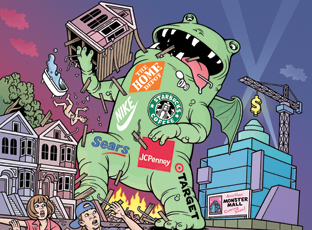
Shopping malls filled with national chain stores and restaurants are in many respects the antithesis of San Francisco. They’re the bane of any metropolis that strives to be unique and authentic. And those just happen to be qualities that make tourism this city’s number one industry.

The logic of modern capitalism, and its relentless growth into new markets, has already placed a Target or a Walmart, and a Nordstrom, Macy’s, Ross, or a JCPenney — along with a bevy of Starbucks, Applebee’s, Jamba Juice, and McDonald’s and myriad other formulaic corporate eateries — in just about every town in the country.

Do people really need them here, too? And in a city renowned worldwide for its scenic beauty and temperate (albeit sometimes foggy) climate, do people want to shop in the enclosed, climate-controlled malls popularized in the small or suburban towns that many residents came here to escape?

For me, the answer is no. Frankly, malls have an aura of artificiality that gives me the creeps — but I freely acknowledge that not everyone feels that way. Some San Franciscans may like malls and chain stores while others don’t.

But it doesn’t really matter what any of us think. Left unchecked, it’s the market that matters — and the logic of the market gives chain stores a huge competitive advantage over the mom-and-pops. Their labor and supply costs are lower, their financial resources are more extensive and appealing to commercial landlords, and their business models are based on constantly opening new stores.

All cities have to do is just say yes. And San Francisco has been increasingly saying yes to malls and chain stores.

The economic desperation that set in since the financial crash of 2008 has overcome the trend of resistance to so-called “formula retail establishments” that had been building in San Francisco during the years before the recession.

So now, rather than dying from neglect, the Metreon mall has been brought back to life by a huge Target store set to open this fall, the second Target (the other one at Masonic and Geary) going into a city that had once eschewed such national mega-retailers.

Just down the street, in the heart of the city’s transit-rich commercial center, the CityPlace mall that had been abandoned by its previous owners after winning city approval two years ago is now being built by new owners and set to open next spring with “value-based” national chain stores like JCPenney.

Projects funded with public money aren’t immune either. The new Transbay Terminal transit center now under construction will have its own mini-mall, with 225,000 square feet of retail, much of it expected to house national chains. Even more retail will be built on the ground floor of the dozen other nearby residential and office buildings connected to the project.

And it isn’t just these new malls going in a stone’s throw from the Westerfield Mall, Crocker Galleria, San Francisco Center, and other central city malls. All over town, national chains like the Whole Foods and Fresh & Easy grocery stores are replacing Cala Foods and other homegrown markets, or going into other commercial shells like the S&C Ford building on Market near the Castro.

Just a few years ago, the approval of Home Depot on Bayshore Boulevard (since then sold and opened as Lowe’s, another national chain) was a hugely controversial project approved by the Board of Supervisors on a closely watched 6-5 vote. Now, Lennar is building an entire suburban-style complex of big box stores on Candlestick Point, hundreds of thousands of square feet — without much controversy at all.

Even Walmart — the dreaded poster child for huge corporations that use their market power to drive down wages or force local stores out of business — is reported to be actively looking to open “a couple” of stores in San Francisco (see “Walmart sets sights on San Francisco,” June 24, San Francisco Chronicle).

To Livable City Executive Director Tom Radulovich and others who have long encouraged San Francisco to embrace the kind of urbanism advocated by famed author and activist Jane Jacobs — which emphasizes unique, neighborhood-based development that enhances public spaces and street life — accepting the malls feels like giving up on more dynamic urban models.

“It’s sort of an admission of failure,” Radulovich said. “It’s the failure of urbanism in San Francisco.”


MID-MARKET SYMBOLISM

Mid-Market Street is a bellwether for the type of city San Francisco may become. Every mayor since at least Dianne Feinstein in the late 1970s has called for the redevelopment of Mid-Market into a more active and inviting commercial and social corridor, and few have done so more fervently than Mayor Ed Lee.

Several city studies have explored a wide variety of ways to accomplish that goal, from eliminating automobiles and transforming Market Street into a lively pedestrian promenade to using redevelopment money, tax breaks, and/or flashy lighted signs to encourage distinctive development projects unique to San Francisco.

“But the city failed, so the market filled the void,” Radulovich said.

It isn’t that all shopping malls or enclosed commercial areas are necessarily bad, Radulovich said, citing the influential work by writer Walter Benjamin on the roles the enclosed “arcades” of Paris played in public life. “They work when they are an extension of public spaces,” Radulovich said.

Yet that isn’t what he sees being built in San Francisco, where what gets approved and who occupies those spaces is largely being dictated by private developers who are more interested in their bottom lines than with the creation of a vibrant urban environment where people are valued as more than mere consumers or workers.

San Francisco isn’t alone in allowing national chains to increasingly dominate commercial spaces. In fact, Stacy Mitchell, a researcher with the Institute for Local Self-Reliance, said that until recently San Francisco was one of the best big US cities in controlling the proliferation of chain stores.

But the city has lost ground since its anti-chain high water mark in 2007, when voters approved Proposition G, which expanded the controls on formula retail outlets — generally requiring them to get a conditional use permit and go through public hearings — that the Board of Supervisors had approved in 2004.

Those controls are only as good as the political will to reject a permit application, and that doesn’t happen very often. A memo prepared last July for the Planning Commission — entitled “Informational Presentation on the Status of Formula Retail Controls” — found that of the 31 formula retails applications the city received since 2007, just three were rejected by the commission, six were withdrawn, and 22 were approved.

It’s gotten even worse since then, as the two Targets and other chains have been courted and embraced by Mayor’s Lee’s administration, whose key representatives didn’t respond to Guardian interview requests by press time.

Mitchell said it’s not nearly as bad in San Francisco as it is in Chicago, New York City, New Orleans, and other iconic US cities whose commercial spaces have been flooded with chains since the recession began.

“It’s nothing compared to the no-holds-barred stuff going on in New York City right now,” Mitchell said. “Walking down Broadway now is like a repeating loop of the stores you just saw further up the street.”

It isn’t that these cities are actively courting the national chains in most cases. It’s just that in the absence of strong local controls, developers and large commercial landlords just prefer to deal with chains, for a variety of reasons.

“If you’re just going with the flow of what developers are doing,” she said, “you always end up with national chains.”

And that’s what San Francisco has started to do.


MALLS LIKE CHAINS

Stephen Cornell, the owner of Brownie’s Hardware and a board member of the nonprofit advocacy group Small Business California, said chains have a huge competitive advantage over local businesses even before either one opens their doors.

“In general, landlords tend to like chains more,” said Cornell, whose business has struggled against Lowe’s and other corporate competitors. “The landlord always worries: is this guy going to make it and do they have the funds to back it up?”

Big corporate chains have lawyers and accountants on staff, and professional systems established for everything from buying goods to opening new stores, whereas most local entrepreneurs are essentially figuring things out as they go along.

“They’re very good at selling themselves,” Cornell said. “They’re going to manipulate the system perfectly, whether it’s the city and its codes or dealing with neighborhood merchants.”

And for large malls, Cornell said the problem is even worse. Brokers that fill malls have standing relationships with the national chains — most of which are publicly traded corporations seeking to constantly expand and gain market share — and no incentive to seek out or take a chance on local entrepreneurs.

“Chains have a lot of advantages,” Cornell said.

Mitchell said there are two main ways in which malls favor national chains over local businesses. In addition to the relationship between mall brokers and national chains, malls are often built with financing from financial institutions that require certain repayment guarantees.

“What they want to see are credit-worthy clients signed onto those places, and that means national chains with a credit rating from Standard & Poors,” Mitchell said, noting how that “automatically locks out” most local businesses.

Cornell also noted that national chains have already figured out how to maximize their efficiency, which keeps their costs down even though that often comes in the form of fewer employees with lower pay — and less reliance on local suppliers, accountants, attorneys, and other professionals — which ends up hurting the local economy. In fact, big chains suck money out of the city and back to corporate headquarters.

“All those people are making money and spending money here, so you have to look at the full circle,” Cornell said.

Mitchell said there are often simple solutions to the problem. For example, she said that city officials in Austin, Texas recently required the developer of a large shopping mall to set aside a certain percentage of the units for locally owned businesses.

So rather than hiring a national broker to find tenants, the developer hired a local broker to contact successful independent businesses in the area who might be interested in expanding, and the project ended up greatly exceeding the city’s minimum requirements.

Mechanisms like that, or like the formula retail controls pioneered in San Francisco, give her some hope. But she said, “Whether the counter-trends will be enough to counter the dominant trend, I don’t know.”


PUBLIC SUBSIDIES

The increased malling of San Francisco isn’t simply the result of official neglect. Often, the city’s policies and resources are actively encouraging the influx of chain stores. A prime example is the massive redevelopment project on Hunters Point and Candlestick Point that city voters approved in 2008 after mega-developer Lennar and most San Francisco political officials pushed the project with a well-funded political campaign.

“If you’re selling the land to Lennar for a dollar, and then building all the automobile infrastructure for people to get there, then that’s a massive public subsidy,” Radulovich said of the big-box mall being built on what was city-owned land on Candlestick Point.

That public subsidy creates a cycle that makes San Francisco less intimate and livable. Creating commercial spaces on the city’s edge encourages more people to drive on congested regional roadways. These spaces are filled with national chain stores that have a direct negative impact on small, locally owned stores in neighborhood commercial districts all over the city, causing some of these businesses to fail, meaning local residents will need to travel further for the goods they once bought down the street.

“Those neighborhoods are going to be less walkable as a result,” Radulovich said, noting how the trend contradicts the lip service that just about every local politician gives to supporting local businesses in neighborhood corridors. “There’s a certain schizophrenia to San Francisco’s economic development strategy.”

Sup. Eric Mar has been working with Jobs with Justice San Francisco and other groups to tweak city policies that have allowed the chains to proliferate. Last year, Mar held high-profile hearings in City Hall on how national chains impact local businesses, which pointed to the need for additional protections (see “Battling big box,” Jan. 3).

This year, he’s working on rolling out a series of legislative initiatives designed to level the playing field between local interests and those of Wall Street and the national chains it champions.

Last month, the Board of Supervisors approved Mar’s legislation to add banks to the city’s formula retail controls, a reaction to Chase Bank and other national banks snapping up vacant stores in neighborhood commercial corridors such as Divisadero Street.

Now he’s working on legislation that would mandate minimum labor and community benefit standards for chain stores — including grocery outlets such as Fresh & Easy — and study how chains affect San Francisco’s overall economy.

“There should be good neighbor policies when they come into a neighborhood,” Mar said. “Some neighborhoods are so distressed they may want a big box grocery story coming in, but we need to try to mitigate its negative impacts.”

One of his partners in that effort is his brother, Gordon Mar of Jobs with Justice, who argues the city needs to have a clearer picture of how national chains impact local communities.

“We’ve definitely seen an increase in corporate chain stores coming into San Francisco in the last year, and nobody has really been tracking it,” he said.

While the Planning Department’s quarterly pipeline report shows that applications for retail outlets has held steady at about 3 million square feet on the way in recent years, it doesn’t break out how much of that is national chains — let alone how that impacts the city’s economy and small business sector.

The city’s Legislative Analyst is now studying the matter and scheduled to release a report later this summer, which Gordon Mar said will be helpful in countering the narrow “jobs” rhetoric that now dominates City Hall.

“They are exploiting the economic recession by saying they’re bringing much needed jobs into the city and serving low-income residents,” he said. “But when you bring out the facts about the impact of these low-road retail stores on neighborhoods and small businesses, there is a net loss of jobs and a lowering of labor standards.”


VALUING MALLS

Yet the fate of those controls is uncertain at best, particularly in a tough economic environment in which the city needs revenue, people are desperate for jobs, and many residents have seen their buying power stagnate, making the cheap goods offered by Target and Walmart more attractive.

“It’s complicated stuff,” Michael O’Connor, a local entrepreneur and former member of the Small Business Commission who favors formula retail controls, told us. “Stores like Target do appeal to lower income families…The progressive agenda needs to understand that working-class families need somewhere to shop.”

O’Connor acknowledges how small businesses like those he owns, including a clothing store, often can’t compete with national chains who buy cheap goods in bulk. So he said he favors protections in some neighborhoods while allowing chains in others, telling us, “I don’t have a problem with the Target going into the Metreon.”

That argument also held sway with city officials when they considered approving the CityPlace project two years ago, which was presented as a mall filled with “value-based” stores that would be affordable to median income San Franciscans.

“At the time, the decision was around whether a value-based retail operation made sense in that location, and the answer was an emphatic ‘yes,'” Barbary Coast Consulting founder Alex Clemens, who represented the project, told us.

On a national or global level, there are good arguments against reliance on national chains selling cheap imported goods, which has created a huge trade deficit between the US and countries such as China that costs American jobs — ironically, the very things that some use as arguments for approving chain stores.

“The recession has created a climate of desperation where cities are more easily swayed by the jobs argument,” Mitchell said, noting the falsity of those arguments by pointing to studies showing that the arrival of chain stores in cities usually creates a net loss in employment. Finally, supporters of chain stores say the cash-strapped city needs the property and sales tax revenue “Because they say they’ll produce a lot sales tax revenue, they’re going to get away with all kinds of shit,” Cornell said, arguing that shouldn’t justify city policies that favor big corporations, such as tax breaks and publicly financed infrastructure. “I certainly don’t think [city officials] should be giving them any advantages.” There are few simple solutions to the complex and interconnected problems that result from the malling of San Francisco and other cities. It’s really a question of balance — and the answer of whether San Francisco can regain its balance has yet to be answered. “Given the mayor’s approach to economic development, it’s inevitable that we’ll have more coming into the city,” Sup. Mar said. “But the ’50s car culture, and the model of malls that came in the ’60s, don’t build communities or strong neighborhoods.”

Missing the point on Hetch Hetchy

35

So now we have to have a vote on tearing down Hetch Hetchy. That’s fine, let’s have the discussion. But let’s be honest about it: This isn’t just, or even primarily, a water issue. It’s really about electric power.

If you want to read the piece I wrote on this for Earth Island Journal, it’s here. I’ve written loads more over the years, enough to fill a couple of good-sized books. But let me try to make the point as simply as I can.

The dam would never have been approved by Congress if it were just a reservoir for San Francisco’s water. The reason the Raker Act, which authorized the destruction of Hetch Hetchy Valley, was approved was that the conservationists, who opposed the dam, were trumped by the public-power advocates, who argued that preventing private companies from controlling the electric power grid was so important that it justified environmental sacrilege. The dam was supposed to provide the centerpiece for a local public-power system that would prevent Pacific Gas and Electric Company from controlling the city’s energy system.

The history of Hetchy Hetchy isn’t about water — it’s about how that power never made it to San Francisco. You can read it in great detail here. I have spent weeks in the National Archives in DC researching this, and have thousands of pages of documents on it. You may or may not support the idea of the city running a public-power system, but it’s hard for anyone to argue that Congress intended anything else.

The city accepted the deal, built the dam, and has for almost a century ducked, bobbed, weaved, and tried everything possible to avoid kicking out PG&E.

So why keep the dam in place? I don’t believe the Restore Hetch Hetchy people when they say that the city can find other storage for its water needs. Tear down the dam and we’ll be sucking water out of the Delta soon enough. But forget that — let’s assume we could conserve enough water that we didn’t need that reservoir.

We’d still have to replace a buttload of electric power. The city’s hydropower system generates 1.7 billion kilowatt hours a year, enough to power more than 400,000 homes — and does so without producing an ounce of CO2. Although there are other powerhouses in the system, we’d lose almost half of its capacity if we tore down the dam.

It seem to me that existing large hydro, while imperfect, is a more environmentally sound form of electricity generation than coal, oil, natural gas, or nuclear — and right now, those are the alternatives.

Soon enough the city will have enough small-scale distributed generation, mostly rooftop solar, to get rid of both PG&E and the dam. Count me as a supporter. But we’re not there yet.

In the meantime, if we’re going to have this discussion, let’s talk about electricity, and PG&E, and the Raker Act, not just water and the once-pristine valley.


Hot catch

1

le.chicken.farmer@gmail.com

CHEAP EATS Yeah, and part of the idea of going to New York City was to escape New Orleans’s heat, which would best be described (for those who haven’t been) as hot.

Hot hot hot hot hot.

As luck would have it, best laid plans and all, it was even hotter than that in New York while we were there, squeak squeak, fuckity fuck. It was hot hot hot hot hot hot hot. So as soon as we got back home to hot hot hot hot hot, we went camping.

In an air-conditioned camper. With our landlordladypersons, an adorable couple name a Pam and Cindy. Now Cindy, being a tried and true in the wool Cajun, has a brother name a Blaine only everybody calls him Bruno. And this Blaine (only everybody calls him Bruno) is my new favorite person because even though he knew we were crazy for camping on the edge of a swamp during mosquito season, he not only loaned us his trailer but drove it there. And parked it. He’s a truck driver.

Our campsite had been under water the previous weekend, and therefore vacant, so the mosquitos were happy to see us.

We heated our dinner in microwaves that first night. S’mores were not discussed. Next day, though, there was a breeze and we were able to sit outside all day and watch a hawk wrestle with a giant catfish that had been trapped in a puddle.

Hawk won.

Hedgehog took pictures, if anyone wants to see them. She also shot some alligators, and a sweet, tiny red parrot that had fallen in love with our friend Cherry’s roof rack.

I went around pulling dead sticks out of trees, and that night’s dinner happened over a fire. Here’s what I grilled: salmon, swordfish, boudin, turnips, tomatoes, peppers, pineapple, peaches, and garlic. The corn I soaked in its husks and threw on the coals.

On Sunday Blaine Only Bruno (or Bob, as I call him for short) came back and took me, Hedgehog, and Cindy to his crawfish pond. So, yeah, so that was how I spent the last part of my last weekend in Louisiana: having a complete pond-to-table crawfish experience.

We piled into this patchy li’l boat and sat on upside-down buckets. The traps are baited with sweet potatoes! Bob putt-putted us around the pond, pulling them up and dumping the crawfish onto a stainless steel sorting table, where we took turns wiping the angry ones through the square hole into net bags, and tossing the half-eaten or otherwise at-peace ones back into the water.

After, driving along the levee in his pickup truck with probably 50 pounds of crawfish for our dinner and then some, Bob told us about his friend’s crawfishing brother who looks like Z.Z. Top and had recently “caught a heart attack.”

Moments later, we ran into him, sitting in a pick-up truck of his own, eating a bag of potato chips and looking indeed like Z.Z. Top — the whole band. Pleasantries were exchanged. Potato chips were not.

Nevertheless, when we got to Bob and Cindy’s mama’s house, where the crawfish were to be boiled, I caught a stomachache — which is a horrible thing to have when you are about to eat 50 pounds of crawfish.

In a desperate attempt to get good again, I guzzled ginger ale. I ate a piece of dry toast. I sat in a recliner and closed my eyes, and missed the part where we boiled them to death.

Hedgehog was there. She said the secret was to not only add the seasoning to the pot, but to plaster them with it afterwards.

Well, they were spicy, and the best crawfish ever. Once I started eating them, I couldn’t stop. In fact, I’m still eating them. Packing up for the long road ahead: New Orleans to Frisco, by way of Pennsylvania and Ohio, or home to home, via home and home.

When I was there — home home — last time, Crawdad de la Cooter kept wanting to go to all these new Cajun restaurants popping up all over the Bay Area, even in Fairfax. I suppose after I’ve been back for a few months I will need these places, but for now I’d rather be eating pho and watching soccer at my new favorite Vietnamese restaurant and sports bar:

ANH HONG

Lunch: Mon-Sat 11am-2pm; Dinner: Mon-Sun 5-10:30pm

2067 University Ave., Berk.

(510) 981-1789

MC,V

Full bar


Live Shots: Quintron and Miss Pussycat at New Parish

0

Peer pressure is the key to any good party. “Don’t leave, don’t leave,” Miss Pussycat called out from the stage Friday night at New Parish, not so much begging or pleading, but in a tone that suggested the couple heading towards the door with their coats were crazy.

The pair turned, torn, and together mouthed something inaudible about the time, or BART, or something. “Maybe Sean could give you a ride,” Miss Pussycat said, seemingly picking a name at random and pointed out into the audience, adding with a deceptively innocent smile, “…wherever you’re going, and then you’ll become best friends.”

Whether convinced or just shamed, the two walked back into the crowd, Miss Pussycat gave a cheer, and the Leslie speaker connected to Qunitron’s organ began to spin up as he launched into the frenzied warble “Banana Beat.”

Essentially in their own genre of swamp boogie, the New Orleans-based Quintron and Miss Pussycat puts on what is basically more like a dance party than a conventional show. Sure, there’s a fair amount of spectacle. It opens with Miss Pussycat’s puppet show, a sort of DIY La Voyage dans la lune that’s enjoyable if you like the aesthetic of Pee-wee’s Playhouse and watching Adult Swim cartoons in a smoked-out stupor.

When it comes to playing music, Quintron always has something going on, using a number or inventions (like his light-operated drum machine) that no one else really does (or understands).

The closest comparison might by the B-52s. Partly because of the campy silliness, partly because of the style, and partly because the combined over-the-top male and female vocals. But mainly it’s the video for “Love Shack” that used to play on VH1 every other commercial break in the early ’90s. The one where everybody is strange, fun, and getting down. The one where they are drinking everything in sight, including the bath tub water. Yeah, it’s a similar kind of atmosphere at the Quintron and Miss Pussycat show.

In addition to crowd control and vocal duties, Miss Pussycat focuses her energy on stage by playing a pair of carefully accessorized maracas. Shaking them mostly, but occasionally tossing one into the air and catching it.

As the show went on, I was concerned by the increasing number of times she dropped them onto the floor. Until I factored in that, considering how many shots she had taken with members of the audience (including one whose shirt read “fuck you YOU fuckin’ fuck – Bourbon St., New Orleans”), she was doing just fine.

Opener
Compared to Quintron and Miss Pussycat, Dent May gave a mild performance, pulling almost entirely from his latest, Do Things and the “Eastover Wives” single. (As someone that never caught him live before, I’d hoped to hear a bit from his last album, although he did play “Meet Me in the Garden.”) The live show doesn’t quite have the understated suave playfulness of May’s records, although there’s a sense that a muted energy is still emerging.

At his best, the slow R&B ballad “Do Things” gave off an Enchantment Under the Sea feel, giving a couple in the audience a chance to slow dance. Moves like jumping off the kick drum at the very end of the set, however, were a bit too calculated.

Generations confer over La Peña’s second skin

3

I’m sitting in on a meeting between two generations of muralists. In name, our encounter was designed as an interview about La Peña Cultural Center’s plans to redo its decades-old facade, a historic piece that right now is a 3-D tableau named “Song of Unity” and meant to represent the people of North and South America coming together in art.

But it has become clear to me the interviewer that’s it’s way more momentous to let these groups talk largely unimpeded by my questions. Two people who created the mural in 1978 are speaking with two people who will design its rebirth in 2012 about changes in the world of street art over the last 34 years. It’s the first time the four have met together. Assasinated Chilean artist-activist Victor Jara‘s detached hands strum a guitar in silent soundtrack over us as we sit on folding chairs in front of the mural in question. 

In contrast to his “Song of Unity’s” figurative style, “graffiti is an abstract art,” says Osha Neumann.

Neumann was able to pay his original mural crew largely with funds from government-sponsored community arts program meant to train and employ creative types. La Peña’s wasn’t the only piece the group worked on — they also masterminded the piece on Berkeley’s Amoeba Music and a large wall at People’s Park. Their work was inspired, he says, by the school of Mexican muralists that included Diego Rivera, José Orozco — the masters that gave birth to the last mural renaissance in the United States. 

Osha Neumann, Cece Carpio, and O’Brien Thiele — two generations of La Peña artists. All Guardian photos by Caitlin Donohue

“Song of Unity” was meant to illustrate the coming-together of two continents through activist culture, at a time with US interventionism in Latin America was reaching a fevered pitch of corruption and when Bay Areans and Latin American refugees were coming together to form La Peña. It was a heavy moment. Jara’s hands, by way of illustration, are portrayed severed from his body for a reason. After the 1973 Chilean coup, they were said to have been cut from his body by military junta.

“Graffiti has no connection at all to the work of the Mexican muralists,” Neumann continues in response to my question about how street art has changed since his time.

“Graffiti artists don’t usually work collectively,” adds O’Brien Thiele, Neumann’s co-artist.

But here, Robert Trujillo must step in. Trujillo is a member of the Trust Your Struggle collective, the team of California-bred young people that have been elected to take up this historic mantle.

“But there are graffiti crews that are really well-established,” he interjects gently. “CPS from Los Angeles. TKO and MSK have crews worldwide. These are the groups that pioneered graffiti art on the West Coast.”

Trujillo should know — in a time in which street art has come into vogue and become a big-money game, TYS is a sterling example of what is still great about the genre. TYS travels the world connecting with communities in parts of the developing world like Latin America and the Phillipines. It uses graffiti-inspired murals to illustrate social problems, solutions. The center already bears the group’s mark — its superlative Cafe Valparaiso, which serves Chilean food at lunch and dinner, is adorned with a striking mural done by TYS members.


“When you’re in school, writing on the walls — that’s the thing they tell you not to do,” Trujillo tells us, by way of explaining the power of graffiti. “You don’t have a voice. With graffiti, suddenly you have a voice. People have to realize that it exists because of society.” He pauses, then hits upon an eloquent sum-up. “Graffiti is the perfect answer to society.”

“This is a really huge project for us,” says TYS member Cece Carpio. Carpio is La Peña’s program manager, one of many ties the local group has to the center. “This is a place of gathering. [With the new mural] we want to honor the history of Latin American activism here, but also the diversity that the place has now.”

This comes to the heart of why La Peña wants a new mural. Certainly, “Song of Unity” is in bad shape. It is crumbling at the junctures of its panels. Water is seeping in through the cracks, a death sentence for its three-dimensional figures. 

“Song of Unity” today

But perhaps even more importantly, the re-envisioning of the center’s facade will represent something rather extraordinary — that a radical institution that has been relevant in this community for decades has found itself in the hands of a new, dedicated generation.

La Peña’s programming has continued to diversify. Upcoming events include July 13’s Asian Rock Fest and this year has seen the fifth year of Queendom, DJ Zita’s all-female celebration of the five elements of hip-hop — not to mention the Immigrant Voices Festival that brought openly undocumented journalist Jose Antonio Vargas to the center last week. The Immigrant Voices Festival is a project explicitly sponsored by this “second generation” group — referred to as LP2G by the center. 

“I was sorry when they said they wanted to take [“Song of Unity”] down,” Neumann admits to the group that is assembled that sunny Sunday afternoon. “But they said they wanted new blood. What could I say to that?”

What indeed? Because if there is one good reason to donate to La Peña’s campaign to step, facade-first, into the new generation of activism — and you can! The last day to contribute to its Indie Gogo campaign is today, Mon/2 — it is to celebrate that a radical institution started in the fire of the ’70s has successfully found relevance today among the Internet generation. 

So what is TYS going to paint on this wall? Will it be three-dimensional, like Jara’s memorialized fingers and guitar? The final design won’t be determined until the collective’s done more meetings like this with the community members of La Peña. But you can rest easy on one point. Says Trujillo: “We all know it’s going to be fresh though.”

Appetite: Spring weekend in Los Angeles yields intriguing tastes

0

I recently returned to my old SoCal stomping grounds for yet another long weekend. This time I stayed at funky, restored motel, The Farmer’s Daughter, gazing over a pool filled with giant rubber duckies, the hotel’s birds greeting me each morning in the lobby. Colorful and quirky, the hotel (with welcoming, engaging staff) is a worthwhile home base, ideally located across the street from the original LA Farmers Market. You won’t find farmers here, rather, it’s a permanent, open air mall of food purveyors.

Though not always gourmet, a few newcomers add foodie cred to the market. However, I hope to never see the demise of old school diners, pie shops and vendors selling unnaturally bright red popcorn and the like – it’s a charming slice of LA history.


On the newer side of things, Short Cake is one of the top Farmers Market destinations. I spent every morning there, happily downing shakeratos ($5 – four shots of espresso shaken with ice and simple syrup) and cappuccinos from one of my favorites, Verve Coffee of Santa Cruz. SF local TCHO chocolate shows up in Short Cake’s mochas, while Amy Pressman’s baked goods are among the best in all of LA.

She trained at Spago with friend and partner Nancy Silverton (Mozza, Pizzeria Mozza). At Short Cake she crafts ridiculously good eats like a curry raisin scones or bacon-cheddar-three chili croissant bread pudding. I rarely repeat places, but this one was worth returning to for breakfast three days in a row.

Another pleasing return this trip? A sunny, playful lunch at Roy Choi’s A-Frame, which I reviewed soon after it opened last year and still find an affordable winner.

BIERBEISL, Beverly Hills

I’m a sucker for cuisines done well, particularly the less commonly seen like Scandinavian, Eastern European or Burmese. I don’t get enough Austrian food. The new BierBeisl, just off Rodeo Drive in Beverly Hills (though not at all like Rodeo Drive – instead, it’s casual, spare and cozy), is one of the better Austrian restaurants around.

Starting with a cool BierBeisl carpaccio, thinly sliced pork roast is delicately doused in a Styrian Gold (Austrian pumpkin seed oil) vinaigrette – a unique, elegant starter. Assorted Austrian charcuterie ($18) and cheeses (add $10) are a brilliant example of the best to come out of the country, vivid with house spreads and rustic rye and pretzel breads.

There’s modern, fresh dishes like seared lamb loin with goat cheese polenta (the most expensive dish, a pricey $36), but I veer towards the traditional, like Vienna Schnitzel ($19-25 for pork, turkey or veal) garnished with lemon and lingonberries plus choice of side: potato salad, roasted parsley potatoes, fries, mixed green salad. House sausages from their sausage menu are a highlight, particularly a Swiss cheese-infused Käsekrainer ($10), lightly peppery and similar to a Polish sausage, while a traditional bratwurst with sauerkraut ($9) likewise satisfies.

Sausages come with a slice of rustic bread and dollops of tarragon mustard and fresh horseradish. The bratwurst is particularly zippy with the Radler Grapefruit: half Stiegl Goldbräu beer, half all-natural grapefruit soda ($6 for 10 oz.; $8 for 16.9 oz.)

Something unusual behind the bar? Reisetbauer Austrian Whisky. Yes, Austrian whisky – distilled in copper pot stills from malted barley, aged in Chardonnay and Trockenbeerenauslese oak wine casks. I appreciated the rogue, hearty spirit of this whisky, lively with chocolate, caramel, hazelnut, bread.

FORMOSA, West Hollywood

Formosa is a Hollywood classic bar/restaurant since 1925 with a storied past. There’s John Wayne’s regular booth which was extended a few feet to hold his long frame when he’d crash after a few drinks. Stars like Bette Davis or Dean Martin would take a cocktail break in between filming at the studios next door (once Pickford-Fairbanks Studio and now The Lot), connected to Formosa by underground walkways. Heavy on history and ghost stories of famed patrons whose photographs line the walls, Formosa has not been known for quality food or drink for years.

But this is not your mama’s Formosa. Though still slowly undergoing its transformation (including mischievous new menu offerings like a fried, spicy peanut butter sandwich), visiting the bar a few times in April I witnessed new bar manager Kate Grutman (previously at Sotto) refreshing the menu and bottle selection – not with fussy cocktails but with well-crafted, playful turns on the likes of a banana daiquiri, aka John Cazale ($10), the secret ingredient being a Fernet rinse, adding a minty, herbal layer. Her Bloody Mary twist is brilliant. Duck Down ($11) is Akvinta Vodka washed with duck confit, mixed with Vince’s original Formosa Bloody Mary mix, lime, Siracha hot sauce, and — wait for it — pickled gobo root (crisp, sweet, and earthy, it’s a member of the burdock root family). I tasted the washed vodka on its own: savory confit imparts a meaty, lush, joyously decadent spirit. It makes for a superior Bloody Mary.

Grutman upgrades dive bar favorites with quality ingredients, as with the Formosa Sour ($9), essentially an improved Midori Sour made from her house Midori liqueur: French honeydew, sugar, orange flower water and lychees with a hint of green food coloring to maintain the neon spirit of the junk food liqueur. Start with an aperitif of The Seven Year Itch ($10), referencing Marilyn Monroe’s potato chips and champagne scene in the film – they go one step further serving housemade chips with a cocktail of bubbles, Cynar, sugar, cherry liqueur and lemon. A perfect finish is Joan Crawford’s Chained ($9), essentially a Sherry Flip with Harvey’s Bristol Cream, Punt e Mes sweet vermouth, garnished with cinnamon. Creamy and savory, it’s dessert.

Grutman is clearly having fun with this menu – and drinking it is likewise a pleasure. Her grandfather was once a Formosa regular so she clearly maintains respect for the unique history of the place, studying old menus, celebrity clientele and films they made at the studios next door, which she’s naming cocktails after. Though there are minor updates happening throughout the building, the place retains its musty, classic Hollywood charm with dim lighting, red booths, rooftop bar, and circa 1930’s Chinese decor. You could still call it a dive but one where you don’t have to check taste at the door. I love witnessing one of the remnants of Old Hollywood reinvent itself while retaining its rich character, ready for more decades ahead.

LUKSHON by Sang Yoon, Culver City

Friends and fellow reviewers have found Lukshon http://www.lukshon.com/read uneven. In my experience, there were a couple brilliant dishes intermingled with a couple disappointments, though my overall meal was strong. I’d return.

The outdoor patio is a mellow alternative to a chic but cacophonous dining room. On a gorgeous LA night, the patio, fronted by a modern rock fireplace, becomes an urban respite.

Attentive, relaxed service made me immediately a fan of Lukshon, while a menu of single origin teas (from San Francisco’s special Red Blossom Tea Co.) and expertly-prepared cocktails confirm the restaurant’s “whole package” status. Asian twists on classic cocktails work, like a vividly tart Lukshon Sour ($11 – Michter’s Rye, lemon, tamarind, palm sugar, kumquats), a smoky Fujian Cure ($11 – Isle of Skye 8yr Scotch, lemon, galangal root, lapsang souchong black tea), or the savory, martini-spirited Formosa ($11): Ethereal gin, Lillet Blanc, atomized mizhiu tou (Taiwanese rice wine), and ginger pearl onions.

Green papaya salad ($9) was a less-than-pleasing version of the classic Thai salad, tasting oddly funky though ingredients were fresh. Chiang Mai curry noodles ($13) read as an enticing list of ingredients (coconut, chile, tumeric, lemongrass, chicken, prawn, yu choy, rice noodles), but came off a tad bland though still satisfying.

The kitchen excelled, however, with fantastic sweetbreads fried “orange chicken” style ($11) in a sweet-sour orange sauce, tender and tossed in scallion, ginger, and pickled lettuce. I’m dreaming of returning just for this dish. A side of yu choy ($7 – a Chinese vegetable), cooked in shaoxing wine and garlic with savory, aged ham is quite a pleasurable way to eat your greens. Short rib rendang ($17) is like the ultimate meatloaf, one cooked in malay spices, red chile lemongrass rempah (a spice paste), drizzled with coconut cream. Sigh.

A simple dessert of flan-like palm sugar caramel custard layered with rice krispies is a delicate finish, with a side of candy cap mushroom ice cream. Lukshon is trendy, yes, but talented chef Sang Yoon hints at the joys of California dining, where our dense Asian cultures and year-round, unparalleled produce combine with classic European cooking technique in inventive dishes.

ink.sack, West Hollywood

Top Chef star Michael Voltaggio smartly opened a sandwich shop half block from his casually hip fine dining restaurant ink., cheekily named ink.sack. Sandwiches come on the mini side at a cheap $4-7, though big enough that I’m unable to finish two. I wish all sandwich shops offered mini versions to vary tastes – and had staff as friendly as ink.sack’s.

Miso-cured albacore tuna is dubbed “spicy tuna” though I could have used more Sriracha mayo to make the sandwich actually spicy and offset a bit of dryness to the tuna. I delighted in sandwiches like The Jose Andres, aka “The Spanish Godfather”, a tribute to the man himself (of The Bazaar, one of my top LA restaurants), filled with Serrano ham, chorizo, and Manchego cheese. But my favorite is a twist on a Reuben with thinly shaved corned beef tongue, Swiss, sauerkraut, and Russian dressing.

EVELEIGH, West Hollywood

True: Eveleigh is the moneyed hipster’s hangout, from a bone marrow, charcuterie-heavy food menu to craft cocktails. But it stands out with a gorgeous setting off a trendy stretch of Sunset Boulevard and quality food and drink. You first pass through the front patio, green with trees and astro turf, into an open dining room with a center bar and ubiquitous fireplace, animal heads and book-lined, gastropub décor. The back of the restaurant is a huge patio covered in plastic with LA views. The space enchants, while my perch at the bar interfaced with busy, disengaged (but still professional, mannered) bartenders.

Though I’ve seen the like of these dishes countless times over the years, each one was well-executed and gratifying, whether bright crushed peas, mint, almonds, Arbequina olive oil and burrata cheese ($12) or a juicy, medium-rare Eveleigh burger (expensive at $19) topped with fontina cheese, pickles and tomato-chorizo relish.

Cocktails ($12) likewise are vivid, balanced and worth a stop on their own. Though, like a thousand cocktailian bars these days, they craft fine, spirituous classics, I’m most pleased with the farm fresh, seasonal side of the menu where they shine with fresh California ingredients and drinks like a Lucky Louie: rhum argicole, kumquats, star anise, ginger, fresh lime.

CURRYWURST, Mid-City West

I “heart” currywurst, that Berlin specialty of grilled dogs doused in German curry. Add chips (fries) if you wish. Currywurst, a few steps from my Farmers Daughter hotel base, is an affordable winner in the currywurst realm (like Berlin Currywurst in Silver Lake). With housemade sausages (my tops is the Hungarian pork) topped with satisfying curry (red German curry is akin to an amped-up, curry laden ketchup), friendly staff and cheap prices make this an ideal snack or lunch.

POUR VOUS, Mid-Wilshire

My bar disappointment this visit was Pour Vous, a sexy, French-influenced den with gorgeous décor, particularly a sunken, circular section with fireside seating. I thrilled to a French-heavy spirit menu highlighting Calvados, absinthe, Armagnac, Cognac. In theory, this could be a dream bar – an underdone concept I’d be thrilled to see well-executed. Maybe it is better early on a weeknight or depending on the bartender?

But on a Friday near midnight, it’s cacophonous, mobbed and irritating. The elegant space is dominated by well-dressed, middle-aged guys with young, blonde girlfriends (sporting breast implants, of course) with a pick-up scene of well-heeled 20-40-somethings on the prowl.

Though such a scene is always irritating (that cliché LA, Vegas, Miami feel), the clash of this crowd in such a romantic setting would be slightly lessened if drinks were excellent. At $14-15 a pop for many cocktails, they should be stellar.

Though it sounded amazing, a medicinally sweet, cloying Le Samourai ($14 – Armagnac, framboise, rhubarb, “umami”) was virtually undrinkable, while a Vadouvan Lassi ($15) could have been brilliant with rhum agricole, lime, coconut, falernum, Vadouvan curry and bitters, but ended up tasting like bland, minimally spiced milk on ice, the curry and the agricole lost in the milk. Tasting my friends’ drinks didn’t get me much further, while disengaged bartenders and a costly bill confirmed just how unsatisfying the entire experience was. I left convinced this is not so much a cocktail-spirits aficionado’s destination as a meat market dressed in pretty clothes.

Subscribe to Virgina’s twice-monthly newsletter, The Perfect Spot, www.theperfectspotsf.com

Film Listings

0

Film listings are edited by Cheryl Eddy. Reviewers are Kimberly Chun, Max Goldberg, Dennis Harvey, and Lynn Rapoport. For rep house showtimes, see Rep Clock.

OPENING

The Amazing Spider-Man Spidey returns in a post-Raimi reboot. (Opens Tue/3.) (2:18)

Beyond the Black Rainbow Sci-fi in feel and striking look even though it’s set in the past (1983, with a flashback to 1966), Canadian writer-director Cosmatos’ first feature defies any precise categorization — let alone attempts to make sense of its plot (such as there is). Arboria is a corporate “commune”-slash laboratory where customers are promised what everyone wants — happiness — even as “the world is in chaos.” Just how that is achieved, via chemicals or whatnot, goes unexplained. In any case, the process certainly doesn’t seem to be working on Elena (Eva Allan), a near-catatonic young woman who seems to be the prisoner as much as the patient of sinister Dr. Nyle (Michael Rogers). The barely-there narrative is so enigmatic at Arboria that when the film finally breaks out into the external world and briefly becomes a slasher flick, you can only shrug — if it had suddenly become a musical, that would have been just as (il-)logical. Black Rainbow is sure to frustrate some viewers, but it is visually arresting, and some with a taste for ambiguous, metaphysical inner-space sci-fi à la Solaris (1972) have found it mesmerizing and profound. As they are wont to remind us, half of its original audience found 1968’s 2001: A Space Odyssey boring, pointless and walk out-worthy, too. (1:50) Roxie. (Harvey)

The Connection The first re-release in a project to restore all of quintessential 1960s American independent director Shirley Clarke’s features, this 1961 vérité-style drama was adapted from a controversial off-Broadway play by Jack Gelber. Set exclusively in a dingy Greenwich Village crash pad, it captures a little time in the lives of several junkies there — many off-duty jazz musicians — listlessly waiting for the return of their dealer, Cowboy. To mimic the stage version’s breaking of the fourth wall between actors and spectators, Clarke added the device of two fictive filmmakers who are trying to record this “shocking” junkie scene, yet grow frustrated at their subjects’ levels of cooperation and resistance. With actors often speaking directly to the camera, and all polished stage language and acting preserved, The Connection offers a curious, artificial realm that is nonetheless finally quite effective and striking. A prize-winner at Cannes, it nonetheless had a very hard time getting around the censors and into theaters back home. Hard-won achievement followed by frustration would be a frequent occurrence for the late Clarke, who would only complete one more feature (a documentary about Ornette Coleman) after 1964’s Cool World and 1967’s Portrait of Jason, before her 1997 demise. She was a pioneering female indie director — and her difficulty finding projects unfortunately also set a mold for many talented women to come. (1:50) Roxie. (Harvey)

Corpo Celeste A 13-year-old girl comes of age in Italy’s deeply Catholic Calabrian region. (1:40) SF Film Society Cinema.

Magic Mike A movie about male strippers with an unlikely director (Steven Soderbergh) and a predictably abs-tastic cast: Channing Tatum, Matthew McConaughey, and Joe Manganiello. (1:50)

People Like Us The opening song — James Gang’s can’t-fail “Funk #49” — only partially announces where this earnest family drama is going. Haunted by a deceased music-producer patriarch, barely sketched-out tales of his misadventures, and a soundtrack of solid AOR, this film has mixed feelings about its boomer bloodlines, much like the recent Peace, Love and Misunderstanding: these boomer-ambivalent films are the inverse of celebratory sites like Dads Are the Original Hipsters. Commodity-bartering wheeler-dealer Sam (Chris Pine) is skating on the edges of legality — and wallowing in his own kind of Type-A prickishness — so when his music biz dad passes, he tries to lie his way out of flying back home to see his mother Lillian (Michelle Pfeiffer), with his decent law student girlfriend (Olivia Wilde). He doesn’t want to face the memories of his self-absorbed absentee-artist dad, but he also doesn’t want to deal with certain legal action back home, so when his father’s old lawyer friend drops a battered bag of cash on him, along with a note to give it to a young boy (Michael Hall D’Addario) and his mother Frankie (Elizabeth Banks), he’s beset with conflict. Should he take the money and run away from his troubles or uncover the mysterious loved ones his father left behind? Director and co-writer Alexa Kurtzman mostly wrote for TV before this, his debut feature, and in many ways People Like Us resembles the tidy, well-meaning dramas about responsibility and personal growth one might still find on, say, Lifetime. It’s also tough to swallow Banks, as gifted as she is as an actress, as an addiction-scarred, traumatized single mom in combat boots. At the same time People Like Us isn’t without its charms, drawing you into its small, specific dramas with real-as-TV touches and the faintest sexy whiff of rock ‘n’ roll. (1:55) Shattuck. (Chun)

Pink Ribbons, Inc. This enraging yet very entertaining documentary by Canadian Léa Pool, who’s better known for her fiction features (1986’s Anne Trister, etc.), takes an excoriating look at “breast cancer culture” — in particular the huge industry of charitable events whose funds raised often do very little to fight the cease, and whose corporate sponsors in more than a few cases actually manufacture carcinogenic products. It’s called “cause marketing,” the tactic of using alleged do gooderism to sell products to consumers who then feel good about themselves purchasing them. Even if said product and manufacturer is frequently doing less than jack-all to “fight for the cure.” The entertainment value here is in seeing the ludicrous range to which this hucksterism has been applied, selling everything from lingerie and makeup to wine and guns; meanwhile the march, walk, and “fun run” for breast cancer has extended to activities as extreme (and pricey) as sky-diving. Pool lets her experts and survivors critique misleading the official language of cancer, the vast sums raised that wind up funding very little prevention or cure research (as opposed to, say, lucrative new pharmaceuticals with only slight benefits), and the products shilled that themselves may well cause cancer. It’s a shocking picture of the dirt hidden behind “pink-washing,” whose siren call nonetheless continues to draw thousands and thousands of exuberant women to events each year. They’re always so happy to be doing something for the sisterhood’s good — although you might be doing something better (if a little painful) by dragging friends inclined toward such deeds to see this film, and in the future question more closely just whether the charity they sweat for is actually all that charitable, or is instead selling “comforting lies.” (1:38) Opera Plaza, Shattuck, Smith Rafael. (Harvey)

Ted Here’s that crass comedy about a talking teddy bear from Seth MacFarlane you didn’t ask for. (1:46) California.

To Rome with Love See “Midnight in Woodyland.” (1:52) Albany, Embarcadero.

Tyler Perry’s Madea’s Witness Protection Pretty sure Madea has made more movies than James Bond at this point. (1:54)

ONGOING

Abraham Lincoln: Vampire Hunter Are mash-ups really so 2001? Not according to the literary world, where writer Seth Graham-Smith has been doing brisk trade in gore-washing perfectly interesting historical figures and decent works of literature — a fan fiction-rooted strategy that now reeks of a kind of camp cynicism when it comes to a terminally distracted, screen-aholic generation. Still, I was strangely excited by the cinematic kitsch possibilities of Graham-Smith’s Lincoln alternative history-cum-fantasy, here in the hands of Timur Bekmambetov (2004’s Night Watch). Historians, prepare to fume — it helps if you let go of everything you know about reality: as Vampire Hunter opens, young Lincoln learns some harsh lessons about racial injustice, witnessing the effects of slavery and the mistreatment of his black friend Will. As a certain poetic turn would have it, slave owners here are invariably vampires or in cahoots with the undead, as is the wicked figure, Jack Barts (Marton Csokas), who beats both boys and sucks Lincoln’s father dry financially. In between studying to be a lawyer and courting Mary Todd (Mary Elizabeth Winstead), the adult Lincoln (Benjamin Walker) vows to take revenge on the man who caused the death of his mother and enters the tutelage of vampire hunter Henry (Dominic Cooper), who puts Abe’s mad skills with an ax to good use. Toss in a twist or two; more than few freehand, somewhat humorous rewrites of history (yes, we all wish we could have tweaked the facts to have a black man working by Lincoln’s side to abolish slavery); and Bekmambetov’s tendency to direct action with the freewheeling, spectacle-first audacity of a Hong Kong martial arts filmmaker (complete with at least one gaping continuity flaw) — and you have a somewhat amusing, one-joke, B-movie exercise that probably would have made a better short or Grindhouse-esque trailer than a full-length feature — something the makers of the upcoming Pride and Prejudice and Zombies should bear in mind. (1:45) 1000 Van Ness, SF Center, Sundance Kabuki. (Chun)

Bel Ami Judging from recent attempts to shake off the gloomy atmosphere and undead company of the Twilight franchise, Robert Pattinson enjoys a good period piece, but hasn’t quite worked out how to help make one. Last year’s Depression-era Water for Elephants was a tepid romance, and Declan Donnellan and Nick Ormerod’s belle epoque–set Bel Ami is an ungainly, oddly paced adaptation of the Guy de Maupassant novel of the same name. A down-and-out former soldier of peasant stock, Georges Duroy (Pattinson) — or “Bel Ami,” as his female admirers call him — gains a brief entrée into the upper echelons of France’s fourth estate and parlays it into a more permanent set of social footholds, campaigning for the affections of a triumvirate of Parisian power wives (Christina Ricci, Uma Thurman, and Kristin Scott Thomas) as he makes his ascent. His route is confusing, though; the film pitches forward at an alarming pace, its scenes clumsily stacked together with little character development or context to smooth the way, and Pattinson’s performance doesn’t clarify much. Duroy shifts perplexingly between rapacious and soulful modes, eyeing the ladies with a vaguely carnivorous expression as he enters drawing rooms, dining rooms, and bedrooms, but leaving us with little sense of his true appetites or other motivations. (1:42) Lumiere, Smith Rafael. (Rapoport)

Bernie Jack Black plays the titular new assistant funeral director liked by everybody in small-town Carthage, Tex. He works especially hard to ingratiate himself with shrewish local widow Marjorie (Shirley MacLaine), but there are benefits — estranged from her own family, she not only accepts him as a friend (then companion, then servant, then as virtual “property”), but makes him her sole heir. Richard Linklater’s latest is based on a true-crime story, although in execution it’s as much a cheerful social satire as I Love You Philip Morris and The Informant! (both 2009), two other recent fact-based movies about likable felons. Black gets to sing (his character being a musical theater queen, among other things), while Linklater gets to affectionately mock a very different stratum of Lone Star State culture from the one he started out with in 1991’s Slacker. There’s a rich gallery of supporting characters, most played by little-known local actors or actual townspeople, with Matthew McConaughey’s vainglorious county prosecutor one delectable exception. Bernie is its director’s best in some time, not to mention a whole lot of fun. (1:39) Balboa, Embarcadero, Shattuck, SF Center, Smith Rafael. (Harvey)

The Best Exotic Marigold Hotel (1:42) Albany, Piedmont, Sundance Kabuki.

Brave Pixar’s latest is a surprisingly familiar fairy tale. Scottish princess Merida (voiced by Kelly Macdonald) would rather ride her horse and shoot arrows than become engaged, but it’s Aladdin-style law that she must marry the eldest son of one of three local clans. (Each boy is so exaggeratedly unappealing that her reluctance seems less tomboy rebellion than common sense.) Her mother (Emma Thompson) is displeased; when they quarrel, Merida decides to change her fate (Little Mermaid-style) by visiting the local spell-caster (a gentle, absent-minded soul that Ursula the Sea Witch would eat for brunch). Naturally, the spell goes awry, but only the youngest of movie viewers will fear that Merida and her mother won’t be able to make things right by the end. Girl power is great, but so are suspense and originality. How, exactly, is Brave different than a zillion other Disney movies about spunky princesses? Well, Merida’s fiery explosion of red curls, so detailed it must have had its own full-time team of animators working on it, is pretty fantastic. (1:33) Balboa, 1000 Van Ness, Shattuck, Sundance Kabuki. (Eddy)

A Cat in Paris This year’s Best Animated Film nominees: big-budget entries Kung Fu Panda 2, Puss in Boots, and eventual winner Rango, plus Chico and Rita, which opened just before Oscar night, and French mega-dark-horse A Cat in Paris. Sure, Jean-Loup Felicioli and Alain Gagnol’s film failed to cash in on 2011’s Paris craze, but it’s still a charming if featherweight noir caper, being released stateside in an English version that features the voices of Marcia Gay Harden and Anjelica Huston. A streetwise kitty named Dino spends his days hanging with Zoey, a little girl who’s gone mute since the death of her father — a cop killed in the line of duty. Zoey’s mother (Harden), also a cop, is hellbent on catching the murderer, a notorious crook named Costa who runs his criminal empire with Reservoir Dogs-style imprecision. At night, Dino sneaks out and accompanies an affable burglar on his prowlings. When Zoey falls into Costa’s clutches, her mom, the thief, and (natch) the feisty feline join forces to rescue her, in a series of rooftop chase scenes that climax atop Notre Dame. At just over an hour, A Cat in Paris is sweetly old-fashioned and suitable for audiences of all ages, though staunch dog lovers may raise an objection or two. (1:07) Opera Plaza. (Eddy)

The Dictator As expected, The Dictator is, yet again, Sacha Baron Cohen doing his bumbling-foreigner shtick. Said character (here, a ruthless, spoiled North African dictator) travels to America and learns a heaping teaspoon of valuable lessons, which are then flung upon the audience — an audience which, by film’s end, has spent 80 minutes squealing at a no-holds-barred mix of disgusting gags, tasteless jokes, and schadenfreude. If you can’t forgive Cohen for carbon-copying his Borat (2006) formula, at least you can muster admiration for his ability to be an equal-opportunity offender (dinged: Arabs, Jews, African Americans, white Americans, women of all ethnicities, and green activists) — and for that last-act zinger of a speech. If The Dictator doesn’t quite reach Borat‘s hilarious heights, it’s still proudly repulsive, smart in spite of itself, and guaranteed to get a rise out of anyone who watches it. (1:23) Metreon, Shattuck. (Eddy)

Elena The opening, almost still image of breaking dawn amid bare trees — the twigs in the foreground almost imperceptibly developing definition and the sky gradually growing ever lighter and pinker in the corners of the frame — beautifully exemplifies the crux of this well-wrought, refined noir, which spins slowly on the streams of dog-eat-dog survival that rush beneath even the most moneyed echelons of Moscow. Sixtyish former nurse Elena (Nadezhda Markina) is still little more than a live-in caretaker for Vladimir (Andrey Smirnov), her affluent husband of almost 10 years. She sleeps in a separate bed in their modernist-chic condo and dutifully funnels money to her beloved layabout son and his family. Vladimir has less of a relationship with his rebellious bad-seed daughter (Yelena Lyadova), who may be too smart and hedonistic for her own good. When a certain unlikely reunion threatens Elena’s survival — and what she perceives as the survival of her own spawn — a kind of deadly dawn breaks over the seemingly obedient hausfrau, and she’s driven to desperate ends. Bathing his scenes in chilled blue light and velvety dark shadows, filmmaker Andrey Zvyagintsev (2003’s The Return) keeps a detached but close eye on the proceedings while displaying an uncanny talent for plucking the telling detail out of the wash of daily routine and coaxing magnetic performances from his cast. (1:49) Lumiere. (Chun)

Found Memories The literal Portuguese-to-English translation of this film’s title — “stories that exist only when remembered” — is clunky, but more poignantly accurate than Found Memories. At first, it’s not entirely clear if Brazilian Júlia Murat is making a narrative or a documentary. In an tiny, isolated community populated by elderly people, Madalena (Sonia Guedes) follows a schedule she’s kept for years, probably decades: making bread, attending church, doing chores, tending the cemetery gates, writing love letters to a long-absent partner (“Isn’t it strange that after all these years, I still find your things around the house?”), and grousing at the “annoying old man” who grinds the town’s coffee beans. One day, young photographer Rita (Lisa Fávero) drifts into the village, an exotic import from the outside, modern world. Slowly, despite their differences, the women become friends. That’s about it for plot, but as this deliberately-paced film reflects on aging, dying, and memories (particularly in the form of photographs), it offers atmospheric food for thought, and a few moments of droll humor. Note, however, that viewer patience is a requirement to reap its rewards. (1:38) SF Film Society Cinema. (Eddy)

Headhunters Despite being the most sought-after corporate headhunter in Oslo, Roger (Aksel Hennie) still doesn’t make enough money to placate his gorgeous wife; his raging Napoleon complex certainly doesn’t help matters. Crime is, as always, the only solution, so Roger’s been supplementing his income by stealthily relieving his rich, status-conscious clients of their most expensive artworks (with help from his slightly unhinged partner, who works for a home-security company). When Roger meets the dashing Clas Greve (Nikolaj Coster-Waldau of Game of Thrones) — a Danish exec with a sinister, mysterious military past, now looking to take over a top job in Norway — he’s more interested in a near-priceless painting rumored to be stashed in Greve’s apartment. The heist is on, but faster than you can say “MacGuffin,” all hell breaks loose (in startlingly gory fashion), and the very charming Roger is using his considerable wits to stay alive. Based on a best-selling “Scandi-noir” novel, Headhunters is just as clever as it is suspenseful. See this version before Hollywood swoops in for the inevitable (rumored) remake. (1:40) Lumiere. (Eddy)

The Hunger Games Katniss Everdeen (Jennifer Lawrence) is a teenager living in a totalitarian state whose 12 impoverished districts, as retribution for an earlier uprising, must pay tribute to the so-called Capitol every year, sacrificing one boy and one girl each to the Hunger Games. A battle royal set in a perilous arena and broadcast live to the Capitol as gripping diversion and to the districts as sadistic propaganda, the Hunger Games are, depending on your viewpoint, a “pageant of honor, courage, and sacrifice” or a brutal, pointless bloodbath involving children as young as 12. When her little sister’s name comes up in the annual lottery, Katniss volunteers to take her place and is joined by a boy named Peeta Mellark (Josh Hutcherson), with whom she shares an old, unspoken bond. Tasked with translating to the screen the first installment of Suzanne Collins’s rabidly admired trilogy, writer-director Gary Ross (2003’s Seabiscuit, 1998’s Pleasantville) telescopes the book’s drawn-out, dread-filled tale into a manageable two-plus-hour entertainment, making great (and horrifying) use of the original work’s action, but losing a good deal of the narrative detail and emotional force. Elizabeth Banks is comic and unrecognizable as Effie Trinket, the two tributes’ chaperone; Lenny Kravitz gives a blank, flattened reading as their stylist, Cinna; and Donald Sutherland is sufficiently creepy and bloodless as the country’s leader, President Snow. More exceptionally cast are Woody Harrelson as Katniss and Peeta’s surly, alcoholic mentor, Haymitch Abernathy, and Stanley Tucci as games emcee Caesar Flickerman, flashing a bank of gleaming teeth at each contestant as he probes their dire circumstances with the oily superficiality of a talk show host. (2:22) 1000 Van Ness. (Rapoport)

Hysteria Tanya Wexler’s period romantic comedy gleefully depicts the genesis of the world’s most popular sex toy out of the inchoate murk of Victorian quackishness. In this dulcet version of events, real-life vibrator inventor Mortimer Granville (Hugh Dancy) is a handsome young London doctor with such progressive convictions as a belief in the existence of germs. He is, however, a man of his times and thus swallows unblinking the umbrella diagnosis of women with symptoms like anxiety, frustration, and restlessness as victims of a plague-like uterine disorder known as hysteria. Landing a job in the high-end practice of Dr. Robert Dalrymple (Jonathan Pryce), whose clientele consists entirely of dissatisfied housewives seeking treatments of “medicinal massage” and subsequent “parosysm,” Granville becomes acquainted with Dalrymple’s two daughters, the decorous Emily (Felicity Jones) and the first-wave feminist Charlotte (Maggie Gyllenhaal). A subsequent bout of RSI offers empirical evidence for the adage about necessity being the mother of invention, with the ever-underused Rupert Everett playing Edmund St. John-Smythe, Granville’s aristocratic friend and partner in electrical engineering. (1:35) Opera Plaza. (Rapoport)

The Intouchables Cries of “racism” seem a bit out of hand when it comes to this likable albeit far-from-challenging French comedy loosely based on a real-life relationship between a wealthy white quadriplegic and his caretaker of color. The term “cliché” is more accurate. And where were these critics when 1989’s Driving Miss Daisy and 2011’s The Help — movies that seem designed to make nostalgic honkies feel good about those fraught relationships skewed to their advantage—were coming down the pike? (It also might be more interesting to look at how these films about race always hinge on economies in which whites must pay blacks to interact with/educate/enlighten them.) In any case, Omar Sy, portraying Senegalese immigrant Driss, threatens to upset all those pundits’ apple carts with his sheer life force, even when he’s shaking solo on the dance floor to sounds as effortlessly unprovocative, and old-school, as Earth, Wind, and Fire. In fact, everything about The Intouchables is as old school as 1982’s 48 Hrs., spinning off the still laugh-grabbing humor that comes with juxtaposing a hipper, more streetwise black guy with a hapless, moneyed chalky. The wheelchair-bound Philippe (Francois Cluzet) is more vulnerable than most, and he has a hard time getting along with any of his nurses, until he meets Driss, who only wants his signature for his social services papers. It’s not long before the cultured, classical music-loving Philippe’s defenses are broken down by Driss’ flip, somewhat honest take on the follies and pretensions of high culture — a bigger deal in France than in the new world, no doubt. Director-writer Olivier Nakache and Eric Toledano aren’t trying to innovate —they seem more set on crafting an effervescent blockbuster that out-blockbusters Hollywood — and the biggest compliment might be that the stateside remake is already rumored to be in the works. (1:52) Embarcadero. (Chun)

The Invisible War Kirby Dick’s searing documentary takes a look at the prevalence of rape within U.S. military ranks, a problem whose unbelievably high levels of occurrence would long ago have caused huge public outcry and imposed reform in any other institutional context. Yet because it’s the military — where certain codes of loyalty, machismo, and insularity dominate from the grunt level to the highest ranks — the issue has not only been effectively kept secret, but perpetrators almost never suffer any disciplinary measures, let alone jail time or dishonorable discharges. Meanwhile the women — some studies estimate 20% of all female personnel (and 1% of the men) suffer sexual assault from colleagues — are further traumatized by an atmosphere that creates ideal conditions for stalking, rape, and “blame the victim” aftermaths from superiors. (Indeed, for many the superior to whom they would have reported an attack was the one who attacked them.) Most end up quitting promising service careers (often pursued because of generations of family enlistment), dealing with the serious mental health consequences on their own. The subjects who’ve come forward on the issue here are inspiring in their bravery, and dedication to a patriotic cause and vocation that ultimately, bitterly betrayed them. Their stories are so engrossing that The Invisible War is as compulsively watchable as its topic and statistics are inherently appalling. (1:39) Metreon. (Harvey)

Jiro Dreams of Sushi Celebrity-chef culture has surely reached some kind of zeitgeist, what with the omnipresence of Top Chef and other cooking-themed shows, and the headlines-making power of people like Paula Deen (diabetes) and Mario Batali (sued for ripping off his wait staff). Unconcerned with the trappings of fame — you’ll never see him driving a Guy Fieri-style garish sports car — is Jiro Ono, 85-year-old proprietor of Sukiyabashi Jiro, a tiny, world-renowned sushi restaurant tucked into Tokyo’s Ginza station. Jiro, a highly-disciplined perfectionist who believes in simple, yet flavorful food, has devoted his entire life to the pursuit of “deliciousness” — to the point of sushi invading his dreams, as the title of David Gelb’s reverential documentary suggests. But Jiro Dreams of Sushi goes deeper than food-prep porn (though, indeed, there’s plenty of that); it also examines the existential conflicts faced by Jiro’s two middle-aged sons. Both were strongly encouraged to enter the family business — and in the intervening years, have had to accept the soul-crushing fact that no matter how good their sushi is, it’ll never be seen as exceeding the creations of their legendary father. (1:21) Bridge. (Eddy)

Madagascar 3: Europe’s Most Wanted (1:33) Metreon, 1000 Van Ness.

Marvel’s The Avengers The conflict — a mystical blue cube containing earth-shattering (literally) powers is stolen, with evil intent — isn’t the reason to see this long-hyped culmination of numerous prequels spotlighting its heroic characters. Nay, the joy here is the whole “getting’ the band back together!” vibe; director and co-writer Joss Whedon knows you’re just dying to see Captain America (Chris Evans) bicker with Iron Man (a scene-stealing Robert Downey Jr.); Thor (Chris Hemsworth) clash with bad-boy brother Loki (Tom Hiddleston); and the Hulk (Mark Ruffalo) get angry as often as possible. (Also part of the crew, but kinda mostly just there to look good in their tight outfits: Jeremy Renner’s Hawkeye and Scarlett Johansson’s Black Widow.) Then, of course, there’s Nick Fury (Samuel L. Jackson) running the whole Marvel-ous show, with one good eye and almost as many wry quips as Downey’s Tony Stark. Basically, The Avengers gives you everything you want (characters delivering trademark lines and traits), everything you expect (shit blowing up, humanity being saved, etc.), and even makes room for a few surprises. It doesn’t transcend the comic-book genre (like 2008’s The Dark Knight did), but honestly, it ain’t trying to. The Avengers wants only to entertain, and entertain it does. (2:23) Metreon, 1000 Van Ness. (Eddy)

Men in Black III Why not? It’s been ten years since Men in Black II (the one where Lara Flynn Boyle and Johnny Knoxville — remember them? — played the villains), Will Smith has barely aged, and he hasn’t made a full-on comedy since, what, 2005’s Hitch? Here, he does a variation on his always-agreeable exasperated-guy routine, clashing with his grim, gimlet-eyed partner Agent K (Tommy Lee Jones, and in a younger incarnation, a spot-on Josh Brolin) in a plot that involves a vicious alien named Boris (Flight of the Conchords’ Jermaine Clement), time travel, Andy Warhol, the moon (as both space-exploration destination and modern-day space-jail location), and lines that only Smith’s delivery can make funny (“This looks like it comes from planet damn.“) It’s cheerful (save a bit of melodrama at the end), crisply paced, and is neither a must-see masterpiece nor something you should mindfully sleep through if it pops up among your in-flight selections. Oh, and it’s in 3D. Well, why not? (1:42) 1000 Van Ness, SF Center, Shattuck. (Eddy)

Moonrise Kingdom Does Wes Anderson’s new film mark a live-action return to form after 2007’s disappointingly wan Darjeeling Limited? More or less. Does it tick all the Andersonian style and content boxes? Indubitably. In the most obvious deviation Anderson has taken with Moonrise, he gives us his first period piece, a romance set in 1965 on a fictional island off the New England coast. After a chance encounter at a church play, pre-teen Khaki Scout Sam (newcomer Jared Gilman) instantly falls for the raven-suited, sable-haired Suzy Bishop (Kara Hayward, ditto). The two become pen pals, and quickly bond over the shared misery of being misunderstood by both authority figures and fellow kids. The bespectacled Sam is an orphan, ostracized by his foster parents and scout troop (much to the dismay of its straight-arrow leader Edward Norton). Suzy despises her clueless attorney parents, played with gusto by Bill Murray and Frances McDormand in some of the film’s funniest and best scenes. When the two kids run off together, the whole thing begins to resemble a kind of tween version of Godard’s 1965 lovers-on the-lam fantasia Pierrot le Fou. But like most of Anderson’s stuff, it has a gauzy sentimentality more akin to Truffaut than Godard. Imagine if the sequence in 2001’s The Royal Tenenbaums where Margot and Richie run away to the Museum of Natural History had been given the feature treatment: it’s a simple yet inspired idea, and it becomes a charming little tale of the perils of growing up and selling out the fantasy. But it doesn’t feel remotely risky. It’s simply too damn tame. (1:37) California, Metreon, Piedmont, Sundance Kabuki, Vogue. (Michelle Devereaux)

Oslo, August 31st Heroin movies are rarely much fun, and Oslo is no exception, though here the stress lies not in grisly realism but visceral emotional honesty. Following an abortive, Virginia Woolf-esque suicide attempt during evening leave from his rehab center, recovering addict Anders visits Oslo for a job interview. He reconnects bittersweetly with an old friend, tries and fails to meet up with his sister, and eventually submerges himself in the nightlife that once fueled his self-destruction. Expressionistic editing conveys Anders’ sense of detachment and urge for release, with scenes and sounds intercut achronologically and striking sound design which homes in on stray conversations. A late intellectual milieu is signified throughout, quite humorously, by serious discussions of popular television dramas, presumably an update of similar concerns addressed in Pierre Drieu La Rochelle’s 1931 novel Le Feu follet, on which the film is based. (1:35) Opera Plaza, Smith Rafael. (Sam Stander)

Peace, Love and Misunderstanding How is that even as a bona fide senior, Jane Fonda continues to embody this country’s ambivalence toward women? I suspect it’s a testament to her actorly prowess and sheer charisma that she’s played such a part in defining several eras’ archetypes — from sex kitten to counterculture-heavy Hanoi Jane to dressed-for-success feminist icon to aerobics queen to trophy wife. Here, among the talents in Bruce Beresford’s intergenerational chick-flick-gone-indie as a loud, proud, and larger-than-life hippie earth mama, she threatens to eclipse her paler, less colorful offspring, women like Catherine Keener and Elizabeth Olsen, who ordinarily shine brighter than those that surround them. It’s ostensibly the tale of high-powered lawyer Diane (Keener): her husband (Kyle MacLachlan) has asked for a divorce, so in a not-quite-explicable tailspin, she packs her kids, Zoe (Olsen) and Jake (Nat Wolff), into the car and heads to Woodstock to see her artist mom Grace (Fonda) for the first time in two decades. Grace is beyond overjoyed — dying to introduce the grandchildren to her protests, outdoor concerts, and own personal growhouse — while urbanite Diane and her kids find attractive, natch, diversions in the country, in the form of Jude (Jeffrey Dean Morgan), Cole (Chace Crawford), and Tara (Marissa O’Donnell). Yet there’s a lot of troubled water for the mother and daughter to cross, in order to truly come together. Despite some strong characterization and dialogue, Peace doesn’t quite fly — or make much sense at its close — due to the some patchy storytelling: the schematic rom-com arch fails to provide adequate scaffolding to support the required leaps of faith. But that’s not to deny the charm of the highly identifiable, generous-spirited Grace, a familiar Bay Area archetype if there ever was one, who Fonda charges with the joy and sadness of fallible parent who was making up the rules as she went along. (1:36) Smith Rafael. (Chun)

Prometheus Ridley Scott’s return to outer space — after an extended stay in Russell Crowe-landia — is most welcome. Some may complain Prometheus too closely resembles Scott’s Alien (1979), for which it serves as a prequel of sorts. Prometheus also resembles, among others, The Thing (1982), 2001: A Space Odyssey (1968), and Event Horizon (1997). But I love those movies (yes, even Event Horizon), and I am totally fine with the guy who made Alien borrowing from all of them and making the classiest, most gorgeous sci-fi B-movie in years. Sure, some of the science is wonky, and the themes of faith and creation can get a bit woo-woo, but Prometheus is deep-space discombobulation at its finest, with only a miscast Logan Marshall-Green (apparently, cocky dude-bros are still in effect at the turn of the next millennium) marring an otherwise killer cast: Noomi Rapace as a dreamy (yet awesomely tough) scientist; Idris Elba as Prometheus‘ wisecracking captain; Charlize Theron as the Weyland Corportation’s icy overseer; and Michael Fassbender, giving his finest performance to date as the ship’s Lawrence of Arabia-obsessed android. (2:03) Metreon, 1000 Van Ness, Sundance Kabuki. (Eddy)

Rock of Ages (2:03) 1000 Van Ness, SF Center, Sundance Kabuki.

Safety Not Guaranteed San Francisco-born director Colin Trevorrow’s narrative debut feature Safety Not Guaranteed, written by Derek Connolly, has an improbable setup: not that rural loner Kenneth (Mark Duplass) would place a personal ad for a time travel partner (“Must bring own weapons”), but that a Seattle alt-weekly magazine would pay expenses for a vainglorious staff reporter (Jake Johnson, hilarious) and two interns (Aubrey Plaza, Karan Soni) to stalk him for a fluff feature over the course of several days. The publishing budget allowing that today is true science-fiction. But never mind. Inserting herself “undercover” when a direct approach fails, Plaza’s slightly goth college grad finds she actually likes obsessive, paranoid weirdo Kenneth, and is intrigued by his seemingly insane but dead serious mission. For most of its length Safety falls safely into the category of off-center indie comedics, delivering various loopy and crass behavior with a practiced deadpan, providing just enough character depth to achieve eventual poignancy. Then it takes a major leap — one it would be criminal to spoil, but which turns an admirable little movie into something conceptually surprising, reckless, and rather exhilarating. (1:34) Metreon, Shattuck. (Harvey)

Seeking a Friend for the End of the World A first directorial feature for Lorene Scafaria, who’d previously written Nick and Norah’s Infinite Playlist (2008) — another movie dubiously convinced that sharing its Desert Island Discs equals soulfulness — Seeking is an earnest stab at something different that isn’t different enough. Really, the film isn’t anything enough — funny, pointed, insightful, surprising, whatever. Lars von Trier’s Melancholia (2011), for all its faults, ended the world with a bang. This is the whimper version. An asteroid is heading smack toward Earth; we are fucked. News of this certainty prompts the wife of insurance company rep Dodge Peterson (Steve Carell) to walk out — suggesting that with just days left in our collective existence, she would rather spend that time with somebody, anybody, else. When vandals force Dodge to flee his apartment building, he teams up with “flaky, irresponsible” neighbor Penny (Keira Knightley) for a tepid road-trip dramedy. Carell’s usual nuanced underplaying has no context to play within — Dodge is a loser because he’s … what? Too nice? His character’s angst attributable to almost nothing, Carell has little to play here but the same put-upon nice guy he’s already done and done again. So he surrenders the movie to Knightley, who exercises rote “quirky girl” mannerisms to an obsessive-compulsive degree, her eyes alone overacting so hard it’s like they’re doing hot yoga on amphetamines. It’s an empty, showy performance whose neurotically artificial character one can only imagine a naturally reserved man like Dodge would flee from. That we’re supposed to believe otherwise stunts Scafaria’s parting exhale of pure girly romanticism — admirable for its wish-fulfillment sweetness, lamentable for the extent that good actors in two-dimensional roles can’t turn passionate language into emotion we believe in. (1:41) Metreon, 1000 Van Ness, Piedmont, Shattuck, Sundance Kabuki. (Harvey)

Snow White and the Huntsman It’s unclear why the zeitgeist has blessed us this year with two warring iterations of the Snow White fairy tale, one broadly comedic (April’s Mirror Mirror), one starkly emo. But it was only natural that Kristen Stewart would land in the latter rendering, breaking open the hearts of swamp beasts and swordsmen alike with the chaste glory of her mien. As Snow White flees the henchmen and hired killers dispatched by her seriously evil stepmother, Queen Ravenna (Charlize Theron), and traverses a blasted, virulent forest populated with hallucinogenic vapors and other life-threatening obstacles, Stewart need not act so much as radiate a dazzling benignity, weeping the tears of a martyr rather than a frightened young girl. (Unfortunately, when required to deliver a rallying declaration of war, she sounds as if she’s speaking in tongues after a heavy hit on the crack pipe.) It’s slightly uncomfortable to be asked, alongside a grieving, drunken huntsman (The Avengers’ Chris Hemsworth), a handful of dwarfs (including Ian McShane and Toby Jones), and the kingdom’s other suffering citizenry, to fall worshipfully in line behind such a creature. But first-time director Rupert Sanders’s film keeps pace with its lovely heroine visually, constructing a gorgeous world in which armies of black glass shatter on battlefields, white stags dissolve into hosts of butterflies, and a fairy sanctuary within the blighted kingdom is an eye-popping fantasia verging on the hysterical. Theron’s Ravenna, equipped in modernist fashion with a backstory for her sociopathic tendencies, is credible and captivating as an unhinged slayer of men, thief of youth, destroyer of kingdoms, and consumer of the hearts of tiny birds. (2:07) Metreon, 1000 Van Ness, Shattuck. (Rapoport)

That’s My Boy (1:55) SF Center.

Ultrasonic Is it madness to imagine a stylish new twist on the claustrophobic conspiracy thriller? Multi-hyphenate director, co-writer, and cinematographer (and musician and software engineer) Rohit Colin Rao manages just that with this head-turning indie feature film debut, while managing to translate a stark indie aesthetic encapsulated by Dischord and Touch and Go bands, lovers of Rust Belt warehouses and waffle houses, culture vultures who revere both Don DeLillo and Wisconsin Death Trip, and critics who lean too hard on the descriptor “angular.” Musician Simon York (Silas Gordon Brigham) is one denizen firmly placed in that cultural landscape, but the pressures of funding his combo’s album, coping with the diminishing returns of his music teacher livelihood, and anticipating the arrival of a baby with his wife, Ruth (Cate Buscher), seem to be piling on his murky brow. Simon begins to hear a hard-to-pin-down sound that no one else can detect, though Ruth’s eccentric and possibly certified conspiracy-theorist brother Jonas (Sam Repshas) is quick to affirm — and build on — his fears. Painting his handsome, stylized mise-en-scène in noiry blacks and wintry whites, Rohit positively revels in this post-punk jewel of a world he’s assembled, and it’s a compelling one even if it’s far from perfect and ultimately shies away from the deepest shadows. (1:30) Roxie. (Chun)

Your Sister’s Sister The new movie from Lynn Shelton — who directed star and (fellow mumblecore director) Mark Duplass in her shaggily amusing Humpday (2009) — opens somberly, at a Seattle wake where his Jack makes his deceased brother’s friends uncomfortable by pointing out that the do-gooder guy they’d loved just the last couple years was a bully and jerk for many years before his reformation. This outburst prompts an offer from friend-slash-mutual-crush Iris (Emily Blunt) that he get his head together for a few days at her family’s empty vacation house on a nearby island. Arriving via ferry and bike, he is disconcerted to find someone already in residence — Iris’ sister Hannah (Rosemarie DeWitt), who’s grieving a loss of her own (she’s split with her girlfriend). Several tequila shots later, two Kinsey-scale opposites meet, which creates complications when Iris turns up the next day. A bit slight in immediate retrospect and contrived in its wrap-up, Shelton’s film is nonetheless insinuating, likable, and a little touching while you’re watching it. That’s largely thanks to the actors’ appeal — especially Duplass, who fills in a blunderingly lucky (and unlucky) character’s many blanks with lived-in understatement. (1:30) Embarcadero, Shattuck, Sundance Kabuki. (Harvey)

On the Cheap Listings

0

Submit items for the listings at listings@sfbg.com. For further information on how to submit items for the listings, see Picks.

WEDNESDAY 27

Swing in the Square Union Square Park, SF. www.unionsquarelive.org. Fourth Wednesdays, 6pm-8pm, free. All you jazzy cats can get your groove on in 1930s and ’40s style at this outdoor party. Move to the Western swing sounds of the B-Stars, who will play live all evening. If you show up early, professional dance instructors await to give you lessons.

San Francisco’s 236th birthday Presidio, SF. www.presidio.gov/calendar. 11am-midnight, free. Join Los Californianos in celebrating SF’s anniversary at the location of the city’s founding, the Presidio. Commemorate the people of early California with music and a horse riding ceremony performed by the Amigos de Anza drill team.

Music on the Main 12th Street and Macdonald, Richmond. www.richmondmainstreet.org. 5pm, free. Enjoy some classic rhythm and blues as it floats over the children’s activities and outdoor bazaar at the first installment of this annual concert series. Blues artist Jesse James will lay down his soul, R&B crooner Reed Fromer will make your hair stand tall, and pop performers from the Richmond Police Activities League will keep your feet tappin’

THURSDAY 28

“So You Think You Can Paint” art party Club Six, 60 6th St., SF. www.clubsix1.com. Thursdays, 6pm-11pm, free. All you have to bring is a friend to this self-titled “world’s most creative happy hour.” The venue will provide all the paint, brushes, tunes, and cheap drinks you need to paint a masterpiece on one of Club Six’s walls. The idea is to complete as many eight-foot-long walls as possible prior to the end of the night, as a party.

Jazz Summerfest Citizen Rhythm Project Stanford Shopping Center, 180 El Camino Real, Palo Alto. www.sfjazz.org. 6pm-7:30pm, free. Citizen Rhythm is an award winning Bay Area fusion group. Come jam with Bay Area fusion group Citizen Rhythm – they’ll be infusing the works of Mingus, Monk, Miles, and more with funk, hard rock, and hip-hop.

Costume roller disco party Mighty, 119 Utah, SF. www.mighty119.com. 9pm, $5. Ladies and gents rolling around in revealing disco outfits? Check. Saturday night classics all night long? Check. Bring a pair of quads or rent skates from David “Skate Godfather” Myles who will be at the front desk. Costumes are optional, boogie is mandatory.

Underground Market Public Works, 161 Erie, SF. www.publicsf.com. 5pm, $10. It’s been away for a year (dang health inspectors, let us live!) but ForageSF’s DIY market of mealtime is back, and better than ever. All food items – prepared by such rad local vendors as Rice Paper Scissors and Homeroom – will be under $5, and sustainable sweeties abound. A date auction will go off, another facet of the evening that’ll contribute to a drive for a new community kitchen space run by ForageSF.

FRIDAY 29

Circus Bella in the park Yerba Buena Gardens, Third St. and Mission, SF. www.circusbella.com. Noon, free. It was the shared dream of David Hunt and Abigail Munn to create this open air, one-ring circus, so in 2008 they made it come true. Ever since, lucky park-goers have been known to happen across Munn’s loping aerial acrobatics and ground-level clowning by the rest of Bella’s talented pack. Bring a blanket and enjoy a picnic lunch as you watch their antics set to live music.

Sonny and the Sunsets concert Amoeba Music, 1855 Haight, SF. www.amoeba.com. 6pm, free. Sonny Smith recorded his album Longtime Companion (out June 26 on Polyvinyl Records) directly onto tape in a musty basement that smelt of beer and tobacco. By way of acoustic guitars, intimate lyrics, and pedal steel, Smith explores love and heartache with songs that sound a little like the results of a Johnny Cash-Kinks-Gene Clark jam session. Hear him perform live today.

SATURDAY 30

Flickr photo walk Treasure Island, 1 Avenue of the Palms, SF. www.meetup.com/flickr. 2pm-4pm, $5. Snag your real camera and give Instagram a break for this photo walk through the man-made island in the middle of the Bay. Flickr peeps will guide you to spectacular views of the city, bay, and the construction that’s underway on the eastern span of the Bay Bridge.

Toothpick Golden Gate Bridge Exhibit final day Hyatt Regency, 5 Embarcadero, SF. www.sanfranciscoregency.hyatt.com. 9am-midnight, free. Ripley’s Believe It Or Not presents this 13-foot model of the Golden Gate Bridge, constructed out of 30,000 toothpicks. You can also gawk at a scale model of a cable car made from matchsticks, and enormous 3-D portraits of Jerry Garcia and legendary Spanish guitarist Carlos Santana made from chicken wire.

French cinema night with wine Alliance Francaise, 1345 Bush, SF. www.afsf.com. 6:45pm, $5 donation. This evening was designed to help non-French speakers discover French cinema. Enjoy wine, refreshments, and free popcorn — and learn to speak French through conversing with cinema buffs.

Russian River water carnival and fireworks show Monte Rio Public Beach, Monte Rio. www.mrrpd.org. Enjoy Independence Day in high California-style — at a beach crowded with people and BBQ. This annual event features a water boat parade, and a “water curtain” — patriotic images projected onto a curtain of water that flows from the Monte Rio bridge. Plus, yes, fireworks.

SUNDAY 1

Sonoma Winery charity classic car show B.R. Cohn Winery, 15000 Sonoma Highway, Glen Ellen. www.brcohn.com. Noon-5pm, free. Visitors can enjoy live music as they gaze at a hand-picked collection of vintage cars from various eras. Food from local vendors will be available, and B.R. Cohn wines will abound. Bring your wallet if you’d like to support Redwood Empire Food Bank of Santa Rosa, donations will be accepted on site.

Park electronic dance music party Pioneer Log Cabin picnic area, Stow Lake Dr. East, Golden Gate Park, SF. www.goldengateparkparty.com. 2pm, free. Bring dancing shoes, something to BBQ, face paint, beer to share, perhaps some earplugs, and boogie down with fellow house music fans at this all-day dance extravaganza.

Preservation Hall Jazz Band Stern Grove, 19th Ave. and Sloat, SF. www.sterngrove.org. 2pm, free. Have you gotten your Stern Grove Festival fix yet this summer? The Sunday free concert series is once more in glorious swing – pack up your hummus and homies and head to the leafy glade for Big Easy brass from Preservation Hall, headlining a bill that also includes bluesers the Stone Foxes.

Monday 2

Beatles karaoke night Café Royale, 800 Post, SF. www.caferoyale-sf.com. 8pm, free. Pianist Joshua Raoul Brody plays your blackbird singing in the dead of night – sit back and let the evening go with beer and cocktails at this Tenderloin neighborhood bar. Brody’s turning it into a Beatle-driven piano bar tonight.

Women of Jazz fan appreciation night Yoshi’s Jazz Club, 510 Embarcadero, Oakl. www.yoshis.com. 8pm, $5. Celebrate the female jazz world as you tap your feet (and enjoy delicious sushi, if you like) to the tunes of “Sweet” Sue Terry, an internationally-known soloist on the sax and clarinet. Then hear composer Peggy Stern riff on everything from her original work to re-harmonized standards.

TUESDAY 3

Colleen Green Brick and Mortar Music Hall, 1710 Mission, SF. www.brickandmortar.com. 8pm, free. Colleen Green sings catchy, heart-wrenching songs that range from psychedelic drone to ’80s pop goulash and ’90s power punk. She plays her Daniel Johnston-inspired live shows alone on stage with only an electric guitar and a drum machine to accompany her. Come down to this free show and see.

A’s post-game fireworks show Oakland Coliseum, 7000 Coliseum Way, Oakl. www.oakland.athletics.mlb.com. 10pm, free. As soon as the Athletics (hopefully) defeat the Boston Red Sox, just make sure you’re anywhere near the Coliseum. If you are, you can enjoy this spectacle of fireworks that will boom over the stadium following the game in celebration of our nation’s independence from Great Britain. And baseball, obviously baseball.


Announcing the weed winners of this weekend’s High Times Cannabis Cup

1

While thousands took to the streets this weekend to celebrate SF Pride, over in the East Bay an event was taking place that celebrated a freedom of a different sort. 

The third annual Bay Area High Times Cannabis Cup brought together marijuana connoisseurs from across the state to Richmond’s Craneway Pavilion. Although the main event was the judging of some of the kindest buds in the country, the exposition also featured a variety of glass water pipes, portable vaporizers, ice-cold cannabis beverages and miscellaneous cannabis accessories. Outside in the parking lot, a chain-link fence surrounded the Prop 215 area where vendors offered card-carrying cannabis patients tastes of an assortment of potent edibles, dabs of concentrate, and tokes of some of the best medical cannabis strains of sativa and indica the state has to offer.

As the sun lowered over the harbor on Sunday night, a soft amber light shining through the many windows of the pavilion, people gathered around the stage for the start of the awards ceremony. High Times staffers announced awards for best product, booth, glass, concentrate, edibles, hybrid, sativa and indica. After a long afternoon of ingesting cannabis products galore, the winners wound their way up to the stage to accept their honors from Miss High Times Emily Aryn (more on her majesty here). San Jose Patients Group took home first place among indicas for its Cordero Kush Platinum. Playbud Delivery Service received first place for best sativa, an honor claimed by its Premium Jack Herer. 

During the ceremony, a special lifetime achievement award was given to Oaksterdam University founder, Richard Lee. Considered the father of Prop 19, his cannabis university and his dispensary were raided by federal agents last April. For an update on where Lee and Oaksterdam are at now, read our interview with Lee and new Oaksterdam head Dale Sky Jones here

[from the High Times website]

BEST INDICA

1st Place – Cordero Kush Platinum, San Jose Patients Group

2nd Place – Master Yoda Kush, Kush connection

3rd Place – Cherry Cola, Sonoma County Collective

BEST SATIVA

1st Place – Premium Jack Herer, Playbud Delivery Service

2nd Place – Yogi Diesel, Elemental Wellness

3rd Place – XJ-13 Cracker Jack, Santa Cruz Mountain Natural

BEST HYBRID

1st Place – Larry OG Kush, The Cali Connection Seed Company

2nd Place – Ken’s Phantom, Granddaddy Purple Collective

3rd Place – OG Sky, Buddy’s Cannabis

CBD AWARDS

1st Place – MCU ATF Bubble, Hill Farms presents Master Control Unit

2nd Place – Lemon Remedy, Harborside Health Center of SJ

3rd Place – Harlequin, Buds and Roses Collective

BEST CONCENTRATE

1st Place – Hardcore OG Budder, Superior Extracts for West Coast Cures

2nd Place – OG Super Sexy Budder, LA Confidential Caregivers

3rd Place – Unfuckwitable OG Wax, Venice Medical Wax Centers

BEST NON-SOLVENT HASH

1st Place – Solvent-less BAMF Mix Hash, BAMF Extractions for Buds and Roses Collective

BEST EDIBLE

1st Place – Eleve Gourmet Veganic Medicated Truffles, Hills Farmacy

2nd Place – CannaChocolate 44/8mg THC/CBD, Tea House Collective

3rd Place – Spice Orange Drops, Greenway Compassionate Relief Inc.

BEST BOOTH

1st Place – Mamma P’s

2nd Place – Elemental Wellness

3rd Place – Cali Connection

BEST PRODUCT

1st Place – Mama P’s Grinder

2nd Place – KO Nail from KO Domeless Nail

3rd Place – The Grinder Card from V-Syndicate

BEST GLASS

1st Place – Hitman Glass

2nd Place – Pulse Glass

3rd Place – Dopeass Glass

Philip Glass and Joanna Newsom’s one-off concert to save the Henry Miller Memorial Library

0

He’s worked with the likes of Ravi Shankar, Leonard Cohen, Woody Allen, and Allen Ginsberg. Next week, one of the most influential living composers, Philip Glass, will add singer-songwriter-celebrated harpist Joanna Newsom to his list of collaborators.

On Monday, they will take the Warfield stage, along with violinist Tim Fain, in a one-off performance to benefit Big Sur’s Henry Miller Memorial Library.

A fixture of Northern California’s artistic heritage, the library will face closure this fall unless it manages to raise $150,000 to upgrade its water system to existing code. Glass and Newsom, both proponents of the library, have joined forces to secure its future.

Dedicated to the acclaimed author of Tropic of Cancer, who moved to Big Sur in 1944, the Henry Miller Memorial Library isn’t a library in the conventional sense.

The small wooden cabin, serving as a bookstore and community center, is nestled in a redwood grove on the Big Sur coastline, right beside a grassy area where concerts are held. The stage has drawn performers as varied as Laurie Anderson and Fleet Foxes, all of whom have found something special in its intimate, picturesque setting.

According to executive director Magnus Toren, the library “ties into what Big Sur represents for many people, which is… getting out of the hustle-bustle of regular life, oftentimes urban life. It’s a little bit of a sanctuary… As soon as you enter through the gate, you feel transported into a different kind of world.”

http://www.youtube.com/watch?v=Xbkp6wd5s0k

Glass, a Manhattanite, was inspired by the library’s setting when he gave his first concert there in 2008, describing it as, “a very, very idyllic place to perform.”

Yet, his attachment to California didn’t stop there. In 2011, Glass established the Days & Nights Festival, a two-week multimedia arts showcase held in Carmel Valley, which will present the upcoming benefit at the Warfield, along with folkYEAH!.

Given their respective backgrounds, the thought of a collaboration between Glass and Newsom has raised some eyebrows.

Credited alongside Steve Reich and Terry Riley for radically altering the direction of 20th century classical music, Glass is celebrated for his early minimalist works (Einstein on the Beach; Music in Twelve Parts) his film scores (Koyaanisqatsi), an immense collection of symphonies, operas, and ballets, and of course, his many collaborative projects.

Glass’ symphonic renditions of David Bowie’s Low and Heroes are a testament to his “maverick” status in the world of composition.

Newsom too has an individualist appeal. The native Californian has garnered a large following over the past decade for her innovative, highly percussive approach to the harp.

Noted for her eccentric, high-pitched voice (she can recall a young girl and an elderly woman in the same breath) and genre-bending songwriting methods, Newsom is esteemed as any singer-songwriter of her generation. “She has a command of the whole range of the [harp], and can adapt her voice to it very well,” Glass explained during a phone call last week.

On her most acclaimed album, Ys, (co-written with revered pop-collagist Van Dyke Parks) Newsom filtered extensive “songs” through a flowing set of dynamics, more befitting of a classical composition than an indie-folk record.

“Artistically, and musically, [the collaboration is] just so interesting,” Toren says. “They’re both iconoclastic. They’re both on the outer edge of certain areas in music. And so, I felt… there could be some synchronicity, some kind of chemistry. And, I think that’s what’s happening.”

Based on the success of several rehearsals in New York, Glass speaks enthusiastically about the collaboration, and the new places it has taken him as an artist. “[Although] I’ve used the harp a lot in orchestral music, I’ve never been in such an intimate relationship with it… It brings out a texture in the music I write… which I’m hearing, almost for the first time.”

Next Monday, the audience should expect solo material from Newsom, Glass, and Fain, in addition to collaborative renditions of Newsom’s songs and Glass’ trios.

When asked if he accepts the title of “classical composer”, Glass was quick to identify himself as a collaborator, above all.

“Part of my agenda,” he explained, “was to get out of the new-music ghetto, into a bigger musical world, where I could work with David Bowie, or Emmylou Harris, or Joanna Newsom… and it wouldn’t be a surprise. No one’s going to say ‘what is he doing now?’ because I’ve done it so much that it’s more like, ‘there he goes again!'”

A Benefit for Big Sur’s Henry Miller Memorial Library
Philip Glass and Joanna Newsom with Tim Fain
Mon/25, $62.50-$140
Warfield
982 Market, SF
(415) 345-0900
www.thewarfieldtheatre.com

Film Listings

0

Frameline36, the San Francisco International LGBT Film Festival, runs through Sun/24 at Castro Theatre, 429 Castro, SF; Roxie Theater, 3117 16th St., SF; Victoria Theatre, 2961 16th St., SF; and Rialto Cinemas Elmwood, 2966 College, Berk. For tickets (most shows $9-$11) and schedule, visit www.frameline.org.

OPENING

Abraham Lincoln: Vampire Hunter America’s 16th president jumps aboard the bloodsucker bandwagon. (1:45) Presidio.

Brave Kelly Macdonald, Emma Thompson, and Billy Connolly star in Pixar’s fantasy about a strong-willed girl who brings turmoil upon her Scottish kingdom when she defies a long-held tradition. (1:33) Balboa, Presidio, Shattuck.

5 Broken Cameras Palestinian Emad Burnat bought his first camcorder in 2005 with the intention of bottling family memories, but when Israeli forces began the construction of settlements in Bil’in (his home village in the West Bank) Burnat stumbled into activist-filmmaker territory. In documenting his community’s nonviolent resistance to the Israeli occupation, Burnat’s friends and family (much like his cameras) are shot at, injured, and even killed. His son Gabreel’s first words are “wall” and “cartridge,” epitomizing the psychological toll of the struggle. Israeli forces are depicted as an eerily faceless entity, with colonialist aspirations run amok. Burnat isn’t interested in highlighting the political delicacy of the situation, and frankly, he’s given us something far more powerful than your average piece of fair-and-balanced journalism on the Israel-Palestine conflict. Splitting the difference between home-video montage and war-zone nightmare, 5 Broken Cameras skillfully merges the political and the personal, profoundly humanizing the Palestinian movement for independence. (1:30) Embarcadero, Shattuck. (Taylor Kaplan)

Found Memories The literal Portuguese-to-English translation of this film’s title — “stories that exist only when remembered” — is clunky, but more poignantly accurate than Found Memories. At first, it’s not entirely clear if Brazilian Júlia Murat is making a narrative or a documentary. In an tiny, isolated community populated by elderly people, Madalena (Sonia Guedes) follows a schedule she’s kept for years, probably decades: making bread, attending church, doing chores, tending the cemetery gates, writing love letters to a long-absent partner (“Isn’t it strange that after all these years, I still find your things around the house?”), and grousing at the “annoying old man” who grinds the town’s coffee beans. One day, young photographer Rita (Lisa Fávero) drifts into the village, an exotic import from the outside, modern world. Slowly, despite their differences, the women become friends. That’s about it for plot, but as this deliberately-paced film reflects on aging, dying, and memories (particularly in the form of photographs), it offers atmospheric food for thought, and a few moments of droll humor. Note, however, that viewer patience is a requirement to reap its rewards. (1:38) SF Film Society Cinema. (Eddy)

The Invisible War Kirby Dick’s searing documentary takes a look at the prevalence of rape within U.S. military ranks, a problem whose unbelievably high levels of occurrence would long ago have caused huge public outcry and imposed reform in any other institutional context. Yet because it’s the military — where certain codes of loyalty, machismo, and insularity dominate from the grunt level to the highest ranks — the issue has not only been effectively kept secret, but perpetrators almost never suffer any disciplinary measures, let alone jail time or dishonorable discharges. Meanwhile the women — some studies estimate 20% of all female personnel (and 1% of the men) suffer sexual assault from colleagues — are further traumatized by an atmosphere that creates ideal conditions for stalking, rape, and “blame the victim” aftermaths from superiors. (Indeed, for many the superior to whom they would have reported an attack was the one who attacked them.) Most end up quitting promising service careers (often pursued because of generations of family enlistment), dealing with the serious mental health consequences on their own. The subjects who’ve come forward on the issue here are inspiring in their bravery, and dedication to a patriotic cause and vocation that ultimately, bitterly betrayed them. Their stories are so engrossing that The Invisible War is as compulsively watchable as its topic and statistics are inherently appalling. (1:39) Metreon. (Harvey) 

Oslo, August 31st Heroin movies are rarely much fun, and Oslo is no exception, though here the stress lies not in grisly realism but visceral emotional honesty. Following an abortive, Virginia Woolf-esque suicide attempt during evening leave from his rehab center, recovering addict Anders visits Oslo for a job interview. He reconnects bittersweetly with an old friend, tries and fails to meet up with his sister, and eventually submerges himself in the nightlife that once fueled his self-destruction. Expressionistic editing conveys Anders’ sense of detachment and urge for release, with scenes and sounds intercut achronologically and striking sound design which homes in on stray conversations. A late intellectual milieu is signified throughout, quite humorously, by serious discussions of popular television dramas, presumably an update of similar concerns addressed in Pierre Drieu La Rochelle’s 1931 novel Le Feu follet, on which the film is based. (1:35) Elmwood, Embarcadero, Smith Rafael. (Sam Stander)

Seeking a Friend for the End of the World See “Apocalypse Meh.” (1:41) Marina, Piedmont, Shattuck.

Ultrasonic Is it madness to imagine a stylish new twist on the claustrophobic conspiracy thriller? Multi-hyphenate director, co-writer, and cinematographer (and musician and software engineer) Rohit Colin Rao manages just that with this head-turning indie feature film debut, while managing to translate a stark indie aesthetic encapsulated by Dischord and Touch and Go bands, lovers of Rust Belt warehouses and waffle houses, culture vultures who revere both Don DeLillo and Wisconsin Death Trip, and critics who lean too hard on the descriptor “angular.” Musician Simon York (Silas Gordon Brigham) is one denizen firmly placed in that cultural landscape, but the pressures of funding his combo’s album, coping with the diminishing returns of his music teacher livelihood, and anticipating the arrival of a baby with his wife, Ruth (Cate Buscher), seem to be piling on his murky brow. Simon begins to hear a hard-to-pin-down sound that no one else can detect, though Ruth’s eccentric and possibly certified conspiracy-theorist brother Jonas (Sam Repshas) is quick to affirm — and build on — his fears. Painting his handsome, stylized mise-en-scène in noiry blacks and wintry whites, Rohit positively revels in this post-punk jewel of a world he’s assembled, and it’s a compelling one even if it’s far from perfect and ultimately shies away from the deepest shadows. (1:30) Roxie. (Chun)

Ongoing 

Bel Ami Judging from recent attempts to shake off the gloomy atmosphere and undead company of the Twilight franchise, Robert Pattinson enjoys a good period piece, but hasn’t quite worked out how to help make one. Last year’s Depression-era Water for Elephants was a tepid romance, and Declan Donnellan and Nick Ormerod’s belle epoque–set Bel Ami is an ungainly, oddly paced adaptation of the Guy de Maupassant novel of the same name. A down-and-out former soldier of peasant stock, Georges Duroy (Pattinson) — or “Bel Ami,” as his female admirers call him — gains a brief entrée into the upper echelons of France’s fourth estate and parlays it into a more permanent set of social footholds, campaigning for the affections of a triumvirate of Parisian power wives (Christina Ricci, Uma Thurman, and Kristin Scott Thomas) as he makes his ascent. His route is confusing, though; the film pitches forward at an alarming pace, its scenes clumsily stacked together with little character development or context to smooth the way, and Pattinson’s performance doesn’t clarify much. Duroy shifts perplexingly between rapacious and soulful modes, eyeing the ladies with a vaguely carnivorous expression as he enters drawing rooms, dining rooms, and bedrooms, but leaving us with little sense of his true appetites or other motivations. (1:42) Lumiere, Smith Rafael. (Rapoport) 

Bernie Jack Black plays the titular new assistant funeral director liked by everybody in small-town Carthage, Tex. He works especially hard to ingratiate himself with shrewish local widow Marjorie (Shirley MacLaine), but there are benefits — estranged from her own family, she not only accepts him as a friend (then companion, then servant, then as virtual “property”), but makes him her sole heir. Richard Linklater’s latest is based on a true-crime story, although in execution it’s as much a cheerful social satire as I Love You Philip Morris and The Informant! (both 2009), two other recent fact-based movies about likable felons. Black gets to sing (his character being a musical theater queen, among other things), while Linklater gets to affectionately mock a very different stratum of Lone Star State culture from the one he started out with in 1991’s Slacker. There’s a rich gallery of supporting characters, most played by little-known local actors or actual townspeople, with Matthew McConaughey’s vainglorious county prosecutor one delectable exception. Bernie is its director’s best in some time, not to mention a whole lot of fun. (1:39) Embarcadero, Four Star, Presidio, Shattuck, Smith Rafael. (Harvey)

The Best Exotic Marigold Hotel (1:42) Albany, Four Star, Piedmont, SF Center, Sundance Kabuki.

A Cat in Paris This year’s Best Animated Film nominees: big-budget entries Kung Fu Panda 2, Puss in Boots, and eventual winner Rango, plus Chico and Rita, which opened just before Oscar night, and French mega-dark-horse A Cat in Paris. Sure, Jean-Loup Felicioli and Alain Gagnol’s film failed to cash in on 2011’s Paris craze, but it’s still a charming if featherweight noir caper, being released stateside in an English version that features the voices of Marcia Gay Harden and Anjelica Huston. A streetwise kitty named Dino spends his days hanging with Zoey, a little girl who’s gone mute since the death of her father — a cop killed in the line of duty. Zoey’s mother (Harden), also a cop, is hellbent on catching the murderer, a notorious crook named Costa who runs his criminal empire with Reservoir Dogs-style imprecision. At night, Dino sneaks out and accompanies an affable burglar on his prowlings. When Zoey falls into Costa’s clutches, her mom, the thief, and (natch) the feisty feline join forces to rescue her, in a series of rooftop chase scenes that climax atop Notre Dame. At just over an hour, A Cat in Paris is sweetly old-fashioned and suitable for audiences of all ages, though staunch dog lovers may raise an objection or two. (1:07) Opera Plaza. (Eddy) 

Dark Shadows Conceptually, there’s nothing wrong with attempting to turn a now semi-obscure supernaturally themed soap opera with a five-year run in the late 1960s and early ’70s into a feature film. Particularly if the film brings together the sweetly creepy triumvirate of Tim Burton, Johnny Depp, and Helena Bonham Carter and emerges during an ongoing moment for vampires, werewolves, and other things that go hump in the night. Depp plays long-enduring vampire Barnabas Collins, the undead scion of a once-powerful 18th-century New England family that by the 1970s — the groovy decade in which the bulk of the story is set — has suffered a shabby deterioration. Barnabas forms a pact with present-day Collins matriarch Elizabeth (Michelle Pfeiffer) to raise the household — currently comprising her disaffected daughter, Carolyn (Chloë Grace Moretz), her derelict brother, Roger (Jonny Lee Miller), his mournful young son, David (Gulliver McGrath), David’s live-in lush of a psychiatrist, Dr. Hoffman (Carter), and the family’s overtaxed manservant, Willie (Jackie Earle Haley) — to its former stature, while taking down a lunatic, love-struck, and rather vindictive witch named Angelique (Eva Green). The latter, a victim of unrequited love, is the cause of all Barnabas’s woes and, by extension, the entire clan’s, but Angelique can only be blamed for so much. Beyond her hocus-pocus jurisdiction is the film’s manic pileup of plot twists, tonal shifts, and campy scenery-chewing by Depp, a startling onslaught that no lava lamp joke, no pallid reaction shot, no room-demolishing act of paranormal carnality set to Barry White, and no cameo by Alice Cooper can temper. (2:00) SF Center. (Rapoport)

The Dictator As expected, The Dictator is, yet again, Sacha Baron Cohen doing his bumbling-foreigner shtick. Said character (here, a ruthless, spoiled North African dictator) travels to America and learns a heaping teaspoon of valuable lessons, which are then flung upon the audience — an audience which, by film’s end, has spent 80 minutes squealing at a no-holds-barred mix of disgusting gags, tasteless jokes, and schadenfreude. If you can’t forgive Cohen for carbon-copying his Borat (2006) formula, at least you can muster admiration for his ability to be an equal-opportunity offender (dinged: Arabs, Jews, African Americans, white Americans, women of all ethnicities, and green activists) — and for that last-act zinger of a speech. If The Dictator doesn’t quite reach Borat‘s hilarious heights, it’s still proudly repulsive, smart in spite of itself, and guaranteed to get a rise out of anyone who watches it. (1:23) 1000 Van Ness, SF Center, Shattuck. (Eddy)

Double Trouble When crooks nab a priceless painting from a Taipei museum, two security guards — wannabe hero Jay (Jaycee “Son of Jackie” Chan) and Chinese-tourist-on-vacation Ocean (Xia Yu) — reluctantly team up to recover the piece. A road trip of sorts ensues, laden with petty bickering, wacky melees, bonding moments, mistaken identity, gangsters both comical and sinister, and other buddy-comedy trappings. As expected, there are a few high-flying fight scenes; in the film’s production notes, director David Hsun-Wei Chang reveals he was inspired by the Rush Hour movies. Alas, Chan is neither as charismatic nor as breathtakingly nimble as his father (and, obvi, Xia is no Chris Tucker). It should be noted, however, that one of the slithery art thieves is played by underwear model Jessica C., famed in Hong Kong for her “police siren boobs.” So there’s that. (1:29) Metreon. (Eddy)

Elena The opening, almost still image of breaking dawn amid bare trees — the twigs in the foreground almost imperceptibly developing definition and the sky gradually growing ever lighter and pinker in the corners of the frame — beautifully exemplifies the crux of this well-wrought, refined noir, which spins slowly on the streams of dog-eat-dog survival that rush beneath even the most moneyed echelons of Moscow. Sixtyish former nurse Elena (Nadezhda Markina) is still little more than a live-in caretaker for Vladimir (Andrey Smirnov), her affluent husband of almost 10 years. She sleeps in a separate bed in their modernist-chic condo and dutifully funnels money to her beloved layabout son and his family. Vladimir has less of a relationship with his rebellious bad-seed daughter (Yelena Lyadova), who may be too smart and hedonistic for her own good. When a certain unlikely reunion threatens Elena’s survival — and what she perceives as the survival of her own spawn — a kind of deadly dawn breaks over the seemingly obedient hausfrau, and she’s driven to desperate ends. Bathing his scenes in chilled blue light and velvety dark shadows, filmmaker Andrey Zvyagintsev (2003’s The Return) keeps a detached but close eye on the proceedings while displaying an uncanny talent for plucking the telling detail out of the wash of daily routine and coaxing magnetic performances from his cast. (1:49) Lumiere. (Chun)

Headhunters Despite being the most sought-after corporate headhunter in Oslo, Roger (Aksel Hennie) still doesn’t make enough money to placate his gorgeous wife; his raging Napoleon complex certainly doesn’t help matters. Crime is, as always, the only solution, so Roger’s been supplementing his income by stealthily relieving his rich, status-conscious clients of their most expensive artworks (with help from his slightly unhinged partner, who works for a home-security company). When Roger meets the dashing Clas Greve (Nikolaj Coster-Waldau of Game of Thrones) — a Danish exec with a sinister, mysterious military past, now looking to take over a top job in Norway — he’s more interested in a near-priceless painting rumored to be stashed in Greve’s apartment. The heist is on, but faster than you can say “MacGuffin,” all hell breaks loose (in startlingly gory fashion), and the very charming Roger is using his considerable wits to stay alive. Based on a best-selling “Scandi-noir” novel, Headhunters is just as clever as it is suspenseful. See this version before Hollywood swoops in for the inevitable (rumored) remake. (1:40) Lumiere. (Eddy)

The Hunger Games Katniss Everdeen (Jennifer Lawrence) is a teenager living in a totalitarian state whose 12 impoverished districts, as retribution for an earlier uprising, must pay tribute to the so-called Capitol every year, sacrificing one boy and one girl each to the Hunger Games. A battle royal set in a perilous arena and broadcast live to the Capitol as gripping diversion and to the districts as sadistic propaganda, the Hunger Games are, depending on your viewpoint, a “pageant of honor, courage, and sacrifice” or a brutal, pointless bloodbath involving children as young as 12. When her little sister’s name comes up in the ann­ual lottery, Katniss volunteers to take her place and is joined by a boy named Peeta Mellark (Josh Hutcherson), with whom she shares an old, unspoken bond. Tasked with translating to the screen the first installment of Suzanne Collins’s rabidly admired trilogy, writer-director Gary Ross (2003’s Seabiscuit, 1998’s Pleasantville) telescopes the book’s drawn-out, dread-filled tale into a manageable two-plus-hour entertainment, making great (and horrifying) use of the original work’s action, but losing a good deal of the narrative detail and emotional force. Elizabeth Banks is comic and unrecognizable as Effie Trinket, the two tributes’ chaperone; Lenny Kravitz gives a blank, flattened reading as their stylist, Cinna; and Donald Sutherland is sufficiently creepy and bloodless as the country’s leader, President Snow. More exceptionally cast are Woody Harrelson as Katniss and Peeta’s surly, alcoholic mentor, Haymitch Abernathy, and Stanley Tucci as games emcee Caesar Flickerman, flashing a bank of gleaming teeth at each contestant as he probes their dire circumstances with the oily superficiality of a talk show host. (2:22) 1000 Van Ness. (Rapoport)

Hysteria Tanya Wexler’s period romantic comedy gleefully depicts the genesis of the world’s most popular sex toy out of the inchoate murk of Victorian quackishness. In this dulcet version of events, real-life vibrator inventor Mortimer Granville (Hugh Dancy) is a handsome young London doctor with such progressive convictions as a belief in the existence of germs. He is, however, a man of his times and thus swallows unblinking the umbrella diagnosis of women with symptoms like anxiety, frustration, and restlessness as victims of a plague-like uterine disorder known as hysteria. Landing a job in the high-end practice of Dr. Robert Dalrymple (Jonathan Pryce), whose clientele consists entirely of dissatisfied housewives seeking treatments of “medicinal massage” and subsequent “parosysm,” Granville becomes acquainted with Dalrymple’s two daughters, the decorous Emily (Felicity Jones) and the first-wave feminist Charlotte (Maggie Gyllenhaal). A subsequent bout of RSI offers empirical evidence for the adage about necessity being the mother of invention, with the ever-underused Rupert Everett playing Edmund St. John-Smythe, Granville’s aristocratic friend and partner in electrical engineering. (1:35) Opera Plaza. (Rapoport)

The Intouchables Cries of “racism” seem a bit out of hand when it comes to this likable albeit far-from-challenging French comedy loosely based on a real-life relationship between a wealthy white quadriplegic and his caretaker of color. The term “cliché” is more accurate. And where were these critics when 1989’s Driving Miss Daisy and 2011’s The Help — movies that seem designed to make nostalgic honkies feel good about those fraught relationships skewed to their advantage—were coming down the pike? (It also might be more interesting to look at how these films about race always hinge on economies in which whites must pay blacks to interact with/educate/enlighten them.) In any case, Omar Sy, portraying Senegalese immigrant Driss, threatens to upset all those pundits’ apple carts with his sheer life force, even when he’s shaking solo on the dance floor to sounds as effortlessly unprovocative, and old-school, as Earth, Wind, and Fire. In fact, everything about The Intouchables is as old school as 1982’s 48 Hrs., spinning off the still laugh-grabbing humor that comes with juxtaposing a hipper, more streetwise black guy with a hapless, moneyed chalky. The wheelchair-bound Philippe (Francois Cluzet) is more vulnerable than most, and he has a hard time getting along with any of his nurses, until he meets Driss, who only wants his signature for his social services papers. It’s not long before the cultured, classical music-loving Philippe’s defenses are broken down by Driss’ flip, somewhat honest take on the follies and pretensions of high culture — a bigger deal in France than in the new world, no doubt. Director-writer Olivier Nakache and Eric Toledano aren’t trying to innovate —they seem more set on crafting an effervescent blockbuster that out-blockbusters Hollywood — and the biggest compliment might be that the stateside remake is already rumored to be in the works. (1:52) Embarcadero. (Chun)

Jiro Dreams of Sushi Celebrity-chef culture has surely reached some kind of zeitgeist, what with the omnipresence of Top Chef and other cooking-themed shows, and the headlines-making power of people like Paula Deen (diabetes) and Mario Batali (sued for ripping off his wait staff). Unconcerned with the trappings of fame — you’ll never see him driving a Guy Fieri-style garish sports car — is Jiro Ono, 85-year-old proprietor of Sukiyabashi Jiro, a tiny, world-renowned sushi restaurant tucked into Tokyo’s Ginza station. Jiro, a highly-disciplined perfectionist who believes in simple, yet flavorful food, has devoted his entire life to the pursuit of “deliciousness” — to the point of sushi invading his dreams, as the title of David Gelb’s reverential documentary suggests. But Jiro Dreams of Sushi goes deeper than food-prep porn (though, indeed, there’s plenty of that); it also examines the existential conflicts faced by Jiro’s two middle-aged sons. Both were strongly encouraged to enter the family business — and in the intervening years, have had to accept the soul-crushing fact that no matter how good their sushi is, it’ll never be seen as exceeding the creations of their legendary father. (1:21) Bridge. (Eddy)

Lola Versus Greta Gerwig’s embattled late-twentysomething, the titular Lola, apologetically invokes the Saturn return to explain the chaos that enters her life when her emotionally underdeveloped boyfriend proposes, panics, and dumps her. Workaday elements of the industry-standard romantic comedy surface, lightly revised: a crass, loopy BFF (co-writer Zoe Lister Jones) who can’t find true love and says things like “I have to go wash my vagina”; a vaguely soulful male friend (Hamish Linklater, 2011’s The Future) who’s secretly harboring nonplatonic feelings (or maybe just an opportunistic streak); wacky yet vaguely successful Age of Aquarius parents (a somewhat toneless Debra Winger and a nicely gone-to-seed Bill Pullman). One can see why it would be tempting to blame a planet’s galactic travels for the solipsistic meandering that Lola engages in, bemusedly lurching, often under chemical influences, from one bout of poor decision-making to the next. She claims to be searching for a path out of the chaos into some calmer place (fittingly, she’s a comp lit Ph.D. candidate who’s writing her dissertation on silence), but as the movie transports us mercilessly from one scene of turmoil to the next, we have little reason to believe her. The script has funny moments, and Gerwig sometimes succeeds in making Lola feel like a charming disaster, but her personal discoveries, while certainly valuable, feel false and forced. (1:26) Metreon. (Rapoport)

Madagascar 3: Europe’s Most Wanted (1:33) Balboa, Metreon, 1000 Van Ness, Presidio.

Marvel’s The Avengers The conflict — a mystical blue cube containing earth-shattering (literally) powers is stolen, with evil intent — isn’t the reason to see this long-hyped culmination of numerous prequels spotlighting its heroic characters. Nay, the joy here is the whole “getting’ the band back together!” vibe; director and co-writer Joss Whedon knows you’re just dying to see Captain America (Chris Evans) bicker with Iron Man (a scene-stealing Robert Downey Jr.); Thor (Chris Hemsworth) clash with bad-boy brother Loki (Tom Hiddleston); and the Hulk (Mark Ruffalo) get angry as often as possible. (Also part of the crew, but kinda mostly just there to look good in their tight outfits: Jeremy Renner’s Hawkeye and Scarlett Johansson’s Black Widow.) Then, of course, there’s Nick Fury (Samuel L. Jackson) running the whole Marvel-ous show, with one good eye and almost as many wry quips as Downey’s Tony Stark. Basically, The Avengers gives you everything you want (characters delivering trademark lines and traits), everything you expect (shit blowing up, humanity being saved, etc.), and even makes room for a few surprises. It doesn’t transcend the comic-book genre (like 2008’s The Dark Knight did), but honestly, it ain’t trying to. The Avengers wants only to entertain, and entertain it does. (2:23) Metreon, 1000 Van Ness, Sundance Kabuki. (Eddy)

Men in Black III Why not? It’s been ten years since Men in Black II (the one where Lara Flynn Boyle and Johnny Knoxville — remember them? — played the villains), Will Smith has barely aged, and he hasn’t made a full-on comedy since, what, 2005’s Hitch? Here, he does a variation on his always-agreeable exasperated-guy routine, clashing with his grim, gimlet-eyed partner Agent K (Tommy Lee Jones, and in a younger incarnation, a spot-on Josh Brolin) in a plot that involves a vicious alien named Boris (Flight of the Conchords’ Jermaine Clement), time travel, Andy Warhol, the moon (as both space-exploration destination and modern-day space-jail location), and lines that only Smith’s delivery can make funny (“This looks like it comes from planet damn.“) It’s cheerful (save a bit of melodrama at the end), crisply paced, and is neither a must-see masterpiece nor something you should mindfully sleep through if it pops up among your in-flight selections. Oh, and it’s in 3D. Well, why not? (1:42) 1000 Van Ness, SF Center, Shattuck. (Eddy)

Moonrise Kingdom Does Wes Anderson’s new film mark a live-action return to form after 2007’s disappointingly wan Darjeeling Limited? More or less. Does it tick all the Andersonian style and content boxes? Indubitably. In the most obvious deviation Anderson has taken with Moonrise, he gives us his first period piece, a romance set in 1965 on a fictional island off the New England coast. After a chance encounter at a church play, pre-teen Khaki Scout Sam (newcomer Jared Gilman) instantly falls for the raven-suited, sable-haired Suzy Bishop (Kara Hayward, ditto). The two become pen pals, and quickly bond over the shared misery of being misunderstood by both authority figures and fellow kids. The bespectacled Sam is an orphan, ostracized by his foster parents and scout troop (much to the dismay of its straight-arrow leader Edward Norton). Suzy despises her clueless attorney parents, played with gusto by Bill Murray and Frances McDormand in some of the film’s funniest and best scenes. When the two kids run off together, the whole thing begins to resemble a kind of tween version of Godard’s 1965 lovers-on the-lam fantasia Pierrot le Fou. But like most of Anderson’s stuff, it has a gauzy sentimentality more akin to Truffaut than Godard. Imagine if the sequence in 2001’s The Royal Tenenbaums where Margot and Richie run away to the Museum of Natural History had been given the feature treatment: it’s a simple yet inspired idea, and it becomes a charming little tale of the perils of growing up and selling out the fantasy. But it doesn’t feel remotely risky. It’s simply too damn tame. (1:37) California, Metreon, Piedmont, Sundance Kabuki. (Michelle Devereaux)

Music From the Big House See review at sfbg.com/pixel_vision. (1:27) Sundance Kabuki.

Peace, Love and Misunderstanding How is that even as a bona fide senior, Jane Fonda continues to embody this country’s ambivalence toward women? I suspect it’s a testament to her actorly prowess and sheer charisma that she’s played such a part in defining several eras’ archetypes — from sex kitten to counterculture-heavy Hanoi Jane to dressed-for-success feminist icon to aerobics queen to trophy wife. Here, among the talents in Bruce Beresford’s intergenerational chick-flick-gone-indie as a loud, proud, and larger-than-life hippie earth mama, she threatens to eclipse her paler, less colorful offspring, women like Catherine Keener and Elizabeth Olsen, who ordinarily shine brighter than those that surround them. It’s ostensibly the tale of high-powered lawyer Diane (Keener): her husband (Kyle MacLachlan) has asked for a divorce, so in a not-quite-explicable tailspin, she packs her kids, Zoe (Olsen) and Jake (Nat Wolff), into the car and heads to Woodstock to see her artist mom Grace (Fonda) for the first time in two decades. Grace is beyond overjoyed — dying to introduce the grandchildren to her protests, outdoor concerts, and own personal growhouse — while urbanite Diane and her kids find attractive, natch, diversions in the country, in the form of Jude (Jeffrey Dean Morgan), Cole (Chace Crawford), and Tara (Marissa O’Donnell). Yet there’s a lot of troubled water for the mother and daughter to cross, in order to truly come together. Despite some strong characterization and dialogue, Peace doesn’t quite fly — or make much sense at its close — due to the some patchy storytelling: the schematic rom-com arch fails to provide adequate scaffolding to support the required leaps of faith. But that’s not to deny the charm of the highly identifiable, generous-spirited Grace, a familiar Bay Area archetype if there ever was one, who Fonda charges with the joy and sadness of fallible parent who was making up the rules as she went along. (1:36) Opera Plaza, Shattuck, Smith Rafael. (Chun)

Prometheus Ridley Scott’s return to outer space — after an extended stay in Russell Crowe-landia — is most welcome. Some may complain Prometheus too closely resembles Scott’s Alien (1979), for which it serves as a prequel of sorts. Prometheus also resembles, among others, The Thing (1982), 2001: A Space Odyssey (1968), and Event Horizon (1997). But I love those movies (yes, even Event Horizon), and I am totally fine with the guy who made Alien borrowing from all of them and making the classiest, most gorgeous sci-fi B-movie in years. Sure, some of the science is wonky, and the themes of faith and creation can get a bit woo-woo, but Prometheus is deep-space discombobulation at its finest, with only a miscast Logan Marshall-Green (apparently, cocky dude-bros are still in effect at the turn of the next millennium) marring an otherwise killer cast: Noomi Rapace as a dreamy (yet awesomely tough) scientist; Idris Elba as Prometheus‘ wisecracking captain; Charlize Theron as the Weyland Corportation’s icy overseer; and Michael Fassbender, giving his finest performance to date as the ship’s Lawrence of Arabia-obsessed android. (2:03) Metreon, 1000 Van Ness, Sundance Kabuki. (Eddy)

Rock of Ages (2:03) California, Four Star, Marina, 1000 Van Ness, SF Center, Sundance Kabuki.

Safety Not Guaranteed San Francisco-born director Colin Trevorrow’s narrative debut feature Safety Not Guaranteed, written by Derek Connolly, has an improbable setup: not that rural loner Kenneth (Mark Duplass) would place a personal ad for a time travel partner (“Must bring own weapons”), but that a Seattle alt-weekly magazine would pay expenses for a vainglorious staff reporter (Jake Johnson, hilarious) and two interns (Aubrey Plaza, Karan Soni) to stalk him for a fluff feature over the course of several days. The publishing budget allowing that today is true science-fiction. But never mind. Inserting herself “undercover” when a direct approach fails, Plaza’s slightly goth college grad finds she actually likes obsessive, paranoid weirdo Kenneth, and is intrigued by his seemingly insane but dead serious mission. For most of its length Safety falls safely into the category of off-center indie comedics, delivering various loopy and crass behavior with a practiced deadpan, providing just enough character depth to achieve eventual poignancy. Then it takes a major leap — one it would be criminal to spoil, but which turns an admirable little movie into something conceptually surprising, reckless, and rather exhilarating. (1:34) Metreon, Shattuck. (Harvey)

Snow White and the Huntsman It’s unclear why the zeitgeist has blessed us this year with two warring iterations of the Snow White fairy tale, one broadly comedic (April’s Mirror Mirror), one starkly emo. But it was only natural that Kristen Stewart would land in the latter rendering, breaking open the hearts of swamp beasts and swordsmen alike with the chaste glory of her mien. As Snow White flees the henchmen and hired killers dispatched by her seriously evil stepmother, Queen Ravenna (Charlize Theron), and traverses a blasted, virulent forest populated with hallucinogenic vapors and other life-threatening obstacles, Stewart need not act so much as radiate a dazzling benignity, weeping the tears of a martyr rather than a frightened young girl. (Unfortunately, when required to deliver a rallying declaration of war, she sounds as if she’s speaking in tongues after a heavy hit on the crack pipe.) It’s slightly uncomfortable to be asked, alongside a grieving, drunken huntsman (The Avengers’ Chris Hemsworth), a handful of dwarfs (including Ian McShane and Toby Jones), and the kingdom’s other suffering citizenry, to fall worshipfully in line behind such a creature. But first-time director Rupert Sanders’s film keeps pace with its lovely heroine visually, constructing a gorgeous world in which armies of black glass shatter on battlefields, white stags dissolve into hosts of butterflies, and a fairy sanctuary within the blighted kingdom is an eye-popping fantasia verging on the hysterical. Theron’s Ravenna, equipped in modernist fashion with a backstory for her sociopathic tendencies, is credible and captivating as an unhinged slayer of men, thief of youth, destroyer of kingdoms, and consumer of the hearts of tiny birds. (2:07) Metreon, 1000 Van Ness, Shattuck. (Rapoport)

That’s My Boy (1:55) Metreon, SF Center.

Turn Me On, Dammit! The 15-year-old heroine of writer-director Jannicke Systad Jacobsen’s Turn Me On, Dammit! is first heard in voice-over, flatly cataloging the over familiar elements of the small town in rural Norway where she lives — and first seen lying on the kitchen floor of her house sharing an intimate moment with a phone sex operator named Stig (Per Kjerstad). Largely ruled by her hormones and longing to get it on with someone other than herself and the disembodied Stig, Alma (Helene Bergsholm) spends large segments of her life unspooling sexual fantasies starring Artur (Matias Myren), the boy she has a crush on, and Sebjorn (Jon Bleiklie Devik), who runs the grocery store where she works and is the father of her two closest friends: burgeoning political activist Sara (Malin Bjorhovde) and full-fledged mean girl Ingrid (Beate Stofring). Back in real life, a strange and awkward physical interaction with Artur leads Alma, excited and confused, to describe the experience to her friends, a mistake that precipitously leads to total social ostracism among her peers. With the possible exception of some unnecessary dog reaction shots during the aforementioned opening scene, documentary maker Jacobsen’s first narrative feature film is an engaging and impressive debut, presenting a sympathetic and uncoy depiction of a young girl’s sexuality and exploiting the rich contrast between Alma’s gauzier fantasies and the realities of her waking world to poignantly comic effect. (1:16) Opera Plaza. (Rapoport)

The Woman in the Fifth A rumpled American writer with a hinted-at dark past (Ethan Hawke) shows up in Paris, to the horror of his French ex-wife and confused delight of his six-year-old daughter. An ill-advised nap on public transportation results in all of his bags being stolen; broke and out of sorts, he takes a grimy room above a café and a gig monitoring the surveillance-cam feed at what’s obviously some kind of illegal enterprise. During the day he stalks his daughter and romances both sophisticated Margit (Kristen Scott Thomas) and nubile Ania (Joanna Kulig); he also dodges his hostile neighbor (Mamadou Minte) and shady boss (Samir Guesmi). Based on Douglas Kennedy’s novel, the latest from Pawel Pawlikowski (2004’s My Summer of Love), offers some third-act twists (gory, distressing ones) that suggest Hawke’s character (and, by extension, the viewer) may not be perceiving reality with 100 percent accuracy. Moody, melancholy, not-entirely-satisfying stuff. (1:23) SF Film Society Cinema. (Eddy)

Your Sister’s Sister The new movie from Lynn Shelton — who directed star and (fellow mumblecore director) Mark Duplass in her shaggily amusing Humpday (2009) — opens somberly, at a Seattle wake where his Jack makes his deceased brother’s friends uncomfortable by pointing out that the do-gooder guy they’d loved just the last couple years was a bully and jerk for many years before his reformation. This outburst prompts an offer from friend-slash-mutual-crush Iris (Emily Blunt) that he get his head together for a few days at her family’s empty vacation house on a nearby island. Arriving via ferry and bike, he is disconcerted to find someone already in residence — Iris’ sister Hannah (Rosemarie DeWitt), who’s grieving a loss of her own (she’s split with her girlfriend). Several tequila shots later, two Kinsey-scale opposites meet, which creates complications when Iris turns up the next day. A bit slight in immediate retrospect and contrived in its wrap-up, Shelton’s film is nonetheless insinuating, likable, and a little touching while you’re watching it. That’s largely thanks to the actors’ appeal — especially Duplass, who fills in a blunderingly lucky (and unlucky) character’s many blanks with lived-in understatement. (1:30) Albany, Embarcadero, Sundance Kabuki. (Harvey)


Make it better now

1

yael@sfbg.com

Noted queer writer and speaker Dan Savage sent a hopeful message to LGBT youth with his 2010 YouTube video, “It Gets Better.” But many queer youth in the Bay Area say they aren’t willing to wait.

“If my adult self could talk to my 14 year old self and tell him anything, I would tell him to really believe the lyrics from “Somewhere,” from West Side Story. There really is a place for us. There really is a place for you. And that one day you will have friends that love and support you, you will find love, you will find a community. And that life gets better,” Savage said.

Savage and his partner Terry Miller’s message went viral. It inspired hundreds of similar videos and eventually led to the creation of the It Gets Better Project, headquartered in Los Angeles. The videos were a response to a tragic cluster of suicides by children bullied for seeming gay, a trend that was only unusual in that the media picked up on it. And for many teens across the country, the “It Gets Better” videos provided crucial hope and support.

But last week, I was talking to Stephanie, Lolo, Ose, and Mia Tu Mutch, four Bay Area teens, about what its like to be a queer youth today. We were talking at the Lavender Youth Recreation and Information Center (LYRIC), a center for queer youth in the heart of the Castro.

When I asked about the “It Gets Better” videos, they all had the same reaction: “Ugh. I don’t like those videos. I don’t like those at all.”

“Those videos are depressing,” Lolo said.

“Yeah. ‘Just wait ’til you’re an adult?'” Stephanie asked.

“Just wait ’til you’re an adult, and your problems will go away,” Mia said, shaking her head.

“And it’s celebrities, too,” Ose noted. “‘I got thousands of dollars, and it gets better!'”

The four of them are facilitators at LYRIC, leading weekly community-building workshops that deal with issues queer kids face. Between 17 and 21 years old, these youth are not waiting for it to get better. They’re doing it for themselves.


LYRIC’S OUTREACH

LYRIC definitely promotes pride and empowerment. Founded in 1988, LYRIC organizers worked to secure funding for a physical space a few years later. Since then, this purple house on Collingwood has functioned as a crucial center for Bay Area queer youth. It offers counseling, food, clothing, community building workshops that kids teach, and a safe place to hang out.

But LYRIC, like many nonprofits, has felt the impact of the severe government cuts to health and human services. As a result, its budget has suffered steady declines from approximately $1.2 million in 2008 to $954,000 this, year primarily due to shrinking government funding.

But LYRIC refuses to give up offering paid internships, a rarity in the nonprofit world.

“The City has made it clear that they no longer intend to invest significant funding into subsidized employment model programs — they want to serve greater numbers of youth at a much lower unit cost — even if we all understand that some of the most marginalized youth will no longer be getting the intensive level of support they need to make it to a successful adulthood” LYRIC’s Executive Director Jodi Schwartz told me, explaining that the organization is now growing support by more grassroots funding networks.

“We used to hire 60-70 young people per year, now it’s more like 20,” Schwartz says.

The organization still serves about 400 young people per year.

“I would guess we have 6,000 queer youth living in the city,” Schwartz said. “So we’re not reaching everyone. Not to say that all those 6,000 queer youth need a LYRIC, but they need community. We all need community.”

Youth from across the country come to San Francisco seeking that community. Often they have escaped intolerant, abusive, or dangerous situations in their families or hometowns. But when they arrive in this storied city, these youth are often disappointed.

“I was that kid who left a small town in Texas and who got to San Francisco as fast as I could,” Mia told me. “And I was like, you know, I’ll figure it out, I’ll find a job, and I’ll do this and that. And it was really hard.”

” I think that the difference is that there are more LGBT specific languages and policies, and organizations that are affirming. All of that is the best in the US, probably,” Mia said. “And there are all these cultural groups and all of that. But queerphobia and transphobia exist here just like it exists everywhere else.”

“So my big thing is how we have all these systems in place that make us a little more queer friendly,” she said. “But how do we actually get the public to stop hating people, to stop doing hate crimes, to stop bullying?”

Ose, who now lives in the Bayview, grew up closer to the city. But coming from a religious family in Modesto, he says, “I had heard things about the Castro itself. I always thought the Castro was the devil…I was a church boy.”

He remembers fear that someone he knew would recognize him in the forbidden neighborhood, that “my mom would find out and be like, what are you doing in the Castro? So I was scared to death my parents would find out I was coming to the Castro.”

That was two years ago. Now, Ose works in the Castro, and he was dressed in cut-off shorts and a slicked back Mohawk, long painted nails clicking on the table. “I’m hella gayed out,” he happily reports.

When Mia made it to San Francisco, she initially settled into the Tenderloin, rather than the gentrifying Castro.

“As a trans person, a lot of trans history is in the Tenderloin and there’s a lot of trans women who live in the Tenderloin and who work in the Tenderloin,” she explained. “So I feel more at home there. Even though it isn’t technically the gay neighborhood, it’s always been the queer ghetto and that’s where the low income and queer people of color live a lot.”

The Tenderloin is also the site of many of the services that queer youth use. Mia made some of her first local connections at Trans: Thrive, a program of the Asian Pacific Islander Center. And many of the kids at LYRIC, as well as the city’s other queer teens, benefit from Larkin Street Youth Services.

The homeless shelter oversees the only beds reserved for queer youth in the city, all 22 of them, a number Schwartz believes in inadequate. A report from Larkin Street in 2010 found that 30 percent of the homeless youth they serve identify as LGBTQQ (lesbian, gay, bisexual, transgender, queer, or questioning).

LYRIC is part of the Community Partnership for LGBTQQ Youth and the Dimensions Clinic Collaborative, which includes service organizations like the queer-specific health clinic Dimensions, the nearby LGBT Center, the Bay Area Young Positives HIV health and support nonprofit, and the city’s Department of Public Health. But LYRIC is one of only a few organizations that focuses on fun, informative community-building workshops.


ACCEPTANCE NOW

Savage promised queer kids that, in the distant future, they would “have friends that love and support you, you will find love, you will find a community.” But LYRIC’s workshops, largely envisioned and run by the youth themselves, show kids that they don’t need to wait: they can create those supportive networks for themselves, in the here and now.

Another such community-building effort was on display at the LGBT Center on June 15: Youth Speaks’ queer poetry slam Queeriosity. The show, which was preceded by five weeks of free poetry workshops for and by queer youth, brought together young queer people from across the Bay Area, and one could feel the love and support in the air.

“Queeriosity is important because, in the poetry scene, we have so many people with so many different backgrounds,” Milani Pelley, one of the show’s hosts and a poet who works with youth in the workshops, told me. “A lot of times people who get identified in the LGBT category, they don’t have that space where they’re front and center and it’s a space for them. It’s very important that we celebrate everyone.”

Pelley, 24, has been working with Youth Speaks since she was 16. She said the message of the It Gets Better videos might be too simple.

“Thinking about being an adult versus a teenager, adults go through the same things,” she said. “The only difference is it’s not encouraged to speak out about it, you’re supposed to act like you have it together and it’s okay.”

Mia said youthful teasing and bullying are precursors to hate crimes: “Bullying and hate crimes are related because it’s all about people not accepting you, and then violently reacting to who are. So either throwing insults or beating you up.”

On April 29, Brandy Martell, an African American trans woman, was murdered in Oakland in a likely hate crime. CeCe McDonald’s recent case has also exhibited the dangers and injustice trans women of color face. The young Chicago woman defended herself against a bigoted attacker who she ended up killing, only to spend time in solitary confinement while awaiting trial, get convicted on manslaughter, and, last week, be placed in a men’s prison to serve her sentence.

I asked the four LYRIC teachers about the campaigns of national organizations like the Human Rights Committee — such as marriage equity or LGBT soldiers — and they all shook their heads.

“There’s a huge disconnect between the national platforms of the major gay organizations and the actual realities of queer youth,” Mia said. “Like they don’t even have queer youth in the majority of their meetings, but then they act like they’re the ones fighting for our rights, you know.”

For example, she said “marriage equality wouldn’t affect me at all. Yeah, it would be okay, it would be better if it was equal across the board. But when you have people dying because of hate crimes, and dying because of bullying, and dying because they don’t have a place to stay and they’re on the streets, it’s like, I just feel like those are a lot more pressing than getting a piece of paper from the government.”


SETTING THE AGENDA

Mia serves on the city’s Youth Commission, where she’s designing training programs for service providers to work with LGBT youth. Ose is working with Schwartz to create programming for LGBTQ youth who don’t want to take the common path of rejecting religion and spirituality as they come to terms with other parts of their identity.

“I go to church a lot,” Ose explained. “I grew up as a Christian. And I wanted to touch base on that because a lot of times, the youth that I come across, the majority of them are being silenced…I’m still going through some issues with my own church, especially with my pastor because just recently I’ve heard that he dislikes me over the fact of the way I dress, the way I act, my feminine gestures.”

Stephanie sighed and said, “I wish there were more LYRICS around the city. One in Bayview, one in every district. And Oakland too.”

“People who provide counseling, food, clothes, water if you need it,” Lola added. “A safe space to go to, a place where you can make friends, and make connections. There need to be more places like that specifically for queer youth.”

Even in San Francisco, harassment is a reality in youth programs and schools. In 2009, the SFUSD studied Youth Risk Behavior in San Francisco’s elementary through high school public schools, and found that more than 80 percent of students reported hearing anti-gay remarks at school, and more than 40 percent said they had never heard school staff stop others from making those remarks. The survey also found that students who identified as LGBT were significantly more likely than their peers to report skipping school out of concern for their safety.

Queer youth will never stop finding informal networks of support. But structured settings like LYRIC can be vital. At places like LYRIC, youth find the community, the love, and the friends that Savage promised would appear with time — before they turn 18.

“It’s easier to build relationships and to build community when its structured, when it has a little bit of structure like, hey, this is a queer specified setting, we’re going to talk to each other, we’re going to hang out, we’re gonna do this, and then you kind of build community off of that. And because it’s based on identity, you feel more comfortable to talk about that,” Mia explained. “You have to change your reality. And you have to be the one to change it for yourself. Because ain’t nobody gonna make it better for you.”

Restore Hetch Hetchy conjures corporate boogiemen

75

The campaign for a ballot measure that seeks to create a plan for tearing down the O’Shaughnessy Dam – San Francisco’s main source of clean water and power – and turning the Hetch Hetchy Valley into a tourist destination must be having a hard time collecting the 9,702 signatures it needs by July 9 because it is resorting to conjuring up unlikely boogiemen to win public sympathy.

Restore Hetch Hetchy just sent out a press release accusing opponents of the measure of preparing a “tobacco industry-style negative ad blitz” funded by venture capitalist Ron Conway and other corporate evildoers.

“Just like the tobacco industry’s big money confused so many people into opposing the Prop. 29 tobacco tax they initially supported, now we’re seeing corporate money flowing like a dirty river right into the coffers of what promises to be yet another nasty negative campaign,” said Mike Marshall, campaign director for the Yosemite Restoration Campaign, which his Restore Hetch Hetchy group is sponsoring.

It cites a statement made by the Bay Area Council – which they helpfully remind us includes “PG&E, Chevron, and Mitt Romney’s former company Bain & Co.” – that Conway has pledged $25,000 to the opposition campaign.

Where do I even begin to unravel this ridiculously hyperbolic and misleading appeal? Let’s start with the fact this has nothing to do with Big Tobacco, Big Oil, Big Capitalists, or Big Utilities. It isn’t corporations that are standing in the way of spending billions of dollars to tear down the dam and replace the lost power and water – it is just about every elected official in the region, from across the political spectrum, and any San Franciscan who has at least as much reason and sentimentality. As for PG&E, I’m sure the utility would just love to see San Francisco’s main source of electricity torn down, which would only expand its monopolistic control of our energy system.

Frankly, the misleading release reeks of desperation, and when I asked campaign consultant Jon Golinger whether the campaign is in trouble, he responded, “We are certainly quite clear this is a David versus Goliath situation, or whatever analogy you want to make.”

Okay, how about a Fantasy versus Reality situation? Or a Past versus Present situation? Or San Franciscans versus Dan Lungren, the right wing member of Congress who has been pushing to remove the dam supposedly because he loves Yosemite Valley so much and wants to create another one (or, more likely, because he wants to tweak the San Francisco liberals and get us fighting among ourselves over something pointless and distracting).

I’m sorry, but I just can’t get my head around the appeal of this idea, which the Sacramento Bee editorial writers actually won a Pulitzer Prize for conjuring up in 2004, certainly another sign of the modern decline in journalism standards. I get that legendary conservationist John Muir was right and this dam probably shouldn’t have been built, and that it might be kinda cool to have another beautiful valley to hike in once the sludge dries up over a few decades.

But when we can’t even find adequate funding for public transit, renewable energy sources, and the multitude of other things that really would help the environment – not to mention while we’re heading into an era when water supplies in the Sierras could be depleted by climate change – do we really want to spend billions of dollars to fetishize one valley and destroy the engineering marvel that is one of the best and most energy-efficient sources of urban water in the country?

Or am I just shilling for Big Tobacco and Mitt Romney because that’s how I see it?

Psychic Dream Astrology: June 13-19

0

ARIES

March 21-April 19

By showing your emotions freely you can be true to yourself in a way that makes room for others to meet your needs. You don’t get to control the way things go just ’cause you’re vulnerable, though, Aries. Avoid any urges to manipulate others based on your needs this week as you stand in your truth.

TAURUS

April 20-May 20

If you’re in a rut with yourself, it’s likely to extend to the things closest to your heart this week, which may force you to deal with things a little sooner than you feel ready for. Find your own light before you try to prove how bright you can shine to others. Now’s the time to get right with yourself, Taurus.

GEMINI

May 21-June 21

It’s never easy to make choices when you can see the merit of all of your options, Twin Star. Figure out what your top three criteria are for success and happiness in your situation(s) and select your preferences that support them. Use the K.I.S.S method when you start over-thinking, and “Keep It Simple Stupid.”

CANCER

June 22-July 22

Things have been moving too far and too fast, Cancer, and you are suffering from the stagnation that comes from too much of a thing. Slow down this week and connect with that which rejuvenates you. Notice where you’ve been spreading yourself too thin and gather your vital energies back for best results.

LEO

July 23-Aug. 22

Asses whether you’ve made a wrong turn somewhere along the recent way, and what you’re gonna do about it. It’s time to stop making the same old choices and open up to the unknown so you can experience what happens when you dare to do things differently. Do what’s right this week and not just what’s familiar, Leo.

VIRGO

Aug. 23-Sept. 22

Be willing to create some revolutionary changes in how you act when your uncertainties come up, Virgo. They say that the only constant in life is change, and you are being challenged to gracefully go with the flow in a way that you can sustain. Take on your fears and don’t avoid them this week.

LIBRA

Sept. 23-Oct. 22

Make choices and take responsibility for the outcome of them, Libra. Trusting yourself and acting decisively, even when you are uncertain, will help you get where you need to go this week. As long as you’re willing to do the work required, go for what you want, and not only what you think you can get.

SCORPIO

Oct. 23-Nov. 21

When you repress your feelings and hold too much back, you’re likely to get angry, defensive and to act impulsively from that mind-set. Take the time to sort through your feelings, even if that means crawling through some muck. You can only move on from what you’re willing to move through, Scorpio.

SAGITTARIUS

Nov. 22-Dec. 21

Relationships can be demanding, this we know, but they can also be so very fulfilling. You need to figure out how much you are willing and able to give to the people around you, and then to put your money where your mouth is. Don’t promise what you can’t deliver on and don’t ask for what you’re not willing to receive.

CAPRICORN

Dec. 22-Jan. 19

Don’t worry as much about what others think of you, instead focus on your relationship to your own damn self, Capricorn. You are at the brink of a huge change, and you need to be right with yourself, no matter what things look like from the outside. May a good sense of humor and flexible attitude guide you, pal.

AQUARIUS

Jan. 20-Feb. 18

Strive to regain internal harmony, Water Bearer. Even if your expectations have gone unmet, your situation isn’t a total loss. Deal with disappointments head-on this week, because they have much to teach you about how to handle turmoil. Stay steady, ’cause even if the boat is rocking, it ain’t sinking yet.

PISCES

Feb. 19-March 20

Trust that through your hard work and effort you are making progress, Pisces, no matter how slowly it seems to be happening. Make taking care of yourself your number one priority this week, because the more you invest in your security and stability the happier you will be for a long time to come.

Jessica Lanyadoo has been a Psychic Dreamer for 17 years. Check out her website at www.lovelanyadoo.com or contact her for an astrology or intuitive reading at (415) 336-8354 or dreamyastrology@gmail.com


Our Weekly Picks: June 13-19

0

WEDNESDAY 13

Rappin’ 4-Tay

More Champagne, Mr. 4-Tay? It’s been almost 20 years since Anthony Forté dropped the infectious Bay Area anthem “Playaz Club,” but I think it’s safe to assume the answer is still a resounding, “Yes.” Born and raised in the Fillmore District of San Francisco, the rapper will be performing at Mezzanine for the Tupac Birthday Celebration in honor of what would have been the fallen artist’s 41st name day. Presented by local emcee and activist Sellassie, a bevy of hip-hop stars will be joining Forté in the spotlight as they remember a musical pioneer. In 1996, Forté was featured on the track “Only God Can Judge Me” on Shakur’s critically acclaimed album, All Eyez on Me. Party forecast: Mostly cloudy with a heavy chance of champagne. (Julia B. Chan)

With Mac Mall, Ray Luv, Spice 1

8pm, $15 advance

Mezzanine

444 Jessie, SF

(415) 625-8880

www.mezzaninesf.com


Action Bronson

This NY-based loudmouth foodie rapper is not for the easily offended. When Action Bronson is not creating social media scandals (a too-far Instagram photo he’s since deleted and apologized for) or spitting tongue-in-cheek verses, Bronson, a former gourmet chef, can be found filming his YouTube cooking series Action in the Kitchen. Bronson’s appeal stems from his ability to seamlessly mix elaborate food imagery into otherwise raunchy-style verse. Who doesn’t want to listen to a song about both “bitches” and prosciutto? (Haley Zaremba)

9pm, $17

With Richie Cunning, Davinci

Independent

628 Divisadero, SF

(415) 771-1421

www.theindependentsf.com


THURSDAY 14

Turtle Power Nightlife

Get aquatic at the Cal Academy of Sciences with a turtle-powered installment of their Thursday NightLife series. The diverse array of performances and activities offered will surely keep your head swimming: watch dance troupe Capacitor performing an excerpt from “Okeanos” (a portrait of the ocean as body, environment, resource, metaphor, and force), then show your skills in the classic Teenage Mutant Ninja Turtles Nintendo game. Talk to conservation groups and sea turtle researcher J. Nichols; next observe the sea turtle skulls on your own. Check out a dive show in the Philippine Coral Reef, and finally, take in some movies in the Planetarium (Sea Turtle Spotlight and Earthquake). Turtle power indeed! (Shauna C. Keddy)

With DJ Jaysonik (Hottub/Le Heat)

6pm, $10–<\d>$12

California Academy of Sciences

55 Music Concourse Drive

Golden Gate Park, SF

(415) 379-8000

www.calacademy.org


The Slippery Slope

Take the lounge-lizard persona of Tom Waits circa Nighthawks at the Diner, sprinkle it with some surf and exotica overtones, and dunk it in the heady atmosphere of a David Lynch score; you might end up with something like Oakland’s the Slippery Slope. This self-described “psychedelic cabaret” ensemble recently expanded to a 10-piece, with the addition of a horn section, hinting at a funkier, groovier approach. However, with its sultry vocals, reverb-soaked guitars, and vast sense of space intact, the Slippery Slope’s warped vision of lounge music remains front and center. (Taylor Kaplan)

With the Bodice Rippers, Go Van Gogh

9pm, $10

Bottom of the Hill

1233 17th St., SF

(415) 626-4455

www.bottomofthehill.com


FRIDAY 15

“DEEPER Architectural Meditations”

Site-specificity is a specialty of Lizz Roman and Dancers, and their upcoming CounterPULSE show, “DEEPER Architectural Meditations,” will not be an exception. Expect to see a side of CounterPULSE you might never have previously taken note of, as Lizz and her merry troupe reveal the hidden nooks and crannies of the space with their body of work, not to mention with their bodies. Exposing not just the architectural complexities of CounterPULSE but also those of the irresistible impulse to interact communally with our immediate environment, the Lizz Roman team will perform all over the CounterPULSE space with live backing from WaterSaw and guest DJ Jerome Lindner. (Nicole Gluckstern)

Through July 1, 8pm, $20–<\d>$25

CounterPULSE

1310 Mission, SF

(415) 626-2060

www.counterpulse.org


How to Dress Well

Like the rest of us, Tom Krell must dream in light and shadows. Unlike the rest of us, he is able to translate those dreams into signature ethereal compositions full of dark emotions and R&B passions. Experimental pop producer How to Dress Well has been well received among critics, bloggers, and music lovers alike since popping onto the radar by posting his own tunes online in 2009. Krell’s singing voice can be described as pleasant but when coupled with his piercing falsetto, is a force steeped in textures. His lo-fi, DIY approach to an urban-sounding kind of electronic music is well done and the result is hypnotic. Touring in anticipation of his Acéphale debut album Total Loss, Krell recently released first single “Ocean Floor for Everything.” (Chan)

With Babe Rainbow, Finally Boys 9pm, $14 Rickshaw Stop 155 Fell, SF (415) 861-2011 www.rickshawstop.com


Sarah Jaffe

Sarah Jaffe’s smoky voice should be a good kickoff for your weekend. Jaffe is an enthralling musician — this Texas crooner’s voice is as layered as her music is driving. She’s currently touring in support of her recently released album The Body Wins, hailed by Interview Magazine as “show[ing] a new shade of musical maturity.” Let her denser, still emotional sounds draw you in, and let the newfound musical complexity she displays on this album wrap around you like a balmy summer night. Secret Colours opens, a fun dance-rock band with a pyschedelic, “newgaze,” and garage rock sound. (Keddy)

9pm, $12

New Parish

570 18th St., Oakl.

(510) 444-7474

www.thenewparish.com


San Francisco Black Film Festival

The San Francisco Black Film Festival kicks off tonight with Robert Townsend’s latest: based-on-a-true-story drama In the Hive, about a group of at-risk teens struggling to continue their educations (with the help of tough-love administrators played by Loretta Devine and Michael Clarke Duncan). The rest of the fest includes a “Focus on Fathers Family Day” featuring a new short doc by Kevin Epps; a games and animation-focused program topped off by a panel with Leo Sullivan (Fat Albert) and Morrie Turner (Wee Pals); and, of course, a huge slate of features and shorts, on a wide-cast net of subjects: pick-up basketball, hip-hop in Ghana, “good hair,” and more. Don’t miss mockumentary Thugs, The Musical — comedian Kevin Avery’s show biz satire in the vein of Townsend’s 1987 Hollywood Shuffle. (Cheryl Eddy)

Fri/15-Sun/17, $5–<\d>$50

Various venues, SF

www.sfbff.org


SATURDAY 16

Motion City Soundtrack

So pop-punk didn’t die with Avril Lavigne’s career after all. More than 15 years after its conception and 10 years past its life expectancy, Minneapolis rock band Motion City Soundtrack just released Go, its fifth studio album. Leaked by Epitaph Records almost a month early, the record is a continuation of singer Justin Pierre’s established flare for sunny melodies and pitch-black lyrics. With song titles such as “Everyone Will Die” and “The Worst is Yet to Come” listeners might expect to hear something much heavier than the danceable tracks that the quintet has become known for. Instead, Pierre explores his many neuroses in a soaring falsetto that promises to get stuck in your head. No headbanging required. (Zaremba)

8pm, $22

With the Henry Clay People, the Front Bottoms

Slim’s

333 11th St, SF

(415) 255-0333

www.slimspresents.com


SUNDAY 17

Emily Jane White and Mariee Sioux

Lucky us, Amoeba Music is offering a free showcase for its Home Grown Independent Artist Series stars of May and June: Emily Jane White and Mariee Sioux. Sioux’s music is focused on narratives and sparse guitar work. White is also noted for her vocals and story-like lyrics. White’s third album, Ode to Sentience, finds her compositions as lush as ever, filled out with organ, pedal steel guitar, and electric guitar. In still images, White is often seen walking in a forest or sitting pensively by a pond, like some sort of mystical being in a painting — and her music allows you to close your eyes and picture that you too are traveling through a misty forest filled with rich stories and woodland creature secrets. Sioux and White will weave tales at this afternoon show. (Keddy)

4pm, free

Amoeba Music

2455 Telegraph, Berk.

(510) 549-1125

www.amoeba.com


Marduk

Formed in Sweden in 1990, legendary black metal group Marduk was designed, in the words of founding member Morgan Hakansson, to be “the most blasphemous metal act ever.” Although they draw from similar lyrical themes as other groups in their genre, with the requisite references to Satanism and gore, Marduk adds several other diabolical layers, notably adding historical imagery and themes from World War II in more recent recorded offerings. Last year’s Iron Dawn EP continued the band’s mighty campaign for metal dominance, and local fans won’t want to miss the only Northern California appearance on this blitzkrieg, er, tour. (Sean McCourt)

With 1349, Withered, Weapon, Black Fucking Cancer, DJ Rob Metal.

6:30pm, $25

DNA Lounge

375 11th St., SF.

(415) 626-1409

www.dnalounge.com


Lemonade

The boys are back in town! The former Mission dwelling, burrito scarfing, epic house party throwing trio — better known as Lemonade — is rolling back into San Francisco behind the release of the beautifully emotive and love-laced LP Diver. Now based in Brooklyn, singer Callan Clendenin, drummer Alex Pasternak, and bassist Ben Steidel (who is currently playing keyboards for their live shows) are embarking on pretty pop territory as the latest full-length finds them coasting on warm waves of synth melodies, tropical sensibilities, and a lush ambience layered in R&B grooves and coos — in easy-to-digest, 3-to-5 minute increments. The Rickshaw show will see the guys playing mostly newer tunes, with an ensuing dance party all but assured. (Chan)

With LE1F, Water Borders

8pm, $12

Rickshaw Stop

155 Fell, SF

(415) 861-2011

www.rickshawstop.com

The Guardian listings deadline is two weeks prior to our Wednesday publication date. To submit an item for consideration, please include the title of the event, a brief description of the event, date and time, venue name, street address (listing cross streets only isn’t sufficient), city, telephone number readers can call for more information, telephone number for media, and admission costs. Send information to Listings, 71 Stevenson Street, Second Floor, SF, CA 94105 or email (paste press release into email body — no attachments, please) to listings@sfbg.com. Digital photos may be submitted in jpeg format; the image must be at least 240 dpi and four inches by six inches in size. We regret we cannot accept listings over the phone.

Music Listings

0

Since club life is unpredictable, it’s a good idea to call ahead or check the venue’s website to confirm bookings and hours. Prices are listed when provided to us. Visit www.sfbg.com/venue-guide for venue information. Submit items for the listings at listings@sfbg.com. For further information on how to submit items for the listings, see Picks.

WEDNESDAY 13

ROCK/BLUES/HIP-HOP

Action Bronson Independent. 9pm, $17.

Buffalo Tooth, Uzi Rash, Poor Sons, Parmesans Elbo Room. 9pm, $5.

Keith Crossan Invitational Pro Blues Jam with Sista Monica Biscuits and Blues. 8 and 10pm, $15.

Lee Huff vs. Rome Balestrieri Johnny Foley’s Dueling Pianos. 9:30pm.

Iron Maidens; All-Female Iron Maiden Tribute Yoshi’s SF. 8pm, $22.

Jail Weddings, Twin Steps, Better Maker Hemlock Tavern. 9pm, $7.

Life and Times, Ume, Kitten Bottom of the Hill. 9pm, $10.

Rin Tin Tiger, Bonnie & the BANG BANG, Roosevelt Radio Brick and Mortar Music Hall. 7:30pm, free with RSVP. The Lineup.

Terry Savastano Johnny Foley’s. 9pm, free.

JAZZ/NEW MUSIC

Cat’s Corner with Nathan Dias Savanna Jazz. 9pm, $10.

Cosmo AlleyCats Le Colonial, 20 Cosmo Place, SF; www.lecolonialsf.com. 7-10pm.

Dink Dink Dink, Gaucho, Michael Abraham Amnesia. 7pm, free.

Ricardo Scales Top of the Mark, 999 California, SF; www.topofthemark.com. 6:30pm, $5.

Ben Vereen Rrazz Room. 8pm, $45-$50.

DANCE CLUBS

Booty Call Q-Bar, 456 Castro, SF; www.bootycallwednesdays.com. 9pm. Juanita MORE! and Joshua J host this dance party.

Coo-Yah! Som., 2925 16th St, SF; (415) 558-8521. 10pm, free. DJs Daneekah and Green B spin reggae and dancehall with weekly guests.

Mary Go Round Lookout, 3600 16th St, SF; www.lookoutsf.com. 10pm, $5. Drag with Suppositori Spelling, Mercedez Munro, and Ginger Snap.

Megatallica Fiddler’s Green, 1333 Columbus, SF; www.megatallica.com. 7pm, free. Heavy metal hangout.

Mod v Rockers: Beatles vs. Buzzcocks Make Out Room. 9pm. DJs spin mod, pop, R&B, Northern Soul, punk, and new wave.

“Tupac Birthday Celebration” Mezzanine. 8pm, $25. With Rappin’ 4Tay, Mac Mall, Ray Luv, Spice 1.

THURSDAY 14

ROCK/BLUES/HIP-HOP

Aceyalone with live band Yoshi’s SF. 10pm, $20.

Rome Balestrieri vs. Lee Huff Johnny Foley’s Dueling Pianos. 9:30pm.

Beat Connection, White Arrows, Mmoths, popscene DJs Rickshaw Stop. 9pm, $12.

Big Freedia Public Works. 9pm, $16.

Erin Brazil and the Brazillionaires, Yawpers, Tidelands Hemlock Tavern. 9pm, $7.

Craig Horton Biscuits and Blues. 8 and 10pm, $15.

Japandroids, Cadence Weapons Independent. 8pm, $15.

John Lawton Trio Johnny Foley’s. 9pm, free.

“Moshi Sound Studio” with Loquat, Halsted Monarch, 101 Sixth St, SF; www.do415.com. 8pm, free with RSVP.

Owl Paws, Sugar Candy Mountain, Hoot Hoots, Upstairs Downstairs Thee Parkside. 9pm, $6.

Real Nasty, Grand Nationals, Guella Cafe Du Nord. 9pm, $10.

Slippery Slope, Bodice Rippers, Go Van Gough Bottom of the Hill. 9pm, $10.

JAZZ/NEW MUSIC

Stompy Jones Top of the Mark, 999 California, SF; www.topofthemark.com. 7:30pm, $10.

Ned Boynton Trio Bottle Cap, 1707 Powell, SF; www.bottlecapsf.com. 7-10pm.

Stephanie Mills Yoshi’s SF. 8pm, $60.

Ben Vereen Rrazz Room. 8pm, $45-$50.

FOLK/WORLD/COUNTRY

Twang! Honky Tonk Fiddler’s Green, 1330 Columbus, SF; www.twanghonkytonk.com. 5pm. Live country music, dancing, and giveaways.

DANCE CLUBS

Afrolicious Elbo Room. 9:30pm, $5-$7. DJ-host Pleasuremaker spins Afrobeat, Tropicália, electro, samba, and funk.

Darling Nikki SOM. Bar. 9pm. DJ Rapid Fire and residents Dr. Sleep and Justin Credible spin ’80s, top 40, and hip-hop.

Get Low Som., 2925 16th St, SF; (415) 558-8521. 10pm, free. Jerry Nice and Ant-1 spin Hip-Hop, 80’s and Soul with weekly guests.

Lions, Tigers, and Queers Underground SF. 10pm-2am, $3. Indie, Electro, and House dance party with resident DJ Becky Knox and special guests.

Matthew Dear DJ set Vessel, 85 Campton, SF; www.vesselsf.com. 10pm, $10-$15.

Thursdays at the Cat Club Cat Club. 9pm, $6 (free before 9:30pm). Two dance floors bumpin’ with the best of 80s mainstream and underground with DJ’s Damon, Steve Washington, Dangerous Dan, and guests.

Tropicana Madrone Art Bar. 9pm, free. Salsa, cumbia, reggaeton, and more with DJs Don Bustamante, Apocolypto, Sr. Saen, Santero, and Mr. E.

FRIDAY 15

ROCK/BLUES/HIP-HOP

Stu Allen & Mars Hotel, Jugtown Pirates Brick and Mortar Music Hall. 9pm, $12-$15.

Animal Games, French Cassettes RKRL, 52 Sixth St, SF; www.rkrlsf.com. 9pm, $10.

Attracted, Mad River 50 Mason Social House, SF; www.50masonsocialhouse.com. 7pm.

Bay Area Heat Johnny Foley’s. 9pm, free.

How to Dress Well, Babe Rainbow, Finally Boys Rickshaw Stop. 9pm, $12-$14.

Locura, La Gente Boom Boom Room. 8pm, $12.

Steve Lucky & the Rhumba Bums Biscuits and Blues. 8 and 10pm, $20.

Monophonics Great American Music Hall. 9pm, $15-$17.

Mother Hips Independent. 9pm, $25.

Mustache Harbor, Sean Tabor Band Bimbo’s. 9pm, $20.

KG Omulo, Afromassive Elbo Room. 10pm, $12.

Soko, Rob Solinski, Vandella, Slow Moving Lions of the Vegetable World Bottom of the Hill. 9:30pm, $12.

Thralls, Rubedo, Excited States Hemlock Tavern. 9:30pm, $7.

Rags Tuttle, Rome Balestrieri, Lee Huff Johnny Foley’s Dueling Pianos. 9pm.

Walk Off the Earth, Mowgli’s Slim’s. 10:30pm, $16.

JAZZ/NEW MUSIC

Audium 1616 Bush, SF; www.audium.org. 8:30pm, $20. Theater of sound-sculptured space.

Black Market Jazz Orchestra Top of the Mark, 999 California, SF; www.topofthemark.com. 9pm, $10.

Terry Disely Bottle Cap, 1707 Powell, SF; www.bottlecapsf.com. 5:30-8:30pm, free.

Stephanie Mills Yoshi’s SF. 8pm, $60.

Ben Vereen Rrazz Room. 8pm, $45-$50.

FOLK/WORLD/COUNTRY

“Bluegrass Bonanza” Plough & Stars. 9pm, $6-$10. With Creak, New Thoreaus.

Taste Fridays 650 Indiana, SF; www.tastefridays.com. 8pm, $18. Salsa and bachata dance lessons, live music.

“Urban Hillbilly Show” Cafe Du Nord. 9pm, $10-$12. With T.V. Mike and the Scarecrows, Eight Belles, Megan Keely.

DANCE CLUBS

DJ What’s His Fuck Riptide Tavern, 3639 Taraval, SF; www.riptidesf.com. 9pm, free. Spinning old school punk and more.

Joe Lookout, 3600 16th St.,SF; www.lookoutsf.com. 9pm. Eight rotating DJs, shirt-off drink specials.

Old School JAMZ El Rio. 9pm. Fruit Stand DJs spinning old school funk, hip-hop, and R&B.

Paris to Dakar Little Baobab, 3388 19th St, SF; (415) 643-3558. 10pm, $5. Afro and world music with rotating DJs including Stepwise, Steve, Claude, Santero, and Elembe.

Pledge: Fraternal Lookout. 9pm, $3-$13. Benefiting LGBT and nonprofit organizations. Bottomless kegger cups and paddling booth with DJ Christopher B and DJ Brian Maier.

Second Annual Fire Ball Public Works. 9pm, $15. With R/D, J Phlip, Christian Martin, Mr. Projectile, AntAcid, and more.

Womp SF: Summer Party DNA Lounge. 9pm. With Frank Nitty vs Ross Fm, St. John, John Beaver, Adam Ant vs Sychosis, and more.

SATURDAY 16

ROCK/BLUES/HIP-HOP

Casy & Brian, Batwings Catwings, Pang, Feelings Thee Parkside. 9pm, $6.

Chris Cain Biscuits and Blues. 8 and 10pm, $20.

Cosmonauts, Burnt Ones, the Mallard, DJ Al Lover Brick and Mortar Music Hall. 9pm, $7-$10.

Cribs, Devin Great American Music Hall. 9pm, $21.

Detroyer (Kiss tribute), Minks (Kinks tribute), Madam and the Ants Cafe Du Nord. 9:30pm, $12.

Digital Underground: Tupac’s Birthday Celebration Yoshi’s SF Lounge. 10:30pm, $30.

Drowning Men, River City Extension, Bonnie & the Bang Bang, Ben Henderson Bottom of the Hill. 8:15pm, $12.

Guverment, Stalking Distance Thee Parkside. 3pm, free.

Hooray for Everything, Awesome Hemlock Tavern. 9:30pm, $6.

Lee Huff, Guido, Rome Balestrieri Johnny Foley’s Dueling Pianos. 9pm.

Lyrics Born, Bayonics, Adam Mansbach Independent. 9pm, $25.

Mayer Hawthorne (DJ set) Public Works. 9pm, $10.

Motion City Soundtrack, Henry Clay People, Front Bottoms Slim’s. 8pm, $20.

Tall Shadows Johnny Foley’s. 9pm, free.

Temper Trap, Crocodiles Warfield. 8pm, $30.

Western Justice Riptide Tavern, 3639 Taraval, SF; www.riptidesf.com. 9:30pm, free.

Zombie Nation, Whitlock, Harrison Hayward, Manzinita Rickshaw Stop. 10pm, $13-$16.

JAZZ/NEW MUSIC

Audium 1616 Bush, SF; www.audium.org. 8:30pm, $20. Theater of sound-sculptured space.

Alex Keitel presents Heart of Viol Conservatory of Music, 50 Oak, SF; www.alexplayscello. 8pm, $10-$15.

Jacqui Naylor Legion of Honor, 100 34th Ave, SF; www.jacquinaylor.com. 7pm, $35.

Rob Reich accordion trio Red Poppy Art House. 9pm, $15.

Ben Vereen Rrazz Room. 8pm, $45-$50.

FOLK/WORLD/COUNTRY

Roem Baur Beach Chalet Brewery & Restaurant, 1000 Great Hwy, SF; www.beachchalet.com. 2pm, free.

Jackstraw, Misisipi Mike Cyperian’s, 2097 Turk, SF; www.noevalleymusicseries.com. 8pm, $18.

Stephanie Mills Yoshi’s SF. 8pm, $60.

Craig Ventresco & Meredith Axelrod Atlas Cafe, 3049 20th St, SF; www.atlascafe.net. 4-6pm, free.

DANCE CLUBS

Bootie SF: The Monster Show DNA Lounge. 9pm, $10-$20. With Cookie Dough’s “”DO Ask DO Tell: A Salute To Our Gays In Uniform” and more.

Fringe Madrone Art Bar. DJs Blondie K and subOctave spin indie music videos.

O.K. Hole Amnesia. 9pm. With live music and visuals.

Paris to Dakar Little Baobab, 3388 19th St, SF; (415) 643-3558. 10pm, $5. Afro and world music with rotating DJs including Stepwise, Steve, Claude, Santero, and Elembe.

Radio Franco Bissap, 3372 19th St, SF; (415) 826 9287. 6 pm. Rock, Chanson Francaise, Blues. Senegalese food and live music.

Saturday Night Soul Party Elbo Room. 10pm, $5-$10. DJs Lucky, Paul Paul, and Phengren Oswald spinning ’60s soul 45s.

Smiths Night SF Rock-It Room. 9pm, free. Revel in 80s music from the Smiths, Joy Division, New Order, and more.

Wild Nights Kok BarSF, 1225 Folsom, SF; www.kokbarsf.com. 9pm, $3. With DJ Frank Wild.

SUNDAY 17

ROCK/BLUES/HIP-HOP

Boogaloo Bahia Jane Warner Plaza, Market and Castro, SF; www.castrocbd.org.1-2pm, free.

Japanther, Pharmacy Hemlock Tavern. 10pm, $7.

Kate Miller-Heidke, Sylvie Lewis Cafe Du Nord. 9pm, $12-$15.

Celso Pina Independent. 8pm, $22.

Lee Huff vs. Rome Balestrieri Johnny Foley’s Dueling Pianos. 9:30pm.

Lemonade, LE1F, Water Borders Rickshaw Stop. 8pm, $10-$12.

Marduk, 1349, Withered, Weapon DNA Lounge. 6:30pm, $25.

Meat Sluts & Friends Thee Parkside. 2pm, free. Tribute to Spot 1019.

Ben Runnels & Friends 50 Mason Social House, SF; www.50masonsocialhouse.com. 7pm, free.

“San Francisco Rock Project” Bottom of the Hill. 2pm, $10. British Invasion Season Show with Best of Rockapocalypse.

Ann Marie Santos and Dio Palacio Bliss Bar, 4026 24 St, SF; www.blissbarsf.com. 4:30pm, $10.

Terry Savastano Johnny Foley’s. 9pm, free.

Skabbs, Songs for Snakes, Pirate Radio Hemlock Tavern. 6pm, 6.

Stray Cat Lee Rocker Yoshi’s SF. 7pm, $25; 9pm, $20.

Violet Lights, Young Digerati, Dogcatcher Brick and Mortar Music Hall. 9pm, $5-$8.

JAZZ/NEW MUSIC

Stephanie Mills Yoshi’s SF. 3pm, $60.

Ben Vereen Rrazz Room.4pm, $45-$50.

FOLK/WORLD/COUNTRY

Sandeep Das, Matt Small and the Crushing Spiral Ensemble Studio B, ODC, 351 Shotwell, SF; www.odcdance.org. 7pm, $20.

DANCE CLUBS

Dub Mission Elbo Room. 9pm, $6. Dub, dubstep, roots, and dancehall with DJ Sep, Ludichris, and Roger Mas.

Jock Lookout, 3600 16th St, SF; www.lookoutsf.com. 3pm, $2. Raise money for LGBT sports teams while enjoying DJs and drink specials.

La Pachanga Blue Macaw, 2565 Mission, SF; www.thebluemacawsf.com. 6pm, $10. Salsa dance party with live Afro-Cuban salsa bands.

MONDAY 18

ROCK/BLUES/HIP-HOP

Damir Johnny Foley’s. 9pm, free.

Hides, Don Peyote Hemlock Tavern. 6pm, $5.

Threads, Liar Script, Man in the Planet Elbo Room. 9pm, $5.

Wildlife Control, Coast Jumper Brick and Mortar Music Hall. 9pm, $10-$13.

JAZZ/NEW MUSIC

Bossa Nova Tunnel Top, 601 Bush, SF; (415) 722-6620. 8-11:30pm, free. Live acoustic Bossa Nova.

FOLK/WORLD/COUNTRY

Buck Wild and the Boss Hossers, Escalator Hill, Magnolia Keys Cafe Du Nord. 8pm, $10.

DANCE CLUBS

Death Guild DNA Lounge. 9:30pm, $3-5. Gothic, industrial, and synthpop with Joe Radio, Decay, and Melting Girl.

Krazy Mondays Beauty Bar, 2299 Mission, SF; www.thebeautybar.com. 10pm, free. Hip-hop and other stuff.

M.O.M. Madrone Art Bar. 6pm, free. DJs Timoteo Gigante, Gordo Cabeza, and Chris Phlek playing all Motown every Monday.

Vibes’N’Stuff El Amigo Bar, 3355 Mission, SF; (415) 852-0092. 10pm, free. Conscious jazz and hip-hop from 1960s-early ’90s with DJs Luce Lucy, Vinnie Esparza, and more.

TUESDAY 19

ROCK/BLUES/HIP-HOP

Arcadio Amnesia. 9:15pm.

Nicki Bluhm and the Gramblers, Arann Harris & the Farm Band Rickshaw Stop. 7:30pm, $10.

Buster Blue, Brother Pacific, Beggars Who Give, Disposition Brick and Mortar Music Hall. 9pm, $7-$10.

Comodo Complex, Inq, Strangers, God’s Hotel Sub-Mission. 8pm.

Fat Tuesday Band Biscuits and Blues. 8 and 10pm, $15.

Midtown Social, Anadel, Trebuchet Bottom of the Hill. 9pm, $8.

Rhett Miller & the Serial Lady Killers, Spring Standards Independent. 8pm, $20.

Neal Morgan, Sad Horse, 3 Leafs Hemlock Tavern. 9pm, $6.

Needles, Frustration, Kontrasekt, Caged Animal, DJ Agitator Knockout. 9:30pm, $6.

Solwave, Dangermaker, Hello Monster Cafe Du Nord. 8pm, $10.

Stan Erhart Band Johnny Foley’s. 9pm, free.

Vanaprasta, Rocketboys, From Indian Lakes Hotel Utah. 8:30pm.

Wooster Boom Boom Room. 8pm, $5.

JAZZ/NEW MUSIC

Gaucho Bottle Cap, 1707 Powell, SF; www.bottlecapsf.com. 7-10pm, free.

Sharon McKnight Rrazz Room. 8pm, $30.

DANCE CLUBS

Brazilian Wax Elbo Room. 9pm, $7.

Eclectic Company Skylark, 9pm, free. DJs Tones and Jaybee spin old school hip hop, bass, dub, glitch, and electro.

Post-Dubstep Tuesdays Som., 2925 16th St, SF; (415) 558-8521.10pm, free. DJs Dnae Beats, Epcot, Footwerks spin UK Funky, Bass Music.

Sonnymoon, Jonti, Devonwho, MndDsgn, B. Lewis Public Works Loft. 9pm, $10. *

Summer ale-manac

0

culture@sfbg.com

SUMMER DRINKS When Anchor Steam began its renaissance back in the early ‘80s, California went all in on the craft beer movement, and hasn’t looked back since. Three decades later, this renewed approach to brewing has not only radically pushed boundaries, but redefined the role of beer in our social fabric.

In the right setting, a quality brew can carry the dignity of a fine wine; but don’t let today’s rampant, beer-geek elitism fool you. It’s still a populist beverage if ever there was one. Looking for a refreshing, approachable ale or lager to nurse on a hot day in Dolores Park? Fear not: our nation’s maverick microbrewers have your back. So, before you go throwing those Coronas in the cooler, take a minute to reassess your options.

For six years now, SoMa’s City Beer Store has curated one of the most exhaustive selections of any bottle shop in town. Owner and buyer Craig Wathen had the following brews to recommend over the coming summer months, which you can snag either in bottles his store (1168 Folsom, SF. www.citybeerstore.com).


SESSION BEERS

Alpha Session (Drake’s; San Leandro, CA)

Table Beer (Stillwater; Baltimore, MD)

Kent Lake Kölsch (Iron Springs; Fairfax, CA)

Highly drinkable and low in alcohol, these session beers are ideal for a leisurely day of drinking in the sunshine. An ideal replacement for macro-lagers like Bud and PBR, they pack a serious hop-punch, while avoiding the heavy malt backbone of most aggressively hopped beers. Stillwater’s Table Beer is fermented with a wild yeast strain, imparting the tart funkiness of Belgian sour ales, while Iron Springs’ Kent Lake Kölsch, a riff on the crisp, clean German style, was awarded the bronze medal for Best Blonde or Golden Ale at the 2011 Great American Beer Festival in Houston.


SOUR BEERS

Gueuze Tilquin (Belgium)

Sanctification (Russian River; Santa Rosa, CA)

Berliner Weisse (High Water; Chico, CA)

Oro de Calabaza (Jolly Pumpkin; Dexter, MI)

Cited for their fruity tartness, barnyard funkiness, and vinegary acidity, Belgian-derived sour beers are among the most complex in the world. Fermented with wild yeasts, and oftentimes aged in barrels, these brews are risky and expensive to make, and usually produced in small quantities. While sours remain a niche product, you owe it to your palate to try one; the four listed above are relatively light-bodied, golden in color (as opposed to certain red and brown sours), and totally satisfying on a hot day.


INDIA PALE ALES

Summer Yulesmith (Alesmith; San Diego, CA)

Simtra Triple IPA (Knee Deep; Lincoln, CA)

Constantly evolving and developing, aggressively hopped IPAs are the bread and butter of California craft brewing. Knee Deep’s Simtra Triple IPA is an extreme example of the style: taking inspiration from Russian River’s Pliny the Younger, it contains three times the hops of a standard IPA, resulting in an onslaught of bitterness. Alesmith’s Summer Yulesmith, a seasonal double-IPA, is similarly assertive; check out the fireworks on its label, and consider picking up a few bottles for your Fourth of July bash.


S’MORE STOUT?!

Campfire Stout (High Water; Chico, CA)

A heavy, roasty, dark beer can be a great indulgence on a summer night, and High Water Brewing offers a great novelty with its Campfire Stout: s’mores in beer form. Brewed with graham crackers, chocolate malt, and toasted marshmallow flavor. Before you begin that rousing round of “Kumbaya,” pop one of these.

OTHER SF BEER SPOTS WORTH CONSIDERING:

Ales Unlimited 2398 Webster, SF. (www.alesunlimited.com)

Healthy Spirits 2299 15th St., SF. (www.healthy-spirits.blogspot.com)

La Trappe 800 Greenwich, SF. (www.latrappecafe.com)

Rosamunde Sausage Grill 2832 Mission, SF. (www.rosamundesausagegrill.com)

Toronado 547 Haight, SF. (www.toronado.com)

Suppenküche 525 Laguna, SF. (Hayes Valley, www.suppenkuche.com)

Beer Revolution 464 Third St., Oakl. (www.beer-revolution.com)


Appetite: Whiskies of the World tastes and gin tales

1

A better than ever year aboard the SF Belle at Whiskies of the World last month meant some fine, global pours of whisk(e)y from Scotland to Australia. Here were some highlights:

On the fun and interesting tip, Lark Distillery distills single malt whisky in Tasmania, an Australian island – and it’s surprisingly solid. Distilled in copper pot stills, it’s smooth with a modicum of peat, aged five years, yet with a bit of complexity. I appreciated returning to 10-year-old old Masterson’s Straight Rye Whiskey. Aged in charred white oak barrels, this Canadian rye evokes whispers of pepper, vanilla, spice, and a soft sweetness.

Count me smitten with Glenmorangie’s new Artein ($79.50), an elegant whisky of stone fruit, mint, even chocolate and lemon zest, matured in Super Tuscan wine casks. It’s sexy, evening wear without being sweet or dessert-y. Speaking of Glenmorangie, Chef Tyler Stone brought a memorable touch to the evening making boozy, liquid nitrogen bowl after bowl of Glenmorangie’s Nectar D’Or whisky served in a mini-glass with egg white lime foam on top. Brilliant.

Funny enough, my favorite taste of the night, the one I couldn’t get out of my mind (and wanted to linger on my taste buds) was not even a whisk(e)y. It’s a a rare brandy (only 220 bottles out there) of Germain-Robin Small Blend No. 1, blended from a 1990 Austin Ranch Pinot (south of Ukiah), ’94 custom Clos du Val Pinot, ’83 Hildreth Ranch Colombard, and small amount of ’87 Colombard brandy. If you can get your hands on it, it’s a stunner.

GIN TALES

Every time I turn around there’s a new gin. Though not on par with some of the best American gins already out there (Junipero, Death’s Door, St. George’s gins, 209, etc…), these new gins offer yet another gin route for those wanting sweeter gins or to try something new from small producers who care. Here’s two new American gins, and a rare Dutch gin that sells for more than almost any gin in the world.

Greenhook Ginsmiths ($31.99) – As one myself, I value stories of career-changers – Steven DeAngelo left a finance career to launch his own gin, just out in February. Dubbed “ginsmith”, his master distiller is Ed Tiedge who uses very low temperatures, nearly 40 degrees below typical gin distillation temps (approx. 132ºF ) for intense and solidified flavors. It’s non-traditional, with heavy floral, chamomile, coriander, elderflower, orange blossom and ginger notes – a little too sweet for me, but bold and  bright. They’re releasing the first of its kind, a Beach Plum Gin Liqueur http://greenhookgin.com/plum.html soon, a variation of an English sloe gin with plums sourced locally from a beachfront Hamptons’ farm.

Small’s American Dry Gin plays a little more like a London Dry with American roots, made from an 1850’s recipe. Created by the Local Wine & Spirits http://www.localwineandspirits.com/ crew in Oregon who produced Ransom Old Tom Gin and Whipper Snapper Oregon Whiskey, this “American Dry” uses US-grown grains, a mid-19th century recipe and pot-distilled methods. It’s juniper-heavy, a little sweet as well but also sharply herbaceous, with elegant, Colonial-spirited label and convenient screwcap.

NOLET’S Silver Gin is unique gin with botanicals including Turkish rose, peach, raspberry… they recently hosted a private dinner with Carl H.J. Nolet, Jr., who owns the distillery with his father, Carolus and brother, Bob. We dined at one of San Francisco’s best new restaurants in SF, AQ, complete with cocktails from AQ’s stellar bartending crew, like the Contemporarian, mixing NOLET, chamomile peach tea, citric acid and simple syrup.

In a nod to The Aviary in Chicago, they set up a boiler emitting chamomile into the air, rounding out our experience with intense aromas.

A floral Heirloom Rose cocktail (NOLET, simple syrup, lime, rose water) elevated the interplay of botanicals with food alongside Mark Liberman’s gorgeous white tuna cured in beets, hibiscus, and juniper. Best of all, we finished with Carolus Nolet, Sr.’s (a 10th generation distiller who launched Ketel One in the 1980’s) NOLET’S Reserve Dry Gin. Typically selling for over $600 a bottle (K&L has it for $550), this extremely allocated, small production gin is a complex, spicy, verbena-laden imbibement that lingered with me long after dinner was through.

Subscribe to Virgina’s twice-monthly newsletter, The Perfect Spot, www.theperfectspotsf.com

Heads Up: 6 must-see concerts this week

0

How can a week go wrong with a Big Freedia show on the horizon? Knock on wood. Especially since this is a makeup show (she had to cancel her Noise Pop appearance due to an emergency surgery). The return alone would be cause for celebration. And yet, this week there’s also a night of gritty Canadian punk, an exotic R&B dream, and some club time with Brooklyn’s Day-Glo neo-gothsters.

You can only hope for such a fun and messy variety, perhaps in some sort of hand-picked exquisite corpse of a show: you draw the sexy rounded hips, vintage Fender, and luxurious shiny-pony hesh hair; I’ll add the shredded T-shirt revealing glittery star pasties and some Joan Crawford brows.

Enjoy these sublimely sunny afternoons sucking down ice cold beverages on outdoor decks (hey there Zeitgeist, Thee Parkside, Dr. Teeth, and the rest of you) and these naturally cooled down evenings inside venues with your favorite music-makers. Go, start prepping for the exquisite chaos soon to arrive.

Here are your must-see Bay Area concerts this week/end:

White Lung
Vancouver, BC bred post-punk act White Lung boasts rapid, heart-pumping energy lead by driving guitars, smashing drums, and screaming melodic vocals casually reminiscent of Pretty Girls Make Graves. The band just dropped brutal sophomore LP Sorry (Deranged) last month. With hooky Oakland badass punks Wax Idols in the lineup as well, your ears should bleed by night’s end.
With Wax Idols, CCR Headcleaner
Mon/11, 10pm, $6
Knockout
3223 Mission, SF
(415) 550-6994
www.theknockoutsf.com
http://www.youtube.com/watch?v=8PoQhaNiXvg&feature=youtu.be
http://www.youtube.com/watch?v=Xrrg_XTVMdI

Buffalo Tooth
The local garage rockers, who described their sound as “Blue Cheer/Black Flag, basically bands with colors in their names,” this week finally celebrate the release of their psychedelic new seven-inch. The self-titled release was recorded by rock’n’roll renaissance man Matthew Melton (formerly of Bare Wires, currently of Warm Soda). They share this show with sister band Poor Sons, and party-punks Uzi Rash and Parmesans.
Wed/13, 9pm, $5
Elbo Room
647 Valencia, SF
(415) 552-7788
www.elbo.com

Big Freedia
Finally. New Orleans’ queen diva of sissy bounce is back in the Bay to make up for her unfortunately canceled Noise Pop show early this year. But let’s not dwell on the past, Ms. Azz Everyone is here now (presented by Noise Pop and Hard French with Future | Perfect DJs) and ready to shake it. Wear your best Crayola pastel short-shorts for the IRL booty battle.
With Hard French DJs Brown Amy and Carnita, and Future | Perfect DJs S4NtA Mu3rTE, Water Borders, Vin Sol, 5kinAndbone5, Richie Panic
Thu/14, 9pm, $16
Public Works
161 Erie, SF
(415) 932-0955
www.publicsf.com
http://www.youtube.com/watch?v=A-cT6SwFIHA

RØSENKØPF
Brooklyn’s Day-Glo neo-gothster crew RØSENKØPF comes to our coast in support of its debut self-titled album, out this month on Wierd Records. Along the way the band has gathered comparisons to the following acts: Nine Inch Nails, Depeche Mode, Massive Attack, early Black Dice, Hawkwind (hmm), Birthday Party, and…Bats Day at Disneyland? Full disclosure: that last one was me.
Fri/15, 8pm, $6
Retox Lounge
628 20th St., SF
(415) 626-7386
www.retoxsf.com
http://www.youtube.com/watch?v=U_J20Vmwzt4

How to Dress Well
“[Experimental pop producer How to Dress Well] is able to translate dreams into signature ethereal compositions full of dark emotions and R&B passions.” – Julia B. Chan
With Babe Rainbow, Finally Boys
Fri/15, 9pm, $14
Rickshaw Stop
155 Fell, SF
(415) 861-2011
www.rickshawstop.com
http://www.youtube.com/watch?v=VbdeacVXbik

Japanther
So you missed out on purchasing tickets to the now-sold out Japandroids show at the Independent earlier in the week (check out our interview with that act in this week’s print issue); no mind, the similarly punny yet elder Japanther – kindred in name and vibe mostly – is here this week too, and it should be just as riotous, perhaps a bit scrappier. The early Aughts-formed art-punk band is know for its spazzy parties of live shows, screaming through a modified telephone, and the like. 
With Pharmacy
Sun/17, 9:30pm, $7
Hemlock Tavern
1131 Polk, SF
(415) 923-0923
www.hemlocktavern.com
http://www.youtube.com/watch?v=MJmn59mizGQ