Water

Zombies are so last week. This week: ALIENS RULE!

0

Prometheus, fuck yeah! Finally, after way too many spoiler-y trailers, Ridley Scott’s new sci-fi epic reaches theaters. My review below, along with a few others this week worth seeing, if aliens and such don’t float your boat. (But seriously, Prometheus! Worth seeing, even if aliens don’t float your boat.)

Also worth checking out: the Pacific Film Archive’s series highlighting local experimental talent Nathaniel Dorsky (Max Goldberg’s write-up here) and the Yerba Buena Center for the Arts’ exciting “New Filipino Cinema” programming (Dennis Harvey reports here, with a bonus midnight-movie DVD recommendation here).

Elena The opening, almost still image of breaking dawn amid bare trees — the twigs in the foreground almost imperceptibly developing definition and the sky gradually growing ever lighter and pinker in the corners of the frame — beautifully exemplifies the crux of this well-wrought, refined noir, which spins slowly on the streams of dog-eat-dog survival that rush beneath even the most moneyed echelons of Moscow. Sixtyish former nurse Elena (Nadezhda Markina) is still little more than a live-in caretaker for Vladimir (Andrey Smirnov), her affluent husband of almost 10 years. She sleeps in a separate bed in their modernist-chic condo and dutifully funnels money to her beloved layabout son and his family. Vladimir has less of a relationship with his rebellious bad-seed daughter (Yelena Lyadova), who may be too smart and hedonistic for her own good. When a certain unlikely reunion threatens Elena’s survival — and what she perceives as the survival of her own spawn — a kind of deadly dawn breaks over the seemingly obedient hausfrau, and she’s driven to desperate ends. Bathing his scenes in chilled blue light and velvety dark shadows, filmmaker Andrey Zvyagintsev (2003’s The Return) keeps a detached but close eye on the proceedings while displaying an uncanny talent for plucking the telling detail out of the wash of daily routine and coaxing magnetic performances from his performers. (1:49) (Kimberly Chun)

Peace, Love and Misunderstanding How is that even as a bona fide senior, Jane Fonda continues to embody this country’s ambivalence toward women? I suspect it’s a testament to her actorly prowess and sheer charisma that she’s played such a part in defining several eras’ archetypes — from sex kitten to counterculture-heavy Hanoi Jane to dressed-for-success feminist icon to aerobics queen to trophy wife. Here, among the talents in Bruce Beresford’s intergenerational chick-flick-gone-indie as a loud, proud, and larger-than-life hippie earth mama, she threatens to eclipse her paler, less colorful offspring, women like Catherine Keener and Elizabeth Olsen, who ordinarily shine brighter than those that surround them. It’s ostensibly the tale of high-powered lawyer Diane (Keener): her husband (Kyle MacLachlan) has asked for a divorce, so in a not-quite-explicable tailspin, she packs her kids, Zoe (Olsen) and Jake (Nat Wolff), into the car and heads to Woodstock to see her artist mom Grace (Fonda) for the first time in two decades. Grace is beyond overjoyed — dying to introduce the grandchildren to her protests, outdoor concerts, and own personal growhouse — while urbanite Diane and her kids find attractive, natch, diversions in the country, in the form of Jude (Jeffrey Dean Morgan), Cole (Chace Crawford), and Tara (Marissa O’Donnell). Yet there’s a lot of troubled water for the mother and daughter to cross, in order to truly come together. Despite some strong characterization and dialogue, Peace doesn’t quite fly — or make much sense at its close — due to the some patchy storytelling: the schematic rom-com arch fails to provide adequate scaffolding to support the required leaps of faith. But that’s not to deny the charm of the highly identifiable, generous-spirited Grace, a familiar Bay Area archetype if there ever was one, who Fonda charges with the joy and sadness of fallible parent who was making up the rules as she went along. (1:36) (Chun)

[No trailer on purpose. Spoilers, y’all.]

Prometheus Ridley Scott’s return to outer space — after an extended stay in Russell Crowe-landia — is most welcome. Some may complain Prometheus too closely resembles Scott’s Alien (1979), for which it serves as a prequel of sorts. Prometheus also resembles, among others, The Thing (1982), 2001: A Space Odyssey (1968), and Event Horizon (1997). But I love those movies (yes, even Event Horizon), and I am totally fine with the guy who made Alien borrowing from all of them and making the classiest, most gorgeous sci-fi B-movie in years. Sure, some of the science is wonky, and the themes of faith and creation can get a bit woo-woo, but Prometheus is deep-space discombobulation at its finest, with only a miscast Logan Marshall-Green (apparently, cocky dude-bros are still in effect at the turn of the next millennium) marring an otherwise killer cast: Noomi Rapace as a dreamy (yet awesomely tough) scientist; Idris Elba as Prometheus‘ wisecracking captain; Charlize Theron as the Weyland Corportation’s icy overseer; and Michael Fassbender, giving his finest performance to date as the ship’s Lawrence of Arabia-obsessed android. (2:03) (Cheryl Eddy)

So close

0

le.chicken.farmer@gmail.com

CHEAP EATS It’s birthday season! Me, yeah, but more importantly:

Happy birthday to C. Chunk, 5. Happy birthday to K. Chunk, 4. I took the train home for C. Chunk’s birthday, and now I’m taking it home for K. Chunk’s. That’s a lot of trains, in case you were wondering, and I’m starting to feel like I could write a Jimmie Rodgers song.

What rhymes with Amtrak?

Ah, nevermind. I think I’ll play with my laptop.

Hedgehog has one more month of work in New Orleans, and then we’ll be coming home by car, and for good. But since our new car is smaller than the one we went to New Orleans with, and that one was popping buttons as it was, I am traveling with roughly half of our crap, including an electric guitar.

Shit! It’s left-handed, and both me and Jimmie Rodgers are righty . . .

I got the wrong-hand blues

My baby’s got me all turned round

Got the wrong-hand blues

My baby’s got me all turned round

This guitar won’t listen to me

It says I’m sitting upside-down

yodel-eh-hee-oh d’eleh-hee-oh d’eleh-hee

Please forgive me. It’s the middle of the night in Texas. (And elsewhere, I imagine.)

One of the nice things about going away for months at a time is you come home and things are different. Give you an example, from my last time home: There’s barbecue in the Mission!

There’s barbecue in the Castro!

This review has nothing to do with barbecue.

Yesterday I barbecued a slab of ribs the size of a small table. We could have put our plates on top of the ribs — but then what would we have eaten?

And how would we have washed the sauce off our knees?

My barbecue sauce is blueberry-based, and stains. Bacon fat, garlic, onions, cayenne, rice vinegar, maple syrup, black pepper, celery seed . . .

But this isn’t about barbecue.

It’s about Thai. The Maze said he thought there was a new Thai restaurant on 16th and Guerrero, and I said I thought I saw one there too, let’s go.

Interestingly, he was thinking of Malai, which has been there for decades and decades. Which goes to show you how much Maze loves Pakwan. He eats there all the time, and just now notices the Thai place across the street?

But there really is a new one, too. New to me, anyway. I think it’s only been there for months and months, almost a year maybe.

And that’s what I like about coming home, I’m saying: Thai food. Which isn’t very good in New Orleans. Not to mention Texas, in the middle of the night.

So, yeah, Krua, kitty-corner from Malai, and first things first: they do have duck soup. In fact, it was one of the best I’ve had, brothwise: salty and rich. The celery was a nice touch, and the noodles were good; but the bowl could have used more ducks in it was all.

As for the gold bags . . .

Well, I don’t have anything to compare them to. I never had gold bags before. In fact, what the hell are gold bags?

All the rage, according to Maze. He keeps seeing them on menus, and now probably I will too. They are dumplingy collections of shrimps, chickens, water chestnuts, and corn, tied off at the top like . . . gold bags, apparently.

Were they good? Yeah. Sure.

I forget what else we had. Probably tofu, or else I would remember. In any case: new favorite restaurant. I just can’t get over the fact that there is duck noodle soup within two blocks of my apartment, and barbecue. Even ramen now, I’m pretty sure. Within two blocks of my apartment!

Our apartment.

All we have to do now is live in it.

KRUA THAI

Daily 11:30am-10:30pm

3214 16th St., SF

(415) 913-7886

MC, V

Beer and wine


Dream not deferred

0

yael@sfbg.com

On Monday, June 4, students at the Meadows-Livingstone School rehearsed for their annual end-of-the-year performance. It was bleak and rainy out, but the small, essentially one-room schoolhouse that houses the private elementary school was bursting with energy.

Twenty kids, first through sixth graders, were practicing: they sang Wade in the Water and a welcoming song in Swahili. During The Greatest Love of All, a seven-year old crooned her solo: “People need someone to look up to, I never found anyone who fulfilled my needs.” But then the kids broke out into the Neville Brothers’ Sister Rosa, (“Thank you Miss Rosa, you are the spark! You started our freedom movement!”) and then a rap about Malcolm X.

At this school, located at Potrero and 25th streets, those needs are fulfilled.

This end-of-the-year performance will showcase what the children have learned all year in an elementary school education built around lessons on African and African American history and culture. As Gail Meadows, the school’s founder and principal, puts it: “We have an Afro-centric school. We have a classical African Civilization class, and have books, videos, games, focused on African Americans. The kids learn African songs, they learn African American field songs.”

Meadows says is offers more than the cursory black history that is usually taught: “At most schools, you’ll learn about Rosa Parks and Martin Luther King, and that’s it.”

All of the children at Meadows-Livingstone are of African descent. “We’re not nationalists,” Meadows says. “The kids understand the world is of many colors, and you can’t live in this world by yourself.”

But spending some crucial elementary school time specifically for African Americans, Meadows believes, does wonders for her students’ abilities to navigate that world.

As Meadows tells it, she’s motivated partly because she didn’t get the same experience as a child. “I lived in a small campus town and went to an all-white school. My mother used to say that she had to undo everything that was done.”

Her education included books shaped by her parents to include black children (“They would search tirelessly for children’s books representing people of color, or they would just change the stories”) and distrust of television (“My father would say, why watch something that doesn’t validate you as a child?”). At her school, she recalls being in “a play that included a line, ‘Don’t drink coffee. It will make you black, and that’s bad.'”

For children in San Francisco today, Meadows says this feeling of belonging is as important as ever. “There’s an exodus of people of color out of San Francisco,” she says. “That means children of color are in classrooms with people who are not educated about African American culture. And they’re educated by a media that gives them a skewed view of who they are.”

This lack of education can often lead to racist bullying. a large reason why many students transfer to Meadows’ school.

“There are students that transfer into my school after having bad experiences, and they don’t know how to confront the person who said something offensive to them,” says Meadows. “In my school they learn to confront. An angry confrontation isn’t productive. It should be direct, they should be able to explain, here’s the real story about that stereotype.”

This education helps when kids leave the Meadows-Livingstone school for middle schools across the city.

“People ask them questions like, are you in a gang? Do you have a house? All these stereotypes they’ve read about, all of a sudden they’re right there,” Meadows says. “If you know who you are, you can live through that. Its easier.”

At a recent visit to the school, some students described their own experiences.

“Sometimes, when I was at my old school, they talked about blacks badly,” said one student. “They said they were stupid and dumb. And I still didn’t believe it, but now I learned about my heritage and I learned that we’re stronger and we have more spirit.”

Or, as he said, “Black power makes me feel strong.”

A 12-year-old who would be leaving the school soon told me a story of how the school influenced. “One of the kids in my neighborhood, he said, ‘We’re all niggers,'” he explained. “I said, ‘No we’re not. We’re regular black kids.'”

As another child put it, “Black power means that you have strength and nobody can push you around, like, like you’re just a little duck and everyone else is a coyote.”

From a long line of teachers, Meadows’ life work has been dedicated to educating and empowering young people. She taught her first class at age 10, before studying education at Kansas State University. She was teaching at Montessori schools when she decided to start her own.

Meadows-Livingstone school came out of a wave of alternative education informed by 1960s liberation movements. The Black Panther party, a part of the history that the children Meadows-Livingstone learn, had a 10-point platform laying out the ways that racism intersects with inequality in education, along with housing, treatment by the justice system, and other facets of society.

Point five says, “We believe in an educational system that will give to our people a knowledge of the self. If you do not have knowledge of yourself and your position in the society and in the world, then you will have little chance to know anything else.”

Meadows-Livingstone continues this part of the Panther legacy, and not just ideologically.

“At one point in our school we had maybe 15 kids whose relatives had been Panthers,” says Meadows.

“We have a grandfather who brings fruit every week,” she says, continuing the spirit of the Free Breakfast Program. “And he was a Panther.”

The children also learn about prominent Panthers. “They play a Panther tag game, and they would cry if they couldn’t be Angela Davis or Huey P. Newton,” she said.

On Fridays, the children read poetry. “They really like to recite poems written by African Americans, it gives them hope. They’re stuck on Langston Hughes, they like Gwendolyn Brooks too.”

The school costs $700 a month, but many of the students are subsidized by The Basic Fund, a private foundation.

Meadows also uses partnerships with city institutions to enhance the curriculum. The children spend time every week swimming at Garfield public pool on Treat Street, and playing tennis, and partnering with Acrosports for tumbling lessons. The swimming lessons hold a particularly strong symbolism, as generations of African Americans in Jim Crow states were denied opportunities to swim.

Tributes to Black historical figures decorate the school’s walls. Children’s art on “Black Inventors” and “Louis Armstrong, the king of jazz” are displayed, along with a large version of the iconic photograph of John Carlos and Tommie Smith doing the Black Power salute at the 1968 Olympics.

When asked about Malcolm X, 20 hands shot up to talk about a figure important to their studies.

As one child explained it: “Malcolm X, he said if somebody’s hits you or hurts your family, he’s not going to turn the other cheek. He’s going to fight back. He’s like, you hurt my family, I’ll hurt yours. Martin Luther King, he said if a white person hits you, don’t fight back, make peace.”

“That’s nonviolence” another chimed in.

When listing their personal heroes, many kids included King and Malcolm. “Muhammad Ali, Yele, and you, Gail!” one exclaimed, the middle hero referring to the school’s drumming and African Civilization teacher, Akinyele Sadiq.

In the summer, most of the students go off to Camp Winnarainbow, the hippie-circus camp that Meadows calls “almost like an extension of our school.” Many of the children have parents who attended the school, and when I ask if they’re excited to graduate, all the kids frown and one says, “I don’t want to leave!” Others are more calm at the question. The school provides a safe haven for bullied kids and a source of ethnic pride. One 12-year-old tells me that when he goes to middle school next year, he’ll make new friends but, “I won’t follow them if they do something bad.” He sighs when I ask if he will be sad to leave. “Yeah,” he says, “But we all have to move on.”

Don’t water down campaign laws

2

EDITORIAL The San Francisco Ethics Commission, which is hardly aggressive about cracking down on campaign-finance violations, has suggested some rule changes that would water down the city’s ethics laws. The supervisors should reject most of the suggestions — and start talking about real reform.

The commission has asked Sup. Scott Wiener to bring the changes to the board, and Wiener told us that he has problems with some of them and is going to be working with his colleagues, particularly Sup. David Campos, to fix the package.

It will need a lot of amendments to be acceptable.

The current proposal would make life easier for campaigns and big donors, but would make it harder for the public to figure out who’s putting up the money and where it’s going. For example, it would exempt from the spending cap all money spent complying with the ethics laws. That sounds fair at first glance — but the amounts involved are huge. For a mayoral race, as much as $147,000 would be exempted. That’s a lot of money for “compliance.”

More important, the ethics proposal would eliminate the restrictions on how much a single donor can give in an election season. Right now, the cumulative limit is $500 for each office on the ballot, which limits the impact that a handful of big-money contributors can have on an election. Under the new rule, a wealthy person who wants to make sure that every politician in town owes him or her can donate the maximum to a long list of candidates, giving more power to a few.

Wiener says that under ranked-choice voting, donors should be able to give to more than one candidate for a single office. Fine — but the cap doesn’t have to be eliminated. It could easily be amended to account for RCV.

The plan would somewhat loosen the reporting requirements in the last days of a campaign, eliminating weekend disclosures. It would decrease the transparency rules for campaign committees that shuffle money back and forth to hide its true source. It would aalow more spending by independent committees with less disclosure.

In other words, it would undermine the ability of the voters to know who is funding which candidates and initiative campaigns. There’s no reason to do any of that.

The problem with the current law is not that it requires too much disclosure — it’s that, in many ways, the controls on political money are too weak. And if the supervisors are serious about reform, there’s plenty to be done.

Ethics laws currently bar anyone who is seeking a city contract from donating to local officials. But it’s still perfectly legal for someone seeking a permit or zoning change to throw around cash. And there are endless problems with developers who need city officials on their side. Extending the contribution ban to anyone seeking special zoning or permit approval for any project with construction costs above a certain threshold — say, $10 million — would exclude, say, homeowners who want to build a new deck, but would limit the role of real-estate money in campaigns.

The amendments need eight votes to pass; before it even gets to the full board, the Rules Committee ought to ship this mess back to the Ethics Commission and tell the supposed watchdogs to try again.

Film Listings

0

Film listings are edited by Cheryl Eddy. Reviewers are Kimberly Chun, Max Goldberg, Dennis Harvey, and Lynn Rapoport. For rep house showtimes, see Rep Clock. For complete film listings, see www.sfbg.com.

OPENING

Bel Ami Judging from recent attempts to shake off the gloomy atmosphere and undead company of the Twilight franchise, Robert Pattinson enjoys a good period piece, but hasn’t quite worked out how to help make one. Last year’s Depression-era Water for Elephants was a tepid romance, and Declan Donnellan and Nick Ormerod’s belle epoque–set Bel Ami is an ungainly, oddly paced adaptation of the Guy de Maupassant novel of the same name. A down-and-out former soldier of peasant stock, Georges Duroy (Pattinson) — or “Bel Ami,” as his female admirers call him — gains a brief entrée into the upper echelons of France’s fourth estate and parlays it into a more permanent set of social footholds, campaigning for the affections of a triumvirate of Parisian power wives (Christina Ricci, Uma Thurman, and Kristin Scott Thomas) as he makes his ascent. His route is confusing, though; the film pitches forward at an alarming pace, its scenes clumsily stacked together with little character development or context to smooth the way, and Pattinson’s performance doesn’t clarify much. Duroy shifts perplexingly between rapacious and soulful modes, eyeing the ladies with a vaguely carnivorous expression as he enters drawing rooms, dining rooms, and bedrooms, but leaving us with little sense of his true appetites or other motivations. (1:42) Clay, Smith Rafael. (Rapoport)

Double Trouble When crooks nab a priceless painting from a Taipei museum, two security guards — wannabe hero Jay (Jaycee “Son of Jackie” Chan) and Chinese-tourist-on-vacation Ocean (Xia Yu) — reluctantly team up to recover the piece. A road trip of sorts ensues, laden with petty bickering, wacky melees, bonding moments, mistaken identity, gangsters both comical and sinister, and other buddy-comedy trappings. As expected, there are a few high-flying fight scenes; in the film’s production notes, director David Hsun-Wei Chang reveals he was inspired by the Rush Hour movies. Alas, Chan is neither as charismatic nor as breathtakingly nimble as his father (and, obvi, Xia is no Chris Tucker). It should be noted, however, that one of the slithery art thieves is played by underwear model Jessica C., famed in Hong Kong for her “police siren boobs.” So there’s that. (1:29) Metreon. (Eddy)

Elena The opening, almost still image of breaking dawn amid bare trees — the twigs in the foreground almost imperceptibly developing definition and the sky gradually growing ever lighter and pinker in the corners of the frame — beautifully exemplifies the crux of this well-wrought, refined noir, which spins slowly on the streams of dog-eat-dog survival that rush beneath even the most moneyed echelons of Moscow. Sixtyish former nurse Elena (Nadezhda Markina) is still little more than a live-in caretaker for Vladimir (Andrey Smirnov), her affluent husband of almost 10 years. She sleeps in a separate bed in their modernist-chic condo and dutifully funnels money to her beloved layabout son and his family. Vladimir has less of a relationship with his rebellious bad-seed daughter (Yelena Lyadova), who may be too smart and hedonistic for her own good. When a certain unlikely reunion threatens Elena’s survival — and what she perceives as the survival of her own spawn — a kind of deadly dawn breaks over the seemingly obedient hausfrau, and she’s driven to desperate ends. Bathing his scenes in chilled blue light and velvety dark shadows, filmmaker Andrey Zvyagintsev (2003’s The Return) keeps a detached but close eye on the proceedings while displaying an uncanny talent for plucking the telling detail out of the wash of daily routine and coaxing magnetic performances from his performers. (1:49) Lumiere. (Chun)

Madagascar 3: Europe’s Most Wanted The animated zoo animals (voiced by Ben Stiller, Chris Rock, David Schwimmer, and Jada Pinkett Smith) join a circus. Hence the clown wigs. (1:33)

Peace, Love and Misunderstanding How is that even as a bona fide senior, Jane Fonda continues to embody this country’s ambivalence toward women? I suspect it’s a testament to her actorly prowess and sheer charisma that she’s played such a part in defining several eras’ archetypes — from sex kitten to counterculture-heavy Hanoi Jane to dressed-for-success feminist icon to aerobics queen to trophy wife. Here, among the talents in Bruce Beresford’s intergenerational chick-flick-gone-indie as a loud, proud, and larger-than-life hippie earth mama, she threatens to eclipse her paler, less colorful offspring, women like Catherine Keener and Elizabeth Olsen, who ordinarily shine brighter than those that surround them. It’s ostensibly the tale of high-powered lawyer Diane (Keener): her husband (Kyle MacLachlan) has asked for a divorce, so in a not-quite-explicable tailspin, she packs her kids, Zoe (Olsen) and Jake (Nat Wolff), into the car and heads to Woodstock to see her artist mom Grace (Fonda) for the first time in two decades. Grace is beyond overjoyed — dying to introduce the grandchildren to her protests, outdoor concerts, and own personal growhouse — while urbanite Diane and her kids find attractive, natch, diversions in the country, in the form of Jude (Jeffrey Dean Morgan), Cole (Chace Crawford), and Tara (Marissa O’Donnell). Yet there’s a lot of troubled water for the mother and daughter to cross, in order to truly come together. Despite some strong characterization and dialogue, Peace doesn’t quite fly — or make much sense at its close — due to the some patchy storytelling: the schematic rom-com arch fails to provide adequate scaffolding to support the required leaps of faith. But that’s not to deny the charm of the highly identifiable, generous-spirited Grace, a familiar Bay Area archetype if there ever was one, who Fonda charges with the joy and sadness of fallible parent who was making up the rules as she went along. (1:36) Embarcadero, Smith Rafael. (Chun)

Prometheus Ridley Scott returns to Alien (1979) turf with this sci-fi thriller starring Charlize Theron, Michael Fassbender, Idris Elba, Noomi Rapace, and Guy Pearce. (2:03)

ONGOING

Bernie Jack Black plays the titular new assistant funeral director liked by everybody in small-town Carthage, Tex. He works especially hard to ingratiate himself with shrewish local widow Marjorie (Shirley MacLaine), but there are benefits — estranged from her own family, she not only accepts him as a friend (then companion, then servant, then as virtual “property”), but makes him her sole heir. Richard Linklater’s latest is based on a true-crime story, although in execution it’s as much a cheerful social satire as I Love You Philip Morris and The Informant! (both 2009), two other recent fact-based movies about likable felons. Black gets to sing (his character being a musical theater queen, among other things), while Linklater gets to affectionately mock a very different stratum of Lone Star State culture from the one he started out with in 1991’s Slacker. There’s a rich gallery of supporting characters, most played by little-known local actors or actual townspeople, with Matthew McConaughey’s vainglorious county prosecutor one delectable exception. Bernie is its director’s best in some time, not to mention a whole lot of fun. (1:39) Embarcadero, Smith Rafael. (Harvey)

A Cat in Paris This year’s Best Animated Film nominees: big-budget entries Kung Fu Panda 2, Puss in Boots, and eventual winner Rango, plus Chico and Rita, which opened just before Oscar night, and French mega-dark-horse A Cat in Paris. Sure, Jean-Loup Felicioli and Alain Gagnol’s film failed to cash in on 2011’s Paris craze, but it’s still a charming if featherweight noir caper, being released stateside in an English version that features the voices of Marcia Gay Harden and Anjelica Huston. A streetwise kitty named Dino spends his days hanging with Zoey, a little girl who’s gone mute since the death of her father — a cop killed in the line of duty. Zoey’s mother (Harden), also a cop, is hellbent on catching the murderer, a notorious crook named Costa who runs his criminal empire with Reservoir Dogs-style imprecision. At night, Dino sneaks out and accompanies an affable burglar on his prowlings. When Zoey falls into Costa’s clutches, her mom, the thief, and (natch) the feisty feline join forces to rescue her, in a series of rooftop chase scenes that climax atop Notre Dame. At just over an hour, A Cat in Paris is sweetly old-fashioned and suitable for audiences of all ages, though staunch dog lovers may raise an objection or two. (1:07) Opera Plaza. (Eddy)

The Color Wheel Carlen Altman, a nervous comedian who moonlights as a Jewish rosary maker, was doing stand-up in Brooklyn when filmmaker Alex Ross Perry approached her about collaborating on a project. The idea for a brother-sister movie came to be: The Color Wheel, a droll and perverse take on vexed lives in transition, tinged with 16mm. Perry directed, produced, and edited the film while co-writing with Altman. When the film begins, a dopey JR (Altman) shows up at the apartment of her misanthropic brother Colin (Perry). JR convinces him to help move her stuff out of her professor ex-boyfriend’s place. Inevitably, their Northeastern road trip follows other tangents, taking the pair on a hilarious and sad journey that raises more questions than answers about their fraught relationship. They meet a lot of jerks, but no one more so than themselves; their characters, filterless with no desire to grow up or shut up, are far behind everyone they encounter. With all its zeitgeisty humor and lovably awful people, The Color Wheel takes some dark turns — it begins as a charming, dour comedy, but ends up viscerally queasy and pitiful, with its two leads as mixed-up as ever. (1:23) Roxie. (Ryan Lattanzio)

I Wish It’s tempting to hold Hirokazu Kore-eda’s I Wish up to that other kids adventure story in the theaters, Wes Anderson’s Moonrise Kingdom, but that’s a disservice to Anderson: his arch look back at an age of innocence comes off as loftily contrived in contrast to this gently empathetic, ground-level view of children’s dreams and desires, one that falls well short of preciousness, thanks to Kore-eda’s acute eye for a changing Japan. Brothers Koichi and Ryunosuke (real-life sibs Koki and Ohshiro Maeda) are living apart like their two parents: the former bunks with his mother (Nene Otsuka) and grandparents in Kagoshima, where he plots to get his parents together again and frets over the ash-spewing still-active volcano; the latter is busy enabling his laid-back guitar-playing father (Jo Odagiri of 2003’s Bright Future) on the other side of the island, where he grows fava beans, eats takeout, and hangs out with pals like budding actress Megumi (Kara Uchida). These offspring of Peter Pan-like parents, who have had a tough time growing up and fulfilling their own dreams, have been forced to grow up fast — but Koichi is pinning his hopes on something faster: the new bullet train line that will link his town with his brother’s. He gets it in his mind that if a wish is made when the first trains pass each other, a miracle, like his bickering parents’ reunion, will occur. The kids conspire to grab to that magical moment, by hook or crook, and a little help from an elderly couple that might have stepped out of an older, more gracious Japan, as rhapsodized by Yasujiro Ozu. And as with his devastating portrait of abandoned kids eking out a living on their own, Nobody Knows (2004), Kore-eda effortlessly coaxes great performances out of his child actors. Like Nobody Knows‘s Akira, Koichi and Ryunosuke are determined to persevere, post-familial meltdown, through all personal Armageddons, be they triggered by volcano, tsunami, or heartbreak. (2:08) Opera Plaza, Smith Rafael. (Chun)

Moonrise Kingdom Does Wes Anderson’s new film mark a live-action return to form after 2007’s disappointingly wan Darjeeling Limited? More or less. Does it tick all the Andersonian style and content boxes? Indubitably. In the most obvious deviation Anderson has taken with Moonrise, he gives us his first period piece, a romance set in 1965 on a fictional island off the New England coast. After a chance encounter at a church play, pre-teen Khaki Scout Sam (newcomer Jared Gilman) instantly falls for the raven-suited, sable-haired Suzy Bishop (Kara Hayward, ditto). The two become pen pals, and quickly bond over the shared misery of being misunderstood by both authority figures and fellow kids. The bespectacled Sam is an orphan, ostracized by his foster parents and scout troop (much to the dismay of its straight-arrow leader Edward Norton). Suzy despises her clueless attorney parents, played with gusto by Bill Murray and Frances McDormand in some of the film’s funniest and best scenes. When the two kids run off together, the whole thing begins to resemble a kind of tween version of Godard’s 1965 lovers-on the-lam fantasia Pierrot le Fou. But like most of Anderson’s stuff, it has a gauzy sentimentality more akin to Truffaut than Godard. Imagine if the sequence in 2001’s The Royal Tenenbaums where Margot and Richie run away to the Museum of Natural History had been given the feature treatment: it’s a simple yet inspired idea, and it becomes a charming little tale of the perils of growing up and selling out the fantasy. But it doesn’t feel remotely risky. It’s simply too damn tame. (1:37) Metreon, Sundance Kabuki. (Michelle Devereaux)

Snow White and the Huntsman It’s unclear why the zeitgeist has blessed us this year with two warring iterations of the Snow White fairy tale, one broadly comedic (April’s Mirror Mirror), one starkly emo. But it was only natural that Kristen Stewart would land in the latter rendering, breaking open the hearts of swamp beasts and swordsmen alike with the chaste glory of her mien. As Snow White flees the henchmen and hired killers dispatched by her seriously evil stepmother, Queen Ravenna (Charlize Theron), and traverses a blasted, virulent forest populated with hallucinogenic vapors and other life-threatening obstacles, Stewart need not act so much as radiate a dazzling benignity, weeping the tears of a martyr rather than a frightened young girl. (Unfortunately, when required to deliver a rallying declaration of war, she sounds as if she’s speaking in tongues after a heavy hit on the crack pipe.) It’s slightly uncomfortable to be asked, alongside a grieving, drunken huntsman (The Avengers’ Chris Hemsworth), a handful of dwarfs (including Ian McShane and Toby Jones), and the kingdom’s other suffering citizenry, to fall worshipfully in line behind such a creature. But first-time director Rupert Sanders’s film keeps pace with its lovely heroine visually, constructing a gorgeous world in which armies of black glass shatter on battlefields, white stags dissolve into hosts of butterflies, and a fairy sanctuary within the blighted kingdom is an eye-popping fantasia verging on the hysterical. Theron’s Ravenna, equipped in modernist fashion with a backstory for her sociopathic tendencies, is credible and captivating as an unhinged slayer of men, thief of youth, destroyer of kingdoms, and consumer of the hearts of tiny birds. (2:07) Metreon, 1000 Van Ness. (Rapoport) *

Chevron meets amid angry shareholders, liability, and environmental disasters

3

About 40 gathered outside Chevron’s San Francisco offices yesterday to mark its annual shareholder meeting. The demonstration was organized by OccupySF’s environmental justice working group, and used art and street theater to criticize Chevron’s involvement in hydraulic fracturing, a natural gas extraction process that may threaten parts of California’s water supply.

The afternoon protest came after a larger group showed up to Chevron’s world headquarters in San Ramon for the shareholder meeting that morning. According to Ginger Cassady of Rainforest Action Network (RAN), who helped organize the protest, it was a “big, colorful demonstration” with “over 100” in attendance.

Groups like the True Cost of Chevron and RAN’s Change Chevron campaign have been pressuring the company for years on a variety of issues. This year, workers and residents in areas where Chevron operates from Ecuador, Brazil, Angola and Nigeria travelled to San Ramon to voice their concerns. These ranged from oil-contaminated land in the Ecuadorian Amazon to an explosion on an oil rig off the shore of Nigeria in January. In that explosion, two workers were killed and more than 100 local people left the city for fear of contamination and other health risks caused by a fire that burned for months before going out on its own, despite Chevron’s efforts to contain the flames.

About 30 activists from around the world entered the meeting with proxy votes, according to Cassady. None interrupted the meeting, instead waiting their turn to speak. There were no arrests.

Some people with proxy votes, however, were not allowed access to the meeting. João Antonio de Moraes, national coordinator of Brazil’s United Federation of Oil Workers (FUP), was not allowed access, along with two representatives from United Steel Workers. Another worker, at the meeting to present in support of a resolution for worker safety, was initially blocked from entering but allowed access after a dispute, but had his presentation notes confiscated.

At the meeting, Chevron CEO John Watson announced “tremendous performance momentum” for the company, with “earnings of $26.9 billion” in the past year, according to a press release.

“Watson reinforced Chevron’s long-standing culture of safety and environmental stewardship, and resulting industry-leading performance,” the press release states. “He also highlighted Chevron’s commitment to partnerships that address health, education and economic development issues in the communities where the company operates, and Chevron’s global social investments of approximately $1 billion over the past six years.”

But Chevron is also suffering financially due to liability following oil spills, explosions, and contamination, a concern protest organizers say Watson failed to address. Representatives from Chevron did not return calls for comment.

The company recently settled with plaintiffs in Ecuador after an appeals court there ordered that they pay $18 billion in fines for spilling and deliberately dumping a total of 345 million gallons of crude oil in the Amazon rainforest of northeastern Ecuador.

Stockholders in attendance voted on eleven proposals, including seven submitted by shareholders, at the meeting. All of the votes went with the recommendation of the Board of Directors- including a proposal to reform the Board of Directors itself. That proposal asked that the Board of Directors find an independent Chair to head it up, as the current Chair is Chevron’s CEO, John Watson. The Board of Directors has the authority to incentivize and, if necessary, fire CEOs.

“We believe this presents a conflict of interest that can result in excessive management influence on the board of weaken the board’s management oversight,” read the proposal.

The proposal, along with several others, mentioned the Ecuador lawsuit, saying “we believe that independent board leadership is key at Chevron, given the questions raised about the oversight by the board of the CEO’s management and disclosure to shareholders of the financial and operational risks to the company from the $18 billion dollar judgment in the Ecuadorian courts in 2011.”

“With all these major legal liabilities that Chevron is facing a lot of people are concerned,” said Cassady.  “Chevron is profitable at the expense of worker safety, the environment, human rights and our economy.”

Other stockholder proposals dealt with safety, transparency, and the environmental impacts of Chevron’s international operations. A proposal asking Chevron to disclose money spent on lobbying received approximately 23 percent of votes, a proposal asking for a report on what the company has done to reduce the risk of accidents like the Niger Delta explosion received only eight percent of the vote, and a proposal that Chevron nominate a new board member with environmental expertise failed as well with 23 percent of votes cast.

Shareholders also voted on a proposal that Chevron release a report on the financial, environmental, and community impacts of hydraulic fracturing, the focus of the afternoon protest in San Francisco. The proposal received about 27 percent of the vote.

Hydraulic fracturing, or fracking, is the process of extracting natural gas by injecting dense underground rock formations with a pressurized mixture of water, sand and chemicals. It has been hailed as an environmentally friendly alternative to oil drilling, as natural gas burns cleaner than oil.

But protest movements have coalesced around fracking practices in the Appalachian mountains region and above the Marcellus Shale, as residents report toxic chemicals in their water supplies, endangering drinking water as well as water used for raising livestock and growing food.

The 2010 documentary Gasland included now notorious footage of residents near a Pennsylvania fracking operations whose tap water bursts into flames.

Fracking operations in California are less well known. The protest outside of Chevron’s San Francisco offices yesterday drew attention to this issue- and the extensive list of chemicals present in fracking solution.

“It’s happening in California, but it’s not really talked about” said Ellen Osuna. Osuna now lives in San Francisco, but moved from New York, where she says she worried about her water supply since it comes from aquifers near the Marcellus Shale.

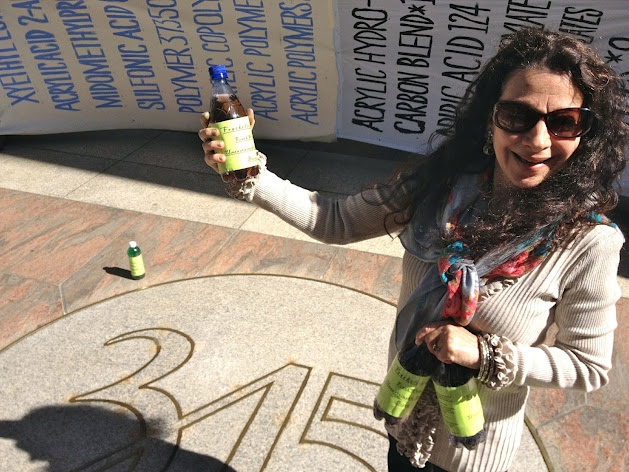
The protest featured an 180-foot banner, painted by artist Ruthie Sakheim. The banner listed more than 70 chemicals found in fracking fluid, in alphabetical order.

“It’s not even halfway through the A’s” said Sakheim.

She also handed out bottles of water oil-colored water labeled “Frackelicious Frackwater Unsustainable Energy Drink.” The label listed some of the more toxic chemicals involved in the process under “ingredients” along with “no preservatives, no artificial flavors, 100 percent poison.”
 
According to a report released by the Congressional Committee on Energy and Commerce, fracking fluid contains 750 chemicals, which “ranged from generally harmless and common substances, such as salt and citric acid, to extremely toxic substances, such as benzene and lead” as well as many carcinogens, according to the report.

These chemicals, along with gas itself, can enter water supplies when the casing on wells cracks or when wastewater containers spill.

The Safe Drinking Water Act of 2005 specifically exempts hydraulic fracturing, a lack of regulation known as the Halliburton Loophole.

Fracking currently takes place in nine California counties, including Sacramento, Los Angeles, Santa Barbara and Monterey.  But the extent of hydraulic fracturing in California isn’t well known, and yesterday, the California Senate rejected SB1054, which would have required energy companies to notify landowners before using hydraulic fracturing on or near their land.

In between chants of  “ban fracking now!” Sakheim told me that she spent several months painting the banner, and plans to continue the project of listing the chemicals involved in fracking in artistic form.

“I have three kids,” said Sakheim. “I really worry about what will happen to them with these corporations having so much control to influence government.”

Fit as a fig

0

le.chicken.farmer@gmail.com

CHEAP EATS On my birthday I saw a lot of water. I took a bath. I drove over the longest continuous bridge over water in the world. It was 90 degrees on the North Shore. I drank a lot of water, used water to wash the fish sauce out of my skirt, and bought a new car.

The Honda Fit! It’s not only the best kind of car to have if you live in a city, it’s the best kind of car. Period. It’s such a good car, I have now bought one twice! And I’ve only ever bought two new cars in my life.

This time it’s a different kind of blue. Less subtle, less sexy, but intensely fun, and even more lickable — in a cotton-candy-y way — than my last Honda Fit.

I left our rental car behind and drove this very shade of blue back onto the Causeway, and back over Lake Pontchartrain. Nothing to look at. Nothing but water, and the road seems to just float on it for 25 miles. It’s like the Salt Flats: terrifyingly boring. And beautiful in its relentlessness, drive drive drive drive drive.

For my birthday, Hedgehog went to wd-50 without me. What the hell, she was in New York, spotting sessions or sessioning spots or some such, and she and her co-writer have to eat, too, don’t they? So while I was eating leftover bad North Shore Vietnamese for dinner, she was sending along pictures of plate after plate after plate of fancy high-falutin’ dishes. I never felt more like a chicken farmer than I did on my 49th birthday.

After dinner I made some popcorn and found Chelsea vs. Bayern Munich on TV. Mother fucking molecular tom-chef-ery, who needs it you got popcorn? Hot dogs …

Vietnamese leftovers.

Egg sandwich.

Oh, hey, this reminds me about Blue Fig, on Valencia Street. Well, technically it was my li’l friend Hoolibloo who reminded me. She and her even li’l’er sis are holding down our Mission digs while Hedgehog and me crash bang boom our way through the home stretch here in New Orleans.

Before I left this last time, Hooli and me dropped onto Blue Fig for lunch or some such. I don’t remember anything. I remember the coffee was good.

I remember we talked about Life, and Careers, how Hooli hoped to produce the theater one day, and I’m pretty sure I encouraged her in this. I’m pretty sure I said, Do what is in your heart, at all costs. Never mind rent.

She wasn’t asking for advice, but — for the record — people do. These days. Me being 49 and all. Maybe this is just the chicken shit talking, but I think I might even have an air of wisdom about me, when there isn’t hay in my hair.

But after the accident, all my memories got erased — except how to make frittatas, oddly enough, since I didn’t know I knew how to make them before the accident. Also worth noting: I didn’t hit my head. At all. So apparently my memories were being stored in my left arm.

Anyway, when wind got back to SF that we were hurting down here, and how, Hooli wrote and said, “Can I help?”

“You can write my review!” I said. “Remember that meal?”

“Blue Fig?” she said.

I said tell me.

“You got the egg sandwich,” she said.

She wrote: I like Blue Fig because the food is very fresh and flavorful. I’ve always been greeted by a smile, she wrote.

She wrote: they cook the food right there in the tiny kitchen behind the counter. It’s all open. It’s fun to watch them. They make the eggs for the egg sandwich on the little burner right behind the cash register.

The first time we went there, she wrote, they were sugaring the pecans for one of the salads, which made the whole restaurant smell so —

Thank you, I wrote. That’ll be enough. I have me a new favorite restaurant. *

BLUE FIG

Mon-Fri 7am-7pm; Sat-Sun 7:30am-7pm

990 Valencia St., SF

(415) 875-9622

Cash only

No alcohol


Stage Listings

0

Stage listings are compiled by Guardian staff. Performance times may change; call venues to confirm. Reviewers are Robert Avila, Rita Felciano, and Nicole Gluckstern. Submit items for the listings at listings@sfbg.com. For further information on how to submit items for the listings, see Picks.

THEATER

OPENING

The Full Monty Eureka Theatre, 215 Jackson, SF; www.roltheatre.com. $25-36. Opens Thu/31, 8pm. Runs Thu-Sat, 8pm (also Sat, 2pm); Sun, 2pm. Through June 30. Ray of Light Theatre performs the hit musical.

100 Saints You Should Know Thick House, 1695 18th St, SF; www.therhino.org. $10-30. Previews Thu/31, 7:30pm and Fri/1, 8pm. Opens Sat/2, 8pm. Runs Wed-Thu, 7:30pm; Fri-Sat, 8pm; Sun, 3pm. Through June 17. Theatre Rhinoceros performs Kate Fodor’s comedy-drama about family love, homosexuality, and adolescence.

BAY AREA

Black n Blue Boys/Broken Men Berkeley Repertory Theatre, Thrust Stage, 2025 Addison, Berk; www.berkeleyrep.org. $14.50-73. Opens Wed/30, 8pm. Runs Tue, Thu-Sat, 8pm (also Sat, 2pm); Wed and Sun, 7pm (also Sun, 7pm). Through June 24. Berkeley Rep presents a world premiere from writer-performer Dael Orlandersmith (a Pulitzer finalist for 2002’s Yellowman).

The Tempest Bruns Amphitheater, 100 California Shakespeare Theater Way, Orinda; (510) 809-3290, www.calshakes.org. $35-71. Previews Wed/30-Fri/1, 8pm. Opens Sat/2, 8pm. Runs Tue-Thu, 7:30pm; Fri-Sat, 8pm (also June 23, 2pm); Sun, 4pm. Through June 25. California Shakespeare Theater opens its season with this dance-filled interpretation of the Bard’s classic tale.

ONGOING

Endgame and Play American Conservatory Theater, 415 Geary, SF; (415) 749-2228, www.act-sf.org. $10-95. Wed/30-Sat/2, 8pm (also Wed/30, Sat/2-Sun/3, 2pm). The stage is bare save for three cocoon-like urns in a row, each containing an emergent head, literally trapped side by side as in an existentialist’s nightmare. In staccato bursts of speech punctuated by the rapid jumping of a follow-spot, the three heads (Anthony Fusco, Annie Purcell, and René Augesen) narrate their respective sides of an adulterous triangle, not once, but twice, incorporating subtle variations on delivery and cadence during the second go-round. The static staging and deconstructed syntax of Samuel Beckett’s seldom-produced short Play is a good introduction to Beckett’s sensibilities, and sets the mood for the main event, the better-known Endgame. This ferocious exploration of habit, habitat, cruelty and fealty has a lot of food for thought to chew on no matter who produces it, but ACT’s version does lack a certain meaty heft. There’s just something a little too smooth in Bill Irwin’s manner as the chairbound, petty tyrant Hamm, and all too often his poisonous ire comes off as merely petulant. Nick Gabriel, as his beleaguered servant Clov, fares somewhat better (or in fact worse), inhabiting his painful mobility with an appropriately long-suffering manner and frustrated despair, and Hamm’s two legless “cursed progenitors” Nell (Barbara Oliver) and Nagg (Giles Havergal) inject some much appreciated warmth into the generally bleak atmosphere. (Gluckstern)

Fwd: Life Gone Viral Marsh San Francisco, 1062 Valencia, SF; (415) 282-3055, www.themarsh.org. $20-50. Thu, 8pm; Sat, 8:30pm; Sun, 7pm. Through June 10. The internet becomes comic fodder for creator-performers Charlie Varon and Jeri Lynn Cohen, and creator-director David Ford.

My Tia Loca’s Life of Crime Bindlestiff Studio, 185 Sixth St, SF; www.brownpapertickets.com. $20. Thu/31-Sat/2, 8pm. “No Human is Illegal,” the immigrant rights activists like to remind, a message adeptly conveyed by Roy Conboy’s My Tia Loca’s Life of Crime, presented by Guerrilla Rep at Bindlestiff Studio. A pointed yet comical commentary on the “crimes” of one Tia Loca (Cat Callejas) which include sneaking back over the border between Mexico and the US after being illegally deported from her actual native country by “La Migra” and impersonating a plainclothes cop in order to find her long-lost daughter, the central message of the play is one of solidarity — familia first. The family bond is most strikingly evident between Callejas’ feisty, independent eccentric and Melvign Badiola as her goofy nephew Memo, who shares her tendency for extralegal action as well as a love for mole. The comedic chemistry between the two is tough and tender, and full of casually hilarious, bickering repartee. The staging is mostly a delight with great jams provided by Brandon Bigelow and Jonah Pavon, strong acting support from Lainey Garrity, Matt Gunnison, and Kirsten Broadbear, and a snappy pace. Regrettably the play’s ending, a dreamlike nod to magical realism and low-riders, feels somewhat tacked on and not fully plotted out, unlike the down-to-earth retelling of events that illustrate Tia’s “criminal” past. But “life aint no pinche bowl of cherries,” and even imperfect, Tia is important. (Gluckstern)

Othello Phoenix Theatre, 414 Mason, SF; www.brownpapertickets.com. $15-18. Thu-Sat, 8pm. Through June 9. Ninjaz of Drama performs Shakespeare’s classic in a contemporary setting.

Slipping New Conservatory Theatre Center, 25 Van Ness, SF; www.nctcsf.org. $25-45. Wed-Sat, 8pm; Sun, 2pm. Through July 1. New Conservatory Theatre Center performs Daniel Talbott’s drama about a gay teen who finds new hope after a traumatic breakup.

The Waiting Period MainStage, Marsh San Francisco, 1062 Valencia, SF; (415) 282-3055, www.themarsh.org. $15-50. Fri, 8pm; Sat, 5pm. Extended through July 7. Brian Copeland (comedian, TV and radio personality, and creator-performer of the long-running solo play Not a Genuine Black Man) returns to the Marsh with a new solo, this one based on more recent and messier events in Copeland’s life. The play concerns an episode of severe depression in which he considered suicide, going so far as to purchase a handgun — the title coming from the legally mandatory 10-day period between purchasing and picking up the weapon, which leaves time for reflections and circumstances that ultimately prevent Copeland from pulling the trigger. A grim subject, but Copeland (with co-developer and director David Ford) ensures there’s plenty of humor as well as frank sentiment along the way. The actor peoples the opening scene in the gun store with a comically if somewhat stereotypically rugged representative of the Second Amendment, for instance, as well as an equally familiar “doood” dude at the service counter. Afterward, we follow Copeland, a just barely coping dad, home to the house recently abandoned by his wife, and through the ordinary routines that become unbearable to the clinically depressed. Copeland also recreates interviews he’s made with other survivors of suicidal depression. Telling someone about such things is vital to preventing their worst outcomes, says Copeland, and telling his own story is meant to encourage others. It’s a worthy aim but only a fitfully engaging piece, since as drama it remains thin, standing at perhaps too respectful a distance from the convoluted torment and alienation at its center. (Avila)

BAY AREA

Crevice La Val’s Subterranean, 1834 Euclid, Berk; www.impacttheatre.com. $10-20. Thu-Sat, 8pm. Through June 9. Just in case you were feeling panicked about the persistently recessed state of the economy and what might be your own less than ideal place in it, the Impact Theatre and Playground co-presentation of Lauren Yee’s Crevice might help to put your woes into perspective. That’s because slacker sibs Liz (Marissa Keltie) and Rob (Timothy Redmond) are only slightly exaggerated representatives of Generation Next whose penchant for making lackluster life choices has sentenced them to an indefinite prison term of couch-surfing and Teen Mom marathons in their childhood home. Naturally, they desire change, but it’s not until their mother (Laura Jane Bailey) starts having a hot fling with a younger man that things do. In an egregious breach of the TMI line, it appears that Mom’s orgasms open a “crevice” into an alternate reality that Rob and Liz subsequently fall into. Thus removed from the entropy of their former reality they begin testing the parameters of their new one, quickly coming to the realization that sometimes the alternatives to what you already have are even worse. Getting home again is a convoluted, not fully mapped-out process, but in the interim, their navigation of their erstwhile wonderland offers most of the play’s best lines as well as the uncomfortably effective transformation of Reggie D. White from Liz’s nerdish best buddy to multi-lingual Mafia killer and casual sadist. (Gluckstern)

God of Carnage Marin Theatre Company, 397 Miller, Mill Valley; www.marintheatre.org. $34-55. Tue and Thu-Sat, 8pm (also Sat/2 and June 16, 2pm; Tue/7, 1pm); Wed, 7:30pm; Sun, 2 and 7pm. Through June 17. Marin Theatre Company performs Yasmina Reza’s Tony-winning comedy about two sets of parents who meet after their children get into a schoolyard fight.

The Great Divide Ashby Stage, 1901 Ashby, Berk; www.shotgunplayers.org. $20-30. Wed-Thu, 7pm; Fri-Sat, 8pm; Sun, 5pm. Through June 24. Shotgun Players performs Adamn Chanzit’s drama about the hot topic of fracking, inspired by Ibsen’s An Enemy of the People.

The Kipling Hotel: True Misadventures of the Electric Pink ’80s New venue: Marsh Berkeley, 2120 Allston, Berk; (415) 282-3055, www.themarsh.org. $20-50. Sat, 8:30pm; Sun, 7pm. Extended through June 10. This new autobiographical solo show by Don Reed, writer-performer of the fine and long-running East 14th, is another slice of the artist’s journey from 1970s Oakland ghetto to comedy-circuit respectability — here via a partial debate-scholarship to UCLA. The titular Los Angeles residency hotel was where Reed lived and worked for a time in the 1980s while attending university. It’s also a rich mine of memory and material for this physically protean and charismatic comic actor, who sails through two acts of often hilarious, sometimes touching vignettes loosely structured around his time on the hotel’s young wait staff, which catered to the needs of elderly patrons who might need conversation as much as breakfast. On opening night, the episodic narrative seemed to pass through several endings before settling on one whose tidy moral was delivered with too heavy a hand, but if the piece runs a little long, it’s only the last 20 minutes that noticeably meanders. And even with some awkward bumps along the way, it’s never a dull thing watching Reed work. (Avila)

Not Getting Any Younger Marsh Berkeley, 2120 Allston, Berk; (415) 282-3055, www.themarsh.org. $15-50. Fri, 8pm; Sat, 5pm. Extended through June 30. Marga Gomez is back at the Marsh, a couple of too-brief decades after inaugurating the theater’s new stage with her first solo show — an apt setting, in other words, for the writer-performer’s latest monologue, a reflection on the inevitable process of aging for a Latina lesbian comedian and artist who still hangs at Starbucks and can’t be trusted with the details of her own Wikipedia entry. If the thought of someone as perennially irreverent, insouciant, and appealingly immature as Gomez makes you depressed, the show is, strangely enough, the best antidote. Note: review from the show’s 2011 run at the Marsh San Francisco. (Avila)

The Odyssey Angel Island; (415) 547-0189, www.weplayers.org. $40-76 (some tickets include ferry passage). Sat-Sun and Fri/1, 10:30am-4pm (does not include travel time to island). Through July 1. We Players present Ava Roy’s adaptation of Homer’s epic poem: an all-day adventure set throughout the nature and buildings of Angel Island State Park.

The World’s Funniest Bubble Show Marsh Berkeley, TheaterStage, 2120 Allston, Berk; (415) 826-5750, www.themarsh.org. $8-50. Fri, 6pm; Sun/3, June 10, 16, 24, and 30, 11am. Through June 30. Louis “The Amazing Bubble Man” Pearl returns with this kid-friendly, bubble-tastic comedy.

PERFORMANCE/DANCE

“The Bilarious Show” LGBT Center Rainbow Room, 1800 Market, SF; www.qcomedy.com. Sat/2, 7:30pm, $12. The National Queer Arts Festival presents this all-bi line-up of comedy, music, and performance.

“Elect to Laugh” Studio Theater, Marsh San Francisco, 1062 Valencia, SF; (415) 282-3055, www.themarsh.org. Tue, 8pm. Ongoing through Nov 6. $15-50. Will Durst and friends perform in this weekly political humor show that focuses on the upcoming presidential election.

“Larry Hankin’s Street Stories” Marsh San Francisco, Studio Theater, 1062 Valencia, SF; (415) 282-3055, www.themarsh.org. Fri/1-Sat/2, 8pm. $20-35. The San Francisco comedy legend performs his solo show.

“The News” Somarts Cultural Center, 934 Brannan, SF; www.somarts.org. Tue/5, 7:30pm. $5. New and experimental queer performance works from Nic Alea, Hallie Dalsimer, and more.

“Parkour Deux” CounterPULSE, 1310 Mission, SF; www.counterpulse.org. Fri/1-Sun/3, 8pm (also Sun/3, 2pm). $15-22. Scott Wells and Dancers perform new work.

“The Romane Event Comedy Show” Make-Out Room, 3225 22nd St, SF; romaneeventcomedyshow.eventbrite.com. Wed/30, 7:30pm. $10. Stand-up with Ms. Pat and the Bay Area Comedy All-Stars.

San Francisco Ethnic Dance Festival Fort Mason Center, Cowell Theater, Marina at Laguna, SF; www.worldartswest.org. Sat/2, 4pm; Sun/3, 4pm. $12-20. Weekend one of the 34th annual festival, “The World United Through Dance,” features a world premiere by Bay Area troupe Gamelan Sekar Jaya, in collaboration with Sudanese gamelan Pusaka Sunda.

“Sex and the City: Live!” Rebel, 1760 Market, SF; www.brownpapertickets.com. Tue, 7 and 9pm. Through June 26. $25. Heklina, D’Arcy Drollinger, Lady Bear, Trixxie Carr play the fab four in this drag-tastic homage to the HBO series.

“Shadow of a Doubt” Dance Mission Theater, 3316 24th St, SF; www.dancecontinuumsf.org. Fri/1-Sun/3, 8pm. $20. Dance Continuum SF performs a dance-theater concert with four premieres and one repertory work.

“Voca People” Marines’ Memorial Theatre, 609 Sutter, Second Flr, SF; www.marinesmemorialtheatre.com. Tue-Fri, 8pm; Sat, 6:30 and 9:30pm; Sun, 3 and 6pm. Through June 17. $49-75. A capella from outer space.

“The Water is Clear and Still” Z Space, 450 Florida, SF; www.brownpapertickets.com. Thu/31-Sat/2, 8pm; Sun/3, 2pm. $25. Liss Fain Dance performs a world premiere performance installation inspired by short stories by Jamaica Kincaid.

“X” Garage, 715 Bryant, SF; www.brownpapertickets.com. June 5-7, 8pm. $10-20. Australian performer Sunny Drake presents his new show in conjunction with the National Queer Arts Festival.

BAY AREA

“Dances for Oakland” Laney College Theater, 900 Fallon, Oakl; www.savagejazz.org. Thu/31-Sat/2, 8pm; Sun/3, 3pm. $5-20. Savage Jazz Dance Company performs in celebration of its 20th anniversary.

“RoCo Dance Onstage” Marin Veterans’ Memorial Auditorium, Marin Center, 10 Avenue of the Flags, San Rafael; (415) 499-6800. Fri/1, 8pm; Sat/2, 7pm. $19.50-29. RoCo Dance and Fitness presents two nights of performance featuring over 700 dancers of all ages. *


I Love This City’s tasteful use of confetti, fog, and lighting

0

When I first heard that the inaugural I Love This City festival was moved from AT&T Park to Mountain View’s Shoreline Amphitheater, I thought fate (or Live Nation) was twisting my arm.

The last time I visited Shoreline was a decade ago, when Moby headlined a nationwide tour and invited top electronic DJs to spin. One of the side stage’s top acts was a Dutch mixer taking Europe by storm: Tiësto. It was the first electronic music show I ever attended.

More than 10 years later at I Love This City, Tiësto was one of the main stage headliners and I’m pushing the age when attending an event that allows high school sophomores is questionable at best. But I was actually eager to attend ILTC. For one thing, the event promised, at the very least, a lineup chock full of well-known talent, ranging from Steve Aoki to DFA co-founder James Murphy to Man-of-the-Moment David Guetta, voted number one in DJ Magazine’s annual Top 100 List in 2011.

In full disclosure, my sentimental side was pulling for success for this inaugural event, just to soak in my trance-filled Tiësto nostalgia. Venue change and all, Live Nation did a pretty good job of holding things together. Here’s a rundown:

The Good
David Guetta: The man knows how to work a crowd, and he had to. He had to follow Tiësto, an unenviable task given the Dutch DJ’s enduring popularity. But Guetta won over listeners with his infectious grin and antics, which included dancing on the DJ equipment table and gesturing to the crowd like a conductor guides a symphony.

Crystal Method: On the Bass Stage, Los Angeles duo Scott Kirkland and Ken Jordan threw down a storming set of big beats that was only derailed by technical glitches at the very end. Kirkland was jamming buttons and strumming strings on an original and fascinating contraption, a CD turntable and a mini-keyborard fused to two guitar necks.

The Visuals: Whoever handled visuals for the main stage DJs did a tremendous job. In fact, the graphics were so stunning, I couldn’t help but wonder if the headliners had their playlists prepared in order to sync up with the montages. Regardless, the production crews should be lauded for tasteful use of confetti, fog, and lighting to lend some extra oomph to the shows. The side stages also had elaborate lighting and visual setups.

The Swaps: Transitions between sets were grab-a-beer-go-to-the-bathroom short. The production teams were well-oiled machines, setting up gear and visuals.

Shoreline was a success: The amphitheater ended up being a fantastic scene for the headliners. The effect gave a truly condensed focus on the DJ, something that might have been lacking at AT&T Park. The folks on the grass had a view and still has reams of bass blasting from the speakers. And the seats gave a much needed reprieve from concert goers, who wanted to take in music and crowd.

Food Trucks: An extremely welcome addition, though they were placed between the side stages, out of the way of the concession stands flanking the amphitheater. Thankfully, the food trucks didn’t seem too inclined to mark up the prices of their own offerings, and I very much would rather have an $8 Curry Up Now burrito over a $6 meat tube in a bun. But that’s just me.

The Bad
Where was the afterparty? The one big drawback with relocating ILTC to Shoreline was the surrounding neighborhood. Once Guetta finished his set and cooed to the restless crowd that he could not play any more music, Mountain View became Bay Area electronic music limbo just before midnight, caught between San Francisco and San Jose. If only nearby Google headquarters had been open, surely the search engine conglomerate could have thrown a kick-ass shindig.

Three stages: There was an impressive collection of talent to be had at ILTF. The Bass Stage made a lot of sense, a refuge where concert-goers could get their fill of low-end frequencies and throbbing drums. But some very good electronic artists got kind of lost in the fray at the Park Stage, which seemed like it was the everything-but-trance-and-dubstep venue. James Murphy, Holy Fuck, Apparat, and Cut Chemist all got shoehorned into an area that struggled to draw a significant following simply because of the size of the other two stages. A main stage and a strong alternate stage likely would have been sufficient.

The nickle-and-dime: $15 to park. $10 for a beer. $4.50 for bottled water. This after $60 for one-day tickets or $100 for two-days. And that’s without any, shall we say, “extracurricular activities.” Today’s electronic festival-goer seems like they have to be more part of the 1% than the 99%.

Gotye‘s ubiquity: No fewer than three main stage headliners threw in a redo of “Somebody That I Used to Know” and the crowd went absolutely crazy, shouting “You didn’t have to stoop so low” every time. C’mon DJs! You didn’t have to milk the crowd so much.

Headliners referring to the crowd as “San Francisco”. I know Tiesto, Afrojack, and David Guetta are all from Europe, but it was kind of awkward when pretty much everyone kept saying “San Francisco!” when the city was a 40-minute drive away. Then again, if the 49ers move to Santa Clara, I guess anything in between can fall under the San Francisco title.
 

Landlocked

1

arts@sfbg.com

MUSIC Pavement. That’s all I really associate with Stockton. Personally, I’ve only been there once, few weeks back on my way to Yosemite, and I just drove through — 205 to 120 — stopping once for gas. So pavement all the way. Yet, despite the lack of waves, it’s home to Surf Club, a sunny four-piece that’s recently released its debut EP, Young Love, on Death Party Records.

“It’s not that bad living in Stockton,” says guitarist Eddie Zepeda. “You make the best of it.” Zepeda barely finished this optimistic assessment before bassist Fonso Robles offers a conflicting view: “Uh, it’s pretty bad.” Earlier in the week, Robles had been pulled out of his car, in the middle of the day, and held up at gunpoint. Before taking off, the robber cautioned, “Don’t let me catch you slippin’,” a combined threat and unsolicited piece of street advice.

Early last year, Justin Vallesteros of Craft Spells moved his project from Stockton to Seattle (where he was born), citing the former city’s number one placement on Forbes Magazine’s 2011 list of “America’s Most Miserable Cities” among the reasons. Surf Club’s Frankie Soto, then guitarist for Craft Spells, stayed behind in his own hometown. “It wasn’t really a hard decision. It was Justin’s band, so I was just like go ahead, dude,” Soto says.

There doesn’t appear to be bad blood between the groups: “Justin still comes over and we all jam,” Zepeda says, and a few days after the interview I run into Soto and Robles at the Great American Music Hall, where Craft Spells is opening for the Drums.

Still, after the split, Soto tells me he spent a few months depressed in his room, trying to find his own sound. When he re-emerged it was with Zepeda and Robles, as well as drummer Jose Medina, who the rest of the group insists is its most talented member. “He’s probably the best drummer and guitarist in the band, and he doesn’t even play guitar for us,” Soto says.

With individual experience in a variety of other bands, the four switched around on instruments, trying to find the right configuration. Medina went from bass to drums, Soto took on vocals in addition to guitar, and Robles — in a Tina Weymouth move — started learning bass from the beginning.

When the band first started coming together, Zepeda had been listening to a lot of surf rock and Beach Boys. It’s certainly an influence on the sound of material released so far, but they didn’t set out or plan to be a Dick Dale revival band.

“I can’t even swim,” Soto says, in a moment of irony recalling Brian Wilson’s fear of the water. “Of all the band names, Surf Club just seemed the easiest to hear.” (Robles angled for Faucet Water, presumably in reference to Stockton’s E. coli contamination warning a couple years back, and Youth Wave was another aquatic option.) “I don’t consider us a surf band. It’s just pop, and that’s what we focus on for all of our songs,” Soto asserts.

True to its name, Young Love is full of open-hearted lyrics with youthful longing. In addition to vocal harmonies, the biggest surf aspect is the tidal wave tempo, where bouncy guitar rhythms get carried by the super tight drumming, speedy fill, and shifts in patterns that reveal Medina’s background in metal and jazz. Soto sings with a light voice, and comes off as a bit of a tender softy. “I guess I’m still kind of shy,” he explains, “I took choir in high school, but it’s still kind of weird being in front of everyone with them paying attention to what you’re saying.”

Barely in their twenties, friends since fifth grade, a band for less than a year, with less than a dozen shows performed so far, Surf Club is clearly still figuring out how to make it work.

As Zepeda puts it, “we’re pretty young, we really don’t have any money, and we all have bills to pay.” That’s the point where people might give you advice, besides slippin’ or not slippin’. When they played with the Soft Pack a couple months back, singer Matt Lamkin gave them some. “He was telling us to move out of Stockton,” Soto says. But ignoring that kind of advice has worked so far.

SF Popfest Day 2

With Surf Club, Kids On A Crime Spree, Manatee, Dead Angle, Cruel Summer

Sat/26, 4pm, $10

Knockout

3223 Mission, SF

(415) 550-6994

www.theknockoutsf.com

Whorls away

1

le.chicken.farmer@gmail.com

CHEAP EATS Way out in the water.

A severed head, a small treasure in gold, or drugs, my own death, fish, a baby in a basket, the murder weapon, the meaning of life, peace and quiet, a clue .. . A long time ago, when I was fearless, I swam toward something. That’s how curious I was. It could have been anything, but I had to know.

Now, I can float. I like to think I can float.

Then, I was a pretty good swimmer. I could swim, see me swimming?

My people on the shore, Moonpie, Baby Rae, and Moonpie’s now resting-in-peace sister, Sweetpee … they didn’t know where I was going, because the fearless don’t always say.

They watched. They worried. And they must have seen what I was seeing — this bobbing thing, way out on the horizon.

As the ocean floor sloped and sloped and sloped away from my kicking feet, they watched, helpless and wondering, and I suppose I got a rise out of this.

Good. Risings was what I needed then, maybe even more than treasure. What it was, though, that I risked my ass for all those years ago, was an Igloo cooler with a half a loaf of sliced white bread in it, an open package of lunch meat, and mustard. Or in other words: sandwiches.

I risked my life for sandwiches!

And I don’t even particularly like sandwiches, I thought, watching a matzoh ball bob in my bowl of matzoh ball soup. That is so David Copperfield.

And these were some hard-earned matzoh balls. Not only because Soup Freaks is off my beaten path (unless I happen to be BARTing to a ballgame), but also because the matzoh gods were not looking out for me, on this particular day.

“Matzoh ball soup!” I said.

And the serverwomanperson digged and dug and couldn’t find hardly no matzoh balls in that there silver thingie of soup. Just one, and some broken off pieces of a couple others.

“Hold on a second,” she said, stepping away from the counter and returning, many months later, with a bag of frozen ones. At least they looked like they were frozen.

At least it seemed like many months.

Anyway, she was fixing to pour them into the vat when, apparently, a thought occurred to her: Did I want to wait for them to warm up, or…

“I’ll just take it as is,” I said, and that was how I wound up with a bowl of matzoh ball soup without hardly any matzoh balls in it. My fault, let the record show.

Theirs: to compensate, probably, they gave me three big pieces of bread — which seemed pretty generous, but I would have rather had a bigger bowl of soup with more things in it. I mean, classically, matzoh ball soup is not the most populated bowl of soup in the world, but, really? No carrots? No celery?

What little chicken there was was really not very good. It was peppered, and dry. Very dry. And there’s nothing worse than dry chicken in soup. Well, except maybe dry chicken outside of soup.

So I’m afraid I’m going to have to break with tradition here and declare Soup Freaks “just another restaurant.”

Not my new favorite.

David Copperfield, on the other hand. On the other hand, the Pixies. I haven’t read or listened to it or them in quite a while, respectively; but at times like these, when everything starts going wrong and doesn’t seem to want to right itself, we will grab at books and songs, if not straws.

If not drinks.

If not lunch itself.

See me swimming? Between waves, a mile from shore … the skinny girl, kicking frantically, breathing hard, and holding on for dear buoyancy to flotsam, jetsam, to little coolers full of someone else’s sandwiches. That’s me.

SOUP FREAKS

Mon.-Fri. 7am-8pm; Sat.-Sun. 10am-6pm

667 Mission St., SF

(415) 543-7687

AE,D,MC,V

No alcohol


Our 2012 Small Business Awards

5

WOMEN IN BUSINESS

KELLY MALONE, WORKSHOP AND INDIE MART

In a tech-obsessed society, our hands navigate today’s gleaming gadgets more often than those of yesteryear: a sewing machine, say, or a manual drill. DIY goddess Kelly Malone has spent years trying to change that — and in so doing has created a business that serves as a cultural touchstone for the budding Divisadero Street corridor.

Malone’s brick-and-mortar shop is named Workshop (1798 McAllister, SF. 415-874-9186. www.workshopsf.org), and it’s a place where aspiring crafters receive hours of instruction in oft-neglected skills like sewing, knitting, and terrarium-making — all while drinking Pabst Blue Ribbon and meeting new friends. After receiving an enthusiastic response from her Indie Mart (www.indie-mart.com), a handmade craft fair she started six years ago in the backyard of her Mission digs, Malone saw a need for a hub for would-be crafters.

“I wanted to create a space that was super ‘hit it and quit it,'” she says. “Where you could come in and take a class, but you didn’t necessarily need to become some expert knitter. A place for people to sit down and get their hands dirty, learn to make something, and get inspired.”

Malone started Workshop on scant funding. Instead of relying on bank loans, she looked to her immediate community for investors. “I’ve started every business without money, which has forced me to really put myself out there and grow my businesses by meeting people and being super-passionate about what I do,” she says.

Malone says having a big budget to open her businesses would have been fun, but saving her pennies and having flea markets and garage sales to pay for sewing machines gives her more street cred, DIY all the way.

And like our favorite kind of businesspeople, Malone hardly sees her enterprises as a sterile way to make a quick buck. “I’m never going to get rich off these businesses, but if I get to the point where I can have a couple people on staff like I do now, and have enough to pay bills and go get some beers, hey, that’s good enough for me.” (Mia Sullivan)

CHAIN ALTERNATIVE

SPORTS BASEMENT

Although based locally, Sports Basement (www.sportsbasement.com) is technically a chain, as it now boasts four locations: an 80,000 square-foot building at the old commissary in the Presidio, SoMa’s brick-and-wood location, a store in Sunnyvale that once mimicked the inside of a computer (look for the remaining “ESC” keyboard sign), and another nearing Mount Diablo in Walnut Creek. But beyond the fact that it offers the only real alternative to national conglomerates when it comes to one-stop athletic and outdoor gear, the retail company is fiercely dedicated to its Bay Area community. Plus, its cozy, with hand-painted cardboard signs detailing specials, comfy couches, and super-friendly staff.

Founder Eric Prosnitz came up with the Sports Basement idea in an effort to create a more personalized experience in an off-price retail outlet, something tailored more closely to Northern California’s environment. Products change every week, discounts rule, and employees are encouraged to treat customers as individuals with a continuum of outdoor lifestyle needs. And the Basement recognizes that it’s an expansive company with the power to affect various neighborhoods. Last year, its locations hosted more than 2,000 community groups at 7,000 events, averaging around four events per store per day. Ten-15% of the retail space serves as free community space. Examples: Walnut Creek holds a fundraiser in the form of a kid apparel fashion show, Sunnyvale hosts ASHA for India, an organization dedicated to providing education for underprivileged children in India; Bryant St. houses the AIDS Lifecycle organization, and Presidio is the meeting spot for Golden Gate Mother’s Group — just to mention a few.

Aaron Schweifler, Director of Operations at Sports Basement, says the staff is encouraged to be creatively autonomous, and hopes each store will provide a shopping experience that can “wow” local residents. We are wowed! (Soojin Chang)

TENANT ADVOCATE

GREG MARKOULIS, AMERICAN INDUSTRIAL CENTER

In 1975, Greg Markoulis of American Industrial Center (2345 Third St., SF. www.aicproperties.com) was scouring San Francisco to find a new home for his family’s 25-year-old shoe manufacturing company. When American Can Company, one of the city’s oldest and busiest industrial complexes, offered an attractive deal on a vacant Third Street building, Markoulis gladly took them up. The new abode reinvigorated the company, transforming it from a street corner location to a community space housing more than 285 businesses — now including graphic designers, commercial photographers, architects, light industrial manufacturers, a winery, a yoga center, a martial arts studio, and a medley of Web-based companies and art collectives. That expansive spirit soon spread, helping to reinvigorate the entire Dogpatch area, which had suffered a lengthy period of industrial decline.

Thirty-seven years later, AIC still keeps the family ethos alive. When making executive decisions, Greg Makoulis says the company’s priorities align much more with how relatives interact with one another rather than those of a typical business. “The ideas of the oldest generation with the most experience are considered first,” says Markoulis.

As this side of town is rapidly undergoing gentrification, he could very well have sold the building to a corporation. But he sees his tenants as valuable community members, not just paychecks. Markoulis thrives on finding working solutions to accommodate his tenants, and respects the fact that people’s needs are ever-changing. Markoulis describes AIC’s priority to be “giving everyone a stable place to operate in.”

In Markoulis’ experience, one of the biggest challenges that AIC has faced over the years has to do with the cost and time for newly opening businesses to acquire permits. He hopes to see changes in San Francisco’s building and planning department, because he thinks a faster turnaround would help foster employment opportunities. (Soojin Chang)

CULTURE CHAMPION

DON ALAN, HEMLOCK TAVERN AND CASANOVA LOUNGE

“I think the challenge for San Francisco is to take care of the venues that its got,” says Don Alan of the ever-shrinking live music scene here. Alan has contributed enormously to the preservation of live rock in the City by the Bay with his raucous Hemlock Tavern space in Polk Gulch (1131 Polk, SF. 415-923-0923, www.hemlocktavernsf.com) on the site of former gay bar the Giraffe. He’s also a preservationist of dive bar ambiance, opening Mission District favorite Casanova Lounge, full to the brim of attractive indie young ‘uns on the make.

Alan got his rock start in the on community radio in Madison, WI, soon coming to SF and opening storied live bluegrass and jazz cafe Radio Valencia. “We opened the Casanova while we still had Radio Valencia and we realized that a bar format would work better for live entertainment than a cafe format,” Alan says. “We opened the Hemlock in 2001 after we closed Radio Valencia. I was really excited about having a space like this. I was very interested in having a kind of old Wisconsin tavern feel because that’s where I grew up. It was perfect for me, finding a space that had a small venue so we didn’t have to be concerned about getting 200 people in every night, so we could book the kind of music that we wanted and to have a big enough bar to support that.”

“But basically this is a subsidized entertainment operation. The money is made at the Hemlock’s bar and the culture happens in the back room with the shows. The culture wouldn’t happen without this up here.” So go buy a beer or eight, already, and then take in one of those rarer-and-rarer raging shows. (Mirissa Neff)

EMPLOYEE-OWNED BUSINESS AWARD

MANDELA FOODS COOPERATIVE

“In high school, all I wanted was there to be a place to find fruits and vegetables,” says Mandela Foods Cooperative (1430 Seventh St., Oakl. 510-452-1133, www.mandelafoods.com) worker-owner James Berk. “I never thought I’d be the one that could provide that. It’s an interesting place to be in.”

Before the store opened, Berk’s native West Oakland was a food dessert. A dependence on convenience stores for nutrition was leading to rampant bad health in his community, so when the opportunity arose to be a part of a for-profit, organic-heavy grocery store in Mandela Marketplace, he took it. Responding to the neighborhood’s request, the shop employs and is owned by community residents. These worker-owners make all the shop’s decisions in group meetings, aiming for consensus when it comes to many essential issues.

Now, nearly three years after opening its doors, Mandela Foods Cooperative is a neighborhood staple. The majority of customers live within a radius of a few blocks and come to snap up bestselling items like orange juice, coconut water, and kale (a vegetable Berk said he had never heard of before working at the store.)

Ready-made food is also popular, from full plate meals to sandwiches that neighbors drop in to buy, despite a Subway next door. Though the shop’s focus continues to be on organic, naturally-produced foods, worker-owners see a need for a greater diversity of products: cheap staples alternating with more spendy products geared towards sustainable foodies. Business is stronger than ever right now, too — Berk says the small shop is on pace to break even this year.

So how is it banding with your neighbors to bring the rest of the block ingredients for a healthy diet? About as positive as you’d imagine it to be. “There’s a unity here that I’m not accustomed to,” says Berk. (Caitlin Donohue)

ARTHUR JACKSON DIVERSITY IN SMALL BUSINESS AWARD

CHERYL BURR, PINKIE’S BAKERY AND CITIZEN’S BAND

Cheryl Burr has no idea why her first bakery boss left her 16-year old self in charge of the pastries. “I would never have let a teenager do that at my business!” she chuckles. But really, the guy was showing prescience — Burr and business partner Chris Beerman, who originally shared space in a bakery-bento retail window in Potrero Hill, opened the doors of their Pinkie’s Bakery (1196 Folsom, SF. 415-556-4900, www.pinkiesbakerysf.com) in SoMa nearly three years ago and have been tickling sweet teeth with their skills there ever since.

“I’ve always been a super-strong personality,” Burr tells us, sitting in the sunny table area of Pinkie’s. Though the Asian American breadsmith built a respectable career in high-class kitchens around the city, there came a moment when she wanted to be able to execute her own vision. “I’ve gotten to this point in my career where I didn’t want to answer to anybody.”

So she took control of her own trajectory, renting space in a commercial kitchen, starting her own hustle. Burr supplied pies to wholesale accounts, mainly friends of friends she’d met through her years in the restaurant business. Her commercial space is part of a culinary reinvigoration of the neighborhood around Seventh Street and Folsom. Pinkie’s is a stone’s throw from Bloodhound Bar, Sightglass Coffee, Radius restaurant, Terroir wine bar and more. “There is definitely a sense of community and partnership around here,” says Burr, who will sometimes refer to the strip as “Folsoma.”

Pinkie’s is also a room away from Citizen’s Band, Beerman and Burr’s freshly-sourced diner. The same customers that come for Burr’s famous levain bread and apple butter morning buns can now also order a dinner of poutine with wild mushroom gravy and crispy pork belly right next door.

“We want to continue to refine what we’re doing here,” Burr says when asked about her future business plans. Did that young woman on her first baking job envision the success of her own bread basket? She smiles. “I’m not entirely sure what I envisioned, but it’s different.” (Caitlin Donohue)

GOLDEN SURVIVOR AWARD

PHIL’S ELECTRIC

During World War II, Phil Sidari was commissioned to make artificial limbs for disabled US veterans returning home. The shortage of finished goods during wartime also prompted Sidari to begin constructing small appliances out of spare parts. Thus, 61 years ago, Phil’s Electric (2701 Lombard, SF. 415-921-3776, www.philselectric.com) was born.

Sidari passed away at the ripe old age of 103, but his friends Vicki and Bob Evans took the reins in the 1970s when Phil decided to retire. Vicki says the store has gone through quite a few changes over the years, including a relocation 28 years ago from Fillmore Street to a quiet corner near the gates of the Presidio.

The shop is intimate, homey, and entirely a family affair. Bob and Vicki’s sons Tom and Ken help their parents run the business and provide excellent customer service to their patrons. Phil’s Electric specializes in the repair of vacuums and lamps but also sells coffee makers, blenders, vacuums, razors, and a host of other small electronic items.

Yet the rise of cheap, disposable electronics has made it difficult a business that’s founded on, well, fixing things. “In the past, almost everything got repaired, but that’s changing,” says Vicki. “For example, you can buy a Cuisinart coffeemaker that, after its warranty, there are no parts for it. So you throw it out. Whereas, say 12 years ago, we would have had a part for that and fixed it for you.”

Phil’s Electric also faces stiff competition from the Internet and larger stores. But it does have some advantages. “Internet companies are working out of a warehouse somewhere, so they don’t really have any commitment to the neighborhood or the city or the community,” Vicki says. And the unique thing about San Franciscans, according to Vicki, is our interest in supporting neighborhood businesses. “If we moved this to a suburban area, I don’t know if we’d have that many loyal customers.”

Vicki’s favorite part about the business? The human aspect and her autonomy. “You can interact with your customers and really try to be flexible and meet people’s needs.” (Mia Sullivan)

SMALL BUSINESS ADVOCATE

CALIFORNIA MUSIC AND CULTURE ASSOCIATION

Two years ago, during the climax of the police and regulatory crackdown on San Francisco nightlife that we dubbed the “War of Fun,” the California Music and Culture Association (www.cmacsf.org) was formed to advocate for all the club owners, promoters, DJs, and other creatures of the night who create our urban soundtrack and culture.

Since then, CMAC has become powerful advocate on behalf of nightlife, demonstrating an influence on Mayor Ed Lee and other city leaders and promoting an understanding at City Hall of the important role played by nightlife, which a recent Controller’s Office report found accounts for $4.2 billion in annual economic activity.

“As the recent Controller’s report demonstrated, the small businesses that make up the nightlife economy have a huge impact on the overall economy, and we’re happy the city is starting to realize this,” Alix Rosenthal, co-chair of the CMAC board, told us.

Now, with the help of newly hired Executive Director Laura Hahn, CMAC hopes to move from playing defense against crackdowns and punitive legislation to playing offense by expanding its membership and developing a proactive agenda that will help nightlife and its purveyors flourish.

“Now that we don’t have our back against the wall, we’re trying to expand,” Hahn told us. “We want to bring it to even smaller business owners like individual DJs, promoters, and individual musicians — the backbone of nightlife in San Francisco.”

But not matter what new realms CMAC gets into, small business advocacy will always be at the core of its mission. As Hahn said, “We want to focus on standing up for the little guys who don’t have people fighting for them in City Hall.” CMAC will host the 2012 San Francisco Nightlife Awards, Thursday, May 31 at Mezzanine, doing even more to bring local nightlife to the fore. (Steve Jones)

GOOD NEIGHBOR

SHANNON AMITIN, FARM:TABLE

“People always ask me if I ever consider expanding,” Shannon Amitin, owner of farm:table (754 Post, SF. 415-292-7089, www.farmtablesf.com) says over the phone, although I swear I can hear his eyes twinkling. “I usually laugh and say, ‘Yes, but only if I can find a much smaller space.'”

The joke — or rather the good fortune — here is that Amitin’s bustling Tenderloin cafe and restaurant squeaks just shy of 265 square feet, with a large communal table for sharing some of the best gourmet dishes in the area. Those dishes are delectably evanescent: the three-year-old resto’s changing daily menu is Tweeted each morning for your rising and shining appetite. Featured as I write this: polenta cake + yukon potato hash + soft egg, asiago + rooftop herb frittata.

“Rooftop”? Yep, farm:table harvests most of its herbs and many greens from its roof, adding a bit of green to the neighborhood. Coming soon, another bit of green in the form of a farm:table parklet, whose funding was secured via, what else, Kickstarter. Farm:table itself has become a community hub for nightlife characters, nonprofit advocates, and office workers.

And yes, there is delicious coffee. Amitin cut his teeth dripping cups of Blue Bottle behind the original’s counter, but became disillusioned when Blue Bottle tipped from a friendly experiment into a chain-aspirational juggernaut. “I saw what I didn’t want to do,” he says. “That’s what led me to something small and personal. I have really good people working for me, in a vibrant area, with a crowd that’s open to new flavors. I want to keep that magic.” (Marke B.)

READERS’ CHOICE

PINK BUNNY

It’s been open less than a year, yet Marina luxury erotic goods boutique Pink Bunny (1772 Union, SF. 415-441-7399, www.pinkbunny.biz) has hopped into our readers’ hearts — and possibly other parts as well. Founder and CEO Serene Martinez showcases quality adult toys from the likes of Jimmyjane and gorgeous lingerie in a lovely, well-curated space. Union Street, get kinky!


Obama: gay OK, pot not

0

steve@sfbg.com

HERBWISE President Barack Obama made big news last week when he became the first U.S. president to state his support for same-sex marriage, taking a states’ rights position on the issue and telling supporters “where states enact same-sex marriage, no federal act should invalidate them.” So why is his administration so aggressively going after medical marijuana providers that are fully compliant with state law?

As a presidential candidate, Obama said that his administration wouldn’t go after medical marijuana patients or suppliers that were in compliance with the laws in the 19 states where medical marijuana is legal or decriminalized, a position that his Department of Justice reinforced with a 2009 memo restating that position.

But then last year, the administration reversed course and began a multi-agency attack on the medical marijuana industry in California and other states, with the Drug Enforcement Administration raiding growers, dispensaries, and even Oaksterdam University; the Department of Justice and U.S. Attorneys’ Offices threatening owners of properties involved in medical marijuana with asset seizure; and the Internal Revenue Service adopting punitive policies aimed at shutting down dispensaries that are otherwise paying taxes and operating legally under state law.

Recently, Obama tried to explain his evolving stance on medical marijuana in a Rolling Stone interview: “What I specifically said was that we were not going to prioritize prosecutions of persons who are using medical marijuana. I never made a commitment that somehow we were going to give carte blanche to large-scale producers and operators of marijuana — and the reason is, because it’s against federal law. I can’t nullify congressional law.”

Yet statements like that only reinforce the idea that Obama has a double standard. After all, same-sex marriage is also against federal law, specifically the Defense of Marriage Act that President Bill Clinton signed in 1996. The Obama Administration last year refused to continue defending DOMA in the courts, whereas it has proactively and aggressively expanded enforcement of federal laws against pot.

When I asked Obama’s Press Office to address the contradiction, they referred to the Rolling Stone interview, provided a transcript of a press briefing from last week, and refused further comment.

Press Secretary Jay Carney spent much of that briefing discussing Obama’s “evolving” position on same-sex marriage, and said the president has always been supporter of states’ rights. “He vehemently disagrees with those who would act to deny Americans’ rights or act to take away rights that have been established in states. And that has been his position for quite a long time,” Carney said.

Assembly member Tom Ammiano, who has sponsored legislation to improve protections for those in the medical marijuana industry and criticized Obama’s crackdown on cannabis, said he was happy to hear Obama’s new stance on same-sex marriage. But he said that position of federal non-intervention in state and local jurisdictions isn’t being following with medical marijuana, or on immigration issues, where the federal government has circumvented local sanctuary city policies with its Secure Communities program targeting undocumented immigrants.

“Good move, Mr. President, now let’s work on that states rights issue,” Ammiano told us. “I don’t want to water down the significance of this, but I do want to treat it holistically.”

Ammiano praised House Minority Leader Nancy Pelosi for her May 3 public statement criticizing the federal raids on medical marijuana patients and suppliers, but he said federal leaders should act to remove marijuana from the list of Schedule 1 narcotics, a classification of dangerous drugs with no medical value.

“Pelosi was good to put that statement out, but now we need the next step of changing federal law,” Ammiano said.

David Goldman, a representative of Americans for Safe Access patient advocacy group who serves on the city’s Medical Cannabis Task Force, called Obama’s double-standard hypocritical: “If Obama is affirming federalism and states rights, then he’s inconsistent with state-regulated medical marijuana.”

But Goldman also said, “Why should we be surprised that politicians take contradictory positions on issues?”


Film Listings May 16-22, 2012

0

Film listings are edited by Cheryl Eddy. Reviewers are Kimberly Chun, Max Goldberg, Dennis Harvey, and Lynn Rapoport. For rep house showtimes, see Rep Clock at www.sfbg.com. Complete film listings also posted at www.sfbg.com.

OPENING

Battleship During idle moments before the action revs up, the aliens start menacing, and the deadly razor balls-cum-air mines start rampaging, wrap your noggin around these random brainwaves: can Taylor Kitsch be any better named? Is it possible for Alexander Skarsgård’s glassy eyes to get any deader? Where are all the Hawaiians, Asians, and people of color in this white-bread vision of Hawaii? All matters to puzzle over in this toy franchise hopeful directed by ex-Chicago Hope regular Peter Berg. The 2007 Transformers is the best this gung-ho hybrid of up-with-the-military “Army of One” commercial and alien invasion flick — with plenty of blow-’em-up-real-good explosions and a dab of J-monster movies, but the writing never quite rises to the occasion. Here, an international group of navy folk and their ships are convening in Hawaii for playful wargames, though the exercises turn somewhat more serious when alien vessels splash down in the middle of the fun —and some mild, no-investment family drama: Alex (Kitsch) is the screw-up younger brother of stony-faced naval man Stone (Skarsgård) and courting the daughter (Brooklyn Decker) of the fleet commander (Liam Neesom), who seems to hate his guts. The ultimate battle with space invaders, however, promises to turn that all around, as Alex is forced to sailor up and lead crew mates like Rihanna and work with former opponents like Captain Nagata (Tadanobu Asano). Here, at least, in the shadow of Pearl Harbor, U.S. and Japanese naval dudes can heal the wounds of World War II and bond in battle against the last unimpeachable interstellar villains who couldn’t give a rat’s ass if you say “I sunk your battleship.” But Berg’s muddled direction doesn’t help when it comes to piecing out the chronology and balancing assorted perspectives in this latest effort to equate militarism with the games big and little kids play. (2:11) (Chun)

Bernie See “Small-Town Confidential.” (1:39) Embarcadero, Shattuck, Smith Rafael.

The Dictator As expected, The Dictator is, yet again, Sacha Baron Cohen doing his bumbling-foreigner shtick. Said character (here, a ruthless, spoiled North African dictator) travels to America and learns a heaping teaspoon of valuable lessons, which are then flung upon the audience — an audience which, by film’s end, has spent 80 minutes squealing at a no-holds-barred mix of disgusting gags, tasteless jokes, and schadenfreude. If you can’t forgive Cohen for carbon-copying his Borat (2006) formula, at least you can muster admiration for his ability to be an equal-opportunity offender (dinged: Arabs, Jews, African Americans, white Americans, women of all ethnicities, and green activists) — and for that last-act zinger of a speech. If The Dictator doesn’t quite reach Borat‘s hilarious heights, it’s still proudly repulsive, smart in spite of itself, and guaranteed to get a rise out of anyone who watches it. (1:23) Balboa, Presidio. (Eddy)

Elles Graphic sex scenes distinguish this otherwise fairly unremarkable tale of Anne (Juliette Binoche), a magazine writer whose blah life (sure, she has a luxurious apartment, but it’s populated by a distant husband, a sullen teenager, and a younger son who’d rather interface with technology than humans) becomes even more unbearable when she begins a new assignment: an article on college students who moonlight as call girls. The always-reliable Binoche brings depth to her role as a bored woman who finds herself unexpectedly titillated by her close brush with dirty thrills, but her eventual rebellion is anti-climactic after all that naughty build-up. Elles does plenty to earn its NC-17 rating, but filmmaker Malgoska Szumowska could’ve titled it Ennui instead. (1:36) Bridge, Shattuck. (Eddy)

Indie Game: The Movie Much like the film business, the video-game biz is mostly controlled by a few huge companies with thousands of employees, hell-bent on ensnaring as many of the billions of dollars spent on games annually as possible. And then, as James Swirsky and Lisanne Pajot’s documentary explores,

there are the little guys, who are “not trying to be professional” or produce glossy content for the masses. Instead, these individuals (or pairs) take advantage of the miracle of digital distribution to follow their own visions and create their own games. The best-case scenarios — illustrated by San Francisco indie developer Jonathan Blow and his hugely successful Braid — can reap enormous creative and financial rewards, but getting there — as the struggles facing the creators of Super Meat Boy and Fez plainly attest can be a mentally and physically draining process, filled with frustration and self-doubt, exacerbated by the taunts of haters online. A thoughtful, artfully-shot peek at one tiny corner of a behemoth industry, Indie Game also offers a surprisingly tense, raw look at some very bright minds struggling to triumph on their own terms. (1:36) Roxie. (Eddy)

Mansome This study of contemporary male grooming — from ironic mustaches to competitive “beardbuilding” to the fine art of the hairpiece — is yet another lighthearted entry from prolific doc-factory Morgan Spurlock (the subject matter being particularly appropriate, given his own trademark ‘stache). With interstitials by co-producers Will Arnett and Jason Bateman — getting pedicures and facials while exchanging barbs, like the TV brothers they are — and input from an array of famous faces (Zach Galifianakis, Paul Rudd, the Old Spice Guy, Judd Apatow, ZZ Top), Mansome is actually most interesting when it focuses on less boldfaced names — like the deadly-serious “beardsman” whose flowing red locks have won him international titles, and the old-school toupee expert who matter-of-factly erases baldness for grateful clients. One quibble: though John Waters appears to discuss his own trademark facial hair, and there’s a Freddy Mercury clip, Mansome remains stubbornly focused on straight dudes — though it does dig up the only man in the galaxy still using the term “metrosexual.” (1:24) Lumiere, Shattuck. (Eddy)

Payback Jumping off Margaret Atwood’s Payback: Debt and the Shadow Side of Wealth, her 2008 meditation on borrowing and lending and the way those acts reverberate through culture, documentarian Jennifer Baichwal finds a thought-provoking, graceful, seemingly free-form way into the writer’s ideas. The film dips into the dynamics between a handful of unlikely debtors and creditors scattered around the globe: two families in Northern Albania tied by a blood feud over disputed land and dishonor; organizing migrant workers and their employers in Florida; and the BP oil spill and an unsuspecting environment. Baichwal, like Atwood, uncovers few easy answers — especially when it comes to handling disasters on the scale of the BP spill — all the while treating her material with elegantly considered imagery and handling her subjects with a cool intelligence. That approach might leave some yearning for an uptick in emotional connection, or simply some connect-the-dots storytelling and, dare we say, drama. Meanwhile fans of the director’s Manufactured Landscapes (2006) will see Payback as its writerly relation, a tone poem about the crimes we’ve manufactured and muddled. (1:26) Lumiere, Shattuck. (Chun)

What to Expect When You’re Expecting The mommy guidebook hits the big screen, with an all-star cast including Jennifer Lopez and Cameron Diaz. (1:50) Presidio, Shattuck.

Where Do We Go Now? With very real, deadly sectarian conflict on their doorstep, a group of Lebanese village women are making it up as they go along in this absurdist, ultimately inspiring dramedy with a dash of musical. Once sheltered by its isolation and the cheek-to-jowl intimacy of its denizens, the uneasy peace between Muslims and Christians in this small town threatens to shatter when the outside world begins to filter in, first through town-square TV broadcasts then tit-for-tat jabs that appear ready to escalate into violence. So the village’s women conspire to preserve harmony any way they can, even if that means importing a motley cadre of Ukrainian “exotic” dancers. What results is a post debauchery climax that almost one-ups 2009’s The Hangover — and a film that injects ground-level merriment and humanity into the headlines, thanks to director, co-writer, and star Nadine Labaki (2007’s Caramel), who has a gimlet eye and a generous spirit. (1:40) Embarcadero. (Chun)

ONGOING

The Artist With the charisma-oozing agility of Douglas Fairbanks swashbuckling his way past opponents and the supreme confidence of Rudolph Valentino leaning, mid-swoon, into a maiden, French director-writer Michel Hazanavicius hits a sweet spot, or beauty mark of sorts, with his radiant new film The Artist. In a feat worthy of Fairbanks or Errol Flynn, Hazanavicius juggles a marvelously layered love story between a man and a woman, tensions between the silents and the talkies, and a movie buff’s appreciation of the power of film — embodied in particular by early Hollywood’s union of European artistry and American commerce. Dashing silent film star George Valentin (Jean Dujardin, who channels Fairbanks, Flynn, and William Powell — and won this year’s Cannes best actor prize) is at the height of his career, adorable Jack Russell by his side, until the talkies threaten to relegate him to yesterday’s news. The talent nurtured in the thick of the studio system yearns for real power, telling the newspapers, “I’m not a puppet anymore — I’m an artist,” and finances and directs his own melodrama, while his youthful protégé Peppy Miller (Bérénice Béjo) becomes a yakky flapper age’s new It Girl. Both a crowd-pleasing entertainment and a loving précis on early film history, The Artist never checks its brains at the door, remaining self-aware of its own conceit and its forebears, yet unashamed to touch the audience, without an ounce of cynicism. (1:40) Metreon. (Chun)

The Best Exotic Marigold Hotel (1:42) Albany, SF Center, Sundance Kabuki.

Bully Anyone who’s ever been a kid on the wrong side of a bully — or was sensitive and observant enough not to avert his or her eyes — will be puzzling over the MPAA’s R rating of this doc, for profanity. It’s absurd when the gory violence on network and basic cable TV stops just short of cutting characters’ faces off, as one blurred-out bus bully threatens to do to the sweet, hapless Alex, dubbed “Fish Face” by the kids who ostracize him and make his life hell on the bus. It’s a jungle out there, as we all know — but it’s that real, visceral footage of the verbal (and physical) abuse bullied children deal with daily that brings it all home. Filmmaker Lee Hirsch goes above and beyond in trying to capture all dimensions of his subject: the terrorized bullied, the ineffectual school administrators, the desperate parents. There’s Kelby, the gay girl who was forced off her beloved basketball team after she came out, and Ja’Maya, who took drastic measures to fend off her tormenters — as well as the specters of those who turned to suicide as a way out. Hirsch is clearly more of an activist than a fly on the wall: he steps in at one point to help and obviously makes an uplifting effort to focus on what we can do to battle bullying. Nevertheless, at the risk of coming off like the Iowa assistant principal who’s catching criticism for telling one victim that he was just as bad as the bully that he refused to shake hands with, one feels compelled to note one prominent component that’s missing here: the bullies themselves, their stories, and the reasons why they’re so cruel — admittedly a daunting, possibly libelous task. (1:35) Smith Rafael. (Chun)

The Cabin in the Woods If the name “Joss Whedon” doesn’t provide all the reason you need to bum-rush The Cabin in the Woods (Whedon produced and co-wrote, with director and frequent collaborator Drew Goddard), well, there’s not much more that can be revealed without ruining the entire movie. In a very, very small nutshell, it’s about a group of college kids (including Chris “Thor” Hemsworth) whose weekend jaunt to a rural cabin goes horribly awry, as such weekend jaunts tend to do in horror movies (the Texas Chainsaw and Evil Dead movies are heavily referenced). But this is no ordinary nightmare — its peculiarities are cleverly, carefully revealed, and the movie’s inside-out takedown of scary movies produces some very unexpected (and delightfully blood-gushing) twists and turns. Plus: the always-awesome Richard Jenkins, and in-jokes galore for genre fans. (1:35) Metreon, 1000 Van Ness, Shattuck. (Eddy)

Chimpanzee (2:00) Metreon, 1000 Van Ness.

Dark Shadows Conceptually, there’s nothing wrong with attempting to turn a now semi-obscure supernaturally themed soap opera with a five-year run in the late 1960s and early ’70s into a feature film. Particularly if the film brings together the sweetly creepy triumvirate of Tim Burton, Johnny Depp, and Helena Bonham Carter and emerges during an ongoing moment for vampires, werewolves, and other things that go hump in the night. Depp plays long-enduring vampire Barnabas Collins, the undead scion of a once-powerful 18th-century New England family that by the 1970s — the groovy decade in which the bulk of the story is set — has suffered a shabby deterioration. Barnabas forms a pact with present-day Collins matriarch Elizabeth (Michelle Pfeiffer) to raise the household — currently comprising her disaffected daughter, Carolyn (Chloë Grace Moretz), her derelict brother, Roger (Jonny Lee Miller), his mournful young son, David (Gulliver McGrath), David’s live-in lush of a psychiatrist, Dr. Hoffman (Carter), and the family’s overtaxed manservant, Willie (Jackie Earle Haley) — to its former stature, while taking down a lunatic, love-struck, and rather vindictive witch named Angelique (Eva Green). The latter, a victim of unrequited love, is the cause of all Barnabas’s woes and, by extension, the entire clan’s, but Angelique can only be blamed for so much. Beyond her hocus-pocus jurisdiction is the film’s manic pileup of plot twists, tonal shifts, and campy scenery-chewing by Depp, a startling onslaught that no lava lamp joke, no pallid reaction shot, no room-demolishing act of paranormal carnality set to Barry White, and no cameo by Alice Cooper can temper. (2:00) California, Marina, Metreon, 1000 Van Ness, Sundance Kabuki. (Rapoport)

Darling Companion When the carelessness of self-absorbed surgeon Joseph (Kevin Kline) results in the stray dog adopted by Beth (Diane Keaton) going missing during a forest walk, that event somehow brings all the fissures in their long marriage to a crisis point. Big Chill (1983) director Lawrence Kasdan’s first feature in a decade hews back to the more intimate, character-based focus of his best films. But this dramedy is too often shrilly pitched and overly glossy (it seems to take place in a Utah vacation-themed L.L. Bean catalog), with numerous talented actors — including Richard Jenkins, Dianne Wiest, Mark Duplass, Elisabeth Moss, and Sam Shepard — playing superficially etched characters that merely add to the clutter. Most cringe-inducing among them is Ayelet Zurer’s Carmen, a woman of Roma extraction who apparently has a crystal ball in her psychic head and actually speaks lines like “My people have a saying….” (1:43) Opera Plaza, Shattuck. (Harvey)

First Position Bess Kargman’s documentary follows a handful of exceptional young ballet dancers, ranging in age from 10 to 17, over the course of a year as they prepare for the Youth America Grand Prix, the world’s largest ballet scholarship competition. Those who make it from the semifinals (in which some 5,000 dancers aged 9 to 19 perform in 15 cities around the world) to the finals (which bring some 300 contestants to New York City) compete for scholarships to prestigious ballet schools, dance-company contracts, and general notice by both the judges and the company directors in the audience. The film’s subjects come from varied backgrounds — 16-year-old Joan Sebastian lives and studies in NYC, far from his family in Colombia; 14-year-old Michaela was born in civil war-torn Sierra Leone and adopted from an orphanage by an American couple in Philadelphia; 11-year-old Aran, an American, lives in Italy with his mother while his father serves in Kuwait. The common threads in their stories are the daily sacrifices made by them as well as their families, whose energies and other resources are largely poured into these children’s single-minded pursuit. We get a vague sense of the difficult world they are driving themselves, in nearly every waking hour, to enter. But the film largely keeps its focus on the challenges of preparing for the competition, offering us many magnificent shots of the dancers pushing their bodies to mesmerizing physical extremes both on- and offstage. (1:34) Embarcadero, Piedmont, Shattuck, Smith Rafael. (Rapoport)

The Five-Year Engagement In 2008’s Forgetting Sarah Marshall, viewers were treated to the startling, tragicomic sight of Jason Segel’s naked front side as his character got brutally dumped by the titular perky, put-together heartbreaker. In The Five-Year Engagement, which he reunited with director Nicholas Stoller to co-write, Segel once again sacrifices dignity and the right to privacy, this time in exchange for fake orgasms (his own), ghastly hand-knit sweaters, egregious facial-hair arrangements, and various other exhaustively humiliating psychological lows — all part of an earnest, undying quest to make people giggle uncomfortably. Segel plays Tom, a talented chef with a promising career ahead of him in San Francisco’s culinary scene (naturally, food carts get a cameo in the film). On the one-year anniversary of meeting his girlfriend, Violet (Emily Blunt), a psychology postgrad, he asks her to marry him in a meticulously planned, gloriously botched proposal scene coengineered by Tom’s oafish friend Alex (Chris Pratt), little realizing that this romantic gesture will soon lead to successive frozen winters in the Midwest (Violet gets offered a job at the University of Michigan), loss of professional stature, cabin fever, mead making, bow-hunting accidents, the titular nuptial postponement, and other, more gruesome events. The humor at times descends to some banally low depths as Segel and Stoller explore the terrain of the awkward, the poorly socialized, and the playfully grotesque. But Segel and Blunt present a believable, likable relationship between two warm, funny, flawed people, and, however disgusted, no one should walk out before a scene in which Violet and her sister (Alison Brie) channel Elmo and Cookie Monster to elaborate on the themes of romantic idealism and marital discontent. (2:04) 1000 Van Ness, Presidio, SF Center, Vogue. (Rapoport)

Footnote (1:45) Opera Plaza, Shattuck.

Girl in Progress (1:30) SF Center.

God Bless America Middle-aged office drone Frank (Joel Murray) is not having a good day-week-month-year-life. His ex-wife is about to happily remarry; his only child is a world-class brat who finds father-daughter time “boring;” his neighbors are a young couple who only get more loudly obnoxious when politely asked to keep the noise down. When that and insistent migraines keep Frank awake night after night, the parade of pundit and reality stupidities on TV only turn his insomnia into wide awake fury. Then he’s fired from his job for unjust reasons — on the same day he gets a diagnosis of brain cancer. Mad as hell, not-gonna-take-it-anymore, he impulsively decides to make a “statement” by assassinating a viral-video poster child for “entitlement.” This attracts admiring attention from extremely pushy, snarky teen Roxy (Tara Lynne Barr), who appoints herself Bonnie to his reluctant Clyde. They drive around the country bestowing “big dirt naps” on other exemplars of what’s wrong with America today, including religious hate mongers, rude moviegoers, and the purveyors of American Idol-type idiotainment. Comedian Bobcat Goldthwait’s latest feature as writer-director has its head in the right place, and so many good ideas, that it’s a pity this gonzo satire-rant runs out of steam so quickly. Aiming splattering paintball gun at the broadest possible targets, it covers them with disdainful goo but not as much wit as one would like. Plus, Barr’s hyper precocious smart mouth is yet another annoying Juno (2007) knockoff — never mind that she counts Diablo Cody among her (many) pet peeves. If God Bless winds up closer to Uwe Boll’s Postal (2007) than, say, Network (1976) in scattershot impact, it nonetheless almost makes it on sheer outré audacity and will alone. A movie that hates everything you hate should not be sneezed at; if only it hated them with more parodic snap, thematic depth and narrative structure. (1:44) Lumiere, Shattuck. (Harvey)

Headhunters Despite being the most sought-after corporate headhunter in Oslo, Roger (Aksel Hennie) still doesn’t make enough money to placate his gorgeous wife; his raging Napoleon complex certainly doesn’t help matters. Crime is, as always, the only solution, so Roger’s been supplementing his income by stealthily relieving his rich, status-conscious clients of their most expensive artworks (with help from his slightly unhinged partner, who works for a home-security company). When Roger meets the dashing Clas Greve (Nikolaj Coster-Waldau of Game of Thrones) — a Danish exec with a sinister, mysterious military past, now looking to take over a top job in Norway — he’s more interested in a near-priceless painting rumored to be stashed in Greve’s apartment. The heist is on, but faster than you can say “MacGuffin,” all hell breaks loose (in startlingly gory fashion), and the very charming Roger is using his considerable wits to stay alive. Based on a best-selling “Scandi-noir” novel, Headhunters is just as clever as it is suspenseful. See this version before Hollywood swoops in for the inevitable (rumored) remake. (1:40) Clay, Piedmont, Shattuck. (Eddy)

Here (2:00) SF Film Society Cinema.

The Hunger Games Katniss Everdeen (Jennifer Lawrence) is a teenager living in a totalitarian state whose 12 impoverished districts, as retribution for an earlier uprising, must pay tribute to the so-called Capitol every year, sacrificing one boy and one girl each to the Hunger Games. A battle royal set in a perilous arena and broadcast live to the Capitol as gripping diversion and to the districts as sadistic propaganda, the Hunger Games are, depending on your viewpoint, a “pageant of honor, courage, and sacrifice” or a brutal, pointless bloodbath involving children as young as 12. When her little sister’s name comes up in the annual lottery, Katniss volunteers to take her place and is joined by a boy named Peeta Mellark (Josh Hutcherson), with whom she shares an old, unspoken bond. Tasked with translating to the screen the first installment of Suzanne Collins’s rabidly admired trilogy, writer-director Gary Ross (2003’s Seabiscuit, 1998’s Pleasantville) telescopes the book’s drawn-out, dread-filled tale into a manageable two-plus-hour entertainment, making great (and horrifying) use of the original work’s action, but losing a good deal of the narrative detail and emotional force. Elizabeth Banks is comic and unrecognizable as Effie Trinket, the two tributes’ chaperone; Lenny Kravitz gives a blank, flattened reading as their stylist, Cinna; and Donald Sutherland is sufficiently creepy and bloodless as the country’s leader, President Snow. More exceptionally cast are Woody Harrelson as Katniss and Peeta’s surly, alcoholic mentor, Haymitch Abernathy, and Stanley Tucci as games emcee Caesar Flickerman, flashing a bank of gleaming teeth at each contestant as he probes their dire circumstances with the oily superficiality of a talk show host. (2:22) 1000 Van Ness, SF Center, Sundance Kabuki. (Rapoport)

Jiro Dreams of Sushi Celebrity-chef culture has surely reached some kind of zeitgeist, what with the omnipresence of Top Chef and other cooking-themed shows, and the headlines-making power of people like Paula Deen (diabetes) and Mario Batali (sued for ripping off his wait staff). Unconcerned with the trappings of fame — you’ll never see him driving a Guy Fieri-style garish sports car — is Jiro Ono, 85-year-old proprietor of Sukiyabashi Jiro, a tiny, world-renowned sushi restaurant tucked into Tokyo’s Ginza station. Jiro, a highly-disciplined perfectionist who believes in simple, yet flavorful food, has devoted his entire life to the pursuit of “deliciousness” — to the point of sushi invading his dreams, as the title of David Gelb’s reverential documentary suggests. But Jiro Dreams of Sushi goes deeper than food-prep porn (though, indeed, there’s plenty of that); it also examines the existential conflicts faced by Jiro’s two middle-aged sons. Both were strongly encouraged to enter the family business — and in the intervening years, have had to accept the soul-crushing fact that no matter how good their sushi is, it’ll never be seen as exceeding the creations of their legendary father. (1:21) Embarcadero, Shattuck. (Eddy)

Last Call at the Oasis If you like drinking water, or eating food, or using mass-produced physical objects, and you also enjoy not being poisoned by virulent chemicals such as hexavalent chromium and atrazine, you probably want to see — but most likely won’t much enjoy — Jessica Yu’s latest documentary, about the impending global water crisis. Or rather, the crisis, the film makes clear, that has already arrived in many parts of the world and — in the sense that it’s about a shortage of safe drinking water — in many parts of the United States. The Academy Award–winning Yu, whose previous films include the 2004 Henry Darger documentary In the Realms of the Unreal, invites various experts to lay out the alarming facts for us, as we sit in the theater clutching our bottles of Dasani. Last Call‘s talking heads include UC Irvine professor Jay Famiglietti, the Pacific Institute’s Peter Gleick (who, regardless of February’s firestorm over an ethical lapse, speaks eloquently here), journalist Alex Prud’homme, whose book The Ripple Effect the documentary is based on, and Erin Brockovich. An unexpected appearance by Jack Black in the role of potential future spokesperson for potable recycled water (one name under consideration: Porcelain Springs) adds levity to a film that is short on silver linings, as well as solutions. The title conveys the sort of gallows humor occasionally displayed by Yu’s subjects — one of whom ponders for a moment the situation he’s just described and then offers this succinct summary: “We’re screwed.” (1:45) Opera Plaza. (Rapoport)

The Lucky One Iraq War veteran Logan (Zac Efron) beats PTSD by walking with his German shepherd from Colorado to the Louisiana bayou, in search of a golden-haired angel in cutoff blue jean short shorts (Taylor Schilling). His stated (in soporific voice-over) aim is to meet and thank the angel, who he believes repeatedly saved his life in the combat zone after he plucked her photograph from the rubble of a bombed-out building. The snapshot offers little in the way of biographical information, but luckily, there are only 300 million people in the United States, and he manages to find her after walking around for a bit. The angel, or Beth, as her friends call her, runs a dog kennel with her grandmother (Blythe Danner) while raising her noxiously Hollywood-precocious eight-year-old son (Riley Thomas Stewart) and fending off the regressive advances of her semi-villainous ex-husband (Jay R. Ferguson). Logan’s task seems simple enough, and he’s certainly walked a fair distance to complete it, but rather than expressing his gratitude, he becomes tongue-tied in the face of Beth’s backlit blondness and instead fills out a job application and proceeds to soulfully but manfully burrow his way into her affections and short shorts. Being an adaptation of a Nicholas Sparks novel, The Lucky One requires some forceful yanking on the heartstrings, but director Scott Hicks (1999’s Snow Falling on Cedars, 1996’s Shine) is hobbled in this task by, among other things, Efron’s wooden, uninvolved delivery of queasy speeches about traveling through darkness to find the light and how many times a day a given woman should be kissed. (1:41) SF Center. (Rapoport)

Marley Oscar-winning documentarian Kevin Macdonald (1999’s One Day in September; he also directed Best Actor Forest Whitaker in 2006’s The Last King of Scotland) takes on the iconic Bob Marley, using extensive interviews — both contemporary (with Marley friends and family) and archival (with the musician himself) — and performance and off-the-cuff footage. The end result is a compelling (even if you’re not a fan) portrait of a man who became a global sensation despite being born into extreme poverty, and making music in a style that most people had never heard outside of Jamaica. The film dips into Marley’s Rastafari beliefs (no shocker this movie is being released on 4/20), his personal life (11 children from seven different mothers), his impact on Jamaica’s volatile politics, his struggles with racism, and, most importantly, his remarkable career — achieved via a combination of talent and boldness, and cut short by his untimely death at age 36. (2:25) California, Opera Plaza, Smith Rafael. (Eddy)

Marvel’s The Avengers The conflict — a mystical blue cube containing earth-shattering (literally) powers is stolen, with evil intent — isn’t the reason to see this long-hyped culmination of numerous prequels spotlighting its heroic characters. Nay, the joy here is the whole “getting’ the band back together!” vibe; director and co-writer Joss Whedon knows you’re just dying to see Captain America (Chris Evans) bicker with Iron Man (a scene-stealing Robert Downey Jr.); Thor (Chris Hemsworth) clash with bad-boy brother Loki (Tom Hiddleston); and the Hulk (Mark Ruffalo) get angry as often as possible. (Also part of the crew, but kinda mostly just there to look good in their tight outfits: Jeremy Renner’s Hawkeye and Scarlett Johansson’s Black Widow.) Then, of course, there’s Nick Fury (Samuel L. Jackson) running the whole Marvel-ous show, with one good eye and almost as many wry quips as Downey’s Tony Stark. Basically, The Avengers gives you everything you want (characters delivering trademark lines and traits), everything you expect (shit blowing up, humanity being saved, etc.), and even makes room for a few surprises. It doesn’t transcend the comic-book genre (like 2008’s The Dark Knight did), but honestly, it ain’t trying to. The Avengers wants only to entertain, and entertain it does. (2:23) Balboa, Marina, Metreon, 1000 Van Ness, Presidio, Sundance Kabuki. (Eddy)

Michael Michael follows a few months in the lives of a pedophile (Michael Fulth) and his captive (David Rauchenberger). It is no surprise that Austrian director Markus Schleinzer previously worked for Michael Haneke: the film’s cold, inanimate aesthetic is the means for psychological torture, on the part of both Michael’s prisoner, and the audience. Michael, a sociopath who works in an office by day, keeps the boy, a pensive 10-year-old named Wolfgang, in a basement behind a bolted door. He visits him nightly, and allows the boy to dine with him. As master and slave go about their mundane routine their level of comfort with one another is just as unsettling as the off-screen sex. Equally disturbing is how Michael manages to maintain such a normal life on the surface. After he tries to bring a new victim home and fails, Wolfgang starts to find ways to push his captor’s buttons. In spite of the loud subject, rarely has such formal reticence registered as this horrifying. (1:36) SF Film Society Cinema. (Ryan Lattanzio)

Monsieur Lazhar When their beloved but troubled teacher hangs herself in the classroom — not a thoughtful choice of location, but then we never really discover her motives — traumatized Montreal sixth-graders get Bachir Lazhar (Fellag), a middle-aged Algerian émigré whose contrastingly rather strict, old-fashioned methods prove surprisingly useful at helping them past their trauma. He quickly becomes the crush object of studious Alice (Sophie Nelisse), whose single mother is a pilot too often away, while troublemaker Simon (Emilien Neron) acts out his own domestic and other issues at school. Lazhar has his own secrets as well — for one thing, we see that he’s still petitioning for permanent asylum in Canada, contradicting what he told the principal upon being hired — and while his emotions are more tightly wrapped, circumstances will eventually force all truths out. This very likable drama about adults and children from Quebec writer-director Philippe Falardeau doesn’t quite have the heft and resonance to rate among the truly great narrative films about education (like Laurent Cantet’s recent French The Class). But it comes close enough, gracefully touching on numerous other issues while effectively keeping focus on how a good teacher can shape young lives in ways as incalculable as they are important. (1:34) Opera Plaza, Piedmont, Shattuck, Smith Rafael. (Harvey)

The Perfect Family Having survived years of hardship by dint of her faith, devout Catholic Eileen Cleary (Kathleen Turner) now lets nothing stand between her and the heavy-handed pursuit of grace — including her own family’s perceived imperfections. The past, in which long-sober husband Frank (Michael McGrady) was an abusive alcoholic, is not discussed. The present — in which ne’er-do-well son Frank Jr. (Jason Ritter) is not yet divorced yet already involved with a Protestant manicurist (Kristen Dalton), while otherwise exemplary daughter Shannon (Emily Deschanel) insists on marrying and child-raising with another woman (Angelique Cabral) — is ignored when it can’t be nagged into submission. These modern aberrations from the Pope-embraced allowable lifestyles must be addressed, however, when Eileen’s endless charitable toil gets her nominated as Catholic Woman of the Year. This would be her crowning achievement, but naturally something’s gotta give: either her family’s going to at least pretend it’s “normal,” or she’s got to grow more accepting at the potential loss of her big moment in the spotlight. Directed by Anne Renton, written by Paula Goldberg and Claire V. Riley, The Perfect Family is an ensemble dramedy (also encompassing Richard Chamberlain and Elizabeth Peña) that trundles as effortfully as its stressed-out protagonist from sitcomish humor to tearjerking, leaving no melodramatic contrivance unmilked along the way. Its intentions (primarily gay-positive ones, in line with the scenarists’ prior features) are good. But the execution is like a sermon whose every calculated chuckle and insight you anticipate five minutes before you hear it. To see Turner really excel as a controlling mother, rent 1994’s Serial Mom again. (1:24) Sundance Kabuki. (Harvey)

The Pirates! Band of Misfits Aardman Animations, home studio of the Wallace and Gromit series as well as 2000’s Chicken Run, are masters of tiny details and background jokes. In nearly every scene of this swashbuckling comedy, there’s a sight gag, double entendre, or tossed-off reference (the Elephant Man!?) that suggests The Pirates! creators are far more clever than the movie as a whole would suggest. Oh, it’s a cute, enjoyable story about a kind-hearted Pirate Captain (Hugh Grant) who dreams of winning the coveted Pirate of the Year award (despite the fact that he gets more excited about ham than gold) — and the misadventures he gets into with his amiable crew, a young Charles Darwin, and a comically evil Queen Victoria. But despite its toy-like, 3D-and-CG-enhanced claymation, The Pirates! never matches the depth (or laugh-out-loud hilarity) of other Aardman productions. Yo ho-hum. (1:27) 1000 Van Ness, SF Center. (Eddy)

The Raven How did Edgar Allan Poe, dipsomaniac, lover of 13-year-old child brides, and teller of tales designed to make the flesh creep and crawl, wind up, at age 40, nearly dying in the gutter and spending his last days in a Baltimore hospital, muttering incoherent imprecations about a mysterious fellow named Reynolds? In The Raven, director James McTeigue (2006’s V for Vendetta) makes the case for a crafty, sociopathic serial killer having played a role in the famous yet impoverished writer’s sad, derelict demise. Recently returned to the dark, thickly fog-machined streets of Baltimore, Poe, vehemently embodied by John Cusack, is chagrined to learn from one Detective Fields (Luke Evans) that someone has begun using his macabre stories (“The Pit and the Pendulum” to particularly gory effect) to enact a series of murders. When the killer successfully gains Poe’s full attention by seizing his ladylove, Emily Hamilton (Alice Eve), the pileup of bodies inspires a few last outbursts of genius. The trail of literary clues feels a bit forced, and Cusack’s Poe possesses an admirable quantity of energy, passion, and general zest for life for one so roundly indicted — by everyone from his editor to his barkeep to his sweetheart’s roundly repellent father (Brendan Gleeson) — as a useless, used-up slave to opiates and alcohol. But the script is smart enough and the action absorbing enough to keep us engaged as Poe attempts to rescue Emily and the film attempts to rescue Poe’s reputation through imagined heroics of both the pen and the sword. (1:50) 1000 Van Ness, SF Center. (Rapoport)

Safe The poster would be slightly more on-point if its suave thug of a star, Jason Statham, were hiding behind the scrunched-faced Catherine Chan rather than the other way around — because at times it’s tough to see this alternately enjoyable and credibility-taxing action flick as more than some kind of naked play for the Chinese filmgoer. Jamming the screen with a frantic kineticism, director-writer Boaz Yakin seems to be smoothing over the problems in his vaguely stereotype-flaunting, patchy puzzle of a narrative with a high body count: the cadavers pile like those in an old martial arts flick — made in Asia, it’s implied, where life is cheap and spectacle is paramount. Picking up in the middle, with flashbacks stacked like firewood, Safe opens on young math prodigy Mei (Chan) on the run from the Russian mafia. A pawn and virtual slave of the Chinese mob, she holds a number in her head that all sorts of ruthless crime factions want. To her rescue is mystery man Luke Wright (Statham), who has had his own deadly tussle with the same Russian baddies and is now on the street and on the verge of suicide, believe it or not. It’s tough to wrap your head around the fact that any of Statham’s rock-hard tough guys could possibly crumble — or even have a sense of humor. You’ll need one to accept the ludicrous storyline as well as the notion that a jillion bullets could be fired and never hit his superhuman street-fighting man. (1:35) Metreon, 1000 Van Ness. (Chun)

Salmon Fishing in the Yemen In Lasse Hallström’s latest film, a sheikh named Muhammed (Amr Waked) with a large castle in Scotland, an ardent love of fly-fishing, and unlimited funds envisions turning a dry riverbed in the Yemeni desert into an aquifer-fed salmon-run site and the surrounding lands into an agricultural cornucopia. Tasked with realizing this dream are London marketing consultant Harriet Chetwode-Talbot (Emily Blunt) and government fisheries scientist Alfred Jones (Ewan McGregor), a reluctant participant who refers to the project as “doolally” and signs on under professional duress. Despite numerous feasibility issues (habitat discrepancies, the necessity for a mass exodus of British salmon, two million irate British anglers), Muhammed’s vision is borne forward on a rising swell of cynicism generated within the office of the British prime minister’s press secretary (Kristin Scott Thomas), whose lackeys have been scouring the wires for a shred of U.K.-related good news out of the Middle East. Ecology-minded killjoys may question whether this qualifies. But putting aside, if one can, the possible inadvisability of relocating 10,000 nonnative salmon to a wadi in Yemen — which is to say, putting aside the basic premise — it’s easy and pleasant enough to go with the flow of the film, infected by Jones’s growing enthusiasm for both the project and Ms. Chetwode-Talbot. Adapted from Paul Torday’s novel by Simon Beaufoy (2009’s Slumdog Millionaire), Salmon Fishing is a sweet and funny movie, and while it suffers from the familiar flurried third-act knotting together of loose ends, its storytelling stratagems are entertaining and its characters compellingly textured, and the cast makes the most of the well-polished material. (1:52) Piedmont. (Rapoport)

Think Like a Man (2:02) Metreon, 1000 Van Ness.

Titanic 3D (3:14) Metreon.

21 Jump Street One of the more pleasant surprises on the mainstream comedy landscape has to be this, ugh, “reboot” of the late-’80s TV franchise. I wasn’t a fan of the show — or its dark-eyed, bad-boy star, Johnny Depp — back in the day, but I am of this unexpectedly funny rework overseen by apparent enthusiast, star, co-writer, and co-executive producer Jonah Hill, with a screenplay by Scott Pilgrim vs. the World (2010) co-writer Michael Bacall. There’s more than a smidge of Bacall’s other high school fantasy, Project X, in the buddy comedy premise of nerd (Hill’s Schmidt) meets blowhard (Channing Tatum’s Jenko), but 21 Jump Street thankfully leapfrogs the former with its meta-savvy, irreverent script and har-dee-har cameo turns by actors like Ice Cube as Captain Dickson (as well as a few key uncredited players who shall remain under deep cover). High school continues to haunt former classmates Schmidt and Jenko, who have just graduated from the lowly police bike corps to a high school undercover operation — don’t get it twisted, though, Dickson hollers at them; they got this gig solely because they look young. Still, the whole drug-bust enchilada is put in jeopardy when the once-socially toxic Schmidt finds his brand of geekiness in favor with the cool kids and so-called dumb-jock Jenko discovers the pleasures of the mind with the chem lab set. Fortunately for everyone, this crew doesn’t take themselves, or the source material, too seriously. (1:49) Metreon. (Chun)

Wrath of the Titans Playing fast and loose with Greek myths but not agile enough to kick out a black metal jam during a flaming underworld power-grab, Wrath of Titans is, as expected, a bit of a CGI-crammed mess. Still, the sword-and-sandals franchise has attracted scads of international actorly talent — the cast is enriched this time by Édgar Ramírez (2010’s Carlos), Bill Nighy, and Rosamund Pike — and you do get at least one cool monster and paltry explication (Cerberus, which bolts from earth for no discernible reason except that maybe all hell is breaking loose). Just because action flicks like Cloverfield (2008) have long dispensed with narrative handlebars doesn’t mean that age-old stories like the Greek myths should get completely random with their titanic tale-spinning. Wrath opens on the twilight of the gods: Zeus (Liam Neeson) is practically groveling before Perseus (Sam Worthington) — now determined to go small, raise his son, and work on his fishing skills — and trying to persuade him to step up and help the Olympians hold onto power. Fellow Zeus spawn Ares (Ramírez) is along for the ride, so demigod up, Perseus. In some weird, last-ditch attempt to ream his bro Zeus, the oily, mulleted Hades (Ralph Fiennes) has struck a deal with their entrapped, chaotic, castrating fireball of a dad Cronus to let them keep their immortality, on the condition that Zeus is sapped of his power. Picking up Queen Andromeda (Pike) along the way, Perseus gets the scoop on how to get to Hell from Hephaestus (Nighy playing the demented Vulcan like a ’60s acid casualty, given to chatting with mechanical owl Bubo, a wink to 1981 precursor Clash of the Titans, which set the bar low for the remake). Though there are some distracting action scenes (full of speedy, choppy edits that confuse disorientation for excitement) and a few intriguing monsters (just how did the Minotaur make it to this labyrinth?), there’s no money line like “Release the Kraken!” this time around, and there’s way too much nattering on about fatherly responsibility and forgiveness —making these feel-good divinities sound oddly, mawkishly Christian and softheaded rather than mythically pagan and brattily otherworldly. Wasn’t the appeal of the gods linked to the fact that they always acted more like outta-hand adolescents than holier-than-thou deities? I guess that’s why no one’s praying to them anymore. (1:39) Metreon. (Chun)


 

Psychic Dream Astrology: May 16-22, 2012

0

May 16-22

ARIES

March 21-April 19

As the first fire sign in the Zodiac, you like to pioneer. Unfortunately, this week you’d do better holding back and letting someone else rush forward to get the party started. Enjoy the stage you’re at without hurrying off to the next one. Display patience in all you do, even if you’re not feeling it.

TAURUS

April 20-May 20

There is a chasm between your ego and your insecurities, and you need to make sure you don’t slip and drown in it. Don’t overcompensate for your lack of self-confidence by being defensive, and don’t water down your needs because of poor self-esteem. Be kind to yourself and others; it’s your week’s cure-all.

GEMINI

May 21-June 21

Family, friends, and animal companions should be your focus this week. Bring your consideration and energy to those you love the most in spite of your fears. Whether you’re worried about the direction of your relationships or trying to heal wounds of the past, resist the urge to act out of your apprehensions, pal.

CANCER

June 22-July 22

You may find yourself flying off the handle this week, so strive to gain control over your moods instead of being at the mercy of them, Cancer. Go into action to create the change you want to see in your life. Stay clear headed and intentional; too much reactiveness will get you in trouble.

LEO

July 23-Aug. 22

You can’t force change this week, but you can behave in the way you feel is right and hope that things grow in the direction you want from there. Your relationships may not be in your control, but if you put your most authentic self out there, you’ll get the insights you need to move ahead. Stay flexible until then, Leo.

VIRGO

Aug. 23-Sept. 22

There’s so much work to be done that you’ve got to use your energy wisely before you strike out. This week you are meant to deal with the things that feel like they’re falling apart. Don’t resist the inevitability of change, Virgo; there is much to be gained by letting go and letting things happen.

LIBRA

Sept. 23-Oct. 22

Stand up on your own two feet to declare what you feel, what you need and what you are willing to give, Libra. Motivate yourself to be true to your deepest internal needs before your circumstances force you to. Be honest and the consequences will prove worth it in the long run.

SCORPIO

Oct. 23-Nov. 21

Acting on what you know to be right is the healthiest thing you can do, but it doesn’t promise that things will go how you want them to. Confronting your frustrations head-on is the wisest path to go this week, pal. Reach out for help when you need it and conserve your energy so you can hang in there if the going gets rough.

SAGITTARIUS

Nov. 22-Dec. 21

You need to transform your emotional life in meaningful ways. This week bring the optimism your sign is know for to the fore as you strive to bring more happiness into your life. Your innermost personal life needs to be your top priority, Sagittarius, so don’t let distractions pull you away.

CAPRICORN

Dec. 22-Jan. 19

If you don’t know what’s right, then do what you’ve gotta to get to the answers, Cap. This week will find you needing to look at what sets you off-balance so that you can work towards internal harmony; it’s feeling right with yourself that allows you to make choices that keep you in accord with your best interests.

AQUARIUS

Jan. 20-Feb. 18

You’re finally ready to see things as they really are and finally cope with them from that place. Prepare for some pretty major adjustments this week, Aquarius, and you should plan on being an active player in them, too. Now is your time to take on the winds of change, even if they mess up your hair.

PISCES

Feb. 19-March 20

Every single thing in your life is trying to teach you something, Pisces, but sometimes it’s hard to see what it is that you’re supposed to learn. This week you should take a big picture view of your situation and remember that sometimes you’ve got to burn a sacrifice a few trees to protect the forest.

Jessica Lanyadoo has been a Psychic Dreamer for 17 years. Check out her website at www.lovelanyadoo.com or contact her for an astrology or intuitive reading at (415) 336-8354 or dreamyastrology@gmail.com


SFIFF 2012: gone but not forgotten

1

It’s been a week since the San Francisco International Film Festival ended, but after 15 days largely spent sitting in the dark at the Kabuki, submerged in a flood of cinematic storytelling, the afterimages are still taking up considerable space in my brain.

And questions remain, like: Why didn’t anyone from Lauren Greenfield’s crew on the documentary The Queen of Versailles report time-share mogul David Siegel or his wife, Jackie, to the Orlando-area SPCA for casually sitting down to brunch and letting their family’s pet python roam unchaperoned through a house filled with fluffy white purse dogs?

And what was going through moderator Audrey Chang’s head when a post-screening Q&A for Maria Demopoulos and Jodi Wille’s cult doc The Source devolved into a noisy, chaotic processing session for an audience filled with former cult members? And did other audience members exit the theater after watching Jessica Yu’s Last Call at the Oasis feeling paralyzingly hyperaware of their gigantic, sloshing waterprint, knowing that any one action they might be about to take — be it using the Sundance Kabuki Cinemas restroom, riding the 22 Fillmore home, or going out for a much-needed cocktail to take the edge off incipient doom — likely represented dozens of gallons’ worth of heedless water use?
 
And a last pressing question: Will anyone see to it that Mosquita y Mari, written and directed by Aurora Guerrero, reaches more-disparate theater screens after it finishes its festival circuit? (In the wake of its January Sundance screening, it did get picked up for DVD and VOD distribution by Wolfe Releasing.)

First-time feature director Guerrero has set her sweet and sorrowful, semiautobiographical coming-of-age film in LA’s Huntington Park neighborhood, where Latina teenagers Yolanda (aka Mosquita; played by Fenessa Pineda) and Mari (Venecia Troncoso) form an unlikely friendship that drifts silently and slowly toward a more ambiguous state. Beautifully shot and scripted, using young local nonprofessionals for much of the cast, Mosquita y Mari tells a small, poignant tale exceedingly well, carefully weaving its tenuous love story into the larger settings of neighborhood and school and two immigrant households whose younger generations find themselves struggling to navigate the track laid down by their parents.

Like many of its cohorts in this year’s SFIFF program, the film demonstrates the benefits of living amid the Bay Area’s small galaxy of annual festivals — and richly deserves to travel farther afield.

Upcoming movies: noir and more (moir?)

0

What to watch? Johnny Depp going goth (agaaaain) for director Tim Burton? Indeed, the camp-stalgia Dark Shadows is the big-ticket opening this week (i.e., has the most billboards around town). But, as always, rich rewards await those moviegoers willing to dig just a li’l below the surface.

Hit the Roxie for another edition of noir series “I Wake Up Dreaming” (and read Max Goldberg’s take on the programming here); and the Yerba Buena Center for the Arts for week two of Andrzej Zulawski insanity (read Dennis Harvey’s take here).

But wait. There’s more! To start, docs about tiny dancers and the world’s impending water crisis:

http://www.youtube.com/watch?v=g74maS8Wfjs&feature=player_embedded

First Position Bess Kargman’s documentary follows a handful of exceptional young ballet dancers, ranging in age from 10 to 17, over the course of a year as they prepare for the Youth America Grand Prix, the world’s largest ballet scholarship competition. Those who make it from the semifinals (in which some 5,000 dancers aged 9 to 19 perform in 15 cities around the world) to the finals (which bring some 300 contestants to New York City) compete for scholarships to prestigious ballet schools, dance-company contracts, and general notice by both the judges and the company directors in the audience. The film’s subjects come from varied backgrounds — 16-year-old Joan Sebastian lives and studies in NYC, far from his family in Colombia; 14-year-old Michaela was born in civil war-torn Sierra Leone and adopted from an orphanage by an American couple in Philadelphia; 11-year-old Aran, an American, lives in Italy with his mother while his father serves in Kuwait. The common threads in their stories are the daily sacrifices made by them as well as their families, whose energies and other resources are largely poured into these children’s single-minded pursuit. We get a vague sense of the difficult world they are driving themselves, in nearly every waking hour, to enter. But the film largely keeps its focus on the challenges of preparing for the competition, offering us many magnificent shots of the dancers pushing their bodies to mesmerizing physical extremes both on- and offstage. (1:34) Embarcadero, Piedmont, Shattuck, Smith Rafael. (Lynn Rapoport)

http://www.youtube.com/watch?v=4EtVA8b-lzw&feature=player_embedded

Last Call at the Oasis  If you like drinking water, or eating food, or using mass-produced physical objects, and you also enjoy not being poisoned by virulent chemicals such as hexavalent chromium and atrazine, you probably want to see — but most likely won’t much enjoy — Jessica Yu’s latest documentary, about the impending global water crisis. Or rather, the crisis, the film makes clear, that has already arrived in many parts of the world and — in the sense that it’s about a shortage of safe drinking water — in many parts of the United States. The Academy Award-winning Yu, whose previous films include the 2004 Henry Darger documentary In the Realms of the Unreal, invites various experts to lay out the alarming facts for us, as we sit in the theater clutching our bottles of Dasani. Last Call’s talking heads include UC Irvine professor Jay Famiglietti, the Pacific Institute’s Peter Gleick (who, regardless of February’s firestorm over an ethical lapse, speaks eloquently here), journalist Alex Prud’homme, whose book The Ripple Effect the documentary is based on, and Erin Brockovich. An unexpected appearance by Jack Black in the role of potential future spokesperson for potable recycled water (one name under consideration: Porcelain Springs) adds levity to a film that is short on silver linings, as well as solutions. The title conveys the sort of gallows humor occasionally displayed by Yu’s subjects — one of whom ponders for a moment the situation he’s just described and then offers this succinct summary: “We’re screwed.” (1:45) Embarcadero, Shattuck. (Rapoport)

And for weirder, stranger tastes, the latest from Police Academy alumni-turned-filmmaker Bobcat Goldthwait, and a mega-creepy import from Austria, land of schnitzel and Fritzl.

http://www.youtube.com/watch?v=yruArw21EGA

God Bless America Middle-aged office drone Frank (Joel Murray) is not having a good day-week-month-year-life. His ex-wife is about to happily remarry; his only child is a world-class brat who finds father-daughter time “boring;” his neighbors are a young couple who only get more loudly obnoxious when politely asked to keep the noise down. When that and insistent migraines keep Frank awake night after night, the parade of pundit and reality stupidities on TV only turn his insomnia into wide awake fury. Then he’s fired from his job for unjust reasons — on the same day he gets a diagnosis of brain cancer. Mad as hell, not-gonna-take-it-anymore, he impulsively decides to make a “statement” by assassinating a viral-video poster child for “entitlement.” This attracts admiring attention from extremely pushy, snarky teen Roxy (Tara Lynne Barr), who appoints herself Bonnie to his reluctant Clyde. They drive around the country bestowing “big dirt naps” on other exemplars of what’s wrong with America today, including religious hate mongers, rude moviegoers, and the purveyors of American Idol-type idiotainment. Comedian Bobcat Goldthwait’s latest feature as writer-director has its head in the right place, and so many good ideas, that it’s a pity this gonzo satire-rant runs out of steam so quickly. Aiming splattering paintball gun at the broadest possible targets, it covers them with disdainful goo but not as much wit as one would like. Plus, Barr’s hyper precocious smart mouth is yet another annoying Juno (2007) knockoff — never mind that she counts Diablo Cody among her (many) pet peeves. If God Bless winds up closer to Uwe Boll’s Postal (2007) than, say, Network (1976) in scattershot impact, it nonetheless almost makes it on sheer outré audacity and will alone. A movie that hates everything you hate should not be sneezed at; if only it hated them with more parodic snap, thematic depth and narrative structure. (1:44) Bridge, Shattuck. (Dennis Harvey)

http://www.youtube.com/watch?v=sXe35bV8Owg

Michael Michael follows a few months in the lives of a pedophile (Michael Fulth) and his captive (David Rauchenberger). It is no surprise that Austrian director Markus Schleinzer previously worked for Michael Haneke: the film’s cold, inanimate aesthetic is the means for psychological torture, on the part of both Michael’s prisoner, and the audience. Michael, a sociopath who works in an office by day, keeps the boy, a pensive 10-year-old named Wolfgang, in a basement behind a bolted door. He visits him nightly, and allows the boy to dine with him. As master and slave go about their mundane routine their level of comfort with one another is just as unsettling as the off-screen sex. Equally disturbing is how Michael manages to maintain such a normal life on the surface. After the older man tries to bring a new victim home and fails, Wolfgang starts to find ways to push his captor’s buttons. In spite of the loud subject, rarely has such formal reticence registered as this horrifying. (1:36) SF Film Society Cinema. (Ryan Lattanzio)