Upcoming

Stage Listings

0

Stage listings are compiled by Guardian staff. Performance times may change; call venues to confirm. Reviewers are Robert Avila, Rita Felciano, and Nicole Gluckstern. Submit items for the listings at listings@sfbg.com. For further information on how to submit items for the listings, see Picks.

THEATER

OPENING

Blue/Orange Lorraine Hansberry Theatre, 450 Post, SF; (415) 474-8800, www.lhtsf.org. $43-53. Previews Wed/8-Fri/10, 8pm. Opens Sat/11, 8pm. Runs Thurs-Sat, 8pm (also Sat, 2pm). Through March 18. Lorraine Hansberry Theatre performs Joe Penhall’s comedic drama about a hospital patient who claims to be the son of an African dictator.

52 Man Pick Up Brava Theater, 2781 24th St, SF; (415) 647-2822, www.brava.org. $10-25. Opens Tues/14, 8pm. Runs Thurs-Sat, Feb 15, and Feb 27, 8pm. Through March 3. Desiree Butch performs her solo show about a deck of cards’ worth of sexual encounters.

Geezer Marsh San Francisco, MainStage, 1062 Valencia, SF; (415) 282-3055, www.themarsh.org. $25-100. Opens Thurs/9, 8pm. Runs Thurs and Sat, 8pm; Sun, 5pm. Through March 18. Geoff Hoyle’s hit solo show returns.

BAY AREA

A Doctor in Spire of Himself Berkeley Repertory Theatre, Roda Theatre, 2015 Addison, Berk; (510) 647-2949, www.berkeleyrep.org. $14.50-73. Previews Fri/10-Sat/11 and Tues/14, 8pm; Sun/12, 7pm. Opens Feb 15, 8pm. Runs Tues and Thurs-Sat, 8pm (also Thurs and Sat, 2pm; no matinees Feb 16, Feb 25, March 1, 8, and 15; no show March 23); Wed and Sun, 7pm (also Sun, 2pm). Through March 25. Berkeley Rep performs a contemporary update of the Molière comedy.

ONGOING

Cabaret Young Performers Theatre, Fort Mason Center, Bldc C, Room 300, Marina at Laguna, SF; (415) 381-1638, cabaretsf.wordpress.com. $25-45. Thurs-Sat, 8pm; Sun, 7pm. Through Feb 19. Shakespeare at Stinson and Independent Cabaret Productions perform the Kander and Ebb classic in an intimate setting.

Glengarry Glen Ross Actors Theatre of San Francisco, 855 Bush, SF; (415) 345-1287, www.brownpapertickets.com. $26-40. Fri-Sat, 8pm. Through March 24. David Mamet’s cutthroat comedy, courtesy of the Actors Theatre of San Francisco.

Higher Theater at Children’s Creativity Museum, 221 Howard, SF; (415) 749-2228, www.act-sf.org. $10-65. Tues-Sat, 8pm (also Wed, Sat-Sun, 2pm; no matinee Wed/8). Through Feb 19. American Conservatory Theatre presents Carey Perloff’s smart and sexy world premiere.

Jesus in India Magic Theatre, Fort Mason Center, Marina at Laguna, SF; www.magictheatre.org. $20-55. Tues, 7pm; Wed-Sat, 8pm (also Feb 18, 2:30pm); Sun, 2:30pm. Through Feb 19. Lloyd Suh’s American Hwangap is still one of Magic’s strongest premieres in recent years, an intriguingly funny and affecting cross-cultural tale of an absent Korean father’s return to the family he abandoned in West Texas 15 years earlier. Suh’s latest makes a disappointing contrast. There’s again an absent father (or two) and a sense of dislocation, but Suh’s “Jesus in India” does little or nothing with them. Director Daniella Topol assembles a bright cast headed by musically adept charmer Damon Daunno — on Michael Locher’s colorful, all-encompassing street mosaic set (comprised of floor-to-wall stickers, spray-paint, and mandalas around a central thicket of abandoned bicycle wheels) — but it all serves an insipid chronicle of the deity’s wayward teen years, which are spent getting high and playing in a punk band in India. Pure irreverence might have been worthwhile, but the “dude, fuckin’ &ldots; dude” humor here — one-note and rarely that funny — comes yoked to a fourth-quarter theme (basically a Henry IV thing, the sowing of wild oats ahead of the taking on of a “king’s” responsibilities) that proves even sketchier, not to mention out-of-step with these deliberately leaderless times. (Avila)

*Little Brother Gough Street Playhouse, 1620 Gough, SF; www.custommade.org. $25-32. Thurs-Sat, 8pm; Sun, 7pm. Through Feb 25. Custom Made Theatre Co. performs Josh Costello’s adaptation of Cory Doctorow’s San Francisco-set thriller.

Not Getting Any Younger Marsh San Francisco, Studio Theater, 1062 Valencia, SF; (415) 826-5750, www.themarsh.org. $15-50. Fri, 8pm; Sat, 5 and 8:30pm. Extended through Feb 25. Marga Gomez is back at the Marsh, a couple of too-brief decades after inaugurating the theater’s new stage with her first solo show — an apt setting, in other words, for the writer-performer’s latest monologue, a reflection on the inevitable process of aging for a Latina lesbian comedian and artist who still hangs at Starbucks and can’t be trusted with the details of her own Wikipedia entry. If the thought of someone as perennially irreverent, insouciant, and appealingly immature as Gomez makes you depressed, the show is, strangely enough, the best antidote. (Avila)

Olivia’s Kitchen Exit Theatre, 156 Eddy, SF; www.generationtheatre.com. $20-40. Fri-Sat, 8pm; Sun, 3pm. Through Feb 19. GenerationTheatre offers this “remix” of Shakespeare’s Twelfth Night.

Private Parts SF Playhouse, Stage 2, 533 Sutter, SF; www.sfplayhouse.org. $20. Thurs, 7pm; Fri-Sat, 8pm. Through Feb 25. Graham Gremore performs his autobiographical solo comedy.

*True West Boxcar Studios, 125A Hyde, SF; (415) 967-2227, www.boxcartheatre.org. $25. Thurs-Sat, 8pm. Through April 7. The first installment of Boxcar Theatre’s four-play Sam Shepard repertory project, True West ushers in the ambitious run with a bang. This tale of two brothers who gradually assume the role of the other is one of Shepard’s most enduring plays, rich with humorous interludes, veering sharply into dangerous terrain at the drop of a toaster. In time-honored, True West tradition, the lead roles of Austin, the unassuming younger brother, and Lee, his violent older sibling, are being alternated between Nick A. Olivero and Brian Trybom, and in a new twist, the role of the mother is being played by two different actresses as well (Adrienne Krug and Katya Rivera). The evening I saw it, Olivero was playing Austin, a writer banging away at his first screenplay, and Trybom was Lee, a troubled, alcoholic drifter who usurps his brother’s Hollywood shot, and trashes their mother’s home while trying to honor his as yet unwritten “contract”. The chemistry between the two actors was a perfect blend of menace and fraternity, and the extreme wreckage they make of both the set (designed by both actors), and their ever-tenuous relationship, was truly inspired. (Gluckstern)

*Vice Palace: The Last Cockettes Musical Thrillpeddlers’ Hypnodrome, 575 10th St, SF; (415) 377-4202, www.thrillpeddlers.com. $30-35. Fri-Sat, 8pm. Through March 3. Hot on the high heels of a 22-month run of Pearls Over Shanghai, the Thrillpeddlers are continuing their Theatre of the Ridiculous revival with a tits-up, balls-out production of the Cockettes’ last musical, Vice Palace. Loosely based on the terrifyingly grim “Masque of the Red Death” by Edgar Allan Poe, part of the thrill of Palace is the way that it weds the campy drag-glamour of Pearls Over Shanghai with the Thrillpeddlers’ signature Grand Guignol aesthetic. From an opening number set on a plague-stricken street (“There’s Blood on Your Face”) to a charming little cabaret about Caligula, staged with live assassinations, an undercurrent of darkness runs like blood beneath the shameless slapstick of the thinly-plotted revue. As plague-obsessed hostess Divina (Leigh Crow) and her right-hand “gal” Bella (Eric Tyson Wertz) try to distract a group of stir-crazy socialites from the dangers outside the villa walls, the entertainments range from silly to salacious: a suggestively-sung song about camel’s humps, the wistful ballad “Just a Lonely Little Turd,” a truly unexpected Rite of Spring-style dance number entitled “Flesh Ballet.” Sumptuously costumed by Kara Emry, cleverly lit by Nicholas Torre, accompanied by songwriter/lyricist (and original Cockette) Scrumbly Koldewyn, and anchored by a core of Thrillpeddler regulars, Palace is one nice vice. (Gluckstern)

*Vigilance Phoenix Theatre, 414 Mason, SF; (415) 335-6087, secondwind.8m.com. $20-25. Thurs-Sat, 8pm; Sun, 2pm. Through Feb 25. Ian Walker (The Tender King) directs a sharp revival of his own lucid, involving 2000 domestic drama about three households brought to the brink by the arrival of a menacing working-class loner. Seamlessly staged in a single pair of rooms (designed by Fred Sharkey) representing all three suburban middle-class homes — as well as downstage on the street where dream-home lottery winner Duncan (an imposing Steven Westdahl) throws his beer cans and leers at the wives and children — Vigilance begins with three friends meeting under the pretext of a poker game. Host Virgil (played with gruff charm by a commanding Mike Newman) is a 30-something husband, father, and guy’s guy whose Montana-grown libertarian machismo compensates for the agro of a stormy marriage and rocky finances. He talks the suggestible, nebbishy Bert (a slyly humorous Ben Ortega) and the equally nerdy but independent-minded Dick (a nicely layered Stephen Muterspaugh) into forming a “committee” to deal with the troublesome Duncan. Walker’s well-honed dialogue brings out the false notes in the supposed pre-Duncan harmony right away, especially in the volatile arguments between Virgil and wife Marla (a sure Natalie Palan Walker) and the passive but more troubled confrontations between Dick and his distant, frustrated wife Cathy (a subtly fraught Kim Stephenson). While the insular, repressed lives of the moderately well off come across well, Duncan’s final monologue is a compressed, if dramatically necessary, attempt at voicing the other side. Vigilance strikes best at the buried politics of marriage and friendship, the latter further invoked in the concerned intervention of cop and childhood friend Frank (a sympathetic Leon Goertzen). (Avila)

Waiting for Godot Royce Gallery, 2901 Mariposa, SF; (415) 336-3522, www.tidestheatre.org. $20-38. Thurs-Sat, 8pm. Through Feb 18. The fuchsia papier-mâché tree and swirling grey-on-white floor pattern (courtesy of scenic designer Richard Colman) lend a psychedelic accent to the famously barren landscape inhabited by Vladimir (Keith Burkland) and Estragon (Jack Halton) in this production of the Samuel Beckett play by newcomers Tides Theatre. Director (and Tides’ producing artistic director) Jennifer Welch layers the avant-garde classic with some audio accents as well (although Jon Bernson’s minimalist industrial soundscape is a bit low in the mix to be very effective). More compelling is the gentle, sad humor and couched intelligence captured expertly by Halton in the circular but deliberate rhythms of his hapless tramp. Burkland as pal Vladimir exudes a palpable presence as well, though lacks the same focus. Timing is all in vaudeville — the parallel universe from whence these tangible modernist archetypes hail — as well as in a play whose plot goes intentionally nowhere, or rather loops back on itself in an implied dance with eternity. The halting aspect to Tides’ staging gets compounded with the arrival of brash whip-cracker Pozzo (a suitably stentorian but inconsistent Duane Lawrence) and his pitiful slave Lucky (a haunted, generally sharp Renzo Ampuero, made up to look like a goth doll à la some Tim Burton movie). That said, the best moments here broadcast the brooding beauty of the play, with its purposely vague but readily familiar world of viciousness, servility, trauma, want, fear, grudging compassion, and the daring, fragile humor that can look it all squarely in the eye. (Avila)

The Waiting Period MainStage, Marsh San Francisco, 1062 Valencia, SF; (415) 282-3055, www.themarsh.org. $15-50. Fri, 8pm; Sat, 5pm. Through March 24. Brian Copeland returns with a new solo show about his struggles with depression.

BAY AREA

Arms and the Man Lesher Center for the Arts, Margaret Lesher Theater, 1601 Civic, Walnut Creek; (925) 943-7469, www.centerrep.org. $38-43. Wed, 7:30pm; Thurs-Sat, 8pm; Sun, 2:30pm. Through Feb 25. Center REPertory Company presents George Bernard Shaw’s classic romantic comedy.

Body Awareness Aurora Theatre, 2081 Addison, Berk; (510) 843-4822, www.auroratheatre.org. $34-55. Tues, 7pm; Wed-Sat, 8pm; Sun, 2 and 7pm. Through March 4. Aurora Theatre performs Annie Baker’s comedy.

Counter Attack! Ashby Stage, 1901 Ashby, Berk; (510) 444-4755, ext. 114, www.stagebridge.org. $18-25. Wed-Thurs, 7:30pm; Fri-Sat, 8pm (also Sat, 2pm); Sun, 2pm. Through March 4. Stagebridge presents the world premiere of Joan Holden’s waitress-centric play.

Ghost Light Berkeley Repertory Theatre, Thrust Stage, 2025 Addison, Berk; (510) 647-2949, www.berkeleyrep.org. $14.50-73. Tues, Thurs-Sat, 8pm (also Sat and Feb 16, 2pm); Wed and Sun, 7pm (also Sun, 2pm). Through Feb 19. Berkeley Rep performs Tony Taccone’s world-premiere play about George Moscone’s assassination, directed by the late San Francisco mayor’s son, Jonathan Moscone.

*The Kipling Hotel: True Misadventures of the Electric Pink ’80s New venue: Marsh Berkeley, 2120 Allston, Berk; (415) 282-3055, www.themarsh.org. $20-50. Sat, 8:30pm; Sun, 7pm. Extended through March 25. This new autobiographical solo show by Don Reed, writer-performer of the fine and long-running East 14th, is another slice of the artist’s journey from 1970s Oakland ghetto to comedy-circuit respectability — here via a partial debate-scholarship to UCLA. The titular Los Angeles residency hotel was where Reed lived and worked for a time in the 1980s while attending university. It’s also a rich mine of memory and material for this physically protean and charismatic comic actor, who sails through two acts of often hilarious, sometimes touching vignettes loosely structured around his time on the hotel’s young wait staff, which catered to the needs of elderly patrons who might need conversation as much as breakfast. On opening night, the episodic narrative seemed to pass through several endings before settling on one whose tidy moral was delivered with too heavy a hand, but if the piece runs a little long, it’s only the last 20 minutes that noticeably meanders. And even with some awkward bumps along the way, it’s never a dull thing watching Reed work. (Avila)

The Pitman Painters TheatreWorks at Mountain View Center for the Arts, 500 Castro, SF; (650) 463-1960, www.theatreworks.org. $19-69. Wed/8, 7:30pm; Thurs/9-Sat/11, 8pm (also Sat/11, 2pm); Sun/12, 2 and 7pm. TheatreWorks performs a new comedy from the author of Billy Elliot about a group of British miners who become art world sensations.

A Steady Rain Marin Theatre Company, 397 Miller, SF; (415) 388-5208, www.marintheatre.org. $34-55. Tues and Thurs-Sat, 8pm (also Sat/11 and Feb 25, 2pm; Feb 16, 1pm); Wed, 7:30pm; Sun, 2 and 7pm. Through Feb 26. Marin Theatre Company performs Keith Huff’s neo-noir drama.

The World’s Funniest Bubble Show Marsh Berkeley, TheaterStage, 2120 Allston, Berk; (415) 826-5750, www.themarsh.org. $8-50. Extended run: Sun/12, Feb 19, 26, March 11, and 18, 11am. Louis “The Amazing Bubble Man” Pearl returns with this kid-friendly, bubble-tastic comedy.

PERFORMANCE/DANCE

“Elect to Laugh” Studio Theater, Marsh San Francisco, 1062 Valencia, SF; (415) 282-3055, www.themarsh.org. Tues, 8pm. Ongoing through Nov 6. $15-50. Will Durst and friends perform in this weekly political humor show that focuses on the upcoming presidential election.

“Epic Romance” Bayfront Theater, B350 Fort Mason Center, Marina at Laguna, SF; (415) 474-6776, www.improv.org. Tues/14, 8pm. $25. BATS Improv taps its collective quick-wit talents to conjure a romantic play on the spot.

“The Eric Show” Milk Bar, 1840 Haight, SF; www.milksf.com. Tues, 8pm (ongoing). $5. Local comedians perform with host Eric Barry.

“How We First Met” Marines’ Memorial Theatre, 609 Sutter, SF; www.howwefirstmet.com. Tues/14, 8pm. $40-75. Jill Bourque’s long-running holiday tradition is inspired by audience members’ real-life tales of romance.

“The I Hate Valentine’s Day Show” Dark Room, 2263 Mission, SF; www.crackpotcrones.com. Tues/14, 8pm; Feb 19, 5pm. $20. “Sketch comedy and improv as a public service for the romantically challenged” with Crackpot Crones Terry Baum and Carolyn Myers.

“It’s Got to Be Love” Eureka Theatre, 215 Jackson, SF; (415) 392-4400, www.cityboxoffice.com. Mon/13-Tues/14, 8pm. $20. Craig Jessup sings Rodgers, Hart, Gershwin, and Sondheim to benefit the San Francisco Arts Education Project.

“Love Bites — and So Did the ’80s” Mission Cultural Center, 2868 Mission, SF; www.lgcsf.org. Fri/10-Sat/11, 8pm. $15-30. The Lesbian/Gay Chorus of San Francisco celebrates the neon decade with this cabaret and musical extravaganza.

“Mortified! Doomed Valentine’s Show” DNA Lounge, 375 11th St, SF; www.getmortified.com. Fri/10, 7:30pm. $21. Also Sat/11, 8pm, $20, Shattuck Down Low, 2184 Shattuck, Berk. The awkward storytelling series returns with a romance-gone-awry theme.

“Our Feet Speak the Rhythms of Our Hearts” Cowell Theater, Fort Mason Center, Marina at Laguna, SF; (415) 345-7575, www.fortmason.org. Sat/11, 8pm; Sun/12, 3pm. $15-25. Tango and More Argentine Dance and World Arts West present this event featuring six ethnic dance companies, including La Tania, Ensembles Ballet Folklórico de San Francisco, Valverde Dance, Barbary Coast Cloggers, and Ballet Pampa Argentina.

“Through the Night” Brava Theatre, 2781 24th St, SF; www.communityworkswest.org. Sat/11, 7pm. $40-100. Daniel Beaty performs at this evening honoring author Nell Bernstein and activist Sujatha Baliga; proceeds benefit Community Works’ programs for Bay Area children, families, and communities impacted by incarceration.

“The Weight Game” NOHspace Theater, 2840 Mariposa, SF; www.brownpapertickets.com. Fri/10-Sat/11 and Feb 17-18, 8pm. $15. Sarah Abbey performs her semi-autobiographical solo show about diets and self-esteem.

BAY AREA

“Black Choreographers Festival: Here and Now 2012” Laney College Theater, 900 Fallon, Oakl; www.bcfhereandnow.com. Fri/10-Sat/11, 8pm; Sun/12, 4pm. Also Feb 17-18 and Feb 24-25, 8pm; Feb 19, 4pm; Feb 26, 7pm, Dance Mission Theater, 3316 24th St, SF. $10-25. Celebrate African and African American dance and culture at this multi-part festival, with works by Marc Bamuthi Joseph, Kendra Kimbrough Barnes, and more.

Silver Swans

2

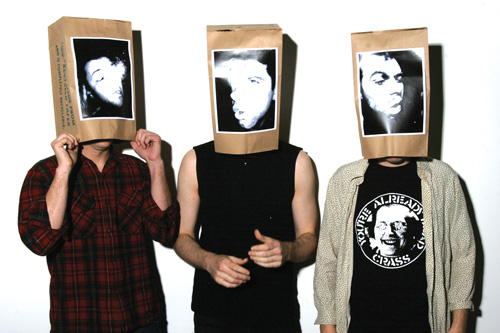
When is the cover better than the original? When the original is by newbie/vitriolic web backlash victim Lana Del Rey, and the cover is a sensual send-up by seasoned San Francisco duo Silver Swans (silverswans.bandcamp.com). The local act split open the pop song — “Video Games” — slowed it down, and filled it with chilly synth floating below breathy vocals.

But we’re not here to debate Del Rey’s musical ability; we’re here to keep a glossy superhero eye on Silver Swans. Formed by Las Vegas-born vocalist Ann Yu and Jamaica-bred effects wizard-DJ Jon Waters in 2007, the band has delivered a lovely catalogue — most recently 2010’s Secrets EP and the upcoming LP Forever (Feb.7) — of heart-wrenching synth pop and shoulder-dancing, Manchester-evoking icy club rock. It’s high time they get their international due.

Description of sound: Someone else said it best: “tropical synths and stuttering 808s” wrapped in ambivalent romance and bittersweet longing.

Like most about the Bay Area music scene: The Bay Area music scene is both sophisticated yet charming. So many amazing bands come out of SF, yet you can still create your own place here and find people who appreciate what you do. In that sense, it’s still fresh here. The scene isn’t jaded and over-saturated, there’s charm and new inspiration everywhere.

What piece of music means the most to you and why: This is a hard one, so many songs have come into my life and forever changed me, the first mixtape I got had a song on it called “So Said Kay” by The Field Mice and I think I could have listened to that song on repeat for days reading into every lyric and just taking in the voice. It made me sad too, and just made me feel exactly what I wanted to feel at the time. It was one of the first songs to inspire me to write and also tap into that unknown territory where you don’t care about how unique or difficult a part is write, you just let yourself get carried away in the moment of the song itself and let it almost write itself.

Favorite local eatery and dish: El Metate Mexican Veggie burrito, the vegetables are roasted and always fresh. Everything there is delicious and on the cheap, right down to their alfajore cookies, I fully endorse the entire menu.

Who would you most like to tour with: Karin Dreijer Andersson — Jon and I are both admirers of everything she does. She is a true artist, and I get lost in her songs always.

Stage Listings

0

Stage listings are compiled by Guardian staff. Performance times may change; call venues to confirm. Reviewers are Robert Avila, Rita Felciano, and Nicole Gluckstern. Submit items for the listings at listings@sfbg.com. For further information on how to submit items for the listings, see Picks.

THEATER

OPENING

Glengarry Glen Ross Actors Theatre of San Francisco, 855 Bush, SF; (415) 345-1287, www.brownpapertickets.com. $26-40. Opens Fri/3, 8pm. Runs Fri-Sat, 8pm. Through March 24. David Mamet’s cutthroat comedy, courtesy of the Actors Theatre of San Francisco.

Higher Theater at Children’s Creativity Museum, 221 Howard, SF; (415) 749-2228, www.act-sf.org. $10-65. Previews Wed/1-Fri/3, 8pm; Sat/4, 2pm. Opens Sun/5, 7pm. Runs Tues-Sat, 8pm (Tues/7, show at 7pm; also Wed, Sat-Sun, 2pm; no matinee Feb 8). Through Feb 19. American Conservatory Theatre presents Carey Perloff’s smart and sexy world premiere.

Vigilance Phoenix Theatre, 414 Mason, SF; (415) 335-6087, secondwind.8m.com. $20-25. Opens Fri/3, 8pm. Runs Thurs-Sat, 8pm; Sun, 2pm. Through Feb 25. Second Wind performs Bay Area playwright Ian Walker’s thriller.

The Waiting Period MainStage, Marsh San Francisco, 1062 Valencia, SF; (415) 282-3055, www.themarsh.org. $15-50. Previews Thurs/2, 8pm. Opens Fri/3, 8pm. Runs Fri, 8pm; Sat, 5pm. Through March 24. Brian Copeland returns with a new solo show about his struggles with depression.

BAY AREA

Counter Attack! Ashby Stage, 1901 Ashby, Berk; (510) 444-4755, ext. 114, www.stagebridge.org. $18-25. Opens Wed/3, 7:30pm. Runs Wed-Thurs, 7:30pm; Fri-Sat, 8pm (also Sat, 2pm); Sun, 2pm. Through March 4. Stagebridge presents the world premiere of Joan Holden’s waitress-centric play.

A Steady Rain Marin Theatre Company, 397 Miller, SF; (415) 388-5208, www.marintheatre.org. $34-55. Previews Thurs/2-Sat/4, 8pm; Sun/5, 7pm. Opens Tues/7, 8pm. Runs Tues and Thurs-Sat, 8pm (also Feb 11 and 25, 2pm; Feb 16, 1pm); Wed, 7:30pm; Sun, 2 and 7pm. Through Feb 26. Marin Theatre Company performs Keith Huff’s neo-noir drama.

ONGOING

Cabaret Young Performers Theatre, Fort Mason Center, Bldc C, Room 300, Marina at Laguna, SF; (415) 381-1638, cabaretsf.wordpress.com. $25-45. Thurs-Sat, 8pm; Sun, 7pm. Through Feb 19. Shakespeare at Stinson and Independent Cabaret Productions perform the Kander and Ebb classic in an intimate setting.

Food Stories: Pleasure is Pleasure Z Space, Theater Artaud, 450 Florida, SF; www.brownpapertickets.com. $20-55. Wed/1-Thurs/2, 7pm; Fri/3-Sat/4, 8pm; Sun/5, 2pm. Word for Word serves up two short stories with a gastronomical theme — T.C. Boyle’s Sorry Fugu and Alice McDermott’s Enough — fleshed out in W4W’s trademark verbatim style by a versatile six-person ensemble under direction of John Fisher. First course, by Boyle, is a nicely acted but fairly drab comic soufflé that tastes pretty familiar. Its setting is a restaurant turned upside down by the ambition of its portly, middle-aged, married chef (Soren Oliver), obsessed with winning over the big paper’s notoriously dismissive and all-powerful food critic (Molly Benson), who turns out to be a secretly insecure bombshell with a perennial dinner companion nicknamed The Palate (Gendell Hernandez). Fisher’s cast comes together well after a few hiccups, and the staging, while sometimes erratic, includes some inspired moments. But the story as a whole has little more to it than the food-as-sex seduction we see coming early on, and consequently lacks any real suspense. More satisfying all around is McDermott’s Enough, a salty, well acted, and fluidly staged condensation of a single lifetime — bracketed by scenes of eager tonguing of ice cream dregs. In this family history of a sweetly sybaritic but otherwise ordinary American woman (played variously by Delia MacDougall and Patricia Silver) food and sex are intertwined again but hardly, as the author stresses, in a metaphorical sense: “Pleasure is pleasure,” after all, and life is good to the last drop. (Avila)

*Humor Abuse American Conservatory Theater, 415 Geary, SF; (415) 749-2228, www.act-sf.org. $10-85. Wed/1-Sat/4, 8pm (also Wed/1 and Sat/4, 2pm); Sun/5, 2pm. “This is a show about clowning,” Lorenzo Pisoni advises his audience at the outset of his graceful solo performance, “and I’m the straight man.” It’s a funny line, actually — funny because it’s true, and not true. In the deft routines that follow, as well as in the snapshots cast on the atmospherically dingy curtain hung center stage, the career of this Pickle Family Circus brat (already alone in the spotlight by age two) never veers far from the shadow of his father. That fact remains central to the winning comedy and wistful reflection in Humor Abuse. Reared in the commotion and commitment of the famed San Francisco circus founded by his parents Larry Pisoni and Peggy Snider, Lorenzo had a childhood both enviable and unusually challenging. The fact that he shares his name with both a grandfather and his dad’s famous clown persona is instructive. His trials and his triumphs are further conflated — along with his father’s —in such elegant catastrophes as falling down a long flight of stairs. And in his good-humored and honest reflections, the existential poignancy at the heart of such artful buffoonery begins to rise to the surface. The spoken narrative feels a little pinched or abbreviated, in truth, but there are no shortcuts to the skill or wider perspective inculcated by the charming Pisoni and (under direction of co-creator Erica Schmidt) set enthralling in motion. (Avila)

*Little Brother Gough Street Playhouse, 1620 Gough, SF; www.custommade.org. $25-32. Thurs-Sat, 8pm; Sun, 7pm. Through Feb 25. Custom Made Theatre Co. performs Josh Costello’s adaptation of Cory Doctorow’s San Francisco-set thriller.

Not Getting Any Younger Marsh San Francisco, Studio Theater, 1062 Valencia, SF; (415) 826-5750, www.themarsh.org. $15-50. Fri, 8pm; Sat, 5 and 8:30pm. Extended through Feb 25. Marga Gomez is back at the Marsh, a couple of too-brief decades after inaugurating the theater’s new stage with her first solo show — an apt setting, in other words, for the writer-performer’s latest monologue, a reflection on the inevitable process of aging for a Latina lesbian comedian and artist who still hangs at Starbucks and can’t be trusted with the details of her own Wikipedia entry. If the thought of someone as perennially irreverent, insouciant, and appealingly immature as Gomez makes you depressed, the show is, strangely enough, the best antidote. (Avila)

Olivia’s Kitchen Exit Theatre, 156 Eddy, SF; www.generationtheatre.com. $20-40. Fri-Sat, 8pm; Sun, 3pm. Through Feb 19. GenerationTheatre offers this “remix” of Shakespeare’s Twelfth Night.

“SF Sketchfest” Various venues, SF; www.sfsketchfest.com. $10-75. Wed/1-Sat/4. The 11th San Francisco Comedy Festival invades 15 venues in 17 days with local and celebrity-packed (and local-celebrity-packed) performances, film events, improv shows, and more.

Vice Palace: The Last Cockettes Musical Thrillpeddlers’ Hypnodrome, 575 10th St, SF; (415) 377-4202, www.thrillpeddlers.com. $30-35. Fri-Sat, 8pm. Through March 3. Thrillpeddlers revives the Cockettes’ 1972 musical extravaganza.

Waiting for Godot Royce Gallery, 2901 Mariposa, SF; (415) 336-3522, www.tidestheatre.org. $20-38. Thurs-Sat, 8pm. Through Feb 18. The fuchsia papier-mâché tree and swirling grey-on-white floor pattern (courtesy of scenic designer Richard Colman) lend a psychedelic accent to the famously barren landscape inhabited by Vladimir (Keith Burkland) and Estragon (Jack Halton) in this production of the Samuel Beckett play by newcomers Tides Theatre. Director (and Tides’ producing artistic director) Jennifer Welch layers the avant-garde classic with some audio accents as well (although Jon Bernson’s minimalist industrial soundscape is a bit low in the mix to be very effective). More compelling is the gentle, sad humor and couched intelligence captured expertly by Halton in the circular but deliberate rhythms of his hapless tramp. Burkland as pal Vladimir exudes a palpable presence as well, though lacks the same focus. Timing is all in vaudeville — the parallel universe from whence these tangible modernist archetypes hail — as well as in a play whose plot goes intentionally nowhere, or rather loops back on itself in an implied dance with eternity. The halting aspect to Tides’ staging gets compounded with the arrival of brash whip-cracker Pozzo (a suitably stentorian but inconsistent Duane Lawrence) and his pitiful slave Lucky (a haunted, generally sharp Renzo Ampuero, made up to look like a goth doll à la some Tim Burton movie). That said, the best moments here broadcast the brooding beauty of the play, with its purposely vague but readily familiar world of viciousness, servility, trauma, want, fear, grudging compassion, and the daring, fragile humor that can look it all squarely in the eye. (Avila)

BAY AREA

Arms and the Man Lesher Center for the Arts, Margaret Lesher Theater, 1601 Civic, Walnut Creek; (925) 943-7469, www.centerrep.org. $38-43. Wed, 7:30pm; Thurs-Sat, 8pm; Sun, 2:30pm. Through Feb 25. Center REPertory Company presents George Bernard Shaw’s classic romantic comedy.

Body Awareness Aurora Theatre, 2081 Addison, Berk; (510) 843-4822, www.auroratheatre.org. $34-55. Previews Wed/1, 8pm. Opens Thurs/2, 8pm. Runs Tues, 7pm; Wed-Sat, 8pm; Sun, 2 and 7pm. Through March 4. Aurora Theatre performs Annie Baker’s comedy.

Ghost Light Berkeley Repertory Theatre, Thrust Stage, 2025 Addison, Berk; (510) 647-2949, www.berkeleyrep.org. $14.50-73. Tues, Thurs-Sat, 8pm (also Sat and Feb 16, 2pm); Wed and Sun, 7pm (also Sun, 2pm). Through Feb 19. Berkeley Rep performs Tony Taccone’s world-premiere play about George Moscone’s assassination, directed by the late San Francisco mayor’s son, Jonathan Moscone.

*The Kipling Hotel: True Misadventures of the Electric Pink ’80s New venue: Marsh Berkeley, 2120 Allston, Berk; (415) 282-3055, www.themarsh.org. $20-50. Sat, 8:30pm; Sun, 7pm. Through Feb 12. This new autobiographical solo show by Don Reed, writer-performer of the fine and long-running East 14th, is another slice of the artist’s journey from 1970s Oakland ghetto to comedy-circuit respectability — here via a partial debate-scholarship to UCLA. The titular Los Angeles residency hotel was where Reed lived and worked for a time in the 1980s while attending university. It’s also a rich mine of memory and material for this physically protean and charismatic comic actor, who sails through two acts of often hilarious, sometimes touching vignettes loosely structured around his time on the hotel’s young wait staff, which catered to the needs of elderly patrons who might need conversation as much as breakfast. On opening night, the episodic narrative seemed to pass through several endings before settling on one whose tidy moral was delivered with too heavy a hand, but if the piece runs a little long, it’s only the last 20 minutes that noticeably meanders. And even with some awkward bumps along the way, it’s never a dull thing watching Reed work. (Avila)

The Pitmen Painters TheatreWorks at Mountain View Center for the Arts, 500 Castro, SF; (650) 463-1960, www.theatreworks.org. $19-69. Tues-Wed, 7:30pm; Thurs-Sat, 8pm (also Sat, 2pm); Sun, 2 and 7pm. Through Feb 12. TheatreWorks performs a new comedy from the author of Billy Elliot about a group of British miners who become art world sensations.

The World’s Funniest Bubble Show Marsh Berkeley, TheaterStage, 2120 Allston, Berk; (415) 826-5750, www.themarsh.org. $8-50. Extended run: Feb 12, 19, 26, March 11, and 18, 11am. Louis “The Amazing Bubble Man” Pearl returns with this kid-friendly, bubble-tastic comedy.

PERFORMANCE/DANCE

“Cabaret of Love” Stage Werx, 446 Valencia, SF; www.brownpapertickets.com. Mon, 7 and 9pm. $15. Picklewater Clown Cabaret performs in celebration of Valentine’s Day.

Company C Contemporary Ballet Yerba Buena Center for the Arts, 701 Mission, SF; (415) 978-2787. Feb 17, 8pm; Feb 18, 6:30pm (gala benefit); and Feb 19, 3pm. $23-175. The company opens its 10th anniversary season.

“Elect to Laugh” Studio Theater, Marsh San Francisco, 1062 Valencia, SF; (415) 282-3055, www.themarsh.org. Tues, 8pm. Ongoing through Nov 6. $15-50. Will Durst and friends perform in this weekly political humor show that focuses on the upcoming presidential election.

“The Eric Show” Milk Bar, 1840 Haight, SF; www.milksf.com. Tues, 8pm (ongoing). $5. Local comedians perform with host Eric Barry.

“Fortunate Daughter” Stage Werx, 446 Valencia, SF; www.brownpapertickets.com. Sun/5, March 4, April 1, May 6, 7pm. $20. Thao P. Nguyen performs her solo show about being caught between her family and her friends in the queer community.

“The Mandrake” Hastings Studio Theater, 77 Geary, SF; (415) 749-2228, www.act-sf.org. Wed/1-Sat/4 and Feb 8-11, 7:30pm. $15. American Conervatory Theater’s MFA class of 2013 performs Machiavelli’s 16th century satire of Italian society.

“The News” Somarts Cultural Center, 934 Brannan, SF; www.somarts.org. Tues/7, 7:30pm. $5. This new monthly queer performance series highlights new and experimental works and works in progress. “Precious Drop: African and Afro-Fusion Dance, Music, and Theater” CounterPULSE, 1310 Mission, SF; 1-800-350-8850, www.counterpulse.org. Fri/3-Sat/4, 8pm. $20. Mohamed Lamine Bangoura with Jaara Dance and Drum and Bu Falle African Drum and Dance present a work-in-progress about the global importance of water. BAY AREA “Cordelia, Mein Kind” TheaterStage at Marsh Berkeley, 2120 Allston, Berk; (415) 282-3055, www.themarsh.org. Thurs/2-Fri/3, 8pm; Sat/4, 5pm; Sun/5, 3pm. $15-50. The Marsh Berkeley collaborates with the Magnes Collection of Jewish Art and Life to present this multimedia Australian import by Deborah Leiser-Moore. “The Second Sin Again…” Black Repertory Group Theater, 3201 Adeline, Berk; www.punanytickets.com. Sat/4, 7pm. $25. Punany Poets perform a mix of erotic poetry, dance, comedy, and theater.

What are people?

4

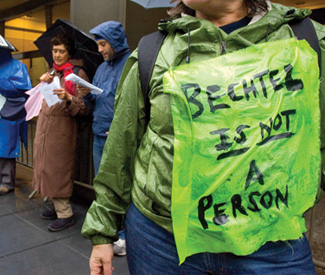
Protesters from the Occupy movement and beyond gathered in front of the Ninth Circuit Court of Appeals in San Francisco on Jan. 20, calling for the adoption of a 28th amendment to the U.S. Constitution aimed at refuting the idea that corporations should have the same rights as people, a legal doctrine know as corporate personhood.

The event was part of a day of action at courthouses around the country, seeking to raise public awareness about the unfettered influence of corporate money in U.S. elections and draw attention to the second anniversary of the landmark corporate personhood decision by U.S. Supreme Court, Citizens United vs the Federal Elections Commission.

“We are here not to protest, not to petition, and not to plead, but to proclaim a truth that should be self evident, even to the Supreme Court: Corporations are not people; money is not speech,” said Abraham Entin, of North Bay Move To Amend, addressing a crowd gathered at the courthouse. “Corporations work very hard to convince us that we cannot do without them and the products they produce. They tell us they are too big to fail, and that our survival is dependent on their survival … Occupy has changed all that.”

In a contentious 5-4 ruling handed down on Jan. 21, 2010, the Citizens United case solidified the legal framework that bequeaths corporations the same rights under the Constitution as real, living, breathing, U.S. citizens, and by merit of their First Amendment rights as citizens bars any restrictions placed on a corporation’s ability to spend money to influence elections.

When Republican presidential candidate Mitt Romney famously said on the campaign trail that “corporations are people, my friend, because corporations have people inside them,” he is reflecting the logic of the majority opinion in the Citizens United case. The court’s majority asserted that corporations are essentially an association of people and thus enjoy the same rights as individuals.

The court also claimed that it is impossible to distinguish between the corporate media outlets and other corporate speech, so all corporations should enjoy the free speech rights saved for the press. Furthermore, because journalists often have to spend money to achieve speech, money spent on messaging by all corporations represents protected speech.

Corporations, a relatively modern invention, aren’t actually discussed in the Constitution. But the notion of corporation personhood began around 1886 in the case of Santa Clara County v. Southern Pacific Railroad. What Citizens United did was equate corporate money spent to influence elections with protected political speech, upending attempts at election reforms and gutting the McCain-Feingold Act of 2002 that regulated federal election campaigns.

That corporations act to corrupt our democratic systems for their own profit is not conspiracy, it’s simply a byproduct of what they are. Corporations are legally obligated to act to maximize their profits for the benefit of their shareholders, otherwise their board and corporate officers are considered negligent of their obligations to their shareholders’ financial interests. Unlike journalists, whose professional credo calls for fairness and acting in the public interest, corporations are designed to act in their own interests.

As Justice John Paul Stevens wrote for the dissenting judges in Citizens United, “Corporations have no consciences, no beliefs, no feelings, no thoughts, no desires. Corporations help structure and facilitate the activities of human beings, to be sure, and their ‘personhood’ often serves as a useful legal fiction. But they are not themselves members of ‘We the People’ by whom and for whom our Constitution was established.”

The resulting flood of corporate money into election campaigns since the court’s ruling is delivered through an aqueduct known as the Super PAC (political action committee). In the wake of Citizens United, election spending by Super PACs in the 2010 midterm elections exceeded $300 million dollars, more spending than the overall spending in the previous five midterm elections combined.

Unlike donations to campaigns, which so far remain regulated, Super PAC money is spent directly by the Super PAC, and can be spent attacking as well as supporting candidates, leading to fears that corporations can exert influence on incumbents before a re-election campaigns by threatening to spend money attacking them in the upcoming election cycle.

“Corporations are human creations, state creations, legal entities … There is no reason we cannot limit their spending,” said Carlos Villarreal, executive director of the National Lawyers Guild’s Bay Area chapter. “Nonprofit organizations are limited in their political spending. Churches and charitable organizations are also limited in their spending. So why not for-profit corporations?”

Perhaps no group knows more about government limits to free speech than participants of the Occupy movement. Elastic restrictions on individual free speech and freedom of association rights spelled out in the First Amendment, resting on alleged risks to health and public safety, have led to Occupy encampments across the nation being restricted and evicted, at times enforced by brutal police crackdowns.

The right of the government to restrict individual and group speech that officials believe represents a clear and present danger was established by the Supreme Court in the 1919 Schenck v United States case — the famous “don’t yell fire in a crowded theater” case. What is not widely known is that this case was a re-examination of the famous 1917 Espionage Act. The “crowded theater” was our nation’s entry into World War I, and those being jailed for “yelling fire” were labor organizers and pacifists expressing their opposition to our entry into the war.

Relying on Schenck, courts have consistently defended restrictions on individual free speech when there is a compelling interest to public safety, the so-called “clear and present danger” standard. Villarreal and the crowd gathered before the Ninth Circuit asserted that corporate influence in our democratic processes represents a clear and present danger to society. “There is no more compelling interest than protecting democracy,” said Villarreal.

Despite the apparent double standard, legal experts say the courts action in the Citizens United case leaves a constitutional amendment as the only avenue left for regulating corporate money in elections and ending corporate personhood, but the movement to take on that Herculean task has already begun.

U.S. Sen. Bernie Sanders (I-VT) and Rep. Ted Deutch (D-FL) have introduced legislation proposing a 28th Amendment to the Constitution. While the language differs from another amendment presented by the group Move to Amend, it also takes aim at ending corporate personhood.

“Two years ago, the United States Supreme Court betrayed our Constitution and those who fought to ensure that its protections are enjoyed equally by all persons regardless of religion, race or gender, by engaging in an unabashed power-grab on behalf of corporate America,” Sanders wrote in a Jan. 20 Guardian(UK) column.

In Sanders’ home state of Vermont, the state Senate is also considering a resolution calling for a constitutional amendment against corporate personhood. A similar resolution, authored by Alix Rosenthal, was adopted by the San Francisco Democratic County Central Committee during a special meeting on Jan. 21. There was just one dissenting vote, and DCCC members say they plan to push for the state party organization to also adopt the stance.

The hurdles set forth to amend the U.S. Constitution, outlined in Article V, are substantial. In order for an amendment to even be considered, a super majority of both houses of Congress must initiate the process, or two-thirds of states must call for the amendment. Proposed amendments passing this threshold are then adopted only after three-quarters of state legislatures ratify the proposed amendment. But that difficult road is one the protesters said they are ready to travel. “We are here on a rainy day with warm hearts and wet feet. We are the 100 percent, the humans. No corporation has every experienced the thrill of wet feet,” said Gangs of America author Ted Nace. “We are the fools who go out on a wet day to fix a broken world. Eighty percent of the public want to fix this. That means we are halfway to our goal. What remains is organization, mobilization.”

Pay to park

62

The San Francisco Municipal Transportation Agency has hailed the success of its SFpark program — which uses high-tech meters and demand-variable pricing to manage on-street parking — noting that expired meter citations are down and meter revenue is up. The resulting 11 percent net increase in revenue  is all going to improve Muni. So transit improves, drivers get more spots and fewer tickets — everybody wins.

[CLARIFICATION (2/1): The new meters had an 11 percent net revenue increase compared to the old meters, but overall net revenues from citations and meters was still down by 3 percent.]

But the SFMTA has run into a hornet’s nest of opposition with its latest proposal to expand SFpark into the Northeast Mission District, Potrero Hill, Dogpatch, and Mission Bay, largely because the plan involves placing meters on streets where parking is now free. And even those who don’t object to paying for parking say the SFMTA has bungled this process.

The problem isn’t just what critics say are arrogance and dubious outreach efforts by agency officials. It may be that the SFMTA pursued too many goals at once, mixing them in ways that muddled the message. Or it may just be that charging for parking will always anger drivers, no matter how it’s proposed.

The agency wants to discourage driving — particularly cruising for parking, hence SFpark’s “Circle Less, Live More” slogan — to speed up Muni and reduce traffic congestion. But that also means charging for street parking so cars won’t just sit in those spaces, and that involves a complicated balancing act in mixed use neighborhoods.

Residents, many employers, and commuters want all-day street parking, preferably free and easy. But most business owners want enough parking turnover so their customers can find a spot. City policies call for prioritizing residents’ needs, and the SFMTA needs money to fund and expand Muni service.

Meeting all of those needs isn’t easy. But over the last couple of months, the SFMTA’s effort to expand its successful and popular SFpark program have managed to turn thousands of residents angrily against that program, the agency, and the proposition that people shouldn’t expect free parking.


COMMUNITY OUTRAGE

Architect John Lum and artist-designer Miranda Caroligne didn’t know each other a couple months ago, but now they’re helping to lead a movement that is uniting neighborhood groups in the Mission, Dogpatch, and Potrero Hill against the parking meter proposals.

“You have an agency that is not listening at all to the community. That’s fascism!” declares Lum. He’s actually an amiable and soft-spoken young guy who employs 10 people at his architecture firm near 17th and Capp streets, but this issue really gets his blood boiling.

And Lum isn’t alone, as the Jan. 13 public meeting before an SFMTA hearing officer showed. Not only did everyone who streamed to the microphone voice opposition to the proposals, but they usually did so in angry and accusatory ways, saying it would destroy businesses, punish the poor, and result in conditions that are simply unworkable and intolerable. And they said the SFMTA simply doesn’t care.

“If you’re a PDR business,” Caroligne said, referring to the Production, Distribution, and Repair businesses whose last bastion is some of the targeted areas, “you’re never going to get people to work at a place that doesn’t have parking…This proposal will push them out.”

There are myriad ways that the plans are flawed, say their critics: Meters were proposed on some residential streets in initial plans, despite SFMTA policies to the contrary; traffic surveys had too small a sampling and weren’t realistic; residential permit districts would be replaced by meters, or meters would be placed where districts might work better; transit service on Potrero Hill is too bad to expect people to use it; live-work spaces were inappropriately treated like retail outlets; and meters near the 22nd Street Caltrain station could actually discourage the use of public transit.

“There’s not that much disagreement, but where there is, it’s really important,” said Tony Kelly, president of the Potrero Boosters Neighborhood Association. “I’m someone who supports parking management, and I’m frustrated that the MTA is so tone deaf with this. We’ve been through a lot of fake public outreach efforts and this is looking like one of those.”

Janet Carpinelli, president of the Dogpatch Neighborhood Association, said her members feel like the SFMTA is ramming this through without regard for the needs or input of that neighborhood.

“The real issue is it’s a very big inconvenience to the businesses and residents in this neighborhood and it’s not really helping anything. It’s just a revenue grab by the MTA,” she said.

Potrero Hill resident Jim Wilkins was so outraged by the proposal to install meters along Pennsylvania Street outside his home that he started an online petition against the proposals that has so far garnered about 1,300 signatures. “We’re forming an organization to resist these proposals,” he told us.

Lum was already a member of the 17th Street Coalition, which formed in 2010 to oppose the renewal of a liquor license at the local Gas’n’Shop, but more recently organized opposition to the meter proposal. It attracted Caroligne, and now they’ve formed a new group, Northeast Mission Neighbors, which held a joint organizing meeting with the Dogpatch and Potrero groups on Jan. 23. They’re all determined to delay and modify the SFMTA’s proposal, which had been scheduled for adoption by the SFMTA Board of Directors Feb. 7.

Lum said the proposed changes are tough to accept: “I don’t think this is about free parking, it’s about living and working in a community with certain things and now those things are changing.”


CHANGE IS HARD

The biggest target of critics’ ire is Jay Primus, who runs the SFpark program for the SFMTA. He maintains that he’s done extensive outreach and gathered community input that has shaped the plans. “These are still proposals and nothing has been approved yet,” he told us.

For example, Wilkins told us his campaign continued even after the meters in front of his house were eliminated from the proposal last month. Primus also noted the proposed meters allow for all-day parking at just 25 cents an hour in most places, so it isn’t really such an inconvenience or financial hardship. And Primus just announced that the Feb. 7 hearing is being pushed back by at least two weeks to heed more community input.

But most of the opposition to the proposals isn’t surprising, and Primus thinks it comes more from the idea of charging for street parking than with the specifics of the proposal.

“Parking is always an emotional and delicate issue in San Francisco, as it is in most cities,” Primus said, citing protests against charging for parking going back to when the first meters were installed in 1947. “This has happened at every block that has gotten meters.”

But now, there are even more benefits and ease of use with modern meters, which motorists can pay with a credit card or even remotely. Variable pricing is also used to ensure more parking based on demand, although it’s being kept at a very low rate in areas where businesses or residents still need all-day parking.

“If people are opposed to paying 25 cents per hour, the lowest rate in the city, then they are opposed to paying for parking,” Primus said. He said it’s a matter of equity among citizens: “There’s nothing equitable about providing parking for free and asking people to pay $4 for a round trip Muni ride.”

That’s a notion that is echoed by others who say it’s time for motorists to start paying their fair share.

“Everybody wants something for nothing. We all want that. Nobody wants to pay for parking, not even me,” Don Shoup, the UCLA professor who wrote the influential book The High Cost of Free Parking, told us. He later added, “That whining you hear is the sound of change.”

At a time when governments are hurting for revenue to provide basic services — among them, maintaining extensive roadway systems for motorists whose taxes don’t come anywhere near covering their societal impacts — he said it just doesn’t make sense to continue subsidizing the storage of automobiles.

“San Francisco has some of the most valuable land on earth. You have expensive housing for people and free parking for cars. It’s not surprising that San Francisco has homeless people and traffic congestion,” Shoup said. “There was never a city that is so liberal about other people’s affairs and so conservative about its own affairs.”

But Shoup did agree with critics that the real goal of managing parking isn’t to discourage driving, although he applauds the SFpark program for using its increased revenue on public transit, which he thinks makes sense from a social justice perspective.

Jason Henderson, a professor of geography at San Francisco State and author of an upcoming book on the politics of parking and mobility, goes even further than Shoup in saying that San Francisco should use its parking policies to discourage driving. But at the very least, Henderson said it is counterproductive to offer free parking.

“The city is giving away valuable real estate with all of this free and underpriced curbside parking at a time when the city’s transportation infrastructure is crumbling and essential city services for parks, after school programs, and libraries are constantly being cut. And here we have thousands of acres of real estate just being given away,” Henderson told us.

“If anything, it needs to be done citywide so that it’s judicious and level, so that merchants won’t say that people won’t come to their neighborhood because they can go to a different neighborhood where there’s free parking.”

Primus said there is a particularly strong need to manage parking around Mission Bay and the North Mission, where much of the city’s growth is occurring.

“In a way, the SFMTA is catching up with the growth of the city. These are some of the last remaining areas that are residential-commercial mixed use areas with no parking management,” Primus said.

Kelly agrees that time has come, but he doesn’t think the SFMTA has helped its case, particularly given the emotions surrounding the issue and the need to maintain public support for improved transit service.

“They’ve been spending all their waking hours in the last couple years pissing people off over parking meters, do you really think people will then support their revenue proposals?” Kelly questioned.

Lum and Caroligne both said the SFMTA should have been willing to make the fundamental argument to people that the days of free parking are coming to an end.

“That’s where a lot of the anger is coming from, you’re doing this for all these reasons that don’t make sense and treating us like children,” Caroligne said, although she also added, “I agree with you that there would still be some outrage, even if the outreach had been better.”

Sorrow, tears, blood — and dance

0

arts@sfbg.com

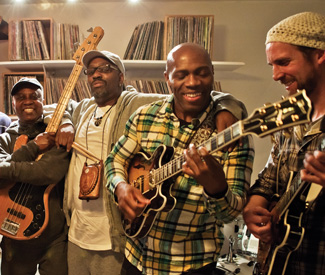
MUSIC Musical genius, human rights activist, cultural legend, African icon — late Nigerian Afrobeat pioneer Fela Kuti encompassed multitudes, but to his 1980s-era guitarist Soji Odukogbe, he provided not only inspiration but a way into his music.

“The music was written by Fela, so if you were good enough, you could add to it, and he wouldn’t say anything. But if you were not good enough, he’d say, ‘This is the line,'” explains Odukogbe, 49, by phone from Berkeley where he now lives. “Afrobeat is a written music — you can’t add to it. You can add if you know your instrument, and it’s sweet enough, then you can go there.”

Fortunately the Lagos, Nigeria, native — who as a child was inspired enough by Fela’s hits to take a wood plank, hammer a nail into it, and pretend it was a guitar — was good enough to take his liberties on guitar on legendary Fela albums like Teacher Don’t Teach Me Nonsense, Beasts of No Nation, and Underground System (all Barclay; 1986, 1989, and 1992). “[Fela] was anxious to meet me [after he got out of prison], and when he saw me, he was so happy — he said, ‘I have a guitar player that’s really good!,'” recalls Odukogbe, who joined Fela’s band in ’85. “One day I said, ‘Fela, I want to take a guitar solo. He only allowed horn and keyboard solos, and he said, ‘Yeah, go ahead,’ and I blew his mind. He was so proud of me.” Odukogbe appears with kindred Fela player Baba Ken Okulolo at a “Fela Kuti Extravaganza” dance party at Cafe Du Nord Jan. 28.

The guitarist played with Fela for five years before deciding to take his chances in the U.S. where a so-called world music movement was catching fire with the success of Nigerian juju master King Sunny Adé, Le Mystere des Voix Bulgares (Nonesuch, 1987), and Brazil Classics 1: Beleza Tropical (Luaka Bop, 1990). Now, with publications such as The New York Times trumpeting an “African invasion” in indie rock and a fascination with African music takes hold once more — morphed and bent to new ends by performers ranging from Vampire Weekend to Dirty Projectors to this year’s Pazz and Jop poll-topping tUnE-yArDs — the time seems right to revisit Fela’s legacy.

Long before African outfits like Tinariwen and Blk Jks threaded rock ‘n’ roll guitar into indigenous rhythms, and hipster-cred comps such as the Ethiopiques and Congotronics series touched down stateside, Fela was hybridizing jazz and highlife with a potent dose of James Brown-style funk, a black power sensibility (not for nothing did he dub himself the Black President), and a driving thirst for justice, even after being jailed some 200 times, suffering at the hands of soldiers (the wounds Fela revealed when he dropped his trousers in the 1982 documentary Music Is the Weapon are heartbreaking), and undergoing a level of government harassment and abuse that would break most mortals. It all appeared to climax in 1977 after the release of his military-mocking 1977 LP Zombie (Barclay) and the subsequent invasion of his Kalakuta Republic commune by soldiers, which led to the death of his mother and the beating and brutalization of the performer, his family, wives, and friends.

Though mainstream superstars Will Smith and Jay-Z threw their producing weight behind the recent Tony Award-winning musical production of Fela!, it’s tough to imagine an artist quite like Fela in today’s music scene, fighting back from the top of the pop charts, occupying the public imagination with his radical politics and spiritual beliefs, and speaking his mind, loudly and outrageously. Still, Fela’s story and music speak louder than ever, especially in the context of indie’s less-than-political appropriation of African sounds, the recent SF run of Fela!, the 2011 rerelease of Fela’s Universal-controlled albums in North America by Knitting Factory Records, the upcoming film directed by artist-filmmaker Steve McQueen, and continuing tide of injustice in Nigeria, where weeks of protests continue over fuel prices and the country has undergone its worst oil spill in a decade.

“The thing that’s most interesting about Fela’s music is how traveling and seeing other cultures, going to the United States, and getting familiar with American music and James Brown and American politics inspired him to fulfill his own roots and look back on himself and to really see these international forces as part of his background and his own culture,” observes Will Magid, 26, who organized the Fela dance party and has played with Odukogbe and Okulolo. Magid’s own forthcoming debut album promises to mix Kuti’s influence with Balkan, pop, and funk sounds. “We need more people who are like that and who are speaking up.”

El Cerrito-by-way-of-Nigeria bassist Okulolo played with Fela as well as King Sunny Ade and has performed with Odukogbe in the Kotoja, the Western African Highlife Band, and the Nigerian Brothers. Magid’s friend and mentor since the two met through Okulolo’s son at UCLA, the musician sees “Fela Kuti Extravaganza” as a teaching opportunity.

“Fela was a great musician, and his music will never die,” says Okulolo. “I think it would be a good idea to continue educating people about his music and how beautiful it is. I worked with [Fela] briefly, and I know the man well, and so many bands are playing Afrobeat now — generally the music needs to be out there.”

“It has funk; it has jazz; it has an African beat; it has everything,” he continues. “It’s our opportunity to showcase it to as many people as we can and make it valuable, to put it in a category that someday will be what reggae is today.”

And during hard times, we can all learn something from Fela, his still-vibrant music, and his way of moving, fluidly and artfully, through oppression, through pain. “There’s this element of social consciousness, of people dancing and then hearing about these oil spills,” muses Magid of the upcoming dance party. “It’s a different kind of dancing when you’re dancing through suffering.” *


WILL MAGID’S WORLD WIDE DANCE PARTY: FELA EXTRAVAGANZA

With Baba Ken Okulolo and Soji Odukogbe, Will Magid Trio with Fely Tchaco, MSK.FM, and izzy*wise

Sat/28, 9:30 p.m., $15

Cafe Du Nord

2170 Market, SF

www.cafedunord.com

Public TV, for sale

2

OPINION The San Mateo Community College District Board of Trustees has announced the upcoming sale of its independent public television station, KCSM-TV. Some potential new owners are cause for alarm.

A January 10th walk-though for potential bidders was attended by the Christian broadcasting giant Daystar Television. The fastest-growing faith-based network in the country, Daystar’s mission is to reach souls with the good news of Jesus Christ as one of a “new breed of televangelists.”

While the prospect of San Mateo Community College bringing Daystar to the Peninsula is the most dramatic possible outcome of the district’s decision to sell, some of the other bidders present challenges as well.

Public Media Company, controlled by radio brokers Public Radio Capital and much in the news for its role in the still-contested sale of KUSF’s radio license to the formerly commercial station KDFC, also toured the station on Jan. 10.

Public Media Company/Public Radio Capital is based in Boulder, Colorado. The intertwined family of limited liability companies has been buying up college radio stations at fire-sale prices all over the country and folding them into tight National Public Radio classical or jazz-only formats. Independent musicians have expressed alarm at the loss of accessible college radio outlets, and the San Francisco Board of Supervisors denounced the loss of KUSF to San Francisco’s cultural fabric in a 2011 resolution.

Other possible bidders included the mysterious Locust Point Networks, a website without a definition beyond “an early stage telecommunications company,” and Cheifet Productions, which produced programming on Silicon Valley for the PBS Nightly Business Report. Also in the potential market are Independent Public Media, a satellite TV service created by one of the founders of Free Speech TV, and KAXT, a South-Bay based family of foreign-language stations founded by a former KGO reporter.

In the Bay Area, public broadcasting is dominated by the vast KQED, which owns television and radio stations from Sacramento to Salinas to San Jose. KQED has long been criticized for a paucity of local programming and news, and a fondness for cooking shows.

The absorption of independent outlets into the KQED structure promises more standardization and less variety for peninsula residents.

The district claims the sale of the educational, noncommercial TV license is a necessity because operating an independent public television station is not compatible with the core mission of educating students. But the district will continue to operate the radio station Jazz 91 radio station.

District officials also said that the TV station was losing money. But a financial statement posted with bid materials seemed to include many shared radio/TV expenses.

The district trustees meet Jan. 25 at 6:00 p.m. at the College of San Mateo, 3401 College of San Mateo Drive. They should be told in no uncertain terms that a sale to a Christian broadcaster is unacceptable — and that that any sale must protect the public interest in localism, independence, and a diversity of points of view. 

Tracy Rosenberg is the executive director of Media Alliance, a Bay Area nonprofit that advocates for democratic communications. www.media-alliance.org


We want the airwaves

12

MUSIC It was written in an email exchange more than two months before 90.3 FM, better known as KUSF, was abruptly taken off the air. “We expect there will be a vocal minority that will be unhappy with the sale.” That cold-corporate speak delivered plainly from one of the involved entities was an ominous and understated prediction.

One year has passed since Jan. 18, 2011, when the station eventually was silenced in a shrouded and complex deal involving conglomerates, brokers, and non-disclosure agreements. However, the University of San Francisco’s attempt to sell the station’s broadcast license to Public Radio Capital and the University of Southern California’s Classical Public Radio Network (CPRN) for $3.75 million is not a done deal.

The Federal Communications Commission (FCC) has yet to approve the sale that has thus far been thwarted by a collective of volunteers who secured legal counsel in order to preserve over 33 years of independent, community radio and to resume broadcasting at the 90.3 frequency.

According to attorney Peter Franck, co-counsel for Friends of KUSF, a hearing would be the next step in the flurry of legal action if all goes well in the effort to save the station. He’s optimistic that the chances are greater with every day that passes that the sale will be denied and is confident the FCC is taking the situation seriously.

“I think it’s a very important case and the trend of college stations disappearing isn’t good. It’s about keeping the airwaves public,” he said.

CPRN initially said the move to acquire the frequency was out of a genuine desire to preserve classical music. But according to the group Save KUSF, Entercom — one of the top five largest radio broadcasting companies in the U.S., is a for-profit entity that was instrumental in orchestrating the deal. Classical and formerly commercial programming, previously heard on KDFC 102.1, took over 90.3 while the ubiquitous sounds of classic rock (KFOX) began emanating from 102.1 and Entercom’s studios.

Dorothy Kidd, a media studies professor at USF, who has adamantly opposed the sale because the university kept faculty and students in the dark, speculated that Entercom is footing the bill to keep KDFC afloat, presumably losing hundreds of thousands of dollars.

The much larger issue of media consolidation of course goes beyond KUSF. Tracy Rosenberg from Oakland-based Media Alliance noted that colleges and universities are selling their non-commercial educational licenses for millions of dollars.

WRVU (Vanderbilt University, Nashville) and KTRU (Rice University, Houston) are going through similar struggles with corporate radio lusting after their licenses. But on a positive note, Rosenberg said smaller, independent stations are banding together and that a coalition has emerged from this issue. “San Francisco is not the same city or as culturally vital without KUSF,” she said.

The absence of the station immediately sparked the ire of the community who felt deceived by USF. The man in the middle of it all who claimed responsibility for the decision and took some heat for it was USF President Father Stephen A. Privett. A day after the deal was made public; he held an uncomfortable public meeting on campus. There he repeated that KUSF would continue in an “online only” format. In addition, a promise was made that a “teaching lab” would be put in place for students. Though he couldn’t guarantee the full $3.75 million in would-be revenue was going to the department.

After talking to faculty, students, and alumni it became clear that no such media lab for students was in place. “The online station is not up and running and most likely will not be until the legal battle is over,” said Chad Heimann, a graduate from the Media Studies Department who was also a KUSF volunteer. He added that he thinks USF doesn’t want to invest in the online station until they know that the station will be sold.

“As far as I know, students are not getting an equivalent educational experience. The new digital studio has not been set up,” Professor Kidd concurred. She called any lab offers “rhetoric” on the school’s part, and that the money has been held up, while USF spends on legal fees. According to Friends of KUSF lawyers, CPRN and USF are using FCC lawyers in Washington for their joint response to legal action.

With costly litigation involved in the pending decision, there are claims that CPRN and USF didn’t comply with FCC law and that KUSF’s studios were dismantled prematurely in May. Additionally, questions have been raised about the operating agreement between the potential buyer and seller and the legality of their fundraising practices.

When the FCC asked for copies of emails from the University’s President regarding the sale, they were told Father Privett deletes his emails. “The IT department keeps backup copies. Their claim that they’re gone is ridiculous,” Franck said.

Father Privett could not be reached for comment as he was in Africa on business, but according to USF’s media relations department, they, along with CPRN, maintain commitment to the transaction and await FCC action, hoping the matter is resolved in the near future.

The legalese may leave you asking, where have all the DJs gone? “One of the issues moving forward is going beyond a grass-roots effort,” said Friends of KUSF treasurer Damin Esper. They did reach the milestone of fundraising $50,000 by November, mostly by holding benefits, like their upcoming DJ night at Bender’s.

Last spring KUSF- in- Exile emerged as a web stream coming out of the Bayview District’s Light Rail Studios with assistance from WFMU. With roughly 80 volunteers, and a music library being re-built from scratch, they remain committed to the cause, protesting in front of Entercom and playing local music, cultural and independent programming in a nonprofit, commercial-free format, all in the name of community.

Andre Torrez is a longtime volunteer and DJ with KUSF and now KUSF-in-Exile.


SAVE KUSF BENEFIT

Fri/20, 9 p.m., $5–$10 donation

Bender’s Bar and Grill

806 S. Van Ness, SF

(415) 824-1800

www.savekusf.org

Chem Dawg to the rescue

17

caitlin@sfbg.com

HERBWISE The Kings of Destruction, more popularly known as KOD, were an hour and a half late for our interview. Being that the hip-hop-graff-clothing-medical-marijuana-advocacy collective is from the East Bay and we had arranged to meet at the Guardian Potrero Hill office, I figured I’d better look for them.

I didn’t have to go far: all five of the group’s members who had stopped by were sitting amid SF political activists in the Guardian conference room, mistakenly ensconced in a discussion of the new supervisoral district lines. They’d introduced themselves along with everyone else, but then faltered when the meeting’s facilitator asked to what he owed the pleasure of having Oakland residents at the table.

All good. Soon enough I have Dogz One, Lil’ Zane, Josh, Tase 1, and Don Juan assembled on the roof standing around a picnic table and talking about marijuana. They’ve brought some of their products for show ‘n’ tell; t-shirts emblazoned with characters culled from local marijuana strains. They’ve brought Grape Ape, a gorilla pulling on a joint with a purple berry-emblazoned baseball hat. Another shirt features Chem Dawg, a husky that figures in an upcoming KOD comic book in which the character (Dogz One is his alter-ego) will fight the government’s attempts to keep marijuana from the people. Pending designs include Girl Scouts Cookies, which will feature a woman wearing a midriff-bearing scout uniform in honor of the SF-specific strain rumored to smell of pastries (those buds available locally at the Green Door dispensary).

Kings of Destruction started out as a graffiti crew, and though members still throw up pieces on walls occasionally (“go down around the train tracks, you’ll see some things,” counsels Don Juan) now its focus is on — state — legal activities: music, clothing, and the catalyst for this interview, advocating for medical marijuana. Though I’m unable to hear samples of the tracks before press time, the group tells me members have been in the studio laying down tracks about their medicine, and they hope to join this spring’s Prohibition Tour (www.prohibitiontour.com), a California college event series that plans to raise awareness among students this spring with lectures and musical performances.

“Oakland has been on the forefront of the medical marijuana movement, so we’re trying to keep everything alive so that everyone can keep their medicine,” says Don Juan. Many in the group are patients and growers themselves who naturally find themselves in the activist role around friends and family who don’t use weed.

KOD sees marijuana as a healthy alternative to pharmaceuticals — many of which have adversely affected friends’ lives in their East Bay community. A prime example is bo, as the promethazine-codeine cough syrup that figures prominently in Bay Area hip-hop these days is popularly called. Compared to the dangers of that kind of drug, KOD members say, the federal government’s resistance to legalizing marijuana seems foolish. Not that there aren’t side effects of marijuana: “You might get a little hungry, might go to sleep,” says Don Juan. “You might just lay back instead of getting mad when somebody cusses you out,” adds Tase 1.

In closing, I ask KOD to tell me a story about the group and marijuana. They give each other looks and chuckle. Finally Tase 1 steps up to the plate. “One time, we were going to do something bad. And then we smoked some weed.” 

Find KOD clothing at www.kronicoverdose.com


Residents slam proposal for more parking meters

65

Nothing makes people more angry than when the city tries to take away their free street parking. The San Francisco Municipal Transportation Agency was reminded of that fact at a City Hall hearing this morning when residents and business owners unleashed a storm of angry criticism over a proposal to install new parking meters in Potrero Hill, Dogpatch, Mission Bay, and parts of the Mission District.

The plans for this pilot program, which were released on Dec. 20, are intended to address the increased demand for parking in the “Mission Bay Parkshed” from development now underway in the area, as well as concerns about increased demand for street spaces once the parking lot at Folsom and 17th Street is converted into a park.

As with previous SFMTA proposals for extended parking meter hours – which were also met with angry criticism – the idea is to encourage increased use of transit and to free up more street parking space for business customers by discouraging local residents from taking up street parking spots for extended periods of time.

But even people who support that idea in concept say that the SFMTA plans are badly designed and don’t take into account the conditions on the ground, largely because they say planners did an abysmal job of outreach and gathering community input before creating the plans.

“I’m urging a cooling off period,” said Tony Kelly, president of the Potrero Boosters Neighborhood Association. He wants to see more active parking management of that neighborhood, but said planners need to better consult local residents. “We’ve earned that right in our neighborhood and you have not earned our trust.”

And that was among the more mild criticisms at this sometimes raucous hearing, where there were standing room only crowds in the main hearing room and an overflow room showing the hearing on television. Officials were accused of hostility to working families, incompetence, arrogance, and with trying to drive businesses out of town.

“Are you insane?” asked one commenter, while another asked, “How do you look at yourself in the mirror?” Several business owners said they would leave the city in the plans were implemented, and one said half of his employees were driven to tears over the proposals. “I don’t hear anyone asking for meters,” said one commenter. “I don’t hear anyone saying this is good.”

But there are those who say the city shouldn’t be expected to supply free parking to residents who choose to own cars, particularly given the SFMTA’s tight budget situation and the role that drivers searching for limited street parking spaces play in increasing traffic congestion in the city, thus slowing down Muni.

“On behalf of Livable City (and as a Mission District resident), I want to express our support for the expansion of SFpark meters into the Mission Bay, 12th and Folsom, and 17th and Folsom neighborhoods,” Livable City Executive Director Tom Radulovich wrote in a recent letter to the SFMTA. “Each of these areas is seeing intensified activity – new residents, new businesses, and new restaurants, bars, and entertainment venues – and each is badly in need of intelligent parking management. The expansion of metered spaces will provide the parking turnover that neighborhood-serving businesses need. SFpark metering and pricing will also reduce cruising for parking in these neighborhoods.”

But the opinions expressed at the hearing were almost uniformly critical, saying the plans actually call for meters on streets that are mostly residential and that they need more work. We’ll have more detailed analysis of the proposals and related issues in upcoming issues of the Guardian.

Democracy in distress, but it’s the best of the alternatives

0


By Dominique Moisi

Dominique Moisi is the author of The Geopolitics of Emotion.

PARIS – Is democratic time too slow to respond to crises, and too short to plan for the long term?

At a time of deepening economic and social crisis in many of the world’s rich democracies, that question is highly relevant. In Italy, for example, Prime Minister Mario Monti has the necessary and legitimate ambition to carry out comprehensive reform. He is both competent and honest, but faces a quasi-structural impediment: whereas leaders once had three years to convince voters of their policies’ benefits, they now have three hours to convince global financial markets to back their approach.

Caught between Italian legislators who, deep down, do not understand that change and markets in quest of near-immediate certainties, can Monti transcend his natural prudence and act with sufficient clarity and decisiveness?

In the United States, too, the political system is becoming increasingly dysfunctional. The political philosopher Francis Fukuyama goes so far as to say that “vetocracy” could triumph over democracy, regardless of who wins the 2012 presidential election. The separation of powers, a principle established by the US founders under the influence of philosophers such as Montesquieu, is leading today to near-paralysis.

Democracies suffer not only from their slow reaction time at moments of crisis, but also from the difficulty that they face in projecting themselves into the future and planning for the long term. On both sides of the Atlantic, political leaders know what they must do for their countries, but don’t know how to get re-elected if they actually do it. They seem to be structurally condemned to short-termism.

But it is not because democracies have a “time problem” that their era seems to some to be over. China is rightly proud to be able to project itself into the twenty-second century. But China owes that quality of long-term thinking much more to its culture than to the nature of its political system. Chinese think long term because they are Chinese, not because they are not democrats.

China’s leaders can, of course, react to events without much regard for Chinese public opinion. After all, the great majority of Chinese do not dream of democracy, even if something like a civil society is emerging, generating new interests and demands that can no longer be totally controlled or manipulated, as in the past.

But that is precisely the weakness of non-democratic regimes in a global age dominated by transparency: Who dreams of becoming a Chinese citizen, or even a citizen of Singapore? In the aftermath of North Korea’s hereditary succession, strategic thinkers rightly emphasize China’s key role in shaping the peninsula’s future. But, despite the scenes of hysteria that followed the death of the “Great Leader” Kim Jong-il, most North Koreans probably dream of joining democratic South Korea (even if many South Koreans fear that prospect).

The majority of Chinese may not want to be governed like Westerners, but it would be wrong to assume that their only ambition is to spend like Westerners. The more successful they are, the more individualistic they will become and the more they will expect the respect and consideration of those who govern them.

By contrast, if China’s economic growth slows, which is likely in the coming years, protest against corruption – a source of fragility for any regime – will escalate. Indeed, it is important to bear in mind that, ahead of the upcoming Chinese leadership transition, new occupants for only the top two posts have been chosen, and that through a process of gradual anointment by roughly a hundred people at most.

The current crisis in the advanced countries, which may very well lead to a global recession (if it is not already doing so), not only reveals the many maladies of democratic regimes, but also acts as their incubator and accelerator. And yet the crisis may turn out to have an even greater impact on non-democratic systems that seem to be more efficient, but are in reality much more fragile. We see this in mounting unrest in both Russia and China.

Contrary to what one might think, democracy is more resilient than the alternatives in the long run. This will remain true as long as democrats remain convinced of it. Non-democratic models cannot truly challenge democracy. Only the misbehavior of democrats can do that.

Dominique Moisi is the author of The Geopolitics of Emotion.

Copyright: Project Syndicate, 2012.
www.project-syndicate.o

States push back on Citizens United ruling

44

With the upcoming anniversary of the Citizens United decision, the U.S. Supreme Court ruling that allowed corporations to make unlimited campaign contributions, California Assembly member Julia Brownley (D-Santa Monica) is pushing a bill to ensure that corporate entities making political donations are required to at least disclose those contributions.

The California Disclose Act, AB 1148, specifically addresses accountability in election campaign ads, forcing corporate sponsors to step out from behind cryptic political action committee (PAC) names when they fund political advertisements.

“Currently the top two donors must be disclosed on political ads, usually behind meaningless campaign committee ads,” said Michelle Romero, manager of the Our Democracy program at the Greenlining Institute, which is supporting the legislation. “We hope to really pierce through the committee names to the top three donors behind ballot measure expenditure campaigns.”

Romero’s ideal realization of this bill would be to require political ads to list donors by the name of the corporation, rather than just its made-up PAC name. “Instead of saying, ‘This ad was paid for by the Committee for Responsible California,’ the ad would list the logos and names of top donors,” said Romero. “For example: the donors are Chevron, Comcast, etc.”

Yet other states have taken even bolder steps to counteract the Citizens United decision. The Montana Supreme Court recently affirmed a ban on unlimited corporate spending on political campaigns, seemingly defying the U.S. Supreme Court. But the Montana judges said that due to the rural state’s low-budget elections and the ability of a few large corporations (particularly mining interests) to drown out everyone else, the Citizens United case did not apply to Montana’s Corrupt Practices Law, which bars corporations from using company resources to make political contributions.

“The government is supposed to represent the people,” Romero said, “not corporate interests.” said Romero.

Easy honors

0

virginia@sfbg.com

APPETITE It’s true: the East Bay cocktail scene is growing by leaps and bounds lately, with a slew of new bars (many opened by San Francisco bar stars) popping up from Albany to Alameda. Two comfortable new hangouts just debuted Jan. 3, serving cocktails for the geek and casual imbiber alike. Both claim noteworthy bartenders covering various shifts. I spent an evening tasting through their menus. Here’s an early peek at cocktail stand-outs at these two. For more exciting drink destinations in the East Bay, click here


HONOR BAR

Situated in its own building — with parking lot — not far from Emeryville’s shopping center madness (and E-ville’s other shining bar beacon, Prizefighter, www.prizefighterbar.com, which opened at the end of 2011), Honor Bar serves gourmet pub food in a room glowing with vintage signs, a Creature from the Black Lagoon pinball machine, and granite red bar at the center of it all. After passing through an entrance lined with cigar signs, records, even a stuffed owl, grab a beer from a tub of ice. It’s all on the honor system, so ask a bartender to add it to your tab. (No surprise: this is already garnering early buzz).

Cocktail menu quality was pretty much guaranteed under bar manager Alex Smith who came from SF’s Gitane. I’ve written about his exquisite drinks at Gitane few times, and was unsurprised to find his offerings at Honor Bar more casual but nonetheless sophisticated, easily exhibiting promise at this early date to be among the best cocktails in the East Bay.

While slurping oysters with St. Germain herb mignonette or dipping Kennebec fries ($3.50) in salt and vinegar aioli or Serrano ham jelly, select from cocktails (all $10) grouped under “stirred” (spirituous) or “shaken” (mixed with other ingredients). I was immediately won over by gently smoky, spicy, bright layers of the Porfiriato. Tequila, guajillo pepper-infused mezcal, Cocchi di Torino, Licor 43, and cinnamon bitters meld in a complex yet drinkable whole.

The spirit of tiki hovers over but does not overwhelm the bourbon-based Bleeding Monarch. Passion fruit lends a tropical air, orgeat adds texture, balsamico amaro and Campari finish with deliciously bitter undertones. Black Sabbath is as badass as it sounds: Laphroiag Scotch dominates with a rough and tumble, smoky presence, given nuance by Averna, absinthe, and orange bitters.

Smith’s established skill with sherry shows in Jenkins’ Ear, highlighting oloroso sherry with aged rum, Angostura bitters and cardamom-spice properties of Hum liqueur — no element out of balance. Dessert with a savory essence can be had in a Winter Flip. Whole egg softens brandy and tawny port, while Smith’s housemade Indian pudding is a cream base (rather than a thick pudding) for layers of spice.

1411 Powell, Emeryville, (510) 653-8667, www.honorbar.com


THE NEW EASY

In Oakland’s Grand Lake district, Easy Lounge closed, transforming into the New Easy. Big Easy inspiration is evident in upcoming Nola Sundays with BBQ, punch bowls (proceeds go to charities), and New Orleans tunes. The space is funky, eclectic, charming, with boozy quotes etched into one wall, stars painted on another, white lights draped over individual picnic tables. The small back patio is warmed by heat lamps and a skeleton gazing over cactus plants.

The welcoming neighborhood joint focuses on farmers market ingredients. Each Saturday a new menu of cocktails is created using ingredients from the big Grand Lake Farmers Market a block away.

Summer-Jane Bell not only created the menu but was hands-on with space design elements, painting stars as she crafted the menu. Her winning bartender team includes Yael Amyra (Circolo, Burritt Room), Ian Adams (15 Romolo, Orson), David Ruiz (Mr. Smith), and Morgan Schick (Nopa, Michael Mina).

Bell’s menu is decidedly playful, reminiscent of American childhood… but with booze. The festive theme starts as you receive Chinese take-out boxes of fresh-popped popcorn, while bites of mini sliders and grilled cheese sandwiches are passed around. I had the most fun with Mad Hatter ($10). Sailor Jerry rum and a spicy ginger soda are obvious mates, but the bright orange, creamy drink surprises with golden raisin puree and carrot juice. Bright and healthy, spice and sweetness (but not too much) make it a delightful alternative to an orange creamsicle.

Gift Horse ($9) was probably the most balanced, making fine use of Hayman’s Old Tom gin, which I haven’t seen much on cocktail menus in awhile. Dolin Blanc vermouth and Bell’s winter bitters made with a tequila base, unfold in floral, dry layers with notes of cranberry and fennel from the bitters.

Winter Sideshow ($11) offers the most spectacle, even if I prefer the former two drinks. The drink will change with the seasons, a base of Beefeater gin and Pür Spiced Blood Orange liqueur the backdrop for Angostura-flambeed kumquats, lit before you.

3255 Lakeshore Ave., Oakl., 510-338-4911, www.easy510.com 

Subscribe to Virgina’s twice-monthly newsletter, The Perfect Spot, www.theperfectspotsf.com


Free to be you and me

0

caitlin@sfbg.com

FREE UNIVERSITY OF SAN FRANCISCO

Like many progressive organization, this year-old network of unpaid teachers and unpaying students has found new energy in Occupy’s protests. Unlike many, it’s not stumbling when it comes to the next step in the movement. FUSF has teamed with Occupiers to develop its upcoming round of five-week classes, which will start in February. At press time, courses included “Introduction to Political Economy,” a class on subversive writers, and Chuck Sperry’s “Occupy Art” guide to bringing down the system with propaganda design.

Spring term: Feb. 5-March 4. 10 a.m.-5:30 p.m. Viracocha, 998 Valencia, SF. www.freeuniversitysf.org

IMPACT BAY AREA

Some education strengthens your mind — some education strengthens your soul. Into the latter category falls self defense non-profit Impact Bay Area’s free-to-the-public “Introduction to Personal Safety” classes. Open to ages 12 and up at Sports Basements across the Bay Area, the course teaches you how to keep your eyes open when walking the neighborhoods, with the end goal of living life with less fear and more fun.

Next class: Feb. 8, 6-8 p.m. Register at www.eventbrite.com/event/2704831223. Sports Basement, 1590 Bryant, SF. www.impactbayarea.org

EAST BAY FREE SKOOL

Not to state the obvious, but we live in the Bay Area. Henceforth, we can stop looking at learning the Spanish language as an extracurricular activity, and more as something that we can do to bring our community closer together. That’s exactly the motivation behind the East Bay Free Skool’s Spanish-English Collective, an educational meet-up which unites bilingual teachers and students for some real pragmatic, communication-based learning. Free Skool is big on knowledge that brings the 99 percent together — check its website for other amazing free classes, from anti-gentrification workshops to herbal medicine primers.

Various venues, Bay Area. tiny.cc/ebfreeskool

CITY COLLEGE OF SAN FRANCISCO

At many of CCSF’s 10-plus campuses across the city, you can take courses absolutely free of charge — and sign up for them at any point in the semester. What can you learn? GED prep, introductory construction skills, economics, US contemporary writers, and tai chi, to name but a few of the offerings. How has this vast resource network escaped the chopping block in California’s beleaguered public school system? We almost don’t want to press the issues — let’s just sign up while these courses still exist.

Various campuses, SF. www.ccsf.edu

CW ANALYTICAL

You’ve planted your own garden, gotten your card, and are committed to heightening endocannabinoid levels in your medical marijuana patient family and friends — but do you really know what you’re doing making weed edibles? This marijuana laboratory offers intermittent classes for the cannabis food newbie or vet that teach about quality control, presentation, and applicable regulations.

Next class: “Labeling Your Medical Edible,” Jan. 19, noon. RSVP to reserve class space and to emily@cwanalytical.com. (510) 545-6984, www.cwanalytical.com


Psychic Dream Astrology

0

Jan. 4-10

ARIES

March 21-April 19

Start the year off right by tying up loose ends and generally cleaning house. Things are about to change in surprising ways, so don’t put too much energy towards making them stick just yet. Get rid of the clutter that obscures your clear view for best results.

TAURUS

April 20-May 20

It’s time to focus on foreplay. The confusion and anxieties that are plaguing you reflect a lack of self-awareness. Take yourself out, treat yourself right and make yourself comfortable before you lay on the pressure. The path of self-discovery is as important as where it brings you.

GEMINI

May 21-June 21

There’s pleasure and then there’s joy, and sometimes the two things come from the same source and then some times they just don’t. The things that are bringing you good times may not have good vibes, so watch yourself, Gemini. Invest in joy, even if it slows down the fun train.

CANCER

June 22-July 22

Invite awesomeness into your life by following two simple rules, Cancer. First, have vision! Know what you want to have enter your life in the upcoming months. Next, set some small, manageable goals that help you lay the foundation to reaching the bigger ones.

LEO

July 23-Aug. 22

Let the virtue of compassion govern your upcoming year, and most certainly this week, Leo. The healthiest answer to your problems, and the smoothest course to your answers will be found with a patient and forgiving heart. If things are set to change, all you can do is make the best of it.

VIRGO

Aug. 23-Sept. 22

This week is a great one for instigating transformation. Trust your instincts and strive towards expanding your life. You are meant to grow, so make sure you do so in an upward direction. Mate your free will with your current conditions in a way that brings the best out of both of them.

LIBRA

Sept. 23-Oct. 22

The only way to achieve the kind of results that you’re looking for is to approach things differently. Practice self-control with your old habits of over-doing things, and daring with your self-imposed limitations. You are on the verge of a life that is greater, so put your best forward.

SCORPIO

Oct. 23-Nov. 21

Take care of your family matters, Scorpio. It’s important to know where you want to go with those relationships because the energy is there for you to change the course of them for the better. Pay close attention to what you know about people, instead of what you want to believe about them.

SAGITTARIUS

Nov. 22-Dec. 21

There is no greater lesson for you this week than patience, Sag. Trade in your enthusiastic impulsiveness for foresight and diplomacy. You are being challenged to get to your destination unharried so that you have more to give when you get there.

CAPRICORN

Dec. 22-Jan. 19

Today’s disappointment’s are the building blocks of your tomorrow: at first, this may sound like a bummer but the truth is that you will handle whatever has got you down and the skills you use will lead to a greater you. Learn from your mistakes, don’t lament them.

AQUARIUS

Jan. 20-Feb. 18

Don’t be scared to experience longing, Aquarius. If you don’t dream it, how will you ever get it, much less recognize it when it sidles up beside you? The problem with desire is that you risk the heartache of not getting what you want when you want a thing so bad: it’ll be totally worth it.

PISCES

Feb. 19-March 20

“What you resist shall persist,” Pisces. You have got to promote your emotional well-being this week. Look at your old ways of avoiding pain and stop before you start! Find other, better ways to approach your needs that require more intention and less autopilot for best results. 

Jessica Lanyadoo has been a Psychic Dreamer for 17 years. Check out her website at www.lovelanyadoo.com or contact her for an astrology or intuitive reading at (415) 336-8354 or dreamyastrology@gmail.com

By the roots

0

caitlin@sfbg.com

HERBWISE Where (besides this column, of course) do you get the latest on marijuana? When it comes to distributing accurate information about buds, Steph Sherer, executive director of medical cannabis advocacy group Americans for Safe Access (ASA), makes no bones about her organization’s role. “Most of our members depend on us for news,” she told the Guardian in a recent phone interview.

Even when clashes between marijuana proponents and the government are brought to light — not always a given in this political climate — Sherer finds the one note handling of cannabis issues by the mainstream media troubling. “[Cannabis] gets thrown on [journalists covering] judicial beats instead of getting picked up by the human interest, or the health and science side of things,” she said.

ASA’s response to this dearth of useful reporting on cannabis was to develop a free iPhone application that serves as a media catch-all for medical marijuana advocates. At no cost, anyone concerned with losing their right to access their medicine safely — or who wants to learn the latest about the sticky green — can now download an interface that pulls together news updates, alerts for upcoming political actions, and materials that can add to one’s activism repertoire; things like phone numbers for legal counsel and advocacy training videos.

For Sherer, the app has the potential to empower the people in the crossfire of the ongoing clashes between the federal government and state-legal growing and retail facilities: patients. “We are creating a platform that empowers people to be their own advocate. The people who can advocate for this the best are the people who are affected.” 

ASA EXECUTIVE DIRECTOR STEPH SHERER’S TOP 6 CANNABIS STORIES YOU MIGHT HAVE MISSED IN 2011

1. In March, the National Cancer Institute recognized marijuana’s medical benefit, classifying it as a “complementary alternative medicine.” Days later, the reference was diluted on its website, per the recommendation of the National Institutes on Drug Abuse.

2. After Obama’s Justice Department fought their appeal, Californian breast cancer survivor Dr. Mollie Frye and her husband were sent to prison in April for five years because of their state-legal growing operation.

3. In October, California patient advocates sued the Obama Administration for violating the 10th Amendment by coercing and obstructing local and state officials, preventing them from implementing medical marijuana laws.

4. The governors of Washington State and Rhode Island petitioned the federal government to reschedule cannabis to allow for medical use.

5. In Connecticut and New Jersey, governors continue to move forward with cannabis access legislation despite threats from US Attorneys.

6. 63-year old Norman Smith uses cannabis to mitigate the symptoms of his inoperable liver cancer. Smith is being denied a transplant from Los Angeles’ Cedar Sinai Medical Center until he agrees to stop using cannabis.


Nite Trax: EPS1 of Blaktroniks rings it in

0

Local soultronica astronaut EPS1 (aka Edd Dee Pee) of the Bay’s rad Blaktroniks project drops this neo-sexy, chills-up mix in anticipation of his upcoming New Year’s Eve party in San Francisco. This blend features songs released on the Blaktroniks’ label, Tokyo Dawn (with a contribution from my heroes at Oakland’s Deepblak). It’s seriously warming my winter right now — calling up some youthful memories of hanging downtown and looking for love, refracted through forward-thinking production techniques, and then moving on into some deep jams.  

Pre 2012 Podcast Blaktroniks by BLAKTRONIKS

This is gonna be a special one.

NYE CONFIDENCE STARTER 2012

9 p.m.-3 a.m., $10.

Siete Potencias Africanas Gallery

777 O’Farrell, SF.

www.sietepotenciasafricanas.com

More info here.

What the new year brings

0

caitlin@sfbg.com

HERBWISE 2011 was a harsh year for medical marijuana. During its first half, the number of California dispensaries burgeoned. But a federal crackdown in September has left much of the industry shaking in its buds. By bombarding landlords with cease-and-desist letters threatening 40 years of jail time if they continue to let marijuana be sold on their property, the Department of Justice has effectively closed down walk-up operations for many smaller dispensaries.

But as we head into the year of the Mayan overhaul, one thing seems certain: advocates for safe and available access to medical cannabis aren’t going anywhere. How can they? Since Proposition 215 made it legal in 1996, 200,000 Californians have gotten physician recommendations to alleviate health concerns with marijuana. People use it for chronic pain, to make it through chemotherapy, for multiple sclerosis, severe anxiety.

“We can’t wait for the federal government to do the right thing in California,” said the state director of Americans for Safe Access Don Duncan. “As the state of California gets its marijuana house in order there will be less incentive for the feds to come in.”

Duncan and his organization were co-authors of the Medical Marijuana Regulation, Control, and Taxation Act — a unified voter initiative that was turned in to the California Secretary of State’s office last Wednesday, Dec. 21. Other contributors include NORML, the California Cannabis Association, the Humboldt Growers Associations, and the United Food and Commercial Workers — the union that now represents workers across the state, including Oaksterdam University employees.

“We’re hoping that this policy will reassure people that we can have a rational system,” continued Duncan in a phone interview with the Guardian. Duncan is convinced that the recent aggression by the Obama administration can be traced to people’s discomfort with the industry’s wild growth, and that a good faith effort to institute a comprehensive regulation system will assuage people’s confusion and fears about marijuana.

His initiative calls for the establishment of a centralized bureau of medical marijuana enforcement, to be comprised of 21 members from various state government offices, patients, advocates, a physician, a nurse, individuals from the marijuana research and policy fields and six people with experience in dispensary operations.

The bureau would be in charge of cannabis registration, industry regulations, and the use of funds that are generated by administrative fees. The initiative also calls for a sales tax of 2.5 percent on medical marijuana retail sales and states that cities — unless voters approve other guidelines — must follow a minimum zoning restriction of a dispensary for every 50,000 people.

In January, a campaign supporting the initiative will begin to drum up awareness. Backers are hoping that by instituting stricter and more consistent controls of dispensaries and growing operations, 2012 will look a lot brighter for the 200,000 Californians that have relied on their marijuana prescription to live their lives.

“I think this is really going to resonate with voters,” said Duncan. “We just need for officials to be able to step outside the controversy of it all.” It’s a hopeful stance. Let’s see how it holds up in the roiling of the upcoming election year.

Localized Appreesh: Buffalo Tooth

0

Localized Appreesh is our weekly thank-you column to the musicians that make the Bay. Each week a band/music-maker with a show, album release, or general good news is highlighted and spotlit. To be considered, contact emilysavage@sfbg.com.

This week’s Localized Appreesh hones in on the mysterious garage punk of San Francisco’s Buffalo Tooth. The band has a set of thrashy-fun songs up now on Bandcamp, recorded by the illustrious Matthew Melton of Oakland’s Bare Wires, but that’s all to be had so far besides the live show (you can catch that this week at Hemlock Tavern). Buffalo Tooth is patiently awaiting an official release. Which, aren’t we all?

Year and location of origin: 2011, Black Hills of South Dakota, Buffalo Specimen: A-46B.
Band name origin: It’s a symbol of resistance and power in Native American culture.
Band motto: Mid-set high fives.
Description of sound in 10 words or less: Blue Cheer/Black Flag; basically bands with colors in their names.
Instrumentation: Guitar/Vox – Greg Downing, Bass/Vox – Eric Kang, Drums/Vox – Sean Grange
Most recent release: Upcoming 7″ S/T EP on Archer’s Guild Records, recorded by: Matthew Melton (Bare Wires) and mastered by: Patrick Haight.
Best part about life as a Bay Area band: Tons of awesome bands to play with, the Bay has so many killer bands right now.
Worst part about life as a Bay Area band: No moneys……
First record/cassette tape/or CD ever purchased:Oh boy, Slipknot when I was 11.
Most recent record/cassette tape/CD/or Mp3 purchased/borrowed from the Web: Danava Hemisphere of Shadows.
Favorite local eatery and dish: Morty’s in the TL, Chicken BLT.

Buffalo Tooth
With Down Dirty Shake, and E Minor and the Dirty Diamonds
Wed/28, 9 p.m., $6
Hemlock Tavern
1131 Polk, SF
(415) 923-0925
www.hemlocktavern.com

Nite Trax: Folsom date moved, KiNK-y Bulgarian techno, pop ‘n lock Santa

0

Local and glocal nightlife notes, reviews, tunes, and more

>>First off, the I Love Cochina Tonga’s party at the LookOut last night was wonderfully fun. Ambrosia Salad delighted with her explosive Barbra Streisand-Miami Sound Machine medley, replete with broken glass and sleigh bells. And there were some serious salsa moves happening up in there later, especially with the dancing banana named Mike. It was, yes, peanut butter jelly time.

>>Second off, my intense footwear nightmare has finally become reality! The first one to wear these in the clubs wins forever.

>>No outdoor oral for Oracle, alas. For the first time in two decades, the official date of the gargantuan, scandalous Folsom Street Fair has changed, moved up to September 23 from its traditional spot at the end of the month. The reason? Oracle World has sold out all the hotel rooms that weekend (bummer for those programmers looking for a two-fer). Here’s the official statement:

Conflict with Oracle Open World Forces Date Change

Normally, the Folsom Street Fair is held on the last weekend in September. However, in 2012, that weekend is the same as Oracle Open World. We have received word from our partners in the hotel industry that many of the city’s hotels are already completely sold out for that weekend.

We have now confirmed that in 2012 the Folsom Street Fair will take place on 9/23/12, so mark you calendars!

We apologize in advance for any inconvenience that this change may cause.

Folsom should never be about apologies! Unless that’s your thing, of course. And I found this weird thing while searching for “Oracle fetish”

(BTW: The guy on the right in the picture above, Johnathan, will be dancing tonight, Fri/23, at big gay wet-towel party Steam at the Powerhouse — featuring actually great music by one of my fave up-and-coming techno DJs, Doc Sleep. She’ll also be headlining next week’s Go Bang! NYE Party at Deco Lounge — catch her.)

>>Yesterday I posted a solstice mix by Honey Soundsystem’s Jason Kendig. Guess it’s time for more Honey love: here’s a mind-tickling deep and moody techno mix by the headliner of the collective’s upcoming huge NYE bash at Public Works, KiNK. The Bulgarian DJ and producer lets us know what sounds are going down in his Eastern neck of the dark woods. (Listen to the below on a really loud system, preferably.) This mix certainly makes me long for something kinkier than egg nog ….

KiNK’s Heavy Weekend [Sunset Honey NYE 2012 Promo Mix] by HONEY SOUNDSYSTEM

>>Finally, I leave you with this slightly disturbing, all the way funky video of Santa throwing down downtown. To all a good night: