Upcoming

Catholic Church rejects LGBT ministers

32

I grew up in the Catholic Church, and it pretty much drove me away from religion. I could never quite get the basic contradictions between a message of love for all people and a politics of intolerance. (Jesus loves his children, except the women, who have to be second-class citizens, and the homosexuals, who are going to burn in Hell.)

Then there was the general wackiness: Every Sunday, we had to pray for “the Jews” in the hope that they would see the light of Jesus and be saved. I once asked our head parish priest, who was also the “Christian Doctrine” teacher at my Catholic school, what that was all about; the Jewish people I knew seemed to be doing fine on their own. They believed their thing, we believed ours, and so what? Were these folks all really going to suffer eternal damnation? That seemed so, you know, harsh.

The priest was very direct: Our way, the Catholic way, was the only way. Everyone else was wrong and would pay for it. People who didn’t believe the same things we did were doomed to hideous torture in the flames of Hades until the end of time and beyond. Too bad for them.

Oh, and by the way: It wasn’t just a sin to have sex, even with yourself — it was a sin to think about it.Later, Father.

Before the blog comments start, let me acknowledge that there are many wonderful Catholics who have done wonderful things for the world. I have nothing but respect for them and they way they live their lives. The nuns who live next door to my mom in Philadelphia are really sweet and helpful to her, and they were great when my dad was dying. I’m a proud atheist, but whatever turns your spirit on is fine with me. Just don’t tell me I have to agree with you.

That said, the dodos who run the organizational part of the Church have always been a bit of a problem.

For example: this is San Francisco, and there are a decent number of gay Catholics, and a lot of them go to Most Holy Redeemer Church in the Castro, which is about as welcoming to gay people as any Catholic institution can ever be. And what does the Great and Exalted Archbishiop, Geroge Niederauer, do? According to a nice scoop by Cythina Laird in the BAR, he kicks a few lesbian and gay ministers out of an Advent service:

At least three gay and lesbian clergy members were disinvited from participating in Advent services at Most Holy Redeemer Catholic Church in the Castro, the Bay Area Reporter has learned. … “The basic reason is that Archbishop Niederauer felt the themes for vespers should better reflect the themes of Advent,” Wesolek told the B.A.R.

The “themes of Advent?” The only “theme of Advent” I know is that it celebrates the upcoming feast of the birth of Christ, who, at the time of his miraculous arrival into this world, hadn’t said a single thing about homosexuals.

Let’s be serious: This isn’t a religious statement, it’s a political statement about same-sex marriage. The archbishop can’t tolerate the idea that people — even respected religious people who also believe in Jesus, one of them a damn bishop, for Christ’s sake  — who happen to disagree with his teachings on marriage might share the stage with his holy crew:

Charles was the Episcopal bishop of Utah and was married to a woman for many years. After his retirement in 1993, he came out as a gay man, divorced his wife, and moved to San Francisco. In October 2008 he married Felipe Sanchez-Paris, Ph.D. in a civil ceremony in San Francisco. The couple had a church wedding in 2004 that was covered in the San Francisco Chronicle .

He told the B.A.R. that he received a call the night before his scheduled appearance “indicating that my participation in a liturgical service was unacceptable to the Chancery (in all likelihood, the archbishop): presumably, my participation as the first openly out gay bishop, legally married according to the laws of the state of California, might suggest approval of gay marriage.”

Kind of hard to believe. Or not.

I wish the folks at the archdiocese would talk to me about this, but they haven’t returned my calls.

UPDATE: George Wesolek, spokesperson for the archdiocese, just called me. He acknowledged that the archbishop had decided to disinvite the three ministers on the grounds that “it appeared they might be going to talk about topics with agendas. Advent is not the time for politicizing this, for divisive issues, it’s a time to bring people together.”

In other words: If you want to talk about same-sex marriage, shut up.


Live Shots: ‘Yes Sweet Can’ at Dance Mission Theater

0

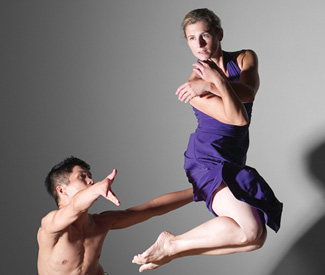
Sweet Can Productions puts on a gonzo circus show, but with a focus on quotidien, real-world concerns. For its upcoming “Yes Sweet Can” show, running for over two weeks at Dance Mission Theater, the performance is inspired by everyday chores — and actually makes them seem like fun.

Cleaning can be a blast, apparently, and making a cup of hot chocolate — while balancing a pot of hot milk on your head, of course — can also be rather exciting. The performers’ talents as acrobats are obvious, their flexibility undeniable. Whenever I see them do those super-exaggerated back bends, I always think “Man, that must feel sooo good!

The storyline at moments can seem a little vague, but that didn’t really seem to matter since the show is always moving forward (sometimes actually flying forward) with aerial feats, high up in the rafters of the theater.

“Yes Sweet Can” by Sweet Can Productions
Dance Mission Theater
3316 24th Street
Thru Jan 1, check website for times and prices
www.sweetcanproductions.com

Revolutionary bedfellows: What Occupy has in common with the sex-positive movement

2

Guardian reporter Yael Chanoff embedded at the Occupy SF and Occupy Oakland encampments during the months-long protest. Here, she reflects on the non-monogamy movement and what it could mean for the 99 percent

Temperatures were running high at Occupy San Francisco. After a day of hard work, the protesters were decompressing. Talented musicians shared their instruments with friends and strangers in impromptu jam sessions. 

The evening in question took place during Occupy SF’s early stages, back when police would swarm at the first sign of a tent being propped up, and all of the 200 or so people who camped out that night mingled and slept in the open air. I sat with two young women and three young men who were all topless, leaning on each other and using laps as pillows. 

Another occupier, who said he had arrived that day, wandered by. “So,” he asked, “Is this thing about free love?”

“I don’t know” the guy next to me replied. He shrugged at the newcomer. “But we’re definitely doing that.”

RADICAL INTIMACY

One week later, I was sitting in the midst of a very different kind of alternative community. We were inside the Supperclub nightclub, in a hot room scattered with beds. The event’s attendees wore sparse Adam and Eve-themed costumes and glittery pasties winked here and there. A video of bonobos copulating was playing. 

It was a “second base” party, one of the many social calendar offerings of San Francisco’s sex-positive community.  The night – dubbed “Sex at Dawn” after author Christopher Ryan’s book by the same name that explores the historical roots of non-monogamy – would feature a panel discussion with several of the leading lights in the alternative, kinky, political sex community. 

Among the night’s speakers: Dossie Easton, Carol Queen, Philippe Lewis, people who have devoted their lives to creating intellectual and physical spaces where free love is unquestioningly ‘what it’s about.’

Their passion notwithstanding, the party that would follow their talk was not a sex party, strictly speaking. Event producers and Club Exotica founders Philippe “Fuzzy” Lewis and Jocelyn Agloro describe their gatherings as “co-created pieces of temporary social art,” places “for people to explore intimacy, relationships, sensuality, and sexuality — in community.” 

In some ways, the two nights were similar. But in other ways, they were quite different. The cost of admission, for example (Occupy SF: free; Club Exotica’s party: $10-35). And the numerous beds. But I couldn’t help being struck by the similarities. 

Both spaces were populated by humans whose need for connection wasn’t being met anywhere else, humans brought together by an experiment in revolutionary ways of relating to each other based on sharing and compassion. 

As I see it, the two communities have important lessons to share with each other.

THE FUTURE OF LOVE?

Occupy SF’s merry encampment is just a memory now. Justin Herman Plaza is empty these days, and somewhat unsettling – a grim square of concrete, bocce courts, and dead grass where 200 thrilled, at times confused, yet fiercely committed individuals spent two month trying to make a better world. 

But the movement is not over. It’s just in the process of reinventing itself. Forums on “Occupy 2.0” are happening around the country.

And as I think back on that night with those free loving campers, I have to wonder, will Occupy hook up with the sexual liberation movement?

When it comes to sex at Occupy, experiences varied among the individuals I interviewed. One young man who has been involved in polyamorous relationships for several years said he didn’t see anything of the sort at camp. “People have met and started dating here,” he said, “but it’s usually monogamous.”

Be that as it may, more than a few people assured me that “there’s been at least one orgy in the tents.” 

Two campers who had been occupying since late September told me that they were in a polyamorous relationship with a third occupier, and knew of other of other threesomes that had developed at camp. One of them, a calm, smiling young man, said the Occupy SF camp was an environment that definitely encouraged this kind of free love.

“I think it’s because you’re around each other all the time, in this rapid exchange of revolutionary ideas, and that’s another way you connect.”

But is sexual revolution part of the Occupy ethos?

The calm man’s partner was an energetic twenty-year-old known to start dance parties at 4 a.m. when camp was still around. She didn’t think so. 

“I mean, we talk about it with each other,” she said. “But it’s not really a part of the political side of the movement.”

Others found that Occupy had at least encouraged more sexual license, albeit unaccompanied by sex-positive theory. With wide-eyed disbelief one long-time camper told me, “I don’t understand it. I’ve been with more women since I’ve been here, homeless, than I ever did when I was housed.” 

It appeared that societal notions of monogamy were being sloughed off at Occupy SF – but without any of the underlying theories of polyamory espouses by the city’s sex-positive community. Many occupiers I spoke had never heard of any theory of non-monogamy, and agreed that a workshop teaching about alternative relationship models at camp could have helped sort out a lot of their ambiguous sexual experiences. 

Ironically, some of the city’s most qualified teachers might have been in the tent next door to these potential students.

SEXPERTS IN THE TENTS

Joani Blank, founder of Good Vibrations and longtime sexual liberation activist, spent time at Occupy Oakland. She told me that she saw ideas of love, sharing, and interpersonal connection brewing in that camp. 

Said Blank, “the camps encouraged love and acceptance and egalitarianism. With Occupy, there’s been a significant opportunity for the nature of love and friendships to change and be more open, and a lot of people [are] relating to other people who are very much not the same as they are. A variety of relationships are being encouraged and supported because everybody’s united.”

Blank thinks that the camps bred sexual experimentation. “[The occupiers] will jump into sexual experiences they’ve never had. So, for them it’s very liberating. I felt that energy myself the night I stayed there, and it translates easily into other kinds of excitement.”

In the ambiguity that surrounds Occupy’s future, one thing seems clear: this movement won’t survive unless it’s built on our love for our peers. That’s the focus of parties like “Sex At Dawn,” where attendees are not allowed to have intercourse, but instead are encouraged to open up sensually to those around them. 

The quest to open up in ways not traditionally encouraged within the bounds of capitalism was seen by many as a keystone of Occupy. The viral video-upcoming documentary The Revolution is Love focuses on Occupy and protesters’ search to replace consumerism with intimacy. 

Polly Pandemonium, founder of sex club Mission Control and its popular swinger’s party Kinky Salon told me that “the sexual liberation movement and the Occupy movement…we are all working towards the same future. It’s homo sapiens natural predisposition to share rather than hoard and fight. The mutual goal is to help people realize that it’s safe to share, and that they won’t be left out in the cold, and to create a culture which supports and rewards that kind of behavior.”

Even in its current transition phase, Occupy continues to capture the imagination of millions, including many involved in our sexual liberation movement right here in San Francisco. With a new, restless crowd of thousands who saw how community sharing could be applied to sexual relationships at the Occupy camps, some new sexual revolution may be stirring. 

For now, Occupy and the sexual liberation movement are just getting acquainted. But if activists stick with the core notions of sharing and love, we might be seeing the start of a beautiful relationship. 


Telegenic Band Check: Magic! Magic Roses

0

Magic! Magic Roses gave SFBG videographer Ariel Soto-Suver a private living room performance and their conversation took her to concerts at Big Sur and dreams of sparkling hair accessories. The piece they performed will be on their new, upcoming album, but first they need a little Kickstart

Clouded: Oakland’s Main Attrakionz rise up from the fog

1

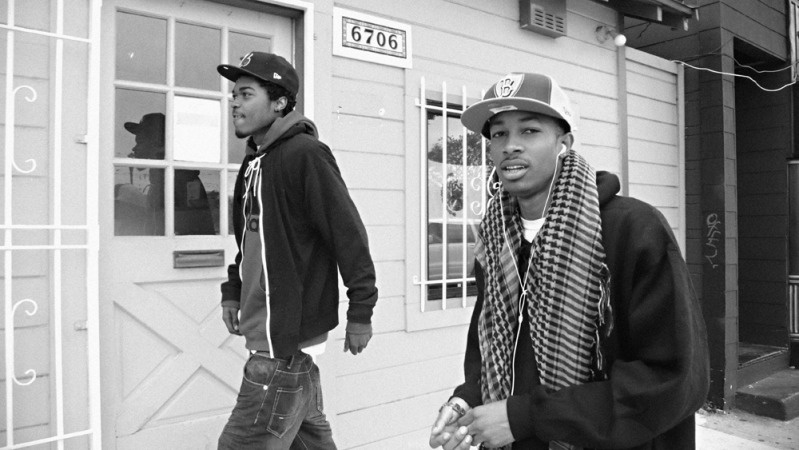
Maybe it’s the dreamy, celestial quality of their ethereal beats, or the cloud of weed smoke that seems to float from the speakers whenever Squadda B or MondreMAN spit one of their sky-high verses. While the origin of the term “cloud rap” may be up for debate, it’s undeniable that Main Attrakionz is carving out its own place in hip-hop by pioneering a new sub-genre.

Squadda and Mondre diligently recorded track after cloudy track in a foam-padded bedroom closet in North Oakland before entering a professional studio to lay down their most recent mixtape 808’s & Dark Grapes II. Thanks to its more polished production — and an ever-growing spotlight on the emerging DIY rap movement — 808’s & Dark Grapes II catapulted Main Attrakionz to the spotlight.

The pair is back at the home studio where it all began when I call them one winter afternoon. Mondre and Squadda, both barely 20 years old, are in high spirits, laughing and joking while we chat. The self-proclaimed “best duo ever” has been rapping together since age 12; they met in a seventh grade math class, and they’ve been inseparable ever since. “We would write and perform at talent shows,” says Mondre.

“Old school Cash Money, back in the ‘90s, those were the first CDs I ever bought,” he says of his formative influences. “No Limit, DJ Quik, Snoop Dogg, Too $hort. East Coast, West Coast, the South, all of it.”

Back in their talent show days, Mondre and Squadda were members of a four-piece called 4Figgas. The summer after they met, they recorded their first track – rapping over the Neptunes-produced beat for the Clipse’s “Grindin’.”

Beats for other early Main Attrakionz releases were often supplied by Shady Blaze, an Oakland rapper, producer, and prominent member of Main Attrakionz’s hip-hop collective Green Ova Undergrounds. More recent work has featured ambient, new-agey beats by up-and-coming artists like East Bay duo Friendzone, whose praise for Main Attrakionz’s off-the-cuff writing process sparked my interest.

“They make a brand new beat, we gotta write brand new shit to go along with it,” explains Squadda. He describes his studio mentality as “blank minded.” The pair listens to a track, rolls a few blunts, and cultivates breezy, zoned-out rhymes on the spot. “Wherever the beat takes it, that’s where we take it,” he says.

A refreshing realness runs throughout Main Attrakionz’s lyrics. The hardships of coming up in Oakland are neither downplayed nor glorified. Smoking weed is a continuous motif, as are the young rappers’ lofty ambitions and dreams. When there are mentions of money, it’s usually in the context of having enough to get by.

Main Attrakionz’s mixtapes have featured a slew of guest appearances from rising stars like ASAP Rocky and Danny Brown. When I ask Squadda whom he’d recruit if he could collaborate with anyone, alive or dead, he responds with youthful cockiness. “It’s gotta be a producer first off, cause I gotta have somebody that can bring something to the table,” he says. “It’s gotta be [UGK’s] Pimp C. Hands down, case closed.”

“It’s crazy that it came at this time, cause now we don’t even care about all that,” Squadda remarks on his recent critical acclaim. “[I’m just] glad to put music out that people can hear from anywhere.” Upcoming projects for Main Attrakionz include solo efforts from Mondre and Squadda, a Green Ova Undergrounds compilation, and a debut full-length.

Since it accompanies every mention of the duo, I can’t resist asking for a definition of cloud rap. “Hold on,” says Mondre. There’s a lot of commotion as he hands the phone to Squadda, and all I can make out is, “We’re higher than everybody else.”

Main Attrakionz
With G-Side and DaVinci
Tues/20, 9 p.m., $15
Independent

628 Divisadero, SF

(415) 771-1421

www.theindependentsf.com

Live Shots: José James at New Parish

0

A couple of phrases used (and possibly made up) to describe José James’s show Friday night: swoontastic and baby-making-music. The rising neo-crooner gigged in San Jose and SF the preceding two evenings, but it’s hard to beat the intimacy of Oakland’s the New Parish, which has a certain bohemian vibe.

Whereas James’s previous shows in the Bay Area were more traditional jazz with restrained piano accompaniment, on this tour he was backed up with a full band capable of illustrating his range. It made for a super talented quintet including keyboardist Kris Bowers (who appeared on Kanye/Jay Z’s Watch the Throne album), bassist Solomon Dorsey, trumpet player Takuya Kuroda (a familiar collaborator of James’s), and standout drummer Nate Smith.

Known for pulling hip-hop and electronic sounds into the vocal jazz tradition, James is as much influenced by John Coltrane as he is in line with the legend’s nephew, Flying Lotus (who did production on 2010’s Black Magic) and gave a respective shout-out to each.

Most impressively, the group collectively had a relaxed, pretension-free quality, with James on point, cuing Kuroda to take a solo or setting a mic stand in front of the seemingly reserved Dorsey, wordlessly indicating that it was his turn to sing. Previewing a significant amount of material from the upcoming album Trouble, James closed the show with an encore of the title track. Reiterating that it was his first time in Oakland, it was clear from the smile on his face (and the crowd’s) that it probably wouldn’t be the last.

OccupySF retakes plaza to debate whether to keep it

10

OccupySF and its supporters defended Justin Herman Plaza last night (Wed/7) in a strong display of nonviolent action, demonstrating a commitment to the movement. But the unfolding events also showed the group is at a crossroads as it debates its next moves, and whether to continue trying to occupy the plaza after the group’s tent city was removed by police and city workers.

About 250 gathered for a rally at 5 pm at 101 Market Street, marching the half a block to Justin Herman Plaza an hour later. Since the plaza was cleared out that morning, it had been guarded on all sides by a line of police. But as they approached, improbably, the police line parted, letting protesters through.

The group began to hold a general assembly meeting, but after 20 minutes police issued an order to disperse. About 50 sat down in a show of civil disobedience while a couple hundred more surrounded the outskirts.

Clashes with police in the past have been characterized by tension and angry cries from protesters. This one was more peaceful. Protesters held their ground and refused to leave, but besides a few incidents in which police detained and shoved protesters, most supporters were restrained and calm.

At 8:50 pm, police suddenly began to clear out. Jubilant protesters rushed into the plaza, having won it once again. However, from the meeting that followed, it seemed clear that many are restless to put their energies into actions other than defending the plaza.

The meeting consisted of several announcements concerning upcoming actions, such as taking part in the local march in support of International Human Rights Day on Saturday and Monday’s West Coast port shutdown. Occupy groups from Anchorage to San Diego have pledged to shut down their cities’ ports on Dec. 12.

Representatives from Occupy Community College of San Francisco and Occupy SF State University, both of which have now created tent city occupations of their own, were also present. After announcements, the discussion turned to strategy. Many saw a great opportunity to pitch tents and try to take back Justin Herman Plaza. Numbers had dwindled somewhat, but there were at least 150 protesters still present for that discussion. Others argued that OccupySF had successfully shown they could retake the plaza and that they should try and avoid a police clash that night, and instead sleep at and near 101 Market Street, their other recently reclaimed protest site.

Many insisted that OccupySF would be strategically wise to allow their supporters to reserve their energy for upcoming marches and actions; nightly calls to defend camp, said one protester, were wearing many down. In the end it was clear that “OccupySF is a network of autonomous individuals. Some will stay in Justin Herman, some won’t—but we’re all in solidarity.”

All this discussion took place amid reports that police were massing in the garage underneath the nearby Hyatt Hotel and at the police tactical building on 16th and De Haro streets. Many believed that they were staging to come back and make arrests if protesters attempted to re-erect their tent city. During the meeting, protesters put up five tents, but by 11:20 pm, they had voluntarily taken down their tents.

The OccupySF general assembly consented last week to defend Justin Herman Plaza anytime it is threatened. Yet the events of the past few days, as well as the destruction of large Occupy sites throughout the country in the past weeks, many sense that strategy may now be shifting.

Gordon Mar, director of Bay Area Jobs With Justice and OccupySF supporter who risked arrest last night, told us, “There’s a lot of exciting ideas and debate about new directions, including reoccupying JHP, but also moving forward in different ways. Occupy our homes initiatives have taken off recently, as well as occupations on college campuses, different communities and neighborhoods. It’s a really exciting and hopeful moment.”

Shaw San Liu of the Chinese Progressive Alliance issued a public statement saying, “You can raid a camp, but you can’t raid a movement. The movement cannot be stopped. [The occupation] was just the tip of the iceberg.”


No more Scrooge: A list of nonprofits that still have holiday volunteer slots

1

Mincemeat, Christmas goose, Hannukah gelt, lush sprays of holly bedecking the proverbial halls – traditionally, the December holidays are all about richness, overeating, and expense. But — especially these days — not everyone will be blessed with bounty over the holidays. In trying economic times, the number of San Franciscans struggling to put food on the table let alone buy their loved ones presents is steadily growing. 

So volunteer. San Franciscans have a long-standing tradition of helping out come the holidays, and many of the traditional community meals and grocery hand-outs have filled up their guest lists like a Big Freedia show during Pride Week. Nevertheless, a bunch of opportunities remain for those looking to lend a last-minute hand.

San Francisco Food Bank

Given recent funding cuts to the organization, the San Francisco Food Bank is taking all the help it can get in its quest to feed an ever-growing number of hungry San Franciscans. An enviably efficient volunteer system relies on interested helpers to sign up on an online calendar before showing up for their shift of repackaging food for community distribution.

900 Pennsylvania, SF. www.sffoodbank.org


Glide Memorial Church

Signing up to volunteer with Glide is a bit like jockeying for the last square of fudge. But luckily the organization – a superpower of Samaritan spirit – has a few spots left for December. Chose between an early-morning grocery bag distribution gig or a toy sorting task.

330 Ellis, SF. www.glide.org


St. Anthony’s

Packed to the gills with volunteers for its main events, St. Anthony’s is still calling out for help with two upcoming items: managing curbside drop-offs on December 23rd and 24th and clothing collection throughout the month. Both duties require the volunteer to be at least somewhat physically fit and able to lift 25 pounds of goodies. Shifts are four to five hours long and can be signed up for via a voicemail message to the volunteer hotline (see below). 

150 Golden Gate, SF. (415) 592-2829, www.stanthonysf.org


Tenderloin Tessie

If you’re looking to participate in a volunteer-run, community-oriented holiday dinner, this is one of  the best bets as better-known options are already staffed out the wazoo. Tenderloin Tessie provides holiday meals to homeless, low-income, disabled, and elderly San Franciscans – and has a wide-open sign-up sheet for volunteers. December 24th shifts involve loading and unloading food from the truck while shifts on Christmas Day are dedicated to decorating the dining room, preparing and serving dinner, and cleaning up afterwards. 

First Unitarian Universalist Church, 1187 Franklin, SF. Call Michael Gagne at (415) 584-3252 to register, www.tenderlointessie.com


Meals on Wheels San Francisco

The nationwide organization that delivers healthy meals to homebound seniors is peddling its Chefs of the Bay Area calendar for the next few weeks at various locations throughout the city. Individual volunteers are needed to staff the tables and promote the calendars, the proceeds from which eventually translate into someone’s hot holiday dinner.

1375 Fairfax, SF. Contact Danie Belfield at dbelfield@mowsf.org or call (415) 343-1311, www.mowsf.org


Habitat For Humanity

Habitat Greater San Francisco holds an ongoing inter-faith build on one of their largest projects to date, a 36-unit condominium at 7555 Mission.  No construction experience is necessary, and December 21 marks the start of their Winter Solstice Build, a community-driven effort to get the Daly City residence available to low-income tenants as soon as possible.

7555 Mission, Daly City. Sign up online at www.habitatgsf.org


Little Brothers San Francisco

Not everyone has family around for the holidays, and older San Franciscans can be especially in need of some care and affection. Little Brothers organizes several opportunities for volunteers looking to befriend community elders, from Christmas Day house visits to phone check-ins to help at the office. 

Various locations, SF. Sign up online or at (415) 771-7957, www.littlebrotherssf.org


AIDS Emergency Fund

Unlimited slots for volunteers pretty much guarantees a perfect present of a Christmas Eve dinner for San Franciscans with HIV/AIDS and their families. Last year, more than 1,000 people ate; this year (the 24th such dinner), a similar turnout is expected. Load-in of supplies begins at 10 a.m. on December 23rd and shifts run all day on Christmas Eve, starting at 8 a.m.

War Memorial Veterans Building, 401 Van Ness, SF. www.aef-sf.org, sign up at aefxmas@aol.com.


Jewish Family and Children’s Services

Gather and deliver holiday treats to those who might not otherwise celebrate the holidays on December 16th and 18th at the JFCS. Individuals and groups of volunteers are both welcome; sign up by December 9.

2150 Post, SF. Call (415) 449-3832 or email loril@jfcs.org to sign up. 


SF SPCA

A sprinkling of volunteer spots remains (especially post-Christmas) at the SPCA’s annual window display at Macy’s Union Square. Staff the windows – full of then-and-there-adoptable creatures – to raise money for future SPCA programs. 

Email windowsvolunteer@sfspca.org, use the online calendar, or call (415) 554-3008 to register, www.sfspca.org 


Hayes Valley Farm

Always open to volunteers, Hayes Valley Farm, an off-ramp-turned-urban-ag-oasis, holds special holiday hours for those looking to weed away end-of-year poundage or just engage with some of the happiest plants and gardeners in San Francisco. December 27 marks the first post-holiday gardening session and is sure to host droves of veterans and newbies alike.

450 Laguna, SF. www.hayesvalleyfarm.org


Film Listings

0

Film listings are edited by Cheryl Eddy. Reviewers are Kimberly Chun, Max Goldberg, Dennis Harvey, Lynn Rapoport, and Matt Sussman. For rep house showtimes, see Rep Clock.

OPENING

Another Happy Day You’d think that if your entire extended family treated you like a waste of space, you’d avoid all unnecessary contact. Seems this strategy never occurred to Lynn (Ellen Barkin), who shows up a few extra days early for her son’s wedding to stay with her aging parents (Ellen Burstyn, George Kennedy) and spend time with her obnoxious sisters (Diana Scarwid, Siobhan Fallon). Furthering the unpleasantries are Lynn’s ex-husband (Thomas Haden Church) and his wife (Demi Moore, in catty Real Housewives mode) and Lynn’s other children, a troubled bunch that includes Kate Bosworth as a self-mutilating waif and Ezra Miller as a depressed, jerky outcast (basically, a milder version of the character he plays, to much greater effect, in the upcoming We Need to Talk About Kevin). No wonder Lynn is a screechy, hysterically-crying mess — “toxic” barely begins to describe the situation. Writer-director Sam Levinson won a Sundance Film Festival award for his script, a fine example of indie-film misery at its most unbearable. (1:55) Balboa. (Eddy)

Golf in the Kingdom Golfers, apparently, worship Michael Murphy’s 1971 best-seller Golf in the Kingdom for its explorations of the sport’s more mystical qualities (for context, Murphy also co-founded Big Sur’s Esalen Institute). It’s unlikely there’ll be any new converts via director Susan Streitfeld’s low-budget attempt to translate the cult novel to the big screen — supply your own “sand trap” joke here, but this movie is a mess: murky night scenes, strange editing choices, and pretentious new age dialogue (“Keep asking questions. The best ones don’t have answers!”) that might’ve felt deep on the page, but is hilariously woo woo when spoken aloud. In fact, if you pretend Golf in the Kingdom — the tale of a young American golfer who encounters a meditating, is-it-wisdom-or-is-it-bullshit-spouting teacher during a stopover in Scotland — is a comedy, you’ll be better off. Not as well off as if you just watched Caddyshack (1980) instead, though. (1:26) Roxie, Smith Rafael. (Eddy)

Magic to Win The latest from Wilson Yip (2008’s Ip Man) is a fantasy about dueling magicians starring Louis Koo and Raymond Wong. (runtime not available) Metreon.

New Year’s Eve Remember when movies named after holidays were slasher flicks, not cheesy, star-studded rom-coms? (1:58) Presidio.

*Outrage The title definitely works: not only is this the most violent Takeshi Kitano film in a stretch, but the shameless, strangely off-key caricatures, especially that of a corrupt African diplomat, veer into offensiveness. Then again, what isn’t offensive, broadly sketched-out, and nasty about this yakuza crime drama-cum-jet-black comedy concerning a particularly code-less, amoral band of modern-day ronin? Chaos reigns, sucking even the beautiful and the charismatic into its quicksand. Kitano here is stony-faced Otomo, the chief bully for boss Kato (Miura Tomokazu) and underboss Ikemoto (Kunimura Jun). Kato is being screwed with by his own godfather, and must distance himself from ex-con brethren, or “brother,” Murase (Renji Ishibashi), then offend him, and finally do much worse. Otomo and his own crew of tough guys, headed up by the wickedly handsome Mizuno (Kippei Shiina) are charged with enacting the twisted plan, which is nihilistically comical in its Byzantine politics and back-stabbing switchbacks — the U.S. Congress will see much that’s familiar in Outrage‘s gaming of an already-decaying system. The shameless caricature of the mob’s African gambling cohort, which succeeds in making him the only vaguely sympathetic character of the lot, only demonstrates how irredeemable and decadent the so-called system — one filled with criminals obsessed with hierarchy and equally preoccupied with wrecking disorder within a very rotten order — has become, especially in the context of the interracial crime-brethren bonding of Kitano’s Brother (2000), the director’s last yakuza flick. Using Japan’s mafia as a cruel funhouse mirror through which to peer at his culture, Kitano finds much wanting with this, his 15th film, and much like Takashi Miike and his recent 13 Assassins, the filmmaker questions the core Japanese notions of duty, conformity, and loyalty and finds that, much like trickle-down economics, power corrupts from the top down. (1:49) Lumiere, Shattuck. (Chun)

*Saxon: Heavy Metal Thunder — The Movie At last, the gritty NWOBHM band gets its Behind the Music — except two hours long and created, tellingly, with fan-raised funding. What Craig Hooper’s doc lacks in technical slickness (for U.S. audiences, subtitles might’ve been a good idea) it more than makes up for in enthusiasm, not to mention thoroughness; though the band has gone through countless members in its 30-plus years, nearly all are interviewed at length, especially singer Biff Byford, who’s still part of the band, and bassist Steve “Dobby” Dawson, who is not. Though Saxon never quite conquered America — despite its best efforts, some of which are kind of regrettable in hindsight — the band enjoyed considerable success in Europe and was on the front lines for some of metal’s most exciting years, storming stages with Motörhead on the Bomber tour and mixing it up with a very young Metallica. Though the band’s overall story arc is a familiar one, anecdotes and asides (and the addressing of those “We inspired Spinal Tap” rumors!) make Saxon essential viewing for any metalhead. (2:00) Yerba Buena Center for the Arts. (Eddy)

The Sitter Indie darling-turned-stoner auteur David Gordon Green (Your Highness) directs Jonah Hill in this R-rated babysitting comedy. (1:21) Shattuck.

A Warrior’s Heart This movie stars secondary Twilight dreamboats Kellan Lutz and Ashley Greene, and its tagline is “In the twilight of their youth … her love gave him the courage to win.” Ah, I see what you did there, A Warrior’s Heart. Very subtle. An improbably buff, infuriatingly cocky lacrosse player (Lutz, who is 26 and in no way resembles a high schooler) wreaks havoc on and off the field, with anger management issues that go totally Krakatoa after his father is killed in Iraq. (Not a spoiler. Like I said, this movie is hardly subtle.) Dad’s gruff-yet-kind military buddy (Adam Beach) takes the troubled lad under his wing, spiriting him from jail to a work camp run by Native Americans. Did you know, as A Warrior’s Heart explains earnestly and often, that Native Americans invented lacrosse? Lessons are learned, the comely daughter (Greene) of the distrustful lacrosse coach (William Mapother) is wooed, and … well, I’ll let you figure out who scores the deciding goal in the national championship game. (1:38) Opera Plaza, Shattuck. (Eddy)

*Young Adult We first meet Mavis Gary (Charlize Theron) passed out next to last night’s bar pickup, whose name she won’t remember upon waking. You get the feeling this scenario happens a lot to Mavis — she’s the aging Manhattan model who seems like a trophy until the guy realizes she’s an even bigger asshole than he is. Plus, she’s in Minneapolis, on a house-grade scotch budget, where the denizens of the Midwestern home town she’s long abandoned assume she’s living a relatively glittering existence as swinging single and published author (albeit ghost author, of a petering-out tween fiction franchise). But no, her life is empty. Save your sympathy, however — Mavis might feel she’s missing something, but her consumerist values and incredible selfishness aren’t going to be sacrificed in finding it. After getting a courtesy baby announcement from old boyfriend Buddy (Patrick Wilson), she makes a determination as arbitrary as it is adamant: they were always meant to be together, and she needs to reclaim him so they can re-live their glory as King Jock and Queen Bitch of high school. Never mind that Buddy is quite happy where he is — let alone that new baby, and a wife (Elizabeth Reaser) less glam but cooler than Mavis will ever be. Acting as her confidant on this kamikaze mission is ex-classmate Matt (Patton Oswalt), who wants to reverse time about two decades for very different reasons. This reunion for the Juno (2007) duo of director Jason Reitman and writer Diablo Cody puts the latter’s facile wit to more complex, mature, organic use — though this ruthless yet quiet black character comedy is no uptempo crowd-pleaser. Rather, it’s an insidious, incisive commentary on such entertainments, as well as on juvie fiction like Sweet Valley High, whose adaptation is what Cody was developing before this tangent trumped it. It’s a surprisingly nervy movie, more like a 20-years-later sequel to Heathers (1988) than to Juno. (1:34) (Harvey)

ONGOING

Answers to Nothing The first scene is of Dane Cook getting a blow job. If you don’t run screaming from the room after that, you’ll be mildly rewarded by this ensemble drama tracing the lives of several Los Angeles residents trapped in various states of quiet desperation. At least director and co-writer Matthew Leutwyler (2010’s The River Why) has the sense to cast Cook (2007’s Good Luck Chuck) as a character you’re supposed to hate; he’s a therapist who’s cheating on his trying-to-get-pregnant wife (Elizabeth Mitchell) with a hipster singer (Aja Volkman) inexplicably hung up on a married dude who treats her like an afterthought. Barbara Hershey has a few understated scenes as Cook’s lonely mother; Julie Benz plays his sister-in-law, a no-nonsense detective investigating the disappearance of a young girl. Probably the most unexpected plot thread — in a film that remains more or less identical to all others cast in the Crash (2004) mode — follows a guilt-ridden woman (Miranda Bailey) determined to help her paralyzed brother complete a marathon. These characters could’ve been the whole movie, no blow job required. (2:03) Metreon. (Eddy)

Arthur Christmas (1:37) 1000 Van Ness, Shattuck.

*The Artist With the charisma-oozing agility of Douglas Fairbanks swashbuckling his way past opponents and the supreme confidence of Rudolph Valentino leaning, mid-swoon, into a maiden, French director-writer Michel Hazanavicius hits a sweet spot, or beauty mark of sorts, with his radiant new film The Artist. In a feat worthy of Fairbanks or Errol Flynn, Hazanavicius juggles a marvelously layered love story between a man and a woman, tensions between the silents and the talkies, and a movie buff’s appreciation of the power of film — embodied in particular by early Hollywood’s union of European artistry and American commerce. Dashing silent film star George Valentin (Jean Dujardin, who channels Fairbanks, Flynn, and William Powell — and won this year’s Cannes best actor prize) is at the height of his career, adorable Jack Russell by his side, until the talkies threaten to relegate him to yesterday’s news. The talent nurtured in the thick of the studio system yearns for real power, telling the newspapers, “I’m not a puppet anymore — I’m an artist,” and finances and directs his own melodrama, while his youthful protégé Peppy Miller (Bérénice Béjo) becomes a yakky flapper age’s new It Girl. Both a crowd-pleasing entertainment and a loving précis on early film history, The Artist never checks its brains at the door, remaining self-aware of its own conceit and its forebears, yet unashamed to touch the audience, without an ounce of cynicism. (1:40) Embarcadero, Smith Rafael. (Chun)

*The Descendants Like all of Alexander Payne’s films save 1996 debut Citizen Ruth, The Descendants is an adaptation, this time from Kaui Hart Hemmings’ excellent 2007 novel. Matt King (George Clooney) is a Honolulu lawyer burdened by various things, mostly a) being a haole (i.e. white) person nonetheless descended from Hawaiian royalty, rich in real estate most natives figure his kind stole from them; and b) being father to two children by a wife who’s been in a coma since a boating accident three weeks ago. Already having a hard time transitioning from workaholic to hands-on dad, Matt soon finds out this new role is permanent, like it or not — spouse Elizabeth (Patricia Hastie, just briefly seen animate) will not wake up. The Descendants covers the few days in which Matt has to share this news with Elizabeth’s loved ones, mostly notably Shailene Woodley and Amara Miller as disparately rebellious teen and 10-year-old daughters. Plus there’s the unpleasant discovery that the glam, sporty, demanding wife he’d increasingly seemed “not enough” for had indeed been looking elsewhere. When has George Clooney suggested insecurity enough to play a man afraid he’s too small in character for a larger-than-life spouse? But dressed here in oversized shorts and Hawaiian shirts, the usually suave performer looks shrunken and paunchy; his hooded eyes convey the stung joke’s-on-me viewpoint of someone who figures acknowledging depression would be an undeserved indulgence. Payne’s film can’t translate all the book’s rueful hilarity, fit in much marital backstory, or quite get across the evolving weirdness of Miller’s Scottie — though the young actors are all fine — but the film’s reined-in observations of odd yet relatable adult and family lives are all the more satisfying for lack of grandiose ambition. (1:55) California, Marina, 1000 Van Ness, Piedmont, SF Center, Sundance Kabuki. (Harvey)

*Drive Such a lovely way to Drive, drunk on the sensual depths of a lush, saturated jewel tone palette and a dreamlike, almost luxurious pacing that gives off the steamy hothouse pop romanticism of ’80s-era Michael Mann and David Lynch — with the bracing, impactful flecks of threat and ultraviolence that might accompany a car chase, a moody noir, or both, as filtered through a first-wave music video. Drive comes dressed in the klassic komforts — from the Steve McQueen-esque stances and perfectly cut jackets of Ryan Gosling as the Driver Who Shall Remain Nameless to the foreboding lingering in the shadows and the wittily static, statuesque strippers that decorate the background. Gosling’s Driver is in line with Mann’s other upstanding working men who hew to an old-school moral code and are excellent at what they do, regardless of what side of the law they’re working: he likes to keep it clear and simple — his services as a wheelman boil down to five minutes, in and out — but matters get messy when he falls for sweet-faced neighbor Irene (Carey Mulligan), who lives down the hall with her small son, and her ex-con husband (Oscar Isaac) is dragged back into the game. Populated by pungent side players like Albert Brooks, Bryan Cranston, Ron Perlman, and Christina Hendricks, and scattered with readily embeddable moments like a life-changing elevator kiss that goes bloodily wrong-right, Drive turns into a real coming-out affair for both Danish director Nicolas Winding Refn (2008’s Bronson), who rises above any crisis of influence or confluence of genre to pick up the po-mo baton that Lynch left behind, and 2011’s MVP Ryan Gosling, who gets to flex his leading-man muscles in a truly cinematic role, an anti-hero and under-the-hood psychopath looking for the real hero within. (1:40) Lumiere. (Chun)

*Eames: The Architect and the Painter Mad Men would boast considerably fewer sublime lines without the design impact of postwar masters Charles and Ray Eames. Touching on only the edges of the wide net cast by the couple and the talented designers at their Venice, Calif., studio, Eames attempts to sum up the genius behind the mid-century modern objets that brought a sophisticated new breed of beauty and glamour to an American middle class. Narrated by James Franco and chock-full of interviews with everyone from grandson Eames Demetrios to director Paul Schrader, this debut feature documentary by Jason Cohn opens on the then-married would-be architect Charles and sidetracked painter Ray meeting and swooning at the Cranbook Academy of Art in Michigan, all while working with Eero Saarinen on a prize-winning molded-wood chair for a MOMA competition. Their personal and design lives would remain intertwined forever more — through their landmark furniture designs (who doesn’t drool for that iconic Eames lounge and ottoman, one of many pieces still in production today); their whimsical, curious, and at-times-brilliant films; their exuberant propaganda for the US government and assorted corporations; and even those Mad Men-like indiscretions by the handsome Charles (Cohn drops one bombshell of an interview with a girlfriend). Throughout, in a way that faintly reflects the industrial design work at Apple today, the Eameses made selling out look good — even fun. One only wishes Cohn, who seems to get lost in the output, delved further into the specific furniture designs and films themselves (only 1968’s Powers of Ten is given adequate play), but perhaps that’s all fated to be sketched out for a sequel on the powers of two. (1:24) Smith Rafael. (Chun)

Happy Feet Two (1:40) 1000 Van Ness.

Le Havre Aki Kaurismäki’s second French-language film (following 1992’s La Vie de Boheme) offers commentary on modern immigration issues wrapped in the gauze of a feel good fairy tale and cozy French provincialism a la Marcel Pagnol. Worried about the health of his hospitalized wife (Kaurismäki regular Kati Outinen), veteran layabout and sometime shoe shiner Marcel (Andre Wilms) gets some welcome distraction in coming to the aid of Idrissa (Blondin Miguel), a young African illegally trying to make way to his mother in London while eluding the gendarmes. Marcel’s whole neighborhood of port-town busybodies and industrious émigrés eventually join in the cause, turning Le Havre into a sort of old-folks caper comedy with an incongruously sunny take on a rising European multiculturalism in which there are no real racist xenophobes, just grumps deserving comeuppance. Incongruous because Kaurismäki is, of course, the king of sardonically funny Finnish miserabilism — and while it’s charmed many on the festival circuit, this combination of his usual poker-faced style and feel-good storytelling formula may strike others as an oil-and-water mismatch. (1:43) Opera Plaza. (Harvey)

House of Boys Amsterdam, 1984: a hot young thing named Frank (Layke Anderson) stumbles out of a rainstorm and into the House of Boys, an only-in-the-movies establishment with a cabaret stage downstairs and a boarding house of sorts for taut-torso’d dancers upstairs. At its helm are Cher … er, Madame (Udo Kier, dazzling in drag), who tut-tuts and dispenses world-weary advice, and earthy mother figure Emma (Eleanor David). As Frank finds himself onstage and off — he’s run away from a middle-class home with a father who insists he remove the “I Heart Boys” bumper sticker from his car — he falls in love with go-go star Jake (Benn Northover). But by the film’s third act, House of Boys’ dance-club melodrama has given way to a far less glitter-infused look at the frightening early days of the AIDS epidemic, with Stephen Fry playing a kindly doctor who snarls when he sees Ronald Reagan on TV. Director and co-writer Jean-Claude Schlim’s film shifts wildly in tone, dips its toes in narrative cheese, and contains lines like “You didn’t have sex — you made love” and “Don’t dream your life, live your dreams!”, but it’s vividly atmospheric throughout, and unexpectedly heartfelt at the finish. (1:53) Roxie. (Eddy)

Hugo Hugo turns on an obviously genius conceit: Martin Scorsese, working with 3D, CGI, and a host of other gimmicky effects, creates a children’s fable that ultimately concerns one of early film’s pioneering special-effects fantasists. That enthusiasm for moviemaking magic, transferred across more than a century of film history, was catching, judging from Scorsese’s fizzy, exhilarating, almost-nauseating vault through an oh-so-faux Parisian train station and his carefully layered vortex of picture planes as Hugo Cabret (Asa Butterfield), an intrepid engineering genius of an urchin, scrambles across catwalk above a buzzing station and a hotheaded station inspector (Sacha Baron Cohen). Despite the special effects fireworks going off all around him, Hugo has it rough: after the passing of his beloved father (Jude Law), he has been stuck with an nasty drunk of a caretaker uncle (Ray Winstone), who leaves his duties of clock upkeep at a Paris train station to his charge. Hugo must steal croissants to survive and mechanical toy parts to work on the elaborate, enigmatic automaton he was repairing with his father, until he’s caught by the fierce toy seller (Ben Kingsley) with a mysterious lousy mood and a cute, bright ward, Isabelle (Chloe Grace Moretz). Although the surprisingly dark-ish Hugo gives Scorsese a chance to dabble a new technological toolbox — and the chance to wax pedantically, if passionately, about the importance of film archival studies — the effort never quite despite transcends its self-conscious dazzle, lagging pacing, diffuse narrative, and simplistic screenplay by John Logan, based on Brian Selznick’s book. Even the actorly heavy lifting provided by assets like Kingsley and Moretz and the backloaded love for the fantastic proponents at the dawn of filmmaking fail to help matters. Scorsese attempts to steal a little of the latters’ zeal, but one can only imagine what those wizards would do with motion-capture animation or a blockbuster-sized server farm. (2:07) 1000 Van Ness, Presidio, Shattuck, Sundance Kabuki. (Chun)

Immortals Arrow time (comin’ at ya, in 3D), blood lust, fascinating fascinators, and endless seemingly-CGI-chiseled chests mark this rework of the Theseus myth. Tarsem Singh flattens out the original tale of crazy-busy hero who founded Athens yet seems determined to outdo the Lord of the Rings series with his striking art direction (so chic that at times you feel like you’re in a perfume ad rather than King Hyperion’s torture chamber). As you might expect from the man who made the dreamy, horse-slicing Cell (2000), Immortals is all sensation rather than sense. The proto-superhero here is a peasant (Henry Cavill), trained in secret by Zeus (John Hurt and Luke Evans) and toting a titanic chip on his shoulder when he runs into the power-mad Cretan King Hyperion (Mickey Rourke, struggling to gnash the sleek scenery beneath fleshy bulk and Red Lobster headgear). Hyperion aims to obtain the Epirus Bow — a bit like a magical, preindustrial rocket launcher — to free the Titans, set off a war between the gods, and destroy humanity (contrary to mythology, Hyperion is not a Titan — just another heavyweight grudge holder). To capture the bow, he must find the virgin oracle Phaedra (Freida Pinto), massacring his way through Theseus’ village and setting his worst weapon, the Beast, a.k.a. the Minotaur, on the hero. Saving graces amid the gory bluster, which still pays clear tribute to 1963’s Jason and the Argonauts, is the vein-bulging passion that Singh invests in the ordinarily perfunctory kill scenes, the avant-garde headdresses and costumes by Eiko Ishioka, and the occasional edits that turn on visual rhymes, such as the moment when the intricate mask of a felled minion melts into a seagoing vessel, which are liable to make the audience gasp, or laugh, out loud. (1:50) 1000 Van Ness. (Chun)

In Time Justin Timberlake moves from romantic comedy to social commentary to play Will Salas, a young man from the ghetto living one day at a time. Many 12-steppers may make this claim, but Salas literally is, because in his world, time actually is money and people pay, say, four minutes for a cup of coffee, a couple hours for a bus ride home from work, and years to travel into a time zone where people don’t run from place to place to stay ahead of death. In writer-director Andrew Niccol’s latest piece of speculative cinema, humans are born with a digitized timepiece installed in their forearm and a default sell-by date of 25 years, with one to grow on — though most end up selling theirs off fairly quickly while struggling to pay rent and put food on the table. Time zones have replaced area codes in defining social stature and signaling material wealth, alongside those pesky devices that give the phrase “internal clock” an ominous literality. Niccol also wrote and directed Gattaca (1997) and wrote The Truman Show (1998), two other films in which technological advances have facilitated a merciless, menacing brand of social engineering. In all three, what is most alarming is the through line between a dystopian society and our own, and what is most hopeful is the embattled protagonist’s promises that we don’t have to go down that road. Amanda Seyfried proves convincible as a bored heiress to eons, her father (Vincent Kartheiser) less amenable to Robin Hood-style time banditry. (1:55) Four Star, Shattuck. (Rapoport)

*Into the Abyss: A Tale of Death, a Tale of Life How remarkable is it that, some 50-plus features along, filmmaker Werner Herzog would become the closest thing to a cinema’s conscience? This time the abyss is much closer to home than the Amazon rainforest or the Kuwaiti oil fields — it lies in the heart of Rick Perry country. What begins as an examination of capital punishment, introduced with an interview with Reverend Richard Lopez, who has accompanied Texas death row inmates to their end, becomes a seeming labyrinth of human tragedy. Coming into focus is the execution of Michael Perry, convicted as a teenager of the murder of a Conroe, Tex., woman, her son, and his friend — all for sake of a red Camaro. Herzog obtains an insightful interview with the inmate, just days before his execution, as well as his cohort Jason Burkett, police, an executioner, and the victims’ family members, in this haunting examination of crime, punishment, and a small town in Texas where so many appear to have gone wrong. So wrong that one might see Into the Abyss as more related to 1977’s Stroszek and its critical albeit compassionate take on American life, than Herzog’s last tone poem about the mysterious artists of 2010’s Cave of Forgotten Dreams (and it’s also obviously directly connected to next year’s TV documentary, Death Row). The layered tragedies and the strata of destroyed lives stays with you, as do the documentary’s difficult questions, Herzog’s gentle humanity as an interviewer, and the fascinating characters that don’t quite fit into a more traditional narrative — the Conroe bystander once stabbed with a screwdriver who learned to read in prison, and the dreamy woman impregnated by a killer whose entire doomed family appears to be incarcerated. (1:46) Opera Plaza. (Chun)

J. Edgar The usual polished, sober understatement of Clint Eastwood’s directing style and the highlights-compiling CliffsNotes nature of Dustin Lance Black’s screenplay turn out to be interestingly wrong choices for this biopic about one of the last American century’s most divisive figures. Interesting in that they’re perhaps among the very few who would now dare viewing the late, longtime FBI chief with so much admiration tempered by awareness of his faults — rather than the other way around. After all, Hoover (played by Leonardo DiCaprio) strengthened his bureau in ways that, yes, often protected citizens and state, but at what cost? The D.C. native eventually took to frequently “bending” the law, witch-hunting dubious national enemies (he thought the Civil Rights movement our worst threat since the bomb-planting Bolshevik anarchists of half a century earlier), blackmailing personal ones, weakening individual rights against surveillance, hoarding power (he resented the White House’s superior authority), lying publicly, and doing just about anything to heighten his own fame. A movie that internalized and communicated his rising paranoid megalomania (ironically Hoover died during the presidency of Nixon, his equal in that regard) might have stood some chance of making us understand this contradiction-riddled cipher. But J. Edgar is doggedly neutral, almost colorless (literally so, in near-monochrome visual presentation), its weird appreciation of the subject’s perfectionism and stick-to-it-iveness shutting out almost any penetrating insight. (Plus there’s Eastwood’s own by-now-de rigueur soundtrack of quasi-jazz noodling to make what is vivid here seem more dull and polite.) The love that dare not speak its name — or, evidently, risk more than a rare peck on the cheek — between Hoover and right-hand-man/life companion Clyde Tolson (Armie Hammer, very good if poorly served by his old-age makeup) becomes both the most compelling and borderline-silly thing here, fueled by a nervous discretion that seems equal parts Black’s interest and Eastwood’s discomfort. While you might think the directors polar opposites in many ways, the movie J. Edgar ultimately recalls most is Oliver Stone’s 1995 Nixon: both ambitiously, rather sympathetically grapple with still-warm dead gorgons and lose, filmmaker and lead performance alike laboring admirably to intelligent yet curiously stilted effect. (2:17) Four Star, 1000 Van Ness, SF Center, Shattuck, Sundance Kabuki. (Harvey)

*Like Crazy Jacob (Anton Yelchin) and Anna (Felicity Jones) meet near the end of college; after a magical date, they’re ferociously hooked on each other. Trouble is, she’s in Los Angeles on a soon-to-expire student visa — and when she impulsively overstays, then jets home to London for a visit months later, her re-entry to America is stopped cold at LAX. (True love’s no match for homeland security.) An on-and-off long-distance romance ensues, and becomes increasingly strained, even as their respective careers (he makes furniture, she’s a magazine staffer) flourish. Director and co-writer Drake Doremus (2010’s Douchebag) achieves a rare midpoint between gritty mumblecore and shiny Hollywood romance; the characters feel very real and the script ably captures the frustration that settles in when idealized fantasies give way to the messy workings of everyday life. There are some contrivances here — Anna’s love-token gift from Jacob, a bracelet engraved “Patience,” breaks when she’s with another guy — but for the most part, Like Crazy offers an honest portrait of heartbreak. (1:29) California, Piedmont, SF Center, Sundance Kabuki. (Eddy)

*Love Crime Early this year came the announcement that Brian De Palma was hot to do an English remake of Alain Corneau’s Love Crime. The results, should they come to fruition, may well prove a landmark in the annals of lurid guilty-pleasure trash. But with the original Love Crime finally making it to local theaters, it’s an opportune moment to be appalled in advance about what sleazy things could potentially be done to this neat, dry, fully clothed model of a modern Hitchcockian thriller. No doubt in France Love Crime looks pretty mainstream. But here its soon-to be-despoiled virtues of narrative intricacy and restraint are upscale pleasures. Ludivine Sagnier plays assistant to high-powered corporate executive Christine (Kristin Scott Thomas). The boss enjoys molding protégée Isabelle to her own image, making them a double team of carefully planned guile unafraid to use sex appeal as a business strategy. But Isabelle is expected to know her place — even when that place robs her of credit for her own ideas — and when she stages a small rebellion, Christine’s revenge is cruelly out of scale, a high-heeled boot brought down to squash an ant. Halfway through an act of vengeance occurs that is shocking and satisfying, even if it leaves the remainder of Corneau and Nathalie Carter’s clever screenplay deprived of the very thing that had made it such a sardonic delight so far. Though it’s no masterpiece, Love Crime closes the book on his Corneau’s career Corneau (he died at age 67 last August) not with a bang but with a crisp, satisfying snap. (1:46) Four Star. (Harvey)

*The Man Nobody Knew: In Search of My Father, CIA Spymaster William Colby A man who dove straight from college into intelligence work — joining the CIA after World War II, and working against communism in Italy (successfully) and Vietnam (not so much) — William Colby became head of the CIA amid the organization’s most tumultuous years; he was called before an angry Congress multiple times in the mid-1970s to answer questions about the agency’s top-secret “Family Jewels” documents, among other cover-ups. This documentary, made by his son, Carl, combines archival footage with contemporary insights from politicians (Donald Rumsfeld, James Schlesinger) and journalists (Bob Woodward, Seymour Hersh), as well as Colby’s first wife (and Carl’s mother) Barbara Heinzen. The Man Nobody Knew is an apt title; in the beginning, at least, William Colby was perfectly suited for covert work — able to square his Roman Catholic beliefs with the shifty moral ground that comes with, say, allegedly ordering assassinations. But he was so closed-off in other aspects that his own son remembers him as a total enigma. Colby’s mysterious death, officially due to a boating accident, adds one more unknowable layer to the film, which intriguingly frames a controversial segment of American history through a very personal lens. (1:44) Lumiere, Shattuck. (Eddy)

*Margin Call Think of Margin Call as a Mamet-like, fictitious insider jab at the financial crisis, a novelistic rejoinder to Oscar-winning doc Inside Job (2010). First-time feature director and writer J.C. Chandor shows a deft hand with complex, writerly material, creating a darting dance of smart dialogue and well-etched characters as he sidesteps the hazards of overtheatricality, a.k.a. the crushing, overbearing proscenium. The film opens on a familiar Great Recession scene: lay-off day at an investment bank, marked by HR functionaries calling workers one by one into fishbowl conference rooms. The first victim is the most critical — Eric Dale (Stanley Tucci), a risk-management staffer who has stumbled on an investment miscalculation that could potentially trigger a Wall Street collapse. On his way out, he passes a drive with his findings to one of his young protégés, Peter (Zachary Quinto), setting off a flash storm over the next 24 hours that will entangle his boss Sam (Kevin Spacey), who’s agonizing over his dying dog while putting up a go-big-or-go-home front; cynical trading manager Will (Paul Bettany); and the firm’s intimidating head (Jeremy Irons), who gets to utter the lines, “Explain to me as you would to a child. Or a Golden Retriever.” Such top-notch players get to really flex their skills here, equipped with Chandor’s spot-on script, which manages to convey the big issues, infuse the numbers with drama and the money managers with humanity, and never talk down to the audience. (1:45) Four Star, Presidio, Sundance Kabuki. (Chun)

*Melancholia Lars von Trier is a filmmaker so fond of courting controversy it’s like he does it in spite of himself — his rambling comments about Hitler (“I’m a Nazi”) were enough to get him banned from the Cannes Film Festival earlier this year, where Melancholia had its debut (and star Kirsten Dunst won Best Actress). Oops. Maybe after the (here’s that word again) controversy that accompanied 2009’s Antichrist, von Trier felt like he needed a shocking context for his more mellow latest. Pity that, for Melancholia is one of his strongest, most thoughtful works to date. Split into two parts, the film follows first the opulent, disastrous, never-ending wedding reception of Justine (Dunst) and Michael (Alexander Skarsgard), held at a lavish estate owned by John (Kiefer Sutherland), the tweedy husband of Justine’s sister, Claire (Charlotte Gainsbourg). Amid the turmoil of arguments (John Hurt and Charlotte Rampling as Justine and Claire’s divorced parents), pushy guests (Stellan Skarsgard as Justine’s boss), livid wedding planner (Udo Kier, amazing), and hurt feelings (Michael is the least-wanted groom since Kris Humphries), it’s clear that something is wrong with Justine beyond just marital jitters. The film’s second half begins an unspecified amount of time later, as Claire talks her severely depressed, near-catatonic sister into moving into John’s mansion. As Justine mopes, it’s revealed that a small planet, Melancholia — glimpsed in Melancholia‘s Wagner-scored opening overture — is set to pass perilously close to Earth. John, an amateur astronomer, is thrilled; Claire, fearful for her young son’s future and goaded into high anxiety by internet doomsayers, is convinced the planets will collide, no matter what John says. Since Justine (apparently von Trier’s stand-in for himself) is convinced that the world’s an irredeemably evil place, she takes the news with a shrug. Von Trier’s vision of the apocalypse is somber and surprisingly poetic; Dunst and Gainsbourg do outstanding work as polar-opposite sisters whose very different reactions to impending disaster are equally extreme. (2:15) Albany, Bridge. (Eddy)

Midnight in Paris Owen Wilson plays Gil, a self-confessed “Hollywood hack” visiting the City of Light with his conservative future in-laws and crassly materialistic fiancée Inez (Rachel McAdams). A romantic obviously at odds with their selfish pragmatism (somehow he hasn’t realized that yet), he’s in love with Paris and particularly its fabled artistic past. Walking back to his hotel alone one night, he’s beckoned into an antique vehicle and finds himself transported to the 1920s, at every turn meeting the Fitzgeralds, Gertrude Stein (Kathy Bates), Dali (Adrien Brody), etc. He also meets Adriana (Marion Cotillard), a woman alluring enough to be fought over by Hemingway (Corey Stoll) and Picasso (Marcial di Fonzo Bo) — though she fancies aspiring literary novelist Gil. Woody Allen’s latest is a pleasant trifle, no more, no less. Its toying with a form of magical escapism from the dreary present recalls The Purple Rose of Cairo (1985), albeit without that film’s greater structural ingeniousness and considerable heart. None of the actors are at their best, though Cotillard is indeed beguiling and Wilson dithers charmingly as usual. Still — it’s pleasant. (1:34) Opera Plaza, Shattuck. (Harvey)

The Muppets Of course The Muppets is a movie appropriate for small fry, with a furry cast (supplemented by human co-stars Jason Segel and Amy Adams) cracking wise and conveying broad themes about the importance of friendship, self-confidence, and keeping dreams alive despite sabotage attempts by sleazy oil tycoons (Chris Cooper, comically evil in the grand Muppet-villain tradition). But the true target seems to be adults who grew up watching The Muppet Show and the earliest Muppet movies (1999’s Muppets from Space doesn’t count); the “getting the gang back together” sequence takes up much of the film’s first half, followed by a familiar rendition of “let’s put on a show” in the second. Interwoven are constant reminders of how the Muppets’ brand of humor — including Fozzie Bear’s corny stand-up bits — is a comforting throwback to simpler times, even with a barrage of celeb cameos and contemporary gags (chickens clucking a Cee-Lo Green tune — I think you can guess which one). Co-writer Segal pays appropriate homage to the late Jim Henson’s merry creations, but it remains to be seen if The Muppets will usher in a new generation of fans, or simply serve as nostalgia fodder for grown-ups like, uh, me, who may or may not totally still own a copy of Miss Piggy’s Guide to Life. (1:38) Balboa, 1000 Van Ness, Presidio. (Eddy)

My Week With Marilyn Statuette-clutching odds are high for Michelle Williams, as her impersonation of a famous dead celebrity is “well-rounded” in the sense that we get to see her drunk, disorderly, depressed, and so forth. Her Marilyn Monroe is a conscientious performance. But when the movie isn’t rolling in the expected pathos, it’s having other characters point out how instinctive and “magical” Monroe is onscreen — and Williams doesn’t have that in her. Who could? Williams is remarkable playing figures so ordinary you might look right through them on the street, in Wendy and Lucy (2008), Blue Valentine (2010), etc. But as Monroe, all she can do is play the little-lost girl behind the sizzle. Without the sizzle. Which is, admittedly, exactly what My Week — based on a dubious true story — asks of her. It is true that in 1956 the Hollywood icon traveled to England to co-star with director Sir Laurence Olivier (Kenneth Branagh) in a fluff romance, The Prince and the Showgirl; and that she drove him crazy with her tardiness, mood swings, and crises. It’s debatable whether she really got so chummy with young production gofer Colin Clark, our wistful guide down memory lane. He’s played with simpering wide-eyed adoration by Eddie Redmayne, and his suitably same-aged secondary romantic interest (Emma Watson) is even duller. This conceit could have made for a sly semi-factual comedy of egos, neurosis, and miscommunication. But in a rare big-screen foray, U.K. TV staples director Simon Curtis and scenarist Adrian Hodges play it all with formulaic earnestness — Marilyn is the wounded angel who turns a starstruck boy into a brokenhearted but wiser man as the inevitable atrocious score orders our eyes to mist over. (1:36) Albany, Clay, 1000 Van Ness, Piedmont. (Harvey)

Puss in Boots (1:45) 1000 Van Ness.

*Shame It’s been a big 2011 for Michael Fassbender, with Jane Eyre, X-Men: First Class, Shame, and the upcoming A Dangerous Method raising his profile from art-house standout to legit movie star (of the “movie stars who can also act” variety). Shame may only reach one-zillionth of X-Men‘s audience due to its NC-17 rating, but this re-teaming with Hunger (2008) director Steve McQueen is Fassbender’s highest achievement to date. He plays Brandon, a New Yorker whose life is tightly calibrated to enable a raging sex addiction within an otherwise sterile existence, including an undefined corporate job and a spartan (yet expensive-looking) apartment. When brash, needy, messy younger sister Cissy (Carey Mulligan, speaking of actors having banner years) shows up, yakking her life all over his, chaos results. Shame is a movie that unfolds in subtle details and oversized actions, with artful direction despite its oft-salacious content. If scattered moments seem forced (loopy Cissy’s sudden transformation, for one scene, into a classy jazz singer), the emotions — particularly the titular one — never feel less than real and raw. (1:39) Embarcadero, Sundance Kabuki. (Eddy)

The Skin I Live In I’d like to think that Pedro Almodóvar is too far along in his frequently-celebrated career to be having a midlife crisis, but all the classic signs are on display in his flashy, disjointed new thriller. Still mourning the death of his burn victim wife and removed from his psychologically disturbed daughter, brilliant-but-ethically compromised plastic surgeon Robert (played with smoldering creepiness by former Almodóvar heartthrob Antonio Banderas) throws himself into developing a new injury-resistant form of prosthetic skin, testing it on his mysterious live-in guinea pig, Vera (the gorgeous Elena Anaya, whose every curve is on view thanks to an après-ski-ready body suit). Eventually, all hell breaks loose, as does Vera, whose back story, as we find out, owes equally to 1960’s Eyes Without a Face and perhaps one of the Saw films. And that’s not even the half of it — to fully recount every sharp turn, digression and MacGuffin thrown at us would take the entirety of this review. That’s not news for Almodóvar, though. Much like Rainer Werner Fassbinder before him, Almodóvar’s métier is melodrama, as refracted through a gay cinephile’s recuperative affections. His strength as a filmmaker is to keep us emotionally tethered to the story he’s telling, amidst all the allusions, sex changes and plot twists torn straight from a telenovela. The real shame of The Skin I Live In is that so much happens that you don’t actually have time to care much about any of it. Although its many surfaces are beautiful to behold (thanks largely to cinematographer José Luis Alcaine), The Skin I Live In ultimately lacks a key muscle: a heart. (1:57) Lumiere, Shattuck. (Sussman)

*Sutro’s: The Palace at Land’s End Filmmaker Tom Wyrsch (2008’s Watch Horror Films, Keep America Strong and 2009’s Remembering Playland) explores the unique and fascinating history behind San Francisco’s Sutro Baths in his latest project, an enjoyable documentary that covers the stories behind Adolph Sutro, the construction of his swimming pools, and the amazingly diverse, and somewhat strange collection of other attractions that entertained generations of locals that came to Land’s End for amusement. Told through interviews with local historians and residents, the narrative is illustrated with a host of rarely-seen historic photographs, archival film footage, contemporary video, and images of old documents, advertisements and newspapers. The film should appeal not only to older viewers who fondly remember going to Sutro’s as children, and sadly recall it burning down in 1966, but also younger audiences who have wandered through the ruins below the Cliff House and wondered what once stood there. (1:24) Balboa, Smith Rafael. (Sean McCourt)

*Tomboy In her second feature, French filmmaker Céline Sciamma (2007’s Water Lilies) depicts the brave and possibly perilous gender experimentations of a 10-year-old girl. Laure (Zoé Héran) moves with her family to a new town, falls in with the neighborhood gang during the summer vacation, and takes the stranger-comes-to-town opportunity to adopt a new, male persona, Mikael, a leap of faith we see her consider for a moment before jumping, eyes open. Watching Mikael quietly observe and then pick up the rough mannerisms and posturing of his new peers, while negotiating a shy romance with Lisa (Jeanne Disson), the sole female member of the gang, is to shift from amazement to amusement to anxiety and back again. As the children play games in the woods and roughhouse on a raft in the water and use a round of Truth or Dare to inspect their relationships to one another, all far from the eyes of the adults on the film’s periphery, Mikael takes greater and greater risks to inhabit an identity that he is constructing as he goes, and that is doomed to be demolished sooner, via accidental discovery, or later, when fall comes and the children march off to school together. All of this is superbly handled by Sciamma, who gently guides her largely nonprofessional young cast through the material without forcing them into a single precocious situation or speech. The result is a sweet, delicate story with a steady undercurrent of dread, as we wait for summer’s end and hope for the best and imagine the worst. (1:22) Opera Plaza, Shattuck. (Rapoport)

Tower Heist The mildest of mysteries drift around the edges of Tower Heist — like, how plausible is Ben Stiller as the blue-collar manager of a tony uptown NYC residence? How is that Eddie Murphy’s face has grown smoother and more seamless with age? And how much heavy lifting goes into an audience member’s suspension of disbelief concerning a certain key theft, dangling umpteen floors above Thanksgiving parade, in the finale? Yet those questions might not to deter those eager to escape into this determinedly undemanding, faintly entertaining Robin Hood-style comedy-thriller. Josh Kovacs (Stiller) is the wildly competent manager of an upscale residence — toadying smoothly and making life run perfectly for his entitled employers — till Bernie Madoff-like penthouse dweller Arthur Shaw (Alan Alda) is arrested for big-time financial fraud, catching the pension fund of Josh’s staffers in his vortex. After a showy standoff gets the upstanding Josh fired, he assembles a crew of ex-employees Enrique (Michael Peña) and Charlie (Casey Affleck), maid Odessa (Gabourey Sidibe), and foreclosed former resident Mr. Fitzhugh (Matthew Broderick), as well as childhood friend, neighbor, and thief Slide (Murphy). Murphy gets to slink effortlessly through supposed comeback role — is he vital here? Not really. Nevertheless, a few twists and a good-hearted feel for the working-class 99 percent who got screwed by the financial sector make this likely the most likable movie Brett Ratner has made since 2006’s X-Men: The Last Stand — provided you can get over those dangles over the yawning gaps in logic. (1:45) 1000 Van Ness. (Chun)

Twilight Saga: Breaking Dawn — Part One Some may have found Robert Pattinson’s stalker-suitor Edward Cullen sufficiently creepy (fits of overprotective rage, flirtatious comments about his new girlfriend’s lip-smackingly narcotic blood) in 2008’s first installment of the Twilight franchise. And nothing much in 2009’s New Moon (suicide attempt) or 2010’s Eclipse (jealous fits, poor communication) strongly suggested he was LTR material, to say nothing of marriage for all eternity. But Twilight 3.5 is where things in the land of near-constant cloud cover and perpetually shirtless adolescent werewolves go seriously off the rails — starting with the post-graduation teen nuptials of bloodsucker Edward and his tasty-smelling human bride, Bella Swan (Kristen Stewart), and ramping up considerably when it turns out that Edward’s undead sperm are, inexplicably, still viable for baby-making. One of the film’s only sensible lines is uttered at the wedding by high school frenemy Jessica (Anna Kendrick), who snidely wonders whether Bella is starting to show. Of course not, in this Mormon-made tale, directed by Bill Condon (1998’s Gods and Monsters, 2004’s Kinsey). And while Bella’s dad, Charlie (Billy Burke), seems slightly more disgruntled than usual, no one other than lovesick werewolf Jacob Black (Taylor Lautner) seems to question the wisdom of this shotgun-free leap from high school to honeymoon. The latter, however, after a few awkward allusions to rough sex, is soon over, and Bella does indeed start showing. Suffice it to say, it’s not one of those pregnancies that make your skin glow and your hair more lustrous. What follows is like a PSA warning against vampire-bleeder cohabitation, and one wonders if even the staunchest members of Team Edward will flinch, or adjust their stance of dewy-eyed appreciation. (1:57) Marina, 1000 Van Ness, SF Center, Sundance Kabuki. (Rapoport)


Bank of America frets about Occupy

An internal Bank of America email has surfaced, making it clear that the megabank is concerned about the national day of action against evictions and foreclosures being carried out today, Dec. 6, by the Occupy Wall Street movement. The leaked internal memo suggests BofA is taking Occupy housing actions very seriously.

According to the email, which was sent to BofA’s third-party Field Services suppliers, the nationwide protests “could impact our industry.”

“We believe protests will likely take place tomorrow at auction sites, homes that are being foreclosed, homes in the eviction stage, and vacant homes,” the BofA memo notes. “We want to make sure that we are all prepared.”

It goes on to emphasize three points: do not engage with the protesters, ensure that vacant homes are secured, and report “media incidents” to 800-796-8448. I called that number to verify that the email was real, and sure enough, a spokesperson confirmed that it was.

The memo concludes with proof that the Bank of America has been paying close attention to activist websites. “The website occupyourhomes.org has a story posted of a Bank customer we are researching,” the email notes. “The web site has an event finder that can help identify upcoming protests.”

After the Guardian called the BoFA to determine whether the email was real, media relations representative Jumana Bauwens followed up with this statement:

“As a matter of normal course of business, when we are alerted to activities that may affect our real estate owned properties, we inform our third party contractors. This is standard operating procedure. The safety of our associates and third party contractors is our first priority. It is the bank’s policy to protect and secure our properties for the investors who own them. Bank of America is committed to helping our customers with home retention solutions and other foreclosure avoidance programs. Foreclosure is always our last resort.”

Live Shots: A peep at the upcoming “Revolutionary Nutcracker Sweetie”

0

Rehearsal was in full twirl this weekend, as dancers prepared to perform “The Revolutionary Nutcracker Sweetie” at Brava Theater this coming weekend.

This is not your classic, bourgeois version of the Nutcracker, but more of a Cinderella tale. Clara is an undocumented worker, working for the richest family in town, the McGreeds, whose gay son (with a pink hairdo) gives Clara a freedom fighting doll from Africa.

Later, the pair embark on an adventure of a lifetime. They make their way through a magical world, of melting ice caps and even underwater, concluding with the a beautiful “dance of the flowers,” which I caught a few photos of during the rehearsal. So start a new tradition this year, and check out Dance Brigade’s spunky and cool version of this holiday favorite, because, sweetie, you don’t want to miss it!

December 10-11
Saturday 2pm and 6pm; Sunday 1pm and 5pm, $15-$17
Brava Theater
2781 24th Street, SF
Purchase tickets here

Government jobs are jobs, too

81

The New York Times weighed in Dec. 4 on an economic fact of life that I’ve been harping about for years now: Jobs in the public sector are … jobs. In many cases, they’re good jobs. And when conservatives and business leaders talk about reducing the size of government — and then complain about the unemployment rate — they’re stuck in doublespeak.

I know the Times has a paywall now, so if you can’t get in from that link I’ll give you the main points of the editorial:

While the private sector has been adding jobs since the end of 2009, more than half a million government positions have been lost since the recession. … The cutbacks hurt more than just services. As Timothy Williams of The Times reported last week, they hit black workers particularly hard. Millions of African-Americans — one in five who are employed — have entered the middle class through government employment, and they tend to make 25 percent more than other black workers. Now tens of thousands are leaving both their jobs and the middle class. Chicago, for example, is laying off 212 employees in the upcoming fiscal year, two-thirds of whom are black.

That’s one reason the black unemployment rate went up last month, to 15.5 percent from 15.1. The effect is severe, destabilizing black neighborhoods and making it harder for young people to replicate their parents’ climb up the economic ladder. …

Many Republicans, however, don’t regard government jobs as actual jobs, and are eager to see them disappear. Republican governors around the Midwest have aggressively tried to break the power of public unions while slashing their work forces, and Congressional Republicans have proposed paying for a payroll tax cut by reducing federal employment rolls by 10 percent through attrition. That’s 200,000 jobs, many of which would be filled by blacks and Hispanics and others who tend to vote Democratic, and thus are considered politically superfluous.

But every layoff, whether public or private, is a life, and a livelihood, and a family. And too many of them are getting battered by the economic storm.

Something to think about as city officials try to eliminate the latest defict and negotiate new union contracts. Because Repbulicans aren’t the only ones who don’t regard government jobs as actual jobs; a lot of Democratic officials and business leaders in liberal San Francisco seem to feel the same way.J


Film Listings

0

Film listings are edited by Cheryl Eddy. Reviewers are Kimberly Chun, Max Goldberg, Dennis Harvey, Lynn Rapoport, and Matt Sussman. For rep house showtimes, see Rep Clock.

OPENING

Answers to Nothing The first scene is of Dane Cook getting a blow job. If you don’t run screaming from the room after that, you’ll be mildly rewarded by this ensemble drama tracing the lives of several Los Angeles residents trapped in various states of quiet desperation. At least director and co-writer Matthew Leutwyler (2010’s The River Why) has the sense to cast Cook (2007’s Good Luck Chuck) as a character you’re supposed to hate; he’s a therapist who’s cheating on his trying-to-get-pregnant wife (Elizabeth Mitchell) with a hipster singer (Aja Volkman) inexplicably hung up on a married dude who treats her like an afterthought. Barbara Hershey has a few understated scenes as Cook’s lonely mother; Julie Benz plays his sister-in-law, a no-nonsense detective investigating the disappearance of a young girl. Probably the most unexpected plot thread — in a film that remains more or less identical to all others cast in the Crash (2004) mode — follows a guilt-ridden woman (Miranda Bailey) determined to help her paralyzed brother complete a marathon. These characters could’ve been the whole movie, no blow job required. (2:03) (Eddy)

*The Artist See “Silence Is Golden.” (1:40) Embarcadero.

*”Christmas in Acidland” Psychedelic it may not be, but the Roxie’s two days of Yuletide weirdness curated by Johnny Legend offers plenty of seasonal nostalgia heavily seasoned by kitsch. The two titular programs compile Xmas-themed errata including animation shorts, musical interludes (Liberace, Ricky Nelson, a tranquilized-looking Rosemary Clooney, a bizarrely maudlin song from none other than Joan Rivers, a “Little Drummer Boy” duet from the mutually nonplussed Bing Crosby and David Bowie), Bob Hope cracking wise on Elvis and gay cowboys, Howdy Doody visiting Santa’s workshop, and greetings from the Reagans — Ron, Nancy, and future turncoat Patty. A “Christmas Noir” program features dramatic miniatures including Dragnet forced at gunpoint to be heartwarming, and Harpo Marx’s only dramatic role as a deaf-mute mime who witnesses a mob hit while performing in a department store window display. Last but far from least there’s the 1959 Mexican family spectacular Santa Claus, which in its English-language version played for years at U.S. kiddie matinees and on TV. One could make the case for a certain lysergic tenor to this wacko color fantasy that starts with a ballet for leaping devils in hell and seldom reduces the insanity level thereafter. Old St. Nick here has competition from one of Satan’s horned, red-jumpsuited minions in determining the naughtiness or niceness of several Mexico City children. (Though there are also “It’s a Small World”-style production numbers representing Xmas spirit in other cultures, including “the Orient” and “even Russia.”) The film’s equal-opportunity jumble of mythologies also has room for Vulcan, Merlin, and a “magic parasol.” A fairly elaborate production for Mexican exploitation king René Cardona (1969’s Night of the Bloody Apes), it’s warped the holiday realities of many a child over the last 50-plus years, and remains an uncontrolled substance of dubiously wholesome oddity still. Roxie. (Harvey) 2Eames: The Architect and the Painter Mad Men would boast considerably fewer sublime lines without the design impact of postwar masters Charles and Ray Eames. Touching on only the edges of the wide net cast by the couple and the talented designers at their Venice, Calif., studio, Eames attempts to sum up the genius behind the mid-century modern objets that brought a sophisticated new breed of beauty and glamour to an American middle class. Narrated by James Franco and chock-full of interviews with everyone from grandson Eames Demetrios to director Paul Schrader, this debut feature documentary by Jason Cohn opens on the then-married would-be architect Charles and sidetracked painter Ray meeting and swooning at the Cranbook Academy of Art in Michigan, all while working with Eero Saarinen on a prize-winning molded-wood chair for a MOMA competition. Their personal and design lives would remain intertwined forever more — through their landmark furniture designs (who doesn’t drool for that iconic Eames lounge and ottoman, one of many pieces still in production today); their whimsical, curious, and at-times-brilliant films; their exuberant propaganda for the US government and assorted corporations; and even those Mad Men-like indiscretions by the handsome Charles (Cohn drops one bombshell of an interview with a girlfriend). Throughout, in a way that faintly reflects the industrial design work at Apple today, the Eameses made selling out look good — even fun. One only wishes Cohn, who seems to get lost in the output, delved further into the specific furniture designs and films themselves (only 1968’s Powers of Ten is given adequate play), but perhaps that’s all fated to be sketched out for a sequel on the powers of two. (1:24) Balboa, Smith Rafael. (Chun)

House of Boys Amsterdam, 1984: a hot young thing named Frank (Layke Anderson) stumbles out of a rainstorm and into the House of Boys, an only-in-the-movies establishment with a cabaret stage downstairs and a boarding house of sorts for taut-torso’d dancers upstairs. At its helm are Cher … er, Madame (Udo Kier, dazzling in drag), who tut-tuts and dispenses world-weary advice, and earthy mother figure Emma (Eleanor David). As Frank finds himself onstage and off — he’s run away from a middle-class home with a father who insists he remove the “I Heart Boys” bumper sticker from his car — he falls in love with go-go star Jake (Benn Northover). But by the film’s third act, House of Boys’ dance-club melodrama has given way to a far less glitter-infused look at the frightening early days of the AIDS epidemic, with Stephen Fry playing a kindly doctor who snarls when he sees Ronald Reagan on TV. Director and co-writer Jean-Claude Schlim’s film shifts wildly in tone, dips its toes in narrative cheese, and contains lines like “You didn’t have sex — you made love” and “Don’t dream your life, live your dreams!”, but it’s vividly atmospheric throughout, and unexpectedly heartfelt at the finish. Star Udo Kier appears in person at Fri/2 screenings. (1:53) Roxie. (Eddy)

*The Man Nobody Knew: In Search of My Father, CIA Spymaster William Colby A man who dove straight from college into intelligence work — joining the CIA after World War II, and working against communism in Italy (successfully) and Vietnam (not so much) — William Colby became head of the CIA amid the organization’s most tumultuous years; he was called before an angry Congress multiple times in the mid-1970s to answer questions about the agency’s top-secret “Family Jewels” documents, among other cover-ups. This documentary, made by his son, Carl, combines archival footage with contemporary insights from politicians (Donald Rumsfeld, James Schlesinger) and journalists (Bob Woodward, Seymour Hersh), as well as Colby’s first wife (and Carl’s mother) Barbara Heinzen. The Man Nobody Knew is an apt title; in the beginning, at least, William Colby was perfectly suited for covert work — able to square his Roman Catholic beliefs with the shifty moral ground that comes with, say, allegedly ordering assassinations. But he was so closed-off in other aspects that his own son remembers him as a total enigma. Colby’s mysterious death, officially due to a boating accident, adds one more unknowable layer to the film, which intriguingly frames a controversial segment of American history through a very personal lens. (1:44) Lumiere, Shattuck. (Eddy)

*Seducing Charlie Barker Veteran local theater director Amy Glazer’s second feature is, like her first, adapted from a play she’d already done on stage — this one by Theresa Rebeck, retitled from its less descriptive original The Scene. Charlie (Stephen Turner Barker) is an actor whose career might have already peaked; tired of his sloth while she slaves in a TV casting gig she hates, wife of 14 years Stella (Daphne Zuniga) insists he hit up a long-ago pal turned sleazy but successful producer for a job. At the party he’s forced to attend for that purpose, however, Charlie gets sidelined — from his task, his art, his marriage — by Clea (Heather Gordon), a new arrival in Manhattan who has a hard body, bottomless ambition, no inhibitions, and no scruples. She’s a monster who might leave him picked clean as carrion in a vulture cage by the time they’re done. The narrative is a little over-crammed and a little underballasted to be fully credible. But Rebeck writes knockout dialogue for the numerous scorched earth confrontations here, and Glazer’s actors do a terrific job fleshing out characters that might read a bit schematic on the page. The results are imperfect but pack considerable juicy dramatic punch. (1:29) Opera Plaza, Smith Rafael. (Harvey)

*Shame It’s been a big 2011 for Michael Fassbender, with Jane Eyre, X-Men: First Class, Shame, and the upcoming A Dangerous Method raising his profile from art-house standout to legit movie star (of the “movie stars who can also act” variety). Shame may only reach one-zillionth of X-Men‘s audience due to its NC-17 rating, but this re-teaming with Hunger (2008) director Steve McQueen is Fassbender’s highest achievement to date. He plays Brandon, a New Yorker whose life is tightly calibrated to enable a raging sex addiction within an otherwise sterile existence, including an undefined corporate job and a spartan (yet expensive-looking) apartment. When brash, needy, messy younger sister Cissy (Carey Mulligan, speaking of actors having banner years) shows up, yakking her life all over his, chaos results. Shame is a movie that unfolds in subtle details and oversized actions, with artful direction despite its oft-salacious content. If scattered moments seem forced (loopy Cissy’s sudden transformation, for one scene, into a classy jazz singer), the emotions — particularly the titular one — never feel less than real and raw. (1:39) Embarcadero. (Eddy)

ONGOING

Anonymous Hark, what bosom through yonder bodice heaves? If you like your Shakespearean capers OTT and chock-full of fleshy drama, political intrigue, and groundling sensation, then Anonymous will enthrall (and if the lurid storyline doesn’t hold, the acting should). Writer John Orloff spins his story off one popular theory of Shakespeare authorship — that Edward de Vere, the 17th Earl of Oxford, was the true pen behind the works attributed to William Shakespeare of Stratford-upon-Avon. Our modern-day narrator (Derek Jacobi) foregrounds the fictitious nature of the proceedings, pulling back the curtain on Ben Jonson (Sebastian Armesto) staging his unruly comedies for the mob, much to the amusement of a mysterious aging dandy of a visitor: the Earl of Oxford (Rhys Ifans). Hungry for the glory that has always slipped through his pretty fingers, the Earl yearns to have his works staged for audiences beyond those in court, where Queen Elizabeth I (Vanessa Redgrave as the elder regent, daughter Joely Richardson as the lusty young royal) dotes on them, and out of the reach of his puritan father-in-law Robert Cecil (David Thewlis), Elizabeth’s close advisor, and he devises a plan for Jonson to stage them under his own name. But much more is triggered by the productions, uncovering secret trysts, hunchback stratagems, and more royal bastards than you can shake a scepter at. Director Roland Emmerich invests the production with the requisite high drama — and camp — to match the material, as well as pleasing layers of grime and toxic-looking Elizabethan makeup for both the ladies and the dudes who look like ladies (the crowd-surfing, however, strikes the off-key grunge-era note). And if the inherent elitism of the tale — could only a nobleman have written those remarkable plays and sonnets? — offends, fortunately the cast members are more than mere players. Ifans invests his decadent Earl with the jaded gaze and smudgy guyliner of a fading rock star, and Redgrave plays her Elizabeth like a deranged, gulled grotesque. (2:10) Four Star. (Chun)

Arthur Christmas (1:37) 1000 Van Ness, Presidio, Shattuck.

*The Descendants Like all of Alexander Payne’s films save 1996 debut Citizen Ruth, The Descendants is an adaptation, this time from Kaui Hart Hemmings’ excellent 2007 novel. Matt King (George Clooney) is a Honolulu lawyer burdened by various things, mostly a) being a haole (i.e. white) person nonetheless descended from Hawaiian royalty, rich in real estate most natives figure his kind stole from them; and b) being father to two children by a wife who’s been in a coma since a boating accident three weeks ago. Already having a hard time transitioning from workaholic to hands-on dad, Matt soon finds out this new role is permanent, like it or not — spouse Elizabeth (Patricia Hastie, just briefly seen animate) will not wake up. The Descendants covers the few days in which Matt has to share this news with Elizabeth’s loved ones, mostly notably Shailene Woodley and Amara Miller as disparately rebellious teen and 10-year-old daughters. Plus there’s the unpleasant discovery that the glam, sporty, demanding wife he’d increasingly seemed “not enough” for had indeed been looking elsewhere. When has George Clooney suggested insecurity enough to play a man afraid he’s too small in character for a larger-than-life spouse? But dressed here in oversized shorts and Hawaiian shirts, the usually suave performer looks shrunken and paunchy; his hooded eyes convey the stung joke’s-on-me viewpoint of someone who figures acknowledging depression would be an undeserved indulgence. Payne’s film can’t translate all the book’s rueful hilarity, fit in much marital backstory, or quite get across the evolving weirdness of Miller’s Scottie — though the young actors are all fine — but the film’s reined-in observations of odd yet relatable adult and family lives are all the more satisfying for lack of grandiose ambition. (1:55) California, 1000 Van Ness, Piedmont, SF Center, Sundance Kabuki. (Harvey)

*Drive Such a lovely way to Drive, drunk on the sensual depths of a lush, saturated jewel tone palette and a dreamlike, almost luxurious pacing that gives off the steamy hothouse pop romanticism of ’80s-era Michael Mann and David Lynch — with the bracing, impactful flecks of threat and ultraviolence that might accompany a car chase, a moody noir, or both, as filtered through a first-wave music video. Drive comes dressed in the klassic komforts — from the Steve McQueen-esque stances and perfectly cut jackets of Ryan Gosling as the Driver Who Shall Remain Nameless to the foreboding lingering in the shadows and the wittily static, statuesque strippers that decorate the background. Gosling’s Driver is in line with Mann’s other upstanding working men who hew to an old-school moral code and are excellent at what they do, regardless of what side of the law they’re working: he likes to keep it clear and simple — his services as a wheelman boil down to five minutes, in and out — but matters get messy when he falls for sweet-faced neighbor Irene (Carey Mulligan), who lives down the hall with her small son, and her ex-con husband (Oscar Isaac) is dragged back into the game. Populated by pungent side players like Albert Brooks, Bryan Cranston, Ron Perlman, and Christina Hendricks, and scattered with readily embeddable moments like a life-changing elevator kiss that goes bloodily wrong-right, Drive turns into a real coming-out affair for both Danish director Nicolas Winding Refn (2008’s Bronson), who rises above any crisis of influence or confluence of genre to pick up the po-mo baton that Lynch left behind, and 2011’s MVP Ryan Gosling, who gets to flex his leading-man muscles in a truly cinematic role, an anti-hero and under-the-hood psychopath looking for the real hero within. (1:40) Lumiere. (Chun)

Happy Feet Two (1:40) 1000 Van Ness.

Le Havre Aki Kaurismäki’s second French-language film (following 1992’s La Vie de Boheme) offers commentary on modern immigration issues wrapped in the gauze of a feel good fairy tale and cozy French provincialism a la Marcel Pagnol. Worried about the health of his hospitalized wife (Kaurismäki regular Kati Outinen), veteran layabout and sometime shoe shiner Marcel (Andre Wilms) gets some welcome distraction in coming to the aid of Idrissa (Blondin Miguel), a young African illegally trying to make way to his mother in London while eluding the gendarmes. Marcel’s whole neighborhood of port-town busybodies and industrious émigrés eventually join in the cause, turning Le Havre into a sort of old-folks caper comedy with an incongruously sunny take on a rising European multiculturalism in which there are no real racist xenophobes, just grumps deserving comeuppance. Incongruous because Kaurismäki is, of course, the king of sardonically funny Finnish miserabilism — and while it’s charmed many on the festival circuit, this combination of his usual poker-faced style and feel-good storytelling formula may strike others as an oil-and-water mismatch. (1:43) Opera Plaza. (Harvey)

Hugo Hugo turns on an obviously genius conceit: Martin Scorsese, working with 3D, CGI, and a host of other gimmicky effects, creates a children’s fable that ultimately concerns one of early film’s pioneering special-effects fantasists. That enthusiasm for moviemaking magic, transferred across more than a century of film history, was catching, judging from Scorsese’s fizzy, exhilarating, almost-nauseating vault through an oh-so-faux Parisian train station and his carefully layered vortex of picture planes as Hugo Cabret (Asa Butterfield), an intrepid engineering genius of an urchin, scrambles across catwalk above a buzzing station and a hotheaded station inspector (Sacha Baron Cohen). Despite the special effects fireworks going off all around him, Hugo has it rough: after the passing of his beloved father (Jude Law), he has been stuck with an nasty drunk of a caretaker uncle (Ray Winstone), who leaves his duties of clock upkeep at a Paris train station to his charge. Hugo must steal croissants to survive and mechanical toy parts to work on the elaborate, enigmatic automaton he was repairing with his father, until he’s caught by the fierce toy seller (Ben Kingsley) with a mysterious lousy mood and a cute, bright ward, Isabelle (Chloe Grace Moretz). Although the surprisingly dark-ish Hugo gives Scorsese a chance to dabble a new technological toolbox — and the chance to wax pedantically, if passionately, about the importance of film archival studies — the effort never quite despite transcends its self-conscious dazzle, lagging pacing, diffuse narrative, and simplistic screenplay by John Logan, based on Brian Selznick’s book. Even the actorly heavy lifting provided by assets like Kingsley and Moretz and the backloaded love for the fantastic proponents at the dawn of filmmaking fail to help matters. Scorsese attempts to steal a little of the latters’ zeal, but one can only imagine what those wizards would do with motion-capture animation or a blockbuster-sized server farm. (2:07) 1000 Van Ness, Shattuck, Sundance Kabuki. (Chun)

Immortals Arrow time (comin’ at ya, in 3D), blood lust, fascinating fascinators, and endless seemingly-CGI-chiseled chests mark this rework of the Theseus myth. Tarsem Singh flattens out the original tale of crazy-busy hero who founded Athens yet seems determined to outdo the Lord of the Rings series with his striking art direction (so chic that at times you feel like you’re in a perfume ad rather than King Hyperion’s torture chamber). As you might expect from the man who made the dreamy, horse-slicing Cell (2000), Immortals is all sensation rather than sense. The proto-superhero here is a peasant (Henry Cavill), trained in secret by Zeus (John Hurt and Luke Evans) and toting a titanic chip on his shoulder when he runs into the power-mad Cretan King Hyperion (Mickey Rourke, struggling to gnash the sleek scenery beneath fleshy bulk and Red Lobster headgear). Hyperion aims to obtain the Epirus Bow — a bit like a magical, preindustrial rocket launcher — to free the Titans, set off a war between the gods, and destroy humanity (contrary to mythology, Hyperion is not a Titan — just another heavyweight grudge holder). To capture the bow, he must find the virgin oracle Phaedra (Freida Pinto), massacring his way through Theseus’ village and setting his worst weapon, the Beast, a.k.a. the Minotaur, on the hero. Saving graces amid the gory bluster, which still pays clear tribute to 1963’s Jason and the Argonauts, is the vein-bulging passion that Singh invests in the ordinarily perfunctory kill scenes, the avant-garde headdresses and costumes by Eiko Ishioka, and the occasional edits that turn on visual rhymes, such as the moment when the intricate mask of a felled minion melts into a seagoing vessel, which are liable to make the audience gasp, or laugh, out loud. (1:50) 1000 Van Ness. (Chun)

In Time Justin Timberlake moves from romantic comedy to social commentary to play Will Salas, a young man from the ghetto living one day at a time. Many 12-steppers may make this claim, but Salas literally is, because in his world, time actually is money and people pay, say, four minutes for a cup of coffee, a couple hours for a bus ride home from work, and years to travel into a time zone where people don’t run from place to place to stay ahead of death. In writer-director Andrew Niccol’s latest piece of speculative cinema, humans are born with a digitized timepiece installed in their forearm and a default sell-by date of 25 years, with one to grow on — though most end up selling theirs off fairly quickly while struggling to pay rent and put food on the table. Time zones have replaced area codes in defining social stature and signaling material wealth, alongside those pesky devices that give the phrase “internal clock” an ominous literality. Niccol also wrote and directed Gattaca (1997) and wrote The Truman Show (1998), two other films in which technological advances have facilitated a merciless, menacing brand of social engineering. In all three, what is most alarming is the through line between a dystopian society and our own, and what is most hopeful is the embattled protagonist’s promises that we don’t have to go down that road. Amanda Seyfried proves convincible as a bored heiress to eons, her father (Vincent Kartheiser) less amenable to Robin Hood-style time banditry. (1:55) Four Star, Shattuck. (Rapoport)

*Into the Abyss: A Tale of Death, a Tale of Life How remarkable is it that, some 50-plus features along, filmmaker Werner Herzog would become the closest thing to a cinema’s conscience? This time the abyss is much closer to home than the Amazon rainforest or the Kuwaiti oil fields — it lies in the heart of Rick Perry country. What begins as an examination of capital punishment, introduced with an interview with Reverend Richard Lopez, who has accompanied Texas death row inmates to their end, becomes a seeming labyrinth of human tragedy. Coming into focus is the execution of Michael Perry, convicted as a teenager of the murder of a Conroe, Tex., woman, her son, and his friend — all for sake of a red Camaro. Herzog obtains an insightful interview with the inmate, just days before his execution, as well as his cohort Jason Burkett, police, an executioner, and the victims’ family members, in this haunting examination of crime, punishment, and a small town in Texas where so many appear to have gone wrong. So wrong that one might see Into the Abyss as more related to 1977’s Stroszek and its critical albeit compassionate take on American life, than Herzog’s last tone poem about the mysterious artists of 2010’s Cave of Forgotten Dreams (and it’s also obviously directly connected to next year’s TV documentary, Death Row). The layered tragedies and the strata of destroyed lives stays with you, as do the documentary’s difficult questions, Herzog’s gentle humanity as an interviewer, and the fascinating characters that don’t quite fit into a more traditional narrative — the Conroe bystander once stabbed with a screwdriver who learned to read in prison, and the dreamy woman impregnated by a killer whose entire doomed family appears to be incarcerated. (1:46) Opera Plaza, Shattuck. (Chun)

J. Edgar The usual polished, sober understatement of Clint Eastwood’s directing style and the highlights-compiling CliffsNotes nature of Dustin Lance Black’s screenplay turn out to be interestingly wrong choices for this biopic about one of the last American century’s most divisive figures. Interesting in that they’re perhaps among the very few who would now dare viewing the late, longtime FBI chief with so much admiration tempered by awareness of his faults — rather than the other way around. After all, Hoover (played by Leonardo DiCaprio) strengthened his bureau in ways that, yes, often protected citizens and state, but at what cost? The D.C. native eventually took to frequently “bending” the law, witch-hunting dubious national enemies (he thought the Civil Rights movement our worst threat since the bomb-planting Bolshevik anarchists of half a century earlier), blackmailing personal ones, weakening individual rights against surveillance, hoarding power (he resented the White House’s superior authority), lying publicly, and doing just about anything to heighten his own fame. A movie that internalized and communicated his rising paranoid megalomania (ironically Hoover died during the presidency of Nixon, his equal in that regard) might have stood some chance of making us understand this contradiction-riddled cipher. But J. Edgar is doggedly neutral, almost colorless (literally so, in near-monochrome visual presentation), its weird appreciation of the subject’s perfectionism and stick-to-it-iveness shutting out almost any penetrating insight. (Plus there’s Eastwood’s own by-now-de rigueur soundtrack of quasi-jazz noodling to make what is vivid here seem more dull and polite.) The love that dare not speak its name — or, evidently, risk more than a rare peck on the cheek — between Hoover and right-hand-man/life companion Clyde Tolson (Armie Hammer, very good if poorly served by his old-age makeup) becomes both the most compelling and borderline-silly thing here, fueled by a nervous discretion that seems equal parts Black’s interest and Eastwood’s discomfort. While you might think the directors polar opposites in many ways, the movie J. Edgar ultimately recalls most is Oliver Stone’s 1995 Nixon: both ambitiously, rather sympathetically grapple with still-warm dead gorgons and lose, filmmaker and lead performance alike laboring admirably to intelligent yet curiously stilted effect. (2:17) Marina, 1000 Van Ness, SF Center, Shattuck, Sundance Kabuki. (Harvey)

*Like Crazy Jacob (Anton Yelchin) and Anna (Felicity Jones) meet near the end of college; after a magical date, they’re ferociously hooked on each other. Trouble is, she’s in Los Angeles on a soon-to-expire student visa — and when she impulsively overstays, then jets home to London for a visit months later, her re-entry to America is stopped cold at LAX. (True love’s no match for homeland security.) An on-and-off long-distance romance ensues, and becomes increasingly strained, even as their respective careers (he makes furniture, she’s a magazine staffer) flourish. Director and co-writer Drake Doremus (2010’s Douchebag) achieves a rare midpoint between gritty mumblecore and shiny Hollywood romance; the characters feel very real and the script ably captures the frustration that settles in when idealized fantasies give way to the messy workings of everyday life. There are some contrivances here — Anna’s love-token gift from Jacob, a bracelet engraved “Patience,” breaks when she’s with another guy — but for the most part, Like Crazy offers an honest portrait of heartbreak. (1:29) California, Piedmont, SF Center, Sundance Kabuki. (Eddy)

*Margin Call Think of Margin Call as a Mamet-like, fictitious insider jab at the financial crisis, a novelistic rejoinder to Oscar-winning doc Inside Job (2010). First-time feature director and writer J.C. Chandor shows a deft hand with complex, writerly material, creating a darting dance of smart dialogue and well-etched characters as he sidesteps the hazards of overtheatricality, a.k.a. the crushing, overbearing proscenium. The film opens on a familiar Great Recession scene: lay-off day at an investment bank, marked by HR functionaries calling workers one by one into fishbowl conference rooms. The first victim is the most critical — Eric Dale (Stanley Tucci), a risk-management staffer who has stumbled on an investment miscalculation that could potentially trigger a Wall Street collapse. On his way out, he passes a drive with his findings to one of his young protégés, Peter (Zachary Quinto), setting off a flash storm over the next 24 hours that will entangle his boss Sam (Kevin Spacey), who’s agonizing over his dying dog while putting up a go-big-or-go-home front; cynical trading manager Will (Paul Bettany); and the firm’s intimidating head (Jeremy Irons), who gets to utter the lines, “Explain to me as you would to a child. Or a Golden Retriever.” Such top-notch players get to really flex their skills here, equipped with Chandor’s spot-on script, which manages to convey the big issues, infuse the numbers with drama and the money managers with humanity, and never talk down to the audience. (1:45) Presidio, Sundance Kabuki. (Chun)

*Melancholia Lars von Trier is a filmmaker so fond of courting controversy it’s like he does it in spite of himself — his rambling comments about Hitler (“I’m a Nazi”) were enough to get him banned from the Cannes Film Festival earlier this year, where Melancholia had its debut (and star Kirsten Dunst won Best Actress). Oops. Maybe after the (here’s that word again) controversy that accompanied 2009’s Antichrist, von Trier felt like he needed a shocking context for his more mellow latest. Pity that, for Melancholia is one of his strongest, most thoughtful works to date. Split into two parts, the film follows first the opulent, disastrous, never-ending wedding reception of Justine (Dunst) and Michael (Alexander Skarsgard), held at a lavish estate owned by John (Kiefer Sutherland), the tweedy husband of Justine’s sister, Claire (Charlotte Gainsbourg). Amid the turmoil of arguments (John Hurt and Charlotte Rampling as Justine and Claire’s divorced parents), pushy guests (Stellan Skarsgard as Justine’s boss), livid wedding planner (Udo Kier, amazing), and hurt feelings (Michael is the least-wanted groom since Kris Humphries), it’s clear that something is wrong with Justine beyond just marital jitters. The film’s second half begins an unspecified amount of time later, as Claire talks her severely depressed, near-catatonic sister into moving into John’s mansion. As Justine mopes, it’s revealed that a small planet, Melancholia — glimpsed in Melancholia‘s Wagner-scored opening overture — is set to pass perilously close to Earth. John, an amateur astronomer, is thrilled; Claire, fearful for her young son’s future and goaded into high anxiety by internet doomsayers, is convinced the planets will collide, no matter what John says. Since Justine (apparently von Trier’s stand-in for himself) is convinced that the world’s an irredeemably evil place, she takes the news with a shrug. Von Trier’s vision of the apocalypse is somber and surprisingly poetic; Dunst and Gainsbourg do outstanding work as polar-opposite sisters whose very different reactions to impending disaster are equally extreme. (2:15) Albany, Bridge. (Eddy)

Midnight in Paris Owen Wilson plays Gil, a self-confessed “Hollywood hack” visiting the City of Light with his conservative future in-laws and crassly materialistic fiancée Inez (Rachel McAdams). A romantic obviously at odds with their selfish pragmatism (somehow he hasn’t realized that yet), he’s in love with Paris and particularly its fabled artistic past. Walking back to his hotel alone one night, he’s beckoned into an antique vehicle and finds himself transported to the 1920s, at every turn meeting the Fitzgeralds, Gertrude Stein (Kathy Bates), Dali (Adrien Brody), etc. He also meets Adriana (Marion Cotillard), a woman alluring enough to be fought over by Hemingway (Corey Stoll) and Picasso (Marcial di Fonzo Bo) — though she fancies aspiring literary novelist Gil. Woody Allen’s latest is a pleasant trifle, no more, no less. Its toying with a form of magical escapism from the dreary present recalls The Purple Rose of Cairo (1985), albeit without that film’s greater structural ingeniousness and considerable heart. None of the actors are at their best, though Cotillard is indeed beguiling and Wilson dithers charmingly as usual. Still — it’s pleasant. (1:34) Opera Plaza, Shattuck. (Harvey)

The Muppets Of course The Muppets is a movie appropriate for small fry, with a furry cast (supplemented by human co-stars Jason Segel and Amy Adams) cracking wise and conveying broad themes about the importance of friendship, self-confidence, and keeping dreams alive despite sabotage attempts by sleazy oil tycoons (Chris Cooper, comically evil in the grand Muppet-villain tradition). But the true target seems to be adults who grew up watching The Muppet Show and the earliest Muppet movies (1999’s Muppets from Space doesn’t count); the “getting the gang back together” sequence takes up much of the film’s first half, followed by a familiar rendition of “let’s put on a show” in the second. Interwoven are constant reminders of how the Muppets’ brand of humor — including Fozzie Bear’s corny stand-up bits — is a comforting throwback to simpler times, even with a barrage of celeb cameos and contemporary gags (chickens clucking a Cee-Lo Green tune — I think you can guess which one). Co-writer Segal pays appropriate homage to the late Jim Henson’s merry creations, but it remains to be seen if The Muppets will usher in a new generation of fans, or simply serve as nostalgia fodder for grown-ups like, uh, me, who may or may not totally still own a copy of Miss Piggy’s Guide to Life. (1:38) Balboa, 1000 Van Ness, Presidio. (Eddy)

My Week With Marilyn Statuette-clutching odds are high for Michelle Williams, as her impersonation of a famous dead celebrity is “well-rounded” in the sense that we get to see her drunk, disorderly, depressed, and so forth. Her Marilyn Monroe is a conscientious performance. But when the movie isn’t rolling in the expected pathos, it’s having other characters point out how instinctive and “magical” Monroe is onscreen — and Williams doesn’t have that in her. Who could? Williams is remarkable playing figures so ordinary you might look right through them on the street, in Wendy and Lucy (2008), Blue Valentine (2010), etc. But as Monroe, all she can do is play the little-lost girl behind the sizzle. Without the sizzle. Which is, admittedly, exactly what My Week — based on a dubious true story — asks of her. It is true that in 1956 the Hollywood icon traveled to England to co-star with director Sir Laurence Olivier (Kenneth Branagh) in a fluff romance, The Prince and the Showgirl; and that she drove him crazy with her tardiness, mood swings, and crises. It’s debatable whether she really got so chummy with young production gofer Colin Clark, our wistful guide down memory lane. He’s played with simpering wide-eyed adoration by Eddie Redmayne, and his suitably same-aged secondary romantic interest (Emma Watson) is even duller. This conceit could have made for a sly semi-factual comedy of egos, neurosis, and miscommunication. But in a rare big-screen foray, U.K. TV staples director Simon Curtis and scenarist Adrian Hodges play it all with formulaic earnestness — Marilyn is the wounded angel who turns a starstruck boy into a brokenhearted but wiser man as the inevitable atrocious score orders our eyes to mist over. (1:36) Albany, Clay, 1000 Van Ness, Piedmont. (Harvey)

Puss in Boots (1:45) 1000 Van Ness, Presidio.

*Sigur Rós: Inni This ain’t your mom’s 3D IMAX arena-rocker exercise. The follow-up to 2007’s Heima, which set out to contextualize Sigur Rós in its native Iceland, Inni opens with a torrent of light and shadow that resolves into the image of frontperson Jónsi Birgisson on bowed guitar, a bright splinter on a stage otherwise drenched in black. The screen explodes with bleached-out light as Birgisson hits the high note, drummer Orri Pall Dyrason bashes his cymbal, and the combo picks up a symphonic head of noise. The still somewhat-mysterious ensemble that burst fully formed onto the international music scene along with the new millennium is seen here through the prism of live performance, worth catching on a big screen (Inní was also released this month on DVD along with a live double-CD). Director Vincent Morisset infuses the often-not-so-interesting genre of concert film with all the drama and unique strategies appropriate to a group that has charted its own indelible path from the start. Sigur Rós’ music may connect to that of Mogwai and other post-rock outfits, but those groups can only hope to score the moving-image counterpart that the Icelandic band finds here, its own variant of Inní‘s smoky, reflective black and white imagery, flickering in time to the beat, fading in and out of focus, and favoring off-center compositions. Undercutting the serious beauty onstage are clips of Sigur Rós’s slightly surreal reality of life on tour and snippets of archival footage from its first decade of life. (1:14) Roxie. (Chun)

The Skin I Live In I’d like to think that Pedro Almodóvar is too far along in his frequently-celebrated career to be having a midlife crisis, but all the classic signs are on display in his flashy, disjointed new thriller. Still mourning the death of his burn victim wife and removed from his psychologically disturbed daughter, brilliant-but-ethically compromised plastic surgeon Robert (played with smoldering creepiness by former Almodóvar heartthrob Antonio Banderas) throws himself into developing a new injury-resistant form of prosthetic skin, testing it on his mysterious live-in guinea pig, Vera (the gorgeous Elena Anaya, whose every curve is on view thanks to an après-ski-ready body suit). Eventually, all hell breaks loose, as does Vera, whose back story, as we find out, owes equally to 1960’s Eyes Without a Face and perhaps one of the Saw films. And that’s not even the half of it — to fully recount every sharp turn, digression and MacGuffin thrown at us would take the entirety of this review. That’s not news for Almodóvar, though. Much like Rainer Werner Fassbinder before him, Almodóvar’s métier is melodrama, as refracted through a gay cinephile’s recuperative affections. His strength as a filmmaker is to keep us emotionally tethered to the story he’s telling, amidst all the allusions, sex changes and plot twists torn straight from a telenovela. The real shame of The Skin I Live In is that so much happens that you don’t actually have time to care much about any of it. Although its many surfaces are beautiful to behold (thanks largely to cinematographer José Luis Alcaine), The Skin I Live In ultimately lacks a key muscle: a heart. (1:57) Lumiere, Shattuck. (Sussman)

*Sutro’s: The Palace at Land’s End Filmmaker Tom Wyrsch (2008’s Watch Horror Films, Keep America Strong and 2009’s Remembering Playland) explores the unique and fascinating history behind San Francisco’s Sutro Baths in his latest project, an enjoyable documentary that covers the stories behind Adolph Sutro, the construction of his swimming pools, and the amazingly diverse, and somewhat strange collection of other attractions that entertained generations of locals that came to Land’s End for amusement. Told through interviews with local historians and residents, the narrative is illustrated with a host of rarely-seen historic photographs, archival film footage, contemporary video, and images of old documents, advertisements and newspapers. The film should appeal not only to older viewers who fondly remember going to Sutro’s as children, and sadly recall it burning down in 1966, but also younger audiences who have wandered through the ruins below the Cliff House and wondered what once stood there. (1:24) Balboa. (Sean McCourt)

*The Swell Season In 2008, musicians Glen Hansard (1991’s The Commitments, Irish band the Frames) and Markéta Irglová won an Oscar for the original song “Falling Slowly” from the folk rock musical Once, in which they star as a Dublin street busker and a young Czech immigrant who spend a week writing and recording songs that document their falling in love. The film boosted them into the public eye at hyperspeed, and they began to tour extensively, performing under the name the Swell Season. For three years following Once‘s debut, filmmakers Nick August-Perna, Chris Dapkins, and Carlo Mirabella-Davis followed the pair, who had become romantically involved, as they struggled to negotiate sudden fame, life on the road, and the stresses of time and change on their relationship. The beautifully filmed black-and-white documentary that resulted is a quiet affair whose visual intimacies and personal revelations are balanced by soft, muted monochromes that preserve some necessary degree of distance for Hansard and Irglová. Troubling issues are engaged in conversational tones, and the rest of the tale is told onstage amid Hansard’s gorgeous emotional storms and Irglová’s more spare but equally lovely compositions. The honesty is sometimes uncomfortable to witness, as two people accustomed to baring their souls in their songs agree to face the camera for a little while longer. (1:31) SFFS New People Cinema. (Rapoport)

*Tomboy In her second feature, French filmmaker Céline Sciamma (2007’s Water Lilies) depicts the brave and possibly perilous gender experimentations of a 10-year-old girl. Laure (Zoé Héran) moves with her family to a new town, falls in with the neighborhood gang during the summer vacation, and takes the stranger-comes-to-town opportunity to adopt a new, male persona, Mikael, a leap of faith we see her consider for a moment before jumping, eyes open. Watching Mikael quietly observe and then pick up the rough mannerisms and posturing of his new peers, while negotiating a shy romance with Lisa (Jeanne Disson), the sole female member of the gang, is to shift from amazement to amusement to anxiety and back again. As the children play games in the woods and roughhouse on a raft in the water and use a round of Truth or Dare to inspect their relationships to one another, all far from the eyes of the adults on the film’s periphery, Mikael takes greater and greater risks to inhabit an identity that he is constructing as he goes, and that is doomed to be demolished sooner, via accidental discovery, or later, when fall comes and the children march off to school together. All of this is superbly handled by Sciamma, who gently guides her largely nonprofessional young cast through the material without forcing them into a single precocious situation or speech. The result is a sweet, delicate story with a steady undercurrent of dread, as we wait for summer’s end and hope for the best and imagine the worst. (1:22) Opera Plaza, Shattuck. (Rapoport)

Tower Heist The mildest of mysteries drift around the edges of Tower Heist — like, how plausible is Ben Stiller as the blue-collar manager of a tony uptown NYC residence? How is that Eddie Murphy’s face has grown smoother and more seamless with age? And how much heavy lifting goes into an audience member’s suspension of disbelief concerning a certain key theft, dangling umpteen floors above Thanksgiving parade, in the finale? Yet those questions might not to deter those eager to escape into this determinedly undemanding, faintly entertaining Robin Hood-style comedy-thriller. Josh Kovacs (Stiller) is the wildly competent manager of an upscale residence — toadying smoothly and making life run perfectly for his entitled employers — till Bernie Madoff-like penthouse dweller Arthur Shaw (Alan Alda) is arrested for big-time financial fraud, catching the pension fund of Josh’s staffers in his vortex. After a showy standoff gets the upstanding Josh fired, he assembles a crew of ex-employees Enrique (Michael Peña) and Charlie (Casey Affleck), maid Odessa (Gabourey Sidibe), and foreclosed former resident Mr. Fitzhugh (Matthew Broderick), as well as childhood friend, neighbor, and thief Slide (Murphy). Murphy gets to slink effortlessly through supposed comeback role — is he vital here? Not really. Nevertheless, a few twists and a good-hearted feel for the working-class 99 percent who got screwed by the financial sector make this likely the most likable movie Brett Ratner has made since 2006’s X-Men: The Last Stand — provided you can get over those dangles over the yawning gaps in logic. (1:45) 1000 Van Ness, Shattuck. (Chun)

Twilight Saga: Breaking Dawn — Part One Some may have found Robert Pattinson’s stalker-suitor Edward Cullen sufficiently creepy (fits of overprotective rage, flirtatious comments about his new girlfriend’s lip-smackingly narcotic blood) in 2008’s first installment of the Twilight franchise. And nothing much in 2009’s New Moon (suicide attempt) or 2010’s Eclipse (jealous fits, poor communication) strongly suggested he was LTR material, to say nothing of marriage for all eternity. But Twilight 3.5 is where things in the land of near-constant cloud cover and perpetually shirtless adolescent werewolves go seriously off the rails — starting with the post-graduation teen nuptials of bloodsucker Edward and his tasty-smelling human bride, Bella Swan (Kristen Stewart), and ramping up considerably when it turns out that Edward’s undead sperm are, inexplicably, still viable for baby-making. One of the film’s only sensible lines is uttered at the wedding by high school frenemy Jessica (Anna Kendrick), who snidely wonders whether Bella is starting to show. Of course not, in this Mormon-made tale, directed by Bill Condon (1998’s Gods and Monsters, 2004’s Kinsey). And while Bella’s dad, Charlie (Billy Burke), seems slightly more disgruntled than usual, no one other than lovesick werewolf Jacob Black (Taylor Lautner) seems to question the wisdom of this shotgun-free leap from high school to honeymoon. The latter, however, after a few awkward allusions to rough sex, is soon over, and Bella does indeed start showing. Suffice it to say, it’s not one of those pregnancies that make your skin glow and your hair more lustrous. What follows is like a PSA warning against vampire-bleeder cohabitation, and one wonders if even the staunchest members of Team Edward will flinch, or adjust their stance of dewy-eyed appreciation. (1:57) Marina, 1000 Van Ness, SF Center, Sundance Kabuki. (Rapoport)
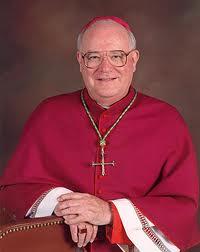
Young Goethe in Love You might be suspect North Face (2008) director Philipp Stölzl’s take on Germany’s most renowned writer is biting off of 1998’s Shakespeare in Love, but the filmmaker manages to rise above facile comparisons to deliver his own unique stab at re-creating the life and love of the 23-year-old polymath, long before he became an influential poet and cultural force. Stölzl and co-writers Christoph Müller and Alexander Dydyna spin off the autobiographical nature of what some consider the world’s first best-seller, 1774’s The Sorrows of Young Werther, though there were few sorrows at first for the young Johann Wolfgang von Goethe (Alexander Fehling) — a perpetually raging, playful party animal rather than the brooding forerunner of romanticism. Unable to move forward in his law studies and believed a wretched failure by his father (Henry Hübchen), Goethe is exiled to a job in a small-town court, beneath the thumb of the fiercely bourgeois court councilor Kestner (Moritz Bleibtreu). Embodying the charms of provincial life: Lotte Buff (Miriam Stein), the bright-eyed, artistic eldest daughter of a struggling widower. Naturally Goethe and Lotte end up caught in each other’s orbits, although rivals for affection and attention lie around each corner, as does a certain inevitable sense of despair. Charismatic lead actors and attention to period details — as well as an infectious joie de vivre — are certain to animate fans of historical romance. (1:42) Opera Plaza, Shattuck. (Chun)


Swing, shift

0

arts@sfbg.com

DANCE Have you ever climbed a steep mountain but were unsure that your lungs or legs would hold up to get you to the top? Or felt a relationship slip through your fingers before you were barely aware of what happened? How about feeling your feet firmly planted, only to land suddenly on your behind? The performers in Stacey Printz’s new Hover Space, her most ambitious project yet, are finding out that their dance floor is putting the lie to such basic concepts as grounding, balance, gravity, or momentum. The space moves up and down and tilts at precarious angles, and yet the dancers appear to have the times of their lives.

At a late rehearsal in Z Space at Theater Artaud for the upcoming Hover Space, they giggle and struggle, accommodate and resist the demands of this unstable environment. The 75-minute work may be physically challenging, but thematically Printz believes that it rests on a solid, if volatile, base.

“How do long-term relationships sustain themselves?” the dancer, choreographer, wife, and mother asked herself. “What does it look like in a place of contentment when you have peace and support, though you have learned to listen and compromise?” For Printz it means being feeling grounded, and therefore being secure enough to take larger risks, “do crazier things” and expand into more new worlds. For some people that solidity comes through relationships, she says; others find it in themselves though “this space cannot be static because the moment you lose the ebb and flow, it’s dead.”

It’s good reasoning from a dancer-choreographer who has always refused to be pinned down. Still an awesomely strong performer, Printz draws on jazz, modern, some ethnic forms, and hip-hop, disciplines in which she has both trained and performed. If the term “fusion” didn’t suggest borrowing, perhaps even an essential lack of artistic independence, she wouldn’t mind the description. “But this is who I am,” she says. “This is how I push myself the most.”

Having a foot in several worlds has given Printz access to a creative freedom that informs the choreography for her own company but which is most strongly seen in her own dancing. For instance, last October’s WestWave Dance Festival piece If You Knew — a duet with beatboxer-musician Tommy Shepherd — was a fulminating explosion of rhythm and motion, with the two of them challenging each other to an ever-higher degree of virtuosity. But she has also challenged her own (and other) dancers to step beyond their own comfort levels. In the 2009 spitfire Cross Talk, the members of the National Folk Theatre of Ireland loosened up their torsos while Printz’s barefoot dancers shone in pristinely precise footwork.

In addition to choreographing for her own 11-year old company, Printz regularly collaborates with Marc Bamuthi Joseph on his multi-genre theater pieces. “I have known him for a long time, and I know how his body moves, so I can give him what he needs within a specific context,” she explains. But working with Bamuthi gives Printz what few choreographers working on someone else’s show get: time and respect. “He is brilliant and has the resources and a big umbrella under which we all can work together for months,” she says.

She also learned that “if you bring in collaborators, let them do what they do best.” Bamuthi lets her make her own gifts to his projects.

Printz’s primary collaborators for Hover Space are her 12 dancers, the largest group she has ever worked with locally. The choreography of a dozen or so distinct episodes includes looks at the relationships of three very different couples. While she often uses pre-recorded music, for her first evening-length piece Printz has invited DJ-composer Kraddy (a.k.a. Matthew Kratz) to join the team. Designer Sean Riley suspended the 12×15 movable platform from Z Space’s ceiling. David Szlaza created the lights; Catherine Myre signed on for the costumes.

HOVER SPACE

Wed/30-Sat/3, 8 p.m., $22–<\d>$25

Z Space at Theater Artaud

450 Florida, SF www.brownpapertickets.com

Whose park?

150

news@sfbg.com

Golden Gate Park and Ocean Beach have long been destinations for locals and tourists to take in natural beauty within an urban setting, but a controversial plan to build a complex of artificial turf soccer fields at their intersection is drawing opposition from neighbors and environmentalists.

The project seems to belie the original intent of Golden Gate Park as a uniquely wild setting. The Master Plan for Golden Gate Park, drafted in 1995, emphasizes environmental stewardship and maintaining the park in a natural, multi-use way. Among its provisions are “major meadows and lawns should be adaptable to host a wide variety of activities, rather than designed for a specific use.”

But the Recreation and Park Department (RPD) and sports advocates are pushing a plan to install seven acres of synthetic turf fields, complete with 60-foot, 150,000-watt lighting that will shine until 10 p.m. year-round.

The project will have its first major public hearing before the Planning Commission on Dec. 1 at 5 p.m. in Room 400 at City Hall. Public comments on the project’s Draft Environmental Impact Report, which was released in October, will be accepted at the Planning Department until 5 p.m. on Dec. 12.

Critics of the plan, including the Ocean Edge Steering Committee, have been distributing educational materials and trying to energize people to oppose a project that the group says runs counter to the park’s purpose and which will harm wildlife and cause other negative impacts.

The fields are slated to be installed over the four existing run-down grass fields in the Western Edge of Golden Gate Park, which sits directly across from Ocean Beach and next to the Beach Chalet historical building and restaurant. The project is projected to cost up to $48 million, about $20 million of which comes from the Clean and Safe Neighborhood Parks bond measure approved by city voters in 2008.

Advocates for the synthetic fields — most notably the City Fields Foundation, the main proponent of converting grass to turf in city parks (see “Turf wars,” 10/13/09) — say that this project will only take up a fraction of the natural space in the park, and that turf has many benefits over natural parkland.

“You can put a grass field in, but then you have to limit public access,” said Patrick Hannan, communications director for the City Fields Foundation. “If you want to have grass, there’s only so much sports play that can happen.”

Hannan says that this project is a response to the high demand for usable athletic fields and the limited play provisions of grass fields and availability of usable fields also limits the number of adults and children able to play sports.

RPD spokesperson Connie Chan was not responsive to Guardian questions about the project’s consistency with the Master Plan, and on the main project, she referred to a statement on the RPD website: “We are proposing to renovate the dilapidated Beach Chalet Athletic Fields in the western end of Golden Gate Park with synthetic turf, field lights and other amenities because Beach Chalet is one of three primary ground sports fields in San Francisco but unfortunately, these fields are in abysmal condition, often closed, and lacking spectator seating.”

But activists say the RPD shouldn’t disregard its own planning documents. “It took a long time to draft the Master Plan,” said Shawna McGrew, an activist who worked at RPD for 30 years. “They have no legal obligation, but a moral obligation to uphold the Master Plan.”

The grass soccer fields have been run down due to lack of maintenance and a continuing gopher problem. But environmental advocates argue that installing the planned light fixtures and synthetic turf will interfere with the wildlife, particularly the nesting birds.

“It’s been referred to as the mothership landing,” said Nature Trip tour guide and bird watcher Eddie Bartley, discussing the impact of the proposed lighting fixtures.

Environmentalists are seeking a greener alternative to this project.

“We feel that there’s a compromise alternative that should really satisfy the concerns that everyone has,” said Katherine Howard of the Ocean Edge Steering Committee. She said her group’s goal is “to renovate the athletic fields, but to do it with real grass. They need a good drainage system, a state of the art irrigation system, gopher control barriers, and top notch grass.”

Howard has spent a significant amount of time approaching people at Golden Gate Park to inform them of the upcoming plans. She believes that not enough park users have been notified about the proposal to install the synthetic turf.

“I had no idea that they were going to do that,” native San Francisco resident Rick Rivero said in response to Howard’s description of the plans. “I played soccer in this field myself and I don’t want to see them changed.”

Rivero said that he hadn’t seen any flyers around the park mentioning plans to change the soccer fields.

RPD originally tried to do the project with conducting an EIR to study alternatives and environmental impacts, but groups like the Golden Gate Audubon Society and Ocean Edge objected. The resulting DEIR stated that, after a few alterations and formal recommendations, the project will have a “less than significant impact” on the biological resources of the area. But environmentalists are dissatisfied with the report.

Among their objections was the report labeling some trees as “tall shrubs” in order to allow for their removal. Studies cited in the DEIR state that water toxicity from the runoff of synthetic turf fields — which can contains plastic and other waste products — “decreased over time” and should have no effect on those using them.

But there have been conflicting studies of that issue, the subject of controversy through the country. Environmentalists noted that water used in natural fields filters down into the underground aquifer where it can be reused, whereas runoff from the turf will be need to be treated as wastewater, a fact given short shrift in the DEIR.

“In our opinion, the EIR is inadequate and incomplete,” Howard said. “And we will be submitting letters to that effect before Dec. 12th, as well as testifying to that on Dec. 1st.”

But the DEIR doesn’t wholly endorse the project. For example, it also states that the project’s impact on cultural resources, referring to the original intent of Golden Gate Park, will be “significant and unavoidable.”

Some parents and sports enthusiasts are disappointed with this backlash and argue that the turf fields will provide an important asset to the city.

“I’m 60, but a few decades ago I played soccer on the Beach Chalet Fields. They were in crappy condition [then] and they’re still in crappy condition,” said Tim Colen, a “soccer parent” we were referred to by Hannan. Colen is also executive director of the San Francisco Housing Action Coalition and someone who regularly testifies at City Hall in favor of large development projects.

“It surprises me that a small minority of people has been able to obstruct this project,” Colen said, noting that many parents support the project because the shortage of fields is forcing families out of the city and toward the readily available fields in the suburbs.

Community meetings and even mayoral forums have addressed the proposed Beach Chalet fields. As reported by the RichmondSF blog, mayoral candidate Joanna Rees showed up to a debate wearing her daughter’s soccer jersey and voiced opposition to the artificial turf. Board of Supervisors President David Chiu also reminisced about the joy of playing soccer on grass fields.

Other community meetings have been flooded with youth soccer players from San Francisco and beyond advocating the installation of the turf fields. But local environmentalists say Golden Gate Park was meant to be a refuge for all city residents and visitors.

“Golden Gate Park was created as a place for people to get away from the city,” Howard said. “The amount of contiguous park land is very important.”

Zero-calorie pleasures: McSweeney’s children’s imprint takes over a gallery

0

There is no better guilty pleasure than children’s book art. Calorie-free, family-friendly, welcoming characters. Mixed with the verbaciousness (I made up that word for the occasion) of McSweeney’s, this is prime post-Thanksgiving eye candy. Y’know, when you’re too food-hungover to delve overmuch in character and plot. This is why we saved the above slideshow of images from McSweeney’s upcoming art opening (Dec. 3) at Electric Works for a sleepy Nov. 25 Friday morning, enjoy.

Among the gems of “McSweeney’s McMullens: Artwork from Children’s Books, plus 1,032 Illustrated Lunch Bags”: Jordan Crane’s Keep Our Secrets, a book that mimics everyone’s favorite T-shirt from the 1990s, the one that changed colors when you breathed on it. Hypercolor! 

Hypercolor is an apt word to describe the rest of the offerings: Amy Martin’s ecstatic illustrations for Symphony City, the ever-lovely Clare Rojas‘ reticent creatures that she’s appropriated for Shelia Heti’s We Need a Horse. Peruse the offerings above and know this — there will also be paper bag art. The images come from books already cobbled together by McSweeney’s children’s imprint McMullens, and some hail from tomes still in the cobbling process. Throughout the duration of the exhibit celebrity readings will be held, open to any hipster reader kids willing to sit and listen. And there will be a gift shop on premises. Think lots of books and the standard nonsensical McSweeney’s swag — banana slicers and fish-scrubbing gloves, I hear. 

Rounding out the exhibit, in the “deluxe reading room” supplied for the young’ns, are paper bags. These are creations by Robert Barnes, another example of prosaic items brought into greatness by a little doodle. There will be hundreds of them. 

So, not to bite on L.E. Leone overmuch but, new favorite art exhibit. 


“McSweeney’s McMullens: Artwork from Children’s Books, plus 1,032 Illustrated Lunch Bags”

Dec. 3 – Jan. 7

Opening reception: Dec. 3, 4-8 p.m., free

Electric Works 

130 Eighth St., SF

(415) 626-5496

www.sfelectricworks.com


Localized Appreesh: The Spyrals

0

Localized Appreesh is our weekly thank-you column to the musicians that make the Bay. Each week a band/music-maker with a show, album release, or general good news is highlighted and spotlit. To be considered, contact emilysavage@sfbg.com.

You remember using spirographs as a child — drawing endless, satisfying colorful curves with your extensive color pencil collection? You could probably bust that out again and give the Spyral’s Sunflower Microphone seven-inch single (released today, a precursor to the upcoming 2012 album) a spin. The wave-like reverb of garage guitar meets a lower 13th Floor Elevators-y howl here, a surfy psychedelic dream. Check out Side A on the Spyrals’ Bandcamp page.

Also, give a listen to the San Francisco psych-pop trio’s output from earlier this year Clouds, equally mind rolling, equally appropriate for an afternoon spent lazily spinning creative circles. And then, even further back, there’s the entrancing song “Soul,” from 2009, and its captivating video, laced with surf and war imagery (see the vid below).

To celebrate the release of Sunflower Microphone this week, the Spyrals play Hemlock Tavern on Thursday.

Year and location of origin:
2009, San Francisco
Band name origin: Time being a never ending spiral. We’re trying to capture a time, good or bad, and share it with the people.
Band motto: It’s gotta groove.
Description of sound in 10 words or less: Best shit you heard in a long while.
Instrumentation: Guitar, vox, bass, drums
Most recent release: Single comes out November 15. Album out early 2012.
Best part about life as a Bay Area band: There’s no shortage of people doing interesting stuff.
Worst part about life as a Bay Area band: There’s no shortage of people doing crap.
First record/cassette tape/or CD ever purchased: Digital Underground Sex Packets.
Most recent record/cassette tape/CD/or Mp3 purchased/borrowed from the Web: Downloaded the Gories I Know You Be Houserockin the other day.
Favorite local eatery and dish: That’s a tough one. Probably Los Compadres. It’s a family owned Taqueria in South City, near where we rehearse. Damn good carnitas.

The Spyrals
With Michael Beach, Hypatia Lake
Thurs/17, 9 p.m.,$6
Hemlock Tavern
1131 Polk, SF
(415) 923-0923
www.hemlocktavern.com

Vintage Spyrals video:
http://www.youtube.com/watch?v=QNXvaKymGz0

Live Shots: Das Racist at Ruby Skye

2

The disgruntled bouncer at Ruby Skye begrudgingly admitted my entry to the Das Racist show on Friday night, only after I managed to flag down the event’s promoter to confirm my legitimacy. It was a telling kick off to an evening riddled with problems on behalf of the club, but I wanted to approach with an open mind.

Leaving my issues with the hyper-vigilant door staff outside, I grabbed an $11 drink at the bar and headed toward the stage to wait for opener Danny Brown. I didn’t need to wait long, as I later learned Das Racist fans would be evacuated from the venue by 10 p.m. to make room for the usual clubutantes.

In his signature skinny jeans and choked-voice delivery, Brown pulled off a riveting set. The Detroit, Mich., rapper asked the audience to “give it up for all the beautiful ladies” before launching into verse after maniacal verse about sex, drugs, and debauchery.

Shortly after Brown stepped off, Das Racist sauntered on stage to soak up a feverish response from fans. The large, intoxicated dude in front of me would go ape throughout the night, knocking people’s drinks over and demanding more than his share of high fives from the group.

Right off the bat, Victor Vazquez (a.k.a. Kool AD) took a dive into the collegiate looking audience. As the microphones began to malfunction, Vazquez appeared to lose interest and spent much of the show seated in various places on stage. Vazquez did, however, manage to yank Hypeman Ashok Kondabolu by the collar of his jumpsuit just as he was about to pounce on some guy for getting too grabby.

Himanshu Suri (a.k.a. Heems) seemed less fazed by Ruby Skye’s sound problems. Suri mimed some air guitar and flashed rock star devil horns at fans between verses. In a hilarious moment of self-parody or unprecedented narcissism, Suri lifted his black Das Racist shirt to reveal yet another Das Racist shirt beneath it.

The group’s many collaborators doubled as stage hands, dipping backstage to find new microphones as others shorted out. The best cameo of the evening goes to the swagger-drenched re-work of Dr. Dre’s “Xplosive” by Boots Riley of the Coup. Newcomer Lakutis performed the absurdly catchy track “Lakutis In Da Haus” from his upcoming EP and re-appeared for Das Racist’s “Rapping 2 U.” Brown and Despot contributed verses on “Power.” Due to sound issues, I couldn’t really tell what Trackademicks was doing, but he was there, too.

Despite the unfortunate setting, fans went totally berserk for Das Racist, shouting along to hits like “Michael Jackson” so enthusiastically that the technical difficulties became nearly inconsequential.

Rhythm nations

0

DANCE Watched over by two pink carousel horses, a rainbow. and a big lotus flower, they sway, stomp, and slide even as they chant, clap, and body slap in increasingly complex rhythms. They are SlamDance, Keith Terry’s sextet of musician-dancers, and they are rehearsing their upcoming performance at the fourth International Body Music Festival, held this year at Yerba Buena Center for the Arts.

Last year, the (free) festival took place in São Paulo, Brazil; next October it will happen (also free) in Istanbul, Turkey. “Free performances [are] something we could never do in this country,” Terry ruefully observes. Still, the plan is to have a local festival (2011 tickets start at $25) every other year.

Terry, who organized the first festival in 2008, started out as a percussionist. He was the first drummer for the Jazz Tap Ensemble, and he is a founding member of Berkeley’s Gamelan Sekar Jaya. So the beat has been in his body for a very long time — yet early in his career he changed from “a seated musician to a moving musician,” as he calls himself. Using one’s body as a musical instrument, he says, sometimes is called “body percussion” or “body drumming.” Terry prefers the term “body music” because it includes melodic and harmonic aspects as well as its rhythmic components. SlamDance performers, for instance, use their voices to percussive effect as well as in simple part-singing.

Using your body to make music is pretty basic. We all do it, perhaps starting as toddlers with patty-cake, progressing into clapping games at recess, and ending up as oldsters who play the spoons. Much of these practices go back to folkways rooted in ritualistic endeavors. But there are also innovations: the gumboot dance, for instance, was developed by South African miners early in the 20th century, while African American fraternities popularized a particular form of step-dancing.

Body music is both a communal practice with a sense of freedom even as it demands great discipline and precision. “That’s what makes it fun,” Terry explains. Often it integrates improvisation and fixed passages, not unlike what happens in both hip-hop and jazz.

Noticeable from a dance perspective is the SlamDancers’ slight sway in the torso. “It helps with the breathing,” Terry notes, though he was surprised to see how practices change from culture to culture.

“One of the things that fascinates me about these festivals is how differently these musicians, who come from all over the world, carry themselves. It was one of the most profound experiences with my first body music festival because we are, basically, all just clapping and stepping. It’s definitely a cultural thing. You put a French group next to a Brazilian one and you can immediately see the difference.”

One of the first groups Terry identified with as kindred spirits was Çudamani, an astounding troupe of male dancer-musicians from Bali. They perform kecak, a rhythmic, chanting-and-swaying “monkey dance” that originated in trance rituals. Six of its dancers bring new choreography as part of this year’s International Body Music Festival line-up, which features a total of eleven companies.

Others include the theatrical Cambuyón, from the Canary Islands, which integrates tap and hip-hop into other percussive forms, and Kantu Korpu, which draws on flamenco and tap to translate regional Greek music into motion. Both of these groups are making their US debut. KeKeÇa’s five performers interpret Turkish songs within Near Eastern movement traditions. Fernando Barba from Brazil draws from samba and maracatu; Danny “Slapjazz” Barber is a hambone virtuoso; the Las Vegas-based group Molodi pulls in theater and just about everything with a beat. A gentler soul is Quebec’s Éric Beaudry, who will also team up with a trio of Oakland step dancers.


INTERNATIONAL BODY MUSIC FESTIVAL

Fri/4-Sat/5, 8 p.m.; Sun/6, 2 p.m., $25–$50

Yerba Buena Center for the Arts

701 Mission, SF.

www.internationalbodymusicfestival.com

Beautiful pop

2

emilysavage@sfbg.com

MUSIC I half-expect Jhameel to be sporting face paint whiskers swiped across his cheeks as I walk up to meet him at Cafe Strada near the UC Berkeley campus. Lyrically, he’s inspired by Ben Gibbard, musically by Sufjan Stevens, but aesthetically, it’s early Bowie.

After listening to Jhameel’s latest full-length — The Human Condition, which came out in early 2011 — on repeat, I’ve grown accustomed to seeing his face painted with black streaks like on the cover, or in rainbow stripes like in the frenetic video for the poppy “How Many Lovers.” The rational side of my brain, however, assures me he’ll show up in street clothes.

It’s not like the multi-instrumentalist singer-songwriter wears face paint in real life, or even in all of his output. In reality, his style is gradually morphing. It’s fluid, like the danceable baroque-pop music itself, which Jhameel (his legal name, meaning “beautiful”) composes and creates almost entirely solo. He played every instrument on the album: guitar, piano, bass, drums, violin, cello, trumpet, keyboard. While it’s not his biggest strength (that would be violin), he says he’s most in line with the cello. “I relate to its personality,” he explains, fresh-faced when we spot each other at the cafe wearing similar black pea coats, “It’s got a strong foundation. It’s rooted in the ground. I get a good vibe out it.”

The son of a master violinist (who appeared in the original Fame) Jhameel spent his childhood surrounded by instruments. “I’ve been writing [music] since before I can remember, it’s been like a language for me.” It can be included in the long list of languages he knows, including Spanish, bits of Korean and Chinese, Latin, some Russian, and near fluency in Arabic.

He majored in Arabic at Berkeley and graduated in two years, paying for schooling through ROTC (Reserve Officers’ Training Corps). But something happened during that time, a “cliché self-identity crises” — a seismic shift of values, mentality. He won’t shed too much light on the life change, but he says he had to let go of ROTC. He joined a co-op; the contrasts enlivened his lyrics. “I only have one life to do this. I’d like to have a positive effect on the world.”

In a stroke of DIY music-maker ingenuity, Jhameel this week announced that beginning Nov. 8, he’ll release a new song every week for the next five weeks in a series called Waves. Each song will be accompanied by individual photography, and will be totally free to download. He calls the upcoming series more primal and animalistic then the highly poetic The Human Condition, which is an analysis of emotion.

He does have some experience mining pop culture. Early in this musical journey he covered T-Pain’s “Buy You a Drink” — on violin — and posted it to Youtube. It’s the perfect slice of modern music. Go watch it now. He’s not wearing any fancy face paint, but he’s got style.

(Note: this article has been changed from its original print version to reflect Jhameel’s decision after press time to change the nature of his next release.)

JHAMEEL

With Company of Thieves, and Motopony

Nov. 14, 9:30 p.m., $12

Cafe Du Nord

2170 Market, SF

(415) 861-5016

www.cafedunord.com


Localized Appreesh: The Sandwitches

0

Localized Appreesh is our weekly thank-you column to the musicians that make the Bay. Each week a band/music-maker with a show, album release, or general good news is highlighted and spotlit. To be considered, contact emilysavage@sfbg.com.

The Sandwitches are all about high highs and low lows. The vocals of Heidi Alexander and Grace Cooper (both former back-up singers for Fresh & Onlys) defy the bounds of San Francisco garage, piping up from low and fuzzed out to high-pitched and near theatrical. The music strays similiarly from convention, with an underlying garage-pop root that sometimes hits close to country-folk, other times lends itself more toward dewy trophy love song/doo-wap. It’s a sound that takes a minute to digest – and that’s a good thing.

You can check it out for yourself. The trio’s upcoming seven-inch single The Pearl is streaming now, here. And then you can go see it live. The Sandwitches will fill the opening slot of a pretty righteous show this week at the Fillmore, with headliners/Australian indie poppers Architecture in Helsinki and lo-fi American rockers DOM.

You may protest, “but that’s not how you spell sandwiches!” Yes, spelling wizards, it’s a play on words. Sand-witches. Witches of bread. Meaning sourdough with warts, or something less gross. Spooky PB&J? Bubbling cauldrons of BLT? Or as you’ll see below, the name simply came from “a process of elimination.”  It’s also way easier to Google.

Year and location of origin: 2009, Frisco, baby.
Band name origin: A process of elimination
Band motto: “More feeling”
Description of sound in 10 words or less: dingy, pingy, bumpy, pumpy, lumpy, brash, sophisticated, and smooth.
Instrumentation: Mexican telecaster, Mexican stratocaster, drum set
Most recent release: The Pearl/Benny’s Memory Palace 7″, Hardly Art
Best part about life as a Bay Area band:  The buds [ed note — double entendre?]
Worst part about life as a Bay Area band: The fog?
First record/cassette tape/or CD ever purchased:  Queen Greatest Hits I & II, Blue Beatles hits collection on tape.
Most recent record/cassette tape/CD/or Mp3 purchased/borrowed from the Web: Jackie Gleason, Music for Lover’s Only.
Favorite local eatery and dish: Chevys and fried chicken.

Sandwitches
With Architecture in Helsinki and DOM
Thurs/3, 8 p.m., $20-$29
Fillmore
1805 Geary, SF
(415) 346-6000
www.livenation.com

Twin Peaks witch house, y’all

0

We’re stoked about the upcoming 20th anniversary tribute to Twin Peaks at the Roxie this Saturday — and we found this witch house tribute to really bring the uncanny spookiness home. Shivers.   

Alerts

0

alert@sfbg.com

Editor’s Note: Protests and other events connected to the Occupy Wall Street movement, include OccupySF and Occupy Oakland, have been developing quickly. To take part, follow our Politics blog or check with the websites associated with this important economic justice movement: occupysf.com, occupyoakland.org, or occupytogether.org. And you can send tips about what’s happening to news@sfbg.com.

WEDNESDAY 26

San Francisco’s budget crisis

Youth from the Bay Area Urban Debate League opine on solving the budget crisis in San Francisco. These electrifying young orators seek to engage the community in conversation and share their research about the current economic atmosphere.

6 p.m., free

SFUSD Board Room

555 Franklin St, 1st Floor

www.baudl.org


THURSDAY 27

Progressive prospects in fall election

Bay Guardian Executive Editor Tim Redmond holds a talk on how the upcoming election will effect the progressive community. Join in discussion, sponsored by Progressive Democrats of America, and ask questions regarding mayoral candidates and city politics.

7-9pm, free

Unitarian Universalist Center, Martin Luther King Room

1187 Franklin, SF

TGTGTGTGTG@aol.com

www.pdamerica.org


FRIDAY 28

White Picket Fences Reception

This multi-media visual and performance art exhibit highlights queer perspectives on the family unit and reflections of contemporary marriage and relationships. Artists like Midori, Monica Canilao, Harrison Bartlett, Mev Luna, Amelia Reiff Hill and Madison Young conjure dialogue in and out of the LGBT community on the dynamics of progressive life. This family oriented event is open to all ages and will be catered with food, wine and performances of featured artists.

7:30-10 p.m.

Michelle O’Connor Gallery

2111 Mission, SF

www.feminapotens.org


SUNDAY 30

Organize and fight back

The Party for Socialism and Revolution is holding its NorCal Regional Conference, with discussions on how big corporations avoid taxes, endless U.S. Wars, the cost of higher education, the prospects for capitalism and socialism, and other topics.

10 a.m.-5 p.m., $7-10

2969 Mission, SF

(415) 821-6171

sf@pwlweb.org


Making Democracy Work

Celebrate 17 years of social justice service with keynote speakers Rep. Andre Carson (D-IN) and Imam Siraj Wahhaj, religious director of At-Taqwa Mosque in NY, at a dinner banquet. This fundraiser supports the Council on American-Islamic Relations, the largest Islamic grassroots civil rights and advocacy group in the country.

5-10 p.m.

Santa Clara Marriott

2700 Mission College, Santa Clara

(408) 986-9874

www.ca.cair.com/sfba/event/17thannualbanquet


Mail items for Alerts to the Guardian Building, 135 Mississippi St., SF, CA 94107; fax to (415) 437-3658; or e-mail alert@sfbg.com. Please include a contact telephone number. Items must be received at least one week prior to the publication date.