Theater

Rep Clock: January 8 – 14, 2014

0

Schedules are for Wed/8-Tue/14 except where noted. Director and year are given when available. Double and triple features marked with a •. All times pm unless otherwise specified.

BERKELEY FELLOWSHIP OF UNITARIAN UNIVERSALISTS 1924 Cedar, Berk; www.bfuu.org. $5-10. The Ghosts of Jeju (Tremblay, 2013), Thu, 7.

CASTRO 429 Castro, SF; (415) 621-6120, www.castrotheatre.com. $8.50-12. The Little Mermaid (Clements and Musker, 1989), presented sing-along style, Wed-Fri, 7. San Francisco Silent Film Festival: “The Little Tramp at 100: A Charlie Chaplin Centennial Celebration:” “Our Mutual Friend: Three Chaplin Shorts,” Sat, 1; The Kid (Chaplin, 1921), Sat, 4; The Gold Rush (Chaplin, 1925), Sat, 7:30. Tickets ($10-22) and more info at www.silentfilm.org. Gravity (Cuarón, 2013), Sun, 2:30, 4:45, 7, 9. All is Lost (Chandor, 2013), Mon, 3:45, 6, 8:15.

CHRISTOPHER B. SMITH RAFAEL FILM CENTER 1118 Fourth St, San Rafael; (415) 454-1222, www.cafilm.org. $6.50-$10.75. A Touch of Sin (Jia, 2013), call for times. “Sundance Film Festival Shorts,” eight selections (comedy, drama, animated) from the 2013 Sundance Film Festival, Wed-Thu, call for times. “Croatian Children’s Animation,” Wed, 6:30. “For Your Consideration: A Selection of Oscar Submissions from Around the World,” Jan 10-16. The Past (Farhadi, 2013), Jan 10-16, call for times.

EXPLORATORIUM Pier 15, SF; www.exploratorium.edu. Free with museum admission ($19-25). “Saturday Cinema: Geometry in Motion,” short films, Sat, 1, 2, 3.

MECHANICS’ INSTITUTE 57 Post, SF; milibrary.org/events. $10. “CinemaLit Film Series: Over the Top: Precode Hollywood:” Hell’s Angels (Hughes, 1930), Fri, 6.

METREON 101 Fourth St, SF; www.mcsmsscalifornia.org. $100-250. Trailblazers in Habits (Tong, 2013), Sat, 2:30. Benefit screening; additional info at www.trailblazersinhabits.com.

NEW PARKWAY 474 24th St, Oakl; www.thenewparkway.com. $8. “Thrillville Theater:” King Creole (Curtiz, 1958), Thu, 9:15.

ODDBALL FILM + VIDEO 275 Capp, SF; www.brownpapertickets.com. $10. Southeast Asian Film Society presents: Flooding in the Time of Drought (Kemarau, 2009), Tue, 7.

PACIFIC FILM ARCHIVE 2575 Bancroft, Berk; (510) 642-5249, bampfa.berkeley.edu. $5.50-9.50. PFA closed until Jan 16.

ROXIE 3117 and 3125 16th St, SF; (415) 863-1087, www.roxie.com. $6.50-11. I Am Divine (Schwarz, 2013), Wed, 7, 9:15. A Touch of Sin (Jia, 2013), Wed-Thu, 6:45, 9:30. “Frameline Encore:” •The Infamous T (Koch, 2012), and A Self-Made Man (Petchers, 2013), Thu, 7. Free screening. “I Was a Teenage Teenager,” docs, exploitation films, TV shows, and more, Fri-Tue. Visit website for complete schedule.

SF PUBLIC LIBRARY Main Branch, 100 Larkin, SF; www.merola.org. Free. “Merola Goes to the Movies:” A Night at the Opera (Wood and Goulding, 1935), Sat, 1.

TANNERY 708 Gilman, Berk; berkeleyundergroundfilms.blogspot.com. Donations accepted. “Berkeley Underground Film Society:” “LOOP Presents: Soundies!”, rare musical films, Sat, 7:30; The Jazz Singer (Crosland, 1927), Sun, 7:30.

TEMESCAL ART CENTER 511 48th St, Oakl; www.shapeshifterscinema.com. Free. “Shapeshifters Cinema,” films by Scott Stark and Allison Leigh Holt, Sun, 8. *


Film Listings: January 8 – 14, 2014

0

Film listings are edited by Cheryl Eddy. Reviewers are Kimberly Chun, Dennis Harvey, Lynn Rapoport, Sam Stander, and Sara Maria Vizcarrondo. For rep house showtimes, see Rep Clock.

OPENING

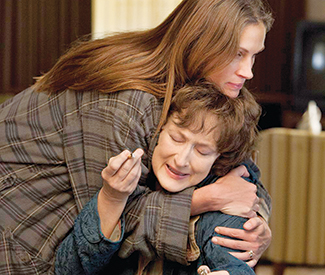
August: Osage County Considering the relative infrequency of theater-to-film translations today, it’s a bit of a surprise that Tracy Letts had two movies made from his plays before he even got to Broadway. Bug and Killer Joe proved a snug fit for director William Friedkin (in 2006 and 2011, respectively), but both plays were too outré for the kind of mainstream success accorded 2007’s August: Osage County, which won the Pulitzer, ran 18 months on Broadway, and toured the nation. As a result, August was destined — perhaps doomed — to be a big movie, the kind that shoehorns a distracting array of stars into an ensemble piece, playing jes’ plain folk. But what seemed bracingly rude as well as somewhat traditional under the proscenium lights just looks like a lot of reheated Country Gothic hash, and the possibility of profundity you might’ve been willing to consider before is now completely off the menu. If you haven’t seen August before (or even if you have), there may be sufficient fun watching stellar actors chew the scenery with varying degrees of panache — Meryl Streep (who else) as gorgon matriarch Violet Weston; Sam Shepard as her long-suffering spouse; Julia Roberts as pissed-off prodigal daughter Barbara (Julia Roberts), etc. You know the beats: Late-night confessions, drunken hijinks, disastrous dinners, secrets (infidelity, etc.) spilling out everywhere like loose change from moth-eaten trousers. The film’s success story, I suppose, is Roberts: She seems very comfortable with her character’s bitter anger, and the four-letter words tumble past those jumbo lips like familiar friends. On the downside, there’s Streep, who’s a wizard and a wonder as usual yet also in that mode supporting the naysayers’ view that such conspicuous technique prevents our getting lost in her characters. If Streep can do anything, then logic decrees that includes being miscast. (2:10) Presidio. (Harvey)

The Invisible Woman See “A Tale of Two.” (1:51) Embarcadero.

The Legend of Hercules Renny Harlin rises from the dead to direct Twilight series hunk Kellan Lutz in this 3D, CG-laden retelling of you know which myth. (1:38)

Lone Survivor Peter Berg (2012’s Battleship, 2007’s The Kingdom) may officially be structuring his directing career around muscular tails of bad-assery. This true story follows a team of Navy SEALs on a mission to find a Taliban group leader in an Afghani mountain village. Before we meet the actors playing our real-life action heroes we see training footage of actual SEALs being put through their paces; it’s physical hardship structured to separate the tourists from the lifers. The only proven action star in the group is Mark Wahlberg — as Marcus Luttrell, who wrote the film’s source-material book. His funky bunch is made of heartthrobs and sensitive types: Taylor Kitsch (TV’s Friday Night Lights); Ben Foster, who last portrayed William S. Burroughs in 2013’s Kill Your Darlings but made his name as an officer breaking bad news gently to war widows in 2009’s The Messenger; and Emile Hirsch, who wandered into the wilderness in 2007’s Into the Wild. We know from the outset who the lone survivors won’t be, but the film still manages to convey tension and suspense, and its relentlessness is stunning. Foster throws himself off a cliff, bounces off rocks, and gets caught in a tree — then runs to his also-bloody brothers to report, “That sucked.” (Yesterday I got a paper cut and tweeted about it.) But the takeaway from this brutal battle between the Taliban and America’s Real Heroes is that the man who lived to tell the tale also offers an olive branch to the other side — this survivor had help from the non-Taliban locals, a last-act detail that makes Lone Survivor this Oscar season’s nugget of political kumbaya. (2:01) (Vizcarrondo)

Liv and Ingmar You wouldn’t expect anything less than soul-scorching intimacy from a documentary on the relationship of acting icon Liv Ullmann and moviemaking maestro Ingmar Bergman. And Dheeraj Akolkar satisfies with the help of plentiful clips from Bergman’s filmography, disarmingly frank interviews with Ullmann, behind-the-scenes footage, and grainy images of and excerpts from letters and memoirs by Bergman. Ullmann was the unforgettable face and inspiration for Persona (1966) and other Bergman classics; he was her director, mentor, and teacher; and they were brought together by film and remained drawn to each other despite the scandal of their respective spouses. Their at-first-happy then increasingly jealously-filled and isolated life is translated into intensely personal, searing visions like Shame (1968), which sparks at least one close-to-the-bone anecdote from Ullmann. She shows Akolkar photos of a bundled-up Bergman in a boat beside a vessel carrying an underdressed, freezing Ullmann and Max Von Sydow. “He was really angry that day,” she recounts. “You ask if he was ever cruel to me. This time, he was really cruel. I hated him so much and I was planning to leave him.” Some might criticize Akolkar for his loose hand with the couple’s story and his heavy reliance on invaluable Bergman works like 1973’s Scenes From a Marriage — no dates or clues to the films or productions used are given until the credits roll — but more irksome are the sentimental montages, “reenactments,” and score: one can picture Bergman convulsed in the beyond during the most saccharine moments. Liv and Ingmar‘s strength is the woman at its center. Revealing mementos from her “dearest Pingmar,” as well as unguarded glimpses into her heart, the almost achingly sincere Ullmann gets the last word here, as befits a survivor and an actress who never hesitated to let the camera see every emotion flitting across her lush features — making this doc less about Ingmar and the specifics of his career, and more about Liv and her still living, breathing emotional life. (1:23) Opera Plaza. (Chun)

ONGOING

American Hustle David O. Russell’s American Hustle is like a lot of things you’ve seen before — put in a blender, so the results are too smooth to feel blatantly derivative, though here and there you taste a little Boogie Nights (1997), Goodfellas (1990), or whatever. Loosely based on the Abscam FBI sting-scandal of the late 1970s and early ’80s (an opening title snarks “Some of this actually happened”), Hustle is a screwball crime caper almost entirely populated by petty schemers with big ideas almost certain to blow up in their faces. It’s love, or something, at first sight for Irving Rosenfeld (Christian Bale) and Sydney Prosser (Amy Adams), who meet at a Long Island party circa 1977 and instantly fall for each other — or rather for the idealized selves they’ve both strained to concoct. He’s a none-too-classy but savvy operator who’s built up a mini-empire of variably legal businesses; she’s a nobody from nowhere who crawled upward and gave herself a bombshell makeover. The hiccup in this slightly tacky yet perfect match is Irving’s neglected, crazy wife Rosalyn (Jennifer Lawrence), who’s not about to let him go. She’s their main problem until they meet Richie DiMaso (Bradley Cooper), an ambitious FBI agent who entraps the two while posing as a client. Their only way out of a long prison haul, he says, is to cooperate in an elaborate Atlantic City redevelopment scheme he’s concocted to bring down a slew of mafioso and presumably corrupt politicians, hustling a beloved Jersey mayor (Jeremy Renner) in the process. Russell’s filmmaking is at a peak of populist confidence it would have been hard to imagine before 2010’s The Fighter, and the casting here is perfect down to the smallest roles. But beyond all clever plotting, amusing period trappings, and general high energy, the film’s ace is its four leads, who ingeniously juggle the caricatured surfaces and pathetic depths of self-identified “winners” primarily driven by profound insecurity. (2:17) Four Star, Marina, Metreon, 1000 Van Ness, Presidio, Sundance Kabuki. (Harvey)

Anchorman 2: The Legend Continues Look, I fully understand that Anchorman 2: The Legend Continues — which follows the awkward lumberings of oafish anchor Ron Burgundy (Will Ferrell) and his equally uncouth team (Paul Rudd, Steve Carell, David Koechner) as they ditch San Diego in favor of New York’s first 24-hour news channel, circa 1980 — is not aimed at film critics. It’s silly, it’s tasteless, and it’s been crafted purely for Ferrell fans, a lowbrow army primed to gobble up this tale of Burgundy’s national TV rise and fall (and inevitable redemption), with a meandering storyline that includes chicken-fried bat, a pet shark, an ice-skating sequence, a musical number, epic amounts of polyester, lines (“by the bedpan of Gene Rayburn!”) that will become quoteable after multiple viewings, and the birth of infotainment as we know it. But what if a film critic happened to be a Ferrell fan, too? What if, days later, that film critic had a flashback to Anchorman 2‘s amplified news-crew gang war (no spoilers), and guffawed at the memory? I am fully aware that this ain’t a masterpiece. But I still laughed. A lot. (1:59) Four Star, Marina, Metreon, 1000 Van Ness. (Eddy)

Blue is the Warmest Color The stars (Adèle Exarchopoulos and Léa Seydoux) say the director was brutal. The director says he wishes the film had never been released (but he might make a sequel). The graphic novelist is uncomfortable with the explicit 10-minute sex scene. And most of the state of Idaho will have to wait to see the film on Netflix. The noise of recrimination, the lesser murmur of backpedaling, and a difficult-to-argue NC-17 rating could make it harder, as French director Abdellatif Kechiche has predicted, to find a calm, neutral zone in which to watch Blue is the Warmest Color, his Palme d’Or–winning adaptation (with co-writer Ghalya Lacroix) of Julie Maroh’s 2010 graphic novel Le Blue Est une Couleur Chaude. But once you’ve committed to the three-hour runtime, it’s not too difficult to tune out all the extra noise and focus on a film that trains its mesmerized gaze on a young woman’s transforming experience of first love. (2:59) Opera Plaza. (Rapoport)

Blue Jasmine The good news about Blue Jasmine isn’t that it’s set in San Francisco, but that it’s Woody Allen’s best movie in years. Although some familiar characteristics are duly present, it’s not quite like anything he’s done before, and carries its essentially dramatic weight more effectively than he’s managed in at least a couple decades. Not long ago Jasmine (a fearless Cate Blanchett) was the quintessential Manhattan hostess, but that glittering bubble has burst — exactly how revealed in flashbacks that spring surprises up to the script’s end. She crawls to the West Coast to “start over” in the sole place available where she won’t be mortified by the pity of erstwhile society friends. That would be the SF apartment of Ginger (Sally Hawkins), a fellow adoptive sister who was always looked down on by comparison to pretty, clever Jasmine. Theirs is an uneasy alliance — but Ginger’s too big-hearted to say no. It’s somewhat disappointing that Blue Jasmine doesn’t really do much with San Francisco. Really, the film could take place anywhere — although setting it in a non-picture-postcard SF does bolster the film’s unsettled, unpredictable air. Without being an outright villain, Jasmine is one of the least likable characters to carry a major US film since Noah Baumbach’s underrated Margot at the Wedding (2007); the general plot shell, moreover, is strongly redolent of A Streetcar Named Desire. But whatever inspiration Allen took from prior works, Blue Jasmine is still distinctively his own invention. It’s frequently funny in throwaway performance bits, yet disturbing, even devastating in cumulative impact. (1:38) Opera Plaza. (Harvey)

Dallas Buyers Club Dallas Buyers Club is the first all-US feature from Jean-Marc Vallée. He first made a splash in 2005 with C.R.A.Z.Y., which seemed an archetype of the flashy, coming-of-age themed debut feature. Vallée has evolved beyond flashiness, or maybe since C.R.A.Z.Y. he just hasn’t had a subject that seemed to call for it. Which is not to say Dallas is entirely sober — its characters partake from the gamut of altering substances, over-the-counter and otherwise. But this is a movie about AIDS, so the purely recreational good times must eventually crash to an end. Which they do pretty quickly. We first meet Ron Woodroof (Matthew McConaughey) in 1986, a Texas good ol’ boy endlessly chasing skirts and partying nonstop. Not feeling quite right, he visits a doctor, who informs him that he is HIV-positive. His response is “I ain’t no faggot, motherfucker” — and increased partying that he barely survives. Afterward, he pulls himself together enough to research his options, and bribes a hospital attendant into raiding its trial supply of AZT for him. But Ron also discovers the hard way what many first-generation AIDS patients did — that AZT is itself toxic. He ends up in a Mexican clinic run by a disgraced American physician (Griffin Dunne) who recommends a regime consisting mostly of vitamins and herbal treatments. Ron realizes a commercial opportunity, and finds a business partner in willowy cross-dresser Rayon (Jared Leto). When the authorities keep cracking down on their trade, savvy Ron takes a cue from gay activists in Manhattan and creates a law evading “buyers club” in which members pay monthly dues rather than paying directly for pharmaceutical goods. It’s a tale that the scenarists (Craig Borten and Melisa Wallack) and director steep in deep Texan atmospherics, and while it takes itself seriously when and where it ought, Dallas Buyers Club is a movie whose frequent, entertaining jauntiness is based in that most American value: get-rich-quick entrepreneurship. (1:58) Sundance Kabuki. (Harvey)

47 Ronin (2:00) Metreon, 1000 Van Ness.

Frozen (1:48) Metreon, 1000 Van Ness.

Gravity “Life in space is impossible,” begins Gravity, the latest from Alfonso Cuarón (2006’s Children of Men). Egghead Dr. Ryan Stone (Sandra Bullock) is well aware of her precarious situation after a mangled satellite slams into her ship, then proceeds to demolition-derby everything (including the International Space Station) in its path. It’s not long before she’s utterly, terrifyingly alone, and forced to unearth near-superhuman reserves of physical and mental strength to survive. Bullock’s performance would be enough to recommend Gravity, but there’s more to praise, like the film’s tense pacing, spare-yet-layered script (Cuarón co-wrote with his son, Jonás), and spectacular 3D photography — not to mention George Clooney’s warm supporting turn as a career astronaut who loves country music almost as much as he loves telling stories about his misadventures. (1:31) Metreon. (Eddy)

The Great Beauty The latest from Paolo Sorrentino (2008’s Il Divo) arrives as a high-profile contender for the Best Foreign Language Film Oscar, already annointed a masterpiece in some quarters, and duly announcing itself as such in nearly every grandiose, aesthetically engorged moment. Yes, it seems to say, you are in the presence of this auteur’s masterpiece. But it’s somebody else’s, too. The problem isn’t just that Fellini got there first, but that there’s room for doubt whether Sorrentino’s homage actually builds on or simply imitates its model. La Dolce Vita (1960) and 8 1/2 (1963) are themselves swaying, jerry-built monuments, exhileratingly messy and debatably profound. But nothing quite like them had been seen before, and they did define a time of cultural upheaval — when traditional ways of life were being plowed under by a loud, moneyed, heedless modernity that for a while chose Rome as its global capital. Sorrentino announces his intention to out-Fellini Fellini in an opening sequence so strenuously flamboyant it’s like a never-ending pirouette performed by a prima dancer with a hernia. There’s statuary, a women’s choral ensemble, an on-screen audience applauding the director’s baffled muse Toni Servillo, standing in for Marcello Mastroianni — all this and more in manic tracking shots and frantic intercutting, as if sheer speed alone could supply contemporary relevancy. Eventually The Great Beauty calms down a bit, but still its reason for being remains vague behind the heavy curtain of “style.” (2:22) Opera Plaza. (Harvey)

Grudge Match If the prospect of watching Rocky go glove-to-glove with Jake LaMotta sounds either tired or exploitive, Grudge Match wants to change your mind. A comedy that delivers a decent bout inside the ring and a worthwhile message about fulfilling your potential at every age, Grudge Match is 100 percent feel-good movie, 100 percent of the time. Yes, the publicity campaign contrived by Kevin Hart’s promoter character is embarrassing. Yes, Alan Arkin plays yet another foul-mouthed curmudgeon. And yes, the boxers have a torn family this match could heal (though fighting threatens to kill them both). But the takeaway is an all-ages lesson our elders are most qualified to teach: having guts is pretty glorious. And at 68 and 70, Sylvester Stallone and Robert De Niro seem delighted to lampoon past greatness. “Kid” (DeNiro) does a puppet show that’s less pathos-filled than the poetry he spouted in 1980’s Raging Bull; the training montages “Razor” (Stallone) slogs through naturally recall 1976’s Rocky. But Grudge Match is about today — not yesterday. Alongside Gravity and The Wolf of Wall Street, Grudge Match is yet another populist lovefest throwaway, but who cares? Few have cornered the market on audience affection like Stallone, and he’s helped De Niro find that love too. (1:53) Metreon. (Vizcarrondo)

Her Morose and lonely after a failed marriage, Theodore (Joaquin Phoenix) drifts through an appealingly futuristic Los Angeles (more skyscrapers, less smog) to his job at a place so hipster-twee it probably will exist someday: beautifulhandwrittenletters.com, where he dictates flowery missives to a computer program that scrawls them onto paper for paying customers. Theodore’s scripting of dialogue between happy couples, as most of his clients seem to be, only enhances his sadness, though he’s got friends who care about him (in particular, Amy Adams as Amy, a frumpy college chum) and he appears to have zero money woes, since his letter-writing gig funds a fancy apartment equipped with a sweet video-game system. Anyway, women are what gives Theodore trouble — and maybe by extension, writer-director Spike Jonze? — so he seeks out the ultimate gal pal: Samantha, an operating system voiced by Scarlett Johansson in the year’s best disembodied performance. Thus begins a most unusual relationship, but not so unusual; Theodore’s friends don’t take any issue with the fact that his new love is a machine. Hey, in Her‘s world, everyone’s deeply involved with their chatty, helpful, caring, always-available OS — why wouldn’t Theo take it to the next level? Inevitably, of course, complications arise. If Her‘s romantic arc feels rather predictable, the film acquits itself in other ways, including boundlessly clever production-design touches that imagine a world with technology that’s (mostly) believably evolved from what exists today. Also, the pants they wear in the future? Must be seen to be believed. (2:00) Presidio, SF Center. (Eddy)

The Hobbit: The Desolation of Smaug Just when you’d managed to wipe 2012’s unwieldy The Hobbit: An Unexpected Journey from your mind, here comes its sequel — and it’s actually good! Yes, it’s too long (Peter Jackson wouldn’t have it any other way); arachnophobes (and maybe small children) will have trouble with the creepy, giant-spider battle; and Orlando Bloom, reprising his Lord of the Rings role as Legolas the elf, has been CG’d to the point of looking like he’s carved out of plastic. But there’s much more to enjoy this time around, with a quicker pace (no long, drawn-out dinner parties); winning performances by Martin Freeman (Bilbo), Ian McKellan (Gandalf); and Benedict Cumberbatch (as the petulent voice of Smaug the dragon); and more shape to the quest, as the crew of dwarves seeks to reclaim their homeland, and Gandalf pokes into a deeper evil that’s starting to overtake Middle-earth. (We all know how that ends.) In addition to Cumberbatch, the cast now includes Lost‘s Evangeline Lilly as elf Tauriel, who doesn’t appear in J.R.R. Tolkien’s original story, but whose lady-warrior presence is a welcome one; and Luke Evans as Bard, a human poised to play a key role in defeating Smaug in next year’s trilogy-ender, There and Back Again. (2:36) Balboa, Metreon, 1000 Van Ness, Sundance Kabuki. (Eddy)

The Hunger Games: Catching Fire Before succumbing to the hot and heavy action inside the arena (intensely directed by Francis Lawrence) The Hunger Games: Catching Fire force-feeds you a world of heinous concept fashions that’d make Lady Gaga laugh. But that’s ok, because the second film about one girl’s epic struggle to change the world of Panem may be even more exciting than the first. Suzanne Collins’ YA novel The Hunger Games was an over-literal metaphor for junior high social survival and the glory of Catching Fire is that it depicts what comes after you reach the cool kids’ table. Katniss (Jennifer Lawrence) inspired so much hope among the 12 districts she now faces pressures from President Snow (a portentous Donald Sutherland) and the fanatical press of Capital City (Stanley Tucci with big teeth and Toby Jones with big hair). After she’s forced to fake a romance with Peeta (Josh Hutcherson), the two watch with horror as they’re faced with a new Hunger Game: for returning victors, many of whom are too old to run. Amanda Plummer and Jeffrey Wright are fun as brainy wackjobs and Jena Malone is hilariously Amazonian as a serial axe grinder still screaming like an eighth grader. Inside the arena, alliances and rivalries shift but the winner’s circle could survive to see another revolution; to save this city, they may have to burn it down. (2:26) Metreon, 1000 Van Ness, Sundance Kabuki. (Vizcarrondo)

I Am Divine Bringing joy to a lot of people during his too-brief life was Glenn Milstead, the subject of Jeffrey Schwarz’s I Am Divine. A picked-on sissy fat kid, he blossomed upon discovering Baltimore’s gay underground — and starring in neighbor John Waters’ underground movies, made by and for the local “freak” scene they hung out in. Yet even their early efforts found a following; when “Divine” appeared in SF to perform at one of the Cockettes’ midnight movie/theater happenings, he was greeted as a star. This was before his greatest roles for Waters, as the fearsome anti-heroines of Pink Flamingos (1972) and Female Trouble (1974), then the beleaguered hausfraus of Polyester (1981) and Hairspray (1988). Despite spending nearly his entire career in drag, he wanted to be thought of as a character actor, not a “transvestite” novelty. Sadly, he seemed on the verge of achieving that — having been signed to play an ongoing male role on Married … with Children — when he died of respiratory failure in 1988, at age 42. (1:25) Roxie. (Harvey)

Inside Llewyn Davis In the Coen Brothers’ latest, Oscar Isaac as the titular character is well on his way to becoming persona non grata in 1961 NYC — particularly in the Greenwich Village folk music scene he’s an ornery part of. He’s broke, running out of couches to crash on, has recorded a couple records that have gone nowhere, and now finds out he’s impregnated the wife (Carey Mulligan) and musical partner of one among the few friends (Justin Timberlake) he has left. She’s furious with herself over this predicament, but even more furious at him. This ambling, anecdotal tale finds Llewyn running into one exasperating hurdle after another as he burns his last remaining bridges, not just in Manhattan but on a road trip to Chicago undertaken with an overbearing jazz musician (John Goodman) and his enigmatic driver (Garrett Hedlund) to see a club impresario (F. Murray Abraham). This small, muted, droll Coens exercise is perfectly handled in terms of performance and atmosphere, with pleasures aplenty in its small plot surprises, myriad humorous idiosyncrasies, and T. Bone Burnett’s sweetened folk arrangements. But whether it actually has anything to say about its milieu (a hugely important Petri dish for later ’60s political and musical developments), or adds up to anything more profound than an beautifully executed shaggy-dog story, will be a matter of personal taste — or perhaps of multiple viewings. (1:45) Embarcadero, Sundance Kabuki. (Harvey)

Mandela: Long Walk to Freedom As tough as it is to separate the man from the monument, Idris Elba, Naomie Harris, director Justin Chadwick manage it in this cinematic rendering of Nelson Mandela’s autobiography — perfectly if unintentionally timed, all us cynics recognize, to coincide with the sad passing of the father of the modern South Africa. Chadwick starts slow, and somewhat chaotically, by quickly sketching out Mandela’s relatively wild youth, with plenty of women and clubbing and few specifics on particulars like, say, the fact that he established the first black law firm in South Africa. So when Mandela finally joins forces with the ANC, you wonder at his sudden radicalization — the context is taken for granted. Not so when Mandela is sentenced to life in prison and he turns into an international symbol of anti-apartheid injustice, and the white authorities turn desperately to him for ways to quell a country erupting in violence. Meanwhile wife Winnie (a surprisingly fiery Harris) gets her just share of screen time as Chadwick concentrates on the couple’s romance and marriage. She’s also offered ample reason for her promotion of violence in the struggle when she’s harassed by the police and put in solitary confinement for more than a year, for no cause. Here the Mandelas come to conveniently embody polar opposite approaches in the movement, and it works, as Chadwick attempts to show how political the personal became. When Mandela’s amazing story takes over, it blows away reservations and inconvenient codas, and remembers the leader at his most triumphant. As the film’s iconic lead character, Elba at first seems physically miscast, but nevertheless effortlessly projects Mandela’s authority, gravitas, and charisma. (2:26) 1000 Van Ness, SF Center. (Chun)

Nebraska Alexander Payne may be unique at this point in that he’s in a position of being able to make nothing but small, human, and humorous films with major-studio money on his own terms. It’s hazardous to make too much of a movie like Nebraska, because it is small — despite the wide Great Plains landscapes shot in a wide screen format — and shouldn’t be entered into with overinflated or otherwise wrong-headed expectations. Still, a certain gratitude is called for. Nebraska marks the first time Payne and his writing partner Jim Taylor weren’t involved in the script, and the first one since their 1996 Citizen Ruth that isn’t based on someone else’s novel. (Hitherto little-known Bob Nelson’s original screenplay apparently first came to Payne’s notice a decade ago, but getting put off in favor of other projects.) It could easily have been a novel, though, as the things it does very well (internal thought, sense of place, character nuance) and the things it doesn’t much bother with (plot, action, dialogue) are more in line with literary fiction than commercial cinema. Elderly Woody T. Grant (Bruce Dern) keeps being found grimly trudging through snow and whatnot on the outskirts of Billings, Mont., bound for Lincoln, Neb. Brain fuzzed by age and booze, he’s convinced he’s won a million dollars and needs to collect it him there, though eventually it’s clear that something bigger than reality — or senility, even — is compelling him to make this trek. Long-suffering younger son David (Will Forte) agrees to drive him in order to simply put the matter to rest. This fool’s mission acquires a whole extended family-full of other fools when father and son detour to the former’s podunk farming hometown. Nebraska has no moments so funny or dramatic they’d look outstanding in excerpt; low-key as they were, 2009’s Sideways and 2011’s The Descendants had bigger set pieces and narrative stakes. But like those movies, this one just ambles along until you realize you’re completely hooked, all positive emotional responses on full alert. (1:55) Embarcadero. (Harvey)

Paranormal Activity: The Marked Ones (1:24) Metreon, 1000 Van Ness.

The Past Splits in country, culture, and a harder-to-pinpoint sense of morality mark The Past, the latest film by Asghar Farhadi, the first Iranian moviemaker to win an Oscar (for 2011’s A Separation.) At the center of The Past‘s onion layers is a seemingly simple divorce of a binational couple, but that act becomes more complicated — and startlingly compelling — in Farhadi’s capable, caring hands. Ahmad (Ali Mosaffa) has returned to Paris from Tehran, where he’s been living for the past four years, at the request of French wife Marie (Bérénice Bejo of 2011’s The Artist). She wants to legalize their estrangement so she can marry her current boyfriend, Samir (Tahar Rahim of 2009’s A Prophet), whose wife is in a coma. But she isn’t beyond giving out mixed messages by urging Ahmad to stay with her, and her daughters by various fathers, rather than at a hotel — and begging him to talk to teen Lucie (Pauline Burlet), who seems to despise Samir. The warm, nurturing Ahmad falls into his old routine in Marie’s far-from-picturesque neighborhood, visiting a café owned by fellow Iranian immigrants and easily taking over childcare duties for the overwhelmed Marie, as he tries to find out what’s happening with Lucie, who’s holding onto a secret that could threaten Marie’s efforts to move on. The players here are all wonderful, in particular the sad-faced, humane Mosaffa. We never really find out what severed his relationship with Marie, but in the end, it doesn’t really matter. We care about, and end up fearing for, all of Farhadi’s everyday characters, who are observed with a tender and unsentimental understanding that US filmmakers could learn from. The effect, when he finally racks focus on the forgotten member of this triangle (or quadrilateral?), is heartbreaking. (2:10) Clay, Smith Rafael. (Chun)

Philomena Judi Dench gives this twist on a real-life scandal heart, soul, and a nuanced, everyday heft. Her ideal, ironic foil is Steve Coogan, playing an upper-crusty irreverent snob of an investigative journalist. Judging by her tidy exterior, Dench’s title character is a perfectly ordinary Irish working-class senior, but she’s haunted by the past, which comes tumbling out one day to her daughter: As an unwed teenager, she gave birth to a son at a convent. She was forced to work there, unpaid; as supposed penance, the baby was essentially sold to a rich American couple against her consent. Her yarn reaches disgraced reporter Martin Sixsmith (Coogan), who initially turns his nose up at the tale’s piddling “human interest” angle, but slowly gets drawn in by the unexpected twists and turns of the story — and likely the possibility of taking down some evil nuns — as well as seemingly naive Philomena herself, with her delight in trash culture, frank talk about sex, and simple desire to see her son and know that he thought, once in a while, of her. It turns out Philomena’s own sad narrative has as many improbable turnarounds as one of the cheesy romance novels she favors, and though this unexpected twosome’s quest for the truth is strenuously reworked to conform to the contours of buddy movie-road trip arc that we’re all too familiar with, director Stephen Frears’ warm, light-handed take on the gentle class struggles going on between the writer and his subject about who’s in control of the story makes up for Philomena‘s determined quest for mass appeal. (1:35) Embarcadero, Sundance Kabuki. (Chun)

Saving Mr. Banks Having promised his daughters that he would make a movie of their beloved Mary Poppins books, Walt Disney (Tom Hanks) has laid polite siege to author P.L. Travers (Emma Thompson) for over 20 years. Now, in the early 1960s, she has finally consented to discuss the matter in Los Angeles — albeit with great reluctance, and only because royalty payments have dried up to the point where she might have to sell her London home. Bristling at being called “Pam” and everything else in this sunny SoCal and relentlessly cheery Mouse House environ, the acidic English spinster regards her creation as sacred. The least proposed changes earn her horrified dismissal, and the very notion of having Mary and company “prancing and chirping” out songs amid cartoon elements is taken as blasphemy. This clash of titans could have made for a barbed comedy with satirical elements, but god forbid this actual Disney production should get so cheeky. Instead, we get the formulaically dramatized tale of a shrew duly tamed by all-American enterprise, with flashbacks to the inevitable past traumas (involving Colin Farrell as a beloved but alcoholic ne’er-do-well father) that require healing of Travers’ wounded inner child by the magic of the Magic Kingdom. If you thought 2004’s Finding Neverland was contrived feel-good stuff, you’ll really choke on the spoons full of sugar force-fed here. (2:06) Balboa, 1000 Van Ness, Presidio, SF Center. (Harvey)

The Secret Life of Walter Mitty Walter Mitty (Ben Stiller) works at the Life magazine archives, where the world’s greatest photojournalists send him images of their extraordinary adventures. Walter lives vicariously. When he imagines his office crush (Kristen Wiig) trapped in a burning building, his inner superhero arrests his faculties and sends him flying through windows, racing up stairs to liberate children from their flaming homes. It’s all a fantasy, of course: the man works in a basement with pictures and George Bailey-styled dreams of travel, what does he have but his imagination to keep him warm? Turns out his workplace is planning to kill off its print edition and become LifeOnline — so facing the end of Life, and imminent quiet desperation, this office-mouse is tasked with delivering the last cover the magazine will ever have. But frame 25 on the contact sheet — the one the magazine’s star photog (Sean Penn) calls “The Quintessence of Life” — is blank. Instead of crying defeat, Walter goes on a hunt for the photographer, his avatar of rugged outdoorsmanship, and the realization of his dreams of adventure. It’s liberating to watch him take risks — Stiller says years of watching Danny Kaye movies (Kaye starred in the 1947 adaptation of James Thurber’s short story) inspired the awkwardly balletic gestures of roving, frightened, ultimately exuberant Walter. The film, which Stiller also directed, is ultimately a dreamy parable about getting caught up in imagination — or just confusing images for real life — both of which feel timely in a world where libraries are cyberplaces and you can play “tennis” in front of your couch. The kind of guy who thought the biggest threat was making the first move, Walter learns differently when he takes actual risks: there is magic in this. (2:05) 1000 Van Ness, SF Center, Sundance Kabuki. (Vizcarrondo)

A Touch of Sin This bleak, gritty latest from Jia Zhangke (2004’s The World) is said to be based on actual incidents of violence in China. The writer-director also drew inspiration — as the title suggests — from King Hu’s martial arts epic A Touch of Zen (1971). And despite some scattered Buddhist references, sin — delivered in heavy doses, hardly just “a touch” — reigns over zen in the film’s four barely connected stories. Before the credits finish rolling, we’ve witnessed a stone-faced man in a Chicago Bulls beanie (Wang Baoqiang) respond to a trio of roadside muggers with a hail of bullets. Is he a vigilante, or did the robbers just mess with the wrong motorcyclist? Next, we visit “Black Gold Mountain,” site of a coal mine whose profits have been funneled into the pockets of its obscenely rich owner and the corrupt local village chief, who’s prone to put-downs like “You’ll be a loser all your life.” On the receiving end of that insult is worker Dahai (the magnetic Wu Jiang), a human pressure cooker of rage and resentment. Later, we pick up the thread of the man in the Bulls hat. He’s a migrant worker, traveling home to a mother who ignores him and a wife who insists “I don’t want your money.” Another fractured family appears in the film’s next chapter, as a woman (Zhao Tao, Jia’s wife and muse) gives her married boyfriend an ultimatum. As the man’s train rumbles away (A Touch of Sin’s characters are constantly in motion: trains, buses, motorcycles, riding in the backs of trucks, etc.), she travels to her job, working the front desk at “Nightcomer Sauna,” as unglamorous a joint as the name suggests. When a pair of wealthy customers decide she’s on the menu (“I’ll smother you with money, bitch!”), she’s forced to defend herself, with blood-drenched consequences. In the film’s final segment, we follow a young man drifting between jobs, finally settling into soul-stifling tech-gadget factory work. That his company housing is dubbed the “Oasis of Prosperity” would be funny, if it wasn’t so depressing. In A Touch of Sin‘s final scene, the film’s one potentially salvageable character passes by an opera being performed in the street. “Do you understand your sin?” the singer warbles. The character pauses, remembering what happened — and why it had to happen. So do we. And yes, we understand. (2:13) Roxie, Smith Rafael. (Eddy)

12 Years a Slave Pop culture’s engagement with slavery has always been uneasy. Landmark 1977 miniseries Roots set ratings records, but the prestigious production capped off a decade that had seen some more questionable endeavors, including 1975 exploitation flick Mandingo — often cited by Quentin Tarantino as one of his favorite films; it was a clear influence on his 2012 revenge fantasy Django Unchained, which approached its subject matter in a manner that paid homage to the Westerns it riffed on: with guns blazing. By contrast, Steve McQueen’s 12 Years a Slave is nuanced and steeped in realism. Though it does contain scenes of violence (deliberately captured in long takes by regular McQueen collaborator Sean Bobbitt, whose cinematography is one of the film’s many stylistic achievements), the film emphasizes the horrors of “the peculiar institution” by repeatedly showing how accepted and ingrained it was. Slave is based on the true story of Solomon Northup, an African American man who was sold into slavery in 1841 and survived to pen a wrenching account of his experiences. He’s portrayed here by the powerful Chiwetel Ejiofor. Other standout performances come courtesy of McQueen favorite Michael Fassbender (as Epps, a plantation owner who exacerbates what’s clearly an unwell mind with copious amounts of booze) and newcomer Lupita Nyong’o, as a slave who attracts Epps’ cruel attentions. (2:14) Embarcadero. (Eddy)

Walking With Dinosaurs Like hungry, fast-moving Chirostenotes, movieland has a habit of poaching from all comers, be it a toy, video game, or here, a hugely successful 1999 BBC documentary miniseries of the same name. This 3D hamburger version of the award-winning six-parter plays to dinos’ most avid audience, traditionally — kids — by anthropomorphizing runt Pachyrhinosaurus, otherwise known as Patchi (voiced by Justin Long), as the scrappy young hero of this adventure and dramatizing life-and-death migrations his herd undertakes each year as rites of passage. Framing the adventure is a present-day dig with archaeologist Zack (Karl Urban), his skeptical nephew (Charlie Rowe), and gung-ho niece (Angourie Rice). With a broken 70 million-year-old tooth in hand — and with help from prehistoric Alexomis bird Alex (John Leguizamo, who provides most of the levity), we learn about Patchi, his brother Scowler (Skyler Stone), and their herd of horned, thick-noised lizards as they make their way south for winter and back, encountering multiple dangers and predators, as well as let’s-make-a-family delights in the form of young female Juniper (Tiya Sircar) along with way. Count on the CGI to be seamless, the 3D to come in handy when it comes to incoming Quetzalcoatlus, and the choice of not having the lizards’ lips move as they speak to seem tasteful and wise — especially when it comes dubbing for a global audience. (1:27) Metreon. (Chun)

The Wolf of Wall Street Three hours long and breathless from start to finish, Martin Scorsese’s tale of greed, stock-market fraud, and epic drug consumption has a lot going on — and the whole thing hinges on a bravado, breakneck performance by latter-day Scorsese muse Leonardo DiCaprio. As real-life sleaze Jordan Belfort (upon whose memoir the film is based), he distills all of his golden DiCaprio-ness into a loathsome yet maddeningly likable character who figures out early in his career that being rich is way better than being poor, and that being fucked-up is, likewise, much preferable to being sober. The film also boasts keen supporting turns from Jonah Hill (as Belfort’s crass, corrupt second-in-command), Matthew McConaughey (who has what amounts to a cameo — albeit a supremely memorable one — as Belfort’s coke-worshiping mentor), Jean Dujardin (as a slick Swiss banker), and newcomer Margot Robbie (as Belfort’s cunning trophy wife). But this is primarily the Leo and Marty Show, and is easily their most entertaining episode to date. Still, don’t look for an Oscar sweep: Scorsese just hauled huge for 2011’s Hugo, and DiCaprio’s flashy turn will likely be passed over by voters more keen on honoring subtler work in a shorter film. (2:59) 1000 Van Ness, SF Center, Sundance Kabuki, Vogue. (Eddy) *


Ignore less

0

culture@sfbg.com

CAREERS AND ED Often called the first feminist, Sor Juana Ines de la Cruz could well be your guiding spirit heading into this bright new year. Born in 1651 in colonial Mexico, Sor Juana defied societal expectations about women at the time to study herself into becoming one of the smartest people in New Spain. She became a nun rather than marry, and eventually amassed one of the largest libraries in the Americas.

One of Sor Juana’s enduring catch phrases was “I don’t study to know more, but to ignore less,” a prettily humble bon mot from a woman who constantly had to defend her right to learn. Sadly, threats of censure by the church slowed her educational roll — but nonetheless, her unlikely influence on the fight for women’s rights is still honored today.

Will you ignore less in the new year? Surely there are fewer obstacles in your way than Sor Juana’s. Here are some excellent ways to engage with the world around you in 2014.


FEMINIST BOOK CLUB FOR MEN

So you say you’re a boor? For all the menfolk — or anyone, really — boggled by feminism, this monthly book club may be the ticket. Held at Noisebridge, the Mission’s tech learning center (check its calendar for amazing, mainly free classes and meetups), the club will start with bell hooks’ Feminism is for Everybody and feature conversations about how to be the best ally possible. All gender identities welcome.

Second Wednesdays starting Wed/8, 7pm, free. Noisebridge, 2169 Mission, SF. www.noisebridge.net


BEGINNING STAND-UP COMEDY

The stand-up school with the most working comedians on staff of any similar institution in the country wants to get you in front of an exposed brick wall talking about your boyfriend’s crazy roommate.

Wednesdays Jan. 8-Feb. 12, 6pm, $239-279. SF Comedy College, 442 Post, Fifth Fl., SF. www.sfcomedycollege.com


REGGAETON FUSION DANCE

Instructor Tika Morgan explores the hip-hop, dancehall, Cuban salsa, and other influences that create the pounding rhythms of reggaeton.

Wednesdays, 8-9:30pm, $13. Dance Mission Theater, 3316 24th St., SF. www.dancemission.com


LGBT COUNTRY-WESTERN DANCE

Two-step, skiffle, country swing, and waltz your way through these inclusive country-western lessons and dance parties run by community advocates Sundance Association.

Thursdays 5:30pm, Sundays 7pm, $5. Sundance Saloon, 550 Barneveld, SF. www.sundancesaloon.org


CHOW QIGONG BASICS

Learn about qigong, the Chinese chi-balancing practice that involves breathing, other physical movements, and mental exercises. This free class is taught by Effie Chow, a qigong grandmaster who founded her East West Academy of Healing Arts here in 1973, and has served on White House advisory boards concerning alternative medicine.

Fri/10, 7-9pm, free. Polish Club, 3040 22nd St., SF. tinyurl.com/qigongsf


MEDIA LITERACY

Support your local community college through its battle to retain its accreditation by enrolling in one of its class offerings — there’s no charge for non-credit courses (though you may have to buy books and materials). This class examines the hidden and explicit messages sent out through mass media, and helps students pinpoint how these cues affect the decisions that they and other members of society make.

Fridays Fri/10-May 23, 8am-12:50pm, free. City College of San Francisco, 1125 Valencia, SF. www.ccsf.edu


STAND-UP PADDLING

Start at the Aquatic Center next to Fisherman’s Wharf where you’ll learn safety and equipment basics, then head down with this SF Rec and Park class to Lake Merced’s scenic bird estuary to get down on some core-strengthening, stand-up paddle boarding action. Bring your own wetsuit, kiddies — it gets cold on those waters!

Sat/11, 1-4pm, free. Aquatic Park, Beach and Hyde, SF. www.sfrecpark.org


INTRODUCTION TO GRAPHIC AND WEB DESIGN

To do anything these days, you need a website. To have a website, you need a web designer. So basically, you may need to sign up for one of the Bay Area Video Coalition’s intro courses on dynamic layouts and client interfaces so that you can continue living your life as a functional citizen in 2014.

Sat/11-Sun/12, 10am-6pm, $595. Bay Area Video Coalition, 2727 Mariposa, SF. www.bavc.org


MAGNIFICENT MAGNOLIAS

With 51 species of this lovely, placid bloom sprinkling the premises, the San Francisco Botanical Garden is the perfect place to learn about the majesty of the magnolia. The garden offers daytime walks if you’re scared of the dark, but we think the nocturnal stroll sounds divine.

Jan. 16, 6-8pm, $20. Register in advance. SF Botanical Garden, Ninth Ave. and Lincoln, Golden Gate Park, SF. www.sfbotanicalgardensociety.org


INDOOR CANNABIS HORTICULTURE

Sure the price tag is steep for this class on raising buds in bright indoor light, but you’ll be supporting your green thumb and your local pot movement institution, which has surfed the tsunami of federal persecution and will live to blow clouds right through legalization (we reckon).

Thursdays Jan. 16-March 20, 10:30am-1pm, $1,195. Oaksterdam University, 1734 Telegraph, Oakl. www.oaksterdamuniversity.com


HYPNOTIC RESTORATIVE YOGA

Accessing the subconscious’s potential for healing is the name of the game in this extremely mellow yoga class, during which you’ll be put into a trance-like state through a hybrid method developed by a Reiki, yoga, and hypnotherapy professional. The dream state is said to be highly beneficial for psychic health -– and sounds hella fun.

Jan. 18, 2:30-5:45, $40-50. Yoga Tree Telegraph, 2807 Telegraph, Berk. www.yogatreesf.com


MEZCAL MASTER CLASS

Each month La Urbana, the chic new taqueria on Divisadero, hosts fancy mezcal tastings. But you’re not just getting your drink on: A different producer of the agave-based spirit comes in each time to present a signature mezcal alongside tales of its production. Educated boozery, this is it.

5-6pm, $10-15. La Urbana, 661 Divisadero, SF. mezcalmasterclasses.eventbrite.com


FAN DANCING

Valentine’s Day (sorry for any unwanted reminders) is on its effusive, heart-shaped way, giving you the perfect excuse for you to drop in on this class with Sin Sisters Burlesque co-founder Balla Fire to learn how to swish, conceal, and reveal with the best of them for your sweetheart.

Jan. 21, 7-9pm, $30. Center for Sex and Culture, 1349 Mission, SF. www.sexandculture.org


INEXPENSIVE AND INCREDIBLE: HOW TO SPOT GREAT VALUE WINE

Does paying $40 to learn how to parse affordable wines make sense? Depends on how many bottles of Cab Sauv you’re consuming — and one would think that after partaking in this one-off seminar with Bar Tartine’s old wine director Vinny Eng, that tally will increase.

Jan. 22, 7-9pm, $40. 18 Reasons, 3674 18th St. SF. www.18reasons.org


WORLD OF FISH

A full weekend of learning about ways to cook fish from around the globe will go on at this friendly North Beach cooking school (which tends to book up its workshops early, so book now). On the menu: black cod poached in five-spice broth, brodo di pesce, and much more.

Feb. 1-2, 10am-3pm, $385. Tante Marie’s Cooking School, 271 Francisco, SF. www.tantemaria.com


PORTRAITURE UNVEILED

Do you have a staring problem? Fix your gaze on this 10-session course including anatomy tips, representational tricks, and a focus on the art of portraiture.

Thursdays, Feb. 6-April 10, 6:30-9:30pm, $360. California College of the Arts, 1111 Eighth St., SF. www.cca.edu


THE BASICS OF BUDGETING AND SAVING

If the only thing you can depend on in this wacky 2014 is yourself, it’s time to hone those financial security skills. This free class is held once a month at the LGBT Community Center, and should give you a couple things to think about when it comes to money management.

Feb. 11, 6:30-8:30pm, free. LGBT Community Center, 1800 Market, SF. www.sfcenter.org


HERBS FOR FLUS AND COLDS

In addition to a more long-running courses and a by-donation, student-staffed herbal health clinic that is open to the public, Berkeley’s Ohlone Herbal Center offers practical classes in Western herbalism for regular folks. Your loved ones will thank you for brushing up with this one — it teaches preventative anti-cold and flu measures, and home remedies for when you inevitably catch something. Yes, tea is provided during classtime.

Feb. 12, 7-9:30pm, free. Register at ohlonecenter@gmail.com. Ohlone Herbal Center, 1250 Addison, Berk. www.ohlonecenter.org


AIN’T I A WOMAN? MY JOURNEY TO WOMANHOOD

If you are looking for educational opportunites as to changing the face of culture, look no further than this public lecture hosted by the California Institute of Integral Studies. For two hours, Orange is the New Black breakout star Laverne Cox will discuss her journey to becoming the most visible black transwoman on television (not to mention the first ever to produce and star in her own program with VH1’s “TRANSForm Me”). The talk won’t be lacking in looks-ahead to the important activism that still remains for Cox and her allies.

March 19, 7-9pm, $25-75. Nourse Theater, 275 Hayes, SF. www.ciis.edu


EVENT SPONSORSHIP

You will finally be able to get that organic farmstand delivery service to sponsor your yearly watermelon seed-spitting contest (or whatever) after you take this crash course on getting money to hold events. The secrets to obtaining event sponsorships are divulged during this one-day class: how to pitch potential partners, going market rates, and more, all in a group discussion-centric format.

April 26, 9am-5pm, $300. San Francisco State University Downtown Campus, 835 Market, SF. www.sfsu.edu


Bad company

1

arts@sfbg.com

FILM Considering the relative infrequency of theater-to-film translations today, it’s a bit of a surprise that Tracy Letts had two movies made from his plays before he even got to Broadway. Bug and Killer Joe proved a snug fit for director William Friedkin (in 2006 and 2011, respectively), who well past age 70 experienced something of a career resurgence from them. Those modern Grand Guignols got around, but were too outré for the kind of mainstream success accorded 2007’s August: Osage County, which won the Pulitzer, ran 18 months on Broadway (an eternity for a non-musical at present), and toured the nation.

As a result, August was destined — perhaps doomed — to be a big movie, the kind that shoehorns a distracting array of stars into an ensemble piece, playing jes’ plain folk. On stage, this Long Day’s Journey Into Fuck All Y’All was a juicy-steak drama meal, chockablock with family dysfunction, colorful cussin’, shocking revelations, and ghoulish as well as broad humor. It was like a vintage Sam Shepard text crossed with an old-school three-act “well-made play.” It was also three and a half hours long.

To his credit, Letts’ own screenplay adaptation clocks in at almost exactly two hours, a considerable reduction that nonetheless doesn’t feel gutted. Whether it feels like a movie, though, is another question. What seemed bracingly rude as well as somewhat traditional under the proscenium lights just looks like a lot of reheated Country Gothic hash, and the possibility of profundity you might’ve been willing to consider before is now completely off the menu. If you haven’t seen August before (or even if you have), there may be sufficient fun watching stellar actors chew the scenery with varying degrees of panache. But the play exposes itself in a medium it might have been most suitable for 50 years before it was written. (Not that the censors would have allowed it then.)

Gorgon matriarch Violet Weston (Meryl Streep, who else) is dying of cancer, albeit not fast enough — she’s still quite capable of driving long-suffering, shot-pounding spouse Beverly (Shepard) to distraction, and all other “loved ones” to a safe geographic distance away. Nonetheless, when Bev simply exits their rambling rural Oklahoma home with no apparent intention of returning, the scattered troops are called in for reinforcement.

Pissed-off prodigal daughter Barbara (Julia Roberts) returns in the company of a husband (Ewan McGregor) and teenage daughter (Abigail Breslin) she’s well on her way to alienating just like mommy did. Middle child Karen (Juliette Lewis) is a man-crazy ninny entering another bad marriage, this one to a Master of the Universe, Florida-style (Dermot Mulroney). Family doormat Ivy (Julianne Nicholson), the third sister, stuck around to masochistically endure Violet’s ingratitude and caustic pity but might be plotting her escape at last. Last and least, there’s Auntie Mattie Fae (Margo Martindale), a viperous chatterbox whose husband (Chris Cooper) self-medicates with beer and TV, while their son (Benedict Cumberbatch) is treated like an even bigger loser than he is.

You know the beats: Late-night confessions, drunken hijinks, disastrous dinners, secrets (infidelity, etc.) spilling out everywhere like loose change from moth-eaten trousers. Even at its much greater stage length, August was overstuffed, though what seemed excessive in a mostly good way then now simply plays as a pileup of clichés and contrivances enlivened by some good lines and snappy performances. Of course the dialogue sounds ornately “theatrical” in this more naturalistic presentation. But director John Wells, a veteran TV writer-producer whose prior feature was 2010’s decent corporate-downsizing drama The Company Men, doesn’t make anything seem very natural. (If Nebraska lives and breathes its locations, this movie might as well have been shot on a studio back lot for all the authenticity earned.)

Nor can he magically weld this cast into a credible “family.” Lewis and Martindale get a lot out of their comically vulgar characters, but are ultimately too one-note. Mulroney delivers a very sharp caricature with less visible effort; Cumberbatch and Nicholson are OK as wallflowers amid invasive stinkweeds. Cooper is the kind of actor who can manage a great deal while seemingly doing very little, while McGregor is the type who can sometimes look like he’s working awfully hard to make absolutely no impression whatsoever. The film’s success story, I suppose, is Roberts: She seems very comfortable with her character’s bitter anger, and the four-letter words tumble past those jumbo lips like familiar friends.

On the downside, there’s Streep, who’s a wizard and a wonder as usual yet also in that mode supporting the naysayers’ view that such conspicuous technique prevents our getting lost in her characters. In the national touring stage production, octogenarian Estelle Parsons was manifestly a cranky old lady — you worried for her going up and down those three flights of stairs, and gasped at her not-at-all-cute potty mouth. Streep acts the shit out of being cranky and old; one suspects between takes she’s probably running triathalons and saving whales. She pulls out the stops, but maybe they should have been left in. If Streep can do anything, then logic decrees that include being miscast.

Still, she’s a lucky woman alongside Misty Upham, who plays that eternal most-thankless role: The largely mute, ever-observant “ethnic” (here, Native American) domestic-nurse-helper who graces all these yelling white people with her quiet compassion, swooping in to save the innocent and comfort the comfortless when necessary. (She also cooks so well you half expect magical Like Water for Chocolate-style dishes to heal all wounds.) Among the things August has lost in translation is the pretense of unsentimentality. When Gustavo Santaolalla’s schmaltzy score drips like molasses over Upham’s payoff moments, you know it’s gone way too far in the other direction. *


AUGUST: OSAGE COUNTY opens January 10 in San Francisco.

Rep Clock: Jan. 1-6, 2014

0

Schedules are for Wed/8-Tue/14 except where noted. Director and year are given when available. Double and triple features marked with a •. All times pm unless otherwise specified.

BERKELEY FELLOWSHIP OF UNITARIAN UNIVERSALISTS 1924 Cedar, Berk; www.bfuu.org. $5-10. The Ghosts of Jeju (Tremblay, 2013), Thu, 7.

CASTRO 429 Castro, SF; (415) 621-6120, www.castrotheatre.com. $8.50-12. The Little Mermaid (Clements and Musker, 1989), presented sing-along style, Wed-Fri, 7. San Francisco Silent Film Festival: “The Little Tramp at 100: A Charlie Chaplin Centennial Celebration:” “Our Mutual Friend: Three Chaplin Shorts,” Sat, 1; The Kid (Chaplin, 1921), Sat, 4; The Gold Rush (Chaplin, 1925), Sat, 7:30. Tickets ($10-22) and more info at www.silentfilm.org. Gravity (Cuarón, 2013), Sun, 2:30, 4:45, 7, 9. All is Lost (Chandor, 2013), Mon, 3:45, 6, 8:15.

CHRISTOPHER B. SMITH RAFAEL FILM CENTER 1118 Fourth St, San Rafael; (415) 454-1222, www.cafilm.org. $6.50-$10.75. A Touch of Sin (Jia, 2013), call for times. “Sundance Film Festival Shorts,” eight selections (comedy, drama, animated) from the 2013 Sundance Film Festival, Wed-Thu, call for times. “Croatian Children’s Animation,” Wed, 6:30. “For Your Consideration: A Selection of Oscar Submissions from Around the World,” Jan 10-16. The Past (Farhadi, 2013), Jan 10-16, call for times.

EXPLORATORIUM Pier 15, SF; www.exploratorium.edu. Free with museum admission ($19-25). “Saturday Cinema: Geometry in Motion,” short films, Sat, 1, 2, 3.

MECHANICS’ INSTITUTE 57 Post, SF; milibrary.org/events. $10. “CinemaLit Film Series: Over the Top: Precode Hollywood:” Hell’s Angels (Hughes, 1930), Fri, 6.

METREON 101 Fourth St, SF; www.mcsmsscalifornia.org. $100-250. Trailblazers in Habits (Tong, 2013), Sat, 2:30. Benefit screening; additional info at www.trailblazersinhabits.com.

NEW PARKWAY 474 24th St, Oakl; www.thenewparkway.com. $8. “Thrillville Theater:” King Creole (Curtiz, 1958), Thu, 9:15.

ODDBALL FILM + VIDEO 275 Capp, SF; www.brownpapertickets.com. $10. Southeast Asian Film Society presents: Flooding in the Time of Drought (Kemarau, 2009), Tue, 7.

PACIFIC FILM ARCHIVE 2575 Bancroft, Berk; (510) 642-5249, bampfa.berkeley.edu. $5.50-9.50. PFA closed until Jan 16.

ROXIE 3117 and 3125 16th St, SF; (415) 863-1087, www.roxie.com. $6.50-11. I Am Divine (Schwarz, 2013), Wed, 7, 9:15. A Touch of Sin (Jia, 2013), Wed-Thu, 6:45, 9:30. “Frameline Encore:” •The Infamous T (Koch, 2012), and A Self-Made Man (Petchers, 2013), Thu, 7. Free screening. “I Was a Teenage Teenager,” docs, exploitation films, TV shows, and more, Fri-Tue. Visit website for complete schedule.

SF PUBLIC LIBRARY Main Branch, 100 Larkin, SF; www.merola.org. Free. “Merola Goes to the Movies:” A Night at the Opera (Wood and Goulding, 1935), Sat, 1.

TANNERY 708 Gilman, Berk; berkeleyundergroundfilms.blogspot.com. Donations accepted. “Berkeley Underground Film Society:” “LOOP Presents: Soundies!”, rare musical films, Sat, 7:30; The Jazz Singer (Crosland, 1927), Sun, 7:30.

TEMESCAL ART CENTER 511 48th St, Oakl; www.shapeshifterscinema.com. Free. “Shapeshifters Cinema,” films by Scott Stark and Allison Leigh Holt, Sun, 8. *


Film Listings: Jan. 1-6, 2014

0

Film listings are edited by Cheryl Eddy. Reviewers are Kimberly Chun, Dennis Harvey, Lynn Rapoport, Sam Stander, and Sara Maria Vizcarrondo. For rep house showtimes, see Rep Clock. Due to holiday deadlines, theater information was incomplete at presstime.

OPENING

August: Osage County See “Bad Company.” (2:10)

Caught in the Web See “Breaking Points.” (2:01)

Paranormal Activity: The Marked Ones For those keeping score at home, this is the 756th Paranormal Activity movie. (1:24)

A Touch of Sin See “Breaking Points.” (2:13) Roxie, Smith Rafael.

ONGOING

American Hustle David O. Russell’s American Hustle is like a lot of things you’ve seen before — put in a blender, so the results are too smooth to feel blatantly derivative, though here and there you taste a little Boogie Nights (1997), Goodfellas (1990), or whatever. Loosely based on the Abscam FBI sting-scandal of the late 1970s and early ’80s (an opening title snarks “Some of this actually happened”), Hustle is a screwball crime caper almost entirely populated by petty schemers with big ideas almost certain to blow up in their faces. It’s love, or something, at first sight for Irving Rosenfeld (Christian Bale) and Sydney Prosser (Amy Adams), who meet at a Long Island party circa 1977 and instantly fall for each other — or rather for the idealized selves they’ve both strained to concoct. He’s a none-too-classy but savvy operator who’s built up a mini-empire of variably legal businesses; she’s a nobody from nowhere who crawled upward and gave herself a bombshell makeover. The hiccup in this slightly tacky yet perfect match is Irving’s neglected, crazy wife Rosalyn (Jennifer Lawrence), who’s not about to let him go. She’s their main problem until they meet Richie DiMaso (Bradley Cooper), an ambitious FBI agent who entraps the two while posing as a client. Their only way out of a long prison haul, he says, is to cooperate in an elaborate Atlantic City redevelopment scheme he’s concocted to bring down a slew of mafioso and presumably corrupt politicians, hustling a beloved Jersey mayor (Jeremy Renner) in the process. Russell’s filmmaking is at a peak of populist confidence it would have been hard to imagine before 2010’s The Fighter, and the casting here is perfect down to the smallest roles. But beyond all clever plotting, amusing period trappings, and general high energy, the film’s ace is its four leads, who ingeniously juggle the caricatured surfaces and pathetic depths of self-identified “winners” primarily driven by profound insecurity. (2:17) (Harvey)

Anchorman 2: The Legend Continues Look, I fully understand that Anchorman 2: The Legend Continues — which follows the awkward lumberings of oafish anchor Ron Burgundy (Will Ferrell) and his equally uncouth team (Paul Rudd, Steve Carell, David Koechner) as they ditch San Diego in favor of New York’s first 24-hour news channel, circa 1980 — is not aimed at film critics. It’s silly, it’s tasteless, and it’s been crafted purely for Ferrell fans, a lowbrow army primed to gobble up this tale of Burgundy’s national TV rise and fall (and inevitable redemption), with a meandering storyline that includes chicken-fried bat, a pet shark, an ice-skating sequence, a musical number, epic amounts of polyester, lines (“by the bedpan of Gene Rayburn!”) that will become quoteable after multiple viewings, and the birth of infotainment as we know it. But what if a film critic happened to be a Ferrell fan, too? What if, days later, that film critic had a flashback to Anchorman 2‘s amplified news-crew gang war (no spoilers), and guffawed at the memory? I am fully aware that this ain’t a masterpiece. But I still laughed. A lot. (1:59) (Eddy)

Blue is the Warmest Color The stars (Adèle Exarchopoulos and Léa Seydoux) say the director was brutal. The director says he wishes the film had never been released (but he might make a sequel). The graphic novelist is uncomfortable with the explicit 10-minute sex scene. And most of the state of Idaho will have to wait to see the film on Netflix. The noise of recrimination, the lesser murmur of backpedaling, and a difficult-to-argue NC-17 rating could make it harder, as French director Abdellatif Kechiche has predicted, to find a calm, neutral zone in which to watch Blue is the Warmest Color, his Palme d’Or–winning adaptation (with co-writer Ghalya Lacroix) of Julie Maroh’s 2010 graphic novel Le Blue Est une Couleur Chaude. But once you’ve committed to the three-hour runtime, it’s not too difficult to tune out all the extra noise and focus on a film that trains its mesmerized gaze on a young woman’s transforming experience of first love. (2:59) (Rapoport)

Blue Jasmine The good news about Blue Jasmine isn’t that it’s set in San Francisco, but that it’s Woody Allen’s best movie in years. Although some familiar characteristics are duly present, it’s not quite like anything he’s done before, and carries its essentially dramatic weight more effectively than he’s managed in at least a couple decades. Not long ago Jasmine (a fearless Cate Blanchett) was the quintessential Manhattan hostess, but that glittering bubble has burst — exactly how revealed in flashbacks that spring surprises up to the script’s end. She crawls to the West Coast to “start over” in the sole place available where she won’t be mortified by the pity of erstwhile society friends. That would be the SF apartment of Ginger (Sally Hawkins), a fellow adoptive sister who was always looked down on by comparison to pretty, clever Jasmine. Theirs is an uneasy alliance — but Ginger’s too big-hearted to say no. It’s somewhat disappointing that Blue Jasmine doesn’t really do much with San Francisco. Really, the film could take place anywhere — although setting it in a non-picture-postcard SF does bolster the film’s unsettled, unpredictable air. Without being an outright villain, Jasmine is one of the least likable characters to carry a major US film since Noah Baumbach’s underrated Margot at the Wedding (2007); the general plot shell, moreover, is strongly redolent of A Streetcar Named Desire. But whatever inspiration Allen took from prior works, Blue Jasmine is still distinctively his own invention. It’s frequently funny in throwaway performance bits, yet disturbing, even devastating in cumulative impact. (1:38) (Harvey)

Dallas Buyers Club Dallas Buyers Club is the first all-US feature from Jean-Marc Vallée. He first made a splash in 2005 with C.R.A.Z.Y., which seemed an archetype of the flashy, coming-of-age themed debut feature. Vallée has evolved beyond flashiness, or maybe since C.R.A.Z.Y. he just hasn’t had a subject that seemed to call for it. Which is not to say Dallas is entirely sober — its characters partake from the gamut of altering substances, over-the-counter and otherwise. But this is a movie about AIDS, so the purely recreational good times must eventually crash to an end. Which they do pretty quickly. We first meet Ron Woodroof (Matthew McConaughey) in 1986, a Texas good ol’ boy endlessly chasing skirts and partying nonstop. Not feeling quite right, he visits a doctor, who informs him that he is HIV-positive. His response is “I ain’t no faggot, motherfucker” — and increased partying that he barely survives. Afterward, he pulls himself together enough to research his options, and bribes a hospital attendant into raiding its trial supply of AZT for him. But Ron also discovers the hard way what many first-generation AIDS patients did — that AZT is itself toxic. He ends up in a Mexican clinic run by a disgraced American physician (Griffin Dunne) who recommends a regime consisting mostly of vitamins and herbal treatments. Ron realizes a commercial opportunity, and finds a business partner in willowy cross-dresser Rayon (Jared Leto). When the authorities keep cracking down on their trade, savvy Ron takes a cue from gay activists in Manhattan and creates a law evading “buyers club” in which members pay monthly dues rather than paying directly for pharmaceutical goods. It’s a tale that the scenarists (Craig Borten and Melisa Wallack) and director steep in deep Texan atmospherics, and while it takes itself seriously when and where it ought, Dallas Buyers Club is a movie whose frequent, entertaining jauntiness is based in that most American value: get-rich-quick entrepreneurship. (1:58) (Harvey)

47 Ronin (2:00)

Frozen (1:48)

Gravity “Life in space is impossible,” begins Gravity, the latest from Alfonso Cuarón (2006’s Children of Men). Egghead Dr. Ryan Stone (Sandra Bullock) is well aware of her precarious situation after a mangled satellite slams into her ship, then proceeds to demolition-derby everything (including the International Space Station) in its path. It’s not long before she’s utterly, terrifyingly alone, and forced to unearth near-superhuman reserves of physical and mental strength to survive. Bullock’s performance would be enough to recommend Gravity, but there’s more to praise, like the film’s tense pacing, spare-yet-layered script (Cuarón co-wrote with his son, Jonás), and spectacular 3D photography — not to mention George Clooney’s warm supporting turn as a career astronaut who loves country music almost as much as he loves telling stories about his misadventures. (1:31) (Eddy)

The Great Beauty The latest from Paolo Sorrentino (2008’s Il Divo) arrives as a high-profile contender for the Best Foreign Language Film Oscar, already annointed a masterpiece in some quarters, and duly announcing itself as such in nearly every grandiose, aesthetically engorged moment. Yes, it seems to say, you are in the presence of this auteur’s masterpiece. But it’s somebody else’s, too. The problem isn’t just that Fellini got there first, but that there’s room for doubt whether Sorrentino’s homage actually builds on or simply imitates its model. La Dolce Vita (1960) and 8 1/2 (1963) are themselves swaying, jerry-built monuments, exhileratingly messy and debatably profound. But nothing quite like them had been seen before, and they did define a time of cultural upheaval — when traditional ways of life were being plowed under by a loud, moneyed, heedless modernity that for a while chose Rome as its global capital. Sorrentino announces his intention to out-Fellini Fellini in an opening sequence so strenuously flamboyant it’s like a never-ending pirouette performed by a prima dancer with a hernia. There’s statuary, a women’s choral ensemble, an on-screen audience applauding the director’s baffled muse Toni Servillo, standing in for Marcello Mastroianni — all this and more in manic tracking shots and frantic intercutting, as if sheer speed alone could supply contemporary relevancy. Eventually The Great Beauty calms down a bit, but still its reason for being remains vague behind the heavy curtain of “style.” (2:22) (Harvey)

Grudge Match If the prospect of watching Rocky go glove-to-glove with Jake LaMotta sounds either tired or exploitive, Grudge Match wants to change your mind. A comedy that delivers a decent bout inside the ring and a worthwhile message about fulfilling your potential at every age, Grudge Match is 100 percent feel-good movie, 100 percent of the time. Yes, the publicity campaign contrived by Kevin Hart’s promoter character is embarrassing. Yes, Alan Arkin plays yet another foul-mouthed curmudgeon. And yes, the boxers have a torn family this match could heal (though fighting threatens to kill them both). But the takeaway is an all-ages lesson our elders are most qualified to teach: having guts is pretty glorious. And at 68 and 70, Sylvester Stallone and Robert De Niro seem delighted to lampoon past greatness. “Kid” (DeNiro) does a puppet show that’s less pathos-filled than the poetry he spouted in 1980’s Raging Bull; the training montages “Razor” (Stallone) slogs through naturally recall 1976’s Rocky. But Grudge Match is about today — not yesterday. Alongside Gravity and The Wolf of Wall Street, Grudge Match is yet another populist lovefest throwaway, but who cares? Few have cornered the market on audience affection like Stallone, and he’s helped De Niro find that love too. (1:53) (Vizcarrondo)

Her Morose and lonely after a failed marriage, Theodore (Joaquin Phoenix) drifts through an appealingly futuristic Los Angeles (more skyscrapers, less smog) to his job at a place so hipster-twee it probably will exist someday: beautifulhandwrittenletters.com, where he dictates flowery missives to a computer program that scrawls them onto paper for paying customers. Theodore’s scripting of dialogue between happy couples, as most of his clients seem to be, only enhances his sadness, though he’s got friends who care about him (in particular, Amy Adams as Amy, a frumpy college chum) and he appears to have zero money woes, since his letter-writing gig funds a fancy apartment equipped with a sweet video-game system. Anyway, women are what gives Theodore trouble — and maybe by extension, writer-director Spike Jonze? — so he seeks out the ultimate gal pal: Samantha, an operating system voiced by Scarlett Johansson in the year’s best disembodied performance. Thus begins a most unusual relationship, but not so unusual; Theodore’s friends don’t take any issue with the fact that his new love is a machine. Hey, in Her‘s world, everyone’s deeply involved with their chatty, helpful, caring, always-available OS — why wouldn’t Theo take it to the next level? Inevitably, of course, complications arise. If Her‘s romantic arc feels rather predictable, the film acquits itself in other ways, including boundlessly clever production-design touches that imagine a world with technology that’s (mostly) believably evolved from what exists today. Also, the pants they wear in the future? Must be seen to be believed. (2:00) (Eddy)

The Hobbit: The Desolation of Smaug Just when you’d managed to wipe 2012’s unwieldy The Hobbit: An Unexpected Journey from your mind, here comes its sequel — and it’s actually good! Yes, it’s too long (Peter Jackson wouldn’t have it any other way); arachnophobes (and maybe small children) will have trouble with the creepy, giant-spider battle; and Orlando Bloom, reprising his Lord of the Rings role as Legolas the elf, has been CG’d to the point of looking like he’s carved out of plastic. But there’s much more to enjoy this time around, with a quicker pace (no long, drawn-out dinner parties); winning performances by Martin Freeman (Bilbo), Ian McKellan (Gandalf); and Benedict Cumberbatch (as the petulent voice of Smaug the dragon); and more shape to the quest, as the crew of dwarves seeks to reclaim their homeland, and Gandalf pokes into a deeper evil that’s starting to overtake Middle-earth. (We all know how that ends.) In addition to Cumberbatch, the cast now includes Lost‘s Evangeline Lilly as elf Tauriel, who doesn’t appear in J.R.R. Tolkien’s original story, but whose lady-warrior presence is a welcome one; and Luke Evans as Bard, a human poised to play a key role in defeating Smaug in next year’s trilogy-ender, There and Back Again. (2:36) (Eddy)

The Hunger Games: Catching Fire Before succumbing to the hot and heavy action inside the arena (intensely directed by Francis Lawrence) The Hunger Games: Catching Fire force-feeds you a world of heinous concept fashions that’d make Lady Gaga laugh. But that’s ok, because the second film about one girl’s epic struggle to change the world of Panem may be even more exciting than the first. Suzanne Collins’ YA novel The Hunger Games was an over-literal metaphor for junior high social survival and the glory of Catching Fire is that it depicts what comes after you reach the cool kids’ table. Katniss (Jennifer Lawrence) inspired so much hope among the 12 districts she now faces pressures from President Snow (a portentous Donald Sutherland) and the fanatical press of Capital City (Stanley Tucci with big teeth and Toby Jones with big hair). After she’s forced to fake a romance with Peeta (Josh Hutcherson), the two watch with horror as they’re faced with a new Hunger Game: for returning victors, many of whom are too old to run. Amanda Plummer and Jeffrey Wright are fun as brainy wackjobs and Jena Malone is hilariously Amazonian as a serial axe grinder still screaming like an eighth grader. Inside the arena, alliances and rivalries shift but the winner’s circle could survive to see another revolution; to save this city, they may have to burn it down. (2:26) (Vizcarrondo)

I Am Divine Bringing joy to a lot of people during his too-brief life was Glenn Milstead, the subject of Jeffrey Schwarz’s I Am Divine. A picked-on sissy fat kid, he blossomed upon discovering Baltimore’s gay underground — and starring in neighbor John Waters’ underground movies, made by and for the local “freak” scene they hung out in. Yet even their early efforts found a following; when “Divine” appeared in SF to perform at one of the Cockettes’ midnight movie/theater happenings, he was greeted as a star. This was before his greatest roles for Waters, as the fearsome anti-heroines of Pink Flamingos (1972) and Female Trouble (1974), then the beleaguered hausfraus of Polyester (1981) and Hairspray (1988). Despite spending nearly his entire career in drag, he wanted to be thought of as a character actor, not a “transvestite” novelty. Sadly, he seemed on the verge of achieving that — having been signed to play an ongoing male role on Married … with Children — when he died of respiratory failure in 1988, at age 42. (1:25) Roxie. (Harvey)

Inside Llewyn Davis In the Coen Brothers’ latest, Oscar Isaac as the titular character is well on his way to becoming persona non grata in 1961 NYC — particularly in the Greenwich Village folk music scene he’s an ornery part of. He’s broke, running out of couches to crash on, has recorded a couple records that have gone nowhere, and now finds out he’s impregnated the wife (Carey Mulligan) and musical partner of one among the few friends (Justin Timberlake) he has left. She’s furious with herself over this predicament, but even more furious at him. This ambling, anecdotal tale finds Llewyn running into one exasperating hurdle after another as he burns his last remaining bridges, not just in Manhattan but on a road trip to Chicago undertaken with an overbearing jazz musician (John Goodman) and his enigmatic driver (Garrett Hedlund) to see a club impresario (F. Murray Abraham). This small, muted, droll Coens exercise is perfectly handled in terms of performance and atmosphere, with pleasures aplenty in its small plot surprises, myriad humorous idiosyncrasies, and T. Bone Burnett’s sweetened folk arrangements. But whether it actually has anything to say about its milieu (a hugely important Petri dish for later ’60s political and musical developments), or adds up to anything more profound than an beautifully executed shaggy-dog story, will be a matter of personal taste — or perhaps of multiple viewings. (1:45) (Harvey)

Mandela: Long Walk to Freedom As tough as it is to separate the man from the monument, Idris Elba, Naomie Harris, director Justin Chadwick manage it in this cinematic rendering of Nelson Mandela’s autobiography — perfectly if unintentionally timed, all us cynics recognize, to coincide with the sad passing of the father of the modern South Africa. Chadwick starts slow, and somewhat chaotically, by quickly sketching out Mandela’s relatively wild youth, with plenty of women and clubbing and few specifics on particulars like, say, the fact that he established the first black law firm in South Africa. So when Mandela finally joins forces with the ANC, you wonder at his sudden radicalization — the context is taken for granted. Not so when Mandela is sentenced to life in prison and he turns into an international symbol of anti-apartheid injustice, and the white authorities turn desperately to him for ways to quell a country erupting in violence. Meanwhile wife Winnie (a surprisingly fiery Harris) gets her just share of screen time as Chadwick concentrates on the couple’s romance and marriage. She’s also offered ample reason for her promotion of violence in the struggle when she’s harassed by the police and put in solitary confinement for more than a year, for no cause. Here the Mandelas come to conveniently embody polar opposite approaches in the movement, and it works, as Chadwick attempts to show how political the personal became. When Mandela’s amazing story takes over, it blows away reservations and inconvenient codas, and remembers the leader at his most triumphant. As the film’s iconic lead character, Elba at first seems physically miscast, but nevertheless effortlessly projects Mandela’s authority, gravitas, and charisma. (2:26) (Chun)

Nebraska Alexander Payne may be unique at this point in that he’s in a position of being able to make nothing but small, human, and humorous films with major-studio money on his own terms. It’s hazardous to make too much of a movie like Nebraska, because it is small — despite the wide Great Plains landscapes shot in a wide screen format — and shouldn’t be entered into with overinflated or otherwise wrong-headed expectations. Still, a certain gratitude is called for. Nebraska marks the first time Payne and his writing partner Jim Taylor weren’t involved in the script, and the first one since their 1996 Citizen Ruth that isn’t based on someone else’s novel. (Hitherto little-known Bob Nelson’s original screenplay apparently first came to Payne’s notice a decade ago, but getting put off in favor of other projects.) It could easily have been a novel, though, as the things it does very well (internal thought, sense of place, character nuance) and the things it doesn’t much bother with (plot, action, dialogue) are more in line with literary fiction than commercial cinema. Elderly Woody T. Grant (Bruce Dern) keeps being found grimly trudging through snow and whatnot on the outskirts of Billings, Mont., bound for Lincoln, Neb. Brain fuzzed by age and booze, he’s convinced he’s won a million dollars and needs to collect it him there, though eventually it’s clear that something bigger than reality — or senility, even — is compelling him to make this trek. Long-suffering younger son David (Will Forte) agrees to drive him in order to simply put the matter to rest. This fool’s mission acquires a whole extended family-full of other fools when father and son detour to the former’s podunk farming hometown. Nebraska has no moments so funny or dramatic they’d look outstanding in excerpt; low-key as they were, 2009’s Sideways and 2011’s The Descendants had bigger set pieces and narrative stakes. But like those movies, this one just ambles along until you realize you’re completely hooked, all positive emotional responses on full alert. (1:55) (Harvey)

Out of the Furnace Scott Cooper is best-known for directing Jeff Bridges to a long-overdue Oscar in 2009 country-music yarn Crazy Heart. Perhaps that’s why his follow-up contains so many stars: Christian Bale, Casey Affleck, Forest Whitaker, Willem Dafoe, Sam Shepard, Zoe Saldana, and Woody Harrelson. That cast is the main draw for Out of the Furnace, a glum fable of dying American dreams co-written by Cooper and Brad Inglesby. Furnace retains Crazy Heart‘s melodramatic tendencies and good ol’ boy milieu, though this time we’re deep in Pennsylvania’s Rust Belt, which manages to be even more depressing than Crazy Horse‘s honky-tonks. Cue gray skies, repeated shots of train tracks and smoke stacks, an emo banjo score, and dialogue that casually mentions that “the mill,” the only source of income for miles around, is about to close. Probably the nicest guy in town is Bale’s character, arrested early on for causing a fatal car accident thanks to his inability to turn down a drink offered by the town heavy (Dafoe). Post-prison, he discovers that his girlfriend (Saldana) has taken up with another man, and that his money-troubled Iraq-vet brother (Affleck) has been entering high-stakes pit fights. Really, this can’t end well for anyone. Adding to Out of the Furnace‘s bleak take on modern masculinity is Harrelson, stealing all his scenes with ease as a psychotically violent redneck. Mickey Knox lives! (1:56) (Eddy)

The Past Splits in country, culture, and a harder-to-pinpoint sense of morality mark The Past, the latest film by Asghar Farhadi, the first Iranian moviemaker to win an Oscar (for 2011’s A Separation.) At the center of The Past‘s onion layers is a seemingly simple divorce of a binational couple, but that act becomes more complicated — and startlingly compelling — in Farhadi’s capable, caring hands. Ahmad (Ali Mosaffa) has returned to Paris from Tehran, where he’s been living for the past four years, at the request of French wife Marie (Bérénice Bejo of 2011’s The Artist). She wants to legalize their estrangement so she can marry her current boyfriend, Samir (Tahar Rahim of 2009’s A Prophet), whose wife is in a coma. But she isn’t beyond giving out mixed messages by urging Ahmad to stay with her, and her daughters by various fathers, rather than at a hotel — and begging him to talk to teen Lucie (Pauline Burlet), who seems to despise Samir. The warm, nurturing Ahmad falls into his old routine in Marie’s far-from-picturesque neighborhood, visiting a café owned by fellow Iranian immigrants and easily taking over childcare duties for the overwhelmed Marie, as he tries to find out what’s happening with Lucie, who’s holding onto a secret that could threaten Marie’s efforts to move on. The players here are all wonderful, in particular the sad-faced, humane Mosaffa. We never really find out what severed his relationship with Marie, but in the end, it doesn’t really matter. We care about, and end up fearing for, all of Farhadi’s everyday characters, who are observed with a tender and unsentimental understanding that US filmmakers could learn from. The effect, when he finally racks focus on the forgotten member of this triangle (or quadrilateral?), is heartbreaking. (2:10) (Chun)

Philomena Judi Dench gives this twist on a real-life scandal heart, soul, and a nuanced, everyday heft. Her ideal, ironic foil is Steve Coogan, playing an upper-crusty irreverent snob of an investigative journalist. Judging by her tidy exterior, Dench’s title character is a perfectly ordinary Irish working-class senior, but she’s haunted by the past, which comes tumbling out one day to her daughter: As an unwed teenager, she gave birth to a son at a convent. She was forced to work there, unpaid; as supposed penance, the baby was essentially sold to a rich American couple against her consent. Her yarn reaches disgraced reporter Martin Sixsmith (Coogan), who initially turns his nose up at the tale’s piddling “human interest” angle, but slowly gets drawn in by the unexpected twists and turns of the story — and likely the possibility of taking down some evil nuns — as well as seemingly naive Philomena herself, with her delight in trash culture, frank talk about sex, and simple desire to see her son and know that he thought, once in a while, of her. It turns out Philomena’s own sad narrative has as many improbable turnarounds as one of the cheesy romance novels she favors, and though this unexpected twosome’s quest for the truth is strenuously reworked to conform to the contours of buddy movie-road trip arc that we’re all too familiar with, director Stephen Frears’ warm, light-handed take on the gentle class struggles going on between the writer and his subject about who’s in control of the story makes up for Philomena‘s determined quest for mass appeal. (1:35) (Chun)

Reaching for the Moon Brazilian director Bruno Barreto (1997’s Four Days in September) offers a moving account of the romantic relationship between the American poet Elizabeth Bishop (Miranda Otto) and the Brazilian architect Lota de Macedo Soares (Glória Pires), which spanned the 1950s and the better part of the ’60s. The pair meet under inauspicious circumstances: traveling to Brazil, Elizabeth visits her old Vassar friend Mary (Tracy Middendorf) at the gorgeous rural estate where she lives with Lota, a wealthy woman from one of Brazil’s prominent political families. Unfortunately for Mary, Lota’s regard for the timid, restrained Elizabeth moves along a precipitous arc from irritation to infatuation, her subsequent impetuous pursuit of her lover’s friend revealing a heartless egoism — as well as an attitude toward householding that blends a poly sensibility with a ruling-class sense of entitlement. The film tracks Elizabeth and Lota’s enduring affair during a period marked by professional triumphs, personal lows, and political turmoil, all of which take their toll on the relationship. (1:56) (Rapoport)

Saving Mr. Banks Having promised his daughters that he would make a movie of their beloved Mary Poppins books, Walt Disney (Tom Hanks) has laid polite siege to author P.L. Travers (Emma Thompson) for over 20 years. Now, in the early 1960s, she has finally consented to discuss the matter in Los Angeles — albeit with great reluctance, and only because royalty payments have dried up to the point where she might have to sell her London home. Bristling at being called “Pam” and everything else in this sunny SoCal and relentlessly cheery Mouse House environ, the acidic English spinster regards her creation as sacred. The least proposed changes earn her horrified dismissal, and the very notion of having Mary and company “prancing and chirping” out songs amid cartoon elements is taken as blasphemy. This clash of titans could have made for a barbed comedy with satirical elements, but god forbid this actual Disney production should get so cheeky. Instead, we get the formulaically dramatized tale of a shrew duly tamed by all-American enterprise, with flashbacks to the inevitable past traumas (involving Colin Farrell as a beloved but alcoholic ne’er-do-well father) that require healing of Travers’ wounded inner child by the magic of the Magic Kingdom. If you thought 2004’s Finding Neverland was contrived feel-good stuff, you’ll really choke on the spoons full of sugar force-fed here. (2:06) (Harvey)

The Secret Life of Walter Mitty Walter Mitty (Ben Stiller) works at the Life magazine archives, where the world’s greatest photojournalists send him images of their extraordinary adventures. Walter lives vicariously. When he imagines his office crush (Kristen Wiig) trapped in a burning building, his inner superhero arrests his faculties and sends him flying through windows, racing up stairs to liberate children from their flaming homes. It’s all a fantasy, of course: the man works in a basement with pictures and George Bailey-styled dreams of travel, what does he have but his imagination to keep him warm? Turns out his workplace is planning to kill off its print edition and become LifeOnline — so facing the end of Life, and imminent quiet desperation, this office-mouse is tasked with delivering the last cover the magazine will ever have. But frame 25 on the contact sheet — the one the magazine’s star photog (Sean Penn) calls “The Quintessence of Life” — is blank. Instead of crying defeat, Walter goes on a hunt for the photographer, his avatar of rugged outdoorsmanship, and the realization of his dreams of adventure. It’s liberating to watch him take risks — Stiller says years of watching Danny Kaye movies (Kaye starred in the 1947 adaptation of James Thurber’s short story) inspired the awkwardly balletic gestures of roving, frightened, ultimately exuberant Walter. The film, which Stiller also directed, is ultimately a dreamy parable about getting caught up in imagination — or just confusing images for real life — both of which feel timely in a world where libraries are cyberplaces and you can play “tennis” in front of your couch. The kind of guy who thought the biggest threat was making the first move, Walter learns differently when he takes actual risks: there is magic in this. (2:05) (Vizcarrondo)

12 Years a Slave Pop culture’s engagement with slavery has always been uneasy. Landmark 1977 miniseries Roots set ratings records, but the prestigious production capped off a decade that had seen some more questionable endeavors, including 1975 exploitation flick Mandingo — often cited by Quentin Tarantino as one of his favorite films; it was a clear influence on his 2012 revenge fantasy Django Unchained, which approached its subject matter in a manner that paid homage to the Westerns it riffed on: with guns blazing. By contrast, Steve McQueen’s 12 Years a Slave is nuanced and steeped in realism. Though it does contain scenes of violence (deliberately captured in long takes by regular McQueen collaborator Sean Bobbitt, whose cinematography is one of the film’s many stylistic achievements), the film emphasizes the horrors of “the peculiar institution” by repeatedly showing how accepted and ingrained it was. Slave is based on the true story of Solomon Northup, an African American man who was sold into slavery in 1841 and survived to pen a wrenching account of his experiences. He’s portrayed here by the powerful Chiwetel Ejiofor. Other standout performances come courtesy of McQueen favorite Michael Fassbender (as Epps, a plantation owner who exacerbates what’s clearly an unwell mind with copious amounts of booze) and newcomer Lupita Nyong’o, as a slave who attracts Epps’ cruel attentions. (2:14) (Eddy)

Tyler Perry’s A Madea Christmas (1:45)

Walking With Dinosaurs Like hungry, fast-moving Chirostenotes, movieland has a habit of poaching from all comers, be it a toy, video game, or here, a hugely successful 1999 BBC documentary miniseries of the same name. This 3D hamburger version of the award-winning six-parter plays to dinos’ most avid audience, traditionally — kids — by anthropomorphizing runt Pachyrhinosaurus, otherwise known as Patchi (voiced by Justin Long), as the scrappy young hero of this adventure and dramatizing life-and-death migrations his herd undertakes each year as rites of passage. Framing the adventure is a present-day dig with archaeologist Zack (Karl Urban), his skeptical nephew (Charlie Rowe), and gung-ho niece (Angourie Rice). With a broken 70 million-year-old tooth in hand — and with help from prehistoric Alexomis bird Alex (John Leguizamo, who provides most of the levity), we learn about Patchi, his brother Scowler (Skyler Stone), and their herd of horned, thick-noised lizards as they make their way south for winter and back, encountering multiple dangers and predators, as well as let’s-make-a-family delights in the form of young female Juniper (Tiya Sircar) along with way. Count on the CGI to be seamless, the 3D to come in handy when it comes to incoming Quetzalcoatlus, and the choice of not having the lizards’ lips move as they speak to seem tasteful and wise — especially when it comes dubbing for a global audience. (1:27) (Chun)

The Wolf of Wall Street Three hours long and breathless from start to finish, Martin Scorsese’s tale of greed, stock-market fraud, and epic drug consumption has a lot going on — and the whole thing hinges on a bravado, breakneck performance by latter-day Scorsese muse Leonardo DiCaprio. As real-life sleaze Jordan Belfort (upon whose memoir the film is based), he distills all of his golden DiCaprio-ness into a loathsome yet maddeningly likable character who figures out early in his career that being rich is way better than being poor, and that being fucked-up is, likewise, much preferable to being sober. The film also boasts keen supporting turns from Jonah Hill (as Belfort’s crass, corrupt second-in-command), Matthew McConaughey (who has what amounts to a cameo — albeit a supremely memorable one — as Belfort’s coke-worshiping mentor), Jean Dujardin (as a slick Swiss banker), and newcomer Margot Robbie (as Belfort’s cunning trophy wife). But this is primarily the Leo and Marty Show, and is easily their most entertaining episode to date. Still, don’t look for an Oscar sweep: Scorsese just hauled huge for 2011’s Hugo, and DiCaprio’s flashy turn will likely be passed over by voters more keen on honoring subtler work in a shorter film. (2:59) (Eddy) *


Stage Listings Jan. 1-6, 2014

0

Stage listings are compiled by Guardian staff. Performance times may change; call venues to confirm. Reviewers are Robert Avila, Rita Felciano, and Nicole Gluckstern. Submit items for the listings at listings@sfbg.com. For complete stage listings, see www.sfbg.com.

THEATER

OPENING

Major Barbara ACT’s Geary Theater, 415 Geary, SF; www.act-sf.org. $20-140. Previews Wed/8-Sat/11, 8pm; Sun/12, 7pm. Opens Jan 15, 8pm. Runs Tue-Sat, 8pm (Jan 21, show at 7pm; additional shows Jan 22 and 29, 2pm); Sun, 2pm. Through Feb 2. American Conservatory Theater performs a new production of George Bernard Shaw’s political comedy.

The Speakeasy Undisclosed location (ticket buyers receive a text with directions), SF; www.thespeakeasysf.com. $60-90 (add-ons: casino chips, $5; dance lessons, $10). Opens Fri/10, 7:40, 7:50, and 8pm admittance times. Runs Thu-Sat, 7:40, 7:50, and 8pm admittance times. Through March 15. Boxcar Theatre presents Nick A. Olivero’s recreation of a Prohibition-era saloon, resulting in an “immersive theatrical experience involving more than 35 actors, singers, and musicians.”

ONGOING

Amaluna Big Top at AT&T Park, Third Street at Terry A. Francois Blvd, SF; www.cirquedusoliel.com. $50-175. Wed/8-Sat/11, 8pm (also Thu/9-Sat/11, 4:30pm); Sun/12, 1, 4:30. Cirque de Soleil is back in town, this time bringing its Tempest-inspired Amaluna to the big top set up outside AT&T Park. Touted for being a celebration of “women [sic] power,” it seems initially odd that the design elements are so focused on the male peacock feather — all greens and blues and graceful, with curving “fronds” rising up from the stage. Jungle sounds chirp in the background as a bevy of Amazonian women in bejeweled headdresses and a mischievous lizard-man circulate the room until the show starts with the lovely abstraction of a floating red cloud of translucent fabric dancing in a single beam of light. The flimsy plotline is forgettable, a coming-of-age and courtship tale between the island’s young princess, Miranda (Iuliia Mykhailova) and a shipwrecked young Romeo (Evgeny Kurkin), though the parallel courtship between the two comic figures of Jeeves (Nathalie Claude) and Deeda (Shereen Hickman) provides a bit of levity and a novel use for footballs. The most realized character is probably Cali (Victor Kee), the half-lizard, whose prehensile tail and neon body paint give him an otherworldly allure, but it’s the aerialist goddesses and fierce embodiments of the storm that are most memorable from an acrobatic point-of-view, and Lara Jacobs’ unique balancing act from a meditative one. (Gluckstern)

Avenue Q New Conservatory Theatre Center, 25 Van Ness, SF; www.nctcsf.org. $25-45. Wed/8-Sat/11, 8pm; Sun/12, 2pm. New Conservatory Theatre Center performs the Tony-winning comedy.

The Book of Mormon Orpheum Theatre, 1192 Market, SF; www.shnsf.com. $60-120. Wed-Sat, 8pm (also Sat, 2pm); Sun, 1 and 6:30pm. Through Jan 19. When approaching the oeuvre of South Park creators Matt Stone and Trey Parker, it’s best to check your political correctness at the door. That’s certainly no less true of their 2011 Broadway musical The Book of Mormon, co-penned with Robert Lopez (of Avenue Q fame), despite the clean-scrubbed appearance of their fumbling albeit well-intentioned missionary protagonists. Sent to Uganda for two years, top mission pupil Elder Price (Nic Rouleau) and his clumsy but affable partner Elder Cunningham (A.J. Holmes) are faced with a village oppressed by a scenery-chewing warlord, a demoralized coterie of fellow missionaries who have yet to have a successful conversion, and their own fraught, odd-couple dynamic. Rouleau’s Price is an appropriate blend of smarm, charm, and secret self-doubt while Holmes excels in his portrayal of a perennial-loser-turned-prophet (his power ballad-esque solo in “Man Up” is one of the show’s best). Of their hosts, the wry Mafala (James Vincent Meredith) and his sweet but strong-willed daughter Nabulungi (Syesha Mercado) get the most stage time, but it’s the crude and caustic General (David Aron Damane) who grabs the most attention. The gleefully profane “Hasa Diga Eebowai,” a Forbidden Zone-style “Spooky Mormon Hell Dream”, and the deliriously blasphemous “Joseph Smith, American Moses,” round out the entertaining, and strangely informative, score. Though it’s (very) unlikely to convert you to the Church of Latter-Day Saints, there’s a good chance you’ll want to convert to the church of Parker and Stone, if you haven’t already. (Gluckstern)

Foodies! The Musical Shelton Theater, 533 Sutter, SF; www.foodiesthemusical.com. $32-34. Fri-Sat, 8pm. Open-ended. AWAT Productions presents Morris Bobrow’s musical comedy revue all about food.

The Oy of Sex Marsh San Francisco, 1062 Valencia, SF; www.themarsh.org. $20-100. Thu-Fri, 8pm; Sat, 8:30pm. Through Jan 18. Comedian Alicia Dattner performs her solo show, based on her stories from her own life and love addiction.

Road Show Eureka Theatre, 215 Jackson, SF; www.therhino.org. $15-30. Wed-Sat, 8pm; Sun, 3pm. Through Jan 19. Theatre Rhinoceros presents the Bay Area premiere of the Stephen Sondheim musical.

Storefront Church San Francisco Playhouse, 450 Post St, Second Flr, SF; www.sfplayhouse.org. $30-100. Wed/8-Thu/9, 7pm; Fri/10-Sat/11, 8pm (also Sat/11, 3pm). Weighty themes come leavened by sharp comedy and engaging characters in this 2012 play from New York’s John Patrick Shanley (Doubt), now enjoying a strong and lively Bay Area premiere at SF Playhouse in director Joy Carlin’s well cast production. Ethan, a gregarious retired accountant and professed secular Jew (a hilarious and endearing Ray Reinhardt) tries to get some relief for his Puerto Rican wife, Jessie (a bubbly Gloria Weinstock), who is perilously behind on her loan payments. But it’s like getting the proverbial blood from a stone during his meeting with her humorless and immobile — indeed, partly paralyzed — loan officer (a quietly shattered Rod Gnapp). Ethan appeals to morality; loan officer Reed sticks to the rules of the system. Enter Donaldo (an admirably sure yet understated Gabriel Marin), the Bronx’s upstanding borough president and the son of Jessie’s old friend. Donaldo has much bigger business with the bank underway (a proposed mall deal that will bring jobs, if at the expense of local character) and at first begs off — until he learns his mother has co-signed the loan. Soon, Donaldo is visiting the source of Jessie’s money problems: a somber Pentecostal preacher and Katrina-refugee named Chester (a gently solemn Carl Lumbly) who has installed a traffic-less church in the storefront below her apartment but remains himself paralyzed by depression and uncertainty. Donaldo, himself a preacher’s son, and Chester soon engage in a fiery and captivating debate that turns on the contradictions between moral conviction and worldly compromise. From there on, a fractured congregation of sorts begins to form around the preacher and Donaldo, including the unctuous yet aloof CEO of the bank (played with bounding confidence by a fine Derek Fischer). It all leads to a rousingly funny and tender scene that makes good on the season’s usual lip service to fraternal feeling and communal values. (Avila)

The Tempest Thick House, 1695 18th St, SF; www.doitliveproductions.com. $15. Thu and Sun, 7pm; Fri-Sat, 8pm. Through Jan 18. Do It Live! Productions performs the Shakespeare classic.

BAY AREA

Can You Dig It? Back Down East 14th — the 60s and Beyond Marsh Berkeley, 2120 Allston, Berk; www.themarsh.org. $20-35. Sat, 8:30pm; Sun, 7pm. Through Feb 2. Don Reed’s new show offers more stories from his colorful upbringing in East Oakland in the 1960s and ’70s. More hilarious and heartfelt depictions of his exceptional parents, independent siblings, and his mostly African American but ethnically mixed working-class community — punctuated with period pop, Motown, and funk classics, to which Reed shimmies and spins with effortless grace. And of course there’s more too of the expert physical comedy and charm that made long-running hits of Reed’s last two solo shows, East 14th and The Kipling Hotel (both launched, like this newest, at the Marsh). Can You Dig It? reaches, for the most part, into the “early” early years, Reed’s grammar-school days, before the events depicted in East 14th or Kipling Hotel came to pass. But in nearly two hours of material, not all of it of equal value or impact, there’s inevitably some overlap and indeed some recycling. Note: review from an earlier run of the show. (Avila)

Edward Gant’s Amazing Feats of Loneliness Ashby Stage, 1901 Ashby, Berk; www.shotgunplayers.org. $20-35. Wed/8-Thu/9, 7pm; Fri/10-Sat/11, 8pm. Shotgun Players performs Anthony Neilson’s comic romp set in “a sensual Edwardian world of top hats, fantastical puppets, and flash powder.”

Sherlock Holmes: The Broken Mirror Berkeley City Club, 2315 Durant, Berk; www.brownpapertickets.com. $20-28. Thu-Sat, 8pm; Sun, 3pm. Through Jan 26. Jeff Garrett portrays all the characters (Sherlock, Watson, Mrs. Hudson, Moriarty…) in this adaptation of William Gillette’s Holmes play.

Tristan & Yseult Berkeley Rep’s Roda Theatre, 2025 Addison, Berk; www.berkeleyrep.org. $17.50-81. Tue and Thu-Sat, 8pm (also Thu and Sat, 2pm; no matinee Jan 18); Wed and Sun, 7pm (also Sun, 2pm). Extended through Jan 18. Kneehigh presents an innovative take on the ancient love-triangle tale. *


The Performant: Epochalypse Now

6

Embracing the great unknown
 
While it could be argued that every day represents a new year, with each date falling exactly one year after the last, like unconscious clockwork, there’s something comforting in the ritual of observing the change in calendar year en masse. A time to take accounts, and make new goals. A time of psychic housekeeping: ridding oneself of the spiritual and mental detritus of the past, in order to make space for a future as yet undefined.

All of which is on my mind as I prepare to bang out my last Performant, at least for the time being. During the last three-and-a-half years I’ve witnessed hundreds of performances, featuring thousands of performers, in venues large and small, each one a brief, incandescent flame feeding into a bonfire of epic creativity. House concerts, punk shows, spoken word, street festivals, performance art meditations, live comedy, high drag camp, amateur wrestling competitions, robot soccer, battle rap, obscure cinema, alternative dance, home theater, and circus arts have all found a place in the Performant, proving, I hope, that just as borders geographical and psychological can be transcended, so too can artistic ones.

But, point proven, the Performant is going to take a bit of a break to focus on some other projects I’ve been neglecting. Avoiding, really. But I’ll still be out there, an ever-appreciative oddience of one, reveling in our infinity of scenes, influences, disciplines. As a parting gift, here’re a few recommendations I can make for our collective new beginning. It’s been an honor to Performant for you.
 
1) Godwaffle Noise Pancakes: Do you like Noise? Do you like vegan pancakes? Do you like The Lab? Duh, yes, of course you do. Usually Sundays, usually from noon-2pm, usually at The Lab, except when it’s not. By far the best-sounding brunch spot in the Mission, and no line!
 
2) Saturday Write Fever: It’s like a playwriting bootcamp for the broke-ass camp, this monthly event held in the café of the EXIT Theatre brings together budding monologists — writers and actors both — for an evening of spontaneous writing and seat-of-your-pants performance. Writers have 30 minutes to prepare a new piece, riffing off a common theme, and then each mini-script gets a quicky performance treatment by members of the oddience. It’s free, it’s fresh, it’s fearless, and frankly, it sounds like a hell of a lot of fun.
 
3) The Cynic Cave: Actually, it would hardly matter what “the Cynic Cave” was, I’d have to go for its name alone. But the fact that it’s a literally underground comedy club ensconced in the basement of my fave local video store, Lost Weekend, makes it a total win. Hosted by George Chen and Kevin O’Shea, the Cave has quietly hosted some of the Bay Area’s funniest humans for just $10 a pop since 2012.
 
4) Boxcar Theatre’s Speakeasy: Boxcar Theatre has always had a knack for thinking outside of the (black) box, and this totally immersive, three-and-a-half hour-long performance sounds like their most enterprising yet. Like Punchdrunk’s Sleep No More, the interactive show promises to be different for each individual participant, a self-directed foray into the seedy underbelly of a 1920’s Speakeasy, populated by showgirls, war veterans, blackjack dealers, and bootleggers, each of whom has a story arc which can be followed to its end, or abandoned halfway through in favor of another. In short, prepare to go a couple of times to get a real sense of what’s going on, and don’t be shy about eavesdropping. Or playing a round of roulette.
 
Honorable mentions: Katabatik, Ask Dr. Hal, Undercover Presents, DJ Purple Dance Karaoke, Playland Not-at-the-Beach, Shaping San Francisco Public Talks

Film Listings: December 25 – 31, 2013

0

Film listings are edited by Cheryl Eddy. Reviewers are Kimberly Chun, Dennis Harvey, Lynn Rapoport, Sam Stander, and Sara Maria Vizcarrondo. For rep house showtimes, see Rep Clock.

OPENING

47 Ronin Keanu Reeves, Tadanobu Asano, Rinko Kikuchi, and Cary-Hiroyuki Tagawa star in this action film about a posse of vengeful 18th-century Japanese samurai. (2:00) Shattuck.

Grudge Match If the prospect of watching Rocky go glove-to-glove with Jake LaMotta sounds either tired or exploitive, Grudge Match wants to change your mind. A comedy that delivers a decent bout inside the ring and a worthwhile message about fulfilling your potential at every age, Grudge Match is 100 percent feel-good movie, 100 percent of the time. Yes, the publicity campaign contrived by Kevin Hart’s promoter character is embarrassing. Yes, Alan Arkin plays yet another foul-mouthed curmudgeon. And yes, the boxers have a torn family this match could heal (though fighting threatens to kill them both). But the takeaway is an all-ages lesson our elders are most qualified to teach: having guts is pretty glorious. And at 68 and 70, Sylvester Stallone and Robert De Niro seem delighted to lampoon past greatness. “Kid” (DeNiro) does a puppet show that’s less pathos-filled than the poetry he spouted in 1980’s Raging Bull; the training montages “Razor” (Stallone) slogs through naturally recall 1976’s Rocky. But Grudge Match is about today — not yesterday. Alongside Gravity and The Wolf of Wall Street, Grudge Match is yet another populist lovefest throwaway, but who cares? Few have cornered the market on audience affection like Stallone, and he’s helped De Niro find that love too. (1:53) (Vizcarrondo)

Her Morose and lonely after a failed marriage, Theodore (Joaquin Phoenix) drifts through an appealingly futuristic Los Angeles (more skyscrapers, less smog) to his job at a place so hipster-twee it probably will exist someday: beautifulhandwrittenletters.com, where he dictates flowery missives to a computer program that scrawls them onto paper for paying customers. Theodore’s scripting of dialogue between happy couples, as most of his clients seem to be, only enhances his sadness, though he’s got friends who care about him (in particular, Amy Adams as Amy, a frumpy college chum) and he appears to have zero money woes, since his letter-writing gig funds a fancy apartment equipped with a sweet video-game system. Anyway, women are what gives Theodore trouble — and maybe by extension, writer-director Spike Jonze? — so he seeks out the ultimate gal pal: Samantha, an operating system voiced by Scarlett Johansson in the year’s best disembodied performance. Thus begins a most unusual relationship, but not so unusual; Theodore’s friends don’t take any issue with the fact that his new love is a machine. Hey, in Her’s world, everyone’s deeply involved with their chatty, helpful, caring, always-available OS — why wouldn’t Theo take it to the next level? Inevitably, of course, complications arise. If Her’s romantic arc feels rather predictable, the film acquits itself in other ways, including boundlessly clever production-design touches that imagine a world with technology that’s (mostly) believably evolved from what exists today. Also, the pants they wear in the future? Must be seen to be believed. (2:00) Shattuck. (Eddy)

I Am Divine Bringing joy to a lot of people during his too-brief life was Glenn Milstead, the subject of Jeffrey Schwarz’s I Am Divine. A picked-on sissy fat kid, he blossomed upon discovering Baltimore’s gay underground — and starring in neighbor John Waters’ underground movies, made by and for the local “freak” scene they hung out in. Yet even their early efforts found a following; when “Divine” appeared in SF to perform at one of the Cockettes’ midnight movie/theater happenings, he was greeted as a star. This was before his greatest roles for Waters, as the fearsome anti-heroines of Pink Flamingos (1972) and Female Trouble (1974), then the beleaguered hausfraus of Polyester (1981) and Hairspray (1988). Despite spending nearly his entire career in drag, he wanted to be thought of as a character actor, not a “transvestite” novelty. Sadly, he seemed on the verge of achieving that — having been signed to play an ongoing male role on Married … with Children — when he died of respiratory failure in 1988, at age 42. (1:25) Roxie. (Harvey)

Mandela: Long Walk to Freedom As tough as it is to separate the man from the monument, Idris Elba, Naomie Harris, director Justin Chadwick manage it in this cinematic rendering of Nelson Mandela’s autobiography — perfectly if unintentionally timed, all us cynics recognize, to coincide with the sad passing of the father of the modern South Africa. Chadwick starts slow, and somewhat chaotically, by quickly sketching out Mandela’s relatively wild youth, with plenty of women and clubbing and few specifics on particulars like, say, the fact that he established the first black law firm in South Africa. So when Mandela finally joins forces with the ANC, you wonder at his sudden radicalization — the context is taken for granted. Not so when Mandela is sentenced to life in prison and he turns into an international symbol of anti-apartheid injustice, and the white authorities turn desperately to him for ways to quell a country erupting in violence. Meanwhile wife Winnie (a surprisingly fiery Harris) gets her just share of screen time as Chadwick concentrates on the couple’s romance and marriage. She’s also offered ample reason for her promotion of violence in the struggle when she’s harassed by the police and put in solitary confinement for more than a year, for no cause. Here the Mandelas come to conveniently embody polar opposite approaches in the movement, and it works, as Chadwick attempts to show how political the personal became. When Mandela’s amazing story takes over, it blows away reservations and inconvenient codas, and remembers the leader at his most triumphant. As the film’s iconic lead character, Elba at first seems physically miscast, but nevertheless effortlessly projects Mandela’s authority, gravitas, and charisma. (2:26) Piedmont. (Chun)

The Past Splits in country, culture, and a harder-to-pinpoint sense of morality mark The Past, the latest film by Asghar Farhadi, the first Iranian moviemaker to win an Oscar (for 2011’s A Separation.) At the center of The Past’s onion layers is a seemingly simple divorce of a binational couple, but that act becomes more complicated — and startlingly compelling — in Farhadi’s capable, caring hands. Ahmad (Ali Mosaffa) has returned to Paris from Tehran, where he’s been living for the past four years, at the request of French wife Marie (Bérénice Bejo of 2011’s The Artist). She wants to legalize their estrangement so she can marry her current boyfriend, Samir (Tahar Rahim of 2009’s A Prophet), whose wife is in a coma. But she isn’t beyond giving out mixed messages by urging Ahmad to stay with her, and her daughters by various fathers, rather than at a hotel — and begging him to talk to teen Lucie (Pauline Burlet), who seems to despise Samir. The warm, nurturing Ahmad falls into his old routine in Marie’s far-from-picturesque neighborhood, visiting a café owned by fellow Iranian immigrants and easily taking over childcare duties for the overwhelmed Marie, as he tries to find out what’s happening with Lucie, who’s holding onto a secret that could threaten Marie’s efforts to move on. The players here are all wonderful, in particular the sad-faced, humane Mosaffa. We never really find out what severed his relationship with Marie, but in the end, it doesn’t really matter. We care about, and end up fearing for, all of Farhadi’s everyday characters, who are observed with a tender and unsentimental understanding that US filmmakers could learn from. The effect, when he finally racks focus on the forgotten member of this triangle (or quadrilateral?), is heartbreaking. (2:10) Clay. (Chun)

Reaching for the Moon Brazilian director Bruno Barreto (1997’s Four Days in September) offers a moving account of the romantic relationship between the American poet Elizabeth Bishop (Miranda Otto) and the Brazilian architect Lota de Macedo Soares (Glória Pires), which spanned the 1950s and the better part of the ’60s. The pair meet under inauspicious circumstances: traveling to Brazil, Elizabeth visits her old Vassar friend Mary (Tracy Middendorf) at the gorgeous rural estate where she lives with Lota, a wealthy woman from one of Brazil’s prominent political families. Unfortunately for Mary, Lota’s regard for the timid, restrained Elizabeth moves along a precipitous arc from irritation to infatuation, her subsequent impetuous pursuit of her lover’s friend revealing a heartless egoism — as well as an attitude toward householding that blends a poly sensibility with a ruling-class sense of entitlement. The film tracks Elizabeth and Lota’s enduring affair during a period marked by professional triumphs, personal lows, and political turmoil, all of which take their toll on the relationship. (1:56) Opera Plaza. (Rapoport)

The Secret Life of Walter Mitty Walter Mitty (Ben Stiller) works at the Life magazine archives, where the world’s greatest photojournalists send him images of their extraordinary adventures. Walter lives vicariously. When he imagines his office crush (Kristen Wiig) trapped in a burning building, his inner superhero arrests his faculties and sends him flying through windows, racing up stairs to liberate children from their flaming homes. It’s all a fantasy, of course: the man works in a basement with pictures and George Bailey-styled dreams of travel, what does he have but his imagination to keep him warm? Turns out his workplace is planning to kill off its print edition and become LifeOnline — so facing the end of Life, and imminent quiet desperation, this office-mouse is tasked with delivering the last cover the magazine will ever have. But frame 25 on the contact sheet — the one the magazine’s star photog (Sean Penn) calls “The Quintessence of Life” — is blank. Instead of crying defeat, Walter goes on a hunt for the photographer, his avatar of rugged outdoorsmanship, and the realization of his dreams of adventure. It’s liberating to watch him take risks — Stiller says years of watching Danny Kaye movies (Kaye starred in the 1947 adaptation of James Thurber’s short story) inspired the awkwardly balletic gestures of roving, frightened, ultimately exuberant Walter. The film, which Stiller also directed, is ultimately a dreamy parable about getting caught up in imagination — or just confusing images for real life — both of which feel timely in a world where libraries are cyberplaces and you can play “tennis” in front of your couch. The kind of guy who thought the biggest threat was making the first move, Walter learns differently when he takes actual risks: there is magic in this. (2:05) (Vizcarrondo)

The Wolf of Wall Street Three hours long and breathless from start to finish, Martin Scorsese’s tale of greed, stock-market fraud, and epic drug consumption has a lot going on — and the whole thing hinges on a bravado, breakneck performance by latter-day Scorsese muse Leonardo DiCaprio. As real-life sleaze Jordan Belfort (upon whose memoir the film is based), he distills all of his golden DiCaprio-ness into a loathsome yet maddeningly likable character who figures out early in his career that being rich is way better than being poor, and that being fucked-up is, likewise, much preferable to being sober. The film also boasts keen supporting turns from Jonah Hill (as Belfort’s crass, corrupt second-in-command), Matthew McConaughey (who has what amounts to a cameo — albeit a supremely memorable one — as Belfort’s coke-worshiping mentor), Jean Dujardin (as a slick Swiss banker), and newcomer Margot Robbie (as Belfort’s cunning trophy wife). But this is primarily the Leo and Marty Show, and is easily their most entertaining episode to date. Still, don’t look for an Oscar sweep: Scorsese just hauled huge for 2011’s Hugo, and DiCaprio’s flashy turn will likely be passed over by voters more keen on honoring subtler work in a shorter film. (2:59) California, Vogue. (Eddy)


ONGOING

About Time Richard Curtis, the man behind 2003’s Love Actually, must be enjoying his days in England, rolling in large piles of money. Coinciding with the 10-year anniversary of that twee cinematic love fest comes Curtis’ latest ode to joy, About Time. The film begins in Cornwall at an idyllic stone beach house, as Tim (Domhnall Gleeson) describes his family members (Bill Nighy is dad; Richard Cordery is the crazy uncle) and their pleasures (tea on the beach, ping pong). Despite beachside bliss, Tim is lovelorn and ready to begin a career as a barrister (which feels as out of the blue as the coming first act break). Oh! And as it happens, the men in Tim’s family can travel back in time. There are no clear rules, though births and deaths are like no-trespass signs on the imaginary timeline. When he meets Mary (Rachel McAdams), he falls in love, but if he paves over his own evening by bouncing back and spending that night elsewhere, he loses the path he’s worn into the map and has to fix it. Again and again. Despite potential repetition, About Time moves smoothly, sweetly, slowly along, giving its audience time enough to feel for the characters, and then feel for the characters again, and then keep crying just because the ball’s already in motion. It’s the most nest-like catharsis any British film ever built. (2:03) SF Center. (Vizcarrondo)

American Hustle David O. Russell’s American Hustle is like a lot of things you’ve seen before — put in a blender, so the results are too smooth to feel blatantly derivative, though here and there you taste a little Boogie Nights (1997), Goodfellas (1990), or whatever. Loosely based on the Abscam FBI sting-scandal of the late 1970s and early ’80s (an opening title snarks “Some of this actually happened”), Hustle is a screwball crime caper almost entirely populated by petty schemers with big ideas almost certain to blow up in their faces. It’s love, or something, at first sight for Irving Rosenfeld (Christian Bale) and Sydney Prosser (Amy Adams), who meet at a Long Island party circa 1977 and instantly fall for each other — or rather for the idealized selves they’ve both strained to concoct. He’s a none-too-classy but savvy operator who’s built up a mini-empire of variably legal businesses; she’s a nobody from nowhere who crawled upward and gave herself a bombshell makeover. The hiccup in this slightly tacky yet perfect match is Irving’s neglected, crazy wife Rosalyn (Jennifer Lawrence), who’s not about to let him go. She’s their main problem until they meet Richie DiMaso (Bradley Cooper), an ambitious FBI agent who entraps the two while posing as a client. Their only way out of a long prison haul, he says, is to cooperate in an elaborate Atlantic City redevelopment scheme he’s concocted to bring down a slew of mafioso and presumably corrupt politicians, hustling a beloved Jersey mayor (Jeremy Renner) in the process. Russell’s filmmaking is at a peak of populist confidence it would have been hard to imagine before 2010’s The Fighter, and the casting here is perfect down to the smallest roles. But beyond all clever plotting, amusing period trappings, and general high energy, the film’s ace is its four leads, who ingeniously juggle the caricatured surfaces and pathetic depths of self-identified “winners” primarily driven by profound insecurity. (2:17) Four Star, Metreon, 1000 Van Ness, Sundance Kabuki. (Harvey)

Anchorman 2: The Legend Continues Look, I fully understand that Anchorman 2: The Legend Continues — which follows the awkward lumberings of oafish anchor Ron Burgundy (Will Ferrell) and his equally uncouth team (Paul Rudd, Steve Carell, David Koechner) as they ditch San Diego in favor of New York’s first 24-hour news channel, circa 1980 — is not aimed at film critics. It’s silly, it’s tasteless, and it’s been crafted purely for Ferrell fans, a lowbrow army primed to gobble up this tale of Burgundy’s national TV rise and fall (and inevitable redemption), with a meandering storyline that includes chicken-fried bat, a pet shark, an ice-skating sequence, a musical number, epic amounts of polyester, lines (“by the bedpan of Gene Rayburn!”) that will become quoteable after multiple viewings, and the birth of infotainment as we know it. But what if a film critic happened to be a Ferrell fan, too? What if, days later, that film critic had a flashback to Anchorman 2’s amplified news-crew gang war (no spoilers), and guffawed at the memory? I am fully aware that this ain’t a masterpiece. But I still laughed. A lot. (1:59) Four Star, Marina, Metreon, 1000 Van Ness. (Eddy)

The Armstrong Lie “This is a story about power, not doping,” a talking head points out in Alex Gibney’s latest doc, The Armstrong Lie. Gibney, an Oscar winner for 2007’s Taxi to the Dark Side, set out to make something more along the lines of The Armstrong Return, shadowing Lance Armstrong as he prepped for his 2009 Tour de France comeback. He envisioned crafting a “feel-good movie,” especially when Armstrong notched an impressive third-place finish — a feat intended to silence those performance-enhancing drug rumors once and for all. In the end, it only amplified the skepticism that loomed over his accomplishments. And as the evidence against Armstrong mounted, Gibney scrapped his original concept and went in a decidedly darker direction. Armstrong’s critics, interviewed for Lie, admit they spotted the acclaimed documentarian among Armstrong’s Tour de France entourage and feared he was “buying into the bullshit.” Among these voices are Armstrong’s former US Postal Service teammate, Frankie Andreu, and his wife, Betsy, who’d been excoriated by their former good friend and his supporters for speaking out against him. A feel-good movie, this is not. And ultimately, Gibney’s film probes deeper than Armstrong’s flaws; it’s careful to point out that drug use is widespread among professional cyclists, who are surrounded by an insular, high-stakes culture that encourages it. The sports world lives and dies by the next world record or superhuman achievement. Is it any wonder that elite athletes seek out that extra competitive edge? And that Armstrong, in fully-inflated ego mode, would believe he had the power to rearrange reality to keep his victories intact? (2:03) Smith Rafael. (Eddy)

Bettie Page Reveals All Mark Mori’s affectionate Bettie Page Reveals All is narrated in the form of a rambling, chuckle-punctuated interview with the late pin-up icon herself. (We never actually see her except in archival film and images.) Even die-hards who already know the story behind the legend — a rough childhood, several unsuccessful marriages, mental-health issues — will likely learn some new tidbits. (A friend recalls watching 2005’s unauthorized biopic The Notorious Bettie Page with its subject, who hollered her opinion — “Lies! Lies!” — throughout.) Associates like Hugh Hefner and Dita Von Teese drop by to praise Page’s talents and legacy, but there’s no greater proof of lasting glamour than Page’s famous photographs, which she clearly loved posing for, and never regretted, even after embracing Christianity later in life. (1:41) Smith Rafael. (Eddy)

The Book Thief One of those novels that seems to have been categorized as “young adult” more for reasons of marketing than anything else, Markus Zusak’s international best seller gets an effective screen adaptation from director Brian Percival and scenarist Michael Petroni. Liesl (Sophie Nelisse) is an illiterate orphan — for all practical purposes, that is, given the likely fate of her left-leaning parents in a just-pre-World War II Nazi Germany — deposited by authorities on the doorstep of the middle-aged, childless Hubermanns in 1938. Rosa (Emily Watson) is a ceaseless nag and worrywart, even if her bark is worse than her bite; kindly housepainter Hans (Geoffrey Rush), who’s lost work by refusing to join “the Party,” makes a game of teacher Liesl how to read. Her subsequent fascination with books attracts the notice of the local Burgermeister’s wife (Barbara Auer), who under the nose of her stern husband lets the girl peruse tomes from her manse’s extensive library. But that secret is trivial compared to the Hubermanns’ hiding of Max Vandenburg (Ben Schnetzer), son of Jewish comrade who’d saved Hans’ life in the prior world war. When war breaks out anew, this harboring of a fugitive becomes even more dangerous, something Liesl can’t share even with her best friend Rudy (Nico Liersch). While some of the book’s subplots and secondary characters are sacrificed for the sake of expediency, the filmmakers have crafted a potent, intelligent drama whose judicious understatement extends to the subtlest (and first non-Spielberg) score John Williams has written in years. Rush, Watson, and newcomer Schnetzer are particularly good in the well-chosen cast. (2:11) SF Center. (Harvey)

Blue is the Warmest Color The stars (Adèle Exarchopoulos and Léa Seydoux) say the director was brutal. The director says he wishes the film had never been released (but he might make a sequel). The graphic novelist is uncomfortable with the explicit 10-minute sex scene. And most of the state of Idaho will have to wait to see the film on Netflix. The noise of recrimination, the lesser murmur of backpedaling, and a difficult-to-argue NC-17 rating could make it harder, as French director Abdellatif Kechiche has predicted, to find a calm, neutral zone in which to watch Blue is the Warmest Color, his Palme d’Or–winning adaptation (with co-writer Ghalya Lacroix) of Julie Maroh’s 2010 graphic novel Le Blue Est une Couleur Chaude. But once you’ve committed to the three-hour runtime, it’s not too difficult to tune out all the extra noise and focus on a film that trains its mesmerized gaze on a young woman’s transforming experience of first love. (2:59) Smith Rafael. (Rapoport)

Blue Jasmine The good news about Blue Jasmine isn’t that it’s set in San Francisco, but that it’s Woody Allen’s best movie in years. Although some familiar characteristics are duly present, it’s not quite like anything he’s done before, and carries its essentially dramatic weight more effectively than he’s managed in at least a couple decades. Not long ago Jasmine (a fearless Cate Blanchett) was the quintessential Manhattan hostess, but that glittering bubble has burst — exactly how revealed in flashbacks that spring surprises up to the script’s end. She crawls to the West Coast to “start over” in the sole place available where she won’t be mortified by the pity of erstwhile society friends. That would be the SF apartment of Ginger (Sally Hawkins), a fellow adoptive sister who was always looked down on by comparison to pretty, clever Jasmine. Theirs is an uneasy alliance — but Ginger’s too big-hearted to say no. It’s somewhat disappointing that Blue Jasmine doesn’t really do much with San Francisco. Really, the film could take place anywhere — although setting it in a non-picture-postcard SF does bolster the film’s unsettled, unpredictable air. Without being an outright villain, Jasmine is one of the least likable characters to carry a major US film since Noah Baumbach’s underrated Margot at the Wedding (2007); the general plot shell, moreover, is strongly redolent of A Streetcar Named Desire. But whatever inspiration Allen took from prior works, Blue Jasmine is still distinctively his own invention. It’s frequently funny in throwaway performance bits, yet disturbing, even devastating in cumulative impact. (1:38) Opera Plaza. (Harvey)

Dallas Buyers Club Dallas Buyers Club is the first all-US feature from Jean-Marc Vallée. He first made a splash in 2005 with C.R.A.Z.Y., which seemed an archetype of the flashy, coming-of-age themed debut feature. Vallée has evolved beyond flashiness, or maybe since C.R.A.Z.Y. he just hasn’t had a subject that seemed to call for it. Which is not to say Dallas is entirely sober — its characters partake from the gamut of altering substances, over-the-counter and otherwise. But this is a movie about AIDS, so the purely recreational good times must eventually crash to an end. Which they do pretty quickly. We first meet Ron Woodroof (Matthew McConaughey) in 1986, a Texas good ol’ boy endlessly chasing skirts and partying nonstop. Not feeling quite right, he visits a doctor, who informs him that he is HIV-positive. His response is “I ain’t no faggot, motherfucker” — and increased partying that he barely survives. Afterward, he pulls himself together enough to research his options, and bribes a hospital attendant into raiding its trial supply of AZT for him. But Ron also discovers the hard way what many first-generation AIDS patients did — that AZT is itself toxic. He ends up in a Mexican clinic run by a disgraced American physician (Griffin Dunne) who recommends a regime consisting mostly of vitamins and herbal treatments. Ron realizes a commercial opportunity, and finds a business partner in willowy cross-dresser Rayon (Jared Leto). When the authorities keep cracking down on their trade, savvy Ron takes a cue from gay activists in Manhattan and creates a law evading “buyers club” in which members pay monthly dues rather than paying directly for pharmaceutical goods. It’s a tale that the scenarists (Craig Borten and Melisa Wallack) and director steep in deep Texan atmospherics, and while it takes itself seriously when and where it ought, Dallas Buyers Club is a movie whose frequent, entertaining jauntiness is based in that most American value: get-rich-quick entrepreneurship. (1:58) Embarcadero, 1000 Van Ness, Sundance Kabuki. (Harvey)

Ender’s Game Those entering Ender’s Game in search of homophobic threads or politically unsavory themes will likely be frustrated. After all, Orson Scott Card — once a board member of the National Organization for Marriage, and here serving as a producer intent on preserving the 1985 novel that netted him acclaim — has revisited what was initially a short story multiple times over the years, tweaking it to reflect a new political climate, to ready it for new expedient uses. Who knows — the times are a-changin’ fast enough, with the outcry of LGBT activists and the growing acceptance of gay military members, to hope that a gay character might enter the mix someday. Of course, sexuality of all sorts is kept firmly in check in the Ender’s world. Earth has been invaded by an insect-like species called the Formics, and the planet unifies to serve up its best and brightest (and, it’s implied, most ruthless) young minds, sharpened on first-person-shooters and tactical games, to the cause of defeating the alien “other.” Andrew “Ender” Wiggin (Asa Butterfield) is the knowing hybrid of his sociopath brother Peter (Jimmy Pinchak) and compassionate sister Valentine (Abigail Breslin) — of the trinity, he’s “the One,” as Han Solo, I mean, Harrison Ford, cadet talent-spotter and trainer Colonel Graff, puts it. Ender impresses the leather off the hardened old war horse, though the Colonel’s psychologically more equipped cohort Major Anderson (Viola Davis) suspects there’s more going on within their chosen leader. Director-screenwriter Gavin Hood demonstrates his allegiance to Card’s vision, valorizing the discipline and teamwork instilled by military school with the grim purpose and dead serious pleasure one might take in studying a well-oiled machine, while Ender is sharpened and employed as a stunningly effective tool in a war he never truly conceived of. This game has a bit more in common with the recent Wii-meets-Rock ‘Em Sock ‘Em Godzillas of Pacific Rim than the winking, acidic satire of Starship Troopers (1997), echoing a drone-driven War on Terror that has a way of detaching even the most evolved fighter from the consequences of his or her actions. The question is how to undo, or rewrite, the damage done. (1:54) SF Center. (Chun)

Frozen (1:48) Metreon, 1000 Van Ness, Vogue.

Go For Sisters “Looks like trouble,” grumbles disgraced former LAPD detective Freddy Suárez when he spots Bernice (Lisa Gay Hamilton) and Fontayne (Yolonda Ross) on his front lawn. The women — childhood friends, recently reunited by the awkward circumstance of parole officer Bernice being assigned to recovering drug addict Fontayne’s case — are looking for Bernice’s estranged son, missing and probably in grave danger due to his entanglements with gangsters in Mexico. Suárez, nicknamed “the Terminator” despite his grizzled exterior, agrees to help (for a price), and the unlikely threesome travel to Tijuana on Rodney’s trail. Border tales are the specialty of writer-director John Sayles (1996’s Lone Star), and as usual, “border” doesn’t only refer to a line on a map. Go For Sisters‘ characters are mostly living between worlds, with morals that shift according to the situation. (The constant is the rekindled friendship between Bernice and Fontayne, once so close they could pass for sisters, or “go for sisters,” per the title.) If the resulting film is a little more rambling than Sayles’ best work, it still offers an experience that feels lived-in and authentic. (2:02) Opera Plaza. (Eddy)

Gravity “Life in space is impossible,” begins Gravity, the latest from Alfonso Cuarón (2006’s Children of Men). Egghead Dr. Ryan Stone (Sandra Bullock) is well aware of her precarious situation after a mangled satellite slams into her ship, then proceeds to demolition-derby everything (including the International Space Station) in its path. It’s not long before she’s utterly, terrifyingly alone, and forced to unearth near-superhuman reserves of physical and mental strength to survive. Bullock’s performance would be enough to recommend Gravity, but there’s more to praise, like the film’s tense pacing, spare-yet-layered script (Cuarón co-wrote with his son, Jonás), and spectacular 3D photography — not to mention George Clooney’s warm supporting turn as a career astronaut who loves country music almost as much as he loves telling stories about his misadventures. (1:31) Castro, Metreon, 1000 Van Ness. (Eddy)

The Great Beauty The latest from Paolo Sorrentino (2008’s Il Divo) arrives as a high-profile contender for the Best Foreign Language Film Oscar, already annointed a masterpiece in some quarters, and duly announcing itself as such in nearly every grandiose, aesthetically engorged moment. Yes, it seems to say, you are in the presence of this auteur’s masterpiece. But it’s somebody else’s, too. The problem isn’t just that Fellini got there first, but that there’s room for doubt whether Sorrentino’s homage actually builds on or simply imitates its model. La Dolce Vita (1960) and 8 1/2 (1963) are themselves swaying, jerry-built monuments, exhileratingly messy and debatably profound. But nothing quite like them had been seen before, and they did define a time of cultural upheaval — when traditional ways of life were being plowed under by a loud, moneyed, heedless modernity that for a while chose Rome as its global capital. Sorrentino announces his intention to out-Fellini Fellini in an opening sequence so strenuously flamboyant it’s like a never-ending pirouette performed by a prima dancer with a hernia. There’s statuary, a women’s choral ensemble, an on-screen audience applauding the director’s baffled muse Toni Servillo, standing in for Marcello Mastroianni — all this and more in manic tracking shots and frantic intercutting, as if sheer speed alone could supply contemporary relevancy. Eventually The Great Beauty calms down a bit, but still its reason for being remains vague behind the heavy curtain of “style.” (2:22) Opera Plaza, Smith Rafael. (Harvey)

The Hobbit: The Desolation of Smaug Just when you’d managed to wipe 2012’s unwieldy The Hobbit: An Unexpected Journey from your mind, here comes its sequel — and it’s actually good! Yes, it’s too long (Peter Jackson wouldn’t have it any other way); arachnophobes (and maybe small children) will have trouble with the creepy, giant-spider battle; and Orlando Bloom, reprising his Lord of the Rings role as Legolas the elf, has been CG’d to the point of looking like he’s carved out of plastic. But there’s much more to enjoy this time around, with a quicker pace (no long, drawn-out dinner parties); winning performances by Martin Freeman (Bilbo), Ian McKellan (Gandalf); and Benedict Cumberbatch (as the petulent voice of Smaug the dragon); and more shape to the quest, as the crew of dwarves seeks to reclaim their homeland, and Gandalf pokes into a deeper evil that’s starting to overtake Middle-earth. (We all know how that ends.) In addition to Cumberbatch, the cast now includes Lost‘s Evangeline Lilly as elf Tauriel, who doesn’t appear in J.R.R. Tolkien’s original story, but whose lady-warrior presence is a welcome one; and Luke Evans as Bard, a human poised to play a key role in defeating Smaug in next year’s trilogy-ender, There and Back Again. (2:36) Balboa, Cerrito, Metreon, 1000 Van Ness, Sundance Kabuki. (Eddy)

The Hunger Games: Catching Fire Before succumbing to the hot and heavy action inside the arena (intensely directed by Francis Lawrence) The Hunger Games: Catching Fire force-feeds you a world of heinous concept fashions that’d make Lady Gaga laugh. But that’s ok, because the second film about one girl’s epic struggle to change the world of Panem may be even more exciting than the first. Suzanne Collins’ YA novel The Hunger Games was an over-literal metaphor for junior high social survival and the glory of Catching Fire is that it depicts what comes after you reach the cool kids’ table. Katniss (Jennifer Lawrence) inspired so much hope among the 12 districts she now faces pressures from President Snow (a portentous Donald Sutherland) and the fanatical press of Capital City (Stanley Tucci with big teeth and Toby Jones with big hair). After she’s forced to fake a romance with Peeta (Josh Hutcherson), the two watch with horror as they’re faced with a new Hunger Game: for returning victors, many of whom are too old to run. Amanda Plummer and Jeffrey Wright are fun as brainy wackjobs and Jena Malone is hilariously Amazonian as a serial axe grinder still screaming like an eighth grader. Inside the arena, alliances and rivalries shift but the winner’s circle could survive to see another revolution; to save this city, they may have to burn it down. (2:26) Metreon, 1000 Van Ness, Sundance Kabuki. (Vizcarrondo)

Inside Llewyn Davis In the Coen Brothers’ latest, Oscar Isaac as the titular character is well on his way to becoming persona non grata in 1961 NYC — particularly in the Greenwich Village folk music scene he’s an ornery part of. He’s broke, running out of couches to crash on, has recorded a couple records that have gone nowhere, and now finds out he’s impregnated the wife (Carey Mulligan) and musical partner of one among the few friends (Justin Timberlake) he has left. She’s furious with herself over this predicament, but even more furious at him. This ambling, anecdotal tale finds Llewyn running into one exasperating hurdle after another as he burns his last remaining bridges, not just in Manhattan but on a road trip to Chicago undertaken with an overbearing jazz musician (John Goodman) and his enigmatic driver (Garrett Hedlund) to see a club impresario (F. Murray Abraham). This small, muted, droll Coens exercise is perfectly handled in terms of performance and atmosphere, with pleasures aplenty in its small plot surprises, myriad humorous idiosyncrasies, and T. Bone Burnett’s sweetened folk arrangements. But whether it actually has anything to say about its milieu (a hugely important Petri dish for later ’60s political and musical developments), or adds up to anything more profound than an beautifully executed shaggy-dog story, will be a matter of personal taste — or perhaps of multiple viewings. (1:45) Embarcadero, Sundance Kabuki. (Harvey)

Lenny Cooke In 2001, Brooklyn-raised Lenny Cooke was the number one high school basketball player in America — rated higher than future NBA megastars like Carmelo Anthony and LeBron James. This doc from brothers Joshua and Benny Safdie is largely a cautionary tale, starting with Cooke’s decision to forego college and enter the NBA draft after a much-hyped but unstable high school career. Footage shot by producer Adam Shopkorn — who followed Cooke during his late teenage years, hoping to track a star being born — captures Cooke excitedly watching the 2001 draft, when multiple “prep-to-pro” players were selected in the first round. It also shows him engaged in a fierce basketball camp match-up with the slightly younger James, who gets the better of him. An unlikely voice of reason comes early, when Kobe Bryant advises Cooke and other young players “Don’t rely on basketball for your happiness, because it’s not gonna happen.” Indeed, the 19-year-old Cooke goes undrafted in 2002, instead playing in various lesser leagues (including a stint in Quezon City, Philippines) before drifting away from his dreams. Inevitably, Lenny Cooke catches up with its subject in more recent years: nearing 30, noticeably overweight, and by turns reflective, regretful, angry, and humbled, cooking for his family as a New York Times sports reporter takes notes on what “not making it” looks like. (1:30) Roxie. (Eddy)

Nebraska Alexander Payne may be unique at this point in that he’s in a position of being able to make nothing but small, human, and humorous films with major-studio money on his own terms. It’s hazardous to make too much of a movie like Nebraska, because it is small — despite the wide Great Plains landscapes shot in a wide screen format — and shouldn’t be entered into with overinflated or otherwise wrong-headed expectations. Still, a certain gratitude is called for. Nebraska marks the first time Payne and his writing partner Jim Taylor weren’t involved in the script, and the first one since their 1996 Citizen Ruth that isn’t based on someone else’s novel. (Hitherto little-known Bob Nelson’s original screenplay apparently first came to Payne’s notice a decade ago, but getting put off in favor of other projects.) It could easily have been a novel, though, as the things it does very well (internal thought, sense of place, character nuance) and the things it doesn’t much bother with (plot, action, dialogue) are more in line with literary fiction than commercial cinema. Elderly Woody T. Grant (Bruce Dern) keeps being found grimly trudging through snow and whatnot on the outskirts of Billings, Mont., bound for Lincoln, Neb. Brain fuzzed by age and booze, he’s convinced he’s won a million dollars and needs to collect it him there, though eventually it’s clear that something bigger than reality — or senility, even — is compelling him to make this trek. Long-suffering younger son David (Will Forte) agrees to drive him in order to simply put the matter to rest. This fool’s mission acquires a whole extended family-full of other fools when father and son detour to the former’s podunk farming hometown. Nebraska has no moments so funny or dramatic they’d look outstanding in excerpt; low-key as they were, 2009’s Sideways and 2011’s The Descendants had bigger set pieces and narrative stakes. But like those movies, this one just ambles along until you realize you’re completely hooked, all positive emotional responses on full alert. (1:55) Embarcadero. (Harvey)

Out of the Furnace Scott Cooper is best-known for directing Jeff Bridges to a long-overdue Oscar in 2009 country-music yarn Crazy Heart. Perhaps that’s why his follow-up contains so many stars: Christian Bale, Casey Affleck, Forest Whitaker, Willem Dafoe, Sam Shepard, Zoe Saldana, and Woody Harrelson. That cast is the main draw for Out of the Furnace, a glum fable of dying American dreams co-written by Cooper and Brad Inglesby. Furnace retains Crazy Heart‘s melodramatic tendencies and good ol’ boy milieu, though this time we’re deep in Pennsylvania’s Rust Belt, which manages to be even more depressing than Crazy Horse‘s honky-tonks. Cue gray skies, repeated shots of train tracks and smoke stacks, an emo banjo score, and dialogue that casually mentions that “the mill,” the only source of income for miles around, is about to close. Probably the nicest guy in town is Bale’s character, arrested early on for causing a fatal car accident thanks to his inability to turn down a drink offered by the town heavy (Dafoe). Post-prison, he discovers that his girlfriend (Saldana) has taken up with another man, and that his money-troubled Iraq-vet brother (Affleck) has been entering high-stakes pit fights. Really, this can’t end well for anyone. Adding to Out of the Furnace‘s bleak take on modern masculinity is Harrelson, stealing all his scenes with ease as a psychotically violent redneck. Mickey Knox lives! (1:56) SF Center. (Eddy)

Philomena Judi Dench gives this twist on a real-life scandal heart, soul, and a nuanced, everyday heft. Her ideal, ironic foil is Steve Coogan, playing an upper-crusty irreverent snob of an investigative journalist. Judging by her tidy exterior, Dench’s title character is a perfectly ordinary Irish working-class senior, but she’s haunted by the past, which comes tumbling out one day to her daughter: As an unwed teenager, she gave birth to a son at a convent. She was forced to work there, unpaid; as supposed penance, the baby was essentially sold to a rich American couple against her consent. Her yarn reaches disgraced reporter Martin Sixsmith (Coogan), who initially turns his nose up at the tale’s piddling “human interest” angle, but slowly gets drawn in by the unexpected twists and turns of the story — and likely the possibility of taking down some evil nuns — as well as seemingly naive Philomena herself, with her delight in trash culture, frank talk about sex, and simple desire to see her son and know that he thought, once in a while, of her. It turns out Philomena’s own sad narrative has as many improbable turnarounds as one of the cheesy romance novels she favors, and though this unexpected twosome’s quest for the truth is strenuously reworked to conform to the contours of buddy movie-road trip arc that we’re all too familiar with, director Stephen Frears’ warm, light-handed take on the gentle class struggles going on between the writer and his subject about who’s in control of the story makes up for Philomena’s determined quest for mass appeal. (1:35) Embarcadero, Marina, Sundance Kabuki. (Chun)

The Punk Singer It was strange when Kathleen Hanna — riot grrrl activist, iconic Bikini Kill battle cry leader, electro-popping Le Tigre singer — went silent. Beat down by a mysterious illness, she seemingly tumbled into hardcore self-preservation mode, contributing her personal files of zines, show flyers, and lyrics to the “Riot Grrrl Collection” at New York University’s Fales Library. This archival material would prove key to Sini Anderson’s new documentary about Hanna, The Punk Singer. The film includes many lesser-seen clips from the early days of Bikini Kill, the band’s tours through Europe, and early moments with Hanna’s husband, Beastie Boy Adam Horovitz, and it uses archival footage and present-day interviews to color in Hanna’s childhood, the beginning of the riot grrrl movement, Le Tigre, and her post-Bikini Kill solo project, the Julie Ruin. The bulk of filming was done over the course of a year — and it was a momentous one: Halfway through, Hanna was diagnosed with late-stage neurological Lyme disease. The revelation spurred Anderson (who also has Lyme disease) to focus on the strength in Hanna’s vulnerability, and to depict how her subject chose to view her illness as motivation to return to music. Anderson’s interviews with Hanna are intimate and enlightening; the film also features commentary from Bikini Kill’s Tobi Vail, Billy Karren, and Kathi Wilcox (now of the Julie Ruin); Kim Gordon; Joan Jett; Carrie Brownstein and Corin Tucker; and teenage Rookie Magazine editor Tavi Gevinson. (1:56) Roxie. (Emily Savage)

Saving Mr. Banks Having promised his daughters that he would make a movie of their beloved Mary Poppins books, Walt Disney (Tom Hanks) has laid polite siege to author P.L. Travers (Emma Thompson) for over 20 years. Now, in the early 1960s, she has finally consented to discuss the matter in Los Angeles — albeit with great reluctance, and only because royalty payments have dried up to the point where she might have to sell her London home. Bristling at being called “Pam” and everything else in this sunny SoCal and relentlessly cheery Mouse House environ, the acidic English spinster regards her creation as sacred. The least proposed changes earn her horrified dismissal, and the very notion of having Mary and company “prancing and chirping” out songs amid cartoon elements is taken as blasphemy. This clash of titans could have made for a barbed comedy with satirical elements, but god forbid this actual Disney production should get so cheeky. Instead, we get the formulaically dramatized tale of a shrew duly tamed by all-American enterprise, with flashbacks to the inevitable past traumas (involving Colin Farrell as a beloved but alcoholic ne’er-do-well father) that require healing of Travers’ wounded inner child by the magic of the Magic Kingdom. If you thought 2004’s Finding Neverland was contrived feel-good stuff, you’ll really choke on the spoons full of sugar force-fed here. (2:06) Balboa, Cerrito, 1000 Van Ness, SF Center. (Harvey)

12 Years a Slave Pop culture’s engagement with slavery has always been uneasy. Landmark 1977 miniseries Roots set ratings records, but the prestigious production capped off a decade that had seen some more questionable endeavors, including 1975 exploitation flick Mandingo — often cited by Quentin Tarantino as one of his favorite films; it was a clear influence on his 2012 revenge fantasy Django Unchained, which approached its subject matter in a manner that paid homage to the Westerns it riffed on: with guns blazing. By contrast, Steve McQueen’s 12 Years a Slave is nuanced and steeped in realism. Though it does contain scenes of violence (deliberately captured in long takes by regular McQueen collaborator Sean Bobbitt, whose cinematography is one of the film’s many stylistic achievements), the film emphasizes the horrors of “the peculiar institution” by repeatedly showing how accepted and ingrained it was. Slave is based on the true story of Solomon Northup, an African American man who was sold into slavery in 1841 and survived to pen a wrenching account of his experiences. He’s portrayed here by the powerful Chiwetel Ejiofor. Other standout performances come courtesy of McQueen favorite Michael Fassbender (as Epps, a plantation owner who exacerbates what’s clearly an unwell mind with copious amounts of booze) and newcomer Lupita Nyong’o, as a slave who attracts Epps’ cruel attentions. (2:14) Embarcadero, 1000 Van Ness, Sundance Kabuki. (Eddy)

Tyler Perry’s A Madea Christmas (1:45) Metreon, 1000 Van Ness.

Walking With Dinosaurs Like hungry, fast-moving Chirostenotes, movieland has a habit of poaching from all comers, be it a toy, video game, or here, a hugely successful 1999 BBC documentary miniseries of the same name. This 3D hamburger version of the award-winning six-parter plays to dinos’ most avid audience, traditionally — kids — by anthropomorphizing runt Pachyrhinosaurus, otherwise known as Patchi (voiced by Justin Long), as the scrappy young hero of this adventure and dramatizing life-and-death migrations his herd undertakes each year as rites of passage. Framing the adventure is a present-day dig with archaeologist Zack (Karl Urban), his skeptical nephew (Charlie Rowe), and gung-ho niece (Angourie Rice). With a broken 70 million-year-old tooth in hand — and with help from prehistoric Alexomis bird Alex (John Leguizamo, who provides most of the levity), we learn about Patchi, his brother Scowler (Skyler Stone), and their herd of horned, thick-noised lizards as they make their way south for winter and back, encountering multiple dangers and predators, as well as let’s-make-a-family delights in the form of young female Juniper (Tiya Sircar) along with way. Count on the CGI to be seamless, the 3D to come in handy when it comes to incoming Quetzalcoatlus, and the choice of not having the lizards’ lips move as they speak to seem tasteful and wise — especially when it comes dubbing for a global audience. (1:27) Metreon, 1000 Van Ness. (Chun)

White Reindeer Washington, DC area realtor Suzanne (Anna Margaret Hollyman) is in full Yuletide spirit well before Jesus’ actual b-day, looking forward to moving in the new year to Hawaii with her TV weatherman husband. But holiday cheer goes down the toilet when she comes home one day to find he’s been shot to death during an attempted break-in. While attempting to be supportive, her parents offer further trauma by announcing that they’re about to break up after probably 40 years or so of marriage. And a mourner at the wake unnecessarily unburdens himself of a secret he might well have kept: Suzanne’s late husband was pretty heavily involved with a local stripper, Autumn, a.k.a. Fantasia (Laura Lemar-Goldsborough). Suzanne seeks her out, first to get some closure, then to “hang out” — part of a pretty crazed grieving process that eventually involves much clubbing, drinking, snorting, and some swinging (new neighbors who bought their home through her turn out to be sexually … adventurous). Zach Clark’s bittersweet semi-black comedy set during a very white Christmas delivers outré content in a low-key, attuned to the emotional realities of characters whose actions make a certain internal sense even when they make absolutely none externally. It’s a holiday movie about depression that is not, ultimately, depressing in itself. (1:22) Roxie. (Harvey) *


One of us

0

arts@sfbg.com

THEATER Take away their unconventional looks and odd talents, and the eponymous carnival performers of Freaks — Tod Browning’s classic carnie horror movie — were not so unusual. Ordinary folks, for the most part, with ordinary problems and everyday virtues. The title secretly pointed to the monstrous souls of their “normal-looking” but heartless colleagues, corrupt to the point of betrayal and murder.

A similar logic is at work in British playwright Anthony Neilson’s droll sideshow, Edward Gant’s Amazing Feats of Loneliness — now enjoying a first-rate Bay Area premiere courtesy of Berkeley’s Shotgun Players — if only in the sense that here too looks can and do deceive; that the truth can prove an elusive, and illusive, thing.

Very funny and beautifully staged with a whimsical, vaguely mysterious mien by director Beth Wilmurt, Edward Gant trades on the gap between our expectations of real life and the fantasies plied by artist-tradesmen like the title character. He’s a strange showman in top hat and tails (played with a nice balance of the corporeal and ethereal by a vacant-eyed Brian Herndon) who heads up a traveling band of scrappy Victorian-era players: innocent Jack Dearlove (Ryan Drummond), restive Nicholas Ludd (Patrick Kelly Jones), and ennui-laden Madame Poulet (Sarah Moser, rounding out an exceptional ensemble).

The farfetched universe these working-class actors conjure from the back of their roving circus truck (in scenic designer Nina Ball’s handsomely evocative construction) might seem like the most preposterous fluff. Gant is worldly enough, however, to know “the truth of life lies least in the facts.” It’s the illusions that count. And in the hands of these showmen they are ribald, wacky, sometimes gruesome stuff.

Hence we come to take seriously, at least a little seriously, the story of a miserable young woman (Moser, done up in a gorgeously macabre, beaded beard) whose massive pimples divulge pearls. These end up appropriated by her evil, good-looking sister (Kelly Jones in a rich “Italian” accent and one of costume designer Christine Crook’s wonderful period getups). And although they also win her a husband (a diabolically dashing Drummond), he turns out to be wayward (not surprising in itself until you see whom he runs off with).

We also get treated to the sad yet hysterical tale of a bereaved fellow (Drummond) who travels to the peaks of Nepal in search of relief from the memory of his deceased fiancée — but the guru (Kelly Jones) he locates to do the job makes something of a botch of it.

These two stories comprising this sleek, uninterrupted 100-minute production come bridged by two songs, arranged in four-part harmony, and include unexpected encounters and asides with soiled teddy bears and other wildlife of the imagination. The “real” story, meanwhile, unfolds among the band of players, as the tensions and frustrations of their life on the road take their toll, leading to discord, dissension, and revelation.

Although a gentler offering than much in playwright Neilson’s generally disquieting oeuvre, Edward Gant continues a line of attack by the dramatist (and often director) on the complacencies of traditional stage realism and their corollaries in everyday life. (The titles of two of his plays, 2006’s Realism and 2013’s Narrative, highlight the terrain pretty neatly.)

Edward Gant also marks the impressive directorial debut of Shotgun company member and well-known Bay Area actor Wilmurt (co-creator, with Mark Jackson, and co-star of 2011’s memorable The Companion Piece at Z Space; and last seen at Shotgun in Jackson’s production of Woyzeck). The director title may be new, but for those familiar with Wilmurt’s admirable comedic and musical abilities — the way she melds influences from vaudeville to Viewpoints into an understated, balletic form of physical humor and wry between-the-lines commentary — her stamp is all over the strong ensemble playing and choice details of this pearl of a production. *


EDWARD GANT’S AMAZING FEATS OF LONELINESS

Through Jan 11

Wed-Thu, 7pm; Fri-Sat, 8pm; Sun, 5pm, $20-$35

Ashby Stage

1901 Ashby, Berk

www.shotgunplayers.org

Sage Listings: Dec. 18-24, 2013

0

Stage listings are compiled by Guardian staff. Performance times may change; call venues to confirm. Reviewers are Robert Avila, Rita Felciano, and Nicole Gluckstern. Submit items for the listings at listings@sfbg.com.

THEATER

OPENING

Disney’s Beauty and the Beast Curran Theatre, 445 Geary, SF; www.shnsf.com. $60-160. Sat/21, 2 and 7:30pm; Sun/22, Dec 29, and Jan 5, noon and 5:30pm; Dec 23-28 and Dec 30-Jan 4, 2pm (also Dec 28 and Jan 3-4, 7:30pm).Through Jan 5. Disney’s version of the classic tale comes to the stage. Bring it, Mrs. Potts!

ONGOING

Amaluna Big Top at AT&T Park, Third Street at Terry A. Francois Blvd, SF; www.cirquedusoliel.com. $50-175. Check website for schedule, including special holiday showtimes. Through Jan 12. Cirque de Soleil is back in town, this time bringing its Tempest-inspired Amaluna to the big top set up outside AT&T Park. Touted for being a celebration of “women [sic] power,” it seems initially odd that the design elements are so focused on the male peacock feather — all greens and blues and graceful, with curving “fronds” rising up from the stage. Jungle sounds chirp in the background as a bevy of Amazonian women in bejeweled headdresses and a mischievous lizard-man circulate the room until the show starts with the lovely abstraction of a floating red cloud of translucent fabric dancing in a single beam of light. The flimsy plotline is forgettable, a coming-of-age and courtship tale between the island’s young princess, Miranda (Iuliia Mykhailova) and a shipwrecked young Romeo (Evgeny Kurkin), though the parallel courtship between the two comic figures of Jeeves (Nathalie Claude) and Deeda (Shereen Hickman) provides a bit of levity and a novel use for footballs. The most realized character is probably Cali (Victor Kee), the half-lizard, whose prehensile tail and neon body paint give him an otherworldly allure, but it’s the aerialist goddesses and fierce embodiments of the storm that are most memorable from an acrobatic point-of-view, and Lara Jacobs’ unique balancing act from a meditative one. (Gluckstern)

Avenue Q New Conservatory Theatre Center, 25 Van Ness, SF; www.nctcsf.org. $25-45. Wed-Sat, 8pm; Sun, 2pm. Through Jan 12. New Conservatory Theatre Center performs the Tony-winning comedy.

The Barbary Coast Revue Stud Bar, 399 Ninth St, SF; eventbrite.com/org/4730361353. $10-40. Wed/18, 9pm. Blake Wiers’ new “live history musical experience” features Mark Twain as a tour guide through San Francisco’s wild past.

The Book of Mormon Orpheum Theatre, 1192 Market, SF; www.shnsf.com. $60-120. Wed-Sat, 8pm (also Sat, 2pm); Sun, 1 and 6:30pm. Through Jan 19. When approaching the oeuvre of South Parkcreators Matt Stone and Trey Parker, it’s best to check your political correctness at the door. That’s certainly no less true of their 2011 Broadway musical The Book of Mormon, co-penned with Robert Lopez (of Avenue Q fame), despite the clean-scrubbed appearance of their fumbling albeit well-intentioned missionary protagonists. Sent to Uganda for two years, top mission pupil Elder Price (Nic Rouleau) and his clumsy but affable partner Elder Cunningham (A.J. Holmes) are faced with a village oppressed by a scenery-chewing warlord, a demoralized coterie of fellow missionaries who have yet to have a successful conversion, and their own fraught, odd-couple dynamic. Rouleau’s Price is an appropriate blend of smarm, charm, and secret self-doubt while Holmes excels in his portrayal of a perennial-loser-turned-prophet (his power ballad-esque solo in “Man Up” is one of the show’s best). Of their hosts, the wry Mafala (James Vincent Meredith) and his sweet but strong-willed daughter Nabulungi (Syesha Mercado) get the most stage time, but it’s the crude and caustic General (David Aron Damane) who grabs the most attention. The gleefully profane “Hasa Diga Eebowai,” a Forbidden Zone-style “Spooky Mormon Hell Dream”, and the deliriously blasphemous “Joseph Smith, American Moses,” round out the entertaining, and strangely informative, score. Though it’s (very) unlikely to convert you to the Church of Latter-Day Saints, there’s a good chance you’ll want to convert to the church of Parker and Stone, if you haven’t already. (Gluckstern)

A Christmas Carol Geary Theater, 415 Geary, SF; www.act-sf.org. $20-95. Wed/18-Sat/21, 7pm (also Sat/21, 2pm); Sun/22, 1 and 5:30pm; Mon/23, 2 and 7pm; Tue/24 and Dec 26-27, 1pm (also Dec 27, 5:30pm); Dec 28, 1pm. Through Dec 28. American Conservatory Theater mounts its annual production of the Dickens classic, with James Carpenter as Scrooge and Ken Ruta as Jacob Marley’s ghost.

Cinderella Buriel Clay Theater, African American Art and Culture Complex, 762 Fulton, SF; www.african-americanshakes.org. $12.50-50. Sat/21-Sun/22, 3pm (also Sat/21, 8pm). African-American Shakespeare Company presents this fairy-tale production for the holidays.

Crones for the Holidays: The Sequel Exit Theatre, 156 Eddy, SF; www.crackpotcrones.com. $20. Sat-Sun, 3pm (also Sat, 8pm). Through Dec 29. Vignettes, improv, songs, and more, written by and starring Terry Baum and Carolyn Myers.

Foodies! The Musical Shelton Theater, 533 Sutter, SF; www.foodiesthemusical.com. $32-34. Fri-Sat, 8pm. Open-ended. AWAT Productions presents Morris Bobrow’s musical comedy revue all about food.

The Golden Girls: The XMAS Episodes Victoria Theatre, 2961 16th, SF; www.trannyshack.com. $30. Thu/19-Sat/21, 8pm; Sun/22, 7pm. Plastic Christmas tree, 80s TV jingles, men in muumuus — it’s beginning to look a lot like Christmas. Two new (old) episodes from the classic television sitcom enliven this year’s staging of the seasonal favorite, starring drag luminaries Heklina, as Dorothy; Cookie Dough, as Sophia; Matthew Martin (who also directs), as Blanche; and Pollo Del Mar, as Rose. Decked to the halls in frighteningly festive outfits courtesy of costumers Landa Lakes and Van Hedwall, the ladies bring out the geriatric within, while proving over and over again that nobody ever really grows up anyway. Laurie Bushman, Manuel Caneri, Peter Griggs, and Jordan Wheeler round out the cast, along with a rotating roster of special guests (including opening night’s appearance by Donna Sashet). Yule laugh, Yule cry, mostly Yule laugh. (Avila)

It’s Christmas, Carole! Creativity Theater, 221 Fourth St, SF; www.itschristmascarole.com. $10-20. Thu/19-Fri/20, 7pm; Sat/21-Sun/22, 2 and 5pm. Michael Phillis’s broadly comic, all-ages take on A Christmas Carol proves a sweet, amusing, and admiringly well-acted 60-minute Christmas pudding in the hands of director Andrew Nance and his charmingly offbeat cast, which includes physical comedienne Sara Moore as the eponymous Christmas grouch. Playwright Phillis, with equally sharp timing and rubbery features, plays Carole’s coworker Bob, a young gay urbanite longing to go back home for Christmas and reconnect with his estranged, disapproving mother. Carole drives a hard bargain but eventually agrees to take over his workload for the day —namely Christmas day, a workday by any other measure for their terrifyingly mean old boss, Mr. Scrooge (Dave Garrett). Also working that day is the cloying goody-goody of the office, played with a hilarious excess of syrup by Dawn Meredith Smith, who doubles as the sassy Ghost of Christmas Breaks in the fitful imagination of slumbering Carole. There the Ghost of Christmas Bonuses (Rory Davis) also makes an appearance, and Carole of course makes a discovery about family, friends, and loved ones that turns even her boss’s bitchiness right around. (Avila)

The Jewelry Box: A Genuine Christmas Story The Marsh San Francisco, 1062 Valencia, SF; www.themarsh.org. $15-40. Fri, 8pm; Sat, 5pm. Through Dec 28. Brian Copeland performs the world premiere of his new, holiday-themed work, an Oakland-set autobiographical tale that’s a prequel to his popular Not a Genuine Black Man.

My Beautiful Launderette New Conservatory Theatre Center, 25 Van Ness, SF; www.nctcsf.org. $25-45. Wed/18-Sat.21, 8pm; Sun/22, 2pm. In this stage adaptation of the 1985 Hanif Kureishi-Stephen Frears film, SF newcomer Javi Harnly takes on the role of Omar, a British-Pakistani youth with an eye for business opportunity, while Robert Rushin portrays his former schoolmate and eventual lover Johnny, a working-class tough and erstwhile fascist whose navigation of Thatcher-era London is fraught with poverty and violence. While the play sticks to much of the original’s plot, the cast is reduced to a chamber septet, with the perhaps unintended consequence of creating an extra layer of isolation for Johnny, whose former “mates” remain offstage, leaving him to be defined almost solely by his relationships to Omar and Omar’s family. Director Andrew Nance’s pacing errs on the side of sedate, subduing the more passionate responses of many of the supporting characters: Omar’s restless cousin Tania (Radhika Rao); his widowed, alcoholic father (Ravi Bhatnagar); his mercurial entrepreneur uncle Nasser (Keith Stevenson); and Nasser’s kittenish mistress (Cat Luedtke). Only Daniel Redmond as the unrepentantly shady Salim gets to fully embody his character’s extremist views and actions, while the sweetly awkward chemistry between the two protagonists does produce a nice bit of heat, their refreshingly matter-of-fact relationship encompassing a full spectrum of emotion and circumstance. (Gluckstern)

The Oy of Sex Marsh San Francisco, 1062 Valencia, SF; www.themarsh.org. $20-100. Thu-Fri, 8pm; Sat, 8:30pm. Through Jan 18. Comedian Alicia Dattner performs her solo show, based on her stories from her own life and love addiction.

Storefront Church San Francisco Playhouse, 450 Post St, Second Flr, SF; www.sfplayhouse.org. $30-100. Tue-Thu, 7pm (no shows Dec 24-25 or Jan 1); Fri-Sat, 8pm (also Sat, 3pm); Sun, 2pm (also Sun/22, 7pm). Through Jan 11. Weighty themes come leavened by sharp comedy and engaging characters in this 2012 play from New York’s John Patrick Shanley (Doubt), now enjoying a strong and lively Bay Area premiere at SF Playhouse in director Joy Carlin’s well cast production. Ethan, a gregarious retired accountant and professed secular Jew (a hilarious and endearing Ray Reinhardt) tries to get some relief for his Puerto Rican wife, Jessie (a bubbly Gloria Weinstock), who is perilously behind on her loan payments. But it’s like getting the proverbial blood from a stone during his meeting with her humorless and immobile — indeed, partly paralyzed — loan officer (a quietly shattered Rod Gnapp). Ethan appeals to morality; loan officer Reed sticks to the rules of the system. Enter Donaldo (an admirably sure yet understated Gabriel Marin), the Bronx’s upstanding borough president and the son of Jessie’s old friend. Donaldo has much bigger business with the bank underway (a proposed mall deal that will bring jobs, if at the expense of local character) and at first begs off — until he learns his mother has co-signed the loan. Soon, Donaldo is visiting the source of Jessie’s money problems: a somber Pentecostal preacher and Katrina-refugee named Chester (a gently solemn Carl Lumbly) who has installed a traffic-less church in the storefront below her apartment but remains himself paralyzed by depression and uncertainty. Donaldo, himself a preacher’s son, and Chester soon engage in a fiery and captivating debate that turns on the contradictions between moral conviction and worldly compromise. From there on, a fractured congregation of sorts begins to form around the preacher and Donaldo, including the unctuous yet aloof CEO of the bank (played with bounding confidence by a fine Derek Fischer). It all leads to a rousingly funny and tender scene that makes good on the season’s usual lip service to fraternal feeling and communal values. (Avila)

Too Many Tamales: A Holiday Story for the Whole Family Marsh San Francisco, 1062 Valencia, SF; www.themarsh.org. $8-35. Opens Sat/21, 2 and 8pm. Runs Sun/22-Mon/23, Dec 27-30, and Jan 2-4, 2pm. Through Jan 4. Marsh Youth Theater and author Gary Soto collaborate on this high-energy holiday show — complete with puppets and Mexican music — based on Soto’s picture book.

BAY AREA

Edward Gant’s Amazing Feats of Loneliness Ashby Stage, 1901 Ashby, Berk; www.shotgunplayers.org. $20-35. Wed-Thu, 7pm; Fri-Sat, 8pm; Sun, 5pm. Through Jan 11. Shotgun Players performs Anthony Neilson’s comic romp set in “a sensual Edwardian world of top hats, fantastical puppets, and flash powder.”

Little Women Lucie Stern Theatre, 1305 Middlefield, Palo Alto; www.theatreworks.org. $19-79. Tue-Wed and Dec 30, 7:30pm (no shows Dec 24-25; Dec 31, show at 2pm only; no show Jan 1); Thu-Sat, 8pm (also Sat and Dec 26 and Jan 4, 2pm); Sun, 2 and 7pm. Through Jan 4. TheatreWorks performs the musical adaptation of the Louisa May Alcott tale.

Mame Hillbarn Theatre, 1285 East Hillsdale, Foster City; www.hillbarntheatre.org. $19-40. Thu/19-Sat/21, 8pm (also Sat/21, 2pm); Sun/22, 2pm. Hillbarn Theatre performs Jerry Herman’s classic musical.

The Pianist of Willesden Lane Berkeley Repertory Theatre, Thrust Theatre, 2015 Addison, Berk; www.berkeleyrep.org. $29-89. Tue and Thu-Sat, 8pm (also Sat, 2pm; no shows Tue/24 or Dec 31); Wed and Sun, 7pm (also Sun, 2pm; matinees only Sun/22 and Jan 5; no show Dec 25). Extended through Jan 5. Mona Golabek stars in this solo performance inspired by her mother, a Jewish pianist whose dreams and life were threatened by the Nazi regime.

PERFORMANCE/DANCE

“Broadway Bingo” Feinstein’s at the Nikko, Hotel Nikko, 222 Mason, SF; www.feinsteinssf.com. Wed, 7-9pm. Ongoing. Free. Countess Katya Smirnoff-Skyy and Joe Wicht host this Broadway-flavored night of games and performance.

“A Chanticleer Christmas” St. Ignatius, 650 Parker, SF; www.chanticleer.org. Sun/22, 8pm. $30-65. The Grammy-winning vocal ensemble performs profound and joyous seasonal tunes.

“Comedy Bottle with Tom Smith” Purple Onion at Kells, 530 Jackson, SF; www.purpleonionatkells.com. Fri/20-Sat/21, 7pm. $10. Headliner Smith performs with Matthew Groom and Ira Summer.

“Exquisite Corpse Theatre: Sci-Fi: Defenders of Intergalactic Donuts” Stage Werx Theatre, 446 Valencia, SF; www.stagewerx.org. Fri/20-Sat/21, 7pm. $23. Mikl-em, Stage Werx, and Foul Play present this combination party, writing game, and performance. Dress in sci-fi togs and assist the artists in writing the show.

“Fiesta Navidena” Peña Pachamama, 1630 Powell, SF; www.carolinalugo.com. Sat/21-Sun/22 and Dec 27-28, 6:15pm. $15-21. Carolina Lugo and Carolé Acuña’s Ballet Flamenco performs a holiday show.

“From the Bay to Bahia” Brava Theater Center, 2781 24th St, SF; www.locobloco.org. Sat/21, 8pm. $5-20. An evening inspired by Loco Bloco’s summer cultural exchange in Bahia, Brazil, with dance, spoken word, and musical performances.

“G. Scott Lacy’s Holiday Cabaret” Society Cabaret at Hotel Rex, 562 Sutter, SF; www.societycabaret.com. Fri/20-Sat/21, 8pm; Sun/22, 2pm. $20-40. A seasonal blend of music and song.

“Happy Birthday Jesus: The Alaska Christmas Show” Rebel, 1760 Market, SF; www.brownpapertickets.com. Wed/18-Fri/20, 7:30 and 10pm. $22.50. RuPaul’s Drag Race fan fave Alaska Thunderfuck performs her off-Broadway show.

“Hark, the Herald Angels Swing!” Davies Symphony Hall, 201 Van Ness, SF; www.cityboxoffice.com. Sun/22, 8pm. $18-65. The SF Girls Chorus and School, plus Alumnae Chorus, perform jazzy holiday songs arranged by Marcus Shelby.

“Have Yourself a Merry Little Christmas: An Evening with Connie Champagne as Judy Garland” Feinstein’s at the Nikko, Hotel Nikko, 222 Mason, SF; www.feinsteinssf.com. Wed/18, 8pm. $25-35 ($20 minimum food and beverage purchase). The acclaimed performer presents her annual holiday show.

“Hysterical Historical San Francisco, Holiday Edition” Shelton Theater, 533 Sutter, SF; www.sheltontheater.org. Sun, 7pm. Through Dec 29. $30-40. Comic Kurt Weitzman performs.

“Jackie Beat’s O Holy Hell!” Rebel, 1760 Market, SF; www.brownpapertickets.com. Sun/22, 7 and 9pm. $26. “Everyone’s favorite Grinch” returns to SF for her annual anti-holiday tribute.

“Kung Pao Kosher Comedy” New Asia Restaurant, 772 Pacific, SF; www.koshercomedy.com. Dec 24-26, 6pm (dinner show); 9:30pm (cocktail show). $44-64. Stand-up with Gary Gulman, Adrianne Tolsch, Samson Koletkar, and Lisa Geduldig.

“Mark Foehringer’s Nutcracker Sweets” Southside Theater, Fort Mason Center, Marina at Laguna, SF; www.brownpapertickets.com. Fri/20-Tue/24, 11am and 2pm (also Sat/21-Sun22, 4pm). $18-28. Contemporary ballet company Mark Foehringer Dance Project SF performs its fifth annual production of this Nutcracker-inspired work aimed at families with young children.

“Mittens and Mistletoe: A Winter Circus Cabaret” Dance Mission Theater, 3316 24th St, SF; www.sweetcanproductions.com. Fri/20-Sat/21, 8pm; Sun/22-Tue/24, 2pm (also Sun/22 and Tue/24, 4pm). $15-60. Light-hearted, circus-themed holiday variety show, with juggling, clowning, trapeze acts, and more.

“Okeanos Intimate” Aquarium of the Bay, Pier 39, SF; www.capacitor.org. Sat, 8pm. $20-30 (free aquarium ticket with show ticket). Extended through Dec 28. Choreographer Jodi Lomask and her company, Capacitor, revive 2012’s Okeanos — a cirque-dance piece exploring the wonder and fragility of our innate connection to the world’s oceans — in a special “intimate” version designed for the mid-size theater at Pier 39’s Aquarium of the Bay. The show, developed in collaboration with scientists and engineers, comes preceded by a short talk by a guest expert — for a recent Saturday performance it was a down-to-earth and truly fascinating local ecological history lesson by the Bay Institute’s Marc Holmes. In addition to its Cirque du Soleil-like blend of quasi-representational modern dance and circus acrobatics — powered by a synth-heavy blend of atmospheric pop music — Okeanos makes use of some stunning underwater photography and an intermittent narrative that includes testimonials from the likes of marine biologist and filmmaker Dr. Tierney Thys. The performers, including contortionists, also interact with some original physical properties hanging from the flies — a swirling vortex and a spherical shell — as they wrap and warp their bodies in a kind of metamorphic homage to the capacity and resiliency of evolution, the varied ingenuity of all life forms. If the movement vocabulary can seem limited at times, and too derivative, the show also feels a little cramped on the Aquarium Theater stage, whose proscenium arrangement does the piece few favors aesthetically. Nevertheless, the family-oriented Okeanos Intimate spurs a conversation with the ocean that is nothing if not urgent. (Avila)

Paula Poundstone Palace of Fine Arts, 3301 Lyon, SF; www.palaceoffinearts.org. Fri/20, 8pm. $35. The comedian and NPR personality performs.

“Point Break Live!” DNA Lounge, 373 11th St, SF; www.dnalounge.com. Jan 3, Feb 7, March 7, and April 4, 7:30 and 11pm. $25-50. Dude, Point Break Live! is like dropping into a monster wave, or holding up a bank, like, just a pure adrenaline rush, man. Ahem. Sorry, but I really can’t help but channel Keanu Reeves and his Johnny Utah character when thinking about the awesomely bad 1991 movie Point Break or its equally yummily cheesy stage adaptation. And if you do an even better Keanu impression than me — the trick is in the vacant stare and stoner drawl — then you can play his starring role amid a cast of solid actors, reading from cue cards from a hilarious production assistant in order to more closely approximate Keanu’s acting ability. This play is just so much fun, even better now at DNA Lounge than it was a couple years ago at CELLspace. But definitely buy the poncho pack and wear it, because the blood, spit, and surf spray really do make this a fully immersive experience. (Steven T. Jones)

“San Francisco Magic Parlor” Chancellor Hotel Union Square, 433 Powell, SF; www.sfmagicparlor.com. Thu-Sat, 8pm. Ongoing. $40. Magic vignettes with conjurer and storyteller Walt Anthony.

“Santa Claus is Coming Out” Eureka Theatre, 215 Jackson, SF; www.combinedartform.com. Thu/19-Fri/20, 8pm; Sat/21, 9:30pm; Sun/22, 5pm; Mon/23, 6pm; Tue/24, 3pm. $20-35. Jeffrey Solomon performs his solo play exploring “the secret romantic life of the holiday icon.”

“The Santaland Diaries” Eureka Theatre, 215 Jackson, SF; www.combinedartform.com. Sat/21, 7pm; Sun/22-Mon/23 and Dec 26-29, 8pm (also Sun/22 and Dec 29, 2pm); Mon/23, 8pm; Tue/24, 1pm. David Sinaiko performs David Sedaris’ tale of working as an elf, adapted to the stage by Joe Mantello.

“Shotz: Orwellian Consumer-mas” Tides Theare, 533 Sutter, SF; www.amoisnyc.org. Wed/18, 8pm. $10. AmiosSF presents five short plays relating to the theme of “Orwellian Consumer-mas.” Each is required to include the line “It’s free. Freee!”

“Sing You A Merry Christmas” Grace Cathedral, 1100 California, SF; www.gracecathedral.org. Sat/21, 11am. $5-25. A sing-along for younger children and their families

“Speechless Faux Holiday Christmas Event” Public Works, 161 Erie, SF; www.speechlesslive.com. Thu/19, 7:30pm. $20. Entertainers, entrepreneurs, and audience members present spontaneous PowerPoint presentations. In keeping with the season, this edition is formatted as a faux holiday party, complete with an ugly sweater contest.

“A Verry Merry Murder Mystery” Bayfront Theater, B350 Fort Mason Center, SF; www.improv.org. Fri/20-Sat/21, 8pm. $20. This concession to the holiday season has more red in it than green. The return of the popular improv show by Bay Area Theatre Sports (BATS) technically has Christmas in it: Along with the 1930s English manor house, it’s part of the setting for murder, as well as the sleuthing and shenanigans that must invariably ensue. Nothing else is certain, however. The audience provides the necessary ingredients to get this full-length completely improvised who-knows-who’ll-have-dunit up and running, including the murder weapon (a dirty sock, the night I went, fiendishly enough). The fine cast (which changes slightly each night) includes the highly imaginative, lightening quick Tim Orr along with fellow BATS veterans like William Hall (who did exceptional work in a Scottish brogue and imaginary kilt), Kasey Klemm, Jenny Rosen, and Regina Saisi; as well as relative newcomers like Ben Johnson and company guest Ethan Karson, both of whom are outstanding. The masterful Joshua Raoul Brody improvises the musical score. (Avila)

“XXmas: The Christmas Ballet, 2013 Edition” Yerba Buena Center for the Arts, Lam Research Theater, 700 Howard, SF; www.smuinballet.org. Wed/18-Sat/21, 8pm (also Sat/21, 2pm); Sun/22, 2 and 7pm; Tue/24, 2pm; Dec 26-28, 8pm (also Dec 26, 2pm). $24-64, Smuin Ballet’s annual holiday show boasts festive ballet, tap, and swing-dance numbers.

BAY AREA

“The Biggest Gift” Lesher Center for the Arts, Margaret Lesher Theatre, 1601 Civic, Walnut Creek; www.leshercenter.org. Thu/19, 11:30am; Fri/20, 9:30am, 11am, and 6:30pm; Sat/21, 10am, 11:30am, 1pm, and 4pm; Sun/22, 11am and 1pm. $14. Fantasy Forum Actors Ensemble presents a Christmas-themed, family-friendly musical.

“The Nutcracker” Paramount Theatre, 2025 Broadway, SF; www.ticketmaster.com. Sat/21-Sun/22, 2pm; Tue/24, 11am. $20-59.50. Oakland Ballet performs Graham Lustig’s version of the classic ballet, with music by the Oakland East Bay Symphony.

“Scrooge: The Haunting of Ebenezer” Ashby Stage, 1901 Ashby, Berk; www.shotgunplayers.org. Mon/23-Tue/24, 8pm. $15. Jeff Garrett plays all the Christmas Carol parts in this solo version of the classic tale.

“A Swell Noël” Aurora Theatre Company, 2081 Addison, Berk; www.auroratheatre.org. Wed/18-Sat/21, 7:30pm; Sun/22, 5pm. $25-32. Cabaret star Craig Jessup performs songs by Noël Coward, Jacques Brel, Stephen Sondheim, and other composers. *

Bravo!

1

arts@sfbg.com

YEAR IN THEATER Before the holiday season crushes us in its tinsel-glinted maw and poops us out into 2014, it’s time to cast a backward glance and ponder 2013’s best moments in theater and performance.

Most satisfyingly enigmatic flights Getting lost can be a good thing. It can concentrate the attention, heighten the senses, activate the imagination, leave room for reflection — and leave something to talk about afterward. This is as true for a visit to the theater as it is for a walk around town.

The great director Robert Wilson put it like this when, speaking in 2012 in Berkeley during the revival of Einstein on the Beach, he noted the difference between his brand of theater and the average: “It’s something that you can freely associate with. [In the usual theater piece] you’re constantly told what to think or how to respond. If you go to the theater tonight, if you go to Broadway, every 20 seconds, 10 seconds, no more than 30, you have to react. It’s always, ‘Do you understand? Do you get it? Do you understand? Do you get it? Do you understand? Do you get it? Do you understand? Do you get it? Do you understand? Do you get it?’ And after a while you don’t understand anything. So in this work it’s ok to get lost.”

Without detracting from the power that can attend even the most didactic of narratives, let’s hear it for the productions this year that did not shy away from abstraction and mystery, as in Shotgun Players’ staging of Linda McLean’s strangers, babies or (more radically, if in workshop form) Affinity Project’s Nocturne (the best part in foolsFURY’s inaugural Factory Parts, a works-in-progress festival). (Robert Avila)

Best Habitués of the Home Theater Circuit We’re big fans of the Home Theater Festival and the back-to-the-basics performance model it so ably demonstrates. But where the festival ends, at the threshold of one’s own doorstep, the notion that there could be a whole DIY living room tour circuit is gaining ground. Two recent exemplars of this lo-key, high-mileage approach are Sebastopol’s the Independent Eye, which just returned home from a month-long, cross-country sojourn during which it performed 17 shows — nine in living rooms — and San Francisco’s Right Brain Performancelab expanded its private-home Due West salon into a roving three-weekend run of its 10-year anniversary performance, What Stays?, from Half Moon Bay to Oakland. (Nicole Gluckstern)

Most “Twisted” take on the big screen Dogugaeshi at Zellerbach Playhouse. Combining his own brand of invention and humor with the titular ancient Japanese form — in which moving sets of painted screens coaxed the eye through a seemingly infinite recession of figurative and abstract environments — master puppeteer Basil Twist and his deft collaborators created an opulent, entrancing, even mystical journey that ranks as one of the purest theatrical experiences all year. (Avila)

Most Pervasive Unofficial Theme for 2013: “Losing my Religion” While our headlines were more concerned with political détente and economic implosion, our stages were full of struggles of a more personal nature: that of religious belief (or lack thereof). With works like Tanya Shaffer’s Siddhartha-inspired musical The Fourth Messenger; Mugwumpin’s mesmerizing fall from prophetic grace, The Great Big Also; the epistemological ponderings of a dead felid in SF Playhouse’s Bengal Tiger at the Bagdhad Zoo; and the wounded evangelicalism simmering in Aurora Theatre’s A Bright New Boise, both actors and audiences were forced to confront questions of faith in ways that pointed to unresolved unease on both sides of the pulpit. (Gluckstern)

Most overdue Bay Area debut The Wooster Group + New York City Players at Yerba Buena Center for the Arts. This production of three of Eugene O’Neill’s early seafaring one-acts seemed to flummox many, though the audience I sat with seemed as riveted as I was by the strange, challenging approach to these texts. Certainly it was a little misleading to describe this as a Wooster Group production — despite having two Wooster actors in the cast and a Wooster set, it was very much in debt to the idiosyncratic and deeply committed approach of director and playwright Richard Maxwell and his NYC Players, who made up the majority of the cast. A long overdue Bay Area visit by these acclaimed companies, it anyway made for one of the more distinctive and provoking encounters between actors and audience all year. (Avila)

Most Memorable Elementals In Aurora Theatre’s production of Max Frisch’s The Arsonists, fire played an ominous role, a tool deployed to destroy the civilization it helped build, while in Ragged Wing Ensemble’s collaborative Time Sensitive, ice took the main stage, with a dripping block signifying both the passage of time and the impermanence of the material world. While at first glance the two plays were to each other as fire and ice — one a carefully modulated farce, the other a frenetic roller coaster of status seekers and secret keepers — both inventively explored common themes of moral decay and the follies of keeping up appearances in a society full of questionable values and diminishing spiritual rewards. (Gluckstern)

Best performance of herself Judith Butler at CounterPULSE. The famed philosopher and theorist of the performativity of gender appeared as part of the ongoing Dance Discourse series, in dialogue with CounterPULSE’s Julie Phelps and outstanding performances by artists DavEnd, and Xandra Ibarra and Hentyle Yapp. While confessing it was not always easy “performing Judith Butler,” the Berkeley prof proved game, contributing to an exceptionally lively cross-disciplinary encounter. (Avila)

Playwriting Series Most Likely to Win a Gold Medal: San Francisco Olympians Festival Here be giants. Plus gods, mortals, and mythological creatures brought to often hilarious life by dozens of local playwrights and theatre artists over the course of three weeks. The brainchild of No Nude Men’s Stuart Bousel, the festival features an array of thematically-connected staged readings featuring characters long forgotten by contemporary audiences: Teucer, Thersites, Laodike, Cruesa, and Neoptolemus, to name but a few. Not content to stick to the script, SF Olympians offers a corresponding gallery show of fine art, encourages wild experimentation such as the debut installment of Megan Cohen’s crowd-directed “Totally Epic Odyssey,” and has even generated a book of new plays (Songs of Hestia, EXIT Press 2011). (Gluckstern)

Most persuasive British accents Ian McKellen and Patrick Stewart in No Man’s Land at Berkeley Rep. In fact, the pair, true British theater royalty, made it all look so easy. (Avila)

Theater Company Most Likely to Boldly Go… Whether a given production is a hit or miss, Cutting Ball’s commitment to staging new absurdist and experimental works has secured it a very important spot in the Bay Area’s theatrical firmament. And although very different in content, the world premieres of Andrew Saito’s boldly apocalyptic Krispy Kritters in the Scarlett Night and Basil Kreimendahl’s quixotic, gender-queer vaudeville Sidewinders provided an essential sounding board for two bright new talents who would have otherwise struggled long to find homes for their misfit children. (Gluckstern)

Best mess Anthony Rizzi’s An Attempt to Fail at Groundbreaking Theater with Pina Arcade Smith at Kunst-Stoff. The Frankfurt-based American performer and former William Forsythe dancer took over the Grove Street loft space for three glorious nights in February as a magnificently straight-shooting queer amalgam of Jack Smith, Penny Arcade, and Pina Bausch, flouncing, crawling, and climbing around the bric-a-brac properties strewn around the room, dancing with anyone who wanted to, dropping a laptop from a ladder (ostensibly by accident), and generally flailing with memorable brio and brilliance. (Avila)

A Few Luminous Performances That Reminded Us There Are No Small Actors, Only Small Stages Donald Currie as Sandy in Cutting Ball’s Sidewinders; Nick Medina as Belinsky in Shotgun Player’s Shipwreck; James Udom as Freddy in Performers Under Stress’ Scamoramaland; Tamar Cohn as the Old Woman in Cutting Ball’s The Chairs; Safiya Fredericks as Sydney in 42nd Street Moon’s It’s a Bird…It’s a Plane…It’s Superman; and Amy Lizardo as Yitzhak in Boxcar Theatre’s Hedwig and the Angry Inch. (Gluckstern)

Most promising solo debut Safiya Martinez in So You Can Hear Me, at the Marsh. Writer-performer Martinez memorably recounted her shattering experience as a 23-year-old special ed teacher in the South Bronx, inhabiting lives and personalities still too rarely seen on any stage, and with a precision and verve equally uncommon. (Avila) *


This Week’s Picks: December 18 – 24, 2013

0

Keep the season safe from Gary Busey.

WEDNESDAY 12/18


“Noir City Xmas”

Fans of sultry dames, smoking guns, and sinister characters — as well as anyone hankering for a break from fizzy, fuzzy holiday clatter — need only slink down a dark alley … er, Castro Street … to “Noir City Xmas,” hosted by Eddie “Czar of Noir” Muller and Audra “Ms. Noir City” Wolfmann. The 35mm double-bill kicks off with cult indie crime drama Blast of Silence (1961), with writer-director-star Allen Baron in person. Next up is 1947’s mega-rare Christmas Eve, which sounds like it might be sentimental until you hear its alternate title: Sinner’s Holiday. Now you’re talkin’! Attendees will also get first look at the program for Noir City 12, coming up next month. (Cheryl Eddy)

7pm, $10

Castro Theatre

420 Castro, SF

www.noircity.com


“Naked Girls Reading Presents: All I Want for Christmas”

Bookstores are closing, magazines are going out of print, and the classics go for pocket change on Amazon. To some, it would seem that the written word has gone out of fashion. The women of Naked Girls Reading disagree. Appearing in 18 cities worldwide, these ladies are proving that literature is as attractive as ever with their nude readings of everything from Homer’s The Odyssey to “Chicken Little.” San Francisco’s chapter includes a retired Harley mechanic and burlesque producer, an author-sexologist, a goldsmith-dominatrix, and an actor-dancer-clown. At their “All I Want for Christmas” event, the lovely ladies will read selections from their holiday favorites, including Charles Dickens to Lemony Snicket. (Janina Glasov)

8pm, $20

Center for Sex and Culture

1349 Mission, SF

www.sexandculture.org


Holograms

Some bands would like to think that listening to their music is a religious experience. Swedish post-punk band Holograms takes this cliché to the next level. Hot off its second release, Forever, the band seeks to capture the feeling of music being played in a church or temple. The vocals echo hauntingly — and just like an old-timey church organ, the synthesizers seem to come in at the right time to elevate Hologram’s musical sermons. Though the band’s been compared to Joy Division on many an occasion, Holograms’ sound is also derivative of ’80s goth at times. Can I get an “amen”? (Erin Dage) With TV Ghost, G. Green 9pm, $12 Bottom of the Hill

1233 17th St, SF www.bottomofthehill.com


“Holiday StrEat Flicks:” Home Alone

While 14 members of the McCallister family rush around their three-story Winnetka, Ill., home, packing for their holiday vacation in Paris, you’re biting into a steamed Coca-Cola braised pork bun. When Kevin, the baby of the Home Alone (1990) family, wakes up to an empty house and realizes he’s been left behind, he orders himself a pizza, just as you grab your own wood-fired slice from Del Popolo. As Harry and Marv, shady burglars also known as the Wet Bandits, sneak around the yard looking for a way in, you’re trying to figure out how to bite into your frozen mousse pop. By the time Kevin’s family returns on Christmas day, you’re sipping mulled wine at this month’s StrEat Flicks and enjoying (not being) Home Alone. (Kaylen Baker).

7pm, free

SoMa StrEat Food Park

428 11th St, SF

www.somastreetfoodpark.com

THURSDAY 12/19


Santa Claus Is Coming Out

This year, Father Christmas comes out of the closet instead of down the chimney in Jeffrey Solomon’s solo show, here for a limited run. The acclaimed off-Broadway play explores what happens when Santa admits that he has been living a lie: Mrs. Claus is just an actor, and Mr. Kringle’s true love is a man named Giovanni. Naturally, conservative parents freak out, and a “Santa-Gate” scandal follows Claus’ controversial confession. Solomon’s show probes the reasons why. “Would people be willing to cancel Christmas as we know it,” he wonders, “rather than let the red suited homosexual into their homes and hearts?” (Glasov)

Thu/19-Fri/20, 8pm; Sat/21, 9:30pm; Sun/22, 5pm; Mon/23, 6pm; Tues/24, 3pm, $25-$35

Eureka Theatre

215 Jackson, SF

www.combinedartform.com


Gremlins and Lethal Weapon

When it comes to films that are considered “holiday classics” by the majority of people, titles such as White Christmas (1954) and Miracle on 34th Street (1947) are likely tossed around. But two of the best Christmas movies — Gremlins (1984) and Lethal Weapon (1987) — are showing tonight at the Castro. What better way to celebrate the season than with Gizmo and pals fending off little green monsters that go caroling and scaring the hell out of mean old people? And Riggs and Murtaugh keeping the season safe from Gary Busey? It’s going to be an ’80s nostalgic blast — but remember, whatever you do, don’t feed any of your furry friends after midnight! (Sean McCourt)

Gremlins, 7pm; Lethal Weapon, 9pm, $8.50-$11

Castro Theatre

429 Castro, SF

www.castrotheatre.com

FRIDAY 12/20


Exodus

If you’re not into the plethora of holiday-related events this week, go to a metal show instead. Credited as being the band that brought thrash to the Bay Area — helping spawn a scene that’s still thriving today — Richmond’s Exodus has been going strong for over 30 years. Playing a brand of aggressive, fast-tempo music, the band has remained a head-banging force through numerous lineup changes and studio albums. Also joining in on the fun is Oxnard’s Nails. Combining elements of early grindcore and power violence, this SoCal band simply rips. So forget the various parties and mixers, and put some money down on what could be one of the heaviest shows of the season. (Dage)

With Hellfire

8pm, $25

Slim’s

333 11th St., SF

www.slimspresents.com


Growlers

I didn’t see the Growlers at Outside Lands last summer, or when the band played a VICE party in Mexico City while I traveled there that same month. Alas, I’ll be home for Christmas during its two nights at the Independent, so I’ll miss out again. Fortunately I can absorb the Costa Mesa band’s cult-like hippie vibes and appreciate its spooky, retro aesthetic through videos. You, however, should go. With a new EP, Gilded Pleasures, there’s a chance to hear some fresh material — and if the videos are any indication of the live experience, you’ll find the finger is on some filthy, reverb-rich pulse and you won’t be able to look away. (Andre Torrez)

With Abigails, Mystic Braves

Fri/20-Sat/21, 9pm, $20

Independent

628 Divisadero

www.theindependentsf.com

SATURDAY 12/21


Youth Brigade

Formed by brothers Adam, Mark, and Shawn Stern in 1980, Youth Brigade made its mark on the early California punk scene not only with empowering anthems like “Fight to Unite,” but also with the DIY attitude with which members went about making their music. The Los Angeles-born band started the Better Youth Organization to promote shows and put out records for themselves and for their friends’ bands, and after more than 30 years, the label continues to go strong, and the group still plays with a raw, rebellious energy and spirit. (McCourt)

With Civil War Rust, Rats in the Wall, Bum City Saints

9pm, $12

Thee Parkside

1600 17th St., SF

www.theeparkside.com


UpSwing Aerial Dance

Cherie Carson’s UpSwing Aerial Dance Company is a small, Berkeley-based group of people who love to spend their time on ropes and trapezes — and even, at times, on stilts and unicycles. Only three years old, the group grew out of a pickup ensemble that wanted to perform on a more regular basis. At home in the Eighth Street arts complex, where it also presents its shows, UpSwing honors the longest night of the year and the return of the sun with a Winter Solstice celebration. In addition to the UpSwing dancers, junior group Teens Who Fly will make an appearance. Alissa Kaplan Soto designed an interactive visual installation, and musicians Dave Worm, Midnight Ramblers, and Sahib Amar and Amar Singh will do their share to make this a welcoming, audience-participation-invited holiday event. (Rita Felciano)

5:30 and 8pm, $10-$25

Studio 12

2525 Eighth St, Berk

www.upswingaerialdance.org


Saturday Write Fever

Do you do some of your best writing under extreme duress? Can you act the hell out of a script that’s just been handed to you? Time to stretch your spontaneity muscles at Saturday Write Fever. Every third Saturday, EXIT Theatre and the San Francisco Theater Pub host writers and performers for a mixer that gives way to a 30-minute writing sprint on a topic chosen that night, during which participants turn out original monologues. Actors are then cast from the audience (no previous acting experience necessary!) for flash performances of these hot-off-the-press works. Hosted by local writers Stuart Bousel and Megan Cohen, this coming together of creative community may move at lightning speed, but it is certain to be unforgettable. (Kirstie Haruta)

8:30pm, free

EXIT Theatre

156 Eddy, SF

www.theexit.org

TUESDAY 12/24


Kung Pao Kosher Comedy

Years ago, comedian Lisa Geduldig put a new twist on the old unwritten law that says “Jews must go to a Chinese restaurant on Christmas” after finding herself telling Jewish jokes at the Peking Garden Club in South Hadley, Mass. Soon thereafter, Kung Pao Kosher Comedy was born. With two shows a night over three days, the 21st annual show offers six chances to escape the holiday madness and have a good laugh. This year’s headliner is Gary Gulman, a Boston native whose resume brims with late-night talk show appearances and Comedy Central spots; he was also a runner-up on Last Comic Standing. Joining him are stand-up and improv star Adrianne Tolsch; Asian American Theater Company Comedy Competition winner Samson Koletkar; and, of course, host Geduldig. Proceeds from the shows benefit San Francisco and Marin Food Banks’ Healthy Children Pantries and the San Francisco Jewish Home’s Esther Weintraub Comedy Clinic. (Haruta)

Dec 24-26, 6pm (dinner show); 9:30pm (cocktail show), $44-$64

New Asia Restaurant 772 Pacific, SF www.koshercomedy.com Oakland Interfaith Gospel Choir Rise up, clap your hands, and sway to the beat, because tonight the Oakland Interfaith Gospel Choir hollers holy at its 25th annual Holiday Concert. Rumor has it that temporary architectural reinforcements may be added to the walls at Slim’s, because the soulful bellowing of these gospel crooners could easily blow the roof off and bring down the house. Though the December holidays don’t immediately conjure up the deep timber and breathtaking vibrato of gospel and spiritual music, the OIGC’s mission — “to inspire joy and unity among all people” — coincides harmoniously with the holiday spirit. Joyful noise, indeed! (Baker) 7 and 9:30pm, $15 Slim’s 333 11th St, SF www.oigc.org

Rep Clock: December 18 – 24, 2013

0

The Yerba Buena Center for the Arts’ “X: The History of a Film Rating” wraps up with Henry and June (1990).

PHOTO COURTESY OF UNIVERSAL

Schedules are for Wed/18-Tue/24 except where noted. Director and year are given when available. Double and triple features marked with a •. All times pm unless otherwise specified.

“ANOTHER HOLE IN THE HEAD FILM FESTIVAL” Balboa Theater, 3630 Balboa, SF; New People Cinema, 1746 Post, SF; www.sfindie.com. $12. Now in its 10th year, the festival highlights indie horror, sci-fi, and fantasy films, Wed-Thu.

ATA GALLERY 992 Valencia, SF; www.atasite.org. Free-$7. “Periwinkle Cinema: Voyeurs and Exhibitionists,” Wed, 8. “Shorts from the SF State Cinema Department (Fall 2013),” Thu, 7. “City College of SF Motion Picture Directing: Student Film Showcase,” Fri, 8. “Other Cinema:” “New Experimental Works,” Sat, 8:30.

BALBOA THEATRE 3630 Balboa, SF; cinemasf.com/balboa. $10. “Popcorn Palace:” It’s a Wonderful Life (Capra, 1946), Sat, 10am. Matinee for kids.

BERKELEY FELLOWSHIP OF UNITARIAN UNIVERSALISTS 1924 Cedar, Berk; www.bfuu.org. $5-10 donation. The World According to Monsanto (Robin, 2008), Thu, 7.

CASTRO 429 Castro, SF; (415) 621-6120, www.castrotheatre.com. $8.50-12. “Noir City Xmas 2013:” •Blast of Silence (Baron, 1961), and Christmas Eve (Marin, 1947), Wed, 7. With Blast of Silence director and star Allen Baron in person with his new book, Blast of Silence: A Memoir. •Gremlins (Danter, 1984), Thu, 7, and Lethal Weapon (Donner, 1987), Thu, 9. “Midnites for Maniacs: Horrific Holidays:” •Home for the Holidays (Foster, 1995), Fri, 7:15, and Love Actually (Curtis, 2003), Fri, 9:15. •Bullitt (Yates, 1968), Sat, 2:35, 7, and The Thomas Crown Affair (Jewison, 1968), Sat, 4:50, 9:15. It’s a Wonderful Life (Capra, 1946), Sun, 2, 5, 8. “San Francisco Gay Men’s Chorus: Shine,” with guest artists Matt Alber and Marina Harris, Tue, 5, 7, 9. Advance tickets ($25-35) at www.sfgmc.org.

CHRISTOPHER B. SMITH RAFAEL FILM CENTER 1118 Fourth St, San Rafael; (415) 454-1222, www.cafilm.org. $6.50-$10.75. The Armstrong Lie (Gibney, 2013), call for dates and times. Bettie Page Reveals All (Mori, 2012), call for dates and times. Blue is the Warmest Color (Kechiche, 2013), call for dates and times. The Great Beauty (Sorrentino, 2013), call for dates and times.

CLAY 2261 Fillmore, SF; www.landmarktheatres.com. $10. “Midnight Movies:” Die Hard (McTiernan, 1988), Fri-Sat, midnight.

PACIFIC FILM ARCHIVE 2575 Bancroft, Berk; (510) 642-5249, bampfa.berkeley.edu. $5.50-9.50. PFA closed until Jan 16.

RANDALL MUSEUM 155 Museum Way, SF; elephants.brownpapertickets.com. $10-20. “An Evening with Elephants:” Sri Lanka: Elephant Island (Colbeck, 2013), Sat, 6. Followed by a slideshow and lecture about Asian elephants. Proceeds benefit elephant research and conservation efforts by Trunks & Leaves Inc.

ROXIE 3117 and 3125 16th St, SF; (415) 863-1087, www.roxie.com. $6.50-11. Is the Man Who is Tall Happy? (Gondry, 2013), Wed, 7, 9. The Punk Singer (Anderson, 2013), Wed-Thu, 7:15, 9. “Piaf: Her Story, Her Songs,” with Raquel Bitton, Thu, 8:15. This event, $25-40. Lenny Cooke (Safdie and Safdie, 2013), Dec 20-26, call for times. White Reindeer (Clark, 2013), Dec 20-26, 9:15 (also Sat-Sun, 2:45).

TANNERY 708 Gilman, Berk; berkeleyundergroundfilms.blogspot.com. Donations accepted. “Berkeley Underground Film Society:” March of the Wooden Soldiers (Meins and Rogers, 1934), Sun, 7:30.

YERBA BUENA CENTER FOR THE ARTS 701 Mission, SF; www.ybca.org. $8-10. “X: The History of a Film Rating:” Henry and June (Kaufman, 1990), Thu, 7:30. “Films by Fassbinder:” In a Year with 13 Moons (1978), Sat, 7:30. *


Keep moving

1

arts@sfbg.com

YEAR IN DANCE This is not 12 Days of Christmas but 12 Months of Dancing. And while there were plenty of lords-a-leaping and ladies dancing (and even a few drummers drumming and pipers piping), there is nothing even remotely accumulative in this annual looking-back at the year that was. Chronology — and what stood out within a particular month because of the generating ideas — and their shape on the stage determined the (sometimes difficult) selection.

January Bebe Miller, a feminist post-modern choreographer, has been making work for over 25 years. So her multimedia A History (Jan. 25, Yerba Buena Center for the Arts), announced as a piece about “remembering remembering,” sounded just about right. It was and it wasn’t. The concept proved more intriguing than its realization, but watching the work attempt to give shape to complex ideas offered its own satisfaction.

February Modern dance repertory company Hubbard Street Dance Chicago teaming with Alonzo King LINES Ballet in the gorgeous Azimuth (Feb. 2, Cal Performances) seemed like one of the year’s unlikelier projects. Yet to watch Hubbard’s dancers take to LINES’ skewed approach to ballet with such ease — and seeing King rise to the challenge of choreographing for a large ensemble with utter confidence — was surprising and delightful.

March With the world premiere of Alexei Ratmansky’s From Foreign Lands (March 1, War Memorial Opera House) San Francisco Ballet acquired another treasure from possibly the most gifted ballet choreographer working today. In a series of beautifully distinct, picture-postcard scenes of refined dancing, the choreographer honored the roots of ballet in social dance. (Lands will return Feb. 18-March 1, during SFB’s upcoming season.)

April As an Indian American dancer, singer, musician, writer, and actor, Sheetal Gandhi has a lot of resources. She excellently drew on all of them for Bahu-Beti-Biwi (Daughter-in-Law, Daughter, Wife)(April 19, ODC Theater), her humorous and poignant portrait of the restrictions that still shape Indian women’s lives, both in this country and in India.

May The wild applause notwithstanding, it was such a relief to watch the end of Eifman Ballet of St. Petersburg’s overwrought Rodin (May 11, Cal Performances), based on the sculptor’s relationship with his pupil and lover Camille Claudel. You try to keep an open mind about an artist’s take on ideas, but sometimes it’s time to say “enough is enough, never again.”

June Though we also got versions by Yuri Possokhov and Bill T. Jones this year, Mark Morris and the Bad Ass Jazz Trio’s Spring, Spring, Spring (June 12, Cal Performances) was the most radical as well as most cogent reinterpretation of The Rite of Spring. Forgoing the original choregraphy and using the score’s four-hand version as musical inspiration generated a work of both ease and heft.

July Serendipity ruled. I happen to catch Pierre Lacotte’s approximation of what Parisian audiences might have seen in 1832 with La Sylphide (July 9, Palais Garnier) generally considered the first Romantic ballet. Excellently — of course — performed by the Paris Opera Ballet, this version looked like a distant cousin of the one we know, and offered a feast of classical dancing set to a score with hokey charm.

August ODC/Dance’s yearly Summer Sampler (Aug. 2-3, ODC Theater) is such a smart idea. As these superb dancers adapt themselves to their more intimate “home” theater and afford an opportunity to observe them up close, they newly reveal themselves as individuals and as a group. This year’s splendidly performed program showcased ODC’s most recent creation, the splendid Triangulating Euclid, Kimi Okada’s sparkling new Two If By Sea, and the company premiere of Kate Weare’s The Light Has Not the Arms to Carry Us.

September The San Francisco Dance Film Festival (Sept. 12-15, various venues) is growing up fast. This annual showcase of screen dance — the intricate partnering of two motion-driven arts — more than ever impressed with the range and quality of its lineup: shorts, documentaries and filmed versions of stage performances. Amy Dowling and Austin Forbord’s Well Contested Sites, filmed on Alcatraz with professional performers and former prisoners, carved itself into your brain as well as into your heart.

October Somehow artists manage to scratch enough support together to keep working (and eating, and living) in the Bay Area. So anniversaries still happen. But I can’t remember a recent one as joyous as Rhythms of Life: Down the Congo Line (Oct. 5, YBCA) for Dimensions Dance Theater’s 40th. To see a whole generation ready to build on what Deborah Vaughan has started was not the least of its gifts.

November In Joe Goode’s Annex, Jo Kreiter’s Flyaway Productions just may have found a home. The venue’s two-story ceilings and industrial look allowed Kreiter to add some discreet ladders, wires, and ropes as support structures for the aerial work she set on her six athletic women dancers. You can take the metaphor inside the piece any way you want, but Give A Woman A Lift (Nov. 8) soared.

December Like it or not, parenthood is life-changing. Maybe that’s why, in Father On (Dec. 5, ODC Theater), Scott Wells’ five dancers — four of who are recent dads — looked not only sleep-deprived but also often frantic. The one non-dad, Rajendra Serber, was the ultimate outsider. Using game structures and sports imagery, Wells created a hilarious but also curiously affectionate piece about the challenges and confusions encountered by the male and his kid. The lesson on becoming a sensitive father left me laughing through tears. *


The Performant: Sleep No More

0

Upon reaching the fifth floor of the California Institute of Integral Studies, a wall of makeshift web diagrams asks arriving oddience members to detail what the longest amount of time they went without sleep was, and what do they tell themselves to get through stress. The average appears to be around 36 hours — which is about as long as I can boast — but no responders quite match the Guinness Book record of 449 hours held by Maureen Weston, nor even to the 60 hours that Mugwumpin, creators of performative “occurrences,” intend to stay awake in this, its last presentation of the year, Asomnia.

More of an experiment in endurance than a traditional performance marathon, Asomnia ushers in what artistic director Christopher W. White promises to be a season focused on the theme of exhaustion. A rigorous schedule of private confessionals, cognitive testing, hygiene and wellness breaks, group check-ins, and meals are interspersed with performances staged for those in attendance, as well as the time necessary to create them. Every two hours a new piece is ready to be performed for whoever has dropped by at that time, whether it’s 4pm or 4am.
 
The room feels especially conducive to this kind of experiment. Book shelves of philosophical, political, and artistic content line one wall; mirrors, another. A mural of jagged, abstract lines adorns the “stage” area, while a bank of windows offer a spectacular view of the skyline from dusk to dawn to dusk again. Wooden drafting tables, brightly-colored metal stools, and comfy chairs appear scattered almost randomly, and a low table laden with munchies and a fortifying tea kettle invites judicious snacking.

“We’ve been eating a lot,” performer Michelle Talgarow tells me as she gives me a tour of the space around the 30-hour mark. She’s surprisingly alert despite having just performed a medley of musical numbers under the direction of guest artist Erika Chong Shuch, one of four non-asomniancs to direct the “process-oriented performance showings,” or “POPS.” The highlight of Shuch’s piece is almost certainly the moment she places her eight-month-old son Wakes on the ground with the performers and has him “choreograph” a segment to the music of Peter Cetera. The performers seem to appreciate both its whimsy as well as the opportunity to get off their feet for a few minutes, and Wakes basks in his spotlight with the casual aplomb of a pro.

I return around the 35-hour mark and again at the 59-hour mark, when the six core performers (Talgarow, White, Ashley Rogers, El Beh, Stephanie DeMott, and Natalie Greene) present the final POPS: a “best-of” compilation of their favorite performative moments from the weekend. How they even remember what they are is impressive to me, and they range from purely playful (a segment involving sunglasses and the music of Esquivel) to an esoteric game of “Blind Man’s Bluff,” from an impromptu group dance party set to “Drinking in Spanish,” by Diego’s Umbrella, to an equally participatory mirroring exercise involving everyone in the room.

The line between spectators and spectatees, already blurred under the extreme circumstances dissolves completely at this point, the only thing continuing to separate us is amount of sleep we’ve had over the past three days. I can think of no other performance I’ve been to in recent memory where oddience members brought cookies and kittens to fortify the performers, and performers offered gracious cups of tea, hugs, and unfiltered access to their completely vulnerable, sleep-deprived psyches. Sure, ultimately the event comes off as more of a congenial scientific experiment than a cohesive work of theater, but for White, that’s precisely the point.

“Primarily we’re doing this piece as research,” he explains prior to the marathon via email. “And as part of (our) ongoing interest in integrating the audience into the process of making a show, we decided to conduct this research publically.” No word yet on how many hours of sleep each performer got to indulge in that night, but perhaps we’ll discover the results in a future piece.

Band practice

0

arts@sfbg.com

THEATER We meet above the waterfall in Yerba Buena Gardens. It’s cold, getting dark. Everyone seems relieved to get inside the YBCA theater next door. We’ll talk here for the next hour, standing around a worktable with a gold lamé circle spread over it, before the band heads downstairs to a windowless rehearsal space in the deep well of the building.

Nicole Kidman Is Fucking Gorgeous is the band formerly known as the artists John Foster Cartwright, Maryam Rostami, and Mica Sigourney. In fact, NKIFG is more and less than a band — it’s a conceit, a project title, a series of performances, maybe a forthcoming album? (They don’t know yet.) None of its members actually plays an instrument, as far as I can tell. But they do compose songs, choreography, and objects that they employ in an unfolding series of situations they as readily call parties as performances. And they will have live music infusing their show this weekend at CounterPULSE, courtesy of ongoing collaborator and perennial inspiration Deep Teens.

Embracing a loopy goth spirit, the triumvirate, which has its origins in a performance two years ago at dancer-choreographer Liz Tenuto’s apartment during the Home Theater Festival, takes its send-ups of contemporary dance and performance art tropes seriously. And for all its insouciance and nonchalant humor, the project is at some level equally as much about the crisis of three artists (two of them well-known drag queens, the other a DJ and videographer) finding a way to live and work in today’s severely stratified San Francisco. It also draws eagerly, if obscurely, from their own private lives.

As for the name, its members like to say what they do is defined by both the presence and absence of someone or something called Nicole Kidman. To hear them talk about it, Kidman starts to sound like a key swallowed by a red herring.

“Who cares about Nicole Kidman?” notes Sigourney, with paradoxical delight. “But people do care about her! She’s the perfect vessel.”

What else should you know about Nicole Kidman Is Fucking Gorgeous? The answer to that question took a rambling, circuitous form. It was ultimately put to a Tarot deck set in the middle of the table.

Mica Sigourney So the frame of this reading is around getting at the truths and dispelling the illusions around this project for you. [The first card is] the Seven of Cups, which is about illusion [versus] reality, and picking out the truth. Right now, all of us are [experiencing] an abundance of emotions, an overwhelming amount.

Maryam Rostami Cups are heart energy, heart chakra, love, emotions.

[skipping ahead]

MS So what we need to manifest in our next step in this project — see, I don’t know if this is telling us what to tell Rob.

MR No, I think it is, I think this is great.

MS We are students of creativity…

MR And magic…

MS So we’re not masters of this yet. We’re still learning. Page of Wands is also about adventure and following bliss really. And our final outcome is the Ten of Swords. So it means we’re being stabbed in the back!

MR The Ten of Swords looks like this: It’s all of our fears pointing toward one single spot. The Ten is when the next step is coming. We’ve reached the end of something and it’s the next thing. The Moon, I feel, has to do with a difficult birthing process. The Moon is about traversing these murky emotional territories, which we have done together and we continue to do. I think this represents our fear.

MS Can I give it a reading too?

MR Yes.

MS Ten being the overabundance of the suit, and Tens being about communication and intellect: The outcome is an overabundance of ideas that sometimes feel like a burden, and are sometimes painful because there are just too many ideas happening. So we’re going to end up with too many ideas. Coupled with the Moon, I’m going to say our final outcome will actually be knowledge that is not measurable by the intellect and is much more intuitive and based in mystery, that is, not easily described by the mind.

MR We’re going to have to dig deeper from all of this. The Ten makes us need to take the next step.

MS And that next step is toward the dark. Well, toward intuition.

MR It is toward intuition. I think that moving toward the more Moon aspects will maybe then inform the next piece.

MS Oh, the moon…

MR Oh, the moon, duh! But this is perfect!

MS The moon is in our piece a lot.

MR Like the actual physical moon.

MS So basically, to clarify things for Rob: The Tarot reading says that we need to dispel some illusions for you. What we need to tell you is that we are about to have a moment of reckoning at this show at which we realize our values and our worth, and our sins. And what’s driving us as a collective is to reap the benefits of a good harvest, as well as learn from each other, and continue to be students of creativity, passion, and magic.

MR Ultimately, not to let our fears get us down and to know that we’re going in the right direction.

MS And this being our final outcome makes me think that maybe you should just know: “The moon.”

John Foster Cartwright The moon.

MS We need to shut up with all our ideas and just be like, the moon.

MR I’m with that. *

NICOLE KIDMAN IS FUCKING GORGEOUS

Thu/12-Sun/15, 8pm, $20

CounterPULSE

1310 Mission, SF

www.counterpulse.org