Technology

Saving City College

43

news@sfbg.com

CAREERS AND ED City College of San Francisco (CCSF) is fighting for its life, and that struggle has turned old enemies into new allies. Suddenly, past differences seem less important than the need to work together, bringing a new sense of unity and purpose to the troubled community college.

In June the school was sanctioned and ordered to “show cause” from the Accrediting Commission of Community and Junior Colleges, putting it on the brink of losing its accreditation — certification necessary for the college’s degrees to be worth anything and for the school to secure federal aid (see “City College fights back,” July 17).

Twelve workgroups comprised of faculty, staff, administrators, students, and college board members are working feverishly to prove by October that the school is making major progress. Otherwise, it could face dire consequences.

While few people with any education or political background believe the school will actually close, there are serious consequences if its accreditation is revoked. A special trustee assigned by the state chancellor’s office could assume the powers of the college’s board or the school could be merged with another community college district.

The only college in California to ever suffer both of those fates was Compton Community College in 2006. Though the two colleges serve wildly different communities, many speak of their fates in the same breath. Its shadow hangs over City College like a ghost of what is to come.

WORKING TOGETHER

The newfound sense of common purpose was displayed on Aug. 1 in CCSF conference rooms, where once-battling special interest groups and employees gathered to tackle problems that have plagued the school for years.

The feuds aren’t just of interest to political geeks and college insiders. Infighting and a dysfunctional governance structure had stalled the school from tackling urgent issues, according to the accrediting commission.

“During interviews, criticism regarding the efficiency of the institutional governance process was revealed. The criticism centered on the length of time to reach a recommendation. It was also noted that there may be misunderstanding regarding the role of a recommending body versus a decision-making body,” according to the commission’s report.

That snippet of the 66-page critical report represents years of strife at the school, not only among the school’s elected trustees but also between the board and other college groups on issues ranging from placement testing to school site closures.

The 12 newly formed workgroups — constituted by the Chancellor’s Office and comprised mostly of faculty, administrators, and trustees — met to discuss issues and make recommendations to the system’s decision-making authorities: the Chancellor’s Office and Board of Trustees. One of the workgroups is in charge of evaluating that very decision-making system, with 14 people from different college constituencies hashing out a new style of democracy for the school.

At their first meeting, the members brought in stacks of papers to hand out — research on best practices and policies in college governments around the state and the nation. This particular workgroup discussed how an ideal student government should run, and how to enact those changes at City College.

The workgroups are brainstorming sessions, and each one has a different task ahead of it, including how to measure student learning, leveraging technology to streamline the school, facilities planning, and fiscal planning. Each workgroup acts independently, although some themes and members overlap.

The Board of Trustees is scheduled to meet and report on the progress of the workgroups on August 14 — the day before fall semester classes begin.

A final, preliminary report based on the findings of the dozen workgroups is expected to be completed before the accrediting commission’s October 15 deadline. With everything on the table, from staff layoffs to campus closures, CCSF is an anxious institution facing an uncertain future.

THE GHOST OF COMPTON’S PAST

In Compton, faculty and staff lived in constant fear of losing their jobs between 2002 and 2006, while the school was at risk of losing accreditation. Its path offers some lessons for CCSF.

“From three or four years prior to the accreditation being revoked, every March everybody got a pink slip and then you found out, you know, whether or not you actually had a job to come back to the next year,” Ann Garten, the community relations director of El Camino Community College District, told the Guardian in a phone interview.

El Camino swooped in to save Compton from total closure when its accreditation was revoked in 2006. The fate of employees at City College is a mystery for now, but based on Compton’s experience, part-time faculty are most at risk.

During spring semester, City College had nearly 1,700 instructors, approximately half of which were part-timers, according to college payroll documents. The school’s faculty are represented by the American Federation of Teachers Local 2121.

Classified workers — those who perform services such as administrative support, technology services, and grounds maintenance — could also be at risk. Their numbers exceeded 800 during the last fiscal year, according to the school’s assistant director of research, Steve Spurling.

They are represented by the Service Employees International Union Local 1021, a large and active union that also represents most city workers. In recent years, both unions have already taken pay cuts and freezes on raises and accepted furlough days to help plug the college’s fiscal holes.

If a special trustee were to take over, these workers would become even more vulnerable. But even without a special trustee, will there be layoffs?

Though there is no definitive answer yet, “everything needs to be on the table,” Trustee Steve Ngo told us. Yet most indications are that part-timers are at the most risk.

“I’m not convinced [full time faculty] pay cuts are what is called for. Our part time is the highest paid in the country,” CCSF Chancellor Pamila Fisher told the Associated Student Presidents, made up of elected leaders from CCSF’s eight main campuses. “We pay them health care. That’s unheard of” and could be re-evaluated, she said.

Yet it’s also possible that more creative and aggressive fundraising could save the part-timers and other college functions. Alisa Messer, president of AFT local 2121, said statewide categorical funds exist expressly to help fund part time faculty health care costs, she said, although not all colleges follow through.

“AFT 2121 has been a leader in this state, and in fact in the nation, on increasing parity for part-time/contingent faculty,” Messer said. “We will not allow this crisis to be an excuse to roll back significant progress that has been made on the rights of our most vulnerable faculty.”

The commission’s June report dinged the school for spending higher than average levels on salaries and benefits, 92 percent of their funds to be exact, while other community colleges in the Bay Area have figures in the low to mid 80s.

Yet many of CCSF’s defenders say that comparison isn’t fair or accurate, noting San Francisco’s higher cost of living and the fact that the district provides health coverage to part-time faculty, which most other community colleges in the state do not provide.

SERVING STUDENTS

As the college unites, many conflicts that remain boil down to the question of open access. CCSF currently operates with what it sees as a true community college ethos, where the varied needs of a diverse student population are balanced.

Recent high school graduates preparing for transfer mingle with adult students continuing their education, while English as Second Language (ESL) learners work towards proficiency and others seek new technical skills or transition to a new career.

Many students also take so-called “personal enrichment” courses — one time classes in the arts or languages, for example — that state government has de-prioritized as the budget hole has gotten deeper.

“I think we have to spend money better,” Ngo said, concerning “non-credit” courses, which are primarily classes for adult learners. He pointed to the fact that ESL classes are a full semester long, despite a unique “hop in, hop out” structure to the lessons, which gives students flexibility in their attendance over the course of the semester.

Reducing the number of weeks in a semester that those classes meet could be one possible strategy for saving money, he said. He emphasized that the college needs to work with hard data, and that calculations from what could be saved by such moves aren’t finished.

The number of campuses within the district is also being re-evaluated. “Yes, one of things we’re looking at is whether we should have nine sites. Centers may be combined. We don’t know if that will pay out yet,” Chancellor Fisher told the student presidents, referring to complex funding formulas that could actually prevent CCSF from saving money by closing campuses.

Fisher said officials are researching the possibility of combining campuses in close proximity, which drew a mixed reaction from the presidents. Bouchra Simmons, the Downtown Campus student president, said that combining the Civic Center and Downtown campuses would be disastrous.

“[Downtown Campus] is already pushed to capacity in terms of class size,” Simmons said. And the reverse, moving Downtown Campus students into Civic Center, would make it difficult for her to drop her daughter off at child care and still be able to make it to school on time.

Emanuel Andreas, Southeast Campus president, disagreed when it came to his constituents. “We understand what is happening, and everything needs to be on the table,” he said.

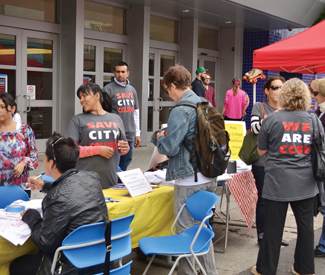
The threat of campus closures and a reduction in non-credit classes are all part of the attack on open access, as some students have said. To combat that, they’ve formed a new student group aimed at educating the city about what they stand to lose.

Project Unity is comprised of Occupy CCSF students, former student trustee Jeffrey Fang, student body President Shanell Williams, and other students, led by the newly elected student Trustee William Walker. They’ve rallied for their school at City Hall, where Supervisors Eric Mar and John Avalos have sponsored a resolution to support City College.

Project Unity met at the Mission Campus shortly after supporting the resolution, and started to plan a grassroots campaign to educate the city and its residents about open access.

Bob Gorringe, a member of Occupy San Francisco, was on hand to help the fledgling group strategize. “[Trustee] Anita Grier came out to the Occupy action council, and she was very open,” Gorringe told the group on July 31, referring to the longtime board member who is not exactly known for her radical tendencies.

Students taking such a vested interest in their college should come as no surprise, considering what happened to Compton before it folded into El Camino.

Although Compton never actually closed, it hemorrhaged students as public fears of the college closing grew larger, and the student body dropped to around 2,000 when El Camino took over, Garten told the Guardian.

Some students went elsewhere, but many appear to have just abandoned the education system.

“We looked at two or three colleges around Compton and none of us had a significant increase in students from the Compton district” enrolling, Garten said.

In other words, it looked like many disillusioned students had simply dropped out, something that nobody wants to see in San Francisco.

MOVING FORWARD

Just over two months remain for CCSF and its supporters to hash out a preliminary plan. Aiding them is a team of experts that will create a detailed report on everything related to the college’s financial woes — possibly the most critical problem area.

The Fiscal Crisis and Management Assistance Team, or FCMAT, explained their process to the college on August 3.

Without revealing any specific details, Michelle Plumbtree, the chief management analyst of FCMAT, warned an audience of a couple dozen interested people that its report would seem negative, but only because that’s exactly what the report is supposed to be: a critical review of problem areas.

“You guys are doing incredible things…But that’s not what we talk about [in our reports],” Plumbtree said.

Mike Hill, another FCMAT team member, succinctly layed out the biggest obstacles to City College’s fiscal future. “This is not a one year problem…We’re looking at three years. What makes that complicated is the governor’s tax, and the parcel tax,” Hill said, referring to Prop. 30 and the San Francisco ballot measure City College sponsored. “There are four scenarios… It’s not predictable.” Prop. 30, the tax measure placed on the ballot by Governor Jerry Brown, wouldn’t raise new revenue for community colleges. If it passes, they simply break even, staving off more drastic cuts. But the parcel tax offers more hope for CCSF, if city voters approve it. It would free up $14 million in revenue for this fiscal year, restoring some of what was lost and prevent the deep cuts and scaled back mission that the school’s support most fear.

Instrumental duo Silian Rail includes ‘every/one’

0

Do artists need vocals and lyrics to demand audience attention in a place like the Bay Area, where there are new musicians popping up left and right? Eric Kuhn and Robin Landy, better known as instrumental duo Silian Rail, have found the answer to that question to be a resounding “no.”

With a handful of locally well-received releases under its belt and an upcoming headlining show at Bottom of the Hill, Silian Rail has clearly made it work thus far without words. The band’s songs run on a driving rhythm paired with carefully crafted guitar work. The complexity of its sound has continued to kept critics and fans coming back for more – a happy discovery for many, that expansive instrumental music can hold their attention.

For a recent companion piece, however, the band added something somewhat foreign to its repertoire, through collaborations with other artists: vocals. “We do have a couple singers on this album,” Kuhn says.

“Our choice to be an instrumental band is not something we ever really talked about. The way we play together emerged quite naturally – [Landy] plays guitar, I play drums…We thought it would be a fun excuse to collaborate with friends and see what they would contribute.”

Silian Rail’s collaborative recent EP every/one (released in May of this year as a companion to the each/other album) will benefit United Roots Oakland, with all of the proceeds going towards its community engagement programs in the arts and media. That EP includes Lewis Patzner (Judgement Day, the Devotionals), Thao Nguyen, Andrew Maguire (Thao and Mirah, DRMS, the Devotionals), Colleen Johnson (Upside Drown), and Winston Goertz-Giffen (Saything).

“The Bay Area music scene is great – not just to blow smoke up the collective ass of the Bay Area,”  Landy says with a laugh. “It’s non-competitive and very supportive. It seems different than LA or New York in that way… I’m just guessing.”

Kuhn says the title of the album, every/one, is a reflection on the tension and paradox of the strength of a collective or a collaboration versus the importance of individual freedom.

“The songs are more or less all from a similar thematic world, which are various texts, films, experiences relating to non-normative psychological functioning – an attempt at sensitively referring to what is classically termed ‘mental illness’,” Kuhn explains.  

“[We] have a lot of empathy for these perspectives, and relate to them in many ways, and respect the non-normative psychological individual as being someone often possessing of an ability to see beyond the arbitrary limits placed on our experience of the world by the various social codes and ideologies that are part of the status quo. There is a wildness and also a directness and a poetic nonsense clarity that we find inspiring and that generally tickles our fancy.”

The band discovered United Roots Oakland at an Occupy Oakland event, where there were young kids free-styling. “It’s an awesome thing to have a creative outlet for kids, [and] to have competent adults there to coach them,” Landy says.

And since the EP was a collaboration, it seemed strange for the band to personally collect a profit from it, Kuhn says, which is they decided to donate.

Silian Rail has a long history of creative endeavors with other musicians. It first gained attention through its connection with other East Bay acts such as Tartufi, Birds & Batteries, and Low Red Land as the group Thread Productions. Although Thread is no longer active, a lot of what the group used to do still happens informally – the bands frequent each others’ shows, try to spread the word on upcoming concerts, and often perform live together.

“It was a hugely helpful idea at the time,” Landy says. “Lynne Angel from Tartufi still plays with us. Our new record is super lush, so we needed extra instrumentation, and she was kind enough to lend her talents. Tartufi still does a lot of broader community organizing around music. I have no idea how they find the time and energy to do it!”

Yet Silian Rail seems to pack in a lot projects in too. Its working towards scoring more film projects – its music has already turned up in various indie films, short clips, and videos, such as an ad for “Farm Fresh Cocktails” (which both Landy and Kuhn found quite odd). Essentially, the Silian Rail sound seems ideal for soundtracks.

But the band’s own music, of course, always comes first. They’ve both long been drawn to creating music. They were friends who grew up together in North Carolina, and parted ways at 13, only to find one another in California many years later.

“Having a guitar with me through adolescence was a lifesaver, having that emotional outlet.” Landy says, reflecting on the importance of music.
Another charitable activity on the band’s plate: it just finished a session at Bay Area Girls Rock Camp – a nonprofit organization that “empowers girls through music” –  in Oakland before our interview. At the camp, musicians teach workshops, host group activities, and perform live.

“Kids are so honest that we were more nervous to play in front of a group of five to 12-years-olds then we are playing a packed venue in San Francisco,” Landy says, “They asked us why we don’t have a singer.”

“With these arts programs, it’s not like if kids have something to do, their problems will go away, it is clearly more complicated; but music can serve as an outlet.”
Kuhn adds: “Music is a means of expression and communication that transcends a lot of barriers – things like technology – more than just language and culture. It holds a fundamental power to enable communication with people.”

For such a technically impressive band, I was impressed to find out that Landy had no formal training on guitar “I don’t really know what I’m doing at all, which has mostly helped my style evolve. I am free to experiment and do things in a different way. It’s all abut making happy mistakes; of course there are benefits to knowing what you’re doing, but it is also a benefit for me to not know. The way I learn things, it probably would have been a waste of time anyway.”

“I did play flute in band during middle school,” she says. “But guitar is basically the opposite of those instruments.”

While Eric had a moderate amount of formal training (he took guitar lessons in high school and “tried to be a music major in college”), he now learns to write for different instruments for new songs without proper lessons. “I needed to write violin and cello parts for songs I’m doing on the new album, so I sat down with a music book and did that.”

“I’m inspired by painters,” he muses. “The idea of fearlessly exploring new territory and always pushing ourselves to new places.”

Silian Rail
With Shuteye Unison, B. Hamilton
Thu/9, $10, 9pm
Bottom of the Hill
1233 17th, SF
(415) 626-4455
www.bottomofthehill.com

Compromise measures

3

news@sfbg.com

San Franciscans are poised to vote this November on two important, complicated, and interdependent ballot measures — one a sweeping overhaul of the city’s business tax, the other creating an Affordable Housing Trust Fund that relies on the first measure’s steep increase in business license fees — that were the products of intense backroom negotiations over the last six months.

Mayor Ed Lee and his business community allies sought a revenue-neutral business tax reform measure that might have had to compete against an alternative proposal developed by Sup. John Avalos and his labor and progressive allies, who sought around $40 million in new revenue, although both sides wanted to avoid that fight and find a compromise measure.

Meanwhile, Mayor Lee was having trouble securing business community support for the housing trust fund that he pledged to create during his inaugural address in City Hall in January. So he modified his business tax proposal to bring in $13 million that would be dedicated to the Affordable Housing Trust Fund, but that didn’t satisfy the Avalos camp, who insisted the city needed more general revenue to offset cuts to city services and help with the city’s structural budget deficit.

Less than a day before the competing business reform measures came before the Board of Supervisors on July 24, a compromise was finally struck that would bring $28.5 million a year, with $13 million of that set aside for the affordable housing fund, tying the fate of the two measures together and creating a kumbaya moment at City Hall that was reminiscent of last year’s successful pension reform deal between labor and the business community.

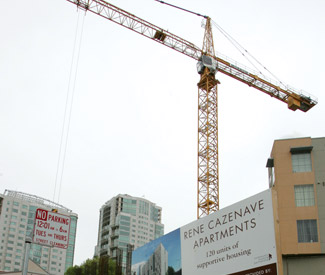
But there was one voice raised at that July 24 meeting, that of Sup. David Campos, who asked questions and expressed concerns over whether this deal will adequately address the “crisis” faced by the working class in a city that will continue to gentrify even if both of these measures pass. Affordable housing construction still won’t meet the long-term needs outlined in the city’s Housing Element that indicates 60 percent of housing construction would need public subsidies to be affordable to current city residents.

It’s also worth asking why a business tax reform measure that doubles the tax base — just 8.4 percent of businesses in San Francisco now pay the payroll tax, whereas 16.4 percent would pay the gross receipts tax that replaces it — doesn’t increase its current funding level of $410 million (the $28.5 million comes from increased business license fees). Some industries — most notably the technology and restaurant industries that have strongly supported Mayor Lee’s political ambitions — could receive substantial tax cuts.

Politics is about compromise, and Avalos tells us that in the current political climate, these measures are the best that we can hope for and worthy of progressive support. And that may be true, but it also indicates that San Francisco will continue to be more welcoming to businesses than the working class residents struggling to remain here.


SOARING HOUSING COSTS

As Mayor Lee acknowledged during his inaugural speech, the boom times in the technology industry has also been driving up commercial and residential rents, he sought to create “housing for the 100 percent.”

The median rent in San Francisco has been steadily rising, jumping again in June an astounding 12.9 percent over June of last year, according to real estate monitor RealFacts, leaving renters shelling out on average an extra $350 a month to landlords.

Driven by a booming tech industry and a lag in new housing, the average San Francisco apartment now rents for $2,734. That’s an annual increase of $4,000 per unit over last year, in a city that saw the highest jumps in rent nationally in the first quarter of 2012. Even prices for the average studio apartment have edged up to $1,800 a month.

The affordability gap between housing and wages in the city is stark. Somebody spending a quarter of their income on rent would need to be making $85,000 a year just to keep up with the average studio. With a mean wage of $64,820 in the San Francisco metro area, even middle class San Franciscans have a difficult time affording a modest apartment. For the city’s lowest paid workers, even earning the country’s highest minimum wage of $10.25 an hour, even devoting every earned dollar to rent still wouldn’t pay for the average small studio apartment.

For those looking to buy a home in the city, it can be a huge hurdle to put aside a down payment while keeping up with the city’s high rents. Almost 90 percent of San Franciscans cannot afford a market rate home in the city. The average San Francisco home price was up 1.9 percent in June over May, climbing to $713,500, or a leap of $50,000 per unit over last year’s prices.

In the 2010 census, before the recent boom in the local real estate market, San Francisco already ranked third in the nation for worst ratio between income and home ownership prices, behind Honolulu and Santa Cruz.

But as the city leadership grapples to mitigate the tech boom’s effects, the lingering recession and conservative opposition to new taxes have gutted state and federal funds for affordable housing. Capped off last December by the California Legislature’s decision to dissolve the State Redevelopment Agency, a major source of money for creating affordable housing, San Francisco has seen a drop of $56 million in annual affordable housing funds since 2007.

Trying to address dwindling funding for affordable housing, the Board of Supervisors voted 8-2 on July 24 to place the Affordable Housing Trust Fund measure on the fall ballot. Only the most conservative supervisors, Sups. Sean Elsbernd and Carmen Chu, opposed the proposal. Sup. Mark Farrell, who has signaled his support for the measure, was absent.

“Creating a permanent source of revenue to fund the production of housing in San Francisco will ensure that San Francisco is a viable place to live and work for everyone, at every level of the economic spectrum. I applaud the Board of Supervisors,” Mayor Lee said in response.

At the heart of the program, the city hopes to create 9,000 new units of affordable housing over 30 years. The measure would set aside money to help stabilize the ongoing foreclosure crisis and replenish the funds of a down payment assistance program for those earning 80 to 120 percent of the median income.

To do so, the city anticipates spending $1.2 billion over the 30-year lifespan of the program, with a $20 million annual contribution the first year increasing $2.5 million annually in subsequent years. It would fold some existing funding in with new revenue sources, including $13 million yearly from the business tax reform measure. Language in the housing fund measure would allow Mayor Lee to veto it is the business tax reform measure fails.

The board was forced to delay consideration of the business tax measure until July 31 because of changes in the freshly merged measures. That meeting was after Guardian press time, although with nine co-sponsors on the board, its passage seemed assured even before the Budget and Legislative Analysts Office had not yet assessed its impacts, as Campos requested on July 24.

“I do believe that we have to ask certain questions when a proposal of this magnitude comes forward,” Campos said at the hearing, later adding, “When you have a proposal of this magnitude, you’re not going to be able to adjust it for some time, so you want it to be right.”

The report that Campos requested, which came out in the late afternoon before the next day’s hearing, agreed that it would stabilize business tax revenue, but it raised concerns that some small businesses exempt from the payroll tax would pay more under the proposal and that it would create big winners and losers compared to the current system.

For example, it calculated that between the gross receipts tax and business license fee, a sample full service restaurant would pay 69 percent less taxes and a supermarket 33 percent less taxes, while a commercial real estate leasing firm would pay 46.7 percent more tax and a large engineering firm would see its business tax bills more than double.

Board President David Chiu, who has co-sponsored the business tax reform measure with Mayor Lee since its inception, agreed that it is a “once in a decade reform,” calling it a “compromise that reflects the best sense of that word.” And that view, that this is the best compromise city residents can expect, seems to be shared by leaders of various stripes.


BACKING THE COMPROMISE

The business community and fiscally conservative politicians have long called for the replacement of the city payroll tax — which they deride as a “job killer” because it uses labor costs to gauge the size of company’s size and ability to pay taxes — with a gross receipts tax that uses a different gauge. But the devil has been in the details.

Chiu praised the “dozens and dozens and dozens of companies that have worked with us to fine-tune this measure,” and press reports indicate that representatives of major corporations and economic sectors have all spent hours in the closed door meetings shaping the complicated formulas for how they will be taxed, which vary by industry.

When the Guardian made a Sunshine Ordinance request to the Mayor’s Office for a list of all the business representatives that have been involved in the meetings, its spokespersons said no such list exists. They have also asked for a time extension in our request to review all documents associated with the deliberations, delaying the review until next week at the earliest, after the board approves the measure.

But the business community seems to be on board, even though some economic sectors — including real estate firms and big construction companies — are expected to face tax hikes.

“The general reaction has been neutral to favorable, and I expect we’ll be supportive,” Jim Lazarus, the vice president of public policy for the San Francisco Chamber of Commerce, who participated in crafting the proposal but who said the Chamber won’t have an official position until it votes later this week.

Lazarus noted the precipitous rise in annual business license fees — the top rate for the largest companies would go from just $500 now to $35,000 under the proposal, going up even more in the future as the Consumer Price Index rises — “but some of it will be offset by a drop in the payroll tax,” Lazarus said.

He also admitted that the new tax system will be “hugely complicated” compared to the payroll tax, with complex formulas that differ by sector and where economic transactions take place. But he said the Chamber has long supported the switch and he was happy to see a compromise.

“I’m assuming it will pass. I don’t believe there will be any major organized opposition to the measure,” Lazarus said.

Labor and progressive leaders also say the measure — which exempts small businesses with less than $1 million in revenue and has a steeply progressive business license fee scale — is a good proposal worth supporting, even if they didn’t get everything they wanted.

“We fared pretty well, the royal ‘we,’ with the mayor starting off from the position that he wanted a revenue-neutral proposition,” Chris Daly, who unsuccessfully championed affordable housing ballot measures as a supervisor before leaving office and becoming the political director for SEIU Local 1021, the largest union of city employees.

Both sides say they gave considerable ground to reach the compromise.

“Did we envision $28.5 million in new revenue? No,” said Lazarus, who had insisted from the beginning that the tax measure be revenue-neutral. “But we also didn’t envision the Affordable Housing Trust Fund.”

Daly and Avalos also said the measures need to be considered in the context of current political and economic realities.

“We were never going to be able to pass — or even to craft — a measure to meet all of the unmet needs in San Francisco,” Daly said. “Given the current political climate, we did very well.”

“If we had a different mayor who was more interested in serving directly the working class of the city, rather than supporting a business class that he hopes will serve all the people, the result might have been different,” Avalos said. “But what’s significant is we have a tax measure that really is progressive.”

Given that “we have an economic system that is based on profits and not human needs,” Avalos said, “This is a good step, better that we’ve had in decades.”


THE HOUSING CRISIS

The tax and housing measures certainly do address progressive priorities — bringing in more revenue and helping create affordable housing — even if some progressives express concerns that conditions in San Francisco could get worse for their vulnerable, working class constituents.

“I don’t know if the proposal before us is aggressive enough in terms of dealing with a crisis,” Campos told his colleagues on July 24 as they discussed the housing measure, later adding, “As good as this is, we are truly facing a crisis and a crisis requires a level of response that I unfortunately don’t think we are providing at this point.”

Not wanting to let “the perfect be the enemy of the good,” Campos said he still wanted to be able to support both measures, urging the board to have a more detailed discussion of their impacts.

“I wish this went further and created even more funding for critically needed affordable housing,” Sup. Eric Mar said before joining Campos in voting for the proposal anyway. “I think they need to build 60 percent of those units as below market rate otherwise we face more working families leaving the city, and the city becoming less diverse.”

Yet affordable housing advocates are desperate for something to replace the $56 million annual loss in affordable housing the city has faced in recent years, creating an immediate need for action and potentially allowing Lee to drive a wedge between the affordable housing advocates and labor if the latter held out for a better deal.

Many have heralded the mayor’s process in bringing together developers, housing advocates, and civic leaders to build a broad political consensus for the measure, particularly given the three affordable housing measures crafted by progressives over the last 10 years were all defeated by voters.

“One of the goals of any measure like this is for it to gain broad enough support to actually pass,” Sup. Scott Wiener said at a Rules Committee hearing on the measure.

In the measure’s grand bargain, developers receive a reduction in the percentage of on-site affordable housing units they are required to build, from 15 percent of units to 12 percent. The city will also buy some new housing units in large projects, paying market rate and then holding them as affordable housing — the buying power of which could be a boon to developers while creating affordable housing units.

At its root, the measure shifts some of the burden of funding affordable housing from developers to a broader tax base and locks in that agreement for 30 years, which could also spur market rate housing development in the process.

A late addition to the proposal by Farrell would create funding to help emergency workers with household earnings up to 150 percent of average median income buy homes in the city, citing a need to have these workers close at hand in the event of an earthquake or other emergency.

While some progressives have grumbled about the givebacks to developers and the high percentage of money going to homebuyer assistance in a city where almost two-thirds of residents rent, affordable housing advocates are pleased with the proposal.

“Did we gain out of this local package? Yes, we got 30 years of local funding. We came out net ahead in an environment where cities are crashing. We essentially caught ourselves way early from the end of redevelopment funds,” said Peter Cohen, executive director of the San Francisco Council of Community Housing Organizations.

Without it, Cohen says many affordable housing projects in the existing pipeline would be lost. “This last year was a bumpy year, and we will not be back to the same operation level for a number of years,” Cohen said. “There was a dip and we are coming out of that dip. It will take us a while to get back up to speed.”

The progressive side was also able to eliminate some of the more controversial items in the original proposal, including provisions that would expand the number of annual condo conversions allowed by the city and encourage rental properties to be converted into tenancies-in-common.

With ballot measures notoriously hard to amend, the Affordable Housing Trust Fund measure is a broad outline with many of the details of how the fund would be administered yet to be filled in. If passed, it will be up to Olson Lee, head of the Mayors Office on Housing and former local head of the demised redevelopment agency, to fill in the details, folding what was essential two partnered affordable housing agencies into a single local unit.

But even the most progressive members of the affordable housing community said there was no other alternative to addressing affordable housing in the wings — which is indeed a crisis now that redevelopment funds are gone — making this measure essential.

As Sara Shortt of the Housing Rights Committee of San Francisco told the Rules Committee, “We lost a very important funding mechanism. We have to replace it. We have no choice.”

8 cultural happenings this week in the big, best, beautiful Bay

0

It is inevitable after reading today’s Best of the Bay 2012 issue that your heart will be swole with pride for our beautiful Bay Area By the Bay. Seize the moment! There are a plethora of arts and culture happenings this week that are perfect examples of — as our managing editor Marke B. put it in his intro to BOB — “the sheer gorgeousness, thriving alternative culture, and promise of freedom and acceptance that are unique to our shores.” Cheers!

CELLspace open critical studio

Turns out, artists aren’t always their best critic. That’s why CELLspace’s open critical studio is such a great opportunity for creatives. Come discuss your art, discover the work of others, and — hopefully — take away a dose of constructive criticism that every creator needs from time to time. 

Wed/25, 7-10pm, free

CELLspace

2050 Bryant, SF 

www.cellspace.org

Cobb’s Comedy Club Showcase

Though it’s one of the city’s premier comedy clubs, Cobb’s isn’t stupid enough to forget the little guys. This Wednesday, check out the club’s up-and-comer showcase, where you can see some of the Bay’s funniest fledglings before they hit it big and really start taking your money. 

Wed/25, 8pm, $12.50

Cobb’s Comedy Club

915 Columbus, SF

www.cobbscomedyclub.com 

SF International Poetry Festival

The San Francisco International Poetry Festival brings you tons of excuses to brood in a vaguely-Italian coffee house while penning lines into your journal. The series of readings from poets of international acclaim — from Iraq to Italy, Sweden to Malta — kicks off this Thursday. Set ever-so aptly in Jack Kerouac Alley, hosts Jack Hirschman, Lawrence Ferlinghetti, and city librarian Luis Herrera will introduce the festival’s lineup of poets with the accompaniment of a modern concert from Neeli Cherkovski, Matt Gonzales, and Jonathan Richman. 

Thu/26, 7-9:00pm, free.

Kerouac Alley, SF

www.sfipf.com

The Wizard of Oz movie night with the San Francisco Symphony

Join the San Francisco Symphony for a unique screening of America’s favorite kids-movie-that’s-not-actually-a-kids-movie. Beyond the fantastical plot line of The Wizard of Oz, the film’s striking visual elements and majestic music and score are part of what has made it the timeless classic it is today. Bridge the gap between silly and sophistication this Thursday by dressing up in your favorite Oz costume, watching the movie, and listening to the SF Symphony perform the score live.

Fri/27, 7:30pm, $12.50-$70

Davies Symphony Hall

201 Van Ness, SF

www.sfsymphony.org

“Re: Told” closing night 

If you missed this month’s run of Root Division’s modern story-telling art exhibit, you still have a chance to catch this glamorous culmination, closing reception, and publication release. Taking a page from Ernest Hemingway, “Re: Told” reframes cultural narratives in order to create a contemporary storytelling experience, yielding an accessible look into some very intimate realities.

Fri/27, 6-9pm, $1-$20

Root Division

3175 17th St., SF

www.rootdivision.com 

Naoya Hatakeyama: Nature Stories 

Prominent Japanese nature photographer Naoya Hatakeyama shows us the dualistic relationship between man and nature in this large-scale photography exhibit illustrating man’s attempt to control nature and, in the wake of the Tohuku earthquake and tsunami. The austere power of nature over humans’ best attempts to rein it in figures prominently in “Natural Stories,” which possesses an ironically calm visual approach to such a powerful concept. 

Through Nov. 4

Opening reception: Sat/29, 10am-5:45pm, $18 (adult general) 

SFMoMA

151 Third St., SF

www.sfmoma.org 

Ohlone basket welcoming ceremony 

The native Californian basket collection at the Oakland Museum of Art would, from a novice’s eye, seem to be complete. Yet due to the Ohlone tribe’s tradition of burning their possessions after death, the tribe’s baskets are scarcely represented among the collection’s 2,500 pieces. To remedy this dearth, the museum commissioned Ohlone artist and scholar Linda Yamane to create a basket. After a two-year documented process, we have an opportunity to welcome the 20,000-stitch, several thousand feathers, and 1,200-bead that make up the Ohlone basket into the museum’s collection with a day of festivity, including story-telling, dance, and song. 

Sat/28, 1-3pm, $12 general. 

Oakland Museum of California

1000 Oak, Oakl. 

www.museumca.org

The Coming Century of War Against Your Computer

Hey you, the one with the oversized headphones and approximately windows to burn open on your laptop, listen up. As part of its specialization in the speculative — that is, fantasy, horror, and science fiction — Borderlands Books presents Corey Doctorow and his book The Coming Century of War Against Your Computer. Copyright laws, net neutrality, and SOPA may be much more serious indicators of the technology takeover than we thought, so let this be your opportunity to decide whether you’re going to let technology-driven measures govern your life.  

Tue/31, 7:30pm, $10

Borderlands Cafe

870 Valencia, SF

www.borderlands-books.com 


Best of the Bay 2012: BEST DECEPTIVELY EPHEMERAL FILM FEST

0

Really though, Disposable Film Festival is a misnomer. Founded in 2007, with an inaugural event at Artists’ Television Access in early 2008, DFF has since evolved into a traveling-fest juggernaut with screenings in Paris, Beijing, Brazil, Macedonia, Argentina — basically, anywhere with open-minded audiences hungering for unique short films. Here’s where the “disposable” part comes in: the films are made DIY-style, using technology of the hand-held, pocket-sized, and easily-accessible-to-everyone variety, like cell phones and webcams. And though its festival screenings are a global phenomenon, DFF also hosts workshops, panel discussions, and other events (bike-in movies!) aimed at inspiring artists — especially young folks who are just discovering the wide world of creative filmmaking beyond those 3D superheroes at the multiplex.

www.disposablefilmfest.com

Environmental groups call for fracking moratorium in California

8

California’s biggest environmental organizations are gathering in Sacramento tomorrow (Wed/25) to call for a moratorium on the controversial practice of hydraulic fracturing – also known as fracking, in which a mixture of water and chemicals is injected at high pressure deep underground to increase production in oil and natural gas wells – until its impacts are better understood.

The occasion is the last in a series of workshops on the issue by the California Department of Conservation’s Division of Oil, Gas and Geothermal Resources, which is considering new rules on a practice that is mostly unregulated in California. Other recent legislative and administrative efforts to address fracking have been scuttled by the powerful fossil fuel industry.

Earlier this year, Sen. Fran Pavley (D-Santa Monica) discovered that state officials didn’t even know how much fracking is happening in California – while it requires state permits to drill an oil or natural gas well, fracking them doesn’t – although the industry has since estimated that more than 600 wells were fracked last year, most of them in Kern Country around Bakersfield.

But there is growing concern by environmentalists that the oil industry plans to expand its use of fracking in the Monterey shale formations that run from the Central Coast to the Central Valley, where an estimated 15 billion barrels of oil could be extracted if loosened up by fracking.

“We’re calling for the Division of Oil and Gas to slow down and not rush through these regulations,” said Andrew Grinberg, spokesperson for Clean Water Action. “We’re calling for a moratorium until we have good regulations that ensure the protection of our water, air, health, and communities.”

Other organizations joining the event – which begins at 5:30pm outside the California Environmental Protection Agency building at 1001 1st St. in Sacramento, where the DOGGR hearing will be held at 7pm – and the call for a moratorium includes the Sierra Club, Planning and Conservation League, Center for Biological Diversity, Environment California, and Food & Water Watch.

Public concerns about fracking have been on the increase in recent years, fueled by a high-profile debate in New York about ending a state moratorium against the practice and by alarming stories of groundwater contamination caused by fracking – including cases in which hydrocarbon content in drinking water is so high that people could set their faucets on fire – told in the 2010 documentary film Gasland and other media accounts.

But Tupper Hull, spokesperson for the influential trade group Western States Petroleum Association, told us fracking has been happening in California for 60 years – almost exclusively in oil wells rather than for the natural gas fields discussed in Gasland – and that it has not caused any detrimental environmental impacts, nor has its use been increasing, despite the increased public attention to the practice.

“We understand there is a lot of interest in this topic and questions about the technology,” Hull said. “We expect there will be new regulations and whatever they are, we hope they are based on facts and science and not emotional responses.”

But he said WSPA opposes the call for a moratorium because “this is a technology that aids in the production of energy.”

Yet the environmental groups say the need for energy shouldn’t cause government to abdicate its role of studying and regulating a potentially harmful practice that was given a broad federal exemption from the Clean Water Act by Congress in 2005, when it approved the Energy Policy Act that was spearheaded by then-Vice President Dick Cheney.

Environmental groups dubbed it the “Halliburton loophole” after Cheney’s former employer, which has greatly expanded the use of fracking in the US.

Celebrate a book about DJs at a bar that is in said book

0

A rather strange-looking book alit upon my desk the other day. It told me it would teach me how to fold underwear. It lied. Luckily, the book did contain a rather amusing little cat-and-mouse story about a cute SF DJ traversing Hong Kong and surrounds in the exuberant days of the late 1990s. This is local author Steven Fruhmoto’s Underwear Origami — a misleading title if ere I’ve heard one. Nonetheless, Mr. Fruhmoto invites you to swallow your dismay at not being able to learn how to fold underwear (it’s a metaphor), and accompany him to the location of the book’s first scene for some beveraging, reading, and book signing on Sat/28. 

I read the book, and recommend for anyone who is into tales that revolve around international party scenes, casual drug use, and Norweigan pop stars emerging from dancing mushrooms. Fruhmoto is a product of Dartmouth College’s masters program in electro-acoustic music — founded in 1989, do you believe? — and Underwear Origami‘s tone is educated in the bpm of the music that fuels its characters, but also literate enough that the whole thing doesn’t come off as a product of someone’s bed-bound Burning Man comedown. 

Why the 1990s, though? Don’t we have enough DJs around these days. Says Fruhmoto, via an email sent to the Guardian in response to that question: 

I lived in San Francisco from 1994 to 2002. The period of the mid- to late ’90s was a uniquely optimistic time in the city, and I wanted to capture the exuberance and innocence of that time. It was pre-9/11, with no Osama Bin Laden, no Iraq, no Guantanamo, no Great Recession, etc. It was also the early days of the Internet, with the excitement of the dot-com phenomenon, and the US economy was booming overall.

I suppose if I were to have set the book in current times, the feel might be a lot more edgy, because the 1990s were a very different time. Also, the advancement of music composition and performance technology, and the advent of the social media connectedness of people would be important themes. In terms of music, I’d probably be talking about the phenomenon of the mainstreaming of electronic musicians, and new genres like dub-step, glitchhop, etc.

Anyways, I suppose we’re all in for some unique optimism. Drop by the Noc Noc for a free beer when you buy a paperback copy of the book. 

Underwear Origami book signing 

Sat/28 6-8pm, free

Noc Noc

557 Haight, SF

www.nocnocs.com

NUDE BEACHES 2012

7

Editors Note: Below you’ll find our annual update on the state of nude beaches in the Bay Area, along with detailed guides and directions to several of our favorites. For details on dozens more, please see our complete Nude Beaches Guide, which we are in the process of updating. 

NUDE BEACHES Arrests for being naked on the sand, anti-nudity warning signs going up at previously unthreatened spots, outright threats of beach closures, social activists making their mark on San Francisco’s most well-known clothing-optional beach: this is shaping up to be one of Northern California’s busiest nude beach seasons in recent memory.

Faced with a July 1 deadline, on June 28 Governor Jerry Brown’s administration announced it saved or would stall shutting down all but one of 70 state parks and beaches targeted for closure due to budgetary shortfalls. These include three sites in our annual guide: Montara’s Gray Whale Cove, Carmel’s Garrapata State Park, and Zmudowski State Beach in northern Monterey County.

Officials said they would use $13 million in bond money in the budget to keep the properties running at least through summer. Some 40 parks will remain open for an estimated one to five years, due to temporary funding and support agreements being negotiated with nonprofit foundations and other organizations. More than 25 other properties, including Gray Whale Cove, also known as Devil’s Slide, will keep going while deals are completed.

When asked exactly how long Gray Whale Cove, Garrapata, and Zmudowski would stay open, California State Parks spokesman Dennis Weber told me they could keep going for a month, the entire summer, a year, or even longer. “We don’t know how much time we have,” he said.

Paul Keel, the state parks sector superintendent for the area that includes Gray Whale Cove, was more optimistic. He told me he’s keeping the popular beach open through at least the end of July because while “nothing’s been signed or inked, it’s fair to say we are optimistic” an agreement with a private operator or nonprofit will be finalized before then. Until the state took control, the site was run by a private licensee, San Francisco developer Carl Ernst and his company, Gray Whale Cove Enterprises, Inc.

Ruth Coleman, head of the State Parks and Recreation Department, said the bonds would fund solar power systems, as well as automatic pay machines that take credit and debit cards. And visitors arriving at Devil’s Slide or Garrapata are likely to notice signs that urge them to pay for parking instead of parking outside.

The card machines are likely to be particularly handy at Devil’s Slide after a long-awaited tunnel bypassing rockslide-prone Highway 1, which remains the access point to the beach, is expected to open this fall. Keel suspects the Devil’s Slide Tunnel will bring larger crowds to the beach.

But the news wasn’t all good. Maintenance and garbage pick up operations are likely to remain reduced or eliminated. In late June, Brown partly vetoed a larger, $41 million funding bill that had been OKed by the state legislature. State Senator Joe Simitian (D-Palo Alto), who coauthored the bigger funding plan, criticized the veto, calling it “a lost opportunity to take action.” Another lost opportunity: in November 2010, California voters rejected a ballot initiative that would have raised about $500 million for state parks.

Meanwhile, while Sacramento was cutting back beach services, activists were making additions to the section of San Francisco’s Baker Beach used by nudists. Naturists have erected driftwood art sculptures and tent-like structures without walls, called “dunies,” at the north end of the beach. And they’ve vowed to keep the site free of gawkers by staring them down in what organizers call a non-confrontational approach to self-policing. “They usually decide to leave pretty soon,” says Santosh, 46, an artist and street fair producer.

Speaking of policing, in the past year cops have raided Garrapata and put up signs about nudity at Bonny Doon Beach and at least two other beaches north of Santa Cruz.

At Garrapata, rangers and lifeguards cited over a dozen persons for public nudity last summer and began patrolling the beach at least two times a day after receiving what lifeguard Eric Sturm told the Carmel Pine Cone were reports of “sex acts on the beach.”

And at Bonny Doon, Laguna Creek, and Panther Beach, “Nudity In The State Park System Is Prohibited” signs have been posted, although naturists there remain defiant and are still visiting the sites. “A 50-year tradition (of clothing-optional use at Bonny Doon) cannot be extinguished by a simple sign,” said Rich Pasco, coordinator of the Bay Area Naturists, after the signs went up. He urged nudists to “be polite and respectful” of rangers and suit up “if requested,” but to engage them in “intelligent conversations.” After two months, the signs at Bonny Doon, though, were taken down because, according to Joe Connors, public safety superintendent for state beaches in the Santa Cruz area, “we don’t get a big volume of complaints there.”

Want to join others in having fun at a clothing-optional spot this summer? The USA’s only naked “Full Moon Hikes” will take place in Castro Valley in late July, August, and September (see our listings online at SFBG.com for Last Trampas in Contra Costa County for details). Another idea to meet and socialize with fellow naturists: drop by Bonny Doon on September 15, when fans of the site will be gathering to keep it pristine by finding and removing trash.

Finally, you can aid the naturist community by sending me your new beach discoveries, trip reports, and improved directions (especially road milepost numbers), along with your phone number to garhan@aol.com or Gary Hanauer, c/o San Francisco Bay Guardian, 71 Stevenson, 2nd Floor, San Francisco, CA 94105.

Our ratings: [full moon] signifies a beach that is large or well-established and where the crowd is mostly nude; [half moon] indicates places where fewer than half the visitors are nude; and [quarter moon] means small or emerging nude areas.

SAN FRANCISCO

NORTH BAKER BEACH, SAN FRANCISCO

RATING: A

Social activists have begun streaming onto the sand of America’s biggest urban nude beach, creating what visitor Santosh calls “a tone that’s like Burning Man,” with regulars bringing guitars, drums, and Frisbees to the sand, putting up art work best described as eclectic, and occasionally staring down gawkers.” There’s no requirement that you go nude,” says Santosh, an artist, graphic artist, and producer of San Francisco’s How Weird Street Faire, an outdoor street fair held each year in the SoMa neighborhood as a fundraiser for the World Peace Through Technology Organization. “But if a creeper dude plops down next to a (nude) person or if they are staring at someone’s private parts and it’s happening close to where we are, on the far north end (of North Baker), then they will start being the object of ridicule.

Directions: Take the 29 Sunset bus or go north on 25th Avenue to Lincoln Boulevard. Turn right and take the second left onto Bowley Street. Follow Bowley to Gibson Road, turn right, and follow Gibson to the east parking lot. At the beach, head right to the nude area, which starts at the brown and yellow “Hazardous surf, undertow, swim at your own risk” sign. Some motorcycles in the lot have been vandalized, possibly by car owners angered by bikers parking in car spaces; to avoid trouble, motorcyclists should park in the motorcycle area near the cyclone fence.

LAND’S END BEACH

RATING: A

Considered one of the most beautiful places in the Bay Area to doff your togs, Land’s End should really be called Swimsuit’s End. The reason: although it draws more clothed users than nudists, more than a few swim tops and bottoms magically “disappear” on warm spring, summer, and fall days at the little cove off Geary Boulevard. Come early to grab your share of the sand on this semi-rocky shoreline, which is sometimes dotted with rock-lined windbreaks left by previous sunbathers. Bring a light jacket or sweatshirt in case the weather changes.

Directions: Follow Geary Boulevard to the end, then park in the dirt lot up the road from the Cliff House. Take the trail at the far end of the lot. About 100 yards past a bench and some trash cans, the path narrows and bends, then rises and falls, eventually becoming the width of a road. Don’t take the road to the right, which leads to a golf course. Just past another bench, as the trail turns right, go left toward a group of dead trees where you will see a stairway and a “Dogs must be leashed” sign. Descend and head left to another stairway, which leads to a 100-foot walk to the cove. Or, instead, take the service road below the El Camino del Mar parking lot 1/4 mile until you reach a bench, then follow the trail there. It’s eroded in a few places. At the end, you’ll have to scramble over some rocks. Turn left (west) and walk until you find a good place to put down your towel.

GOLDEN GATE BRIDGE BEACH

RATING: A

On the hottest days, Golden Gate Bridge Beach becomes so packed with people that one visitor describes it as a “gay mob scene.” But the rocky shore, which connects three picturesque coves, also gets its share of straight men and women. Prime, non-cruising activities include sunbathing, enjoying breathtaking views of the Bridge, and even taking some dips in the water. “You can sometimes go out over 100 feet during low tide,” a woman tells me.

Directions: from the toll booth area of Highway 101/1, take Lincoln Boulevard west about a half mile to Langdon Court. Turn right (west) on Langdon and look for space in the parking lots, across Lincoln from Fort Winfield Scott. Park and then take the beach trail, starting just west of the end of Langdon, down its more than 200 steps to Golden Gate Bridge Beach, also known as Marshall’s Beach. Despite recent improvements, the trail to the beach can still be slippery, especially in the spring and winter.

FORT FUNSTON BEACH

RATING: C

What’s the only Golden Gate National Recreation Area park where you can walk your dog without a leash, as well as the spot where the world record for the farthest tossed object (a flying ring sent soaring 1,333 feet by Erin Hemmings) was set in 2003? Answer: Fort Funston, which is affectionately called Fort Fun by its fans. Known for its magnetic sand, steady winds (especially in March and October) that make its cliffs popular for hang gliding, and, in particular, its dogs, who appear here with their human escorts by the hundreds, the area even attracts a few naturists from time to time. Mostly hidden away in the sand dunes on the beach, naked sunbathers usually stay away on the weekends, when families swarm the area. To keep the “fun” in Fort Funston, even on weekdays, be sure to use caution before disrobing.

Directions: From San Francisco, go west to Ocean Beach, then south on the Great Highway. After Sloat Boulevard, the road heads uphill. From there, curve right onto Skyline Boulevard, go past one stoplight, and look for signs for Funston on the right. Turn into the public lot and find a space near the west side. At the southwest end, take the sandy steps to the beach, turn right, and walk to the dunes. Find a spot as far as possible from the parking lot.

CONTRA COSTA COUNTY

LAS TRAMPAS REGIONAL WILDERNESS, CASTRO VALLEY

RATING: C

Want to go walking around nude at night outside without being hauled off to jail? Imagine hiking naked guided only by your flashlight in the East Bay Hills, with the trail silhouetted by a full moon and small herds of horses coming up to greet you.

“It’s absolutely surreal,” says Jurek Zarzycki. “The horses come within inches of you, so close you can feel their breath. It’s like being on a moonscape with aliens. You may be a little afraid at first, but the horses are very friendly.”

America’s only nude “Full Moon Hikes” have been taking place on summer full moon nights in Castro Valley for more than seven years. The next ones will be held July 29, August 31 (arrive by 6pm), and September 28 (starting at 5:15pm) “We start early so that we have the full moon already risen by the time the sun sets,” says San Leandro’s Dave Smith, who leads most of the hikes. “Then we hike up the trail around sunset.”

Coordinated by a partnership between the Sequoians Naturist Club and the Bay Area Naturists, based in San Jose, walkers leave the property of the Sequoians fully clothed at dusk and walk through meadows and up hills until the moon rises, before heading back down the slopes completely nude, with their clothes folded neatly into their backpacks.

After the walk, most hikers shower at The Sequoians, and, for a fee of $5, take a dip in the 86-degree pool there and enjoy a plunge in the facility’s hot tub. “It was fabulous,” says Zarzycki about an earlier trek. “I pitched my tent right there at The Sequoians and then slept under the sky.”

Directions: Contact The Sequoians (www.sequoians.com) or the Bay Area Naturists (www.bayareanaturists.org) for details on how to join a walk. Meet at The Sequoians. To get there, take Highway 580 east to the Crow Canyon Road exit. Or follow 580 west to the first Castro Valley off-ramp. Take Crow Canyon road toward San Ramon .75 mile to Cull Canyon road. Then follow Cull canyon road around 6.5 miles to the end of the paved road. take the dirt road on the right until the “Y” in the road and keep left. Shortly after, you’ll see The Sequoians sign. Proceed ahead for about another .75 mile to The Sequoians front gate.

SAN MATEO COUNTY

DEVIL’S SLIDE, MONTARA

RATING: A

Although Devil’s Slide, also known as Gray Whale Cove, was scheduled to be closed this month by the state due to budget shortfalls, officials plan to keep it open while they negotiate with what Paul Keel, San Mateo coast state parks sector superintendent, calls a prospective “donor to keep it in operation for the coming year.” At press time, Keel told us that although “nothing’s been signed or inked, it’s fair to say we are optimistic, so hopefully we will know more in the next month.” Access to the site, though, is changing: after a long-awaited, voter-approved Devil’s Slide tunnel is completed this fall, Keel and others expect a possible increase in traffic to the beach, as more pedestrians and bicyclists use a nearby section of Highway 1 that is being closed. Meanwhile, rangers say they will allow a long-standing tradition of nudity to continue on the sand unless visitors complain.

Directions: Driving from San Francisco, take Highway 1 south through Pacifica. Three miles south of the Denny’s restaurant in Linda Mar, turn left (inland or east) on an unmarked road, which takes you to the beach’s parking lot and to a 146-step staircase that leads to the sand. Coming from the south on Highway 1, look for a road on the right (east), 1.2 miles north of the Chart House restaurant in Montara. Starting this fall, from the north, take Highway 1 through the Devil’s Slide tunnel and then turn left onto the road described above. From the south, continue using the above directions. Most naturists use the north end of the beach, which is separated by rocks from the rest of the shore.

SAN GREGORIO NUDE BEACH, SAN GREGORIO

RATING: A

Still the USA’s longest continually used nude beach, San Gregorio even has its own web site and live web cam at www.freewebs.com/sangregoriobeach. The privately run operation, which is located next to San Gregorio State Beach, recently began its 46th year of serving the clothing-optional community.

The beach often draws a large gay crowd, along with some nude and suited straight couples, singles, and families. “It’s a really romantic spot,” says a single woman. However, first-timers are sometimes annoyed (as I was, years ago) by the driftwood structures on the sandy slope leading down to the beach, which are used by some visitors as “sex condos.” However, fans of the beach savor San Gregorio’s stunning scenery. It has “awesome natural beauty,” says regular visitor Bob Wood. Attractions of the 120-acre site include two miles of soft sand and tide pools to explore, as well as a lagoon, lava tube, and, if you look closely enough on the cliffs, the remains of an old railroad line.

Directions: From San Francisco, drive south on Highway 1, past Half Moon Bay, and, between mileposts 18 and 19, look on the right side of the road for telephone call box number SM 001 0195, at the intersection of Highway 1 and Stage Road, and near an iron gate with trees on either side. From there, expect a drive of 1.1 miles to the entrance. At the Junction 84 highway sign, the beach’s driveway is just .1 mile away. Turn into a gravel driveway, passing through the iron gate mentioned above, which says 119429 on the gatepost. Drive past a grassy field to the parking lot, where you’ll be asked to pay an entrance fee. Take the long path from the lot to the sand; everything north of the trail’s end is clothing-optional (families and swimsuit using visitors tend to stay on the south end of the beach). The beach is also accessible from the San Gregorio State Beach parking area to the south; from there, hike about a half-mile north. Take the dirt road past the big white gate with the Toll Road sign to the parking lot.

SANTA CRUZ COUNTY

GARDEN OF EDEN, FELTON

RATING: C

Tucked away in Henry Cowell Redwoods State Park, between Santa Cruz and Felton, the Garden Of Eden is a much-used skinny-dipping hole on the San Lorenzo River, which is also visited by clothed families. Some hikers are surprised when they see people nude there and either use the spot anyway or keep walking. Watch out for poison oak and slippery sections on the trail. Eden is one of three clothing-optional swimming holes on the river. To find them, look for cars pulled over on Highway 9, next to the state park, which bans nudity but seldom sends ranger patrols to the creek.

Directions: From Santa Cruz, drive north on Highway 9 and look for turnouts on the right side of the road, where cars are pulled over. The first, a wide turnout with a tree in the middle, is just north of Santa Cruz. Rincon Fire Trail starts about where the tree is, according to reader Robert Carlsen, of Sacramento. The many forks in the trail all lead to the river, down toward Big Rock Hole and Frisbee Beach; Carlsen says the best area off this turnout can be reached by bearing left until the end of the trail. Farther up the highway, 1.3 miles south of the park entrance, is the second and bigger pullout, called the Ox Trail Turnout, leading to Garden of Eden. Park in the turnout and follow the dirt fire road downhill and across some railroad tracks. Head south, following the tracks, for around .5 miles. Look for a “Pack Your Trash” sign with park rules and hours and then proceed down the Eden Trail.

Ox Trail, which can be slippery, and Eden Trail both wind down steeply to the creek. “The path continues to the left, where there are several spots for wading and sunbathing,” Carlsen says. The main beach is only 75 feet long and 30 feet wide, but fairly sandy. Carlsen’s favorite hole is accessible from a trail that starts at the third turnout, a small one on the right side of the road, about 4.5 miles from Highway 1 and just before Felton. A gate marks the start of the path. The trail bends left. When you come to the road again, go right. At the railroad tracks, go right. From here, look for the river down the hill on your left; many paths lead to it. Says Mike: “Within 10 yards, you can be in the water.”

BONNY DOON NUDE BEACH, BONNY DOON

RATING: A

Despite the temporary erection of anti-nudity warning signs at longtime nudie fan favorite Bonny Doon Beach, north of Santa Cruz, officials have told us they have no immediate plans to issue citations at the north end of the site, which has traditionally been occupied by naturists. In fact, the signs were taken down after just two months.

In fact, in June, Pam, of San Mateo, even found a nudist at the main public, south side of the beach, which is used by suited visitors. A 15-foot long rock on the sand, along with a sloping cliff with rocks that jut out, separate the two sides of the cove that form Bonny Doon.

“In the short term, things at Bonny Doon are destined to continue the way they are,” says Kirk Lingenfelter, sector superintendent for Bonny Doon and nearby state beaches. Lingenfelter says he likes Bonny Doon just the way it is. “It’s one of our pocket beaches,” he explains. “They can really give you the feeling of rugged, untouched majesty. I like standing on those beaches. You can sometimes forget that there’s a highway in the distance. It’s a very important feeling to maintain. “The clothing-optional section usually attracts more women and couples than most nude beaches. “Minuses” include occasional vehicle burglaries and gawkers on the bluffs or in the bushes.

Directions: From San Francisco, go south on Highway 1 to the Bonny Doon parking lot at milepost 27.6 on the west side of the road, 2.4 miles north of Red, White, and Blue Beach, and some 11 miles north of Santa Cruz. From Santa Cruz, head north on Highway 1 until you see Bonny Doon Road, which veers off sharply to the right just south of Davenport. The beach is just off the intersection. Park in the paved lot to the west of Highway 1; don’t park on Bonny Doon Road or the shoulder of Highway 1. If the lot is full, drive north on Highway 1, park at the next beach lot, and walk back to the first lot. Or take Santa Cruz Metro Transit District bus route 40 to the lot; it leaves the Metro Center three times a day on Saturdays and takes about 20 minutes. To get to the beach, climb the berm next to the railroad tracks adjacent to the Bonny Doon lot, cross the tracks, descend, and take a recently improved, sign-marked trail to the sand. Walk north past most of the beach to the nude cove on the north end. Alternately, Dusty suggests parking as far north as possible, taking the northern entrance, and, with good shoes, following a “rocky and steep” walk down to the sand.

2222 BEACH, SANTA CRUZ

RATING: A

In late May, when my girlfriend and I visited a little cliffside park above it and peered down on the aptly named 2222 — it’s the number of the house across the street — we discovered that the pocket-size cove looked as beautiful as ever. In fact, America’s smallest nude beach is so small it could probably fit in your yard. And that’s what makes it a magical place. You won’t find crowds at 2222, which takes scrambling to reach and isn’t recommended for children or anyone who isn’t a good hiker. However, those who are agile enough to make it down a steep cliff and over some concrete blocks on the way down will probably be rewarded with an oasis of calm and a good spot to catch some sunrays.

Directions: The beach is a few blocks west of Natural Bridges State Beach and about 2.5 miles north of the Santa Cruz Boardwalk. From either north or south of Santa Cruz, take Highway 1 to Swift Street. Drive .8 miles to the sea, then turn right on West Cliff Drive. 2222 is five blocks away. Past Auburn Avenue, look for 2222 West Cliff on the inland side of the street. Park in the nine-car lot next to the cliff. If it’s full, continue straight and park along Chico Avenue. Bay Area Naturists leader Rich Pasco suggests visitors use care and then follow the path on the side of the beach closest to downtown Santa Cruz and the Municipal Wharf.

PRIVATES BEACH, SANTA CRUZ

RATING: A

“Privates is one of my favorite beaches,” says Brittney Barrios, manager-buyer of Freeline Design Surf Shop, which is located nearby and sells keys to unlock the gate leading to the clean, beautiful cove. “It’s always very peaceful.” Visitors include nudists, surfers, families, and local residents. “Everyone gets along,” adds Barrios. “And it’s never crowded.”

Barrios says many of the naturists, who often visit in groups, like to play Paddle Ball on the sand. As for Barrios, she prefers to “lay out,” as she calls it, in the sun.

There’s almost no litter, wind, noise, or troublemakers — security guards plus a locked gate keep the latter out — and world class surfers, such as those who starred in Endless Summer II, regularly put on a free show for the naked people who share the warm, clean sand with surfers.

“It’s really nice,” says Hunter Young, a former worker at Freeline, which sells up to 600 beach passes a year. “Surfers love it because it has good waves. It’s 100 percent standup surfing, with paddling. Anytime I go to Privates, I can expect a long ride on my longboard.”

“The beach is also very family oriented,” explains Barrios. “And it’s OK for dogs too.”

“There are two different coves on the beach,” says Young. “Clothed families who use the beach know which cove is nude and stay away from it. If you want to play naked Frisbee, at the bottom of the beach stairs you just walk to the left.”

Directions: 1) Some visitors walk north from Capitola Pier in low tide (not a good idea since at least four people have needed to be rescued). 2) Others reach it in low tide via the stairs at the end of 41st Avenue, which lead to a surf spot called the Hook at the south end of a rocky shore known as Pleasure Point. 3) Surfers paddle on boards for a few minutes to Privates from Capitola or the Hook. 4) Most visitors buy a key to the beach gate for $100 a year at Freeline (821 41st Ave., Santa Cruz, 831-476-2950) 1.5 blocks west of the beach. Others go with someone with a key or wait outside the gate until a person with a key goes in, provided a security guard is not present (they often are there). “Most people will gladly hold the gate open for someone behind them whose hands are full,” says Bay Area Naturists leader Rich Pasco. The nude area starts to the left of the bottom of the stairs.

MARIN COUNTY

MUIR NUDE BEACH, MUIR BEACH

RATING: A

Mellow times are continuing at one of the Bay Area’s easiest to reach and most enjoyable nude beaches, the clothing-optional north side of Muir Beach. Also known as Little Beach, it’s separated by the main public beach by a line of large rocks that visitors usually walk over. Says Lucas Valley’s Michael Velkoff, who switched from Red Rock to become a regular at Muir: “This season, there’s plenty of sand. It’s also a great place for women because people leave you alone here. Nobody’s hitting on you. And high tide only comes a third of the way up the beach.” Recent additions include a new bridge over a marshy, lagoon-like area near the parking lot, plus about a half dozen Porta-Potties.

Directions: From San Francisco, take Highway 1 north to Muir Beach, to milepost 5.7. Turn left on Pacific Way and park in the Muir lot (to avoid tickets, don’t park on Pacific). Or park on the long street off Highway 1 across from Pacific and about 100 yards north. From the Muir lot, follow a path and boardwalk to the sand. Then walk north to a pile of rocks between the cliffs and the sea. You’ll need good hiking or walking shoes to cross; in very low tide, try to cross closer to the water. The nude area starts north of it.

RED ROCK BEACH, STINSON BEACH

RATING: B

One of the most popular Bay Area nude beaches, Red Rock has struggled with sand erosion that’s left a smaller site the last few seasons, along with a more crowded feel to it and, perhaps in reaction, fewer overall visitations. Except for being a little overgrown with vegetation in early July and some poison oak on the half nearest the highway, the beach trail, however, is reported in good shape this year. “Just wear shoes with socks, go single file in spots, and you should be okay,” advises Stinson Beach attorney-teacher Fred Jaggi. Rock climbing and various kinds of Frisbee continue to be frequent pastimes at Red Rock — Ultimate Frisbee games there can last as long as three hours. Naked Scrabble and Nude Hearts are among the other games played by sunbathers. “It’s very peaceful at the beach,” says Jaggi. “Nobody ever brings down a large boombox.”

Directions: Go north on Highway 1 from Mill Valley, following the signs to Stinson Beach. At the long line of mailboxes next to the Muir Beach cutoff point, start checking your odometer. Look for a dirt lot full of cars to the left (west) of the highway 5.6 miles north of Muir and a smaller one on east side of the road. The lots are at milepost 11.3, one mile south of Stinson Beach. Limited parking is also available 150 yards to the south on the west side of Highway 1. Or from Mill Valley, take the West Marin/Bolinas Stage toward Stinson Beach and Bolinas. Get off at the intersection of Panoramic Highway and Highway 1. Then walk south .6 mile to the Red Rock lots. Follow the long, steep path to the beach that starts near the Dumpster next to the main parking lot.

BOLINAS, BASS LAKE

After Tracey, of San Anselmo, hiked to what she called “beautiful, clean, sunny” Bass Lake, she went onto a message board in June to urge those who are considering trying the Bolinas attraction to “Go. Go. Go now.” “The trail was a little overgrown. But I had fun swimming nude in the lake,” says regular Dave Smith, of San Leandro, about his adventure last year. “If you want to visit an enchanted lake, Bass is it,” agrees Ryan, also of the East Bay. “Tree branches reach over the water, forming a magical canopy, and huge branches of calla lilies bloom on the shore.” Ryan isn’t kidding: even walking (45-60 minutes from the parking area over 2.8 mostly easy miles) to Bass can be an adventure unlike any other. One time, rangers stopped and cited a clad man with an unleashed dog, but let some passing nudists continue. And Smith, who usually walks naked, has come across bobcats and mountain lions early in the morning. “I came around a corner and there was a mountain lion sitting like Egypt’s Great Sphinx of Giza 50 yards down the path,” he says.

Directions: From Stinson Beach, go north on Highway 1. Just north of Bolinas Lagoon, turn left on the often-unmarked exit to Bolinas. Follow the road as it curves along the lagoon and eventually ends at Olema-Bolinas Road. Continue along Olema-Bolinas Road to the stop sign at Mesa Road. Turn right on Mesa and drive four miles until it becomes a dirt road and ends at a parking lot. On hot days the lot fills quickly. A sign at the trailhead next to the lot will guide you down scenic Palomarin Trail to the lake. For directions to Alamere Falls, 1.5 miles past Bass Lake, please see “Elsewhere In Marin” in our online listings.

RCA BEACH, BOLINAS

RATING: A

Want to recharge your life? A trip to RCA can do just that. And a single stopover at the beautiful beach will probably inspire you to keep coming back. “It hasn’t changed much in 20 years,” says regular visitor Michael Velkoff. “A downside is that it’s very exposed to the wind. The good news is that there are lots of nooks that are sheltered from the wind. And there’s so much driftwood on the sand that many people build windbreaks or even whole forts. You could build a village with all that driftwood. The last time I went, somebody built a 30 foot tall dragon out of it.” Suited and unsuited males and females and families visit the shoreline, which seems even bigger than its one mile length because, adds Velkoff, “we’ll see six people on a beautiful day on a Sunday. Picture [please see next listing] Limantour as far as how people are spread out on the sand. Everybody’s like 100 feet apart. It’s great.”

Directions: From Stinson Beach, take Highway 1 (Shoreline Highway) north toward Calle Del Mar for 4.5 miles. Turn left onto Olema Bolinas Road and follow it 1.8 miles to Mesa Road in Bolinas. Turn right and stay on Mesa until you see cars parked past some old transmission towers. Park and walk .25 miles to the end of the pavement. Go left through the gap in the fence. The trail leads to a gravel road. Follow it until you see a path on your right, leading through a gate. Take it along the cliff top until it veers down to the beach. Or continue along Mesa until you come to a grove of eucalyptus trees. Enter through the gate here, then hike .5 miles through a cow pasture on a path that will also bring you through thick brush. The second route is slippery and eroding, but less steep. “It’s shorter, but toward the end there’s a rope for you to hold onto going down the cliff,” tells Velkoff.

LIMANTOUR BEACH, OLEMA

RATING B

At Limantour, in Point Reyes National Seashore, you can walk a mile wearing nothing but your smile. “I just head away from any people and put my towel down in the dunes or against a wall,” says visitor Michael Velkoff. “Nobody bothers you. Of course, I carry a pair of shorts, just in case I need to put them on. I love it at Limantour. Plus it has tons of nice sand.” You may also want to don a pair of binoculars for watching birds, seals, and other wildlife. This May, Velkoff saw a whale from his vantage point on the sand; he’s also seen porpoises frolicking just offshore. The long shoreline is one of America’s most beautiful beaches, yet few visitors realize the narrow spit of sand is clothing-optional. The site is so big — about 2.5 miles in length — you can wander for hours, checking out ducks and other waterfowl, shorebirds such as snowy plovers, gray whales, and playful harbor seals. Dogs are allowed on six-foot leashes on the south end of the beach. To grab the best parking, arrive by 10:30am.

Directions: Follow Highway 101 north to the Sir Francis Drake Boulevard exit, then follow Sir Francis through San Anselmo and Lagunitas to Olema. At the intersection with Highway 1, turn right onto 1. Just north of Olema, go left on Bear Valley Road. A mile after the turnoff for the Bear Valley Visitor Center, turn left (at the Limantour Beach sign) on Limantour Road and follow it 11 miles to the parking lot at the end. Walk north .5 miles until you see some dunes about 50 yards east of the shore. Nudists usually prefer the valleys between the dunes for sunbathing, which may be nearly devoid of or dotted with users, depending on the day.


 

9 ways to say oui to Bastille Day

1

Unless the tech kings and queens need to start watching their backs, there’s no accounting for the voracity San Francisco consumes all things Bastille Day (Sat/14). Why do we celebrate the anniversary of the storming of a French clink so comprehensively, when Canada Day goes all but unnoticed? Perhaps the answers will be clearer after this weekend — movies, concerts, food cart explosions, and more will be taking place now through Sat/14 in honor of the Bay’s most illogically favorite holiday.

Farewell, My Queen 

Landmark Theatres picked an appropriate time to unveil French director Benoit Jacquot’s film Farewell, My Queen. The flick follows the last three days of Marie Antoinette (Diane Kruger) and her reader (Léa Seydoux, the pale beauty from Midnight in Paris) in the chaos just before the French Revolution.

Showing at Embarcadero Center Cinema, 1 Embarcadero Center, SF; Shattuck Cinemas, 2230 Shattuck Ave, Berk.

www.landmarktheatres.com

Pre-Bastille Musicale with Baguette Quartet and GAUCHO

Peacefully ring in this not-so-peaceful holiday with a musical performance in the UC Berkeley Botanical Garden. Local group Baguette Quartette performs tangos, foxtrots, and more tunes endemic to 1920s and ’30s Paris. It’ll be joined by Gaucho, a Euro-New Orleans-inspired jazz group that prides itself on its ability to inspire foot-tapping. 

Thu/12 5:30-7:30pm, $12

University of California Berkeley Botanical Gardens

200 Centennial, Berk. 

(510) 643-2755 

botanicalgarden.berkeley.edu

“From Geek to Chic: French Fashion and Technology”

SF Fashion + Tech has acquired a collection of Bay Area industry notables to speak at their Bastille Day commemoration “French Technique: From Geek to Chic.” Enrich your intellect and your closet with drinks, music, and fashion tech talk. 

Thu/12 5pm-9pm, $15-$25

Temple

540 Howard, SF. 

f1wfrenchtechnique.eventbrite.com

Mugsy’s Pop-Up Wine Bar

El Rio busts out its new socially-conscious wine bar in honor of Bastille Day, where Francophile — or just plain wine-chugging — Missionaries can celebrate French independence with a cuppa and some patio-side sunshine. Just as the French revolutionaries stormed the Bastille on this monumental day, Mugsy proposes to storm your olfactory senses with a velvety wine with hints of licorice, chocolate, and lavender (and, somehow, plum, olive, and pepper), a 2009 Le Clos du Caillou Côtes du Rhône Vieilles Vignes Cuvee Unique. Quite a way to class up your Friday night happy hour. 

Fri/13 5:30-8:30pm

El Rio

3158 Mission, SF.

mugsywinebar.tumblr.com

Off The Grid Au Francais 

Foodies can rejoice in a Off The Grid’s solution to affordable French cuisine. In honor of the holiday, many of the street truck fair’s vendors will be offering special French-inspired items. Regardless of one’s culinary orientation (cupcake, crepe, and bahn mi, or baguette?), French gypsy jazz will accompany this cart food frenzy throughout the evening. 

Fri/13 5pm-9pm, free entry

Fort Mason Center, SF

www.offthegridsf.com

Bardot-A-Go-Go 

Go-go to the Rickshaw’s no-pretension dance floor for this always-fun Bastille Day pre-party. DJs Brothers Grimm and Pink Frankenstein will be providing the tunes to guide the night, and you can count on some Gainsbourg screenins to provide an appropriately-hazy French ambiance. Go-go girls, drinks, videos — even 1960’s hair-styling for only $10. 

Fri/13 9pm-11pm, $10

Rickshaw Stop

155 Fell, SF 

www.rickshawstop.com

Belden Place Block Party 

Celebrating another nation’s independence day has never felt so authentic. Tucked away in a FiDi alleyway, Belden is a focal point for Francophiles in San Francisco due to its tasty restaurants. Bastille Day turns the nook into a communal fete, with music and other festivities to boot. The festival recently ran into some trouble due to “past insanity” — always a good sign — but it’s pledged to  

Sat/14, check restaurant websites for hours

Belden between Pine and Bush, SF.

www.belden-place.com

KZYX Bastille Day benefit

Holler your support of community radio through a mouthful of crawfish etouffee — today Mendocino indie radio station KZYZ is raising funds for its community tunes with a full spread of French Cajun fare. Live tunes from Americana rockabillies Contino and that band’s fave openers Shaky Jake Blues Band featuring Rag Time Rick will be the perfect side dish to heaping bowls of gumbo, jambalaya, and red beans and rice with sweet corn boiled in Tabasco mash for the vegetarians music fans. 

Sat/14 3pm, $10-$15

Mendocino County fairgrounds

Highway 128, Boonville

www.kzyx.org

Le P’tit Laurent 

What is normally a highfalutin French restaurant is also a fabulous fete for those who want to get their dinner, drinks, and dancing all in one. The restaurant will serve its normal menu a la carte, keep its bar open until 2am, and rumor has it DJs and dancing will enter the scene at around 10:30pm.

Sat/14 5:00pm-10:30pm dinner, 10:30pm-2am drinks and dancing, $23

699 Chenery, SF. 

 www.leptitlaurent.net

Bernal Heights pumps up the volume

2

Climb Bernal Hill as a sweaty pedestrian and you just might descend by flying down on a futuristic — newly charged! — electric bicycle. Or at least, with a fully-juiced iPhone. Starting this month through the end of the summer, a collaboration between Sol Design Lab and The New Wheel has brought the city’s newest solar energy recharging station to Bernal Heights. Plug in your speedy e-bike, or hell, electric toothbrush.

The New Wheel’s extensive selection of pedal-activated electric bikes and urban transportation goods and bike shop services — we recently profiled its owners for being the e-bike pioneers they are — are enhanced by Sol Design’s latest Solar Pump design, which is able to utilize solar energy to charge anything with a standard electric plug. With a single solar panel, Sol Design Lab and The New Wheel pedal-assisted electric bicycle users can get 65 miles for as little as three cents.

“The Solar Pump is mainly a way to start the discussion around sustainable energy practices,” says co-owner Brett Thurber. Although an electric bicycle doesn’t face the same difficulties in acquiring energy as does the electric car, the Solar Pump has helped to foster a sense of community that Thurber claims is important in The New Wheel’s sustainable endeavor, particularly through its ability to charge computers and phones. 

“People are hanging out outside and doing work. I think it’s all a part of goodwill,” he explains. “It’s public power and it’s free. That got a lot of people’s attention.”

The Solar Pump is an ironic re-invention of the1950s gas pump, retrofitting that product of the mid-20th century economic boom with solar panels to encourage and reinforce a vision of carbon-free cities. Originally on tour at music festivals like Coachella and set to make an appearance at this summer’s Outside Lands, Solar Pump™ technology provides free solar energy outlets to the public and to charge the store’s vast array of bikes.

With the help of the Solar Pump™ , The New Wheel creates a communal space of free-of-charge solar outlets and extensive electric bicycle products and maintenance.  Paired with San Francisco’s chaotic city layout of grid street-planning planted atop a naturally hilly landscape, the convenience of the electric bike might be a good answer for wayward progressives who like the idea of clean energy more than the reality of harrumphing their aching muscles and rickety street bikes up Jones Street, and who desperately need a solar outlet to charge their various electronic devices of communication. 

The New Wheel

420 Cortland, SF

(415) 524-7362

www.thenewwheel.net


Guardian voices: The labor agreement that changed SF

18

This year marks the 53rd anniversary of the beginnings of  negotiations between the International Longshoreman’s and Warehouseman’s Union and the Pacific Maritime Association over what came to be known as the “Mechanization and Modernization Agreement.”  Signed in October, 1960, after months of talks,  the “M and M agreement” transformed San Francisco’s economy forever, moving its founding industry — shipping and trans shipping — to the East Bay, opening up the land once devoted to maritime uses to real estate development, and setting off the modern political era of San Francisco.

The agreement allowed containerization to come into the San Francisco Bay, making obsolete  the finger piers along San Francisco’s waterfront and the ILWU’s “gangs” that worked on them, hand-loading “break bulk” cargo into the holds of cargo ships. The new technology of shipping cargo in a single  container that could be transported by truck, train, and ship without unloading  transformed maritime trade.

During World War II, shipbuilding and shipping were  fundamental in the effort to move billions of tons of supplies and millions of troops across the global battlefield. In both cases the  San Francisco Bay was ground zero in that in that effort.

Kaiser and Bechtel, two Bay Area-based construction companies, wildly successful in undertaking huge construction projects during the New Deal, were urged to build ships during the war. Kaiser in Richmond and Bechtel in Sausalito constructed  huge shipyards that  built cargo ships by the hundreds, bringing tens of thousands of workers to the Bay Area and changing the demographics of the region for ever. These huge industrial centers didn’t last after the war, and while they transformed who lived in the region, they didn’t really have a lasting economic impact.

But wartime changes in cargo handling did.

For as long as San Francisco had been a city, it depended on its port as the base of its economy. The Gold Rush happened here in part because we had a port and the world rushed in on ships. The enduring fortunes were made during that period by merchants and shipping companies were totally dependent on shipping and cargo handling.

At the heart of the maritime economy was the longshoreman who, by hand, loaded and unloaded ships’ holds. The demand for speed during WWII saw the then-revolutionary introduction of the fork lift truck on the piers of San Francisco, replacing hands with a machine for the first time in the history of the San Francisco waterfront.

But that was only the beginning. New ship designs and new shipping techniques were invented to meet the needs of global war. Since most of the Pacific islands that were the military objectives of the war had no ports or piers, ships were designed that could land directly on a beach and unload preloaded trucks.  Preloaded containers were simply stacked on the decks of Liberty ships, avoiding the need to load the cargo below decks.  By the Korean War these containers were in such regular use by the Army that ships were modified to carry only them, replacing below-deck cargo entirely.

Since ports and piers had been major targets during the war and required extensive rebuilding in both Europe and Asia,  new cargo handling techniques were built into these new facilities, making US ports, undamaged by the war, outmoded and old fashioned.  If US ports were to keep up they had to be modernized.  But who would pay for these new facilities: the shipping business or the government?

San Francisco was still governed by an unbroken line of Republican Mayors during this key period: the anti-New Deal, pro-Mussolini Angelo Rossi; the shipping line owner and anti- ILWU leader Roger Lapham; the pro-real-estate development Elmer Robinson; and finally, the last Republican Mayor of San Francisco, the pro-urban-renewal stalwart George Christopher. These four had no desire to rebuild the waterfront and make the ILWU even stronger. Indeed, Robinson and his successor Christopher had a vision of the waterfront as prime real estate, not working waterfront.

And so, with no commitment to the maritime industry from the city’s leadership and with technological change making the status quo impossible to maintain, Harry Bridges and the leadership of the ILWU cut the best deal they could for their existing members: the 1960 M and M agreement, which gave all existing longshore workers lifetime jobs and very good pay — but sealed the fate of San Francisco waterfront.

By 1962 the Port of Oakland had built its first container facility, and that same year, the first containership, the S.S. Elizabethport, docked and begin loading. By the mid 1970’s, the ILWU was no longer a force in the San Francesco labor movement, its leadership taken by the Building Trades unions  whose  numbers increased as the development boom, fueled by land made vacant by the loss of the maritime industry, grew.

For the rest of the Bay Area, it was San Francisco’s model of waterfront as real estate development that was followed, not Oakland’s investment in cargo shipping. By 1965, development of the Bay was so intense that the McAteer-Petris Act was passed, creating the Bay Conservation and Development Commission, a regional body aimed at limiting the powers of local governments (like San Francisco) in filling and over-developing the Bay.

The 8 Washington battle, the struggle over the Hunters Point shipyard, and the looming battle over the use of a port pier for the Warriors arena all have their history deeply rooted in the 1960 M and M agreement.

In this second decade of the 21st century, our greatest challenge is creating and sustaining meaningful employment. Would our prospects be better if we had somehow been able to keep some maritime uses at the port? Would families in Bay View-Hunters Point be more able to buy homes in their own neighborhood if the same kinds of jobs that allowed their grandparents to buy theirs still existed? Would the boom-or-bust cycle of our real-estate dependent local economy been so disruptive if we had a more steady state base of a maritime sector — which kept the Great Depression from being so devastating in San Francisco in the1930s?

These questions are real — and should show that the shape of our economy is made by us and the decisions we make, locally, not solely by techological change, global trends or the far-too-palsied invisible hand of the free market.

Resisting the police state: Berkeley activists demand local control

17

Editor’s Note: This article supplements this week’s cover story on FBI surveillance

By Sasha Hippard

As the federal government battles presumed threats to national security in this post-9/11 world, once-important distinctions between local and national police agencies have been blurred. But as local officers get drawn into federal counterterrorism operations and immigration crackdowns, and as their departments beef up with tanks and other military hardware, citizens and civil libertarians are pushing back on the creeping police state.

In the last year, San Francisco, Portland, Ore., and other cities have set limits on the participation by local officers in FBI’s surveillance operations of law-abiding citizens. San Jose has refused to honor federal immigration holds, creating a model for other sanctuary cities. And in Berkeley, citizens and politicians have taken a deliberate approach to limit their police department’s cooperation with the feds on several fronts.

“I don’t think most people understand just how dramatically the balance between government power and individual liberties has shifted in the last 10 years,” says Shahid Buttar, executive director of the Bill of Rights Defense Committee, a Washington DC-based nonprofit that has worked with Berkeley, San Francisco, and other cities on the issue.

Local activist group Coalition for a Safe Berkeley, the city’s Peace and Justice Commission, and the ACLU of Northern California have asked the Berkeley City Council to bring police practices in line with local values and state constitutional standards.

They held a special town hall meeting on June 9 to discuss ways to limit the Berkeley Police Department’s cooperation with the larger police state, the latest step in a methodical political process that began last year (see “Policing the police,” 12/12/11).

Concerned citizens were joined by representatives from the Northern California Regional Intelligence Center (NCRIC), Berkeley Police Department, and the Berkeley Police Review Commission. The workshop highlighted how federal partnerships with local law enforcement take the power from the hands of the city and place it under the control of the federal government.

Activists urged the city to terminate its relationship with the NCRIC, a so-called “fusion center” that culls information gathered by local, state, and federal agencies in ways they believe violates the right to privacy that is enshrined in the California Constitution, at least until limits on the gathering and use of that information can be clearly established.

Like all fusion centers, NICRIC’s primary goal is to promote information-sharing between state and local government and various federal agencies such as the FBI, CIA, and Department of Homeland Security. Of particular concern are reports NICRIC issues about people who have caught the attention of authorities for one reason or another.

Suspicious Activity Reports, or SARs, serve as the primary source of information gathering for fusion centers, which ask law enforcement agents and civilians to report activity based on whether or not it would “rouse suspicion in a reasonable person.” NCRIC’s Mike Sean listed off a number of possible report-worthy actions that ranged from cyber attacks and theft to photographing a building and “questioning personnel beyond a level of curiosity.” SARs rely on the vague “reasonable suspicion standard” to determine whether or not there is criminal intent behind activities.

Buttar said many citizens assume that the federal police state excesses of old — such as the FBI’s notorious COINTELPRO program, which spied on and sabotaged people who were critical of the government — are no longer happening. But with technology making it easier to gather ever-more information about private citizens, “there’s even more reason to be concerned by this government surveillance now.”

State and local privacy protections, as well as court rulings interpreting them, generally require an “articulable criminal predicate” — or reasonable suspicion that the target is doing something illegal — before police agencies can conduct surveillance on people. 

But SARs flood local authorities with potentially false reports of criminal activity, opening the door to racial profiling and unwarranted surveillance and potentially pitting groups of citizens against one another, with implications that can last for years.

“What happens if my neighbor who really doesn’t like me makes a report and it makes it to the level of filing?” Berkeley City Council member Linda Maio asked at the meeting,  “How does that effect my future interactions with law enforcement?”

Civil libertarians say the answers to those questions are as unsettling as they are unclear, deliberately so, despite efforts to seek a fuller understanding on how the police state gathers and processes information.

“[The ACLU] has concerns about the plethora of information gathered by NICRIC” Julia Mass, an ACLU staff attorney, said at the hearing. She said police should be looking at reports of “reasonable suspicion of criminal activity, not reasonable suspicion of suspicious activity.”

The counterterrorism tactics taken on by local police forces are not limited to policy change. In Berkeley, a grant of $200,000 by the Department of Homeland Security’s Urban Areas Security Initiative (UASI) allowed the Berkeley Police Department to purchase a military-grade armored vehicle. This purchase went unnoticed by the City Council.

Berkeley Cop Watch, an all-volunteer organization that monitors police action, only discovered information about the purchase through a public records request. The police department’s request for the grant was a one-time cash request and therefore not presented to the council for approval.

While Police Chief Michael Meehan insisted the vehicle has “only defensive not offensive capabilities,” there is no difference between the tank in Berkeley and the tanks used by the military except that the weapons have been removed. As one audience member proclaimed during the meeting: “If they’ve got it, they’ll use it.”

The police chief went on to say that the decision to buy this vehicle was based on the “need to protect our officers” and an agreement between the city police and UC Berkeley Police Department has been made to store the tank on a campus with a history of clashes between police and peaceful protesters.

The purchase of the tank raises concerns not only about the increasing militarization of local police forces, but the lack of transparency in regards to agreements between federal agencies and local law enforcement. Sharon Adams of the Coalition for a Safe Berkeley said she feels “a level of betrayal that the police were doing this the whole time and we only found out through Cop Watch.”

The coalition seeks to terminate the relationship between Berkeley Police Department and UASI, which also funds NICRIC fusion centers. The increasingly close relationship between local police and federal agencies has had a particularly significant impact on immigration reform.

Through the Secure Communities database the federal government uses to track and hold detainees in local jails across the country, the Immigration and Customs Enforcement (ICE) essentially coopts local police to act as federal immigration agents.   works with local police authorities to target and detain suspected undocumented immigrants. The Department of Homeland Security has recently made ICE a requirement for all jurisdictions in the nation, but the increase in non-crime related deportations that have occurred have caused many communities in the Bay Area to resist the partnership.

In response, Assembly memeber Tom Ammiano has been pushing for the approval of the state-wide TRUST Act, which would allow communities to op-out of Secure Communities, undoing what Mass calls “the lynch pin between local law enforcement and federal immigration officials.”

The city is not reimbursed for the holding fees by the federal government and it unfairly targets individuals who are not be involved in any criminal activity. While the Coalition and ACLU recommend the Berkeley Police Department not enforce civil immigration detainers under any circumstances, the Police Review Commission suggests instead that enforcement would only occur where an arrestee has been charged with a serious or violent felony offense in the last five years.

Although the work session was intended to present Council members with enough information to vote on various motions of revision to the Berkeley Police Department’s mutual aid memoranda of understanding with federal agencies, no decisions were made during the later City Council meeting. All proposals will be revisited in September.

Same time next year

0

GAMER There was a moment when it seemed this year’s Electronic Entertainment Expo (better known as E3) would be the most exciting since way back in 2006, the year Wii and PlayStation 3 premiered. This January, rumors swirled around Sony and Microsoft, that they were developing next generation consoles, and perhaps looking to premiere them alongside Nintendo’s big Wii U reveal.

But Microsoft’s decision instead was to coast on their current success as market leader, and Sony chose to concentrate on setting themselves apart in an increasingly multi-platform marketplace by focusing on peripherals and exclusives. So, at least one more year for this generation of gaming, making E3 2012 pretty interchangeable with 2011.

Nintendo’s presentation played it safe with first-party games that were either already known (Pikmin 3) or practically indistinguishable from past installments (New Super Mario Bros. 2), and left innovation for new Wii U software to third party developers. Playing nice with outside development teams will go a long way towards winning back the “hardcore” crowd Nintendo desperately craves but the dearth of exciting games evoked too-fresh memories of last year’s disastrous 3DS launch.

Speaking on the Wii U at an investor presentation prior to E3, Nintendo president Satoru Iwata stated “There is always a limit to our internal resources … if I said that an overwhelmingly rich software lineup would be prepared from day one, it would be too much of a promise to make.” Attendees at Nintendo’s conference would have been wise to heed that warning, as an initially excited crowd grew more restless with each announcement that wasn’t a hi-definition Zelda or Metroid game.

On the other side of the coin, Microsoft opened with a guaranteed bread-winner for the Xbox and their only exclusive blockbuster releasing this year, Halo 4. Coupled with the annual release of Call of Duty, the Xbox is in a safe spot, and Microsoft was smart to concentrate the rest of their show on apps and an application they’re calling SmartGlass, even if doing so created some disappointment in the crowd. An experiment in tablet crosstalk, SmartGlass is just one example of the “second-screen” gameplay all three publishers appear keen on for 2013.

Last of the “big three” publishers, Sony attempted to entice consumers into supporting the low-selling PlayStation Move and the new PSVita handheld, but their exclusive titles remained the most compelling reason to own a PlayStation. A new project from Quantic Dream, Beyond: Two Souls improves on Heavy Rain‘s cinematic storytelling, and Naughty Dog’s post-apocalyptic survival piece The Last of Us wowed audiences with gruesome one-on-one combat. Sony also featured the Expo’s biggest failure: way too much time devoted to a buggy and simplistic augmented reality book, Wonderbook, based on the Harry Potter franchise.

Concentrating on games over peripherals, Ubisoft had arguably this year’s best showing. New action/stealth IP WATCH_DOGS, about a hacker who can control the power of a city’s technology, had many declaring it E3’s biggest surprise, and Ubisoft also delivered strong demos for Splinter Cell: Blacklist, Assassin’s Creed III, Far Cry 3, and Rayman Legends, the last of which harnessed the possibilities of the Wii U in ways even Nintendo couldn’t match.

On the E3 show floor, the Tomb Raider series’ reboot is emotionally engrossing and includes a more robust upgrade system than the game it most closely resembles, Uncharted. Where Uncharted is known for strong story and characters, Tomb Raider competes with a terrifying sense of helplessness and mature storytelling. Making its debut at E3, Star Wars 1313 also made a lot of promises about being first to set a “mature” game in the Star Wars universe. It’ll be interesting to see if LucasArts uses that freedom as a tableau to create a truly interesting story, or if it becomes a bar to hit in terms of language and violence. Either way, 1313 features some of the most realistic motion capture I’ve ever seen, and lighting and animation that rivals entries in the film series. If there was a constant among the big E3 games, it was the year 2013. Publishers are tired of getting beat up each fall by Call of Duty‘s annual release and have relocated to next spring. Most titles demoed at E3 have been slotted for 2013’s first quarter, which currently looks as stuffed with games as November usually does. It’ll be interesting to see who stands their ground and who makes one last push to the barren summer months. If 2013 looks to be an exciting time to be a gamer, in 2012 it remains business as usual. 

Suspended state

0

news@sfbg.com

In May, a rip appeared in the social safety net that catches many of the people whose careers have been derailed by the continuing economic crisis when Californians lost eligibility for federal relief money under the Fed-Ed portion of the federal unemployment insurance extension program.

The news of the funding loss came to program recipients in a letter from the California Employment Development Department (EDD). According to data obtained from the EDD by the Bay Guardian, 1,994 San Franciscans were among the more than 92,000 people statewide who were cut from the unemployment roles earlier then expected, as the maximum length of benefits was reduced suddenly from 99 weeks to 79 weeks.

A nuance in the legislation that regulates state-by-state eligibly for Fed-Ed caused California’s early exit from the program, while individuals in other states with lower unemployment rates and stronger employment prospects remain eligible for longer coverage. New York state, with an unemployment rate of 8.5 percent, 2.4 points lower then California’s rate, continues to receive Fed-Ed funding.

Ironically, that’s because the recession has lingered longer here than elsewhere, and unemployed Californians are now being punished for being stuck for so long in such a slow economy.

“In order for a state to qualify for the Fed-Ed extension program you have to have a high unemployment rate and certainty California does have a high unemployment rate,” EDD Deputy Director Loree Levy told us. “It is just not 10 percent higher than what it has been over the last three years, and that is a requirement of the program. So the good news is that California’s economy is improving. It is unfortunate news for a lot of the long-term unemployed individuals who will now be doing without these extension benefits.”

In San Francisco, the economy is definitely improving. The Bureau of Labor Statistics (BLS) reports that the San Francisco metropolitan area, which includes San Francisco and San Mateo counties, saw the second highest 12-month rise in employment nationally, creating more than 25,000 jobs, a 2.7 percent leap in employment. This big jump, the second highest nationally, reduced the city’s unemployment rate to 7 percent in April, leaving San Francisco a rare rose in a sea of briars.

But that’s little consolation to people in industries that have yet to recover, from construction to education to other government jobs.

While the city’s economy has been buoyed by tourism, technology, and a segment of pre-existing affluence that has weathered the economic crisis, the statewide the picture is much different. The state’s “improving economy” left more than two million Californians unemployed in May, 10.9 percent the state’s workforce.

When statewide unemployment ticked up slightly in April, the state’s three-month average registered as 8 percent higher than the three-year average, missing by a statistical sliver the federal program’s threshold 10 percent increase. This triggered the BLC, which tracks unemployment across the nation, to notify the California EDD that funding of the Fed-Ed program would cease.

The trouble with this metric as a benchmark for benefits dispersion is when discouraged workers self identify as having stopped looking for a job, they are no longer included in the unemployment figures used by the BLS to determine Fed-Ed eligibility. If a fraction of these workers had identified themselves as seeking work, the Fed-Ed relief would have continued to flow into California.

If the state edges back across that threshold in the coming months, Fed-Ed money will flow into the state again, but those recently cut from the unemployment roles who did not exhaust their Fed-Ed eligibility time will not qualify to be re-added to the program.

The program’s loss could have a significant impact on the state’s economy going forward.

“In the three years since Fed-Ed was passed, more than 912,00 people in California have relied on the benefits,” Levy says. “That has brought $5 billion of federal funds into the ailing state economy. It has had a tremendous impact on the economy and when you add in a multiplying effect from money spent out there from these benefits on local businesses, it can be almost a $10 billion effect on the economy.”

As the economic crisis drags on, federal stimulus and relief programs that were planned with a short downturn in mind dry up, a political climate of austerity in government spending has taken its place. Individuals caught in the fallout of the economic crisis increasingly find themselves with nowhere to turn.

Only one out of three unemployed workers statewide currently receive any unemployment benefits, and before the end of Fed-Ed, a staggering 700,000 people who had been receiving benefits during the economic crisis exhausted the previous maximum 99 weeks without finding work.

“What happens when we require people to go out and get jobs when there are no jobs? That’s a nightmare. People are being cut off with no place to turn,” Princeton professor of economics Paul Krugman said at the Commonwealth Club of San Francisco last month. “Benefits that are emergency benefits should not depend on some arbitrary timeline for the individual but for the duration of the emergency. If we have a flood, you don’t say ‘We are only going to help flood victims for three days.’ We help them until the flood recedes.”

Of those Californians who still do receive an unemployment check, over half have been out of work for more than six months, the period at which normal state funding ends and federally emergency extension programs take over. The remaining federal unemployment extension program enacted during the economic crisis — the Emergency Unemployment Compensation program — is set to phase out on Dec. 23 of this year. That is bad news for Californians locked out of the labor market who have exhausted the normal six months of state funded benefits.

Responding to the release of May’s week jobs report, House Minority Leader Nancy Pelosi (D-SF) said the report, “Makes clear that we have more work to do to restore security and opportunity for the middle class. The time is now for Republicans to join us in moving forward on behalf of the middle class.”

Without the renewal by Congress of federal unemployment extension deep in the presidential election cycle, another larger surge in people booted from the unemployment roles will be locked in competition for the state’s paltry offering of new job creation — a punishing musical chairs game with real life stakes.

Mayor Lee’s business tax reform will include new revenue

30

Mayor Ed Lee has acquiesced to labor’s demand that the business tax reform measure being negotiated for the November ballot raise tens of millions of dollars in new revenue, rather than being revenue-neutral as Lee and business leaders had previously insisted, according to Guardian sources in both the business and progressive communities who are involved in the ongoing negotiations.

As we previously reported, SEIU Local 1021 had demanded that the measure – which must be submitted to the Board of Supervisors by Tuesday – raise $30-50 million in additional revenue to prevent cuts to city services and to recapture money the city lost when the largest downtown corporations sued the city in 2001 to invalidate its gross receipts tax. If not, the union threatened to qualify a competing ballot measure that would raise the money, something neither side wants.

Sources say the Mayor’s Office has agreed to structure the tax to raise at least $25 million in new revenue, and some believe they will settle on $30 million, which is being supported by the big technology companies and is probably enough for labor to sign onto the deal.

But a complicating factor is the fact that Lee’s representatives are simultaneously negotiating another ballot measure to create an Affordable Housing Trust Fund that will also need to generate revenue, most likely through an increase in the real estate transfer tax, something the commercial landlords are opposing.

The business community has opposed any tax increases, but it is split between the big technology companies who helped elect Lee and more traditional businesses, including the FIRE (Finance, Insurance, and Real Estate) companies that all observers say are likely to get hit with a higher tax burden whatever the outcome of the current negotiations.

There is an urgency to get this deal done now because of the fast-approaching deadline to introduce ballot measures to the board, and the fact that under state law revenue measure can be passed with only a simple majority of voters only in presidential election years.


Mecke joins crowded District 5 supervisorial race

26

Progressive activist Quintin Mecke jumped into the District 5 supervisorial race today, echoing gentrification concerns raised this week by the Guardian and The New York Times and promising to be an independent representative of one of the city’s most progressive districts, a subtle dig at Sup. Christina Olague’s appointment by Mayor Ed Lee.

“The City is at an economic crossroads. As a 15 year resident of District 5, I cannot sit idly by while our City’s policies force out our residents and small businesses, recklessly pursuing profits for big business at whatever cost,” he began a letter to supporters announcing his candidacy, going on to cite the NYT article on the new tech boom that I wrote about earlier this week.

“What we do next will define the future of San Francisco; the city is always changing but what is important is how we choose to manage the change. One path leads to exponential rent increases, national corporate chain store proliferation, and conversion of rent-controlled housing. The other path leads to controlled and equitable growth, where the fruits of economic development are shared to promote and preserve what is great about this City and our district,” Mecke wrote.

Mecke came in second to Gavin Newsom in the 2007 mayor’s race and then served as the press secretary to Assembly member Tom Ammiano before leaving that post last week to run for office. Mecke joins Julian Davis and John Rizzo in challenging Olague from her left, while London Breed and Thea Selby are the leading moderates in a race that has 10 candidates so far, the largest field in the fall races.

Although he never mentioned Olague by name, Mecke closed his message by repeatedly noting his integrity and independence, a theme that is likely to be a strong one in this race as Olague balances her progressive history and her alliance with the fiscally conservative mayor who appointed her.

“Politics is nothing without principles; and it’s time now to put my own principles into action in this race,” Mecke wrote. “District 5 needs a strong, independent Supervisor. I am entering this race to fight for the values that I believe in and to fight to preserve what is great about District 5 and the city. I have brought principled independence to every issue I’ve worked on and that’s what I’ll continue to bring to City Hall.”

In an interview with the Guardian, Mecke said he sees the campaign as a “five-month organizing project” to reach both regular voters and residents of the district who haven’t been politically engaged, including those in the tech sector. He’d like to see the perspective of workers represented in discussions about technology, not simply the narrow view of venture capitalist Ron Conway that Mayor Lee has been relying on.

“Local politics needs new blood,” Mecke said, “it needs to hear from these people.”

Pinoy rising

0

arts@sfbg.com

FILM Cinema has had a long and colorful history in the Philippines, with a first “golden age” of home-grown product in the 1950s, a turn toward exportable exploitation films in the ’60s, notable new-wave directors (like Lino Brocka) emerging in the ’70s, and so forth — sustaining one of the world’s most prolific film industries despite difficulties political and otherwise. At the turn of the millennium those wheels were wobbling and slowing, however, hard-hit by a combination of too many low-grade formula films, shrinking audiences, and stiffer competition from slick imported entertainments. The commercial sector stumbled on, but as a shadow of its robust former self.

But there’s something percolating beyond hard consonants on the archipelago these days, signs of a new DIY vigor coming from independent sectors juiced by the inexpensive accessibility of digital technology, undaunted (at least so far) by problems of exhibition and income-generating at home. It’s a sprawling, unpredictable, work-in-progress scene that some figure could well become the next “it” spot for cineaste types seeking one of those spontaneous combustions of fresh talent that arise occasionally where you least expect it — like Romania, to name one recent example.

One person who definitely thinks that’s the case is Joel Shepard, Yerba Buena Center for the Arts’ longtime Film/Video Curator. He’s traveled to the Philippines several times in recent years (once serving on the jury at CineManila), and has previously programmed a few prime examples of the country’s edgy new voices — particularly Brilliante Mendoza, whose notorious 2009 police-corruption grunge horror Kinatay (a.k.a. Butchered) was one of the most hotly divisive Cannes jury-prize winners in recent history. Now YBCA is presenting “New Filipino Cinema,” Shepard’s first “big fat snapshot” — hopefully to be continued on an annual basis — of a wildly diverse current filmic landscape, assembled in collaboration with Manila critic Philbert Ortiz Dy.

Shepard’s program notes call the Philippines “an extremely fascinating country…but the more I learned about the place and its people, the less I felt like I actually understood anything. The truth felt more and more slippery.” One might get a similar sensation watching the films in this expansive (nearly 30 titles, shorts included) sampler, in that they’re all over the map stylistically and thematically — from lyrical to gritty, satirical to anarchistic — suggesting no single defining “movement” or aesthetic to New Filipino Cinema.

Nor should they, since these movies reflect very different cultures, politics, and issues in regions hitherto underrepresented onscreen. After all, Manila isn’t the only place you can get your hands on a digital camera; and Tagalog is primary language for just one-third of all Filipinos.

The series opener has significant local ties: Loy Arcenas is a lauded stage set designer who’s worked frequently with our own American Conservatory Theater. Unavailable for preview, in description his feature directorial debut Niño (2011) sounds redolent of Luchino Visconti and The Garden of the Finzi-Continis (as well as, perhaps, 1975’s Grey Gardens) as it depicts a once grand family of Spanish émigrés living in decrepit splendor, diminished over generations by political inconvenience and a proud, fatal inability to adapt.

Their aristocratic pretensions are a far cry from the rowdier real life captured or depicted in other YBCA selections. A bizarre footnote to the United States’ complicated, incriminating relationship with the Philippines is documented in Monster Jiminez’s Kano: An American and His Harem (2010). Its subject is a Yankee Vietnam vet whose military pension allowed him to construct a sort of one-man imperialist paradise centered around his penis. Whether he was a gracious benefactor, a bullying rapist, or both is a puzzle only clouded further by contradictory input from former/current wives and mistresses (even while he’s in prison), stateside relatives who recall a childhood ideal to shape a sociopath, and the authorities who’ve lately kept him in prison.

War is ongoing, marriage an impractical hope in Arnel M. Mardoquio’s impressive Crossfire (2011), whose young lovers in southern region Mindanao must dodge government-vs.-rebel-vs.-bandit guns as well as a rural poverty sufficient to make our heroine vulnerable to being offered as a lender-debt payoff. Their plight is starkly contrasted with the spectacular scenery of countryside few tourists will ever hazard.

Its atmospheric opposite is Lawrence Fajardo’s Amok (2011), whose thousand threads of seemingly free-floating narrative depict life dedicatedly melting down all race, age, class, and economic divisions during a heat wave passage through one of Manila’s busiest intersections. What birth and development keeps apart gets nail-gunned together, however, once this string of naturalistic vignettes hits a plot device that delivers deus ex machina to all with no melodramatic restraint. Fate also lays heavy hand on the junior protagonists of Mes de Guzman’s At the Corner of Heaven and Earth (2011), a crude but honest neo-realist drama about four orphaned and runaway boys trying to eke out a marginal existence in Nueva Vizcaya.

Should this all sound pretty grim, be informed there’s lots of levity — albeit much of it gallows-humored — on the YBCA slate. Jade Castro’s exuberantly silly Remington and the Curse of the Zombadings (2011) finds the funny in homophobia as its crass young hero (a farcically deft Mart Escudero) is “cursed” by an angry queen he’d insulted to become gay himself; meanwhile somebody goes around their regional burg assassinating cross-dressers via ray-gun. Plus: zombies, and the proverbial kitchen sink. Also on the frivolous side is Antoinette Jadaone’s mockumentary Six Degrees of Separation from Lilia Cuntapay (2011), in which the titular veteran screen thespian struggles for recognition after decades playing bit parts and occasional showier ones, notably as witchy folkloric “aswang” attempting to suck the lifeblood from newborn babes. (See aswang-related coverage in this week’s Trash column, too.)

Yet those are but moderately playful New Filipino Cinema exercises compared to the determined off-map outrages practiced by Mondomanila (2011). This gonzo eruption of spermazoidal huzzah! by multimedia Manila punk underground mover Khavn de la Cruz seeks to leave no societal cavity unexplored, or unoffended. Opening with an infamous quote from Brokedown Palace (1999) star Claire Danes, who characterized Manila as a “ghastly and weird city … [with] no sewage system,” it delivers both fuck-you and fuck-me to that judgment via 75 minutes of mad under caste collage. There isn’t much plot. But there’s variably judged arson, pedophilia, yo-yo trick demonstrations, poultry abuse, upscale mall shopping, voyeuristic pornographia, Tagalog rap, rooftop drum soloing, and limbless-little-person salesmanship of duck eggs.

Further complicating your comprehension of a very complex scene, the YBCA series encompasses avant-garde shorts by veteran John Torres and newer experimentalists. There’s also a free afternoon Indie-Pino Music Fest Sat/9, and on June 17 there’s a postscript: Lav Diaz’s Florentina Hubaldo, CTE, the six-hour latest epic in a career whose patience-testing wide open cinematic spaces make Béla Tarr look like Michael Bay. 

“NEW FILIPINO CINEMA”

June 7-17, $8

Yerba Buena Center for the Arts

701 Mission, SF

www.ybca.org

Revival signs

1

emilysavage@sfbg.com

MUSIC A few musicians with slick hair and black-frame glasses are seen setting up their equipment in Chicago’s Hi-Style Studio: amps, a mustard Telecaster, glittering gold drums, a huge stand-up bass, and vintage condenser microphones. What year is this?

The drum hits crack and the bass strings ripple with heavy plucks. The finger-snapping beat is unavoidable, almost cloying in its blitheness. Potent vocals reminiscent of Little Richard suddenly overpower it all. It’s Broken Arrow, Oklahoma’s JD McPherson — singing so hard a craggy vein in his otherwise smooth forehead bulges — in the video for the single that has brought him this far: “North Side Gal.”

It’s due to be inescapable this summer. “The Chicago Cubs have actually been playing that song at the stadium during games,” McPherson says during a phone call from his car, where the singer-songwriter-occasional vegetarian is waiting on an order of red pepper tofu. “It’s really exciting. There’s really no other team I’d rather have that song associated with. It’s the ultimate old ballpark, underdog team.”

Like contemporaries Nick Waterhouse (who, coincidentally, is also playing San Francisco this week, and un-coincidentally is also profiled in this issue) and Nick Curran and the Lowlifes, McPherson is tackling the invigorating rock’n’roll power and bluesy vocals of early R&B and 1950s rock, exploring retro record-making processes,while nonchalantly dressing the part.

It’s another revival, likely to sell well across the mainstream in the Heartland, but also appeal to the underground listeners throughout rockabilly pockets. Though this is beyond classic rockabilly’s precise replications of the past, past kitsch and overwhelming aesthetics. These band leaders with undeniable guitar skills and a very modern drive have something that can only be described, apologetically, as star power. Out of the smoky clubs and into the mind’s eye.

And while rockin’ McPherson may have the sound, the side-parted hair, and the analog recording process back-story like the others in this current resurgence, his own background is fairly different; if the more soulful California boy Waterhouse is Rat Pack wool suits, McPherson is dusty rolled denim.

McPherson was raised on a cattle farm in Buffalo Valley, Southeast Oklahoma — dutifully feeding the cows before school — but later fell into a nearby punk scene, and met his wife (and mother to his two young daughters) at a new wave-goth club night in Tulsa; wearing a Smiths shirt herself, she approached him to say,”You look like a Smiths fan.” She’s now his biggest supporter, sitting patiently while he runs by new guitar parts or song lyrics. She’s also the original “North Side Gal.”

But before all that, before his interest in punk and new-wave, before the wife and kids, and long before the release of his modern reinterpretation of early rock’n’roll record, Signs and Signifiers, he was just a 13-year-old kid in the Midwest learning to play the guitar.

His much older brothers showed him their ’70s-era Lynyrd Skynyrd, Allman Brothers, and Jimi Hendrix records. He grew obsessed with Led Zeppelin then Van Halen, and later, Nirvana, which led to searches for punk origins records by the Stooges and the Ramones. As a late teen, he discovered early rock’n’roll, the backbeat to all those spinning vinyl dreams.

“I found the Decca recordings of Buddy Holly, and that sort of seemed to marry the exuberance of the Ramones, with the country Arcadian aesthetic that I was growing up around. It made sense…and it got me.”

His teenage punk band began interjecting Buddy Holly’s “Rocking Around with Ollie Vee” into their sets; the sound had a pervasive pull, and he fell backwards, deeper into the roots of rock’n’roll — Screamin’ Jay Hawkins, blues artists his Alabama-born dad loved such as Muddy Waters and John Lee Hooker, and early jazz musicians.

He looked to Little Richard in particular, to whom he has garnered favorable comparisons (see the beginning of this story). Because of his style, and, perhaps, his skin color, he’s also seen comparisons to Elvis. “I love Elvis, I mean, I lo-ove Elvis,” he stretches out the “of” sound in the word “love” with an endearingly twangy accent. “I don’t know if there’s a huge musical similarity between us and Elvis, maybe instrumentation-wise, but we’re way more Specialty Records than Sun Records.”

“Little Richard is my favorite recording artist,” he continues, “[I’m] way more interested in Elvis’ black counterparts and predecessors. I do love rockabilly, but we don’t interject a lot of hillbilly sounds into our rhythm and blues the way Elvis did.”

In the ’90s Midwest, pop-country was taking over the airwaves, Billy Ray Cyrus and the like — it’s what all McPherson’s high school classmates were popping in the tape decks. It wasn’t for him. Perhaps this is why he shies away from any hillbilly sounds, those that can lead to psychobilly when mixed with the punk roots. Not that he disparages rockabilly.

“There’s a subculture of all these bands that have no intention of doing anything other than just really faithfully reproducing these sounds, there’s a lot more rockabilly and Western swing bands doing that thing, [yet] these are folks that are putting out quality music.”

But in those scenes and beyond he saw a shortage of the more straight-forward rock’n’roll he loved. That’s why he and musical partner Jimmy Sutton (the gray fox thumping those stand-up bass strings in the “North Side Gal” video) decided to make the DIY, all-analog Signs and Signfiers album in the first place. “So our record basically was almost like an art project, like ‘let’s just make this record and do what we always wanted to do.'”

The drummer on the album was Alex Hall, who doubled as the engineer. Now he’s still “in the family,” often playing keyboards with the band; drummer Jason Smay is on the current tour. During the recording process, McPherson and Sutton would run through a song then Hall would head into the control booth to mix. He’d set the levels, start the tape, run in, then get behind the drums. “That was kind of the magic of it, it was essentially mixed as we recorded it. Real fast, instant gratification. It’s the best way to record.”

Like contemporary Waterhouse noted, McPherson of course has his own connections with modern technology and has used digital recording processes in the past, but he prefers the analog way, to extract that authentic sound. “I’ve seen the amazing things you can do in a digital environment, but there’s some special thing to getting a band live in the studio and recording an actual performance. And then you know, the equipment sounds amazing too.”

While the record was originally released in 2010 on Sutton’s tiny Hi-Style label, the “North Side Gal” single and album have really started picking up this year. With the homemade video as the ultimate calling card, Rounder Records signed the band and rereleased the album this spring. The video has gained half a million views as of press time, and the band’s television debut is tonight on Conan. Despite all that, they’re still relatively unknown in the US, but McPherson and his band have a huge following in the UK — they regularly play sold-out shows and festivals, and have daily rotation on BBC Radio.

During the recording process, and up until the end of the 2011 school year, McPherson was still employed in a local Broken Arrow middle school as a computer and arts teacher (he went to college for fine arts). When he was laid off last summer he says he told the band, “well, I’m getting a paycheck through the summer, so let’s tour and try to make some money while I look for another job.” They’ve been touring consistently ever since.

Perhaps this batch of ’50s-inspired rockers and analog R&B crooners will move beyond the past, and into the future musical pantheon, gaining elusive mainstream success. Or maybe they’ll remain lovable underdogs. Only time will tell. For your McPherson fix now, you could always take in a Cubs game. Check back at the end of summer ’12.

JD MCPHERSON

With Toshio Hirano

Thu/7, 8pm, $21

Great American Music Hall

859 O’Farrell, SF

(415) 885-0750

www.slimspresents.com


Deep dish

0

SUPER EGO Ooh, she's windy! And everybody knows it. I'm writing you from Chicago, specifically and improbably from the Hard Rock Hotel in the gorgeous old Union Carbide building. It's not so tacky (I'm staying on the Prince Floor, displaying several of his blouses), even though it's brimming with hopefuls for the International Mr. Leather Competition-related "Grabbys," the big annual gay porn awards. Someone please tell their hairdressers that 2005 was seven years ago! No more gay porn cockatoos, please. It is also big, hairy bear week here — officially called Bearpawcalypse 2012, I shit you not — so everything is thuper-thuper-gay.

I'll be back to join you at the following ragers, but right now I'm off to "grabby" me some drinks in the stunning Second City. First stop: a strong sidecar and some live Latin jazz at Al Capone's favorite hang, the Green Mill. Straight mobbin', y'all.

OMAR SOULEYMAN


Are you ready to completely lose it, hypnotic synth-groove hi-NRG Syrian folk-pop style? Even just thinking of how this hyper-energetic, legendary Middle Eastern singer somehow came to be embraced by Western ravers makes me smile — but we'll all be too busy bouncing and trying to sing along to deconstruct all that.

Fri/1, 8pm doors, $20 advance. Mezzanine, 444 Jessie, SF. www.mezzaninesf.com

STOMPY 20-YEAR REUNION


The Stompy label, party crew, and music production powerhouse has helped keep the chunky, funky, banging SF house sound alive (DJ Deron, Stompy's honcho, is one of my favorites when I just wanna let loose). To celebrate its second decade, Berlin's sunny tech-house wiz Ian Pooley is joining Jonene, Tasho, Sweet P, and Deron to stomp us good.

Fri/1, 9pm, $10 before 11pm, $20 after. Monarch, 101 Sixth St., SF. www.stompy.com

DOPPLEREFFEKT


Keepers of the true mad scientist techno flame, this mysterious, essential group — headed by mental lab technician Heinrich Mueller, a.k.a. Gerald Donald, a.k.a. Rudolf Klorzeiger — was all the rage, and one of the actual quality offspring, of the electro clash scene, which is now experiencing a full-blown revival. Dark thoughts and porn dreams burble up through insanely catchy melodies and sci-fi Kraftwerk affect. With C.L.A.W.S., Robot Hustle, Josh Cheon, Caltrop, and the No Way Back crew.

Sat/2, 10pm, $25. Monarch, 101 Sixth St., SF. www.monarchsf.com

KONTROL GRAND FINALE


What would the city's techno scene be like without Kontrol? Ace new crews like As You Like It and Rocket might not be around if it hadn't been for the seven-year-old monthly blast of live news from the global techno underground. Originally started at the storied Rx Gallery as a clean, minimal-pumping break from all the baroque, bombastic clutter that was techno in the early 2000s (and as a showcase for the burgeoning international touring circuit created by the Internet and advancing digital technology), Kontrol grew at the EndUp into one of our invaluable electronic faces to the world. Now the Kontrollers — Greg Bird, Alland Byallo, Sammy D, Nokloa Baytala, and Craig Kuna — have way too much going on, damn their popular talents! This seventh anniversary event is also the end of the line for the monthly party, although Kontrol will live on in other forms, including, I'm sure, one day, a 21st anniversary party, at which I will be raving in my hover-wheelchair. Berlin master Heiko Laux performs. Danke and aufweidersehn!

Sat/2, 10pm-6am, $20. EndUp, 401 Sixth St., SF. www.tinyurl.com/kontrolbye

WICKED 21-YEAR ANNIVERSARY


After last year's incredible reunion (and a hugely successful world tour) one of SF's original rave crews — the one that brought a tasty touch of pagan British psychedelia to its eclectic productions — gathers again to howl. DJs Garth, Jeno, Thomas, and Markie, plus a signature cast of beloved characters, get devilish all night. *

Sat/2, 10pm-7am, $20. Mighty, 119 Utah, SF. www.mighty119.com

A different world

0

arts@sfbg.com

DANCE Moving, especially when it’s not by choice, is never fun. Losing your home after some 30 years of relative comfort and security is really the pits. That’s how I felt when I heard that the San Francisco Ethnic Dance Festival — my first encounter with the Bay Area’s voluptuous dance culture — would not be able to continue performing at the Palace of Fine Arts because of the Doyle Drive reconstruction.

Yet EDF has survived; the new, smaller, more varied venues have encouraged the re-thinking of what had become a comfortable format. One more time EDF is taking its shows on the road — to Fort Mason Center’s Cowell Theater and Firehouse, and to the de Young Museum, the Asian Art Museum, and the Novellus Theater at Yerba Buena Center for the Arts. Presentations range from intimate lecture formats to full-throttle multi-company performances.

Unlike previous years, however, the popular January auditions (where you could get your fill, or a least a taste of what world dance is all about, for a $10 day pass) had to be cancelled for financial reasons. Like other arts organizations, EDF is struggling, though the 34-year-old fest has been hit particularly hard. “We were forced into an expansion of projects at a time when the economy was contracting,” says Carlos Carvajal, EDF’s co-artistic director along with CK Ladzepko. The Novellus Theater also seats 200 fewer people than the Palace, a significant loss of earned income.

The Ghana-born Ladzekpo founded his African Music and Dance Festival in 1973 and has introduced generations of artists into the intricacies of African rhythms and traditions. Carvajal started folk dancing when he was in high school in San Francisco and has performed with SF Ballet and European and South American companies. Both men have been closely involved with the Festival for years — as adjudicators and observers and now as artistic directors.

The absence of auditions allowed the two curators to go for the best and the brightest for this year’s 30 slots. They were particularly looking for innovation because, as Carvajal quotes Ladzekpo, “We can’t hide behind tradition.” Master artists whose primary concern was the preservation and dissemination of specific traditions started many of these ensembles. But more and more, this generation of ethnic dancers feels free to reinterpret and experiment what used to be considered inviolate practices.

Today’s artistic directors very likely have not only encountered other global dance forms but probably have studied modern dance, choreography, and even ballet. Many of them are as willing to test the boundaries of their fields as their colleagues in other art forms. This year’s line-up, while still offering plenty of what we all have come to love — Chinese Dragon dance, Native American hoop dance, rites of passages rituals from Liberia, temple ceremonies from Bali — offers plenty of contemporary choreography grounded in specific cultural traditions. It’s global dance in all its complexity.

Two different gamelans working together — as the Balinese Gamelan Sekar Jaya and the Sundanese Pusaka Sunda are for the new Bayangan Jiwa — would have been unheard of two decades ago (not to speak of them using very cutting-edge shadow-light technology). Neither would you have had an Uzbek percussionist (Abbos Kosimov) pair up with a Tajikistani dancer (Mariam Gaibova). And, “We specifically asked Abhinaya Dance Company to return with San Jose Taiko,” Carvajal says. It took guts and imagination to bring (successfully) together Japanese Taiko and Indian Bharata Natyam.

Carvajal is also delighted by how Carola Zertuche has revitalized Theatre Flamenco of San Francisco. For EDF, the Company will perform flamenco barefoot, milonga style, reconnecting the dance with its Moorish and Gypsy roots and also reminding us that flamenco’s percussive qualities originated in a musician’s use of a cane and not the dancer’s heels.

Maybe OngDance Company personifies EDF at its most sophisticated. At Dance Mission Theater in January they showed themselves profoundly steeped in Korean tradition, absolutely contemporary in their perspective and brilliant in the art of stagecraft. They’ll present Shadow of Cheoyong during the festival’s third weekend of performances. *

SAN FRANCISCO ETHNIC DANCE FESTIVAL

June 2-July 1, $12-$20

Various venues, SF

www.worldartswest.org