Technology

Behold! Highlights of ArtPadSF and artMKT

0

In this week’s issue, Guardian visual arts Matt Fisher singled out some highlights of the big ArtPadSF and artMKT shows, which open tonight and run through Sun/19. Here’s a slideshow that shows you what he was talking about. Artist descriptions after the jump: 

ARTPADSF:

Andrew Benson, Johansson Projects

Benson’s sometimes gooey, sometimes crunkly digital video/experimental software work breathes some ragged, frenetic energy into the standard trope of “relationships between the body and technology.” His piece is scheduled to be projected from the Phoenix onto the six-story building next door at 8pm, Thu/16-Sat/18.

Justine Frischmann, Unspeakable Projects

Frischmann’s paintings look like something that one of those spiders on Benzedrine would make. If it lived inside an Etch A Sketch. And used neon spray paint. During a dust storm. Trust me, these are compliments.

David Hevel, Marx & Zavattero

Hevel makes collaged sculptures and sharp pop abstract paintings, usually riffing on American celebrity. His work at the fair will be very MTV 1983.

Scott Hove, Spoke Art

Will Oaklander Hove be showing one of his intensely drugged up fanged wall cakes, a knotted rope work installation, or a surrealism-on-meth painting? Yeah, it all sounds good to me, too.

Jason Kalogiros, Queen’s Nails Gallery

Kalogiros makes edgy, dense, cerebral, photo-based works, lately by manipulating found commercial images. I’m hoping to see a couple from his series of Cartier and Bvlgari watches.

Ed Loftus, Gregory Lind Gallery

Loftus does photorealism pretty much the right way, by marrying intense attention to detail with an obsessive and neurotic subject matter that crawls under your skin ever deeper the more time you spend with it. While you’re in Gregory Lind’s space, also check out Thomas Campbell and Jovi Schnell.

Matt Momchilov, Unspeakable Projects

Momchilov queers punk and rock fandom in the traditional sense of the word, meaning his paintings and sculpture snatch and redirect standard accoutrements of punk fanboys and girls to point that hardcore laser focus in new directions and at more fey subjects.

Gregg Renfrow, Toomey-Tourell

I won’t blame you one bit if you try to lick Renfrow’s luminous, vibrating color field abstractions. His meticulous, precise, wondrous paintings are like visual everlasting gobstoppers, and I fully expect that by the time I see ’em, they’ll have a layer of saliva all over.

Jonathan Runcio, Queen’s Nails Gallery

Runcio makes incisive 2 and 3D work that takes traditional hardedge abstraction in the art concrete vein, shacks it up with remnants of urban architecture, and has a post-formalist lovechild.


ARTMRKT

Johnna Arnold, Traywick Contemporary

The fair’s Collector’s Lounge will be showing Arnold’s video created to accompany the richly saturated, haunting landscape photos that will be showing offsite at the gallery.

Carol Inez Charney, Slate Contemporary

harney’s complex photographs were the single most outstanding thing I saw last year at ArtPad. That’s complex like a personality, not like your taxes. A year later, I’m prepared for the brainfreeze again.

Amanda Curreri, Romer Young

Curreri’s precisely conceived conceptual color and abstract works are subtle in that they tend to yield only small nibbles at first pass, but they’re deceptive that way, and usually end up smacking you around by the time it’s all over.

Lauren DiCioccio, Jack Fischer Gallery

DiCioccio has recently been applying her super-meticulous needlework to fastidiously x-ing out individual letters in pages of books, as an act of both scrutiny and physical redaction of the received, mediated world.

Joshua Hagler, Jack Fischer Gallery

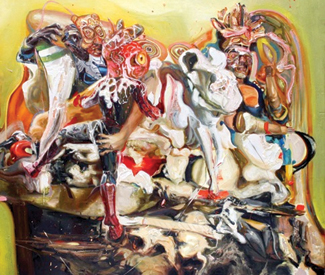
Somewhere in the Hamptons summer home where Glenn Brown and Lucian Freud are renting with Mark Tansey and Matthew Day Jackson, Hagler is stoned on the couch making fart noises with his armpits. That is also a compliment.

Claire Rojas, Gallery Paul Anglim

Sure Gallery Paul Anglim shows Barry McGee, but I’ll be looking at the Rojas paintings, whose hard edge and off-kilter abstractions of interior architectural spaces are spot-on and mesmerizing.

Diane Rosenblum, Slate Contemporary

Rosenblum switches up hyperanalytical and conceptual works that incorporate research, crowdsourced interactions, and photography. I’m hoping to see images from a series of recent photos that work Flickr comments into the image.

Dana Hart Stone, Brian Gross

I can’t wait to examine Hart Stone’s paintings up close, which in the past have been made by repeatedly transferring or printing antique images in rows onto canvas. Also at Brian Gross are Bay Area stalwarts Roy de Forest and Robert Arneson.

Esther Traugot, Chandra Cerrito

Traugot combines found organic objects with crochet. I know what you’re thinking, but this is not a Portlandia skit. She does it the right way, promise.

Googlass: Gatecrashing Google I/O

5

It would be foolish to turn down the offer of cost-free Billy Idol on a Wednesday night, but I could have remembered that I live in San Francisco and high profile rock ‘n’ roll will like as not, come served with a side of goober. 

This is to say, that I went to the Google I/O developer’s conference last night. The buffet’s waffle fries were not great and I heard the mini-chicken pot pies were worse, but I did get a chance to watch DJ Steve Aoki give shout-outs to “technooooology!”, allowing a techie or two who promised to get him a Google bus to clamber on stage and flop about next to his set-up.

Through a complicated and unexplained series of events, my date at Dave’s with a man who owns a VW van turned into a trip to the Moscone Center for what I would later learn was a $900 opportunity to hear about Big Goog’s new answer to Spotify in the yearly conference’s three-hour keynote speech.

Sadly, our posse got there too late to see Idol (Rolling Stone was on time.) But we managed to catch Aoki’s triumphant remixes of Kid Cudi and Kendrik Lamar, and the bitter end of the after-hours portion of the conference, which Google characterized thusly:

Google I/O After Hours will be a hyper-visual, heart pounding journey, providing hands-on interactive experiences and sophisticated recreation and featuring awe-inspiring technology and live musical performances like no other. We’ve teamed up with the best global visionaries to present to you their dynamic experiments, heightened realities, and magical experiences.

There was a mechanical hand that mimicked its user’s motions (these largely entailed “pointing a gun” at Steve Aoki and vaguely heil-like salutes as I watched), fake living room sets you could digitally manipulate from a touchscreen, light-up lilypads, photobooths, IPA on tap, and food offerings that would have made the house cook at any college fraternity mildly proud (three bean salad!) Many people were wearing Google Glasses. At a concert? 

I was not prepared for all the Burning Man in evidence (did that woman wear those chaps for the entire conference or was that special for Idol?), including this man yes, wearing Google Glasses. He also owns a glowing fur company. “It’s called Electro Fur,” he told me, handing me a card. “So, www.electrofur.com?” I asked politely. “You know it.” Check out his “Elegance” collection, and don’t forget a tail to top it all off. If anyone wants to buy me the $250 furkini top promising “a ridiculous amount of fun”, I’m with it.

www.electrofur.com

Party raft, set sail for white guys!

Introspection abounds, as instructed. What color Google Glasses would be best for me?

Also, peep SFist’s Andrew Dalton, who has a Vine of the Googlass

On the Cheap listings

0

Events compiled by Cortney Clift. For information on how to submit events for consideration, see Selector.

WEDNESDAY 15

Information Technology Talk World Affairs Council, 312 Sutter, SF. www.worldaffairs.org. 7-8pm, $15. Will the advancement of technology will solve all of humankind’s problems? One of today’s most respected cyber philosophers Evgeny Morozov doesn’t think so. Join him tonight as he discusses what might happen if we continue on our path that diverges from the natural imperfections of human life toward a digitally standardized age.

Oakland Walking Tour Paramount Theatre, 2025 Broadway, Oakl. www2.oaklandnet.com. 10am, free. RSVP at (510) 238-3234 or aallen@oaklandnet.com. Whether you’re an Oakland resident or looking to get better acquainted with the city, take to the streets and join this 90-minute walking tour of Uptown and Lake Merritt. Volunteers will guide you past sparkly Art Deco landmarks like the Fox and Paramount theaters and the Floral Depot. Finish up atop the Kaiser Center’s secret rooftop garden for a camera-worthy view of Lake Merritt. Because what better way to wrap up a walk than in a perfectly manicured rooftop garden?

THURSDAY 16

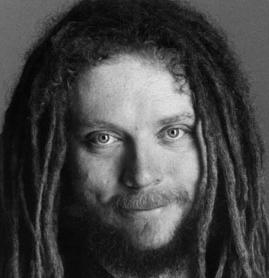
Jaron Lanier: "Who Owns the Future?" JCCSF Kanbar Hall, 3200 California, SF. www.jccsf.org/arts. 7pm, $10. Computer scientist, musician, and digital media pioneer Jaron Lanier will be at the Jewish Community Center to discuss his new book Who Owns the Future? Lanier will speak about the effects social media has on the economy and the paths we will take to move toward a new information economy.

FRIDAY 17

Fun Times with Friends Lost Weekend Video 1034 Valencia, SF. www.lostweekendvideo.com. 8pm, $10. So you’ve been to a stand-up show before. But have you been to a stand-up show with free cake? Fun Time with Friends (FTWF) aptly summarizes its event as something like "a comedy show crashing a party, or a party crashing a comedy show." As this is the premiere FTWF event, its hilarious founders will take to the stage. Some of which include: Ron Chapman, Aly Jones, Scott Simpson, and Brandon Stokes.

World Congress on Qigong and Tradition Chinese Medicine Hotel Whitcomb 1231 Market, SF. www.15thworldcongress.eventbrite.com. 9am-9:30pm, free. Register online. Think East this evening at a world-traveling event that aims to educate attendees on the benefits and practices of traditional Chinese medicine and Qigong– physical and breathing exercises related to tai chi. Acupuncturists, herbalists, martial artists, physicians, and clinical researchers will be hosting workshops throughout the day and opening festivities will kick off in the evening at 7pm.

SATURDAY 18

Little Paper Planes store opening 855 Valencia, SF. www.littlepaperplanes.com. 6-9pm, free. Be real, did you get Mom a present worth her love on Mother’s Day? Of course not, but today’s brick-and-mortar opening of this beloved website of goods made by small producers is the perfect opportunity to be a good child again. Little Paper Planes moves onto Valencia Street today, and DJs Jackie Im and Aaron Harbour will be dropping beats to which you can happily peruse the shop’s selection of well-made, quietly gorgeous clothes, housewares, and accessories. (Your momma thanks you in advance.)

Festival of the Silk Road Mexican Heritage Plaza Theatre, 1700 Alum Rock, San Jose. www.festivalsilkroad.com. 2-10pm, $10-45. The 7,000-mile Silk Road trade route extending through Iran, China, Turkey, India, Greece, and Egypt will be recreated today for a cross-cultural extravaganza. During the day take part in various dance and musical workshops, check out a costume exhibit, or snatch up some jewelry and art at the Silk Road Bazaar. In the evening sit back and enjoy performances by an array of ethnic dance groups.

Ferry Plaza Farmer’s Market Birthday Bash Ferry Plaza, Embarcadero at Market, SF. farmersmarketbirthdaybash.eventbrite.com. 9am-noon, free–$20. The best thing about birthday parties is often the food. We think it’s safe to say the food at this party is going to be hard to beat. Celebrate the 20th anniversary of the Ferry Plaza’s market and its contribution to the Bay Area’s farm to table movement. Ticket holders will enjoy a build-your-own shortcake station, a custom beverage and juice bar, and special party favors. Non-ticketed, free activities include a market-wide treasure hunt and presentation by local luminaries.

"The Whole Enchihuahua" Dolores Park, SF. www.sfspca.org. Noon-3pm, free. Be warned: your cuteness tolerance is going to be tested this afternoon. The third annual Whole Enchihuahua — a canine-filled afternoon organized to bring awareness to the high numbers of Chihuahuas in shelters — will consist of a doggie fashion show, adoptable animals, free dental checks for your pup, and food trucks (serving up people food, although we all know that your four-legged friend will get your scraps).

SUNDAY 19

Amgen Tour of California 2013 Marina Green, Marina and Fillmore, SF. www.amgentourofcalifornia.com. 8:15am-noon, free. Whether you are a cycle-to-work or cycle-across-the-country kind of biker, the Amgen Tour of California is sure to stir up some motivation within your little bike-loving skull. Competitors will be biking down from Santa Rose to cross the finish line of the 750-mile California coast race. Where’s the best place to watch? We advise snagging a spot on the Golden Gate Bridge, which will be closed to cars during the event.

TUESDAY 21

Feast of Words SOMArts Cultural Center 934 Brannan, SF. www.feastofwords.eventbrite.com. Doors open 6:30pm, $5 with potluck dish or $12 at the door. Scarf down some literature amongst friends and food at this monthly literary feast. Tonight’s special guest will be author of Birds of Paradise Lost Andrew Lam. Grab a plate of homemade goodies, take part in writing exercises led by Lam, and share your on-the-spot scribbles for a chance to be entered in a drawing for edibles, books, and other prizes.

Ultimate zero

3

rebecca@sfbg.com

In January, Mayor Ed Lee appeared on the PBS NewsHour to talk up the city’s Zero Waste program, an initiative to eliminate all landfilled garbage by 2020 by diverting 100 percent of the city’s municipal waste to recycling or compost. “We’re not going to be satisfied,” with the 80 percent waste diversion already achieved, Lee told program host Spencer Michels. “We want 100 percent zero waste. This is where we’re going.”

But somewhere in Te Anau, New Zealand, an environmental scholar tuning into an online broadcast of the program was having none of it. “I sat there thinking, no, you’re not. It would be great if you were, but you’re not — for obvious reasons,” said Robert Krausz, who’s working toward a PhD in environmental management, describing his reaction during a Skype call with the Bay Guardian.

Krausz, a Lincoln University scholar originally from Canada, spent three years studying municipal zero-waste initiatives internationally, and completed an in-depth, 40-page analysis of San Francisco’s Zero Waste program as part of his doctoral thesis.

He may as well have taken aim at a sacred cow. The city’s Zero Waste program has near-universal support among local elected officials, and has garnered no shortage of glowing media attention. San Francisco’s track record of diverting 80 percent of waste from the landfill is well ahead of the curve nationally, scoring 15 percent higher than Portland, Ore., a green hub of the Pacific Northwest, and 20 percentage points or higher above Seattle, according figures provided by Recology, San Francisco’s municipal waste hauler.

Despite the city’s well-earned green reputation, Krausz arrived at the pessimistic conclusion that “San Francisco’s zero waste to landfill by 2020 initiative is headed for failure.” In seven years’ time, he predicts, the program deadline will be marked with a day of reckoning rather than a celebratory gala. “I think the city is setting itself up,” Krausz told the Guardian. “Somebody’s going to be holding the bag in 2020.”


ANOTHER AFFLUENT CITY

Sporting a goatee and glasses, Krausz comes across as the type you might find locking up his bike outside a natural foods store with canvas bags at the ready. When he visited San Francisco, he said he was ready to be wowed by the example of an ecologically enlightened city, yet ultimately left in disappointment. “It was just another affluent American city, in terms of consumption.”

The problem, he argues, is that people are still buying way too much disposable stuff — and a significant amount can’t be recycled. Plastic bags, food wrapping, pantyhose, plastic film, pet waste, construction materials with resin in them (like the popular Trex decking), and particularly disposable diapers have nowhere to go but into the landfill.

San Francisco produces a total of about six kilograms of trash per person per day before diversion is factored in — three times the U.S. national average. That’s a sobering figure that puts a slight dent in the city’s eco-conscious image. It’s not really fair to denizens of the city by the Bay, because it counts trash generated by 20 million annual visitors, daytime employees, developers, and businesses as well as residents. Nevertheless, the trash output ranks well above the per capita average for the Eurozone, which clocks in at a minimalistic 0.5 kg per person per day.

The city has earned its bragging rights for making strides toward diverting waste from the landfill — yet truckloads of waste still leave the famously green city every day. Since 2003, Krausz notes, San Francisco’s overall waste generation has actually increased, from 1,900 to 2,200 kilograms per person per year. At the same time, the per capita amount of waste going into a landfill has dropped, from about 1,000 to 500 kilograms per year. That’s still a lot of garbage.

Krausz argues that San Francisco has no comprehensive plan for achieving Zero Waste, while at the same time having little control over “top of the pipe” consumption, which generates a glut of trash. “While the city has achieved success at managing waste at the end-of-pipe, it has thus far failed to address the fundamental problem of consumption, which is driving waste generation,” his study notes.

Guillermo Rodriguez and Jack Macy of San Francisco’s Department of the Environment counter that there is a strategy, involving a host of different measures ranging from education, to policy initiatives, to incentive programs aimed at reducing waste. They think zero waste is possible. “We’re probably at 99 percent diversion here in this office,” said Macy, who serves as the city’s Commercial Zero Waste Coordinator. “At least 90 percent of the discard stream is recyclable and compostable,” he added. And as for the last 10 percent, “that pie will be shrinking as we find more markets” for recyclables.

Krausz also raised skepticism about Recology’s bid for a landfill contract that would extend until 2025, five years beyond the deadline for all waste elimination. To that, Recology’s Eric Potashner responded that state law requires 15 years of disposal capacity to guarantee a safety net, regardless of municipal aspirations.

Krausz is critical of San Francisco officials for promising zero waste, but he acknowledges that manufacturers of disposable goods, not city officials, are to blame. Ambitious legislative measures such as San Francisco’s mandatory composting program and a ban on plastic bags have been enacted and achieved tangible results, but for items like ubiquitous thin-film plastics, dirty diapers, synthetic materials, and the like, good solutions have yet to be found.

Krausz’ study also determined that no city on the planet that’s set out to do so has ever actually succeeded at achieving zero waste. “If you are a city that is a member of Western civilization as we know it, you’re not going to be zero waste to landfill, because you participate in the global economy,” Krausz states plainly.


SF’S TRASH PIT

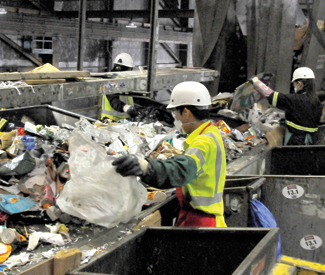
On a recent Friday morning, Recology’s Potashner and Paul Giusti led a tour of the city’s recycling and waste processing facilities. It featured a stop at the transfer station, housed in a large warehouse off of Tunnel Road where all the refuse from the black trash bins is deposited before being carted off to the Altamont Landfill. A sweet, pungent aroma hung in the air. “We call this the pit,” Giusti explained as we approached a sunken area that could have contained multiple Olympic-sized swimming pools, extending a story or two below us into the earth. “This is the last frontier,” Potashner added. “The last 20 percent.”

It was filled with an astonishing quantity of trash, making a tractor that ambled awkwardly over top the mound to compact it down appear toy-like in comparison. The sea of discarded material contained every hue, and floating around in the debris were orange juice containers, cardboard boxes, and thousands upon thousands of (banned) plastic bags. Between 200 and 300 garbage trucks eject their contents into the pit each day, and a single truck can hold up to four tons of trash.

Giusti started working for Recology, formerly NorCal Waste Systems, in 1978, following in the footsteps of his father. Back then, the pit was more like a mountain: “When I would dump my truck, I could walk up this pile,” he said, gesturing toward a set of sprinklers suspended from the ceiling to indicate how high it once extended. State data confirms the story: In 2011, according to CalReycle, San Francisco sent 446,685 tons of waste to the landfill. That number has steadily declined over time; in 2007, it stood at 628,914 tons.

Asked for his reaction to Krausz’s thesis that the Zero Waste program won’t ever actually get to zero, Guisti turned the question around by asking, what’s the harm in trying? “Let’s say you said, zero waste is unattainable,” he said. “Then what’s the number? I think zero waste is an ambitious goal — but if we get to 90 or 95 percent, what a tremendous achievement.” Setting the highest of bars is important, he said, because striving for it provides the motivation to keep diverting waste from the landfill.

In order to actually reduce the city’s garbage from 446,685 tons to zero in the next seven years, Zero Waste program partners Recology and San Francisco’s Department of the Environment face a twofold challenge. First, they must prevent compostable and recyclable material from getting into the landfill pile. Second, they must find solutions for diverting the waste that currently has nowhere else to go but the landfill. With a combination of seeking new markets for recyclables, using technology that can sort out the recyclable and compostable matter, and implementing incentives and educational outreach programs, they’re still focused on the goal. “It’s hard to tell how close we’ll get to zero in 2020,” Macy said. So even if zero waste does not actually mean zero waste in the end, that goal “sends a message that we want to move toward being as sustainable as we can.”

Editor’s notes

2

tredmond@sfbg.com

EDITORS NOTES Jaron Lanier is not a Luddite. He’s one of the most brilliant technologists in the world, the virtual inventor of virtual reality and one of the first people calling for information (and music) to be free. He was a tech giant when most of today’s tech titans were in their disposable diapers. So when he starts talking about how the Internet is destroying the middle class, everybody ought to listen.

And that’s exactly what he saying in his new book, Who Owns the Future?

Lanier is 53; he’s been around long enough to see some of the best promises our modern industrial era turn out to be failures or lies. He’s got a little perspective on things — and he’s not happy with what he’s seeing.

We all know American capitalism is a force for disruption and destruction as well as creativity and creation. We all know that industries are born and die. The automobile replaced the horse and buggy. And in a lot of today’s conventional thinking, the tech revolution is just another step in the same direction.

Lanier has another perspective. The current light-speed, youth-driven tech economy has undermined the social contract that has been part of the United States political and economic systems since the Great Depression: People ought to have the right to job security, a decent wage, and the chance to have a family and grow old.

In an interview with Salon, Lanier notes:

“We don’t realize that our society and our democracy ultimately rest on the stability of middle-class jobs. When I talk to libertarians and socialists, they have this weird belief that everybody’s this abstract robot that won’t ever get sick or have kids or get old. It’s like everybody’s this eternal freelancer who can afford downtime and can self-fund until they find their magic moment or something.

“The way society actually works is there’s some mechanism of basic stability so that the majority of people can outspend the elite so we can have a democracy. That’s the thing we’re destroying, and that’s really the thing I’m hoping to preserve. So we can look at musicians and artists and journalists as the canaries in the coal mine, and is this the precedent that we want to follow for our doctors and lawyers and nurses and everybody else? Because technology will get to everybody eventually.”

Hey Googlers and Twitterati and Facebookians: You should listen, sometimes, to your elders.

Brown raids cap-and-trade funds, delaying action on climate change

5

Greenhouse gas concentrations in the atmosphere continue to rise to dangerous levels, but still our political leaders delay taking meaningful actions to address the looming crisis. The latest example: Gov. Jerry Brown is borrowing $500 million from the state’s new cap-and-trade program — money designated specifically for efforts to address climate change — to help balance the revised state budget proposal that he released today.

And the worst part was that Brown is raiding these funds even though there was no good reason to do so. “The Governor’s Budget reflected California’s most stable fiscal footing in well over a decade,” was the first sentence in the budget document, which admirably begins to restore education funding, partly because voters approved the Prop. 30 tax package last year.

While Brown said that the $500 million raid is just a loan that will be paid back with interest, the action highlights the short-term thinking that animates our political and business leaders, who seem content with hollow gestures and symbolic actions that fall far short of what’s actually needed to minimize climate change and sea level rise (even the cap-and-trade system itself is a business-friendly half-measure; simply capping then decreasing emmissions would have been far more effective).

There are a multitude of immediate needs for that “borrowed” money that would have big impacts to the carbon emmissions that our state continues to spew into the atmosphere, such as helping Muni and other urban transit systems overcome budget deficits that hamper their ability to provide good alternatives to private automobile use, which is one of the top sources of greenhouse gas emmissions.  

Environmentalists and advocates for social and economic justice — who have fought to direct some of these funds to reducing emmissions in low-income communities, where it is an acute public health issue on top of the long-term climate change threat — immediately criticized the governor’s move.

“The governor is playing a dangerous game that could wreck California’s push toward clean energy,” Greenlining Institute Legal Counsel Ryan Young said in a press release. “Voters of color turned out in force to protect AB 32, the clean energy law, when it was under attack by Prop. 23 [last year’s effort to repeal it], and they did it based on the promise that it would bring clean energy investments to polluted and struggling communities. These are the same voters who provided Jerry Brown’s victory margin when he ran for governor. Seizing these funds for other uses will hurt our state’s neediest communities, and it’s simply not necessary.”

Longtime Sierra Club legislative director Bill Magavern, who works with the Coalition for Clean Air, told Capital Weekly that the money is urgently needed for a variety of programs to reduce pollution in communities of color: “These important goals are now shunted aside as broken promises. The Governor has spoken of the urgency of addressing our climate crisis, but he has not put his money where his mouth is. It’s important to remember that none of the dollars in the Greenhouse Gas Reduction Fund come from taxes, and they were never intended to go to the General Fund.”

Another gauge is also telling: how do the polluters feel about the governor’s new budget? Well, here’s another press release we got on the governor’s new budget, from a conservative business organization that has long opposed meaningful efforts to address climate change: “California Manufacturers & Technology Association president Jack Stewart made the following media statement after Gov. Jerry Brown’s proposed ‘May Revise’ budget: ‘We congratulate Gov. Jerry Brown on a proposed balanced budget that will help California provide important government services. We appreciate that the Governor proposes the addition of a statewide sales tax exemption on the purchase of manufacturing equipment.  This will make California a more competitive place to scale up production.”

Same as it ever was.

Fair play

4

arts@sfbg.com

VISUAL ART It’s art fair time again. Last year there were three, this year there are only two, though it looks like artMRKT, which is taking over now defunct SF Fine Art Fair’s slot at Fort Mason, has pretty much absorbed the former’s area galleries. ArtPadSF, the more festive of the two fairs, will again be renting out all the rooms at the Tenderloin’s Phoenix hotel. (Both fairs run Thu/16-Sun/19). I can’t help but wonder, will there be synchronized swimming again in the pool this year?

>>View a slideshow of our fair picks here

Say what you will about whether or not art fairs are a reasonable way to actually engage artworks in a serious way (read: they’re not), they do offer exposure to people that are worth knowing more about. With that in mind, here’s our locals only guide to Bay area artists — some emerging, some established — whose work you can catch at the fairs.


ARTPADSF

Andrew Benson, Johansson Projects

Benson’s sometimes gooey, sometimes crunkly digital video/experimental software work breathes some ragged, frenetic energy into the standard trope of “relationships between the body and technology.” His piece is scheduled to be projected from the Phoenix onto the six-story building next door at 8pm, Thu/16-Sat/18.

Justine Frischmann, Unspeakable Projects

Frischmann’s paintings look like something that one of those spiders on Benzedrine would make. If it lived inside an Etch A Sketch. And used neon spray paint. During a dust storm. Trust me, these are compliments.

David Hevel, Marx & Zavattero

Hevel makes collaged sculptures and sharp pop abstract paintings, usually riffing on American celebrity. His work at the fair will be very MTV 1983.

Scott Hove, Spoke Art

Will Oaklander Hove be showing one of his intensely drugged up fanged wall cakes, a knotted rope work installation, or a surrealism-on-meth painting? Yeah, it all sounds good to me, too.

Jason Kalogiros, Queen’s Nails Gallery

Kalogiros makes edgy, dense, cerebral, photo-based works, lately by manipulating found commercial images. I’m hoping to see a couple from his series of Cartier and Bvlgari watches.

Ed Loftus, Gregory Lind Gallery

Loftus does photorealism pretty much the right way, by marrying intense attention to detail with an obsessive and neurotic subject matter that crawls under your skin ever deeper the more time you spend with it. While you’re in Gregory Lind’s space, also check out Thomas Campbell and Jovi Schnell.

Matt Momchilov, Unspeakable Projects

Momchilov queers punk and rock fandom in the traditional sense of the word, meaning his paintings and sculpture snatch and redirect standard accoutrements of punk fanboys and girls to point that hardcore laser focus in new directions and at more fey subjects.

Gregg Renfrow, Toomey-Tourell

I won’t blame you one bit if you try to lick Renfrow’s luminous, vibrating color field abstractions. His meticulous, precise, wondrous paintings are like visual everlasting gobstoppers, and I fully expect that by the time I see ’em, they’ll have a layer of saliva all over.

Jonathan Runcio, Queen’s Nails Gallery

Runcio makes incisive 2 and 3D work that takes traditional hardedge abstraction in the art concrete vein, shacks it up with remnants of urban architecture, and has a post-formalist lovechild.

www.artpadsf.com


ARTMRKT

Johnna Arnold, Traywick Contemporary

The fair’s Collector’s Lounge will be showing Arnold’s video created to accompany the richly saturated, haunting landscape photos that will be showing offsite at the gallery.

Carol Inez Charney, Slate Contemporary

Charney’s complex photographs were the single most outstanding thing I saw last year at ArtPad. That’s complex like a personality, not like your taxes. A year later, I’m prepared for the brainfreeze again.

Amanda Curreri, Romer Young

Curreri’s precisely conceived conceptual color and abstract works are subtle in that they tend to yield only small nibbles at first pass, but they’re deceptive that way, and usually end up smacking you around by the time it’s all over.

Lauren DiCioccio, Jack Fischer Gallery

DiCioccio has recently been applying her super-meticulous needlework to fastidiously x-ing out individual letters in pages of books, as an act of both scrutiny and physical redaction of the received, mediated world.

Joshua Hagler, Jack Fischer Gallery

Somewhere in the Hamptons summer home where Glenn Brown and Lucian Freud are renting with Mark Tansey and Matthew Day Jackson, Hagler is stoned on the couch making fart noises with his armpits. That is also a compliment.

Claire Rojas, Gallery Paul Anglim

Sure Gallery Paul Anglim shows Barry McGee, but I’ll be looking at the Rojas paintings, whose hard edge and off-kilter abstractions of interior architectural spaces are spot-on and mesmerizing.

Diane Rosenblum, Slate Contemporary

Rosenblum switches up hyperanalytical and conceptual works that incorporate research, crowdsourced interactions, and photography. I’m hoping to see images from a series of recent photos that work Flickr comments into the image.

Dana Hart Stone, Brian Gross

I can’t wait to examine Hart Stone’s paintings up close, which in the past have been made by repeatedly transferring or printing antique images in rows onto canvas. Also at Brian Gross are Bay Area stalwarts Roy de Forest and Robert Arneson.

Esther Traugot, Chandra Cerrito

Traugot combines found organic objects with crochet. I know what you’re thinking, but this is not a Portlandia skit. She does it the right way, promise.

www.art-mrkt.com/sf

Tech guru says Internet destroying middle class

28

Jaron Lanier isn’t a Luddite. He can’t be dismissed as a crackpot, whiner critic who is jealous of the success of others. He virtually invented virtual reality; he was a tech guru when most of today’s tech titans were still in diapers. So when he says that the Internet is destroying the middle class, maybe everyone ought to stop for a second and listen.

Okay, as I’ve said before: The Internet didn’t destroy San Francisco. Technology is a tool; it can be used in good ways and bad ways, and its impacts on society, particularly on the poor, can be mitigated by government action (or greatly worsened by inaction).

But Lanier is concerned that the business boom that has been created by high tech has made social inequality worse and is wiping out the middle class that is so essential to a stable country. He talks about how Kodak had 140,000 workers, many of them middle class, and Instagram has 13:

You have this intense concentration of the formal benefits, and that winner-take-all feeling is not just for the people who are on the computers but also from the people who are using them. So there’s this tiny token number of people who will get by from using YouTube or Kickstarter, and everybody else lives on hope. There’s not a middle-class hump. It’s an all-or-nothing society.

More important, the youth-driven culture of the current economic boom ignores that fact that some people are old, and have families, and get sick and disabled, and need a kind of stability that our current march of “disruptive” capitalism is destroying:

We don’t realize that our society and our democracy ultimately rest on the stability of middle-class jobs. When I talk to libertarians and socialists, they have this weird belief that everybody’s this abstract robot that won’t ever get sick or have kids or get old. It’s like everybody’s this eternal freelancer who can afford downtime and can self-fund until they find their magic moment or something.

And Lanier IS a guy who can afford downtime and self-fund. But he’s also 53, and has a little more perspective on life. He recognizes that the middle class has always had, and needs, some sort of public-sector support, whether it’s through tax policy or education or job creation, particularly in unstable economic times. It’s fine for capitalism to be disruptive — as long as there’s a safety net to make sure that all the people disrupted out of their livelihoods aren’t disrupted out of their homes.

Young people, Googlers, Facebookians, Twitterati: Maybe you should listen to your elders.

Hey, you! “Tech people” are not the douchebags you think we are

I hear a lot of talk, especially from my own queer community, about how “tech people” are ruining San Francisco. From skyrocketing rent prices and disappearing diversity to economic and cultural ruination, the tech community has become the scapegoat for a lot of the problems we are facing in the city as a whole. As a tech worker, I’m writing this to say: wake up and direct your anger at the real sources of these problems.

First of all, let’s get one thing straight. The vast majority of “tech people” in San Francisco don’t make nearly as much money as you think they do. We are not making six-figure salaries, we are not personally driving up rent costs, and we are not killing the cultural community here. Simply put, we are trying to further our careers and make the city we call home a nicer place to live. 

From day one of living in San Francisco, I’ve put blood sweat and tears into building the cultural community in SF (music, mostly), and I’ll never stop doing that. I first moved here with my husband in 2006 from Indiana. We fell deeply in love with the city while visiting several times early on in our relationship, and knew this was where we wanted to call home. Of course queer acceptance came into play, but I loved the fact that the city had a life of its own, an entity with which I felt a kinship. I immediately immersed myself in the music scene here, forming a touring band and quickly becoming a booker and promoter for live shows. It wasn’t until several years into my time here that I snuck my way into the tech industry. Thankfully all those hours spent in my parent’s basement as a child on the computer helped! Here I am, five years into my tenure at Bay Area music tech startup Thrillcall, hustling every day to help build music communities not only in SF, but across the country.

I bust my ass doing this for modest pay just to get ahead and know I’m working in a field (music) that I love. I know many others like myself who have day jobs in the tech community that do the same.

However, accusations that I’ve been hearing lately would have you believe otherwise. Claims that “people like us” are ruining San Francisco by gentrifying everything and pushing out what San Francisco truly is. Protip: the Bay Area has, for quite some time now, been a hub for technology. This is not a new thing. Stop acting like it is. Directing anger towards us for what you consider woes to the community at large here is way off base. Bubbles have happened constantly since the early 1990s (or hey, 1840s), and anyone who has lived here for long can tell you this is true. 

The tipping point for me, to be honest, was the nonsense of people beating up a “Google Bus” piñata in the Mission, shouting epithets about how they’re the bane of San Francisco. The people that ride those buses are not to blame. They are not heading up that company, they don’t make millions of dollars, and they certainly don’t deserve the hatred being directed at them by many people here in San Francisco.

They’re utilizing a method of mass transportation (cutting down on carbon footprint) provided by their employer. If you want to be angry about something, be angry at the company, not the people who work for it. If you want to actually do something about it (beating a piñata in a public place solves nothing), then take your grievances to the heads of the companies you think are responsible for the predicament that San Francisco currently finds herself in.

You know what is ruining San Francisco? Complacency. Apathy. Misguided hate. Inaction. Put some energy into making change, not senseless whining.

If you’re upset about rising rent costs, be angry at the money-hungry landlords that do absolutely nothing to put money back into the city or help build culture. Want SF prices to stop skyrocketing? Let’s organize and drive proposals with our city government. Upset about the recent sanitization of many of the lovely traditions and values of San Francisco? Get mad at a-holes like Scott Weiner, who is actually supported by a lot of longtime, non-tech residents. Want more culture, arts, music? Maybe try reaching out to people that can help in the tech world instead of complaining about everything going downhill. 

A vast majority of the tech workers here in SF are upwardly mobile, culturally involved people. We are not ruining this city. We live here for much more than just the jobs we have. We love it, and it’s where we call home. We have as much control over the cost of living here as everybody else. And we are not the companies we work for, however large or small. Corporations, for the most part, suck. We all know that. Demonizing the people that work for them (while contributing to this wonderful city) is baseless, classless, and makes you look like a total dick.

We’re not the douchebags you think we are. Let’s put our energy toward doing good, instead of just pointing fingers. A great deal can be accomplished if people took an active role toward coexisting, rather than shouting “ENEMY!” to anyone who will listen. 


Aiming for the top of the food chain

The issue of labeling for genetically engineered foods gained fresh momentum last week, when Sen. Barbara Boxer announced she’d be pushing for the U.S. Food and Drug Administration to require this consumer notification on a national level.

It’s sure to be an uphill battle for the organic food movement, which suffered a loss on this issue at the California ballot last year, but a new book calling for a mass restructuring of the nation’s food system might help provide ammunition for proponents of GE food labeling.

Wenonah Hauter’s Foodoply: The Battle over the Future of Food and Farming in America traces decades of little-known history documenting small farmers’ resistance to agricultural consolidation, followed by national and international policy agreements that gave rise to the commercialized agribusiness model that dominates America’s food system today. Hauter, executive director of Food and Water Watch, grew up on a farm.

“It gave me life experience about how difficult farm work is, and how hard farmers have to work, and how under-valued they are in our society,” the author said of that experience in a recent interview with the Bay Guardian. “One of the reasons I wrote Foodopoly was to get at this issue … It’s easy to demonize farmers rather than the systemic causes of the traditional food system.”

Her book is nothing short of a call to arms to take back corporate control of a food system that short-changes small farmers and leaves consumers with limited, unhealthy options.

“If we want to change our food system, we have to reclaim our democracy,” she says. “So many people just think we’re going to create an alternative system, without really doing the political work to address fundamental issues, like the consolidation that allows some companies to have so much power over our political system.” It won’t be achieved with certified sustainable agriculture programs or farmers markets alone, she says – but rather through confronting agribusiness’ influence in the halls of government.

Her meticulously researched work names names, providing detailed lists of the industry’s most influential processers, grocers, and junk-food manufacturers along with the ubiquitous brands they produce. It also sheds light on the ills of factory farming and genetically engineered foods.

“The top 20 processing companies and the grocery industry have benefited from figuring out that fat, sugar and salt actually addicts people to junk food, and is making people sick and overweight,” Hauter told us. “Children see just under 5,000 junk food ads a year. We know that children begin to identify with brands at about the age of two. Lots of junk food is placed at eye level for young children, because they pull on their parents’ shirttails, whining for the junk food.”

While organics may pose a healthier alternative, meanwhile, Hauter’s chapter on the “paradox” of attractively packaged, premium-priced organic food is rather disheartening. “Fourteen of the 20 largest food processing companies actually control many of the organic brands, and organics today are viewed as a rich market, where people can be charged,” Hauter notes, going straight to the heart of the matter. “It’s a lot different from the vision I think many people had in the early 1970s, when the organics movement began.”

Foodopoly also devotes considerable attention to the political influence of the biotech sector. “I think that the biotech industry has a lot of political power,” she told the Guardian, and then revealed that assertion to be a profound understatement: “Over a 10-year period, they spent $572 million on lobbying and campaign contributions, they hired 13 former members of Congress during this period, they hired 300 former staff from the White House … and they have about 100 lobby shops in Washington. … With Prop 37, [of the] the approximately $45 million put towards ads, about $8 million was Monsanto’s.”

This kind of influence doesn’t just carry troubling implications for the democratic process, but makes it less likely that looming questions around the long-term health effects of genetically engineered foods will ever be sufficiently answered.

“With all the new technology coming on – nanotechnology, cloning, genetic engineering – we really need to take a look again at our regulatory system,” Hauter insists. “There’s a lot of new evidence coming out on the problems with these new technologies. There was a review of hundreds of scientific studies around glyphosate, which is a major ingredient in Monsanto’s Roundup herbicide. It shows that there are cellular effects within the human body, and that these could very well be working together with other variables to trigger health problems. We’re talking about everything from gastrointestinal problems, to diabetes, autism, obesity, Alzheimer’s, and a number of different problems.”

Despite these disturbing findings, there’s been a distinct lack of long-term study or precautionary restraints imposed by lawmakers, Hauter says.

“There are a lot of other reasons that we should be concerned about genetic engineering, from the cost and control of foods, to the overuse of this dangerous herbicide, glyphosate, and the fact that it’s creating super weeds,” she says. Further complicating matters, “New pesticides are being developed to address the problems that these co-branded herbicides have caused. That’s the problem with our society,” Hauter adds. “We never look at the unintended consequences.”

Will SF’s new broadband infrastructure be controlled by the city or Google?

28

Board President David Chiu is calling for San Francisco to add to its broadband fiber network every time a contractor or utility tears up a street, joining other cities in expanding high-speed Internet capacity. But will this new network be a municipal utility or corporate-controlled? An upcoming hearing he has called for could begin to answer that question.

“In the 21st century, cities need access to affordable, high-quality broadband to compete economically, just as access to water, electricity, roads or railways was critical in the 20th century,” Chiu said in a public statement. “We see other cities like Austin, Kansas City and Santa Clara making enormous strides.  My proposal will ensure that San Francisco does better in this area.”

But Austin and Kansas City have opted to take the easy path and let Google install and control the system, which raises a variety of questions and problems that are highlighted “Kansas City Gives it up for Google,” in the current issue of Harper’s Magazine, which looked at how KC is letting corporate interests trump the public interest.

“According to its contract, Kansas City must give Google access to its underground conduits, fiber, poles, rack space, nodes, buildings, facilities, and available land. It cannot charge the company for ‘access to or use of any city facilities . . . nor will it impose any permit and inspection fees.’ And what does the city get in return? It has no say in the pricing of Google’s services, nor can it ensure that Google will deliver fiber-optic service to all of the city’s residents. Google’s offices, meeting spaces, and showroom are provided free of charge, and the city pays the company’s electric bill. The mayor, moreover, is barred from commenting on Google’s activities without the express permission of Google,” the magazine writes.

Chiu is building his proposal from a report that then-Sup. Tom Ammiano commissioned years ago, calling for the city to build a network of fiber as it opens up the streets. Now, Chiu is trying to implement that idea with legislation and an upcoming hearing on the issue, but right now he’s agnostic on whether that network is owned by San Francisco or a corporation that it might contract with.

“My legislation doesn’t dictate who lays the fiber, it just ensures that it happens,” Chiu told the Guardian, although he did add that he’s “more intrigued that it could be the public sector.”   

The Harpers article discusses how public utilities have succeeded in delivering reliable, cost-effective services to millions of Americans since the 1930s when FDR began to use government to deliver electricity to rural areas that lacked it, drawing parallels to the 100 million Americans now who lack access to high-speed Internet service. But the federal government seems to be encouraging corporations to do the work this time, and they’re more than happy to oblige.

“Why does Google feel so at home in Kansas City—rather than in, say, California, where the company is based? Why not build their first citywide fiber-optic network in a nearby community? According to Google vice president Milo Medin, the company has preferred to steer clear of such pesky statutes as the California Environmental Quality Act. ‘Many fine California city proposals . . . were ultimately passed over in part because of the regulatory complexity here,’ Medin told a congressional committee in 2011. ‘In fact, part of the reason we selected Kansas City for the Google Fiber project was [that] the city’s leadership and utility moved with efficiency and creativity in working with us to craft a real partnership,’” the article says.

Yet with Google in charge, the company is only guaranteeing access to neighborhoods where a minimum number of residents pre-register and pay for premium service, redlining out many African-American neighborhoods and forcing community members to go door-to-door essentially selling Google’s services.

And in the end, the corporation will make gains even if it loses money on the project, as the article concludes: “So why would an Internet-search company want to spend a fortune to install fiber-optic cable in Kansas City, Missouri, and neighboring Kansas City, Kansas? Freedom from regulatory headaches is one part of the equation: if such networks are the wave of the future, the time to jump in is now, before legislative oversight can ruin the party. But another explanation might be the treasure trove of user-behavior information that such a network represents. Data of this kind is so prized that a company like Google can afford to give away other services for free, as long as this beneficence opens up new markets. In Kansas City, low-income subscribers to the company’s slower, ‘free’ Internet option will be giving Google details about each URL they visit, even if their accounts remain anonymous. And customers who plunk down $120 a month for the ‘Full Google Experience’ will have their television-viewing habits individually tracked by Google’s data-mining elves. Is this a reasonable bargain? For Kansas City, it’s too late to ask. But history—and the success of municipally owned fiber-optic projects throughout the country—strongly suggest that we should look this gift horse in the mouth.”

Food for thought as San Francisco contemplates whether it wants to build public infrastructure or simply facilitate more corporate infrastructure.

On the Cheap listings

0

For information on how to submit events for listing consideration, see the guidelines in Selector.

THURSDAY 9

Bike to work day Various SF locations. www.sfbike.org. 5:30am-7pm, free. Trade in a cramped morning Muni commute for an open-air bike ride today in honor of bike to work day. The SF Bicycle Coalition knows biking the hills of SF is not always an easy task, which is why it has set up 26 "energizer stations" all around the city to serve free snacks, beverages, and reusable, goodie-filled tote bags to use on your to-and-froms. Check the Coalition’s site to find a station along your regular route.

Thirsty Thursday Toga Party Atmosphere, 447 Broadway, SF. www.a3atmosphere.com. 9:30pm, free. RSVP required. Revive your Animal House-esque days with a toga party. Travelers, locals, au pairs, and international students will be decked out in the finest bed sheets around. Show up before 10pm and score a free bingo card with a $3 shot offered every time you check off a square.

Britweek Design Series San Francisco Design Center, 2 Henry Adams, SF. www.babcsf.org. 4:30-10pm, $20-25 advance. The British-American Business Council hosts this design-driven evening. The event will kick off with a panel of British and American architects and interior designers, followed by a second international panel of innovators working in product design and technology, finishing up with an after party at Project One Gallery, just down the street from the design center.

FRIDAY 10

Spirit: A Century of Queer Asian Activism Mission Cultural Center, 2868 Mission, SF. www.queerrebels.com. 8pm, $12-20. Queer Rebels’ organization for queer artists of color brings movers and shakers of the community together to celebrate 100 years of queer Asian activism. The two-day event begins tonight with performances by Eli-Coppola award winning poet Ryka Aoki, performance artist Genevieve Erin O’Brien, and more. The festivities will continue tomorrow night with a panel discussion and film screenings.

SATURDAY 11

Pet Week kick-off Little Marina Green, Marina and Baker, SF. www.marinatimes.com. 11am-3pm, free. Soak up some sun and get your puppy fix today at Pet Week’s kick-off event. Bring your favorite four-legged friend for free microchipping, watch police K-9s show off their detective skills, pick up some free goodies for Fido, and maybe even adopt a new friend. Pet adoption will be available from eight organizations including Pets Unlimited, Muttville, and Rocket Dog Rescue.

Bluegrass Pickin’ Picnic Dahlia Picnic Area, Golden Gate Park, SF. www.countryroundupsf.com. Noon-6pm, free. If you’re a fan of Golden Gate Park and bluegrass but the giant mobs of the Hardly Strictly festival bruise your gentle nerves, here is your second chance. Sponsored by the California Bluegrass Association, this afternoon is an open jam session for all who play or just like listening to bluegrass. Set up your picnic blanket early and score some free hamburgers and hot dogs while supplies last.

SUNDAY 12

Wanderlust Festival Marina Green. sf.wanderlustfestival.com. 12-5pm, free. Register online. If the daily grind of city life is taking its toll, head over to the Marina for a stress-relieving day of yoga and music. The day will begin with yoga sessions led by Pradeep Teotia and Susan Hauser, Lululemon 2012 ambassador. The evening will conclude with musical performances by DJ Drez and the fittingly named MC Yogi.

TUESDAY 14

Cakespy book signing Book Passage, 1 Ferry Building, SF. www.bookpassage.com. 6pm, free. Ever been stuffing your face with a red velvet cupcake or Girl Scout cookie and wondered where the recipe originated? Self proclaimed "dessert detective" Jessie Oleson Moore has these answers and more in her new book The Secret Lives of Baked Goods: Sweet Stories & Recipes from America’s Favorite Desserts. Head over to the Ferry Building to meet Moore and get a signed copy of this sweet literary treat.

"Ask a Scientist: Origins of the Universe" SoMa StrEat Food Park, 428 11th St., SF. www.askascientistsf.com. In this lecture hosted by UC Berkeley Professor Eliot Quataert science fanatics will learn how the universe evolved from its smooth beginnings to its current state. Quataert will focus on how gravity reigns supreme and builds up the planets, stars, and galaxies required for biological evolution. If digesting all this scientific chatter works up an appetite, fuel up at one of the ten gourmet food trucks at SoMa StrEat Food Park.

Secret San Francisco: Adventures in History Balboa Theatre, 3630 Balboa, SF. www.cinemasf.com/balboa. 6:30pm, $10. The history of the downtown neighborhoods of San Francisco are well photographed and documented, but head further west and things tend to get a bit foggy. That’s where the Western Neighborhood Projects comes in. The nonprofit has been documenting all things west of Stanyan Street since 1999. Head to the Balboa Theatre tonight for a dose of SF history — west and east — short films, archival TV footage, and other historic surprises.

Bay to Breakers will have video surveillance, license plate scans, and secret “FBI assets”

19

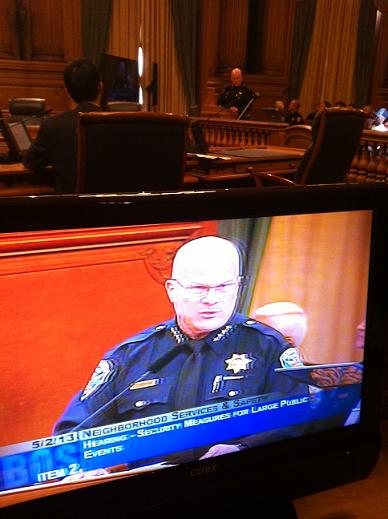
Police video surveillance was in the spotlight during yesterday’s City Hall hearing on security measures at large events, as supervisors voiced a desire to strike the right balance between security and civil liberties. And while they got some reassurance and small signs of restraint from the SFPD, they also learned about secretive new security measures that go beyond what the public was aware of.

San Francisco Police Chief Greg Suhr clarified misleading media reports (a Chronicle story then picked up by Associated Press) that he’s seeking real time video surveillance along Market Street. Right now, Suhr said he just wants an inventory of existing video cameras along Market and downtown that he can request footage from after a crime is committed and that he would make his case to the board if he ever wanted to go beyond that.

“Right now, we only look at footage in retrospect,” Suhr told the Neighborhood Services and Safety Committee hearing, adding that he has no objections to seeking a court warrant to obtain that footage because “we do want it to be admissible.”

Yet Suhr and Deputy Chief James Loftus also revealed that SFPD will be deploying an undisclosed number of temporary real-time video surveillance cameras atop long poles at the Bay to Breakers footrace on May 19, as it did last fall during the World Series and the big parade down Market Street celebrating the Giants victory.

“We always want more video,” Suhr told the Guardian, although he said that he also understands the civil liberties sensitivities of San Franciscans, which is why he isn’t now seeking a permanent increase in SFPD’s real time video surveillance capabilities. “I’m from San Francisco, I get it.”

Other security tools that the SFPD will be employing at Bay to Breakers and other large events are technology that uses video cameras on police cars to capture license plate numbers and run them through a DMV database, what Loftus vaguely described as “specialized resources from surrounding jurisdictions” (watch out for the drones, y’all), and unspecified “FBI assets [that] will be present and assisting in event security.”

When Sup. Eric Mar, who called the hearing, asked about those last two items, Loftus said he wouldn’t discuss them publicly, but “I could talk to you about it offline if you’d like.”

Sup. David Campos said that he doesn’t want San Francisco to be reactionary after incidents like the Boston Marathon bombing and that we should be a model city for balancing security with civil liberties: “I think that’s a very difficult balance to strike, but it anyone can strike that balance, I think San Francisco can.” He also expressed concerns about plans to ban backpacks at Bay to Breakers: “I don’t know if that’s going to address the problem.”

Loftus said the ban only applied to large backpacks (larger than 8.5x11x14 inches) and that runners and spectators will still be allowed to use small backpacks to hold water and changes of clothing. Yet for those concerned about the creeping police state, including several people who spoke during the public comment period, there was little consolation offered in the presentations, and the supervisors said this would be an important ongoing discussion.

“This is a discussion that goes beyond San Francisco,” Campos said. “We as a country need to have this discussion.”

Maker Faire tickets on sale now

0

Maker Faire Bay Area 2013 is a two-day showcase of creativity and cool technology that celebrates the maker mindset.  It’s inspiring, stimulating, and fun for all ages.

Come see first-time makers and favorites returning with something new. Learn to solder, craft, create fun or practical items with a 3D printer, or interact with Robots. You’ll be amazed by the ingenuity and creativity of the maker projects that abound and the fun you will have! Maker Faire is a weekend filled with an incredible variety of attractions, exhibits, talks, demonstrations and performances bridging science, technology, arts and crafts — most of them hands-on and all of them engaging. Maker Faire is a reflection of our community at its very best.  www.makerfaire.com

Short takes: SFIFF week two

0

Prince Avalanche (David Gordon Green, US, 2012) It has been somewhat hard to connect the dots between David Gordon Green the abstract-narrative indie poet (2000’s George Washington, 2003’s All the Real Girls) and DGG the mainstream Hollywood comedy director (2008’s Pineapple Express, yay; 2011’s Your Highness and The Sitter, nay nay nay). But here he brings those seemingly irreconcilable personas together, and they make very sweet music indeed. Paul Rudd and Emile Hirsch play two men — one a fussy, married grown-up, another a short-attention-spanned man child — spending the summer in near-total isolation, painting yellow divider lines on recently fire-damaged Texas roads. Their very different personalities clash, and at first the tone seems more conventionally broad than that of the 2011 Icelandic minimalist-comedy (Either Way) this revamp is derived from. But Green has a great deal up his sleeve — gorgeous wide screen imagery, some inspired wordless montages, and a well-earned eventual warmth — that makes the very rare US remake that improves upon its European predecessor. Wed/1, 4pm, and Fri/3, 6:30pm, Kabuki. (Dennis Harvey)

Fill the Void (Rama Burshtein, Israel, 2012) Respectfully rendered and beautifully shot in warm hues, Fill the Void admirably fills the absence on many screens of stories from what might be considered a closed world: the Orthodox Hasidic community in Israel, where a complex web of family ties, duty, and obligation entangles pretty, accordion-playing Shira (Hada Yaron). An obedient daughter, she’s about to agree to an arranged marriage to a young suitor when her much-loved sister (Renana Raz) dies in childbirth. When Shira’s mother (Irit Sheleg) learns the widower Yochay (Yiftach Klein) might marry a woman abroad and take her only grandchild far away, she starts to make noises about fixing Shira up with her son-in-law. The journey the two must take, in possibly going from in-laws to newlyweds, is one that’s simultaneously infuriating, understandable, and touching, made all the more intimate given director Rama Burshtein’s preference for searching close-ups. Her affinity for the Orthodox world is obvious with each loving shot, ultimately infusing her debut feature with a beating heart of humanity. Wed/1, 6:30pm, and Thu/2, 4pm, Kabuki. (Kimberly Chun)

The Strange Little Cat (Ramon Zürcher, Germany, 2013) There’s a strange music to this light-on-its-toes, rhythmic, and ultimately mesmerizing chamber piece by first-time feature director Ramon Zürcher — one seemingly informed by dance, Gerhard Richter, contemporary opera, and Jean-Luc Godard in a latter-day gimlet-eyed state. The arc of a banal yet odd day is traced, within mostly the close confines of a Berlin apartment, as family members enter, interact, and then retreat in a kind of call and response: the mother runs a kitchen machine, a girl cries out as if to mimic its roar, a cousin who looks as if he’s straight out of a Dutch master painting soberly surveys the scene, while the eponymous feline weaves in and out of the action. In fact, that pet is the most domesticated of the lot populating this riveting domestic scene, all of which makes you want to see what Zürcher cooks up next. Wed/1, 9pm; Sun/5, 7pm; and May 8, 4pm, Kabuki. (Chun)

Salma (Kim Longinotto, England/India, 2012) Kept like a prisoner in her in-laws’ house for more than two decades, Salma is more than the most famed woman poet writing in the Tamil language. She’s also an archetypal South Indian woman of her time and place: married as a teen despite her desire to read and write poetry, her body controlled by her husband and family, and her freedom constricted to the point where she was once forced to write on scraps of paper in the toilet and to smuggle her verse out to have it published. What follows is the stuff of fairy tales, as Salma evolves into a politician and heroine who speaks for those otherwise muffled by their burkas and smothered by circumstance. Documentarian Kim Longinotto keeps a close eye on the oppressive culture that once harbored the writer — and inspired her to express herself — yet also takes the time to notice Tamil Nadu’s many small instances of beauty, in mutable pink and purple skies, a gold-flecked green sari, and showy weddings that mark both the beginning, and end, for so many young girls. Documentarian Longinotto whets one’s appetite for more of Salma’s words, while upholding her story’s relevance amid rising consciousness concerning the rights of all women in India. Thu/2, 6:15pm, Kabuki; Sat/4, 2pm, PFA; Sun/5, 3:45pm, New People. (Chun)

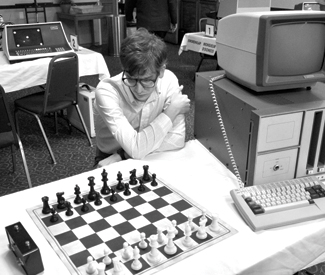
Computer Chess (Andrew Bujalski, US, 2013) Mumblecore maestro Andrew Bujalski (2002’s Funny Ha Ha; 2005’s Mutual Appreciation) makes his first period picture, kinda, with this stubbornly, gloriously retro saga set at an early-1980s computer-chess tournament (with a few ventures into the freaky couples-therapy seminar being held at the same hotel). The technology is dated, both on and off-screen, as hulking machines with names like “Tsar 3.0” and “Logic Fortress” battle for nerdly supremacy as a cameraman, wielding the vintage cameras that were actually used to film the feature, observes. Tiny dramas highlighting the deeply human elements lurking amid all that computer code emerge along the way, and though the Poindexters (and the grainy cinematography) are authentically old-school, the humor is wry and awkwardly dry — very 21st century. Keep an eye out for indie icon Wiley Wiggins, last seen hiding from Ben Affleck’s hazing techniques in 1993’s Dazed and Confused, as a stressed-out programmer. Thu/2, 9pm, and Sat/4, 4pm, Kabuki. (Cheryl Eddy)

The Cleaner (Adrián Saba, Peru, 2011) An austere take on substitute-parental bonding dressed in apocalyptic sci-fi clothing, Adrián Saba’s Peruvian feature finds the world ending not with a bang but with a sickly whimper. (If you’ve ever breathed the toxic air or looked at the shit-brown sea around Lima, you’ll find this pretty credible.) A middle-aged loner (Victor Prada) tasked with cleaning up the death sites of citizens felled by a fatal epidemic finds a surviving young boy (Adrian Du Bois) in one such apartment. Their forced, awkward pairing — because the death toll is so high city services can no longer taken in another orphan — is poignant and terse in what’s a minimalist companion to the underrated 2008 adaptation of José Saramago’s plague saga Blindness. Sat/4, 6:15pm, Kabuki; Tue/7, 8:40pm, PFA; May 9, 8:30pm, Kabuki. (Harvey)

Invasion of the Body Snatchers (Philip Kaufman, US, 1978) Yes, Vertigo (1958) is very nice. But here is my alternate choice for Best San Francisco Movie Ever: 2013 SFIFF tributee Philip Kaufman’s 1978 remake of the 1950s sci-fi classic. Donald Sutherland, Brooke Adams, Jeff Goldblum, Veronica Cartwright, and Leonard Nimoy are among the locals who get very paranoid — with no pot brownies involved — when everyone around them starts turning coldly conformist. Given the film’s fond evocation of the city’s loopy, friendly, countercultural vibe at the time, this shift in the psychological weather really is alarming — arguably much more dramatically so than it was the vanilla small-town setting of Don Siegel’s original or Abel Ferrara’s military-base 1994 version. Wonderfully creepy, eccentric, stylish and humorous, it was Kaufman’s first commercial success. He will appear at the Castro screening to discuss it, his career in general, and to accept his Founder’s Directing Award. Sun/5, 7:30pm, Castro. (Harvey)

Waxworks (Paul Leni, Germany, 1924) Paul Leni’s 1924 omnibus horror feature is considered one of the great classics of German Expressionist cinema. A young man (William Dieterle, who went on to a long Hollywood directing career) answers an ad seeking “an imaginative writer for publicity” work at a wax museum. There he’s asked to write “startling tales” about specific wax figures, envisioning himself and the owner’s comely assistant (Olga Belajeff) as hero and heroine in each narrative. The first and longest tale has the two of them as a couple who get unwanted attention from the tyrannical, lusty Caliph of Bagdad (Emil Jannings). It’s an attenuated comic episode sparked by spectacular abstracted “Middle Eastern” sets. Next, Conrad Veidt (of 1920 Expressionist flagship film The Cabinet of Dr. Caligari) plays Ivan the Terrible in a more macabre story of bloodthirst and madness. Finally, Werner Krauss is “Spring-Heeled Jack” (i.e. Jack the Ripper), terrorizing our protagonists in a brief riot of nightmarish superimposed images. SFIFF’s annual silent film extravaganza at the Castro will be accompanied by a stellar quartet of musicians playing an original score: Mike Patton, Scott Amendola, Matthias Bossi, and William Winant. Expect an eclectic and propulsive evening of sounds equally schooled by punk, prog rock, and jazz. Tue/7, 8:30pm, Castro. (Harvey)

Before Midnight (Richard Linklater, US, 2012) Proving (again) that not all sequels are autonomic responses to a marketplace that rewards the overfamiliar, director Richard Linklater and his co-writers Julie Delpy and Ethan Hawke reconnect with the characters Céline and Jesse, whom we first encountered nearly 20 years ago on a train and trailed around Vienna for a night in Before Sunrise, then met again nine years later in Before Sunset. It’s been nine more years since we left them alone in a Paris apartment, Céline adorably dancing to Nina Simone and telling Jesse he’s going to miss his plane. And it looks like he did. The third film finds the two together, yes, and vacationing in Greece’s southern Peloponnese, where the expansive, meandering pace of their interactions — the only mode we’ve ever seen them in — is presented as an unaccustomed luxury amid a span of busy years filled with complications professional and personal. Over the course of a day and an evening, alone together and among friends, the two reveal both the quotidian intimacies of a shared life and the cracks and elisions in their love story. May 9, 7pm, Castro. (Lynn Rapoport) *

The San Francisco International Film Festival runs through May 9 at the Castro Theatre, 429 Castro, SF; New People Cinema, 1746 Post, SF; Pacific Film Archive, 2575 Bancroft, Berk; and Sundance Kabuki Cinemas, 1881 Post, SF. For tickets (most shows $10-15) and info, visit festival.sffs.org.


Events Listings

0

Compiled by Cortney Clift. Submit items for the listings at listings@sfbg.com. For further information on how to submit items for listings, see Picks.

WEDNESDAY 1

3D Printing Discussion Adobe Systems, 601 Townsend, SF. www.codame.eventbrite.com. 6-9pm, $10 donation suggested. Seeing 3D printing in action can kind of blow your mind. If you’re ready for it, join CODAME, a nonprofit organization working to blend technology and creativity as it delves into this way of the future. 3D printing guru Scott Summit will lead the discussion. If you’re more of a visual person don’t worry, the evening won’t be all tech talk. Demonstrations, surprise guests, and on-site creations are promised.

THURSDAY 2

“Portraits of Wild Mushrooms” The Bone Room, 1573 Solano, Berk. www.boneroompresents.com. Through July 1. Opening reception: 7pm, free. Mushroom art, free wine, and pizza. Need we say more? Celebrate the Bone Room’s grand opening of their new show “Emerging from the Underworld: Portraits of Wild Mushrooms.” While you chow down on a slice of pie, check out the paintings and archival-quality prints by Lucy Martin to transport yourself into the mystical, magical fungus kingdom.

“Memories of the Game” George Krevsky Gallery, 77 Geary, SF. www.georgekrevskygallery.com. 6-9pm, free. Baseball season is heating up. If game days just aren’t enough of America’s favorite pastime for you then head over to the George Krevsky Gallery for an evening of poetry, literature, music, and video all dedicated to the sport. Marty Lurie host of KNBR’s Giants Pre-Game show will MC the evening’s lineup. Also check out the gallery’s art exhibit “Out of the Park,” which runs through May 25.

FRIDAY 3

Gay Date Night Cinco De Mayo Celebration Pisco Latin Lounge, 1817 Market, SF. www.gaycouplesinstitute.org. 6-7:30pm, free if you RSVP 24 hours prior to event. If guzzling down pitchers of margaritas in honor of Mexican independence is not exactly how you’d like to spend your Friday night, the Pisco Latin Lounge has an option that is a little less loco and a little more laid back. The Gay Couples Institute is sponsoring an evening at Pisco Latin Lounge where couples can enjoy complimentary drinks, appetizers, and enter to win miscellaneous prizes.

Jack London Night Market Jack London Square, Oakl. 6-10pm, free. Bring together local artisans, music, and food, and chances are you’ve got an entertaining evening. Add in local fruit vendors, street performers, and alcohol and it’s pretty hard to go wrong. Head over to this monthly event and take advantage of warming weather complete with a waterfront view.

SATURDAY 4

Japantown Children’s Day Festival Japantown Peace Plaza, 1610 Geary, SF. www.jccnc.org. 11am-4pm, free. In celebration of Japan’s national holiday to celebrate children, the Japanese Cultural and Community Center of Northern California is holding a day filled with food and hands-on crafts for kids.

Liberation with Benefits Drag Show and Dance Party The Legionnaire Saloon, 2272 Telegraph, Oakl. www.southernersonnewground.org. 8pm-2am, $5-20 donation suggested. Support national equality tonight in true San Francisco fashion. This benefit — complete with performances by local drag legends such as Lady Rose and Renato, and music by three different DJs — will support Southerners on New Ground (SONG), an organization dedicated to defeating anti-LGBT laws in the South.

Sherlock Holmes Mystery Ball Masonic Lodge of San Mateo, 100 N. Ellsworth, San Mateo. www.peers.org/holmes.html. Doors open 6:45pm, $15 advance, $20 door. Why spend another evening playing Clue and watching CSI when you could solve a mystery decked out in Victorian garb. The ball will include a formal dance lesson to the tunes of chamber ensemble Bangers & Mash, and of course a mystery. If you work up an appetite after mastering the grand waltz, a light buffet will be provided. Don’t fret if a corset and lacey ball gown just aren’t a part of your wardrobe. 19th and 21st century evening attire is admired but not required.

SUNDAY 5

Urban Air Market Octavia and Hayes, SF. www.urbanairmarket.com. 11am-6pm, free. It’s not unusual for Bay Area fashion to come with an eco-friendly kick. Sustainable design is not only an element, but the main attraction at this weekend’s Urban Air Market — a biannual festival which features over 130 designers whose products are well designed, local, and sustainable. Dreamboat Dresses’ quirky frocks, Heliotrope’s all natural beauty and body products, and Jfish Designs’ modern ceramics are just a few vendors who will be present. We think it’s safe to say chances of buyer’s remorse here are slim to none.

MONDAY 6

Free salsa concert Oakland City Center, 500 12th St., Oakl. www.oaklandcitycenter.com. If a case of the Mondays is getting you down, spice it up with a mid-day salsa concert. Oakland City Center’s spring and summer concerts are back and in full swing. Soak up some afternoon sun and jam out to the contemporary Cuban tunes of salsa band Rumbaché. But if your boss gets on your back about the extra long lunch break, don’t blame us.

TUESDAY 7

Helen Suzman exhibit and panel Jewish Community Center, Katz Snyder Gallery, 3200 California, SF. www.jccsf.org. Through Aug. 31. Opening reception: 7pm, free. RSVP to arts@jccsf.org required. Helen Suzman, a South African anti-apartheid activist and politician will be honored through a graphic panel and memorabilia exhibit. Suzman’s nephew will be at tonight’s event to reminiscence and share stories of his aunt’s life, work, and legacy.


On the Cheap listings

0

Submit items for the listings at listings@sfbg.com. For further information on how to submit items for listings, see Picks.

WEDNESDAY 24

LGBT Career Fair SF LGBT Center, 1800 Market, SF. lgbtcareerfair2013.eventbrite.com. Noon, free. RSVP online. Head over to the LGBT Center today to check out some leading Bay Area employers dedicated to diversity and inclusion in the workplace. The fair provides the LGBT community and allied job seekers the opportunity to network and discover new careers.

THURSDAY 25

Green fashion show and discussion SkunkFunk, 1475 Waight, SF www.efactor.com/greenclothessf. 7-9pm, free. Check out a fashion show with a focus on sustainable, eco-friendly clothing. After you’re wooed by all the green style Oceana Lott, a human resource manager, magazine editor, and teacher will speak about how to create a lifestyle that is both fulfilling and economically minded.

The Bone Room Presents The Bone Room, 1573 Solano, SF. www.boneroompresents.com. 7pm, free. Head to the Bone Room this evening to uncover the mysteries behind the human nose. Neuroscientist Leslie Vosshall will give an in-depth presentation on the biology and possibility of genetic basis for the human sense of smell.

“How to Move a Mountain” Southern Exposure, 3030 20th St., SF. www.soex.org. 7-9pm, free. At this eclectic three-pack of presentations on the power of collaborations you’ll be able to learn about the sexual life of slime mold, robots that can improvise music, and how to draw collectively.

FRIDAY 26

Body image workshop AHP Services Center, 1930 Market, SF. www.ucsf-ahp.org. 6:30-9:30pm, free. Call (415) 476-6448 x1 to register. Join tonight’s discussion about the way gay and bisexual men see their bodies. The evening will cover ways to improve body image and how it can affect your relationships and sex life.

Natural Poetry Month book party Pegasus Downtown, 2349 Shattuck, Berk. www.omnidawn.com. 7pm, free. Celebrate National Poetry Month with Omnidawn Publishing. Writers George Albon, Norma Cole, Alice Jones, and more will give brief readings from their own Omnidawn books. Hors d’oeuvres, desserts, wine, and fizzy water will be provided to sip and snack on.

SATURDAY 27

Public Square: Future soul edition YBCA Forum and Galleries, 701 Mission, SF. www.ybca.org. 11am-1am. Check website for specific event prices. Join the YBCA for a full day of classes, performances, and exhibits. Some events on the schedule include the 50 Cent Tabernacle, which — for a mere 50 cents — will give you access to up to six of the offered dance and movement classes. Hang out at an event put on by art group Field of Inquiry afterward, which answers the question “What will soul look like in the year 2038?” The group will respond with performances, food, design, murals, and technology. Check the site for a full schedule of events for the day.

Same-Sex Ballroom Competition Just Dance Ballroom, 2500 Embarcadero, Oakl. www.aprilfollies.com. 10am-11pm, $15 for daytime events only, $25 for evening events only, $35 for entire day. Now in its 11th year, the annual and longest running same-sex dance competition will include international Latin, American smooth, and American rhythm divisions. New to the competition this year are tango and country western dances. The day includes dance lessons for beginners, A-level finals, performances by top rated couples in the evening, and an open social dance for all.

9th Annual Golden Gate Sacred Harp Singing Potrero Hill Neighborhood House, 953 De Haro, SF. www.bayareasacredharp.org. 9am-3:30pm, free. Experience the raw power and moving poetry of the sacred harp in an authentic singing ritual — a centuries-old tradition of singing early American hymns in shape note style. A dinner will be held at noon on the grounds, so bring a dish to share.

SUNDAY 28

People’s Park Anniversary People’s Park, 2556 Haste, Berk. www.peoplepark.org. Noon-6pm, free. The politically driven, community-run park is celebrating its 44th anniversary today. The day will consist of live performances by The Fvah Squad Band, Junior Toots, and more. There will be tables for community organizations, workshops, free vegan meals from Food not Bombs, and a drum circle.

Pinhole Photograph Day RayKo, 428 Third St., SF. www.raykophoto.com. Noon-5pm, free. In honor of worldwide Pinhole Photography Day, RayKo is hosting a special exhibition of this throwback, analogue art. Pinhole artist Jo Babcok will be exhibiting his images and cameras made from everything from a suitcase to coffee pots to a bowling ball case. Babcock will also be teaching pinhole amateurs how to make their own camera from supplies provided by RayKo. Check the website to enroll in this quick-and-easy seminar.

How Weird Street Faire Howard and New Montgomery, SF. www.howweird.org. Noon-8pm, $10 donation requested. The 14th annual street faire is back with the theme “Weirdi Gras.” The fair will include marching bands, parades, art, performances, 10 stages of world-class electronic music, and vendors from around the world. Expect to see costumes, and dancing reminiscent of New Orlean’s Mardi Gras style. Even more exciting, five New Orleans marching bands will roam the fair grounds this year, in accordance with the theme.

Festival of Mandolins Croatian American Cultural Center, 60 Onondage, SF. www.croationamericanweb.org. 11am-5pm, $10 advance, $15 door, children free. The 13th annual San Francisco Festival of the Mandolins will include five diverse performances ranging from bluegrass to classical. Before the show mandolin workshops will be held. Ethnic Bulgarian food will also be available.


Punk democracy

1

arts@sfbg.com

MUSIC When the going gets tougher in the music biz, scrappy little South Bay punk label Asian Man Records has kept on going, downsizing yet sticking to its guns. That means standing by bands that have a chance to jump ship to a bigger imprint — by wishing them well.

Such might be the case with San Francisco’s Wild Moth, which came heavy with its sprawling, epic post-punk on the Mourning Glow EP released by Asian Man last summer, plays this week’s showcase, and has recently completed a full-length. “There’s some bigger labels that might be interested,” says Asian Man’s main man Mike Park, 43, on a recent morning in the office in his mom’s basement garage in affluent, arcadian Monte Sereno, right where it’s been for the past 16 years. “Our thought pattern is we want what’s best for the band. We’re here for you, but we want you to get the best deal.”

DIY, book-your-own-life punk has always hinged on that kind of support to Park, no slouch when it comes to both music-making and community-building. I last spoke to the vet of the South Bay ska scene and linchpin of Skankin’ Pickle about eight years ago when he was embarking on his “Bike For Peace” tour, cycling down the coast along with others to play and raise funds for a local youth center. Five years along from the opening of the first drug- and alcohol-free arts-focused Plea For Peace center in Stockton, Park continues to keep the faith — and to keep Asian Man out of the red — by staying small, though over the years he’s sold more than a 1 million albums by artists as disparate as Alkaline Trio, Andrew Jackson Jihad, the Queers, Kepi Ghoulie, the Lawrence Arms, and Slow Gherkin.

“A lot has to do with, when the music industry started to tank, I had a big jump-start on it,” says Park today. “I felt there was going to be a big turn and I started cutting back quite a bit. Bigger labels were still spending a lot of money and doing well in 2000, but I’ve always been able to turn a profit and, with the present-day music industry, I cut back even more.”

“We’re really upfront with the bands as far as our limitations — and we don’t do much at all!” he continues, chuckling. Yet despite the fact that Asian Man doesn’t harbor a major’s or major-indie’s marketing team (Park employs only one full-time employee besides himself) it does what it can, fostering a space that helps everyone help themselves. “Mostly the bands want to be part of this community. A lot of bands come over and hang out, help us pack records, lend a hand. We try to go to each other’s shows, and bands help out other bands when they tour.”

Park clearly took the lessons of Ian MacKaye’s Dischord Records to heart: keep prices low, maintain integrity, the works. The upcoming show with Wild Moth, the Exquisites, and Shinobu might be considered a good example of punk democracy in action: “They’re all on the same level,” Park says of the groups. “We’re just hoping we get a decent crowd. It’s a test to see how many people we can get out with no real headliner!” He got SF’s Great Apes on the bill because he’s known member Brian Moss since he was a teenager playing music: “He’s a super-talented guy and very supportive of all bands. You can tell some people are into it for what can further their careers, but instead with him, it’s ‘how can I help others?'”

Sounds a little like someone else we know. Still, punks mature, get married, and have kids, much like Park, who, despite an upcoming reunion show for his combo the Chinkees at a ska festival in Las Vegas in May, seems most excited about his latest project: his album of kids music and his kids label, Fun Fun Fun, which aims to release children’s music by punks. So far, the imprint’s Play Date, composed of Greg Attonito of Bouncing Souls and wife Shanti Wintergate, has shown up on NPR, and Park himself won a spot as the “Super Music Friend” on this winter’s Yo Gabba Gabba! Live! tour. “Other than the fact that we try to put out music that isn’t dumbed down, musically, it can pass for any of the records we normally put out,” he explains of Fun Fun Fun’s sounds, “only more G-rated and more educational lyrics.”

Whether he’s teaching kids when it’s safe to cross the street via ska or learning about new hardcore genres from the high schoolers that come by the office to help out, Park certainly can’t be accused of turning into a cranky punk nostalgist, grumbling about awesome mosh pits long gone.

“Punk’s evolved like everything. Things can’t stay the same with technology and the social media tools that artists have,” he says optimistically. “Let’s say there’s an underground show, and it gets canceled. Someone says, ‘Let’s do it at my house and here’s the address,’ and after a social media blast, you have 100 kids in a house in an hour. I remember pre-Internet you’d have to call people, and no one would have a cell phone, and someone would camp out at the old location and say the new location is here. I think it’s kind of cool, to be honest.”

SHINOBU, WILD MOTH, THE EXQUISITES, GREAT APES

Sat/20, 9pm, $9

Bottom of the Hill

1233 17th St., SF

(415) 621-4455

www.bottomofthehill.com

Looking over the Overlook

1

cheryl@sfbg.com

FILM Though he’s now living in Los Angeles, Rodney Ascher was a San Franciscan “for years and years,” he says, adding that he used to spend “a lot of time at Craig Baldwin’s Other Cinema.” He also has praise for the Roxie, the venue that’ll be hosting the local premiere of his Room 237 — a fascinating, kinda disturbing documentary that burrows deep down the rabbit hole with people who are obsessed with Stanley Kubrick’s 1980 horror masterpiece The Shining.

The Roxie screens that film Thu/18, and opens Ascher’s doc Fri/19; Ascher hints that he’ll journey to SF for the occasion. I spoke with him about Kubrick, Italian horror, and other mind-bending topics.

San Francisco Bay Guardian How did you find your five subjects?

Rodney Ascher Before I did the first interview, [producer] Tim Kirk and I spent maybe a year researching different theories about The Shining and people who were writing about it. Some people were fairly well-known to us, like Bill Blakemore, who has the Native American [theory]. His article was syndicated in newspapers in 1987, and has been reprinted all over the internet, so he was a person that we always wanted to talk to. Jay Weidner, who talks about subliminal techniques and allusions to the space program — his essay has circulated pretty widely online too.

So we started with them, and we would find other people as we went. The writer Jonathan Lethem, who’s had a lot of interesting things to say about The Shining, turned me on to John Fell Ryan, a guy in Brooklyn who’d been screening the movie backwards and forwards at the same time. Not only was that amazing in and of itself, but like a lot of this other stuff we were finding, it was amazing that it had only happened in the time since we’d started the project. A lot of [Room 237] is about the substance of what people are saying about The Shining — but it’s also very concerned with this phenomenon at the beginning of the 21st century, where an awful lot of people seem obsessed with this movie made in 1980, and isn’t that interesting, and why is that happening?

SFBG What was the interview process like?

RA I mailed [each subject] a digital audio recorder, and I would talk to them via Skype from my studio. I’d have a list of questions based on what I knew about what they had written, but oftentimes the more open-ended questions would lead in more interesting directions: “What was the first time you saw The Shining?” or “When did you figure out this idea? How did it come to you?”

I read someplace that one of the best interview questions is just, “Why?” I don’t have much of a hard-core documentary background, so I haven’t interviewed tons of people, but I figured out pretty quickly that the less I said, the better.

SFBG What role do you think the internet has played in this growing obsession with The Shining?

RA I think it’s got everything to do with it. Things like YouTube videos and digital technology in general allow us to look at movies more carefully. We try to have a little bit of a subplot of people being able to watch the movie in theaters, and then on home video, on DVD, Blu-ray, YouTube. As [the opportunity to watch the film again] increases, the way we watch it changes.

But it’s also things like comment threads and blog postings, which allow people to share ideas with other folks in a way that was never possible before. Even if you could write a newspaper article or a magazine entry, there are very practical length considerations that you’d have to work with. But now, if you feel like writing a 125-page article about the manager of the Overlook Hotel, you can put it up on your blog, and there’s no limit to how much detail you can include.

SFBG Both your 2010 short The S From Hell and Room 237 are about hidden meanings and subtexts. What draws you to those themes?

RA The S From Hell started because I read about these people who had a childhood phobia of the old Screen Gems logo, and I had a flashback to myself at the age of three. Although my experience wasn’t quite as intense, I had a similar strong, confused reaction to that thing. And I’ve watched The Shining again and again, and have been obsessed with it, even if I haven’t come close to deciphering it. So it may be that — although I barely appear in these movies — there’s an autobiographical quality to this, that I’m recognizing aspects of myself in what these folks are doing. But maybe it’s not best for me to try to analyze Room 237 too deeply!

SFBG The Shining isn’t the only film used to illustrate Room 237. How did you decide what else to use? I spotted clips from Lamberto Bava’s Demons (1985), for example.

RA It was kind of instinctual. I tried to [gather] movies from a similar time or place to The Shining, but in all respects, I’m making a connection between The Shining and these other films. Sometimes it might be very literal, sometimes it might be personal to my own history.

In a big-picture sense, I think we’re talking about the ways movies get into our heads. Bill Blakemore, one of our interviewees, has a great phrase where he compares The Shining to a dream, and Stanley Kubrick’s process of filmmaking to dreaming — that you condense everything that’s happened in your life up to that point, and then it comes out in dreams, in some kind of strange new version.

Demons is a movie about the line between what’s happening on the screen, and what’s happening in the audience, getting very blurry. So for people who are familiar with Demons, the connection might play very clearly; but for people who aren’t, they’re still seeing a really stylishly shot scene of people in a theater in the early ’80s who are struggling to understand this very baffling movie they’ve been presented with.

SFBG Room 237‘s sound design is very distinctive. Can you talk about how that came together?

RA The sound design is by Ian Herzon, an amazing guy who was able to create this heavy, atmospheric mix. It was important to me that Room 237 played more as an immersive experience than as a dry piece of journalism. In a weird way I wanted it to be kind of a horror movie in itself. And Ian has worked on some of the Resident Evil movies, so that was a style that he was comfortable with.

The music is by William Hutson and Jonathan Snipes, who specialize in [horror themes]. Jonathan plays in a band called Nilbog, which performs, like, music from Dawn of the Dead (1978) and Suspiria (1977) live in concert. Their studio looks like a museum of analog synthesizers. So when I was discussing the music I wanted for the film, and I was talking about the early ’80s, Italian synthesizer scores, or John Carpenter music, or Tangerine Dream’s score for Sorcerer (1977), we spoke the same language very quickly. I love the way the synth scores have this trance-inducing, meditative effect. They sometimes have even quasi-religious aspects to them, which seemed kind of appropriate, since we’re looking at The Shining the way some people interpret the Bible.

SFBG What is your reaction when you hear people say, “After seeing Room 237, I’ll never watch The Shining the same way again?”

RA That’s great! And another thing that a lot of them say is, “I’m gonna go and immediately re-watch The Shining,” which is awesome. The Shining is a maze that certainly me and the people that we talked to can’t get out of — so there’s something satisfying about luring other people back into the middle of it. 

ROOM 237 opens Fri/19 at the Roxie.

Indicator city

74

steve@sfbg.com

When biologists talk about the health of a fragile ecosystem, they often speak of an “indicator species.” That’s a critter — a fish, say, or a frog — whose health, or lack thereof, is a signal of the overall health of the system. These days, when environmentalists who think about politics as well as science look at San Francisco, they see an indicator city.

This progressive-minded place of great wealth, knowledge, and technological innovation — surrounded on three sides by steadily rising tides — could signal whether cities in the post-industrial world will meet the challenge of climate change and related problems, from loss of biodiversity to the need for sustainable energy sources.

A decade ago, San Francisco pioneered innovative waste reduction programs and set aggressive goals for reducing its planet-cooking carbon emissions. At that point, the city seemed prepared to make sacrifices and provide leadership in pursuit of sustainability.

Things changed dramatically when the recession hit and Mayor Ed Lee took office with the promise to focus almost exclusively on economic development and job creation. Today, even with the technology and office development sectors booming and employment rates among the lowest in California, the city hasn’t returned its focus to the environment.

In fact, with ambitious new efforts to intensify development along the waterfront and only lackluster support for the city’s plan to build renewable energy projects through the CleanPowerSF program, the Lee administration seems to be exacerbating the environmental challenge rather than addressing it.

According to conservative projections by the Bay Conservation and Development Commission, the Bay is expected to rise at least 16 inches by 2050 and 55 inches by the end of the century. BCDC maps show San Francisco International Airport and Mission Bay inundated, Treasure Island mostly underwater, and serious flooding the Financial District, the Marina, and Hunters Point.

Lee’s administration has commissioned a report showing a path to carbon reduction that involves promoting city-owned renewable energy facilities and radically reducing car trips — while the mayor seems content do the opposite.

It’s not an encouraging sign for Earth Day 2013.


HOW WE’RE DOING

Last year, the Department of the Environment hired McKinsey and Company to prepare a report titled “San Francisco’s Path to a Low-Carbon Economy.” It’s mostly finished — but you haven’t heard much about it. The department has been sitting on it for months.

Why? Some say it’s because most of the recommendations clash with the Lee administration’s priorities, although city officials say they’re just waiting while they get other reports out first. But the report notes the city is falling far short of its carbon reduction goals and “will therefore need to complement existing carbon abatement measures with a range of new and innovative approaches.”

Data presented in the report, a copy of which we’ve obtained from a confidential source, shows that building renewable energy projects through CleanPowerSF, making buildings more energy-efficient, and discouraging private automobile use through congestion pricing, variable-price parking, and building more bike lanes are the most effective tools for reducing carbon output.

But those are things that the mayor either opposes and has a poor record of supporting or putting into action. The easy, corporate-friendly things that Lee endorses, such as supporting more electric, biofuel, and hybrid vehicles, are among the least effective ways to reach the city’s goals, the report says.

“Private passenger vehicles account for two-fifths of San Francisco’s emissions. In the short term, demand-based pricing initiatives appear to be the biggest opportunity,” the report notes, adding a few lines later, “Providing alternate methods of transport, such as protected cycle lanes, can encourage them to consider alternatives to cars.”

Melanie Nutter, who heads the city’s Department of the Environment, admits that the transportation sector and expanding the city’s renewable energy portfolio through CleanPowerSF or some other program — both of which are crucial to reducing the city’s carbon footprint — are two important areas where the city needs to do a better job if it’s going to meet its environmental goals, including the target of cutting carbon emissions 40 percent from 1990 levels by the year 2025.

But Nutter said that solid waste reduction programs, green building standards, and the rise of the “shareable economy” — with Internet-based companies facilitating the sharing of cars, housing, and other products and services — help San Francisco show how environmentalism can co-exist with economic development.

“San Francisco is really focused on economic development and growth, but we’ve gone beyond the old edict that you can either be sustainable or have a thriving economy,” Nutter said.

Yet there’s sparse evidence to support that statement. There’s a two-year time lag in reporting the city’s carbon emissions, meaning we don’t have good indicators since Mayor Lee pumped up economic development with tax breaks and other city policies. For example, Nutter touted how there’s more green buildings, but she didn’t have data about whether that comes close to offsetting the sheer number of new energy-consuming buildings — not to mention the increase in automobile trips and other byproducts of a booming economy.

Tom Radulovich, executive director of Livable City and president of the BART board, told us that San Francisco seems to have been derailed by the last economic crisis, with economic insecurity and fear trumping environmental concerns.

“All our other values got tossed aside and it was all jobs, jobs, jobs. And then the crisis passed and the mantra of this [mayoral] administration is still jobs, jobs, jobs,” he said. “They put sustainability on hold until the economic crisis passed, and they still haven’t returned to sustainability.”

Radulovich reviewed the McKinsey report, which he considers well-done and worth heeding. He’s been asking the Department of the Environment for weeks why it hasn’t been released. Nutter told us her office just decided to hold the report until after its annual climate action strategy report is released during Earth Day event on April 24. And mayoral Press Secretary Christine Falvey told us, “There’s no hold up from the Mayor’s Office.”

Radulovich said the study highlights how much more the city should be doing. “It’s a good study, it asks all the right questions,” Radulovich said. “We’re paying lip service to these ideas, but we’re not getting any closer to sustainability.”

In fact, he said the promise that the city showed 10 years ago is gone. “Gavin [Newsom] wanted to be thought of as an environmentalist and a leader in sustainability, but I don’t think that’s important to Ed Lee,” Radulovich said.

Joshua Arce, who chairs the city’s Environmental Commission, agreed that there is a notable difference between Newsom, who regularly rolled out new environmental initiatives and goals, and Lee, who is still developing ways to promote environmentalism within his economic development push.

“Ed Lee doesn’t have traditional environmental background,” Arce said. “What is Mayor Lee’s definition of environmentalism? It’s something that creates jobs and is more embracing of economic development.”

Falvey cites the mayor’s recent move of $2 million into the GoSolar program, new electric vehicle charging stations in city garages, and his support for industries working on environmental solutions: “Mayor Lee’s CleantechSF initiative supports the growth of the already vibrant cleantech industry and cleantech jobs in San Francisco, and he has been proactive in reaching out to the City’s 211 companies that make up one of the largest and most concentrated cleantech clusters in the world.”

Yet many environmentalists say that simply waiting for corporations to save the planet won’t work, particularly given their history, profit motives, and the short term thinking of global capitalism.

“To put it bluntly, the Lee administration is bought and paid for by PG&E,” said Eric Brooks with Our City, which has worked for years to launch CleanPowerSF and ensure that it builds local renewable power capacity.

The opening of the McKinsey report makes it clear why the environmental policies of San Francisco and other big cities matter: “Around the globe, urban areas are becoming more crowded and consuming more resources per capita,” it states. “Cities are already responsible for roughly seventy percent of global carbon dioxide emissions, and as economic growth becomes more concentrated in urban centers, their total greenhouse gas emissions may double by 2050. As a result, tackling the problem of climate change will in large part depend on how we reduce the greenhouse gas emissions of cities.”

And San Francisco, it argues, is the perfect place to start: “The city now has the opportunity to crystallize and execute a bold, thoughtful strategy to attain new targets, continue to lead by example, and further national and global debates on climate change.”

The unwritten message: If we can’t do it here, maybe we can’t do it anywhere.


ON THE EDGE

San Francisco’s waterfront is where economic pressures meet environmental challenges. As the city seeks to continue with aggressive growth and developments efforts on one side of the line — embodied recently by the proposed Warriors Arena at Piers 30-32, 8 Washington and other waterfront condo complexes, and other projects that intensify building along the water — that puts more pressure on the city to compensate with stronger sustainability initiatives.

“The natural thing to do with most of our waterfront would be to open it up to the public,” said Jon Golinger, who is leading this year’s referendum campaign to overturn the approval of 8 Washington. “But if the lens you’re looking through is just the balance sheet and quarterly profits, the most valuable land maybe in the world is San Francisco’s waterfront.”

He and others — including SF Waterfront Alliance, a new group formed to oppose the Warriors Arena — say the city is long overdue in updating its development plan for the waterfront, as Prop. H in 1990 called for every five years. They criticize the city and Port for letting developers push projects without a larger vision.

“We are extremely concerned with what’s happening on our shorelines,” said Michelle Myers, director of the Sierra Club’s Bay Chapter, arguing that the city should be embracing waterfront open space that can handle storm surge instead of hardening the waterfront with new developments. “Why aren’t we thinking about those kinds of projects on our shoreline?”

David Lewis, director of Save the Bay, told us cities need to think less about the value of waterfront real estate and do what it can to facilitate the rising bay. “There are waterfront projects that are not appropriate,” Lewis said. Projects he puts in that category range from a scuttled proposal to build around 10,000 homes on the Cargill Salt Flats in Redwood City to the Warriors Arena on Piers 30-32.

“We told the mayor before it was even announced that it is not a legal use of the pier,” Lewis said, arguing it violated state law preserving the waterfront for maritime and public uses. “There’s no reason that an arena has to be out on the water on a crumbling pier.”

But Brad Benson and Diana Oshima, who work on waterfront planning issue for the Port of San Francisco, say that most of San Francisco’s shoreline was hardened almost a century ago, and that most of the planning for how to use it has already been done.

“You have a few seawall lots and a few piers that could be development sites, but not many. Do we need a whole plan for that?” Benson said, while Oshima praises the proactive transportation planning work now underway: “There has never been this level of land use and transportation planning at such an early stage.”

The Bay Conservation and Development Commission was founded almost 50 years ago to regulate development in and around the Bay, when the concern was mostly about the bay shrinking as San Francisco and other cities dumped fill along the shoreline to build San Francisco International Airport, much of the Financial District, and other expansive real estate plans.

Now, the mission of the agency has flipped.

“Instead of the bay getting smaller, the bay is getting larger with this thing called sea level rise,” BCDC Executive Director Larry Goldspan said as we took in the commanding view of the water from his office at 50 California Street.

A few years ago, as the climate change predictions kept worsening, the mission of BCDC began to focus on that new reality. “How do we create a resilient shoreline and protect assets?” was how Goldspan put it, noting that few simply accept the inundation that BCDC’s sea level rise maps predict. “Nobody is talking about retreating from SFO, or Oakland Airport, or BART.”

That means Bay Area cities will have to accept softening parts of the shoreline — allowing for more tidal marshes and open space that can accept flooding in order to harden, or protect, other critical areas. The rising water has to go somewhere.

“Is there a way to use natural infrastructure to soften the effect of sea level rises?” Goldspan asked. “I don’t know that there are, but you have to use every tool in the smartest way to deal with this challenge.”

And San Francisco seems to be holding firm on increased development — in an area that isn’t adequately protected. “The seawall is part of the historic district that the Port established, but now we’re learning the seawall is too short,” Goldspan said.

BCDC requires San Francisco to remove a pier or other old landfill every time it reinforces or rebuilds a pier, on a one-to-one basis. So Oshima said the district is now studying what it can remove to make up for the work that was done to shore up Piers 23-27, which will become a new cruise ship terminal once the America’s Cup finishes using it a staging ground this summer.

Yet essentially giving up valuable waterfront real estate isn’t easy for any city, and cities have both autonomy and a motivation to thrive under existing economic realities. “California has a history of local control. Cities are strong,” Goldspan said, noting that sustainability may require sacrifice. “It will be a policy discussion at the city level. It’s a new discussion, and we’re just in the early stages.”


NEW WORLD

Global capitalism either grows or dies. Some modern economists argue otherwise — that a sustainable future with a mature, stable economy is possible. But that takes a huge leap of faith — and it may be the only way to avoid catastrophic climate change.

“In the world we grew up in, our most ingrained economic and political habit was growth; it’s the reflex we’re going to have to temper, and it’s going to be tough.” Bill McKibben writes in Eaarth: Making a Life on a Tough New Planet. “Across partisan lines, for the two hundred years since Adam Smith, we’ve assumed that more is better, and that the answer to any problem is another burst of expansion.”

In a telephone interview with the Guardian, McKibben discussed the role that San Francisco could and should be playing as part of that awakening.

“No one knows exactly what economy the world is moving toward, but we can sense some of its dimensions: more localized, less material-based, more innovative; these are things that San Francisco is good at,” he told us, noting the shift in priorities that entails. “We need to do conservation, but it’s true that we also need to build more renewable power capacity.”

Right now, CleanPowerSF is the only mechanism the city has for doing renewable energy projects, and it’s under attack on several fronts before it even launches. Most of the arguments against it are economic — after all, renewable power costs more than coal — and McKibben concedes that cities are often constrained by economic realities.

Some city officials argue that it’s more sustainable for San Francisco to grow and develop than suburban areas — thus negating some criticism that too much economic development is bad for the environment — and Radulovich concedes there’s a certain truth to that argument.

“But is it as green as it ought to be? Is it green enough to be sustainable and avert the disaster? And the answer is no,” Radulovich said.

For example, he questioned, “Why are we building 600,000 square feet of automobile-oriented big box development on Hunters Point?” Similarly, if San Francisco were really taking rising seas seriously, should the city be pouring billions of dollars into housing on disappearing Treasure Island?

“I think it’s a really interesting macro-question,” Jennifer Matz, who runs the Mayors Office of Economic Development, said when we asked whether the aggressive promotion of economic development and growth can ever be sustainable, or whether slowing that rate needs to be part of the solution. “I don’t know that’s feasible. Dynamic cities will want to continue to grow.”

Yet that means accepting the altered climate of new world, including greatly reduced fresh water supplies for Northern California, which is part of the current discussions.

“A lot of the focus on climate change has moved to adaptation, but even that is something we aren’t really addressing,” Radulovich said.

Nutter agreed that adapting to the changing world is conversation that is important: “All of the development and planning we’re doing today needs to incorporate these adaptation strategies, which we’re just initiating.”

But environmentalists and a growing number of political officials say that San Francisco and other big cities are going to need to conceive of growth in new ways if they want to move toward sustainability. “The previous ethos was progress at any cost — develop, develop, develop,” Myers said, with the role of environmentalists being to mitigate damage to the surrounding ecosystem. But now, the economic system itself is causing irreversible damage on a global level. “At this point, it’s about more than conservation and protecting habitat. It’s about self-preservation.”