Tech

Life’s a gas

0

marke@sfbg.com

SUPER EGO OK, first of all, there is now the first all-night whipped cream supply delivery service in the world right here in SF — the evocatively named Hippie Gap. “We do NOT condone ANY MISS use [sic] of our products!!!” says the About. “Whip-it! Original N2O” it then goes on, before linking to the Wikipedia entry for nitrous oxide. 10pm-10am, y’all. The best parts of rave may have been the stroboscopic aneurysms (and the bisexual Smart Drinks vendors): when the nitrous tank arrived the carnival truly began. But I’ll really sit up if someone bikes a gasmask greased with Vick’s VapoRub to my stoop. Screw your Backstreet Boys crap, that’s when the ’90s really will be back.

Also, right now there is a gang of kick-ass, stiletto-heeled Estonian girls in Miami getting vulnerable rich businessmen drunk at “Russian-style” bars and tricking them into buy extravagantly tacky things like Dom Perignon and boatloads of caviar. They are known as the B-Girls and they grifted one poor slob out of $48,000. They are kind of my girl-gang heroes? Well, right after Pussy Riot, Foxfire, Steel Magnolias, the Mi Vida Loca cholas, and the Sisterhood of the Transgender Pants.


MAYA JANE COLES

http://www.youtube.com/watch?v=ShMAgi_d77w

Young Brit phenom has been on an unstoppable tear the past few years, and while the hype has cooled somewhat, the skills have stayed white hot. Jazz-eared, soulful tech-house and killer bass augmentation swing wonderfully wide across a variety of moods, and always hit the spot. With local favorites Moniker and Brian Bejarano.

Thu/8, 9pm, $20. Monarch, 101 Sixth St., SF. www.monarchsf.com


STARKEY

Ethereal Philly street bass hero bangs the floor out with his futuristic swoops and sticky-starlight arpeggios — get a preview of new album Orbits, dropping in December, at new beats ‘n bass party Sway. Soulful fellow bass-face Kastle, of San Francisco and awfully good looking, dubs it up to open.

Thu/8, 9pm, $10–$15. 330 Ritch, SF. starkeyandkastle.eventbrite.com


ASC

A sweet night of thoughtful techno that doesn’t shy away from rippling drum and bass ecstasy from this grown-up veteran of the UK hardcore scene. Local smarties Ghosts on Tape, Bells and Whistles, and Mossmoss jumpstart the sophisticated, super-danceable aural vibes at the monthly As You Like It party.

Fri/9, 10pm-late, $10–$20. Beatbox, 314 11th St., SF. www.ayli-sf.com


MOUNT KIMBIE

A lineup to make cerebral bassheads’ hearts go boom. Transcendent UK duo Mount Kimbie aren’t afraid to take you off the rails and down a winding trail with their live sets. Gorgeous Floridian tech-dubber XXYYXX also appears, with SF electronic dreamer Giraffage (“Feels” is one of my fave 2012 tracks), D33J, Dials, and the Lights Down Low nutters.

Fri/9, 10pm-3am, $17–$20. 103 Harriet, SF. www.1015.com


RAREBITS

One of the cutest little secrets of nightlife music nerds has been this wildly eclectic night of, well, rare bits of sonic loveliness and genius off-kilter projections, put on by three cute bearish guys and tucked away in gay bar Truck. For this anniversary free-for-all, they’ve invited 16 DJs (including residents Chicken, Bearno Kardashian, and Bobby Please) to spin 20-minute sets of yummy, weird stuff. Plus there’ll be pop-up food from Two Tarts and a Stove. Delish.

Fri/9, 6pm-2am, free. Truck, 1900 Folsom, SF. rarebits.tumblr.com


ALL NIGHT LONG

If you’ve just moved here from another planet, or know a friend who really needs to catch up, witnessing classic DJ Garth take the decks for a fabuloso marathon five-and-a-half hour set in the Public Works loft — well, that’s the perfect crash course in 20 years of San Francisco dance music.

His titillatingly wicked blend of psychedelic rock, cosmic disco, acid house, and pagan grooves will have you howling at the moon right quickly, friend.

Sat/10, 10pm-3:30am, $7. Public Works, 161 Erie, SF. www.publicsf.com


NON-STOP BHANGRA DIWALI CELEBRATION

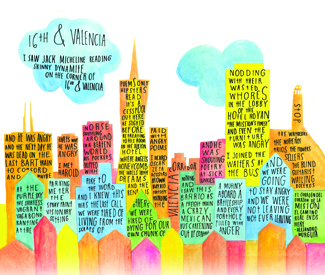
Meanwhile, downstairs at Public Works, one of my favorite monthly parties celebrates the Indian festival of lights, Diwali, with a bhangra-riffic blowout, with the dholrythms dancers, live dhol drummers, and DJs Jimmy Love, rav-E, Santero, and Harvi Bhachu. It all kicks off with a seriously great bhangra flashmob and procession at 16th Street and Valencia at 9pm. Bring a light and let it shine!

Sat/10, 9pm-3am, $10–$15. Public Works, 161 Erie, SF. www.publicsf.com


Listen to the comic! Save CCSF, vote yes on Prop A

10

San Franciscans were bummed when, this summer, it looked for a second like we’d lose our only community college. And we weren’t the only ones who would have been affected — City College of San Francisco isn’t just the biggest school in the city, it’s the biggest school in the entire state, providing vital job training, family development classes, continuing education, and a springboard into four-year university for undergrads. 

The folks at Mission Mini-Comix sent us this comic stating the case for Prop A, which would ensure that CCSF gets the funds it needs to keep educating us. (You can check it out in its full glory on their website, or snag one of the free mini-books they’ve been handing out around town.

>>PRINT OUT OUR QUICK ‘N’ GUIDE TO THE CITY, STATE, AND NATIONAL RACES

>>READ UP ON THE FULL GUARDIAN ENDORSEMENTS 

Here’s the skinny on the panels, from Mini-Comix artist Rio Roth-Barreiro (who won an all-ages Guardian comics contest when he was younger — says mom Robin Roth the recognition “got him started on this path!”): 

So, this is another comic that attempts to tackle local San Francisco issues. We do tend to do this every couple years or so, with mixed results, but we’re normally drawing a comic against whatever legislation is being voted on. In this case, we’re happy to do a comic supporting Proposition A and City College of San Francisco.

City College is a very personal issue for me. Not only are my mom and god-cousin teachers there, but I got my AA degree and most of my job skills training there which did end up setting me up well with a career in the tech industry (newsflash, cartooning doesn’t really pay the bills) and I’d like to see every young person in this city, county and larger bay area have access to the same opportunity and resources I did. This goes to the larger issue of where our priorities are in this country, with trillions being spent on our military, foreign wars and tax cuts for the rich while schools at home are literally falling apart (both physically and financially). Even in the liberal “hotbed” of San Francisco, we’re seeing the same tired arguments that are being trotted out all over the country to justify the systematic dismantling of public education.

“Teacher’s are getting paid too much!” “It’s all the Teacher’s Unions’ fault!” I see this sentiment getting echoed with infuriating regularlity in the Chronicle and in online news sources such as SFGate, but it doesn’t really mesh with the actual facts of life for City’s teachers, who have seen their classes double in size (twice the work) with many not having seen a raise in 5+ years. Having California cut money to education every year isn’t helping things. CCSF is being starved for funds and then the fact that they can’t meet their budget is being used as an excuse to take away their accreditation and/or close them down. Teachers are being painted as being greedy when every year they are getting less and having to work more.

Meanwhile, crushing education is going to have long term negative impact on local and national economies as our schools prepare less kids with the skills they need for technical and skilled jobs. People getting paid less means there will be even less government income to pay for things in the next budget and having a less skilled workforce will only lead to more jobs getting outsourced to India and China. It’s a vicious cycle pulling our economy down the drain, but some can’t see beyond the latest budget or the need to invest in our (and our children’s) future.

Proposition A on the San Francisco ballot and Proposition 30 on California’s ballot both seek to raise funds and prioritize education and I hope y’all be voting for them. And if you aren’t registered to vote yet, go get yourself registered, son! California now has online registration so you can be ready to stand by our schools and CCSF’s mission statement for a affordable and high quality education to be available for all. Registration deadline is October 22nd and voting is on November 6th

Oh yeah, I almost forgot our own accreditations, but this comic was written by me with a lot of help and input from Robin Roth, Leslie Simon and Amber Straus (and my wife Beth came up with the subtitle) and was drawn by me, Mike, Audrey and Justin.


Man for the moment?

25

steve@sfbg.com

This year’s supervisorial race in District 5 — representing the Haight, Panhandle, and Western Addition, some of the most reliably progressive precincts in the city — has been frustrating for local leftists. But as the long and turbulent campaign enters its final week, some are speculating that John Rizzo, whose politics are solid and campaign lackluster, could be well-positioned to capitalize on this strange political moment.

Appointed incumbent Sup. Christina Olague has been a disappointment to some of her longtime progressive allies, although she’s now enjoying a resurgence of support on the left in the wake of her vote to reinstate Sheriff Ross Mirkarimi. Now two allies of the mayor — tech titan Ron Conway and landlord Thomas Coates — are funding a $120,000 last-minute attack on Olague.

The campaign of one-time left favorite Julian Davis lost most of its progressive supporters following his recent mishandling of accusations of bad behavior toward women (see “Julian Davis should drop out,” 10/16).

The biggest fear among progressive leaders is that London Breed, a well-funded moderate candidate being strongly supported by real estate and other powerful interests, will win the race and tip the Board of Supervisors to the right. The final leg of the campaign could be nasty battle between Breed and Olague and their supporters, who tend to see it as a two-person race at this point.

But in a divisive political climate fed by the Mirkarimi and Davis scandals and the unprecedented flood of hundreds of thousands of dollars in real estate and tech money, it’s hard to say what D5 voters will do, particularly given the unpredictably of how they will use ranked-choice voting to sort through this mess.

Running just behind these three tarnished and targeted candidates in terms of money and endorsements are Rizzo and small business person Thea Selby, who described their candidacies as “the grown-ups in the room, so there’s an opportunity there and I’m hopeful.”

Selby hasn’t held elective office and doesn’t have same name-recognition and progressive history as Rizzo, although she has one of the Guardian’s endorsements. It probably didn’t help win progressive confidence when the downtown-backed Alliance for Jobs and Sustainable Growth recently did an independent expenditure on behalf of both Selby and Breed.

And then there’s Rizzo, who has been like the tortoise in this race, quietly spending his days on the streets meeting voters. Between fundraising and public financing, Rizzo collected about $65,000 as of Oct. 20 (compared to Breed’s nearly $250,000), but he’s been smart and frugal with it and has almost $20,000 in the bank for the final stretch, more than either Olague or Davis.

But perhaps more important than money or retail politics, if indeed D5 voters continue their strongly progressive voting trends, are two key facts: Rizzo is the most clear and consistent longtime progressive activist in the race — and he’s a nice, dependable guy who lacks the oversized ego of many of this city’s leaders.

“I see consistency there and a lack of drama,” Assembly member Tom Ammiano, an early Rizzo endorser, told us. “He’s looking not like a flip-flopper, not like he owes anyone, and he doesn’t have a storied past.”


PROGRESSIVE HISTORY

Rizzo, who was born in New York City 54 years ago, is downright boring by San Francisco standards, particularly given his long history in a local progressive movement known for producing fiery warriors like Chris Daly, shrewd strategists like Aaron Peskin, colorful commenters like Ammiano, bohemian thinkers like Matt Gonzalez, and flawed idealists like Ross Mirkarimi.

Rizzo is a soft-spoken family man who has lived in the same building on Waller Street in the Haight-Ashbury for the last 27 years. Originally, he and Christine, his wife of 25 years, rented their apartment in a tenancy-in-common building before they bought it in the early 1990s, although he’s quick to add, “In all the years we’ve owned it, we never applied for condoship.”

He supports the city’s limits on condo conversions as important to protecting working-class housing, although he said, “The focus should be on building new affordable housing.” That’s an issue Rizzo has worked on since joining the Sierra Club’s San Francisco Bay Chapter more than 20 years ago, an early advocate for broadening the chapter’s view of environmentalism.

He’s a Muni rider who hasn’t owned a car since 1987.

Michelle Myers, director of the Sierra Club’s San Francisco Bay Chapter, said Rizzo brings a wealth of experience, established relationships, and shrewd judgment to his role as the group’s political chair. “We really rely on John’s ability to weigh what is politically feasible, not just what’s ideal in our minds,” she told us.

Yet that political realism shouldn’t be confused for a lack of willingness to fight for big, important goals. Rizzo has been an advocate for public power in San Francisco for many years, strategizing with then-Sup. Ammiano in 2001 to implement a community choice aggregation program, efforts that led to this year’s historic passage of the CleanPowerSF program (with a key vote of support by Olague) over the objections of Mayor Lee and some business leaders.

“CleanPowerSF was carried by John Rizzo, who has been working on that issue for 10 years,” Myers said.

Rizzo is a technology writer, working for prospering computer magazines in the 1990s “until they all went away with the dot.com bubble,” as well as books (his 14th book, Mountain Lion Server for Dummies, comes out soon).

He sees the “positives and the negatives” of the last tech boom and this one, focusing on solving problems like the Google and Genetech buses blocking traffic or Muni bus stops. “On the one hand, these people aren’t driving, but on the other hand, they’re unregulated and using our bus stops,” he said. “We need to find some solution to accommodate them. Charge them for it, but accommodate them.”

That’s typical of how Rizzo approaches issues, wanting to work with people to find solutions. As president of the City College of San Francisco Board of Trustees, Rizzo suffered the bad timing of the district having its accreditation threatened just as his supervisorial race was getting underway, but he’s steadily worked through the administrative problems that predated his tenure, starting with the criminal antics of former Chancellor Phil Day and continuing with “a management structure still in place, and it had calcified.”

Despite being on the campaign trail, Rizzo called the trustees together six times in August to deal with the accreditation problems. “We now have a plan that shows all the things the district needs to do to keep it afloat. City College is back on track.”


WEAKNESS BECOMES STRENGTH

Eileen Hansen — a longtime progressive activist, former D8 supervisorial candidate, and former Ethics Commissioner — gave her early endorsement to Rizzo, who never really seemed to catch fire. “There hasn’t been a lot of flash and I would love for there to be more energy,” she admitted.

So, like many progressive leaders, she later offered her endorsement to Davis, believing he had the energy needed to win the race. But after Davis’ problems, Hansen withdrew that endorsement and sees Rizzo as the antidote to its problems.

“We are in such a mess in D5, and I’m hoping they will say, ‘enough already, let’s find someone who’s just good on the issues, and that’s John,” Hansen said. “As a progressive, if you look at his stands over many years, I’d be hard-pressed to find an issue I don’t agree with him on. He’s a consistent, strong progressive voice, someone you can count on who’s not aligned with some power base.”

Other prominent progressive leaders agree.

“What some people may have viewed as his weak point may end up being his strength,” said former Board President Aaron Peskin, who endorsed Rizzo after the problems surfaced with Davis. “A calm, steady, cool, collected, dispassionate progressive may actually be the right thing for this moment.”

Sup. Malia Cohen, a likable candidate who rose from fourth place on election night to win a heated District 10 supervisorial race two years ago, is a testament to how ranked-choice voting opens up lots of new possibilities.

“Ranked choice voting defies conventional wisdom,” Peskin said. “There may be Julian Davis supporters and Christina Olague supporters and London Breed supporters who all place John Rizzo as their second.”

In fact, during our endorsement interviews and in a number of debates and campaign events, nearly every candidate in the race mentioned Rizzo as a good second choice.

Yet Rizzo doesn’t mince words when he talks about the need for reconstitute the progressive movement after the deceptions and big-money interests that brought Mayor Lee and “his fake age of civility” to power. Lee promised not to seek a full term “and he broke the deal,” Rizzo said. “And it was a public deal he broke, not some backroom deal.” 

That betrayal and the money-driven politics that Lee ushered in, combined with the divisive political climate that Lee’s long effort to remove Mirkarimi from office created, has deeply damaged the city’s political system. “I think the climate is very bad It’s bad for progressives, and just bad for politics because it’s turning voters off,” Rizzo said.

He wants to find ways to empower average San Franciscans and get them engaged with helping shape the city’s future.

“We need a new strategy. We need to regroup and think about things long and hard. I think it’s not working here. We’re doing the same things and it’s not working out. The money is winning.” He doesn’t think the answers lie in continued conflict, or with any individual politicians “because people are flawed, everyone is,” Rizzo said.

Yet Rizzo’s main flaw in the rough-and-tumble world of political campaigns may be that he’s too nice, too reluctant to toot his horn or beat his chest. “That kind of style is not me. That aggressive person is not who I am,” Rizzo said. “But I think voters like that. Voters do want someone who is going to focus on policy and not themselves.”

Can tech be funny? Baratunde Thurston thinks so

0

Baratunde Thurston has probably racked up more frequent flyer miles in the past year than you or me can hope to log in our lifetimes. Just in the last month, the author, comedian, former digital director of The Onion, founder of comedy startup Cultivated Wit, and Brooklyn resident has made trips to Boston, Detroit, Chicago, Dublin, and London. He’s stopped in Maine, Oregon, Boston, Washington DC, and Puerto Rico on the November itinerary. Clearly, his attempts to bring levity to our tech-saturated culture are resonating outside Silicon Valley. 

This week SF will be on his schedule – he’ll be hosting an event on Sat/3 at Public Works.

2012 has been a banner year for this Renaissance man. In February Thurston released the NYT bestseller How to be Black, a work that doubles as an instruction manual on the nuanced aspects of black life in professional and social realms and as a memoir of his adolescent years growing up with a pan-African single mother, in a neighborhood he describes in the book as “just like The Wire. We had the drug dealing, the police brutality, the murders. Well, it was almost a perfect match. We had everything The Wire had except for universal critical acclaim and the undying love of white people who saw it”

>>CHECK OUT BARATUNDE THURSTON NOW ON REDDIT’S “ASK ME ANYTHING” FORUM 

On a Skype call from his hotel room in London with the Guardian, Thurston remarks that in the time since the book’s release, his own “views on blackness have hardened and become much more staunch.” 

He fondly recalls the wide variety of positive reactions the book has elicited from its readers. He says that among black readers, his chapters on being a racial minority in private school and the workplace – not to mention the tribulations of having an unique name (Baratunde comes from the Yoruba Nigerian name Babatunde) have been especially resonant and validating.

The book has also hit home with non-black readers. On a plane ride from New York to Los Angeles, a Colombian woman overheard Thurston discussing the book and asked to borrow a copy. Before the flight even landed, she had already finished the book, and filled in Thurston on her own experience of being a fair-skinned Colombian. 

In another encounter, a white man from a black neighborhood in Chicago was prompted by reading the book to share with Thurston his epiphany of when he realized he was not black. His friends decided to form a rap group and said he wasn’t allowed to rap. Instead, he was designated as the manager.

As for whether or not this book can actually make you black? Thurston reports that he has not heard of any such transformation.

In the past couple months; the central focus of Thurston’s professional life has been shifting from HTBB to his digital humor lab Cultivated Wit, which he launched last June with fellow Onion alums Brian Janosch and Craig Cannon. Cultivated Wit’s raison d’etre is to infuse humor into Silicon Valley. His reasoning behind this move should be clear. Outside of the occasional Google home page gimmick, tech companies aren’t well known for their ace sense of humor.

Cultivated Wit acts as a consulting firm: it aims to help tech companies produce comedy-tinged marketing and outreach operations – sometimes remixing the conventional hack day by adding standup comedy, creating the hybrid “comedy hack day.” The company plans on releasing a torrent of comedic apps “with the aim to push the envelope on where comedy can happen and also on the types of interactions and personality an app can and should have,” says Thurston.

He’s never lived here, but Thurston says he has deep connections to SF and the tech scene, which should prove crucial now that he’s got his own startup. He starred in an episode of Popular Science’s Future of Everything on the Discovery Channel that was filmed in Berkeley, SF, and Palo Alto. He’s been known to do standup at the Punchline.

And as Cultivated Wit continues to expand and go on the hunt for VC cash, Thurston has recognized the expanding role the Bay Area plays in his professional life. 

“The future should be architected not just by engineers but by art as well. So the Bay is essential for us,” he says.

Such is Thurston’s appreciation for the Bay, he’s throwing a How to be Black reading this Saturday at Public Works to go along with the paperback release of his book. Attendees can pay $5 to attend the pre-reading whiskey hour, where you’ll score a free signed copy of HTBB and meet the whiskey-loving author (fyi, Thurston’s is partial to Whiskey Thieves when drinking in the city.) 

Comedians Kevin Camia and Denae Hannah will join the lineup that night for two-and-a-half hours of standup comedy, readings, and a Q&A session. Just don’t queue up to ask Thurston if he plans on writing How to be a Black Best-Selling Author – we did it for you. Thurston’s response: “I plan on living that, but I don’t necessarily plan on documenting that in book format.”

How To Be Black #paperblack book release

with Kevin Camia and Denae Hannah

Sat/3, 3:30-7pm, $20-25

Public Works

161 Erie, SF

www.publicsf.com

The sleazy money typhoon

106

CORRECTION: This article has been updated to correct inaccurate information.


The flood of money into the San Francisco elections over the past month is mind-boggling. We’ve never seen this level of independent-expenditure attacks in district elections. We’ve never seen an out-of-nowhere conservative candidate with no political experience at all spend half a million of his own money to buy a San Francisco Assembly seat. It could be a very ugly Nov. 6.

The most dramatic entry in the last-minute sewer-money contest is the political action committee just formed to attack Sup. Christina Olague over her vote to retain Sheriff Ross Mirkarimi. San Francisco Women for Responsibility and Accountable Supervisor exists only to oppose Olague; Ron Conway, a close ally Mayor Ed Lee, has thrown $20,000 into the group, and his wife Gayle put up $49,000. Linda Voight, who is married to real-estate industry mogul and rent-control foe Thomas Coates, put up another $49,000. That more than $100,000 coming in during the last 10 days of a campaign and it’s an unprecedented amount of negative money for a district race.

The idea that a tech titan and a big landlord would use the Mirkarimi vote in a hit-campaign is disturbing to a lot of people, particularly Ted Gullicksen, who runs the San Francisco Tenants Union:

Conway’s committee attacks Christina Olague for supporting Ross Mirkarimi.  But really he is just using the issue of domestic violence as a tool to unseat a political opponent.  By doing so, he is cheapening the issue of domestic violence to further his crass political agenda of repealing rent control.

(Conway, in an Oct. 30 note, says he does not oppose San Francisco’s rent control laws. Coates has put significant money into anti-rent-control efforts.)

It’s also, apparently, payback from two of the mayor’s money guys — and it makes a screwy election even stranger. Particularly since none of the other prominent candidates in D5 are out there going after Olague on her vote and most of them probably would have voted the same way.

Conventional wisdom is that attacking Olague helps London Breed, who is the candidate the landlords have chosen (and spent $40,000 on). But nobody knows exactly what will happen when all the ranked-choice ballots are counted. John Rizzo has largely weathered the story of attacks from all sides and will be #2 on a lot of ballots. I think Julian Davis is finished, and more of his supporters will go to Rizzo or Olague than to Breed.

Still, it’s entirely possible that the most progressive district in the city will be represented by someone who is likely to be more aligned with the moderates and conservatives than with the left.

Then there’s Michael Breyer, who has now put more than $500,000 of his own money into the Assembly race against Assessor Phil Ting. Breyer’s never done anything in local politics; he claims to talk about old-fashioned San Francisco values and hypes his family members from past generations who have been active in the community, but he grew up on the East Coast and moved here in 2002. But with that kind of money, the more conservative candidate has been able to bring the race close to even.

And if he can use his own fortune to top Ting — who’s been a decent Assessor and has long ties to the community — it’s going to be a bad moment for San Francisco politics.


SFBG TV: Arse Elektronika brings new meaning to “grab my joystick”

0

It was Saturday before Folsom Street Fair 2012, and I found myself standing in Kink.com’s recently-opened Armory Club, sipping on a well-crafted cocktail and waiting for people to arrive in the bar’s private backroom area. 

As I gazed about the bondage scene portraits on the walls, I think of San Francisco’s history as an extremely open, sexually-progressive city. Only more recently have we seen the proliferation of a tech industry fueled by the Silicon Valley, the city’s high-functioning contado. 

Given our epic confluence of sex and tech, it’s no wonder Monochrom’s Johannes Grenzfurthner created Arse Elektronika, a conference focusing on sex and technology that’s now in its fifth year of existence. This year’s theme of “Fucking Polygons, Fucking Pixels” underlay a focus on procedural representations of sex and gaming, with various speakers, seminars and performances taking part in the event. 

“People actually do this?” asked a bar patron, who was hearing about Arse Elektronika for the first time. “You’re not from here, are you?” I said, chuckling a bit.


Realtors and tech spending big to flip the Board of Supervisors

93

Wealthy interests aligned with Mayor Ed Lee, the real estate industry, big tech companies, and other downtown groups are spending unprecedented sums of money in this election trying to flip the balance of power on the Board of Supervisors, with most of it going to support supervisorial candidates David Lee in D1 and, to a lesser degree, London Breed in D5.

The latest campaign finance statements, which were due yesterday, show Lee benefiting from more than $250,000 in “independent expenditures” from just two groups: the Alliance for Jobs and Sustainable Growth PAC, which got its biggest support from tech titans Mark Benioff and Ron Conway; and the Coalition for Responsible Growth, funded by the San Francisco Association of Realtors.

Lee’s campaign has also directly spent another nearly $250,000 on its race to unseat incumbent Sup. Eric Mar – bringing total expenditures on his behalf to more than $500,000, an unheard-of amount for a district election. Mar has spent $136,000 and has $24,100 in the bank, and he is benefiting from another $125,000 that San Francisco Labor Council unions have raised on his behalf.

Breed has benefited from more than $40,000 in spending on her behalf by the two groups. Her campaign is also leading the fundraising field in her district, spending about $150,000 so far and sitting on more than $93,000 in the bank for a strong final push.

Incumbent D5 Sup. Christina Olague has done well in fundraising, but the reports seem to indicate that her campaign hasn’t managed its resources well and could be in trouble in the final leg. She has just $13,369 in the bank and nearly $70,000 in unpaid campaign debts, mostly to her controversial consultant Enrique Pearce’s firm.

Slow-and-steady D5 candidates John Rizzo and Thea Selby seem to have enough in the bank ($20,000 and $33,000 respectively) for a decent final push, while Selby also got a $10,000 boost from the the Alliance, which could be a mixed blessing in that progressive district. Julian Davis still has more than $18,000 in the bank, defying the progressive groups and politicians who have pulled their endorsements and pledging to finish strong.

In District 7, both FX Crowley and Michael Garcia have posted huge fundraising numbers, each spending around $22,000 this year, but Crowley has the fiscal edge going into the final stretch with $84,443 in the bank compared to Garcia’s less than $34,000. But progressive favorite Norman Yee is right in the thick of the race as well, spending $130,000 this year and having more than $63,000 in the bank.

The following is a detailed look at the numbers (we didn’t do Districts 3, 9, and 11, where the incumbents aren’t facing serious or well-funded challenges) for the biggest races:


Independent Expenditures


Alliance for Jobs and Sustainable Growth PAC

The downtown-oriented group is run by notorious campaign attorney Jim Sutton. It has raised $447,500 this year, including $225,000 in this reporting period (Oct. 1 to Oct. 20).

It has spent $107,808 this period and $342,248 this reporting period. It has $243,599 in the bank and $105,334 in outstanding debt.

Donors include: Salesforce CEO Mark Benioff ($100,000), venture capitalist Ron Conway ($35,000), San Francisco Police Officers Association ($25,000), Healthplus Share Services out of Walnut Creek ($20,000), Committee on Jobs ($47,500), and Operating Engineers Local 3 ($10,000)

The Alliance has spent $143,763 this year, including $16,921 in this reporting period, supporting D1 supervisorial candidate David Lee and attacking his opponent Eric Mar; and $10,205 each in support of D5 candidates Thea Selby and London Breed.


Coalition for Sensible Growth (with major funding by the SF Association of Realtors)

Raised nothing this reporting period but $225,000 this year.

Spent $75,636 this period and $287,569 this year. Has $170,744 in the bank and $152,000 in outstand debts.

It has spent $101,267 supporting D1 candidate David Lee, $26,405 support of David Chiu in D3, $2,739 each supporting FX Crowley and Michael Garcia in D7, $12,837 opposing Norman Yee in D7, $29,357 backing London Breed in D5, and $20,615 promoting Prop. C (the Housing Trust Fund).

The San Francisco Labor Council Labor & Neighbor PAC has raised $84,563 for its various member unions and spent $93,539 this year on general get-out-the-vote efforts.

The Labor Council also supports three Teachers, Nurses and Neighbors groups supporting Eric Mar in D1 (raising $125,000 and spending $85,437), FX Crowley in D7 (raising $50,000 and spending $40,581), and Christina Olague in D5 (raising $15,000 and spending $15,231)


Supervisorial Races:

District 1

Eric Mar

Raised $18,270 this period, $135,923 this year, and got no public finances this period.

He has spend $61,499 this period, $187,409 this year, and has $24,180 in the bank with no debt.

Donors include: Sup. David Chiu ($250), board aides Judson True ($100) and Jeremy Pollock ($100), redevelopment attorney James Morales ($200), developer Jack Hu ($500), engineer Arash Guity ($500), community organizer James Tracy ($200), Lisa Feldstein ($250), Marc Salomon ($125), Petra DeJesus ($300), and Gabriel Haaland ($200).

David Lee

Raised $4,174 this period, $140,305 this year, and no public financing matches this period.

He has spent $245,647 this year and $55,838 this period. He has $5,871 in debts and $26,892 in the bank.

Donors include the building trades union ($500), property manager Andrew Hugh Smith ($500), Wells Fargo manager Alfred Pedrozo ($200), and SPO Advisory Corp. partner William Oberndorf ($500).

District 5

John Rizzo

Raised $5,304 this period (10/1-10/20), $29,860 this year, and $14,248 in public financing

He has $19,813 in the bank

Donors are mostly progressive and environmental activists: attorney Paul Melbostad $500), Hene Kelly ($100), Bernie Choden ($100), Dennis Antenore ($500), Clean Water Action’s Jennifer Clary ($150), Matt Dorsey ($150), Arthur Feinstein ($350), Jane Morrison ($200), and Aaron Peskin ($150).


Julian Davis

Raised $8,383 this period, $38,953 YTD, and got $16,860 in public financing in this period (and $29,510 in the 7/1-9/30 period).

He has $67,530 in YTD expenses, $18,293 in the bank, and $500 in debts.

Some donors: Aaron Peskin ($500), John Dunbar ($500), Heather Box ($100), Jim Siegel ($250), Jeremy Pollock ($200), BayView publisher Willie Ratcliff ($174), and Burning Man board member Marian Goodell ($400). Peskin and Dunbar both say they made those donations early in the campaign, before Davis was accused of groping a woman and lost most of his progressive endorsements.


London Breed

Raised $15,959 this period, $128,009 YTD, got $95,664 in public financing this period.

Total YTD expenditures of $150,596 and has $93,093 in the bank

Donors include: Susie Buell ($500), CCSF Board member Natalie Berg ($250), Miguel Bustos ($500), PG&E spokesperson and DCCC Chair Mary Jung ($250), SF Chamber of Commerce Vice President Jim Lazarus ($100), Realtor Matthew Lombard ($500), real estate investor Susan Lowenberg ($500), Municipal Executives Association of SF ($500), Carmen Policy ($500), SF Apartment Association ($500), SF’s building trades PAC ($500), and Sam Singer ($500).


Christina Olague

Raised $7,339 this period, $123,474 YTD, and got $39,770 in public financing this period.

Has spent $54,558 this period, $199,419 this year, has $13,367 in the bank, and has $69,312 in outstanding debt.

Donors include: former Mayor Art Agnos ($500), California Nurses Association PAC ($500), a NUHW political committee ($500), the operating engineers ($500) and electrical workers ($500) union locals, Tenants Together attorney Dean Preston ($100), The Green Cross owner Kevin Reed ($500), SEIU-UHW PAC ($500), Alex Tourk ($500), United Educators of SF ($500), and United Taxicab Workers ($200).

Some expenses include controversial political consultant Enrique Pearce’s Left Coast Communications ($15,000), which documents show is still owed another $62,899 for literature, consulting, and postage.


Thea Selby

Raised $5,645 this period, $45,651 YTD, and got $6,540 in public financing this period.

Spent $29,402 this period, $67,300 this year, and has $33,519 in the bank.

Donors include:

David Chiu board aide Judson True ($100), One Kings Lane VP Jim Liefer ($500), SF Chamber’s Jim Lazarus ($100), Harrington’s Bar owner Michael Harrington ($200), and Arthur Swanson of Lightner Property Group ($400).


District 7


Norman Yee

Raised $8,270 this period and $85,460 this year and received $65,000 in public financing.

Spent $15,651 this period, $130,005 this year, and has $63,410 in the bank and no debt.

Donors include: Realtor John Whitehurst ($500), Bank of America manager Patti Law ($500), KJ Woods Construction VP Marie Woods ($500), and Iron Work Contractors owner Florence Kong ($500).


FX Crowley

Raised $5,350 this period, $163,108 this year, and another $25,155 through public financing.

He spent $76,528 this period, $218,441 this year, and has $84,443 in the bank and $7,291 in unpaid debt.

Donors include: Alliance for Jobs & Sustainable Growth attorney Vince Courtney ($250), Thomas Creedon ($300) and Mariann Costello ($250) of Scoma’s Restaurant, stagehands Richard Blakely ($100) and Thomas Cleary ($150), Municipal Executives Association of SF ($500), IBEW Local 1245 ($500), and SF Medical Society PAC ($350)


Michael Garcia

Raised $8,429 this period, $121,123 this year, and $18,140 through public financing.

He spent $45,484 this period, $222,580 this year, and has $33,936 in the bank.

Donors include: Coalition for Responsible Growth flak Zohreh Eftekhari ($500), contractor Brendan Fox ($500), consultant Sam Lauter of BMWL ($500), Stephanie Lauter ($500), consultant Sam Riordan ($500), and William Oberndorf ($500)


On the Cheap Listings

0

Submit items for the listings at listings@sfbg.com. For further information on how to submit items for the listings, see Picks.

WEDNESDAY 24

"A Passion for Waiting: Messianism, History, and the Jews" International House Auditorium, UC Berkeley, 2299 Piedmont, Berk. (510) 643-7413, www.grad.berkeley.edu/lectures. 4:10pm, free. Literary editor of The New Republic and author of Nuclear War Nuclear Peace, Against Identity, and Kaddish Leon Wieseltier will be delivering this lecture as part of the UC Berkeley Graduate School lecture series.

Sister Spit anthology release party City Lights, 261 Columbus, SF. (415) 362-8193, www.citylights.com. 7pm, free. Join author Michelle Tea at the City Lights bookstore in what promises to be an uproarious night celebrating the best of feminist, queer-centric writing. Occupying center stage at this event will be the debut of the anthology Sister Spit: Writing, Rants, and Reminiscence from the Road, a collection of poetry and narratives from Tea’s beloved spoken word tours.

Altered Barbies 50 Shotwell, SF. (415) 240-2202, www.alteredbarbie.com. Through Nov.18. Opening reception: 1-8pm, free. This year’s installment of the vaunted altered Barbies will be politically-themed (as is appropriate.) Babs for president? This exhibition invites participants to project their thoughts on cultural and social issues through the medium of unrealistically-proportioned plastic women, in an effort to facilitate community-building discourse.

FRIDAY 26

Vintage Poster Fair Conference Center Building A, Fort Mason Center, SF. (800) 856-8069, www.posterfair.com. Fri/26, 5-9pm; Sat/27, 10am-7pm; Sun/28, 10am-6pm, free–$15. The International Vintage Poster Fair makes a return to San Francisco this year, and taking center stage will be "Seven Deadly Sins," exhibit showcasing vintage posters from as far back as the 1890s.

"From Here" UGallery, 3367 20th St., SF. (415) 742-8417, www.ugallery.com. Through Dec/28. Opening reception: 6-9pm, free. A manifestation of the Bay Area’s rich diversity through art. Come witness Mexican artist Pablo Solares’s portraits of his fellow countrymen, Korean artist Michael Van farmland depictions, and the conceptual imagery of Lana Williams.

SATURDAY 27

Chinatown history presentation SFPL, 100 Larkin, SF. (415) 557-4277, www.sfpl.org. 11am-12:30pm, free. History buffs take careful note here. Acclaimed architect and Chinese American studies professor Philip Choy will be giving a talk about his newest book San Francisco Chinatown: A Guide to its History, which details the long and remarkable history of the city’s Chinatown.

CODAME Adore Space, 135 Dore, SF. www.codame.com. 8pm, free. It’s an art and tech mashup y’all! Started in 2010 by Bruno Fonzi CODAME seeks to combine the city’s passion for art and tech together in a multi-dimensional environment in the mediums of time and space. Complementing this art-tech amalgamation will be an indie gaming tournament, fire dancing, and, to go along with the holiday spirit, a Halloween costume contest.

Moon Goddess Exhibit Modern Eden, 403 Francisco, SF. (415) 956-3303, www.moderneden.com. Through Nov.11. Opening reception: 6-10pm, free. Come one, come all to worship the moon goddess in all her glory and supernatural mystique. This international exhibit showcases numerous artistic interpretations of what such a lunar deity would look like. And in case you were wondering, the next full moon will be on the 29th. Plan your visit accordingly.

Bay Area Science Fair Various times and locations. www.bayareascience.org. Through Nov.3. Eight days of scientific splendor and pageantry mark this mega-fest of scientific thinking. Learn about how science plays a crucial role in our everyday lives at a star party, a zombie edition of Cal Academy’s weekly Nightlife event, even a special Discovery Days at AT&T Park and Sonoma County Fairgrounds. There’s so much jam-packed into the affair that by its end, you’ll be qualified to apply to any of Cal or Stanford’s Ph.D science programs. (No guarantees.)

SUNDAY 28

Nerd Nite The Stork Club, 2330 Telegraph, Oakl. (510) 444-6174, www.nerdnite.com. 7pm, $8. Nerd alert! Nerd Nite will be making its way across the Bay to Oakland where it will be launching its first event in Oakland. Talks on the such as nerd favorites as Darwinian evolution and nanocrystals will be given to satisfy your geeky thirst.

TUESDAY 30

"Race and Religion at the Golden Gate" Pacific School of Religion Chapel, 1798 Scenic, Berk. (510) 849-8222, www.psr.edu. 6:30pm, free. An event tailored for the liberals major in all of us, acclaimed professors such as Hatem Bazian, Rudy Busto, Zayn Kassam, and more will be tackling the intricate intersection of race and religion with in the context of the Bay Area at this panel discussion.

UP Festival will locate urban engineering ideas within the best of the SF arts scene

0

Technology-driven “tactical urbanism” will be on display Sat/20 at the Urban Prototyping (UP) Festival. Presented by the Gray Area Foundation for the Arts, the Intersection for the Arts, Rebar, and global design firm IDEO, the UP Festival will feature over 20 projects whose creators hope will be at the forefront of urban innovation. The various projects will be showcased on the streets and in parking lots in a three-block zone centered on the corner of 5th Street and Mission, and soundtracked by a rather stellar lineup of local theater, live music, and DJs. The festival promises to be an explosion of DIY tech meets DIY civic engagement meets SF art scene.

Each digitized urban mashup venture presented will essentially be a miniature replica of the desired development. The projects will include public urinals, reimagined urban gardens, and glowing crosswalks. In addition, one particular display that caught our eye entitled “Faces,” is a facial recognition plan that takes pictures of passing pedestrians and projects them on a nearby wall. Scary? Cool?

Hip-hop collective Felonius performs with theater group Campo Santo this weekend

Expect to see an array of some the best entertainment in the Bay, too. Hot Pocket, the Latin-funk ensemble comprised of Bayonics members will perform, along with Jazz Mafia and a host of other live music groups. Festival goers will get the privilege of a performance by Intersection for the Art’s resident theater company Campo Santo who collaborate on a piece with hip-hop collective Felonius. The GAFTA stage will host DJs from Haceteria’s Tristes Tropiques to Honey Sound System’s DJ P-Play, latter doing a set with visuals by Gabriel Dunne. Kicking off the festivities will be a live graffiti battle, for which artists like Ricardo “Apex” Richey and Jan Wayne Swayze will spray up works of art as you watch (don’t get too close unless you dig aerosol-head.)

UP Festival Expo

Sat/20, free

Mint and Hallidie Plazas

5th St. between Mission and Market, SF

sf.urbanprototyping.org

Party Radar: Rrose, Osunlade, Daniel Wang, Odyssey, more

1

First of all, what the heck are you gonna be for Halloweeeeen?

I’m vacillating between being these amazing but creepy speakers made of artificial muscles — so many of my interests intersecting? — and DJ Paris Hilton (I’ll just stand there like a stunned gazelle with one headphone, and have someone pop up from under my minidress to fiddle with a mixer). In any case, let’s all agree that this can be our Halloween–costume-choosing retro kiki house theme song:

Second, I screwed up someting major in my Super Ego column in the paper this week: The wonderful Odyssey party is actually on FRIDAY (not Saturday as your wasted columnist stupidly put forth — hey at least I’m cute in the dark!) Come and spank me on the dancefloor, loves, it’s gonna be a great one.

Here are more parties.


>>OSUNLADE

Beautifully hypnotic global-tribal, jazzy-deep house from the spiritual master — he’ll be at another installment of Marques Wyatt’s Deep parties, IMHO the most excitingly diverse experiences in SF.

Fri/19, 10pm-4am, $15-$20. Mighty, 119 Utah, SF. www.mighty119.com


>>PEACHES

It’s time to re-up your degree in the teaches of Peaches. Berlin’s bad mama-jamma of electroclash performance art is back for a rare appearance, celebrating the 17th anniversary of local art-tech-music powerhouse Blasthaus.

Fri/19, 9pm, $22.50. Mezzanine, 444 Jessie, SF. www.blasthaus.com


>>RROSE

The mindbending deep techno entity known as Rrose obliterated pretty much everyone when she played here at Public Works several months ago — c’est la vie! Joining Rrose in the blessedly banging, re-abilified Club Six basement is Sensate Focus, another cerebellum twirler. I’m kind of scared, the good scared.

Sat/20, 10pm-late, $15-$20. Club Six, 101 Sixth St., SF. www.clubsix1.com


>>DANIEL WANG

He used to live here, now he lives in Berlin — the US is less cute without him 🙁 but he will be bringing his deliciously breezy underground house magic to Honey Soundsystem 🙂 

Sun/21, 10pm, $5. Holy Cow, 1535 Folsom, SF. hnysndsystm.tumblr.com

San Francisco Stories: The literary life

9

tredmond@sfbg.com

A few months before I graduated from college, a group of Distinguished Literary Figures came to my Fancy Eastern University and gave a special seminar on careers in literature. At least 150 of my classmates showed up in their $80 Frye boots and their shirts with the alligators on them and the attitudes they’d carefully honed during a life in which things pretty much went their way.

After an erudite discussion of the lofty (the philosophy of writing) and the mundane (write every day and don’t send bad photocopies of your manuscript to your publisher), one of the DLF’s asked for a show of hands: How many of you are planning a career as a writer?

Every hand in the room shot up. And I looked around and said to myself:

No you aren’t.

No, most of you people will never be writers. Because you’re too fucking happy. Because you’re all well-adjusted young men and women with real futures, who will want jobs that pay and apartments with heat and decent food and cars that start and clothes that look cool, and cappuccino that someone else makes for you, and vacations in nice places where the sun always shines.

You’ll never be writers. You don’t know enough about life.

*****

A year or so later, I was sitting in the makeshift loft of my $175-a-month illegal storefront apartment, and my fingers were so cold that I couldn’t work the cheap and nasty typewriter very well, and there wasn’t any heat and the only way to get rid of the chill was to turn on the oven, which was a very bad idea because a banged-up British motorcycle shared the concrete floor of my room with me and the gas tank leaked, not enough to spill but enough that after five or six hours the collected aromatic hydrocarbons in the air were probably enough to ignite and consume me and half the neighborhood in a cataclysmic fireball. So: we sat in the cold.

My girlfriend had left me; her cat was gone but the place was full of fleas, and I’d picked one out of my mustache that morning when I tried to shave. I was finishing a story about antinuclear protests for a magazine that would soon fold, but maybe not before I got my $200 check, and all I could think about was:

I still have a couple cold beers, and Brian Eno on the box, the toilet hadn’t overflowed yet this week — and fuck: This is about as good as it gets.

This is how young writers live.

We don’t ask for much, writers. We don’t need better iPhones or wifi at Union Square or tax breaks. What we need, and have always needed, is chaos, misery, and grit. We need places where money doesn’t rule and where everything isn’t comfortable. We need, more than anything, a kind of cheap that isn’t cool.

You go to the Salvation Army or Goodwill these days and you don’t see many writers who have day jobs as temps in the Zone buying the crummiest suits and ties they can get away with; it’s all, like, hipster fashion.

Writers need real cheap. They need $2 beers and $4 burritos and crappy places to live that cost less than you can make selling a story or two a month. They need to exist, for real, not just for fun, in a world outside the bubble — and they need a city that makes room for that to happen.

I love where I live, but it’s failing me. And I sometimes think that nobody in charge really cares.

*****

The Bay Guardian turns 46 this week. I’ve been part of it for more than half its life, since I sold my first story to the paper in 1982, a shocking expose about police harassing homeless people for sitting on the sidewalk. I got paid $50. It was a huge deal. I ran right out and bought a bottle of whiskey.

The Guardian was always more of a reporter’s paper than a writer’s paper — we wanted news, facts, information more than we wanted flair. And that’s as it should be in a newspaper. But we’ve also always appreciated the local literary scene, and have always been a place where young (and old) writers could find their voices and tell stories.

Now the paper’s under new ownership, and for our birthday, we contacted some of the best writers we could find in town and asked them to tell us their San Francisco story. What is the city’s literary narrative? What, to use a horrible cliché, do we talk about when we talk about San Francisco?

I’m not surprised that some of what we got was about rent — about the fact that nobody like us can live here anymore without rent control, that the housing crisis brought on by the latest tech boom has made it a terribly unfriendly city for writers.

But they also talked about beauty and passion and the reasons that, despite it all, we remain.

*****

One day after I’d been in San Francisco a few years, my brother called me from Boulder, Colorado, where he’d enrolled as a University of Colorado student. “I can’t stand it here,” he said. “There aren’t any fucking problems.”

Yep — everyone he saw in Boulder was rich and white and clean and educated and healthy. He dropped out pretty quickly, and went back to his America, where it’s nasty and you fight for every scrap and life sucks and then you die — but along the way, you meet the greatest people in the world and you live and love and get in some awesome kicks.

Me, I stayed in my city, a place worth fighting for.

I spent my childhood and college years in New York and Connecticut; I grew up in San Francisco. This is my place in the world, and, as the late great John D. MacDonald said of Florida, “It is where I am and where I will stay, right up to the point where the Neptune Society sprinkles me into the dilute sewage off the Fun Coast.”

And for better and for worse, San Francisco is a great story, a world of love and hope and fear and greed and all these people who wake up every morning and try to make it and the world a better place, often against the greatest possible odds.

Herb Caen said it once: “Love makes this town go ’round. Love and hate, pot and booze, despair and buckets of coffee, most of it stale.” We are strange, and we are proud, and we are freaks, and while our local politicians try to tamp us down and make us normal, the rest of the world treats us as special because of who and what we are.

We are immigrants, most of us, and we all love the city we once knew, and those of us who have been here a while are the worst kind of radicals, the ones who hate change … but inside us, inside the ones who know and care and believe, there’s a heartbeat that says: We have something special here, and part of it comes from tradition, and part of it comes from the shabby underclass side of life, from the fight against greed and landlords and smart-eyed speculators who want to charge for what San Francisco once gave away free.

And that’s a kind of style and class that doesn’t fit into anyone’s portfolio of stock options.

I can talk about policy options all night. It’s a disease you get when writing becomes journalism and the fight goes out of the pen in your hand and into the pen where the decisions that change your life get made. I could tell you a thousand ways that San Francisco can stop becoming a city of the rich and too fucking cool for words and could give a little, tiny bit of its soul to the population that made it great.

I could say that the dot.com booms that ruined so much of this city’s crazy madness would never have happened without the Beats and the Summer of Love, and that we ought to honor our ancestors — even if it means the newcomers have to do what everyone else did, and live a little lower for a while.

I could make the case that housing in San Francisco ought to be treated like a public utility, dispensed by seniority, so the folks who worked for 30 years trying to build community without making a lot of cash get priority over the ones who arrived yesterday, with gobs of money and no concept of what the people who came before them did to make this city great.

But mostly I want to say this:

It’s not pretty, being a writer. The ones who succeed are few, and the ones who fail are many, and the city’s poorer for every one who is force to give up because the city would rather have rich people than people who live on the edge.

But in my San Francisco, some people still make it. I love them all. It gives me hope.

SF Stories: Annalee Newitz

0

46TH ANNIVERSARY SPECIAL Right now, at UC Berkeley, somebody is inventing a new organism. Across the Bay, at the San Francisco hacker space Noisebridge, somebody is programming a giant array of LEDs they bought from a cheerfully piratical Chinese website that sells the lights on long ribbons rolled tightly into bundles. On Mount Tam, long after the park closes on Saturday night, a group of amateur astronomers has set up telescopes and is surveying Messier objects. In Golden Gate Park, historians are leading walking tours; in the Presidio, the Park Service has just painstakingly recreated a dune ecosystem that had been destroyed by development decades ago. And over at Tech Shop, in SoMa, somebody is inventing a high-tech prosthetic that will turn disabilities into superpowers.

The San Francisco Bay Area is globally famous for its subversive subcultures, from the hippies and punks to the hipsters and steampunks. But what we usually forget is that scientists and engineers are part of the city’s phylogeny of subversives too. The Bay Area was home to the nation’s first conservationist movement in the early twentieth century, as well as the first urban “sidewalk astronomy” club in the 1960s. The Homebrew Computer Club, whose members included a bunch of weirdos who invented the first home PCs, started in Silicon Valley in the 1970s. The people who participated in these groups, like John Muir and Steve Wozniak, were activists. Their goal was to teach everyone about science, so that we could use science to transform our cities and the world.

We did it, too. In the 1960s, conservationists prevented developers from choking the Bay with landfill so they could build more condos. In the 1980s, computer scientists at Stanford and Berkeley organized to educate the public about the incredible dangers of Reagan’s “Star Wars” project, a computerized missile defense system. And today, Bay Area scientists are still trying to save the world. Earthquake engineers at an enormous lab in Richmond are figuring out ways to construct buildings that won’t collapse when the Big One hits. Biologists at Walnut Creek’s Joint Genome Institute are using a fleet of genome sequencers save the environment by figuring out which plants make the best biofuels — and which microorganisms are the best carbon sinks.

It’s no accident that San Francisco is home to two of the country’s most radical experiments in politicized science: the Electronic Frontier Foundation (EFF), which fights legal battles to protect people’s privacy and free speech in the realms of technology; and the Public Library of Science (PLoS), which makes scientific journal articles freely available online under open copyright licenses. Both organizations challenge the conventional wisdom that technology and science should be controlled by an elite few.

Here in the Bay Area, we use education to disturb the peace. We do science in the streets. When it comes to rational inquiry, we do not fuck around. And that is why San Francisco will always be a city with one glowing tentacle wrapped tightly around the future. Of course, our version of tomorrow isn’t ruled by brain-eating zombie authoritarians and mind-controlled mutants. Instead, it’s full of green energy, freely-shared information, robotic exoskeletons for people who are paralyzed, carefully maintained ecosystems, and Utopian experiments with Internet democracy. I know you’ve seen that future, too. It lurks in labs and libraries. Of course there are always reasons to be pessimistic. But sometimes, when you climb a hill and look out at the open Bay, you cannot suppress the feeling that we are inventing a better tomorrow.

Annalee Newitz is a surly media nerd who is editor and time distortion field operator for i09.com.


Pre-lloween

0

marke@sfbg.com

SUPER EGO “We wanted to put together something that truly reflects San Francisco on its most popular holiday,” DJ Syd Gris of Opulent temple tells me over the phone. “A titillating, intoxicating kaleidoscope of San Francisco flavor with soulful, sexy music. And zombie strippers.”

He’s talking about the massive Masquerotica (Sat/20, 8:30pm-3am $55–$125, creative costume expected. San Francisco Concourse Exhibition Center, 635 8th St., SF. www.maquerotica.com ), a perfect kick-off to the insane Halloween season, which pretty much does include frisky input from most of the more risquee club scenes SF’s got going — Kink.com, Anon Salon, Mission Control, Vau de Vire, Hubba Hubba Revue, Bondage-A-Go-Go, Asian Diva Girls, Club Exotica … and then for kicks, Trannyshack. Hey, different strokes! Please have sex with Trannyshack if you want.

There also promises to be some intriguing tunes, from electro-house headliners Stanton Warriors and 15-piece funk band Action Jackson right on through to the early R&B Hard French DJs and hard-driving Mr. Gris himself. (We’ll also probably be hearing from a lot from gay rapper Cazwell’s alabaster abs as well. Squee squee!) http://www.youtube.com/watch?v=hyO9D3t0jVM

“The demise of the Exotic Erotic Ball here a few years ago provided an opportunity to put the focus back on local talent while still keeping the sexy vibe. We’d like to think that we’re sanding off some of the rougher edges of what the Erotic Exotic and the Castro became, so that people feel more comfortable being themselves. Or getting out of themselves. Whatever the case may be.”

Although there’s no hardcore sex allowed at Masquerotica (no fear, there’ll be plenty of makeout areas), why do San Franciscans weave so much hanky-panky into our pagan revels? Or did I just answer my own question?

“Halloween is partly about being able to express yourself in ways that don’t involve judgement, and so a lot of subcultural communities found acceptance during the holiday,” Gris said. “We want to honor that. We’re a big tent, and we want to fill it with all the people and things that turn us on in the Bay Area.”


MOVE D

I have a scary-powerful crush on this wizard of wide-ranging techno, whose epic sets with live bells and whistles are painterly in their soundscape effects and irresistible in their atmospheres. You can dance to them, too. With DJs Conor, Jonah Sharp, and Mike B.

Thu/18, 9pm-3am, $12–$15. Public Works, 161 Erie, SF. www.publicsf.com


REAGENZ

Oh hey, did I mention that the amazing Move D was in town from Berlin? Why not take advantage of that, and his fruitful collaboration with local hero Jonah Sharp, and present them both in their ambitious ambient live-entity form, Reagenz. Tech heads like me are already wetting their drawers for this installment of the Realtime live techno party, also featuring Moniker, Polk & Hyde, and Its Own Infinite Flower.

Fri/19, 9pm, $12–$15. 222 Hyde, SF. www.222hyde.com


ODYSSEY

One of the city’s most beloved underground parties emerges to celebrate its anniversary, with SF legend DJ Neon Leon at the helm. Expect tons of warm house tunes and love up the wazoo (plus some nifty projections, too!) With DJs Steve Fabus, Robin Simmons, Jason Kendig, Robert Jeffrey, and Viv Baron.

Fri/19, 10pm-4am, $10. Public Works, 161 Erie, SF. www.public.com


HALLOWEEN! THE BALLAD OF MICHELE MYERS

What do you get when you mashup all your favorite teenage slasher flicks with The Facts of Life? Grindr! Kidding. You get this horrifically hilarious musical brought to us by one of SF’s most twisted drag queens, Raya Light. As glamour-ghoul Michele Myers, she’s gonna tear you apart to a disco beat. And you’ll be singing right along.

Fri/19-Wed/31, 8pm and 10pm, $20. CounterPulse, 1310 Mission, SF. michelemyers2012.eventbrite.com


DEATH BECOMES HER

You know you live for that campfest movie — wherein Goldie Hawn eats Meryl Streep while Bruce Willis drives away with Freeway the Dog? Something like that, but also the Fountain of Youth and Isabella Rossellini in something really strappy. Anyway, Peaches Christ is giving the 1992 flick, which introduced many of us toddlers to the wonders of CGI, the inimitable uproarious Castro Theatre treatment. Heklina of Trannyshack joins her for a wild live pre-show, with Lady Bear, L. Ron Hubby, and the city’s drag-erati.

Sat/20, 8pm, $20–$25. Castro Theatre, 429 Castro, SF. www.peacheschrist.com

SF Stories: Laura Fraser

3

46TH ANNIVERSARY SPECIAL

People marvel that I manage to live in San Francisco on what I make as a freelance writer. They wonder if I have a trust fund, secretly write speeches for CEOs, or run a phone-sex business on the side. They figure I must somehow make over six figures to live in a three-bedroom flat in the Haight with high ceilings, hardwood floors, a big kitchen, and a garden as big as a park.

No: I’m able to be a writer in San Francisco because of rent control.

If it weren’t for rent control, I would not live in the city I love, which has been my home since 1984, when I scored an apartment on Waller Street with one woman I’d met in a magazine collective called Processed World and another who’d just gotten off the Green Tortoise bus.

At first I wasn’t sure I wanted the apartment. It was filthy; the living room had been subdivided into four sections with hanging sheets, and only cockroaches dared to enter the kitchen. It was $750 a month, which seemed astronomical to us at the time. But it was so rundown that no one had ever bothered to rip away the original wainscoting, Victorian cabinets, hardwood floors, or clawfoot tub, so it had a lot of charm under its grime. The landlord — an entrepreneurial hippie who bought about ten buildings when the Haight was at its most depressed — insisted we do community service as part of our rent. We pooled our money, took the place, and began scrubbing and painting.

Over the years, by sheer luck, I never moved. Instead, people moved in with me. I lived with a constant parade of roommates, most of them artists or people who worked for nonprofits. There was a drummer, a guitarist, and a composer. Maria was a young journalist from Mexico City who came here to write about migrant farm workers. Stevious was a political refugee from South Africa who worked at Mother Jones. Gail was a chef who left to join the circus. Natalie taught English to new immigrants. Julia was an avant-garde theatre director. Danielle was a filmmaker who wanted to make a documentary about Ghana, where she’d lived in the Peace Corps. Vince worked for the alternative press. All these people had moved to San Francisco because they wanted to do something creative or humanitarian, and to Waller Street, because our rent made that possible.

During the dot-com boom, my flat became a refuge. Two friends, a photographer and a musician, had been effectively evicted by a landlord who made life so hellish they’d leave, so he could raise the rent at a time when Mission rents went up 40 percent in a year. They had nowhere to go, so they moved in with me. It was a very San Francisco story: the guy was my great-grand-ex, who used to live in the flat above me when we dated, and now he was living in my house with his girlfriend. We cooked and played music and got along fine, until they moved into a flat they could afford — in Oakland.

Until the dot-com years, thanks to rent control, you could make a living as an artist or activist and manage to live in San Francisco, even if it meant eating a lot of burritos. Today, that’s not possible, unless you’re as old as I am and somehow had the luck to hang on to the second apartment you moved into after college. I may envy people who had the foresight to buy real estate in the 1980s or 1990s, but the fact is, I didn’t have the money then, either, for what now seems like a laughably low down payment. Rent control is my equity. The neighbors who live in the mirror-image apartment in my building are not artists or activists; they are tech people, whose rent is double mine, and who do make six figures.

Recently, a talented young novelist visited my flat and was amazed at how spacious it is. He’s struggling to keep on living in San Francisco, and I don’t know how he and his wife manage writing and running an international creative nonprofit while paying our city’s rents, especially with a child. I do know that unless San Francisco makes room for people like him, as it made room for me, with rent control, we will lose the distinctive character of our city—or what remains of it. Rent control made it possible for me to be a writer, but 25 years later, it’s a lot harder for him.

Rent control is essential to keeping San Francisco’s creative character. But it isn’t sufficient if the city wants to help young people who are trying to embark on creative careers outside of the tech sector in San Francisco today. We need affordable housing; we need rent controls to extend to vacant apartments; mainly, we need to want to keep San Francisco weird.

Laura Fraser is the author of the New York Times bestseller An Italian Affair, among other books.

Parsley, sage, rosemary, and timewarp

0

marke@sfbg.com

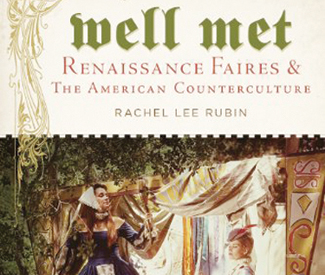
CULTURE For any of you (guilty!) who have a kneejerk gag-reflex reaction upon hearing the words “Renaissance Faire,” but can’t quite pinpoint the source of your disdain, author Rachel Lee Rubin breaks it down for you three ways: fear of men in tights, fear of voluptuous women squeezed into revealing outfits, and fear of being engulfed by nerd culture. That third category of Renaiphobia includes my own personal terror, being approached by a merry fool and loudly addressed in “castle talk,” that peculiar grammatical melange which embodieth the thithermost in Faire-y frippery. (I would also add another fear: that of hepatitis A, which my husband’s high school friend contracted from a woefully undercooked giant turkey leg.)

“Part of Renaissance Faire culture is inextricably intertwined with this adjacent culture of Renaissance Faire haters,” Rubin told me over the phone from her office in Cambridge, Mass. “I spent so much time among the trolls on Internet message boards, it really hurt my feelings!”

The fascinating, forthcoming Well-Met: Renaissance Faires and the American Counterculture (NYU Press, release date November 19), a study of the phenomenon and its political and cultural echoes by Rubin — a professor of American Studies at the University of Massachusetts, Boston — just might temper any Renaissance indigestion. Its deep and compelling tale of the Faire’s reach, much of it emanating from a specifically Californian aesthetic of soft-golden attitudes and ecstatic liberal expression, certainly had me revisiting some of my own preconceptions, even yearning to be part of the revelry. Somebody polish me a codpiece!

Next year will mark the 50th anniversary of the Faire. (This year’s monthlong Northern California Renaissance Faire in Hollister winds down Sat/13-Sun/14). Amazingly, Well-Met is the first comprehensive historical and anthropological study of the festival, although an official 50th jubilee commemorative album is set to be published next year (www.rpf50book.com).

The Faire’s tale begins with a young Laurel Canyon teacher’s quest to teach her charges at the local community center the history of theater, including the Italian Renaissance form of commedia dell’arte, the rowdy, harlequin-speckled, lute-sountracked populist traveling-theater tradition, a mixed-up version of which the Faire would soon become most identified with. But Phyllis Patterson’s idea of putting on a community festival, dubbed the Renaissance Pleasure Faire, soon became a flashpoint for several cultural and political currents of the time, not least the blacklisting of Hollywood professionals by the House Un-American Activities Committee (with all that out-of-work talent, the first Ren Faire served as both a showbiz bonanza and a backlash to Communist witch hunts); a turning away from mass-produced goods and the harmful effects of global commercialism (with an emphasis on handmade crafts and local community); and the incubation stage of the hippie, including the Faire’s soft-focus, wild-and-free English pastoral style of clothing, soon found donned by top pop minstrels, from the Byrds and the Monkees to the Beatles and the Isley Brothers.

“Even now, the spectre of the long-haired hippie looms in many older conservative minds. And he — it is always a he — belongs to the aesthetic of the Renaissance Faire, guitar in one hand, flower in the other,” Rubin told me.

Also involved in the Faire’s history was the reinvention of theater — the New Vaudeville, including such bigtimers as Firesign Theater, the Flying Karamazov Brothers, Pickle Family Circus, and Bill Irwin — plus the explosion of public community radio (LA’s KPFK and our own KPFA owe much of their golden years to the Faire), and a revisionist historical movement in education. Rubin traces the New Left political movement’s break with the Old Left to the Faire’s liberating effect. But mostly the Faire operated as America’s freak magnet, the most visible manifestation of the counterculture emerging from the conformist 1950s — and a safe space for outsiders of all types.

“Again and again, people told me how the Faire made them feel safe,” Rubin said. “Vietnam veterans told me it was only at Faire that they felt welcome back in the country. There was a huge gay and lesbian presence from the beginning, and the bawdiness encouraged there attracted different sexual expressions. Class difference, too, could be left behind. The costuming echoed that of the masquerade, where a certain amount of anonymity — a shedding of the self at the gates, which is a very important ritual at the Faire — opened up new possibilities.

“The central paradox of the Faire is that it allows you to be more yourself while being someone else.”

Another paradox is the overwhelming anachronism of the Faire — starting with those emblematic turkey legs and continuing through the revealing custom-made chain mail “wench wear” that’s lately become all the rage among female Faire regulars (“playtrons” in castle talk). Somehow, reimagining the historical past makes the Faire more authentic.

“The inspiration to write this book actually came when I took an English friend to one of the fairs,” Rubin said with a laugh. “He was horrified: ‘what have you done to my country’s history?’ And yes, it’s called the Renaissance Faire, but it’s really the idealization of probably 10 years of the whole historical period, in England, and only very select parts of that. But the central notion of the festival is play — even a play on the meaning of ‘renaissance’ itself. It’s almost like steampunk’s relationship with the Victorian era. Except that steampunk starts with one historical period and imagines the future, whereas the Renaissance Faire imagines the past.”

And of course the one constant of every historical endeavor is change. The Faire is now a national institution with a broader appeal than ever. After functioning as an artistic haven in the 1960s and a working class escape in the late ’70s and ’80s (the titillating “freakfest” alternative to Six Flags’ “redneck Disneyland”), it’s lately settled into the role of suburban theme party and gamer-nerd paradise. But that’s changing as well.

“The video game role-players are still there, but the faire doesn’t seem to resonate as much with the current tech crowd, which may be more attracted to material gain than fantasy escapism,” Rubin said. And many regular playtrons are dismayed at what they see as the Disneyfication of the Faire. “Even as a suburban and working class phenomenon, the Faire always functioned as an alternative narrative to everyday life. But now we’re seeing more ‘handmade crafts’ manufactured in China and attempts to corporatize the Faire on larger levels. There has always been an argument about authenticity among playtrons, but now there are more contemporary forces affecting the Faire.”

Yet the original spirit of transformation and togetherness persists. For Well-Met, Rubin visited dozens of Faires across the country, not only documenting several intriguing regional differences but also talking to dedicated playtrons about their personal experiences at the Faire. What emerges is a candid family portrait, full of self-aware whimsy, goofy charm, and awkward situations. (Rubin speaks with playtrons of color about the faire’s often ethnically challenged demographics and writes about the widening of the Faire’s aesthetics to include Islamic World elements, in acknowledgment of the actual Renaissance’s roots.)

Also persistent: the wilder, bawdy side, especially on the last day of many Faires, when parents are warned and much of the self-censorship vanishes, like mead from a sterling goblet gripped by hairy Hobbit knuckles. Profane insults and hilariously vulgarish displays fill the fairgrounds. Will that be the case on Sun/14 at the NorCal Ren Faire? Squeeze yourself into corset and tights and come findeth out.

NORTHERN CALIFORNIA RENAISSANCE FAIRE

Sat/13- Sun/14, $25–$35 (Kids under 12 free), 10am-6pm

Casa de Fruita

10031 Pacheco Pass Hwy, Hollister

www.norcalrenfaire.com

Local censored 2012

0


BEHIND THE MIRKARIMI CASE

In early January, details from the police investigation of then-Sheriff-elect Ross Mirkarimi bruising his wife’s arm during an argument were leaked to the San Francisco Chronicle and other news outlets. The key piece of evidence was a 45-second video that Mirkarimi’s wife, Eliana Lopez, made with her neighbor, Ivory Madison, displaying the bruise and saying she wanted to document the incident in case of a child custody battle. That video convinced many of Mirkarimi’s guilt, and a majority of Ethics Commissioners say they found it to be the main evidence on which Mirkarimi should be removed from office on official misconduct charges (the Board of Supervisors was scheduled to vote on Mirkarimi’s removal on Oct. 9, after Guardian press time).

But that video was only a small part of the overwhelming and expensive case that Mayor Ed Lee brought against Mirkarimi, including the more serious charges of abuse of power, witness dissuasion, and impeding a police investigation, all of which go more directly to a sheriff’s official duties. All of those charges got lots of media coverage and they helped cement the view of many San Franciscans that Mirkarimi engaged in a pattern of inappropriate behavior, rather than making a big momentary mistake. Yet most of the media coverage during the six months of Ethics Commission proceedings ignored the fact that none of the evidence that was being gathered supported those charges. Indeed, all those charges were unanimously rejected by the commission on Aug. 16, a startling rebuke of Lee’s case but one that was not highlighted in many media reports, which focused on the one charge the commission did uphold: the initial arm grab.


THE NEXT DOT-BOMB

In the late 1990s, San Francisco was in a very similar place to where it is now. The first dot-com boom was full bloom, driving the local economy and creating countless young millionaires — but also rapidly gentrifying the city and driving commercial and residential rents through the roof (great for the landlords, bad for everyone else). And then, the bubble popped, instantly erasing billions of dollars in speculative paper wealth and leaving this a changed city. The city’s working and creative classes suffered, but the political backlash gave rise to a decade with a progressive majority on the Board of Supervisors.

The era ended in 2010 when Ed Lee was appointed mayor, and he began ambitious agenda of pumping up a new dot-com bubble using tax breaks, public subsidies, and relentless official boosterism to lure more tech companies to San Francisco. Lee has been successful in his approach, in the process driving up commercial rents and housing prices. By some estimates, about 30 percent of the city’s economy is now driven by technology companies.

Yet there have been few voices in the local media raising questions about this risky, costly, and self-serving economic development strategy. The Bay Citizen did a story about Conway’s self interested advice, the New York Times did a front page story raising these issues, and San Francisco Magazine just last month did a long cover story questioning how much tech is enough. But most local media voices have been silent on the issue, and much of the damage has already been done.


OLD POWERBROKERS RETURN TO CITY HALL

More than a decade ago, then-Mayor Willie Brown and Chinatown power broker Rose Pak worked together to empower big business, corrupt local politics, and clear the path for rampant development — an approach that progressives on the Board of Supervisors repudiated and slowed from 2000-2010. But Brown, Pak, and a new generation of their allies have returned in power in City Hall, and it’s as bad as it ever was.

Many San Franciscans know of their high-profile role appointing Lee to office in early 2011. But their influence and tentacles have extended far beyond what we read in the papers and watch on television, starting in 2010 when their main political operatives David Ho and Enrique Pearce ran Jane Kim’s supervisorial campaign, beating Debra Walker, a veteran of the fights against Brown’s remaking of the city.

Now, this crew has the run of City Hall, meeting regularly with Mayor Lee and twisting the arms of supervisors on key votes. Pearce and Ho persuaded longtime progressive Christina Olague to co-chair the scandal-plagued Run Ed Run campaign last year, she was rewarded this year with Lee appointing her to the Board of Supervisors. Pearce has been her close adviser, and most of her campaign cash has been raised by Brown and Pak. Even progressive Sup. Eric Mar admits that Pak in raising money for him, a troubling sign of things to come.


THE REAL OCCUPY STORY

The Occupy San Francisco camp that was cleared by police last week may have been mostly homeless people. And major news media outlets from the start reported that Occupy was dangerous, filthy, and a civic eyesore.

But last fall, the camps were comprised of a huge variety of people that chose to live part or full time on the streets. Students, people with 9-5 jobs, people with service jobs, and the unemployed were all represented. Wealthy people who lived in the financial districts where camps popped up mixed with working-class people who came from suburbs and small towns. Families came out, welcomed in the “child spaces” set up in many Occupy camps throughout the country. Most camps also boasted libraries, free classes, kitchens, food distribution, and medical tents.

As news media focused on gross-out stories of pee on the streets and graphic descriptions of drunk occupiers, they managed to ignore the complex systems that were built in the camps. Nor did anyone mention that homeless people have the right to protest, too.