SoMa

Una Pizza Napoletana

0

paulr@sfbg.com

DINE If food is art (probably not, by the way), then Una Pizza Napoletana is probably the closest thing we have to a food-art installation.

This phrase, “art installation,” isn’t exactly euphonious. You install mufflers and software, and (if you’re the new head coach of the 49ers) the West Coast offense. You install a new dishwasher. Art, whatever it may or may not be, deserves a more supple verb.

Picture a white cube with high walls, mostly bare except for white tile wainscoting (rather restroom-y, I thought, but most likely practical). At the center behind the glass podium, a pizza oven of turquoise tiles like a huge Navajo artifact recovered from an archaeological dig. The space, on a nondescript SoMa corner, looks like one of the art galleries you might find in the western reaches of Chelsea, in the part of New York City where the avenues are a little wider, the buildings less tall, and the city feels not quite so breathlessly compacted.

Una Pizza Napoletana’s crowd fits the space: it’s youthful and knowing, ritualistically peering into smart phones, willing to wait for a table at a place that is so plainly and peculiarly happening. Young people don’t want to miss out, it’s their greatest fear.

What they will find missing here is anything other than pizza. That is the menu: pizza in five versions, no substitutions, no polluting table-side condiments like oregano or chili flakes (but salt and pepper, in demure shakers). That is all. No side dishes, soups or salads, no fritti misti, no pastas or roasts. The pizza isn’t sliced for you either; it’s uncut, we might say. Seinfeld had the Soup Nazi (not to mention that lunatic mohel), and we have this.

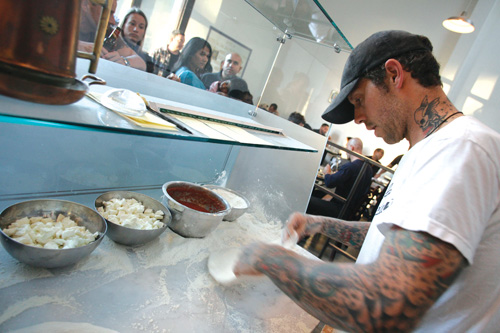
The maestro of this remarkable production, Antonio Mangieri, can be observed behind the podium manning the oven, wielding his long-handled peel like a medieval knight with a lance. He could be a mime, a figure of soundless kinesis: he stretches, he thrusts, in goes a pie, out comes another, on goes a drizzle of olive oil from his copper urn and a handful of fresh arugula.

It’s hard not to watch his act, because he’s at the very center of things. Also, you’re likely to be quite hungry and wondering if the pizza he’s lifting from the oven might be headed for your table. If it is, you’ll be happy, because the pies, despite their stark lack of trappings are worth waiting for and even suffering (a little) for.

The heart of any pizza is the crust, and UPN’s crusts deserve the ultimate compliment: they could stand on their own, without any toppings at all. They have a slight thickness and focaccia-like sponginess that cuts against current cracker-crust vogue, and they taste quite distinctly of sourdough. It is rare in my experience that pizza crust, even in good pizzerias contributes flavor. Mostly one is attentive to, and grateful for, texture (chewy? crispy?) and the structural question of whether or not the points droop. UPN’s did droop for us a little, but that was probably because we were hacking our way through them haphazardly, so the pieces weren’t symmetric.

Another factor in the droopiness would likely be that the pies are generously laden with toppings. You don’t get a dusting of this and a few gratings of that. These pizzas are loaded. The bianca ($20) for instance, was fitted out with extra-virgin olive oil, garlic, sea salt, at least a dozen thumbs of buffalo mozzarella, and plenty of basil leaves which interestingly accompanied the rest of the pie into the oven rather than being put on after the pie had baked — and were accordingly blistered. Basil’s flavor can withstand rougher handling than that of most other herbs (you can keep pesto made from your summer surplus frozen for months without having it go flat), but I did think that in this case the high heat had diminished the leaves’ fragrant, peppery bite.

The Ilaria pie ($22) by contrast was strewn with fresh arugula leaves, but these were aftermarket add-ons and had not been asked to face a 900-degree Fahrenheit oven. As a result they retained their fresh, nutty flavor, but they also were not well-integrated with the rest of the toppings. Instead they amounted to a mat laid over their accompaniments — a kind of roof to the crust’s floor. Those other toppings included extra-virgin olive oil, sea salt, cherry tomatoes, and smoked mozzarella. I thought the last would be the dominant flavor — smoked anything often asserts itself over other ingredients in the vicinity — but it was mild and muted here.

Service is excellent, and a brief wine list offers several unusual, pizza-friendly Italian bottlings in both red and white by the glass. But I noticed quite a few bottles of Moretti beer on nearby tables, too. If beer matches up with almost any food, then pizza — more than almost any other food — matches up with practically any drink euphoric in nature.

UNA PIZZA NAPOLETANA

Dinner: Wed.-Sat., from 5 p.m.

210 11th St., SF

(415) 861-3444

www.unapizza.com

Beer and wine

MC/V

Noisy

Wheelchair accessible

What not to M.O.O.P.

3

caitlin@sfbg.com

PLAYA PREP In Miranda Caroligne’s Mission District sewing studio, there is a dress dummy covered in used Carhartt remnants that are being reborn as an asymmetrical mini-dress. It’s a project that the designer, whose fanciful style has made her a popular check box on pre-Burning Man to-do lists, is working on for Margaret Long, a member of the Flaming Lotus Girls fire art collective. Please note: no fun fur or tribal accents are visible on the soon-to-be-dress.

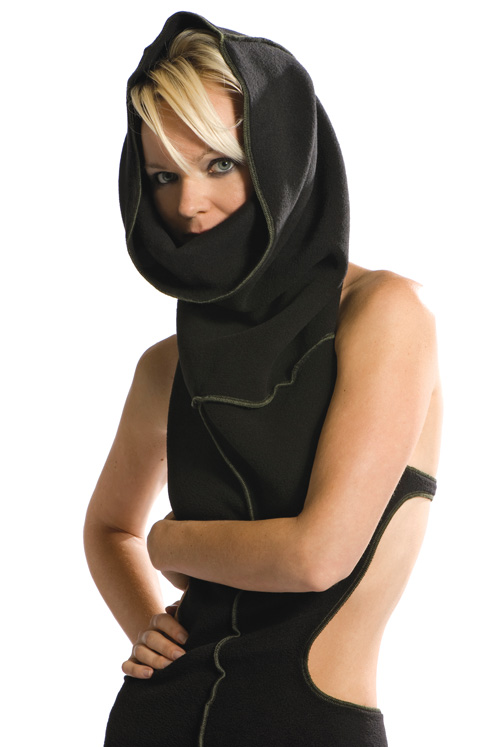
These are the rush months for Caroligne and other burner designers, like SF-based Silver Lucy and Tammy Hulva of Tamo Design, prime time for helping burners to realize their sartorial fantasies. Caroligne makes form-fitting, whimsically-stitched fleece jackets that hang by the bundle throughout her bright creative space, and one-size-fits-all boot covers made from old suit sleeves. But she says that for her custom-made creations, she prefers a little vision in her clients. In other words, please don’t come to her for furry boots and glow sticks.

“I tend to speak out against that,” she says of trends towards the homogenization of playa culture. “I only design for people if they have a very clear vision of something they want to express. I consider myself the conduit to making that happen.” When people come in for the standard Mad Max raver treatment, she sits them down to clarify what about the look resonates with them.

Burning Man fashions have evolved over the last quarter-century, with the old emphasis on crazy DIY costumes eventually morphing into distinct burner fashion aesthetics, such as the feather-and-leather look popularized by the El Circo camp and the late designer Tiffa Novoa and featured in SF stores such as Five and Diamond.

It is perhaps indicative of the spread of Burning Man culture that Caroligne’s potential clients sometimes ask for the same style. It’s been popularized by a hundred wholesale websites — fun fur bikinis and (particularly popular in the Bay Area, according to the designer) the “dark leather and feather tribal look that’s mass produced in Bali.”

Stores from SoMa to San Rafael to New York advertise themselves as one-stop shopping venues for burner-fied fashion, and numerous expos make similar claims here in the Bay Area — Aug. 14’s second Prepare for the Playa street fair of the year being one of them.

Independent designers are at creative odds with the uniformity that is developing in some camps — but they’re also concerned with the sustainability of the designs, which are often imported and disposable. “That disgusts me,” Caroligne says. “A lot of that stuff is very M.O.O.P.-y.” (M.O.O.P. being the burner acronym for to-be-avoided-at-all-costs “matter out of place,” or any waste that could harm the playa’s natural ecosystem).

It wasn’t always this way. Before the turn of the 21st century, it would have been difficult to determine the Burning Man uniform. People made clothes for themselves and friends, or they wore regular clothing-redux in the hot Nevadan sun. Ironically nowadays, Caroligne says, “I’ve heard many people talk about walking into a Burning Man party and feeling judged (because of what they were wearing).”

She’s still a little unsure of the implications of working as a for-profit businessperson within a nonprofit culture. But Caroligne tries to mitigate the disconnect by doing pieces for busy artists that contribute to the Burning Man community (she was particularly excited to have costumed Burning Man board member Marian “Maid Marian” Goodell for the ritual burning of The Man one year, and be-suited Glitch Mob’s Justin Berreta for another).

In a previous incarnation, Caroligne was a physical therapist. When she began her fashion career, she did so with an eye toward her clothing’s effect on individual body dynamics. She created weighted coats that swung appealing when their owner strode across dusty Black Rock streets, sexy dresses made of cozy fabric that could be doubled around the face for warmth or privacy. At times, her clothing can even reflect the party philosophy of the wearer– she often asks customers whether they’d like the softest fabric of their new wardrobe item on the inside or outside. “Do you want to feel it or do you want other people to feel it?”

She believes what one wears at Burning Man can be empowering. “We’re finding your superhero self. What does your superhero look like?” is a common topic of discussion in initial consultations.

Judging from the length of her in-process dress’ skirt, Long’s superhero is sultry — but also here to get some work done. An intact overall strap has been left to speak for itself on the right shoulder, and below, grease-stained Carhart pieces have been left whole so that Long’s customary wrench loop will continue to ride comfortably on her right hip. Caroligne is attempting to create an outfit that expresses the wearer.

“During my 12 years at Burning Man, I’ve seen the change from self-made to high fashion,” says Hulva, whose Tamo Design clothes “originate from ideas about making my wardrobe more functional and fashionable on the playa.

Hulva makes luxe faux fur that doesn’t shed M.O.O.P. like the cheaper stuff you’ll find at many a mall store. Her popular “Baroness” jacket is late-night-early-morning playa crawl dream wear, with a hood to hide in, fabric that gives, deep pockets to store party essentials — and you don’t have to be so glum about covering up your LED tube top: it’s sexy, to boot.

When pumped about hot playa trends for 2011, Caroligne and Hulva were loathe to cite anything too specific (though Caroligne expressed her enthusiasm for “playful 1980s revival styles”), rooting instead for individuality.

Burning Man fashion is about “a platform for self-expression,” according to Caroligne. Clothes, she says, “are the primary way that people can express themselves,” accessible even to those that specialize in other forms of playa magic, like Long.

But they did note a general trend arch over the festival’s history. The past of Burning Man lay in DIY clothes, self-made everything. The present has brought professionally-made garb, and the mass accessibility of a certain playa “look.” The future? Hulva hopes it holds “a trend to be more sustainable and practical — in addition to keeping things light and fun.”

She’s working on it. On Sunday, Aug. 7, Hulva is organizing the Haute Pool Show, a gathering at the Phoenix Hotel of 20 local, independent designers selling their high quality, playa-ready belts, vests, and accessories. It’s a follow up to her last event — July’s Beyond the Fence at Mighty — and both cater to those preparing for their journey to Black Rock City.

Only these aren’t clothes you’ll be reserving for the desert. Sure, they’re whimsical, but Burning Man fashion — particularly here in the Bay Area — really is stepping beyond the playa fence. The festival’s recent sell-out of tickets and an expected crowd of around 52,000 underline the fact that its impact is growing, and style cues picked up from the playa may just be finding their way into year-round usage.

“Versatile styles are hot this year,” says Hulva. “Burning Man fashion has really migrated into the everyday self expression, so people are buying things they can wear on the playa and back home.”

HAUTE POOL SHOW

Sun/7 2-8 p.m., free

Phoenix Hotel

601 Eddy, SF

Facebook: Haute Pool Show

PREPARE FOR THE PLAYA

Aug. 14 noon-7 p.m., free

Cafe Cocomo

650 Indiana, SF

www.preparefortheplaya.com


MIRANDA CAROLIGNE’S MUST-HAVES FOR THE PLAYA

Comfortable shoes

Cotton socks

Daytime clothes in light colors

A good shade hat and/or parasol

Silk long underwear for easy layering

A warm coat (“that you’ll have fun with”)

A thrift store cashmere sweater that you can tailor to be form-fitting

Replacing the Concourse

4

news@sfbg.com

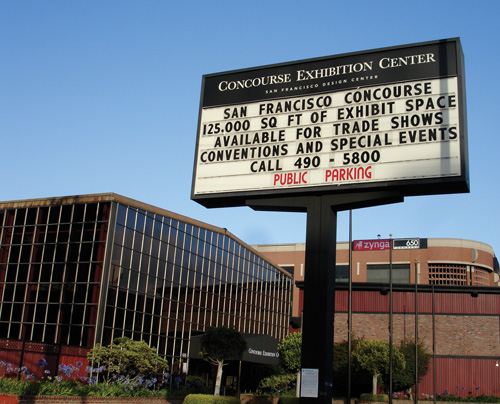
In one of the few remaining San Francisco neighborhoods untouched by gentrification, there is a proposal to demolish the Concourse Exhibition Center and replace the quintessential Showplace Square building with a market-rate residential project, which the developer says will be rental apartments.

This is the first major project in the new Eastern Neighborhoods Plan that will change the light industrial neighborhood where brick and mortar meet interior design, raising questions about whether the development would be sustainable, transit-oriented, and family-friendly.

Home to annual events like the Green Festival and the KPFA Craft Fair, the Concourse is where mom and pop vendors share their wares in an affordable venue — one of the few remaining in the city.

“Since ’96,” recounted Alan Van De Kamp, director of sales for the Green Festival, “they’ve been trying to sell it, to tear it down. You never know from year to year … You imagine at some point, somebody’s gonna say it’s time.”

Though nothing has been approved, the current proposal by developer and Concourse owner Bay West Development, first introduced in 2000, has come the farthest yet. The project will be considered for approval by the Planning Commission once the environmental review process is complete, which could take up to six months. Public comments on the project will be accepted until August 8.

The proposed project contains two sites, one at 801 Brannan Street and one at 1 Henry Adams Street, which would result in a total development of up to 674 residential units, 43,037 square feet of retail space, and 673 parking spaces. Under the city’s inclusionary housing laws, 221 of those units would be affordable (71 to be built on site and 150 dedicated to the city for development). Of the total parking spaces, 166 spaces would replace existing parking spots at the site.

Bay West, developer of the San Francisco Design Center, has owned the Concourse building for 30 years and wants to demolish and rebuild as part of the Eastern Neighborhoods Rezoning and Area Plans, the blueprint for development in a part of the city dominated by working class residents.

That controversial plan was in development for years, during which there was a moratorium on approval of large projects, and it was finally adopted in 2008. It was created to redevelop The Mission, Showplace Square/Potrero Hill, East SoMa, and the Central Waterfront — 7 percent of the city’s 47 square miles — over 20 years.

“It’s our feeling that the building itself is beyond its use as an exhibit hall and we’re replacing it with housing units,” said Sean Murphy, a partner at Bay West.

The Planning Commission heard the draft Environmental Impact Report for the proposal on July 28. At the hearing, the commissioners expressed interest in seeing the progression of the development, but not all were convinced.

“There is a certain amount of vagueness,” said Commissioner Kathrin Moore. “This EIR is ultimately tempered by the strong policy issues that underlie building in the Eastern Neighborhoods and at this moment I don’t quite see that.”

The proposal has left some questions unanswered, such as, where will the small vendors go to sell their wares? Bay West has suggested exhibition halls like the Cow Palace or Moscone Center, but Green Festival organizers say that isn’t realistic for everyone. “We would lose some of our vendors if we went to Moscone,” said Van De Kamp. “There’s some people that can’t come. A lot of the green economy is about mom and pops. They can’t afford it.”

Sue Hestor, a land-use attorney who opposes the development, asked vendors who use the Concourse how important leaving the center would be. “For a lot of people,” she said, “it meant the difference for them being viable or not.”

It would be a major challenge to move, said Robbie Kowal, the co-director of Sea of Dreams, a huge party and concert that will hold its seventh annual celebration this New Years Eve at the Concourse. “There’s the Cow Palace, and the Design Center, but it’s not that big, not a place where you can put a proper concert on one side and a multitude of different kinds of spaces [on the other]. The Sea of Dreams’ success is attributable to the proper use of the Concourse.”

With 125,000 square feet of space that can be split into its west and east halls and a mezzanine, the Concourse building has catered to annual festivals and events for more than 20 years, holding as many as 6,800 people at once.

“There’s room for so many different communities in there. We love our home,” said Kowal. “It’s a really unique and wonderful space.”

The redwood frame of the Concourse, accented by glass fronts that allow for natural lighting, used to be a furniture mart and then a fashion and jewelry mart before it was an event center. The project proposal’s architect, David Baker and Partners, has already designed many of the new buildings in Showplace Square.

Bay West isn’t worried about where the Concourse shows will go. “Most of our shows use less than 20,000 square feet,” said Murphy. “The larger shows would go to the 100,000 square foot San Mateo County Event Center.”

Tony Kelly of the Potrero Boosters Neighborhood Association says the intention of the plan is to reduce the light industrial area by zoning more of it for residential uses, protecting only about half of it and converting the remainder.

“This is an area where we don’t have enough parks, or transit. The project would double the population, and we don’t have enough new infrastructure to handle it,” he said. “It’s essentially a ticking time bomb that the city’s going to have to get a handle on at some point, or these residents are going to be miserable.”

Though the project would create at least an acre of publicly accessible open space, some residents wonder if it’s enough, and the concern about insufficient transit remains.

“It seems to me that once again there is too much parking near a freeway entrance, inadequate transit that is not likely to improve significantly once the Transit Effectiveness Project [a city plan for improving Muni service] is implemented,” said activist Sue Vaughan, who rides her bike at least part way during her commute from the Richmond District to REI at 840 Brannan Street for work.

“This is exactly the kind of place that attracts (commuters),” said Hestor. “There’s too much parking. There’s crappy transit. It totally undermines any idea of sustainable development.”

But at the commission hearing, Commissioner Hisashi Sugaya didn’t think Hestor’s argument had merit. “Parking is not an environmental impact as far as the city is concerned,” he said.

Vaughan says that Muni managers have been absent from several development meetings in the Eastern Neighborhoods area. “No one from Muni was represented on this panel discussion about the Sustainable Communities Strategy,” she said, referring to a July 6 meeting convened by the Planning Department to discuss the importance of building housing next to accessible transit.

The Concourse is scarcely accessible by bus lines 10 and 19, but with a growing population in Showplace Square, it wouldn’t be enough, says Vaughan. “We’re moving forward with all these projects with lots of parking near freeway entrances, which makes it seems like SF is becoming a bedroom community for Silicon Valley. You have an impact on Muni when that happens. With more cars, there’s more congestion for buses.”

Bay West argues that the apartments it plans to build at the Concourse site would be “workforce housing” with less than 1:1 parking (actual parking would work out to .79:1 at the 801 Brannan site and .64:1 at the One Henry Adams site). More than 40 percent of the units would be larger two-bedroom units intended for families.

Yet Kelly says that that by offering the apartments at market rates, none are appropriate for new families. “For all the talk about keeping families here, then how come we’re not building family housing?”

It’s a max-out project, says San Francisco architect Dick Millet, of the Potrero Boosters Neighborhood Association. “In the end, under their breath, they’re all going to say, I wouldn’t live there myself.”

Portuguese delights at the Secret Wine Shop and lenga|lenga

0

Up on the second floor of an industrial warehouse in SOMA, you can find a small, stylishly decorated loft filled with secret spirits. I’m not talking about a haunted house. I’m talking about the Secret Wine Shop. It’s also the home of owner Christy Bergman — and homebase for her endeavor to bring unique and delicious wines to an eager audience, in a nontraditional and extremely intimate environment.

On July 25, I went to Bergman’s Portuguese food and wine event, which was a collaboration with lenga|lenga, a new catering biz specializing in traditional Portuguese flavors.  Needless to say, it was one secret that deserves to be shared.

All six-courses were perfectly paired with a wonderfully robust, small-production wine, either from Portugal or made with Portuguese grapes. According to the chefs, there are 1001 ways to cook cod, so several of the dishes used this delicate, flaky fish, including the main course of creamy codfish, cooked with potatoes and white sauce, a Portuguese twist on potatoes au gratin or Spanish brandade.

As we made our way through the long list of wines, each one better than the last, we socialized with the resident cat Diesel, examined the eclectic art on the walls, and got to know our fellow wine aficionados, in what was essentially somebody’s living room. This is truly a special wine tasting experience, and with the expert wine selection by Bergman, your palette will be pleasantly surprised by the diversity of flavors that one evening can encompass. As they say in Portuguese as they clink their glasses together … saúde!

Hot sexy events: July 27-August 3

0

Ugh. There is nothing sexy about breast cancer (unless you’re Annie Sprinkle). But honestly, when life gives you tumors, you give that thing tumescence – or at least, that’s adult film performer Hollie Stevens’ view.

Stevens was diagnosed with breast cancer this year, but it’s hardly held her down. The clown porn enthusiast filmed an intense scene on societysm.com in which her head was shaved – it had to happen anyway for chemo, so why not make it someone’s fantasy? This week, you can help young Stevens out in her quest for health. On Fri/29, she’s hosting a low-lit lingerie roller disco, complete with an auction featuring Chuck Stevens pornography prints, and Girls and Corpses magazines – the site of Stevens’ recent “Playdead bunnies” feature.

“Is Leather Dead? Does it Need to Die?”

Leather leader-author Guy Baldwin, kink educator Race Bannon, lesbian activist Gayle Rubin, and Instigator magazine editor Michael Thorn take a hard look at leather’s relevance today. In the age of Internet cruising, can a community still be said to exist? Heady questions being asked mere days before the Up Your Alley street fair. 

Weds/27 7-10 p.m., free

LGBT Center

1800 Market, SF

www.folsomstreetfair.org


A Night for Hollie Stevens

The press release says bring your fat wallet, lingerie, or both. So you’ve got options. Can’t make it? Donate to Stevens here.

Fri/29 8:30 p.m.-12:30 a.m., $30

Private SoMa location, SF (buy ticket for details)

www.holliestevensxxx.com


Comfort and Joy Active Touch

Burning Man fundraising season is upon us (for those who were lucky enough to score a ticket) and one of the most venerable playa sexy camps is throwing a big, swinging bash set to jams by DJ Bus Station John

Fri/29 10 p.m.-4 a.m., $20 suggested donation

Mission Control 

www.missioncontrolsf.org


Perverts Put Out! Dore Alley edition

Our sex columnist Gina De Vries is over the moon for this recurring performance series that focuses on the gamut of sex and artistic expression – cop fantasies, “bearlesque,” even cruising the Excelsior has gotten its due on stage over the years. What will go off this year? You’ll have to attend to find out – it’s also the perfect pre-party for all those that are gonna have to work Up Your Alley tomorrow. 

Sat/30 7:30 p.m., $10-15

1349 Mission, SF

(415) 552-7399

www.sexandculture.org


Up Your Alley street fair 

In the thick of hippie summer fests comes Up Your Alley Fair, an al fresco get-together that unmasks the sexual undertones of other festivals. Why pretend it’s all about the music when you know all you’re trying to do is get that hottie back to your tent to get laid? Up Your Alley (and Folsom Street Fair, its big brother) makes no pretense – it’s all sexy sex all the time, in the DJ areas, in the women-only Venus Playground, and by your favorite pillory. 

Sun/31 11a.m.-6 p.m., $7 suggested donation

Folsom between Seventh and 12th St., SF

www.folsomstreetfair.org/alley


Perverts give good poetry

0

culture@sfbg.com

LUST FOR LIFE I work at the St. James Infirmary, an occupational health clinic for current and former sex workers. The clinic is a beneficiary of Dore Alley’s Up Your Alley Fair — a pride celebration for kinky people and little sister of the Folsom Street Fair — so every year I have to a work a shift at the festival. I haven’t been able to enjoy the actual street fair aspect of it for a while. But I always look forward to this week, and to Dore Alley Eve (as those of us in the kink and leather communities jokingly call it) because of Perverts Put Out (PPO), which this year takes the stage Saturday, July 30.

Now, it’s impossible for me to write about PPO without bias. I’m good friends with the producers and I’ve been on their rotating roster of performers since 2007. But I’ve also been coming to PPO as an audience member since 2004, right about the time I graduated from teen poetry slams and started performing my own works around the Bay Area.

Attending PPO for those first three years as an adult performer (in all senses of that term) and newly-minted sex writer trying to find her place in the SF spoken word scene, I received an amazing lesson in our sex and art communities. PPO is responsible for much of my education about both writing and performance. I sat back. I watched. I learned. I took a lot of notes.

So consistently well curated it borders on absurd, PPO is an impressive mix of genre and content — everything from poetry to performance art, diatribes to elegantly crafted erotic short stories. The unifying theme of PPO is of course sexuality, and most of the performers are queer in some way. But queerness and sexuality can cover a lot of ground.

Some of my favorite PPO memories from over the years: Kirk Read’s tragically beautiful piece about going duck hunting with a new lover. Daphne Gottlieb’s gorgeous poem “Carpe Nocturne” about (among other things) desire, lineage, death, and love. Lori Selke’s razor-sharp breakup letter to the racist and sexist mainstream BDSM scene. Meliza Banales’ riotously funny story about doing crystal healing sex work in Santa Cruz. Steven Schwartz’s “Bearlesque,” a smart and funny rumination on bear identity, complete with dancing and tassles. Jaime Cortez’s eerily beautiful short story “Excelsior,” about queer men cruising not in the Castro or SoMa, but in the Excelsior District. Fran Varian’s secret and brutal cop fantasy, told from the perspective of an anti-imperialist queer activist protagonist. Pretty much everything poet Horehound Stillpoint has ever done, ever. I could go on. But really, you should just come to the show.

PERVERTS PUT OUT: THE DORE ALLEY EDITION

Sat/30 7:30 p.m., $10–$15

Center for Sex and Culture

1349 Mission, SF

(415) 902-2071

www.sexandculture.org


Best of the Bay 2011: BEST RUM LEED-ER

0

When Bar Agricole opened earlier this year, the provenance of its architectural design made almost as many headlines as its food. Impeccably eco-contemporary and obsessively LEED-standard compliant, the striking tavern in SoMa raised the bar for restaurant design. Good for it. It’s lovely; it’s immaculate; we would almost eat off the walls. But — besides the fact that all this green-edged conception has actually yielded a comfortable vibe, stellar drinks, and spectacular cooking (please try the sauerkraut soup and roasted mussels with chorizo) — what’s the real news? Agricole! The classic West Indian white rum, or rhum, is derived from pure cane juice and much prized by the French. Bar Agricole serves it in its ti punch cocktail, spiffily accented with lime zest. The clean, crisp taste evokes an amiable warmth within, much like Bar Agricole itself.

355 11th St., SF. (415) 355-9400, www.baragricole.com

BEST KOREAN CHICKEN GARAGE

Best of the Bay 2011: BEST KARAOKE PROUSTIAN

3

The continued karaoke tyranny of Journey’s “Don’t Stop Believin'” induces revulsion on the order of Barney’s theme song. Now one fine man, maverick karaoke DJ Roger Niner, has taken a stand for all of us against the song’s monopoly. The wildly costumed, wildly fun Niner levies a $5 tax for its use, and uses the extra cash to buy more songs for his collection. Niner can usually be found at the Parlor near Fisherman’s Wharf on Wednesdays, San Mateo’s Swingin’ Door on Thursdays and Fridays, and SoMa’s Butter on Sundays. Ever the intellect, his website quotes Marcel Proust: “Detest bad music but do not despise it. As it is played, and especially sung, much more passionately than good music, it has much more than the latter been impregnated, little by little, with man’s tears.”

www.rogerniner.com

Best of the Bay 2011: BEST PLACE TO MEET YOUR MAKER

0

If you ever need reminding that nerd is still the new black, TechShop is at the ready. Inside this SoMa “open access public workshop” you’ll find a veritable wonderland of high-tech tools for metal- and wood-working, machining, fabric crafts, electronics, and robotics — with classes on how to use it all. Offerings range from entry-level courses on basic skills like soldering, laser-cutting, silk-screening, milling, and injection-molding, to pro-pushing seminars on the latest precision machining tools and high-tech design software. Individual memberships are a pricey, $100–$125 per month (less for students), but hey — at least you won’t have to buy your own 3-D scanner! Whether you have a skill you’re itching to hone, an invention you’d like to prototype, or a project you’re hoping to finalize, this shop’s capable crew will help you see it through.

926 Howard, SF. (415) 263-9161, www.techshop.ws/tssf

Best of the Bay 2011: BEST HOME ROASTS IN THE AVENUES

0

The gracious husband and wife team behind the beans at Brown Owl Coffee have been roasting together as Hearth Coffee Roasters for a few years now. Their passion shows — the two serve lush coffees at their tiny, cozy cafe. Impeccable cappuccinos and a mean cup of drip pair well with breads and pastries from local producers like Mi2Sweets; Oakland’s Pepples Donuts; and baklava from Richmond Egyptian restaurant Al Masri. Affogato lovers, take note — theirs is a beaut, made with Straus vanilla ice cream. Tucked out in the avenues, Brown Owl’s a big "how now?" to those who locate SF’s superior beans solely Mission and SoMa-side.

1131 Taraval, SF. (415) 242-1426, www.brownowlcoffee.com

Best of the Bay 2011: BEST IMPERSONATION OF AN ART GALLERY BY A RESTAURANT

0

You are to be pardoned if you approach the nondescript brick SoMa building that houses Una Pizza Napoletana, walk through the door (plate glass, like the rest of the façade), and have the brief sensation of arriving at an art gallery between installations. Or perhaps the high-ceilinged, white-walled cube — with a turquoise-tiled conical shape rising from the center — seems more like a museum? No. It’s a pizzeria, home to tattooed chef and former New Yorker Anthony Mangieri, and the tiled shrine is the pizza oven. Pizza is the sole objet d’art: that’s it, nothing more, no sides, substitutions, condiments, nada. The drill isn’t quite as severe as on Seinfeld’s "Soup Nazi" episode, but it’s still a singular — and tasty — experience.

210 11th St., SF. (415) 861-3444, www.unapizza.com/sf

The long wait for sleep

7

rebeccab@sfbg.com

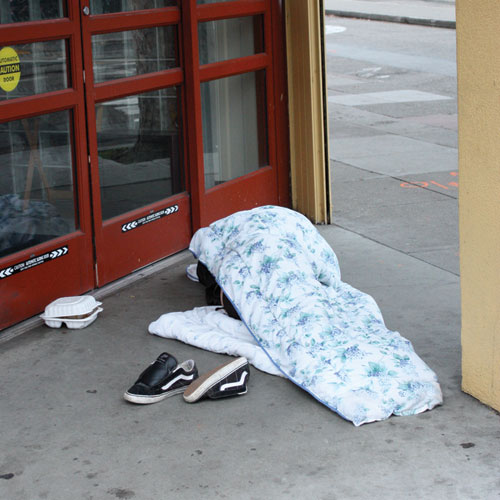
Rodney Palmer is 52, and he uses a cane because he has a bad hip. Walking is painful for the homeless native San Franciscan, but to reserve a bed at a shelter, he’s got to get up early and cover a lot of ground. “I get up at 4 a.m. and go to Glide” in hopes of getting a long-term shelter bed, he told the Guardian. “By the time I get there, there’s people sleeping on the ground.”

People arrive at the homeless assistance center so early because the shelter beds that can be reserved for 90 days free up at 7 a.m. on a first-come, first-served basis — and they’re quickly snapped up.

Palmer reached into his sock and pulled out a small plastic bag full of painkillers to demonstrate how he copes. Lately he hasn’t had any luck getting a long-term bed, so he’s devoting many hours a day to getting on wait lists for overnight beds. That means heading to drop-in centers in SoMa and the Mission, where at least there are chairs he can rest in. “It’s an all-day job,” he said. When it comes to waiting outside, “I feel vulnerable. People can die like that when the winter comes.”


BEYOND SHELTER

A coalition of homeless advocates is trying to change the way shelter beds are allocated in San Francisco, and District 6 Supervisor Jane Kim has taken up their cause, spearheading an initiative for the Nov. 8 ballot. The Fair Shelter Initiative would eliminate “shelter” from the definition of housing under Care Not Cash, the signature homeless policy created under former Mayor Gavin Newsom.

Since about 41 percent of shelter beds are set aside as housing for Care Not Cash recipients — who represent an estimated 7 percent of the city’s homeless population — advocates say the move would effectively free up long-term shelter space for veterans, disabled people, seniors, and others who don’t qualify for Care Not Cash. It would, they say, give everyone an equal shot at getting a bed.

At the same time, proponents say, it would solve a recurring problem of beds going unfilled even as shelter seekers wait for hours on end only to be turned away or to finally give up, discouraged by the system.

Cyn Bivens, a peer advocate at Mission Neighborhood Resource Center, says roughly 60 people sign up for shelter beds on a given day at his facility. People who are trying for the 90-day beds show up before 7 a.m.

“They may drop between one and five beds, but we may have 50 people in line,” Bivens explains. “Usually, by 7:15, I’m saying sorry, they’ve only dropped two beds.” People then continue to sign up all day in hopes of reserving overnight beds, which are released later in the day. Bivens estimates that about half the people who start out seeking a bed don’t wind up getting one.

While Kim and supporters of the Fair Shelter Initiative view the proposed change as a simple adjustment that would improve a dysfunctional system, they face opposition from Mayor Ed Lee and Human Services Agency Director Trent Rohrer, who have described it as a bid to dismantle Care Not Cash.


$59 A MONTH

As things stand, several hundred indigent adults in San Francisco benefit from County Adult Assistance Programs (CAAP), an umbrella encompassing General Assistance and several other programs intended for people who are waiting to receive Social Security Income (SSI) or seeking employment.

Each month, CAAP beneficiaries are allocated a maximum of $422, or $342 in the case of General Assistance recipients, but they never actually see that money. Instead, under Care Not Cash, they receive $65 and $59, respectively, since the rest is deducted for housing. Some CAAP recipients have actual housing in single-room occupancy (SRO) hotels, but roughly two-thirds are guaranteed shelter beds to meet their housing needs, according to an estimate from the Coalition on Homelessness.

The upshot of this system is that most CAAP recipients are effectively made to pay up to $357 a month from their benefits to sleep on a cot in a shelter, provided they make it there by curfew. For one frustrated homeless man on General Assistance who spoke at a July 14 hearing about the proposed initiative, living on less than $2 a day rather than closer to $11 a day was making it very difficult for him to improve his situation.

“I’m trying to look for work,” he said, adding that he’d seen job postings in other cities. “How am I going to subsidize my trip to Emeryville or San Jose? I’m stuck, and there are things that I cannot do.”

Mark Leach, another homeless CAAP beneficiary, said the low cash grant posed a vexing problem for him too: “I can’t afford to pay my phone bill.” Living on nothing more than $65 a month can mean living in isolation, with no way to receive calls in case work becomes available.

Another issue arising from the current system, according to Bob Offer-Westort of the Coalition on Homelessness, is that a disproportionately high number of beds are reserved for the relatively small number of CAAP recipients citywide, and those program beneficiaries don’t always use their beds. Some don’t make it to the shelter in time for curfew, others couch surf, and still others may prefer to sleep outside, far from the confines and crowds of the shelters. If they don’t show up to claim the bed, it will eventually become available to someone else for the night — but that can take hours. So people who either aren’t enrolled in CAAP or don’t already have long-term beds are reduced to waiting, day after day, for space to free up overnight.

If the Fair Shelter Initiative were in place, CAAP recipients “won’t be guaranteed a shelter bed” as part of Care Not Cash, says Offer-Westort. “But they’ll be competing for more beds,” he added, which “should reduce the wait time.”

In the meantime, CAAP recipients who aren’t being housed in SROs or some other transitional housing would receive the full amount of their benefits. Rohrer, the HSA director, seized on this point as problematic, saying that doling out the full cash grants would draw people to San Francisco from other counties where benefits are lower. “If we start to get folks from other counties and states … the result will be more homeless people in San Francisco and less access for folks,” Rohrer said.

Jennifer Friedenbach of the Coalition on Homelessness countered this, saying, “they have never been able to prove that people will come from out of town.” She addressed the notion that the Fair Shelter Initiative would dismantle Care Not Cash by saying, “It’s news to me — big news — that shelter is the entirety of Care Not Cash.”

Opponents of the measure who spoke at the hearing argued that $422 a month was too much to give to a homeless person because it could feed addiction. While it’s true that many homeless people in San Francisco have substance-abuse issues, many others are disabled or have just fallen on hard times. Advocates say they’ve noted a surge in newly homeless people accessing services, particularly women.


HUNDREDS OF BEDS CUT

Compounding the overall problem is that more than 300 shelter beds have been lost since 2004. During the hearing, L.J. Cirilo ticked off a long list of homeless service programs and facilities that had vanished in recent years due to budget cuts, going on for several minutes.

Palmer falls into the category of people who might benefit from a shorter wait time if Kim’s initiative were in place. He was just one of many who turned up at the Mission Neighborhood Resource Center — a homeless drop-in center that offers a clinic, shower, and laundry facilities — to watch a movie and eat supper. Two of the others there said they had experienced traumatic brain injuries and had been victims of identity theft. A construction worker explained that he was seeking odd jobs with little luck. Another man shuffled impatiently back and forth as he spoke, scratching incessantly, while he condemned the entire homeless services system as corrupt.

The measure has drawn opposition from Mayor Lee, who is “concerned that changes to Care Not Cash may begin a process that would unravel the program,” according to Christine Falvey, Lee’s spokesperson. “He wants to make sure we don’t do anything to prevent our department from providing the program.”

Falvey also noted that Lee was interested in meeting with advocates to find an administrative fix, rather than a ballot initiative, that could address concerns about the shortcomings of the shelter system. Kim expressed some openness to that idea at a hearing, but seemed committed to moving forward with changing the system that’s in place. “We do want to address inequity,” she said. “There absolutely should be no vacant beds.”

Upcoming summer festivals

0

July 14-24

Midsummer Mozart Festival Various Bay Area venues. (415) 627-9141, www.midsummermozart.org . Prices vary. You won’t be hearing any Beethoven or Schubert at this midsummer series — the name of the day is Mr. Mozart alone.


July 16-17

Connoisseur’s Marketplace Santa Cruz between Camino and Johnson, Menlo Park. (650) 325-2818, www.miramarevents.com. 10am-6pm, free. Let the artisans do what they do best — you’ll polish off the fruits of their labor at this outdoor expo of artisan food, wine, and craft.


July 21-Aug 8

SF Jewish Film Festival Various Bay Area venues. www.sfjff.org. Times and prices vary. A three week smorgasbord of world premiere Jewish films at theaters in SF, Berkeley, the Peninsula, and Marin County.


July 22-Aug 13

Music@Menlo Chamber Music Festival Menlo School, 50 Valparaiso, Atherton. (650) 330-2030, www.musicatmenlo.org. Classical chamber music at its best: this year’s theme “Through Brahms,” will take you on a journey through Johannes’ most notable works.


July 23-Sept 25

 SF Shakespeare Festival Various Bay Area venues. www.sfshakes.org. Various times, free. Picnic with Princess Innogen and her crew with dropping a dime at this year’s production of Cymbeline. It’s by that playwriter guy… what’s his name again?


July 30

Oakland A’s Beer Festival Eastside Club at the Oakland-Alameda Coliseum, 7000 Coliseum Way, Oakl. www.oakland.athletics.mlb.com. 4:05-6:05pm, free with game ticket. Booze your way through the Oakland A’s vs. Minnesota Twins game while the coliseum is filled with brewskies from over 30 microbreweries, there for the chugging in your souvenir A’s beer mug.


July 30-31

 Berkeley Kite Festival Cesar Chavez Park, 11 Spinnaker, Berk. www.highlinekites.com. 10am-5pm, free. A joyous selection of Berkeley’s coolest kites, all in one easy location.


July 31

Up Your Alley Dore between Folsom and Howard, SF. www.folsomstreetfair.com. 11am-6pm, $7-10 suggested donation. Whether you are into BDSM, leather, paddles, nipple clamps, hardcore — or don’t know what any of the above means, this Dore Alley stroll is surprisingly friendly and cute once you get past all the whips!


Aug 1-7

SF Chefs Various venues, SF. www.sfchefs2011.com. Times and prices vary. Those that love to taste test will rejoice during this foodie’s paradise of culinary stars sharing their latest bites. Best of all, the goal for 2011’s event is tons of taste with zero waste.


Aug 7

SF Theater Festival Fort Mason Center. Buchanan and Marina, SF. www.sftheaterfestival.org. 11am-5pm, free. Think you can face about 100 live theater acts in one day? Set a personal record at this indoor and outdoor celebration of thespians.


Aug 13

San Rafael Food and Wine Festival Falkirk Cultural Center, 1408 Mission, San Rafael. 1-800-310-6563, www.sresproductions.com. Noon-6pm, $25 food and wine tasting, $15 food tasting only. A sampler’s paradise, this festival features an array of tastes from the Bay’s best wineries and restaurants.


Aug 13-14

Nihonmachi Street Fair Post and Webster, SF. www.nihonmachistreetfair.org. 11am-6pm, free. Founded by Asian Pacific American youths, this Japantown tradition is a yearly tribute to the difficult history and prevailing spirit of Asian American culture in this SF neighborhood.


Aug 20-21

Oakland Art and Soul Festival Entrances at 14th St. and Broadway, 16th St. and San Pablo, Oakl. (510) 444-CITY, www.artandsouloakland.com. $15. A musical entertainment tribute to downtown Oakland’s art and soul, this festival features nationally-known R&B, jazz, gospel, and rock artists.


Aug 20-22

* SF Street Food Festival Folsom St from Twenty Sixth to Twenty Second, SF. www.sfstreetfoodfest.com. 11am-7pm, free. All of the city’s best food, available without having to go indoors — or sit down. 2011 brings a bigger and better Street Food Fest, perfect for SF’s burgeoning addiction to pavement meals.


Aug 29-Sept 5

Burning Man Black Rock City, Nev. (415) TO-FLAME, www.burningman.com. $320. This year’s theme, “Rites of Passage,” is set to explore transitional spaces and feelings. Gather with the best of the burned-out at one of the world’s weirdest, most renowned parties.


Sep 10-11

* Autumn Moon Festival Street Fair Grant between California and Broadway, SF. (415) 982-6306, www.moonfestival.org. 11am-6pm, free. A time to celebrate the summer harvest and the end of summer full-moon, rejoice in bounty with the moon goddess.


Sept 17-18

SF International Dragon Boat Festival California and Avenue D, Treasure Island. www.sfdragonboat.com. 10am-5pm, free. The country’s largest dragon boat festival sees beautiful man-powered boats take to the water in 300 and 500 meter competitive races.


Sept 23-25

SF Greek Food Festival Annunciation Cathedral. 245 Valencia, SF. www.sfgreekfoodfestival.org. Fri.-Sat., 11am-10pm; Sun., noon-9pm, free with advance ticket. Get your baba ghanoush on during this late summer festival, complete with traditional Greek dancing, music, and wine.


Sept 25

Folsom Street Fair Folsom between 7th and 12th St., SF. www.folsomstreetfair.org . 11am-6pm, free. The urban Burning Man equivalent for leather enthusiasts, going to this expansive SoMa celebration of kink and fetish culture is the surest way to see a penis in public (you dirty dog!).


Sept 30-Oct 2

Hardly Strictly Bluegrass Speedway Meadows, Golden Gate Park, SF. www.strictlybluegrass.com. 11am-7pm, free. Pack some whiskey and shoulder your banjo: this free three day festival draws record-breaking crowds — and top names in a variety of twangy genres — each year.


Items with asterisks note family-fun activities.

Zero Zero

0

paulr@sfbg.com

DINE Our recent bout of pizza chic was bound to reach some sort of apex sooner or later, like all fevers, and it now appears to have done so at Zero Zero, the Bruce Hill endeavor that opened last summer in the old Azie space adjoining LuLu. The name refers to a vaunted Neapolitan flour used to make pizza dough, but it also seems to suggest the turn of the millennium, with its near-5,000 Nasdaq and the reinvention of SoMa as the urban version of Silicon Valley. If you’d gone to sleep about 10 years ago and were just now waking up, you probably wouldn’t think much had changed, except that pizza had become very grand indeed during your little nap.

As a pizza master, Hill has a formidable pedigree. He was the longtime chef at Oritalia, one of the city’s most interesting and innovative restaurants of the 1980s and 1990s before moving on to reinvigorate the cooking at both the Waterfront and Bix. The Zero Zero gamble is to open a pizzentric restaurant in the heart of the city’s new restaurantland instead of at its fringes, in the lower Haight (Ragazza), Dogpatch (Piccino), or Glen Park (Gialina). A major plus of the location is that a rich lode of clientele is near at hand; being upstairs at Zero Zero on a busy weekend night is a little like trying to work your way through the break room of the Abercrombie and Fitch catalog. Clearly pizza is familiar and reassuring to people who aren’t too many years past their college graduations and who are now living in SoMa’s innumerable new luxury lofts. But is pizza enough to carry a serious restaurant?

Hill has gracefully hedged his bets by laying out a menu that’s considerably broader and more sophisticated than a few tomato-red pies to be washed down with steinfuls of brew. The kitchen turns out an assortment of crudo, antipasti, and pasta plates to keep things interesting. And if you don’t want pizza at all, you can certainly get by — although you won’t find so much as a single conventional large dish. It’s little dishes, with or without pizza. Or bupkes.

We found the food beautifully conceived and presented, although several dishes struck me as being on the verge of too salty. This is odd, considering that so much restaurant food has struck me as underseasoned over the years. Whenever I come upon oversalted food in a restaurant, I find myself thinking of the young chefs-in-waiting who can often be seen in clusters on the sidewalks in front of culinary academies, puffing away at their ciggies. It is well known that smoking cigarettes dulls the sense of taste and affects the way a chef is seasoning things.

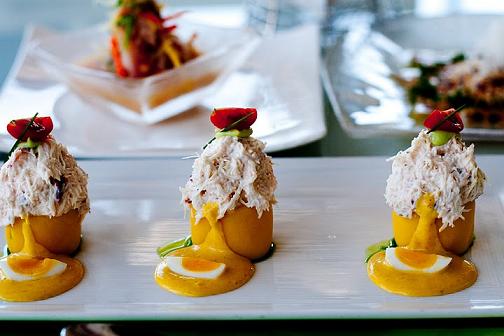
A crudo of California halibut flaps ($12.95) was presented on a narrow sushi platter, as if subtly to enhance our sense of its freshness. And it was glisteningly tender, its butteriness deepened by Fiordolio EVOO. But the promised “panzanella” was just golden-crisp croutons with salt sprinkled over the top. It is surprising how much damage even a little salt can do to delicate food. I also found too salty an otherwise marvelous salad of wild arugula ($9.50) with quarters of ultra-ripe yellow nectarine and marcona almonds. The greens, with their almost prickly freshness, could have been picked five minutes before. But the lemon vinaigrette tended toward briny. One dish we did find in good tune was expertly braised octopus ($13.95), cubed and tender and plated with Sicilian chickpea fritters that could have passed for polenta triangles, along with the wondrous weed purslane and an agrodolce (sweet-sour) sauce. There was an important clue in this dish — that saltiness is a relative phenomenon. It can be balanced.

The pizzas buck the local trend by using a slightly thicker, puffier crust. One nice feature of puffs: they blister well. Blisters suggest that the pie has been rushed to you straight from the oven, like a popover. The topping combinations are elegant and restrained; even a relatively lavish pie, the Fillmore ($15.95), with leeks, mozzarella, hen-of-the-wood mushrooms, garlic, thyme, and three cheeses (parmesan, pecorino, fontina), remained coherent, with fresh herb breath.

But Zero Zero’s best feature is probably its build-your-own-dessert option. You choose your base ($4), your ice cream ($4.95) — simple flavors but housemade — and your toppings ($1 each). Olive oil and sea salt are among them, but so is chocolate hazelnut crunch. Which would you rather have? 

ZERO ZERO

Dinner: Sun.–Thurs., 5:30-10 p.m.;

Fri.–Sat., 5:30–11 p.m.

Lunch: Mon.–-Fri., noon–-2:30 p.m.

Brunch: Sat.–Sun., 11:30 a.m.–2:30 p.m.

826 Folsom, SF

(415) 348-8800

www.zerozerosf.com

Full bar

AE/DS/MC/V

Noisy

Wheelchair accessible


Girls just want to have fun

9

culture@sfbg.com

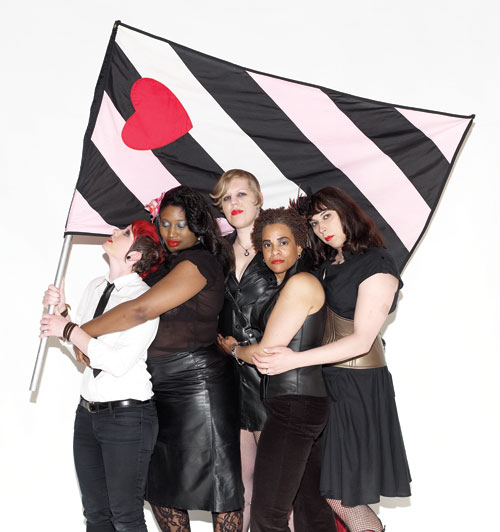
SEX It was their first official slumber party and a late-night run to the grocery store for pink hair dye was in order. Decked out in a combination of pink, pajamas, and leather, the San Francisco girls of Leather shrieked and giggled as they wandered the aisles searching for anything rosy-colored. The girls could easily have been mistaken for a freshman herd of coeds soaked in Malibu and cheap vodka, but as the group’s president, Leland, remembers, they were “just high on girls.”

Until they discovered the store’s collection of pink and white unicorns — on sale.

“We all oohed and ahhed and ended up purchasing six of them, surprising the other girls by returning to the party with an entire unicorn herd,” Leland says. From sleeping bags and hair braiding to dirty storytelling and play piercing, the night teetered between innocent and naughty, sweet and sexy. “So many unicorns, so many needles, and so much blood!” she said.

The SF girls of Leather (the girls prefer a lowercase “g” and uppercase “L” out of respect for the traditions of the leather community) are giddy and flirty: the epitome of seventh-grade girliness, complete with kinky sleepovers, hearts, and cuteness. As this year-old group sees it, maturity is overrated when it comes to BDSM — and a hint of silliness in a dark dungeon can only heighten the sex appeal. Who else is going to giggle or blush after a spank?

The group’s approach to leather is hardly in line with the masculine traditions that have come to be associated with the history of the kink community. But in the year since the girls formed their group, they’ve been working to secure their place in the continuum of leather lovers. And judging from the group’s growing membership — and accolades from the leather community at large — SFgoL is providing a much-needed refuge for marginalized fans of lighthearted play, splashing accents of pink across the traditional wash of black.


GIRL GOALS

Historically, a girl in the leather community has been defined as the female-identified version of a boy — a submissive expected to service a dominant individual in various kinds of BDSM play. But in SFgoL parlance, girl means something way more fun. Top, bottom, submissive, dominant, giver, receiver, experienced, or curious: all roles are welcome in the group, as long as you “girl” identify.

Which means what, exactly?

“Leather doesn’t have to be serious,” says Leland, who is of the mind that people of all ages, bodies, and sexual preferences can find bliss by tapping into their own personalized “girl-space.”

“You’re a leathergirl if you feel like it,” says SFgoL Vice President Kate McKinley. Even boys and bois are allowed in the group — as long as they have a “girl heart.” Coincidentally, McKinley wears one of these around her neck — a silver heart necklace.

“I play girly and therefore this group is where I belong,” she says.

An important tenet of the leather life, service (traditionally, the practice of obediently pleasing a dominant character) is still an integral part of the girl group’s goals — but its definition of the term goes beyond tending to masters and daddies.

In the year since the group’s inception, SFgoL has volunteered at multiple fundraisers and organized charity drives for nonprofits benefiting women in the leather community and beyond. Members are free to service individuals but are required to serve the community by means of philanthropy: grown-up Girl Scouts earning merit badges for kink.

Their efforts haven’t gone unnoticed — the San Francisco Bay Area Leather Alliance recognized SFgoL as its best new organization of 2010. “Contributing to the community makes it easier for us to enjoy what we’re doing,” says SFgoL member Anita, who asked that we not use her last name for professional reasons.

Anita moved to San Francisco from Norway on a work visa, but soon found herself lusting for a close encounter with leather. She discovered some BDSM groups for women interested in playing with women, but because she identified as straight when she arrived in the city, the SFgoL’s more inclusive membership requirements felt like a better fit.

She was also attracted to the group because it didn’t require members be in a dominant-submissive relationship. She was free to play with whomever, whenever, and however she pleased. “I’m a girl and I was interested in exploring the leather community in a group where I could just be myself and share my feelings,” she says.

Last month the SFgoL celebrated its one-year anniversary with 18 full members and more than 100 girls on its Listserv. The numbers are a strong indicator of its success, especially since the current version of the SFgoL isn’t the city’s first attempt at a girly collective. In 2004, a leathergirl group was formed, but failed to secure footing in the established leather community. The second time around seems to be the shiny charm — or maybe these girls are just extra-charming?

“We do have a smokin’ hot group of girls,” giggles Leland, looking around the table and raising her eyebrows at Anita and McKinley.

It’s lunch hour on a Tuesday and the three girls flirt like crazy, constantly laughing and finishing each other’s sentences between small bites of spicy Thai food. The three are a prime example of the group’s demeanor and exactly why Leland has enforced a “no cruising” rule during official meetings.

“The meetings are meant to be safe space and for taking care of business. But yes, we can play outside the meetings,” she says, batting her lashes as the other girls smirk, hiding a thousand secrets anyone with a pulse would die to hear.


RESIZING THE LEATHER FIT

Since its inception, the leather community has been predominately male. Icons like Marlon Brando, and the work of Tom of Finland and the Satyrs Motorcycle Club, defined modern masculinity in the 1950s, igniting a kinky obsession in the gay community. A badass jacket, muir cap, and related wardrobe of black hide became a symbol of sexual power and masculine independence, eradicating the stereotype that all gay men were effeminate.

Leather rules and traditions grew from military protocol and were diligently enforced by masters and their slaves, daddies and their boys. Women were intrigued, but struggled to find a place among the men; many leather bars turned away women at the door.

Over time, elements of BDSM became associated with leather and the community began to flex. During the ’80s, leatherwomen competitions popped up, and in the ’90s, groups like San Francisco’s Outcasts — now the Exiles —provided the community with strong female-identified role models. In 2006, the Exiles helped open Betty Paige’s Secret, which in subsquent years of the festival became Venus’ Playground. It was the first leatherwomen play space at the Folsom Street Fair.

It’s been six years since the Venus milestone, yet during this April’s International Ms. Leather competition in San Francisco, it was apparent that questions about the role of women in the leather community remain.

In a moment of call and response, “Where are the leatherwomen?” was shouted into the microphone. The answer was loud and proud: “Here we are! We’re here!” followed by a rumble of audience applause. Women may be standing their ground with paddles in hand, but the exchange was telling of their struggle for continued acknowledgment.

Deborah Isadorah, a veteran of kink and current leather momma, has been entranced by the leather community for more than 40 years, and is proud to have watched the roles of women expand. But in Isadorah’s eyes, the progression has been slow going.

“We live in a patriarchal society and that reflects on every part of our society, including leather,” she says, sipping a latte in Oakland and soaking in the spring sun.

“The men outnumber us physically in this community, [but that] doesn’t mean women’s voices are missing,” she continues. Isadorah is pleased with the progress of her generation of leatherwomen and is happy to sit back and nurture the younger crop. “I think we’ve done our job: to educate women about their bodies and the opportunities they have to explore sexuality beyond what society thinks is appropriate.”

Today, nearly half the current directors of the Leather Alliance, the community’s well-respected governing board, are female.

“We’re sitting at the table now,” says Daddy Vick Germany, a female-bodied leather daddy who has been a part of the Bay Area’s leather community for more than 15 years and serves as a director for the Alliance. Overall, Daddy Vick is content with the community’s moves toward inclusivity. “The men are leaving more space for us,” she says.

But traces of segregation can still be found. “Sometimes men just don’t see you — you’re not even in their line of vision,” she says, referring to a recent experience at the Up Your Alley street fair where a man blindly butted in front of her while she stood in a concession line. She recognizes that these incidents can be subconscious, but any female who roams the SoMa leather fairs is bound to encounter this feeling of invisibility. It makes her “mad as hell.”

Elected SF Dyke Daddy in 2002, Vick made substantial efforts to bridge gaps between the sexes. She’s currently running for SF Leather Daddy, a traditional competition built on fundraising for the AIDS crisis. In 2009 a transman won the competition, but if she wins, Daddy Vick would be the first female-bodied daddy to hold the title. Her candidacy alone is sure to shake things up with leathermen who believe in upholding traditional roles — but her motives are pure.

“I’m not doing this to make a statement as a female daddy. I’m running because I think I’m a good daddy for the community,” she says, meaning she cares about being a supportive, reliable father figure for those around her. The “working title” would help her foster change more effectively than her individual efforts.

Besides Folsom’s Venus’ Playground, there are no official social spaces intended for leatherwomen. This makes sharing communal bars and events incredibly important. Change is a slow process, but Daddy Vick says ample motivation is brewing in all corners, and — paired with the diffusion of kink — the space for growth can only flourish. Leather is opening into an umbrella term with the capacity to encompass multiple elements of fetish, and to further accept people of all genders, bodies, and preferences in any role.

In this respect, Daddy Vick thinks the SFgoL could play an important role. “It just takes people like Leland, coming in with a different energy. People who stand up in the crowd, see a need, and start organizing.”


FOLLOW THE PINK BRICK ROAD

While leatherwomen made slow but steady strides in the past decade, those straddling the space between butch and femme — the girl space — began breaking ground for themselves, too. In 2003 an international Leather Girl Network was born, led by the Bay Area’s Cheryl D. The group intended to mirror the already well-established leather boy community. Girls everywhere were giddy with possibilities.

“I had always identified with the title of ‘girl.’ I was a girl who liked to serve the community, but I was also a switch,” says Mistress Pilar, a longtime leather veteran and member of the original, and now revived, SF girls of Leather. Being a switch — someone who doesn’t commit to top or bottom exclusively — meant her definition of girl didn’t fit with that of the Leather Girl Network, which stated: girl equals submission. She wasn’t alone in her dilemma.

In 2004, San Francisco girls decided to put together their own troop, headed by girl Lori, the 2003 San Francisco Leather Dyke girl (a contest that no longer exists), and girl Hayden, the 2004 title-holder. They intentionally left the definition of girl open to allow for individual interpretation. The leather community shuddered at the loose restraints, confused by the men, boys, and transpeople that joined the girl ranks.

“People in the leather community were not comfortable with this idea at the time. No one even liked talking about it,” says Pilar, referring to the notion that a girl didn’t need to be a biological woman to be in their group. “The attitude that people should ‘get off the fence’ really hurt.”

The initial group grew to about 30 members and its short three years as a successful alliance was packed with fundraising, volunteer work, and super-girly fun. But eventually the negative attitudes, biased expectations, and confusion over the definition of “girls” wore down on moral.

“People would walk up to me and demand, ‘girl, clean my boots’ and I would say, ‘I don’t serve you, I serve the community,'” Pilar says shaking her head.

Even Daddy Vick remembers how the group of strong, independent individuals struggled to prove themselves to the wider leather community. The girls, she says, “took a lot of flak” for contesting tradition. “There was still a belief in place that girls and boys couldn’t be leaders. Some thought girls and boys should be seen and not heard.”

The girls managed to have good times regardless, but Pilar says by early 2007 the group was down to five members who reluctantly agreed the end had come. It wasn’t until the 2010 International Ms. Leather competition — when Pilar decided to donate the leftover SF girls memorabilia and a curious Leland started asking questions — that SFgoL sparked back into life, with a little PR and a lot of ambition.

“Leland is a wonderful leader. She creates a really positive image of a girl,” says Pilar, nostalgically looking over an old stack of meeting notes, scribbled calendars, and photos from the original group. The dissolution of her crew hit hard, and it’s bittersweet for Pilar to hear about the new group’s instant success. But more than anything, she’s proud. “I feel like a proud mom. Those are my girls.”

Coincidentally, just as the girls sprung out of the woodwork and formed an official group, the San Francisco boys of Leather, a longstanding and once very active organization, hung up their chaps and caps due to a decline in membership. The boys generously donated all their remaining funds to the girls.

Steve Gaynes, the 1994 SF Leather Daddy and Alliance director representing the 15 Association, a longstanding sexual fraternity for men interested in BDSM, has been a leatherman since 1978 and has watched all kinds of groups come and go. He says the ebb and flow is just a reflection of the community’s current needs.

“The energy ran of out the boys and ran into the girls. If there’s no driving force behind a group, it will die,” he says, noting the community’s excitement for the new girl group. “They’re enthusiastic, inclusive, and have clear ideas for their future. And they’re doing [it all] with a lot of respect for tradition.”

And the SFgoL’s continued dedication to volunteer work and partnerships with other groups have shown the community at large that it values the path paved by the forefathers — and foremothers — of leather.

Paying tribute to old protocol is simple. Isadorah boils it down to three simple rules: integrity, honesty, and service to the community. Judged by this metric, she says, anyone who thinks the SFgoL is out of line is just being stubborn. “Whenever something happens in the community that brings change, there will always be someone who is offended,” Gaynes says. “You won’t know you’ve created change until you’ve offended those people. Change is good and should be embraced.”


LOOKING OUT FOR THE GIRLS

Leland and McKinley agree that there seems to be a buzz of excitement surrounding the SfgoL lately. The group’s logo is everywhere, and partnerships are being fostered across the community. Leland has even been asked to serve as a director for the SF Leather Alliance.

But her primary concern is making sure the SFgoL remains a safe, welcoming landing pad for girls who are new to the leather community. And these days, the media is providing all sorts of inspiration for curiosity. Rihanna’s song “S&M” speaks directly to sexual play, but even a quick Google search for “girls in leather” retrieves images of celebrities in fetish gear, from Lindsay Lohan and Miley Cyrus in leather leggings to Emma Watson in a full latex suit with collar. In general, our society is opening up to alternative sex and women want in on the action.

But girls who jump in with little research and few friends may not leave with the most positive experiences. The inherent power dynamic associated with BDSM relationships and play can blur the lines between consent and abuse, and Leland says it’s important for newbies to have mentors within reach. “Sometimes the person you’re playing with may not have your best intentions at heart,” she says. “But as an alliance of girls, we can look out for each other.”

Appetite: Sustainable seafood with Gaston Acurio

5

The average American still doesn’t know enough about sustainable fish. Most of us eat whatever is on the menu with little to regard to where it’s sourced, its health properties (or lack thereof) — totally unaware if the creature we’re eating is endangered or close to it. Consider this Appetite your 101 on the latest happenings in sustainable fish — and a primer on how to make sure your seafood dinner is safe for the waters of the world. 

I was privileged to attend a recent intimate round-table discussion with Peru’s leading chef Gaston Acurio and management from Monterey Bay Aquarium, the number one seafood source in the nation on what is or isn’t safe to eat at any given time.

Naturally, we met in the offices of La Mar Cebicheria, Acurio’s first stateside restaurant and my top spot in SF for Peruvian (New York is also about to get its first La Mar outpost). As San Francisco’s breezy, bayside location of La Mar just went fully sustainable, it was an ideal time to discuss the necessity of planet-minded dining.

(Bait and) tackle these apps at Ki without fear of deprieving your grandkids of maritime meals

Acurio says chefs, cooks, and kitchen staff in general, are “the best weapons” in the struggle to change America’s fish-eating habits. While many say consumers should educate themselves, Acurio rightly pinpoints a need for education among restaurant staff. He shared a story of a Peruvian restaurant relaying to diners that their children would not know what their beloved local river shrimp tasted like if over-fishing in the area continued. With this kind of schooling, consumers themselves began asking every restaurant they dined at not to serve the shrimp. Locals changed habits – and may have saved the shrimp based on information learned on a night out.

The Peruvian’s commitment to sustainability is apparent. Acurio is working to take the message he’s spread throughout his home country worldwide. “Restaurants are instruments for sharing our culture with the world,” he says. He prefers to train his staff by inspiration, getting them involved in a mission — not just teaching them to perform a predetermined role.

Here are three things that restaurant staff and individual consumers can do to support sustainable seafood consumption, thus preserving the over-fished seafood we are at risk of losing like tuna and mahi mahi. (And remember, downloadable guides of what to eat and what to avoid avoid are available on the Monterey Aquarium website.)

1. Support local fisherman. Locally, buy sustainable fish at places like Royal Hawaiian in Potrero Hill or in the Ferry Plaza Building at San Francisco Fish Co.

2. Eat “down” the food chain – smaller fish need less time to mature, and make more sustainable catches. Try clams, anchovies, sardines, mussels, etc. 

3. Avoid aquaculture, farmed fish raised in controlled conditions.

Acurio believes more creativity happens when one cooks with what is fresh and available on a day-to-day basis. Rather than being limited by the diner who’s going to be upset that you didn’t serve tuna tartare, he challenges his chefs to “dream big”: to create dishes that will win customers over to a new way of looking at fish dinner. 

A few local restaurants serving only sustainable seafood:

1. Tataki and Tataki South, Pacific Heights and Noe Valley – The first fully-sustainable sushi restaurant in the US was Tataki, right here in our own backyard.

2. Ki, SoMa – Part of the funky, spacious “Zen Compound” that includes Temple Nightclub and a rooftop garden. Ki is an artsy new izakaya-sushi-drinks lounge.

3. Hecho, FiDi – Sustainable sushi sources called out by name – with tequila to accompany.

4. Pacific Catch, Marina – has elected June to be its sustainable shrimp month – it will be serving safe shrimp from various parts of the world.

And a little homework for those who’d like to learn more about keeping your sea meals safe for the ocean environment: don’t miss local resident Casson Trenor’s book, Sustainable Sushi (Trenor helped launch both Tataki and Ki). Also, the fabulous 18 Reasons is throwing a “Good Fish” event (cooking demo and lecture, $25-35) Sunday afternoon, June 12, sure to help you navigate the confusing terms that are involved in selecting a more sustainable fish.

— Subscribe to Virginia’s twice-monthly newsletter The Perfect Spot


Tipping point

3

sarah@sfbg.com

On June 14, members of the Board of Supervisors will vote to appoint a new member of the Police Commission — in the wake of a messy string of alleged police misconduct scandals that, progressives argue, underscore why having strong civilian oversight is critical to ensuring a transparent, accountable police department the public can trust.

The appointment comes less than two months after San Francisco native Greg Suhr was sworn in as chief in the wake of Mayor Gavin Newsom’s decision to appoint former Chief George Gascón as the next district attorney — a move that has served to muddy the D.A. Office’s efforts to investigate the alleged police misconduct.

Further complicating the board’s choice is the heated battle that erupted over the appointment, led in part by members of two Democratic clubs that represent lesbian, gay, bisexual, and transgender communities.

The Alice B. Toklas LGBT Democratic Club has officially endorsed Julius Turman, a gay attorney and community activist who was a former assistant U.S. attorney and the first African American president of the Alice club. Turman currently works for Morgan, Lewis & Bockius, where he represents companies in actions for wrongful termination, employment discrimination, and unfair competition. He is also state Sen. Mark Leno’s (D-SF) proxy to the San Francisco Democratic County Central Committee and serves on the Human Rights Commission.

On the other side, members of the Harvey Milk LGBT Democratic Club, the voice of the city’s queer left, are supporting David Waggoner, an attorney and community activist who is a former Milk Club president. Waggoner has worked on police use-of-force policy and as a pro bono attorney for the National Lawyers Guild at the Oakland Citizen’s Police Review Board, and been a passionate advocate for the LGBT community, immigrants’ rights, people with disabilities, and the homeless.

The other two applicants for the post are Vanessa Jackson, a staffer at a women’s shelter with experience in counseling ex-offenders; and Phillip Hogan, a former police officer who serves on the board of the Nob Hill Association and has been trying to get on a commission for years.

Although both Jackson and Hogan have diverse experience with law enforcement — Jackson as an African American woman who claims the police have “no respect for people of color” and Hogan as a former police officer of Lebanese-Irish descent who manages real estate — neither has the support of the LGBT community. The position occupied by Deputy District Attorney James Hammer for the last two years, and Human Rights Commission director Theresa Sparks occupied before that, is widely considered to be an LGBT seat.


WHO’S THE REFORMER?

So now the fight is about whether Turman or Waggoner would be the strongest reformer.

In a recent open letter, former Board Presidents Harry Britt, Aaron Peskin. and Matt Gonzalez expressed support for Waggoner. “While most hardworking police officers perform their jobs admirably, insufficient oversight and poor management systems have led to significant problems,” their letter stated. “Despite these widely reported problems, the Police Commission has failed to adequately address these issues. San Francisco needs real reform, not more of the same. We believe David Waggoner will be that voice at this critical time.”

At the June 2 Rules Committee hearing, Waggoner proposed taking away master keys to single-resident occupancy (SRO) hotels from the police. “Significant abuse of that resulted in seriously tarnishing the department,” he said.

Turman made an equally impassioned — if less stridently reformist-sounding — speech. “Why would we allow an officer to enter a home, regardless of the master key rule, which I’m not a fan of?” Turman asked. He also said Tasers are dangerous weapons with unintended consequences. “I fear communities of color will suffer more from Taser use.”

Waggoner’s supporters noted that their candidate has more than 15 years of police accountability experience. Turman’s supporters vouched for his integrity, maturity, ability to build consensus, and “belief in strategically serving his community.”

In the end, Sups. Sean Elsbernd and Mark Farrell voted for Turman, while Rules Committee Chair Sup. Jane Kim voted for Waggoner.

That means Turman’s name has been forwarded to the full board with a recommendation. But because the Rules Committee interviewed all the candidates, the board can still appoint any of them.

At the Rules Committee, Sup. Scott Wiener voiced support for Turman. And Board President David Chiu recently told the Guardian that he has known Turman for years, has worked with him professionally, and will vote for him. “I found him to be fair, thoughtful, and compassionate,” Chiu said, noting that he believes the role of the commission is “to provide oversight and set policy.”

Sup. David Campos, one of the solid progressive votes on the board and a longtime Milk Club member, believes Waggoner would make an excellent commissioner but is a friend of Turman, and believes he’ll be a strong voice for reform. “Sean [Elsbernd] and Mark [Farrell] could be in for a big surprise if Julius gets appointed,” Campos mused shortly after Elsbernd and Farrell voted for Turman.

Campos recalled how he and Turman started working at the same firm years ago. “So I got to know him well,” he said, adding he is “like a family member.

“By virtue of his involvement with Alice, some folks think Julius will be a certain way,” Campos added. “But I believe he’ll take a progressive point of view on the issues. He has both the knowledge and the experience with the police, he understand the important role that police oversight and the Police Commission play in making the SFPD accountable.”

Kim told us that she primarily voted for Waggoner because she knows him the best, and not out of concern that Turman wouldn’t do a good job. “I’m more familiar with David and that’s what tipped the scale,” Kim said. “It’s great to have two strong LGBT attorneys who have a clear understanding of public safety issues, the law, and are advocates for the community.”

But Debra Walker, who ran against Kim last November, steadfastly supports Waggoner. “Julius has been active in the Alice B. Toklas club for a while, he’s a prosecutor, while David is more of a citizen’s defense attorney,” she said.

Turman continues to be dogged by reports of domestic violence, thanks to a lawsuit that Turman’s former domestic partner Philip Horne filed in March 2006 alleging that Turman came into his house when he was sleeping on New Year’s Day 2006 and tried to strangle him.

Horne claimed he “was terrified that the lack of air supply would cause him to pass out and potentially die at the hands of such a jealous and unmerciful former lover.” He alleged he was able to calm Turman down only to see him get enraged again and punch Horne in the face seven to 10 times. When Horne decided he needed to go to the emergency room, the complaint states, Turman grabbed his phone and keys saying, “If you leave, you’ll never see the cats (alive) again,” and “I will report you to the state bar.”

Horne claimed he ran outside screaming for help and that when SFPD arrived, they arrested Turman for domestic violence and called an ambulance for Horne.

Turman responded in July 2006 to what he described as Horne’s “unverified complaint,” arguing he acted in “self-defense” and that the conduct Horne complained of “constituted mutual combat.” He added that “damages, if any, suffered by Horne were caused in whole or in part by entities or persons other than Turman.”

In the end, no criminal charges were ever filed against Turman and the case was settled out of court. Turman now says “I’ve done nothing wrong and these allegations are false.”

Campos warns people not to jump to conclusions. “We need to remember that there is a presumption of innocence,” Campos said. “Yes, there was a court case, but there was never a conviction. Yes, there was a settlement, but people do that for a lot of reasons.”

Turman told the Rules Committee that the incident was from “an extremely difficult time that is now being used against me as a political sideshow.”

Meanwhile, Campos notes that without a reform-minded mayor, there will be only so much any board-appointed police commissioners can do. “What we really need to implement police reform is a mayor who is willing to do that,” he said. “Otherwise it’s going to be very difficult because the mayor still gets to appoint four commissioners and mayor still gets to control who is in charge of the police department.”


WHAT DIRECTION?

Civil liberties advocates praised as a “first step in the right direction” Suhr’s May 18 decision to issue an order clarifying that SFPD officers assigned to the FBI’s joint terrorism taskforce should adhere to SFPD policies and procedures set by the Police Commission, not FBI guidelines.

But in the coming months, the commission will have to decide whether to push a Portland-style resolution around SFPD involvement with the FBI. The commission also will be dealing with fallout from the other scandals, including the crime lab, the use of force against mentally ill suspects, and videos that allegedly show police conducting warrantless search and seizure raids in single residential occupancy hotels.

These scandals have progressives arguing that it’s critical that the board’s three seats on the commission are occupied by applicants with proven track records of reform.

Waggoner notes that in 2003, voters approved Prop. H., which changed the composition of the commission from five to seven members. Four are appointed by the mayor; three by the board.

Last year, he said, the commission made significant progress in the right direction when it adopted new rules after the Jan. 2 shooting of a man in a wheelchair in SoMa. “That was not the first time an unarmed person with a disability was killed,” he said. “After Prop. H and a crisis, the commission finally took steps. It remains to be seen if Chief Suhr will implement that.”

Waggonner said the current arrangement “creates tension between people who are more willing to defer to the chief on policy issues and being in an advisory capacity, as opposed to people who want to be in the forefront of setting policy.”

That tension played out when Commissioners James Hammer, Angela Chan, and Petra DeJesus tried to find consensus on the Taser controversy last year. “Overall they worked well together. But there’s been no progress yet on Tasers,” he said, noting that the commission eventually decided on a pilot project.

Waggoner said he would be in favor of the commission having a more active role and exerting its authority under the city charter to set policy, but in collaboration with the chief.

The Police Commission’s May 18 joint hearing with the Human Rights Commission about FBI spying concerns was a symbol of the broader issue at the Police Commission. The majority of the commission didn’t see any major problems — but the progressives were highly critical. “Is the commission there to set policy and take leadership, or is it there in an advisory capacity?” Waggoner asked.

With Hammer’s departure, Chan and DeJesus, both board-appointed women of color, are the most progressive members of the commission. Chan hopes Hammer’s replacement believes in strong civilian oversight. “We should never be a rubber stamp for the police department,” he said. “We need to take community concerns very seriously. When the police department is doing great things, we should support them — but if we see something wrong, we should not be afraid to speak out.”

Turman told the Guardian that “being the voice for reform and advising are not mutually exclusive roles — and an effective police commissioner needs to be both.

“I would advocate for series of meetings with representatives from the Arab community, the SFPD, and the FBI to increase communication and understanding of each side’s perspective on exactly what we need to implement in San Francisco,” Turman said.

Asked more about Tasers, Turman said that “one of the things I would be interested in pursuing is a recognition by some that female officers are less likely to incapacitate during an arrest, which could lead to learning for the larger police force.”

But does this means Turman will turn out to be a swing vote for Tasers? Only time — and the board’s June 14 vote — will tell.

Big launch for Avalos, emphasizing unity and integrity

69

John Avalos launched his mayoral campaign yesterday with a spirited event in a sunny SoMa park that drew several hundred enthusiastic supporters, ranging from elected officials such as Assemblymember Tom Ammiano and Sups. Ross Mirkarimi and Eric Mar to representatives of a wide variety of progressive and community organizations.

There was also an unlikely supporter: Sen. Leland Yee, who is also running for mayor but spoke to reporters wearing an Avalos sticker and said he was pleased that Avalos is in the race. The two men were each endorsed by the SF Bay chapter of the Sierra Club over weekend, and Yee’s campaign appears to be trying to court the second place votes from supporters of Avalos, the only solid progressive in the race.

But political sideshows aside, this was a day for Avalos and his supporters to shine, and they demonstrated a larger and more energetic event than other mayoral candidates have managed to pull together so far. And the crowd took the opportunity to emphasize Avalos’ progressive values of integrity and collaboration, in the process taking subtle swipes at the ambitions and egocentrism of other mayoral candidates.

“We are for John Avalos because John Avalos is for all of us,” was the repeated refrain in a strong speech by “progressive Christian pastor” and blogger Bruce Reyes-Chow.

Ammiano noted that it was the birthday of Harvey Milk and said that Avalos is the heir to Milk’s legacy of promoting progressive change through community organizing. “Harvey Milk knew the secret and the secret was grassroots…Without that tethering together, we never move forward,” said Ammiano, whose endorsement of Avalos could be a significant factor in the race, particularly as Bay Area Reporter writers and other LGBT entities support other candidates.

Ammiano offered a few reasons for his endorsement, joking that, “He has the best hair of all the candidates.” But even more important was the issue of integrity and trustworthiness, where Ammiano said Avalos really shines. “Trust is a significant attribute and you don’t see a lot of that [in public life]. And John is honorable,” Ammiano said.

Other speakers from labor and progressive organizations emphasized how Avalos has been fighting for progressive causes his entire adult life. “John cares about the issues we care about and he listens,” said Andrea Buffa of Global Exchange, who also worked with Avalos on campaigns against corporate dominance when she worked for Media Alliance.

“I’m here to fight for John because John fights for all of us,” was the conclusion of the fifth-grade student from San Francisco Community School, who introduced Avalos.

During his speech, Avalos said he was touched by the huge turnout and display of enthusiasm. “It’s such a joy to see you here. My heart is swollen,” he said, before introducing his family and telling a story of his father’s lifetime of union activism on behalf of Los Angeles dock workers. “I learned from him the value of hard work and devotion to something much greater than yourself,” Avalos said.

And the main cause that Avalos has devoted himself to in San Francisco has been the progressive movement, with its commitment to workers rights and social and economic justice. “We see that wealth is accumulating into fewer and fewer hands,” Avalos said, one of several core problems that he said his candidacy is committed to addressing, later adding, “I’m running for mayor to even the playing field.”

While he advocated for creating safe streets for pedestrians and cyclists, stimulating job growth, and adopting a housing policy designed to promote diversity by creating more homes for low- and middle-income San Franciscans, he devoted much of his address to addressing the core problem of wealthy special interests getting their way at City Hall.

“We cannot have the same business as usual that greases the wheels with lobbyists,” Avalos said. “I’ll put the interests of the collective above the interests of the few, day in and day out.”

Avalos cast this year’s mayoral election as pivotal to San Francisco’s future. “As a city, we are at the crossroads and only we can turn the tide,” Avalos told a crowd from which almost 400 people signed up to volunteer on his campaign, closing with a line that echoed Milk’s refrain from almost 40 years ago: “I want to recruit you to this movement.”

Summer fairs and festivals

0

ONGOING

Young At Art Festival de Young Museum, Golden Gate Park, SF. (415) 695-2441, www.youngatartsf.com. Through May 22, free. The creative achievements of our city’s youth are celebrated in this eight day event curated and hosted by the de Young Museum.

* Oakland Asian Cultural Center Asian Pacific Heritage Festival Oakland Asian Cultural Center, 388 Ninth St., Oakl. (510) 637-0462, www.oacc.cc. Through May 26. Times and prices vary. Music, lectures, performances, family-friendly events in honor of Asian and Pacific American culture and traditions.

DIVAfest Exit Theatre, 156 Eddy, SF. (415) 931-2699, www.theexit.org. Through May 28. Times and prices vary. Bastion of the alternative, EXIT Theatre showcases its 10th annual buffet of fierce women writers, performers, and directors. This year features two plays, beat poetry, musical exploration, and more.

* Yerba Buena Gardens Festival Yerba Buena Gardens, Mission and Third St., SF. (415) 543-1718, www.ybgf.org. Through Oct. 31. Times vary, free. A series of cultural events, performances, activities, music, and children and family programs to highlight the green goodness of SoMa’s landscaped oasis.


May 18-June 5

San Francisco International Arts Festival Various venues. (415) 399-9554, www.sfiaf.org. Times and prices vary. Celebrate the arts through with this mish-mash of artistic collaborations dedicated to increasing human awareness. Artists included hail from around the world and right here in the Bay Area.


May 21

* A La Carte & Art Castro St. between Church and Evelyn, Mountain View. (650) 964-3395, www.miramarevents.com. 10am-6pm, free. With vendors selling handmade crafts, microbrewed beers, fresh foods, a farmers market, and even a fun zone for kids, there’s little you won’t find at this all-in-one fun fair. Asian Heritage Street Celebration Larkin and McAllister, SF. www.asianfairsf.com. 11am-6pm, free. This year’s at the country’s largest gathering of APA’s promises a Muay Thai kickboxing ring, DJs, and the latest in Asian pop culture fanfare — as well as tasty bites to keep your strength up.

Freestone Fermentation Festival Salmon Creek School, 1935 Bohemian Hwy, Sonoma. (707) 479-3557, www.freestonefermentationfestival.com. Noon-5pm, $12. Learn about the magical wonders of fermentation with hands-on and mouth-on demonstrations, exhibits, and tasty live food nibbles.

Uncorked! San Francisco Wine Festival Ghirardelli Square, SF. (415) 775-5500, www.ghirardellisq.com. 1-6pm, $45-50 for tasting tickets, free for other activities. Uncorked! brings you the real California wine experience with tastings, cooking demonstrations, and even a wine 101 class for those who are feeling not quite wine-refined.


May 20-29

SF Sex Worker Film and Art Festival Various venues, SF. (415) 751-1659, www.sexworkerfest.com. Times and prices vary. Webcam workshops, empowering film screenings, shared dialogues on plant healing to sex work in the age of HIV: this fest has everything to offer sex workers and the people who love ’em.


May 22

Lagunitas Beer Circus Lagunitas Brewing Co., 1280 N McDowell, Petaluma. (303) 447-0816, www.craftbeer.com. Noon-6pm, $40. All the wonders of a live circus — snake charmers, plate spinners, and sword swallowers — doing their thing inside of a brewery!


May 21-22

* Maker Faire San Mateo County Event Center, 2495 South Delaware, San Mateo. www.makerfaire.com. Sat, 10am- 8pm; Sun, 10am-6pm, $5-25. Make Magazine’s annual showcase of all things DIY is a tribute to human craftiness. This is where the making minds meet. Castroville Artichoke Festival Castroville, Calif. (831) 633-0485, www.artichokefestival.org. Sat., 10am- 6pm; Sun., 11 am- 4:30 p.m., free. Pay homage to the only vegetable with a heart: the artichoke. This fest does just that, with music, parades, and camping.


May 28-29 

San Francisco Carnaval Harrison between 16th and 22nd St., SF. 10am-6pm, free. The theme of this year’s showcase of Latin and Caribbean culture is “Live Your Fantasy” — bound to bring dreams alive on the streets of the Mission.


June 3-12

Healdsburg Jazz Festival Various venues, Healdsburg. (707) 433-463, www.healdsburgjazzfestival.org. Times and prices vary. Bask in the lounge-lit glow of all things jazz-related at this celebration in Sonoma’s wine county.


June 3-July 3 

SF Ethnic Dance Festival Zellerbach Hall, Berk. and Yerba Buena Center for the Arts, SF. www.worldartswest.org. Times and prices vary. A powerful display of world dance and music taking to the stage over the course of five weekends.


June 4

* Berkeley World Music Festival Telegraph, Berk. www.berkeleyworldmusicfestival.org. Noon-9pm, free. Fourteen world music artists serenade the streets and stores of Telegraph Avenue and al fresco admirers in People’s Park.

Huicha Music Festival Gundlach Bundschu Winery, 2000 Denmark St., Sonoma. (707) 938-5277, www.gunbun.com/hmfevent. 2-11pm, $55. Indie music in the fields of a wine country: Fruit Bats, J Mascis of Dinosaur Jr, Sonny and the Sunsets, and more.


June 4-5

Union Street Eco-Urban Festival Union from Gough to Steiner and parts of Octavia, SF. (800) 310-6563, www.unionstreetfestival.com. 10am-6pm, free. Festival goers will have traffic-free access to Cow Hollow merchants and restaurant booths. The eco-urban theme highlights progressive, green-minded advocates and products.

The Great San Francisco Crystal Fair Fort Mason Center, Building A., SF. (415) 383-7837, home.earthlink.net/~sfxtl/index.html. Sat., 10am-6pm; Sun., 10am-4pm, $6. Gems and all they have to offer: beauty, fashion, and mysterious healing powers.


June 5

* Israel in the Gardens Yerba Buena Gardens, SF. (415) 512-6420, www.sfjcf.org. 11am-5pm, free. One full day of food, music, film, family activities, and ceremonies celebrating the Bay Area’s Jewish community and Israel’s 63rd birthday.


June 10-12

Harmony Festival Sonoma County Fairgrounds, 1350 Bennett Valley, Santa Rosa. www.harmonyfestival.com. 10am-10pm, $45 one day, $120 for three day passes. This is where your love for tea, The Flaming Lips, goddess culture, techno, eco-living, spirituality, and getting drunk with your fellow hippies come together in one wild weekend.

Queer Women of Color Film Festival Brava Theater. 2789 24th St., SF. (415) 752-0868, www.qwocmap.org. Times vary, free. A panel discussion called “Thinkers and Trouble Makers,” bisects three days of screenings from up-and-coming filmmakers with stories all their own.


June 11-12

* Live Oak Park Fair 1301 Shattuck, Berk. (510) 227-7110, www.liveoakparkfair.com. 10am-6pm, free. This festival’s 41st year brings the latest handmade treasures from Berkeley’s vibrant arts and crafts community. With food, face-paint, and entertainment, this fair is perfect for a weekend activity with the family.


June 11-19 

San Mateo County Fair San Mateo County Fairgrounds. 2495 S. Delaware, San Mateo. www.sanmateocountyfair.com. June 11, 14, 18, and 19, 11am-10pm; all other days, noon-10pm, $10 for adults. It features competitive exhibits from farmers, foodies, and even technological developers — but let’s face it, we’re going to see the pig races.


June 12

Haight Ashbury Street Fair Haight between Stanyan and Ashbury, SF. www.haightashburystreetfair.org. 11am-5:30pm, free. Make your way down to the grooviest corner in history and celebrate the long-standing diversity and color of the Haight Ashbury neighborhood, featuring the annual battle of the bands.


June 16-26

Frameline Film Festival Various venues, SF. www.frameline.org. Times and prices vary. This unique LGBT film festival comes back for its 35th year showcasing queer documentaries, shorts, and features.


June 17-19 Sierra Nevada World Music Festival Mendocino County Fairgrounds. 14400 CA-128, Boonville. (916) 777-5550, www.snwmf.com. Fri, 6pm-midnight; Sat, 11am-midnight; Sun, 11am-10pm, $60 for Friday and Sunday day pass; $70 for Saturday day pass, $150 three day pass. Featuring Rebulution, Toots and the Maytals, and Jah Love Sound System, this fest comes with a message of peace, unity, and love through music.


June 18 

Summer SAILstice Encinal Yacht Club, 1251 Pacific Marina, Alameda. (415) 412-6961, www.summersailstice.com. 8am-8pm, free. Boat building, sailboat rides, sailing seminars, informational booths, music, a kid zone, and of course, wind, sun, and water.

Pinot Days Festival Pavilion, Fort Mason Center, SF. (415) 382-8663, www.pinotdays.com. 1-5pm, $50. Break out your corkscrews and head over to this unique event. With 220 artisan winemakers pouring up tastes of their one-of-a-kind vino, you better make sure you’ve got a DD for the ride home.


June 18-19

North Beach Festival Washington Square Park, SF. (800) 310-6563, www.northbeachchamber.com. Sat, 10am-6pm; Sun, 10am-6pm, free. Make your way down to the spaghetti capital of SF and enjoy food, music, arts and crafts booths, and the traditional blessing of the animals.

Marin Art Festival Marin Civic Center, San Rafael. (415) 388-0151, www.marinartfestival.com. 10am-6pm, $10. A city center designed by Frank Lloyd Wright plays host to this idyllic art festival. Strolling through pavilions, sampling wines, eating grilled oysters, and viewing the work of hundreds of creative types.


June 20-Aug 21

Stern Grove Music Festival Stern Grove. Sloat and 19th Ave., SF. (415) 252-6252, www.sterngrove.org. Sundays 2pm, free. This free outdoor concert series is a must-do for San Francisco summers. This year’s lineup includes Neko Case, the SF Symphony, Sharon Jones, and much more.


June 25-26

San Francisco Pride Celebration Civic Center Plaza, SF; Parade starts at Market and Beale. (415) 864-FREE, www.sfpride.org. Parade starts at 10:30am, free. Gays, trannies, queers, and the rest of the rainbow waits all year for this grand-scale celebration of diversity, love, and being fabulous. San Francisco Free Folk Festival Presidio Middle School. 450 30th Ave., SF. (415) 661-2217, www.sffolkfest.org. Noon-10pm, free. Folk-y times for the whole family — not just music but crafts, dance workshops, crafts, and food vendors too.


June 29-July 3

International Queer Tango Festival La Pista. 768 Brannan, SF. www.queertango.freehosting.net. Times vary, $10-35. Spice up your Pride (and Frameline film fest) week with some queer positive tango lessons in culturally diverse, welcoming groups of same sex couples.


June 30-July 3

High Sierra Music Festival Plumas-Sierra Fairgrounds, Quincy. www.highsierramusic.com. Gates open at 8am Thursday. $205 weekend pass, $90 parking fee. Yonder Mountain String Band, My Morning Jacket, and most importantly, Ween. Bring out your sleeping bags for this four day mountaintop grassroots festival.


July 2

Vans Warped Tour Shoreline Amphitheatre, Mountain View. www.vanswarpedtour.com. 11am, $46-72. Skating, pop punk, hardcore, screamo, and a whole lot of emo fun.


July 2-3

Fillmore Jazz Festival Fillmore between Jackson and Eddy, SF, 1-800-310-6563, www.fillmorejazzfestival.com. 10am-6pm, free. Thousands of people get jazzed-up every year for this musical feast in a historically soulful neighborhood.


July 4

City of San Francisco Fourth of July waterfront celebration Pier 39, Embarcadero and Beach, SF. (415) 709-5500, www.pier39.com. Noon-9:30pm, free. Ring in the USA’s birthday on the water, with a day full of music and end up at in the city’s front row when the fireworks take to the sky.


July 9-10

Renegade Craft Fair Fort Mason Festival Pavilion. Buchanan and Marina, SF. (312) 496-3215, www.renegadecraft.com. 11am-7pm, free. Put a bird on it at this craft fair for the particularly indie at heart.


July 14-24

Midsummer Mozart Festival Various Bay Area venues. (415) 627-9141, www.midsummermozart.org. Prices vary. You won’t be hearing any Beethoven or Schubert at this midsummer series — the name of the day is Mr. Mozart alone.


July 16-17

Connoisseur’s Marketplace Santa Cruz between Camino and Johnson, Menlo Park. (650) 325-2818, www.miramarevents.com. 10am-6pm, free. Let the artisans do what they do best — you’ll polish off the fruits of their labor at this outdoor expo of artisan food, wine, and craft.


July 21-Aug 8

SF Jewish Film Festival Various Bay Area venues. www.sfjff.org. Times and prices vary. A three week smorgasbord of world premiere Jewish films at theaters in SF, Berkeley, the Peninsula, and Marin County.


July 22-Aug 13

Music@Menlo Chamber Music Festival Menlo School, 50 Valparaiso, Atherton. (650) 330-2030, www.musicatmenlo.org. Classical chamber music at its best: this year’s theme “Through Brahms,” will take you on a journey through Johannes’ most notable works.


July 23-Sept 25

 SF Shakespeare Festival Various Bay Area venues. www.sfshakes.org. Various times, free. Picnic with Princess Innogen and her crew with dropping a dime at this year’s production of Cymbeline. It’s by that playwriter guy… what’s his name again?


July 30

Oakland A’s Beer Festival Eastside Club at the Oakland-Alameda Coliseum, 7000 Coliseum Way, Oakl. www.oakland.athletics.mlb.com. 4:05-6:05pm, free with game ticket. Booze your way through the Oakland A’s vs. Minnesota Twins game while the coliseum is filled with brewskies from over 30 microbreweries, there for the chugging in your souvenir A’s beer mug.


July 30-31

 Berkeley Kite Festival Cesar Chavez Park, 11 Spinnaker, Berk. www.highlinekites.com. 10am-5pm, free. A joyous selection of Berkeley’s coolest kites, all in one easy location.


July 31

Up Your Alley Dore between Folsom and Howard, SF. www.folsomstreetfair.com. 11am-6pm, $7-10 suggested donation. Whether you are into BDSM, leather, paddles, nipple clamps, hardcore — or don’t know what any of the above means, this Dore Alley stroll is surprisingly friendly and cute once you get past all the whips!


Aug 1-7

SF Chefs Various venues, SF. www.sfchefs2011.com. Times and prices vary. Those that love to taste test will rejoice during this foodie’s paradise of culinary stars sharing their latest bites. Best of all, the goal for 2011’s event is tons of taste with zero waste.


Aug 7

SF Theater Festival Fort Mason Center. Buchanan and Marina, SF. www.sftheaterfestival.org. 11am-5pm, free. Think you can face about 100 live theater acts in one day? Set a personal record at this indoor and outdoor celebration of thespians.


Aug 13

San Rafael Food and Wine Festival Falkirk Cultural Center, 1408 Mission, San Rafael. 1-800-310-6563, www.sresproductions.com. Noon-6pm, $25 food and wine tasting, $15 food tasting only. A sampler’s paradise, this festival features an array of tastes from the Bay’s best wineries and restaurants.


Aug 13-14

Nihonmachi Street Fair Post and Webster, SF. www.nihonmachistreetfair.org. 11am-6pm, free. Founded by Asian Pacific American youths, this Japantown tradition is a yearly tribute to the difficult history and prevailing spirit of Asian American culture in this SF neighborhood.


Aug 20-21

Oakland Art and Soul Festival Entrances at 14th St. and Broadway, 16th St. and San Pablo, Oakl. (510) 444-CITY, www.artandsouloakland.com. $15. A musical entertainment tribute to downtown Oakland’s art and soul, this festival features nationally-known R&B, jazz, gospel, and rock artists.


Aug 20-22

* SF Street Food Festival Folsom St from Twenty Sixth to Twenty Second, SF. www.sfstreetfoodfest.com. 11am-7pm, free. All of the city’s best food, available without having to go indoors — or sit down. 2011 brings a bigger and better Street Food Fest, perfect for SF’s burgeoning addiction to pavement meals.


Aug 29-Sept 5

Burning Man Black Rock City, Nev. (415) TO-FLAME, www.burningman.com. $320. This year’s theme, “Rites of Passage,” is set to explore transitional spaces and feelings. Gather with the best of the burned-out at one of the world’s weirdest, most renowned parties.


Sep 10-11

* Autumn Moon Festival Street Fair Grant between California and Broadway, SF. (415) 982-6306, www.moonfestival.org. 11am-6pm, free. A time to celebrate the summer harvest and the end of summer full-moon, rejoice in bounty with the moon goddess.


Sept 17-18

SF International Dragon Boat Festival California and Avenue D, Treasure Island. www.sfdragonboat.com. 10am-5pm, free. The country’s largest dragon boat festival sees beautiful man-powered boats take to the water in 300 and 500 meter competitive races.


Sept 23-25

SF Greek Food Festival Annunciation Cathedral. 245 Valencia, SF. www.sfgreekfoodfestival.org. Fri.-Sat., 11am-10pm; Sun., noon-9pm, free with advance ticket. Get your baba ghanoush on during this late summer festival, complete with traditional Greek dancing, music, and wine.


Sept 25

Folsom Street Fair Folsom between 7th and 12th St., SF. www.folsomstreetfair.org. 11am-6pm, free. The urban Burning Man equivalent for leather enthusiasts, going to this expansive SoMa celebration of kink and fetish culture is the surest way to see a penis in public (you dirty dog!).


Sept 30-Oct 2

Hardly Strictly Bluegrass Speedway Meadows, Golden Gate Park, SF. www.strictlybluegrass.com. 11am-7pm, free. Pack some whiskey and shoulder your banjo: this free three day festival draws record-breaking crowds — and top names in a variety of twangy genres — each year.


Items with asterisks note family-fun activities.


A better tomorrow

0

arts@sfbg.com

“‘I am the carnivore/ The hounded night walker/ Searching for my wings scattered under glass.'<0x2009>” So begins “Blood Penguin,” the first poem in Will Alexander’s latest collection, Compression & Purity (City Lights, 100 pages, $13.95). Alexander is an honest-and-for-true black surrealist. In 2011, he will have three books of poetry, one novel, one book of essays, and a book of philosophy coming out. Even if you’ve never heard his name before, you gotta admit that Will Alexander is a bad muthafuckah. “because of my leaning,” he writes in the same poem, “I know the stark Egyptian soma/ Much as would the blinded cemetery scribe.'”

Invoking equal parts Homer and Ray Charles, Alexander excavates as only a black surrealist can — by revisiting and resurrecting cults and symbols of the past with new eyes while taking a biographic, confessional tone. Many of the pieces coalesce into declarations/definitions for an ever-shifting identity meeting the limits of contemporary classification.

“I am simply without means to conduct my own prism,” Alexander writes in this opening poem. A lament of all artists and creative others who find themselves at this juncture where capability could possibly override access and capital, enabling us to manifest our truest visions.

In “The Deluge in Information,” we once again meet this fluid identity. “I am more like a crow from crucial underwater fires,” Alexander writes, “a crucial underwater crow/ Neither Chinese or Shinto/ But of the black dimensionality as hidden underwater mass.”

Whereas Alexander’s Sunrise in Armageddon (2006) was a whop over the head that only the most Joycean among us could dare to hold with a steady grip, Compression & Purity hovers over a series of consistent, graspable subjects throughout. The treatment of identity/biography in “Blood Penguin” and “Deluge” is fully unmasked in “On Anti-Biography,” where Alexander makes the succinct, clear statement: “I am only concerned with simultaneity and height, with rays of monomial kindling, guiding the neocortex though ravens, into the ecstasy of x-rays and blackness.”

This and the poem that follows, “My Interior Vita,” ring like an Afrosurrealist’s manifesto. When Alexander writes, “Yet above all, the earth being for me the specificity of Africa, as revealed by Diop, and Jackson, and Van Sertima, and its electrical scent in the writing of Damas. Because of this purview I have never drawn to provincial description, or to quiescent chemistry of condensed domestic horizon,he seems to be speaking for those who have rejected the quiet servitude that characterizes existing roles for African Americans, Asian Americans, Latinos, and queer folk. Even as he’s speaking from a universal mind with a universal tongue, he always seems to land on the side of “otherness.”

“Yet at a more ancient remove,” he continues, “there exists the example of Nubia and Kemet unconcerned with life as secular confiscation, but with the unification of disciplines, such as astronomy, philosophy, law, as paths to the revelations of the self. Knowledge then, as alchemical operation, rather than an isolated expertise.” Word.

Though Afrosurreal, Alexander is “Afro futurist” as well. “Alien Personas,” the name of yet another strong poem in this collection, could easily be a rubric for the other driving force in this book. Beginning with the personification poem “Water On A New Mars” (“Being water/ I am the voltage of rocks/ Of algid suns in transition/ Flying across a scape/ Of bitter Martian dioxide”), Alexander reaches from the semi-utopian science fiction of Octavia Butler to dystopian Delanyian homage and the expansive cosmology of Sun Ra. What we find is an artist seeking a unified-all-inclusive art theory. A noble, if totally insane, gesture for a better and brighter tomorrow.

Compression and Purity works well as an introduction to Alexander’s black surrealist oeuvre while still engaging and challenging his longtime readers. Though emotionally cold and detached, the poems more than make up for it with a genuine love of language and its power to effect change. 


WILL ALEXANDER, CEDAR SIGO

Wed./18, 7 p.m.; free

City Lights Bookstore

261 Columbus, SF

(415) 362-8193

www.citylights.com