SoMa

Heavy times

2

arts@sfbg.com

Sometimes it takes leaving a place to appreciate it. This past weekend, I went to Los Angeles. Once back in San Francisco, I walked from my apartment in SoMa by the freeway to my afternoon job at an elementary school in the Mission. I put on my headphones, pressed play, and the high-pitched wail that opens the Sandwitches’ recent release Mrs. Jones’ Cookies (Empty Cellar Records) woke me up.

The sky was endlessly azure. The sun was hitting my back as the cool breeze rushed at me, creating temperate perfection. It would be an understatement to say that the Sandwitches complemented this moment, because the music indeed heightened it. What was a routine walk felt new.

With doo-wop and old country influences, the band’s first full-length release, 2009’s How to Make Ambient Sadcake (Turn Up Records), seems to emerge from the 1950s. On Mrs. Jones’ Cookies, there are moments that sound even older, such as “Miracle Me” with its folk vibrato and flute solo, suggestive of a song for Gold Rush pioneers. then there are songs, like the slow-brewing “Black Rider,” that place the Sandwitches within the SF rock movement happening now. (The group’s Grace Cooper and Heidi Alexander were also former back-up singers for the Fresh & Onlys, which is where the pair originally met, and have released songs with Sonny Smith for his 100 Records project.) I feel that the Sandwitches’ music is from my era, but that the members have lived rich past lives. In this sense, their music is timeless.

Mrs. Jones’ Cookies‘ opening track “In The Garden” sings of forever love, narrating a tale of devotion, with images of diamonds and a locket held to the chest. “Heidi [Alexander], Roxanne [Brodeuer, the group’s drummer], and I can probably all agree that most of our song lyrics come from personal experiences,” explains vocalist-guitarist Grace Cooper, “most always experiences with guys.” On the spirited “Summer of Love,” Cooper and Alexander harmonize a romance story steeped in heated weather metaphors. The song climaxes after the two-minute mark, when the ladies’ vocals peak.

Before I left for L.A., I went to the Eagle Tavern’s second-to-last rock show, where I was able to squeeze to the front for the band’s opening set. Even more than when they fill my San Francisco-world via earbuds, the Sandwitches spellbind live. Cooper and Alexander seem to swing their jaws back and forth to create the complicated harmonies, challenging ranges, and intricate interweaving of their voices that set them apart.

“I’ve always sung a lot, ever since I was a kid,” Alexander says when asked about the Sandwitches’ unique vocals. To fight away the fear of loneliness, she sang show tunes and Joni Mitchell “as loud as I could.” After the vocal climax on “Summer of Love,” the song’s rhythm changes, a compositional surprise that’s executed with grace.

“My Heart Does Swell” is a heartbroken tale of lost love — “I’ve been wasting all my time/ Banging my head against a decorated wall of blame” — with a toy piano solo. “I try my best not to be totally obvious when I’m writing about a relationship,” Cooper adds. “I try to use a lot of fancy imagery and analogies to confuse people.”

The arrestingly gorgeous “Joe Says” talks about a man who says “impossibly beautiful things” and is “in love with every ounce of me.” But there’s an aching ambiguity to the relationship because he also “is out there doing something” and “never did believe in magic.” The song’s last line is “Joe says he has every intention of coming back to me,” but the listener does not know how this story ends.

I live down the street from the Eagle Tavern, which is near where my walk began. While I was away in L.A., the Eagle shut its doors. Most movements or institutions have limited life spans. The Eagle may return as it was, or become something new. “We all love the Eagle and are very sad to see it go,” Alexander says. “It felt good [to play there one last time] even though [the closure is] such a shitty thing. It is the end of a really good era.” 


The myth of the poor landlord

112

Early in my career at the Guardian, Bruce Brugmann, the editor, warned me about certain kinds of stories. “You know,” he said, “you can always find a welfare cheat.” It’s true: if you look hard enough, you can always find someone, somewhere, who’s getting an extra welfare check or scamming the system for a few bucks — and if that’s what you write about, you start to give the impression that everyone’s cheating on welfare, and that maybe we ought to crack down on the thieving bastards.


But the problem with welfare isn’t the handful of cheats — it’s the fact that most deserving people can’t get enough money to live on. And there are far more, bigger cheaters in the executive suites.


I thought about that when I read Elizabeth Lesly Stevens’ story in the Bay Citizen about poor Wayne Koniuk.


Listen:


By trade, Koniuk fashions artificial limbs for amputees. By habit, he fits prostheses at no charge for people who cannot pay. This has left him a less-than-wealthy man.


But he does have one substantial asset: a Divisadero Street building that his father, Walter, an orthotist, bought in 1970 and gave to his only son in 2001 so Wayne could run his business on the ground floor and Wayne’s adult children would always have a place to live.


For eternity,” Koniuk recalls his father saying, “my grandkids will always have a place they can go. No matter whatever happens, that building should stay in the family.”


A small problem has come up: Koniuk wants to evict his longtime tenant so his 24-year-old son can have the apartment. And since the tenant is over 60 — and has done nothing wrong, paid his rent on time and been well behaved for roughly 30 years — it’s not easy to get rid of him.


Koniuk, who himself lives in suburban Belmont, gave a half-interest in the building to his older son in 2007 so he could evict a tenant and move in himself. But under San Francisco’s extraordinarily pro-tenant housing laws, landlords can do this only once per building. 


I like that: extraordinarily pro-tenant housing laws.


The sob story of the poor landlord even registered with Sup. Ross Mirkarimi, who has never once voted against single piece of pro-tenant legislation:


Vacancy rates are going up because owners have decided to take their units off the market,” said Ross Mirkarimi, a progressive member of the Board of Supervisors. He attributes that response to “peaking frustrations in dealing with the range of laws that protect tenants in San Francisco that make it difficult for small property owners to thrive.”


Well: Where do I start?


Maybe with the obvious: San Francisco is, overall, an extraordinarily tough place to be a tenant right now — and an extraordinarily excellent place to be a landlord. Between soaring rents and Prop. 13, virtually anyone who owns rental housing in this city is doing well. The pitiful tales of the poor broke landlord who can’t afford the upkeep are, frankly, mostly tales. I have heard hundreds of them over the years. In every single case, it turns out the landlord was a lot better off than he or she claimed.


There’s a good reason for that: San Francisco residential property is immensely valuable. The city’s only 49 square miles, most of it is built up, and almost nobody’s building new rental housing. Yeah, there are dips, but over the past 50 years, property values have gone in only one direction — and thanks to Prop. 13, if you bought the building more than a week ago, your taxes are less than what they ought to be.


There are, indeed, tenants who pay less than market rent, mostly people who have lived in their apartments for a long time and have been protected by rent control — and have somehow avoided the fate that awaits Koniak’s tenant, Robert Murphy, which is eviction.


Murphy pays “only” $525 a month, which seems like nothing compared to the $2,000 or more that Koniuk could probably get for the unit today. But keep in mind: That rent was set 30 years ago, when it was more than adequate to cover his share of the landlord’s mortgage, property taxes and maintenance. When Koniak’s dad bought the place, the building was worth a fraction of its current value. I’m pretty sure the mortgage payments didn’t go up (not as many variable-rate deals back then) — and the property taxes are essentially frozen under Prop. 13. Why should Murphy’s rent go up?


That’s the whole idea of rent control — not to deny landlords a reasonable rate of return on their investments, but to ensure that tenants aren’t punished if property values soar out of control.


And let’s remember: Koniuk didn’t pay a penny for the place — he inherited it from his dad. And he owns it free and clear; he confirmed to me when we talked that the original mortgage was paid off long ago. He complained about the cost of maintenance, but read the story carefully — he gave one of the units to his son, which was lovely but was also his choice. He could have been getting rent from that unit if he wanted more maintenance money. By moving your kids into a building, you become in essence a single-family homeowner. When I have to do maintenance on my house, it comes out of my pocket. That’s just how it is.


And Stevens’ line about Koniuk being a “less than wealthy man” seems a bit of a stretch. He owns a home in Belmont. He owns (free and clear) a building in the city worth well over $1 million. His mother owns another rental building just down the street, as well as a home in the Sunset. “Over the years,” he told me, “my dad bought up properties in the city, and fixed them up and sold them or gave them to his kids.”


And why does he need to evict Murphy? Because, he told me, his son, who is now 24, has moved out of the family home, and Koniuk is paying $1,200 a month to cover his son’s rent. If he could just get more money out of Murphy, he said, he wouldn’t evict him — “I could just use that money to pay my son’s rent someplace else.”


Well: Good for Mr. Koniuk, paying his 24-year-old son’s rent. Again, though, it’s a choice — my parents didn’t pay my rent when I was 24. Most parents don’t. I’m glad this not-wealthy landlord feels he can afford it — but that doesn’t mean a 30-year tenant, a retired union worker who is living on a fixed income, should lose his home.


There’s a fundamental misunderstanding in all of this about the relations between a tenant and landlord and how rental housing is, and should be, treated in San Francisco. I’ll give you my bias, first: I believe that in a city with a world-class housing crisis, and that’s San Francisco, housing should be regulated like a public utility. Landlords should be allowed a reasonable rate of return on their investment, but should not be allowed speculative profit — and should have no financial incentive to evict long-term tenants.


That’s impossible thanks to state law, which bars rent controls on vacant apartments and allows landlords to evict tenants whenever they want and sell the units as tenancies in common, or backdoor condos.


So the best we can do is use the regulatory powers that we have — and they ought to start with the notion (well established in law, and not just in San Francisco) that a tenant who pays rent on time and creates no nuisance has as much right to his unit as the landlord does. It ought to be okay for people to rent apartments and live in them for 30 or 40 years — and know, just as homeowners do, what the monthly nut will be when they retire.


I feel bad for Wayne Koniuk, who seems like a nice guy and a good human being. I feel much worse for his tenant, who is decidedly NOT rich and will have a huge burden paying market rent in this city right now. In fact, if he’s evicted, I don’t know where he’s ever going to find a place to live. He certainly won’t find a comparable place.


Now onto the claim that landlords are holding units vacant because they don’t like tenant-protection laws. First, if that’s true, in this city, and this market, right now, it ought to be a crime — it’s like a store withholding food and water from local residents after an earthquake because it might be more valuable later. The city has the right in a housing emergency to make laws strongly discouraging landlords from keeping housing vacant. The Rent Board ought to study this, and the supervisors ought to act. At the very least, the city ought to have a special tax on vacant residential units.


But I’m not entirely sure how much of that is really going on. Ted Gullicksen at the San Francisco Tenants Union told me it’s pretty rare: “That’s always been a big myth that the property owners put out.” he said. (I remember in the early days of rent control, when landlords insisted that nobody would ever build new rental housing in a city with rent control laws. So San Francisco exempted all new housing from rent control. Didn’t make a damn bit of difference; nobody builds rental housing anyway, because condos are more profitable.)


Stevens, who was very nice and polite when I called her and is a professional reporter who has done some excellent work, told me she didn’t want to talk to me for the record but would be glad to respond to comments on the Bay Citizen website. She pointed to a map of census data showing vacant buildings in San Francisco.


Gullicksen says his read of the data shows that most of the vacant units tend to be unsold condos; the highest concentration is in the Soma/South Beach area where the new condos have been built (and it’s no secret that a lot of them are vacant).


Check it out for yourself. The map function isn’t easy to use, but unless I’m reading the data wrong, the census tract with the most vacant housing is in the Mission Bay area, and the tracts that cover the Mission, the Haight and other tenant-heavy areas have a much smaller percentage of vacancies.


Now, there probably are landlords who keep units vacant; as I say, that ought to be a crime, but it isn’t. But it’s a bid odd for Ross Mirkarimi to talk about this situation the way Stevens quoted him, particularly his line about laws that “make it difficult for small property owners to thrive.”


Mirkarimi told me that he got involved in the case because Koniuk is “a constituent.” (So, by the way, is Murphy.) He reminded me that he’s been one of the best pro-tenant votes on the board (absolutely true). And he told me, for the record, very clearly, that he does NOT favor any relaxation of tenant laws or changes in the restrictions on owner-move-in evictions. “I would never want to change the protections for tenants against evictions,” he said.


I reminded him of the bottom line: Small property owners in San Francisco ARE thriving. The vast majority are doing far better financially than their tenants. This myth of the poor starving property owner with the rich greedy tenants is, frankly, so much horsepucky it’s hard to hear it without screaming.


In the comments section of the story, Stevens goes further on her interview with Mirkarimi:


Mr. Koniuk showed Mr. Mirkarimi the letter demanding $70,000. Mr. Koniuk had offered $45,000. (TBC also has a copy of the letter, and I spoke with the attorney who wrote it). When speaking with me, Mr. Mirkarimi said that “my jaw dropped” when he read the letter. “That letter is negotiated extortion, legitimized,” he said, by the tenant/landlord laws as they have evolved in SF. The Koniuk episode “revealed how greed or special interest can shift [power] to the other [tenant] side.”


Mirkarimi and I went back and forth on this for a while, and in the end, he told me that the statements in the Bay Citizen story “do not reflect my views or my record.” I think that’s true; I think he just got caught up in this one story of this one guy with a situation that isn’t at all the way it looks at first.


I mean, “extortion?” Seriously? What’s wrong with Murphy asking for $70,000 to move out? I don’t think that’s anywhere near enough. As another commenter noted:


You portray the tenant as “greedy” for asking for $70k but is it fair to do so without also stating the fair market value of the property? $70k on a building worth 2 million doesn’t sound so “greedy” specifically when the displaced tenant has to try to find a equivalent unit at market rate; just a guess but that cost per month I’d estimate at close to $3,000/month… do the math $70/3= 2 years at the higher rent. Doesn’t appear so “greedy”, to me.


Here’s what’s fair: Koniuk wants Murphy out so he can move in his son (who presumably won’t be paying rent at all). Fine: he should offer his tenant enough money to rent a comparable apartment in the city for the rest of his life. That’s what Murphy has now — the right to live in his apartment, at a controlled rent, until he dies. And he has a legal, moral and public-policy right to stay there.


The way I see it, Koniuk wants to buy from Murphy the right to occupy that apartment. He wants to buy the unit for his son. He ought to pay fair market value — enough to allow Murphy to buy or rent a similar place at a similar monthly payment.


The commenters who says that’s not fair because Koniuk “owns” the building


Don’t forget Murphy does not OWN the building, he pays for the privilege to live there; he has no right to it otherwise.


are missing a fundamental point. Ownership of residential property in San Francisco is not a single, simple right. It’s a bundle of rights and restrictions. I, for example, own a house in Bernal Heights. I do not own the right to demolish it and replace it with a gas station. (In fact, I don’t have the right to demolish it at all unless I can make a very good case for doing so.) I don’t have the right to drill for oil under the house. I don’t have the right to open a dog kennel in the house. I don’t have the right to add a second unit in the basement and rent it out.


If you buy, or inherit, a building with a longtime tenant in it, your rights as an owner are restricted. You don’t have the right to evict that person or raise the rent except under very limited circumstances. Murphy’s right to live in that house is every bit as solid as the rights of my neighbors not to see my house torn down and replaced with a Burger King.


That’s been a basic principle of real property law for a long time now. Some libertarians don’t like it, but most of society has come to accept it.


It doesn’t matter what Koniuk’s dad wanted; he left his son a building with a tenant in it, and thus he left a property with use restrictions. His dad could have gone to his grave dreaming that his son would turn the place into an amusement park, but that wasn’t going to happen either.


If all of this makes it tough on the poor landlords, I’m sorry: they knew, or should have know, the rules when they got into the landlord business. And virtually all of them can get out easily by selling the building — at a profit — to somebody else who realizes that residential property in San Francisco is, and has always been, an excellent financial investment.


PS: Randy Shaw at Beyond Chron really went after Mirkarimi for his comments, which I understand — Shaw’s been a tenant lawyer all his life and he has every right to criticize an elected official who makes what appear to be anti-tenant comments. What disturbed me is that Shaw never called Mirkarimi for comment; that’s just basic journalistic practice (and always a good idea). I asked him why he didn’t call; my email said:


I have no complaint with what you wrote; as a longtime tenant advocate you have every right (and responsibility) to be critical of a politician who makes statements that appear to run counter to the tenant agenda. I just think it’s fair to call people before you go after them; sometimes, as you well know, quotes that appear in news accounts are incomplete or inaccurate. That’s why I always try to check before I write.


His response:


I see the issue very differently and disagree with your premise.


Which is really, really weak. Pick up the phone, Randy. It’s really not that hard.

Stage Listings

0

Stage listings are compiled by Guardian staff. Performance times may change; call venues to confirm. Reviewers are Robert Avila, Rita Felciano, and Nicole Gluckstern. Submit items for the listings at listings@sfbg.com. For further information on how to submit items for the listings, see Picks. For complete listings, see www.sfbg.com.

THEATER

OPENING

Silk Stockings Eureka Theatre, 215 Jackson; 255-8207, www.42ndstmoon.org. $24-44. Previews Wed/4, 7pm; Thurs/5-Fri/6, 8pm. Opens Sat/7, 6pm. Runs Wed, 7pm; Thurs-Fri, 8pm; Sat, 6pm; Sun, 3pm. Through May 22. 42nd Street Moon presents a Cole Porter production.

ONGOING

Absolutely San Francisco Alcove Theater, 414 Mason; 992-8168, www.absolutelysanfrancisco.com. $32-50. Check for dates and times. Open-ended. Not Quite Opera Productions presents a musical.

*Caliente Pier 29, The Embarcadero; 438-2668, www.love.zinzanni.org. $117-145. Wed-Sat, 6pm; Sun, 5pm. Open-ended. Ricardo Salinas, cofounder of famed Mission-born radical Latino comedy trio Culture Clash, penetrates the velvet enclave of Teatro ZinZanni, taking the helm for its latest Euro-style dinner-cirque cabaret show. Under Salinas’ inspired direction, the evening plays as a revolt by brown-hued kitchen and wait staff against a ruthless takeover by, what else, a Chinese conglomerate. Multiculti clashes ensue, with the underdogs led by a brother-sister team played charmingly by ZinZanni regulars Christine Deaver and Robert Lopez, and with much expert repartee and physical humor neatly enveloping characteristically stunning feats of acrobatics and circus arts that leave forkfuls of grub hovering before slack-jawed mouths. I don’t know how many actual kitchen staffers out there can afford the ticket price (though it does come with a tasty five-course meal in addition to a first-class show), but the blend of Salinas and company’s shrewd if subdued social commentary and big-heated Latin-fueled humor—not to mention the exquisite musical numbers featuring guest star Rebekah Del Rio—lead to something altogether harmonious. (Avila)

Cancer Cells The Garage, 975 Howard; 518-1517, www.975howard.com. $15. Fri-Sat, 8pm; Sun, 2pm. Through May 22. Performers Under Stress and directors Geoff Bangs and Scott Baker offer this well-conceived program of late Pinter works, a total of nine plays and poems intelligently arranged and unevenly but in some cases vibrantly performed (especially in the case of One for the Road) in a fleet 90-minute evening. With the titular poem, written as the esteemed playwright was undergoing chemo (and recited here with somewhat unnecessary emotion by Valerie Fachman), a telling definition of cancer cells arises: “They have forgotten how to die/ And so extend their killing life.” Given the unbridled political nature of the work that follows—including the devastatingly stark (yet ever articulate to the point of being unexpected) dramatic vocabulary of Mountain Language, a compact depiction and rumination on state-sponsored genocide—those cancer cells grow out of their literal referent into a literary metaphor for the warping, perverting, and devastating consequences of supreme, unchecked power and its Olympian delusions. Pinter’s late works, written with a pronounced urgency in the face of ever-widening war and genocide, advance his shrewd and potent ability for exposing the obscenity beneath the shell games of language as deployed by power in pursuit of its imperial and totalitarian aims. (Avila)

Collected Stories Stage Werx, 533 Sutter; Z(800) 838-3006, www.brownpapertickets.com. $20-25. Fri-Sat, 8pm. Through Sat/ 7. Stage Werx presents David Margulies’ drama about art, ethics, and betrayal.

Cordelia NOHspace, 2840 Mariposa; (800) 838-3006, www.brownpapertickets.com. $18-20. Wed-Thurs, 7pm; Fri-Sat, 8pm. Through Sat/7. Theatre of Yugen presents world premiere of an abstraction of Shakespeare’s King Lear.

Devil/Fish 2781 24th St; www.cirquenoveau.com. $26. Fri-Sat, 7pm; Sun, 6pm. Through May 22. Cirque Noveau presents a story involving aerial performance, acrobatics, and more.

*Geezer Marsh, 1062 Valencia; (800) 838-3006, www.themarsh.org. $20-50. Thurs, 8pm; Sat, 5pm; Sun, 3pm. Through July 10. The Marsh presents a new solo show about aging and mortality by Geoff Hoyle.

*Killer Queen: The Story of Paco the Pink Pounder Michael the Boxer Gym and Barbershop, 96 Lafayette; (800) 838-3006, www.brownpapertickets.com. $20. Thurs-Sat, 8pm; Sun, 7pm. Through Sun/8. The boxing ring is no metaphor in Killer Queen, a vital and walloping new solo play by Peter Griggs set in a small, real-life boxing gym in SoMa (before moving to another in Los Angeles later in the run). And yet the ring—around which a privileged audience is excitingly pressed—encompasses so much of the queer American experience since the 1970s and ’80s that every punch, literary or otherwise, reverberates with wider significance and poetical precision. Griggs, as a gay youth of color who grows up to be the first openly gay title holder in his class, occupies that ring and that life with a rare and utterly persuasive intensity as he alternately cajoles, flirts with, dismisses, and even menaces his audience between a captivating narrative and highly credible boxing choreography (including a tense training scene with the gym’s Michael Onello). An effeminate boy growing up in a violently homophobic society, “Paco” (as he’s nicknamed despite not being Latino) discovers boxing—and Queen—in time to save his life, thanks to two crucial surrogate fathers. Set to the music of the seminal rock band (sometimes using original recordings, sometimes interpretations by nearby piano accompanist Stephen Mello), the music is, like the ring, anything but arbitrary, and beautifully deployed overall. There are some rough or abrupt transitions and some muddiness in the underscoring of dialogue, but these are minor and passing and hardly take away from a unique, enthralling work directed with incisive attention to emotional as well as social truths by Wolfgang Wachalovsky (cofounder of queer performance incubator THEOFFCENTER, which co-produced with Burning Monk Collective). Indeed, it’s the very rawness around the edges of this studiously developed piece—including a passionate digression concerning the current “It Gets Better” campaign pitched at queer youth—that gives it an immediate and politically-charged quality above and beyond the electricity of the setting and the pulsating athletic movement it foregrounds. Beyond the stage-ring, moreover, the play remains as serious as its site-specific setting: its development has led to the founding in LA of an Empowerment Center for disadvantaged queer youth as well as the first Gay Boxing League. (Avila)

Loveland The Marsh, 1062 Valencia; (800) 838-3006, www.themarsh.org. $20-35. Fri, 8pm; Sat, 8:30pm (also Sun/8, 7pm). Through Sun/8. Ann Rudolph’s one-woman show continues its successful run.

Party of 2 — The New Mating Musical Shelton Theater, 533 Sutter; 1-800-838-3006, www.partyof2themusical.com. $27-29. Fri, 9pm. Open-ended. A musical about relationships by Shopping! The Musical author Morris Bobrow.

Secret Identity Crisis SF Playhouse, Stage 2, 533 Sutter; 869-5384, www.un-scripted.com. $10-20. Thurs-Sat, 8pm (no show Sat/7). Through May 14. Un-Scripted Theater Company presents a story about unmasked heroes.

Shopping! The Musical Shelton Theater, 533 Sutter; (800) 838-3006, www.shoppingthemusical.com. $27-29. Sat, 8pm. Open-ended. A musical comedy revue about shopping by Morris Bobrow.

A Streetcar Named Desire Actors Theatre, 855 Bush; 345-1287, www.actorstheatresf.org. $26-38. Wed-Sat, 8pm. Through June 4. Actors Theatre of San Francisco presents the Tennessee Williams tale.

Talking With Angels Royce Gallery, 2901 Mariposa; (800) 838-3006, www.brownpapertickets.com. $21-35. Thurs-Sat, 8pm. Through May 21. A play by Shelley Mitchell set in Nazi-occupied Hungary.

Vice Palace: The Last Cockettes Musical Thrillpeddlers’ Hypnodrome, 575 10th St; (800) 838-3006, www.brownpapertickets.com. $30-35. Fri-Sat, 8pm; Sun, 7pm. Through July 31. Thrillpeddlers presents composer Scrumbly Koldewyn’s revival of the 1972 musical revue.

BAY AREA

East 14th – True Tale of a Reluctant Player The Marsh Berkeley, 2120 Allston Way, Berk; (800) 838-3006, www.themarsh.org. $20-50. Sat, 8pm; Sun, 7pm. Through Sun/8. Don Reed’s one-man show continues.

*Eccentricities of a Nightingale Aurora Theatre, 2081 Addison; (510) 843-4822, www.auroratheatre.org. $10-55. Tues, 7pm; Wed-Sat, 8pm; Sun, 2 and 7pm. Through Sun/8. Bracketed literally from beginning to end by fireworks, Aurora Theatre’s production of Tennessee Williams’ The Eccentricities of a Nightingale offers some serious bang. On the surface, a tragic-comic tale of unrequited love in small-town Mississippi, Eccentricities plunges into deeper waters, exploring the ever-waged war between societal norms and its misfits — and the struggle to remain true to oneself — with a subtly layered approach. Protagonist Alma (Beth Wilmurt), the titular Nightingale, isolated by her complicated family circumstances and her own mild eccentricities, carries a long-burning torch for the boy-next-door, a rather callow young doctor (Thomas Gorrebeeck) with a terrifyingly overprotective mother (Marcia Pizzo). But Alma’s yearning, as much habit as attraction, has less to do with a dream of settling down with a nice doctor husband, but rather of freeing herself from the conventions that threaten to crush her spirit. Alma’s nervous artistic temperament hides a solidly pragmatic core, and when she has her young doctor alone in a hotel room at last, her plea for him to “give me an hour and I’ll make a lifetime of it,” rings not of desperation but of the adventure she craves. Director Tom Ross deftly brings out the gentle humor and bittersweet victory in the text via a strong cast and stellar design team. (Gluckstern)

Lady With All the Answers Center REPertory Company, Lesher Center for the Arts, Knight Stage 3 Theatre, 1601 Civic Center, Walnut Creek; (925) 943-SHOW, www.centerrep.org. $45. Thurs-Sat, 8:15pm; Sun, 2:15pm. Through May 15. Center REPpresents Kerri Shawn’s one-woman play about Ann Landers.

Not a Genuine Black Man The Marsh Berkeley, TheaterStage, 2120 Allston Way, Berk; (800) 838-3006, www.themarsh.org. $20-50. Thurs, 7:30pm. Through Thurs/5. Brian Copeland’s one-man show continues.

Out of Sight The Marsh Berkeley, Theaterstage, 2120 Allston Way, Berk; (800) 838-3006, www.themarsh.org. $20-50. Sat, 5pm (no show Sat/9); Sun, 3pm. Through May 8. Sara Felder’s one-woman show returns.

Passion Play Live Oak Theatre, 1301 Shattuck, Berk; (510) 649-5999, www.aeofberkeley.org. $10-15. Fri-Sat, 7pm (also Sun/8, and may 15, 2pm). Through May 21. Actors Ensemble of Berkeley presents the West Coast premiere of a time-travel play by Sarah Ruhl.

Three Sisters Berkeley Repertory Theatre, Thrust Stage, 2025 Addison, Berk; (510) 647-2949, www.berkeleyrep.org. $29-73. Dates and times vary. Through May 22. Berkeley Rep presents a new version of Chekhov’s 1901 play by Sarah Ruhl (In the Next Room, Eurydice), directed by Les Waters. The language sounds generally and pleasingly modern in the mouths of the titular Prozorov sisters—Olga (Wendy Rich Stetson), Masha (Natalia Payne), and Irina (Heather Wood)—although the production is rather traditional in staging (period set by Annie Smart, and corresponding costumes by Ilona Somogyi). We follow the restless siblings and their flock of soldier-admirers through a handful of years in their provincial town, where their late father was an elite military officer. In this period, the dashing officer Vershinin (Bruce McKenzie) brings a spark of new life—especially to the unhappily married Masha—and stokes the sisters’ ultimately unanswered desire to return to their beloved Moscow. The production breathes a good deal of life into the play, whose half-foolish and heartbreakingly funny characters so palpably exude a complex set of longings and misplaced desires, but it labors under an initial stiffness and a somewhat jagged set of performances. (Payne’s twitchy Masha, for instance, whose features maintain throughout a look of unwelcome surprise, feels incongruent at times). Some of the more moving turns concentrate here in the supporting characters, including James Carpenter as Chebutykin, the fawning old doctor who has forgotten all he used to know; Thomas Jay Ryan as Tuzenbach, the self-conscious Russian of German descent desperately smitten with Irina; and Alex Moggridge as the sisters’ much put-upon, feckless, alternately gentle and petulant brother, Andrei. (Avila)

The World’s Funniest Bubble Show The Marsh Berkeley, Cabaret, 2120 Allston Way, Berk; (800) 838-3006, www.themarsh.org. $8-50. Through July 10. The Amazing Bubble Man performs.

PERFORMANCE

DIVAfest EXIT Theatre, 156 Eddy; 673-3847, www.theexit.org. Check for times and prices. Through May 28. Plays and performances by women artists, including Maggie Cronin, Christina Augello, Margery Fairchild, Cheryl Smith, and Diane di Prima. 

Hot sexy events: April 27-May 3

0

Hey there sexy, how’s life on the other side of the Intertubes? I wanna get real with some real questions in this week’s sexy events column. Don’t worry, it’s about you. Namely, we here at the SF of BG would like to know just what you feel is missing from sex coverage in this age of Aquarius (ha!) in which we live. Are you feeling like you have pressing sex ed questions that need answering? Are you wishing that there was more event coverage of the parties and perv-a-thons in our fair Sodom By the Bay?

See, we’re going through an evolution with our sex coverage, and though we’ve got some pretty hot and wild ideas up in our noggins, youse the readers are just that, and maybe you’re thinking something we missed. So how bout it – new voices, dildo reviews, heavy breathing monolouges? The Guardian’s mission is to be a voice for the community of San Francisco, so have at us. Um, our safe word is spelt. 


Erotic Reading Circle

Share your thoughts, air out those tired old insecurities – get real pervy with, whatever. The monthly Erotic Reading Circle at the Center for Sex and Culture provides a safe space for writers to share their bedroom-related materials. Carol Queen and Jen Cross of Writing Ourselves Whole facilitate the gathering, pretty much a must-do for any aspiring sex scribe. 

Weds/27 7:30 p.m., $5 suggested donation

Center for Sex and Culture 

1349 Mission, SF

www.sexandculture.org


Hot Draw

Unleash your wild, artistic side at these live drawing sessions – one need only peep the galleries on Mark I. Chester’s website to see that he doesn’t play when it comes to drawing dirty players. Kinky leathermen strut about for a crowd of strictly sketchy, strictly gay male artist scribblers.

Thurs/28 6:30-9:30 p.m., free

Mark I. Chester Studio

1229 Folsom, SF

(415) 621-6294

www.markichester.com


Art of Restraint

How would you like to be situated right in the center of a high-art, surround sound bondage performance? It’s all within your grasp, baby – this week’s Femina Potens event at Mission Control will string up local lovelies Fivestar and Madison Young, while adult film performers and submissives offering up chocolate-covered strawberries romp about. Does it sound too good to be true? Believe, child, believe. 

Sat/30 8 p.m.-3 a.m., $50-75

Mission Control 

www.missioncontrolsf.org


How Weird Street Faire

While not sexy per se, this fair sure is freaky: How Weird takes over a good portion of SoMa for stage upon stage of electronic ass-shaking, and community bonding. What community, you say? Bonding how, you ask? Well maybe just maybe that’s up to you, sailor. Head over in whatever state of disarray you like and get funky. 

Sun/1 noon- 8 p.m., $10 suggested donation

Howard and Second St., SF

www.howweird.org 


Kentucky Fried Woman’s Guilty Pleasures

You need this bucket of crispy, greasy, lip-smackin’ queers stripping down to their burlesque bundles like you need to watch your cholesterol intake. For reals, put down the trans fat. Instead, pop on over to Oakland’s Bench and Bar bar, and feast your eyes on the talents of Alotta Boutté, Scotty the Blue Bunny, and oh! So much more. Heart-stopping, in a good way. 

Sun/1 7:30-10:30 p.m., $10

Bench and Bar

510 17th St., Oakl.

(415) 374-1924

Facebook: Kentucky Fried Woman’s Guilty Pleasures 


“Finding and Maintaining a Happily Ever After: A Relationship Workshop for Lesbian Couples”

How do you make relationships last past the original courting period? Davina and Molly have married each other countless times in protest of unequal civil rights, and so they’re uniquely qualified (maybe) to talk about how to make matrimony mutually awesome (in and out of the bedroom).

Tues/3 6:30-8:30 p.m. $20-25 for singles $35-45 for pairs

Center for Sex and Culture 

1349 Mission, SF

www.sexandculture.org


FEAST: 7 brunch cocktails

0

culture@sfbg.com

It’s noon on a Saturday — for you, we envision two possible scenarios. One: you’re covered in glitter, you smell like a wet poodle, and you’re on your way to brunch. Two: you’re well-rested after last night’s sobering yoga, feeling fly, and on your way to brunch. Hey booze breath, forget the three Advil, coffee, and a Xanax — you know there’s no better way to kick a hangover (or forge the path toward one) than to cocktail your way through the early afternoon. And Miss Fresh-As-A-Daisy? Have a drink already. Always helpful, never hurtful, here is our list of the tastiest brunch libations of the moment.


GINGER LEMON DROP AT CAFÉ FLORE

There is a stretch of Market Street that catches us unawares: one minute you’re surrounded by city, the next you’re in front of a magical garden filled with people downing bloody marys and eating eggs benedict. Ah, Café Flore, your lush patio makes us feel guilty for not drinking at breakfast. But we resolve not to live our life in shame. The ginger lemon drop, a Café Flore original, is the perfect way to kick off a day of leisure. Ginger liqueur and fresh lemon juice will have you feeling like you’re drinking pure, unadulterated sunshine, while the Ketel One vodka buzz reminds you that you’re actually just drunk.

2298 Market, SF. (415) 621-8579, www.cafeflore.com


MOJITO AT THE RAMP

You’re already on a mission to brunch, why not indulge in a meal amid the ocean breezes? Salty winds plus brunch treats and cocktails equals living large at The Ramp, which sits all the way at the end of Dogpatch’s Mariposa Street, perched on the pier of a boatyard. Grab a table inside the funky dining room or outside on the water and make sure to order one of the fresh mint mojitos. Two sips in, and you’ll be feeling like a brunch pirate. Day drunk ahoy!

855 Terry Francois, SF. (415) 621-2378, www.ramprestaurant.com


SPICED ALEXANDER AT AXIS CAFÉ AND GALLERY

The standard Alexander cocktail is made with gin, chocolate liqueur, and cream, a mature take on chocolate milk. The spiced Alexander at Axis Café, a lowkey but upscale café and art gallery at the base of Potrero Hill, is served hot and spiked with soju — great by itself or with one of the cafe’s whole wheat pancake and poached cranberry plates. A lesser-known brunch beverage, yes, but it pairs way better with waffles than a tequila shot. Like an old-fashioned hot cocoa, Axis’ is sweet, creamy, and warm — perfect for the seats by the joint’s roaring fireplace.

1201 Eighth St., SF. (415) 437-2947, www.axis-cafe.com


FOG CUTTER AT BAR AGRICOLE

This sleek SoMa restaurant is known in some circles as the Chez Panisse of cocktails, so it’s no wonder that its brunch offerings include libations worth writing home about, once you’ve sobered up. One standout is the fog cutter, a complex citrus drink made with pisco, rum, gin, sherry, citrus juice, and orgeat (almond syrup) served on the rocks and with a taste that’s similar to a mai tai. Planning on catching up with your correspondence later that day? We suggest you stick to one, for clarity’s sake.

355 11th St., SF. (415) 355-9400, www.baragricole.com


BLOODY MARY AT HOME

While it’s true that you can build your own bloody mary in the comfort of your own home, doing it at Market and Church Street’s comfiest brunch spot is much more exciting. Home puts the world at your fingertips: pickled veggies, olives, and over 15 kinds of hot sauce. This, friends, is the art of taking bloody mary by the horns.

2100 Market, SF. (415) 503-0333, www.home-sf.com


MICHELADA AT COCK-A-DOODLE CAFÉ

This downtown Oakland breakfast spot has the brunch drink for when you’re looking to kick off your free day with some heat. As all those who have ventured south of the border will recall, the michelada is a bloody mary gone Mexican, the dreaded red beers (lager and tomato juice) of your college days gone festive. Crisp Corona, lime, and Cock-A-Doodle’s house bloody mary mix await you, served in a huge salt-and-chile-rimmed glass that’s ready to baila contigo.

719 Washington, Oakl. (510) 465-5400 www.cockadoodlecafe.com


IRISH COFFEE AT THE BUENA VISTA

The Buena Vista’s Irish coffee story is frequently repeated by a certain faction of Bay Area folks. It is said, usually after the storyteller has downed a few, that this Fisherman’s Wharf bar was the first to perfect the drink on this side of the Atlantic. The Buena Vista’s Irish coffee is a proprietary mix of Irish whiskey, hot joe, and frothy cream — and although a friend of ours once wisely told us never to mix our uppers with our downers, to her we say: welcome to brunch drinks.

2765 Hyde, SF. (415) 474-5044 www.thebuenavista.com


This place

0

arts@sfbg.com

LIT Begun in part as a series of maps accompanying public lectures, Rebecca Solnit’s Infinite City: A San Francisco Atlas (University of California Press, 167 pages, $24.95) is a remarkable act of gathering, one that presents myriad versions and visions of San Francisco and its surrounding areas that can inform a reader’s experience.

Infinite City was recently selected by the Northern California Independent Booksellers as one of its 2011 winners. Duality is a fundamental aspect of the book’s breadth and depth and sense of sharply critical appreciation — structurally, Solnit pairs distinct maps with corresponding chapter-length essays. In keeping with that characteristic, and also with the book’s group spirit (though admittedly on a much smaller and less intensive scale), I asked different Guardian contributors to share appraisals of one, or in most cases two, of the 22 sections. The result provides just a hint of what can be found within Infinite City. (Johnny Ray Huston)

MAP 3. “Cinema City: Muybridge Inventing Movies, Hitchcock Making Vertigo

The map for this chapter tracks the San Francisco life of Eadweard (sic) Muybridge, alongside landmarks from Alfred Hitchcock’s Bay Area masterpiece Vertigo. In “The Eyes of the Gods,” Solnit, who won the National Book Critics Circle award for her 2003 Muybridge bio River of Shadows, writes of the 19th century artist’s breakthrough high-speed photography, “It was as though the ice of frozen photographic time had broken free into a river of images.”

Many such rivers flowed all over this fair city when Vertigo premiered at the Stage Door Theatre at 420 Mason St. on May 9, 1958. Alas, only 10 of the more than 60 single-screen venues extant that year, all demarcated on Shizue Seigel’s fine map, are still functioning. Solnit rightly describes the shift to watching films on various digital delivery mechanisms as leaving contemporary culture with a “curious imagistic poverty.” As she concisely describes watching Milk and Once Upon a Time in the West on the Castro Theatre’s giant screen, we’re reminded that there is no comparison between enjoying cinema in such a grand setting and staring at a laptop. The great 20th century memoirist and observer Quentin Crisp wrote, “We ought to visit a cinema as we would go to a church. Those of us who wait for films to be made available for television are as deeply suspicious as lost souls who claim to be religious but who boast that they never go to church.”

That applies to you too, Netflix subscribers! The Roxie, Castro, Red Vic, Clay, and a small number of other houses of worship are still in business, so what are you waiting for? (Ben Terrall)

MAP 4. “Right Wing of the Dove: The Bay Area as Conservative/Military Brain Trust”

In “The Sinews of War are Boundless Money and the Brains of War Are in the Bay Area,” Solnit argues that antiwar, green, and left Bay Area hotspots are well known and don’t need to be charted again — unlike military contractors and assorted other forces of reaction in the region.

Solnit notes that many military bases that used to operate in the Bay Area are closed, “but the research, development, and profiteering continue as a dense tangle of civilian and military work, technological innovation, economic muscle, and political maneuvering for both economic and ideological purposes.”

Among the hard-right compounds providing counterevidence for that demonstration chestnut “the people united will never be defeated”: Lawrence Livermore National Labs (birthplace of Star Wars — the Reagan era money pit, not the George Lucas movie); Lockheed Martin, world’s largest “defense” contractor; the Hoover Institution, Stanford’s reactionary think tank; and Northrop Grumman, missile component designer. It’s useful to have so many of them in one place, if queasy-making.

On the lower left of the map sits Sandow Birk’s beautifully warped code of arms, which features the Cicero quote (Nervi belli pecunia infinita) that Solnit cites in her chapter title, under a half eagle/half dove, a rifle-toting soldier, and a scythe-clutching skeleton. It should be on the door of every U.S. military recruiting center. (Terrall)

MAP 6. “Monarchs and Queens: Butterfly Habits and Queer Public Spaces”

“How thoroughly the lexical landscape of gay history is invested with [a] paradigm of emergence,” notes poet Aaron Shurin in “Full Spectrum,” the chapter accompanying Infinite City‘s sixth map. Like one of the dazzlingly-named butterfly species rendered by Mona Caron on the map, Shurin flits gracefully between memoir and historiography as he tracks San Francisco’s ongoing evolution as a locus for queer emergence.

From North Beach to Polk Gulch, from Folsom to Castro, LGBT folk — be they American painted ladies, Satyr angel wings, or Mission blues — have continually migrated to and within the city to shed their cocoons and show their true colors. Local faux-queen Fauxnique traced this metamorphosis at the 2003 Miss Trannyshack Pageant when she climatically emerged as a regal butterfly to Elton John’s “Someone Saved My Life Tonight” (apropos to Shurin’s royalty motif, she won the crown). So too did the late Age of Aquarius painter Chuck Arnett, who often nestled butterfly imagery into his portraits of SoMa’s leather demimonde, and whose murals once adorned some of the many now-extinct bars also denoted by Ben Pease’s cartography. Only more than half a dozen of these “wildlife sanctuaries,” in Shurin’s parlance, have survived, with the Eagle Tavern’s announced closure marking another loss of habitat. Queers, though, are if anything adaptive, and my hope is that the future fluttering tribes of San Francisco will keep alighting on new ground to unfurl their wings. (Matt Sussman)

MAP 7. “Poison/Palate: The Bay Area in Your Body”

“Food is part of the Bay Area you hear about nowadays, exquisite upscale food at famous restaurants and gourmet markets. But it’s so boring we couldn’t stay focused on it in this map.” These refreshing, if rarely uttered words come two-thirds of the way through the chapter that accompanies the “Poison/Palate” map, Rebecca Solnit’s “What Doesn’t Kill You Makes You Gourmet.”

The phony Tuscany of Napa and the once-orchard-filled, now-EPA-Superfund-site-speckled Silicon Valley are wisely singled out for derision, a convenient duality in both geography and culture and the perfect framework on which to hang a critique of the local culinary community’s smug, myopic self-indulgence, by raising the not-so-elite-specters in Bay Area food history (the It’s It, the Popsicle, the Hangtown Fry, the Rice-a-Roni), and reintroducing the politics of food into the conversation, in the form of the chemical tonnage used to produce wine grapes, food giveaways at community gardens, Diet for a Small Planet, and Black Panther breakfast programs for school-kids. The sprawling topic is almost given too short a shrift, threatening to leap its mutant-mermaid-bedecked map.

Better is the 18th chapter, “How to Get From Ethiopia to Ocean Beach.” Solnit begins by loosely charting the ingredients that go into your cuppa joe: the water from Hetch Hetchy, the milk from West Marin, the coffee that courses through the port of Oakland, and, impishly, the leavings that flow toward the Southeast Water Pollution Control Plant. All that’s missing from the equation is the sugar that I need to make the darkest, brandy-and-cherry-tinged brew palatable. SF’s cafe culture is also deservedly lionized — though some might want to hurl china due to the exclusions on the accompanying map: why, for instance, call out Blue Danube Coffee House and not the grungier, more Chinese-populated Java Source? (Kimberly Chun)

MAP 8. “Shipyards and Sounds: The Black Bay Area since World War II”

Though author Joshua Jelly-Schapiro opens this chapter, subtitled “High Tide, Low Ebb,” with an eloquent invocation of Otis Redding’s “(Sittin’ on) The Dock of the Bay” — penned in Sausalito, by the way — it was the slight mention of Lowell Fulson’s “San Francisco Blues” that most resonated with me. “Ohh, San Francisco,” the lyric goes, “Please make room for me.” The facts presented in “Shipyards and Sounds” record The City’s answer as a genteel and progressive “No nigger.”

Beginning at the start of WWII, when Southern blacks migrated to the Bay Area to build ships in Hunters Point, Jelly-Schapiro points out that the main areas of wartime shipbuilding (Richmond, Hunters Point, Marin City) are “places that today remain centers of black population and of black poverty.” Indicating, to me, that little has changed since the 1940s in some significant ways. Don’t get mad at me, I didn’t say it. Jelly-Schapiro did.

Jelly-Schapiro also shows how terms like “redevelopment” displaced black Fillmore District residents to housing projects they’d been banned from during the war and land-grab euphemisms like “urban renewal” decimated black neighborhoods such as West Oakland. Electoral laws mandating that the SF Board of Supervisors be elected by citywide contests and not by district allowed a city that desegregated its schools and transit system in the 1860s to remain progressive and very, very white.

Jelly-Schapiro’s conclusion contains a critique of Bay Area celebrations when “Negro president” Barack Obama was elected in 2008. What he won’t say is covered in Shizue Seigel’s map. A sidebar shows the dwindling soul of a city, while the headers cover the founding of the Black Panthers and Sylvester’s solo debut at Bimbo’s. (D. Scot Miller)

MAP 9. “Fillmore: Promenading the Boulevard of Gone”

After the damned disheartening facts presented in the previous chapter, it’s both merciful and hopeful that “Little Pieces of Many Wars” — though just as rage-inducing — establishes some kind of equilibrium.

Gent Sturgeon’s incredible Rorschach-inspired artwork opens a thoroughly-researched piece on Fillmore Street and its many incarnations. Mary Ellen Pleasant’s abolitionist work and her eucalyptus trees — which still stand on the corners of Bush and Octavia streets — are a starting point for a leisurely stroll with Solnit, who runs the voodoo down, “The war between the states left its traces here,” she says, “as did the Second World War, and the war on poverty, the war on drugs, the stale and ancient war of racism, and the various forms of freelance violence.”

She remembers San Francisco as an abolitionist headquarters, and Fillmore Street as the first place Allen Ginsberg read “Howl.” Recalling the Fillmore’s rich heritage of jazz, poetry, and art, Solnit takes it even further, adding, “The wealthy sometimes claim to bring civilization to rough neighborhoods, but the Upper Fillmore neighborhood that was so culturally rich when it was the property of poor people in the 1950s is smoothed over in significance now.”

The tragedy of Japanese internment, and the cross-cultural exchange that was demolished by it and redevelopment loom like white sheets over the city to this day. But Solnit closes with an optimistic sense of resurgence, even though Nickie’s has gone Irish.

Ben Pease’s cartography shows the cross-currents of culture of yesterday’s Fillmore Street, but not much else. That’s not a complaint, really. (Miller)

 MAP 13. “The Mission: North of Home, South of Safe”

Two 2009 shootings on 24th Street pop out, in blood red, on the map accompanying Adriana Camarena’s “The Geography of the Unseen,” in much the same way that the spate of shooting deaths the previous year marked my brief time spent living in the Mission. In ’08, I lived in a Victorian flat at Treat and 23rd, distinguished by the fact that it was a favorite hang for the teenaged homies — its steps were slightly tucked back off the street, ideal when it came to hiding out, smoking dope, and snacking out — until my landlords installed a fence, ostensibly to keep the steps free of spit.

We were on the same block as an appliance-loaded junkyard; the last stop of an ancient Mission industrial railroad; and the Parque Niños Unidos, with its swampy, grassy corner, so often cordoned off to keep the tots from wading in the mud, its circling ice cream carts and its de facto refreshment stand, El Gallo Giro taco truck; and the community garden, where the feral kittens tumbled and hid and fresh produce was given away free every Sunday afternoon.

The Parque likely was the last thing 18-year-old poet Jorge Hurtado saw when he was shot and killed on our corner at 1 a.m. that year. I remember waking up that night to what sounded like a cannon boom, only the first of a slew that sweltering, ominous summer — Mark Guardado, president of the SF chapter of the Hells Angels, was killed a little over a week later, down Treat, in front of Dirty Thieves. The tension was thick and gooey in the air — who was next? The beauty of Shizue Seigel’s Mission map lies in how intimate it is, how it’s threaded around the shaggy-dog snatches of yarns Camarena catches among the day laborers waiting at Cesar Chavez and Bayshore, from the long litany of splintered families, time spent in the refuge of gangs at 24th and Shotwell, and then, in Frank Pena’s case, lives cut sadly short farther up 24th at Potrero. The included stories, rarely straying beyond the tellers’ voices and the facts they choose to reveal, stay with you — even if her sources’ internal lives remain, as the chapter’s subtitle goes, “the Geography of the Unseen.” (Chun)


NORTHERN CALIFORNIA INDEPENDENT BOOKSELLERS 2011 BOOK OF THE YEAR AWARDS


FICTION


Gold Boy, Emerald Girl, stories, Yiyun Li (Random House, 240 pages, $25)

Nonfiction

Packing for Mars: The Curious Science of Life in the Void, Mary Roach (W.W. Norton and Company, 336 pages, $15.95)

Honorable Mention: Autobiography of Mark Twain, Vol. 1, (University of California, 760 pages, $34.95)


POETRY

Come On All You Ghosts, Matthew Zapruder (Copper Canyon, 96 pages, $16)

Food Writing

My Calabria: Rustic Family Cooking from Italy’s Undiscovered South, Rosetta Costantino, Janet Fletcher, and Shelley Lindgren (W.W. Norton and Company, 416 pages, $35)

Children’s Picture Book

The Quiet Book, Deborah Underwood and Renata Liwska (Houghton Mifflin Books for Children, 32 pages, $12.95)

Honorable mention: Zero, Kathryn Otoshi (KO Kids, 32 pages, $17.95)


TEEN LIT

The Sky is Everywhere, Jandy Nelson (Dial, 288 pages, $17.99)

Honorable mention: The Mockingbirds, Daisy Whitney (Little, Brown Books for Young Readers, 352 pages, $16.99)


REGIONAL TITLE

Infinite City: A San Francisco Atlas, Rebecca Solnit (University of California, 167 pages, $24.95)

Honorable mention: A State of Change: Forgotten Landscapes of California, Laura Cunningham (Heyday, 352 pages, $50)


Why the Eagle is home

4

Some people don’t fit in. Anybody who has walked in the margins for any period of time gets this. And anybody who gets this, honestly, understands that within the margins of the outsider, there are narrower margins to inhabit. If you came to San Francisco, or the Bay Area, as an outsider’s outsider, you may have found a home of sorts at the Eagle Tavern.

I came to San Francisco a long time ago. I came out, I did my time in the Castro. I migrated out of there as I migrated out of my 20s and wound up hanging in the SoMa bars, where I felt more comfortable and had more in common with the men who frequented them. The scene down there was edgier for sure, maybe outright crazy at times, but at least it seemed a little more down to earth. The people were interesting and fun. Artists, musicians, addicts, hustlers, drag queens. Home.

Beyond my identity as a queer man, I’ve also worked as a musician for the last three or so decades. I’ve had a reasonable amount of mainstream success. But I also do a lot of smaller projects, which don’t always make me money but are in many ways what I live and breathe for.

About 10 years ago, one of my musical brothers in arms, Doug Hilsinger, who is the talent booker at the Eagle, asked my to play with the Cinnamon Girls, his Neil Young tribute … The catch, well you gotta wear a dress. In fact, well, you get to have a couple of drinks and rock out LOUD (really loud) and play Neil songs … and we do, and if you’ve heard us, you know we do it right, and we do it well. It’s shambolic, drunken, and artful. Awesome fun, the art of the bar band, a stage to play on and an audience to listen.

Do a little cultural deconstruction here: a band of straight and gay musicians get together and play Neil Young songs at a leather bar in San Francisco, simply for fun, to a mixed audience (the Eagle is notoriously mixed straight and gay on music nights). I believe you call this cultural cross-pollination, when groups of people who might not anticipate socializing do so by accident and create some unanticipated unity. It’s not at a scripted event, but it is part of the day-to-day workings of the Eagle Tavern in San Francisco. Could you please tell me, if you happen to know, if there is any other place on the planet (seriously) where something like this happens? People throw around phrases like “unique San Francisco institution” a little to easily sometimes. THIS is the real deal.

And this is, by the way, one of about 100 plus events that may happen at the Eagle in any given year. What else may happen? AIDS fundraisers, political rallies (I’ve seen no fewer than five city supervisors and two state senators plying the crowd at the Sunday beer bust). Hilsinger’s regular Thursday night indie music night has seen a host of great and notable artists for a decade, offering a venue to people who might otherwise have a hard time finding a stage. I’ve been to memorials and wakes there. My partner Troy and I had our reception for our illegal San Francisco gay marriage at the Eagle back in 2004.

The Eagle isn’t really as much a bar as it is an oddball equivalent of the old school public house, the bar that also has become a community center. Add to all of this a history of more than 30 years, far enough back to when leather was really the outsider community within the community, old enough to have lost a lot of clientele and fought hard to stay in business during the AIDS crisis. Old enough to have weathered the shifting demographic of SoMa during the dot-com and Web 2.0 economic tidal shifts. That’s called institutional endurance, and its rare. You can ask any bar owner or restaurant owner about this.

The Eagle Tavern, for all of these reasons and many more, is culturally significant in this town. Should it close so that an owner (who doesn’t live in town and who has shown callously that he doesn’t give a damn about the community) can “clean it up” and make, presumably, a straight bar that caters to the bridge-and-tunnel scene (or even a new, trendy gay bar focused on younger clientele), we as a city are going to lose something that simply cannot be replaced.

Victor Krummenacher is a musician and designer.


Fondue Cowboy

0

paulr@sfbg.com

The word “cowboy” has carried its share of evocative adjectives over the years — midnight, urban, lonesome (yet do we really believe that an urban cowboy would be lonesome at midnight?) — but fondue is unexpected. In part this must be because fondue itself is slightly unexpected in these parts. Our best-known fondue restaurant, Matterhorn, is something of a Swiss period piece, and whatever else Fondue Cowboy might be, it certainly isn’t that. The place, which opened early last summer in a SoMa spot that had been an Extreme Pizza outlet, is surprisingly light on the Wild West kitsch you might expect to find inside. Indeed, there is virtually none, other than the black-and-white cowboy movies playing silently on the flat-screen behind the bar. The crowd is interestingly mixed, if not quite emulsified: groups of shrieking (and apparently heterosexual) 30-ish people, along with dottings of young gay men, heavy of bicep, who look as if they might have just stepped off the set of Cruising, William Friedkin’s dark cinematic ode to life in Manhattan’s meatpacking district circa 1980.

What binds these disparate elements is fondue, whether melted cheese or chocolate. Fondue should probably be more popular than it is; for shareability and participation, it’s hard to beat. And because the dunkables are brought to you almost in mis en place form, you get a good, close look at what you’re about to eat. In these respects, Fondue Cowboy shares some ancestry with Matterhorn — but in the execution, the new place goes its own way. A lot of its distinctiveness has to do with the cheese blends in the savory fondues (all $20 for two). They’re given atmospheric names — Desperado, Quick Draw, Rawhide — and are seasoned accordingly, with real Southwestern verve. For traditionalists, there is the Traditional, of Gruyère and Emmenthaler cheeses, white wine, roasted garlic, and nutmeg. More typical of the Fondue Cowboy experience is the Outlaw, which begins with cheddar cheese and adds beer, roasted tomatoes, garlic, cilantro, and jalapeños.

The presentation turned out to be not entirely unlike that of a queso fundido, with the seasoned cheese bubbling in its little cast-iron chafing pot above a blue Sterno flame. But whereas queso fundido is generally accompanied just by tortillas, the Outlaw turned up with an impressive ensemble of bite-sized items ready for dipping: baguette squares, roasted fingerling potato, broccoli florets, black grapes, black olives, cornichons, and green apple. A modest surcharge of $8 brought a sizable plate of sausage coins, spicy Louisiana edition. The coins were delicious, whether dipped in the melted cheese or eaten straight, and they compared favorably with chorizo, the Mexican sausage that has made many a queso fundido memorable.

The brief menu does offer a few other items, mostly salads, such as white bean ($8), a jumble of mixed baby greens, pickled red onions, red and orange pepper julienne, shredded black olives, and plenty of the advertised white beans. The dressing: an extroverted red-wine vinaigrette that glistened like morning dew on the greens. I would have liked a little more sugar for balance in the dressing, since sourness and saltiness were already strongly represented by the onions and olives. A vinaigrette is a bar stool, and a bar stool needs three legs, the third — and sometimes neglected — leg being sugar in some form.

Speaking of sugar: the marvelous Happy Trails ($18 for two), the dark-chocolate dessert fondue, was notable at least as much for its cayenne kick as for its sweetness. Of sweetness, it had just enough, and of kick, it had .. just enough. I have eaten chili-infused chocolate before, but never did I find it sublime, as I did here. Maybe this had to do with the chocolate being molten. Or maybe it had to do with the supporting cast, a rich array of fruit (kiwi, strawberries, banana), along with baked goods (pieces of madeleine and squares of chocolate-cherry cake) from nearby Pinkie’s, and — for the final festive touch — slivers of marshmallow. Roasting marshmallows over embers in a Weber kettle was one of the great treats of childhood — maybe something that actual cowboys might have done — but dipping them in pepper-charged melted dark chocolate, in a handsome urban restaurant far from midnight, turned out to be a fine alternative.

FONDUE COWBOY

Dinner: Tues.–Sun., 5–10 p.m.

1052 Folsom, SF

(415) 431-5100

www.fonduecowboy.com

Beer and wine

AE/MC/V

Noisy

Wheelchair accessible


Editor’s notes

2

tredmond@sfbg.com

You lose a lot on the left. We all get used to it; we’re fighting against a rich, entrenched power structure and the rules of the game are rigged against us. For people in the labor movement, it’s been a particularly bad year; all over the country, politicians are looking for ways to undermine collective bargaining rights.

So it’s nice to win one every now and then — and it’s nice to be able to say that labor, progressive labor, just won a major victory in San Francisco. But it’s no surprise that the San Francisco Chronicle got the story wrong.

For several years now, the owners of the Fairmont Hotel have wanted to tear down a tower built in the 1960s, eliminate 226 hotel rooms, and build about 160 luxury condos instead. The hotel workers union, not surprisingly, worried about a loss of jobs; condo owners don’t use housekeeping. But it’s a larger issue than that: people who buy hotel condos don’t live there much. Most of the rooms that have been converted nationwide become pieds à terre for very wealthy people. They spend a few nights a year in their units; the rest of the time, the places are empty. Nobody there to shop, eat, or get entertained in SF; nobody spending money here.

So it’s a nice little bit of class warfare: The city loses hotel and restaurant jobs — and part of the city’s tourist infrastructure — so that the owners (including a Saudi prince and Oakland A’s owner Lou Wolff) can make a fast windfall profit. (Think $1 million to $2 million each for 160 condos and you get the picture.)

The owners hired Willie Brown to make their case at City hall; Mayor Ed Lee quickly introduced legislation that would allow the conversion. The Chron picked up the ownership line: only condos can save the Fairmont. “The business has migrated downhill to new hotels near the Moscone Convention Center south of Market,” the paper lamented in an April 17 editorial. Done deal, right?

Well, no. Local 2, the hotel workers union, did an amazing job of organizing, working with Nob Hill neighbors and, by the way, pointing out the facts — the Fairmont has outperformed the SoMa hotels during 10 of the past 11 years, has enviable occupancy rates and stands to reap the benefits of the America’s Cup. Facing a possible strike and a battle royal at City Hall, the Fairmont blinked. The condo plan is dead. Good work, my friends. 


Endangered Eagle may still have hope

4

news@sfbg.com

An important community institution never truly dies. It remains in the hearts and minds of everyone it has touched — a fact that that patrons who have lived and loved (sometimes literally) in the Eagle Tavern understand. But that doesn’t mean they’re ready to loosen their talons and let go.

With the help of San Francisco’s supervisors, some seriously committed community energy — and maybe even a Dallas cowboy who likes his leather — they may not have to.

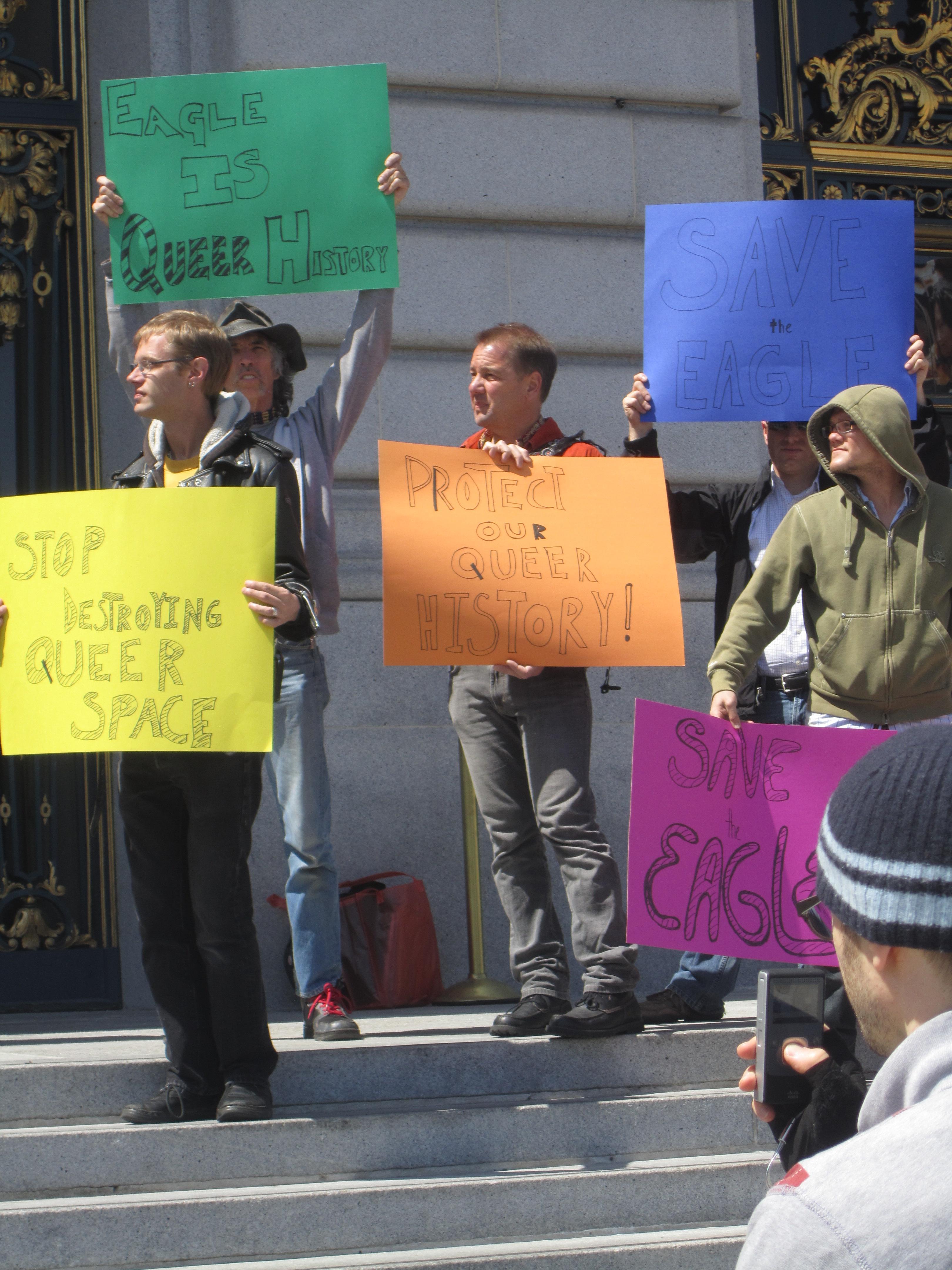
For the past week, patrons of one of San Francisco’s oldest and boldest gay leather bars have been rallying to save their stomping ground from uncertain fate. It started when they found that rumors swirling since early in the year were true: the Eagle was slated to close at the end of April and faced a May 1 eviction.

Since then, defenders of the 12th Street space have scraped together emergency meetings and impromptu marches, a surprise leather night at the Skylark Bar (owned by a believed-to-be buyer), and a demonstration on the steps of City Hall. Letters were sent to the Board of Supervisors, petitions signed, and pink tent campouts planned as vigils.

Through it all, the message carrying most clearly was that the Eagle Tavern is far more than a swingin’ hot spot. “It’s our history and it’s our culture,” said organizer Kyle DeVries at a rally on the steps of City Hall last Tuesday. “And we’re proud of what we’ve given to this city.”

That “what” includes more than $1 million raised through the years at popular Sunday beer busts supporting everything from breast cancer research to AIDS awareness. But it also includes providing a safe haven and sense of belonging for San Francisco’s queer community for more than three decades.

And now, patrons have learned they will eek out another month. Thanks to the huge outpouring of support from Eagle denizens, and political pressure from three San Francisco supervisors, the end-of-April plan to fly the coop has been delayed at least until the end of May, Eagle manager Ron Hennis said.

But since the issue first exploded April 11, efforts to save the sacred space haven’t slowed down. At press time, supporters were planning an April 19 “Tuesday roost” at the Eagle in hopes of pumping energy and cash back into the tavern on a night known to be quiet.

Sup. Scott Wiener, along with Sups. David Campos and Jane Kim, sent a letter to the San Francisco Police Department that reviews liquor license sales in connection with the California Department of Alcohol Beverage Control. The letter reviewed the Eagle’s importance in SF’s queer community and stated that its authors are “adamantly opposed to any sale that would result in the Eagle’s destruction.”

The supervisors urged the SFPD to “closely scrutinize, consistent with applicable legal standards, any requested liquor license transfer relating to the Eagle to ensure that any such transfer will not harm the LGBT community by putting an end to the Eagle.”

So far, these efforts have been promising for Eagle patrons. In a phone interview, Wiener told us that Skylark owner Steve Englebrecht has pulled out of negotiations to buy the place. But the situation remains complex.

Eagle manager Ron Hennis explained that current owners John Gardiner and Joe Banks decided to sell the Eagle a year ago to focus on their other SoMa leather bar, Hole in the Wall Saloon, which has been plagued with high-cost property battles of its own.

Gardiner and Banks didn’t respond to our e-mails. But Hennis said they intended to sell the business — which includes the Eagle name, equipment, and liquor license — to people they felt would maintain the existing spirit of the bar: Hennis, Eagle entertainment coordinator Doug Hilsinger, and Lila Thirkield, owner of the Lexington Club.

Hennis and Hilsinger told us a contract was signed and the deal had progressed through an initial set of inspections and into escrow when the property’s owner, John Nikitopoulos, refused to negotiate a new lease with the prospective owners.

Despite successful conversations up to that point, Gardiner and Banks “turned off and didn’t say why,” Hennis said.

Further complicating the matter, Gardiner and Banks’ lease ran out and Nikitopoulos hasn’t renewed it. He’s been renting the property month-to-month and is reportedly raising the monthly price tag, which has remained the same for the past 10 years.

Hennis said the owners were still paying rent when they were threatened with eviction — which would mean a death sentence for the Eagle unless they could sell the business to a party Nikitopoulos would be willing to negotiate a lease with.

In the midst of the stalemate, Nikitopoulos offered to buy the business (and most important, the liquor license) from Gardiner and Banks, who refused saying they’d already agreed to sell to Hennis and his partners. Nikitopoulos then approached Hennis, suggesting Hennis purchase the business as planned and then sell him the liquor license. When Hennis also turned down the landlord’s offer — without the liquor license, Hennis wouldn’t actually own the bar — he disappeared from the conversations.

At the April 12 demonstration, mayoral candidate Bevan Dufty called for the stakeholders involved to recognize that in a city that “values history — indeed, is defined by history,” the lease on the Eagle is “more than just a business transaction.

“The owner of this building needs to come to the table and talk about this,” he urged.

But Nikitopoulos, a resident of Santa Rosa who inherited the property from his father, hasn’t responded to Hennis, reporters, or even to calls from Sup. Wiener. He was, however, reportedly in communication with Englebrecht when the Skylark owner swept in to purchase the space and liquor license — but not the name or the leather culture.

Though Englebrecht withdrew, supporters worry Nikitopoulos could potentially negotiate a lease with a different tenant — leaving the bar a casualty of SoMa’s continued gentrification.

Longtime Eagle patron Mike Talley, who has lived in SoMa for more than two decades, fears the Eagle would fit perfectly into a familiar story of luxury lofts, astronomical rent increases, and — inevitably — mass evictions. He explained that what the Chronicle’s late columnist Herb Caen called the Miracle Mile — a strip of SoMa gay and leather bars that once numbered in the dozens — now consists of just a few properties “hanging in there.”

Mark Kliem, a.k.a Sister Zsa Zsa Glamour of the Sisters of Perpetual Indulgence, echoed Talley’s concern, saying, “The rest of the entire world is family-friendly. Why can’t we have this one little half-mile area to call queer space?”

It’s worth noting that the Eagle is by no means exclusively gay. It is famous for its Thursday-night rock shows where, according to an Eagle DJ, “a melting pot of hipsters, stoners, and rockers mixed with the leather crowd.”

“Everyone was cool,” he said. “Everyone was welcome.”

Still, the bar has become an icon of San Francisco’s queer community.

Kim, who represents the district, presented the Eagle with a letter of commendation recognizing its 30 outstanding years as a “venue, cultural institution, safe haven, and home for the LGBT community” at the April 12 meeting.

“You can’t threaten something as important as this institution,” Campos added.

Wiener, Kim, and California Sen. Mark Leno also praised the Eagle at Sunday’s regularly scheduled beer bust. Leno lauded the efforts of local drag queen/community organizer Anna Conda, and referred to the week’s events as “Stonewall West.”

If anything, the week of demonstrations has drawn San Francisco’s queer community closer. And there is hope that the crowd can stay together in the spot they claimed for themselves. One white-horse possibility is Mark Frazier, owner of a Dallas bar also named the Eagle — and also home to a leather crowd.

Seth Munter of Herth Realty in San Francisco said Frazier has been eyeing the SF Eagle for more than a year, and that he is “interested and able to participate in continuing the Eagle as it has been, either with partners or on his own.”

Reached by phone in Dallas, Frazier told us he’s dreamt of the business since before his own Eagle took flight in 1995. “I think the San Francisco Eagle has a lot of history and a core base of support,” he said. “Any time you go into a business with so much support, it’s going to be successful.”

Frazier stressed that like the SF original, his Eagle has raised substantial sums for charity. Though he acknowledged that the bottom line of all businesses is to make money, “the successful ones continue to give back to the community — and not only monetarily.”

So far, Frazier said he has “exchanged e-mails with the powers that be” and that he is confident the Eagle’s troubles stem from a “communication gap” he could help fix.

Hennis expressed hope about the possibility of working with Frazier in addition to pursuing other options like historical preservation.

Demonstrators have penned more than 100 hand-written letters to the Historic Preservation Commission urging it to assign the Eagle landmark status. Commissioner Alan Martinez said such a process could cost thousands of dollars and would not “grant the right to dictate businesses or tenants.”

Still, he announced publicly that giving the building historic status is not “about turning the city into a museum — it’s about our history.”

Though landmark status protects the physical property, it would also provide legitimacy, an instantaneous way to tell the building’s story and bind the community together. And no matter what happens with the sale of the Eagle, that’s one possibility that flies.


The Treasure Island nightmare

83

There are times when people like me, who think development should be driven by public needs, not private profit, are in something of a bind. I don’t like the Lennar plan for Bayview Hunters Point — but I agree that doing nothing isn’t a very good alternative. Sometimes, the “no-project” alternative isn’t an alternative at all — which gives the developers a huge hand up in negotiations with the city. Gee, you want affordable housing? We can give you 15 percent — or we can walk away and you’ll get nothing.


But when it comes to Treasure Island, I think we’re in a different situation. The proposed development is so out of whack, so looney, that it makes no sense to me — and the alternative of doing nothing, at least for now, isn’t so bad at all.


The plan calls for 19,000 new residents on the 403-acre artificial island in the Bay. At most, 25 percent of the units would be below-market. Which means some 13,700 rich people, virtually all of them with jobs in San Francisco, the Peninsula or the East Bay, would be plunked into a place with no viable transportation alternatives.


I wonder if any of these planners have ever tried to leave TI by car; it’s a nightmare. And there’s no way to fix it: Even if they build a new acceleration ramp (the current stop-and-go into 60-mile-an-hour traffic is a death trap), the Bay Bridge is already at full capacity during a very long rush hour in the morning and evening. And does anybody really think those 13,700 people will all take the ferry to work every day?


Impossible: There’s no way to provide enough ferry service for that population at anything resemble the cost the developers are willing to pay. How about all the Google and Yahoo and Genentech employees (and that’s a big part of the population buying new high-end condos in San Francisco)? You think they’re all going to take a ferry to downtown SF then hop on a bus or train then take another bus to the office? Not these folks. A lot of them will want to drive.


And the bridge, which is already backed up, will back up further, driving more traffic onto the streets of SOMA and creating a slowdown all the way back to Berkeley.


Meanwhile, the island is sinking, and water levels are rising. Forget the fancy engineering plans to sink stone columns deep into the clay under the Bay; what happens when the water rises? Are we going to surround the entire place with seawalls?


And here’s the bottom line: The current situation isn’t all that awful. There’s a small amount of housing out there, some of it affordable. There’s lots of open space. A little effort and the playing fields and parkland could be upgraded and TI could, for the intermediate term, be a day-use area for the city. Not a terrible alternative.


At some point, either the island’s going to sink back into the Bay or it’s going to have to be completely redeveloped. But right now, with no public money available, we’re at the whims of private developers. And what they’re offering doesn’t even remotely meed the city’s needs — and will create a catastrophic transportation problem.


So the supervisors are in a great position to negotiate. We want 50 percent affordable housing, we want the developer to pay for substantially increased bus and ferry service (or maybe we want to add a rail line to the Bay Bridge). And if that’s not something the developers want to do, fine: we’ll wait. Nothing wrong with that.


Music Listings

0

Music listings are compiled by Cheryl Eddy. Since club life is unpredictable, it’s a good idea to call ahead to confirm bookings and hours. Prices are listed when provided to us. Submit items for the listings at listings@sfbg.com. For further information on how to submit items for the listings, see Picks.

WEDNESDAY 6

ROCK/BLUES/HIP-HOP

Ani DiFranco Fillmore. 8pm, $33.50.

Fences, Rin Tin Tiger, Passenger and Pilot Rickshaw Stop. 8pm, $10.

Emma Jean Foster and Glide Gospel 50 Mason Social House, 50 Mason, SF; www.50masonsocialhouse.com. 9pm, free.

Aaron Glass and friends, Mowgli’s, Sufis Elbo Room. 9pm, $8.

A Rocket to the Moon, Valencia, Anarbor, Runner Runner Bottom of the Hill. 7pm, $15.

Spider Heart Submission, 2183 Mission, SF; www.sf-submission.com. 10pm, $5.

JAZZ/NEW MUSIC

Cosmo Alleycats Le Colonial, 20 Cosmo, SF; www.lecolonialsf.com. 7pm.

Dink Dink Dink, Gaucho, Michael Abraham Amnesia. 7pm, free.

Ben Marcato and the Mondo Combo Top of the Mark. 7:30pm, $10.

Michael Parsons Revolution Café, 3248 22nd St, SF; (415) 642-0474. 8:30pm, free.

Denise Perrier Rrazz Room. 8pm, $30.

DANCE CLUBS

Booty Call Q-Bar, 456 Castro, SF; www.bootycallwednesdays.com. 9pm. Juanita Moore hosts this dance party, featuring DJ Robot Hustle.

Buena Onda Little Baobab, 3388 19th St., SF; (415) 643-3558. 10pm, $3. Soul, funk, swing, and rare grooves with residents Dr. Musco and DJB.

Cannonball Beauty Bar. 10pm, free. Rock, indie, and nu-disco with DJ White Mike.

Jam Fresh Wednesdays Vessel, 85 Campton, SF; (415) 433-8585. 9:30pm, free. With DJs Slick D, Chris Clouse, Rich Era, Don Lynch, and more spinning top40, mashups, hip hop, and remixes.

Mary-Go-Round Lookout, 3600 16th St, SF; (415) 431-0306. 10pm, $5. A weekly drag show with hosts Cookie Dough, Pollo Del Mar, and Suppositori Spelling.

No Room For Squares Som., 2925 16th St, SF; (415) 558-8521. 6-10pm, free. DJ Afrodite Shake spins jazz for happy hour.

Respect Wednesdays End Up. 10pm, $5. Rotating DJs Daddy Rolo, Young Fyah, Irie Dole, I-Vier, Sake One, Serg, and more spinning reggae, dancehall, roots, lovers rock, and mash ups.

Synchronize Il Pirata, 2007 16th St, SF; (415) 626-2626. 10pm, free. Psychedelic dance music with DJs Helios, Gatto Matto, Psy Lotus, Intergalactoid, and guests.

THURSDAY 7

ROCK/BLUES/HIP-HOP

Dark Star Orchestra Great American Music Hall. 9pm, $35.

Dodos, Reading Rainbow Fillmore. 8pm, $18.50.

Futur Skullz, Blown to Bits, Trouble Kidz, Born Uglies Eagle Tavern. 9:30pm, $7.

Heavy Metal Kings, Danny Diablo Slim’s. 8:30pm, $18.

Hydrophonic, Burn River Burn, Electric Shepherd Bottom of the Hill. 9pm, $8.

Loto Ball, Moira Scar, Tunnel Hemlock Tavern. 9pm, $7.

Peelander-Z, Anamanaguchi, Glowing Stars DNA Lounge. 8pm, $16.

Ron Sexsmith, Caitlin Rose Café Du Nord. 9pm, $16.

“Shock and Roll Therapy” Stud. 8pm, free. With Havarti Party, Poor Sons, Narooma, and Cool Ghouls.

Society 50 Mason Social House, 50 Mason, SF; www.50masonsocialhouse.com. 9pm, free.

Sounds, K.Flay, DJ Aaron Axelsen, Miles the DJ Rickshaw Stop. 9pm, $14.

Tycho, Inu, Soma FM DJs Independent. 8pm, $20. SOMA FM 11th anniversary party.

JAZZ/NEW MUSIC

“Activating the Medium XIV: Radio: Chapter One” San Francisco Museum of Modern Art, 151 Third St, SF; www.sfmoma.org. 7pm, $10. With Richard Garet and Jim Haynes and Allison Holt.

Raul Midion Yoshi’s San Francisco. 8pm, $28.

Organsm featuring Jim Gunderson and “Tender” Tim Shea Bollyhood Café. 6:30-9pm, free.

Stompy Jones Top of the Mark. 7:30pm, $10.

FOLK/WORLD/COUNTRY

Bill Monroe Tribute Band Atlas Café. 8-10pm, free.

Chris Milam Revolution Café, 3248 22nd St, SF; (415) 642-0474. 8:30pm, free.

Rafael and Ingrid Red Poppy Art House. 7pm, $12.

“Twang! Honky Tonk” Fiddler’s Green, 1330 Columbus, SF; www.twanghonkytonk.com. 5pm.

DANCE CLUBS

Afrolicious Elbo Room. 9:30pm, $5. DJs Pleasuremaker and Señor Oz spin Afrobeat, tropicália, electro, samba, and funk.

Caribbean Connection Little Baobab, 3388 19th St, SF; (415) 643-3558. 10pm, $3. DJ Stevie B and guests spin reggae, soca, zouk, reggaetón, and more.

Club Jammies Edinburgh Castle. 10pm, free. DJs EBERrad and White Mice spinning reggae, punk, dub, and post punk.

Culture Corner Koko Cocktails, 1060 Geary, SF; www.kokococktails.com. 10pm, free. Roots reggae, dub, rocksteady, and classic dancehall with DJ Tomas’ Bunny Wailer and Big Youth Birthday Celebration.

Diapers, Binkies, and Friends Knockout. 9:30pm, free. Dad-to-be Jamie Jams spins baby-themed jams with DJs Stab Master Arson and DJ Eli Glad.

Drop the Pressure Underground SF. 6-10pm, free. Electro, house, and datafunk highlight this weekly happy hour.

Electric Feel Lookout, 2600 16th St, SF; www.fringesf.com. 9pm, $2. Indie music video dance party with subOctave and Blondie K, plus guest DJ Candy.

80s Night Cat Club. 9pm, $6 (free before 9:30pm). Two dance floors bumpin’ with the best of 80s mainstream and underground with Dangerous Dan, Skip, Low Life, and guests.

Wolfgang Gartner Ruby Skye. 9pm, $25.

Guilty Pleasures Gestalt, 3159 16th St, SF; (415) 560-0137. 9:30pm, free. DJ TophZilla, Rob Metal, DJ Stef, and Disco-D spin punk, metal, electro-funk, and 80s.

Holy Thursday Underground SF. 10pm, $5. Bay Area electronic hip hop producers showcase their cutting edge styles monthly.

Jivin’ Dirty Disco Butter, 354 11th St., SF; (415) 863-5964. 8pm, free. With DJs spinning disco, funk, and classics.

Lacquer Beauty Bar. 10pm-2am, free. DJs Mario Muse and Miss Margo bring the electro.

Mestiza Bollywood Café, 3376 19th St, SF; (415) 970-0362. 10pm, free. Showcasing progressive Latin and global beats with DJ Juan Data.

1984 Mighty. 9pm, $2. The long-running New Wave and 80s party has a new venue, featuring video DJs Mark Andrus, Don Lynch, and celebrity guests.

Peaches Skylark, 10pm, free. With an all female DJ line up featuring Deeandroid, Lady Fingaz, That Girl, and Umami spinning hip hop.

Thursday Special Tralala Revolution Café, 3248 22nd St, SF; (415) 642-0474. 5pm, free. Downtempo, hip-hop, and freestyle beats by Dr. Musco and Unbroken Circle MCs.

FRIDAY 8

ROCK/BLUES/HIP-HOP

Bryan Adams Warfield. 9pm, $25-85.

Akron/Family, Delicate Steve, Honeymoon, DJ Britt Govea Independent. 9pm, $15.

Buxter Hoot’n, Devotionals, Nick Jaina Café Du Nord. 9:30pm, $10.

Danielson, Battlehooch, Half-handed Cloud Bottom of the Hill. 10pm, $13.

Dark Star Orchestra Great American Music Hall. 9pm, $35.

Fiver Brown and the Good Sinners 50 Mason Social House, 50 Mason, SF; www.50masonsocialhouse.com. 9pm, free.

Larry Graham and Graham Central Station Yoshi’s San Francisco. 8 and 10pm, $30-38.

Hillside Fire, Narwhal Brigade, Ayurveda, Sandy Greenfield Band Kimo’s. 9pm.

Hot Lunch, Blank Stares, Pre-Legendary and the Dreamers Hemlock Tavern. 9:30pm, $7.

Mantles, Wrong Words, Lenz, Wet Illustrated Knockout. 9pm, $7.

Or the Whale, Chamberlin, Steve Taylor Rickshaw Stop. 8:30pm, $12.

Protest the Hero, Maylene and the Sons of Disaster, TesseracT Slim’s. 8:30pm, $17.

Volbeat, Damned Things Fillmore. 7pm, $22.50.

JAZZ/NEW MUSIC

Black Market Jazz Orchestra Top of the Mark. 9pm, $10.

Empty Space Revolution Café, 3248 22nd St, SF; (415) 642-0474. 9pm, free.

Madeleine Peyroux Palace of Fine Arts, 3301 Lyon, SF; www.sfjazz.org. 8pm, $30-75.

Redshift, Rootstock Community Music Center, 544 Capp, SF; www.sfcmc.org. 8pm, $10.

FOLK/WORLD/COUNTRY

“Cowpokes, Gunslingers, and Outlaw Country” Red Devil Lounge. 9pm, $12. With Good Luck Thrift Store Outfit, Whisky Richards, Tiny Television, and Preservation.

Tito y Su Son De Cuba Quinteto Red Poppy Art House. 8pm, $12-15.

DANCE CLUBS

Afro Bao Little Baobab, 3388 19th St, SF; (415) 643-3558. 10pm, $5. Afro and world music with rotating DJs including Stepwise, Steve, Claude, Santero, and Elembe.

Bass Time Continuum Session 4 Club Six. 9pm, $5. With Lotus Drops, Energy Alchemist, Bitch Plz, Benito, and Mr. Rise.

Blow Up DNA Lounge. 10pm, $10-15. “Miss Blow Up USA Pageant” with Jeffrey Paradise.

Cartagena! CD release party   Elbo Room. 10pm, $5. Cumbia with DJs Beto, Vinnie Esparza, and B. Cause.

Deeper 222 Hyde, 222 Hyde, SF; (415) 345-8222. 9pm, $10. With rotating DJs spinning dubstep and techno.

Dirty Rotten Dance Party Madrone Art Bar. 9pm, $5. With DJs Morale, Kap10 Harris, and Shane King spinning electro, bootybass, crunk, swampy breaks, hyphy, rap, and party classics.

Exhale, Fridays Project One Gallery, 251 Rhode Island, SF; (415) 465-2129. 5pm, $5. Happy hour with art, fine food, and music with Vin Sol, King Most, DJ Centipede, and Shane King.

Fo’ Sho! Fridays Madrone Art Bar. 10pm, $5. DJs Kung Fu Chris and Makossa spin rare grooves, soul, funk, and hip-hop classics.

Fubar Fridays Butter, 354 11th St., SF; (415) 863-5964. 6pm, $5. With DJs spinning retro mashup remixes.

Good Life Fridays Apartment 24, 440 Broadway, SF; (415) 989-3434. 10pm, $10. With DJ Brian spinning hip hop, mashups, and top 40.

Hot Chocolate Milk. 9pm, $5. With DJs Big Fat Frog, Chardmo, DuseRock, and more spinning old and new school funk.

Rockabilly Fridays Jay N Bee Club, 2736 20th St, SF; (415) 824-4190. 9pm, free. With DJs Rockin’ Raul, Oakie Oran, Sergio Iglesias, and Tanoa “Samoa Boy” spinning 50s and 60s Doo Wop, Rockabilly, Bop, Jive, and more.

Some Thing Stud. 10pm, $7. VivvyAnne Forevermore, Glamamore, and DJ Down-E give you fierce drag shows and afterhours dancing.

Vintage Orson, 508 Fourth St, SF; (415) 777-1508. 5:30-11pm, free. DJ TophOne and guest spin jazzy beats for cocktalians.

SATURDAY 9

ROCK/BLUES/HIP-HOP

Jeff Beck, Imelda May Fillmore. 8pm, $75.

Danger Babes 50 Mason Social House, 50 Mason, SF; www.50masonsocialhouse.com. 9pm, free.

Dark Star Orchestra Great American Music Hall. 9pm, $35.

Deskonocidos, Criaturas, Needles, Ruleta Rusa Knockout. 10pm, $7.

Funk Bros Revolution Café, 3248 22nd St, SF; (415) 642-0474. 9pm, free.

Larry Graham and Graham Central Station Yoshi’s San Francisco. 8 and 10pm, $38.

Jesse Morris and the Man Cougars Riptide Bar. 9pm, free.

Papercuts, Banjo or Freakout Café Du Nord. 9:30pm, $14.

Pollux, Bonnie Dune, Lite Brite Bottom of the Hill. 10pm, $12.

Rise Against, Bad Religion, Four Year Strong Bill Graham Civic Auditorium, 99 Grove, SF; www.ticketmaster.com. 7:30pm, $32.50.

Shearing Pinx, Continues, Victory and Associates Hemlock Tavern. 9:30pm, $7.

Submarines, Nik Freitas Slim’s. 9pm, $16.

FOLK/WORLD/COUNTRY

Hypnotist Collectors, Shareef Ali and the Radical Folksonomy, Fancy Dan Band, Slow Motion Cowboys Hotel Utah. 8pm, $8.

Mamacoatl Red Poppy Art House. 8pm, $15.

Craig Ventresco and Meredith Axelrod Atlas Café. 4pm, free.

DANCE CLUBS

Afro Bao Little Baobab, 3388 19th St, SF; (415) 643-3558. 10pm, $5. Afro and world music with rotating DJs including Stepwise, Steve, Claude, Santero, and Elembe.

Bootie SF: Halloween in April DNA Lounge. 9pm, $6-12. Who says Halloween only comes once a year? Mash it up with DJs Adrian and Mysterious D, guest Faroff, and more.

Club Gossip Cat Club. 9pm, $5-8. Pay tribute to Janet Jackson and other 80s ladies at this party guest-hosted by the Bay Area Flash Mob.

New Wave City New Order Tribute Mezzanine. 9pm, $7-12. Celebrate “Blue Monday” on a Saturday with DJ Shindog, guest Andy T, and more.

Rock City Butter, 354 11th St., SF; (415) 863-5964. 6pm, $5 after 10pm. With DJs spinning party rock.

Same Sex Salsa and Swing Magnet, 4122 18th St, SF; (415) 305-8242. 7pm, free.

Spirit Fingers Sessions 330 Ritch. 9pm, free. With DJ Morse Code and live guest performances.

Spotlight Siberia, 314 11th St, SF; (415) 552-2100. 10pm. With DJs Slowpoke, Double Impact, and Moe1.

Tormenta Tropical Elbo Room. 10pm. Electro cumbia with Chancha Via Circuito, El G, and DJs Shawn Reynaldo and Oro 11.

SUNDAY 10

ROCK/BLUES/HIP-HOP

Band of Heathens Slim’s. 7:30pm, $15.

Let the Night Roar, Pigs Hemlock Tavern. 9pm, $6.

G. Love and Special Sauce, Belle Brigade Fillmore. 8pm, $25.

Mark Growden and His Tucson String Band, Conspiracy of Venus Amnesia. 9pm, $10.

John Mellencamp Warfield. 7pm, $49.50-130.

Sleepytime Gorilla Museum, Now You, Listo Independent. 8pm, $18.

Whiskerman, 7 Orange ABC, Magic Leaves Bottom of the Hill. 9pm, $8.

David Wilcox Yoshi’s San Francisco. 7pm, $25.

JAZZ/NEW MUSIC

Assad Brothers Palace of Fine Arts, 3301 Lyon, SF; www.sfjazz.org. 7pm, $25-60.

John Santos Bliss Bar, 4026 24th St., SF; www.blissbarsf.com. 4:30pm, $10.

Tom Lander Duo Medjool, 2522 Mission, SF; www.medjoolsf.com. 6-9pm, free.

FOLK/WORLD/COUNTRY

Family Folk Explosion Revolution Café, 3248 22nd St, SF; (415) 642-0474. 8:30pm, free.

Jenny Lynn and Her Gone Daddies Thee Parkside. 4pm, free.

“San Francisco Festival of the Mandolins” Croatian American Cultural Center, 60 Onondaga, SF; www.croatianamericanweb.org. 10am-5pm, $15.

DANCE CLUBS

Batcave Cat Club. 10pm, $5. Death rock, goth, and post-punk with Steeplerot Necromos and c_death. Dub Mission Elbo Room. 9pm, $6. Dub, roots, and classic dancehall with DJ Sep, Vinnie Esparza, and guest Adam Twelve.

Gloss Sundays Trigger, 2344 Market, SF; (415) 551-CLUB. 7pm. With DJ Hawthorne spinning house, funk, soul, retro, and disco.

Honey Soundsystem Paradise Lounge. 8pm-2am. “Dance floor for dancers – sound system for lovers.” Got that?

La Pachanga Blue Macaw, 2565 Mission, SF; www.thebluemacawsf.com. 6pm, $10. Salsa dance party with live Afro-Cuban salsa bands.

MONDAY 11

ROCK/BLUES/HIP-HOP

Elephant and Castle, Pixel Memory, Butterfly Bones Elbo Room. 9pm, $5.

Moon Duo, Royal Baths, Lilac Bottom of the Hill. 9pm, $10.

Scala and Kolacny Brothers Independent. 8pm, $25.

JAZZ/NEW MUSIC

Broun Fellinis Yoshi’s San Francisco. 8pm, $25.

Lavay Smith Orbit Room, 1900 Market, SF; (415) 252-9525. 7-10pm, free.

DANCE CLUBS

Death Guild DNA Lounge. 9:30pm, $3-5. Gothic, industrial, and synthpop with Joe Radio, Decay, and Melting Girl.

Krazy Mondays Beauty Bar. 10pm, free. With DJs Ant-1, $ir-Tipp, Ruby Red I, Lo, and Gelo spinning hip hop.

M.O.M. Madrone Art Bar. 6pm, free. With DJ Gordo Cabeza and guests playing all Motown every Monday.

Network Mondays Azul Lounge, One Tillman Pl, SF; www.inhousetalent.com. 9pm, $5. Hip-hop, R&B, and spoken word open mic, plus featured performers.

Sausage Party Rosamunde Sausage Grill, 2832 Mission, SF; (415) 970-9015. 6:30-9:30pm, free. DJ Dandy Dixon spins vintage rock, R&B, global beats, funk, and disco at this happy hour sausage-shack gig.

Skylarking Skylark. 10pm, free. With resident DJs I & I Vibration, Beatnok, and Mr. Lucky and weekly guest DJs.

TUESDAY 12

ROCK/BLUES/HIP-HOP

Olof Arnalds Café Du Nord. 9:30pm, $15.

Amee Chapman, Jenny Kerr, Sugarplums Club Waziema, 543 Divisadero, SF; (415) 356-6641. 8pm, free.

Ms. Lauryn Hill Warfield. 8pm, $59.50-90.

Omar Rodriguez Lopez Group, Zachs Marquise Great American Music Hall. 8pm, $21.

Haroula Rose, TD Lind Hotel Utah. 8pm, $8.

Rural Alberta Advantage, Lord Huron, Vandella Bottom of the Hill. 9pm, $14.

Scala and Kolacny Brothers Independent. 8pm, $25.

Sydney Ducks, Something Fierce Hemlock Tavern. 9pm, $6.

DANCE CLUBS

Boomtown Little Baobab, 3388 19th St, SF; www.bissapbaobab.com. 9pm, free. DJ Mundi spins roots, ragga, dancehall, and more.

Eclectic Company Skylark, 9pm, free. DJs Tones and Jaybee spin old school hip hop, bass, dub, glitch, and electro.

Share the Love Trigger, 2344 Market, SF; (415) 551-CLUB. 5pm, free. With DJ Pam Hubbuck spinning house.


 

Take back the knit

0

caitlin@sfbg.com

STREETWISE The dinosaur outside my library makes my day. Someone knit a little green bike rack cozy with floppy yellow spikes, right next to the rack that now has a custom-sized, rainbow-colored, beaded sweater. Indeed, the whole neighborhood has been knit-tagged — the stretch of Divisadero between Post and California streets has nary a rack that hasn’t been dressed against the spring chills.

The woman who answered the phone at Atelier Yarns, the knitting store down the block on Divisadero, didn’t know who had done the pieces, which is not to say they’d gone unnoticed. “They’re really good,” she said. “I wish I knew who had done them.”

Digging further, I fell into the deep abyss of Internet craft blogs and found that the Western Addition isn’t the only place where knit is joining the textures of the concrete jungle. Across the world, “yarn bombing” groups have sprung up. Last year, a group altered the Oakland-Berkeley border’s controversial “Here There” statues, knitting a colorful cozy over the T in “There” that renders the words equal, symbolically erasing the hierarchical positioning of the two bergs. There have been knitted seat covers on Philly’s Blue line subway and a knitted tank cover in shades of Pepto-Bismol pink in Copenhagen — not to mention jauntily decorated stop signs, trees, and railings the world over.

Magda Sayeg, a.k.a. PolyCotn, is generally regarded as the mother of this peaceful barrage. So I called her to find out why she — and now the rest of the world — yarn bombs.

It all started seven years ago with a knit cover for the doorknob of her Houston art studio. “It was about me making my door-handle pretty,” she remembers. Then she knitted a cover for a stop sign, which attracted lots of attention. “People would get out of the car, take pictures, scratch their head.”

She did more pieces. She formed a yarn bomb collective called “Knitta Please.” Since then, Sayeg has knitted everything from a riotously rainbow cover on a Mexico City bus to a powder pink coat for a single stone on the Wall of China.

Sayeg’s work makes knitting, once a private activity, part of the public domain. “You’re taking something so traditional and homey and placing it in an environment — graffiti art, it’s so male-dominated.”

Which is not to say that she doesn’t locate yarn bombing inside the tradition of street art. “I identify with the street artists more than the knitters,” Sayeg says, remembering the first time she saw the moaning cartoon faces of a gallery show by seminal SF street artist Barry McGee. “That really rocked my perception of what street art was. You could say [the yarn bombing] story started there.”

Like “traditional” street artists, Sayeg uses her creations to make her mark on her physical surroundings. She loves tagging the redundant bits of the urban landscape, like street posts whose signs have been removed and rendered useless. “It’s a visual pollution that we just accept. There’s no reason why we shouldn’t cover up something that’s not needed.” She pointed to the 3-D video game sprites of Space Invader and moss graffiti artists like Edina Tokodi as others who “are putting the can down” in the street art world.

But Sayeg also likes how yarn bombing questions the assumptions of what knitting is, which brings us to the question of the genre’s feminist interpretation. Though there are certainly male yarn bombers, you can’t deny that this kind of functional art, and craft in general, has historically been thought of as “women’s work” — and has had its worth denigrated and minimized as such. With yarn bombing, “there’s something there that might make people uncomfortable. An edge to something that never seems edgy. Like we’re supposed to be making sweaters and socks,” Sayeg says.

That stereotype has been turned on its head by craft activism, a form of protest that has its modern day roots in the 1980s and ’90s peace demonstrations at Greenham Common Royal Air Force base in England, where the U.S. military installed cruise missiles in 1981. Women gathered around the cyclone fencing at the base, stuffing its grid with knitted objects and hoisting handmade signs that read “Women’s Struggle Won The Vote, Now Let’s Use It For Disarmament.”

More recently, as Kirsty Robertson recounts in an essay in Extra/Ordinary (Duke University Press, 306 p., $24.95), the Revolutionary Knitting Circle held a “knit-in” at the 2002 G-8 summit in Alberta, Canada. Betsy Greer — who has a day job as an anti-sweatshop activist and also wrote an essay in Extra/Ordinary — coined the term “craftivism” to describe efforts similar to her own antiwar cross-stitch art. In Greer’s words, craftivism is “about using what you can to express your feelings outward in a visual manner without yelling or placard-waving. It was about channeling that anger in a productive and even loving way.”

Which is not to say that all urban crafters — as I’ve come to think of the men and women reclaiming textile and other forms of craft in a modern setting — are explicitly political. I was reminded of Sayeg’s desire to subvert the masculine face of street art when I visited the SoMa studio of Amy Ahlstrom, a San Francisco textile artist who is taking images from the walls of cities and translating them into painstakingly crafted quilts.

Ahlstrom, who has made her own clothes since her Molly Ringwald childhood, started quilting as an art student in 1991. She had a successful career in comic art and returned to stitching in 2005. “To me, this is a very natural thing,” she says, surrounded by her eye-popping creations hanging on stark white walls. “This was the most unique way I could speak to the world.”

Living in the Mission, Ahlstrom found the neighborhood’s murals, street signs, and tags an integral part of her city life. She began photographing them and was struck by an urge to alter their context. “I saw this tag and thought, ‘Wouldn’t that be funny in gingham?’ “

Like a textile DJ, she cut and sewed patterns made from the digital images she had captured into textured Dupioni silk. Now she’s working on a series of pieces dedicated to the visual cues of specific neighborhoods. Her SoMa quilt contains depictions of furniture leaping from public art installation “Defenestration”‘s decrepit Sixth Street building, Jeremy Novy’s ubiquitous stenciled koi, and the neon signs of Holy Cow and Brainwash. She’s not the only artist to harness the power of the quilt — Ben Venom is another SF quilter who creates heavy metal motifs from old band shirts (his “Listen to Heavy Metal While You Sleep!” skull-cross design is a Guardian staff favorite).

Ahlstrom brings the street to textile and the yarn bombers bring their textiles to the street, but they all work to the same end. Though Ahlstrom’s pieces will sell for hundreds of dollars and hang like the gallery pieces that they are, she creates them with the intention of breaking down the art world stipulation that craft cannot be art.

She cites the Gee’s Bend quilts as one inspiration for her work. Gee’s Bend is a small Alabama River community whose women inhabitants came together to have their quilts exhibited by the Houston Museum of Fine Arts in 2002, to great critical acclaim. In contrast to previous exhibitions, the quilts were not divorced from their functional use — museum literature placed the stories of Gee’s Bend quilters front and center in an attempt to highlight how the beauty of their geometric patterns was accentuated, not diminished, by their status as household objects.

So what did the gentle crafter of my beloved dinosaur have in mind when she or he looped that clover green around the bike rack? You’d have to ask the knitter — but at the very least, they’ve made their presence known.

Appetite: Dark and lovely Weavers Coffee

0

Weaver’s Coffee: if you aren’t drinking it, you should be. Based in San Rafael, Weaver’s  has a chill, little shop serving and selling their coffee and teas. The shop fronts their roasting facility and offices, which I had the privilege of touring recently.

John Weaver, master roaster and founder, was Peet‘s master roaster for more than 20 years, working directly with the late Alfred Peet. He brings a masterful perfection to Weaver’s coffees and teas, with a refined eye and palate for sourcing the best beans internationally. He returns to his roots with Weaver’s (under his parent company, Wild Card Roasters), able to once again create small batch, individualized blends.

During my visit, I sifted through burlap bags of raw beans from many countries, witnessing the different look and feel of each. Watching the roasting process in a massive Probat machine, divine aromas encompass. Weaver and crew manually and continuously check the beans as they turn from light green/brown tones to a dark, chocolate-ly brown. Similar to craft distilling, they smell and examine beans through various stages to ascertain the exact moment when roasting is complete. It’s an art requiring expertise and timing.

There are many beans to recommend, from the rich, wine notes of Aged Mocha Java (also used in the current batch of St. George’s Firelit Liqueur, to the current special Astral Blend: smooth, sweet, earthy (bonus: purchasing this one supports breast cancer research).

I’ve been drinking Weaver’s since last Fall and it is the best new coffee I’ve had in awhile… as it begins to gain popularity, I’m proud to call it another local great.

**Purchase Weaver’s at Rainbow Grocery, to name just one local vendor. Here’s a full listing.

**Drink Weaver’s at Curbside Coffee‘s street cart, found at Off the Grid and parked weekdays in SoMa (they also specialize in Vietnamese coffee).

–Subscribe to Virgina’s twice monthly newsletter, The Perfect Spot

March to the rainbow

0

culture@sfbg.com

IRISH Whether you live in Dallas or settle in SoMa, March is the month when Americans throw out their stale V-Day candy hearts and bring out the greens. Not the ones you smoke, silly, we’re talking St. Patrick’s Day here. Along with the rest of the country, San Franciscans will bite into green bagels, take a swig of something Irish, and head down to the St. Patrick’s Day parade (ours is early this year, Saturday, March 12) to join in the Celtic revelry. But — typical — there’s something about our Irish celebrations that set SF apart — our St. Patrick’s Day parade is one of few in the country to welcome the LGBT community to the party.

While it’s easy to forget over here at the end of the rainbow, most St. Patrick’s Day celebrations in the U.S.A. have a strict no-gays policy when it comes to who is allowed to march — which is sad and ironic considering that Irish Americans once faced the same discrimination that their parade associations now seem to be condoning when it comes to gay Americans.

Three cities in the country allow gay groups to participate in their St. Paddy’s parades: Queens, N.Y., SF, and Key West, Fla. (editor’s note: not exactly true, as it turns out — check out our correction for the other bergs around the country to welcome the queer community into the St. Paddy’s fold) The Queens parade was created as an all-inclusive alternative to the New York City parade, which still does not allow LGBT groups to participate despite years of protests — after Irish pride, these demonstrations may be NYC’s second highest profile St. Paddy’s Day tradition. This year the president of Ireland, Mary McAleese, has refused to participate in the Big Apple’s march on account of the parade’s regrettable policy. She’s not the only one: Boston’s mayor has refused to march in his city’s parade for the past few years.

But here in the country’s queer mecca, we can shake our heads in smug, gay disapproval at the St. Patty’s wars of the rest of the country. SF has a history of hoisting our rainbow shamrock high: this city’s parade is all-inclusive, which the president of SF’s Irish Societies (the organization behind the parade and concurrent Civic Center Plaza festival), Dermot Philpot is glad about.

“We include everybody, and we look for them to be in the parade,” Philpot told us in a recent phone interview. “When we include LGBT groups and individuals in our parade, it shows that [the SF Irish community] is part of a larger community.” Although there are no nominally gay groups marching in the parade, unlike in years past, Philpot says he hopes “[the LGBT community] feels included and that they will be there.”

The San Francisco Lesbian/Gay Freedom Band is one LGBT group that has high-stepped for Irish pride, making its most recent St. Patrick’s Day parade appearance in 2000. Doug Litwin, who is the secretary for the band’s board of directors, says the band had been participating in the parade even before he and his clarinet joined the group in 1985. Although marching on St. Paddy’s Day is a subject of contention for queer groups in other parts of the country, for the SF Lesbian/Gay Freedom Band the parade is about as run-of-the-mill as any. “The bottom line is in San Francisco it’s just not that big of a deal to be openly gay anymore,” says Litwin. “Our band was declared the official band of San Francisco by two different mayors. Some of these parade organizers practically beg us to march.”

Openly gay senator Mark Leno is another familiar face on parade day. Leno is unable to attend the event this year because of an out-of-town speaking engagement, but says he’s been included in the parade as far back as 1998, when he was first elected to office. “I’ve always been proud of the fact that San Francisco’s parade is inclusive. And as long as I have been in office, I’ve always felt welcome in the parade.” Only once has he ever gotten negative reactions from the parade crowds. As Leno recalls, that year he had opted to ride through the parade in a Jaguar. “I heard booing and hissing right as I got up to Second Street.” At issue: red-blooded parade watchers were upset that Leno hadn’t chosen an American car for his cruise through the crowds.

ST. PATRICK’S DAY PARADE

Sat/12, 11:30 a.m., free

Begins at Market and Second streets, SF

(415) 203-1027

www.uissf.org

Radio radio!

5

arts@sfbg.com

Do you remember rock ‘n’ roll radio, as the Ramones once quizzed us, ever so long ago? If not that “Video Killed the Radio Star”-era iteration, a leather-clad punky nostalgia for Murray the K and Alan Freed, then do you remember college rock when it became the name of a musical genre in the early 1990s?

I’m trying to make out its faint strains now: a sound nominally dubbed rock, but as wildly eclectic and widely roaming as the winds blowing me over the Bay Bridge on this blustery, rain-streaked afternoon. I’m not imagining it. New, shaken-and-stirred PJ Harvey nudging family-band throwback the Cowsills. Nawlins jazzbos Kid Ory and Jimmy Noone rubbing sonic elbows with winsome Tim Hart and Maddy Prior. Brit electropoppers Fenech-Soler bursting beside Chilean melody-makers Lhasa. The ancient Popul Vuh tangling with the bright-eyed art-rock I Was a King. It’s an average playlist for KALX 90.7 FM, the last-standing free-form sound in San Francisco proper — though it hails from across the bay in Berkeley.

But what about SF’s own, KUSF? A former college radio DJ and assistant music director at the University of Hawaii’s KTUH and the University of Iowa’s KRUI, I’m one of those souls who’s searching for it far too late, even though I benefited from my time in college radio, garnering a major-league musical education simply flipping through the dog-eared LPs and listening to other jocks’ shows. Like so many music fans, I got lost — searching for the signal and repelled by commercial radio’s predictable computerized playlists, cheesy commercials, and blowhard DJs — and found NPR.

Today, I’m testing the signals within — the health of music on SF terra firma radio — by driving around the city, cruising City Hall, bumping through SoMa, and dodging bikes in the Mission. KALX’s signal is strong on the noncommercial side of the dial, alongside the lover’s rock streaming from long-standing KPOO 89.5 and the Strokes-y bounce bounding from San Jose modern rock upstart KSJO 92.3, whose tagline promises, “This is the alternative.” But KSJO’s distinct lack of a DJ voice and seamless emphasis on monochromatic Killers-and-Kings-of-Chemical-Romance tracks quickly bores, slotting it below its rival, Live 105.

Dang. I wind my way up Market to Twin Peaks. Waves of white noise begin to invade a Tim Hardin track. KALX’s signal fades as the billowing, smoky-looking fog rolls majestically down upscale Forest Hill to the middle-class Sunset. But I can hear it — with occasional static — on 19th Avenue, and later, in the Presidio and Richmond.

Throughout, KUSF’s old frequency, 90.3, comes through loud and clear — though now with the sound of KDFC’s light-classical and its penchant for swelling, feel-good woodwinds. The music is so innocuous that to rag on it feels as petty and mean as kicking a docile pup. But I get my share of instrumental wallpaper while fuming on corporate phone trees. It’s infuriating to realize that it supplanted KUSF, the last bastion of free-form radio in SF proper. Where is the free-form rock radio? This is the city that successfully birthed the format in the 1970s, with the freewheeling, bohemia-bred KSAN, and continued the upstart tradition with pirate stations such as SF Liberation Radio. Doesn’t San Francisco deserve its own WFMU or KCRW?


FEWER INDEPENDENTS, MORE CONSOLIDATION

Online radio — including forces like Emeryville’s Pandora and San Diego’s Slacker Radio — provides one alternative. This is true for listeners who use the TiVo-like Radio Shark tuner-recorder to rig their car (still the primo place to tune in) to listen to online stations all over the country. The just-launched cloud-based DVR Dar.fm also widens the online option.

Nevertheless, online access isn’t a substitute for free radio air waves. “We get the wrong impression that everyone is wired, and everyone’s online, and no one listens to terrestrial radio,” says radio activist and KFJC DJ Jennifer Waits. “Why then are these companies buying stations for millions of dollars?”

Waits and KALX general manager Sandra Wasson both point to the consolidation that’s overtaken commercial radio since deregulation with the Telecommunications Act of 1996 — a trend that has now crept onto the noncommercial end of the dial.

As competition for limited bandwidth accelerates (in San Francisco, this situation is compounded by a hilly topography with limited low-power station coverage) and classical radio stations like KDFC are pushed off the commercial frequencies, universities are being approached by radio brokers. One such entity, Public Radio Capital, was part of the secretive $3.75 million deal to sell KUSF’s transmitter and frequency. Similar moves are occurring throughout the U.S., according to Waits. She cites the case of KTXT, the college radio station at Texas Tech, as akin to KUSF’s situation, while noting Rice and Vanderbilt universities are also exploring station sales.

“The noncommercial band is following in the footsteps of the commercial band in the way of consolidation,” Wasson says, from her paper-crammed but spartan office at KALX, after a tour of the station’s 90,000-strong record library. Wire, Ringo Death Starr, and Mountain emanate from the on-air DJ booth, as students prep the day’s newscast and a volunteer readies a public-affairs show. “Buying and selling noncommercial radio seems to me very much like what used to happen and still does in commercial radio: one company owns a lot stations in a lot of different markets and does different kinds of programming in different markets. Deregulation changed it so that 10-watt stations weren’t protected anymore. There were impacts on commercial and noncommercial sides.”

Lack of foresight leads cash-strapped schools to leap for the quick payout. “Once a school sells a station, it’s unlikely it will be able to buy one back,” says Waits. “Licenses don’t come up for sale and there are limited frequencies. They have an amazing resource and they’re making a decision that isn’t thought-through.”


DREAMING IN STEREO

There are still people willing to put imagination — and money — behind their radio dreams. But free-form has come to sound risky after the rise of KSAN and FM radio and the subsequent streamlining and mainstreaming of the format.

Author and journalist Ben Fong-Torres, who once oversaw a KUSF show devoted to KSAN jocks, cites the LGBT-friendly, dance-music-focused KNGY 92.7 as a recent example of investors willing to try out a “restricted” format. “They were a good solid city station that sounded quite loose,” he explains. “But even there they weren’t able to sell much advertising because they were limited to the demographic in San Francisco and they couldn’t make enough to pay their debts.”

Nonetheless, Fong-Torres continues to be approached by radio lovers eager to start a great music station. “I’ve told them what I’m telling you,” he says. “It’s really difficult to acquire a stick in these parts, to grab whatever best signals there are.” This is especially true with USC/KDFC rumored to be on a quest for frequencies south of SF.

“There are some dreamers out there who think about it,” muses Fong-Torres. “A single person who’s willing to bankroll a station just out of the goodness of his or her heart and let people spread good music — someone like Paul Allen, who did KEXP in Seattle.”


THE FIGHT TO SAVE KUSF

The University of San Francisco has touted the sale of KUSF’s frequency and the station’s proposed shift to online radio as a teaching opportunity. But the real lesson may be a reminder of the value of the city’s assets — and how easily they can be taken away. “We’re learning how unbelievably sacred bandwidth is on the FM dial,” says Irwin Swirnoff, who was a musical director at the station.

Swirnoff and the Save KUSF campaign hope USF will give the community an opportunity to buy the university’s transmitter, much as Southern Vermont College’s WBTN 1370 AM was purchased by a local nonprofit.

For Swirnoff and many others, listener-generated playlists can’t substitute for the human touch. “DJs get to tell a story through music,” he explains. “They’re able to reach a range of emotions and [speak to] the factors that are in the city at that moment, its nature and politics. Through music, they can create a moving dialogue and story.”

Swirnoff also points to the DJ’s personally selective role during a time of corporate media saturation and tremendous musical production. “In the digital age, the amount of music out in the world can be totally overwhelming,” he says. “A good station can take in all those releases and give you the best garage rock, the best Persian dance music, everything. One DJ can be a curator of 100 years of music and can find a way to bring the listener to a unique place.”

Local music and voices aren’t getting heard on computer-programmed, voice-tracked commercial stations despite inroads of satellite radio into local news. In a world where marketing seems to reign supreme, is there a stronger SF radio brand than the almost 50-year-old KUSF when it comes to sponsoring shows and breaking new bands for the discriminating SF music fan? “People in the San Francisco music community who are in bands and are club owners know college radio is still a vital piece in promoting bands and clubs,” says Waits. “There are small shows that are only getting promotion over college radio.”

“It was a great year for San Francisco music, and we [KUSF] got to blast it the most,” Swirnoff continued. “It’s really sad that right now you can’t turn on terrestrial radio and hear Grass Widow, Sic Alps, or Thee Oh Sees, when it’s some of the best music being made in the city right now.”


PIRATE CAT-ASTROPHE — AND THE DRIVE TO KEEP RADIO ALIVE

Aside from KUSF, the only place where you could hear, for instance, minimal Scandinavian electronics and sweater funk regularly on the radio was Pirate Cat. The pirate station was the latest in a long, unruly queue, from Radio Libre to KPBJ, that — as rhapsodized about in Sue Carpenter’s 2004 memoir, 40 Watts From Nowhere: A Journey into Pirate Radio — have taken to the air with low-power FM transmitters.

After being shut down by the FCC and fined $10,000 in 2009, Pirate Cat is in limbo, further adrift thanks to a dispute about who owns the station. Daniel “Monkey” Roberts’ sale of Pirate Cat Café in the Mission left loyal volunteers wondering who should even receive their $30-a-month contributions. Roberts shut down the Pirate Cat site and stream on Feb. 20. Since then, some Pirate Cat volunteers have been attempting to launch their own online stream under the moniker PCR Collective Radio.

“We would definitely start our own station,” says Aaron Lazenby, Pirate Cat’s skweee DJ and a Radio Free Santa Cruz vet. “The question now is how to resolve the use of Pirate Cat so we don’t lose momentum and lose our community. We all love it too much to let it fizzle out like that.”

Some people are even willing to take the ride into DIY low-power terrestrial radio. I stumbled over the Bay Area’s latest on a wet, windy Oakland evening at Clarke Commons’ craftsman-y abode. The door was flung open and a colorful, quilt-covered fort/listening station greeted me in the living room. In the dining space, a “magical handcrafted closet studio station” provided ground zero for the micro-micro K-Okay Radio — essentially a computer sporting cute kitchen-style curtains and playing digitized sounds.

A brown, blue, and russet petal-shingled installation looked down on K-Okay’s guests as they took their turn at the mic. And if you were in a several-block radius of the neat-as-a-pin house-under-construction and tuned your boombox to 88.1 FM, you could have caught some indescribably strange sounds and yarns concerning home and migration. I drove away warmed by the friendly mumble of sound art.

Who would have imagined radio as an art installation? Yet it’s just another positive use for a medium that has functioned in myriad helpful ways, whether as a life link for Haitians after the 2010 earthquake or (as on a recent Radio Valencia show) a rock gossip line concerning the Bruise Cruise Fest. As Waits puts it, radio is “about allowing yourself to be taken on a musical journey rather than doing the driving yourself online.” Today it sounds like we need the drive to keep that spirit alive.

5 Things: March 8, 2011

0

>>1. PETA HOPS We had no idea that Anchor Steam is vegan. Now we can throw back a case and pet our potbellied pig, Sir Skrumpkins, guilt- and irony-free. (Apparently many beers use animal gelatins for filtration.)

>>2. FAREWELL SKRUMPKINS And here is how to safely dispose of your dearly beloved, earthly departed pet potbellied pig in Northern California.

>>3. ONE-TWO PUNCH Speaking of drinking, one of the oldest bars in  SF, Elixir in the Mission, is also one of the most forward-thinking. The joint’s hand-crafted, organic cocktails are out of this world. Under the stewardship of owner H., Elixir’s just redone its menu. Olde Sydney-Town punch, honey kumquat caipirinha, Meyer lemon cucumber collins — these are just three of the mouthwatering new concoctions. (When we start to use phrases like “mouthwatering concoctions,” you know we need a drink.) Bonus: patrons receive a complimentary pisco punch while waiting for their cocktail. And no, it’s not like a Hawaiian punch, we checked.

>>4. GUNS AND BUTTER Overheard at the new Whole Foods in the Haight, much ado about the new scientifically validated checkout line system (also experienced at the SoMa branch). First introduced in New York City, the system uses a single line, or two, that feed into a passel of registers, all controlled by a single, cute, traffic cop. Although there are already reports of doofuses stepping out of turn, the system reportedly shrinks wait time to less than two minutes. Not so much of a hit, though, are armed security guards, apparently ready to draw their weapons on yogurt-stealers. “That’s what we pay for at Whole Foods, right?” commented one dude in the bakery line. “The wholesome experience.” (Please support your local, possibly unarmed grocer.)

>>5.THIS IS PARADISE Take a risk. Wear it inside the club. Now is the time to see ‘Shades,’ a new video by SF’s David Enos and Mishell Stimson.

http://www.youtube.com/watch?v=NCUD8UEBaSQ

Hot sexy events: March 2-8

0

Those bedazzled emissaries of SF morals, the Sisters of Perpetual Indulgence, are once again emerging from their pancake makeup-encrusted cloisters to spread the good word. Indeed, on Sun/6 they’ll be hosting not one, but two benefits involving liberal doses of alcohol and private part-focused celebrations.

In SoMa, the sisters invite you to take a sacrament of all-you-can-drink Bud Lite at Chaps to benefit the group’s anti-hate crime “Stop the Violence” campaign. Of course, pants are optional – the event is entitled, after all, Jock Off. Eee! Pacifism is sexy! Pull your trousers halfway up to trek across town for the concurrent Quadroboob, whose ra-ma-tazz lineup (including the spectacular Lady Monster) guarantees that even as you are raising funds for the Breast Cancer Emergency Fund, you will be simultaneously putting your knockers to good use. That means shake ’em, ladies (and gents).


Leather Alliance Weekend

A whirling dervish of chaps and kicky hide hats descends on SF this week, as the Leather Alliance and its entourage gear up for the Mr. Leather Contest on Sat/5 at the Hotel Whitcomb – oh, and the SF Citadel meet and greet (Thurs/3) and assorted beer busts and cigar celebrations in honor of the chosen one. Last year was New Mexican transman wheelchair-user Tyler McCormick‘s time to shine, who will wear the leather crown this year?

Thurs/3-Sun/6 $15-35 for weekend’s events

Various locations, SF

www.leatheralliance.org


International Sex Workers’ Rights Day Art XXX-hibition

Not to be confused with the International Day to End Violence Against Sex Workers (that’s December 17), International Sex Workers’ Rights Day brings a whole bunch of creative works by and of those that supply society with a much-needed dose of climax-for-hire. Annie Sprinkle will be selling her prints, and St. James’ Infirmary workers Rachel Schreiber and Barbara DeGenevieve will share their photographs of sex workers at the center. 

Fri/4 6-9 p.m., free

Million Fishes Art Gallery

2501 Bryant, SF

www.millionfishes.com


Kinky Dating

How does the dating game change when the night of your dreams ends with you in shackles and him holding a whip and a plan? Edukink’s one-off workshop explores the etiquette of courting in the BDSM world, lessons that all you kinksters can get down on regardless of sexual orientation. The class is part of the program’s monthly “Newcomer’s Series,” so feel free to stop by even (especially) if you’re new to the dungeon scene. 

Fri/4 7:30-10:30 p.m., $15-25 sliding scale

SF Citadel

1277 Mission, SF

(415) 626-2746

www.sfcitadel.org


Quadroboob

Over 12 performers will prance about Bernal Heights’ superlative dyke bar to raise funds for breast cancer. Bonus round: the Sisters of Perpetual Indulgence’s Sister Sara Femme Fatale is emceeing, implying that more of her otherworldly siblings may well be in attendance.

Sun/6 5-9 p.m., $10-20 suggested donation

Wildside West

424 Cortland, SF

(415) 647-3099

www.thesisters.org


Jock Off

An anti-hate crime benefit with unlimited booze and jock contests to boot? Where else would you spend the end of your weekend, one might well ask.

Sun/6 5-9 p.m., $8

Chaps

1225 Folsom, SF

(415) 255-2427

www.chapsbarsanfrancisco.com


Asking for What you Want in the Bedroom and Beyond

You’ll never know what will make you feel slutty, shameless, and satiated if you can’t ask for it! Which is why your perpetual best friend in the bedroom, Good Vibrations, has contracted a one Marcia Baczynski, sex educator, to elaborate on the intricacies of sexual proposition. How to make asks in a way that is inspired, assertive, and sensitive will be covered, as will be handling rejection and the best course of action to take if what you asked for turns out to suck. 

Tues/8 6-8 p.m., $20-25

Good Vibrations

1620 Polk, SF

(415) 345-0500

www.goodvibes.com 


“My girlfriend is a hacker”: Inside the EFF party

2

On our way to the Electronic Frontier Foundation’s 21st Birthday party, my programmer friend explained to me why, if it weren’t for the work of the good folks over at EFF, neither eBay nor WikiLeaks could do their thing.

See, it’s all about encryption, a topic my friend is slightly obsessed with. It used to be illegal for anyone but the government to send encrypted information through electronic channels, he explained, using technology that’s now commonplace and used in any website that requires a log in. In the 1990s, the EFF came along with a lawsuit to open up the ability to offer a secure transfer of information to the masses. The tech law firm prevailed, and soon it became possible to securely log in to a website and enter your credit card information without fear that it would be intercepted. Hence, the trail was blazed for online shopping.

From minds far more subversive than that of Meg Whitman sprang a very different use of the technology. Utilizing encryption software, WikiLeaks designed a way for whistleblowers to securely submit classified documents to an online repository.

That’s just one of many accomplishments that EFF could point to at its Feb. 16 celebration. A nonprofit, EFF “fights for freedom primarily in the courts,” according to its website, taking on the US government and major corporations on issues that threaten Internet freedom and digital rights. EFF boasts more than 61,000 contacts through its Action Center, which it uses to beat back bad legislation and raise awareness.

Just in the last few weeks, EFF has taken on the FBI over its plan to expand federal surveillance laws, weighed in on net neutrality, fended off against attacks from Congress over its aggressive protection of online privacy, and spearheaded a program that allows web users to surf secure all the time.

The EFF staged its 21st bash at Bricks and Mortar Media (BAMM.tv), a “content creation factory” in SoMa.

The place was adorned with festive, futuristic hacker art, from a flat-screen monitor displaying a word cloud, to a stage setup featuring an aerial array of computer bits and video game controllers.

One room featured a live video feed projected onto the wall with a strobe-light effect, and partygoers delighted in throwing kung-fu kicks in front of it and watching themselves flicker on screen like action figures seconds later.

In true tech-pioneer fashion, the night featured live nerdcore performances. What’s nerdcore? Let me put it this way. When the star of Dual Core shouts into the mic, “Throw your hands in the air if you’ve got mad skills,” the people he’s addressing really do have mad skills – like programming, web design, developing apps for mobile devices, managing vast databases, creating video games, and yes, even hacking. One of Dual Core’s raps included the line, “My girlfriend is a hacker.” He’s clearly smitten.

Several chiptune artists also performed, including Crashfaster  — “a chip musician, retro remixer, and low-bit concert promoter whose outreach has galvanized the Bay Area’s vibrant chiptune community,” according to EFF – and Trash80, “the eminent chip musician behind ArduinoBoy — software that helps integrate the Nintendo Game Boy into any existing electronic music arsenal.”

I had the honor of chatting with Doctor Popular, described on EFF’s site as a “professional yo-yoer, nerdcore artist, and innovator.” The good doctor makes music using only an iPhone, iPad, and some wires. He told me he writes songs using a handful of apps while riding CalTrain from San Francisco to San Mateo for his day job at a company that makes video games.

And oh, the nerdy crowd! The knowing glint in their eyes, those people who really understand how to manipulate technology. They program software, develop apps, eat, sleep and breathe online communication, whip out iPhones and Droid phones and talk about video games, latest versions of browsers and operating systems, and other matters that this reporter could not quite comprehend, because they were using acronyms.

They were gracious. “Sorry,” some one said to me after launching into a paragraph of alphabet-soup gibberish to my programmer friend. “Sometimes I forget, and then I notice people’s eyes glazing over.”

And yet, when you hang out with hardcore nerdcore fans, you learn the most fascinating things. For example, how when you begin typing “Torrent” into a Google search engine, the word “torrent” will not show up in the automatic feed that suggests search terms. Why? Well, there are theories.

Lion dancer takes off his mask

1

Another year and another ferocious super-natural lion symbolically rips and spits out heads of lettuce along the storefronts of Kearny Avenue. This is the lion dance, a highly visceral and visually unique performance that is a centerpiece in the city’s Southwest Airlines Chinese New Year parade, a 150-year old event that draws the participation of over 100 community groups. 

Although each performance is different, one thing stays the same: the lion dancers’ faces are never revealed and their identity stays behind the mask. We were lucky enough to speak with one veteran lion dancer about growing up with the parade and his time inside the lion.

Wilson Mah is a native San Franciscan. He teaches lion dancing at Loong Mah Sing See Wui, or the Dragon Horse Lion and Dragon Dance Association, a non-profit dedicated to teaching the lion dance to its 100 young members between the ages of four and 19. Mah’s organization is one of the main lion dance troupes in this year’s Chinese New Year parade.

In his own youth, Mah was afforded an education about Chinese culture that he spends his adulthood passing on. “When I grew up, it was very common for kids to go to Chinese school right after our public elementary school let out,” Mah says. “The school that I went to was inside of a Methodist church called Hip Wo, I got involved in the parades through my school and the church while I was growing up.”

Mah remembers being affected by the lion dancers at an early age. “I was a baby and I remember being held by my father and watching the lions. I was terrified! For me, that was no paper-mâché symbolic lion. That was a lion that had made its way through heaven and down through the portals to Victory Hall on Stockton Street.”

Mah maintains that it is this unmatched, supernatural quality about the lions which makes them part of a rich Chinese cultural heritage worth holding onto. “When you see that lion and you watch it perform, you see how visceral and tenacious it is. That, contrasted with the idea that they bring good luck, is very powerful. I’m a fourth generation American and I can’t think of anything else equivalent to that.”

Nowadays, Mah uses the strength and tenacity of the lion to empower the youth in his group, encouraging them to manifest the best qualities of the lion both in and out of his class. Mah’s teaching experience dates way back. After dodging the Vietnam War, he set out to do community-based work and helped to establish The Kearny Street Workshop, a historic Asian American arts organization in SoMa. The road that eventually led Mah to teach the lion dance continued smoothly until the early ‘90s, when Mah and his family struggled after their house suffered significant damage from a fire. Mah decided to make something out of the rough situation. “While I was waiting for my house to be rebuilt I wanted to do something constructive.”

He’s been teaching the lion dance ever since. Although the group performs the lion dance at special events and celebrations throughout the year, he says the Chinese New Year Parade is an important opportunity for his dancers to showcase their hard work and cultural pride to the rest of the city. “We do it for the San Francisco community at large,” Mah says. “I still have cultural sensitivities, I’ve gone through racial intolerance growing up. I think it’s important to show the public the beauty of Chinese arts and culture. We want to bring a lot of these things to a positive light.”


SF Chinese New Year Parade

Sat/19, 5:30 p.m., free

Starts at Second Street and Market, SF

(415) 986-1370

www.chineseparade.com