SoMa

Redrawing the map

43

tredmond@sfbg.com, steve@sfbg.com

The most important political change of 2012 may not be the appointment of a new District 5 supervisor or the inauguration of a new mayor and sheriff. A process moving slowly through a little-known city task force could wind up profoundly shifting the makeup, and balance of power, on the Board of Supervisors — and hardly anyone is paying attention, yet.

The Redistricting Task Force is in the process of drawing new lines for the supervisorial districts, as mandated every 10 years when new census data is available. The nine-member body is made up of three appointees each by the board, the mayor and the Elections Commission. While mandated to draw equal-sized districts that maintain “communities of interest,” the board has almost unchecked authority to decide which voters are in which districts.

While it’s difficult to draw 11 bad districts in San Francisco, it’s entirely possible to shift the lines to make it more difficult to elect progressives — something many groups out there are anxious to do.

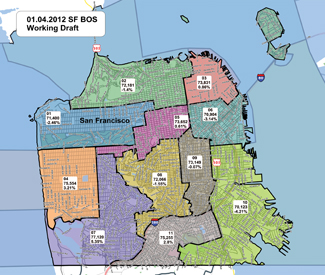
VIEW THE CURRENT WORKING DRAFT MAP HERE


CONSOLIDATING THE LEFT

Downtown and pro-landlord groups are circulating their own draft maps, attempting to influence the outcome. Their goal is hardly a secret: If progressive voters can be concentrated in a small number of districts — say, districts 5, 6, and 9 — it’s more likely that a majority of the board will be moderates and conservatives.

The task force has looked at 10 “visualizations” prepared by a consultant, and each of them had some alarming aspects. For example, the visualizations mostly pushed such conservative areas as Seacliff and Presidio Heights into District 1, which is represented by progressive Sup. Eric Mar.

On Jan. 4, those drafts were replaced by a single working draft map, which is now on the task force’s hard-to-find website (www.sfgov2.org/index.aspx?page=2622) — and it’s not as bad as the earlier versions. The working draft keeps Seacliff and Presidio Terrace in District 2 — which share similar demographics.

“The working families in the Richmond don’t belong in the same community of interest as the millionaires with homes overlooking the ocean,” Mar told us.

But there are other changes that some may find alarming. The more conservative Portola neighborhood, which is now in District 9, would be included in District 11, while D9 would pick up the more liberal north Mission. That would make D9 an even safer progressive district — but make D11 harder for a progressive like the incumbent, John Avalos, to win.

The task force has been holding hearings on each of the districts — but there’s been little discussion about how the new lines will affect the makeup of the board, and the politics and policy of the city, as a whole.


POPULATION CHANGES

The driving force behind the changes in the districts is the rather dramatic population shift on the east side of the city. Most of the districts, census data show, have been relatively stable. But since 2000, 24,591 more people have moved into D6 — a nearly 30 percent increase — while 5,465 have moved into D10 (a 7.5 percent increase) and 5,414 into D11 (8.7 percent). D9 saw the biggest population decrease, losing 7,530 voters or 10.3 percent.

The huge growth in D6 has been the result of a boom in new high-end condos in the Rincon Hill and SoMa neighborhoods, and it’s changed the demographics of that district and forced the city to rethink how all of the surrounding districts are drawn.

No matter what scenario you look at, D6 has to become geographically smaller. Most of the maps circulating around suggest that the north Mission be shifted into D9 and parts of the Tenderloin move into districts 3 and 5. But those moves will make D6 less progressive, and create a challenge: The residents of the Tenderloin don’t have a lot in common with the millionaires in their high-rise condos.

As progressive political consultant David Looman noted, “The question is, how do you accommodate both the interests and concerns of San Francisco’s oldest and poorest population and San Francisco’s youngest, hippest, and very prosperous population?”

The working map is far from final. By law, the population of every district has to be within 1 percent of the median district population, or up to 5 percent if needed to prevent dividing or diluting the voting power of minority groups and/or keeping established neighborhoods together.

Under the current draft, eight of the 11 districts are out of compliance with the 1 percent standard, and District 7 has 5.35 percent more residents than the mean, so it will need to change. But task force Chair Eric McDonnell told the Guardian that he expects the current map to be adopted with only slight modifications following a series of public meetings over the next couple months.

“The tweaks will be about how we satisfy the population equalization, while trying to satisfy communities of interest,” McDonnell said, noting that this balancing act won’t be easy. “I anticipate everyone will be disappointed at some level.”


OUTSIDE INFLUENCES?

Some progressives have been concerned that downtown groups have been trying to influence the final map, noting that the San Francisco Board of Realtors, downtown-oriented political consultants David Latterman and Chris Bowman, and others have all created and submitted their own maps to the task force.

McDonnell said the task force considered solutions proposed by the various maps, but he said, “We won’t adopt wholesale anyone’s maps, but we think about what problem they were trying to solve.”

For example, some progressive analysts told us that many of the proposals from downtown make D9 more progressive, even though it is already a solidly progressive seat, while making D8 more conservative, whereas now it is still a contestable district even though moderates have held it for the last decade.

“It would be nice to see the Mission in one district, but it makes D8 considerably more conservative, so it’s a balancing act,” said Tom Radulovich, a progressive activist who ran for D8 supervisor in 2002.

Latterman told us he has a hard time believing the final map will be substantially similar to the current draft. “Once that gets circulated to the neighborhoods, I find that hard to believe it won’t change,” he said. “A lot of the deviations are big and they will have to change.”

He said that he approached the process of making a map as a statistician trying to solve a puzzle, and that begins with figuring out what to do with D6. “I fall back on my technician skills more than the political,” Latterman, who teaches political science at the University of San Francisco, said. “It’s a big puzzle.”

Latterman also disputed concerns that he or others have tried to diminish progressive voting power, saying that’s difficult to do without a drastic remaking of the map, something that few people are advocating.

“It’s hard to make major political changes with the other constraints we have to meet,” he said. “Unless you’re willing to scrap everything we have, it’ll be hard to make major political changes.”

Once the task force approves a final map in April, there’s little that can be done to change it. The map will go to both the Elections Commission and the Board of Supervisors, but neither can alter the boundaries.

“We are the final say,” McDonnell said. That is, unless it is challenged with a lawsuit, which is entirely possible given the stakes.

Shining season

0

virginia@sfbg.com

APPETITE In its opening weeks, AQ in SoMa* reminds me of lauded Commonwealth and Sons and Daughters. At all three restaurants, precision marries inventiveness — at a reasonable cost. AQ’s starters are $9 or $13, while entrees are $24. After dining in cities the world and country over, I can vouch that it is rare to see this level of skill and creativity at this price.

Seasonal menus are a dime a dozen here, but how often do you see seasonal trees and plants with seasonal bar glassware, and a seasonally changing bar top? As AQ’s bar morphs from copper to Italian marble for the winter and fall leaves enliven, the space exudes celebratory beauty. There’s exposed brick, funky whisk lighting, open kitchen, and a ridiculously cool basement lounge with mid-century lamps and couches viewable from a mini-bridge walkway at the restaurant’s entrance.

Then there’s the food. Owner-executive chef Mark Liberman combines New York and San Francisco sensibilities with Mediterranean and French influences. But when it comes to style and ingredients, he’s decidedly Californian. (Liberman has cooked on both coasts, as well as in France and Napa, and with Daniel Boulud and Joël Robuchon in Vegas). Nuance prevails without getting mired in overwrought fussiness. Starters are small, but entrees are as filling as they are complex.

All this comes into focus when you taste Monterey squid and charred avocado ($9). Parsnips and grapefruit add brightness, while black sesame char over silky avocado ushers in a dish rich, earthy, unusual. A delicate starter, it is rife with flavor.

I adore boudin noir (blood sausage or black pudding, depending on if you’re from the US or UK-Ireland) and Liberman’s version is a thrill. A warm, spiced pile of tender meat (not in a sausage casing) is companion to chestnuts done three ways ($9): raw, confit, and as a cream sauce. With quince and sorrel, the dish pops. At this point, I’m catching my breath at the level of detail and sapidity, recalling countless basic salads or sandwiches I’ve had for the same price.

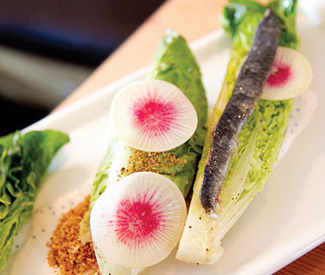
Not as revelatory as the charred avocado or boudin noir, a toasted barley and Dungeness crab dish ($13) tossed with mushrooms and Douglas fir, still pleased, as did the cauliflower ($9) in various iterations from charred to raw, doused in vadouvan spices with golden raisins. In the Autumn spirit, roasted pumpkin ($10) sits alongside carrots, ancho cress greens, with a heaping scoop of mascarpone cream. Even a little gem salad in buttermilk dressing ($10) fends off typicality with poppy seeds, watermelon radish, and cured sardines.

On the entree front, one witnesses Liberman’s range in a juicy, utterly satisfying slow-cooked veal breast (all entrees $24), subtly candied in orange, accompanied by unfried, plump sweetbreads and broccoli. He does not leave vegetarians in the shadows with Kohlrabi “Bourguignon.” Kohlrabi, a brawny German turnip, stands stoically in the center of the plate, a root sprouting from the dish with flair. Notes of horseradish and star anise peek out, but it’s the red wine sauce that must be lapped up.

Desserts ($8) are equally expert in detail but didn’t wholly captivate. I enjoyed ginger cake with Asian pear and salted toffee, cooked in Amaro Montenegro, and a devil’s chocolate cake dusted in coffee and smoked streusel, with shavings of roasted white chocolate — although I could have used more smoked streusel to bring out the earthiness of the cake.

A winning team of talented bartenders, helmed by Timothy Zohn, is worth a visit alone and should be a new go-to for cocktailians. (All menu cocktails are $10.) Winter’s chill diminishes when sipping a New Amsterdam # 1: raisin-infused Bols Genever, maple syrup, Old Fashion bitters, and a splash of apple cider. Head south with Mexican Piano: Espolon blanco tequila, huckleberry syrup, lime, and tarragon, topped with a torched bay leaf. The menu contains lovely aperitif and digestif cocktails, many amaro based, with a section of classics given seasonal treatment, like a sazerac of date-infused Russell’s Reserve Rye, sugar, and Peychaud’s winter bitters. (The vintage glassware is gorgeous)

Already, AQ feels like “the whole package.”

AQ

Mon.-Sun. 5:30 p.m.-11 p.m., Sunday brunch 11 a.m.-2 p.m.,

1085 Mission, SF.

(415) 341-9000

www.aq-sf.com

MC/Visa

Full bar

Subscribe to Virgina’s twice-monthly newsletter, The Perfect Spot, www.theperfectspotsf.com

*Due to an editing error, AQ’s location was misstated in the paper as being in the Mission. Since the time of this review, AQ has since discontinued the lunch service referred to in the paper edition. 


Battling big box

1

news@sfbg.com   

In neighborhood commercial districts, national chains and other formula retail stores such as PETCO, Target, Subway, Walmart, and Starbucks are hot button issues for residents who don’t want to see San Francisco turn into a strip mall or have local money pulled from the community.

Sup. Eric Mar and other city officials want to make sure local small businesses aren’t being unnecessarily hurt by competition from national chains, which is why he called a hearing on Dec. 5 to discuss big box retailers and their impacts on San Francisco’s small businesses, neighborhoods, workers, and economy.

“There is no vehicle to see the impacts of big business on the city,” Mar told us, saying he is contemplating legislation to do just that.

Mar was part of city efforts to keep formula pet stores from locating in the Richmond area, working with a coalition of pet food small businesses concerned about PETCO and Pet Food Express trying to move into the area. But it isn’t just pet stores.

“There is a perception that Walmart might make a move into the city since we already have stores like Fresh n’ Easy,” Mar’s Legislative Aide Nick Pagoulatos told us.

The city doesn’t have a comprehensive analysis on how these companies impact San Francisco. Mar says he wants to “have a clear scale of their influence and see what we need to do to protect small business in San Francisco.”

History of wariness

In 2004, the Board of Supervisors adopted the first Formula Retail Use Control legislation, an ordinance that “prohibited Formula Retail in one district; required Conditional Use Authorization in another; and established notification requirements in all neighborhood commercial districts.”

The Planning Code changed again after a voter ballot initiative in 2007, Proposition G, required any formula retail use in neighborhood commercial districts to obtain a conditional use permit, which gave neighboring businesses a chance to weigh in during a public hearing.

Mar said the intent wasn’t to bar big box retail from entering the city, but to simply give neighborhoods a voice. But now, he said the city needs to take a more comprehensive look at what’s coming and how they will impact the city.

Small Business Commissioner Kathleen Dooley echoed the concern, which extends even beyond city limits. “I’ve heard through the rumor mill that Lowe’s in South San Francisco is going to close and

Walmart is looking to take that space since they know they’d never get into the city,” she told us. “It’s bad enough that Target is opening stores [in San Francisco]. They are the quintessential big box because they sell everything.”

Target is in the process of opening a massive store inside the Metreon in SoMa, and another store at Geary and Masonic. Mar isn’t diametrically opposed to the big box industry, but he thinks those companies should be appropriately situated.

“I’ve seen that people in Richmond are positive toward big box like Target coming into the district, but some are nervous that it will take down business,” he told us. “There are some property spaces that are supposed to be for big box, like the property at Geary and Masonic where the old Sears and Toys”R”Us used to be.”

But it’s not easy to figure out what other big box stores have their sights set on the city. The Planning Department’s list of projects in the pipeline aren’t always filed under the name of the business, making it difficult to stay vigilant.

For example, while application #3710017 at 350 Mission Street describes the project as a “95,000 sq. ft. building of office, retail and accessory uses,” it isn’t clear what businesses are actually setting up shop. And these days, some big box stores are coming in smaller boxes.

Prototype stores such as Unleashed by PETCO are specifically designed to squeeze into smaller property spaces so they can get into neighbor corridors that are typically reserved for small businesses.

More help needed

During the Dec. 5 hearing before the Land Use and Economic Development Committee, Sup. Scott Wiener echoed Mar concerns, commenting that he wants to see how the Planning Commission could “improve the Conditional Use process since we see a pushback of strong neighborhood activity.”

Dooley recalled an issue from 2009 when the Small Business Commission formally asked the Planning Commission not to authorize a PETCO in the Richmond because “the surrounding area was already well served by pet stores.” The board ultimately stopped PETCO, but Pet Food Express did locate a store nearby, which Dooley said has already taken a toll on the locally owned pet food suppliers.

“Big box stores carry a huge number of products that impact other stores,” she said. “Big box is a category killer in the neighborhood…the Planning Commission needs new criteria for formula retail because there are several different types.”

Some superstores require parking lots, taking up additional land, and increasing traffic in certain neighborhoods. Yet one trait that most chain stores have in common is that they extract more money from San Francisco than locally owned businesses, whose revenues tend to circulate locally.

“With every dollar spent at local stores, 65 cents will go back into the community, while only a quarter will be returned from a big box.” Rick Karp, owner of the 50-year-old Cole Hardware, said at the hearing, citing various studies on the issue.

Small business owners are asking for economic impact reports to be included in project applications from chain stores to see just how they measure up to their locally owned counterparts.

When Lowe’s entered his district, Karp says he lost 18 percent of his business and was forced to eliminate six full-time jobs. He appealed to city officials to “keep big box out of San Francisco because it impacts the efficacy of neighborhood shopping.”

Once chain stores puts the locals out of business, the consumer is stuck with set prices and reduced variety. But critics say it isn’t just consumers and small business owners who suffer, but workers as well. They singled out Walmart as notorious for union-busting and poor labor standards.

“We can use our land use ordinances and powers to set a basic minimum labor standard. Big box must abide by that and also include health care if implemented in local government [legislation],” Mar said.

But Steven Pitts, a labor policy specialist at UC Berkeley, told us there is a connection between low prices and low wages.

“People who work at Walmart are poorer than those who shop there,” he told us. “Therefore, if prices were raised to increase wages for employees, the burden wouldn’t be on people of lower income.”
Opposing Walmart

To illustrate how Walmart would adversely affect San Francisco’s workforce, the hearing included two employees of Walmart, Barbara Collins and Ronald Phillips from Placerville, who helped create Organization United for Respect at Walmart (OURWalmart) to push for better benefits and labor standards.

“We want to hold Walmart accountable,” said Collins, whose last annual income from Walmart was $15,000 annually, a salary she realized couldn’t support her four children. “Walmart says they pay living wages. No, they don’t.”

Phillips said that Walmart has “a tendency to fire people for any reason and then does not have to pay for the benefits… I was one of these people, but I was rehired.”

For the past three months, Phillips says she has worked at least six days and 40 hours per week, but that she still qualified for welfare assistance.

Also at the hearing, SF Locally Owned Merchants Alliance unveiled a study showing that formula retail costs nearly as many jobs as it creates. A domino effect occurs when stores close because fewer customers circulate to other nearby stores.

But the group noted that consumer habits are probably even more important than city regulations. The SFLOMA study found that if 10 percent of San Franciscans shifted their spending to locally owned small businesses, consumers would create 1,300 jobs and $190 million in the city.

And that would be good for everyone: owners, consumers, and workers. Steven Cornell, owner of Brownie’s Hardware, said that small business pays good wages, typically above the minimum wage, as well as sick leave, health coverage, and other benefits. As he told the hearing, “Local businesses have been doing this for 20 to 30 years since we are already invested in the community.”

Period Piece: Green and Gilbert Streets sense

0

Guardian history writer Lucy Schiller is exploring the city street-by-street in the slow week inter-holiday weekends. Today, learn about a newspaper editor that died in a duel and a ghost from Philadelphia. Click here for yesterday’s installment on Brannan Street and Geary Boulevard.

Gilbert Street

Named for Edward Gilbert, newspaper editor, congressman

Like many a valiant man before him, Edward Gilbert died in a duel. The newspaperman exercised editorial control over The Alta California, which in 1848 was San Francisco’s only newspaper, and he made his positions on political matters clear as day. He served a single term in the U.S. Congress before returning to his post at the Alta and attacking General James Denver for mismanaging supplies meant for stranded, West-moving immigrants. Gilbert was 33 at the time of his death by Denver’s hand in a duel near Sacramento. His incongruously tiny street runs a block between Sixth and Seventh Streets in SoMa. 


Green Street

Named for Talbot Green, fraudulent businessman

Like any early pioneer to San Francisco, businessman Talbot Green left a lot behind back east. In his case, though, it was an entire identity along with a family and some pretty massive debt. No one in San Francisco knew of his checkered past and Green rose to prominence as a successful civic leader, which ultimately got him recognized by a ghost from his previous Pennsylvanian life. Green denied the serious charges – that he was operating under a fake name, that he had abandoned his family, that he embezzled large amounts of money. But he disappeared the day after accusations were made and his reputation never recovered, though he attempted to return to San Francisco years later. A major artery in North Beach, Green Street runs from the Presidio to the Embarcadero.


Millionaires eyeing Potrero Hill

60

I hate to harp on this (well, no I don’t) but when people tell me that we don’t have to worry so much about gentrification these days, that we’re living in a different world than the days of the dot-com boom, I have to wonder: Am I the only one reading the business pages?

Because in the real world of San Francisco business, the real-estate boom is on and housing prices — particularly in the southeast part of the city — are about to start soaring again.

In fact, according to the Chron, the market is already flying high — and dealing with the influx of new wealth and the continuing change in the demographics of the city will be very much a serious issue for Mayor Lee over the next year:

ZipRealty just completed a study on the millennial home buyer, pointing out that this generation, born after 1982,  is the largest in American history, larger even than the Baby Boomer generation. To these buyers, walkability and a vibrant urban community are huge draws in a home purchase. The ZipRealty study seems confirmed by this recent mini-boom in neighborhoods close to SoMa’s flourishing tech industry: newly minted millionaires in their 20s and 30s have the buying power to drive prices up.

Want proof? We’ve got it. The median price of a single-family home in San Francisco County was $745,000 in October, up $10K from October of 2010. In the neighborhoods in question though, the increase is more striking. In Noe Valley this October, the average price-per-square-foot was up 5% from last year for the third month in a row; in SoMa, up 11%; in eastern Potrero Hill, up 16%.

So: When Zynga goes public in a few months, a whole lot of young millionaires will want to buy houses in Potrero Hill. Dogpatch, and the southern end of SOMA. Oh, and the Mission. Rents will go way up. Housing prices will go even further beyond the level that ordinary, non-millionaire working people can afford.

I’m happy for all the Zyngites, and I’m glad the company is here in SF and generating economic activity. But one of the lessons of the dot-com boom is that the city, as a matter of policy, has to protect existing neighborhoods and residents (and existing industrial blue-collar businesses and jobs) from displacement. Otherwise the horrors of the late 1990s will start creeping back.


Some joy in Mudville

0

caitlin@sfbg.com

“I like the way you trim it/I got to bag it/Bag it up.” A ganja-fied version of Blackstreet’s “No Diggity” was playing over the speakers the night of Saturday, November 12 at 847 Lounge, an event space above the SoMa dispensary Green Door. The party’s mood was — yes — high as patients awaited the announcement of the winners in three categories of cannabis products at the Patient’s Choice awards ceremony, conversation with the activists and patients assembled in the room veered towards the serious.

Medical marijuana activist Mellody Gannon enjoyed the scene from a table in the center of the room: “As a patient, it’s really important right now that things like this are going on,” she said. Amid puzzling federal crackdowns, the future of her medicine is smoky. Recent pressure from the Department of Justice on landlords and banks has caused many dispensaries to consider shutting their doors (see “Feds crack down,” 10/12/11).

Which is why she was heartened to see cannabis connoisseurs coming together to celebrate the best of what California cannabis producers have to offer.

This year’s Patient’s Choice event was a much more intimate affair. Attendance was open to the public in 2010, but this year was limited to dispensary staff, activists, and the patients who had paid the $350 for a judge’s testing package. Judges had to sample over 30 strains (not to mention other products) in the 10 days leading up to Friday, when their votes were tallied and winners announced to stoned elation.

The event, sponsored by many of the city’s best-known dispensaries, was a fundraiser for Americans for Safe Access (ASA), an organization that promotes secure and available ways for prescribed patients to access medical marijuana.

Gannon, a patient since 1996, said that ASA’s advocacy is important — many times her doctors have turned up their nose at the medical efficacy of her marijuana prescription. “They tell you that you’re crazy or just a pothead,” she said.

After breaking a host of bones in a car accident, she relies on cannabis to mitigate chronic pain. “If they start closing these clubs, where are you going to go?” she asked.

Lynette Shaw sat nearby, smoking a strain home-grown buds she’s named Bonanza Jellybean. Shaw founded the Marin Alliance dispensary in Fairfax in 1997 after working on the Proposition 215 campaign the year before. She obtained special zoning from the city for the dispensary and insisted “we’ve done everything they told us to, even when the rules changed. We’re completely regulated to the satisfaction of the community.”

Nonetheless, one of the Department of Justice’s cease-and-desist letters landed in the mailbox of her landlord. Now unless something changes, Shaw’s dispensary — located in a county with one of the highest rates of breast cancer in the nation — will be out on the streets. Her landlord was threatened with 40 years in prison for renting to an illegal drug trafficker.

While others have pegged the Obama administration’s about-face on the tolerance of medical cannabis to election year grandstanding, Shaw thinks the persecution of state-legal marijuana operations like her own is a harbinger of much more dire civil rights violations.

“They’re trying to break the Constitution over marijuana. That’s why it’s important that we fight back now,” she said.

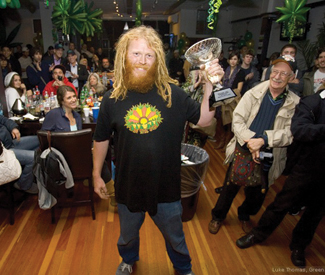
It was clear from the crowd at 847 Lounge that the medical marijuana movement wasn’t going to lose their meds without a fight. Perhaps strangely, the family producers that proudly hoisted their glass, Stanley Cup-looking trophies for best strain and other products still had an air of winning about them.

Is SF moving to the right?

92

The Bay Citizen/New York Times thinks so. The headline on the story — “more conservative is the new normal” — says it all. Matt Smith (formerly of our price-fizing rival SF Weekly) and Gerry Shih say the Nov. 8 election signals a turn to the right for this famously liberal city:

But Tuesday’s election signaled a palpable shift: In addition to Lee, a pro-business moderate, voters overwhelmingly picked George Gascón, the law-and-order former police chief — and former Republican — as district attorney.

“To whoever thinks San Francisco is loopy and left-wing, this election basically said, ‘No, it’s really not,’” said David Latterman, associate director of the Leo T. McCarthy Center for Public Service and the Common Good at the University of San Francisco. “We just elected an ex-Republican, pro-death penalty district attorney by a landslide. Just ponder that.”

Well: It’s interesting that they call Lee a “pro-business moderate,” which is probably accurate but differs from how Lee’s more progressive supporters see the new mayor. But while they talk about Gascon, they conveniently leave out the fact that San Francisco has elected the first solid progressive to a citywide office in a long, long time. Ross Mirkarimi — a former Green Party member and without a doubt one of the most left-leaning supervisors — won a tight, contested race for sheriff running honestly as a progressive. I think you have to go back to 1987, when Art Agnos ran for mayor as the candidate of the left, to find another example of a progressive champion winning all across town.

The interesting element of all of this — and something I think Smith and Shih got absolutely right — is that the demographic makeup of the city is changing, and has been for a while:

“From a political perspective, the tech companies are employing young workers who often prefer to live in San Francisco, even if they commute to Silicon Valley, said Wade Randlett, a Bay Area technology executive and top fund-raiser for President Obama.”

Wade Randlett is not my favorite person in local politics, but the point he makes is valid — and it’s not happening by accident. Virtually all of the new housing that’s been built in San Francisco in the past decade has been aimed at wealthy people, a lot of them young tech types who commute from the city to Silicon Valley. The other people moving into new housing are empty-nest retirees from places like Marin County. If you walk through the new condo buildings in Soma, the residents are mostly white, with a few Asians; there are almost no African Americans, very few families and essentially zero working-class people.

For years, downtown groups (including Randlett’s former employer, SFSOS) have pushed for this kind of housing, and some of them have been very open about their goal: By bringing in more rich people and tech workers, you can change the politics of the city. Housing activist Calvin Welch puts it succinctly: Who lives here, votes here.

That’s the reason why land use and housing are so critically important in this town. If poor and working-class people are pushed out to make way for a more upscale set of residents, then progressives who talk about taxing the wealthy to provide services for the poor will have a harder time getting elected.

It’s not a conspiracy; it’s an open, stated policy goal of the people who spent vast sums of money electing Ed Lee.


Going veg at the wing shop: Wing Wings’ deep-fried oyster mushrooms

1

Owner Christian Ciscle’s been trying to get me to come into his Lower Haight wings shop for a minute. I was always like “Christian (full disclosure: Ciscle took me on board as counterperson back in the days when he managed SoMa’s Little Skillet to-go window), they’re wings. I don’t eat meat.”

But then I went, and now I have to apologize because: Wing Wings‘ deep-fried oyster mushrooms.

When do you get to eat a whole tray of oyster mushrooms? And for $5? It’s improbable, really. Wing Wings’ side of them occupies a hefty paper tray. They’re crispy and just salty enough on the outside, juicy on the inside. Dunk them in some ranch dressing or Wing Wing remoulade and you’re good to go. I nearly took down the whole thing, but I had a friend there to fight me for the bottom of the tray (thank god).

They don’t really have anything to do with each other, but if you stop by for the oyster mushrooms you can also pick up a brown sugar-black pepper biscuit what that Ciscle has been baking since the Little Skillet days. Call it dessert if you’re a label person. 

Pairing suggestion: Wing Wings, limeade, and some headphones at nearby Rookie Ricardo’s LP listening stations

Of course, there’s no veggie entrees per se at Wing Wings – normally. But tomorrow, Tue/8, the counter shop will host a pop-up dinner by chef-about-town Dontaye Ball of Good Foods Catering, who has lent his culinary chops to everywhere from the kitchens at Google to Delfina and the Presidio Social Club.

Ball’s entrees will include, yes, pork belly and beef meatloaf ($15) and slow-braised chicken in a white wine-thyme gravy with cornbread dressing ($14), but also blackened tofu with roasted veggies and mashed yams ($12). Check out the evening’s menu here

A full vegetarian belly — at a wings shop. Will wonders never cease?


Good Foods Catering’s “Soulful Food” pop-up dinner 

Tue/8 6-9 p.m., check Good Foods website for prices

Wing Wings

422 Haight, SF

www.wingwingssf.com

www.goodfoodsonthego.blogspot.com

Hot sexy events: November 2-8

0

It’s easy to see how photographer Michael Rosen gets people to take their clothes off. He listens, he’s mild-mannered, and he makes great art of the occasion – what more could you want in a voyeur? Rosen has been taking erotic photos since 1977, images of all genders, all sexualities, all the slutty, falling-apart-at-the seams of human sexuality. His new show opens on Fri/4.

This new exhibition, “Contact Sheet,” focuses on the fairer sex. Rosen has assembled comprehensive looks at individual womens’ sexuality – the series start with them fully clothed, then progress to strip shots, close-ups of genitals, and erotic images. 

“They’re strong, in control, and display what of themselves they choose,” comments Rosen. Lucky ladies to have a shutterbag there to pick up what they’re putting down. 


“100 Ways to Play: A Catalog of Kink”

Like a smorgasbord of BDSM snacks, this party gives attendees the opportunity to sample many of the ways of play that they might be called upon to perform at a dungeon party. Get the introductory skills you need to at least know what you don’t know about electric, fetish, medical, sensation, impact play, and much more. 

Thu/3 7:30-10:30 p.m., $15-$25

SF Citadel

1277 Mission, SF

www.sfcitadel.org


Michael Rosen photography exhibit: “Contact Sheet”

36 women, caught and preserved on 35mm film contact sheets – this is Rosen’s meditation on feminine sexuality. Seeing as he’s been capturing sexy things for over 30 years, his thoughts bear listening to. 

Fri/4 6-9 p.m., free

Center for Sex and Culture

1349 Mission, SF

(415) 902-2071

www.sexandculture.org


Hard French

If you can’t get laid at 2011’s final installment of this cruise-y queer soulfest, you’re just not trying. Or you need to work on your outfit. The monthly retro bump-and-grind returns to El Rio for one last time before it gets too cold for vintage swimsuits and white denim booty shorts.

Sat/5 2-9 p.m., $7

El Rio

3158 Mission, SF

(415) 282-3325

www.elriosf.com


“Intersextions of Fat Positivity & Sex Positivity”

Sex educator Virgie Tovar will bring her fat-friendly knowledge of all things carnal to this workshop on bridging the gap between chubby and sexual positivity. Come to learn more about integrating both into your community. 

Sun/6 3-4 p.m., free

Good Vibrations

1620 Polk, SF

(415) 345-0400

www.goodvibes.com


Eagle in Exile

Ever since leather bar legend the Eagle was ousted from SoMa, there’s been a severe lack of all-you-can-drink beer events for bears and big boys. Well, except for Eagle in Exile, which brings those boys to the El Rio yard with bottomless Rolling Rocks. Pair with a side of Sisters of Perpetual Indulgence and performances by the Patsy Cline belt-outs of the Patsychords and Carletta Sue Kay and you have yourself a party. 

Sun/6 3-8 p.m., $10

El Rio

3158 Mission, SF

(415) 282-3325

www.elriosf.com

Wine tales

0

virginia@sfbg.com

APPETITE The wine scene never rests, particularly during harvest time. Besides traveling to Bordeaux for harvest a couple weeks ago (where I picked grapes with the harvesters one day in Sauternes), and continued weekends in Napa and Sonoma, I’ve been savoring the city’s latest wine bars, wine books, and a rare panel for Robert Mondavi staff of key Napa winemakers discussing Napa’s premier soil.


NEW CITY SIPS

Alongside the best wine bar openings of 2010 — like Barrique (www.barriquesf.com) and Fat Angel (www.fatangelsf.com) — there are the new Barrel Room (www.barrelroomsf.com) in the old Hidden Vine space, and the new Hidden Vine (www.thehiddenvine.com), near the Transamerica Building.

But for city-produced vino, I’d head to brand new Bluxome Street Winery (www.bluxomewinery.com). Reclaiming a SoMa winemaking heritage they say was thriving pre-1906 Great Quake, the Bluxome crew grows their own grapes within 100 miles of SF, producing a handful of whites and reds, from Sauvignon Blanc to Pinot. Tasting through flights of each, I found all balanced and interesting, particularly a Chardonnay, which reigns in typically over-oaked California qualities for a pleasantly acidic, well-rounded white. In the tasting room, sit in front of giant windows overlooking production of the wine you’re tasting.


GRAND CRU AT TO KALON

This summer I spent an unforgettable weekend with Robert Mondavi staff at Mondavi’s To Kalon vineyards, where vines were first planted in 1868. Mondavi’s master of wine, Mark de Vere, deems this land, “the preeminent Grand Cru [exceptional growth] site of Napa since the 19th century.” At the cost of more than $40,000 per acre, it’s outrageously expensive land. But to the winemakers who each claim a plot of it, they say it produces some of California’s (and the world’s) finest wine, reflective of the unique terroir of Napa.

A panel of six To Kalon winemakers (including Mondavi’s Genevieve Janssens, a Frenchwoman named 2010 winemaker of the year by Wine Enthusiast) mesmerized me, discussing how Napa is reaching maturing in the quality of vines, land, and winemaker technique. Tor Kenward, of TOR wines, said working with To Kalon vines is “intellectually challenging…. Despite price, it’s fascinating to work with.”

Sampling five To Kalon Cabernet Sauvignons side-by-side, each reflects similar characteristics pointing to the properties inherent in the land. Each also reflects winemaker style (these winemakers likewise produce wines from other Napa regions).

Standouts were Carter Cellars 2008 Cab ($125 a bottle), with dusty earth and spice giving it profound character, balanced by bright floral notes. At a mere 185-300 cases a year, it’s truly a limited wine. The other was TOR’s 2008 Cab ($150, with 400-500 cases a year). A clean, mineral nose exudes light perfume, while it tastes of dark berries with gentle spice, vanilla, and a creamy finish.

As one would expect, these are pricey bottles, hovering between $125-150 due to immense land costs. Provenance Vineyards was the exception at $75 a bottle for its 2007 Cab, exhibiting notes of white pepper, vanilla, and berries. Provenance winemaker Tom Rinaldi may get flak for not increasing the price of his To Kalon wine to more closely match fellow winemakers, but he keeps costs low for reasons akin to benefiting from rent control: he secured an early contract and plot with an essentially fixed price. I admire that although he could be making double, he has chosen not to put this on his customers… yet. (His current rates will be re-examined soon.)

Tor Kenward commented on Napa’s maturing winemaking, playfully expressing California’s place in the wine world: “I’ve gone mano y mano with Bordeaux through the decades. It’s amazing how California goes head to head.”


DRINKING IN PAGES

My recent flights overseas required some serious reading, and finishing Natalie Maclean’s new Unquenchable: A Tipsy Quest for the World’s Best Bargain Wines (www.nataliemaclean.com) helped a 10-hour flight pass quickly.

Each section hits a different part of the world in search of high quality, value wines. From South Africa to Sicily, wine terms and history are subtly slipped into stories about individual winemakers and pairing recipes. A cheery book cover belies Ms. Maclean’s skill with imagery (she’s won the M.F.K. Fisher Distinguished Writing Award and four James Beard Foundation Journalism Awards). For example, in her particularly engaging chapter on German riesling, she compares riesling as the “quivering … opera diva Sarah Brightman singing pop tunes… [with a] range [that] stretches far beyond what I hear,” to popular chardonnays as: “breathy pop stars who have to whisper the high notes.”

Subscribe to Virgina’s twice monthly newsletter, The Perfect Spot (www.theperfectspotsf.com)


How about Scott Olsen Plaza?

14

Occupy Oakland changed the name of Frank Ogawa Plaza; it’s time for OccupySF to do the same.

The place where the protesters are gathered is named for Justin Herman, the notorious director of San Francisco’s Redevelopment Agency in the terrible days of the 1950s and 1960s, when “redevelopment” meant removing black people from the Western Addition and removing poor people, particularly Filipinos, from South of Market and later the International Hotel. Herman once famously said that the SOMA land where he wanted to build hotels was “too valuable to permit poor people to park on it.”

In the 1960s, the battle against redevelopment was one of the defining political struggles in San Francisco, bringing Asians, African Americans, white progressives, young community organizers, affordable housing and tenant activists, poverty and civil rights lawyers … just about the whole spectrum of the city’s left. It’s been the subject of books and movies. The people who fought Justin Herman are part of a long political thread in San Francisco — as is OccupySF today.

I’ve always thought it was an abomination to have a downtown plaza named after a guy who did so much to destroy San Francisco. Maybe from now on we should all call it Scott Olsen Plaza.

Hot sexy events: October 27-November 1

0

Friday evening of the Folsom Street Fair saw a throng gathered in a second-story SoMa apartment for an art opening. The space was owned by a one Mark I. Chester, a man who counts as one of the city’s many hubs of sex culture. Chester tends towards the art side of rough sex — regularily hosting drawing sessions where men pose in various states of disarray — a harness here, a dog mask there, and not much else. But tonight, the crowd was more diverse. It was there to witness the opening of “Fear No Art,” the sex and power exhibition that you watch close its doors on Sun/30 this week.

Black-and-white photographs hung densely on Chester’s walls, but the opening party was 3D. On”stage” (the front of the living room), a man in a gold lamé thong performed comedic showtunes describing his life as a D-List porn star. Soliciting audience interaction, he neatly displayed his aptitude for deep-throating. Lucky banana. 

Any lingering effects of his levity was appreciated for the next act (at least, your hemophobic reporter appreciated them). Next up was Leland of the San Francisco girls of Leather, who announced to the crowd that she’d be etching the exhibition’s name onto the back of the helper she’d brought to the front of the cramped room with her. 

“Don’t be afraid to move in closer, it’s actually really quite beautiful,” she counseled the audience. A handful of art lovers obliged, pushing in for a closer look at her razor-thin lines that blossomed into strips of blood before their eyes as the woman who the back belonged to squirmed in agony — particularly when Leland went back over the lines for a more pronounced look. 

“Fear No Art” advises you in a similar manner — not to be afraid to look at sex in all its forms, and to consider what every kind of eroticism says about us as humans. It closes Sun/30, an excellent chance to take in 2D representations of human beauty, lust, and love. 


Naked Girls Reading: Neil Gaiman edition

So lit-sexy it’s scary, this regular reading event — hosted by the area’s hottest female sex activists in their alltogether — welcomes to its featured artist slot Rain DeGrey, professional bondage rigger, Kink.com star, and sex educator. She and the regular crew of NGR will be reading from the works of Neil Gaiman, a novelist whose children’s book featured a young orphan being raised by a graveyard, if that gives you any idication of the creepiness of his canon of work. C. Theodore Walker will perform a “half play, half ritual” based on the works of Aleister Crowley.

Thu/27 8-10:30 p.m., $15

Center for Sex and Culture

1349 Mission, SF

www.sexandculture.org


Steam’s one-year anniversary party

Powerhouse kicks off Halloween weekend with the 12-monther of its bathhouse revival shindig, Steam. It’ll be garaunteeing that the ghouls drop their sheets with a wet towel contest (winner gets $100, which will buy a zombie Amy Winehouse-sized load of vodka-Red-Bulls. Go-gos, power showers, hot boys — oh, boo. 

Fri/28 10 p.m.- 2 a.m., $5

Powerhouse

1347 Folsom, SF

www.powerhouse-sf.com


XXX Haunted Fun House

Halloween at Mission Control is like Christmas Day in Santa’s Workshop — all the work from around the year pretty much leads up to this one big spectacular. Do these swingers have mad flair game? Obviously. Pack more than a sheet with holes in it when you go to this two-night extravaganza featuring performances to fuck to from DJs Jocelyn and Cyril Noir, seances, zombie strippers, and virgin sacrifices (yeah right). 

Fri/28 10 p.m.-late, $25-$35 free membership required

Mission Control

www.missioncontrolsf.org


“Building Our Own White Picket Fences”

In a sex events column gone by we talked about Femina Potens’ plans for an art exhibit that re-envisioned what family and home meant in the alt sex-LGBT community. It’s opening on Fri/28, a multi-media presentation featuring artists Midori, Monica Canilao, Harrison Bartlett, Mev Luna, Amelia Reiff Hill, and Madison Young. Go to reflect on your own notion of what the future holds, and be inspired by the imaginings of others. 

Fri/28 7:30 p.m., free

Michele O’Connor gallery

2111 Mission, SF

www.feminapotens.org


“Fear No Art” closing party

“Things I Have Fucked Someone With: An Incomplete Collection” is photographic round-up of just those things by Patti Beadles. It looks like one of those kitchen posters that show you all the different kinds of chili peppers, and at this sex art exhibition she also displays a similarly-configured of things she has not fucked anyone with (shape seems to be the defining factor between the two). Pair this with Jim Duvall’s BDSM romance novel cover of a woman being used as a harp by a lover, Shilo McCabe’s pussy-baring fetish art, and others and you have yourself a panoramic view of human sexuality at local sex luminary Mark I. Chester’s SoMa apartment. 

Sun/30 2-5 p.m., donations suggested

1229 Folsom, SF

www.markichester.com

Lee under fire over voter fraud accusations (VIDEO)

    Just over two weeks before election day, allegations of voter fraud carried out by agents of an independent expenditure committee created on behalf of Mayor Ed Lee threw a curveball into the San Francisco mayor’s race. Lee has been the clear front runner for months.

    Volunteers for Sen. Leland Yee, a mayoral candidate, accused Lee supporters working on behalf of the San Francisco Neighbor’s Alliance in Chinatown of marking ballots for San Francisco voters, guiding ballot selections with stencils, and collecting ballots in a bag, in apparent violation of election law. Videos of a voting station where the activity occurred were shot by Yee volunteers and aired on major media outlets.

    An onslaught of questions about these accusations were directed at Lee at a campaign event Oct. 24, in which Lt. Gov. Gavin Newsom, the former San Francisco mayor, announced his endorsement for Lee’s candidacy. Lee sought to distance himself from the independent expenditure committee in question, saying his own campaign has kept things clean. The mayor said he supported his rivals’ calls for investigation into any “fishy business,” and supported the idea of bringing in federal election monitors.

    Here’s a video of Lee getting the third degree from reporters at the press event, which was held in the office of a SoMa-based tech company called BranchOut.

Video by Rebecca Bowe

Korean wave

0

virginia@sfbg.com

APPETITE Growing up partly on the East Coast (New Jersey) with close Korean friends exposed me to the pleasures of kimchi and burning hot ssamjang (a Korean hot sauce) early in life. In Flushing, Queens, I savored endless incredible Korean restaurants, often filled only with Korean customers. I was first hooked on those crispy, comforting Korean pancakes, pajeon, and my fondness for the cuisine grew from there.

Although more than 30 percent of our city’s population is of Asian descent, our Korean community is not as large as that of LA or NYC, which could be why we’re less the Korean food Mecca those two cities are (despite our abundance of Korean BBQ joints, that is). But there’s been a recent wave of Korean openings I can only hope will signal a robust Korean dining catalog in our future. The more bulgogi and bibimbap in this town, the better. While I usually find less to love at places mixing cuisines, like the Tenderloin’s new Ahn Sushi & Soju serving both Japanese and Korean food, here are three recent openings that show promise… and none are Korean BBQ.


AATO

Aato, a new “Korean fusion” restaurant in the Marina, is an unexpected oasis on busy Lombard Street. Owner Jennie Kim grows herbs in potted plants by a little front patio strewn with white lights. Despite a pricier menu than one typically sees in Korean eateries ($12–$15 for starters, $13.50–$25 for entrees), Aato does things differently, apparent from chandeliers in the surprisingly elegant dining room to the use of locally grown, organic ingredients (though common-as-day in SF, unusual for local Korean spots). Initial highlights include ssam, which literally means “wrapped” in Korean. There are three versions served with rice, kimchi, veggies and rice paper wraps. My gut pushed me straight to eel ssam, but Kim talked me into hangbang (Herbal) bo ssam. I wasn’t sorry. The tender, steamed pork is aromatic and nuanced with herbs. Man-du Korean dumplings are delicately pan-fried, plump with kimchi and shrimp, an exemplary appetizer. Jab-chae is traditional sweet potato noodles stir-fried with beef and seasonal veggies. Weekend brunch intrigues with the likes of eggs with “Korean-style” hash browns,, man-du dumpling soup, and a fritatta with tobiko, salmon, avocado, and cheese.

1449 Lombard, SF. (415) 292-2368


NAN

Japantown’s Nan works for two reasons: it’s a minimalist, airy space, with an extensive menu that tends slightly toward creativity. Skewers of pork belly and BBQ beef abound, alongside rice bowls, bibimbap and rice cakes. Seafood pajeon is not the perfection it is at Manna (see below), but bulgogi beef mixed with wheat noodles utterly satisfies, particularly with Asian beers on tap.

1560 Fillmore, SF. (415) 441-9294


MANNA

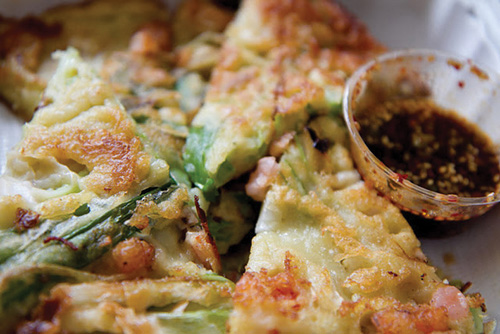
Manna offers a clean, friendly dining room in the heart of the Inner Sunset. It serves a number of Korean classics with varying iterations among their 44 dinner menu items. There are diverse versions of bibimbap, short ribs, and stews. Manna also fries up a buttery seafood pajeon (Korean pancake), loaded with leeks, scallions, mini-shrimp, and squid — one of the best I’ve ever had.

845 Irving Street at 10th Ave., SF. (415) 665-5969


OTHER RECOMMENDED (BUT NOT NEW) KOREAN STOPS:

I adore Toyose (3814 Noriega, SF. (415) 731-0232), a humble hangout in a garage with Korean bar style food like spicy chicken wings, washed down with sojus and Korean beers. First Korean Market (4625 Geary, SF. (415) 221-2565) is a tiny Korean market with kimbap, sushi/maki-style rolls. Head to To Hyang (3815 Geary, SF. (415) 668-8186) for raw beef salad — a hefty beef tartare-style beef dish topped with an egg — and other homestyle treats from Mom, whose daughters run the front of the house. Korean tacos are playful and cheap at John’s Snack and Deli (40 Battery, SF. (415) 434-4634) in the Financial District, and the Seoul on Wheels truck (www.seoulonwheels.com) which can be found at Off the Grid (www.offthegridsf.com).

Wonderfully worn HRD Coffee Shop (521 3rd Street, SF. (415) 543-2355) a humble Korean-run sandwich shop in SoMa, serves a hefty spicy pork kimchi burrito. Arang (1506 Fillmore, SF. (415) 775-9095) on Lower Fillmore serves a heartwarming seafood bibimbap with octopus and shrimp. A “fusion” place that really does work, and that is one of the Richmond’s best restaurants overall, is Namu (439 Balboa, SF. (415) 386-8332), offers Korean fried chicken and ever-popular Korean beef short rib “tacos” on nori (seaweed), which is also sold at the Ferry Plaza Farmers Market on Thursdays and Saturdays.

Subscribe to Virgina’s twice monthly newsletter, The Perfect Spot (www.theperfectspotsf.com)


Spreading smoke

0

caitlin@sfbg.com

HERBWISE When asked to describe herself, Green Cross Dispensary patient Nicole Williams laughs. “I work full time, I go to school, I care for my mom. My brother’s taking the LSATs on Saturday — what else should I say? Native San Franciscan, long time resident.”

She’s being interviewed by the Guardian to gauge the demand in the Excelsior neighborhood for a new business that’s relocating to the neighborhood where it will be the first of its kind: the Green Cross’ new marijuana dispensary walk-in facility. Currently, the company is the city’s sole licensed delivery-only dispensary.

The Green Cross is hoping to have a little more luck with 4218 Mission than it did with its first location, which opened in Noe Valley in 2004 as a more professional alternative to the stereotypical cannabis club with “long haired hippies behind the counter,” in the words of dispensary employee Caren Woodson.

But the idea attracted so many customers (some garnering complaints that marijuana was being sold on the street) that the city’s planning department rescinded owner Kevin Reed’s permit for the space. After a disappointing attempt to open a location in Fisherman’s Wharf, an aide to the Mayor encourage Reed to try for a delivery-only permit instead. Now, the dispensary hopes the third try’s the charm. A public hearing to discuss its application to re-open in the Excelsior is scheduled for Nov. 17.

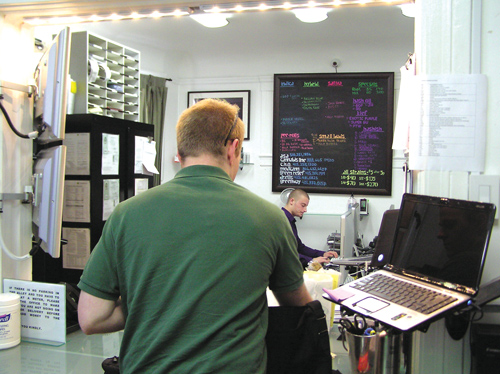
“We’re going to make sure we’re addressing the neighbors’ concerns,” Reed says, sitting on a stool in the Green Cross delivery and call center, which operates out of the front rooms of his comfortably-appointed SoMa apartment. In front of him are the flashing screens of 32 security cameras — a glaring reminder that Green Cross’ first commitment is to safety.

Green Cross employees dress in business casual — even, as this reporter witnessed, when they’re up to their elbows in bowls of weed nugs they’re breaking apart. Though currently located in a mostly residential building, Woodson claims that the business has never received a single neighborhood complaint.

The delivery service has now served over 3,000 clients. Having sunk a half million dollars into failed permitting procedures, Reed hopes he’s created a comprehensive plan that will pass the expectations of the various city agencies through which one must venture to open a weed dispensary.

The new location will necessitate a focus on discretion and security. Monroe Elementary School and the Mission YMCA are both a few blocks away. Plans include a wall that would block all view of the goings-on inside the dispensary. Plans do not include a space for on-site smoking, and members will have to sign a code of conduct that says they’ll be respectful of the surrounding neighborhood.

350 patients in the Green Cross’ database live in the proposed site’s 94112 zip code. Williams is one of them, and has been a patient since Green Cross’ Noe Valley days. She’s nowhere near the image of a troublemaking pothead, but it’s small wonder she was “pretty excited” to hear that she might be getting a new neighbor.

“You’re just looking for a safe place where you can get your medicine and go home.”

GREEN CROSS MANDATORY REVIEW HEARING

Nov. 17, time TBA

Room 400, City Hall

One Dr. Carlton B. Goodlett, SF

(415) 558-6377

www.sf-planning.org

www.thegreencross.org

Foreplay: Two pre-Folsom scenes

0

As Folsom Street Fair (Sat/24) looms over us like a leather daddy with an itchy whip paw, the city readies itself for the roughest, naughiest, sweatiest weekend of the year. Yesterday, I ran all over the city checking in with the sex scene. I kept my clothes mostly on, but then it is only Thursday… 

Monarchy-Andrew Wedge fitting at Mr. S Leather

“This is Spartaaa!” I’m standing outside one of SoMa’s crucial leather one-stops with an old hand local kink photographer Rich Trove (check his site after the Fair for shots of your flings in the sunshine) and a fashion journalist from the Chronicle. Guess which one is trying to explain to the other what a traditional S&M harness looks like?

Our motley crew has been assembled by Folsom Street Fair’s executive director Demetri Moshoyannis to lurk around Mr. S‘s fitting room while British synthpoppers Monarchy was being fitted for their custommade Andrew Wedge harnesses. The band will be wearing them at their FSF performance on Sunday at 5:10 p.m. on the 12th Street stage. 
“We have no idea what we’re in for,” smiled a member of the band’s entourage. Of course, that wasn’t exactly true — keyboardist Andrew Armstrong attended the fair with a friend six years ago. 

“It kind of freaked me out in a good way,” said Armstrong, modeling the tight neoprene half-tank that Wedge (who vends high end fur and leather designs from places like the Castro’s Sui Generis) had fit over he and his bandmate’s white dress shirts and under the sharp black blazers they were sporting. 

“There’s something a bit religious about it,” he said of Wedge’s designs, which had been agreed upon after a series of emails between the two of them. “It’s futuristic, but masculine as well. Even though we’re basically wearing bra tops.”

“England is very prudish. Well, we take these things seriously, but we do it behind closed doors,” he continued. Again, I found it hard to take him at his word, seeing as the band supplied its own imposing, matching black latex masks for the occasion. They don’t go out in public without them, it turns out, a comment on the nature of celebrity. 

The crew and designer lined up for one last photo opportunity in front of Mr. S’s black leather and harness covered four post king-sized bed. “Not in front of the dildos!” cautioned Moshoyannis. “We want these to be pictures they can use.” Clearly he meant in the Chronicle. 

Side note: if you’re still checking for some sexy threads for this weekend, you could do worse than check out Mr. S’s new sports section. Complete with urinals on the walls and an impressive selection of wrestling singlets, I found myself especially turned on by the display of $12 Style Pig knee socks. I picked some up in red, or as the helpful sales assistant clarified, fisting.


Good Vibrations’ Indie Erotic Film Festival at the Castro Theatre

Best reason to finally buy an iPhone: the Ohmibod Freestyle G. I snagged the mp3 compatible vibrator (really, really feel the rhythmn on your favorite beats) at the IXFF’s pre-party upstairs at the Castro, where Jiz Lee, Carol Queen, Kitty Stryker, and other SF local lustfuls drank cocktails of St. George absinthe and rootbeer, slapped on costume mustaches and generally enjoyed the burlesque stylings of Twilight Vixen Revue. 

When the short erotic film competition began, it got surprisingly jocky. Lucia Aniello’s Dildo Sport, Kelly Robinson and Oscar Salisbury’s Fight, Flight, Or Fuck, and Rollo Wenlock’s computer-aged 30 Love all featured tennis, so I guess the New York Times article was onto something with that balls metaphor

“30 love” – short film. from Rollo Wenlock on Vimeo.


Not everything was heavy breathing-appropriate, either. SF’s own Levni Yilmaz entered one of his backlit Magic Marker-ed creations from his series “Tales of Mere Existence,” What Would Penis Do?, a look at his awkward childhood forays into sexual activity. There was the quirky bunnies and peanuts and women’s rooms in Always, Only, Ever — an entry from Barbara Benas of Brooklyn — not to mention an I-guess-hot tryst between a female American soldier and burkha-clad woman in a designer cave, Julien Rotterman’s Salam and Love

But some of it was. Erika Lust — who earlier this week had an IXFF evening dedicated to her erotic, high glamour European flicks — shared Love Hotel, a threesome flick that made a trip to Barcelona seem highly advisable. Sadly, as the evening’s hosts (Peaches Christ, Hugs Bunny, Lady Bear, and Dr. Carol Queen — when Carol Queen plays the evening’s straightman you know you’re in for it) pointed out, Lust edited out all signs of genitals. Sigh.

The evening’s winner, as determined by an overwhelming audience response at the end of the night, was La Putiza. Created by Mexican director Gerardo Delgado, the short flick combined erotic comic art, overblown superhero crusading, and joyful, copious amounts of gay sex. Sure, the aesthetic was refined and the lead actor was fuckable, but one suspects that the secret to Delgado’s success, entering into this most phallic of all SF weekends, went back to Peaches Christ’s gleeful promise at the start of the night’s program: 30-foot penises. For Good Vibes’ interview with the filmmaker, voyage here

Thanks Castro Theatre, hope we didn’t make too much of a mess. 

Hot sexy events: September 21-27

1

Pretty much, today’s whole paper is a hog-tied, historical, self-confessional smutfest of San Franciscan proportions. It only makes sense, because I dare say this week of sex events will reach levels of debauchery that even the City by the Bay can be happily ashamed of. 

Yep, it’s the Folsom Street Fair sex events column! Including things that aren’t Folsom Street Fair also, like Mission Control’s genderqueer play party, a Good Vibes film fest, and an art exhibition that’ll leave you panting.

Indie Erotic Film Fest short film competition and party

The culmination of a week of alternative porno presentations, tonight’s docket includes short blue films from around the world – something for everyone in this wild and wooly world of voyeurs. But cum early – the pre-screening party in the top floor of the Castro is gonna be balls, or at least mustaches. There’s a mustachio-ed photobooth and even more titillating, burlesque dancing courtesy of Twilight Vixen Review. 

Thu/22 party 7 p.m., screenings 8 p.m., $10 each

Castro Theatre

429 Castro, SF

(415) 621-6120

www.gv-ixff.org


Steam does Folsom

Get squeaky-durty at this installment of Steam, the SoMa bathouse resurrection party. So many ways to play: enter into the wet towel contest ($100 prize for the best terrycloth tease), massages for $1 per minute, cheap drinks, cheaper go-gos, and hard crusing into the kinkiest weekend in the Bay. Tunes by Honey Soundsystem’s DJ Peeplay help you get some. 

Fri/23 9 p.m.-2 a.m., $8 cover to benefit the SF Bay Area Leukemia and Lymphoma Society

Powerhouse 

1347 Folsom, SF

Facebook: Steam Does Folsom


San Francisco erotic art exhibition

From the candy-coated gazes of Yancy Mendoza’s models to the unique sextaur sculpture stylings of Peter Keresztury, there will be enough images of penetration, playtime, and penis at this group art exhibition to merit a stopover in your weekend of hedonism rendered art. 

Fri/23, 4-9 p.m.; Sat/24, 1-9 p.m.; Sun/25, noon-5 p.m., free 

The Artists Alley

863 Mission, SF

www.eroticartevents.com


Velvet

Play in the SF girls of Leather “fungeon,” and have a genderqueer good time overall at Mission Control’s queer-trans-boi-butch-femme puppy pile. Scenes from the Crash Pad Series will be playing all night to ensure that you’ve got inspiration for all the naughty things you’re about to do to your alt sex cupcake. 

Fri/23 8 p.m.-2 a.m., $20 Mission Control members only

Mission Control

www.missioncontrolsf.org


Show Me Where it Hurts

Sardine-pack into a crowd of the hottest, kinkiest dykes on the scene at this free party at the Lex. But dress to impress: Elizabeth and Buck Wilder are performing, DJs Jenna Riot and Durt are spinning… you’ll wanna look whip-smart at the night’s fetish-uniform costume contest. 

Sat/24 9 p.m., free

Lexington Club

3464 19th St., SF

www.lexingtonclub.com


Folsom Street Fair

400,000 fetish fans packed into 13 sunny city blocks – the mother of all fetish fairs takes over SF this weekend. Check for hard-bodied, sweaty-fisted action all over the place, but also the annual erotic artist’s corner and two stages of live music all day. Oh and hey, for a rad look at women’s role at the fair over the years, check out Amber Schadewald’s cover story on the SF girls of Leather from early this summer. 

Sun/25 11 a.m.-6 p.m., $10 suggested donation

Folsom between Seventh and 12th sts., SF

www.folsomstreetfair.org


Deviants: Official Folsom Street Fair after-party

There’s gonna be so much bump and grind at this union of Honey Sound System, Some Thing, and Hard French DJ crews that your harness will go bald. It’s only right – a minutes-long stumble from the main event in SoMa today gets you to the Erie Street cul-de-sac that Public Works looms over. Today, it’ll be blocked off for a outdoors-indoors party that have you screaming for more. The party features the hostessing powers of Sex Issue star Princess Donna http://bit.ly/oQu9mn and a photo confession booth staffed by queer porn maven Courtney Trouble. 

Sun/25 3 p.m.-4 a.m., $20-30

Public Works 

161 Erie, SF

www.publicsf.com


Rogue pairings

1

culture@sfbg.com

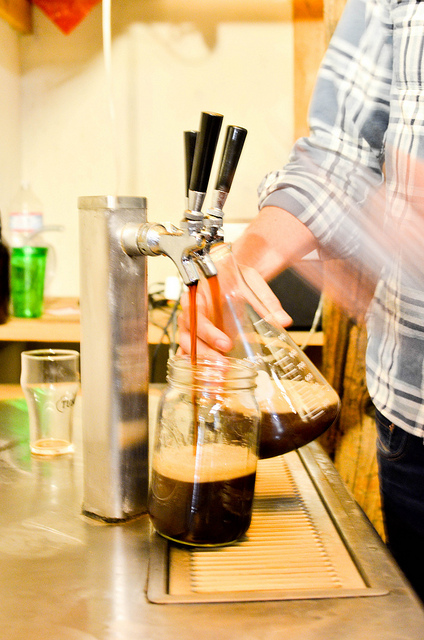
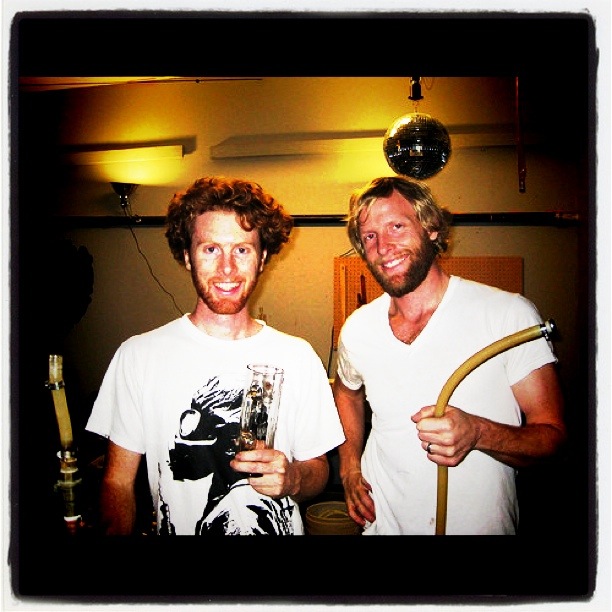
BEER AND WINE The other week, I hit up one of the free, bi-weekly Thursday night tasting parties put on by San Francisco nanobrewery Pacific Brewing Laboratories, located in a small garage on a side street deep in SoMa—and was completely smitten. The adventurous atmosphere and swell-looking crowd were part of that, of course. But the small-batch beers on offer (I quickly downed a gorgeously smooth black IPA), the rogue food vendors (I then dove into a box of Nosh This Bacon Crack chocolate), and the almost-steampunk assemblage of tangled brewing equipment, scuffed kegs, and illustrative blackboards really sealed the deal.

Since they seemed exquisitely attuned to the underground brew-plus-food equation, I asked the guys behind Pac Brew Labs, Patrick M. Horn and Bryan Hermannsson, to tell us a bit about themselves and give us a wee menu of street pairings. Here’s what Patrick came up with for us. (Marke B.)

“Pacific Brewing Laboratory started in a garage as a place for us to experiment with new beer flavors, styles, and brewing techniques. What started out as a place to share new creations with friends grew into a twice-monthly, totally free event with hundreds of our “new” friends and great local street food vendors.

“We brew small, 10-gallon batches which allows for constant beer experimentation. Some of our more exotic beer styles include Hibiscus Saison, Squid Ink Black IPA, Chamomile Ale, Lemongrass IPA, Szechwan Peppercorn Red ale, and wine-soaked oak-aged Brown Ale. We’re always on the lookout for new ingredients and inspirations that will lead us to palate-pleasing creations. For our tastings, we often invite a local food cart to attend, in order to pair our beers against some of the amazing varieties of flavors produced by DIY local food vendors. Below are a few of our favorites, which include beers we enjoy from other local breweries.”

Read about Pac Brew Lab’s upcoming free Thursday Night Beer Nights at www.pacbrewlab.com.


WISE SONS DELI PASTRAMI + PACIFIC BREWING LABORATORIES SQUID INK BLACK IPA

“Leo Beckerman and Evan Bloom of pop-up Wise Sons Deli (Saturdays, 9 a.m.-2 p.m. at Beast and Hare, 1001 Guerrero, SF. www.wisesonsdeli.com) are on a mission from God to bring to us mere mortals the best in Jewish deli. They’ve been serving up their in-house pickles, matzo ball soup, pastries and — most importantly — their weeklong-brined, spice-rubbed, hickory smoked pastrami with home made rye bread to San Francisco and at many of our beer socials since the year 5771. Our Squid Ink is made with darker grains than traditional IPAs and uses West Coast hops to give it a traditional West Coast IPA hop aroma and bitterness. The richness and spices of the pastrami pair perfectly with the citrus-y, hoppy and roasted flavors of the Black IPA. Finish with a house fermented pickle for the perfect sandwich-beer-pickle experience.”


MISSION CHINESE FOOD + TRUMER PILSNER

“Anthony Myint and Danny Bowien have created one of the most creative and community minded pop-up restaurant in the nation with Mission Chinese Food (Thu-Tue, 11:30 a.m.-3 p.m. and 5 p.m.-10:30 p.m., at Lung Shan, 2234 Mission, SF. (415) 863-2800, www.missionchinesefood.com). Their delicious twists on traditional Chinese and Asian cooking include kung pao pastrami, thrice-cooked bacon, tingling lamb noodle soup, salt cod fried rice and cold-poached chicken with chicken hearts. Mission Chinese Food also contributes $0.75 from each entrée to the San Francisco Food Bank. The Trumer (www.trumer-international.com) from Berkeley, with its high carbonation, crisp malt backbone and good hop bitterness, offers a good counterpoint to the exotic flavors and spices of Danny’s cuisine. As the heat and tingling build from chilies and Szechwan peppercorns, a pilsner can really satisfy. (And if you need to douse a flaming palate, the low alcohol content allows for a few brews with minor effect.)”


NOSH THIS CHOCOLATE + 21ST AMENDMENTS MONK’S BLOOD

Beer and chocolate go together like Bert and Ernie or peanut butter, bananas, and Elvis. Kai Kronfield of Nosh This (noshthis.com) makes some of the most creative chocolates in San Francisco. Butter toffee Bacon Crack, salted caramels made with balsamic vinegar, Meyer lemon, or salt & pepper… not to mention the Bacon Bourbon Rocky Road. These chocolates are the perfect balance of sweet, salty, and chocolate-y and pair well with darker, maltier beers. 21st Amendments Monk’s Blood (www.21st-ammendment.com), a dark Belgian ale, fits this bill well. Made with the traditional hops and barley, it also contains figs, vanilla, and cinnamon. It’s a complex beer, in a can, that complements the richness and intricate flavors of Kai’s creations. This combo is a perfect end to an evening, a mid-day snack, or breakfast — whatever, nobody’s judging.


PIZZA HACKER + MOONLIGHT DEATH AND TAXES

“Pizza and beer is typically a no-brainer pairing, but often most choose an IPA, pale ale, or lager to go with their cheesy slice. Moonlight’s Mooonlight’s Death and Taxes (www.moonlightbrewing.com) is a dark lager — but its roasty, crisp and malty flavors lends itself perfectly to the olive oil and salt-covered crust and smoky essence of the Pizza Hacker’s (www.thepizzahacker.com) pies. Jeff, the nominal Pizza Hacker and self-described “occasional Pazi (Pizza nazi)”, has built a custom-made portable wood fired brick oven called the FrankenWeber. He wheels it up outside bar or brewery, assembles, and bakes fresh pizzas on the sidewalk. His sauce is from organic heirloom tomatoes and he uses a method pioneered by Tartine for kneading the dough. Best tasted with a full bodied, flavorful pint of brew!


MAGIC CURRY KART + ALMANAC SUMMER 2010

Almanac’s Summer 2010 Belgian golden (www.almanacbeer.com) is made with blackberries and aged in red wine oak barrels for 11 months. Brian Kimball of Magic Curry Kart (www.magiccurrykart.com) wheels around two burners and two rice cookers on his bike, and whips up the most incredibly Thai-influenced curries in front of you with amazing precision. The ingredients are fresh and the spices are delicious. Almanac’s golden ale will add a nice fruity finish to the spicy and flavorful red or green curry. With an eight percent alcohol count and naturally carbonated in the bottle, Summer 2010 will refresh your palette after every sip without overpowering it, enabling new tastes in every luscious bite of curry. Cheers!

Mayor Lee and PG&E

9

EDITORIAL Pacific Gas and Electric Company is the number one corporate criminal in San Francisco. The company’s malfeasance caused the deaths of eight people and destroyed an entire neighborhood in San Bruno last year. The National Transportation Safety Board, in a report issued August 30, denounced PG&E’s “integrity management program without integrity” and blasted the company’s efforts to “exploit weakness in a lax system of oversight.”

That doesn’t even address the fact that PG&E has been operating an illegal monopoly in San Francisco for more than 80 years, engaging in an ongoing criminal conspiracy to violate the federal Raker Act. Or the fact that the utility spent $50 million of ratepayer money on a ballot initiative aimed at eliminating consumer choice in the electricity market.

So why was Mayor Ed Lee out at a PG&E public relations event Sept. 1 praising the “great local corporation” as a “great company that gets it?”

Well, the mayor’s campaign press spokesperson, Tony Winnicker, says that PG&E was at the event to donate $250,000 to a program for at-risk youth, and that the mayor was only recognizing that, for all its flaws, the utility “also [does] something good for our public schools and low-income kids.”

That’s not enough, and that’s not acceptable — and the mayor should apologize to the residents of San Francisco, San Bruno and everyplace else in California where the giant corporation has done serious and lasting damage.

It’s nice that PG&E gave a contribution to a program that helps Soma kids learn to read and to play baseball. We support the RBI program and its goals. Never mind that the $250,000 is about 0.005 percent of the money that the utility spent trying to block public power in California. Never mind that PG&E pays such a low franchise fee that it robs of city of millions of annual tax dollars that could fund programs like this one. It still sounds like a large sum, and to the nonprofit program at Bessie Charmichael School, it is.

But there’s a reason PG&E gives money to community groups and programs like this all over town — it’s a way to buy support and respect. Corporate largess of this sort is a relatively cheap public relations strategy — and for the mayor not to see that is embarrassing.

It’s a particularly notable conflict of interest, too — Lee’s top patron and biggest political supporter, Willie Brown (who knows a bit about corruption himself) has been on PG&E’s payroll as a private attorney for the past several years, earning about $200,000 a year.

Most of the candidates for mayor have been taking a gentle approach to Lee, and that makes a certain amount of sense — in a ranked-choice voting environment, negative campaigning often backfires. But there’s nothing inappropriate about saying that the mayor of San Francisco has damaged his own reputation and the reputation of the city by allowing himself to be used at a PR tool by PG&E. Remember: He didn’t just show up and thank the utility for the money. He called PG&E a “great local corporation,” which is, quite simply, false. This ought to become an issue in the race, and Lee should be forced to explain his position on public power, his ties to Brown and PG&E and his willingness to put aside years of malfeasance in the name of a small contribution.

Editorial: Mayor Ed Lee: Keeping City Hall safe for PG&E

15

Mayoral candidates Dennis Herrera, John Avalos and Leland Yee blast Lee’s pro-PG&E comments (in postscript)

Pacific Gas and Electric Company is the number one corporate criminal in San Francisco. The company’s malfeasance caused the deaths of eight people and destroyed an entire neighborhood in San Bruno last year. The National Transportation Safety Board, in a report issued August 30, denounced PG&E’s “integrity management program without integrity” and blasted the company’s efforts to “exploit weakness in a lax system of oversight.”

That doesn’t even address the fact that PG&E has been operating an illegal monopoly in San Francisco for more than 80 years, engaging in an ongoing criminal conspiracy to violate the federal Raker Act. Or the fact that the utility spent $50 million of ratepayer money on a ballot initiative aimed at eliminating consumer choice in the electricity market.

So why was Mayor Ed Lee out at a PG&E public relations event Sept. 1 praising the “great local corporation” as a “great company that gets it?”

Well, the mayor’s campaign press spokesperson, Tony Winnicker, says that PG&E was at the event to donate $250,000 to a program for at-risk youth, and that the mayor was only recognizing that, for all its flaws, the utility “also [does] something good for our public schools and low-income kids.”

That’s not enough, and that’s not acceptable — and the mayor should apologize to the residents of San Francisco, San Bruno and everyplace else in California where the giant corporation has done serious and lasting damage.

It’s nice that PG&E gave a contribution to a program that helps Soma kids learn to read and to play baseball. We support the RBI program and its goals. Never mind that the $250,000 is about 0.005 percent of the money that the utility spent trying to block public power in California. Never mind that PG&E pays such a low franchise fee that it robs of city of millions of annual tax dollars that could fund programs like this one. It still sounds like a large sum, and to the nonprofit program at Bessie Charmichael School, it is.

But there’s a reason PG&E gives money to community groups and programs like this all over town — it’s a way to buy support and respect. Corporate largess of this sort is a relatively cheap public relations strategy — and for the mayor not to see that is embarrassing.

It’s a particularly notable conflict of interest, too — Lee’s top patron and biggest political supporter, Willie Brown (who knows a bit about corruption himself) has been on PG&E’s payroll as a private attorney for the past several years, earning about $200,000 a year.

Most of the candidates for mayor have been taking a gentle approach to Lee, and that makes a certain amount of sense — in a ranked-choice voting environment, negative campaigning often backfires. But there’s nothing inappropriate about saying that the mayor of San Francisco has damaged his own reputation and the reputation of the city by allowing himself to be used at a PR tool by PG&E. Remember: He didn’t just show up and thank the utility for the money. He called PG&E a “great local corporation,” which is, quite simply, false. This ought to become an issue in the race, and Lee should be forced to explain his position on public power, his ties to Brown and PG&E, his positon on  community choice aggregation, his willingness to kick  the PG&E-friendly  commissioners off the PUC and appoint credible public power advocates  and to put aside decades  of  City Hall malfeasance in the name of a small contribution.

P.S. As the Sept. 2 Examiner put it neatly in its headline, “Mayor, PG&E engage in baseball diplomacy, Utility donates to youth program in wake of NTSB criticism.”
Amy Crawford’s excellent heads-up  story noted that Lee “also heaped praise on PG&E, which announced a $250,000 loan to RBI “

Then she quoted Lee as saying without gulping or blushing, “Isn’t  that a wonderful contribution from a great local corporation? They’re a great company that gets it.”

Crawford put the quote in the proper context: “PG&E”s generosity came just two days after the National Transportation Safety Board blamed it for a deadly San Bruno gas line explosion one year ago.  The blast and subsequent fire destroyed a neighborhood, killing eight.”

As usual, PG&E downplayed the tragedy by calling it all just a “coincidence.”  She quoted Joe Molica, the PG&E spokesman, as saying,  “We’re really here to talk about kids.” Crawford wrote that Molica declined to “discuss the damning criticism.”  Three mayoral candiates promptly blasted Lee for his telling remarks. Three candidates for mayor promptly blasted Lee’s pro-PG&E remarks.

City Attorney Dennis Herrera  said the next day  that  “Ed Lee’s lavish praise for PG&E as ‘a great corporation’ on the eve of the one-year anniversary of the San Bruno tragedy, just days after federal regulators blamed the utility for a ‘litany of failures’ that claimed eight lives, is unconscionable,” said Herrera. “It shows insensitivity to victims’ families, and poor judgment for allowing his office to be used as a corporate PR tool. No less troubling, it ignores the serious work my office and others have done to protect San Franciscans from PG&E’s negligence, to prevent further explosions like those in San Bruno last year and in Cupertino on Wednesday. The interim Mayor should reassess his laudatory view of PG&E, and apologize to San Bruno victims’ families.”. http://herreraformayor.com/2011/09/herrera-criticizes-ed-lees-lavish-praise-pge-eve-oneyear-anniversary-san-bruno-blast/

Sup. John Avalos also  said the next day  that  “Ed Lee called PG&E a “great corporation” yesterday–a great corporation who spent $50 million last year trying to pass a ballot measure that would ensure their monopoly in places like San Francisco instead of repairing and inspecting pipes like the one that caused this terrible destruction.  Now this “great” corporation wants its customers to foot the bills for its negligence and bad practices?  Ed Lee says that this corporation “gets it.”  PG&E seem to “get” that a symbolic donation to a charity at the height of their unpopularity might help their rate-payers forget the catastrophic results of their negligence and bad practices ”  http://avalosformayor.org/2011/09/breaking-ed-lee-praises-pge-for-being-great-avalos-responds/s

State Sen. Leland Yee later  said that  “Obviously Ed Lee doesn’t understand that words matter. Eight of my constituents died and dozens lost their homes a year ago, and that is why I passed legislation to help those affected families try rebuilding their lives and why I am now pushing legislation to hold PG&E accountable. Rather than praising PG&E, the interim mayor should be calling on the Governor to sign the numerous bills to force the private utility to do what they have failed to do for decades – proper technology, inspection, and safety.”

And so Mayor  Lee has publicly demonstrated that he doesn’t get it and that he is poised to wallow in the Willie Brown sleaze of keeping City Hall safe for PG&E and its allies. Let’s keep the pressure on.  B3


BAY BUNS CONTEST 2011: meet the contestants

0

Who’s got the HOTTEST ASS in the Bay Area? The SF Bay Guardian is looking for the Bay’s best buns to publish in our SEX ISSUE coming out September 21. Readers have submitted pics of their behinds, now it’s your turn to vote!

The winner will receive a mixed bag of delights for any body from your favorite adult retailer, Good Vibrations, and fame as the Bay budonkadonk king or queen! Voting ends at midnight on Sunday, September 18th. Check out our hot-ass contestants after the jump!

CLICK HERE TO SEE WHO WON!


1. Ahimsa, San Francisco:


2. Amber, TenderNob:


3. Brandyy, SoMa:


4. Christina, Emeryville:


5. Daniel, Lower Haight:


6. Douglas, Upper Haight:


7. Eugene, East Bay:


8. Hugo, Potrero Hill:


9. Jamal, Oakland (Lake Merritt):


10. Jennifer, Alamo Square:


11. Jinx1313, North Oakland:


12. Larissa, Sunset:


13. Marissa, Mission:


14. Marissa2, Lower Haight:


15. Michele, Lower Nob Hill/Tenderloin:


16. Mikaela, Excelsior:


17. Minx, Burlingame:


18. Nic, Union Square:


19. Ola, South Beach:


20. Patrick, Sunset


21. Ray, SoMa:


22. Sheila, Santa Rosa:


>>VOTE FOR THE BAY AREA’S HOTTEST ASS NOW!