Sheriff

Eliana steals the show at Thursday’s dueling City Hall rallies

48

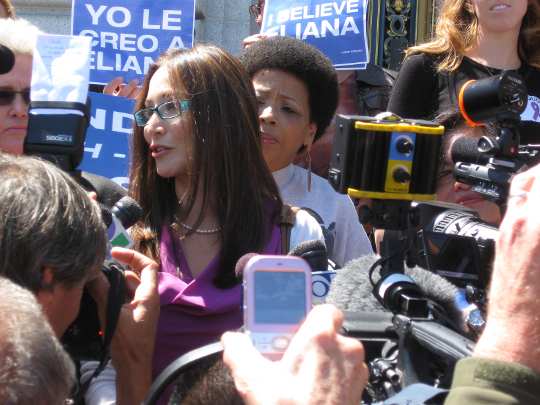
Eliana Lopez once again stole the show as the Ethics Commission Thursday debated the “ethical fate” of her husband Sheriff Ross Mirkarimi inside City Hall while the Stand With Ross forces and their opponents staged back to back rallies on the City Hall steps.

Eliana sat with and supported her husband during the morning at the hearing on the misconduct case and then made an early afternoon dramatic entrance to the Mirkarimi rally. (The commission later Thursday unanimously rejected most of Mayor Ed Lee’s official misconduct charges against the suspended sheriff but voted 4-l to recommend the Board of Supervisors find him guilty of official misconduct for grabbing his wife’s arm on Dec. 31 and pleading guilty to the resulting misdemeanor charge of false imprisonment.  See Steve Jones Guardian blog.)

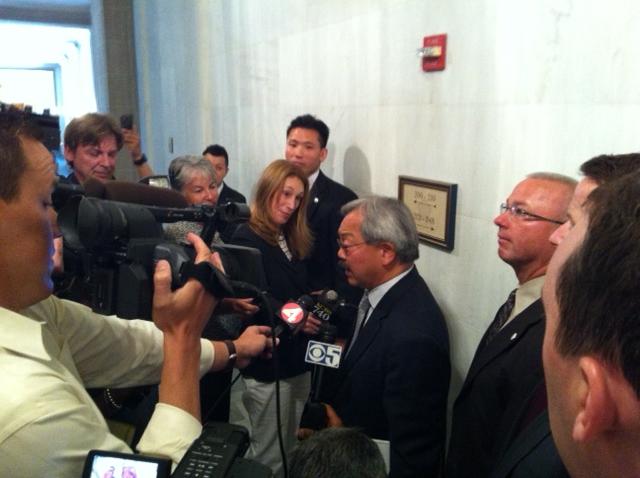
Eliana was greeted with cheers as the tv cameras and reporters crowded in on her.  

She spoke with ease and authority, greeted many friends, spoke in Spanish to several Spanish language radio and television reporters, and walked easily through the crowd shaking hands and talking with supporters in two languages.

“We don’t want any more hate,” she said. “We want love.” She said the case was
“about democracy” and she said that the community stands behind her husband.

I asked her about her plans.  She said she had finished her movie in Venezuela and was back living with Ross in their home with their young son Theo.   “I have good feelings,” she said.

The two groups worked out an informal modus vivendi.  The Remove Ross group had a permit for using the steps so they went first with their press conference rally with banners saying “We stand with survivors” and “The facts do matter.” Their group was largely from the three organizations leading the charge against Ross, La Casa de las Madres, Domestic Violence Consortium and Futures Without Violence.

The Mirkarimi group initially gathered across Polk Street, waved signs and chanted “Stand With Ross.” The group then got a permit to use the City Hall steps and held its rally after the first rally ended.  Sharon Hewitt, executive director of the Community Leadership project, said that the city owed an “act of apology for the violence” that it had caused to Ross and his family.

The police officer on duty estimated to me that there were 40 or so in the domestic violence group. My count was about 50 or so.  The Stand With Ross group had more people and they were more spirited in their chants and marching.   

Commission narrows Mirkarimi charges to one but recommends removal

238

The Ethics Commission today unanimously rejected most of Mayor Ed Lee’s official misconduct charges against suspended Sheriff Ross Mirkarimi – including abuse of power, impeding a police investigation, and dissuading witnesses – but voted 4-1 to recommend the Board of Supervisors find him guilty of official misconduct for grabbing his wife’s arm on Dec. 31 and pleading guilty to the resulting misdemeanor charge of false imprisonment.

The sole dissenting vote, Chair Benedict Hur, said he had “grave concerns” that such as a broad interpretation of what behaviors constitute official misconduct would give mayors a “strong tool” to inappropriately remove their political adversaries (or at least invite charges that they were), as Mirkarimi supporters allege is happening now.

But the rest of the commission adopted a broad interpretation of what city officials and voters intended in 1995 when they overhauled the City Charter and added a new official misconduct clause banning “conduct that falls below the standard of decency, good faith and right action impliedly required of all public officers.”

“I have a lot of concerns about where you draw the line if you don’t relate it to official duties,” Hur said, appealing to his colleagues that, “I think this charter provision was meant to be narrow.”

Commissioner Paul Renne – who in earlier hearings had taken a strong role in excluding prejudicial evidence against Mirkarimi and was thought to be a possible vote in his favor – today led the charge in interpreting misconduct in the broadest possible way, arguing it didn’t even have to be related to his official duties, while the three other votes against Mirkarimi made the case that his conduct and conviction were related to a sheriff’s role overseeing the jail and its domestic violence programs.

“I think the voters would be shocked if we were to say a public official who pleaded guilty to domestic violence has not committed an act of official misconduct,” Renne said.

But Mirkarimi’s attorneys and supporters – who outnumbered those urging his removal (mostly domestic violence advocates) by more than 4-to-1 during the three hours of public testimony taken today – say the shocking thing is for a just-elected official to be unilaterally removed from office by a political adversary for reasons that today’s proceedings showed were tenuous.

“No case has ever been upheld in court to remove an elected official for a low-level misdemeanor,” said Paula Canny, the attorney for Mirkarimi’s wife, Eliana Lopez, who sat next to and supported his husband throughout today’s nine-hour proceedings.

Indeed, the city is wading into uncharted waters and the commission had few court precedents to draw from in making its findings. It’s also possible that the charter provision is unconstitutionally vague, as Mirkarimi’s attorneys have alleged, both here and in court, with an earlier judge opting to wait until after the city’s process plays out before ruling on the question.

But first, it will be up to the Board of Supervisors, where nine votes on the 11-member body are required to remove Mirkarimi. Today’s hearing got complicated at the end – as commissioners wrestled with what it means to essentially throw out the mayor’s charges and adopt their own more narrow accusation, and how to present everything to the board – that it decided to hold one more meeting in early September to adopt a summary and send everything to the board, which will then have 30 days to act.  

“I leave this process concerned that the will of the voters is being undermined,” Mirkarimi told reporters after the hearing. Holding his hand, Lopez said, “I’m shocked to see what happened today, but we are fighters.”


For complete coverage and analysis of what happened today, what it means, and what’s next, read next week’s Bay Guardian.

Stand with Ross at a major rally Thursday noon at City Hall

11

The Sheriff Ross Mirkarimi forces put out a call to action Wednesday to mobilize their supporters for a show of force at a noon rally at City Hall on Thursday.

The rally is scheduled to be across Polk Street from the City Hall entrance because they fear that their opponents will be holding a rally on the City Hall steps with a sound system.

The possibility of dueling rallies comes as the Ethics Commission is set to hear closing arguments on Thursday in a fact-finding hearing in the Mirkarimi removal case.

Mirkarimi’s rally is the latest event in an accelerating grassroots effort by his supporters to put pressure on the Ethics Commission and the Board of Supervisors who will have the ultimate decision on whether Mirkarimi stays or goes as sheriff. 

I particularly like the statement of the National Lawyers Guild on Mirkarimi: http://www.nlgsf.org/news/statement-suspension-sf-sheriff-ross-mirkarimi-and-ethics-commission-proceedings


Why?

44

steve@sfbg.com

Just a couple years ago, it seemed like the golden age of marijuana in San Francisco, the birthplace of the movement to legalize medical pot and a national leader in creating an effective regulatory framework to govern an industry that had become a legitimate, respected member of the business community.

More than two dozen patient cooperatives jumped through a variety of bureaucratic hoops to become licensed dispensaries, most of them opening storefront businesses that were often the most attractive, clean, and secure retail outlets on their blocks, sometimes in gritty stretches of SoMa, the Tenderloin, or the Mission.

“Pretty much everyone involved agrees that San Francisco’s system for distributing marijuana to those with a doctor’s recommendation for it is working well: the patients, growers, dispensary operators, doctors, politicians, police, and regulators with the planning and public health departments,” I wrote in “Marijuana goes mainstream” (1/28/10).

Since then, San Francisco’s medical marijuana industry has only become more established and professional, complying with new city regulations (such as changing how edibles are packaged to avoid tempting children), paying taxes and fees — and making very few waves. According to city officials, there have been almost no complaints from anyone about the dispensaries — and in San Francisco, people complain about everything.

But in the last six months, the full force of the federal government has brought the hammer down hard on this budding business sector, forcing the closure of eight brick-and-mortar dispensaries and instilling paranoia and insecurity in those that remain.

In just the past few weeks, two of the city’s oldest and most respected dispensaries –- HopeNet and the Vapor Room -– were forced to close their doors.

There’s been little rhyme or reason to which clubs get those dreaded letters warning operators and landlords to shut it down or be subject to asset forfeiture and prison time — and the officials involved have refused to explain their actions, except with moralistic anti-drug statements or unsupported accusations.

“These are people who played by the rules and paid their taxes, and now they’re being punished for it,” said Assembly member Tom Ammiano, a leader in creating a state regulatory framework to govern the distribution of medical marijuana, which California voters legalized in 1996. “This is pure thuggery. They are ignoring due process out of blind prejudice and ambition.”

Ammiano met with Melinda Haag, the US Attorney for the Northern District of California, who has coordinated the local crackdown from her 11th floor office in the Federal Building near City Hall, shortly after she announced her intentions to go after medical marijuana. He said she was like a throwback to a less enlightened era.

“In talking to Haag, not only is she a bit of a bully, but she’s totally uneducated about the issue,” Ammiano told us. When she told him that her office has received many complaints about the dispensaries, he asked to see them -– even making a formal Freedom of Information Act document request –- but she has yet to produce them. “Her duplicity is very moralistic, it’s like going back 100 years.”

Neither Haag nor anyone from the White House or Justice Department would grant an interview to the Guardian to discuss the reasons for and implications of the crackdown, or to answer the list of written questions her office asked us to submit. Instead, Haag gave the Guardian this statement and refused to respond to our follow-up questions:

“Although all marijuana stores are illegal under federal law, I decided to use our limited resources to address those that are in close proximity to schools, parks and playgrounds and operations so large that they constitute marijuana superstores. I hope that those who believe marijuana stores should be left to operate without restriction can step back for a moment and understand that not everyone shares their point of view, and that my office has received many phone calls, letters and emails from people who are deeply troubled by the tremendous growth of the marijuana industry in California and its influence on their communities.”

But in San Francisco, where more than 80 percent of residents consistently support medical marijuana in polls and at the ballot box, most people don’t share Haag’s point of view. And city officials contest many of her claims, from saying the dispensaries are “left to operate without restriction” to her implication that they promote crime or endanger children to the haphazard way she has targeted dispensaries to the characterization that many people are “deeply troubled by the tremendous growth of the marijuana industry.”

In fact, to talk to city officials, virtually nothing Haag says is true.

“We’re not getting nuisance complaints [about the dispensaries],” Dr. Rajiv Bhatia, the city’s medical director who oversees regulation of the dispensaries by the Department of Public Health, told the Guardian. “We’ve had very few complaints over the years and good cooperation with the storefront part of the regulations.”

Almost across the board, city officials and club operators praise one another and the cooperative relationship they’ve established over the last four years. Some of San Francisco’s biggest dispensaries have somehow avoided Haag’s wrath, but their once-open operators are now afraid to speak publicly, warily checking the mailbox each day. A thriving industry eager to pay its taxes and submit to regulation is being driven back underground, with all the uncertainty and hazards that creates.

“The question everyone is asking: Why here, why now, why these businesses? Nobody knows the answer,” Bhatia said. “We’re left to speculate and guess about motives.”

MULTI-AGENCY ATTACK

The federal crackdown has been stunning in both its speed and breadth, with various federal agencies coordinating their attacks. The IRS is auditing the biggest clubs and denying write-offs for routine business expenses, the DEA is threatening asset forfeiture efforts, and Haag and the DOJ are threatening prison time and court injunctions.

Underlying all of that is President Barack Obama, who pledged not to use federal resources to go after those in compliance with state law in the 17 states where medical marijuana is legal. Then, last year, Attorney General Eric Holder suddenly announced a new policy: “It will not be a priority to use federal resources to prosecute patients with serious illnesses or their caregivers who are complying with state laws on medical marijuana, but we will not tolerate drug traffickers who hide behind claims of compliance with state law to mask activities that are clearly illegal.”

When we sought an explanation and clarification from the White House Communications Office about why well-established medical marijuana collectives carefully operating under California law were suddenly deemed “drug traffickers” that wouldn’t be tolerated, they refused to answer and referred us to a statement Obama made to Rolling Stone magazine.

“What I specifically said was that we were not going to prioritize prosecutions of persons who are using medical marijuana. I never made a commitment that somehow we were going to give carte blanche to large-scale producers and operators of marijuana -— and the reason is, because it’s against federal law. I can’t nullify congressional law,” Obama told the magazine.

That simplistic explanation – which conveniently ignores how people are supposed to get this medicine – has infuriated local growers and patients. It’s particularly galling for those who supported Obama and took him at his word in the last election, and who don’t understand why he is suddenly escalating the federal war on drugs, ignoring local laws and values, and re-criminalizing their communities.

FUNERAL PROCESSION

Hundreds of medical marijuana supporters gathered on Aug. 1 for a New Orleans-style funeral procession at the Lower Haight intersection near where Vapor Room had operated -– without incident and with praise as a model business from three successive district supervisors –- from 2004 until the previous day.

The mood was festive and defiant on that sunny afternoon, where advocates from both sides of the bay gathered to express solidarity with the closed clubs and resolve to battle through the recent setbacks.

“I’m feeling the fight,” Steve DeAngelo, star of the reality television show Weed Wars and head of Oakland’s Harborside Health Center, which received Haag’s shut-down-or-else letter last month, told the Guardian. “I don’t think we can allow taking a few hits to break our spirit….We started this struggle to win it and we’re not going to stop until we do.”

Local politicians and business leaders also came to offer their support.

“As president of the Lower Haight Merchants Association, I’m upset that Vapor Room had to shut down,” Thea Selby, who is also running for the District 5 supervisorial seat, told us. “The Vapor Room did a lot of good for this neighborhood and was a great business.”

Marchers, most clad in black, carried “Cannabis is Medicine: Let States Regulate” and other signs -– as well as a makeshift coffin and massive puppet depicting a scowling Haag -– and danced down the middle of the street as Brass Mafia horns belted out lively jazz tunes. By the time the procession reached Haag’s office at the Federal Building, a chill fog had darkened the skies and the mood.

DeAngelo took the bullhorn first and called out Obama directly: “Either you were lying, sir, or your employees are out of step with your policies.” Steph Sherer, executive director of the DC-based Americans for Safe Access, told the crowd, “We need to tell Obama to lose Haag or lose California.”

Ammiano and the other mostly Democratic Party politicians who spoke tried to avoid putting Obama directly into the crosshairs of the angry activists, although he did say those executing this crackdown “are harming Obama’s chances of winning.” He also urged activists to put the pressure on politicians in Sacramento and Washington DC: “We need to be a voice in reshaping what’s happened in these last few months.”

Ammiano said the crackdown “empowers the cartels and the people who use violence,” contrasting that with San Francisco’s civilized approach to regulating marijuana.

“We in San Francisco have been a model for how to regulate this industry and we have been successful. We are not going to let the federal government interfere with our rights in this city,” Sup. David Campos told the crowd.

Cathy Smith, the founder of HopeNet, who was still reeling from watching her club gutted and shuttered the day before, also sounded an angry and defiant tone, urging supporters to make their voices heard by Haag and others.

“Everybody that’s here needs to go up to this evil woman’s office tomorrow and tell them what we think,” Smith said.

The general feeling was that if the feds can target model clubs like HopeNet and Vapor Room –- which had deep community roots and generous compassionate care programs for low-income patients -– then all clubs are in danger.

“I’m very upset that we’re losing two great medical marijuana dispensaries where patients could medicate on site,” said David Goldman, a local ASA activist and member of the city’s Medical Cannabis Task Force, noting how important that is for patients who live in apartments that ban smoking.

HopeNet and Vapor Room were some of the only dispensaries in town where smoking was allowed on site, because they were more than 1,000 feet from schools, playgrounds, or day care facilities, the city’s standard. Bhatia said that’s a very strict standard in a city as dense as San Francisco, which is why only four clubs ever met it.

Yet the feds saw things differently, ostensibly targeting HopeNet because a small private school opened two blocks away last year, and the Vapor Room because the feds didn’t use the city’s standard of being more than 1,000 feet from the playground at Duboce Park, instead deciding the dispensary was a community menace because it was a little under 1,000 feet from that dog-friendly park’s nearest patch of grass.

LAST DAYS

Vapor Room founder Martin Olive was a bundle of complicated emotions on the club’s last day in business (it will still operates as delivery-only, just like HopeNet, Medithrive, and a few other shuttered clubs have done). Initially, he didn’t want to talk to us: “I’m trying to keep a lower profile because it’s scary out there now.”

But he slowly opened up and tried to describe the feeling of watching his proudest accomplishment so rapidly undone by the one-two punch of a letter from the merchant services company cutting off credit card access (just like every dispensary in the city, returning pot sales to a cash-only status) followed days later by Haag’s shut-down letter.

“It’s complicated emotions that I’m feeling -– let down, confused. At the end of the day, I don’t understand why this is happening,” Olive said. “It’s a community tragedy, it really is.”

Vapor Room was a welcoming gathering place for its members and a supporter of a variety of community events and causes.

“I’ve always treated this as if it were just a nice coffee house. I’m not an outlaw,” Olive said. “I almost forgot I was breaking federal law. It was so normal, so legitimate.”

In fact, some club owners say their establishments helped clean up rough streets. “We took care of the entire block. Before us, it was all dealers, so there’s a safety issue,” HopeNet’s Smith told me as the once-welcoming club on 9th Street near Howard was reduced to bare walls.

Patients were also feeling the pain, including a 48-year-old ex-con who said he was paroled two years ago after serving 25 years in prison for attempted murder. “I have anger issues, big time. The only thing that keeps me calm and quiet and not blowing up is medical marijuana,” he told us, seething, before praising HopeNet’s “homelike environment” and supportive community. “It’s important to sit and relax in an environment that is comfortable and safe. All this is doing is pushing us into the streets.”

DRIVEN UNDERGROUND

Before going through his latest official misconduct battles and fighting to return to his job as the elected sheriff, Ross Mirkarimi was the District 5 supervisor who sponsored the creation of the city’s medical marijuana regulatory system, the product of a long and arduous legislative process.

“We developed the system out of stark necessity because neither local government nor state government gave a roadmap to the dispensaries,” Mirkarimi said. “Prop. 215 legalized medical marijuana, but there were no rules around it.”

After an intensely collaborative process that lasted more than a year, the city in 2005 adopted a process for licensing dispensaries that balanced the needs of this nascent industry with concerns by police, patients, disability rights activists, neighborhood groups, and health officials. Mirkarimi said that maybe it’s time for city officials to consider an idea he floated a few years ago of having the city itself directly distribute medical marijuana through General Hospital.

“I still think that’s a good idea, particularly if the feds are going to force medical marijuana dispensaries back into the dark ages.” For all his praise of the city’s dispensaries, Dr. Bhatia will admit that the industry still needed better oversight -– dealing with issues such as standards for growing and transporting cannabis, fiscal transparency, and potency and dosage standards –- but the federal crackdown has scuttled his efforts to expand the city’s regulatory system.

“This DEA action stops us from making progress on the regulation of clubs that we need to make,” Bhatia said. “There are lots of issues, but we had just finished getting the clubs into their housing.” Now the industry is being driven back underground.

Ironically, Haag and other federal officials have accused dispensary operators of profiteering, which they’ll certainly be more free to do now that local officials have lost their leverage to begin regulating the finances of the supposedly nonprofit patient collectives that officially operate each dispensary.

“That was one of the areas that we never developed the tools or capacity to look at,” said Bhatia, who proposed more transparent record-keeping by dispensaries last year, only to have the operators express concern about how the feds might use that information, which turned out to be an understandable fear.


Alerts

0

WEDNESDAY 8

Speak up: stop and frisk Southeast Community Complex, 1800 Oakdale, SF; Stop and frisk — the controversial, pretty much definitely Fourth Amendment-violating policy that police in New York cling to despite protest and that Mayor Ed Lee recently proposed implementing in San Francisco — just won’t go away, despite opposition from pretty much everyone. This panel discussion and opportunity to debate issues relating to the proposed stop and frisk policy. The event is presented by the Osiris Coalition and filmmaker Kevin Epps.

First District 5 debate of the season Park Branch Library, 1833 Page, SF; District 5 is in the center of San Francisco, and much of the excitement of November’s city elections will center on its race for supervisor. A wide range of candidates will vie for the coveted spot that Ross Mirkarimi left to become sheriff. All of the candidates have promised to show up to this first debate in the hotly contested race. The debate is presented by District 5 Democratic Club, the District 5 Neighborhood Action Committee, and the Wigg Party.

THURSDAY 9

Occupy the Bay Berkeley Fellowship of Unitarian Universalists’ Hall, 1924 Cedar, Berk; www.bfuu.org. 7pm, $5-10 suggested donation. Filmmakers Name Name and Namey Namey have been documenting Occupy in the Bay Area since the fall. Come reminisce, learn, and be inspired by their film at its premier. You made this history happen, celebrate it, baby!

SATURDAY 11

Black Riders Liberation Party La Peña Cultural Center, 10pm, $5-10. The Black Riders Liberation Party considers itself the new generation of the Black Panther Party, organizing similar programs to stop police violence and gang violence and feed communities. This Saturday, the Party parties. Come celebrate the Black Riders and meet organizers, bring a canned food donation for a discount.

Pistahan Yerba Buena Gardens, Mission and Third St., SF; www.pistahan.net. 11am, free. This giant annual Filipino celebration goes all weekend. Start off the weekend with a parade from Beale and Market streets to Yerba Buena Gardens, where the festival of music, food, performance and education begins.

Foreclosure victory block party 376 Bradford, SF; www.occupybernal.org. 10am, free. Shortly after we named Ross Rhodes a Local Hero (Best of the Bay 2012) for his work protecting his home and those of his Bernal Heights neighbors from unjust foreclosure, he received a loan modification agreement. Come celebrate with Ross and others from Occupy Bernal with a block party at his house. There will be educational presentations about banks’ predatory role in the foreclosure crisis and efforts to fight back in the morning, followed by general partying.

SUNDAY 12

Lessons from Vermont Eric Quezada Center, 518 Valenica, SF; www.collectiveliberation.org. 3-5pm, free. Yes, we have the Affordable Care Act, but it leaves much to be desired, unless you’re in Vermont. There, Governor Peter Shumlin signed universal healthcare into law in May 2011. But of course, Shumlin didn’t do this alone. Come hear a presentation from some of the organizers who won this victory, all the way from the Vermont Workers’ Center.

MONDAY 13

Undocumented and unafraid Asian Law Caucus, 55 Columbus, SF; www.asianlawcaucus.org. 12-1:30pm, free. The Asian Pacific Islander undocumented student group ASPIRE will lead this talk on the immigration rights struggle. The last talk in the Asian Law Caucus-led summer brown bag series is especially timely as undocumented youth work on figuring out if and how they might benefit from President Obama’s policy directive giving limited amnesty to undocumented college students, and what it means for family and friends, especially those already in ICE custody. This talk on the issues youth without legal status face and how to keep building towards the DREAM Act, which would offer broader protections that Obama’s policy.

TUESDAY 14

Milk Club District 5 debate Eric Quezada Center, 518 Valencia, SF; www.milkclub.org. 7-8:30 p.m., free. A District 5 supervisors race debate hosted by the Harvey Milk Democratic Club. Milk Club President Glendon Hyde, aka Anna Conda, says candidates will cover drug policy, public space, sex worker rights, the housing crisis, queer seniors’ issues, and much more. As an extra special bonus, the debate will be hosted by transgender performer Ben McCoy and the Guardian Managing Editor Marke Bieschke.

Supervisors prepare to receive Mirkarimi case from Ethics

37

The Board of Supervisors this week adopted a plan for considering ousting their former colleague, suspended Sheriff Ross Mirkarimi, on the official misconduct charges brought by Mayor Ed Lee in connection with Mirkarimi grabbing his wife’s arm on Dec. 31. The Ethics Commission is scheduled to make its final recommendation on Aug. 16, after which it will cull together the mountain of documents and evidence developed over the last four months.

Ethics Commission Executive Director John St. Croix tells the Guardian that it will take at least three weeks after the commission votes to compile an official record that already includes documents that now fill three five-inch-thick binders, which will grow with the “findings of fact” and recommendations that the commission will adopt on Aug. 16.

So the board won’t formally get the case until Sept. 6 at the earliest, at which point it will have a City Charter-mandated 30 days to make a decision, which requires at least nine votes from the 11-member board to remove Mirkarimi from office. Board sources say they want to give supervisors some time to review the voluminous record before the hearing, but still allow for a continuance if necessary, making the likely hearing date Sept. 18 if all goes according to schedule.

“Everything we have so far is available online, so if they wanted to get a head start, they’re welcome to,” St. Croix said of the supervisors.

Despite the fact that the commission spent lots of painstaking hours ruling on the admissibility of evidence – including cutting out most of the 22-page declaration of Lee’s star witness, Mirkarimi neighbor Ivory Madison, with commissioners ruling it was a prejudicial attempt to “poison the well” – St. Croix said the entire record will be passed on to supervisors, with strike-throughs or similar indicators for evidence ruled irrelevant or prejudicial.

“It’s got to be easy to understand because once the board gets it, the 30-day clock is ticking, so it needs to be clear,” said St. Croix, who says he is still weighing how much of the evidence can be transmitted electronically versus in paper form.

The Ethics Commission opted not to explore accusations that Mayor Lee committed perjury on two separate issues during his live testimony, but the issue of whether he consulted with any supervisors is likely to come up again as it goes to the board. Supervisors, who essentially act as jurors in these proceedings, have been legally barred from discussing the case, particularly with Lee.

Building Inspection Commissioner Debra Walker said her friend Sup. Christina Olague told he that Lee once asked her about filing charges against Mirkarimi. Olague denied it, but then told reporters that she may recuse herself from the case. One other supervisor is also rumored to have discussed the case with Lee (who denied it under oath).

When Mirkarimi attorney David Waggoner addressed the board on Tuesday, he asked them to affirmatively declare they have not discussed the case with anyone before deliberating. Any supervisors who recuse themselves would become de facto votes to keep Mirkarimi in office because doing do still takes nine votes, no matter now many supervisors actually vote.

Waggoner also objected to the short schedule – which includes a 10-minute presentation by a representative from Ethics, 20 minutes by the Mayor’s Office, 20 by Mirkarimi’s side, a five-minute mayoral rebuttal, and unlimited questions from supervisors and public comment – saying that it belies the serious and unprecedented decision to override voters and remove an elected official.

“This proceeding is extraordinary in its nature,” he said, objecting to the board adopting essentially the same procedures it uses for appealing routine Planning Commission project approvals.

But St. Croix said he welcomed the board’s shortening of his agency’s presentation, saying its recommendation and the record it compiled should speak for itself. “I don’t even know what the commission would present,” he said. “To try to sell it is not seemly.”

Guardian editorial: The real Mirkarimi question

67

EDITORIAL After more than five months of legal and political wrangling, after criminal prosecution and a guilty plea, misconduct charges that are costing both sides hundreds of thousands of dollars, and lengthy hearings at the Ethics Commission, the case against Ross Mirkarimi comes down to a simple question: Do you believe Eliana?

Because if you believe Eliana Lopez, and, tangentially, Linette Peralta Haynes, and take the testimony the two women have given under oath as credible, then the entire prosecution turns into something between a misguided disaster and a mean-spirited political vendetta.

That’s what the Ethics Commission and the Board of Supervisors need to consider as they decide Mirkarimi’s fate.

The way Lopez tells the story, Mirkarimi was never a wife-beater (as Mayor Ed Lee insisted). He didn’t have a history of physical violence or abuse. He grabbed her arm during an argument, and left a bruise. Inexcusable, for certain, but not necessarily a sign of serious assault — Lopez testified that she bruises so easily that just playing around with her three-year-old son can leave marks on her.

Lopez says that she made the infamous video purely as a tool to keep around in case the couple divorced and Mirkarimi attempted to use his status as a US citizen, whose son was born in the US, to gain custody of the child. She thought at the time that her neighbor, Ivory Madison, was a lawyer who would keep the video confidential. She testified that she never wanted to go to the police — and never felt afraid of or threatened by Mirkarimi.

She and Haynes also testified very clearly that Mirkarimi never even came close to trying to discourage witnesses from coming forward, to dissuade anyone from telling the truth to the authorities or in any way to try to interfere with a police investigation. That’s consistent with all of the phone and text records.

The sheriff pleaded guilty to misdemeanor false imprisonment, and that alone, the mayor argues, should be grounds to kick him out of office. But let’s remember: It’s common to plead to a crime you didn’t commit in order to avoid a trial on a more serious charge. Nobody really thinks Mirkarimi imprisoned his wife. The plea was the result of a deal that allowed him to keep his right to carry a handgun (necessary for his job) and to prevent all of this nastiness from coming out at a domestic violence trial at which a guilty verdict would have ended his career. (Although given Lopez’s dramatic testimony, it seems likely to us he might well have been acquitted.)

The primary witness on the mayor’s side is Ivory Madison, the couple’s neighbor, whose 22-page written statement was so full of hearsay and irrelevant information that the Ethics Commission tossed nearly all of it out.

Is it possible for someone who copped to a misdemeanor to remain in an office of public trust? Former Sheriff Mike Hennessey, who was a big fan of rehabilitation, thinks so — and it seems a stretch to say that Mirkarimi’s guilty plea, in and of itself, is grounds for removal.

No: The only way the commissioners and the board can reasonably call this official misconduct, and credibly determine that the sheriff is unfit for his job, is to dismiss the Lopez testimony and accept Madison’s competing narrative — one based on second-hand stories never subjected to cross-examination.

Lopez has an interest in her husband keeping his job (although she’s probably better off financially living in Venezuela and making movies). But it would have been hard for the two of them to conspire on her version of the story; Mirkarimi has been forbidden by court order from talking to his wife since February. And they have consistently given very similar accounts of the events.

If the commissioners and the supervisors agree with us — and we found Lopez the most believable witness to come forward in the entire affair — then there’s only one way to vote. And that’s to dismiss the official misconduct charge and restore Ross Mirkarimi to office.

Bay Area activists join in anger over Anaheim police shootings

24

Last weekend in Anaheim, police shot and killed two young men. Every day since, protesters have taken to the streets. This weekend, a national day of protest following the killings helped spread the call for justice in Anaheim spread to the Bay Area. 

Manuel Diaz, 25, was unarmed when he was killed by Anaheim police July 21. When a crowd gathered at the scene as Diaz lay bleeding, police fired rubber bullets and pepper balls into the crowd. One police dog got loose, charged at a baby, and bit the child’s father. Police say they used crowd control because the people had grown rowdy, and that some were throwing rocks. The next day, police shot a 21-year-old, Joel Acevedo, who they say shot at officers while fleeing. 

Anaheim police shot another man the next day, a suspected burglar, marking the eighth officer-involved shooting in Anaheim so far this year. Five of the shootings resulted in death, and all but one of those killed were Latino.

“What’s going on here in Orange County is symbolic of a problem with the system,” Eduardo Perez, a 21-year-old student who attended Sunday’s protest told the Orange County Register. “This wouldn’t happen to white people. This is racism, simple as that.” 

Saturday was a designated a national day of action, and protests in New York, Oakland, Seattle, and Chicago took place, while a smaller group marched Friday in San Francisco. 

Tensions boiled over between protesters and Anaheim police Tuesday. Police say that protesters smashed windows and set fires. They shot at a crowd of hundreds with rubber bullets, beanbags and pepper balls, arresting 24 by the end of the night. That was what an Occupy Oakland medic, who preferred to be quoted as Elle, want to head down. 

“I saw an insane amount of force being used to disperse protesters who I think are rightfully angry. I noticed there was nobody there as a medic, reaching out to do first aid,” Elle said. 

On Sunday, protesters rallied at the APD headquarters and attempted a march to Disneyland. Law enforcement officers in camoflauge uniforms, toting tear gas launchers, blocked them the crowd from getting near Disneyland.

“They were stopped by the SWAT team that apparently wears desert camo,” said Elle, noting that Anaheim police and Orange County sheriff’s deputies, many on horseback, also confronted the march. 

Although Elle says that she did observe mounted police “using their horses almost as batons to shove and hit protesters onto the street,” she only treated minor injuries as a medic. 

”The unfortunate thing about being a medic is that these people who are being arrested need your help the most,” she said.

“The arrests they made were pretty violent, the ones that I saw. They hit one guy over the head with their baton as they were taking them to the van. They carried another woman out from a back alley, and she was crying and terrified. They were pretty brutal to the people they were arresting.”

Elle says she wanted to go help in Anaheim in part to help build a unified movement.

“We’re building a movement in Oakland around a really similar situation,” she said.

“If our state, community, country is going to make these murders stop all these communities need to rise up together and say this is unacceptable, we need to stop. It’s going to take a lot of people getting out there into the streets and building constant popular support to say this is an unacceptable use of our tax dollars.”

That “constant popular support” has been mounting in the Bay Area so far in 2012. Occupy Oakland started off the year with a march to the Oakland City Jail, and, the next day, joined with the Oscar Grant Committee for a march and rally commemorating his death. As officer-involved shootings have continued throughout the year, family and supporters have continued to take to the streets in response. 

“I also wanted to help build a bridge between Oakland and Anaheim,” Elle says of her trip. 

“If every community is issuing statements saying we want police to be held accountable for these deaths, we want to revoke the police officers’ bill of rights, we want active legislation preventing stop and frisk, active legislation to protect people’s fourth amendment rights, I think it could accomplish something,” Elle said.

Perspective and proportion

46

steve@sfbg.com

In the eyes of his critics, suspended Sheriff Ross Mirkarimi may never be able to recover from the portrayal by prosecutors and Mayor Ed Lee that he abused his wife, intimidated her with threats to use his power to take custody of their young son if they divorced, and used her and his campaign manager to try to dissuade witnesses and thwart a police investigation.

The tearful video of his wife, Venezuelan actress Eliana Lopez, displaying the bruise on her arm, and the fact that Mirkarimi pleaded guilty to a misdemeanor false-imprisonment charge in connection with the incident are all these critics need to condemn him. Indeed, it was all that Lee relied on when he suspended Mirkarimi without pay and launched unprecedented official misconduct proceedings to remove him from office.

But now that the Ethics Commission has gotten through the substance of its inquiry — and past the tedious work of creating from scratch systems and standards for gathering evidence and evaluating whether it warrants an elected official’s removal by the mayor — the testimony has told a very different story of what really happened.

Accusations of witness dissuasion (which had been one of three original criminal charges Mirkarimi faced before agreeing to a lesser plea deal) and abusing his official position haven’t been supported by any direct evidence or testimony, and as the hearings wore on, Deputy City Attorneys Peter Keith and Sherri Kaiser were looking increasingly vindictive as they fruitlessly pursued those angles with witnesses who seemed credible.

There is also no direct evidence that the abuse was anything more than a moment of frustration and bad judgment at noontime on Dec. 31, when Mirkarimi grabbed Lopez’s arm as she tried to walk away from their heated argument about divorce child custody, and she yanked it away, eight days before his swearing in as sheriff.

Whether that incident and its aftermath meets the City Charter’s broad and untested definition of official misconduct — including “conduct that falls below the standard of decency, good faith and right action impliedly required of all public officials” — will be up to the interpretation of the Ethics Commission, which has now accepted all the evidence that it has deemed relevant and credible. All that remains is the fight over its “finding of fact” at an Aug. 16 hearing and its subsequent recommendation to the Board of Supervisors, which could begin considering the matter in September.

There won’t be an inquiry into whether Mayor Lee committed perjury on June 29, as outside witnesses said he did on two separate issues. The commission July 19 rejected the argument by Mirkarimi’s attorneys that Lee’s alleged lies under oath would cast doubt over his reasons for launching these unprecedented proceedings and the discretionary judgment he exercised. Commissioners decided that was a tangential issue.

In the final hour of the commission’s laborious work in whittling down the voluminous evidence that the city has presented in this case — which both sides and the commission openly acknowledge will likely be considered by the courts as well as the board — it also made deep cuts into the written testimony of attorney Nancy Lemon, a domestic violence expert who drew damning conclusions about Mirkarimi based on how “batterers” typically behave.

That’s been a big part of the city’s case, reducing Mirkarimi down to a two-dimensional batterer whose every action can be predicted by that distinction, from the manner in which he relinquished his weapons to police to the reasons why Lopez has resisted cooperating with efforts to charge her husband with crimes and remove him from office.

Lemon’s testimony was based almost solely on second-hand descriptions of life in the Mirkarimi household in a 22-page written declaration by neighbor Ivory Madison, who was also the only witness that Lee said he spoke to before removing Mirkarimi from office. But most of Madison’s incredible and fantastical narrative — which painted Mirkarimi as a monster who repeatedly abused Lopez and their son and controlled every aspect of their domestic life, right down to what and whether they ate — had already been discredited and disallowed by skeptical commissioners in June.

“I was disappointed by the content of Ivory Madison’s declaration. A first-year lawyer should know that much of it is inadmissible and it should not have been given to us,” Commissioner Paul Renne told Keith in June. Renne called the declaration “clearly hearsay, clearly having the intention of poisoning the well of this hearing.”

Keith apologized and offered little resistance to much of the declaration’s removal, but the city has nonetheless continued to rely on the second-hand accounts of Madison and another neighbor, Callie Williams, in its descriptions of Mirkarimi’s conduct and the questioning of witnesses.

But that hearsay evidence and speculation was countered on July 18 and 19 with the extended cross examination of two key witnesses in the case: Lopez and Mirkarimi campaign manager Linnette Peralta Haynes, a woman with domestic violence training who Lopez reached out to on that pivotal day of Jan. 4 when Madison called the police. Each woman spent more than three grueling hours each on the stand, questioned by city attorneys and commissioners — and they painted a very different portrait of the events than Lee and Madison had.

As for Madison — having had most of her testimony stricken from the record, and with Lopez testifying about Madison’s sudden zeal for going after Mirkarimi and involving his political opponents in that process — Mirkarimi’s team decided not to call her to the stand for live cross-examination. Attorney Shepherd Kopp told reporters, “I think the neighbor’s testimony is suspect at best.”

The go-between

Haynes was central to the city’s allegation that Mirkarimi dissuaded witnesses and sought to thwart a police investigation. Phone and electronic records revealed that she communicated with both Lopez and Mirkarimi many times on Jan. 4, the day Mirkarimi learned that his wife had been confiding with neighbors about the Dec. 31 incident and that Madison had broken that confidence and called the police.

The city’s apparent theory was that Haynes acted as Mirkarimi’s agent in trying to cover up the incident and do damage control, including coaching Lopez on what to say to Madison and Williams.

But the city has never had any evidence to support its theory, and this was its first chance to question Haynes, who had been at the end of a high-risk pregnancy and resisted cooperating with the investigation.

Yet despite Kaiser and commissioners grilling Haynes for more than three hours — twice as long as she had told the commission that she would need — no smoking gun emerged. Haynes seemed calm and consistent as she described giving Lopez emotional support and probing to ensure that she wasn’t in danger. Kaiser fumbled through technical difficulties and maintained an accusatory and belittling tone even as the answers she was receiving seemed to destroy her line of questioning.

“I think the house of cards that mayor has been trying to establish about witness dissuasion was demolished by Linnette Peralta Haynes, who was absolutely credible,” Mirkarimi attorney Shepherd Kopp told reporters after the hearing.

Haynes has a background in domestic violence, undergoing a 40-hour certification training in the mid-90s when she went to work for a domestic violence center in San Mateo for almost two years, then later helping develop and teach a domestic violence curriculum for the jail in San Francisco.

She’s familiar with the Power and Control Wheel — the basis for many of Lemon’s conclusions — which indicates how physical abuse can be connected to other forms of abuse, such as emotional, verbal, and sexual abuse. It was with this background and training that Haynes questioned Lopez about whether she was in danger and being abused when she got an unexpected call on the morning of Jan. 4.

“She let me know she had an argument with Ross and wanted to talk to me,” Haynes said, later answering another question by saying, “She told me she was really worried about custody issues and she was talking to a friend who was an attorney.”

That friend turned out to be Madison, who Lopez maintains had represented herself as an attorney who would keep their conversation and the video they made of her injuries confidential, to be used only in the event of a custody battle. The city has sought to cast doubt on that claim — which the court rejected in Mirkarimi’s criminal case when it admitted the video as evidence — implying that Madison was simply a concerned friend and the attorney argument was developed weeks later.

Haynes said she asked Lopez whether there had been any prior incidents of physical abuse, whether Lopez felt unsafe, and whether she had been subjected to other forms of abuse — defining each form for Lopez — and that she was told “no” to each question.

“I asked if she thought she was in danger and she said no,” Haynes said.

Later on Jan. 4, Lopez told Haynes she had made the video: “She told me a friend had helped me do a video just in case I needed it for custody issues…She did tell me that she really wanted to work on her marriage, that she wanted to make to make it work, but that just in case she wanted to make sure she got custody of Theo.”

Lopez later testified that one reason she sought out Haynes was because Madison had suddenly become aggressive in trying to convince her that she was a domestic violence victim and the incident needed to be reported to the police, and Lopez wanted to get the perspective of someone with a background in domestic violence.

“I said, I have a person telling me this, I want your opinion about it,” Lopez testified.

Around 12:30pm that day, when Madison informed Lopez that she had called the police and they were on the way, she frantically called Haynes from Madison’s house and suddenly put the two women on the phone together, which Madison and the city have characterized as a witness dissuasion effort.

Haynes said she was confused when Lopez suddenly handed the phone to Madison: “She said, ‘help me, help me, help me,’ and I’m on the phone wondering what’s going on.”

“[Madison] told me, ‘I’ve been talking to Eliana for several days and I just called the police,’” Haynes said.

Haynes said she asked Madison if she had called any domestic violence agencies or if she just called the police “and she got very agitated” — adopting a defensive tone of voice — and that reaction seemed “fishy” to Haynes.

Asked whether she tried to dissuade Madison from talking to the police, she responded, “I told her she should maybe talk to her friend about what she wants.” She said that she could hear Lopez telling Madison, “This is not what I want, this is not what I want.”

So Haynes said she tried to extricate herself from the situation: “I told her I really think you need to get off the phone, talk to Eliana, and respect her.” And the phone conversation ended with Lopez getting back on the line and telling Haynes to call Mirkarimi to let him know what was going on.

But Mirkarimi was busy and not answering his phone, prompting Haynes to text at one point that he needed to answer ‘so I can protect you.” What did she mean by that, Kaiser asked.

“My thinking was that something sounded fishy, something wasn’t right, and they need legal help,” Haynes said.

“Your focus had been on Eliana up until then?” Kaiser asked.

“My focus has always been Eliana,” Haynes responded.

Later, asked about the nature of her repeated phone conversations with Lopez, she denied helping her strategize ways to dealing with witnesses or police. “I was just providing support for her, emotional support,” Haynes said, later adding “I wanted to be present for her.”

The victim

Lopez testified that while the grabbing incident was unacceptable and serious — which she conveyed to Mirkarimi — she didn’t consider herself to be in an abusive environment or in need of outside help, except perhaps the marriage counseling she had been seeking and which Mirkarimi finally agreed to.

“An abusive environment is when those kinds of think happen every day or every week,” she said, maintaining — in the face of repeated questioning — that this was the first and only instance of physical abuse.

“At the end of the day on Dec. 31, I told him, that cannot happen, this is wrong, we need counseling,” she said. “He realized it was wrong and he took it very seriously.”

But she said that Madison went from being a supportive friend and counselor on Jan. 1 to suddenly becoming increasingly insistent that Lopez report the incident to police in the days that followed.

“She started trying to convince me to call the police in that email,” Lopez said, answering a question about a Jan. 2 message from Madison, “but that wasn’t our conversation on Jan. 1.”

Lopez said Madison’s approach got more aggressive. “She said, ‘screw him, I have a lot of friends willing to help you,’” Lopez said, noting that Madison offered her the vacant homes of rich friends and offered to bring in journalist Phil Bronstein, DA George Gascon, Attorney General Kamala Harris, and Lieutenant Governor Gavin Newsom to help her.

“It looked to me suspicious…She was calling Ross’ political enemies,” Lopez said.

When Lopez finally made it clear she didn’t want police involvement, Madison called the police.

“I didn’t expect that my lawyer could call the police on her own. I thought that was my decision,” Lopez said.

Keith tried to tie Lopez’s custody concerns to his status as sheriff, driving at that point with many questions. But Lopez said her concern was that California family courts would favor Mirkarimi simply because he’s an American and she’s from a country that has bad relations with the US.

“In this country, I think he’s in a better position than me,” she said. After he again tried to make it about his official position, she said, “As a sheriff, no; as an American, yes.”

She denied the claim by the city and Madison that it was Mirkarimi who sought to improperly use his position, a key element of removing him for official misconduct. Lopez said her conclusions about Mirkarimi’s advantages in a potential custody battle were the result of conversation that happened much earlier.

“That conversation happened in March 2011. He wasn’t even thinking about running for sheriff at that point,” she said, denying that Mirkarimi ever raised his official position in their custody conversations and claiming the concerns about his power were her own. “He never said that, that was my conclusion of our conversations. He never said, ‘I am a powerful man.'”

Throughout hearings, Mirkarimi’s side has enjoyed strong shows of public support, with many of his supporters wielding signs that read, “I believe Eliana” and “I support Eliana,” both in Spanish and English.

During a recess in the July 18 hearing, Mirkarimi said he appreciated the outpouring of support: “There are scores of people showing their support who think this has gone way too far.”


Eliana Lopez is a victim, but of whom?

237

It’s been an eventful visit to San Francisco this week for Venezuelan actress Eliana Lopez, who spent the last two evenings on the witness stand testifying before the Ethics Commission as it considers removing her husband, Sheriff Ross Mirkarimi, from office for official misconduct for grabbing her arm on Dec. 31. And then today in court, she helped persuade Judge Garrett Wong to lift the stay-away order that has barred the couple from having any contact with each other since January, allowing this battle-weary couple to finally share an much-needed embrace.

Lopez didn’t want any of this – not the police and prosecutors going after her husband and getting an order to keep her family apart, not Mayor Ed Lee suspending Mirkarimi and taking away the salary the family needed now more than ever (compounding his failure to ask Lopez what really happened by refusing to allow the city to pay for her plane fare back from Venezuela, where she’s been staying with family and looking for acting jobs, to testify in his proceedings), not the hypocritical statements of concern that she’s been victimized, made by people who she considers to be the real abusers of her and her family.

Her perspective on this whole sordid affair became crystal clear while spending more than three hours on the stand being grilled by Deputy City Attorney Peter Keith and the commissioners, where she said that she’s never been scared of Mirkarimi but that San Francisco has become a scary place to her after being betrayed and victimized by the people entrusted to help her.

“At this point, I think he’s safer in Venezuela than San Francisco,” Lopez said of her three-year-old son when Keith condescendingly asked about how he’s doing in her home country. Keith’s belittling tone toward this supposed crime victim prompted Mirkarimi attorney Shepherd Kopp to tell reporters, “The questioning of Ms. Lopez, so far, I think is just offensive.”

Clearly, some of Lopez’s decisions helped create this mess. She said on the stand that she regrets telling her neighbors Callie Williams and Ivory Madison what happened on Dec. 31, even if she believes they should have kept her confidence as they promised. And there are good legal reasons why domestic violence victims shouldn’t be able to stop the prosecutions of their abusers, who they may still be scared to offend.

But none of that excuses the complete disregard for Lopez, her perspective, and her interests that has been shown by San Francisco’s law enforcement, political, and domestic violence advocacy communities – a point that Mirkarimi supporters have repeatedly made throughout the proceedings, emphasizing that they believe and support Lopez.

“I didn’t expect that my lawyer could call the police on her own,” Lopez said of Madison, whom she said had represented herself as a legal adviser who was helping her create evidence for a child custody case if her marital problems ended in divorce. “I thought that was my decision.”

Once Madison took a more aggressive posture in urging Lopez to go the police, including “calling Ross’s political enemies” to help her bring him down, Lopez testified, “I realized that I couldn’t trust her.” But it was too late. As soon as Lopez clearly said that she didn’t want police involvement, that was when Madison called them.

“I told her, ‘you don’t have my permission to do this. I trusted you,’” Lopez said she told Madison after being told the police were on the way, sending Lopez into a panic. “When I left Ivory Madison’s house, I was so shaking I couldn’t find my car…I was feeling betrayed and I was so angry.”

Toward the end of her testimony, she said, “After Ivory Madison called the police, I felt betrayed, I felt like I had betrayed Ross.”

Anyone who knows Lopez or watched her on the stand understands that this is a strong woman who is used to taking care of herself, not a shattered domestic violence victim incapable of acting on her own behalf.

“I said we have to think, Ross, we have to do something,” Lopez testified, explaining her reaction to the police involvement and her text message to “use your power” to do something, which Mirkarimi replied to by saying there was nothing he could do at that point, despite unproven accusations that he tried to dissuade witnesses and thwart the investigation. “It was me who was pushing him.”

Even after the controversy went public and threatened his career, Lopez said it her who told him not to resign and to fight for his job. “I told him, ‘you won the election, stay strong, we can win this,” she testified.

Nobody wants to minimize domestic violence, but let’s keep some perspective on what happened here. Lee may or may not really believe that Mirkarimi “beats his wife,” as he told reporters in justifying his overreaction, but the evidence that has emerged doesn’t dispute the consistent contention by Mirkarimi and Lopez that he grabbed her arm one time, for one moment, and that was the full extend of the abuse.

“I bruise really easily,” Lopez testified. “Just Theo playing with me, I get bruised.”

Some people do. And while that doesn’t excuse what Mirkarimi did – getting physical with a partner is never okay, as he said on the stand, accepting his fate – it does indicate that perhaps Mirkarimi’s critics have lost their perspective, sense of proportion, and realization that domestic violence laws are supposed to be about helping and protecting the victim.

Does anyone even want to try to make an argument that’s what’s happened in this case?

Lopez steals the show as the city’s case against Mirkarimi falters

117

This afternoon’s must-watch television is on the city’s SFGTV starting at 5pm when Venezuelan actress Eliana Lopez returns to the witness stand as the Ethics Commission considers Mayor Ed Lee’s effort to remove her husband, Sheriff Ross Mirkarimi, from office on official misconduct charges. Because after last night’s hearings, the city’s case has been severely weakened, making the standoff between a charming Lopez and flailing Deputy City Attorney Peter Keith even more pivotal.

For those with the patience and stomach to sit through these sordid and often tedious hearings – including a press gallery that has packed each hearing – there is a growing sense that the city is in trouble and getting desperate, largely because Keith and Deputy City Attorney Sherri Kaiser have been unable to support their speculative central charges, nonetheless grinding away at them, thus highlighting that lack of support.

That seemed especially true last night during Kaiser’s disastrous cross-examination of Mirkarimi campaign manager Linnette Peralta Haynes, a figure who was central to the city’s allegation that Mirkarimi dissuaded witnesses and sought to thwart a police investigation into a Dec. 31 incident in which he grabbed Lopez’s arm and left a bruise.

Haynes had communicated with Lopez and Mirkarimi via phone and text message throughout the day on Jan. 4, when neighbor and Lopez confidante Ivory Madison reported the incident to police, even briefly speaking to Madison that day when Lopez suddenly handed the phone to her. The city’s apparent theory was that Haynes acted as Mirkarimi’s agent in trying to cover up the incident and do damage control, including coaching Lopez on what to say to Madison and another neighbor, Callie Williams, as Lopez desperately tried to prevent the situation from spinning out of control.

But the city has never had any evidence to support its theory, and this was its first chance to question Haynes, who had been at the end of a high-risk pregnancy and resisted cooperating with the investigation, which seemed to only feed the city’s conviction that she had incriminating information that Kaiser would be able to pry loose on the witness stand.

Yet that didn’t happen, despite Kaiser and commissioners grilling Haynes for more than three hours, twice as long as she had told the commission that she would need. Whereas Haynes seemed calm and consistent as she described giving Lopez emotional support and probing to ensure that she wasn’t in danger, Kaiser fumbled through technical difficulties and maintained an accusatory and belittling tone even as the answers she was receiving seemed to destroy her line of questioning.

“I think the house of cards that mayor has been trying to establish about witness dissuasion was demolished by Linnette Peralta Haynes, who was absolutely credible,” Mirkarimi attorney Shepherd Kopp told reporters after the hearing.

But the star of last night’s show was Lopez, who had just returned from Venezuela, where she and her son have been staying with family since March because Lee stripped Mirkarimi of his salary and because the couple is barred from seeing one another by a restraining order they didn’t seek, but which has been extended by these proceedings.

Keith’s first line of questioning tried to use that separation against them, implying that Lopez was supporting Mirkarimi – which she has done since the beginning, claiming that he’s not abusive and that they are working on their problems – only so that he would continue to sign off in family court on his son remaining in Venezuela.

“Ms. Lopez has a thriving life in Venezuela and she wouldn’t want to do anything to upset the sheriff,” Keith proffered to a skeptical commission to justify his line of questioning about Lopez, who begins a 20-day film shoot on Monday.

But he seemed to score few points in that realm as Lopez – who was alternately resolute and playfully charming, sparking some of the only moments of levity and laughter during hearings that have dragged on for months – laid the blame for her family plight on Madison (“my nutty neighbor,” she Lopez once described her) and the investigators and prosecutors that she believes have misinterpreted her words and intentions and blown the incident out of proportion.

Keith also tried to find support for another key allegation against Mirkarimi – that he claimed to be a “powerful man” who could use his office to keep custody of their son in the event of a divorce – but he also seemed to hit a brick wall there. Based on statements by Madison – most of whose hyperbolic and unsupported written testimony has been disallowed by the commission – Keith tried to tie Lopez’s custody concerns to his status as sheriff, driving at that point with many questions.

But Lopez said her concern was that California family courts would favor Mirkarimi simply because he’s an American and she’s from a country that has bad relations with the US. “In this country, I think he’s in a better position than me,” she said. After he again tried to make it about his official position, she said, “As a sheriff, no; as an American, yes.”

It was that concern over custody that prompted Lopez to consult with Madison and make a tearful video of the bruise on her arm, something Lopez said Madison coached her through and promised would remain confidential, something Lopez believed because Madison had attended law school and presented herself as a lawyer.

When Keith confronted Lopez with a prior written statement that she was worried about Mirkarimi’s power as “an American and politician,” Lopez said that it was Madison who planted that idea in her head, not Mirkarimi. “After our conversation, she made me feel even more scared. She said it was an all boys network and they would protect themselves so you need evidence,” Lopez said.

But she denied the claim by the city and Madison that it was Mirkarimi who sought to improperly use his position, a key element of removing him for official misconduct. Lopez said her conclusions about Mirkarimi’s advantages in a potential custody battle were the result of conversation that happened much earlier.

“That conversation happened in March 2011. He wasn’t even thinking about running for sheriff at that point,” she said, denying that Mirkarimi ever raised his official position in their custody conversations and claiming the concerns about his power were her own. “He never said that, that was my conclusion of our conversations. He never said, ‘I am a powerful man.’”

Because the interrogation of Haynes dragged on so long, it was nearly 9pm when Lopez took the stand, and she only got through about 40 minutes of testimony before the hearing adjourned. Keith estimated that she would be on the stand for about two and a half hours – and so far, the city’s attorneys have underestimated how long they would question each witness – so there’s probably much more to come this afternoon.

Guest opinion: RCV is good for progressives

52

Since San Francisco began using ranked choice voting in 2004 and public financing of campaigns in 2002, the city has been a leader in the types of political reform badly needed at state and national levels. People of color today have an unprecedented degree of representation and progressives are a dominant presence in city government. Elections are being decided in November, when turnout usually is highest, and the combination of public financing and deciding races in one election minimizes the impact of independent expenditures and Super PACs .

Yet progressive stalwart Calvin Welch, whose work we have long admired, recently authored a Bay Guardian oped against RCV. His charges against RCV are as wrong today as they were when he first made them 10 years ago when he opposed RCV on the ballot. And given the horrible Supreme Court ruling known as Citizens United, which has opened the floodgates on corporate campaign spending and did not exist when San Francisco last used separate runoff elections, returning to two elections is a direct threat to the future of San Francisco progressivism. 

The most serious of his claims is that RCV favors “moderate to conservative candidates” because “left-liberals do very well in run-off elections” since “in low-turnout elections, left-liberals vote more heavily than do conservatives.” He cites the 2000 supervisorial races and 2001 city attorney race, in which “the more liberal candidate for City Attorney, Dennis Herrera” bested “Chamber of Commerce functionary Jim Lazarus.” He asserts “that’s a verifiable San Francisco political fact.”

But San Francisco State University professor Richard DeLeon, author of the acclaimed book of Left Coast City about San Francisco politics, debunked that claim with real election data in his 2002 paper, “Do December runoffs help or hurt progressives?”

He found that in the November 2001 city attorney election, for every 100 voters who turned out in progressive precincts, 107 turned out in conservative precincts. But in the December 2001 runoff, for every 100 voters who turned out in the progressive precincts, 126 turned out in the conservative precincts, an 18 percent increase. Wrote DeLeon, “This dramatic increase in the ratio of conservative to progressive voters occurred despite (or perhaps because of) the 44 percent drop in voter turnout citywide between November and December.”

He continued: “If San Francisco had used [ranked choice voting] in November, Herrera most likely would have won by an even greater margin. In November, the liberal/progressive candidates for city attorney won a combined 60 percent of the vote…In the December runoff, however, Herrera won with only 52 percent of the vote. Thus, due to the proportionally greater decline in progressive voter turnout, Herrera probably lost approximately 8 percent of his potential vote, making the election close.”

DeLeon also rebutted Welch’s citation of the supervisorial races in 2000 as ones that demonstrated a progressive advantage in low-turnout runoffs, writing:

 “Progressive success that year was NOT due solely to a one-time surge in turnout among progressive voters…Many powerful forces converged in that election, not least the anti-Willie Brown backlash, the cresting of the dot-com invasion, and the return to district elections, which forced despised incumbents to stand trial before angry neighborhood electorates.”

DeLeon concluded:  “Based on the evidence presented, I conclude that December runoffs have hurt progressive voters, candidates and causes in the past and (absent same-day runoffs) will continue to do so in the future, even under district elections.”The Bay Guardian cited Professor DeLeon’s study in March 2002 (see  and scroll down to “A is OK”), and Mr. Welch is ignoring these results today just as he did then.

Certainly progressives haven’t won 100% of RCV elections — should any political perspective? — but they have done well nonetheless, electing  Bay Guardian-endorsed candidates like John Avalos, David Campos, Eric Mar, David Chiu and Ross Mirkarimi, despite those candidates not being incumbents. Other progressive incumbents first elected before RCV elections, like Aaron Peskin, Chris Daly, and others, were re-elected under RCV. And Mirkarimi was elected citywide in the sheriff’s race. On  the flip side, progressive Eileen Hansen most certainly would have beaten moderate Bevan Dufty in a November RCV contest for D8 supervisor; instead she lost in December after finishing first in November.

What’s actually at stake here is how we define progressivism. Since we began using RCV in 2004, 8 of the eleven members of the Board of Supervisors come from communities of color, a DOUBLING from pre-RCV days. At the citywide level, all seven officials elected by RCV come from communities of color. So out of the 18 elected officials in San Francisco, a whopping 15 out of 18 come from communities of color, the highest percentage for a major city in the United States.

The proposed repeal amendment would launch low-turnout September elections in San Francisco. In fact, the December 2001 city attorney race in which Welch cites as exemplary had a turnout of 15 percent of registered voters, the lowest in San Francisco’s history. New York City’s last September mayoral primary had a turnout of 11.4 percent. In Charlotte NC (population 750,000, similar to San Francisco) its last mayoral primary had a turnout of only 4.3 percent. Cincinnati had a September turnout of 15 percent, and Boston and Baltimore had September mayoral primaries with turnout in the low 20s. Many cities in Minnesota have September primaries with extremely low turnout; the two largest cities, Minneapolis and St. Paul, have switched to RCV largely to eliminate September primaries.

Research has demonstrated that voters in low turnout elections are disproportionately more conservative, whiter, older, and more affluent; those who don’t participate are people of color, young people, poor people — and progressives. So having a mayoral race in a low turnout September election has real consequences not only on voter turnout but on the demographics of the electorate.

While we share the priorities of Welch’s progressive economics, we believe progressivism must be more inclusive, especially if it wants to enjoy the support of these burgeoning demographics. While disappointed by the lack of progressive achievements of President Barack Obama, we still view the election of the first African American as president as a major progressive achievement.

Finally, we would assert that the ranked ballots used in RCV have been important for San Francisco democracy. Just look at the recent “top two” primary on June 5, and you can see the defects of the methods proposed to replace RCV. In many races across the state – including in the Marin County congressional race where progressive Democrat Norman Solomon lost by 0.2 percent — too many spoiler candidates split the field and candidates got into the top two with extremely low vote percentages, some as low as 15 percent of the vote. In one race where there was a Latino majority and a solid Democratic district, the Democrats ran so many candidates that the Democratic vote split and two white Republicans made the runoff with low vote percentages.

San Francisco risks such elections if we get rid of RCV. Think of the last mayoral election, and the choice for Asian voters if we used single-shot plurality voting instead of RCV. Which Asian candidate would they vote for with their single-shot vote — Lee, Chiu, Yee, Ting, Adachi? What kind of vote split might have occurred? And to avoid that, what kind of backroom dealing would have occurred BEFORE the election to keep that many candidates out of the race to prevent that vote-splitting?  We saw such vote splitting in the 2003 mayoral election as well, with various progressive candidates running and splitting the progressive vote. Going back to plurality elections would be damaging for constituencies that often run multiple candidates, such as the Asian and progressive communities.

RCV has been good for San Francisco, and we should keep it. For those who would like to see a runoff in mayoral races, Board president David Chiu has proposed a compromise that, while increasing the costs of running for mayor, is far better than the repeal measure for September elections. Chiu’s proposal would keep RCV to elect the mayor, but with a December runoff if no mayoral candidate won a majority of first rankings in November. The 2011 mayoral election would have gone to a runoff, with John Avalos as Ed Lee’s opponent.

San Francisco progressives should embrace a view of progressivism that is inclusive, promotes higher turnout and is based on a politics that is looking forward instead of backward to some golden age that never existed. Ranked choice voting and public financing are two parts of the puzzle for ensuring a vibrant progressivism.

Steven Hill led the campaign for ranked choice voting in San Francisco, and Matt Gonzalez was President of the Board of Supervisors and legislative author of the RCV charter amendment. See www.SFBetterElections.org for more information


What if the mayor lied?

16

EDITORIAL The case Mayor Ed Lee is presenting to the Ethics Commission is no longer about whether Sheriff Ross Mirkarmi injured his wife, Eliana Lopez, or whether his actions were atrocious and unacceptable. Those facts are not in dispute — although Mirkarimi pled guilty to a less-serious misdemeanor, he has not denied that he grabbed Lopez’s arm and squeezed hard enough to leave a bruise. Even his strongest defenders aren’t condoning that or dismissing the seriousness of this incident of domestic violence.

Much of the evidence Lee has presented goes to different issues — for example, the allegation (so far, without any proof) that Mirkarimi sought to dissuade witnesses from coming forward .

And formally, the question Lee is raising is a larger one: Did Mirkarimi’s action rise to the level of official misconduct — or, in the words of Lee’s testimony, did his conduct “fall below the standard of decency, good faith, and right action that is impliedly required of all public officials?”

Now Lee is facing that same question. It’s something the commission needs to address — not only because it goes to the heart of this particular case but because the public has a right to know if the mayor of San Francisco lied under oath on the witness stand.

In fact, now that two credible witnesses — one a city commissioner, the other a former supervisor — have made public statements that indicate Lee was dishonest in his testimony, the District Attorney’s Office should open an investigation. Perjury is a felony crime — and while it’s hard to prove, there are critical facts that are missing. The only witnesses who have direct (non hearsay) corroboration have been unwilling to discuss the matter in detail, and only the DA and Ethics have the ability to issue subpoenas and ask them the key questions under oath.

Lee testified that he hadn’t discussed the case or his deliberations over filing charges with any member of the Board of Supervisors. But Building Inspection Commission member Debra Walker told reporters that her friend and ally, Sup. Christina Olague, had recounted having a conversation with the mayor on that topic right before the charges were filed. Olague denies that, but has declined further comment.

Then Lee testified that he never offered, or authorized anyone in his office to offer, a job to Mirkarimi in exchange for his resignation. Former Sup. Aaron Peskin says Lee ally Walter Wong approached him and asked him to convey exactly such an offer to the sheriff on behalf of the mayor. Peskin recalls the exact date, time and place of his meeting with Wong, and he mentioned the offer to Guardian reporters long before this trial began. Wong has declined to speak to reporters.

So at the very least, there are grounds for the commission members to allow Mirkarimi’s lawyers to question Olague and Wong — and if either of them contradicts the mayor’s sworn statement, it would raise serious doubts about Lee’s credibility. And that’s central to the official misconduct case: Mirkarimi’s lawyers argue that the sheriff was never given due process and that the mayor never tried to learn Mirkarimi’s side of the story. The mayor says Mirkarimi refused to tell that story. The commission vote could hinge on that dispute — and if Lee lied about other parts of his testimony, it would be fair to question everything he said. And if Lee can’t hold himself to the standards of decency and good faith, the voters need to know that.

And whatever the outcome, it’s clearly time for the supervisors to look at the City Charter section on official misconduct. Because the current law allows the mayor to suspend and charge any elected official in the city, entirely on his or her own discretion — but there’s no way (short of a recall election) to charge, impeach, suspend or remove the mayor. It’s an imbalance that gives the chief executive extraordinary powers with little accountability. That’s not good government.

If Mayor Lee lied

219

What’s going to happen to Mayor Ed Lee?

That’s the big question after a series of news reports have suggested that the mayor was less-than truthful under oath in his statements to the Ethics Commission. If he actually lied on the stand, that would be considered perjury, which is a felony.

But the reality is that the mayor’s not going to jail. First of all the District Attorney’s Office would have to investigate and file charges — and does anyone really think this DA, George Gascon, is going to subpoena Walter Wong and demand that he talk under oath about his interactions with Lee (who is a close friend)? I think Gascon ought to do it; there’s clear evidence that a crime may have been committed, and the public has a right to know about it, but I suspect that will never happen.
And even if the DA pushed, and Wong told the truth, and the truth contradicted the mayor, would a jury believe Wong over Lee?

It’s really hard to prove perjury. Maybe one of Lee’s staffers talked to Wong and the mayor wasn’t directly involved. Maybe the recollections of the two men have faded in the past few months. Maybe the mayor’s defense would be able to throw up enough chaff that nobody in the courtroom could figure it out.

So it’s not going to be about a criminal case against the mayor. But the revelations of what’s gone down here go far beyond any possible perjury indictment.

For starters, Ross Mirkarimi’s lawyers have every right and responsibility to demand that the Ethics Commission members hear from Debra Walker, Walter Wong, and — I would argue — every member of the Board of Supervisors. Here’s why:

The crux of Mirkarimi’s legal case at Ethics is that the mayor had no grounds to remove him from office — and that Lee never gave Mirkarimi due process or a chance to explain himself. The way the suspended sheriff tells it, the mayor never asked for an explanation of what happened that New Year’s Eve, never tried to talk to Eliana Lopez — never, in short, did any investigation into the incident before deciding the file misconduct charges (except for talking to Ivory Madison).

The way the mayor tells it, Mirkarimi refused to provide an explanation.

That distinction is critical, and the only basis for deciding what happened is for the judges — the commissioners — to use their best information and judgment about who’s telling the truth.

In other words, the mayor’s credibility is central to the entire case.

So if there’s any evidence that Lee lied about his discussions with Walter Wong or about whether he talked to any supervisors, then the commissioners would have the responsibility to consider that when evaluating the rest of his testimony. If you can’t believe everything he said, can you believe anything he said?

Some commissioners may argue that it’s not their business to determine if the mayor perjured himself, and on one level, that’s true — Ed Lee isn’t on trial here. But his credibility either makes or breaks the case. So the panel needs to hear from witnesses who can address that question.

Then there’s the much larger, more disturbing possibility that the mayor sought to influence (or might have been in a position to influence) members of the Board of Supervisors, who will be sitting as the final judges of Mirkarimi’s fate.

There’s a reason that the City Attorney’s Office has advised board members not to talk about the case. They’re sitting in a judicial role, and they can’t legally fulfill that obligation if there’s any indication they’ve already made up their minds. And if the mayor has talked to any of them — and there’s any indication at all that anything he said could be seen as seeking to influence their votes — well, in a courtroom you’d call that jury tampering. It’s a little different in a political forum, but still: Any supervisor who had a conversation with the mayor will be under pressure to recuse himself or herself — and every recusal helps Mirkarimi.

It doesn’t matter how many supervisors are in the room, in the country, recused or otherwise unable to vote — the mayor still needs nine to remove the sheriff. Three recusals and the whole thing collapses.

That’s why all of this is so fascinating and potentially explosive.

Oh,and by the way: When Lee set this process in motion, he should have known that he’d be testifying under oath and that anything he said or did might come out. You’d think he’d have been a little better prepared. 

So what’s going to happen to Ed Lee? Legally, nothing. But he may have done serious damage to his own case.

Perjury allegations against Lee gain more support

126

San Francisco Democratic Party Chair Aaron Peskin has confirmed his role in extending a city job offer from Mayor Ed Lee to Sheriff Ross Mirkarimi if Mirkarimi had been willing to resign in March, bolstering allegations that Lee may have committed perjury when testifying under oath before the Ethics Commission on Friday.

But even as more media outlets report the possible perjury (a story we broke first here), which is further complicating the already complicated official misconduct proceedings that Lee brought against Mirkarimi, the Mayor’s Office and key Lee allies have refused to comment on the perjury allegations or the strange circumstances surrounding the alleged bomb threat that temporarily got Lee off the hot seat.

As we reported in this week’s Guardian, Building Inspection Commissioner Debra Walker said Lee was lying when he said that he hadn’t spoken with any members of the Board of Supervisors before charging Mirkarimi with official misconduct. Walker said Sup. Christina Olague told her she had spoken with Lee about the matter, which Olague now denies.

Lee also responded “absolutely not” when asked by Mirkarimi attorney Shephard Kopp whether he authorized Peskin or development consultant Walter Wong, a close Lee ally, “to convey to Sheriff Mirkarimi if he would stop down, you’d get him another job.”

At press time for this week’s article, Peskin was backpacking in the Sierras and couldn’t be reached, but he has now confirmed to the Guardian that he met with Wong at 11:30am on March 19 – just hours before Lee met with Mirkarimi to say he would be removed from office unless he resigned – at Cafe Trieste.

In that meeting, Peskin said Wong asked him to convey to Mirkarimi an offer from the mayor of a job with the San Francisco Public Utilities Commission or the Airport Commission if Mirkarimi would voluntarily resign. Asked whether Wong indicated that he had discussed the offer with the mayor, Peskin told us, “He certainly left me with that impression.”

Mirkarimi refused to accept the offer, insisting on fighting to keep his job, which was one factor in Peskin’s subsequent public statement calling for Mirkarimi to resign. “There were a lot of things that factored into that,” Peskin said of his call for Mirkarimi to step down, although he wouldn’t discuss other factors on the record.

Efforts by both the Guardian and the Examiner to reach Wong have been unsuccessful, and messages to the Mayor’s Press Office on this and related issues also haven’t been answered. But just as Walker has offered to do, Peskin said he’s willing to testify under oath if asked.

“I am prepared, if subpoenaed, to tell the truth, the whole truth, and nothing but the truth,” Peskin told us.

Lee hasn’t had any public events or made any public comments on the matter since the scandal broke on Friday. The other unanswered mystery is why Lee was whisked from the hearing room just 15 minutes into his testimony, shortly after making the statements that Walker alleges amounted to perjury.

As we reported, neither the SFPD nor the Sheriff’s Department ordered the room evacuated, meaning that decision must have been made by someone within the Mayor’s Office. Press Secretary Christine Falvey’s last statement to the Guardian, on July 2, said, “Again, the mayor’s office did not recess the meeting. I still have to refer you to the Police Department which maintains Mayor Lee’s security or the Ethics Commission about the decision to recess the meeting for (I believe) about 90 minutes.”

Yet neither body seems to know who made the call, and follow-up questions asking the Mayor’s Office to disclose any information they have about that decision have gone unanswered. District Attorney George Gascon — whose office would need to pursue the perjury allegations considering the city’s official misconduct rules don’t apply to the mayor — also didn’t return our call asking generally how allegations of this fashion should be handled.

The official misconduct proceeding continue in front of the Ethics Commission on July 18 and 19 when Mirkarimi’s wife, Eliana Lopez, is scheduled to testify. But that has also been complicated by the Mayor’s Office’s refusal to authorize payment for a plane ticket for Lopez to return from her native Venezuela to testify. Mirkarimi and his legal team say they can’t afford to pay for that plane ticket after Lee suspended Mirkarimi without pay.

Davis launches D5 campaign with fortuitous timing

14

When progressive activist Julian Davis formally launched his District 5 supervisorial campaign late last week with a well-attended kickoff party at the Peacock Lounge in Lower Haight, timing and circumstances seemed to be on his side.

Days earlier, Quintin Mecke – a rival for the progressive vote in this staunchly leftist district – announced to supporters that he needed to care for his ailing mother and wouldn’t be running after all. At the same time, appointed incumbent Christina Olague seemed to be rapidly falling from favor with many progressives.

First came the viral video of Olague gushing over all the support she’s received from Chinatown power broker Rose Pak during a fundraiser where she raised nearly $50,000, then her squirrely role in helping the moderates repeal ranked-choice voting, and finally the bizarre episode of clashing with a close progressive ally and friend to defend Mayor Ed Lee from perjury allegations.

Davis has sought to capitalize on the rapidly unfolding developments, today sending out a press release blasting Olague for having “joined the conservatives on the Board of Supervisors to repeal ranked choice voting for mayoral elections,” and telling the Guardian that Mecke’s exit will help clarify the choice D5 voters face.

“The fact that he’s out allows us to consolidate the progressive base,” Davis said, not mentioning that candidates John Rizzo and Thea Shelby will also be vying for the progressive vote.

At his kickoff party, Davis also demonstrated that he has substantial support from another significant D5 voting block – African Americans – for which he’ll be competing with political moderate London Breed, director of the African American Arts & Cultural Complex.

Davis said that with Olague’s support by Mayor Ed Lee and the city’s economic and political establishment, he’ll need to run a strong grassroots campaign based on “people power and shoe leather,” an approach that he’s also displaying with regular street corner campaigning.

“We’re at an economic, social, and political crossroads in San Francisco,” he said at his launch party. “Rogue developers are corrupting City Hall with a vision of luxury condos, corporate tax breaks, chain stores, and parking garages. It’s a vision of San Francisco that doesn’t include us. Everyday, progressive reforms are being dismantled and progressive values are being abandoned.”

Davis is hoping that Olague’s ties to Lee will drag her down in a district that voted almost 2-1 in favor of progressive John Avalos (whose campaign Davis actively worked on) over Lee in last year’s mayor’s race.

“Look what’s happening on the waterfront where Olague voted to approve the 8 Washington development. These are condos for the Kardashians, vacation homes for the ultra rich and the 1 percent. That’s not keeping it real for San Francisco,” he said at the kickoff. “So we’ve got to ask ourselves: how do they get away with it? The only way they can. By choosing your leaders for you. Over the past two years in San Francisco, we’ve had an appointed mayor, an appointed district attorney, an appointed sheriff, and an appointed District 5 supervisor. Does that sound like participatory democracy to you? Does that sound like your vote counts?”

And as Avalos also tried to do in his mayoral campaign, Davis says he wants to use his campaign to help restart the city’s progressive movement, which has been in tatters since being divided and nearly conquered by the politicians and political operatives who helped elevate Lee into Room 200 18 months ago.

As he told supporters, “We can re-launch the progressive movement in San Francisco from this district. We can take back City Hall. We will win this election with people power, street by street, block by block, neighbor to neighbor, shop by shop.”

Under oath

19

steve@sfbg.com

Mayor Ed Lee and suspended Sheriff Ross Mirkarimi each took some lumps on June 29 as they were cross-examined by opposing attorneys in front the Ethics Commission, which is conducting the official misconduct case that Lee brought against Mirkarimi over a Dec. 31 domestic violence incident. But the hearings proved unexpectedly dramatic when the room was suddenly cleared for an undisclosed security threat — following testimony by Lee that a city commissioner alleges included perjury.

The incident raises a number of issues that officials hadn’t yet answered by Guardian press time. Was the security threat real? If so, why wasn’t the room or the rest of City Hall properly secured after the mayor was whisked away? If not, who ordered the room cleared and why?

Undersheriff Paul Miyamoto, who ran against Mirkarimi last year, told the Guardian that the San Francisco Police Department notified his office that a caller claimed to have planted bombs outside of City Hall and on the Golden Gate Bridge. Deputies conducted a search and found nothing, and his office didn’t order the recess of the hearing. “We did not evacuate anyone,” he told us.

Speculation about the incident was heightened during the break when Debra Walker, a Mirkarimi supporter and longtime member of the city’s Building Inspection Commission, told the Guardian that Lee committed perjury when he denied speaking with any members of the Board of Supervisors before filing official misconduct charges. Lee was responding to a direct and pointed question from Mirkarimi attorney Shepherd Kopp — one that that Lee’s attorneys had unsuccessfully objected to.

Specifically, Walker said that her longtime friend and political ally Sup. Christina Olague — who Lee appointed to serve the last year of Mirkarimi’s term for the District 5 seat — had told her repeatedly that Lee had asked her advice before filing the charges against Mirkarimi, and that Olague’s advice was that Lee should ask for Mirkarimi’s resignation but drop the matter if he refused.

That allegation, which was first reported on the Guardian’s Politics blog shortly after the commission went into recess (Olague had not yet returned a call from the Guardian asking whether she had spoken to Lee about Mirkarimi), prompted reporters to confront Olague in the hallway outside her supervisorial office, where she tersely denied the allegation and then took refuge behind closed doors.

When the reporters lingered and persisted, waiting for a more complete answer, Olague finally emerged, reiterated her denial, refused to speculate about why her friend Walker would make that claim, and said, “We’re not allowed to discuss this matter with anyone before it comes to the board…I may have to recuse myself from voting on this.”

It was unclear why she thought recusal might be necessary, but if she does disqualify herself from voting on Mirkarimi’s removal later this summer after Ethics completes its investigation and makes its recommendations to the board, that would hurt Lee’s effort to get the nine votes needed to remove Mirkarimi.

When the Ethics Commission hearing resumed after a couple hours, Lee was again placed in a position of denying specific factual allegations that others have made, again raising the possibility that he committed perjury in his sworn testimony, which could expose him to felony criminal charges while undercutting his moral authority to remove Mirkarimi over the single misdemeanor count of false imprisonment that he pleaded guilty to in March.

The second instance was when Kopp asked Lee, “Did you ever extend any offer through third parties that you would find him another job if he resigned?”

“I don’t recall offering Sheriff Mirkarimi any job,” Lee replied.

Kopp specifically asked whether that job offer had been extended on Lee’s behalf by permit expediter Walter Wong or by San Francisco Democratic Party Chair Aaron Peskin, to which Lee replied, “Absolutely not.”

Mirkarimi supporters have told the Guardian that Peskin had made that offer, which Mirkarimi refused, shortly before the party chair publicly called for Mirkarimi’s resignation. The outgoing message on Peskin’s cell phone said he was unavailable and wouldn’t be checking his messages until July 5. Mirkarimi’s attorneys said they’re still figuring out how to respond to the developments and had no comment, but Walker said she’s willing to testify under oath.

But the dramas underscore the treacherous grounds opened up by these unprecedented proceedings, the first involving the Ethics Commission and the broadened definition of official misconduct placed into the City Charter in 1996. As baseball great Barry Bonds and former President Bill Clinton learned, being forced to testify under oath about sensitive topics can be a tough trap to negotiate.


MIRKARIMI TESTIMONY

Deputy City Attorney Peter Keith also seemed to be trying to spring that perjury trap on Mirkarimi as he took the stand on the morning of June 29 following an hour on the stand at the previous night’s hearing. Keith reminded Mirkarimi that he was advised not to discuss his testimony with anyone and asked, “Who have you spoken to since last night?”

“My attorneys,” Mirkarimi answered.

“What did you say to them?” Keith asked, drawing objections about attorney-client privilege that Commission Chair Benedict Hur sustained.

“Did you stop for coffee?” Keith then asked, seemingly concerned that Mirkarimi may have discussed his testimony with someone at the coffee shop that morning, which Mirkarimi denied. Keith let the allegation go but maintained an accusatory, hectoring tone throughout the next three hours that he had Mirkarimi on the stand, two more hours than he had told the commission he would need.

Much of the time was spent trying to establish support for the allegation that Mirkarimi had dissuaded witnesses and sought to thwart the police investigation, which was triggered by a call from Ivory Madison, a neighbor to whom Mirkarimi’s wife, Eliana Lopez, had confided. But the testimony yielded little more than the city’s unsupported inference that Mirkarimi must have directed Lopez and his campaign manager, Linnette Peralta Haynes, to contact Madison after she had called the police and urged her to stop cooperating with them.

Mirkarimi has maintained that he did nothing to dissuade Madison or anyone from talking to police, and that he wasn’t aware of the investigation or that Madison had made a videotape of Lopez showing a bruise on her arm until hours after the police were involved. He even sent a text to Lopez saying there was nothing he could do, as he noted.

“It was after 4pm on January 4 when I first learned of any of this,” Mirkarimi testified, later adding, “I was very clear to her in saying you can’t unring the bell, we have to follow through with this.”

Yet Lee and the deputy city attorneys who are representing him also maintain that they needn’t prove witness dissuasion or other allegations they have made, and that the Dec. 31 incident and Mirkarimi’s guilty plea to a single misdemeanor count of false imprisonment are enough to constitute official misconduct and warrant his removal, an interpretation that Mirkarimi’s attorneys dispute.

Keith sought to hammer home how Mirkarimi should have admitted to and publicly atoned for his crime right away rather than telling reporters it was a “private family matters” (which Mirkarimi admitted was a mistake) or fighting the charges by trying to discredit Madison publicly, an allegation he denies.

After unsuccessfully trying to get Mirkarimi to admit to directing efforts to question Madison’s credibility in local media accounts, Keith asked, “Did you ever direct anyone not to attack Ivory Madison?”

“I never directed anyone to attack or not attack,” Mirkarimi replied.

Keith also clarified that Mirkarimi denies the allegation Madison made that the physical abuse on Dec. 31 went beyond grabbing Lopez’s arm once in the car, as the couple has maintained. “It’s your testimony there was no punching, pulling, or grabbing in the house?” Keith asked, which Mirkarimi confirmed.

Yet Keith said that given the totality of what happened, Mirkarimi should have known he couldn’t continue on as sheriff. “Under those circumstances, wouldn’t resigning be the honorable thing to do?” Keith said, to which Mirkarimi replied that it’s a hard question and that he’s doing what he thinks is right.

Faced with friendlier questions from his own attorney, David Waggoner, Mirkarimi apologized for his actions, saying “I feel horrible and ashamed,” but that he was “sad and scared” to have his family torn apart against their will. He also said that he believes he can still be effective as sheriff because “what makes San Francisco special is our forward-thinking approach to criminal justice.”

Longtime Sheriff Michael Hennessey — who endorsed Mirkarimi and continues to support him — established a variety of programs emphasizing redemption and rehabilitation, hiring former convicts into top jobs in the department to emphasize a belief in restorative justice that Mirkarimi ran a campaign promising to continue.

“Never in my wildest dreams did I think I would be an example of what this redemption process looks like,” Mirkarimi said, choking back tears.

But Keith had the last word before Mirkarimi left the stand, belittling the idea that Mirkarimi offers an example to follow by noting how much probation time and court-ordered counseling he still has to undergo and asking, “The process of redemption doesn’t happen overnight, right?”


LEE ON THE STAND

Under questioning by Kopp, Mayor Lee admitted that he doesn’t have a written policy on what constitutes official misconduct, that his decisions are made on “a case by case basis,” and that he’s not sure whether conviction of a crime would always constitute official misconduct “because I’ve never confronted this before.”

“Were you aware that many members of the Sheriff Department have criminal convictions?” Kopp asked. Lee said he was not aware. Asked whether he was aware that Sheriff Hennessey had hired a convicted murderer into a top command staff position (see “The unlikely sheriff,” 12/21/11), Lee said he wasn’t.

Lee’s insistence that Mirkarimi’s crime makes him unable to deal effectively with other officials was also attacked by Kopp, who asked, “Isn’t it true that people get elected who have disagreements with other city officials?” He pointed out that City Attorney Dennis Herrera had nasty conflicts with Lee when they ran against each other for mayor last year, but that they’re working well together now.

Kopp also drilled into Lee about his decision to bring official misconduct charges before conducting an investigation or speaking with any witnesses besides Madison — an answer Lee blurted out just as city attorneys objected to the question. Much of Madison’s written testimony has been rejected by the commission as prejudicial hearsay evidence (see “Mayor vs. Mirkarimi,” July 27).

But the public’s perception of this case, if not it’s outcome, could turn on whether Lee is holding Mirkarimi to standards that he himself — as someone appointed mayor on a later-broken promise not to run for a full term — couldn’t meet. It was what Kopp seemed to be driving at before the bomb scare.

“You have asserted in your written charges that Sheriff Mirkarimi’s conduct fell below the standard of decency, good faith, and right action that is impliedly required of all public officials, correct?” Kopp asked.

“Yes,” Lee replied.

“We expect certain things of our elected officials, right?” Kopp asked.

After a long pause, in which Lee appeared to be thinking through his answer, he replied, “That’s generally true, yes.”

“And when the charter speaks of official misconduct, it doesn’t say we expect a certain standard for the sheriff, a different standard for the mayor, a different standard for the DA, a separate standard for the assessor, it just speaks in general terms about official misconduct for public officials, right?” Kopp asked.

Kaiser objected to the question on three counts, sustained on the grounds that it calls for a legal conclusion.

“Do you yourself believe there’s a separate standard for sheriff than for other elected officials?” Kopp asked, and this time the city’s objection was overruled and Lee replied, “It should be the same standard.”

“And would you agree with me that one of the things that is expected of elected officials is for them to be honest and forthright when dealing not only with their constituents, but with other elected officials?” Kopp asked, his final question before Chair Benedict Hur announced that the hearing would be suspended and the room would need to be cleared.

After the hearing reconvened, Kopp drew parallels to other city officials who remained on job after scandals, including former Mayor Gavin Newsom (who had an affair with a subordinate who was married to his campaign manager), former Sheriff Dick Hongisto (who was jailed for refusing to carry out a court’s eviction order), and current Fire Chief Joanne Hayes White (whose husband reported that she hit him in the head with a pint glass).

Asked about the latter case, Lee responded, “I don’t know all the circumstances around that and I don’t believe I was mayor at the time.”


Mayor and Mirkarimi testify in Ethics probe before dramatic disruption

261

After Sheriff Ross Mirkarimi endured about four hours of questioning in his official misconduct proceedings, mostly from Deputy City Attorney Peter Keith, Mayor Ed Lee took the stand a little after 1pm. But just as Mirkarimi attorney Shepherd Kopp was beginning to pin Lee down on the selective manner in which he decided to launch these unprecedented proceedings, the commission suddenly announced the hearing was being suspended and the room would need to be cleared immediately.

There is speculation that there was a bomb threat or other security emergency, but officials have so far offered no explanation for the dramatic development or whether the hearing would reconvene today. Yet the room is still half-filled with journalists and audience members, some speculating that that the clearing of the room was simply an effort to get the unusually grim-faced Lee off the hot seat.

Kopp’s questioning included pointed questions about whether he consulted any members of the Board of Supervisors before deciding to bring official misconduct charges against Mirkarimi in March. The city’s objection was overruled after Kopp noted that the supervisors will ultimately decide Mirkarimi’s fate. Forced to answer under oath, Lee said no, he didn’t speak to any supervisors before filing charges.

But progressive activist Debra Walker says Sup. Christina Olague — women who are close political allies and speak regularly — has repeatedly told her that Mayor Lee asked her opinion before filing the charges. If true, that would mean Mayor Lee committed perjury, which is a felony. Yet as reporters confronted Olague outside her office, she denied ever speaking with Lee about the case and then barricaded herself in her office.

When the reporters lingered and persisted, she finally emerged, reiterated her denial, refused to speculate about why her friend Walker would make that claim, and said, “We’re not allowed to discuss this matter with anyone before it comes to the board…I may have to recuse myself from voting on this.”

It was unclear why she thought recusal might be necessary, but if she does that would hurt Lee’s effort to get the nine votes on the board needed to remove Mirkarimi.

We’ll have complete analysis of the testimony and other developments in next week’s Guardian.


Mayor vs. Mirkarimi

58

steve@sfbg.com

For all the lawyers, investigators, witnesses, politicians, and political appointees involved in Mayor Ed Lee’s official misconduct case against suspended Sheriff Ross Mirkarimi, this case is ultimately a battle between these two politicians, who come from rival ideological camps — and have a lot riding on the outcome of their clash.

And this week, both Mirkarimi and Lee are expected to take the witness stand and face tough questioning from each other’s attorneys.

These first two rounds of live testimony before the Ethics Commission — which has been painstakingly setting up procedures for its inquiry, defining its scope, and making myriad rulings on what evidence and witnesses to allow — could be the emotional high point of hearings likely to drag on throughout the summer.

On June 28, after the commission finishes ruling on the admissibility of evidence — dealing mostly with the controversial testimony of Lee’s star witness, Ivory Madison, the neighbor who triggered the police investigation that found Mirkarimi had grabbed his wife’s arm during a Dec. 31 argument — Mirkarimi is expected to take the stand.

Given the tacks taken by each side so far, the deputy city attorneys representing Lee will likely try to ask Mirkarimi a broad array of questions about his actions and their wider implications, while his attorneys will seek to limit the line of inquiry to what they see as the narrow question of whether he committed specific acts of official misconduct.

“They’re going to want to blast him with every single issue they can conjure up,” said Mirkarimi attorney Shepherd Kopp. But he thinks the Ethics Commission “will limit it consistent with how they’ve been ruling on our objections,” which has already greatly limited the case that Lee sought to present.

The next day, Lee is scheduled to take the stand, with Mirkarimi’s attorneys planning to question the mayor about why he didn’t conduct an investigation or seek more input from witnesses or former mayors before demanding Mirkarimi’s resignation and suspending him without pay in March.

“The suspension was not done carefully with the best interests of the city at heart. It was a rash political decision that had little to do with the facts,” Mirkarimi’s other attorney, David Waggoner, told us.

Indeed, the city didn’t begin gathering evidence until after the charges had been filed, and since then Lee and his team haven’t been able to unearth much evidence in support of his most damning allegations that Mirkarimi tried to dissuade witnesses and thwart the police investigation, something that Mirkarimi and his attorneys have adamantly denied. In the absence of that evidence, Waggoner said Lee has stepped up his efforts to defame Mirkarimi publicly.

Lee told reporters on June 19 that he suspended Mirkarimi because he was “beating his wife,” seeming to escalate the characterization of a single arm-grabbing incident. The city has also released the video that Madison made of Mirkarimi’s wife tearfully recounting the incident and the couple’s text messages, which made Mirkarimi look bad but don’t offer much new information or evidence.

“He’s panicking. The ship is going down and he’s beginning to flail,” Waggoner said of Lee’s recent statements and actions. “The more the mayor uses that kind of rhetoric, the less credibility he has.”

We sought responses and comments from the press secretaries for Lee and the City Attorney’s Office, but both refused to comment for the record.

Ethics Commission Chair Benedict Hur has taken an increasingly strong role in running the hearings and limiting the ability of either side’s attorney to control them. At the June 19 hearing, he cut off Deputy City Attorney Sherri Kaiser at least twice when she tried to offer unsolicited comments, at one point causing her to get visibly agitated and declare, “I’m objecting to the procedures for objecting to evidence.”

But Hur didn’t relent or modify his approach, telling her, “We are trying to conduct these proceedings in a fair and expeditious way.” Waggoner praised the way Hur has run the hearings so far: “I think he’s been fair in his rulings and how he’s conducted the process.”

After this week’s pair of hearings, the Ethics Commission is scheduled to reconvene its inquiry on July 18 and 19, when it will likely hear from Madison, whose testimony could make or break the case. But first, attorneys for each side are meeting this week to decide where they can agree to limit Madison’s testimony, with the commission making rulings on realms where the two sides differ. Deputy City Attorney Peter Keith has previously said he expects Madison to face tough questioning in which her credibility will be attacked, but the commission itself has already criticized her written declaration and greatly limited her hearsay accounts of life in the Mirkarimi household (see “Ethics Commission undercuts the main witness against Mirkarimi,” June 20, SFBG.com Politics blog). And Kopp told us, “If I get most of my objections sustained, I may not need to cross examine her, as fun as that might be.”

Ethics Commission undercuts the main witness against Mirkarimi

213

The testimony of the star witness in Mayor Ed Lee’s official misconduct case against suspended Sheriff Ross Mirkarimi came in for harsh criticism by the Ethics Commission last night, with that body striking most of it as prejudicial and unsupported hearsay evidence that should have never been introduced, something that even the city’s attorneys admitted and apologized for.

It was a serious blow to the city’s case that also undercuts the written testimony of the city’s domestic violence expert, attorney Nancy Lemon, who based much of her analysis and judgments on this discredited and disallowed testimony of Ivory Madison, the neighbor and confidante of Mirkarimi’s wife who reported the Dec. 31 domestic violence incident to police.

Meanwhile, Lee was confronted by a large pack of reporters following his monthly appearance before the Board of Supervisors earlier the day, which peppered him with pointed questions about his decision to bring what is evolving into an expensive, complicated, and nasty prosecution of Mirkarimi rather than simply allowing him to be recalled by voters. The exchange made news when Lee characterized Mirkarimi’s arm-grabbing incident as “the beating of his wife.”

Mirkarimi and his attorneys labeled that comment and much of the city’s case as simply a smear campaign that goes well beyond the narrow question of whether Mirkarimi committed official misconduct and should be removed from office, which the commission is still in the process of setting up procedures to answer.

Yesterday’s hearing dealt mostly with deciding whether to exclude or allow the written testimony of nearly two dozen witnesses. The only testimony that was stricken entirely was that of Paul Henderson, Lee’s criminal justice adviser, who testified that Mirkarimi’s guilty plea to misdemeanor false imprisonment for the grabbing incident would hurt his ability to function as the sheriff. The commission found the testimony to be irrelevant and prejudicial, clearly upsetting Deputy City Attorney Sherri Kaiser.

But the big news from last week’s hearing was the dim view that the commission took of Madison’s 22-page declaration, which painted Mirkarimi as domineering and oppressive, a bleak picture that she attributed to his wife, Eliana Lopez, as conveyed during repeated conversations between October and December as the couple was having marital problems. Madison is the main source supporting the city’s most serious allegations: that Mirkarimi abused his wife and then tried to thwart a police investigation

Commissioner Paul Renne – a career litigator appointed to the commission by the District Attorney’s Office – took the lead role in criticizing Madison’s testimony and the city for allowing it, ruing the fact that it was used by the Examiner and other media outlets to paint a defamatory “portrait of verbal abuse and child neglect inside Mirkarimi’s fear-ridden household,” as the Examiner put it on the cover of yesterday’s paper.

“I saw that and I thought maybe this idea of [taking initial testimony through written] declarations is not protective of the interests of everyone,” Renne said.

“I was disappointed by the content of Ivory Madison’s declaration. A first-year lawyer should know that much of it is inadmissible and it should not have been given to us,” Renne told Deputy City Attorney Peter Keith, calling it “clearly hearsay, clearly having the intention of poisoning the well of this hearing.”

Keith didn’t even try to defend most of the declaration, responding to Renne by saying, “We have an independent witness that is represented by [her own legal] counsel and we didn’t have control over everything that was submitted…I think the criticism is well-taken and we didn’t mean to put matters before the commission that are not relevant.”

“But you were the one who submitted the declaration,” Renne responded, telling Keith that the city must avoiding engaging in character assassination that goes beyond the scope of the commission’s inquiry, which will result in a formal recommendation going to the Board of Supervisors near the end of summer.

“My recommendation is we reject the declaration and you bring her in for live testimony,” Renne recommended. The rest of the commission seemed to agree with Renne’s criticism, but it opted to go through the declaration line-by-line, removing most of it from the proceedings. Madison is also expected to testify live and be subjected to a tough cross-examination by Mirkarimi’s attorneys, who say she has blown the incident out-of-proportion and broke the confidence of Lopez, who denies that Mirkarimi was ever abusive.

In arguing unsuccessfully for much of Madison’s written testimony to remain in the record, Keith told the commission that it was the basis for Lemon’s assessment of patterns of behavior by batterers, thus undercutting that testimony as well.

“If they’re untrue, they’re meaningless, right?” Renne asked Keith, referring to the sensational tales Madison told about Mirkarimi’s controlling behavior.

But Keith said that even if the stories Lopez told Madison were untrue or highly embellished – as Lopez’s attorney, Paula Canny, has implied as she characterized her client as building a child custody case in the event the couple divorced – they are still relevant to understanding why Madison reported Mirkarimi to the police.

“Whether or not these actions happened, it’s relevant to her concerns,” Keith said.

But Mirkarimi attorney Shepherd Kopp said that, like much of the city’s case, hearsay testimony based on flawed and prejudicial information should be irrelevant to these proceedings and shouldn’t be allowed as evidence against Mirkarimi.

“Their expert, Ms. Lemon, can believe what she wants, but that doesn’t mean it should come in as evidence,” Kopp said.

The hearing was continued to next week when Mirkarimi, Lee, and other key witnesses are expected to begin giving live testimony before the commission on June 28 and 29. Click here to read the various documents associated with the case.

OccuPride remembers

6

yael@sfbg.com

QUEER ISSUE “First of all, the parade wouldn’t have barricades, because that immediately creates an us versus them divide, and then you see the parade as just the groups and companies that can afford the fee, which is like $450. Anyone who wanted to march could march, regardless of what the sheriff or Fire Department says. There would be tents for connections to services that people desperately need. I’m not opposed to having companies there, but they shouldn’t be the be-all, end-all of Pride. And there should be more about the history, because people don’t know it. In the Holocaust, anywhere from 10,000 to 100,000 gays were worked to death in Dachau and other work camps. That’s where the pink triangle comes from. But people think Harvey Milk pulled it out of his ass or something.”

That’s what Scott Rossi, one of the organizers of San Francisco’s OccuPride march, told me when I asked him what his ideal SF Pride Parade would look like. The protest’s rallying cry is Community Not Commodity, and the group hopes to bring some rebellious spirit to the parade, which they say has become too watered down with corporate sponsors and assimiliation-lovin’ politics.

Some of the action’s organizers are from Occupy San Francisco and Occupy Oakland, but the majority are a coalition of radical queer groups like HAVOQ, Pride at Work, Act Up, and QUIT (Queers Undermining Israeli Terrorism).

Honestly, it would be weird if there wasn’t a group with an anti-capitalist critique of the parade disrupting Pride this year. It’s been a tradition since 1992 when Act Up members joined the parade and staged intermittent Die-Ins, collapsing every seven minutes, the frequency that people were dying from AIDS that year.

Act Up and related groups staged similar demonstrations practically every year. A decade later, two Gay Shame protesters were arrested when they attempted to enter the parade. That year’s parade was sponsored by Budweiser, and Gay Shame had created a seven-foot-tall cardboard Budweiser can that read “Vomit Out Budweiser Pride and the Selling of Queer Identities,” and other props to confront “the consumerism, blind patriotism and assimilationist agenda of the Pride Parade.”

And radical queers show no sign of stopping. Veteran gay rights warrior Tommi Mecca was at basically all of these disruptions, and he won’t be missing out on this year’s events. Mecca was 21 when he helped organize the first Pride March in Philadelphia in 1972.

“Pride used to be a protest,” Mecca recalls. “It was very free. There were no barricades on the street, there were very few rules. We didn’t have contingents, people just gathered, and at some point there were speeches, usually by activists…I don’t know when it started getting corporate sponsors.”

But the glitz! The glamour! The music enhanced by electricity! Today, Pride is a giant, televised affair — this year, sponsored by Wells Fargo.

“Don’t people in Pride realize how much we’re being used by Wells Fargo?” Mecca said. “It just reeks.”

So if you go to the parade, smell the sweet smell of protesters promoting “pride not profit, a movement not a market, and community not commodity.” After all, if it wasn’t for queer radicals in the ’70s, there wouldn’t be a Pride at all.

Dick Meister: Dolores Huerta merits our highest honor

0

By Dick Meister

Dick Meister, former labor editor of the SF Chronicle and KQED-TV Newsroom, is co-author of “A Long Time Coming: The Struggle To Unionize America’s Farm Workers” (Macmillan). Contact him through his website, www.dickmeiste.com, which includes more than 350 of his columns.

How fitting it is that Dolores Huerta has been awarded the Presidential Medal of Freedom.  Her many years of hard and invaluable work for union rights and civil rights generally deserve no less than the country’s highest civilian honor, bestowed on her May 30 by President Obama.

Huerta, now a vibrant 80 years old, has had a remarkable career spanning more than a half-century. She’s probably best known for her work with Cesar Chavez in the founding and operations of the United Farm Workers union. But that’s been just part of her lifelong and extraordinarily successful and courageous fight for economic and social justice.

Huerta, five-foot-two, 110 pounds, hardly looks the part. What’s more, she’s had 11 children to raise along the way, much of the time as a single mother. She’s traveled the country, speaking out and joining demonstrations in behalf of a wide variety of causes.

She’s lobbied legislators to win important gains for Latino immigrants and others.  She was a leader in the worldwide grape boycott that forced growers to agree in 1970 to the country’s first farm union contracts. Which she negotiated despite her utter lack of experience in negotiating. She remains a leading Latina, feminist, labor and anti-war activist, and a key role model for women everywhere.

Huerta started out as an elementary school teacher in Stockton, California, in 1955. But she quickly tired of “seeing little children come to school hungry and without shoes.”

That, and her anger at “the injustices that happened to farm workers” in the area, led Huerta to quit teaching to join the Community Services Organization, the CSO, which helped local Chicanos wage voter registration drives and take other actions to win a political and economic voice.

Cesar Chavez, who was general director of the 22-chapter CSO, stressed above all what he called “grass roots organizing with a vengeance.” Huerta agreed, and generally agreed with Chavez on tactics as well. That included an unwavering commitment to non-violence.

But where Chavez was shy, she was bold and outspoken. She had to be if she was to assume the leadership to which her commitment had drawn her. Mexican-American men did not easily grant leadership to women, most certainly not to small, attractive women like Huerta.

She was assigned to the State Capitol in Sacramento as the CSO’s full-time lobbyist. It was an unfamiliar task, but during two years at the capitol, Huerta pushed through an impressive array of legislation, including bills that extended social insurance coverage to farm workers and immigrants and liberalized welfare benefits.

Huerta soon realized, however, that legislation could not solve the real problems of the poor she represented. What they needed was not government aid passed down from above to try to ease their poverty, but some way to escape the poverty.  The way out, Huerta concluded, was farm labor organizing.

Chavez agreed. And in 1962, when the other CSO leaders and members rejected his plans for organizing farm workers, he quit the CSO to start organizing on his own. Huerta soon followed, helping create the organizations that evolved into the United Farm Workers, the United Farm Workers with Chavez as president and Huerta as vice president and chief negotiator, later as secretary-treasurer. She, like Chavez, was paid but five dollars a week plus essential expenses.

Chavez quarreled frequently with Huerta. That was inevitable, given Huerta’s excitable temperament and the harsh discipline Chavez imposed on himself and his close associates. But they were always headed in the same direction. And though Chavez was not entirely immune to the Mexican ideal of male supremacy, he was not the traditional macho leader by any means, He marveled at Huerta for being “physically, spiritually and psychologically fearless – absolutely.”

Like Chavez, she believed fervently in getting people to organize themselves, to get them to set their own goals and decide for themselves how to reach them. Huerta directed the message particularly to the many women among the farm workers.

She joined their picket lines outside struck fields, defying growers, sheriff’s deputies and other sometimes violent opponents.  As one picket said, “Dolores was our example of something different. We could see one of our leaders was a woman, and she was always out in front, and she would talk back.”

Huerta paid a heavy physical price for her militancy. She nearly died in 1988 after being clubbed by a policeman while demonstrating with about 1,000 others outside a fundraiser for the presidential campaign of then Vice President George H.W. Bush, who had ridiculed the UFW and the grape boycott. Huerta’s spleen was ruptured and had to be removed, leading to a near fatal loss of blood.

She was operated on for other serious problems in 2000.  Huerta stepped down as a UAW officer that year to join Democrat Al Gore’s presidential campaign, and has remained active in UFW and Democratic Party affairs, notably by lobbying for immigrant rights, helping train a new generation of organizers and joining campaigns to improve the lot of janitors, nursing home employees and other highly exploited workers.

Dolores Huerta has shown us, beyond doubt, that injustice can be overcome if we confront it forcefully, if we heed the demand she has been known to shout in urging passers-by to join picket lines and other demonstrations: “Don’t be a marshmallow! Stop being vegetables! Work for justice!”

Dick Meister, former labor editor of the SF Chronicle and KQED-TV Newsroom, is co-author of “A Long Time Coming: The Struggle To Unionize America’s Farm Workers” (Macmillan). Contact him through his website, www.dickmeiste.com, which includes more than 350 of his columns.