SF

Motorists fight back in “transit-first” San Francisco

78

Believing that they’re somehow discriminated against on the streets of San Francisco, a new political coalition of motorists, conservatives, and neighborhood NIMBYs yesterday [Mon/7] turned in nearly twice the signatures they need to qualify the “Restore Transportation Balance in San Francisco” initiative for the November ballot.

It’s a direct attack on the city’s voter-approved “transit-first” policies and efforts to reduce automobile-related pollution and greenhouse gas emissions. It would prevent expanded parking meter enforcement unless requested by a neighborhood petition, freeze parking and permit rates for five years, require representation of motorists on the SFMTA board and create a Motorists Citizens Advisory Committee within the agency, set aside SFMTA funding for more parking lot construction, and call for stronger enforcement of traffic laws against cyclists.  

“With 79 percent of San Francisco households owning or leasing an automobile and nearly 50 percent of San Franciscans who work outside of their homes driving or carpooling to work, it is time for the Mayor, the Supervisors, and the San Francisco Municipal Transportation Agency (SFMTA) Board to restore a balanced transportation policy for all San Franciscans,” the group claims on its petition.

But given that drivers already dominate the space on public roadways, often enjoying free parking on the public streets for their private automobiles, transportation activists say it’s hard to see motorists as some kind of mistreated population.

“The idea that anyone who walks or cycles or takes public transit in San Francisco would agree that these are privileged modes of transportation is rather absurd,” Tom Radulovich, executive director of Livable City and an elected member of the BART board, told the Guardian.

He said this coalition is “co-opting the notion of balance to defend their privilege. They’re saying the city should continue to privilege drivers.”

But with a growing population using a system of roadways that is essentially finite, even such neoliberal groups as SPUR and the San Francisco Chamber of Commerce have long promoted the idea that continued overreliance on automobiles would create a dysfunctional transportation system.

“Prioritization of the single modes of transportation isn’t a matter of ideology, it’s a matter of geometry,” Radulovich said. “We’re all better off, including motorists, if we prioritize other modes of transportation and encourage people to get out of their cars.”

Still, the revanchist approach to transportation policy in San Francisco has been on the rise in recent years, starting with protests against parking management policies in the Mission and Potrero Hill, and continuing this year with Mayor Ed Lee successfully pushing the repeal of charging for parking meters on Sundays.

The coalition behind this ballot measure includes some of the combatants in those battles, including the new Eastern Neighborhoods United Front (ENUF) and old Coalition of San Francisco Neighborhoods. Other supporters include former westside supervisors Quentin Kopp, Tony Hall, and John Molinari, and the city’s Republican and Libertarian party organizations.

Spokespersons for the coalition didn’t return Guardian calls, but we’ll update this post if and when we hear back, and we’ll have a longer analysis of this issue in next week’s Guardian.

But Radulovich said that while conservatives are helping drive this coalition, anger over the city’s transportation policies is more of a throwback to a bygone era than it is based on conservative principles (for example, the SF Park program criticized by the coalition uses market-based pricing to better manage street parking and encourage turnover in high-demand areas).

As he said, “There are certain people who believe in the welfare state, but only for cars and not for humans.”  

Alerts: July 9 – 15, 2014

0

WEDNESDAY 9


Talk on gun control

Commonwealth Club SF Club Office, 595 Market, SF. 6pm, $20 non-members, $12 members, $7 students. Michael Waldmanpresident of the Brennan Center for Justice at NYU School of Law and author of The Second Amendment: A Biography will recount the raucous public debate surrounding the Second Amendment and gun control policy in the United States. In 2008, the U.S. Supreme Court ruled for the first time that the Constitution protects an individual right to gun ownership. Waldman argues that our view of the amendment is set, at each stage, not by a pristine constitutional text, but by the push and pull, the rough and tumble of political advocacy and public agitation. Moderated by Mark Follman, Senior Editor of Mother Jones.

SATURDAY 12


Survival Adaptations

Adobe Books Backroom Gallery, 3031 24th St., SF. www.rootdivision.org/071214. 7-10pm, free. This exhibition explores “the creative ways in which artists are responding to the challenge” presented by the changes in the Bay Area’s socio-economic landscape, and what the relocation of cultural administrators and institutions means for San Francisco’s future. The purpose of the project is to “reflect on our changing city” and “celebrate those who have chosen to stay and fight.”


Laborfest: SF waterfront labor history walk

Meet at Hills Brothers Coffee, 75 Folsom, SF. www.laborfest.net. 10am-noon, free. Join this walk and learn the stories of San Francisco’s labor struggles, affecting the maritime industry from 1835 until 1934. Labor historian Larry Shoup will discuss the 1901 transportation workers strike, led by the Teamsters, which the San Francisco police failed to quell.

Sunday 13


Greening the Economy, the Emerging Green Job Sector and Making Your Own Life Eco-Friendly

First Unitarian Universalist Society of San Francisco, MLK Room, 1187 Franklin, SF. http://tinyurl.com/qhw7jjq. 9:30am, free (light breakfast offered for a slight fee). Sierra Club managing editor Tom Valtin will give a talk on how our economy is becoming increasingly “green” and how to live a more eco-friendly life. Part of the society’s Sunday FORUM Speaker Series, this event will highlight new opportunities in the ever-growing green job sector.

Taxing speculators

18

steve@sfbg.com

Political tensions over evictions, displacement, real estate speculation, and rapidly rising housing costs in San Francisco are likely to heat up through the summer and autumn as a trio of November ballot measures are debated and combated by what’s expected to be a flood of campaign cash from developers and other real estate interests.

Topping the list is a tax measure to discourage the flipping of properties by real estate speculators. Known generally as the anti-speculation tax — something then-Sup. Harvey Milk was working on at the time of his assassination in 1978 — it was the leading goal to come out of a citywide series of tenant conventions at the beginning of this year (see “Staying power,” 2/11/14).

“To be in a position to pass the last thing Harvey Milk worked on is a profound opportunity,” AIDS Housing Alliance head Brian Basinger told us, arguing the measure is more important now then ever.

The measure has been placed on the ballot by Sups. John Avalos, David Campos, Jane Kim, and Eric Mar and is scheduled for a public hearing before the Board of Supervisors Rules Committee on July 10 at 2pm.

“It’s an absolutely key issue for San Francisco right now. Passing this measure will create a seismic shift in what we’re seeing with evictions and displacement in the city,” Sara Shortt, director of the Housing Rights Committee, told the Guardian.

The measure creates a supplemental surcharge on top of the city’s existing real estate transfer tax, a progressive rate ranging from a 24 percent tax on the sale of a property within one year of its purchase to 14 percent if sold between four and five years later.

In addition to levying the tax, the measure would also give the Board of Supervisors the power to waive that tax “subject to certain affordability-based restrictions on the occupancy of the real property,” giving the city leverage to expand and preserve deed-restricted affordable housing.

Meanwhile, there’s been a flurry of backroom negotiations surrounding the City Housing Balance Requirement measure sponsored by Sup. Jane Kim, which would require market rate housing projects to get a conditional use permit and be subjected to greater scrutiny when affordable housing falls below 30 percent of total housing construction (with a number exemptions, including projects with fewer than 24 units).

That measure is scheduled for a hearing by the Rules Committee on July 24 and, as an amendment to the City Charter, it needs six votes by the Board of Supervisors to make the ballot (the anti-speculation tax is an initiative that requires only the four supervisorial signatures that it now has).

Mayor Ed Lee and his allies in the development community responded to Kim’s measure by quickly cobbling together a rival initiative, Build Housing Now, which restates existing housing goals Lee announced during his State of the City speech in January and includes a poison pill that would invalidate Kim’s housing balance measure.

Together, the measures will draw key battle lines in what has become the defining political question in San Francisco these days: Who gets to live here?


COMBATING SPECULATORS

In February, Mayor Lee and his allies in the tech world, most notably venture capitalist Ron Conway, finally joined housing and other progressive activists in decrying the role that real estate speculators have played in the city’s current eviction and displacement crisis.

“We have some of the best tenant protections in the country, but unchecked real estate speculation threatens too many of our residents,” Lee said in a Feb. 24 press release announcing his support for Sen. Mark Leno’s Ellis Act reform measure SB 1439. “These speculators are turning a quick profit at the expense of long time tenants and do nothing to add needed housing in our City.”

The legislation, which would have prevented property owners from evicting tenants using the Ellis Act for at least five years, failed in the Legislature last month. So will Lee honor his own rhetoric and support the anti-speculation tax? His Communications Director Christine Falvey said Lee hasn’t yet taken a position on the measure, but “the mayor remains very concerned about real estate speculators.”

Peter Cohen of the Council of Community Housing Organization said Lee and his allies should support the measure: “It seems so clearly aligned with the same intent and some of the same mechanics as Ellis Act reform, which had the whole city family behind it.”

“I think it would be very consistent with their position on Ellis Act reform to support the anti-speculation tax,” Shortt told us. “If the mayor and tech companies went to bat for the anti-speculation tax, and not against it, that would show they have real concern about displacement and aren’t just giving it lip service.”

Conway’s pro-tech group sf.citi didn’t returned Guardian calls on the issue, nor did San Francisco Planning and Urban Research Association, but their allies in the real estate industry strongly oppose it.

“As Realtors, our goals are to increase housing availability and improve housing affordability,” San Francisco Association of Realtors CEO Walk Baczkowski told the Guardian. “We don’t believe the proposal from Sup. Mar, which is essentially a tax on housing, will accomplish either of those goals.”

But supporters of the measure say real estate speculation only serves to drive up housing costs.

“We have been successful at bringing people around on the issue of real estate speculation,” Basinger told us. “But of course, there will be financed opposition. People will invest their money to protect their interests.”

“We know it’s going to be a fight and we’ll have to put in a lot of resources,” Shortt said, adding that it’s a fight that tenant activist want to have. “Part of what fuels all of this [displacement] is the rampant real estate speculation. We can’t put profits above people.”


MAYOR’S MEASURE

Falvey denies that Lee’s proposal is designed simply to negate Kim’s measure: “Build Housing Now specifically asks the voters to adopt as official city policy the Mayor’s Housing Plan to create 30,000 new homes by 2020 — the majority within reach of low, moderate, and middle income residents. This is not a reaction, but a proactive measure that lets voters weigh in on one of the mayor’s most important policy priorities.”

Yet the most concrete thing it would do is sabotage the housing balance measure, an intention it states in its opening words: “Ordinance amending the Planning Code to prohibit additional land use requirements such as conditional use authorizations, variances or other requirements on housing projects…based on a cumulative housing balance ratio or other similar criteria related to achieving a certain ration of affordability.”

Beyond that, it would have voters validate Lee’s housing goal and “urge the Mayor to develop by December 31, 2014 a Housing Action Plan to realize this goal.” The measure is filled with that sort of vague and unenforceable language, most of it designed to coax voters into thinking it does more than it would actually do. For example, it expands Lee’s stated goal of 30 percent of that new housing being affordable by setting a goal of “over 50 percent within reach of low and middle income households.”

But unlike most city housing policies that use the affordable housing threshold of those earning 120 percent of area median income (AMI) and below, Lee’s measure eschews that definition, allowing him and his developer allies to later define “middle income households” however they choose. Falvey told us “he means the households in the 50-150 percent of AMI range.”

The measure would also study the central premise of Mayor Lee’s housing policy, the idea that building more market rate housing would bring down the overall price of housing for everyone, a trickle-down economic argument refuted by many affordable housing advocates who say the San Francisco housing market just doesn’t work that way because of insatiable and inelastic demand.

“Within 60 days of the effective date of this measure, the Planning Department is directed and authorized to undertake an economic nexus analysis to analyze the impact of luxury development on the demand for middle income housing in the City, and explore fees or other revenue sources that could help mitigate this impact,” the measure states.

Shortt thinks the mayor’s measure is deceptive: “It’s clever because for those not in the know, it looks like a different way to solve the problem.” But she said the housing balance measure works well with the anti-speculation tax because “one way to keep that balance is to make sure we don’t lose existing rental stock.”

And advocates say the anti-speculation tax is the best tool out there for preserving the rental housing relied on by nearly two-thirds of city residents.

“It’s the best measure we have going now,” Basinger said of the anti-displacement tax. “Mayor Ed Lee and his tech supporters were unable to rally enough support at the state level to reform the Ellis Act, so this is it, folks.”

Garbage game

8

San Francisco elected officials frequently celebrate the ambitious citywide goal of sending zero waste to the landfill by 2020, an environmental feat widely viewed as attainable since the current waste diversion rate stands at a stellar 80 percent.

Official city numbers — based on reporting by Recology, a company that has a monopoly on trash collection and curbside recycling in San Francisco — demonstrate that only 20 percent of all city dwellers’ trash ends up in a landfill, that unenlightened dead end for matter discarded from our lives, never to be reprocessed.

Yet a lawsuit against Recology exposed some inconsistencies in the company’s record keeping. It also shed light on how some material counted as “diverted” is routinely sent to a landfill anyway, a practice that muddies the concept of the city’s Zero Waste program but is nevertheless legal under state law.

On June 17, a San Francisco jury determined that Recology misrepresented the amount of waste diverted from the landfill in 2008, enabling it to collect an incentive payment of $1.36 million for meeting the goal. The verdict compels Recology to pay the money back to the city, since it was obtained after submitting a false claim.

The outcome of this lawsuit — brought by a former manager of the Tunnel Road recycling Buy Back facility, who also claims he was retaliated against for trying to expose fraud — highlights some larger questions. Was this inaccuracy unique to 2008, or are Recology’s numbers always a little fuzzy? Are there adequate safeguards in place to prevent the company from fudging the numbers, particularly when both company and city officials have an incentive to exaggerate the diversion rate? And if what’s on paper doesn’t quite square with reality, is San Francisco really keeping as much garbage out of the landfill as the city’s Department of the Environment says it is?

Attorney David Anton, who represented the former Recology employee, Brian McVeigh, said he found it odd that San Francisco officials didn’t show much interest in collaborating to recover the bonus money, even though millions of dollars was potentially at stake. Since damages are trebled under the False Claims Act, cited in the lawsuit, Recology could ultimately be made to fork over the incentive payment three times over.

“The city’s representative in the Department of the Environment actually testified that he hoped this lawsuit would be unsuccessful,” Anton recounted. He guessed that officials remained on the sidelines because in San Francisco’s political power centers, “relationships with Recology are so close and tight. It was a very strange thing,” he went on, “to be pursuing this lawsuit, trying to get money to the city, and the city’s representatives are saying, ‘we don’t want it.'”

Recology has filed post-trial motions in a bid to have the penalty reduced, “asking the court to decide whether there was any evidence at trial that there were public funds in the Diversion Incentive Account, and if so, how much,” explained Recology spokesperson Eric Potashner. “We expect a ruling this summer.”

Department of the Environment spokesperson Guillermo Rodriguez told the Guardian that Robert Haley, manager of the department’s Zero Waste team, was unavailable for comment before press time. With regard to the lawsuit, Rodriguez noted, “The city has been following the trial closely and is awaiting the judge’s ruling on post-trial motions before determining any reaction.”


FALSE CLAIMS

The False Claims Act is designed to recover damages to government when false statements are made to obtain money or avoid making payments. It has a provision allowing whistleblowers, such as McVeigh, to lead the charge on seeking civil enforcement action. The whistleblower may be eligible to receive a share of recovery.

Under the bonus incentive program, Recology sets aside extra cash — collected from garbage customers’ payments — in a segregated account. But it cannot withdraw funds from that account unless it hits the city’s established waste-reduction targets. Recology submitted paperwork to the city in 2008 showing that it met the diversion goals, so it was allowed to withdraw the money.

But the lawsuit demonstrated that Recology actually fell short of those goals — and apparently, nobody in city government ever followed up to check whether the reporting was accurate.

A key reason the jury ruled against Recology on this particular claim, according to Anton, was that it was found to have misclassified some construction and demolition waste as “diverted” material. Under state law, when ground-up construction debris is used to cover the top of a landfill — to prevent pests, fires, and odors, for example — it’s counted as “alternative daily cover.” Trash in this category winds up in a landfill, just like any other trash. But state law allows garbage companies to count it as “diverted,” just as if it were an aluminum can tossed into the blue bin.

The lawsuit claimed that Recology tried to count a great many tons of construction and demolition waste as “alternative daily cover” when in reality, it should have been counted as just plain trash.

Solano County records show that a landfill inspector had flagged an “area of concern” after discovering solid waste mixed in with construction debris Recology shipped to a landfill for use as that top layer. “It looks like they didn’t do a good enough job of cleaning out that material,” CalRecycle spokesperson Mark Oldfield noted as he pulled up the report from 2008 at the Guardian’s request.

Had the material gone to the landfill as just plain garbage, instead of “alternative daily cover,” Recology would have had to count it as waste sent to the landfill, instead of waste diverted from the landfill. That would have meant falling short of the waste diversion goal, hence losing out on the $1.36 million.

“Recology kept this completely secret from San Francisco,” according to Anton.

Potashner said it was actually a bit more complicated — the company challenged the inspector’s findings, he said. “The local enforcement agency in Solano County had questions about that material,” but Recology never received a cease-and-desist order, he added. “When we had talked to jurors after the fact, that was the issue that seemed to sway them. In 2008 we didn’t make that bonus by that much. They thought we shouldn’t have been able to count that as diversion because of this issue.”

Either way, the incident exposes a strange reality: When San Francisco city officials trumpet the citywide success of “diverting” 80 percent of all waste from the landfill, some portion of that 80 percent actually winds up in a landfill anyhow. Whether the construction debris counted as “alternative daily cover” has trash mixed into it or not, it’s still destined to wind up in a big, environmentally unfriendly trash heap.


CONCRETE NUMBERS

The lawsuit highlighted a few other red flags, too, raising more questions about the city’s true diversion numbers. For instance, the suit claimed that Recology was involved in a system of digging up concrete from its own parking lots, to be handed over to concrete recyclers as “diverted” waste.

“Recology facilities have large areas of concrete pads,” the complaint noted. “Management of Recology … directed Recology work crews in 2005, 2006, 2007, and 2008 to cut out sections of concrete pads and deliver the removed concrete to concrete recyclers, to falsely inflate the diversion incentive reported to SF.”

The waste management company then “solicited cement companies to deliver and dispose of excess and rejected concrete loads to Recology, to fill in the removed concrete pad sections,” according to the complaint. Those shipments were brought in on trucks that weren’t weighed at entry, and then placed in the concrete pads. Management then had work crews remove the same concrete that had been delivered, shipped it to the concrete recyclers, and reported it “as diverted from being disposed in a landfill,” the complaint noted.

This account was corroborated by a Guardian source unrelated the lawsuit, but nonetheless familiar with the inner workings of the company. “They would take the concrete across the road — right across the street,” this person confirmed.

Asked to provide an explanation for this, Recology’s Potashner said, “it is clear, and wasn’t even challenged by the plaintiff at trial, that recycled concrete is diverted, whether it had been from Recology’s lots or anywhere else.”

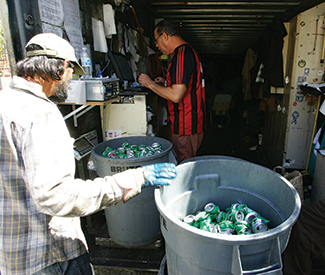
McVeigh’s case stemmed from his realization, while working as a manager at Recology’s Tunnel Road recycling buyback facility, that employees there were routinely marking up the weights of recyclable materials brought in, in order to pay out certain customers more than they were actually owed. The suit suggests that these routinely inflated California redemption value (CRV) tags contributed to Recology missing its waste-diversion targets, but the jury ultimately sided against the plaintiff on this question since it amounted to a financial loss for Recology, not the city.

The complaint included tag numbers and logs of scale weights that didn’t match up, showing a pattern of fraudulent dealings at the buyback center. In November 2007, for example, “ticket reports showed that 23.4 tons of aluminum CRV cans were purchased at the Bayshore Buyback Center, yet only 16.56 tons existed and were shipped.”

Asked about these claims, Potashner acknowledged that there may have been some “knuckleheads” involved in messing with the scales at the buyback center, but asserted that such activity had since been addressed. He added, “If there were any staffing issues around theft, that was actually affecting Recology’s books,” not the public.

Oldfield, the CalRecycle spokesperson, noted that a long list of paperwork violations had been recorded in 2010, but he said the company appeared to have been in compliance since then — based on logs from inspectors’ visits once a year.

Another problem uncovered in the trial, Anton said, had to do with Recology misrepresenting tons of garbage from out of county, so that it would be counted outside the parameters of the waste diversion program. Potashner said that had been corrected, adding, “the out-of-county waste is really a small volume.”

But he confirmed that yet another practice brought to light in this lawsuit is ongoing, revealing a surprising end for some of the stuff that gets tossed into the green compost bins.


MANY SHADES OF GREEN

According to every colorful flier sent out by Recology, the stuff that goes into the green bin gets composted. The green bin is for compost. The blue bin is for recycling. The black bin is for trash that goes to the landfill. This is the fundamental basis of Recology’s waste collection operation and, taking the company and the Department of the Environment at face value, one would assume that 80 percent of all waste was being processed through the blue and green waste streams.

Instead, some of what gets tossed into green bins makes its way to a landfill.

The green-bin waste is shipped to a Recology facility where it’s turned into compost, a process that involves sifting through giant screens. But some of what gets processed, known as “overs” because it isn’t fine enough to drop through the screens, is routinely transferred to a nearby landfill, where it’s spread atop the trash pile. Once again, this six-inch topper of neutralizing material is known as “alternative daily cover.”

Although Recology could convert 100 percent of its green-bin waste into soil-nourishing compost, the practice of using partially processed green-bin waste for “alternative daily cover” is cheap — and it’s perfectly legal under California law. Roughly 10 percent of what gets tossed into the compost bins is used in this way, Recology confirmed.

“There are some people who will say using green waste isn’t really diversion,” acknowledged Jeff Danzinger, a spokesperson with CalRecycle, which oversees recycling programs in California counties. “There’s some people who say we should stop that practice because that just incentivizes a landfill solution for green waste. But if somebody’s saying green waste shouldn’t go into a landfill and get counted as diversion, it’s an opinion.”

Nor is it something the city objects to. The Department of the Environment is aware of this practice, Recology’s Potashner told the Bay Guardian. Yet the city agency has never raised formal concerns about it, despite a mandate under its composting program agreement that the company use green-bin waste for the highest and best possible use.

But there’s no incentive for anyone in city government to complain: Recology may legally count this discarded material as “diverted” in official reporting, thus edging it closer to an annual bonus payment. San Francisco, meanwhile, may count it as part of the 80 percent that was successfully diverted — thus edging it closer to the ambitious Zero Waste program goal.

“It’s great PR to say you’re the highest recycling,” noted the person who was familiar with the company, but wasn’t part of the lawsuit. “It’s almost a movement more than reality. But who’s really watching for the public on these numbers? There’s no watchdog. It’s all about bragging rights.”


Recology is “a political business”

Recology’s political connections in San Francisco run deep. Years ago, when former San Francisco Mayor Willie Brown served as speaker of the California Assembly, he also worked as a lawyer for Recology, which was then known as Norcal Waste Systems.

Campaign finance archives show that when Brown ran for mayor in 1995, he received multiple campaign contributions from Norcal employees in what appeared to be a coordinated fashion.

Brown continues to be influential in the city’s political landscape due to his close relationship with Mayor Ed Lee, who himself came under scrutiny in his capacity as head of the Department of Public Works in 1999 when he was accused of granting Norcal a major rate increase as a reward for political donations to Brown.

In 2010, when Recology submitted a bid for a lucrative waste-disposal contract proposing to haul waste to its Yuba County landfill, Lee reviewed its proposal in his then-capacity as city administrator. As the Guardian reported (see “Trash talk,” 3/30/10), Lee recommended far higher scores for Recology than his counterparts on the contract review team, a key to the company winning the landfill contract over competitor Waste Management Inc. Before Lee declared his mayoral candidacy in 2011, news reports indicated that powerful Chinatown consultant Rose Pak had worked in tandem with Recology executives on a campaign effort, “Run Ed Run,” organized to urge Lee to launch a mayoral bid. Company employees had also been instructed to help gather signatures to petition Lee to run for mayor, news reports indicated, but Pak publicly denied her role coordinating this effort. David Anton, the attorney for Brian McVeigh, emphasized that Recology’s close ties to powerful city officials might have something to do with the city’s lack of interest in targeting the company for the improperly received incentive payments. Yet Recology spokesperson Eric Potashner called this assertion “completely untrue. Recology meets with the various city departments and regulators weekly. We are constantly improving our controls and practices for handling the city’s ever-changing waste stream; often at the behest of city regulators.” Recology and its predecessor companies have maintained the exclusive right to collect commercial and residential refuse in San Francisco since 1932, and rates are routinely raised for city garbage customers, based on the company’s own reporting that its costs are increasing. “I can tell you today, there will be another significant increase on July 21, 2016” — five years after the last rate increase — “because they have a monopoly,” said neighborhood activist and District 10 supervisorial candidate Tony Kelly, who previously worked on a ballot measure that sought to have the city’s refuse collection contract go out for a competitive bid. “When you have a closed system … then it’s entirely a black box. It’ll all be self-reported. It’s too powerful of an incentive.” An industry insider familiar with Recology echoed this point, adding that cozy relationships with local officials make it easier for the self-reporting to escape scrutiny. “It’s a political business,” this person said. “In San Francisco, they’re really a political organization.” Since the rate is guaranteed, this person added, the mentality is that there’s plenty of wiggle room for financial losses and expenditures such as generous political contributions. “If you’re losing any money, you just ask for it back when you do your next rate increase. The city doesn’t have any objection. The ratepayers just get stuck with it.” (Rebecca Bowe)

Push the Feeling party organizers launch Push the Feeling, the record label

0

If you’ve ever walked out of a dance party wishing you could take the party home with you, Push The Feeling has a solution to your problem. For the last two years, Kevin Meenan and Drew Marcogliese have hosted dance parties at the Lower Haight’s Underground SF nightclub under that name; they’ve hosted all manner of DJs, from local heroes like Giraffage to blogosphere faves like YACHT and Les Sins (aka Toro Y Moi).

But recently, they’ve expanded their endeavors into the field of recorded sound, launched a label under the Push the Feeling name. This week they released a 12-inch containing “Skulls,” a song by Marcogliese’s band Silver Hands, plus four remixes. Of course, the parties will go on: Most immediately, they’re hosting a release party for the 12-inch on Saturday, July 5 at Underground, featuring performances by Silver Hands, Marcogliese (as YR SKULL), and Meenan (as Epicsauce).

Of the remixers, three (Chautauqua, Woolfy, and YR SKULL) have performed at Push The Feeling. The fourth remix comes from Mike Simonetti, boss of the influential Italians Do It Better label; he hasn’t played yet, but according to Meenan, he’s “on our wishlist.”

Yet Push the Feeling doesn’t plan to release only party regulars. The two are fans of just about anything on the electronic spectrum, and as long as it has an electronic element, they’re game.

Meenan and Marcogliese said they had talked about starting a label for a long time, even before the parties. But the demands of the parties made it difficult to get the project off the ground.

“Every month, it was like ‘Okay, we’re done with this party, let’s focus on the label stuff,’ and then next thing we know we’re booking the next party,” said Meenan.  “Realistically, we’re about six months behind where we wanted to be about a year ago.”

But with the label off the ground, and the duo has no intention of slowing down. (The parties will continue at the same rate and will, the organizers promise, be just as wild as ever. If anything, the launch of the label is just another chance to party.)

Hosting a label carries a certain prestige, and it’s already brought them blogosphere recognition. The 12-inch has been featured on prominent blogs such as XLR8R, Lagasta, and Gorilla vs. Bear. But the parties will be just as cheap and accessible as ever: Admission to Push the Feeling event is rarely more than $6, and the duo plans to keep it that way.

“We go to clubs, but the reality is we’re more neighborhood bar-type guys,” Marcogliese said of the cheap, fun, accessible dance music scene he and Meenan have curated.  “We wanted to make it very laid-back, not like an in-your-face club with expensive drinks and cover. We focus on keeping it cheap, keeping it casual — keeping it a night we would both want to go to.”

PUSH THE FEELING: Silver Hands 12″ Release Party

With YR SKULL and Epicsauce DJs

Sat/5, 9pm, $6

Underground SF

424 Haight, SF

www.undergroundsf.com

Reinstate the 42: SF protest in solidarity with Brazilian transit workers

7

Hey there, lovers and haters of the World Cup, if you missed out on the protest of Google and FIFA at Pride, there’s still time on the clock to score that goal: there will be another protest tomorrow [Thu/3] to support Brazilian transit workers and their quest for higher wages.

In solidarity with Brazilian protestors, a group of queer anarchists blocked the joint Google/FIFA float in the SF Pride Parade on Sunday. The group saw the float protest as an opportunity to draw together two issues linking San Francisco and Brazil: gentrification in the Bay Area and the displacement of Brazilians in order to make this year’s World Cup possible.

As the protestors said, “We couldn’t pass up the opportunity to connect issues of gentrification and evictions in the Bay Area with the violent displacement of Brazilians who live in the Favelas. The Google/FIFA float was a perfect target for direct action to raise awareness about these issues!”

According to Al Jazeera and Solidar Suisse, more than 150,000 people were evicted from their homes to create the World Cup arenas, including parking lots. Following the Brazilian government’s pacification initiative, Brazilian police occupied multiple favelas, or slums, housing around 1.5 million people total, near the airport and roads leading to the World Cup stadiums in order to make the communities more presentable. Besides minimizing gang activity temporarily, there are no programs implemented to help favela residents in the long run.

Brazilian transit workers also felt cheated by World Cup preparations. Despite Brazil’s underfunded transit system and low wages for workers, Brazil’s government poured $11.5 billion into World Cup preparations. Protestors with the Subway Workers Union of Sao Paulo were beaten and attacked with tear gas by police during a five-day strike for higher wages.

Brazilian Justice Ministry declared the strike illegal and implemented a $250,000 per day fee, and allowed the Brazilian government to fire employees that continue to strike. The workers suspended the strike before the Cup, but the 42 transit workers fired during the strike have not been reinstated.

The SF protest joins the Subway Workers Union in asking for the 42 fired workers to be reinstated. You can root for that goal Thu/3 outside the Brazilian Consulate, 300 Montgomery, SF. 4-5pm.

Grimm but not grim: SF Playhouse’s winning fairy tale ‘Into the Woods’

0

Given all traditional parameters of critical experience, SF Playhouse’s production of Into the Woods (now playing through Sept 6) should be at least somewhat irksome. The vocal talent can be inconsistent, the accents are ambiguous, the set looks busy, and the musical is high-strung enough that it can be insufferable without expert work on all fronts. Shockingly, despite the surface-level issues, the Playhouse production is an unqualified technical success and a complete joy to take in.

The watchability may result from the impeccable staging and verbal interplay between the actors, or the reliable and often gorgeous small orchestra that accompanies the singing. Or perhaps the musical’s hilarity comes from the Robert Goulet-esque swagger of the dual princes and the coy and satirically sexualized awakening of Little Red Ridinghood. Or maybe the show is so good because, in addition to his expert instrumental direction, music director Dave Dobrusky helps his cast find their vocal strengths — the entire ensemble navigates the passaggio-shredding score with astonishing tact. All these positives combine to make Into the Woods an atmospheric journey more than worth taking.

Stephen Sondheim and James Lapine’s 1986 work has aged majestically. The book avoids any hint of contemporary cultural referentiality, giving the work a timelessness and broad humor that seems just as applicable in the millennial age as it was 30 years ago. Gender expectation, the limitations of heroics, and the predictability of children’s stories are all over the 2014 liberal zeitgeist and all play big thematic roles in the production.

Sondheim and Lapine manage to boil down these issues to atomic levels — Ridinghood’s titillation at the lascivious Wolf’s advances, Jack’s clueless but powerful desire to traverse the world of the giants, and the witch’s overprotectiveness over Rapunzel all explore basic yearnings and are remarkably Freudian in scope. It’s no wonder that Disney is releasing a blockbuster version of the musical this December.

The plot is a flimsy excuse to combine the stories of Cinderella (Monique Hafen), Rapunzel (Noelani Neal), Jack and the Beanstock (Tim Homsley), and Little Red Ridinghood (Corinne Proctor) into a single entity. A Baker (Tim Pinto) and his Wife (El Beh) are victims of an infertility curse at the hands of a vengeful witch (Safiya Fredericks) and the very convenient antidote is to steal items from each of the other Brothers Grimm icons.

Despite the storyline’s more contrived elements, Sondheim and Lapine, in typically sophisticated fashion, fill the show with fast-talking, convoluted numbers and twists that require actors capable of sudden and realistic emotional shits as well as deft pronunciation. Not one of the lines in the show was garbled or dropped, nor did any of the sudden shifts cause interruptions in the emotional momentum of the piece. For a Sondheim piece, this is an impressive achievement — I hate to think how many run-throughs some of the more word-heavy interchanges took. Whether to credit this more to Dobrusky or director (and Playhouse co-founder) Susi Damilano is unclear, but they both deserve extensive kudos for the verbal and emotional clarity of the play.

Chiefly responsible for this are Hafen’s Cinderella and the Pinto and Beh’s Baker couple, who have the least flashy parts in the production and need to act as its emotional center. Hafen is the stand-out, with a beautiful coloratura voice that floats up effortlessly to the higher notes in her melancholic “Cinderella at the Grave” and the conflicted “On the Steps of the Palace.” She moves with authenticity and humbleness — she never eats scenery or overdoes anything, which allows the other actors to be more flamboyant. Her evasion of the Baker’s Wife’s questions about her courtship with the Prince is a revelatory moment.

Pinto’s Baker is equally full of humanity. He has to deal with the most opposition and tragedy throughout the narrative and retain the full sympathy of the audience —any garish showboating and nobody cares about his trials anymore. Pinto utilizes his creamy baritone voice and telling body language to field an incredibly likable performance.

El Beh is more dynamic than Pinto, but also less consistent. Her decidedly clipped and modern delivery clashes with his more Victorian dictation and some of her more tender moments come off a bit contrived. At her best though, she delivers powerhouse belting and charged emotive complexity that nicely counters Pinto’s down-to-earth style.

Fredericks is another vocal star as the witch. She has both the fastest (her part during the “Prologue”) and slowest (“The Last Midnight”) songs and manages to carry both — her diction is crisp without sounding contrived, her pitch is accurate without sounding clinical, and her intensity is undeniable.

Cinderella’s Prince and Rapunzel almost steal the show and don’t seem like supporting cast members at all despite their slightly briefer stage time. The Prince (Jeffrey Brian Adams) is a delightful archetype; a square-jawed, Jon Hamm look-alike who charms his way into the heart of Cinderella before realizing that he is addicted to “the rescue” of princesses. He hams it up to an extreme degree, but does so with a charming degree of self-referentiality. His vocals and timing in “Agony,” in which he bemoans the elusiveness of the princesses with Rapunzel’s Prince (Ryan McCrary, who is also solid) were perfection and his seduction of the Baker’s Wife in “Any Moment” is truly inspired Space Age Bachelor Pad-esque sexual panache.

Noelani Neal’s Rapunzel has a gorgeous tone, which she shows off during a tongue-in-cheek reoccurring vocalise that could easily have been shrill. Sadly, she fades into the woodwork a bit as the play goes on. When she’s on stage, however, she owns it, and I’m sure she will be in lead roles at the Playhouse and elsewhere before long.

The ensemble enthusiasm, also increased by the every-fiery local theater legend Maureen McVerry as Jack’s Mother and Homsley’s doe-eyed but mostly relatable Jack, carries through the play’s almost three-hour running time. Even as the unnecessarily trite and sappy ending begins to take shape (no fault of the production, just a rare miscue by Sondheim and Lapine), the chemistry and focus onstage is still palpable. All of the detractions alluded to earlier are still detractions — the set could use more space, there could have been a more unified dialect, and the frenetic action of the play is sometimes overwhelming in the weaker moments. The heart of the production, however, makes it irresistible and sure to fill seats throughout its lengthy run. 

INTO THE WOODS

Through Sept. 6

Tue-Thu, 7pm; Fri-Sat, 8pm (also Sat, 3pm); Sun, 2pm, $20-$120

San Francisco Playhouse

450 Post, SF

www.sfplayhouse.org

Protect light industrial businesses from Big Tech sprawl

15

[Editor’s Note: With the San Francisco Board of Supervisors Land Use Committee scheduled on Monday, July 7, to act on a proposal to allow the new owner of the San Francisco Design Center to evict existing tenants to accommodate tech company Pinterest, Jim Gallagher of Garden Court Antiques, one of those tenants, wrote the following guest editorial for the Guardian.]

The San Francisco Design Center has been a doing business at 2 Henry Adams street for the last 40 years.  During that time it has created thousands of good paying jobs in the city.  We are currently at risk of losing the majority of the building to tech office space.  The building is zoned for PDR-Design but a loophole in the law is being exploited by the new owners, a Chicago based investment firm.  This would lead to the loss of SF based small businesses and the jobs that they create.

 We have worked with countless interior design firms, architects and contractors as a resource for their projects.  In addition, we are an intrinsic part of a network of the PDR(Production, Distribution and Repair) businesses here in San Francisco.  These are the upholsterers, fabrication workrooms, cabinet makers, finishers, metal workers, installers and movers that make up our industry.  This industry offers above average paying jobs to a variety of people from different cultural and ethnic backgrounds that don’t necessarily have college degrees.  These jobs and those that work at them are being squeezed out of this city and when they are gone, we lose yet another piece of the soul of San Francisco.

There is no question that PDR space is being lost in San Francisco.  A recent study of PDR space in SF, showed that we currently have the lowest available PDR space of any major American city at less than 7 percent.  Mayor Lee along with Supervisors Cohen and Campos introduced legislation at the end of last year to expand the amount of PDR space and shore up the manufacturing and light industrial sector in the city.  Why then, would the Board of Supervisors even consider giving up a quarter of a million square feet of PDR space that is currently 90% occupied with viable PDR businesses?

The sad reality is that it is a simple matter of corporate greed.  The new owners of the Showplace Building at 2 Henry Adams bought the building as a PDR building, knowing the use limitations of designated PDR building and immediately began to find ways around the laws.  The loophole that they discovered was the Landmark designation.

The Landmark designation was an exception put into the PDR protections in order to help with the cost maintaining some of the historic architecture that is often found in these PDR buildings.  The idea being that PDR rents do not always bring in enough income to retrofit and maintain these old buildings.  The Landmark status would allow the owners of PDR buildings to rent out part of the building as higher paying office space in order to offset the retrofit and maintenance cost.  This sounds like a good idea until you bring in the greed factor.  This Landmark exception has become the favorite loophole for corporate investors and greedy landlords to move out PDR businesses all over the city.

In the case of the Showplace Building, it is currently 90 percent occupied by PDR-Design businesses.  According to the building owers, there are approximately 262,000 square feet of rentable space in the building.  The Common Area Maintenance or CAM fees that tenants of the building pay beyond their monthly rent is $1.25 per square foot per month.  This would mean that the owners of the Showplace building are currently bringing in nearly $3,500,000 just in Common Area Maintenance fees annually.  In what universe is this not enough money to maintain a building that was fully retrofitted 15 years ago and is only five stories high?

The idea that this building needs to granted Landmark status from the city in order to create enough revenue to maintain the building just does not pass the smell test!  This is a case of simple greed on the part of a Chicago based investment company.  They believe that they can skirt the laws that are in place to protect San Francisco based small businesses and San Francisco workers.  They do not have the best interest of our city or our workers in mind.  They simply want to exploit this Landmark loophole in the PDR protections to line their own pockets.

I would hope that the members of the Board of Supervisors and Mayor Ed Lee do not let this happen.  Please consider the consequences to our city.  Do not choose to allow a Chicago based investment company to skirt our laws and exploit this loophole.  Do not allow this greed to put several San Francisco small businesses out of business. 

This building is 90 percent full of viable PDR businesses.  We pay nearly $3.5 million dollars a year to maintain this building.  This is the perfect example of what a well-run PDR building should look like.  This building is this beautiful and well-maintained because of us.  Please don’t allow the exploitation of the Landmark status to kick us out.  We built our businesses here because we love this place and we want to continue to work and thrive here.

The warm-up

0

culture@sfbg.com

THE WEEKNIGHTER Weekends are for amateurs. Weeknights are for pros. That’s why each week Broke-Ass Stuart (www.brokeassstuart.com) will be exploring a different San Francisco bar, bringing you stories about the places and people who make San Francisco one of the most phenomenal cities in the world. Who wants a drink?

There’s something romantic about San Francisco’s summertime fog. Those damp and chilly nights belong only to us, and the atmosphere they create is what dreams are made of. While the rest of the country simultaneously shares the same experience of panting and sweltering, we bundle up in scarves and coats and hoodies and boots just to run to the store. Maybe that’s the real reason San Francisco feels like a bubble. Maybe it’s not just that we’re this bedrock of progressivism and technological innovation. Maybe it’s that, like living inside a shaken snow globe, our lives are defined by the fact that the rest of the world is obscured from us by the mists floating in the air.

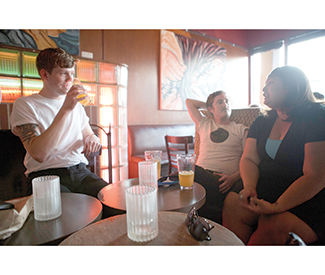
I’ve been telling Noah for a while that I’m gonna go visit him at the Fireside Bar (603 Irving, SF. 415-731-6433). We used to work Thursday nights together at the Golden Gate Tap Room until we didn’t anymore, and I’ve been meaning to catch up with him during one of his shifts at the Fireside. Situated at the corner of Seventh and Irving, the Fireside may be the perfect neighborhood bar. It’s got a dive bar feel without being rundown and smelly, the drinks are stiff and cheap, and the regulars are friendly enough. But most importantly it’s got a motherfucking fireplace.

Imagine this: You’ve decided to get out of your regular routine and go explore somewhere else. Maybe you wandered around Golden Gate Park or decided to check out the Inner Sunset. Or you just walked to the end of Upper Haight and decided to keep on going into the unknown. It’s July in San Francisco, and the sun is starting to go down, and you’ve been wandering around all day with someone who makes you feel all warm and gooey inside. Let’s grab a drink, one of you says as your feet start to hurt and your mouth feels parched and the top of the ear where you just kissed your special person is cold to the touch. And then you see the Fireside Bar. While San Francisco summers have been around far longer than the Fireside, it’s weird to imagine one without the other. You think about this as the two of you order drinks before sitting down to make love-eyes at each other near the fireplace.

I first moved to San Francisco in the summertime, and considering I lived in the Upper Haight, the fog was like a visitor who showed up towards the end of each day. My friend Maria lived a block down from me so one night we got drunk at her place and decided to go on an adventure. I grabbed my skateboard, she put on her roller skates and we headed west to explore parts of SF neither of us was familiar with. Cutting through the fog and the shadows of UCSF we eventually found our way to the Fireside, where we stopped for drinks and so Maria could clean up the scrapes she received from falling repeatedly on her skates. We got warm by the fire and then managed to get our drunk asses back to our respective homes without either of us cracking our heads open. It was a romantic night, not in a sexual way, but in a way where we both knew we were two people falling in love with San Francisco and its foggy ways.

I think it’s time I finally get my shit together and go visit Noah. Maybe I need a little fog and the Fireside to remind me of all the reasons I fell in love with this city in the first place.

Stuart Schuffman aka Broke-Ass Stuart is a travel writer, poet, and TV host. You can find his online shenanigans at www.brokeassstuart.com

Making waves

1

arts@sfbg.com

THEATER The Fourth of July kicked off a revolution once; could it happen again? Each year in Dolores Park the San Francisco Mime Troupe gives it a shot, kicking off its touring season of free outdoor shows with a musical-comical call to arms — an appeal to popular solidarity against the very real forces of oppression on a holiday gleefully synonymous with keg-tapping.

It’s a task the legendary 55-year-old artist-run collective pursues with passion and its own unique flair: a larger-than-life mix of Italian commedia dell’arte storytelling and American-style melodrama, with a smattering of original songs thrown in for good measure. It’s an eye and ear catching spectacle that this year hits close to home, wading into the conflicts and displacement churned by a rapidly transforming high-tech, high-cost city.

Ripple Effect is set in present-day San Francisco, or just offshore in the bay, in a small tour boat where three women of very different backgrounds reckon with one another. The boat’s captain is an ardent but paranoid Lefty activist (played by Velina Brown). Her passengers are a Vietnamese beautician and all-American immigrant (Keiko Shimosato Carreiro) and a newbie tech worker from small-town Nebraska (Lisa Hori-Garcia) whose popular app landed her a corporate job in the big city.

Against the backdrop of a yawning wealth gap, real estate speculation, an epidemic of evictions, Google bus protests, and diminishing diversity, Ripple Effect‘s three protagonists (all played by longtime Mime Troupe members) explore the tensions that divide them and the common ground beneath them. (The Mime Troupe is also linking the play to a series of community forums, at its Mission studio and after select performances, in which various community leaders will facilitate public dialogue around the show’s themes and the growing divide in the city.)

“It’s always tough because we do tour the shows, so we don’t want to make them too specific to San Francisco,” says Mime Troupe actor-writer Michael Gene Sullivan, who plays several secondary roles in Ripple Effect, including a certain wily CEO. “But we feel like there are so many issues going on within the city that people around the state, really around the country, will be able to relate to — not just housing and how the cities are changing, but also the struggle within the working class, the way people are being pitted against each other while the incredibly rich are getting incredibly richer. It’s just that it’s more pointed here.”

There is precedent for SF-centric plays in past Mime Troupe offerings. In fact, the company’s 1999 show, City For Sale, took on the housing crisis of the last real estate and dot-com bubble. But Sullivan says the issue has also changed. “This show, while it touches on [housing], is much more about a change in the culture of the city. Not just what does it mean to be living in San Francisco, but what is San Francisco now?”

Ripple Effect is a departure in some other ways too. It’s a more concentrated drama, less concerned with a particular impending disaster to push the plot than in the precise relationship between the main characters. “In this show the dilemma is, to a large extent, how the characters see each other,” notes Sullivan. To this end, Sullivan, head writer for the collective since 2000, shared the writing this time around with Bay Area playwrights Eugenie Chan and Tanya Shaffer, each of whom explored specific aspects of the characters’ back stories. The show also sports two directors (Hugo E. Carbajal and Wilma Bonet) and comes with a new musical team: composer-lyricist Ira Marlowe and musical director Michael Bello, who together fill roles covered in recent years by Pat Moran.

The Mime Troupe has not been immune to the financial upheaval shaking the city. Last year, the collective had to launch an emergency fundraising campaign called the Cost of Free to make up for a serious budget shortfall that jeopardized its ability to offer its annual show. Velina Brown, Sullivan’s life partner as well as fellow artist, explains that the 2008 economic downturn had reduced the offerings of arts foundations by as much as 40 percent. “Being already a really lean organization anyway, 40 percent going away is huge.” But where another theater might have folded up shop, the Mime Troupe, with help from its audience, bounced back.

“One of the things that’s helped us over the years with all these ups and downs is that we are a collective,” says Brown. “It’s not all on one or two people and if they feel like that’s it, then that’s it — there’s a larger group of people that have to agree that that’s it before the doors close. We also own our building, and that has definitely saved our behinds. We haven’t had to be at the mercy of a landlord — who says, “Hey, I could get 10 times what you people are paying” — and kicked to the curb.”

“Because we’re a collective it takes people a lot longer to get burned out,” agrees Sullivan. “Because we’re worker-owners of our company we are willing to put in more time, do things for a little less pay, come to meetings when we’re not paid to be there. We do get paid; it’s an [Actors] Equity company. But we have a sense of ownership you don’t get at other places, and that also helps the company in the most difficult times.” *


THE RIPPLE EFFECT

Through Sept. 1 at various NorCal venues

Fri/4-Sat/5, 2pm, free

Dolores Park

19th St at Dolores, SF

Also Sun/6, 2pm, free

Yerba Buena Gardens

760 Howard, SF

www.sfmt.org

This Week’s Picks: July 2 – 8, 2014

0

WEDNESDAY 2


Be Calm Honcho

As Be Calm Honcho’s lead singer croons about her love of California on the band’s debut album, differences between the SF-based band and an LA-based band quickly emerge. (Yes, LA. You can stop bragging about being able to bath in sunshine at the beach 365 days a year.) Be Calm Honcho recorded the album in Stinson Beach, where Karl the Fog must’ve frequently drifted in, comfortably settling into his guest role on the album. The tunes sound effortlessly dreamy — even a little gloomily hopeful. The band is joined, fittingly, by fellow local bands, The She’s and Owl Paws, at its record release show tonight. (Amy Char)

With The She’s and Owl Paws

8pm, $10

Rickshaw Stop

155 Fell, SF

(415) 861-2011

www.rickshawstop.com


Deafheaven

For the past three years, these hometown heroes have managed to charm the pants off of critics and fans alike with their powerfully emotive mixture of black metal and shoegaze. The band’s most recent album, Sunbather, a sad, seething record about the melancholy of perfectionism and unattainable ideals, was a critical darling that brought Deafheaven onto the national stage in a flood of gushing reviews and end-of-the-year best-of lists. Though they are a relatively new band, with only a few years and two albums under their belt, Deafheaven both record and perform with a masterful confidence and unabashed willingness to break the rules, creating a sound that has been described as “post-everything.” You don’t want to miss the chance to see them shred on their home turf. (Haley Zaremba)

With Wreck & Reference

8pm, $16

Great American Music Hall

859 O’Farrell, SF

(415) 885-0750

www.slimspresents.com


Answer Me! A Comedy Game Show

A thick layer of dust covers your high school quiz bowl trophy in your childhood bedroom. Between Netflix marathons of Orange Is the New Black, you sort of yearn for an intellectually stimulating challenge. Take everything you know about Piper Chapman and head over to the Mission for tonight’s pop culture game show. (While you’re at it, consider renting a video or two to support Lost Weekend Video before the competition begins.) Two teams, each comprised of two local comedians and one randomly selected audience member, duke it out for frivolous fame and useless trinkets. Plus, your teammates are sure to be more entertaining than that awkward mouth-breather back in high school. (Amy Char)

8pm, $10

The Cinecave at Lost Weekend Video

1034 Valencia, SF

(415) 643-3373

www.lostweekendvideo.com


THURSDAY 3


Legendary Stardust Cowboy

Inspired by his obsession with space travel, Norman Carl Odam became the Legendary Stardust Cowboy in 1961 and has been honing his maniacal psychobilly style ever since. “The Ledge” is as interested in cars and girls as he is in sci-fi, toilet humor, and the political issues of whatever era he happens to find himself in (“They signed the treaty in Kyoto, Japan!” he screams on “Global Warming,” as if a UN conference was as exciting as a sockhop.) His absurd subject matter and often incomprehensible vocals have earned him fans from outsider-music guru Irwin Chusid to David Bowie, who covered “I Took A Ride On A Gemini Spacecraft” on his album Heathen. The Ledge’s upcoming Stork Club show should demonstrate why he’s considered one of America’s best — or at least most polarizing — touring musicians. (Daniel Bromfield)

9:30pm, $5

Stork Club

2330 Telegraph, Oakland

(510) 444-6174

www.storkcluboakland.com


FRIDAY 4


Venetian Snares

Winnipeg-based electric music artist Andy Funk, better known as Venetian Snares, has been releasing bass-heavy odysseys of albums since the early 1990s. His artistic diversity and tendency to reinvent himself has led to a scattered but unbelievably prolific output — he’s put out 26 formal full-lengths for 8 different labels since 1998 alongside hundreds of EPs, singles, and mixes. While Venetian Snare’s time signatures, samples, and equipment are constantly in flux, his music stays abrasive and challenging no matter the set-up. His newest album, My Love, is a Bulldozer, released two weeks ago, juxtaposes modern classical elements — particularly strings — with extended drum machine and bass breakdowns and irreverent, often hilarious lyrics. Known for his live mixing and aggressive sets, expect both IDM aficionados and raging moshers to be showing up in full force. Avoid the trite fireworks and head to the Independent for some real explosives. (David Kurlander)

8pm, $15

Independent

628 Divisadero, SF

(415) 771-1421

www.theindependentsf.com


Gilman Benefit

924 Gilman has gotten some flak recently for hiking up the prices of its shows, deviating from its original $5-a-show credo in order to satisfy the demands of its $4,500 rent. Luckily, Gilman will will be hosting not one, but two benefit concerts in the first two weeks of June — and both will only set you back a paper Lincoln. The first will take place on the 4th of July and features a host of local bands, including The SoundWaves (San Leandro), Flip & The European Mutts (San Jose), and Black Dream (San Francisco) — plus Drinking Water, an Arizona ska-punk trio that’s toured in the US and Mexico. Though benefit No. 2 features a higher proportion of indie rockers, this one is as punk as anything the Gilman’s ever put on. (Daniel Bromfield)

7pm, $5

924 Gilman

924 Gilman, Berkeley

(510) 524-8180

www.924gilman.org


SATURDAY 5


The Fresh & Onlys

Though they rose to fame with the San Francisco garage-rock explosion of a few years back, the Fresh & Onlys eschew the punky pulp-horror aesthetic of many of their contemporaries in favor of a romantic sound that’s more Heart Shaped World than “Heart Shaped Box.” Though their early recordings (Grey Eyed Girls, Play It Strange) are as fuzzy as anything Ty Segall or John Dwyer’s ever done, the Fresh & Onlys have always been more pop than rock, more brain than body, more introverted than extroverted. But that doesn’t mean they can’t hold it down live — whether as an opener or headliner, they can bend their style to suit just about any live setting and keep the party going. (Daniel Bromfield)

9pm, $15

The Chapel

777 Valencia, San Francisco

(415) 551-5157

www.thechapelsf.com


SUNDAY 6


“Brakhage, Brakhage, Brakhage!”

Add about 397 more “Brakhages” to the title of this Yerba Buena Center of the Arts tribute to the late, great experimental filmmaker, and you’ll have the approximate number of films he created over the span of his career. Three programs highlight both familiar and rare works from the celluloid wizard. Up first is today’s “Self and Other,” films from 1974-86 that examine “how autobiography and portraiture can be represented with motion pictures.” Later programs are “Sound Films” (1962-74), spotlighting some of the oft-silent artist’s soundtracked pieces; and a vivid, gorgeous array of late-career works represented in “Hand-Painted Films” (1993-2002). (Cheryl Eddy)

2pm, $8-$10

Also July 10, 7:30pm; July 13, 2pm

Yerba Buena Center for the Arts

701 Mission, SF

www.ybca.org


The San Francisco Symphony

The San Francisco Symphony heads west to the Sunset on Sunday for its annual appearance at the free Stern Grove Festival. The outdoor affair, picturesquely located in a green basin of rocks and picnic tables, will feature a mostly 20th-century program conducted by charismatic former Symphony Resident Conductor Edwin Outwater. More unconventional programming, including several offerings from Howard Hansons 1930s opera Merry Mount, join standard overtures and waltzes by Bernstein and Richard Rodgers. A potential second-half highlight comes in the form of Ravel’s heartbreakingly gorgeous “Pavane Pour Une Infante Defunte” and exhilarating “Bolero,” both presented with jazz improvisations from prolific pianist Makoto Ozone — the reworking of these iconic classics into new styles should lead to striking new modalities and moods. Pack up a cheese plate and your best white capris and head down to the Grove for an alternately meditative and rousing journey through the modern classical canon. (David Kurlander)

2pm, free

Sigmund Stern Grove

19th Ave. and Sloat, SF

(415) 252-6252

www.sterngrove.org


MONDAY 7


Cloud Nothings

Cleveland’s Cloud Nothings have been indie darlings since the band’s formation in 2009, but have received special praise for April’s Here and Nowhere Else. The new work sees the group embracing a punchier punk aesthetic — lead singer and rhythm guitarist Dylan Baldi spins confused, remarkably catchy choruses over staccato guitar lines and astonishing drum fills by hitherto unknown new addition Jayson Gerycz. Their present tour, which winds around iconic mid-size theaters in the West and Midwest before a European leg, promises a taut, kinetic setlist that includes all of their new album and a few scattered cuts from their three preceding LPs. These guys may be melodic, but they embrace involved and improvised instrumental interludes onstage that lend each show unpredictability and showcase Gerycz, Baldi, and excellent bassist TJ Duke. The stately Great American Music Hall provides an ideal locale for the group’s blend of flash and homage. (David Kurlander)

8pm, $20

859 O’Farrell, SF

(415) 885-0750

www.gamhtickets.com


TUESDAY 8

Nick Cave and the Bad Seeds

Eccentric doesn’t really being to cover it. Nick Cave is a madman with a burning spark of genius propelling his frenetic presence and unparalleled career, careening from genre to genre, turntable to page to screen, and implanting his gritty, unmistakable thumbprint into everything he touches. With an almost four-decade career, the onetime frontman of Australian punk and post-punk bands the Lost Boys and the Birthday Party, and current frontman of Grinderman and the Bad Seeds, Nick Cave is a legendary force of nature. Everything about Cave’s musical style is unique, but it is his lyrics that set him apart as one of the most imaginative and unapologetically confrontational artists in the industry. Stained pink with blood, sweat, and semen, his songs are a visceral journey that only Cave, one of the most energetic and impassioned performers alive, could properly deliver. His sneer and snarl are a sight to behold. (Haley Zaremba)

With Jonathan Richman

8pm $53

The Warfield

982 Market, SF

(415) 673-4653

www.thewarfieldtheatre.com

The Guardian listings deadline is two weeks prior to our Wednesday publication date. To submit an item for consideration, please include the title of the event, a brief description of the event, date and time, venue name, street address (listing cross streets only isn’t sufficient), city, telephone number readers can call for more information, telephone number for media, and admission costs. Send information to Listings, the Guardian, 225 Bush, 17th Flr., SF, CA 94105; or e-mail (paste press release into e-mail body — no attachments, please) to listings@sfbg.com. Digital photos may be submitted in jpeg format; the image must be at least 240 dpi and four inches by six inches in size. We regret we cannot accept listings over the phone.

Burger Boogaloo Breakdown

0

Thee Oh Sees

Hiatus, schmiatus. Less than six months after the prom kings of SF’s garage scene declared they’d be taking an “indefinite” break from playing — inciting local blog warfare, while they were at it, with frontman John Dwyer’s move to LA signalling that the trickle of SF musicians down south had actually become a downpour — Thee Oh Sees dropped Drop, nine tracks of reassuringly heavy, noisy, psyched-out reverb. Fans know their maniacal live show is not to be missed, and BB marks the band’s first public return to our stages (or parks, as the case may be). Can we hug and make up now? Sat/5 (Day 1), 8pm.


The Muffs

Of all the bands riding the current wave of ’90s nostalgia, The Muffs are one we’re a-okay with hearing from again. If you’ve seen Clueless, you probably know their cover of “Kids in America,” but with Kim Shattuck’s rough-hewn, little-girl-gone-bad vocals and charisma at the helm, we’ve always thought they deserved much more. This time last year, Shattuck was playing bass for the Pixies; if getting booted from that band was what it took to produce The Muffs’ first record in 10 years, Whoop De Woo (out July 29 ), we’re fine with that too. Bust out your pink Converse for this one. Sun/6 (Day 2), 6pm.


Nobunny

Aside from maybe hot dog-eating contests and firecracker-related injuries, perhaps nothing says “America” like a barely-clothed adult man throwing himself around on stage in a terrifying bunny mask, a coat made of garbage, and a ball gag. Luckily, we have Nobunny, the endearingly insane alter ego of veteran punk madman Justin Champlin, who promises to make this all-ages affair just a little bit of a darker experience than you’d probably want unaccompanied children to have on their own. Just like our founding fathers would have wanted. Sat/5 (Day 1), 5:15pm.

Events: July 2 – 8, 2014

0

Listings are compiled by Guardian staff. Submit items for the listings at listings@sfbg.com. For further information on how to submit items for the listings, see Selector.

WEDNESDAY 2

Jean Kwok Book Passage, 1 Ferry Bldg, SF; www.bookpassage.com. 6pm, free. The author discusses her new novel, Mambo in Chinatown.

Craven Rock Long Haul Info Shop, 3124 Shattuck, Berk; www.thelonghaul.org. 7pm, free. The author reads from cultural-studies tome Days and Nights in a Dark Carnival. Yes, it’s about Juggalos.

Judy Wells and Dale Jensen Books Inc, 1344 Park, Alameda; (510) 522-2226. 7pm, free. The poets read as part of the Last Word Reading Series, followed by an open mic.

THURSDAY 3

“Target Independence Day Celebration” Craneway Pavilion, 1414 Harbour Way South, Richmond; www.oebs.org. 6:30pm, free. Oakland East Bay Symphony performs patriotic works to celebrate Independence Day, followed by a fireworks display.

FRIDAY 4

Fourth of July at the Berkeley Marina Berkeley Marina, 201 University, Berk; www.anotherbullwinkelshow.com. Noon-10pm, $15. Family-friendly fun with live entertainment, pony rides, arts and crafts, and fireworks (9:30pm).

July 4th Festival of Family Fun Jack London Square, Broadway and Embarcadero, Oakl; www.jacklondonsquare.com. 11am-4pm, free. Fun activities for families including a petting zoo, balloon artists, face paint, bubble wrangling, and more.

Pier 39 Fourth of July Pier 39, SF; www.pier39.com. Noon, free. The family-friendly fun begins at noon with live music from the USAF Band of the Golden West, followed by Tainted Love. At 9:30pm, enjoy the traditional fireworks display over the bay.

SATURDAY 5

Fillmore Jazz Festival Fillmore between Jackson and Eddy, SF. www.fillmorejazzfestival.com. 10am-6pm, free. Also Sun/6. The largest free jazz fest on the West Coast fills 12 blocks with music, arts and crafts, gourmet food, and more.

LaborFest 2014 Redstone Building, 2940 16th St, SF; www.laborfest.net. 11am-5pm, free. Street fair in honor of the 100th anniversary of the San Francisco Labor Temple. Also today: Noon, meet at 518 Valencia, SF. Free. Labor bike tour with Chris Carlsson (ends at Spear and Market). 2pm, meet at Harry Bridges Plaza Tower, Embarcadero at Market, SF. Free. SF General Strike walk led by retired ILWU longshoreman Jack Heyman and others. 7pm, ILWU Local 34 Hall, 801 Second St, SF. Donations accepted. “FilmWorks United” screening of Miners Shot Down (Desai, 2014).

SUNDAY 6

LaborFest 2014 First Unitarian Universalist Church, 1187 Franklin, SF; www.laborfest.net. 9:30am, free. “Working Class Housing, Ethnic Housing: Hunters Point and Bayview” panel discussion. Also today: 9:45am, meet at Coit Tower entrance, One Telegraph Hill, SF. Free. Coit Tower mural walk with Peter O’Driscoll, Gray Brechin, and Harvey Smith. 11am, meet at 18th St and Tennessee, SF. Free. Dogpatch and Potrero Point walk with Nataly Wisniewski of SF City Guides. Noon, meet at One Market St, SF. Free. Labor history and Market St. walk with Chuck Schwartz of SF City Guides. 2pm, Bird and Beckett Bookstore, 653 Chenery, SF. Free. Author Zeese Papanikolas discusses the Ludlow Massacre. 7pm, 518 Valencia, SF. Free. “Labor, Privatization, and How to Defend Public Education” discussion.

Temescal Street Fair Telegraph between 40th and 51st Sts, Oakl; www.temescaldistrict.org. Noon-6pm, free. Three food courts and multiple stages showcasing local performers (including an entire stage just for kids with magicians, jugglers, and more), plus 150 booths with local crafts, artworks, and more.

MONDAY 7

LaborFest 2014 Meet at Portsmouth Square, Washington St, SF; www.laborfest.net. 10am, free. Chinatown walk with Mae Schoeing of SF City Guides. Also today: 7pm, Bird and Beckett Bookstore, 653 Chenery, SF. Free. Poetry reading by Nellie Wong and Alice Rogoff.

TUESDAY 8

LaborFest 2014 Meet at the corner of Stockton and Maiden Lane, SF; www.laborfest.net. 10am, free. “Rising Steel: Two Centuries of San Francisco Architecture” walking tour. Also today: 6-9pm, Pacific Media Workers Guild, 433 Natoma, SF. Free. “Méndez Rising: Spotlight on the Revolutionary Works of an Artist for Social Justice,” tribute to the art of Leopoldo Méndez. *


Guardian Intelligence: July 2 – 8, 2014

0

GUARDIAN ON THE MOVE

There were a couple of big changes for the Bay Guardian this week. We and our sister newspapers within San Francisco Media Company — San Francisco Examiner and SF Weekly — moved into the Westfield Mall. Yes, the mall, but in the fifth floor business offices formerly occupied by the San Francisco State University School of Business extension program. The company, owned by Black Press in Canada and Oahu Publications in Hawaii, also named Glenn Zuehls as the new publisher and Cliff Chandler, who worked for the Examiner for years, as the senior vice president of advertising. Zuehls, who comes from Oahu Publications, replaces Todd Vogt as the head of SFMC. Zuehls and Chandler told the staff of all three papers that their primary goal is to grow the company’s revenues.

QUEER SPIRIT ROILS PRIDE

Even as an awareness of the ever-growing commercialization of SF Pride dawned on younger participants, a spirit of activism also took flight. Community grand marshal Tommi Avicolli Mecca led a fiery parade contingent (above) of housing activists in Sunday’s parade, protesting skyrocketing evictions in San Francisco. The anti-eviction brigade staged a die-in in front of the official parade observation area. Friday’s Trans March was the biggest so far, and Saturday’s Dyke March featured a huge contingent marching under the banner “Dykes Against Landlords.” Meanwhile, hundreds of protestors targeted a Kink.com prison-themed party, saying it glorified a prison-industrial complex, which “destroys the lives of millions of people.” Seven of the protestors were arrested, and charges of police brutality are being investigated.

LESBIANS BASHED AT PRIDE

While there were some disturbing anecdotal reports of homophobic slurs and queer bashing at Pride this year (including one of a Sister of Perpetual Indulgence and her husband being attacked at Pink Saturday), San Francisco Police Department spokesperson Albie Esparza said police are only investigating one incident so far as an actual hate crime. It occurred on June 28 around 5:30pm near the intersection of Mission and Ninth streets when two young lesbians were subjected to homophobic taunts and then severely beaten by five young male suspects, all of whom remain at large. They’re described at 16 to 20 years old, two black, three Hispanic. Esparza said hate crimes are defined as attacks based solely on being a protected classes, so that doesn’t include robbery or assaults in which racism or homophobic slurs are used, if that doesn’t seem to be the motivation for the attacks.

LIFE’S A STAGE

Hark! It must be summer, because all the companies dedicated to outdoor theater are opening new productions in parks across the Bay Area. Aside from the San Francisco Mime Troupe’s Ripple Effect (see feature in this issue; www.sfmt.org), Marin Shakespeare is presenting As You Like It in San Rafael (pictured), with Romeo and Juliet opening later in July (www.marinshakespeare.org); Free Shakespeare in the Park brings The Taming of the Shrew to Pleasanton and beyond (www.sfshakes.org); and Actors Ensemble of Berkeley goes stone-cold Austen with Pride and Prejudice in John Hinkel Park (www.aeofberkeley). AS YOU LIKE IT PHOTO BY STEVEN UNDERWOOD

TEN YEAR GRIND

Kids and pro skaters from One Love boards tore up “the island” — between the Ferry Building and the Embarcadero — with flips, kick tricks and plants June 29, celebrating the tenth anniversary of the much loved skate spot. Local Hunters Point pro skater Larry Redmon sat watching the new generation of skaters and offering pointers. Sure downtown has more grind blockers then it did a decade ago, but as Redmon says, “We out here.” PHOTO BY PAUL INGRAM

THE WILLIE CONNECTION

Muni’s workers and the SFMTA reached a final labor deal over the final weekend of June, but Mayor Ed Lee is telling news outlets the real dealmaker was former mayor Willie Brown. “He’s someone who understands the city, understands labor, the underlying interests,” SFMTA Director Ed Reiskin told various news outlets. Reports say Brown went unpaid by the city for the deed. That’s hard to believe: Anyone who knows Slick Willie knows he seldom does anything for free.

WAXING NOSTALGIC

The new Madame Tussauds wax museum attraction opened June 26 at Fisherman’s wharf — and includes SF-specific figure replicas like Mark Zuckerberg, Harvey Milk, and, of course, our real mayor, Nicolas Cage (pictured). See the Pixel Vision blog at SFBG.com for more creepy-ish pics and a review.

SHARON SELLS OUT (THE INDEPENDENT)

Despite her catalog full of confessional songs about nasty breakups and other dark subject matter, Sharon Van Etten was all smiles during two sold-out shows at the Independent June 29 and June 30. Leaning heavily on songs from her new album, Are We There, Van Etten and her four-piece band even led the adoring crowd in a cheerful sing-along at one point. On her next pass through town, we expect to be seeing her on a much bigger stage.

UNION PROUD

If BBQ and black-market fireworks aren’t your idea of showing civic pride, make your way over to the Mission’s Redstone Building (2940 16th St. at Capp) for a street fair Sat/5 with local musicians, poets, visual artists, and more, to mark the 100th anniversary of the SF Labor Temple and call attention to current labor issues like the fight for a $15 minimum wage. Built by the city’s Labor Council in 1914, the building formerly housed SF’s biggest labor unions and was the planning center for the famous 1934 General Strike. This celebration is part of Labor Fest, now in its 20th year, which runs throughout July around the Bay Area — for more: www.laborfest.net


Painting with more colors

6

joe@sfbg.com

Not many plays feature an all-Latino cast, let alone all El Salvadoran. But Paul Flores’ Placas placed brown actors and a brown experience center stage. The 2012 production explored a father and ex-gang member’s struggle, leading his son out of a hard life of drugs, violence, and perhaps death.

The play garnered favorable but mixed reviews from critics, but among Salvadorans, it was a huge hit.

“You had older generations coming to see the play right alongside their grandkids,” Flores told the Guardian. The play’s premiere venue packed its 500-seat capacity, and sold out seven out of its eight nights in San Francisco. “We tapped a community thirsty to hear its stories told.”

Placas is the kind of creative work not being funded often enough by the city’s largest arts grant organization, critics are saying. At a contentious San Francisco Board of Supervisors Budget and Finance Committee hearing on June 20, artists told supervisors that programs serving diverse communities were severely underfunded, and alleged the city’s major arts funder, Grants for the Arts, awards money disproportionately to art forms favored by white audiences.

Spurred by public outcry and city studies, Sups. Eric Mar and London Breed recommended the transfer of $400,000 in unused funding from GFTA to another city arts funder, the Cultural Equity Grants (which funded Placas), to direct arts money to people of color.

The transfer won’t be approved until it goes before the full Board of Supervisors next month. But as San Francisco studio and housing rents soar, Mar said this was vital to keeping diverse artists in the city.

“I think the crisis for arts groups now is many of them are being displaced,” he told the Guardian. “How can the city subsidize groups with low rent or free rent, and how could we support small groups [to prevent them from] being displaced?”

"Arts inequity": San Francisco Budget and Legislative Analyst Report by Joe Fitzgerald Rodriguez

Above is a PDF of the Budget Legislative Analyst’s report, as it breaks down lack of funding to diverse programs. The report has relevant sections highlighted.

The Guardian reached out to City Administrator Naomi Kelly for comment (her office ultimately directs arts grants funding). She was unavailable for an interview before we went to press, but her spokesperson Bill Barnes told us, “I don’t think we should be in a position of having governments regulate artistic content.”

But in a way, the government already does. The GFTA funding is made up of city dollars, and for decades its funding priorities have scarcely changed, favoring many of the largest mainstream organizations.

GFTA funds many arts organizations, but a recent report by the Budget and Legislative Analyst’s Office found it awarded about 70 percent of grants to organizations with mostly white artists who mostly cater to white audiences. The San Francisco Symphony, San Francisco Ballet, San Francisco Opera, City Arts, the Exploratorium, the Museum of Modern Art, and the American Conservatory Theater received over one-third of GFTA funding over the past five years, the report found.

“The Bay [Area] will soon be 70 percent people of color,” Andrew Wood, director of the SF International Arts Festival, told the Guardian. “Why invest so heavily in organizations that are such a minority of the population?”

Taken on its face, the findings show a stark divide between funding for smaller, struggling minority arts groups and large, independently funded arts groups with predominantly white patrons. The report divided the diversity of GFTA arts funding into three categories: people of color (Asians, African Americans, and Latinos), ethnic minorities (Arab/Middle Eastern/Jewish), and LGBT organizations. The funding for these categories remained steady at about 20, 2, and 5 percent of arts funding, respectively, since 1989.

The lack of funding is one thing, but critics say the pattern indicates an outright dismissal of the broader community. In a mass email entitled “The State of the Arts in San Francisco” sent to the arts community from a group calling itself Arts Town Hall Organizing Committee said the outcry against critiques of GFTA’s diversity funding was “advanced by fringe members of the arts community.”

Realizing it called Black, Asian, and Latino artists a “fringe community,” the San Francisco Arts Alliance (a signatory to the email comprised of San Francisco’s symphony, opera, and other GFTA funded organizations) quickly backpedaled. It said the email was sent on their behalf by the public relations firm Barnes Mosher Whitehurst Lauter & Partners, a group that often runs astroturf campaigns for mainstream organizations.

One reason for GFTA’s inability to fund diverse arts groups may be a lack of trying: The BLA found the GFTA “does not have a definition or criteria for granting funds to people of color organizations.”

This color blindness is a problem, Wood told us. “[The money] the city invests in the War Memorial Opera House compared to the Bayview Opera House, also city owned, is completely out of whack,” he said. The Bayview Opera House was one among six “cultural institutions” to receive a portion of a $400,000 GFTA award, according to the organization’s 2013/14 annual report. Conversely, GFTA awarded the San Francisco Opera $653,000 the same year.

“They’re two different universes,” Wood said.

Allocating more funding for the Cultural Equity Grants was an oft-mentioned method for better supporting disadvantaged artists, the report found, even though GFTA and CEG share many of the same grantees.

Some say the report’s numbers don’t add up. San Francisco Arts Commission Director of Cultural Affairs Tom DeCaigny, a longtime local artist, disagreed with how the BLA defined which groups were white, ethnic, or otherwise.

“The methodology in the report assigns people an identity, and I know some of our grantees were referred to as white when they’re not,” DeCaigny told the Guardian. “We would want to see organizations self identify.”

Those faults undermine the value of the BLA’s findings, although he said, “I’m hesitant to comment on the value of that report.”

But some in the arts community felt DeCaigny’s opinion aligns suspiciously closely to the mayor’s priorities: funding the preferred arts organizations of his wealthy donors (like the symphony). We reached out to the San Francisco Symphony for comment but its representatives told us it would be unable to respond before our deadline.

DeCaigny defended the symphony, noting its annual Lunar New Year and Day of the Dead concerts serve diverse audiences. For the economically disadvantaged, he said, the symphony offers free concerts open to the public in Dolores Park, and that the symphony’s “artists are very diverse.”

DeCaigny pointed out the San Francisco Symphony Orchestra’s youth programs (shown above) are notably very diverse.

The donors are mostly white, he said, “but that’s true in other sectors as well. It has more to do with how wealth is distributed in our society.”

But Flores, Placas’ director, explained the need for ethnically diverse art was not just about who consumes it, but what message the art is sending to the audience. Nothing revealed this more, he said, then when he took Placas on tour across the United States. While in New York City, he conducted an informal poll.

“I asked ‘when I say San Francisco, what do you think of?’ They said the 49ers, the San Francisco Giants, the Golden Gate Bridge. They didn’t think gangs, pupusa, cumbia,” he said. That’s why Placas, which told the story of gang life among San Francisco Salvadorans, had such impact in the city and even beyond its borders.

“I love telling stories about San Francisco,” Flores told us. “The symphony doesn’t do that, the opera doesn’t do that. What does that? Locally generated art.”

The Board of Supervisors Budget and Finance committee is tentatively slated to hold a hearing on allegations made in the BLA report on July 16.  

Jasper Scherer contributed to this report.

Guardian on the move: Into the mall, under new management

59

There were a couple of big changes for the Bay Guardian this week. We and our sister newspapers within San Francisco Media Company — San Francisco Examiner and SF Weekly — moved into the Westfield Mall. Yes, the mall, but in the fifth floor business offices formerly occupied by the San Francisco State University School of Business extension program.

The company, owned by Black Press in Canada and Oahu Publications in Hawaii, also named Glenn Zuehls as the new publisher and Cliff Chandler (who worked for the Examiner for years) as the senior vice president of advertising. Zuehls, who comes from Oahu Publications, replaces Todd Vogt as the head of SFMC. Zuehls and Chandler told the staff of all three papers that their primary goal is to grow the company’s revenues, a point that Black Press CEO Rick O’Connor also echoed during the annoucement this morning: “It’s all about revenues.”

Oahu Publications President and Publisher Dennis Francis will also serve as president of SFMC, which now has the same owners as the Black Press and Oahu Publications after Vogt’s ownership interest was bought out by his partners in May. The combined company owns newspapers throughout Canada and Hawaii, as well as around the continental US, including Seattle Weekly and the Akron Beacon Journal. 

Editorially, the Bay Guardian remains an independent publication under the leadership of Publisher Marke Bieschke and Editor-in-Chief Steven T. Jones, yours truly.  


Wax on: a journey into the new Madame Tussauds San Francisco

0

You probably won’t win any staring contests inside the new Madame Tussauds that opened June 26 at Fisherman’s Wharf. (Besides, I wouldn’t recommend holding prolonged eye contact with any of the wax figures, especially the Nicolas Cage one.) Like the youngest sibling in the shadow of brothers and sisters who have already established themselves, the SF branch — the fifth North American branch — tries to make a name for itself by flaunting its individuality whenever it’s convenient. Its attempt showcases eerily lifelike figures of well-known San Franciscans in themed rooms.

The museum’s main selling point is the Harvey Milk figure, which successfully presents itself as a thoughtful tribute. His nephew Stuart Milk had the privilege of unveiling his uncle’s wax figure to press less than an hour before the museum’s opening. The moment the red curtain fell — days before this year’s Pride Weekend — we stepped into a scene from 1978’s SF Pride, where Harvey parks himself on the roof of a car, clutching a handmade sign proclaiming “I’m from Woodmere, N.Y.” Stuart himself lauded the authenticity of the wax figure down to the shabby state of the shoes, as he said Harvey was quite frugal then. 

Later during the tour, I learned that Madame Tussauds’ team painstakingly pays attention to every possible detail. Apparently, the artists place the wax figures’ hair in place one strand at a time (!) and strive for complete accuracy — I was assured that if someone had a wrinkle on their face, it’d reappear in the exact same spot on their doppelgänger’s face. After examining the stubble on a baseball player’s face (even though it seemed to give him a slightly ashen complexion), I was convinced of the employee’s claims.

Madame Tussauds stresses how visitors can get up close and personal with the figures. Even the wallpaper of Harvey Milk’s room underscores this point, as it depicts a crowd of participants banding together with Harvey in his fight for gay rights. Props sit on the sidelines so you don’t have to. Grab a bullhorn or a sign that reads “Free to be” in big block letters and join Harvey.

Admittedly, it’s clear the museum tries to capitalize on its location — isn’t that how you stay in business at Fisherman’s Wharf? Yes, there’s a room to commemorate 1967’s Summer of Love, complete with Janis Joplin beside a psychedelic Volkswagen van and Jerry Garcia. But it quickly gets cramped. The room also includes a replication of the famous Haight Street fishnet stocking legs (just if you forgot you were in the middle of tourist territory), and interestingly enough, a Chinese New Year parade commemoration that feels out of place. Here, it begins to get a little gimmicky. The Spirit of San Francisco room slightly redeems itself by featuring the Golden Gate Bridge at two moments in its history — its current likeness and the construction process (complete with engineer Joseph Strauss).

Mark Zuckerberg didn’t quite make the cut for the Spirit of San Francisco room. He’s relegated to the same floor, however. In his trademark hoodie, he sits cross-legged and barefoot in a chair, enjoying some downtime even though he’s almost rubbing elbows with wax figure Barack Obama and his Oval Office reproduction. The iconic Apple logo is noticeably absent from what must be Zuck’s Macbook Pro. (Curiously enough, his sandals still sport the Adidas logo. Go figure.) 

“He’s been very popular with selfies,” said Adrea Gibbs, general manager of Madame Tussauds San Francisco. Our press preview ran a little overtime and members of the public had already entered by the middle of our tour, getting cozy with the wax figures. And to accommodate visitors who have qualms about awkwardly-angled photos taken at arm’s length, employees are quick to offer assistance. I saw only one visitor attempt to take a selfie, but it wasn’t too crowded yet. Give it some time.

The appeal of the remainder of the museum, however, quickly dwindled for me. Madame Tussauds San Francisco — the youngest sibling again — falls short of differentiating itself. It’s likely that most of the wax figures, including Lady Gaga, George Clooney, Audrey Hepburn, and E.T., will feel right at home in another branch somewhere across the world from San Francisco. (Although it did feel like I was supposed to be in Lincoln Park when the Golden Gate Bridge, as part of the wallpaper behind Tiger Woods, caught my eye.)

Apart from the Spirit of San Francisco room, there’s nothing that feels quite as put together elsewhere in the museum. Sure, Madame Tussauds does a fine job of creating interactive props to accompany the other wax figures and to entertain visitors. And marketing-wise, I suppose it only makes sense to include a variety of figures to appeal to a broad audience. Adult admission stands at a somewhat steep price and in this economy, attendees want to get enough bang for their buck. A visit to the new Madame Tussauds, however, is best saved for those who don’t think twice about wearing shorts to Fisherman’s Wharf in the middle of a San Franciscan summer.

Madame Tussauds San Francisco

Open daily at 10am, $16-$26

145 Jefferson, SF

www.madametussauds.com/SanFrancisco/

Will proposal to sell Hetch Hetchy power overshadow CleanPowerSF?

Supervisors Scott Wiener and London Breed have proposed an ordinance to allow the San Francisco Public Utilities Power Commission’s Power Enterprise to sell hydroelectric energy from the Hetch Hetchy dam to retail customers — particularly large real estate developments. Sup. Wiener and Breed say the ordinance would both generate revenue for the PUC and further the city’s overall goal of achieving a 100 percent greenhouse-gas free power mix. 

But how well does it fit into the city’s other clean energy goals? Some advocates of an existing citywide green energy plan worry that this new effort could cause a far more ambitious program to fall by the wayside.

For more than a decade, city government has been working toward implementing a clean energy plan through CleanPower SF, which aims to meet the city’s goal of 100 percent clean energy by allowing all San Francisco residents the choice of switching to a green power mix through the city-administered program, instead of remaining with PG&E. But CleanPower SF hangs in limbo, largely due to opposition from the SFPUC board, appointed by Mayor Ed Lee–whose regular meetings with PG&E officials have raised eyebrows.

The legislation proposing to broaden the sale of SFPUC’s hydroelectric power supply seeks to tackle some of the problems CleanPower SF might have addressed had it not been stalled. A press statement from Wiener noted that it aims to help build a large enough customer base for the SFPUC to generate sufficient revenues to maintain city infrastructure, as well as meeting the city’s overall target of 100 percent clean energy by 2030.

“My concern is that the Mayor’s office will say it’s something that will supplement CPSF [CleanPowerSF] and say that’s enough,” said Jason Fried, Executive Officer of the Local Agency Formation Commission. “I want to make it clear that it [proposed ordinance] is really meant to compliment CleanPower SF.”

But just exactly how—and how much—the proposal would complement CleanPower SF is still up for debate. Fried said Wiener’s new proposal complements CleanPower SF because it ultimately gives people more choices. “I don’t know how you can argue with giving people more choices,” he said.

But the legislation is targeted at large, private developments, rather than renewable energy options for community members. Which is why Fried emphasized that proposed ordinance shouldn’t been seen as a replacement to the city’s existing Community Choice Aggregation (CCA) program, CleanPower SF.

Eric Brooks, a long-time advocate of CleanPower SF, insists the legislation would complement CleanPowerSF only if, “CleanPowerSF was given first right to purchase Hetch Hetchy power from the PUC.” This would allow the ordinance to focus on community members rather than just large, private developments, he said.

“Being able to balance different types of power like solar, wind and hydro, and being able to furnish consistent hydro power during high usage together would also help keep rates lower so that the CleanPowerSF can deliver power at lower prices,” he added.

Officials from the Sierra Club echoed Brooks, saying that the Sierra Club “supports the legislation in concept,” but requests that the legislation incorporate the ability for CleanPower SF to purchase Hetch Hetchy power from the PUC Power Enterprise.  “You have to look at it as peeling customers away from PG&E,” said John Rizzo, Sierra Club’s political chair. “The more you do that, the greener we can become.”

Although Brooks said he plans to meet with Sup. Wiener regarding how the ordinance could work in tandem with CleanPower SF, officials from Sup. Wiener’s office indicated that the ordinance is inherently separate from CleanPower SF. “[The ordinance] doesn’t further or hinder CPSF [Clean Power SF],” said Andres Power, Wiener’s legislative aide, who was involved in drafting the legislation. “It’s neutral from that perspective.”

Responding to questions about the legislation’s relationship with Clean Power SF (and whether or not collaboration might be a good strategy), Jeff Cretan, another of Sup. Wiener’s legislative aides, said, “Innovative solutions can come from multiple directions.” He further explained that, if passed, the legislation “could prove how other clean power initiatives can be successful.”

Jury find SF officer used excessive force in beating a restrained arrestee

28

A jury last week unanimously convicted a San Francisco police officer of using excessive and unnecessary force, although the San Francisco Police Department cleared the officer in an internal investigation and kept him on the streets.

In Magistrate Maria-Elena James’ courtroom, the jury voted 8-0 that Police Officer Matthew Sullivan used excessive force against plaintiff Eduardo Alegrett on February 7, 2012.  Alegrett’s lawyer, Panos Lagos, told the Guardian that Alegrett was suffering a “mental crisis” when he allegedly battered a woman at 88 Perry Place.

Police arrived to arrest him and called for backup when Alegrett pretended to have a gun, a bust that Lago said was appropriate, although he disagrees with what happened next. Sullivan arrived at the scene, ordered Alegrett to get on his stomach, then repeatedly hit him in the head while Alegrett was already restrained by two officers. Lagos told us that Sullivan acted too quickly for the other officers to stop him—administering “10 strikes within two seconds.”

A SFPD spokesperson told us that Sullivan is still on street duty. When we asked if they were imposing any disciplinary actions, we were told the information was not available to the public, although the spokesperson did say the SFPD’s “investigation revealed there were no wrongdoing…and there’s no reason to penalize someone that didn’t do anything wrong.”

According to Lagos, the Bane Act and Alegrett’s Fourth Amendment rights were violated in the incident. The Bane Act, one of California’s civil and criminal laws related to hate crimes, “provides protection from interference by threats, intimidation, or coercion or for attempts to interfere with someone’s state or federal statutory or constitutional rights.”   

Alegrett was awarded $3,200 compensation for his injuries, and his legal fees will be covered. Sullivan will also be required to pay a fine, which will be determined at a later trial.

“It’s very unusual to have this trial decision,” said Lagos.

Quantitative information regarding police brutality cases is limited. A 2013 San Francisco Office of Citizen Complaints report shows that out of 727 complaints, only 43 were sustained. Out of the 43 sustained, over half were for neglect of duty, 24 percent for unwarranted action, 10 percent for “conduct reflecting discredit represented,” and 7 percent for unnecessary force.

The National Institute of Justice says “police officers should use only the amount of force necessary to control an incident, effect an arrest, or protect themselves or others from harm or death.” However, there are no universal rules regulating the amount of force allowed, and officers must refer to their specific agency for force guidelines. The NIJ’s website also says that “excessive use of force is rare.”

Lagos said that the OCC  told Alegrett, when he first filed his complaint, that the case wouldn’t go to court because they saw no evidence of excessive force. We asked Lagos why this incident report managed to do what others didn’t.

“Video evidence is what made this trial different.” Two tenants, unknown to the police officers, filmed the incident on their phones.

Lagos said that the outcome of the trial should encourage police to enforce the established rules on officers’ use of force, specifically rules regarding mental breakdowns: “The SFPD has a practice of failing to train officers to recognize citizens with mental or emotional breakdowns.”