SEIU

SEIU rally draws 1,000 to city hall

26

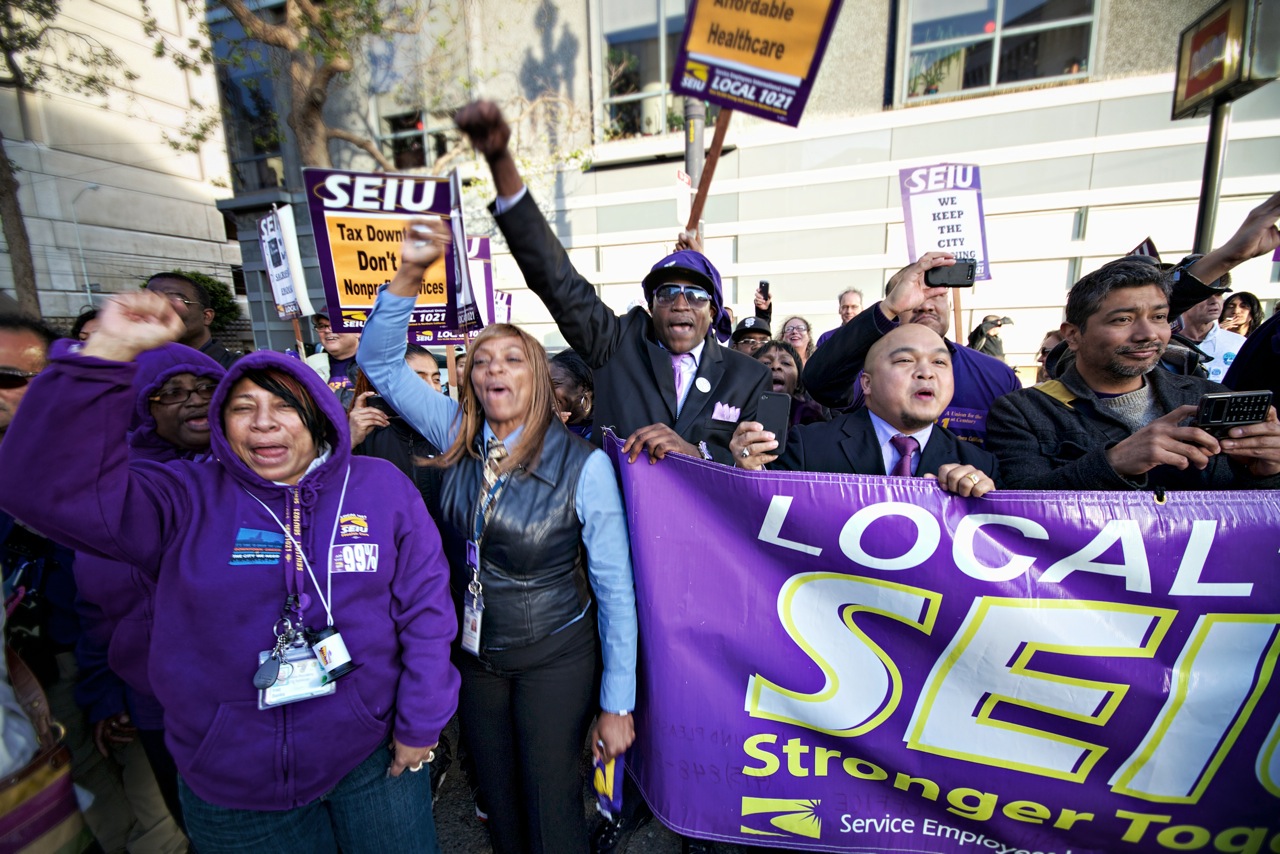
More than 1,000 city employees gathered at City Hall April 18 for a protest that ended in 23 arrests.

The protest comes as the SEIU Local 1021 contract negotiations with the city’s employee relations division are underway. According to Larry Bradshaw, Local 1021 vice president, the city’s proposal may result in pay cuts and health care cost increases for city workers.

“Here’s your negotiations update. The city and county wants you to take another 2 ½ percent pay cut this year and next year. The courts want their court-workers to take a five percent pay cut indefinitely,” Bradshaw, who works as a paramedic, told the crowd.

He also claimed that: “If you have Kaiser, under the city’s proposal you’re going to pay six times more than you’re paying currently. If you have Blue Shield, you’re going to pay twice as much. If you’re on the city plan—I’m not making this up—you’re going to pay one hundred times more than what you’re paying right now.”

Workers at the rally ranged from hall janitors to General Hospital nurses to Department of Emergency Management dispatchers donning shirts reading, “we run 911!”

Workers from the International Federation of Professional and Technical Engineers Local 21 also attended to show solidarity.

Sups Avalos, Mar, Kim, Chiu, Campos and Olague offered their support at the rally.

Around 6:30, the group left city hall and marched down Polk St. City workers then stretched caution tape across Market at Van Ness, in front of a Bank of America branch, and 23 sat down on the street. After a police warning, they were arrested for obstructing the sidewalk.

“We’re sitting to protest the greed of the city. The man is getting raises. The district attorney and the city attorney are getting raises. And they want us to take more pay cuts and furloughs,” said Arlette Smith, a protective services social worker, ten minutes before she was arrested.

The union wants to take these pay cuts off the table.

SEIU Local 1021 spokesperson Carlos Rivera also noted, “we’re sitting by Bank of America because banks and corporations don’t pay their fair share.”

The union is calling into question a tax settlement from 2001, in which a court ruled in favor of several corporations that sued the city over a hybrid payroll and gross receipts tax structure. The union characterizes the resulting loss of about $25 million per year in tax revenue as a loophole.

“The payroll tax is only paid by ten percent of San Francisco businesses, yet they’re asking city workers and non profit workers to continue to shoulder these massive budget deficits year after year,” said SEIU spokesperson Anna Bakalis.

Bakalis said that the SEIU is focusing on reinstating a gross receipts tax after researching alternative solutions for the city budget, if the pay cut and health care increases do not go though.

“We want to be able offer some solutions,” she told the Guardian. “We want to help them fix the budget.”

The union plans to return to city hall for further demonstration April 30 “if they have not taken those pay cuts and health care cuts off the table,” according to Bradshaw.

In city workers’ shoes

6

We both work under City Hall’s iconic dome as civil servants. While I often work late into the evening hours as a supervisor, Robert’s back-breaking work as a janitor is often done past the midnight hour, five nights a week.

I had the opportunity to meet Robert last week, as part of the “Walk A Day In Our Shoes” program of Service Employees International Union, Local 1021.

Robert is 52 years old. He’s worked for the city since 1999. Before that, he worked for San Francisco Unified School District. He sweeps and mops the floors and stairs of the famous rotunda and cleans 150 cubicles.

Last week, Robert had me take off my jacket and tie, roll up my sleeves and do his job for a while. I swept the marble floors, which are truly unending. I mopped the grand marble staircase behind happy couples exchanging wedding vows. He let me attempt to push a gigantic whirring machine that felt more like a Zamboni than a vacuum.

When I was younger, I had a summer job as a janitor at a public high school, so I know how truly strenuous Robert’s job is.

Robert injured his spine as a result of pushing that heavy vacuum for years. When he was in the hospital treating his spinal injury, the doctors discovered cancer. While in chemotherapy, he didn’t miss a day of work. He lives cancer-free today.

Robert is also a green pioneer at City Hall — he started a recycling program here before it was popular to do so. After that, the rest of the city caught on. He has photos of himself and the past four mayors in his home. He offers directions to visitors. He has a son, and they both live in his sister’s home. He speaks lovingly of his wife, who he lost to diabetes several years ago.

As our economy evolves, we can’t leave people like Robert — those who support our world-class city —behind. While we court businesses who create new jobs in our city, we also need to reinvest in the people who do the important work that often goes unnoticed.

Hospital workers are up at 4am, preparing meals for patients. Library technicians provide bilingual translation for our children. Others, like Robert, are up until 1am, making sure we have a clean and safe environment to work every day.

After years of concessions to balance deep budget deficits, city workers experienced ongoing cuts to their wages and benefits. In current contract negotiations, they are being asked to give hundreds more each month in healthcare costs to insure their children.

We appreciate all they have done to help our city in times of need. As our city recovers economically, it’s time to thank them, to ask others to help shoulder the costs for affordable housing, parks and recreation facilities and schools, and to reform our local business tax — which is paid by only 10% of our city’s companies.

Last week, I got to know a fellow civil servant whose work we need to remember to value. Which is why I will stand alongside Robert, labor unions, nonprofits, community members and neighbors on Wednesday, April 18, in front of City Hall from 4pm to 7pm. Please join us in supporting the workforce that supports us all, 24 hours a day. 

David Chiu is president of the Board of Supervisors.Thousands of community allies, elected officials, and SEIU 1021 members will rally on Wednesday, April 18 to close tax loopholes on mega banks and corporations from 4pm to 7pm at City Hall.

The losing bets

26

By Darwin BondGraham

news@sfbg.com

Wall Street’s massive taxpayer funded bailout, initiated by the Bush administration and carried forward under President Obama, never really ended — it just shifted from federal to local sources of funding. Even while local and state governments have been forced to cut back on crucial services, wealthy banks and investment firms are being padded with enormous cash flows sucked directly from the already strained budgets of cities, counties, and public agencies.

That’s the message a growing chorus of activists in the Bay Area are bringing before the boards, councils, and commissions that entered into complex financial deals with Wall Street banks, deals that turned toxic in the crash of 2008. Activists want elected officials and the banks to cancel the contracts and refund the public.

The Bay Area is the epicenter of this renewed movement for financial justice. Last week, teachers from Peralta College, organizers with the Alliance of Californians for Community Empowerment (ACCE), Oakland religious leaders, and Occupy Oakland activists organized four protests contesting what they say is bank predation on local communities.

At issue are arcane financial instruments called interest rate swaps. Sold by banks to virtually every sizable government and local agency in the US through the 2000s, rate swaps promised governments the ability to “swap” their potentially costly variable rate payments on bonds into a synthetic fixed rate. Seeking to protect local taxpayers during the volatile 2000s, when floating interest rates were rising, local leaders eagerly signed on.

But the economic meltdown turned those tools into golden handcuffs for local government agencies. Taxpayers are now forced to regularly pay millions to the banks simply because variable interest rates, at the urging of the Federal Reserve, have fallen far below the synthetic rates. These deals might seem numbingly complex, but the effects on local communities are clear and painful.

“The Metropolitan Transportation Commission is paying upwards of $53 million a year on rate swaps,” said Alia Phelps of ACCE at a protest on Feb. 21 outside of the former Bank of America building at 555 California Street. “This is money that isn’t going to keep routes in service, that isn’t paying drivers, nor going to repair buses, or to keep fares lower. We need these swaps renegotiated.”

That protest included visits to half a dozen banks. Activists demanded branch managers fax a letter to their corporate headquarters calling on the banks to voluntarily renegotiate swaps signed with the Metropolitan Transportation Commission (MTC), the Bay Area’s regional transportation authority, which has lost over $100 million on toxic swap deals.

In 2002 the Bay Area Toll Authority (BATA), a state-level agency operated by the MTC, issued more than $1 billion in bonds to pay for repairs and seismic upgrades of regional toll bridges. Three financial giants stepped forward promising to lower MTC’s long-term borrowing costs on these bonds by using interest rate swaps. Ambac, Solomon Smith Barney and Morgan Stanley signed deals with the MTC to cover $300 million in debt.

“With this transaction, we are getting the peace of mind of a fixed debt payment at a significant discount from traditional price levels,” MTC’s Chief Financial Officer Brian Mayhew said at the time of the deal.

Basically the swap agreement had the MTC paying a fixed interest rate of 4.1 percent to the banks, while the banks paid 65 percent of the London Interbank Offered Rate (LIBOR), a key benchmark used in global financial markets. Whichever party’s sum happened to be higher when payments came due would pay the difference. The advantage of the deal, in the eyes of the MTC’s managers, was that it would lock-in a low interest rate on MTC’s debt, potentially saving as much as $45 million.

“We think it’s a good time to lock in these low rates,” Mayhew said in 2002.

Fast forward to 2009. A year into the financial crisis, interest rates collapsed. LIBOR, which had been fluctuating around 5 percent and reached a peak of 5.8 percent in September of 2007, plummeted to virtually zero. The flow of payments became entirely one-sided, from MTC to banks that offered this deal. The advantage of the swap evaporated, and it became a toxic asset. While the Federal Treasury would offload similar toxic assets from the “too big to fail banks” using the TARP program, local governments were stuck with them.

As Ambac careened toward bankruptcy in 2010 due to its absurdly over-leveraged portfolio of credit default swaps, the MTC was forced to terminate its swap agreement with the company, paying the exorbitant sum of $104 million, after already having paid out $23 million in interest. All of this was essentially bridge toll money, surrendered by drivers crossing the seven state-owned bridges administered by BATA: the Bay, Antioch, Benicia-Martinez, Carquinez, Dumbarton, Richmond-San Rafael, and San Mateo bridges.

The drain on MTC funds indirectly affects all of its programs, including operational support for AC Transit, Muni, and other regional bus and train services. According to its most recent Comprehensive Annual Financial Report, MTC and its transit agency partners are on the hook for another $235 million in interest rate payments due on swaps with a rogue’s gallery of banks including Wells Fargo, Morgan Stanley, Citigroup, Bank of America, JP Morgan, Bank of New York, and Goldman Sachs. All of this money will be diverted from the MTC’s various transit infrastructure, planning, and operations accounts.

“The big picture is service cuts, pay cuts, work speed ups, fare hikes, route eliminations, and other things that harm working people who ride transit,” said retired Muni worker Ellen Murray.

The MTC’s quarter-billion dollar rate swap nightmare is only the most obvious part of a more systemic problem. Until at least 2030, given current conditions, San Francisco’s Airport Commission must make costly rate swap payments to numerous banks, including JP Morgan Chase, Goldman Sachs, Depfa, Bank of America, and Merrill Lynch, on agreements associated with more than a half-billion in debt. Much of this is linked to commercial paper issued to pay for infrastructure at the Airport (SFO).

Unlike the MTC, SFO’s financial managers were more prudent in entering swap agreements, and therefore secured better terms that have produced a net savings. “The Airport has saved about $92 million to date,” Assistant Deputy Airport Director Kevin Kone told us, referring mostly to gains made between 2005 and late 2007.

But since 2008, SFO’s swaps have been losing money. When Lehman Brothers collapsed, and Bear Stearns imploded and was absorbed into JP Morgan, SFO was forced to terminate swaps with both companies, costing $6.7 million. Last year SFO paid $6.65 million to terminate a rate swap agreement with Ireland’s Depfa Bank. In September, the Airport paid another $4.6 million to end yet another rate swap with JP Morgan. These specific swap agreements, Kone says, “were functioning as they should have early on, providing savings,” but now they’re draining public funds.

SFO’s seven remaining swaps have a negative value of $67 million, according to San Francisco’s 2011 Comprehensive Annual Financial Report. As with the MTC, SFO’s debts will ultimately be paid by passengers and taxpayers. Kone says nobody really knows how much these swaps could ultimately impact the airport, either in terms of cost or savings.

“If interest rates rise, they could have a positive cost savings impact on the airport,” he said.

Joe Keffer of the Service Employees International Union (SEIU) Local 1021 said at the Feb. 21 rally that Oakland has already paid Goldman Sachs $26 million on a swap that dates back to 1997, and that under current market conditions, the city will have to pay roughly another $25 million until the contract expires in 2021.

Oakland’s toxic deal with Goldman Sachs is now the subject of much scrutiny. The newly formed Coalition for Economic and Social Justice —made up of churches, labor unions, neighborhood groups, and Occupy Oakland activists— took up the issue with the City Council on Feb. 21, packing the chamber with one of the more diverse activist coalitions in recent memory.

“We’re here to implore you to get the City of Oakland out of this toxic relationship,” Rev. Daniel Buford of the Allen Temple Baptist Church told the council.

Members of the Oakland City Council are sympathetic to this message. In a letter sent last June, Council member Rebecca Kaplan implored Goldman Sachs CEO Lloyd Blankfein to spare Oakland’s taxpayers: “By bringing the contract to conclusion with no penalty fees, and negotiating a reasonable exit strategy, you would be demonstrating good faith to public taxpayers in the most substantial way.” At the conclusion of public comment Tuesday night, Oakland Council member Libby Schaaf promised the public action on the swap.

In a Valentine’s Day protest the previous week, 50 activists visited the Oakland offices of Morgan Stanley. Faculty and students from the Peralta Community College system went there demanding the bank renegotiate a rate swap that is estimated to have cost the college $1.6 million last year. The same day the college’s board of trustees discussed the need to cut $12 million more from the budget in 2012. Morgan Stanley CEO James Goreman’s pay for 2011 was $14 million, opponents of the swap point out.

Peralta student and Bay Area transit activist Adam Ross attempted to reach the 9th floor offices of Morgan Stanley in a small delegation to deliver a letter demanding the bank renegotiate the swap: “There were signs on the door saying the office was closed. They probably got tipped off and locked the doors.”

Afterward, Caesar Swaby of Riders for Transit Justice addressed the rally, connecting dots for the different constituencies present: “Morgan Stanley is taking money from Peralta College, causing classes to be cut. Morgan Stanley is also taking money from transit riders. Morgan Stanley has a $3 million rate swap with the MTC, causing cuts to bus and train services.”

A Morgan Stanley representative declined to comment for this report. Goldman Sachs did not return calls and emails. A spokesperson for the MTC was unable to be reached by deadline.

Meet the new supervisor

10

Christina Olague, the newest member of the Board of Supervisors, faces a difficult balancing act. She was appointed by Mayor Ed Lee, whom she supported as co-chair of the controversial “Run Ed Run” campaign, to fill the vacancy in District 5, an ultra-progressive district whose voters rejected Lee in favor of John Avalos by a 2-1 margin.

So now Olague faces the challenge of keeping her district happy while staying on good terms with the Mayor’s Office, all while running in her first campaign for elected office against what could be a large field of challengers scrutinizing her every vote and statement.

Olague has strong progressive activist credentials, from working with the Mission Anti-Displacement Coalition to protect low-income renters during the last dot-com boom to her more recent community organizing for the Senior Action Network. She co-chaired the 2003 campaign that established the city’s minimum wage and has been actively involved in such progressive organizations as the Milk Club, Transit Riders Union, and the short-lived San Francisco People’s Organization.

“One of the reasons many of us are so supportive of Christina is she is grounded in the issues of low-income San Franciscans,” said Gabriel Haaland, who works with SEIU Local 1021 and accompanied Olague to a recent interview at the Guardian office.

She also served two terms on the Planning Commission — appointed by Board of Supervisors then-President Matt Gonzalez in 2004 and reappointed by then-President Aaron Peskin in 2008 — where she was known for doing her homework on complicated land use issues and usually landing on the progressive side of divided votes.

“Coming from the Planning Commission, she can do a lot of good,” said Tom Radulovich, executive director of Livable City and a supporter who has worked with Olague for 15 years. “We lost a lot of collective memory on land use issues,” he said, citing the expertise of Chris Daly and Aaron Peskin. “We do need that on the board. There is so much at stake in land use.”

Olague disappointed many progressives by co-chairing Progress for All, which was created by Chinatown power broker Rose Pak to push the deceptive “Run Ed Run” campaign that was widely criticized for its secrecy and other ethical violations. At the time, Olague told us she appreciated how Lee was willing to consider community input and she thought it was important for progressives to support him to maintain that open door policy.

In announcing his appointment of Olague, Lee said, “This is not about counting votes, it’s about what’s best for San Francisco and her district.” Olague also sounded that post-partisan theme, telling the crowd at her swearing-in, “I think this is an incredible time for our city and a time when we are coming together and moving past old political pigeonholes.”

With some big projects coming to the board and the working class being rapidly driven out of the city, progressives are hoping Olague will be a committed ally. There’s some concern, though, about her connections to Progress For All campaign’s secretive political consultant, Enrique Pearce.

Pearce has become a bit of a pariah in progressive circles for his shady campaign tactics on behalf of powerful players. In 2010, his Left Coast Communications got caught running an independent expenditure campaign partly funded by Willie Brown out of Pearce’s office, even though Sup. Jane Kim was both its beneficiary and his client — and that level of coordination is illegal. Last year, Pearce was hired by Pak to create the “Run Ed Run” campaign and write the hagiographic book, The Ed Lee Story, which also seemed to have some connections with Lee’s campaign. The Ethics Commission hasn’t fined Pearce for either incident, and he didn’t return a Guardian call for comment.

Olague told us not to worry. “He’s a friend…and I think it’s an exaggerated concern,” she said, confirming but minimizing his role so far. Yet she hired one of Pearce’s former employees, Jen Low, as one of her board aide. Olague’s other aides are Chris Durazo from South of Market Community Action Network (SOMCAN) and Dominica Henderson, formerly of the SF Housing Authority.

Debra Walker, a progressive activist who served on the Building Inspection Commission and has worked with Olague for decades, said she’s a reliable ally: “She’s from the progressive community and I have no equivocation about that.”

Olague makes no apologies for her alliances, saying that she is both independent and progressive and that she should be judged by her actions as a supervisor. “People will have to decide who I am based on how I vote,” she said, later adding, “I support the mayor and I’m not going to apologize for that.”


OLAGUE’S PRIORITIES

Olague was born in Merced in 1961 to a Mexican immigrant father who fixed farming equipment and a stay-at-home mother. She went to high school in Fresno and moved to the Bay Area in 1982. She attended San Francisco State University but had to drop out to help support her family, working at various stock brokerage firms in the Financial District. She later got a degree in liberal studies from California Institute of Integral Studies.

In 1992, Olague’s mother was in serious car accident that left her a quadriplegic, so Olague spent the next seven years caring for her. After her mother died, Olague left the financial services industry and became a community organizer for the Mission Anti-Displacement Coalition, battling the forces of gentrification and then-Mayor Brown and becoming an active player in the ascendant progressive movement.

But Olague never abided progressive orthodoxy. She backed Mark Leno over the more progressive Harry Britt in their 2002 Assembly race and backed Leno again in 2007 when he ran for state Senate against Carole Migden. She also voted for the Home Depot project on Bayshore Boulevard despite a progressive campaign against the project.

Olague worked with then-Sup. Chris Daly to win more community benefits and other concessions from developers of the Trinity Plaza and Rincon Tower projects, but now she is critical of Daly’s confrontational tactics. “Daly’s style isn’t what I agree with anymore,” Olague said, criticizing the deals that were cut on those projects to approve them with larger than required community benefits packages. “I think we romanticized what we got.”

So how does Olague plan to approach big development proposals, and is she willing to practice the brinksmanship that many progressives believe is necessary to win concessions? While she says her approach will be more conciliatory than Daly’s, she says the answer is still yes. “You push back, you make demands, and if you don’t think it’s going to benefit the city holistically, you just fucking say no,” Olague said.

Walker said Olague has proven she can stand up to pressure. “I think she’ll do as well as she did on the Planning Commission. She served as president and there is an enormous amount of pressure that is applied behind the scenes,” Walker said. “She’s already stood up to mayoral pressure on some issues.”

Yet even some of Olague’s strongest supporters say her dual — and perhaps dueling — loyalties to the Mayor’s Office and her progressive district are likely to be tested this year.

“It’ll be challenging for her to navigate,” Radulovich said. “The Mayor’s Office is going to say I want you to do X and Y, and it won’t always be progressive stuff, so it’ll be interesting to see how that plays out.”

But he said Olague’s land use expertise and progressive background will likely count for more than any bitter pills that she’s asked to swallow. “Sometimes, as a policy maker, you have to push the envelope and say we can get more,” he said. “It helps if you’re willing to say no to things and set boundaries.”

When we asked Olague to lay out her philosophy on dealing with land-use issues, she said that her approach will vary: “I have a very gray approach, project by project and neighborhood by neighborhood.”

Only a couple weeks into her new role, Olague said that she’s still getting a lay of the land: “I’m in information gathering mode, meeting with neighborhood groups to try to figure out what their issues are.”

But Olague said she understands that part of her job is making decisions that will disappoint some groups. For example, after Mayor Lee pledged to install bike lanes on Fell and Oak streets to connect the Panhandle to The Wiggle and lessen the danger to bicyclists, he recently stalled the project after motorists opposed the idea.

“I’m a transit-first person, for sure. I don’t even drive,” Olague said of her approach to that issue, which she has now begun to work on. “We’ll try to craft a solution, but then at some point you have to fall on one side or the other.”


THE “JOBS” FOCUS

One issue on which Olague’s core loyalities are likely to be tested is on the so-called “jobs” issue, which both Lee and Olague call their top priority. “Jobs and economic revitalization are very important,” she told us.

Progressives have begun to push back on Lee for valuing private sector job creation over all other priorities, such as workers’ rights, environmental safeguards, and public services. That came to a head on Jan. 26 at the Rules Committee hearing on Lee’s proposed charter amendment to delay legislation that might cost private sector jobs and require extra hearings before the Small Business Commission. Progressives and labor leaders slammed the proposal as unfair, divisive, unnecessary, and reminiscent of right-wing political tactics.

But when we interviewed Olague the next day, she was reluctant to criticize the measure on the record, even though it seemed so dead-on-arrival at the Board of Supervisors that Mayor Lee voluntarily withdrew it the next week.

Olague told us job creation is important, but she said it can’t squeeze out other priorities, such as protecting affordable rental housing.

“We always have to look at how the community will benefit from things. So if we want to incentivize for businesses, how do we also make it work for neighborhoods and for people so that we don’t end up with where we were in the Mission District in the ’90s?” she said.

Olague also said that she didn’t share Lee’s focus on jobs in the technology sector. “There’s a lot of talk of technology, and that’s fine and I’m not against that, and we can see how it works in the city. But at the same time, I’m concerned about folks who aren’t interested necessarily in working in technology. We need other types of jobs, so I think we shouldn’t let go of the small scale manufacturing idea.”

Mayor Lee’s call for more hearings gets wary reception

41

Labor and the Left came out strongly against Mayor Ed Lee’s proposed charter amendment to require all city legislation be delayed and subjected to hearings by the Small Business Commission and other commissions if it might cost private sector jobs, putting its prospects of making the ballot in doubt.

 “This legislation is one, unnecessary; two, unbalanced; and three, divisive,” Mike Casey, president of the San Francisco Labor Council – whose executive committee voted unanimously to oppose the legislation – said during today’s Rules Committee hearing on the measure.

He and other labor leaders noted that members of the business community have plenty of opportunities to weigh in on legislation it opposes, but Lee’s proposal would elevate employers’ interests far above those concerning the environment, consumers, public health, or workers. “This legislation gives one stakeholder undue power in the democratic process, which is undemocratic,” said Kate Hegé of La Raza Centro Legal, which represents day laborers and other immigrants.

Teacher Ken Tray of United Educators of San Francisco said, “Often times ‘jobs’ is used as a red herring to divert the city from doing what it needs to do.” It was a common theme, as opponents of the proposal noted that paid sick leave, the local minimum wage, and requiring employee health benefits were all fiercely opposed by the business community. “Anything that raises workers up, we’re told it’s a job killer,” said Larry Bradshaw of SEIU Local 1021.

Small business representatives – a bit sheepishly, given the tenor of the hearing, and without support from their downtown brethren – said they were simply looking for the ability to express their concerns. “We’ve tried to let small business have a voice at the Board of Supervisors,” said longtime small business advocate Scott Hauge, a regular at City Hall.
Keith Goldstein of Potrero Dogpatch Merchants Association said, “We feel we don’t have a say in this process.”

Mayor’s Office board liaison Jason Elliott emphasized that Lee’s charter amendment would create a delay and an extra hearing or two, but that supervisors would still be free to approve the legislation anyway. “This is about public participation and feedback,” Elliott said.

But Sup. David Campos, who led the questioning of Elliott, wasn’t buying it. “What’s the reason behind this? Is there a specific reason the Mayor’s Office has decided to do this now and through a charter amendment?” Campos said, probing for instances in which the Mayor’s Office thought the business community hadn’t been heard.

Elliott continued to say it was about emphasizing jobs and taking more public input, but he couldn’t explain what’s lacking currently or what’s muting employers. Campos thanked the Mayor’s Office for being willing to work with supervisors and accept amendments – including many introduced today, which delayed the vote on the measure until next week.
But Campos questioned the need for the legislation, comparing it to the hollow jobs rhetoric from the current field of Republican presidential candidates. “It’s not just the number of jobs you have, it’s the quality of those jobs,” Campos said.

(Side note: the Mayor’s Office issued a press release today celebrating the first two businesses to take advantage of last year’s controversial mid-Market payroll tax exemption, Zendesk and Pearl’s Deluxe Burgers, which created 56 jobs between them. And to help create those great burger joint jobs, Pearl’s got Redevelopment Agency assistance, a low-interest city loan, and an exemption from the payroll tax. For hiring burger flippers that probably make minimum wage. But I digress…)

Campos said that everyone in City Hall wants to see more good jobs in the city, “but I don’t believe this is a constructive approach.” Sup. Jane Kim echoed the sentiment, saying private sector job creation isn’t the only imperative. “Lowering our minimum wage to $3 or $1 an hour would create plenty of jobs in San Francisco,” she said.

Even the more conservative third committee member, Sup. Mark Farrell, said he tends to agree with his committee colleagues and made the motion to continue the item until next week, when its prospects for passage look weak unless Lee can convince them that there’s more to this measure than just political grandstanding.

Occupy is back — with horns and glitter

8

yael@sfbg.com

On Jan. 20, hundreds of activists converged on the Financial District in a day that showed a reinvigorated and energized Occupy movement.

The day of action was deemed “Occupy Wall Street West.” Despite pouring rain, the numbers swelled to 1,200 by early evening.

Critics have said that the Occupy movement is disorganized and lacks a clear message. Some have decried its supposed lack of unity. Others have even declared it dead.

But the broad coalition of community organizations that came together to send a message focused on the abuses of housing rights by corporations and the 1 percent sent a clear message:

The movement is very much alive.


A FULL SCHEDULE

Protesters packed the day with an impressive line-up of marches, pickets, flash mobs, blockades, and everything in between.

The action began at 6:30 a.m., when dozens chained and locked themselves together, blocking every entrance to Wells Fargo’s West Coast headquarters at 420 Montgomery Street. The bank didn’t open for business that morning.

Another group of protesters did the same thing at the Bank of America Building around the corner. A dozen blockaded one of the bank’s entrances from 8:30 a.m. to 6 p.m., preventing its opening. A group organized by Act Now to Stop War and End Racism (ANSWER) closed down the Bank of America branch at Powell and Market for several hours.

The Bank of America branch at Market and Main was also closed when activists turned it into “the Food Bank of America.” Several chained themselves for the door, while others set up a table serving donated food to hundreds of people.

Meanwhile, activists with the SF Housing Rights Coalition and Tenants Union occupied the offices of Fortress Investments, a hedge fund that has overseen the destruction of thousands of rent controlled apartments at Parkmerced. Direct actions also took place at the offices of Bechtel, Goldman Sachs, and Citicorp.

Hundreds picketed the Grand Hyatt at Union Square in solidarity with UNITE HERE Local 2 hotel workers.

A group of about 600 left from Justin Herman Plaza at noon and marched to offices of Fannie Mae, Wells Fargo, and the Immigration and Customs Enforcement Agency (ICE) in a protest meant to draw attention to housing and immigrant-rights issues.

“It’s not just a corporate problem. The government has been complicit in these abuses as well,” said Diana Masaca, one of the protest’s organizers.

More than 100 activists from People Organized to Win Employment Rights (POWER) and the Progressive Workers Alliance “occupied Muni,” riding Muni buses on Market Street with signs and chants demanding free transit for youth in San Francisco.

Another 200 participated in an “Occupy the Courts” action at the Ninth Circuit Court of Appeals, in protest of the Citizens United Supreme Court decision and corporate personhood.


GLITTER AND BRASS

Exhausted, soaked protesters managed to keep a festive spirit throughout the day, with colorful costumes, loud music, and glitter — lots of glitter.

The Horizontal Alliance of Very Organized Queers (HAVOQ) and Pride at Work brought the sparkly stuff, along with streamers and brightly colored umbrellas, to several different actions. Many painted protest slogans onto their umbrellas, proclaiming such sentiments as “I’ll show you trickle down” and “Not gay as in happy, queer as in fuck capitalism.”

According to protester Beja Alisheva, “HAVOQ is about bringing fabulosity to the movement with glitter, queerness, and pride. All day we’ve been showing solidarity between a lot of different types of oppression.”

There was also the Occupy Oakland party bus — a decked-out former AC transit bus — and carnival, a roving party that shut down intersections and bank entrances in its path while providing passengers a temporary respite from rain.

The Brass Liberation Orchestra, a radical marching band that has been energizing Bay Area protests for a decade, showed up in full force with trumpets, drums, trombones, and a weathered sousaphone.

The Interfaith Allies of Occupy also used horns to declare their message. About 30 participated in a mobile service, sounding traditional rams’ horns and declaring the need to “lift up human need and bring down corporate greed.”

Said Rabbi David J. Cooper of Kehela Community Synagogue in Oakland: “Leviticus 19 says, do not stand idly by in the face of your neighbor’s suffering. Well, we’re all neighbors here. Ninety-nine percent of us are suffering in some way, economically or spiritually. And maybe that number is 100 percent.”


FOCUS ON HOUSING

A coalition called Occupy SF Housing called for and organized the day of action, but the messages ranged from environmental to anti-war to immigrant rights.

Many groups did focus in on housing-related issues — and a takeover of a vacant hotel building stressed the urgency and need to house homeless San Francisco residents.

Housing protests included an anti wage-theft occupation led by the Filipino Community Center and the National Alliance for Filipino Concerns at the offices of CitiApartments, an action at the offices of Fortress Investments to demand a halt to predatory equity, and an “Occupy the Auction” demonstration in which protesters with Occupy Bernal stopped the day’s housing auction (at which foreclosed homes are sold) at City Hall.

“A lot of the displacement in this city is happening because of banks and because of things that are out of peoples’ control,” said Amitai Heller, a counselor with the San Francisco Tenants Union. “People will live in a rent controlled apartment for 20 years thinking that they have their retirement planned. A lot of the critiques of the movement are, if you couldn’t afford it you should move. But these people moved here knowing they could afford it because of our rent controls.”


LIBERATE THE COMMONS

Most of the early protests drew a few hundred people. But when the 5 p.m. convergence time rolled around, many people got off work and joined the march. A rally at Justin Herman Plaza brought about 600; by the time the march joined up with others at Bank of America on Montgomery and California, the numbers had doubled.

The evening’s demonstration, deemed “liberate the commons,” was also more radical than other tactics throughout the day; organizers hoped to break into and hold a vacant building, the 600-unit former Cathedral Hill Hotel at 1101 Van Ness.

When protesters arrived at the site, police were waiting for them. Wearing riot gear and reinforced by barricades, the cops successfully blocked the Geary entrance to the former hotel.

The darkness, rain, and uncertainty created a chaotic environment as protesters decided how to proceed. Some attempted to remove barricades; others chanted anti-police slogans.

Soon, cries of “Medic! We need a medic!” pierced the air. A dozen or so protesters had been pepper sprayed.

Police Information Officer Carlos Manfredi later claimed that the pepper spray was in response to “rocks, bottles and bricks” thrown by protesters. He also claimed that one officer was struck in the chest by a brick, and another “may have broken his hand.”

But I witnessed the entire incident, and I can say that no rocks, bottles or bricks were thrown at police.

When protesters opted to march down Van Ness, apparently towards City hall, several broke windows at a Bentley dealership at 999 Van Ness.

The march then turned around and headed back up Franklin, ending at the former hotel’s back entrance. There, it became clear that some protesters had successfully entered the building; they unfurled a banner from the roof reading “liberate the commons.”

Soon, many other protesters streamed into the building. They held it, with no police interference, for several hours.

Around 9:30, police entered the building and arrested three protesters for trespassing. About 15 others remained in the building, but left voluntarily by midnight.

This building has been a target of protest campaigns in San Francisco since it was purchased by California Pacific Medical Center, which closed the hotel in 2009. There are plans underway for a hospital to open at the site in 2015.

The project has been met with opposition from unions such as SEIU United Healthcare Workers West and UNITE HERE Local 2. The California Nurses Association (CNA) has also come out against the hospital proposal. In fact, it was the target of a CNA protest earlier in the day Jan. 20, when protesters created a “human billboard” reading “CPMC for the 1 percent.”

At a Jan.18 press conference, CNA member Pilar Schiavo said that at the former Cathedral Hill Hotel site, “A huge hospital is being planned with is being likened by Sutter to a five-star hotel. At the same time, Sutter is gutting St. Lukes Hospital, which is essential to providing healthcare for residents in the Mission, the Excelsior and Bayview- Hunter’s Point.”

Homes Not Jails, a group that finds housing for the homeless, often without regard to property rights, was crucial to planning the “Liberate the Commons’ protest. The group insists that the 30,000 vacant housing units in San Francisco should be used to shelter the city’s homeless, which they estimate at 10,000.


RAINY REBIRTH

Wet and cold conditions were not what Occupy SF Housing Coalition organizers had in mind they spent weeks planning Occupy Wall Street West, which was billed as the reemergence of the Occupy Movement in San Francisco for 2012.

Yet for many, the day was still a success.

“The rain’s a downer. But I think it speaks to the power of the movement, the fact that all these people are still out getting soaked,” said Heller on Jan. 20.

Perhaps hundreds of “fair-whether activists” did forgo the day’s events to stay out of the cold. If that’s the case, then occupy protesters with big plans for the spring should be pleased.

At this rate, it seems that Occupy will survive the winter- and emerge with renewed energy in 2012.


This article has been to corrected. We originally reported that a demonstration at the offices of Citi Apartments was led by the Chinese Progressive Association (CPA). In fact, it was led by the Filipino Community Center and the National Alliance for Filipino Concerns, and supported by a number of organizations including the Progressive Workers Alliance, of which CPA is a member organization. We regret the error.

Protesters “occupy” vacant building

38

After a long day of protest that began at 6 a.m., 1200 joined a march affiliatiated with Occupy SF  last night. The march aimed to “liberate the commons”; organizers said they succeeded when they were able to enter a vacant building, the former Cathedral Hill Hotel at 1101 Van Ness.

The march left from Justin Herman Plaza just after 5 p.m. and arrived at the former hotel around 7 p.m. after rallying at several sites along the way.

There, protesters were greeted by a police line and barricades protecting the buildings.

SFPD Officer Carlos Manfredi reports that protesters tried to remove barricades with the hooks of their umbrellas, and then threw “rocks, bottle and bricks” at police. Police responded by pepper spraying a dozen protesters.

Many eyewitness reports confirm manipulation of barricades, but deny that anything was thrown at police, instead attributing the pepper spray usage to anti-police slogans chanted by the crowd.

After the confrontation, the march turned down Van Ness. Some protesters broke windows at a Bentley dealership at 999 Van Ness.

The march soon turned back around, and protesters regrouped near the building’s back entrance on Franklin between Geary and Post.

There, the crowd looked up to see figures on the roof unfurl a banner reading “Liberate the Commons.” The back door was then opened from the inside by activists, largely from Homes Not Jails, who had broken into the building.

Soon after, demonstrators began streaming into the building.

Police arrived around 8 p.m. and redirected traffic, blocking Geary between Van Ness and Franklin, while a mass of several hundred protesters continued to block Franklin street between Post and Geary.

At 8:30, Manfredi said that police had no plans to rush into the “occupied” building.

“RIght now officer safety is our number one priority so we’re not going to go in there and rush into this event. Obviously Van Ness and Geary is a very busy street…We’re monitoring the situation, we’re talking with the owner, and we’re going to come up with a game plan…We’re going to see if we can open up some line of communication and speak to them, and see if we can come to some form of resolution,” Said Manfredi.

Manfredi also discussed the difficulties police find in communicating with Occupy SF protesters, noting that “a lot of times with these protesters, there’s not one single person responsible for leading the pack. So it’s very difficult, when you talk to one person they may not agree with the other ten. So that’s where the problem comes in.”

This “leaderless” quality, as well as privileging immediate human needs like shelter and food over some aspects of capitalism such as property rights, has been a running theme in the Occupy movement. Homeless advocacy was a large part of the Occupy SF focus in past months, as the encampment at Justin Herman Plaza created a community of homeless and housed activists.

Homes Not Jails, an organization that has been working with Occupy SF, was crucial in planning the “liberate the commons” protest. The group insists that the 30,000 vacant housing units in San Francisco should be used to shelter the city’s homeless, which they estimate at 10,000. San Francisco’s Human Services Agency reports the number of homeless at 6,455.

The cold rain pouring down throughout the night’s events increased the urgency many felt to find shelter for homeless colleagues. Said one demonstrator, “if we can prevent just one homeless person from dying of exposure in the rain tonight, the building takeover was worth it.”

The former Cathedral Hill Hotel, which has been vacant since it closed in 2009, is now owned by Sutter Health and California Pacific Medical Center, with plans to open a hospital at the site in 2015.

The project has been a target of several protests campaigns, including opposition from SEIU-United Healthcare Workers West, UNITE HERE Local 2, and the California Nurses Association (CNA). They also say the hospital will not cater to patients with medicare and medicaid.

At a press conferenece Jan. 18, CNA member Pilar Schiavo announced a protest at the site for the afternoon of Jan. 20.

Said Schiavo, “A huge hospital is being planned which is being likened by Sutter to a five-star hotel. At the same time, Sutter is gutting St. Lukes Hospital, which is essential to providing health care for residents in the Mission, the Excelsior and Bayview-Hunter’s Point. We know that the five-star hospital’s not aimed at serving the 99 percent, and we must hold Sutter accountable to all communities, not just those fortunate enough to have private insurance.”

Police cleared the street of protesters and entered the building around 9:30. Those who wished to were allowed to leave; several did, while about 15 remained. Protesters discussed plans to continue the building occupation through the night.

But most protesters providing support from the outsid had left by midnight, and those inside decided to leave voluntarily, according to organizer Craig Rouskey.

This post has been updated.

State of the occupations

0

news@sfbg.com, rebeccab@sfbg.com


STUDENTS TARGET THE 1 PERCENT

Another Occupy offshoot sprung up at San Francisco State University Dec. 1 when about 150 students attended a march and rally that culminated at Malcolm X Plaza, now the site of the San Francisco’s newest Occupy camp.

Students symbolically blocked off ATMs, wrapped Chase Bank machines in cellophane and plastered nearby Wells Fargo and Bank of America ATMs with “meet the one percent” flyers profiling wealthy University of California Trustee Monica Lozano and California State University Regent Bill Hauck.

The highlight of the action came when SF State President Robert Corrigan arrived on the scene. The group was using the people’s mic to read a letter addressed to Corrigan, penned by the Occupy SF State General Assembly, demanding that he write two letters. One should be directed to the school’s chancellor and CSU Board of Trustees, “urging them to repeal the 9 percent tuition fee increase” that the board passed Nov. 16, and another should go to “the presidents of every other CSU campus asking them to also contact the chancellor and Board of Trustees regarding a repeal of the 9 percent tuition fee increase.”

Corrigan listened, then participated in a frank question-and-answer session with protesters, urging them to contact Sacramento legislators. Yet he refused to write those letters or declare support for Occupy SF State.

Afterwards, the students returned to Malcolm X Plaza and erected about 15 tents, which organizers said would contain “books, food, and homework help” along with providing shelter for sleeping protesters.


OCCUPY LA MISIÓN

In the Mission, where city officials have been encouraging OccupySF to relocate from its current home in the Financial District, a separate new Occupy effort could be underway.

Organizer Enrique Del Valle says he and other organizers have been distributing flyers and talking to people and organizations throughout the neighborhood. “We’re getting it together to have a General Assembly,” he told us.

The effort is unrelated to the OccupySF General Assembly’s Nov. 29 decision to decline the city’s offer to utilize an abandoned lot at 1950 Mission Street, he added. Before the city made that offer, Del Valle, a community volunteer with connections with many Mission groups, says he was already working on forming a neighborhood occupation.

If Occupy SF had set up shop in the space offered by the city, “We would have worked with them,” he explained, “but set up somewhere else.”

Meanwhile, Mayor Ed Lee and OccupySF are still waiting for one another’s next moves. On the evening of Dec. 1, when San Francisco Police officers surrounded the camp in steel barricades, protesters felt another raid was underway. But they resisted and took down some barricades, causing police to suddenly back down and remove the rest.

“They’ve just been mindfucking us,” OccupySF protester Markus Destin told us. “As soon as they spend all that money breaking us down, we’ll just come back in a week and re-encamp.”

Mayoral Press Secretary Christine Falvey said Lee wasn’t aware OccupySF rejected his offer: “We haven’t heard back one way or another from the group. The offer is still out there and the group has all of the information they need from us. We are awaiting a decision. Mayor Lee has made it very clear to the group that he supports their first amendment rights and their right to assemble, but that overnight camping at Justin Herman Plaza is not an option for the long term because of the health and safety problems it creates.”


OCCUPY AGAINST FORECLOSURE

Community members rallied outside a foreclosed Visitacion Valley home Dec. 1 before moving their protest to the offices of the company that purchased the property.

At 11 a.m., dozens gathered in front of the residence where 75-year-old Josephine Tolbert had lived for nearly 40 years. A day earlier, Tolbert had arrived home with three young grandchildren in tow to find her locks changed. Organizers say the evicted resident needs to access the house to retrieve food and medicine.

The crowd — which included neighbors, friends, and members of Alliance of Californians for Community Empowerment (ACCE), Service Employees International Union (SEIU), OccupySF, and Occupy the Hood — demanded that Tolbert be let back in. According to Bayview resident and self-proclaimed “foreclosure fighter” Vivian Richardson, “They would not let her in to get food, diapers, or her diabetes medicine.”

Tolbert had run a daycare business from her home for 20 years. One of her regular clients, a mother with two young children, arrived during the rally. She was surprised to find that Tolbert was locked out of her home and unable to care for her children that day.

“I want to get in my home so I can resume my business,” Tolbert said. “That’s my occupation there, I don’t have any other way of caring for myself.”

The group then headed to the offices of True Compass Loan Services, LLC, the new owners of Tolbert’s home. About 20 supporters gathered at the Ocean Ave office, where ACCE organizer Grace Martinez singled out True Compass owner Ashok Gujral, who owns a $2.75 million home and multiple restaurants, according to a press release from a group calling itself the Foreclosure Fighters.

“The man is worth $10 million, and he has a bunch of limited liability companies,” said Martinez. “Everyone has been shocked at how this man could do this, he knows she is a senior.”

According to Martinez, Gujral personally refused to let Tolbert into her home Nov. 30. He and others from the company “don’t want her in there because they say she’ll refuse to leave,” Martinez added. Calls to Gujral’s office were referred to attorney Jak Marques, who did not return Guardian requests for comment.

A True Compass representative informed protesters “there’s no one here to talk to you,” then swiftly shut the door. But when a few protesters went around through a side entrance and let everyone else in, the group took their protest to the hallway inside.

They remained there for almost an hour, chanting, pounding rhythmically on the walls, and flooding the office on the other side of a locked door with phone calls, demanding Tolbert be allowed to return to her home to retrieve her medicine and belongings.

Five police officers arrived almost immediately as protesters entered company offices. One explained to the protesters that if they didn’t leave, they would face arrest for trespassing. A heated but measured back-and-forth ensued, in which protesters insisted that if Tolbert was his mother, the officer would feel differently. The officer, Lieutenant C. Johnson, responded, “If it was my mother — I don’t know. I have a house for my mother. But I feel for Josephine, and for the millions of other Americans in the same situation.”

Martinez quieted groans from protesters, replying, “You’re part of the 99 percent, and we’re not going to shoot the messenger.”

Organizers conferred and decided to leave the building voluntarily. Sergeant R. Young, who was also at the scene, told the Guardian, “It’s heartbreaking to do this. Their freedom of speech is a constitutional right that we take a sworn oath to protect.”


THE SEEDS OF A NEW AMERICA?

Does the Occupy movement signify a new beginning for America? Is history repeating itself? Is violence inevitable? These were some of the big questions pondered by a handful of prominent Bay Area writers, thinkers, artists, and activists Dec. 1 during a panel discussion organized by Salon.com.

Dan Siegel, who most recently made headlines for resigning as Oakland Mayor Jean Quan’s legal advisor because he disagreed with her decision to order a police raid of the Occupy Oakland encampment, was a panelist. “The perspective of Mayor Quan and other mayors, besides reflecting the 1 percent, reflects a misguided paradigm,” Siegel said. “The nation’s clearly in an economic crisis that this country has not seen since the 1930s. The mayors should be on the side of the 99 percent. They ought not be the lapdogs of Wall Street.”

Renowned author Rebecca Solnit also participated in the panel discussion. Asked if she thought Occupy symbolized a new beginning, she reflected on the past. “Huge mistakes were made on the left,” in past social movements, she said. “It was supposed to be the revolution, but the women were still expected to make the coffee.” She offered that Occupy represented an evolved manifestation that had benefitted from lessons learned over the years.

“It’s a culmination of decades of refining, searching, and building coalitions,” Solnit said. “It’s the beginning in the sense that summer’s the beginning. We’re reaping the fruit of … what’s been imagined.”

It’s also provided a spark for campus-based organizing. “The Occupy movement has given a tremendous amount of wind to the sails of the student movement and had a consciousness-raising aspect,” said Matt Haney, executive director of the University of California Student Association. “Now they are prepared in a new way to join all of those other folks who are also suffering.”

A key question put to panelists was whether Occupy ought to consider running candidates for office. In response, panelist Melanie Cervantes, an artist and activist, got to the heart of the issue. “What is political power? Is it just representation?” she asked.

Cervantes pointed out that autonomous social movements in Latin America have given rise to leftist political leaders, and she spoke of the past successes of mass-based organizations. “There were things that preceded us generationally, and they worked,” she pointed out. “There’s a lot of different ways people are experienced in trying to change things.”

Panelist Peter Coyote, an actor, activist, and founder of a radical underground group called The Diggers, offered an analogy in response to the idea of Occupy running candidates for office. “If you take a healthy goldfish and throw it into polluted water, it’s gonna get sick,” he said.

Solnit framed her answer as an analogy, too. “We live in a really crummy house with roaches and a leaky roof … Occupy is saying, let’s try to build a better house,” she said. “Our demand is for a better world, isn’t that obvious? We’re building a whole new political vocabulary, a whole new sense of possibility.”

As to the question of whether violence is inevitable as the movement continues to unfold, some panelists discussed nonviolence as a protest tactic, while others focused on the violent behavior of law enforcement officers against protesters. “You don’t hear students talk about using violence,” Haney said. “It’s more like how do we deal with violence that’s being used against us?”

Siegel stressed that the protests ought to be disruptive, yet nonviolent. “The question for our society is, who has the power?” he said. “At the end of the day, we live in a nation state, and people control things. And if they continue to control things, we’re screwed.”


WEST COAST PORT BLOCKADE

Occupy Oakland organizers have been engaged in planning yet another shutdown of the Port of Oakland on Dec. 12, which will coincide with attempts to shut down West Coast ports in San Diego, Los Angeles, Portland, Seattle, Longview, Tacoma, and Anchorage. “On December 12, the Occupy movements in different cities will … effectively shutdown the hubs of commerce, in the same fashion that Occupy Oakland shut down the Port of Oakland on November 2nd, the day of our general strike,” according to a Call to Action on WestCoastPortShutdown.org. “The message to you from Occupy Oakland in the face of police raids and continued disruptions of workers lives by the 1 percent is the following: The Occupy movement will strike back and rise again! We will blockade all of the West Coast Ports on December 12th in solidarity with longshoremen, port workers and truckers in their struggle against the 1 percent!” Steven T. Jones contributed to this report.

Alerts

0

alert@sfbg.com

THURSDAY 8

Feminist Occupiers

Eyewitness accounts from women in the Bay Area and London have attested to sexual harassment in Occupy camps and struggles to be heard at Occupy General Assembly meetings. Join in a vibrant discussion about women’s issues within the Occupy and other protest movements.

Light supper served at 6:15 p.m. for a suggested $7.50 donation

747 Polk, SF

Contact: Norma Gallegos

415-864-1278

baradicalwomen@earthlink.net

www.radicalwomen.org


SATURDAY 10

Occupy Education organizing

Help plan the next steps in the campaign to get funding for the public university system at this organizing meeting for Occupy Education NorCal. The discussion will include the demands in an open letter to state officials approved Nov. 15 by Occupy Cal General Assembly and plans for a direct action campaign in the spring.

Noon, free

UAW Local 2865

2070 Allston #205, Berk

caloccupation@gmail.com


International Human Rights March

Participate in International Human Rights Day by marching from the OccupySF encampment to United Nations Plaza, where a series of speakers will address the need to strengthen efforts to protect and expand basic human rights at home and abroad.

3-5 p.m., free

Justin Herman/Bradley Manning Plaza

Market and Steuart, SF

www.occupysf.org


MONDAY 12

West Coast Port Shutdown

To hit business where it hurts and swat away union busting, OccupyOakland and OccupyLA are working hand-in-hand to protest EGT (an international grain exporter whose practices have detrimental effects on the working class) and Goldman Sachs (the investment banking giant that supports EGT and has fired port truckers) through a port blockade along the West Coast. Come help demonstrate the power of people to cut into the profits of entities hostile to the 99 percent.

5:30 am, West Oakland BART station, march to Port of Oakland

3 p.m., Rally at 14th and Broadway, Oakl, then march to Port

5 p.m., West Oakland BART station, march to Port

www.westcoastportshutdown.org

wcportshutdownmedia@gmail.com


TUESDAY 13

Steve Williams Roast

After 15 years of helping lead People Organized to Win Employment Rights (POWER), Steve Williams is moving on. But before he goes, he’ll be subjecting himself to the Steve Williams Roast & Toast, with the goal of raising more than $5,000 for POWER. To help meet that goal, the Unitarian Universalist Veatch Program has agreed to match every donated dollar up to that amount.

7-10 p.m., $25-$40

SEIU Local 1021 HQ

350 Rhode Island, SF

peopleorganized.givezooks.com/events/steve-williams-toast-roast


Mail items for Alerts to the Guardian Building, 135 Mississippi St., SF, CA 94107; fax to (415) 437-3658; or e-mail alert@sfbg.com. Please include a contact telephone number. Items must be received at least one week prior to the publication date.

A new name in District 5

73

There’s a new name popping up in the cattle call that is the District Five supervisorial appointment. He’s not terribly well known in city political circles (his chief claim to local fame is serving on the Library Commission), but he’s got a powerful patron: U.S. Senator Dianne Feinstein.

His name is Michael Breyer. Yes, from that Breyer family.

In a Nov 30 letter to Mayor Ed Lee, Feinstein lauds Breyer and says he has her endorsement for the job. You can read the letter here (pdf).

Feinstein notes that Breyer’s grandfather, Irving, was chief counsel for the San Francisco Unified School District and that his aunt was a president of SEIU. She doesn’t mention his closer, and better-known, political connections. Nor does she mention that his uncle was a partner in a law firm that was once among the most politically connected in the city, run by William Coblentz, who when Feinstein was mayor was routinely considered one of the two or three most powerful people in San Francisco.

Among the great qualities the senator sees in Michael Breyer? He can raise money. “He can count on financial support from the high tech community and others,” Feinstein notes.

Would Ed Lee seriously consider someone who has this little local political experience and no real history of activism in the district — but really, really strong family political ties? I can’t imagine it. But Senator Feinstein isn’t doing this just for fun.

Public health and Occupy

8

By Sasha J. Cuttler

OPINION On November 17, Mayor Ed Lee’s administration declared OccupySF a "public health nuisance." The mayor and other city officials are using this declaration as a justification to evict the OccupySF camps.

But rather than being a nuisance, the Occupy camps are reclaiming public space and voices while making health disparities more visible. Dozens of health organizations are making statements of solidarity, including the American Public Health Association, with more than 30,000 members, which recently passed a resolution with overwhelming support of the Occupy movement.

San Francisco officials say that overcrowding and inadequate sanitation are causing a threat to public health and safety. But as noted by public health nurse Martha Hawthorne, "When is the last time city department heads have left their offices and taken a walk through the Tenderloin, just minutes away from the San Francisco Occupy site? Smells of human waste? Evidence of street drug use? Garbage on the street? It’s there and has been for years, the inevitable consequence of the lack of affordable housing and years of cutbacks to mental health and substance abuse funding in San Francisco."

As far as overcrowding of tents, Hawthorne goes on to note: "Overcrowding? Go anywhere in the city with a public health nurse. You’ll see multiple families living in one flat, sharing a kitchen, having their own tiny room if they are lucky and can afford it. People sleep in shifts and live elbow-to-elbow in garages, basements, closets, old office spaces — and they are the ones we nurses can see, because at least they have an address. "

The one percent is attempting to maintain control by blaming the victim. Rather than blame the marginalized for their misery, the Occupy movement opens an opportunity for dialogue and mass mobilization while providing tangible assistance to those in need of help right now. Homeless and mentally ill individuals have been receiving food and shelter at Occupy encampments everywhere.

The Occupy movement is making visible the public health consequences of insatiable corporate greed. Income inequality is closely paralleled, unsurprisingly, by poorer health outcomes. The rich are not only getting richer, they are living longer, healthier lives than the majority of us in the 99 percent.

Despite months of Occupy experience world-wide, the only evidence of ill health and injury directly related to the camps can be found in the hundreds of nonviolent activists exposed to clouds of tear gas, fountains of pepper spray, myriads of beatings, and volleys of rubber bullets. These incidents of state-sponsored violence can cause lasting health impacts on the individuals who are exercising their right to free speech and assembly.

We can do better than this. We need to use this gathering as a reminder that health care is a human right and do everything in our power to help, not hinder, the populations we serve.

Like thousands of other public health workers, I believe that the Occupy movement is creating an incredible opportunity that needs to be protected and expanded. Public health does need to be protected — and one of the best ways is through engagement with the Occupy movement, not through its eviction. 2

Sasha J. Cuttler, R.N., Ph.D, is a nurse and SEIU Local 1021 activist

About that “acrimonious fall”

Catch this. Mayor Ed Lee’s mayoral victory had nothing to do with millions of dollars in campaign contributions from private interests, a sophisticated get-out-the vote effort targeting Lee supporters, the advantage of incumbency, some funny business, or a calculated campaign strategy concentrating efforts on absentee ballots.

Instead, the fact that Lee triumphed over voters’ second pick, the significantly less well-funded progressive candidate Sup. John Avalos, is proof that the left in San Francisco has plummeted into a dark abyss. In fact, the progressive movement has descended so far into disarray and become so irrelevant that its condition warrants front page news.

That’s essentially the narrative that Benjamin Wachs and Joe Eskenazi of the San Francisco Weekly offer in their cover article, “Progressively Worse: The Tumultuous Rise and Acrimonious Fall of the City’s Left,” in which they refer to the Guardian as “the movement’s cajoling ward boss, kingmaker, and sounding board.” Gosh, I feel so goddamn important right now.

Once the blood pressure returned to normal, my initial reaction to this piece was that Wachs and Eskenazi seem to misunderstand who and what progressives actually are. They portray the city’s left as a caricature, a brash bunch of power mongers now on the losing end that can be easily summed up with pithy video game references, Happy Meal toy bans, and bikes.

Witness the contrast between the Weekly’s portrayal of progressives (helped along by former Newsomite Eric Jaye), and the portrait of the left the Guardian offers this week with an Op-Ed written by NTanya Lee — an actual progressive who volunteered for the Avalos for Mayor campaign.

Here’s the Weekly on the left:

“This is an eclectic group, one often bound not by mutual interests as much as mutual enmity — toward Brown, his successors, and the corporate interests of ‘downtown.’ As a result, progressive principles are often wildly inconsistent. Progressives favor more government control over people’s lives for their own good, as when they effectively banned McDonald’s Happy Meals. But sometimes progressives say the government needs to let people make their own choices … Progressives believe government should subsidize homeless people who choose to drink themselves to death, while forbidding parents from buying McNuggets because fast food is bad for us. … Without consistent principles, it’s easy to associate progressives with the craziest ideas to come out of City Hall, and the movement’s bad ideas are memorable. … Daly’s pledge to say ‘Fuck’ at every public meeting makes a killer Internet meme. Hey, let’s legalize prostitution and outlaw plastic bags!”

Here’s Lee on the left:

“The Avalos coalition was largely community forces: SF Rising’s base in working class Black, Latino, Filipino and Chinese communities; the Bike Coalition’s growing base of mostly white bike riders; affinity groups like Filipinos, Queers, Latinos and Arabs for Avalos; progressive Democrats; social networks of creative, young progressive activists affiliated with the League of Young Voters; and loyal families and neighborhood leaders from John’s own District 11. The campaign prioritized communicating to voters in four languages, and according to the Chinese press, John Avalos was the only non-Chinese candidate with a significant Chinese outreach program. There were stalwarts from progressive labor unions (most notably SEIU 1021 and USWW) who threw down — but overall, labor played it safe and invested resources in other guys. And then, in the great surprise development of the race, supporters of the new national occupy movement came to be a strong part of the Team Avalos base because the campaign was so well positioned to resonate with the call to take on the one percent.”

When it comes to takeaways from the November election, the Weekly’s conclusion is essentially opposite that of progressives. While many on the left see themselves as regaining momentum and building the power to rise even in the face of defeat by the established powers-that-be, the Weekly casts San Francisco’s left as deflated and out-of-touch.

Speaking of out-of-touch, the SF Weekly refers to San Francisco’s “increasingly imaginary working class.”  But in reality, 61 percent of students attending public schools in S.F. Unified School District qualify for free or reduced lunch, and a majority of San Franciscans cannot afford market-rate housing.

However, the Weekly is correct in pointing out that shifting demographics have dealt a blow to the progressive base.

“Between 2000 and 2010, the city grew older (every age group over 50 increased), wealthier (there are now 58 percent more households earning $125,000 or more), and more heavily Asian (up from around 30 to nearly 35 percent of the city’s population): exactly the groups progressives don’t win with. These voters don’t respond well to campaigns against developments or for city services, because they’re often living in those developments and don’t need city services.”

I take issue with the Asian part of that statement as a sweeping generalization, however, having witnessed the solid organizing work of the Chinese Progressive Association, for example.

The Weekly also says progressives and the Guardian never called out former Mayor Gavin Newsom for ripping off their best ideas. Oh, they didn’t?  That’s news to me.

The Weekly article implies that progressives got trounced by moderates because jobs are priority No. 1 for voters, and the left has no feasible economic plan — but at the same time, the article completely dismisses ideas that the Guardian has put forth, like creating a municipal bank, implementing Avalos’ Local Hire legislation, or taxing the rich.

Taxing the rich is precisely the kind of economic solution the international Occupy movement is clamoring for, and the concept has even attracted a few unlikely supporters, like billionaires Warren Buffet and Sean Parker, who is not some conservative a*hole by the way.

“The Guardian … stays on the progressive agenda because they put it there, along with taxing the rich, tapping downtown to subsidize Muni, and other measures … Proposing the same old solutions to every new problem turns policies into punch lines.”

Speaking of predictable, no profile authored by the Weekly mentioning the Guardian would be complete without some dig about public power. “The Guardian has been flogging public power since Tesla invented the alternating-current generator,” the S.F. Weekly squawks. Those clever reporters, turning policies into punch lines.

But wait, I thought the problem was that progressives couldn’t get it together on the job creation thing. Consider the CleanPower SF program, which has been strongly advocated for by progressive Sup. and Sheriff-elect Ross Mirkarimi (who it turns out is “not toxic,” according to the Weekly, since he was elected citywide and all). According to an analysis by the Local Clean Energy Alliance, CleanPowerSF will create 983 jobs — 4,357 jobs when indirect job creation is factored in — over the course of three years, assuming the 51 percent renewable energy target is met. Presented with this kind of information, the Weekly will only yawn and say, “Are we on that again?”

That being said, our friends’ article might actually have a pearl of wisdom or two buried somewhere in that nauseating sea of sarcasm. Everyone needs to engage in self-reflection. So right after you’re done throwing up, think about how to take advantage of the opportunity this article presents for a citywide dialogue about progressivism in San Francisco.

Lessons of the Avalos campaign

157

By N’Tanya Lee

It’s the middle of the night. His two kids and wife are home in bed. Supervisor John Avalos, candidate for mayor, heads downtown in his beat-up family car. He parks and walks over to 101 Market Street, and casually starts talking to members of OccupySF. He’s a city official, but folks camped out are appreciative when they see he’s there to stand with them, to try to stop the cops from harassing them, even though its 1 a.m. and he should be in bed.

John Avalos was the first elected official to personally visit Occupy SF. It wasn’t a publicity stunt — his campaign staff didn’t even know he was going until it was over. He arrived and left without an entourage or TV cameras. This kind of moment — defined by John’s personal integrity and the strength of his personal convictions — was repeated week after week, and provides a much-needed model of progressive political leadership in the city.

John Avalos is more than “a progressive standard bearer,” as the Chronicle likes to call him. He’s also a Spanish-speaking progressive Latino, rooted in community and labor organizing, with a racial justice analysis and real relationships with hundreds of organizers and everyday people outside of City Hall. He’s demonstrated an authentic accountability to the disenfranchised of the city, to communities of color and working people, and he knows that ultimately the future of the city is in our hands.

Some accomplishments of John’s campaign for mayor are already clear: He consolidated the progressive-left with 19%, or nearly 40,000, first-place votes, despite the confusion of a crowded field; he came in a strong second to incumbent Ed Lee despite being considered a long shot even weeks before the election; after RCV tallies, he finished with an incredible 40% of the vote, demonstrating a much wider base of support across the city than he began with, and much broader than former frontrunners Leland Yee and David Chiu, who outspent him 3-1. He won the Castro, placed third in Chinatown (ahead of Yee), and actually won the election-day citywide vote. Not bad. In fact, remarkable, for a progressive Latino from a working class district in the southern part of town, running in his first citywide race.

I believe John Avalos demonstrated what can be accomplished with a new kind of progressive leadership — and suggests the elements of a new progressive coalition that can be created to win races in 2012, and again, in 2015.

It’s Monday afternoon, 1:35pm, time for our weekly Campaign Board meeting. John rushes in, after a dozen appointments already that day. The rest of us file into the ‘cave’ — the one private room in Campaign headquarters, with no windows, a makeshift wall and furniture that looks to be third-hand. The board makes the key strategy, message, and financial decisions. There are no high paid political consultants here. Most of us are, or have been, organizers. Today, we need to approve the campaign platform. Finally. We’ve decided to get people excited about our ideas, an agenda for change. We leave the meeting excited and nervous, wondering if anyone will get excited about the city creating its own Municipal Bank.

We were an unlikely crew to lead a candidate campaign — even a progressive one in San Francisco. We come from membership based community and labor organizations, and share a critique of white progressive political players and electeds who spend too few resources on building power through organizing and operate without accountability to any base. We are policy and politics nerds, but we hate traditional politics. Seventy percent of us are people of color — Black, Filipina, Latino, and Chinese. We are all women except John, the candidate, and nearly half of us are balancing politics with parenting.

The campaign board — including John himself—shared a vision for building progressive power. The campaign plan was explicit and specific about achieving outcomes that included winning room 200 but went beyond that central goal. We set out to strengthen progressive forces, to build towards the 2012 Supervisor races, and increase the capacity of the community-based progressive electoral infrastructure so we can keep building our collective power year-round, for the long-term.

We hope these victories will shape progressive strategy moving forward:

1. In just a few months, Team Avalos consolidated a new and unique progressive bloc. We brought together people and organizations who’d never worked together before — white bike riders and Latino anti-gentrification organizers, queer activists and African American advocates for Local Hire. The Avalos coalition was largely community forces: SF Rising’s base in working class Black, Latino, Filipino and Chinese communities; the Bike Coalition’s growing base of mostly white bike riders; affinity groups like Filipinos, Queers, Latinos and Arabs for Avalos; progressive Democrats; social networks of creative, young progressive activists affiliated with the League of Young Voters; and loyal families and neighborhood leaders from John’s own District 11. The campaign prioritized communicating to voters in four languages, and according to the Chinese press, John Avalos was the only non-Chinese candidate with a significant Chinese outreach program. There were stalwarts from progressive labor unions (most notably SEIU 1021 and USWW) who threw down — but overall, labor played it safe and invested resources in other guys. And then, in the great surprise development of the race, supporters of the new national occupy movement came to be a strong part of the Team Avalos base because the campaign was so well positioned to resonate with the call to take on the one percent.

2) Team Avalos built popular support for key progressive ideas. We used the campaign to build popular support for a citywide progressive agenda. Instead of leading with our candidate we led with bold, distinctive issues that provided a positive alternative vision to the economic crisis: Progressive taxation, municipal banking, and corporate accountability for living wage jobs instead of corporate tax breaks. By the end of the campaign, at least three other candidates came to support the creation of a city-owned bank, and the idea had enough traction that even the San Francisco Business Times was forced to take a position against it.

3) Team Avalos built the electoral capacity of grassroots organizations whose members have the most at stake if progressives gain or lose power in SF: poor and working-class communities of color. We developed the electoral organizing skills of a large new cohort of grassroots leaders and organizers of color with no previous leadership experience in a candidate campaign. They are ready for the next election.

For the last few months, I had the privilege of working with an unusual but extraordinary Avalos campaign team, who were exactly the right people for the right moment in history, to lead a long shot campaign to an unlikely, remarkable and inspiring outcome. Let’s build on these gains. In the coming weeks and months, we must be thorough in our analysis of this election, engage and expand the Avalos coalition base, and build unity around one or more collective demands of Mayor Lee from the left. And in time, we will have a progressive voting majority and a governing bloc in City Hall. We will win, with the mass base necessary to defend gains, hold our own electeds accountable, and truly take on the city’s one percent.

NTanya Lee was the Executive Director of Coleman Advocates for Children & Youth, and served as a volunteer chair of the Avalos for Mayor campaign board. You can find her now at USF or working on her new project about a long-term vision for left governance called Project 2040.


OccupySF is worth the investment

30

Thirteen labor and community leaders wrote to Mayor Ed Lee Nov. 17 asking him not to evict the OccupySF protesters. The message of the hand-delivered letter: It’s worth the time and effort the city will have to make to allow the encampment to remain. It was signed by Conny Ford, OPEIU Local 3, Bob Offer-Westord, Coalition on Homelessness, Pilar Sciavo, California Nurses Association, Elizabeth Alexander, SEIU 1021, Rev. Carol Been, Clergy and Laity United for Economic Justice, Steve Williams, POWER, Gabriel Haaland, SEIU 1021, Tim Paulson, San Francisco Labor Council, Kate Huge, La Raza Centro Legal, Gordon Mar, Jobs with Justice, Forrest Schmidt, ANSWER, Shaw-San Liu, Chinese Progressive Association, and Mike Casey, UNITED-HERE Local 2.

Here’s the full letter:

Dear Mr. Mayor:

Occasionally a movement takes hold of the imagination of a people, resulting in major social and economic shifts in public policy. Thirty to forty years ago, such a movement driven by a coalition of the religious right and corporate America and spearheaded by the National Chamber of Commerce and the National Association of Manufacturers, changed the course of our nation for the worse.

With the election of Ronald Reagan and scores of corporate-backed politicians since then, our nation has seen a reversal of the progressive gains made in the decades immediately preceding 1980, from the New Deal to the War on Poverty.

In yesterday’s meeting, you and several city department heads questioned whether it is “worth the investment” to meet and work with the SF Occupy movement to address certain health and safety issues. We think it is.

The national Occupy Wall Street movement has brought dramatic focus to the disproportionate concentration of wealth and power held by the top 1% of America.  They have drawn broad attention to the devastation wrought by Wall Street upon communities throughout the country:  home foreclosures, record unemployment, attacks on immigrants, union busting, school closures, social service cutbacks, etc.

Over the years, in our own city, a number of legendary movements and causes have led to meaningful and lasting progressive change. The 1934 General Strike and the I-Hotel are but two examples. These and other struggles such as the Civil Rights movement are iconic not based on whether they resulted in victory or defeat, but because these struggles inspired and trained a new generation of organizers and activists committed to economic and social change.

Whether the Occupy movement is helping usher in yet another shift remains to be seen. But of this we are certain: the City of San Francisco working with Occupy SF to support their vision and work is “worth the investment.”

Provocative police actions in Oakland resulted in unnecessary injuries and threatened the very safety of the community they’ve sworn to protect.

We appeal that you not shut down the occupation of Justin Herman Plaza and continue to meet, daily if necessary, in order to work through the issues connected with Occupy SF.

Superviors and labor leaders challenge Lee’s OccupySF stance

41

Mayor Ed Lee has put the city and its police force on a collision course with not only OccupySF, but also several members of the Board of Supervisors and top labor leaders who support the movement and want the city to allow its encampment to continue.

They spoke at a special hearing of the City Operations and Neighborhood Services Committee that was convened by Chair John Avalos this morning, supporting a resolution that Avalos created to allow OccupySF to have tents and other infrastructure that Lee opposes. The resolution – which is co-sponsored by Sups. Eric Mar, David Campos, and Jane Kim – was approved by the committee and is set to be considered by the full Board of Supervisors tomorrow (Tues/1).

“It is something I am wholeheartedly supporting because it is an expression of great frustration and concern about the economic system,” Avalos said. “We need to speak with a greater voice about changing our economic system so it works for the many and not just the few,” Avalos said, explaining why he is “wholeheartedly supporting” the OccupySF movement.

But Avalos said he’s been frustrated that Lee and the police have raided the camp twice and are threatening more, something that Avalos has been trying to mediate since the first raid on Oct. 5. He also said the city should learn from Oakland that using the police force to stop the movement only makes it stronger.

“If we were to try to stop it from happening, it would just encourage more people to take part in it,” he said, noting that more midnight raids are dangerous for both police and protesters. “We have to figure out as a city how we’re going to facilitate, encourage, and accommodate this movement.”

But instead, Avalos said Lee’s stand against allowing tents or an kind of encampment, while claiming to support the message OccupySF, has created a tense standoff. “I’ve seen very mixed messages come out of this administration,” Avalos said, adding that nobody believes police statements that the massing of SFPD cops in riot gear on Oct. 26 was only a training exercise.

Mar said OccupySF deserves tremendous credit for holding the space and being responsive to the health and safety concerns raised by city officials. “I’ve seen a transformation in the movement in the last three weeks that is truly impressive,” Mar said. “I’ve also seen, during the General Assemblies, an incredible exercise in democracy.”

He also disputed accusations that the camps are dirty and that the movement is unfocused. “Don’t believe the hype from the mainstream media but look at the messages coming out of this movement,” said Mar, who was wearing a “We are the 99 percent” sticker.

“We should allow OccupySF to do what they’re doing,” Campos said. “It’s good for San Francisco.”

Campos also called out Lee and Oakland Mayor Jean Quan for ordering violent raids on the peaceful encampment, disputing the idea that “somehow it’s okay for us to spend the limited resources we have on these kinds of police actions…I hope we don’t have Mayors Quan and Lee wasting resources that could be better spent elsewhere.”

During the public comment portion of the hearing, each of the more than two dozen speakers supported the resolution.

“What this resolution does is it calls on the other supervisors and the mayor to decide how they want to deal with OccupySF,” said Gus Feldman of SEIU Local 1021.

Representatives of several labor unions and the San Francisco Labor Council that have voted to endorse OccupySF spoke at the hearing, include Ken Tray with United Educators of San Francisco, who gave a rousing speech in support of the movement.

“The times have changed and the political landscape has shifted,” Tray said, ticking off a long list of reasons for supporting the movement, from San Francisco’s long tradition of advocating for progressive change to the fact that “the schoolchildren of San Francisco are being denied resources because the 1 percent refuse to pay their fair share.”

Frank Martin del Campo of the SF Labor Council displayed the bruises on his arm inflicted by police during the raid on the Occupy Oakland, saying “this was an attempt to criminalize dissent…It represents the politicization of the police.”

Labor Council Executive Director Tim Paulson said, “I just want to be clear that we are the 99 percent….We want Occupy San Francisco to be there 24/7.” He and others say the Occupy movement is highlighting deep economic inequities that the labor movement has long been raising as well. “OccupySF has called the question on really important issues we’ve been struggling with for years,” said Gabriel Haaland of SEIU Local 1021

“Here is a peaceful protest being answered with violence,” said Pilar Schiavo of California Nurses Association, which has been supporting the occupations. This is an important political struggle, she said, and “It’s time for the mayor to decide what side he’s on.”

Many speakers focused their criticism on Lee, such as Brad Newsham, who said, “Any official who would send in the riot police to deal with this camp does not deserve to be mayor of San Francisco.” He said the city should set an example for the country by formally allowing the encampment to continue, and he turned to the young protesters in the room and said, “Hold your ground and we’ll try to get your back.”

Sean Semans, an active member of OccupySF since the beginning, thanked Avalos and the other progressive supervisors for “saving us when nobody would,” and he expressed frustration with the Mayor’s Office.

“The mayor still doesn’t recognize us, he won’t come down and see the work we’re doing,” Semans said. “We can do all kinds of work when we’re not fighting to protect our First Amendment rights.”

He was part of an OccupySF delegation that met with Lee last week, and Semans said the mayor offered to help get the protesters rooms in SRO hotels or meals from local soup kitchens, showing that he has a fundamental misunderstanding about what this occupation is about.

As Semans said, “It shows what we’re dealing with here.”

The case against C and D

68

By Brenda Barros, Riva Enteen, Joe Jacskon, Renee Saucedo, Dave Welsh, David H. Williams and Claire Zvanski

OPINION The Guardian started out right on Proposition C and D:

“Our initial instinct was to oppose both of these measures… There’s a basic unfairness about all of this that bothers us … city workers are being asked to give up part of their pay — but the wealthiest individuals and big corporations in San Francisco are giving up nothing. It’s part of the national trend — the poor and middle class are shouldering the entire burden of the economic crisis, and the rich aren’t suffering a bit.”

It’s too bad that the Guardian editors didn’t stick to their guns.

We all know why decent pensions and health care cost so much: corporate greed. And the identity of the corporate criminals who are driving the economy into the ground is no secret. It’s the Wall Street banks and financial speculators. It’s Bank of America and Wells Fargo. It’s the corporate CEOs. It’s the insurance companies.

All workers, whether they work for the city or not, have a right to affordable medical care and a decent retirement.

Take Ethel, who retired 10 years ago after working for the city for more than 20 years and collects a pension of only $17,000 a year. Both Prop C and Prop D would take money out of her check. Some city workers qualify for section 8 housing — Prop C and D would take money out of their paychecks too.

None of this is rocket science. But the corporate media pounds away daily at public employees and ignores the shenanigans of their buddies in the corporate boardrooms. And far too many fall for this bait and switch, or are just too confused to stand up and fight back.

Now, with Propositions C and D, the downtown bigwigs and their lapdog politicians are taking advantage of this confusion to sock it to the victims, and make workers pay for the party the rich have been having at our expense.

Unfortunately, there are those among us who think we should concede many of our hard-fought rights in order to appear reasonable and fend off future attacks.

Making these kinds of concessions is like putting a little blood in the water, and hoping that the corporate sharks will be satisfied. But the reality is that when sharks taste blood, they just get hungry for more.

The editors of the San Francisco Chronicle, the mouthpiece for Wall Street and its minions, said pretty much the same thing in a recent editorial:

“San Franciscans should have no illusions,” wrote the Chronicle editors. “Props C and D offer only modest down payments on the reforms [sic] that must be pursued… The very fact that business and labor leaders are supporting Prop C… sets the stage for… further reforms [sic] that will almost certainly be needed…”

Of course the “reforms” that the Chronicle is demanding are just more attacks on workers’ rights. That’s why many political leaders, including former Supervisor Chris Daly and Ted Gullicksen of the Tenants Union — opposed both Propositions C and D.

Enough is enough. Let’s take heart from the Occupy Wall Street movement. After decades of Reaganomics, Bushonomics, and Democratonomics, it is high time to draw the line, stand up to Wall Street, and fight back.

Join former Supervisor Chris Daly and Tenant’s Union leader Ted Gullicksen, and: Vote NO on C! Vote NO on D! Tax the Rich! 

Brenda Barros is vice-chair, Social Economic Committee, SEIU 1021. Riva Enteen is a member of SEIU 1021. Joe Jackson is co-chair of the S.F. African American Employee Association. Renee Saucedo is a member of SEIU 1021. Dave Welsh is a delegate to the S.F. Labor Council. David H. Williams and Claire Zvanski are retiree members of SEIU 1021.

Endorsement interviews: Bevan Dufty

1

Bevan Dufty’s been running for mayor for about two years now. He’s often the star of the debates — if only because he has an engaging personality and is willing to laugh at himself, a rare trait in a politicians. And although he way typcially aligned with the fiscal conservatives on the Board of Supervisors, he has the support of the progressive SEIU Local 1021 — in large part because he’s talking about working with city employees instead of demonizing them. He also told us that the next mayor of San Franciisco needs to have a black agenda — to address the alarming outmigration of African Americans and the economic damage that’s been done to that community. You can listen to the full interview and watch video after the jump.


Dufty by endorsements2011


http://www.youtube.com/watch?v=GPohsxUCQao

On the streets with Occupy San Francisco

31

The messages sounded yesterday on the streets of San Francisco – delivered in speeches, chants, signs, songs, interviews, and the petition handed to Chase Bank officials by a half-dozen protesters before their arrest – should resonate with most Americans. After all, while rich corporations and individuals have been accruing ever more wealth, the vast majority of us have been falling behind.

“Banks get bailed out, we get sold out,” was one of those chants by the several hundred people who marched through the Financial District – our OccupySF effort building off the two-week Occupy Wall Street events – targeting some of the villains of the economic meltdown: JPMorgan Chase, Bank of America, Citibank, Charles Schwab, the Federal Reserve, and Goldman Sachs.

They may be relatively small and easy to ignore, these “occupations” of Wall Street and San Francisco and other cities that are entering their third week, but they’re being driven by a palpable anger and stirring critiques of economic and political systems that exploit the powerless. But as the foreclosures, layoffs, and other hardships continue, this nascent movement could have some staying power.

“I think it’s starting to wake people up out of their complacent distraction,” Robin Kralique, a 26-year-old SF resident holding a sign that read “Let’s have the GDP measure happiness,” told the Guardian. “We’re planting the seeds for a better future, and I’m hoping it wakes some people up.”

Like many of the young protesters gathered outside the corporate office building at 555 California at the start of the march, she was inspired by Occupy Wall Street. They’re angry watching their economic opportunities evaporate as more and more of the country’s wealth accumulates in fewer and fewer hands.

“There’s an insane amount of greed in this country,” 24-year-old Erin Kramer, a dancer and performance artist stuck in a corporate job she needs to get by, told me. Her sign read, “Don’t be afraid to say revolution!”

And many weren’t, with calls for revolution on the tips of many lips, albeit tempered with healthy doses of realism. “Even if it isn’t at critical mass yet, it sets the stage for the next revolution,” Kralique said when I asked her what she hoped this moment would accomplish.

Sup. John Avalos, a progressive mayoral candidate who spoke at the rally, is pushing legislation to create a municipal bank in San Francisco, one that would invest far more money in local projects and small businesses than Bank of America, which manages most of the city’s money.

“We have to figure out new ways to use our local dollars to help our economy,” Avalos told us. “The message here is we’re pulling our dollars out of these banks unless they help us.”

Before Avalos spoke – asking the boisterous crowd, “Have you ever felt like you’ve been had?” – activist Bobbi Lopez was on the microphone decrying the “lack of accountability for the people responsible for this decline.”

And then, the march was off – flanked by dozens of San Francisco Police officers on motorcycles, riding bicycles, and in cars – to deliver creative forms of protest around the Financial District, including a funny song and dance routine by Fresh Juice Party in front of the Schwab office, singing, “Land of the free, home of the brave, this is the street our labor paved.”

In fact, that was almost literally true at the San Francisco march, which was shepherded by off-duty city workers from SEIU Local 1021.

“This Wall Street thing is really spreading. The message of a small group of people in New York has really spread…Wall Street is a symbol of all this corruption, cronyism, and greed,” Gabriel Haaland, an organizer with SEIU Local 1021, told me at the start of the march. “It’s really resonated with our members…It’s been picking up steam as things have been unraveling over the last year.”

An hour or so later, Haaland was one of six people who staged an occupation of the Chase branch at Market and 2nd streets, along with two women in his union who have been unsuccessfully battling bank foreclosures on their homes – Brenda Reed and Tanya Dennis – and three other activists: William Chorneau, Manny S. Tucker, and Claire Haas.

Tipped off by Haaland, I was inside the bank lobby as the march approached and a police officer on a bicycle came inside to warn bank officials, “The protest is headed your way, you may want to secure the premises.”

He and another officer helped prevent protesters from getting inside, but the six protesters had already infiltrated the building. They began chanting and pulled blankets out of a suitcase, laying them out and placing them on the ground.

Reed spoke for the group, demanding to meet with JPMorgan Chase & Co. CEO Jamie Dimond to present a petition calling for a halt to the bank’s foreclosures. Through tears, she told the story of her long struggle to protect her home from foreclosure by Chase, which had taken her loan over from another lender.

SFPD Lt. M.E. Mahoney told the group, “You’re not going to be able to camp out here and wait for the CEO to come talk to you,” asking store managers whether they wanted to make a citizen’s arrest. They did, but Mahoney also told Reed that he would watch as she handed the petition to store managers.

“I’m here today because for two and a half years, I have desperately tried to get Chase to work with me,” Reed told a bank employee as hundreds of protesters outside looked on and chanted their support. “You have put me through hell. You’ve destroyed my health, you’ve destroyed my business, and it’s not fair what you’ve done.”

After she was finished, another bank manager (who refused to give his name) told Reed, “Just to let you know, we are compassionate to your cause,” drawing from the protesters the frustrated retort, “No you aren’t!” Through the day, protesters noted that the banks have been profitable and don’t need to be foreclosing on so many homes, sitting on so much capital, and funneling their profits out of desperate communities and into the accounts of wealthy investors – particularly after being bailed out by taxpayers in 2008.

Outside, the crowd chanted “Go, Brenda, go!” and “Let those people go, arrest the CEO!”

The crowd remained outside for more than an hour as police tried to wait them out, finally arresting the occupiers on trespassing charges and quickly citing and releasing them, apparently in the hope it would clear the people out of congested Market Street. “That was my quickest arrest ever,” Haaland, a veteran of many labor actions and progressive protests over the years, told me afterward.

Reed addressed the crowd on a bullhorn, explaining that she refinanced her home in 2007 with a shady “pretender lender” who misrepresented what her monthly payments would be. They ballooned to a level she was unable to cover and she sought a loan modification from Chase, which had taken over the loan from the now defunct Washington Mutual.

“Chase Bank is trying to steal my home of 38 years,” she told the crowd. “Jamie Dimond, come out from under your rock and let me talk to you.”

She decried how government bailed out the banks and then allowed them to aggressively foreclose on homes whose mortgages they didn’t originate, but who acquired the title out of the complex financial derivatives that has sliced and diced mortgages into complex financial instruments.

“It’s government-sanctioned fraud,” she said. Despite what she said were Chase’s plans to auction her home in Oakland next month, she pledged, “You will not get my home. You will not get what belongs to me.”

But whether that kind of fierce resolve – voiced over and over again, by hundreds of activists fed up with economic injustice – translates into any kind of real change is yet to be determined.

A case for Avalos, Yee and Dufty

121

OPINION Like all of us, SEIU 1021 can take three dates to the prom when it comes to voting for mayor, but narrowing it down in a field of so many candidates was still challenging. After a month-long process, we arrived at a dual endorsement of Supervisor John Avalos and State Senator Leland Yee for first and second choice, and Supervisor Bevan Dufty for our third choice.

It’s a diverse slate, and the choices are representative of the constituencies, perspectives and priorities in our membership.

Yee’s record on labor issues in Sacramento has been impeccable, and he has long been a staunch supporter of our union, so endorsing him was a no-brainer. The Guardian asked me personally, as I am also a transgender activist, how I could support Leland after his vote against transgender health benefits. Frankly, I was disappointed in how my response was framed.

Leland approached transgender activists a number of years ago and apologized for his vote. Instead of denying or rationalizing like other politicians might do, he had the courage to come to a community meeting of transgender activists, stand in front of us, admit he was wrong, and apologize. For people to continue to attack an individual for having a true change of heart is very discouraging. We would never make any advancement of our rights if we continued to shun those who have come to understand and support the transgender fight for equality. In fact, Yee’s support was critical to the collective effort to save Lyon-Martin, a clinic that is a key service provider for trans folks, after it almost closed earlier this year.

That’s why so many in the transgender community now support Yee so strongly and why he has become an even closer, tested ally through this experience.

SEIU 1021 has always had a very close relationship with John Avalos. Avalos has been a steadfast supporter of crucial social and health- care services, and has been a leader in creating needed progressive revenue measures. But most importantly, John understands how essential jobs are for lifting people out of poverty and stimulating the local economy for everyone in San Francisco.

Last year, he introduced a Local Hire ordinance that is becoming a real jobs generator in our city and a national model. Like many of our members when they first started working for the city, workers hired under the Local Hire ordinance may for the first time have a living-wage job with benefits.

And while some in labor have been critical of this legislation — in fact, it cost him the endorsement of the San Francisco Labor Council — that’s a short-sighted criticism.

As more people are employed in San Francisco with living wage jobs, they spend money in San Francisco, boosting tax revenues and in turn creating more jobs across the city. Moreover, this visionary legislation has other benefits — workers coming from low-income communities bring a new found pride in and community spirit to what could be otherwise economically depressed areas. That’s why SEIU 1021 supports Avalos, and why I am proud to endorse him as well.

Rounding out SEIU’s endorsements in this campaign is former Supervisor Bevan Dufty. Dufty has a history of supporting preserving city services. Some have argued that Dufty can’t handle downtown pressure, and yet, Dufty has consistently supported public power, took a stance against Sit-Lie despite intense pressure, and several years ago, at a critical juncture for Tom Ammiano’s signature health care legislation, Healthy San Francisco, he didn’t blink when we called on him to be our 8th vote. In fact, he committed to the bill, unequivocally, and called on other supervisors, like Fiona Ma, to say it was time. She immediately co-sponsored and eventually it was a unanimous 11-0 vote.

For labor and progressives, Ammiano’s Healthy San Francisco legislation was the single most important piece of legislation of the last decade. And while history has been rewritten, and Lt. Gov. Gavin Newsom now takes credit for the legislation, then-Mayor Newsom did not come on board until after Dufty declared his support, and as the 8th supporter, created a veto-proof majority.

Each of these candidates have shown their capacity to grow and transform as leaders making them the best choices for progressive labor, and we believe for the San Francisco. Whatever you do, you have three votes, make them count. 

Gabriel Haaland is a transgender labor activist and the SEIU 1021 San Francisco political coordinator.