SEIU

A new progressive agenda

56

Over the past three months, the Guardian has been hosting a series of forums on progressive issues for the mayor’s race. We’ve brought together a broad base of people from different communities and issue-based organizations all over town in an effort to draft a platform that would include a comprehensive progressive agenda for the next mayor. All told, more than 100 people participated.

It was, as far as we know, the first time anyone tried to do this — to come up with a mayoral platform not with a few people in a room but with a series of open forums designed for community participation.

The platform we’ve drafted isn’t perfect, and there are no doubt things that are left out. But our goal was to create a document that the voters could use to determine which candidates really deserve the progressive vote.

That’s a critical question, since nearly all of the top contenders are using the word “progressive” on a regular basis. They’re fighting for votes from the neighborhoods, the activists, the independent-minded people who share a vision for San Francisco that isn’t driven by big-business interests.

But those of us on what is broadly defined as the city’s left are looking for more than lip service and catchy phrases. We want to hear specifics; we want to know that the next mayor is serious about changing the direction of city policy.

The groups who endorsed this effort and helped plan the forums that led to this platform were the Harvey Milk LGBT Club, SEIU Local 1021, the San Francisco Tenants Union, the Human Services Network, the Community Congress 2010, the Council of Community Housing Organizations, San Francisco Rising, Jobs with Justice, and the Center for Political Education.

The panelists who led the discussions were: Shaw-san Liu, Calvin Welch, Fernando Marti, Gabriel Haaland, Brenda Barros, Debbi Lerman, Jenny Friedenbach, Sarah Shortt, Ted Gullicksen, Nick Pagoulatos, Sue Hestor, Sherilyn Adams, Angela Chan, David Campos, Mario Yedidia, Pecolio Mangio, Antonio Diaz, Alicia Garza, Aaron Peskin, Saul Bloom, and Tim Redmond.

We held five events looking at five broad policy areas — economy and jobs; land use, housing and tenants; budget and social services; immigration, education and youth; and environment, energy and climate change. Panelists and audience participants offered great ideas and the debates were lively.

The results are below — an outline of what the progressives in San Francisco want to see from their next mayor.


ECONOMY AND JOBS

Background: In the first decade of this century, San Francisco lost some 51,000 jobs, overwhelmingly in the private sector. When Gavin Newsom was sworn in as mayor in January 2004, unemployment was at 6.4 percent; when he left, in January 2011, it was at 9.5 percent — a 63 percent increase.

Clearly, part of the problem was the collapse of the national economy. But the failed Newsom Model only made things worse. His approach was based on the mistaken notion that if the city provided direct subsidies to private developers, new workers would flock to San Francisco. In fact, the fastest-growing sector of the local economy is the public sector, especially education and health care. Five of the 10 largest employers in San Francisco are public agencies.

Local economic development policy, which has been characterized by the destruction of the blue-collar sector in light industry and maritime uses (ironically, overwhelmingly privately owned) to free up land for new industries in business services and high tech sectors that have never actually appeared — or have been devastated by quickly repeating boom and bust cycle.

Instead of concentrating on our existing workforce and its incredible human capital, recent San Francisco mayors have sought to attract a new workforce.

The Mayor’s Office has, as a matter of policy, been destroying blue-collar jobs to promote residential development for people who work outside of the city.

There’s a huge disconnect between what many people earn and what they need. The minimum wage in San Francisco is $9.92, when the actual cost of living is closer to $20. Wage theft is far too common.

There is a lack of leadership, oversight and accountability in a number of city departments. For example, there is no officiating body or commission overseeing the work of the Office of Economic and Workforce Development. Similarly the Arts Commission, the chartered entity for overseeing cultural affairs, is responsible for less than 25 percent of the budget reserved for this purpose

There’s no accountability in the city to protect the most vulnerable people.

The city’s main business tax is highly regressive — it’s a flat tax on payroll but has so many exceptions and loopholes that only 8,500 businesses actually pay it, and many of the largest and richest outfits pay no city tax at all.


Agenda items:

1. Reform the Mayor’s Office of Economic and Workforce Development to create a department with workforce development as a primary objective. Work with the San Francisco Unified School District, City College and San Francisco State to create sustainable paths to training and employment.

2. Create a municipal bank that offers credit for locally developed small businesses instead of relying on tax breaks. As a first step, mandate that all city short-term funds and payroll accounts go only to banks or credit unions that will agree to devote a reasonable percentage of their local loan portfolios for small business loans.

3. Reform procurement to prioritize local ownership.

4. Link economic development of healthcare facilities to the economic development of surrounding communities.

5. Link overall approval of projects to a larger economic development policy that takes as its centerpiece the employment of current San Francisco residents.

6. Enforce city labor laws and fund the agency that enforces the laws.

7. Establish the Board of Supervisors as the policy board of a re-organized Redevelopment Agency and create community-based project area oversight committees.

8. Dramatically expand Muni in the southeast portion of the city and reconfigure routes to link neighborhoods without having to go through downtown. Put special emphasis on direct Muni routes to City College and San Francisco State.

9. Reform the payroll tax so all businesses share the burden and the largest pay their fair share.

10. Consolidate the city’s various arts entities into a single Department of Arts & Culture that includes as part of its mandate a clear directive to achieve maximum economic development through leveraging the city’s existing cultural assets and creative strengths and re-imagining San Francisco’s competitive position as a regional, national and international hub of creative thinking. Sponsor and promote signature arts programs and opportunities to attract and retain visitors who will generate maximum economic activity in the local economy; restore San Francisco’s community-based cultural economy by re-enacting the successful Neighborhood Arts Program; and leverage the current 1-2 percent for art fees on various on-site building projects to be directed towards non-construction-site arts activity.


LAND USE, HOUSING AND TENANTS

Background: Since the office market tanked, the big land-use issue has become market-rate housing. San Francisco is building housing for people who don’t live here — in significant part, for either very wealthy people who want a short-term pied a terre in the city or for commuters who work in Silicon Valley. The city’s own General Plan calls for 60 percent of all new housing to be below-market-rate — but the vast majority of the new housing that’s been constructed or is in the planning pipeline is high-end condos.

There’s no connection between the housing needs of city residents and the local workforce and the type of housing that’s being constructed. Family housing is in short supply and rental housing is being destroyed faster than it’s being built — a total of 21,000 rental units have been lost to condos and tenancies in common.

Public housing is getting demolished and rebuilt with 2500 fewer units. “Hotelization” is growing as housing units become transitory housing.

Planning has become an appendage of the Mayor’s Office of Economic Development, which has no commission, no public hearings and no community oversight.

Projects are getting approved with no connection to schools, transit or affordable housing.

There’s no monitoring of Ellis Act evictions.

Transit-oriented development is a big scam that doesn’t include equity or the needs of people who live in the areas slated for more development. Cities have incentives to create dense housing with no affordability. Communities of concern are right in the path of this “smart growth” — and there are no protections for the people who live there now.

Agenda items:

1. Re emphasize that the Planning Department is the lead land-use approval agency and that the Mayor’s Office of Economic and Workforce Development should not be used to short-circuit public participation in the process.

2. Enact a freeze on condo conversions and a freeze on the demolition of existing affordable rental housing.

3. Ban evictions if the use or occupation of the property will be for less than 30 days.

4. Index market-rate to affordable housing; slow down one when the other is too far ahead.

5. Disclose what level of permanent affordability is offered at each project.

6. Stabilize existing communities with community benefits agreements before new development is approved.


BUDGET AND SOCIAL SERVICES

Background: There have been profound cuts in the social safety net in San Francisco over the past decade. One third of the city’s shelter beds have been lost; six homeless centers have closed. Homeless mental health and substance abuse services have lost $32 million, and the health system has lost $33 million.

None of the budget proposals coming from the Mayor’s Office have even begun to address restoring the past cuts.

There’s not enough access to primary care for people in Healthy San Francisco.

Nonprofit contracts with the city are flat-funded, so there’s no room for increases in the cost of doing business.

The mayor has all the staff and the supervisors don’t have enough. The supervisors have the ability to add back budget items — but the mayor can then make unilateral cuts.

The wealthy in San Francisco have done very well under the Bush tax cuts and more than 14 billionaires live in this city. The gap between the rich and the poor, which is destroying the national economy, exists in San Francisco, too. But while city officials are taking a national lead on issues like the environment and civil rights, there is virtually no discussion at the policy level of using city policy to bring in revenue from those who can afford it and to equalize the wealth disparities right here in town.

Agenda items:

1. Establish as policy that San Francisco will step in where the state and federal government have left people behind — and that local taxation policy should reflect progressive values.

2. Make budget set-asides a budget floor rather than a percentage of the budget.

3. Examine what top city executives are paid.

4. Promote public power, public broadband and public cable as a way to bring the city millions of dollars.

5. Support progressive taxes that will bring in at least $250 million a year in permanent new revenue.

6. Change the City Charter to eliminate unilateral mid-year cuts by the mayor.

8. Pass a Charter amendment that: (a) Requires the development of a comprehensive long-term plan that sets the policies and strategies to guide the implementation of health and human services for San Francisco’s vulnerable residents over the next 10 years, and (b) creates a planning body with the responsibility and authority to develop the plan, monitor and evaluate its implementation, coordinate between policy makers and departments, and ensure that annual budgets are consistent with the plan.

9. Collect existing money better.

10. Enact a foreclosure transfer tax.


YOUTH, IMMIGRATION, AND EDUCATION

Background: In the past 10 years, San Francisco has lost 24,000 people ages 12-24. Among current youth, 5,800 live in poverty; 6,000 have no high school degree; 7,000 are not working or attending school; 1,200 are on adult probation.

A full 50 percent of public school students are not qualified for college studies. Too often, the outcome is dictated by race; school-to-prison is far too common.

Trust between immigrants and the police is a low point, particularly since former Mayor Gavin Newsom gutted the sanctuary ordinance in 2008 after anti-immigrant stories in the San Francisco Chronicle.

Some 70 percent of students depend on Muni, but the price of a youth pass just went from $10 to $21.

Agenda items:

1. Recognize that there’s a separate role for probation and immigration, and keep local law enforcement from joining or working with immigration enforcement.

2. Improve public transportation for education and prioritize free Muni for youth.

3. Create family-friendly affordable housing.

4. Restore the recreation direction for the Recreation and Parks Department.

5. Implement police training to treat youth with respect.

6. Don’t cut off benefits for youth who commit crimes.

7. Shift state re-alignment money from jails to education.


ENERGY, ENVIRONMENT AND CLIMATE CHANGE

Background: When it comes to land use, the laws on the books are pretty good. The General Plan is a good document. But those laws aren’t enforced. Big projects get changed by the project sponsor after they’re approved.

Land use is really about who will live here and who will vote. But on a policy level, it’s clear that the city doesn’t value the people who currently live here.

Climate change is going to affect San Francisco — people who live near toxic materials are at risk in floods and earthquakes.

San Francisco has a separate but unequal transportation system. Muni is designed to get people downtown, not around town — despite the fact that job growth isn’t happening downtown.

San Francisco has a deepwater port and could be the Silicon Valley of green shipping.

San Francisco has a remarkable opportunity to promote renewable energy, but that will never happen unless the city owns the distribution system.


Agenda items:

1. Promote the rebirth of heavy industry by turning the port into a center for green-shipping retrofits.

2. Public land should be for public benefit, and agencies that own or control that land should work with community-based planning efforts.

3. Planning should be for the community, not developers.

4. Energy efficiency programs should be targeted to disadvantaged communities.

5. Pay attention to the urban food revolution, encourage resident owned farmers markets. Use unused public land for local food and community gardens.

6. Provide complete information on what parts of the city are fill, and stop allowing development in areas that are going to be inundated with sea level rise.

7. Prioritize local distributed generation of electricity and public ownership of the power grid.

8. Change Clean Energy San Francisco from a purchasing pool system to a generating system.

SF Labor Council makes surprising dual endorsements

5

The San Francisco Labor Council made a pair of dual endorsements last night that reflect the wide ideological range of local unions — stretching from the progressive SEIU Local 1021 that represents city workers to the more conservative members of the trade unions — as well as the power of behind-the-scenes politicking.

For mayor, the council made a dual endorsement of Leland Yee — who secured an early endorsement from the trade unions and has significant progressive support as well — and Dennis Herrera, whose supporters deftly worked to secure the long-shot endorsement for his ascendant campaign.

Similarly, the council gave a dual endorsement in the sheriff race to Ross Mirkarimi, the progressive candidate who has a long list of labor union endorsements, and Chris Cunnie, whose base of support is the police unions and other more conservative groups and individuals. There was no endorsement in the DA’s race.

So how did Herrera and Cunnie manage to land such influential support despite having secured only a few endorsements from individual labor unions? Several of those in attendance wondered the same thing, but several sources say both dual endorsements were engineered by Labor Council President Mike Casey, who heads UNITE-HERE Local 2, whose hotel worker members have been locked in a bitter labor dispute with the big hotel corporations. Casey did not immediately return a call for comment, but I’ll update this post if and when I hear back.   

Team Avalos

63

When Supervisor John Avalos chaired the Budget & Finance Committee in 2009 and 2010, his office became a bustling place in the thick of the budget process. To gain insight on the real-life effects of the mayor’s proposed spending cuts, Avalos and his City Hall staff played host to neighborhood service providers, youth workers, homeless advocates, labor leaders, and other San Franciscans who stood to be directly impacted by the axe that would fall when the final budget was approved. They camped out in City Hall together for hours, puzzling over which items they could live without, and which required a steadfast demand for funding restoration.

“One year, we even brought them into the mayor’s office,” for an eleventh-hour negotiating session held in the wee morning hours, recounted Avalos’ legislative aide, Raquel Redondiez. That move came much to the dismay of Steve Kawa, mayoral chief of staff.

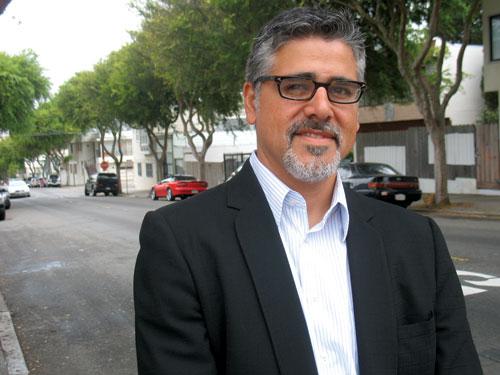
Avalos, the 47-year-old District 11 supervisor, exudes a down-to-earth vibe that’s rare in politicians, and tends to display a balanced temperament even in the heat of high-stakes political clashes. He travels to and from mayoral debates by bicycle. He quotes classic song lyrics during full board meetings, keeps a record player and vinyl collection in his office, and recently showed up at the Mission dive bar El Rio to judge a dance competition for the wildly popular Hard French dance party.

Yet casual observers may not be as familiar with the style Avalos brings to conducting day-to-day business at City Hall, an approach exemplified that summer night in 2010 when he showed up to the mayor’s office flanked by grassroots advocates bent on preserving key programs.

“My role is, I’m an insider, … but it’s really been about bringing in the outside to have a voice on the inside,” Avalos said in a recent interview. “People have always been camped out in my office. These are people who represent constituencies — seniors, recipients of mental health care, unions, people concerned about violence. It’s how we change things in City Hall. It’s making government more effective at promoting opportunities, justice, and greater livelihood.” Part of the thrust behind his candidacy, he added, is this: “We want to be able to have a campaign that’s about a movement.”

That makes Avalos different from the other candidates — but it also raises a crucial question. Some of the most important advances in progressive politics in San Francisco have come not just from electoral victories, but from losing campaigns that galvanized the left. Tom Ammiano in 1999 and Matt Gonzalez in 2003 played that role. Can Avalos mount both a winning campaign — and one that, win or lose, will have a lasting impact on the city?

Workers and families

No budget with such deep spending cuts could have left all stakeholders happy once the dust settled, but Avalos and other progressive supervisors did manage to siphon some funding away from the city’s robust police and fire departments in order to restore key programs in a highly controversial move.

“There’s a Johnny Cash song I really like, written by Tom Petty, called ‘I Won’t Back Down.’ I sang it during that time, because I didn’t back down,” Avalos said at an Aug. 30 mayoral forum hosted by the Potrero Hill Democratic Club. “We made … a symbolic cut, showing that there was a real inequity about how we were doing our budgets. Without impacting public safety services, we were able to get $6 million from the Fire Department. A lot of that went into Rec & Park, and health care programs, and to education programs, and we were able to … find more fat in the Police Department budget than anybody had ever found before, about $3 million.”

Last November, Avalos placed a successful measure on the ballot to increase the city’s real-estate transfer tax, which so far has amassed around $45 million in new revenue for city coffers, softening the blow to critical programs in the latest round of budget negotiations. “Without these measures that community groups, residents, and labor organizations worked for, Mayor Ed Lee would not have been able to balance the budget,” Avalos said.

More recently, he emerged as a champion of the city’s Local Hire Ordinance, designed as a tool for job creation that requires employers at new construction projects to select San Francisco residents for half their work crews, to be phased in over the next several years. That landmark legislation was a year in the making, Redondiez said, describing how union representatives, workers, contractors, unemployed residents of Chinatown and the Bayview, and others cycled through Avalos’ City Hall office to provide input.

His collaborative style stems in part from his background. Avalos formerly worked for Service Employees International Union Local 1877, where he organized janitors, and served as political director for Coleman Advocates for Children & Youth. He was also a legislative aide to former District 6 Sup. Chris Daly, who remains a lightning rod in the San Francisco political landscape.

Before wading into the fray of San Francisco politics, Avalos earned a masters degree in social work from San Francisco State University. But when he first arrived in the city in 1989, with few connections and barely any money to his name, he took a gig at a coffee cart. He was a Latino kid originally from Wilmington, Calif. whose dad was a longshoreman and whose mom was an office worker, and he’d endured a climate of discrimination throughout his teenage years at Andover High in Andover, Mass.

Roughly a decade ago, Avalos and a group of youth advocates were arrested in Oakland following a protest against Proposition 21, which increased criminal penalties for crimes committed by youth. Booked into custody along with him was his wife, Karen Zapata, whom he married around the same time. She is now a public school teacher in San Francisco and the mother of their two children, ages 6 and 9, both enrolled in public schools.

“John has consistently been a voice for disenfranchised populations in this city,” said Sharen Hewitt, who’s known Avalos for more than a decade and serves as executive director of The Community Leadership Academy & Emergency Response Project (CLAER), an organization formed to respond to a rash of homicides and alleviate violence. “He understands that San Francisco is at a major turning point in terms of its ability to keep families and low-income communities housed. With the local hiring ordinance, most of us who have been working around violence prevention agree — at the core of this horrible set of symptoms are root causes, stemming from economic disparity.”

Asked about his top priorities, Avalos will invariably express his desire to keep working families rooted in San Francisco. District 11, which spans the Excelsior, Ingleside, and other southeastern neighborhoods, encompasses multiracial neighborhoods made up of single-family homes — and many have been blunted with foreclosure since the onset of the economic crisis.

“Our motto for building housing in San Francisco is we build all this luxury housing — it’s a form of voodoo economics,” Avalos told a small group of supporters at a recent campaign stop in Bernal Heights. “I want to have a new model for how we build housing in San Francisco. How can we help [working-class homeowners] modify their loans to make if more flexible, so they can stay here?” He’s floated the idea of creating an affordable housing bond to aid in the construction of new affordable housing units as well as loan modifications to prevent foreclosures.

“That’s what is the biggest threat to San Francisco, is losing the working-class,” said community activist Giuliana Milanese, who previously worked with Avalos at Coleman Advocates for Youth and has volunteered for his campaign. “And he’s the best fighter. Basically, economic justice is his bottom line.”

Tenants Union director Ted Gullicksen gave Avalos his seal of approval when contacted by the Guardian, saying he has “a 100 percent voting record for tenants,” despite having fewer tenants in his district than some of his colleagues. “David Chiu, had he not voted for Parkmerced, could have been competitive with John,” Gullicksen said. “But the Parkmerced thing was huge, so now it’s very difficult to even have David in same ballpark. Dennis [Herrera] has always taken the right positions — but he’s never had to vote on anything,” he said. “After that, nobody comes close.”

Cash poor, community rich

There’s no question: The Avalos for Mayor campaign faces an uphill climb. Recent poll figures offering an early snapshot of the crowded field peg him at roughly 4 percent, trailing behind candidates with stronger citywide name recognition like City Attorney Dennis Herrera or the incumbent, Mayor Ed Lee, who hasn’t accepted public financing and stands to benefit from deep-pocketed backers with ties to big business.

Yet as Assembly Member Tom Ammiano phrased it, “he’s actually given progressives a place to roost. He doesn’t pussy-foot around on the issues that are important,” making him a natural choice for San Francisco voters who care more about stemming the tides of privatization and gentrification than, say, rolling out the red carpet for hi-tech companies.

One of Avalos’ greatest challenges is that he lacks a pile of campaign cash, having received less than $90,000 in contributions as of June 30, according to an Ethics Commission filing. “He can’t call in the big checks,” said Julian Davis, board president of Booker T. Washington Community Service Center, “because he hasn’t been doing the bidding of big business interests.” A roster of financial contributions filed with the Ethics Commission shows that his donor base is comprised mainly of teachers, nonprofit employees, health-care workers, tenant advocates, and other similar groups, with almost no representatives of real-estate development interests or major corporations.

Despite being strapped for cash, he’s collected endorsements ranging from the Democratic County Central Committee, to the Harvey Milk Democratic Club, to the city’s largest labor union, SEIU 1021; he’s also won the backing of quintessential San Francisco characters such as renowned author Rebecca Solnit; San Francisco’s radical bohemian poet laureate, Diane di Prima; and countercultural icon Diamond Dave.

While some of Avalos’ core supporters describe his campaign as “historic,” other longtime political observers have voiced a sort of disenchantment with his candidacy, saying it doesn’t measure up to the sweeping mobilizations that galvanized around Gonzalez or Ammiano. Ammiano has strongly endorsed Avalos, but Gonzalez — who now works for Public Defender (and mayoral candidate) Jeff Adachi — has remained tepid about his candidacy, stating publicly in an interview on Fog City Journal, “I like [Green Party candidate Terrie Baum] and John fine. I just don’t believe in them.”

Ironically, Sup. Sean Elsbernd, often Avalos’ political opposite on board votes, had kinder words for him. “John is intelligent, John is honest, and John has integrity,” Elsbernd told the Guardian. “I don’t think he knows the city well enough to serve as chief executive … but I’ve seen the good work he’s done in his district.”

Meanwhile, Avalos is still grappling with the fallout from the spending cut he initiated against the police and fire departments in 2009. Whereas those unions sent sound trucks rolling through his neighborhood clamoring for his recall from office during that budget fight, the San Francisco Police Officers Association (SFPOA), the San Francisco Fire Fighters union, and the plumbers’ union, Local 38, have teamed up now that Avalos is running for mayor to form an independent expenditure committee targeting him and Public Defender Jeff Adachi, a latecomer to the race.

“We’ll make sure we do everything we can to make sure he never sees Room 200,” SFPOA President Gary Delagnes told the Guardian. “I would spend as much money as I could possibly summon to make sure neither ever takes office.” Delagnes added that he believes the political makeup of San Francisco is shifting in a more moderate direction, to Avalos’ disadvantage. “People spend a lot of money to live here,” he said, “and they don’t want to be walking over 15 homeless people, or having people ask them for money.”

If it’s true that the flanks of the left in San Francisco have already been supplanted with wealthy residents whose primary concern is that they are annoyed by the sight of destitute people, then more has already been lost for the progressive movement than it stands to lose under the scenario of an Avalos defeat.

The great progressive hope?

Despite these looming challenges, the Avalos campaign has amassed a volunteer base that’s more than 1,000 strong, in many cases drawing from grassroots networks already engaged in efforts to defend tenant rights, advance workplace protections for non-union employees, create youth programs that aim to prevent violence in low-income communities, and advance opportunities for immigrants. According to some volunteers, linking these myriad grassroots efforts is part of the point. Aside from the obvious goal of electing Avalos for mayor, his supporters say they hope his campaign will be a force to re-energize and redefine progressive politics in San Francisco.

“All the candidates that are running are trying to appeal to the progressive base,” Avalos said. But what does it really mean? To him, being progressive “is a commitment to a cause that’s greater,” he offered. “It’s about how to alter the relationship of power in San Francisco. My vision of progressivism is more inclusive, and more accountable to real concerns.”

N’Tanya Lee, former executive director of Coleman Advocates, was among the people Avalos consulted when he was considering a run for mayor. “The real progressives in San Francisco are the folks on the ground every day, like the moms working for public schools … everyday families, individual people, often people of color, who are doing the work without fanfare. They are the unsung heroes … and the rising progressive leaders of our city,” she said. “John represents the best of what’s to come. It’s not just about race or class. It’s about people standing for solutions.”

When deciding whether to run, Avalos also turned to his wife, Zapata, who has held leadership positions in the San Francisco teacher’s union in the past. She suggested rounding up community leaders and talking it through. “The campaign needed to be a movement campaign,” Zapata told the Guardian. “John Avalos was not running because he thought John Avalos was the most important person in the world to do this job. Our question was, if John were to do this, how would it help people most affected by economic injustice?”

Hewitt, the executive director of CLAER, also weighed in. “My concern is that he has been painted as a leftist, rooted in some outdated ideology,” she said. “I think [that characterization] is one-dimensional, and I think he’s broader than that. My perception of John is that he’s a pragmatist — rooted in listening, and attempting to respond.”

Others echoed this characterization. “He doesn’t need to be the great progressive hope,” said Rafael Mandelman, an attorney who ran as a progressive in District 8 last year. “If people are looking for the next Matt Gonzalez, I’m not sure that’s what John is about. He’s about the communities he’s representing.”

As to whether or not he has a shot at victory, Mandelman said, “It’s a very wide field, and I think John is going to have a very strong base. I think he will get enough first-choice votes to be one of the top contenders. And with ranked choice voting, anything can happen.”


A lame attack on Avalos and Adachi

30

The Examiner headline today is about as misleading as you can get: “Labor leaders unite against mayor candidates Jeff Adachi, John Avalos.”


That’s pretty ridiculous, since Avalos has the endorsement of the largest city employee union (SEIU Local 1021) and the local teachers union and is about the most pro-labor person in the race. And when you look at what’s actually going on, only three “labor leaders” (out of 150 unions represented in the San Francisco Labor Council) are going after Adachi and Avalos — and they’re among the most conservative labor unions in the city. Who are these “labor leaders?” The cops, the firefighters and the plumbers.


The plumbers, I guess, are mad about Avalos’ local-hire law. The cops and firefighters are mad that Avalos doesn’t give them everything they want. And the fact that they’re going to raise money to go after Adachi and Avalos suggests that they think one or both of them is a serious threat to Mayor Ed Lee.


Or else they’re just blustering and throwing money around because they can.


The reality is that Avalos will have strong labor support, as he always has. Adachi will have a lot more than the cops and firefighters and plumbers to worry about — nobody in organized labor is happy with his pension-reform legislation. So this little rump group making a fuss and getting Examiner headlines means very little.

The real Leland Yee

53

tredmond@sfbg.com

It’s early January 2011, and the Four Seas restaurant at Grant and Clay is packed. Everyone who is anyone in Chinatown is there — and for good reason. In a few days, the Board of Supervisors is expected to appoint the city’s first Asian mayor.

The rally is billed as a statement of support for Ed Lee, the mild-mannered bureaucrat and reluctant mayoral hopeful. But that’s not the entire — or even, perhaps, the central — agenda.

Rose Pak, who describes herself as a consultant to the Chinese Chamber of Commerce but who is more widely known as a Chinatown powerbroker, is the host of the event. She stands in front of the room, takes the microphone, and, in Cantonese, delivers a remarkable political speech.

According to people in the audience, she says, in essence, that the community has come out to celebrate and support Ed Lee — but that’s just the start. She also urges them not just to promote their candidate — but to do everything possible to prevent Leland Yee from becoming mayor.

She continues on for several minutes, lambasting Yee, the state Senator who lived in Chinatown as a child, accusing him of about every possible political sin — and turning the Lee rally into an anti-Yee crusade. And nobody in the crowd seems terribly surprised.

Across Chinatown, from the liberal nonprofits to the conservative Chamber of Commerce, there’s a palpable fear and distrust of the man who for years has been among San Francisco’s most prominent Asian politicians — and who, had Lee not changed his mind and decided to run for a full term this fall, was the odds-on favorite to become the city’s first elected Chinese mayor.

The reasons for that fear are complex and say a lot about the changing politics of Asian San Francisco, the power structure of a city where an old political machine is making a bold bid to recover its lucrative clout — and about the career of Yee himself.

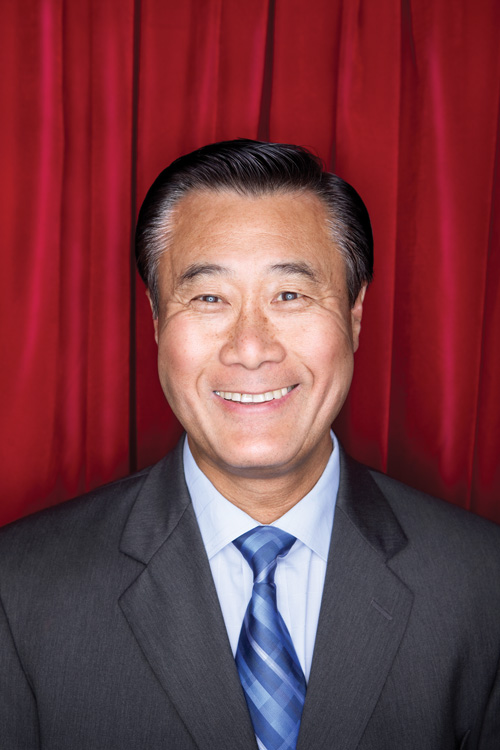
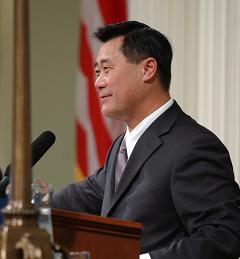
Senator Leland Yee is a political puzzle. He’s a Chinese immigrant who has built a political base almost entirely outside of the traditional Chinatown community. He’s a politician who once represented a deeply conservative district, opposed tenant protections, voted against transgender health benefits and sided with Pacific Gas and Electric Co. on key environmental issues — and now has the support of some of the most progressive organizations in the city. He’s taken large sums of campaign money from some of the worst polluters in California, but gets high marks from the Sierra Club.

His roots are as a fiscal conservative — yet he’s been the only Democrat in Sacramento to reject budget compromises on the grounds that they required too many spending cuts.

He’s grown, changed, and developed his positions over time. Or he’s become an expert at political pandering, telling every group exactly what it wants to hear. He’s the best chance progressives have of keeping the corrupt old political machine out of City Hall — or he’s a chameleon who will be a nightmare for progressive San Francisco.

Or maybe he’s a little bit of all of that.


Leland Yin Yee was born in Taishan, a city in China’s Guangdong province on the South China Sea. The year was 1948; Mao Zedong’s Communist Party of China had taken control of much of the countryside and was moving rapidly to take the major cities. The nationalist army of General Chiang Kai-Shek was falling apart, and Yee’s father, who owned a store, decided it was time for the family to leave.

The Yees made it to Hong Kong, and since Mee G. Yee had previously lived in the United States and served in the U.S. Army during World War II, he was ultimately able to move the family to San Francisco. In 1951, the three-year-old Leland Yee arrived in Chinatown.

For four years, Yee lived with his sister and mother in a one-room apartment with a shared bathroom while his father worked as a sailor in the merchant marine. It was, Yee recalled in a recent interview, a tight, closed, and largely self-sufficient community.

“The movie theater, the shoe store, the barber shop, food — everything you needed you could get in Chinatown,” Yee said. “You never had to leave.”

Of course, after a while, Yee and his mom started to venture out, down Stockton Street to Market, where they’d shop at the Emporium, the venerable department store. “It was like walking into a different country,” he said. “If you didn’t know English, they didn’t have time for you.”

Yee, like a lot of young Chinese immigrants of his era, put much of his time into his studies — in the San Francisco public schools and in a local Chinese school. “My mom spoke a village dialect, and we had to learn Cantonese,” he said. “Every little kid had to go to Chinese school. We hated it.”

When Yee was eight, his parents managed to buy a four-unit building on Dolores Street, and the family moved to the Mission, where he would spend not only the rest of his childhood but much of his early adult life. He graduated from Mission High School, enrolled in City College, studied psychology and after two years won admission to UC Berkeley.

Berkeley in 1968 was a very different world from Chinatown and even the relatively controlled environment he’d experienced at home in the Mission. “You didn’t protest in school. You’d have been sent home, and your mother would kill you,” he said.

At Berekely, all hell was breaking loose, with the antiwar protests, the People’s Park demonstrations, the campaign to create a Third World College (which led to the first Ethnic Studies Department), and a general attitude of mistrust for authority. “I developed a sense of activism,” Yee said. “I realized I could speak out.”

That spirit quickly vanished when Yee lost faith in some of his fellow activists. “People would work with us, then get into positions of power and use that against you,” he recalled. “A lot of my friends said ‘forget it.’ I left the scene.”

Yee once again devoted his energy to school, earning a masters at San Francisco State University and a Ph.D in child psychology from the University of Hawaii. Along the way, he met his wife, Maxine.

With his new degree, the Yees moved back to San Francisco — and back in with his parents at the Dolores property, where he, Maxine and a family that would grow to four kids would live for more than a decade.


Yee worked as a child psychologist for the San Francisco Department of Public Health, starting the city’s first high school mental-health clinic. He went on to become a child psychologist at the Oakland Unified School District, then joined a nonprofit mental health program in San Jose.

In 1986, Yee decided to get active in politics for the first time since college, and ran for the San Francisco School Board. He lost — and that would be the only election he would ever lose. In 1988, he won a seat, and established himself as an advocate for students of color, fighting school closures in minority neighborhoods. He also tried to get the district to modify its harsh disciplinary rules, arguing against mandatory expulsions.

On fiscal issues, though, Yee was a conservative. For his first term, despite the brutal cutbacks of the recession of the late 1980s and early 1990s, he insisted that the district make do with the money it had. His solution to the red ink: Cut waste. Only in 1992, when he was up for re-election, did he acknowledge that the district needed more cash; at that point, he supported a statewide initiative to tax the rich to bring money to the schools.

The sense of fiscal conservatism — of holding the line on taxes, but mandating open and fair contracting procedures and tight financial controls — was a hallmark of much of his political career. When the Guardian endorsed him for re-election to the board in 1992, we wrote that “there’s real value in his continuing vigilance against administrative fat and favoritism in contracts.”

Over the next four years, Yee worked with then-Superintendent Waldemar “Bill” Rojas, a deeply polarizing figure who pushed his own personal theory of “reconstitution” — firing all the staff at low-performing schools — and later was enmeshed in a scandal that led to prison time for a contractor he’d hired. Yee told me he was the only board member to vote against hiring Rojas, but people who were watching the board closely back then say he didn’t always stand up to the superintendent.

He also became what some say was a bit too close with Tim Tronson, a consultant hired by the district as a $1,000-a-day facilities consultant. Tronson wound up getting indicted on 22 counts of grand theft, embezzlement, and conspiracy in a scheme to steal $850,000 from the schools, and was sentenced to four years in state prison.

In 1998, when some school board members wanted to build housing for teachers on property that the district owned in the Sunset, Yee led the opposition — with Tronson’s help. At one meeting at Sunset Elementary School, Yee went so far as to say, according to people present, that “Tim Tronson is my man, and I rely on him for advice.”

Yee acknowledged that he worked closely with Tronson to defeat that housing project. “He was the facilities manager,” Yee explained, “and I said that I trusted his judgment.”


Yee has either a great sense of political timing or exceptional luck. He ran for the Board of Supervisors in 1996, facing one of the weakest fields in modern San Francisco history. He was the only Chinese candidate and one of just two Asians (the other, appointed incumbent Michael Yaki, barely squeaked to re-election). In an at at-large election with the top five winning seats, Yee came in third, with 103,000 votes.

He was never a progressive supervisor. In 2000, the Guardian ranked the good votes of what we referred to as Willie Brown’s Board, and Yee scored only 43 percent. He was against campaign finance reform. He supported the brutal gentrification and community displacement represented by the Bryant Square development. He voted to kill a public-power feasibility study and opposed the Municipal Utility District initiative. He opposed a moratorium on uncontrolled live-work development.

In 2002, Yee was one of only three supervisors to oppose Proposition D, a crucial public-power measure that would have broken up PG&E’s monopoly in the city. He stood with PG&E (and then-Sups. Tony Hall and Gavin Newsom) in opposition to the measure, then signed a pro-PG&E ballot argument packed with PG&E lies.

When I asked him about that stand, Yee at first didn’t recall opposing Prop. D, but then said he “stood with labor” on the issue. In fact, the progressive unions didn’t oppose Prop. D at all; the opposition was led by PG&E’s house union, IBEW Local 1245.

Yee was particularly bad on tenant issues. He not only voted to deny city funding for the Eviction Defense Collaborative, which helped low-income tenants fight evictions; he actually tried to get the city to put up money for a free legal fund to help landlords evict their tenants. He opposed a ballot measure limiting condo conversions. He opposed a measure to limit the ability of landlords to pass improvement costs on to their tenants.

In 2001, Yee voted to uphold a Willie Brown veto of legislation to limit tenancies in common, a backdoor way to get around the city’s condo conversion ordinance. Only Hall and Newsom, then the most conservative supervisors on the board, joined Yee. At one point, he started asking whether the city should consider repealing rent control.

He opposed an affordable housing bond in 2002, joining the big landlord groups in arguing that it would raise property taxes. Every tenant group in town supported the measure, Proposition B; every landlord group opposed it.

I asked Yee about his tenant record, and he told me that he now supports rent control. But he said that he was always on the side of homeowners and small landlords, and that property ownership was central to Chinese culture. “I was responding to the Chinese community and the West Side,” he said.

He wasn’t much of an environmentalist, either — at least not in today’s terms. He was one of the only city officials to support a “Critical Car” rally in 1999, aimed at promoting the rights of vehicle drivers (and by implication, criticizing Critical Mass and the bicycle movement).

His record on LGBT issues was mixed. While he supported a counseling program for queer youth when he was on the school board, he also supported JROTC, angering queer leaders who didn’t want a program in the public schools run by, and used as a recruiting tool for, the military, which at that point open discriminated against gay and lesbian people.


Yee was also one of only two supervisors who voted in 2001 against extending city health benefits to transgender employees.

That was a dramatic moment in local politics. Nine votes were needed to pass the measure, and while eight of the supervisors were in favor, Yee and Hall balked. At one point, Board President Tom Ammiano had to direct the Sheriff’s Office to go roust Sup. Gerardo Sandoval, who was ducking the issue in his office, to provide the crucial ninth vote.

Yee didn’t just vote against the bill. According to one reliable source who was there at the time, Yee spoke to a community meeting out on Ulloa Street in the Sunset and berated his colleagues, quipping that the city should have better things to do than “spend taxpayer money on sex-change operations.”

It was a bit shocking to trans people — Yee had, over the years, befriended some of the most marginalized members of what was already a marginalized community. “There was one person at the rail crying, saying ‘Leland, how could you do this to us,'” Ammiano recalled.

The LGBT community was furious with Yee. “I didn’t speak to him for at least a year,” Gabriel Haaland, one of the city’s most prominent transgender activists, told me.

Yee now says the vote was a mistake — but at the time, he told me, he was under immense pressure. When he voted for the queer youth program, he said, “the elders of the Chinese community ripped me apart. They called my mother’s friends back in the village [where he was born] and said her son was embarrassing the Chinese community.”

That must have been difficult — and he said that “if I had known the pain I had caused, I wouldn’t have voted that way.” But it was hard to miss that pain his vote caused.

On the other hand, people learn from their experiences, attitudes evolve, we all grow up and get smarter, and the way Yee describes it, that’s what happened to him.

In 2006, when he was running for state Senate, Yee met with a group of trans leaders and formally — many now say sincerely — apologized. It was an important gesture that made a lot of his critics feel better about him.

“He didn’t have to do that,” Haaland said. “People change, and he paid for his crime, and that’s genuine enough for me.”

As a former school board member, Yee kept an interest in the schools — but not always a healthy one. At one point, he actually proposed splitting SFUSD into two districts, one on the (poorer) east side of town and one on the (richer) west. “We strongly opposed that,” recalled Margaret Brodkin, who at the time ran Coleman Advocates for Children and Youth. “Eventually he dropped the idea.”

For all the problems, in his time on the Board of Supervisors, Yee developed a reputation for independence from the Brown Machine, which utterly dominated much of city politics in the late 1990s. His weak 43 percent rating on the Guardian scorecard was actually third-best among the supervisors, after Ammiano and the late Sue Bierman.

In 1998, he was one of the leaders in a battle to prevent the owners of Sutro Tower from defying the city’s zoning administrator and placing hundreds of new antennas on Sutro Tower. He, Bierman, and Ammiano were the only supervisors opposing Brown’s crackdown on homeless people in Union Square.

When he ran in the first district elections, in 2000, against two opponents who had Brown’s support and big downtown money, the Guardian endorsed him, noting that while he “can’t be counted on to support worthy legislation … He’s one of only two board members who regularly buck the mayor on the big issues.”

(He never liked district elections, and used to take any opportunity to denounce the system, at times forcing Ammiano to use his position as president to tell Yee to quit dissing the electoral process and get to the point of his speech.)


In 2002, the westside state Assembly district seat opened up, and both Yee and his former school board colleague Dan Kelly ran in the Democratic primary. Yee won, and went on to win the general election with only token opposition.

His legislative record in the Assembly wasn’t terribly distinguished. Yee never chaired a policy committee — although he did win a leadership post as speaker pro tem. And he cast some surprisingly bad votes.

In 2003, for example, then-Assemblymember Mark Leno introduced a bill that would have exempted single-room occupancy hotels from the Ellis Act, which allows landlords to evict tenants for no reason. Yee refused to vote for the bill. Leno was furious — he was one vote short of a majority and Yee’s position would have doomed the bill. At the last minute, a conservative Republican who had grown up in an SRO hotel voted in favor.

When he ran for re-election in 2004, we noted: “What’s Leland Yee doing up in Sacramento? We can’t figure it out — and neither, as far as we can tell, can his colleagues or constituents. He’s introduced almost no significant bills — compared, for example, to Assemblymember Mark Leno’s record, Yee’s is an embarrassment. The only high-profile thing he’s done in the past several years is introduce a bill to urge state and local governments to allow feng shui principles in building codes.”

In 2006, Yee decided to move up to the state Senate, and he won handily, beating a weak opponent (San Mateo County Supervisor and former San Francisco cop Mike Nevin) by almost 2-1. His productivity increased significantly in the upper chamber — and in some ways, he moved to the left. He’s begun to support taxes — particularly, an oil severance tax — and when I’ve questioned him, he somewhat grudgingly admits that Prop. 13 deserves review.

He’s done some awful stuff, like trying to sell off the Cow Palace land to private developers. But he has consistently been one of the best voices in the Legislature on open government, and that’s brought him some national attention.

Yee has been a harsh critic of spending practices and secrecy at the University of California, and when UC Stanislaus refused in 2010 to release the documents that would show how much the school was paying Sarah Palin to speak at a fundraiser, Leland flew into action. He not only blasted the university and introduced legislation to force university foundations to abide by sunshine laws; he worked with two Stanislaus students who had found the contract in a dumpster and made headlines all over the country.

He’s fought for student free speech rights and this year pushed a bill mandating that corporations that get tax breaks for job creation prove that they’ve actually created jobs — or pay the tax money back. He’s also won immense plaudits from youth advocates and criminal justice reformers for his bill that would end life-without-parole sentences for offenders under 18.

Along the way, he compiled a 100 percent voting record from the major labor unions, including the California Nurses Association and SEIU, and with the Sierra Club. All three organizations have endorsed him for mayor.

Yee told me that he thinks he’s become more progressive over the years. “My philosophy has shifted,” he said.

Yet when you talk to his colleagues in Sacramento, including Democrats, they aren’t always happy with him. Yee has a tendency to be a bit of a loner — he’s never chaired a policy committee and in some of the most bitter budget fights, he’s refused to go along with the Democratic majority. Yee insists that he’s taken principled stands, declining to vote for budget bills that include deep service cuts. But the reality in Sacramento is that budget bills have until this year required a two-thirds vote, meaning two or three Republicans have had to accept the deal — and losing a Democratic vote has its cost.

“You have to give up all sorts of things, make terrible compromises, to get even two Republicans,” one legislative insider told me. “When a Democrat goes south, you have to find another Republican, and give up even more.”

In other words: It’s easy to take a principled stand, and make a lot of liberal constituencies happy, when you aren’t really trying to make the state budget work.


I met Rose Pak on a July afternoon at the Chinatown Hilton. She brought along her own loose tea, in a paper package; the waitress, who clearly knew the drill, took it back to the kitchen to brew. Pak and I have not been on the greatest of terms; she’s called the Guardian all kinds of names, and I’ve had my share of critical things to say about her. But on this day, she was polite and even at times charming.

After we got the niceties out of the way (she told me I was unfair to her, and I told her I didn’t like the way she and Willie Brown played politics), we started talking about Yee. And Pak (unlike some people I interviewed for this story) was happy to speak on the record.

She told me Yee had “no moral character.” She told me she couldn’t trust him. She told me a lot of stories and made a lot of allegations that we both knew neither she nor I could ever prove.

Then we got to talking about the politics of Chinatown and Asians in San Francisco, and a lot of the animosity toward Yee became more clear.

For decades, Chinatown and the institutions and people who live and work there have been the political center of the Chinese community. Nonprofits like the Chinatown Community Development Center have trained several generations of community organizers and leaders. The Chinese Chamber of Commerce, the Six Companies, and other business groups have represented the interests of Chinese merchants. And while the various players don’t always get along, there’s a sense of shared political culture.

“In Chinatown,” Gordon Chin, CCDC’s director, likes to say, “it’s all about personal connections.”

There’s a lively infrastructure of community-service programs, some of which get city money. There’s also a sense that any mayor or supervisor who wants to work with the Chinese community needs to at least touch base with the Chinatown establishment.

Yee doesn’t do that. “He doesn’t give a shit about them,” David Looman, a political consultant who has worked with many Chinese candidates over the years, told me.

Yee’s Asian political base is outside of Chinatown; he told me he sees himself representing more of the Chinese population of the Sunset and Richmond and the growing Asian community in Visitacion Valley and Bayview.

Pak is connected closely to Brown, who Yee often clashed with. For Pak, Brown, and their allies, strong connections to City Hall mean lucrative lobbying deals and public attention to the needs of Chinatown businesses. Then there’s the nonprofit sector.

CCDC and other nonprofits do important, sometimes crucial work, building and maintaining affordable housing, taking care of seniors, fighting for workers rights, and protecting the community safety net. Yee, Pak said, “has never shown any interest in our local nonprofits. We all work together here, and he doesn’t seem to care what we do.” Yee told me he has no desire to see funding cut for any critical social services in any part of town. But he has also made no secret of the fact that he questions the current model of delivering city services through a large network of nonprofits, some of which get millions of taxpayer dollars. And the way Pak sees it, all of that — the nonprofits, the business benefits, the contracts — are all at risk. “If Leland Yee is elected mayor,” she told me, “we are all dead.”

I ran into an old San Francisco political figure the other day, a man who has been around since the 1970s, inside and outside of City Hall, who remains an astute observer of the players and the power relationships in the local scene. At the time we talked, he wasn’t supporting any of the mayoral candidates, but he had a thought for me. “This town,” he said, “is being taken over by a syndicate. Willie Brown is the CEO, and Rose Pak is the COO, and it’s all about money and influence.”

That’s not a pleasant thought — I’ve lived through the era of political machine dominance in this town, and it was awful. In the days when Brown ran San Francisco, politics was a tightly controlled operation; only a small number of people managed to get elected to office without the support of the machine. Developers made land-use policy; gentrification and displacement were rampant; corruption at City Hall turned a lot of San Franciscans off, not only to the political process but to the whole notion that government could be a positive force in society.

A few years ago, I thought those days were over — and to a certain extent, district elections will always make machine politics more difficult. But when I see signs of the syndicate popping up — and I see a candidate like Ed Lee, who’s close friends with Brown, leading the Mayor’s Race — it makes me nervous. And for all his obvious flaws, at least Leland Yee isn’t part of that particular operation. If there’s a better reason to vote for him, I don’t know what it is.

YEE HOME PURCHASE RAISES SUSPICIONS

Rose Pak has a question about Leland Yee. “How,” she asked me, “did the guy manage to buy a million-dollar house on a $30,000 City Hall salary?”

Pak isn’t the only one asking — numerous media reports over the years have examined how Yee raised a family of four and bought a house in the Sunset on very little visible income. And while I’m not usually that interested in the personal finances of political candidates, I decided that it was worth a look.

Here’s what I found: Public records show that in July 1999, Yee and his wife, Maxine, purchased a house on 24th Avenue for $875,000 (it’s now assessed at slightly more than $1 million). At the time, Yee was a San Francisco supervisor, earning a little more than $30,000 a year. (The salary of the supervisors was raised dramatically shortly after Yee left the board and went to the state Assembly.) His wife wasn’t working. And his economic interest statements for that period show no other outside earnings. So the disposable, after-tax income of the entire Yee family couldn’t have been much more than $25,000.

That, by any normal standard, shouldn’t have been enough to float a mortgage that, records show, totaled $516,000. In fact, the interest payments alone on that mortgage alone would total $3,600 a month — more than Yee’s gross income.

Documents in the Assessor’s Office show another paper trail, too. In 1989, Jung H. Lee, Yee’s mother, transferred the deed on a four-unit Dolores St. building where the family had been living to Maxine and Leland Yee — for no money. And a few months before the Yees bought the Sunset house, they took out a $320,000 home-equity loan on that property. That was the down payment on the Sunset property.

Still: At that point, the Yees would have been paying off two mortgages, with a total nut of about $5,000 a month — and supporting four kids, in San Francisco. In 2002, Yee’s economic interest statement’s show some modest income from teaching at Lincoln University — but nowhere near enough to pay that level of expenses.

What happened? Yee explains it this way: “For more than 10 years, we were living rent-free in my parents’ property,” he told me I an interview. “We were a close Chinese family, and my parents provided the food and helped pay for the children’s clothing. So we had almost no expenses and we lived very frugally.”

During that period, Yee was working for the San Francisco Department of Public Health, the Oakland Unified School District, and a San Jose nonprofit, earning, he said, between $50,000 and $90,000 a year. If he saved almost all of that money, he would have had more than a half-million dollars in the bank when he bought the Sunset house.

There’s nothing on any of his economic disclosure forms showing any ownership of stocks or other reportable financial interests during that period, so he wasn’t investing the money. In fact, he says, it was, and is, all in simple savings accounts. A bit unusual for that large a sum of money.

How did he get a mortgage? “Back then,” he said, “banks were willing to lend a lot more freely than they do today.”

Starting in 2003, Yee was in the state Assembly, making a higher salary — but still not much in excess of $100,000 a year. After taxes, he was probably taking home about $75,000 — and $60,000 was going to the two mortgages.

How did he do it? “We have been supplementing our income with our savings,” he said. “We don’t take vacations, we are very careful with our money.” And they clearly aren’t desperate for cash — Yee’s daughter occupies two of the four units in the Dolores St. building they own, but the other two units are vacant.

It’s possible. It’s plausible. But I don’t blame people for wondering how he managed to pull it off. (Tim Redmond, with research assistance by Oona Robertson) 


BIG CORPORATIONS HAVE BACKED YEE

Yee became a prodigious fundraiser in Sacramento — and a lot of the money came from big corporations that had business in the Legislature. And while he has perfect scores from the Sierra Club and the big labor unions, he’s taken tens of thousands of dollars from some of the biggest corporations, agribusiness interests, and polluters in the state. And at times, he’s voted their way.

Since 1993, for example, campaign finance records show Yee has taken more than $20,000 from Chevron, ExxonMobil, Valero, Conoco Phillips, and BP. He’s received another $22,450 from the chemical industry (and industry employees). Most of it came from Clorox, Dow Chemical, and Dupont.

And while the Sierra Club may not have considered it a priority, Sen. Mark Leno has worked hard to pass a bill limiting chemical fire retardants in furniture. In 2008, Yee voted against Leno’s AB 706.

That year he also refused to support a bill that would prohibit the use of the chemical diacetyl in workplaces. The industries that opposed AB 514 (including Bayer, Abbott Laboratories, Pfizer, and Johnson & Johnson) have given Yee a total of more than $60,000.

In 2003, Yee voted against a crucial tenant bill, one that would have prevented the owners of single room occupancy hotels from using the Ellis Act to evict tenants. He received a campaign check for $2,500 from the San Francisco Apartment Association the next day. Landlords in general have given Yee close to $40,000.

Then there’s agribusiness. Yee gets a lot of money from the farming industry, despite the fact that there obviously aren’t many farms in his district. Why, for example, would the California Poultry Association, the California Cattlemen’s Association, and the California Farm Bureau give him money? The Poultry Association’s Bill Mattos told us that Yee “has taken a keen interest in California’s poultry industry.”

Yee also took immense flak from the San Francisco Chronicle and other papers over a 2003 vote against a bill to limit emissions from farm vehicles. In an editorial, the paper wrote that he was “doing dirty work for the lobbyists.” In the end, under immense public pressure, he switched positions and voted for the bill. I asked Yee about all that money from all those bad operators, and he told me — as most politicians will — that campaign cash has never influenced any of his votes.

So why do all these groups give him money? “It’s about whether you will sit down and listen,” Yee said. “I will talk to all sides and at least consider the arguments as a thoughtful human being. Then I vote my conscience.” (Tim Redmond, with research by Oona Robertson) 

BART board mulls nation’s first cell service disruption policy

44

A special meeting of BART’s Board of Directors yesterday (Wed/25) was the first step in crafting a policy outlining the circumstances under which BART staff would be authorized to cut off cell phone service in its train stations. The resulting policy will be the first in the nation, and is likely to act as a model for other government agencies to address the issue.

While BART’s top management defended the suspension of cell phone service to disrupt a protest planned for August 11, BART’s board was divided over whether the suspension of cell service to prevent a protest was justified and what would constitute a justification for cutting cell service in the future.

“This group was encouraging, promoting and inciting illegal behavior on our platform,” BART police Chief Kenton Rainey reminded the board.

“Well, there is illegal activity every day at BART. The response does not feel proportional enough for justification,” responded BART director Tom Radulovich,

BART director Robert Raburn echoed Radulovich’s concerns. “Neither speculation about a protest, nor mere disruption of train service, nor other illegal activity by itself constitutes a risk to passenger safety that would warrant interrupting cell service. We must guard First Amendment freedom of speech, and this will become a landmark case,” said Raburn.

Staff and union representatives stressed that public safety was always BART’s top concern.

Officials from BART’s three unions generally agreed that the shutting of cell phone service was inappropriate, but admonished protesters for conducting protests on the platforms where they say there is a safety risk due to crowding.
“I applaud the individuals, the union supports the individuals who organize, for I understand organizing. I understand protesting,” said Austin Thomas, who represents BART employees from SEIU Local 1021. “But, I would like to see that this forum be the forum to bring your protest, to have your grievances redressed here.”

“The bottom line for BART is that downtown San Francisco at 5 pm is the maximum stress point at the maximum stress time. It’s all about public safety and keeping the trains moving,” stressed BART Assistant General Manager of Operations Paul Oversier.

“We keep going around with these safety issues, but do not be confused: We do not have to have one or the other,” urged director Lynette Sweet, who referenced the 1955 case Pike vs Southern Bell Telegraph.

“In this case, a gentleman by the name of Bull Connors ordered Southern Bell to remove the telephone of one Lewis Pike, described by Mr. Connors as a negro of questionable character who is known to be using his phone for unspecified illegal purpose. That is not where we as BART want to go. We don’t want to tell people, or signify, or specify, that you can’t talk, that you don’t have the ability to talk.”

But BART board Vice President John McPartland took a harder stance. saying the action was justified, and BART need to post signs informing the public of possible disruptions in cell service due to safety issues.

“This is the beginning of a review from a national perspective on this issue. I, for one, think we should maintain our ability to control cell service until we have it looked at from a legislative perspective.” said McPartland.

“Not all free speech is protected. There are some very narrow exceptions, and I believed this to be one of them,” Oversier insisted.

“If we are ever going to shut off cell phone service, ever, it should be for the most valid reasons that I equate with 9-11 [terrorist attack] level. Not the protests that we thought were going to happen on August 11th. We can’t do that,” cautioned Sweet, who wondered out loud if BART couldn’t just apologize for making a mistake and move on.

Members of the public present for the meeting remained dubious about BART creating policy concerning cell phone disruption at all.

Speaking on behalf of protest group No Justice No BART, an activist identifying himself only as Christof told the board, “We are not asking you to fix anything. We just simply don’t trust you to run a police force at all. We are not asking you to improve your free speech policy, we already have a free speech policy – it’s called the constitution.”

He expressed doubts as to whether BART should be trusted with the power to cut cell phone service. “What is the first thing that your police officers did on the Fruitvale platform after they shot Oscar Grant in the back? They tried to confiscate video footage taken by passengers,” Christof accused.

That footage from the New Years Eve shooting of Grant by officer Johannes Mehserle was the beginning of BART’s problems with anti-police brutality protesters.

Other speakers from the public had similar concerns about BART overreaching its authority.

“The proper place to present the arguments we have just heard is not to this board, but in a court room before a judge considering a motion or injunction. Instead of using those existing legal mechanisms, you have taken matters into your own hands as vigilantes,” said Edward Hasbrook representing the Identity Project.

BART officials expect the new policy will be crafted and voted on within a month. They say the new policy will be vetted through BART attorneys, the ACLU, and and BART’s civilian advisory committee. But they cautioned that BART could not envision every emergency that would warrant shutting off of cellular service as they craft their forthcoming policy, so the policy would include some flexibility at the discretion of BART management.

Both the California Public Utilities Commission and the Federal Communications Commission, who regulate cell phone providers, are already examining the legality of BART’s actions. As an afterthought, at the close of the meeting, Sweet urged the board to consult with those agencies over the policy before it is implemented.

BART has only provided cell service in its stations for a short time. While BART is under no legal obligation to provide phone service, once they began providing service they fall under the jurisdiction of the FCC, which regulates cell service nationally.

Speaking in Denver to CNET, FCC Commissioner Robert McDowell said the matter was still under investigation.

“What the heck happened, what precedent does it set, were there any laws that were broken?” McDowell questioned. “Let’s continue with the investigation. We’ll draw conclusions after we have all the facts.”

Tonight: the last of five Guardian forums on the issues for the next mayor

0

Join us tonight for the fifth and final installment of the Guardian Forum: a series of panel discussions and participatory debates framing the progressive issues for the mayor’s race and beyond:
 
Forum Five: Environment, Energy and Climate Change
Tonight, August 25 at 5:30PM
Koret Auditorium, San Francisco Main Library, 100 Larkin St., SF
(Civic Center BART and MUNI 5, 19, 47, 49, or F Train)

Featuring:
Tim Redmond, San Francisco Bay Guardian
Antonio Diaz, People Organizing to Demand Environmental and Economic Rights
Alicia Garza, People Organized to Win Employment Rights
Aaron Peskin, former San Francisco supervisor
Saul Bloom, Arc Ecology
 
Cosponsors: Harvey Milk LGBT Democratic Club, San Francisco Tenants Union, SEIU Local 1021, San Francisco Rising, San Francisco Human Services Network, Council of Community Housing Organizations, Community Congress 2010, Center for Political Education, Jobs with Justice
 
All events are free. Sessions will include substantial time for audience participation and discussion. Please join us!
 
Save the Date
On September 21st, we’ll present our platform to the mayoral candidates and see which ones are willing to sign on.

Alerts

0

alerts@sfbg.com


THURSDAY 25

The Guardian Forum

This summer, the Bay Guardian — along with cosponsors that include SEIU 1021, the San Francisco Tenants Union, and the Harvey Milk LGBT Democratic Club — has held a series of public forums framing progressive issues for the mayor’s race and beyond. This fifth and final forum focuses on the Environment, Energy, and Climate Change and the panel is Guardian Executive Editor Tim Redmond, Antonio Diaz with People Organizing to Demand Environmental and Economic Rights, Alicia Garza with People Organized to Win Employment Right, former Supervisor Aaron Peskin, and Arc Ecology’s Saul Bloom.

5:30 p.m., free

Koret Auditorium, SF Main Library

100 Larkin, SF


FRIDAY 26

Torture and Yoo

The California Young Republican Federation hosts John Yoo as welcoming speaker for its first state convention. Yoo has had international complaints filed against him for his complicity in torture and other crimes against humanity at Abu Ghraib and Guantánamo Bay after writing legal memos justifying harsh interrogation techniques for the Bush White House. Yoo is a professor at UC Berkeley’s Boalt Hall School of Law. Anti-war protestors will gather at the doors to “welcome” convention attendees and protest Yoo.

6:30-8:00 p.m., free

Marine Memorial Club & Hotel

609 Sutter Street, SF

www.cyrf2011.com/


SATURDAY 27

Green Tea Party

The Tea Party Express national bus tour is kicking off in Napa, of all places. To counter the event, the Napa County Green Party is throwing a Green Tea Party with prominent progressive speakers, vegetarian cuisine, fun info booths, and iced green tea. The event will end with a march to the Napa Valley Expo Fairgrounds, where presidential candidates are expected to be speaking to Tea Party supporters. Participants are encouraged to wear green.

10:30 a.m., free

Veterans Memorial Park

Corner of Main and Third, Napa

napa@cagreens.org

(707) 257-7435


SUNDAY 28

Preserving the Harvest

The Ecology Center of San Francisco (ECOSF) is hosting a community workshop entitled “Preserving the Harvest: Canning and Drying,” along with a potluck and solar oven pizza making. Spend time with neighbors and friends while learning how to can fruits and tomatoes in the most energy efficient way. ECOSF’s mission is to promote cooperation, community, and respect for the environment, so bring a dish made from your garden to share.

11:00 a.m. – 5:00 p.m.

Near School of Arts athletic field

555 Portola, SF

www.eco-sf.org


Mail items for Alerts to the Guardian Building, 135 Mississippi St., SF, CA 94107; fax to (415) 437-3658; or e-mail alert@sfbg.com. Please include a contact telephone number. Items must be received at least one week prior to the publication date.

Who doesn’t support Ed Lee?

37

One of the more interesting things about the Democratic County Central Committee’s mayoral endorsements was the lack of support for Mayor Ed Lee among the eight state and federal office holders who sit on the panel.


Under the party charter, any Democrat who lives in the city and represents San Francisco in Sacramento or Washington gets to vote at the DCCC. So U.S. Senator Dianne Feinstein, U.S. Reps. Nancy Pelosi and Jackie Speier, state Senators Mark Leno and Leland Yee, State Assembly Members Tom Ammiano and Fiona Ma and Attorney General Kamala Harris all had a say in who the party would support for mayor. None of those people ever show up at the meetings, but they’re allowed to appoint an alternate to represent their views.


And only Feinstein voted to endorse Lee.


Pelosi’s alternate didn’t show up for the endorsement meeting. Speier abstained. Yee voted for himself. Leno voted No Endorsement. Ammiano suported Avalos. Harris abstained. Fiona Ma voted for Bevan Dufty.


Not a rousing show of support for the incumbent.


(It would have been interesting if Lt. Governor Gavin Newsom were still on the DCCC, but Gav has moved to Marin, and he will now have the distinct honor of serving on that county’s committee.)


Meanwhile: I almost want to ignore Randy Shaw’s attempt to portray the DCCC (and some white progressives in general) as racist for not supporting any of the Asian candidates, since I think it’s too easy to throw that word around in this city, and journalists ought to be pretty careful when they do it. White people (like me and Randy Shaw) need to be particularly sensitive to race issues in the media — and I do think there are real tensions between some old-line progressives and emerging Asian political leaders who don’t always agree with progressives on issues. But that sensitivity should include not sensationalizing race or using race to score political points.


That said, it’s worth noting that of the four Asians on the Board of Supervisors, the DCCC endorsed three (Eric Mar, David Chiu, and Carmen Chu). The only one who didn’t get the DCCC nod for supervisor was Shaw’s candidate in District 6, Jane Kim.


Oh, and the Number 1 candidate endorsed by the Democratic Party is Latino. And the two fastest-growing non-white political populations in the city are Asians and Latinos.


You can fight forever about the politics of the DCCC endorsement and why the panel only chose two candidates. The Guardian will almost certainly support three, since that’s how RCV works. Why Yee, who has the support of both SEIU Local 1021 and the Sierra Club, got only two votes at the DCCC is a fair question. Why Chiu, who is a member of the DCCC, didn’t win the third slot is also an interesting political question. But I honestly don’t think race was a factor. Maybe I’m wrong.    


And as for the whole flap about Aaron Peskin, Rose Pak and the People’s Republic of China (based, by the way, on Peskin’s comments in a Falun Gong newspaper): I met with Rose Pak a few weeks ago, and in the course of talking about Leland Yee (who I will be profiling in the Aug. 31 Guardian) she told me that some progressives were accusing her of being a Communist — a reference to comments by Peskin and Chris Daly linking her to the PRC. She called it “red baiting.”


Just for the record: I’d by happy if Pak WAS a communist — maybe she’d be more interested in income redistribution, progressive taxation and land reform in San Francisco. I like communists. I even got me a picture of ol’ Leon Trostky hangin’ in my office (along with a picture of John Ross, another noted pinko). And years ago, when I had a garage, I really did have a commie flag tacked up on the wall. A friend bought it for me in the Soviet Union back in the day, and one of the reasons I loved it was that it was so poorly made that it started to unravel the minute I stuck the tacks in it, and the colors weren’t quite right, and the silkscreened hammer and sickle was way off center. Go team.


Seriously, I think the era when the label “Communist” was a serious smear is long over. Nobody cares any more. Besides, China isn’t really a Communist country these days, is it? I’m not an expert on the Chinese economy, but it seems much more hyper-capitalist to me. And it’s safe to say that there’s no Cuba-style forced economic equality in China, a country that has a handful of billionaires and a lot of very poor people and may have even worse income distribution than the United States.


Maybe we could talk about the issues?

City workers union backs Yee — and Avalos

18

The press release I got from Leland Yee’s campaign made it sound as if Yee had won a major victory over progressive supervisor John Avalos:


SAN FRANCISCO – Senator Leland Yee has landed the first choice endorsement of the largest organization of city workers – Service Employees International Union (SEIU 1021) – in his campaign for San Francisco Mayor. The move by the 54,000 member union is a complete rejection of the city’s top official, interim Mayor Ed Lee.


The endorsement comes after Yee has landed virtually every major labor endorsement in the race, including the California Nurses Association, California School Employees Association, International Brotherhood of Electrical Workers, San Francisco Building and Construction Trades Council, Laborers International Union, United Brotherhood of Carpenters, Communication Workers of America, and the American Federation of State, County, and Municipal Employees, among others.


Yee has also been endorsed by the major environmental groups, including the Sierra Club and San Francisco Tomorrow.


“I am proud to be the labor candidate in this race and honored to receive the endorsement from SEIU 1021 and our city’s workforce, who run our city and provide us essential services,” said Yee. “SEIU 1021 represents some of our lowest paid and hardest working employees, including healthcare workers, nurses, and janitors. Together, we have fought to ensure greater transparency and accountability at City Hall and within state government. I look forward to working with SEIU as we move San Francisco forward.”


Local 1021 is among the most progressive unions in the city — and when it comes to local politics, one of the most effective. Candidates backed by 1021 get the union’s volunteer work and wealth of political organizing skill, and it can make a huge difference.


Avalos, the leading progressive in the race, would seem a natural for the SEIU nod, and at first glance, it appeared that one of labor’s best friends at City Hall had been stiffed. You don’t learn until the end of the Yee release what really happened:


SEIU 1021 also endorsed John Avalos as a first or second choice and Bevan Dufty as a third choice.


Yep — Yee didn’t win the endorsement outright. Local 1021 was split between Yee supporters and Avalos supporters, and wound up doing a dual endorsement. Here’s what the official 1021 statement says:


The delegates were in support of both Supervisor John Avalos and State Senator Leland Yee, both progressives with strong labor credentials and records, both having been in SEIU at one time, and both friends. The delegates reasoned that with so many candidates in the race, neither could win without the others second votes, so they made a dual endorsement of them, asking members and supporters to vote their choice of first or second between them.


Dufty came in third in part because he did (and does) really well in these kinds of interviews. Watch the candidates on the trail — Dufty is funny, relaxed, personable … the kind of guy you want to go have a beer with. The others often come off as stiff and scripted. That doesn’t mean I’m necessarily voting for Dufty, who has been on the wrong side of too many issues. But in a crowded field, his personality stands out.


What does this mean? It means that SEIU members can and will work for both Yee and Avalos, which is good news for Avalos and probably better news for Yee. The senator has been working hard to get as many Avalos/Yee dual endorsements or 1-2 endorsements as he can, since any apparent connection between the two helps Yee with the progressive vote. And while I understand and appreciate the rights of candidates to promote themselves and hype every endorsement they get in the best terms possible, this one was a bit misleading. 

Private cops at SF General?

26


Truly astonishing moment at the June 23 Budget Committee hearing. The director of Public Health, Barbara Garcia, actually testified that San Francisco General Hospital would be better off with private security guards instead of sheriff’s deputies — because the deputies were only able to follow the law.


You can watch the video here. The discussion starts at 4:49. It begins with Sup. Scott Wiener, is his quiet Scott Wiener way, asking Garcia to talk about the plan to contract out hospital security.


Garcia first insisted that this was a way to save $2 million that would prevent further cuts to health programs. That’s always the primary argument for contracting out.


But then she went a step further.  An outside company, she said, could provide better security — because the (low paid, poorly trained) guards will be able to operate without the restrictions of being peace officers. “There are some restrictions on [the deputy sheriffs’] ability to restrain patients,” she said.


That wasn’t a slip of the tongue — Gregg Sass, the chief financial officer, repeated it again. “If a patient isn’t breaking the law,” he said, “a deputy sheriff won’t intervene.” More: “Private security can intervene. They’re not bound by the same limits that a deputy sheriff is bound by.”


Both Garcia and Sass noted that they wanted security officers who reported directly to them, not to an elected sheriff.


Am I the only one who thinks this is a little weird?


The money thing I understand. I don’t agree — often these supposed savings don’t show up in the end, and besides, do we really want people who get paid $13 an hour without benefits handling security at SF General? But I understand the argument.


On the other hand, the notion that peace officers have to follow rules, and so we should have people who don’t have to follow rules instead strikes me as pretty disturbing. And I’m not sure how true it is: Can a security guard hold and restrain a patient who hasn’t broken the law and isn’t covered by a legal order like a 5150?


I don’t think so. The folks at SEIU Local 1021 don’t think so, either: A flier the group put out notes that:


The issue of Sheriff’s Dept. having legal restraints applies equally to all employees. If there is no 5150 or 5250, no-one has a right to restrain the patient against their will; but a well trained Institutional Policeman can gently persuade a patient with Alzheimer’s to return to their unit.


And I have to say, the notion of having the Department of Public Health oversee a security force (instead of the Sheriff or the Police Department) is disturbing, too. The worst problems in police abuse tend to come from little fiefdoms that aren’t propertly managed — the BART Police, for example, and housing and transit cops in other jurisdictions. Nobody at DPH is trained to manage a security force.


What, exactly, are these (low paid, poorly trained) security guards going to do — grab patients who complain about waiting six hours to see a doctor and “restrain” them? What happens when somebody actually does commit a crime (or brings a gun or a knife into the hospital)? The guards can’t make an arrest. So they call the cops — who come, in due time, but maybe not quickly enough to prevent a disaster. And, of course, we then pay the cops to come and make the arrest.


I haven’t been able to reach Eileen Shields, the public information officer at the Health Department, but I can tell you: The language that her boss used at the Budget and Finance Committee was pretty frightening.


UPDATE: Shields sent me over Garcia’s memo on this, which lays out the case. It pretty much says it all: 


There are times when  patients are unable to control their behavior due to acute medical       
 illness, such as delirium or brain injury. These patients may present a   
 serious risk to their own safety as well as to the safety of other       
 patients and hospital staff.                                             
                                                                           
 These situations are not the result of – nor do they result in – illegal 
 activity. This puts the Sheriff’s deputies, whose responsibility is to   
 uphold the law, in a difficult situation when they are confronted with   
 potentially harmful (but not illegal) situations caused by acute,         
 non-psychiatric medical conditions. Outside security firms do not operate 
 under the same constraints. Instead, they function as members of the     
 health care team whose responsibility is to enforce hospital policy. They 
 are charged with ensuring a safe environment and can act with greater     
 freedom to ensure safety within the limits of the law but without the     
 additional requirements and expectations placed upon a law enforcement   
 officer.
 

Dick Meister: Can a woman beat Hoffa?

0


A woman as president of the macho Teamsters Union that was once headed by supermacho Jimmy Hoffa? It could happen. 

Sandy Pope thinks so, and she’s going to try as hard as she can to make it happen – going to try as hard as she can to succeed Hoffa’s lawyer son, Jimmy junior, as head of one of the country’s largest and most powerful unions.

If a majority of delegates at the Teamster convention that opened today in Las Vegas vote for Pope to unseat Hoffa, who was first elected a dozen years ago, she’ll be only the third woman to ever head an international union.

Randi Weingarten, the highly regarded president of the American Federation of Teachers, who took office in 2008, is one of the others. The third is Mary Kay Henry, who just recently succeeded the controversial Andy Stern as president of the country’s largest union, the 1.3 million-member Service Employees International Union, the SEIU.

The Teamsters comes in at number two, with 1.2 million members. Hoffa’s supporters argue that Sandy Pope is not up to handling such a huge and diverse union. Her record, however, seems to indicate otherwise.

For 33 years, the 54-year-old Pope has held her own in the union’s macho culture, as a driver of big long haul freight trucks and as a warehouse worker.  For seven years she’s been president of a New York Teamster local of drivers and warehouse workers, one of only 16 of the Teamster’s 407 locals nationwide to be headed by a woman.

Before that, Pope was an international union representative in the Teamster’s warehouse division. She’s been a longtime leader of the Teamsters for a Democratic Union (TDU), which has exposed much of the corruption that’s been common in the union since the days of Hoffa senior as president.

The TDU’s work has led to some important corrections in union operations, but much remains to be done, and it’s unlikely that Hoffa junior would do much about it.  As the incumbent, he’s running a status quo campaign. Some local level Teamster officials fear retaliation from Hoffa and his allies if they campaign for Pope.

But Pope certainly isn’t backing off one bit. She’s promising to halt or at least slow the concessions that Teamster negotiators have granted employers in recent years.  Under her, she says, the union” will close the concessions stand.”

It also would push the union’s officers off the gravy train. In one Minnesota Teamsters local closely allied with Hoffa, for instance, the principal officer is paid $200,000 a year. Hoffa himself is paid $363,000.  And that’s going on at the same time that many rank-and-file Teamsters are taking pay and benefit cuts and otherwise feeling the effects of a declining economy.

It’s what the pro-labor magazine “Labor Notes” quite accurately calls “the union leadership’s back-scratching, pocket-lining culture.”

Generally speaking, Pope’s promising to return to the basics of union operations – to build public support, mobilize the union’s current members and wage a major organizing drive to recruit new members. Pope also promises that some 20,000 of the union’s members whose jobs have been downgraded to part-time can expect a drive to make those jobs full-time.

It’s clear that, like many dissident Teamsters, Sandy Pope is “sick of having a lawyer with a big name hijack our union.”


Dick Meister, former labor editor of the SF Chronicle and KQED-TV Newsroom, has covered labor and politics for more than a half-century. Contact him through his website, www.dickmeister.com, which includes more than 300 of his columns.


Reminder: Guardian forum tonight

0

Come by the Local 2 hall, 209 Golden Gate, tonight for the second Guardian Forum on issues in the mayor’s race. We’ll be talking about budget, healthcare and social services, with a great lineup of speakers. And it’s all about audience participation — so bring your ideas. There will be plenty of time for discussion.


Panelists:


Gabriel Haaland, SEIU 1021


Brenda Barros, health care worker, SF General


Debbi Lerman, Human Services Network


Jenny Friedenbach, Budget Justice Coalition


the Unite Here Local 2 hall is at 209 Golden Gate, at Leavenworth. Couple of blocks from Civic Center BART. We start at 6 p.m. and run until 8 p.m. See you there.

Guardian Forum June 21: Budget, healthcare and social services

5

We’re doing the second in a series of Guardian forums on issues in the mayor’s race June 21. This one will focus on the budget, healthcare and social services. We’re looking for ideas — progressive approaches to the policy and process of setting the city budget, priorities in healthcare and social services, how to balance reveue and cuts, where new revenue should come from etc. The panelists will make some suggestions and outline some issues, but this is a community process and we want to hear from you. So come by, listen — and participate.

It’s at the Unite Here Local 2 hall, 209 Golden Gate. 6 pm. June 21.

panelists:


Gabriel Haaland, SEIU 1021

Brenda Barros, health care worker, SF General

Debbi Lerman, Human Services Network

Jenny Friedenbach, Budget Justice Coalition


The Local 2 hall is easy to get to, right near Civic Center. Join us.


The Guardian Forum: Issues for the next mayor

0

A series of panel discussions and participatory debates framing the progressive issues for the mayor’s race and beyond

Forum Two: Budget, Healthcare and Social Services
• Gabriel Haaland, SEIU 1021
• Brenda Barros, Health Care Worker, SF General Hospital
• Debbi Lerman, Human Services Network
• Jenny Friedenbach, Budget Justice Coalition
And others to be confirmed!

June 21 • 6 pm – 8 pm
UNITE HERE Local 2, 209 Golden Gate

Outline of Programs:
June 9: Economy, Jobs and the Progressive Agenda
June 21: Budget, Healthcare and Social Services
July 14: Tenants, Housing and Land Use
July 28: Immigration, Education and Youth
Aug. 25: Environment, Energy and Climate Change

Cosponsors:
• Harvey Milk LGBT Democratic Club
• San Francisco Tenants Union
• SEIU Local 1021
• San Francisco Rising
• San Francisco Human Services Network
• Council of community housing organizations
• Community congress 2010
• Center for Political Education

All events are free. Sessions will include substantial time for audience participation and discussion.
Please join us!

Editor’s Notes

7

tredmond@sfbg.com

Three weeks before the June 25-26 Pride Weekend — which is the unofficial opening of the official fall mayoral race — there are two front-runners: state Sen. Leland Yee and Sup. John Avalos.

I’m not saying either is going to win. Things change quickly in this town. We don’t even know for sure if the incumbent, Ed Lee, is going to be in the final scrum.

But here’s what we do know: Yee and Avalos — right now, today — are doing the things they need to do to emerge from a crowded pack. And the others are either hanging back or flailing around.

Avalos had more than 400 people at his kickoff. State Assemblymember Tom Ammiano was there to endorse him. He’s got window signs all over the east side of town. He’s showing momentum, energy; he’s on track to solidify the progressive base and start moving west. He has agreed to cosponsor the mayor’s pension reform plan (but only if SEIU Local 1021 gets the amendments the union wants).

Yee has figured out a very smart strategy: He realizes that he’s already got name recognition and a west-side base, that he’s never going to get the support of the Chinatown establishment (powerbroker Rose Pak hates him), and that he’s one of at least five candidates fighting over the center. So he’s trying to grab a share of the left.

Yee’s people were thrilled that he and Avalos got the Sierra Club. The more groups that endorse the two together (in any order), the more Yee becomes associated with the progressive standard-bearer. And the more second-place votes he gets on the left. (Don’t kid yourself; this race may well come down to who gets second-place votes on the left.)

And Sup. David Chiu just gave Yee a great big gift. Chiu defied every single tenant group in town and became the swing vote in favor of the Parkmerced project. Now the tenants are pissed — and you know Yee is going to try to take advantage of it.

The frustrating part of that scenario is that Yee was never a good tenant vote when he was a supervisor. That’s his Achilles’ heel on the left — but it’s old history, and the anger at Chiu is here today.

Would Chiu be a better mayor for tenants than Yee? Quite possibly. Is any tenant group thinking that right now? No.

Chiu’s in a tricky spot. He’s trying to be the centrist progressive — and that’s a hard thing to sell to either the center (where he’s one of five candidates) or the left (where Yee is edging him out in cozying up to Avalos).

City Attorney Dennis Herrera hasn’t recovered from the political consultant lobbying mess (not a new story, he’s hardly the only, or even remotely, the worst offender, but damn, it makes him look bad). Former Sup. Bevan Dufty’s doing great at the candidate forums but doesn’t have a breakout move. Assessor Phil Ting is awfully quiet.

It’s only June. But it won’t be “only” anything much longer.

Awaiting consensus

5

news@sfbg.com

Mayor Ed Lee’s pension reform proposal was unveiled May 24 with support from some of those who helped develop it, including investment banker Warren Hellman, Rebecca Rhine from the Municipal Executives Association, San Francisco Chamber of Commerce head Steve Falk, and San Francisco Labor Council Executive Director Tim Paulson.

The plan would dramatically alter the way the city manages employee retirement benefits, starting July 2012, while exempting employees who earn less than $50,000. Lee described it as “serious,” “comprehensive,” and a plan that “reflects consensus.”

Already the legislation to place it on the fall ballot has secured the cosponsorship of Board President David Chiu and Sup. John Avalos, rival candidates for mayor. Other mayoral candidates also offered their support, including former Sup. Bevan Dufty and City Attorney Dennis Herrera.

But there is one notable exception to the support for this plan, a party that has been at the negotiating table where it was crafted: Service Employees International Union Local 1021, which represents about half of the city’s 26,000 employees. The union claims the plan disproportionately affects 500 SEIU members, who are mostly women and people of color and already took large pay cuts last year to avoid layoffs.

Avalos, who described Lee’s proposal as “a sensible approach” and “the right way to go,” has said that if SEIU’s concerns aren’t adequately addressed, he’ll withdraw his sponsorship.

“I’d like to get to a consensus, but if we don’t and 10,000 union workers don’t sign on, I’m going to take my name off as a sponsor,” Avalos said. “We have to find ways to pay for pension benefits without decimating jobs and social services.”

Lee’s measure also didn’t win over Public Defender Jeff Adachi, who claims the proposal won’t make deep enough or fast enough cost savings in the next few years, so he will continue gathering signatures to place a rival measure on the ballot.

So rather than the consensus product Lee hoped the whole city family would be able to convince voters to support, it’s looking like pension reform could again be a divisive issue and one that spills over into this year’s mayor’s race.

Chiu thanked “our brothers and sisters from the labor community” when Lee announced his pension measure, noting that “each city worker that makes more than $50,000 would have to give thousands every year.” He supports the pension deal and hopes SEIU will eventually back it. Avalos and Sen. Leland Yee, another mayoral candidate, seem to be waiting for SEIU to sign on before offering their full support.

Mayoral spokesperson Christine Falvey told us that Lee views SEIU’s concerns as separate from the pension reform proposal. “He appreciates SEIU’s input in the pension reform talks and has committed to sitting down with them and trying to resolve this issue.”

Then there’s Adachi, who helped qualify Measure B, a 2010 pension reform proposal that united labor and city leaders in opposition. He continues to gather signatures to qualify a competing pension measure, needing about 50,000 signatures by early July unless Lee amends his plan to secure greater cost savings in less time.

“My focus is on this issue,” Adachi said, praising Lee’s efforts at achieving consensus. “But is this going to solve this problem so we don’t have to come back within two to three years? It comes down to a math problem.”

Adachi says Lee’s plan doesn’t adequately address the city’s need to save money now.

“The stress period is really in the next four years, so my hope is that the mayor’s proposal could be strengthened,” Adachi said, noting that his proposal yields $90 to $144 million in annual savings, compared to $60 to $90 million annually under Lee’s plan.

“SEIU is right that Mayor Lee’s proposal is inequitable,” Adachi added, noting that Measure B was criticized for being unfair to lower-income workers. “That’s why my new proposal increases pension contribution rates in $10,000 graduations. But under Lee’s plan, a person who earns $100,000 contributes the same rate as someone who makes $50,000.”

He criticized Lee’s plan for requesting only modest increases from safety workers. “Police and fire cost two to three times as much as everyone else’s retirement. They pay 17 percent of what’s in the fund and take out 36 percent. So that means SEIU folks are subsidizing the costs of safety workers’ retirement.”

Adachi acknowledged it would be better to have one measure everyone can support. “But I don’t agree that we should put ineffective reform on the ballot,” he said.

Adachi took a lead role on the issue in 2010 when he qualified Measure B mostly with backing from a few wealthy sponsors, including venture capitalist Michael Moritz, a financial supporter of Republican Ohio Gov. John Kasich and the Ohio Republican Party. Adachi took lots of political heat for the move, but he shrugs off the criticisms.

“It comes down to making sure people understand the issue,” he said. “A year ago, no one was acknowledging that it was a problem, but now everyone does. I’m hoping the board strengthens the proposal. It’s going to take supervisors really looking at this to see if works, not just jumping on the bandwagon.”

According to the Department of Human Resources, Lee’s plan would yield an estimated savings of $800 million to $1 billion over 10 years, with the bulk coming from increased employee retirement fund contributions of up to 6 percent for future and current employees. The proposal raises the retirement age from 62 to 65 for most city workers and from 55 to 58 for public safety workers. It also imposes caps on pensions for new employees.

Lee’s proposal must now make its way through the Rules Committee and win the approval of the full board by July 12, the deadline for supervisors to submit charter amendments. According to the Department of Human Resources, 89 percent of San Francisco’s 26,000 city workers earn more than $50,000. That means only 3,000 city workers fall below the $50,000 cut-off that exempt them from paying extra, under Lee’s plan.

But Larry Bradshaw, a bargaining unit member of SEIU 1021, said that members who make slightly more than that threshold will face pay cuts under the plan, on top of the pay cuts they took last year to avoid being laid off by Mayor Gavin Newsom.

For certified nursing assistants, the shift would amount to a roughly $12,000 annual pay cut, Bradshaw said. Security guards would face an estimated $5,000 per year cut, and clerical workers could face anywhere from $1,000 to $11,000 per year.

These workers faced getting fired and rehired at lower-paid classifications to make up for a revenue shortfall, but the union reached an agreement to stave off the worst pay cuts for those “de-skilled” employees by imposing a one percent across-the-board cut for all members in order to restore the salary cuts.

As SEIU workers take the pay cut to fund pensions, he said union members won’t be able to continue subsidizing the salaries of these deskilled workers.

“So we’re not going to have that option of asking our members to keep funding these workers who have taken this 20 percent pay cut,” he said. “And these are primarily women and people of color.”

But Sup. Sean Elsbernd and other supporters of the pension deal say the plight of these workers is an unrelated issue. “They aren’t a pension issue, so wouldn’t it be more appropriate to discuss them in the collective bargaining context?”

Elsbernd believes Lee’s measure is “fair and equitable,” partly because employees’ pension contributions would be reduced in boom years when tax revenue and stock market gains swell the city’s coffers.

“But Jeff Adachi is throwing a big roll of the legal dice,” Elsbernd said. He noted that city employees have long paid 7.5 percent toward their pensions. “But now, along come two pension reform plans that both challenge that notion.

“And every case in California shows you have to provide a commensurate benefit to change that kind of right,” he continued, arguing that Lee’s proposal is more legally sound because it lowers employees’ contributions during boom years. “So the $60 million that our plan would save is a hell of a lot more secure than the $90 million Jeff claims his plan would save.”

Sup. David Campos has yet to take a position on Lee’s plan, but hopes there is a way to address legitimate concerns about lower-income workers. “There’s no question that we have to do something about pension reform,” he said. “I don’t know if there’s a perfect proposal. But I’m especially intrigued by Mayor Lee’s plan. It recognizes that low-wage workers should not be expected to contribute at a higher rate than higher-wage workers. But we have to put the mayor’s proposal in the context of what else is happening, which is why SEIU’s de-skilling concerns are legitimate.” Campos credited Adachi for highlighting pension reform. “My hope is that we can come up with something that we can all be supportive of, where the mayor and Jeff’s proposals are combined. And while we have to be careful that the balance that has been constructed is maintained, this allows for a dialogue at the board, and for Jeff to be involved, so we can come up with a unified proposal. Because if we are going to address pension reform, we need to do so with a united front.”

David Chiu helps Leland Yee

118

It’s nice, sometimes, to be in Sacramento. You can run for local office without having to vote on local issues. Witness State Sen. Leland Yee, who didn’t have to take a formal position on the Park Merced project — and now can bask in the wonder of seeing David Chiu hand him thousands of tenant votes.


Here’s the deal: Chiu and Yee are both fighting for progressive voters in the mayor’s race. Most progressive groups will endorse John Avalos, but Yee and Chiu want those second-place votes, badly. Yee’s already got his West-side base, and getting a number two nod from, say, the Milk Club or SEIU 1021 won’t hurt him a bit with those voters. But he’s not strong with Chinatown leaders (Rose Pak despises him) and he’s in a race with three (so far) Asian candidates. He’s also contending with a bunch of other center-moderate types (Dennis Herrera, Bevan Dufty) in a very crowded race.


His strategy — and it’s smart — is to court the left, get those second- and third-place nods on the East side of town and emerge from the pack when all the votes are counted. Problem is, that’s Chiu’s natural constituency (or should be) — he talks about “our shared progressive values,” was elected as a progressive and, frankly, can’t win this race just by sticking to the center. It’s just too crowded there with too many people who have won citywide races.


And Chiu just gave up a huge chunk of the city’s left by alienating every tenant group in town.


As Dean Preston of Tenants Together put it in BeyondChron (which is generally quite friendly to Chiu):


 Chiu reached a backroom deal with the developer and provided the crucial sixth vote to approve the largest demolition of rent-controlled housing in San Francisco since the redevelopment of the Fillmore. Despite a good record on tenant rights issues before his work on Parkmerced, Chiu has now earned the distrust of tenants across the city.


The tenants aren’t always a solid bloc. Mitchell Omerberg of the Affordable Housing Alliance and Ted Gullicksen at the Tenants Union don’t always agree on candidates or issues. But there was no division or dissent on this one. Omerberg, who has been known to slide to the center, was adamant that Chiu’s vote — the swing vote to move the project forward — was “deeply disappointing.” He told us: “In general it’s an unwise, immoral plan to demolish a neighborhood. When you demolish people’s homes, you always regret it later.”


So now Yee can go to progressives and say — as he did at the Democratic County Central Committee — that he has all kinds of concerns about Park Merced and make it sound as if he opposes it, and use that leverage to peel some endorsements and votes away from Chiu. It’s ironic: When he was on the Board of Supervisors, Yee was hardly known as a pro-tenant vote. His record on tenant issues, while ancient history in political terms, was going to haunt him with some progressives (and still may). But now he’s gotten a boost — if only because he and Chiu are the ones most agressively working to get endorsements from progressive groups, and Chiu just shot himself in both feet.


SEIU 1021 withholds support for newly unveiled pension proposal

San Francisco’s largest labor union, Service Employees International Union 1021, is not on board with a proposed charter amendment that would reform the city’s pension system for public employees.

The pension reform proposal was unveiled by a coalition of city officials, labor representatives, and business leaders at a press conference in the mayor’s office in City Hall this morning, May 24. The plan would yield an estimated savings of $800 million to $1 billion in savings over the course of a decade, the bulk of it coming from increased employee contributions to retirement funds of up to six percent for future and current employees. The proposal would raise the retirement ages from 62 to 65, or 55 to 58 for public-safety workers, and impose caps on pensionable salaries for new employees. Mayor Ed Lee described the plan as “a serious, comprehensive plan and one that reflects the consensus.” The proposed charter amendment must go through the Board of Supervisors’ Rules Committee and win the approval of the full board before it can be placed on the ballot in November.

Lee emphasized that the pension plan had been crafted with a consensus-building approach over the course of several months, which brought business, labor, and city officials together. Billionaire Warren Hellman delivered comments about the historic nature of the proposal, and Rebecca Rhine from the Municipal Executives Association and Steve Falk from the San Francisco Chamber of Commerce each voiced support for the plan.  Sups. Sean Elsbernd and Board President David Chiu spoke of the collaborative and democratic process that had brought everyone in the city family under one tent.

Well, almost everyone.

“We’re stuck on one issue,” noted SEIU 1021 Vice President Larry Bradshaw. Under the plan, a pay cut would go into effect for three groups of lower-paid workers on the same date that they would be responsible for making new pension contributions, July 1, 2012, he explained. The affected workers include nursing assistants, security guards, and clerical workers, he said. While the mayor’s proposal requiring new pension contributions builds in an exemption for city workers making less than $50,000 per year, many of these SEIU employees would fall just above that cutoff mark, Bradshaw said.

“We’ve got workers that are just about at the $50,000 threshold … so they’re going to be paying about $2,000 a year out of their pocket,” toward new pension contributions, he said. “So the mayor’s plan has these workers, who are our lowest-paid workers, taking this huge pay cut, and then they want us to agree to this increase in contributions. And the scale of these pay cuts are just enormous. For someone who’s making $50,000 a year, to ask them to take $2,000 or $3,000 on top of $12,000 in a pay cut, is impossible.”

The pay cut is a leftover from the administration of former Mayor Gavin Newsom. For certified nursing assistants, the shift would amount to a roughly $12,000 annual pay cut, Bradshaw said. Security guards would face an estimated $5,000 per year cut, and clerical workers could face anywhere from $1,000 to $11,000 per year. Bradshaw estimated that a total of about 570 city employees would be affected. The workers faced getting fired and re-hired at lower-paid classifications in a prior budget year to make up for a revenue shortfall, but the union reached an agreement to stave off the worst pay cuts for those “de-skilled” employees by imposing a one percent across-the-board cut for all members in order to restore the salary cuts.

“This was such a sore point with our membership, the membership would not allow us to turn our backs on these workers, and we couldn’t get the city to restore the pay cuts,” Bradshaw said. “So we voluntarily took a one percent pay cut for every member to make up the loss in pay that these workers suffered.”

This arrangement would no longer be possible under the pension reform proposal, he said, because most union members would be asked to contribute 3.5 to 5 percent toward their pensions. “We’re already paying one percent more, so we’re not going to have that option of asking our members to keep funding these workers who have taken this 20 percent pay cut,” he said. “So the same day this goes into effect, these people take this horrible hit in their pay. And these are primarily women and people of color. Our problem is, we can’t leave these workers behind.”

Until that issue is resolved, the union cannot get on board with the plan, he said. “We’ve been waiting three weeks to meet with the mayor, and we can’t fix the problem if we can’t sit down with the mayor and talk about it,” he said, noting that  union representatives had been able to sit down with mayoral chief of staff Steve Kawa. Restoring the pay cut would have an estimated financial impact of $5 to $6 million.

Bradshaw said SEIU 1021 had hoped to fix the problem in order to be able to get on board and voice their support during the announcement this morning. “We were at the table until 11:30 last night,” he said. “We called the mayor, we had Tim Paulson at the [San Francisco Labor Council] text the mayor, we asked the city team to ask the mayor to come in. The mayor was a no show.” The Guardian has placed calls to the mayor’s office seeking comment, but hasn’t yet heard back.

Asked what he thought the outcome might be, Bradshaw said, “We think this situation cries out for justice. We think there are lots of ways to solve this problem, and we keep putting ideas on the table that are rejected by the mayor’s office. We’re hopeful. But, until we sit down with the mayor, it’s kind of a big question mark.”

SEIU 1021 represents around 17,000 city workers, making it the largest and one of the most politically powerful labor unions in the city.

Pattie Tamura attended the press conference on behalf of SEIU 1021, but stopped short of voicing support for the proposal when reporters questioned whether the union was on board with the plan, saying only that negotiations were ongoing. Bradshaw said they sent a representative as a sign of respect for the collaborative process that had been spearheaded by coalition leaders, particularly Warren Hellman.

Homeowner defense groups to target Wells Fargo shareholders

8

“Foreclosures are the new F-Word.” So said Regina Davis, executive director of the San Francisco Housing Development Corporation, at an April 29 seminar at SFHDC’s office on Third Street that explored ways to prevent more foreclosures in San Francisco, California and beyond.

Since the economic meltdown in 2008, there have been 2,000 foreclosures in San Francisco. And the majority have impacted low-income folks and communities of color, who were sold more predatory loans than other groups, Davis and a panel of foreclosure experts warned
And as the recession drags on, another 2,000 foreclosures could be in the works, further destabilizing communities and draining more resources from the city, in terms of lost property values and related tax revenues.

And while deep-pocketed lobbyists have been making it hard to pass laws that would offer at-risk homeowners more protections, homeowner defender groups have decided to target, and now protest against, the group they believe stand directly in the way of equitable reforms: the banks.
 “Wells-Fargo CEO John Stumpf took home $21 million in 2009 while his bank received $25 billion in TARP funds,” stated a flier that ACCE (formerly ACORN) and the Home Defenders League are distributing to urge folks to meet at Justin Herman Plaza at 11: 30 a.m., May 3 and march to the Wells Fargo shareholder meeting where protesters plan to personally deliver a list of their demands to WF CEO Stumpf.

“He and his cronies fought tooth and nail to kill consumer protection bills in California and around the country and are currently trying to gut a 50-state Attorneys General settlement with homeowners that have been defrauded,” the flier concluded.
It noted that ACCE and the Home Defenders League sponsored this event, in partnership with the California State Labor Federation, the California Nurses Association, Contra Costa Interfaith Supporting Community Organizing, Causa Justa: Just Cause, ENLACE, Jobs for Justice, National Education Association, Oakland Education Association PICO California, PICO National Network, SEIU United Service Workers West and Local 1021 and Tenants Together.

“We are also part of The New Bottom Line, a national campaign focused on creating an economy that works for the many, and not the few,” the flier stated.

From Wisconsin to San Francisco

101

Public Defender Jeff Adachi is scurrying all over town trying to explain how his version of pension reform is really “progressive.” It would be laughable if its implications weren’t so devastating for working people employed by the city and those living in and around San Francisco.

Adachi is rightfully worried that the events in Wisconsin and the national movement to defend union rights they have inspired will hurt his campaign. He is eager to say that he, unlike the Republicans in Wisconsin, supports unions’ rights to collective bargaining. But while Wisconsin Gov. Scott Walker and the Republican Legislature eliminated collective bargaining for their public employees to slash their wages, health care, and pensions, Adachi is slashing San Francisco’s workers pay and pensions through the ballot, effectively taking those items off the bargaining table. What’s the difference?

In both Wisconsin and San Francisco the deficit is the excuse to require cuts in public worker retirement and community services. Walker created Wisconsin’s deficit by granting huge tax cuts for corporations and the super-rich. In San Francisco, the deficit that cannot cover the city’s pension fund contributions was similarly brought on by three decades of tax cuts for corporations and the rich in California, compounded by former Mayor Gavin Newsom opposing nearly every revenue measure proposed throughout his seven-year reign — and by the city not contributing its share to the pension fund for all the years the stock market was doing well.

In determining how “progressive” Adachi’s measure is, we should, as always, follow the money. Here’s who’s is backing his proposal:

 Michael Moritz, the billionaire venture capitalist (and No. 308 last year on Forbes’ list of wealthiest Americans) who hosted fundraisers for Prop. B — Adachi’s first attempt last year at pension reform that was soundly defeated — and is a major financial backer of Republican Ohio Gov. John Kasich and the Ohio Republican Party Central Committee.

 Howard Leach, the billionaire financier who raised almost $400,000 for the George W. Bush campaign and was rewarded with the position of ambassador to France. He also contributes to the Republican Governors Association, whose major objective was the election of the new crop of conservative governors pushing anti-worker measures in Wisconsin, Ohio, Indiana, Florida, New Jersey, and other states.

 David Crane, who is a paltry multimillionaire former investment banker and close friend of and former top pension adviser to Republican former Gov. Arnold Schwarzenegger.

You have to wonder why these super-rich are suddenly so concerned about the parks and senior and youth programs, the mental health and drug abuse programs Adachi cites as being cut because of pension costs. If these billionaires were so moved, they could take the money they are sinking into Adachi’s measure and donate that to the programs. Or they could support some kind of progressive revenue measure that makes the wealthy downtown financiers and investors — who can afford to pay — ante up to protect the programs they claim to be concerned about.

No one is more concerned with the viability of the pension fund than those who plan to retire on it. That’s why the city’s unions are engaged in discussions with the city to develop real pension reform that is fact-based, principled, and compassionate to those trying to raise families in this economic climate.

So when Adachi’s high-priced signature gatherers (paid as much as $5 per signature to get Prop. B on the ballot) come to your neighborhood grocery store, just say “No!”

No, this is not what we call progressive policy. Not in Wisconsin, and not in San Francisco.

Roxanne Sanchez is president and Larry Bradshaw is San Francisco vice president of SEIU Local 1021.