San Francisco

On the Cheap Listings

0

On the Cheap listings are compiled by Jackie Andrews. Submit items for the listings at listings@sfbg.com. For further information on how to submit items for the listings, see Picks.

WEDNESDAY 29

Support SF Pride At Work Women’s Building, 3543 18th St., SF; www.sfprideatwork.org. 6-8pm, sliding scale donation. Help support the LGBTQ arm of the labor movement at SF Pride at Work’s annual fundraiser featuring art, music and karaoke, and tasty treats. This year, in addition to a silent auction and art sale featuring work from the Beehive Collective, Jamie Q, Lex Non Scripta, and others, DJ BootyKlap will take the decks to get you dancing.

THURSDAY 30

“Small” Creativity Explored, 3245 16th St., SF.; www.creativityexplored.org. 7-9pm, free. You won’t find “Guernica”-sized works at this art exhibition. “Small” is all about artwork that can fit in the palm of your hand, and features over 100 pee wee stylings from 40 big talents. There will be smatterings from art modes from ceramics to woodblock prints, and mixed-media pieces exploring a wide variety of themes – the only parameter given to the artists was the size (seven by seven inches) allowing them to either interpret life’s minutia or immensity in any media they choose.

FRIDAY 1

“Homebrew” Rare Device, 1845 Market, SF; www.raredevice.net. 7-9pm, free. Artist and founder of Born Ugly skate mag Mickael Broth shows all new work at this opening reception for the former hooligan (as a young’n, he enjoyed graffiti and stealing beer from neighbors’ garages, and later spent 10 months in the slammer for vandalism.) The show, up all month, features an installation composed of drawings, paintings, and photographs that follow the theme of the home – which helped Broth overcome a crippling fear of one day coming home to his house in flames with his dog trapped inside. However morbid the inspiration, the result is inspiring and surprisingly optimistic.

SATURDAY 2

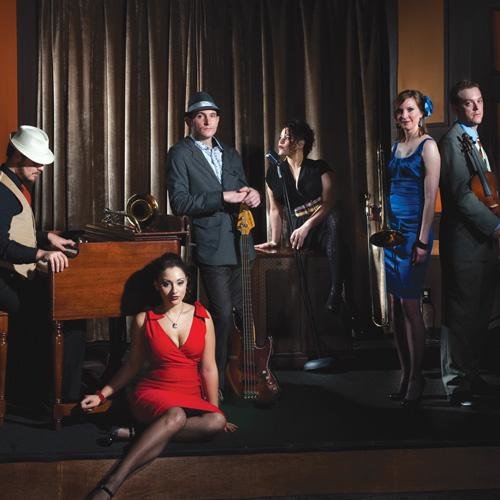
Fillmore Jazz Festival Fillmore between Jackson and Eddy, SF; www.fillmorejazzfestival.com. Sat/2 and Sun/3, 10am-6pm, free. Celebrate the rich history and jazz tradition of San Francisco’s Fillmore District with two days, and three stages of up-and-coming acts and seasoned crooners – like Mingus Amungus, Scary Larry and many others. Of course there will also be arts and crafts to check out, eclectic cuisine from a variety of food vendors, and other goods to purchase.

SUNDAY 3

Neko Case at the Stern Grove Festival Stern Grove, 19th Ave. and Sloat, SF; www.sterngrove.org. 2pm, free. Enjoy a free concert at this beautiful outdoor amphitheater in the park. Singer-songwriter Neko “Lungs for Days” Case headlines this 74 year-old tradition of free performing arts at the Grove. Also performing is local faves the Dodos, and to occupy the kiddies, Magik Magik orchestra (the Tiny Telephone recording studio’s official house orchestra) will get them making music together at the “build a band” workshop.

These Colors Don’t Run SOMArts Cultural Center, 934 Brannan, SF; www.squart.eventbrite.com. 3-11:30pm, $10. There’s a lot going on at this nine hour party – a mini-Hard French complete with BBQ, an experimental drag show, live bands including Dave End, Night Call, and Double Dutchess, and something called – ahem — squart performances. Not to be confused with the flatulent surprise known as a shart, squarting involves glitter, nudity, adult diapers, and spandex and works like this: artists break into randomly assigned teams and receive a list of theme criteria, for which they have two hours to assemble a piece and face a panel of judges for anything-goes spontaneous performance art.

East Bay Symphony and fireworks Craneway Pavilion, 1414 Harbor Way South, Richmond; www.oebs.org. 6:30pm, free. Enjoy live music, food, and fireworks for this Independence Day weekend celebration. Oakland East Bay Symphony will perform patriotic standards and popular movie scores to fireworks and breathtaking views of the San Francisco skyline. The venue will host a Fourth of July-themed concession menu, and you’ve got options: the adjacent Boiler restaurant will remain open during the event.

MONDAY 4

Pier 39 July Fourth celebration Pier 39, Embarcadero, SF; www.pier39.com. 1pm, free. Take the family to Pier 39 for this year’s Independence Day celebration featuring live music, fireworks, and all the attractions that Pier 39 always has to offer (sea lions!) Live performances lined up for this event are beach pop-y Ruby Summer and Tainted Love, everyone’s favorite ’80s cover band. There will also be a Club 90 dance party featuring club hits from back in the day. After the sun goes down, be sure to stick around for the fireworks display.



Alerts

0

WEDNESDAY 29

Moon Tides and the women of Jeju Island

Photographer Brenda Paik Sunoo presents her book Moon Tides, an homage to the female divers of Jeju-do between the ages of 39 and 93. Through photographs and interviews, the author presents the lives of these remarkable South Korean women who dive for seaweed and shellfish with little more than a knife and no breathing apparatus. This practice is common throughout coastal Korea and Japan, usually leaving the men to stay at home and care for the family. The film focuses on the older generations who still do it. The evening includes a wine reception; tickets can be purchased online.

5:30–7:30 p.m., $10

Russ Building

235 Montgomery, 12th Floor, SF

(415) 543-4669

www.imow.org


SATURDAY 2

Immigration history and Angel Island

Like a Left Coast Ellis Island, Angel Island was an immigration station for newly arrived immigrants and war prisoners. It was also the location of the 1939 trial to deport Australian-born International Longshore and Warehouse Union (ILWU) President Harry Bridges for allegedly being a member of the Communist Party. ILWU historian Harvey Schwartz and ironworker Mike Daly discusses the island’s history — from the trial of Harry Bridges to the Pearl River Delta Taishan people of China, who were largely responsible for building the early infrastructure of California. Check the website for ferry and shuttle information.

11 a.m., free

Angel Island Immigration Post

Mess Hall

Northeast side of the island

www.laborfest.net


SUNDAY 3

Labor attacks in California

The McCarthy-era “witch hunts” in California that targeted trade union members and their right to make a living also helped shape the future of the labor movement. The backlash included a large protest and sit-in at the House Un-American Activities Committee (HUAC) hearings in San Francisco, which resulted in ending the HUAC hearings and their attack on the labor movement. Hear about that tumultuous time from those who were involved, including Phil Mezey (the San Francisco State University professor who was fired for not signing a loyalty oath), labor historians, and a handful of retired workers and protestors.

2 p.m., free

ILWU Local 34

801 Second St., SF

www.laborfest.net 


Mail items for Alerts to the Guardian Building, 135 Mississippi St., SF, CA 94107; fax to (415) 437-3658; or e-mail alert@sfbg.com. Please include a contact telephone number. Items must be received at least one week prior to the publication date.

Private cops at SF General?

26


Truly astonishing moment at the June 23 Budget Committee hearing. The director of Public Health, Barbara Garcia, actually testified that San Francisco General Hospital would be better off with private security guards instead of sheriff’s deputies — because the deputies were only able to follow the law.


You can watch the video here. The discussion starts at 4:49. It begins with Sup. Scott Wiener, is his quiet Scott Wiener way, asking Garcia to talk about the plan to contract out hospital security.


Garcia first insisted that this was a way to save $2 million that would prevent further cuts to health programs. That’s always the primary argument for contracting out.


But then she went a step further.  An outside company, she said, could provide better security — because the (low paid, poorly trained) guards will be able to operate without the restrictions of being peace officers. “There are some restrictions on [the deputy sheriffs’] ability to restrain patients,” she said.


That wasn’t a slip of the tongue — Gregg Sass, the chief financial officer, repeated it again. “If a patient isn’t breaking the law,” he said, “a deputy sheriff won’t intervene.” More: “Private security can intervene. They’re not bound by the same limits that a deputy sheriff is bound by.”


Both Garcia and Sass noted that they wanted security officers who reported directly to them, not to an elected sheriff.


Am I the only one who thinks this is a little weird?


The money thing I understand. I don’t agree — often these supposed savings don’t show up in the end, and besides, do we really want people who get paid $13 an hour without benefits handling security at SF General? But I understand the argument.


On the other hand, the notion that peace officers have to follow rules, and so we should have people who don’t have to follow rules instead strikes me as pretty disturbing. And I’m not sure how true it is: Can a security guard hold and restrain a patient who hasn’t broken the law and isn’t covered by a legal order like a 5150?


I don’t think so. The folks at SEIU Local 1021 don’t think so, either: A flier the group put out notes that:


The issue of Sheriff’s Dept. having legal restraints applies equally to all employees. If there is no 5150 or 5250, no-one has a right to restrain the patient against their will; but a well trained Institutional Policeman can gently persuade a patient with Alzheimer’s to return to their unit.


And I have to say, the notion of having the Department of Public Health oversee a security force (instead of the Sheriff or the Police Department) is disturbing, too. The worst problems in police abuse tend to come from little fiefdoms that aren’t propertly managed — the BART Police, for example, and housing and transit cops in other jurisdictions. Nobody at DPH is trained to manage a security force.


What, exactly, are these (low paid, poorly trained) security guards going to do — grab patients who complain about waiting six hours to see a doctor and “restrain” them? What happens when somebody actually does commit a crime (or brings a gun or a knife into the hospital)? The guards can’t make an arrest. So they call the cops — who come, in due time, but maybe not quickly enough to prevent a disaster. And, of course, we then pay the cops to come and make the arrest.


I haven’t been able to reach Eileen Shields, the public information officer at the Health Department, but I can tell you: The language that her boss used at the Budget and Finance Committee was pretty frightening.


UPDATE: Shields sent me over Garcia’s memo on this, which lays out the case. It pretty much says it all: 


There are times when  patients are unable to control their behavior due to acute medical       
 illness, such as delirium or brain injury. These patients may present a   
 serious risk to their own safety as well as to the safety of other       
 patients and hospital staff.                                             
                                                                           
 These situations are not the result of – nor do they result in – illegal 
 activity. This puts the Sheriff’s deputies, whose responsibility is to   
 uphold the law, in a difficult situation when they are confronted with   
 potentially harmful (but not illegal) situations caused by acute,         
 non-psychiatric medical conditions. Outside security firms do not operate 
 under the same constraints. Instead, they function as members of the     
 health care team whose responsibility is to enforce hospital policy. They 
 are charged with ensuring a safe environment and can act with greater     
 freedom to ensure safety within the limits of the law but without the     
 additional requirements and expectations placed upon a law enforcement   
 officer.
 

Appetite: Dining with two European winemakers

0

There’s nothing quite like dining with the person who made the wine you’re drinking — intimate and focused, it gives one a special insight into what’s in one’s glass. Earlier this month, I met with three Napa-Sonoma winemakers. Recently, I had the chance to spend time with two Europeans from the unparalleled regions of Bordeaux and Kamptal. Look for these wines in local wine shops — or ask that your shopkeeper stock them, they’re that good.

LAURENZ V., Austria – The Gruner Veltliners and Rieslings of Laurenz V.’s — whose name is pronounced “Laurenz Five” — hail from one of my favorite wine-making countries. I adore these two varietals when they come from skilled hands, and those of Laurenz Maria Moser V certainly qualify. He comes from five generations of winemaking, and his grandfather was the legendary Professor Dr. Lorenz Moser III, inventor of the Lenz Moser Hocherziehung trellising system that caught on across European vineyards.

Lunch with Moser entailed colorful stories and many a laugh — the man is hilarious. It also meant a line-up of gorgeous Gruners from a terraced landscape in the Kamptal region, north of Vienna. His wines are stainless steel-fermented, a technique which yields a crisp, bright Gruner profile.

We tasted through seven Gruners, from a juicy 2009 Laurenz und Sophie Singing to his Charming line (years 2005-2009). I was partial to the 2005, full and balanced with acidity and apple spice, as well as the 2006 with its clean nose and creamy yet mineral taste. We even sampled a honeyed 1980 (!) Gruner to witness the possibilities of a Gruner aging — contrary to popular opinion, they can mature quite prettily. 

We ended with a lively citrus-apple 2009 Prinz Von Hessen ‘H’ riesling and a lush, grapefruit-touched Johannisberger Klaus Riesling Kabinett Trocken. The two reflected the range of beautiful wines that come out of Austria. 


Chateau Palmer, Bordeaux, France – When one is invited to a personal dinner with a winemaker from Bordeaux, France, it’s a requirement to jump at the opportunity. During three plus hours with Bernard de Laage at Berkeley’s Claremont Hotel we tasted twelve Chateau Palmer, de Laage’s blends of equal parts merlot and cabernet sauvignon with just a touch of petit verdot. Comparing vintages side by side, we were able to gain a deeper appreciation of the inflections and strengths brought by each harvest. 

For me, the stand outs were the lush 2000 Palmer, the less aged but still bright 2005 Alter Ego — a robust, young expression of Chateau Palmer — an opulent and exuberant 1999 Palmer, and the musty, full, smoky but acidic 2002 Palmer. I actually couldn’t find a single low point in the 1998-2006 line-up.

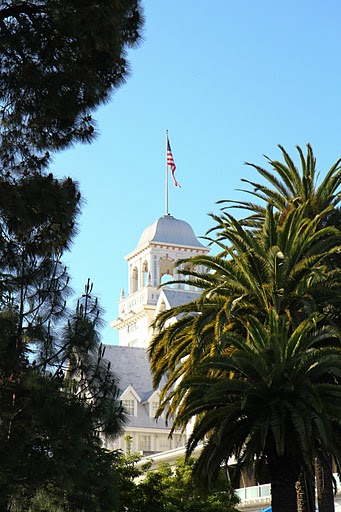
The evening, part of Berkeley Wine Festival (check out its site for future dinners), was over the top — spectacular views of the San Francisco Bay from the back room of Claremont Hotel’s Meritage restaurant. Twinkling lights on a warm night made a brilliant partner to rising star chef Josh Thomsen‘s menu. I was duly impressed with all his dishes, and wouldn’t be surprised if we see a lot more from him in coming years. My top dish of the five course dinner was the Maine sea scallops topped with Hudson Valley foie gras. Served over rhubarb-balsamic compote and endive, it was the dining pinnacle of the night. But for sheer satisfaction, I’m giving my points to Thomsen’s succulent Creek Stone beef short rib.

All in all, a happy marriage of wine, food, people, and setting.


— Subscribe to Virgina’s twice monthly newsletter, The Perfect Spot


Carrot coladas: Vegan happy hour, anyone?

0

A short list of cocktails that are not vegan: Irish coffee, anything involving Drambuie or Martini and Rossi vermouth, cheese-garnished Bloody Marys. (Thanks Barnivore.)

This spring, I interviewed six SF vegans on the state of animal product-free lifestylin’ out here in the Bay. They agreed it was all pretty awesome, given the kitchen creativity and commitment to healthy eating that lives out here. But they identified one thing that our hills and valleys are lacking: a strong sense of vegan community. 

And what’s a better community builder than alcohol?A vegan — and thus more hardcore — version of worldwide sustainability boozery crew Green Drinks, Vegan Drinks SF has been gathering up meat-defeaters for the past two years, dumping them (with fair notice) on the city’s watering holes for a vegan cocktail special, scintillating mingling opportunities, and drunken event announcements to cap the whole thing off. This week, there’s a meet-up at Martuni’s on Thurs/30. We caught up with Elizabeth Castoria, the managing editor of Vegan Drinks progenitor VegNews, to find out more about the phenomenon. 

Ah, and if you’re really feeling the concept, you might try meat-free speed dating.


San Francisco Bay Guardian: How many meetings of Vegan Drinks SF have there been? 

Elizabeth Castoria: We started in February of 2009, and typically skip the months of November and December because since Vegan Drinks is always held on the last Thursday of the month, those two months tend to get swallowed by the holidays. If my math’s right, that’s 25 meetings so far. 


SFBG: Are the drinks specifically vegan? I know that animal products tend to lurk in alcoholic beverages when you least expect them.

EC: The nice thing is that the vast majority of hard liquor is vegan (it’s much more common to find beer and wine that’s been processed with animal byproducts). Our monthly drink special changes up, but it’s always a liquor-based martini. 


SFBG: Who are the Vegan Drinkers? How many people came to the last event? 

EC: We don’t take tickets at the door or anything, but about 50 were in attendance at the last event. The group usually ranges between around 50-ish people to 75-ish, and it’s a real mix. Most are probably between the ages of 25 and 55, and the personalities are diverse, as in any group. Most are professionals who come right from work. 


SFBG: Why Martuni’s for this one? Does the place have a special vegan allegiance? 

EC: When we were scouting out places, Martuni’s seemed like a really good fit because it has a fairly spacious back room that’s semi-private. Skip, the owner, has been really wonderful about coming up with creative drink specials every month. He also happens to have both a popcorn popper and a really adorable little hot dog cart, and he went out and got us a bunch of vegan hot dogs, buns, and condiments that sold for $1. It’s wonderful to partner with someone who’s so enthusiastic! 


SFBG: And knowing Martuni’s, there will be some amazing lounge act in the back room…

EC: Ha! Not intentionally. Though Martuni’s martinis are notoriously strong, so after a few, you never know! We do, however, have a brief announcement period at the end of every event so that anyone who has a project or opportunity to share has the chance to do so. 


SFBG: Drunk events announcements, love it. Why’d you start Vegan Drinks? 

EC: Vegan Drinks as an idea actually started in New York in 2008. When our staff started seeing photos from their events that looked like way too much fun, we got jealous. So we started our own chapter! The point is just to create a space for people to come together, spend time among like-minded folks, and hang out. It purposefully doesn’t have an agenda beyond “let’s have drinks and chat” because so often events are fundraisers, or outreach, or festivals, or readings, or something else that involves a level of obligation, and it’s really nice to just get together with people in the community and hang out without any pressure. 


SFBG: Have you seen any interesting animal product-free collaborations spring up out of these meetings? What are the hot vegan conversation topics that people are mingling over these days?

EC: Certainly some networking happens, and some projects have come from that. For example, even with Vegan Drinks itself, we started organizing the events, and then connected with the Vegansaurus bloggers, and now we co-sponsor the event with them. In terms of hot topics, food is a nearly ubiquitous theme at vegan gatherings. New restaurants, places people have eaten recently for the first time and had either good or bad experiences, new recipes people are experimenting with and those kinds of things definitely come up.


(Carrot colada photo by Wendall T. Webber via Food & Drink)


Vegan Drinks

Thurs/28 6-8 p.m., free with purchase of drink 

Martuni’s 

4 Valencia, SF

(415) 241-0205

www.sfvegandrinks.com


PRIDE TOP 5: Bobby Viteritti’s sleaze songs

0

DJ Bobby Viteritti, the resident DJ at San Francisco’s legendary Trocadero Transfer from 1977 – 1981, appears on the new Horse Meat Disco CD, Horse Meat Disco III — he curates a disc of favorite “sleaze songs.” And you KNOW he’s got the dance floor goods, henny. After the jump, he sleazes us up and reminds us how hot Pride used to get (and will this weekend again).

Bobby Viteritti’s Top 5 sleaze songs 

1. “Runaway Love” by Linda Clifford (Curtom), 1978 

2. “Walk the Night” by Skatt Brothers (Casablanca), 1979 

3. “Evolution” by Giorgio Moroder (Casablanca), 1978 

http://www.youtube.com/watch?v=SuGGrRXW67k

4. “Hot Butterfly” by Bionic Boogie (Polydor), 1978 

5. “Anambra” by Ozo (DJM), 1976 

http://www.youtube.com/watch?v=Vhjsy5K9yr0


Civil Grand Jury slams shipyard development project

5

“The Civil Grand Jury concludes that the Hunter’s Point Shipyard redevelopment project will require more communication, more transparency, and more commitment from the City in order to achieve its goals of providing housing, jobs and economic development, tax revenue and open spaces to San Francisco and its residents, particularly those residing in the surrounding neighborhoods.”

So reads the conclusion of the Civil Grand Jury’s 2010-2011 report, which is titled, “Hunters Point Shipyard: a shifting landscape.” The report makes six findings and seven recommendation that city departments and the Board will have to respond to within the next 60-90 days. And some of these recommendations reflect problems the Guardian unearthed and highlighted during in its coverage of the development.

The jury found that the San Francisco Department of Public Health (SFDPH) is not in compliance with its pledge to the California Department of Public Health to keep residents informed of developments at the Hunters Point Shipyard. As the report’s authors note, the SFDPH’s website “is not regularly updated.”

The jury also found that the City has placed itself in a potentially compromising situation with developer Lennar where in essence, “the wolf is paying the shepherd to guard the flock.”

The jury further noted that by having developer Lennar reimburse the city for monitoring expenses associated with the shipyard project, SFDPH has created a situation that “could raise doubt in the public’s mind about its commitment to proactively and impartially enforce environmental health regulations even when it might adversely impact Lennar.”

Public trust in the SFPDH has been further jeopardized by its failure to update its website in a timely manner, and its apparent reluctance to comment publicly on the best method to deal with the clean-up of Parcel E-2, which is the site of a former dump and deemed one of the most polluted parcels of land on the shipyard.

The jury found that the above concerns were “further reinforced by the recent release of email messages that purportedly showed inappropriate communications between senior officials at the SFDPH and the U.S. Environmental Protection Agency and Lennar.”

The jury found that with the exception of Parcel A, the City has no legal control over the remaining shipyard property. “Consequently, in a technical sense, the City has no authority over matters dealing with deadlines and deliverables for environmental clean-up. However, the City does in fact have some standing in these matters via the 2004 conveyance agreement between the San Francisco Redevelopment Agency (SFRA) and the Navy. The agreement stipulates that the Navy will work collaboratively with the SFRA and share information about cleanup work.”

Last but not least, the jury found the previous efforts by the City to implement workforce policies at city-funded construction projects such as the shipyard have “largely proved ineffective” as they only require contractors to make good-faith efforts, but that earlier this year, a new local hire ordinance was implemented with stricter requirements and mandates.

Based on these findings, the jury recommended that SFDPH needs to update its shipyard project website on a weekly or monthly basis, immediately stop accepting money from Lennar to pay for monitors at the shipyard and cover the costs from its own resources, rigorously enforce conflict of interest guidelines governing deals between its officials and the companies they are monitoring, and conduct its own environmental assessment of the issue of capping Parcel E-2 and make its findings available to the public for comment.

The jury also recommended that because the Navy still owns the majority of the shipyard land and therefore the city has no direct control over deadlines and deliverables, it is critical that the Bay Area Air Quality Management District and SFDPH be “particularly vigilant in monitoring clean-up activities at the shipyard.”

The jury further recommended that the City and the SFRA should have “contingency plans in place” for continuing Redevelopment-related projects, including the shipyard, “in the event State redevelopment plans are cut or eliminated.”

Last but not least, the jury recommended that to ensure that promised job creation goals for the shipyard are realized, “the City should ensure that the Office of Labor Standards Enforcement has sufficient resources to allow it to effectively enforce the provisions of the new workforce laws.”

According to the conditions of the Civil Grand Jury’s report, for each finding the responding parties must report if the recommendation has been implemented or not, whether it requires further analysis, or was not implemented because it is either unwarranted or not reasonable.

So, expect to see some fireworks in the coming weeks, given that the Mayor’s Office, the Board, the Office of Economic and Workforce Development, SFDPH, the Office of Labor Standards Enforcement, the Redevelopment Agency and the BAAQMD have been named as the responding parties in this report…

Fixing Care not Cash

18

I will admit to a bias up front: I was against Care Not Cash in 2002, when Gavin Newsom used it as a cynical play to get elected mayor by bashing the homeless. I always argued that the city would be taking away the already-tiny welfare payments from people in exchange for housing that isn’t there. Imagine living on $422 a month in San Francisco. Now imagine that’s been cut to $59 a month — because the city’s determined that you can sleep in a shelter bed. Great fucking deal.


And that’s what happens. Care not Cash allows the city to reduce a homeless person’s general assistance grant to $59 a month as soon as the city finds housing for the person. And a shelter counts as housing.


There are lots of problems with the scenario — like this and and this. In essence, the city sets aside a certain number of shelter beds for people in the CNC program, but they don’t all show up, so there are empty beds — and people who need a place to sleep can’t get them because they’re earmarked as “housing” for an anti-homeless program.


So five supervisors have come up with a ballot initiative that would make one small, but significant change in the Care Not Cash legislation. It would specify that shelters don’t count as housing. That’s it. That’s the entire amendment. (You can read the proposed law here (pdf)


It makes perfect logical sense. You want to tell a homeless person that instead of giving you welfare payments, we’re going to give you housing? Fine. Then make it housing. Wasn’t that the premise of CNC from the start?


But somehow, CNC stalwarts (including those who make money off the program) are outraged, claiming this will gut the entire effort. In the Chronicle story, Mayor Ed Lee notes that


“By removing the shelter system from the available benefits provided to Care Not Cash recipients, we dismantle this path to getting people housed, ultimately undermining the success of the nationally recognized, award-winning program.”


Of course, the proposal doesn’t remove the shelter system from the available benefits. Sup. Jane Kim, the sponsor, and her colleagues aren’t talking about shutting down shelters or kicking homeless people out. The measure just says you can’t take someone’s welfare grant away just because you found him or her a temporary cot in a noisy, often unsafe shelter that offers no privacy and operates under random rules that at lot of us would find intolerable. 


Again, my bias is against the entire premise of Care Not Cash. I think the city (and the state and the feds) ought to be providing homeless people with enough money to get a place to live and enough to eat. That’s the way it used to work — when I arrived in San Francisco, you could actually afford to rent a room in a shared house with General Assistance money, and you could live reasonably — not in luxury, but reasonably — on federal SSI payments. But the cost of housing has so outstripped the increase in welfare payments that people wind up on the streets. 


But if we’re going to do the Care Not Cash thing, shouldn’t the city be required to provide real housing before the grants get cut off?


Randy Shaw, who runs a bunch of Care Not Cash hotels under city contract, doesn’t think so. He argues that


[T]he measure repeals CNC’s central premise that homeless single adults on welfare should not get $422 per month if they refuse SRO housing. The initiative also dramatically reverses San Francisco homeless policy: it replaces a system designed to get homeless people housed with one subsidizing homeless people to live permanently in shelters. The measure increases homelessness and provides no alternative funding to make up for the millions of CNC dollars that would be eliminated from the city’s supportive housing budget.


 I understand the concern about the CNC money (some of which, again, goes to Shaw’s operation). If the city starts paying $422 a month to some people who are now only getting $59, that money will have to come from someplace. But this whole notion that the proposed change will allow the city to give cash grants to people who “refuse SRO housing” seems a bit off.


“We haven’t changed that part at all,” Jennifer Freidenbach, who runs the Coalition on Homelessness and was involved in drafting the measure, told me. “People who refuse SRO housing would still get their grants cut.”


I asked Shaw about this — and also about my understanding that there isn’t enough SRO housing for every homeless person who wants a place to live. Should people on the waiting list get their grants cut off because the city can stick them in a shelter in the meantime?


For whatever reason, my old pal Randy hasn’t responded. (I continue to be boggled by two things — Shaw never calls people before he trashes them, and he seems unwilling to have substantive debates with me when I want to talk to him. That last time I emailed him to ask why he didn’t call people for comment, he responded: “I see the issue very differently and disagree with your premise.” How is that helpful? This time he didn’t answer at all.)


The oddest thing is that Shaw — a longtime housing advocate who has spent 30 years working to help low-income people — has adopted a remarkably strident, even harsh tone that reminds me of the rhetoric that Newsom and his allies used to use. Consider:


Understand we are talking about people who have the option of accepting permanent housing but refuse. People who want to get a full city grant, live in a city-funded shelter, but want the right to pay nothing.


Jeez. Those lazy welfare bums who want “the right” to a place to live and a miniscule, tiny cash grant.


There was a time when liberals used to talk about a guaranteed national income. Now the debate in progressive San Francisco involves bashing poor people. Wow. 


PRIDE TOP 5: Horse Meat Disco

1

Magical UK disco foursome Horse Meat Disco (the four horsemen of the discopocalypse?) are joining House of Stank at Juanita More’s super-kiki Pride party on Sunday — and hottie Jim Stanton from the quartet has gifted us with his Pride Top 5. Get ready to twirl, because there’s also a hot-hot Horsemeat minimix after the jump, celebrating the upcoming July 4 release of their third compilation disc, Horsemeat III (holy mirrorballs, Duck Man, just check out this track list). Get into it.

Macho, “I’m a Man” (Prelude), 1978
Macho is a proper disco song that reminds me of San Francisco because of the leather scene. It is sooo gay and hard! Perfect for that “dark room” action. Haha!

http://www.youtube.com/watch?v=-VbLB4UEFvw

Locussolus, “I Want It  (Prins Tomas Remix)” (International Feel/UK), 2011
Prins Tomas turns DJ Harvey’s celebrated epic club track into a funky Dr Buzzard’s Original Savannah Band-style work out for our new disco generation. BIG!

http://www.youtube.com/watch?v=3EDtfBDSWug


Ava Cherry, “You Never Loved Me” (RSO), 1980
EVERYTHING you want from  a disco track jam-packed into 8 minutes. Bitterness, heartache and regret? Check! Searing strings? Check! Brass section to die for? Check! And that trippy break HIT!!!


Run Baby Run, “Let No Man Put Asunder (Ron Hardy Edit)” (Salsoul), 1983
I love the original a lot, BUT I like Ron Hardy’s “raw” side! A proper Chicago legend. I edit this to another level. Soo ENERGETIC!!!Always in my set.


Paul Parker, Right On Target (Megatone), 1982

A muscular slab of energetic and frisky true San Francisco. Non-stop heavy action from Patrick Cowley the godfather of hi-NRG.

http://www.youtube.com/watch?v=eKqtVhcRZwU

And check out this minimix!!


<< <Horse Meat Disco III Mini-Mix by Strut

Lights Out: Taking the Royal Baths

0

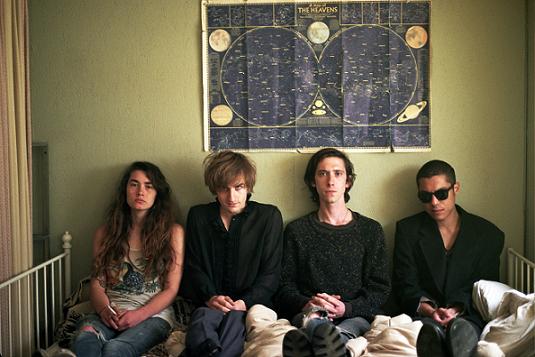
“This music was what we wanted to hear,” explains vocalist-guitarist Jigmae Baer of the beginnings of the Royal Baths, “that we weren’t hearing anywhere else.” 

The Royal Baths formed two years ago, as Baer was coming to the end of playing with Thee Oh Sees, and guitarist-vocalist Jeremy Cox moved to San Francisco by way of Arcata. 

“When we first started, I’d been listening to a lot of finger-picking,” explains guitarist-vocalist Jeremy Cox. “So I was experimenting with open tuning, like Delta Blues, playing Willie Johnson and Skip James.”

“I remember the first song we covered was a Skip James song,” adds Bear. “And we covered a song by Nina Simone, the Carter Family, and Spaceman 3.”

The quartet plays rock ‘n’ roll with a pretty grittiness: accelerating beats makes the music frenzy-filled; staggering melodies shine through the noisy fuzz; extended psychedelic guitar jams are rough flourishes; and the duo delivery of lyrics is hypnotic in its repetition and raw in its simple truth.

“Jigmae writes all the lyrics,” Cox clarifies. “Jigmae brings his typewriter and I’ll have just a guitar, and we’ll have an idea about what we want the song to be about.” Together the pair’s dynamic — one fiddling on the guitar and the other typing away — brings about the dark and light of the Royal Bath’s music. “After we have a rough skeleton of the song, we’ll bring it into the studio and do it with the full band, says Cox. “And it changes further from there.”

In 2010, the band released its debut album Litanies (Woodsist Records). They’ve already recorded and mixed a new album. When I ask if there’s a release date for that one, Baer quips, “We would’ve liked to release it two months ago.” The pair explains that they recorded the album in February, but had to go back to the studio to redo the initial mixes. 

“This album is a lot different sounding to our ears,” explains Cox, “because our last album was more just writing the songs as we went. This album was mostly recorded live, so it’s more of a live rock and roll album.”

This is a good thing; The Royal Baths have a voltaic energy live. And if you’ve seen them play recently, then you’ve heard new material from this unreleased and unnamed album. 

In the new song “Faster and Harder,” Baer and Cox’s low and high registers harmonize the lines “I love my damaged girl/We share a wicked world.” The track has a British paisley rock undertone and like good classic rock ‘n’ roll, it is sexy and dirty. The double guitars spiral out of control as the duo chants the title lines faster and faster. 

When asked what inspires Baer’s lyrics, he replies, “It’s always a combination of being partially autobiographical and partially from my friends and what I see in them.” Baer adds, “A lot of times, I write stuff that makes me laugh.” He notes that the band is often regarded as being very serious, but in an absurdist way. “I am talking about the real fucked up problems that our friends and us have, in a very unflinching way, and trying to find the absurdity of our petty little problems.”

Beat-driven track “Burn,” explains Baer, “is just a story about our friend who went to Pill Hill and just got ripped off.”

As you wait for the release of the Royal Baths next album, catch the band’s live show at the Hemlock before they go on tour this August and begin their relocation to Brooklyn.


Royal Baths

With Dadfag, Nucular Animals, Psychic Feline

July 2 9:30 pm, $7

Hemlock Tavern

1131 Polk, SF 

(415) 596-7777

www.hemlocktavern.com


Hot sexy events: June 22-28

0

Apparently we got everyone a little too hot and bothered with our bike messenger sex post a few weeks back — the bicycle coitus backlash has already begun!

This news from LA, where the super fly Midnight Ridazz ride ran into some complications in the form of a drunk, cell phone-using driver smashing into a group stopped on the side of a road, injuring 11 cyclists. The police were quick to point fingers — at the cyclists. After all, “alcohol, condoms, and marijuana” were found near the scene of the crime, as ABC Channel 7 reported. Clearly, the Ridazz were gearing up (ha!) for a late night bike orgy. You know how that saddle friction gets everyone all randy.

LAPD did offer this PSA-type release, which I suppose is intended to act as a mea culpa for being all sassy about adult beverages, smoking weed, and safe sex? At any rate, “bike orgy” should surely be the SF Bike Party’s next theme ride. And now onto sex events for Pride Week! 


Oh!

Dirty young gentlemen, be aware: you’re not to miss this grimy-beated, well-meated party time at SF’s cruisey queer watering hole. Details? Write the story yourself — all we can tell you is that DJs Taco Tuesday and Guy Ruben will be getting the soundtrack hot like a skin flick. 

Wed/22 10 p.m.-2 a.m., $5

Powerhouse

1347 Folsom, SF

www.powerhouse-sf.com


“Heart/Hand/Art: Erotic Moments from San Francisco’s Lesbian Underground”

In a recent SF Station interview, Phyllis Christopher insists she “never, never wanted to shock people. I was having these amazing experiences and I wanted to talk about it.” Surely shocking is not the right word for Christopher’s florid shots of women in the throes of passion — titty grabbing, peeking out between fishnetted leg passion — we only flash on “sexy.” But Christopher’s intent was to document the lives of San Francisco lesbians. The erotica she captured is gorgeous — a flattering portrayal of women loving women in the City by the Bay. 

Thurs/23 6-8 p.m., free

Good Vibrations

1620 Polk, SF

(415) 345-0500

www.goodvibes.com


Lexington Club Pride weekend

Let’s be honest, it’s a rat race trying to name your Pride parties with the sluttiest monikers in the city — there’s just too much competition out there. But the Lex surely has a leg way up, if there is such a contest. Honestly, it wins based on sheer quantity: Thursday dances out with “DTF,” Friday flirts hard with “No Strings Attached,” on Saturday you can “Tap That,” and Sunday’s climax (after a super-slutty brunch party — oh, and the official Pride blowout, of course) is “Hit It and Quit It.” Straddle you a lady lez and get down — just don’t spill that Pabst on her cut-offs unless you’re trying to lick it off. 

Thurs/23-Sun/26, free

Lexington Club

3464 19th St., SF

(415) 863-2052

www.lexingtonclub.com


Mr. Kok Kontest

Kok Bar’s keeping it hard and slutty for you all weekend, but the new kid on the Folsom block has some extra special for you planned for Saturday night: a contest to see who has the biggest dick — though wait, isn’t that the point of Pride Week itself? Anyways, it’s been formalized here, so pack your binoculars, not much else, and head down.

Sat/25, free before 10 p.m., $4 afterwards

Kok Bar

1225 Folsom, SF

www.kokbarsf.com


Pansexual Pride Party

Cap off your Pride celebrations (or gear up for Sunday night) at the Citadel’s all-inclusive dungeon play party. Featured will be a demonstration by Mr. SF Citadel 2011 on how to successfully dominate a bottom twice your size. The website promises that it will produce experiences akin to “a chihuahua picking on a rottweiler.” 

Sun/26 5-8 p.m., $10 

SF Citadel 

1277 Mission, SF

www.sfcitadel.org


“Sex, Death, Laughter, and Disease: Writing and the Body”

Empower your body (and your prose) with this course, which will teach the skill of writing the corporeal form as protagonist. Sound a little English Lit-y for you? Instructor Lorelei Lee is an NYU creative writing professor, but check her clips before you dismiss this event from this column: lady’s been featured in $pread Magazine, the anthologies Hos, Hookers, Call Girls and Rent Boys: Professionals Writing on Life and Love and Off the Set: Porn Stars and Their Partners — plus, she’s currently penning a script with Stephen Elliott. 

Tues/28 (through Aug. 2) 7:30-9 p.m., $325

Center for Sex and Culture

1349 Mission, SF

(415) 902-2071

www.sexandculture.org


Measure would make getting a shelter bed easier and more fair

3

More than three years after a Guardian investigation found that San Francisco’s homeless shelter system is an unnecessarily confusing, difficult to navigate, and inequitable boondoggle that routinely denies people use of even vacant shelter beds, voters in November will get a chance to change a system created largely by former Mayor Gavin Newsom’s Care Not Cash program.

Care Not Cash was sold to voters in 2002 as a program that reduced the general assistance payments to homeless individuals in exchange for the city giving them housing and support services. But that housing often turned out to be simply a shelter bed, and after years of city budget cutting closed homeless shelters, nearly half the remaining beds were set aside for Care Not Cash clients whether they used them or not.

So Sup. Jane Kim and four progressive supervisors, working with the Coalition on Homelessness, yesterday approved the creation of a “Fair Shelter” ballot measure to require that Care Not Cash clients get more than simply a shelter bed and that shelter beds be opened up to all who need them on a more equitable and sensible basis.

But Mayor Ed Lee and others who helped create the current system are criticizing the measure and using the same deceptive claims that have masked the problem for years. “Care Not Cash is premised on providing a path to housing and services. That path begins with shelter for those who need it. By removing the shelter system from the available benefits provided to Care Not Cash recipients, we dismantle this path to getting people housed, ultimately undermining the success of this nationally recognized, award-winning program,” Lee said in a statement issued yesterday.

Human Services Agency Director Trent Rhorer, Newsom’s point person in creating the system, told the Chronicle that the measure would threaten Care Not Cash and attract more homeless people to the city by making it easier to get into shelters. He also denied there was a problem, noting that about 100 of the city’s 1,100 shelter beds are vacant each night.

But there’s a gaping contradiction at the heart of Rhorer’s rhetoric, demonstrating that the city’s real intention is to make life as difficult as possible for the homeless in the hopes that they’ll simply leave the city, as Guardian reporters found when they spent a week trying to sleep in the shelters. Vacant beds are only made available late at night, and claiming one often involves long uncertain waits and crosstown run-arounds between where people register and where they might ultimately sleep.

It’s a dehumanizing and deceptive system that COH and the city’s Homeless Shelter Monitoring Committee have long been seeking to change. “The inclusion of shelter in the original ordinance has resulted in an unintended negative consequence of wreaking havoc on the city’s publicly funded shelter system. People with disabilities, seniors, working homeless people and undocumented people have a disadvantage in garnering access to shelter beds under the current system,” Shelter Monitoring Committee Chair LJ Cirilo said in a statement put out by COH, which noted that 43 percent of shelter beds are reserved by Care Not Cash recipients, although they represent only about 14 percent of the city’s homeless population.

The cab driver protest

4

I’m on the side of the taxi drivers who held that noisy demonstration at City Hall. The folks who drive taxis get screwed in so many ways — the gate fees (the price of leasing a cab for a shift) go up faster than the fares the drivers can charge. Gas (which comes out of the drivers’ pockets) goes up even faster. And now they’re getting dinged for credit-card fees (even though by law they’re supposed to take credit cards). Add it all up, and the drivers are losing thousands of dollars a year — and they weren’t making all that much in the first place.


Wonder why drivers are bombing along 101 at 80 miles an hour from SFO to the city? The less time they spend on a fare the more fares they can take. It’s dangerous and the drivers don’t like it, but if you have to make a living and the city and the cab companies keep squeezing every dime out of your pocket, you have to drive like crazy.


I understand why Ross Mirkarimi was pissed at the noise — he’s trying to hold a press conference on education and nobody can hear the kids talking. Bad timing. But still — I’m amazed the drivers aren’t more angry. I’m amazed more of them aren’t calling for a strike. Driving a cab used to be a decent way to make a living (half the freelance writers in San Francisco were cab drivers). Now it’s a nasty grind for a stingy reward (and no helath insurance).


A note to journalists covering this story: Most of the drivers I know hate the word “cabbie.” They’re drivers. Taxi drivers. They’re rather be treated as professionals. 


Show off your your air balls at this weekend’s U.S. Air Guitar Competition

0

The world of competitive air guitar in the United States has come a long way from it’s humble beginnings in 2003 when only two coasts were ripping faux chords. Nowadays, a nationwide shred-a-thon draws guitar mimes from around the country, and hosts competitions in 17 cities. Each regional winner competes in the Chicago nationals, vying for the chance to bring back the golden crown from the mother of all air guitar championship competitions in Oulou, Finland.  

In fact, the Europeans have been serious about their air guitar for quite some time. The Fins have been holding the world air guitar competitions since 1996 to honor the practice as a true art form and a message of peace. (You can’t hold a rifle if you’re playing air guitar, right?)

In the U.S., however – the birthplace of both rock music and air guitar, mind you – it’s always been kind of a joke, something tighty-whitey-clad teenagers do in front of bedroom mirrors. Made legendary by Joe Cocker at his Woodstock performance in 1969, and then popularized by hair metal enthusiasts of the 1980s, the art of air guitar has yet to reach its cultural zenith here in the states – but we’re working on it.

http://www.youtube.com/watch?v=bpp-XLuS0Y4

Joe Cocker keeps busy in between vocals at his 1969 Woodstock performance. When asked what he was fingering, he replied: “I’ve always wanted to play guitar, but never learned.”

The San Francisco leg of the U.S. Air Guitar Championships will jump kick all over the Golden Gate this Fri/24 and Sat/25, and is open to all competitors.

Here’s how it works: Participants battle imaginary axes in two rounds: rockin’ air licks to a song of one’s own choosing, and then to a surprise song from the judges. They are scored on a scale from zero to six, just like in figure skating (would that ice skaters shared the air guitar competitors’ goofy self awareness.) The judges look for technical skill (the accuracy of the notes noodled), stage presence (rock god channeling), and something called “airiness,” that certain je ne sais quoi that transcends the act of air guitar into the upper echelons of  high art. In the end, the two scores are totaled and the winner with the highest score from on both nights will represent San Francisco in the upcoming national throwdown.

Think you have what it takes to emerge victorious? Enter here. And be sure to check back for my play-by-play coverage of this weekend’s competition.


U.S. Air Guitar Championships

Fri/24 and Sat/25, 9pm, $20/free for competitors

The Independent

628 Divisadero, SF

www.theindependentsf.com


Fighting for control: A digital DJ throwdown this weekend at Public Works

1

This Sat/25, San Francisco will serve as host to an event that will have Guitar Hero extremists falling off their couches. Fresh off its success from its two year anniversary show in January, a group dedicated to showcasing live electronic musicianship is taking over Public Works, this time for the West Coast Championship Controller Battle, where electronic controllerists will battle it out in hopes of achieving a piece of controller glory.  

“It’s not a typical show,” says Rich “Rich DDT” Trapani, a producer of the event and co-founder of LoveTechSF. Trapani hopes that the controller battle will “bring the community [of electronic musicians] together and serve as a place to inspire each other.”  

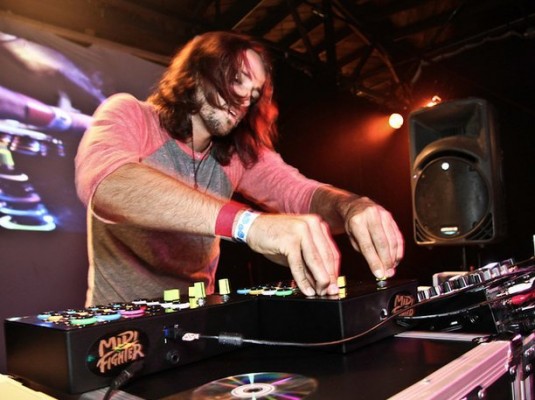
For those not familiar with controllers: think completely digitalized turntables that mash up music with the help of computer hardware. They come in all shapes and sizes, each one fitted out with different types of knobs, switches, keys – some even have multicolored arcade game buttons that wouldn’t be out of place on an old Pacman or Frogger game system. 

With a controller, you can have the force of a drum kit at the mercy of your fingertips. A kick drum at your index finger, a snare at the ring finger, a hi-hat at the middle finger, and a snare at the pinky. It’s a heady sight, controllerists going at their machines – but don’t worry if you get stuck at the back of the club on Saturday. Trapani says there will be a video crew all over the clashing digitalists covering the action and projecting it on large screens for all to see. 

“People are learning a lot from the creative innovation and musicianship in this small period of time to really gain an understanding of what it means to be an electronic musician,” says Trapani. The controller battle will be a one-on-one throw down, tournament style elimination. Known and new electronic musicians from up and down the West Coast will be given two and a half minutes to electrify the audience — and judges panel — with their new and inimitable sets. 

LoveTech is working collaboratively with Controllerism.com and the Slayers Club DJ collective to produce this controller battle royale. 

“It’s going to be something that drives home the point that San Francisco is at the vanguard of music culture,” says Matt Haze, a Slayers Club DJ who will be spinning at the controller battle Saturday night. 

Also scheduled to perform at the battle are popular controllerists Ean Golden, and the electronic musician dubbed “the godfather of controllerism”, Moldover (co-founder of Love Tech and founder of Controllerism.com). The celebrity judges panel includes Zach Huntting Akazappan (Laptop Battle), J.Tonal (The Flying Skulls), and Laura Escude (Electronic Creatives).


West Coast Championship Controller Battle

Sat/25 9 p.m., $6 presale/$10 at the door

Public Works

161 Erie Street, SF

www.publicsf.com

Facebook: West Coast Championship Controller Battle


The Queer Issue 2011

5

Every year we bring it for Pride — attempting to represent the incredibly varied and creative community we call queer. This is an impossible task, of course, but that doesn’t mean we don’t try! We really try. So strap on those rainbow knickers, hop on a unicorn, and let’s dive in. 

>>EDITOR’S NOTES

Queer youth and you

By Marke B.


>>THE GUARDIAN HOT PINK LIST 2011


>>OUR MEGA-GUIDE TO PRIDE

Events, parties, art, action and more


>>GO WITH THE FLOW

Oakland rap phenom Kreayshawn reps a casual Bay sexuality

By Amber Schadewald


>>BRIGHT ON

Dyke porn pioneer Susie Bright opens up with Big Sex, Little Death

By Mattilda Sycamore Bernstein


>>YEARBOOK OF HEARTBREAK AND OUTRAGE

A 40-year retrospective highlights the Bay Area Reporter’s heroic AIDS coverage

By Oscar Raymundo


>>SHE’S GOT THE LOOK

Cat Perez’s Lesbians in San Francisco blog captures queer hotness

By Amber Schadewald


>>GETTING WHAT YOU WANT

Second annual This Is What I Want performance extravaganza plumbs the nature of desire

By Robert Avila


>>SCENES FROM THE ROAD

Queer youth art from the Roaddawgz homeless youth program

The Guardian Hot Pink List 2011

3

For the past few years, as part of our annual Queer Issue, we’ve rounded up a few of the people who have inspired us with their unique approaches to queer life. Whether they’re activists, artists, performers, or just plain hot-to-trot rabble-rousers, they’ve made our queer hearts beat a little faster (and reminded us of the fantastic diversity and dedication of the community). This year, we’ve gathered together another Hot Pink bunch, and asked them. “What inspires you right now — and what could the queer community use more of?” This year’s Hot Pink List was photographed by Keeney + Law


HONEY MAHOGANY

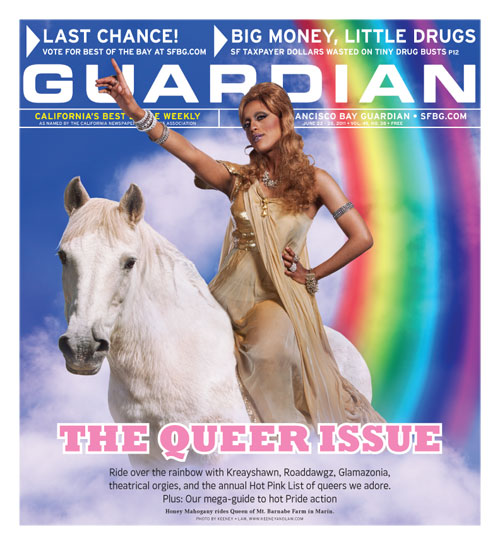
Singer, performer, social worker, photographer, glamour girl — Miss Honey Mahogany (www.itshoney.com) does it all and leaves you breathless. Catch up with her on the SFMOMA Pride Parade float (a drag salute to Paris, 1928) on Sunday, June 26, and look for her forthcoming EP this summer. “I feel really lucky to be coming of age as a performer at a time when there seem to be more and more queers out there in the public eye. Whether it be in popular media, politics, art, advocacy work, research … we are everywhere! One thing I would really like to see in the next few years is the rise of new, massively popular gay icons … and I mean ICONS, not celebrities. I think the world is ready for that. In fact, I think the world needs it.”


ROSE SLAM! JOHNSON

Have fun or make a difference? Bike-food-community activist Rose Slam! Johnson has found the two can make hot partners. She helped plan SF Bike Coalition’s Bike to School Day, and merrily oversees the Western Addition’s Urban Eating League, Apothocurious (a bike-powered organic food subscription service, www.apothocurious.com), and her own queer adult outdoors camp. This summer, she’s embarking on an multimonth bike ride and camping with Northwest queer youth. “Fear and defensiveness often distract us. By bringing people together around things we are passionate about — food, bikes, community, fun — we are able to move towards love, acceptance, and healing.”


KB BOYCE AND CELESTE CHAN

The masterminds behind Queer Rebels (www.queerrebels.com), an organization that showcases queer artists of color, KB and Celeste are involved in everything from Community United Against Violence (www.cuav.org) to “TuffNStuff: The Last Delta Drag King,” KB’s musical act. Upcoming “Queer Rebels of the Harlem Renaissance” (Friday, July 1 and Saturday, July 2), part of the national Queer Arts Festival (www.queerculturalcenter.org) is a stage extravaganza celebrating that great period. And TuffNStuff performs at the Trans March Rally (www.transmarch.org) Friday, June 24 from 3:30 p.m.-6:30 p.m. “We are inspired by new queer work that creates our own myths, reveals hidden histories, and is unapologetically, riotously gay!”


ALIX P. SHEDD

“It’s very rare to find an aesthetically dedicated queer space that isn’t centered around alcohol, includes queer youth, and is right for all different kinds of performers and performances. Somewhere you can scream, dance, and love everything that’s gay.” So Alix (with help from Lorin Murphy and a ton of volunteers) found a space, painted it pink, and launched the Big Gay Warehouse (www.biggaywarehouse.org). For the past year, the bGw has hosted many of the city’s most intriguing queercentric events, from punk concerts and video nights to sensory derangements and environmental makeovers. Alas, bGw’s days are numbered due to rising rents, but Alix — who’s also involved in trans-women-empowering nonprofit thrift store the Junque Shoppe and designs a clothing line called Apocalypse Vintage — already has the next move in mind.


MICAH TRON (WITH DJ JEANINE DA FEEN)

Super-sharp MC Micah Tron has been rising through the Bay’s hip-hop ranks with a deep electric sound and sexy come-ons. Check her out at www.soundcloud.com/Micahtron and peep her forthcoming EP “Jungle Music,” produced by the HOTTUB crew. She’ll be performing at the Crooked party at the Showdown on Friday, June 24 and on the Pride celebration main stage (www.sfpride.org) on Sunday, June 26 at 11:50 a.m. with her DJ Jeanine Da Feen. “Walking the streets of San Francisco inspire me, there’s nothing like being surrounded by people who aren’t afraid to be themselves. Our community could use more self-acceptance — we’re beautiful people!”


JOCQUESE “JOQ” WHITFIELD

Work! Voguer extraordinaire, Jocquese teaches the wonderful Tuesday night Vogue and Tone class — “a dance class with a party feel” — at Dance Mission Theatre (www.dancemission.com). He’s also part of the raucous Miss Honey nightlife crew and is a collaborator, with Shireen Rahimi, on the West Coast Dopest Outsiders youth life skills program, encouraging “movement through movement.” He’ll be performing at Crooked and Pride with Micah Tron. “I think we live in a society where we place sexuality on everything. I want to strip that away and tell people to just be themselves and dance.”


DIEGO GOMEZ/ TRANGELA LANSBURY

George Washington was due for a kick-ass sex change — so artist and illustrator Diego Gomez (designnurd.blogspot.com) started painting colorful characters like Storm from X-Men, She-Ra, and Jem on dollar bills, a.k.a. “Diego Dollars.” As the designer for Tweaker.org, he gets out valuable information from the San Francisco AIDS Foundation. He’s currently illustrating an “all-Latin porn-graphic novel” called Spicey and a comic book called “CuntBricks,” making clothes and accessories for Barney’s New York and local boutique Sui Generis, crafting with his “Needle X Change” knitting group, performing as his alter ego Trangela Landsbury, and a ton of other neon-bright activities. “I’d like to see more glitter and gold in the future and ‘happy’ surprises (not to mention endings).”


CHRISTOPHER REYNOLDS AND ALYSIA SEBASTIANI

Sustainability was all the queer conceptual rage this past year — but Christopher and Alysia, the powerhouses behind landscape design firm Reynolds-Sebastiani (www.reynolds-sebastiani.com) have been setting the principles in motion by designing and maintaining spaces throughout the city that morph norms to create alternative environments that adapt to change. Recent projects include a redesign of the Phoenix Hotel grounds, to be unveiled at Juanita More’s Pride Party on Sunday, June 26 and a show of amazing terrariums using vintage bottles they unearthed at St. Francis Fountain in the Mission’s new event space, Candy Kitchen, opening Thursday, June 23, 6 p.m.-10 p.m., and continuing for two weeks. “Like any cultural paradigm shift, sustainable practices must reach and change the popular vernacular in order to become truly sustainable — in this way they’re like queer culture,” says Christopher.

Go with the flow

2

arts@sfbg.com

QUEER “I don’t like titles. I’m an open-minded person. I’m not going to shoot anybody down based on gender or color,” Kreayshawn told me over the phone. “I’ve dated girls. I’ve dated guys. And I’ve felt the same way for both.”

It’s only been about a month since the 21-year-old East Oakland native’s “Gucci Gucci” video blew-up, gaining both props and criticism for her label-bashing, be-yourself approach — designer-addicted “basic bitches” are her favorite target, and everyone from college-campus Adderall addicts to crass Barbie wannabes gets a dig. She’s generated a lot of hype and the immediate backlash has been harsh, but Kreayshawn’s rambunctious persona has kept things fresh. She’s an adorable little stoner with mad style, a naughty mouth, and a cartoonish sexual vibe. Her “White Girl Mob” is a swagged-out version of the Spice Girls and her collection of work (including a hilariously over-the-top, girl-on-girl makeout session in the video for “Online Fantasy”) immediately gave the press a reason to cry “lez.”

That’s usually the story when a woman steps up in the rap game, though — in a genre marked by macho preening and degrading insults, most women in hip-hop usually play the boys’ game and highlight their masculine side or market a hypersexed sluttiness, both of which can easily play into stereotypes of lesbianism. (Recently, rap — and pop — women have found one escape hatch: straight-up out-of-body weirdness, à la early Nicki Minaj.)

For actual gay or bi ladies who want a piece of big-time rap’s pie, the odds so far have been stacked against them — out lesbian rappers like super-talented Yo Majesty only seem to get so far, although there is, at least, a still-flickering homo-hop circuit that promotes queer talent. Major label artists are pressured to stay in the closet, despite all the rumors and paparazzi shots of “companions.” This last approach can be psychologically disastrous, as I found out one night in Minneapolis when a devastated and drunk Lady Sovereign, who had repeatedly rejected the lesbian label at her management’s request, crashed on my futon after her ex-girlfriend refused to let her stay over. Sov finally came out last summer. You could tell that her bottled-up feelings had taken their toll, however.

But hey, it’s 2011 and it’s nice to think the rap game has matured along with the rest of pop culture. Ellen is wifed up. Lohan dated Ronson. Lambert should’ve won American Idol. Everybody seems “Born This Way.” As celebrity homos become more visible, the “openly gay” tag seems old-fashioned. But that doesn’t mean we still aren’t curious — and if you don’t tell, people will keep asking.

Yet while Kreayshawn hasn’t denied being a lady-lover, questions regarding her sexuality have garnered a wash of fuzzy responses, only fueling curiosity and more sound-bites. My personal favorite was her quote in Complex Magazine, in which she stated she isn’t a “raging lesbian” but an “occasional lesbian.” Should I be insulted? This needed some clarification.

“I say occasional because I go with the flow,” Kreayshawn told me over the phone, while relaxing on what she considers a “chill day:” hours of interviews and business related to her recent $1 million deal with Columbia Records.

She could easily claim the “B” in LGBT, but says she’s not comfortable with that label either. If anything, she’d go for an “A.”

“Sometimes I tell my friends I’m asexual because I don’t feel like I seek out guys or girls.” Kreayshawn lets interested parties approach her and would just rather let things happen organically. “A girl and I could start talking and I could think, ‘Hey, she’s cool, we should be friends’ or I could think ‘This girl is hot, we should hang out on another kind of hype.’ And it’s the same with guys.”

She’s like the indie-rap version of Lady Gaga — another young woman in the public eye who isn’t afraid to declare her undeclared sexual status. This isn’t a phase and she’s not on the fence. Nor is she checking just one box. She could be the poster child for that nebulous term, “post-gay,” if we’re at a point in our culture where we can move beyond the importance of mainstream representation. (Many would say we’re not.)

“I wish everybody was open-minded so we wouldn’t have to have any labels — no bi, straight, gay. We wouldn’t have to have these titles that separate people.”

Her spirited musician mother helped shape Kreayshawn’s flexible ideas on sexuality. Mom even worked in the warehouse of Good Vibrations, San Francisco’s sex-positive one-stop shop.

“I’d go visit my mom and bring my homework. That place is really diverse, you know what I’m sayin’? I saw some crazy dildos and shit, but I was taught that it’s normal. That’s why I’m open and accepting of everything.”

She admits her lyrics are consistently more lez-oriented, but not necessarily raging. “It’s not like I say I’m gonna eat this girl’s koochie — it’s on a different hype.” This way, she says, guys can sing along too.

It’s appropriate that Kreayshawn keep one eye toward her male audience and supporters — she rolls with a lot of buzz-worthy industry dudes, most notably the guys of Odd Future. As nice as their beats may be, members like Tyler, the Creator have been known to deliver some nasty, homophobic lines. Does she just bite her tongue?

“I know those guys personally, but I’m also not someone who goes off and listens to their music every day. I don’t like homophobe stuff, not in music and not in my friends,” she says, maybe hinting that the Odd Future guys just like to ruffle rainbow feathers for effect. Kreayshawn herself is no stranger to playing dirty, although she often takes on a mocking male persona when doing so — calling other girls hos and Twittering lines like “I need a bitch on my lap.”

“Growing up in the hood and shit, I would hear all kinds of that shit walking down the street,” she explains. Now she wants to turn sexist speech on its head and play with it. “When guys say that stuff in music, like, uh girl, your pussy is so wet — what? Ew — nasty!” She wants girls to be able to sing along and participate instead of feeling attacked or uncomfortable.

“But I wouldn’t say you should read into every single lyric,” she says. With all the attention she’s receiving, she may yet turn her girl-love outward with some solid lyrics. She’s already hard at work on a mixtape and her first full-length, which she hopes will be released by the end of the year. Predicting where Kreayshawn will be by next summer isn’t so easy.

“I’ll probably be touring like something crazy. Maybe directing a music video. Or maybe I’ll be knitting socks. You never know with me. It could get completely out of control.”

And as for advice at this year’s Pride: “Everyone be safe. Have fun. And just make sure you have fun and be safe while doing it.”

I told her she sounded like a mom. “I know,” she giggles in her squeakiest voice. “I just care about my people.”

She’s got the look

0

culture@sfbg.com

QUEER Apparently being a lesbian is the hottest new trend — so much so that middle-aged white dudes are posing as gay ladies, writing famous blogs and filling entire websites with lesbian content. (Yes, I’m talking to you, “Amina” and “Paula.”) Really?

Fortunately, there are plenty of actual queer women who can blog for themselves, thank you very much. Catherine “Cat” Perez, is one of those real-life queer women — verified by an in-person chat at the Wild Side West bar — posting real-life depictions of other actual lesbians on her blog Lesbians in San Francisco, a tribute to girls who like girls in America’s gay capital.

The layout is simple: each featured lez gets one photo and three fun facts of her choosing (“She won a s’mores eating contest as a Girl Scout.” “She doesn’t know how to whistle.” “She is related to Chuck Norris.”) Perez started LISF last summer with the intention of giving queer women of the Bay some flattering but honest representation.

“I just think in terms of the queer community, women can get bypassed and overlooked,” she told me, flicking her cigarette. “I want to educate people about what queer women look like, what they’re interested in, what they do. It may not always be what people assume.”

Perez began by photographing her friends, then opened it to anyone in the Bay Area, aiming for an accurate depiction of the city’s diversity. She swears there is no screening process. Although the aim is inclusion, the final product looks pretty tailored. Beauty may reside in the eye of the beholder — but it’s undeniable that these super-fashionable, adorably hipster girls are hot.

“Yes, there is definitely a ‘scene’ element to it. But that’s not the point,” Perez shakes her head and throws up her hands. “I’m only one person and I work a nine-to-five. People need to actively pursue a shoot with me.”

And it’s that simple — send Perez an e-mail, brainstorm your idea for the shoot, and show up. It’s an offer she often won’t refuse. So why are only a specific type of lezzies contacting LISF? Vanity? A need for self-promotion? Has LISF become a showcase of our local celesbians? Maybe it’s time for the rest of the community to get our faces up there, too.

“I wouldn’t consider myself a celesbian — I don’t know how I feel about that term,” Perez said with a laugh. “If I had to choose a label, I would identify as a queer woman,” embracing the broader, more inclusive mode of thinking. The title of the blog has discouraged some women from participating, but Perez says she has no plans to change it anytime soon.

“Growing up, I always wondered what queer communities looked like outside of my home in New Jersey,” she says. With its general-interest name, her blog comes up pretty high on Google searches. “I just want to shed some light on the people who live here. That’s it.”

Through the end of the month at the Lexington Club (www.lexingtonclub.com), Perez is exhibiting a collection of blog-inspired photos called “Stereo,” which simultaneously celebrates and debunks lesbian stereotypes. Perez selected 15 queer women and photographed them each twice: once in a stereotypical role (softball player, gym teacher, high femme) and once as themselves. As one might imagine, there’s a lot of overlap.

“Some girls were dressing up as other’s stereotypes,” she says. “Stereotypes don’t have to be negative. These photos embrace that, because, yeah, sometimes we are the stereotype.”

Bright on

1

culture@sfbg.com

QUEER Heady, hilarious, heartbreaking: Big Sex Little Death explores legendary sex writer, educator, and instigator Susie Bright’s coming of age from the 1960s to the present. Bright’s memoir focuses on her involvement with The Red Tide, a radical high school newspaper in Los Angeles in the 1970s, and her subsequent membership in a socialist sect that sends her halfway across the country. Her union organizing stint lasts until the Party leadership expels her for “joining or leading a cult of personality.” Personality is certainly one of Bright’s strong points, so perhaps we should be grateful for this particular falling out. It eventually leads to Bright’s role in founding the first lesbian porn magazine, On Our Backs, in San Francisco in 1981, as well as her pioneering work as a fiery spokesperson for free speech and sexual liberation. I spoke with her over the phone about sex and memory and writing.

SFBG You do such a great job of talking about your sexual coming of age as a teenager: describing your sluttiness without shame, your curiosity about bodies and pleasure and the intricacies of sexual positioning.

Susie Bright I think it’s because I wrote my memoir like a storyteller, like a poet — not a polemicist. I wasn’t ashamed; it never occurred to me. Margaret Mead would have found my little teenage tribe to be quite poignant.

SFBG There’s a tendency for many sex-positive spokespeople to glamorize even the most annoying, mundane, or gross sexual experiences as somehow — well — positive. Sometimes this sex-positive rhetoric ends up making those of us who don’t always succeed at having a wonderful sex life feel like failures …

SB I think bad sex — obnoxious, absurd, BIG FAIL sex — is funny, nostalgic, and more endearing as you grow older. It also goes hand in hand with adventurous, rapturous, mind-blowing sex. You actually know the difference. You’ve spanned the spectrum, you’ve lived. The big bummer with American sex right now is the unrelenting banality and flat-out scarcity.

SFBG The most striking part of Big Sex Little Death for me is the way you describe betrayal in the social and political realms you choose to inhabit — places that initially give you so much hope. Like when you helped to start On Our Backs, the first lesbian porn magazine, in the early ’80s. Feminist bookstores refused to carry it, claiming that you were aiding the patriarchy.

SB It was more than that. The whole mainstream feminist movement was calling for our heads. Or, as Barbara Grier of Naiad Press put it, “Everyone I know thinks y’all should be assassinated.”

It’s been a part of every civil rights and social justice movement that I’ve been a part of. We know it — we talk about how the powers that be would prefer to let the weak fight among themselves. We see how divide-and-conquer tactics are so effective, but it’s very hard to resist.

What kills me is the blindness, even years after the fact. Sometimes it’s comical. I got a letter from an ambitious writer the other day who told me that in the ’80s she fought the sex-positive On Our Backs types tooth and nail, no tactic too dirty. “We” were pimping the patriarchy and she was on point to take us down. She asked me if I found it amusing that she’s now in a submissive relationship with a man — no! Then she asked me if I would blurb her new book.

Someone asked me on this tour if I ever got an apology, and I was startled. No, not for the bombings or the death threats or the bannings or the locked doors or the bizarre libels and slanders. No way.

SFBG When the feminist movement refused to support you, you found several surprising allies. Among them were John Preston, at the time the editor of the gay leather magazine Drummer; cult filmmaker Russ Meyer of Faster Pussycat fame; and even the Mitchell brothers of that legendary exploitative straight strip club on O’Farrell Street.

SB Well, those were strange bedfellows, eh? They were all mavericks, iconoclasts, outlaws, film buffs, and we shared that in common. Aside from public librarians and ACLU lead attorneys, these guys were probably the most eloquent defenders of the First Amendment you ever met.

SFBG On Our Backs was started by two strippers who worked at various clubs in the Tenderloin and North Beach. One of the most heartbreaking chapters in Big Sex Little Death is where you show us how so many strippers worked to support their lovers financially, male and female, and then ended up strung out on drugs, homeless, or dead after their lovers used and abused them.

SB “Legalize it,” as Peter Tosh said. That is why these tragedies happen — because sex work is criminalized.

SFBG In your preface, you say, “I’m more preoccupied with people dying than with people coming.” And so of course you want to prevent these unnecessary deaths. Toward the end of the book, you also mention the deaths of friends, lovers, and confidantes to AIDS — but only briefly. It’s as if it’s still too painful to talk about.

SB The main deaths I talk about are my parents’, where I could fit more of the puzzle together; then John Preston, as a small example of what went on in early ’80s plague life; and the dykes I first knew at On Our Backs, some of who died too young. I am angry and too ragged to write about it all yet — I don’t have the distance from it. The last memorial I attended this past fall was [for] one of my greatest inspirations, a total ball-of-fire who ate a Fentanyl patch, choked to death on her vomit, and left a suicide note.

It was the exact one-year anniversary of the death of her father, a Southern fundamentalist preacher who beat and raped her as a child. She left him at 15 to come to California and made her way as one of the first generation of out dyke strippers and punk rockers. My redheaded friend was a leader of a local NA chapter by the time she was 20. What happened to her, all these years later, breaks the heart of everyone who knew her. She was a wonderful, wonderful, caring, radical feminist creative dyke who wanted to be a superhero who would vanquish all the abusers. It’s not fair.

SFBG Fairness is one of the central issues of the book — who lives and who dies, which cultures disappear and which remain. At the end of the book, you talk about deciding to give birth to a child, Aretha, and raising her. I’ll admit I got a bit worried that you would suddenly talk about this trajectory in a way that erased your sexual and political history, the histories of people like the friend you just mentioned.

SB My daughter has a trajectory of her own, now!

SFBG But somehow you’re able to talk about your love for Aretha while making it clear that child rearing certainly isn’t for everyone, and still articulating an anti-assimilationist queer world view focused on sexual liberation and radical politics.

SB I’m just drawn that way.

SFBG Why do you think gay assimilationists emphasize marriage, military inclusion, and child-rearing as the only choices for respectable queers, narrowing the options for everyone and rejecting sexual liberation as something dangerous from the past?

SB They’re squares — what can I say? They’ve always been around. Square used to be a synonym for straight. We’re constantly caught in the middle on this, the boho bunch. Of course we want civil rights for all, duh. I defend anyone’s right to let the state be their pimp, to fight the wars, be the cannon fodder, acquire family assets like a stamp-collecting hobby. Bully for you. But as Peggy Lee said, “Is that all there is?” Christ, I hope not.

Mattilda Bernstein Sycamore (mattildabernsteinsycamore.com) is most recently the author of So Many Ways to Sleep Badly.


Cleaning up UC’s mess

5

news@sfbg.com

By 7 a.m., when engineering students begin to trickle into Cory Hall at UC Berkeley, Arnold Meza has already scrubbed the floors, wiped clean the chalkboards, and emptied the trash of 30 offices and many of the classrooms and hallways of the six-floor building.

His early shift as a custodian is a gift, he says, because it is steady compared to his former swing-shift schedule, but Meza is still barely making rent. And he is a single father of four. Like many service workers in the University of California system, Meza wonders how the university can refuse to give him a 3 percent wage increase while top UC executives receive six-figure bonuses every year.

“It falls on broken promises,” Meza said while tying up a bag of trash, one of hundreds he would take out that week. Meza was referring to an agreement in 2009 between the university and its service workers unions, including Meza’s union, AFSCME (American Federation of State, County and Municipal Employees). At that time, the administration established a minimum wage (currently $13 per hour) for the more than 7,000 service workers and agreed, if funding was available, to increase wages annually to bring their low-wage workers out of poverty.

But the university is going back on its promise, refusing to increase wages with the funding dedicated for that very purpose, the East Bay Alliance for a Sustainable Economy and the Partnership for Working Families (EBASE) notes in its recent report titled “Bad Budgeting, Broken Promises.”

As the UC Office of the President sees it, the 2009 discussion was not an agreement at all, but a “conditional memorandum of understanding” that would only be effective if state funding was available, said UCOP spokeswoman Dianne Klein.

“We’ve already taken $500 million in cuts. We’ll have to take another $500 million in cuts. Because there is no new money, the memorandum of understanding is moot,” Klein told us.

The state budget vetoed by Governor Jerry Brown last week would have set the UC system back $150 million in cuts on top of the $500 million in cuts approved by Brown in January. How much more will actually be cut from UC funding remains to be seen, but the forecast is not promising.

Despite the cuts, the proposed budget bill states that $3 million in distributed state funds should go toward the salaries and benefit of service workers in the UC system. In a March 24 letter to the governor, UC President Mark Yudof requested that the governor veto that restriction so the university could use the dedicated $3 million “to preserve our flexibility in dealing with the $500 million reduction.”

Compared to the total UC budget of $21.8 billion, that $3 million makes up only 0.014 percent — nickels and dimes to give employees a living wage.

Meanwhile, Meza and his fellow coworkers struggle to put food on the table, making ends meet by working two jobs. After his 4 a.m. to noon Monday through Friday shift, Meza works eight-hour shifts as a car mechanic on weekends. Similarly, many UC service workers collect cans to get a few dollars from the recycling center.

“When I started here 20 years ago, I was making close to $9 an hour. That wasn’t enough,” recalled Meza, who put his four children through public high school on that salary. Today, Meza brings home about $2,400 a month, barely enough to cover rent and a few bills at his El Cerrito home.

“I want my kids to go to college. But financially, I can’t afford it,” he said. “For me, it’s a sad reality.”

Meza’s union, AFSCME, is working with UC to lower the workers’ contribution to retirement pensions to 1.5 percent. The university proposes a 3.5 percent pension plan to go into effect this July and 5 percent in July 2012—the same amount requested from top UC executives. At their low wage, that would cost the service workers the equivalent of one biweekly paycheck a year.

Some UC executives, such as UC Berkeley Chancellor Robert Birgeneau, receive additional retirement perks. Roughly 200 highly paid UC executives receive a supplemental retirement benefit of 5 percent of their annual pay, said Nikki Fortunato Bas, the executive director of EBASE. That’s a total annual cost to UC of $4 million.

“If UC gets its way in 2011, instead of getting to climb that next rung on the ladder out of poverty, [the low wage workers] will take a step backward through a combination of increased contributions to retirement and healthcare and UC withholding a 3 percent raise,” Bas said. “All the while, UC is showering already highly-paid executives with six-figure bonuses.”

In an infamous budget battle that has required the UC system to restructure its quickly diminishing funding from the state, more than 100,000 employees’ paychecks have been reduced while top execs like UCLA Ronald Reagan Medical Center CEO David Feinberg receive thousands of dollars in bonuses. In September 2010, Feinberg’s base pay was increased by 22 percent and he received a $250,000 “retention bonus,” for a total compensation of $1.33 million.

These astounding numbers, as part of a $3.1 million package in bonuses for 37 UC executives last September, were quoted in the EBASE report, using data from the UC Regents website (www.universityofcalifornia.edu/regents).

UCOP says the retention bonuses are necessary “because we pay below market as it is [for top executives’ salaries],” said Klein, and the UC needs to offer huge bonuses to keep the executives from moving to higher paying universities. “You have two options: sayonara or we’ll match it,” Klein said. “You can’t recruit in the classifieds for these people … and you’ll have to replace them for the same money, anyway.”

The bonuses are not state-funded, said Klein, but are taken from research grants, patient care, and even federal funding. But Bas said the problem is with UC’s priorities: “Time and again, they have shown that they can find money to give bonuses or backfill sports programs,” she said. “UC may look at this as a matter of technicalities, but we cannot ignore the stories of employees and their families who are struggling to get by.”

As it stands, UC is short-staffed when it comes to service workers. “We’ve been short-staffed for the last 10 years,” said Meza, who estimates that UC Berkeley employs about 140 custodians, less than one-third of the 460 or so custodians the university employed in the 1980s. The result is that the students suffer, said Meza. “The students are getting the short end of the stick because we can only clean once a week in some classrooms because we’re short staff. We see the students pay a lot with tuition, and they’re getting less.”

Already, student fees have increased by more than 32 percent, and another 8 percent fee increase is pending, reported EBASE. As the state continues to make cuts, students and low wage service workers suffer the consequences.

According to the California Budget Project, a single-parent family needs to make $68,375 a year just to make ends meet in Alameda County. “UC workers have reduced-cost healthcare, so this number could be adjusted downward to $58,544,” said Bas. “For a custodian at UC Berkeley or UC San Francisco making $30,000 or even $40,000 a year, this means working two jobs and collecting cans just to scrape by.”

When his oldest was nine years old, Meza remembers, he used to drive his family to the recycling center to get cash for cans he had taken out of the garbage. “The kids were happy in the car because I was going to get money for food when I recycled cans,” which meant there would be dinner on the table that night, Meza said, apologizing for getting teary-eyed at the memory.

“I just don’t want people who work here to go through what I went through to raise a family,” he said.

No matter how many cars Meza fixes on the weekend, he never seems to have a break from the stress of trying to cover fuel, rent, heating bills, doctors’ bills, and other necessities. He’s only 43, but he feels much older after 20 years of working two jobs, seven days a week, providing for four children on his own.

UC workers, unions like AFSCME and other stakeholders have proposed $600 million in budget alternatives such as reducing the excessive 7-to-1 employee-to-management ratio (at UC Berkeley, the average is four employees to one manager). Yet UC does not appear to be seriously considering these alternatives; its current goal is to take back the $3 million dedicated to its low-wage service workers.

“We think this is a matter of finding the will within the UC administration to do what’s right by honoring their word to protect working families’ a path out of poverty,” Bas said.

Two months ago, Meza and his fellow union members marched into UC Berkeley’s Chancellor Robert Birgeneau’s office and asked him to spend one day in the life of a service worker on campus. He still hasn’t answered their request.

“People are really struggling here. We are committed to working and we give 110 percent — that should be accounted for,” said Meza. “Give us our 3 percent. We earned it.”