San Francisco

Politicians have a limited time offer for you

0

As politicians push to maximize their campaign contributions before the semi-annual reporting deadline of tonight (Thu/30) at midnight – a big measure of the strength of their campaigns and sure-fire way to keep the money flowing in – our e-mail in-boxes at the Guardian have been flooded with urgent pleas for cash.

There’s a real art to these appeals, which generally rely on some combination of fear, humor, “we’re so close” appeals to “put us over the top,” and earnest calls for support in order to get people to open their wallets. We won’t find out how the campaigns really did for another month when the forms are due, but we thought we’d offer a sampling of our favorite pitches of the season.

President Barack Obama is offering to join you for dinner if you give his presidential campaign even a few bucks: “ I wanted to say thank you before the midnight deadline passes. And I’m looking forward to thanking four of you in person over dinner sometime soon. If you haven’t thrown your name in the hat yet, make a donation of $5 or more before midnight tonight — you’ll be automatically entered for a chance to be one of our guests.”

Democratic Party consultant James Carville sent out a funny one entitled “Backwards tattoo” on behalf of the Democratic Senatorial Campaign Committee: “FEC deadline is midnight, and here’s a number to ponder: 90%. It’s so important, you should tattoo it backwards on your forehead so you read it every time you brush your teeth:

  • 90% of donations to Karl Rove’s American Crossroads this year came from 3 billionaire donors bent on destroying President Obama.

  • 90% of donations to the DSCC come from grassroots supporters.”

Comedian and U.S. Sen. Al Franken always writes great appeals. I liked his previous one, “Oatmeal,” better than his current one, “Cake,” but it’s still pretty good: “Remember Election Night 2010? Remember watching Democrats you admired—progressive champions—giving concession speeches?  Remember shaking your head as radical right-wingers were declared winners?  Remember the first moment you realized that John Boehner was going to become Speaker of the House? Not fun memories.  But here’s the thing: In a lot of states, the cake was baked a long time before the polls closed—not in 2010, but in 2009. Every cycle, races are won and lost—months before anyone votes—because one side builds an early advantage that proves to be insurmountable.”

On the other side other aisle, the National Republican Senatorial Committee is offering signed lithographs of the U.S. Capitol (huh?) for donations of $125 or more, or you can give just $4 to help elect four more GOP senators because, “Even with the support of all 47 Republican Senators for a Balanced Budget Amendment, Harry Reid blocking its progress every step of the way will be nearly impossible to overcome.”

GOP presidential candidate Mitt Romney writes that, “Your donation will build the campaign needed to defeat the Obama juggernaut in 2012.”

Rep. Dennis Kucinich (D-Ohio) issued a national appeal for his efforts to stand “up to leaders of both parties” and the scheming capitalist forces: “Across the country, corporate forces have been pushing for draconian cuts to the social safety net, making it harder for all Americans to have a better quality of life.”

SF District Attorney candidate David Onek used his wife – Kara Dukakis, daughter of former Democratic presidential nominee Michael Dukakis – to make his fundraising plea today: “I’m writing today to ask for your help. As you already know, my husband, David Onek, is running to be San Francisco’s next District Attorney to reform our broken criminal justice system. The deadline for our fundraising period is midnight tonight and it is crucial that we make a strong showing.”

U.S. Sen. Barbara Boxer even acknowledged the barrage of funding appeals as she sought money for her PAC for Change: “I know you may be getting a flurry of these June 30 fundraising emails today, so let me get right to the point: We’ve already raised more than $44,000 toward our $50,000 end-of-quarter grassroots goal — but if we’re going to make it, and fight back against the millions that Karl Rove and our opponents are already spending against us, I need your support before midnight tonight.”

SF Mayoral candidate Leland Yee sent out an appeal this morning with the subject line, “An amazing couple months…14 hours to go before the deadline,” in which he touted his campaign’s endorsements and accomplishments but asked people to dig deeper: “Even if you have donated to the campaign already, a contribution before midnight tonight will make a huge difference. Every dollar counts and no amount is too small.”

Mayoral candidate Dennis Herrera exclaimed: “Wow! It’s been just seven hours since I sent an email to each of you asking for your support in sponsoring my field team’s 10,000 signatures by matching them with a fundraising goal of $10,000 – and we have made some serious progress. “

And then tomorrow, after a likely round of “thank you, we did it!” self-congratulatory messages, it’s back to summer as usual.

The Chron is clueless

8

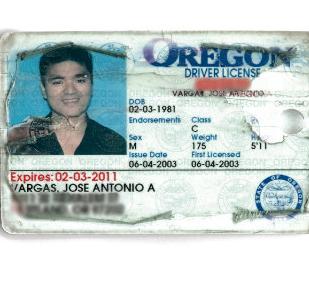
The ol’ Chron commissioned its former reader representative, Dick Rogers, to do a piece on the Jose Antonio Vargas story, and he concludes that Vargas was a liar whose failure to turn himself in to immigration authorities (and thus accept deportation to a country he hardly knew) undermined his journalistic work. Rogers quotes editor Ward Bushee:


“While he deserves sympathy for his efforts to become a citizen, Vargas’ lack of forthrightness in some of his reporting cannot be defended,” Bushee said. “He practiced a pattern of deception that was not only dishonest, but disrespectful of his readers and fellow journalists at The Chronicle.”


Pardon me while I puke.


I’ve already written about Vargas and about former Chron editor Phil Bronstein’s (far more nuanced) handwringing over the situation. But the conclusions the Chron reached in the Rogers article are just bizarre and reflect a creaky, ancient attitude towards journalism that makes no sense in the modern world.


I called Rogers, who is a nice guy with a long history in journalism, and we had a long talk about the situation. I asked him what the young man should have done when he found out at 16 that his parents had sent him to the Unites States illegally. Rogers, to his credit, said he didn’t know, that it was a tricky moral and legal dilmemma. “But that’s not what I was asked to write about,” he said.


The issue for him: Vargas lied when he filled out his employment application and failed to disclose to his editors that he was in the country illegally. That damaged the Chronicle. “You can’t put yourself above your newspaper,” he told me.
Okay, once again: What should Vagas have done? What should a person who is forced by stupid and inconsistent federal laws to lie about his immigration status do if he wants to be a journalist? Well, Rogers said, that’s the dilemma: “I don’t think he should have been working in mainstream journalism.”


Of course, he’s have to lie to get a job as a lawyer, or doctor, or CPA. And all of those professions also have ethical codes that discourage lying. So perhaps he should have been a bricklayer.


To be fair, Rogers doesn’t go that far — he suggested that there were other types of journalism Vargas could have done. He could, for example, have worked for the Bay Guardian. (I wish.) After we talked for a while, Rogers said that if Vargas was going to work for the Chron, he should have recused himself from any stories involving immigration.


But let’s be real here: The Chron allowed a reporter who took money from a nativist group to keep writing about immigration. Bushee, who is so outraged about Vargas, has no problem allowing an (illegally) unregistered lobbyist who gets paid to advocate for wealthy interests in the city to write a political column without ever disclosing his clients or conflicts. (Rogers told me that was a legitimate point. “Conflicts are conflicts,” he said.)


And at the same time, the Chron fired a reporter who participated in an antiwar march and wouldn’t let a lesbian reporter cover same-sex marriage.


It’s inconsistent to the point of being silly.


Look: All of us have conflicts. As the great Larry Bensky once told me, “People who have no conflicts have no interests.” Can a person who drives a car write about transportation policy? Can a person who smokes pot write about medical marijuana (or should she tell her editor, sorry boss — I’m illegally ingesting a controlled substance at night, better fire me or report me to the cops because I can’t cover this story)? Can a person with children write about whether San Francisco is a good city to raise children? Can a person with kids in the public schools write about the school board? Can a divorced person cover a wedding? Can a person who had an affair write about a politician who’s caught fooling around? Can a person who drinks beer write about the city’s alcohol tax?


I mean, let’s not be ridiculous here.


Let me tell a perhaps hypothetical story. Suppose that, when I was working for a (socially conservative) daily newspaper in a (socially conservative) New England city in the mid-1970s, I had a colleague who was gay. And suppose she decided — correctly — that her career would be damaged (at that time, at that institution) if she was out of the closet. (For all I know, she was a criminal, too — I’m not sure when this particular state repealed its sodomy laws.) So suppose she lied — to her boss, to her coworkers, to everyone around. Did that mean she was a bad reporter? Not at all. My hypothethical friend did what she thought she had to do, at a time when the professional and political world she lived in was unwilling to accept who she was. (In fact, there were no laws back then about firing people because of their sexual orientation.) She hated it, we all hated it, and we worked to change things. But I’m not going to condemn her — or call into question the credibility of her work — because of it.


(By the way: I lied, too. I told my boss at this particular institution that I didn’t smoke marijuana. It was a job requirement. I wanted the job. I was a lawbreaker, and I still covered the cops. In fact, I wrote about pot busts. Thank god they didn’t test my pee.)


Let’s face it: Everyone at the Chron, and at every daily newspaper, has personal issues that prevents him or her from being completely objective. Jose Antonia Vargas was no different. The fact that the United States government forced him to lie is no grounds for saying he couldn’t be, and isn’t, a good, honest reporter.
 

Behind the backflip: The story of a street-performing family

1

You can’t miss the acrobatic stylings of Orion, Alex, and Meisje Griffiths — also known as the Sardine Family — on a sunny day on the corner of Jefferson and Powell Streets. If the bold, baggy, crimson-colored pants don’t catch your eye, there’s something about the energetic English accents pumping out of the subwoofer that have a way of pulling you in.

Pier 39 rarely disappoints when it comes to street performers at this time of year. Cloudy days be damned, if it’s technically summer, a big heart with any kind of creative curiosity won’t be able to pass through tourist town without being reeled in by one of the different acts along the congested sidewalks. But who are these performers? How’d they wind up performing on city street corners? Who did I just give my money to?

Three second generation acrobats, along with longtime friend Kevin, make up the Sardine Family, a traditional circus act which weaves in plenty of comedic punch lines, showmanship, and charisma. And they deliver one hell of a street show. I was able to sit down with Orion Griffiths and get the story of how the Sardine Family set their clown shoes on the streets of San Francisco.

Orion, Alex, and Meisje are the three youngest of eight children. “We’re a circus family,” says Griffiths. “My mom and dad did street shows in Europe. My dad started doing street shows 34 years ago. I actually started real street shows when I was thirteen. I’ve been doing this for 17 years.” The 23 year old’s voice carries evidence of his parents’ home in the United Kingdom. “I’ve done [street shows] all around the world. I’ve done street shows like this in 46 countries.”

Originally from Europe, the three Griffiths emigrated from England to Massachusetts in 2004. They moved to San Francisco last year to attend acrobatics school and perform their street show at Pier 39 as a means to pay for their school’s tuition costs. 

Both Orion and Alex have been working on their current street performance, “for the past 10 years,” says Orion. “If you’ve got circus skills and you come out here, you probably will just flop, because it’s more about the talking, it’s got nothing to do with the skills you are doing. Even if you are doing double back flips on the street, nobody cares.” 

One of the highlights of the Sardine Family act is the moment each performer showcases their trick specialty. They perform stomach-wrenching rag doll backbends and dancing handstands. They juggle on top of a nearly ten foot tall unicycle and reel off aerial backflips. It’s amusing to see a family of tourists about to pass by suddenly do a double take, looping back to join the crowd that has already assembled around the Sardine Family. The act is flawless and the family’s chemistry creates an environment so natural and comfortable that everyone wants to hang out for the next trick. 

How do they do it? Orion and Alex, the two emcees of the performance, are constantly feeding off the audience and vibing off of each other, making sure the audience is entertained in between tricks. And even after the 10 years of hard work that the Griffiths have put into the act, Orion is neither fazed nor offended when the typical passer-by — well, passes by. “That’s part of street performing. They’ve got their own thing to do — they don’t need to care about a street show.” Griffiths went on to say, “I don’t even get upset when somebody watches the whole show and doesn’t put money in the hat.”

But if you want to give them something, that’s great too. Towards the end of one show both Orion and Alex jokingly say, “If you’ve got a dollar to donate, great. Five dollars, even better. If all you’ve got is a quarter…keep it. You need it more than we do.” 

As far as making a living off street performing? “It’s very, very hard,” Orion answers. “You can’t always make a living, you have to have a side job. We’ve made it out alright because we’re pretty good at it, but a lot of these [other street performers] have to get a side job. They do it for the love of it.”  

When asked about the people who criticize and continue to question the credibility of street performers like the Sardine Family, Griffiths responds “I love it.” However for the most part, he says that the Sardine Family has been well received by the people of San Francisco. “They love us, we’re English. San Francisco is a great place”

But let’s be clear: all those lifts, juggling balls, and tumbles — the Sardine Family performs in hopes of getting closer to a dream. 

“Our dream is to start a circus, and that’s why we’re here in circus school. We’re looking for a group or an organization that would fund our show to start a circus. Once more people meet us and see what our story is and here about our background, hopefully they’ll be on board with it,” Griffiths says.

“We’ve been doing this our whole lives, all for the same dream. We’ve been training for years. We’ll probably train another year to get our act right before we try and start a circus.”

But at the end of their flips and tricks on the day I stopped to watch, the Sardine Family says something that makes their godly acrobatic routine a little more grounded – maybe even a little more relatable, in this town of artists. 

“We’re not hustlers, we’re performers. We do this because we love it.”


Hot sexy events June 29-July 5

0

Love the mommy bloggers. Such a feel good moment when a harried parent gets to sit down and share (even electronically, even through a screen) just what they’ve been feeling about their day with the kids. Y’know, how to talk to a youngster about adoption, wise words from grandma, the best new G-spot stimulator.

Oh yes, there’s a new kind of mommy in town. Or at least, pervy parents are finally getting their due. Dirty mommies now have their very own local blog, and meet-up.

To compliment personal online screeds that are already being penned by Shar Rednour of How Good Sex Made Me a Great Mom, of the example above, and sex toy shop mommies Moms In Babeland, Madison Young organized Sexy Mamas Social Club (she’s also held workshops on motherhood and sexuality at Good Vibes, and ate breast milk icecream as performance art this year). It’s open to moms in the sex trade, moms who have sex on screen, moms in alternative sexuality communities, and moms who support all of the above. The group meets for brunch at one in the afternoon on Fridays, which is another reason to like it. 


Sex With Emily livecast

Today, Emily Morse told me all about the new semen cookbook (there’s something weird in the air about cooking with cum). She’s got this squeaky little voice, she’s broadcasts outta San Francisco, she has very little qualms about talking about her decidedly heterosexual, but fairly entertaining love life. And she’s there for you everyday so that you can snicker through the afternoon, especially when your boss asks you what you’re listening to and you say “making Jello shots with male ejaculate.” Now I wish that would happen. 

Monday-Friday 1-2 p.m.

www.sexwithemily.com


Go-Go Studs night

There’s nothing worse than being in the middle of a good grind and looking up to see the scantily clad go-gos with looks of boredom on their Adonis-like faces. Well hell, how hard do you have to work it to get a rise out of them? KOK feels your pain, so they’ve assembled a line-up of faces so fresh they’ve had no time to weary of your (adorable) flailing. Sexxy.

Fri/1 11:30 p.m.-1 a.m., $2 after 11 p.m.

KOK Bar

1225 Folsom, SF

www.kokbarsf.com


Sexy Mama’s Social Club

Because sexy thangs shouldn’t be barred from having kids – or from continuing to be hella sexy. New mamí Madison Young has apparently organized a get-together for mommas from the sex industry. Be you a sex worker, a sex writer, polyamorous, an adult film actress, or just supportive, roll through this brunch (the group’s third) to be part of a new old girl’s club. 

Fri/11-4 p.m.

Email Madison Young at feminapotens@gmail.com for details

www.feminapotens.org 


Nasty

In addition to hosting a frequently-updated site of HIV/AIDS research news, Project Inform throws a good party. We think – Powerhouse‘s Nasty will now go to benefit the HIV/AIDS advocacy organization, which is promising for many reasons. The party’s raised over $30,000 for the AIDS Emergency Fund in the past, and it’s kind of your dirty, dirty duty to make sure that it gets off (ha) on the right food with Project Inform. All for charity! 

Fri/1 10 p.m.-1 a.m., $5

Powerhouse 

1347 Folsom, SF

www.projectinform.org


Pyro Passion with Stefanos and Chey

Why wait til the Fourth for the fireworks? Rumor has it this power couple of SF BDSM learned their fireplay skills in a sub-zero Minnesota dungeon – that’s one way to figure out how to be sensual with flame, but getting taught by the experts, with super hot models, in one of the city’s best-known dungeons – you’ve upped them on comfort factor, at least. Learn skills in tools, safety, and the psychology of properly lighting your lover aflame.

Thurs/30 8-10 p.m., $20

SF Citadel

1277 Mission, SF

(415) 626-2746

www.sfcitadel.org 


Hunger strike highlights horrible prison conditions

14

In a state that’s still floundering for ways to comply with court orders to drastically reduce the number of inmates in a prison system that has long been severely overcrowded, people in prison face unconstitutionally inhumane and degrading treatment on a daily basis. And now a group of inmates is highlighting the problem with a hunger strike that begins this Friday, July 1.

Lawyers for and supporters of the group of inmates from the Secure Housing Unit at the notorious Pelican Bay prison will hold a press conference tomorrow (Thu/30) at 11 am outside the state building at 1515 Clay Street in Oakland to announce the hunger strike to back up a list of demands they have submitted to the warden and Gov. Jerry Brown. Their demands include an end to long-term solitary confinement, collective punishment, and forced interrogation on gang affiliation, and they say they will continue their hunger strike until their demands are met.

“The prisoners inside the SHU at Pelican Bay know the risk that they are taking going on hunger strike,” Manuel LaFontaine of All of Us or None said in a prepared statement. “The CDCR must recognize that the SHU produces conditions of grave violence, such that people lose their lives in there all the time.”

The anti-war group World Can’t Wait is also supporting the hunger strike and calling for a supportive demonstration on Friday at 11 am outside the state building in San Francisco at Van Ness and McAllister streets. California officials have for years defied judges’ orders to reduce the prison population, which is at 180 percent of capacity, and the Supreme Court this year upheld the order and is requiring the state to reduce the prison population to 109,000 inmates, of 137.5 percent of the levels the prisons were designed to house.
The Brown Administration is seeking an extension of the deadline as it wrestles with political gridlock and a budget debacle that has stymied the governor’s efforts to transfer more prison inmates to county jails. But that plan avoids the reality that the U.S. has by far the highest incarceration rate in the world, a situation that is both inhumane and fiscally unsustainable.

He’s back!

9

steve@sfbg.com

It’s been more than a year since relations between San Francisco’s nightlife community and the San Francisco Police Department bottomed-out following a nasty crackdown and pattern of harassment led by plain-clothes Officer Larry Bertrand and Michelle Ott, an agent with the California Department of Alcoholic Beverage Control.

The pair’s antics included repeatedly shutting down clubs, aggressively raiding private parties, seizing laptop computers and other property, making arrests for minor infractions, roughing up and threatening those who objected to the harsh treatment, dumping out dozens of bottles of alcohol, and, according to one lawsuit, retaliating against those who filed complaints.

There were at least four lawsuits against the city related to the crusade, including one that the city is in the process of settling for $50,000 (involving promoter Arash Ghanadan, who had repeated run-ins with Bertrand) and another federal lawsuit alleging that Bertrand’s harassment of legal businesses amounted to a criminal racketeering enterprise. The federal case is headed for trial later this year.

After cover stories in the Guardian (see “The new War on Fun,” 3/23/10) and SF Weekly exposed the abuses, and the nightlife community formed the California Music and Culture Association to counter the assault, Bertrand and Ott were pulled off the nightlife beat and things slowly got better.

So when Bertrand appeared back on the beat on a recent Friday night, June 17 — targeting two of the same clubs he allegedly harassed before, Mist and Sloan, and shutting Sloan down for the night on a technical violation — many in the nightlife community freaked out, fearing that their improved relationship with SFPD was over and the bad old days were back.

“My phone was blowing up with texts and photos of his raid on Sloan nightclub. People are livid,” attorney Mark Rennie, who works with clubs on permitting and compliance issues, wrote to a group of nightlife advocates in an e-mail titled “Officer Larry Bertrand back on the Streets last night and up to his old tricks.”

Complaints were made to new Police Chief Greg Suhr and others in the command staff. The SFPD initially refused a Guardian request for comment on whether Bertrand would remain back on the beat, citing the ongoing lawsuits. But police spokesperson Sgt. Mike Andraychak eventually admitted it was a mistake to have Bertrand busting clubs and said he won’t be back on that beat anytime soon.

Andraychak said the new commander of Southern Station, Capt. Charlie Orkes, assigned Bertrand to police the clubs for the night and “he wasn’t aware of the history of lawsuits, and so that’s why Officer Bertrand was out there that night doing permit inspections … He won’t have Officer Bertrand in that role again, in the interests of good community relations.”

Those relations have become much better and more cooperative in the last year, according to Suhr, Rennie, and Entertainment Commission Executive Director Jocelyn Kane. “We’re happy with our relationship with the Police Department right now,” Kane told us. “That’s why [the reappearance of Bertrand] was of concern to people.”

During an interview with the Guardian on the morning of June 17, Suhr said he was supportive of nightlife. “I’m pro entertainment and I want the clubs to succeed. It think it draws people to the city and allows us to do a lot of things,” Suhr said, emphasizing the importance of clear communications and good relations between clubs and the SFPD. “If we’re being fair, consistent, and objective in how we treat situations, the clubs will know how it works.”

To many in the nightlife community, Bertrand represents the antithesis of that approach. Mist owner Mike Quan, a plaintiff in the ongoing federal lawsuit alleging Bertrand repeatedly harassed him and his customers, said he was shocked to hear Bertrand showed up at his club and was abrasive with his employees again. “My attorney sent [SFPD] a letter the next day saying this is not acceptable,” Quan told us. “Hopefully they got the message.”

Mayoral candidate Bevan Dufty, who is close to the nightlife community, helped reach out to Suhr after the incident and said he believes it was an aberration. “This is something that is a concern and the leadership needs to be sure that we’re not falling back,” Dufty told us.

Appeals also went out to the City Attorney’s Office, headed by another mayoral candidate, Dennis Herrera, who said he was happy to hear this was an isolated incident. But he said it illustrates something he’s been saying in meetings with clubs and cops — that SFPD’s nightlife enforcement policies need to be clear and consistent.

“We need to get it above the ad hoc way we’ve done it, so that it’s above the captain level and coming from the command staff,” Herrera told us.

Suhr, who has better relations with the nightlife community than any of his recent predecessors, also emphasized the need to lay out clear expectations. But he stopped short of saying there wouldn’t be anymore undercover raids of clubs and parties, telling us, “I think it’s important that people think that’s a possibility.”

Dick Meister: Paid sick leave is good for us all

5

The latest figures show that some 44 million workers in private employment  – more than 40 percent of the private sector workforce – do not have paid sick days that they could use to recover from illnesses, including contagious illnesses such as the flu, or worse.

It should be of particular concern that those occupations which are currently least likely to provide paid sick days include occupations most likely to have regular contact with the public – most importantly and most disturbingly, food service and food preparation.

That raises serious health problems – especially in these tight economic times, when workers need to stay on the job as much as they can, no matter how ill they are, to earn as much money as they can. Which, of course, endangers the health of those who come in contact with them, as well as delaying their recovery from their illness.

Public health experts note that the fewer the number of workers who are able to stay at home when sick, the more likely it is that diseases will spread. In addition to the increased suffering of the public and other workers which that causes, it also causes significant economic losses.

Laws have been proposed in several states and in Congress that would require employers to grant paid sick leaves to their employees, but it seems unlikely that the measures, however much they are needed, will pass any time soon – if at all.

But there has at least been a start, however slight, toward what’s broadly needed. That’s a paid sick leave law that was adopted by the city of San Francisco five years ago – the first citywide such law in the country. If nothing else, the San Francisco ordinance proves that such laws are quite feasible, and not the “job killers” that anti-labor forces contend they would be.

San Francisco business groups fought fiercely against adoption of the ordinance and thankfully lost big time. The ordinance was approved by 61 percent of the voters in a citywide election in 2006.

Under the ordinance, workers in businesses with fewer than 10 workers can earn up to five paid sick days a year, while workers in larger businesses can earn up to nine paid sick days.  Workers accrue one hour of paid sick leave for every 30 hours they work. They may use the sick time to recover from their own illnesses, care for a sick family member, or seek routine medical care.

A recent independent survey of nearly 1,200 San Francisco workers and nearly 700 employers by the Institute for Women’s Policy Research came up with findings that the city ordinance was, in the words of the California AFL-CIO, “overwhelmingly positive for workers, businesses and the public.”

The labor federation called the study “further evidence policies that help working families meet their responsibilities at work and at home are good for everyone.”

The study shows, in short, that the San Francisco ordinance has had a great impact on workers’ lives but little or no impact on the city’s businesses.  They overwhelmingly report that the law has not cut into their profits. Two-thirds of them reported no problems implementing the law.

It seems likely that the reason for the slight impact on businesses business can be attributed to the fact that most workers take sick leave days only when they need them.  Even though the law allows workers five to nine sick days a year, San Francisco workers used a median of just three days a year. And one-quarter of the workers didn’t take a single sick day.

Even the major opponent of the law prior to its passage, the local, politically powerful restaurant association that led the political fight against the city ordinance, now concedes it hasn’t led to employee abuses or hurt restaurants or other business.

Most important, as the state AFL-CIO noted, the survey proved that having paid sick days makes a substantial difference for working families.  More than half the workers surveyed said they’ve benefitted from the law. Among other important things, the law has given workers who need paid sick days the most, including parent and workers with chronic health conditions, the time they need to care for their health and that of their children.

The labor federation reports that it hears regularly “the stories of parents who are forced to choose between their children’s health and the financial well-being of their family . . . who have put off visits to the doctor and sacrifice their health to avoid losing their jobs.

Washington, D.C. and Milwaukee have followed San Francisco’s lead and adopted ordinances providing paid sick leave for workers.  And some states, California, New Jersey and Connecticut among them, have adopted similar though less extensive laws.

But what’s most needed is a federal law – a law that, if properly enforced, would grant sick leave pay to all workers, helping them, their families and anyone else who might be exposed to their illness.

It’s obviously the sensible thing to do.


Dick Meister, former labor editor of the SF Chronicle and KQED-TV Newsroom, has covered labor and politics for more than a half-century as a reporter, editor, author and commentator. Contact him through his website, www.dickmeister.com, which includes more than 300 of his columns.


One Hundred Days of Spring: As Mid-Market talks, two organizers do

1

All photos by Stephen Heraldo

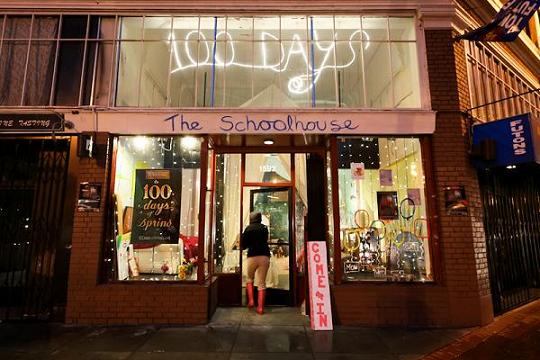
Just beyond the scope of the perpetual debate of revitalizing Mid-Market — defined as the stretch from Fifth Street to Van Ness Avenue — an extraordinary project is quietly closing its doors on an oblique, no-man’s-land corner of Market near Franklin. There, for one hundred days and nights, an empty glass storefront opened up to spill a swath of light and music onto the cigarette-studded sidewalk — without funding, a business model, or (as founders Will Greene and Sam Haynor are the first to say) much of anything else.

“Ask us our mission statement,” One Hundred Days of Spring organizer Haynor challenges.

“We don’t have one,” Greene, his creative partner, cuts in.

“Well, yes we do,” says Haynor.

“Yeah, that not doing it seemed like a cop-out,” the pair concludes.

“It” was creating more than three months of free and donation-based events, classes, and recorded stories representing a variegated slice of the local population: hipster kids in art collectives, professionals on their Market Street commutes, and low income neighborhood residents, including many who bed down each night on the block.

As part of Central Market Partnership’s ongoing efforts to inject arts and culture into revitalization plans for mid-Market, the San Francisco Office of Economic and Workforce Development is joining with the Arts Commission to hold a series of focus groups exploring ways to engage artists, small businesses and cultural organizations in the making of a thriving creative district.

Five focus groups have already met, according to OEWD’s Jordan Klein, and over the coming weeks, more gatherings — of community residents, transportation advocates, historical preservation advocates, and nonprofit leaders — will provide insight for the Central Market Economic Strategy, to be released in the late summer or early fall.

One Hundred Days of Spring wasn’t on the agenda of any of these meetings. A former boutique clothing store sandwiched between SROs and auto body shops on a strip shadowed by the sheer, block-long face of a Honda dealership, the space’s previous tenants didn’t last long. But transformed into a gypsy-tent-circus-wagon-theater-gallery-cum-classroom, the storefront, reborn as the Schoolhouse, rooted itself in the neighborhood in just a few months.

The hundred days are now over. But if the packed closing ceremony was any indication, Haynor and Greene’s model is one that the community is keen to reproduce. Mark Singer, a research librarian and freelance writer who found the project in what the two founders call the “analog way” — by stumbling across the threshold — told supporters, “I challenge everyone in this room to replicate what we’ve seen here, seen in the last hundred days.”

“The ultimate goal,” Haynor said, “is not only to share and to educate, but at the end of one hundred days, to have created one hundred new ideas for people to carry out into the world.”


Nothing to it

One Hundred Days of Spring was an experiment in community-supported programming. Rather than relying on or waiting for grant money, Haynor and Greene hoped to show that a community space can be self-sustaining — for the benefit of those who can contribute more and those who must contribute less.

“San Francisco is grant rich,” Haynor explains, “but it’s also full of people waiting for grants. They have a bunch of awesome ideas, but by the time the grant cycle comes around, the initial spark is gone. For us, going after a grant would just eat up time, and we wouldn’t end up doing what we wanted.”

Instead, the two 25-year-olds pooled their savings and paid $2,000 a month for rent from March to June, $200 for utilities, plus a few hundred extra for renovations and insurance. Within three weeks of the initial idea, they had moved into the space and populated a calendar of events through friends, friends of friends, and tools like SF Chalkboard. They were running full tilt by day six. 

In just over three months, the team offered more than 250 classes, shows, and tutorials — sometimes five in a day — covering everything from truffle-making and fermentation to bike repairs, aerial silks, and open mics. By collecting donations on a pay-what-you-can basis, Haynor and Greene were able to recover a large portion of their initial output, and also garner an extra $4,000 to reinvest into the project.

Greene on the value of 100 days of events: “If you try to put a value on what we have now, that we didn’t have then, you couldn’t buy it for $4,000.”

Though the Schoolhouse founders ended up $4,000 short, Greene says they “could have broken even” if they had focused more on the project’s revenue-generating components, like filming videos for musicians who performed in the space.

Even so, for Greene the worth of One Hundred Days of Spring was indisputable. “If you try to put a value on what we have now, that we didn’t have then, you couldn’t buy it for $4,000,” he says.

When Judy Nemzoff, community arts and education program director for the Arts Commission, stopped by the Schoolhouse and asked how Haynor and Greene did what they did, the two replied, “Well, we just signed a lease.”


It takes two

Inside the Schoolhouse, the laid-back attitude seemed to likewise shrug “nothing to it but to do it.” But the warm, easy atmosphere belied the late nights and hard work it took to get ‘er done.

Understanding how One Hundred Days of Spring came to be — and why it worked so well — means understanding a bit about its creators

Greene and Haynor, hanging at the Schoolhouse

Haynor and Greene have the kind of friendship people make movies about. Besides the sort-of charming things like finishing each other’s sentences and bragging about accomplishments each knows the other would never mention for himself, there’s the sense that somehow, these two unassuming fellows are going to change the world.

“We’re a good balance,” Greene says. With the air of someone showing how two-plus-two equals four, he explains, “Sam’s a bit spastic, and I can plunge a toilet.”

“We have different skill sets, but we share goals,” he continues. “We keep each other in check. We’re both very often wrong, but we’re rarely both wrong at the same time.”

Coco Spencer, who joined One Hundred Days of Spring as an intern partway through and become an indispensible team member, says she was willing to dedicate so many hours to the Schoolhouse because, “Basically, Sam and Will are the most inspiring people I’ve ever met.”

Haynor and Greene were campers and later counselors together at the Bar 717 Ranch in Trinity County. There, they found each other, and also a passion for teaching — or, as they put it, “helping people to be good versions of themselves.”

Though each has traveled and embarked on sundry individual projects — Greene as a musician and videographer, Haynor as a chess champion and conflict-area journalist — they continue to connect over their drive to educate in unique new ways.


Bathroom, beats, and big ideas

At the Schoolhouse, that meant engaging community members through a service-based approach. “Our main goal is to provide resources to people who need resources,” Greene says. “We’re not interested in providing resources to people who have resources.”

Given the diversity of The Schoolhouse’s participants, “resources” could mean different things.

Haynor explains, “For some people, we’re a bathroom. For some we’re a place to stop in and say ‘hi.’ For some, we’re a place to do events.”

“We’re successful because we’re always doing something fun, and everyone feels invited,” Greene says. “It’s the loose nature of our project. There’s no doorman, no guy with a cash box.”

There were challenges (“Sam’s been trying to put together homeless poetry readings, but he’s scheduled them for the first of the month. That’s when everyone gets their checks, so everyone gets drunk,” Greene says at one point), but there were also many moments — like when a woman from the block walked up and started giving Haynor a massage, or when Greene calmly negotiated with a rowdy, intoxicated visitor, encouraging her to pipe down and eventually leave — that pointed to a deft interface with the surrounding community.

“They respect our storefront more than they do the others,” Greene says. Some locals worked shifts at the Schoolhouse in return for resources. Others stopped in for music, for food and nutrition classes, or to look at the art. Some simply came by to talk about living in the area.

During an “Un-Talent Show”, a performer named SofT humorously described a street-dweller’s perpetual problem: carrying belongings. He showed an in-stitches audience how to bundle objects in an old sweater — a wholly relatable rap on wrapping. Another visit came from Benny, one of SF’s famous itinerant tamale sellers, who lives in an SRO across the street and makes what partakers described as “possibly the world’s best tamales” across town in his girlfriend’s kitchen.

Haynor describes a woman who walked into a sewing workshop — run by SF Social Fabric, a volunteer-staffed bike maintenance and sewing skills collective — with “some trepidation.”

“She was in a room with a bunch of people who were nothing like her,” he says, “but we got to know each other over the fact that we all wear clothes. And they all fall apart.”

Neighborhood connections at the Schoolhouse

“There’s a duality to this corner,” Haynor says. “From doctors to the people who live on the block to all the people in the middle who travel Market Street. Before us, some wouldn’t even cross the street.”

“At our best,” he continues, “we’re a place people from another demographic can discover the old-fashioned way — with their eyes and their feet. They cross the threshold, ask what we’re doing, decide to stay, and learn something. Now, I can’t go five minutes without seeing someone I know, or someone who I recognize, or someone who just popped in.”

Singer, a perfect example of the phenomenon, started stopping by between two and five times a week after his initial discovery. He framed the project’s importance in simpler terms: “This is where we need these things to happen. Where it smells like urine on a hot day.”


Let’s put on a show!

Singer believes that projects like the Schoolhouse can “transform parts of San Francisco” by providing services that are more than “just artists and gallery-talk.” The Schoolhouse, he says, “was something visceral.”

“One Hundred Days of Spring created an infinite possibility for community that can’t be replicated on a screen or keyboard. We’re not talking Internet cafés with white earbuds, but humans breathing in the same space — collaborating, communicating in one room, and that room changing every darn day.”

Indeed, the walls of the Schoolhouse were repainted so many times over the course of the hundred days — with layers of murals, street art, installations, white space for projecting films — that Spencer, who took charge of many of the events’ logistics, joked she was hoping to reduce the interior square footage, and thus, the rent.

The zealous energy required to transform the space again and again was reminiscent — Singer pointed out — of Babes-in-Arms-era Mickey Rooney and Judy Garland exclaiming Hey, kids! Let’s put on a show in this old barn! That down-home, DIY energy may be just what efforts like the Mid-Market revitalization require.

Greene, who attended one of the Central Market Partnership’s focus groups, says the consensus was that knowledge about and access to space were the biggest obstacles to creating and executing programs of any kind.

“People are looking for answers,” he says, “looking for some larger entity to hand them space, or looking tax breaks. There’s the feeling that you can’t just do what you want to do.”

“Rather than saying ‘if you give us space, we’ll fill it with beautiful things,’ you can say ‘I’m just going to do it.’ If you’re willing to make it happen, if you work really hard, if you work with the people you’re trying to reach, then you don’t have to worry about anything else.”

Despite the waiting, wanting, hoping attitudes Greene says he encountered, he points out that plenty of others are “just doing it.” The Schoolhouse helped along a few such visionaries by sponsoring two “Grant Prix Dinners.” During the informal roundtables, entrepreneurs presented project ideas between courses. Participants paid a fee for dinner and a ballot on which to elect their favorite projects – to whom the entry frees were turned over as seed money at the end of the night. 


Bringing together the neighborhood

At times, especially in San Francisco and other urban areas where real estate is costly, amping up a neighborhood’s arts and cultural amenities has acted as a roundabout measure to invite the type of gentrification that sweeps streets clean. That kind of programming is not intended to serve current residents so much as to usher in new ones. 

By contrast, the Schoolhouse made a conscious decision to serve the neighborhood’s existing population — with safer-feeling streets resulting, and much more quickly, at that. 

One Hundred Days of Spring was a bold, direct move to engage the local community. As such, it was highly effective not only at providing needed resources, but at tempering the less-desirable qualities of the neighborhood by creating a sense of community and responsibility among residents and passers-through.

“Coming out of Muni, walking home on Market Street,” Singer had said, “can frankly be pretty scary. There’s substance abuse, drug deals, and people who may or may not be harmless.” The Schoolhouse, he said, helped diffuse that lack of ownership and feeling of “anything goes.” For Singer – and Schoolhouse denizens of all backgrounds — the space managed to help tie a few new knots. 

“The Schoolhouse brought me closer to a world that’s very marginal,” Singer said. “the homeless world.”

Whether or not Mid-Market planners will look to the Schoolhouse for a lesson in effective community building, the project’s two masterminds have undoubtedly developed a model they can draw on in the future.

Haynor and Greene plan to continue working together on community education projects. With One Hundred Days of Spring under their belts, they will be able to approach supporters “not just with an idea, but with a proven concept.”

“We are both in this together to see what we’re both capable of,” Haynor said. “To see if we’re any good at this thing.”

In the style of banter so typical of the pair, Greene added, “So we can figure out the rest of what we’re going to do with our whole darn lives.”


Burner artists go bigger and wider

66

I’ve been covering Burning Man for many years, both for the Guardian and my book, so it’s easy to feel a little jaded about another year of preparing for that annual pilgrimage to the playa. But then I plug into the innovative projects that people are pursuing – as I did last week for the annual Desert Arts Preview – and I find myself as amazed and wide-eyed as a Burning Man virgin.
And when the weekend came, I watched my old camps go bigger than ever – with Opulent Temple throwing a rocking Rites of Massive six-stage dance party on Treasure Island, and the Flux Foundation lighting up the Electric Daisy Carnival in Las Vegas with its newest installation, BrollyFlock – demonstrating the ambitious scale at which veteran burners are now operating.
Increasingly, burners are putting their energies into real world projects not bound for Burning Man, often with the help of Black Rock Arts Foundation, the nonprofit spinoff of Black Rock City LLC that funds and facilitates public art projects. BRAF’s latest, a project that is also receiving a grant from the National Endowment for the Arts, is The Bike Bridge, which pairs noted burner artist Michael Christian with 12 young women from Oakland to turn old bicycles and bike parts into sculptures that will be built at The Crucible and placed throughout Oakland.
“The Bike Bridge is the next evolution of our community-focused public art projects,” BRAF Executive Director Tomas McCabe said in a June 23 press release. “This educational and creative project is designed specifically to engage Oakland’s youth.”
Later that evening, McCabe and other burners gathered on the waterfront in Kelly’s Mission Cafe for the Desert Arts Preview, where he ticked off a long list of projects that BRAF was working on around the world, from the conversion of a bridge in Portland, Ore. into an elaborate artwork to a sculpture made of sails for next year’s Figment festival in New York City to a bus opera (written about bus culture and performed aboard buses) in Santa Fe to a cool interactive floating eyeball artwork that will tour Paris, London, Barcelona, and San Francisco to the BOOM Parade (combining bicycles and boom boxes) that will roll through Bayview Hunters Point in October.
But the most ambitious artworks are still being planned for that limitless canvas of the Black Rock Desert, where Burning Man will be staged in late August. This year’s temple, The Temple of Transition, is being built out of Reno by a huge international crew from 20 countries headed by a pair of artists known simply by their nationalities, Irish and Kiwi, who built Megatropolis at last year’s event.
“We built a city block of buildings and burned it to the ground,” Kiwi told the gathering, noting how impressed he’s been by a number of recent projects he’s watched. “When you start doing that, you feel challenged and wonder what you can do next.”
Irish said they were particularly inspired by watching the Temple of Flux go up last year, a project involving more than 200 volunteers that I worked on and chronicled for the Guardian, and said it made them want to bid to build this year’s temple. “That’s what inspired us,” Irish said.
The project includes a series of towers and altars, the tallest one in the center reaching about 120-feet into the air, a phenomenal height against the vast flatness of the playa. They said volunteers have been plentiful and the city of Reno has actively facilitated their work, “but our main concern is having enough finances,” Kiwi said.
The project got a grant from the company that stages Burning Man, Black Rock City LLC, which gave almost $500,000 to 44 different projects this year, but most didn’t come anywhere close to covering the full project costs. The Temple of Transition bridged its gap by raising almost $25,000 in a campaign on Kickstarter, which many projects are now using.  
“It’s a great way to cut out the middle man. You guys are funding art directly,” longtime artist Jon Sarriugarte, who got a BRC art grant this year to build the Serpent Twins (with his partner, Kyrsten Mate), said of Kickstarter, where he was about three-quarters of the way to meeting his goal of the $10,000 he needs to cover his remaining project costs.
Serpent Twins is a pair of Nordic serpents crafted from a train of 55-gallon containers and illuminated with fire and LED effects that will snake their way around the playa this year, one of many mobile artworks that have been getting ever more ambitious each year.
“I love the playa. It’s a beautiful canvas, but it’s also a beautiful road,” Sarriugarte told the group, conveying his excitement at driving his art into groups of desert wanderers: “I can’t wait to split the crowds and then contain them.”
Another cool project that is in the final days of a much-needed Kickstarter campaign is Otic Oasis, whose artists (including longtime Burning Man attorney Lightning Clearwater) brought a scale model to the event. It’s a slotted wood structure made up of comfy lounging pods stacked into a 35-foot pyramid design that will be placed in the quietest corner of the playa: deep in the walk-in camping area, inaccessible to art cars and other distractions.
That and other projects that are doing Kickstarter campaign are listed on the Burning Man website, where visitors can get a nice overview of what’s in store.  
One project that didn’t meet its ambitious Kickstarter goal was Truth & Beauty, artist Marco Cochrane’s follow-up to last year’s amazing Blissdance, a 40-sculpture of a dancing nude woman that has temporarily been placed on Treasure Island. But the crew has already made significant progress on the new project, a 55-foot sculpture of the same model in a different pose (stretching her arms skyward), and Cochrane told me they will be bringing a section of her from her knees to shoulders as a climbable artwork.

The Flux crew has been working for months on BrollyFrock, a renegade flock of flaming, illuminated, and shade-producing umbrellas that was commissioned by Imsomniac for its Nocturnal and Electric Daily Carnival music festivals, and it was placed at the latter festival near Wish, large dandelions that were built near the Temple of Flux at Burning Man last year, as well as new artworks by Michael Christian. Flux’s Jessica Hobbs said burners artists have become much sought-after by the large festivals that have begun to proliferate.

“I really think a lot of these music festivals are looking at how our pieces make an experience,” Hobbs said, citing both the spectacularity and interactivity that are the hallmarks of Burning Man artworks of the modern era. The Flux crew was pushed to meet a tight deadline for the project, preventing them from doing a big project for Burning Man this year, but that’s just part of the diversification being experienced by burner artists these days. “We challenged ourselves and we came away with another great project.”


Fake-out

0

arts@sfbg.com

HAIRY EYEBALL It’s not just the title of Stephanie Syjuco’s solo show “RAIDERS” — her first at Catharine Clark Gallery — that brings to mind Indiana Jones. Something of the latter-day swashbuckler comes across in Syjuco’s art, which, like Indy, initially seems to be playing to all sides for the sake of plunder — when in fact this cleverness is the outward expression of a deeper skepticism toward the very institutions it’s engaged with.

But Indiana Jones is also a pop cultural commodity and a franchise that has netted millions for creators George Lucas and Steven Spielberg. This too, I imagine, is not lost on Syjuco, whose work frequently strips Pop Art bare of its smart, slick exterior (as well as Conceptual Art of its pretensions) to access the larger and far less glamorous network of market forces, production processes, and questions of ownership that shape it as a commodity.

Whereas Takashi Murakami installed an actual Louis Vuitton boutique inside Los Angeles’ Museum of Contemporary Art, Syjuco’s project “Counterfeit Crochet” called on hobbyists the world over to knit fake designer bags, complete with logos, and even provided the patterns and instructions. She has also, on more than one occasion, set up detourned versions of shops and marketplaces inside museum walls.

“RAIDERS” opens with an installation of what at first glance appears to be a collection of handsome Asian antiquities — mainly vases and small, decorative vessels — arranged on the very shipping crates they were transported in. It quickly becomes obvious that what we’re looking at is truly a set-piece, and that the “priceless” cache before us is actually an arrangement of life-size photographic reproductions adhered to laser-cut wooden backings.

Raiders: International Booty, Bountiful Harvest (Selections from the A____ A__ M______) — to give the installation its full title — becomes more interesting when you consider that Syjuco used images downloaded from the Asian Art Museum’s online database of its holdings as her source material. Love and theft (if I may poach the title of Eric Lott’s remarkable study of American minstrelsy) are certainly forces that have shaped many a museum’s prized holdings, and it is this history — one so often bound to colonialism and its aftermath — that is also embedded in Syjuco’s fakes.

And Syjuco decidedly, politically, traffics in fakes, not forgeries. Practically every piece in “RAIDERS” has rematerialized online, open source materials — be they digital images or readily accessible canonical texts — into art objects that are themselves parodies of object-ness. Conceptually whip-smart and materially banal (wood, tape, paper, and glue are common ingredients), Syjuco’s pieces continually taunt us with the question, “Why buy the cow when you can get the milk for free?”

In the gallery’s back room, jewel-case-size blocks of wood covered in pixilated digital prints of CD cover art representing Syjuco’s entire collection of “music illegally downloaded or pirated from others” are, as the bright orange stickers adhered to their shrink-wrapped exteriors proclaim, really available for the “blowout price” of $9.99 a piece.” Across from this pile that looks as if it had been airlifted straight from a Tijuana bootlegger, is Phantoms (h__rt _f d__kn_ss) an installation organized around Joseph Conrad’s Heart of Darkness, replete with a table, sawhorses, houseplants, TV monitors, and 10 bound copies of different online, public domain versions of Conrad’s text that are strictly “price upon request.”

Syjuco is certainly not the first artist to take on the art world’s biggest white elephant: value. But she wields her scalpel with a thoughtful precision and economy of gesture that will forever be beyond the abilities of a gaseous giant such as Damien Hirst. And that, to borrow another clichéd bit of market-speak, is truly priceless.


INKSTAINS

If you missed the San Francisco Museum of Modern Art’s excellent Eadweard Muybridge retrospective that closed earlier this month, Matt Bryans has created something of an homage to the early master’s photographic panoramas and doctored views of a not-quite-virginal Yosemite at SF Camerawork.

“Untitled” unfurls along one of the gallery’s walls for nearly 30 feet, a fantastical expanse of ever-shifting landscape seemingly captured from a middle distance. Glaciers give way to snow-capped peaks, which then dip into valleys that ease into rolling plains and finally abut more misty crags. In the piece’s upper half, clouds swirl and dissolve across the arc of the sky as in a Chinese ink painting.

Although the piece has the weathered patina of an old daguerreotype and recalls Muybridge in its staged epicness, Bryans is a collage artist who works solely with a medium whose livelihood has been called into question about as often as film photography’s: newsprint. “Untitled” — which like the other large collage commissioned by SF Camerawork is all explosions and stars wrapped around a support column — was created using only India erasers and inky photographs clipped from newspapers.

Scanning the sky of Bryans’ panorama, you can make out the smudged traces of what was once type. And the closer you look, you start seeing the fissures between the thousands of carefully glued pieces that Bryans has transformed into a seemingly organic whole, which nonetheless appears on the point of disintegration.

The panorama piece is large enough that it sags a little and billows whenever a current of air hits it. It seems to hang heavy with the losses it embodies — photography’s ghosts, newspapers as a disappearing medium, the unknowable contexts of the images themselves — a load that’s almost too much to bear. 

STEPHANIE SYJUCO: RAIDERS

Through July 16

Catharine Clark Gallery

150 Minna, SF

(415) 399-1439

www.cclarkgallery.com

MATT BRYANS: BREAKING THE LAND

Through Aug. 20

SF Camerawork

657 Mission, SF

(415) 512-2020

www.sfcamerawork.org


Girls just want to have fun

9

culture@sfbg.com

SEX It was their first official slumber party and a late-night run to the grocery store for pink hair dye was in order. Decked out in a combination of pink, pajamas, and leather, the San Francisco girls of Leather shrieked and giggled as they wandered the aisles searching for anything rosy-colored. The girls could easily have been mistaken for a freshman herd of coeds soaked in Malibu and cheap vodka, but as the group’s president, Leland, remembers, they were “just high on girls.”

Until they discovered the store’s collection of pink and white unicorns — on sale.

“We all oohed and ahhed and ended up purchasing six of them, surprising the other girls by returning to the party with an entire unicorn herd,” Leland says. From sleeping bags and hair braiding to dirty storytelling and play piercing, the night teetered between innocent and naughty, sweet and sexy. “So many unicorns, so many needles, and so much blood!” she said.

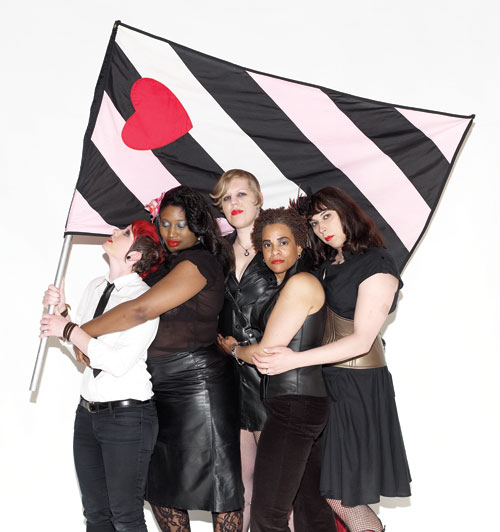
The SF girls of Leather (the girls prefer a lowercase “g” and uppercase “L” out of respect for the traditions of the leather community) are giddy and flirty: the epitome of seventh-grade girliness, complete with kinky sleepovers, hearts, and cuteness. As this year-old group sees it, maturity is overrated when it comes to BDSM — and a hint of silliness in a dark dungeon can only heighten the sex appeal. Who else is going to giggle or blush after a spank?

The group’s approach to leather is hardly in line with the masculine traditions that have come to be associated with the history of the kink community. But in the year since the girls formed their group, they’ve been working to secure their place in the continuum of leather lovers. And judging from the group’s growing membership — and accolades from the leather community at large — SFgoL is providing a much-needed refuge for marginalized fans of lighthearted play, splashing accents of pink across the traditional wash of black.


GIRL GOALS

Historically, a girl in the leather community has been defined as the female-identified version of a boy — a submissive expected to service a dominant individual in various kinds of BDSM play. But in SFgoL parlance, girl means something way more fun. Top, bottom, submissive, dominant, giver, receiver, experienced, or curious: all roles are welcome in the group, as long as you “girl” identify.

Which means what, exactly?

“Leather doesn’t have to be serious,” says Leland, who is of the mind that people of all ages, bodies, and sexual preferences can find bliss by tapping into their own personalized “girl-space.”

“You’re a leathergirl if you feel like it,” says SFgoL Vice President Kate McKinley. Even boys and bois are allowed in the group — as long as they have a “girl heart.” Coincidentally, McKinley wears one of these around her neck — a silver heart necklace.

“I play girly and therefore this group is where I belong,” she says.

An important tenet of the leather life, service (traditionally, the practice of obediently pleasing a dominant character) is still an integral part of the girl group’s goals — but its definition of the term goes beyond tending to masters and daddies.

In the year since the group’s inception, SFgoL has volunteered at multiple fundraisers and organized charity drives for nonprofits benefiting women in the leather community and beyond. Members are free to service individuals but are required to serve the community by means of philanthropy: grown-up Girl Scouts earning merit badges for kink.

Their efforts haven’t gone unnoticed — the San Francisco Bay Area Leather Alliance recognized SFgoL as its best new organization of 2010. “Contributing to the community makes it easier for us to enjoy what we’re doing,” says SFgoL member Anita, who asked that we not use her last name for professional reasons.

Anita moved to San Francisco from Norway on a work visa, but soon found herself lusting for a close encounter with leather. She discovered some BDSM groups for women interested in playing with women, but because she identified as straight when she arrived in the city, the SFgoL’s more inclusive membership requirements felt like a better fit.

She was also attracted to the group because it didn’t require members be in a dominant-submissive relationship. She was free to play with whomever, whenever, and however she pleased. “I’m a girl and I was interested in exploring the leather community in a group where I could just be myself and share my feelings,” she says.

Last month the SFgoL celebrated its one-year anniversary with 18 full members and more than 100 girls on its Listserv. The numbers are a strong indicator of its success, especially since the current version of the SFgoL isn’t the city’s first attempt at a girly collective. In 2004, a leathergirl group was formed, but failed to secure footing in the established leather community. The second time around seems to be the shiny charm — or maybe these girls are just extra-charming?

“We do have a smokin’ hot group of girls,” giggles Leland, looking around the table and raising her eyebrows at Anita and McKinley.

It’s lunch hour on a Tuesday and the three girls flirt like crazy, constantly laughing and finishing each other’s sentences between small bites of spicy Thai food. The three are a prime example of the group’s demeanor and exactly why Leland has enforced a “no cruising” rule during official meetings.

“The meetings are meant to be safe space and for taking care of business. But yes, we can play outside the meetings,” she says, batting her lashes as the other girls smirk, hiding a thousand secrets anyone with a pulse would die to hear.


RESIZING THE LEATHER FIT

Since its inception, the leather community has been predominately male. Icons like Marlon Brando, and the work of Tom of Finland and the Satyrs Motorcycle Club, defined modern masculinity in the 1950s, igniting a kinky obsession in the gay community. A badass jacket, muir cap, and related wardrobe of black hide became a symbol of sexual power and masculine independence, eradicating the stereotype that all gay men were effeminate.

Leather rules and traditions grew from military protocol and were diligently enforced by masters and their slaves, daddies and their boys. Women were intrigued, but struggled to find a place among the men; many leather bars turned away women at the door.

Over time, elements of BDSM became associated with leather and the community began to flex. During the ’80s, leatherwomen competitions popped up, and in the ’90s, groups like San Francisco’s Outcasts — now the Exiles —provided the community with strong female-identified role models. In 2006, the Exiles helped open Betty Paige’s Secret, which in subsquent years of the festival became Venus’ Playground. It was the first leatherwomen play space at the Folsom Street Fair.

It’s been six years since the Venus milestone, yet during this April’s International Ms. Leather competition in San Francisco, it was apparent that questions about the role of women in the leather community remain.

In a moment of call and response, “Where are the leatherwomen?” was shouted into the microphone. The answer was loud and proud: “Here we are! We’re here!” followed by a rumble of audience applause. Women may be standing their ground with paddles in hand, but the exchange was telling of their struggle for continued acknowledgment.

Deborah Isadorah, a veteran of kink and current leather momma, has been entranced by the leather community for more than 40 years, and is proud to have watched the roles of women expand. But in Isadorah’s eyes, the progression has been slow going.

“We live in a patriarchal society and that reflects on every part of our society, including leather,” she says, sipping a latte in Oakland and soaking in the spring sun.

“The men outnumber us physically in this community, [but that] doesn’t mean women’s voices are missing,” she continues. Isadorah is pleased with the progress of her generation of leatherwomen and is happy to sit back and nurture the younger crop. “I think we’ve done our job: to educate women about their bodies and the opportunities they have to explore sexuality beyond what society thinks is appropriate.”

Today, nearly half the current directors of the Leather Alliance, the community’s well-respected governing board, are female.

“We’re sitting at the table now,” says Daddy Vick Germany, a female-bodied leather daddy who has been a part of the Bay Area’s leather community for more than 15 years and serves as a director for the Alliance. Overall, Daddy Vick is content with the community’s moves toward inclusivity. “The men are leaving more space for us,” she says.

But traces of segregation can still be found. “Sometimes men just don’t see you — you’re not even in their line of vision,” she says, referring to a recent experience at the Up Your Alley street fair where a man blindly butted in front of her while she stood in a concession line. She recognizes that these incidents can be subconscious, but any female who roams the SoMa leather fairs is bound to encounter this feeling of invisibility. It makes her “mad as hell.”

Elected SF Dyke Daddy in 2002, Vick made substantial efforts to bridge gaps between the sexes. She’s currently running for SF Leather Daddy, a traditional competition built on fundraising for the AIDS crisis. In 2009 a transman won the competition, but if she wins, Daddy Vick would be the first female-bodied daddy to hold the title. Her candidacy alone is sure to shake things up with leathermen who believe in upholding traditional roles — but her motives are pure.

“I’m not doing this to make a statement as a female daddy. I’m running because I think I’m a good daddy for the community,” she says, meaning she cares about being a supportive, reliable father figure for those around her. The “working title” would help her foster change more effectively than her individual efforts.

Besides Folsom’s Venus’ Playground, there are no official social spaces intended for leatherwomen. This makes sharing communal bars and events incredibly important. Change is a slow process, but Daddy Vick says ample motivation is brewing in all corners, and — paired with the diffusion of kink — the space for growth can only flourish. Leather is opening into an umbrella term with the capacity to encompass multiple elements of fetish, and to further accept people of all genders, bodies, and preferences in any role.

In this respect, Daddy Vick thinks the SFgoL could play an important role. “It just takes people like Leland, coming in with a different energy. People who stand up in the crowd, see a need, and start organizing.”


FOLLOW THE PINK BRICK ROAD

While leatherwomen made slow but steady strides in the past decade, those straddling the space between butch and femme — the girl space — began breaking ground for themselves, too. In 2003 an international Leather Girl Network was born, led by the Bay Area’s Cheryl D. The group intended to mirror the already well-established leather boy community. Girls everywhere were giddy with possibilities.

“I had always identified with the title of ‘girl.’ I was a girl who liked to serve the community, but I was also a switch,” says Mistress Pilar, a longtime leather veteran and member of the original, and now revived, SF girls of Leather. Being a switch — someone who doesn’t commit to top or bottom exclusively — meant her definition of girl didn’t fit with that of the Leather Girl Network, which stated: girl equals submission. She wasn’t alone in her dilemma.

In 2004, San Francisco girls decided to put together their own troop, headed by girl Lori, the 2003 San Francisco Leather Dyke girl (a contest that no longer exists), and girl Hayden, the 2004 title-holder. They intentionally left the definition of girl open to allow for individual interpretation. The leather community shuddered at the loose restraints, confused by the men, boys, and transpeople that joined the girl ranks.

“People in the leather community were not comfortable with this idea at the time. No one even liked talking about it,” says Pilar, referring to the notion that a girl didn’t need to be a biological woman to be in their group. “The attitude that people should ‘get off the fence’ really hurt.”

The initial group grew to about 30 members and its short three years as a successful alliance was packed with fundraising, volunteer work, and super-girly fun. But eventually the negative attitudes, biased expectations, and confusion over the definition of “girls” wore down on moral.

“People would walk up to me and demand, ‘girl, clean my boots’ and I would say, ‘I don’t serve you, I serve the community,'” Pilar says shaking her head.

Even Daddy Vick remembers how the group of strong, independent individuals struggled to prove themselves to the wider leather community. The girls, she says, “took a lot of flak” for contesting tradition. “There was still a belief in place that girls and boys couldn’t be leaders. Some thought girls and boys should be seen and not heard.”

The girls managed to have good times regardless, but Pilar says by early 2007 the group was down to five members who reluctantly agreed the end had come. It wasn’t until the 2010 International Ms. Leather competition — when Pilar decided to donate the leftover SF girls memorabilia and a curious Leland started asking questions — that SFgoL sparked back into life, with a little PR and a lot of ambition.

“Leland is a wonderful leader. She creates a really positive image of a girl,” says Pilar, nostalgically looking over an old stack of meeting notes, scribbled calendars, and photos from the original group. The dissolution of her crew hit hard, and it’s bittersweet for Pilar to hear about the new group’s instant success. But more than anything, she’s proud. “I feel like a proud mom. Those are my girls.”

Coincidentally, just as the girls sprung out of the woodwork and formed an official group, the San Francisco boys of Leather, a longstanding and once very active organization, hung up their chaps and caps due to a decline in membership. The boys generously donated all their remaining funds to the girls.

Steve Gaynes, the 1994 SF Leather Daddy and Alliance director representing the 15 Association, a longstanding sexual fraternity for men interested in BDSM, has been a leatherman since 1978 and has watched all kinds of groups come and go. He says the ebb and flow is just a reflection of the community’s current needs.

“The energy ran of out the boys and ran into the girls. If there’s no driving force behind a group, it will die,” he says, noting the community’s excitement for the new girl group. “They’re enthusiastic, inclusive, and have clear ideas for their future. And they’re doing [it all] with a lot of respect for tradition.”

And the SFgoL’s continued dedication to volunteer work and partnerships with other groups have shown the community at large that it values the path paved by the forefathers — and foremothers — of leather.

Paying tribute to old protocol is simple. Isadorah boils it down to three simple rules: integrity, honesty, and service to the community. Judged by this metric, she says, anyone who thinks the SFgoL is out of line is just being stubborn. “Whenever something happens in the community that brings change, there will always be someone who is offended,” Gaynes says. “You won’t know you’ve created change until you’ve offended those people. Change is good and should be embraced.”


LOOKING OUT FOR THE GIRLS

Leland and McKinley agree that there seems to be a buzz of excitement surrounding the SfgoL lately. The group’s logo is everywhere, and partnerships are being fostered across the community. Leland has even been asked to serve as a director for the SF Leather Alliance.

But her primary concern is making sure the SFgoL remains a safe, welcoming landing pad for girls who are new to the leather community. And these days, the media is providing all sorts of inspiration for curiosity. Rihanna’s song “S&M” speaks directly to sexual play, but even a quick Google search for “girls in leather” retrieves images of celebrities in fetish gear, from Lindsay Lohan and Miley Cyrus in leather leggings to Emma Watson in a full latex suit with collar. In general, our society is opening up to alternative sex and women want in on the action.

But girls who jump in with little research and few friends may not leave with the most positive experiences. The inherent power dynamic associated with BDSM relationships and play can blur the lines between consent and abuse, and Leland says it’s important for newbies to have mentors within reach. “Sometimes the person you’re playing with may not have your best intentions at heart,” she says. “But as an alliance of girls, we can look out for each other.”

Farmville

1

le.chicken.farmer@gmail.com

CHEAP EATS I probably could have picked a better route to the restaurant. Maybe if I’d gotten off at the Powell station instead of Civic Center. As it was, at not-even-9 a.m. on a Saturday, I had to step over piles of shit and vomit.

It was like reading one of my restaurant reviews; it’s part of life, yes, but not necessarily the part you want to happen before dinner. Or in this case, breakfast.

But, so you know, I would step over dead bodies and piles of fish guts to caffeinate and chew things up with my friend Kayday. Especially at farm : table, which I had heard about and have been meaning to get to for forever. High on my list of Things To Do this year is to find my way back to my former farmerliness. Because I miss the eggs, but also because I’m tired of myself in my shit-kicking city-fried people personhood. I long for the smell of a chicken coop.

Kayday, who was essentially nudged out of San Francisco for the same reason I will be one day — for not being the cool kind of queer — was down for the weekend from Seattle. Not for Pride — for the weekend before, to consign and collect her guitars and things.

I do hope everyone had a happy and proudful Pride month, and weekend, and parade. I encourage this forward-thinking bubble, being the self-proclaimed beacon of queer acceptance that it, um, proclaims itself to be, to start opening not only its mouth but its employment opportunities, its hearts, and even in some cases (gasp) its zippers to transwomen before we lose more good guitar players to Seattle.

Mine had about a gazillion job interviews in the one year she was here, but no job offers, whereas she was one-for-one in both Los Angeles and Seattle. Which reminds me of my romantical track record, home and away. Not that we talk about this. You just can’t help wondering.

“I feel like I was dumped by San Francisco,” Kayday said.

We were sitting at the inside table. That’s officially all there is, inside, at farm : table, is one pretty big square one, seats maybe eight, and then a couple more on the sidewalk.

“That sucks,” I said, biting into my fresh pea and pecorino quiche, which didn’t. It was light and fluffy, and I could almost hear the hens that laid those eggs, clucking softly in the kitchen. I was almost halfway done with it before Kayday figured out how to even approach her baguette-bacon-hard-boiled-egg pileup. By which time everyone else at the table had weighed in with their own techniques.

“Turn the egg over and smash it into the bread,” one woman offered. Another said she just takes the pieces off and eats them à la carte.

“Me, I get the quiche,” I said, chomping on clouds. Christ, I love San Francisco. And the Tenderloin.

One nice thing about sharing a table with a bunch of strangers: Kayday was spared the gory details of my recent bad butt health. I only told her what the surgeon told me: that if it doesn’t heal in two to four weeks, the next procedure is so uncomfortable they will have to put me to sleep. Those were his words.

“I hope he doesn’t come from a veterinary background,” Kayday said.

“I know. Right?” I said. “I’m getting my affairs in order, just in case.”

FARM : TABLE

Mon.–Fri. 7:30 a.m.–6 p.m.;

Sat. 8 a.m.–6 p.m.;

Sun. 9 a.m.–3 p.m.

754 Post, SF

(415) 292-7089

No alcohol

Cash only

Life at 45 r.p.m.

2

arts@sfbg.com

MUSIC Hunter Mack is many things — visual artist, U.C. Berkeley mechanical engineering PhD, new dad — but music fans know him best as the owner and president of Oakland-based, 7-inch-centric Gold Robot Records. The indie label’s releases include the now-disbanded Volunteer Pioneer, San Francisco’s Man/Miracle, and Bonnie “Prince” Billy of Drag City Records, among others.

Thirty-two-year-old Mack, an avid concert-goer and audiophile, became disheartened when bands he saw perform only had their music available on CDRs. And he would continually hear these musicians express their want and longing to do a vinyl record. His close friend, Graham Hill, drummer for Beach House and Papercuts who records solo under the moniker Roman Ruins also had a few tracks that had not been released. “[Hill] is one of the reasons [I started the label]. His music needed to be preserved on something archival,” Mack explains.

Early on, Mack resolved to physically release GRR’s music on vinyl only (through its website, gold-robot.com/records, the label also distributes digital downloads). “I like the active listening experience that a 7-inch forces you into. You listen to things on one side; you have a song; if you want to listen to that song you have to actively flip it over,” he says. “Instead of setting your music on shuffle and not knowing where it came from or not making an actual choice, a 7-inch makes you — forces you — to make a choice.”

Thus GRR’s inaugural release was “Releasing Me/Your House,” a 7-inch by Roman Ruins, in 2007. “It was wonderful. I worked with [Hill] since and continue to work with him now,” Mack says.

Since its inception, GRR has grown to include a very diverse array of artists who have produced more than 30 releases, from Ned Oldham’s simple guitar songs, to the 1990s hip-hop of Meanest Man Contest, to the experimental noise rock of Railcars. “There’s something vain about being able to choose all the music that goes onto [the label]. I’m essentially the decider on what comes out,” he says. “For that reason, it ends up being an extremely eclectic collection of music because I listen to extremely eclectic music.”

An older version of GRR’s website explained that the only requirement for music to be considered for the label was that it “inspired space travel.” This, of course, was a joke — but it stuck and has become the label’s tagline throughout the years. In selecting artists to work with, Mack exclusively seeks out musicians who are as excited, motivated, and invested in the project as he is. “I’m just looking for stuff that I’m listening to and that I’m loving. I’m looking for somebody who needs my support,” he explains.

Mack enjoys working with artists in different stages in their careers: emerging artists like Monster Rally; well-established musicians doing a unique project (Bonnie “Prince” Billy’s Gold Robot Release featured poetry set to music); or a solo side project of an artist already in a band, like Roman Ruins. Mack’s openness to work with artists at different points in their professional careers reflects his commitment to providing musicians with several avenues to showcase their art.

This philosophy extends to designers too. While Mack has created album art for different releases — including the abstract cover for “Pastor/al,” a Roman Ruins 7-inch on orange vinyl — most of the artwork is done by other artists. “I know when I was just starting my visual arts career, I would have jumped at any chance to make art for a release. And so I’m trying to give people that opportunity,” Mack says. This year, Mack anticipates the release of five new GRR releases, from Not the 1s, Primary Structures, Seamonster, Monster Rally, and Roman Ruins. He acknowledges that this release schedule is very ambitious. “[It’s] a lot for me,” he says. Despite his mild apprehension, his passion for and love of music is palatable. “I’m not making any money off this,” Mack says. “It’s solely a project of getting music out and giving music back to the musicians.”

The way forward

0

sarah@sfbg.com

Two days before President Obama announced his plan to begin withdrawing 33,000 troops from Afghanistan over the next 15 months, Peace Action West’s political director Rebecca Griffin delivered a box containing thousands of toy soldiers to Sen. Dianne Feinstein’s office in downtown San Francisco.

Tied to each soldier were handwritten messages that gave reasons for demanding a large and swift withdrawal. Many of the petitions came from folks whose loved ones are in the military or are veterans of Afghanistan and Iraq.

Unlike most Democratic Party leaders, Feinstein has not demanded a significant draw-down of combat troops, despite polls showing that Americans increasingly support leaving Afghanistan, particularly after the killing of Osama bin Laden. There’s good reason for the public’s growing restlessness. This 10-year war has already surpassed Vietnam as the longest conflict in U.S. history.

According to the online database icasualities.org, 1,637 U.S. soldiers have died in Afghanistan and 4,463 soldiers have died in Iraq. Another 11,722 service members have been wounded in Afghanistan, and 32,100 in Iraq, primarily by improvised explosive devices. And that’s not counting the thousands who are suffering from depression, posttraumatic stress disorder, and other ailments.

Griffin said her goal was to draw attention to the political organizing in support of ending the war. But even as she made her delivery, Feinstein was on MSNBC maintaining that draw-down decisions should be left to the military generals.

In the wake of President Obama’s June 22 announcement, which went way farther than the generals wanted, many of Feinstein’s colleagues such as Sen. Barbara Boxer and Rep. Nancy Pelosi, the house minority leader, expressed disappointment that the pace of withdrawal isn’t quicker.

“I am glad this war is ending, but it’s ending at far too slow a pace,” Boxer said.

“We will continue to press for a better outcome,” Pelosi stated.

Rep. John Garamendi (D-Concord), who visited the troops over Memorial Day weekend, told us that a different strategy is needed. “Our troops are incredible, dedicated, and skilled. But every minute of every day, they are in a very dangerous situation, and many of them are dying. There is no recognition that we are caught in the middle of a five-way civil war.”

And Rep. Barbara Lee (D-Oakland) vowed to offer defense appropriations amendments to cut all funding for combat operations. “History shows there is no military solution in Afghanistan,” she said. “We’ve got to engage with the Taliban and engage with those in the region to find some stability.”

But where does Obama’s plan leave the peace movement as the election nears?

Griffin said activists should take credit for getting Obama to withdraw 33,000 troops rather than the smaller number his generals wanted. She sees his plan as a sign that activists need to keep pushing for more, including a concrete timeline for when he will bring all the troops home.

Under Obama’s plan, 68,000 troops will still be on the ground in September 2012, and 2014 is identified as the deadline for completing the transition to Afghan control and ending the U.S.’s combat mission.

“This means there’ll be a significant military presence in Afghanistan for at least another three-and-a-half years,” Griffin said. “By the end of Obama’s first term, the war will be 11 years old and there will be nearly double the American troops on the ground as there were when [George W.] Bush left office.”

Progressive activist and author Norman Solomon, who is running in the 2012 race to replace Rep. Lynn Woolsey (D-Marin County), noted that a recent New York Times’ headline read “Obama Opts for Faster Afghan Pullout.”

“But faster than what?” Solomon said, noting that “10,000 troops are only 10 percent of our force. This is a pattern we saw in Iraq, where the withdrawal was too slow and the numbers remaining doubled when you factored in all the private contractors.”

Solomon said that when Nixon pulled 500,000 troops from Vietnam in the late 1960s, the conflict actually increased in terms of the tonnage of weaponry used. “And the U.S. is now engaged in wars in Libya, Yemen, and a Pakistan air war.”

But longtime antiwar activist and former Democratic state legislator Tom Hayden saw a number of clues in Obama’s speech for how to push for a faster, bigger, more significant draw-down.

“Obama said 33,000 troops will be withdrawn by next summer, followed by a steady pace of withdrawal. So that gets you to 50,000 troops by the election, and all combat troops out by 2014,” Hayden told us. “If he could be pushed by the peace movement, that would break the back of the warmongers’ planning.”

In his speech, Obama noted that the U.S. will host a summit with our NATO allies and partners to shape the next phase of this transition next May in Chicago, where Obama’s former chief of staff is mayor.

“Get ready, Rahm Emanuel, for big demonstrations,” warned Hayden, who was a member of the Chicago Seven group tried for inciting riots during the 1968 Democratic National Convention. “But do you imagine Obama would do that if he were going to escalate the war? No — he’s wrapping a ribbon of unity to transfer control to Afghanistan on a timetable.”

He also noted that Obama’s allies aren’t exactly pushing him to stay. “They may not have an exit strategy, but they are heading for the exits,” Hayden said. “So if you organize demonstrations with international support, that gives you an organizational opportunity in multiple governments to press Obama to leave.”

Hayden predicts that Obama is moving toward a diplomatic settlement, led by Secretary of State Hillary Clinton, that is pro withdrawal and pro women.

“But Obama’s got a genuine problem of his own making. He escalated the damn war,” Hayden said. “He doesn’t want the military to be attacking his plan. But if he wants to be in the center, he’s going to offend the generals.

Hayden noted that in his speech Obama said, “America, it is time to focus on nation building here at home.” It was a statement that sounded in line with a recent U.S. Conference of Mayors resolution calling on Congress “to bring these war dollars home to meet vital human needs, promote job creation, rebuild our infrastructure, aid municipal and state governments.”

But Richard Becker, western regional coordinator of the antiwar ANSWER Coalition, described Obama’s draw-down as “a minimal pledge.”

“Given the growing discontent with the war, it’s hard to see how you can claim that this is a step forward,” he told us.

Becker said it has been difficult to mobilize the antiwar movement under a Democratic administration. He also stressed the importance of people coming out in San Francisco for a “protest, march, and die-in” on Oct. 7, the 10th anniversary of the war, and for a major action in Washington. D.C., on Oct. 6. “What’s going to get the U.S. out is a combination of what’s going on in Afghanistan — and what kind of antiwar movement we have here.”

Don’t privatize public safety

3

Four weeks ago, surgeon Dimitry Nikitin walked out of Florida’s Orlando Regional Medical Center to his car and was shot dead by a disgruntled patient who then turned his gun on himself and committed suicide. Last September, a doctor at Baltimore’s Johns Hopkins was shot and killed by a patient distraught over his mother’s terminal diagnosis.

There is an epidemic of violence in America’s health care facilities. Many of the scenarios are familiar — the news is full of stories of combatants in gang fights following wounded rivals into hospital emergency rooms to finish them off. But the full depth of the problem is largely unreported and extends to hospital wards, clinics, and long-term care facilities

A recent report from the U.S. Department of Labor based on 2009 statistics says health care providers rank third in the likelihood of being assaulted on the job — just behind police and correctional officers. In 2009, there were 38 assaults per 10,000 nurses aides.

Despite this troubling trend, the San Francisco Department of Public Health is asking the Board of Supervisors to approve its proposal to replace institutional police officers in some public health facilities with low-paid private security guards.

Here are two reasons this is a profoundly bad idea.

1. Health care is a stressful environment and growing more stressful every day.

As the providers of last resort, public hospitals and clinics often face a perfect storm of patients who are involved in violence, alcohol and drug abuse, or are suffering from untreated mental illness. But even outside emergency wards, health care workers must work up-close with patients and family members pushed to the breaking point by an overburdened delivery system.

As health care costs spiral, public health budgets shrink and access to high quality care dwindles, many hospitals and clinics are reporting assaults by patients and family members upset by long lines, half-day waits, and unaffordable care.

According to a September report by CNN on rising violence in health care facilities, violence caused by patients’ frustration with health care services is on the rise.

“People are just tired of waiting, or they are just angry that they’re not getting the care they feel is acceptable,” nurse Rita Anderson told CNN. “Instead of saying something, their response is yelling, hitting, screaming, and spitting.”

2. Well-screened and trained security officers reduce health care violence.

According to a study on reducing violence in hospitals by the National Crime Prevention Council, three top strategies for keeping health care facilities safe include reducing patient wait-times through well-organized and managed patient processing; controlling facilities through locked wards, staff ID badges, and security cameras; and hiring carefully selected and well-trained security personnel.

Currently, San Francisco’s hospitals and health care facilities are protected by highly trained San Francisco Sheriff’s deputies and institutional police officers. The Department of Public Health wants to replace some of these officers with private security guards.

But the private security industry is notoriously bad at screening recruits and plagued with turnover, in part because of low salaries. As a result, the use of private security creates unsafe working conditions for employees who deal with difficult or violent patients, such as those in San Francisco’s psychiatric emergency wards.

Unlike institutional police officers, private security guards cannot make arrests. Instead, they must involve the San Francisco Police Department, accumulating costs that quickly defeat the budget savings of using low-paid private guards to do work that should be done by highly trained officers.

Everyone who uses San Francisco’s public health system should contact the San Francisco Board of Supervisors and ask them to make the right choice to keep our hospitals, clinics, and long-term care facilities safe.

Ed Kinchley is an emergency room social worker at San Francisco General Hospital.


Smooth sailing for developers

3

rebeccab@sfbg.com

It’s a mad dash at San Francisco City Hall to put all the pieces together in preparation for the America’s Cup, the prestigious regatta that will culminate in the summer of 2013 along the city’s northern waterfront. But once that spectacle is over, the biggest impact of the event will be a massive, lasting, and quite lucrative transformation of the city’s waterfront by a few powerful players, a deal that has been modified significantly since it was approved by the Board of Supervisors.

As negotiations on the fine terms of the development agreements continue to unfold, the future landscape of a huge section of the San Francisco waterfront is in play. If the America’s Cup Event Authority (ACEA) — the race management team controlled by billionaire Oracle CEO Larry Ellison — aims high in its investments into port-owned infrastructure, it has the potential to lock-in leases and long-term development rights for up to nine piers for 66 years, with properties ranging from as far south as Pier 80 at Islais Creek to as far north as Pier 29, home of the popular dinner theater Teatro ZinZanni.

The possibility of securing long-term leases and development rights to Piers 19, 23, and 29 — provided race organizers sink more money into infrastructure improvements — was added to the deal in the last two weeks of 2010, just before San Francisco won its bid to host the world-famous sailing match. The possibility of obtaining rights to portions of two additional piers, 27 and 80, were also added at the last minute. Race organizers and city officials negotiated the final modifications after the Board of Supervisors signed off on the Host City Agreement on Dec. 14, 2010.

Not all board members knew that three additional city-owned piers were being added as possible extensions of the land deal, and those properties weren’t mentioned in any of the earlier documents that went through a public review process in the months leading up to the approval of the agreement. Yet Board President David Chiu was evidently appraised of how the last-minute negotiations were unfolding and he quietly offered his support.

On Dec. 22, 2010, Chiu sent a letter to Russell Coutts, CEO of Oracle Racing, the team that won the 33rd America’s Cup and is an integral player in laying plans for the 34th. “I understand that Mayor Newsom and the city’s team have been working directly with you since the board’s approval of the Host City Agreement to make the necessary adjustments and clarifications to the agreement to ensure it meets your needs. I am aware of these changes and support them,” Chiu wrote in a letter that was not shared with his fellow supervisors.

Quoting from a section of the agreement that explains that ACEA is ensured long-term development opportunities in exchange for funding improvements and upgrades, Chiu’s letter went on, “This section specifically applies to … Piers 30-32 and Seawall Lot 330, as well as Piers 26 and 28, and if mutually agreeable could apply to Piers 19, 23, and 29. To obtain the community’s support and agreement for future development rights to piers on the northern waterfront, you will need to invest in a strong partnership with the community … I am prepared to help facilitate that relationship.”

Former Board President and Democratic County Central Committee Chair Aaron Peskin, who has closely followed the America’s Cup land deal and has for decades been actively involved in land-use issues along the northern waterfront, interpreted Chiu’s letter to Coutts as a backroom deal.

“There is no question that the president of the board, without the authorization of the majority of the Board of Supervisors, went behind closed doors, out of view of the public, and committed to [long-term development] for three piers,” Peskin said, highlighting the fact that no other supervisors were copied on Chiu’s letter. “That he has done this unilaterally, without the consent of a board’s vote at a board meeting, is not good governance. If there’s one body that’s supposed to do all of its work for the public, it’s the Board of Supervisors.”

Chiu defended the letter by emphasizing the part that asked for a partnership with the community. “This was all within the broader framework of the Host City Agreement that we signed in the middle of December,” he told the Guardian when presented with the letter during an interview and asked to comment. “They had questions about, well, can we develop on these other piers? And what I said was, ‘Well, as I think the language here specifically says if mutually agreed upon … you could possibly do this.’ And we specifically said you’ll need to invest in a strong partnership with the community.”

He added that specific development plans would still have to be approved by the Board of Supervisors. Proposals for each parcel will be made in separate Disposition and Development Agreements, subject to board approval.

On hearing Chiu’s response, Peskin was still critical of the lack of transparency in this deal: “My position is, if it walks like a duck and quacks like a duck, it’s a duck.”

Meanwhile, an analysis prepared by Budget Analyst Harvey Rose in mid-March suggests that the final amendments did reflect new commitments for the city that go well beyond what was discussed publicly. “No city approval of the Event Authority’s selection of Pier 29 for a long-term lease is required in the agreement, as modified by the Mayor’s Office and other city officials,” the Budget Analyst’s report notes. “This entire provision … was not included in the agreement of Dec. 14, 2010 as previously approved by the Board of Supervisors.”

Brad Benson, special projects manager at the Port of San Francisco, explained the Pier 29 provision slightly differently. “The city would have to be acting in its reasonable discretion to say no,” he said, emphasizing that ACEA would have to invest well above the $55 million threshold to obtain rights to Pier 29.

At a time when a new era of civility is being hailed at City Hall, two elements of the city family are essentially agreeing to disagree on the broader question of whether the 11th-hour modifications to the deal resulted in a greater hit to city coffers than supervisors approved. While Rose stated in public hearings that the modifications would deal a greater blow to city revenues, City Attorney Dennis Herrera, a mayoral candidate, has stood with the Office of Economic and Workforce Development in his assessment that the changes did not significantly exceed the scope of what was approved by the board. Fred Brousseau of the Budget & Legislative Analyst chalked it up to “a difference in opinion,” reflecting “the auditor’s standard for materiality versus the city attorney’s.”

Legalese aside, it’s clear that the race organizers stand to gain some highly desirable waterfront property in exchange for investing in the piers and bringing an event to the city that is expected to generate substantial economic activity. If ACEA invests a minimum threshold of $55 million for infrastructure improvements, it can likely secure long-term development rights for Piers 30-32, a 13-acre waterfront parking lot where Red’s Java House is located, plus win the title to Seawall Lot 330, a two-acre triangular parcel along the Embarcadero that has been discussed as the site of a future luxury condo tower that has already cleared city approval for that use.

A high-rise next door to Seawall Lot 330, called the Watermark, currently has condos going for $1.2 million apiece on average, according to a calculation of online listings. Under the America’s Cup deal approved by the board, the port would have received 1 percent of each condo sale plus 15 percent of transfers or subleases made by ACEA. “Such required payments … have been entirely removed from the agreement as modified by the Mayor’s Office and other city officials,” the budget analyst’s report points out.

Waterfront real estate in San Francisco, always expensive, has recently soared to even higher values. According to a June 22 article in the San Francisco Business Times, Farallon Capital Management recently put up for sale a 3.36-acre parcel in Mission Bay zoned for life science and tech office space — and it’s expected to fetch around $90 million. This past April, BRE Properties shelled out $41.4 million for two Mission Bay residential development sites entitled for 360 residential units, and last year, Salesforce.com acquired a 14-acre Mission Bay property for $278 million, or $140 per buildable square foot.

By comparison, the $55 million that ACEA must invest to be granted a two-acre waterfront parcel on the Embarcadero, plus long-term rights to lease and develop an additional 13 acres across the street, sounds like a good deal. “We’re using an appraisal approach. It’s not going to ridiculously undervalue the property,” Benson said. Under changes made to the deal after the board signed off, base rent for Piers 30-32 will be $4 per square foot of building area. Rent for all other possible piers will be $6 per square foot of building area.

The ability to transfer city-owned Seawall Lot 330 outright to the ACEA is predicated on the approval by the State Lands Commission to strip that property of constraints placing it, like all coastal properties, in the public trust. Lt. Gov. Gavin Newsom, who pushed the deal as mayor, is one of the three members of that commission.

Under a provision in the agreement, the ACEA’s $55 million investment will be applied toward rent credits on city-owned parcels — and depending on how much the company puts in, that credit balance can increase by 11 percent every year. Benson described this as a typical arrangement, saying, “It’s not out of the line with other rent-credit deals the port has done.”

Two former mayoral advisors from OEWD, Kyri McClellan and Alexandra Lonne, have since gone to work for the America’s Cup Organizing Committee (ACOC), a nonprofit entity working in tandem with the city and the ACEA to secure financial commitments for hosting the race. Newsom has also been named ambassador at large for the America’s Cup effort.

Meanwhile, an OEWD budget proposal includes $819,000 in staffing costs for four management-level positions relating to America’s Cup planning. A refund is expected in the form of $12 million that the ACOC has committed to fundraise by the end of 2011, with an ultimate target of $32 million by 2013. So far, ACOC has only raised $2 million, but plans to seek higher donations once it gains tax-exempt status. “I think the $2 million is a really good start,” said Mike Martin, who transferred in February from the San Francisco Public Utilities Commission to OEWD to direct the America’s Cup effort. “They’re building a foundation for an effective pitch.”

For now, city departments are scrambling toward completing the environmental review process for the infrastructure improvements, expected to be complete sometime in November. “It’s incredibly compressed,” Martin said. “There’s a lot to be done in a very short time.”

Peskin, for his part, seemed be keeping a watchful eye on the unfolding America’s Cup plans. “What we, the citizens of San Francisco, have to watch out for is that we’re not being taken advantage of,” he said. “We’ve got to be vigilant that we don’t get taken to the cleaners.”

Catch Blacklicious for three bucks (and stay dry)

0

It’s gonna be a gloomy night after a rainy day in San Francisco. I guess I’ll sit on the couch, get my popcorn ready — and catch a live concert with one of conscious hip-hop’s greats. Tonight (Tues/21) at 10:30 p.m. you can catch NorCal hip-hop duo Blackalicious for a live 30 minute concert for just three dollars.


Have you ever gotten mad at the fact that your favorite boy band or heavy metal group never plays in the Bay Area? Now these artists can come to you – er, on your laptop. That’s the concept of StageIt.com, a website that brings live shows and performances to your computer screen – at really, really affordable prices. 

One of tonight’s headliners is Blackalicious, a group whose 2005 release The Craft continues to define feel-good hip-hop acrobatics. Founded in 1992 by rapper Gift of Gab and San Francisco native DJ and producer Chief Xcel, the group is representative of the DJ-rapper combo favored during the days of old school hip hop. 

And not only are the duo’s tiny figures going to be rhyming and scratching in pixelated form across your stream –  if you need to hear “Feel That Way,” touch a button and send in your request – there’s even an opportunity to chat with the artists. And if at the end of the show, you were impressed with how the two were able to overcome the weirdness of watching an “intimate” show online, you can even tip.

The site highly touts its ability to give fans the “behind the scenes” experience –  in fact, as the StageIt website says, it’s not “about broadcasting concerts online. It’s about sharing the amazing moments that happen in between.”

For only three to five dollars per show — many of the artists allow fans to pay what they can – that’d be a real good bargain. 


Blackalicious live from Beta Records

Tue/28 10:30 p.m., $3

www.stageit.com

SFBG Radio: Small business and jobs in SF

0

Today we talk about jobs in San Francisco — how the giant mega-employers of yore have left and how the public sector and small business are now the big employers in town. Listen after the jump.

TheLittleGuyWins by endorsements2010

Our Weekly Picks: June 29-July 5, 2011

0

WEDNESDAY 29

FILM

Green  

Swedish-French filmmaker Patrick Rouxel’s Green documents the life and death of a female orangutan in a rainforest of Indonesia. The 48-minute film won the Natural History Museum Environment Award in Great Britain for its narration-free depiction of a habitat ravaged by loggers, forest fires, and dwindling biodiversity. Head to the San Francisco Main Library to see a free screening of Green; afterward, there will be an opportunity to speak with members of the Rainforest Action Network Forest Team and ask questions of activists from the Bay Area working in the field. If you can’t make it, Green streams for free at greenplanetfilms.org. (David Getman)

6 p.m., free

Koret Auditorium

San Francisco Main Library

100 Larkin, SF

(415) 557-4277

www.sfpl.org


MUSIC

Tera Melos

There are many bands formerly treasured for innovation and aggression that — as the members got older and actually learned how to play their instruments — suddenly got boring, like a crappy caterpillar emerging from a brilliant cocoon. Although it has undergone a dramatic sonic change, Tera Melos is, happily, not one of these bands. Since gaining a vocalist and switching around members, Tera Melos has blossomed into a jaw-droppingly technically adept (it always was) pop band that draws from the best of its math rock past to craft songs that are as catchy as they are challenging. Add to this an impressive stage presence, bolstered by the joy of watching everyone in the band shred on his respective ax of choice with mind-blowing ability, and a rare but winning combination is born. (Cooper Berkmoyer)

With Les Butcherettes and Adebisi Shank

8 p.m., $14

Great American Music Hall

859 O’Farrell, SF

(415) 885-0750

www.gamh.com


FRIDAY 1

MUSIC

Death Grips at Low End Theory SF

For almost any other hip-hop group out there, the sound of Sacramento’s Death Grips would be too much. It’s loud, it’s abrasive, and it’s rough around the edges. Even a relatively relaxed song on the debut album Ex-Military features a distorted power-chord sampled from Link Wray’s “Rumble.” But the lyrical ferociousness displayed by MC Ride, Mexican Girl, Info Warrior, and Flatlander manages to match the beat. With nonstop drummer Zach Hill of Hella performing live with this latest rap-rock hybrid, the show should be punk enough to make you forget about earlier, lesser experiments in the genre (i.e., Limp Bizkit). (Ryan Prendiville)

With TOKiMONSTA, Free the Robots, Bangers, Nobody, D-Styles, and Nocando

10 p.m., $15

103 Harriet, SF

(415) 431-1200

www.1015.com


PERFORMANCE

Circus Bella

As if all the hallmarks of the circus weren’t entertaining enough, Circus Bella sets performers to a live quartet playing New Orleans jazz, French waltz, klezmer, and other music from around the globe — along with plain old American circus marches. Circus Bella features nine artists who showcase the usual clowning along with trapeze, ropewalking, juggling, and contortion in open-air venues. The circus has been touring since 2008 and arrives for a brief stay of nine free performances in assorted Bay Area parks. After today’s show, there’s also the chance to meet the artists-musicians, including America’s Got Talent veterans Zoë Klein and Dave Paris, also known as Paradizo Dance. (Getman)

Fri/1–Sat/2, noon

Also Sat/2, 2:15 p.m., free

Yerba Buena Gardens

760 Howard, SF

(415) 543-1718

www.ybgf.org


MUSIC

Group Doueh

Bamaar Salmou (the Doueh of Group Doueh) is a guitarist like you’ve never heard before. Many have tried to incorporate African music into a rock rubric. Yet while a few succeed somewhat (notably Sun City Girls), most fail outright. Salmou’s strength is that the music seems to have emerged organically. Group Doueh is based in the Western Sahara where Salmou has been playing guitar for almost 30 years, drawing on the regional stylings of Saharan music as well as Western music that would filter into the area on cassette. The end result is something as heavy and raw as Jimi Hendrix (apparently of favorite of Salmou’s) and as vibrant as the western edge of North Africa, a tapestry of sound that no amount of orientalist posturing will ever be able to successfully imitate. (Berkmoyer)

With Nick Waterhouse and the Tarots, Mark Gergis DJ set

9 p.m., $14

Rickshaw Stop

155 Fell, SF

(415) 861-2011

www.rickshawstop.com


VISUAL ART

ColorFest

As the city gets buried under its pale gray seasonal shroud of fog, the Exploratorium is rebelling, giving a giant middle finger to the weather encroaching on its dome with its summer-long celebration of color. For two months, the hands-on museum is delving into the visible spectrum with ColorFest, featuring more 30 color-related exhibits, a six-part Chromatic Cinema series, and weekly demos on the science behind rainbow-riffic things like kaleidoscopes, prisms, and dye-making. Or sip cocktails, dance, and listen to live music during the adults-only “After Dark” events on the first Thursday of each month: July’s theme is red and August’s is blue. Wayward San Francisco spirits, this just might be the cure for the summertime blues. (Kat Renz)

Through Sept. 5

Tues.–Sun., 10 a.m.–5 p.m., $10–$15

Exploratorium

3601 Lyon, SF

(415) 561-0363

www.exploratorium.edu


SATURDAY 2

THEATER

2012: The Musical!

Okay, it’s officially summer: the San Francisco Mime Troupe, now in its 52nd season of confusing noobs who’re expecting actual mimes onstage, is opening its annual park-hopping musical production. At first glance, one might worry that 2012: The Musical! might be some kind of disaster-movie parody. Fear not — SFMT is smarter and way more hilarious than that. 2012 refers to the show-within-the-show being mounted by Theater BAM!, a fictional political theater company whose creative integrity is jeopardized when its members have to choose between selling out (and staying afloat) or staying staunchly idealistic (and going under). Written by Michael Gene Sullivan with Ellen Callas, with music by Bruce Barthol with Pat Moran, 2012 kicks off at Dolores Park and romps up and down California (Ukiah to Hollywood) throughout the summer. (Cheryl Eddy)

Various venues through Sept. 25

Sat/2–Mon/4, 2 p.m., free

Dolores Park

19th St. at Dolores, SF

www.sfmt.org


MUSIC

DJ MartyParty

Half of PANTyRAiD with Glitch Mob’s Ooah, DJ MartyParty is picking up where Prince left off: seemingly obsessed with purple. Not only is Purple the title of his new album, it’s also his genre, the aesthetic of his website, and presumably the shade of his mood ring 24/7. For those of you without a color-coded record collection, his “Twisted Summer Mixtape” online is a bit more descriptive: a promising soundtrack for warm nights. Eclectic vocal samples (Adele, Eleanor Rigby, Khia’s crack) and layered melodies combine with a measured amount of vibrato bass and soul-clappin’ hi-hats, ensuring that the mood stays hot (purple is the most sensual color) without overheating. (Prendiville)

With Bogl, Manitous, Shawna, Mozaic, Dax, and Napsty

10 p.m., $10–$12

Public Works

161 Erie, SF

(415) 932-0955

www.publicsf.com


MUSIC

Melodians

Chances are, you’ve probably heard the Melodians without even knowing it. The Kingston, Jamaica, trio’s biggest hit, “Rivers of Babylon,” is omnipresent as far as roots reggae goes, and as an early addition to the Trojan Records roster, it helped pioneer a musical genre that would become a movement. The Melodians’ catalog is widely covered by all manner of upstroke-friendly musicians, and although dwarfed in size by those of similar artists such as Desmond Dekker and Lee Perry, the early material is just as consistently great as any other late-1960s Kingston reggae music (does anyone else always read “reggae music” in a Jamaican accent?) Two of three original members remain, and although well into their 60s, they show no signs of letting up, having toured consistently since 2007 with the Yellow Wall Dub Squad. (Berkmoyer)

9 p.m., $20

Brick and Mortar Music Hall

1710 Mission, SF

(415) 800-8782

www.brickandmortarmusic.com


EVENT

Breastfest Beer Festival

The 11th annual Breastfest Beer Festival gives San Franciscans the chance to get tipsy and taste-test knowing that all those beers aren’t just supporting a habit, but also a good cause. The festival expands this year to include the unlimited sampling of drinks from 60 breweries, four cider companies, and three wineries. In addition, Breastfest features fresh food and live music from1980s cover band Metal Shop. So far, the festival has brought in more than $225,000 to the Charlotte Maxwell Complementary Clinic (CMCC), an innovative public health center that gives women in dire financial straits and others fighting cancer alternative medical and social services, free. (Getman)

5 p.m., $45

Fort Mason Center

Marina at Laguna, SF

(415) 461-4677

www.thebreastfest.org


MONDAY 4

EVENT

U.S.S. Hornet Fourth of July Family Party

The aircraft carrier U.S.S. Hornet was a major factor in World War II’s Pacific theatre — its 20,000-plus tons were instrumental in the Doolittle Raid, the Battle of Midway, and Guadalcanal, among others. The decorated ship was also on hand in 1969 to scoop up Neil Armstrong and company after Apollo 11 splashed down post-moon walk. Alas, the Hornet can’t talk (though its alleged ghost sightings might suggest otherwise), but it survived its many adventures to become part of a museum that also hosts occasional parties, including today’s suitably patriotic July 4 bash. Tour the carrier’s multiple decks, check out the Apollo Moon Mission exhibit, play carnival games, and boogie to live music (Celtic, retro, and classic rock). Guests are encouraged to stick around for a front-row view of the traditional fireworks over the bay. (Eddy)

1–9 p.m., $10–$25

707 W. Hornet

Pier 3, Alameda

(510) 521-8448, ext. 282

www.hornetevents.com 


The Guardian listings deadline is two weeks prior to our Wednesday publication date. To submit an item for consideration, please include the title of the event, a brief description of the event, date and time, venue name, street address (listing cross streets only isn’t sufficient), city, telephone number readers can call for more information, telephone number for media, and admission costs. Send information to Listings, the Guardian Building, 135 Mississippi St., SF, CA 94107; fax to (415) 487-2506; or e-mail (paste press release into e-mail body — no text attachments, please) to listings@sfbg.com. Digital photos may be submitted in jpeg format; the image must be at least 240 dpi and four inches by six inches in size. We regret we cannot accept listings over the phone.

Stage Listings

0

Stage listings are compiled by Guardian staff. Performance times may change; call venues to confirm. Reviewers are Robert Avila, Rita Felciano, and Nicole Gluckstern. Submit items for the listings at listings@sfbg.com. For further information on how to submit items for the listings, see Picks. 

THEATER

OPENING

2012: The Musical! Dolores Park, 19th St at Dolores, SF; www.sfmt.org. Free. Sat/2-Mon/4, 2pm. Continues through Sept. 25 at various Bay Area venues. San Francisco Mime Troupe mounts their annual summer musical; this year’s show is about a political theater company torn between selling out and staying true to its anti-corporate roots.

BAY AREA

All My Children Cabaret at Marsh Berkeley, 2120 Allston, Berk; www.themarsh.org. $20-50. Previews Fri/1, 8pm. Opens Sat/2, 8:30pm. Runs Fri, 8pm; Sat, 8:30pm. Through July 23. Not the soap opera — it’s Seattle Improv co-founder Matt Smith in his comedy about a middle-aged man with boundary issues.

ONGOING

All Atheists Are Muslim Stage Werx, 533 Sutter, SF; www.brownpapertickets.com. $20. Runs Sun, 7pm. Through July 10. Zahra Noorbakhsh returns with her timely comedy.

Assisted Living: The Musical Imperial Palace, 818 Washington, SF; 1-888-88-LAUGH, www.assistedlivingthemusical.com. $79.59-99.50 (includes dim sum). Sat-Sun, noon (also Sun, 5pm). Through July 31. Rick Compton and Betsy Bennett’s comedy takes on “the pleasures and perils of later life.”

The Book of Liz Custom Made Theatre, 1620 Gough, SF; www.custommade.org. $10-29. Thurs-Sat, 8pm; Sun, 7pm. Through July 31. Custom Made Theatre performs David and Amy Sedaris’ comedy about an unconventional nun.

*Fighting Mac! Thick House Theatre, 1695 18th St, SF; 1-800-838-3006, www.therhino.org. $15-30. Wed/29-Sat/2, 8pm; Sun/3, 3pm. Theatre Rhinoceros artistic director John Fisher’s new play is (characteristically for the author of Combat! and Special Forces, among others) too subtly intelligent and far-reaching to fit comfortably under the didactic subject heading “gays in the military.” Nevertheless, that is the terrain it scouts, with neat skill and satisfyingly messy results. It’s the story of a young West Point–bound gay Berkeley student (an able, likeable Joshua Lomeli) with a fixation on the historical figure of Hector “Fighting Mac” Macdonald (a strong William J. Brown III), a self-made Victorian-era British Major-General who committed suicide after being accused of homosexuality. Mac shares the stage as alter-ego or mentor to the young man, counseling him to let go of his faith in feelings for a hard-headed calculation of advantage in a world where both love and war are often no more than means to social ends. In the paralleling of stories Fisher draws out with humor, knowing winks, and an underlying emotional unease the implications of certain colonized key words, like loyalty, honor, and love — and finds them too often a long way from home. Not for the first time, director Fisher also gets fine, open, and shrewd performances from a cast that includes several Berkeley students. (Avila)

“Fury Factory 2011” Various venues and prices; www.brownpapertickets.com. Through July 12. Over 30 Bay Area and national companies participate in this bi-annual theater festival.

Indulgences in the Louisville Harem Phoenix Theatre, 414 Mason, SF; 1-800-838-3006, www.offbroadwaywest.org. $20-40. Thurs-Sat, 8pm. Through July 30. Two spinster sisters find unlikely beaux in Off Broadway West Theatre’s production of John Orlock’s play.

The Pride New Conservatory Theatre Center, 25 Van Ness, SF; (415) 861-8972, www.nctcsf.org. $24-40. Wed-Sat, 8pm; Sun, 2pm. Through July 10. New Conservatory Theatre Center performs the West Coast premiere of Alexi Kaye Campbell’s love-triangle time warp drama.

*Vice Palace: The Last Cockettes Musical Thrillpeddlers’ Hypnodrome, 575 10th St; (800) 838-3006, www.brownpapertickets.com. $30-35. Fri-Sat, 8pm; Sun, 7pm. Through July 31. Hot on the high heels of a 22-month run of Pearls Over Shanghai, the Thrillpeddlers are continuing their Theatre of the Ridiculous revival with a tits-up, balls-out production of the Cockettes’ last musical, Vice Palace. Loosely based on the terrifyingly grim “Masque of the Red Death” by Edgar Allan Poe, part of the thrill of Palace is the way that it weds the campy drag-glamour of Pearls Over Shanghai with the Thrillpeddlers’ signature Grand Guignol aesthetic. From an opening number set on a plague-stricken street (“There’s Blood on Your Face”) to a charming little cabaret about Caligula, staged with live assassinations, an undercurrent of darkness runs like blood beneath the shameless slapstick of the thinly-plotted revue. As plague-obsessed hostess Divina (Leigh Crow) and her right-hand “gal” Bella (Eric Tyson Wertz) try to distract a group of stir-crazy socialites from the dangers outside the villa walls, the entertainments range from silly to salacious: a suggestively-sung song about camel’s humps, the wistful ballad “Just a Lonely Little Turd,” a truly unexpected Rite of Spring-style dance number entitled “Flesh Ballet.” Sumptuously costumed by Kara Emry, cleverly lit by Nicholas Torre, accompanied by songwriter/lyricist (and original Cockette) Scrumbly Koldewyn, and anchored by a core of Thrillpeddler regulars, Palace is one nice vice. (Gluckstern)

What Mamma Said About Down There SF Downtown Comedy Theater, 287 Ellis, SF; www.sfdowntowncomedytheater.com. $15. Thurs-Sat, 8pm. Through August 20. Sia Amma returns with her solo comedy.

BAY AREA

Down a Little Dirt Road Berkeley City Club, 2315 Durant, Berk; www.justtheater.org. $15-30. Thurs/30-Sat/2, 8pm; Sun/3, 5pm. A naturalistic family portrait twists itself into a supernatural love knot in Erin Marie Bregman’s first full-length play Down a Little Dirt Road, directed by Molly Aaronson-Gelb. Dad (Anthony Nemirovsky), an earthquake researcher, has moved his family to Parkfield, Calif. for work, but Mom (Lisa Morse) is not with them. Did she die in a plane crash on September 11? Did she vanish into another dimension? Daughter Alice (Alona Bach) has plenty of theories to share, each more earnestly improbable than the last. She is also plagued with recurring nightmares, an unsettling trait she shares with her father. Together they dream of wandering, lost, in a shadow realm, gradually revealed to hold the shade of the missing mother, trying desperately to get back to her daughter while a menacing authority figure (Ryan Tasker) tries to literally pry her memories away. Alona Bach delivers a guileless, pitch-perfect performance as Alice, and her relationship with her stage parents is comfortable and genuine. Berman is clearly playing with the convention of the family-oriented horror story, much like the referenced Roald Dahl classic The Witches, but the ghostly elements prove somewhat problematic in terms of staging and clarity, and while there are a few moments with some serious spine-tingling potential, the overall effect is somewhat flat. (Gluckstern)

East 14th: True Tales of a Reluctant Player Marsh Berkeley, 2120 Allston, Berk; www.themarsh.org. $20-50. Sat, 8:30pm; Sun, 7pm. Through Aug. 7. Don Reed’s hit solo comedy receives one last extension before Reed debuts his new show (a sequel to East 14th) in the fall.

Metamorphosis Aurora Theatre, 2081 Addison, Berk; (510) 843-4822, www.auroratheatre.org. $10-55. Tues, 7pm; Wed-Sat, 8pm; Sun, 2 and 7pm. Through July 17. Aurora Theatre Company performs a terrifying yet comic adaptation of Kafka’s classic by David Farr and Gísli Örn Gardarsson.

A Raisin in the Sun Pear Avenue Theatre, 1220 Pear, Mtn. View; (650) 254-1148, www.thepear.org. $15-30. Thurs-Sat, 8pm; Sun, 2pm. Through July 10. Lorraine Hansberry’s classic play comes to life on the Pear Avenue Theatre stage.

*Working for the Mouse La Val’s Subterranean, 1834 Euclid, Berk; www.impacttheatre.com. $10-20. Thurs-Sun, 8pm. Through July 8. It might not come as a surprise to hear that even “the happiest place on earth” has a dark side, but hearing Trevor Allen describe it during this long overdue reprise of 2002’s Working for the Mouse, will put a smile on your face as big as Mickey’s. With a burst of youthful energy, Allen bounds onto the tiny stage of Impact Theatre to confess his one-time aspiration to never grow up — a desire which made auditioning for the role of Peter Pan at Disneyland a sensible career move. But in order to break into the big time of “charactering,” one must pay some heavy, plush-covered dues. As Allen creeps up the costumed hierarchy one iconic cartoon figure at a time, he finds himself unwittingly enmeshed in a world full of backroom politics, union-busting, drug addled surfer dudes with peaches-and-cream complexions, sexual tension, showboating, job suspension, Make-A-Wish Foundation heartbreak, hash brownies, rabbit vomit, and accidental decapitation. Smoothly paced and astutely crafted, Working for the Mouse will either shatter your blissful ignorance or confirm your worst suspicions about the corporate Disney machine, but either way, it will probably make you treat any “Casual Seasonal Pageant Helpers” you see running around in their sweaty character suits with a whole lot more empathy. (Gluckstern)

PERFORMANCE/DANCE

“The Betrothed” Cowell Theater, Fort Mason Center, Marina at Laguna, SF; (415) 788-7142, ext. 18. Thurs, 7pm. Free (RSVP required due to limited space). The Italian Cultural Institute and the Museo Italo Americano present this theatrical performance based on Alessandro Manzoni’s novel of the same name.

“The Book” SOMArts Cultural Center, 934 Brannan, SF; www.somarts.org. Fri/1 and July 29, 6pm. Free. Also July 7, 14, and 21, 8pm. $12. In conjunction with a new dance-based exhibition by Avy K Productions, SOMArts presents a series of new work featuring Bay Area artists Carol Swann, Ken Ueno, Matt Ingalls, Jesse Hewit, and more.

“Queer Rebels of the Harlem Renaissance” African American Art and Culture Complex, 762 Fulton, SF; www.queerrebels.com. Fri-Sat, 7:30pm. $15-25. The National Queer Arts Festival presents this show of new work by 16 LGBT African American artists.

“The Romane Event Comedy Show” Make-Out Room, 3225 22nd St, SF; www.pacoromane.com. Wed, 7:30pm. $7. Comedian Paco Romane hosts this showcase of up-and-coming stand-up talent.

San Francisco Ethnic Dance Festival Yerba Buena Center for the Arts, Novellus Theater, 700 Howard, SF; www.sfethnicdancefestival.org. Fri-Sat, 8pm (also Sat, 3pm); Sun, 3pm. $18-58. The annual festival wraps up in a final weekend of dance from Haiti, Spain, China, Hawaii, and global points beyond.

“This Twisted Tale” Dance Mission Theater, 3316 24th St, SF; www.brownpapertickets.com. Fri-Sat, 8pm. $20. Paper Doll Militia performs their latest aerial theater production.

“Will Franken’s Beautiful Birthday Bash: .38 Special” Purple Onion, 140 Columbus, SF; (415) 956-1653. 8pm, $20. Comedian Will Franken performs a new show of vignettes in honor of his 38th birthday. 


Rep Clock

0

Schedules are for Wed/29–Tues/5 except where noted. Director and year are given when available. Double and triple features are marked with a •. All times are p.m. unless otherwise specified.

BALBOA 3620 Balboa, SF; www.balboamovies.com. $20. “Opera, Ballet, and Shakespeare in Cinema:” Rigoletto, performed by Placido Domingo, Wed, 7:30.

CASTRO 429 Castro, SF; (415) 621-6120, www.castrotheatre.com. $7.50-10. •The Blue Angel (von Sternberg, 1930), Wed, 3, 7, and The Devil is a Woman (von Sternberg, 1935), Wed, 5:15, 9. Beautiful Darling: The Life and Times of Candy Darling, Andy Warhol Superstar (Rasin, 2010), Thurs, 7, 9:15. “Peaches Christ presents:” Purple Rain (Magnoli, 1984), Fri, 8. With star Apollonia in person; for tickets ($23) and more info, visit www.peacheschrist.com. “Scary Cow’s 14th Indie Film Festival,” Sat, 3. For more info, visit www.scarycow.com. Call for Sun-Tues program info.

CHRISTOPHER B. SMITH RAFAEL FILM CENTER 1118 Fourth St, San Rafael; (415) 454-1222, www.cafilm.org. $10.25. Buck (Meehl, 2011), call for dates and times. The Tree of Life (Malick, 2011), call for dates and times. The Trip (Winterbottom, 2010), call for dates and times. Page One (Rossi, 2011), July 1-7, call for times.

“FILM NIGHT IN THE PARK” This week: Creek Park, 451 Sir Francis Drake, San Anselmo; (415) 272-2756, www.filmnight.org. Donations accepted. Breaking Away (Yates, 1979), Fri, 8; The Princess Bride (Reiner, 1987), Sat, 8.

FOUR STAR 2200 Clement, SF; www.lntsf.com. $10. “Asian Movie Madness” •Ip Man 2 (Yip, 2010), and Tiger Cage 2 (Yuen, 1990), Thurs, call for times.

PACIFIC FILM ARCHIVE 2575 Bancroft, Berk; (510) 642-5249, www.bampfa.berkeley.edu. $5.50-9.50. “Arthur Penn: A Liberal Helping:” The Missouri Breaks (1976), Wed, 7. “Japanese Divas:” The Life of Oharu (Mizoguchi, 1952), Thurs, 7; Rashomon (Kurosawa, 1950), Sat, 6:30; Sansho the Bailiff (Mizoguchi, 1954), Sat, 8:20. “Going South: American Noir in Mexico:” Ride the Pink Horse (Montgomery, 1947), Fri, 7; Where Danger Lives (Farrow, 1950), Fri, 9:10.

RED VIC 1727 Haight, SF; (415) 668-3994; www.redvicmoviehouse.com. $6-10. Orgasm Inc. (Canning, 2011), Wed-Thurs, 7:15, 9:15. Rango (Verbinski, 2011), Fri-Sun, 7:15, 9:20 (also Sat-Sun, 2, 4:15). Vertigo (Hitchcock, 1958), July 5-6, 7, 9:25 (also July 6, 2).

ROXIE 3117 and 3125 16th St, SF; (415) 863-1087, www.roxie.com. $5-9.75. Making the Boys (Robey, 2009), Wed, 9; Thurs, 9:15. Meek’s Cutoff (Reichardt, 2010), Wed, 7. “San Francisco United Film Festival,” Wed-Thurs, 6. Yoga Is (Bryant, 2011), Thurs, 7. Happy (Belic, 2011), Fri-Sun, 7, 8:30 (also Sat-Sun, 3:30, 5:15); July 4-7, 7 and 9.

SAN FRANCISCO PUBLIC LIBRARY Koret Auditorium, 100 Larkin, SF; www.greenplanetfilms.org. Free. Green (Rouxel, 2009), Wed, 6:15.

“TEMESCAL STREET CINEMA 2011” 49th St at Telegraph, Oakl; www.temescalstreetcinema.com. Free. “Animation + Experimentation,” short films, Thurs, 8:45. With music by Amber Gougis at 8pm.

TOP OF THE MARK InterContinental Mark Hopkins, One Nob Hill, SF; www.topofthemark.com. Free. Dirty Harry (Siegel, 1971), Tues, 7:30. YERBA BUENA CENTER FOR THE ARTS 701 Mission, SF; (415) 978-2787, www.ybca.org. $6-8. Centre Forward (Pak, 1978/2010), Thurs, 7:30.

Music Listings

0

Music listings are compiled by Cheryl Eddy. Since club life is unpredictable, it’s a good idea to call ahead to confirm bookings and hours. Prices are listed when provided to us. Submit items for the listings at listings@sfbg.com. For further information on how to submit items for the listings, see Picks.

WEDNESDAY 29

ROCK/BLUES/HIP-HOP

Autumn Sky, Rabbit Quinn Hotel Utah. 8pm, $10.

Bell’s Roar, Quiet Coyote El Rio. 9pm, $5.

Burlap to Cashmere, Rob Drabkin Café Du Nord. 8pm, $10.

La Corde, Octant, Tender Frame Hemlock Tavern. 9pm, $6.

Drift, Il Gato, Matinees Bottom of the Hill. 9pm, $8.

Dropkick Murphys, Chuck Ragan, Parkington Sisters Warfield. 7:30pm, $32.

David Landon Biscuits and Blues. 8 and10pm, $15.

Lumps, Th Mrcy Hot Sprngs, Meat Packers Knockout. 10pm, $5.

Magical School Bus, Viking Moses, Assateague, Eriksen Goetz Kimo’s. 9pm, $6.

Vows, Rosa Grande, Cellar Doors Elbo Room. 9pm, $6.

JAZZ/NEW MUSIC

Cat’s Corner with Nathan Dias and Christine Savanna Jazz. 9pm, $10.

Cosmo Alleycats Le Colonial, 20 Cosmo, SF; www.lecolonialsf.com. 7pm.

Dink Dink Dink, Gaucho, Michael Abraham Amnesia. 7pm, free.

“Guerrilla Cabaret” Martuni’s, 4 Valencia, SF; www.dragatmartunis.com. 7pm, $5. With Tom Shaw Trio.

Jazz organ party with Graham Connah Royal Cuckoo, 3202 Mission, SF; www.royalcuckoo.com. 7:30pm, free.

“Kim Nalley Sings Nina Simone” Rrazz Room. 8pm.

Ben Marcato and the Mondo Combo Top of the Mark. 7:30pm, $10.

Michael Parsons Revolution Café, 3248 22nd St, SF; (415) 642-0474. 8:30pm, free.

Quartet San Francisco Yoshi’s San Francisco. 8pm, $20.

DANCE CLUBS

Booty Call Q-Bar, 456 Castro, SF; www.bootycallwednesdays.com. 9pm. Juanita Moore hosts this dance party, featuring DJ Robot Hustle.

Buena Onda Little Baobab, 3388 19th St, SF; (415) 643-3558. 10pm, free. Funk, swing, rare grooves, and more with Dr. Musco and guests.

Full-Step! Tunnel Top. 10pm, free. Hip-hop, reggae, soul, and funk with DJs Kung Fu Chris and Bizzi Wonda.

Mary Go Round, the New Generation Lookout, 3600 16th St, SF; www.lookoutsf.com. 10pm, $5. Drag with Suppositori Spelling, Mercedez Munro, and Ginger Snap.

No Room For Squares Som., 2925 16th St, SF; (415) 558-8521. 6-10pm, free. DJ Afrodite Shake spins jazz for happy hour.


THURSDAY 30

ROCK/BLUES/HIP-HOP

A B and the Sea, Young Digerati Rickshaw Stop. 9pm, $10. With Popscene DJs.

Devil’s Own, Sweet Chariot, Gypsy Moonlight Band Bottom of the Hill. 9pm, $8.

Bobby Joe Ebola and the Children MacNuggets, Dead Westerns, Reaction, Emily’s Army, Freedom Club Thee Parkside. 9:30pm, $8.

Emily Anne, Patsychords, Bye and Byes Café Du Nord. 8pm, $10.

Female Trouble, Laura Jean, Tomorrow Men El Rio. 8pm, $7.

Hashishen Knockout. 9:30pm.

Howlin Rain, Assemble Head in Sunburst Sound, Meg Baird Hemlock Tavern. 9pm, $8.

Dom Kennedy, DJ Jack Slim’s. 8pm, $18.

Johnny Rawls Biscuits and Blues. 8 and 10pm, $20.

Sir Lord Von Raven, Apache, Warm Blood Amnesia. 9pm, $7-10.

Tubes Yoshi’s San Francisco. 8pm, $28.

JAZZ/NEW MUSIC

Cosmo Alleycats with Ms. Emily Wade Adams Blondie’s, 540 Valencia, SF; (415) 864-2419. 9pm, free.

Dave Parker Quartet Purple Onion, 140 Columbus, SF; (415) 956-1653. 7:30-10:30pm, free.

Dave Scott Quartet Revolution Café, 3248 22nd St, SF; (415) 642-0474. 8:30pm, free.

“Kim Nalley Sings Nina Simone” Rrazz Room. 8pm.

Organsm featuring Jim Gunderson and “Tender” Tim Shea Bollyhood Café. 6:30-9pm, free.

Pink Martini with San Francisco Symphony Davies Symphony Hall, 201 Van Ness, SF; www.sfsymphony.org. 8pm, $20-115.

Savanna Jazz Jam Session Savanna Jazz. 7:30pm, $5.

Soul jazz party with Chris Siebert Royal Cuckoo, 3202 Mission, SF; www.royalcuckoo.com. 7:30pm, free.

Stompy Jones Top of the Mark. 7:30pm, $10.

DANCE CLUBS

Afrolicious Elbo Room. 9:30pm, $5. DJs Pleasuremaker and Señor Oz spin Afrobeat, Tropicália, electro, samba, and funk.

Club Cornhole Stud. 9pm, $3.99. With DJ Phatima Unclear, DJ MF, Lady Bear, Broads, Joan Crawford’s Old Baguettes, and more.

Culture Corner Koko Cocktails, 1060 Geary, SF; www.kokococktails.com. 10pm, free. Roots reggae, dub, rocksteady, and classic dancehall with DJ Tomas, Yusuke, Vinnie Esparza, and Basshaka and ILWF.

Guilty Pleasures Gestalt, 3159 16th St, SF; (415) 560-0137. 9:30pm, free. DJ TophZilla, Rob Metal, DJ Stef, and Disco-D spin punk, metal, electro-funk, and 80s.

1984 Mighty. 9pm, $2. The long-running New Wave and 80s party features video DJs Mark Andrus, Don Lynch, and celebrity guests.

Supersonic Bollyhood Café. 10pm, $5. Fly the friendly skies with SF’s Tasty Crew, spinning wold beats from the Balkans, Brazil, Colombia, and more.

Thursday Special Tralala Revolution Café, 3248 22nd St, SF; (415) 642-0474. 5pm, free. Downtempo, hip-hop, and freestyle beats by Dr. Musco and Unbroken Circle MCs.

Thursdays at the Cat Club Cat Club. 9pm, $6 (free before 9:30pm). Two dance floors bumpin’ with the best of 80s mainstream and underground with Dangerous Dan, Skip, Low Life, and guests.

Tropicana Madrone Art Bar. 9pm, free. Salsa, cumbia, reggaeton, and more with DJs Don Bustamante, Apocolypto, Sr. Saen, Santero, and Mr. E.


FRIDAY 1

ROCK/BLUES/HIP-HOP

Battlehooch, Ghost and the City, Sun Hop Fat, Panhandlers Independent. 9pm, $13.

Grady Champion Biscuits and Blues. 8 and 10pm, $20.

Donkeys, He’s My Brother She’s My Sister, Red Pony Clock Hemlock Tavern. 9:30pm, $8.

Giant Squid, Judgement Day, Cormorant Thee Parkside. 9pm, $8.

Group Doueh, Nick Waterhouse and the Tarots, Mark Gergis DJ set Rickshaw Stop. 9pm, $14.

Scene of Action, Fighting the Villain, 5606, Hometown Bottom of the Hill. 9:30pm, $10.

Sonny and the Sunsets, Calvin Johnson, Sandwitches, Wounded Lion Great American Music Hall. 8pm, $13.

Stymie and the Pimp Jones Luv Orchestra, Gun and Doll Show, Last Men on Earth, Naked Fiction Café Du Nord. 8pm, $10.

JAZZ/NEW MUSIC

Black Market Jazz Orchestra Top of the Mark. 9pm, $10.

“Kim Nalley Sings Nina Simone” Rrazz Room. 8pm.

Ottmar Liebert and Luna Negra Yoshi’s San Francisco. 8 and 10pm, $25-30.

Pink Martini with San Francisco Symphony Davies Symphony Hall, 201 Van Ness, SF; www.sfsymphony.org. 8pm, $20-115.

Soul jazz party with Jules Broussard and Chris Siebert Royal Cuckoo, 3202 Mission, SF; www.royalcuckoo.com. 7:30pm, free.

DANCE CLUBS

Afro Bao Little Baobab, 3388 19th St, SF; (415) 643-3558. 10pm, $5. Afro and world music with rotating DJs including Stepwise, Steve, Claude, Santero, and Elembe.

Derrick Carter Public Works, 161 Erie, SF; www.publicsf.com. 9:30pm, $10-15. With Honey Soundsystem DJs, Rouzbeh, Galen, and Chris Smith.

Duniya Dancehall Blue Macaw, 2565 Mission, SF; (415) 920-0577. 10pm, $10. With live performances by Duniya Drum and Dance Co. and DJs dub Snakr and Juan Data spinning bhangra, bollywood, dancehall, African, and more.

Haight Street Hop Milk. 10pm, $5. With DJs Tanoa Samoa Boy and Rockin’ Raul spinning vintage 45s, plus burlesque dancers and more.

Low End Theory 103 Harriet, SF; www.1015.com. 10pm, $15. With TOKiMONSTA, Death Grips, and Free the Robots.

Oldies Night Knockout. 9pm, $2-4. Doo-wop, one-hit wonders, soul, and more with DJs Primo, Daniel, and Lost Cat.

120 Minutes Elbo Room. 10pm. Witch house with DJs Whitch, Nako, and oOoOO.

Strangelove: Military Fashion Show Cat Club. 9:30pm, $3-7. Goth and industrial with DJs Tomas Diablo, Joe Radio, Orko, and Xander. Military or military fetish attire encouraged.

That 90s Dance Party DNA Lounge. 9pm, $7-9. Pop, rock, and alternative from the 90s with BaconMonkey, Omar, Sage, and Sparkle.

Vintage Orson, 508 Fourth St, SF; (415) 777-1508. 5:30-11pm, free. DJ TophOne and guest spin jazzy beats for cocktalians.


SATURDAY 2

ROCK/BLUES/HIP-HOP

Animals and Men, Grass Widow, Rank/Xerox Bottom of the Hill. 10pm, $10.

Attitude Adjustment, Psychosomatic, Zombie Holocaust, Abrupt Slim’s. 8:30pm, $13.

Coliseum, Futur Skullz, Blown to Bits, Pins of Light Thee Parkside. 9:30pm, $8.

Dominique Leone, Kapowski, Dinosaur Feathers Amnesia. 9pm, $7-10.

Lost Puppy Thee Parkside. 3pm, free.

Lumerians, Young Prisms, Bronze Great American Music Hall. 9pm, $13.

Le Panique, Shell Corporation, Survival Guide Café Du Nord. 9pm, $12.

Royal Baths, Nucular Animals, Psychic Feline, Dadfag Hemlock Tavern. 9pm, $7.

Ty Segell, Audacity, Mikal Cronin, No Boss Independent. 9pm, $10.

Sweet Baby J’ai Biscuits and Blues. 8 and 10pm, $20.

JAZZ/NEW MUSIC

“Fillmore Jazz Festival” Fillmore between Jackson and Eddy, SF; www.fillmorejazzfestival.com. 10am-6pm, free.

Jazz organ party with Graham Connah Royal Cuckoo, 3202 Mission, SF; www.royalcuckoo.com. 7:30pm, free.

“Kim Nalley Sings Nina Simone” Rrazz Room. 8pm.

Ottmar Liebert and Luna Negra Yoshi’s San Francisco. 8 and 10pm, $30.

FOLK/WORLD/COUNTRY

“Red, White, and Bluegrass” Music Store, 66 West Portal, SF; www.shelbyashpresents.com. 2-4pm, free. With Kemo Sabe and MilkDrive.

“Red, White, and Bluegrass” Plough and Stars. 9:30pm, $6-10. With Windy Hill and TED.

DANCE CLUBS

Afro Bao Little Baobab, 3388 19th St, SF; (415) 643-3558. 10pm, $5. Afro and world music with rotating DJs including Stepwise, Steve, Claude, Santero, and Elembe.

Bootie SF DNA Lounge. 9pm, $8-15. Mash-ups.

Debaser Knockout. 10pm, $5. Alternative dance party with Jamie Jams and Emdee spinning 90s music.

DJ Grandmaster Flash Yoshi’s San Francisco. 10:30pm, $20.

DJ MartyParty Public Works, 161 Erie, SF; www.publicsf.com. 10pm, $10-12.

Sanafrica Bollyhood Café. 9pm, $7-10. West African and Latin fusion party with Jose Luis, DJ Nado, and DJ Mignane.

Saturday Night Soul Party Elbo Room. 10pm, $10. Sixties soul with DJs Lucky, Phengren Oswald, and Paul Paul.


SUNDAY 3

ROCK/BLUES/HIP-HOP

Blind Willies, Red Weather, Horny Brass Band Make-Out Room. 7:30pm, $8.

Neko Case, Dodos Sigmund Stern Grove, 19th Ave at Sloat, SF; www.sterngrove.org. 2pm, free.

Philistines, Truxton, Excuses for Skipping Bottom of the Hill. 9pm, $10.

Retro Electric Café Du Nord. 9pm, $10.

Th Mrcy Hot Sprngs, Blind Shake Hemlock Tavern. 9:30pm, $7.

Andre Thierry and Zydeco Magic Knockout. 6-10pm, $8. With DJ Dr. Scott.

Twice As Good Biscuits and Blues. 8 and 10pm, $15.

JAZZ/NEW MUSIC

“Fillmore Jazz Festival” Fillmore between Jackson and Eddy, SF; www.fillmorejazzfestival.com. 10am-6pm, free.

Jazz organ party with Lavay Smith and Chris Siebert Royal Cuckoo, 3202 Mission, SF; www.royalcuckoo.com. 7:30pm, free.

Kally Price Old Blues and Jazz Band, Emperor Norton’s Jazz Band Amnesia. 9pm, $5.

“Kim Nalley Sings Nina Simone” Rrazz Room. 7pm.

Ottmar Liebert and Luna Negra Yoshi’s San Francisco. 7 and 9pm, $25.

Tom Lander Duo Medjool, 2522 Mission, SF; www.medjoolsf.com. 6-9pm, free.

DANCE CLUBS

Batcave Cat Club. 10pm, $5. Death rock, goth, and post-punk with Steeplerot Necromos and c_death.

Boom DNA Lounge. 9pm, $12-15. House and hip-hop with Stanley Frank, Joshua J., Sidekick, and Juanita More, plus the Some Thing Drag Show.

Dub Mission Elbo Room. 9pm, $6. Dub, roots, and classic dancehall with Vinnie Esparza and Maneesh the Twister.

45 Club: 100 Yards of Funky Soul Records Knockout. 10pm, $2. Soul, funk, and more with Dirty Dishes, English Steve, and dX the Funky Gran Paw.

Ceremony City Nights, 715 Harrison, SF; www.sfclubs.com. 5pm-midnight, $40. With Moto Blanco, Jay Santos, and DJ Grind.

Jock Lookout, 3600 16th St, SF; www.lookoutsf.com. 3pm, $2. Raise money for LGBT sports teams while enjoying DJs and drink specials.

La Pachanga Blue Macaw, 2565 Mission, SF; www.thebluemacawsf.com. 6pm, $10. Salsa dance party with live Afro-Cuban salsa bands.


MONDAY 4

ROCK/BLUES/HIP-HOP

“El Rio Big Time Freedom Festival” El Rio. 3:30pm, $8. With John Vanderslice, Low Red Land, Finn Figgins, Tartufi, Whisperlights, and Walking In Sunlight.

DANCE CLUBS

Death Guild DNA Lounge. 9:30pm, $3-5. Gothic, industrial, and synthpop with Joe Radio, Decay, and Melting Girl. This week: wear a kilt or plaid skirt and get in free.

M.O.M. Madrone Art Bar. 6pm, free. DJs Timoteo Gigante, Gordo Cabeza, and Chris Phlek playing all Motown every Monday.

Recovery: 4th of July Edition Lookout, 3600 16th St, SF; www.lookoutsf.com. 3-8pm, free. Hostess Pollo Del Mar serves “jello injectors” as DJ Guy Ruben spins.

Sausage Party Rosamunde Sausage Grill, 2832 Mission, SF; (415) 970-9015. 6:30-9:30pm, free. DJ Dandy Dixon spins vintage rock, R&B, global beats, funk, and disco at this happy hour sausage-shack gig.


TUESDAY 5

ROCK/BLUES/HIP-HOP

Horsefly, Kate Fiano El Rio. 7pm, free.

Ted Nugent, Brent James and the ContraBand Independent. 8pm, $55.

Paul Collins Beat, King Lollipop, Garbo’s Daughter, DJ Shindog Thee Parkside. 8pm, $8.

Religious Girls, Zorch, Primary Colors Hemlock Tavern. 9pm, $6.

J-Roddy Walston and the Business, Maxim Ludwig and the Santa Fe Seven Café Du Nord. 8pm, $12.