San Francisco

Biting the Big Apple

0

arts@sfbg.com THEATER The world’s largest arts festival, the now-venerable Edinburgh Festival Fringe, got its start in 1946 as a scrappy party-crasher outside the official Edinburgh International Festival. Thanks to its inspired blend of difficult-to-categorize, anything-goes performances, the Edinburgh Fringe helped create a definitive theatrical format that has since flourished in Fringe Festivals around the world. Among other things, Fringe is a catalyst for new works, new companies, and new interpretations of how theater can be made, and experienced.

Of all the Fringe Festivals in the United States, the one that generates the most buzz is by far the New York International Fringe Festival (this year’s dates are Aug. 12-28). That the New York Fringe is curated is a sticking point among festival purists because it violates one of the founding precepts of Fringe: that anyone with a story to tell and a willing venue can take part. Despite that breach, there still manages to be a pretty broad spectrum of representation.

Works originating in the Bay Area display a staggering variety: the tale of an Iranian-American woman striking a compromise with her Islamic family over her live-in atheist boyfriend; a provocative series of multigenerational monologues on body image and acceptance; a musical homage to a 19th century black opera pioneer; and a transcontinental coming-of-age story.

When Bay Area comedian Zahra Noorbahksh began developing her solo show All Atheists Are Muslim at the Bay Area’s Solo Performance Workshop in 2008, she discovered something about the material that she had previously worried about being alienating or inaccessible.

“The Muslim and non-Muslim public is [hungry] for a three-dimensional view of a mainstream Islamic-Iranian American family that isn’t some heavy-handed political discourse,” she shares over e-mail. “I love seeing that moment when the audience that came in with their arms crossed, ready to challenge me and my ‘ludicrous’ title, realize that by my father’s very mathematical equation, all atheists are in fact Muslim.”

For Noorbahksh, the fest offers not only the opportunity of performing in New York but of expanding on the very definition of Fringe.

“It gives a ‘fringe’ culture and religion like Islam a platform and an opportunity to open up a dialogue with the non-Islamic world,” she says. “[And it] has given me an opportunity to be a part of the healing that needs to happen between Muslim and non-Muslim Americans and the general image of Islam in the public consciousness today.”

Oakland native ‘rie Shontel (a.k.a. Anita Woodley) raises consciousness every week as a producer for syndicated North Carolina Public Radio show The Story in Chapel Hill. But it wasn’t until 2009 that Shontel was moved to tell her own story, initially to friends and family, and Mama Juggs was born. Inspired by the memory of her 100-year-old great-grandmother, Suga Babe, and her repertoire of breast-feeding songs, Shontel performs four interwoven monologues wrestling with body image and breast awareness (her mother, one of the characters portrayed, died of breast cancer at 47), and the cultural myopia surrounding both. What sounds on the page like potentially heavy-handed material reveals itself on the stage as a thoroughly engaging, irreverent take on “titty juggs,” her great-grandmother’s term.

August may mark Mama Juggs‘ first foray into Fringe, but Shontel has already been drumming up national support via her “100 Living Rooms” tour, performing in private homes across the U.S.

“The intimate parlor performances have raised many interesting discussions and encouraged many to get breast exams,” she reports. “My mission for Mama Juggs is to make breast health a topic for conversation.”

“I was inspired by this very accomplished woman of color and wanted to give voice to her story that has been largely forgotten.” Opening up an entirely different conversation, Oakland-based opera singer Angela Dean-Baham’s solo show The Unsung Diva traces the history of 19th- century black opera sensation Sissieretta Jones. In a format reminiscent of Tayo Aluko’s tribute production Call Mr. Robeson, Dean-Baham’s one-woman work of musical theater combines American folk and spirituals with operatic arias and character vignettes drawn from the life of a woman once so influential that she was the first African American to perform at the then-unnamed Carnegie Hall. Like her hero, Dean-Baham is excited about what a successful run in New York could mean for her future.

“NY Fringe offers its artists a tremendous opportunity to put work before NY agents, producers, press, diverse audiences at a reasonable cost to self-producing artists,” she said. “As a juried theater festival, they offer the immediate gratification that other artists find the work engaging and that there is an audience for the work.”

San Francisco-born Aileen Clark knows firsthand the universality of a good story. Raised speaking three languages on four continents, Clark nevertheless refers to herself as the “whitest Latinita” on the planet, and her solo show How I learned to Stop Worrying and Lost My Virginity has touched a nerve among audiences of all colors and persuasions.

“I’ve always loved telling stories and acting out everything I see and do,” she says, describing the impetus behind the show’s creation. “I set out to make a play that would feel like we were just hanging out at a party and talking.” With John Caldon of Guerrilla Rep and Claire Rice of AMP, she crafted a comedic coming-of-age memoir packed with 21 characters, which debuted at the EXIT Theatre in November 2009. Newly transplanted to Brooklyn, Clark hopes Virginity will help introduce her to New York audiences.

“This show definitely gives me a wonderful connection with the people who come to see it,” she enthuses. “I’m hoping Fringe can be a door that opens other doors to great opportunities.”

www.fringenyc.org

Don’t fence him in

0

arts@sfbg.com

DANCE One of the most fascinating aspects of the world of dance studies has been the split that has taken place in the last few decades between dance history and dance theory. To oversimplify, the first concerns itself with discussing works in terms of their formal values of aesthetics; the second, influenced by cultural studies, prefers to look at pieces as social constructs.

Of course, there is an overlap between the two fields, and while I appreciated this new way of thinking about dance as a mind expander, I also deeply resented what I considered the devaluing of individual artistic achievement.

Good news: dancers themselves have come to the rescue. Immersed in cultural, gender, race, and other sociological studies — the lingua franca of today’s academy — they have started making works in which concepts like ambiguity, perception and reality, performance and identity, and direct and mediated experience are the subject matter, not a byproduct, of their work-making concerns. Some of these approaches — such as Jess Curtis’ ongoing Symmetry Project Studies, for instance — have yielded astounding results. Or Keith Hennessy’s mashing together of sociopolitical issues into novel form-giving approaches. Even at the heart of Joe Goode’s work, though he is in many ways a more traditional artist, lie principles of uncertainty and multiplicity on a constantly shifting ground.

It’s probably no accident that Miguel Gutierrez, a prominent member of this group of artists, started his career in the Joe Goode Performance Group. Gutierrez, now a New York City resident with a growing international reputation from France to Australia, is bringing his most recent piece, HEAVENS WHAT HAVE I DONE, to San Francisco. Clever that man he is, he recently refused to describe this solo in an interview with the Dancers Group’s indance publication.

Gutierrez last performed in San Francisco in 2008, when he brought his Bessie Award-winning Retrospective Exhibitionist/Difficult Bodies to what is now Z Space. It consisted of a solo for himself and a trio for Anna Azrieli, Michelle Boule, and Abby Crain. Although the trio had its own merits, it was Gutierrez’s appropriately-titled solo that communicated as a gutsy, spectacularly in-your-face piece of dance theater. Retrospective intrigued because of newness, intoxicated because of its intensity, and overall impressed because it was a complete statement. The questions Gutierrez asked about identity, perception, and the nature of performance may not have been that novel or original, but the way he framed them within a reshaped theatrical context made them so.

Wriggling lasciviously on a full-length mirror, he attempted to devour and slip into his own image. It was simultaneously pathetic and touching. Putting side-by side a video of himself as a high school pretty boy with two girls and his current, lived-in body as a gay man on stage put both identities in question.

In another section, Gutierrez laconically read aloud answers he had given in a videotaped interview while we watched the original on a monitor. What was more true: the artifice of his aping himself or the fake spontaneity of the television image?

Gutierrez appears in San Francisco as part of the Garage’s Verge festival, where kindred spirits Laura Arrington, Jorge de Hoyos, and Jesse Hewit will open for him. Garage director Joe Landini is presenting Gutierrez because he wants to encourage this type of performance practice, but also because he is an old friend. “Miguel used to run that [Methuselah-age] elevator at 50 Oak Street,” he remembers — up to Lines Ballet’s studios and down to the basement swimming pool. 

HEAVENS WHAT HAVE I DONE Fri/8–Sun/10, 8 p.m., $15. Garage, 975 Howard, SF. www.brownpapertickets.com


Na Nach hey hey

2

marke@sfbg.com

SUPER EGO My ever-ahead Hunky Beau just introduced me to Na Nach techno — and I’ve been kinda freaking out about it, like I would about 3-D animated GIF nail polish, that you could upload Hipstamatic photo booth pics of you and your friends to, reenacting tacky 1980s movie dance montages, but happening on your nails, in 3-D, if it even existed, which it doesn’t, so why don’t you just get off your boring global warming-proving ass and do something fabulous about that, Mr. Scientist. I already know the weather’s weird. I want Footloose on my fingernails!

Na Nach is the name of a newish Hasidic Jewish subsect of followers of Rebbe Nachman of Breslov, the kabbalist mystic who lived 200 years ago. But unlike the larger Breslovian following, it has mobile rave units. Driving around Israel in white vans graffitied with giant Hebrew letters, the Na Nach stop at intersections and come tumbling out, blasting homemade electro trance, chanting “Na Nach Nachma Nachman Me’uman” (the Rebbe’s name spelled out), and dancing ecstatically in outfits that are part typical Orthodox dude and part Ali G. It’s basically a glorious logical conclusion to the whole “trance music as religious experience” thing. Of course the Sufis already got there centuries ago but, one suspects, without the aid of JBL 18-inch portable subwoofers and a pirated copy of Ableton Live.

The happy, energetic music and mood are actually pretty infectious. And the Na Nach, some of them former ravers and gangsters, have become so ubiquitous that hilarious parodies have started springing up — including one by the great gay Tel Aviv party Arisa (whose video flyers rule the homo Web right now.) Have a Na Nach look and listen at www.sfbg.com/nanach.


TABOO

DJ David Harness’s lovely, deep-yet-breezy party anchored San Francisco’s soulful house scene throughout the early 2000s, one of those joints where you could use the words “vibe” and “spiritual” and not feel like you were tossing up disco clichés. Yes, there were candles and, er, incense involved, and quite a few flowers tucked behind perked-up ears — hands snaking luxuriously up into the air as well. Now the party returns, finding a new biweekly Oakland evening home at the spacious Bench and Bar. Organic sounds, no labels.

Thurs/7, 6 p.m.–midnight, free. Bench and Bar, 510 17th St., Oakl. www.bench-and-bar.com


TIPPER SOUND EXPERIENCE

Cosmic, Burner-like blasts of time-warped bass and cheeky step from multimedia mindblower Tipper, the modest Brit who takes his audio technology fetish to another level. Gotta love it when he drops the lingo: “Featuring a five-way crossover sound system in a Quadraphonic Array with specialized subwoofers dedicated to 45 hertz and below … ” With a six-screen projection rig thrown in, you’ll basically be entering the electronic space-pod of your ear dreams. It’s an experience.

Fri/8, 8 p.m., $22.50. Regency Ballroom, 1290 Sutter, SF. www.theregencyballroom.com


LEE BURRIDGE

The bloke from Bournemouth who was crucial in spreading the acid house gospel in the ’80s — and brought rave to Asia, with his storied seven-year stint in Hong Kong — has become a reliably sunny, techno-twisty force on Top 100 DJs lists and better global dance floors. Good, solid fun is had whenever he gets to town (and sometimes I just randomly prance around and drop to his xylo-yummy 2010 track “Wongel” in my head) so go already. Nikola Baytala, Rooz, and other locals work the build-up.

Fri/8, 10 p.m.–late, $15. Mighty, 119 Utah, SF. www.mighty119.com


LEE FOSS

Guess it’s a battle of the Lees this week — luckily there’s some after-hours leeway to hit up both. This Lee comes to us from the Midwest via Los Angeles and London, were his chiseled looks and dreamboat eyes were at first as much of a talking point as his music. Luckily he overcame that crippling handicap to inject some bouncy tech-funk flavor into the trademark R ‘n’ B house of the Wolf and Lamb set. Call it the new New Jack Swing sound if you like. And you will like, especially when grouped at Public Works with Beats in Space radio host Tim Sweeney and my not-so-secret French house crush, Le Loup. (I love his little fuzzy mustache!)

Fri/8, 10 p.m.–3 a.m., $12. Public Works, 161 Erie, SF. www.publicsf.com

A minor place

0

arts@sfbg.com

HAIRY EYEBALL The painter Margaret Kilgallen died in 2001; she was just 33 years old. A year later, critic Glen Helfand would write in the Guardian (“The Mission School,” 7/1/2002) a coming out party for Kilgallen, her husband Barry McGee, and friends such as Chris Johanson and Alicia McCarthy, whose scruffy, heartfelt, and street-influenced art had started to attract a popular following abroad as well as intense interest from beyond the Bay Area art world.

When an artist dies young, it is hard to not view their work through the lens of their cruelly curtailed biography. The work that remains is always haunted by speculation about what could have been. Posthumous exhibits will always be, to some extent, tributes, and those who write about that artist’s work face the very human impulse to eulogize, as well as the critical one to historicize.

This dilemma is especially true for Kilgallen and her art. In the decade since her untimely passing due to complications from breast cancer, the Mission School has been variously contested and embraced as both an aesthetic and historical category, and the artists Helfand associated with it have become well-known, frequently imitated, and displayed in increasingly prestigious venues. Kilgallen, along with Johanson and McGee (with whom Kilgallen had a daughter just three weeks before she died), is prominently featured in the Geffen Contemporary’s current, much-hyped summer blockbuster “Art in the Streets.” And viewers need only spend a few hours trolling Etsy to sense the larger stylistic impact the Mission School has had on a younger generation of creative types.

“Summer/Selections,” Ratio 3’s current exhibition of paintings by Kilgallen and the first San Francisco solo show of her work in 13 years, is a bittersweet homecoming, to be sure. But it’s also, like Kilgallen’s art, unsentimental — which is not the same as unfeeling. It’s a reminder that while time doesn’t heal all wounds, it can sometimes afford us enough distance to see with greater clarity those qualities of the departed that so compelled or moved us in the first place. And, undoubtedly, the soft power of Kilgallen’s talents as a sympathetic observer is fully on display here.

Like her contemporaries, Kilgallen culled much of her imagery from hand-painted storefronts and signage along Mission Street, thrift-scored printed matter, old-fashioned typography, and the hand-scrawled texts of the homeless and itinerant. But sometimes the signal-to-noise ratio in her larger pieces — the crazy quilts of painted and stitched-together canvas scraps, or even her wall murals — drowned out the delicacy and assuredness at work in each individual component.

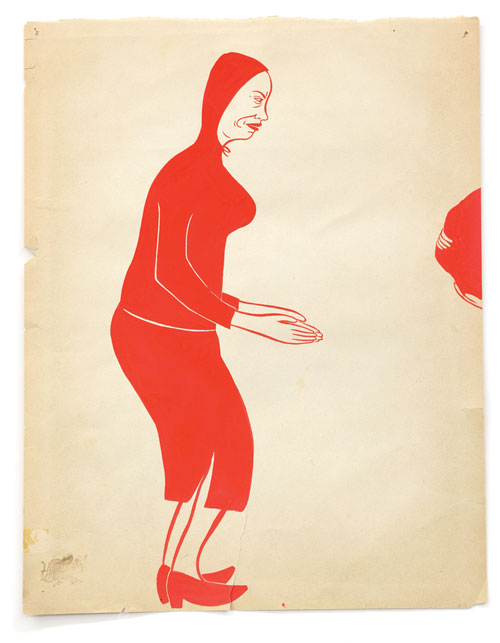
The remarkable selection of acrylic paintings — most from 2000 and all untitled — hanging in Ratio 3’s main space offers some much-welcome breathing room. They are single-subject studies of objects (groups of shoes, wigs, lips, trees, and plant life), simple repeating patterns (droplets, waves, grids), or (mostly) female figures on canvases made from discarded endpapers or repurposed grocery bags — another instance of Kilgallen’s sensitivity to the material grain of her surroundings.

Whether in the color gradations and tiny spiked edges of a leaf, or in the finely outlined toenails of a mule-clad foot, Kilgallen’s remarkable control over line and paint application imbues each canvas, even the simplest or most abstract, with an untold back-story. This is especially true of the women, who all have laugh lines but usually address the viewer with a tight-lipped smirk. If Kilgallen’s flora could have come from a children’s book, her women could pass as characters from a Dan Clowes comic.

The untitled collage pieces in the back room — smaller-scale examples of Kilgallen’s quilt-like assemblages of canvas — are more abstract, yet still retain the just-right sense of color, line and proportion on display in the other paintings. In one piece, from 1999, a single fluffy gray cloud is the only graphic break in a long expanse of sutured turquoise. Another from the same year resembles the collaged remains of a billboard’s past incarnations. But like all of the pieces in “Summer/Selections,” it feels wholly fresh.

I wish the same could be said of the recent work of Johanson, an SF expat and Kilgallen’s contemporary, whose current show at Altman Siegel is about as coherent and compelling as its title: “This, This, This, That.”

I have always preferred Johanson’s folksy takes on Sol LeWitt’s rainbow-hued precision over his text or figure-filled paintings, and there are plenty to take in here. The problem is one of editing.

For every piece — such as the carefully thought-out uneven grid of squares and rectangles “Fall Apart and Let It Go” (2011) — that feels like Johanson is trying to push himself and his explorations of color into a more formal direction, there is another that reads as an easy way out.

The acrylic and latex color shards of “Same Brain, Same Body, Different Day” (2011) nicely mirror the visible segments of the pressed grain of the wood they’re painted on, whereas “Celebration of Life Through Found Palette and Paint” (also 2011), a painted panel mounted to an upright, rainbow-colored wooden shipping palette, just feels lazy.

Certainly, many artists have made repetition a compelling cornerstone of their practice, extending their engagement with a single technique, approach, or material into a fruitful long-term relationship. Johanson, however, seems like he is simply in a rut, making more and more of the kind of art that first brought him wider renown with diminishing creative returns. Warhol did all right for himself in the 1970s, though, and I’m sure Johanson is doing just fine as well. But I know he’s capable of doing more.  

MARGARET KILGALLEN: SUMMER/SELECTIONS

Through Aug. 5

Ratio 3

1447 Stevenson, SF

(415) 821-3371 www.ratio3.org

CHRIS JOHANSON: THIS, THIS, THIS, THAT

Through July 30

Altman Siegel

49 Geary, Fourth Floor, SF

(415) 576-9300, www.altmansiegel.com


Is LEED really green?

news@sfbg.com


The archangel of sustainable development has arrived, promising much needed city housing that will add to the “social fabric of the waterfront community” with its glamorous green rooftops and unheard-of bay views. This is going to be the greenest building of them all, or so we’ve been told, but the truth is a bit more complicated.


A condominium development 25-plus years in the making, 8 Washington would transform the site of the Golden Gateway Tennis and Swim Club near Pier 39. The developer plans to renovate the recreation center with a larger fitness facility, provide two new waterfront parks with public access, and supply 30,000 feet of ground-floor retail stores and restaurants beneath its 165 new luxury apartments.


Sounds nice, doesn’t it? The problem with this $345 million project is that it’s being touted, with its “green building” LEED certification, as the most sustainable structure it can possibly be.


But there’s nothing sustainable about building high-end condos in San Francisco, a city with too many high-end condos and not enough affordable housing. And LEED (Leadership in Energy and Environmental Design), the most popular sustainable development certification system in the country, is a lie — at least as your friendly neighborhood building developer is marketing it.


LEED, the baby of the U.S. Green Building Council (USGBC) is a great marketing tool for developers in San Francisco, the city with the single most LEED certified buildings in the United States. San Francisco was just named the “greenest” city in North America at the 2011 Aspen Ideas Festival, largely due to its extensive representation of green buildings — which normally means structures built with recycled materials, near a transportation hub, featuring some solar panels or other renewable energy sources.


“LEED is certainly a positive thing,” Planning Commission President Christina Olague told us. “There’s this whole push toward green sustainability.”


The project’s “platinum” LEED status is all a San Francisco developer could hope for to attract the green — and more important, the city’s approval.


“LEED certification is part and parcel to the vision for the project,” said PJ Johnston of PJ Johnston Communications, speaking for the developer. “The city, neighborhood, and waterfront deserve healthy, sustainable structures, living spaces, public spaces, and amenities. That’s exactly what 8 Washington will bring.”


LEED has become the final word in green building — if your building is LEED certified, you’re golden. But all this green they’ve been feeding us is really a misleading, incomplete rating system.


The first thing to consider is that sustainable development, even if it uses recycled materials and 10 percent sun-powered electricity, is still development. Any time a structure is torn down, “the energy and materials in that [original structure] are going to get sent to landfills somewhere. You gotta calculate all that,” said sustainable development activist Brad Paul, a former SF deputy mayor, who believes in considering the entire “life cycle of a building” in determining its sustainability.


Even the Environmental Protection Agency sometimes discounts essential considerations of sustainable building. When it sought a new SF office space in 2009, its intention was to find a home that was “a model of sustainable development,” the SF Biz Times reported. But its first choice was to build new development, at the site at 350 Bush Street — with its environmental costs of demolition, throwing out old materials, and starting from scratch.


Last month, the EPA decided to remain at 75-95 Hawthorne Street instead of moving to a new building, but not because it was the sustainable choice. No deal was reached for 350 Bush, and as Regional Public Affairs Officer Traci Madison said, “There was no other option to choose from.”


Although it’s a measure of a structure’s material sustainability, LEED does not consider a building’s life cycle, or even its use. Consider 8 Washington. The developer has boasted that it’s the most expensive housing project in San Francisco history, with a hefty price tag of $3 million to $10 million per apartment.


“Who can afford these luxury condos, and what do they use them for?” Paul asks. “These guys who work for hedge funds on Wall Street,” who use the condo as a second or third home and commute on their private jets to get there.


Johnston said 8 Washington will be marketed to a “mix of buyers, including young professionals, empty-nesters looking to move back to San Francisco, and families … The project has many two- and three-bedroom units, encouraging family living,” he said. But it’s unlikely that those who can afford a condo of this luxury will make it their only home.


“[Board President] David Chiu says he’s worried about SF becoming a bedroom community for Silicon Valley,” said Paul. “I’m more worried about this being a bedroom community for New York, Boston, L.A.”


Instead of providing the affordable housing that San Francisco so needs, projects like 8 Washington attract the wealthy, who aren’t using public transportation. Instead, Paul said, they burn tons of fossil fuels using their new condos as weekend getaways.


LEED FOR THE RICH


LEED certifies buildings as “sustainable developments” based on the following categories: sustainable sites, water efficiency, energy and atmosphere, materials and resources, indoor environmental quality, and innovation in design and regional priority.


Earning points in each category brings a building closer to LEED certification, which requires at least 40 points. Above “silver” and “gold” status, a “platinum” LEED certification requires 80 points. But how builders get the points is what matters. For example, a developer might skimp on the insulation to install extra solar panels and get more points for a less efficient building.


Does LEED consider a building’s actual use? “The short answer is no,” said Jennifer Easton, a communications associate at the USGBC who added, “We want [LEED] to be used by every type of project.” But despite its billing, LEED tells an incomplete story.


“It’s just green drapery,” said SF attorney Sue Hestor, a slow growth advocate. “They’ve really had a PR machine. They keep touting all this greenness.”


LEED certification has value, Paul said, but it doesn’t turn multimillion dollar condos green. “There is absolutely no need for high-end luxury housing in the city right now,” he said.


Building luxury condos in place of affordable housing encourages the “Manhattanization” phenomenon, attracting wealthy out-of-towners to expend fuel on their private jets to get to their new crash pads.


“They aren’t gonna be living there all year,” Olague said of residents of luxury housing. “We hear a lot of, ‘We need more housing.’ If you keep building housing for the top 2 percent, how does it lessen the demand on your average workforce?”


But not everyone sees luxury condo-building as counterproductive. “Building that project actually allows for more affordable housing,” said Gabriel Metcalf, executive director of SPUR (San Francisco Planning + Urban Research Association). “It’ll provide housing for some people, and that can only be helpful to the housing market. If you don’t build new condos, then people just compete for the crumbs, and that means people who are rich push the rest of us out.”


In other words, if you give the rich housing, then they won’t take over your flat in the Mission — if they ever really wanted it in the first place. “I don’t think we can impose some kind of hipster elitism that they’re not our kind of people so they’re not allowed in,” Metcalf said of the wealthy out-of-towners.


LEED agrees. “We don’t want [LEED] to be for one specific group of people,” Easton said. “We have LEED-certified homeless shelters, but having a LEED certified luxury condo building is an advantage. We can’t control if someone is flying across the country in a jumbo jet every day — but we can control their energy efficiency in a building.”


WHO RIDES BUSES?


For the typical working class San Franciscan, living modestly is a must and public transportation is essential. So there’s an inherent environmental advantage to attracting residents who don’t rely on polluting planes and cars.


“There’s a definite need for workforce housing, middle class housing in San Francisco,” Paul says. “I guarantee you none of those people get there by private jet. The less income people have, the more likely they’re going to be to use public transit.”


But 8 Washington and luxury developments like it don’t foster public transit. The more wealthy people who move in, the more low-income residents get displaced — to the East Bay or other areas with more affordable housing. It’s another strike against sustainability when these workers opt to drive back into the city for work instead paying for BART, says Paul, particularly when they drive older, less-efficient cars.


“LEED was a way to spell an environmentally friendly product, but you have to figure in the extra driving,” said Paul.


But 8 Washington gets LEED points for building on a site close to public transit in an attempt to discourage individual car pollution. But will wealthy condo owner actually take the infrequent F-line with all the tourists instead of parking their $150,000 car in the underground parking garage right below their feet?


“When you’re talking about sustainable practices and reducing greenhouse gas emissions and how it relates to land use planning, it makes you wonder if that’s supposed to [solely] relate to housing people near transit corridors,” said Olague. “It seems to me you have to look at equity.”


The garage at 8 Washington, to be built below sea level under the condos, will house 415-plus parking spaces. The developer says that 250 of the spaces will be offered as public parking for the busy Ferry Building down the street, but the 165 additional spaces guarantee one parking space for each residential unit.


“Given the larger size of the residential units and the fact that the majority of the units are two to three bedrooms, we believe that one parking space per dwelling is appropriate,” said Johnston. Appropriate, maybe, but not environmentally friendly.


PROMISES AND REALITY


Wealthy people and affordable housing aside, LEED doesn’t actually measure the energy used in a building, says New York City-based architectural associate Henry Gifford. He filed a $100 million class action lawsuit against LEED last October for gaining a monopoly on the sustainable development market by making false claims about buildings’ energy savings.


“They say that the building is required to be energy efficient. But the building doesn’t have to be energy efficient — it just has to earn points, to promise it’s going to be energy efficient,” Gifford said.


It’s up to the developer what computer software is used to predict a building’s energy efficiency, and Gifford says that computer diagrams can easily be manipulated and do not consider inconsistent factors, like weather.


“California is the promise land,” said Gifford. “All you’re required to do is provide a promise. The sad thing is that it removes all the integrity from the process — it encourages lying.”


Furthermore, once the building is built and has achieved LEED certification, the building’s actual energy use in its life cycle isn’t considered. The only way you can truly know if a building is energy efficient is by looking at the utility bills, says Gifford. But once it’s LEED-certified, who cares?


There is a voluntary program called Building Performance Partnership (BPP) that tracks a building’s energy and water use over time. “The idea is we want LEED to be a system where it enacts change in the actual building,” said Easton. But the problem is the building has already gained LEED certification before the first utility bill is even mailed.


“We publish baseball scores. With everything in life, people get scored,” said Gifford, who operates with transparency in developing energy efficient buildings in New York, hosting open houses after buildings are built with printouts of their recent utility bill history.


LEED was never intended to have the final say on sustainable building, to be a seal of green approval, according to a New York Times op-ed by Alec Appelbaum last year (“Don’t LEED us astray,” 5/19/10). “Rather it was to be a set of guidelines for architects, engineers, and others who want to make buildings less wasteful. However, developers quickly realized that its ratings — certified, silver, gold, or platinum — were great marketing tools, allowing them to charge a premium on rents.”


Therein lies the issue. Yes, 8 Washington will “allow for more ‘eyes on the street’ at all hours of the day” and provide two or three-bedroom units for families who can afford them, as it promises. But a sustainable structure is far different than the promise of a sustainable life cycle of a building. And a promise is just that. *


UPDATE: Jennifer Easton at LEED wrote to inform us that, although the 8 Washington website clearly states that the project will include LEED certified buidlings, “We would like to clarify that 8 Washington is not a LEED-certified project, nor a LEED-registered project.”


PLANNING COMMISSION HEARINGS


July 7: Community Vision for San Francisco’s Northeast Waterfront


July 14: City demographics and sustainability; the need for low-income housing; presentation of “jet fuel burn rate” argument.


July 21: 8 Washington’s EIR approval hearing


All hearings to be held at 12 p.m. in the Commission Chambers, Room 400, City Hall, 1 Dr. Carlton B. Goodlett Place.


JET FUEL BURN RATE FOR LUXURY CONDOS


Let’s assume that just five of the 165 condo buyers at 8 Washington (3 percent) are Wall Street hedge fund traders or venture capitalists using them as second or third homes. Let’s also assume they’ll use them 1.5 times a month and commute to SF aboard their business jet, a reasonable assumption for Wall Street execs making tens of millions in salary and bonuses. Why would they fly by private jet rather than take Southwest or Amtrak? Because they can. This must be factored into any environmental analysis of a project that explicitly markets to this demographic and include the following:


Mid to large size business jets used to fly cross country (Hawker 800XP, Gulfstream G2/ G3, Bombardier Global Express) on average burn 400 gallons of jet fuel/hour, take 6 hours to fly New York to SFO and 5 hours for return trip. Therefore, a single round trip burns:


11 hours X 400 gallons per hour = 4,400 gallons of jet fuel per trip. A typical family car uses 1,200 gallons of gas per year, so one flight from NYC to 8 Washington equals almost four years of driving a family car.


1.5 trips/mo. = 6,600 gallons X 12 months = 79,200 gallons of jet fuel/year or the equivalent of driving a family car for 66 YEARS each month.


Using our example of five residents, the numbers over one year and 20 years are:


5 X 79,200 gallons/per year = 396,000 GALLONS OF JET FUEL A YEAR or equal to driving a family car 330 years, A THIRD OF A MILLENNIUM, each year.


396,000 gal. X 20 yrs. = 7,920,000 gallons of jet fuel, equivalent of driving family car 6,600 years, OVER 6 MILLENNIUM, in 20 years.


Given this reality, the 8 Washington environmental impact report must analyze such questions as:


How many solar panels are needed compensate for burning 396,000 gallons of jet fuel/year? How many low flow toilets would make up for burning 396,000 gallons of jet fuel/year? Etc.

Music Listings

0

Music listings are compiled by Cheryl Eddy. Since club life is unpredictable, it’s a good idea to call ahead to confirm bookings and hours. Prices are listed when provided to us. Submit items for the listings at listings@sfbg.com. For further information on how to submit items for the listings, see Picks.

WEDNESDAY 6

ROCK/BLUES/HIP-HOP

Bianca and the AMs 50 Mason Social House, 50 Mason, SF; www.50masonsocialhouse.com. 9pm, free.

Darwin Deez, Dirty Gold, Younger Lovers Bottom of the Hill. 9pm, $12.

Free Moral Agents, Wild Pack of Canaries, Thousandnames Hotel Utah. 9pm, $6.

Maus Haus, Swahili Blonde, Gangi, Epic Sauce DJs Rickshaw Stop. 8pm, $10.

Mental 99, Wesley Morgan Madrone Art Bar. 7pm, free. Every Wed. in July.

Anais Mitchell, Bhi Bhiman Slim’s. 9pm, $21.

Moonbell, Magic Christian, Antenna Elbo Room. 9pm, $6.

Eddie Neon Biscuits and Blues. 8 and 10pm, $15.

Rosebuds, Other Lives Independent. 8pm, $14.

Tunnel, Aranya, Black Caucus Hemlock Tavern. 9pm, $6.

JAZZ/NEW MUSIC

Cat’s Corner with Nathan Dias and Christine Savanna Jazz. 9pm, $10.

Cosmo Alleycats Le Colonial, 20 Cosmo, SF; www.lecolonialsf.com. 7pm.

Dink Dink Dink, Gaucho, Michael Abraham Amnesia. 7pm, free.

Jazz organ party with Graham Connah Royal Cuckoo, 3202 Mission, SF; www.royalcuckoo.com. 7:30pm, free.

“Kim Nalley Sings Nina Simone” Rrazz Room. 8pm.

Ben Marcato and the Mondo Combo Top of the Mark. 7:30pm, $10.

Jimmie Vaughan and the Tilt-a-Whirl Band Yoshi’s San Francisco. 8pm, $35.

DANCE CLUBS

Booty Call Q-Bar, 456 Castro, SF; www.bootycallwednesdays.com. 9pm. Juanita Moore hosts this dance party, featuring DJ Robot Hustle.

Buena Onda Little Baobab, 3388 19th St, SF; (415) 643-3558. 10pm, free. Funk, swing, rare grooves, and more with Dr. Musco and guests.

Mary Go Round, the New Generation Lookout, 3600 16th St, SF; www.lookoutsf.com. 10pm, $5. Drag with Suppositori Spelling, Mercedez Munro, and Ginger Snap.

No Room For Squares Som., 2925 16th St, SF; (415) 558-8521. 6-10pm, free. DJ Afrodite Shake spins jazz for happy hour.

THURSDAY 7

ROCK/BLUES/HIP-HOP

Bit Shifter, Crashfaster, Glowing Stars, Starpause, Awkward Terrible DNA Lounge. 7pm, $16.

Blank Tapes, Collin Ludlow-Mattson and the Folks, Beehavers Amnesia. 9pm, $7-10. Presented by Seaweed Sway.

Buckethead, Wolff Great American Music Hall. 9pm, $30.

Vanessa Carlton Swedish American Hall (upstairs from Café Du Nord). 8pm, $25.

“George Clinton and Parliament Funkadelic Birthday Funkathon” Yoshi’s San Francisco. 8 and 10:30pm, $50.

Karen Lovely Biscuits and Blues. 8 and 10pm, $20.

Massive Moth, Soft Tags, Teenage Sweater Hemlock Tavern. 9pm, $7.

Moanin Dove, Audio Out Send, Beep Bottom of the Hill. 9pm, $10.

Morning Commute, Rad Cloud, All My Dead Young Friends Café Du Nord. 9pm, $10.

Rattle and Rye, Trainwreck Riders, Buxter Hoot’n, Quinn Deveaux Slim’s. 8pm, $15. With Fox and Woman, Jimmy Sweetwater, Robin DiCarlo, Jelal Huyler, and more.

Stalley and Reks Brick and Mortar Music Hall, 1710 Mission, SF; www.brickandmortarmusic.com. 9pm, $15.

State of Independence Dance Tour 50 Mason Social House, 50 Mason, SF; www.50masonsocialhouse.com. 9pm, free.

Gillian Welch Warfield. 8pm, $32.

JAZZ/NEW MUSIC

Chives Red Poppy Art House. 8pm, $12-15.

Cosmo Alleycats with Ms. Emily Wade Adams Blondie’s, 540 Valencia, SF; (415) 864-2419. 9pm, free.

Dave Parker Quartet Purple Onion, 140 Columbus, SF; (415) 956-1653. 7:30-10:30pm, free.

Joe Cohen Show Rose Pistola, 532 Columbus, SF; www.rosepistola.com. 8pm, free.

“Kim Nalley Sings Nina Simone” Rrazz Room. 8pm.

Organsm featuring Jim Gunderson and “Tender” Tim Shea Bollyhood Café. 6:30-9pm, free.

Soul jazz party with Chris Siebert Royal Cuckoo, 3202 Mission, SF; www.royalcuckoo.com. 7:30pm, free.

Stompy Jones Top of the Mark. 7:30pm, $10.

FOLK/WORLD/COUNTRY

Heather Combs, Damond Moodie, Mike Gibbons, Kate Cotter Hotel Utah. 8pm, $8.

DANCE CLUBS

Afrolicious X Fex Elbo Room. 9:30pm, $5. Afrobeat, Tropicália, electro, samba, and funk with the Voo Doo Killer, DJ Newlife, J. Boogie, and B Maj.

Culture Corner Koko Cocktails, 1060 Geary, SF; www.kokococktails.com. 10pm, free. Roots reggae, dub, rocksteady, and classic dancehall with DJ Tomas, Yusuke, Vinnie Esparza, and Basshaka and ILWF.

Electric Feel Lookout, 3600 16th St, SF; www.lookoutsf.com. 9pm, $2. Indie music video dance party with DJs Blondie and subOctave.

Guilty Pleasures Gestalt, 3159 16th St, SF; (415) 560-0137. 9:30pm, free. DJ TophZilla, Rob Metal, DJ Stef, and Disco-D spin punk, metal, electro-funk, and 80s.

Josh Miller Jam Party Knockout. 9:30pm. With DJs Russell Quan, Erin McDermott, Chris McVicker, and Josh Miller.

1984 Mighty. 9pm, $2. The long-running New Wave and 80s party features video DJs Mark Andrus, Don Lynch, and celebrity guests.

Popscene Rickshaw Stop. 9pm, $12. With Bass Drum of Death and DJs Aaron Axelsen and Omar.

Thursday Special Tralala Revolution Café, 3248 22nd St, SF; (415) 642-0474. 5pm, free. Downtempo, hip-hop, and freestyle beats by Dr. Musco and Unbroken Circle MCs.

Thursdays at the Cat Club Cat Club. 9pm, $6 (free before 9:30pm). Two dance floors bumpin’ with the best of 80s mainstream and underground with Dangerous Dan, Skip, Low Life, and guests.

Tropicana Madrone Art Bar. 9pm, free. Salsa, cumbia, reggaeton, and more with DJs Don Bustamante, Apocolypto, Sr. Saen, Santero, and Mr. E.

FRIDAY 8

ROCK/BLUES/HIP-HOP

AC/Dshe, Thunderbleed, Hell Fire Slim’s. 9pm, $15.

Buckethead, Wolff Great American Music Hall. 9pm, $30.

Graham Colton, J. Irvin Dally, Megan Bonnell Hotel Utah. 9pm, $14.

“George Clinton and Parliament Funkadelic Birthday Funkathon” Yoshi’s San Francisco. 8 and 10:30pm, $50.

Graffiti6, Hundred Days, A Silent Film Rickshaw Stop. 9pm, $12.

Guitar Shorty Biscuits and Blues. 8 and 10pm, $20.

Reverend Horton Heat, Swingin’ Utters Independent. 9pm, $20.

Ian Fays, Sidewalk Society, Bowery Beasts, Golden Ghosts Knockout. 9pm, $7.

“Let Her Dance” Verdi Club, 2424 Mariposa, SF; www.letherdance.eventbrite.com. 8pm, $15. With Heidi Alexander, Grace Cooper, Quinn Deveaux, and others performing 60s hits.

MP Allstars 50 Mason Social House, 50 Mason, SF; www.50masonsocialhouse.com. 9pm, free.

New Diplomat, Reckless Kind, Please Do Not Fight, DJ Huffy Elbo Room. 9:30pm, $8.

Riverboat Gamblers, Dead To Me, Off With Their Heads, Underground Railroad to Candyland, Big Kids Thee Parkside. 9pm, $12.

Soul of John Black Biscuits and Blues Union Room. 8:30 and 10:30pm, $20.

Sunbeam Road, Bassturd, Coolzey Hemlock Tavern. 9:30pm, $8.

Tracing Figures, Yomihara, Your Cannons, Caught in Motion Café Du Nord. 9pm, $10.

Trophy Fire, Bruises, Hate Factory, Eighteen Individual Eyes Bottom of the Hill. 9pm, $10.

JAZZ/NEW MUSIC

Black Market Jazz Orchestra Top of the Mark. 9pm, $10.

Dan Heffez Trio Rose Pistola, 532 Columbus, SF; www.rosepistola.com. 9pm, free.

“Kim Nalley Sings Nina Simone” Rrazz Room. 8pm.

Soul jazz party with Jules Broussard and Chris Siebert Royal Cuckoo, 3202 Mission, SF; www.royalcuckoo.com. 7:30pm, free.

Vaughan Johnson Jazz Combo Jack’s Club, 2545 24th St., SF; (415) 641-1880. 7pm, free.

FOLK/WORLD/COUNTRY

La Gente Red Poppy Art House. 9pm, $12-15.

DANCE CLUBS

Afro Bao Little Baobab, 3388 19th St, SF; (415) 643-3558. 10pm, $5. Afro and world music with rotating DJs including Stepwise, Steve, Claude, Santero, and Elembe.

“Benefit for Cheb I Sabbah” 1015 Folsom, SF; www.chebisabbah.com. 9pm, $15 and up. With artists from Anon Salon, Hookahdome, Opel Productions, Non Stop Bhangra, Six Degrees Records, and more.

Blow Up DNA Lounge. 10pm, $20. With Jessica 6, Jeffrey Paradise, and Austy Pantz.

Lee Foss, Tim Sweeney, Le Loup Public Works, 161 Erie, SF; www.publicsf.com. 10pm, $8-12. House, funk, techno, and disco; also with Eug, Jason Kendig, and Briski.

Tipper, VibeSquaD, Dov, Hypnotech Regency Ballroom. 9pm, $28. With visuals by Johnathan Singer.

Vintage Orson, 508 Fourth St, SF; (415) 777-1508. 5:30-11pm, free. DJ TophOne and guest spin jazzy beats for cocktalians.

SATURDAY 9

ROCK/BLUES/HIP-HOP

Absent Society, Name, Ashkira, Memento Mori Slim’s. 9pm, $14.

Catholic Radio, Crazies Will Destroy You, Yalpine Hotel Utah. 9pm, $8.

Finish Ticket, Happy Body Slow Brain, Bird By Bird, PK Bottom of the Hill. 8:30pm, $12.

“George Clinton and Parliament Funkadelic Birthday Funkathon” Yoshi’s San Francisco. 8 and 10:30pm, $50.

Reverend Horton Heat, Swingin’ Utters Independent. 9pm, $20.

Leaders, Midnite Snaxxx, Uzi Rash, Slam Dunk Hemlock Tavern. 9:30pm, $7.

Rod Piazza and the Mighty Flyers Biscuits and Blues. 8 and 10pm, $22.

Soul of John Black Brick and Mortar Music Hall, 1710 Mission, SF; www.brickandmortarmusic.com. 9pm, $10.

Static Sound, Imaginary Colors Thee Parkside. 4pm, free.

TYGA, Mindless Behavior, Lil Twist, Jawan Harris, Travante Fillmore. 7pm, $28.50.

Washed Out, Class Actress, Chain Gang of 1974 Great American Music Hall. 9pm, $16.

West Coast Ramblers, Slim Jenkins, Stillmen Café Du Nord. 9pm, $10.

JAZZ/NEW MUSIC

Jazz organ party with Graham Connah Royal Cuckoo, 3202 Mission, SF; www.royalcuckoo.com. 7:30pm, free.

“Kim Nalley Sings Nina Simone” Rrazz Room. 8pm.

Mike Hirsch Trio Rose Pistola, 532 Columbus, SF; www.rosepistola.com. 9pm, free.

FOLK/WORLD/COUNTRY

Lamont Cole and Rebekah Todd Red Poppy Art House. 9pm, $10-15.

Robin Lovejoy 50 Mason Social House, 50 Mason, SF; www.50masonsocialhouse.com. 9pm, free.

Queen Ifrica and Tony Rebel Rock-It Room. 9pm, $20.

DANCE CLUBS

Afro Bao Little Baobab, 3388 19th St, SF; (415) 643-3558. 10pm, $5. Afro and world music with rotating DJs including Stepwise, Steve, Claude, Santero, and Elembe.

Bootie SF DNA Lounge. 9pm, $8-15. Mash-ups with guest Victor Menegaux.

Cockblock Rickshaw Stop. 10pm, $8-10. With Natalie Nuxx.

Fly Me to the Moon Koko Cocktails, 1060 Geary, SF; www.kokococktails.com. 9:30pm, free. Sixties soul, girl groups, and garage with DJs Amy A and DJ the DJ.

Smithsfits Friend Club Knockout. 9:30pm, $4. Smiths and Misfits with DJs Josh Ghoul and Jay Howell.

Tormenta Tropical Elbo Room. 10pm, $5-10. Electro cumbia with DJs Shawn Reynaldo and Oro11.

SUNDAY 10

ROCK/BLUES/HIP-HOP

Pete Anderson Biscuits and Blues. 8 and 10pm, $15.

Brother Pacific, That Ghost, Cool Ghouls Hotel Utah. 9pm, $6.

“George Clinton and Parliament Funkadelic Birthday Funkathon” Yoshi’s San Francisco. 7 and 9:30pm, $50.

“Gorilla Takeover” DNA Lounge. 5:30pm. Battle of the Bands with Krawl, Thy Winter Shadow, and more.

Drew Grow and Pastors’ Wives, Winnie Byrd, Chineke Hemlock Tavern. 9pm, $7.

“JAMband Family Festival” Park Chalet, 1000 Great Hwy, SF; www.jamjamjam.com. 11am, free. With Charity and the JAMband, plus Rhythm Child.

Anya Marina, How Café Du Nord. 8pm, $12.

Ian Moore and the Lossy Coils, Bare Wires, Lotus Moon Bottom of the Hill. 9pm, $12.

JAZZ/NEW MUSIC

“After the End of the World Concert” Musicians’ Union Hall, 116 Ninth St, SF; www.noertker.com. 7:30pm, $10. With Annelise Zamula, Tracy McMullen, Bill Noertker, and Dave Mihaly.

Lua Hadar, Aaron Germain, Jason Martineau Bliss Bar, 4026 24th St, SF; www.blissbarsf.com. 4:30-7:30pm, $10.

Jazz organ party with Lavay Smith and Chris Siebert Royal Cuckoo, 3202 Mission, SF; www.royalcuckoo.com. 7:30pm, free.

“Kim Nalley Sings Nina Simone” Rrazz Room. 7pm.

Sheelagh Murphy Martuni’s, Four Valencia, SF; www.dragatmartunis.com. 7pm, $7.

Rob Evans Trio Rose Pistola, 532 Columbus, SF; www.rosepistola.com. 5:30pm, free.

Sunday Jazz Jam 50 Mason Social House, 50 Mason, SF; www.50masonsocialhouse.com. 9pm, free.

Tom Lander Duo Medjool, 2522 Mission, SF; www.medjoolsf.com. 6-9pm, free.

FOLK/WORLD/COUNTRY

AfroCubanism and Pellejo Seco Sigmund Stern Grove, 19th Ave at Sloat, SF; www.sterngrove.org. 2pm, free.

Lee Vilensky Trio Thee Parkside. 4pm, free.

DANCE CLUBS

Batcave Cat Club. 10pm, $5. Death rock, goth, and post-punk with Steeplerot Necromos and c_death.

Dub Mission Elbo Room. 9pm, $6. Dub, roots, and classic dancehall with DJ Sep and guests Robert Rankin’ and Spliff Skankin’.

Jock Lookout, 3600 16th St, SF; www.lookoutsf.com. 3pm, $2. Raise money for LGBT sports teams while enjoying DJs and drink specials.

La Pachanga Blue Macaw, 2565 Mission, SF; www.thebluemacawsf.com. 6pm, $10. Salsa dance party with live Afro-Cuban salsa bands.

Tropical Hot Dog Night Knockout. 10pm, free. Mutant disco and post-punk with DJs Placentina and Lady of the Night.

MONDAY 11

ROCK/BLUES/HIP-HOP

John Doe and Jill Sobule Café Du Nord. 8pm, $20.

Guverment, Illusion of Self, Illness Elbo Room. 9pm, $6.

DANCE CLUBS

Death Guild DNA Lounge. 9:30pm, $3-5. Gothic, industrial, and synthpop with Joe Radio, Decay, and Melting Girl.

M.O.M. Madrone Art Bar. 6pm, free. DJs Timoteo Gigante, Gordo Cabeza, and Chris Phlek playing all Motown every Monday.

Sausage Party Rosamunde Sausage Grill, 2832 Mission, SF; (415) 970-9015. 6:30-9:30pm, free. DJ Dandy Dixon spins vintage rock, R&B, global beats, funk, and disco at this happy hour sausage-shack gig.

TUESDAY 12

ROCK/BLUES/HIP-HOP

Bees Table, Gunfighter Nation, Jiggabits, Parentz Hotel Utah. 8pm, $6.

Fat Tuesday Band Biscuits and Blues. 8 and 10pm, $15.

Oslo, Violet Isle, Hosannas Bottom of the Hill. 9pm, $10.

Pacific Pride, Goochi Boiz, Western Hymn, Wild Assumptions Hemlock Tavern. 9pm, $7.

School of Rock All-Stars Rickshaw Stop. 6:30pm, $20.

Stage Listings

0

Stage listings are compiled by Guardian staff. Performance times may change; call venues to confirm. Reviewers are Robert Avila, Rita Felciano, and Nicole Gluckstern. Submit items for the listings at listings@sfbg.com. For further information on how to submit items for the listings, see Picks. For complete listings, see www.sfbg.com.

THEATER

OPENING

Act One, Scene Two SF Playhouse, Stage Two, 533 Sutter, SF; (415) 869-5384, www.un-scripted.com. $10-20. Opens Thurs/7, 8pm. Runs Thurs-Sat, 8pm. Through Aug 20. Un-Scripted Theater Company hosts a different playwright each night, performing the first scene of an unfinished play and then improvising its finish.

Not Getting Any Younger Marsh San Francisco, 1062 Valencia, SF; www.themarsh.org. $15-50. Opens Thurs/7, 8pm. Runs Thurs, 8pm; Sat, 8:30pm; Sun, 7pm. Through July 24. Marga Gomez presents a workshop production of her new comedy, her ninth solo show.

Salty Towers Exit Theatre, 156 Eddy, SF; (415) 673-3847, www.theexit.org. $15-25. Opens Thurs/8, 8pm. Runs Thurs-Sat, 8pm; Sun, 3pm. Through July 23. Thunderbird Theatre Company performs a farce that combines Greek mythology with a tale of sea creatures running a two-star hotel.

Twilight Zone Live: Season 8 Dark Room, 2263 Mission, SF; www.ticketturtle.com. $20 ($5 discount if you use the code word “maggie”). Opens Fri/8, 8pm. Runs Fri-Sat, 8pm. Through July 29. The Dark Room Theater presents its eighth annual tribute to classic Twilight Zone episodes.

BAY AREA

Macbeth Dominican University of California, Forest Meadows Amphitheater, 1475 Grand, San Rafael; (415) 499-4488, www.marinshakespeare.org. $20-35. Previews Fri/8-Sun/10, 8pm. Opens July 15, 8pm. Performance times vary; check website for schedule. Through Aug 14. Marin Shakespeare Company takes on the Scottish play, opening under a full moon, no less.

The Verona Project Bruns Amphitheater, 100 California Shakespeare Theater Way, Orinda; (510) 548-9666, www.calshakes.org. $35-66. Previews Wed/6-Fri/8, 8pm. Opens Sat/9, 8pm. Runs Tues-Thurs, 7:30pm; Fri-Sat, 8pm (also July 30, 2pm); Sun, 4pm. Through July 31. California Shakespeare Theater performs a world-premiere play (inspired by The Two Gentlemen of Verona) by Amanda Dehnert.

ONGOING

All Atheists Are Muslim Stage Werx, 533 Sutter, SF; www.brownpapertickets.com. $20. Sun/10, 7pm. Zahra Noorbakhsh returns with her timely comedy.

Assisted Living: The Musical Imperial Palace, 818 Washington, SF; 1-888-88-LAUGH, www.assistedlivingthemusical.com. $79.59-99.50 (includes dim sum). Sat-Sun, noon (also Sun, 5pm). Through July 31. Rick Compton and Betsy Bennett’s comedy takes on “the pleasures and perils of later life.”

Billy Elliot Orpheum Theater, 1192 Market, SF; www.shnsf.com/shows/billyelliot. $35-200. Tues-Sat, 8pm (also Wed, 2pm); Sun, 2pm. Through Sept. 17. As a Broadway musical, Billy Elliot proves more enjoyable than the film. The movie’s T. Rex score may have been a major selling point, but it was a bit maudlin for a story that needed no help in that department. The musical naturally has a sentimental moment or three, but it’s much more often funny, muscular in its staging (with repeatedly inspired choreography from Peter Darling), and expansive in its eclectic score (Elton John) and well-wrought book and lyrics (Lee Hall). Moreover, Stephen Daldry (who also directed the 2000 film) plays up bracingly the too-timely class politics of the modest 1980s English mining town besieged by Margaret Thatcher’s neoliberal regime in the latter’s ultimately successful bid to crush the once-powerful miners union. The cast is likewise very strong, beginning with opening night’s impressive J.P. Viernes in the title role. Broadway’s Faith Prince is an especially engaging presence as the ballet teacher who takes an interest in Billy’s inherent talent, setting him on a course out of the doomed town and into London’s Royal Ballet School — much to the violent disgust of his predominantly male and prickly household. The first act is a nearly perfect balance of bawdy humor, aggressive staging, adept scene-setting and character development and a potent tide of song and group choreography that is hard to resist. There are some unfortunate choices later on, like a bit of Peter Pan wire work that has Billy twirling over the stage (an excessive display that hovers awkwardly over dullsville) and in general the second act is not as strong as the first. It’s also the point where the working-class politics paid homage to by the script gets seriously blunted by a concomitant streak of middle-class individualism. But as crowd-pleasing entertainment the musical burrows deep and more often than not comes up with gold. (Avila)

The Book of Liz Custom Made Theatre, 1620 Gough, SF; www.custommade.org. $10-29. Thurs-Sat, 8pm; Sun, 7pm. Through July 31. Custom Made Theatre performs David and Amy Sedaris’ comedy about an unconventional nun.

“Fury Factory 2011” Various venues and prices; www.brownpapertickets.com. Through Tues/12. Over 30 Bay Area and national companies participate in this bi-annual theater festival.

Indulgences in the Louisville Harem Phoenix Theatre, 414 Mason, SF; 1-800-838-3006, www.offbroadwaywest.org. $20-40. Thurs-Sat, 8pm. Through July 30. Two spinster sisters find unlikely beaux in Off Broadway West Theatre’s production of John Orlock’s play.

The Pride New Conservatory Theatre Center, 25 Van Ness, SF; (415) 861-8972, www.nctcsf.org. $24-40. Wed/6-Sat/9, 8pm; Sun/10, 2pm. New Conservatory Theatre Center performs the West Coast premiere of Alexi Kaye Campbell’s love-triangle time warp drama.

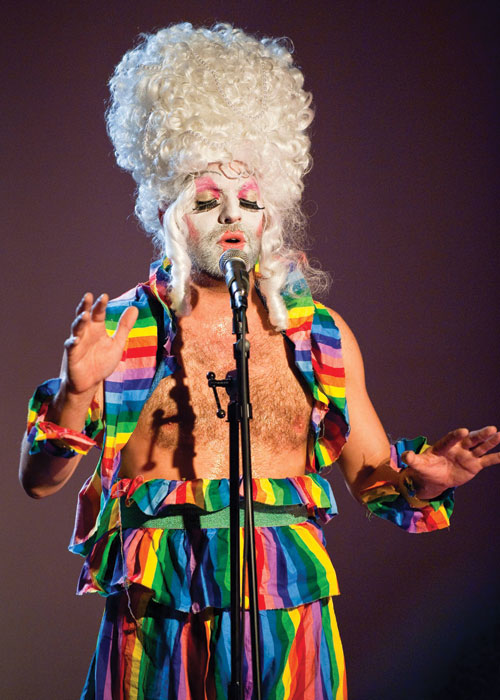
*Vice Palace: The Last Cockettes Musical Thrillpeddlers’ Hypnodrome, 575 10th St; (800) 838-3006, www.brownpapertickets.com. $30-35. Fri-Sat, 8pm; Sun, 7pm. Through July 31. Hot on the high heels of a 22-month run of Pearls Over Shanghai, the Thrillpeddlers are continuing their Theatre of the Ridiculous revival with a tits-up, balls-out production of the Cockettes’ last musical, Vice Palace. Loosely based on the terrifyingly grim “Masque of the Red Death” by Edgar Allan Poe, part of the thrill of Palace is the way that it weds the campy drag-glamour of Pearls Over Shanghai with the Thrillpeddlers’ signature Grand Guignol aesthetic. From an opening number set on a plague-stricken street (“There’s Blood on Your Face”) to a charming little cabaret about Caligula, staged with live assassinations, an undercurrent of darkness runs like blood beneath the shameless slapstick of the thinly-plotted revue. As plague-obsessed hostess Divina (Leigh Crow) and her right-hand “gal” Bella (Eric Tyson Wertz) try to distract a group of stir-crazy socialites from the dangers outside the villa walls, the entertainments range from silly to salacious: a suggestively-sung song about camel’s humps, the wistful ballad “Just a Lonely Little Turd,” a truly unexpected Rite of Spring-style dance number entitled “Flesh Ballet.” Sumptuously costumed by Kara Emry, cleverly lit by Nicholas Torre, accompanied by songwriter/lyricist (and original Cockette) Scrumbly Koldewyn, and anchored by a core of Thrillpeddler regulars, Palace is one nice vice. (Gluckstern)

What Mamma Said About Down There SF Downtown Comedy Theater, 287 Ellis, SF; www.sfdowntowncomedytheater.com. $15. Thurs-Sat, 8pm. Through August 20. Sia Amma returns with her solo comedy.

BAY AREA

All My Children Cabaret at Marsh Berkeley, 2120 Allston, Berk; www.themarsh.org. $20-50. Fri, 8pm; Sat, 8:30pm. Through July 23. Not the soap opera — it’s Seattle Improv co-founder Matt Smith in his comedy about a middle-aged man with boundary issues.

East 14th: True Tales of a Reluctant Player Marsh Berkeley, 2120 Allston, Berk; www.themarsh.org. $20-50. Sat, 8:30pm; Sun, 7pm. Through Aug 7. Don Reed’s hit solo comedy receives one last extension before Reed debuts his new show (a sequel to East 14th) in the fall.

Metamorphosis Aurora Theatre, 2081 Addison, Berk; (510) 843-4822, www.auroratheatre.org. $10-55. Tues and Sun, 7pm (also Sun, 2pm); Wed-Sat, 8pm. Through July 17. Aurora Theatre Company performs a terrifying yet comic adaptation of Kafka’s classic by David Farr and Gísli Örn Gardarsson.

A Raisin in the Sun Pear Avenue Theatre, 1220 Pear, Mtn. View; (650) 254-1148, www.thepear.org. $15-30. Thurs/7-Sat/9, 8pm; Sun/10, 2pm. Lorraine Hansberry’s classic play comes to life on the Pear Avenue Theatre stage.

2012: The Musical! Cedar Rose Park, 1300 Rose, Berk; www.sfmt.org. Free. Sat/9-Sun/10, 2pm. Continues through Sept. 25 at various Bay Area venues. San Francisco Mime Troupe mounts their annual summer musical; this year’s show is about a political theater company torn between selling out and staying true to its anti-corporate roots.

*Working for the Mouse La Val’s Subterranean, 1834 Euclid, Berk; www.impacttheatre.com. $10-20. Thurs/7-Fri/8, 8pm. It might not come as a surprise to hear that even “the happiest place on earth” has a dark side, but hearing Trevor Allen describe it during this long overdue reprise of 2002’s Working for the Mouse, will put a smile on your face as big as Mickey’s. With a burst of youthful energy, Allen bounds onto the tiny stage of Impact Theatre to confess his one-time aspiration to never grow up — a desire which made auditioning for the role of Peter Pan at Disneyland a sensible career move. But in order to break into the big time of “charactering,” one must pay some heavy, plush-covered dues. As Allen creeps up the costumed hierarchy one iconic cartoon figure at a time, he finds himself unwittingly enmeshed in a world full of backroom politics, union-busting, drug addled surfer dudes with peaches-and-cream complexions, sexual tension, showboating, job suspension, Make-A-Wish Foundation heartbreak, hash brownies, rabbit vomit, and accidental decapitation. Smoothly paced and astutely crafted, Working for the Mouse will either shatter your blissful ignorance or confirm your worst suspicions about the corporate Disney machine, but either way, it will probably make you treat any “Casual Seasonal Pageant Helpers” you see running around in their sweaty character suits with a whole lot more empathy. (Gluckstern)

PERFORMANCE/DANCE

Front Line Theatre CounterPULSE, 1310 Mission, SF; www.brownpapertickets.com. Fri/8-Sun/10, 8pm. Also July 21-23, 8pm, Garage, 975 Howard, SF; www.brownpapertickets.com. Both venues, $20. The company presents the world premiere of Rare Earth, a verse-and-movement comedy about waste and the past.

Miguel Gutierrez Garage, 975 Howard, SF; www.brownpapertickets.com. Fri-Sun, 8pm. $15. The choreographer performs his 2010 work Heavens What Have I Done as part of Verge, the Garage’s workshop series.

LINES Ballet Summer Program Cowell Theater, Fort Mason Center, Marina at Laguna, SF; www.linesballet.org. Tues/12, 7:30pm. $15. The LINES Ballet Summer Program celebrates its 10th anniversary with the first of two student showcases.

“OMFG! The Internet Dating Musical” ODC Theater, 3153 17th St, SF; www.odctheater.org. Fri-Sat, 8pm; Sun, 2pm. Through July 17. $15-18. ODC Theater Resident Artist Chris Winslow presents his new comedy about a couple who both fear they can’t live up to reality after meeting online.

“Project Bust” Z Space, 450 Florida, SF; www.brownpapertickets.com. Wed/6 and Aug 3, 8pm. $15. Malinda LaVelle presents her evening-length dance-theater piece.

“Sympathetic: An Aerial Dance Performance Honoring Labor” Rincon Annex Post Office, 121 Spear, SF; (415) 564-4010. Sat, 1 and 3pm. Free. The Labor Archives and Research Center, San Francisco State University, and Flyaway Productions present this work honoring the 1934 San Francisco General Strike by choreographer Jo Kreiter and musician Pamela Z.

“The Tinker Show” Stage Werx, 533 Sutter, SF; www.thetinkershow.com. Thurs-Fri, 8pm. $18-20. “Old school immaturity” via live sketch comedy and improv, plus original short films.

Yubiwa Hotel Performing Arts Company NOHspace, 2640 Mariposa, SF; www.sfiaf.org. Fri, 8pm; Sun, 3pm. $12. The company performs the play Mesujika Doe, a Japanese-American collaboration from Shirotama Hitsujiya and Trista Baldwin.

Fetish and armor

1

culture@sfbg.com

LUST FOR LIFE The year I was 16, I wore nothing but thrift shop vintage lingerie. As outerwear. I’d layer two slips or two half-slips on top of each other so they wouldn’t be quite as see-through and clomp around in impossibly high heels. I bought my actual underwear from the Victoria’s Secret at the mall when they had their blowout sales. There and at places like Forever 21 — flashy, clubby, and cheap.

I tell you these details because it’s important, naming the places I picked up armor and fetish. Because it felt like armor and it felt like fetish — in all senses of the word. Sexual but mythic and protective in proportion, too. That lacy magenta push-up demi-bra, the one that was just a little too tight, the one that was always uncomfortable. But I’d wear it anyway because I understood the importance of armor. Of having something that would protect me if bad shit went down.

The refrain from my mother — and from the more prudish crowd at my school, the tough homophobic boys in my neighborhood, the cat-calling older men at the Mission BART Station who didn’t realize how young I was — was that if you wear clothes like that, you are asking for it. You’re putting yourself in danger.

But didn’t any of them realize that this was my way of staying out of danger? I felt so much more powerful in those impossible heels, tits pushed up and out, cleavage for days, fishnets encasing my thighs, tight leather boots hugging my calves. I felt so much more powerful and able to fight if any shit went down.

I get that kids are sexualized young in this culture, especially girls. That’s creepy, and I’m not saying it’s okay. When Abercrombie & Fitch sold thongs to preteens, it disgusted me. Toddler beauty pageants scare the hell out of me.

But whenever people get moralistic and concerned about teenage girls’ slutty outfits, about how sexual teens are these days — I cringe. Because I was that girl who got into screaming fights with her mother about fishnets and cleavage and dresses that were too tight. And I want us to actually talk to that girl without screaming at her. To see how she feels about what she’s wearing. To see if she’s doing it solely to impress people, or if she’s doing it to go along with the crowd, but she really hates it. Or if she’s doing it because it’s a way to claim power in a world that hates sexuality and hates femininity.

I was a queer chubby girl wearing sexy clothes trying to learn how to love herself in a viciously fatphobic, sexist, homophobic world. Honestly? Cobbling together a wardrobe of vintage lingerie was one of the ways I coped. I spent a lot of time figuring out what clothes worked for my body. Like most fat people, I had to figure it out on my own.

There is no cultural road map for being fat and sexual. We’re taught that the two are at odds with each other. I have lost count of how many times I have heard people say — in person, on the Internet, in print media — that fat people should not go out in clothes that are tight or revealing or provocative. That the very sight of our flesh — and in particular, the sight of our sexual bodies — is cause for disgust, even for violence. I wonder sometimes if people would have reacted as strongly to my outfits as a teenager if I’d been a size 2 or 4 instead of a size 12 or 14. How much of it was fear of young people being sexual? How much of it was fear of fat people being sexual?

I was speaking at a reproductive justice conference a while back, on a panel called something vague and cutting-edge like “The Politics of Sexuality.” I was supposed to be talking about my work in the porn industry as a fat queer woman — what I like and don’t like about doing porn. But the panel moderator opened the session by referring to Andrea Dworkin and Catherine McKinnon (who are famously anti-porn) as “sex-radical feminists.” My eyes about bugged outta my head.

It all went downhill from there. Women in the audience started disclosing their rape fantasies during the Q&A: “Why do we like this? Are we fucked up?” It was like group therapy and second-wave feminist sex guilt were getting together to have a really terrible party. By the end of it, I was bowled over and exhausted.

And then a pretty young fat girl — white, maybe 19 or 20, kinda punky, with wire-rimmed glasses and fine blonde hair with an orange streak — walked up to me as I gathered my things. She had tears in her eyes.

“I’ve …” She had to gulp, she was that choked up. “I’ve never… Gina, you’re the first fat person I’ve ever heard talk about being comfortable with your body and comfortable with sex. I really want to be there, and I’m not yet. What do I do?”

I was floored. I almost started crying too. I hugged her. I told her she was beautiful. I scribbled down some websites and some book titles. And then I hugged her — again — and told her she was beautiful — again. I felt like I could not say that enough times.

I wish I’d had time to tell her my story — how wearing clothes as armor and fetish helped and healed, and got me to where I am now. If that girl wants to wear nothing but vintage lingerie for a year? For the rest of her life? More power to her. 

Gina de Vries is a San Francisco-based writer, sex worker, activist, and writing instructor. Hear all about her at www.ginadevries.com. Hot for Lust for Life? It’s our new sex column, stay tuned.

Our Weekly Picks, July 6-12, 2011

0

WEDNESDAY 6

DANCE/THEATER

Project Bust

Malinda LaVelle’s Project Bust tackles tits and ass without A Chorus Line. Presented as part of the San Francisco Conservatory of Dance’s second annual Summer Dance Series, Project Bust is the culmination of 18 months of research and creation with eight women in their 20s. A group of SF Conservatory of Dance-trained performers make up LaVelle’s company, Project Thrust, and for this evening-length dance theater work, they address some of the ups and downs of being young and female. This fresh crew marries athletic prowess with a fearless attitude, and their work is not complete without a competitive pillow fight. (Julie Potter)

Wed/6 and Aug. 3, 8 p.m., $15

Z Space

450 Florida, SF

(415) 626-0453

www.zspace.org


MUSIC

Rosebuds

Honestly, talking about this band at all makes me feel creepy. I blame their publicist. Since the release of The Rosebuds Make Out and over the course of four albums, Ivan Howard and Kelly Crisp were not just a band, they were married. Ideally, they were in love. It’s the sort of biographical information that can’t be glossed, but also overwhelmingly frames the musical relationship. Now that the pair are divorced, is their new album, Loud Planes Fly Low, truly as plaintively sad as it sounds? Onstage is it just an act? Does Howard seem happier in GAYNGS? Maybe Crisp’s latest blog post has the answers. (Ryan Prendiville)

With Other Lives

8 p.m., $14

Independent

628 Divisadero, SF

(415) 771-1421

www.theindependentsf.com


THURSDAY 7

FILM

San Francisco Frozen Film Festival

San Francisco has more film festivals than people I think. But — like the star of Last Fast Ride: The Life, Love, and Death of a Punk Goddess — the San Francisco Frozen Film Festival stands out from the pack. Last Fast Ride, which is screening at the fest, documents the late Marion Anderson: dominatrix, performance artist, and native San Franciscan whose stint as lead vocalist of the Insaints (and arrest at 924 Gilman; hint: it involves nudity and a banana) will forever secure her legacy as one of the wildest and most outspoken women ever to pick up a microphone. Also screening at the festival are several enormously varied collections of short films, as well as other full-length documentaries including Color Me Obsessed: A Film About the Replacements and Ocean Monk, which follows the surfing disciples of weightlifting spiritualist Sri Chinmoy. (Cooper Berkmoyer)

Thurs/7–Sat/9, $11

Roxie Theater

3117 16th St., SF

(415) 863-1087

www.frozenfilmfestival.com


VISUAL ART

“Chroma: About Color”

The summer months call for color and spontaneity; the newest exhibit at Cain Schulte Contemporary Art offers both. Tonight’s opening reception rings in a monthlong show featuring bright hues rendered in all kinds of media by five different artists. The gallery consistently spotlights artists on the rise and those just hitting their stride. This show is no different. Jessica Snow displays pieces on canvas and paper; Carrie Seid uses aluminum and silk; David Buckingham constructs with metal; Joel Hoyer with panel; and Eileen Goldenberg encaustic works. Don’t be blue if you can’t make it tonight: the art is on display for most of the summer. (David Getman)

Through Aug. 20

5:30–7:30 p.m., free

Cain Schulte Contemporary Art

251 Post, SF

(415) 543-1550

www.cainschulte.com


THEATER

Act One, Scene Two

Here’s a unique idea from a theater company that takes its name to heart: Un-Scripted’s Act One, Scene Two, which every night hosts a different playwright wielding an unfinished script. After an onstage debriefing with the author, the company takes the stage to perform the first scene from the first act, reading through the lines for the first time. The flyin’-by-the-seats-of-our-pants theme continues as Un-Scripted shifts to full-on improv mode, finishing out the play using their own wits but guided by information shared by the writer in that on-stage interview about his or her writing process, influences, etc. Sophisticated spontaneity (and likely some decent doses of impulsive humor) awaits. (Cheryl Eddy)

Through Aug. 20

Thurs.–Sat., 8 p.m., $10–$20

SF Playhouse, Stage Two

533 Sutter, SF

(415) 869-5384

www.un-scripted.com


FRIDAY 8

FILM

“Watching Big Brother: A Tribute to the Summer of 1984”

Ah, 1984: “Like a Virgin,” Boy George, Mary Lou Retton, Ronald Reagan — er, anyway. Politics aside, it was a magnificent year if you were an elementary-school kid obsessed with pausing the VCR to better analyze each second of every new Duran Duran video. The movies from 1984 weren’t too shabby, either, with a top 10 filled with now-classics: Ghostbusters, Beverly Hills Cop, Footloose … trust me, you’ve seen ’em all. Midnites for Maniacs salutes one of the greatest years for film (suck it, 1939) with a two-day cinematic throwdown. The event’s title, “Watching Big Brother,” nods to the Orwellian tone of the times, but the films are (mostly) pure fun, from big hits like Gremlins and The Karate Kid to more culty choices: The Pope of Greenwich Village, starring the original faces of Eric Roberts and Mickey Rourke; immortal sci-fi new-wave nugget The Adventures of Buckaroo Banzai Across the 8th Dimension; and a Midnites for Maniacs favorite, Diane Lane punk-noir musical relic Streets of Fire. (Eddy)

Fri/8, 7:30 p.m.; Sat/9, 2:30 p.m., $12–$13

Castro Theatre

429 Castro, SF

(415) 621-6120

www.castrotheatre.com


MUSIC

“Let Her Dance”

How high can your hair go? Like, 1962 high? Better get to back-combing, because “Let Her Dance” is a recreation of a prom circa the early ’60s, with a lineup of local musicians crooning tunes from the era (think Ike and Tina, the Bobby Fuller Four, Curtis Mayfield, and the like). The elegant Verdi Club, which could actually serve as a prom venue, has a big dance floor, so you can twist, mashed-potato, watusi, and frug to the sounds of DJ Primo Pitmo, plus Heidi Alexander and Grace Cooper (the Sandwitches), Shannon “And the Clams” Shaw, Quinn Deveaux, and others breathing new life into retro jams, with back-up help from the Goldstar Band. (Eddy)

8 p.m., $15

Verdi Club

2424 Mariposa, SF

www.letherdance.eventbrite.com


MUSIC

Limp Wrist

As punk rock begins yet another agonizing mutation into a marketable consumer good, a process that seems to ebb and flow with each passing lustrum, it’s easy to forget that bands can still be fierce. With a fearsome live show (I have seen the band rip a microphone cord in half, which, if you’ve ever tried — though I don’t know why you would — ou know is not easy) and songs like “I Love Hardcore Boys, I Love Boys Hardcore” and “Recruiting Time,” Limp Wrist strikes terror into the hearts of homophobes everywhere with wit, intelligence, and wicked-fast power chords. Vocalist Martin, also of the infamous Los Crudos, is a hairy-chested, short-shorts-wearing bomb who goes off when drum blasts start and queercore reaches its blitzkrieg zenith. (Berkmoyer)

With Drapetomania and Brilliant Colors

9 p.m., $7

El Rio

3158 Mission, SF

(415) 282-3325

www.elriosf.com


MUSIC

“The Tipper Sound Experience!”

There is an arms race taking place right now in the electronic music scene. The DJ booth has become a launching pad for a complete sensory assault. Tipper is not new to the fight, having built up a reputation by stuffing cars with a dangerous quantity of speakers (Funktion Ones — only the best), and blowing up crowds. This latest project not only continues the weaponization of glitchy breakbeats and wobbly down- tempo, but escalates it through Tipper’s extensive research into holographic surround sound, for 360 degrees of musical bombardment. (Prendiville)

With VibesquaD, Dov, and Hypnotech; visuals by Johnathan Singer

9 p.m., $25–$40

Regency Ballroom

1300 Van Ness, SF

1-800-745-3000

www.theregencyballroom.com


MUSIC

“A Benefit for Cheb I Sabbah”

Algerian-born DJ turned world musician Cheb I Sabbah been a part of San Francisco’s music scene since the 1980s; he’s the kind of innovative, constantly evolving musician who can’t help but influence other creative types he’s met along the way. That community, as well as his many fans, are uniting to help Cheb I, who is uninsured, cover medical bills after a devastating diagnosis of stage four stomach cancer. As you might suspect, the benefit boasts a massive lineup, with artists drawn from Anon Salon, Hookahdome, Opel Productions, Non Stop Bhangra, and Six Degrees Records, plus Fat Chance Bellydance dancers and DJs Syd Gris, Janaka Selecta, Turbo Tabla, DJ Sep, and many more. There will also be a raffle (win private belly dance lessons!) and if you can’t make the show, you can donate directly to the cause at Cheb I’s website. (Eddy)

9 p.m.–4 a.m., $15 and up

1015 Folsom, SF

www.chebisabbah.com


SATURDAY 9

EVENT

“Ugly Sweater Scavenger Hunt”

CLASH’s Ugly Sweater Scavenger Hunt finally gives you an excuse to bust out that Christmas gift from Grandma on a summer Saturday night. The hunt is stitched together by so-bad-it’s-good fashion, flowing alcohol, and scavenger accomplishments beamed in by social networking. Four to six people team up to complete funky challenges that might include coercing clues from characters planted in the city, thumb wrestling children, and sparking impromptu street dance parties. CLASH (which stands for California League of Adult Scavenger Hunters) pledges to “avoid the raunchy” but warns of a “light suggestive undertone at times” to shake things up. Luckily, anyone age 21 to 87 is welcome, so feel free to bring along the original gifter! (Getman)

8 p.m., $20

Blackthorn Tavern

834 Irving, SF

(415) 623-9629

www.clashsf.com 


The Guardian listings deadline is two weeks prior to our Wednesday publication date. To submit an item for consideration, please include the title of the event, a brief description of the event, date and time, venue name, street address (listing cross streets only isn’t sufficient), city, telephone number readers can call for more information, telephone number for media, and admission costs. Send information to Listings, the Guardian Building, 135 Mississippi St., SF, CA 94107; fax to (415) 487-2506; or e-mail (paste press release into e-mail body — no text attachments, please) to listings@sfbg.com. Digital photos may be submitted in jpeg format; the image must be at least 240 dpi and four inches by six inches in size. We regret we cannot accept listings over the phone.

Rep Clock

0

Schedules are for Wed/6–Tues/12 except where noted. Director and year are given when available. Double and triple features are marked with a •. All times are p.m. unless otherwise specified.

BALBOA 3620 Balboa, SF; www.balboamovies.com. $20. “Opera, Ballet, and Shakespeare in Cinema:” Love’s Labours Lost, performed at the Globe Theater, Sat-Sun, 10am.

CASTRO 429 Castro, SF; (415) 621-6120, www.castrotheatre.com. $7.50-13. •Out of the Past (Tourneur, 1947), Wed, 3:15, 7, and The Night of the Hunter (Laughton, 1955), Wed, 5, 8:55. Cave of Forgotten Dreams (Herzog, 2010), Thurs, 3, 5, 7, 9. “Watching Big Brother: A Tribute to the Summer of 1984: Day One” •The Last Starfighter (Castle, 1984), Fri, 7:30; Gremlins (Columbus, 1984), Fri, 9:45; and The Adventures of Buckaroo Banzai Across the 8th Dimension (Richter, 1984), Fri, 11:59; “Day Two:” •Cloak and Dagger (Franklin, 1984), Sat, 2:30; The Karate Kid (Avildsen, 1984), Sat, 4:45; Red Dawn (Milius, 1984), Sat, 7:15; The Pope of Greenwich Village (Rosenberg, 1984), Sat, 9:45; and Streets of Fire (Hill, 1984), Sat, 11:59. “Marc Huestis Presents: I Dream of Barbara Eden:” 7 Faces of Dr. Lao (Pal, 1964), Sun, noon; Gala Event with on-stage interview, performances, and more, Sun, 8. Tickets for the Gala Event, $25-45 at (415) 863-0611 or www.ticketfly.com.

CHRISTOPHER B. SMITH RAFAEL FILM CENTER 1118 Fourth St, San Rafael; (415) 454-1222, www.cafilm.org. $10.25. Buck (Meehl, 2011), call for dates and times. Page One (Rossi, 2011), call for dates and times. The Tree of Life (Malick, 2011), call for dates and times. The Trip (Winterbottom, 2010), call for dates and times. Mann vs. Ford (Chermayeff, 2011), Wed, 7. With director Maro Chermayeff and producer James Redford in person. Swan Lake, performed by the Bolshoi Ballet, Thurs, 7; Sun, 1. The Big Uneasy (Shearer, 2011), Mon, 7:15. With director Harry Shearer in person; this event, $15.

“FILM NIGHT IN THE PARK” This week: Creek Park, 451 Sir Francis Drake, San Anselmo; (415) 272-2756, www.filmnight.org. Donations accepted. ) Beatles movie TBA, Fri, 8.

FOUR STAR 2200 Clement, SF; www.lntsf.com. $10. “Asian Movie Madness” •Torrid Wave (Lin, 1982), and Sex and Zen III (Min, 1998), Thurs, call for times.

MECHANICS’ INSTITUTE 57 Post, SF; (415) 393-0100, rsvp@milibrary.org. $10. “CinemaLit Film Series: Music and Nostalgia:” Oh! What a Lovely War (Attenborough, 1969), Fri, 6.

PACIFIC FILM ARCHIVE 2575 Bancroft, Berk; (510) 642-5249, www.bampfa.berkeley.edu. $5.50-9.50. “Japanese Divas:” Twenty-Four Eyes (Kinoshita, 1954), Wed, 7; Carmen Comes Home (Kinoshita, 1951), Thurs, 7 and Sat, 6:30: When a Woman Ascends the Stairs (Naruse, 1960), Sat, 8:20; •Woman of Tokyo (Ozu, 1933) and A Hen in the Wind (Ozu, 1948), Sun, 5. “Bernardo Bertolucci: In Search of Mystery:” Before the Revolution (1964), Fri, 7; The Grim Reaper (1962), Fri, 9:10; The Spider’s Stratagem (1970), Sun, 7:45.

PARAMOUNT 2025 Broadway, Oakl; 1-800-745-3000, www.ticketmaster.com. $5. National Velvet (Brown, 1944), Fri, 8.

RED VIC 1727 Haight, SF; (415) 668-3994; www.redvicmoviehouse.com. $6-10. Vertigo (Hitchcock, 1958), Wed, 2, 7, 9:25. Circo (Schock, 2010), Thurs-Fri, 7:15, 9:15. Poster sale, noon-6pm. “An Evening with Jonathan Richman:” Vengo (Gatliff, 2000), Sat, 8. Babe (Noonan, 1995), Sun-Mon, 7:15, 9:15 (also Sun, 2, 4). What’s Up Doc? (Bogdanovich, 1972), July 12-13, 7:15, 9:20 (also July 13, 2).

RIALTO CINEMAS ELMWOOD 2966 College, Berk; (510) 433-9730, www.rialtocinemas.com. $5-10. The Big Uneasy (Shearer, 2011), July 8-14, call for times.

ROXIE 3117 and 3125 16th St, SF; (415) 863-1087, www.roxie.com. $5-9.75. Happy (Belic, 2011), Wed-Thurs, 7, 8:30. Viva Riva! (Munga, 2010), Wed, 7, 9. “San Francisco School of Digital Filmmaking Graduating Class ’11 Presents: Love the Shorts,” Thurs, 7, 9. “San Francisco Frozen Film Festival,” Thurs-Sat. Visit www.frozenfilmfestival.com for tickets and info. The Big Uneasy (Shearer, 2011), Sun-Mon, 7, 9 (also Sun, 3, 5). “Where Did That Come From?,” illustrated lecture with Bill Nichols, 7. For tickets ($20), visit www.sffs.org.

“TEMESCAL STREET CINEMA 2011” 49th St at Telegraph, Oakl; www.temescalstreetcinema.com. Free. D-Tour (Granato, 2009), Thurs, 8:45. With music by Pancho San at 8pm.

VIZ CINEMA New People, 1746 Post, SF; www.vizcinema.com. $15. Das Boot (Petersen, 1981), Thurs, 6. Restored and remastered director’s cut version of the film in honor of its 30th anniversary, with producer Ortwin Freyermuth in person. VORTEX ROOM 1082 Howard, SF; www.myspace.com/thevortexroom. $5 donation. “The United States of Vortex:” •Wild in the Streets (Shear, 1968), Thurs, 9, and The Werewolf of Washington (Ginsberg, 1973), Thurs, 11.

A cheap shot at Tom Ammiano

34

Elizabeth Lesly Stevens has done some good work on the insanity of Prop. 13. Check out this, and this, and this — all of which say, more or less, that rich people are getting a great deal under the tax law, and aren’t paying their share.


Correct. Well said. Good points.


So why did she decide to take a cheap shot at the one local politician who’s actually trying to do something about it?


A column that ran in the New York Times July 3 talks about Assemblymember Tom Ammiano, who is leading an effort to reform the worst parts of Prop. 13 — the loopholes that allow commercial property to avoid reassessment, costing the state and local government tens of millions of dollars or more a year.


And what does Stevens, who based on her past writing clearly agrees this is a problem, have to say? Well, she says Ammiano is courageous for taking on the issue — then tweaks him for having a low, Prop. 13-protected assessment on his own house in Bernal Heights:


Yet the feisty Mr. Ammiano is quiet as a church mouse about altering the residential protections of Proposition 13 — of which he is a signal beneficiary.


Mr. Ammiano, who is also a comedian, pays just $530 a year in taxes on the Bernal Heights home he has owned since 1974. As far as the city and Proposition 13 are concerned, his house is worth $45,600. Zillow estimates its current worth at $645,000. At that value, the tax would be about $7,500.


That’s all perfectly true. It’s also true that Ammiano is (a) not rich and (b) has spoken for years of the need to reform all of Prop. 13, not just the commercial loophole he’s going after right now. I’ve known Ammiano a long time — and I can tell you that, since the days he was on the San Francisco School Board in the 1990s, he has consistently favored amending Prop. 13, including the residential benefits that he now enjoys.


So he hasn’t been “quiet as a church mouse.” He’s been pretty loud, for a pretty long time.


He also knows, as does Stevens, that repealing Prop. 13 entirely is a political nonstarter. Not going to happen. Too bad, but even talking about it is a waste of time right now. So Ammiano’s going after the only reform he has a chance of winning — and, by the way, attacking the most outrageous loophole.


I don’t think Stevens meant this to be a hit piece or anything; she, and her editors, are just fascinated by this strange law we Californians call Prop. 13. But when I read her piece, what I got out of it was: Here’s a guy who wants to make other people pay more taxes — but he’s not going to do anything about his own tax breaks. I just don’t think that’s terribly true, or terribly fair.


(By the way, Stevens is on vacation with her family, and, as is her usual practice, didn’t want to comment. She just said people can make their points in the comments section of her piece.)

Editorial: Mayor Lee’s budget deal

1

The way the daily newspapers are presenting it, the budget that Mayor Ed Lee and the Board of Supervisors Budget and Finance Committee negotiated represents a new era of civility and cooperation at City Hall. The committee, after marathon negotiations, approved the $6.8 billion deal unanimously. Both sides called it a good process and a good result.

And indeed, by any standard, the way Lee worked with community groups was a huge breakthrough. After 16 years of essentially being cut out of the process under mayors Willie Brown and Gavin Newsom, the stakeholders — the people who provide the essential city services — were actually at the table. And the final blueprint isn’t as bad as it could be.

But it’s still a budget that does nothing to restore the roughly $1 billion of General Fund cuts over the past five years, that seeks no new taxes from big business or the wealthy, and that includes spending on a new Police Academy class that even the mayor doesn’t think the city needs.

And from the start, the mayor and his staff were absolutely determined to privatize security at the city’s two big public hospitals — even when it makes no political or fiscal sense.

The privatization plan was the centerpiece of what became a 13-hour shuttle diplomacy session, as staffers and supervisors sought to reach a deal they could all accept. The Mayor’s Office — particularly Steve Kawa, the chief of staff — put immense pressure on the committee members to accept a plan to replace deputy sheriffs with private security guards at San Francisco General and Laguna Honda hospitals. In the grand scheme of things, the $3 million in projected savings wasn’t a huge deal — but the politics was unnecessarily bloody. It’s as if Lee and Kawa were determined to privatize something, whatever the cost.

In the end, Sup. Jane Kim deserves considerable credit for holding firm and refusing to accept the proposal — and since Sup. David Chiu went along with her, they joined Sup. Ross Mirkarimi as a three-vote majority on the five-member panel and shot it down.

Police Chief Greg Suhr pushed for funding for a new police academy class to train 35 officers at a cost of $3.5 million (that’s $100,000 a cop). “I don’t think the department has looked hard enough at how we deploy the existing officers,” Sup. John Avalos told us.

And some key issues are still up in the air — for example, whether the mayor will adequately fund public financing of the November campaigns. With at least eight serious candidates running for mayor (not counting Lee), and most of them looking for the public financing that will help level the playing field, the city’s going to have to come up with at least several million dollars. That’s critical to the fairness of the election.

The bottom line remains: This city has been deeply damaged by years of cuts. And the next budget needs to start with a plan to repair that.


Another BART Police shooting

2

It’s still too soon to determine whether the latest BART Police shooting was legit. There were witnesses. There’s station security video. Maybe the victim really was attacking the officers with a knife and a broken bottle. Maybe he was drunk. Maybe something else was going on.


But given BART’s horrible record on police shootings (even before the Mehserle case), this one ought to be investigated and debated in as open a manner as possible.


And already, the cone of silence has descended. BART public affairs says the station video won’t be released. The San Francisco Police Department, which is also investigating, won’t release any documents or information, the Public Affairs Office tells me.


I’m already dubious. Technically, it might be legal for a cop to shoot a man who has a knife — but is shooting a drunk guy really necessary? How much of a threat was he, really? Were there other ways to subdue him?


The BART Board ought to be asking these questions, too — in public. Because right now, I suspect I’m not the only one who doesn’t trust anything that BART administration or the BART Police say.


This is going to be a major test of how the new BART police oversight policy works. And since Step One is rebuilding the public’s trust, the typical secrecy has to end.  

Vicki Marlane, 1934-2011

2

San Francisco lost true drag royalty today when Ms Vicki Marlane, “the Girl with the Liquid Spine” who performed with the weekend Hot Boxxx Girls revue at Aunt Charlie’s Lounge, passed away at 7:04 a.m. at San Francisco General Hospital. No official cause of death was immediately available, but her co-entertainer Gina la Divina said she “had been down for a while,” presumable meaning she had been ill. (This information was passed on to me this morning by Matt Slusarenko of Queerty.com, and he’s just posted his tribute.) From circus sideshow act in the 50s to drag road warrior in the swinging 70s — she lived a life, honey. That life was documented in a fantastic film released last year, “Forever’s Gonna Start Tonight.”

Besides enjoying her performances countless times, I had the pleasure of interviewing her for the Winter 2008 edition of our nightlife guide SCENE.

Vicki Marlane, seated third from left next to Gina La Divina. Photo by Matthew Reamer.


http://www.youtube.com/watch?v=lRdj_2Ex_cY

Sad day for San Francisco film fans

2

Two big bummers today, my fellow cinemaniacs.

The first bit of news is that it’s official, according to collective member Claudia Lehan: beloved Haight Street landmark the Red Vic Movie House will officially be closing its doors July 25, the theater’s 31st birthday (read my story about the Red Vic’s 30th birthday year here.) The last film to grace its screen will be perennial Red Vic favorite (and annual Red Vic birthday flick), Harold and Maude (1971). Stay tuned for more on this story.

And sad news from the San Francisco Film Society: charismatic executive director Graham Leggat will be stepping down from the post he’s held since 2005 due to health issues, according to a SFFS press release. (Chronicle columnist Leah Garchik has more on the story here.) Leggat wasn’t just a figurehead for the organization. He oversaw a huge expansion of SFFS’ programs — per the release: “Historic developments under Leggat’s direction include the launch of the country’s only daily independent regional online film magazine, SF360.org, in 2006; integration of the filmmaker services programs of Film Arts Foundation in 2008, which have since grown into a rich array of grants, residencies and project development services; the creation and expansion of SFFS’s annual Fall Season slate of festivals and events, which this year includes seven themed film series between September and November; and the recent announcement of the creation of the San Francisco Film Society New People Cinema, which provides a year-round theatrical home for the organization’s myriad activities for the first time in its 54-year history.” Best of luck to Leggat — a man whose charming, witty presence is familiar to all regular attendees of the San Francisco International Film Festival.

Everybody loves parklets

20

The Chronicle’s urban design writer John King, consistently one of the paper’s best writers, today took a celebratory look at the parklets that have been springing up around town, calling them, “the most intriguing urban design innovation in today’s San Francisco.” I agree with that sentiment, and so does the crowd that showed up on Sunday to dedicate “the Deeplet,” the first such parklet in front of a residential property.

It was a collaboration between homeowner Amandeep “Deep” Jawa, his girlfriend Kimberly Conley, and designer Jane Martin, who King quotes in his piece (which only Chron subscribers and read until Sunday when it goes public). The idea is to take underutilized space from automobiles and give it back to people.

Livable City director Tom Radulovich also spoke at the event, talking about how the streets were traditionally the gathering and social spaces in cities, until transportation planners started to value the efficient movement and storage of automobiles over a more inclusive view of streets. But the parklets – along with temporary street seizures like the Sunday Streets events – are part of a movement back to a more holistic view of city spaces.

We at the Guardian have been sympathetically covering this trend for years, and it is notably one of the few areas of agreement that we’ve had with the Chronicle and former Mayor Gavin Newsom, whose administration cleared the way for the permitted creation of parklet. And on this beautiful summer day, agreeing on the importance of having places to lounge and to just be seems like a great starting point for more discussions on the future of this great city.

The Fourth of July in Rock Rapids, Iowa, 1940-53

5

(Note: In July of l972, when the Guardian was short a Fourth of July story, I sat down and cranked out this one for the front page on my trusty Royal Typewriter. I now reprint it each year on the Bruce blog (by popular demand, of course), with some San Francisco updates and postscripts. My update for  this year’s Fourth  is the story on  today’s Chronicle front page that reports sadly, “Leaner budgets douse fireworks shows.” But, if you read to the end of this piece, I will point you to a little known spot in town where the amateurs and semi-pros  and parents with children will go to fire off their cherry bombs and Roman candles.

Back where I come from, a small town beneath a tall standpipe in northwestern Iowa, the Fourth of July was the best day of a long, hot summer.

The Fourth came after YMCA camp and Scout camp and church camp, but before the older boys had to worry about getting into shape for football. It was welcome relief from the scalding, 100-degree heat in a town without a swimming pool and whose swimming holes at Scout Island were usually dried up by early July. But best of all, it had the kind of excitement that began building weeks in advance.
The calm of the summer dawn and the cooing of the mourning doves on the telephone wires would be broken early on July Fourth: The Creglow boys would be up by 7 a.m. and out on the lawn shooting off their arsenal of firecrackers. They were older and had somehow sent their agents by car across the state line and into South Dakota where, not far above the highway curves of Larchwood, you could legally buy fireworks at roadside stands.

Ted Fisch, Jim Ramsey, Wiener Winters, the Cook boys, Hermie Casjens, Jerry Prahl, and the rest of the neighborhood would race out of their houses to catch the action. Some of them had cajoled firecrackers from their parents or bartered from the older boys in the neighborhood: some torpedoes (the kind you smashed against the sidewalk); lots of 2 and 3-inchers, occasionally the granddaddy of them all, the cherry bomb (the really explosive firecracker, stubby, cherry red, with a wick sticking up menacingly from its middle; the kind of firecracker you’d gladly trade away your best set of Submariner comics for).

Ah, the cherry bomb. It was a microcosm of excitement and mischief and good fun. Bob Creglow, the most resourceful of the Creglow boys who lived next door,  would take a cherry bomb, set it beneath a tin can on a porch, light the fuse, then head for the lilac bushes behind the barn.

“The trick,” he would say, imparting wisdom of the highest order, “is to place the can on a wood porch with a wood roof. Then it will hit the top of the porch, bang, then the bottom of the porch, bang. That’s how you get the biggest clatter.”

So I trudged off to the Linkenheil house, the nearest front porch suitable for cherry bombing, to try my hand at small-town demolition. Bang went the firecracker. Bang went the can on the roof. Bang went the can on the floor. Bang went the screen door as Karl Linkenheil roared out in a sweat, and I lit out for the lilacs behind the barn with my dog, Oscar.

It was glorious stuff – not to be outdone for years, I found out later, until the Halloween eve in high school when Dave Dietz, Ted Fisch, Ken Roach, Bob Babl, and rest of the Hermie Casjens gang and I made the big time and twice pushed a boxcar loaded with lumber across Main Street and blocked it for hours. But that’s another story in my annual  Halloween blog.

Shooting off fireworks was, of course, illegal in Rock Rapids, but Chief of Police Del Woodburn and later Elmer “Shinny” Sheneberger used to lay low on the Fourth. I don’t recall ever seeing them about in our neighborhood and I don’t think they ever arrested anybody, although each year the Rock Rapids Reporter would carry vague warnings about everybody cooperating to have “a safe and sane Fourth of July.” My father, a bit of a law and order sort, would take Jimmy DeYoung and me  five miles north of town and across the state line to Minnesota where it was legal to shoot off fireworks. 

Perhaps it was just too dangerous for them to start making firecracker arrests on the Fourth – on the same principle, I guess, that it was dangerous to do too much about the swashbuckling on Halloween or start running down dogs without leashes (Mayor Earl Fisher used to run on the platform that, as long as he was in office, no dog in town would have to be leashed. The neighborhood consensus was that Fisher’s dog, a big, boisterous boxer, was one of the few that ought to be leashed).

We handled the cherry bombs and other fireworks in our possession with extreme care and cultivation; I can’t remember a single mishap. Yet, even then, the handwriting was on the wall. There was talk of cutting off the fireworks supply in South Dakota because it was dangerous for young boys. Pretty soon, they did cut off the cherry bomb traffic and about all that was left, when I came back from college and the Roger boys had replaced the Creglow boys next door, was little stuff appropriately called ladyfingers.

Fireworks are dangerous, our parents would say, and each year they would dust off the old chestnut about the drugstore in Spencer that had a big stock of fireworks and they caught fire one night and much of the downtown went up in a spectacular shower of roman candles and sparkling fountains.

The story was hard to pin down, and seemed to get more gruesome every year – but, we were told, this was why Iowa banned fireworks years before, why they were so dangerous and why little boys shouldn’t be setting them off. The story, of course, never made quite the intended impression; we just wished we’d been on the scene.
My grandfather was the town druggist (Brugmann’s Drugstore, “where drugs and gold are fairly sold,” since 1902) and he said he knew the Spencer druggist personally. Fireworks put him out of business and into the poorhouse, he’d say, and walk away shaking his head.

In any event, firecrackers weren’t much of an issue past noon – the Fourth celebration at the fairgrounds was getting underway and there was too much else to do. Appropriately, the celebration was sponsored by the Rex Strait post of the American Legion (Strait, so the story went, was the first boy from Rock Rapids to die on foreign soil during World War I); the legionnaires were a bunch of good guys from the cleaners and the feed store and the bank who sponsored the American Legion baseball team each summer.

There was always a big carnival, with a ferris wheel somewhere in the center for the kids, a bingo stand for the elders, a booth where the ladies from the Methodist Church sold homemade baked goods, sometimes a hootchy dancer or two, and a couple of dank watering holes beneath the grandstand where the VFW and the Legion sold Grainbelt and Hamms beer  at 30¢ a bottle to anybody who looked of age.

Later on, when the farmboys came in from George and Alvord, there was lots of pushing and shoving, and a fist fight or two.

In front of the grandstand, out in the dust and the sun, would come a succession of shows that made the summer rounds of the little towns. One year it would be Joey Chitwood and his daredevil drivers. (The announcer always fascinated me: “Here he comes, folks, rounding the far turn…he is doing a great job out there tonight…let’s give him a big, big hand as he pulls up in front on the grandstand…”)

Another year it would be harness racing and Mr. Hardy, our local horse trainer from nearby  Doon, would be in his moment of glory. Another year it was tag team wrestling and a couple of barrel-chested goons from Omaha, playing the mean heavies and rabbit-punching their opponents from the back, would provoke roars of disgust from the grandstand. ( The biggest barrel-chest would lean back on the ropes, looking menacingly at the crowd and yell, “ Aw, you dumb farmers. What the hell do you know anyway?” And the grandstand would roar back in glee.)

One year, Cedric Adams, the Herb Caen of Minneapolis and the Star-Tribune, would tour the provinces as the emcee of a variety show. “It’s great to be in Rock Rapids,” he would say expansively, “because it’s always been known as the ‘Gateway to Magnolia.” (Magnolia, he didn’t need to say, was a little town just over the state line in Minnesota which was known throughout the territory for its liquor-by-the-drink roadhouses. It was also Cedric Adams’ hometown: his “Sackamenna.”) Adams kissed each girl (soundly) who came on the platform to perform and, at the end, hushed the crowd for his radio broadcast to the big city “direct from the stage of the Lyon County Fairgrounds in Rock Rapids, Iowa.”

For a couple of years, when Rock Rapids had a “town team,” and a couple of imported left-handed pitchers named Peewee Wenger and Karl Kletschke, we would have some rousing baseball games with the best semi-pro team around, Larchwood and its gang of Snyder brothers: Barney the eldest at shortstop, Jimmy the youngest at third base, John in center field, Paul in left field, another Snyder behind the plate and a couple on the bench. They were as tough as they came in Iowa baseball.

I can remember it as if it were yesterday at Candlestick, the 1948 game with the Snyders of Larchwood. Peewee Wenger, a gawky, 17-year-old kid right off a high school team, was pitching for Rock Rapids and holding down the Snyder artillery in splendid fashion. Inning after inning he went on, nursing a small lead, mastering one tough Larchwood batter after another, with a blistering fastball and a curve that sliced wickedly into the bat handles of the right-handed Larchwood line-up.

Then the cagey Barney Snyder laid a slow bunt down the third base line. Wenger stumbled, lurched, almost fell getting to the ball, then toppled off balance again, stood helplessly holding the ball. He couldn’t make the throw to first. Barney was safe, cocky and firing insults like machine gun bullets at Peewee from first base.

Peewee, visibly shaken, went back to the mound. He pitched, the next Larchwood batter bunted, this time down the first base line. Peewee lurched for the ball, but couldn’t come up with it. A couple more bunts, a shot through the pitcher’s mound, more bunts and Peewee was out. He could pitch, but, alas, he was too clumsy to field. In came Bill Jammer, now in his late 30’s, but in his day the man who beat the University of Iowa while pitching at a small college called Simpson.

Now he was pitching on guts and beer, a combination good enough for many teams and on good days even to take on the Snyders. Jammer did well for a couple of innings, then he let two men on base, then came a close call at the plate. Jammer got mad. Both teams were off the bench and onto the field and, as Fred Roach wrote in the Rock Rapids Reporter, “fisticuffs erupted at home plate.” When the dust cleared, Jammer has a broken jaw, and for the next two weeks had to drink his soup through a straw at the Joy Lunch. John Snyder, it was said later, came all the way in from center field to throw the punch, but nobody knew for sure and he stayed in the game. I can’t remember the score or who won the game, but I remember it as the best Fourth ever.

At dusk, the people moved out on their porches or put up folding chairs on the lawn. Those who didn’t have a good view drove out to the New Addition or parked out near Mark Curtis’ place or along the river roads that snaked out to the five-mile bridge and Virgil Hasche’s place.

A hush came over the town. Fireflies started flickering in the river bottom and, along about 8:30, the first puff of smoke rose above the fairgrounds and an aerial bomb whistled into the heavens. BOOM! And the town shook as if hit by a clap of thunder.

Then the three-tiered sky bombs – pink, yellow, white, puff, puff, puff. The Niagara Falls and a gush of white sparks.

Then, in sudden fury, a dazzling display of sizzling comets and aerial bombs and star clusters that arched high, hung for a full breath and descended in a cascade of sparks that floated harmlessly over the meadows and cornfields. At the end, the flag – red, white and blue – would burst forth on the ground as the All-American finale in the darkest of the dark summer nights. On cue, the cheers rolled out from the grandstand and the cars honked from the high ground and the people trundled up their lawn chairs and everybody headed for home.

Well, I live in San Francisco now, and I drive to Daly City with my son, Danny, to buy some anemic stuff in gaudy yellow and blue wrapping and I try unsuccessfully each year to get through the fog or the traffic to see the fireworks at Candlestick. But I feel better knowing that, back where I come from, everybody in town will be on their porches and on the backroads on the evening of the Fourth to watch the fireworks and that, somewhere in town, a little boy will put a big firecracker under a tin can on a wood porch, then light out for the lilacs behind the barn.

P.S. Our family moved in l965 from Daly City to a house in the West Portal area of San Francisco. There are, I assure you, few visible fireworks in that neighborhood. However, down where we work at the Guardian building at the bottom of Potrero Hill, the professional and amateur action is spectacular.

From the roof of the Guardian building at 135 Mississippi, and from any Potrero Hill height, you can see the fireworks in several directions: the waterfront fireworks in the city, fireworks on the Marin side of the Golden Gate bridge, fireworks at several points in the East Bay, fireworks along the Peninsula coast line.

And for the amateur action, parents with kids, kids of all ages, spectators in cars and on foot, congregate after dusk along Terry Francois Boulevard in San Francisco along the shoreline between the Giants ballpark and Kellys Mission Rock restaurant.

The action is informal but fiery and furious: cherry bombs, clusters, spinning wheels, high flying arcs, whizzers of all shapes and sizes. The cops are quite civilized and patrol the perimeter but don’t bother anybody. I go every year. I think it’s the best show in town. B3.

The Village Voice, Ashton Kutcher and prostitution ads

13

There’s some fascinating back and forth in media circles about the Village Voice, its chain (which includes SF Weekly), Ashton Kutcher, Demi Moore, prostitution, and layoffs and budget cuts as the nation’s oldest alternative weekly.

It’s all so juicy I don’t know where to begin. Perhaps with the SF Weekly’s cover story this week, which also ran in the Voice and most of the chain’s other papers.

The story takes Kutcher and Moore to task for launching a campaign against child prostitution using bogus numbers.
For the record: I have no reason to doubt the Voice’s conclusions here. I have no problem with adult ads (which the Guardian also takes). And frankly, I have no problem with prostitution, which, like gambling and drugs, ought to be legalized, regulated and taxed.

And the Voice was scrupulous about disclosing that it has a financial interest in this issue. How much of an interest? Well, a lot. In fact, according to the New York Observer, the prostitution ads could well be floating the financially troubled chain:

Backpage, which is a fraction of the size of Craigslist, is the only popular classifieds site left willing to host the paid escort and body-rub ads that are often thinly veiled fronts for prostitution. In the month after Craigslist closed its erotic services sections under pressure from Congress and state attorneys general, Backpage enjoyed a half-million-visitor bump in traffic, according to Quantcast, and became the No. 1 publisher of escort ads on the Internet. The Aim Group, a media consulting firm, estimated that in January, Backpage brought in $2.1 million in revenue from erotic services ads alone.

That would be about $24 million a year — and the Observer notes that VVM desperately needed the cash:

For more than two decades, Village Voice Media executive editor Mike Lacey employed a simple, often devastatingly successful strategy for gaining control of the country’s alternative weekly business: acquire the local paper, cut editorial costs (lay off critics, reporters and, reportedly, entire fact-checking departments), pump the paper full of nationally syndicated content and splash an occasional local investigative piece on the cover. It was working like a charm until 2004, when the San Francisco Bay-Guardian sued VVM’s SF Weekly for manipulating ad prices in an attempt to drive the rival paper out of business. According to court transcripts, Mr. Lacey told the staff on his first day as owner of SF Weekly that this was precisely his intention.

Despite facing legendary antitrust lawyers in a state notorious for its aversion to monopolistic practices, Mr. Lacey spent years appealing the court’s award of $16 million, which grew to $21 million with interest, until the California Supreme Court threw out VVM’s petition. During the proceedings, the company revealed that it owed creditors $80 million and claimed it could not afford to pay the award. Lawyers for the Bay-Guardian threatened to force bankruptcy.

In January 2011, VVM and SF Weekly settled the issue privately. Though the terms of the agreement were not disclosed, between the settlement and what one attorney familiar with the case said were legal fees of at least $5 million to fight the case, VVM was likely left with an eight-figure hole burned in its pocket.

Since last spring, the company’s efforts to patch that hole up have included the unthinkable (laying off legendary Village Voice investigative reporter Wayne Barrett in January); the surprising (selling off Kansas City Pitch to Tennessee publisher South Comm, Inc., in mid-March); and the long overdue: shutting down an experiment with a pair of sex blogs that were never publicly launched despite being published for nearly a year.

(For the record: The Guardian and VVM have agreed not to discuss the terms of the settlement.)

Mike Lacey, the executive editor of Village Voice Media, shot back with a letter to the Observer featuring his typical wild-ass metaphors and flowery prose:

In fact, in just the past few months Backpage.com has spent millions of dollars policing content to attempt, for example, to keep underage kids out of adult listings. Despite Trench’s professed lack of knowledge, which we do not doubt for a second, anyone looking at Backpage will notice the absence of nudity-merely one of thousands of changes over the past year.

Damn — no more nudity on Backpage. Then Lacey goes on to describe what he found at the Voice when he took it over:

We found a Voice “library” where an individual sat with scissors and clipped out articles from other publications for filing. The age of the Internet stopped at the library’s doors. Town cars arrived to ferry one late working chap to Westchester County. While we kept critics at Cannes, Toronto, and Sundance, we equivocated on sending them to Rotterdam. The Voice was the only alternative newspaper in the country that thought its reporters needed to have their facts checked in addition to being edited, copyedited, and proofread. I disagreed. (Though I do not wish to presume that the Observer might not benefit from such staffing.)

Actually, it was a little more than that. There were a number of longtime Voice staffers — mostly with politically left views — who earned, by alternative press standards, fairly high salaries. They’ve been shoved out the door. Nat Hentoff, James Ridgeway, Wayne Barrett … all gone. They were, in some ways, the soul of the old Voice — scrappy, unafraid to be progressives (and to care about political causes) and interested in social change. That didn’t fit with Lacey’s world view.

But it gets better: The Voice and Kutcher are now in a tweet war — and all of this is going to bring more attention to Backpage and the sex ads — which, again, don’t bother me, but do bother a lot of stuck-up law-enforcement types, who will now have even more reason to go after VVM. At the Observer notes:

As Backpage grows in popularity, more news stories have emerged suggesting that the kinds of abuses that led lawmakers to demand Craigslist shutter its erotic-services section are increasingly occurring on the site. In September a former child prostitute sued VVM for knowingly publishing advertisements of her, and later that month 21 attorneys general called on the company to follow Craigslist’s lead and ban escort ads. VVM declined, but offered to continue cooperating with law enforcement officials on cases originating on the site.

I’m not sure all this publicity is exactly what Lacey had in mind.


Ameri-cows rejoice!

0

Come our nation’s day of independence, all non-meat eaters will eat one: a homogenized, unexciting tofu dog. Especially if they are shy and/or lazy – the dog package conveniently slips into one’s red-white-and-blue woven straw tote, and they are easily sneakable onto BBQ grills without a huge amount of haranguing from friends pumped up on animal proteins. 

But they suck (except for Field Roast sausages, whole food fist pump). And thankfully, this year all you little veggies have an option to the tube-shaped madness: the San Francisco Vegetarian Society‘s Healthy Holiday BBQ on Sun/3.

Belly up to the benefit for Go Vegan Radio (which airs Sundays at 3 p.m. on am channel GREEN 960) BBQ for treats from a tummy grumbling V-list: Souley Vegan, Rudi’s Bakery, and Sunshine Burger among other moo-friendly vegan magic makers. 

But what would a vegan gathering be without a little speechifying on topics that affect your belly and other things? Dr. Elliott Katz, the founder of In Defense of Animals will give a talk to reaffirm your anti-burger convictions, and at 2:30 p.m., animal rights crusaders Jake Conroy of the persecuted e-activists Shac Seven, Alfredo Kuba, and Pat Cuviello will flap jaw in a panel discussion entitled “Coffee, Cake, and Constitution.” 

Oh, and vegan bodybuilder Kenneth G. Williams will be there. Stoked!

Meat-free muscles: Kenneth G. Williams

Should Sunday’s festivities leave you unable to stomach the thought of being restricted to one kind of coleslaw and buns on the Fourth itself, you’re in luck: bring your best cornmeal-crusted tempeh over to the Presidio for a conveniently-located potluck before the fireworks, also sponsored by the Veg Society (details below).


San Francisco Healthy Holiday BBQ

Sun/3 noon-3:30 p.m., $10 suggested donation

First Unitarian Universalist Center

1187 Franklin, SF

www.sfvs.org


Fourth of July SF Vegetarian Society-Living Foods picnic potluck

Mon/4 1 p.m., free

O’Reilly Avenue between Lincoln and Eddy, SF

www.sfvs.org


Noodle gnar: We got your SF air guitar championship photos right here

0

Attention, pre-adults: there is a place for you, a place where a laissez faire attitude and zero musical talent will not only get you by, but get you laid. Ladies and gentleman, welcome to San Francisco, the American hotbed of would-be air guitar heroes.

No, champions. No, gods. In fact, such is the level of air guitar talent in the Bay Area that the organizers of the U.S. Air Guitar Championships decided to hold not one, but two regional competitions last weekend at the Independent.

Authentic nerds (minus the “ironically cool” schtick) took the opportunity to trade their tighty-whities for more creative duds and rise to the heavens.They came, they shredded — they melted the ears off a boozed-up crowd that heartily welcomed beer, candy, rubber animals, and body parts thrown at their heads, not to mention catapaulting, oversized bodies. What would a rock show be without stage diving? 

On night one (Fri/24), the “master of airimonies” was Bjorn Turoque, the dark horse 2003 winner of the World Air Guitar Championships in Finland (a victory documented in the film Air Guitar Nation). Judges were Hot Lixx Hulihan — two time SF winner and one time national winner — as well as Onion A.V. Club’s Mark Hawthorne and some other dude that everyone hated. In true rock and roll spirit, the crowd expressed their disgust for any unfair scoring by hurling random objects at the judges.

On night two (Sat/25), Hot Lixx mastered the airimonies, while judge Turoque was joined by nemesis and legend C Diddy (co-star in the aforementioned documentary, first ever U.S. champion, and a world champion himself) and Dr. Frank of Mr. T Experience, who is also the author of King Dork. The crowd showed much more love and respect for this bunch and kept their fist-pumping hands to themselves.

Participants on each night’s lineup battled imaginary axes in two rounds: air noodling to a minute-long song of one’s own choosing, and a surprise song from the judges. The judges scored the performances on a scale from four to six, looking for technical skill, stage presence, and something called “airiness” — the unexplainable something that “you’ll know when you see.” In the end, the winners with the highest combined score on each night — Shred Nugent and seasoned champ Cold Steel Renegade — represented San Francisco in Chicago’s national throwdown. 

The winner from night one, Shred Nugent (a.k.a. Airy and the Hendersons, get it?), shows excitement for his high score. All photos by Jackie Andrews

Cold Steel Renegade, now a two-time SF champ, emerged victorious on the following night to join Nugent in Chicago

While more performance art than concert, the night involved all of the elements of a good rock show: a rowdy crowd, lights, fog, and energetic “musicians.”  Along with rock ‘n’ roll comes baggage — sex, drugs, booze, hurling television sets out windows, trashing hotel rooms. And while none of the contestants got super creative, a few did pulled out some of those stops.

Toward the end of his performance, this contestant pulled tall boys out of his pockets and sprayed onlookers with the froth. His score was dinged for playing something other than air guitar. 

Creepy fake cocaine moment No. 1: Singar the Goat Demon and his “groupie” snort lines of the faux blow and then prance around the bag in a strange pagan-like ritual. 

Creepy fake cocaine moment No. 2: The Six String General snorted lines of the spurious nose-candy off this young ladies bum before whacking her from behind. 

An otherwise unmemorable performance became noteworthy with a freakishly high jump into the crowd to a perfectly timed confetti explosion. 

Opting for Marilyn Manson shock, posing pretty for the camera. 

And so it was — the San Francisco leg of the U.S. Air Guitar Championships came and went, blowing minds and leaving a huge mess. We hear that our SF contenders did well in Chicago, but unfortunately neither are going to Finland for the World Air Guitar Championships. Next year!

Dearly beloved

0

Pop historians have praised Prince’s 1984 Purple Rain as the greatest soundtrack of all time, the greatest album of the 1980s, and even the greatest album (full stop) of all time. Fans agree — the Oscar-winning platter has sold more than 13 million copies.

Purple Rain, the movie, occupies another space entirely — it’s a time capsule of the big-hair, tight-pants era. Far from a forgotten footnote to the Purple Rain album, however, the movie has emerged as a full-fledged cult classic. Naturally, this means it’s a favorite of Peaches Christ, who’ll be feting the movie in royal style this weekend. The film’s leading lady, actor-musician Apollonia, who still performs and also runs her own production company, will appear in person. I spoke with her from the shores of Lake Minnetonka — er, Los Angeles — ahead of her San Francisco visit.

SFBG One of the highlights at the Castro event is sure to be the costume contest. Do you have any ’80s fashion regrets?

Apollonia I think my fashion regret was wearing, like, lace leggings. I wore those with undies underneath for a TV show in Mexico. They looked great in person. You know, sometimes you wear things and you look in the mirror and you go, “Oh man, this is kickin’.” Then I saw it on TV and I was like, “Oh shit, what the hell did I just do?” It was baaad. [Laughs.]

SFBG I’m sure Purple Rain fans always ask about your relationship with Prince.

A The funniest thing — a bit annoying, too — is that a lot of people will ask, “I want to buy tickets for the Prince concert, can you get me better seats?” [Laughs.] And these are just innocent fans who don’t know better. [I also get] “Did you guys date? Were you married?” No, we never dated. We were not married. I’m not the drummer, I’m not the ex-wife. I’m the actor that was in the movie!

SFBG How was Prince to work with? Do you keep in touch?

A He’s funny, great personality. Musical genius. We don’t see each other every month, but we [performed together] at the Roosevelt Hotel in Hollywood maybe two years ago. I always tell friends, you know, forever it’s Ike and Tina, Sonny and Cher, and Prince and Apollonia. I could see people’s faces, they were freaked out watching us!

SFBG Do you have a favorite memory of working on Purple Rain?

A It was all hard work, but I enjoyed it from day one — and going to the Oscars, which was wild! Just being part of music folklore — it’s an iconic movie and I’m honored to have been part of it. 

PURPLE RAIN

Fri/1, 8 p.m., $25–$43

Castro Theatre

429 Castro, SF

www.peacheschrist.com


Feelmore510 is bringing sexy back to Oakland

0

The Bay’s east side can seem a little prudish, especially when compared to its slutty sister city. Until February, Oakland’s only retail resources for sex were a couple of trashy adult “superstores.” Those places can be fun and functional, but it’s safe to bet the cashier probably isn’t too concerned about answering a list of questions and making you feel comfortable with your purchase. Nenna Joiner, the owner of Oakland’s new sex-positive shop, Feelmore510, is quite the opposite and simply can’t wait to start friendly conversations about sex with everyone in her community.

Joiner, a sex educator and adult film director, has been dreaming about opening an Oakland shop for years, but her ideas go far beyond retail. From terminology to etiquette, Joiner says her community needs to start at the beginning, birds and bees style. “I love talking to people. People teach me new things everyday. I’m open and not judgmental. I’ll talk about anything,” she says after ushering a couple ladies out the door who had spent their lunch break browsing. 

From basic questions to the personal, Joiner is educating from the inside out. “A guy came by the other day asking if it was gay for him to want to play with his girlfriend’s butt,” she says. “San Francisco takes its sexual openness for granted — the community there is so exposed, probably overexposed,” she laughs, a playful swipe at the close-knit kink communities and accessible sex-positive resources she loves.

Joiner says Oakland residents may attend erotic events like Folsom or shop for dildos west of the bridge, but when they return home, the conversation goes flaccid. She puts partial blame on years of serious bedroom talk: preventative health and safe sex practices have been a priority due to the high number of HIV cases in the area. No one is contesting the importance of these topics, but in terms of fast, slutty fun they can be total Debbie Downers. Joiner wants to put the spunk back into conversations about sexuality. 

Before the shop opened, the surrounding neighborhood seemed nervous about the addition of a sex shop on the block, but Joiner has been extra careful to make sure people understand that her intentions are purely rooted in the revitalization of Oakland. She keeps up on local politics, attends city meetings, directs tourists to other neighborhood businesses, and even watches high school band concerts. She waves at people from across the street and welcomes anyone inside to chat and enjoy the space. Joiner feels supported by the city around her, which she thinks is happy to recognize her role as a successful business owner. She regularly gets friendly calls from the Alameda Small Business Association, casual check-ins to make sure she’s doing well.

“They know I’m a young woman of color, working my ass off. Maybe they don’t watch porn or have interest in the products I sell, but they support me because they know how hard I’m working.”

Nestled between downtown office buildings on Telegraph Avenue, Feelmore510 lures in its share of curious customers during the day with a modest store front that looks more art gallery than porn hub. Inside the store, Joiner loves to play her late grandmother’s vinyl collection, including Sinatra and Perry Como, which perfectly compliment the space’s glowing chandeliers and velvet curtains. The shop stays open until midnight, way past the bedtime of most of her neighbors’, but with the Fox Theater nearby and a collection of bars and clubs in walking distance, Joiner likes providing the night owls some after-party options.

“I stay open late because I want to help more people have great sex.” Getting people off the streets and under the sheets with body-safe, pleasurable accessories– now that’s community activism!


Feelmore510

1703 Telegraph Avenue, Oakland

(510) 891-0199

www.Feelmore510.com