San Francisco

The toast of London

0

virginia@sfbg.com

>>View an extended version of this article at Virginia’s site, the Perfect Spot.

TRAVEL TALES Twenty-five bars, from Notting Hill to Hoxton. I did some serious exploring when I splashed down in London’s famed cocktail scene this June, from cutting-edge experimentation to dive-y comfort, legendary classics to just-opened destinations. I sipped with cocktail luminaries like Nick Strangeway, imbibed incognito at world famous haunts, and raised my glass at good old-fashioned pubs. Here are some of my experiences, served neat.

A SHOT OF INNOVATION

It’s true: there’s some cutting edge stuff going down in London Town. Among them, 69 Colebrooke Row is considered a standard of experimentation, if not mad science, with drinks pioneer Tony Conigliaro at the helm. A visit to its test lab, Drink Factory — “a collective of like-minded bartenders and artists” — was a revelation. There, unexpected flavors are subjected to rigorous R&D via a dazzling collection of lab equipment ranging from sous vide thermal immersion circulator to tube-tangled “vacuum machine.” (Press comparisons of Conigliaro to Willy Wonka have grown cliched but remain effective.).

Drink Factory rhubarb gimlet, post-centrifuge

By no means are Conigliaro and crew’s concoctions fussy. When you taste a rhubarb gimlet, for example, you get the pure tart of fresh rhubarb stalks, their essence extracted via centrifuge. This gimlet — among the best cocktails I encountered in London — may have had a complex origin but it contained a mere three ingredients: rhubarb, Beefeater gin, and a twist of grapefruit.

The Colebrooke crew recently took on the fabulous new Zetter Townhouse bar. They’ve created a cocktail menu of understated, intricate sips like the Flintlock: Beefeater gin, gunpowder tea tincture, sugar, Fernet Branca, and dandelion and burdock bitters. Zetter’s British drawing room, whimsically peppered with taxidermy (a full-sized kangaroo!), a gramophone, and mismatched furniture, complemented by a stately yet quirky basement gaming room, is among London’s nicest spots to linger over drinks.

Another standout was the spanking new Worship Street Whistling Shop. I chatted with bar manager Ryan Chetiyawardana, formerly of Bramble Bar in Edinburgh and 69 Colebrooke Row. Candlelight glowed warmly against dark wood fixtures and a classic organ with more than a hint of Victorian influence in the basement bar’s decor. Chetiyawardana showed us their Rotovap (for distilling at low temperatures) in a tiny, glass-walled “lab.” Here the Whistling Shop elves create bitters, tonics, and ingredients like “walnut ketchup” (port wine, green walnut, chocolate, saffron, and spice).

Wonders are many, from a house gin fizz using vanilla salt, orange bitters, extra virgin olive oil, and soda, to a conversation-starter called the (Substitute) Bosom Caresser, layered with baby formula milk (you heard right), Hennessy Fine de Cognac, dry Madeira, house grenadine, salt, and pepper bitters. A pricey Champagne gin fizz (80 pounds a bottle) takes No. 3 gin, lemon, and sugar, fermenting the ingredients with yeast via méthode champenoise, a classic process of secondary fermentation in the bottle. Elegant, integrated beauty.

Some of Whistling Shop’s profoundest joys came from a row of mini-casks behind the bar where an intriguing mix of ingredients are infused into a range of spirits. Though the barrel-aged cocktail craze has swept the world, I’ve yet to see this range at any one bar. WS2 “Whisky” ages Balvenie with beech, maple, and peat syrup in new oak. WS2 “Genever” captivates with Tanqueray gin, Caol Ila Scotch, green malt, and spices, aged in sherry oak. Wherever you turn at this bar, you’ll find the unusual, while the staff and vibe are comfortable, classy. Just the kind of place I’d love to have in my own city.

TRADITIONAL, WITH TWISTS

Smokin’: Hawksmoor’s julep and Tobacco Old Fashioned

Hawksmoor is the territory of visionary mixer Nick Strangeway, where friendly bartenders continue his tradition of well-crafted drinks. I was delighted to order from a menu loaded with classic juleps, cobblers, punches. St. Regis mint julep is a 1930s new Orleans recipe: rye whiskey and Cuban rum form the base, while homemade grenadine rounds it out. it comes, wonderfully, in a traditional julep cup (atypically caked in thick ice, however) with a vivid garnish of berries and mints, tasting like a proper southern julep. compared to other smoke-infused cocktails, I would have liked to taste more tobacco in the Hawksmoor’s tobacco old fashioned. But with rye and house tobacco bitters, the drink was still beautifully executed.

AND THEN … NOT SO MUCH

It’s incredible how many acclaimed London menus are still littered with flavored vodkas and fruity, chichi, or just plain played-out drinks. I witnessed entire groups of friends each with a mojito in hand in bars that carried extensive, fascinating menus.

The 1930s tunes and classy, basement vibe of Nightjar worked in terms of a speakeasy-themed bar. But clientele appeared to be not a day over 18, making the place feel like “kindergarten just let out,” as my companion the Renaissance Man said. Fine — but the flamboyantly garnished yet crappy-tasting drinks really sank the place. Despite a beautiful menu, “signature” cocktails tasted of juice (Pedro Pamaro) or smoky tea (Name of the Samurai) but not at all of alcohol. The only win was a surprisingly good canape platter. For a mere 6 pounds, one can get six tasty, generously-sized canapés until 2 or 3 a.m. This is significant when you realize how impossible it is to get even a bite to eat in London’s hippest neighborhoods after 11 p.m. (just try!)

POMP OVER TASTE

My expectations were high for my visit to the lauded Artesian Bar at the Langham Hotel. The gorgeous, airy room is illuminated with Asian-meets-French decor, romantic and intimate. An extensive menu hosts a brilliant flavor-profile map to help choose a cocktail to suit your mood. All seemed to confirm how special this place was. And then …

Yes, I was prepared for pricey cocktails (15 pounds) but not for the menu to read better than it tasted. The standout was Cask Mai Tai, a cask-aged Mai Tai, deeply spiced and autumnal, with tart lime and fresh mint. However, Silk Route, an intriguing milk punch of Batavia Arrack, Pimento Dram, and Elements 8 Platinum Rum was bland with a funky aftertaste. I yearned for its sun-dried roasted coconut and lime elements to shine through. Alexino sounded luscious: Ron Zacapa 23 Rum shaken with whipping cream, red bean paste, and aromatic spices. I tasted little red bean or spice, while the bean paste sat sludge-like at the bottom of the glass. Granted, red bean is not an easy ingredient to mix into a drink. But at roughly $25 a cocktail, each should be exemplary.

SOMETIMES CLASSIC IS BEST

I’ve saved one of the best for last: Duke’s. This elegant, small hotel bar is a temple to the martini. I could see why it was frequented by James Bond author Ian Fleming and other martini lovers over the years. I cannot recall a more perfect martini. Head barman Alessandro Palazzi is among the most delightful, consummate bartenders I’ve had the pleasure to be served by. As he wheeled out a trolley laden with olives, lemons, ice, and gorgeous barware, he immediately impressed with his expert gin knowledge.

Asking where we were from, he launched into a rapturous account of his love for San Francisco gins 209 and Junipero, saying he’s long been extolling the glories of Junipero. Well-versed and intimately acquainted with the best gins the world over, he dropped distiller names like “Arne” and “Fritz.”

I asked for London’s Sipsmith gin. Alessandro proceeded to bring out a sample of another locally-produced, small distiller Sacred so we could compare side-by-side. He mixed our martinis to icy perfection, gin’s bite tempered with the refreshing cool of dry vermouth and a hint of lemon. This tiny, quiet haven remains among my favorite memories of London, an impeccable martini immaculately served lingering in my mind.

Big solar, little solar

4

rebeccab@sfbg.com

At a business conference this past May hosted by Wired Magazine, Bill Gates, the billionaire chair of Microsoft and an influential philanthropist, offered his two cents on solar energy. “If you’re going for cuteness,” he told Wired, “the stuff in the home is the place to go. It’s really kind of cool to have solar panels on your roof. But if you’re really interested in the energy problem, it’s those big things in the desert.”

Those big things in the desert are solar farms, designed to concentrate energy from the sun using arrays of mirrors or parabolic troughs spanning vast swaths of land. They’re green versions of the types of power plants big energy companies have always relied on — centralized, dependent on transmission lines, and requiring billions of dollars in investment. Some rely on water from desert aquifers for cooling, cleaning, and steam generation. Yet the plants can replace electricity that traditionally has been derived from burning coal, representing a significant advancement away from fossil fuels.

It’s too early to say whether California’s energy future will follow Gates’ maxim that rooftop solar is “cute” while desert solar represents the serious stuff. Others have argued just the opposite, and momentum is building on both fronts. Gov. Jerry Brown has endorsed the idea of installing 12,000 megawatts of rooftop solar, and was expected to bring stakeholders together in late July to discuss how to accomplish that goal.

At the same time, large-scale desert solar is attracting billions in investment, and big-name companies such as Bechtel, Chevron, AECOM, and Pacific Gas & Electric Co. are engaged in its development. The California Energy Commission approved nine desert solar-thermal projects last year, capable of producing 4,100 megawatts.

As California moves toward fulfilling a mandate of generating 33 percent of electricity from renewable power sources by 2020, there’s bound to be a political edge to solar development too. Giant utility companies profit by sending power along their transmission lines from desert solar farms to the grid. On the other hand, if energy-conscious customers generate more power than they use with rooftop solar panels, the utility company has to cut them a check. So there’s little incentive for utilities to encourage customer-owned, distributed generation of renewable power.

Jeanine Cotter, CEO of San Francisco-based Luminalt, a small solar installer, says it takes her work crew about a day and a half to mount new panels onto a rooftop. “That will produce power for that home for the next several decades,” Cotter notes. “It’s a rapidly deployable technology that is durable and will last a long time.”

Cotter practices what she preaches. “At my house, if you turn on all the appliances, you can look at the meter and see that we’re still relying on PG&E to bring us power,” she says. Cutting down results in the meter showing that the panels are producing electricity for the grid.

Self-empowerment is a major draw for proponents of rooftop solar. “The choice is pretty clear: pay for the ongoing cost of remote central-station renewable power or pocket the savings of locally-generated renewable power,” Al Weinrub of the Sierra Club writes in a pitch for decentralized solar generation in a January 2011 report. “Businesses with large rooftops or parking lots can become small power companies that feed electricity into the grid. Community cooperatives can pool the rooftop area of their neighborhoods to form, for example, an East Oakland Power Company.” The revenue could be rolled into job creation and more green-energy development.

Rooftop solar has gained traction in California over the past five years with a $3 billion program to subsidize installations. The California Public Utilities Commission recently touted the California Solar Initiative (CSI) program’s success — a 47 percent growth in installations since 2009. All told, the Golden State boasts 924 megawatts of solar generation capability, installed at 94,891 locations. Consultants for the California Public Utilities Commission found that 11,543 megawatts of solar could be generated on large urban rooftops statewide, while another 27,000 megawatts could be generated on empty lots near rural substations.

The potential is huge, but a cost barrier remains. Even with incentives, residential solar remains largely inaccessible to people who aren’t rich enough to own property or finance the upfront cost. In San Francisco — recently declared the greenest city in North America by Siemens — roughly 70 percent of residents are renters who almost never have the option of going solar. Proponents of desert solar farms claim that the large-scale, centralized technology offers something that rooftop panels can’t — the potential to bring renewable energy to the masses.

The largest desert solar plant under construction worldwide is BrightSource’s Ivanpah plant, which Bechtel is building in the Mojave Desert. Spearheaded by an Oakland company, the plant uses sunlight and mirrors to generate steam to power a turbine. The energy will flow onto the grid to serve PG&E and Southern California Edison customers. It’s a dramatic improvement compared with burning coal, but there are other issues. On a yearly basis, it will use enough groundwater in the arid desert to cover 100 acres, one-foot deep. And it riled environmentalists who worried that it would affect the habitat of an endangered tortoise.

No one disputes that on a per-watt basis, it’s cheaper to install desert solar than rooftop solar. According to estimates from Go Solar California, it costs more than $8 per watt to install small-scale rooftop solar systems, while recent costs for desert solar farms have been calculated at around $4 per watt. “Because they have the economy of scale, they can be built at less cost,” notes John White, executive director of the Sacramento-based Center for Energy Efficiency and Renewable Technologies.

Yet a renewable energy expert who formerly worked for the California Energy Commission (CEC) says comparing costs of desert and rooftop solar from the point of view of the customer tells a different story. In April, Sanford Miller delivered a presentation at UC Davis that could have been considered subversive. His analysis essentially found that ratepayers shell out less to subsidize rooftop solar installations than they do to finance the purchase of energy from desert solar farms once the full cost of transmission and environmental mitigation are factored in.

“From a ratepayers’ perspective, rooftop solar would be significantly cheaper than the desert solar,” Miller says. When he sent his findings around to his colleagues at the CEC, “no one disputed it,” he said. “But the view was that desert solar was inevitable.”

But that still leaves the question of who can afford solar — and this is where Tom Price, former executive director of Black Rock Solar and now part of a solar investment firm called CleanPath, believes he’s found a middle way. As things stand, every utility customer chips in to subsidize the cost of individualized solar panels for the lucky few who are installing them, he points out, and those same customers are footing the bill for energy companies to buy power from giant solar farms. He’s pushing the Community Solar Gardens bill as an alternative.

Introduced as Senate Bill 843 by Sen. Lois Wolk (D-Davis), the bill would allow any customer to purchase a subscription to a centralized renewable energy facility, and receive credit on their utility bill in exchange for the monthly fee.

White takes the view that all the different solar technologies are needed — rooftop, desert, and “intermediary” — the kind of small-scale, centralized facility that is located closer to the customers who will use it, like the solar array at the Sunset Reservoir in San Francisco. “After Fukushima [Daiichi Nuclear Power Plant in Japan], we need to begin talking seriously about reducing our dependence on nuclear power,” White says. “When you look at what we’re trying to replace and what we’re trying to avoid, it’s like we’re trying to assemble a new portfolio.”


Parks Inc.

6

steve@sfbg.com

Should the city be trying to make money off of its parks, recreation centers, and other facilities operated by the Recreation and Park Department? That’s the question at the center of several big controversies in recent years, as well as a fall ballot measure and an effort to elevate revenue generation into an official long-term strategy for the department.

So far, the revenue-generating initiatives by RPD General Manager Phil Ginsburg and former Mayor Gavin Newsom have been done on an ad hoc basis — such as permitting vendors in Dolores Park, charging visitors to Strybing Arboretum, and leasing out recreation centers — but an update of the Recreation and Open Space Element (ROSE) of the General Plan seeks to make it official city policy.

The last of six objectives in the plan, which will be heard by the Planning Commission Aug. 4, is “secure long-term resources and management for open space acquisition, operations, and maintenance,” a goal that includes three policies: develop long-term funding mechanisms (mostly through new fees and taxes); partner with other public agencies and nonprofits to manage resources; and, most controversially, “pursue public-private partnerships to generate new operating revenues for open spaces.”

The plan likens that last policy to the city’s deal with Clear Channel to maintain Muni bus stops with funding from advertising revenue, saying that “similar strategies could apply to parks.” It cites the Portland Parks Foundation as a model for letting Nike and Columbia Sportswear maintain facilities and mark them with their corporate logos, and said businesses such as bike rental shops, cafes, and coffee kiosks can “serve to activate an open space,” a phrase it uses repeatedly.

“The city should seek out new opportunities, including corporate sponsorships where appropriate, and where such sponsorship is in keeping with the mission of the open space itself,” the document says.

Yet that approach is anathema to how many San Franciscans see their parks and open spaces — as vital public assets that should be maintained with general tax revenue rather than being dependent on volunteers and wealthy donors, subject to entry fees, or leased to private organizations.

That basic philosophical divide over how the city’s parks and recreational facilities are managed has animated a series of conflicts in recent years that have soured many people on the RPD. They include the mass firing of rec directors and leasing out of rec centers, the scandal-tinged process of selecting a new Stow Lake Boathouse vendor, new vending contracts for Dolores Park, the eviction of the Haight Ashbury Neighborhood Center recycling facility, plans to develop western Golden Gate Park and other spots, the conversion by the private City Fields Foundation of many soccer fields to artificial turf, and the imposition of entry fees at the arboretum.

Activists involved in those seemingly unrelated battles united into a group called Take Back Our Parks, recognizing that “it’s all the same problem: the monetization of the park system,” says member John Rizzo, a Sierra Club activist and elected City College trustee. “It’s this Republican idea that the parks should pay for themselves.”

And now, with the help of the four most progressive members of the Board of Supervisors, the group is putting the issue before voters and trying to stop what it calls the auctioning off of the city’s most valuable public assets to the highest bidders.

The Parks for the Public initiative — which was written by the group and placed on the ballot by Sups. John Avalos, David Campos, Eric Mar, and Ross Mirkarimi — is intended to “ensure equal public access to parks and recreation facilities and prevent privatization of our public parks and facilities,” as the measure states. It would prevent the department from entering into any new leases or creating new entry fees for parks and other facilities.

Even its promoters call it a small first step that doesn’t get into controversies such as permitting more vending in the parks, including placing a taco truck in Dolores Park and the aborted attempt to allow a Blue Bottle Coffee concession there. But it does address the central strategy Newsom and his former chief of staff, Ginsburg, have been using to address the dwindling RPD budget, which was slashed by 7 percent last year.

“What a lot of us think the Recreation and Parks Department is actually doing is relinquishing the maintenance of park facilities to private entities,” says Denis Mosgofian, who founded the group following his battles with RPD over the closures and leases rec centers. “They’re actually dismantling much of what the public has created.”

He notes that San Francisco voters have approved $371 million in bonds over the last 20 years to improve parks and recreation centers, only to have their operations defunded and control of many of them simply turned over to private organizations that often limit the public’s ability to use them.

By Mosgofian’s calculation, at least 14 of the city’s 47 clubhouses and recreation centers have been leased out and another 11 have been made available for leases, often for $90 per hour, which is more than most community groups can afford. And he says 166 recreation directors and support staffers have been laid off in the last two years, offset by the hiring of at least nine property management positions to handle the leases.

Often, he said, the leases don’t even make fiscal sense, with some facilities being leased for less money than the city is spending to service the debt used to refurbish them. Other lease arrangements raised economic justice concerns, such as when RPD evicted a 38-year-old City College preschool program from the Laurel Hill Clubhouse to lease it to Language in Action, a company that does language immersion programs for preschoolers.

“Without telling anyone, they arranged to have a private, high-end preschool go in,” Rizzo said, noting that its annual tuition of around $12,000 is too expensive for most city residents and that the program even fenced off part of the playground for its private use, all for a monthly lease of less than $1,500. “They don’t talk to the neighbors who are affected or the users of the park … We’re paying for it and then we don’t have access to it.”

They also refused to answer our questions. Neither Ginsburg nor Recreation and Park Commission President Mark Buell responded to Guardian messages. Department spokesperson Connie Chan responded by e-mail and asked us to submit a list of questions, which department officials still hadn’t answered at Guardian press time. But it does appear that the approach has at least the tacit backing of Mayor Ed Lee.

“In order to increase its financial sustainability in the face of ongoing General Fund reductions, the Recreation and Parks Department continues to focus on maximizing its earned revenue. Its efforts include capitalizing on the value of the department’s property and concessions by entering into new leases and developing new park amenities, pursuing philanthropy, and searching for sponsorships and development opportunities,” reads Mayor Lee’s proposed budget for RPD, which includes a chart entitled “Department Generated Revenue” that shows it steadily increasing from about $35 million in 2005-06 to about $45 million in 2011-12.

And that policy approach would get a big boost if it gets written into the city’s General Plan, which could happen later this year.

Land use attorney Sue Hestor has been fighting projects that have disproportionately favored the wealthy for decades, often using the city’s General Plan, a state-mandated document that lays out official city goals and policies. She also is concerned that the ROSE is quietly being developed to “run interference for Rec-Park to do anything they want to.”

“By getting policies into the General Plan that are a rationalization of privatization, it backs up what Rec-Park is doing,” Hestor said, noting how much influence Ginsburg and his allies have clearly exerted over the Planning Department document. “It’s effectively a Rec-Park plan.”

Sue Exeline, the lead planner on ROSE, said the process was launched in November 2007 by an Open Space Task Force created by Newsom, and that the Planning Department, Neighborhood Parks Council, and speakers at community meetings have all influenced its development. Yet she conceded that RPD was “a big part of the process.”

When we asked about the revenue-generating policies, where they came from, and why they were presented in such laudatory fashion without noting the controversy that underlies them, Exeline said simply: “It will continue to be vetted.” And when we continued to push for answers, she tried to say the conversation was off-the-record, referred us to RPD or Planning Director John Rahaim, and hung up the phone.

The rationale for bringing in private sources of revenue: it’s the only way to maintain RPD resources during these tight budget times. A July 5 San Francisco Examiner editorial that praised these “revenue-generating business partnerships” and lambasted the ballot measure and its proponents was titled “Purists want Rec and Park to pull cash off trees.”

But critics say the department could be putting more energy into a tax measure, impact fees, or other general revenue sources rather than simply turning toward privatization options.

“We need to see revenue, but we also need to stop the knee-jerk acceptance of every corporate hand that offers anything,” Mosgofian said. “Our political leadership believes you need to genuflect before wealth.”

And they say that their supporters cover the entire ideological spectrum.

“We’re getting wide support, everywhere from conservative neighborhoods to progressive neighborhoods. It’s not a left-right issue, it’s about fairness and equity,” Rizzo said.

In sponsoring the Parks for the People initiative and unsuccessfully trying to end the arboretum fees (it failed on a 5-6 vote at the Board of Supervisors, with President David Chiu the swing vote), John Avalos is the one major mayoral candidate that is raising concerns about the RPD schemes.

“Our parks are our public commons. They are public assets that should be paid for with tax dollars,” Avalos told us. He called the idea of allowing advertising and corporate sponsorships into the parks, “a real breach from what the public expects from parks and open space.”

When asked whether, if he’s elected mayor, he would continue the policies and let Ginsburg continue to run RPD, Avalos said, “Probably not. I think we need to make a lot of changes in the department. They should be given better support in the General Fund so we don’t have to make these kinds of choices.”

ROSE will be the subject of informational hearings before the Planning Commission on Aug. 4 and Sept. 15, with an adoption hearing scheduled for Oct. 13. Each hearing begins at noon in Room 400, City Hall, 1 Dr. Carlton B. Goodlett Dr., San Francisco.


End the BART cover-up

3

Ten days have passed since a BART police officer shot and killed a man at the Civic Center station — and the public still knows almost nothing about what happened. BART will only say that an officer (unnamed) shot a man who was “aggressive” and “holding a bottle and a knife.” One witness told the Bay Citizen that the man “looked like a drunk hippie” and wasn’t running or lunging toward the two officers on duty. The coroner has identified the victim as Charles Blair Hill, 45; he had no known address.

And that’s about it. BART is investigating and so is the San Francisco Police Department, but neither agency has released a single police report or any further information. BART is still withholding a security video from the station that shows part of the incident. All that either police department will say at this point is that the investigation is under way — but nobody will offer any time frame for its completion.

For an agency still reeling from the last police shooting and still trying to win some kind of public confidence in its ability to run a law-enforcement operation, this kind of stonewalling is a big mistake.

We understand that the surveillance video might influence potential witnesses and perhaps should be kept under wraps until everyone on the scene has made a statement. But how long can that take? Two weeks? Three? At a certain point, the cops will have found all the witnesses they’re going to find — and the public needs to know that there will be a reasonable time limit after which the video will be made public.

The same goes for police reports on the incident, including the statements of other witnesses — and the names of the officers involved.

BART’s spokesperson, Linton Johnson, told us he can’t release the names of the officers because state law forbids it. He says he will release the video footage as soon as the investigation is complete. When will that be? Nobody’s giving so much as a hint. Johnson says he doesn’t know because the San Francisco Police Department is the lead agency; SFPD public affairs says the only person authorized to talk about the case is Johnson at BART.

SFPD has no business giving BART the final says on this — San Francisco ought to release the information from its incident reports immediately.

We’d be more patient about this if BART didn’t have such a long, disgraceful history of cover-ups, obfuscation, and lies about police shootings. Since 1992, when the agency completely fabricated a story to justify the shooting of an 19-year-old Jerrold Hall (BART said Hall was struggling for control of the cop’s gun; evidence showed he was actually shot in the back, from a considerable distance) it’s been hard to trust anything the transit system says.

A BART cop shot and killed a naked, mentally ill man in 2001 (and tried to cover up the scandal). And of course, the 2009 Oscar Grant shooting was marked by misinformation and cover-ups.

So BART has a particular responsibility to handle this case with the greatest amount of sunshine possible. For starters, the basic police reports — the officers’ own accounts and the reports of the initial response team — ought to be public (even if the names of the officers and witnesses are redacted). And if there’s a legal issue, the BART board ought to take the initiative to ask a judge to authorize the release of at least some relevant information.

If the officer who fired on Charles Blair Hill acted properly, then there’s nothing to hide. If the officer shot too quickly, then the public needs to know that BART is aware of the problem and is going to act on it — before anyone else gets killed.


Alerts

0

alert@sfbg.com

WEDNESDAY 13

“Community Organizing in Radical Times”

James Tracy and Amy Sonnie discuss the forthcoming book Hillbilly Nationalists, Urban Race Rebels, and Black Power: Community Organizing in Radical Times, following the trend of young activists reflecting on and writing about U.S. activist history. Also, Roxanne Dunbar-Ortiz speaks on the extraordinary Rainbow Coalitions built in Chicago and other cities in the late 1960s.

7–9 p.m., free

Modern Times Bookstore

2919 24th St., SF

www.laborfest.net


FRIDAY 15

Art of Fumiaki Hoshino

In 1971 Tokyo, Fumiaki Hoshino led the demonstration against Japan hosting and maintaining U.S. bases with nuclear arsenals. As the leader of the movement, he was blamed and given a life sentence for the deaths of a trade unionist and a policeman there, making him the longest-held political prisoner in Japanese history. His wife, Akiko, whom he met during his imprisonment, has been fighting for his release. She will present the watercolors he painted in prison and speak about their international solidarity campaign.

1–6 p.m., free

518 Valencia

518 Valencia, SF

www.laborfest.net


Geronimo Ji-Jaga memorial

Honor and celebrate the extraordinary life of Elmer “Geronimo Ji-Jaga” Pratt — a Black Panther, political prisoner, human rights activist, revolutionary, and godfather to Tupac Shakur — who died of a heart attack in Tanzania June 3. Pratt was the target of the FBI in numerous COINTELPRO investigations and was wrongfully accused and convicted of kidnap and murder in 1972. He spent 27 years in prison, eight of them in solitary confinement before his conviction was vacated and he was released in 1997.

6–11 p.m., free

East Side Arts Alliance

2277 International Blvd., Oakl.

(510) 533-6629

www.itsabouttimebpp.com


SUNDAY 17

Irish labor walk

Many Irish people immigrated to the U.S. in the early years of the 20th century due to political unrest in Ireland at the time, and many early Irish settlers made the Bay Area their home. This walking tour focuses on the role of Irish workers in the history of San Francisco’s waterfront and includes a discussion of the labor frame-up of Tom Mooney and Warren Billings in 1916 and other historic markers.

12–2 p.m., free

Marine Fireman’s Hall

420 2nd St., SF

www.laborfest.net


Mail items for Alerts to the Guardian Building, 135 Mississippi St., SF, CA 94107; fax to (415) 437-3658; or e-mail alert@sfbg.com. Please include a contact telephone number. Items must be received at least one week prior to the publication date.

BART service disruptions as protesters call for transit police to be disbanded (video)

Rush hour on the BART system in downtown San Francisco was royally screwed up for several hours July 11, and for protesters who paced along station platforms chanting “No justice, no peace!” and engaging in verbal clashes with transit cops, that was the point. The group, after all, is called No Justice, No BART, and they were there to pressure the agency in the wake of a BART police shooting.

The protesters were there to call attention to the fatal July 3 shooting of Charles Hill, a man who had no permanent address. The BART passenger was gunned down roughly a minute after two transit officers responded to a call from a station agent.

Things started heating up at around 5 p.m., when protesters who had gathered at Civic Center Station, the place where the shooting occurred, moved in a procession up and down the platform, chanting. According to fliers handed out to all the participants, the plan was for groups to board and exit the train cars together.

“None of this is really a question of public opinion — nobody here is in favor of people being shot down,” an organizer said into a megaphone at the beginning of the protest. “The question is, what is it going to take to make it stop?” To cheers and applause, he said, “We’re here today to take action to stop the BART police from killing. We don’t think the BART police should exist. There’s a mobilized angry public that isn’t going to take this shit anymore.”

Here’s what happened when the group tried boarding the first train:

http://www.youtube.com/watch?v=6axP9OO3sCc

The video was captured by Josh Wolf.

BART Deputy Police Chief Daniel Hartwig was in the thick of it all. The chaos prompted police to shut down Civic Center Station and order everyone to leave. Once a dispersal order was issued, protesters and media exited the station, and passed by a line of officers from the San Francisco Police Department that had formed on the street.

The march then proceeded down Market Street to Powell station, and many activists boarded a train there, then exited at the 16th and Mission Street Station. With police and media still trailing behind, they proceeded back downtown on foot.

A second standoff occurred around 7 p.m. at the cable car turnaround, just outside Powell Street Station, much to the bewilderment of shoppers who gathered outside The Gap and Forever 21, clutching their shopping bags. Wearing helmets and holding nightsticks ready, police stood in a line to block off Powell street, facing protesters who were congregating in the plaza.

Tensions ran high as chanting continued and people shouted at police. At one point, a young mother who held her three-year old son started shrieking at police, enraged. She said that an officer had taunted her by saying, “Bang, bang, we’ll come.”

No one was arrested while the crowd remained in the plaza, but after mostly everyone else had left, a man who had joined in the protest was taken into custody and charged with being intoxicated in public.

Earlier in the afternoon, at Civic Center Station, Laura Wolterstorff held a photograph of Hill that she had found online. “This happens often in our city, not only with BART police, but with the SFPD as well,” she said, adding that she works with people who are struggling with homelessness and mental health issues. In the case of transit cops, “Is it necessary to have a police force that carries guns?” she asked.

Another woman who joined the protest at Civic Center, who gave her name as Miriam, said flatly, “I think if he was wearing a suit, he wouldn’t have been killed.”

Details about why transit police fired at Hill three times about a minute after arriving on the scene are sketchy. While the police have justified the shooting by saying he was brandishing a knife, the agency has yet to release a surveillance video of the incident.

The Fillmore’s clip, cut, and snip: Reggie Pettus of New Chicago Barbershop No. 3 speaks

0

35 years ago, if you were to step through the doors of New Chicago Barbershop No. 3 you’d probably find Reginald “Reggie” Pettus standing behind his classic barber’s chair. Today, Pettus can still be found in the shop on Fillmore Street, an area that has seen seismic changes in its community. Pettus and the shop are a part of the Fillmore’s African American past, but he wants people to know that the shop is part of the present, too.

Born in Mobile, Alabama, the now seventy-one year old Pettus came to the Fillmore District in 1958, when he enrolled at City College of San Francisco. “Half of my family was in Mobile, Alabama, the other half was in San Francisco, so when I graduated from high school I wanted to come out here to go to school, so that’s what I did,” said Pettus in a Guardian interview one summer afternoon at his shop.

Known for its doo-wop beginnings and its present day rhythmic hot spots, the Fillmore District is the place to be when it comes to absorbing San Francisco’s jazz culture. Home to the historic Fillmore theater, and popular jazz club Yoshi’s San Francisco, the Fillmore District brings in people of all ages and colors to enjoy its good times. But if you’re looking to get a handle on some parts of Fillmore history, you won’t find it in the clubs. 

1551 Fillmore: The place to be for a beard trim, haircut, and some neighborhood history

Pettus has been working in The New Chicago Barbershop No. 3, a business originally opened on Ellis Street by his uncle James “Mack” McMillan in 1968, for thirty five years. Another branch (Chicago Barbershop No. 2), is located on Divisadero Street.

Pettus said that he’s been a professional barber for thirty seven years, but has been cutting hair since he was a young adult, including the time when he served in the Air Force from 1960 to 1964. “I’ve always been [a barber]. When I was in high school I cut hair, when I was in the service I cut hair. So when I got out of the service and came to California, my uncle, he had a barbershop so I went to school and became a barber, a legal barber that is.”

This year marks the forty-forth year of business for the barbershop, a success that Pettus credits to the staff’s welcoming customer service. “We open on time; we treat all the customers the same way, whether they’re Willie Brown or somebody that has come off the street. The way we treat people. That’s why we’re still here.”

Nevertheless, the barbershop has faced tougher times as the years have progressed. Pettus described the current business flow to be “fair”. “It’s holding on, put it that way.” He was adamant about the reasons for the ongoing decrease in clientele for the shop. He said that during the mid ‘70s, redevelopment came in and tore down most of the buildings around the Fillmore (the neighborhood had been slated for redevelopment since 1948 by the San Francisco Redevelopment Agency and by 1956, 60 blocks were included in this designated blighted area). As a result, most of the middle-class African American population had moved out of the Fillmore by the ’70s, resulting in a drop in business for the barbershop. “When they moved down, our business moved down,” said Pettus.

After the redevelopment, Pettus said that the makeup of the neighborhood had shifted. “Way back in the day it used to be mostly Afro Americans, Italians, and Asians. Now, after they tore all the buildings, then brought everything back, you got quite a few Koreans and Caucasians in comparison to Afro Americans.” 

“We’re the only Afro Americans on this block,” Pettus said. He takes pride in the fact that the shop has stuck around, but at the same time Pettus knows that it’s evidence of the lack of representation of African American businesses in the Fillmore District.

When asked what he’d change if he could tackle one aspect of the Fillmore’s future, Pettus responded “I would put more emphasis on having more Afro American people come back into the area, and let them know that we are still here too.”

Through the hardships that the New Chicago Barbershop No. 3 has faced, it has always been able to fall back on what it does best — cut hair. One of Pettus’s fonder memories was when Willie Brown came to the shop during his time as mayor. Over the years the shop has served as barbers to local stars, visiting celebrities – and the everyday residents of the Fillmore.

As many of the shop’s neighbors come and go, the New Chicago Barbershop No. 3 carries on as the Fillmore District’s spot for a cut, clip, or snip. But its owner is humble about its importance in the neighborhood. When asked about what separates the barbershop from other businesses on Fillmore Street, Pettus jokingly answered, “We’ve been here the longest.” 

Now retired, Pettus, who continues to live in the Fillmore,  and still makes frequent stops to the shop on 1551 Fillmore Street. 

Said Pettus, “I still do the same thing; I still deal with mostly the same people, and I enjoy it, I enjoy it.”


New Chicago Barbershop No. 3

1551 Fillmore, SF

(415) 563-9793

www.newchicagobarbershop.net


Editorial: End the BART coverup

4

Ten days have passed since a BART police officer shot and killed a man at the Civic Center station — and the public still knows almost nothing about what happened. BART will only say that an officer (unnamed) shot a man who was “aggressive” and “holding a bottle and a knife.” One witness told the Bay Citizen that the man “looked like a drunk hippie” and wasn’t running or lunging toward the two officers on duty. The coroner has identified the victim as Charles Blair Hill, 45; he had no known address.

And that’s about it. BART is investigating and so is the San Francisco Police Department, but neither agency has released a single police report or any further information. BART is still withholding a security video from the station that shows part of the incident. All that either police department will say at this point is that the investigation is under way — but nobody will offer any time frame for its completion.For an agency still reeling from the last police shooting and still trying to win some kind of public confidence in its ability to run a law-enforcement operation, this kind of stonewalling is a big mistake.

We understand that the surveillance video might influence potential witnesses and perhaps should be kept under wraps until everyone on the scene has made a statement. But how long can that take? Two weeks? Three? At a certain point, the cops will have found all the witnesses they’re going to find — and the public needs to know that there will be a reasonable time limit after which the video will be made public.

The same goes for police reports on the incident, including the statements of other witnesses — and the names of the officers involved.

BART’s spokesperson, Linton Johnson, told us he can’t release the names of the officers because state law forbids it. He says he will release the video footage as soon as the investigation is complete. When will that be? Nobody’s giving so much as a hint. Johnson says he doesn’t know because the San Francisco Police Department is the lead agency; SFPD public affairs says the only person authorized to talk about the case is Johnson at BART.

SFPD has no business giving BART the final says on this — San Francisco ought to release the information from its incident reports immediately.

We’d be more patient about this if BART didn’t have such a long, disgraceful history of cover-ups, obfuscation, and lies about police shootings. Since 1992, when the agency completely fabricated a story to justify the shooting of an 19-year-old Jerrold Hall (BART said Hall was struggling for control of the cop’s gun; evidence showed he was actually shot in the back, from a considerable distance) it’s been hard to trust anything the transit system says.

A BART cop shot and killed a naked, mentally ill man in 2001 (and tried to cover up the scandal). And of course, the 2009 Oscar Grant shooting was marked by misinformation and cover-ups.

So BART has a particular responsibility to handle this case with the greatest amount of sunshine possible. For starters, the basic police reports — the officers’ own accounts and the reports of the initial response team — ought to be public (even if the names of the officers and witnesses are redacted). And if there’s a legal issue, the BART board ought to take the initiative to ask a judge to authorize the release of at least some relevant information.

If the officer who fired on Charles Blair Hill acted properly, then there’s nothing to hide. If the officer shot too quickly, then the public needs to know that BART is aware of the problem and is going to act on it — before anyone else gets killed.

One month to read a 1,600-page DEIR on the America’s Cup: Ready, set, go!

Members of the public will have a chance to offer feedback on the massive draft environmental impact report (DEIR) for the America’s Cup at the Planning Commision on August 11 — one month from the date of the DEIR release, July 11. Anyone interested in weighing in on far-reaching plans for the Northern Waterfront during the world-famous sailing matches in 2012, 2013, and beyond ought to download the report now and start diving in. To absorb the whole thing, you’d have to read 53 pages a day.

Representatives from the Port of San Francisco, the Office of Economic and Workforce Development, and America’s Cup Race Management gathered in San Francisco City Hall July 11 for a briefing on the landmark document. Race organizers are aiming to wrap up the environmental review process by the end of the year.

Iain Murray, CEO of America’s Cup Race Management, spoke about the history of the regatta, the sailing events planned around the globe from now until the 2013 match, and the challenges even the world’s most skilled sailors will encounter while learning to pilot the specialized America’s Cup vessels.

Brad Benson of the Port of San Francisco explained that Pier 27 would serve as a primary public viewing area during the event and a focal point for city activities during the match, complete with spectator vessels. He also noted that preparations for the race would involve dredging and sub-structure improvements at Piers 30-32, which would house cranes for lifting the giant boats in and out of the water.

Yet none of the speakers spoke directly about the findings of the DEIR.

“What we’d like to do is let the document speak for itself,” said Michael Martin, America’s Cup Project Director, after a reporter asked him to provide a summary. Martin also noted that a number of locations were being studied as areas where members of the public could congregate during the races, including Crissy Field, Aquatic Park, and Fort Mason. Alcatraz would likely be used for private events, he added.

The DEIR is a hefty document which we’ve barely begun to peek at. It encompasses plans not only for the America’s Cup, but a two-story, 91,000-square foot cruise terminal at Pier 27 that would serve ships carrying as many as 4,000 passengers. (The green shoreside power hookup there, as we reported last week, will be temporarily disabled, negatively impacting air quality.)

If the proposal is approved as written, the core and shell of the cruise terminal would be built to house the America’s Cup operations as part of the America’s Cup Village at Piers 27-29. After the 2013 events, the rest of the facility would be completed.

Meanwhile, a coalition of environmental organizations that have been involved in the planning process released a statement expressing “guarded optimism” about the DEIR. Made up of representatives from San Francisco Baykeeper, San Francisco Tomorrow, and the Turtle Island Restoration Network, the groups signalled that they would be keeping a close eye on issues such as traffic congestion, the impacts of crowding near sensitive habitats in the Presidio and other viewing areas, carbon-reduction plans, and impacts to Bay water quality and marine life.

“Our organizations are committed to a green and carbon negative event and this is just the first step in ensuring that we get that,” said Teri Shore, Program Director of Turtle Island Restoration Network. “We need to have a thorough understanding of the impacts of the event, how they will be mitigated, and who will pay.” 

During America’s Cup, clean-air program takes a step backward

A $5 million clean-air program along the San Francisco waterfront will be temporarily halted to accommodate the America’s Cup, prompting criticism from environmental advocates.

In October of 2010, representatives from the Port of San Francisco joined former Mayor Gavin Newsom and Princess Cruises to unveil a shoreside power installation at San Francisco’s Pier 27 for cruise ships transporting tourists to the city. The fourth system of its kind ever installed, the shoreside power hookup was touted as a way to improve local air quality by supplying passenger vessels with municipal power, making it unecessary for ships to run large diesel generators while at dock.

The U.S. Environmental Protection Agency provided $1 million to finance the emissions-reduction project. Additional financing came from the San Francisco Public Utilities Commission, the Bay Area Air Quality Management District, and Port capital funds.

Modern cruise ships use between 6 and 12 megawatts of power. The Port estimated that 19.7 tons of carbon dioxide would be reduced for every 10-hour ship call, while harmful air pollutants such as particulate matter, nitrogen oxides, and sulfur oxides would be cleared while diesel generators were shut down. The shoreside power was fed by San Francisco’s gravity-based Hetch Hetchy Water System, a relatively green energy source.

The environmental gains from shoreside power could be temporarily lost, however, when America’s Cup racing teams take over Pier 27 in 2012 and 2013 during the high-profile sailing events.

“With just one stroke of a pen, it’s gone,” said Teri Shore, program director at the Turtle Island Restoration Network (TIRN), based in Marin County. While the shoreside power hookup is disabled, “The ships will be coming in and parking, and running their diesel engines” at other waterfront piers.

The Port had already anticipated temporarily halting the shoreside power for a year during construction of a Pier 27 cruise terminal, Brad Benson of the Port of San Francisco told the Guardian. “Assuming there were no America’s Cup, it would already not be in operation … for approximately one year,” he explained. After a year of construction that will mark the first phase of the cruise terminal project, the America’s Cup will move onto the site, he said. “As a result of the America’s Cup, shoreside power is not going to be available for one year.”

By 2014, when cruise ships will be required by state law to have the ability to plug in at the shore rather than run polluting generators, the shoreside power will be in operation again, Benson added. The America’s Cup Event Authority — the primary race organizing team — has agreed to finance a $2 million relocation cost.

Shore, who is working with a coalition of environmental advocates that’s closely watching America’s Cup plans, said she hopes to see the city find some way to offset the impacts from the lost air-quality improvements. As long as ships’ generators are running, “there’s an exposure level,” she pointed out.

Benson said the port is starting to look at how it could offset the impacts, saying there might be ways of reducing carbon outputs during the event in order to make up for the lost emissions reductions. “I can’t tell you whether we could achieve the same level of emissions reductions that shoreside power would provide,” he said. “It’s very effective.”

On Monday, July 11, the city is expected to release a draft environmental impact review for the America’s Cup project.

Art spotlight: D Young V’s post-Babylon transmutations

0

What’s the story behind a work of art? You could make like that bammer guy at the gallery opening and schmooze the into a corner artist, force them to tell you the story behind every single piece when they should be taking shots and turning up in paparazzi photos — or you could just hang with us. We asked SF wheatpaste artist D Young V what the deal was behind his “Make An Effort” show opening at White Walls on Sat/9. Turns out, he’d reimagined what his buddies would be doing after the City By the Bay went Mad Max on us. Post apocalyptic bike messengers? We’ll let him tell you himself.

San Francisco Bay Guardian: We’re intrigued by the artist statement — you asked San Franciscans to imagine themselves post-apocalypse? Explain?   

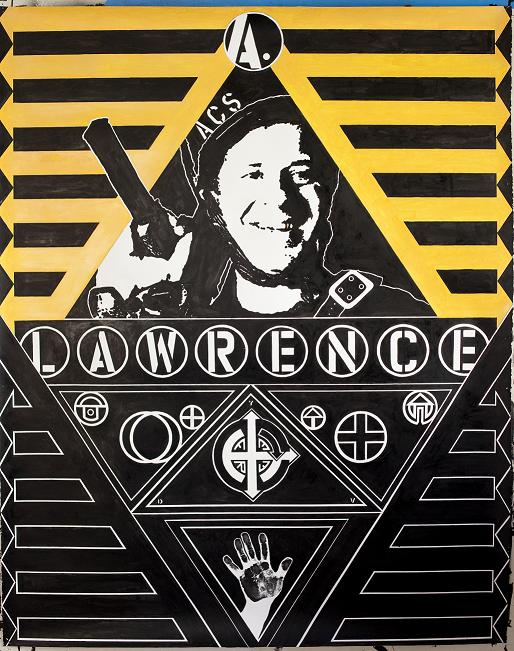
DYV: (This is about the piece you see on this post) Aaron is a Tenderloin-based fine artist and extremely talented graphic designer. We’ve worked together on a number of occasions. He is one of the friendliest people I have ever met, and also an avid bicycle rider. The “A.C.S.” on his helmet stands for Armed Courier Services. This is sort of a rogue group of messengers in this world that handle the delivery of information, mail, packages, and the transportation of people through neigborhoods and cities (for the right price). They are an armed force that has taken on the roles of bike messenger, post office, and sometimes private security. They are more like a mercenary group or extremely organized militia, but also a necessary part of the city’s movement and traffic of information and goods. I thought Aaron would be a good candidate for this piece due to his bike riding and extremely high level of organization. I wanted to get his unique personality [to come out] through the piece as well. Despite the fact that he is holding an Uzi over his shoulder, he appears very approachable and friendly. Though nobody would be aware of this but Aaron and I, the color of the arrows represents the color of his helmet in real life. I am intrigued by his helmet and wanted to incorporate it somehow in the piece, if only symbolically. The handprint on the botton of his piece is his.


“Make An Effort: New Works by D Young V”

Through July 30

Opening reception: Sat/9 7-11 p.m., free

White Walls

835 Larkin, SF

(415) 931-1500

www.whitewallssf.com

The Performant: Meme trope traditions

0

Taking in the San Francisco Mime Troupe’s “2012: The Musical”

Even the most anarchic, atheistic, or contrarian among us deserve the comfort of a few holiday traditions, whatever the season — and come the Fourth of July weekend you’ll find a kindred crowd hundreds strong camped out in the lower quadrant of Dolores Park. Unusually for Independence Day frolics, the focus is not on the consumption of grilled foodstuffs or blowing things up (fine traditions both), but on the opening of the latest San Francisco Mime Troupe show. Although the largest crowds typically show up for the official opening, always scheduled for the glorious Fourth, the preview performances are also well-attended, and it’s not unusual for folks to pick a preferred date that remains constant for years on end. And no matter how fog-bound the holiday itself, somehow the Mime Troupe opening miraculously manages to fall on one of the sunniest weekends of the year, proof perhaps of some insidious cosmic intervention, either on behalf of the Mimes or the ‘Murkins.


Politicized street theatre will always have a rather niche appeal, but the Mime Troupe nonetheless packs parks and indoor venues all over California, and in years past, the nation, with its signature brand of comedic-leftist-satire-with-song-and-dance-routines. For many San Franciscans it may sometimes feel like they’re preaching to the choir, but as anyone who’s ever seen The Reverence Billy on a roll can attest, sometimes the choir needs preaching to same as anyone else. And when it comes to the Mime Troupe, they don’t just talk a good game, but do their best to abide by it. In addition to “overthrowing capitalism one musical comedy at a time,” the Mime Troupe operates as a multi-racial, multi-generational collective, and it’s actually thanks to them, defendants of a little-remembered obscenity case in the 1960s, that theatre companies can perform uncensored in the parks of San Francisco today. Not that there’s anything particularly obscene about this year’s offering—“2012, The Musical”—where the only affront to public decency are the villainous corporate green-washers written into the script.
 
So here’s where it begins. A sunny Saturday in the park. Picnickers and space hoarders arriving hours early to ensure a good seat on the grass. By noon the Troupe is working out last-minutes staging kinks and sound mix, as eager, unaffiliated petition-bearers circulate the area. This year’s theme combines the personal (struggling radical theatre company looking for funding) with the political (when they find it, where is it really coming from, plus a side-plot involving an incompetent Senator running for President at the behest of the Rand Corporation). In keeping with the 2012 trope, a play-within-the-play is staged complete with spandex-clad denizens from the future, mad scientists Nostradamus, and a befeathered Mayan priest. But for the Mimes, it’s the memes they help disseminate that impact most. Self-determined collectivism. Radical inclusion. Art for people not for profit. The uncensored, uncensured use of public space. And an unabashed fealty for showtunes.
 
Through September 25,
Various locations
Free
(415) 285-1717
www.sfmt.org

CPMC to City: Drop Dead

21

The astonishing cluelessness of the folks at California Pacific Medical Center continues.

In our last episode, CPMC’s chief, Dr. Warren Browner, announced to the City Planning Commission that the hospital had no interest in following the normal rules that apply to every developer planning a massive $2.5 billion project. Developers have to pay fees for transit and affordable housing. Nonprofits like CPMC are supposed to spend money on charity care. Nobody — not even the more moderate members of what is by no means an anti-development commission — was ready to accept Browner’s line.

And now the hospital chain has officially told San Francisco to go fuck itself. 

Sorry, Doc — this isn’t going to work.

IF Ed Lee has any integrity at all (and I hope and believe that he does) he’ll stick to his original position and demand a reasonable community benefits agreement that includes housing money, transit money, increased charity care and a commitment to keep St. Luke’s Hospital open in the Mission for the forseeable future. And he’ll tell the white coats and suits at CPMC that if they don’t want to do that, then San Francisco isn’t interested in their project.

CPMC can’t exactly pull up stakes and move: The Sutter affiliate makes its money by serving San Francisco residents (and working with San Francisco doctors who send insurance money into the hospital system). Go ahead, Dr. Browner — try to build in Brisbane. You’ll lose all your San Francisco patients — and all that Brown and Toland insurance money.

The activists at every level have made it pretty clear that they’re willing to work with CPMC and accept a gigantic project on the edge of the Tenderloin, on a street that already has terrible traffic and transit problems — but not without a solid, acceptable community benefits agreement. So the hospital crew is going to have to learn to work with San Francisco. 


After 31 years, the Red Vic says farewell

4

You read it here yesterday: the gloomy news that the venerable Red Vic Movie House is officially closing shop July 25 (the theater’s 31st birthday). I caught up with Red Vic collective member Claudia Lehan today to talk about the rep house, whose signature red building has long been a Haight Street institution.

SFBG: There’ve been rumors for a little while that the Red Vic was in financial trouble. What ultimately led to the decision to close?

Claudia Lehan: We’ve known for awhile that it was coming, we just weren’t sure when to tell everybody. It’s this month because it’s our birthday, as you pointed out — July 25 — and we just thought that would kind of be a way to set a marker for ourselves for the closing.

SFBG: Was it just that not enough people were coming to the theater, that you weren’t selling enough tickets?

CL: Yeah, that’s kind of the bottom line, lack of attendance or lower numbers. It’s been a long, slow, steady decline. Then again, I worked last night and it was pretty busy for Vertigo. So it’s just hard to know, but if it’s not busy enough on a regular basis that we can make it a sustainable a business…

SFBG: It must have been pretty serious, since I remember from writing my article on the Red Vic’s 30th last year that the building is actually owned by a collective member, Jack Rix, and his wife, Betsy Rix, a former collective member and one of the Red Vic’s founders.

CL: Right. Yeah, it’s hard for them. There’s definitely no bad guys in this story. I know people are always like, “Is it your rent?” — and it’s obviously not. It is really hard for them, and I think they let us go quite a lot longer than is really sensible in order to, like, hit this marker of our birthday, which is really sweet.

SFBG: What’s the mood among the staff? You mentioned you were sad, but kind of ready, too.

CL: I think for us — we’ve been telling patrons who come in to see a movie, people are asking and we’re like, “Yeah, we are closing,” and it’s kind of like doing a bit of grief counseling. People who you tell are sometimes really sad about it. I think for us we’re sad but we’re kind of at the acceptance stage. But…it is a sad thing. We definitely don’t want to close, but it’s just sort of not realistic.

SFBG: What’s next for the Red Vic staff and space?

CL: I’ve been in grad school part-time for something completely unrelated to film, Chinese medicine. And [collective member] Sam Sharkey is still gonna be hosting The Room at the Clay [every second Saturday of the month at midnight, starting August 13]. I’m glad all the people who come out to enjoy The Room can continue, and Sam is a great host.

It’s pretty sure that our neighbors the Alembic are going to expand into what is now our lobby, and the auditorium is — there’s a few different ideas up in the air. I think Betsy is someone who is just very community-minded, and she wants to put something else in there that’s gonna have that spirit of the Red Vic. Something that’ll be good for the Haight, as well as San Francisco. So there’s a small chance that there’ll be a small screening room in the back, much smaller than the 140 seats we have now. It’ll be more of a community space. Sort of a multi-use space. And with the rest of the auditorium, she has a couple of different ideas, I’m not sure yet.

SFBG: The theater is saying farewell with Red Vic favorite Harold and Maude.

CL: Yeah, it’s a four-day run, and we’ll end on the 25th, and we’ll try to make the whole run special, and then see what happens on the 25th. I think it will be bittersweet. We’re trying to keep it a little bit positive, you know — kind of, “We’re so grateful we’ve been here for 31 years.” It’s pretty amazing that a collectively-run, single-screen theater survived for that long. We kept plugging away, but it’s kind of time.

SFBG: Well, you guys will definitely be missed…everyone I’ve talked to about it has been like, “Red Vic closing? Noooo!

CL: I know! But, I don’t want to have any tone of, like, pointing fingers at people. I think people are very nostalgic for movie theaters and bookstores, and these places where we love to hang out, but they don’t really turn out in the numbers they used to. It’s just a different world.

The joy of joysticks

1

GAMER On a sunny Sunday afternoon in late June, the crush of body-painted, thonged masses surged down Market Street, a trail of gold confetti, empty bottles, and promotional debris in its wake. Downtown was full to bursting with what seemed like everyone in the Bay Area celebrating Pride. But only a few blocks away, a very different scene was unfolding.

South Town Arcade is easy to miss. Tucked into a corner at the mouth of the Stockton Tunnel, its vivid green awning is all that stands out from the other small doorways at the periphery of Union Square. If you’re serious about video game arcades, South Town is a godsend: the cabinets are all sit-down, Japanese “candy cabs” with ultra-precise parts. And there is no shortage of skilled competition.

This particular day, the arcade was a locus of activity. Much like the teeming blocks nearby, South Town was packed with people, although not nearly as uncomfortably. About two dozen men and a handful of women were talking amicably, sketching in notebooks, or glued to a screen in rapt attention.

Every now and then a group of girls in thigh-high fringed moccasins and tie-dye tank tops, or someone in heels without pants, wandered past. It was a little surreal, but no one at South Town seemed to notice. Everyone was too absorbed with Super Street Fighter IV: Arcade Edition (which I was assured is the end-all, be-all of cabinet games these days) tournament that had been underway since noon. When contestants were evenly matched and a good game was in the works, everyone crowded around, enrapt as Hadoukens, as the sounds of two digital characters pummeling each other mixed with the emanations of around a dozen other cabinets and the eight-bit coming over the stereo. The tension was palpable, but you definitely couldn’t hear a pin drop.

There were cheers throughout the matches as someone landed a combo or dodged a sweep, and discussions in between as players and audience members (though basically everyone in the audience was also in the tournament) dissected what went right or wrong. There was a sense of community and camaraderie, something that Simon Truong, who runs the arcade along with Arturo Angulo and Cameron Berkenpas, points out is at the very heart of South Town.

“We wanted to build a community. Playing online is fine, but it’s totally different when you can actually see your opponent. You could, you know, talk shit if you want,” he said, laughing. “But mostly, the people who play in our arcade, if they lose, they talk. They figure out, how can I beat you with the same moves? They give each other tips — so basically everybody can up their level of play and represent San Francisco and Northern California. We need better players out here to represent the area.”

It seems to be working. With little or no advertising, South Town Arcade has seen the number of customers balloon in the six weeks since it opened. Some players sit down when the doors open and only leave when they close for the night, six to nine hours later. As I sat feeding my tip money into Metal Slug between tourney matches — the coin slot basically a vacuum at first, but less so as an hour of play began to hone my meager skills — I could only imagine what that amount of time playing Street Fighter IV could do for your game.

Watching Pavo Miskic, a lanky San Mateo resident, shoot his hand across the buttons before a match, it became clear to me that practice helps. But until South Town opened, the only places in the Bay Area for Miskic to get his hours in were limited to Golflands in Sunnyvale and Milpitas, and to the student centers at San Francisco and San Jose State universities. “San Francisco hasn’t really had that much of a scene for [Street Fighter IV],” Miskic says. “[South Town] is gonna help. Until then everyone was playing mostly in the San Jose area.”

After braving Pride parade traffic and finally making it to South Town, Miskic emerged six hours later as tournament champion, despite arriving late and taking a default loss. As he stepped outside to speak with me, a girl handed him a congratulatory portrait she had drawn of Balrog, his character of choice in the day’s matches. Inside, even though the tournament was over, no one seemed ready to leave. A small circle began gathering around the Street Fighter II cabinet.

“I’ll add that I’m really bad at this game,” Miskic said. “I consider myself terrible. That’s the thing that I like about it, though. Because there’s always a constant challenge between the old-school people and the new-school people coming up, once you’re around the community for long enough, people will get used to you. You’ll make friends in it. People will help each other out.” 

SOUTH TOWN ARCADE

447 Stockton, SF.

www.southtownarcade.com


Appetite: Breaking bar news — MacGregor joins Jasper’s

1

We’ve been anticipating the opening of Jasper’s Corner Tap & Kitchen (slated for late July/early August) in the former Ponzu space downtown. With news of Chef Adam Carpenter helming the “upscale tavern-inspired” kitchen and none other than Kevin Diedrich as Bar Manager (who you’ve heard me talk about since early Burritt Room days), it’s sure to be an exciting opening all around.

There’s breaking news on the bar side today that ups the ante even further. Brian MacGregor is another bartender who’s long been slaking our thirst with superb imbibements since his Jardiniere days. He’s just signed on with Jasper’s bar team, making it officially an all-star cast. His Locanda gig fell through a couple months ago, which was entirely their loss, but that paved the way for his new role at Jasper’s.

As Jasper’s is part of the Kimpton restaurant group, Kimpton’s Master Mixologist Jacques Bezuidenhout is helping create the cocktail menu, heavy on fresh purees and juices, and, of course, local produce. Both Diedrich and MacGregor have been named Bay Area “Bar Stars” by the San Francisco Chronicle in recent years, and with Bezuidenhout also involved, we can expect a stellar cocktail menu and execution.

Along with 18 international beers on tap and a wine list assembled by Master Sommelier Emily Wines, Chef Carpenter’s menu will offer a line-up of gourmet comfort with the likes of homemade pretzels (accompanied by smoked cheddar and beer fondue), and creative versions of fish n’ chips (with polenta crust) or bangers n’ mash (spicy beer sausage). Open all day, every day, this promises to be not only a welcome downtown dining option, but with all that talent behind the bar, a drinking destination.

— Subscribe to Virgina’s twice monthly newsletter, The Perfect Spot

Alerts

0

alert@sfbg.com

THURSDAY, JULY 7


Two years after the coup

Andrés Thomas Conteris, founder of Democracy Now! En Español, along with Adrienne Aron and Theresa Carmeranesi, will share observations from their recent trips to Honduras, specifically the well-organized resistance movement against the repressive coup that ousted their democratically-elected president in 2009.

7–9 p.m., free

First Unitarian Universalist Church

Thomas Starr King Room

1187 Franklin, SF

www.soaw.org


Saving labor murals

All over the country, many of the murals created during the WPA-era that depict the history and struggles of the U.S. labor movement are threatened of permanent removal, like the hidden labor history mural in the Maine Labor Department Building. At this event, noted New Deal historians Gray Brechin and Harvey Smith will speak about the unremitting war on labor art and history occurring closer to home.

7–9 p.m., free

Berkeley City College Auditorium

2050 Center, Berk.

www.laborfest.net

SATURDAY, JULY 9


Stop the Libya bombing!

NATO intervention in Libya: a massive outpouring of humanity or a blatant display of U.S. imperialism? If you agree with the second viewpoint, stand up against the bombings in Libya, where civilians have been caught in the crossfire. The bombings also cost the U.S. $10 million a day, outrageous at a time when workers in the public and nonprofit sectors are being fired due to a nationwide budget crisis. There will also be a joint action the same day in Washington, D.C. in front of the White House.

12–2 p.m., free

Meet at Powell and Market, SF

(415) 821-6545

www.answersf.org

TUESDAY, JUNE 12


Who built San Francisco?

Learn about San Francisco history and 120 years of its architecture from the perspective of the people — the union workers who built these massive artifacts — not from the architectural firms that usually get all the credit. In two hours, you will see 30 buildings, from famous skyscrapers and little-known treasures, that tell a story about the rich labor and political history of the city, as well as the design trends that helped change the concrete face of America.

10 a.m.–12 p.m., free

Meet at Stockton and Maiden lane, SF

www.laborfest.net 2

Mail items for Alerts to the Guardian Building, 135 Mississippi St., SF, CA 94107; fax to (415) 437-3658; or e-mail alert@sfbg.com. Please include a contact telephone number. Items must be received at least one week prior to the publication date.

Mayor Lee’s budget deal

0

The way the daily newspapers are presenting it, the budget that Mayor Ed Lee and the Board of Supervisors Budget and Finance Committee negotiated represents a new era of civility and cooperation at City Hall. The committee, after marathon negotiations, approved the $6.8 billion deal unanimously. Both sides called it a good process and a good result.

And indeed, by any standard, the way Lee worked with community groups was a huge breakthrough. After 16 years of essentially being cut out of the process under mayors Willie Brown and Gavin Newsom, the stakeholders — the people who provide the essential city services — were actually at the table. And the final blueprint isn’t as bad as it could be.

But it’s still a budget that does nothing to restore the roughly $1 billion of General Fund cuts over the past five years, that seeks no new taxes from big business or the wealthy, and that includes spending on a new Police Academy class that even the mayor doesn’t think the city needs.

And from the start, the mayor and his staff were absolutely determined to privatize security at the city’s two big public hospitals — even when it makes no political or fiscal sense.

The privatization plan was the centerpiece of what became a 13-hour shuttle diplomacy session, as staffers and supervisors sought to reach a deal they could all accept. The Mayor’s Office — particularly Steve Kawa, the chief of staff — put immense pressure on the committee members to accept a plan to replace deputy sheriffs with private security guards at San Francisco General and Laguna Honda hospitals. In the grand scheme of things, the $3 million in projected savings wasn’t a huge deal — but the politics was unnecessarily bloody. It’s as if Lee and Kawa were determined to privatize something, whatever the cost.

In the end, Sup. Jane Kim deserves considerable credit for holding firm and refusing to accept the proposal — and since Sup. David Chiu went along with her, they joined Sup. Ross Mirkarimi as a three-vote majority on the five-member panel and shot it down.

Police Chief Greg Suhr pushed for funding for a new police academy class to train 35 officers at a cost of $3.5 million (that’s $100,000 a cop). “I don’t think the department has looked hard enough at how we deploy the existing officers,” Sup. John Avalos told us.

And some key issues are still up in the air — for example, whether the mayor will adequately fund public financing of the November campaigns. With at least eight serious candidates running for mayor (not counting Lee), and most of them looking for the public financing that will help level the playing field, the city’s going to have to come up with at least several million dollars. That’s critical to the fairness of the election.

The bottom line remains: This city has been deeply damaged by years of cuts. And the next budget needs to start with a plan to repair that.

Ghost Fleet wanderers

5

Scott Haefner, Stephen Freskos, and Jon Haeber aren’t the types to stand out in a crowd. Haefner is a web developer, Freskos supervises projects for an engineering firm, and Haeber has a desk job at a company that helps businesses hit high on Google — three straight-laced Bay Area professionals who blend readily into the corporate world.

But everyone’s got their thing — a way to break out of bounds, or scratch the itch of some incessant curiosity.

For these three friends in their late-20s to mid-30s, their thing entails prowling around in rundown deserted places by the light of the full moon, at times taking great pains to avert detection by security patrols. “We go into places that most people don’t go,” Haefner says. They’ve been traipsing into the unknown and documenting their discoveries together for years, motivated as much by art as adrenaline.

This past May, after weighing the consequences, they publicized one of their boldest excursions yet: Sneaking aboard the Mothball Fleet in Suisun Bay to spend entire weekends roaming the bowels of the mildewed vintage ships, while dodging the beams of patrol-boat searchlights.

Unlike many nocturnal wanderers magnetically drawn to abandoned spaces — squatters, taggers, or scrappers, for instance — they don’t break in, vandalize, or steal. Instead, they adopt the same sense of reverence in decaying, chemical-laden industrial places that conscientious hikers assume on backwoods trails. They shoot night photos with professional quality gear, occasionally using flashlights to achieve a technique called light painting.

Haefner, Freskos and Haeber consider themselves advanced practitioners in the art of urban exploration (a.k.a. urbex or UE), an underground activity that’s grown trendier as it draws in adventuresome novices. Now that they’ve publicized their caper aboard the Mothball Fleet, however, they’ve also come under the watchful eye of the feds.


EXPIRATION DATE

At first they thought it was a pipe dream. Doubting their ability to access the Mothball Fleet was saying a lot, considering they’d once snuck onto the Vandenberg Air Force Base and wandered amid abandoned missile silos, absorbing the gravity of the military history those Cold War artifacts represented. Another time they’d managed a nighttime excursion to Neverland Ranch, the famed private amusement park of the late Michael Jackson.

But the ghost ships moored at Suisun Bay seemed out of their league. The rows of hulking, government-owned vessels were locked up and berthed offshore, surrounded by a security headquarters and a shoreline barricade plastered with “No Trespassing” signs. Patrol boats equipped with searchlights circled the docks 24 hours a day, and the prospect of climbing aboard without being spotted seemed crazy.

But then they got word that the last of the aging ships would soon be towed away and destroyed. For Haeber, the history nut of the bunch, this changed everything. “It was about the urgency of making sure these ships were documented,” he explained. “Getting them in the current state that they’re in is so important.”

Alternatively known as the Mothball Fleet and the Ghost Fleet, the ships are part of the National Defense Reserve Fleet, a collection of cargo ships, tankers, and military auxiliaries overseen by the U.S. Maritime Administration (MARAD). Created in 1946 to be ready for deployment in case a national emergency arose, the fleet consisted of 2,277 ships at its height in 1950, strategically stationed at eight anchorages nationwide. For most of the vessels, the call to service never came, and they declined into obsolescence. By April, the entire fleet had dwindled to just 178 ships, at dock in Suisun Bay; Fort Eustis, Va.; and Beaumont, Texas.

The ships that have been moored at Suisun Bay for decades have long since deteriorated, and now they’re being hauled off to the scrap yard bit by bit, though the spot will continue to serve as an anchorage for newer additions to the National Defense Reserve Fleet.

Some were constructed in the World War II era, while others date back to the 1960s and 1970s. While many are tankers or merchant vessels, there are also warships, relics of history deployed in World War II, the Korean War, the Vietnam War, and Operation Desert Storm.

Many of the roughly 70 dilapidated ships have become ecological hazards, leaching toxins and heavy metals into the tidal estuary, which flows into San Francisco Bay. The monumental task of removing and dismantling them began late last year, providing badly needed blue-collar jobs on Mare Island, in the economically depressed city of Vallejo.

By 2017, the last of the ghost ships will have met with torch cutters. At least one will be salvaged: the USS Iowa (BB-61) — a 1938 lead battleship that shuttled President Franklin D. Roosevelt to and from the Tehran Conference during World War II — will be donated and turned into a museum.

Aside from being scrapped, outmoded ships meet with a variety of fates. Some are donated for educational use while others are deliberately sunk to create artificial reefs. Still others are used for target practice in the Navy’s sink-at-sea live-fire training exercises program (SINKEX).

“We saw that these things were going to be gone,” Haefner said. “So we planned it out.”

Haeber examined satellite imagery on Google Earth. Freskos, who’d spent time at sea, studied the tidal patterns. The three scoured the Internet for online photos of the Ghost Fleet. They conducted a scouting mission with binoculars in hand, and gained a sense of when they could take advantage of windows of opportunity between the 30-minute patrol boat rounds.

Long before they even discovered a navigable slough that snaked through a marsh into Suisun Bay or spotted the Craigslist post advertising an inflatable raft for sale, Freskos went up to shoreline gate where the “No Trespassing” signs were posted. He peered through at the tantalizing rows of mothballed ships, and hollered as loud as he could. Nobody responded.


DECAYED TIME CAPSULES

After the months of planning left them confident that it was indeed possible to access the Mothball Fleet, the trio of photographers set out for their first visit, with about 700 pounds of gear in tow. They split the cost of a 12-foot inflatable Fish Hunter raft with a Minn Kota trolling motor. They carried the raft and their gear through a muddy expanse to a marshy spot where the low-profile craft could be set into a narrow slough, safely out of view.

“We always went on or exited at nighttime,” Haefner said. “We would go on nights near the full moon so we could take pictures. It makes it look even more ghostly.”

Their first target was Row F, a line of ships docked in a straight shot from where the slough filtered into the bay. They maneuvered down the narrow channel in their raft, dodging submerged obstacles along the way. Keeping tabs on the whereabouts of the security boat, they started rowing once they reached the open water, and managed to bridge the 800-foot distance to the first ship.

“Our plans were kept secret to all except our loved ones,” Haeber wrote in an online account of that first excursion. “Nobody, other than my girlfriend, knew exactly where I was that weekend. For all intents and purposes, I was on a fishing trip with some friends.”

“Keep Off” signs announcing an invisible 500-foot barrier that was not to be breached were affixed to the hull of every ship. The intruders maneuvered their raft between two Coast Guard cutters, Planetree and Iris, and tied up.

“It can be kind of a challenge getting on,” Haefner explained. “We’re risking ourselves, obviously, but we also brought a bunch of expensive camera gear.” He was the first one to climb aboard the Iris, reaching high to grab onto a bumper that he could then pull himself up on to gain access to the ship. While Freskos kept watch, Haeber handed the gear up to Haefner bit by bit. Once all three were aboard with their backpacks and camera equipment, they hauled up the raft and deflated it.

The Iris was commissioned in 1944. In 1970, it responded to the scene of an oil-rig fire in Galveston, Texas. In 1987, it assisted with cleanup operations in Prince William Sound after the Exxon-Valdez spill. It was decommissioned in 1995, so their entrance likely marked the first time anyone other than MARAD employees had been aboard in 16 years.

A handy feature of ghost ship exploration is that once aboard a ship, it’s possible to access any ship along the entire row, thanks to gangplanks connecting the vessels. So while many of the mothballed vessels were completely secured, there was always the chance that the next one down would have an unlocked entranceway. Part of the ethos of urban exploration is to avoid breaking anything, so they only accessed the interiors of unsecured ships. “They are fairly vigilant about keeping doors locked up tight,” Haefner said. “But there are just so many doors.”

Haeber found a single open door on the SS Exxon Gettysburg, a mammoth oil tanker constructed in 1957, and entered the ship alone, enthralled. The interior, he later wrote, smelled like a mix of mold, benzene, and soggy newspaper. He turned on his flashlight and began tiptoeing through the corridors and peering into the cabins. “They were like time capsules, untouched since the 1970s,” Haeber said.

“Some of the ships were 15 stories deep, like a maze,” Freskos said. “We’d get lost inside.” The trio split from Row F before sunrise and managed to get back to the slough without any mishaps, but they returned on a handful of other occasions with sleeping bags and enough food and water to last a weekend. On those subsequent journeys, they’d seek out places to sleep, often crashing in the once-luxurious captain’s quarters. They slept by day, so that entire nights could be devoted to wandering in awe of the decayed, post-apocalyptic industrial environs, shooting hundreds of photographs.

They visited rooms where crews once hung out playing board games, still littered with cigarettes. They photographed molded interiors, dark cavernous stairwells, engine parts, navigational equipment, and abandoned cabins with peeling wallpaper. “We found personal letters, cards, things people left,” Haefner said. “We were always looking for signs of life.” They wandered through mess halls, engine rooms, bathrooms, galleys, even chilling places with operating chairs and overhead spotlights. They climbed around on the decks in the open night air, wandering through derricks and cranes.

The old ships would make eerie creaking noises when the tide rushed in, and there was always that mild sensation that one experiences on a boat, of things not staying still. “It was like a cacophony of sound when the current was coming in,” Freskos recalled. Hawks, osprey, and owls nested aboard some of them, so the creaking noises were sometimes accompanied by screeching birds of prey.

“The place is steeped in history,” Freskos said. “I’d always think of what this room was used for, or what went on here, when people were experiencing the suffering, craziness, and nervousness of war.”


HIGHLIGHTS AND HAIR-RAISERS

A highlight of their journeys aboard the Mothball Fleet was stumbling across the sleek black Sea Shadow, a stealth ship, which was ensconced within a barge on Row G. Shrouded in secrecy, the angular vessel was developed by Lockheed for the U.S. Navy to test how low of a radar profile could be achieved, and it served as inspiration for a stealth ship featured in a James Bond film. According to the MARAD website, “Sea Shadow was constructed and tested under a high degree of secrecy; until the Navy made its existence public in 1993, all tests were conducted at night.” The ship entered the Suisun Bay Reserve Fleet in September 2006.

They also found their way aboard the USS Iowa, which bears the distinction of being the only U.S. Navy warship ever outfitted with a bathtub, so FDR could have a soak while crossing the Atlantic. While they didn’t manage to go inside, an eerie photograph of three enormous guns on deck conveys the magnitude of the battleship.

One of Haeber’s most cherished discoveries was a three-story-tall mural he photographed inside the SS President Lincoln, an American President Lines ship constructed in San Francisco in 1961. An early version of a containerized cargo vessel, the Lincoln doubled as a cruise ship catering to a small number of elite passengers, and remnants of the elegant interior décor remained. The ship has since been hauled to the scrap yard.

It wasn’t always smooth sailing for the three urban explorers. Once they narrowly dodged a work crew aboard a ship — “but we saw or heard them before they saw us,” Haefner said. Another time, while paddling back to the slough, they discovered their raft was punctured and had to manually pump air into it as they traveled. Then, at the tail end of their final journey to the Ghost Fleet, they found themselves fully illuminated by the dreaded patrol-boat searchlight for a full 10 seconds. They froze, convinced they’d been caught. But nothing happened, so they powered up and rowed like hell to get back ashore, and never returned.

Of course, posting interior photographs of the Mothball Fleet all over the Internet and delivering a public slideshow about their sneak-aboard escapades has attracted the attention of the federal government. “The Department of Homeland Security has been looking into it,” said Haefner, who can tell by monitoring web traffic on his blog. “I know that they know.” He also noticed hits from the U.S. State Department and the U.S. Department of Justice, but so far, none have come knocking.

In response to a Guardian request for comment about the Mothball Fleet photographers, Kim Riddle, a spokesperson for MARAD, e-mailed an official statement. “We were aware of the intrusion,” she wrote. “We are concerned about the safety of individuals onboard our ships. This is a dangerous industrial site, and we take significant precautions for our own workers when they are onboard the fleet to make sure that areas are safe for them to enter. While trespassing on federal property, these photographers put themselves in a very dangerous position and could have been severely injured or killed from a fall or by entering an enclosed space that doesn’t have enough oxygen. Since learning of this incident, we took additional security steps, reviewed our procedures, and reinforced training with our employees to stop these kinds of intrusions.”

Freskos touched on the safety issue in an online discussion about the project. “There were many long discussions about oxygen-deprived spaces such as anchor chain lockers and ballast tanks,” he wrote. “There were contingency plans made for injuries. We carried a medical kit, we wore [life jackets], and took many other precautions.” He also responded to those who questioned the wisdom of publicizing their late-night excursions to the Mothball Fleet. “I think I speak for the three of us when I say that we are well aware of the consequences,” Freskos wrote. “But it’s a passion of ours, and it’s worth it.”

The photographers’ work can be viewed here, here, and here.