San Francisco

Live Shots: Avital tours Mission District food hotspots

0

Photos by: Bowerbird Photography

It was 11:30am on a Saturday morning, and we were tipping back salty oysters and chasing them down with sweet pink rhubarb cocktail, and then, just because pig meat tastes so good, ate some wonderfully cured, sliced Southern ham. The day was off to a great start and just kept getting tastier as our little posse made its way through the Mission, led by our knowledgeable and ebullient guide, Avital of Avital Tours.

She described her name as sounding like “Advil” and “Tylenol” mixed together, perhaps also hinting of the hangover and pharmaceutical cure we might need unless we paced ourselves on the drinks. Avital organizes food and wine tours in San Francisco, and specializes in discovering special local eateries that may be off an SF local’s radar.

There was a little of everything on the tour: local cuisine, history, talks by the chefs or restaurant owners, and even a little hands-on cooking stuffing mini meat pastries. Avital is an expert at pairing foods and balancing the tasting options. A super-energizing coffee sampling came at a perfect time, providing a needed lift after the morning cocktail and a delicious beer and cheese adventure.

As we meandered through the streets, Avital narrated our journey with interesting anecdotes about the history of the neighborhoods and murals that decorate the Mission, giving even me, a native San Franciscan, some insight into the neighborhood. The tour ended with ice cream sandwiches on the steps of Mission High, looking out over the Cinco de Mayo celebrations in Dolores Park.

We climbed to the top of those steps after our three-hour culinary adventure, and felt a sense of accomplishment not unlike how hikers feel after reaching the summit of a mountain. Eating and drinking ourselves silly takes work, and we felt perfectly contented to just sit there, loosen our belts, and soak in the sunbeams. What a nommy day!


Community college students convene to unite against cuts, state legislation

7

Students and staff from community colleges throughout California gathered at the City College of San Francisco (CCSF) Mission campus May 12 to discuss legislation, particularly the Student Success Act, that organizers feel threatens community college students.

The conference “was the first time that students from community colleges across California came together like this,” said Everic Dupuy, a student at CCSF. 

Dupuy participated in a panel with fellow students and teachers explaining the Student Success Act. The act would implement six recommendations made by the Student Success Task Force, a body created in January 2011 to investigate policy changes to increase graduation rates at community colleges.

Students have vehemently opposed the recommendations that the task force made. A December issue of the Guardsman, CCSF’s newspaper, was devoted to that opposition. 

The Student Success Act act includes policies that would prioritize class placement for newer students. Students who have been enrolled in community college for more than two years would find it more difficult to get into classes they need. The act would also create a system-wide standardized test to assess student success. 

“The task force’s recommendations will benefit higher-income students more, while students who attend part-time and work while attending school will be hit the hardest,” an editorial written collectively by students across the state claimed.

Members of the task force said that encouraging students to complete their coursework in a streamlined two years is necessary as community colleges have faced budget cuts. “Hundreds of thousands of first-time students, recent graduates of California’s high schools, have been turned away because they could not register for a single course,” said Peter MacDougall, chair of the Student Success Task Force, in an editorial.

But Dupuy says prioritizing new students is unacceptable. “It pits newer students against older students in a race for classes. It basically creates a situation where education is being rationed,” he told the Guardian. 

Teachers, staff and administrators at CCSF have also come out against the Student Success Task Force. At a rally in November, faculty and members of the CCSF board of trustees came out against the recommendations in the report published by the task force, saying they insert the state into local policies and reward students who study full-time and declare majors early at the expense of others.  

“The California Master Plan for Higher Education said education should be free and accessible to everyone,” said Dupuy. The plan, written in 1960, did “reaffirm the long established principle that state colleges and the University of California shall be tuition free to all residents of the state.”

It has since been altered several times, and in 1985, community colleges began charging fees for courses. In recent years those fees have rapidly increased, and will be increased by $10 this summer, when students will begin paying $46 per unit fees. 

Other sessions at the conference included presentations from students who organized with student movements in Chile and Canada.  Students in Quebec are revolting against college tuition hikes in a strike that has now lasted 13 weeks.  

Students from Santa Monica College also presented at an Occupy-style general assembly meeting that ended the conference. They proposed the formation of a statewide student union, and will be hosting another statewide conference to plan the student union May 19. Santa Monica College has been a site of conflict recently, as students protesting the implementation of a program that would have increased fees for more popular summer courses were pepper sprayed at a hearing on the program. Their campaign worked, and the college delayed the program for further examination. 

Organizers say the student union would play a role that existing student government structures can’t. “Our student governments are mostly administrating us instead of fighting for us in our districts” said Mikhail Pronilover, a Santa Monica College student. 

“The Student Success Act is a perfect example of why we need a statewide student union. Organizing in our districts isn’t enough- if we can’t come together, we won’t be able to defeat it,” said Claire Keating, an incoming student at UCLA. Keating is involved with the Southern California Education Organizing Coalition, formed recently to address the SSA and other perceived attacks on students. A similar group, Occupy Education Northern California, has also formed in recent months- students hope to continue the coalition-building trend across the state.

A massive student march on Sacramento has become a tradition in recent years. But students are ramping up efforts to keep year-long pressure on legislators.

Organizers hope Saturday’s conference, with reprsentatives from throughout the nation’s largest public education system, will prove an important step in that direction.

A fair deal for the city’s nurses

12

For San Francisco’s public-sector registered nurses, this year’s Nurse’s Week was a paradox. On May 10, nurses from throughout the city gathered in the cafeteria of San Francisco General Hospital to celebrate Florence Nightingale’s birthday by bestowing gratitude and appreciation on nurses selected by their colleagues. Martha Hawthorne, long-time Castro-Mission Health Center public health nurse, was one of those honored. 

Upon acceptance of the award, Martha said that city nurses would be most appropriately honored by getting a fair contract. The next day a smaller gathering of nurses, including Martha, was back across the bargaining table from city negotiators who have proposed  significant financial and working condition concessions. Decreased compensation threatens the future of nursing in the public sector by impairing recruitment and retention of highly-skilled registered nurses. Working conditions concessions are even more broadly harmful and unacceptable; it is both risky for the nurses and increases the likelihood of adverse outcomes for those we care for.

San Francisco DPH nurses care for the city, quite literally, and with great pride. We are also proud of San Francisco’s historically progressive record on public health. Immigrant pregnant mothers are not interrogated by immigration authorities before giving birth. Public health nurses don’t require insurance company pre-authorized visits before teaching self-care to elderly residents of downtown SROs. The quality of care given by Jail Health nurses is no less than that given to someone living in a nice house by the city’s home health nurses of Health-at-Home. Laguna Honda, one of the last municipal long-term care centers, has a beautiful new campus and San Francisco General Hospital is being noisily rebuilt thanks to voter-approved bond measures. But nice buildings and well-conceived health programs don’t care for the ill and injured, nurses do.

Nurses are professionally pragmatic; we don’t offer false hope. Patient advocacy requires great patience. This is especially true in the public sector, where the population we serve is likely to suffer from intractable extreme poverty and social marginalization. The poor don’t require less health care than wealthy individuals, in fact they require more. It’s not always pretty, but we know that if we are given the human resources to do so we will continue to deliver excellent patient care.

The complexity and intensity of patient care seems to be rising far faster than inflation. Aside from the issues of fairness and quality care, nurses simply don’t have enough hours in the day to do the repair our over-burdened fractured health system requires. Activist nurses are needed to save lives by preserving and expanding health care access. While universal single-payer health-care is elusive nationally, California nurses are optimistic we can do better here. Women’s health is under attack nationally by fanatics who would deny cancer screening and care for rape survivors.

Nurse’s Week is over and we have a lot to do, let’s start with a fair deal for DPH nurses. It’s not to much to ask for and we will all benefit.

Sasha Cuttler, RN, is a San Francisco public health nurse.

Claymation! Fashion! Digital Sound! An afterschool arts revival

0

If you believe the children are our future, then you may soon agree — contrary to rumors of its ongoing extiction — that the future arts scene of San Francisco is actually looking bright.

While arts classes fall off the curriculum in public schools nationwide, a collaboration between the San Francisco Recreation and Parks Department’s (SFRPD) Cultural Arts Division and its Community Services Division (which runs afterschool programs citywide) keeps the creative spark alive via the ongoing Arts Afterschool program.

Just a year and a half old, the Arts Afterschool program will host its first-ever live showcase, the Arts Afterschool Spring Gala at the Harvey Milk Center for the Arts on Sat/12. The gala will feature the artwork of 400 kids from virtually every neighborhood in San Francisco. The event showcases work from the program’s fall, winter and spring sessions.


Arts Afterschool is the brainchild of Jenny Rodgers, supervisor for the Cultural Arts Department of SFRPD.

“Jenny did it because it’s an opportunity for us to bring really, really quality instructors to the entire city, and reach kids that wont actually come into contact with that kind of work in their own schools right now, because there are so many cuts going on with arts programs in schools,” says Clove Galilee, program coordinator for the Cultural Arts Division of Recreation and Parks.

Lively paintings dapple the walls of the Harvey Milk Center and stretch up the stairwell. Sculptures of many shapes and colors dot the building. Downstairs in the gallery sit two computers, one with a looping slideshow of kids’s works.

“The other part of this, which is really exciting, is a whole series of interviews,” says Galilee. “We actually went to each site and interviewed instructors teaching arts classes there, talked to the kids, and did these little three-minute videos of what kids were doing. And those are amazing. Amazing.”

If kids attending the event are inspired by the exhibitions, they can make artwork of their own at arts and crafts tables, as you (the adult you) peruse the room and munch on provided refreshments.
The late afternoon treats gala visitors to live performances in the ballroom, as dancers, musicians, thespians, filmmakers, fashionistas, hip-hoppers, and digital sound virtuosos take the stage.
   
As part of the live performance section, one-of-a-kind kid-designed fashions will strut across the runway and hip-hop dance groups from Ocean View and Ingleside will perform a choreographed routine. And youngsters from Bay View’s Joseph Lee Playground will perform African drumming and dance, which Galilee says is “pretty amazing.” “They created a whole little performance and it’s awfully cute,” she says. “We really try to be up with what kids really want to learn.”
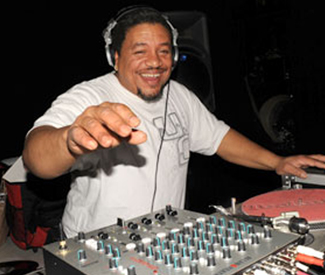
While the main age group in the program is 7 to 12 years, teenaged participants designed digital sound performances.  “We’re excited to listen to their digital sound stuff,” says Galilee. “And kids from all over the city compiled claymation videos. They actually make the clay figures, and then they create the story. They narrate the story, they film it all, and they learn to edit it.”


How do these talented tykes come to master so many mediums? Professional instructors from across the arts were recruited and paid for by a three-year grant through the Department of Children, Youth and Families. “What’s unique about our program is [SFRPD] already has a thriving afterschool program that really helps parents and is very affordable,” says Galilee. “These kids go to these programs everyday after school and they get homework help, they learn how to cook, get to play games and spend time with highly qualified recreation leaders.”
Then, on Tuesdays and Thursdays the art specialists arrive.

“They expose the kids to all sorts of those things they may not come in contact with otherwise,” says Galilee. “And [Arts Afterschool] is actually free because the kids have already paid to be part of the regular afterschool program.”

Arts Afterschool Spring Gala
Sat/12, 1pm-4:30pm, free
Performances begin at 3pm
Harvey Milk Center for the Arts
50 Scott, SF
(415) 554-8742

What are “old-fashioned” SF values?

12

Michael Breyer, who has never held elective office in San Francisco and is running for state Assembly, is getting a fair amount of press — and although he has nowhere near the visibility of Assessor-Recorder Phil Ting, he has the support of Sen. Dianne Feinstein and may throw a boatload of money into the race. He’s already sent out one flier that features very little about him but a lot about his (more famous) family — his father, Steven Breyer, is a justice of the U.S. Supreme Court and his uncle, Charles Breyer, is a federal judge.

But here’s what intrigued me about the mail piece: It says that

“Sacramento needs a fresh perspective. It needs old-fashioned San Francisco values.”

What, exactly, are “old-fashioned San Francisco values?” One could certainly argue that the message harkens back to a day when the city was less diverse, less progressive, less open to the sometimes-radical ideas (remember this one?) that have changed the nation and the world. Of course, exploiting the workers and destroying the environment in the name of extracting riches was a famous SF value during the Gold Rush era; so was the Chinese Exclusion Act. On the other hand, resisting the Red Scare was a great traditional SF value in the 1950s, as were civil-rights sit-ins. Free love, free drugs and free lunch were vintage SF values a decade or so later. Labor struggles against capital are also a great San Francisco value.

So what, exactly, is Mr. Breyer talking about?

I called his campaign manager, Michael Terris, who wrote the piece, and asked him if Breyer was longing for a more conservative, less diverse era. “Not at all,” he said. “Old-fashioned values mean family, schools, neighborhoods, quality-of-life issues. Those are shared by the many diverse communities in the 19th District.” He added: “The West Side sees things a little differently.”

And while one of Breyer’s main issues is education, the great San Francisco value of taxing the wealthy to provide public services isn’t part of his platform. Although he does support Gov. Brown’s tax plan for November, he does not support amending Prop. 13 to shift the burden of taxation back to commercial property. He has the strong support of the Building Owners and Managers Association, which is all about keeping taxes low on huge commercial properties owned by vastly rich outfits.

So he clearly doesn’t share my old-fashioned San Francisco values. What about yours?

UPDATE: My mistake — Feinstein hasn’t endorsed Breyer. She supported him for D5 supervisor but is staying out of this race.


Sketching Sixth Street: In new show, Joel Phillips renders the unseen

0

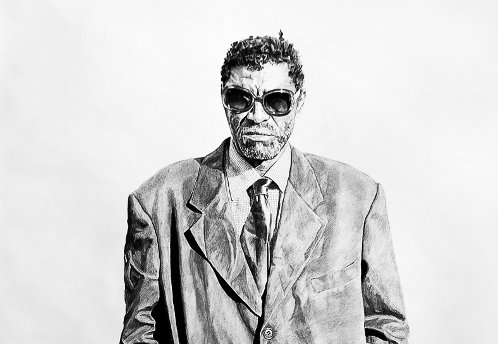
“I’m really interested in the idea of anonymity within a dense urban environment and how the denser an urban population is, the easier it is to be overlooked,” Joel Phillips says over a glass of red wine on a far too windy night in the Mission. His show, “No Regrets in Life,” opens tonight at Satellite66 and will feature seven charcoal and graphite drawings of men and women he’s met on the corner of Sixth St. and Mission.
 
Phillips, a few months shy of 23, has spent significant chunks of time in Seattle, Santa Barbara, San Francisco, and New York. While he was living in New York, he started thinking more about the social dynamics of cities and how some people tend to get lost in the mix. “In New York no one really looks you in the eye, everyone brushes past you and moves past you,” Phillips says.

In an effort to counter this surplus of vacuous interactions, Phillips started asking one in every ten people he met on the streets of Manhattan if he could take their photo. “The response [was] overwhelmingly negative,” Phillips recalls. “Probably 85 percent of the people said ‘Fuck off, leave me alone, get out of my way, what the hell do you want my picture for?’”

But the ones who willingly posed in front of Phillips lens “were a very particular subset of the population — people who had time and were looking for interactions.” Phillips recalls conversing with Richard, a homeless man who became the subject of his first life size drawing, for three hours before taking his photo. “He had the most amazing story. He had been everything from a horserace photographer to a foot soldier in WWII in General Patton’s division.”

After graduating with an art degree from Westmont College, Phillips moved to San Francisco for a graphic design position; and for the city’s rich imagery and artistic potential. “Part of the reason I fell in love with San Francisco was its amazing diversity of people and how you can look at all these people on the street and really see stories, particularly in their eyes and the lines on their faces.”

Phillips fortuitously fell into an artist homeshare-studio space on the corner of Sixth and Mission — a massive building with high ceilings, large windows, and not much insulation. “I hadn’t really done my research on the corner,” Phillips says. “There’s a lot of homelessness and drug dealing, [and] I didn’t know until I moved there that it was one of the most crime-ridden corners in the city. But it’s a very communal corner in a strange way.”

Since moving to Sixth and Mission less than a year ago, Phillips has rapped with, photographed, and drawn a number of people on his corner.

Phillips says Spaceman OT, a man he approached and decided to draw, was “one of the most lively people I’ve ever met.” Spaceman “wears a life vest at all times in case of a flood, a bicycle helmet, and snowboard goggles. He bargained me into buying him lunch in exchange for a picture, so we hung out and he was just the most fun person — he was dancing around on the sidewalk, sweeping up things, he has these lightsaber battles with his broom — he pretends he’s Darth Vader.”

I’m really interested in “taking people we don’t know how to interact with on a day-to-day basis, particularly people who may be homeless, they might not be homeless, but don’t seem like they’re easy to approach, whether they’re talking to themselves or whether their coat has a hole in it, . . . out of that dark unlit area they’ve fallen into socially and bring[ing] them into a spotlight by obsessively rendering them.”

Phillips’ passion for people comes through within the span of a short (or in our case very long) conversation. “I’m not necessarily trying to make a statement about homelessness in general. I’m really just trying to take my own artistic process and apply it to these kind of people I find really interesting and amazing,” he says.

No Regrets in Life
Opening reception 5/11, 7-11pm
Through June 4
Satellite66 Gallery
66 Sixth St., SF.
www.satellite66.org
www.joeldanielphillips.com

The Performant: Tender is the ‘Loin

0

Cutting Ball Theater’s “Tenderloin” hits a sensitive zone.

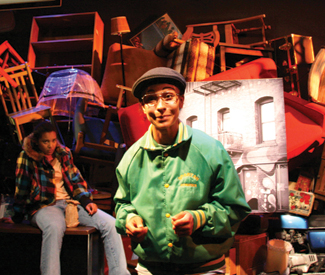
Against a towering backdrop of junked furniture, which looks as if someone had collapsed the “Defenestration” building on itself and dragged it into the EXIT on Taylor, Michael Uy Kelly as Captain Gary Jimenez extols the virtues of an oft-maligned district. “The Tenderloin is the best part of the gut,” he grabs his own to demonstrate, “and it’s the best part of the city. It could be.”

Jimenez was one of 40-plus neighborhood fixtures to have been interviewed by a group of actors involved in The Cutting Ball Theater’s latest work, a documentary-style play called “Tenderloin,” and like most of the voices who made it into the play, his is sympathetic to his surroundings. Kelly, who also plays a trans bartender, an elderly gentleman named “Nappy Chin,” and a former Vietnamese “boat person,” is similarly sympathetic to his subjects, imbuing each with a quiet dignity and an almost stoic streak of optimism.

Located as it is in the tenderest parts of the ‘loin, an expedition to the EXIT Theatre on Eddy Street, and its sister outpost on Taylor, where resides The Cutting Ball, can be somewhat disconcerting for those unaccustomed to San Francisco’s meanest streets. But though the district is home to a large percentage of the city’s theatres, it’s the theatre verite featuring its other residents that most characterizes the neighborhood. Or, as resident amateur historian and self-taught documentary photographer Mark Ellinger puts it in his interview (performed by actor David Sinaiko), there’s “a lot of human drama that has taken place in these buildings.”

>>Read SFBG theater critic Robert Avila’s take on “Tenderloin” here.

Said buildings, an imposing bank of Beaux Arts architecture, somewhat camouflaged from public admiration by a veneer of city grime, house the densest population in the city, and one of the most diverse, a diversity reflected in the characters performed by an ensemble cast of six, each with a compelling story — and a different perspective on what it means to be in, and of, the Tenderloin.

“I wouldn’t live anywhere else,” says Kelly as barmaid Collette Ashton.

“I’m trying…to get the F@#% out,” growls Tristan Cunningham as street cleaner (and ex-con) Shomari Kenyatta.

All told, “Tenderloin” (which plays through June 3), is an ambitious amalgam of oral history, social commentary, and reality check. In certain ways, it hearkens to Marcus Gardley’s “Love is a Dream House in Lorin,” commissioned by the Shotgun Players as an ode to the working-class neighborhood where they’ve been located since 2004. But while Gardley’s lushly sprawling storyline compressed hundreds of years of history into its community-based theatrical tribute using interview material as a jumping off point rather than as the entire script, “Tenderloin” is more tightly focused on the present day and on word-for-word enactment of the interview material. Documentary rather than docudrama.

The other major difference between the two productions lies in the sensitive zone of community engagement. While Shotgun was able to utilize members of their community as cast and crew and filled the theatre seats with their families, Cutting Ball limits its acting pool to a cadre of (very!) capable professionals, none of whom actually hail from the Tenderloin, and while they’re offering a limited number of pay-what-you-can “neighborhood tickets” to Tenderloin residents, the crowd on the day I attended appeared to be mostly comprised of Cutting Ball subscribers (to be fair, it was a Saturday matinee). Despite this layer of missed opportunity, however, “Tenderloin” is a multi-faceted, mostly unsentimental snapshot of one of San Francisco’s most unique terrains, and is well worth the visit, not just as a play, but as a home.

“Tenderloin”
Through June 3
EXIT on Taylor
277 Taylor, SF
$10-$50
(415) 525-1205
www.cuttingball.com

What the preservation vote says about the 2012 supervisors

64

UPDATE: Important update at the end of this story

What does it mean that a historic preservation law favored by developers and promoted by Sup. Scott Wiener passed the Board of Supervisors 8-3? Maybe nothing. Historic preservation is a strange poliltical issue, favored by some of the wealthy white homeowner types who love pretty buildings (and aren’t so good on other issues), and this thing was sold as a way to help low-income people and affordable housing. But the reality is that the Wiener measure will make it harder to declare historic districts, and thus will take away a tool that the left can use to stop uncontrolled commercial development. And remember: The affordable housing community wasn’t pushing this bill, and, for the most part, hasn’t had problems with historic preservation. The most progressive political club in the city, the Harvey Milk LGBT Democratic Club, came out strongly against the measure and urged Sup. Christina Olague, a co-sponsor, to oppose it:

We are extremely troubled that you appear to be buying into the flawed, bogus and self-serving arguments by SPUR and other supporters of this legislation that historic preservation is classist and leads to gentrification, interferes with the production of affordable housing and is a tool of San Francisco’s elite.  Nothing could be further from the truth.

There was a way to address the issues of low-income people in historic districts without making it harder to block inappropropriate development, but Wiener’s bill went much further. And while I respect Scott Wiener and find him accessible and straightforward, and I agree with him on some issues, he isn’t someone whose basic agenda promotes the interests of tenants or low-income people. His supporters are much more among the landlord class and the downtown folks. The San Francisco Chronicle, which is a conservative paper on economic and development issues, loved the legislation.

So what happened when this got to the Board? Only three people — the ones the Chron calls “the stalwart left flank of the Board” — voted no.

John Avalos, David Campos and Eric Mar. They are now the solid left flank, the ones who can be counted on to do the right thing on almost every issue. Once upon a time, there were six solid left votes. Now there are three.

What does this mean for the other key issues coming up, including CPMC, 8 Washington, and the city budget? Maybe nothing. As I say, this issue is complicated. Olague told me, for example, that she’s really worried about working-class people who can’t afford to comply with the increased regulations that come with historic districts. Her vote doesn’t mean she’s dropped out of the progressive camp, or that she (or Sups. Jane Kim and David Chiu) can’t be counted on in the future. I really want to believe that this was just an aberration, a vote where I’ll look back in the fall and say: Okay, we disagreed on that one, but nobody’s perfect

Still, it’s kind of depressing: The dependable progressive vote is down to three.

UPDATE/CORRECTION: I didn’t know when I posted this that Olague had spoken to the Milk Club leadership after the club’s statement went out and the club has since issued a correction:

Due to a misunderstanding, Supervisor Christine Olague’s position on the Historic Preservation Commission’s critical role in the life of San Franicsco was misrepresented in our weekly newsletter. Supervisor Olague is looking into ways to help continue Historic District status for the Queer community, the Filipino community in the South of Market area, and the Japantown area. She is specifically looking for wording that would help these plans remain viable and welcomes any questions on her position and on her plan. Our apologies to the Supervisor for this unfortunate mistake.

Bank’s offer to fund vandalism repairs draws activist backlash

55

After young anarchists vandalized cars and businesses during a brief but destructive rampage through the Mission District last week, Wells Fargo was quick to offer $25,000 in grants to repair the damage, which the bank publicized in a press release as “building upon its history of supporting local communities.”

Yet this is the same Wells Fargo that has been targeted by housing rights, labor, and other progressive activists in recent months for its aggressive foreclosure tactics and investments in mountaintop removal coal mining and other heinous activities, culminating in a major standoff between protesters and the company during its annual shareholders meeting in San Francisco on April 24.

The grant money was supposed to be administered mostly by the Valencia Corridor Merchants Association, but the group got an earful from activists during its meeting on Monday night and now its leaders are figuring out how they can extricate themselves from this thorny situation. Among those putting pressure on the group is Sara Shortt, executive director of the Housing Rights Committee of San Francisco, who says the bank is trying to buy allies that it desperately needs right now.

“Wells is trying to divide a wedge between activists who have been working to highlight their irresponsible practices in the community and the businesses we shop at,” Shortt told us. “As a Valencia Street resident, I resent that they are hoping to use my community merchants as a tool for them to gain positive PR, by taking advantage of their desperation after the attacks.”

Bank spokesperson Holly Rockwood emphasized Wells Fargo’s “long history of corporate philanthropy” when I asked her about the donation, and she denied that the corporation was trying to burnish its tarnished image less than week after thousands of activists disrupted the bank’s annual meeting, resulting in 20 arrests. “The timing was simply in response to the wave of vandalism,” Rockwood said.

Nonetheless, merchants association President Deena Davenport said the group is now “backing away from this” to avoid getting in the middle of this fight. “The people with the Housing Rights Committee gave us a lot of good reasons why shouldn’t accept this money,” she said, adding that the association will make a final decision at its meeting this Monday.

While she said that she appreciates the bank’s offer and doesn’t begrudge anyone who wants to accept the money, “we are looking at ways to raise the money ourselves,” including reaching out to local credit unions to see if they would match the Wells Fargo offer, making the same money available but without the heavy political baggage.

SFIFF 2012: gone but not forgotten

1

It’s been a week since the San Francisco International Film Festival ended, but after 15 days largely spent sitting in the dark at the Kabuki, submerged in a flood of cinematic storytelling, the afterimages are still taking up considerable space in my brain.

And questions remain, like: Why didn’t anyone from Lauren Greenfield’s crew on the documentary The Queen of Versailles report time-share mogul David Siegel or his wife, Jackie, to the Orlando-area SPCA for casually sitting down to brunch and letting their family’s pet python roam unchaperoned through a house filled with fluffy white purse dogs?

And what was going through moderator Audrey Chang’s head when a post-screening Q&A for Maria Demopoulos and Jodi Wille’s cult doc The Source devolved into a noisy, chaotic processing session for an audience filled with former cult members? And did other audience members exit the theater after watching Jessica Yu’s Last Call at the Oasis feeling paralyzingly hyperaware of their gigantic, sloshing waterprint, knowing that any one action they might be about to take — be it using the Sundance Kabuki Cinemas restroom, riding the 22 Fillmore home, or going out for a much-needed cocktail to take the edge off incipient doom — likely represented dozens of gallons’ worth of heedless water use?
 
And a last pressing question: Will anyone see to it that Mosquita y Mari, written and directed by Aurora Guerrero, reaches more-disparate theater screens after it finishes its festival circuit? (In the wake of its January Sundance screening, it did get picked up for DVD and VOD distribution by Wolfe Releasing.)

First-time feature director Guerrero has set her sweet and sorrowful, semiautobiographical coming-of-age film in LA’s Huntington Park neighborhood, where Latina teenagers Yolanda (aka Mosquita; played by Fenessa Pineda) and Mari (Venecia Troncoso) form an unlikely friendship that drifts silently and slowly toward a more ambiguous state. Beautifully shot and scripted, using young local nonprofessionals for much of the cast, Mosquita y Mari tells a small, poignant tale exceedingly well, carefully weaving its tenuous love story into the larger settings of neighborhood and school and two immigrant households whose younger generations find themselves struggling to navigate the track laid down by their parents.

Like many of its cohorts in this year’s SFIFF program, the film demonstrates the benefits of living amid the Bay Area’s small galaxy of annual festivals — and richly deserves to travel farther afield.

Obama’s evolution

58

Other than a few Mitt Romney supporters, most of us view evolution as a wonderful biological mechanism to which we owe our supposed higher intelligence. So Obama’s “evolution” from a foe to a supporter of same-sex marriage deserves tremendous praise. But before we go all ga-ga over the president, let’s remember:

He didn’t evolve on his own. In this case, the evolution needed a push, from generations of LGBT activists and supporters, who put the issue in front of the world, made it a basic matter of civil and human rights, and forced Obama to realize that he could no longer duck and had to take a stand.

Remember FRD’s famous statement to activists? “Now you have to make me do it.” That’s what happened here. Obama made the political calculation, of course, and it’s a good one — energizing his base is more important than angering a bunch of people who weren’t going to vote for him anyway. But there’s more to it, and I think Paul Hogarth has the right line:

Biden’s statement may have been the final trigger, but the LGBT movement deserves the credit – despite the odds – to hold firm on getting the President to take this historic stance. And it’s a lesson that other progressive constituencies should take heart in, as we strive to make Barack Obama the President we hoped he would be.

Let’s also remember that this really started in San Francisco, with an act of what I like to call civic disobedience. At the time, a lot of critics said that Mayor Gavin Newsom was hurting the Democratic Party by making a move before the rest of the nation was ready for it. But what he did eight years ago was force the rest of the nation to get ready for it — and the subsequent legalization of gay unions in a growing number of states has shown America what the Boston Phoenix referred to as “the utter, mundane normality” of same-sex marriage.

We all knew this moment was coming. The demographics can’t be denied. Almost everyone younger than 30, and most people younger than 40, supports same-sex marriage. The country is changing — in this case, in a very positive way — and Obama was risking being on the wrong side of history. Even the Republicans seem to get that — they’re running away from this issue as fast as they can.

So now it’s likely that L.A. Mayor Antonio Villaraigosa will have his way and the Democratic Party platform will have a same-sex marriage component. Romney will be on the defensive on a key social issue – a huge change from the past. The Supreme Court will be more likely to uphold Judge Vaughn Walker’s decision on Prop. 8 (yes, the high court is political and changes with the norms of society, sometimes slowly, but the president’s statement will have a clear impact.)

So this is huge — not just because of the impact but because of what it says about the power of progressive movements. Now let’s make the president raise taxes on the rich.


Mayor Lee signs watered-down limits on SFPD spying

6

Flanked by members of Coalition for a Safe San Francisco, Police Chief Greg Suhr, and Sup. Jane Kim, Mayor Ed Lee today signed legislation that calls for San Francisco Police officers working with the FBI’s Joint Terrorism Task Force to respect privacy rights in the California Constitution and local laws and calling for annual reports on SFPD-FBI activities.

Coalition members trumpeted what they called “historic civil rights legislation,” but this watered-down version of legislation that Lee vetoed last month doesn’t offer the same guarantees and codification of privacy principles as the previous version, which was approved on a 6-5 vote of the Board of Supervisors, whereas this new version won unanimous approval.

Its endorsement by the most conservative supervisors – those most deferential to the SFPD, politicians who routinely vote against even the most innocuous progressive legislation – is a sure indicator that the legislation doesn’t really do much to clips the wings of the SFPD, which initiated this controversy with a secret 2007 agreement with the FBI that federalized local officers.

That was precisely the objection to the initial legislation that were offered by Lee and Suhr, that it codified local privacy protections with specific limits on SFPD officers engaging in surveillance on citizens who had broken no laws, and that it subjected any future agreements with the FBI to approval by the Police Commission. The new legislation is far more vague.

“It is a step in the right direction, there’s no doubt it’s progress, but whether it’s real progress depends on the implementation,” says John Crew, an expert on police practices with the American Civil Liberties Union-Northern California, which unearthed the 2007 secret memo.

Crew has worked on this issue for years and has been troubled by the FBI’s claims that local laws don’t apply to federalized agents, with the SFPD’s resistance to allowing specific limits to be codified in local law, and with the deferential position Lee has taken to the SFPD. Crew said the strongest part of the new ordinance is the explicit statement that local officers can’t ignore local and state laws, but the details of how that’s applied weren’t really addressed in this new version.

“The question now is will there be a vigilant, meaningful, and sustained effort to implement this law and will there be sufficient transparency,” Crew said.

Two of the strongest advocates for the new law, Nasrina Bargzie of the Asian Law Caucus and Zahra Billoo of CAIR-SFBA, say the compromise version addressed their main issues and is worth celebrating, but they agree with Crew that its strength will ultimately depend on how it is implemented.

“We don’t see this as the end. We need to make sure it is implemented properly,” Billoo said, calling it a “watered down version” of the stronger and more specific initial legislation.

For example, the legislation calls for annual reports on FBI-SFPD activities, but it doesn’t go into much detail on what those reports will include.

“Part of what we’re going to do is communicate with the stakeholders about what we expect those reports to look like,” said Nasrina Bargzie, a coalition member from the Asian Law Caucus, noting that they would like to base them on the work that has been done in Portland, Ore., which has been a leader on the issue. “It’s going to require us to watch those trouble spots during implementation.”

While the vetoed legislation would have given the Police Commission more authority over future SFPD-FBI agreements, the signed version simply calls for public hearing before the Police Commission when there are new agreements. “Ultimately, it will come down to political will at the Police Commission” to enforce privacy protections, Crew said.

He called San Francisco “one of the strongest communities of concern about civil rights in the country,” and as long as that remains the case then this legislation could be an important vehicle for protecting civil rights. But the real question is what happens when there’s another terrorist scare and the JTTP decides civil liberties are secondary to beliefs that the police state and its surveillance efforts needs to be beefed up. Or when the police state decides to simply refuse to disclose is activities.

Housing for the rich moves forward — fast

39

A proposal to build the most expensive condos in San Francisco history will come before the Board of Supervisors May 15 — and then before the Port Commission May 16, and then before the Board’s Finance Committee May 16, a jumble of hearings and votes that may make it more difficult for critics to be heard.

The 8 Washington project will be one of the most critical votes the board will face in 2012 and will make a lasting statement about the city’s housing policy. And it’s on an odd fast track.

At the board’s May 15 meeting, the supervisors will consider an appeal to the certification of the project’s environmental impact report, and will vote on approving the conditional use authorization for the building complex. If either of those is rejected — that is, if project sponsor Simon Snellgrove can’t line up six votes to approve the EIR and the CU — then the whole thing goes down in flames. The project would still exist in theory, but in practice it would be another two years before it could come back again.

If both of those approvals get through, then the actual development agreement and the financial documents for the project come before the Port Commission the next day — May 16 — at a highly unusual special hearing set for 9am. That’s a tough time to get people to come out and speak against a project, but the Port says it’s necessary, and here’s why:

One hour later, at 10am, the board’s Budget and Finance Committee will consider the same thing. And the Port wants this to get through Budget and Finance before that panel is entirely consumed with the next city budget.

So there will be two nearly simultaneous hearings, both at City Hall, on the same topic, early in the morning. A little difficult for people who want to testify at both. What if the Port hearing goes on until, say, 11:30 or noon (there have been plenty of three-hour hearings on contentious land-use issues in this city)? What if the Budget Committee starts discussion on the item before the Port is through with it?

Brad Benson, the Port’s special projects director, told me that his agency was “in touch with the chair of the Budget Committee. We get the point that people can’t be in two places at the same time.” 

But still, it all seems awfully rushed — particularly since, according to project opponent Sue Hestor, the state Lands Commission also has to sign off on this, and that won’t happen until July.


Localized Appreesh: Glitter Wizard

1

Localized Appreesh is our weekly thank-you column to the musicians that make the Bay. To be considered, contact emilysavage@sfbg.com.

I’ve been wanting to get Glitter Wizard in Localized Appreesh for some time. It’s based in the Bay Area, plays local haunts often, and I appreciate what it’s putting out there. Fronted by Wendy Stonehenge, the hair-shaking, psychedelic glam rock band is at once wildly individual and comfortingly throwback.

That vintage guitar sound and the fringed frocks that adorn Glitter Wizard recall tripping San Francisco musicians of yore; and yet, there really aren’t many other bands doing it up quite like this now, in the modern day Bay. We’re dying for the long-hairs, the rock’n’roll dramatics, the all-out performance of Glitter Wizard, sonically Hawkwind, aesthetically Bowie.

The band’s next releases aren’t out ’till summer (read: real soon), but you can catch the act live this weekend opening for another band with a penchant for glittering spectacle and glammy make-up, White Hills. Before all that, Stonehenge fills in the blanks:

http://www.youtube.com/watch?v=drbGNEqZlbI

Year and location of origin: Glitter Wizard was originally birthed in Santa Cruz sometime around 2006. The Bay Area version came together in 2008.

Band name origin: I just felt that the name was a perfect amalgamation of our glammy stage show and our heavy rock sound.

Band motto: Turn up the guitar!

Description of sound in 10 words or less: Gypsyhawk said it best: “You guys sound like Uriah Heep played by punks!”

Instrumentation: Wendy Stonehenge on vocals, Doug Graves on keys and synths, Fancee Cymballs on drums, Lorfin Terrafor on Guitar, Kandi Moon on bass.

Most recent release: Our last release was our first LP, Solar Hits, but we have a new seven-inch and full-length coming out this summer.

Best part about life as a Bay Area band: We’ve probably got more good bands here than any other city in the country, if not the world.

Worst part about life as a Bay Area band: You have to book shows at least three months in advance.

First album ever purchased: New Kids on the Block — Hangin’ Tough (how embarrassing).

Most recent album purchased/downloaded: Def Leppard — High ‘n’ Dry (only slightly less embarrassing)

Favorite local eatery and dish: Lorfin and Kandi just introduced me to the beef brisket at Tommy’s Joynt. So good!

Glitter Wizard
With White Hills, Disappearing People
Sun/13, 9pm, $12
Bottom of the Hill
1233 17th St., SF
(415) 621-4455
www.bottomofthehill.com

Deutch maneuver

0

le.chicken.farmer@gmail.com

CHEAP EATS “Berlin is awesome,” Kayday writes me, from Berlin. “We should all live here.”

Amazingly, I answer her in German. “Genau,” I write.

Berlin is awesome, true. But it’s one thing May through September, and something very much else the rest of the time. Is my opinion.

Kayday lives in Seattle, and complains about the weather there from September through July.

She doesn’t want to live in Germany, I feel certain.

When she was here, just a few weeks ago, she wanted to eat at Schmidt’s, maybe for practice. So we did. No complaints from me. Schmidt’s has the best wild boar sausage in all of San Francisco.

We also ate at my new favorite Chinese restaurant, in the Richmond, but I’m not going to tell you yet about that. Maybe next week. If you’re good.

Wild boar sausage, I’m pretty sure I already told you about. There’s Rice Broker though, in the Mission, which is another place where Kayday and me ciao’d down.

“Hi,” I said.

“Hello.”

“Hola.”

And she tried to answer — probably in German — but couldn’t, because something had gone down the wrong pipe. Maybe, I’m thinking, a sesame seed. Or a teeny tiny speck of almond?

Both things were in her rice bowl, which was the two skewers of lemongrass beef one, with whole orange slices, string beans, and, yeah, almonds and sesame seeds.

Now, I’ve seen people choking in restaurants before. I’ve even been the person choking in restaurants. It’s no big thing. You cough, you turn red, you hold up your finger to let your dining companions know that, no, in fact you don’t need the Heimlich. Yet. And then you drink some water, cough some more, tear up a little, feel like an idiot, and continue eating.

So happens, the wrong-pipe problem is a recurring theme for me, in life. I have lots and lots of sympathy and patience, and too am ready — if necessary — to spring into action. Ever the nanny, I am trained in CPR and so forth.

“Hello?” I said again. “Are you quite sure you don’t need the Heimlich?”

“I’m OK,” Kayday said. “I just need to go for a walk.” And she excused herself. “Be right back.” And left.

This was a first.

I digged into my own bowl, which was rice porridge with pork-and-ginger meatballs, bok choy, and cilantro. It was excellent, and went down very smoothly.

While I ate, though, I couldn’t take my eyes off of Kayday’s bowl, which was beautiful. The meat, as yet untouched, glistened on its skewers. The orange slices shone forth, like little sunsets. The beans — it was just a beautiful bowl of food. Calling to me.

Kayday is a dear and good friend. She’s an important part of my band. It occurred to me she could choke and die outside on the sidewalk. Still, I decided not to eat her food. When she came back, I would ask. And she would share.

Then, the hell with it, I reached across the table and tried a piece of meat from her skewer. Tough city, go figure!

But, like I says, mine was very good. The meatballs were almost as smooth as the porridge, and good and gingery. And I loved my edamame snack bowl, with dandelion and cane vinegar.

Come to think of it, she’d had a snack bowl appetizer too. Pickled daikon and carrots. And I can’t remember now if I even tasted it, but it sounds pretty good, no?

Of course, this isn’t Kentucky Fried Chicken. But to its credit it isn’t Spork either. And even though it choked my friend, I like that Rice Broker is there. Here in the hood.

And anyway, she survived. She came back.

“Hello,” I said.

She said, “Hi.”

RICE BOWL

Wed-Sun 6-10pm

1058 Valencia, SF.

(415) 643-5000

Cash only

Beer and wine


Steady WATERS

0

MUSIC Van Pierszalowski’s story writes itself: musician finds love in picturesque European city, swims in fjords, writes a fuzzy grunge-inflected record about it and his travels, and calls the band WATERS (appearing Thu/10 at the Fillmore). “I met a girl,” he says from the road. “And I just wanted to get back over there. It was a place to work on songs, refocus.”

Even his story before the present wrote itself: young man travels to Alaska to fish with his father and creates chilly, acoustic folk soundscapes, names the band Port O’Brien after an Alaskan Bay.

This all happened. Only life isn’t all one big linear story, and Pierszalowski isn’t nearly so precious as implied within these tales. He never stopped writing songs between the break-up of Port O’Brien and formation of WATERS. He was bouncing back and forth between Oslo and San Francisco for two years, with stops here and there in New York and Alaska, also Dallas in spring of 2011 to record a full-length with producer John Congleton (St. Vincent, Bill Callahan).

His first and latest album for WATERS — Out in the Light — came out last September to a flurry of positive reviews, tales of rebirth, etc. The record produced anthemic “For the One” (and its trippy dreamcatcher-based video), which kicks off with a slow buzz breaking into a chainsaw pop guitar line, and Pierszalowski pleading, “Oh my god I thought I was a free man out on road,” later in chorus, “when I wake up/and I take you with me/I’ve seen too much of old/And I’m not waiting.”

So what happens after the initial burst of new-band hype? Pierszalowski is still in love, and touring much of the year. When home in the Bay Area for brief snippets of time, he and the girl — Marte Solbakken — live together, and frequent Dynamo Donuts for sustenance. “I live up there on Potrero Hill. Everything’s there, that’s our home.”

While Pierszalowski is ringleader and songwriter, the current incarnation of the band — drummer Nicholas Wolch and bassist Alexander Margitich, both from Santa Rosa, guitarist Aaron Bradshaw, and Solbakken on keys and singing — has been touring the States together for some time.

This summer they’ll be back in Oslo briefly, and before that, more tours, including an opening slot for Delta Spirit, which brings the band to the Fillmore this week. Following that, there’s another tour with Nada Surf in June.

They’ll traverse the wide-open plains and rather familiar coasts of the U.S. — when not fishing in Alaska, Pierszalowski was raised in tiny coastal Cambria, just south of the Hearst Castle.

He wasn’t a surfer like many of the locals, so he found solace in music, taking inspiration from a long line of iconic guitarists and singers, starting with Billie Joe Armstrong in junior high, moving up to Joey Ramone, Thom Yorke, Neil Young, Will Oldham, and his most consistant inspiration, Kurt Cobain.

“I’ve always gone on record as saying In Utero is my favorite record of all time,” he says. Nirvana was an influence on Port O’Brien’s sound and a huge influence on WATERS.

So what’s next? Pierszalowski is feeling the pressure to start creating new music again, has written a few songs on the sly, and is already fantasizing about the next record — he’s hoping to get back in the studio at the end of the year. It’s his life on the road with the one that he loves, but it’s not just a simple fairytale. There are donuts involved.

WATERS

With Delta Spirit

Thu/10, 8pm, $20

Fillmore

1805 Fillmore, SF

www.thefillmore.com

The tender line

2

arts@sfbg.com

THEATER A couple of days after the opening of the Cutting Ball’s documentary play, Tenderloin, I spotted independent filmmaker Rob Nilsson crossing the street at Taylor and Eddy, less than a block from the theater. Drawn to the neighborhood and its residents for decades, Nilsson is one of the more prominent artists who have found inspiration, collaboration and a kind of authenticity in the Tenderloin, long among San Francisco’s poorest and liveliest districts.

Director-writer Annie Elias and her Tenderloin team continue this tradition, with a clear concern to do right by their subjects (among whom happens to be Nilsson himself, played by actor Tristan Cunningham). The action emerges from an opening tableau of street life, featuring the colorful sights and harrying sounds of a rowdy inner-city intersection (nicely augmented by sound designer Matt Stines). Upstage rises scenic designer Michael Locher’s ceiling-high mound of furniture and bric-a-brac, which is fronted by two rows of hanging photographs, loving portraits of local people and places whose panels double as projection screens establishing context for each of the scenes that follow.

The play presents a spectrum of Tenderloin denizens whose stories reflect the dire straits normally associated with this congested low-income slice of downtown, but also the sense of freedom and community some have found there. We hear from the desperate and lonely but even more often from people who have grown to prefer the Tenderloin to more stifling environs.

That positive note lands too forcefully at times, especially when it comes from relatively privileged members of the commuting class (the plugging of the neighborhood by some middle-class patrons at the Nite Cap bar, for instance, begins to sound a little like an ad from the visitors bureau), or professional advocates like Reverend Karen Oliveto (played by Leigh Shaw) at Glide Memorial Church.

By contrast, the play excels when the voices are both genuinely local and agenda-free, as is the case with the story by a man from Sixth Street who haplessly agrees to accept responsibility for a newborn baby from an acquaintance on her way to jail (a story as charming and resonant as a well-crafted short story, and beautifully recreated by actor Michael Kelly).

A set of discrete interviews naturally runs the risk of becoming an aimless narrative, especially without a single dramatic episode or storyline at the center (as is the case with the better-known works in the docudrama genre, such as Tectonic Theater’s The Laramie Project). Elias sets out to mitigate this problem in several ways, first of all by casting well — in terms of both the selection of interview subjects and the delicate portrayals marshaled by her exceptional ensemble of actor-documentarians (aided by additional writing from David Westley Skillman).

In addition to Michael Kelly’s standout performance throughout, Rebecca Frank does particularly subtle work with a number of memorable personalities, including Leroy B. Looper, the (recently deceased) owner of the Cadillac Hotel, who appears here with wife and longtime business partner Kathy (played gracefully by David Sinaiko). (Siobhan Doherty rounds out the production’s admirable ensemble.)

Elias also relies on dynamic staging, often setting a couple of interviews in alternating tension with one another, a technique that generally serves the production well — as in a sly point-counterpoint between former Tenderloin police captain Gary Jimenez (Kelly) and a homeless person (Cunningham) — even if some scenes prove unnecessarily busy.

But the narrative that emerges, which lays a heavy emphasis on “stripping back the layers” and revealing the truth of the much-maligned district, suffers from the accumulation of a familiar liberal slant toward tolerance and understanding. To the extent it undercuts outrage at a larger system of extreme and degrading inequality, such a slant obscures as much as it reveals. *

TENDERLOIN

Through May 27

Thu, 7:30pm; Fri-Sat, 8pm (also Sat, 2pm); Sun, 5pm, $10-$50

Exit on Taylor

277 Taylor, SF

(415) 525-1205

www.cuttingball.com


Rep Clock May 9-15, 2012

0

Schedules are for Wed/9-Tue/15 except where noted. Director and year are given when available. Double and triple features are marked with a •. All times pm unless otherwise specified.

ARTISTS’ TELEVISION ACCESS 992 Valencia, SF; www.atasite.org. $7. “Other Cinema:” “Occupy Cinema!,” works from and inspired by the Occupy movement, Sat, 8:30.

CASTRO 429 Castro, SF; (415) 621-6120, www.castrotheatre.com. $7.50-11. Check website for shows and times.

CHRISTOPHER B. SMITH RAFAEL FILM CENTER 1118 Fourth St, San Rafael; (415) 454-1222, www.cafilm.org. $6.75-10.25. Bully (Hirsch, 2012), call for dates and times. The Deep Blue Sea (Davies, 2011), call for dates and times. Letters From the Big Man (Munch, 2011), call for dates and times. Marley (Macdonald, 2012), call for dates and times. Monsieur Lazhar (Falardeau, 2011), call for dates and times. “World Ballet on the Big Screen:” The Bright Stream from the Bolshoi Ballet, Moscow, Tue, 6:30. This event, $15. First Position (Kargman, 2011), May 11-17, call for times. Lou Harrison: A World of Music (Soltes, 2012), Sun, 7.

ELMWOOD 10070 San Pablo, El Cerrito; www.rialtocinemas.com. Free. “Community Cinema:” Strong! (Wyman, 2012), Wed, 7.

PACIFIC FILM ARCHIVE 2575 Bancroft, Berk; (510) 642-5249, bampfa.berkeley.edu. $5.50-9.50. No screenings scheduled.

ROXIE 3117 and 3125 16th St, SF; (415) 863-1087, www.roxie.com. $6.50-10. Gerhard Richter Painting (Belz, 2011), Wed-Thu, 7, 9. Hit So Hard (Ebersole, 2011), Thu, 8:45. Jeff, Who Lives at Home (Duplass and Duplass, 2011), Thu, 7. “I Wake Up Dreaming 2012: The French Have a Name for It!”: •I, The Jury (Essex, 1953), Fri, 6:10, 9:45, and The Big Combo (Lewis, 1955), Fri, 8, 11:30; •Knock On Any Door (Ray, 1949), Sat, 4, 8, and Edge of Doom (Robson, 1950), Sat, 2, 6, 10; •Such a Pretty Little Beach (Allegret, 1949), Sun, 3, 8, and Detour (Ulmer, 1945), Sun, 4:45, 9; The Pretender (Wilder, 1947), Sun, 1:30, 6:30; •The Strange Mr. Gregory (Rosen, 1945), Mon, 6:40, 9:20, and Return of the Whistler (Lederman, 1948), Mon, 8; •Highway 13 (Berke, 1948), Tue, 6:40, 9:30, and The Devil’s Henchman (Friedman, 1949), Tue, 8.

SAN FRANCISCO STATE UNIVERSITY McKenna Theatre, Creative Arts Bldg, 1600 Holloway, SF; (415) 338-2467, creativearts.sfsu.edu. $5-9. “SF State’s 52nd Annual Film Finals,” Fri, 7.

“SAUSALITO FILM FESTIVAL” Various North Bay venues; www.sausalitofilmfestival.com. Fourth annual festival highlighting features, shorts, animation, and documentaries, Fri-Sun.

SF FILM SOCIETY CINEMA 1746 Post, SF. $10-11. The Day He Arrives (Hong, 2011), Wed-Thu, 3, 5, 7, 9. Here (King, 2011), May 11-17, 1:45, 6:30. Michael (Schleinzer, 2011), May 11-17, 4:15, 9.

SAN FRANCISCO MUSEUM OF MODERN ART 151 Third St, SF; www.sfcinematheque.org. $10. “Seconds of Eternity IV:” Galaxie (Markopoulos, 1966), Thu, 7.

SUNDANCE KABUKI 1881 Post, SF; www.sundancecinemas.com. “San Francisco Opera’s Grand Opera Cinema Series:” Il Trittico, Tue/15, 7 and May 19, 10:30am.

VORTEX ROOM 1082 Howard, SF; www.myspace.com/thevortexroom. $7 donation. “Starship Vortex:” •Dark Star (Carpenter, 1974), Thu, 9, and To the Stars By Hard Ways (Viktorov and Viktorov, 1982), Thu, 11.

YERBA BUENA CENTER FOR THE ARTS 701 Mission, SF; (415) 978-2787, www.ybca.org. $6-8. “Discovering Andrzej Zulawski:” The Third Part of the Night (1971), Thu, 7:30; The Devil (1972), Sat, 7:30; On the Silver Globe (1976/1988), Sun, 2.

Sushi east and west

0

virginia@sfbg.com

APPETITE Despite the countless lauded sushi restaurants I’ve eaten at in NY and LA, I find San Francisco more than keeps up, whether due to the staggering range of fish (and lovably surly attitude) Roger delivers at Zushi Puzzle (www.zushipuzzle.com) (pencilfish or flying fish, anyone?), the sustainable efforts of Tataki (www.tatakisushibar.com) and Sebo (www.sebosf.com), or the pristine precision of Sausalito stalwart Sushi Ran (www.sushiran.com), which tops overrated Nobu (www.noburestaurants.com) restaurants, in my book.

Here is one new SF spot and one revamped Berkeley restaurant adding more welcome sushi diversity to the Bay Area.


SARU SUSHI BAR

Why couldn’t Saru Sushi Bar have been in Noe Valley all the years I lived right by this 24th Street storefront? The space’s original two sushi incarnations were less than desirable, where I was once subjected to smelly, rubbery fish. The closet-sized restaurant is completely revamped to the unrecognizable point. Still tiny, it feels roomier with large front windows and sleek brown color scheme. Cheery service pleasantly elevates the experience, particularly on a sunny day at lunch.

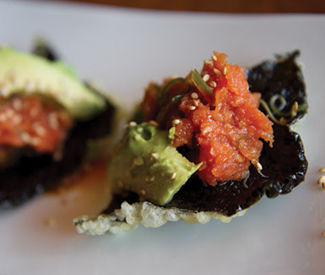
I’d claim the space has finally arrived. There’s not just the usual hamachi and sake (salmon), but rather playful, unique bites prepared with care. “Spicy cracker” ($7) is a sheet of seaweed fried in tempura, topped with spicy tuna and avocado — a textural bite. Bright halibut tartare is drizzled in lime zest, yuzu juice, and Japanese sea salt. Though I ever appreciate sampling options, some tasting spoons ($7) work better than others. One that worked: young yellowtail (kanpachi) in truffle oil and ponzu sauce, with garlic chips and scallions.

I know I’m good hands if raw spot prawns (amaebi) are on the nigiri menu ($7 two pieces). Bright and firm, they taste as if they were caught fresh that morning. Snappy rolls (maki) are not overwrought. Quality raw scallops are a favorite, so I appreciate Naked Scallop ($12), a roll wrapped in light green soy paper, filled with snow crab, avocado, masago (smelt roe), and, of course, scallop. Not near as junk-food-sushi as it sounds, is the fresh, fun, subtly crispy Popcorn Tuna roll ($10): panko-crusted spicy tuna is topped with masago (smelt roe), scallions, spicy mayo, and a sweet soy glaze.

Noe Valley finally has a destination sushi bar.

3856 24th St., SF. (415) 400-4510, www.akaisarusf.com


JOSHU-YA BRASSERIE

At first glance, Joshu-ya Brasserie could be another hip Berkeley student hang-out: a funky, converted old house with red-gated front patio. But step inside the recently remodeled space and bamboo and dark wood exude an Old World Zen. A fountain out front murmurs soothingly while the sun warms the partially covered patio.

A chalkboard lists fish specials, but also rabbit tacos and Kobe kimchi sliders (the latter cooked too medium-well for me). One immediately realizes this is no typical sushi or even Japanese restaurant. Young executive chef-owner Jason Kwon’s vision is bigger. Yes, he is going for the Bay Area standard of seasonal, sustainable, locally-sourced ingredients — after all, he founded Couteaux Review (www.couteauxreview.com), a culinary organization promoting sustainable agriculture. But French influence and unique twists keep things interesting, with dishes like pan-roasted rib-eye medallions in blackberry balsamic reduction, or duck confit with buckwheat noodles, nori and bonito flakes. In some ways, the vision feels beyond what the restaurant has yet fully grown into, but the intriguing elements hold promise.

The $35 omakase is a steal, particularly when chef Kwon informs you his fish supplier is the same one that French Laundry and Morimoto buy from. After a starter of seared albacore, fresh and bright, if a little too doused in fried onions and ponzu sauce, a giant, artistic sashimi platter hits a number of high notes with actual fresh wasabi (always a good sign), aji tataki (horse mackerel) from Japan, kanpachi (young yellowtail) from Hawaii, hirame (halibut) from Korea, and chu-toro (bluefin tuna) from Spain. Only one fish on the platter arrived too cold and firm. The rest were silky and satisfying.

Being less of a sweet tooth, I’d rather have finished the omakase with another savory dish than tempura red bean ice cream. Generous scoops of fried ice cream and pound cake were a little weighted after such a refreshing meal. Seared salmon in truffle creme sounds like a fine dessert to me.

2441 Dwight Way, Berk. (510) 848-5260, www.joshu-ya.com

Subscribe to Virgina’s twice-monthly newsletter, The Perfect Spot, www.theperfectspotsf.com