Ross Mirkarimi

Not in our neighborhood

6

news@sfbg.com

San Francisco faces an enormous shortage of affordable housing for young people at risk of homelessness, but a pair of projects intended to address the issue are under fire from neighborhood activists in supervisorial District 2, home to the city’s wealthiest residents.

The proposed conversion of the defunct Edward II Hotel and the major overhaul at the Booker T. Washington Community Service Center (BTWCSC) could create a combined 74 units of affordable housing for vulnerable youth, complete with services and support systems to help young people coming from foster or homeless families.

“We are building houses for young people who are getting their start in life,” said Julian Davis, president of the board of BTWCSC. “There was a great need for foster youth housing that has been studied ad nauseam … Our center wanted to contribute.”

But both projects have run into strong neighborhood opposition that appears to have turned D2 Sup. Mark Farrell against the projects as proposed, despite initial support for the BTWCSC project by both Farrell and his predecessor, Michela Alioto-Pier. Farrell’s approach has frustrated project opponents and caused the representative of a neighboring district, Sup. Ross Mirkarimi, to sponsor the project.

“The project emanated from Michela Alioto-Pier and she supported the original project, which is why I joined her in support and it initially appeared that Sup. Farrell was joining that support,” Mirkarimi told us, noting that he is continuing to champion the project because it borders his district and because “the Booker T center has a long reach and serves clients from throughout city.”

After hearing from constituents concerned about parking, the size of the five-story building that is proposed, and other issues, Farrell dropped his sponsorship of the project and submitted alternative legislation that cut the building to four stories, presenting it to project proponents without their input as a take-it-or-leave-it proposal.

“The thing I find most puzzling about this is the lack of communication with me personally,” BTWCSC Executive Director Pat Scott said of Farrell, noting how helpful Alioto-Pier and Farrell’s staff had been before opponents convinced him to drop his support for the project. “I was a little taken aback, quite frankly. I would just assume that he’d talk to me.

But Farrell said he was simply trying to heed neighborhood concerns and craft a compromise that would get neighbors to drop their lawsuit threats and appeal of the Planning Commission’s 6-1 vote to approve the project. “I can’t control what happened in the past, I’m only here to make sure everyone is happy now,” Farrell told us. “I absolutely support the project, I think the community center is great … We’re arguing over a story.”

Yet Scott noted that project proponents already had compromised on a project that was initially proposed for eight stories, and she said that even at five stories, it isn’t coming anywhere near what the city actually needs. So while Farrell casts it as a fight over one story, Scott said, “10 units is a big thing in a city that has nothing for these kids.”

That need was outlined in a 2007 report by the Mayor’s Transitional Youth Task Force. The group of city officials and nonprofit providers, convened by then-Mayor Gavin Newsom, studied issues affecting at-risk youth between the ages 16 and 24 and one of the major needs identified was housing.

A follow-up study found that 4,500 to 6,800 young people are “homeless or marginally housed each year.” The citywide affordable housing stock for this population sat at meager 314 units at the time.

“We are not doing a good enough job as a city and as a state [to help at-risk youth],” Davis said. “Once they leave the foster care system, there is very little support for them.”

The report called for 400 new affordable housing units for this population to be completed or under construction by 2012. Edward II and BTWCSC are located in the Marina and the Western Addition, respectively, in proximity to affluent neighborhoods in a district with a dearth of affordable housing.

“With supportive housing [going] into neighborhoods that never had affordable housing, there is a certain unknown and it makes people uncomfortable,” said Gail Gilman, Executive Director of Community Housing Partnership, which owns and manages the Edward II project.

Patricia Vaughey, a resident of the Marina-Cow Hollow area since 1976, is perhaps the most vocal critic of the project. She has used the neighborhood associations and every other city forum she can find as platforms to lambaste the plans. “It just kills my soul to see this project,” she told us, voicing a variety of concerns about how the project would be managed. “I am so worried about the kids … We are asking for the best program in the country and we are not getting it.”

Yet Gilman said that considerable energy and many resources have been invested in designing Edward II and that she trusts Larkin Street Youth Service, a respected nonprofit agency, to do the programming. “We chose to partner with Larkin Street because they are the experts in this area,” she said.

Vaughey characterized the stretch of Lombard Street between Divisadero and Van Ness streets, where Edward II will be located, as marred by crime and prostitution and unsuitable for this project. “We have a little Tenderloin down here,” she said.

Gilman disputed that characterization and said the building was chosen after an extensive search and that it met the criteria of having the right sized building in a safe neighborhood with good access to public transit and open space.

But many residents have expressed concern over the pending change to zoning for the building. And if the BTWCSC project couldn’t win Farrell’s support, the Edward II project faces an even more uphill battle because Farrell told us, “There’s an even stronger level of neighborhood concern over that project…. It’s going to be a tough hill to climb.”

The contentious issue under review by the Planning Department is an application to expand the density limit from 16 units to 24.

John Miller, president of the Marina Community Association, said that “from a neighborhood dynamic perspective,” a change to density is problematic. He said changing the density for one building is a slippery slope that could hurt the entire neighborhood. “Higher density is inconsistent with the neighborhood. It could work beautifully at lower density.”

Miller said potential renters in the vicinity would be concerned with “loitering that could occur when people are coming and going … With so many people there is no sense of community”

Yet as with BTWCSC, proponents say simply slashing the project to a smaller size would kill it because then it wouldn’t pencil out financially. Making an issue of density is therefore obstruction of the project because compromise cannot be reached on the issue.

Farrell, a venture capitalist, said he ran the numbers on BTWCSC and believes it would still be a viable project at four stories if the Mayor’s Office of Housing is able to offer some unspecified assistance, as he said the officials there have pledged to him they would. “I know we need more affordable housing,” Farrell said, rejecting suggestions that D2 residents tend to oppose all affordable housing projects. “I don’t think that should be a part of this conversation.”

Farrell criticized the outreach done by Edward II proponents, telling us, “I don’t think it was done in a tactful way.” But Miller said a recent meeting with Gilman and others was positive. “It was an effort on their part to respond to the neighborhood concerns as best they can,” Miller said.

“We are confident we can partner with the community in a proactive way to address the concerns that are addressable,” Gilman said. “If we diligently work with the community, we can have positive project.”

Edward II is on track to come before the Planning Commission in mid-July, while the appeal of the BTWCSC project is scheduled to be heard by the Board of Supervisors Land Use Committee on June 6 at 1 p.m. Neither Mirkarimi nor Farrell offered predictions, but both said the issue of whether the project should be four or five stories will likely be a key part of the discussion.

“Coming through the process has made me super supportive of all plans for transition age housing. I was already a supporter but this made me a fervent supporter,” Scott said. “The amount of opposition by people who don’t care what happens to our children — it makes you want to fight.”

Big launch for Avalos, emphasizing unity and integrity

69

John Avalos launched his mayoral campaign yesterday with a spirited event in a sunny SoMa park that drew several hundred enthusiastic supporters, ranging from elected officials such as Assemblymember Tom Ammiano and Sups. Ross Mirkarimi and Eric Mar to representatives of a wide variety of progressive and community organizations.

There was also an unlikely supporter: Sen. Leland Yee, who is also running for mayor but spoke to reporters wearing an Avalos sticker and said he was pleased that Avalos is in the race. The two men were each endorsed by the SF Bay chapter of the Sierra Club over weekend, and Yee’s campaign appears to be trying to court the second place votes from supporters of Avalos, the only solid progressive in the race.

But political sideshows aside, this was a day for Avalos and his supporters to shine, and they demonstrated a larger and more energetic event than other mayoral candidates have managed to pull together so far. And the crowd took the opportunity to emphasize Avalos’ progressive values of integrity and collaboration, in the process taking subtle swipes at the ambitions and egocentrism of other mayoral candidates.

“We are for John Avalos because John Avalos is for all of us,” was the repeated refrain in a strong speech by “progressive Christian pastor” and blogger Bruce Reyes-Chow.

Ammiano noted that it was the birthday of Harvey Milk and said that Avalos is the heir to Milk’s legacy of promoting progressive change through community organizing. “Harvey Milk knew the secret and the secret was grassroots…Without that tethering together, we never move forward,” said Ammiano, whose endorsement of Avalos could be a significant factor in the race, particularly as Bay Area Reporter writers and other LGBT entities support other candidates.

Ammiano offered a few reasons for his endorsement, joking that, “He has the best hair of all the candidates.” But even more important was the issue of integrity and trustworthiness, where Ammiano said Avalos really shines. “Trust is a significant attribute and you don’t see a lot of that [in public life]. And John is honorable,” Ammiano said.

Other speakers from labor and progressive organizations emphasized how Avalos has been fighting for progressive causes his entire adult life. “John cares about the issues we care about and he listens,” said Andrea Buffa of Global Exchange, who also worked with Avalos on campaigns against corporate dominance when she worked for Media Alliance.

“I’m here to fight for John because John fights for all of us,” was the conclusion of the fifth-grade student from San Francisco Community School, who introduced Avalos.

During his speech, Avalos said he was touched by the huge turnout and display of enthusiasm. “It’s such a joy to see you here. My heart is swollen,” he said, before introducing his family and telling a story of his father’s lifetime of union activism on behalf of Los Angeles dock workers. “I learned from him the value of hard work and devotion to something much greater than yourself,” Avalos said.

And the main cause that Avalos has devoted himself to in San Francisco has been the progressive movement, with its commitment to workers rights and social and economic justice. “We see that wealth is accumulating into fewer and fewer hands,” Avalos said, one of several core problems that he said his candidacy is committed to addressing, later adding, “I’m running for mayor to even the playing field.”

While he advocated for creating safe streets for pedestrians and cyclists, stimulating job growth, and adopting a housing policy designed to promote diversity by creating more homes for low- and middle-income San Franciscans, he devoted much of his address to addressing the core problem of wealthy special interests getting their way at City Hall.

“We cannot have the same business as usual that greases the wheels with lobbyists,” Avalos said. “I’ll put the interests of the collective above the interests of the few, day in and day out.”

Avalos cast this year’s mayoral election as pivotal to San Francisco’s future. “As a city, we are at the crossroads and only we can turn the tide,” Avalos told a crowd from which almost 400 people signed up to volunteer on his campaign, closing with a line that echoed Milk’s refrain from almost 40 years ago: “I want to recruit you to this movement.”

Held underwater

1

sarah@sfbg.com

Since the recession began four years ago, 2,000 homes have been lost to foreclosure in San Francisco. These numbers sound insignificant compared to other counties in the Bay Area, but they primarily have hit communities of color already struggling to remain in this expensive city.

As panelists at a recent seminar on foreclosures noted, the first wave hit the Bayview and the Excelsior, while the second hit the Richmond and the Sunset. And as the recession drags on and more borrowers go underwater, another 2,000 foreclosures are on the local horizon.

Although foreclosures continue to destabilize communities and drain resources from local governments, the banking lobby continues to oppose legislative reforms that would allow more people to remain in their homes. And this deep-pocketed resistance has labor, religious, and educational organizations forming the New Bottom Line coalition in an effort to find grassroots solutions to the crisis.

“Foreclosures are the new f-word,” said Regina Davis, CEO of Bayview’s San Francisco Housing Development Corporation, at SFHDC’s April 29 foreclosure seminar.

Sups. John Avalos and Malia Cohen illustrated that there is no shortage of horror stories about predatory lending and dual tracking, in which borrowers apply for loan modifications while the bank continues to pursue foreclosure. Representatives for Sup. Ross Mirkarimi and Assessor-Recorder Phil Ting noted that the banking lobby has blocked even the most modest reforms, even as uncertainty continues to devastate the housing market.

Avalos said his family underwent a housing crisis in 2009, when his wife left her job to home school their special-needs daughter. “We tried to get a loan modification and were told we could only get it by going into default,” he said, recalling how Mission Economic Development Agency (MEDA) helped them navigate the process. “If this could happen to an elected official, it could happen to anyone.”

Cohen, who lost her condo in the Bayview to foreclosure earlier this year, described foreclosure as “an incredible beast that has ravaged and wrecked the finances of many Latino, African American, and Asian communities who were sold the American dream of homeownership but then had the rug pulled away.”

Mirkarimi aide Robert Selna, a former San Francisco Chronicle reporter, said the banking industry spent $70 million last year to kill legislation by state Sen. Mark Leno (D-SF) and Senate President Darrell Steinberg (D-Sacramento) to end dual tracking. This year, the industry has been opposing SB729, Leno and Steinberg’s latest attempt to require banks to give people a definitive answer on loan modification, identify who owns the loan, and give borrowers legal recourse if banks don’t take these steps.

“SB729 gets to the heart of helping to keep people in their homes, but it’s difficult to combat the spending power of the banking industry,” Selna said.

Ben Weber, an analyst in the Assessor-Recorder’s Office, said approximately 277,000 homes in California are going through the foreclosure process; an estimated 1.8 million California residents are underwater on their mortgage; and California is sixth in “negative equity” nationwide. “Negative equity is one of the best indicators of foreclosures — so can we expect another 1.5 million to 1.6 million foreclosures statewide?” he asked.

Weber noted that Ting is supporting AB 1321 by Assemblymember Bob Wieckowski (D-Fremont), which would require that all mortgage assignments be recorded within 30 days of their execution; prevent notices of default from being recorded until 45 days after any deed of trust has been recorded; and provide consumers with better transparency about who owns their debt. Yet Ting’s office reports that the banking industry has lobbied against this and other foreclosure-related legislation

Weber said the legislation is a response to problems with the industry’s Mortgage Electronic Registration System (MERS), which was introduced 15 years ago. “The mortgage industry wanted to expedite the transfer of mortgages between entities so that they could be sold and resold on Wall Street,” Weber said, noting that the system also allowed the industry to avoid paying recording fees to counties.

MERS records an average of 6,700 deeds of trust annually in San Francisco, and MERS deeds of trust are usually transferred two to four times, Weber observed. “So MERS members avoided — conservatively — $134,000 per year in fees.”

Grace Martinez of Alliance of Californians for Community Empowerment noted that the banking lobby already killed AB935 by Assemblymember Bob Blumenfield (D-Northridge), which sought to charge a $20,000 fee to compensate for the estimated cost of a foreclosure to local government. “That money would have gone back to the city,” she said.

In an April 14 letter, the banking lobby claimed Blumenfield’s bill was a tax that increases the costs of homeownership for new borrowers. “It also serves to discourage the importation of capital into California at a time when the federal government is winding down their involvement in mortgage finance and protracts and complicates California’s economic recovery,” stated the letter, which the California Bankers Association, the California Chamber of Commerce, and other business groups signed.

But Dan Byrd, research director at Berkeley’s Greenlining Institute, reminded the mostly black and brown crowd at SFHDC’s foreclosure seminar that declining property values due to foreclosures have drained $193 billion from African American and $180 billion from Latino communities nationwide. “Folks from these communities who had credit good enough to qualify for a prime loan were given subprime loans with adjustable mortgage rates,” he said

Byrd stressed that homeowners facing foreclosures need to be more financially literate. “A lot of loan documents are written in language that people can’t understand, and they don’t have the money to hire a lawyer,” Byrd said, as he urged politicians to fund organizations that provide financial counseling and education. “Our elected federal officials just cut the budget that supports SFHDC and similar groups.”

SFHDC housing counselor Ed Donaldson said appraisal values make it hard to sell the below-market-rate units that are coming online. “So if we don’t do something about the foreclosure problem, the housing market will continue to unwind,” he said, urging people to protests banks and show up at City Hall and in Sacramento to support reform.

The Rev. Arnold Townsend, vice president of the local branch of the National Association for the Advancement of Colored People, said San Francisco likes to pretend that the foreclosure crisis didn’t really affect the city. “But it did,” he said. “It badly hit people of color that the city, by its policies, doesn’t seem to care if they leave.”

Attorney Henri Norris noted that bankruptcy can be an alternative to foreclosure. “A bankruptcy can stop a foreclosure, at least temporarily,” Norris said. He recommends that people make their loans current and try to get a loan modification approved. “But it’s going to take running a marathon.”

Avalos, who is running for mayor, noted that the city does not fund enough affordable housing and he proposed an affordable housing bond that would include assistance for mortgage assistance, ownership downpayment, seismic retrofitting, and energy efficiency. “I understand that voters see no personal benefit, but it would raise wealth in property values,” he said.

Cohen observed that the federal Homeowners Affordable Modification Program (HAMP), which President Obama unveiled in March 2009, “hasn’t worked” and that most of the important reform proposals are “happening at the state level.” She encouraged people to show support for SB729, but wasn’t ready to declare support for Avalos’ housing bond.

“I want to make sure the climate is ripe, that Sups. Carmen Chu and Eric Mar are included, because their districts will be impacted by foreclosures, and that the support is broad-based,” she said. “But folks can divest from banks that have not treated us right.”

Noting that divestment was the most effective way to end apartheid in South Africa, SFHDC’s Davis invited seminar participants to a free screening of Charles Ferguson’s documentary Inside Job, which shows how subprime loans, dual tracking, and mortgage bundling triggered the 2008 financial meltdown — and how many of the main players are still calling the shots.

But despite SFHDC’s informative seminar and the New Bottom Line campaign’s May 3 protest at Wells Fargo’s annual shareholder meetings in San Francisco, SB729 failed to make it out of committee May 4, when Sen. Alex Padilla (D-Van Nuys) announced he would introduce an alternative dual tracking bill. In addition, Wieckowski turned his MERS reform into a two-year bill, suggesting the votes weren’t there to approve it.

Paul Leonard, California director of the Center for Responsible Lending, observed that SB729 supporters include a broad array of consumer, civil rights, labor, faith-based groups, and homeowners, but the only groups in opposition were the California Bankers Association, the Mortgage Bankers Association, and the Chamber of Commerce.

“I find it remarkable that after the exposure of deep-seeded scandals about robo-signing and the systematic shortcomings of mortgage loan service operators, none of the bills intended to address these issues got out of their first committee hearing,” Leonard said.

In an April 20 letter, the banking lobby claimed that SB729 was “unnecessarily complex,” could overlap and contradict actions by federal regulators and state attorneys general, and promote strategic defaults that would negatively affect communities and cloud title for a year following a foreclosure, leaving properties vacant.

Dustin Hobbs of the California Mortgage Bankers Association claims the average time for a foreclosure is more than 300 days. “This would have dragged it out further, and the last thing we need is more vacant homes and more homes in foreclosure,” he said.

Ting noted that Wieckowski made the call to turn AB1321 into a two-year bill. “But you would have thought we were offering the end of home ownership,” Ting said, noting that the banking industry was shocked when advocates produced a MERS memo that encourages banks to record documents and pay fees. “It basically recommended our legislation,” Ting observed.

“Assignments out of MERS name should be recorded in the county land records, even if the state law does not require such a recording,” a Feb. 16 MERS memo said.

Ting describes MERS as “a Wall Street set-up, the ultimate in smoke and mirrors.”

“We did a little poking around in MERS and found that it would help if the name of the loan owner was recorded,” Ting said, noting that the confusion MERS created is bad for consumers, the real estate industry, and homeowners.

“Part of the problem is computer systems doing what banks used to do,” Ting said. “It ended up with robo-signing and foreclosures being sent to the wrong people. I thought AB1321 was a no-brainer, but we had to take it to five or six legislators before anyone would pick it up. This is a prime example of how a particular industry has made a huge amount of money and is unwilling to bend any rules to give consumers any recourse.”

But CMBA’s Hobbs described AB1321 as “part of a broader attack on MERS.” And an April 21 opposition letter from the banking industry describes it as “creating impediments for attracting capital to California’s mortgage marketplace and imposing significant new workloads on county recorders and clerks.”

Ting says he has heard lobbyists make that argument. “But my assessor recorders organization supported it — and they are mostly not elected officials,” he said, noting the group usually doesn’t get involved in promoting legislation.

Ting admits that it’s hard to get the national reforms that are needed. “San Francisco still has a big part to play. And our legislators are still very powerful, so we have no excuse not to be fighting in Sacramento where the Democrats have a supermajority. I mean, how could these bills not get out of committee? It’s not like we didn’t take amendments, but no level of amendments would have made anything happen.”

“Foreclosures typify this financial and political era,” he continued. “They are about all the things we should have seen coming — and some of us did. But even then, and now, there is political amnesia. For all the families that lost their homes, shouldn’t we do something to make sure this doesn’t happen again? Wall Street was bailed out two years ago, but Main Street is still waiting.”

Small Business Awards Ceremony wrap-up

2

The Bay Guardian’s annual Small Business Awards party packed the upper room at Public Works May 11, with the winners and assorted friends and allies (including Sup. Ross Mirkarimi) enjoying the celebration of entrepreneurship and community. The hit of the night was Virginia Ramos, the Tamale Lady, winner of the Spirit of the Streets Award, who had the room spellbound as she talked of her life and her love for San Francisco. And it was clear that the diverse group of individuals and businesses all shared a strong belief that small, locally owned businesses make San Francisco great.

City officials pedal and praise on Bike to Work Day

6

photos by Luke Thomas/Fog City Journal

Almost every top city official pedaled up to City Hall this morning for the 17th annual Bike to Work Day, all pledging their support for expanding safe cycling opportunities in San Francisco and declaring the bike to be a vital part of the city’s transportation infrastructure that will only grow in importance in the coming years.

“We should all feel proud that we have more to celebrate than ever in the history of Bike to Work Day,” said Leah Shahum, executive director of the San Francisco Bicycle Coalition, which sponsored the event and facilitated the rides by city officials, including riding Sups. Jane Kim and Carmen Chu to work on tandem bikes. Shahum praised the city for rapidly expanding the network of bike lanes and facilities over the last year.

Shahum accompanied Mayor Ed Lee on a ride along JFK Drive in Golden Gate Park (which Lee announced will soon get the city’s next separated green bikeway), along car-clogged Fell and Oak streets, through the Wiggle, and along Market Street toward City Hall.

Lee told us, “I feel good, exhilarated,” as he neared City Hall, where he and officials gave speeches praising bikes and calling for improvements to the system. “I want to experiment with ways to have detached bike lanes on Fell and Oak,” Lee said to the applause of cyclists familiar with competing with cars on those fast-moving streets.

Lee also declared his support for the goals of SFBC’s Connecting the City initiative, which calls for a system of safe, crosstown bikeways, connecting the bay to the ocean and the northern waterfront to the south side of the city. He also called for continuing the green bike lanes on Market Street all the way to the Ferry Building and said, “I’m dedicated to it.”

Board President David Chiu, who sponsored the legislation that set the goal of achieving 20 percent of all vehicle trips by bicycle by the year 2020, said he was proud to see so many bikes on the streets today. “Thank you for showing the world how we roll,” he told the crowd, also voicing his support for the crosstown bike route plan. “We have to imagine safe enough conditions for 8- and 80-year-olds to bike.”

“It makes us a healthier, happier, and more vibrant city when we bike together,” Sup. Eric Mar told the gathering.

Sup. Sean Elsbernd was the only member of the board not to bike today, but his fellow fiscal conservative Sup. Mark Farrell biked in from District 2 and told the gathering that improving the city’s bicycling infrastructure “is critical to our future.”

Chu doesn’t ride a bike, but she hoped on a tandem bike with SFBC board member Amandeep Jawa and told him, “Thanks for helping me see San Francisco in a new way,” noting her new appreciation for the sights, smells, and small details that opened up along a route to work that she usually drives.

Sup. Ross Mirkarimi called his District 5 the “epicenter” for cycling in the city and declared, “It’s time that we take back Masonic Boulevard…to make sure it’s safe for bicyclists and pedestrians.”

Sup. Jane Kim told the crowd, “I grew up a city girl and I never learned how to ride a bike,” but said that former SFBC director Dave Snyder and others have been trying to teach her recently. In her ride in on the back of a tandem bike, “I got to feel how unsafe it is to have cars and buses jostle around you.”

Sup. Scott Wiener told the gathering, “This was my first Bike to Work Day and it’s not going to be my last.”

Sup. David Campos told us he really enjoyed his ride up Valencia Street, where the stoplights are timed to the pace of bicyclists. “It’s the best ride in the city. If we can make more streets like Valencia we’d be in better shape,” Campos told us.

In his speech, Campos said, “We have so much happening around bicycling, bu we also have a long way to go.”

Sup. Malia Cohen said she biked the longest way in to City Hall, all the way from 3rd Street and Thomas, and that she was happy about both the bike infrastructure improvements and carfree events like Sunday Streets. “I want to encourage you all to come out to the Bayview for Sunday Streets [on June 12],” she said.

For all the celebration and improvements to the system, Sup. John Avalos said it’s important to continue establishing respect on the roads for bicyclists. “We have to change many minds about biking in San Francisco,” he said.

To illustrate the increasingly important role that bicycling is playing in San Francisco, SFMTA Commissioner Cheryl Brinkman cited city studies showing a 58 percent increasing in the number of cyclists on the streets of San Francisco over the last four years, noting a comparable increase in Muni ridership or in motorists on the roads would have resulted in gridlock in those systems.

“It’s a good lesson for us,” Brinkman said, voicing support for the goal to creating 100 miles of dedicated bikeways throughout the city in order to promote safe cycling.

City’s local power program will be greener, but not so local, at first

The San Francisco Public Utilities Commission (SFPUC) is in negotiations with Shell Energy North America to purchase power for a new version the city’s community-choice aggregation (CCA) program that will be smaller — but greener — than what city officials had originally envisioned.

While the forward momentum and the prospect of offering 100 percent renewable energy seems to have ushered in a rare moment of harmony among the players in City Hall who are crafting the program, not all the grassroots advocates were fully sold on the idea, saying they were still waiting to see how committed the city was to moving ahead with a plan to build municipal green energy facilities which could ultimately bolster the local economy and create jobs.

The new plan for CleanPower SF was unveiled by the SFPUC at a May 6 meeting of the Local Agency Formation Commission (LAFCo), which has been working with the city’s utility commission for half a decade to implement CleanPower SF. Emerging after a false start last year, the new plan would target 75,000 electricity customers at the outset – far less than under the original idea of enrolling all of San Francisco’s Pacific Gas & Electric Co. customers while providing the chance to opt out.

The CCA would offer 100 percent renewable power right off the bat, instead of the 51 percent renewable target that was previously envisioned. That fully green product offering is possible because the city would hire a contractor, most likely Shell, to purchase the green energy on the open market. The energy mix could be derived from sources within California or out of state.

“We’re having productive discussions,” noted Mike Campbell, who directs the CCA program for the SFPUC, but noted that it would be awhile yet before all the terms of the deal were cemented. Shell also contracts with the Marin Energy Authority for its CCA program, which San Francisco is looking to as a model.

The new scheme abandons a prior goal of meeting or beating PG&E electricity rates, but the SFPUC justified this switch by pointing to market research suggesting that the higher price would not necessarily subvert the program’s success.

Campbell said the new model came to fruition after poll results identified a core segment of San Franciscans who would be willing to stick with the green power program even if the price was slightly higher. “There’s such a strong segment of folks who are eager to do something about global climate change,” he said.

Campbell added that estimated generation fees could climb from around 7 cents to 13.5 cents per kilowatt-hour, amounting to a roughly $10 monthly utility bill increase on average. Since PG&E is expected to increase rates for customers who use less energy, “it’s going to help make it more attractive,” Campbell noted.

The new plan seemed to sit well with Ross Mirkarimi, a longtime advocate for community choice who chairs the Local Agency Formation Commission, which is tasked with overseeing the SFPUC’s implementation of the program. “The new program has great potential and goes where PG&E can’t or won’t,” Mirkarimi told the Guardian. “Carving out a customer niche that delivers a true green load is strategically more beneficial to the longevity of CCA in San Francisco. Once we establish an economic foundation for CCA, we then are positioned to build a renewable energy infrastructure as originally envisioned.”

Mirkarimi noted that the forward momentum had changed the dynamic in a historically fractious process, since, after years of being at loggerheads, the SFPUC and LAFCo finally seemed to be on the same page.

Both Campbell and Mirkarimi acknowledged that they expected PG&E to put up a fight, as it did when Marin County rolled out its CCA using a similar model to the one San Fransico now plans to adopt. Since PG&E will still be in charge of customer billing, it could employ tactics such as artificial spikes as it did in Marin to try and scare off CCA customers. “We do expect PG&E to do everything it can think of to try and encourage customers not to participate,” Campbell said.

Meanwhile, organizers from the San Francisco Green Party and the Local Clean Energy Alliance, who have closely tracked the process and held meetings with the SFPUC, say they’re supportive of the general concept but are still waiting to see whether the city is fully dedicated to laying the groundwork for building city-owned energy generating facilities.

Over time, this aspect of the program — which has been part of the plan all along — could supply green energy locally, gradually replacing the energy supply that Shell would be purchasing from elsewhere. San Francisco Green Party organizer Eric Brooks also pointed out that over time, city-owned generating facilities and local energy-efficiency upgrades could enable the SFPUC to bring down the cost of the green power to make it competitive with PG&E.

Campbell noted that the city would move ahead with the build-out, but “it certainly won’t be in the first year.”

Unless the build-out aspect of CCA moves ahead with a strong level of commitment, said Al Weinrub of the Local Clean Energy Alliance, the social-justice goals of creating new jobs and bringing generation costs down to make green power accessible to everyone may not be realized.

“We have a commitment from staff that they will pursue studies” to move ahead with the build-out, noted Weinrub. “The problem … is that they’re really dragging their feet.” He added, “We’ll have a lot of trouble supporting CleanPower SF is there’s no local build-out.”

Organizers also voiced concerns that without moving forward with this second element, the CCA could end up catering exclusively to an upper-middle class, predominately white customer base.

At the LAFCo meeting, the SFPUC delivered a presentation explaining the results of the poll that had been conducted to determine who would purchase green electricity from CleanPower SF. A longer version of that presentation, delivered to grassroots advocates in a separate meeting and provided to the Guardian by Brooks, showed that on average, CleanPower SF customers were expected to have higher levels of education and higher income levels — individuals making more than $100,000 per year had the greatest enthusiasm for the program. Those results also showed that 67 percent of survey respondents representing African American, Asian / Pacific Islander, or other communities of color indicated that they would not be interested in enrolling in CCA when they were given information about the program and the estimated rates.

Weinrub said this demographic profile of the initial CCA customer base would be problematic if it represented the only customers who would ever subscribe, because the whole notion of CCA from the start had been to create an accessible, community-owned power source that benefited San Franciscans across the board and offered an alternative to PG&E. But he said he believed the program could have more widespread appeal and grow its customer base if there was a sound strategy to bring down rates over time by employing local energy generation and energy-efficiency projects. “Our whole pitch is, what about everybody else?” he said. “We feel pretty strongly that with a well designed build-out program, you can offer very competitive services.”

Legal scholars weigh in on Secure Communities

5

In face of statements by Secretary of Homeland Security Janet Napolitano, three legal scholars in California have offered their opinions on recent developments surrounding immigration enforcement in California and “Secure Communities” (S-Comm) a program run by U.S. Immigration and Customs Enforcement (ICE) that automatically shares fingerprints at the point of arrest by local law enforcement.

Napolitano recently asserted that states and localities have no power to decide whether to participate in S-Comm, raising serious concerns about overreaching by the federal government and intrusion into local police power. In response, Aarti Kohli Director of Immigration Policy at the Warren Institute on Law & Social Policy at UC Berkeley’s law school, and law professors Hiroshi Motomura and Bill Ong Hing have weighed in on the growing controversy to provide, “accurate and important analysis on the legal terrain surrounding S-Comm.”

Kohli said that the reason academics are weighing in now is to point out that just because the federal government is asserting that it has certain authority doesn’t mean that’s the case, and that there are people who are interpreting the law differently.
“It’s not a cut and dry situation,” Kohli said of the federal government’s current position. “Strong arguments can be made that the federal government is overreaching.”

Kohli notes that at least 60 percent of the people who are currently in the country unlawfully entered the United States before 2000. “So, they have been here for over 11 years,” she said, noting that the last legalization opportunity for folks who entered unlawfully occurred in 1986. “So, you are talking 26 years ago,” she said, noting that there used to be many more options for people to adjust their status. “So, now you have people who have lived in the country for two decades who have not been able to legalize their status.”

Kohli observed that given the economic crisis, cooperating with the feds’ controversial “Secure Communities” program also becomes a question of priorities. “It becomes a question of where do you want to put your enforcement dollars,” she said, noting that state and local governments facing restraints in terms of jail space and resources. “So, does it make us safer to lock up low-level offenders, people who we would otherwise never dream of locking up, particularly in face of the constraints at the state and local levels?”

Initial research conducted by UC Berkeley’s Warren Institute’s indicates that S-Comm does implicate the use of local resources. 
“Data indicates that the majority of non-citizens who are booked into ICE custody through Secure Communities have been accused of low-level offenses, including traffic-related misdemeanors,” Kohli said in a press statement. “ Under typical circumstances, localities would allow low-level arrestees to post bond soon after an arrest.  However, if ICE issues a request for the local jurisdiction to hold the person, then bond is often denied and the person must remain in the local jail until the case comes before a judge.  Because of ICE holds, local jurisdictions use their own limited resources to feed, detain, and manage low-level offenders who would ordinarily not remain in custody.  All of this occurs before the person is even taken into custody by ICE.  Secure communities has resulted in a dramatic rise in ICE holds issued to local jails, thereby overburdening local law enforcement with the detention of those arrested on minor offenses who would not normally be held for extended periods.

Hiroshi Motomura, a law professor at UCLA, asserted that S_Comm undermines trust between local law enforcement and immigrant communities, may overstep the constitutional authority of the federal government to tell local governments how to run their police departments—and has a more basic flaw that has  policy and constitutional dimensions. “It is that the program delegates to local police the discretion to decide who—through stops and arrests—will be put into the immigration enforcement system, and who will not,” Motomura said in a press statement. “Even if the federal government retains the theoretical power to decide not to deport some non-citizens, local police will become the gatekeepers. As a practical matter, their decisions to arrest some residents but not others, to get tough with some neighborhoods but not others, will drive and direct federal immigration policy.  The constitutional command that U.S. citizenship is national citizenship means that immigration enforcement decisions can’t be left to local preferences—and local prejudices.  The local government proponents of opt-out aren’t arguing that they should be allowed to make immigration decisions.  Instead, they are arguing that no local officials should be allowed to make what must ultimately be national policy.”

And Bill Ong Hing, a law professor at the University of San Francisco reacted to ICE’s stated position that states and local governments must participate in S-Comm: “In the immigration field, the concept of preemption is an appropriate check on over-zealous local enforcement efforts that directly affect immigration regulation, while the Tenth Amendment is a check on federal intrusion on a local jurisdiction’s attempt to be more protective of individual rights and when the locality has a legitimate non-immigration-related purpose such as public safety,” he said. “The central teaching of the Tenth Amendment cases is that ‘even where Congress has the authority under the Constitution to pass laws requiring or prohibiting certain acts, it lacks the power directly to compel the States to require or prohibit those acts.’ Congress may not, therefore, directly compel states or localities to enact or to administer policies or programs adopted by the federal government. It may not directly shift to the states enforcement and administrative responsibilities allocated to the federal government by the Constitution. Such a reallocation would not only diminish the political accountability of both state and federal officers, but it would also ‘compromise the structural framework of dual sovereignty,’ and separation of powers. Thus, Congress may not directly force states to assume enforcement or administrative responsibilities constitutionally vested in the federal government.”

Ong Hing also noted that S-Comm’s current Memorandum of Agreement (MOA) between ICE and the State of California provides that it may be ‘modified at any time by mutual written consent of both parties. “The implication of this provision is clear: the terms of the MOA are negotiable,” he said

The trio’s move comes as local authorities in California and across the nation are increasingly turning against S-Comm, arguing that it overburdens local law enforcement with civil immigration enforcement, and results in high budgetary and social costs. 
Community advocates and several elected officials have already asserted that S-Comm harms community policing strategies by eroding trust between victims and witnesses of crime and police who fear immigration consequences. They cite examples of domestic violence victims in San Francisco and Maryland who have been placed in deportation proceedings after they called local law enforcement agencies for help.

In San Francisco, Sheriff Michael Hennessey has already asked to opt out of S-Comm because it casts “too wide a net”. Under the current program, S-Comm calls for fingerprinting and federal immigration database checks of arrestees, including those jailed for minor offenses like a broken taillight. And community advocates warn that the program can result in deportation without conviction or a trial. But the federal government has stated that only states can opt out. Last week, shortly after Illinois announced that it was pulling out of S-Comm, and a bill that Assemblymember Tom Ammiano authored, requiring the Attorney General to allow California counties to opt out of the program passed out of a committee, Hennessey announced that he will start releasing from jail undocumented immigrants who have been arrested for low-level crimes, even if federal officials notified through S-Comm’s fingerprint identification program request that they be held for deportation hearings.

Hennessey’s new policy is set to begin June 1. It means that undocumented immigrants arrested for petty crimes such as disorderly conduct, drunk in public or shoplifting will not be held in jail until ICE come to collect them. And it will make San Francisco the first California county to implement such a policy.

Hennessey explained that local jails are not required to hold inmates if ICE has identified them as undocumented, so sheriff’s deputies won’t be violating the law. Currently, sheriff’s deputies hold undocumented immigrants who have been booked for low-level offenses until ICE picks them up. But under the new policy sheriff’s deputies will release them with a citation as they do in cases involving U.S. citizens.

Hennessey, who is retiring and has endorsed Sup.Ross Mirkarimi in the race to replace him this fall, says the shift is intended to uphold the city’s sanctuary ordinance, which prohibits local officials from assisting ICE unless a felony crime is involved.

ICE’s own statistics seem to support Hennessey’s concerns: From June 2010 until February, 111 people that S-Comm identified were deported without being convicted in criminal court. 85 people who committed the lowest two levels of crimes were deported, plus 45 who committed felonies, including rape and assault.

But ICE spokeswoman Virginia Kice decribed Hennessey’s decision as “unfortunate”.
“ICE detainers are an effective tool to ensure that individuals arrested on criminal charges, who are also in violation of U.S. immigration law, are not released back into the community to potentially commit more crimes,” Kice said in a statement.

The myth of the poor landlord

112

Early in my career at the Guardian, Bruce Brugmann, the editor, warned me about certain kinds of stories. “You know,” he said, “you can always find a welfare cheat.” It’s true: if you look hard enough, you can always find someone, somewhere, who’s getting an extra welfare check or scamming the system for a few bucks — and if that’s what you write about, you start to give the impression that everyone’s cheating on welfare, and that maybe we ought to crack down on the thieving bastards.


But the problem with welfare isn’t the handful of cheats — it’s the fact that most deserving people can’t get enough money to live on. And there are far more, bigger cheaters in the executive suites.


I thought about that when I read Elizabeth Lesly Stevens’ story in the Bay Citizen about poor Wayne Koniuk.


Listen:


By trade, Koniuk fashions artificial limbs for amputees. By habit, he fits prostheses at no charge for people who cannot pay. This has left him a less-than-wealthy man.


But he does have one substantial asset: a Divisadero Street building that his father, Walter, an orthotist, bought in 1970 and gave to his only son in 2001 so Wayne could run his business on the ground floor and Wayne’s adult children would always have a place to live.


For eternity,” Koniuk recalls his father saying, “my grandkids will always have a place they can go. No matter whatever happens, that building should stay in the family.”


A small problem has come up: Koniuk wants to evict his longtime tenant so his 24-year-old son can have the apartment. And since the tenant is over 60 — and has done nothing wrong, paid his rent on time and been well behaved for roughly 30 years — it’s not easy to get rid of him.


Koniuk, who himself lives in suburban Belmont, gave a half-interest in the building to his older son in 2007 so he could evict a tenant and move in himself. But under San Francisco’s extraordinarily pro-tenant housing laws, landlords can do this only once per building. 


I like that: extraordinarily pro-tenant housing laws.


The sob story of the poor landlord even registered with Sup. Ross Mirkarimi, who has never once voted against single piece of pro-tenant legislation:


Vacancy rates are going up because owners have decided to take their units off the market,” said Ross Mirkarimi, a progressive member of the Board of Supervisors. He attributes that response to “peaking frustrations in dealing with the range of laws that protect tenants in San Francisco that make it difficult for small property owners to thrive.”


Well: Where do I start?


Maybe with the obvious: San Francisco is, overall, an extraordinarily tough place to be a tenant right now — and an extraordinarily excellent place to be a landlord. Between soaring rents and Prop. 13, virtually anyone who owns rental housing in this city is doing well. The pitiful tales of the poor broke landlord who can’t afford the upkeep are, frankly, mostly tales. I have heard hundreds of them over the years. In every single case, it turns out the landlord was a lot better off than he or she claimed.


There’s a good reason for that: San Francisco residential property is immensely valuable. The city’s only 49 square miles, most of it is built up, and almost nobody’s building new rental housing. Yeah, there are dips, but over the past 50 years, property values have gone in only one direction — and thanks to Prop. 13, if you bought the building more than a week ago, your taxes are less than what they ought to be.


There are, indeed, tenants who pay less than market rent, mostly people who have lived in their apartments for a long time and have been protected by rent control — and have somehow avoided the fate that awaits Koniak’s tenant, Robert Murphy, which is eviction.


Murphy pays “only” $525 a month, which seems like nothing compared to the $2,000 or more that Koniuk could probably get for the unit today. But keep in mind: That rent was set 30 years ago, when it was more than adequate to cover his share of the landlord’s mortgage, property taxes and maintenance. When Koniak’s dad bought the place, the building was worth a fraction of its current value. I’m pretty sure the mortgage payments didn’t go up (not as many variable-rate deals back then) — and the property taxes are essentially frozen under Prop. 13. Why should Murphy’s rent go up?


That’s the whole idea of rent control — not to deny landlords a reasonable rate of return on their investments, but to ensure that tenants aren’t punished if property values soar out of control.


And let’s remember: Koniuk didn’t pay a penny for the place — he inherited it from his dad. And he owns it free and clear; he confirmed to me when we talked that the original mortgage was paid off long ago. He complained about the cost of maintenance, but read the story carefully — he gave one of the units to his son, which was lovely but was also his choice. He could have been getting rent from that unit if he wanted more maintenance money. By moving your kids into a building, you become in essence a single-family homeowner. When I have to do maintenance on my house, it comes out of my pocket. That’s just how it is.


And Stevens’ line about Koniuk being a “less than wealthy man” seems a bit of a stretch. He owns a home in Belmont. He owns (free and clear) a building in the city worth well over $1 million. His mother owns another rental building just down the street, as well as a home in the Sunset. “Over the years,” he told me, “my dad bought up properties in the city, and fixed them up and sold them or gave them to his kids.”


And why does he need to evict Murphy? Because, he told me, his son, who is now 24, has moved out of the family home, and Koniuk is paying $1,200 a month to cover his son’s rent. If he could just get more money out of Murphy, he said, he wouldn’t evict him — “I could just use that money to pay my son’s rent someplace else.”


Well: Good for Mr. Koniuk, paying his 24-year-old son’s rent. Again, though, it’s a choice — my parents didn’t pay my rent when I was 24. Most parents don’t. I’m glad this not-wealthy landlord feels he can afford it — but that doesn’t mean a 30-year tenant, a retired union worker who is living on a fixed income, should lose his home.


There’s a fundamental misunderstanding in all of this about the relations between a tenant and landlord and how rental housing is, and should be, treated in San Francisco. I’ll give you my bias, first: I believe that in a city with a world-class housing crisis, and that’s San Francisco, housing should be regulated like a public utility. Landlords should be allowed a reasonable rate of return on their investment, but should not be allowed speculative profit — and should have no financial incentive to evict long-term tenants.


That’s impossible thanks to state law, which bars rent controls on vacant apartments and allows landlords to evict tenants whenever they want and sell the units as tenancies in common, or backdoor condos.


So the best we can do is use the regulatory powers that we have — and they ought to start with the notion (well established in law, and not just in San Francisco) that a tenant who pays rent on time and creates no nuisance has as much right to his unit as the landlord does. It ought to be okay for people to rent apartments and live in them for 30 or 40 years — and know, just as homeowners do, what the monthly nut will be when they retire.


I feel bad for Wayne Koniuk, who seems like a nice guy and a good human being. I feel much worse for his tenant, who is decidedly NOT rich and will have a huge burden paying market rent in this city right now. In fact, if he’s evicted, I don’t know where he’s ever going to find a place to live. He certainly won’t find a comparable place.


Now onto the claim that landlords are holding units vacant because they don’t like tenant-protection laws. First, if that’s true, in this city, and this market, right now, it ought to be a crime — it’s like a store withholding food and water from local residents after an earthquake because it might be more valuable later. The city has the right in a housing emergency to make laws strongly discouraging landlords from keeping housing vacant. The Rent Board ought to study this, and the supervisors ought to act. At the very least, the city ought to have a special tax on vacant residential units.


But I’m not entirely sure how much of that is really going on. Ted Gullicksen at the San Francisco Tenants Union told me it’s pretty rare: “That’s always been a big myth that the property owners put out.” he said. (I remember in the early days of rent control, when landlords insisted that nobody would ever build new rental housing in a city with rent control laws. So San Francisco exempted all new housing from rent control. Didn’t make a damn bit of difference; nobody builds rental housing anyway, because condos are more profitable.)


Stevens, who was very nice and polite when I called her and is a professional reporter who has done some excellent work, told me she didn’t want to talk to me for the record but would be glad to respond to comments on the Bay Citizen website. She pointed to a map of census data showing vacant buildings in San Francisco.


Gullicksen says his read of the data shows that most of the vacant units tend to be unsold condos; the highest concentration is in the Soma/South Beach area where the new condos have been built (and it’s no secret that a lot of them are vacant).


Check it out for yourself. The map function isn’t easy to use, but unless I’m reading the data wrong, the census tract with the most vacant housing is in the Mission Bay area, and the tracts that cover the Mission, the Haight and other tenant-heavy areas have a much smaller percentage of vacancies.


Now, there probably are landlords who keep units vacant; as I say, that ought to be a crime, but it isn’t. But it’s a bid odd for Ross Mirkarimi to talk about this situation the way Stevens quoted him, particularly his line about laws that “make it difficult for small property owners to thrive.”


Mirkarimi told me that he got involved in the case because Koniuk is “a constituent.” (So, by the way, is Murphy.) He reminded me that he’s been one of the best pro-tenant votes on the board (absolutely true). And he told me, for the record, very clearly, that he does NOT favor any relaxation of tenant laws or changes in the restrictions on owner-move-in evictions. “I would never want to change the protections for tenants against evictions,” he said.


I reminded him of the bottom line: Small property owners in San Francisco ARE thriving. The vast majority are doing far better financially than their tenants. This myth of the poor starving property owner with the rich greedy tenants is, frankly, so much horsepucky it’s hard to hear it without screaming.


In the comments section of the story, Stevens goes further on her interview with Mirkarimi:


Mr. Koniuk showed Mr. Mirkarimi the letter demanding $70,000. Mr. Koniuk had offered $45,000. (TBC also has a copy of the letter, and I spoke with the attorney who wrote it). When speaking with me, Mr. Mirkarimi said that “my jaw dropped” when he read the letter. “That letter is negotiated extortion, legitimized,” he said, by the tenant/landlord laws as they have evolved in SF. The Koniuk episode “revealed how greed or special interest can shift [power] to the other [tenant] side.”


Mirkarimi and I went back and forth on this for a while, and in the end, he told me that the statements in the Bay Citizen story “do not reflect my views or my record.” I think that’s true; I think he just got caught up in this one story of this one guy with a situation that isn’t at all the way it looks at first.


I mean, “extortion?” Seriously? What’s wrong with Murphy asking for $70,000 to move out? I don’t think that’s anywhere near enough. As another commenter noted:


You portray the tenant as “greedy” for asking for $70k but is it fair to do so without also stating the fair market value of the property? $70k on a building worth 2 million doesn’t sound so “greedy” specifically when the displaced tenant has to try to find a equivalent unit at market rate; just a guess but that cost per month I’d estimate at close to $3,000/month… do the math $70/3= 2 years at the higher rent. Doesn’t appear so “greedy”, to me.


Here’s what’s fair: Koniuk wants Murphy out so he can move in his son (who presumably won’t be paying rent at all). Fine: he should offer his tenant enough money to rent a comparable apartment in the city for the rest of his life. That’s what Murphy has now — the right to live in his apartment, at a controlled rent, until he dies. And he has a legal, moral and public-policy right to stay there.


The way I see it, Koniuk wants to buy from Murphy the right to occupy that apartment. He wants to buy the unit for his son. He ought to pay fair market value — enough to allow Murphy to buy or rent a similar place at a similar monthly payment.


The commenters who says that’s not fair because Koniuk “owns” the building


Don’t forget Murphy does not OWN the building, he pays for the privilege to live there; he has no right to it otherwise.


are missing a fundamental point. Ownership of residential property in San Francisco is not a single, simple right. It’s a bundle of rights and restrictions. I, for example, own a house in Bernal Heights. I do not own the right to demolish it and replace it with a gas station. (In fact, I don’t have the right to demolish it at all unless I can make a very good case for doing so.) I don’t have the right to drill for oil under the house. I don’t have the right to open a dog kennel in the house. I don’t have the right to add a second unit in the basement and rent it out.


If you buy, or inherit, a building with a longtime tenant in it, your rights as an owner are restricted. You don’t have the right to evict that person or raise the rent except under very limited circumstances. Murphy’s right to live in that house is every bit as solid as the rights of my neighbors not to see my house torn down and replaced with a Burger King.


That’s been a basic principle of real property law for a long time now. Some libertarians don’t like it, but most of society has come to accept it.


It doesn’t matter what Koniuk’s dad wanted; he left his son a building with a tenant in it, and thus he left a property with use restrictions. His dad could have gone to his grave dreaming that his son would turn the place into an amusement park, but that wasn’t going to happen either.


If all of this makes it tough on the poor landlords, I’m sorry: they knew, or should have know, the rules when they got into the landlord business. And virtually all of them can get out easily by selling the building — at a profit — to somebody else who realizes that residential property in San Francisco is, and has always been, an excellent financial investment.


PS: Randy Shaw at Beyond Chron really went after Mirkarimi for his comments, which I understand — Shaw’s been a tenant lawyer all his life and he has every right to criticize an elected official who makes what appear to be anti-tenant comments. What disturbed me is that Shaw never called Mirkarimi for comment; that’s just basic journalistic practice (and always a good idea). I asked him why he didn’t call; my email said:


I have no complaint with what you wrote; as a longtime tenant advocate you have every right (and responsibility) to be critical of a politician who makes statements that appear to run counter to the tenant agenda. I just think it’s fair to call people before you go after them; sometimes, as you well know, quotes that appear in news accounts are incomplete or inaccurate. That’s why I always try to check before I write.


His response:


I see the issue very differently and disagree with your premise.


Which is really, really weak. Pick up the phone, Randy. It’s really not that hard.

Illinois pulls out of Secure Communities

16

As California considers reforming Secure Communities, Illinois announced today that it is terminating its involvement in the controversial federal immigration program. California and Illinois moves come in face of Washington D.C’s decision to opt out of S-Comm and Washington State’s refusal to participate. And they test ICE’s claims that the program is mandatory, as other states watch these developments.

(UPDATE: Yesterday, I erroneously reported that New York State had refused to participate in S-Comm.That is not the case. New York State does allow jurisdictions to participate, they have a MOA with ICE, and 8 more counties just joined. I confused NY with Washington State, which has refused to join.)

In a May 4 letter to Immigration and Customs Enforcement (ICE), Illinois Gov. Pat Quinn enclosed a notice from Illinois State Police (ISP) director Hiram Grau, notifying ICE that because of its indiscriminate use of the “Secure Communities” deportation program, Illinois is terminating the November 2009 S-Comm Memorandum of Agreement (MOA) between ISP and U.S. Department of Homeland Security’s ICE.”

“The stated purpose of the program, as set forth in the MOA, is to “identify, detain and remove from the United States aliens who have been convicted of ¬serious criminal offenses and are subject to removal (emphasis added), ICE’s statistics on the Secure Communities program, compiled through February 28, 2011, reveal that the implementation of the Secure Communities program in Illinois is contrary to the stated purpose of the MOA: more than 30 percent of those deported from the United States, under the program, have never been convicted of ¬any crime, much less a serious one. In fact, by ICE’s own measure, less than 20 percent of those who have been deported from Illinois under the program have ever been convicted of a serious crime.”

Quinn notes that on November 9, 2010, his office directed ISP to suspend S-Comm until a review of the program and its adherence to the MOA could be conducted. “Upon evaluation of data provided by ICE to the State of Illinois, conversations between ICE and members of my administration, and a new, proposed MOA from ICE, it’s clear that the conflict between the MOA as signed by ISP and ICE’s implementation of the program cannot be resolved to the State of Illinois’ satisfaction.”

“With this termination, no new counties in Illinois can be activated and those counties that were previously activated… must be deactivated and removed from the Secure Communities program,” Quinn concludes.

Illinois’ move comes as California Assemblymember Tom Ammiano’s Transparency and Responsibility Using State Tools (TRUST) Act passes out of the California Assembly’s Public Safety Committee, next stop appropriations. The TRUST Act would allow local governments to opt out of S-Comm or set standards for jurisdictions that chose to participate. Joining Ammiano as co-sponsors of the TRUST Act are Assemblymembers Gil Cedillo (D-LA) and Bill Monning (D- Carmel) and Sen. Leland Yee (D-SF). Endorsers include 80 organizations, local governments and elected officials, including the Santa Clara and Santa Cruz County Boards, San Francisco Sheriff Michael Hennessey, who blew the whistle on S-Comm in San Francisco a year ago, and has endorsed San Francisco Sup. Ross Mirkarimi in the sheriff’s race this fall, retired Sacramento Police Chief Arturo Venegas, and civil rights and faith groups, including the California Partnership to End Domestic Violence, the California Labor Federation, the San Bernardino Catholic Diocese and Equality California.

Advocates hope Ammiano’s TRUST Act will restore balance and accountability to the nation’s immigration system. They charge that S-Comm’s misleading focus, over-broad reach and lack of transparency have eroded trust between police and immigrant communities, making victims and witnesses to crimes reluctant to come forward.

The TRUST Act would make S-Comm an “opt-in” program so local governments can tailor their participation based on local needs.The bill would set safeguards for municipalities that do elect to participate in S-Comm to guard against racial profiling and would ensure that children and domestic violence survivors are not swept up by S-Comm. The TRUST act also upholds the right to a day in court by only reporting for deportation individuals convicted – not merely accused – of crimes.

These moves come fresh in the heels of Congressman Luis Gutierrez’s April 27 appearance in San Francisco, where he was joined by San Francisco Sups David Campos and John Avalos, and Board President David Chiu in asking President Obama for administrative relief from rapidly increasing deportations.
“We need to stop deporting parents and ripping apart all families, including same-sex partners, “ wrote Chiu, Campos and mayoral candidate Avalos. “We need to stop deporting students who would have been eligible for the DREAM ACT. Last year, the U.S. deported an estimated 400,000 immigrants, the highest number of deportations per year in the history of our nation. We must allow our counties to opt out of  “S-Comm” (Secure Communities), which is making our communities less secure, and we support Congressman Gutierrez in these courageous requests. Immigrants are part of the fabric of our communities, and we need to fix our immigration system so everyone who lives here can continue to live as a full member of society without constant fear of safety, security, and livelihood being jeopardized at any moment.”


Ross for boss (of the sheriff’s department)

3

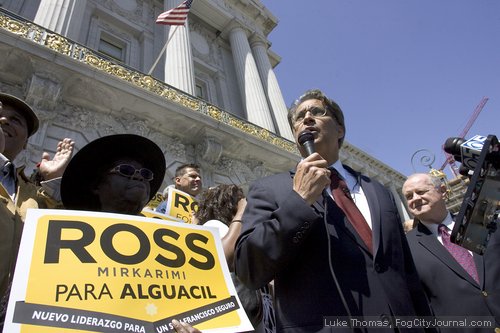
City Hall’s steps were awash in multi-lingual black and yellow “Ross Mirkarimi for Sherrif” signs at noon today, as Mirkarimi supporters watched Sheriff Mike Hennessey, who is stepping down after 31 years of service and eight elections, endorse Sup. Mirkarimi as the next sheriff.  “New Leadership for a Safe San Francisco” was printed on the English version of the signs that Mirkarimi’s supporters carried. They included former Mayor Art Agnos, Sups. David Campos and Eric Mar, Tim Paulson of the Labor Council, Debra Walker, Linda Richardson, Sharen Hewitt, Terry Anders, and Mirkarimi’s partner Eliana Lopez and their almost two-year old son Theo. And everyone had plenty of great things to say about outgoing sheriff Hennessey and sheriff candidate Mirkarimi. And Hennessey even pinned a shiny toy sheriff’s badge onto the T-shirt of Mirkarimi’s son Theo, making him the happiest kid in town. At least for the day.

Campos kicked off the event by honoring Hennessey as the “most progressive and most effective sheriff in the country.”
“Mike Hennessey is also my neighbor in District 9. I see him taking out the trash so I know he’s a good neighbor,” Campos joked, as he listed the many achievements in Hennessey’s long career as an elected official in San Francisco. These achievements included Hennessey’s pioneering innovations in criminal justice and culminated in his decision to blow the whistle in 2010 on the federal government’s plan to activate its controversial Secure Communities program in San Francisco—without telling the public.
“He’s not afraid to stand up for what’s right,” Campos said.

‘This is the time for me to move on,” Hennessey announced, as he laid out his reasons for endorsing Mirkarimi as Sheriff, over other candidates in the field.
Hennessey described the Sheriff’s Department as a “large enterprise” that has over 1,000 employees, a $150 million budget and whose jail houses an average population of 2,000 folks in custody, on a daily basis.
“It’s not something that can be handled lightly,” Hennessey said. “That’s why I’m here to endorse Ross Mirkarimi as the next sheriff.”

Hennessey listed the many endeavors that he and Mirkarimi have worked closely on, including a number of criminal justice issues, and he cited Mirkarimi’s extensive law enforcement background, his significant legislative accomplishments in the areas of criminal justice and public safety, and his ability to find innovative solutions and overcome obstacles to progress, as reasons to support Mirkarimi.

Hennessey observed that criminal justice is “one of the thornier issues” that members of the Board of Supervisors are often asked to get involved in, but often duck.”But Ross has not shied away from working on them,” Hennessey said, citing Mirkarimi’s involvement in shaping the “No Violence Alliance Project” and his leadership in creating the Safe Communities Re-entry Council.

Hennessey also noted that in face of AB 109, the Governor’s plan to transfer state inmates to county jails, “it’s vitally important to have person in charge of sheriff’s office that understands these alliances and can make them work more effectively.”

Hennessey concluded by observing that the Sherrif’s Department has to deal with a lot of bureaucracy, so it’s important to understand how the Board, the budget process and other city departments, including the District Attorney’s office and the police, work.
‘And that’s why I’m endorsing Ross as Sheriff,” Hennessey said

Then it was the turn of Mirkarimi, who graduated from the San Francisco Police Academy, did Naval Reserve training and worked for more than 8 years as an investigator for the District Attorney’s office, to speak.

“I have never been at a loss for words,” Mirkarimi acknowledged, as he launched into a speech that began by thanking everyone for showing up at short notice “for one of the most important occasions of my political career.”

Mirkarimi did a great job of giving Hennessey the praise he deserves.
“He is a living legend,” Mirkarimi said. “It’s completely impossible to fill his shoes.”
Citing Hennessey’s integrity and his ability to innovate, Mirkarimi warned that, “Maybe it’s come to the point where we have taken him for granted. He’s the longest serving elected official in the history of San Francisco, and he’s probably the most understated.”

“And the most important endorsement in this race is that of Mike Hennessey,” Mirkarimi added, as he gave Hennessey his commitment “to build upon your legacy as effectively as possible.”

Mirkarimi cited some of the most immediate and serious challenges that face the next sheriff. These include AB 109, which Gov. Jerry Brown just signed, which. Mirkarimi said, threatens to increase the reentry prisoner level by 30 percent in California. “It will take creative ingenuity and resources to make sure we are effective in taking care of this population,” he said.

Mirkarimi also touched on the rising number of veterans that are ending up in the prison system, talked more about the No Violence Alliance Project, and suggested that certified deputy sheriffs could help serve warrants, transfer prisoners, and patrol Muni, “when the police department finds itself understaffed” so as to ensure that San Francisco is safe.

“For every four people arrested and jailed in San Francisco, three out of four are repeat offenders in a three-year period,” Mirkarimi warned, by way of explaining why he wants to advance a more collaborative spirit between SPPD and the Sheriff’s department.

Mirkarimi also noted that one out of every 15 African American males are in jail, at any time in the year, compared to I out of 300 males who are not black or brown. “So, we must step up our game in dealing with poverty,” he said, as he recommended increased access to job training and good jobs, “so work doesn’t become a seasonal hope but a permanent job.” He also made the connections between a lack of good housing, childcare, and schools and a rise in poverty, crime and recidivism.

Mirkarimi concluded by crediting Hennessey for “walking that fine pirouette” between upholding the principles of public safety and understanding the power of redemption at the same time.

I asked Sheriff Mike Hennessey what he considers to be the biggest challenges of running for sheriff/
“Letting people know what you are going to do, and what your issues are,” Hennessey said, noting that San Francisco has an intelligent, issues-driven electorate.

And Mirkarimi’s supporters weren’t shy about letting folks know the issues that the current D5 Supervisor has helped them with, over the years.

“Ross, as a supervisor and me, as someone who comes from a community of color, we know the habits that ex-offenders can bring with them, if there are no safety nets,” said Terry Anders who sits with Mirkarimi on the Safe Communities Reentry Council. “And I believe in what Ross stands for and the integrity of his person. He’s one of the first people to show up when there are crimes and victims, and he attends basketball games and boxing matches.”

Paulette Brown, whose son Aubrey Abraska Jr, was murdered in August 2006, but whose killers have still not been brought to justice.
“We shouldn’t have to run and leave our families, we should be protected,” Brown said. “Ross is my district supervisor and if he can get in, and do something about crime and solve unsolved homicides, then I’m for him. Maybe if he gets in, he’ll have more pull to do something about these unresolved cases.”

And then it was back to work, which for Mirkarimi now includes the somewhat daunting task of trying to raise money in an election year that also includes a mayor’s race, but does not include the help of public financing, at least not for the sherrif’s race….

Mirkarimi running for sheriff

27

OPINION Serving as San Francisco Sheriff is a huge civic responsibility. The sheriff has 1,000 employees, more than 2,000 pretrial and sentenced prisoners daily, and management responsibility for a budget of more than $150 million. And, like all department heads, the sheriff’s involved in a lot of politics.

I believe Sup. Ross Mirkarimi is the person best prepared to serve as San Francisco’s next sheriff.

Mirkarimi has the law enforcement experience of graduating from the San Francisco Police Academy (as class president) and more than eight years of on-the-job experience as an investigator for the San Francisco District Attorney. He was the lead investigator in one of the city’s all-time biggest white collar crime cases, against Old Republic National Title Insurance Company.

As a union labor representative in the D.A.’s office, he picked up some significant experience negotiating contracts for public safety personnel under the CALPERS retirement system.

He’s no stranger to the training and discipline of a paramilitary institution, having been certified in advanced environmental crime forensics from the Federal Law Enforcement Training Center in Glynco, Ga., as well as earning an honorable discharge from the U.S. Navy for serving in the reserves.

Equally important, Mirkarimi has demonstrated the progressive values required to maintain and expand San Francisco’s outstanding track record of diversity in hiring, innovation in criminal justice, and commitment to rehabilitation San Francisco deserves in our next sheriff.

Elected supervisor in 2004, and reelected in 2008 with 77 percent of the vote, Mirkarimi has been a very effective advocate for his district and for San Francisco — especially on public safety issues.

As a member of the Budget Committee for five years and twice chair of the Public Safety Committee, he is intimately familiar with the complicated issues confronting all partners in San Francisco’s criminal justice system, whose combined budgets account for well over $1 billion.

Mirkairmi and I have worked together on many criminal justice issues, including the creation of San Francisco’s Reentry Council and an innovative community-based program that provides case management services to ex-offenders who have a history of violence. That program — the No Violence Alliance — has significantly reduced recidivism among the program’s participants. It was a risky venture to take on violent offenders as a case management study, but both Mirkarimi and I felt that it was time San Francisco expanded its approach toward effective reentry.

It is this type of thoughtful, yet courageous approach to our criminal justice challenges that leads me to endorse Ross Mirkarimi to be my successor.

The San Francisco Sheriff’s Department has many difficult challenges ahead: a diminishing budget; the governor’s “prison realignment,” which will put many state prisoners in the county jail; preserving the jail’s rehabilitation programs; and finding cost-effective ways of managing the 40,000 individuals who come through San Francisco’s jails each year.

I believe Ross Mirkarimi brings the right combination of law enforcement training, legislative experience, and political acumen to meet these challenges. I am proud to support him in his bid to become our next sheriff.

Mike Hennessey is sheriff of San Francisco.

Approve affordable housing — for youth

1

OPINION Booker T. Washington, born as a slave, risked his life to learn to read and write and went on to found Tuskegee University. At his core, he believed that economic independence and access to education were the keys to equality. He put it best when he said: “There are two ways of exerting one’s strength: one is pushing down, the other is pulling up.”

Since 1919, the Booker T. Washington Community Service Center has worked to lift up San Franciscans of every background, with a particular focus on the African American community. To continue that vision, the center is embarking on a capital project that will provide 50 units of affordable housing to youth and families, along with new athletic and educational space.

The most critical part of the project is providing housing for transitional-age youth. Many of these young people age out of foster care with no family support, few job skills, and no chance to rent a market-rate apartment in this expensive city. The project represents a real commitment to these youth, who are overwhelmingly people of color. With affordable housing funding under threat at the federal and state levels, it’s essential that shovel-ready projects get the green light from City Hall.

That is why we were thrilled when Sups. Ross Mirkarimi, Eric Mar, and Mark Farrell introduced the necessary legislation to allow this project to move forward. Joining hundreds of community leaders, countless families, and prominent African Americans, these supervisors lent their support for a project that continues the ongoing fight for economic justice.

It’s also why we are concerned that a few neighbors are using their influence to push down on the hopes of San Francisco’s youth. Some neighbors have asked that we add additional parking, even though the site is just a few blocks from Geary Boulevard and most low-income youth don’t have cars. Others have suggested that we cut nine units to make the building shorter, even though San Francisco’s housing needs are so acute. As is often the case in San Francisco, those who support progressive values need to speak up to ensure that we can overcome this campaign of misinformation and fear.

On April 28, the Planning Commission will consider whether to certify the environmental impact report for this project, and whether to approve it. We are hopeful that progressive voices speak out so we can provide hope and a future to youth in our community. As Booker T. often said: “Success is to be measured not so much by the position one has reached in life as by the obstacles one has overcome.” 

Julian Davis is president of the board and Patricia Scott is executive director of the Booker T. Washington Community Service Center, located at 800 Presidio Ave. The Planning Commission hearing is Thursday, April 28 at City Hall, Room 400.


Spies in blue

19

sarah@sfbg.com

San Francisco cops assigned to the FBI’s terrorism task force can ignore local police orders and California privacy laws to spy on people without any evidence of a crime.

That’s what a recently released memo appears to say — and it has sent shockwaves through the civil liberties community.

It also has members of the S.F. Police Commission asking why a carefully crafted set of rules on intelligence gathering, approved in the wake of police spy scandals in the 1990s, were bypassed without the knowledge or consent of the commission.

“It’s a bombshell,” said John Crew, a long-time police practices expert with the American Civil Liberties Union of Northern California.

The ACLU obtained the document April 4 under the California Public Records Act after a long battle. It’s a 2007 memorandum of understanding outlining the terms of an agreement between the city and the FBI for San Francisco’s participation in the Joint Terrorism Task Force.

And, according to Crew, it effectively puts local officers under the control of the FBI. “That means Police Commission policies do not apply,” Crew said. “It allows San Francisco police to circumvent local intelligence-gathering policies and follow more permissive federal rules.”

Veena Dubal, a staff attorney at the Asian Law Caucus, agreed: “This MOU confirms our worst fears,” she said.

Dubal noted that in the waning months of the Bush administration, the FBI changed its policies to allow federal authorities to collect intelligence on a person even if the subject is not suspected of a crime. The FBI is now allowed to spy on Americans who have done nothing wrong — and who may be engaged in activities protected by the First Amendment.

FBI activity under this new “assessment” category has since come under fire, and a recent report in The New York Times showed that the FBI has conducted thousands of assessments each month, and that these guidelines continue under Obama.

And if the feds do control San Francisco police policy, then the San Francisco cops could be spying on innocent people — a dramatic change from longstanding city policy. “The MOU is disturbing,” Police Commission member Petra DeJesus told the Guardian. “The department is assuring us that local policies are not being violated — but it looks as if it’s subject to interpretation.”

It’s the latest sign of a dangerous trend: San Francisco cops are working closely with the feds, often in ways that run counter to city policy.

And it raises a far-reaching question: With a district attorney who used to be police chief, a civilian commission that isn’t getting a straight story from the cops, and a climate of secrecy over San Francisco’s intimate relations with outside agencies, who is watching the cops?


SPIES LIKE US

San Francisco has a long — and ugly — history of police surveillance on political groups. SFPD officers spied on law-abiding organizations during the 1984 Democratic National Convention; kept files in the 1980s on 100 Bay Area civil, labor, and special interest groups; and carried out undercover surveillance of political groups focused on El Salvador and Central America.

Those abuses led the Police Commission to develop a departmental general order in 1990 known as DGO 8.10. The local intelligence guidelines require “articulable and reasonable suspicion” before SFPD officers are allowed to collect information on anyone.

Even those rules weren’t enough to halt the spies in blue. In 1993, police inspector Tom Gerard was caught spying on political groups — particularly Arab American and anti-apartheid organizations and groups Gerard described as “pinko” — and selling that information to agents for the Anti-Defamation League.

As the ACLU and Asian Law Caucus noted in a December 2010 letter to Cdr. Daniel Mahoney: “That scandal was not just about the fact that peaceful organizations and individuals were being unlawfully spied upon and their private information sold to foreign governments, but that the guidelines adopted in 1990 had never been fully implemented by SFPD. No officers had been trained on the new guidelines and no meaningful audit had ever been implemented.”

Over the years, the commission has tried to keep tabs on police intelligence and prevent more spy scandals. The general order mandates that local police officials have to request general authority from a commanding officer and the chief to investigate any activity that comes under First Amendment protections — and must specify in the request what the facts are that give rise to this suspicion of criminal activity. The order also states that the chief can’t approve any request that doesn’t include evidence of possible criminal activity.

Those requests are reviewed monthly by the Police Commission and there are annual audits of the SFPD files to monitor compliance — so the notion that the local cops are joining the FBI spy squad without commission oversight is more than a little disturbing.

Officials with the FBI and SFPD are doing their best to reassure the local community that there’s nothing to worry about. But so far their replies seem to duck questions about whether FBI guidelines trump local policies. For example, the MOU states that “when there is a conflict, [task force members] are held to the standard that provides the greatest organizational benefit.”

We asked Mahoney to clarify: does that mean the local cops could be held to the FBI’s standards?

“The San Francisco Police Officer(s) who are assigned to the Joint Terrorism Task Force always have and continue to be required to follow all SFPD’s policies and procedures,” Mahoney replied in a statement.

That’s confusing; do they follow SFPD policies, or obey the MOU?

We asked FBI special agent-in-charge Stephanie Douglas whether SFPD officers are involved in surveillance and “assessments” (that FBI code word for creating spy files on individuals and groups) and whether they are identifying as SFPD or FBI officers.

“The FBI only initiates investigations on allegations of criminal wrongdoing or threats to our national security,” Douglas replied April 21. “Our investigations are conducted in compliance with the Constitution, the laws of the United States, the Attorney General Guidelines, the Domestic Investigation and Operations Guide, and all other FBI policies.”

Okay, that’s typical FBI-speak. Here’s more: “The JTTF is a task force comprised of FBI special agents, agents from other federal agencies, and local police officers who have been officially deputized as federal task force officers (TFOs) who have the power and authority of a federal agent. Because all JTTF TFOs are actually de facto federal agents, they are required to operate under federal laws and policies when involved in a JTTF case.”

So the cops are actually feds. But wait: “Our standard JTTF MOU recognizes, however, that the JTTF TFOs do wear two hats, as it were, and directs JTTF TFOs to follow his or her own agency’s policy when it is stricter than the FBI policy under certain circumstances,” Douglas concluded.

Again: not exactly clear, and not exactly reassuring.

“At some point they need to say whether SFPD officers are engaged in assessments,” Crew said.

These questions have spurred the Police Commission and Human Rights Commission to schedule a joint hearing in May to discuss what the document means, why SFPD never alerted the civilian oversight authorities, and whether a clarifying addendum can be tacked onto the agreement.


SPY FOR US OR LEAVE

The concerns are likely to be intensified by recent developments in Portland, Ore.

Portland dropped out of the Joint Terrorism Task Force in 2005 over concerns that local cops would be violating privacy laws. But in November 2010, the FBI thwarted a bomb plot allegedly linked to terrorists, and city officials came under pressure to rejoin the JTTF.

But Mayor Sam Adams has insisted on language that would bar local cops from doing surveillance and assessments, which, apparently, won’t fly with the feds.

On April 20, Willamette Week, the Portland alternative paper, wrote that Adams “effectively scuttled” Portland’s reentry into its local JTTF because of his anti-spying language.

In an April 19 letter to Adams, U.S. Attorney for Oregon Dwight Holton stated that Adams’ proposal of only allowing officers with the Portland Police Bureau to be involved in investigations and not in FBI assessments was a deal-breaker.

“Unfortunately, as currently drafted, the proposed resolution does not provide a way in which the PPB can rejoin the team,” Holton wrote. “There is a single provision that stands as a roadblock to participation — specifically the provision that seeks to have the City Council delineate only certain investigative steps a task force officer can take part in. Specifically, the resolution seeks to dictate for the JTTF which stages of an investigation task force officers from the [Portland police] can work on.”

“Investigation and prevention of complex crimes and terrorism are typically fluid and fast-moving,” he added. “It makes no sense to ask [Portland police] officers to be in for one part of a conversation, but out for another part of the same conversation as investigators discuss findings from assessments, investigations, etc. in evaluating and addressing terrorist threats in Portland and beyond.”

The message isn’t lost on San Francisco civil liberties activists. If you don’t let your cops join the spy squad, they can’t be a part of the task force.

“It was one thing to join the JTTF 10 years ago when they were operating under guidelines that, while not to the ALCU’s taste, were at least tied to some level of suspicion,” Adams said. “But they have taken their procedures and guidelines and moved them to the far right. It’s one thing to say that it’s necessary for the FBI to do that, and quite another to say that local agencies have to forfeit their own policies — and with no public debate or decision-making.”


ASK THE FEDS FIRST

Further complicating the question of police oversight is the fact that George Gascón, who was police chief when civil liberties groups started asking for a copy of the MOU last fall, refused to turn over the document without asking the feds first.

In a Jan. 4 letter to the ACLU and ALC, Gascón and Mahoney stated that the SFPD could not speak to information about the duties, functions, and numbers of officers assigned to the Joint Terrorism Task Force “without conferring with our partners in the Federal Bureau of Investigation.”

“I am sure you can appreciate the delicate balance we hold in crafting policy that not only supports our mission in the ultimate protection of life, but also in advancing democratic values through collaboration with the communities we serve,” Gascón and Mahoney wrote.

And Gascón is now district attorney.

“It raises the question of accountability,” said Public Defender Jeff Adachi “We want to make sure that police officers working in the city, regardless of whether it be for the feds or the SFPD, are complying with general orders and policies established by the department. But when officers go on an assignment with the feds, we don’t know if they are operating under parameters set by local law.”

Unearthing the FBI’s hitherto clandestine MOU with the SFPD appears to be yet another sign that local police are increasingly being subjected to federal policies not in keeping with local procedures.

As the Guardian previously reported, the 2008 decimation of San Francisco’s sanctuary city legislation and the 2010 activation of the federal government’s controversial Secure Communities program, which both happened during former Mayor Gavin Newsom’s tenure, means that the city of St. Francis now ranks among the top 38 counties nationwide that are deporting “noncriminal aliens.”

Dubal also noted that the FBI came to the SFPD in 1996 asking for help with the task force, but also sought a waiver from the Police Commission so officers could participate without having to follow local rules. “And within two weeks, then Mayor Willie Brown said, not in our town,” Dubal said. “So in 1997, the SFPD said we are not going to join unless we can follow our own rules. And in 2001, when the SFPD joined, it was under an MOU that required them to comply with SFPD rules and was signed in 2002 by then-SFPD Chief [Earl] Saunders.”

Dubal said that after local law enforcement agencies sign an MOU with the FBI, they designate and assign officers to work from FBI headquarters. “In the past, two SFPD officers, paid with San Francisco tax dollars, physically worked in the FBI’s office in a secure room where you can only go if you have security clearance. But they still can’t spy without reasonable suspicion, and they also need audits.”

Crew and Dubal said that in a recent meeting, SFPD officials assured them that local police were following General Order 8.10, but that they are open to creating an MOU addendum to clarify this.

Crew and Dubal remain unsure if the FBI would be agreeable to signing off on that. They note that the FBI has previously stated that its JTTF has sensitive investigations going on so it can’t give the public all the information. “Fine, but the issue is, Are these investigations based on suspicion, or are they based on religious background, associations, ethnicity, and travel patterns?” Dubal said.

They also doubt that the MOU would even have surfaced if not for comments that then SFPD Chief Gascón made, first in October 2009, then in March 2010, that triggered an uproar in the local Muslim, Arab, and Pakistani and Afghani communities.

At the time, Gascón, who has a law degree and graduated from the FBI Academy, had just landed in San Francisco fresh from a stint as police chief for Meza, Ariz., where he drew praise for speaking out against Maricopa County Sheriff Joe Arpaio’s inhumane treatment of undocumented immigrants Given this seemingly progressive stance, Gascón shocked civil libertarians in San Francisco when he said he wanted to unearth SFPD’s intelligence unit, which was disbanded amid scandal in the early 1990s.

“We have to realize that in the post-9/11 world, San Francisco is an iconic city, like New York, Washington. and Los Angeles,” Gascón said. “If somebody wanted to make a big statement about something they disliked about America, doing it here would definitely get attention. We need to know what is going on under the surface of the city.”

But Gascón did not say how a revived police spy unit, which had been shut down in large part due to Crew’s work, would operate. And six months later, he upset Bay Area Muslims during a March 2010 breakfast by reportedly saying that the Hall of Justice building was not just susceptible to earthquakes, but also to an attack by members of the city’s Middle Eastern community who could park a van in front of it and blow it up.

Gascón subsequently claimed that he “never referred to Middle Easterners or Arab Americans,” but that he had instead singled out the Afghanistan and Yemen communities because they pose “potential terrorism risks”

“In light of Gascón’s comments and his desire to resurrect the intelligence unit, people were asking, ‘Is it possible that the SFPD is also doing the same thing?'” Dubal asked, noting that she started getting complaints in 2009 and throughout 2010 about the FBI.

“Folks were saying that the FBI was asking about their religious identity, their family situation, and their political activities,” she recalled. “I certainly saw an upswing in innocent people being contacted. People were saying, ‘What the hell? — the FBI knocked on my door at 5 a.m.'”


COMMUNITIES UNDER SIEGE

A 2011 Human Rights Commission report documents frequent complaints from Arab, Muslim, and South Asian communities facing racial and religious profiling while traveling and unwaraanted interrogation, surveillance, and infiltration by local and federal law enforcement personnel at their homes, places of worship, and workplaces.

The report recommended asking the supervisors and the Police Commission to “ensure that all SFPD officers, including those deputized to the Joint Terrorism Task Force, follow and comply with local and state privacy laws, including DGO 8.10.”

On April 5, the Board of Supervisors voted 10-0 to approve a resolution, sponsored by Sup. Ross Mirkarimi and cosponsored by Sups David Chiu, Eric Mar, David Campos, and John Avalos, to endorse the HRC report.

All this is happening against the backdrop of FBI guidelines that have been loosened twice since September 2011, first by U.S. Attorney General John Ashcroft in the wake of the 9/11 terrorist attacks, then by Attorney General Michael Mukasey in the dying days of the Bush administration, and now by the Obama administration.

And as The New York Times reported in March, records obtained through a Freedom of Information Act request show that between Dec. 2008 and March 2009, the FBI began 11,667 assessments of people and groups for criminal/terror links, completed 8,605 assessments, and launched more than 400 intensive investigations based on the assessments. The FBI also told the Times that agents continue to open assessments at about the same pace

Crew noted that Mukasey’s guidelines marked the first time since 1976 that the FBI has been allowed to do assessments and collect files without a suspicion that a crime has occurred.

Dubal observed that the most relevant documents to emerge from a recent FOIA request to determine if the FBI has engaged in disturbing intelligence gathering activities are those related to “geomapping.”

“The materials are not particular to Northern California, but they show how FBI maps communities based in ethnic concentrations,” Dubal said.

Dubal also pointed to the case of Yasir Afifi, an Egyptian American student from Santa Clara, who found an FBI tracking device on his car when he took it in for an oil change. In March 2011, CAIR filed suit in Washington, D.C., alleging that the FBI violated Afifi’s First, Fourth, and Fifth Amendment rights by failing to obtain a warrant.

DeJesus recently told the Guardian that the Police Commission was never made aware of the MOU’s existence. “The chief should have checked in with the commission president, at the very least,” she said. “The idea that they were not reporting this to anyone is disconcerting.”

“The SFPD does not have the authority to enter into a secret agreement with the FBI whereby some of its officers are allowed to conduct intelligence operations in violation of the Police Commission’s General Order 8.10,” Crew added.

In a Jan. 25 letter to Mahoney, representatives from the ACLU and the ALC noted that “in the past, the SFPD had not previously deferred to the FBI on whether or how to openly address how San Francisco police officers will be supervised and held to well-established and painstakingly and collaboratively crafted San Francisco general orders.”

“These are low-level investigations that require no criminal predicate, meaning that when initiating an assessment, FBI agents can conduct intrusive forms of investigation without any criminal suspicion,” Dubal said. “These include interviewing innocent Americans, infiltrating organizations, using open source data to spy and surveil, going into religious centers such as mosques to spy and surveil, and recruiting and using informants.”




Supes vote on Botanical Garden fees

The Board of Supervisors voted on April 12 to keep in place nonresident fees at the San Francisco Botanical Garden for at least another two years, rejecting a proposal by Sup. John Avalos to do away with the fees and make up for the shortfall with a portion of revenues brought in by a real-estate transfer tax that was approved by voters last year.

Advocating for his position, Avalos stood to tell a story about his last visit to the Botanical Garden. “A couple months ago, I was able to go there with my kids,” he began. “I went in, I was asked for my ID, I showed my ID. I noticed the next person who came in after me looked very agitated when she got to the gate. She said the F-word very loud, and she started to walk away. I approached her, and I said, ‘hey what’s going on?’ And she said, ‘I come here everyday, and I’m being asked for my ID, and I have to go back to my house to get it because I don’t have it with me today.'”

She wasn’t the only person who seemed disgruntled by the gatekeeper that day. “On my way out, I noticed a few tourists coming up,” Avalos continued. “It looked like they were from Germany. They walked up to the gate and then they walked back away from the gate. They clearly did not go in because they did not want to pay the fee.” A couple in their 60s tried to enter, but they did not go in because they didn’t have their IDs proving that they lived in San Francisco, he added.

Bottom line: “The gate and the fee has really diminished what people’s enjoyment of the park has been like for decades,” he said. “Can’t there just be one fee that we don’t raise? Can this be that one fee? I don’t think that’s asking too much.” He also noted that budget analyst’s report showed that the fees did not bring in the revenue that had been anticipated, a point echoed by Sups. Ross Mirkarimi and David Campos.

Yet Avalos’ pitch wasn’t enough to persuade his colleagues. On the question of whether money from the real-estate transfer tax revenues should be used to make up for the nonresident fees so that the Botanical Garden could be free for everyone, supervisors said no on a 7-4 vote, with Sups. Eric Mar, Mirkarimi, Campos, and Avalos voting yes.

The board also voted on whether the nonresident admission fees should be extended beyond June 30, 2011 (a date set when the fee was initially imposed), as proposed by Mayor Ed Lee. Board President David Chiu offered an amendment that the fees would only remain in place for two years, after which point the debate could be rehashed. The amendment was adopted, and the mayor’s proposal passed on a 6-5 vote, with Sups. Jane Kim, Mar, Mirkarimi, Avalos, and Campos voting no.

So, that’s how it went down at the board. If you’re a nonresident, the Botanical Garden still isn’t free.

Since Kim and Avalos both shared their accounts of visiting the Botanical Garden, I thought I’d share my own photos and impressions from a visit on a recent afternoon, when I had several hours to myself to explore Golden Gate Park’s haven of greenery. Admission was free, since I’d planned ahead to bring my ID.

The day was sunny and warm, and I spent a long time photographing the light streaming through a cluster of bamboo and sitting by a pond watching some water bugs skip around on the surface. It was a welcome escape from city life with an element of educational value, since all the plants are labeled with plaques identifying their Latin names, common names, and places of origin.

I noticed two people sitting wordlessly together in the sun. The woman, who seemed to be a caregiver, was seated on a bench, and beside her was an elderly man in a wheelchair with a blanket over his lap. The man seemed to be very frail. Yet he wore a serene expression, and was clearly enjoying the calm and quiet afternoon.

I don’t know if they paid to get in or not. As Board President David Chiu noted at the meeting before voting in favor of keeping the fee in place, “We don’t live in a perfect world.” You can argue about the privatization of parks, or about the need to find all possible sources of revenue in order to fend off cuts to city-funded services. Nevertheless, it’s sad to think of the folks who would be barred from the simple pleasure of sitting in the sun surrounded by natural beauty, because they can’t afford to pay.

Seeking a watchdog’s watchdog

1

rebeccab@sfbg.com

When cash pumps through the guts of city politics, the Ethics Commission is charged with keeping track of it all to help members of the public follow the money. But what happens when the public loses faith in the ethics of the Ethics Commission?

In the run-up to a hotly contested mayoral race, in a city marked by rough-and-tumble politics influenced by moneyed power brokers, the function of this local-government watchdog agency is especially critical — and to hear some critics tell it, the Ethics Commission needs reform if it is to perform as an effective safeguard against corruption.

So it was hardly surprising that an April 5 discussion at the San Francisco Board of Supervisors meeting about whom to appoint to the Ethics Commission featured a low-level tug-of-war with some potentially high-level implications.

Sup. Eric Mar proposed that the board consider Allen Grossman for the seat. An octogenarian government watchdog unaffiliated with any political party, Grossman has gone so far as to file a successful lawsuit against the Ethics Commission for not following its own public-disclosure rules. As a potential appointee, he was widely viewed as reform-minded, following in the footsteps of others who have been purged from the body in recent years.

“Open government and good government work together, hand in hand,” Grossman told members of the board’s Rules Committee several weeks prior, interlacing his fingers for emphasis.

Grossman won the backing of Sups. John Avalos and Ross Mirkarimi. But Board President David Chiu spoke against the idea, throwing his support instead behind Dorothy Liu, an attorney and professional colleague of his through the Asian American Bar Association. The Rules Committee, chaired by Sup. Jane Kim and filled out by Sups. Sean Elsbernd and Mark Farrell, also turned down Grossman in favor of Liu.

“She’s extremely hard-working and does her homework,” Chiu later told the Guardian. He also saw it as a plus that Liu was not a political insider: “I think we need an individual on the Ethics Commission who will be impartial,” he said, adding that he’d prefer “someone who has not been involved in the rough-and-tumble of San Francisco politics.” Sup. Carmen Chu echoed Chiu’s comments during the meeting, saying she thought Liu would be an ideal candidate because she did not seem to have an agenda.

Mirkarimi and Avalos, on the other hand, said they were looking for a candidate who did possess a vision for strengthening the role of the agency as a watchdog. “I think our Ethics Commission and the department, as it stands, needs all the help it can get,” Mirkarimi said during the meeting. “I think having people who are well-seasoned with an understanding in the law of ethics and sunshine is something we should be looking for. Mr. Grossman has exhibited that well over the years in trying to do everything he possibly can to advance the cause in a nonpartisan way of making sure that we have a very strong Ethics Commission.”

Mar’s motion to consider Grossman was shot down on an 8-3 vote with Mirkarimi, Mar, and Avalos dissenting; Liu then won the commission appointment on a 10-1 vote, with Avalos dissenting.

Until recently, the Board of Supervisors seat on the Ethics Commission was held by Eileen Hansen, a progressive who had called for political reform under Mayor Willie Brown’s administration prior to being named to the post. When she was being considered for the commission, Hansen recalled, then-Sup. Michela Alioto-Pier raised an objection. “[She] thought the perfect person would be somebody who … would come essentially as a clean slate,” Hansen remembered. “Because I had been involved in organizing campaigns and had run for office, that was deemed too political.”

Yet Hansen viewed her familiarity with the system as an asset that helped her serve as an effective watchdog against corruption. During her six-year tenure, Hansen often cast lone dissenting votes against decisions she believed were weakening ethical standards. She told the Guardian she’d tried floating remedies for situations she viewed as inappropriate, only to have them summarily ignored, a role similar to that of former Ethics Commission member and staffer Joe Lynn.

In one case, Hansen recalled, she became concerned about a planning commissioner who also directed a nonprofit. To raise money, her organization held fundraisers that were ostensibly attended and funded by the very same developers and lobbyists who appeared before her at the Planning Commission. Yet Hansen said she was unable to persuade the other commissioners or staff to call for an investigation.

A more recent Ethics Commission vote underscores the same tension. On March 14, the commission voted unanimously to waive a pair of ethics regulations to allow a mayoral staff member to become executive director of the America’s Cup Organizing Committee (ACOC). Composed of highly influential business figures including at least two billionaire investors, ACOC is tasked with securing corporate donations for the America’s Cup to offset city costs of hosting the race.

Kyri McClellan, project manager with the Mayor’s Office of Economic and Workforce Development, helped craft a memorandum of understanding with ACOC regarding its fundraising obligations to the city. In her new job, without skipping a beat, she’ll interface with the city on behalf of ACOC. The rules that were waived for her benefit are meant to prevent city officials from holding undue influence over their former coworkers after leaving public service, and to prevent city staffers from accepting money from city contractors right after departing from city employment.

“If I had been there, there would have been at least one vote against that waiver,” said Hansen, whose term on the commission ended before this vote. “We have this law in place for a reason. By continuing to provide waivers … we create a situation where the public will not trust the Ethics Commission as a watchdog.”

Hansen said she was scouting for a new commissioner who would carry on with her work. “I was looking for and trying to recruit a visionary — someone who could really be a reformer,” she said. “We’re almost in a position now where we need a watchdog over the watchdog.” She said she saw Grossman as the right fit.

Other observers, such as CitiReport blogger Larry Bush — an investigative reporter who called for the creation of the Ethics Commission in San Francisco in the early 1990s — questioned whether Liu was the best choice after hearing her statements at the March 17 Rules Committee hearing. Liu did not come out strongly in favor of televising Ethics Commission meetings, which has long been a sticking point for open-government advocates.

“I absolutely support televising the Ethics Commission, I think it’s really important,” Kim noted when we asked her about this. She added that she would have supported Oliver Luby — a former Ethics Commission staff member and whistleblower who was ultimately ousted from the job — if he’d applied.

Kim noted that an initial concern she’d had in seeking an ethics commissioner was whether the person would vote to allow Mayor Lee to resume his job as city administrator after serving out his term as interim mayor, a key decision that the commission was scheduled to consider April 11.

Once she was advised that it would be inappropriate to ask which way they would vote when conducting candidate interviews, Kim said she withheld her question — and still didn’t know Liu’s or Grossman’s position at the time she spoke with the Guardian. “I think it’s very appropriate for him to get his job back,” Kim noted. “That vote is very important to me.”

That vote drew closer scrutiny, however, after Ethics Commission staff recommended that the exemption that would be built into the law for Lee’s benefit should be expanded to include appointed members of the Board of Supervisors. “This new proposal would convert a targeted, narrow exemption to deal with a special case into the ‘Politician Job Protection Act’ and could open the door to all kinds of unintended consequences,” charged Jon Golinger of San Franciscans for Clean Government.

Meanwhile, Luby seemed disheartened by the board’s selection of Liu for the Ethics Commission. He was looking to Grossman to fill Hansen’s shoes as the commission’s reformer — a role previously held by Lynn, Luby’s good friend and mentor who died last year.

He lamented, “This will mark the first time in over 10 years to have an Ethics Commission without someone who has past experience advocating for good government.” 


Jane Kim’s credibility problem

96

(UPDATED AND CLARIFIED ON 4/7 BELOW) Two weeks ago, when Sup. Jane Kim voted to move the Twitter/mid-Market/Tenderloin tax exclusion zone forward before Twitter had agreed to a community benefits agreement (CBA), over the objections of Sup. Ross Mirkarimi and other opponents of the legislation who wanted a chance to review the CBA, she announced at the Budget & Finance Subcommittee meeting that she would delay the vote if the CBA wasn’t approved by the day before the hearing.

Today, the full board is scheduled to consider approving the legislation and Twitter has not yet agreed to a CBA, which is the only thing the city gets in return for giving the company a $57 million tax break. So, during a rally this morning at City Hall against the CPMC project, I asked Kim whether she would keep her word and delay the legislation.

No, she said, they will be voting today to approve it and then they’ll approve the CBA later as trailing legislation. When I pointed out that she was going back on her word and reminded her of the comments she made publicly two weeks ago, she said, “Well, the community understands and wants us to move this forward.”

What community, I asked, noting that much of the community opposes the legislation. She said, “SOMCAN is OK with this,” referring to the South of Market Community Action Network, whose members were perhaps the most vociferous opponents of the legislation at that March 23 committee hearing, their members uniformly asking that the legislation be delayed until after a CBA is approved by Twitter and subjected to community input.

After that conversation, a SOMCAN member who overheard the exchange confirmed that the organization continues to oppose the legislation, although City Hall sources tell us that Kim’s office has assured the group that it will get money out of the final CBA. It is illegal for supervisors to direct funding to specific groups in such agreements, which are negotiated by the Office of Economic and Workforce Development, as Deputy City Attorney Cheryl Adams testified at the March 23 hearing.

UPDATE AND CLARIFICATION: Kim legisiative aide Matias Mormino and SOMCAN organizational director Angelica Cabande strongly deny the organization was promised financial compensation from the Twitter CBA, saying the only assurance the organization was given was Kim’s pledge to create legislation designed to prevent the displacement that SOMCAN fears this legislation will create. Cabande also told us, ” The CBA will keep the corporation accountable to our neighborhood and residents’ concerns by specifically defining how Twitter’s presence will benefit the surrounding low-income communities.” 

Kim has made several statements about this legislation that weren’t true or were contradicted by the testimony of City Economist Ted Egan, as we’ve reported. Previously, she has also lied to others about statements I’ve made in conversations with her and about whether she’s ever met privately with Willie Brown, who supported her supervisorial campaign with an independent expenditure mailer that was illegally created in her campaign manager’s office.

Kim’s sponsorship of this tax break legislation comes despite the fact that she’s said she generally opposes such supply-side economic schemes. In his economic analysis of the legislation, Egan recommended doing a parcel tax on vacant commercial property as a better way to address vacant storefronts in mid-Market, the problem that Kim and others have claimed that this legislation is about.

I asked her about that recommendation during the March 16 committee hearing and she said that she strongly supports the proposal and that she has directed her staff to work on it. Is she going to keep her word and follow through on that pledge? I’ll believe it when I see it.

5 Things: March 24, 2011

0

>>BEES ARE BACK IN TOWN On March 24, Hayes Valley Farm welcomes back the bees. Hives previously kept at the urban farm were wiped out by a mysterious pesticide sabotage, but head beekeeper Karen Peteros, co-founder of San Francisco Bee-Cause, has stayed busy bringing the pollinators back. Tonight’s oddly matched Return of the Bees event at the Korean American Community Center will feature a discussion about the new hives, as well as a meet-and-greet with San Francisco Sups. Jane Kim (D-6) and Scott Wiener (D-8) and Ross Mirkarimi (D-5). Catching the buzz of urban farming politics? Become a budding apiarist by signing up for an urban beekeeping workshop.

>>A NEW KIND OF NINJA  A recent New York Times editorial by 24-year-old Matthew Klein started out by drawing a parallel between Western youth and those young people in the Arab world who keep fomenting uprisings. “We all enjoy speculating about which Arab regime will be toppled next, but maybe we should  be looking closer to home. High unemployment? Check. Out-of-touch elites? Check. Frustrated young people?” he wrote. “About one-fourth of Egyptian workers under 25 are unemployed, a statistic that is often cited as a reason for the revolution there. In the United States, the Bureau of Labor Statistics reported in January an official unemployment rate of 21 percent for workers ages 16 to 24.” What all these unemployed young’uns do with all their free time? Apparently, they re-imagine themselves as ninjas on YouTube.

>>GENDER MYSTIC Didik Nini Thowok, a popular dancer, choreographer and comedian from Indonesia, will be in San Francisco April 21 through 24. According to a post on the Asian Art Museum website, “Didik is one of the few remaining Indonesian dancers today who explores transgender culture and its historical connection with mystical practices in Indonesia.” Didik will give a short talk about his creative process and a dance performance, followed by audience Q&A, on Saturday, April 23 at the Asian Art Museum. The talk is free with museum admission. 

You know your spring closet is begging for this Dry Bones “Hep Cat” button-down from Self Edge. Buy it Saturday AND help out communities in Japan? Me-yow. 

>>LAND OF THE RISING CREDIT CARD BILL Bust out those pocketbooks, cause it’s time to lend a hand across the Pacific. Local retailers like Valencia Corridor holder-downers Five and Diamond, Self Edge, and The Summit are among those participating in Saturday’s worldwide Shop For Japan event. So open up that studded hand-tooled leather clutch, dive into the pocket of your artisan Japanese jeans, indulge your soy mocha addiction — whatever, just do it to it, moneybags.

>>UGLY DOG, PRETTY CAUSE Can’t hardly wait for this summer’s Petaluma Sonoma-Marin Fair ugliest dog contest? The O.G. ugly dog pagaent has spawned its share of imitation events and Associated Press kowtows, and now there’s a kooky little documentary about the bonkers owners that parade their boxers with underbites and Chinese crested with… well, the typical Chinese crested attributes, with a little extra wartage and askew tounge thrown into the mix. Assuage your barely contained anticipation with tonight’s Worst in Show screening in Berkeley. Bonus: half of your ticket price goes to help out East Bay furry friends! That’s enough to make us wanna grab some fuzzy hips and f’in conga:

Unregistered lobbyist

0

tredmond@sfbg.com

In 2007 and 2008, Pacific Gas and Electric Co. paid former Mayor Willie Brown a total of $480,000 for consulting work. Since Brown has never been utility lawyer, it’s almost certain that money has bought political advice and access.

Brown is also working for the owners of the Fairmont Hotel, which wants to tear down one of its towers and build as many as 180 luxury condos.

His public affairs institute shares office space with one of the most powerful lobbying firms in town. He meets with or talks regularly with the mayor and members of the Board of Supervisors.

Yet unlike dozens of others who seek to influence public policy for hire, Brown is not registered as a lobbyist at City Hall.

On the surface, it’s a fairly modest issue — all Brown would have to do to comply with the letter and spirit of the city’s law is to fill out a form, list his clients, and reveal which officials he’s been talking to. It would take him 10 minutes.

But the fact that someone who is widely acknowledged to be among the most influential power brokers in San Francisco refuses to disclose whom he’s working for leaves city officials and the public in the dark — and raises a long list of questions about the effectiveness of the city’s ethics laws.

There’s a reason city law requires people who seek to influence city officials for money to disclose what they’re up to. When elected officials, commissioners, or department heads meet with advocates, they need to know who’s paying the bills. If, for example, Sup. Jane Kim has breakfast with Brown (which Brown himself reported on in a recent column in the San Francisco Chronicle), she needs to know: Does he have a client with an agenda? If he asks her to meet with someone, is he just looking out for the interests of the city — or is he pushing a paid special interest?

When Brown has dinner with Mayor Ed Lee (as he did several weeks ago) the voters need to know: Is this dinner companion pushing the mayor to make policy decisions that might help a private interest?


THE RULES

The definition of “lobbyist” in city law is designed to avoid putting special requirements on advocates who push issues on their own or for purely political reasons. A neighborhood activist pushing for a stop sign or better police patrols doesn’t have to register. Neither does a restaurant owner looking for a permit to put tables on the street. The only people who have to register are those who represent a client who pays them more than $3,000 in any given three-month period.

Lawyers are exempt if they’re contacting city officials purely about specific pending litigation or claims. Labor leaders are exempt if they’re talking about wages or benefits for their union members.

The requirements aren’t onerous. Lobbyists simply disclose their clients, the issues they’re working on, the city officials they have contacted, and any campaign contributions they’ve made.

There’s no doubt Brown meets the financial threshold in at least one instance. Documents on file with the state Public Utilities Commission show that PG&E paid him $280,000 in 2007 and almost $200,000 in 2008. And although Brown is a lawyer, there’s no indication that he is representing PG&E in any litigation against the city.

On the other hand, PG&E is fighting hard to derail the city’s community choice aggregation program. Is Brown part of that effort? There’s no way to know.

It’s clear he talks to local officials regularly. Most members of the Board of Supervisors we contacted said they had talked to Brown at some point in the past year. “He called me to ask how he could help with the local hire legislation,” Sup. John Avalos told us. “I told him he could call (then-Sup.) Bevan Dufty. He said he would, but I don’t know if it ever happened.” Sup. Sean Elsbernd told us he speaks to Brown about “the state of local political dynamics,” but said he can’t remember being lobbied on any particular issue.

Insiders say that’s typical — Brown rarely lets anyone know exactly what his interests are. “The talent of Willie is his ability to create plausible deniability,” one city official, who asked not to be named, told us.

But when Brown is involved, things have a funny way of happening. Take the Fairmont Hotel.


FRONT OF THE LINE

The Fairmont’s owners, who include the Saudi royal family and a group of American investors, want to tear down one of the hotel’s towers, eliminate several hundred hotel rooms, and replace them with high-end condominiums. That requires a city permit — legislation by former Sup. Aaron Peskin limits the number of hotel rooms that can be converted to condos and requires applicants to submit to a lottery for the right to convert.

The Fairmont applied for a permit in 2009, and won tentative approval. But in October 2010, the Planning Commission refused to certify the project’s environmental impact report. With no valid EIR, the permits expired, meaning the hotel would have to go back and reenter the lottery, with no guarantee of success.

So the Fairmont owners are seeking special legislation that would allow them to submit a new EIR without going to the back of the line — in essence, an exemption from the lottery. So far there’s no champion on the Board of Supervisors, and the hotel workers union has been dubious about the project, fearing it will cost union jobs in the long run.

But early in March, Mayor Lee quietly submitted his own legislation to the board, offering the Fairmont everything the owners want.

Who’s working for the owners? Willie Brown.

Bill Oberndorf, part of the local ownership group, told us Brown was an “advisor” to the project. “Nobody in the city has more knowledge about how to get things done than Mayor Brown,” he said.

So did Brown talk to Lee before the mayor introduced his Fairmont bill? And isn’t that a valid question? At press time, Lee’s office hadn’t responded to my questions. But if Brown was a registered lobbyist, he’d have to report that information.

Who else are Brown’s clients? Since he doesn’t register, there’s no list. But there are some clues.

For example, the headquarters of the Willie Brown Institute is situated at One Market Plaza, Suite 2250. That’s the same address as Platinum Advisors, the high-powered lobbying firm founded by Darius Anderson. Among the firm’s clients: AECOM, the engineering and construction giant, which has a $147 million contract on the Chinatown subway project; PG&E; and Sutter Health, which wants to build a $1 billion hospital on Van Ness Avenue.

Others who lobby regularly at City Hall don’t always register. Rob Black, who works for the Chamber of Commerce, is a constant presence.

Black told us the chamber used to be considered a “registered lobby entity” that was required to report all contacts with public officials and the issue involved. But the Board of Supervisors changed that law last year, requiring lobbyist registration only from individuals who are paid at least $3,000 per quarter for lobbying. Furthermore, the definition of lobbying doesn’t include attending or speaking at public hearings or writing letters. So while the SF Chamber’s Black, Steve Falk, and Jim Lazarus all lobby city officials, Black said, none have exceeded that threshold. “If we hit the monetary threshold, we’ll start filing individually,” he said.

The fact that Brown is a lawyer doesn’t excuse him from registering, said Ethics Commission director John St. Croix “If someone is paid specifically to lobby government, they should register,” St. Croix said.

Sup. Ross Mirkarimi told us that the city needs to take a look at the lobbyist registration law to make sure that everyone who has private interests is properly registered.

Elsbernd said that others — particularly labor leaders and union staffers — also regularly lobby but don’t register. And while the law may allow them to skate underneath (like Black), there’s a huge difference between, say, Labor Council Executive Director Tim Paulson appearing at City Hall and Brown meeting with city officials.

When Paulson appears, there’s no doubt in anyone’s mind whom he represents. The same could be said of Black. Although the chamber has many members, it’s clear that he’s pushing the interests of the big-business community.

On the other hand, Ken Cleaveland, public affairs director of the Building Owners and Managers Association, is duly registered with the Ethics Commission.

Brown — as is his typical practice — didn’t return my calls seeking comment. But by flouting the rules, he’s able to operate completely behind the scenes, influencing policy decisions in secrecy, with no accountability whatsoever. That’s a violation of the exact reason the lobbyist registration laws exist.