Rent

The two defining votes of 2012

38

The Board of Supervisors will be facing two votes in the next couple of months that will define this board, establish the extent of the mayor’s political clout — and potentially play a decisive role in the political futures of several board members.

Oh: They’ll also have a lasting impact on the future of this city.

I’m talking about 8 Washington and CPMC — one of them the most important vote on housing policy to come along in years, the other a profound decision that will change the face of the city and alter the health-care infrastructure for decades to come.

Both projects have cleared the Planning Commission, as expected. Neither can go forward without approval from a majority of the supervisors. And there will be intense downtown lobbying on both of them.

The 8 Washington project would create what developer Simon Snellgrove calls the most expensive condos ever built in San Francisco. A piece of waterfront property would become a gated community for the very, very rich, many of whom won’t even live here most of the time. If it’s approved, the economy won’t collapse, neighborhoods won’t be destroyed — but it will make a powerful statement about the city’s housing policy. The message: We build housing for the 1 percent. We are a city that caters only to one very tiny group of people. We are willing to let the needs of the few drive our policy over the needs of the many.

Face it: There is no shortage of housing for the people who will buy Snellgrove’s condos. There’s a severe shortage of housing for most of the people who actually work in San Francisco. And the city’s housing policy is so scewed up that it’s making things worse. That’s the message of 8 Washington.

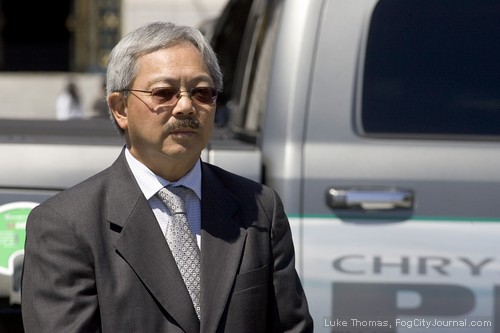
Then there’s CPMC. California Pacific Medical Center wants to put a snazzy state-of-the art new medical center on Van Ness, which is all well and good. But the giant nonprofit Sutter Health, which operates CPMC, has been openly hostile to some of the city’s demands (for housing, transit and other environmental mitigiation) and the proposal that Mayor Ed Lee has signed off on is way out of balance. There’s not anything even close to a reasonable link between jobs and housing — which will impact the entire city. You bring in a lot of new workers and don’t help build enough housing for them and everyone’s rent goes up.

CPMC also wants to radically downsize St. Luke’s Hospital, the only full-service facility on the south side of town except for the overcrowded and overloaded SF General. Health care for a sizable part of the city will suffer.

This is a very big deal, and the Chamber of Commerce is pushing hard for the supes to approve it. A lot of labor and the entire affordable housing community is against it.

So put those two votes in front of a board where the progressive majority has been very shaky of late — and where Lee will be working hard to line up six votes — and you’ve got potential political dynamite. Supervisor John Avalos told me he has serious concerns about both projects. Sup. David Campos told me he feels the same way. Sup Eric Mar is unlikely to vote for 8 Washington and unlikely to oppose the health-care workers and the progressive leaders who want to block the CPMC deal and make Sutter come back with a better offer, but some elements of labor are pushing hard for 8 Washington and Mar is up for re-election in one of the city’s swing districts.

Sup. David Chiu is against 8 Washington. I’ve called Sups. Jane Kim and Christina Olague (who was not a fan of the project when she was on the Planning Commission) but they haven’t gotten back to me. Olague is running for re-election this fall in the city’s most progressive district, one that’s right on the edge of the CPMC project site; Kim’s district is on the other edge.

You can’t really count to six on either of these projects without getting Chiu and/or Kim and/or Olague. Chiu has no progressive opposition, but if he supports the CPMC deal, someone may decide to challenge him. If Olague supports either project, it will give her opponents plenty of fodder for the fall campaign (John Rizzo, who is running against her, told me he opposes both). If Olague opposes the two projects, it’s going to be much harder for anyone to run against her from the left since she will have demonstrated that she can stand up the mayor on tough issues.

I’ll let you know if I hear more.


Why three families, who never missed a rent payment, may face eviction

6

Alma Sierra has been living in her home at 490 Athens for three years. Sierra, her nine year old son, and two other mothers with their children share a rental unit. They have diligently paid their rent, and her son goes to school across the street. But last year, US Bank foreclosed on the small-time landlords that owned the property- now, the tenants face eviction.

“We’re three single mothers with children. We don’t have the means to just up and leave,” Sierra, a part-time domestic worker, told me through a translator from Causa Justa, an organization that works for tenants’ rights.

Their work helped pass the Just Cause eviction policy for which the organization is named last year.

Under city law, a landlord needs one of 14 reasons to justly evict a tenant. The reasons include failure to pay rent and trashing the property, as well as owner move-in and Ellis Act evictions.

But the foreclosure crisis has brought on a wave of bank-owned properties. These are tricky situations legally; banks generally want to sell the property, a task made more difficult if there are pesky tenants living there.

“The banks want to get rid of the tenants. The realtors for the banks always tell them they can get more money if there aren’t any tenants in it. Because that way they would have to do an owner move-in eviction,” said Tommi Mecca, a long-time tenants’ rights advocate in the city.

According to Mecca, US Bank has been pressuring the three families to leave the building, although no eviction papers have been filed yet. The Guardian is awaiting calls back from US Bank representatives.

In fact, it was only recently that the tenants even learned about the change of ownership, and contacted Causa Justa to ask for assistance.

The San Francisco Housing Rights Committee (SFHRC) got involved, as well- and discovered that the foreclosure had likely taken place in March of 2011.

“We got no notice about it,” said Sierra.

She added that she and the other tenants had continued to pay their rent to the former landlords for almost a year– even after the landlords no longer owned the property.

“It can take many months, in some cases longer, to actually sell property,” said Sarah Shortt, an organizer with the SFHRC.

“So in the meantime the bank is the landlord and they haven’t been responsible in lending or as landlords. They tend to disregard tenants’ rights and trample over the needs and concerns of renters.”

Even when tenants are made aware that the property they live in has been sold back to bank, it can often be difficult to determine who to turn to for repairs, complaints, or even the right address for rent checks.

“One of the things we see a lot of is, the bank acquires the property and then they’re just MIA. Tenants come to us and say, we don’t know who owns our building, where to pay rent, who to ask to fix leaky ceiling. We help them research to find who owner is,” said Shortt.

These situations often end with buy-outs, in which the bank pays the tenants to leave the property. The amount ranges, but according to Mecca, it can often be insubstantial.

“They start at $1,000, $3,000, something really insulting. And it’s only if tenants walk in somewhere like [the SFHRC] that we tell them, wait a minute, your tenancy is worth so much more than that.

As for Sierra and her roommates, they are determined not to leave.

“We don’t want to leave,” said Sierra. “We didn’t do anything wrong.”

At a press conference in front of a branch of US Bank on 16th and Mission today, more than 40 supporters came out to support the tenants in their attempts to stay in their home. In compliance with police, they left an aisle for pedestrians and blocked neither the sidewalk nor the street, and made efforts to allow customers room to enter and exit the bank. The manager opted to lock the doors anyway.

Once the door had been locked, some of the children who live in the unit taped letters they had hoped to deliver inside to the doors. One letter reads in part, “We have nowhere to go. None of our families can afford to move. And we shouldn’t have to. As tenants, we have rights in San Francisco.”

The letters cites a recent report which states that 2.3 million children in the United States have lost their homes to foreclosure  that one in eight children in the United States has been affected by foreclosure (based on data for loans that were made between 2004 and 2008.)

And supporters plan to keep up the pressure on banks in these and other cases of foreclosure and eviction- there’s hardly a lull before an “occupy the auctions dance party” planned for tomorrow.

For Shortt, the housing issue fits squarely into heightened protest activity launched by occupy protesters last fall.

“I think that’s one of the most important pieces of the occupy movement, starting to educate ourselves and each other about how ubiquitous the toll that’s been taken on cities, neighborhoods, communities by banking industry and one percent,” said Shortt.

“Any of these cases we talk about homeowners, renters, it’s the 99 percent we’re talking about, and tends to be the lower tier of the 99 percent, low income people are being disproportionately hit by this.”

Our Weekly Picks April 25-May 1

0

WEDNESDAY 25

>> Norm Talley

It’s been a good decade since the Detroit Beatdown sound was unleashed on the world via an eponymous triple-disc release on the UK’s Third Ear Records, which collected the works of several integral Motor City dance music producers. In truth, the Beatdown sound wasn’t so much a cohesive style — although it did reflect the spinetingling synthesis of Detroit’s hypnotic, unhurried house sound with the Zen-like disco-funk loopiness that was earning Moodymann and Theo Parrish rabid followers at the time — than a foray into bumpin’ erotic grooviness, no matter the tempo or sample source. An uptick in Beatdown sound reverence has lead to recent tours by many of the original players, including Norm Talley, who will bring almost 30 years worth of decks magic to the incredibly welcoming Housepitality weekly party. (Marke B.)

9pm, $5 before 11pm, $10 after

Icon

1192 Folsom, SF

(415) 626-4800

www.housepitalitySF.com


>> Eric Erlandson

As the guitarist for Hole, Eric Erlandson was at the center of alternative rock explosion of the early ’90s, a member of one of the most popular bands of the time, and a friend and confidant to one of the scene’s most influential players, Nirvana’s Kurt Cobain. With the 18th anniversaries of both the suicide of Cobain and the release of Hole’s hit record Live Through This passing this month, Erlandson has just released his first book, Letters To Kurt (Akashic Books) a touching and enlightening collection of prose poems addressed to his departed friend. He’ll read from the book and do an acoustic performance tonight. (Sean McCourt)

7:30pm, free

Moe’s Books

2476 Telegraph, Berk.

(510) 849-2087

www.moesbooks.com


In conversation with Andi Mudd

Thu/26, 7pm, free

City Lights

261 Columbus, SF

(415) 362-8193

www.citylights.com


>> “A Change of the World: In Memory of Adrienne Rich”

The iconic contemporary poet — how many of those have we got left, friend? — passed away at her home in Santa Cruz last month. But Adrienne Rich’s legacy of strong-willed, powerfully voiced feminism, radical lesbian activism, perfectly illuminated quotidian details, and, hopefully, incredible control of poetic form, is set to be carried on for generations, beginning with this huge tribute at the SF Main Library from notable Bay Area wordsmiths. Join Elana Dykewomon, Aaron Shurin (whose latest volume, Citizen, is a stunner), Jewelle Gomez, Justin Chin, Kevin Killian, Toni Mirosevich, and oodles more as they resurrect Rich’s voice and offer their own oblations on the rough altar of her inspiring genius. OMG she would hate that I got all over-dramatic with the language back there. (Marke B.)

6pm, free

Hormel Gay and Lesbian Center at the SF Main Library

100 Larkin, SF

www.sfpl.org


>> “John Waters in Conversation”

Oh hell yes. Sometimes San Francisco resident John Waters (if you’ve spotted him on Muni, I am sooo jealous) visits California College of the Arts to screen 2004 sex-com A Dirty Shame, which features a typically eclectic cast (including Waters regulars Mink Stole and Patricia Hearst, and Selma Blair’s memorable, uh, udders). The “Pope of Trash” (he’s also an author, occasional actor, hilarious solo performer, and photographer) hangs out after to chat about his filmmaking career — and the fact that this killer event is free (part of CCA’s Cinema Visionaries program and Design and Craft Lecture Series) is just icing on the poo. Er, cake. (Cheryl Eddy)

7-9pm, free

Timken Lecture Hall

California College of Arts

1111 Eighth St., SF

(415) 703-9563

www.cca.edu


THURSDAY 26

>> “Bloomsbury/It’s Not Real”

In the early part of the 20th century and for a short period only, the London neighborhood of Bloomsbury became a center of civilized thought. In their salons its members argued about poetry, painting, and history. They passionately believed in Art and embraced total freedom — artistic, sexual, personal. Some of them became famous; others dropped by the wayside. Yet in retrospect, Bloomsbury looks like a small Shangri-la. Or was it? Jenny McAllister has been popping the balloons of pretense for close to 20 years, creating dance theater pieces that are as witty as they are humorous. In “Bloomsbury Group/It’s Not Real” she and her 13th Floor Dance Theater introduces us to some of those peculiar characters that called Bloomsbury home. (Rita Felciano)

Thu/26-Sun/29, 8pm, $18–$23

ODC Theater

3153 17th St., SF

(415) 863-9834

www.odctheater.org


>> The Touré-Raichel Collective

Israeli pianist Idan Raichel and Malian guitarist Vieux Farka Touré forged a friendship after crossing paths at a Germany airport in 2008. The Israeli pop star, known for culling from many worldly influences, had been a fan of Vieux’s father, legendary guitarist Ali Farka Touré. Raichel beckoned the younger Touré to visit him in Tel Aviv for a jam session. Their serendipitous collaboration resulted in The Tel Aviv Session, an acoustic, improvisational masterwork. Throughout Tel Aviv, Touré sets the stage with dramatic strumming and guitar-picking, while Raichel engages with his own meticulous, twinkling ripostes. The duo’s casual chemistry facilitates a rare and absolutely mesmerizing interplay fused together by impeccable technique. (Kevin Lee)

8pm, $25–$85 Herbst Theatre 401 Van Ness, SF (415) 392-4400

www.cityboxoffice.com


>> Trippple Nippples

Poised to make a splash at SXSW this year with its hyperkinetic live show, Tokyo’s Trippple Nippples unfortunately had to cancel due to visa complications. The band is now making up for lost time with a string of West Coast shows that includes a Thursday stop at Thee Parkside. A mix of psychedelic performance art, electronics. and in-your-face noise rock, the group has caused a stir in Japan, in addition to finding endorsements from American artists such as Pharrell, who recently championed it in Vice’s mini-documentary, Tokyo Rising. Check out the Dan Deacon-esque slice of kaleidoscopic electropop “LSD” for a taste. (Landon Moblad)

With Ass Baboons of Venus and Ghost Town Refugees

9pm, $10

Thee Parkside

1600 17th St., SF

(415) 252-1330

www.theeparkside.com


>> Afrolicious Five-Year Anniversary

Give it up for unstoppable, adorable DJ brothers Señor Oz and Pleasuremaker, a.k.a. Oz and Joey McGuire. A half-decade ago, when the idea of mixing as many global dance music styles into one party as possible was still pretty radical, the bros’ Afrolicious party went one better with live instrumentation (often courtesy of Joey’s band, Pleasuremaker, which drops a new full-length later this year), remarkable guest stars, and a fantasy Latin funk sheen. Best of all, Afrolicious pumped a welcoming, soulful, old-school smiley vibe — free of the slightly sour, scene-y sting of other such endeavors. Afrolicious anniversary parties burst apart at the seams with guest-star goodies and span two wild nights. This one is no exception, with resident percussionists Qique and Diamond, Brazilian drum troupe Fogo Na Roupa, DJs New Life and Sergio, and more. (Marke B.)

Thu/26-Fri/27, 9:30pm, $10

Elbo Room

647 Valencia, SF

(415) 552-7788

www.elbo.com


FRIDAY 27

>> “First Breath — Last Breath”

Bad Unkl Sista, participators in arts-party mega-fare (like Maker Faire, for instance), take over Z Space this weekend for the world premiere of a new performance work, “First Breath — Last Breath,” directed, choreographed, and costumed by founder and artistic director Anastazia Louise, a Butoh-trained dancer and dance teacher who honed her skills in the “wearable art” costuming department as a core member of the Carpetbag Brigade from 2000 to 2009. A sensory-stimulating meditation on life and death, the piece promises an apt element of the unscripted in its hybrid spectacle of dance, Butoh, aerial work, couture, percussive scenic design, film, and music. (Robert Avila)

Fri/27, 8pm; Sat/28, 2 and 8pm, $35

Z Space

450 Florida, SF

(415) 209-5569

www.badunklsista.com


SATURDAY 28

>> Jim Gaffigan

Comedian and actor Jim Gaffigan could pontificate on any subject, but his delightful treatises on bacon bits, Cinnabons, and other dubious delectables rank as fan favorites. “I’ve never eaten a Hot Pocket and been like, ‘I’m glad I ate that,'” he opines during a popular sermon on the sloppy snack. Followers gravitate toward his languid style and natural inclination to poke fun at his own comedy, especially through whiny, one-line asides he whispers as an aghast faux audience member. New 75-minute stand-up routine “Mr. Universe” is available for $5 as an online stream, $1 of which will go toward The Bob Woodruff Foundation in support of veterans and their families. (Lee)

Sat/28, 7:30 and 10pm; Sun/29, 7pm, $39.75–$49.75 Warfield 982 Market, SF (415) 567-2060 www.thewarfieldtheatre.com


>> “Dear Howard, I Love You But I’m Leaving You For Bryant”

You know how friends get your help moving with a little beer and a few laughs? Artists go all out in this regard. This joint fundraiser between the Garage and THEOFFCENTER benefits the new home for the Garage at 715 Bryant. The current Garage space at 975 Howard was literally that in 2007 when Joe Landini moved in and converted it into his “safehouse” for local artists, an ambitious low-rent breeding ground for dance, theater, and performance. The name stays but the venue changes to a more accommodating space nearby. In celebration, the Garage plays, parades, parties, and moves this Saturday in cunningly pragmatic programming that starts at 975 Howard and ends, via “procession,” with a bash at the new digs. (Avila)

The Garage

6pm, performance

975 Howard, SF

8pm, procession

8:30pm, party

715 Bryant, SF

www.715bryant.org


MONDAY 30

>> Marshall Crenshaw

Singer-songwriter-guitarist extraordinaire Marshall Crenshaw has been writing and making records for more than 30 years now, first gaining mainstream exposure with his 1981 hit “Someday, Someway.” In 1987, he portrayed Buddy Holly in the film La Bamba, playing an excellent cover of Holly’s then-obscure outtake “Crying, Waiting, Hoping,” virtually turning the song into his own, one which remains a staple in his live shows to today. The past few years have seen Crenshaw nominated for a Golden Globe for Best Original Song for the title track he wrote for the movie Walk Hard: The Dewey Cox Story, and the release of the album Jaggedland—don’t miss your chance to see him at this unique solo performance. (McCourt)

8pm, $18

Yoshi’s

1330 Fillmore, SF

(415) 655-5600

www.yoshis.com


TUESDAY 1

>> Treat Social Club

On a blustery evening in March, organizers Finn Kelly and Adam Theis invited their friends to converge inside a hangar-like space in the Mission for Treat Social Club’s inaugural event. No one knew quite what to expect but once inside revelers found themselves swaying to Realistic Orchestra’s moody silent film score, awed by fabulous visuals, and mesmerized by the aerial choreography Amanda Boggs. It was an auspicious start for the monthly series and with performances by tap dancer Tyler Knowlin, and an aerial piece that will be influenced by crowd participation, the second edition promises to be just as tantalizing as the first. (Mirissa Neff)

7:30pm, $10-20

Go Game Headquarters

400 Treat (Suite F), SF

www.treatsocialclub.com


The Guardian listings deadline is two weeks prior to our Wednesday publication date. To submit an item for consideration, please include the title of the event, a brief description of the event, date and time, venue name, street address (listing cross streets only isn’t sufficient), city, telephone number readers can call for more information, telephone number for media, and admission costs. Send information to Listings, the Guardian Building, 135 Mississippi St., SF, CA 94107; fax to (415) 487-2506; or e-mail (paste press release into e-mail body — no text attachments, please) to listings@sfbg.com. Digital photos may be submitted in jpeg format; the image must be at least 240 dpi and four inches by six inches in size. We regret we cannot accept listings over the phone.

Guardian endorsements for June 5 election

34

>>OUR ONE-PAGE “CLEAN SLATE” PRINTOUT GUIDE IS HERE. 

As usual, California is irrelevant to the presidential primaries, except as a cash machine. The Republican Party has long since chosen its nominee; the Democratic outcome was never in doubt. So the state holds a June 5 primary that, on a national level, matters to nobody.

It’s no surprise that pundits expect turnout will be abysmally low. Except in the few Congressional districts where a high-profile primary is underway, there’s almost no news media coverage of the election.

But that doesn’t mean there aren’t some important races and issues (including the future of San Francisco’s Democratic Party) — and the lower the turnout, the more likely the outcome will lean conservative. The ballot isn’t long; it only takes a few minutes to vote. Don’t stay home June 5.

Our recommendations follow.

PRESIDENT

BARACK OBAMA

Sigh. Remember the hope? Remember the joy? Remember the dancing in the streets of the Mission as a happy city realized that the era of George Bush and The Gang was over? Remember the end of the war, and health-care reform, and fair economic policies?

Yeah, we remember, too. And we remember coming back to our senses when we realized that the first people at the table for the health-policy talks were the insurance industry lobbyists. And when more and more drones killed more and more civilian in Afghanistan, and the wars didn’t end and the country got deeper and deeper into debt.

Oh, and when Obama bailed out Wall Street — and refused to spend enough money to help the rest of us. And when his U.S. attorney decided to crack down on medical marijuana.

We could go on.

There’s no question: The first term of President Barack Obama has been a deep disappointment. And while we wish that his new pledge to tax the millionaires represented a change in outlook, the reality is that it’s most likely an election-year response to the popularity of the Occupy movement.

Last fall, when a few of the most progressive Democrats began talking about the need to challenge Obama in a primary, we had the same quick emotional reaction as many San Franciscans: Time to hold the guy accountable. Some prominent left types have vowed not to give money to the Obama campaign.

But let’s get back to reality. The last time a liberal group challenged an incumbent in a Democratic presidential primary, Senator Ted Kennedy wounded President Jimmy Carter enough to ensure the election of Ronald Reagan — and the begin of the horrible decline in the economy of the United States. We’re mad at Obama, too — but we’re realists enough to know that there is a difference between moderate and terrible, and that’s the choice we’re facing today.

The Republican Party is now entirely the party of the far right, so out of touch with reality that even Reagan would be shunned as too liberal. Mitt Romney, once the relatively centrist governor of Massachusetts, has been driven by Newt Gingrich and Rick Santorum so deeply into crazyland that he’s never coming back. We appreciate Ron Paul’s attacks on military spending and the war on drugs, but he also opposes Medicare and Social Security and says that people who don’t have private health insurance should be allowed to die for lack of medical care.

No, this one’s easy. Obama has no opposition in the Democratic Primary, but for all our concerns about his policies, we have to start supporting his re-election now.

U.S. SENATE

DIANNE FEINSTEIN

The Republicans in Washington didn’t even bother to field a serious candidate against the immensely well-funded Feinstein, who is seeking a fourth term. She’s a moderate Democrat, at best, was weak-to-terrible on the war, is hawkish on Pentagon spending (particularly Star Wars and the B-1 bomber), has supported more North Coast logging, and attempts to meddle in local politics with ridiculous ideas like promoting unknown Michael Breyer for District Five supervisor. She supported the Obama health-care bill but isn’t a fan of single-payer, referring to supporters of Medicare for all as “the far left.”

But she’s strong on choice and is embarrassing the GOP with her push for reauthorization of an expanded Violence Against Women Act. She’ll win handily against two token Republicans.

U.S. CONGRESS, DISTRICT 2

NORMAN SOLOMON

The Second District is a sprawling region stretching from the Oregon border to the Golden Gate Bridge, from the coast in as far as Trinity County. It’s home to the Marin suburbs, Sonoma and Mendocino wine country, the rough and rural Del Norte and the emerald triangle. There’s little doubt that a Democrat will represent the overwhelmingly liberal area that was for almost three decades the province of Lynn Woolsey, one of the most progressive members in Congress. The top two contenders are Norman Solomon, an author, columnist and media advocate, and Jared Huffman, a moderate member of the state Assembly from Marin.

Solomon’s not just a decent candidate — he represents a new approach to politics. He’s an antiwar crusader, journalist, and outsider who has never held elective office — but knows more about the (often corrupt) workings of Washington and the policy issues facing the nation than many Beltway experts. He’s talking about taxing Wall Street to create jobs on Main Street, about downsizing the Pentagon and promoting universal health care. He’s a worthy successor to Woolsey, and he deserves the support of every independent and progressive voter in the district.

U.S. CONGRESS, DISTRICT 12

NANCY PELOSI

Nancy Pelosi long ago stopped representing San Francisco (see: same-sex marriage) and began representing the national Democratic party and her colleagues in the House. She will never live down the privatization of the Presidio or her early support for the Iraq war, but she’s become a decent ally for Obama and if the Democrats retake the House, she’ll be setting the agenda for his second term. If the GOP stays in control, this may well be her last term.

Green Party member Barry Hermanson is challenging her, and in the old system, he’d be on the November ballot as the Green candidate. With open primaries (which are a bad idea for a lot of reasons) Hermanson needs support to finish second and keep Pelosi on her toes as we head into the fall.

U.S. CONGRESS, DISTRICT 12

BARBARA LEE

This Berkeley and Oakland district is among the most left-leaning in the country, and its representative, Barbara Lee, is well suited to the job. Unlike Pelosi, Lee speaks for the voters of her district; she was the lone voice against the Middle East wars in the early days, and remains a staunch critic of these costly, bloody, open-ended foreign military entanglements. We’re happy to endorse her for another term.

U.S. CONGRESS, DISTRICT 13

JACKIE SPEIER

Speier’s more of a Peninsula moderate than a San Francisco progressive, but she’s been strong on consumer privacy and veterans issues and has taken the lead on tightening federal rules on gas pipelines after Pacific Gas and Electric Company killed eight of her constituents. She has no credible opposition.

STATE SENATE, DISTRICT 11

MARK LENO

Mark Leno started his political career as a moderate member of the Board of Supervisors from 1998 to 2002. His high-profile legislative races — against Harry Britt for the Assembly in 2002 and against Carole Migden for the Senate in 2008 — were some of the most bitterly contested in recent history. And we often disagree with his election time endorsements, which tend toward more downtown-friendly candidates.

But Leno has won us over, time and again, with his bold progressive leadership in Sacramento and with his trailblazing approach to public policy. He is an inspiring leader who has consistently made us proud during his time in the Legislature. Leno was an early leader on the same-sex marriage issue, twice getting the Legislature to legalize same-sex unions (vetoed both times by former Gov. Arnold Schwarzenegger). He has consistently supported a single-payer health care system and laid important groundwork that could eventually break the grip that insurance companies have on our health care system. And he has been a staunch defender of the medical marijuana patients and has repeatedly pushed to overturn the ban on industrial hemp production, work that could lead to an important new industry and further relaxation of this country wasteful war on drugs. We’re happy to endorse him for another term.

STATE ASSEMBLY, DISTRICT 17

TOM AMMIANO

Ammiano is a legendary San Francisco politician with solid progressive values, unmatched courage and integrity, and a history of diligently and diplomatically working through tough issues to create ground-breaking legislation. We not only offer him our most enthusiastic endorsement — we wish that we could clone him and run him for a variety of public offices. Since his early days as an ally of Harvey Milk on gay rights issues to his creation of San Francisco’s universal health care system as a supervisor to his latest efforts to defend the rights of medical marijuana users, prison inmates, and undocumented immigrants, Ammiano has been a tireless advocate for those who lack political and economic power. As chair of Assembly Public Safety Committee, Ammiano has blocked many of the most reactionary tough-on-crime measures that have pushed our prison system to the breaking point, creating a more enlightened approach to criminal justice issues. We’re happy to have Ammiano expressing San Francisco’s values in the Capitol.

STATE ASSEMBLY, DISTRICT 19

PHIL TING

Once it became abundantly clear that Assessor-Recorder Phil Ting wasn’t going to get elected mayor, he started to set his eyes on the state Assembly. It’s an unusual choice in some ways — Ting makes a nice salary in a job that he’s doing well and that’s essentially his for life. Why would he want to make half as much money up in Sacramento in a job that he’ll be forced by term limits to leave after six years?

Ting’s answer: he’s ready for something new. We fear that a vacancy in his office would allow Mayor Ed Lee to appoint someone with less interest in tax equity (prior to Ting, the city suffered mightily under a string of political appointees in the Assessor’s Office), but we’re pleased to endorse him for the District 19 slot.

Ting has gone beyond the traditional bureaucratic, make-no-waves approach of some of his predecessors. He’s aggressively sought to collect property taxes from big institutions that are trying to escape paying (the Catholic Church, for example) and has taken a lead role in fighting foreclosures. He commissioned, on his own initiative, a report showing that a large percentage of the foreclosures in San Francisco involved some degree of fraud or improper paperwork, and while the district attorney is so far sitting on his hands, other city officials are moving to address the issue.

His big issue is tax reform, and he’s been one the very few assessors in the state to talk openly about the need to replace Prop. 13 with a split-role system that prevents the owners of commercial property from paying an ever-declining share of the tax burden. He wants to change the way the Legislature interprets Prop. 13 to close some of the egregious loopholes. It’s one of the most important issues facing the state, and Ting will arrive in Sacramento already an expert.

Ting’s only (mildly) serious opponent is Michael Breyer, son of Supreme Court Justice Breyer and a newcomer to local politics. Breyer’s only visible support is from the Building Owners and Managers Association, which dislikes Ting’s position on Prop. 13. Vote for Ting.

DEMOCRATIC COUNTY CENTRAL COMMITTEE

You can say a lot of things about Aaron Peskin, the former supervisor and retiring chair of the city’s Democratic Party, but the guy was an organizer. Four years ago, he put together a slate of candidates that wrenched control of the local party from the folks who call themselves “moderates” but who, on critical economic issues, are really better defined as conservative. Since then, the County Central Committee, which sets policy for the local party, has given its powerful endorsement mostly to progressive candidates and has taken progressive stands on almost all the ballot issues.

But the conservatives are fighting back — and with Peskin not seeking another term and a strong slate put together by the mayor’s allies seeking revenge, it’s entirely possible that the left will lose the party this year.

But there’s hope — in part because, as his parting gift, Peskin helped change state law to make the committee better reflect the Democratic voting population of the city. This year, 14 candidates will be elected from the East side of town, and 10 from the West.

We’ve chosen to endorse a full slate in each Assembly district. Although there are some candidates on the slate who aren’t as reliable as we might like, 24 will be elected, and we’re picking the 24 best.

DISTRICT 17 (EAST SIDE)

John Avalos

David Campos

David Chiu

Petra DeJesus

Matt Dorsey

Chris Gembinsky

Gabriel Robert Haaland

Leslie Katz

Rafael Mandelman

Carole Migden

Justin Morgan

Leah Pimentel

Alix Rosenthal

Jamie Rafaela Wolfe


DISTRICT 19 (WEST SIDE)

Mike Alonso

Wendy Aragon

Kevin Bard

Chuck Chan

Kelly Dwyer

Peter Lauterborn

Hene Kelly

Eric Mar

Trevor McNeil

Arlo Hale Smith

State ballot measures

PROPOSITION 28

YES

LEGISLATIVE TERM LIMITS

Let us begin with a stipulation: We have always opposed legislative term limits, at every level of government. Term limits shift power to the executive branch, and, more insidiously, the lobbyists, who know the issues and the processes better than inexperienced legislators. The current system of term limits is a joke — a member of the state Assembly can serve only six years, which is barely enough time to learn the job, much less to handle the immense complexity of the state budget. Short-termers are more likely to seek quick fixes than structural reform. It’s one reason the state Legislatures is such a mess.

Prop. 28 won’t solve the problem entirely, but it’s a reasonable step. The measure would allow a legislator to serve a total of 12 years in office — in either the Assembly, the Senate, or a combination. So an Assembly member could serve six terms, a state Senator three terms. No more serving a stint in one house and then jumping to the other, since the term limits are cumulative, which is imperfect: A lot of members of the Assembly have gone on to notable Senate careers, and that shouldn’t be cut off.

Still, 12 years in the Assembly is enough time to become a professional at the job — and that’s a good thing. We don’t seek part-time brain surgeons and inexperienced airline pilots. Running California is complicated, and there’s nothing wrong with having people around who aren’t constantly learning on the job. Besides, these legislators still have to face elections; the voters can impose their own term limits, at any time.

Most of the good-government groups are supporting Prop. 28. Vote yes.

PROPOSITION 29

YES

CIGARETTE TAX FOR CANCER RESEARCH

Seriously: Can you walk into the ballot box and oppose higher taxes on cigarettes to fund cancer research? Of course not. All of the leading medical groups, cancer-research groups, cancer-treatment groups and smoking-cessation groups in the state support Prop. 29, which was written by the American Cancer Society and the American Heart Association.

We support it, too.

Yes, it’s a regressive tax — most smokers are in the lower-income brackets. Yes, it’s going to create a huge state fund making grants for research, and it will be hard to administer without some issues. But the barrage of ads opposing this are entirely funded by tobacco companies, which are worried about losing customers, particularly kids. A buck a pack may not dissuade adults who really want to smoke, but it’s enough to price a few more teens out of the market — and that’s only good news.

Don’t believe the big-tobacco hype. Vote yes on 29.

San Francisco ballot measures

PROPOSITION A

YES

GARBAGE CONTRACT

A tough one: Recology’s monopoly control over all aspects of San Francisco’s waste disposal system should have been put out to competitive bid a long time ago. That’s the only way for the city to ensure customers are getting the best possible rates and that the company is paying a fair franchise fee to the city. But the solution before us, Proposition A, is badly flawed public policy.

The measure would amend the 1932 ordinance that gave Recology’s predecessor companies — which were bought up and consolidated into a single behemoth corporation — indefinite control over the city’s $220 million waste stream. Residential rates are set by a Rate Board controlled mostly by the mayor, commercial rates are unregulated, and the company doesn’t even have a contract with the city.

Last year, when Recology won the city’s landfill contract — which was put out to bid as the current contract with Waste Management Inc. and its Altamont landfill was expiring — Recology completed its local monopoly. At the time, Budget Analyst Harvey Rose, Sup. David Campos, and other officials and activists called for updating the ordinance and putting the various contracts out to competitive bid.

That effort was stalled and nearly scuttled, at least in part because of the teams of lobbyists Recology hired to put pressure on City Hall, leading activists Tony Kelley and retired Judge Quentin Kopp to write this measure. They deserve credit for taking on the issue when nobody else would and for forcing everyone in the city to wake up and take notice of a scandalous 70-year-old deal.

We freely admit that the measure has some significant flaws that could hurt the city’s trash collection and recycling efforts. It would split waste collection up into five contracts, an inefficient approach that could put more garbage trucks on the roads. No single company could control all five contracts. Each of those contracts would be for just five years, which makes the complicated bidding process far too frequent, costing city resources and hindering the companies’ ability to make long-term infrastructure investments.

It would require Recology to sell its transfer station, potentially moving the waste-sorting facility to Port property along the Bay. Putting the transfer station in public hands makes sense; moving it to the waterfront might not.

On the scale of corrupt monopolies, Recology isn’t Pacific Gas and Electric Co. It’s a worker-owned company and has been willing to work in partnership with the city to create one of the best recycling and waste diversion programs in the country. For better or worse, Recology controls a well-developed waste management infrastructure that this city relies on, functioning almost like a city department.

Still, it’s unacceptable to have a single outfit, however laudatory, control such a massive part of the city’s infrastructure without a competitive bid, a franchise fee, or so much as a contract. In theory, the company could simply stop collecting trash in some parts of the city, and San Francisco could do nothing about it.

As a matter of public policy, Prop. A could have been better written and certainly could, and should, have been discussed with a much-wider group, including labor. As a matter of real politics, it’s a messy proposal that at least raises the critical question: Should Recology have a no-bid, no contract monopoly? The answer to that is no.

Prop. A will almost certainly go down to defeat; Kopp and Kelly are all alone, have no real campaign or committee and just about everyone else in town opposes it. Our endorsement is a matter of principle, a signal that this longtime garbage deal has to end. If Recology will work with the city to come up with a contract and a bid process, then Prop. A will have done its job. If not, something better will be on the ballot in the future.

For now, vote yes on A.

PROPOSITION B

YES

COIT TOWER POLICY

In theory, city department heads ought to be given fair leeway to allocate resources and run their operations. In practice, San Francisco’s Department of Recreation and Parks has been on a privatization spree, looking for ways to sell or rent public open space and facilities as a way to balance an admittedly tight budget. Prop. B seeks to slow that down a bit, by establishing as city policy the premise that Coit Tower shouldn’t be used as a cash cow to host private parties.

The tower is one of the city’s most important landmarks and a link to its radical history — murals painted during the Depression, under the Works Progress Administration, depict local labor struggles. They’re in a bit of disrepair –but that hasn’t stopped Rec-Park from trying to bring in money by renting out the place for high-end events. In fact, the tower has been closed down to the public in the past year to allow wealthy patrons to host private parties. And the city has more of that in mind.

If the mayor and his department heads were acting in good faith to preserve the city’s public spaces — by raising taxes on big business and wealthy individuals to pay for the commons, instead of raising fees on the rest of us to use what our tax dollars have already paid for — this sort of ballot measure wouldn’t be necessary.

As it is, Prop. B is a policy statement, not an ordinance or Charter amendment. It’s written fairly broadly and won’t prevent the occasional private party at Coit Tower or prevent Rec-Park from managing its budget. Vote yes.


 

Dufty fights Mayor Lee’s dehumanization of homeless people

65

I’ve had some pretty sharp disagreements with Bevan Dufty, but in this case, he’s on the right track: Mayor Lee’s idea of launching an ad campaign to discourage contributions to panhandlanders is ugly, dehumanizing, and a civic disgrace.

Homeless people are people. They’re not animals at Yosemite (“please don’t feed the bears.”) They’re not some sort of public-relations problem for downtown hotels. They’re San Franciscans who for one reason or another have lost the ability to pay rent. That’s not a crime and it shouldn’t be the end of their humanity.

You want to stop agressive panhandling? It’s relatively easy. Increase general assistance grants and make sure that everyone in the city has enough money to eat and get a place to sleep. Oh, but that involves raising taxes — and it also requires a dramatic change in attitude at City Hall. A guaranteed minimum income wasn’t always considered a crazy radical idea; 40 years ago, it was part of the mainstream of American political thought. Now, anybody who isn’t working — for whatever reason — is considered drunk, lazy, a freeloader, a drag on all of the rest of us. Except that a lot of the rest of us are one paycheck away from the same fate.

I always give to panhandlers. I know some of them take the money and buy booze or drugs; I spend part of my money on such things, too, and I don’t even live on the street. If I did, I suspect the beer-and-bourbon portion of my net spending would increase significantly. I know some have substance-abuse problems; I suspect that the buck or two I hand over isn’t going to make that any better or worse, but it might very well keep someone in need of a drink or a fix decide it’s not necessary to rob a passer-by or break a car window to get the money.

Even the “agressive” panhandlers I encounter tend to calm down if you treat them politely. If I have no cash, I look them in the eye, say I’m sorry and would love to help but I can’t do it right now. In more than 30 years walking the streets of San Francisco, treating panhandlers like the human beings they are, I’ve never once had a problem. And I don’t expect to.

Let’s do an ad campaign to discouarge residents and tourists from continuing to allow their tax money to go for loopholes and benefits for large corporations. Don’t feed the rich; they’re already too fat. How about it, Ed?


Heading East: Artists in flux

28

San Francisco isn’t an easy place to live for artists and others who choose to fill their souls at the expense of their bank accounts, particularly with the comparatively cheap and sunny East Bay so close. And with more of these creative types being lured eastward, Oakland and its surroundings are getting ever more hip and attractive — just as San Francisco is being gentrified by dot-com workaholics.

It’s a trend I’ve been noticing in recent years, one that I saw embodied during regular trips to make Burning Man art with the Flux Foundation (see “Burners in Flux,” 8/31/10) and hundreds of others who work out of the massive American Steel warehouse.

At least once a week, I would take BART to the West Oakland station and cycle up Mandela Parkway, a beautiful and inviting boulevard, riding in the wide bike lane past evocative public art projects in weather that was always warmer than my neighborhood in San Francisco.

Since then, I’ve watched waves of my Flux friends moving from San Francisco to the East Bay, pushed by the high cost of living and pulled by the allure of a better and more sustainable lifestyle, a migration of some of the most interesting and creative people I know, some of the very people that have made San Francisco so cool.

“I love San Francisco, but it’s just not an affordable place anymore,” said Jessica Hobbs, one of the Flux founders who last year moved with two other women from the crew into what they call the Flux Meow House in a neighborhood near the intersection of Oakland, Berkeley, and Emeryville.

Hobbs has long worked in the East Bay and “I’ve never been one of those who has that bridge-phobia” — that resistance to cross over into other cities for social gatherings — “but the most interesting culture of San Francisco is starting to move to the East Bay.”

In the last 10 years, workspaces for burners and other creative types have proliferated in the East Bay — including the Shipyard, the Crucible, NIMBY Warehouse, Xian, Warehouse 416, and American Steel — while the number in San Francisco has stayed static or even shrunk. That’s partly a result of SF’s dwindling number of light industrial spaces, but Hobbs said the influx of artists in the East Bay supported and populated these new workspaces and fed the trend.

“They were making space for that to happen, so we came over here,” Hobbs said. “There’s more willingness to experiment over here.”

There have been code-compliance conflicts between these boundary-pushing art spaces and civic officials, including Berkeley’s threats to shut down the Shipyard and Oakland’s issues with NIMBY, but Hobbs said both were resolved in ways that legitimized the spaces. And then events such as Art Murmur, a monthly art walk in downtown Oakland, put these artists and their creations on proud display.

“Oakland and the East Bay have been very welcoming,” Hobbs said. “They want us.”

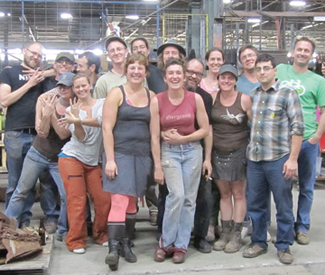
As we all talked on April 5, Karen Cusolito was throwing a party celebrating the third anniversary of American Steel, a massive workspace she formed for hundreds of artists and a gathering space for her extended community. Cusolito had working in the East Bay since 2005, commuting from Hunters Point before finally moving to Oakland in 2010.

“I moved here with such great trepidation because I thought I’d be bored,” she said. “But I’ve found a more vibrant community than I could have imagined, along with an unexpected sense of calm.”

Reflecting on the third anniversary of American Steel, Cusolito said, “On one hand, I’m astonished that it’s been three years. On the other hand, I’m surprised that this hasn’t always existed,” she said. “I have an amazing community here. I’m very blessed.”

Hobbs’ roommate, Rebecca Frisch, lost her apartment in Hayes Valley last year and decided to seek some specific things that she felt her soul seeking. “I wanted more light and space and a garden. I had a long wish list and nearly all of it came true,” she said. “I cast my net as far north as Petaluma and even Sebastapol. It’s really about a home and setting that felt good and suited my wish list.”

The space they found was spacious and airy, almost suburban but in a neighborhood that is lively and being steadily populated with other groups of their friends who have also been moving from San Francisco, gathered into three nearby homes.

“It was a great space with this huge yard. It’s got sun all day long, fruit trees everywhere, and we now have an art fireplace. You don’t find that in San Francisco,” Hobbs said.

As much as Hobbs and Frisch have been pleased with East Bay living, they each felt finally pressured to leave San Francisco, which makes them wonder what the future holds for the city.

“It’s made me sad because it’s apparent there’s no room for quirky, creative individuals. It’s only for the super rich,” Frisch said. “I feel horrible for families and people with fewer options that I have. I wondered if I would mourn the city I loved, and it’s been just the opposite. I really love it here.”

There have been a few challenges and tradeoffs to living in the East Bay, Hobbs said, including a lack of late-night food offerings and after hours clubs. “With anything, there will be a balance between positives and convenience,” she said.

Not everyone from Flux is flowing east — that balance tips in different ways for different people at different times. Monica Barney recently moved to San Francisco from Oakland and she’s enjoying the more dense urban living.

“I got sick of living in the East Bay,” she said. “I didn’t like that you have to drive everywhere. It changes the tone of the neighborhood when you can get around without a car.”

Yet for most of the couple hundred artsy people in the Flux Foundation’s orbit, the East Bay is drawing more and more people. Jonny Poynton moved to West Oakland three years ago after living in San Francisco for nine. He appreciates the sense of community he’s found in Oakland, and he doesn’t feel like he’s given up much to attain it.

“One of the things I like about West Oakland is how close it is to the city,” he said.

Flux’s latest transplant is Jason DeCook, who works in the building trades and moved from San Francisco to just down the street from Poynton on April 7.

“I moved because of the usual reasons that most have, larger space for the same rent, but also the sunshine and proximity. I’ve been hella reluctant to do this for the past few years but thought about it a couple of times. Now the issue has been forced with all the art this year,” DeCook said.

In addition to working on art at American Steel, DeCook says he’s excited to have a yard and storage areas to work on his own projects.

“I’m a blue collar, hands-on kind of guy and it’s easy for me to feel connected to a lot of the people that live around me or are beginning to visit the area. It’s exciting to be in a place that has been ignored for so long by money, because a group of us can come up with a project or I can on my own and get to doing it with little red tape and it will be appreciated by the neighbors for making the place a little bit better,” DeCook said.

In many ways, he thinks that West Oakland and other East Bay pockets are on a similar trajectory as many of San Francisco’s coolest neighborhoods decades ago, many of which are now getting too expensive for the artists to live.

“Earlier today I was considering how, in the past, like the early ’60s when so many artists and musicians were drawn to the Haight and other places, they did so because it was cheap and close to opportunity,” he said. “I think West Oakland is seeing that happen to it. It is a furnace of creativity, and I am helping however I can to stoke that.

Heading East: The musician

0

This week’s Guardian takes a look at San Francisco versus Oakland — and asks whether the big city may have lost its caché to the East Bay

tredmond@sfbg.com

Andy Duvall arrived in San Francisco in 1995, moved with some friends into a flat where his rent was $250 a month. It was a great town for musician, and for 15 years, he was part of the local scene.

Then he looked around in 2010 and realized that he was paying $750 a month for a tiny room with a housemate he barely knew. “It was so hard to find a place I could afford,” Duvall, the former Zen Guerilla drummer who is now part of the experimental band Carleton Melton, told us.

So he packed up and moved across the Bay — and he’s never looked back. “When I moved out, I was afraid I’d totally miss SF,” he said. “But I got to Oakland, and now even if I could I wouldn’t move back.”

Duvall lives in a 900-square-foot place off 40th Street with his girlfriend; they split the $900 rent. “It just seems like there are more artistic and musical people around here,” he said. “I’m surrounded by musicians, instead of worrying that the person downstairs is going to try to get me kicked out of the building.”

Duvall’s main worry now? He sees the pattern that drove him out of San Francisco happening again. “In five years, the same thing is going to happen to Oakland,” he said. “This neighborhood is just exploding. It’s good, I guess — but it’s bad for the artists and musicians.”

San Francisco’s loss

116

news@sfbg.com

San Francisco is increasingly losing its working and creative classes to the East Bay and other jurisdictions — and with them, much of the city’s diversity — largely because of policy decisions that favor expensive, market-rate housing over the city’s own affordable housing goals.

“It’s definitely changing the character of the city,” said James Tracy, an activist with Community Housing Partnership. “It drains a big part of the creative energy of the city, which is why folks came here in the first place.”

>>Is Oakland cooler than San Francisco? Oaklanders respond.

Now, as San Francisco officials consider creating an affordable housing trust fund and other legislative changes, it’s fair to ask: Does City Hall have the political will to reverse the trend?

Census data tells a big part of the story. In 2000, the median owner-occupied home in San Francisco cost $369,400, and by 2010 it had more than doubled to $785,200. Census figures also show median rents have gone from $928 in 2000 up to $1,385 in 2010 — and even a cursory glance at apartment listings show that rents have been steadily rising since then.

Tracy and other affordable housing activists testified at an April 9 hearing before the Board of Supervisors Land Use and Economic Development Committee on a new study by the Budget and Legislative Analyst, commissioned last July by Sup. David Campos, entitled “Performance Audit of San Francisco’s Affordable Housing Policies and Programs.”

“There’s a hearing right now at City Hall about our housing stock and how it’s been skewing upward toward those with higher incomes,” Board President David Chiu told us, noting that it is sounding an alarm that, “Creative individuals that make this place so special are being driven out of the city.”

Oakland City Council member Rebecca Kaplan said that San Francisco’s loss has been a gain for Oakland and other East Bay cities, which are enjoying a new cultural vibrancy that has so far been largely free of the gentrifying impacts that can hurt a city’s diversity.

“You can add more people without getting rid of anybody if you do it right. Most of development is looking at places that are now completely empty like the Lake Merritt BART station parking lot, empty land around the Coliseum, and the West Oakland BART station,” Kaplan told us. “We have to commit to revitalization without displacement.”

Yet the fear among some San Franciscans is that we’ll have just the opposite: displacement that actually hinders the city’s attempts at economic revitalization. “What’s at stake is the economic recovery of the city,” Tracy said. “You can’t have such a large portion of the workforce commuting into the city.”

TOO MANY CONDOS

A big part of the problem is that San Francisco is building plenty of market-rate (read: really expensive) housing, but not nearly enough affordable housing. The report Campos commissioned looked at how well the city did at meeting various housing construction goals it set for itself from 1999 to 2006 in its state-mandated Housing Element, which requires cities to plan for the housing needs of its population and absorb a fair share of the state’s affordable housing needs.

The plan called for 7,363 market-rate units, or 36 percent of the total housing construction, with the balance being housing for those with moderate, low, or very low incomes. Developers built 11,293 market rate units during that time, 154 percent of what was needed and 65 percent of the total housing construction. There were only 725 units built for those with moderate incomes (just 13 percent the goal) and just over half the number of low-income units needed and 83 percent of the very low-income goal met.

“We have to do a better job of monitoring and evaluating each project,” Chiu said. “Every incremental decision we make determines whether this will be a city for just the wealthy.”

The situation for renters is even worse. From 2001-2011, the report showed there were only 1,351 rental units built for people in the low to moderate income range, people who make 50-120 percent of the area median income, which includes a sizable chunk of the working class living in a city where about two-thirds of residents rent.

“The Planning Commission does not receive a sufficiently comprehensive evaluation of the City’s achievement of its housing goals,” the report concluded, calling for the planners and policymakers to evaluate new housing proposals by the benchmark of what kind of housing the city actually needs. Likewise, it concluded that the Board of Supervisors isn’t being regularly given information it needs to correct the imbalance or meet affordable housing needs.

Policy changes made under former Mayor Gavin Newsom also made this bad situation even worse. Developers used to build affordable housing required by the city’s inclusionary housing law rather than pay in-lieu fees to the city by a 3-1 ratio, but since the formulas in that law changed in 2010, 55 percent of developers have opted to pay the fee rather than building housing.

Also in 2010, Newsom instituted a policy that allowed developers to defer payment of about 85 percent of their affordable housing fees, resulting in an additional year-long delay in building affordable housing, from 48 months after the market rate project got permitted to 60 months now.

Tracy and the affordable housing activists say the city needs to reverse these trends if it is to remain diverse. “It’s not even debatable that the majority housing built in the city needs to be affordable,” Tracy said.

Mayor Ed Lee has called for an affordable housing trust fund, the details of which are still being worked out as he prepares to submit it for the November ballot. Chiu said that would help: “I will require a lot of different public policies, but a lot of it will be an affordable housing trust fund.”

GROWTH AND DIVERSITY

San Francisco’s problems have been a boon for Oakland.

“With much love and affection to my dear SF friends, I must say that Oakland is more fun,” Kaplan told us. “Also I think a lot of people are choosing to live in Oakland now for a variety of reasons that aren’t just about price. We have a huge resurgent art scene, an interconnected food, restaurant, and club scene, a place where multicultural community of grassroots artists is thriving, best known from Art Murmur.”

There is fear that Oakland could devolve into the same situation plaguing San Francisco, with rising housing prices that displace its diverse current population, but so far that isn’t happening much. Oakland remains much more racially and economically diverse than San Francisco, particularly as it attracts San Francisco’s ethnically diverse residents.

“We’re not looking at a situation where the people moving into town are necessarily predominantly white,” Kaplan said. “We’re having large growth in quite a range of communities, including growing Ethiopian and Eritrean and Vietnamese populations…If you don’t want to live in a multicultural community, maybe Oakland’s not your cup of tea.”

According to the 2010 census, a language other than English is spoken at home in 40.2 percent of Oakland households, compared to 25.4 percent in San Francisco. “Almost every language in the world spoken in Oakland,” Kaplan said.

African Americans make up 28 percent of Oakland’s population, compared to only 6.1 percent in San Francisco, and 6.2 percent of the population of California. In San Francisco, the number of black-owned businesses is dismal at 2.7 percent, compared to 4 percent statewide and 13.7 percent in Oakland. The census also finds that 25.4 percent Oaklanders are people of Latino origin, compared to San Francisco at 15.1 percent and 37.6 percent statewide. San Francisco is 33.3 percent Asian, compared to Oakland at 16.8 percent and all of California at 13 percent.

Both cities are less white than California as a whole; the state’s white population is 57.6 percent, compared to 34 percent in Oakland and 48.5 percent in San Francisco.

Gentrification shows its face differently depending on the neighborhood. Some say Rockridge, a trendy Oakland neighborhood where prices have recently increased, has gone too far down the path.

“Rockridge has been ‘in’ for a long time, but the prices are staggering and it isn’t as interesting any more,” Barbara Hendrickson, an East Bay real estate agent, told us.

The nationwide foreclosure crisis didn’t spare Oakland and may have sped up its gentrification process. “The neighborhoods are being gentrified by people who buy foreclosures and turn them into sweet remolded homes,” observed Hendrickson.

Yet Kaplan said many of these houses simply remain vacant, driving down values for surrounding properties and destabilizing the community. “I think we need a policy where the county doesn’t process a foreclosure until the bank has proven that they own the note,” said Kaplan, who mentioned that the city has had some success using blight ordinances to hold banks accountable for the empty buildings.

And as if San Francisco didn’t have enough challenges, Kaplan also noted another undeniable advantage: the weather. “The weather is really quite something,” she said. “I have days with a meeting in San Francisco and I always have to remember to bring completely different clothing. Part of why I wanted to live in California was to be able to spend more time outdoors, be healthy, bicycle, things like that. So that’s pretty easy to do over here in Oakland.”

Heading East: The flight from San Francisco

13

EDITORIAL There is no simple free-market solution to gentrification and displacement. There’s no way a crowded city like San Francisco can simply rely on the forces of supply and demand to protect vulnerable populations. And there’s no way the city’s flawed housing policy can prevent the loss of thousands of San Franciscans — particularly young, creative people who help keep a city lively — from fleeing to a town where they can actually afford the rent.

Richard Florida, the famous social and economic theorist who coined the term “creative class” argues that artists and writers and geeks and musicians are the forces that drive modern economies. His pioneering 2002 essay in the Washington Monthly was titled “Why cities without gays and rock bands are losing the economic development race.”

Florida’s something of an elitist and he ignores the contributions that tens of thousands of others (including retired people, union members and nonprofit workers) make a community. He idolizes tech culture and often ignores issues like class and race.

But he’s got a point: Nobody who’s doing anything cool wants to live in a city where everyone is rich and everything is clean and boring. And that’s the danger San Francisco faces.

Just go over to Oakland for a few days and talk to all the people who were once part of this city’s cultural scene. They’ll tell you what anyone with any sense knows: You don’t attract creative people to a city by giving out tax breaks for corporations and building fancy office space. The rock bands that Florida talks about aren’t going to stay in a city because it has high-end jobs for people with advanced degrees. Artists need a place where they can afford the rent.

San Francisco is still a great urban center, by any possible standard, and has all the qualities of diversity, openness, energy, politics and fun that have made generations of immigrants from all over the world want to make it their home. But at a certain point, housing becomes more important than all of the other development issues that local government can address.

Take Andy Duvall, a musician we interviewed who was part of San Francisco for 15 years before he was literally priced out of town. For half of what he was paying in the Mission, Duvall has more than twice the space in Oakland — and the situation is just getting worse. While most of the country is still mired in a deep housing slump (and parts of San Francisco are facing a foreclosure crisis), rents in this town are soaring, beyond the affordability of almost anyone who currently lives here. According to the city’s own statistics, only about 10 percent of San Franciscans can afford the rent on a median market-rate apartment. That means if they’re evicted or lose their homes, they have to leave town.

The supervisors held a hearing April 9 on affordable housing, and the message was profound: “Affordable housing preserves the neighborhood in more ways than one; residents are the foundation on which the economy is built. From any angle, if we can’t afford to live here, there is no city,” observed Val Sinckler, a Western Addition resident.

But while the mayor is working to attract companies that will pay high-end salaries to people who can afford to pay far more rent than the average San Franciscan, he’s a long way from coming up with the money to even begin to mitigate the problem.

An effective policy to preserve San Francisco requires strict regulation (to prevent evictions and displacement), a mandate that commercial developers build housing for their workforce and that residential developers meet the needs of low- and moderate-income residents — and a large investment of public money in affordable housing. If Lee isn’t willing to talk serious about those three crucial elements, then he’s presiding over the decline of one of the world’s coolest cities.

Editorial: The flight from San Francisco

23

EDITORIAL There is no simple free-market solution to gentrification and displacement. There’s no way a crowded city like San Francisco can simply rely on the forces of supply and demand to protect vulnerable populations. And there’s no way the city’s flawed housing policy can prevent the loss of thousands of San Franciscans — particularly young, creative people who help keep a city lively — from fleeing to a town where they can actually afford the rent.

Richard Florida, the famous social and economic theorist who coined the term “creative class” argues that artists and writers and geeks and musicians are the forces that drive modern economies. His pioneering 2002 essay in the Washington Monthly was titled “Why cities without gays and rock bands are losing the economic development race.”

Florida’s something of an elitist and he ignores the contributions that tens of thousands of others (including retired people, union members and nonprofit workers) make a community. He idolizes tech culture and often ignores issues like class and race.

But he’s got a point: Nobody who’s doing anything cool wants to live in a city where everyone is rich and everything is clean and boring. And that’s the danger San Francisco faces.

Just go over to Oakland for a few days and talk to all the people who were once part of this city’s cultural scene. They’ll tell you what anyone with any sense knows: You don’t attract creative people to a city by giving out tax breaks for corporations and building fancy office space. The rock bands that Florida talks about aren’t going to stay in a city because it has high-end jobs for people with advanced degrees. Artists need a place where they can afford the rent.

San Francisco is still a great urban center, by any possible standard, and has all the qualities of diversity, openness, energy, politics and fun that have made generations of immigrants from all over the world want to make it their home. But at a certain point, housing becomes more important than all of the other development issues that local government can address.

Take Andy Duvall, a musician we interviewed who was part of San Francisco for 15 years before he was literally priced out of town. For half of what he was paying in the Mission, Duvall has more than twice the space in Oakland — and the situation is just getting worse. While most of the country is still mired in a deep housing slump (and parts of San Francisco are facing a foreclosure crisis), rents in this town are soaring, beyond the affordability of almost anyone who currently lives here. According to the city’s own statistics, only about 10 percent of San Franciscans can afford the rent on a median market-rate apartment. That means if they’re evicted or lose their homes, they have to leave town.

The supervisors held a hearing April 9 on affordable housing, and the message was profound: “Affordable housing preserves the neighborhood in more ways than one; residents are the foundation on which the economy is built. From any angle, if we can’t afford to live here, there is no city,” observed Val Sinckler, a Western Addition resident.

But while the mayor is working to attract companies that will pay high-end salaries to people who can afford to pay far more rent than the average San Franciscan, he’s a long way from coming up with the money to even begin to mitigate the problem.

An effective policy to preserve San Francisco requires strict regulation (to prevent evictions and displacement), a mandate that commercial developers build housing for their workforce and that residential developers meet the needs of low- and moderate-income residents — and a large investment of public money in affordable housing. If Lee isn’t willing to talk serious about those three crucial elements, then he’s presiding over the decline of one of the world’s coolest cities.


Reject the CPMC deal

0

EDITORIAL For most of the past year, Mayor Ed Lee had been taking a tough line with California Pacific Medical Center, the health-care giant that wants to build a state-of-the-art 555-bed hospital on Cathedral Hill. The mayor had been telling a stunningly recalcitrant CMPC management that the outfit would have to put upwards of $70 million into affordable housing and spent millions more on transit, neighborhood and charity-care programs to mitigate the impacts of the massive project.

But late in March, something happened. Under immense pressure from the Chamber of Commerce and other big business groups, the mayor buckled and agreed to a deal with woefully inadequate mitigation measures. The supervisors should reject the plan and force CPMC to do better.

The biggest problem with a project this size is the mix of jobs and housing. Lee is properly concerned about creating jobs in a city where unemployment in some neighborhoods is stubbornly high. But the proposed deal only guarantees a tiny fraction of the 1,500 permanent new jobs for San Francisco residents.

That means a city that has almost zero vacancy in affordable housing is going to have to absorb a workforce much of which won’t be able to buy or rent anything at current market rates. That means more competition for scarcer housing and higher rents and home costs for everyone.

By any basic planning logic, CPMC should be on the hook for providing enough affordable housing for at least some reasonable percentage of its workforce. Instead, the hospital chain is offering about $33 million, only $3 million of which will be paid up front. That won’t even address half of the housing impact. Besides, the jobs will be there when construction starts, and more when the hospital opens; the limited affordable housing money will come much later. The highest-paid doctors and administrators may be able to afford the pricey new market-rate condos the city is madly approving — but where, exactly, are the nurses, orderlies, clerks, janitors and other health-care workers going to live?

CPMC has agreed to provide charity care at the same level is currently does — which is abysmally low, among the lowest of all nonprofit hospital chains in California. So that’s not an advantage.

And it has promised to keep open St. Luke’s Hospital in the Mission — the only full-service hospital other than SF General in the southeast part of town. But the proposal calls for cutting the number of beds by nearly two-thirds, from 229 to 80. And it allows for the closure of that hospital if CPMC’s system-wide operating margin falls below 1 percent (something that will be hard for the city to challenge, since CPMC handles the books).

It’s cynical how CPMC is using this critical medical facility in an underserved area as a bargaining chip. Already, hospital lobbyists are warning that St. Luke’s will be shut down if they don’t get what they want on Cathedral Hill.

Meanwhile, CPMC has labor trouble and is refusing to guarantee that existing employees at facilities that will be demolished will be able to keep their jobs and seniority at the new hospital.

We realize that CPMC needs to build a new facility to replace aging and seismically unsafe structures elsewhere in town. But the hospital chain also has a responsibility to address the impacts this project will have on San Francisco. And right now, it’s not a good deal.

Editorial: Reject the CPMC deal!

17

EDITORIAL For most of the past year, Mayor Ed Lee had been taking a tough line with California Pacific Medical Center, the health-care giant that wants to build a state-of-the-art 555-bed hospital on Cathedral Hill. The mayor had been telling a stunningly recalcitrant CMPC management that the outfit would have to put upwards of $70 million into affordable housing and spent millions more on transit, neighborhood and charity-care programs to mitigate the impacts of the massive project.

But late in March, something happened. Under immense pressure from the Chamber of Commerce and other big business groups, the mayor buckled and agreed to a deal with woefully inadequate mitigation measures. The supervisors should reject the plan and force CPMC to do better.

The biggest problem with a project this size is the mix of jobs and housing. Lee is properly concerned about creating jobs in a city where unemployment in some neighborhoods is stubbornly high. But the proposed deal only guarantees a tiny fraction of the 1,500 permanent new jobs for San Francisco residents.

That means a city that has almost zero vacancy in affordable housing is going to have to absorb a workforce much of which won’t be able to buy or rent anything at current market rates. That means more competition for scarcer housing and higher rents and home costs for everyone.

By any basic planning logic, CPMC should be on the hook for providing enough affordable housing for at least some reasonable percentage of its workforce. Instead, the hospital chain is offering about $33 million, only $3 million of which will be paid up front. That won’t even address half of the housing impact. Besides, the jobs will be there when construction starts, and more when the hospital opens; the limited affordable housing money will come much later. The highest-paid doctors and administrators may be able to afford the pricey new market-rate condos the city is madly approving — but where, exactly, are the nurses, orderlies, clerks, janitors and other health-care workers going to live?

CPMC has agreed to provide charity care at the same level is currently does — which is abysmally low, among the lowest of all nonprofit hospital chains in California. So that’s not an advantage.

And it has promised to keep open St. Luke’s Hospital in the Mission — the only full-service hospital other than SF General in the southeast part of town. But the proposal calls for cutting the number of beds by nearly two-thirds, from 229 to 80. And it allows for the closure of that hospital if CPMC’s system-wide operating margin falls below 1 percent (something that will be hard for the city to challenge, since CPMC handles the books).

It’s cynical how CPMC is using this critical medical facility in an underserved area as a bargaining chip. Already, hospital lobbyists are warning that St. Luke’s will be shut down if they don’t get what they want on Cathedral Hill.

Meanwhile, CPMC has labor trouble and is refusing to guarantee that existing employees at facilities that will be demolished will be able to keep their jobs and seniority at the new hospital.

We realize that CPMC needs to build a new facility to replace aging and seismically unsafe structures elsewhere in town. But the hospital chain also has a responsibility to address the impacts this project will have on San Francisco. And right now, it’s not a good deal.


Heads Up: 8 must-see concerts this week

0

This week, most of the crucial shows are hella local (as is that faux pas slang). What can you do? We’re all cogs in the Bay Area machine. And we happen to have a lot of impressive musicians within spitting distance. There are cheap shows spread across the hyper-local map starring Religious Girls, French Cassettes, Midnite Snaxxx, Thee Oh Sees, and Il Gato.

A few non-locals made the list too, we can’t all be #based here, of course – where would the fun be in that? Visiting out-of-towners Polyphonic Spree, Caroline Chocolate Drops, and more, remind us that bands like to tour here too. Give them your hard-earned cash to support the ubiquitous hard-wrought traveling musician travails.

Here are your must-see Bay Area concerts this week/end:

Polyphonic Spree
Reach for the light with the colorful, cultish goodness of joy-poppers Polyphonic Spree, still spreading that spaced out cheer.
With New Fumes
Tue/3, 8pm, $20.
Great American Music Hall
859 O’Farrell, SF
www.slimspresents.com
http://www.youtube.com/watch?v=rHJo_klmPcA

Il Gato
Baroque pop excellence returns — for those playing along at home, Il Gato graced the cover of the Guardian’s fall preview way back in 2011. Now the band is hard at work on its next album, and it recently set up a Kickstarter campaign to help ease the costs.
With Passenger & Pilot, Red Weather, Drew Victor
Thu/5, 8pm, $10
Cafe Du Nord
2170 Market, SF
(415) 861-5016
www.cafedunord.com
http://www.youtube.com/watch?v=dvquZoRE5hY

Religious Girls, Mister Loveless, B Hamilton, French Cassettes
Not only are these all delectable Oakland acts (save for French Cassettes: SF) – including returning GOLDIES champs/tribal percussionists/weirdo synthsters Religious Girls – but this show is an Art Murmur freebie. Show up early to catch all the acts, and remember to tip your bartenders.
Fri/6, 6pm, free
Uptown
1928 Telegraph, Oakl.
(510) 451-8100
www.uptownnightclub.com

Thrones
Thrones is just one dude: Seattle’s Joe Preston, the metal-grinding doom bassist/Moog-enthusiast who’s spent time on tastemaker labels Kill Rock Stars and Southern Lord, and played alongside Earth, the Melvins, and High on Fire.
With Helms Alee, Grayceon
Fri/6, 9:30pm, $10
Hemlock
1131 Polk, SF
(415) 923-0923
www.hemlocktavern.com
http://www.youtube.com/watch?v=XacI2AknauM

ALL THE CHILDREN SING: Adobe Books Benefit Concert with Thee Oh Sees
Psych-garage rock experts/locals Thee Oh Sees swoop in to support Adobe Books — the event is a fundraiser for the beloved shop suffering an imminent rent increase. The benefit also includes more real live rockers, a silent art auction, and stand-up comedy by local comedians George Chen (whose own experimental noise band, Chen Santa Maria, plays Bottom of the Hill Mon/9) and Anna Seregina.
With Sonny and the Sunsets, the Mallard
Sat/7, 8:30pm, $10-$20 sliding scale
Lab
2948 16th St., SF
Facebook: All The Children Sing
adobebooksbackroomgallery.blogspot.com
http://www.youtube.com/watch?v=z1bHddYhtDw

Carolina Chocolate Drops
This Grammy Award-having old-time string band from North Carolina just released its seventh joyous, foot-stomping blues album (Leaving Eden) and has a song (“Daughter’s Lament”) on the lauded Hunger Games soundtrack.
Sat/7, 8pm, $20
Slim’s
333 11th St., SF
(415) 255-0333
www.slimspresents.com
Check this killer banjo-and-fiddle cover of Blu Cantrell’s “Hit ‘Em Up Style”
http://www.youtube.com/watch?v=wKTXJUYiAT4

Bear in Heaven
“In the kaleidoscopic video for the album’s charming lead single, “The Reflection of You,” cameras zoom in and out on [Jon] Philpot, guitarist Adam Wills, and drummer Joe Stickney at a rapid pace as strobe lights flash beneath them. It’s a hyper-stimulating, entirely accurate depiction of the band’s sound; once the rollercoaster ride is over, you can think of nothing but jumping back in line and doing it all over again.” (Frances Capell).
See Frances’ full story in this week’s issue.
With Blouse, Doldrums
Sun/8, 8pm, $15
Independent
628 Divisadero, SF
(415) 771-1421
www.theindependentsf.com
http://www.youtube.com/watch?v=tjW5rkXiQdc

Midnite Snaxxx
Oakland’s favorite punky, lo-fi garage rockers, Midnite Snaxx — featuring Trashwomen’s Tina Lucchesi, and the Guardian’s Dulcinea Gonzalez, formerly of Loudmouths — return to the cavernous inner Knockout sanctum.
With White Murder, Glitz
Sun/8, 9pm
Knockout
3223 Mission, SF
(415) 550-6994
www.theknockoutsf.com

Just longing for sameness

0

[An earlier version of this article incorrectly identified Paul Robeson as Renee Gibbons’ lover, when in fact it was William Marshall. We regret the error]

caitlin@sfbg.com

IRISH Yesterday she and her husband received notice that it would soon be converted into a condo. But for the moment, it is still hers. We are sitting in Irish author Renee Gibbons’ rent-controlled North Beach apartment of 31 years and she is telling me about the time she saw Van Morrison walking down Columbus Street in the 1970s.

“I was looking pretty foxy,” she remembers. Gibbons still recalls what she was wearing: a woven Irish sweater, hippie skirt, and knee-length camel-colored boots.

Morrison had always been one of those celebrities who she knows — she just knows — would fall in love with her if only they knew each other. So imagine the scene: a pretty girl and a boy pass each other, walk on, and then turn with their entire bodies to look at the other. Only then he resumed his journey and the moment was over.

Not that Gibbons hasn’t had enough torrid love affairs to fill a book. In fact, she’s done just that with Longing For Elsewhere: My Irish Voyage Through Hunger, History, and High Times (self-published, 250pp, $16.95). And though she took William Marshall for a lover at the age of 19, and was a fashion model in Paris, Longing‘s short folk stories revolve around places, not people. It’s her first book, though she did write a column in the Irish Herald for 13 years.

An inveterate traveler, Gibbons and husband, 84-year old retired radical longshoreman Lew, have made their home in the North Beach neighborhood, which to Gibbons has the feel of a small village. But the evictions are rampant on their block, and the day before our interview the daughter of Gibbons’ landlord sent her a letter stating their intention to convert the building into condos. The couple pays $1200 a month for their space. The letter said they could buy their unit for $2 million.

Steering from that painful subject, I ask Gibbons where — since this is the St. Patrick’s Day issue of the Guardian after all — people should go to see the real (read: not green beer) Irish community of San Francisco.

She recommends bars, primarily. Irelands 32 and the Plough and the Stars in the Richmond, Berkeley’s Starry Plough, where she and her daughter used to sing (a natural talent, her daughter now tours with Prince), O’Reilly’s down the street from her home. The Irish Castle Gift Shop is also a hub, a place where the San Francisco Irish can shop for Barry’s Irish tea, fishermen’s sweaters, Irish baked beans, and “the real” kind of Cadbury’s chocolate, and travelers can dip in for some Éire hospitality. “They take the time to chat and all that,” Gibbons says.

Longing is a self-narrated look at the life of a radical bohemian, a woman who came from poverty unheard of in this country (she calls this part of the book “Angela’s Ashes without the dead babies.”) to become an adventurer. Gibbons and Lew once traveled from Santiago, Chile to Dublin — without flying on an airplane. The journey took them to Argentina, Africa, Istanbul, and they did it in two months.

So she doesn’t limit her community to the Irish and Irish Americans in town, relating more to the activist set. She and Lew been occupying with the best of them (“I have a photograph of Lew on his cane giving the cops in riot gear the whatfor,” she tells me. “They were trying to stop him from protesting in front of the docks where he used to work!”) When the two alit on San Francisco, the city fit them like a glove.

She’s prepared to fight for her right to stay in North Beach, where every morning she does tai chi in Washington Square, where she celebrated Nelson Mandela’s release from prison with her daughter, and where she can always depend on the local green grocer for the block’s gossip.

“But we’re not going quietly,” she says. “I told the landlord the only way we’re leaving here is in urns or pine coffins.” Gibbons doesn’t drive, and honestly has no desire to live anywhere in the United States besides San Francisco. Maybe she’ll go back to Ireland, she says. They take care of their elderly there better than we do.

“North Beach is known as a bohemian community. There’s hardly any poets or artists left in the neighborhood.” It may just be that the San Francisco she loves is in its last days. Maybe it’s always in its last days, making it doubly important that all its remaining freaks and artist-types get record of their lives on paper. 

LONGING FOR ELSEWHERE: RENEE GIBBONS AUTHOR READING

Fri/16 7 p.m., free

Books Inc.

601 Van Ness, SF

www.renee-gibbons.com


Families leaving SF: It’s housing costs, stupid

34

City officials continue to wring their hands over why families are leaving the city, and I’m sure there are a number of factors, but I can tell you that from the people I know — families who live in the city or want to live in the city — it’s all about the cost of housing.C

Critics of the SFUSD like to say that families are leaving for better schools, but those families haven’t been paying attention to the tremendous strides the district has made in recent years. Yes, middle schools are still a challenge in some areas, and yes, not all the public schools are great, but overall, most families that make the effort to find a quality school for their kids can do it.

The folks I know who work in the city hate the idea of living in the burbs. Nobody wants to commute across that bridge or through the BART tunnels every day; more important, nobody wants to be on the other side of the Bay from their house and their kids when the Big Earthquake hits. The problem is the money.

You want to keep families in San Francisco? Building housing for multimillionaires isn’t going to do it. If it were up to me, I’d float about a $5 billion revenue bond, buy up all the housing on the private market, put it all in a land trust and resell it — with the provision that the buyers had every right of ownership except the right to sell for a profit. That’s not likely to happen — but the city has to get serious about both building new affordable housing and (even more important) preserving what’s already there.

Yes, a lot of families want to buy a house, but a lot of families would be happy with a decent, affordable place to rent. Particularly if they knew that they wouldn’t be evicted so a richer person can buy or rent the place. What most families want is stability — they want to know where they’re going to live not just this year but when their kids are older. So many renters in this town live in such fear of eviction that it’s a huge incentive to move somewhere else.

You can talk about parks and playgrounds and youth programs, but San Francisco’s never going to be as family-friendly as we’d all like unless we can do something about housing costs and rental stability.


The struggle for housing money at City Hall

24

It’s barely March, and the next election isn’t until June and that’s just primaries and the Democratic County Central Committee, but we just started getting political mail anyway. It’s a piece from the Board of Realtors, denouncing plans for an increase in the real-estate transfer tax “to provide subsidized housing to people who want to live in San Francisco but don’t have the means to do so.” Mayor Ed Lee, the flier says, is backing this “outrageous” plan.

What, exactly, is going on here?

Well, for starters, the mayor is distinctly NOT pushing for an increase in the transfer tax, not right now, anyway. What he is doing is meeting with housing advocates and legislators and trying to come up with a stable source of funding for affordable housing — yes, for families and low-income people, many of them longtime residents who are being forced out by Ellis Act evictions, others of them people who work in the city and would rather live here than commute from Pinole, which everyone with any sense agrees is a good idea.

The problem: For years, San Francisco used Redevelopment Agency tax-increment money for affordable housing. Now that money’s gone, since the governor abolished redevelopment agencies. Actually, the money’s not gone, technically — the increased tax revenue from redevelopment project areas still exists. It’s just that the state is now taking a bunch of it, and other taxing entities like BART and the school district get some of it, and now it’s impossible to send bonds and borrow money against it. So what was once tens of millions for affordable housing is now a few million.

“We might have $20 million a year in the general fund,” said housing activist Peter Cohen. “But that’s compared to the $40 million or $50 million we had in the past, and it still leaves housing short.”

Lee has promised repeatedly to fix that problem, to find a way to make sure that there’s enough money that the nonprofits who build housing can plan and develop for the long term. Right now, it’s being called a Housing Trust Fund, but nobody knows exactly how it will actually work.

Remember: The city’s own General Plan states that 60 percent of all new housing should be available at below market rate. All of the regional growth projections say that San Francisco needs to build more housing — for its own workforce, not just for the rich. (And the local workforce, for all the tech jobs the mayor keeps hyping, is still mostly public-sector workers and service employees, most of whom can’t possibly afford the soaring rents and housing prices in this city.)

A lot of the existing affordable housing money comes from the city’s inclusionary housing law, which mandates that market-rate developers set aside a percentage of their new units (usually 20 percent) for lower-income people. Most developers eschew allowing poor people into their condo enclaves, so they pay a fee into a city fund instead.
But if we’re aiming for 60 percent, and we’re getting (at most) 20 percent, we’re a long ways off. Oh, and the developers are starting to argue that the 20 percent rule is too onerous and they can’t build enough condos for the rich if they have to throw scraps to the poor and middle-class, too.

And some supervisors are squawking about building more housing for the middle class, and right now in a zero-sum game, that means less for low-income people.
This all adds up to a mess for the mayor, and it’s no wonder some advocates are talking about raising the transfer tax — which, after all, is paid by the seller of a residential or commercial building, and while there are absolutely some houses underwater in San Francisco (and there should probably be an exemption in the tax for that situation), overall home prices are rising again, and many, probably most home sales these days involve substantial profit. It’s not a perfect tax, but it’s a tax on a class that is (generally) better off to support a class that is typically not so well off.

Here’s the problem: If the mayor supports a transfer tax, and that’s part of the final package, the realtors and the commericial building owners will no doubt put huge amounts of money into defeating it. That would mean Lee would have to raise a bucket of money and campaign really hard to pass it. But Lee’s demonstrated that he’s not the fighting type; he wants something that nobody serious will oppose. Which is why my sources at City Hall say that he wants the transfer tax off the table.

That could mean that the Housing Trust Fund will be a basic set-aside, a budgetary mandate that a certain amount of money go into a reliable fund for housing. That’s one of the city’s most pressing needs (really, if this becomes a city of just the rich, even those of us who own houses or have rent-controlled apartments won’t want to live here any more. Mayor Larry Ellison? Eeew.) So I’m okay with that. I’m not a big fan of set-asides, but this is the whole future of San Francisco we’re talking about.

So the realtors can take a chill pill — the mayor doesn’t want to get in a fight with you. Sigh.

The failure of Lee’s business tax plan

16

The Mayor’s Office and city finance officials are circulating drafts of a new business tax plan that would largely abolish the payroll tax and replace it with a levy on gross receipts.

Ben Rosenfield, the city controller, and Ted Egan, the chief economist, have been meeting with business groups and presenting what’s described in the documents they’re circulating as “one possible idea.” And there’s some very positive news about the proposal: It would greatly broaden the tax base (only about 10 percent of the city’s businesses are hit by the payroll tax) and it’s designed to be somewhat progressive: Businesses with higher gross receipts would pay a higher percentage tax.

The plan is complicated — since some types of industries (retailers, for example) have high gross receipts compared to payroll, and some (financial services) have high payrolls compared to gross receipts, the levies are broken down into four schedules. At the lowest end, companies with comparatively large gross reciepts would pay between 0.05 percent and 0.125 percent. At the highest end, the tax would go from 0.220 to 0.535.
But there’s one central — and simple — element of the proposal: At this point, it’s entirely revenue neutral. In fact, finance officials say, over time the total tax burden paid by local businesses would go down, since payroll tends to rise slightly faster than gross receipts.

That, sources say, is something the mayor has made clear he doesn’t want to budge on. He’s not willing to accept a plan that raises the total amount of money the city gets from business taxes.

Which puts him in synch with what some business groups want: “The business community thinks this should be revenue-neutral,” Scott Hauge, who runs Small Business California, told me.

But in a city that faces a large structural budget deficit, some supervisors have other ideas. “I want to look at new revenue possibilities,” Sup. John Avalos said.

And even the current proposals would let banks, which are exempt from local business taxes, escape without paying anything.
In reality, the proposals are less then revenue-neutral. Rosenfield and Egan project that the new tax system would lead to the creation of 2,500 jobs a year — mostly because businesses over time would be paying lower taxes.

Hague told me that he’s not sure exactly how business leaders feel about this. “We don’t know yet how it will affect people,” he noted. But some political leaders have been clamoring for years for the elimination of the payroll tax, which, by taxing employment, appears to be a damper on job growth.

That’s actually a myth. The payroll tax is so minor that it can’t possibly influence any individual hiring decision. It’s true that if city business taxes in general are reduced, companies will have more money — and some might spend that on new hiring. But San Francisco, like most major cities, has to have some kind of business tax — and I can already hear some downtown types complaining that a gross receipts tax “punishes growth and success.”

This proposal is a long way from what Sup. David Chiu suggested a year ago. His plan would have included a commercial rent tax — ensuring that financial institutions that get away with paying nothing would have to contribute like other businesses. Like most local taxes, it wasn’t perfect — state law bars cities from imposing corporate income taxes and limits what else municipalities can do — but together with a reworked gross receipts tax, it was projected to bring $28 million more dollars into the city treasury — without any job loss.

But the Chamber of Commerce and crew fought bitterly against that idea, and Chiu withdrew it.

At this point, Chiu said, he’s working with the mayor and trying to get the business community to accept the idea of a change in the tax structure. But this is a rare opportunity to do two things — to make the local tax system more fair, and to raise taxes on the biggest companies to bring additional revenue into the city.

The plan will probably have to go to the ballot anyway, so why not do it right?

The right to a civil lawyer

10

I like Sup. David Chiu’s idea of giving indigent plaintiffs in civil cases the right to a lawyer. It’s one of those legal and political issues that’s been hanging around for decades: Everyone accused of a crime has the Constitutional right to counsel, but if you’re sued and have no money, you could very well be  SOL.

Now, there are a few places that some people can get help — nonprofit legal groups that help seniors, tenants, and others, but there aren’t enough of those lawyers to meet the need, and some people don’t qualify for any of the available help. Under the law, a poor person who gets sued has no guaranteed right to any assistance at all, and can wind up representing him- or herself in court, even if he or she has no legal background or experience.

That’s one reason landlords tend to win eviction cases against low-income people: If the tenant can’t find free legal help, it’s high-priced landlord lawyer who knows all the tricks against poor tenant who has no idea how to respond to a summons and complaint.

The supervisors have approved Chiu’s resolution, which asserts than San Francisco is a “right to civil counsel” city, but there’s not a whole lot of money around to fund it. He’s asking for a modest pilot program costing no more than $100,000 and focusing on eviction defense, which is a great place to start. His idea is to get the big law firms in the city to help out — to devote some of their time and money to pro bono work in the city’s indigent civil defense program.

And some of them will, and that’s great. But what we really need is a funding source for this — and it seems to me that the lawyers of the city are a logical place to start.

Yes, there are unemployed lawyers and lawyers who barely make rent. But as a whole, the class of people licensed to practice law in San Francisco is better off than most of the rest of us. The state bar hits every lawyer up for about $400 a year to fund bar operations, and the interest that lawyers earn on client trust funds has to go to indigent legal defense.

So why not set up a San Francisco lawyer’s fee — say, $50 a year for everyone practicing in the city — to fund the city’s civil legal defense program? I don’t know exactly how many lawyers we have, and I can’t find anyone at the state bar who can answer that, but I’ve seen published reports in the past suggesting that the city has more lawyers per-capita than anywhere else except Washington, D.C. One story that ran years ago in the Examiner put it at one per 70 residents — which would mean more than 10,000 lawyers in the city. So a $50 fee would bring in half a million dollars –plenty to set up an office and hire a couple of lawyers and have a director who could spend time running down pro bono counsel to help.

I have no idea if the city can legally do that; I checked with the folks in the City Attorney’s Office, and they have no simple answer. So Chiu would have to request a legal opinion on the question.

But if it’s possible, it’s a great idea, and I suspect even most lawyers in the city would support it. 


UPDATE: The state bar folks pointed me to the right place on the bar website, and it turns out there are 17,000 lawyers in SF. That’s $850,000 a year.


What’s wrong with the America’s Cup deal? A lot

21

Let’s start out with a premise that even Larry Ellison’s minions have come to accept: The race is happening here. Too late now to move it to another city. Worst-case scenario, according to Stephen Barclay, the point person for the world’s sixth-richest man: “If we don’t meet those dates, the teams will be forced to relocate to other places around the bay.”

That’s right — the teams will relocate to other places around the bay. The host city will still, for all practical purposes, be San Francisco; the races will happen off SF’s waterfront (where the Coast Guard is willing to allow them and the conditions are right) and the rich tourists will stay here, not in Burlingame or Fremont.

If Ellison decides the city’s not giving him enough, he won’t put up $55 million to fix up some of the waterfront piers. The city may decide that a development deal of some sort with him makes economic sense. But it’s a real-estate deal at this point, not a deal for the race. At least, that’s what the Ellison team seems to be confirming.

And I fear that the real-estate deal that the Board of Supervisors Finance Committee sent forward yesterday, 2-1, is a bad deal for the city.

The terms are really complicated, and it makes my head hurt just trying to figure it all out — and still, the supes are expected to vote on the 120-plus-page document Feb. 28. Here’s what we do know, though:

The supervisors originally came to a deal with the America’s Cup Event Authority back in December. The concept was — and is — pretty straightforward, the same sort of deal the city has done (or, certainly, the Redevelopment Agency has done) many times in the past. In exchange for putting cash into renovating several piers, Ellison’s group would get long-term leases and development rights on the property. The idea: The city can’t afford to fix the piers. Ellison’s organization can. And once the property is renovated, the developer can make back that initial investment, and a profit, by building commercial space, condos and whatever else the Port decides to allow.

In a perfect world, San Francisco (and the state and the feds) would tax the hell out of people like Ellison, and there’d be public money to rebuild the waterfront as public open space, recreational facilities and the like. And wouldn’t that be utterly cool? Wouldn’t this city have the most awesome waterfront in the world?

But no: The only way the piers are going to anything but a place to park cars until they fall into the bay is if some private developer gets the rights to build something that I won’t like.

Supervisors Jane Kim and Mark Farrell, who don’t agree on a lot of things, both agreed with my basic analysis of the politics here: We shouldn’t let the excitement over the prospect of a boat race get in the way of analyzing this for what it is: A financing tool for the Port to get its infrastructure fixed up. Without a private investor, “they just don’t have the capacity to do that,” Kim told me.

So let’s just stipulate for a moment that this is the best, maybe the only way the city can restore the Port. Then it comes down to the real issue: Has the Mayor’s Office negotiated a good enough deal? Is San Francisco getting enough out of this? Or is everyone so hyper-buzzed about fancy carbon-fiber boats in the water (and I admit, they’re pretty cool) and free-spending tourists in the hotels and restaurants that we’re letting Mr. Ellison — who didn’t get so stinky rich by being a weak negotiator — walk away with most of the cookies?

Remember: Ellison’s not doing the city any favors. He’s only fixing up the piers that he will effectively own (as least for most of the rest of this century).

Back in December, the rough outlines looked like this: A corporation set up by Oracle, called the America’s Cup Event Authority, would put $55 million into repairing and renovating piers, then would get  66-year leases and development rights on piers 30-32, 26 and 28, as well as seawall lot 330, across the Embarcadero, which Ellison’s team wants to turn into more condos for rich people. If that’s not enough to pay for Ellison’s investment, Ellison’s heirs or successors get half the rent for the piers for another 15 years. That’s 81 years.

The original deal mandated that the city would collect a 1 percent fee on the re-sale of the new condos. It also had a requirement that Ellison share with the city any profits he made by flipping the long-term leases.

That’s a big deal, because almost nobody in the city actually holds onto development entitlements anymore. A developer wins the right to build an office building — and next week, he or she sells that right to somebody else. It’s almost certain that at some point, Ellison — whose sole goal here is going to be making a profit off city land — will decide that the best way to make money is to cash out. He’ll keep his 66-year leases for a few years, maybe lobby his way to approvals for office, condos, time-shares (gasp! yeah, they’ll do that if it’s legal) restaurants or whatever — then sell the remaining time on the leases, plus the development rights, to somebody else. And because he’s Larry Ellison, he’ll wind up making a nice tidy profit.

That used to be what happened with Port property (see: Pier 39) but lately, the Port’s gotten a bit wiser and has, in some cases, insisted that part of the profit from flipping a lease goes back to the city. In the original discussions, Ellison was going to have to pay the Port 15 percent of any net gains he made from the almost inevitable sale of the valuable leases.

But that’s gone now. After the board approved Newsom’s deal, the former mayor — who was always terrible at negotiation with the rich and powerful and always gave away the store — went back and monkeyed around with it. He and Sup. David Chiu insisted that the changes were just technical, not substantive enough to require a new board vote — but the current deal has no 15 percent cut for the Port, and the 1 percent levy on condo sales only applies after the second owner sells — which will be years down the road.

Then there’s the part where the city has to reimburse Ellison if the cost of renovating the piers exceeds what’s expected (oh, and we have to pay him 11 percent interest, which is about ten times what I get on my bank account; how about you?) There’s no cap on what the city might have to pay. And Ellison gets to develop a new marina.

And while Pier 29 is no longer a part of the deal, the city has to give Ellison $12 million — or rights to a pier to be named later. (Maybe Ellison figures that in a few years the people who opposed Pier 29 development will be out of office and he can convince the new mayor and supervisors to give Pier 29 back. It’s not legally excluded.)

Kim told me she’s going to insist that the final deal include a local-hire provision, which the rest of the board would be crazy not to support (and which Ellison, despite his company’s problems with local labor laws in the past, would be crazy not to accept).

But overall, Kim — who with Sup. Carmen Chu was part of the 2-1 majority sending the package to the full board — told me she thought the city got a good deal. “It took me a while,” she said. “But [Port Director] Monique Moyer convinced me that this was good for them.”

Sup. John Avalos, the dissenting vote on the Finance Committee, isn’t convinced. He’s got a long list of concerns, starting with the fact that he thinks the projected attendance and economic benefits are a bit delusional. “The figures seem farfetched,” he told me. “I’m seeing a lot of pumped up numbers. And those numbers drive whether this is a good deal for the city or not.”

He’d like to see the 1 percent rule apply to the second condo sale, not the third. He’d like to see the Port get 15 percent of the profits from any sale. And he’d like a cap on the reimbursements the city has to give to Ellison.

But here’s the problem: When the development agreement comes before the board, sitting as a Committee of the Whole Feb. 28, it will be hard to put any of that back in the agreement. This is a contract, and while the board can pass a resolution asking for more, in the end, it’s a matter of voting it up or down.

Vote yes and it’s done — more or less as is — although Kim says there will be another chance to make changes down the road, since the board and the Planning Commission will have to sign off on whatever type of development Ellison wants to do. The problem with that scenario? Ellison’s lawyers will wave this development agreement around like a Giants victory towel and proclaim that it binds the city and limits any ability to demand any more changes later. That’s how these people operate.)

Vote no and the ball goes back to Larry’s Court: His group can sit down with the Mayor’s Office and make some changes, or they can walk away (and build their boat sheds in …. where? Oakland? Foster City? Who’s got waterfront that can handle this?)

When the Finance Committee send the package to the full board, Avalos said, “we pretty much lost our ability to influence the agreement. Now we have to decide if we want to call [Ellison’s] bluff.”

PS: One of the lingering issues is whether the America’s Cup Organizing Committee can raise the $30 million-odd that is needed to make the numbers pencil out. If I were a rich person and Mark Buell, the ACOC point person, called me for money, here’s what I’d say:

How much is Larry Ellison contributing?

See, Ellison’s improvements on the waterfront aren’t charity. He’s looking to make a buck off everything he does. In past eras, the great robber baron capitalists would donate civic monuments — libraries and museums and stuff — and by any traditional standard of great wealth, Ellison ought to be writing a personal check for that $30 million. Or at least for some of it.

But so far, he hasn’t given a penny. The sixth richest man in the world isn’t actually donating anything to San Francisco. Yeah, he’s gracing us with his lordly presence, but cash? Nada.

Good luck with that one, Mark.

PPS: This whole concept that the city needs to fix the “crumbling” piers ought to be examined. First of all, nobody’s ever said that Pier 29 was in anything but fine shape. But beyond that, the Bay Conservation and Development Commission considers piers to be bay fill, and in the long term, wants San Francisco to get rid of some of them. “Maybe it’s a good thing if some of the piers fall into the bay,” former Sup. Aaron Peskin told me. “Then we’ll have more leeway with BCDC when we want to fix up some of the others.”

Research assistance by Royce Kurmelovs