Radio

Save our homes

9

yael@sfbg.com


This story has been edited


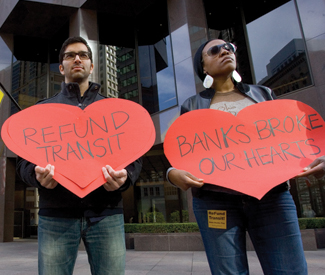
Bay Area activists, fueled in part by the Occupy movement, have recently taken stands against police brutality, for the rights of the homeless, against the corporate power of banks, and much more. But, arguably, nowhere has the movement been more successful than in the fight against foreclosures and evictions.


With the support of Alliance of Californians for Community Empowerment (ACCE) and the Bayview Foreclosure Fighters, several Bayview residents whose homes had already been sold continue to occupy them, and in some cases sales have been rescinded. Occupy Bernal has used civil disobedience to postpone six housing auctions, keeping their neighbors in their homes that much longer. They secured a meeting with Diana Stauffer, Wells Fargo Home Mortgage senior vice president, and David Campos, District 9 supervisor, to delay foreclosure proceedings.


But the activists are pushing for a full moratorium on foreclosures and evictions in San Francisco. Such a moratorium is not without precedent. In recent years, sheriffs have stopped evictions and foreclosures in Wayne Country, Michigan; Cook County, Illinois; Butler County, Ohio; and Philadelphia County, Pennsylvania.


When Cook County Sheriff John Dart imposed his moratorium in 2010, he said, “I can’t possibly be expected to evict people from their homes when the banks themselves can’t say for sure everything was done properly. I need some kind of assurance that we aren’t evicting families based on fraudulent behavior by the banks.”


San Francisco seems ripe for a similar stance, as Assessor-Recorder Phil Ting recently released a report revealing widespread lawbreaking in foreclosure proceedings. The report found that 84 percent of foreclosures in San Francisco over the last three years involved faulty paperwork, some of it amounting to fraud.


Representatives from the District Attorney’s and the City Attorney’s offices told the Guardian that they are concerned about the report. These bodies may be starting the process of further investigating findings. Last week, Sheriff Ross Mirkarimi, whose office carries out the county’s evictions, said he has begun an initiative to collect and analyze the city’s foreclosure data.


But Mirkarimi’s hands may be tied. As he told Ann Garrison of KPFA radio Feb. 25, “I don’t have the latitude or discretion, much as I would like, because there would need to be a change in state law that empowers municipal sheriffs to be able to use that discretion.”


Occupy Bernal formed just a couple months ago, but it has emerged as a powerful advocate for homeowners facing foreclosure. The neighborhood-based branch of the Occupy movement chose to focus specifically on preventing the evictions of Bernal Heights residents, where over 100 homes face foreclosure.


They kept the pressure up Feb. 25, when a group of supporters convened at 1090 Chestnut Street, the residence of John Stumpf, the CEO of Wells Fargo. That bank owns the majority of mortgages on Bernal homes facing foreclosure.


The protest wasn’t meant to block the street and no one tried to enter the building where Stumpf owns three of the 14 floors. But police decided that the group of about 150 warranted blocking off the entire block to traffic, to the annoyance of many neighbors.


“You collected $43.7 billion in taxpayer money and have since made record profits at the expense of low-income communities, while repeatedly breaking your legal and moral obligations as a creditor. You have failed to comply with loan modification requirements under your own lending agreements,” said a blown-up “foreclosure notice” outside Stumpf’s home.


In the spirited street theater scene, activists dressed as an auctioneer and a larger-than-life John Stumpf played out a fake auction of Stumpf’s property.


Dexter Cato, a father of four whose wife was recently killed in a car crash in the midst of months-long loan modification proceedings, faces foreclosure from his Bayview home of 40 years.


“Stumpf, we want a new address for you,” said Archbishop Franzo King of the Western Additions’ John Coltrane church, “850 Bryant Street!”


The crowd then proceeded to chant this address: the San Francisco Hall of Jusice and County Jail.


“We understand that some of our customers are going through difficult times during this economic recovery,” said Jim Foley, president of Wells Fargo’s Greater Bay Area region, in a press release responding to the Feb. 25 protest. The company plans to hold “Home Preservation Workshops” in Richmond March 7 and 8 to help homeowners facing foreclosure.


Public officials may be a long way from locking up CEOs for foreclosure fraud, but some have taken notice of complaints against the banks. On Feb. 2, the Berkeley City Council voted not to extend its contract with Wells Fargo to manage $300 million in city assets, citing its foreclosures on city residents.


On a national level, activists have been successful in persuading people to transfer their money to local banks and credit unions in recent months. Javelin Strategy and Research came out with statistics that 5.6 million Americans have switched bank service providers in the past 90 days, three times the normal transfer rate. Bank Transfer Day in early October was specifically cited as the trigger by 610,000 of those people.


The recent $25 billion settlement between the five largest banks and attorneys general in California and other states over mortgage fraud made big headlines, but activists note that it allocates a measly $2,000 to some people who have lost their homes to foreclosure. Occupy Bernal’s Buck Bagot said people need more protection from powerful banks. “Banks suckered people into this stuff, and they have made billions,” Bagot said. “We’re not saying people shouldn’t have to pay off the money they borrowed, but it took two to tango.”

NATHANIEL BLUMBERG, 1922-2012

3

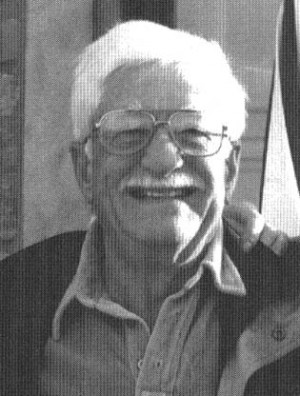
Nathan Blumberg, a great journalist who insisted on meeting deadlines, wrote his own obituary so that he would not miss his final deadline,  on Valentine’s Day, in 2012, when he died of complications from a stroke in Kalispell, Montana. Below is his obit,and his final byline, updated and corrected by Wilbur Wood, his former student and former city editor of the Guardian in the late 1960s.  Wood said that  Nathaniel wrote his own obit to insure that it would be complete and accurate. Nathaniel’s critique of mainstream journalism, and his  vision of independent journalism, were a major influence in the founding of the Guardian and the alternative press.

Nathaniel Blumberg was a World War II combat veteran, Rhodes Scholar, investigative reporter, national press critic, novelist, visiting professor and lecturer at major universities, dean and professor during his 35-year tenure at the University of Montana, and a man devoted to Montana for the last 55 years of his life.

He died February 14, 2012, at the age of 89 in Kalispell, Montana, where he had been hospitalized since a stroke February 8 in his home near Big Fork.     

Born April 8, 1922, in Denver, Colorado, Nathaniel Bernard Blumberg was the eighth and last child of Dr. Abraham Moses and Jeanette Blumberg. His father was a country doctor in Siebert, Colorado, for many years and had moved to Denver with his family to serve as superintendent of a tuberculosis sanitarium.

Nathaniel grew up in the west side of Denver with his four brothers and three sisters in a vibrant home filled with newspapers, magazines, books, music and long discussions of current events at the dinner table. He was graduated from East Denver High School after covering the city’s high school sports for the Rocky Mountain News while a senior.

His education at the University of Colorado was interrupted by the attack on Pearl Harbor and in August, 1942, he enlisted in the Army. After basic training, he was sent to the Army Specialized Training Program in Logan, Utah, and then to Camp Bowie in Texas. He was assigned to the forward observation team of Battery C of the newly formed 666th Field Artillery Battalion, a 155mm howitzer non-divisional unit trained to change mission on short notice. The Triple Sixes entered the war during one of the coldest winters of the century in Belgium against elite German SS troops in the Battle of the Bulge, the largest land battle in the history of the United States Army. The battalion then drove across the Roer river and the Rhine, through the heart of Germany and into occupation in Austria. He earned three battle stars and a Bronze Star in combat. 

Shortly after VE Day in 1945, he published the first history of a unit in World War II, “Charlie of 666,” which he had begun writing when the battalion was formed in 1944. With his poker winnings and combat pay, he published the 32-page booklet in a German print shop and distributed it to members of his battery to send home.

After the war he returned to the University of Colorado, was named editor of the student newspaper and received a bachelor of arts in journalism and a master of arts in history. He was awarded a Rhodes Scholarship for two years of study at Oxford University, where he earned a doctorate in modern history under the tutelage of the internationally known and controversial historian, A.J.P. Taylor. He was a starting guard for Oxford in the first Oxford-Cambridge basketball game ever played in 1949.

Nathaniel was an assistant professor of journalism at the University of Nebraska from 1950 to 1955, when in 1954 the University of Nebraska Press published his “One-Party Press?,” the first significant study of press performance in a presidential election. He went to Michigan State University for a year as an associate professor and in 1956 at the age of 34 he was brought to the Universty of Montana by President Carl McFarland to become dean and professor of the School of Journalism. He served under four presidents and two interim presidents during his 12 years as dean.

He established the annual Dean Stone Night in 1957 to honor the founder and first dean of the School of Journalism, to present awards to outstanding students and to bring a prominent journalist to lecture on the campus, a tradition still followed.

He formed the Department of Radio-Television in 1957 and brought in Phil Hess to put KUFM on air Jan. 31, 1965, six years before National Public Radio was begun in 1971. He has been called on air “the grandfather of Montana Public Radio, a public service of the University of Montana.”

With Mel Ruder of the Hungry Horse News, president of the Montana Newspaper Association, Nathaniel installed the Montana Newspaper Hall of Fame in the School of Journalism in 1958.

Also in 1958, he founded the Montana Journalism Review, the first journalism review in the United States, three years before the Columbia Journalism Review. It is still going.

Shortly after the inauguration of President Kennedy in 1961, the U.S. State Department asked him to serve as an “American Specialist” in Thailand for the summer. Three years later, under President Johnson, he again served in the same capacity for the summer in Trinidad, Guyana, Surinam and Jamaica.

He was elected vice president of the American Association of Schools and Departments of Journalism in 1962, declining to run for president because it meant he would be sponsoring a national journalism competition he and his faculty regarded as unethical. He was elected national chairman of the accreditation committee of the American Council on Education for Journalism in 1967 and national president of Kappa Tau Alpha, the society honoring scholarship in journalism, in 1969.

He was a member of the Rhodes Scholarship state selection committee from 1956 to 1987, including seven years as state secretary. He served six times on the western seven-state Rhodes regional selection committee.

Nathaniel was a staff writer for the Denver Post, associate editor of the Lincoln (Neb.) Star and assistant city editor of the Washington Post. He accepted invitations to serve as a visiting professor at Pennsylvania State University for fall quarter of 1964, Northwestern University’s Medill School of Journalism for the 1966-67 year and the Graduate School of Journalism at the University of California at Berkeley in 1970.

He married Lynne Stout in 1946 and they had three daughters, Janet Leslie, Jenifer Lyn and Josephine Laura. They divorced in 1970 but remained a close family. Their children and grandchildren gathered in Missoula on many occasions and spent long summers on the east shore of Flathead Lake.

Starting a new life in 1970, Nathan took the full name of Nathaniel on his birth certificate. In 1973, he married Barbara Farquhar, a college English professor and a widely published poet, who came to Missoula with her daughter, Nina. Barbara introduced him to Newfoundland dogs and they shared their 34 years together with seven Newfies (and a wolf with a touch of dog in her from the Helena hills). They enjoyed traveling together to beaches and fishing villages in the Canary Islands, Morocco, Spain, Portugal, Nova Scotia, and frequently to Florida, Mexico, Costa Rica, Orcas Island and the central Oregon coast. They balanced these adventures with quiet periods of writing in the cabin they designed and helped build near Big Fork.

In 1980 he established WoodFIREAshes Press to publish books which he hoped to write, edit and design without commercial publishers, editors or agents. He crafted “The Afternoon of March 30, A Contemporary Historical Novel” in l984, which centered on facts never reported by mainstream newspapers or on television about the attempted assassination of President Reagan by John W. Hinckley Jr. It received many warm reviews except for the Missoulian reviewer who didn’t care for the book although he termed the chapter on Hinckley’s trial “riveting.” Bud Guthrie wrote that he had “written a pretty bad novel but a forceful and persuasive book.” Doris Lessing, years before she was awarded the Nobel Prize for Literature, wrote Nathaniel, “I have read ‘The Afternoon of March 30’ with fascination. I really could not put it down, once I had started. If you ever come to London – and why should you, if you live in Montana, which I understand from friends of mine is one of the special places – then do let me know.”    
 
Nathaniel rarely spoke of his part in World War II until 19 survivors of his artillery battery gathered for a reunion in 1992 and urged him to write the uncensored story of their time at war. He returned to Belgium and Germany three times, including a three-day meeting with 32 German veterans of the Ardennes battle. In 2000 he published “Charlie of 666, a Memoir of World War II,” which included his 1945 history and his recollections on the war 55 years later. It was nominated for the 2002 Distinguished Book Award of the Society of Military History.

From 1991 to 1999 he published 20 issues of the “Treasure State Review, A Montana Periodical of Journalism and Justice.” Many of his graduates contributed to the 12-page newsletter. It served as his commentary on that decade of Montana history.

He wrote many articles for magazines, but he was most proud of his coverage of the “March on the Pentagon” in 1967 and his long essay, “Chicago and the Press,” based on his time on the streets and in the parks covering the protesters during the chaotic week of the 1968 Democratic National Convention. He was co-editor with Warren Brier of “A Century of Montana Journalism” and editor of the two-volume “Mansfield Lectures in International Relations.”

He was a demanding teacher with high standards who encouraged his students to live up to the highest principles of the journalism profession, to treat their native language with accuracy and affection, to always be skeptical but never cynical, and to remember that “sacred cows make the best hamburgers.” He was teacher, friend and counselor to hundreds of his students and took great pride in their professional success, their contributions to journalism in Montana and the nation, and their strong sense of public service in their chosen careers. They have written an extraordinary number of books. Scores of his graduates became lifelong friends.

Nathaniel was outspoken and had strong opinions. When he was honored by the Montana Newspaper Association along with Mel Ruder of the Hungry Horse News and Hal Stearns of the Harlowtown Times as the first three Master Editor/Publishers in 1991, he told a cheering audience of weekly journalists that “I am just as proud of the kind of people who don’t like me as I am of the kind of people who love me.” At the 25th anniversary of the Montana Constitutional Convention in Helena in 1997, his critique of the Montana daily press drew the longest standing ovation of the meeting.

His beloved Barbara Ann died of a stroke on the Autumnal Equinox, Sept. 21, 2007, a few days before her 73rd birthday. He also lost his youngest daughter, Josephine Loewen, in a tragic accident on Jan. 7, 2001, at the age of 46.

Survivors include his daughters, Janet Leslie Blumberg of Bothell, Wash., Jenifer Blumberg of Charlo, and stepdaughter Nina Gutierrez and husband Miguel of Ciudad Colon, Costa Rica; grandchildren Caleb Knedlik and wife Janine of Philadelphia, Pa., Asher Loeb of San Francisco, Ariel Diaz and husband Victor of Phoenix, Aram Loeb of Dayton, Ohio, Laramie and Kiam Loewen of Missoula, Adam Loewen of Portland, and Helen, Valerie and Sofia Gutierrez of Ciudad Colon, Costa Rica; numerous nieces and nephews and his first wife, Lynne Blumberg in Missoula.

He spent his last years in his cabin working on a book, including a chapter on “My 30 Years With John W. Hinckley, Jr.” in which he named Neil and Sharon Bush as co-conspirators in the attempt to assassinate President Reagan.

He requested no formal services and that his ashes be scattered with those of Barbara among the trees around their home near Big Fork.

Our Weekly Picks: February 15-21

0

WEDNESDAY 15

The Asteroids Galaxy Tour

Do Danish hipsters listen to American funk music? Apparently the Asteroids Galaxy Tour is keen to show its repertoire goes beyond the catchy pop you’ve likely heard on an Apple iPod ad (“Around the Bend”) or a Heineken commercial (“The Golden Age”). Asteroids, the brainchild of vocalist Mette Lindberg and producer Lars Iversen, gained popularity with their nostalgia-inducing sound on 2009 release Fruit (Small Giants). Lindberg and Iversen push that retro-funkiness even further in newest release Out of Frequency (B.A.R. Music), employing more horns and electronic organ sounds to add some oomph to Lindberg’s sweet tones. It’s as if technicolor was suddenly brought into this high-definition world. (Kevin Lee)

With Vacationer

8 p.m., $10–$15

Independent

628 Divisadero, SF

(415) 771-1421

www.theindependentsf.com


THURSDAY 16

El pasado es un animal grotesco

Acclaimed Argentine director Mariano Pensotti found the roots of this play in a heap of random photographs salvaged from a defunct photo lab. The narrative impulse came from Balzac. The title he borrowed from an Of Montreal song. The result is an ingenious, giddy “mega fiction” that follows the tortuous careers of four 20somethings in Buenos Aires over a single decade, 1999 to 2009, with its intervening economic meltdown and a million other matters expected and unimagined — the detritus of an unwieldy but irresistible urge to meaning. Pensotti makes his San Francisco debut with this low-tech yet wildly ambitious theatrical production. (Robert Avila)

Thurs/16-Sat/18, 8pm, $20–$25

Yerba Buena Center for the Arts

701 Mission, SF

(415) 978-2787

www.ybca.org


BUMP Records on Mark Bradford

Jam the playlist on the website for the Bay Area Video Coalition’s BUMP Records youth-run label and you’ll get a sampling of catchy R&B and hip-hop songs, polished sound from young people who produce and perform their own work, learning about the importance of having a voice in society along the way. But they’re not just radio-ready, these kids. At this SF MOMA event of creative souls established and on-the-rise, BUMP artists will reinterpret hair stylist cum artist Mark Bradford’s character exploration of a Teddy Pendergrass-Pinnochio character, Pinnochio is on Fire. To warm up the crowd, artist Reneke Djikstra will talk about the spirit behind her luminous portrait work. (Caitlin Donohue)

6 p.m.-9:45 p.m., free with $18 museum admission

SF MOMA

151 Third St., SF

(415) 357-4000

www.sfmoma.org


FRIDAY 17

Hold Me Closer, Tiny Dionysus: A Greek Comedy Rock Epic

trixxie carr and Ben Randle put the libation in liberation with the return of their Great Recession–era musical about a lil grape-stained deity named Tiny Dionysus (carr) who, after getting booted off Mount Olympus, comes to San Francisco, where a group of unemployed artists call on him for help weathering the general storm. Randle directs playwright, faux queen, and chanteuse carr and a cast of five as classical Greek and classic rock converge, along with puppetry, drag, and original carr tunes, until no one is sure who is what is where is when — is why it’s so liberating. (Avila)

Fri/17-Sun/19, 8p.m., $20

CounterPULSE

1310 Mission, SF

(800) 838-3006

www.counterpulse.org


The FP

Ever since Snake Plissken played a sadistic life or death version of HORSE in 1996’s Escape from L.A., one question above all has been on the mind of serious filmmakers: what formerly non-threatening competition will inevitably become a bloodsport in our twisted future dystopia? With their directorial debut, The FP, the Trost Brothers have perhaps answered the question once and for all: Dance Dance Revolution (or at least something very similar to avoid trademark violations.) Make sure to strap on your most hardcore head band for the SF IndieFest’s 21+ DDR afterparty at 518 Valencia, where you can scout recruits for your video gang. The film opens theatrically March 16. (Ryan Prendiville)

7:15 p.m., $11

Roxie Theater

3117 16th St., SF

(415) 863-1087

www.roxie.com


Tanya Bello and Alyce Finwall

If Tanya Bello and Alyce Finwall have anything in common besides their friendship and a performance history on the East Coast, it’s fierceness and a take-no-prisoners approach to dance. When the petite Bello’s is on stage, it’s difficult to watch anybody else. If she brings anything like that kind of intensity to her new “Sol y Sombra” for her not even two-year-old Project B company, we should be in for a treat. In one of their early SF performances Finwall Dance Theater’s quartet of women in “Wide Time” just about bounced off the walls. Yet despite its wildness, the work also was tightly controlled. Turns out that Finwall has choreographed for over 10 years. In this program she will premiere the duet “Angel”. (Rita Felciano)

Fri/17-Sat/18, 8 p.m., $10–$20

The Garage

975 Howard, SF

www.975howard.com


Trainwreck Riders

Trainwreck Riders: a collision of country twang and good old rock’n’roll interspersed with hints of bluegrass and notes of garage punk. Their songs feel nostalgic, even upon first listen, and tend to focus on heartbreak. Yet they sing the blues in a way that makes you want to jam out instead of tear up. Yeah, these guys aren’t your run-of-the-mill indie act; but there is something quintessentially indie about them. Maybe it’s their preference for flannel. Or that Peter Frauenfelder’s voice bears a striking resemblance to Isaac Brock’s. Clearly, they’re from San Francisco. Ghost Yards, the band’s fourth full-length release, drops this spring. (Mia Sullivan)

With the Blank Tapes, and the Human Condition

9 p.m., $14

Independent

628 Divisadero, SF

(415) 771-1421

www.theindependentsf.com


SATURDAY 18

Bonobo

Bonobo, aka Britain’s Simon Green, has long reigned as one of the masters of the post-party, chillout tracks that deters drinking headaches in both lounge and living room. With his 2010 release Black Sands (Ninja Tune), Green opted for a more lush, jazzy, and spontaneous sound that edged slightly away from downtempo and toward the dancefloor. Ninja Tune has just released a remix CD of Black Sands that uses Green’s tracks and vocals from Andreya Triana as rich source material. Green could stick in a slow burning rework to begin the set, such as with Letherette’s sublime version of “All In Forms,” then turn up the energy a notch with a track like Machinedrum’s percussive-heavy production on “Eyesdown.” (Lee)

9 p.m.

Mezzanine

444 Jessie

(415) 625-8880

www.mezzaninesf.com


SUNDAY 19

Girl Walk // All Day and Cheryl Dance Party

Partly a 71-minute long music video centered around Girl Talk’s latest mashup album All Day, Girl Walk // All Day is also an ecstatic musical feature following young one dancer as she bursts out of the confines of ballet class and dances her way across New York City. Financed through Kickstarter and filmed largely on the sly in public and not so public (Bloomingdales) spaces, GW//AD involves over 100 dancers, and takes a fanciful poke at the tendency of people to ignore the exceptional, even when it breaks, two steps, or tumbles into their daily life. This screening — followed by a set from CHERYL (NY) — will be suitably projected over the dance floor. (Prendiville)

7 p.m. $10

Public Works

161 Erie, SF

(415) 932-0955

www.publicsf.com


Prime Cuts Film Festival Extravaganza!

The Scary Cow indie film co-op is one of those magical organizations that provide creative people with the network and resources to engage in collaborative creativity. The co-op’s mission is, simply, to cultivate a San Francisco film community equipped to make better films by connecting people who want to make films, and actually making them. (Genius?) Scary Cow has helped fund local films since 2007 and is celebrating its fifth anniversary with a screening of 13 shorts the co-op deems its “prime cuts.” Chosen shorts span the genres — from mockumentary to horror/comedy to sci-fi rock musical —and range from three to 24 minutes in length. (Sullivan)

4 p.m., $15–$40

Castro Theater

429 Castro, SF

(415) 621-6120

www.scarycow.com


MONDAY 20

Chucho Valdes and the Afro-Cuban Messengers

Perhaps the eminent Cuban pianist of his time, Jesus “Chucho” Valdes has spent four decades wowing audiences as performer, composer, and arranger. A co-founder of the legendary Latin American jazz-rock band Irakere, Valdes has won four Grammy awards, including one for his most recent album, Chucho’s Steps (Four Quarters). In Steps, Valdes pays homage to several renowned musicians, including John Coltrane, Cole Porter, George Gershwin and Joe Zawinul. His current band references Art Blakey and the Jazz Messengers, which produced driving, bebop sounds and served as a platform for younger jazz musicians to showcase their skills. (Lee)

7:30 p.m., $35–$75

Herbst Theatre

401 Van Ness, SF

(415) 621-6600

www.sfjazz.org


TUESDAY 21

Doug Stanhope

While his style of comedy has been called abrasive and caustic, Doug Stanhope simply tells it like it is on a variety of cultural and societal subjects, all with hilarious results. Since he won the San Francisco International Comedy Competition in 1995, he has earned a well deserved, wild reputation for his routines and shows, captured most recently on his live DVD/CD Oslo: Burning The Bridge To Nowhere (Roadrunner 2011). Last September Stanhope performed in a maximum security prison in Iceland, telling fans that if they committed a heinous enough crime to be sent there, they could see him for free — thankfully you’ve got an easier option tonight. (Sean McCourt)

8 p.m. $23.50

Cobb’s Comedy Club

915 Columbus, SF

(415) 928-4320

www.cobbscomedyclub.com


The Guardian listings deadline is two weeks prior to our Wednesday publication date. To submit an item for consideration, please include the title of the event, a brief description of the event, date and time, venue name, street address (listing cross streets only isn’t sufficient), city, telephone number readers can call for more information, telephone number for media, and admission costs. Send information to Listings, the Guardian Building, 135 Mississippi St., SF, CA 94107; fax to (415) 487-2506; or e-mail (paste press release into e-mail body — no text attachments, please) to listings@sfbg.com. Digital photos may be submitted in jpeg format; the image must be at least 240 dpi and four inches by six inches in size. We regret we cannot accept listings over the phone.

Alerts

0

yael@sfbg.com

WEDNESDAY 15

Which way forward?

Four panelists will speak on their approach to creating progressive change in the United States. Speakers include Rocky Anderson, former mayor of Salt Lake City and presidential candidate with the Justice Party; Margaret Flowers of Physicians for National Health Program and organizer with Occupy DC; Tom Gallagher, former state legislator in Massachusetts; and Dave Welsh of the San Francisco Labor Council. With moderator Rose Aguilar of KALW’s Your Call radio. A forum organized by the 99% Coalition, a group focused on anti-war and non-violence activism working alongside Occupy San Francisco.

7 p.m., $10 suggested donation

Unitarian Universalist Church

1187 Franklin, SF

(415) 710-7464

www.sf99percent.org


Black history film and discussion

A screening of Freedom Riders, the film detailing the story of 400 groundbreaking Civil Rights Movement activists that rode on integrated buses throughout the South despite violent resistance everywhere they turned.

7pm, $5 suggested donation

2969 Mission, SF

415-821-6545

answer@answersf.org


FRIDAY 17

Join the Un-Conference

Reverend Billy Talen, the performance artist pastor of the anti-consumerist Church of Life After Shopping, will give a sermon Friday evening. That part is $10, and all proceeds go to whistleblower Bradley Manning’s defense. But that’s just the first night of a free, three-day “un-conference.” Participants will set their own agenda, and range from experts and stars like Daniel Ellsberg, Annie Sprinkle, and Colonel Ann Wright to your run-of-the-mill folks interested in justice for whistleblowers.

6 p.m., $10

UC Berkeley International House

2299 Piedmont, Berk

www.freshjuiceparty.com


MONDAY 20

Stand with prisoners

A demonstration to protest racism and economic injustice perpetuated by mass incarceration and the prison-industrial complex and to stand in solidarity with prisoners and their families. This event is called by prisoners and sponsored by Occupy Oakland, reminding us that “there are more African Americans under correctional control today — in prison or jail, on probation or parole — than there were enslaved in 1850.” It will feature speakers and musical performances.

10 a.m., free

1540 Market, SF for bus and carpool

www.occupuy4prisoners.org


Occupying elders

The Gray Panthers present a discussion with participants in Occupy Bernal and the Wild Old Women, Occupy Oakland, and Occupy San Francisco. How can elders contribute to Occupy? Come find out from the people on the ground, including Ginny Jordan of the Wild Old Women, who have shut down more banks than any other Bay Area Occupy group, and Tova Fry of Occupy Oakland.

1 p.m., free

Unitarian Universalist Center

1187 Franklin, SF

graypanther-sf@sbcglobal.net

Nite Trax: DJ Rekha brings the ‘Basement’ beats to Non Stop Bhangra

0

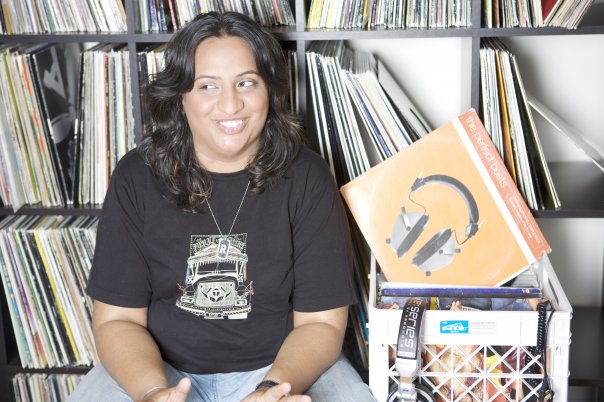
“I have been around the bhangra block,” says DJ Rekha, NYC’s ambassador for the highly danceable contemporary Punjabi (by way of London) sound, and founder of the popular, long-running Basement Bhangra party. “The biggest gig was definitely the White House. I have played all over the US and in Brazil, Sweden, New Zealand. I’ve done a bunch of music festivals and performed at cultural spaces including the Kennedy Center in DC.”

Talk about “world music” (even if that term has fallen from fashion). Rekha brings her Basement Bhangra spin — which includes a good bit of hip-hop and global bass influence — to our own beloved Non Stop Bhangra this Sat/11, joining the monthly party’s dholrhythms dance crew and DJ Jimmy Love for its reboot at Public Works, as I detailed in this week’s Super Ego nightlife column. In an email interview, Rekha wrote about bhangra’s changing scene, her favorite moments from the past 15 years at her club (Padma Lakshmi, anyone?), and her favorite bhangra bangers of the moment. 

http://www.youtube.com/watch?v=zgfMjwfs7H0

SFBG Can you share some of your favorite moments from Basement Bhangra?

DJ REKHA There have been a few.
1) I guess the first favorite moment is the first time I saw the line extend to the end of the block. We were always crowded, but by the following summer it was all the way down the street and not single file.
2) Having Wyclef stop by in the first few years of the night.
3) Dropping the Basement Bhangra anthem the first time.
4) Playing Panjabi MC’s Beware of the Boys after it was already hitting New York radio, having playing it there so much several years before.
5) Watching Ted Forstmann (RIP) crawl and look for his date Padma Lakshmi’s phone after she dropped it dancing
6) Getting a note to the booth saying I am Anil Kapoor (the game show host in Slumdog Millionaire) — and me dismissing it as a ploy to alter the bhangra musical direction of the night to Bollywood.

http://www.youtube.com/watch?v=DJztXj2GPfk

SFBG Have you been to San Francisco before, and if you have can you tell me if you think there are any differences between the bhangra scene here and in NYC?
   
DJ REKHA I have been to SF many times but I must sheepishly admit I have never been to a bhangra party there. But Non-Stop Bhangra is very well-known and regarded so I am super excited to be playing there Saturday.  My DJ experiences in SF have been awesome — most recently at the Asian Art Museum and for the 25th Anniversary of Trikone. In both cases I play a range of sounds. But SF is home to the best bhangra dance crew — Bhangra Empire — they’ve performed at the White House, professional sporting events. 

http://www.youtube.com/watch?v=WKWPzTF8-sw

SFBG Besides the fact that bhangra is infectious (I grew up partly in London and have loved it since the ’80s), do you think the influx of young Indian people moving to the US in the past couple decades has helped fuel bhangra’s popularity in clubs here?

DJ REKHA I think South Asian culture is more prevalent due to many factors —  Bollywood Dreams, Slumdog, globalization. Specifically for bhangra it’s the dance teams on the college scene that really help keep the music alive. Every major city in the US has some form of regular South Asian club night but only a few are actually focused musical on bhangra. Every major university has a bhangra team.  
 
SFBG What other types of music besides bhangra are you into — anything that might surprise some of your regulars?

DJ REKHA I love many styles of music.  Being from NY, I love hip-hop, but also dancehall, electronic, tropical bass. I am big Beatles and Prince fan.

SFBG What developments do you see happening within the bhangra sound?

DJ REKHA I think the latest thing we are seeing/hearing is Punjabi vocals with no actually bhangra music in the track. For example the song Amplifier by Imran Khan.  There is also a lot more over hip-hop stylings in the song in terms of vocals and not just beats.  The lines of what is a bhangra track vs something that is desi urban are being blurred.  Its never easy to keep a genre constrained.   Also in the last year or two as a reflection of dance music today there are a lot more faster tempoed songs.

SFBG Can you share your bhangra top 5 of the moment?

DJ REKHA My top 5 joint of the moment are:

>>”Tohar,” Garry Sandhu

>>”Electro Love Boliyan,” Ranbir S. and Bikram Singh


>>”Jatti,” Panjabi MC


>>”Jogi,” Jr. Dred


>>”Sadi Gal Hor Yah (feat. DCS),” PBN

Making history: Joanne Griffith’s ‘Redefining Black Power’ project comes to the Bay

0

“Joanne [Griffith]’s work is centered on one theme: not to offer information as a point of journalistic fact, but to act as a conduit for debate and conversation, especially around issues relating to the African diaspora experience.” So writes Brian Shazor, director of the Pacifica Radio Archives, in the foreward to Griffith’s new book Redefining Black Power: Reflections on the State of Black America (City Lights Books, 206pp, $16.95). Griffith will be presenting her work, part of an interactive project to archive the state of African Americans in the United States in the Bay Area this week — starting tonight (Wed/8) at the Museum of the African Diaspora.

This shouldn’t have to be said, but in these times of reductive news media it does: Obama isn’t the only black voice that needs to be heard, during this Black History Month or any other month. Inspired by the archives of progressive African American voice kept by LA’s Pacifica Radio Archives, Griffith — a leading progressive voice herself, having reported on issues from around the African diaspora for the BBC and NPR — transcribes her interviews with leading thoughtmakers for the book, set up as a series of dialogues. Hear from political prisoner Ramona Africa why Obama is “the new crack,” journalist Linn Washington, Jr. on media matters, green jobs leader Van Jones on hybrid activism. The president is used as a theme of the book, but the interviews use him as a lens to look at issues that range far beyond the White House.

Griffith and the other minds behind Redefining Black Power want these interviews to serve as a jumping off point for other unheard voices. Head over to the book’s website and you’ll find directions on how to add your point of view to those of the better-known activists and professionals already immortalized in the Pacifica archives. You can go to one of Griffith’s upcoming readings (details below) for inspiration. Or better yet, read our recent email interview with her and then do that. 

SFBG: Explain where the interviews in the book came from. How did you become acquainted with the Pacifica Radio Archives. Why are they important for people to hear?

JG: The idea for the Redefining Black Power Project, of which the book is part, was born out of the historic audio held in the Pacifica Radio Archives; a national treasure trove of material charting America’s history from a progressive perspective dating back to 1949. Within the collection are key recordings from the civil rights, black power and black freedom movement, including Rosa Parks, Shirley Chisholm, Jesse Jackson, Malcolm X, James Baldwin, Lorraine Hansberry, Dr. Martin Luther King Jr., Bobby Seale, Elaine Brown, and so many others. But it was one recording of Fannie Lou Hamer addressing the 1964 Democratic National Convention that sparked the idea for Redefining Black Power. The director of the Pacifica Radio Archives, Brian DeShazor, heard the tape and wanted to find a permanent way to preserve and share the voices held in the archives with a wider audience, and what better way than through the written word. Brian approached City Lights Books with the idea, and this book is the result, drawing on the voices of history to link us to the election of Barack Obama, one of the most significant moments in the social and political history of the United States. Through this project, we hope to preserve the voices, opinions and perspectives of African-Americans in this so called ‘Age of Obama’ for historians to digest and explore in years to come. 

How did I get involved? As a complete audio nut, I always make a point of visiting local radio stations wherever I travel in the world. Back in 2007, I was in Los Angeles, called KPFK to arrange a visit and was introduced to the Pacifica Radio Archives. Speaking with Brian DeShazor, we came up with an idea to share the historic collection with a UK audience and I’ve been doing this every Sunday evening on BBC Radio 5 Live in the UK for over four years. Because of this work and the extensive list of people I have interviewed over the years, Brian invited me to do the interviews for the Redefining Black Power project. Through this book, we delve into the role of the activist from different perspectives; the legal system, the media, religion, the economy, green politics and emotional justice. All were recorded between September 2009 and August 2011. To be clear though, this book is not an anthology of black leaders speaking on the Obama presidency. This is simply a taster of opinions on the subject, but everyone is encouraged to participate with their thoughts and opinions at www.redefiningblackpower.com and come out to the many events we’re hosting throughout February, including here in the Bay Area at the Museum of African Diaspora from 7 p.m. on Wednesday Feb 8 and at Marcus Books in Oakland with guest panelists Hodari Davis from Youth Speaks and social justice activist Dereca Blackmon on Thursday Feb 9 from 6.30 p.m.

SFBG: Has there been an interview you’ve conducted in which your subject’s answers have deeply surprised you? 

JG: Every interview had its own surprise; from Ramona Africa describing President Obama as ‘the new crack’ and why she refused to vote, to economist Dr. Julianne Malveaux revealing the financially precarious situations many African Americans find themselves in; from high foreclosure rates and high unemployment to the low levels of accumulated wealth for black women. Very sobering statistics. Michelle Alexander, too, the author of The New Jim Crow: Mass Incarceration in the Age of Colorblindness really shocked me when she said that more African American men are currently incarcerated than were enslaved in 1850. 

However, it was Dr Vincent Harding, the man behind Dr. Martin Luther King Jr’s “Beyond Vietnam” speech that surprised me the most. A true veteran of the civil rights movement, he made the point that the election of President Obama was never the goal of the movement; instead he prefers to call the work “the movement for the expansion and deepening of democracy in America.” Put this way, it made me realize more than ever, that the work we do today is not in isolation, but part of a wider movement, stretching back all the way to slavery. And the work isn’t over. 

SFBG: Your introduction ends with a quote from Kanye and Jay-Z’s Watch the Throne album. What role, if any, does hip-hop play in the book?

JG: Hip-hop doesn’t play a role in this book, other than this quote, but it will feature heavily in the next volume of Redefining Black Power which will focus on the reflections of black entertainers, writers, poets and performers on this moment in US history.  

SFBG: What would be the best way the United States could spend Black History Month?

JG: Black history — regardless of whether it is the United States or the UK where I moved from or anywhere else — should be acknowledged daily; this is the only way for us to keep memories alive and never forget where transformative change, like the election of President Obama, comes from. 

Listening to recordings like those held in the Pacifica Radio Archives with our youth would be a great place to start. I spent a couple of days with a group of students in Detroit, sharing the archive material and getting them to discuss their thoughts on the recordings; Audre Laude, James Baldwin, Muhammad Ali, Nelson Mandela, and others. Every one of them said they wished they had heard these voices before. It gave them a context to their own lives that didn’t exist previously, while encouraging them to never give up; too many people have suffered for them to let less than favorable circumstances stop them now. 

SFBG: Who should read this book? How should it be used?

JG: Use it as a conversation starter to discuss issues in your own community. Parents, use it as a way to engage your children in history. Students, use it as a resource for papers on race and the Obama presidency. Most importantly, everyone, share your thoughts at www.redefiningblackpower.com. This book is not the end of the project; we’re only getting started. 

Joanne Griffith’s Redefining Black Power author readings:

Wed/8 7 p.m., free with $10 museum admission

Museum of the African Diaspora

685 Mission, SF

(415) 358-7252

www.moadsf.org


Thu/9 6:30-8 p.m., free

Marcus Books

3900 Martin Luther King Jr. Way, Oakl.

(510) 652-3244

www.marcusbookstores.com


The story of hip-hop

0

By Courtney Garcia

MUSIC From the start, Ice-T was a versatile chameleon, the product of an integrated culture, and a student of the marginalized.

Born in New Jersey, raised in the Crenshaw District of LA, he joined the Crips then pursued the army to pay his bills. His career was blazed in rap, though he once flipped the game to heavy metal. Multifaceted talent that he is, Ice would later grow even more famous on television.

It’s no surprise, then, that he now adds the title of director to his resume, with the debut of his first documentary, Something From Nothing: The Art of Rap, at this year’s Sundance Film Festival. The feature length endeavor is the pioneering artist’s tribute to the culture that bred him, beat him, and made him who he is; it’s a culture he feels is slowly slipping from his grasp. It’s a story as much about the traditions of hip-hop as it is a fervent call to action, told through the eyes of its maker and his impressive posse of friends.

The premise, nevertheless, is simple: this is the story of hip-hop. “It’s a lot of life lessons because you’re not only hearing about rap, but experiences and struggles,” explained Ice during a one-on-one breakfast interview at The Lift in Park City, Utah. He was present for the screenings, along with Grandmaster Caz and Chuck D, both of whom appear in the film.

Other notable feature players include Eminem, Dr. Dre, Kool Moe Dee, Kanye West, Royce da 5’9,” Common, Rakim, KRS-One, Bun B, and Snoop Dogg. “You’re hearing people who you thought woke up successful talk about how they thought about quitting, how they had to find their voice,” Ice said. “I wanted to catch these guys when they were vulnerable, to show they’re real people, and that success doesn’t come without some blows.”

Ice got into rap initially to avoid falling back into gang life, first experimenting with turntables while enlisted in the military. Musically, he made his name as an underground artist before signing with Warner Music/Sire Records, and eventually winning a Grammy for his song, “Back On the Block.” He would follow such success with a branch into acting, currently starring in the primetime series, Law & Order: Special Victims Unit. And while his schedule is more than demanding, he found time between shoots to direct this documentary, a film he believes had to be made to challenge the fallacious imagery of hip-hop in American culture.

“This movie is not about the money or the cars, it’s about the craft,” he says. “The only questions we get asked by the press were, you know, ‘Who are you having sex with?’ ‘How high do you get?’ ‘Who don’t you like?’ They don’t care about your work…I wanted people to see the hip-hop I know, not the hip-hop that’s been given out until now. You’re getting this image that’s not real.”

Something From Nothing begins on the streets of New York, and follows the beat to the sunny coast of Los Angeles. Interviewing the gamut of rap’s finest, Ice catches his friends at the record store, in the studio, on their patio and at the diner. They eat; they smoke; they talk hip-hop. Some, like Kanye, freestyle for the camera; others spit the rhymes they can’t get out of their heads.

In one of the more poignant scenes, Ice speaks with Eminem about his toil to commit to the trade amidst extreme discouragement, and the moment he realized it was his raison d’etre. Equally surreal, the filmmaker travels to Dr. Dre’s lavish estate in the Hollywood Hills, where the two converse about the late, Tupac Shakur.

Because the name ‘Ice-T’ signifies authority, the strength of this film is his access to the inside, exposing tales most people would never have a chance to hear. He hits on every shade of the genre, from gangster rap to native tongue, the poetics of Q-Tip to the in-your-face anarchy of Immortal Technique.

Introducing the film at Sundance, he described his impetus as a dissatisfaction with the current state of hip-hop, and an earnest aim to improve the situation.

Later, he elaborated. “To me, the most pinnacle moment in the movie was when Mos Def quoted Q-Tip saying ‘rap is not pop; rap never had pop ambitions.’ It’s a counterculture. Now it’s become pop, and how you gonna get mad at the kids? They want to eat; they want to make money; they want to live. If you ask me what my dream is, I would love to see a 19 year-old Public Enemy come out of nowhere; I would love to see the new 18 year-old Ice Cube just come kick in the door, and start telling motherfuckers, ‘Fuck the bling, this is what’s good. Let’s talk about Obama, let’s talk about Occupy Wall Street. Let’s go in.'”

He added, “It will never get radio play, but I believe if a young group of kids really nailed it, they could get a movement going. And it’s needed. I took Rage Against the Machine out as my opening act, so of course I want to see that. The terrain is wide open.”

It’s rare to catch Ice-T without his signature shades, and somehow it’s obvious he truly is the OG he claims. Yet his inner sincerity and passion show through in this project, an ode to the first platform to ever give him a voice. He sold the rights to film after the Sundance showings to The Indomina Group for worldwide distribution; a theatrical release is planned for summer.

“Music has that power to give people emotion, and that’s what’s lacking right now,” he reiterated. “They’re not using art form at full power. They’re just rubbing the surface of it.”

After the tear gas clears

3

yael@sfbg.com

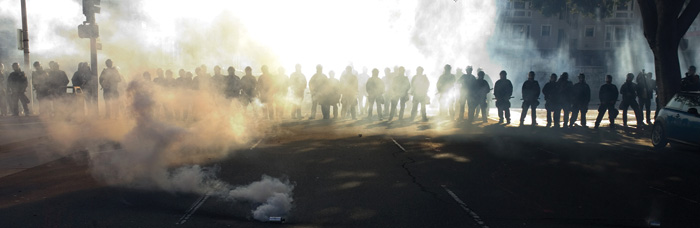
After a chaotic day of marches and confrontations between police and protesters Jan 28, I was arrested along with about 400 others who were trapped by police in front of the downtown Oakland YMCA. Seven of us were journalists.

The goal of the march was to take over an abandoned building — an the vacant Kaiser Convention Center, a city-owned building that’s been closed since 2005, was a prime target.

I have not yet been able to retrieve my property, including my recorder and notebook, which is being held by the Oakland Police Department. What follows is a pieced-together account and a perspective on what the events of Jan. 28.

I spend 20 hours behind bars, and missed the later parts of the action. But I was able to observe what happened in jail and make some sense of what happened.

Occupy people are constantly debating tactics and goals, and for many, the idea of occupying a vacant building made sense. When Occupy Oakland had a camp in Frank Ogawa Plaza, also known as Oscar Grant Plaza, and commonly shortened to OGP, it created a strong community. That community bridged divides between the homeless and the housed, between students and labor organizers, and between Oakland residents of different races, genders and levels of ability in an unprecedented fashion.

The camp had a kitchen that fed hundreds of people everyday and a network of shared tents and blankets which welcomed in hundreds who otherwise would have slept on the streets, often feeling isolated from other residents of their city and made to feel inferior.

The camp was repeatedly raided, Occupiers were tear gassed and shot with rubber bullets, and when OGP was cleared out, the community no longer had a home. And the police started that violence.

That was the practical reason for wanting to occupy a vacant building: to have a social center for Occupy Oakland.

Of course, there are other reasons. There’s the question that many squatters and homeless advocacy groups have been making for decades: why let buildings lie vacant while people freeze on the street?

Remember: The building that Occupy wanted to occupy is public property, and right now nobody is using if for anything.

In one exchange in jail, a guard asked a protester why the activists thought they had the right to take over a vacant building. “I mean, it’s not yours,” he insisted. The protester replied that many vacant buildings are government-owned and therefore public.

“So it’s the government’s,” the cop said.

“But I pay taxes,” the protester responded.

“Me too!” replied the cop. “It’s mine!”

“It’s both of ours,” smiled the protester. “It’s all of ours.”

That’s what made the convention center action such a clear and easy political decision.

A lot of people in Occupy would go further, saying that at a time of a severe housing crisis, it’s perfectly legitimate to take over privately owned buildings that are sitting there vacant. It’s part of the central argument of Occupy — that corporations and the rich unfairly own and continue to acquire much more wealth than the majority of people. For many people, owning a vacant building and doing nothing with it, while hundreds freeze on the streets, is a crime itself.


UP AGAINST THE COPS

Then there’s the question of the police — and violence.

The word “nonviolent” has a specific meaning in the history of political movements. Martin Luther King Jr. defined it in his essay “The Meaning of Non-Violence”: “If you are hit you must not hit back; you must rise to the heights of being able to accept blows without retaliating … But it also means that you are constantly moving to the point where you refuse to hate your enemy. You are constantly moving to the point where you love your enemy.”

It’s a philosophy but also, in political terms, a tactic.

Many of the people who make up Occupy Oakland get their start as activists organizing against police brutality in a city that has longstanding problems with violent and undisciplined officers.

Police Chief Howard Jordan said in a press release that “It became clear that the objective of this crowd was not to peacefully assemble and march, but to seek opportunity to further criminal acts, confront police, and repeatedly attempt to illegally occupy buildings.”

It was certainly clear that the intent of the crowd was to illegally occupy a building. And any honest assessment of Occupy Oakland would have to acknowledge that some members are not wedded to King-style nonviolent civil disobedience. (Neither, by the way, were a lot of the protest movements of the 1960s.) Many protesters wore masks and bandanas to disguise their identities and protect them from tear gas and pepper spray, and the march was led by protesters with makeshift shields, which suggests that they expected to be attacked. You could certainly argue that what those people were doing wasn’t confrontation; it was self-defense.

Frankly, it made sense to be prepared: In other Occupy Oakland actions, police have attacked with batons, tear gas, pepper spray, flash-bang grenades, and smoke bombs. And for quite a few Oakland residents, the police have always been seen as an outside force that can’t be trusted.

In fact, violence did break out. Many, including myself, have eyes still stinging from tear gas. I saw several wounds caused by rubber bullets shot at protesters. I spoke individually to at least a dozen people — one of them a pregnant woman — who were struck with police batons.

And protesters did not remain peaceful while this violence was being used against them.

Some picked up tear gas canisters and threw them back towards police; that much I saw. I also saw protesters throw empty plastic bottles at police.

According to the police, they also threw metal pipes, rocks and bricks. According to the protesters, they threw mainly empty plastic bottles and fruit at police. But as protesters often say of the police, “They’re the ones who showed up with the guns.” If the cops didn’t want violence, why unleash such an arsenal of weapons?

People got hurt, protesters and police alike. Several bystanders who had nothing to do with the situation were swept up in the mass arrest.

The city of Oakland, already in dire financial straits, likely spent hundreds of thousands of dollars reacting to the protests. Police claim that they were unable to sufficiently respond to violent crimes over the weekend, including five murders, because they were overwhelmed with Occupy troublemakers.

Of course, city officials were the ones who decided to arrest 400 people — with all the expense that involves.

There are, at this point, no reports of serious injuries to any police officers. However, at least a dozen protesters had welts on their faces or bodies from being beaten by clubs or shot with rubber bullets. One woman was shot in both arms with rubber bullet; one man was shot in the face with rubber bullets while holding a video camera to document the events. Several protesters were shoved to the ground and received wounds on their faces while being arrested. Police raised their rubber-bullet rifles to the faces of protesters throughout the day, threatening attacks. A rubber bullet to the face can cause brain damage and blindness.


DID IT HAVE TO HAPPEN?

How could this have been prevented?

Police say that “while peaceful forms of expression and free speech rights will be facilitated, acts of violence, trespassing, property destruction and overnight lodging will not be tolerated.” But 40 people were arrested during an ongoing Occupy Oakland vigil in the first weeks of January for having “illegal property” at OGP in what many saw as clearly a peaceful expression of First Amendment rights.

On KGO radio Jan. 29, Chief Jordan said that he has allowed Occupy Oakland to protest without a permit and would continue to do so, but those early January raids were ostensibly due to permit violations — violations of the terms of a permit that Occupy Oakland did in fact have.

There’s no question: The police response to Occupy Oakland over the past few months has caused some people in the movement to get more radical.

Many Occupy Oakland-affiliated medics condemned those who threw objects at police, saying that they provoked a backlash that caused more injuries. Many Oakland residents who might be in line with the socio-economic critique presented by the Occupy movement feel endangered and confused by marches that result in the massive use of police weapons in broad daylight. A lot of people would rather protest in a lot of ways that less resemble urban warfare.

On the other hand, there are also ways that Oakland officials could have prevented the consequences of weapons deployed and 400 arrested Jan. 28. They could, for example, have allowed protesters to occupy the vacant building.

When protesters seized a building Jan. 20 in San Francisco, police first attempted to prevent them. They lined up in front of the targeted building. They deployed pepper spray and struck several protesters with batons. When they were unsuccessful, and protesters entered the building from the back, they opted to block the surrounding streets and wait until the time seemed right to enter the situation and make arrests. Police spokesperson Carlos Manfredi told me that the cops were not going to rush into the situation and were trying to prevent injury and violence.

The Kaiser Convention Center has been vacant for years. The city of Oakland recently made plans to sell it to its Redevelopment Agency, but that plan fell into legal limbo when Gov. Jerry Brown signed AB26, a bill that dissolved all California redevelopment agencies.

At this point, nobody at Oakland City Hall has any plans whatsoever for the big, empty structure.

Why not allow Occupy to use the convention center? It’s not downtown, where Mayor Quan says businesses have been adversely affected by Occupy Oakland’s presence. It would give the movement a chance to stop focusing on trying to occupy spaces and start focusing on benefiting the community with food, shelter, and community programs that they provided when they had a camp. It would give the building tenants who could be held responsible for maintaining it. It might even help get Occupy Oakland and the Oakland Police Department out of the cycle of violence that they have been spiraling into for months.

Each time arrests occur, each time violence occurs, both sides blame the other. Both sides are correct that they were provoked. Both sides are correct that something that they think is worth defending was violated — for the cops, it’s the law. For the protesters, it’s the right of the people to assemble.

In fact, many Oakland residents have experienced violence at the hands of the Oakland Police Department for years before Occupy began. There was already a mass movement formed around the murder of Oscar Grant, and thousands of people fed up with police murders of unarmed, often black, suspects.

In recent decades, other radical groups, notably the Black Panthers, insisted that their community lacked basic needs because the city of Oakland refused to prioritize them. The Black Panther free breakfast program served food in a strikingly similar way to Occupy Oakland. Black Panthers were also notorious for carrying guns to defend themselves against police violence.

Occupy Oakland protesters (unlike Tea Party members) certainly don’t carry guns. But, more and more, they cry “fuck the pigs” as much as any Panther.

For much of the Occupy movement’s 99 percent, unjust actions by banks, corporations, and the government officials that they have often bought and paid for are the worst problems facing the United States today. For others, particularly the poor and people of color, these problems are magnified and exacerbated by the fact that they feel the threat of police harassment every day. For years, they’ve understood that police disproportionately do not investigate or solve crimes that happen to them and their families.


THE RADICALS AND THE BROADER MOVEMENT

The Oakland General Assembly Jan. 29 was the biggest it’s been in weeks. While there were still over 300 people in jail, 300 more came out to get involved with the meeting. That happened at the same time that many who felt that inexcusable violence and property destruction occurred Jan. 28 and concluded they could no longer have anything to do with Occupy Oakland.

It’s a challenge for the movement nationally, too: How do you accept and encourage the people whose legitimate anger at economic injustice and police abuse turns them toward more radical responses — and at the same time make room for a people who want nothing to do with the black bloc Fs, vandalism, and confrontation with the police?

There are tactical issues with the way the building occupation was planned. Many who were completely in line with the concept felt unsafe and uncomfortable with the secretive nature of the organizers who planned it. The location of the building targeted for occupation was kept secret for practical reasons; police could easily prevent a successful takeover. Supporters must often be led to the locations of planned takeovers without knowing where the action is and how they’ll get there. But how do you reconcile this with the transparency required when organizers are leading more than 1,000 people who want to use tactics they feel comfortable with and make their own choices?

Occupy Oakland is asking the people to imagine a world where property rights wouldn’t prevent them from doing all the good that they could do with a building like the Kaiser Convention Center. They must also ask themselves to imagine a world in which goals like a building occupation can be achieved in a way that everyone involved is able to consent to their involvement.

These debates continue to occur at Occupy Oakland. Some will leave the movement, some will join. Some will take the ideas and try to manifest them in new and different ways. Participants in Occupy Oakland desperately want basic needs of food and shelter met for their community members, and for the system that governs the city to do so in a way that allows people to thrive when it comes to health, education, and opportunities for creativity and growth. They think that they have the beginnings of a community and a process that can achieve those visions, better than the city government ever has, and they care more about achieving it than respecting the property rights of the owners of abandoned buildings.

Live Shots: Decentralized Dance Party

0

All photos by Bowerbird Photography
 
When Sam Love and I finally arrived at Union Square on Fri/27 night, we were surprised by the mass of boomboxes perched on peoples’ shoulders, like a thousand John Cusacks in Say Anything, heading down Powell Street. Somehow, we found our friends (Ickles and Eckles) when the party descended at the Powell Street BART station. The music blared and tourists careened their heads over the banisters of the station to see what the heck was going on. It was a Decentralized Dance Party (DDP), where strangers get dressed up, gather with their old boomboxes, and wait for the organizers to hijack a radio frequency, where they send out the jams on long antennas, for some major noise and wild Friday night dancing.

The theme was “Strictly Business,” so at times it was hard to tell the downtown suits from the party people, which just added more crazy to the mix. Of course, it got pretty hot on the concrete dance floor and layers were quickly stripped. Eventually, we found ourselves walking down Market, a hoard of twinkle-toed goofballs, getting down to everything from Journey to LMFAO. Almost to the Ferry Building, we stopped in a business park at 1 Bush Plaza and were told — gleefully? — that we had amassed 400 noise violations. The cops gave us one more song. Little did they know, DDP would pick a nearly 15 minute-long song – extending the party just long enough to finish off those “water” bottles and find someone’s shoulder to dance on.

The Performant: Discord fever

0

San Francisco Tape Music Festival unwinds at ODC

The fact that it’s raining makes it an unexpectedly perfect night to attend the San Francisco Tape Music Festival. The water rushing through pipes and sweeping across the rooftop of the ODC Theatre adds an extra layer of ambience to the cacophonic tones emitting from a modest bank of speakers, squatting on the stage like forbidding monoliths. The here-and-now intrusion of the rainfall ties even the most outré compositions of the evening together in an entirely unanticipated manner, from the oldest (dated 1857) to those created this still-young year by members of the current incarnation of the San Francisco Tape Music Collective and sfSound.


Snugly protected from the bluster of the elements, we sit in patient anticipation as the lights dim to as near a full blackout as can be achieved with glowing EXIT signs and lighted soundboard. The darkness forces focus on the content of the composition, not the conduit, freeing the senses from the unconscious tyranny of vision. And a certain amount of focus does come in handy for an evening spent listening to the trajectories of polyphonic dissonance whizzing through the room at reckless speeds. Field recordings, samples of radio-age music scores, spoken murmurings of French, English, Greek, percussive clatterings, static-y white noise, and a host of sonic curiosities stack up on top of each other like the building blocks of childhood, leaning precariously, threatening to topple. “Purposeless play,” John Cage once described it, though of course such purposelessness contains a purpose all its own.

Maggi Payne, SF Tape Music Fest, SFBG.com

Composer Maggi Payne

A 16-minute Matthew Barnard composition entitled The Piano Makers sweeps the oddience into the Kemble piano factory, where Barnard made a series of field recordings of piano manufacturing: all clatter of machinery, zing of taut strings and tuning forks, and pounding of keys. John Cage’s Williams Mix kicks off a centennial celebration of Cage’s birth with a frenetic mélange of classic cartoon scores, old jazz standards, church hymns, radio announcements, and a lonesome foghorn. One of the evening’s most distinctive aural pleasures comes courtesy of noted theatrical sound-designer Cliff Caruthers, whose eerie, affecting Underneath would serve perfectly as the ambient score of some great, underwater epic — Gilgamesh perhaps — all creaking boards, and groaning depths, punctuated by the primal bellow of some unfathomable creature and a twinkle of silvery fish. Maggi Payne’s Glassy Metals rounds out the first half with a textural layering of metallic sounds manipulated to mimic the wet gurgle of a deep forest brook and rush of dry desert winds.

Ma++ Ingalls, SF Tape Music Fest, SFBG.com

Performer Ma++ Ingalls. Photo by Lenny Gonzalez

Two of the highlights of the second half include the second John Cage piece of the night, Imaginary Landscape No. 5. Composed on a block graph designating eight tracks and 42 separate sound clips, the realization of this version was created collaboratively by the Tape Music Collective, and performed by Ma++ Ingalls. Sterfos, by Orestis Karamanlis, also performed by Ingalls, transports the listener to a fishing village on the edge of the Aegean Sea. Bucolic village sounds such as the somber clang of church bells, footsteps crunching on gravel, the lapping of waves, dogs barking, children playing, and an elderly man with the oratory tone of a storyteller, all layered over with the urgent textural tones of aggressive modernity. More than any other piece of the evening, Sterfos embodies the cinematic quality of the music, a clearly defined story arc winding through the village entire. Only a minor technical glitch halfway through the piece mars the otherwise seamless meander along the shoreline of a strangely familiar sea.


Public TV, for sale

2

OPINION The San Mateo Community College District Board of Trustees has announced the upcoming sale of its independent public television station, KCSM-TV. Some potential new owners are cause for alarm.

A January 10th walk-though for potential bidders was attended by the Christian broadcasting giant Daystar Television. The fastest-growing faith-based network in the country, Daystar’s mission is to reach souls with the good news of Jesus Christ as one of a “new breed of televangelists.”

While the prospect of San Mateo Community College bringing Daystar to the Peninsula is the most dramatic possible outcome of the district’s decision to sell, some of the other bidders present challenges as well.

Public Media Company, controlled by radio brokers Public Radio Capital and much in the news for its role in the still-contested sale of KUSF’s radio license to the formerly commercial station KDFC, also toured the station on Jan. 10.

Public Media Company/Public Radio Capital is based in Boulder, Colorado. The intertwined family of limited liability companies has been buying up college radio stations at fire-sale prices all over the country and folding them into tight National Public Radio classical or jazz-only formats. Independent musicians have expressed alarm at the loss of accessible college radio outlets, and the San Francisco Board of Supervisors denounced the loss of KUSF to San Francisco’s cultural fabric in a 2011 resolution.

Other possible bidders included the mysterious Locust Point Networks, a website without a definition beyond “an early stage telecommunications company,” and Cheifet Productions, which produced programming on Silicon Valley for the PBS Nightly Business Report. Also in the potential market are Independent Public Media, a satellite TV service created by one of the founders of Free Speech TV, and KAXT, a South-Bay based family of foreign-language stations founded by a former KGO reporter.

In the Bay Area, public broadcasting is dominated by the vast KQED, which owns television and radio stations from Sacramento to Salinas to San Jose. KQED has long been criticized for a paucity of local programming and news, and a fondness for cooking shows.

The absorption of independent outlets into the KQED structure promises more standardization and less variety for peninsula residents.

The district claims the sale of the educational, noncommercial TV license is a necessity because operating an independent public television station is not compatible with the core mission of educating students. But the district will continue to operate the radio station Jazz 91 radio station.

District officials also said that the TV station was losing money. But a financial statement posted with bid materials seemed to include many shared radio/TV expenses.

The district trustees meet Jan. 25 at 6:00 p.m. at the College of San Mateo, 3401 College of San Mateo Drive. They should be told in no uncertain terms that a sale to a Christian broadcaster is unacceptable — and that that any sale must protect the public interest in localism, independence, and a diversity of points of view. 

Tracy Rosenberg is the executive director of Media Alliance, a Bay Area nonprofit that advocates for democratic communications. www.media-alliance.org


Local musicians reinterpret Nick Drake’s “Pink Moon” at the Rickshaw Stop

4

Had you been skeptical about the “UnderCover Presents: Nick Drake’s Pink Moon” event Sunday night at the Rickshaw Stop you wouldn’t have been alone. It had the potential to be disastrous. Coordinating the sound alone must have posed a considerable challenge. How do you get 11 eclectic local bands — 50 performers each with specific sound needs — to play one song from one album without frazzling intervals between each performance and each set up? And then of course there’s the album to consider, Nick Drake’s Pink Moon. How can the bands perform the covers without butchering the album?
 
In the case of coordination and sound, it was a flawlessly organized UnderCover event, co-produced by Faultline Studios. Band set ups were seamless, the sound was first-rate, and the visuals by Joe Case that projected behind the stage were diverting. There were also pre-recorded interviews with band members shown before each performance, which made for an altogether different concert experience. With regards to Pink Moon, if you had hoped to hear covers that faithfully honored the songwriter’s final album, the event was likely a let down, but not a catastrophe.
 
Pink Moon is an odd choice for this kind of an event. For one, it’s terse — with only 11 songs, it clocks in at 28 minutes, and so each band is on stage for only a moment. It’s essentially a bleak piece of songwriting as well, recorded with only guitar and vocals, aside from the light piano on the title track. As John Wood, who produced Pink Moon said in a 1979 radio interview, “[Drake] was very determined to make this very stark, bare record and he definitely wanted it to be him more than anything.” However, the event’s music director Darren Johnston saw this as an invitation. He in fact chose the album because of its sparseness and the endless ways to approach it. “It’s not even my favorite Nick Drake album,” he said in one of the pre-recorded interviews.
 
It’s worth noting that many of the bands did not seem to be Drake aficionados, nor did they pretend to be. A series of pre-recorded interviews showed that they were unaware that a “pink moon” or “bloody moon” represents imminent disaster in other cultures, and that Drake was possibly foretelling his antidepressant overdose, which happened two years after the album was released.
 
Needless to say then, the bands tweaked and reinvented the songs on Pink Moon. If the result wasn’t sensitive tributes to Nick Drake, it was still seasoned musicians putting on compelling performances. Music Director Darren Johnston’s own band, Brass Menažeri, started the night off with the title track, “Pink Moon” which was a rumpus of snorting tubas, trumpets, and French horns. It was followed by the Oakland pop band Kapowski who managed to churn out a memorable piano take on “Place to Be.” The Real Vocal Quartet turned some heads with their cover of “Road,” sticking to the song in the beginning, then veering into a blasting collage of strings before coming back up, rather reluctantly, for another verse.
 
The performance that best embodied Pink Moon was the saxophone player David Boyce’s rendition of — interestingly enough— the only instrumental on the album, a song called “Horn.” With an array of effect pedals, Boyce withdrew from with the original song, but managed to embody the whole album with it. He puffed away and evoked its desolation, adding layer upon layer of drifting, sometimes ear-splitting sounds that encapsulated something like panic and nausea.
 
In many ways, you wanted to hear these bands doing their own material and performing longer sets. It was a shame that we only got a taste of the Billie Holiday inspired voice of singer Kally Price, for instance, who was spell-binding in the very, very brief amount of time she was up on stage.

Brass Menažeri (“Pink Moon”)
Kapowski! (“Place to Be”)
Real Vocal String Quartet (“Road”)
Kally Price (“Which Will”)
David Boyce (“Horn”)
Pocket Full of Rye (“Things Behind the Sun”)
Broken Shadows Family Band (“Know”)
Freddi Price (“Parasite”)
Ramon and Jessica (“Free Ride”)
Aaron Novik (“Harvest Breed”)
Jazz Mafia (“From the Morning”)

All photos by Jessica Trimmer

We want the airwaves

12

MUSIC It was written in an email exchange more than two months before 90.3 FM, better known as KUSF, was abruptly taken off the air. “We expect there will be a vocal minority that will be unhappy with the sale.” That cold-corporate speak delivered plainly from one of the involved entities was an ominous and understated prediction.

One year has passed since Jan. 18, 2011, when the station eventually was silenced in a shrouded and complex deal involving conglomerates, brokers, and non-disclosure agreements. However, the University of San Francisco’s attempt to sell the station’s broadcast license to Public Radio Capital and the University of Southern California’s Classical Public Radio Network (CPRN) for $3.75 million is not a done deal.

The Federal Communications Commission (FCC) has yet to approve the sale that has thus far been thwarted by a collective of volunteers who secured legal counsel in order to preserve over 33 years of independent, community radio and to resume broadcasting at the 90.3 frequency.

According to attorney Peter Franck, co-counsel for Friends of KUSF, a hearing would be the next step in the flurry of legal action if all goes well in the effort to save the station. He’s optimistic that the chances are greater with every day that passes that the sale will be denied and is confident the FCC is taking the situation seriously.

“I think it’s a very important case and the trend of college stations disappearing isn’t good. It’s about keeping the airwaves public,” he said.

CPRN initially said the move to acquire the frequency was out of a genuine desire to preserve classical music. But according to the group Save KUSF, Entercom — one of the top five largest radio broadcasting companies in the U.S., is a for-profit entity that was instrumental in orchestrating the deal. Classical and formerly commercial programming, previously heard on KDFC 102.1, took over 90.3 while the ubiquitous sounds of classic rock (KFOX) began emanating from 102.1 and Entercom’s studios.

Dorothy Kidd, a media studies professor at USF, who has adamantly opposed the sale because the university kept faculty and students in the dark, speculated that Entercom is footing the bill to keep KDFC afloat, presumably losing hundreds of thousands of dollars.

The much larger issue of media consolidation of course goes beyond KUSF. Tracy Rosenberg from Oakland-based Media Alliance noted that colleges and universities are selling their non-commercial educational licenses for millions of dollars.

WRVU (Vanderbilt University, Nashville) and KTRU (Rice University, Houston) are going through similar struggles with corporate radio lusting after their licenses. But on a positive note, Rosenberg said smaller, independent stations are banding together and that a coalition has emerged from this issue. “San Francisco is not the same city or as culturally vital without KUSF,” she said.

The absence of the station immediately sparked the ire of the community who felt deceived by USF. The man in the middle of it all who claimed responsibility for the decision and took some heat for it was USF President Father Stephen A. Privett. A day after the deal was made public; he held an uncomfortable public meeting on campus. There he repeated that KUSF would continue in an “online only” format. In addition, a promise was made that a “teaching lab” would be put in place for students. Though he couldn’t guarantee the full $3.75 million in would-be revenue was going to the department.

After talking to faculty, students, and alumni it became clear that no such media lab for students was in place. “The online station is not up and running and most likely will not be until the legal battle is over,” said Chad Heimann, a graduate from the Media Studies Department who was also a KUSF volunteer. He added that he thinks USF doesn’t want to invest in the online station until they know that the station will be sold.

“As far as I know, students are not getting an equivalent educational experience. The new digital studio has not been set up,” Professor Kidd concurred. She called any lab offers “rhetoric” on the school’s part, and that the money has been held up, while USF spends on legal fees. According to Friends of KUSF lawyers, CPRN and USF are using FCC lawyers in Washington for their joint response to legal action.

With costly litigation involved in the pending decision, there are claims that CPRN and USF didn’t comply with FCC law and that KUSF’s studios were dismantled prematurely in May. Additionally, questions have been raised about the operating agreement between the potential buyer and seller and the legality of their fundraising practices.

When the FCC asked for copies of emails from the University’s President regarding the sale, they were told Father Privett deletes his emails. “The IT department keeps backup copies. Their claim that they’re gone is ridiculous,” Franck said.

Father Privett could not be reached for comment as he was in Africa on business, but according to USF’s media relations department, they, along with CPRN, maintain commitment to the transaction and await FCC action, hoping the matter is resolved in the near future.

The legalese may leave you asking, where have all the DJs gone? “One of the issues moving forward is going beyond a grass-roots effort,” said Friends of KUSF treasurer Damin Esper. They did reach the milestone of fundraising $50,000 by November, mostly by holding benefits, like their upcoming DJ night at Bender’s.

Last spring KUSF- in- Exile emerged as a web stream coming out of the Bayview District’s Light Rail Studios with assistance from WFMU. With roughly 80 volunteers, and a music library being re-built from scratch, they remain committed to the cause, protesting in front of Entercom and playing local music, cultural and independent programming in a nonprofit, commercial-free format, all in the name of community.

Andre Torrez is a longtime volunteer and DJ with KUSF and now KUSF-in-Exile.


SAVE KUSF BENEFIT

Fri/20, 9 p.m., $5–$10 donation

Bender’s Bar and Grill

806 S. Van Ness, SF

(415) 824-1800

www.savekusf.org

Higher and higher

0

TRASH Rejected by audiences. Panned by critics. Beloved by a loyal cadre of alternative comedy fans.

Wet Hot American Summer may not have found success when it premiered in 2001, but the offbeat comedy has since become — like so many underrated flops — a cult classic.

“I’m always amazed that some critics didn’t just dislike it, they were outright hostile to it,” says David Wain, who directed the film and co-wrote it with Michael Showalter. “But those who keyed into it, whether the first time or second or third, seemed to really key into it. And for that I’m grateful.”

Those diehard Wet Hot devotees came out in droves when SF Sketchfest announced a live radio play version of the movie: tickets to the event quickly sold out. At the event, Wain will join Showalter and other cast members, including Paul Rudd, Amy Poehler, and Michael Ian Black.

Black remembers when he first realized Wet Hot had achieved cult status.

“About two or three years after the film came out, people started hosting midnight screenings at various theaters around the country,” he says. “It’s very gratifying, particularly because its popularity has remained pretty consistent over the last decade, and has found new fans among people who are unaware of our work — The State, Stella — beyond that movie.”

Those who missed the sketch comedy of The State and Stella were likely the same audience members baffled by Wet Hot, a film that is gleefully strange and — past the simple premise of “last day at summer camp” — difficult to explain.

Wet Hot does not fit into neat categorizations,” Black reflects. “It’s not a parody, it’s not a romantic comedy, it’s not a comedic homage. It has its own thing, its own sensibility.”

Part of that sensibility includes a talking can of mixed vegetables (voiced by H. Jon Benjamin), a cameo by falling Russian space station Skylab, and Black having steamy storage shed sex with future Sexiest Man Alive Bradley Cooper.

“It was kind of awkward because neither of us had ever been with another man before, but once we got into it, it was fine,” Black recalls. “I thought, ‘Oh, this is pretty much just like making out with a girl, only with a dick.'”

Because Wet Hot is the kind of movie fans watch and rewatch endlessly —something I can attest to from personal experience — those attending the live show probably have a pretty good idea of what to expect. Still, Wain promises a unique theatrical experience.

“We’ve gathered much of the original cast and many other awesome comedy folks, and we’ll have a live band and we’ll do an audio version of the movie,” he says. “Should be a blast!” 

SF SKETCHFEST

Jan. 19-Feb. 4, $10–$75 (Wet Hot event SOLD OUT as of 1/18, alas — but there’s plenty more Sketchfest fun to be had!)

Various venues, SF

www.sfsketchfest.com