Punk

The Performant: Hamburger helpers

0

There’s certainly no shortage of live comedy in the Bay Area, but you have to hand it to Club Chuckles for keeping it weird. Avoiding line-ups packed with middle-aged men whining about their therapy bills, or cosmonaut princesses with pubic hair obsessions, Club Chuckles can often be found lurking in the rock-saturated shadows of the Hemlock Tavern’s back room performance space, infused with the kind of punk rock vibes you’ll never pick up at the buttoned-down, two-drink minimum comedy clubs. The sold out, eight-year anniversary show at the considerably swankier digs of the Verdi Club might have been better lit, but the rowdy element still prevailed, as an entire line-up devoted to the comedy of the awkward braved the hecklers to bring the laffs.

Imagine if you will an idiot savant of the yo-yo who turns out to just be an idiot, and you’ve got a good idea of what to expect when Kenny “K-Strass” Strasser takes the stage. The befuddled alter-ego of Mark Proksch, “K-strass” is a yo-yo wielding man-child out to save the environment from the ill-effects of too much toilet flushing. Determined to wow the crowd with one of his patented yo-yo tricks, The William Tell, Strasser put a bucket and an apple on the head of his first of two volunteers, who quipped, “is this like Guantanamo?” “I don’t know him,” Strasser responded immediately, nervously readying his yo-yo to fly, uncontrolled, in the general direction of the apple.

The most traditional comic of the evening, affable Duncan Trussell delivered a stand-up set filled with references to medical marijuana, tripping at Great America, and the embarrassment of being human. But then he veered into prop comedy territory with a long rambling story about his Wiccan parents and The Book of Shadows, which culminated in an impromptu séance and an appearance by ventriloquist dummy “L’il Hobo”. A classic, hinge-jawed variant, L’il Hobo became apparently possessed by Lucifer halfway through the otherwise standard dummy/ventriloquist act, culminating in an eerie duet of “Wish You Were Here,” and the devil’s gruff demand for worship.

Dressed like a turn-of-the-nineteenth-century butterfly collector, Tim Heidecker of Tim and Eric Awesome Show fame, launched into his bumbling act clutching a cheat sheet like a lifeline, dropping his punchlines as often as he dropped the mic. Declining to indulge in any of his recently released Herman Cain-inspired anthems (“Cainthology: Songs in the Key of Cain”), he instead turned his affection to Newt Gingrich’s presidential aspirations, and introduced an ambitious high-speed rail project dubbed “Zazz Rent-a-Train.” “Why own when you can rent?” intoned the movietone narrator of the video-screened infomercial on the rail project designed to connect all the continents by rail.

Kicking the emotionally tone-deaf dial to eleven, headliner Neil Hamburger emerged at last, his trademark greasy comb-over and bow-tie suggesting the desperation of the small-time Vaudeville circuit. “Get some drinks up here asshole,” he snarled at booker Anthony Bedard, before launching into a series of dead-weight knock-knock jokes, a lengthy segment focused on the dubious “talents” of Britney Spears, embittered rants against various oddience members (“laugh your fool head off…this is fun. Everyone else is having fun…with your girlfriend”), and “an award-winning tribute to ice cream” which segued into a ribald joke about Ben and Jerry’s and prostitutes.

Like Kenny “K-Strass” Strasser, the Hamburger character is a long-inhabited alter ego, whose public appearances often appear more painful for the character than for his cringing fans, who really ought to have some kind of convenient moniker by which to call themselves, like “Hamburger-heads,” or “total masochists.” And indeed, by the show’s end only the true total masochists remained, each empty seat in the rows attesting to that peculiar comedic format of anti-success that Hamburger wields so well.

Clark shadows

0

TRASH If you were around in the waning days of drive-ins and urban grindhouses, the heydays of video stores and 1980s late-night cable, or were a Mystery Science Theatre 3000 fan, the name Greydon Clark might ring a faint bell — maybe even a warning bell.

For 25 years Clark was a prolific independent director, writer, producer, and even bit-part actor in the realm of low-budget exploitation movies designed for quick playoff in second-run theaters, graveyard-shift broadcast slots, and on rental shelves. Most were retreads of well-worn genre trends, a couple outright imitations of recent hits; they rarely hit the radar of mainstream critics, let alone awards-giving bodies — not even the Golden Raspberries. Though his last two features were futuristic adventures, Clark himself was relegated to cinema’s past by the turn of the millennium, having “aged out” in a business where an obsession with youth trickles down even to the least prestigious off-camera creative roles.

Now just short of 70, Clark is still around, selling memorabilia on his website, appearing at fan conventions, and the like. This Friday he’ll be at the Roxie for a Midnites for Maniacs tribute triple-bill featuring rare 35mm screenings of features long out of circulation.

First up is 1978’s Hi-Riders, a hybridization of then-current Smokey and the Bandit (1977) knockoffs and the earlier biker-flick vogue that’s one of his most enjoyable films. Frequent Clark collaborator Darby Hinton and busy stunt performer (through 1997’s Titanic) Diane Peterson are the nominal stars of a raucous action cheapie that pits muscle-car aficionados against each other, then against trigger-happy yokels ordered to kill by a vengeful fat cat who proclaims “Animals like that should be exterminated!” Acting pitched at a 10 on the hysteria scale, skinny dipping, and good crashes involving an actual bitchin’ Camaro ensue.

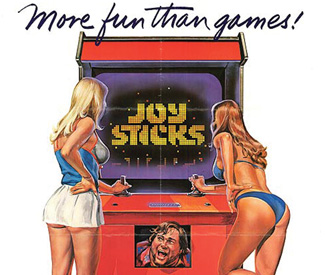
This is followed by Joysticks (1983), a prior Midnites for Maniacs midnight selection that remains a giddy high-lowlight in the short-lived 80s subgenre of movies about videogaming. How can it miss, with Porky’s-style gags, a hero named McDorfus, secondary “punk” villain King Vidiot (played by Napoleon Dynamite’s future Uncle Rico), and a theme song Tipper Gore might have taken exception to (“Jerk it left, jerk it right, shoot it hard, shoot it straight, video to the maaaaaax!!!”)?

Last and quite possibly least is 1982’s Wacko, one of several Airplane!-like slasher spoofs at the time. Its genial flailing about in search of laughs ropes in several of Clark’s favorite falling stars (Joe Don Baker, Stella Stevens, George Kennedy) and one future celebrity (pre-“Dice Man” Andrew Clay, as Fonz-y high school stud Tony Schlongini). If you were 10 years old (or 15 and stoned) in 1982, this was probably the funniest thing ever. So regress already.

But this selection offers just the tip of the native Michigander’s celluloid iceberg. Driving west on a whim in the 1960s, Clark managed to score work as both an actor and scenarist with Z-budget multihyphenate role model Al Adamson, including the incredible Satan’s Sadists (1969) and incredibler Dracula vs. Frankenstein (1971).

Those experiences empowered him to direct, co-write, and act in 1973’s The Bad Bunch (Kiss The Establishment Goodbye was one of several alternative titles), a drama of Vietnam War-era racial tensions that was shot in Watts for less than $15,000. It was clumsily crafted and crudely melodramatic, but serious-minded enough — despite gratuitous boobs and opening song “Honky Mutha Nigga Lover” — to set him on a more determinedly commercial, costs recouping path from then on.

Thus 1976’s Black Shampoo, an outrageous blaxploitation cash-in on Warren Beatty’s heterosexual hairdresser lothario hit, followed quickly by the unforgettably named (if otherwise forgettable) Satan’s Cheerleaders (1977), tentacled-alien-Frisbee-creature horror Without Warning (1980, with a very young David Caruso as one victim), and so forth. They inevitably featured once-hot, now economically-priced Hollywood names of a certain age (Clu Gulager, Jack Palance, Yvonne De Carlo etc.), attractive youngers mostly never to be heard from again, and Clark regulars like actress spouse Jacqueline Cole. (The fact that so many of his actors and crew came back for more suggests that he’s a pleasant guy to work for.)

Some of these movies actually require the MST3K treatment they got (i.e. 1985 Joe Don vs. Mafia shoot ’em up Final Justice) to be watchable. Some, like 1990 psychological thriller Out of Sight, Out of Her Mind or 1980 sci-fi fantasy The Return (a rare upgrade to then-current B-level stars in Cybill Shepard and Jan-Michael Vincent), didn’t get it and aren’t.

But others are inspirationally silly, with enough hints to make it clear that their creator was in on the joke. Probably the most widely seen of his films is acknowledged camp classic The Forbidden Dance, one of two lambada movies released on the same day in 1990. It stars former Miss USA and future Mulholland Drive (2001) enigma Laura Harring as an Amazonian tribal princess who comes to Beverly Hills (accompanied by “witch doctor” Sid Haig) to attract attention to rainforest destruction via the healing power of public ass-grinding. All this and an ozone depletion message make it Clark’s Inconvenient Truth, just as The Bad Bunch was his Crash.

Less socially conscious but equally nuts are Uninvited (1988), in which a yacht full of the expected veteran actors and hot young ‘uns are terrorized by a mutant lab-experiment cat puppet; and Russian Holiday (1992), a daft espionage thriller with Susan Blakely as a tourist haplessly playing Nancy Drew amidst Moscow neck-snappings.

Then there’s 1989’s Skinheads: The Second Coming of Hate. Its hilarious racist, sexist, swastika-emblazoned goon squad makes the mistake of pursuing clean-cut “good” kids into the wilderness lair of survivalist Chuck Connors, who fought in World War II and knows just what to do with a buncha neo-Nazi scum. It’s pretty much the Reefer Madness of Reagan-era fascist punk gang movies (1982’s Class of 1984, 1984’s Savage Streets, etc.) — a category that surely calls for its own Midnites for Maniacs tribute.


“MORE FUN THAN GAMES! A TRIBUTE TO GREYDON CLARK”

Fri/2, triple-feature starts at 7 p.m., $12

Roxie Theater

3117 16th St., SF

(415) 863-1087 www.midnitesformaniacs.com

Our Weekly Picks: November 30-December 6

0

WEDNESDAY 30

“Flotsam and Jetsam: The Spray of History”

The ceaselessly inventive Los Angeles filmmaker Lewis Klahr comes to town for two shows this week. Joseph Cornell’s boxes are perhaps the most convenient reference point for Klahr’s richly emotional collage animation, though his handmade films’ range of tones and complex interlacing of pop culture and personal sentiment really merits stand-alone consideration. This PFA program samples Klahr’s recent short films, while the SF Cinematheque show at Yerba Buena Center for the Arts on Friday focuses on Klahr’s ongoing series of sublime musical memory pieces, Prolix Satori. The two shows have no overlapping films, which among other things means you get to appreciate Klahr’s Brill Building ear for titles (A Thousand Julys, False Aging, Wednesday Morning Two A.M., Daylight Moon, Well Then There Now). (Max Goldberg)

7:30 p.m., $9.50

Pacific Film Archive Theater

2575 Bancroft, Berk.

(510) 642-1412

www.bampfa.berkeley.edu

www.sfcinematheque.org


Lemuria

You would think that a band called Lemuria — a hypothetical continent said to have submerged into the depths of the Indian Ocean — would sound along the lines of Vangelis or Tangerine Dream. But the trio from Buffalo, NY, takes after alternative pop-punk predecessors like Superchunk and the Breeders. Sheena Ozella and Alex Kerns started Lemuria in 2004, taking on bass player Jason Draper a year later. Since then, Lemuria has matured into a band that’s at once frisky and endearing, dynamic and biting. On Lemuria’s newest album, Pebble (Bridge 9), Ozella and Kerns alternate on vocals in such a way that inspires deep sighs, like you’ve just spotted an adorable little dog. But when Ozella’s tough and vivacious guitar playing takes a front-seat, you realize that dog can bite. (James H. Miller)

With the Pillowfights!, Matsuri

9 p.m., $10

Bottom of the Hill

1233 17th St., SF

(415) 621-4455

www.bottomofthehill.com


FRIDAY 2

“Danzón”

It’s hard to imagine contemporary dance and performance without the seminal influence of German choreographer-performer Pina Bausch, whose work was so different when it started in the 1970s that it spawned its own genre: dance theater. Bausch’s gorgeous visual aesthetic, wildly eclectic movement, incorporation of speech and unbridled emotion, and her collaborative, searching process all contributed to a remaking of the landscape. The subject of a recent 3D documentary tribute by Wim Wenders, Bausch (who died in 2009) left behind a supreme body of work that her company continues to perform around the world. This weekend, Tanztheater Wuppertal Pina Bausch offers Danzón, Bausch’s poignant, humor-filled celebration of life’s journey in the teeth of death. No 3D specs required. (Robert Avila)

Through Dec. 3, 8 p.m., $30

Zellerbach Hall, Berk.

(510) 642-9988

www.calperformances.org


“True Stories Lounge”

As the cliché goes, truth is stranger than fiction — and knowing that a story is true (or at least somewhat “based on a true story,” Texas Chainsaw Massacre-style) makes it all the more fascinating. The ongoing series “True Stories Lounge” brings together a varied slate of word-wranglers to spin compelling non-fiction tales. This edition’s storytellers include spoken word artist Alan Kaufman, who’ll read from his new memoir, Drunken Angel; comedian Marilyn Pittman, talking through a family tragedy; Salon.com founder David Talbot, reading from his soon-to-be-released book of San Francisco history; Bay Citizen editor Steve Fainaru, a 2008 Pulitzer winner, discussing Iraq; and Brando biographer Peter Manso, reading from his latest Cape Cod-set true crime book. (Cheryl Eddy)

7:30 p.m., $10

Make-Out Room

3225 22nd St., SF

www.makeoutroom.com


Benoit & Sergio

“Sergio used to be my English teacher,” reads a YouTube comment for “Walk and Talk.” How hard it would be to explain a lyric like “My baby does K all day” at a parent-teacher conference? In 2009 Sergio quit the D.C. prep school racket to make music full-time with French expatriate Benoit. The electronic duo has quickly built a reputation on less than a dozen tracks released across Ghostly International, Visionquest, and DFA. With an original sound that mixes ecstatic techno house, melancholic late-night soul, and playfully barbed vocals, this will be the SF debut of the pair’s live show. (Ryan Prendiville)

With No Regular Play and DJ sets by Pillowtalk, Thee Mike B, Rich Korach, and more

9 p.m., $15-20

Public Works

161 Erie, SF

(415) 932-0955

www.publicsf.com


SATURDAY 3

Papercuts

Founder and lead songwriter of Papercuts, Jason Robert Quever, has a knack for softly wooing listeners into his songs. Part of the seductiveness is Quever’s voice. You tend to follow its breathiness until you’re deep in his weightless and roomy dream pop. On Papercuts’ Fading Parade, the band’s debut album on Subpop, which came out earlier this year, Quever can sound like a love sick ghost, padding around and whispering pleas in your ear. His vocals hover over a lulling swathe of reverb, but drums and guitars retain enough crispness so as not to become a colorless drone. It’s a carefully weighted balance, and one that’s well worth witnessing live. (Miller)

With Dominant Legs, Tim Cohen’s Magic Trick

9 p.m., $12

Rickshaw Stop

155 Fell, SF

(415) 861-2011

www.rickshawstop.com


“In the Red — Flaming Lotus Girls Gallery Show”

The Flaming Lotus Girls always go big, pushing the envelope on fire arts innovation every year at Burning Man and other festivals. That’s a big reason why I profiled them in my book, The Tribes of Burning Man: How an Experimental City in the Desert is Shaping the New American Counterculture. And it’s also why they’re in debt, now more than most years. So come mingle, marvel at their fiery artworks, dance to DJs from Space Cowboys and the Ambient Mafia, buy some art (including photo prints of FLG projects) or shwag (from the FLG’s autographed and lipstick-kissed calendar to copies of my book that I’ll be selling and signing there), and help the Flaming Lotus Girls get out of the red and into active preparations for its next big project. (Steven T. Jones)

With Deckward, 8Ball, Olde Nasty, and more

6 p.m.-2a.m., free but donations accepted

SomArts

934 Brannan, SF

(415) 552-1770

www.flaminglotus.com


“The Bay Brewed: A Rock and Roll Beer Festival”

Live music and drinking clearly go well with together. Unfortunately, beer festivals too often conjure up images of boring C list jam bands or old-timers working their way through a bunch of Creedence covers. Not the case with The Bay Brewed, a beer festival and music showcase mash-up put on by the folks over at The Bay Bridged blog. Along with unlimited tastings from 21st Amendment, Anchor Steam, Lagunitas, and Magnolia, among others, admission includes performances by some great local bands. Pick up a complimentary mug and catch the shoegaze-y post-punk of Weekend, the psychedelic rock of Sleepy Sun, the dub-tinged Extra Classic, and the punky power pop of Terry Malts. (Landon Moblad)

2-7 p.m., $55

Verdi Club

2424 Mariposa, SF

(415) 861-9199

www.thebaybridged.com/the-bay-brewed


SUNDAY 4

Cass McCombs

Similar to the nomadic lifestyle he’s maintained over the years, Cass McCombs creates music that can be tough to pin down. Though he was born in Concord and has considered the Bay Area home at various points in his career, the indie singer-songwriter has bounced all over the country, eschewing traditional genre expectations in the process. Wit’s End and Humor Risk, McCombs’ two 2011 albums, fully demonstrate his maturing take on sparse folk, dreamy pop, and melancholic rock spiked with just the right amount of humor.(Moblad)

With White Magic, Liza Thorn

8 p.m., $16

Great American Music Hall

859 O’Farrell, SF

(415) 885-0750

www.slimspresents.com


MONDAY 5

The Sea and Cake

Merely listening to indie veteran the Sea and Cake’s extensive catalog of material is an exhausting feat. With jazz, Brazilian, and African influences, this band has been generating a unique sound for more than 20 years. Characterized by Sam Prekop’s breathy vocals and delicate guitar work, the Sea and Cake has long provided the perfect soundtrack for mellowing out with your friends. The group embraced a more experimental sound for this year’s The Moonlight Butterfly (Thrill Jockey), its first release since 2008. Timelessly hip, yet approachable, start your week off right with the effervescent jams of the Sea and Cake. (Frances Capell)

With Lia Ices

8 p.m., $21

Great American Music Hall

859 O’Farrell, SF

(415) 885-0750

www.slimspresents.com


TUESDAY 6

Jeffrey Lewis & the Junkyard

Jeffrey Lewis is a jack of all trades. His style encompasses both cerebral folk and grungy, distorted garage rock. Though his lyrics may come across as stream-of-conscience tangents, Lewis’ witty songs are brimming with clever and heartbreaking observations. The musician is also an accomplished comic book artist, and his illustrations often accompany his live performances. Topics of discussion include LSD, farm animals, and the history of Communism. Is there anything Lewis can’t do? (Capell)

With the Yellow Dress, Tortured Genies

8 p.m., $10

Rickshaw Stop

155 Fell, SF

(415) 861-2011

www.rickshawstop.com


Other Lives

Other Lives is building a lot of momentum in the wake of Tamer Animals (TBD Records), the band’s latest album. The five-piece from Stillwater, Okla., supported Bon Iver on tour, and afterward, played headline shows across Europe. Eclipsing its recent successes, though, was the announcement that it will support Radiohead on its U.S. Tour, beginning in February. The momentum is certainly deserved. Tamer Animals is dim folk-rock that builds on robust orchestration — violins, cellos, clarinets, and horns all have a grand presence on the record. Once an instrumental collaboration called Kunek, Other Lives still has an appreciation for the slightest sonic details, so that nearly every moment has something to call surprising, if not riveting. (Miller)

With JBM

9 p.m., $12

Cafe Du Nord

2170 Market, SF

(415) 861-5016

www.cafedunord.com


Anna Calvi

Praised by Brian Eno as “the best thing since Patti Smith,” dark songstress Anna Calvi also exudes the fierce swagger and edgy sex appeal of predecessors PJ Harvey and Pat Benatar. Calvi’s flamenco and blues-tinged debut earned her critical acclaim and a Mercury Prize nomination for best album of 2011. A backing band consisting of Mally Harpaz on harmonium and percussion and Daniel Maiden-Wood on drums heightens the drama of Calvi’s cinematic anthems. Armed with a guitar and a voice that’s both sultry and operatic, the fiery Calvi seduces everything in her path. (Capell)

8 p.m., $17 Great American Music Hall 859 O’Farrell, SF (415) 885-0750 www.slimspresents.com 

The Guardian listings deadline is two weeks prior to our Wednesday publication date. To submit an item for consideration, please include the title of the event, a brief description of the event, date and time, venue name, street address (listing cross streets only isn’t sufficient), city, telephone number readers can call for more information, telephone number for media, and admission costs. Send information to Listings, the Guardian Building, 135 Mississippi St., SF, CA 94107; fax to (415) 487-2506; or e-mail (paste press release into e-mail body — no text attachments, please) to listings@sfbg.com. Digital photos may be submitted in jpeg format; the image must be at least 240 dpi and four inches by six inches in size. We regret we cannot accept listings over the phone.

Carved up

0

emilysavage@sfbg.com

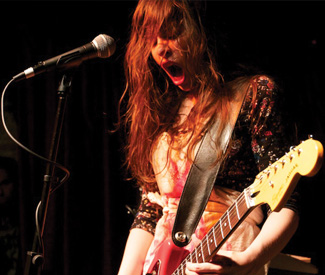
MUSIC Mexican garage punk act Le Butcherettes has been making a clamorous bang touring ’round the world — that noise thanks in no small part to wild ringleader, Teri Gender Bender. Back in early fall, Bender was expertly matched to fellow wild child, Iggy Pop, in a tour that seemed destined to rule. Tragedy struck when Pop was injured during a live show, and the future of the tour was unclear. Fast-forward three months and the rescheduled shows are finally here, going down at the Warfield. Before the tour, I spoke with the enigmatic Bender — a feminist, a performance artist, and most importantly, a rock’n’roll force to be reckoned with.

SFBG What was the reaction when you heard you’d be opening for Iggy Pop?  

Teri Gender Bender All three of us absolutely fell apart with joy. It’s a dream come true for sure, still pinching myself that it can’t be real.  

SFBG Any particularly memorable moments from the tours with Dead Weather, Yeah Yeah Yeahs, or Deftones?

TGB Getting to play in Mexico very early on in this band with Yeah Yeah Yeahs and Dead Weather were such mind blowing experiences. I was only 19 and they were our first big shows. It was a great [yet] nerve racking experience and a real eye opener. We did the Deftones tour with our new lineup, Gabe Serbian who is now the drummer, and Jonathan Hischke who plays bass — I did not have a bass player in the early days of the band. We had a lot of good times and weird times — it’s always strange to play first in front of people who really are there to see the headline band so it’s very hard work to get them to open their ears and minds to a band they have no idea about.

We had a lot of fun also with the Dillinger Escape Plan who were also on the tour. Both Gabe and Jonathan were friends with all of them from their days in their old bands the Locust and Flying Luttenbachers, they all had toured together before. It was also a great honor when Chino invited me to sing with him during their song “Knife Party” each night during the Deftones set. Overall we just feel really fortunate to be able to play with and for all kinds of people, not just one genre.

SFBG How did Serbian end up joining the band?

TGB Gabe joined in December of 2010, I met him through my manager Cathy who has known him for a while and suggested that I try jamming with him. We clicked immediately and that was that. She also introduced me to Jonathan, who lives at her house and was also friends with Gabe, he had just finished his touring with Broken Bells and said he would love to jam with us and again it just felt great. Our first real shows as the band we are were this year’s SXSW, which we all had a blast playing.

SFBG What music did you grow up listening to?

TGB I am not too proud to say I was all about Spice Girls, when I was really You Go Girl power. But I grew up with the music of my father who was all about classic rock and bands like the Beatles played constantly in our house when I was young. However, I will say that definitely the Spice Girls were not Gabe and Jon’s first CDs.

SFBG What inspires your lyrics?

TGB My sadness. Loss, expectations, deceptions, women’s rights.

SFBG Does the live show still include food, blood, and/or animals?

TGB The live show does not have any of those things now, when I first started the band I used many things like blood and meat as metaphors and symbolism — the meat represented how I felt women were treated, but I grew to realize that people don’t see or necessarily understand that was the message meant by the blood and meat but instead took away a whole different meaning and it became bigger than the music and more the talking point of our show from media — it was not meant as some kind of gimmick, so as soon as [I] felt like that was what it was becoming, I stopped because that was not ever the intention.

It came from a place of rage and I channeled those emotions into the music now versus having anything that could be called antics. The only thing left from that period is my bloody apron which really is the notion of the housewife stereotype rebellion. That will go away soon now too as it is also becoming a focus that does not really have the same importance or message once it is co-opted into an icon of the band. 


LE BUTCHERETTES

With Iggy Pop

Sun/4 and Tues/6, 8 p.m., $47

(415) 345-0900

www.thewarfieldtheatre.com

Our Weekly Picks: November 23-29

0

WEDNESDAY 23

Immortal Technique

“So now that it’s proven, that a soldier of revolution/ Or head of an empire, disguised in a constitution/ Can not escape the retribution or manipulation/ Of the self-appointed rulers of the planet’s corporations.” So says Afro-Peruvian rapper Immortal Technique on new mixtape The Martyr (Viper Records). Born Felipe Coronel, Tech seizes every opportunity to eviscerate American class warfare and excoriate the United States government’s complicity. Tech’s angry sermons get a little lost in the first half of Martyr because of distracting riffs taken from the Beatles, Aerosmith, and The Goonies soundtrack, though there is a clever reworking of ABBA’s “Money, Money, Money” in reference to this generation’s “Rich Man’s World (1%).” Pure, undiluted Tech shines through on the mixtape’s second half. Swill with care. (Kevin Lee)

With Chino XL, Da Circle, DJ GI Joe

8 p.m., $32.50

Fillmore

1805 Geary, SF

(415) 346-6000

www.thefillmore.com


MOM’s Family Funk’tion

Before you indulge in caloric binges, first endear yourself to the soulful 1960s sound that has always sounded sweeter during the holidays: Motown. No one knows and appreciates this more than the masterminds behind MOM (Motown on Mondays) who bring originals, remixes, and “close relatives” of Motown label songs to venues and events across San Francisco, including Madrone Art Bar, Public Works, SF Funk Fest, even the Treasure Island Music Festival. The first MOM’s Family Funk’tion goes down the night before the turkey funeral that is Thanksgiving at Brick & Mortar, with DJs Gordo, Timo, Phleck, and Matteo spinning the tracks that get the tail-feathers shaking. The crew from MOM promises to provide “toasty soul and fresh funk jams.” (Emily Savage)

10 p.m., $5

Brick & Mortar Music Hall

1710 Mission, SF

(415) 800-8782

www.brickandmortarmusic.com


tUnE-YarDs

Before her set at Pitchfork Music Festival last summer, we were all given tubes of neon yellow warpaint so we could emulate tUnE-YarDs’ Merrill Garbus. Though we may have resembled her, it was no use. We would never be as badass as the woman on stage looping ukulele, smashing drums, and wailing something fierce. With help from additional saxophonists and drummers, the playful jams of Garbus’ quirky hit album w h o k i l l (4AD) burst forth into the calculated cacophony that is tUnE-YarDs. (Frances Capell)

With Pat Jordache

8 p.m., $23

Regency Ballroom

1300 Van Ness, SF

(415) 673-5716

www.theregencyballroom.com


FRIDAY 25

“Sing-A-Long Sound of Music”

Chances are “Sing-A-Long Sound of Music,” the classic musical from 1964 with lyric subtitles so the whole theater can burst into song, is your mother’s dream come true — unless I am the only one who has watched their mom caper around the house, singing “My Favorite Things” (a possibility). It’s fortunate that “Sing-A-Long Sound of Music” should show the weekend after Thanksgiving. If mom’s in town, it’s your best bet. Additionally, the theater hands out goody bags, holds a pre-film concert featuring organist David Hegarty, as well as a costume contest. Your mom can dress up as Maria, of course, and you can dress as one of the Von Trapp children. Come on, do it for family. (James H. Miller)

7 p.m., $15

Castro Theater

429 Castro, SF

(415) 621-6120

www.castrotheater.com


Nadastrom

Are there a lot of orphans in the DJ community? Why are they active the weekend after Thanksgiving, when touring bands are presumably in food comas? Thankfully, there’s still down and dirty shows like this to sweat the gravy out, featuring a big lineup of international and SF DJs including Nadastrom, the progenitors of the bastard toddler of Dutch house and reggaeton: moombahton. Put on by Soundpieces, Camp?, and Irie Cartel, the proceeds of the event will benefit DJs Bogl and Benjammin Taylor, who lost their home in the fire above the Haight and Fillmore Walgreens a couple months back.(Ryan Prendiville)

With Truth (NZ), Stylust Beats (CAN), Lorne B (CAN), Tuffist (SP), Dnae Beats and more

10 p.m., $15 advance

103 Harriet, SF

(415) 431-1200

www.1015.com


“Velveteen Rabbit”

There is a lovely tradition in English children’s books that dresses issues around growing up with imagination and a gentle but firm hold on reality. Winnie the Pooh and Wind in the Willows are two of them. Marjorie Williams’ 1922 The Velveteen Rabbit is another. ODC/Dance’s KT Nelson, a young mother at the time, choreographed it 24 years ago. Today, it’s as fresh and imaginative as ever, with wonderfully colorful costumes, Benjamin Britten’s splendid score and Geoff Hoyle’s intimate narration. The two-person high Nana has just a touch of Victorian strictness about cleaning up the nursery but her efficiency is more than held in check by the toys who have minds of their own. Opening performance is Grandparents’ (20 percent off) and photo day (Rita Felciano)

Through Dec. 11, times vary, $15–$45

Novellus Theater

Yerba Buena Center for the Arts

700 Howard, SF

(415) 978-2787

www.ybca.org


“Great Dickens Christmas Fair”

Do not discount the Dickens Fair’s potential for holiday weekend shenanigans. Opportunities for hijinx abound, and not just because the fair’s 800 performers — from dirty-overcoated “guvnah!” drunks to crinoline-encased ladies who tea — are encouraged to interact in character with passers-by (mess with them gently! They love it!) The fair fills the cavernous Cow Palace, and houses a corsetry with live models coordinated by local cinchers Dark Garden, an adventurer’s salon where you can share your rollicking tales of shot glass exploration with fantastically mustached gents — and yes, you can booze your face off. Four bars, people! Including an absinthery in an alley, where you can mix chemically-induced hallucinations in with your environment-induced ones. (Caitlin Donohue)

Through Dec. 18, $22–$25

Cow Palace

2600 Geneva, SF

1-800-510-1558

www.dickensfair.com


Boys Noize

Here’s a great way to shed those new extra turkey (or Tofurkey) pounds — waddle into the Mezzanine Saturday night in your most comfortable tight jeans and dance your ass off. Boys Noize throws down the kind of relentlessly squelchy music that might make pioneers of Detroit’s minimal techno scene wince. Noize, actually the moniker of German DJ Alex Ridha, has been busy as of late, pushing releases on his record label, BoysNoize Records and its digital offshoot BNR Trax. The label’s sounds range from acidy techno to sinister electro, with a sprinkle of wobbly dubstep and a dash of oddball, leftfield sounds — much like the label’s creator himself. (Lee)

10 p.m., $30

Mezzanine

444 Jessie, SF

415) 625-8880

www.mezzaninesf.com


SUNDAY 11/27

Jeffrey Luck Lucas and Nebulous Orchestra

The Mission District’s Episcopal Church of St. John the Evangelist is no ordinary church — sure, it holds regular worship services, but it is also highly progressive (vocally supportive of LGBT rights, for example), boasts a colorful mural on one of its exterior walls, and is staunchly community-oriented, welcoming the occasional secular event into its historic (circa 1910, after being rebuilt post-1906 quake) building. Tonight’s performance features Mission troubadour Jeffrey Luck Lucas, heading up an “orchestra” (pipe organ, oboes, clarinets, strings, and more) comprised of other local musicians. You can bet that the acoustics in the church — itself known for a strong music program — will render the experience even more amen-worthy. (Cheryl Eddy)

With Gloaming Boys

6 p.m., $8–$20 (no one turned away for lack of funds)

Episcopal Church of St. John the Evangelist

1661 15th St., SF

www.saintjohnsf.org


MONDAY 11/28

“You Are All Captains”

A beguiling and beautiful meta-fiction, You All Are Captains grew out of Oliver Laxe’s experience teaching film workshops to local kids in Tangiers. Everyone plays themselves in this reflexive movie, though Laxe casts himself as the fool — a presumptuous European director guiding students to his own ends. The disguise allows him to realize sly but substantive reflections upon the ontology and ethics of filming. It’s fitting that You All Are Captains is making its local premier in a classroom: a U.C. Berkeley student group flying under the banner of “Picturing Neo-Imperialism” has invited Laxe to present his debut in person more than a year after it won the FIPRESCI critics’ award at Cannes. (Max Goldberg)

7 p.m., free

UC Berkeley

Dwinelle B-4, Berk.

www.pnwg.wordpress.com/events


TUESDAY 11/29

Metal Mother

By some standards, Oakland’s Tara Tati came into music fairly late: she didn’t take up the piano seriously until she was 23. But you wouldn’t guess as much listening to her ethnic fusion project, Metal Mother. On the debut album Bonfire Diaries, the singer-songwriter builds up a bold and elemental sound. With its trudging percussion and distinctly dark temper, Metal Mother invokes ’80s goth rock, ethnic fusion bands like Dead Can Dance, and at times, world ambient soundscapes. And yet, at heart, Tati sounds like a pop artist in the same vein as Björk circa Homogenic, and that alone implies talent. (Miller)

With Horns of Happiness, Mortar and Pestle, Birdseye

8 p.m., $10

Cafe Du Nord

2170 Market, SF

(415) 861- 5061

www.cafedunord.com


Retox

Is the Locust a joke? With its speedy deliver, high vocals, beepy attack synth, and masked personas, I never could quite decide. And yet, who cares? The energy level was always high, the shows always masterful absurdist romps. Justin Pearson and Gabe Serbian from the screamy ’90s-born Three One G act have now formed Retox — like Locust 2.0. Masks now off, and sounds a bit filled in (but really, just a smidge — its new album clocks in at 13 minutes total), it’s shinier, thicker, less jokey. It’s helter-skelter rock’n’roll, minus the screeching buzz-saw, the painful intro to “Boredom is Counter-Revolutionary” notwithstanding. The band is matched well with frantic experimental Japanese noise-punk act Melt-Banana. Anticipate high-energy, non-medical spasms. (Savage)

With Melt-Banana, Peace Creep

9 p.m., $14

Bottom of the Hill

1233 17th St., SF

(415) 621-4455

www.bottomofthehill.com

Film Listings

0

Film listings are edited by Cheryl Eddy. Reviewers are Kimberly Chun, Max Goldberg, Dennis Harvey, Lynn Rapoport, and Matt Sussman. For rep house showtimes, see Rep Clock.

OPENING

Arthur Christmas Santa’s son (voiced by James McAvoy, who heads up an all-star, mostly-British cast) steps up to solve a North Pole crisis in this 3D animated tale. (1:37) Presidio, Shattuck.

Hugo Martin Scorsese directs this fanciful 3D tale of an orphan secretly living in a train station. (2:07) Shattuck, Sundance Kabuki.

The Muppets Of course The Muppets is a movie appropriate for small fry, with a furry cast (supplemented by human co-stars Jason Segel and Amy Adams) cracking wise and conveying broad themes about the importance of friendship, self-confidence, and keeping dreams alive despite sabotage attempts by sleazy oil tycoons (Chris Cooper, comically evil in the grand Muppet-villain tradition). But the true target seems to be adults who grew up watching The Muppet Show and the earliest Muppet movies (1999’s Muppets from Space doesn’t count); the “getting the gang back together” sequence takes up much of the film’s first half, followed by a familiar rendition of “let’s put on a show” in the second. Interwoven are constant reminders of how the Muppets’ brand of humor — including Fozzie Bear’s corny stand-up bits — is a comforting throwback to simpler times, even with a barrage of celeb cameos and contemporary gags (chickens clucking a Cee-Lo Green tune — I think you can guess which one). Co-writer Segal pays appropriate homage to the late Jim Henson’s merry creations, but it remains to be seen if The Muppets will usher in a new generation of fans, or simply serve as nostalgia fodder for grown-ups like, uh, me, who may or may not totally still own a copy of Miss Piggy’s Guide to Life. (1:38) Presidio. (Eddy)

My Week With Marilyn See “No Bombshell.” (1:36) Albany, Clay, Piedmont.

*Sigur Rós: Inni This ain’t your mom’s 3D IMAX arena-rocker exercise. The follow-up to 2007’s Heima, which set out to contextualize Sigur Rós in its native Iceland, Inni opens with a torrent of light and shadow that resolves into the image of frontperson Jónsi Birgisson on bowed guitar, a bright splinter on a stage otherwise drenched in black. The screen explodes with bleached-out light as Birgisson hits the high note, drummer Orri Pall Dyrason bashes his cymbal, and the combo picks up a symphonic head of noise. The still somewhat-mysterious ensemble that burst fully formed onto the international music scene along with the new millennium is seen here through the prism of live performance, worth catching on a big screen (Inní was also released this month on DVD along with a live double-CD). Director Vincent Morisset infuses the often-not-so-interesting genre of concert film with all the drama and unique strategies appropriate to a group that has charted its own indelible path from the start. Sigur Rós’ music may connect to that of Mogwai and other post-rock outfits, but those groups can only hope to score the moving-image counterpart that the Icelandic band finds here, its own variant of Inní‘s smoky, reflective black and white imagery, flickering in time to the beat, fading in and out of focus, and favoring off-center compositions. Undercutting the serious beauty onstage are clips of Sigur Rós’s slightly surreal reality of life on tour and snippets of archival footage from its first decade of life. (1:14) Roxie. (Chun)

*The Swell Season In 2008, musicians Glen Hansard (1991’s The Commitments, Irish band the Frames) and Markéta Irglová won an Oscar for the original song “Falling Slowly” from the folk rock musical Once, in which they star as a Dublin street busker and a young Czech immigrant who spend a week writing and recording songs that document their falling in love. The film boosted them into the public eye at hyperspeed, and they began to tour extensively, performing under the name the Swell Season. For three years following Once‘s debut, filmmakers Nick August-Perna, Chris Dapkins, and Carlo Mirabella-Davis followed the pair, who had become romantically involved, as they struggled to negotiate sudden fame, life on the road, and the stresses of time and change on their relationship. The beautifully filmed black-and-white documentary that resulted is a quiet affair whose visual intimacies and personal revelations are balanced by soft, muted monochromes that preserve some necessary degree of distance for Hansard and Irglová. Troubling issues are engaged in conversational tones, and the rest of the tale is told onstage amid Hansard’s gorgeous emotional storms and Irglová’s more spare but equally lovely compositions. The honesty is sometimes uncomfortable to witness, as two people accustomed to baring their souls in their songs agree to face the camera for a little while longer. (1:31) SFFS New People Cinema. (Rapoport)

*Tomboy In her second feature, French filmmaker Céline Sciamma (2007’s Water Lilies) depicts the brave and possibly perilous gender experimentations of a 10-year-old girl. Laure (Zoé Héran) moves with her family to a new town, falls in with the neighborhood gang during the summer vacation, and takes the stranger-comes-to-town opportunity to adopt a new, male persona, Mikael, a leap of faith we see her consider for a moment before jumping, eyes open. Watching Mikael quietly observe and then pick up the rough mannerisms and posturing of his new peers, while negotiating a shy romance with Lisa (Jeanne Disson), the sole female member of the gang, is to shift from amazement to amusement to anxiety and back again. As the children play games in the woods and roughhouse on a raft in the water and use a round of Truth or Dare to inspect their relationships to one another, all far from the eyes of the adults on the film’s periphery, Mikael takes greater and greater risks to inhabit an identity that he is constructing as he goes, and that is doomed to be demolished sooner, via accidental discovery, or later, when fall comes and the children march off to school together. All of this is superbly handled by Sciamma, who gently guides her largely nonprofessional young cast through the material without forcing them into a single precocious situation or speech. The result is a sweet, delicate story with a steady undercurrent of dread, as we wait for summer’s end and hope for the best and imagine the worst. (1:22) Embarcadero. (Rapoport)

ONGOING

*El Bulli: Cooking in Progress Oh to be a fly on the wall of El Bulli — back in 2008 and 2009, when director Gereon Wetzel turned his lens on the Spanish landmark, it was considered the best restaurant in the world. This elegantly wrought documentary, covering a year at the culinary destination (now closed), allows you to do just that. Wetzel opens on chef-owner Ferran Adrià shutting down his remarkable eatery for the winter and then drifting in and out of his staff’s Barcelona lab as they develop dishes for the forthcoming season. Head chef Oriol Castro and other trusted staffers treat ingredients with the detached methodicalness of scientists — a champignon mushroom, say, might be liquefied from its fried, raw, sous-vide-cooked states — and the mindful intuition of artists, taking notes on both MacBooks and paper, accompanied by drawings and much photo-snapping. Fortunately the respectful Wetzel doesn’t shy away from depicting the humdrum mechanics of running a restaurant, as Adrià is perpetually interrupted by his phone, must wrangle with fishmongers reluctant to disclose “secret” seasonal schedules, and slowly goes through the process of creating an oil cocktail and conceptualizing a ravioli whose pasta disappears when it hits the tongue, tasting everything as he goes. Energized by an alternately snappy and meditative percussive score, this look into the most influential avant-garde restaurant in the world is a lot like the concluding photographs of the many menu items we glimpse at their inception — a memorable, sublimely rendered document that leaves you hungry for more. (1:48) Opera Plaza. (Chun)

*The Descendants Like all of Alexander Payne’s films save 1996 debut Citizen Ruth, The Descendants is an adaptation, this time from Kaui Hart Hemmings’ excellent 2007 novel. Matt King (George Clooney) is a Honolulu lawyer burdened by various things, mostly a) being a haole (i.e. white) person nonetheless descended from Hawaiian royalty, rich in real estate most natives figure his kind stole from them; and b) being father to two children by a wife who’s been in a coma since a boating accident three weeks ago. Already having a hard time transitioning from workaholic to hands-on dad, Matt soon finds out this new role is permanent, like it or not — spouse Elizabeth (Patricia Hastie, just briefly seen animate) will not wake up. The Descendants covers the few days in which Matt has to share this news with Elizabeth’s loved ones, mostly notably Shailene Woodley and Amara Miller as disparately rebellious teen and 10-year-old daughters. Plus there’s the unpleasant discovery that the glam, sporty, demanding wife he’d increasingly seemed “not enough” for had indeed been looking elsewhere. When has George Clooney suggested insecurity enough to play a man afraid he’s too small in character for a larger-than-life spouse? But dressed here in oversized shorts and Hawaiian shirts, the usually suave performer looks shrunken and paunchy; his hooded eyes convey the stung joke’s-on-me viewpoint of someone who figures acknowledging depression would be an undeserved indulgence. Payne’s film can’t translate all the book’s rueful hilarity, fit in much marital backstory, or quite get across the evolving weirdness of Miller’s Scottie — though the young actors are all fine — but the film’s reined-in observations of odd yet relatable adult and family lives are all the more satisfying for lack of grandiose ambition. (1:55) California, Piedmont, SF Center, Sundance Kabuki. (Harvey)

Dragonslayer Dragonslayer tags along with Josh “Skreech” Sandoval, a Fullerton, Calif. skater celebrated for shredding pools and living a vagabond’s life. First-time director Tristan Patterson fronts with the kind of side-winding portraiture that prizes sensory impressions instead of back-story, but whittle away Dragonslayer‘s loose ends and you end up with an unremarkable lost generation romance, a Bonnie and Clyde with lower stakes. The film meets Skreech at 23: he’s turned his back on sponsorship gigs and a romance that produced a son (no trace of the mother here). In an arbitrarily defined chapter structure, Skreech investigates freshly abandoned pools, squats in a friend’s backyard, shows off his medical marijuana license, and cracks tallboys in Southern California’s magic light. He’s stunned by a pretty girl’s red lipstick and fades into a relationship with her (it takes a while before the movie treats her as anything more than scenery). He takes a few earnest stabs at fatherhood and rehearses his principles of no principles to the soundtrack’s well-stocked bangs. There are a few genuinely poignant moments — Skreech’s taking a call from his estranged mother in a bus full of punks — but in general Dragonslayer is too caught up in its own glossy reverie to register emergent emotions. Patterson’s tendency to use editing as dramatic shorthand is evident in an early sequence of Skreech muffing a skate contest abroad: repeated shots of Skreech wiping out are cut with the eventual winner’s triumphs and then back to our hero’s defeated expression. Arranged in the foregone style of reality television, the actual event is given no room to breathe. (1:14) Roxie. (Goldberg)

*Drive Such a lovely way to Drive, drunk on the sensual depths of a lush, saturated jewel tone palette and a dreamlike, almost luxurious pacing that gives off the steamy hothouse pop romanticism of ’80s-era Michael Mann and David Lynch — with the bracing, impactful flecks of threat and ultraviolence that might accompany a car chase, a moody noir, or both, as filtered through a first-wave music video. Drive comes dressed in the klassic komforts — from the Steve McQueen-esque stances and perfectly cut jackets of Ryan Gosling as the Driver Who Shall Remain Nameless to the foreboding lingering in the shadows and the wittily static, statuesque strippers that decorate the background. Gosling’s Driver is in line with Mann’s other upstanding working men who hew to an old-school moral code and are excellent at what they do, regardless of what side of the law they’re working: he likes to keep it clear and simple — his services as a wheelman boil down to five minutes, in and out — but matters get messy when he falls for sweet-faced neighbor Irene (Carey Mulligan), who lives down the hall with her small son, and her ex-con husband (Oscar Isaac) is dragged back into the game. Populated by pungent side players like Albert Brooks, Bryan Cranston, Ron Perlman, and Christina Hendricks, and scattered with readily embeddable moments like a life-changing elevator kiss that goes bloodily wrong-right, Drive turns into a real coming-out affair for both Danish director Nicolas Winding Refn (2008’s Bronson), who rises above any crisis of influence or confluence of genre to pick up the po-mo baton that Lynch left behind, and 2011’s MVP Ryan Gosling, who gets to flex his leading-man muscles in a truly cinematic role, an anti-hero and under-the-hood psychopath looking for the real hero within. (1:40) Lumiere. (Chun)

Happy Feet Two (1:40) Four Star, 1000 Van Ness, Presidio.

Le Havre Aki Kaurismäki’s second French-language film (following 1992’s La Vie de Boheme) offers commentary on modern immigration issues wrapped in the gauze of a feel good fairy tale and cozy French provincialism a la Marcel Pagnol. Worried about the health of his hospitalized wife (Kaurismäki regular Kati Outinen), veteran layabout and sometime shoe shiner Marcel (Andre Wilms) gets some welcome distraction in coming to the aid of Idrissa (Blondin Miguel), a young African illegally trying to make way to his mother in London while eluding the gendarmes. Marcel’s whole neighborhood of port-town busybodies and industrious émigrés eventually join in the cause, turning Le Havre into a sort of old-folks caper comedy with an incongruously sunny take on a rising European multiculturalism in which there are no real racist xenophobes, just grumps deserving comeuppance. Incongruous because Kaurismäki is, of course, the king of sardonically funny Finnish miserabilism — and while it’s charmed many on the festival circuit, this combination of his usual poker-faced style and feel-good storytelling formula may strike others as an oil-and-water mismatch. (1:43) Bridge. (Harvey)

Immortals Arrow time (comin’ at ya, in 3D), blood lust, fascinating fascinators, and endless seemingly-CGI-chiseled chests mark this rework of the Theseus myth. Tarsem Singh flattens out the original tale of crazy-busy hero who founded Athens yet seems determined to outdo the Lord of the Rings series with his striking art direction (so chic that at times you feel like you’re in a perfume ad rather than King Hyperion’s torture chamber). As you might expect from the man who made the dreamy, horse-slicing Cell (2000), Immortals is all sensation rather than sense. The proto-superhero here is a peasant (Henry Cavill), trained in secret by Zeus (John Hurt and Luke Evans) and toting a titanic chip on his shoulder when he runs into the power-mad Cretan King Hyperion (Mickey Rourke, struggling to gnash the sleek scenery beneath fleshy bulk and Red Lobster headgear). Hyperion aims to obtain the Epirus Bow — a bit like a magical, preindustrial rocket launcher — to free the Titans, set off a war between the gods, and destroy humanity (contrary to mythology, Hyperion is not a Titan — just another heavyweight grudge holder). To capture the bow, he must find the virgin oracle Phaedra (Freida Pinto), massacring his way through Theseus’ village and setting his worst weapon, the Beast, a.k.a. the Minotaur, on the hero. Saving graces amid the gory bluster, which still pays clear tribute to 1963’s Jason and the Argonauts, is the vein-bulging passion that Singh invests in the ordinarily perfunctory kill scenes, the avant-garde headdresses and costumes by Eiko Ishioka, and the occasional edits that turn on visual rhymes, such as the moment when the intricate mask of a felled minion melts into a seagoing vessel, which are liable to make the audience gasp, or laugh, out loud. (1:50) 1000 Van Ness. (Chun)

In Time Justin Timberlake moves from romantic comedy to social commentary to play Will Salas, a young man from the ghetto living one day at a time. Many 12-steppers may make this claim, but Salas literally is, because in his world, time actually is money and people pay, say, four minutes for a cup of coffee, a couple hours for a bus ride home from work, and years to travel into a time zone where people don’t run from place to place to stay ahead of death. In writer-director Andrew Niccol’s latest piece of speculative cinema, humans are born with a digitized timepiece installed in their forearm and a default sell-by date of 25 years, with one to grow on — though most end up selling theirs off fairly quickly while struggling to pay rent and put food on the table. Time zones have replaced area codes in defining social stature and signaling material wealth, alongside those pesky devices that give the phrase “internal clock” an ominous literality. Niccol also wrote and directed Gattaca (1997) and wrote The Truman Show (1998), two other films in which technological advances have facilitated a merciless, menacing brand of social engineering. In all three, what is most alarming is the through line between a dystopian society and our own, and what is most hopeful is the embattled protagonist’s promises that we don’t have to go down that road. Amanda Seyfried proves convincible as a bored heiress to eons, her father (Vincent Kartheiser) less amenable to Robin Hood-style time banditry. (1:55) 1000 Van Ness, Shattuck. (Rapoport)

*Into the Abyss: A Tale of Death, a Tale of Life How remarkable is it that, some 50-plus features along, filmmaker Werner Herzog would become the closest thing to a cinema’s conscience? This time the abyss is much closer to home than the Amazon rainforest or the Kuwaiti oil fields — it lies in the heart of Rick Perry country. What begins as an examination of capital punishment, introduced with an interview with Reverend Richard Lopez, who has accompanied Texas death row inmates to their end, becomes a seeming labyrinth of human tragedy. Coming into focus is the execution of Michael Perry, convicted as a teenager of the murder of a Conroe, Tex., woman, her son, and his friend — all for sake of a red Camaro. Herzog obtains an insightful interview with the inmate, just days before his execution, as well as his cohort Jason Burkett, police, an executioner, and the victims’ family members, in this haunting examination of crime, punishment, and a small town in Texas where so many appear to have gone wrong. So wrong that one might see Into the Abyss as more related to 1977’s Stroszek and its critical albeit compassionate take on American life, than Herzog’s last tone poem about the mysterious artists of 2010’s Cave of Forgotten Dreams (and it’s also obviously directly connected to next year’s TV documentary, Death Row). The layered tragedies and the strata of destroyed lives stays with you, as do the documentary’s difficult questions, Herzog’s gentle humanity as an interviewer, and the fascinating characters that don’t quite fit into a more traditional narrative — the Conroe bystander once stabbed with a screwdriver who learned to read in prison, and the dreamy woman impregnated by a killer whose entire doomed family appears to be incarcerated. (1:46) Embarcadero, Shattuck. (Chun)

J. Edgar The usual polished, sober understatement of Clint Eastwood’s directing style and the highlights-compiling CliffsNotes nature of Dustin Lance Black’s screenplay turn out to be interestingly wrong choices for this biopic about one of the last American century’s most divisive figures. Interesting in that they’re perhaps among the very few who would now dare viewing the late, longtime FBI chief with so much admiration tempered by awareness of his faults — rather than the other way around. After all, Hoover (played by Leonardo DiCaprio) strengthened his bureau in ways that, yes, often protected citizens and state, but at what cost? The D.C. native eventually took to frequently “bending” the law, witch-hunting dubious national enemies (he thought the Civil Rights movement our worst threat since the bomb-planting Bolshevik anarchists of half a century earlier), blackmailing personal ones, weakening individual rights against surveillance, hoarding power (he resented the White House’s superior authority), lying publicly, and doing just about anything to heighten his own fame. A movie that internalized and communicated his rising paranoid megalomania (ironically Hoover died during the presidency of Nixon, his equal in that regard) might have stood some chance of making us understand this contradiction-riddled cipher. But J. Edgar is doggedly neutral, almost colorless (literally so, in near-monochrome visual presentation), its weird appreciation of the subject’s perfectionism and stick-to-it-iveness shutting out almost any penetrating insight. (Plus there’s Eastwood’s own by-now-de rigueur soundtrack of quasi-jazz noodling to make what is vivid here seem more dull and polite.) The love that dare not speak its name — or, evidently, risk more than a rare peck on the cheek — between Hoover and right-hand-man/life companion Clyde Tolson (Armie Hammer, very good if poorly served by his old-age makeup) becomes both the most compelling and borderline-silly thing here, fueled by a nervous discretion that seems equal parts Black’s interest and Eastwood’s discomfort. While you might think the directors polar opposites in many ways, the movie J. Edgar ultimately recalls most is Oliver Stone’s 1995 Nixon: both ambitiously, rather sympathetically grapple with still-warm dead gorgons and lose, filmmaker and lead performance alike laboring admirably to intelligent yet curiously stilted effect. (2:17) Four Star, Marina, 1000 Van Ness, SF Center, Shattuck, Sundance Kabuki. (Harvey)

Jack and Jill (1:39) 1000 Van Ness, Shattuck.

*Like Crazy Jacob (Anton Yelchin) and Anna (Felicity Jones) meet near the end of college; after a magical date, they’re ferociously hooked on each other. Trouble is, she’s in Los Angeles on a soon-to-expire student visa — and when she impulsively overstays, then jets home to London for a visit months later, her re-entry to America is stopped cold at LAX. (True love’s no match for homeland security.) An on-and-off long-distance romance ensues, and becomes increasingly strained, even as their respective careers (he makes furniture, she’s a magazine staffer) flourish. Director and co-writer Drake Doremus (2010’s Douchebag) achieves a rare midpoint between gritty mumblecore and shiny Hollywood romance; the characters feel very real and the script ably captures the frustration that settles in when idealized fantasies give way to the messy workings of everyday life. There are some contrivances here — Anna’s love-token gift from Jacob, a bracelet engraved “Patience,” breaks when she’s with another guy — but for the most part, Like Crazy offers an honest portrait of heartbreak. (1:29) California, Piedmont, SF Center, Sundance Kabuki. (Eddy)

*Love Crime Early this year came the announcement that Brian De Palma was hot to do an English remake of Alain Corneau’s Love Crime. The results, should they come to fruition, may well prove a landmark in the annals of lurid guilty-pleasure trash. But with the original Love Crime finally making it to local theaters, it’s an opportune moment to be appalled in advance about what sleazy things could potentially be done to this neat, dry, fully clothed model of a modern Hitchcockian thriller. No doubt in France Love Crime looks pretty mainstream. But here its soon-to be-despoiled virtues of narrative intricacy and restraint are upscale pleasures. Ludivine Sagnier plays assistant to high-powered corporate executive Christine (Kristin Scott Thomas). The boss enjoys molding protégée Isabelle to her own image, making them a double team of carefully planned guile unafraid to use sex appeal as a business strategy. But Isabelle is expected to know her place — even when that place robs her of credit for her own ideas — and when she stages a small rebellion, Christine’s revenge is cruelly out of scale, a high-heeled boot brought down to squash an ant. Halfway through an act of vengeance occurs that is shocking and satisfying, even if it leaves the remainder of Corneau and Nathalie Carter’s clever screenplay deprived of the very thing that had made it such a sardonic delight so far. Though it’s no masterpiece, Love Crime closes the book on his Corneau’s career Corneau (he died at age 67 last August) not with a bang but with a crisp, satisfying snap. (1:46) Lumiere. (Harvey)

*Margin Call Think of Margin Call as a Mamet-like, fictitious insider jab at the financial crisis, a novelistic rejoinder to Oscar-winning doc Inside Job (2010). First-time feature director and writer J.C. Chandor shows a deft hand with complex, writerly material, creating a darting dance of smart dialogue and well-etched characters as he sidesteps the hazards of overtheatricality, a.k.a. the crushing, overbearing proscenium. The film opens on a familiar Great Recession scene: lay-off day at an investment bank, marked by HR functionaries calling workers one by one into fishbowl conference rooms. The first victim is the most critical — Eric Dale (Stanley Tucci), a risk-management staffer who has stumbled on an investment miscalculation that could potentially trigger a Wall Street collapse. On his way out, he passes a drive with his findings to one of his young protégés, Peter (Zachary Quinto), setting off a flash storm over the next 24 hours that will entangle his boss Sam (Kevin Spacey), who’s agonizing over his dying dog while putting up a go-big-or-go-home front; cynical trading manager Will (Paul Bettany); and the firm’s intimidating head (Jeremy Irons), who gets to utter the lines, “Explain to me as you would to a child. Or a Golden Retriever.” Such top-notch players get to really flex their skills here, equipped with Chandor’s spot-on script, which manages to convey the big issues, infuse the numbers with drama and the money managers with humanity, and never talk down to the audience. (1:45) Presidio, Sundance Kabuki. (Chun)

*Martha Marcy May Marlene If Winter’s Bone star Jennifer Lawrence was the breakout ingénue of 2010, look for Martha Marcy May Marlene‘s Elizabeth Olsen to take the 2011 title. Both films are backwoodsy and harrowing and offer juicy roles for their leading starlets — not to mention a pair of sinister supporting roles for the great John Harkes. Here, he’s a Manson-y figure who retains disturbing control over Olsen’s character even after the multi-monikered girl flees his back-to-the-land cult. Writer-director Sean Durkin goes for unflashy realism and mounds on the dread as the hollow-eyed Martha attempts to resume normal life, to the initial delight of her estranged, guilt-ridden older sister (Sarah Paulson). Soon, however, it becomes clear that Things Are Not Ok. You’d be forgiven for pooh-poohing Olsen from the get-go; lavish Sundance buzz and the fact that she’s Mary-Kate and Ashley’s sis have already landed her mountains of pre-release publicity. But her performance is unforgettable, and absolutely fearless. (1:41) Lumiere. (Eddy)

*Melancholia Lars von Trier is a filmmaker so fond of courting controversy it’s like he does it in spite of himself — his rambling comments about Hitler (“I’m a Nazi”) were enough to get him banned from the Cannes Film Festival earlier this year, where Melancholia had its debut (and star Kirsten Dunst won Best Actress). Oops. Maybe after the (here’s that word again) controversy that accompanied 2009’s Antichrist, von Trier felt like he needed a shocking context for his more mellow latest. Pity that, for Melancholia is one of his strongest, most thoughtful works to date. Split into two parts, the film follows first the opulent, disastrous, never-ending wedding reception of Justine (Dunst) and Michael (Alexander Skarsgard), held at a lavish estate owned by John (Kiefer Sutherland), the tweedy husband of Justine’s sister, Claire (Charlotte Gainsbourg). Amid the turmoil of arguments (John Hurt and Charlotte Rampling as Justine and Claire’s divorced parents), pushy guests (Stellan Skarsgard as Justine’s boss), livid wedding planner (Udo Kier, amazing), and hurt feelings (Michael is the least-wanted groom since Kris Humphries), it’s clear that something is wrong with Justine beyond just marital jitters. The film’s second half begins an unspecified amount of time later, as Claire talks her severely depressed, near-catatonic sister into moving into John’s mansion. As Justine mopes, it’s revealed that a small planet, Melancholia — glimpsed in Melancholia‘s Wagner-scored opening overture — is set to pass perilously close to Earth. John, an amateur astronomer, is thrilled; Claire, fearful for her young son’s future and goaded into high anxiety by internet doomsayers, is convinced the planets will collide, no matter what John says. Since Justine (apparently von Trier’s stand-in for himself) is convinced that the world’s an irredeemably evil place, she takes the news with a shrug. Von Trier’s vision of the apocalypse is somber and surprisingly poetic; Dunst and Gainsbourg do outstanding work as polar-opposite sisters whose very different reactions to impending disaster are equally extreme. (2:15) Albany, Embarcadero, Smith Rafael. (Eddy)

Midnight in Paris Owen Wilson plays Gil, a self-confessed “Hollywood hack” visiting the City of Light with his conservative future in-laws and crassly materialistic fiancée Inez (Rachel McAdams). A romantic obviously at odds with their selfish pragmatism (somehow he hasn’t realized that yet), he’s in love with Paris and particularly its fabled artistic past. Walking back to his hotel alone one night, he’s beckoned into an antique vehicle and finds himself transported to the 1920s, at every turn meeting the Fitzgeralds, Gertrude Stein (Kathy Bates), Dali (Adrien Brody), etc. He also meets Adriana (Marion Cotillard), a woman alluring enough to be fought over by Hemingway (Corey Stoll) and Picasso (Marcial di Fonzo Bo) — though she fancies aspiring literary novelist Gil. Woody Allen’s latest is a pleasant trifle, no more, no less. Its toying with a form of magical escapism from the dreary present recalls The Purple Rose of Cairo (1985), albeit without that film’s greater structural ingeniousness and considerable heart. None of the actors are at their best, though Cotillard is indeed beguiling and Wilson dithers charmingly as usual. Still — it’s pleasant. (1:34) Opera Plaza, Shattuck. (Harvey)

The Other F Word The 1980s U.S. hardcore punk scene was one refreshing bastion of opposition in the Reagan era of militaristic, monetary, and quasi-“family values” conformism. It was a fairly harmless outlet (if also a factory) for all that excess testosterone. Boys will be boys, etc. Sooner or later they’d have to grow the fuck up. Right? Well, punk became punk-pop, embraced by the musical product divisions of multinational corporations everywhere, and while the chords didn’t change much, the lyrics stopped being angry about political-economic injustice — now they were about dubious injustices like girl problems. How (let alone why) do you grow up when label execs and fans want you to stay the guy who causes shoulder dislocations worldwide? Illustrating one gun-to-head route toward responsible adulthood is Andrea Nevins’ The Other F Word, a fun if superficial new documentary in which the missing unmentionable is (gasp) fatherhood. Punks become dads! Like whoa! Break out the swear jar! Much of this is cute. But the notion that getting older and more sedate is any more revelatory in a 45-year-old man from a 20-year-old band than it is for the rest of us seems questionable. Our principal guide is very likeable Pennywise leader Jim Lindberg, seen getting less and less happy with his road-to-family-time ratio. Some other interviewees here look like parental recipes for future therapy; a deeper documentary might have probed that. But F Word seldom gets past the surface “shock” appeal of heavily tattooed, aging bad boys changing nappies and joining the PTA. It’s still stuck in a testosterone zone most of its subjects have at least learned to compartmentalize. (1:38) Lumiere, Shattuck. (Harvey)

Puss in Boots (1:45) 1000 Van Ness.

The Skin I Live In I’d like to think that Pedro Almodóvar is too far along in his frequently-celebrated career to be having a midlife crisis, but all the classic signs are on display in his flashy, disjointed new thriller. Still mourning the death of his burn victim wife and removed from his psychologically disturbed daughter, brilliant-but-ethically compromised plastic surgeon Robert (played with smoldering creepiness by former Almodóvar heartthrob Antonio Banderas) throws himself into developing a new injury-resistant form of prosthetic skin, testing it on his mysterious live-in guinea pig, Vera (the gorgeous Elena Anaya, whose every curve is on view thanks to an après-ski-ready body suit). Eventually, all hell breaks loose, as does Vera, whose back story, as we find out, owes equally to 1960’s Eyes Without a Face and perhaps one of the Saw films. And that’s not even the half of it — to fully recount every sharp turn, digression and MacGuffin thrown at us would take the entirety of this review. That’s not news for Almodóvar, though. Much like Rainer Werner Fassbinder before him, Almodóvar’s métier is melodrama, as refracted through a gay cinephile’s recuperative affections. His strength as a filmmaker is to keep us emotionally tethered to the story he’s telling, amidst all the allusions, sex changes and plot twists torn straight from a telenovela. The real shame of The Skin I Live In is that so much happens that you don’t actually have time to care much about any of it. Although its many surfaces are beautiful to behold (thanks largely to cinematographer José Luis Alcaine), The Skin I Live In ultimately lacks a key muscle: a heart. (1:57) Embarcadero, Shattuck. (Sussman)

Steve Jobs: The Lost Interview Is this a quickie cash-in following the tidal wave of appreciation following the death of Steve Jobs? Interviewer Robert Cringely made Triumph of the Nerds, a PBS miniseries about the birth of the personal computer industry, in 1995, and much of this lengthy talk with Jobs (his former employer) didn’t ultimately make the cut, although the Apple co-founder’s critique of Microsoft as lacking taste went down in history. The master tapes of this discussion were thought to be lost until the series editor unearthed an unedited copy of the entire interview in his London garage. This rush production isn’t quite unedited (at points Cringely steps in to contextualize) — and it was done more than 15 years ago, before Jobs sold NeXT to Apple and returned to the firm to shake the firmament with the iPod, iPhone, and iPad — but the interview and the answers Cringely fields are nevertheless fascinating, from the potentially silly question “are you a hippie or a nerd?” (“If I had to pick one of those two, I’m clearly a hippie,” Jobs responds with a sly look in his eye, “and all the people I worked with were clearly in that category, too”) to Jobs’ prophesies about the impact of the Web to musings like “I think everybody in this country should learn to program a computer, learn a computer language, because it teaches you how to think.” (1:00) Opera Plaza. (Chun)

Tower Heist The mildest of mysteries drift around the edges of Tower Heist — like, how plausible is Ben Stiller as the blue-collar manager of a tony uptown NYC residence? How is that Eddie Murphy’s face has grown smoother and more seamless with age? And how much heavy lifting goes into an audience member’s suspension of disbelief concerning a certain key theft, dangling umpteen floors above Thanksgiving parade, in the finale? Yet those questions might not to deter those eager to escape into this determinedly undemanding, faintly entertaining Robin Hood-style comedy-thriller. Josh Kovacs (Stiller) is the wildly competent manager of an upscale residence — toadying smoothly and making life run perfectly for his entitled employers — till Bernie Madoff-like penthouse dweller Arthur Shaw (Alan Alda) is arrested for big-time financial fraud, catching the pension fund of Josh’s staffers in his vortex. After a showy standoff gets the upstanding Josh fired, he assembles a crew of ex-employees Enrique (Michael Peña) and Charlie (Casey Affleck), maid Odessa (Gabourey Sidibe), and foreclosed former resident Mr. Fitzhugh (Matthew Broderick), as well as childhood friend, neighbor, and thief Slide (Murphy). Murphy gets to slink effortlessly through supposed comeback role — is he vital here? Not really. Nevertheless, a few twists and a good-hearted feel for the working-class 99 percent who got screwed by the financial sector make this likely the most likable movie Brett Ratner has made since 2006’s X-Men: The Last Stand — provided you can get over those dangles over the yawning gaps in logic. (1:45) 1000 Van Ness, Shattuck. (Chun)

Twilight Saga: Breaking Dawn — Part One Some may have found Robert Pattinson’s stalker-suitor Edward Cullen sufficiently creepy (fits of overprotective rage, flirtatious comments about his new girlfriend’s lip-smackingly narcotic blood) in 2008’s first installment of the Twilight franchise. And nothing much in 2009’s New Moon (suicide attempt) or 2010’s Eclipse (jealous fits, poor communication) strongly suggested he was LTR material, to say nothing of marriage for all eternity. But Twilight 3.5 is where things in the land of near-constant cloud cover and perpetually shirtless adolescent werewolves go seriously off the rails — starting with the post-graduation teen nuptials of bloodsucker Edward and his tasty-smelling human bride, Bella Swan (Kristen Stewart), and ramping up considerably when it turns out that Edward’s undead sperm are, inexplicably, still viable for baby-making. One of the film’s only sensible lines is uttered at the wedding by high school frenemy Jessica (Anna Kendrick), who snidely wonders whether Bella is starting to show. Of course not, in this Mormon-made tale, directed by Bill Condon (1998’s Gods and Monsters, 2004’s Kinsey). And while Bella’s dad, Charlie (Billy Burke), seems slightly more disgruntled than usual, no one other than lovesick werewolf Jacob Black (Taylor Lautner) seems to question the wisdom of this shotgun-free leap from high school to honeymoon. The latter, however, after a few awkward allusions to rough sex, is soon over, and Bella does indeed start showing. Suffice it to say, it’s not one of those pregnancies that make your skin glow and your hair more lustrous. What follows is like a PSA warning against vampire-bleeder cohabitation, and one wonders if even the staunchest members of Team Edward will flinch, or adjust their stance of dewy-eyed appreciation. (1:57) Marina, 1000 Van Ness, SF Center, Sundance Kabuki. (Rapoport)

A Very Harold and Kumar 3D Christmas Delivery of a mystery package to the crash pad Kumar (Kal Penn) no longer shares with now-married, successfully yuppiefied Harold (John Cho) forces the former to visit the latter in suburbia after a couple years’ bromantic lapse. Unfortunately Kumar’s unreconstructed stonerdom once again wreaks havoc with Harold’s well-laid plans, necessitating another serpentine quest, this time aimed toward an all-important replacement Xmas tree but continually waylaid by random stuff. Which this time includes pot (of course), an unidentified hallucinogen, ecstasy, a baby accidentally dosed on all the aforementioned, claymation, Ukrainian mobsters, several penises in peril, a “Wafflebot,” and a Radio City Music Hall-type stage holiday musical extravaganza starring who else but Neil Patrick Harris. Only in it for ten minutes or so, NPH manages to make his iffy material seem golden. But despite all CGI wrapping and self-aware 3D gratuitousness, this third Harold and Kumar adventure is by far the weakest. While the prior installments were hit/miss but anarchic, occasionally subversive, and always good-natured, Christmas substitutes actual race jokes for jokes about racism, amongst numerous errors on the side of simple crassness. There are some laughs, but you know creators Jon Hurwitz and Hayden Schlossberg are losing interest when the majority of their gags would work as well for Adam Sandler. Cho and Penn remain very likeable; this time, however, their movie isn’t. (1:30) 1000 Van Ness. (Harvey)

The Woman on the Sixth Floor There is a particular strain of populist European comedy in which stuffy northerners are loosened up by liberating exposure to those sensual, passionate, loud, all-embracing simple folk from the sunny south. The line between multicultural inclusion and condescension is a thin one these movies not infrequently cross. Set in 1960, Philippe Le Guay’s film has a bourgeoisie Paris couple hiring a new maid in the person of attractive young Maria (Natalia Verbeke). She joins a large group of Spanish women toiling for snobbish French gentry in the same building. Her presence has a leavening effect on investment counselor employer Jean-Louis (Fabrice Luchini), to the point where he actually troubles to improve the poorly housed maids’ lot. (Hitherto no one has cared that their shared toilet is broken.) But he also takes an inappropriate and (initially) unwanted romantic interest in this woman, lending a creepy edge to what’s intended as a feel-good romp. (For the record, Verbeke is about a quarter-century younger than Luchini — a difference one can’t imagine the film would ignore so completely if the genders were reversed.) Le Guay’s screenplay trades in easy stereotypes — the Spanish “help” are all big-hearted lovers of life, the Gallic upper-crusters (including Sandrine Kiberlain as J-L’s shallow, insecure wife) emotionally constipated, xenophobic boors — predictable conflicts and pat resolutions. As formulaic crowd-pleasers go, it could be worse. But don’t be fooled — if this were in English, there’d be no fawning mainstream reviews. In fact, it has been in English, more or less. And that ugly moment in cinematic history was called Spanglish (2004). (1:44) Opera Plaza, Shattuck. (Harvey)

*The Woodmans Francesca Woodman jumped off a building in 1981 when she was 22, despondent over the fact that her photographs hadn’t found a niche in New York’s competitive art world. She was no stranger to competition — she’d grown up with a parents who placed art-making above all other obligations. Fast-forward to the 21st century, and Francesca remains the most-acclaimed Woodman; her haunting black-and-white photos, often featuring the artist’s nude figure, have proven hugely influential in the realms of both fine art and fashion. She was, as the San Francisco Museum of Modern Art website says (an exhibit of her work opens Nov. 5), “ahead of her time.” Scott Willis’ documentary features extensive interviews with her parents, George and Betty, and to a lesser extent Francesca’s brother, Charles (also an artist); the film is both Woodman bio and incisive exploration of the family’s complex dynamics. Most fascinating is Charles, who remarks of his daughter’s posthumous success, “It’s frustrating when tragedy overshadows work.” But after her death, he took up photography, making images that resemble those Francesca left behind. (1:22) Roxie. (Eddy)

Young Goethe in Love You might be suspect North Face (2008) director Philipp Stölzl’s take on Germany’s most renowned writer is biting off of 1998’s Shakespeare in Love, but the filmmaker manages to rise above facile comparisons to deliver his own unique stab at re-creating the life and love of the 23-year-old polymath, long before he became an influential poet and cultural force. Stölzl and co-writers Christoph Müller and Alexander Dydyna spin off the autobiographical nature of what some consider the world’s first best-seller, 1774’s The Sorrows of Young Werther, though there were few sorrows at first for the young Johann Wolfgang von Goethe (Alexander Fehling) — a perpetually raging, playful party animal rather than the brooding forerunner of romanticism. Unable to move forward in his law studies and believed a wretched failure by his father (Henry Hübchen), Goethe is exiled to a job in a small-town court, beneath the thumb of the fiercely bourgeois court councilor Kestner (Moritz Bleibtreu). Embodying the charms of provincial life: Lotte Buff (Miriam Stein), the bright-eyed, artistic eldest daughter of a struggling widower. Naturally Goethe and Lotte end up caught in each other’s orbits, although rivals for affection and attention lie around each corner, as does a certain inevitable sense of despair. Charismatic lead actors and attention to period details — as well as an infectious joie de vivre — are certain to animate fans of historical romance. (1:42) Embarcadero, Shattuck. (Chun) 


I don’t want to grow up

0

TRASH The 1980s U.S. hardcore punk scene was one refreshing bastion of opposition in the Reagan era of militaristic, monetary, and quasi-“family values” conformism. But it was also increasingly a turn-off for folks who liked the music and the message but not the violence at shows.

Rather than leaving the rest of us to pogo in peace, inevitably a few shirtless yobbos would turn the mosh pit into an ever-widening demolition derby that typically devolved into punches. First girls left, then finally bands depressed by every gig turning into Fight Club. Sure, the perps wore mohawks, maybe even waxed pious about being straight-edge. But the sentiment applied: frat bratz, go home.

Still, it was a fairly harmless outlet (if also a factory) for all that excess testosterone. Boys will be boys, etc. Sooner or later they’d have to grow the fuck up. Right?

Well, wrong. Punk became punk-pop, embraced by the musical product divisions of multinational corporations everywhere, and while the chords didn’t change much, the lyrics stopped being angry about political-economic injustice — now they were about the kind of dubious injustice one might summarize as “I know I was a jerk but I’m a rebel and anyway who does that bitch think she is leaving me without a girlfriend WHAAAAAAAAAH.” The Adolescents were one thing; permanent adolescence is another. How (let alone why) do you grow up when label execs and fans want you to stay the guy who causes shoulder dislocations worldwide?

Illustrating one gun-to-head route toward responsible adulthood is Andrea Nevins’ The Other F Word, a fun if superficial new documentary in which the missing unmentionable is (gasp) fatherhood. Punks become dads! Like whoa! Break out the swear jar!

Much of this is cute. But the notion that getting older and more sedate is any more revelatory in a 45-year-old man from a 20-year-old band than it is for the rest of us seems questionable. Our principal guide is very likeable Pennywise leader Jim Lindberg, seen getting less and less happy with his road-to-family-time ratio, given an endless touring schedule and three daughters who miss daddy (and vice versa). Many lifers came to punk from broken homes; Art Alexakis from maybe-not-so-punk Everclear, who endured horrific childhood abuse, touchingly stresses “I’m raising my kids the way I wish I’d been raised.”

Some other interviewees here — I won’t name names — look like parental recipes for future therapy. A deeper documentary might have probed that, while asking wives and kids for their two cents. But F Word seldom gets past the surface “shock” appeal of heavily tattooed, aging bad boys changing nappies and joining the PTA. It’s still stuck in a testosterone zone most of its subjects have at least learned to compartmentalize. (Dennis Harvey) 

THE OTHER F WORD opens Fri/18 in Bay Area theaters.

Our Weekly Picks: November 16-22

0

WEDNESDAY 16

Kiran Ahluwalia

Tuareg rock band Tinariwen continues to hit it out of the park this year, releasing a hypnotically raw new album, collaborating with TV on the Radio’s Kyp Malone and Tunde Adebimpe — and now working with Indo-Canadian singer Kiran Awluwali on her engrossing new disc Aam Zameen: Common Ground. Not that Awluwali needed the help, exactly: her enticing voice holds its own in both her own Punjabi-inflected compositions and the throaty tribal blues of the Sahara. She has also seamlessly incorporated Celtic fiddling, Persian gazals, Portuguese fado, Sufi qawwali, and Afghan rhubab into her previous releases — her eclecticism comes without preciousness. Emblematic is her version, with Tinariwen, of Nusrat Fateh Ali Khan’s “Mustt Mustt”: “a song from the South Asian Islamic tradition performed with Muslims from Mali, Tinariwen.” And a gorgeous Canadian! (Marke B.)

8 p.m., $20

Yoshi’s Oakland

510 Embarcadero West, Oakl.

www.yoshis.com


ChameleonsVox

Unlike some other bands that emerged out of Manchester, England in the 1980s (Joy Division, The Fall), The Chameleons have remained relatively obscure. Formed in 1981, the band’s exotic strain of post-punk was perfected on its breathtaking debut, Script of the Bridge (1983). Script was an atmospheric album that featured some of the most interesting guitar work of the post-punk era thanks to Reg Smithies and Dave Fielding. “Second Skin” and “View from a Hill” were two swirling, heavily delayed tracks that remain astonishing feats. Since the band separated in 2003, lead singer and bass player Mark Burgess has started ChamelonsVox, a run off band (and a blessing) that stays true to the original. (James H. Miller)

With Black Swan Lane, James Oakes

9 p.m., $20

Cafe Du Nord

2170 Market, SF

(415)861 5016

www.cafedunord.com


“Block by Block”

Forget hushed indoor voices and audio tours. At the de Young Museum this weekend, Campo Santo and Sean San José will activate the space with the work of artists including hip-hop theater collective Felonious, and writer Junot Díaz. The roving performance adventure composed of dance, mixed-media, live music-mixing, beatboxing, spoken word movement, and projected visuals by Favianna Rodriguez and Evan Bissell brings a San Francisco block party inside the museum. Drawing from recent short stories and other original writings rooted in the New Jersey Dominican family life of Junot Díaz, Block by Block: The Pura Principle is the third Camp Santo work created with the writer. (Julie Potter)

Through Sat/19, 8 p.m., $15–$30

de Young Museum

50 Hagiwara Tea Garden, SF

(415) 750-3600

www.deyoung.famsf.org


“Love Streams”

Yerba Buena screened John Cassavetes’s smoldering swan song four years ago, but it’s not likely you’ve seen it since. Love Streams remains unavailable on DVD, though it inspires strong allegiances: French impresario agnès b. named her production company after it, while Yerba Buena curator Joel Shepard simply calls it his favorite film. Cassavetes and his wife Gena Rowlands play brother and sister experiencing crises in different emotional registers. Their moment-by-moment performances earn every bit of wisdom and tenderness the hard way. (Max Goldberg)

7:30 p.m., $8

Yerba Buena Center for the Arts

701 Mission, SF

(415) 978-2787

www.ybca.org


FRIDAY 18

International Motorcycle Show

Have you a loved one who insists on riding their motorcycle in ill-advised conditions? Through light rain showers, perhaps, or after a solid Whiskey Wednesday at Bender’s? Make light of their foolhardy shenanigans with a trip to the International Motorcycle Show, where the two of you will drool over custom choppers — built-in gaping maws, anyone? — but also the tally-ho swaggadacio of “Around the World Doug” Wothke, who has ridden a 1948 Indian Chief around the world, and a Harley Sportster for completely unrecommended distances (the width of continents). Clutch post-ride Wothke quote: “I’m wore out like a two dollar whore on nickel night!”(Caitlin Donohue)

Fri/18, 4-9 p.m.; Sat/19, 9:30 a.m.-8 p.m.; Sun/20, 9:30 a.m.- 5 p.m., $10 one day/$24 three day pass San Mateo County Event Center 2495 South Delaware, San Mateo (650) 638-0745 www.motorcycleshows.com


Trey McIntyre Project

In the ballet world, Trey McIntyre is something of a phenomenon: a popularizer of an art that in some people’s eyes is weighted down by the cobwebs of history. But for this choreographer of over 80 works, ballet is just a language that can be augmented with anything from hip-hop to salsa, gymnastics to modern dance. Out of this twenty-first century lingo McIntyre very skillfully fashions dances that communicate with an easy physicality; quite simply, it’s lots of fun to watch, even when they tackle serious subjects. TMP is bringing three works: the ebulliently theatrical “Gravity Heroes,” “The Sweeter End,” which is dedicated to the people of New Orleans, and “Dreams” — set to the music of and as a tribute to Roy Orbison. (Rita Felciano)

8 p.m. $30-$68

Cal Performances

Zellerbach Hall, Berk.

510-642-9988

www.calperformances.org


DJ Harvey and Mike Simonetti

Have you heard DJ Harvey before? He’s been around for more than two decades now, and released the LP Locussolus earlier this year, but his sound does have special requirements: “You can’t understand the blues until you’ve had your heart broken by a woman or whatever, and you can’t understand my music until you’ve had group sex on Ecstasy.” At least that’s what he told his 19-year-old son (and later a CMJ interviewer.) Well, a quasi-Luddite (spinning vinyl and sometimes analog tape edits) with tastes at the crossroads of disco, house, and punk, Harvey’s music is almost as provocative (and unsubtly sexual) as his bold statements. He’ll be joined by Mike Simonetti, the tastemaker behind Italians Do It Better, home of Glass Candy and Chromatics. (Ryan Prendiville)

With Eug (Face)

9:30 p.m., $10-15

Public Works

161 Erie, SF

(415) 932-0955

www.publicsf.com


SATURDAY 19

Lucinda Williams

Proving that some things only get better with time, Lucinda Williams’ intoxicating blend of introspective songwriting and impassioned performing skills makes her one of the best musical acts out there. The 50-something singer continues to weave her twangy, soulful voice with a background of country, rock, folk and blues on her latest album, this year’s Blessed (Lost Highway), featuring standout tracks “Copenhagen,” “Convince Me,” and “Seeing Black.” While her records are excellent, live on stage is really the place to hear Williams—her shows are pure musical marathons; somehow raucous, soothing, cathartic, and celebratory all at the same time. (Sean McCourt)

With Blake Mills (Sat.) and Buick 6 (Sun.)

Through Sun/20, 8 p.m., $40

Fillmore

1805 Geary, SF

(415) 346-6000

www.thefillmore.com


“Fall 2011 San Francisco Underground Short Film Festival”

Sometimes, a killer title is your best weapon. Peaches Christ’s alter ego, Joshua Grannell, knows this (see: 2010’s All About Evil). Together with partner-in-crime and fellow local weird-movie champion Sam Sharkey (he’s pals with Tommy Wiseau!), Peaches returns to the scene of Evil (the Victoria) to roll out the Fall 2011 San Francisco Underground Film Festival. The fest features 33 films from every genre imaginable crammed into two programs, including the later “After Dark” segment featuring my personal favorite killer title of the group: Wizard Heist, from filmmaker Max Sylvester. And Peaches wouldn’t steer you wrong: the nine-minute film, about a quartet of sorcerers reuniting for one last score, is all that and a 12-sided die. “I need to know: are you going to get back on that unicorn with us, or are you going to let your beard fall off?” (Cheryl Eddy)

7:30 and 10:30 p.m., $15 ($20 for both programs)

Victoria Theatre

2961 16th St., SF

store.peacheschrist.com


Kyuss

Back in its early 1990s heyday, Kyuss found success without the help of traditional venues. Instead, the band would rock the arid wilderness near its Palm Desert, Calif. home, turning on a gas-powered generator and playing its distinctive brand of swirling, down-tuned stoner rock until the juice ran out. Founding guitarist Josh Homme eventually departed to form Queens of the Stone Age, rubbishing talk of a reunion, but Kyuss has recently been resurrected without him. Rounded out by new guitarist Bruno Fevery, the four-piece embarked on a worldwide headlining tour, playing (mostly) indoor venues and delighting fans who thought their opportunity to see the influential band had gone for good. After languishing in stasis for more than a decade, Kyuss Lives! (Ben Richardson)

With the Sword, Black Cobra, Papa Wheelie

8 p.m., $30

Regency Ballroom

1300 Van Ness, SF

(415) 673-5716

www.theregencyballroom.com


Dirty Ghosts

Dirty Ghosts is a grimy quartet rising up from the gutters of San Francisco. Allyson Baker provides vocals, gnarly guitar riffs, and a bad attitude. Erin McDermott handles the bass, Jason Slota’s on drums and Nick Andre tackles the keyboard and sampler. Originally an in-apartment recording project, the band formerly included Carson Binks (who’s now in the Saviours) and Baker’s husband Aesop Rock, but when the Dirty Ghosts decided to get serious in 2010 and start playing live shows, Baker enlisted McDermott and Andre — Slota joined this year. A link to the band’s website recently popped up in my inbox with a direct warning — “They’re gonna be huge.” After listening to Dirty Ghosts’ single, “Shout It In,” I believe it. Heed the warning. Don’t sleep on this act. (Frances Capell)

With Dante Vs. Zombies and Phil Manley’s Life Coach

9 p.m., $8

El Rio

3158 Mission, SF

(415) 282-3325

www.elriosf.com


SUNDAY 20

Kimya Dawson

Kimya Dawson is much too candid of a songwriter to even think of separating her life as a new mother from her music. In 2008, the ex-Moldy Peach released an album of children’s songs, called Alphabutt. On her latest album, Thunder Thighs (released on her label, Great Crap Factory), Dawson returns in anti-folk mode to sing about the humbling experience of having a baby daughter, and looks back on her muddled past. “I walked with the sweats/I walked with the chills,” she sings on the 10 minute epic about recovering from addiction, “Walk Like Thunder.” Thunder Thighs even has some children’s songs, too. (Miller)

With Your Heart Breaks, Dave End

8 p.m., $15

Rickshaw Stop

155 Fell, SF

(415) 861-2011

www.rickshawstop.com


TUESDAY 22

Laura Johnston Kohl

In her self-published book Jonestown Survivor: An Insider’s Look, Laura Johnston Kohl documents how, in 1970, she became a follower of Jim Jones, leader of the religious cult the Peoples Temple split between San Francisco and the South American country of Guyana. Jones became infamous in ’78 when he ordered more than 900 of his Peoples Temple followers to commit suicide by ingesting cyanide-laced Kool Aid. Kohl was away from Jonestown when the suicide order came. She spent the next 20 years recovering from the deaths of her family and friends and her so-called survivors’ guilt. Now, Kohl is an avid public speaker willing to share her tragic, life-altering experience with the world. (Kevin Lee)

7 p.m., free

Books Inc.

601 Van Ness

(415)776-1111

www.jonestownsurvivor.com

XX hardcore

0

emilysavage@sfbg.com

MUSIC When Blatz, a political punk band connected to all-ages Berkeley music venue 924 Gilman Street Project (the Gilman), was looking for a girl singer to join the act in 1990, it wound up with two new additions.

Annie Lalania and Anna Joy Springer were separately asked to audition, but the band didn’t realize they were already friends. When the women arrived, they decided they didn’t want to leave, and so they both joined the band, which made for chaotic, memorable live shows with massive pits in crowd and sometimes double of every instrument on stage. It was like “a silly American version of Crass,” says Springer.

Now a published author and professor of creative writing at U.C. San Diego, Springer recounts this story and other anecdotes, laced with humor and debauchery, about maneuvering through the ’90s Bay Area punk scene as a feminist queer woman in the new documentary, From the Back of the Room.

Directed by D.C.-based filmmaker Amy Oden, the documentary — which screens at the Center for Sex and Culture this week — follows the trail of women in punk, hardcore, riot grrrl, and other DIY music scenes beginning in the 1980s. Its clusters of interviews span generations, scenes, and states, with vintage and contemporary footage of live shows sprinkled throughout.

Via phone, on an eight-hour road trip during a Southern tour with the film, Oden tells me she hopes the documentary will start a dialogue on the issues faced by women, adding “My other big hope is that if younger women see it, they feel they can be a part of this community, or whatever community they want to be a part of.”

Following initial introductions and clips, From the Back of the Room is segmented into sections discussing different aspects of sexual politics — categories such as violence in the scene, and later, motherhood, arise and are addressed by female musicians, roadies, bookers, graphic designers, and house show providers.

“I started coming up with people whose bands I’d always admired, or listened to a lot,” explains Oden, also a musician. “It was bands I’d listened to growing up. [The film] was half that, and half people being like, ‘oh you should talk to this person’ or ‘have you met this person?’

The end result is a film that includes Leora from NYC hardcore act Thulsa Doom, Slade Bellum from San Francisco’s Tribe 8, Laura Pleasants from current sludge act Kylesa, hard-rocking twin sisters Janine Enriquez and Nicole Enriquez from Witch Hunt, Jen Thorpe from experimental Canadian punk band Submission Hold, and Allison Wolfe from seminal riot grrrl act Bratmobile, among dozens of other interviewees.

Riot grrrl is likely the most consistently recognized form of female punkdom, thanks to the media frenzy in the early ’90s surrounding Wolfe’s band and acts like Bikini Kill and Sleater-Kinney.

“It was overwhelming,” Wolfe says of the hype during a phone call from her home in Los Angeles. “At first you’re flattered…but what it ends up feeling like is that your community is being taken from you and served up in a really watered-down way. The message was heavily edited — declawed and defanged.”

Wolfe, who now plays in the band Cool Moms, says riot grrrl was very much a part of third-wave feminism, adding, “I don’t feel riot grrl is super current, I think it does exist in a certain time and place, but it’s part of a [feminist] continuum.”

And therein lies another issue Oden addresses in her documentary — while riot grrrl is no longer contemporary, or at least, no longer hounded by media, there are still plenty of females in the punk scene that deserve recognition — and many more that came before it.

“I definitely think riot grrrl did some amazing things,” says Oden, “But I think that often times the other side of that story gets left out, the women that were active contributors to the punk scene before riot grrrl, during riot grrrl, and since riot grrrl.”

Clearly, women in punk did not die off in the ’90s. This week, there’s a show in San Francisco at Public Works with T.I.T.S, Grass Widow, and experimental punk act Erase Errata — the continuing torch bearers of the DIY punk movement, the Bay Area band formed in 1999 that toured with electro post-Bikini Kill act, Le Tigre.

From the Back of the Room explores longevity, but also contradictions — punk is not a cohesive scene, and it’s not void of the usual trappings of mainstream society. It’s a many-layered, impassioned, conflicting, world. Lyrics screamed about equality do not always match actions.

Springer of Blatz and later, Gr’ups, knows well the disconnect. Just last year, on a reunion tour with Gr’ups, she played with anachro-punks Subhumans and the old power struggle with the audience was alive and well. She tells me, “We were on a stage and there were all these people shouting the words to old Subhumans songs, all these amazing lyrics about freedom and equanimity.” Then, some “no shirt-wearing pseudo skinhead looking guy” in the crowd yelled “shut up and show us your tits.”

Says Thorpe from Submission Hold in the trailer for From the Back of the Room,”A lot of people come into the punk scene thinking it’s an ideal world where they’re not going to come across sexism, racism, homophobia — all the isms — but that’s not true, it exists there as well, and it needs to be addressed there as well.”

“FROM THE BACK OF THE ROOM”

Sat/19, 8-11 p.m., $5–$7 sliding scale.

Center for Sex and Culture

1349 Mission, SF

(415) 902-2071

www.sexandculture.org


Unaffiliated yet tangentially related show this week:

T.I.T.S, GRASS WIDOW, ERASE ERRATA

Thurs/17, 9pm, $8

Public Works

161 Eerie, SF

(415) 932-0955

www.publicworks.com

Playlist

0

CASS MCCOMBS

HUMOR RISK

(DOMINO)

Cass McCombs’ Wit’s End, released in the spring, was as elegant and somber as a candle-lit church. It was consistent, too, both sonically and thematically. In contrast, Humor Risk, the singer songwriter’s second LP this year, is eclectic, brighter, and less restrained. “Robin Egg Blue” is a breezy, nod your head side-to-side number, and “Mystery Mail” is crunchy hard rock. However, Humor Risk is hardly all smiles. After all, it’s Cass McCombs. “The Same Thing” is upbeat, but the lyrics are chilling. And “To Everyman His Chimera” (a female monster that breathes fire) sounds like a sequel to Wit’s End‘s “County Line”— it’s stripped down and fraught with tension. On the whole, Humor Risk is as infectious as pop but so substantive that it resists being called it. (James H. Miller)


THE MUSICAL ART QUINTET

NUEVO CHAMBER

(CLASSICAL REVOLUTION RECORDS)

This lively local string quintet formed at Sunday jam sessions at Revolution Cafe (homebase of its label) with the purpose of fusing classical to Argentine, Cuban, African, and electronic dance rhythms. Not a novel concept, but main composer-bassist Sascha Jacobsen’s concoctions hop nimbly through a world of styles while impressing with ear-catching intricacy and handsome technique. (“Turtle Island String Quartet high on Ástor Piazzolla” springs to mind.) Occasionally the project errs slightly in its earnestness — the jazzy positivity of “Life is Beautiful” is a bit relentless, although little kids will dig it — but indelible tracks like “Milonga de San Francisco” and Afrobeat-inflected “Fela Feliz” are spirited treats that will have you twirling across the floor. Musical Art Quintet performs Fri/18, 8 p.m., $10/$20 at the Collins Theater, 1055 Ellis, SF. www.musicalartquintet.com. (Marke B.)


AYSHAY

WARN-U

(TRIANGLE)

It’s nice when a record begins and immediately you feel as if you are being summoned into a secret ceremony. Raised in Kuwait and born in Senegal, Ayshay (Fatimi Al Quadiri) translates traditional Islamic songs into haunting and hypnotic spells on Warn-U. These tracks creep way under your skin, layered and looped vocal chants, alongside witchy electronics that bridge the gap between Grouper, Zola Jesus, Dead Can Dance, and Ofra Haza. There is something refreshing and rewarding about a debut that understands its scope. These four songs, coming in at 20 minutes, illuminate a singular vision and new voice that we’re sure to hear a lot from in years to come. Simultaneously sensual and creepy. (Irwin Swirnoff)


ATLAS SOUND

PARALLAX (4AD)

The incomparable Bradford Cox’s genius lies in his ability to mate transcendent lightness with cumbersome human vulnerability. His third release as Atlas Sound, Parallax, is the most refined example of this skill thus far. Shimmering harmonic tones blossom throughout Cox’s celestial pop songs, but his stream-of-consciousness vocal musings are forever steeped in melancholy. “When you’re down, you’re always down,” Cox cries over twinkling harpsichord loops on “Te Amo.” “My Angel Is Broken” is an anthem for the downhearted driven by summery surf guitar riffs. Featuring piano and backing vocals from MGMT’s Andrew VanWyngarden, “Mona Lisa” is a jangly cosmic joyride. The album’s closing track, “Lightworks,” floats off into oblivion like a lost balloon in the night sky. (Frances Capell)


WAX IDOLS

NO FUTURE

(HOZAC RECORDS) It’s unnerving when you realize you’ve been subconsciously waiting for something. Wax Idols’ No Future, is the record that filled an unknown void in my music collection, the slim crack between 1980s sleaze and modern post-punk. On the album, the Bay Area trio offers a sweet taste of the past without dipping its dirty fingernails too deeply into the punk classics pie. While songs like “Hotel Room” have the paranoid drums of the Germs, and snarling female vocals of Lydia Lunch, tracks such as “Nothing At All” lean more toward a shoegazy, garage-y Pretenders. The disaffected mood throughout is set by titles like “Uneasy,” and “Bad Future,” and yet, No Future sounds to me like the future of punk. (Emily Savage)

Let’s get lost

0

FILM Dragonslayer tags along with Josh “Skreech” Sandoval, a Fullerton, Calif. skater celebrated for shredding pools and living a vagabond’s life. First-time director Tristan Patterson fronts with the kind of side-winding portraiture that prizes sensory impressions instead of back-story, but whittle away Dragonslayer‘s loose ends and you end up with an unremarkable lost generation romance, a Bonnie and Clyde with lower stakes. If Dragonslayer‘s Sundance awards and Christine Vachon executive producer credit are any indication, Patterson’s combination of familiar character packaging and cool reality effects has already been a lucrative one.

The film meets Skreech at 23: he’s turned his back on sponsorship gigs and a romance that produced a son (no trace of the mother here). In an arbitrarily defined chapter structure, Skreech investigates freshly abandoned pools, squats in a friend’s backyard, shows off his medical marijuana license, and cracks tallboys in Southern California’s magic light. He’s stunned by a pretty girl’s red lipstick and fades into a relationship with her (it takes a while before the movie treats her as anything more than scenery). He takes a few earnest stabs at fatherhood and rehearses his principles of no principles to the soundtrack’s well-stocked bangs.

There are a few genuinely poignant moments — Skreech’s taking a call from his estranged mother in a bus full of punks — but in general Dragonslayer is too caught up in its own glossy reverie to register emergent emotions. Patterson’s tendency to use editing as dramatic shorthand is evident in an early sequence of Skreech muffing a skate contest abroad: repeated shots of Skreech wiping out are cut with the eventual winner’s triumphs and then back to our hero’s defeated expression. Arranged in the foregone style of reality television, the actual event is given no room to breathe. This kind of telescoping becomes even more calculating when Patterson treads into Skreech and Leslie’s garbled romance. Patterson seems eager to place the movie in the tradition arty wasted youth pics (take your pick), but Dragonslayer‘s riskless form makes like Real Skaters of Orange County.

Skreech’s interesting face is the only thing that counts. Like a punk Giacometti, he appears very differently from one angle to the next. His rotating hairstyles and t-shirts provide visual fizz, and he’s also good for sweetly stoned bits of dropout philosophy. With all that said, it’s difficult to imagine Patterson pulling off the same frictionless portraiture with one of the punks squatting in Oscar Grant Plaza — someone, that is, who would necessitate difficult editorial decisions. I didn’t love Matthew Porterfield’s 2010 Putty Hill — another portrait of lost youth with plenty of other elements in common — but its canny diffusion of grief and formally inscribed layers of knowledge make for an instructive comparison with Dragonslayer‘s shallow depths. The filmmaker’s hand is both invisible and inescapable in Dragonslayer, its main purpose to score the artistic equivalent of a contact high.

After inking Skreech with a tribute to his son, a tattooist speaks wistfully about how the young man’s wild style hearkens back to the days before skateboarding was another ESPN sport. For his own part, Skreech listens to the Germs when he’s cruising Fullerton with his infant son. There’s an interesting question of punk nostalgia lurking here, but Dragonslayer is too caught up banking a pretty picture to address it.

DRAGONSLAYER opens Fri/18 at the Roxie.

Live Shots: Shonen Knife at Bottom of the Hill

2

Japanese pop and the Ramones; it’s a combination you might not hear anywhere else besides a Shonen Knife show (or on the band’s tribute album Osaka Ramones). On Friday night at Bottom of the Hill, the Osaka-bred trio of pop punk rockers wound up an already-worked over crowd with a full encore set of Ramones songs.

But long before that rowdy ode,  they received cheers as they were collectively spotted through the window behind the stage, making their way down the stairs outside and into the venue. They stood with a pre-recorded theme song and held up banners with Japanese words (anyone know what they said?  which said “Shonen Knife”) then launched into endless stage theatrics that included Kiss-style twin head-banging by vocalist-guitarist Naoko Yamano (the only original member since 1981) and cheery bassist-guitarist Ritsuko Taneda. From start to finish, there was a lot of rock star posing: devil horns, guitar swinging, head-banging, arms thrown in the air.

The trio played high-energy tracks off a back catalogue that stretches 30 years; standouts included “Rock Society” off 2006’s Genki Shock and  “Perfect Freedom”  off 2010’s Free Time. They played “Redd Kross,” a tribute to the Red Kross, which is Yamano’s favorite band (not the Ramones?). They also highly recommended the burgers at Bottom of the Hill — Shannon Shaw, during the Shannon and the Clams set did mention that on their joint seven-day tour, they’d learned that Shonen Knife “really likes burgers, especially from Wendy’s.”

After the trio returned from a hyper-brief trip offstage, it was time for the all-Ramones encore. “Beat on the Brat,” “The KKK Took My Baby Away,” “Sheena is a Punk Rocker,” “Rock’n’Roll High School” — the works. It was then, and only then, that the crowd began crowd surfing. The first surfer failed to give enough warning of his intent, and was dropped unceremoniously. With the crowd worked up into a oafish frenzy, the momentum picked up and secondary jumpers were successfully surfed. Like a proper punk show.

The Performant: Revenge of the nerds

0

Gaiman and Palmer, the Bay Area Science Festival, and a live game of Frogger

Nerd might still be a four-letter word in high school locker rooms (assuming these are still high school locker rooms to be found), but there’s really never been a better time in history to be an adult nerd. No matter if your inclinations lie in language, linux, or the laws of thermodynamics, a nerdish life lived well is truly the best revenge for all those real or imagined slings and arrows of awkward youth.

Epitomizing this truism, geek-elite power couple Neil Gaiman and Amanda Palmer launched a joint mini-tour across the West Coast entitled simply “An Evening with Neil Gaimna and Amanda Palmer,” which turned out to be exactly that, no more and no less.


Though shades of goth tinge both artists’ output, their overall aesthetic is more playful than grim. Neil Gaiman, a prolific writer in many mediums, will perhaps always be best known for his long-running graphic novel series The Sandman, while Amanda Palmer, first hit international acclaim as co-founder of the antique punk/Weimer cabaret act The Dresden Dolls. During a pleasurably meandering three-hour evening at the Brava Theatre (two days before their appearance at The Palace of Fine Arts), the two performed bits of their own work—Neil reading from his 2006 collection of short stories Fragile Things, she playing the ukulele and piano with her singular panache. The songs that they performed together were naturally the highlights. Who knew that Neil Gaiman had a torch singer tucked within his black garb and quiet English reserve? He also penned the lyrics for some of the more notable tunes, including a lovelorn lament “I Google You,” plus one of opening act The Jane Austen Argument’s tunes: “Holes.”

It was a brainiac weekend all around, thanks to the Bay Area Science Festival, which hosted a plethora of walking tours, lectures, exhibitions, and hands-on activities for all. Ducking into my friendly neighborhood Sci-Fi/Fantasy/Horror fiction bookshop, Borderlands, I got an earful from science fiction authors Scott Sigler, Mira Grant, and Jeff Carlson about the “Science of Science Fiction,” primarily about how much research goes into being able to create with a mostly scientific justification for “melting faces” and “zombification”.

Last but not least, the Come Out and Play Festival, wrapped up a week’s worth of street games with an intensely-packed weekend of battle-scaled dodgeball, cardboard tube fighting, city-wide scavenger hunts, and labyrinths. In Everett Middle School’s vast playground, about forty adults plus a handful of kids, showed up to play a few rousing rounds of Field Frogger, a completely analog twist on the classic arcade game of yore. Participants playing “froggers” sat on giant yoga balls and bounced through an obstacle course of banner-carrying “cars,” “turtles,” and ”logs.” By the end of the morning, there were six froggers hopping through the roads and rivers at the same time, which gave the playing field more of an appearance of a collision course than in the original Konami version, combining innovation with chaos and homage with humor.

http://www.youtube.com/watch?v=zDgqJjht2vQ

GOLDIES 2011

0

Although the Goldies have been around for 23 years, the question arises with annual predictability: Goldies? What are the Goldies? The name is shorthand for the Guardian Outstanding Local Discovery awards — and it represents the Guardian’s annual celebration of local musicians, filmmakers, dancers, choreographers, and theater and visual artists (plus, this year, a film programmer and a poet) who have affixed their unique stamps on the Bay Area’s diverse, ever-changing arts scene.

Goldies winners produce work that stands out for being exciting, provocative, influential, inspiring, and even awe-inspiring. In 2011, with depressing financial news crowding the headlines and mind-numbing product churning from the mainstream entertainment maw, it is particularly crucial to honor and encourage those who’ve stayed true to their creative pursuits — be they makers of crush-worthy bubblegum punk rock, outrageously hilarious performance art, nimble and athletic dance routines, or symbolically-charged high heels carved from ice.

The 2011 Goldie winners were selected by a group of Guardian editors and contributors, including Emily Savage, Robert Avila, Garrett Caples, Rita Felciano, Nicole Gluckstern, Max Goldberg, and Matt Sussman. Thanks to all who participated, and thanks to you for reading the Guardian and supporting Bay Area arts. Most importantly, thanks to all Goldies winners past and present. They are people who, as writer Caples remarks of 2011 Lifetime Achievement winner David Meltzer, “make San Francisco great.” (Cheryl Eddy)

>>DANCE: SAN FRANCISCO HIP HOP DANCEFEST

>>THEATER: PHILIP HUANG

>>MUSIC: RELIGIOUS GIRLS

>>DANCE: KATIE FAULKNER

>>VISUAL ART: ANA TERESA FERNANDEZ

>>FILM: PAUL CLIPSON

>>MUSIC: DIRTY CUPCAKES

>>VISUAL ART: TAMMY RAE CARLAND

>>LIFETIME ACHIEVEMENT: INGRID EGGERS

>>LIFETIME ACHIEVEMENT: DAVID MELTZER

GOLDIES 2011: Tammy Rae Carland

1

GOLDIES The beds in the photographs are like any other unmade beds — messes of rumpled sheets and dented pillows occasionally punctuated by a stray article of clothing or a curious pet. Except that they are not like other beds: they are, as the title of Tammy Rae Carland’s 2002 series of depopulated portraits informs the viewer, “lesbian beds.”

The distinction is crucial, critical. A smart conceptual retort to the hoary stereotype of lesbian bed death, Carland’s photographs of one of the places where women share their lives (and their bodies) with other women also make clear the political stakes of representing even the most quotidian objects.

At the same time, there is nothing in or about the photographs that signifies “lesbian.” Indeed, it is very banality of the images’ content, the very familiarity of the scene that is repeatedly depicted in “Lesbian Beds,” that makes them so immediately relatable. And yet to uncouple these photographs from the title which brackets them would be to disregard the difference the entire series makes visible.

This sometimes uneasy mix of representational politics and sentimental attachment to objects is at the core of Carland’s work. She cites her longtime involvement in the queer and feminist punk scenes that sprung up in Pacific Northwest in the early ’90s — where she made zines, ran a gallery space, booked shows and, later, ran the successful and politically progressive indie label Mr. Lady Records with her partner — as a catalyst for her interest in, “marginal identities and marginal bodies.”

“[And] not just in regards to sites of oppression,” explains Carland — who has lived in Oakland for close to a decade and now chairs the California College of the Arts’ photography department — “but alternative sites where people function.” It is often the material possessions accumulated at those sites, rather than the people themselves, that catch Carland’s sympathetic eye and form the genesis for a new project. For her series “Outposts,” it was the (unpopulated) encampments within the “women born, women only” space of the Michigan Womyn’s Music Festival. In “My Inheritance,” Carland turned the camera on the inventory of her late mother’s apartment — the entirety of which could fit in a paper grocery bag.

Carland’s latest project, “I’m Dying Up Here,” which was recently featured as part of Yerba Buena Center for the Arts’s triennial Bay Area Now 6, takes a different tack, focusing on stand-up comedy and the figure of the self-deprecating comedian. Pieces include staged photographs of local female performers, their faces often obscured, caught mid-routine, as well as a bar stool and microphone — the tools of the trade — cast in white porcelain.

Like beds, the comedy club stage is also a site of vulnerability, albeit a public one. For female comedians, the price of admission is often predicated on making themselves the butt of their own jokes. The melancholy and tender pieces in “I’m Dying Up Here” convey that moment, pregnant with empowerment but also the threat of rejection. A joke, like an artwork, can always flop or the audience just might not get it. A bed is just a bed; but then it isn’t, if two women share it. Carland’s work routinely foregrounds this riskiness while extending a reassuring hand as if to say, “it’s ok if this fails, because we both still tried.”

GOLDIES 2011: Dirty Cupcakes

4

GOLDIES It was the summery music video that launched a thousand bubblegum crushes. Guitarist-vocalist Lauren Matsui, drummer Laura Gravander, and bassist Sola Morrissey, a.k.a the Dirty Cupcakes, adorably lust after unrequited love. The cute boy of their dreams prefers other boys, and he sexily smooches another man, while the girls swoon from different spots around San Francisco, including a Sandy-in-Grease bedroom scene. “I feel like it’s a San Francisco thing to be in love with a gay man, or somebody that you can’t have,” says Matsui.

The addictive video, created by their pals Jen Dorn, Kevin Jardin, and Aya Carpio for the band’s garage pop jam “I Want It (Your Love),” was an insta-hit this summer, gaining the relatively unknown trio more than 15,000 page views to date.

It was a rough cut of the video that convinced Matthew Melton of Bare Wires to put out the trio’s record as the first release on his new label, Fuzz City. Just released last month, the I Want It seven-inch was recorded in Melton’s bedroom in Oakland and a studio in the Tenderloin beginning late 2009. The Cupcakes were born just a year prior.

It almost began on a lark. On a sunny day in Dolores Park in 2008, some strippers were holding a bake sale, and a friend of Matsui and Morrissey’s brought back a treat. Hence the name, Dirty Cupcakes. “We didn’t even have a band, but we had the name,” Matsui laughs. Matsui, who had been playing guitar since she was 13 (thanks to A Hard Day’s Night), taught Morrissey to play the bass and they picked up Gravander shortly there after.

Gravander was playing with Nobunny at the now-shuttered Eagle Tavern when Matsui gathered some “liquid courage” and asked Gravander to join her band: “She was so awesome and totally had the energy we needed.”

The band, influenced by stripped-down bubblegum punk like Nikki and the Corvettes and early Go-Go’s, has since played throughout the Bay, most often at the Knockout (“we’re basically the resident band,” Matsui jokes) and house shows in the East Bay — Nov. 9, they’ll play Oakland’s New Parish for the first time.

Live, they play fast and loud, wearing matching costumes — colorful ’60s-esque stripey shifts, Girl Scout uniforms, dinosaur heads. At one Oakland house show, Gravander recalls things getting particularly hectic. “During the last half of our last song, the drums collapsed and I was like, ‘No! I won’t end like this!’ So I pulled the snare and held it on my lap and kept playing.”

It’s the band’s cheerful take on punk that has endeared them to locals and other bands like Shannon and the Clams. They make fun songs (including one about robot love) and videos, wear creative frocks, and say they feel the freedom to do whatever they want as band — I guess, save for making out with gay boys.

Localized Appreesh: TurbonegrA

0

Localized Appreesh is our weekly thank-you column to the musicians that make the Bay. Each week a band/music-maker with a show, album release, or general good news is highlighted and spotlit. To be considered, contact emilysavage@sfbg.com.

There’s a sizable difference between a cover band and a tribute band. TurbonegrA is a thrashing, slashing, spit-in-your-eye tribute to legendary Norwegian punk band Turbonegro.

I first learned of the original, Turbonegro, not through its death-rock music, but on a huge patch neatly stitched to the back of a jacket with these words: Turbojugend.  Turbojugend would be the Turbonegro Army, not dissimilar to the Kiss Army, but a whole lot sleazier. To find there’s an all-female testimonial to that kind of debauchery in our very own city of San Francisco, it’s a devilsend. Plus, with the originators currently without SF show dates, TurbonegrA is your only chance to catch the guitar-shredding theatrical doom live, for now at least.

The ladies in leather play next at Bottom of the Hill will fellow band-fans, Ancient Mariners (Iron Maiden tribute) and Beer Drinkers & Hell Raisers (ultimate ZZ Top worshipers). Should be a fist-pumping night.

Year and location: 2007, San Francisco
Band name origin: Female version of Turbonegro
Band Motto: ( Ich bin geil)
Description: An all-girl tribute to the infamous boys of Oslo.
Instrumentation: Hanky Panky – Amanda Guilbeaux ( lead vocals), Eurogirl – Shelley Cardiff ( lead guitar), Commander Col Pot – Katie Colpitts ( guitar and vocals), Happy Jom – Millie Clip ( bass), Ms. C’ass – Cassie Jalilie ( drums).
Most recent release: Shetox – 2011 and we also have a full length on Wolverine records in Germany titled – L’ass Cobras.
Best part about life as a Bay Area band: Fleet week
Worst part about life as a Bay Area band: Fleet week
First record purchased: I actually bought 12 records at once for only a penny!
Most recent record purchased: Uncommen Men from Mars ( France) – we had the honor of playing with them on our recent European tour. Locally we have to say we are big fans of Death Valley High.
Favorite local eatery : Esperpento. It’s cheap and fast – like us!

TurbonegrA
With Ancient Mariners, Beer Drinkers & Hell Raisers
Weds/9, 9 p.m., $10
Bottom of the Hill
1233 17th St, SF
www.bottomofthehill.com

A rendition of “Self Destructo Bust” performed, coincidentally, at Bottom of the Hill
http://www.youtube.com/watch?v=YaJQk3d4-8I

The Hangover: Nov. 3-5

0

Jounce with us, if you will, through the Guardian staff’s frenzied weekend. Here’s our live reviews, hot raging, random sightings.

**I’m a firm believer in the idea that whenever Atlanta’s Mastodon comes to town, you must go. The last three times I saw the band, however, resulted in nearly identical experiences (with setlists culled largely from 2009 release Crack the Skye; the tour had a special visual component in the form of a trippy video synced to each song). Granted, Mastodon is one of the best live acts today, or in any era, I dare say — no fucking around, no stage banter, just solid rocking from opening notes to “Thank you, good night!” — but the same show three times did get a little tiresome. (That’s what you get for being obsessed.) Fortunately, the band’s set Thurs/3 at the Warfield was an outstanding mix of new songs (from brand-new disc The Hunter, an album stuffed with meaty rockers well-suited for live performance), plus songs from, yes, Skye, but also Remission, Blood Mountain, and personal favorite Leviathan (“Blood and Thunder” was the encore). Portland, Ore. openers Red Fang have their own cult following, very well-deserved. Come back soon and headline, Red Fang! (Cheryl Eddy)

**It’s not every day that you recieve a commendation from the State Senate for hosting a happy hour, but then you don’t work for an alt weekly that’s turning 45 years old all that often either. The Guardian’s 45th anniversary happy hour went off at the Buck Tavern last Thursday, to the tune of $1 Bud Lights (blame Executive Editor Tim Redmond’s atrocious taste in beverages), copious political cameos (including aforementioned appearance by State Senator Mark Leno and a big plaque), and tons of giveaway vibrators courtesy of Good Vibes. The end of the night was a little fuzzy, but I do recall a lot of female Baby Boomers stoked on their new sex toys and some delinquent reporters smoking weed in the beaded curtain room towards the back. Uncalled for. (Caitlin Donohue)

**I had to be pretty stoked on Das Racist to brave the armpit of San Francisco known as Ruby Skye – where the drinks are as overpriced as the staff is hostile – on Friday night. Despite the poor choice of venue, I had a pretty awesome time. In his signature skinny jeans, opener Danny Brown made groupies swoon with some debaucherous selections from his mixtape XXX. Das Racist’s set featured a ridiculous number of cameos, the best of  which was a swagger-drenched re-work of Dr. Dre’s “Xplosive” by Boots Riley of The Coup. A close second was scraggly-haired newcomer Lakutis, who dropped his absurdly catchy track, “Lakutis In The Haus,” and re-appeared for a verse on “Rapping 2 U.” Das Racist’s Himanshu Suri (a.k.a. Heems) strutted the stage playing air guitar and flashing rock star devil horns at the crowd. Though he did a stage dive early on, Victor Vazquez (a.k.a. Kool AD) seemed a little too relaxed. He messed with his phone and remained seated for the majority of the set. I don’t really blame him, though, as the sound issues at Ruby Skye were unrelenting. The sub-par sound accommodations didn’t stop fans from going bonkers over favorites like “Power” and “Michael Jackson.” Check out a full review with photos in Noise Blog later this week. (Frances Capell)

**We all know the story: Some dude records an album in a basement, garners considerable Internet attention, tries to perform live, and totally blows it. Fortunately for the audience at the Rickshaw Stop on Thursday night, Unknown Mortal Orchestra is a bold exception to this emerging parable in modern music. The hazy, cracked psych-pop tunes dreamed up by Unknown Mortal Orchestra’s progenitor Ruban Nielson blossomed and came to life with help from bandmates Jacob Portrait and Julien Ehrlich. See full review here. (Frances Capell) 

**There’s no real way of knowing how much crossover there was between the fans of Dresden Dolls singer-solo artist Amanda Palmer and fiction writer-poet Neil Gaiman before the two married last year. Now though? Well, it would have been amazingly helpful if the seating arrangement at the Palace of Fine Arts Friday night had been his and hers to properly delineate whose fans wear more Victorian-styled coats, Sherlock Holmes hats, video game references, tucked in long-sleeves t-shirts with jeans, early ’90s Jean-Claude Van Damme haircuts, and black. But since that didn’t happen, it was up to the audience to stake their own claims. “We’ve been Amanda fans for quite a while,” one man told the people sitting in front of him, arm draped over his companion. “We’ve been with her longer than he has.” (Ryan Prendiville)

**Despite the awesome spectacle (high kicks, guitar humping) and the resumes (Sleater-Kinney, Helium, the Minders) Wild Flag‘s music stands on its own. The indie rock foursome (don’t call it a supergroup) from Portland, Oreg. and Washington D.C. ripped the Great American Music Hall to shreds on Saturday night, likely Friday night too but I wasn’t there. Jumping on stage without a word and whipping through the first three songs of the set (all off the self-titled debut), the band set the bar high early; the energy between vocalist-guitarist Mary Timony and vocalist-guitarist Carrie Brownstein was instantly electric. The two snaked around one another, in classic sex-soaked rock god movements. Janet Weiss’ complex drumming remained a blissful flurry of pummeling hits. Organist Rebecca Cole added cool retro garage charm. This is a pack of insanely talented musicians, and the crowd fed off their every lick. It was a packed, attentive, ecstatic house.  See the full review here.  

**J-pop and the Ramones; a combination you might not hear anywhere else besides a Shonen Knife show. On Friday night, the Osaka-bred trio of pop punk rockers received audience cheers as we collectively spotted them through the window behind the stage at Bottom of the Hill, making their way down the stairs outside and into the venue. The band played crowd favorites off 2010’s Free Time, including first track “Perfect Freedom” and “Rock Society” off 2006’s Genki Shock. They covered “Redd Kross,” which is Yamano’s favorite band (not the Ramones?). They also highly recommended the burgers at Bottom of the Hill (which: really?) though Shannon Shaw, during the Shannon and the Clams set did mention that on their joint seven-day tour, she’d learned that Shonen Knife “really likes burgers, especially from Wendy’s.” (Emily Savage) 

**The skies opened up just like the forecast said on Saturday, just in time to soak 2011’s last few hours of Hard French at El Rio. The good news: no one was electrocuted (way to weather-protect your 45s, DJs Carnita and Brown Amy) and the party kept going straight on into Sly and the Family Stone’s 1968 hit “Everyday People”. And like, c’mon, as if anyone ever exited the dancefloor of the two-year-old queer soul party dry? (Caitlin Donohue)

We love the sound: Wild Flag will play the Great American Music Hall

0

Back in 2010, when the members of Wild Flag initially started playing music with one another, whether a band would be forged or not wasn’t altogether clear. Carrie Brownstein, Rebecca Cole, and Janet Weiss (all from Portland, Ore.) had been writing the score for art documentary !Women Art Revolution when they tapped Mary Timony, who lived in Washington D.C., to record vocals. One project naturally led to the other.

Given the bands they had played in before, you would think there’d be no question as to whether or not they’d make a good group: Brownstein and Weiss had Sleater-Kinney until it disbanded in the 2006, Timony led Helium in the 90s, while Cole had backed the Minders. However, the four weren’t certain. In theory, sure, but: “Everyone knows, whether, you’re a fan or a musician, that theories do not make good music,” Carrie Brownstein said in a phone interview on Thursday. Wild Flag is now north in San Francisco for a two-night stint at the Great American Music Hall starting Friday, Nov. 4. “We spent a lot of time working to figure out if the band was necessary.”

Necessary — it’s something Brownstein stresses about the band. And it seems that it not only determined the fate of Wild Flag, but also determines her involvement in just about any project, which likely explains the reason why everything she does, she does extremely well — she needs it, and it undoubtedly needs her. Her co-created IFC sketch comedy with Fred Armisen, Portlandia (whose second season begins in January), is spot on and hilarious. Her blog at NPR Music, Monitor Mix, was intelligent and delightful. And Sleater-Kinney was one of the most talented feminist-punk bands of the late 90s and early 2000s.

Now, Brownstein and the others have found Wild Flag necessary — the songs were telling them so. “The songs felt like they were being played by a band,” Brownstein explained, “not individual people with separate ideas that weren’t congealing into something interesting.”

After they announced that Wild Flag was official late last year, the band set out on tour, without an album or recorded songs, to play fairly small clubs (including Bottom of the Hill) and to give fans a pure, unadulterated listen to the band. Over the course of that tour, the band earned a reputation for its passionate live performances. Then, in April of this year, Wild Flag went into Sacramento’s the Hangar studio to record its self-titled debut, releasing it five months later on Merge.

The record is tough but catchy, original but accessible, and recalls just about every sub-genre between post-hardcore and classic hard rock. It also speaks to just how important music is to Wild Flag. “We love the sound, the sound is what found us/Sound is the blood between me and you,” they harmonize on the dynamic single, “Romance.” Most of the music besides the vocals on the album was recorded live as well, making it a raw and undisguised release.

“For our first album, we wanted an unadorned, mirror document of who we were — our capabilities, our presence, and our sound,” Brownstein said. “It was exciting to have a blank slate; to not be comparing or measuring ourselves to any previous body of work.”

Although the four musicians have been playing in bands for decades and they feel familiar, Wild Flag is itself still a very new project. Even for someone like Brownstein, who is in familiar territory. “I feel like this band is very recent and still in its infancy,” she says, “there are still a lot of places to go with it, and there are a lot of things I still don’t know about it.”

Clearly, this is just the beginning for Wild Flag. The members are anxious to move on from this point and explore the band and it’s ultimate potential. “We’re trying to just be present in the band and be in the middle of it. But at the same time, we’re impatient. I really want to have new songs, those are what I love playing live.”

“But,” she adds, “that’s not going to happen between now and San Francisco.”

Wild Flag
With Drew Grow & the Pastors Wives
Fri/4 and Sat/5, 9 p.m., $19
Great American Music Hall
859 O’Farrell, SF
www.gamh.com

The awesome video for “Romance”
http://www.youtube.com/watch?v=8J8n9R8rnB8&ob=av2e

Live Shots: Anamanaguchi at Slim’s

0

The self-proclaimed “nerds” behind me in the will-call line at Slim’s Sunday night were lamenting the theft of their culture. “I hate it when hipsters try to act like us,” one said, with threatening hostility. “Because you’re not one of us, you don’t know what it’s like, and it’s not fucking cool.” Oh crap, I thought, looking straight ahead. Are they talking about me? Do they think I’m a poser, coming to this show because it’s hip? That I wear chunky orthopedics and thick rimmed glasses for the purpose of ironic style? I got my ticket and went inside as fast as I could, away from the geek toughs.

Luckily the show itself wasn’t as militantly nerdcore as the line. Anamanaguchi borrows the speed and intensity of punk rock, but also has other notable influences. The band that’s known for making songs inspired by 8bit video game soundtracks, started out with “Space Wax America,” a new song that not only nods to Weezer’s “Surf Wax America” but has a bouncy background beat that could fit in with happy Euro techno. (Or maybe that certain rave quality was just the armfuls of glowsticks the band threw out to the audience. Or the visuals: colorful anime references including dogs, cats, and a never quite resolving cthuhlu Pokemon.) It’s like Anamanaguchi takes all the fun parts from genres and ditches the rest. And the band looks to be having a blast, particularly guitarist/member-who-handles-most-mic-breaks, Peter Berkman, who performed in a clearly homemade and adorable Adventure Time costume.

The band created the soundtrack to the video game version of the Scott Pilgrim Versus The World graphic novels, so combined with Halloween eve, I wasn’t surprised to see some evil ex-boyfriends amongst the crowd. I was, however, caught off guard by what appeared to be a combination of Ramona Flowers and the The Dark Knight’s Joker, giant red lips and short green hair with long tufts hanging down in front of each ear. Afterward, I asked her if I was identifying it right and she said, “Well, Ramona Flowers is my everyday look, and I wanted to be the Joker, so I guess you could say yes.” I checked my wallet and looked around for the guys from the line. If they still had it in for me, I could always give the girl a twenty to tell them “He’s with me.”

Opener: During a song about Jesus and fucking asses up like a car crash, opener Knife City took a brief swig of his beer and proceeded to spit it over the crowd in the front. The reaction from the rest of the crowd, looks of disgust and puzzlement, quickly revealed who was punk or not.