protests

Who is the brick thrower?

14

Yael@sfbg.com

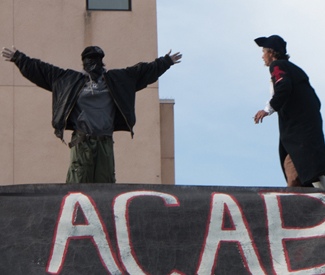
The brick-throwing man whose projectiles hit two protesters at the Occupy San Francisco takeover of a Turk Street building on May Day has helped spark intense internal debates in the movement about the use of violence.

But nobody has heard the alleged hurler’s side of the story.

Jesse Nesbitt, 34, was arrested on the scene, and is accused of felony assault, assault on a police officer, and vandalism. I interviewed Nesbitt in San Francisco County Jail May 3. He spoke of his associations with drug addicts and revolutionaries; his previous stints in jails, prisons and psych wards; and his countless arrests on the streets of San Francisco for illegal lodging.

What emerged was a picture of a homeless Army veteran who suffers from untreated mental illness and substance-abuse issues — someone who found a degree of help and solace in the Occupy movement but has never fully escaped his problems. His story is, unfortunately, not unusual — there are many thousands of vets who the system has utterly failed.

Nesbitt told me he was diagnosed as schizophrenic at 16. “From bad things happening, my mental illness has snowballed since then,” he explained.

Nesbitt said he grew up in the projects outside Pittsburgh, Pennsylvania during the 1980s. “It wasn’t too nice,” he explained. When he was 18, he joined the Army.

“I wanted to join the military all my life. That’s what I wanted to do,” he said. The schizophrenia could have stopped him — but “I lied my way in.”

His tour in Korea was during peace time, but he says he still saw combat. “We were supposed to be at peace with North Korea, in a ceasefire. But whenever they got a chance, they shot at us. And whenever we got a chance, we shot at them.

“It hardened my heart. And it gave me a sense of duty to uphold our Constitution.”

Nesbitt returned from South Korea in 1996. Afterward, “I hitchhiked from coast to coast twice. I got married three times. I have a kid in Pennsylvania. I went to jail in Pennsylvania for — being young and stupid,” he said.

Later in the interview, he expanded on his prison time in Pennsylvania. “I did four years and eight months for aggravated assault, theft, and possession of an instrument of crime,” said Nesbitt. “I also did time in Georgia for assault. And I did time in Alameda County for vandalism and weapons.”

In fact, as he tells it, Nesbitt’s time in Berkeley was spent mainly in jail, before he got involved with Occupy Berkeley.

“I don’t know how much time I did in total in Alameda County. I’d be in jail two, three weeks, get out five, six days, then get arrested again. That was from last April to July,” he says.

On the days when he was free, “I was doing what I normally do,” said Nesbitt. “I’d squat somewhere. In the daytime I’d panhandle, go to the library. I was doing a lot of drinking. Then I started getting arrested a lot when I started doing meth.”

That was his life before joining Occupy. “A friend of mine who was shooting heroin at the time said, let’s go join the revolution. It will help clean you up. It helped pull me out of a drug addiction and keep me healthy,” said Nesbitt.

But that wasn’t the only reason he joined.

“I’ve always had revolutionary beliefs,” he says. He spoke of his friends in Pittsburgh. They wouldn’t let him go the G20 protests in 2009, fearing he would be incited to violence.

“I’ve been involved with anarchists for a long time. They pointed out documentaries I should watch, things I should read,” said Nesbitt.

But the example he gave me isn’t your classic Emma Goldman. Nesbitt remembered “The Esoteric Agenda” — a conspiracy-theory film that connects stories about corporate greed with apocalyptic prophecies.

“The education was getting me ready for something,” he said.

At Occupy Berkeley, even while Nesbitt recovered from his meth addiction, he continued to live in a cycle of violence.

“It was in Berkeley out at the Occupy camp. I got into a fight with somebody, I was in a black out. It took six cops to hogtie 135-pound me, so I was talking shit. While I was hogtied, they dropped me on my head. I went from talking shit to unconscious. I slept for the next two weeks,” Nesbitt told me.

His involvement with Occupy San Francisco increased after the Occupy Berkeley encampment was taken down.

Occupy San Francisco, however, didn’t quite progress the way he had hoped. “When they started raiding us in December, I was hoping the numbers would go up. Instead they dwindled,” said Nesbitt.

He was part of a small group of people continuing the “occupation” tactic outside the Federal Reserve Building at 101 Market St. Back in the fall, that sidewalk was a spot where dozens of people held protest signs and meetings all day and many slept throughout the night. After a series of police raids, and as most of those organizing with Occupy moved on to different tactics and projects, some decided to remain there.

Even when the Justin Herman Plaza camp was in full functional form, it was derided as “nothing but a homeless camp.” There were homeless people there, but many found food and other resources, as well as security from both police and other people they feared on the street, leading many to devote themselves to the goals of the protest movement.

The 101 Market camp that emerged in February was mostly a homeless camp — and, although the people there remained fiercely political in their convictions, they certainly didn’t enjoy the safety that the Justin Herman camp once provided.

Nesbitt was one of those people. “The SFPD not letting us sleep, telling us sitting on cardboard was lodging, sitting under a blanket to stay warm was lodging, you can only take so much of it,” he said. “They slammed my head against the back of a paddy wagon last time they arrested me for sitting underneath a blanket.”

His story is not unusual.

“Veterans continue to lead the nation in homelessness,” explained Colleen Corliss, spokesperson for the veterans-aid nonprofit Swords to Plowshares. “There are a lot of factors at play. Those who go to war have a higher instance of mental illness and substance abuse, which ultimately can lead to a vicious cycle of homelessness,” she said. “Even if you serve during peace time, you can still have really traumatic experiences.”

Nesbitt’s experience with the city’s mental health facilities wasn’t enough to break this cycle. “I did get 5150-ed,” he said, describing the term for involuntary psychiatric commitment. “I was in the hospital less than 24 hours, they kicked me out.”

Why? “I threatened to kill a doctor,” said Nesbitt.

Nesbitt’s 24-hour stay was in the overburdened, short-staffed psych ward at San Francisco General Hospital. When the psych wards began closing beds in 2007, it was comprised of four units, each with 30 beds; it is now down to one unit, according to Ed Kinchley, a social worker in the medical emergency department at General.

There’s also a floor in the behavioral health center for psychiatric patients with 59 beds, but “they told the staff last week that they’re planning to close 29 of those beds.”

“Since [the beds] are full almost every day, the bar or the standard for who stays there or who goes in-patient is a lot higher than it used to be,” said Kinchley.

Whatever the reason, Nesbitt was not getting treatment the day of the alleged brick-throwing — and he was having problems. “I was getting an episode the day before it all happened,” he said. “I was afraid to go by myself to sleep because I was hearing voices. Normally those voices tell me to hurt people. I try to keep around people I love and trust that wouldn’t let me do anything.”

Mixed with his schizophrenia is a brand of Constitutionalism that’s not common on the left.

“When you join the military or the police department, you take an oath swearing to defend the United States Constitution against all enemies foreign and domestic,” Nesbitt said. “Now they’re passing the NDAA, Patriot Act, and other bills I don’t know about. They’re intentionally taking away our constitutional rights. We’re supposed to defend those rights, not lie down and take it.

“I think Abraham Lincoln said, if the government betrays us, we’re supposed to take them out.” Nesbitt insists he’s “not a terrorist. No matter what they might say about me in the Chronicle or whatnot, I’m not a terrorist. What is he, then? “I’m a freedom fighter,” said Nesbitt. “I’m fighting for the freedom of everyone.”

Obama’s mistake

4

By Gabriel Haaland and Laura Thomas

Last month, Obama came out swinging against medical marijuana in an interview, defended his raids of law-abiding clubs, and is currently positioning himself to the right of former President George Bush — despite the fact that nearly 75 percent of Americans support legalized medical marijuana.

In Northern California, Melinda Haag, Obama’s US Attorney for the Northern District of California, is resolutely determined to shut down medical marijuana access. Her district starts in the Bay Area and runs up the California coast to the Oregon border. Ironically, her district may have the strongest support in the entire country for medical marijuana, from voters, law enforcement, elected officials, businesses, and community members. Why is she so obsessed with shutting down the clubs? She claims that it’s because she is protecting the children of California. Really. So the next time someone is dying of cancer and they don’t have legal access to medical marijuana, we will be sure to remember that the children of California are safe. And let’s be clear: She is going after regulated clubs and the idea of a regulated industry — regulations that communities, sheriffs, Boards of Supervisors, and health departments have built.

Haag is targeting community leaders, such as Richard Lee, the chief promoter of California’s effort to legalize marijuana, and Oaksterdam, the area where most of the medical dispensaries are in Oakland. She also shut down Mendocino’s ground-breaking regulation of marijuana growers — literally driving past illegal grows to one recently inspected and certified by Mendocino sheriff’s deputies. She subpoenaed Department of Public Health records used to issue licenses for dispensaries here. She is going after dispensaries in San Francisco that are in full compliance with local and state law, merely because they are within an arbitrary distance from a school or park, even if the park is unused, or the school opened after the dispensary did.

Her actions are not protecting children from the harms of marijuana. She states that dispensaries attract crime, which is not proven by any evidence. What does cause crime is the black market, especially the black market for marijuana imported from Mexico, where 50,000 people have been lost in prohibition-related violence. The less people can produce, purchase, and consume marijuana grown here in California, the worse things get for Mexico. She also seems oddly concerned about the evils of capitalism, worried that people may be making a living from the medical marijuana industry. While we may not be the biggest fans of capitalism, we don’t think closing small businesses (or even large ones) in these economic times is a great idea. Haag’s actions have put thousands out of work and eliminated tax revenues for localities and the state. She’s using taxpayer resources to make the local economy a little bit worse. Thanks.

In San Francisco, elected officials including the mayor, the Board of Supervisors, the district attorney, the city attorney, Assemblymember Tom Ammiano, State Senator Mark Leno, the Democratic County Central Committee, and most recently, Democratic Congressional Leader Nancy Pelosi, have all spoken out against Obama’s efforts to undermine legal, regulated medical marijuana in California. The San Francisco Chronicle has run not one, but two editorials in the last month on the topic, plus a column from conservative columnist Deb Saunders. There have been rallies, protests, petitions, meetings, and letters asking her to stop going after medical marijuana.

What will it take to get Obama to wake up to the fact that his effort are not supported by three quarters of the country and that, in particular, Melinda Haag is obsessed with shutting down any regulated medical marijuana business? She is making things worse: leaving patients to the black market to find their medication, undermining law enforcement efforts to work with medical marijuana producers, and exacerbating the violence in Mexico.

But instead of reining her in, Obama is doubling down one of the most popular causes in America.. Medical marijuana is far more popular in the U. S. right now than Congress, the president, or Republican candidate Mitt Romney. The most serious moment at the Correspondents Dinner in Washington, DC last week was when comedian Jimmy Kimmel asked Obama point-blank why he was going after medical marijuana. None of it makes much sense. How much evidence is needed to convince Obama and Haag that their actions are creating harm, not eliminating it? How much evidence is needed that this is not what the voters and taxpayers want? What kind of data do they need that regulation reduces crime? How many patients need to tell their stories? What will it take to change her actions?

And when will Obama wake up to the fact that he is making a huge mistake? 

Gabriel Haaland is a member of the San Francisco Democratic County Central Committee. Laura Thomas works with the Drug Policy Alliance.

Oakland protest: Tear gas, one arrest

0

Tuesday morning brought an eruption of protests though out downtown Oakland as Occupy activists marched and rallied in support of a national general strike day to mark May Day.

Though the action lacked the numbers of last fall’s Port of Oakland strike, three early morning marches of several hundred protesters made there way through Oakland drawing attention to issues of gentrification, patriarchy and what protesters characterized as the injustices of capitalism.

In a city still waiting for an economic recovery, the protests were a reminder that simmering tensions over economic disparities continue to cause major disruptions of business as usual in Oakland.

Activists focused attention on Child Protective Services and the family court system. The agency was criticizing the for dividing families and sharpening the financial strain on poor families.

“This is where lawyers get rich, where judges get rich, and everyone else suffers,” stated an Occupy Oakland activist on the steps of the courthouse on 13th and Oak.

By noon various marches and protests converged on Oscar Grant Plaza, as roughly 1,000 protesters blocking traffic at 14th and Broadway. Protester danced to a portable sound system carted around in wheel chair, and danced around a maypole erected in the intersection.

OPD’s new crowd-control tactics were in display as riot police entered the crowd to make an arrest as bystanders were moved away with tear gas, concussion grenades and batons.

One woman was arrested and a 19-year-old Oakland woman, was struck in the head with a police baton. Bleeding heavily from the blow, she was rushed to the hospital after Occupy medics determined her wound was beyond their capacity to treat.

It was unclear what provoked the arrest.

Further protests are planned for this afternoon.

UPDATE: Sergeant Jeff Thomason, OPD public affairs, told us there have been four arrests, related to an incident in which paint was allegedly thrown at a police officer. Oakland has summoned mutual aid from the California Highway Patrol, the Alameda County Sheriff’s Office and the Pleasanton and Hayward PDs.

May Day protests begin with ferry workers strike

1

[Editor’s Note: We’ll be covering May Day events in San Francisco and Oakland throughout the day, so check back for regular updates.]

May Day activities have begun with a strike by ferry workers and Golden Gate Transit workers, halting parts of the morning commute.

About 100 ferry workers picketed at the Ferry Building in San Francisco, as well as the Larkspur Ferry Terminal. In anticipation of the strike, the Golden Gate Bridge District announced that they would cancel morning ferry service yesterday. Service should resume at 2:15.

Workers from the Golden Gate Bridge Coalition say that they have offered concessions of more than $2 million and are still locked in labor disputes, prompting the strike for the traditional International Workers Day. 

“The last thing that bridge, bus, and ferry workers want to do is to inconvenience passengers, but what other option has management left us?” said Alex Tonisson, co-chair of the Golden Gate Bridge Labor Coalition, in a press release.

The strikes come after a rough start to May Day demonstrations in San Francisco. A plan for workers on the Golden Gate Bridge to strike and shut down traffic on the bridge was called off two days before the planned demonstration. Last night, protesters vandalized store windows, cars, and the Mission Police station in a march along Valencia St. Organizers with Occupy SF and Occupy Oakland were quick to distance themselves and condemn the destruction, both physically at the protest and in subsequent statements. 

We will continue to update as events unfold.

FCC complaint filed on BART cell phone service shut-off and today’s the last day to comment

1

Back in August, in the midst of protests, BART shut off its cell phone service.

At the time, we said in an editorial that “The bizarre move by BART officials Aug. 11 to shut down cell phone service in the underground train stations made headlines around the world — and for good reason. It was, Wired Magazine reported Aug 15, apparently the first time in United States history that a public agency sought to block electronic communications as a way to prevent a political protest.”

One of the BART protesters, Colin G. Gallagher, has filed a complaint with the Federal Communications Commission (FCC) about BART shutting off cell phone service, and its public comment period ends today. Starting May first, there will be a limited comment period, restricted only to those represented by a lawyer or government officials, according to Gallagher. You can add your comment to the filing on the FCC website.

This is far from the first complaint on the subject filed with the FCC, and BART has since outlined a policy about cutting off cell phone service.

But it’s another chance to comment on the potentially illegal action by BART that drew rage and claims that BART had violated the first amendment. Gallagher agrees, and wrote in his filing comment that communication should go “unhindered by bureaucracies, agencies, and the measures of dubious legality employed by those who would restrain or cut off access.”

An absolute must-read on taxes (by Stephen King)

10

A lot of things drive me crazy (people making a left turn on 16th and Bryant at 5 p.m., backing up traffic for an entire block; people who get to park in the midde of the street on Sunday because the cops don’t ticket churchgoers; politicians who say “I’ll take a look at that” as a way to duck a question, dog owners who leave piles of shit in the middle of the sidewalk… don’t get me started). But one of the worst, on top of my list, is the claim that wealthy people who think the rich don’t pay enough taxes should just write the government a check.

George W. Bush loved that one. Every time taxes on the rich came up, he’d say: “If you think your taxes are too low, the IRS takes checks and money orders.” You can pay online, too.

So what’s wrong with that argument? Why doesn’t Warren Buffett just pay the taxes he thinks he ought to, and stop complaining? Because taxes don’t work that way, that’s why. And one of the best essays on this critical point just appeared on the Daily Beast. The author of this gem, called “tax me, for F@%&’s sake” is an author, Steven King, who is also part of the 1 percent, a man whose knack for telling horror stories has made him very wealthy. And he has harsh words for just about everyone who tries to get away with suggesting that high taxes ought to be voluntary:

I’ve known rich people, and why not, since I’m one of them? The majority would rather douse their dicks with lighter fluid, strike a match, and dance around singing “Disco Inferno” than pay one more cent in taxes to Uncle Sugar. It’s true that some rich folks put at least some of their tax savings into charitable contributions. My wife and I give away roughly $4 million a year to libraries, local fire departments that need updated lifesaving equipment (Jaws of Life tools are always a popular request), schools, and a scattering of organizations that underwrite the arts. Warren Buffett does the same; so does Bill Gates; so does Steven Spielberg; so do the Koch brothers; so did the late Steve Jobs. All fine as far as it goes, but it doesn’t go far enough.

What charitable 1 percenters can’t do is assume responsibility—America’s national responsibilities: the care of its sick and its poor, the education of its young, the repair of its failing infrastructure, the repayment of its staggering war debts. Charity from the rich can’t fix global warming or lower the price of gasoline by one single red penny. That kind of salvation does not come from Mark Zuckerberg or Steve Ballmer saying, “OK, I’ll write a $2 million bonus check to the IRS.” That annoying responsibility stuff comes from three words that are anathema to the Tea Partiers: United American citizenry.

More:

Most rich folks paying 28 percent taxes do not give out another 28 percent of their income to charity. Most rich folks like to keep their dough. They don’t strip their bank accounts and investment portfolios. They keep them and then pass them on to their children, their children’s children. And what they do give away is—like the monies my wife and I donate—totally at their own discretion. That’s the rich-guy philosophy in a nutshell: don’t tell us how to use our money; we’ll tell you. The Koch brothers are right-wing creepazoids, but they’re giving right-wing creepazoids. Here’s an example: 68 million fine American dollars to Deerfield Academy. Which is great for Deerfield Academy. But it won’t do squat for cleaning up the oil spill in the Gulf of Mexico, where food fish are now showing up with black lesions. It won’t pay for stronger regulations to keep BP (or some other bunch of dipshit oil drillers) from doing it again. It won’t repair the levees surrounding New Orleans. It won’t improve education in Mississippi or Alabama. But what the hell—them li’l crackers ain’t never going to go to Deerfield Academy anyway. Fuck ’em if they can’t take a joke.

He skewers the idea that giving the rich more money creates jobs (“At the risk of repeating myself, here’s what rich folks do when they get richer: they invest. A lot of those investments are overseas, thanks to the anti-American business policies of the last four administrations.”) He explains why the GOP tries so hard to defend tax cuts (“They simply idolize the rich. Don’t ask me why; I don’t get it either, since most rich people are as boring as old, dead dog shit. The Mitch McConnells and John Boehners and Eric Cantors just can’t seem to help themselves. These guys and their right-wing supporters regard deep pockets like Christy Walton and Sheldon Adelson the way little girls regard Justin Bieber … which is to say, with wide eyes, slack jaws, and the drool of adoration dripping from their chins.”) And he warns that life might not be so pretty for the uber-rich if this trend continues:

Last year during the Occupy movement, the conservatives who oppose tax equality saw the first real ripples of discontent. Their response was either Marie Antoinette (“Let them eat cake”) or Ebenezer Scrooge (“Are there no prisons? Are there no workhouses?”). Short-sighted, gentlemen. Very short-sighted. If this situation isn’t fairly addressed, last year’s protests will just be the beginning. Scrooge changed his tune after the ghosts visited him. Marie Antoinette, on the other hand, lost her head.

Think about it.

Yes, think about it: A society that gets more and more economically unequal is a society that won’t be stable for long.


Utopia, mon amour

0

marke@sfbg.com

VISUAL ARTS With Occupy gearing up again and a fresh round of election hell full upon us, another cycle of protest — and the urge to engage with the problems of the world while somehow escaping them — is in the air. The Oakland Museum’s current “1968 Exhibit” (through August 19) offers a family-friendly, multimedia trip through the Bay Area’s most famous political and cultural upheaval. But here are three ongoing shows that look closely at individual creators from the past whose work transcends nostalgia, transmits a fair amount of beauty, and drums up some idealistic lessons for the present.


“ARTHUR TRESS: SAN FRANCISCO 1964”

A miracle to inspire cafe artists everywhere. In 1964, 23-year-old NYC photographer Arthur Tress winged through San Francisco for a season, shooting the populace at a particularly turbulent time: the Republican National Convention, the Beatles’ first North American tour, auto worker protests along Van Ness, the passage of the Civil Rights Act. He developed the negatives in the communal darkroom off Duboce Park, had an unremarkable show in the back of a cafe, packed the photos up at his sister’s, and moved on. After his sister died, he found them in a box of her effects, and realized their significance.

And what a find: Forget Mad Men, this is the real 1964, perched on the edge of a cultural unraveling, its existential beehive slowly loosening into flower child ideals. The 70 photographs on show at the de Young, curated by James Ganz, expertly play with composition to bring rough social patches to artful life. A distorted shot of a George Romney presidential campaign poster delivers Orwellian chills. Screaming girls hoisting “Ringo for President” banners intimate repressed political hysteria. Dashing union workers form impressive phalanxes. Patrons at a Fifth and Market diner embody an microcosm of economic disillusionment. A transgender woman suns her hairy legs on the Embarcadero, a plaid-shirted boy holds up a hand-drawn hammer and sickle.

All of it coated with the glamour of deconstructed nostalgia, in which one can indulge and critique at once. But there’s more: “You have throw into the mix a heavy dose of social commentary and criticism — the idea that the photograph can be a vehicle for social change,” Tress tells an interviewer in the show’s handsome if carelessly annotated catalogue. “You photographed street demonstrations, you photographed protests … it was a way of becoming part of the movement.”

Through June 3. De Young Museum, 50 Hagiwara Tea Garden Dr., deyoung.famsf.org

“THE UTOPIAN IMPULSE: BUCKMINSTER FULLER AND THE BAY AREA”

Inside the great Henry Ford automotive museum just outside of Detroit, you can tour an actual Dymaxion House, designed by preternaturally productive designer, philosopher, and dissembler R. Buckminster Fuller. It’s as perfect a realtime experience of walking around in someone’s 1940s sci-fi Utopian dream as one can ever have. A polished aluminum mushroom cap subdivided into tiny rooms bursting with ingenious “squee!”-worthy gadgetry to handle all of life’s projected needs, the Dymaxion House never took off as vernacular American architecture, despite its supposed ease of construction, light weight, and good intentions to house an expanding population. (Among its bland nemeses: rain, expense, and snarky architecture critics.)

But while it’s particularly poignant to see this polished dream deferred nestled among the many wheeled ones populating Henry Ford’s shrine to the former glories of the Motor City — and even though geodesic monument Spaceship Earth at Disney’s Epcot, another eerie graveyard of sleek Utopian ideals, remains Bucky Fuller’s only famous American architectural manifestation — the Dymaxion concept, and several other Bucky wonders, have had a profoundly positive and energizing effect on the Bay Area, as this visionary show at the SFMOMA reveals.

Curator Jennifer Dunlop Fletcher forewarned, “To be clear, it’s not so much a show about Fuller.” Indeed, but in the first rooms prepare to be blown away by gorgeous blow-ups of Massachusetts-born Bucky’s hyper-geometric blueprints, which will surely provide several indie electro bands with album cover inspiration for years to come, and a wall of insanely detailed notecards from “Everything I Know,” his late-life video-recorded brain dump.

Then the real magic of the show kicks in, as it opens up into displays of Bay Area movements and products directly traceable to Fuller, from glorious hippie artifacts like the Ant Farm architecture collective, the Whole Earth Catalog scene, and the iconic North Face “Oval Intention” dome-shaped tent (really!) to contemporary tech initiatives, like bright neon specimens from the “One Laptop One Child” campaign and the utterly transfixing “Local Code” by UC Berkeley Assistant Professor Nicholas de Monchaux, which digitally renders the transformation of all the unused public space in SF into “a common ecological infrastucture.”

Beyond reviving interest in Fuller, the ambitious project of SFMOMA here is to showcase the deep connection between the Bay Area’s brilliant tech legacy and its transcendental communal one, an audacious, successful synthesis that would bring Bucky joy — and one that only a full-size recreation of Steve Wozniak’s garage could probably best.

Through July 29. SFMOMA, 151 Third St., SF. www.sfmoma.org

“RADICALLY GAY: THE LIFE OF HARRY HAY”

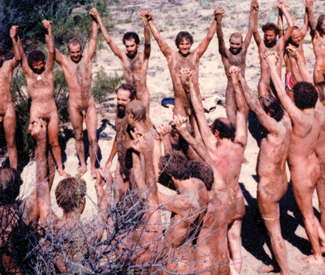
Harry Hay seemed to drop almost effortlessly into so many essential 20th century ideal-driven environments — Hollywood, unions, the Communist Party, gay rights, naturism, really the list goes on. That this modest show at the SF Main Library, curated by Joey Cain, not only clearly distills Hay’s timeline and influence, but also manages to illuminate new corners of his life and sometimes bring on a few tears, is rather a sensation.

Seriously, the man was multitude. Hay is best known as the founder of one of the first gay rights organizations, the Mattachine Society — here revealed through documents, org charts, and touching photos to have been a sort of Moose Lodge for “homophiles.” In one of the show’s most astounding touches, the exquisite Edwardian tea set used by his mother Margaret to caffeinate the early Mattachine meetings is displayed in full.

But of course there was more for this Mad Hatter, including pleading the Fifth before the House Un-American Activities Committee in the 1950s for his Communist party membership and Marxist musicology studies, his 1930s radicalizing tryst with actor and union supporter Will Geer, a.k.a. Grandpa from The Waltons, the “Circle of Loving Friends” desert commune, the national campaign to stop the damming of the Rio Grande — all laced through with references to underground SF gay clubs and arts happenings. (Some things, like his controversial early support for NAMBLA, which could benefit from some honest contextualization, seem glossed over, perhaps due to space concerns.)

Hay’s creation in the 1970s of the Radical Faeries, a collective whose anti-assimilationist, Pagan aesthetic continue to influence and inform Bay Area style, is well-represented here, as is perhaps Hay’s most stable pursuit: his loving 40-year relationship with John Burnside. Two seemingly politically contradictory Utopian ideals, embodied in one mercurial spirit, revealed beautifully.

Through July 29. SF Main Library, 100 Larkin, SF. www.sfpl.org

Bon voyage

0

THEATER Bay Area audiences set off for The Coast of Utopia with Shotgun Players’ production of Voyage, the first play in Tom Stoppard’s celebrated 2002 trilogy based on the lives and careers of certain radical Russian émigrés in 19th century Europe. With artistic director Patrick Dooley at the helm of a large cast, the local launch of Stoppard’s sweeping, pageant-like history play proves a smooth and articulate one, although so much is being set up in Voyage — which takes place inside Russia ahead of a departure to revolutionary Europe by one of its principal characters, future anarchist Mikhail Bakunin (an exuberantly confident Joe Salazar) — that the dramatic ball feels like it’s just getting rolling. (Unfortunately, audiences will have to wait until 2014 before Shotgun has all three plays, including Shipwreck and Salvage, up and running in repertory).

Stoppard’s play is both consistently witty and a bit glossy — in the sense of being both too sleek and too superficial to feel very deep. But it is not without a political point of its own. Here, the heady ideas and exchanges of real historical actors like Bakunin or literary critic Vissarion Belinsky (Nick Medina) mingle with family tensions, romantic entanglements, careerism, and political intrigues, all amid some seismic shifting of history. That the ideas in play are often fodder for comedy underscores the discrepancy here between high ideals and lived experience — and the emphasis on a compromised but happy present over long-term struggle for a new society. The trilogy will make the deeply interesting figure of Alexander Herzen (played in Voyage by an able Patrick Jones) the charmingly sympathetic carrier of this not very satisfying liberal through line.

Funny the work comedy can do. A few days and two pretty long plane rides after seeing Voyage, I arrived in Moscow in time to see some real Russians pretending to be from Belarus, in a theater production that also leveraged comedy to explore urgent political themes. Two in Your House, which is among the 15 productions making up the Russia Case program of the 2012 Golden Mask theater festival, is smart, dead-pan absurdist theater based on actual events and documents stemming from the 2010 house arrest of Belarusian poet, activist, and presidential candidate Vladimir Neklyaev.

http://www.youtube.com/watch?v=CiGbfNz3IyY

The action unfolds on a small stage in front of an audience crammed into a house with maybe 60 seats in all. Five actors recreate a situation in which Neklyaev (played with a gentle, almost serene philosophical air by a Russian actor who is himself a writer in real life) and his wife must share their small apartment with two KGB officers. The set is minimal, though a backdrop giving the diagram and dimensions of the actual flat neatly underscores both the fidelity to details and the suffocating invasion of intimate space suffered by the couple. Their vulnerability before two male strangers (and a third who rotates in during shift changes) comes across viscerally at the outset, but the tables are soon turned as Mrs. Neklyaev begins a fearless (and frankly hilarious) campaign of harassment to retake her home from the invaders — thus dissolving once and for all the illusory line between public and private spheres in the face of an invasive authoritarian regime.

Even without benefit of the simultaneous translation offered English speakers in the audience, the deft physical comedy and its Mrozek-like humor in the face of an outrageous as well as preposterous situation speaks volumes about political realities, the web of systemic violence that ultimately snares everyone, including the KGB agents (here played not unsympathetically as reluctant and increasingly miserable lackeys of the state). The comedy in this way comes as illuminating, subversive gloss on the hard facts of the case.

The company responsible for this unexpectedly wry bit of documentary theater is named Teatr.doc (pronounced “Theater Doc”). Led and financed by Elena Gremina, it’s one of Moscow’s scrappy independent theaters (as opposed to the state-subsidized repertory theaters employing full ensembles of actors and theater artists).

There are still several days of plays ahead at the time of this writing, but it’s clear already that the independent theater has an important presence in this festival. Of the 15 productions selected for the 2012 Russia Case by curator and critic Elena Kovalskaya, the majority tends toward the experimental and more politically outspoken fare of the small independents. Three come from Teatr.doc; two more come from Moscow’s Praktika Theatre, devoted exclusively to new drama. Other noteworthy names in the lineup include St. Petersburg’s AKHE Engineering Theatre (two-time guests of the San Francisco International Arts Festival, who are currently collaborating with SF’s own Nanos Operetta on a new work to premiere at SFIAF next year).

That evening after Two in Your House came an off-program production of famed director Dmitry Krymov’s Ta-Ra-Ra Boom-De-Boom. Krymov (whose In Paris, featuring Mikhail Baryshnikov, opens at the Berkeley Rep this month) offered up a spectacular, carnivalesque processional employing 80 actors in resplendent, sometimes wild costumes and a very long conveyor-belt stage to meditate on Chekhov and the impossible century since his death, as well as a kind of relentless attempt to grapple with or transcend both.

Moscow alone has something like 115 theaters, and the variety of work on display is predictably large. Only a handful of independent theaters take on overtly political subject matter, but these have a disproportionate influence today. The premiere of Two in Your House, for example, coincided with the recent massive street protests against Putin in the wake of elections overwhelmingly perceived as rigged. Its Belarusian subject matter thus chimed effortlessly with this political moment in Russia, especially for the younger 20-something Muscovites who are the bulk of the audiences for independent theater as well as the vast majority making up the recent street demonstrations.

THE COAST OF UTOPIA: VOYAGE

Through April 29

Wed-Thu, 7pm; Fri-Sat, 8pm; Sun, 5pm, $20-$30

Ashby Stage, 1901 Ashby, Berk.

www.shotgunplayers.org


Justice for Trayvon organizers react to Zimmerman murder charges

3

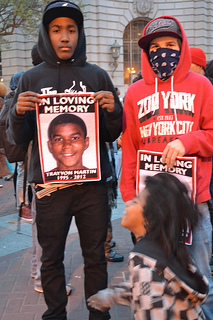
The Bay Area joined cities across the country in holding protests and rallies demanding justice for Trayvon Martin, a 17-year-old shot and killed by 28-year-old George Zimmerman in Sanford, Florida Feb. 26. 700 wore hoodies and marched downtown March 21. An “emergency scream-out” held March 26 outside of the Hall of Justice and jail at 850 Bryant called for justice for Martin as well as victims of police violence such as Ramarley Graham, an unarmed 18-year old Bronx man who was killed in his home by police. A “hoodies and hijabs” march last week in Oakland commemorated Martin’s death alongside the death of Shaima Al-Awadi, a 32-year old mother of five who was killed in a potential hate crime in her El Cajon home last month.

Speakers at these protests expressed outrage that Zimmerman had not been charged with any crime.

Now he has. On April 11, Zimmerman was charged with murder in the second degree.

I asked local activists- is this justice?

“I’m not jumping up for joy that this murderer has finally been arrested. I hope we can question what took so long,” said Tiny Gray-Garcia, creator of POOR magazine, who helped organize the scream-out.

She compared the case to that of Oscar Grant and his killer, Johannes Mehserle. After protest erupted demanding that Mehserle be charged with Grant’s killing, he became the first police officer in the history of California to be charged with murder. He was convicted of involuntary manslaughter and served eleven months in prison. 

“In the same way that Mehserle was finally charged, will Zimmerman eventually get a slap on the wrist?” asked Gray-Garcia. 

The March 26 scream-out was “not only for our young brother Trayvon. It was for Oscar Grant, Ramarley Graham, it was for Idress Stelley, Aiyana Jones, all the victims of police terror,” said Gray-Garcia

Unlike Graham, Stelley, and Jones, Martin was not killed by a police officer. But Gray-Garcia believes that his death can be atttibuted to “police culture.”

“Trayvon was murdered by a volunteer vigilante,” said Gray-Garcia of the neighborhood watch captain who had aspirations of becoming a police officer. “He was part of a violent police culture.”

If police and prison culture is a problem, is Zimmerman’s arrest- by police- justice?

In the media storm that followed the incident, some writers, such as this one at the Crunk Feminist Collective, have grappled with the question.

“How can I demand a criminal conviction for Zimmerman when I am opposed to prisons?” asks the Crunk Feminist Collective writer. “How do I reconcile these things?  I’m not sure yet.  But what I do know is that this really is not about the prison, but about a prison state that targets black and brown bodies in problematic ways.  It’s about a system of policing and surveillance, in which some bodies are always under the eye of the state.”

Isaac Ontiveros of the Oakland-based Critical Resistance, a group whose “vision is the creation of genuinely safe, healthy communities that respond to harm without relying on prisons and punishment,” has also struggled with this issue.

“That’s a challenging question for everybody,” said Ontiveros. “Part of it is, how can we start to dislodge the logic of neighborhood watches? You look at neighborhood watch associations and who are they watching, what do they mean by neighborhood, and who is considered suspicious?”

After Martin’s death, protests across the country were unrelenting calling for Zimmerman’s arrest. Days before the arrest and charge were made, a group of students who had marched 40 miles to Sanford from Daytona Beach “occupied” the Sanford police station, condemning how the case had been handled and demanding the termination of Sanford police Chief Bill Lee Jr. Police had declined to press charges against Zimmerman, saying that he had acted in self-defense.

On March 23, almost a month after the Feb. 26 shooting, Florida governor Rick Scott appointed special prosecutor Angela Corey to investigate the case. Zimmerman was charged with murder and taken into custody April 11.

“We do not prosecute by public pressure or petition. We prosecute based on facts and the laws of Florida,” said Corey at the time.

“She contends that neither petitions or media pressure influenced her decision, when we know too well that without it, nothing would have happened to Zimmerman,” said Mesha Irizarry, another scream-out organizer. Irizarry’s son, Idriss Stelley, was killed by police in 2001. 

The incident has put a national spotlight on racism in the United States. In Sanford, the NAACP held a town hall meeting for African American residents to air their frustrations with profiling in their own lives; hundreds attended

“If you’re black and you’re shot, particularly by someone who’s not black, that it is not viewed as seriously,” Sanford City Manager Norton Bonaparte told Reuters.

He added: “that’s why some feel that Mr. Zimmerman was allowed to just go on his way while Mr. Martin went to a morgue. And certainly if it was reversed, and Zimmerman had been black, he would have been detained and arrested.”

The same sentiment was expressed by protesters in San Francisco March 21. The speakers that day were family members of black teens who had been killed and whose murders had, they said, not been thoroughly investigated.

“Personal justice would be to open up all these other cases,” said Gray-Garcia.

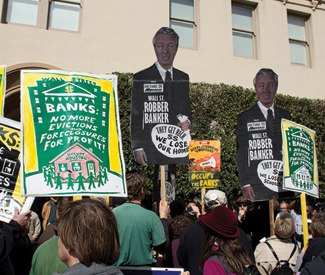
Activists hope to turn resolution into real foreclosure suspension

3

On April 10, the Board of Supervisors unanimously passed a resolution calling for a temporaray suspension on foreclosures in San Francisco.

The resolution “urges city contractors and all mortgage and banking institutions to suspend foreclosure activities and related auctions and evictions until State and Federal measures to protect homeowners from unfair and unlawful practices and provisions for principle reductions are in place.”

This comes after a report from Assessor-Recorder Phil Ting found that 84 percent of foreclosures in San Francisco in the past three years involved faulty paperwork and, likely, fraud.  

The resolution does not require anything, but instead urges the city to work on behalf of constituents swept up in the foreclosure crisis. 

It urges all city departments, “including but not limited to, the offices of the Mayor, the Assessor-Recorder, the City Attorney, the District Attorney, and the Sheriff, to take proactive steps and measures to ensure that the City and County of San Francisco prevents and protects its resident form illegal foreclosures, auctions, and evictions.”

“The controller is supposed to audit every case beyond what was in Phil Ting’s report. Based on that information the glaring illegal activity for the banks, the district attorney and city attorny should sue the banks and file an injunction to stop foreclosures. I think those are some of the steps we could take,” said Julien Ball, an anti-foreclosure activist with Occupy Bernal

The resolution also “urges the Mayor to direct…our city lobbyists in the California State Capital to prioritize support for California Homeowners Bill of Rights state bills.”

This series of bills, proposed by state attorney general Kamala Harris, would include efforts to stop dual tracking- when homeowners still in the process of a loan modification are simultaneously tracked for foreclosures. The package also includes a ban on robosigning and other practices that can constitute fraud in foreclosure proceedings. 

Sups. Avalos and Campos sponsored the resolution, and Kim, Mar, Olague and Cohen co-sponsored. 

Occupy Bernal’s goal remains a city-wide moratorium on foreclosure, and towards that end, the resolution represents an important step.  It puts San Francisco on record as being against unfair foreclosures and related evictions,” said Ball, “and its something we can use to put pressure on the banks and public officials to act.”

“That involves exposing and shaming banks through public protests, blasting them with phone calls, calling out their board members, its necessary if we have to stand in front of somebody’s home to stop them from being evicted we’ll do that to,” said Ball.

They plan to escalate these tactics April 24, when a coalition of groups has declared that it will “shut down” an April 24 Wells Fargo shareholders meeting in San Francisco.

Breaking: hundreds with OccupySF ‘occupying’ building

40

UPDATE: Representatives of the Archdiocese have made clear that they will not make a decision regarding the building occupation until the morning 

OccupySF, along with at least 400 supporters and homeless advocacy groups, have entered a vacant ’building and plan to turn it into a community center. Participants served a free dinner, unrolled sleeping bags and tacked up posters in rooms marked “sleeping quarters” by organizers, and are currently meeting to decide next steps.

“Occupy San Francisco and Occupy Oakland originally were providing food and shelter to those who didn’t have it previously. That’s the plan I think, to provide food, shelter and a space for political organizing,” said protester Samantha Levens, 33, a deckhand on the Alameda-Oakland Ferry. 

The building, 888 Turk, is the former site of Westside Mental Health Center and has been vacant since the closure of that mental health clinic about five years ago. It is owned by the Archdiocese of San Francisco.

It is available for lease through HC&M Commercial Properties.

About 400 marched to the building at 4:30pm, trailed by an former AC Transit decorated and converted to a protest-party vehicle by Occupy Oakland. The march had the air of an April Fools Day Carnival, complete with clowns, jugglers, and a man dressed as Captain America alongside people with bandanas and Guy Fawkes masks. Protesters marched from Union Square on Geary, chanting “homes not jails” and ”housekeys not handcuffs.”

The march followed a rally in Union Square, in which homeless advocates from Berkeley, Oakland and Sacramento spoke to the crowd, and performers including the Mixcoatl Anahuac dance group and the Brass Liberation Orchestra kept the mood festive.

The protest was part of a national day to defend the rights of the homeless with protests in 17 cities. Paul Boden of the Western Regional Advocacy Project, which planned the Union Square protest, spoke speficically about Business Improvement Districts in San Francisco, which he claimed funell property taxes to businesses at the expense of the homeless.

When the march arrived at Turk and Gough, the site of the building, it had already been unlocked from the inside, and protesters on the roof held a sign reading “organize or starve.”

About 40 police officers provided an on-foot escort for the march. Officers as well as several police vehicles are currently standing by the “occupied” site, and declined to provide comment at this time. 

An OccupySF-associated building takeover occurred Jan. 20 just a few blocks away at the former Cathedral Hill Hotel. At the request of the building’s owners, police entered the building, and no occupiers remained the following morning.

“Occupy SF through the OccupySF commune has inhabited a vacant building for the purpose of creating a community center in the spirit of the buildings original intention, to create a center for health and healing,” according to a press release issued by the group.


Black Power, then and now

17

“We’re not ever to be caught up in the intellectual masturbation of the question of Black Power. That’s a function of people who are advertisers that call themselves reporters.”

That’s how the radical student and civil rights leader Stokely Carmichael opened a speech about Black Power — a term he helped popularize — at UC Berkeley in 1966. But the ideas and concepts behind Black Power proved to be an enduring ones that are enjoying a resurgence today.

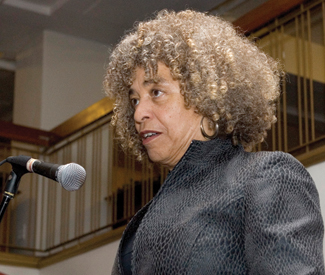
Angela Davis epitomized the Black Power movement to many observers. The author, scholar, and professor was a Black Panther Party member who then joined the Communist Party USA and brought a class analysis to issues of race, building on the movement that began in the ’60s for decades to come.

In recent months, as the Occupy Wall Street movement began to focus the country’s attention on economic and social inequities, Davis has spoken out regularly in support of the movement and drawn connections back to her early activism. She has embraced the “99 percent” paradigm, and the connections between various issues that Occupy activists have sought to highlight.

“Our demands for justice lead us toward demands for prison abolition. And our demands for prison abolition lead us to demands for free, quality education. And our demands for free quality healthcare, and housing, and an end to racism, an end to sexism, an end to homophobia,” Davis said March 1 in Oakland at a benefit for Occupy 4 Prisoners, a coalition of Occupy protesters and prison justice advocates.

Consciousness surrounding those connections can be largely attributed to efforts from Black Power organizers.

“When I listen to the way young people so easily talk about the connectedness of race, gender, and sexual issues, and I remember how we groped our way towards an understanding of those connections, it makes me really proud,” Davis said in a January interview with Independent Lens.

And as Davis said at the March 1 event: “One of the most exciting accomplishments of the Occupy movement has been to force us to engage in conversation, explicit conversation about capitalism, for the first time since the 1930s.”

The movement’s economic message also seemed useful to Kiilu Nyasha, a San Francisco-based journalist and former member of the New Haven Black Panther Party.

“Globalization has already happened. It’s not happening, it’s happened. One percent, internationally, owns and controls 80 percent of the world’s resources. People are dying all over the world of every complexion which you can think of” Nyahsa said March 14 at a panel discussion called Reboot the Rainbow.

The original Rainbow Coalition- the topic of the March 14 panel- included the Black Panther Party, the Puerto Rican Young Lords, and the poor white Young Patriots organization, and was committed to a Black Power concept: organize your own, fight together. Building coalition is more important now than ever.

“It’s not Black Power right now,” says Terry Collins, president of KPOO radio, a black-owned station long focused on community empowerment. “It’s people power. It’s power unto the people who are in need: all the people out there who are out of their homes, students who owe so much that they’re like indentured servants.”

Occupy the Hood is a national effort to encourage participation of people of color in Occupy Wall Street. In its mission statement the group writes, “It is imperative that the voice of people of color is heard at this moment!”

The focus of San Francisco’s Occupy the Hood chapter is “three-fold,” according to organizer Mesha Irizarry: “The cop-watching in neighborhoods that are criminalized, especially poor neighborhood of color. It’s freedom fighters against foreclosures. It’s also bank transfers.”

Occupy the Hood showed up March 16, when a group known as the Foreclosure Fighters- organized and supported Alliance of Californians for Community Empowerment, Homes Not Jails, and related groups—occupied their latest foreclosed home. “We’re liberating this house. We’re taking it out of the hands of the oppressor,” said Archbishop Franzo King of the African Orthodox Church.

“Jesus Christ was an uncompromising revolutionary. He spoke truth to power. Then they killed him for it,” added King in a nod to the radical religious leaders who have influenced liberation movements throughout the years.

Black Power was concerned with self-determination, with organizing within community. That legacy is still strong as San Francisco’s African American communities experience an out-migration and continuing police harassment and violence.

“Black sailors and black army personnel built the shipyard,” said Jameel Patterson, a founder of the Bayview-Hunters Point-based community organization Black Star Liner Incorporated. “Hunters Point, West Point, Harbor Road—they’re all military names. The soldiers stayed there with their families. The area has a rich African American legacy going back to the ’40s. Now it’s fading…we want to make sure that community’s still here 20 years from now.”

Patterson remembers being a child in the ’70s when, on the tail of an era brimming with black liberation efforts. “There were more community events,” he said, but now, “People don’t have connections with each other. That’s what we’re building.”

The group does regular events where they serve free home-cooked meals to residents, reminiscent of the Black Panther Party’s free breakfast program. “With every plate, you get information,” often Know Your Rights reminders for encounters with police, said Tracey Bell-Borden of Black Star Liner.

They have also spent countless hours in City Hall meetings advocating for their community and reporting back on city policies that affect it. “We occupy the Police Commission meeting,” said Bell-Borden.

Police are a central and tricky question for the Black Power movement of the ’60s, as well as organizing efforts today. Black Panther Party members spent years serving free breakfast to children, writing and selling newspapers, and even running election campaigns, but they are often remembered for carrying guns and efforts to “police the police.” So many leaders were arrested that energy that could have gone into feeding or education was often channeled into freeing prisoners.

“I was in the second chapter of the Black Panther Party,” Nyasha said at the March 14 event, “which basically existed to get the first chapter out of jail.”

Recent police crackdowns have fed indignation not just about policing protesters, but about the role police play in poor communities of color. “One thing Occupy has done is address the issue of policing in communities of color, to the extent that some aftermath of what we’re seeing at Occupy is shedding light on how police can sometimes treat people,” said Kimberley Thomas Rapp, executive director of the Lawyers’ Committee for Civil Rights of the Bay Area.

“In black neighborhoods, police should be community partners, not come in and exert more force than necessary. And at protests, they should be there to ensure safety, not just to arrest people unnecessarily or use excessive force,” Rapp said.

Police crackdowns on Occupy are the first exposure many white protesters of the younger generation have had to excessive police force, an issue that was central to the story of the Black Power. Sadly, for many black and other protesters of color, excessive police force is nothing new.

“It’s absolutely the case that police brutality shown towards many Occupy protesters has brought to the forefront the issue of police violence and led to an awakening among many white folks of the day to day reality of police violence that many people of color have lived with now for many years,” Michelle Alexander, author of The New Jim Crow, told the Guardian.

Enraged at police beatings (see “OPD spies on and beats protesters,” Feb. 14) both Occupy Oakland and Occupy San Francisco have held “fuck the police” marches. March 18, after a six-month commemoration celebration brought 3,000 to Zuccotti Park in New York City, followed by 200 arrests and rampant police violence, Occupy Wall Street protesters followed suit, holding their first anti-police brutality march.

Occupy Wall Street has reanimated concepts that burned through the ’60s, such as violence vs. nonviolence, the systemic causes of personal economic woes, and the peoples’ relationship to police. With the consciousness created by Black Power activists, today’s organizers have a foundation on which to build their own answers to these questions, across issues and generations.

National Occupy the Hood has called for action concerning Trayvon Martin, the unarmed black 17-year-old who was shot Feb. 26 and whose confessed killer has yet to be arrested. Taking up high-profile cases of injustice and working more closely with organizers to respond to the needs of local African American communities could bring more power and truth to the rage for justice currently galvanizing a new generation.

“It’s about black re-empowerment,” Archbishop King said. “It’s like the torch, the light of freedom and justice, has actually gone out. And we’re trying to relight that. That’s why I’m so excited about the Occupy movement; it ties into the Black Power struggle. And I think it’s waking up some of us old revolutionaries to stand up.”

Interviewing Anonymous

3

yael@sfbg.com, steve@sfbg.com

There have always been journalists and activists devoted to safeguarding the free flow of information, but the age of the Internet has brought a new set of opportunities and challenges — and a new generation of loosely affiliated online enforcers collectively known as Anonymous.

This network of so-called “hacktivists” from around the world organize operations ranging from physical protests to cyber attacks on corporate websites, involving anything from small groups carrying out someone’s idea to large groups using downloaded software to launch sophisticated attacks on high-profile villains or in defense of embattled heroes.

“We are Anonymous. We are Legion. We do not forgive. We do not forget. Expect us,” is a common tagline members of the group use in announcing its campaigns, often through YouTube videos and accompanied by imagery of a suit with a question mark for a head or someone wearing the Guy Fawkes mask popularized by the film V for Vendetta, with its theme of the masses rising up against injustice, driven by the power of basic ideas about justice (see “Remember, remember the 5th of November,” 11/1/11).

The idea of the online community rising up in collective action under the banner of Anonymous first appeared around 2003, but it really caught on and went viral in the last few years, first when Anonymous organized global protests outside Church of Scientology offices in 2008 and again at the end of 2010 when Anonymous defended Wikileaks’ release of secret diplomatic cables, shutting down the websites of Visa, Amazon, PayPal, and other companies that cooperated with the U.S. government in trying to freeze Wikileaks’ assets.

Here in San Francisco, Anonymous helped organize and coordinate the waves of protests directed at BART in August 2011 after the agency shut down cell phone service to try to disrupt a protest of the latest fatal shooting by a BART police officer. It was through those protests that some of the earliest organizers of Occupy San Francisco say they met and began working together, and Anonymous has shown strong support for the Occupy movement.

So, for this year’s FOI Issue, we decided to chat up an Anonymous member who is active in the group’s discussions on its Internet Relay Chat (IRC) channels, which are hard to find and prone to being shut down whenever someone fears security has been breached. The following are excerpts from that interview:

SFBG Is there a philosophy behind the work Anonymous does?

ANON You should really ask the hive mind. We are all Anon, not just a single person. But I will answer you. There are a few things that bind all of Anon together: Justice, freedom, personal joy. We just want to live our lives normally and happily, and we believe there is a power stopping us from doing so, so we decided to band together and do something about it.

SFBG We’ve written a lot about Occupy and it’s the same thing: Everyone can only represent themselves.

ANON Occupy is the next step, I believe. But that’s just me. Occupy is the forum where people gather transferred into the real world. It’s just one manifestation of the hive mind in reality. There may be another one in the future.

SFBG How is organizing with Anonymous different from organizing in the real world?

ANON Safer I suppose. Convenience. We are only at the mercy of what’s out there in cyberspace. We aren’t going to be beat down by a cop who has gotten drunk on power. In the real world, it’s dangerous to gather in numbers. It’s come to a point where even a little dissent under the First Amendment can turn you into an “enemy” of a country you love so much.

Anon, we are people. We come together. We feel like doing something, we do it. We separate; it’s not always the same people. There is very, very, very little organization.

SFBG How does Anonymous tend to organize? Are raids the most common form of political protest?

ANON Raids can be and cannot be, depends on your mood. Sometimes it is, sometimes it’s not. I have personal views on raids as a protest. But all I can say to that effect is, it is simply one means of a protest. There is no damage. Just an online sit-in.

SFBG Can you describe how that process works, in which some ideas turn into action and some just remain ideas?

ANON People just agree on it, or talk about which is a good idea and which is a bad one. You see it every day on the IRC channel, for example. The bad ones we disagree on. We all input into one another’s conversation. Even if our idea is wrong and we see truth in another, there is no judgment for being wrong.

SFBG What about people who aren’t great with computers or would have no idea how to find this chatroom. Would they be helpful? Would you want them to get involved?

ANON There are Anons everywhere. They talk to people and show them how to get here. I’ve showed people and others in this room have showed people. And this is just one congregation. There are many. Yes we want more people involved. We want the average Joe to be involved. You don’t need computer skills to be a part of anonymous. Just ideas, or questions. Just wanting to search for the truth of the world.

SFBG Does Anonymous have ideas and faith everyone in the group believes in?

ANON No. There are some ideas, but no faith. Faith, I believe, is really personal. But ideas, yes, we have many. And everyone ideas are important, whether they are brilliant or stupid, because they are another person. I guess respect and appreciation for other people for who they are is something we all agree on.

SFBG Websites targetted for recent raids have included those of the Vatican, AIPAC. How would you describe the pattern or category that most targets fit into?

ANON I guess I could say, corrupt. And there is proof of corruption. We don’t ever move without proof. But other than that, I am not at liberty to say.

SFBG It’s not based on corporate greed or crimes?

ANON I am really not at liberty to say. Anons come from all walks. We attack what we think is wrong, as a collective. It doesn’t always have to be corporate greed. It has to be crime. Personally I don’t care how greedy a company is. But when they do something wrong, I react. I’m sure there are some like minds in Anon, but I can’t speak for everyone.

A good example is back when PayPal, Mastercard, and Visa refused to release funds to Wikileaks. The money belonged to Wikileaks and the middle men would not release it. The money was donated, and they refused to release it…We saw it as wrong. It also hurt the free flow of information, of revealing what’s going on behind closed government doors. Who are they to decide those things should be kept secret? The people want to know and they should know. I suppose this brings us to another of Anon’s ideas that we mostly believe in, transparency.

SFBG Is there anything that should be kept secret?

ANON When it comes to governments, no. When it comes to personal life, yes.

SFBG What about personal lives of government officials?

ANON Of course that should be kept private. But when it involves the rest of the country, we are at an impasse. If they want certain details kept private, fine by me. But if they want to make back door deals, that is wrong. People should know what the government is doing. The only place where secrecy can be defended that I see at this moment is military defense, but even that can be easily corrupted. So we want to know.

SFBG What about Bradley Manning’s alleged leaks? Those were about the military.

ANON Personally, I think there is a danger. But as a whole, we want to know. Because secrets left in the hands of a few can become corrupt. We should all understand one another.

It sounds like an ideal, but universal brotherhood, why is it so far off a thought? Why can’t we all just understand one another instead of going out and fighting? A lot of wars in the past have had many secrets, many back door dealings, many deaths that could have been avoided. If people just knew everything that happens all the time, if people just knew the truth, wouldn’t we care more?

SFBG Care more about what?

ANON About others. We are human, we laugh, we love, we share joy, we stand by and help people. This type of society is separating us, the Internet unites us. It’s what being a human being is about. We are a whole as a species, not an individual,

SFBG A sense of community is an important part of it?

ANON I don’t know, but I suppose it does hit our need for belonging. It’s just one place we belong. A community is the side effect I think of just coming together and sharing ideas. Not a bad side effect, but a side effect nonetheless

SFBG How does the concept of diversity factor into this? It could be all old white men in Anon and no one would know, but that could still affect what ideas come out.

ANON Well, because personally I am not old or white — as to my gender, I’ll keep that anonymous — and I am a part of it. I share ideas. I couldn’t care less. It’s the ideas that unite me to other Anons. Some ideas do separate me from some, but there is middle ground everywhere. And true news and an open mind, I believe, can help people find middle ground.

From bhangra to Brazilian horns: Celebrate International Women’s Day at Yoshi’s

0

International Women’s Day has been around to raise consciousness and support women’s rights since the early 1900s, and this year the party happens Thu/8. Tomorrow morning, people across the Bay Area will be rising up to join women-led demonstrations like Women Occupy and Rally Against Sex Discrimination and Sex Harassment to show our support for the XX-chromosoned all around the world. But after the daytime marches and the protests, Yoshi’s San Francisco Jazz Club invites us all to end the night at International Women’s Day’s official after party — an evening of notable speakers and intimate performances benefiting two upcoming events, Earth Day and Peace Day.

March 8 has become established as the annual date to globally recognize gender issues and celebrate feminism. The United Nations’ official 2012 theme for the day is “Empower Rural Women — End Hunger and Poverty,” and tomorrow night’s celebration at Yoshi’s should evoke that message — seasoned in local context and jazzy flavor. 

Patricia Maginnis, a long-loved activist and cartoonist, is one of the most esteemed feminist pioneers whose work helped the fight for safe, accessible abortions. She helped establish the Association to Repeal Abortion Law in California in 1966, and helped 12,000 women find abortions outside the country by 1969. Maginnis continues to make active contributions to spreading awareness of women’s rights, and will be speaking at Yoshi’s about the latest feminist issues concerning contraception and cosmetic safety. 

Big Brother and the Holding Company headlines tomorrow night’s stunning bill of SF-based musicians. It was Janis Joplin’s original band, and its experimental and raw sounds played a significant role in establishing San Francisco’s psychedelic music scene. 

Non Stop Bhangra, a monthly bhangra dance night in San Francisco that blends traditional Punjab folk and dance music — will also be bringing the party to Yoshi’s. The diverse line up will also feature Brazilian horn-driven funk band, Mondo Loko, sexy and soulful genre-bender Valerie Orth, soul-rock musician and former classical opera singer Pamela Parker, the soulful melodies of the harmonic powerhouse Lesley Grant, and the versatile, exotic vocals of Ziva.  

International Women’s Day Celebration

Thu/8 8 p.m., free for lounge-only; $35 for main stage access 

Yoshi’s San Francisco Jazz Club

1330 Fillmore, SF 

(415) 655-5600

www.yoshis.com


Occupying the Capitol

5

It’s an unseasonably hot day at UC Davis, and student activists are milling around a tent city, set up especially for 100 people arriving from a four-day March on Education. The school, one of the hubs of the Occupy movement, gained notoriety when public safety Officer John Pike casually pepper sprayed a line students during a sit-in back in November. Now, officers bike through the idyllic scene, smiling and chatting up occupiers.

Everyone is preparing for the next day, March 5, the statewide day to defend education that will bring thousands of students and teachers to Sacramento to demand an end to budget cuts and fee hikes at California’s schools, community colleges, and universities.

Those on the march hope to highlight the importance of this issue, marching 79 miles from the Bay Area. The first night, the march stayed in Richmond, and the next day Richmond’s Mayor Gayle McLaughlin came out to welcome them.

Students march annually on Sacramento, and say they won’t stop until education is affordable (or, as some would demand, free). A climate of worldwide protest over disparities in wealth and opportunity, including Occupy protests in the United States, helped fuel a larger than usual turnout this year.

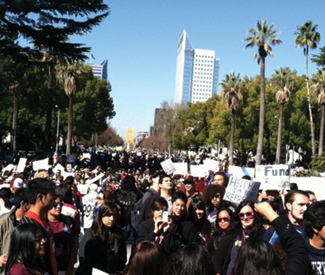
More than 5,000 people converged in Sacramento March 5 and marched to the Capitol building, occupying the Rotunda all day. Many chanted “no cuts, no fees, education must be free.”

Community college student throughout the state are reeling from the cuts, and resulting fee hikes—course units, once free, were raised from $26 to $36 per unit last year, and will be increased another $10 this summer. These costs go towards closing the state budget deficit, and not toward a bigger course catalogue; classes continue to be slashed.

Frances Gotoh of San Bernardino Valley College is back at school after being laid off from her longtime job at Bank of America. She said she desperately needs the retraining; without it her job prospects look dim. She needs to support her family—her 20-year-old son is also a college student—but says she can’t afford the increasing fees. “Why is education being taken away?” asked Gotoh. “It belongs to the people.”

Josselyn Torres, a psychology major at Sonoma State University, felt similarly. “Every year, the fees are getting higher but the class size is getting bigger,” said Torres, who noted that many of her friends won’t be graduating with her because so many of the classes they needed were cut. “The politicians have all gone to college. If they keep cutting our education, how can we make it as far as them?”

When the march reached the Capitol, student and state government leaders spoke on the importance of education. Students demanded an end to fee hikes and budget cuts. Assembly Speaker John Perez (D-Los Angeles) and Senate President Pro Tem Darrell Steinberg (D-Sacramento) praised student activists and expounded on the necessity of accessibility to education. Almost all speakers decried the two-thirds majority needed to raise taxes, allowing just a few Republicans to block them.

Lt. Gov. Gavin Newsom also spoke, describing the need to support education in staunchly free-market terms: “You can’t have an economic development strategy without a workforce development strategy.”

Periodically, the crowd interrupted Newsom and other politicians in the midst of making promises with chants of “show us.” They also chanted this election year threat: “You’ll hear us out or we’ll vote you out!”

Around 12:30 p.m., the permitted rally ended and thousands dispersed. About 400 stayed to “Occupy the Capitol.” The group streamed into the building and into the rotunda. California Highway Patrol officers, responsible for policing the Capitol, blocked more than 150 from entering the central area. So, communicating via the Peoples Mic with several rounds of crowd repetition for every sentence spoken, the group participated in a statewide general assembly.

Some building employees showed support, but the only politician to sit down with the protesters was Newsom, who sits on the UC Board of Regents and CSU Board of Trustees. He chatted with students, some of whom requested that he ask police to stop blocking students from meeting in the same area; he didn’t do so, but was able to convince them to give protesters in the rotunda access to bathrooms.

The group managed to collectively decide on demands of the state: support the Millionaire’s Tax ballot initiative, repeal Prop. 13, cancel all student debt, fund all education through college, and democratize the Board of Regents. When building closed at 6 p.m., officers declared the assembly unlawful and arrested 70 who refused to disperse.

Meanwhile, another 400 or so attended a permitted rally on the Capitol lawn called by several Sacramento labor unions to support Occupy the Capitol.

Over the past five years, education funding in California has been cut drastically. Spending per K-12 student per year has gone down by almost $2,000 and higher education has seen program cuts and tuition hikes. Gov. Jerry Brown’s latest budget proposal includes still more cuts to California colleges and universities.

Several proposed ballot initiatives are designed to address this. An initiative sponsored by Brown would bring spending per student per year up by $1,000, stabilizing at $7,658 (it was $7,096 in 2011-12) and reversing a five-year slide. But it would still be less than 2007-08, according to a report from the California Budget Project (CBP).

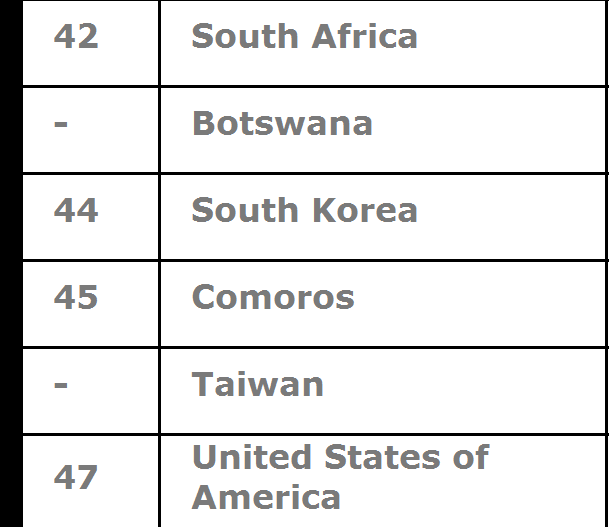
That report shows K-12 education spending is the biggest piece of the state budget, although California ranks dismally low compared to other states for spending on K-12 education: 47th in the country.

The governor’s proposal would raise funds with a combination of a tax increase for those earning $250,000 and over per year and a sales tax increase. But critics say the increase in the sales tax, which is notoriously regressive, would hurt lower and middle income families.

The measure is up against other potential ballot initiatives that would raise revenue strictly from the wealthiest Californians. The so-called Millionaire’s Tax, for example, would raise funds for education by increasing taxes on those making $1 million or more per year. The Millionaire’s Tax also has the advantage of resulting in a permanent change in the law, while Brown’s measure would apply only for the next five years.

“California’s problems have also been exacerbated by tax cuts, one-time ‘solutions,’ overly optimistic assumptions, and the fact that the two-thirds vote requirement for the legislature to approve any tax measure has blocked adoption of a balanced approach towards bridging the budget gap,” according to the CBP report.

Teachers’ unions are divided over the best ballot measure. The California Teachers’ Association has endorsed Brown’s measure, emphasizing that it includes a plan to close the budget deficit.

“The governor’s initiative is the only initiative that provides additional revenues for our classrooms and closes the state budget deficit, and guarantees local communities will receive funds to pay for the realignment of local health and public safety services that the Legislature approved last year,” said Dean Vogel, CTA president, in a press release.

But the Millionaire’s Tax was sponsored by the California Federation of Teachers, and it has now been endorsed by this student general assembly. John Rizzo, president of the City College of San Francisco Board of Trustees, also endorsed the measure.

“We’ve got to tell the state of California that we cannot continue this. We cannot continue the cuts to our community colleges, to UCs, to the California State Universities,” said Rizzo, speaking at a March 1 rally in San Francisco.

According to a recent report, of five polls conducted throughout California, each initiative has majority support, but voter prefer the Millionaire’s Tax, with a recent Field Poll showing 63 percent support.

Legislators are also at work trying to increase education funding. Assembly Speaker Perez has introduced a bill that would slash tuition fees by two-thirds at CSU and UC schools for students of families making less than $150,000 per year. The bill would also allocate funding to city colleges throughout the state, for them to determine how to best use the money.

The cost of the plan, about $1 billion, would be paid by eliminating a corporate tax loophole that the Legislature approved in 2009, which would allow companies to choose the cheaper of two formulas for calculating their taxes. Critics have called the legislation bad for business, saying that removing tax incentives would hurt California companies.

“The California Middle Class Scholarship Act is very simple,” Perez told students at UC Davis when he unveiled the bill on Feb. 3. “Too many families are getting squeezed out of higher education. For students whose families make $150,000 a year or less, too much to qualify for our current financial aid system, but not enough to be able to write a check for the cost of education, without feeling that pinch, the Middle Class Scholarship Act reduces fees at the UC system and at the CSU system by two-thirds, giving tremendous assistance to those families to make college affordable again.”

Education advocates say California needs to do something to reverse the spiraling cost of higher education in California, which could do long-term damage to the state, affecting young people and businesses that need skilled workers and spiraling out from there. And these advocates say this short-sighted strategy is easily preventable if there is the political will to address it.

“There are a lot of sources of revenue that are not being taken advantage of,” Lisa Schiff, a member of Parents for Public Schools of San Francisco, told us.

Even if tuitions were lowered or—as the most ambitious of protesters demand—higher education was made free, most former students would still be saddled with massive debt. As costs have risen, debts of hundreds of thousands of dollars are commonplace. With the job market recovery slow and painful, graduates often feel helpless to pay back their debt.

Robert Meister, a professor of Political and Social Thought at UC Santa Cruz and president of the Council of UC Faculty Associations, has long argued that the state’s higher education systems ought to focus on keeping tuitions low and student debt in check (see “In the red,” 1/11/11).

Yet he told us that growing income inequality makes people even more desperate for a college education and willing to accept levels of student debt that limit their ability to become anything more than corporate cogs after graduation. “Their ability to raise tuition is a function of the growth of income inequality,” he told us.

In his speech at UC Davis, Perez cast the issue as one of a disinvestment in the state’s future: “California’s public colleges and universities has been one of our most prestigious institutions, and, unfortunately, because of the collapse of the economy, we’ve moved away from fully investing in those universities and colleges.”

A month later, the school again served as a backdrop for illustrating the problem and calling for reform. Dani Galietti, a MFA student at UC Davis who was setting up a performance art piece when I arrived, greets everyone cheerfully and is thrilled about the Occupy movement.

“I wanted to share myself and my work with the movement,” Galietti tells me while taping a “paper trail” to the sidewalk; she plans to walk on it with home-made stamps attached to the bottoms of her shoes.

But her mood darkens when I ask about her student debt. “I came out of five years of education $100,000 in debt,” says Galietti, “and I’m not the only one.”

She is a first generation college student, she explains, who helped pay for school with McNair scholarships.

“I grew up one of five, with a single mother,” Galietti explains. “We struggled my whole life, as a lot of people have, financially.”

“So many people are graduating with so much debt. There’s this looming fear, fear and hopelessness. The economy’s bad, the job market sucks. I’m so thankful that they’re out here. People are active, they’re making a difference.”

“We need education,” Galietti says. “I mean, knowledge is power.”


Green Film Fest shorts: Just Do It

0

Activist ire need a jump start? The Green Film Festival takes over Japantown’s San Francisco Film Society Cinema now through Wed/7. Go for tidings on the fight for our planet around the world — documentaries, expert panel presentations, and short films will be taking place. Check out Ali Lane’s previous reviews from the festival here.

Just Do It

In this intimate peek inside the world of “Environmental Direct Action,” viewers will marvel at the organization and cooperation displayed by the film’s English subjects. Occupy Oakland could really learn a thing or two from these self-proclaimed “domestic extremists,” champions against climate change, who the filmmakers followed for a year. The film starts off in the lead-up to “Climate Camp,” a literal camp-out of protesters in a secret location on a hill above London. From here, the protesters plan an “action.” Their actions seem pretty harmless and whimsical: gluing their hands together and invading the trade floor of RBS to sing songs; putting up posters at the entrance of a bank that says “Undergoing Ethical Renovation”; handcuffing themselves to the front gate of an MP’s home in order to publicly berate his policies. But these protests work. They get the news media to cover topics that were previously ignored.

The subjects of this film are mainly photogenic young people, with a few seasoned veterans as well, like . Some are Cambridge educated. All are uniformly anti-capitalist, as they believe capitalism inevitably leads to exploitation of the environment. They designate spokespeople, meticulously map out their “actions,” and memorize the legal consequences and potential charges faced, making sure to minimize any criminal property damage along the way. Before going out on an action, they write the phone number of their organization’s legal counsel on their forearms. What they’re doing is certainly risky, disobedient, and outside the margins of normal behavior, but the viewer gets the sense that these people have their act together and aren’t much of a threat to civil society.

This is a very sympathetic portrait of a movement, and it’s clear where director Emily James’s heart is. Her subjects’ enthusiasm for the cause, and for activism in general, is infectious. By the end it’s hard not to feel like a lazy bum as one subject intones, “Anyone out there thinking, ‘I wanna do more,’ just do it!” Indeed, this film doesn’t just give an impetus, but also a blueprint for how such things can be done.

The lingering question I had while watching the film, however, remained unanswered: where did these people get their money, for camp tents, and massive amounts of food, and buses, and superglue, and d-locks, and ladders: everything that it takes to protest, and live full-time as a protestor. Where do those funds come from? Perhaps this is a question to ask the filmmakers at the closing night party.

Green Film Festival closing night film and party

Wed/7 7:30 p.m., $12 for film, $15 for film and party

SF Film Society Cinema

1746 Post, SF

(415) 742-1394

www.sfgreenfilmfest.org


The losing bets

26

By Darwin BondGraham

news@sfbg.com

Wall Street’s massive taxpayer funded bailout, initiated by the Bush administration and carried forward under President Obama, never really ended — it just shifted from federal to local sources of funding. Even while local and state governments have been forced to cut back on crucial services, wealthy banks and investment firms are being padded with enormous cash flows sucked directly from the already strained budgets of cities, counties, and public agencies.

That’s the message a growing chorus of activists in the Bay Area are bringing before the boards, councils, and commissions that entered into complex financial deals with Wall Street banks, deals that turned toxic in the crash of 2008. Activists want elected officials and the banks to cancel the contracts and refund the public.

The Bay Area is the epicenter of this renewed movement for financial justice. Last week, teachers from Peralta College, organizers with the Alliance of Californians for Community Empowerment (ACCE), Oakland religious leaders, and Occupy Oakland activists organized four protests contesting what they say is bank predation on local communities.

At issue are arcane financial instruments called interest rate swaps. Sold by banks to virtually every sizable government and local agency in the US through the 2000s, rate swaps promised governments the ability to “swap” their potentially costly variable rate payments on bonds into a synthetic fixed rate. Seeking to protect local taxpayers during the volatile 2000s, when floating interest rates were rising, local leaders eagerly signed on.

But the economic meltdown turned those tools into golden handcuffs for local government agencies. Taxpayers are now forced to regularly pay millions to the banks simply because variable interest rates, at the urging of the Federal Reserve, have fallen far below the synthetic rates. These deals might seem numbingly complex, but the effects on local communities are clear and painful.

“The Metropolitan Transportation Commission is paying upwards of $53 million a year on rate swaps,” said Alia Phelps of ACCE at a protest on Feb. 21 outside of the former Bank of America building at 555 California Street. “This is money that isn’t going to keep routes in service, that isn’t paying drivers, nor going to repair buses, or to keep fares lower. We need these swaps renegotiated.”

That protest included visits to half a dozen banks. Activists demanded branch managers fax a letter to their corporate headquarters calling on the banks to voluntarily renegotiate swaps signed with the Metropolitan Transportation Commission (MTC), the Bay Area’s regional transportation authority, which has lost over $100 million on toxic swap deals.

In 2002 the Bay Area Toll Authority (BATA), a state-level agency operated by the MTC, issued more than $1 billion in bonds to pay for repairs and seismic upgrades of regional toll bridges. Three financial giants stepped forward promising to lower MTC’s long-term borrowing costs on these bonds by using interest rate swaps. Ambac, Solomon Smith Barney and Morgan Stanley signed deals with the MTC to cover $300 million in debt.

“With this transaction, we are getting the peace of mind of a fixed debt payment at a significant discount from traditional price levels,” MTC’s Chief Financial Officer Brian Mayhew said at the time of the deal.

Basically the swap agreement had the MTC paying a fixed interest rate of 4.1 percent to the banks, while the banks paid 65 percent of the London Interbank Offered Rate (LIBOR), a key benchmark used in global financial markets. Whichever party’s sum happened to be higher when payments came due would pay the difference. The advantage of the deal, in the eyes of the MTC’s managers, was that it would lock-in a low interest rate on MTC’s debt, potentially saving as much as $45 million.

“We think it’s a good time to lock in these low rates,” Mayhew said in 2002.

Fast forward to 2009. A year into the financial crisis, interest rates collapsed. LIBOR, which had been fluctuating around 5 percent and reached a peak of 5.8 percent in September of 2007, plummeted to virtually zero. The flow of payments became entirely one-sided, from MTC to banks that offered this deal. The advantage of the swap evaporated, and it became a toxic asset. While the Federal Treasury would offload similar toxic assets from the “too big to fail banks” using the TARP program, local governments were stuck with them.

As Ambac careened toward bankruptcy in 2010 due to its absurdly over-leveraged portfolio of credit default swaps, the MTC was forced to terminate its swap agreement with the company, paying the exorbitant sum of $104 million, after already having paid out $23 million in interest. All of this was essentially bridge toll money, surrendered by drivers crossing the seven state-owned bridges administered by BATA: the Bay, Antioch, Benicia-Martinez, Carquinez, Dumbarton, Richmond-San Rafael, and San Mateo bridges.

The drain on MTC funds indirectly affects all of its programs, including operational support for AC Transit, Muni, and other regional bus and train services. According to its most recent Comprehensive Annual Financial Report, MTC and its transit agency partners are on the hook for another $235 million in interest rate payments due on swaps with a rogue’s gallery of banks including Wells Fargo, Morgan Stanley, Citigroup, Bank of America, JP Morgan, Bank of New York, and Goldman Sachs. All of this money will be diverted from the MTC’s various transit infrastructure, planning, and operations accounts.

“The big picture is service cuts, pay cuts, work speed ups, fare hikes, route eliminations, and other things that harm working people who ride transit,” said retired Muni worker Ellen Murray.

The MTC’s quarter-billion dollar rate swap nightmare is only the most obvious part of a more systemic problem. Until at least 2030, given current conditions, San Francisco’s Airport Commission must make costly rate swap payments to numerous banks, including JP Morgan Chase, Goldman Sachs, Depfa, Bank of America, and Merrill Lynch, on agreements associated with more than a half-billion in debt. Much of this is linked to commercial paper issued to pay for infrastructure at the Airport (SFO).

Unlike the MTC, SFO’s financial managers were more prudent in entering swap agreements, and therefore secured better terms that have produced a net savings. “The Airport has saved about $92 million to date,” Assistant Deputy Airport Director Kevin Kone told us, referring mostly to gains made between 2005 and late 2007.

But since 2008, SFO’s swaps have been losing money. When Lehman Brothers collapsed, and Bear Stearns imploded and was absorbed into JP Morgan, SFO was forced to terminate swaps with both companies, costing $6.7 million. Last year SFO paid $6.65 million to terminate a rate swap agreement with Ireland’s Depfa Bank. In September, the Airport paid another $4.6 million to end yet another rate swap with JP Morgan. These specific swap agreements, Kone says, “were functioning as they should have early on, providing savings,” but now they’re draining public funds.

SFO’s seven remaining swaps have a negative value of $67 million, according to San Francisco’s 2011 Comprehensive Annual Financial Report. As with the MTC, SFO’s debts will ultimately be paid by passengers and taxpayers. Kone says nobody really knows how much these swaps could ultimately impact the airport, either in terms of cost or savings.

“If interest rates rise, they could have a positive cost savings impact on the airport,” he said.

Joe Keffer of the Service Employees International Union (SEIU) Local 1021 said at the Feb. 21 rally that Oakland has already paid Goldman Sachs $26 million on a swap that dates back to 1997, and that under current market conditions, the city will have to pay roughly another $25 million until the contract expires in 2021.

Oakland’s toxic deal with Goldman Sachs is now the subject of much scrutiny. The newly formed Coalition for Economic and Social Justice —made up of churches, labor unions, neighborhood groups, and Occupy Oakland activists— took up the issue with the City Council on Feb. 21, packing the chamber with one of the more diverse activist coalitions in recent memory.

“We’re here to implore you to get the City of Oakland out of this toxic relationship,” Rev. Daniel Buford of the Allen Temple Baptist Church told the council.

Members of the Oakland City Council are sympathetic to this message. In a letter sent last June, Council member Rebecca Kaplan implored Goldman Sachs CEO Lloyd Blankfein to spare Oakland’s taxpayers: “By bringing the contract to conclusion with no penalty fees, and negotiating a reasonable exit strategy, you would be demonstrating good faith to public taxpayers in the most substantial way.” At the conclusion of public comment Tuesday night, Oakland Council member Libby Schaaf promised the public action on the swap.

In a Valentine’s Day protest the previous week, 50 activists visited the Oakland offices of Morgan Stanley. Faculty and students from the Peralta Community College system went there demanding the bank renegotiate a rate swap that is estimated to have cost the college $1.6 million last year. The same day the college’s board of trustees discussed the need to cut $12 million more from the budget in 2012. Morgan Stanley CEO James Goreman’s pay for 2011 was $14 million, opponents of the swap point out.

Peralta student and Bay Area transit activist Adam Ross attempted to reach the 9th floor offices of Morgan Stanley in a small delegation to deliver a letter demanding the bank renegotiate the swap: “There were signs on the door saying the office was closed. They probably got tipped off and locked the doors.”

Afterward, Caesar Swaby of Riders for Transit Justice addressed the rally, connecting dots for the different constituencies present: “Morgan Stanley is taking money from Peralta College, causing classes to be cut. Morgan Stanley is also taking money from transit riders. Morgan Stanley has a $3 million rate swap with the MTC, causing cuts to bus and train services.”

A Morgan Stanley representative declined to comment for this report. Goldman Sachs did not return calls and emails. A spokesperson for the MTC was unable to be reached by deadline.

Occupy and Castlewood Workers to join up for “perhaps the biggest and most vibrant march Pleasanton has ever seen”

10

Organizers hope for a big turnout Feb. 25 for the latest protest in a two-year saga to demand a better contract.

Food service workers at Castlewood Country Club were put on lockout on Feb. 25, 2010 when they refused the terms of a contract with the club. The contract stipulated that workers pay $849 per month for health care, a change from the free health care the contract had previously provided.

Lockouts, when employers refuse to let employees come back to work until they agree to contract terms, are a rare but powerful tool used against unions.

“A lockout is the opposite of a strike,” said Sarah Norr, organizer with UNITE HERE local 2850, which represents the Castlewood workers.

Since the lockout began, the club has hired non-union replacement workers and most of the union workers have taken other jobs. But, in order to end the lockout legally, the company must resolve the contract issues.

According to Norr, “It’s illegal to permanently replace locked out workers.”

Workers brought the case to the National Labor Relations Board (NLRB), which filed a complaint against Castlewood August 30, 2010. The complaint states that the club “has been interfering with, restraining, and coercing employees in the exercise of the rights guaranteed in Section 7 of the [National Labor Relations] Act” and “has been failing and refusing to bargaining [sic] collectively and in good faith with the exclusive bargaining representative of its employees.”

An ongoing NLRB hearing on the case is expected to conclude on March 1.

Meanwhile, workers have been picketing daily since the lockout began two years ago. This has sometimes resulted in dramatic clashes with the club members.

One of the workers’ protests last June. Golfers’ reponses, complete with property desctruction, begin around 1:35

“Members of the club harass them on a daily basis. Hitting golf balls at them, throwing racial slurs at them. Some of them are really supportive but some are not so nice,” said Norr.

But workers persevere, and tomorrow they hope for a larch march on the club, joined by OccupySF and Occupy Oakland.

Said Norr, “It’s going to be a big, vibrant march, perhaps biggest and most vibrant march Pleasanton has ever seen. There will be a babies’ and children’s brigade.”

For Occupy organizers, joining up with the protest makes perfect sense.

“Many of Castlewood’s member-owners spent $25,000 for their memberships,” said Ann Worth, a longtime union member and participant in Occupy Oakland, in a press release. “They can justify spending that kind of money to play golf, but they still think it’s okay to squeeze more out of the people who work for them for $10 or $12 an hour. They expect workers to subsidize their expensive game by giving up affordable health care for their kids. It’s a perfect example of what’s been going wrong in this country: the rich are getting richer by denying everyone else their share in the American Dream.”

Living the green dream

1

FILM Bay Area filmmakers Steve and Ann Dunsky (2005’s The Greatest Good) have a pair of documentaries making waves right now: Green Fire, about conservationist Aldo Leopold, which plays at the upcoming San Francisco Green Film Festival; and Butterflies and Bulldozers, an exploration of the decades-long fight to save San Bruno Mountain. Bulldozers screened at the 2011 Green Film Festival, and has a coveted slot amid the 20th anniversary programming at Washington, D.C.’s Environmental Film Festival later this spring. (It also features Guardian editor and publisher Bruce B. Brugmann among its interviewees.) I chatted with the busy couple about their latest projects.

SFBG I have to admit, I hadn’t even heard of Aldo Leopold until I saw Butterflies and Bulldozers, which opens with a Leopold quote.

Ann Dunsky I think maybe 99.9 percent of all the people we’ve ever spoken to have never heard of Aldo Leopold. But for those people who do know of him, he’s like their god. He’s had an amazing influence on the field of conservation.

SFBG How did you get involved with the San Bruno Mountain story?

Steve Dunsky We had just made The Greatest Good, and it was a really intensive period of time. So [we] decided to take some time off from our regular jobs, with the U.S. Forest Service making films, and maybe do an independent film. At that time we’d been living in Brisbane for about 20 years, and we’d heard about this amazing story that had national implications, both historically and in a contemporary sense. And since that’s what we do — we make films about conservation and conservation history — we thought we’d look into it.

SFBG What was the biggest challenge you faced?

AD What intrigued us was the heart of the story, which is what you’re always looking for: the wonderful relationship and dynamic between [film subjects] Fred [Smith] and David [Schooley], these two really good friends who bonded over their joint efforts to save the mountain, and ultimately had a major falling-out about the best way to do that. So we thought, “There’s the thread that we would like to weave throughout he film.”

SD The reason we chose that Leopold quote at the beginning is that we ultimately realized that it’s a story about compromise. It’s an uncomfortable subject for a lot of people, especially in the environmental community, because it does create a lot of tension over where you draw the line. At what point do you say it’s OK to have some development in exchange for other protections?

AD It was a challenge to find that proper balance where we were very respectful to all sides. Telling the story completely without any narration is a very hard way to make a film, but ultimately I think it’s much more satisfying, because our voices aren’t in there trying to tell the viewer what to think.

SFBG The film discusses how San Bruno Mountain was, in some ways, ground zero for the environmental movement.

SD The early 60s were a formative time for the environmental movement, and San Bruno Mountain and Save the Bay played a critical role in that. And then, you have this whole second layer of the story, which deals with the Endangered Species Act and the Habitat Conservation Plan amendment, which is also very historically significant.

SFBG What’s next for San Bruno Mountain? 

SD It’s really a success story, despite the compromises that were made. As we say in the film, it is one of the largest open spaces in any urban area in the United States. Most of the mountain, 2,000 acres, is state and county park. And that was the result of these protests, as well as the political and legal processes that went on in the 1970s behind the scenes. [Currently] a developer wants to build on some sand dunes that are on the west side of the mountain, so that’s a fight going on right now.

SFBG Do you hope the movie will inspire people to take up the fight?

SD For people in the Bay Area, what I would like them to do is — when they drive by San Bruno Mountain, they don’t look at it as a big, ugly, brown lump, but actually realize that it’s a haven for biodiversity, and also that there was this 50-year ongoing struggle to save it. I think it’s important for people to know the history of their surroundings.

From a national perspective, we really hope that it gets people to think about these deeper issues of conservation, questions about compromise, and questions about development versus preservation.

AD One of my favorite Leopold quotes is “Conservation without a keen realization of its vital conflicts fails to rate as authentic human drama; it falls to the level of a mere utopian dream.” I love that because I think it’s so easy to say “No development anywhere!” A lot of us would like things to be that easy, but they’re not. And I think this film, hopefully, will help people recognize that it’s not that simplistic. 

Green Fire screens March 5 at the Green Film Festival (www.sfgreenfilmfest.org) and March 8 at the Randall Museum (www.sfns.org). For more information on Butterflies and Bulldozers, visit www.butterfliesandbulldozers.com; DVDs available for institutional and home use at www.bullfrogfilms.com.


Valentine’s Day dump the banks rally: If only all break-ups involved this much singing (VIDEO)

7

Protesters across the country participated in “break up with your bank” day on Feb. 14. Several protesters happened throughout the Bay Area, including a demonstration organized by Causa Justa :: Just Cause, Occupy Bernal, Occupy SF Housing, and the San Francisco Tenants Union.

In past months those organizations have variously stopped evictions and foreclosures, prevented homes from being auctioned off, and organized mass protests. They’ve created trouble shutting down bank branches, sometimes for hours, on dozens of occasions.

For Valentine’s Day, protesters decided to have a little fun.

“Our intention is not to shut down the banks,” insisted Causa Justa organizer Maria Zamudio. “Just to break up with them.”

About 60 marched through the financial district Feb. 14, presenting large red broken hearts and “dump the banks” banners decorated with pink balloons.

http://www.youtube.com/watch?v=6-f6pHXQkbs

Security guards at the banks that the group approached locked their doors. Protesters, amused, began chanting “the banks shut themselves down.”

Bank of America building locked their doors when they saw the protest approaching. At the Wells Fargo west coast headquarters around the corner, a representative who identified himself as David accepted the card.

Afterwards, a dozen members of the group headed to City Hall for a Board of Supervisors meeting in support of a resolution brought by Supervisor John Avalos and co-sponsored by Supervisor Eric Mar. The resolution supports the city treasurer’s office in its recent efforts to include social responsibility and community reinvestment in its evaluation criteria as it searches for new banks in which to invest San Francisco’s money. The resolution passed.

“It’s not a victory, but a great step in the right direction,” said Zamudio. She hopes that the social responsibility assessment will look at a bank’s history with predatory loans, investment in small businesses, and refinancing mortgages.

No country

0

arts@sfbg.com

FILM “The male stereotype makes masculinity not just a fact of biology but something that must be proved and re-proved, a continual quest for an ever-receding Holy Grail,” wrote Marc Feigen Fasteau in The Male Machine, a 1975 Gloria Steinem-approved polemic (she wrote the introduction) that attempted to catalyze American men into joining their sisters in the women’s movement in reexamining and casting off traditional gender roles.

Masculinity of the variety rhapsodized by Ernest Hemingway and scrutinized by Fasteau is now something talked about in scare quotes (see Old Spice’s man on a horse) or presented as a relic of an earlier time à la Don Draper, even if magazines such as GQ routinely make it into a fetish object. Even a cursory scan of contemporary pop culture, from Drake’s broody makeover of hip-hop swagger to Will Arnett’s stay-at-home dad in Up All Night, shows that men today seemingly have more options, and consequently different sets of expectations, when it comes to being a man.

And yet, the ties that bind to that “ever-receding Holy Grail” still grip some men, causing fresh wounds and opening up old scars. It’s a struggle that runs through many of the remaining programs in Yerba Buena Center for the Arts’ ongoing series “Bros Before Hos: Masculinity and its Discontents,” a collection of leftfield representations of masculinity, often under duress.

The hitchhiking bisexual hustler at the center of Meat Rack (1968), a gritty piece of Gay Lib-era San Francisco film history, protests the loudest. Director Michael Thomas, who appears in person at the screening, has his boy-toy clanking his can against the prison bars of pop Freudian psychology as he works out his Mommy issues, turning tricks in Market Street cinemas (appropriate, given that Thomas owned the infamous Strand Theater and later founded its namesake, indie film distributor Strand Releasing). Although the film’s sexual politics are at times as confused as its protagonist’s, Meat Rack depicts with lysergic abandon the panic that can happen when the injunction to be a man is simply too much to bear.

That pressure is also touched on again and again by the various Finnish men Joonas Berghäll and Mika Hotakainen interviewed for their tender documentary Steam of Life (2011). Within the steam-filled confession booth of a sauna, men talk candidly and emotively about their lives, loves, and losses, their famous Scandinavian reserve seemingly melting away into streams of tears with each new puff of steam. “What are the options for boys?” a solider asks a bench-mate, reflecting on his inability to mourn. “Silence and drinking”

Steam of Life wears its nationalism, as well as its heart, on its sleeve, intercutting gorgeous long shots of the Finnish countryside between its in-the-buff interviews, and ending with a dedication, not merely to its subjects, but to, “all Finnish men.”

But the ballad of aging strongman Stanley Pleskun, a.k.a. Stanless Steel, as documented in Zachary Levy’s Strongman (2009), can be called uniquely American. Pleskun’ abilities are the stuff of classic tall tales — he can lift 10,000-pound trucks with his legs and hold aloft three adults with just one finger — even if his chaotic home life and uphill battle to keep his career going, sympathetically captured by Levy, is straight Arthur Miller. For all his might, Pleskun is at times painfully oblivious to his emotional shortcomings, making his quest for the ever-receding Holy Grail of fame and glory one of the rougher paths that “Bros Before Hos” traces. 

“BROS BEFORE HOS: MASCULINITY AND ITS DISCONTENTS”

Through Feb. 26

Yerba Buena Center for the Arts

701 Mission, SF

(415) 978-2787

www.ybca.org

No country

0

FILM “The male stereotype makes masculinity not just a fact of biology but something that must be proved and re-proved, a continual quest for an ever-receding Holy Grail,” wrote Marc Feigen Fasteau in The Male Machine, a 1975 Gloria Steinem-approved polemic (she wrote the introduction) that attempted to catalyze American men into joining their sisters in the women’s movement in reexamining and casting off traditional gender roles.

Masculinity of the variety rhapsodized by Ernest Hemingway and scrutinized by Fasteau is now something talked about in scare quotes (see Old Spice’s man on a horse) or presented as a relic of an earlier time à la Don Draper, even if magazines such as GQ routinely make it into a fetish object. Even a cursory scan of contemporary pop culture, from Drake’s broody makeover of hip-hop swagger to Will Arnett’s stay-at-home dad in Up All Night, shows that men today seemingly have more options, and consequently different sets of expectations, when it comes to being a man.

And yet, the ties that bind to that “ever-receding Holy Grail” still grip some men, causing fresh wounds and opening up old scars. It’s a struggle that runs through many of the remaining programs in Yerba Buena Center for the Arts’ ongoing series “Bros Before Hos: Masculinity and its Discontents,” a collection of leftfield representations of masculinity, often under duress.

The hitchhiking bisexual hustler at the center of Meat Rack (1968), a gritty piece of Gay Lib-era San Francisco film history, protests the loudest. Director Michael Thomas, who appears in person at the screening, has his boy-toy clanking his can against the prison bars of pop Freudian psychology as he works out his Mommy issues, turning tricks in Market Street cinemas (appropriate, given that Thomas owned the infamous Strand Theater and later founded its namesake, indie film distributor Strand Releasing). Although the film’s sexual politics are at times as confused as its protagonist’s, Meat Rack depicts with lysergic abandon the panic that can happen when the injunction to be a man is simply too much to bear.

That pressure is also touched on again and again by the various Finnish men Joonas Berghäll and Mika Hotakainen interviewed for their tender documentary Steam of Life (2011). Within the steam-filled confession booth of a sauna, men talk candidly and emotively about their lives, loves, and losses, their famous Scandinavian reserve seemingly melting away into streams of tears with each new puff of steam. “What are the options for boys?” a solider asks a bench-mate, reflecting on his inability to mourn. “Silence and drinking”

Steam of Life wears its nationalism, as well as its heart, on its sleeve, intercutting gorgeous long shots of the Finnish countryside between its in-the-buff interviews, and ending with a dedication, not merely to its subjects, but to, “all Finnish men.”

But the ballad of aging strongman Stanley Pleskun, a.k.a. Stanless Steel, as documented in Zachary Levy’s Strongman (2009), can be called uniquely American. Pleskun’ abilities are the stuff of classic tall tales — he can lift 10,000-pound trucks with his legs and hold aloft three adults with just one finger — even if his chaotic home life and uphill battle to keep his career going, sympathetically captured by Levy, is straight Arthur Miller. For all his might, Pleskun is at times painfully oblivious to his emotional shortcomings, making his quest for the ever-receding Holy Grail of fame and glory one of the rougher paths that “Bros Before Hos” traces. 

“BROS BEFORE HOS: MASCULINITY AND ITS DISCONTENTS”

Through Feb. 26

Yerba Buena Center for the Arts

701 Mission, SF

(415) 978-2787

www.ybca.org

Trader Joe’s signs agreement in labor victory

6

Trader Joe’s, known for being really more of a snack emporium than a grocery store, can now be known for something else; buying tomatoes picked by people with basic human rights.

Feb. 9, it became the second grocery store chain– the first was Whole Foods– to sign an agreement with the Coalition of Immokalee Workers (CIW), a group based in Immokalee, Florida famous for its successful Fair Food campaign.

By signing a Fair Food agreement with the CIW, Trader Joe’s pledged to buy their Florida tomatoes only from companies that comply with the CIW’s list of working conditions. According to Bay Area CIW solidarity organizer Liz Fitzgerald, a 23-year-old San Francisco resident, the “code of conduct” includes “zero tolerance for sexual harassment or modern day slavery, having places where farmworkers can wash their hands, basic human rights like that.

The agreement also includes an increase in price for tomatoes—one penny per pound—to augment workers salaries.

Its just pennies, and its only tomatoes. But the Fair Food Campaign is one of the most successful farmworkers rights efforts in past decades, and seems to be growing stronger still.

Acitivists in Florida teamed up with allies across the country for the two-year campaign it took to win over Trader Joe’s, mainly consisting of protests and educational campaigns complementing behind-the-scenes meetings. The efforts targeting Trader Joe’s were amicable compared to their first campaign, aimed at Taco Bell, when begin in 2001. Then, the CIW led a nationwide boycott of the fast food chain and a “Boot the Bell” effort to get Taco Bells off college campuses. Taco Bell finally agreed to sign the agreement after four years of pressure.

Since then, the Fair Food Agreement has gained an impressive list of adherents. After Taco Bell, McDonalds, Burger King, and Subway signed on. In April 2009, CIW made a deal with Compass Group, the world’s largest contract food service provider. Industry giants Bon Appetit Management Company, Aramark, and Sodexo have also signed on to the agreement.

“The goal of the Fair Food Program is to promote the development of a sustainable Florida tomato industry that advances both the human rights of farmworkers and the long-term interests of Florida tomato growers,” according to a joint CIW-Trader Joe’s press release.
Fitzgerald says that, after two years organizing on the steering committee of the Bay Area’s Student-Farmworker alliance (highlights include a Lady Gaga impersonation during a flash mob-style protest last year), she is eager to keep up the fight.

“Its incredible because this is one of so many victories…CIW, along with allies, we are an unstoppable force. This makes me want to not stop until we change this entire agricultural system that’s so exploitative,” said Fitzgerald.