protests

Downtown action: Sex shop Feelmore510 celebrates one year of community pleasure

2

The sex shop Feelmore510 is located on the corner of Oakland’s Telegraph and 17th streets, across from an Obama campaign office, in between a pawn shop and the oldest African-American owned shoe store in town. The neighborhood is in transition, a place with old roots and a lot of new blooms – most businesses on this stretch of Telegraph opened within the last five years. Feelmore510 will celebrate its one-year anniversary Sun/12 when owner Nenna Joiner helps host Town Love, a new party at Hibiscus’ Rock Steady.

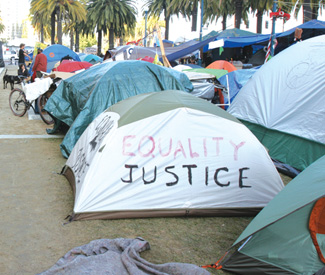
But those businesses aren’t the shop’s only neighbors. This fall, Feelmore510 also lived alongside Occupy Oakland’s City Hall encampment. Though many local business owners have expressed anxiety about the effect that protests were having on their sales, Joiner is in full support of the movement. She sometimes walked over to visit friends who were “occupying,” and was happy to donate safe sex supplies to the camp. “Sex is a basic need for survival,” she said in a recent in-store interview with the Guardian. Joiner allows protestors to chill in the store and talk politics — as long as they aren’t running from the cops.

Joiner envisions her store as more than just a place to shop – it’s also a community center. On a recent afternoon, Joiner shook each customer’s hand and asked them their name. Her goal is that all comers can shop for augmentations to their love life in comfort. 

A cross-section of Oakland’s entire population converges in this particular area of downtown. Joiner sees everyone from rich vintage porn collectors — drawn to her extensive selection of old magazines and videos — to people who ask to pay with California welfare benefit cards. 

Her best-selling items, which are taken home by customers who are male, female, straight, bi, and trans, are the queer porn films that Joiner herself directed, edited, and produced. 2010’s Tight Places features diverse actors and she made Hella Brown with a cast of all African American women. Hella Brown is made in a semi-documentary style – Joiner shot interviews with over 50 queer and trans subjects about their sexual proclivities while making the movie. 

Artfully-displayed contraptions at downtown Oakland’s favorite sex shop. 

Joiner’s films are unique in the way that they showcase different sexual practices and different body types from mainstream porn, which is often geared towards a heterosexual male audience. Her films show women of all shapes, having queer sex — fellating strap-ons and other acts you might not catch in other kinds of porn. While the films are not shot with the straight male audience in mind, that group does seem to enjoy them, often buying the first film and then returning for more. Joiner sees her films as educational tools, especially for what she calls the “brown community,” where things like transitioning from one gender to another are often socially stigmatized and restricted by financial limitations. 

“Queer women of color possess a whole different intelligence and mentality,” she says, adding that many women have a certain shyness about “packing,” (wearing a flaccid prosthetic penis underneath clothing) and getting cosmetic gender modification surgery. Joiner fully embraces her role as an educator in the Oakland queer community. 

Joiner refers to dildos as “prosthetics,” – she says that this language is less alienating to those unfamiliar with their usage. She keeps a packer on prominent display, in order to provoke people into asking questions, which can open up a dialogue about passing as a man, transitioning, or simply stuffing one’s jock with something more substantial than a tube sock. She says customer preference in prosthetics can vary. Many want a life-like phallus, while others request dildos that don’t look like penises, going for glass, sculptural, or abstract designs.

Joiner feels that she is at the intersection of several different communities in Oakland. Joiner goes to two church services every Sunday. She buys passing school kids lunch at Ms. Tina’s, the little sandwich shop next door. She’s active in the queer scene, and she’s also a small business owner who encourages other vendors to promote their own businesses by using her store as a launchpad. 

“Having a space allows other people to identify with a vision of opening their own space.” When she first opened her store, naysayers questioned her brick-and-mortar approach over the Internet. But she says a website cannot replace the tactile satisfaction of a place to gather, to talk, to share. She uses her store to hold classes on topics rarely discussed other places, like sex industry work.

Joiner wants the toys she sells to be safe and fun for anyone, and to open up a conversation about sex, gender, and pleasure with Feelmore510. It works – her space encourages one to think of sex in a different, more open way. Joiner’s toys are all just tools for lovers to transfer feeling, power, and energy between each other. There is no single way to have sex, just endless different first-time experiences. It’s a new kind of space in an old part of Oakland, open for all comers to explore their most innovative sexual selves.


Feelmore510 one-year anniversary party at Town Love

Sun/12 5-11 p.m., $5

Rocksteady at Hibiscus

1745 San Pablo, Oakl.

(888) 477-9288

Facebook: Feelmore510 anniversary party at Town Love


After the tear gas clears

3

yael@sfbg.com

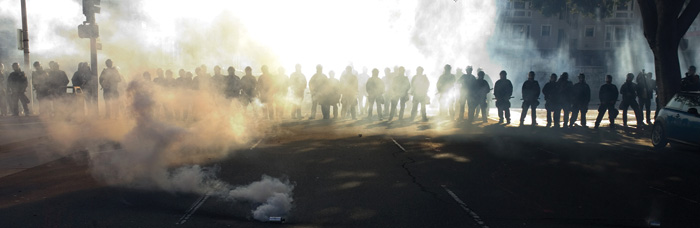
After a chaotic day of marches and confrontations between police and protesters Jan 28, I was arrested along with about 400 others who were trapped by police in front of the downtown Oakland YMCA. Seven of us were journalists.

The goal of the march was to take over an abandoned building — an the vacant Kaiser Convention Center, a city-owned building that’s been closed since 2005, was a prime target.

I have not yet been able to retrieve my property, including my recorder and notebook, which is being held by the Oakland Police Department. What follows is a pieced-together account and a perspective on what the events of Jan. 28.

I spend 20 hours behind bars, and missed the later parts of the action. But I was able to observe what happened in jail and make some sense of what happened.

Occupy people are constantly debating tactics and goals, and for many, the idea of occupying a vacant building made sense. When Occupy Oakland had a camp in Frank Ogawa Plaza, also known as Oscar Grant Plaza, and commonly shortened to OGP, it created a strong community. That community bridged divides between the homeless and the housed, between students and labor organizers, and between Oakland residents of different races, genders and levels of ability in an unprecedented fashion.

The camp had a kitchen that fed hundreds of people everyday and a network of shared tents and blankets which welcomed in hundreds who otherwise would have slept on the streets, often feeling isolated from other residents of their city and made to feel inferior.

The camp was repeatedly raided, Occupiers were tear gassed and shot with rubber bullets, and when OGP was cleared out, the community no longer had a home. And the police started that violence.

That was the practical reason for wanting to occupy a vacant building: to have a social center for Occupy Oakland.

Of course, there are other reasons. There’s the question that many squatters and homeless advocacy groups have been making for decades: why let buildings lie vacant while people freeze on the street?

Remember: The building that Occupy wanted to occupy is public property, and right now nobody is using if for anything.

In one exchange in jail, a guard asked a protester why the activists thought they had the right to take over a vacant building. “I mean, it’s not yours,” he insisted. The protester replied that many vacant buildings are government-owned and therefore public.

“So it’s the government’s,” the cop said.

“But I pay taxes,” the protester responded.

“Me too!” replied the cop. “It’s mine!”

“It’s both of ours,” smiled the protester. “It’s all of ours.”

That’s what made the convention center action such a clear and easy political decision.

A lot of people in Occupy would go further, saying that at a time of a severe housing crisis, it’s perfectly legitimate to take over privately owned buildings that are sitting there vacant. It’s part of the central argument of Occupy — that corporations and the rich unfairly own and continue to acquire much more wealth than the majority of people. For many people, owning a vacant building and doing nothing with it, while hundreds freeze on the streets, is a crime itself.


UP AGAINST THE COPS

Then there’s the question of the police — and violence.

The word “nonviolent” has a specific meaning in the history of political movements. Martin Luther King Jr. defined it in his essay “The Meaning of Non-Violence”: “If you are hit you must not hit back; you must rise to the heights of being able to accept blows without retaliating … But it also means that you are constantly moving to the point where you refuse to hate your enemy. You are constantly moving to the point where you love your enemy.”

It’s a philosophy but also, in political terms, a tactic.

Many of the people who make up Occupy Oakland get their start as activists organizing against police brutality in a city that has longstanding problems with violent and undisciplined officers.

Police Chief Howard Jordan said in a press release that “It became clear that the objective of this crowd was not to peacefully assemble and march, but to seek opportunity to further criminal acts, confront police, and repeatedly attempt to illegally occupy buildings.”

It was certainly clear that the intent of the crowd was to illegally occupy a building. And any honest assessment of Occupy Oakland would have to acknowledge that some members are not wedded to King-style nonviolent civil disobedience. (Neither, by the way, were a lot of the protest movements of the 1960s.) Many protesters wore masks and bandanas to disguise their identities and protect them from tear gas and pepper spray, and the march was led by protesters with makeshift shields, which suggests that they expected to be attacked. You could certainly argue that what those people were doing wasn’t confrontation; it was self-defense.

Frankly, it made sense to be prepared: In other Occupy Oakland actions, police have attacked with batons, tear gas, pepper spray, flash-bang grenades, and smoke bombs. And for quite a few Oakland residents, the police have always been seen as an outside force that can’t be trusted.

In fact, violence did break out. Many, including myself, have eyes still stinging from tear gas. I saw several wounds caused by rubber bullets shot at protesters. I spoke individually to at least a dozen people — one of them a pregnant woman — who were struck with police batons.

And protesters did not remain peaceful while this violence was being used against them.

Some picked up tear gas canisters and threw them back towards police; that much I saw. I also saw protesters throw empty plastic bottles at police.

According to the police, they also threw metal pipes, rocks and bricks. According to the protesters, they threw mainly empty plastic bottles and fruit at police. But as protesters often say of the police, “They’re the ones who showed up with the guns.” If the cops didn’t want violence, why unleash such an arsenal of weapons?

People got hurt, protesters and police alike. Several bystanders who had nothing to do with the situation were swept up in the mass arrest.

The city of Oakland, already in dire financial straits, likely spent hundreds of thousands of dollars reacting to the protests. Police claim that they were unable to sufficiently respond to violent crimes over the weekend, including five murders, because they were overwhelmed with Occupy troublemakers.

Of course, city officials were the ones who decided to arrest 400 people — with all the expense that involves.

There are, at this point, no reports of serious injuries to any police officers. However, at least a dozen protesters had welts on their faces or bodies from being beaten by clubs or shot with rubber bullets. One woman was shot in both arms with rubber bullet; one man was shot in the face with rubber bullets while holding a video camera to document the events. Several protesters were shoved to the ground and received wounds on their faces while being arrested. Police raised their rubber-bullet rifles to the faces of protesters throughout the day, threatening attacks. A rubber bullet to the face can cause brain damage and blindness.


DID IT HAVE TO HAPPEN?

How could this have been prevented?

Police say that “while peaceful forms of expression and free speech rights will be facilitated, acts of violence, trespassing, property destruction and overnight lodging will not be tolerated.” But 40 people were arrested during an ongoing Occupy Oakland vigil in the first weeks of January for having “illegal property” at OGP in what many saw as clearly a peaceful expression of First Amendment rights.

On KGO radio Jan. 29, Chief Jordan said that he has allowed Occupy Oakland to protest without a permit and would continue to do so, but those early January raids were ostensibly due to permit violations — violations of the terms of a permit that Occupy Oakland did in fact have.

There’s no question: The police response to Occupy Oakland over the past few months has caused some people in the movement to get more radical.

Many Occupy Oakland-affiliated medics condemned those who threw objects at police, saying that they provoked a backlash that caused more injuries. Many Oakland residents who might be in line with the socio-economic critique presented by the Occupy movement feel endangered and confused by marches that result in the massive use of police weapons in broad daylight. A lot of people would rather protest in a lot of ways that less resemble urban warfare.

On the other hand, there are also ways that Oakland officials could have prevented the consequences of weapons deployed and 400 arrested Jan. 28. They could, for example, have allowed protesters to occupy the vacant building.

When protesters seized a building Jan. 20 in San Francisco, police first attempted to prevent them. They lined up in front of the targeted building. They deployed pepper spray and struck several protesters with batons. When they were unsuccessful, and protesters entered the building from the back, they opted to block the surrounding streets and wait until the time seemed right to enter the situation and make arrests. Police spokesperson Carlos Manfredi told me that the cops were not going to rush into the situation and were trying to prevent injury and violence.

The Kaiser Convention Center has been vacant for years. The city of Oakland recently made plans to sell it to its Redevelopment Agency, but that plan fell into legal limbo when Gov. Jerry Brown signed AB26, a bill that dissolved all California redevelopment agencies.

At this point, nobody at Oakland City Hall has any plans whatsoever for the big, empty structure.

Why not allow Occupy to use the convention center? It’s not downtown, where Mayor Quan says businesses have been adversely affected by Occupy Oakland’s presence. It would give the movement a chance to stop focusing on trying to occupy spaces and start focusing on benefiting the community with food, shelter, and community programs that they provided when they had a camp. It would give the building tenants who could be held responsible for maintaining it. It might even help get Occupy Oakland and the Oakland Police Department out of the cycle of violence that they have been spiraling into for months.

Each time arrests occur, each time violence occurs, both sides blame the other. Both sides are correct that they were provoked. Both sides are correct that something that they think is worth defending was violated — for the cops, it’s the law. For the protesters, it’s the right of the people to assemble.

In fact, many Oakland residents have experienced violence at the hands of the Oakland Police Department for years before Occupy began. There was already a mass movement formed around the murder of Oscar Grant, and thousands of people fed up with police murders of unarmed, often black, suspects.

In recent decades, other radical groups, notably the Black Panthers, insisted that their community lacked basic needs because the city of Oakland refused to prioritize them. The Black Panther free breakfast program served food in a strikingly similar way to Occupy Oakland. Black Panthers were also notorious for carrying guns to defend themselves against police violence.

Occupy Oakland protesters (unlike Tea Party members) certainly don’t carry guns. But, more and more, they cry “fuck the pigs” as much as any Panther.

For much of the Occupy movement’s 99 percent, unjust actions by banks, corporations, and the government officials that they have often bought and paid for are the worst problems facing the United States today. For others, particularly the poor and people of color, these problems are magnified and exacerbated by the fact that they feel the threat of police harassment every day. For years, they’ve understood that police disproportionately do not investigate or solve crimes that happen to them and their families.


THE RADICALS AND THE BROADER MOVEMENT

The Oakland General Assembly Jan. 29 was the biggest it’s been in weeks. While there were still over 300 people in jail, 300 more came out to get involved with the meeting. That happened at the same time that many who felt that inexcusable violence and property destruction occurred Jan. 28 and concluded they could no longer have anything to do with Occupy Oakland.

It’s a challenge for the movement nationally, too: How do you accept and encourage the people whose legitimate anger at economic injustice and police abuse turns them toward more radical responses — and at the same time make room for a people who want nothing to do with the black bloc Fs, vandalism, and confrontation with the police?

There are tactical issues with the way the building occupation was planned. Many who were completely in line with the concept felt unsafe and uncomfortable with the secretive nature of the organizers who planned it. The location of the building targeted for occupation was kept secret for practical reasons; police could easily prevent a successful takeover. Supporters must often be led to the locations of planned takeovers without knowing where the action is and how they’ll get there. But how do you reconcile this with the transparency required when organizers are leading more than 1,000 people who want to use tactics they feel comfortable with and make their own choices?

Occupy Oakland is asking the people to imagine a world where property rights wouldn’t prevent them from doing all the good that they could do with a building like the Kaiser Convention Center. They must also ask themselves to imagine a world in which goals like a building occupation can be achieved in a way that everyone involved is able to consent to their involvement.

These debates continue to occur at Occupy Oakland. Some will leave the movement, some will join. Some will take the ideas and try to manifest them in new and different ways. Participants in Occupy Oakland desperately want basic needs of food and shelter met for their community members, and for the system that governs the city to do so in a way that allows people to thrive when it comes to health, education, and opportunities for creativity and growth. They think that they have the beginnings of a community and a process that can achieve those visions, better than the city government ever has, and they care more about achieving it than respecting the property rights of the owners of abandoned buildings.

Film Listings

0

Film listings are edited by Cheryl Eddy. Reviewers are Kimberly Chun, Max Goldberg, Dennis Harvey, Lynn Rapoport, and Matt Sussman. For rep house showtimes, see Rep Clock.

OPENING

Big Miracle Three gray whales trapped beneath the Beaufort Sea ice near the tiny town of Barrow, Alaska become an international cause célèbre through the uneasily combined efforts of an Anchorage reporter (John Krasinski), a Greenpeace activist (Drew Barrymore), a group of chainsaw-toting Inupiaq fishermen, a Greenpeace-hating oilman (Ted Danson), a Reagan-administration aide (Vinessa Shaw), a U.S. Army colonel (Dermot Mulroney), a pair of Minnesotan entrepreneurs (James LeGros and Rob Riggle) with a homemade deicing machine, and the crew of a Soviet icebreaking ship. The magical pixie dust of Hollywood has been sprinkled liberally over events that did indeed take place in 1988, but the media frenzy that blossoms out of one little local newscast is entirely believable. Everyone loves a good whale story, and this one is a tearjerker — though the kind that parents can bring their kids to without worrying overly much about subsequent weeks of deep-sea-set nightmares and having to explain terms like “critically endangered Western North Pacific gray whale” if they don’t want to. The film makes clear that the weak-on-the-environment Reagan administration and Danson’s oilman stand to gain some powerfully good PR from this feat, with potentially devastating ecological results down the line, and Barrymore’s character gets to recite a quick litany of impending oceanic catastrophes. But this kind of talk is characterized as less useful than a nice, quick, visceral pull on the heartstrings, and while offering us the pleasurable sight of whales breaching in open water, the film avoids panning out too much farther, which may be why the miracle looks so big. (2:03) (Rapoport)

*Carol Channing: Larger Than Life See “Hello, Carol!” (1:27) Opera Plaza, Shattuck.

Chronicle A group of teens develop superpowers — fun times, until one of them turns to the dark side — in this sci-fi film shot in the ever-popular “found footage” style. (1:23)

*Come Back, Africa See “On the Township.” (1:24) Roxie.

*Coriolanus For his film directing debut, Ralph Fiennes has chosen some pretty strong material: a military drama that is among Shakespeare’s least popular works, not that adapting the Bard to the screen has ever been easy. (Look how many times Kenneth Branagh, an even more fabled Shakespearean Brit on stage than Ralph, has managed to fumble that task.) The titular war hero, raised to glory in battle and little else, is undone by political backstabbers and his own contempt for the “common people” when appointed to a governmental role requiring some diplomatic finesse. This turn of events puts him right back in the role he was born for: that of ruthless, furious avenger, no matter that now he aims to conquer the Rome he’d hitherto pledged to defend. The setting of a modern city in crisis (threadbare protesting masses vs. oppressive police state) works just fine, Elizabethan language and all, as does Fiennes’ choice of a gritty contemporary action feel (using cinematographer Barry Ackroyd of 2006’s United 93 and 2008’s The Hurt Locker). He’s got a strong supporting cast — particularly Vanessa Redgrave as Coriolanus’ hawkish mother Volumnia — and an excellent lead in one Ralph Fiennes, who here becomes so warped by bloodthirst he seems to mutate into Lord Voldemort before our eyes, without need of any prosthetics. His crazy eyes under a razored bald pate are a special effect quite alarmingly inhuman enough. (2:03) Embarcadero. (Harvey)

Domain This moody French drama about the co-dependent relationship between a middle-aged-yet-still-glamorous alcoholic (Béatrice Dalle) and her just-coming-out teenage nephew, Pierre (Isaïe Sultan), had the distinction of topping John Waters’ list of favorite movies in 2010 (Enter the Void was number two; Jackass 3D was number six). It’s unclear if the Bordeaux-set Domain (released in 2009) would be hitting theaters now without Waters as its champion, but first-time feature director Patric Chiha — who wrote the screenplay especially for Dalle, a cult favorite for her role as a mentally disturbed beauty in 1986’s Betty Blue — keeps the melodrama to a minimum, instead relying on subtle hints that cool, sophisticated Aunt Nadia’s life is slowly disappearing into a bottle of white wine. Sultan is a little one-note, but Dalle proves heartbreaking as a good-time gal who doesn’t quite have the strength to face her illness. (1:48) SF Film Society Cinema. (Eddy)

*The Innkeepers Horror fans who haven’t yet discovered writer-director Ti West (2009’s The House of the Devil) best get on it — this is a guy with an offbeat sense of humor who recognizes that formulaic stories and crappy CG are not necessary scary-movie ingredients. His latest concerns a rambling, Victorian-relic hotel about to shut its doors after one last weekend in business. Staffers Claire (Sara Paxton) and Luke (Pat Healy) are soon to be jobless, but they’re more concerned with compiling evidence that the inn is haunted — as suggested by local legend and Luke’s paranormal-themed website. Though there are some familiar tropes here (why is there always a creepy basement, and why won’t scary-movie characters stay the hell out of it?), The Innkeepers does deliver a handful of genuine frights. Its main pleasure, though, is its tone, which is neither too jokey nor trying to take itself too seriously. Alongside the slacker duo played by Paxton and Healy are Kelly McGillis (last seen fighting zombies in 2010’s Stake Land), who lends gravitas as a cranky psychic; and indie darling Lena Dunham (2010’s Tiny Furniture), who has a brief but funny cameo as a neurotic barista. (1:42) Lumiere. (Eddy)

The New Metropolis Andrea Torrice’s pair of half-hour docs explore an important yet oft-overlooked topic: America’s “first suburbs,” communities that sprang up just outside large cities in response to the post-war baby boom. Now that these towns are aging, and in need of infrastructure repair, they’re finding that states would rather fund brand-new “inner rim suburbs” — where homebuyers reap the tax benefits of government-subsidized roads, for example, while enjoying their pre-fab McMansions. Both parts of the made-for-PBS doc offer hopeful solutions, particularly part two, The New Neighbors, which studies a multi-racial New Jersey community that is working together to insure “stable integration” in its neighborhoods. The results are remarkable, and inspiring. Both docs screen as part of a free event, “The New Metropolis: Building a Sustainable and Healthy Bay Area in the Age of Global Warming,” featuring a post-film dialogue that frames issues raised by the films in a local context. Panelists include filmmaker Torrice; El Cerrito Councilmember Janet Aelson, a transit policy expert; regional design specialist Carl Anthony; and other community leaders. For more info and to register, visit el-cerrito.org/eqc/newmetropolis. (:54) Cerrito. (Eddy)

Norwegian Wood Haruki Murakami’s global best-seller — a melancholic, late-1960s love story — hits the big screen thanks to Tran Anh Hung (1993’s The Scent of the Green Papaya). Kenichi Matsuyama (2011’s Gantz, 2005’s Linda Linda Linda) and Rinko Kikuchi (2006’s Babel) play Watanabe and Naoko, a young couple who reconnect in Tokyo after the suicide of his best friend, who was also her childhood sweetheart. There’s love between them, but Naoko is mentally fragile; she flees town suddenly after they sleep together for the first time. Meanwhile, Watanabe meets the vivacious Midori (Kiko Mizuhara) — who is also already involved, though not quite so deeply as he — and they spark, though he’s devoted to Naoko, and visits her at the rural hospital where she’s (sort of) working through her emotional issues. Tran is an elegant filmmaker, and Radiohead’s Jonny Greenwood contributes an appropriately moody score. But amid all the breathless encounters, the uber-emo Norwegian Wood drags a bit at over two hours, and the film never quite crystallizes what it was about Murakami’s book that inspired such international rapture. (2:13) Sundance Kabuki. (Eddy)

The Right to Love: An American Family This earnest doc springboards off the YouTube fame of the adorable, Star Wars-obsessed Leffew family, who started beaming videos from their Santa Rosa home (channel name: “Gay Family Values”) as a response to attacks on marriage equality. Director Cassie Jaye wisely uses quite a bit of Bryan and Jay’s own footage, which depicts a loving family going about their business under normal (family dinners) and special-occasion (excitedly plotting to leave tooth fairy loot under their young daughter’s pillow) circumstances. But it’s not all sunshine and rainbows, with the ugly reality of Prop 8 and, most troublingly, Bryan’s own family members, staunchly set in their disapproval of same-sex marriage despite the highly functional example in their midst. This world-premiere Castro screening features in-person appearances by The Right to Love‘s director and subjects; visit www.R2Lmovie.com for additional information on the event. (1:30) Castro. (Eddy)

The Woman in Black Daniel Radcliffe plays a lawyer turned ghost buster in this Hammer Films thriller, adapted from Susan Hill’s best-selling (and previously-adapted for stage and screen) novel. (1:36) Shattuck.

ONGOING

Albert Nobbs The titular character in Rodrigo Garcia’s film is a butler of ideal bone-stiff propriety and subservience in a Dublin hotel whose well-to-do clients expect no less from the hired help. Even his fellow workers know almost nothing about middle aged Albert, and he’s so dully harmless they don’t even notice that lack. Yet Albert has a big secret: he is a she, played by Glenn Close, having decided this cross dressing disguise was the only way out of a Victorian pauper’s life many years ago. Chance crosses Albert’s path with housepainter Hubert (Janet McTeer), who turns out to be harboring precisely the same secret, albeit more merrily — “he” has even found happy domesticity with an understanding wife. Albert dreams of finding the same with a comely young housemaid (Mia Wasikowska), though she’s already lost her silly head over a loutish but handsome handyman (Aaron Johnson) much closer to her age. This period piece is more interesting in concept rather than in execution, as the characters stay all too true to mostly one-dimensional types, and the story of minor intrigues and muffled tragedies springs very few surprises. It’s an honorable but not especially rewarding affair that clearly exists mostly as a setting for Close’s impeccable performance — and she knows it, having written the screenplay and produced; she’s also played this part on stage before. Yet even that accomplishment has an airless feel; you never forget you’re watching an actor “transform,” and for all his luckless pathos, Albert is actually a pretty tedious fellow. (1:53) Shattuck. (Harvey)

*The Artist With the charisma-oozing agility of Douglas Fairbanks swashbuckling his way past opponents and the supreme confidence of Rudolph Valentino leaning, mid-swoon, into a maiden, French director-writer Michel Hazanavicius hits a sweet spot, or beauty mark of sorts, with his radiant new film The Artist. In a feat worthy of Fairbanks or Errol Flynn, Hazanavicius juggles a marvelously layered love story between a man and a woman, tensions between the silents and the talkies, and a movie buff’s appreciation of the power of film — embodied in particular by early Hollywood’s union of European artistry and American commerce. Dashing silent film star George Valentin (Jean Dujardin, who channels Fairbanks, Flynn, and William Powell — and won this year’s Cannes best actor prize) is at the height of his career, adorable Jack Russell by his side, until the talkies threaten to relegate him to yesterday’s news. The talent nurtured in the thick of the studio system yearns for real power, telling the newspapers, “I’m not a puppet anymore — I’m an artist,” and finances and directs his own melodrama, while his youthful protégé Peppy Miller (Bérénice Béjo) becomes a yakky flapper age’s new It Girl. Both a crowd-pleasing entertainment and a loving précis on early film history, The Artist never checks its brains at the door, remaining self-aware of its own conceit and its forebears, yet unashamed to touch the audience, without an ounce of cynicism. (1:40) California, Marina, 1000 Van Ness, Piedmont, Sundance Kabuki. (Chun)

Beauty and the Beast 3D (1:24) 1000 Van Ness..

Carnage Nancy (Kate Winslet) and Alan (Christoph Waltz) have arrived in the apartment of Penelope (Jodie Foster) and Michael (John C. Reilly) to discuss proper follow-up to a playground incident in which one of their children went ballistic on another. But this grownup discussion about conduct between children quickly degenerates into a four-way living room sandbox melee, as the couples reveal snobbish disdain toward one another’s presumed values and the cracks in each marriage are duly bared. Roman Polanski’s unnecessary screen translation of Yasmina Reza’s play remains awkwardly rooted to the stage, where its contrivances would have seemed less obvious, or at least apt for the medium. There’s some fun to be had watching these actors play variously self-involved, accusatory Manhattanites who enact a very lite Who’s Afraid of Virginia Woolf? amid way too much single-malt Scotch ingestion. But the text gets crudely farcical after a while, and its critiques of the characters’ shallow materialism, bad parenting, knee-jerk liberal empathy, privileged class indifference, etc. would resonate more if those faults weren’t so cartoonishly drawn. In the end, Carnage‘s high-profile talent obliterates rather than illuminates the material — it’s like aiming a bazooka at a napkin. (1:20) Shattuck. (Harvey)

Contraband A relative gem among the dross of January film releases, Contraband works best when it doesn’t take itself too seriously, and flounders when it does. Directed by Baltasar Kormákur, the man behind much of Iceland’s popular filmography (2006’s Jar City, 2002’s The Sea, 2000’s 101 Reykjavik), this no-frills genre picture stars Mark Wahlberg as Chris Farraday, an ex-smuggler-turned-family-man who must give the life of crime another go-round when his wife (Kate Beckinsale) and brother-in-law (Caleb Landry Jones) find themselves in thrall to a nasty, drug-addicted criminal (an especially methy-looking Giovanni Ribisi). If you’ve seen any of these One Last Heist movies, you won’t be surprised that Chris’ operation goes completely awry — in Panama, on a cargo captained by J.K. Simmons, no less. Ribisi is as simpering and gleefully evil a caricature as they come, and as Chris’ best friend, brooding Ben Foster’s unexpected about-face in the film’s last third is pretty watchable. I’m not exactly saying you should go and see it, but I’m not stopping you, either. (1:49) 1000 Van Ness, SF Center. (Ryan Lattanzio)

A Dangerous Method Cool and chatty (unsurprisingly, given its subject matter and the fact that it’s based on a play and a novel), David Cronenberg’s latest begins in 1904 Zurich as a shrieking patient (Keira Knightley) is escorted into the care of psychiatrist Carl Jung (Michael Fassbender). Dr. Jung, an admirer of Sigmund Freud, tests the “talking cure” on the woman, who turns out to be the fiercely intelligent and conveniently beautiful Sabina Spielrein. An attraction, both intellectual and sexual, soon develops, no matter that Jung is Sabina’s doctor, or that he happens to be married to a prim wife whose family wealth keeps him in boats and lake houses. Meanwhile, Jung and Freud (an excellent Viggo Mortensen) begin corresponding, eventually meeting and forming a friendship that’s tested first when Sabina comes between them, and later when Jung expresses a growing interest in fringe pursuits like parapsychology. The scenes between Freud and Jung are A Dangerous Method‘s most intriguing — save those brief few involving Vincent Cassel as a doctor-turned-patient who advises Jung to “never repress anything” — but the film is mostly concerned with Jung’s various Sabina-related dramas. Pity that this is a tightly-wound Fassbender’s least dynamic performance of the year, and that Knightley, way over the top in Sabina’s hysterical scenes, telegraphs “casting mistake” from the get-go. (1:39) Albany, Shattuck. (Eddy)

*The Descendants Like all of Alexander Payne’s films save 1996 debut Citizen Ruth, The Descendants is an adaptation, this time from Kaui Hart Hemmings’ excellent 2007 novel. Matt King (George Clooney) is a Honolulu lawyer burdened by various things, mostly a) being a haole (i.e. white) person nonetheless descended from Hawaiian royalty, rich in real estate most natives figure his kind stole from them; and b) being father to two children by a wife who’s been in a coma since a boating accident three weeks ago. Already having a hard time transitioning from workaholic to hands-on dad, Matt soon finds out this new role is permanent, like it or not — spouse Elizabeth (Patricia Hastie, just briefly seen animate) will not wake up. The Descendants covers the few days in which Matt has to share this news with Elizabeth’s loved ones, mostly notably Shailene Woodley and Amara Miller as disparately rebellious teen and 10-year-old daughters. Plus there’s the unpleasant discovery that the glam, sporty, demanding wife he’d increasingly seemed “not enough” for had indeed been looking elsewhere. When has George Clooney suggested insecurity enough to play a man afraid he’s too small in character for a larger-than-life spouse? But dressed here in oversized shorts and Hawaiian shirts, the usually suave performer looks shrunken and paunchy; his hooded eyes convey the stung joke’s-on-me viewpoint of someone who figures acknowledging depression would be an undeserved indulgence. Payne’s film can’t translate all the book’s rueful hilarity, fit in much marital backstory, or quite get across the evolving weirdness of Miller’s Scottie — though the young actors are all fine — but the film’s reined-in observations of odd yet relatable adult and family lives are all the more satisfying for lack of grandiose ambition. (1:55) Balboa, California, Piedmont, Presidio, SF Center, Sundance Kabuki. (Harvey)

*Everyday Sunshine: The Story of Fishbone This doc offers a lively, revealing look at SoCal ska-punk rockers Fishbone, a band that formed circa 1979 in a San Fernando Valley junior high newly filled with bussed-in South Central kids. In its heyday, Fishbone enjoyed cult success with hits like “Party at Ground Zero” and the tune that gives the film its title; Everyday Sunshine speaks to Fishbone’s broad appeal, as famous faces chime in to reminisce (and longtime fan Laurence Fishburne narrates), but it also illuminates some of the reasons its members never became megastars. Codirectors Chris Metzler (a San Francisco resident best-known for 2004’s Plagues and Pleasures on the Salton Sea) and Lev Anderson spent months on the road with the band, capturing the infectious energy of its live shows in addition to behind-the-scenes tension. Past members add their voices, but the main protagonists are bassist-vocalist Norwood Fisher and lead vocalist-saxophone player Angelo Moore. Their intertwining stories offer a poignant portrait of creative soulmates who’ve weathered many storms (personality conflicts, legal and money troubles, an industry that didn’t know how to categorize them) without once giving up on their music. In addition to its compelling story, the film’s quirkier stylistic choices, including animation, lift Everyday Sunshine above the crowded field of traditional music docs. (1:47) Smith Rafael. (Eddy)

Extremely Loud and Incredibly Close Director Stephen Daldry is no stranger to guiding actors to Oscars; his previous two films, 2008’s The Reader and 2002’s The Hours, both earned Best Actress statuettes for their stars. So it’s no surprise that Sandra Bullock’s performance is the best thing about this big-screen take on Jonathan Safran Foer’s 2005 novel, which is otherwise hamstrung by twee, melodramatic elements that (presumably) translated poorly from page to screen. One year after 9/11, a Manhattan mother (Bullock) and her nine-year-old son Oskar (newcomer Thomas Horn, a youth Jeopardy! champ) are, unsurprisingly, still mourning their beloved husband and father (Tom Hanks), who was killed on “the worst day.” But therapy be damned — Oskar takes to the streets, knocking on the doors of strangers, searching for the lock that will fit a mysterious key his dad left behind. Carrying a tambourine. Later befriending an elderly man (Max von Sydow) whose true identity is immediately obvious, despite the fact that he writes pithy notes instead of speaking. In its attempts to explore grief through the eyes of a borderline-autistic kid (“tests were inconclusive,” according to Oskar), Extremely Loud and Incredibly Close is so forced-quirky it makes the works of Wes Anderson look like minimalist manifestos; that it bounces its maudlin, cliché-baiting plot off the biggest tragedy in recent American history is borderline offensive. Actually offensive, however, is the fact that Daldry — who also knows from young thespians, having helmed 2000’s Billy Elliot — positions the green Horn (ahem) in such a complex role. The character of Oskar is, as written, nauseatingly precocious; adding shrill and stridently unsympathetic to the mix renders the entire shebang nigh-unwatchable, despite the best efforts of supporting players like Viola Davis and Jeffrey Wright. (2:09) 1000 Van Ness, Presidio, SF Center, Shattuck, Sundance Kabuki. (Eddy)

The Flowers of War Based on the novel The 13 Women of Nanjing by Geling Yan (Xiu Xiu: The Sent Down Girl), Flowers of War sees director Zhang Yimou probing the still-painful wounds of the Nanjing Massacre. Here, he gets to pull out his customary sensuous fascinations — jewel-tone colors that pop unexpectedly amid gray wartime rubble, reams of floating textiles, and girls, girls, girls — to intriguing if patchy effect. The touch-and-go quality of the production is understandable considering the clash of acting styles generated by our players: crass good-old-boy American-in-China mortician John (Method-ically played by Christian Bale), and the clutch of look-alike Catholic school girls and cadre of call girls, the latter headed up by slyly Veronica Lake-ish vamp Yu Mo (Ni Ni). John has been called to bury a priest at the Nanjing cathedral, smack in the middle of the Japanese invasion, and despite the corpses littering the street, all he seems to care about is getting paid and running off. Somehow the sweet little helpless schoolgirls convert him into a believer, enough to make him don the priest’s garb and try to protect them from crazed Japanese soldiers intent on literally carrying out the Rape of Nanjing. Meanwhile the ladies of the evening, hiding out in the basement against everyone’s wishes, work their wiles to get him to help them escape. Armed with a budget that makes this the most expensive film in Chinese history, Zhang embraces this collision of soldiers, cultures, contemporary Western war movies, and popular Chinese entertainments in the stylized mode of a archetypal Chinese melodrama. Though it’s far from his best work, Flowers still draws you in while imparting the horrors of an ugly war that pulled the most innocent — and beautifully decadent — civilians into its wake. (2:21) Four Star. (Chun)

*The Girl With the Dragon Tattoo The meeting of Stieg Larsson’s first “Millennium” book and David Fincher promised fireworks, as he’s a director who can be equally vivid and exacting with just the elements key to the series: procedural detail, obsession, violence, tweaked genre conventions, mind games, haunted protagonists, and expansive story arcs. But perhaps because this possible franchise launch had to be rushed into production to ride the Larsson wave, what should have been a terrific matchup turns out to be just a good one — superior in some stylistic departments (notably Trent Reznor and Atticus Ross’ pulsing score), but overall neither an improvement nor a disappointment in comparison to the uninspired but effective 2009 Swedish film version. Daniel Craig plays Mikael Blomkvist, the muckraking Stockholm journalist whose public disgrace after a failed expose of a suspect corporate tycoon makes him the perfect candidate for an unexpected assignment: staying sequestered in the wealthy, warring Vanger clan’s island home to secretly investigate a teenage girl’s disappearance and presumed murder 40 years ago. His testy helpmate is the singular Lisbeth Salander (Rooney Mara), antisocial hacker, researcher, and ex-mental patient par excellence. Nearly three hours long, the compressed, slightly altered (get over it) storyline nonetheless feels rushed at times; Fincher manages the rare feat of making mostly internet research exciting in filmic terms, yet oddly the book’s more shocking episodes of sex and/or mayhem don’t have the memorable impact one might expect from him. The leads are fine, as is the big support cast of recognizable faces (Christopher Plummer, Stellan Skarsgård, Robin Wright, etc.) But the knockout suspense, atmosphere, and urgency one hoped for isn’t present in this intelligent, not entirely satisfying treatment. On the other hand, maybe those who’ve already read the books and seen the prior films have already had so much exposure to this material that a revelatory experience is no longer possible. (2:38) Marina, 1000 Van Ness, SF Center, Sundance Kabuki. (Harvey)

The Grey Suicidally depressed after losing his spouse, Ottway (Liam Neeson) has to get pro-active about living in a hurry when his plane crashes en route to a oil company site in remotest Alaska. One of a handful of survivors, Ottway is the only one with an idea of the survival skills needed to survive in this subzero wilderness, including knowledge of wolf behavior — which is fortunate, given that the (rapidly dwindling) group of eight men has landed smack in the middle of a pack’s den. Less fortunate is that these hairy, humongous predators are pretty fearless about attacking perceived intruders on their chosen terrain. Director and co-writer Joe Carnahan (2010’s The A-Team, 2006’s Smokin’ Aces) labors to give this thriller some depth via quiet character-based scenes for Neeson and the other actors (including Frank Grillo, Dallas Roberts and Dermot Mulroney) in addition to the expected bloodshed. The intended gravitas doesn’t quite take, leaving The Grey and its imposing widescreen scenery (actually British Columbia) in a competent but unmemorable middle ground between serious, primal, life-or-death drama and a monster movie in wolf’s clothing. (1:57) 1000 Van Ness, Sundance Kabuki. (Harvey)

*Haywire Female empowerment gets its kung-fu-grip thighs around the beet-red throat of all the old action-heroes. Despite a deflated second half — and director Steven Soderbergh’s determinedly cool-headed yet ultimately exciting-quelling approach to Bourne-free action scenes — Haywire is fully capable of seizing and demanding everyone’s attention, particularly that of the feminists in the darkened theater who have given up looking for an action star that might best Angelina Jolie’s Lara Croft. Former pro mixed martial arts fighter Gina Carano, who plays it as studiedly intense and charismatic as crossover grapplers Lee, Norris, and Seagal before her, is that woman, with convincingly formidable neck and shoulder muscles to distract from her curves. Her Mallory Kane is one of the few women in Haywire‘s pared-down, stylized mise-en-scene — the lone female in a world of men out to get her, starting with the opening diner scene of a watchful Mallory confronted by a man (Channing Tatum) playing at being her boyfriend, fed up with her shit, and preparing to pack her into the car — a scenario that doubtless many rebel girls can relate to until it explodes into an ultraviolent, floor-thrashing fight scene. Turns out Mallory is an ex-Marine and Blackwater-style mercenary, ready to get out of the firm and out of a relationship with her boss, Kenneth (Ewan McGregor), when she learns, the bruising way, that she’s been set up. The diner scene sets the tone for rest of Haywire, an otherwise straightforward (albeit flashback-loaded) feminist whodunit of sorts, limned with subtextual currents of sexualized violence and unfolding over a series of encounters with men who could be suitors — or killers. (1:45) California, 1000 Van Ness. (Chun)

Hugo Hugo turns on an obviously genius conceit: Martin Scorsese, working with 3D, CGI, and a host of other gimmicky effects, creates a children’s fable that ultimately concerns one of early film’s pioneering special-effects fantasists. That enthusiasm for moviemaking magic, transferred across more than a century of film history, was catching, judging from Scorsese’s fizzy, exhilarating, almost-nauseating vault through an oh-so-faux Parisian train station and his carefully layered vortex of picture planes as Hugo Cabret (Asa Butterfield), an intrepid engineering genius of an urchin, scrambles across catwalk above a buzzing station and a hotheaded station inspector (Sacha Baron Cohen). Despite the special effects fireworks going off all around him, Hugo has it rough: after the passing of his beloved father (Jude Law), he has been stuck with an nasty drunk of a caretaker uncle (Ray Winstone), who leaves his duties of clock upkeep at a Paris train station to his charge. Hugo must steal croissants to survive and mechanical toy parts to work on the elaborate, enigmatic automaton he was repairing with his father, until he’s caught by the fierce toy seller (Ben Kingsley) with a mysterious lousy mood and a cute, bright ward, Isabelle (Chloe Grace Moretz). Although the surprisingly dark-ish Hugo gives Scorsese a chance to dabble a new technological toolbox — and the chance to wax pedantically, if passionately, about the importance of film archival studies — the effort never quite despite transcends its self-conscious dazzle, lagging pacing, diffuse narrative, and simplistic screenplay by John Logan, based on Brian Selznick’s book. Even the actorly heavy lifting provided by assets like Kingsley and Moretz and the backloaded love for the fantastic proponents at the dawn of filmmaking fail to help matters. Scorsese attempts to steal a little of the latters’ zeal, but one can only imagine what those wizards would do with motion-capture animation or a blockbuster-sized server farm. (2:07) Shattuck. (Chun)

The Iron Lady Curiously like Clint Eastwood’s 2011 J. Edgar, this biopic from director Phyllida Lloyd and scenarist Abi Morgan takes on a political life of length, breadth and controversy — yet it mostly skims over the politics in favor of a generally admiring take on a famous narrow-minded megalomaniac’s “gumption” as an underdog who drove herself to the top. Looking back on her career from a senile old age spent in the illusory company of dead spouse Denis (Jim Broadbent), Meryl Streep’s ex-British Prime Minister Margaret Thatcher steamrolls past hurdles of class and gender while ironically re-enforcing the fustiest Tory values. She’s essentially a spluttering Lord in skirts, absolutist in her belief that money and power rule because they ought to, and any protesting rabble don’t represent the “real England.” That’s a mindset that might well have been explored more fruitfully via less flatly literal-minded portraiture, though Lloyd does make a few late, lame efforts at sub-Ken Russell hallucinatory style. Likely to satisfy no one — anywhere on the ideological scale — seriously interested in the motivations and consequences of a major political life, this skin-deep Lady will mostly appeal to those who just want to see another bravura impersonation added to La Streep’s gallery. Yes, it’s a technically impressive performance, but unlikely to be remembered as one of her more depthed ones, let alone among her better vehicles. (1:45) Albany, 1000 Van Ness, Presidio, SF Center, Sundance Kabuki. (Harvey)

Man on a Ledge Sam Worthington plays escaped convict Nick Cassidy, a former cop wrongly accused of stealing a very big diamond from a ruthless real estate mogul (Ed Harris) against the backdrop of 2008’s financial disasters. Having cleared the penitentiary walls, many a man might have headed for the nearest border, but Nick’s fervent desire to prove his innocence leads him to climb out the window of a 21st-floor Manhattan hotel room and spend most of the rest of the movie pacing a tiny strip of concrete and chatting with hung over NYPD crisis negotiator Lydia Mercer (Elizabeth Banks), who’s also nursing some PTSD after a suicide negotiation gone bad. After a while, the establishing shots panning up 21 floors or across the city grid to Nick’s exterior perch begin to feel extraneous — we know there’s a man on a ledge; it says so on our ticket stub. More involving is the balancing act Nick performs while he’s up there — keeping the eyes of the city glued on him while guiding the suspensefully amateur efforts of his brother (Jamie Bell) and his brother’s girlfriend (Genesis Rodriguez) to pull off an unidentified caper in a nearby high-rise. Ed Burns, Anthony Mackie, and Kyra Sedgwick costar. (1:42) Balboa, 1000 Van Ness. (Rapoport)

Miss Bala You want to look away, but aided and abetted by director-cowriter Gerardo Naranjo’s sober, elegant perspective on the ugly way that innocents get pulled into the Mexican drug wars, you must see it through. That’s the case with Laura Guerrero (Stephanie Sigman), a naive Tijuana beauty contestant who signs up for the Miss Baja pageant with a friend, who almost immediately decides to game the system by partying with the police and DEA agents who could possibly help their chances of winning. Laura instantly falls into the hands of Lino (Noe Hernandez), a mafia boss in the process of crashing the party, and with his gang, killing all assembled. Desperately trying to find her friend, Laura takes a wrong turn that lands her back in the arms of Lino, who vows to help the would-be beauty queen and entangles her in his increasingly closed-in criminal world. Naranjo’s cool-headed, almost stately compositions come as almost blessed relief as he pans slowly from the shadows, where you really don’t want to know what’s going on, to a girl, almost completely out of the frame, desperately wedging herself out a second floor window. His detachment undercuts the horror, while angel-faced, perpetually anguished-looking lead actress Sigman simultaneously compels and frustrates with her fatal errors in judgement as she grows more complicit and is literally caught in the crossfire between the rough gangsters who terrorize her and the government soldiers unafraid mete out punishment. The toughest part is watching Sigman’s infuriatingly passive protagonist be used like a sexual puppet, but this raw and refined film — loosely based on the story of 2008’s Miss Sinaloa, Laura Zuniga — doesn’t pull many punches in indicting the pageant machine and the corrupt system that supports it. (1:53) Sundance Kabuki. (Chun)

Mission Impossible: Ghost Protocol No world landmark (the Kremlin, the Burj Khalifia) is too iconic and/or freaking tall for uber-adrenalized Impossible Missions Force agent Ethan Hunt (Tom Cruise) and his team (Jeremy Renner, Paula Patton, Simon “Comic Relief” Pegg) to infiltrate, climb, assume false identities in, use as a home base for unleashing futuristic spy technology that seems almost plausible (with the help of lots of iPads), race a BMW through, etc. One kind of gets the sense that Cruise and company sat down with a piece of paper and were like, “What stunts haven’t we done before, and how many of them can I do with my shirt off?” Celebrated animation director Brad Bird (2004’s The Incredibles) is right at home with Ghost Protocol as his first live-action effort — the film’s plot (set in the present day, it involves a positively vintage blend of Russians and nukes) and even its unmemorable villain take a back seat to Cruise’s secret-agent shenanigans, most of which take the form of a crazy plan that must be altered at the last minute, resulting in an even crazier plan, which must be implemented despite the sudden appearance of yet another ludicrously daunting obstacle, like, say, a howling sandstorm. For maximum big dumb fun, make sure you catch the IMAX version. A warning, though: any time the movie screeches to a halt to explore emotions or attempt characterization … zzz. (2:13) 1000 Van Ness. (Eddy)

My Week With Marilyn Statuette-clutching odds are high for Michelle Williams, as her impersonation of a famous dead celebrity is “well-rounded” in the sense that we get to see her drunk, disorderly, depressed, and so forth. Her Marilyn Monroe is a conscientious performance. But when the movie isn’t rolling in the expected pathos, it’s having other characters point out how instinctive and “magical” Monroe is onscreen — and Williams doesn’t have that in her. Who could? Williams is remarkable playing figures so ordinary you might look right through them on the street, in Wendy and Lucy (2008), Blue Valentine (2010), etc. But as Monroe, all she can do is play the little-lost girl behind the sizzle. Without the sizzle. Which is, admittedly, exactly what My Week — based on a dubious true story — asks of her. It is true that in 1956 the Hollywood icon traveled to England to co-star with director Sir Laurence Olivier (Kenneth Branagh) in a fluff romance, The Prince and the Showgirl; and that she drove him crazy with her tardiness, mood swings, and crises. It’s debatable whether she really got so chummy with young production gofer Colin Clark, our wistful guide down memory lane. He’s played with simpering wide-eyed adoration by Eddie Redmayne, and his suitably same-aged secondary romantic interest (Emma Watson) is even duller. This conceit could have made for a sly semi-factual comedy of egos, neurosis, and miscommunication. But in a rare big-screen foray, U.K. TV staples director Simon Curtis and scenarist Adrian Hodges play it all with formulaic earnestness — Marilyn is the wounded angel who turns a starstruck boy into a brokenhearted but wiser man as the inevitable atrocious score orders our eyes to mist over. (1:36) Presidio, Shattuck. (Harvey)

One for the Money (1:46) 1000 Van Ness.

*Pina Watching Pina Bausch’s choreography on film should not have been as absorbing and deeply affecting of an experience as it was. Dance on film tends to disappoint — the camera flattens the body and distorts perspective, and you either see too many or not enough details. However, improved 3D technology gave Wim Wenders (1999’s Buena Vista Social Club; 1987’s Wings of Desire) the additional tools he needed to accomplish what he and fellow German Bausch had talked about for 20 years: collaborating on a documentary about her work. Instead of making a film about the rebel dance maker, Wenders made it for Bausch, who died in June 2009, two days before the start of filming. Pina is an eloquent tribute to a tiny, soft-spoken, mousy-looking artist who turned the conventions of theatrical dance upside down. She was a great artist and true innovator. Wenders’ biggest accomplishment in this beautifully paced and edited document is its ability to elucidate Bausch’s work in a way that words probably cannot. While it’s good to see dance’s physicality and its multi dimensionality on screen, it’s even better that the camera goes inside the dances to touch tiny details and essential qualities in the performers’ every gesture. No proscenium theater can offer that kind of intimacy. Appropriately, intimacy (the eternal desire for it) and loneliness (an existential state of being) were the two contradictory forces that Bausch kept exploring over and over. And by taking fragments of the dances into the environment — both natural and artificial — of Wuppertal, Germany, Wenders places them inside the emotional lives of ordinary people, subjects of all of Bausch’s work. (1:43) Shattuck, Smith Rafael, Sundance Kabuki. (Rita Felciano)

Red Tails History (and the highly-acclaimed 1995 TV film, The Tuskeegee Airmen) tells us that during World War II, African American fighter pilots skillfully dispatched Nazi foes — while battling discrimination within the U.S. military every step of the way. From this inspiring true tale springs Red Tails, an overly earnest and awkwardly broad film which matches lavish special effects (thank you, producer George Lucas) with a flawed script stuffed with trite dialogue (thank you, “story by” George Lucas?), an overabundance of characters, and too many subplots (including a romance and a detour into Hogan’s Heroes). The movie would’ve been much stronger had it streamlined to focus on the friendship between the brash Lightning (David Oyelowo) and the not-as-perfect-as-he-seems Easy (Nate Parker); the head-butting between these two supplies the film’s only genuine moments of tension. Otherwise, there’s not much depth, just surface-to-air heroics. (2:00) 1000 Van Ness. (Eddy)

*Shame It’s been a big 2011 for Michael Fassbender, with Jane Eyre, X-Men: First Class, Shame, and A Dangerous Method raising his profile from art-house standout to legit movie star (of the “movie stars who can also act” variety). Shame may only reach one-zillionth of X-Men‘s audience due to its NC-17 rating, but this re-teaming with Hunger (2008) director Steve McQueen is Fassbender’s highest achievement to date. He plays Brandon, a New Yorker whose life is tightly calibrated to enable a raging sex addiction within an otherwise sterile existence, including an undefined corporate job and a spartan (yet expensive-looking) apartment. When brash, needy, messy younger sister Cissy (Carey Mulligan, speaking of actors having banner years) shows up, yakking her life all over his, chaos results. Shame is a movie that unfolds in subtle details and oversized actions, with artful direction despite its oft-salacious content. If scattered moments seem forced (loopy Cissy’s sudden transformation, for one scene, into a classy jazz singer), the emotions — particularly the titular one — never feel less than real and raw. (1:39) Four Star, Shattuck. (Eddy)

Sherlock Holmes: A Game of Shadows Maybe Guy Ritchie should’ve quit while he was ahead. Thanks to strong performances from Robert Downey Jr. and Jude Law, the British director’s first Holmes flick proved surprisingly fun. Two years later, it’s clear that Ritchie’s well of creatitivity has run dry. Sherlock Holmes: A Game of Shadows is cliched and overlong, burying a few good ideas under an avalanche of tired action movie stalwarts gone steampunk. To be fair, the set design and art direction are still sumptuous, creating a hyperbolic, detailed vision of Victorian Europe. New cast additions Jared Harris (as Moriarty, maliciously polite) and Stephen Fry (as Mycroft, eccentric and nude) do well with limited material. Noomi Rapace, playing a helpful gypsy, is superfluous. Downey Jr. and Law are still game for some amusing PG-13 homoeroticism, but it’s the former’s disinterested performance that ensures the movie’s downfall. Forced to make do without witty quips or interesting deductions, the Holmes of A Game of Shadows is part bruiser, part buffoon. The game’s a flop, Watson. (2:09) SF Center. (Ben Richardson)

Sing Your Song It’s easy to be cynical about do-gooding celebrities. Like, does superstar X really care about that charity or cause, or is he or she merely doing a public-image polish? This is not a concern with Harry Belafonte, who — when not charming audiences with tunes like “The Banana Boat Song” — has spent most of his 84 years personally battling injustice. If he wasn’t such an American treasure (World War II veteran, courageous challenger of Hollywood racism, vocally pro-labor union amid anti-Commie hysteria, etc.), Sing Your Song might feel as if it were progressing in an almost comedically heroic manner: Harry befriends Martin Luther King, Jr; Harry teaches JFK and RFK about civil rights; Harry champions Nelson Mandela; Harry protests the Vietnam War; Harry devotes himself to Africa (cue “We Are the World”). But it all really happened (with historical footage and photographs to prove it), and most of it at a time when his views were seen as radical by mainstream America. Belafonte’s accomplishments are undeniable, and Sing Your Song is, perhaps unavoidably, a textbook hagiography — even as his children from multiple marriages, one of whom co-produced the film, make vague yet forgiving references to Belafonte’s frequent absentee-dad status. Otherwise, Sing Your Song is solely concerned with singing Belafonte’s praises — admirable, but kinda one-note. (1:44) Roxie. (Eddy)

Sleeping Beauty Australian novelist turned director Julia Leigh’s first feature arrives affixed with a stamp of approval from no less than Jane Campion; though Sleeping Beauty treads in Campion-style edgy feminism, its ideas are not quite fully formed, rendering a film that’s not entirely satisfying. It is gorgeously shot, however, with long (occasionally overly so) shots that coolly observe the life of Lucy (pillow-lipped Emily Browning, star of 2011’s Sucker Punch), a college student struggling to make ends meet with an array of minimum-wage gigs. Her housemates hate her; the only friend she has is a shut-in drug addict. She gets her kicks picking up random men at yuppie bars — until she’s offered a gig working for an exclusive purveyor of kink to elderly clients, first as a lingerie-clad serving girl, and later as a “sleeping beauty:” she’s given knockout drugs and handed over to customers (“no penetration” is the only rule, but yes, it’s still creepy). Sleeping Beauty is too chilly to be titillating, and while Browning is lovely, Lucy is affectless to the point of being, well, pretty boring, even with her clothes off. I read one review that suggested watching the film as if it were intended to be a comedy; lines like “Match your lipstick to the color of your labia” certainly support this thesis. (1:44) SF Film Society Cinema. (Eddy)

*Tinker Tailor Soldier Spy Tomas Alfredson (2008’s Let the Right One In) directs from Bridget O’Connor and Peter Straughan’s sterling adaptation of John le Carré’s classic spy vs. spy tale, with Gary Oldman making the role of George Smiley (famously embodied by Alec Guinness in the 1979 miniseries) completely his own. Your complete attention is demanded, and deserved, by this tale of a Cold War-era, recently retired MI6 agent (Oldman) pressed back into service at “the Circus” to ferret out a Soviet mole. Building off Oldman’s masterful, understated performance, Alfredson layers intrigue and an attention to weird details (a fly buzzing around a car, the sound of toast being scraped with butter) that heighten the film’s deceptively beige 1970s palette. With espionage-movie trappings galore (safe houses, code machines), a returned-to flashback to a surreal office Christmas party, and bang-on supporting performances by John Hurt, Mark Strong, Colin Firth, Toby Jones, and the suddenly ubiquitous Benedict Cumberbatch, Tinker Tailor epitomizes rule one of filmmaking: show me, don’t tell me. A movie that assumes its audience isn’t completely brain-dead is cause for celebration and multiple viewings — not to mention a place among the year’s best. (2:07) Four Star, Piedmont, SF Center, Shattuck, Sundance Kabuki. (Eddy)

Underworld Awakening (1:30) 1000 Van Ness.

*War Horse If the idea of watching heroic horses getting slaughtered amid the brutal trench warfare of World War I fills your heart with disgust, then you might want to applaud Steven Spielberg and his relatively sensitive touch with that material in the heartrending War Horse. The PG-13 rating also gives you some idea that the director will be hewing to the movie’s origins as a children’s book. Spielberg paints this tale about loss of innocence, be it in the fields of the farm or the battle, in broad strokes, but here, you might feel a bit less manipulated by his prowess as a crowd-pleasing storyteller, less conscious about the legacy he draws on, and more immersed in a story that stays as close as it can to its animal protagonist’s point of view, short of pulling a Mr. Ed. War Horse opens with Joey’s birth and follows him as he’s sold to a struggling English farm run by traumatized war veteran Ted (Peter Mullan), his spunky wife Rose (Emily Watson), and his animal-loving son Albert (Jeremy Irvine). Circumstance — and an unyielding landlord (David Thewlis) — sends Joey off to the so-called Great War, first into the care of an honorable captain (Tom Hiddleston), later a French girl (Celine Buckens), and worst, into the arms of the German enemy, where he toils as a disposable beast of burden charged with hauling the literal machines of war uphill. Spielberg shields viewers both young and old from the more explicit horrors, though gracefully imparts war’s terrors, sending fresh chills through a viewer when, for instance, a child riding a horse disappears over a ridge and fails to return. No one’s immune from tears, and you have to wonder how much healing is actually possible at War Horse‘s conclusion, despite its stylized, symbolism-laden beauty. Nonetheless cinephiles will glean a certain pleasure from images that clearly nod to the blood-red skies of Gone With the Wind (1939), the ominous deep focus of Orson Wells, and the too-bright Technicolor clarity-slash-artifice of National Velvet (1944). (2:26) 1000 Van Ness, Shattuck. (Chun)


Occupy Oakland inmates at Santa Rita attacked- developing story

153

(THIS STORY HAS BEEN UPDATED)

In the aftermath of the mass arrests of Occupy Oakland protesters– and whoever else happend to be on the wrong street at the wrong time– on Jan. 28 in Oakland, there have been loads of reports and rumors about brutality inflicted on those arrested. Most of those arrested were held in Santa Rita jail.


My observations:

I spent 20 hours in jail, and I saw some cruel treatment. I saw people suffering after being denied medication. I saw people with allergies to the food that was provided refused any substitute and unable to eat, sometimes for more than 24 hours. I saw people crammed into holding cells meant for groups a third their size, so that some people had to remain standing, sometimes for more than 24 hours. As many arrestees were wearing clothing coated in tear gas and pepper spray, those chemicals continued to waft through cells and affect all present.

Reports:

I have reports directly from sources of arrested occupiers being beat up in jail with police batons. At least 20 people were ziptied, meaning their hands were cuffed behind their backs– and more often than not, if they happen to be cuffed too tightly and their hands go numb and even blue, police won’t loosen them– for more than eight hours. I know that some people who were denied access to a restroom ended up sitting in their own vomit and urine for at least four hours in some cases.

UPDATE Another report from Joshua Clover, a professor of English at UC Davis, who was released Monday night, :
“I was held for 53 hours for a misdemeanor charge which every single person here, and there, knows will never be brought, and indeed which will be met with a class action suit for wrongful arrest that the city of Oakland will be compelled to settle. I have a perforated peptic ulcer. Early on in the stay I requested non—prescription care — liquid antacid, which the jail keeps on hand — when I began to have an ulcer attack, which is to say, when I began to bleed internally. I was not given such care until an attorney was able to intervene by phone many hours later. I received one capful, which was mildly effective for about three hours. Further requests were ignored. As many will know, a bleeding ulcer attack is both painful and potentially fatal”

UPDATE When I questioned Alameda County Sheriff’s Department Public Information Officer Sergeant JD Nelson about this, he responded that “[Clover] was obviously seen by a medical person, and they said that was enough medicine.”

But accoridng to Clover, via an email, “The one time that I received medication, a deputy came to the cell door accompanied by someone who may have been a nurse, holding a capful of antacid. I asked for more but was not given it.” And was Clover seen by a medical professional to determine the correct amount of medication? He says, “Definitely not.”

Also according to Clover, “Food was often not provided for periods of up to 14 hours. For a long period I shared a cell with 27 other people; it was about ten by ten feet. For a period I was in a cell labeled ‘Maximum Occupancy: Two.’ There were ten of us, three very sick. We stood. One of the people slumped over on the toilet, that being the alternative to standing.”

UPDATE

“Three people I know were denied medication for HIV infections while being held for multiple days, which is a life-threatening choice made by the county”

“two women were denied anti-depressants that they had with them when they went to jail”

UPDATE According to an anonymous source, “My 12×12 cell had 28 people. There was a toilet, a concrete bench, and enough hard floor space for three or four of us to sleep at a time. A girl in the cell across from ours told the guards she needed Lexapro or she would go into withdrawl. They ignored the request. One of my cellmates was HIV-positive. When I last saw him at 2 a.m. on Monday morning he had not yet been given his medications. As I exited the jail I saw a woman who had just been released lying on the floor. She was having a seizure and being tended to by a couple of firemen.”

UPDATE From Alyssa Eisenberg, who has multiple sclerosis:
“I take my medication at least twice a day…without it, the pain is, everything kind of goes numb and tightens up. Somtimes I can’t even see without it. When  had to sign the booking form about noon i couldn’t even see it, my vision was so blurry…I was told they don’t give meds to people that are going to be cited and released, only to people that are going to stay and get charged.”

Unconfirmed reports:

Daily Kos quotes an anonymous source who reports that “prisoners from the Oakland Commune were being denied medications (some had seizures) while the guards said they didnt care if they died. Some people were brutally beaten. The put tear gas in the vents of my cell twice.”
According to Occupy Oakland media spokesperson Omar Yassin, a report that someone was tear gassed in the jail’s hallway is likely credible.

Then there’s the peolpe who were injured during the protests Jan. 28. Also according to Yassin:

At least a dozen people had welts on their faces or bodies from being beaten by clubs or shot with rubber bullets. One woman was shot in both arms with rubber bullet; one man was shot in the face with rubber bullets while holding a video camera to document the events. Several protesters were shoved to the ground and received wounds on their faces while being arrested. Police raised their rubber-bullet rifles to the faces of protesters throughout the day, threatening attacks– a rubber bullet to the face can cause brain damage and blindness.


A spokesperson for the Alameda County Sheriff’s Department refused to comment, although she did say that they’ve “been bombarded with calls about this all day.” Shocker.

UPDATE According to Alameda County Sheriff’s Department Public Information Officer Sergeant JD Nelson, no complaints of mistreatment at Santa Rita have been filed.

Nelson said that peanut butter was made avaliable to vegans those allergic to meat, in direct contrast to what I witnessed in jail.

In response to reports that some detainees were held on buses in the Santa Rita parking lot for up to eight hours, during which time they were refused bathroom access and in some cases made to sit in their own urine and vomit, Nelson said that “Generally when they come to the jail the buses are unloaded fairly quickly. Obviously some people are going to go first, some last.”

He told me that detainees were denied medication because “We do we allow them to take their medication in jail. People will try to smuggle stuff in.”

When asked about reported beating in jail, Nelson replied, “I haven’t gotten any reports of any skirmishes between officers and those arrested. We would report it if  there was any use of force,”

According to Nelson, the Alameda County Sheriff’s Office has video footage of all of the areas in the jail where arrestees were held, and, unless there was a lawsuit preventing its release, he would make the footage available to me soon. For now he said, “I don’t even know if they’ve been developed.” (Is this 1984? Not in the Orwellian sense. In the technology sense.)

More on this soon. Send me information that you have, yael@sfbg.com

Inside the Occupy Oakland protest

57

UPDATE: We’ve corrected a few factual mistakes. We originally reported that protesters forced open the door of the YMCA; in fact, they asked to be let in and they were. We regret the error.

An Occupy Oakland march that turned violent Jan. 28 led to the arrest of 400 people, including me.

The march, which peaked at about 2,000 protesters, was organized with the intention of entering a vacant building — the Kaiser Convention Center — and turning it into a new “Social Center” that participants in Occupy Oakland hoped to use to gather, teach, and organize.

The move was more than symbolic. Occupy activists have engaged in constant debate about tactics and goals, particularly when it comes to violence and property destruction, and it’s hard to argue at this point that Occupy Oakland is a nonviolent movement.

But many thought that the goal of occupying a vacant building made sense. When Occupy Oakland had a camp in Frank Ogawa Plaza, also known as Oscar Grant Plaza, commonly described as OGP, it created a strong community. It’s a community that bridged divides between the homeless and the housed, between students and labor organizers, and between Oakland residents of different races, genders and levels of ability in an unprecedented fashion.

Besides that, the camp had a kitchen that fed hundreds of people everyday. The camp had a network of shared tents and blankets that welcomed in hundreds who would have slept freezing on the streets, often feeling isolated from other residents of their city and made to feel inferior. Now, they had a place to stay that was warmer, more safe and secure, and was embedded in a community bound together by ties of solidarity.

That community was able to thrive in it’s centralized camp location.

That was the practical reason for wanting to occupy a vacant building: to have a social center for Occupy Oakland.

Of course, there are other reasons. There’s the question that many squatters and homeless advocacy groups have been making for decades: why let buildings lie vacant while people freeze on the street?

The march set off from OGP at 1 p.m. Jan. 28. There was no ambiguity about group’s goal: Many pushed carts stacked with furniture, hoping to furnish the new center; others held a large banner reading “Vacant? Take it!” 

Many other Occupy groups around the world, including protesters in Washington DC, London, England, and Belfast, Ireland, have taken over vacant buildings in an attempt to create social centers, house homeless community members and protest injustice symbolized by buildings lying vacant while people live on the street.

In Oakland, the attempts were staved off when riot police lined up in front of the march and declared unlawful assemblies.

In front of the  Convention Center, police threw smoke bombs into the crowd and warned that those who refused to disperse would be arrested. The march continued around the corner to 12th St and Oak, where protesters and police were involved in another confrontation. Police shot smoke bombs and “pepper bombs,” canisters of pepper spray that explode on impact, into the crowd. Some in the march responded by throwing canisters, along with plastic bottles, back at police. Masked protesters in the front of the group brandished makeshift shields. Protesters say the shields were there to protect them from rubber bullets and bean bag rounds.

The cops had a different perspective. “It became clear that the objective of this crowd was not to peacefully assemble and march, but to seek opportunity to further criminal acts, confront police, and repeatedly attempt to illegally occupy buildings,” said Oakland Police Chief Howard Jordan in a press release.

In a tense moment, hundreds knelt to hide behind the frontline shields while police fired rubber bullets into the crowd.
When police began to advance at both the front and back end of the group, protesters retreated, marching on 12th St back to Ogawa/Grant Plaza.

As they marched on 12th street, Occupy Oakland-affiliated street medics treated injuries from tear gas, pepper spray, and rubber bullets. Police followed in the rear of the march, continuing to project exploding flash-bang grenades at the crowd.

At about 5:30, another march left from the plaza, again with the stated attention of occupying a building. Police marched behind protesters. When the march cut through Fox Square in Oakland’s Uptown neighborhood, police filled in all surrounding sides of the march. Protesters have used the term “kettling” to describe a situation in which police line up on all sides of a group, blocking anyone in the group from leaving.
After “kettling” hundreds of protesters at this location, police began to deploy tear gas. Some protesters with makeshift plastic and metal shields, many marked with the “circle-A” anarchy symbol, advanced towards police. Several police beat the shield back with batons and struck some protesters.

One 19-year-old woman who was struck with a baton to the kidneys was brought to the hospital and treated for internal bleeding.
At Fox Square, police announced that the gathering was an unlawful assembly. Minutes later, some protesters knocked over a line of chain-link fencing, allowing the march to exit the “kettle.” The march continued on Telegraph.

When the march arrived at Broadway between 22nd and 23rd streets, protesters asked to be let into the YMCA and someone who was in there opened the doors. Police later closed in on both sides until they had formed a line preventing the approximately 400 protesters from exiting.

On Broadway, there was no dispersal order issued. This is in violation of the Oakland Police Department’s crowd control policy, which states that “If after a crowd disperses pursuant to a declaration of unlawful assembly and subsequently participants assemble at a different geographic location where the participants are engaged in non-violent and lawful First Amendment activity, such an assembly cannot be dispersed unless it has been determined that it is an unlawful assembly and the required official declaration has been adequately given.”

About 6:30 p.m., police announced that all of the blocked-in group was under arrest.

It was more than six hours before the sidewalk was cleared of all detainees. Most are charged with failure to disperse. Some, such as those who entered the YMCA, have been charged with burglary.

Dozens of protesters who had avoided arrest marched back to City Hall. There, they illegally entered the building and committed several acts of vandalism. According to a press release, these included “breaking an interior window to a Hearing Room, tipping over and seriously damaging the historic model of City Hall, destroying a case containing a model of Frank Ogawa Plaza, and breaking into the fire sprinkler and elevator automation closet.” Protesters also report setting off fireworks in the counsel chambers.

Some protesters took an American flag from City Hall and burned it in front of the government building.

Oakland officials have complained about the cost of the protests. The city had reportedly spent $2.4 million policing Occupy Oakland protesters as of November 15, just weeks after announcing the decision to close down five elementary schools to save $2 million.
Occupy activists say the huge — expensive — police presence is an overreaction.

“The amount of property damage by protesters has been minimal next to Mayor Quan’s destruction of the humanitarian Occupy Oakland community and excessive force against peaceful people, said Wendy Kenin, an Occupy Oakland spokesperson. “The City of Oakland’s commitment to militarism far outweighs its investment in schools. 

Kenin said she was back at Occupy Oakland outside City Hall, with her four children, the day after the incidents.
There were no arrests made in the City Hall incident, partly because so many police resources were deployed at the YMCA.

Cities and counties that provided police reenforcements to handle the mass arrests include Alameda County, San Mateo County, Santa Clara County, San Francisco County and Marin County and the cities of Fremont, Hayward, Berkeley, Pleasanton, San Francisco and Union City/Newark; and the University of California-Berkeley, according to an Oakland Police Department press release. 

Dozens of those detained were brought to Glenn Dyer jail, which quickly filled up; the rest were brought to Santa Rita jail in Dublin.
Several members of the press, as well as passers-by who were on their way to work in the area, were swept up in the arrests.

In jail, those detained debated tactics involved in the day’s demonstrations and discussed the future of Occupy Oakland.

The number of injured protesters is unknown, but in the 19-person sampling of arrestees with whom I spent 20 hours, two had bruises from baton strikes, one suffered from an injured foot after a pepper-bomb exploded upon impact with her ankle, and most had irritation in their eyes, ears, and throat from exposure to tear gas and pepper spray.

Oakland police report that three officers were injured.

As of the morning of Jan. 30, about 100 remained in Santa Rita.

Hot sexy events: January 18-24

0

Thankful. I am thankful for San Francisco sex. Just got back from the AVN awards in Vegas this weekend and couldn’t get over the fake boobs (literally — mountainous cleavage), rubber ducky-esque lips, and rote couplings that took over the Hard Rock Hotel for the better part of the week. Don’t get me wrong, the weekend was all kinds of wonderful and there were buffets and penthouse hot tubs filled with Tina Horn, Princess Donna, and Akira Raine — salacious tweeting and rumors of Robin Leach and deep red carpet conversations about being forced to wear condoms. But for me, SF.

Also, the trailer for James Franco’s new movie based on the life of Kink.com actress-writer Lorelei is out: 

Why am I so stoked on this city? Read on about what San Francisco does best: weird, original, affirming sex events in the City By the Bay. Here’s four reasons that’ll make you glad you’re here (pervert).


Good Vibrations’ Lakeshore store opening

Once an employee-owned store in the Mission, Good Vibes has expanded into a nationwide business, powered by an Ohio sex toy corporation, and teaching everyone from Florida to Washington about the power of gadgets in the bedroom through an award-winning sales and education website. (Read our interview with the company’s C.O.O. and staff sexologist Carol Queen here.)The empire gets one bigger today, with the opening of Good Vibes’ first Oakland brick and mortar location. Kandi Burress of Real Housewives of Atlanta will be on hand to promote her superlative line of vibrators, Bedroom Kandi

Sat/28 6-9 p.m., free

Good Vibrations

3219 Lakeshore, Oakl.

(510) 788-2389

www.goodvibes.com


Perverts Put Out: Midwinter Edition

Accepting his honor at this year’s Guardian Goldies art awards, performance provacateur Philip Huang utilized a neti pot in ways surely frowned up by the Health Department. The man is inappropriateness, embodied — just ask those “God Hates Fags” people, he’s crashed their protests with a colander head, carrying a sign that says “No Fags on the Moon.” So what does a Huang do at a reading made for and by pervy weirdos? You’ll just have to attend the latest edition of Perverts Put Out, to find out. Tonight’s event also features sexy solliquies by horehound stillpoint, Sherilyn Connelly, and Jen Cross. 

Sat/28 7:30 p.m., $10-15

Center for Sex and Culture

1349 Mission, SF

www.sexandculture.org


John Leslie one-year memorial

Harken back to your best memories of golden age porn star John Leslie, who passed away in 2010. Center for Sex and Culture will be hosting this memory circle for friends of his work — which includes Talk Dirty To Me (1980), Nothing To Hide (1981), and Talk Dirty To Me, Part II (1982). One of the first actor-cum-director hyphenates in adult film, the man was big back in the days of well-budgeted productions. Perhaps this will also be a look back on the long, strange road the porn industry has traveled over the past few decades (after all, Leslie did finish out his career directing gonzo releases). 

Sun/29 5:30 p.m., free

Center for Sex and Culture

1349 Mission, SF

(415) 902-2071

www.sexandculture.org


[SSEX BBOX] premiere 

Name the sexiest cities in the world. Did Sao Paolo, Berlin, and San Francisco make it on there? They’re the obvious choices, of course — and fertile territory for this global documentary project. The team behind [SSEX BBOX] chased tail around the globe, chatting with all orientations and genders about what makes them tingle below (above) the equator.

Mon/30 8:30 p.m., free

Center for Sex and Culture

1349 Mission, SF

(415) 902-2071

www.ssexbbox.com


Pay to park

62

The San Francisco Municipal Transportation Agency has hailed the success of its SFpark program — which uses high-tech meters and demand-variable pricing to manage on-street parking — noting that expired meter citations are down and meter revenue is up. The resulting 11 percent net increase in revenue  is all going to improve Muni. So transit improves, drivers get more spots and fewer tickets — everybody wins.

[CLARIFICATION (2/1): The new meters had an 11 percent net revenue increase compared to the old meters, but overall net revenues from citations and meters was still down by 3 percent.]

But the SFMTA has run into a hornet’s nest of opposition with its latest proposal to expand SFpark into the Northeast Mission District, Potrero Hill, Dogpatch, and Mission Bay, largely because the plan involves placing meters on streets where parking is now free. And even those who don’t object to paying for parking say the SFMTA has bungled this process.

The problem isn’t just what critics say are arrogance and dubious outreach efforts by agency officials. It may be that the SFMTA pursued too many goals at once, mixing them in ways that muddled the message. Or it may just be that charging for parking will always anger drivers, no matter how it’s proposed.

The agency wants to discourage driving — particularly cruising for parking, hence SFpark’s “Circle Less, Live More” slogan — to speed up Muni and reduce traffic congestion. But that also means charging for street parking so cars won’t just sit in those spaces, and that involves a complicated balancing act in mixed use neighborhoods.

Residents, many employers, and commuters want all-day street parking, preferably free and easy. But most business owners want enough parking turnover so their customers can find a spot. City policies call for prioritizing residents’ needs, and the SFMTA needs money to fund and expand Muni service.

Meeting all of those needs isn’t easy. But over the last couple of months, the SFMTA’s effort to expand its successful and popular SFpark program have managed to turn thousands of residents angrily against that program, the agency, and the proposition that people shouldn’t expect free parking.


COMMUNITY OUTRAGE

Architect John Lum and artist-designer Miranda Caroligne didn’t know each other a couple months ago, but now they’re helping to lead a movement that is uniting neighborhood groups in the Mission, Dogpatch, and Potrero Hill against the parking meter proposals.

“You have an agency that is not listening at all to the community. That’s fascism!” declares Lum. He’s actually an amiable and soft-spoken young guy who employs 10 people at his architecture firm near 17th and Capp streets, but this issue really gets his blood boiling.

And Lum isn’t alone, as the Jan. 13 public meeting before an SFMTA hearing officer showed. Not only did everyone who streamed to the microphone voice opposition to the proposals, but they usually did so in angry and accusatory ways, saying it would destroy businesses, punish the poor, and result in conditions that are simply unworkable and intolerable. And they said the SFMTA simply doesn’t care.

“If you’re a PDR business,” Caroligne said, referring to the Production, Distribution, and Repair businesses whose last bastion is some of the targeted areas, “you’re never going to get people to work at a place that doesn’t have parking…This proposal will push them out.”

There are myriad ways that the plans are flawed, say their critics: Meters were proposed on some residential streets in initial plans, despite SFMTA policies to the contrary; traffic surveys had too small a sampling and weren’t realistic; residential permit districts would be replaced by meters, or meters would be placed where districts might work better; transit service on Potrero Hill is too bad to expect people to use it; live-work spaces were inappropriately treated like retail outlets; and meters near the 22nd Street Caltrain station could actually discourage the use of public transit.

“There’s not that much disagreement, but where there is, it’s really important,” said Tony Kelly, president of the Potrero Boosters Neighborhood Association. “I’m someone who supports parking management, and I’m frustrated that the MTA is so tone deaf with this. We’ve been through a lot of fake public outreach efforts and this is looking like one of those.”

Janet Carpinelli, president of the Dogpatch Neighborhood Association, said her members feel like the SFMTA is ramming this through without regard for the needs or input of that neighborhood.

“The real issue is it’s a very big inconvenience to the businesses and residents in this neighborhood and it’s not really helping anything. It’s just a revenue grab by the MTA,” she said.

Potrero Hill resident Jim Wilkins was so outraged by the proposal to install meters along Pennsylvania Street outside his home that he started an online petition against the proposals that has so far garnered about 1,300 signatures. “We’re forming an organization to resist these proposals,” he told us.

Lum was already a member of the 17th Street Coalition, which formed in 2010 to oppose the renewal of a liquor license at the local Gas’n’Shop, but more recently organized opposition to the meter proposal. It attracted Caroligne, and now they’ve formed a new group, Northeast Mission Neighbors, which held a joint organizing meeting with the Dogpatch and Potrero groups on Jan. 23. They’re all determined to delay and modify the SFMTA’s proposal, which had been scheduled for adoption by the SFMTA Board of Directors Feb. 7.

Lum said the proposed changes are tough to accept: “I don’t think this is about free parking, it’s about living and working in a community with certain things and now those things are changing.”


CHANGE IS HARD

The biggest target of critics’ ire is Jay Primus, who runs the SFpark program for the SFMTA. He maintains that he’s done extensive outreach and gathered community input that has shaped the plans. “These are still proposals and nothing has been approved yet,” he told us.

For example, Wilkins told us his campaign continued even after the meters in front of his house were eliminated from the proposal last month. Primus also noted the proposed meters allow for all-day parking at just 25 cents an hour in most places, so it isn’t really such an inconvenience or financial hardship. And Primus just announced that the Feb. 7 hearing is being pushed back by at least two weeks to heed more community input.

But most of the opposition to the proposals isn’t surprising, and Primus thinks it comes more from the idea of charging for street parking than with the specifics of the proposal.

“Parking is always an emotional and delicate issue in San Francisco, as it is in most cities,” Primus said, citing protests against charging for parking going back to when the first meters were installed in 1947. “This has happened at every block that has gotten meters.”

But now, there are even more benefits and ease of use with modern meters, which motorists can pay with a credit card or even remotely. Variable pricing is also used to ensure more parking based on demand, although it’s being kept at a very low rate in areas where businesses or residents still need all-day parking.

“If people are opposed to paying 25 cents per hour, the lowest rate in the city, then they are opposed to paying for parking,” Primus said. He said it’s a matter of equity among citizens: “There’s nothing equitable about providing parking for free and asking people to pay $4 for a round trip Muni ride.”

That’s a notion that is echoed by others who say it’s time for motorists to start paying their fair share.

“Everybody wants something for nothing. We all want that. Nobody wants to pay for parking, not even me,” Don Shoup, the UCLA professor who wrote the influential book The High Cost of Free Parking, told us. He later added, “That whining you hear is the sound of change.”

At a time when governments are hurting for revenue to provide basic services — among them, maintaining extensive roadway systems for motorists whose taxes don’t come anywhere near covering their societal impacts — he said it just doesn’t make sense to continue subsidizing the storage of automobiles.

“San Francisco has some of the most valuable land on earth. You have expensive housing for people and free parking for cars. It’s not surprising that San Francisco has homeless people and traffic congestion,” Shoup said. “There was never a city that is so liberal about other people’s affairs and so conservative about its own affairs.”

But Shoup did agree with critics that the real goal of managing parking isn’t to discourage driving, although he applauds the SFpark program for using its increased revenue on public transit, which he thinks makes sense from a social justice perspective.

Jason Henderson, a professor of geography at San Francisco State and author of an upcoming book on the politics of parking and mobility, goes even further than Shoup in saying that San Francisco should use its parking policies to discourage driving. But at the very least, Henderson said it is counterproductive to offer free parking.

“The city is giving away valuable real estate with all of this free and underpriced curbside parking at a time when the city’s transportation infrastructure is crumbling and essential city services for parks, after school programs, and libraries are constantly being cut. And here we have thousands of acres of real estate just being given away,” Henderson told us.

“If anything, it needs to be done citywide so that it’s judicious and level, so that merchants won’t say that people won’t come to their neighborhood because they can go to a different neighborhood where there’s free parking.”

Primus said there is a particularly strong need to manage parking around Mission Bay and the North Mission, where much of the city’s growth is occurring.

“In a way, the SFMTA is catching up with the growth of the city. These are some of the last remaining areas that are residential-commercial mixed use areas with no parking management,” Primus said.

Kelly agrees that time has come, but he doesn’t think the SFMTA has helped its case, particularly given the emotions surrounding the issue and the need to maintain public support for improved transit service.

“They’ve been spending all their waking hours in the last couple years pissing people off over parking meters, do you really think people will then support their revenue proposals?” Kelly questioned.

Lum and Caroligne both said the SFMTA should have been willing to make the fundamental argument to people that the days of free parking are coming to an end.

“That’s where a lot of the anger is coming from, you’re doing this for all these reasons that don’t make sense and treating us like children,” Caroligne said, although she also added, “I agree with you that there would still be some outrage, even if the outreach had been better.”

Occupy is back — with horns and glitter

8

yael@sfbg.com

On Jan. 20, hundreds of activists converged on the Financial District in a day that showed a reinvigorated and energized Occupy movement.

The day of action was deemed “Occupy Wall Street West.” Despite pouring rain, the numbers swelled to 1,200 by early evening.

Critics have said that the Occupy movement is disorganized and lacks a clear message. Some have decried its supposed lack of unity. Others have even declared it dead.

But the broad coalition of community organizations that came together to send a message focused on the abuses of housing rights by corporations and the 1 percent sent a clear message:

The movement is very much alive.


A FULL SCHEDULE

Protesters packed the day with an impressive line-up of marches, pickets, flash mobs, blockades, and everything in between.

The action began at 6:30 a.m., when dozens chained and locked themselves together, blocking every entrance to Wells Fargo’s West Coast headquarters at 420 Montgomery Street. The bank didn’t open for business that morning.

Another group of protesters did the same thing at the Bank of America Building around the corner. A dozen blockaded one of the bank’s entrances from 8:30 a.m. to 6 p.m., preventing its opening. A group organized by Act Now to Stop War and End Racism (ANSWER) closed down the Bank of America branch at Powell and Market for several hours.

The Bank of America branch at Market and Main was also closed when activists turned it into “the Food Bank of America.” Several chained themselves for the door, while others set up a table serving donated food to hundreds of people.

Meanwhile, activists with the SF Housing Rights Coalition and Tenants Union occupied the offices of Fortress Investments, a hedge fund that has overseen the destruction of thousands of rent controlled apartments at Parkmerced. Direct actions also took place at the offices of Bechtel, Goldman Sachs, and Citicorp.

Hundreds picketed the Grand Hyatt at Union Square in solidarity with UNITE HERE Local 2 hotel workers.

A group of about 600 left from Justin Herman Plaza at noon and marched to offices of Fannie Mae, Wells Fargo, and the Immigration and Customs Enforcement Agency (ICE) in a protest meant to draw attention to housing and immigrant-rights issues.

“It’s not just a corporate problem. The government has been complicit in these abuses as well,” said Diana Masaca, one of the protest’s organizers.

More than 100 activists from People Organized to Win Employment Rights (POWER) and the Progressive Workers Alliance “occupied Muni,” riding Muni buses on Market Street with signs and chants demanding free transit for youth in San Francisco.

Another 200 participated in an “Occupy the Courts” action at the Ninth Circuit Court of Appeals, in protest of the Citizens United Supreme Court decision and corporate personhood.


GLITTER AND BRASS

Exhausted, soaked protesters managed to keep a festive spirit throughout the day, with colorful costumes, loud music, and glitter — lots of glitter.

The Horizontal Alliance of Very Organized Queers (HAVOQ) and Pride at Work brought the sparkly stuff, along with streamers and brightly colored umbrellas, to several different actions. Many painted protest slogans onto their umbrellas, proclaiming such sentiments as “I’ll show you trickle down” and “Not gay as in happy, queer as in fuck capitalism.”

According to protester Beja Alisheva, “HAVOQ is about bringing fabulosity to the movement with glitter, queerness, and pride. All day we’ve been showing solidarity between a lot of different types of oppression.”

There was also the Occupy Oakland party bus — a decked-out former AC transit bus — and carnival, a roving party that shut down intersections and bank entrances in its path while providing passengers a temporary respite from rain.

The Brass Liberation Orchestra, a radical marching band that has been energizing Bay Area protests for a decade, showed up in full force with trumpets, drums, trombones, and a weathered sousaphone.

The Interfaith Allies of Occupy also used horns to declare their message. About 30 participated in a mobile service, sounding traditional rams’ horns and declaring the need to “lift up human need and bring down corporate greed.”

Said Rabbi David J. Cooper of Kehela Community Synagogue in Oakland: “Leviticus 19 says, do not stand idly by in the face of your neighbor’s suffering. Well, we’re all neighbors here. Ninety-nine percent of us are suffering in some way, economically or spiritually. And maybe that number is 100 percent.”


FOCUS ON HOUSING

A coalition called Occupy SF Housing called for and organized the day of action, but the messages ranged from environmental to anti-war to immigrant rights.

Many groups did focus in on housing-related issues — and a takeover of a vacant hotel building stressed the urgency and need to house homeless San Francisco residents.

Housing protests included an anti wage-theft occupation led by the Filipino Community Center and the National Alliance for Filipino Concerns at the offices of CitiApartments, an action at the offices of Fortress Investments to demand a halt to predatory equity, and an “Occupy the Auction” demonstration in which protesters with Occupy Bernal stopped the day’s housing auction (at which foreclosed homes are sold) at City Hall.

“A lot of the displacement in this city is happening because of banks and because of things that are out of peoples’ control,” said Amitai Heller, a counselor with the San Francisco Tenants Union. “People will live in a rent controlled apartment for 20 years thinking that they have their retirement planned. A lot of the critiques of the movement are, if you couldn’t afford it you should move. But these people moved here knowing they could afford it because of our rent controls.”


LIBERATE THE COMMONS

Most of the early protests drew a few hundred people. But when the 5 p.m. convergence time rolled around, many people got off work and joined the march. A rally at Justin Herman Plaza brought about 600; by the time the march joined up with others at Bank of America on Montgomery and California, the numbers had doubled.

The evening’s demonstration, deemed “liberate the commons,” was also more radical than other tactics throughout the day; organizers hoped to break into and hold a vacant building, the 600-unit former Cathedral Hill Hotel at 1101 Van Ness.

When protesters arrived at the site, police were waiting for them. Wearing riot gear and reinforced by barricades, the cops successfully blocked the Geary entrance to the former hotel.

The darkness, rain, and uncertainty created a chaotic environment as protesters decided how to proceed. Some attempted to remove barricades; others chanted anti-police slogans.

Soon, cries of “Medic! We need a medic!” pierced the air. A dozen or so protesters had been pepper sprayed.

Police Information Officer Carlos Manfredi later claimed that the pepper spray was in response to “rocks, bottles and bricks” thrown by protesters. He also claimed that one officer was struck in the chest by a brick, and another “may have broken his hand.”

But I witnessed the entire incident, and I can say that no rocks, bottles or bricks were thrown at police.

When protesters opted to march down Van Ness, apparently towards City hall, several broke windows at a Bentley dealership at 999 Van Ness.

The march then turned around and headed back up Franklin, ending at the former hotel’s back entrance. There, it became clear that some protesters had successfully entered the building; they unfurled a banner from the roof reading “liberate the commons.”

Soon, many other protesters streamed into the building. They held it, with no police interference, for several hours.

Around 9:30, police entered the building and arrested three protesters for trespassing. About 15 others remained in the building, but left voluntarily by midnight.

This building has been a target of protest campaigns in San Francisco since it was purchased by California Pacific Medical Center, which closed the hotel in 2009. There are plans underway for a hospital to open at the site in 2015.

The project has been met with opposition from unions such as SEIU United Healthcare Workers West and UNITE HERE Local 2. The California Nurses Association (CNA) has also come out against the hospital proposal. In fact, it was the target of a CNA protest earlier in the day Jan. 20, when protesters created a “human billboard” reading “CPMC for the 1 percent.”

At a Jan.18 press conference, CNA member Pilar Schiavo said that at the former Cathedral Hill Hotel site, “A huge hospital is being planned with is being likened by Sutter to a five-star hotel. At the same time, Sutter is gutting St. Lukes Hospital, which is essential to providing healthcare for residents in the Mission, the Excelsior and Bayview- Hunter’s Point.”

Homes Not Jails, a group that finds housing for the homeless, often without regard to property rights, was crucial to planning the “Liberate the Commons’ protest. The group insists that the 30,000 vacant housing units in San Francisco should be used to shelter the city’s homeless, which they estimate at 10,000.


RAINY REBIRTH

Wet and cold conditions were not what Occupy SF Housing Coalition organizers had in mind they spent weeks planning Occupy Wall Street West, which was billed as the reemergence of the Occupy Movement in San Francisco for 2012.

Yet for many, the day was still a success.

“The rain’s a downer. But I think it speaks to the power of the movement, the fact that all these people are still out getting soaked,” said Heller on Jan. 20.

Perhaps hundreds of “fair-whether activists” did forgo the day’s events to stay out of the cold. If that’s the case, then occupy protesters with big plans for the spring should be pleased.

At this rate, it seems that Occupy will survive the winter- and emerge with renewed energy in 2012.


This article has been to corrected. We originally reported that a demonstration at the offices of Citi Apartments was led by the Chinese Progressive Association (CPA). In fact, it was led by the Filipino Community Center and the National Alliance for Filipino Concerns, and supported by a number of organizations including the Progressive Workers Alliance, of which CPA is a member organization. We regret the error.

Sorrow, tears, blood — and dance

0

arts@sfbg.com

MUSIC Musical genius, human rights activist, cultural legend, African icon — late Nigerian Afrobeat pioneer Fela Kuti encompassed multitudes, but to his 1980s-era guitarist Soji Odukogbe, he provided not only inspiration but a way into his music.

“The music was written by Fela, so if you were good enough, you could add to it, and he wouldn’t say anything. But if you were not good enough, he’d say, ‘This is the line,'” explains Odukogbe, 49, by phone from Berkeley where he now lives. “Afrobeat is a written music — you can’t add to it. You can add if you know your instrument, and it’s sweet enough, then you can go there.”

Fortunately the Lagos, Nigeria, native — who as a child was inspired enough by Fela’s hits to take a wood plank, hammer a nail into it, and pretend it was a guitar — was good enough to take his liberties on guitar on legendary Fela albums like Teacher Don’t Teach Me Nonsense, Beasts of No Nation, and Underground System (all Barclay; 1986, 1989, and 1992). “[Fela] was anxious to meet me [after he got out of prison], and when he saw me, he was so happy — he said, ‘I have a guitar player that’s really good!,'” recalls Odukogbe, who joined Fela’s band in ’85. “One day I said, ‘Fela, I want to take a guitar solo. He only allowed horn and keyboard solos, and he said, ‘Yeah, go ahead,’ and I blew his mind. He was so proud of me.” Odukogbe appears with kindred Fela player Baba Ken Okulolo at a “Fela Kuti Extravaganza” dance party at Cafe Du Nord Jan. 28.

The guitarist played with Fela for five years before deciding to take his chances in the U.S. where a so-called world music movement was catching fire with the success of Nigerian juju master King Sunny Adé, Le Mystere des Voix Bulgares (Nonesuch, 1987), and Brazil Classics 1: Beleza Tropical (Luaka Bop, 1990). Now, with publications such as The New York Times trumpeting an “African invasion” in indie rock and a fascination with African music takes hold once more — morphed and bent to new ends by performers ranging from Vampire Weekend to Dirty Projectors to this year’s Pazz and Jop poll-topping tUnE-yArDs — the time seems right to revisit Fela’s legacy.

Long before African outfits like Tinariwen and Blk Jks threaded rock ‘n’ roll guitar into indigenous rhythms, and hipster-cred comps such as the Ethiopiques and Congotronics series touched down stateside, Fela was hybridizing jazz and highlife with a potent dose of James Brown-style funk, a black power sensibility (not for nothing did he dub himself the Black President), and a driving thirst for justice, even after being jailed some 200 times, suffering at the hands of soldiers (the wounds Fela revealed when he dropped his trousers in the 1982 documentary Music Is the Weapon are heartbreaking), and undergoing a level of government harassment and abuse that would break most mortals. It all appeared to climax in 1977 after the release of his military-mocking 1977 LP Zombie (Barclay) and the subsequent invasion of his Kalakuta Republic commune by soldiers, which led to the death of his mother and the beating and brutalization of the performer, his family, wives, and friends.

Though mainstream superstars Will Smith and Jay-Z threw their producing weight behind the recent Tony Award-winning musical production of Fela!, it’s tough to imagine an artist quite like Fela in today’s music scene, fighting back from the top of the pop charts, occupying the public imagination with his radical politics and spiritual beliefs, and speaking his mind, loudly and outrageously. Still, Fela’s story and music speak louder than ever, especially in the context of indie’s less-than-political appropriation of African sounds, the recent SF run of Fela!, the 2011 rerelease of Fela’s Universal-controlled albums in North America by Knitting Factory Records, the upcoming film directed by artist-filmmaker Steve McQueen, and continuing tide of injustice in Nigeria, where weeks of protests continue over fuel prices and the country has undergone its worst oil spill in a decade.

“The thing that’s most interesting about Fela’s music is how traveling and seeing other cultures, going to the United States, and getting familiar with American music and James Brown and American politics inspired him to fulfill his own roots and look back on himself and to really see these international forces as part of his background and his own culture,” observes Will Magid, 26, who organized the Fela dance party and has played with Odukogbe and Okulolo. Magid’s own forthcoming debut album promises to mix Kuti’s influence with Balkan, pop, and funk sounds. “We need more people who are like that and who are speaking up.”

El Cerrito-by-way-of-Nigeria bassist Okulolo played with Fela as well as King Sunny Ade and has performed with Odukogbe in the Kotoja, the Western African Highlife Band, and the Nigerian Brothers. Magid’s friend and mentor since the two met through Okulolo’s son at UCLA, the musician sees “Fela Kuti Extravaganza” as a teaching opportunity.

“Fela was a great musician, and his music will never die,” says Okulolo. “I think it would be a good idea to continue educating people about his music and how beautiful it is. I worked with [Fela] briefly, and I know the man well, and so many bands are playing Afrobeat now — generally the music needs to be out there.”

“It has funk; it has jazz; it has an African beat; it has everything,” he continues. “It’s our opportunity to showcase it to as many people as we can and make it valuable, to put it in a category that someday will be what reggae is today.”

And during hard times, we can all learn something from Fela, his still-vibrant music, and his way of moving, fluidly and artfully, through oppression, through pain. “There’s this element of social consciousness, of people dancing and then hearing about these oil spills,” muses Magid of the upcoming dance party. “It’s a different kind of dancing when you’re dancing through suffering.” *


WILL MAGID’S WORLD WIDE DANCE PARTY: FELA EXTRAVAGANZA

With Baba Ken Okulolo and Soji Odukogbe, Will Magid Trio with Fely Tchaco, MSK.FM, and izzy*wise

Sat/28, 9:30 p.m., $15

Cafe Du Nord

2170 Market, SF

www.cafedunord.com

Film Listings

0

Film listings are edited by Cheryl Eddy. Reviewers are Kimberly Chun, Max Goldberg, Dennis Harvey, Lynn Rapoport, and Matt Sussman. For rep house showtimes, see Rep Clock.

OPENING

Albert Nobbs The titular character in Rodrigo Garcia’s film is a butler of ideal bone-stiff propriety and subservience in a Dublin hotel whose well-to-do clients expect no less from the hired help. Even his fellow workers know almost nothing about middle aged Albert, and he’s so dully harmless they don’t even notice that lack. Yet Albert has a big secret: he is a she, played by Glenn Close, having decided this cross dressing disguise was the only way out of a Victorian pauper’s life many years ago. Chance crosses Albert’s path with housepainter Hubert (Janet McTeer), who turns out to be harboring precisely the same secret, albeit more merrily — “he” has even found happy domesticity with an understanding wife. Albert dreams of finding the same with a comely young housemaid (Mia Wasikowska), though she’s already lost her silly head over a loutish but handsome handyman (Aaron Johnson) much closer to her age. This period piece is more interesting in concept rather than in execution, as the characters stay all too true to mostly one-dimensional types, and the story of minor intrigues and muffled tragedies springs very few surprises. It’s an honorable but not especially rewarding affair that clearly exists mostly as a setting for Close’s impeccable performance — and she knows it, having written the screenplay and produced; she’s also played this part on stage before. Yet even that accomplishment has an airless feel; you never forget you’re watching an actor “transform,” and for all his luckless pathos, Albert is actually a pretty tedious fellow. (1:53) Embarcadero, Shattuck. (Harvey)

*Declaration of War See “The Best Medicine.” (1:40) Lumiere, Shattuck.

The Flowers of War Based on the novel The 13 Women of Nanjing by Geling Yan (Xiu Xiu: The Sent Down Girl), Flowers of War sees director Zhang Yimou probing the still-painful wounds of the Nanjing Massacre. Here, he gets to pull out his customary sensuous fascinations — jewel-tone colors that pop unexpectedly amid gray wartime rubble, reams of floating textiles, and girls, girls, girls — to intriguing if patchy effect. The touch-and-go quality of the production is understandable considering the clash of acting styles generated by our players: crass good-old-boy American-in-China mortician John (Method-ically played by Christian Bale), and the clutch of look-alike Catholic school girls and cadre of call girls, the latter headed up by slyly Veronica Lake-ish vamp Yu Mo (Ni Ni). John has been called to bury a priest at the Nanjing cathedral, smack in the middle of the Japanese invasion, and despite the corpses littering the street, all he seems to care about is getting paid and running off. Somehow the sweet little helpless schoolgirls convert him into a believer, enough to make him don the priest’s garb and try to protect them from crazed Japanese soldiers intent on literally carrying out the Rape of Nanjing. Meanwhile the ladies of the evening, hiding out in the basement against everyone’s wishes, work their wiles to get him to help them escape. Armed with a budget that makes this the most expensive film in Chinese history, Zhang embraces this collision of soldiers, cultures, contemporary Western war movies, and popular Chinese entertainments in the stylized mode of a archetypal Chinese melodrama. Though it’s far from his best work, Flowers still draws you in while imparting the horrors of an ugly war that pulled the most innocent — and beautifully decadent — civilians into its wake. (2:21) Smith Rafael. (Chun)

The Grey Suicidally depressed after losing his spouse, Ottway (Liam Neeson) has to get pro-active about living in a hurry when his plane crashes en route to a oil company site in remotest Alaska. One of a handful of survivors, Ottway is the only one with an idea of the survival skills needed to survive in this subzero wilderness, including knowledge of wolf behavior — which is fortunate, given that the (rapidly dwindling) group of eight men has landed smack in the middle of a pack’s den. Less fortunate is that these hairy, humongous predators are pretty fearless about attacking perceived intruders on their chosen terrain. Director and co-writer Joe Carnahan (2010’s The A-Team, 2006’s Smokin’ Aces) labors to give this thriller some depth via quiet character-based scenes for Neeson and the other actors (including Frank Grillo, Dallas Roberts and Dermot Mulroney) in addition to the expected bloodshed. The intended gravitas doesn’t quite take, leaving The Grey and its imposing widescreen scenery (actually British Columbia) in a competent but unmemorable middle ground between serious, primal, life-or-death drama and a monster movie in wolf’s clothing. (1:57) (Harvey)

Man on a Ledge Sam Worthington plays escaped convict Nick Cassidy, a former cop wrongly accused of stealing a very big diamond from a ruthless real estate mogul (Ed Harris) against the backdrop of 2008’s financial disasters. Having cleared the penitentiary walls, many a man might have headed for the nearest border, but Nick’s fervent desire to prove his innocence leads him to climb out the window of a 21st-floor Manhattan hotel room and spend most of the rest of the movie pacing a tiny strip of concrete and chatting with hung over NYPD crisis negotiator Lydia Mercer (Elizabeth Banks), who’s also nursing some PTSD after a suicide negotiation gone bad. After a while, the establishing shots panning up 21 floors or across the city grid to Nick’s exterior perch begin to feel extraneous — we know there’s a man on a ledge; it says so on our ticket stub. More involving is the balancing act Nick performs while he’s up there — keeping the eyes of the city glued on him while guiding the suspensefully amateur efforts of his brother (Jamie Bell) and his brother’s girlfriend (Genesis Rodriguez) to pull off an unidentified caper in a nearby high-rise. Ed Burns, Anthony Mackie, and Kyra Sedgwick costar. (1:42) (Rapoport)

*Miss Bala You want to look away, but aided and abetted by director-cowriter Gerardo Naranjo’s sober, elegant perspective on the ugly way that innocents get pulled into the Mexican drug wars, you must see it through. That’s the case with Laura Guerrero (Stephanie Sigman), a naive Tijuana beauty contestant who signs up for the Miss Baja pageant with a friend, who almost immediately decides to game the system by partying with the police and DEA agents who could possibly help their chances of winning. Laura instantly falls into the hands of Lino (Noe Hernandez), a mafia boss in the process of crashing the party, and with his gang, killing all assembled. Desperately trying to find her friend, Laura takes a wrong turn that lands her back in the arms of Lino, who vows to help the would-be beauty queen and entangles her in his increasingly closed-in criminal world. Naranjo’s cool-headed, almost stately compositions come as almost blessed relief as he pans slowly from the shadows, where you really don’t want to know what’s going on, to a girl, almost completely out of the frame, desperately wedging herself out a second floor window. His detachment undercuts the horror, while angel-faced, perpetually anguished-looking lead actress Sigman simultaneously compels and frustrates with her fatal errors in judgement as she grows more complicit and is literally caught in the crossfire between the rough gangsters who terrorize her and the government soldiers unafraid mete out punishment. The toughest part is watching Sigman’s infuriatingly passive protagonist be used like a sexual puppet, but this raw and yet refined film — loosely based on the story of 2008’s Miss Sinaloa, Laura Zuniga — doesn’t pull many punches in indicting the pageant machine and the corrupt system that supports it. (1:53) (Chun)

One for the Money Katherine Heigl stars as bounty hunter Stephanie Plum in this adaptation of Janet Evanovich’s best-selling mystery novel. (1:46)

Sing Your Song It’s easy to be cynical about do-gooding celebrities. Like, does superstar X really care about that charity or cause, or is he or she merely doing a public-image polish? This is not a concern with Harry Belafonte, who — when not charming audiences with tunes like “The Banana Boat Song” — has spent most of his 84 years personally battling injustice. If he wasn’t such an American treasure (World War II veteran, courageous challenger of Hollywood racism, vocally pro-labor union amid anti-Commie hysteria, etc.), Sing Your Song might feel as if it were progressing in an almost comedically heroic manner: Harry befriends Martin Luther King, Jr; Harry teaches JFK and RFK about civil rights; Harry champions Nelson Mandela; Harry protests the Vietnam War; Harry devotes himself to Africa (cue “We Are the World”). But it all really happened (with historical footage and photographs to prove it), and most of it at a time when his views were seen as radical by mainstream America. Belafonte’s accomplishments are undeniable, and Sing Your Song is, perhaps unavoidably, a textbook hagiography — even as his children from multiple marriages, one of whom co-produced the film, make vague yet forgiving references to Belafonte’s frequent absentee-dad status. Otherwise, Sing Your Song is solely concerned with singing Belafonte’s praises — admirable, but kinda one-note. (1:44) Roxie. (Eddy)

Sleeping Beauty Australian novelist turned director Julia Leigh’s first feature arrives affixed with a stamp of approval from no less than Jane Campion; though Sleeping Beauty treads in Campion-style edgy feminism, its ideas are not quite fully formed, rendering a film that’s not entirely satisfying. It is gorgeously shot, however, with long (occasionally overly so) shots that coolly observe the life of Lucy (pillow-lipped Emily Browning, star of 2011’s Sucker Punch), a college student struggling to make ends meet with an array of minimum-wage gigs. Her housemates hate her; the only friend she has is a shut-in drug addict. She gets her kicks picking up random men at yuppie bars — until she’s offered a gig working for an exclusive purveyor of kink to elderly clients, first as a lingerie-clad serving girl, and later as a “sleeping beauty:” she’s given knockout drugs and handed over to customers (“no penetration” is the only rule, but yes, it’s still creepy). Sleeping Beauty is too chilly to be titillating, and while Browning is lovely, Lucy is affectless to the point of being, well, pretty boring, even with her clothes off. I read one review that suggested watching the film as if it were intended to be a comedy; lines like “Match your lipstick to the color of your labia” certainly support this thesis. (1:44) SFFS New People Cinema. (Eddy)

Warren Ellis: Captured Ghosts The Roxie screens Patrick Meaney’s latest loving portrait of a comics innovator, following in the footsteps of his 2010 effort, Grant Morrison: Talking With Gods. The film captures Warren Ellis’ career as a writer of tenacious and idiosyncratic futurist sci-fi, but it also tries to get a grasp on his outsized internet persona. Other comics professionals, bloggers, and assorted celebrity friends reflect on his effect on their lives in genial if typically worshipful interviews. Ellis, a self-styled curmudgeon, is painted as the “sweetest person in the world” — the love his friends and followers have for him is genuine. Perhaps not a fitting starting point for anyone completely unfamiliar with his writing (you’d be better off picking up a collection of Planetary or Transmetropolitan), but Captured Ghosts makes a solid case for the Brit’s creative legacy, and looks to his future with optimism, tempered by Ellis’ self-critical humility. (1:30) Roxie. (Sam Stander)

ONGOING

*The Artist With the charisma-oozing agility of Douglas Fairbanks swashbuckling his way past opponents and the supreme confidence of Rudolph Valentino leaning, mid-swoon, into a maiden, French director-writer Michel Hazanavicius hits a sweet spot, or beauty mark of sorts, with his radiant new film The Artist. In a feat worthy of Fairbanks or Errol Flynn, Hazanavicius juggles a marvelously layered love story between a man and a woman, tensions between the silents and the talkies, and a movie buff’s appreciation of the power of film — embodied in particular by early Hollywood’s union of European artistry and American commerce. Dashing silent film star George Valentin (Jean Dujardin, who channels Fairbanks, Flynn, and William Powell — and won this year’s Cannes best actor prize) is at the height of his career, adorable Jack Russell by his side, until the talkies threaten to relegate him to yesterday’s news. The talent nurtured in the thick of the studio system yearns for real power, telling the newspapers, “I’m not a puppet anymore — I’m an artist,” and finances and directs his own melodrama, while his youthful protégé Peppy Miller (Bérénice Béjo) becomes a yakky flapper age’s new It Girl. Both a crowd-pleasing entertainment and a loving précis on early film history, The Artist never checks its brains at the door, remaining self-aware of its own conceit and its forebears, yet unashamed to touch the audience, without an ounce of cynicism. (1:40) California, Embarcadero, Marina, 1000 Van Ness, Piedmont, Sundance Kabuki. (Chun)

Beauty and the Beast 3D (1:24) 1000 Van Ness..

Carnage Nancy (Kate Winslet) and Alan (Christoph Waltz) have arrived in the apartment of Penelope (Jodie Foster) and Michael (John C. Reilly) to discuss proper follow-up to a playground incident in which one of their children went ballistic on another. But this grownup discussion about conduct between children quickly degenerates into a four-way living room sandbox melee, as the couples reveal snobbish disdain toward one another’s presumed values and the cracks in each marriage are duly bared. Roman Polanski’s unnecessary screen translation of Yasmina Reza’s play remains awkwardly rooted to the stage, where its contrivances would have seemed less obvious, or at least apt for the medium. There’s some fun to be had watching these actors play variously self-involved, accusatory Manhattanites who enact a very lite Who’s Afraid of Virginia Woolf? amid way too much single-malt Scotch ingestion. But the text gets crudely farcical after a while, and its critiques of the characters’ shallow materialism, bad parenting, knee-jerk liberal empathy, privileged class indifference, etc. would resonate more if those faults weren’t so cartoonishly drawn. In the end, Carnage‘s high-profile talent obliterates rather than illuminates the material — it’s like aiming a bazooka at a napkin. (1:20) Bridge, Shattuck. (Harvey)

Contraband A relative gem among the dross of January film releases, Contraband works best when it doesn’t take itself too seriously, and flounders when it does. Directed by Baltasar Kormákur, the man behind much of Iceland’s popular filmography (2006’s Jar City, 2002’s The Sea, 2000’s 101 Reykjavik), this no-frills genre picture stars Mark Wahlberg as Chris Farraday, an ex-smuggler-turned-family-man who must give the life of crime another go-round when his wife (Kate Beckinsale) and brother-in-law (Caleb Landry Jones) find themselves in thrall to a nasty, drug-addicted criminal (an especially methy-looking Giovanni Ribisi). If you’ve seen any of these One Last Heist movies, you won’t be surprised that Chris’ operation goes completely awry — in Panama, on a cargo captained by J.K. Simmons, no less. Ribisi is as simpering and gleefully evil a caricature as they come, and as Chris’ best friend, brooding Ben Foster’s unexpected about-face in the film’s last third is pretty watchable. I’m not exactly saying you should go and see it, but I’m not stopping you, either. (1:49) 1000 Van Ness, SF Center. (Ryan Lattanzio)

A Dangerous Method Cool and chatty (unsurprisingly, given its subject matter and the fact that it’s based on a play and a novel), David Cronenberg’s latest begins in 1904 Zurich as a shrieking patient (Keira Knightley) is escorted into the care of psychiatrist Carl Jung (Michael Fassbender). Dr. Jung, an admirer of Sigmund Freud, tests the “talking cure” on the woman, who turns out to be the fiercely intelligent and conveniently beautiful Sabina Spielrein. An attraction, both intellectual and sexual, soon develops, no matter that Jung is Sabina’s doctor, or that he happens to be married to a prim wife whose family wealth keeps him in boats and lake houses. Meanwhile, Jung and Freud (an excellent Viggo Mortensen) begin corresponding, eventually meeting and forming a friendship that’s tested first when Sabina comes between them, and later when Jung expresses a growing interest in fringe pursuits like parapsychology. The scenes between Freud and Jung are A Dangerous Method‘s most intriguing — save those brief few involving Vincent Cassel as a doctor-turned-patient who advises Jung to “never repress anything” — but the film is mostly concerned with Jung’s various Sabina-related dramas. Pity that this is a tightly-wound Fassbender’s least dynamic performance of the year, and that Knightley, way over the top in Sabina’s hysterical scenes, telegraphs “casting mistake” from the get-go. (1:39) Albany, Lumiere. (Eddy)

*The Descendants Like all of Alexander Payne’s films save 1996 debut Citizen Ruth, The Descendants is an adaptation, this time from Kaui Hart Hemmings’ excellent 2007 novel. Matt King (George Clooney) is a Honolulu lawyer burdened by various things, mostly a) being a haole (i.e. white) person nonetheless descended from Hawaiian royalty, rich in real estate most natives figure his kind stole from them; and b) being father to two children by a wife who’s been in a coma since a boating accident three weeks ago. Already having a hard time transitioning from workaholic to hands-on dad, Matt soon finds out this new role is permanent, like it or not — spouse Elizabeth (Patricia Hastie, just briefly seen animate) will not wake up. The Descendants covers the few days in which Matt has to share this news with Elizabeth’s loved ones, mostly notably Shailene Woodley and Amara Miller as disparately rebellious teen and 10-year-old daughters. Plus there’s the unpleasant discovery that the glam, sporty, demanding wife he’d increasingly seemed “not enough” for had indeed been looking elsewhere. When has George Clooney suggested insecurity enough to play a man afraid he’s too small in character for a larger-than-life spouse? But dressed here in oversized shorts and Hawaiian shirts, the usually suave performer looks shrunken and paunchy; his hooded eyes convey the stung joke’s-on-me viewpoint of someone who figures acknowledging depression would be an undeserved indulgence. Payne’s film can’t translate all the book’s rueful hilarity, fit in much marital backstory, or quite get across the evolving weirdness of Miller’s Scottie — though the young actors are all fine — but the film’s reined-in observations of odd yet relatable adult and family lives are all the more satisfying for lack of grandiose ambition. (1:55) California, Piedmont, Presidio, SF Center. (Harvey)

*Drive Such a lovely way to Drive, drunk on the sensual depths of a lush, saturated jewel tone palette and a dreamlike, almost luxurious pacing that gives off the steamy hothouse pop romanticism of ’80s-era Michael Mann and David Lynch — with the bracing, impactful flecks of threat and ultraviolence that might accompany a car chase, a moody noir, or both, as filtered through a first-wave music video. Drive comes dressed in the klassic komforts — from the Steve McQueen-esque stances and perfectly cut jackets of Ryan Gosling as the Driver Who Shall Remain Nameless to the foreboding lingering in the shadows and the wittily static, statuesque strippers that decorate the background. Gosling’s Driver is in line with Mann’s other upstanding working men who hew to an old-school moral code and are excellent at what they do, regardless of what side of the law they’re working: he likes to keep it clear and simple — his services as a wheelman boil down to five minutes, in and out — but matters get messy when he falls for sweet-faced neighbor Irene (Carey Mulligan), who lives down the hall with her small son, and her ex-con husband (Oscar Isaac) is dragged back into the game. Populated by pungent side players like Albert Brooks, Bryan Cranston, Ron Perlman, and Christina Hendricks, and scattered with readily embeddable moments like a life-changing elevator kiss that goes bloodily wrong-right, Drive turns into a real coming-out affair for both Danish director Nicolas Winding Refn (2008’s Bronson), who rises above any crisis of influence or confluence of genre to pick up the po-mo baton that Lynch left behind, and 2011’s MVP Ryan Gosling, who gets to flex his leading-man muscles in a truly cinematic role, an anti-hero and under-the-hood psychopath looking for the real hero within. (1:40) Opera Plaza. (Chun)

Extremely Loud and Incredibly Close Director Stephen Daldry is no stranger to guiding actors to Oscars; his previous two films, 2008’s The Reader and 2002’s The Hours, both earned Best Actress statuettes for their stars. So it’s no surprise that Sandra Bullock’s performance is the best thing about this big-screen take on Jonathan Safran Foer’s 2005 novel, which is otherwise hamstrung by twee, melodramatic elements that (presumably) translated poorly from page to screen. One year after 9/11, a Manhattan mother (Bullock) and her nine-year-old son Oskar (newcomer Thomas Horn, a youth Jeopardy! champ) are, unsurprisingly, still mourning their beloved husband and father (Tom Hanks), who was killed on “the worst day.” But therapy be damned — Oskar takes to the streets, knocking on the doors of strangers, searching for the lock that will fit a mysterious key his dad left behind. Carrying a tambourine. Later befriending an elderly man (Max von Sydow) whose true identity is immediately obvious, despite the fact that he writes pithy notes instead of speaking. In its attempts to explore grief through the eyes of a borderline-autistic kid (“tests were inconclusive,” according to Oskar), Extremely Loud and Incredibly Close is so forced-quirky it makes the works of Wes Anderson look like minimalist manifestos; that it bounces its maudlin, cliché-baiting plot off the biggest tragedy in recent American history is borderline offensive. Actually offensive, however, is the fact that Daldry — who also knows from young thespians, having helmed 2000’s Billy Elliot — positions the green Horn (ahem) in such a complex role. The character of Oskar is, as written, nauseatingly precocious; adding shrill and stridently unsympathetic to the mix renders the entire shebang nigh-unwatchable, despite the best efforts of supporting players like Viola Davis and Jeffrey Wright. Congrats, Kodi Smit-McPhee, child actor who single-handedly dismantled 2009’s The Road — you now have some company at the kid’s table in the literary-adaptation hall of shame. (2:09) 1000 Van Ness, Presidio, SF Center, Shattuck, Sundance Kabuki. (Eddy)

Fullmetal Alchemist: The Sacred Star of Milos There’s probably no reason to venture out to see Fullmetal Alchemist: The Sacred Star of Milos unless you’re already a fan of the Fullmetal Alchemist manga (and/or its many offshoots, including an anime series that’s aired stateside on the Cartoon Network). That’s not to say Milos is a crappy movie; it just depends an awful lot on foreknowledge about its mythical world and main characters, a pair of young brothers named Ed and Al. Their mastery of “alchemy” (a.k.a. Harry Potter-style zapping skills) has earned them government status but also cost them various body parts — Al, whose voice suggests he’s a pre-teen, exists only as a robot-like metal suit attached to the boy’s human soul. Their adventures in steampunk mischief lead them to a country called Milos that’s been repressed by the world’s superpowers; there, they meet a young girl who’s determined to restore her homeland to grandeur using what’s alternately called “the star of fresh blood,” “the stone of immortality,” or “the philosopher’s stone” to either “open the doorway of truth” or “use the alchemy of the holy land.” Or something. Mumbo-jumbo-y plot points aside, Milos is more or less a fast-paced triumph-of-the-underdog story, with pants-wearing giant wolves and other magic-with-a-k flourishes. Fun if you’re into that kind of thing. (1:50) SFFS New People Cinema. (Eddy)

*The Girl With the Dragon Tattoo The meeting of Stieg Larsson’s first “Millennium” book and David Fincher promised fireworks, as he’s a director who can be equally vivid and exacting with just the elements key to the series: procedural detail, obsession, violence, tweaked genre conventions, mind games, haunted protagonists, and expansive story arcs. But perhaps because this possible franchise launch had to be rushed into production to ride the Larsson wave, what should have been a terrific matchup turns out to be just a good one — superior in some stylistic departments (notably Trent Reznor and Atticus Ross’ pulsing score), but overall neither an improvement nor a disappointment in comparison to the uninspired but effective 2009 Swedish film version. Daniel Craig plays Mikael Blomkvist, the muckraking Stockholm journalist whose public disgrace after a failed expose of a suspect corporate tycoon makes him the perfect candidate for an unexpected assignment: staying sequestered in the wealthy, warring Vanger clan’s island home to secretly investigate a teenage girl’s disappearance and presumed murder 40 years ago. His testy helpmate is the singular Lisbeth Salander (Rooney Mara), antisocial hacker, researcher, and ex-mental patient par excellence. Nearly three hours long, the compressed, slightly altered (get over it) storyline nonetheless feels rushed at times; Fincher manages the rare feat of making mostly internet research exciting in filmic terms, yet oddly the book’s more shocking episodes of sex and/or mayhem don’t have the memorable impact one might expect from him. The leads are fine, as is the big support cast of recognizable faces (Christopher Plummer, Stellan Skarsgård, Robin Wright, etc.) But the knockout suspense, atmosphere, and urgency one hoped for isn’t present in this intelligent, not entirely satisfying treatment. On the other hand, maybe those who’ve already read the books and seen the prior films have already had so much exposure to this material that a revelatory experience is no longer possible. (2:38) Marina, 1000 Van Ness, SF Center, Sundance Kabuki. (Harvey)

Le Havre Aki Kaurismäki’s second French-language film (following 1992’s La Vie de Boheme) offers commentary on modern immigration issues wrapped in the gauze of a feel good fairy tale and cozy French provincialism a la Marcel Pagnol. Worried about the health of his hospitalized wife (Kaurismäki regular Kati Outinen), veteran layabout and sometime shoe shiner Marcel (Andre Wilms) gets some welcome distraction in coming to the aid of Idrissa (Blondin Miguel), a young African illegally trying to make way to his mother in London while eluding the gendarmes. Marcel’s whole neighborhood of port-town busybodies and industrious émigrés eventually join in the cause, turning Le Havre into a sort of old-folks caper comedy with an incongruously sunny take on a rising European multiculturalism in which there are no real racist xenophobes, just grumps deserving comeuppance. Incongruous because Kaurismäki is, of course, the king of sardonically funny Finnish miserabilism — and while it’s charmed many on the festival circuit, this combination of his usual poker-faced style and feel-good storytelling formula may strike others as an oil-and-water mismatch. (1:43) Opera Plaza. (Harvey)

*Haywire Female empowerment gets its kung-fu-grip thighs around the beet-red throat of all the old action-heroes. Despite a deflated second half — and director Steven Soderbergh’s determinedly cool-headed yet ultimately exciting-quelling approach to Bourne-free action scenes — Haywire is fully capable of seizing and demanding everyone’s attention, particularly that of the feminists in the darkened theater who have given up looking for an action star that might best Angelina Jolie’s Lara Croft. Former pro mixed martial arts fighter Gina Carano, who plays it as studiedly intense and charismatic as crossover grapplers Lee, Norris, and Seagal before her, is that woman, with convincingly formidable neck and shoulder muscles to distract from her curves. Her Mallory Kane is one of the few women in Haywire‘s pared-down, stylized mise-en-scene — the lone female in a world of men out to get her, starting with the opening diner scene of a watchful Mallory confronted by a man (Channing Tatum) playing at being her boyfriend, fed up with her shit, and preparing to pack her into the car — a scenario that doubtless many rebel girls can relate to until it explodes into an ultraviolent, floor-thrashing fight scene. Turns out Mallory is an ex-Marine and Blackwater-style mercenary, ready to get out of the firm and out of a relationship with her boss, Kenneth (Ewan McGregor), when she learns, the bruising way, that she’s been set up. The diner scene sets the tone for rest of Haywire, an otherwise straightforward (albeit flashback-loaded) feminist whodunit of sorts, limned with subtextual currents of sexualized violence and unfolding over a series of encounters with men who could be suitors — or killers. (1:45) California, Four Star, 1000 Van Ness. (Chun)

The Iron Lady Curiously like Clint Eastwood’s 2011 J. Edgar, this biopic from director Phyllida Lloyd and scenarist Abi Morgan takes on a political life of length, breadth and controversy — yet it mostly skims over the politics in favor of a generally admiring take on a famous narrow-minded megalomaniac’s “gumption” as an underdog who drove herself to the top. Looking back on her career from a senile old age spent in the illusory company of dead spouse Denis (Jim Broadbent), Meryl Streep’s ex-British Prime Minister Margaret Thatcher steamrolls past hurdles of class and gender while ironically re-enforcing the fustiest Tory values. She’s essentially a spluttering Lord in skirts, absolutist in her belief that money and power rule because they ought to, and any protesting rabble don’t represent the “real England.” That’s a mindset that might well have been explored more fruitfully via less flatly literal-minded portraiture, though Lloyd does make a few late, lame efforts at sub-Ken Russell hallucinatory style. Likely to satisfy no one — anywhere on the ideological scale — seriously interested in the motivations and consequences of a major political life, this skin-deep Lady will mostly appeal to those who just want to see another bravura impersonation added to La Streep’s gallery. Yes, it’s a technically impressive performance, but unlikely to be remembered as one of her more depthed ones, let alone among her better vehicles. (1:45) Albany, Four Star, 1000 Van Ness, Presidio, SF Center, Sundance Kabuki. (Harvey)

Hugo Hugo turns on an obviously genius conceit: Martin Scorsese, working with 3D, CGI, and a host of other gimmicky effects, creates a children’s fable that ultimately concerns one of early film’s pioneering special-effects fantasists. That enthusiasm for moviemaking magic, transferred across more than a century of film history, was catching, judging from Scorsese’s fizzy, exhilarating, almost-nauseating vault through an oh-so-faux Parisian train station and his carefully layered vortex of picture planes as Hugo Cabret (Asa Butterfield), an intrepid engineering genius of an urchin, scrambles across catwalk above a buzzing station and a hotheaded station inspector (Sacha Baron Cohen). Despite the special effects fireworks going off all around him, Hugo has it rough: after the passing of his beloved father (Jude Law), he has been stuck with an nasty drunk of a caretaker uncle (Ray Winstone), who leaves his duties of clock upkeep at a Paris train station to his charge. Hugo must steal croissants to survive and mechanical toy parts to work on the elaborate, enigmatic automaton he was repairing with his father, until he’s caught by the fierce toy seller (Ben Kingsley) with a mysterious lousy mood and a cute, bright ward, Isabelle (Chloe Grace Moretz). Although the surprisingly dark-ish Hugo gives Scorsese a chance to dabble a new technological toolbox — and the chance to wax pedantically, if passionately, about the importance of film archival studies — the effort never quite despite transcends its self-conscious dazzle, lagging pacing, diffuse narrative, and simplistic screenplay by John Logan, based on Brian Selznick’s book. Even the actorly heavy lifting provided by assets like Kingsley and Moretz and the backloaded love for the fantastic proponents at the dawn of filmmaking fail to help matters. Scorsese attempts to steal a little of the latters’ zeal, but one can only imagine what those wizards would do with motion-capture animation or a blockbuster-sized server farm. (2:07) 1000 Van Ness, Shattuck. (Chun)

Joyful Noise As heartfelt and anodyne as the singing underdogs at its center, Joyful Noise offers a spirited if ultimately hamstrung spin on a familiar set-up (anyone seen 1993’s Sister Act 2?). Queen Latifah and Dolly Parton (returning to the screen after a two decade hiatus) do most of the heavy lifting as working-class single mother Vi Rose Hill and flashy widow G.G. Sparrow, respectively, who find themselves locking horns as they strategize how to take the small-town Georgia church choir they both sing in to the big-time Gospel competition that gives the film its title. There’s also the matter of G.G.’s city-slicked grandson’s aggressive courting of Vi Rose’s precocious teenage daughter, who, it turns out, like many of the supporting players here, can out-belt most American Idol finalists. Writer-director Todd Graff’s script works in some genial digs at Parton’s fabulous artifice (“Who cares if I’ve had a few little nips and tucks? God didn’t make plastic surgeons so they could starve!” she proudly declares), but Parton’s singing often provides the emotional expressiveness that her face now has trouble conveying. Latifah’s performance is the biggest surprise in a movie that seems all but hatched from a Disney channel writers meeting: Vi Rose radiates both light and heat, tempering Joyful Noise’s steady stream of homespun treacle with some much-needed righteousness and fury. (1:58) 1000 Van Ness. (Sussman)

*Melancholia Lars von Trier is a filmmaker so fond of courting controversy it’s like he does it in spite of himself — his rambling comments about Hitler (“I’m a Nazi”) were enough to get him banned from the Cannes Film Festival earlier this year, where Melancholia had its debut (and star Kirsten Dunst won Best Actress). Oops. Maybe after the (here’s that word again) controversy that accompanied 2009’s Antichrist, von Trier felt like he needed a shocking context for his more mellow latest. Pity that, for Melancholia is one of his strongest, most thoughtful works to date. Split into two parts, the film follows first the opulent, disastrous, never-ending wedding reception of Justine (Dunst) and Michael (Alexander Skarsgard), held at a lavish estate owned by John (Kiefer Sutherland), the tweedy husband of Justine’s sister, Claire (Charlotte Gainsbourg). Amid the turmoil of arguments (John Hurt and Charlotte Rampling as Justine and Claire’s divorced parents), pushy guests (Stellan Skarsgard as Justine’s boss), livid wedding planner (Udo Kier, amazing), and hurt feelings (Michael is the least-wanted groom since Kris Humphries), it’s clear that something is wrong with Justine beyond just marital jitters. The film’s second half begins an unspecified amount of time later, as Claire talks her severely depressed, near-catatonic sister into moving into John’s mansion. As Justine mopes, it’s revealed that a small planet, Melancholia — glimpsed in Melancholia‘s Wagner-scored opening overture — is set to pass perilously close to Earth. John, an amateur astronomer, is thrilled; Claire, fearful for her young son’s future and goaded into high anxiety by internet doomsayers, is convinced the planets will collide, no matter what John says. Since Justine (apparently von Trier’s stand-in for himself) is convinced that the world’s an irredeemably evil place, she takes the news with a shrug. Von Trier’s vision of the apocalypse is somber and surprisingly poetic; Dunst and Gainsbourg do outstanding work as polar-opposite sisters whose very different reactions to impending disaster are equally extreme. (2:15) Lumiere. (Eddy)

Midnight in Paris Owen Wilson plays Gil, a self-confessed “Hollywood hack” visiting the City of Light with his conservative future in-laws and crassly materialistic fiancée Inez (Rachel McAdams). A romantic obviously at odds with their selfish pragmatism (somehow he hasn’t realized that yet), he’s in love with Paris and particularly its fabled artistic past. Walking back to his hotel alone one night, he’s beckoned into an antique vehicle and finds himself transported to the 1920s, at every turn meeting the Fitzgeralds, Gertrude Stein (Kathy Bates), Dali (Adrien Brody), etc. He also meets Adriana (Marion Cotillard), a woman alluring enough to be fought over by Hemingway (Corey Stoll) and Picasso (Marcial di Fonzo Bo) — though she fancies aspiring literary novelist Gil. Woody Allen’s latest is a pleasant trifle, no more, no less. Its toying with a form of magical escapism from the dreary present recalls The Purple Rose of Cairo (1985), albeit without that film’s greater structural ingeniousness and considerable heart. None of the actors are at their best, though Cotillard is indeed beguiling and Wilson dithers charmingly as usual. Still — it’s pleasant. (1:34) Opera Plaza. (Harvey)

Mission Impossible: Ghost Protocol No world landmark (the Kremlin, the Burj Khalifia) is too iconic and/or freaking tall for uber-adrenalized Impossible Missions Force agent Ethan Hunt (Tom Cruise) and his team (Jeremy Renner, Paula Patton, Simon “Comic Relief” Pegg) to infiltrate, climb, assume false identities in, use as a home base for unleashing futuristic spy technology that seems almost plausible (with the help of lots of iPads), race a BMW through, etc. One kind of gets the sense that Cruise and company sat down with a piece of paper and were like, “What stunts haven’t we done before, and how many of them can I do with my shirt off?” Celebrated animation director Brad Bird (2004’s The Incredibles) is right at home with Ghost Protocol as his first live-action effort — the film’s plot (set in the present day, it involves a positively vintage blend of Russians and nukes) and even its unmemorable villain take a back seat to Cruise’s secret-agent shenanigans, most of which take the form of a crazy plan that must be altered at the last minute, resulting in an even crazier plan, which must be implemented despite the sudden appearance of yet another ludicrously daunting obstacle, like, say, a howling sandstorm. For maximum big dumb fun, make sure you catch the IMAX version. A warning, though: any time the movie screeches to a halt to explore emotions or attempt characterization … zzz. (2:13) 1000 Van Ness. (Eddy)

My Week With Marilyn Statuette-clutching odds are high for Michelle Williams, as her impersonation of a famous dead celebrity is “well-rounded” in the sense that we get to see her drunk, disorderly, depressed, and so forth. Her Marilyn Monroe is a conscientious performance. But when the movie isn’t rolling in the expected pathos, it’s having other characters point out how instinctive and “magical” Monroe is onscreen — and Williams doesn’t have that in her. Who could? Williams is remarkable playing figures so ordinary you might look right through them on the street, in Wendy and Lucy (2008), Blue Valentine (2010), etc. But as Monroe, all she can do is play the little-lost girl behind the sizzle. Without the sizzle. Which is, admittedly, exactly what My Week — based on a dubious true story — asks of her. It is true that in 1956 the Hollywood icon traveled to England to co-star with director Sir Laurence Olivier (Kenneth Branagh) in a fluff romance, The Prince and the Showgirl; and that she drove him crazy with her tardiness, mood swings, and crises. It’s debatable whether she really got so chummy with young production gofer Colin Clark, our wistful guide down memory lane. He’s played with simpering wide-eyed adoration by Eddie Redmayne, and his suitably same-aged secondary romantic interest (Emma Watson) is even duller. This conceit could have made for a sly semi-factual comedy of egos, neurosis, and miscommunication. But in a rare big-screen foray, U.K. TV staples director Simon Curtis and scenarist Adrian Hodges play it all with formulaic earnestness — Marilyn is the wounded angel who turns a starstruck boy into a brokenhearted but wiser man as the inevitable atrocious score orders our eyes to mist over. (1:36) Clay, Presidio, Shattuck. (Harvey)

*Pariah A teenage girl stands stock-still in a dark nightclub, gazing with desire and fear at the half-naked female dancers on the stage. Later, riding home on the bus, she slowly removes the layers of butch that held her together in the club, stripping down to some version of the person her parents need to see when she walks in the door. Nearly wordlessly, the opening scenes of Dee Rees’s Pariah poignantly depict the embattled internal life of Alike (Adepero Oduye), a 17-year-old African American girl living in Brooklyn with her family and struggling both to be seen as she is and to determine what that might look like. The battles are being waged externally, too, between Alike’s adoring father (Charles Parnell), living in willful ignorance, and angry, rigid mother (Kim Wayans), desperately enforcing a feminine dress code and steering Alike away from openly butch friend Laura (Pernell Walker). Rees’ script beautifully conveys a household of landmines and chasms, which widen as husband and wife and daughter struggle and fail to communicate, asking the wrong questions, fearfully skirting the truth about Alike’s sexuality and her parents’ crumbling marriage. And the world outside proves full of romantic pitfalls and the tensions of longtime friendship and peer pressure. The poems in which the talented Alike takes solace and makes her way toward a more truthful existence are beautiful, but at a certain point the lyricism overtakes the film, forcing an ending that is tidy but less than satisfying. (1:26) Embarcadero. (Rapoport)

*Pina Watching Pina Bausch’s choreography on film should not have been as absorbing and deeply affecting of an experience as it was. Dance on film tends to disappoint — the camera flattens the body and distorts perspective, and you either see too many or not enough details. However, improved 3D technology gave Wim Wenders (1999’s Buena Vista Social Club; 1987’s Wings of Desire) the additional tools he needed to accomplish what he and fellow German Bausch had talked about for 20 years: collaborating on a documentary about her work. Instead of making a film about the rebel dance maker, Wenders made it for Bausch, who died in June 2009, two days before the start of filming. Pina is an eloquent tribute to a tiny, soft-spoken, mousy-looking artist who turned the conventions of theatrical dance upside down. She was a great artist and true innovator. Wenders’ biggest accomplishment in this beautifully paced and edited document is its ability to elucidate Bausch’s work in a way that words probably cannot. While it’s good to see dance’s physicality and its multi dimensionality on screen, it’s even better that the camera goes inside the dances to touch tiny details and essential qualities in the performers’ every gesture. No proscenium theater can offer that kind of intimacy. Appropriately, intimacy (the eternal desire for it) and loneliness (an existential state of being) were the two contradictory forces that Bausch kept exploring over and over. And by taking fragments of the dances into the environment — both natural and artificial — of Wuppertal, Germany, Wenders places them inside the emotional lives of ordinary people, subjects of all of Bausch’s work. (1:43) Shattuck, Smith Rafael, Sundance Kabuki. (Rita Felciano)

Red Tails History (and the highly-acclaimed 1995 TV film, The Tuskeegee Airmen) tells us that during World War II, African American fighter pilots skillfully dispatched Nazi foes — while battling discrimination within the U.S. military every step of the way. From this inspiring true tale springs Red Tails, an overly earnest and awkwardly broad film which matches lavish special effects (thank you, producer George Lucas) with a flawed script stuffed with trite dialogue (thank you, “story by” George Lucas?), an overabundance of characters, and too many subplots (including a romance and a detour into Hogan’s Heroes). The movie would’ve been much stronger had it streamlined to focus on the friendship between the brash Lightning (David Oyelowo) and the not-as-perfect-as-he-seems Easy (Nate Parker); the head-butting between these two supplies the film’s only genuine moments of tension. Otherwise, there’s not much depth, just surface-to-air heroics. (2:00) 1000 Van Ness. (Eddy)

*A Separation Iran’s first movie to win Berlin’s Golden Bear (as well as all its acting awards), this domestic drama reflecting a larger socio-political backdrop is subtly well-crafted on all levels, but most of all demonstrates the unbeatable virtue of having an intricately balanced, reality-grounded screenplay — director Asghar Farhadi’s own — as bedrock. A sort of confrontational impartiality is introduced immediately, as our protagonists Nader (Peyman Moadi) and Simin (Leila Hatami) face the camera — or rather the court magistrate — to plead their separate cases in her filing for divorce, which he opposes. We gradually learn that their 14-year wedlock isn’t really irreparable, the feelings between them not entirely hostile. The roadblock is that Simin has finally gotten permission to move abroad, a chance she thinks she must seize for the sake of their daughter, Termeh (Sarina Farhadi). But Nader doesn’t want to leave the country, and is not about to let his only child go without him. Farhadi worked in theater before moving into films a decade ago. His close attention to character and performance (developed over several weeks’ pre-production rehearsal) has the acuity sported by contemporary playwrights like Kenneth Lonergan and Theresa Rebeck, fitted to a distinctly cinematic urgency of pace and image. There are moments that risk pushing plot mechanizations too far, by A Separation pulls off something very intricate with deceptive simplicity, offering a sort of integrated Rashomon (1950) in which every participant’s viewpoint as the wronged party is right — yet in conflict with every other. (2:03) Embarcadero. (Harvey)

*Shame It’s been a big 2011 for Michael Fassbender, with Jane Eyre, X-Men: First Class, Shame, and A Dangerous Method raising his profile from art-house standout to legit movie star (of the “movie stars who can also act” variety). Shame may only reach one-zillionth of X-Men‘s audience due to its NC-17 rating, but this re-teaming with Hunger (2008) director Steve McQueen is Fassbender’s highest achievement to date. He plays Brandon, a New Yorker whose life is tightly calibrated to enable a raging sex addiction within an otherwise sterile existence, including an undefined corporate job and a spartan (yet expensive-looking) apartment. When brash, needy, messy younger sister Cissy (Carey Mulligan, speaking of actors having banner years) shows up, yakking her life all over his, chaos results. Shame is a movie that unfolds in subtle details and oversized actions, with artful direction despite its oft-salacious content. If scattered moments seem forced (loopy Cissy’s sudden transformation, for one scene, into a classy jazz singer), the emotions — particularly the titular one — never feel less than real and raw. (1:39) Embarcadero, Shattuck. (Eddy)

Sherlock Holmes: A Game of Shadows Maybe Guy Ritchie should’ve quit while he was ahead. Thanks to strong performances from Robert Downey Jr. and Jude Law, the British director’s first Holmes flick proved surprisingly fun. Two years later, it’s clear that Ritchie’s well of creatitivity has run dry. Sherlock Holmes: A Game of Shadows is cliched and overlong, burying a few good ideas under an avalanche of tired action movie stalwarts gone steampunk. To be fair, the set design and art direction are still sumptuous, creating a hyperbolic, detailed vision of Victorian Europe. New cast additions Jared Harris (as Moriarty, maliciously polite) and Stephen Fry (as Mycroft, eccentric and nude) do well with limited material. Noomi Rapace, playing a helpful gypsy, is superfluous. Downey Jr. and Law are still game for some amusing PG-13 homoeroticism, but it’s the former’s disinterested performance that ensures the movie’s downfall. Forced to make do without witty quips or interesting deductions, the Holmes of A Game of Shadows is part bruiser, part buffoon. The game’s a flop, Watson. (2:09) 1000 Van Ness, SF Center. (Ben Richardson)

The Skin I Live In I’d like to think that Pedro Almodóvar is too far along in his frequently-celebrated career to be having a midlife crisis, but all the classic signs are on display in his flashy, disjointed new thriller. Still mourning the death of his burn victim wife and removed from his psychologically disturbed daughter, brilliant-but-ethically compromised plastic surgeon Robert (played with smoldering creepiness by former Almodóvar heartthrob Antonio Banderas) throws himself into developing a new injury-resistant form of prosthetic skin, testing it on his mysterious live-in guinea pig, Vera (the gorgeous Elena Anaya, whose every curve is on view thanks to an après-ski-ready body suit). Eventually, all hell breaks loose, as does Vera, whose back story, as we find out, owes equally to 1960’s Eyes Without a Face and perhaps one of the Saw films. And that’s not even the half of it — to fully recount every sharp turn, digression, and MacGuffin thrown at us would take the entirety of this review. That’s not news for Almodóvar, though. Much like Rainer Werner Fassbinder before him, Almodóvar’s métier is melodrama, as refracted through a gay cinephile’s recuperative affections. His strength as a filmmaker is to keep us emotionally tethered to the story he’s telling, amidst all the allusions, sex changes and plot twists torn straight from a telenovela. The real shame of The Skin I Live In is that so much happens that you don’t actually have time to care much about any of it. Although its many surfaces are beautiful to behold (thanks largely to cinematographer José Luis Alcaine), The Skin I Live In ultimately lacks a key muscle: a heart. (1:57) Opera Plaza. (Sussman)

*Tinker Tailor Soldier Spy Tomas Alfredson (2008’s Let the Right One In) directs from Bridget O’Connor and Peter Straughan’s sterling adaptation of John le Carré’s classic spy vs. spy tale, with Gary Oldman making the role of George Smiley (famously embodied by Alec Guinness in the 1979 miniseries) completely his own. Your complete attention is demanded, and deserved, by this tale of a Cold War-era, recently retired MI6 agent (Oldman) pressed back into service at “the Circus” to ferret out a Soviet mole. Building off Oldman’s masterful, understated performance, Alfredson layers intrigue and an attention to weird details (a fly buzzing around a car, the sound of toast being scraped with butter) that heighten the film’s deceptively beige 1970s palette. With espionage-movie trappings galore (safe houses, code machines), a returned-to flashback to a surreal office Christmas party, and bang-on supporting performances by John Hurt, Mark Strong, Colin Firth, Toby Jones, and the suddenly ubiquitous Benedict Cumberbatch, Tinker Tailor epitomizes rule one of filmmaking: show me, don’t tell me. A movie that assumes its audience isn’t completely brain-dead is cause for celebration and multiple viewings — not to mention a place among the year’s best. (2:07) 1000 Van Ness, Piedmont, SF Center, Shattuck, Sundance Kabuki. (Eddy)

Underworld Awakening (1:30) 1000 Van Ness.

*War Horse If the idea of watching heroic horses getting slaughtered amid the brutal trench warfare of World War I fills your heart with disgust, then you might want to applaud Steven Spielberg and his relatively sensitive touch with that material in the heartrending War Horse. The PG-13 rating also gives you some idea that the director will be hewing to the movie’s origins as a children’s book. Spielberg paints this tale about loss of innocence, be it in the fields of the farm or the battle, in broad strokes, but here, you might feel a bit less manipulated by his prowess as a crowd-pleasing storyteller, less conscious about the legacy he draws on, and more immersed in a story that stays as close as it can to its animal protagonist’s point of view, short of pulling a Mr. Ed. War Horse opens with Joey’s birth and follows him as he’s sold to a struggling English farm run by traumatized war veteran Ted (Peter Mullan), his spunky wife Rose (Emily Watson), and his animal-loving son Albert (Jeremy Irvine). Circumstance — and an unyielding landlord (David Thewlis) — sends Joey off to the so-called Great War, first into the care of an honorable captain (Tom Hiddleston), later a French girl (Celine Buckens), and worst, into the arms of the German enemy, where he toils as a disposable beast of burden charged with hauling the literal machines of war uphill. Spielberg shields viewers both young and old from the more explicit horrors, though gracefully imparts war’s terrors, sending fresh chills through a viewer when, for instance, a child riding a horse disappears over a ridge and fails to return. No one’s immune from tears, and you have to wonder how much healing is actually possible at War Horse‘s conclusion, despite its stylized, symbolism-laden beauty. Nonetheless cinephiles will glean a certain pleasure from images that clearly nod to the blood-red skies of Gone With the Wind (1939), the ominous deep focus of Orson Wells, and the too-bright Technicolor clarity-slash-artifice of National Velvet (1944). (2:26) Shattuck. (Chun)

*Young Adult We first meet Mavis Gary (Charlize Theron) passed out next to last night’s bar pickup, whose name she won’t remember upon waking. You get the feeling this scenario happens a lot to Mavis — she’s the aging Manhattan model who seems like a trophy until the guy realizes she’s an even bigger asshole than he is. Plus, she’s in Minneapolis, on a house-grade scotch budget, where the denizens of the Midwestern home town she’s long abandoned assume she’s living a relatively glittering existence as swinging single and published author (albeit ghost author, of a petering-out tween fiction franchise). But no, her life is empty. Save your sympathy, however — Mavis might feel she’s missing something, but her consumerist values and incredible selfishness aren’t going to be sacrificed in finding it. After getting a courtesy baby announcement from old boyfriend Buddy (Patrick Wilson), she makes a determination as arbitrary as it is adamant: they were always meant to be together, and she needs to reclaim him so they can re-live their glory as King Jock and Queen Bitch of high school. Never mind that Buddy is quite happy where he is — let alone that new baby, and a wife (Elizabeth Reaser) less glam but cooler than Mavis will ever be. Acting as her confidant on this kamikaze mission is ex-classmate Matt (Patton Oswalt), who wants to reverse time about two decades for very different reasons. This reunion for the Juno (2007) duo of director Jason Reitman and writer Diablo Cody puts the latter’s facile wit to more complex, mature, organic use — though this ruthless yet quiet black character comedy is no uptempo crowd-pleaser. Rather, it’s an insidious, incisive commentary on such entertainments, as well as on juvie fiction like Sweet Valley High, whose adaptation is what Cody was developing before this tangent trumped it. It’s a surprisingly nervy movie, more like a 20-years-later sequel to Heathers (1988) than to Juno. (1:34) Shattuck. (Harvey)


Protesters “occupy” vacant building

38

After a long day of protest that began at 6 a.m., 1200 joined a march affiliatiated with Occupy SF  last night. The march aimed to “liberate the commons”; organizers said they succeeded when they were able to enter a vacant building, the former Cathedral Hill Hotel at 1101 Van Ness.

The march left from Justin Herman Plaza just after 5 p.m. and arrived at the former hotel around 7 p.m. after rallying at several sites along the way.

There, protesters were greeted by a police line and barricades protecting the buildings.

SFPD Officer Carlos Manfredi reports that protesters tried to remove barricades with the hooks of their umbrellas, and then threw “rocks, bottle and bricks” at police. Police responded by pepper spraying a dozen protesters.

Many eyewitness reports confirm manipulation of barricades, but deny that anything was thrown at police, instead attributing the pepper spray usage to anti-police slogans chanted by the crowd.

After the confrontation, the march turned down Van Ness. Some protesters broke windows at a Bentley dealership at 999 Van Ness.

The march soon turned back around, and protesters regrouped near the building’s back entrance on Franklin between Geary and Post.

There, the crowd looked up to see figures on the roof unfurl a banner reading “Liberate the Commons.” The back door was then opened from the inside by activists, largely from Homes Not Jails, who had broken into the building.

Soon after, demonstrators began streaming into the building.

Police arrived around 8 p.m. and redirected traffic, blocking Geary between Van Ness and Franklin, while a mass of several hundred protesters continued to block Franklin street between Post and Geary.

At 8:30, Manfredi said that police had no plans to rush into the “occupied” building.

“RIght now officer safety is our number one priority so we’re not going to go in there and rush into this event. Obviously Van Ness and Geary is a very busy street…We’re monitoring the situation, we’re talking with the owner, and we’re going to come up with a game plan…We’re going to see if we can open up some line of communication and speak to them, and see if we can come to some form of resolution,” Said Manfredi.

Manfredi also discussed the difficulties police find in communicating with Occupy SF protesters, noting that “a lot of times with these protesters, there’s not one single person responsible for leading the pack. So it’s very difficult, when you talk to one person they may not agree with the other ten. So that’s where the problem comes in.”

This “leaderless” quality, as well as privileging immediate human needs like shelter and food over some aspects of capitalism such as property rights, has been a running theme in the Occupy movement. Homeless advocacy was a large part of the Occupy SF focus in past months, as the encampment at Justin Herman Plaza created a community of homeless and housed activists.

Homes Not Jails, an organization that has been working with Occupy SF, was crucial in planning the “liberate the commons” protest. The group insists that the 30,000 vacant housing units in San Francisco should be used to shelter the city’s homeless, which they estimate at 10,000. San Francisco’s Human Services Agency reports the number of homeless at 6,455.

The cold rain pouring down throughout the night’s events increased the urgency many felt to find shelter for homeless colleagues. Said one demonstrator, “if we can prevent just one homeless person from dying of exposure in the rain tonight, the building takeover was worth it.”

The former Cathedral Hill Hotel, which has been vacant since it closed in 2009, is now owned by Sutter Health and California Pacific Medical Center, with plans to open a hospital at the site in 2015.

The project has been a target of several protests campaigns, including opposition from SEIU-United Healthcare Workers West, UNITE HERE Local 2, and the California Nurses Association (CNA). They also say the hospital will not cater to patients with medicare and medicaid.

At a press conferenece Jan. 18, CNA member Pilar Schiavo announced a protest at the site for the afternoon of Jan. 20.

Said Schiavo, “A huge hospital is being planned which is being likened by Sutter to a five-star hotel. At the same time, Sutter is gutting St. Lukes Hospital, which is essential to providing health care for residents in the Mission, the Excelsior and Bayview-Hunter’s Point. We know that the five-star hospital’s not aimed at serving the 99 percent, and we must hold Sutter accountable to all communities, not just those fortunate enough to have private insurance.”

Police cleared the street of protesters and entered the building around 9:30. Those who wished to were allowed to leave; several did, while about 15 remained. Protesters discussed plans to continue the building occupation through the night.

But most protesters providing support from the outsid had left by midnight, and those inside decided to leave voluntarily, according to organizer Craig Rouskey.

This post has been updated.

“Occupy Wall Street West” hopes to see massive protest

14

A coalition from across San Francisco is hoping to make tomorrow – Friday, Jan. 20 – a monumental day in the history of Bay Area activism, the Occupy movement, and the fight against home foreclosures and other manifestations of corporate greed.Organizers call the day of protests, marches, street theater, pickets, and more “Occupy Wall Street West.”

Those that urged Occupy protesters to focus in on a list of demands should be pleased, as the day includes a list of demands on banks, including a moratorium on foreclosures and an end to predatory and speculative loans.


Organizers note that Occupy SF Housing, the coalition that planned the day, is separate from OccupySF. In fact, a subset of the group known best for its months-long tent city at Justin Herman Plaza was only one part of a substantial coalition that planned this day of action. Among others, the coalition includes the SF Housing Rights Committee, Homes Not Jails, Alliance of Californians for Community Empowerment (ACCE), and Occupy Bernal, a neighborhood-focused Occupy group specifically aimed at preventing evictions and foreclosures.

Justin Herman Plaza – or Bradley Manning Plaza, as many in OccupySF like to refer to the park just across from the Ferry Building – will be a crucial meeting point. A press spokesperson said that “down at Bradley Manning Plaza at 6 a.m.,12 p.m., and 5 p.m., we’re going to be launching various segments of the protests, and there will be information desks and education all for those who are interested.”

Organizers hope to culminate the day with a mass march at 5 p.m. A map of the planned actions can also be found here.

Many of the groups in the coalition have focused on specific cases of homeowners and tenants facing eviction and foreclosure; tomorrow, they bring their power to the Financial District.

Vivian Richardson, a member of the coalition who has also worked with ACCE and the newer Foreclosure Fighters group in Bayview, says that she remains in her home after being threatened with foreclosure due to community support.

“On my own, I tried everything to get out of this bad loan… I fought for two years on my own, only to have my home foreclosed on and taken away,” Richardson said at a press conference held yesterday.

“With the help of my community, unions, and ACCE members throughout the state, we generated over 1,400 emails and a few hundred calls to the CEO of [lender] Aurora Bank, and within one hour they called me to reopen my case,” she said. “As of today, the bank has voided the sale of my home and rescinded the foreclosure.”

Groups hoping to prevent foreclosures have had many success stories like Richardson’s. But tomorrow, they will put pressure on large corporate banks.

As SF Housing Rights Committee Executive Director Sarah Shortt said at the rally, “What we’re trying to do here is draw connections between some of those issues and the banking industry… I think that’s one of the most important pieces of the Occupy movement: starting to educate ourselves and each other about how ubiquitous the toll that’s been taken on cities, neighborhoods, communities by banking industry and the one percent.”

The focus is on housing, but in typical Occupy fashion, protesters will draw connections between all kinds of concerns that they see as abuses by banks and corporations.

According to OccupySF member Lisa Guide, the day is about “war profiteering, unjust foreclosures and evictions for profits by the big banks, exploitation of labor and union workers, and liberation of the commons for public good, among many other [issues].”

Guide also mentioned that Jan. 20 is “the eve of the Citizens United Supreme Court case, the court case that gave corporations the power to buy our government.” Simultaneous actions are planned to protest Citizens United, including an Occupy the Courts action at the Ninth District Court of Appeals at noon, to coincide with a national call to “Occupy the Courts

More than 55 organizations are involved in the day of action, and their focuses go beyond housing rights. These include students from Occupy SF State, Occupy Modesto Junior College, and other campus Occupy groups; anti-war organizations such as Iraq Veterans Against the War; environmental organizations such as the Rainforest Action Network; several unions, including UNITE HERE Local 2 and the California Nurses Association; the Chinese Progressive Alliance; and the Interfaith Allies of Occupy, which will be hosting an all-day “respite area” at Saint Patrick’s Roman Catholic Church at 756 Mission.

The array of events planned for Friday is overwhelming. There are demonstrations, pickets, and occupations planned at dozens of banks and corporations throughout the Financial District. Street theater is planned in several places, including an adaptation of A Christmas Carol by the San Francisco Mime Troupe at Justin Herman Plaza at noon and a show from Iraq Veterans Against the War that, according to IVAW member Jason Matherne, a Navy veteran who served in Qatar, “is called Operation First Casualty, because the first casualty of war is the truth.”

Matherne said, “corporations are profiting off the war at the expense of the 99 percent. Specifically, the Bechtel Corporation is using–misusing–billions of dollars to rebuild the infrastructure in Iraq.”

Tomorrow should be big. In a press release, organizers claim that “this is predicted to be the largest street protest of the Financial District since anti-war protests in 2003.”

Whatever the turnout, the Saint Patrick’s “respite” should be a boon, as weather reports indicate rain for tomorrow. Luckily, as Vicki Gray, a Deacon in the Episcopal Diocese of California, Occupy supporter and Interfaith Organizer, said of the sanctuary: “All are welcome. It will be warm, it will be quiet, and you will be loved.”

Occupy Art by Guardian cover illustrator Eric Drooker

0

This week’s Guardian cover was illustrated by Eric Drooker. Drooker is best known for creating amazing paintings that have graced many a New Yorker cover and for the fact that he designed the illustrations used in the recent film adaptation of Allen Ginsberg’s HOWL.

The illustrator is also an outspoken supporter of all things OCCUPY. He’s designed several posters for the movement and we were beyond pleased to have him capture our thoughts on how to take back the country. Have a look through some recent illustrations that he’s done for the cause, including one that promotes tomorrow’s Occupy Wall Street West protests…


Free to be you and me

0

caitlin@sfbg.com

FREE UNIVERSITY OF SAN FRANCISCO

Like many progressive organization, this year-old network of unpaid teachers and unpaying students has found new energy in Occupy’s protests. Unlike many, it’s not stumbling when it comes to the next step in the movement. FUSF has teamed with Occupiers to develop its upcoming round of five-week classes, which will start in February. At press time, courses included “Introduction to Political Economy,” a class on subversive writers, and Chuck Sperry’s “Occupy Art” guide to bringing down the system with propaganda design.

Spring term: Feb. 5-March 4. 10 a.m.-5:30 p.m. Viracocha, 998 Valencia, SF. www.freeuniversitysf.org

IMPACT BAY AREA

Some education strengthens your mind — some education strengthens your soul. Into the latter category falls self defense non-profit Impact Bay Area’s free-to-the-public “Introduction to Personal Safety” classes. Open to ages 12 and up at Sports Basements across the Bay Area, the course teaches you how to keep your eyes open when walking the neighborhoods, with the end goal of living life with less fear and more fun.

Next class: Feb. 8, 6-8 p.m. Register at www.eventbrite.com/event/2704831223. Sports Basement, 1590 Bryant, SF. www.impactbayarea.org

EAST BAY FREE SKOOL

Not to state the obvious, but we live in the Bay Area. Henceforth, we can stop looking at learning the Spanish language as an extracurricular activity, and more as something that we can do to bring our community closer together. That’s exactly the motivation behind the East Bay Free Skool’s Spanish-English Collective, an educational meet-up which unites bilingual teachers and students for some real pragmatic, communication-based learning. Free Skool is big on knowledge that brings the 99 percent together — check its website for other amazing free classes, from anti-gentrification workshops to herbal medicine primers.

Various venues, Bay Area. tiny.cc/ebfreeskool

CITY COLLEGE OF SAN FRANCISCO

At many of CCSF’s 10-plus campuses across the city, you can take courses absolutely free of charge — and sign up for them at any point in the semester. What can you learn? GED prep, introductory construction skills, economics, US contemporary writers, and tai chi, to name but a few of the offerings. How has this vast resource network escaped the chopping block in California’s beleaguered public school system? We almost don’t want to press the issues — let’s just sign up while these courses still exist.

Various campuses, SF. www.ccsf.edu

CW ANALYTICAL

You’ve planted your own garden, gotten your card, and are committed to heightening endocannabinoid levels in your medical marijuana patient family and friends — but do you really know what you’re doing making weed edibles? This marijuana laboratory offers intermittent classes for the cannabis food newbie or vet that teach about quality control, presentation, and applicable regulations.

Next class: “Labeling Your Medical Edible,” Jan. 19, noon. RSVP to reserve class space and to emily@cwanalytical.com. (510) 545-6984, www.cwanalytical.com


Editor’s notes

0

tredmond@sfbg.com

It’s hard for California cities to raise taxes. Almost anything that amounts to a tax hike has to go before the voters, and most of the time, it requires a two-thirds vote.

But in a year when the local legislators are also up for election — and six of the supervisorial districts are up this fall — the voters can pass taxes with a simple majority.

That’s one reason that 2012 is a perfect year for tax reform in San Francisco. The other is the spirit of Occupy.

The tent-city protests changed the political dynamics all over the country, putting the message of economic injustice on the agenda and on the front pages. That’s even more true in this city, which was one of the epicenters of the national movement.

Mayor Ed Lee announced in his inauguration speech that he’s going to be the mayor “of the 100 percent,” an effort to preach the message that we’re all good pals and we all love each other here in this great city of ours, but the truth is we aren’t, and we don’t. The very rich in San Francisco not only have little in common with the rest of us; for the most part, they like it that way. The biggest corporations and wealthiest individuals have an interest in preserving economic injustice, and they’ve shown repeatedly that they will go to great lengths to prevent progressive change.

San Francisco needs to change the way it raises revenue, and one of the key elements of that is the local business tax. Right now it’s a flat tax on payroll, and a lot of people (including me) don’t like it. So there’s movement for a new type of tax, maybe on gross receipts.

That’s fine — but it has to be more than a shift in how taxes are determined. San Francisco desperately needs more money — probably at least $250 million a year — to balance the budget without further cuts and to make up for what the state and federal government have taken away. And a new business tax needs to be progressive — to hit the biggest and the richest harder than the small and struggling.

I fear the mayor is not going to be pushing that kind of agenda, so someone on the board has to do it. This is the year that a “tax the one percent” measure can win. But we need to get started now.

OccupyOakland rings in the new year with protests against police

21

Occupy Oakland kicked off the year with two marches protesting police and prisons. A march to the Oakland City Jail on New Year’s Eve was followed by a march against police brutality on New Year’s Day, ending with a rally against police violence. Speakers at the rally indicated that the Bay’s most radicalized Occupy group may focus on an anti-police repression theme in the new year.

About 300 people attended a nighttime demonstration in Oakland City Center on Dec. 31. Protesters left Oscar Grant/Frank Ogawa Plaza at 9:45 and marched to the city jail. About 20 Occupy Oakland protesters remain in jail after several different incidents of arrest in the past weeks.

At the jail, protesters spoke about police repression, set off fireworks, and chanted “inside or outside, we’re all on the same side.” Many reported seeing solidarity fists sticking out from between bars on the jail’s windows.

The demonstration was part of a national call for New Year’s Eve jail solidarity protests, and similar “noise demonstrations,” in which protesters made noise outside jails to show solidarity with inmates. Similar protests took place in 25 cities around the world.

The march featured a giant banner stating “Fuck the police.”

Around 11:30 pm, protesters marched back for a dance party on the plaza. “At midnight, we did the countdown like everyone else,” said Patrick, who has been involved in OccupySF and Occupy Oakland.

A banner dropped in the plaza read, “Out with the old. Occupy 2012.”

At 1 pm on Jan. 1, Occupy Oakland participants gathered once again. They marched to Fruitvale Bart Station in an anti-police brutality march commemorating Oscar Grant. The unarmed young Oakland man was killed on Jan. 1, 2009 by BART Police Officer Johannes Mehserle, who was convicted of involuntary manslaughter for the shooting and given a two-year prison sentence.

The march was followed by a rally and speak-out with about 500 in attendance. Several women with sons and grandsons who had been killed by police in San Francisco and Oakland shared their experiences. Adam Jordan, member of the Oscar Grant Committee for Justice, said that Occupy Oakland had helped unify the local community against police brutality.

Several speakers agreed that police violence against the poor and people of color and recent arrests at Occupy Oakland, as well as tear gas and other weapons used against Occupy Oakland protesters, are all connected. “It’s all systemic. It’s the same problem,” Jordan said. “The police that are attacking everyone in Occupy Oakland now have been attacking black people for centuries.”

Members of Oscar Grant’s family, including his mother, his young daughter, his fiancé, his uncle, and several cousins, were also present, and many spoke.

Gerald Smith, an organizer with Occupy Oakland and member of the Oscar Grant Committee Against Police Brutality and Repression, read aloud a message from Angela Davis, who has proposed nationwide demonstrations to free political prisoners on Feb. 20. He also talked about several proposals to continue to protest against police violence in the East Bay, including picketing the Alameda County District Attorney’s office and emergency meetings the following day every time an Oakland resident is killed by a police officer.

In a reference to the leaderless, “horizontal” structure that has defined Occupy groups around the world, Smith said to the crowd, “How much will we do this? It’s up to you. I hope you know by now, you decide everything.”

Occupy and the hostile media

8

OPINION Every progressive movement in U.S. history was portrayed negatively by mainstream media at the time it was happening. It’s no surprise that the media portray the Occupy Wall Street movement in the same light.

During the Montgomery bus boycott, mainstream media outlets interviewed black folks who were against it and talked about how the boycott was misguided and hurt the local economy. The day after the boycott started, the Montgomery Advertiser ran a story featuring the manager of the bus lines saying that bus drivers were being shot at and rocks were being thrown at them.

During the rest of the civil rights movement, protesters who were fire-hosed and otherwise brutalized were called “violent protesters” in the mainstream media, which again featured interviews with people saying that the protests were wrongheaded.

During the Anti-Vietnam War movement, the mainstream media portrayed protesters as out of touch, violent, and dirty. There was a picture in the San Francisco Chronicle of a guy who was throwing back a tear gas canister that had been shot at the peaceful crowd. This was shown as proof of protesters being wild, out of touch, and violent. The Black Panther Party had free breakfast programs and was beloved worldwide — but every mainstream media outlet that covered it, covered it negatively.

There has never been any strike, work stoppage, or union action that was supported by the mainstream media at the time that it was happening.

The mainstream press didn’t support the Anti-Apartheid movement and doesn’t support the boycott, disinvestment and sanctions movement for Palestine.

The mainstream press is always on the wrong side of history because it’s always on the side of the status quo, which is capitalist exploitation and oppression.

Here’s an example: Every article about the port shutdown featured a trucker speaking against the shutdown. However, the Occupy movement received and circulated a letter from an organization representing hundreds of port truckers which thanked us all for this action in support of their struggle. None of those folks were interviewed by media.

Another example: In any movement we will make in the U.S. that is multi-racial, there will be real problems to fix around race. These are good problems, because they come from the fact that a lot of different groups of people who normally wouldn’t work together are doing so now.

But the article in the Chronicle that supposedly showed that Occupy Oakland doesn’t connect with black folks was poor and unethical journalism. The paper quoted only two black folks; one said the answer is to tell other Black folks to “Stop The Violence.” Okay. But the Chron didn’t interview any of the folks in the neighborhood around Gayla Newsome who was put back into her foreclosed home. They didn’t interview anyone from the neighborhood around 10th and Mandela, where the Tactical Action Committee has made a foreclosed Fannie Mae home into a community center with workshops for the community. They didn’t interview anyone involved with Occupy Oakland’s November 19th march, which was 2,000 strong and focused on school closures. They didn’t interview any of the many black union members who have worked with us. They didn’t interview anyone in the People Of Color Caucus, or anyone else who is black and works with Occupy Oakland.

Don’t be surprised at the media’s negative portrayal of our movement. It’s happening because we are growing, we are effective, and we are right. *

Boots Riley is a musician and activist.

Policing the police

2

Bay Area cities have been at the forefront of local challenges to the police state, making stands on issues including racial profiling, deportations of undocumented immigrants, the use of force against peaceful protests, and police intelligence-gathering and surveillance of law-abiding citizens. But the city of Berkeley is creating comprehensive policies to address all of these issues in a proposed Peace and Justice Ordinance that is now being developed.

The effort comes against the backdrop of clashes between police and Occupy movement protesters, including the violent Oct. 25 police raid on OccupyOakland, with Berkeley Police and other jurisdictions on the scene.

Among other things, Berkeley is redefining when it will join other communities in what’s called “mutual aid” agreements — deals that require nearby agencies to help each other out when one public-safety department is overwhelmed.

It’s not terribly controversial when it applies to firefighting — but some people in San Francisco and Berkeley weren’t happy to see their officers joining the Oakland cops in the crackdown in peaceful protesters.

Berkeley officials also want to limit the ability of local cops to work with the FBI and federal immigration agents.

The effort began quietly last summer with behind-the-scene organizing spearheaded by the Washington D.C.-based Bill of Rights Defense Committee, which reached out to a wide variety of groups, include the NAACP, the ACLU, Asian Law Caucus, National Lawyers Guild, the Coalition for a Safe Berkeley, and the city’s Peace and Justice Commission.

“It was a series of one-on-one conversations with the leaders of these groups and then getting them into a room together,” said Bill of Rights Defense Committee Executive Director Shahid Buttar.

That effort got a major push forward last month when Councilmembers Jesse Arreguin and Kriss Worthington led an effort to suspend mutual aid agreements the Berkeley Police Department has with the University of California police and two other police agencies — as well as two city policy documents — over concerns about the use of force against peaceful protesters and domestic surveillance activities.

The council approved the proposal unanimously. Ironically, on the day after the vote, the university launched a violent and controversial crackdown on the OccupyCal encampment — without the help of Berkeley Police.

“It sends the message that we’re not going to try to suppress people’s rights to demonstrate and express themselves,” Arreguin told the Guardian.

The timing of the violent police raid on OccupyOakland — which made international headlines — helped elevate the issue. “What happened in Oakland made people very concerned,” Arreguin said.

Peace and Justice Commission member George Lippman agreed: “People were so shocked by what happened in Oakland that they didn’t resist. …To me, it comes down to what are our values.”

Arreguin used public records laws to obtain the mutual aid agreements between the various cities and then, with help from activists, identified provisions that conflict with Berkeley laws and values. Worthington said that work was crucial to winning over other members of the council: “If it was a generic objection to the whole thing, we would not have won the vote.”

The agreements that the council suspended were with the UC police, the Northern California Regional Intelligence Center (an arm of the Joint Terrorism Task Force, a domestic surveillance pact that has ramped up activities since 9/11), the Urban Area Security Initiative (a creation of the Department of Homeland Security), the city’s Criminal Intelligence Policy, and its Jail Policy (which directs local officers to honor federal immigration holds).

“There is a real potential for problems when we give police the blank check to respond to mutual aid agreements,” he said. “We’re trying to ensure they respect this community’s values.”


“WE DON’T DO ICE’S JOB.”

Arreguin and other members of his coalition have been working on modifying provisions of these documents, and they are expected to return to the council for a vote next month. But that’s just the first step in Berkeley’s efforts to create comprehensive peace and justice policies, covering civil liberties, crowd control policies, use of force, and cooperation with other policing agencies.

“The ordinance we’re discussing would cover a lot of these areas,” Arreguin said. “What we’re trying to achieve here is more accountability.”

For example, the police are the ones who decide what is an “emergency situation” that would trigger a mutual aid response. But should a peaceful protest that blocks traffic or goes on an unpermitted march be considered an emergency? “It may not be appropriate for us to respond to every request, particularly when it comes to political activities,” Arreguin said. “Just because people are breaking laws, that shouldn’t be a pretext to respond to mutual aid.”

In a similar vein, the coalition is developing policies to support Berkeley’s status as a sanctuary city for immigrants of all kinds and looking for ways to resist the federal Secure Communities program, a national database of fingerprints and arrest information that allows Immigration and Customs Enforcement agents to place detention holds on those suspected of being undocumented immigrants.

The boards of supervisors in San Francisco, Santa Clara, and other jurisdictions have tried unsuccessfully to opt out of the program, something that requires state approval. But the activists say Santa Clara has become a model by following up with an ordinance that says the county won’t honor the federal requests until they have a signed written agreement to cover all the county’s costs associated with honoring the holds.

“We don’t do ICE’s job,” Sup. George Shirakawa told supporters after the Oct. 17 vote, according to published reports. Arreguin called the effort “a smart approach and we want to see if we can do it in Berkeley.”

Other Bay Area cities have also begun to examine issues related to a police state that has expanded since the 9/11 attacks, including Richmond and Piedmont. In San Francisco, the latest process of challenging the role of local police officers in domestic surveillance — issues the city has periodically wrestled with for decades — began earlier this year (“Spies in blue,” April 26). It led to an ordinance that would limit that activity, which activists say Sup. Jane Kim will introduce next month.

“If our local police are going to work with the FBI at all, they have to observe our local laws,” says John Crew, the police practices expert with the ACLU-Northern California who has been helping develop San Francisco’s ordinance. “Far to often, the FBI has shown interest in protest activities that have nothing to do with illegal activities.”

For example, documents unearthed by a lawsuit filed by the ACLU and the Bay Guardian and through other avenues show FBI coordination with local police agencies related to the Occupy protests, those aimed at BART, and in the aftermath of the trail of Johannes Merserle, the former BART officer who shot Oscar Grant. The UC Board of Regents also canceled a meeting last month where a large protest was organized, citing unspecified intelligence about threats to public safety.

Crew noted that a right to privacy is written into California’s constitution, yet San Francisco has two experienced police inspectors assigned full-time to work with FBI and its Joint Terrorism Task Force. “They aren’t focused on laws being broken, but on collecting massive amounts of information,” Crew said.


SURVEILLANCE IN THE SPOTLIGHT

Veena Dubal of the Asian Law Caucus, which has also been involved with Berkeley coalition, is happy to finally be connecting various issues related to an overreaching police state. “What’s really exciting about the ordinance is it’s pushing back on all these very problematic federal polices that have really gone after communities of color,” she said. “The people being spied on in Berkeley are not the people who live in the hills, it’s the students and people of color.”

She said the Occupy movement, its broad appeal to the 99 percent, and police overreaction to peaceful protests have helped to highlight some of these longstanding policing issues and caused more people to feel affected by this struggle.

“The Occupy movement certainly brings these issues to an audience that wasn’t concerned about it before. Surveillance and police brutality, all the sudden that’s in the spotlight.” she said, noting that people have begun to question their willingness to give police more power after 9/11. “More and more people are understanding that the powers the government took aren’t just being directed at terrorists, but members of their families.”

Willie Phillips of Berkeley’s NAACP chapter, a lifelong Berkeley resident who has experienced discrimination and racial profiling by police his whole life, said it’s good to finally build a coalition that broadens support for addressing policing issues.

“It gets people discussing issues that overlap and creating that kind of dialogue is important,” he told us. “Separation only creates a division in addressing the issue that we’re facing…..We have to start looking at our commonalities and our hopes, instead of fear, because fear is what divides us.”

Phillips said the Occupy movement, with its engaged young people who have stood strong against aggressive police tactics, has helped place the spotlight back on policing issues after progress on combating racial profiling in the ’90s was derailed by 9/11.

“It’s shows that everyone can be marginalized,” Phillips said of the Occupy movement. “Ninety-nine percent of people have been marginalized and that context helps us understand each other.”

Arreguin hopes that Berkeley’s work in this realm sparks discussions with other Bay Area jurisdictions. “We want to work on a regional level to deal with these issues,” he said, later adding, “I’ve been alarmed as the police state has developed over the years.”

Asked whether he’s gotten any pushback from police to his efforts, Arreguin said Police Chief Michael Meehan and his department have been very cooperative and that “our police are just waiting for a dialogue about what kind of changes we want to see.”

A Berkeley Police spokesperson says the department won’t comment on political matters. Berkeley Police Association President Tim Kaplan said mutual aid agreements are important to public safety, but that “we do feel like we’re part of the Berkeley community and we want to work with the city and its citizens….We’re going to do what the law says.”

And the coalition is intent on writing some of the country’s most progressive laws for policing the police.

“The victory we had on mutual aid agreements is very exciting and we have an opportunity to make some real changes,” Arreguin said.

Buttar said his organization has helped to facilitate similar coalitions in about 30 cities, from Los Angeles to Hartford, Conn. But he said Berkeley’s is the biggest and has the most ambitious agenda. “I tend to think that just getting the coalition together is a win,” Buttar said. “So, to that extent, Berkeley is already a model.”

Guardian editorial: And now we recommend a national Occupy Day

9

EDITORIAL In less than three months, the Occupy movement has changed the national political debate — and possibly the course of U.S. history. A small group of protesters, derided in the mainstream media, grew to a massive outpouring of anger at economic inequality. It’s no coincidence that politicans at all levels have begun to respond. At least five different measures aimed at raising taxes on the rich are in the works in California. In Kansas Dec. 6, President Obama made one of the most progressive speeches of his career, talking directly about the need for economic justice.

While even some supposed allies say the encampments weren’t effective, the truth is that the out-front, in-your-face tactic of holding nonstop protests in the financial heart of places like Manhattan and San Francisco got attention. The visibility of the Occupy camps forced everyone to pay attention. The U.S. economy is in a crisis; less disruptive tactics wouldn’t have worked. But now most of the emcampments are gone, broken up by police forces and scattered from the central areas of major cities. It’s crucial that this growing and powerful national movement not fall apart after the almost inevitable crackdown on one style of protest. Occupy needs to look forward and plan its next steps.

Some of that is already happening, with Occupy activists targeting home foreclosures and marching on West Coast ports. But it’s worth considering another tactic, too: Occupy ought to begin planning now for a massive spring mobilization in Washington and a series of nationwide actions that could bring millions more people into the movement.

Part of the strategy of the Occupy camps was to maintain a presence, day after day — and that made perfect sense when the movement was starting. But single-day events, if organized on a massive scale as part of a larger campaign, can have a profound and lasting impact.

The original Earth Day — April 22, 1970 — involved 20 million people across the United States. There were events in hundreds of cities and thousands of high school and college campuses. It brought together old-school, sometime stodgy conservation groups with radical young environmentalists, the United Auto Workers with people concerned about pollution from car exhaust. It was, by any reasonable account, the birth of the modern American environmental movement.

The other great thing about Earth Day — and the reason it makes a great model for the Occupy movement — is that it was largely a grassroots event. Although there was a national office, most of the work was done spontaneously, in local communities, with no top-down direction.

And everyone — from Washington D.C. to the state capitols and city halls — paid attention.

Mass marches and mobilizations helped end the Vietnam War, spark the Civil Rights Movement and fight the anti-labor politics of the Reagan Administration. None of those events took place in isolation, any more than a national Occupy Day would take place in isolation. The nation’s ready for major economic change — and organizing a national event alone could help make stronger connnections among the broad constituency that is the 99 percent.


Occupy’s next steps

6

EDITORIAL In less than three months, the Occupy movement has changed the national political debate — and possibly the course of U.S. history. A small group of protesters, derided in the mainstream media, grew to a massive outpouring of anger at economic inequality — and it’s no coincidence that politicians at all levels have begun to respond. At least five different measures aimed at raising taxes on the rich are in the works in California. In Kansas Dec. 6, President Obama made one of the most progressive speeches of his career, talking directly about the need for economic justice.

While even some supposed allies say the encampments weren’t effective, the truth is that the out-front, in-your-face tactic of holding nonstop protests in the financial heart of places like Manhattan and San Francisco got attention. The visibility of the Occupy camps forced everyone to pay attention. The U.S. economy is in a crisis; less disruptive tactics wouldn’t have worked. But now most of the encampments are gone, broken up by police forces and scattered from the central areas of major cities. It’s crucial that this growing and powerful national movement not fall apart after the almost inevitable crackdown on one style of protest. Occupy needs to look forward and plan its next steps.

Some of that is already happening, with Occupy activists targeting home foreclosures and marching on West Coast ports. But it’s worth considering another tactic, too: Occupy ought to begin planning now for a massive spring mobilization in Washington and a series of nationwide actions that could bring millions more people into the movement.

Part of the strategy of the Occupy camps was to maintain a presence, day after day — and that made perfect sense when the movement was starting. But single-day events, if organized on a massive scale as part of a larger campaign, can have a profound and lasting impact.

The original Earth Day — April 22, 1970 — involved 20 million people across the United States. There were events in hundreds of cities and thousands of high school and college campuses. It brought together old-school, sometime stodgy conservation groups with radical young environmentalists, the United Auto Workers with people concerned about pollution from car exhaust. It was, by any reasonable account, the birth of the modern American environmental movement.

The other great thing about Earth Day — and the reason it makes a great model for the Occupy movement — is that it was largely a grassroots event. Although there was a national office, most of the work was done spontaneously, in local communities, with no top-down direction.

And everyone — from Washington D.C. to the state capitols and city halls — paid attention.

Mass marches and mobilizations helped end the Vietnam War, spark the Civil Rights Movement and fight the anti-labor politics of the Reagan Administration. None of those events took place in isolation, any more than a national Occupy Day would take place in isolation. The nation’s ready for major economic change — and organizing a national event alone could help make stronger connections among the broad constituency that is the 99 percent.

State of the occupations

0

news@sfbg.com, rebeccab@sfbg.com


STUDENTS TARGET THE 1 PERCENT

Another Occupy offshoot sprung up at San Francisco State University Dec. 1 when about 150 students attended a march and rally that culminated at Malcolm X Plaza, now the site of the San Francisco’s newest Occupy camp.

Students symbolically blocked off ATMs, wrapped Chase Bank machines in cellophane and plastered nearby Wells Fargo and Bank of America ATMs with “meet the one percent” flyers profiling wealthy University of California Trustee Monica Lozano and California State University Regent Bill Hauck.

The highlight of the action came when SF State President Robert Corrigan arrived on the scene. The group was using the people’s mic to read a letter addressed to Corrigan, penned by the Occupy SF State General Assembly, demanding that he write two letters. One should be directed to the school’s chancellor and CSU Board of Trustees, “urging them to repeal the 9 percent tuition fee increase” that the board passed Nov. 16, and another should go to “the presidents of every other CSU campus asking them to also contact the chancellor and Board of Trustees regarding a repeal of the 9 percent tuition fee increase.”

Corrigan listened, then participated in a frank question-and-answer session with protesters, urging them to contact Sacramento legislators. Yet he refused to write those letters or declare support for Occupy SF State.

Afterwards, the students returned to Malcolm X Plaza and erected about 15 tents, which organizers said would contain “books, food, and homework help” along with providing shelter for sleeping protesters.


OCCUPY LA MISIÓN

In the Mission, where city officials have been encouraging OccupySF to relocate from its current home in the Financial District, a separate new Occupy effort could be underway.

Organizer Enrique Del Valle says he and other organizers have been distributing flyers and talking to people and organizations throughout the neighborhood. “We’re getting it together to have a General Assembly,” he told us.

The effort is unrelated to the OccupySF General Assembly’s Nov. 29 decision to decline the city’s offer to utilize an abandoned lot at 1950 Mission Street, he added. Before the city made that offer, Del Valle, a community volunteer with connections with many Mission groups, says he was already working on forming a neighborhood occupation.

If Occupy SF had set up shop in the space offered by the city, “We would have worked with them,” he explained, “but set up somewhere else.”

Meanwhile, Mayor Ed Lee and OccupySF are still waiting for one another’s next moves. On the evening of Dec. 1, when San Francisco Police officers surrounded the camp in steel barricades, protesters felt another raid was underway. But they resisted and took down some barricades, causing police to suddenly back down and remove the rest.

“They’ve just been mindfucking us,” OccupySF protester Markus Destin told us. “As soon as they spend all that money breaking us down, we’ll just come back in a week and re-encamp.”

Mayoral Press Secretary Christine Falvey said Lee wasn’t aware OccupySF rejected his offer: “We haven’t heard back one way or another from the group. The offer is still out there and the group has all of the information they need from us. We are awaiting a decision. Mayor Lee has made it very clear to the group that he supports their first amendment rights and their right to assemble, but that overnight camping at Justin Herman Plaza is not an option for the long term because of the health and safety problems it creates.”


OCCUPY AGAINST FORECLOSURE

Community members rallied outside a foreclosed Visitacion Valley home Dec. 1 before moving their protest to the offices of the company that purchased the property.

At 11 a.m., dozens gathered in front of the residence where 75-year-old Josephine Tolbert had lived for nearly 40 years. A day earlier, Tolbert had arrived home with three young grandchildren in tow to find her locks changed. Organizers say the evicted resident needs to access the house to retrieve food and medicine.

The crowd — which included neighbors, friends, and members of Alliance of Californians for Community Empowerment (ACCE), Service Employees International Union (SEIU), OccupySF, and Occupy the Hood — demanded that Tolbert be let back in. According to Bayview resident and self-proclaimed “foreclosure fighter” Vivian Richardson, “They would not let her in to get food, diapers, or her diabetes medicine.”

Tolbert had run a daycare business from her home for 20 years. One of her regular clients, a mother with two young children, arrived during the rally. She was surprised to find that Tolbert was locked out of her home and unable to care for her children that day.

“I want to get in my home so I can resume my business,” Tolbert said. “That’s my occupation there, I don’t have any other way of caring for myself.”

The group then headed to the offices of True Compass Loan Services, LLC, the new owners of Tolbert’s home. About 20 supporters gathered at the Ocean Ave office, where ACCE organizer Grace Martinez singled out True Compass owner Ashok Gujral, who owns a $2.75 million home and multiple restaurants, according to a press release from a group calling itself the Foreclosure Fighters.

“The man is worth $10 million, and he has a bunch of limited liability companies,” said Martinez. “Everyone has been shocked at how this man could do this, he knows she is a senior.”

According to Martinez, Gujral personally refused to let Tolbert into her home Nov. 30. He and others from the company “don’t want her in there because they say she’ll refuse to leave,” Martinez added. Calls to Gujral’s office were referred to attorney Jak Marques, who did not return Guardian requests for comment.

A True Compass representative informed protesters “there’s no one here to talk to you,” then swiftly shut the door. But when a few protesters went around through a side entrance and let everyone else in, the group took their protest to the hallway inside.

They remained there for almost an hour, chanting, pounding rhythmically on the walls, and flooding the office on the other side of a locked door with phone calls, demanding Tolbert be allowed to return to her home to retrieve her medicine and belongings.

Five police officers arrived almost immediately as protesters entered company offices. One explained to the protesters that if they didn’t leave, they would face arrest for trespassing. A heated but measured back-and-forth ensued, in which protesters insisted that if Tolbert was his mother, the officer would feel differently. The officer, Lieutenant C. Johnson, responded, “If it was my mother — I don’t know. I have a house for my mother. But I feel for Josephine, and for the millions of other Americans in the same situation.”

Martinez quieted groans from protesters, replying, “You’re part of the 99 percent, and we’re not going to shoot the messenger.”

Organizers conferred and decided to leave the building voluntarily. Sergeant R. Young, who was also at the scene, told the Guardian, “It’s heartbreaking to do this. Their freedom of speech is a constitutional right that we take a sworn oath to protect.”


THE SEEDS OF A NEW AMERICA?

Does the Occupy movement signify a new beginning for America? Is history repeating itself? Is violence inevitable? These were some of the big questions pondered by a handful of prominent Bay Area writers, thinkers, artists, and activists Dec. 1 during a panel discussion organized by Salon.com.

Dan Siegel, who most recently made headlines for resigning as Oakland Mayor Jean Quan’s legal advisor because he disagreed with her decision to order a police raid of the Occupy Oakland encampment, was a panelist. “The perspective of Mayor Quan and other mayors, besides reflecting the 1 percent, reflects a misguided paradigm,” Siegel said. “The nation’s clearly in an economic crisis that this country has not seen since the 1930s. The mayors should be on the side of the 99 percent. They ought not be the lapdogs of Wall Street.”

Renowned author Rebecca Solnit also participated in the panel discussion. Asked if she thought Occupy symbolized a new beginning, she reflected on the past. “Huge mistakes were made on the left,” in past social movements, she said. “It was supposed to be the revolution, but the women were still expected to make the coffee.” She offered that Occupy represented an evolved manifestation that had benefitted from lessons learned over the years.

“It’s a culmination of decades of refining, searching, and building coalitions,” Solnit said. “It’s the beginning in the sense that summer’s the beginning. We’re reaping the fruit of … what’s been imagined.”

It’s also provided a spark for campus-based organizing. “The Occupy movement has given a tremendous amount of wind to the sails of the student movement and had a consciousness-raising aspect,” said Matt Haney, executive director of the University of California Student Association. “Now they are prepared in a new way to join all of those other folks who are also suffering.”

A key question put to panelists was whether Occupy ought to consider running candidates for office. In response, panelist Melanie Cervantes, an artist and activist, got to the heart of the issue. “What is political power? Is it just representation?” she asked.

Cervantes pointed out that autonomous social movements in Latin America have given rise to leftist political leaders, and she spoke of the past successes of mass-based organizations. “There were things that preceded us generationally, and they worked,” she pointed out. “There’s a lot of different ways people are experienced in trying to change things.”

Panelist Peter Coyote, an actor, activist, and founder of a radical underground group called The Diggers, offered an analogy in response to the idea of Occupy running candidates for office. “If you take a healthy goldfish and throw it into polluted water, it’s gonna get sick,” he said.

Solnit framed her answer as an analogy, too. “We live in a really crummy house with roaches and a leaky roof … Occupy is saying, let’s try to build a better house,” she said. “Our demand is for a better world, isn’t that obvious? We’re building a whole new political vocabulary, a whole new sense of possibility.”

As to the question of whether violence is inevitable as the movement continues to unfold, some panelists discussed nonviolence as a protest tactic, while others focused on the violent behavior of law enforcement officers against protesters. “You don’t hear students talk about using violence,” Haney said. “It’s more like how do we deal with violence that’s being used against us?”

Siegel stressed that the protests ought to be disruptive, yet nonviolent. “The question for our society is, who has the power?” he said. “At the end of the day, we live in a nation state, and people control things. And if they continue to control things, we’re screwed.”


WEST COAST PORT BLOCKADE

Occupy Oakland organizers have been engaged in planning yet another shutdown of the Port of Oakland on Dec. 12, which will coincide with attempts to shut down West Coast ports in San Diego, Los Angeles, Portland, Seattle, Longview, Tacoma, and Anchorage. “On December 12, the Occupy movements in different cities will … effectively shutdown the hubs of commerce, in the same fashion that Occupy Oakland shut down the Port of Oakland on November 2nd, the day of our general strike,” according to a Call to Action on WestCoastPortShutdown.org. “The message to you from Occupy Oakland in the face of police raids and continued disruptions of workers lives by the 1 percent is the following: The Occupy movement will strike back and rise again! We will blockade all of the West Coast Ports on December 12th in solidarity with longshoremen, port workers and truckers in their struggle against the 1 percent!” Steven T. Jones contributed to this report.

Bank of America frets about Occupy

An internal Bank of America email has surfaced, making it clear that the megabank is concerned about the national day of action against evictions and foreclosures being carried out today, Dec. 6, by the Occupy Wall Street movement. The leaked internal memo suggests BofA is taking Occupy housing actions very seriously.

According to the email, which was sent to BofA’s third-party Field Services suppliers, the nationwide protests “could impact our industry.”

“We believe protests will likely take place tomorrow at auction sites, homes that are being foreclosed, homes in the eviction stage, and vacant homes,” the BofA memo notes. “We want to make sure that we are all prepared.”

It goes on to emphasize three points: do not engage with the protesters, ensure that vacant homes are secured, and report “media incidents” to 800-796-8448. I called that number to verify that the email was real, and sure enough, a spokesperson confirmed that it was.

The memo concludes with proof that the Bank of America has been paying close attention to activist websites. “The website occupyourhomes.org has a story posted of a Bank customer we are researching,” the email notes. “The web site has an event finder that can help identify upcoming protests.”

After the Guardian called the BoFA to determine whether the email was real, media relations representative Jumana Bauwens followed up with this statement:

“As a matter of normal course of business, when we are alerted to activities that may affect our real estate owned properties, we inform our third party contractors. This is standard operating procedure. The safety of our associates and third party contractors is our first priority. It is the bank’s policy to protect and secure our properties for the investors who own them. Bank of America is committed to helping our customers with home retention solutions and other foreclosure avoidance programs. Foreclosure is always our last resort.”