


In this episode, Johnny and economist Johnny Venom talk about the Wall Street protests, what will and won’t work, whether the system is too rigged — and possibly the birth of a left-wing tea party. Check it out after the jump.
protests
On the streets with Occupy San Francisco
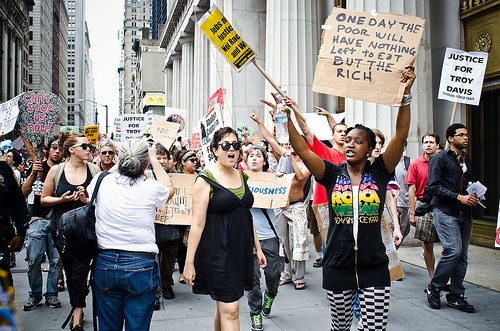
The messages sounded yesterday on the streets of San Francisco – delivered in speeches, chants, signs, songs, interviews, and the petition handed to Chase Bank officials by a half-dozen protesters before their arrest – should resonate with most Americans. After all, while rich corporations and individuals have been accruing ever more wealth, the vast majority of us have been falling behind.
“Banks get bailed out, we get sold out,” was one of those chants by the several hundred people who marched through the Financial District – our OccupySF effort building off the two-week Occupy Wall Street events – targeting some of the villains of the economic meltdown: JPMorgan Chase, Bank of America, Citibank, Charles Schwab, the Federal Reserve, and Goldman Sachs.
They may be relatively small and easy to ignore, these “occupations” of Wall Street and San Francisco and other cities that are entering their third week, but they’re being driven by a palpable anger and stirring critiques of economic and political systems that exploit the powerless. But as the foreclosures, layoffs, and other hardships continue, this nascent movement could have some staying power.
“I think it’s starting to wake people up out of their complacent distraction,” Robin Kralique, a 26-year-old SF resident holding a sign that read “Let’s have the GDP measure happiness,” told the Guardian. “We’re planting the seeds for a better future, and I’m hoping it wakes some people up.”
Like many of the young protesters gathered outside the corporate office building at 555 California at the start of the march, she was inspired by Occupy Wall Street. They’re angry watching their economic opportunities evaporate as more and more of the country’s wealth accumulates in fewer and fewer hands.
“There’s an insane amount of greed in this country,” 24-year-old Erin Kramer, a dancer and performance artist stuck in a corporate job she needs to get by, told me. Her sign read, “Don’t be afraid to say revolution!”
And many weren’t, with calls for revolution on the tips of many lips, albeit tempered with healthy doses of realism. “Even if it isn’t at critical mass yet, it sets the stage for the next revolution,” Kralique said when I asked her what she hoped this moment would accomplish.
Sup. John Avalos, a progressive mayoral candidate who spoke at the rally, is pushing legislation to create a municipal bank in San Francisco, one that would invest far more money in local projects and small businesses than Bank of America, which manages most of the city’s money.
“We have to figure out new ways to use our local dollars to help our economy,” Avalos told us. “The message here is we’re pulling our dollars out of these banks unless they help us.”
Before Avalos spoke – asking the boisterous crowd, “Have you ever felt like you’ve been had?” – activist Bobbi Lopez was on the microphone decrying the “lack of accountability for the people responsible for this decline.”
And then, the march was off – flanked by dozens of San Francisco Police officers on motorcycles, riding bicycles, and in cars – to deliver creative forms of protest around the Financial District, including a funny song and dance routine by Fresh Juice Party in front of the Schwab office, singing, “Land of the free, home of the brave, this is the street our labor paved.”
In fact, that was almost literally true at the San Francisco march, which was shepherded by off-duty city workers from SEIU Local 1021.
“This Wall Street thing is really spreading. The message of a small group of people in New York has really spread…Wall Street is a symbol of all this corruption, cronyism, and greed,” Gabriel Haaland, an organizer with SEIU Local 1021, told me at the start of the march. “It’s really resonated with our members…It’s been picking up steam as things have been unraveling over the last year.”
An hour or so later, Haaland was one of six people who staged an occupation of the Chase branch at Market and 2nd streets, along with two women in his union who have been unsuccessfully battling bank foreclosures on their homes – Brenda Reed and Tanya Dennis – and three other activists: William Chorneau, Manny S. Tucker, and Claire Haas.
Tipped off by Haaland, I was inside the bank lobby as the march approached and a police officer on a bicycle came inside to warn bank officials, “The protest is headed your way, you may want to secure the premises.”
He and another officer helped prevent protesters from getting inside, but the six protesters had already infiltrated the building. They began chanting and pulled blankets out of a suitcase, laying them out and placing them on the ground.
Reed spoke for the group, demanding to meet with JPMorgan Chase & Co. CEO Jamie Dimond to present a petition calling for a halt to the bank’s foreclosures. Through tears, she told the story of her long struggle to protect her home from foreclosure by Chase, which had taken her loan over from another lender.
SFPD Lt. M.E. Mahoney told the group, “You’re not going to be able to camp out here and wait for the CEO to come talk to you,” asking store managers whether they wanted to make a citizen’s arrest. They did, but Mahoney also told Reed that he would watch as she handed the petition to store managers.
“I’m here today because for two and a half years, I have desperately tried to get Chase to work with me,” Reed told a bank employee as hundreds of protesters outside looked on and chanted their support. “You have put me through hell. You’ve destroyed my health, you’ve destroyed my business, and it’s not fair what you’ve done.”
After she was finished, another bank manager (who refused to give his name) told Reed, “Just to let you know, we are compassionate to your cause,” drawing from the protesters the frustrated retort, “No you aren’t!” Through the day, protesters noted that the banks have been profitable and don’t need to be foreclosing on so many homes, sitting on so much capital, and funneling their profits out of desperate communities and into the accounts of wealthy investors – particularly after being bailed out by taxpayers in 2008.
Outside, the crowd chanted “Go, Brenda, go!” and “Let those people go, arrest the CEO!”
The crowd remained outside for more than an hour as police tried to wait them out, finally arresting the occupiers on trespassing charges and quickly citing and releasing them, apparently in the hope it would clear the people out of congested Market Street. “That was my quickest arrest ever,” Haaland, a veteran of many labor actions and progressive protests over the years, told me afterward.
Reed addressed the crowd on a bullhorn, explaining that she refinanced her home in 2007 with a shady “pretender lender” who misrepresented what her monthly payments would be. They ballooned to a level she was unable to cover and she sought a loan modification from Chase, which had taken over the loan from the now defunct Washington Mutual.
“Chase Bank is trying to steal my home of 38 years,” she told the crowd. “Jamie Dimond, come out from under your rock and let me talk to you.”
She decried how government bailed out the banks and then allowed them to aggressively foreclose on homes whose mortgages they didn’t originate, but who acquired the title out of the complex financial derivatives that has sliced and diced mortgages into complex financial instruments.
“It’s government-sanctioned fraud,” she said. Despite what she said were Chase’s plans to auction her home in Oakland next month, she pledged, “You will not get my home. You will not get what belongs to me.”
But whether that kind of fierce resolve – voiced over and over again, by hundreds of activists fed up with economic injustice – translates into any kind of real change is yet to be determined.
Six arrested protesting bank foreclosures during Occupy SF
Six activists protesting bank foreclosures were arrested after occupying Chase bank on Market Street in downtown San Francisco this afternoon (Thurs/29) as part of a broader action organized to mirror the Occupy Wall Street protests in New York City.
Brenda Reed, Tanya Dennis, William Chorneau, Manny S. Tucker, Gabriel Haaland, and Claire Haas were all arrested inside Chase on Market and Second streets while hundreds rallied outside, according to Guardian City Editor Steven T. Jones, who is there at the scene. The occupation was staged following a march that originated at San Francisco’s Goldman Sachs offices at 555 California Street and then progressed to the offices of CitiBank, Charles Schwab, and Chase.
The arrests prompted protesters to chant, “Let those people go! Arrest the CEO!” They also chanted, “Go, Brenda, go!” and “Shame on Chase!”
When they first entered the downtown San Francisco bank, Reed, who has battled a Chase foreclosure for two years, demanded to speak to the CEO. “You have put me through hell, and devastated my health,” she told the bank manager.
“Just to let you know, we are compassionate to your cause,” the manager responded, but was greeted by shouts of “No, you’re not!” from the crowd.
When Reed and her small group of supporters were asked to leave, they refused. As of 5:20 p.m., there was still a crowd of hundreds protesting out front.
UPDATE: They’ve been released, and Reed made the following statement to the crowd: “Chase Bank is trying to steal my home of 38 years.”
She said, “It’s government-sanctioned, nationalized fraud,” and added, “there are thousands and thousands and thousands of people like me, all over California.”
Video by Steven T. Jones
Occupy Wall Street comes to SF: VIDEO
Guardian City Editor Steven T. Jones is out in the streets this afternoon (9/29) covering the Occupy Wall Street protests that were brought to San Francisco by a coalition of labor and economic justice advocates, and inspired by ongoing demonstrations in New York City. Mayoral candidate Sup. John Avalos was spotted mixing with demonstrators as they flew signs calling for taxes on the rich.
“People are understanding that we’ve had the wool pulled over our eyes,” Avalos said, “and they’re fighting back.”
Here’s footage from the scene shot outside 555 California, a San Francisco skyscraper that was the former Bank of America headquarters and now houses offices for Goldman Sachs and other major financial players.
Video by Steven T. Jones
Occupy Wall Street comes to SF
View our full coverage of the OccupySF movement here.
As the Occupy Wall Street demonstration enters its 12th day in New York City – and as progressive activists protest in cities across the country – Bay Area residents are preparing for a mass mobilization on the streets of San Francisco tomorrow afternoon (Thurs/29), targeting financial institutions and other entities that they blame for the economic plight of the average American.
While the mainstream media has alternatively tried to ignore the uprising or scoffed at its wide range of complaints, the activists involved say it boils down to the powerful doing well at the expense of the powerless, and actively widening that divide. And the manifestations are many: layoffs and employee benefit cuts by profitable corporations, a worsening foreclosure crisis and lack of affordable housing, small businesses that can’t get access to capital, political corruption that scuttled real fiscal reforms, deep cuts to government services made worse by the right-wing’s refusal to tax rich corporations and individuals, shady corporate tax avoidance schemes, an education system under assault, refusal to seriously address global warming and economic injustice, and a litany of problems created by the same small group of power brokers.
“It’s along the lines of saying: Look, these people are screwing us in every way they can,” Alysabeth Alexander, the political director of Servie Employees International Union Local 1021, told us.
That union and many others are part of the broad coalition – a group that includes university students, social service providers, religious leaders, economic justice advocates, the online collective Anonymous, and others – that is organizing tomorrow’s protests in San Francisco, which will peak between 3-6 pm at selected targets around the Financial District, such as Bank of America, Wells Fargo, Chase, and Goldman Sachs.
“Big banks crashed our economy and destroyed our communities. Budget cuts threaten our schools, libraries, and social services. We bailed out the banks. Now they need to pay,” organizers wrote in an event invite on Facebook.
One of those organizers is Sarah Page, who has been helping coordinate various Occupy San Francisco events, which begin tomorrow with a 7:30 am “wake-up call” at the “night camp” at Steuart Street near Embarcadero and continue through a 4 pm demonstration outside the Federal Reserve Building and into the evening.
Her group’s week of protest began last Saturday with a General Assembly in Union Square and will end with another one there this Saturday at noon. “There’s more people camping and they’ve gotten very organized. Every day it seems like there’s more people showing up,” she told us. “There aren’t really leaders, the people at the camp are really organizing themselves.”
The week of protests, dubbed the Refund California Week of Action, has also been organized and chronicled by the website Make Banks Pay California, which says that this week’s protests throughout the Bay Area will be followed up next week by protests in Los Angeles.
Will the protests that began on Wall Street and trickled into cities around the country catch fire in the same way those in the Arab Spring have? I suppose that depends on who shows up and what happens tomorrow. But we at the Guardian will be out on the streets, chronicling the action with words and images here and tweets here or here, so follow along or join the moment.
Yael Chanoff contributed to this report.
BART seeks power to ban targeted individuals

Legislation currently before California Governor Jerry Brown would allow Bay Area Rapid Transit (BART) to ban passengers who have been convicted of a crime committed while on BART property. Written into a renewal of legislation for existing transit rules in the Sacramento area, the bill being considered by Governor Brown, AB 716, would make it an infraction to return to BART stations or use the regional transit system for up to one year.
“BART seeks whatever legal solutions we can to keep our passengers safe. There are dangerous people who are attracted to these public places. For example, we had a stabbing at the gates of Balboa station on the 8th of September,” BART spokesperson Luna Salaver told the Guardian. “This is something that BART can use as a tool.”
BART denied any connection between the wave of recent protests and the addition of BART to the bill renewal of AB 716. The BART Board of Directors began pursuing their inclusion into the legislation this spring, and addressed the issue at its June 9 board meeting — before frequent protests began over the July 3 shooting death of Charles Hill by BART police at Civic Center Station.
However, if passed, the resulting ordinance could be applied to protesters, some of whom have been arrested during civil disobedience that has caused rush hour service disruptions of BART’s operations, and others who have been arrested in official free speech areas while not directly contributing to a disruption in service.
With some 350,000 people passing through turnstiles each weekday, BART does not believe it can easily prevent everyone who is cited from re-entering BART, but says it will serve as an additional tool if a person is re-encountered by BART police. While a fine of $75 on the first offense may not be enough on its own to act as a deterrent, infractions to the law could be examined as probation or parole violations and subsequent infractions carry heavier fines.
“It would be preferable if these types of conditions were set by a judge as a condition of probation,” said Michael Rifher, staff attorney ACLU of Northern California. “These types of ordinances imposing ‘stay away’ orders without judicial oversight are an area that is very open to abuse.”
Specifics on how the new law would be enforced are not in place yet, and will be developed by BART if the bill receives Gov. Brown’s signature.
“If the bill passes the Governor’s desk, BART will still have to go through its own process to implement it as an ordinance,” said Salaver. “This is something BART can uses as a tool but it will not likely be invoked automatically.”
Rifher says the underlying legislation does go further to protect free speech and the rights of the disabled than many examples of “stay away” legislation. For example, according to the text of the legislation, someone banned from riding BART or entering the station would still be allowed to “engage in activities that are protected under the laws of the United States or of California, including, but not limited to, picketing, demonstrating, or distributing handbills.”
In discussing the process of implementing an ordinance, BART said it would invite people from the disabled community, who may have special concerns about the formation of BART’s policy, to participate.
Sources familiar with the bill say it is unclear whether Governor Brown plans to sign the legislation.
SFBG Radio: Beyond the Wall Street protests

Today we talk about the protests on Wall Street — and Johnny offers a more effective approach. Hint: It has to do with blaring out-of-tune techno music at rich people. You’ll have to listen after the jump to get the rest.
BART’s failed press mainpulation

Another nice scoop by Zusha Elinson at the Bay Citizen: He’s got emails showing how BART tried to set up a fake counter-protest and press conference to skew media coverage toward how protests were inconveniencing riders.
The brainchild of Linton Johnson, BART’s PR chief (and the man who brought you the cell-phone shutoff), the plans included a pre-written script and a couple of private SUVs with drivers to take the BART loyalists to the press conference.
You can’t make this shit up.
BART’s attempts to avoid protests and manipulate the press appear to exceed its interest in reforming police practices. I wonder, sometimes, if the BART Board is even paying attention.
On Guard!
news@sfbg.com
BART’S CRACKDOWN
For weeks now, protesters have descended on Bay Area Rapid Transit (BART) stations to denounce the fatal July 3 shooting of homeless passenger Charles Hill by a BART Police officer, and to call for the agency’s long-controversial police force to be disbanded. Commuters have had to contend with service disruptions and delays, and costs to the transit agency have exceeded $300,000. Yet it isn’t just bullhorn-wielding protesters who’ve been thrust into the spotlight — BART’s police force is also facing scrutiny for its conduct under pressure.
BART drew the ire of numerous media outlets after a Sept. 8 protest when transit cops detained members of the press along with protesters on suspected violation of California Penal Code Section 369i, which prohibits interfering with the operations of a railroad. Most journalists were eventually released, but the protest resulted in 24 arrests.
Although BART police later contended that they issued dispersal orders prior to closing in, many who were encircled and detained (including me) insisted they’d heard no such announcement. BART police also instructed San Francisco Police Department (SFPD) officers who were on hand to assist to seize reporters’ SFPD-issued press passes — a move that SFPD spokesperson Troy Dangerfield later told the Guardian was an error that went against normal SFPD protocol.
In a Sept. 10 editorial, the San Francisco Chronicle blasted BART police for placing Chronicle reporter Vivian Ho in handcuffs despite being informed that she was there as a journalist. Ho’s experience was mild compared with that of Indybay reporter David Morse (aka Dave Id), who told the Guardian he was singled out for arrest by BART Deputy Police Chief Daniel Hartwig and isolated from the scene — even though Hartwig is familiar with Morse and knows he’s been covering protests and BART board meetings for the free online publication. Asked why Morse was arrested when other journalists detained for the same violation were released, BART spokesperson Jim Allison told us, “The courts will answer that, won’t they?”
No Justice, No BART — a group that was instrumental in organizing the Sept. 8 protest — telegraphed to media and police at the outset that they intended to test BART’s assertions that people’s constitutionally guaranteed rights to free speech would be upheld as long as they remained outside the paid areas of the station, in what was dubbed a “free speech zone.” (Rebecca Bowe)
CHRON VS. WIENER(S)
Scott Wiener tried to do something eminently reasonable, and ask the naked guys in the Castro to put down a towel before they sit on public benches. Although the Department of Public Health hasn’t made any statements about the issue (and people put their naked butts on public toilet seats without creating major social problems), it’s pretty much an ick factor thing — and using a towel is an unwritten (sometimes written) rule at almost every nudist resort in the country.
The whole thing is a bit ironic, since it’s already illegal for fully clothed poor people to sit on the street — but so far, it’s not illegal for naked people to sit on benches. So far.
Wiener’s move set off an anti-nudity campaign at the San Francisco Chronicle, starting with columnist C.W. Nevius suggesting that the nudies are all perverts: “If these guys were opening a trench coat and exposing themselves to bystanders in a supermarket parking lot we’d call them creeps.” A Chron editorial called for a new law banning nudity in the city (an excellent use of time for a police department that already says it can’t afford community policing). The national (right-wing) press is having a field day. The commenters on sfbg.com are arguing about whether the pantsless men are shedding scrotal hair, or whether they’re mostly shaved. For the record, we haven’t checked.
And for the record, in a couple of months it’s going to get way too cold and rainy for this sort of thing anyway. (Tim Redmond)
HERRERA’S SMACKDOWNS
City Attorney Dennis Herrera has always been limited by his office’s neutral role in criticizing city policies and officials. But as a mayoral candidate, he seems to have really discovered his political voice, offering more full-throated criticisms of Mayor Ed Lee and his policies than any of the other top-tier candidates.
“I think it’s kind of liberating for him that he can talk policy instead of just about legal issues,” Herrera’s longtime spokesperson Matt Dorsey, who recently took a leave from his city job to work on the campaign full-time, told the Guardian.
Perhaps not surprisingly, Herrera’s shift began a little more than a month ago when Lee bowed to pressure from Willie Brown, Rose Pak, and other top power brokers to get into mayor’s race, prompting Herrera’s biting analysis that, “Ed Lee’s biggest problem isn’t that he’s a dishonest man — it’s that he’s not his own man. The fact is, if Ed Lee is elected mayor, powerful people will continue to insist on things. And I don’t think San Franciscans can be blamed for having serious doubts about whether Ed Lee would have the courage to say no.”
Herrera followed up last week by providing an example of something Lee and most other mayoral candidates don’t have the courage to say no to: the Central Subway project, with its runaway price tag and growing number of critics that say it’s a wasteful and inefficient boondoggle that will worsen Muni’s operating budget deficit.
“Fiascos aren’t born that way. They typically grow from the seeds of worthy idea, and their laudable promise is betrayed in subtle increments over time,” was how Herrera began a paper he released Sept. 8 called “It’s time to rethink the Central Subway,” in which he calls for a reevaluation of a project that he and the entire Board of Supervisors once supported.
He notes that the project’s costs have tripled and its design flaws have been criticized by the Civil Grand Jury and numerous transit experts. “Let’s look at this thing and see if it still makes sense,” Herrera told us, a stand that was greeted as blasphemy from the project’s supporters in Chinatown, who called at least two press conferences to decry that they called a “cheap political stunt.”
While the stand does indeed help distinguish Herrera from a crowded mayoral field, he insists that it was the grand jury report and other critiques that prompted him to raise the issue. “Good policy is good politics, so let’s have a debate on it and let the validity of the project stand or fall on its merits,” he said.
Herrera and fellow candidate John Avalos were also the ones who called out Lee on Sept. 2 for praising Pacific Gas & Electric Co. as “a great company that get it” for contributing $250,000 to a literacy program, despite PG&E’s deadly negligence in the San Bruno pipeline explosion and its spending of tens of millions of dollars to sabotage public power efforts and otherwise corrupt the political process.
“It shows insensitivity to victims’ families, and poor judgment for allowing his office to be used as a corporate PR tool. No less troubling, it ignores the serious work my office and others have done to protect San Franciscans from PG&E’s negligence,” Herrera said in a prepared statement.
Now, his rhetoric isn’t quite up to that of Green Party mayoral candidate Terry Baum, who last week called for PG&E executives to be jailed for their negligence, but it’s not bad for a lawyerly type. Herrera insists that he’s always wielded a big stick, expressed through filing public interest lawsuits rather than campaign missives, “but the motivation in how I do either is not really different.” (Steven T. Jones)
JACK IS BACK
The mayor’s race just got a new player, someone who is guaranteed to liven things up. His name is Jack Davis — and he’s already gone on the attack.
Davis, the infamous bad boy of political consulting who is so feared that Gavin Newsom paid him handsomely just to stay out of the 2003 mayor’s race, has been keeping a low profile of late. But he’s come out of semi-retirement to work for Jeff Adachi, the public defender who is both running for mayor and promoting Prop. D, his pension-reform plan.
Davis and Adachi first bonded when Adachi ran against appointed incumbent Kim Burton in 2002. Now, Davis has begun firing away at Mayor Ed Lee, with a new mailer that calls the competing Lee pension plan a “backroom deal.” The piece features a shadowy figure (who looks nothing like Ed Lee) slipping through a closing door, a fancy ashtray full of cigars and an allegation that Lee gave the cops a sweet pension deal in exchange for the police union endorsement.
Trust us, that’s just the start. (tr)
PENSION PALS
Meanwhile, Adachi sent Lee a letter on Sept. 8 challenging him to debate the merits of their rival pension measures — Lee spearheaded the creation of Prop. C, with input from labor unions and other stakeholders — sometime in the next month.
“I believe there is a vital need — if not an obligation — for us to ensure that the voters of San Francisco understand both the severity of our pension crisis as well as the significant differences between our two proposals,” Adachi wrote, later adding, “As the two principals behind the competing ballot measures, I hope that we can work together to increase awareness of this important issue and work toward a better future for our city.”
Lee’s campaign didn’t respond directly to Adachi, but Lee’s ever-caustic campaign spokesperson Tony Winnicker told the Guardian that the request was “the oldest political trick in book” and one they were rejecting, going on to say, “Voters deserve to hear from all the candidates on pension reform, not just two of them.”
Perhaps, but given the mind-numbing minutiae that differentiates the two measures, some kind of public airing of their differences might be good for all of us. Or I suppose we can just trust all those dueling mailers headed our way, right? (stj)
For more, visit our Politics blog at www.sfbg.com.
BART Police arrest journalists and protesters
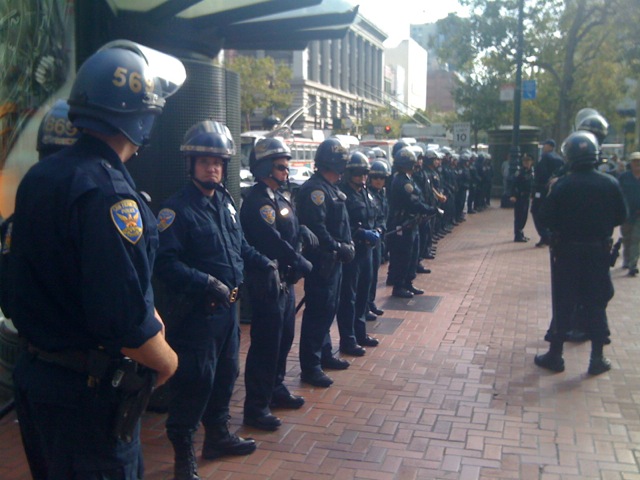
BART Police are cracking down hard on a peaceful protest in the Powell Street station, detaining a group of 30 to 40 people that includes almost a dozen journalists, including Guardian reporter Rebecca Bowe, who just called in with a report on the ongoing situation. (For Rebecca Bowe’s account of the BART protest and arrests, with video footage, click here.)
The scene is chaotic and details are unclear at this point, but we’ll report more on this blog post as the situation unfolds. This protest stems from shootings by BART Police, the transit agency’s ban on political speech on train platforms, and its decision last month to cut cell phone service in an effort to scuttle a police accountability protest that never materialized. Today’s protest, organized by the group Anonymous, stated an intention to exercise free speech rights without disrupting BART service.
But BART officials have apparently decided to deal harshly with the protesters and Bowe reports that the group has been detained for violation of Penal Code Section 369i, which makes it a crime to disrupt rail service, outlawing activities that “would interfere with, interrupt, or hinder the safe and efficient operation of any locomotive, railway car, or train.”
Yet an attorney working with the protesters notes that mere speech doesn’t hinder operations, noting that section C of that code section specifically “does not prohibit picketing in the immediately adjacent area of the property of any railroad or rail transit related property or any lawful activity by which the public is informed of the existence of an alleged labor dispute.”
While this protest may not involve a labor dispute, it does seem that the ongoing protests against BART are evolving into a test of the agency’s claims of the authority to ban all protest and political speech on its train platforms.
More to come…
UPDATE AT 6:07 PM: The professional journalists in the group have been released after being detained for about 30 minutes, and they’ve been shepherded into an area where they can no longer see the group of arrestees. But a group of three to five San Francisco State University journalism students who don’t have press credentials remain in custody, despite repeated appeals to the police by their faculty advisor Justin Beck.
The real Leland Yee
tredmond@sfbg.com
It’s early January 2011, and the Four Seas restaurant at Grant and Clay is packed. Everyone who is anyone in Chinatown is there — and for good reason. In a few days, the Board of Supervisors is expected to appoint the city’s first Asian mayor.
The rally is billed as a statement of support for Ed Lee, the mild-mannered bureaucrat and reluctant mayoral hopeful. But that’s not the entire — or even, perhaps, the central — agenda.
Rose Pak, who describes herself as a consultant to the Chinese Chamber of Commerce but who is more widely known as a Chinatown powerbroker, is the host of the event. She stands in front of the room, takes the microphone, and, in Cantonese, delivers a remarkable political speech.
According to people in the audience, she says, in essence, that the community has come out to celebrate and support Ed Lee — but that’s just the start. She also urges them not just to promote their candidate — but to do everything possible to prevent Leland Yee from becoming mayor.
She continues on for several minutes, lambasting Yee, the state Senator who lived in Chinatown as a child, accusing him of about every possible political sin — and turning the Lee rally into an anti-Yee crusade. And nobody in the crowd seems terribly surprised.
Across Chinatown, from the liberal nonprofits to the conservative Chamber of Commerce, there’s a palpable fear and distrust of the man who for years has been among San Francisco’s most prominent Asian politicians — and who, had Lee not changed his mind and decided to run for a full term this fall, was the odds-on favorite to become the city’s first elected Chinese mayor.
The reasons for that fear are complex and say a lot about the changing politics of Asian San Francisco, the power structure of a city where an old political machine is making a bold bid to recover its lucrative clout — and about the career of Yee himself.
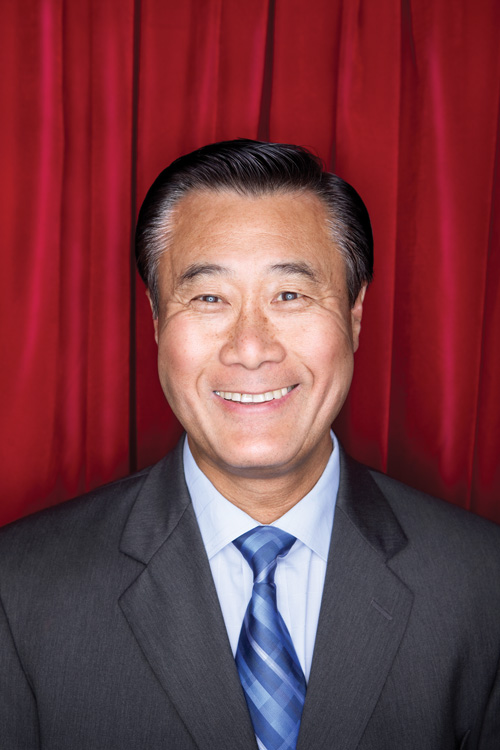
Senator Leland Yee is a political puzzle. He’s a Chinese immigrant who has built a political base almost entirely outside of the traditional Chinatown community. He’s a politician who once represented a deeply conservative district, opposed tenant protections, voted against transgender health benefits and sided with Pacific Gas and Electric Co. on key environmental issues — and now has the support of some of the most progressive organizations in the city. He’s taken large sums of campaign money from some of the worst polluters in California, but gets high marks from the Sierra Club.
His roots are as a fiscal conservative — yet he’s been the only Democrat in Sacramento to reject budget compromises on the grounds that they required too many spending cuts.
He’s grown, changed, and developed his positions over time. Or he’s become an expert at political pandering, telling every group exactly what it wants to hear. He’s the best chance progressives have of keeping the corrupt old political machine out of City Hall — or he’s a chameleon who will be a nightmare for progressive San Francisco.
Or maybe he’s a little bit of all of that.
Leland Yin Yee was born in Taishan, a city in China’s Guangdong province on the South China Sea. The year was 1948; Mao Zedong’s Communist Party of China had taken control of much of the countryside and was moving rapidly to take the major cities. The nationalist army of General Chiang Kai-Shek was falling apart, and Yee’s father, who owned a store, decided it was time for the family to leave.
The Yees made it to Hong Kong, and since Mee G. Yee had previously lived in the United States and served in the U.S. Army during World War II, he was ultimately able to move the family to San Francisco. In 1951, the three-year-old Leland Yee arrived in Chinatown.
For four years, Yee lived with his sister and mother in a one-room apartment with a shared bathroom while his father worked as a sailor in the merchant marine. It was, Yee recalled in a recent interview, a tight, closed, and largely self-sufficient community.
“The movie theater, the shoe store, the barber shop, food — everything you needed you could get in Chinatown,” Yee said. “You never had to leave.”
Of course, after a while, Yee and his mom started to venture out, down Stockton Street to Market, where they’d shop at the Emporium, the venerable department store. “It was like walking into a different country,” he said. “If you didn’t know English, they didn’t have time for you.”
Yee, like a lot of young Chinese immigrants of his era, put much of his time into his studies — in the San Francisco public schools and in a local Chinese school. “My mom spoke a village dialect, and we had to learn Cantonese,” he said. “Every little kid had to go to Chinese school. We hated it.”
When Yee was eight, his parents managed to buy a four-unit building on Dolores Street, and the family moved to the Mission, where he would spend not only the rest of his childhood but much of his early adult life. He graduated from Mission High School, enrolled in City College, studied psychology and after two years won admission to UC Berkeley.
Berkeley in 1968 was a very different world from Chinatown and even the relatively controlled environment he’d experienced at home in the Mission. “You didn’t protest in school. You’d have been sent home, and your mother would kill you,” he said.
At Berekely, all hell was breaking loose, with the antiwar protests, the People’s Park demonstrations, the campaign to create a Third World College (which led to the first Ethnic Studies Department), and a general attitude of mistrust for authority. “I developed a sense of activism,” Yee said. “I realized I could speak out.”
That spirit quickly vanished when Yee lost faith in some of his fellow activists. “People would work with us, then get into positions of power and use that against you,” he recalled. “A lot of my friends said ‘forget it.’ I left the scene.”
Yee once again devoted his energy to school, earning a masters at San Francisco State University and a Ph.D in child psychology from the University of Hawaii. Along the way, he met his wife, Maxine.
With his new degree, the Yees moved back to San Francisco — and back in with his parents at the Dolores property, where he, Maxine and a family that would grow to four kids would live for more than a decade.
Yee worked as a child psychologist for the San Francisco Department of Public Health, starting the city’s first high school mental-health clinic. He went on to become a child psychologist at the Oakland Unified School District, then joined a nonprofit mental health program in San Jose.
In 1986, Yee decided to get active in politics for the first time since college, and ran for the San Francisco School Board. He lost — and that would be the only election he would ever lose. In 1988, he won a seat, and established himself as an advocate for students of color, fighting school closures in minority neighborhoods. He also tried to get the district to modify its harsh disciplinary rules, arguing against mandatory expulsions.
On fiscal issues, though, Yee was a conservative. For his first term, despite the brutal cutbacks of the recession of the late 1980s and early 1990s, he insisted that the district make do with the money it had. His solution to the red ink: Cut waste. Only in 1992, when he was up for re-election, did he acknowledge that the district needed more cash; at that point, he supported a statewide initiative to tax the rich to bring money to the schools.
The sense of fiscal conservatism — of holding the line on taxes, but mandating open and fair contracting procedures and tight financial controls — was a hallmark of much of his political career. When the Guardian endorsed him for re-election to the board in 1992, we wrote that “there’s real value in his continuing vigilance against administrative fat and favoritism in contracts.”
Over the next four years, Yee worked with then-Superintendent Waldemar “Bill” Rojas, a deeply polarizing figure who pushed his own personal theory of “reconstitution” — firing all the staff at low-performing schools — and later was enmeshed in a scandal that led to prison time for a contractor he’d hired. Yee told me he was the only board member to vote against hiring Rojas, but people who were watching the board closely back then say he didn’t always stand up to the superintendent.
He also became what some say was a bit too close with Tim Tronson, a consultant hired by the district as a $1,000-a-day facilities consultant. Tronson wound up getting indicted on 22 counts of grand theft, embezzlement, and conspiracy in a scheme to steal $850,000 from the schools, and was sentenced to four years in state prison.
In 1998, when some school board members wanted to build housing for teachers on property that the district owned in the Sunset, Yee led the opposition — with Tronson’s help. At one meeting at Sunset Elementary School, Yee went so far as to say, according to people present, that “Tim Tronson is my man, and I rely on him for advice.”
Yee acknowledged that he worked closely with Tronson to defeat that housing project. “He was the facilities manager,” Yee explained, “and I said that I trusted his judgment.”
Yee has either a great sense of political timing or exceptional luck. He ran for the Board of Supervisors in 1996, facing one of the weakest fields in modern San Francisco history. He was the only Chinese candidate and one of just two Asians (the other, appointed incumbent Michael Yaki, barely squeaked to re-election). In an at at-large election with the top five winning seats, Yee came in third, with 103,000 votes.
He was never a progressive supervisor. In 2000, the Guardian ranked the good votes of what we referred to as Willie Brown’s Board, and Yee scored only 43 percent. He was against campaign finance reform. He supported the brutal gentrification and community displacement represented by the Bryant Square development. He voted to kill a public-power feasibility study and opposed the Municipal Utility District initiative. He opposed a moratorium on uncontrolled live-work development.
In 2002, Yee was one of only three supervisors to oppose Proposition D, a crucial public-power measure that would have broken up PG&E’s monopoly in the city. He stood with PG&E (and then-Sups. Tony Hall and Gavin Newsom) in opposition to the measure, then signed a pro-PG&E ballot argument packed with PG&E lies.
When I asked him about that stand, Yee at first didn’t recall opposing Prop. D, but then said he “stood with labor” on the issue. In fact, the progressive unions didn’t oppose Prop. D at all; the opposition was led by PG&E’s house union, IBEW Local 1245.
Yee was particularly bad on tenant issues. He not only voted to deny city funding for the Eviction Defense Collaborative, which helped low-income tenants fight evictions; he actually tried to get the city to put up money for a free legal fund to help landlords evict their tenants. He opposed a ballot measure limiting condo conversions. He opposed a measure to limit the ability of landlords to pass improvement costs on to their tenants.
In 2001, Yee voted to uphold a Willie Brown veto of legislation to limit tenancies in common, a backdoor way to get around the city’s condo conversion ordinance. Only Hall and Newsom, then the most conservative supervisors on the board, joined Yee. At one point, he started asking whether the city should consider repealing rent control.
He opposed an affordable housing bond in 2002, joining the big landlord groups in arguing that it would raise property taxes. Every tenant group in town supported the measure, Proposition B; every landlord group opposed it.
I asked Yee about his tenant record, and he told me that he now supports rent control. But he said that he was always on the side of homeowners and small landlords, and that property ownership was central to Chinese culture. “I was responding to the Chinese community and the West Side,” he said.
He wasn’t much of an environmentalist, either — at least not in today’s terms. He was one of the only city officials to support a “Critical Car” rally in 1999, aimed at promoting the rights of vehicle drivers (and by implication, criticizing Critical Mass and the bicycle movement).
His record on LGBT issues was mixed. While he supported a counseling program for queer youth when he was on the school board, he also supported JROTC, angering queer leaders who didn’t want a program in the public schools run by, and used as a recruiting tool for, the military, which at that point open discriminated against gay and lesbian people.
Yee was also one of only two supervisors who voted in 2001 against extending city health benefits to transgender employees.
That was a dramatic moment in local politics. Nine votes were needed to pass the measure, and while eight of the supervisors were in favor, Yee and Hall balked. At one point, Board President Tom Ammiano had to direct the Sheriff’s Office to go roust Sup. Gerardo Sandoval, who was ducking the issue in his office, to provide the crucial ninth vote.
Yee didn’t just vote against the bill. According to one reliable source who was there at the time, Yee spoke to a community meeting out on Ulloa Street in the Sunset and berated his colleagues, quipping that the city should have better things to do than “spend taxpayer money on sex-change operations.”
It was a bit shocking to trans people — Yee had, over the years, befriended some of the most marginalized members of what was already a marginalized community. “There was one person at the rail crying, saying ‘Leland, how could you do this to us,'” Ammiano recalled.
The LGBT community was furious with Yee. “I didn’t speak to him for at least a year,” Gabriel Haaland, one of the city’s most prominent transgender activists, told me.
Yee now says the vote was a mistake — but at the time, he told me, he was under immense pressure. When he voted for the queer youth program, he said, “the elders of the Chinese community ripped me apart. They called my mother’s friends back in the village [where he was born] and said her son was embarrassing the Chinese community.”
That must have been difficult — and he said that “if I had known the pain I had caused, I wouldn’t have voted that way.” But it was hard to miss that pain his vote caused.
On the other hand, people learn from their experiences, attitudes evolve, we all grow up and get smarter, and the way Yee describes it, that’s what happened to him.
In 2006, when he was running for state Senate, Yee met with a group of trans leaders and formally — many now say sincerely — apologized. It was an important gesture that made a lot of his critics feel better about him.
“He didn’t have to do that,” Haaland said. “People change, and he paid for his crime, and that’s genuine enough for me.”
As a former school board member, Yee kept an interest in the schools — but not always a healthy one. At one point, he actually proposed splitting SFUSD into two districts, one on the (poorer) east side of town and one on the (richer) west. “We strongly opposed that,” recalled Margaret Brodkin, who at the time ran Coleman Advocates for Children and Youth. “Eventually he dropped the idea.”
For all the problems, in his time on the Board of Supervisors, Yee developed a reputation for independence from the Brown Machine, which utterly dominated much of city politics in the late 1990s. His weak 43 percent rating on the Guardian scorecard was actually third-best among the supervisors, after Ammiano and the late Sue Bierman.
In 1998, he was one of the leaders in a battle to prevent the owners of Sutro Tower from defying the city’s zoning administrator and placing hundreds of new antennas on Sutro Tower. He, Bierman, and Ammiano were the only supervisors opposing Brown’s crackdown on homeless people in Union Square.
When he ran in the first district elections, in 2000, against two opponents who had Brown’s support and big downtown money, the Guardian endorsed him, noting that while he “can’t be counted on to support worthy legislation … He’s one of only two board members who regularly buck the mayor on the big issues.”
(He never liked district elections, and used to take any opportunity to denounce the system, at times forcing Ammiano to use his position as president to tell Yee to quit dissing the electoral process and get to the point of his speech.)
In 2002, the westside state Assembly district seat opened up, and both Yee and his former school board colleague Dan Kelly ran in the Democratic primary. Yee won, and went on to win the general election with only token opposition.
His legislative record in the Assembly wasn’t terribly distinguished. Yee never chaired a policy committee — although he did win a leadership post as speaker pro tem. And he cast some surprisingly bad votes.
In 2003, for example, then-Assemblymember Mark Leno introduced a bill that would have exempted single-room occupancy hotels from the Ellis Act, which allows landlords to evict tenants for no reason. Yee refused to vote for the bill. Leno was furious — he was one vote short of a majority and Yee’s position would have doomed the bill. At the last minute, a conservative Republican who had grown up in an SRO hotel voted in favor.
When he ran for re-election in 2004, we noted: “What’s Leland Yee doing up in Sacramento? We can’t figure it out — and neither, as far as we can tell, can his colleagues or constituents. He’s introduced almost no significant bills — compared, for example, to Assemblymember Mark Leno’s record, Yee’s is an embarrassment. The only high-profile thing he’s done in the past several years is introduce a bill to urge state and local governments to allow feng shui principles in building codes.”
In 2006, Yee decided to move up to the state Senate, and he won handily, beating a weak opponent (San Mateo County Supervisor and former San Francisco cop Mike Nevin) by almost 2-1. His productivity increased significantly in the upper chamber — and in some ways, he moved to the left. He’s begun to support taxes — particularly, an oil severance tax — and when I’ve questioned him, he somewhat grudgingly admits that Prop. 13 deserves review.
He’s done some awful stuff, like trying to sell off the Cow Palace land to private developers. But he has consistently been one of the best voices in the Legislature on open government, and that’s brought him some national attention.
Yee has been a harsh critic of spending practices and secrecy at the University of California, and when UC Stanislaus refused in 2010 to release the documents that would show how much the school was paying Sarah Palin to speak at a fundraiser, Leland flew into action. He not only blasted the university and introduced legislation to force university foundations to abide by sunshine laws; he worked with two Stanislaus students who had found the contract in a dumpster and made headlines all over the country.
He’s fought for student free speech rights and this year pushed a bill mandating that corporations that get tax breaks for job creation prove that they’ve actually created jobs — or pay the tax money back. He’s also won immense plaudits from youth advocates and criminal justice reformers for his bill that would end life-without-parole sentences for offenders under 18.
Along the way, he compiled a 100 percent voting record from the major labor unions, including the California Nurses Association and SEIU, and with the Sierra Club. All three organizations have endorsed him for mayor.
Yee told me that he thinks he’s become more progressive over the years. “My philosophy has shifted,” he said.
Yet when you talk to his colleagues in Sacramento, including Democrats, they aren’t always happy with him. Yee has a tendency to be a bit of a loner — he’s never chaired a policy committee and in some of the most bitter budget fights, he’s refused to go along with the Democratic majority. Yee insists that he’s taken principled stands, declining to vote for budget bills that include deep service cuts. But the reality in Sacramento is that budget bills have until this year required a two-thirds vote, meaning two or three Republicans have had to accept the deal — and losing a Democratic vote has its cost.
“You have to give up all sorts of things, make terrible compromises, to get even two Republicans,” one legislative insider told me. “When a Democrat goes south, you have to find another Republican, and give up even more.”
In other words: It’s easy to take a principled stand, and make a lot of liberal constituencies happy, when you aren’t really trying to make the state budget work.
I met Rose Pak on a July afternoon at the Chinatown Hilton. She brought along her own loose tea, in a paper package; the waitress, who clearly knew the drill, took it back to the kitchen to brew. Pak and I have not been on the greatest of terms; she’s called the Guardian all kinds of names, and I’ve had my share of critical things to say about her. But on this day, she was polite and even at times charming.
After we got the niceties out of the way (she told me I was unfair to her, and I told her I didn’t like the way she and Willie Brown played politics), we started talking about Yee. And Pak (unlike some people I interviewed for this story) was happy to speak on the record.
She told me Yee had “no moral character.” She told me she couldn’t trust him. She told me a lot of stories and made a lot of allegations that we both knew neither she nor I could ever prove.
Then we got to talking about the politics of Chinatown and Asians in San Francisco, and a lot of the animosity toward Yee became more clear.
For decades, Chinatown and the institutions and people who live and work there have been the political center of the Chinese community. Nonprofits like the Chinatown Community Development Center have trained several generations of community organizers and leaders. The Chinese Chamber of Commerce, the Six Companies, and other business groups have represented the interests of Chinese merchants. And while the various players don’t always get along, there’s a sense of shared political culture.
“In Chinatown,” Gordon Chin, CCDC’s director, likes to say, “it’s all about personal connections.”
There’s a lively infrastructure of community-service programs, some of which get city money. There’s also a sense that any mayor or supervisor who wants to work with the Chinese community needs to at least touch base with the Chinatown establishment.
Yee doesn’t do that. “He doesn’t give a shit about them,” David Looman, a political consultant who has worked with many Chinese candidates over the years, told me.
Yee’s Asian political base is outside of Chinatown; he told me he sees himself representing more of the Chinese population of the Sunset and Richmond and the growing Asian community in Visitacion Valley and Bayview.
Pak is connected closely to Brown, who Yee often clashed with. For Pak, Brown, and their allies, strong connections to City Hall mean lucrative lobbying deals and public attention to the needs of Chinatown businesses. Then there’s the nonprofit sector.
CCDC and other nonprofits do important, sometimes crucial work, building and maintaining affordable housing, taking care of seniors, fighting for workers rights, and protecting the community safety net. Yee, Pak said, “has never shown any interest in our local nonprofits. We all work together here, and he doesn’t seem to care what we do.” Yee told me he has no desire to see funding cut for any critical social services in any part of town. But he has also made no secret of the fact that he questions the current model of delivering city services through a large network of nonprofits, some of which get millions of taxpayer dollars. And the way Pak sees it, all of that — the nonprofits, the business benefits, the contracts — are all at risk. “If Leland Yee is elected mayor,” she told me, “we are all dead.”
I ran into an old San Francisco political figure the other day, a man who has been around since the 1970s, inside and outside of City Hall, who remains an astute observer of the players and the power relationships in the local scene. At the time we talked, he wasn’t supporting any of the mayoral candidates, but he had a thought for me. “This town,” he said, “is being taken over by a syndicate. Willie Brown is the CEO, and Rose Pak is the COO, and it’s all about money and influence.”
That’s not a pleasant thought — I’ve lived through the era of political machine dominance in this town, and it was awful. In the days when Brown ran San Francisco, politics was a tightly controlled operation; only a small number of people managed to get elected to office without the support of the machine. Developers made land-use policy; gentrification and displacement were rampant; corruption at City Hall turned a lot of San Franciscans off, not only to the political process but to the whole notion that government could be a positive force in society.
A few years ago, I thought those days were over — and to a certain extent, district elections will always make machine politics more difficult. But when I see signs of the syndicate popping up — and I see a candidate like Ed Lee, who’s close friends with Brown, leading the Mayor’s Race — it makes me nervous. And for all his obvious flaws, at least Leland Yee isn’t part of that particular operation. If there’s a better reason to vote for him, I don’t know what it is.
YEE HOME PURCHASE RAISES SUSPICIONS
Rose Pak has a question about Leland Yee. “How,” she asked me, “did the guy manage to buy a million-dollar house on a $30,000 City Hall salary?”
Pak isn’t the only one asking — numerous media reports over the years have examined how Yee raised a family of four and bought a house in the Sunset on very little visible income. And while I’m not usually that interested in the personal finances of political candidates, I decided that it was worth a look.
Here’s what I found: Public records show that in July 1999, Yee and his wife, Maxine, purchased a house on 24th Avenue for $875,000 (it’s now assessed at slightly more than $1 million). At the time, Yee was a San Francisco supervisor, earning a little more than $30,000 a year. (The salary of the supervisors was raised dramatically shortly after Yee left the board and went to the state Assembly.) His wife wasn’t working. And his economic interest statements for that period show no other outside earnings. So the disposable, after-tax income of the entire Yee family couldn’t have been much more than $25,000.
That, by any normal standard, shouldn’t have been enough to float a mortgage that, records show, totaled $516,000. In fact, the interest payments alone on that mortgage alone would total $3,600 a month — more than Yee’s gross income.
Documents in the Assessor’s Office show another paper trail, too. In 1989, Jung H. Lee, Yee’s mother, transferred the deed on a four-unit Dolores St. building where the family had been living to Maxine and Leland Yee — for no money. And a few months before the Yees bought the Sunset house, they took out a $320,000 home-equity loan on that property. That was the down payment on the Sunset property.
Still: At that point, the Yees would have been paying off two mortgages, with a total nut of about $5,000 a month — and supporting four kids, in San Francisco. In 2002, Yee’s economic interest statement’s show some modest income from teaching at Lincoln University — but nowhere near enough to pay that level of expenses.
What happened? Yee explains it this way: “For more than 10 years, we were living rent-free in my parents’ property,” he told me I an interview. “We were a close Chinese family, and my parents provided the food and helped pay for the children’s clothing. So we had almost no expenses and we lived very frugally.”
During that period, Yee was working for the San Francisco Department of Public Health, the Oakland Unified School District, and a San Jose nonprofit, earning, he said, between $50,000 and $90,000 a year. If he saved almost all of that money, he would have had more than a half-million dollars in the bank when he bought the Sunset house.
There’s nothing on any of his economic disclosure forms showing any ownership of stocks or other reportable financial interests during that period, so he wasn’t investing the money. In fact, he says, it was, and is, all in simple savings accounts. A bit unusual for that large a sum of money.
How did he get a mortgage? “Back then,” he said, “banks were willing to lend a lot more freely than they do today.”
Starting in 2003, Yee was in the state Assembly, making a higher salary — but still not much in excess of $100,000 a year. After taxes, he was probably taking home about $75,000 — and $60,000 was going to the two mortgages.
How did he do it? “We have been supplementing our income with our savings,” he said. “We don’t take vacations, we are very careful with our money.” And they clearly aren’t desperate for cash — Yee’s daughter occupies two of the four units in the Dolores St. building they own, but the other two units are vacant.
It’s possible. It’s plausible. But I don’t blame people for wondering how he managed to pull it off. (Tim Redmond, with research assistance by Oona Robertson)
BIG CORPORATIONS HAVE BACKED YEE
Yee became a prodigious fundraiser in Sacramento — and a lot of the money came from big corporations that had business in the Legislature. And while he has perfect scores from the Sierra Club and the big labor unions, he’s taken tens of thousands of dollars from some of the biggest corporations, agribusiness interests, and polluters in the state. And at times, he’s voted their way.
Since 1993, for example, campaign finance records show Yee has taken more than $20,000 from Chevron, ExxonMobil, Valero, Conoco Phillips, and BP. He’s received another $22,450 from the chemical industry (and industry employees). Most of it came from Clorox, Dow Chemical, and Dupont.
And while the Sierra Club may not have considered it a priority, Sen. Mark Leno has worked hard to pass a bill limiting chemical fire retardants in furniture. In 2008, Yee voted against Leno’s AB 706.
That year he also refused to support a bill that would prohibit the use of the chemical diacetyl in workplaces. The industries that opposed AB 514 (including Bayer, Abbott Laboratories, Pfizer, and Johnson & Johnson) have given Yee a total of more than $60,000.
In 2003, Yee voted against a crucial tenant bill, one that would have prevented the owners of single room occupancy hotels from using the Ellis Act to evict tenants. He received a campaign check for $2,500 from the San Francisco Apartment Association the next day. Landlords in general have given Yee close to $40,000.
Then there’s agribusiness. Yee gets a lot of money from the farming industry, despite the fact that there obviously aren’t many farms in his district. Why, for example, would the California Poultry Association, the California Cattlemen’s Association, and the California Farm Bureau give him money? The Poultry Association’s Bill Mattos told us that Yee “has taken a keen interest in California’s poultry industry.”
Yee also took immense flak from the San Francisco Chronicle and other papers over a 2003 vote against a bill to limit emissions from farm vehicles. In an editorial, the paper wrote that he was “doing dirty work for the lobbyists.” In the end, under immense public pressure, he switched positions and voted for the bill. I asked Yee about all that money from all those bad operators, and he told me — as most politicians will — that campaign cash has never influenced any of his votes.
So why do all these groups give him money? “It’s about whether you will sit down and listen,” Yee said. “I will talk to all sides and at least consider the arguments as a thoughtful human being. Then I vote my conscience.” (Tim Redmond, with research by Oona Robertson)
BART protests continue (VIDEO)
Protesters returned to downtown San Francisco train stations on August 29, vowing to keep up their schedule of Monday evening rush hour protests until the BART police are disarmed and retrained, or disbanded. This time, howevef, stations remained open and trains ran on schedule in a protest where both BART police and demonstrators took pains to reach out to commuters angered by recent train service disruptions.
A crowd of 200 people gathered outside of Civic Center station, the location of the July 3 fatal shooting of a 45 year old Charles Hill by BART police.
Hill’s physician, Dr. Rupa Marya, joined the protest a day after releasing an open letter on the shooing calling for BART police to re-examine its use of force policies and training.
“Charles was a member of the invisible class of people in SF–mentally ill, homeless and not reliably connected to the help he needed,” read Marya’s letter. “We often have to deal with agitated–sometimes even violent–patients in the hospital. Through teamwork, tools and training, we have not had to fatally wound our patients in order to subdue them.”
The protest made its way down Market Street entering each station briefly but remaining outside the fare gates. BART police have made it clear recently that their policies only allow freedom of expression outside the paid areas of the station. Previous protests on the train platforms have lead to station closures and train delays – delays that protesters and police have accused each other of causing.
Video taken by Josh Wolf, which includes protesters and counterprotesters, including a debate between Dr. Marya and a supporter of the cops.
As the protesters moved down the Market Street corridor they were shadowed by a small army of BART and San Francisco Police Department officers intent on preventing further station closures.
At Montgomery station Deputy BART Police Chief Daniel Hartwig told the Guardian, “Protesters appear to be following BART’s free speech rules and regulations and at this point we are happy they are. We support their right to protest.”
Behind him the station lobby filled protesters chanting, “How can they protect and serve us? BART police just make us nervous.”
At Embarcadero station an organizer with No Justice No BART challenged BART’s free speech rules.
“Right here you can say what you want. The moment you enter that fare gate you can’t say what you want,” he announced over a megaphone before crossing through the fair gates under heavy police presence.
After speaking out briefly in the paid area of the station, he exited of his own accord and was promptly arrested by BART police along with another protester in a Guy Fawkes mask who also had been using a megaphone.
Muni, which shares several downtown train stations with BART, has shifted in recent years away from police patrols to a “community ambassador” program, largely removing armed SFPD officers from those train and bus lines in favor of unarmed fare enforcement personal. The program has been praised from all sides as an appropriate balance of community safety, and fare enforcement on public transportation.
Robin, a young San Francisco native who said it was her first time participating in the police misconduct protests, characterized the gathering as a success. When asked if she found the presence of so many police intimidating she said “It was meant to be intimidating. That they would bring everyone out to police a small protest shows they fell they have something to be ashamed of.”
While the protesters focused on BART’s use of lethal force, civil liberties groups filed a petition Monday with the Federal Communications Commission, as the national fallout continues over BART’s decision to cut cellphone service to thwart a protest that never developed on August 11.
The coalition including Center for Democracy and Technology, Center for Media Justice, and Electronic Frontier Foundation argues that regardless of First Amendment augments for or against the disruption of cell service in the paid areas of BART’s stations, BART exceeded its authority under federal law. The complaint notes that the Communications Act, which governs cell phone service providers, clearly states the no carrier shall discontinue service without authorization from the FCC.
“It has been settled law for decades that law enforcement agencies have no authority to order discontinuation of phone service on mere suspicion of illegal activity without due process,” the complaint states.
The coalition urged the FCC to address the issue immediately in light of BART’s statements attempting to justify the cell service disruption, and the risk that other government agency may consider similar policies if the FCC does not assert its authority in the matter.
BART’s board of directors held an emergency meeting (Wed/25) to begin crafting a policy outlining to what future instances could lead further shutoffs.
BART has staff defended its disruption of service that took place August 11, saying their intent was to protect public safety.
BART board mulls nation’s first cell service disruption policy
A special meeting of BART’s Board of Directors yesterday (Wed/25) was the first step in crafting a policy outlining the circumstances under which BART staff would be authorized to cut off cell phone service in its train stations. The resulting policy will be the first in the nation, and is likely to act as a model for other government agencies to address the issue.
While BART’s top management defended the suspension of cell phone service to disrupt a protest planned for August 11, BART’s board was divided over whether the suspension of cell service to prevent a protest was justified and what would constitute a justification for cutting cell service in the future.
“This group was encouraging, promoting and inciting illegal behavior on our platform,” BART police Chief Kenton Rainey reminded the board.
“Well, there is illegal activity every day at BART. The response does not feel proportional enough for justification,” responded BART director Tom Radulovich,
BART director Robert Raburn echoed Radulovich’s concerns. “Neither speculation about a protest, nor mere disruption of train service, nor other illegal activity by itself constitutes a risk to passenger safety that would warrant interrupting cell service. We must guard First Amendment freedom of speech, and this will become a landmark case,” said Raburn.
Staff and union representatives stressed that public safety was always BART’s top concern.
Officials from BART’s three unions generally agreed that the shutting of cell phone service was inappropriate, but admonished protesters for conducting protests on the platforms where they say there is a safety risk due to crowding.
“I applaud the individuals, the union supports the individuals who organize, for I understand organizing. I understand protesting,” said Austin Thomas, who represents BART employees from SEIU Local 1021. “But, I would like to see that this forum be the forum to bring your protest, to have your grievances redressed here.”
“The bottom line for BART is that downtown San Francisco at 5 pm is the maximum stress point at the maximum stress time. It’s all about public safety and keeping the trains moving,” stressed BART Assistant General Manager of Operations Paul Oversier.
“We keep going around with these safety issues, but do not be confused: We do not have to have one or the other,” urged director Lynette Sweet, who referenced the 1955 case Pike vs Southern Bell Telegraph.
“In this case, a gentleman by the name of Bull Connors ordered Southern Bell to remove the telephone of one Lewis Pike, described by Mr. Connors as a negro of questionable character who is known to be using his phone for unspecified illegal purpose. That is not where we as BART want to go. We don’t want to tell people, or signify, or specify, that you can’t talk, that you don’t have the ability to talk.”
But BART board Vice President John McPartland took a harder stance. saying the action was justified, and BART need to post signs informing the public of possible disruptions in cell service due to safety issues.
“This is the beginning of a review from a national perspective on this issue. I, for one, think we should maintain our ability to control cell service until we have it looked at from a legislative perspective.” said McPartland.
“Not all free speech is protected. There are some very narrow exceptions, and I believed this to be one of them,” Oversier insisted.
“If we are ever going to shut off cell phone service, ever, it should be for the most valid reasons that I equate with 9-11 [terrorist attack] level. Not the protests that we thought were going to happen on August 11th. We can’t do that,” cautioned Sweet, who wondered out loud if BART couldn’t just apologize for making a mistake and move on.
Members of the public present for the meeting remained dubious about BART creating policy concerning cell phone disruption at all.
Speaking on behalf of protest group No Justice No BART, an activist identifying himself only as Christof told the board, “We are not asking you to fix anything. We just simply don’t trust you to run a police force at all. We are not asking you to improve your free speech policy, we already have a free speech policy – it’s called the constitution.”
He expressed doubts as to whether BART should be trusted with the power to cut cell phone service. “What is the first thing that your police officers did on the Fruitvale platform after they shot Oscar Grant in the back? They tried to confiscate video footage taken by passengers,” Christof accused.
That footage from the New Years Eve shooting of Grant by officer Johannes Mehserle was the beginning of BART’s problems with anti-police brutality protesters.
Other speakers from the public had similar concerns about BART overreaching its authority.
“The proper place to present the arguments we have just heard is not to this board, but in a court room before a judge considering a motion or injunction. Instead of using those existing legal mechanisms, you have taken matters into your own hands as vigilantes,” said Edward Hasbrook representing the Identity Project.
BART officials expect the new policy will be crafted and voted on within a month. They say the new policy will be vetted through BART attorneys, the ACLU, and and BART’s civilian advisory committee. But they cautioned that BART could not envision every emergency that would warrant shutting off of cellular service as they craft their forthcoming policy, so the policy would include some flexibility at the discretion of BART management.
Both the California Public Utilities Commission and the Federal Communications Commission, who regulate cell phone providers, are already examining the legality of BART’s actions. As an afterthought, at the close of the meeting, Sweet urged the board to consult with those agencies over the policy before it is implemented.
BART has only provided cell service in its stations for a short time. While BART is under no legal obligation to provide phone service, once they began providing service they fall under the jurisdiction of the FCC, which regulates cell service nationally.
Speaking in Denver to CNET, FCC Commissioner Robert McDowell said the matter was still under investigation.
“What the heck happened, what precedent does it set, were there any laws that were broken?” McDowell questioned. “Let’s continue with the investigation. We’ll draw conclusions after we have all the facts.”
Even BART must honor free speech rights
Given the recent battles between BART and both the physical and online protesters organized by the group Anonymous, it’s no surprise that the live video feed of this morning’s (Wed/24) BART Board of Directors meeting is down due to “technical difficulties.” But we’ll try to follow-up later with what happened during the special meeting focused on BART’s decision to shut down cell service in an effort to thwart a threatened Aug. 11 protest against the latest fatal shooting by BART police.
In the meantime, we have an interesting letter sent this week to the agency by the American Civil Liberties Union, which cites relevant caselaw and makes it clear that BART exceeded its legal authority in shutting down the system. Unfortunately, BART’s stubborn refusal to acknowledge its mistake has spawned continuing protests that are snarling commutes and – given the trigger-happy nature of some BART cops – unnecessarily creating dangerous situations for everyone.
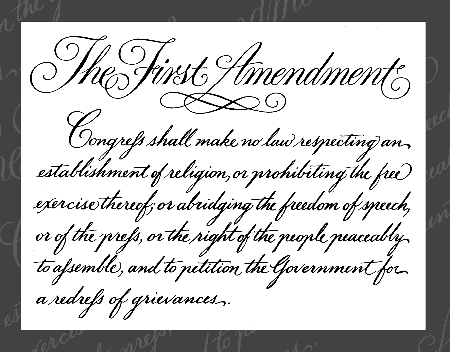
“The people of our state have the right to speak freely as Americans and as Californians. Our supreme court has long held that cutting off telephone service can infringe upon the right guaranteed by the First Amendment, reasoning that because ‘the right of free speech and press are worthless without effective means of expression, the guarantee extends both to the content of the communication and the means for its dissemination.’ Our state constitution is even more protective of free expression than is the First Amendment,” writes staff attorney Michael T. Risher, citing the 1966 Sokol v. Public Utilities Commission case, among others.
The standard set by the Supreme Court for when speech or networks may be cut off is when it creates “a clear and present danger of imminent violence,” which he argues simply wasn’t the case with a protest that never even materialized. And he notes that the courts take an even more dim view of prior restraint, or the regulation of speech before it even occurs.
“BART cannot properly prevent protestors or other cell-phone users from speaking with one another on the telephone in the first place. Our courts have held that even private telephone carriers, whose actions are not constrained by the First Amendment, cannot shut off service simply because they believe that their customers may be using their services to facilitate crime,” he wrote, citing the 1942 ruling in People v. Brophy. “BART, which is bound to follow both the First Amendment and the California Constitution’s Liberty of Speech clause, must not do so either.”
Threats or payback?
news@sfbg.com
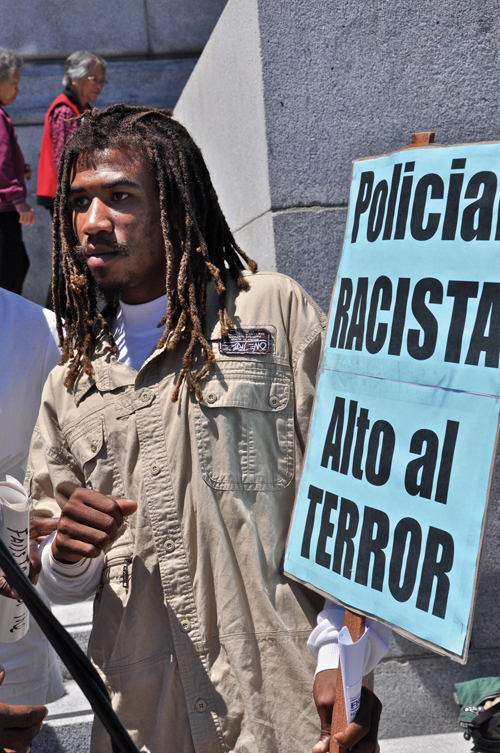
Officers from the San Francisco Police Department arrested a 21-year-old activist from Hunters Point less than 24 hours after he appeared on a public access television show where he indicted the police for a recent shooting and named officers he says have personally harassed him.
Around 4 p.m. on Saturday, July 23, Debray Carpenter, who is also known as Fly Benzo, was arrested near the intersection of Oakdale Avenue and Lane Street and booked on charges of threatening a police officer and resisting arrest. After spending almost four days in jail, the District Attorney’s Office declined to file any charges and Carpenter was released.
“If they feel like they can charge me, they would’ve,” Carpenter said after his release. “SFPD lies and that’s a fact. I just want the people to see how they lie. Just like they are lying about me, they could be lying about Kenneth Harding. Anything they say needs to be taken with a grain of salt.”
On July 16, police shot and killed Kenneth Harding Jr. while he was running from police. When officers stopped Harding at the 3rd and Oakdale Muni platform and asked him to produce a transfer, he bolted. The official story is that while he was running away, Harding pulled out a gun and fired at least one shot at police before they returned fire. Police later said the shot that killed him pierced his neck on the right side and was fired from his own gun, but some witnesses say that Harding didn’t have a gun, and many people in the community still have doubts about what happened.
Carpenter has spoken out against Harding’s death on the TV news, and he has participated in and organized protests calling for greater police accountability in the weeks following the shooting. On July 22, Carpenter appeared as the only guest on the public access program “CLAER Da Corner,” a 90-minute show hosted by Sharen Hewitt, the executive director of Community Leadership Academy & Emergency Response Project (CLAER), an anti-violence nonprofit.
During his appearance on the program, Carpenter named several SFPD officers who he claimed had harassed him in the past. He also recounted an exchange that took place a few days earlier on July 19. It was during this encounter that police say Carpenter made the criminal threat for which he was later arrested.
The police version of the incident differs significantly from the story that Carpenter shared with Hewitt on her show before his arrest.
According to Carpenter, he was with a group of people having a casual conversation with an SFPD officer as two other officers drove up and aggressively pursued a teenager for no apparent reason. When the group asked the officers about their behavior, one of the officers explained that she’s from New York, said Carpenter.
This prompted Carpenter to bring up Sean Bell, a young man who was gunned down by the NYPD, and the officer replied, “I haven’t shot anyone, yet,” according to Carpenter.
“Ya’ll bleed too. Just how we bleed, ya’ll bleed,” Carpenter shot back.
He told the host that the officer then responded by asking, “Is that a threat?”
“No, that’s a fact,” replied Carpenter. The police then drove away, he said.
But the police say that Carpenter threatened to kill one of the officers and was aggressive from the moment they arrived.
“Carpenter started yelling at them and he said, ‘White pig bitch I’m gonna put one in you,'” SFPD spokesman Lt. Troy Dangerfield told us.
“You bleed like I do. I’m gonna put one in you and show you,” Carpenter allegedly told police after being asked if his previous statement had been a threat, according to Dangerfield.
“There was a large crowd of people that began circling around the officers and they determined it was unsafe to make an arrest at the time,” Dangerfield said. “One of our rules is if you know somebody you don’t have to make an arrest right there and cause a big scene.”
The police arrested Carpenter four days later and booked him for allegedly making terrorizing threats and resisting arrest. While in jail Carpenter told his lawyer, John Hamasaki, that he didn’t know why he had been arrested and Hamasaki said at the time he wasn’t sure either.
“The arrest stinks,” Hamasaki told us. “Just an exercise of power by the police letting folks know if they speak up, they can be locked up.”
The District Attorney’s Office said that it declined to file charges because there was insufficient evidence to secure a conviction but declined to go into further detail.
“It is not uncommon for the District Attorney to drop charges that are against the police,” said Dangerfield, the police spokesman. “Unless there’s injuries, photos and things like that, they rarely want to prosecute a lot of threats against police officers, and even more resisting arrest, because they think that’s the type of business we’re in.”
“That’s bullshit,” said Hamasaki. “(Crimes against police are) the hardest things for us to negotiate to get them to come down. … The DA doesn’t want to upset the rank and file.”
Erica Derryck, a spokeswoman for the District Attorney’s Office, also disagreed with Dangerfield’s assessment.
“We take seriously any threats against San Franciscans whether they are uniformed sworn officers or members of the general public,” Derryck said. “We review every case on a case-by-case basis.”
Carpenter says he isn’t the only one being targeted for his activism in Hunters Point. Police arrested Henry Taylor, 54, as he was on his way to speak up at the July 20 town hall meeting at the Bayview Opera House in which Chief Greg Suhr’s appearance ignited pandemonium (see “Anger erupts over police shootings,” July 27).
Dangerfield said that police arrested Taylor for violating a stay-away order, but Taylor says that he isn’t under a stay-away order for that area and that police arrested him to prevent him from testifying at the town hall meeting.
No recordings are known to exist between Carpenter and the officer, just as no video recordings have revealed exactly what happened between Harding and the police on the 3rd Street Muni platform. There are several videos of the immediate aftermath, including footage of Harding writhing on the ground while police raised their weapons and denied him first aid, but apparently no video of the shooting itself. In Oakland, all officers are now issued small cameras to wear on their uniforms that record every interaction an officer has with the public. In the case of both Carpenter and Harding, such equipment would likely provide answers to what actually transpired, but Dangerfield said the SFPD has no plans to follow Oakland’s lead. “I know the chief of police has said he is looking into cameras for officers who do plain clothes assignments, and warrant arrests, and things like that. For the general patrol force, at this point, that’s not the case,” Dangerfield said. “There are some officers who do carry their own. … There’s no rule that says that can’t be done.”
Why doesn’t BART just apologize?
It’s pretty clear that people are still mad at BART for cutting off cell phone service — and that the agency is doing a miserable job of responding. The latest protest featured BART cops arresting people for nothing more than speaking out in the station, which leaves the train system in the horrible position of attacking First Amendment rights. And the protests are likely to continue, making life difficult for commuters and discouraging people from taking BART.
And it’s all so pointless.
All the anonymous protesters want is for BART to apologize and promise not to cut off cell phone service again. That seems like a really easy solution. Cutting off service was a bad idea in the first place; why not admit it, enact a policy against future disruptions and call it a day? How hard can that be? What level of arrogance is required to ignore a simple way of resolving an increasingly intractable conflict?
The BART directors, never a blue-ribbon bunch, need to get their collective act together. Because this is really stupid.
BART officer information hacked and released

UPDATE: See below for text of a conversation with an anonymous hacker who takes credit for hacking the BART police site.
Someone has hacked into a database of BART police officers held on bartpoa.com and released names, addresses, emails, and passwords for 102 BART officers.
On a Twitter feed for user @AnonyOps, which was used by the international hacking group Anonymous over the past several days to deliver an almost minute-by-minute account of the Aug. 15 downtown San Francisco BART protests, a post went up at 10:55 a.m. Aug. 17 which read, “The bartpoa.com database was just hacked and released.”
NBC Bay Area news is reporting that Anonymous was responsible for breaking into the police officer database, and that the FBI is looking into the matter. A recent report included this statement from BART:
We condemn this latest attack on the working men and women of BART. We are deeply concerned about the safety and security of our employees and their families. We stand behind them and our customers who were the subject of an earlier attack. We are deeply troubled by these actions.
However, Anonymous is not taking credit for this hack.
At 11:15 a.m., another post went up on the same feed, which read, “FYI, No one claimed responsibility for the hack. Some random joe joined a channel and released the data to the press.”
Another message was posted at 11:18: “The thing about anonymity is, you can can claim allegiance to any cause. Even if your intent is to hurt that cause. Who can prove otherwise?”
Then, at 11:21: “The leak today of BART officer data could be the work sanctioned by those who truly support anonymous, or agent provocateurs. Stay skeptical.”
UPDATE: A private chat has been posted to the website Pastebin under the title “Anonymous is not Unanimous.” One online chat occurred around 11:20 a.m. on Aug. 17 between a user identified as Lamaline_5mg, who takes credit for hacking the BART police officer’s website, and another user, n0pants, who says, “It is very important to me in all of the different work that I do not to put people at risk.” Here’s the raw text of that conversation, with dates and times:
[08/17/11 11:18] <Lamaline_5mg> I don’t want the media to know anything about the hackers.
[08/17/11 11:19] <n0pants> in what sense?
[08/17/11 11:19] <Lamaline_5mg> I am not a hacker. This is my first attack.
[08/17/11 11:19] <n0pants> ohwow
[08/17/11 11:19] <n0pants> that’s pretty newsworthy too
[08/17/11 11:19] <Lamaline_5mg> I just got pissed about what bart did and learned a lot about Microsoft SQLi.
[08/17/11 11:19] <n0pants> u cover yr ass?
[08/17/11 11:20] <Lamaline_5mg> Sure I do.
[08/17/11 11:20] <Lamaline_5mg> So, what. Is this an interview? XD
[08/17/11 11:20] <n0pants> heh
[08/17/11 11:20] <n0pants> It is very important to me in all of the different work that I do not to put people at risk
can I share that this is yr 1st attack?
[08/17/11 11:21] <Lamaline_5mg> Yet. Of course. Also, say that I encourage anybody to do the same.
[08/17/11 11:23] <n0pants> you got it. anything else you want to add?
[08/17/11 11:24] <Lamaline_5mg> This really was the easyest thing. The had 0 security.
In an earlier conversation taking place around 10:30 a.m., when Lamaline_5mg links to the file containing the police officer information, the hacker encounters resistance from users who are identified by the person who posts it as being part of the Anonymous team that carried out #opBART. “We are not interested in any thing like that,” someone with the user name OpNoPro says. “Please refrain from dropping anybody’s private information anywhere on anonymous’s behalf… not interested in breaching somebody’s privacy… they have a right to it as much as you do.” The same user notes, “Keep the operations separate.”
After ordering phones censored, BART spokesperson took vacation during protest
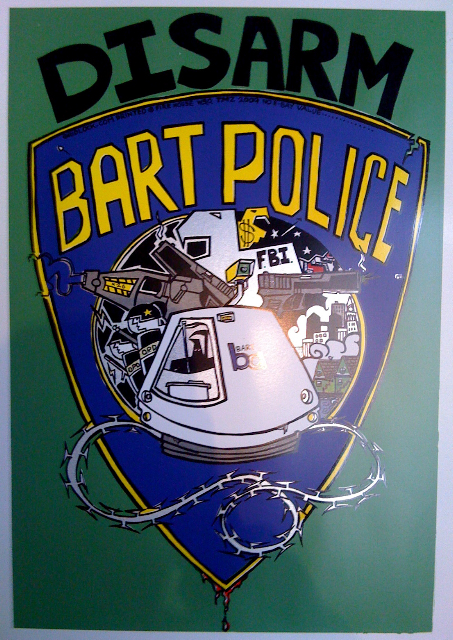
On August 16, one day after a transit system disruption caused by protests over BART’s unprecedented decision to temporary cut cellular phone during a previous protest, BART Chief Communications Officer Linton Johnson acknowledged to the press that the idea to cut service had been his from the start.
Johnson defended his decision telling the San Francisco Chronicle, “A 1969 U.S. Supreme Court decision, in the Brandenburg v. Ohio case, allows public agencies to put public safety before free speech when there is an imminent danger to the public.”
But was there an imminent danger?
What Johnson failed to acknowledge was that after his idea to order a unprecedented disruption of cellular service to thwart the protest anticipated on August 11 was vetted by BART police, Johnson went on vacation and wasn’t around to help determine what kind of danger the protest – which didn’t end of happening – may have posed. NOTE THE UPDATE BELOW. JOHNSON CLAIMS HE WAS MONITORING THE STATIONS.
In fact, Johnson left on vacation on August 11, the same day the fizzled protest that started a national controversy occurred. So with BART’s plan in motion, and Johnson apparently not on hand, nothing of note happened. No indication was reported by BART or by the media of any trouble at all breaking out on the platforms or paid areas of BART stations on August 11. BART may have been left holding the bag.
An automatically generated e-mail response to the Guardian’s request to interview Johnson read “I will be out of the office starting 08/11/2011 and will not return until 08/16/2011. Please contact Deputy Chief Communications Officer Jim Allison while I am gone.”
On August 15, Johnson’s voicemail message indicated he had returned from vacation early, and would do his best to field phone interview requests within 20 minutes of receiving them.
August 15 happened to be the day that fallout from his plan lead to evening rush hour transit disruptions by protesters with swarms of national and international news representatives on hand. Though interviewed by the nation’s press corp, Johnson chose not to acknowledge the primacy of his decision making role in the censorship until the following day.
Comparing the “imminent danger,” declared by BART, and the #opBART protest called by international hacker group Anonymous on August 15 that caused all Downtown San Francisco BART stations to close for the evening rush, questions arise over what, if any, criteria Johnson used in deciding to pull or not pull the plug on BART cell service.
The Federal Communications Commissions has launched an investigation into BART’s actions, responding to a call by California State Senator Leland Yee.
“We are continuing to collect information about BART’s actions,” stated FCC spokesperson Neil Grace in a statement issued by the agency. “(We) will be taking steps to hear from stakeholders about the important issues those actions raised, including protecting public safety and ensuring the availability of communications networks.”
UPDATE: Johnson finally got back to us by email and wrote, “I offered up the idea on Thursday morning. BART PD took it to the Interim GM. The GM approved it then let the Board of Directors know what was to happen that night. I was on scene in case the protest broke out. I left downtown SF around 8pm – I was on a plane that night, which left at 11:50pm.”