protests

Editor’s notes

0

tredmond@sfbg.com

I really can’t get that upset about the broken bank windows in Oakland. This is minor stuff, a tiny part of what has been largely a peaceful Occupy movement. The windows have been replaced, the banks and their insurance companies have paid for it, the Occupy people helped clean up … whatever.

The problem was that the folks who went a bit Seattle ’99 on Oakland weren’t thinking too clearly — or else they didn’t care about the differences between then and now, and here and there, and why property destruction in downtown Oakland in the fall of 2011 is a bad strategic idea.

There are always folks at a big Bay Area demonstration who want to cause some mayhem. It happened during the protests against the Iraq War, and it happened during the Oscar Grant protests, and I figured it would happen when thousands of people convenened in the East Bay for what was dubbed a general strike. Sometimes it’s spontaneous anger (see: Oscar Grant), and it’s hard to argue with; sometimes it’s sparked by police riots and violence, and while it’s hard to blame protesters for fighting back.

I’m not here to attack the black bloc or denounce anarchists or get into the whole battle over whether property destruction counts as violence. Been there, done that, got the circle-A t-shirt. I just want the Occupy movement, in Oakland and San Francisco and the rest of the country, to continue to grow and develop and become an agent of real change in a way that we haven’t seen in decades. The potential is there; this could really happen.

And that requires not just debate and discussion and theory and action; it requires political strategy.

I’m not talking about turning the refreshingly leaderless and nonhierarchical, consensus-based structure into something more traditional. I’m talking about the protesters considering the way their actions are portrayed in the news media, their ability to build crucial alliances — and frankly, their willingness to be good neighbors.

Folks: You now live in downtown Oakland and downtown San Francisco. You’ve turned empty public spaces into lively, exciting communities. That’s a positive thing.

There are other people who share downtown Oakland, and some of them are evil corporations but some are small local businesses who are hurting, just like the rest of the 99 percent. So make alliances, shop local, and don’t trash the place. That’s just smart politics.

Powerful, mostly peaceful Oakland action ends badly

19

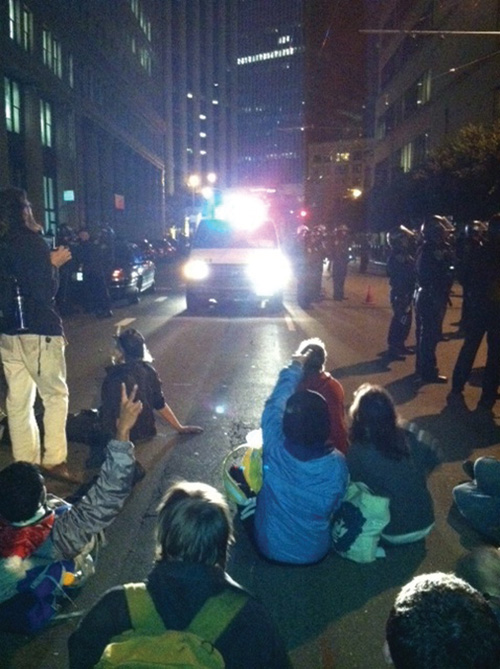
After a long day of mostly peaceful demonstrations by thousands of protesters who joined OccupyOakland’s General Strike and Day of Action yesterday, it’s still unclear why the Oakland Police – which had stood down the entire day, leaving the movement to self-police – massed in riot gear around midnight and used tear gas and other projectiles to clear the streets and make a reported 80 arrests.

Spokespersons for the Oakland Police Department and Mayor Jean Quan haven’t returned Guardian phone calls, and reports in the Oakland Tribune and other media outlets don’t indicate exactly what prompted police to change tactics and aggressively confront the demonstration. Protesters had taken over a vacant building and erected barricades in the streets shortly before riot police showed up, and it appears from a Tribune video that a dumpster was set on fire after the police showed up.

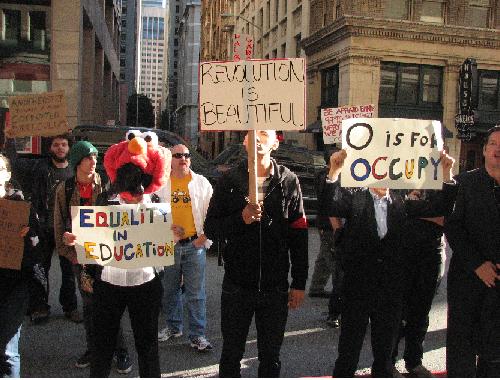
Before the standoff between city officials and demonstrators in Oakland again took a violent turn, the day was notable for its lack of police presence around the occupied Oscar Grant Plaza and nearby 14th and Broadway epicenter. And despite a small number of masked agitators who broke bank windows and sprayed graffiti – much to the chagrin of most protesters who actively opposed such tactics – the movement was remarkably nonviolent and self-policing, particularly given a crowd of what seemed to be around 10,000 people at its peak. Protesters even handled traffic control, using a megaphone to help motorists through intersections congested with passing demonstrators.

“This is an extraordinarily peaceful collection of diverse people,” Sen. Loni Hancock (D-Oakland) told the Guardian just after 5 pm as a massive march left the encampment to shut down the Port of Oakland. “I feel like they’re doing what no elected person can do: they’re putting economic equity issues in front of the American people.”

“This is beautiful and powerful. This I love,” agreed Oakland City Council member Libby Schaaf, beaming as the peaceful march took off, although she told us that she was disappointed to see Oakland businesses vandalized, including her beloved Noah’s Bagels. “Fight greed, not bagels.”

Most of the crowd condemned the violence, and many openly worried that it would undercut the positive demonstration of people power and the airing of frustration with economic injustices in the country. But even Hancock said a few bad apples shouldn’t spoil people’s understanding of what an important day it was.

“I’m very grateful to them for calling attention to economic inequality. It is in the interests of cities that this issue take center stage,” Hancock told us. “There are so many things that have been talked about that are now on the stage and it’s a very important conversation to have.”

But many in the movement were disappointed nonetheless, despite the myriad successes in shutting down business nonviolently. Around 3 pm, a crowd of thousands marched past a Chase Bank at 20th and Berkeley streets where the front window had been shattered, as was the case with at least six other businesses. Taped to the windows were signs reading “We are better than this” and “This is not the 99%. Sorry, the 99%”.

As the huge crowd repeatedly chanted “peaceful protest,” Ryan, a 31-year-old Oakland resident, expressed his frustration over vandalism he blamed on out-of-town instigators. “People from Oakland would not damage their city like that,” he told me. “Last week was beautiful, we were dancing and singing in the streets,” he said, referring to the largely nonviolent response to police violence, “but this is bullshit.”

Large protests almost always have members who want to escalate the conflict and who see breaking windows as a legitimate tactic, and yesterday there were sometimes tense conflicts between protesters who disagreed on the issue. Another complex issue is how to now view Oakland Mayor Jean Quan, whose support for last week’s violent police crackdown prompted calls for her recall or resignation, although her subsequent apology, the re-encampment of Frank Ogawa Plaza, and yesterday’s police stand down caused some to rethink whether to actively oppose her.

“My goal for today is to spur the international movement forward and to show what we’re capable of,” said 23-year-old Iris Brilliant, who got more actively involved in OccupyOakland after the crackdown and said she was happy to see the police kept at bay. “It’s important to push this forward.”

But Tania Kappner, a 41-year-old teacher from Oakland, still hadn’t forgiven Quan or the police for the violent excesses in last week’s raid. She was camped out in Oscar Grant Plaza in a tent with the sign “Mayor Quan Must Go!”

“It’s good she’s not sending them in on us today, but she never should have done it in the first place,” Kappner told us. “We’re calling for her to go and the police who did it to be jailed.”

With the decision to again unleash the riot police and tear gas and arrest big numbers of people – which was the very thing that prompted such huge numbers of people to turn out yesterday, giving OccupyOakland the numbers and power to easily shut down the port and dozens of businesses – Oakland and the larger Occupy movement might again find itself back at square one.

The National Lawyer’s Guild, which had observers on hand to witness the late-night police crackdown, issued a statement today condemning the city’s actions and saying they violate a crowd control police the NLG helped the city write to settle lawsuits stemming from the OPD’s use of rubber bullets to clear anti-war protesters from the Port of Oakland back in 2003.

“Like we saw last Tuesday, the OPD actions in the late night hours violated numerous provisions of the Crowd Control Policy and the Constitutional rights of activists,” explained NLG’s San Francisco Bay Area chapter president Michael Flynn. “Our legal observers did not disobey any police orders and neither did many of the other arrestees.”
“The Crowd Control Policy clearly prohibits shooting munitions into a crowd,” added NLG attorney Rachel Lederman. “While the police are allowed to use tear gas, they are supposed to use a minimum amount and only where other crowd control tactics have failed.  It is not at all clear that less violent and less provocative measures would not have sufficed to achieve any legitimate law enforcement objectives last night.”

Meanwhile, in San Francisco, Mayor Ed Lee has reportedly assured OccupySF that he won’t follow through on threats to raid the camp if tents aren’t removed, at least not anytime soon (many observers speculate that he’ll at least wait until after next week’s mayoral election). But Lee has been unwilling to make a clear public statement that raids are now off the table.

When we sought to clarify Lee’s position and get his reaction to a Board of Supervisors resolution calling for the city to allow a 24/7 encampment, his Press Secretary Christine Falvey wrote: “The mayor has not focused on the resolution, but has been focusing on meeting with clergy, labor, occupysf demonstrators and his department heads to make sure that the site is kept clean, safe and accessible for everyone. He remains concerned about overnight camping and the public health and safety issues that brings. That said, he has seen some good progress over the last few days because of his open communication with the group. DPW cleaned up the site over the weekend and the demonstrators helped facilitate the cleanup. Tents were moved off the Bocce Ball Court as well. The group is working with Fire and Public Health officials to make some improvements. The dialogue is ongoing.”

Photos by Steven T. Jones

Leave the occupiers alone

0

EDITORIAL With all of the police raids and arguments over messages and demands and tactics, it’s easy to forget that the Occupy Wall Street movement has a clear political point — and it’s right.

The movement is about the devastating and unsustainable direction of the American economy, about the fact that a tiny elite controls much of the nation’s wealth, that virtually all of the income growth over the past 20 years has gone to the very top, about the collapse of the middle class and the rise of economic inequality that would have been unthinkable a generation ago. Those are the central issues facing the United States, the state of California and the cities of San Francisco and Oakland today — and instead of trying to crack down on the protests, city officials ought to be endorsing the occupy movement and talking about cracking down on the financial institutions and the wealthy.

A few things worth noting:

1. The protesters are almost entirely nonviolent. Although there have been a few isolated incidents in Oakland and SF, the overwhelming majority of the thousands of people at Justin Herman Plaza and Frank Ogawa Plaza are actively promoting and insisting on nonviolence. This is not a crowd that is a threat to anyone.

2. There’s a precedent for long-term political protest camps in San Francisco. The AIDS Vigil remained at U.N. Plaza — with tents, tarps, and cooking gear — for ten years, from 1985 to 1995.

3. The city of San Francisco’s citations — reported without question in the daily newspapers — about health and sanitation problems are way overblown. The OccupySF protesters are making extraordinary efforts to keep the place clean. When the city failed to live up to its promise to provide portable toilets, the protesters ordered (and paid for) their own. As state Sen. Leland Yee (not known as a crazy radical) noted after a visit Oct. 26: “While hundreds gathered, there was not one incident of violence. If the interim mayor thinks there are health issues, I certainly didn’t see them.” We visited Oct 31, and the place was clean and peaceful.

4. The cat-and-mouse game with the San Francisco police is the equivalent of psychological warfare; protesters have to be on edge at all times for fear of a crackdown that may or may not come.

5. Mayor Jean Quan made a bad mistake sending in the cops to roust Occupy Oakland. Nothing good at all can come of any further police eviction action.

Frankly, we don’t see why the protesters — who are well-behaved, represent no threat to anyone, and are doing a huge civic and national service by bringing attention to an issue that the powers that be in Washington, Sacramento and (sadly) San Francisco have largely ignored — can’t stay where they are. If there are health issues, let the Department of Public Health work with the occupiers. If there’s a problem with a portable kitchen, let the Fire Department show the protesters how to run it safely and legally (there are portable cooking devices at every street fair, in dozens of food trucks and in probably 100 other places around town).

The people at OccupySF and Occupy Oakland have done an amazing job of building a safe, respectful and inclusive community. They are the political heros of 2011. If there’s anyplace in America where the movement ought to be allowed to grow and thrive, it’s here in the Bay Area.

Editor’s notes

0

tredmond@sfbg.com

One cool October day in 1985, when I was a young reporter at the Guardian, a friend who was visiting from New York where she was working with Gay Men’s Health Crisis, called me with an urgent message:

City employees were out with water hoses, trying to force a couple of HIV-positive men from camping in front of a federal office building at U.N. Plaza. I ran down there; she had photos. I talked to the men, who were tired and wet, but determined not to leave — and within a few days after my story ran (“AIDS vigil under attack,” 11/6/85), they were joined by dozens more.

And as the months passed, the AIDS vigil grew and grew. It raised awareness of the federal government’s criminal lack of attention to the epidemic. It became a tent city, a small community in the middle of San Francisco with donated food and supplies. Every once in a while, a politician or a media celebrity would spend a night there.

The feds backed off with the hoses and the city figured out that the encampment was no danger to anyone and was making an important political statement. And it remained there — with tents and tarps — for ten years.

I was at the OccupySF camp Oct. 3rd to do a live KPFA broadcast with Mitch Jeserich, and the place was clean, peaceful and well-organized. A couple of cops walked through while we were on the air; they were smiling and chatting with the protesters, who were negotiation with the Department of Public Works about vacating the grassy areas to allow watering. I saw none of the filth that the daily newspapers have talked about.

The only real health and safety problem was the lack of portable toilets — the seven on site weren’t enough for the number of people there. So if the city wants to keep things sanitary, Mayor Ed Lee ought to send in some more. Oh, and the medical tent needs supplies, particularly ice packs and sterile gauze.

A woman from Occupy Vancouver was down visiting and showing solidarity; she said that protesters all over the continent were looking to San Francisco and Oakland for inspiration.

This is a good thing. The protests may not have an agenda, but they have a message, and it’s getting to big and too loud to ignore. I hope it doesn’t take ten years for politicians at the local, state and federal level to respond — but as long as nobody’s addressing economic inequality, OccupySF is and ought to be here to stay.

Guardian editorial: Leave the occupiers alone!

2


As the world watches, San Francisco and Oakland should set the standard by supporting  Occupy San Francisco and Occupy Oakland and supporting  their goals and peaceful tactics.  B3

 With all of the police raids and arguments over messages and demands and tactics, it’s easy to forget that the Occupy Wall Street movement has a clear political point — and it’s right.

The movement is about the devastating and unsustainable direction of the American economy, about the fact that a tiny elite controls much of the nation’s wealth, that virtually all of the income growth over the past 20 years has gone to the very top, about the collapse of the middle class and the rise of economic inequality that would have been unthinkable a generation ago. Those are the central issues facing the United States, the state of California and the cities of San Francisco and Oakland today — and instead of trying to crack down on the protests, city officials ought to be endorsing the occupy movement and talking about cracking down on the financial institutions and the wealthy.

A few things worth noting:

1. The protesters are almost entirely nonviolent. Although there have been a few isolated incidents in Oakland and SF, the overwhelming majority of the thousands of people at Justin Herman Plaza and Frank Ogawa Plaza are actively promoting and insisting on nonviolence. This is not a crowd that is a threat to anyone.

2. There’s a precedent for long-term political protest camps in San Francisco. The AIDS Vigil remained at U.N. Plaza — with tents, tarps, and cooking gear — for ten years, from 1985 to 1995.

3. The city of San Francisco’s citations — reported without question in the daily newspapers — about health and sanitation problems are way overblown. The OccupySF protesters are making extraordinary efforts to keep the place clean. When the city failed to live up to its promise to provide portable toilets, the protesters ordered (and paid for) their own. As state Sen. Leland Yee (not known as a crazy radical) noted after a visit Oct. 26: “While hundreds gathered, there was not one incident of violence. If the interim mayor thinks there are health issues, I certainly didn’t see them.” We visited Oct 31, and the place was clean and peaceful.

4. The cat-and-mouse game with the San Francisco police is the equivalent of psychological warfare; protesters have to be on edge at all times for fear of a crackdown that may or may not come.

5. Mayor Jean Quan made a bad mistake sending in the cops to roust Occupy Oakland. Nothing good at all can come of any further police eviction action.

Frankly, we don’t see why the protesters — who are well-behaved, represent no threat to anyone, and are doing a huge civic and national service by bringing attention to an issue that the powers that be in Washington, Sacramento and (sadly) San Francisco have largely ignored — can’t stay where they are. If there are health issues, let the Department of Public Health work with the occupiers. If there’s a problem with a portable kitchen, let the Fire Department show the protesters how to run it safely and legally (there are portable cooking devices at every street fair, in dozens of food trucks and in probably 100 other places around town).

The people at OccupySF and Occupy Oakland have done an amazing job of building a safe, respectful and inclusive community. They are the political heroes of 2011. If there’s anyplace in America where the movement ought to be allowed to grow and thrive, it’s here in the Bay Area.


Guardian editorial: Let OccupySF and Oakland stay

5

With all of the police raids and arguments over messages and demands and tactics, it’s easy to forget that the Occupy Wall Street movement has a clear political point — and it’s right.The movement is about the devastating and unsustainable direction of the American economy, about the fact that a tiny elite controls much of the nation’s wealth, that virtually all of the income growth over the past 20 years has gone to the very top, about the collapse of the middle class and the rise of economic inequality that would have been unthinkable a generation ago. Those are the central issues facing the United States, the state of California and the cities of San Francisco and Oakland today — and instead of trying to crack down on the protests, city officials ought to be endorsing the occupy movement and talking about cracking down on the financial institutions and the wealthy.

A few things worth noting:

1. The protesters are almost entirely nonviolent. Although there have been a few isolated incidents in Oakland and SF, the overwhelming majority of the thousands of people at Justin Herman Plaza and Frank Ogawa Plaza are actively promoting and insisting on nonviolence. This is not a crowd that is a threat to anyone.

2. The city of San Francisco’s citations — reported without question in the daily newspapers — about health and sanitation problems are way overblown. The OccupySF protesters are making extraordinary efforts to keep the place clean. When the city failed to live up to its promise to provide portable toilets, the protesters ordered (and paid for) their own. As state Sen. Leland Yee (not known as a crazy radical) noted after a visit Oct. 26: “While hundreds gathered, there was not one incident of violence. If the interim mayor thinks there are health issues, I certainly didn’t see them.”

3. The SF Mayor’s Office and the police have made no serious effort to work with or negotiate with the protesters. Even the five supervisors who arrived Oct. 26 (and good for them) when there were rumors of a police action, had no idea what the cops were up to — and Police Chief Greg Suhr wasn’t responding to their phone calls. It’s the equivalent of psychological warfare; protesters have to be on edge at all times for fear of a crackdown that may or may not come.

4. Mayor Jean Quan made a bad mistake sending in the cops to roust Occupy Oakland. Nothing good at all can come of any further police eviction action.

Frankly, we don’t see why the protesters — who are well-behaved, represent no threat to anyone, and are doing a huge civic and national service by bringing attention to an issue that the powers that be in Washington, Sacramento and (sadly) San Francisco have largely ignored — can’t stay where they are. If there are health issues, let the Department of Public Health work with the occupiers. If there’s a problem with a portable kitchen, let the Fire Department show the protesters how to run it safely and legally (there are portable cooking devices at every street fair, in dozens of food trucks and in probably 100 other places around town).

The people at OccupySF and Occupy Oakland have done an amazing job of building a safe, respectful and inclusive community. They are the political heros of 2011. If there’s anyplace in America where the movement ought to be allowed to grow and thrive, it’s here in the Bay Area.

Guardian editorial: Let OccupySF and Oakland stay

18

With all of the police raids and arguments over messages and demands and tactics, it’s easy to forget that the Occupy Wall Street movement has a clear political point — and it’s right.

The movement is about the devastating and unsustainable direction of the American economy, about the fact that a tiny elite controls much of the nation’s wealth, that virtually all of the income growth over the past 20 years has gone to the very top, about the collapse of the middle class and the rise of economic inequality that would have been unthinkable a generation ago. Those are the central issues facing the United States, the state of California and the cities of San Francisco and Oakland today — and instead of trying to crack down on the protests, city officials ought to be endorsing the occupy movement and talking about cracking down on the financial institutions and the wealthy.

A few things worth noting:

1. The protesters are almost entirely nonviolent. Although there have been a few isolated incidents in Oakland and SF, the overwhelming majority of the thousands of people at Justin Herman Plaza and Frank Ogawa Plaza are actively promoting and insisting on nonviolence. This is not a crowd that is a threat to anyone.

2. The city of San Francisco’s citations — reported without question in the daily newspapers — about health and sanitation problems are way overblown. The OccupySF protesters are making extraordinary efforts to keep the place clean. When the city failed to live up to its promise to provide portable toilets, the protesters ordered (and paid for) their own. As state Sen. Leland Yee (not known as a crazy radical) noted after a visit Oct. 26: “While hundreds gathered, there was not one incident of violence. If the interim mayor thinks there are health issues, I certainly didn’t see them.”

3. The SF Mayor’s Office and the police have made no serious effort to work with or negotiate with the protesters. Even the five supervisors who arrived Oct. 26 (and good for them) when there were rumors of a police action, had no idea what the cops were up to — and Police Chief Greg Suhr wasn’t responding to their phone calls. It’s the equivalent of psychological warfare; protesters have to be on edge at all times for fear of a crackdown that may or may not come.

4. Mayor Jean Quan made a bad mistake sending in the cops to roust Occupy Oakland. Nothing good at all can come of any further police eviction action.

Frankly, we don’t see why the protesters — who are well-behaved, represent no threat to anyone, and are doing a huge civic and national service by bringing attention to an issue that the powers that be in Washington, Sacramento and (sadly) San Francisco have largely ignored — can’t stay where they are. If there are health issues, let the Department of Public Health work with the occupiers. If there’s a problem with a portable kitchen, let the Fire Department show the protesters how to run it safely and legally (there are portable cooking devices at every street fair, in dozens of food trucks and in probably 100 other places around town).

The people at OccupySF and Occupy Oakland have done an amazing job of building a safe, respectful and inclusive community. They are the political heros of 2011. If there’s anyplace in America where the movement ought to be allowed to grow and thrive, it’s here in the Bay Area.
 

Alerts

0

alert@sfbg.com

Editor’s Note: Protests and other events connected to the Occupy Wall Street movement, include OccupySF and Occupy Oakland, have been developing quickly. To take part, follow our Politics blog or check with the websites associated with this important economic justice movement: occupysf.com, occupyoakland.org, or occupytogether.org. And you can send tips about what’s happening to news@sfbg.com.

WEDNESDAY 26

San Francisco’s budget crisis

Youth from the Bay Area Urban Debate League opine on solving the budget crisis in San Francisco. These electrifying young orators seek to engage the community in conversation and share their research about the current economic atmosphere.

6 p.m., free

SFUSD Board Room

555 Franklin St, 1st Floor

www.baudl.org


THURSDAY 27

Progressive prospects in fall election

Bay Guardian Executive Editor Tim Redmond holds a talk on how the upcoming election will effect the progressive community. Join in discussion, sponsored by Progressive Democrats of America, and ask questions regarding mayoral candidates and city politics.

7-9pm, free

Unitarian Universalist Center, Martin Luther King Room

1187 Franklin, SF

TGTGTGTGTG@aol.com

www.pdamerica.org


FRIDAY 28

White Picket Fences Reception

This multi-media visual and performance art exhibit highlights queer perspectives on the family unit and reflections of contemporary marriage and relationships. Artists like Midori, Monica Canilao, Harrison Bartlett, Mev Luna, Amelia Reiff Hill and Madison Young conjure dialogue in and out of the LGBT community on the dynamics of progressive life. This family oriented event is open to all ages and will be catered with food, wine and performances of featured artists.

7:30-10 p.m.

Michelle O’Connor Gallery

2111 Mission, SF

www.feminapotens.org


SUNDAY 30

Organize and fight back

The Party for Socialism and Revolution is holding its NorCal Regional Conference, with discussions on how big corporations avoid taxes, endless U.S. Wars, the cost of higher education, the prospects for capitalism and socialism, and other topics.

10 a.m.-5 p.m., $7-10

2969 Mission, SF

(415) 821-6171

sf@pwlweb.org


Making Democracy Work

Celebrate 17 years of social justice service with keynote speakers Rep. Andre Carson (D-IN) and Imam Siraj Wahhaj, religious director of At-Taqwa Mosque in NY, at a dinner banquet. This fundraiser supports the Council on American-Islamic Relations, the largest Islamic grassroots civil rights and advocacy group in the country.

5-10 p.m.

Santa Clara Marriott

2700 Mission College, Santa Clara

(408) 986-9874

www.ca.cair.com/sfba/event/17thannualbanquet


Mail items for Alerts to the Guardian Building, 135 Mississippi St., SF, CA 94107; fax to (415) 437-3658; or e-mail alert@sfbg.com. Please include a contact telephone number. Items must be received at least one week prior to the publication date.

Avalos offers resolution supporting OccupySF and its camp

57

In the wake of last night’s violent police raid on the Occupy Oakland encampment (a still-tense situation that we’re now on the scene covering) and two similar late-night police crackdowns on OccupySF in recent weeks, Sup. John Avalos and co-sponsors Eric Mar and David Campos are introducing a resolution at today’s San Francisco Board of Supervisors meeting that calls for the city to explicitly allow the OccupySF encampment and its related infrastructure to remain.

That resolution (the full text follows below), which Avalos legislative aide Raquel Redondiez says will be the subject of a special hearing on Monday before being considered by the full board on Tuesday, Nov. 1, grew out of testimony from OccupySF participants that Avalos solicited at last week’s board meeting following a late night police raid on Oct. 16 that resulted in five arrests and many injuries.

As we report in this week’s paper (see “Mixed messages,” to be posted this evening, Tues/25), at that Oct. 18 board meeting, Mayor Ed Lee took the position that no tents, kitchens, or other infrastructure would be permitted, a stance that Police Chief Greg Suhr seemed to soften slightly at a raucous Police Commission hearing the next day. In the face of those mixed messages, OccupySF grew into a full-blown tent city in Justin Herman Plaza and there have been no real conflicts with police since.

Both the San Francisco Police Department and the Mayor’s Office were slow to respond to messages we left all week seeking to clarify the city’s policy toward OccupySF, but both finally got back to us last night after the article had gone to press.

SFPD spokesperson Daryl Fong told us, “We’re still currently doing daily safety inspections at Justin Herman Plaza and continuing to provide leafletting…We’re educating the campers about violations and concerns for public safety,” such as unsanitary conditions or unsafe camping structures.

But he said OccupySF hasn’t been given any deadlines for removing structures and there are no current plans for another raid. “Our goal is to get compliance from the campers voluntarily,” he said. “This situation is being continually monitored as it progresses.”

When we asked the Mayor’s Office about the contradiction being Lee’s stance and the city’s reaction to the growing tent city, Press Secretary Christine Falvey wrote, “The mayor’s position on Occupy SF has not changed. He has directed his departments to facilitate peaceful protest, but not allow structures, tents, or a permanent campsite. He wants to ensure the area is safe for demonstrators and the general public. If you have been to the site, you may have seen the Fire and Public Health Departments conducting inspections for public health and safety concerns and you may have seen Recreation and Park and Police staff informing people of the parks and public safety codes that prohibit camping equipment. Individuals are being informed daily of this and the city’s Homeless Outreach Team is offering services to anyone in the area who may need it. The policy stands and departments are educating the group about what is and is not allowed and the mayor expects those who want to use the space to protest, to follow the rules.”

But OccupySF protesters say they have no intention of leaving the space, believing it’s their right to be there as part of a national movement spotlighting the greed and corruption of the wealthiest 1 percent of Americans. And when I told Falvey that the encampment seems to defy the mayor’s stated position, she wrote, “The mayor has asked several departments to enforce the existing codes, and I understand a number of informational contacts have gone out daily to educate those using the plaza about what is allowable in addition to Fire and Public Health inspections to make sure open flames or dangerous materials are not being used or stored at the site.”

I told her that didn’t address my question, and I asked for a reaction to the Avalos legislation that would explicitly allow “tents, tarps, First Aid supplies, environmentally clean and fire-safe energy sources, and the ability to store, prepare, and serve hot food,” which is the reality now on the ground. I’ll update this post when I get a response.

In the meantime, here’s the full text of the resolution:

[Expressing Support for Occupy Wall Street Protest Movement and the People’s Right to Peaceful Assembly in San Francisco]

Resolution Supporting the Occupy Wall Street Protest Movement and Urging Mayor Lee to Uphold People’s Right to Peaceful Assembly and Collaborate with Occupy SF to Ensure Safety of the Protestors, their Supporters, and the Greater Public.

WHEREAS, “Occupy Wall Street” was formed by a broad spectrum of people coming together to protest the corporate-serving economic and political system controlled by the 1 percent, profiting at the expense of 99 percent of the people; and

WHEREAS, Three years after the current financial crisis caused by Wall Street speculators and profiteers, the unemployment rate in the United States is still at the highest level since the Great Depression with the unemployment rate in San Francisco currently at 8.3 percent; and,

WHEREAS, The United States’ major banking institutions, which have been bailed-out by the government and United States taxpayers, have done little to prevent massive foreclosure of residential properties or support the revitalization of local economies by sustaining small businesses; and,

WHEREAS, Since 2008, there have been 1.2 million foreclosures in California, with 12,410 homes in San Francisco alone; and,

WHEREAS, The “Occupy Wall Street” protest movement has struck a chord with the people of the United States and around the world, inspiring over 900 similar protests and solidarity actions across the country, where tens of thousands of people have come out to express their deep indignation against Wall Street greed and systemic socio-economic injustices; and,

WHEREAS, The “Occupy” demonstrations are a rapidly growing movement of people from all walks of life with the goal of occupying public space in order to create a shared dialogue and assert demands for economic justice; and,

WHEREAS, The “Occupy” demonstrations have been supported by the California Nurses Association/ National Nurses Association, American Federation of Labor -Congress of Industrial Organizations, Change to Win, International Longshore and Warehouse Union-International, Teamsters Joint Council 7, Services Employees International Union, Laborers International Union of North America, and many others; and,

WHEREAS, The OccupySF demonstrations began in September with small gatherings of people and have since grown and gained supported from thousands of individuals, community and faith-based organizations, and unions; and,

WHEREAS, On October 12, a 500-person march and civil disobedience organized by local community groups received national media attention, exposing the struggles of San Francisco residents against foreclosure, corporate control, and spiraling unemployment; and,

WHEREAS, The October march and protest action culminated in civil disobedience and, despite the arrest of 11 people, lacked any antagonistic conflict between the police and protestors; and,

WHEREAS, Similar to demonstrations in hundreds of cities across the United States, OccupySF demonstrators are asserting their rights to free speech and peaceful assembly 24 hours a day, seven days a week, in order to create public dialogue around corporate control of the political process and public space; and,

WHEREAS, Numerous and various groups continue to join the protesters at OccupySF, including an interfaith clergy contingent and the California Nurses Association, which has set up a First Aid tent to support the protestors and help ensure public safety; and,

WHEREAS, The City of San Francisco has a right and duty to ensure the safety and security of the general public including the protestors and their supporters; and,

WHEREAS, Since the beginning of the protest, City actions have resulted in the confiscation of food, tents, sleeping bags, and other belongings from the OccupySF demonstrators as well as causing preventable injuries and arrests; and,

WHEREAS, The City has a lengthy and proud history of political protest and has upheld the rights of people to free speech, freedom of assembly, and peaceful protest; and,

WHEREAS, With clear leadership from the Mayor, City departments can set a tone of cooperation and collaboration with OccupySF protestors and supporters, help mitigate harm, and address any public safety, health and sanitation concerns, all while avoiding unnecessary conflict; now, therefore, be it

RESOLVED, That the Board of Supervisors supports the Occupy Wall Street protest movement and the rights of all who protest to assemble peacefully and enjoy free speech in the City and County of San Francisco; and, be it

FURTHER RESOLVED, That the Board of Supervisors recognizes that Free Speech and Freedom of Assembly should not be limited to daytime nor short-term activities and we deem the need of protesters to have tents, tarps, First Aid supplies, environmentally clean and fire-safe energy sources, and the ability to store, prepare, and serve hot food reasonable; and, be it

FURTHER RESOLVED, That the Board of Supervisors urges the Mayor, the Police Department, and other City agencies to uphold the rights of protestors to political speech and public assembly, and to recognize that the full exercise of such rights requires that participants are able to attend to the needs of everyday life, and have a space free from harassment; and, be it

FURTHER RESOLVED, That the Board of Supervisors urges Mayor Ed Lee to direct the Recreation and Park Department, the Department of Public Works, the Police Department, and other City agencies, as relevant, to be flexible and to collaborate with protestors for the safe sharing of public spaces, in which demonstrators can exercise their political rights and the City can address legitimate safety concerns while avoiding unnecessary antagonism; and, be it

FURTHER RESOLVED, That the Board of Supervisors urges Mayor Ed Lee, in order to prevent further harm and conflict to any members of the public, including protestors of OccupySF, to direct the Police Department to ensure that there will be no use of force to dislodge the OccupySF demonstrators and confiscate their belongings.

WTF, Chuck?

18

And now for a new installment in the ongoing saga of What the Fuck, Chuck?, our attempt to figure out the unfathomable positions of the Chron’s local columnist, C.W. Nevius. Today’s episode: Why is Nevius so determined to stir up a clash between the police and the OccupySF protesters?

Although the Oakland cops have rousted Occupy Oakland — with a nightime raid, arrests, and the works — things have been pretty mellow in San Francisco for the past week. Police Chief Greg Suhr has tried to avoid sending riot troops in to evict the camp. The campers are working with city officials to get a permit for a stove. The camp is largely peaceful; nobody’s hurting anyone or anything.

Oh, but Chuck is nervous:

Many of the city’s homeless residents have gravitated there, the sanitation is a nightmare, there are rats, and car batteries are neither a safe nor ecological energy source.

Well, there were rats there before the protesters arrived. City officials have offered to set up portable toilets. Car batteries aren’t perfect, but if you charge them by riding a stationary bicycle, the energy is pretty darn ecological. And really, unless you knock the battery over and it cracks and spills, car batteries are pretty safe; the don’t explode or emit fumes. The acid and lead are toxic, but they’re pretty well contained. There are more than 300,000 car batteries on the streets of San Francisco already; every car has one.

And so what if “many of the the city’s homeless residents” have gone to join the protests? Some are eager for the free food and shelter, which is fine — putting the more middle-class radicals side by side with homeless people isn’t a bad thing at all. In fact, it’s about the most radical thing that OccupySF is doing. Homeless people are the most visible victims of the economic injustict that the occupyers are protesting; shouldn’t they be part of the action?

I realize that some homeless people have mental health and substance abuse issues, but those didn’t start with OccupySF. Instead of whining about the situation, the city ought to be taking advantage of it — here’s a group of hard-to-reach folks who social workers can probably connect with more easily in an environment and community that’s supportive.

But Nevius can’t imagine anything good coming of any of this:

As Occupy SF gets bigger and louder, the potential for trouble only increases.

I guess Nevius doesn’t believe it’s possible for an alternative community that includes a wide range of activists and homeless people to grow and make its voice heard without “trouble.” And the only way out is to send in the troops.

What the Fuck, Chuck?


SFPD allows OccupySF to grow into a tent city

14

Photos by Steven T. Jones, who also contributed to this report.

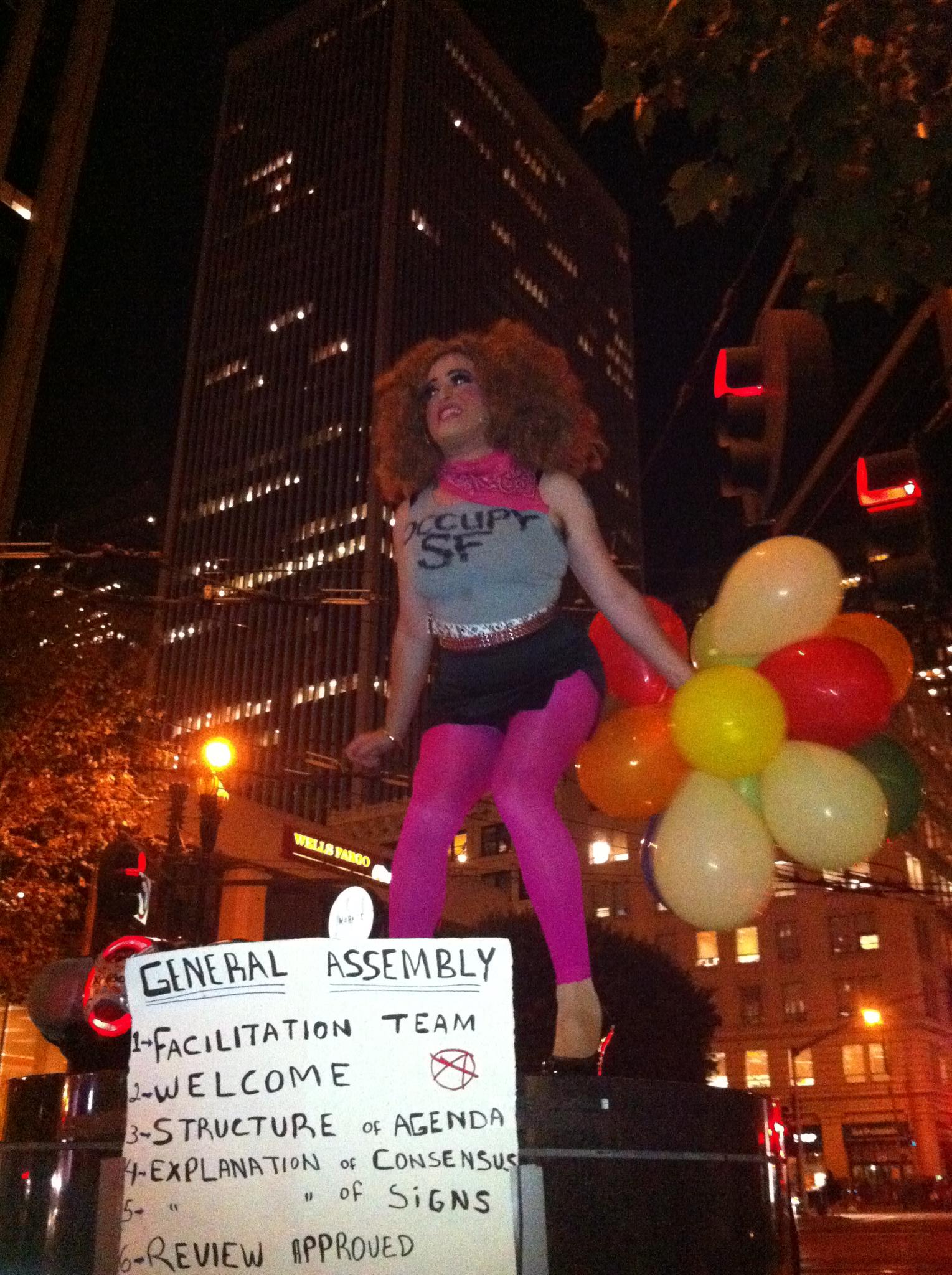
It seems the San Francisco Police Department is laying off the OccupySF encampment, at least for now. After top city officials sent mixed messages to the occupiers during a pair of high-profile hearings in City Hall this week, a full-blown tent city with working kitchen and medical tent has now been erected in Justin Herman Plaza.

During the Board of Supervisors meeting on Tuesday, Mayor Ed Lee voiced support for the movement’s message, but said that tents, tarps, and cooking in the plaza or in OccupySF’s presence on the sidewalk in front of the Federal Reserve wouldn’t be tolerated.

A string of protesters testified against the policy and the two recent police crackdowns, which was also criticized by John Avalos and other progressive supervisors who are working on a legislative solution to the standoff. But at the Police Commission hearing the next night, Police Chief Greg Suhr seemed to announce that police would stand  down and allow the encampment to continue.

Protesters packed the meeting and disrupted the proceedings with chants of “SFPD where is your humanity” and accusations of police brutality at several recent raids of their camp. Many representatives made public comments condemning police brutality and repression of the protests, and many speakers also connected it with a broader problem of police harassment, notably in Bayview-Hunters Point.

Said OccupySF protester Christopher Ray: “Obama himself does not have the right to come tell us to stop, to tell us to take down our tarps, to tell us we can’t eat, to cook food, to sleep there. Period. You would have change the Constitution of the United States in order to do that. We’re not leaving.”

By the end of the long meeting, Suhr expressed support in what seemed like a promise to OccupySF: “We have no future plans to go into the demonstration. We know that it’s for the long haul. We did work, or, I’m told that we were trying to work all day Sunday to take down the tarps and the structures. We did meet last week and I did provide a written notice that’s been provided wholesale since down there. We realize that this movement could go on indefinitely, and as such, I’m actually working with the Mayor’s Office personally to put the port-o-potties and the handwashing stations down there to provide sanitation. I don’t know that anybody’s doing that. And in other towns where this movement has grown and is very large, they’re already experiencing things like dogs that have bitten people, rats, sanitation issues, the lack of running water so I can assure you that our efforts are to keep it safe and to facilitate the First Amendment demonstration.”

His statement was meant with a cry of “Now that’s what I’m talking about!” and thunderous applause from the chamber, and the OccupySF movement has interpreted the remarks as permission for the encampment to continue without further police harassment. Guardian calls to the SFPD Public Affairs Office to clarify the policy have not yet been returned.

By last night, the encampment’s numbers and infrastructure had grown — with a kitchen producing group dinners and new tents being added throughout the evening — and there seemed to be only a cursory police presence. Many protesters were essentially declaring victory, telling the Guardian that the numbers only grew after each police raid, expressing hope that the city has now had a change of heart. 

This comes after a rocky history of SFPD relations with the protest. On October 5, police issued a notice requiring all tents at the encampment to be removed. Protesters complied, but police still moved in, confiscated all the protest’s materials, and ended up making one arrest in the ensuing altercation. Since, OccupySF has mostly refrained from erecting any structures; instead, the growing numbers, now an average of 200 per night, sleep on the sidewalk. When they put up two tarps when weather turned rainy on Sunday the 16th, the result was another nighttime police raid, this time with five arrests and several injuries to demonstrators.

Yet the next morning, protesters had strung up more tarps.  And in the past few days, many have pitched tents. Now, tents number over 40, and the police are yet to raid.

On Thursday, California Nurses Association and the National Nurses Association worked with OccupySF’s medic team to set up a medical tent. The tent has been sorely needed for a while, but it is only recently that supporters of the protest felt safe creating it.

When the tent was put up, police came and circulated a notice that had been issued on Oct. 1 stating, “Tents, overhead tarps, and/or wooden pallets are not to be within the demonstration area unless appropriate permits are obtained because of the potential hazard they present.” But police exited without attempting to enforce this notice, and as of now the medical tent, complete with a cot and a growing stock of supplies, is still in place.

Said Pilar Schiavo, an organizer with CNA who has been working with OccupySF: “We were able to provide treatment to a bunch of occupiers today.” She says there are many at OccupySF with no other access to health care besides the new tent. “It’s just basic first aid so far, but a little goes a long way here. One had a broken finger from Sunday’s raid.”

Schiavo says when they set up the tent early Thursday morning, protesters Tweeted, Facebooked, and otherwise put out calls for needed medical supplies. Shiavo was proud to report that “supplies started showing up an hour later.”

Just a short BART ride away, city officials in Oakland have accommodated Occupy Oakland and it has grown into a large tent city with ever-improving infrastructure and organization. Perhaps OccupySF is now headed down the same path.

A broke ass in our ranks: SFBG Culture Editor Caitlin Donohue honored by Broke Ass Stuart for her insolvency

1

We here at the Guardian pride ourselves on being populist. That means documenting the latest in the people’s protests, and generally being a resources for students, artists, families, anyone in that good old 99 percent. But it’s not 100 percent for your benefit, dear readers. SF’s not a cheap city to live in. Case in point: Culture Editor Caitlin Donohue’s been chosen as Broke Ass Stuart’s Broke Ass of the Week.

Kudos, Donohue. Now the whole Internets is aware that you beg quarters off of us for beer.

And thanks for the shout-out. We quote:

I dig working there because it’s locally owned and I am no longer the weirdest person at the office.

In response to Stuart’s questionaire (the same queries are posed to each week’s Broke Ass) she also covers her favorite dive bar, favorite cheap meal, best thing she ever dropped serious cash on, and what she does when she’s hungover. 

Alerts

0

alert@sfbg.com

Editor’s Note: Protests and other events connected to the Occupy Wall Street movement, include OccupySF and Occupy Oakland, have been developing quickly. To take part, follow our Politics blog or check with the websites associated with this important economic justice movement: occupysf.com, occupyoakland.org, or occupytogether.org. And you can send tips about what’s happening to news@sfbg.com.

WEDNESDAY 19

“Fast Times in Palestine”

Pamela Olson’s new memoir, Fast Times in Palestine, recounts her time in Ramallah as a young journalist from 2003-2005. It was described by Rebecca Vilkomerson, executive of the Jewish Voice for Peace, as, “a moving, inspiring account of life in Palestine that’s enormously informative yet reads like a novel.” Celebrate the publication with the program’s short presentation from the author, a Q&A session, and a book signing.

7-9 p.m., free

Stanford University

Building 160, Room 124


THURSDAY 20

Eat crab, fight AIDS

Support individuals living with HIV and help prevent this spreading epidemic by joining this crab feed fundraiser for AIDS Project East Bay. APEB provides free and confidential HIV and STD/STI testing with a scheduled appointment.

6-10 p.m., $45

8945 Golf Links, Oakl.

www.apeb.org


San Jose Short Film Festival

The 3rd annual San Jose Film Festival will present entertaining shorts from filmmakers around the world on Oct. 20-23rd. The weekend will be speckled with VIP events, parties and interesting forums and panels. San Jose will be taken over with Hollywood style. Each of the four days will be broken down into two-hour blocks of short films of various genres. Tickets are now online for sale.

7 p.m.- 12 a.m.

CineArts Theater @ Santana Row

3088 Olsen Drive, San Jose

www.sjshortfest.com


SATURDAY 22

Figth police brutality in the Central Valley

Remember Oscar Grant and join in the caravan of resistance standing in solidarity against police violence. Rain or shine, protest outside these city police stations and stand up against those who “shoot down innocent people” and “carry out raids on immigrant and harass those working to end this abuse”.

11 a.m., free

Outside the Stockton Police Station, 22 E. Market, Stockton

or

12:30 p.m., free  

Manteca Police Station, 1001 W. Center, Manteca

or  

2:00 p.m., free

Stanislaus County Jail, 1115 H St., Modesto

A community forum on state repression will take place in Cesar Chavez Park at 4 p.m. in Modesto

Contact Kat Williams at wearealloscargrant.cv@gmail.com


Mail items for Alerts to the Guardian Building, 135 Mississippi St., SF, CA 94107; fax to (415) 437-3658; or e-mail alert@sfbg.com. Please include a contact telephone number. Items must be received at least one week prior to the publication date.

We want the airwaves: KFJC’s birthday party

3

At 8 p.m. on Oct. 20, 1959, the first words spoken on local college radio station KFJC came pumping through the air waves. It was station manager Bob Ballou, operating from a broom closet at the old Foothill Junior College campus in Mountain View. In the decades that followed, the station has grown known for its eclectic show lineup and in-house concerts: Noothgrush, Exhumed, and Foxtails Brigade, among so many others.

With KUSF ripped off the air earlier this year (an aside: Save KUSF), the debate about local college radio has, if nothing else, continued. It’s part of a far bigger issue – where do people learn about new music and how do they listen? For those who tuned in to this type of programming as students, or those who live nearby and still click the dial as post-grads or never-grads, the gaping gap is felt. KFJC DJs have stood by KUSF throughout the protests and legal discussions, clearly aware of the brevity of the situation.

KFJC, 89.7 FM, which is operated as a teaching lab for the fine arts and communications department of Foothill College in Los Altos Hills, is thankfully still pumping – this year celebrating its 52nd anniversary. In honor of the milestone, there will be an open house Saturday, Oct. 22. Meaning: you can peek your nose around a living, breathing college station.  (It’s just south of San Francisco).

The station also is on the verge of possibly receiving CMJ’s most adventurous station College Radio Award – results are in this Thursday. On the eve of these events, I got the rundown on the news and events from KFJC DJ and volunteer Jennifer Waits and KFJC Publicity Director (and DJ) Leticia Domingo.

San Francisco Bay Guardian: What will take place during KFJC’s open house?
Jennifer Waits: Listeners will get an opportunity to meet KFJC DJs and tour KFJC’s studios at Foothill College. It’s also during our annual fundraiser, so they will be able to pick up some KFJC goodies in exchange for donations to the station.
SFBG: How has the station grown in the past year?
JW: A big project this year was the installation of new shelving at the station. KFJC has tens of thousands of pieces of music, from vinyl to CD to cassette tape, and we’ve been bursting at the seams. The new high density shelves helped give us some breathing room so that we can continue to add music to our library at the current pace. We also traveled to Milwaukee this summer in order to broadcast live from the Utech Records Festival.
SFBG: Why do you feel KFJC is up for CMJ’s most adventurous station award?
JW: During my tenure at KFJC, I’ve always felt like the station has been an innovator. Not only is KFJC’s airsound unique – with music ranging from experimental to country to soundtracks to metal to electronic – but the station has also been a pioneer in international live remote broadcasts. KFJC’s first international broadcast was from Brixton, England in 1996 and since that time we’ve traveled to New Zealand (2000) and Japan (2008) in order to present live music performances to our listeners. The 2008 live broadcast from Japan also featured a live four-camera video stream, so that listeners from around the world could both see and hear the musicians on stage.
SFBG: To what do you attribute KFJC’s longevity?
Leticia Domingo: Obviously our listeners have kept us alive for so long. They are our staff, the hands that feed us. They’ve allowed us to indulge our creativity and breathe life into the ho hum/indie/college radio scenes.
SFBG: What’s your take on the current state of college radio?
JW
: I’m saddened by the loss of some of our peers from the terrestrial dial, particularly KUSF in San Francisco. But at the same time, we’re lucky in the San Francisco Bay Area to have a number of thriving college radio stations on the dial. Personally, I’ve become even more connected with people from other stations this year and am happy to see the college radio community strengthening.
LD: Unfortunately and fortunately we are at crossroads. People don’t need DJs and college stations to turn them on to music or shows anymore. However at KFJC we are still very fortunate to be able to continue to discover new sounds and keep the saw sharpened. Without preemptive action, radio broadcasting is going to phase out like broadcast TV signals. And for college radio stations, we are at the mercy of the colleges.

KFJC Open House
Sat/22, 1-5 p.m., free
Directions: Here
www.kfjc.org

To the wonderful folks at Occupy SF/Wall Street/Everywhere

122

First of all, don’t get depressed by this sort of stuff. During the occupation and blockade at Diablo Canyon, when about two thousand people managed to prevent the opening of the nuclear power plant, the mainstream news media kept reporting that the blockade was failing, that the protesters were getting tired, that everyone had given up and was going home. One person starting walking around with a poster that said “The media is getting tired and hungry and going home.”

Press accounts typically understate the numbers and dedication of protest movements. Instead of talking about how amazing it is that so many people have given up everything else in their lives to protest economic injustice, the press will say: Why aren’t there more?

So hang in — overall, the message is getting out. As we said in an editorial this week:

If the demonstrators don’t have all the solutions, at least they’ve identified the problem. And that’s more than Obama, Congress, or the mainstream news media have done.

But as someone who has watched, written about, worked on, joined and been otherwise involved in direct action and community organizing efforts for more than 30 years (yeah, I’m old), let me make a friendly suggestion.

Saul Alinsky, who pretty much invented modern community organizing, always said that building an effective organization and agitating for social change was as much about empowering the powerless as it was about winning a specific battle. He and his students learned quickly that nothing is worse for an organized movement than the frustration of constant failure. The movement that arose against the Iraq and Afghanistan wars suffered from that — when it was clear that nothing any of us did (including electing Obama) was going to bring the troops home and end hostilities, a lot of people gave up and stopped marching.

The people I learned from back at the Connecticut Citizens Action Group, which practiced Alinsky-style organizing, used to say that victories, even small victories, would prove to people that they really could fight City Hall. If a low-income neighborhood was worried about cars speeding down the streets where kids were playing, fine: Organize everyone and demand stop signs, speed bumps and police patrols. Once you’ve shown disenfranchised people that they can force the powers that be to listen and respond, you have the basis for something much more ambitious.

I guess what I’m saying here is that you might want to think about setting a goal that’s a little bit short of decentralizing all of society. When I worked with the Abalone Alliance, we were all about changing the way people related in the world; everything worked by consensus, we spent an immense amount of time discussing power relationships and we all had a radical model for rebuilding the United States (and the world). But we also wanted to stop a nuclear power plant from being built on an earthquake fault. And when that happened — the protests actually delayed the opening for several years — it gave tremendous life and energy not just to the movement but to all the people in it. It was radically empowering.

The Livermore Action Group, which emerged out of the Abalone Alliance, was dedicated to ending the threat of nuclear war (and all war), among other things. But it had as an immediate first step ending weapons reasearch at the Lawrence Livermore Lab.

Around the same time, the American Friends Service Committee came up with a campaign called the Nuclear Freeze. The bumper stickers read: “Step one: Freeze Nuclear Weapons.” The idea: When you’re in a hole, stop digging. Nuclear proliferation was threatening the world; as a first step, we ought to stop building more bombs. 

Since this is all about Wall Street, and you’ve got momentum on your side, maybe you want to start talking about something specific. How about “Step One: Tax Wall Street Transactions and Create A Million Jobs.” A transactions tax dedicated to public-sector job creation would do wonders for the economy. It’s the kind of campaign that a wide range of allies could join. It’s got simple, populist appeal. It’s not everything you want, but it’s not bad — and remember, it’s ony Step One.

Just a thought from a friend.


Crackdown came from the top

8

steve@sfbg.com

The decision to raid the OccupySF protest camp in the middle of the night Oct. 5 was approved by Mayor Ed Lee and Police Chief Greg Suhr — and involved a more aggressive approach to limiting protest activities than authorities in any other major city have undertaken.

Both Lee and Suhr insist that they support the protesters right to free speech. But the raid was more than a modest effort to get a propane stove turned off or to bring food preparation up to health codes.

The move only served to galvanize the movement and increase its numbers. And both police and protesters say they expect this occupation to continue for a long time.

Suhr told the Guardian that the decision to move into the encampment and seize its supplies was made after consultation with the Fire Department, Department of Public Health, and the Mayor’s Office. While DPH expressed concerns about food preparation on the site, Suhr said health officials never asked the police to shut the kitchen down. The Fire Department was another story.

“There was open flame, propane, and tons of fuel, near plywood. The Fire Department told us there as a fire danger,” Suhr told us. “Deputy Chief Cashman made the call that we would go move the people away from the fuel.”

Suhr said Mayor Ed Lee gave the okay to remove public safety hazards, but said the protest itself shouldn’t be interfered with. “In San Francisco, protesters are acting within their First Amendment right to free speech and freedom to assemble. While allowing for peaceful protests, we also must ensure that our streets and sidewalks remain safe and accessible for everyone,” Lee said in a public statement, although his office has not responded to a list of questions about the decision and its implications.

After all, the tents and other shelters were hardly a hazard to anyone; leaving the activists out in the rain with no tents was, strictly speaking, more of a health issue.

A movement that calls for the indefinite occupation of public spaces to protest corporate greed is bound to continue to cause conflicts with local ordinances and property interests, something that Suhr acknowledged. “We will surgically and as best as possible and with as much restraint as possible try to deal with the hazards while protecting people’s First Amendment rights, Suhr said.

He objected to the notion that there was a police crackdown on the protest. “They’re occupying it now, and they’re probably going to be there was a long time,” Suhr said. “We haven’t arrested one demonstrator. The only person arrested punched a cop and then threatened to kill him afterward.”

But Sup. John Avalos, the one major mayoral candidate to show up during the raid and try to mediate the conflict, said he’s disappointed with the city’s stance. “This is not the San Francisco that I know. This is not the San Francisco I love. This City has served as a sanctuary for free speech and assembly for generations, and we must protect that legacy,” Avalos said in prepared statement that he closed with, “This should be a city for the rest of us — for the 99 percent. I stand with Occupy SF.”

Even Suhr said that the SFPD has no intention of removing the protesters from their perch in front of the Federal Reserve, and will continue safeguarding regular OccupySF marches, telling us, “We will continue to facilitate this.”

“They got everything out of there so we could start over,” Suhr said the encampment’s kitchen and other hazards. “This demonstration isn’t going away. I think people are justifiably upset by this issue nationally.”

The Occupy Wall Street platform

6

EDITORIAL In New York City, the protesters who started the Occupy Wall Street movement remain camped out in Zuccotti Park. In Washington, DC, President Obama said at an Oct. 6 press conference that he understands the sentiment driving the activists. Yet in San Francisco, Mayor Ed Lee has approved a police crackdown and the confiscation of camping supplies in an effort to debilitate the occupation in front of the Federal Reserve Bank.

The move comes at a time when Lee is doing nothing to crack down on foreclosures that cost the city money, nothing to force the big banks that have the city’s deposits to lend more in the community, and nothing to promote local taxes on the wealthy.

While Lee says he supports the First Amendment rights of the protesters, he sent the cops in at 10:30 at night to confiscate their belongings — using, in part, the sit-lie law (which is only in effect until 11 p.m.)

His approach is just wrong. This city ought to be embracing and supporting the demonstrations. San Francisco makes room for all kinds of public events; this one should be no different. The people at City Hall should be working with the people in the streets to make San Francisco a central part of this growing national movement.

Make no mistake about it: What started as a small-scale, leaderless, somewhat ragtag group in lower Manhattan now has the potential to become a potent political force in this country. Occupy Wall Street has tapped into a deep feeling of frustration that’s shared by people in blue states and red states, in cities and towns and rural communities. The feeble economy impacts almost everyone — and this movement has managed to point the finger at the people who caused the problem, who are preventing solutions and who are making big money off the suffering of others.

We realize that at this point, there’s no specific focus for Occupy Wall Street. The civil rights movement and the anti-war movements of the 1960s and the antinuclear movement of the 1970s, the demonstrations against free trade agreements in the 1990s and the marches against the Iraq War in the past decade included people with hundreds of ideological agendas, but they had a pretty clear message — and, generally speaking, specific actions that government officials could take to address the issues.

Occupy Wall Street hasn’t called for any bills, regulations or policies. It’s still a group that is simply calling attention to a basic truth — the very wealthy in general, and the financial sector in particular, are enjoying economic gains at the expense of the rest of us. But that alone is a profound and potent message — if the demonstrators don’t have all the solutions, at least they’ve identified the problem. And that’s more than Obama, Congress, or the mainstream news media have done.

There’s been plenty of talk of a formal platform — one Occupy Wall Street activist posted a proposed list of 13 demands on the group’s website. It’s not a bad list (a guaranteed living wage, single-payer health care, free college education, debt forgiveness, a racial and gender equal rights amendment) with a few somewhat random elements (outlaw all credit agencies). Fox News has picked up the list, although the organization, such as it is, has made it clear that there is no consensus on any platform and agenda. And the labor unions that are joining the protests — with the proper respect for the folks who started things — have legislation in mind (a financial transaction tax, for example).

There’s a danger that the message becomes so diffuse, and imbued with every possible issue that anyone on the left cares about, that it loses the potential to have an impact on the 2012 elections. Occupy Wall Street could go a long way to providing a populist progressive message to counter the Tea Party (which is funded by and largely organized by billionaires but tries to claim grassroots legitimacy).

And there’s no need for a laundry list of agenda items. The focus is right where it ought to be: The richest Americans — and the big financial institutions — have been sucking all the money and energy out of the economy. The remaining 99 percent are suffering. Tax the top 1 percent and create a robust jobs program to put the rest of the country back to work; that’s a winning platform for 2012

Editor’s notes

16

tredmond@sfbg.com

It’s nice to see that the days when you could get away with calling protesters commies are back. CNBC says that the Occupy Wall Street activists are “anarchists” who are “aligned with Lenin.” Actually, none of the anarchists I know are remotely Leninist. The communists of old were all for the creation of a powerful state. Lenin read Bakunin in his early years, but later declared that anarchists were “bourgeois revolutionaries.”

But I wouldn’t expect Larry Kudlow, Jim Cramer and Joe Kernan to be up on their radical history. They clearly haven’t spent much time with the people of the Occupy Wall Street movement, either. If they did, they’d realize that — like most of the left-wing movements that have sprung up with young people at the forefront in the United States over the past half century — the essential politics of Occupy Wall Street aren’t derived from Lenin, Marx, Castro, the Sandinistas, or Hugo Chavez. It’s about self-reliance, about community control and free expression, and in its purest form, it’s a rejection of the old role of leaders and authority. It would have driven Lenin mad.

I grew up on that side of politics. In college, the anti-apartheid and antinuclear movements were all about consensus process, all about the rejection of any sort of power relationships. We had no elected presidents or chairpeople. We didn’t vote on anything — voting disempowers the losing side. We took no action until we could reach consensus; everyone had to agree with everything.

What ultimately happened was that the people who could stick around for very long meetings, typically very late at night, where everybody had a lot to say and nobody got to tell anyone to cut it short, made the decisions. I never lasted.

When you’re all at an encampment with nowhere to go, it’s a thrilling exercise in real, direct democracy. When you’re trying to do organizing involving people who have jobs, kids, and lives that can’t fit three-hour (at best) meetings into the schedule, you leave a lot of your potential allies out.

The most interesting thing, though, is that the organizing principle of the protests, by its nature, involves distrusting government. That’s been part of the young left for a long time — and for those of us who believe in a strong public sector, it’s a bit, as they say, challenging.

Editorial: The Occupy Wall Street platform

6

In New York City, the protesters who started the Occupy Wall Street movement remain camped out in Zuccotti Park. In Washington, DC, President Obama said at an Oct. 6 press conference that he understands the sentiment driving the activists. Yet in San Francisco, Mayor Ed Lee has approved a police crackdown and the confiscation of camping supplies in an effort to debilitate the occupation in front of the Federal Reserve Bank.

The move comes at a time when Lee is doing nothing to crack down on foreclosures that cost the city money, nothing to force the big banks that have the city’s deposits to lend more in the community, and nothing to promote local taxes on the wealthy.

While Lee says he supports the First Amendment rights of the protesters, he sent the cops in at 10:30 at night to confiscate their belongings — using, in part, the sit-lie law (which is only in effect until 11 p.m.)

His approach is just wrong. This city ought to be embracing and supporting the demonstrations. San Francisco makes room for all kinds of public events; this one should be no different. The people at City Hall should be working with the people in the streets to make San Francisco a central part of this growing national movement.

Make no mistake about it: What started as a small-scale, leaderless, somewhat ragtag group in lower Manhattan now has the potential to become a potent political force in this country. Occupy Wall Street has tapped into a deep feeling of frustration that’s shared by people in blue states and red states, in cities and towns and rural communities. The feeble economy impacts almost everyone — and this movement has managed to point the finger at the people who caused the problem, who are preventing solutions and who are making big money off the suffering of others.

We realize that at this point, there’s no specific focus for Occupy Wall Street. The civil rights movement and the anti-war movements of the 1960s and the antinuclear movement of the 1970s, the demonstrations against free trade agreements in the 1990s and the marches against the Iraq War in the past decade included people with hundreds of ideological agendas, but they had a pretty clear message — and, generally speaking, specific actions that government officials could take to address the issues.

Occupy Wall Street hasn’t called for any bills, regulations or policies. It’s still a group that is simply calling attention to a basic truth — the very wealthy in general, and the financial sector in particular, are enjoying economic gains at the expense of the rest of us. But that alone is a profound and potent message — if the demonstrators don’t have all the solutions, at least they’ve identified the problem. And that’s more than Obama, Congress, or the mainstream news media have done.

There’s been plenty of talk of a formal platform — one Occupy Wall Street activist posted a proposed list of 13 demands on the group’s website. It’s not a bad list (a guaranteed living wage, single-payer health care, free college education, debt forgiveness, a racial and gender equal rights amendment) with a few somewhat random elements (outlaw all credit agencies). Fox news has picked up the list, although the organization, such as it is, has made it clear that there is no consensus on any platform and agenda. And the labor unions that are joining the protests — with the proper respect for the folks who started things — have legislation in mind (a financial transaction tax, for example).

There’s a danger that the message becomes so diffuse, and imbued with every possible issue that anyone on the left cares about, that it loses the potential to have an impact on the 2012 elections. Occupy Wall Street could go a long way to providing a populist progressive message to counter the Tea Party (which is funded by and largely organized by billionaires but tries to claim grassroots legitimacy).

And there’s no need for a laundry list of agenda items. The focus is right where it ought to be: The richest Americans — and the big financial institutions — have been sucking all the money and energy out of the economy. The remaining 99 percent are suffering. Tax the top 1 percent and create a robust jobs program to put the rest of the country back to work; that’s a winning platform for 2012.

Lee backs crackdown; Avalos: “I stand with Occupy SF”

136

Mayor Ed Lee has just released a statement on last night’s police raid of the Occupy San Francisco encampment – claiming to basically support the movement but also support the harsh police crackdown and seizure of tents, food, and other personal property – that offers a sharp contrast to the position of his mayoral rival, John Avalos, who is condemning the SFPD’s actions.

Once again, as Lee also did this week in defending businesses that seize money set aside for employee health care costs, our “consensus and civility” mayor is showing that if you try to stand for everything, you end up standing for nothing. Yet Avalos understands that there are times when one side is simply wrong and that supporting the people means being willing to fight for them.

On both issues, Lee mouthed the meaningless “jobs” defense, claiming that he was trying to help working people by letting their employers raid their health care funds, allowing restaurants to fraudulently jack up their bills, or directing the police to seize their tents and food. That’s not just pandering, it’s insulting.

I’ve tried unsuccessfully to get Lee’s office to offer more detailed explanations of his positions, but they’re so far sticking to prepared statements that are riddled with contradictions. So we’re just going to run the full statements by Lee and Avalos and let you decide who makes more sense and best reflects San Francisco values.

Lee wrote:

“I understand and sympathize with the anxiety and frustration felt by so many in our country caused by a lingering recession and joblessness. That’s why I am doing everything I can to create jobs, get people back to work and make our families stronger here in San Francisco. I support the spirit of the Occupy Wall Street movement that calls for peacefully assembling to protest and bring national attention to disparity issues in our country.
“In San Francisco, protesters are acting within their First Amendment right to free speech and freedom to assemble. While allowing for peaceful protests, we also must ensure that our streets and sidewalks remain safe and accessible for everyone. I will continue to work closely with our Police Chief to ensure San Francisco responds appropriately to these demonstrations.  
“San Francisco is a city that embraces free speech and freedom to assemble like no other city.”

Indeed, no other city among the 60 or so that have followed the Occupy Wall Street example of occupying public spaces has sent police and trucks in to raid encampments in the middle of night, so San Francisco is indeed alone in its treatment of the movement that Lee shamelessly claims to support.

And now Avalos:

“Last night I gathered in solidarity with the protesters Occupying San Francisco. Like many people all over the country, I have been watching this protest gather strength and grow as more and more of us, more of the 99 percent, demand accountability from the corporations and people who are responsible for the destruction of our economy and devastation of our families.

“I came to down to observe the protest last night in response to summons from protesters and a notice from the police accusing their encampment of a number of minor infractions, ranging from open flames on a city street or sidewalk to serving food without a permit. I observed and negotiated with police in good faith to keep the peace and allow the encampment to remain, only to hear of a crackdown shortly after I left.

“This is not the San Francisco that I know. This is not the San Francisco I love. This City has served as a sanctuary for free speech and assembly for generations, and we must protect that legacy. With our unemployment rate nearing 10 percent, we have a responsibility to be a sanctuary for the 99 percent.

“Instead, last night we witnessed that 99 percent being detained, arrested, and intimidated with force.

“My vision is of a true sanctuary city – one that protects our right to free speech and assembly, and one that holds real criminals accountable. This should be a city for the rest of us – for the 99 percent. I stand with Occupy SF.”

The goals of Occupy Wall Street

74

Occupy Wall Street is an easy target — a group of protesters taking on one of the most powerful institutions in the country, with loose spinoffs in cities all over, and no clear leadership or (many would say) agenda. The Atlantic’s business writer, Danile Indiviglio, weighed in Oct 5 with an essay he called “Five Reasons Occupy Wall Street Won’t Work.” Some of it’s your typical musings from a guy in a suit who doesn’t understand direct action (“But the Occupy Wall Street movement’s anger is directed at bankers. Here’s the problem: they really don’t care.”)

But his main pitch is one that I’m sympathetic to, and so are a lot of other supporters of the growing movement. He says the protesters don’t know what they want:

Any protest that hopes to accomplish some goal needs, well, a goal. If a demonstration like this lacks concrete objectives, then its purpose will be limited at best and nonexistent at worst. At this time, all the protest really appears to stand for is a general dislike of Wall Street. But what does that mean?

And that’s where I think he’s wrong. The occupiers may have started off with only vague objectives, but some tangible, progressive goals are starting to emerge — and they don’t in any way require the bankers to care.

The Wall Street protests are growing — and some of the people getting involved have a very clear agenda. The most dramatic evidence is the growing role of organized labor in the actions. The nurses marched Oct. 5 — and they have a very specific platform, well thought-out, that calls for a financial transactions tax. AFSCMA, CWA and the city’s transit workers joined the march, too. And the head of the AFL-CIO, Richard Trumka, is now on board. And while Trumka made it clear that labor isn’t going to try to dominate the spontaneous protests,

The labor leader was specific as he summarized his demands: make Wall Street invest in creating jobs for Americans, stop foreclosures and write down problem mortgages. Paying for government programs would come from a “very tiny” tax on speculation, he said.

I’m not seeing any kind of political turf war here — the original Occupy Wall Street folks seem happy to have labor on the team. And once you get tens of thousands of labor activists in the streets — and using the media and the growing groundswell of support for the protests to push a Congressional agenda — then something potentially powerful is happening.