protests

Editor’s notes

0

marke@sfbg.com

“We live in turbulent times,” my uncle observed last Saturday. He’s right: the world is roiling.

This past week alone: 100,000 students marched in Santiago, Chile to protest education cuts. (The protest turned violent on Friday when police used excessive force and tear-gassed the crowd.) On Saturday, 300,000 people from across the political spectrum marched in Israel, mainly to protest rising housing costs. (A million-person march is planned for next week.)

Syria saw probably its bloodiest weekend of protests yet, as the government sent in more forces to crush anti-authoritarian uprisings. In Spain, a resurgent M-15 — the huge yet ambiguous protest organization that occupied Madrid’s main square this summer — was blocked by anti-riot police from re-occupying Puerto del Sol. And, in Tottenham, London, a peaceful vigil for a man slain by police was stoked into a weekend of riots that is spreading throughout the city as of this writing.

The swelling protests are all unique in their ways, but we certainly seem to be in the midst of a global “protest movement movement.” Many of the demonstrations — at least the nonviolent ones — have been presented in the media as a continuation of the Arab Spring, due to the important role of online social media and the peaceful, game-changing aspirations of participants. And in most of the recent protests, there is evidence of a frightened and over-reactive government (the Chinese government, quaking over growing unrest due to its cover-up of a train crash last month, is flailing at online censorship) or a woefully unprepared police force (the Tottenham police were severely late in addressing public questions about the shooting, and failed to heed community leader warnings about potential violence).

But all have to do with economic inequality, an overwhelming feeling of powerlessness in the face of ineffectual governance, and an onslaught of austerity cuts imposed from above. Last week’s odious debt ceiling charade by American “leaders” has just ensured massive national austerity cuts, and made the economy a lot more anxious (and unequal). Hands up if you feel powerless.

I think of two recent large examples of Bay Area economic unrest: the 2009 student demonstrations against University of California tuition hikes and the reaction to the Mehserle verdict last year. Are we prepared to channel the coming frustration into an expansive, nonviolent popular movement that builds on positive momentum, includes everyone, and brings a whiff of the Arab Spring to our shores?

Alerts

0

alerts@sfbg.com

WEDNESDAY 10

Protesting another police shooting

Raheim Brown Jr., 20, was killed on Jan. 22 by an Oakland school district police officer, after a fellow police officer was allegedly attacked with a screwdriver. This rally protests the latest in a series of killings by police, and supports Brown’s family, who will be confronting the Oakland School Board for its part in the death. After the rally, protestors will march to the Oakland School District headquarters where the family members will be making their address.

3:30 p.m., free

Lake Merritt Bart Station

Oak & 9th St., Oakland


THURSDAY 11

Mayoral debate

Watch the mayor mayoral candidates face off in a debate. The forum will be hosted by the San Francisco Young Democrats, Alice B. Toklas LGBT Democratic Club and the City Democratic Club, who have partnered with the Huffington Post and YouTube to broadcast and discuss the event. Melissa Griffin will be the evening’s moderator, with commenting by Beth Spotswood and Pollo de Mar.

6 p.m., free

African American Art & Cultural Complex

762 Fulton St., SF

www.sfyd.org


SATURDAY 13

Climate change and the EcoHouse

Learn how to reduce your carbon footprint on a tour of Berkeley’s EcoHouse, a toolshed built with straw bale, rammed earth, clay, and cob. The center has a living roof, laundry greywater system, 1100-gallon rainwater cistern, a native rain garden and three kinds of compost. The tour features tips on the best ways to save energy and reduce climate impact, with the EcoHouse as its prime example.

10 a.m.-noon, free

Ecohouse

1305 Hopkins St., Berkeley

(510) 548-2220 x239

www.ecologycenter.org


SUNDAY 14

Iraq War Veterans Speak Out

This event organized by March Forward!, an organization of veterans and soldiers on active duty, gives Iraq War Veterans a chance to speak out about their experiences, and against war. A former Marin Corps infantryman, former Army infantryman and former Army intelligence operative will share eyewitness accounts of their time in Iraq. They will explain how their Iraq war experiences turned them into anti-war activists, the current situation for veterans and veteran care, and how they are building an anti-war resistance among active duty troops within the military.

5-7 p.m., $5-10 donation, no one turned away

2969 Mission St., SF

www.answersf.org


Mail items for Alerts to the Guardian Building, 135 Mississippi St., SF, CA 94107; fax to (415) 437-3658; or e-mail alert@sfbg.com. Please include a contact telephone number. Items must be received at least one week prior to the publication date.

Anger erupts over police shootings

11

rebeccab@sfbg.com

As the murky details of two recent police shootings emerge, a palpable anger surging through targeted communities points to a deeper issue than the particular circumstances surrounding each of these deaths. Simply put, many Bay Area communities are fed up with police violence.

For many activists who descended on transit stations to protest the fatal BART police shooting of Oscar Grant III, the 20-year-old unarmed Hayward man who was killed on New Year’s Day 2009, an upwelling of rage was rekindled after BART cops shot and killed a homeless man named Charles Blair Hill on July 3 in Civic Center Station.

Then, on July 16, San Francisco police officers in the Bayview shot 19-year-old Kenneth Wade Harding Jr. multiple times after he ran from the T-Third train platform because he’d been stopped for fare evasion, leaving him dead on the sidewalk.

The recent officer-involved shootings occurred under two different law enforcement bodies, and both incidents remain under police investigation with many questions still unanswered. BART police say Hill was brandishing a knife; the San Francisco Police Department (SFPD) said its response was justified because Harding fired at officers first. The investigation in Harding’s case took a bizarre twist July 21 when SFPD issued a press release based on a medical examiner’s report stating that Harding had died not from rounds fired by police, but a self-inflicted gunshot wound.

But among communities distrustful of the police, the particulars of each case seemed to matter less than the perception that officers are too quick to escalate conflicts into deadly standoffs. Both incidents provoked intense anger because they resulted in marginalized transit passengers suffering sudden, violent deaths following interactions that were initiated by police. The shootings sparked angry protests, prompting standoffs at Civic Center BART Station, along the T-Third line in the Bayview, on Valencia Street, in Dolores Park, inside the Castro Muni Station, and at the cable car turnaround on Powell Street.

A group of activists staged protests in the Mission following the Bayview police shooting, snaking through the streets as they disrupted traffic and public transit service. “The march began at Dolores Park where nearly 200 of us departed,” an anonymous post on the anticapitalist Bay of Rage website recounted, describing the events of a July 19 protest that resulted in 43 arrests. “Upon reaching the Castro Muni Station, all hell broke loose…. What had now become a mob moved effortlessly past the bewildered cops … Trash was set alight and thrown down onto the tracks below … ticket machines, the fare checkpoints, and the agent booth were all smashed with hammers and flags — totally ruined. Smoke bombs and fireworks were thrown throughout the station.”

This display occurred just eight days after protesters shut down BART stations in downtown San Francisco during rush hour to condemn the fatal shooting of Hill, the homeless BART passenger.

The message from outraged Bayview residents at a chaotic and emotionally charged community forum staged July 20 at the Bayview Opera House was not that people were upset that this had happened to Harding, a Washington state resident, in particular. Instead, people expressed outrage that police had gunned down yet another African American youth, and that unless some complicated and long-standing issues were addressed, it could happen again, to anyone. The forum was organized in partnership with the SFPD and clergy members from the Bayview. Police had prepared a PowerPoint presentation, but never managed to get that far.

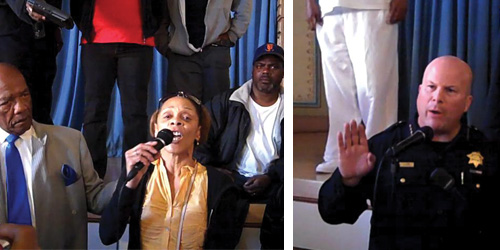
At the meeting, Police Chief Greg Suhr tried to provide an explanation for the July 16 shooting. “During this foot pursuit, at some point in time, the suspect … fired at the officers, and the officers returned fire. This is the account that we have so far,” he said. “I cannot tell you how badly that I feel … as captain of this station for two years,” Suhr continued, as an angry crowd shouted him down.

Police escorted Suhr out of the meeting before everyone who had signed up to speak had a chance to be heard. Once outside, the police chief told reporters that he planned to return.

After Suhr and other city officials departed from the meeting, District 10 Supervisor Malia Cohen stayed at the Bayview Opera House and addressed the crowd that remained, she later told the Guardian, and engaged in discussion with Bayview homeowners, merchants, and other community stakeholders.

“We had a very thoughtful conversation,” she said. “People had questions about [Municipal Transportation Agency] policy over the SFPD riding the bus. We talked about the importance of attending Board of Supervisors meetings, Police Commission meetings, and giving public comment. And there will be future conversations, without obstruction.”

Many who attended the meeting voiced concerns that went well beyond the July 16 incident. Several said they believed youth were unduly harassed by law enforcement over Muni fares on a regular basis. Elvira Pollard spoke about how her son was shot 36 times by police and killed seven years ago. Another woman complained that police had used abusive language when she was arrested in the Bayview four years ago.

Mayor Ed Lee told the Guardian that a bigger police presence at the Oakdale/Palou stop on the T-Third line was part of the city’s strategy to prevent violence in that area. “I actually asked the chief to pay more attention to areas that had a history of gun violence and shootings and other kinds of violence … and it just so happens that this particular area, Third and Palou, is a place where there’s a lot of violence,” Lee said. “So we had more uniformed officers on that specifically at not only my request, but with the understanding of the police chief, too.”

Responding to acts of violence by sending in more police sounds simple enough, yet it seems a toxic environment has arisen out of a heightened police presence in a community where tensions between police and residents already run high, fueled by anxiety and bad past experiences. Add to this dynamic a trend of youth who lack other transportation alternatives riding public transit even if they don’t have enough money to pay the fare, and the situation feeds ongoing strife, particularly when fare evaders are asked for identification and searched by police.

Lee, in partnership with Cohen, called a meeting in City Hall July 19 with leaders of the Bayview community. The press was not allowed to attend, but participants said later that officials gave a presentation about the shooting and played an audio of gunfire from the SFPD’s SpotShotter program to offer evidence that Harding had fired first. Later that day, the SFPD reported that gunshot residue had been detected on Harding’s hand, supporting the police account of what happened. Yet the July 21 press release, suggesting that Harding had shot himself because a .380-caliber bullet that police said could not have come from SFPD firearms had entered the right side of Harding’s neck, made it even less clear what really happened.

By July 22, confusion was still swirling over why a gun hadn’t immediately been recovered from the scene of the shooting, and there still wasn’t any clarity on whether an online video of a passerby removing a silvery object from the sidewalk showed a person who retrieved Harding’s firearm after the shooting, as police have claimed. Police recovered a gun that was initially believed to be Harding’s, but later reported that the gun could not have been the same weapon that discharged a .380 caliber round into the victim’s head.

Chris Jackson, a Bayview resident who sits on the board of City College of San Francisco and ran for District 10 supervisor in 2010, said after the City Hall meeting that he felt it had amounted to little more than a lecture from the city’s top officials. Jackson said he perceived a need for a policy shift in terms of how to deal with fare evasion and violence prevention. “We need a better approach,” he said. “We cannot address this with more cops on the T line.”

After Harding’s death, it came to light that the 19-year-old Washington state man had served time for attempting to promote prostitution, and had been named as a person of interest in connection with the fatal shooting of a 19-year-old Seattle woman. Yet a widely circulated online video showing him writhing on the sidewalk in a pool of blood after being shot, while a handful of officers continued to stand around with weapons drawn, sparked outrage. Once the forum at the Bayview Opera House had broken up, LaDonna Callaway condemned the police response, saying, “They didn’t have to shoot him as many times as they did.”

Angelique Mayhem, a Bayview resident who stood nearby, told the Guardian that she didn’t think the meeting had solved anything. “A boy gets gunned down. We don’t know if there was a gun there, but we do know that for 40 damn years, people have been getting gunned down in this community,” Mayhem said. “People are angrier now than when they were when they walked in the door. We’re a community that’s truly in pain, that’s truly frustrated, and really needs some respect.”

Mayor Lee meets with Bayview community leaders about officer-involved shooting

Mayor Ed Lee and officials from the San Francisco Police Department met with Bayview community leaders in City Hall July 19 to discuss the police investigation surrounding a July 16 officer-involved shooting that has prompted intense community anger and protests. While city officials indicated that the meeting was called to provide information and updates for the community, frustrated community members emerging from the City Hall conference room dismissed it as “more of a lecture,” saying city officials weren’t open to hearing broader community concerns that have intensified in the wake of this tragic event.

Reporters were not allowed in the room while the meeting was held because “it’s more of a community meeting,” according to mayoral communications staff member Francis Tsang. Attendees included Bayview community leaders Chris Jackson, Geoffrea Morris, Mike Brown, Charlie Walker, Ed Donaldson, and the Rev. Amos Brown. District 10 Sup. Malia Cohen also issued invitations to the meeting, which was scheduled at the same time as the full Board of Supervisors meeting, and sent a representative.


The shooting victim was Kenneth Harding Jr., 19, from Washington. Police say he fired one round at officers before police fired nine rounds, killing him. However, some witnesses initially reported that they did not see Harding fire a gun, and a firearm wasn’t immediately recovered from the scene. Police initially tried to detain Harding on the station platform of the Oakdale / Palou stop on the T-Third line on suspected fare evasion. After Harding was killed, it came to light that he had a criminal history and had been named as a person of interest in the fatal shooting of a 19-year-old pregnant woman from Washington. The incident, which occurred in broad daylight and was captured on film and witnessed by people who were out on the street, proved to be a traumatizing event for a low-income, predominantly African American community where tensions already run high between police and residents.

Lee indicated to the Guardian that the July 19 meeting had been called primarily to clear up misinformation. “There have been a lot of stories spreading about what did and didn’t occur, and we felt it was necessary to get the community updated as quickly as possible,” Lee said. “Any time there is a death in any community we’re very concerned … this one in particular has been represented in many different ways, and a lot of it has been very inflammatory in terms of what people have said occurred. We’ve heard points like there was no gun, when in fact now we’ve found a gun through police investigation. That there was no shot made at officers when … the officers have at least some evidence through the ShotSpotter program that there was an initial shot made by the suspect.”

Lee added that MUNI staff had reported people relaying “all kinds of stories” while riding the buses. “These are very hard, hard feelings,” he said. “So I felt it necessary that we confront this head on with community leaders. We met with some yesterday, we’re meeting with some today, [Police Chief Greg Suhr] is hosting a town-hall meeting in the Bayview tomorrow to yet again find every opportunity to fully explain what they have uncovered as the evidence, and to make sure people base their views on the facts.” A larger community meeting is scheduled for July 20 at 6 p.m. at the Bayview Opera House.

Meanwhile, Bayview community leaders Chris Jackson and Geoffrea Morris were not pleased when they emerged from the conference room. “The mayor left without hearing one public comment,” Morris said. “It was just a lecture. It wasn’t addressing the police, and how they deal with fare evasion, and harass people along the T train. It was not that. It was just, the mayor said his little thing, did not say goodbye, and ran out.”

Morris went on, “We don’t have grief counselors out there. We don’t have the police saying that they’ll stay off the T-Train platform until the investigation is done. We thought this meeting was going to be for them to go, ‘where do we go from here?’ And the thing that people are missing … whatever demon that boy had, that was a human life.” Concerns are still swirling about how long it took for an ambulance to arrive after the shooting, Morris said, and about how police arrived at the scene with high-powered weapons which they kept drawn even as Harding writhed in a pool of blood on the sidewalk.

Morris and Jackson said that during the meeting, officials showed a Channel 7 TV news broadcast clip and played an audio of gunshots being fired to demonstrate that the suspect had fired an initial shot before police opened fire. “We all have Internet, smart phones, and all the footage as well,” Morris said. “I was there on the site.”

Shortly after the meeting, the San Francisco Police Department issued a statement to announce that gunshot residue had been detected on Harding’s right hand during an investigation. “The presence of gunshot residue on Harding’s right hand supports statements from witnesses that Harding held the gun in his right hand as he fired at the police officers,” the press release stated. It went on to note that the presence of gunshot residue on an individual’s hand could indicate that the individual fired a gun, or was in close proximity to a gun when it was fired, or touched something that was coated with gunshot residue.

Morris and Jackson also voiced concerns that went beyond the details of this particular case. “The response really needs to be a policy shift,” Jackson said. “We need a better approach in terms of violence prevention. We cannot address this with more cops on the T line.”

Jackson, who ran for District 10 supervisor in 2010, also questioned why police officers had been tasked with fare evasion enforcement on the T-Third line in the first place. MUNI also employs fare inspectors, he pointed out, and the city has a specialized program, called the ambassadors program, which was created last year in the wake of violence along the T-Third line directed at members of the Asian community. “Where was the public conversation about putting cops on MUNI trains?” Jackson wanted to know. “Who came up with that idea?”

Asked about this, Lee told the Guardian that he had specifically requested a higher police presence in areas where higher levels of crime were anticipated – and the July 16 shooting occurred in just such an area.

“I actually asked the chief to pay more attention to areas that had a history of gun violence and shootings and other kinds of violence … and it just so happens that this particular area, Third and Palou, is a place where there’s a lot of violence,” Lee said. “So we had more uniformed officers on that specifically at not only my request, but with the understanding of the police chief, too. He’s trying to do his best to keep everybody safe. And that in the summer, with all of the evidence that we have about where the shootings are and where they’re occurring, we naturally focus on areas where we think there’s going to be more violence to have more presence. So circumstances occurred where an individual was stopped because of a fare evasion, and I believe police were there to begin to detain him, and ask him to provide some evidence of who he is and why he did what he did, and that turned out to be a chase. A chase is one thing, but a chase with an opening of a firearm is a completely different thing.”

Meanwhile, Bayview community residents who ride the T-Third line experienced delays in recent days because MUNI operations staff decided to stop running light rail trains into the Bayview, instead dropping people off partway through the route and then directing them to wait for shuttle buses.

On July 18, a little before dark, a T-Third driver stopped at the Marin Street stop and announced that all passengers would have to wait for a shuttle bus. When passengers demanded to know why, she responded, “They’re acting up on Third Street, and our bosses don’t want us in the middle of it.”

According to SFMTA spokesperson Kristen Holland, operations staff began receiving reports around 6:30 or 7 p.m. July 18 that “there were upwards of 50 people walking on the right-of-way for the trains. As a safety precaution, our operations folks deployed buses for that portion of the line. We were told that they started at the southern terminus, and were walking north.”

This Guardian reporter hopped onto a shuttle bus with a notebook in hand after hearing that people were “acting up,” but by the time the bus made its way into the heart of the Bayview, the streets were calm. A MUNI employee who asked not to be named said he’d heard that someone had kicked in a window on one of the T-Third cars, and that was why the trains weren’t going through.

Meanwhile, the unexpected transfer left passengers weary, since for many waiting for the shuttle marked a second or third transfer on public transportation to get home. “People’s kind of frustrated. You go a few blocks, and they say it’s the end of the line. You go a couple blocks and they tell you the same thing,” said Darwin Green.

Another passenger, a youth who was with a friend and seemed concerned about the unfamiliar route the shuttle bus was taking, said, “I think it’s bullshit that they’re issuing citations. And there’s no need to shoot somebody because they didn’t have change for the bus fare.”
 
Another passenger was also disgruntled about the delays. Asked what he thought about everything that had been going on in recent days, he said, “It seems like they spend an awful lot of money in wages chasing down $2 fares.”

Zero tolerance for BART cop killings

27

I understand how frustrated some commuters were when protesters shut down the Civic Center BART station. And you can make the argument that the protest might have alienated fewer people if it had been outside the station, or whatever. But the fact is, a man is dead because a BART cop shot him — and quite a few other people are dead because BART cops shot them, and in at least three of those cases, the shooting was unjustifiable. And the BART Board sat on its hands for almost 20 years and did nothing (until the Oscar Grant shooting was captured on video).


So I’m with the protesters on this one. It was important to make a statement, to disrupt business as usual, and to tell BART that, frankly, we’re all sick of this shit.


And now BART says it’s going to enforce a “zero tolerance” policy for protests. BART’s Linton Johnson says:


“That delay goes to the protesters. That mess, those fringe groups own it.”


I have a couple of questions: That “mess” of a police shooting — who owns that? Why are people angry (for good reason) about the BART Police suddenly “fringe groups?”


And when do we get a “zero tolerance” policy for dubious police shootings?

TV party

2

TRASH These days we’re used to TV series regularly offering better, more serious, and more relevant drama than mainstream movies, a notion unthinkable not long ago. But even at the height of boob tube silliness, when zero cable alternatives and FCC strictures resulted in mostly bland programming, there was some room for deviation from formula. That room was primarily occupied by TV movies, which began being produced in 1964. By decade’s end they were a broadcast staple, earning strong ratings and lessening the need for networks to purchase old theatrical-release films for broadcast.

In the 1970s TV movies would increasingly take on social issues. That kind of activist edge was still pretty rare, however, when two little-remembered telepics the Vortex Room is showing on Thursday, July 14 first aired. Both are dated relics stylistically but surprisingly prescient politically.

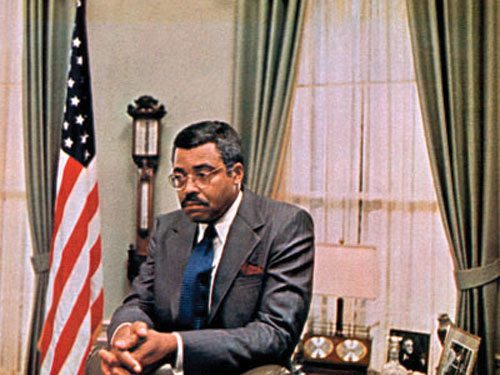
The Man (1972), which was given a brief theatrical release after being made for ABC, was adapted from Irving Wallace’s trashy bestseller by The Twilight Zone‘s Rod Serling — fair enough, since its conceit must have seemed science fiction at the time. James Earl Jones plays a fusty academic Senate president pro tempore suddenly swept into the Oval Office after circumstances wipe out the succession line before him.

Having a “black,” “Negro,” or “jigaboo” (depending on who’s talking and how publicly) commander-in-chief naturally brings out the not-so-latent racism in the various old white male power-mongers used to minority colleagues being powerless token figures. Polite and awed by his position to a fault — he’s no 2008 Barack Obama — our protag nonetheless learns to stand up for himself and his office, even if that means making some decisions unpopular with black voters.

Four years earlier, another trashy novelist (Sidney Sheldon of The Other Side of Midnight) had the pretty good idea of updating (without crediting) Sinclair Lewis’ 1935 cautionary novel It Can’t Happen Here — about a “patriotic” political party pushing the country toward a fascist dictatorship — as a modern action-suspense series. What with Vietnam protests, campus unrest, civil rights struggles, and so forth, the concept of our nation undergoing civil war was evidently too hot for the networks. They passed even after the original script had been shorn of nearly all direct political commentary.

Nonetheless, feature-length pilot Shadow on the Land is fairly strong (and violent) meat for the era. Its hectic portrait of a nation oppressed by governmental “security” brutality, air travel restrictions, etc. on one side, destabilized by a “Society of Man” underground resistance on the other is a metaphor applicable to the Nazi threat of Lewis’ day, Nixon vs. the Left, or post-Patriot Act America. It’s by turns wooden, heavy-handed, shrill, and sophisticated — not exactly good, but still a credible picture of something that could well happen here, perhaps more easily now than in 1968.  

THE UNITED STATES OF VORTEX

The Man, Thurs/14, 9 p.m.;

Shadow on the Land, Thurs/14, 11 p.m., $5

Vortex Room

1082 Howard, SF

www.myspace.com/thevortexroom


Mehserle’s free, but some protesters could still face jail time

 Johannes Mehserle, the former BART police officer who shot and killed Oscar Grant while he was lying face down on the Fruitvale station train platform on New Year’s Day 2009, was released from a Los Angeles jail June 13 after serving a total of 365 days for his involuntary manslaughter conviction. He was sentenced to two years behind bars, but Judge Robert Perry granted him an early release due to credit for time served and good behavior.

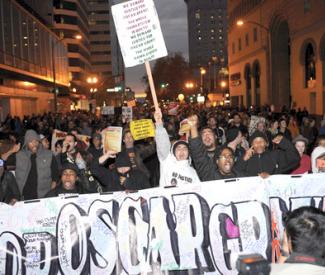
The same date of his release, the National Lawyers Guild filed a class-action lawsuit on behalf of 150 protesters who were mass-arrested during the Nov. 5, 2010 demonstration in Oakland in the wake of Mehersle’s sentencing. Meanwhile, a handful of individuals who engaged in the Jan. 14, 2009 and July 8, 2010 protests launched by Grant supporters — which morphed into riots after community rallies came to an end — are still battling court cases.

Two of the protesters arrested last July initially faced serious felony arson charges for igniting a trash can, which could have led to incarceration for a longer duration than Mehserle served for fatally shooting Grant.

“There were several felony arrests last July, and people were facing charges that could lead to more than a year, no question about that,” noted attorney Dan Siegel of the Oakland-based firm Siegel & Yee. Siegel is currently representing Todd Lister and Adrian Wilson, the two defendants who were accused of arson. The codefendants now face attempted arson charges, carrying a minimum penalty of eight months, with a midterm of one year. “Theoretically, that’s what they’re still facing,” Siegel said, but added that he was confident the as-yet unresolved case would result in a more lenient outcome.

Meanwhile, some of the burglary charges stemming from the looting that occurred in Oakland last July could potentially lead to multi-year sentences, Siegel added, leading to more time in jail than Mehserle served.

Some of the hundreds arrested over the course of the three protests who had prior criminal convictions had their probation or parole immediately revoked as a consequence, said Rachel Jackson, a member of the Coalition for Justice for Oscar Grant and one of the organizers of the Nov. 5 community rally in downtown Oakland’s Frank Ogawa Plaza.

Of the hundreds of arrests made in Oakland during waves of protests launched by Grant supporters, just a small number were on serious charges such as burglary or arson. The mass arrest of 150 individuals last November was initially made on charges of unlawful assembly, yet nearly all of the arrestees were cited and released after spending up to 24 hours in jail, and all had their charges dropped.

In that instance, Oakland police corralled 150 demonstrators who had been participating in a lawful march through the streets into a residential block in East Oakland. Once they were surrounded, Oakland police — who were aided in the streets by 32 other law-enforcement agencies that night, according to National Lawyers Guild attorney Rachel Lederman — placed them all under arrest. No dispersal order was issued prior to making the arrests, and it would have been impossible to comply if one had been issued.

In a class-action lawsuit, the National Lawyers Guild argues that the Nov. 5 protester roundup and mass arrest was a violation of the Oakland Police Department’s crowd control policy, and that it constituted a violation of protesters’ rights to freedom of speech and freedom of assembly. “Even legal observers and a few people who happened to live in the neighborhood were swept up,” Lederman said.

“The policy is clear, and the constitution is clear,” she went on. “You must have probable cause to believe an individual is committing a crime. But in this case, the whole crowd was herded onto a residential street, blocked in, and held on the street for hours. There was never a dispersal order, and all exits were sealed off.”

The Oakland Police Department did not respond to a request for comment.

Arrestees were held handcuffed in vans, in some cases for hours, without access to a bathroom, Lederman noted. All of the women were subjected to pregnancy tests upon being booked into jail, “which made no sense and was abusive in this particular case,” Lederman maintains, because the short time they spent there didn’t justify the excuse that the test would have been necessary to determine whether anyone needed prenatal care. Several men, meanwhile, were subjected to DNA swabs, which is “only supposed to happen if you’re arrested for a violent felony,” according to Lederman. 

Jackson, who was also arrested that night, said she believed police conduct was “incredibly intimidating, and it has a chilling effect on free speech.”

Protesters target Apple as a tax cheat

32

By Oona Robertson

Tomorrow (Sat/4), the economic justice organization US Uncut is protesting Apple Computers for trying to avoid paying $4 billion in federal taxes and for joining a corporate tax cheat lobbying group. Ironically, it is Apple’s good corporate reputation that has made it a target, as protesters hope the attention might shame the company into doing the right thing.

Apple has kept billions of dollars in profits in offshore tax havens and low-tax countries such as Ireland and the Netherlands. Through an organization called WIN America that Apple belongs to along with Google, Microsoft, and other large corporations, it is lobbying Congress for a tax holiday to bring $1.2 trillion in profits back to the U.S. to supposedly invest in the economy. Apple’s share of this tax break, $4 billion, would equal salaries for 90,000 teachers.

US Uncut is aware that the technology giant is an unlikely target for protest, due to its popularity and positive public image. Protesters are hoping that because Apple seems to care about its image in the eyes of consumers, it is more likely to respond to a protest.

“Most of the other companies aren’t really gonna give a damn if we go after them. They’re not concerned for their reputation. [With Apple] there’s a little more leverage,” US Uncut spokesperson Joanne Gifford told us. Apple did not return requests for comment.

Protesters hope to creatively drive their message home using flash mobs to get people’s attention. They are demanding Apple, “Leave the Tax Cheat Lobbying Group and Stop Lobbing Congress for More Tax Loopholes,” according to its website.

This Saturday’s action coincides with similar protests in 15 other U.S. cities, all organized by US Uncut as part of what it calls a national day of action. In San Francisco, protesters are meeting at Union Square to “discuss action ideas,” before heading over to the Apple flagship store on Market Street. Chanting, handing out leaflets and holding signs will be recommended, boasting slogans such as “Love the iPhone, hate the tax cheat,” and, “It only takes one bad apple.”

US Uncut’s website lists creative action ideas for protesters to employ, such as impersonating Apple employees by wearing turquoise blue shirts and nametags, or approaching the Genius Bar to ask questions such as, “Why can’t I sync my iPhone with my values?”

Teachers are being told to bring their pink slips and ask the “geniuses” how to save their jobs. The protesters’ last major flash mob, a music and dance number targeting Bank of America, made headlines and the hope is to replicate that level of publicity this Saturday.

Environmentalists rappel off Richmond Bridge to protest Chevron

This morning, May 23, activists from Amazon Watch and the Rainforest Action Network rappelled off the Richmond Bridge and unfurled a 50 foot banner which read: “Chevron Guilty: Clean Up Amazon.”

Anchored to the bridge deck, three brave souls dangled airborne above the bay alongside the banner, within view of an oil tanker. The banner drop was carried out to draw attention to Chevron’s environmental contamination in the Amazon Rainforest in Ecuador.

http://www.youtube.com/watch?v=HfCtDl1Jf2A

In an historic court victory in Ecuador on Feb. 14, Chevron was found guilty of causing $18 billion worth of environmental damage to a Rhode Island-sized swath of the Amazon. The widespread soil and water contamination, caused by decades of toxic dumping by Texaco and Chevron, has been linked to high rates of cancer and birth defects. Amazon Watch has been campaigning to get Chevron to clean up the oil pollution for 18 years.

“Chevron has said they are going to appeal the decision,” noted Paul Paz y Miño, managing director of Amazon Watch. “They’ve said they’ll fight it till hell freezes over.” So activists are keeping the pressure on.

Chevron will hold its annual shareholder meeting on May 25 in San Ramon, and a coalition of environmental organizations are using the occasion to draw attention to environmental problems the company has caused worldwide.

Three community leaders from the impacted Ecuadorian region traveled to California to share their stories and join in protests outside the shareholders meeting.

Their personal stories are moving. Humberto Piaguaje is a leader of the indigenous Secoya people of Ecuador’s northern Amazon rainforest, whose numbers in that region have dwindled from thousands to just several hundred since Texaco arrived in the area nearly 50 years ago.

Carmen Zambrano moved to the Amazonian region affected by Chevron in 1984, and according to her bio, tells stories “of how the company told people that the crude was good for their health, and that the contaminated water was safe to bathe and wash in, to drink from. … Her own children are terminally ill and developmentally disabled. Her sister-in-law suffers from cancer; her brother-in-law has serious heart problems. Her neighbors have died and almost everyone she knows has skin ailments.”

Serbio Curipoma, a cacao farmer from the Orellana province of Ecuador, lost his parents and sister to cancer. According to his bio, “He realized six years ago that the house his family has lived in for 20 years had been built directly atop an unremediated covered oil pit; digging just a few meters into the earth reveals thick crude.”

The trio from Ecuador will be joined by leaders from Chevron-affected communities in Nigeria, Indonesia, Canada, Angola, and Alaska at a teach-in at Berkeley’s David Brower Center May 23 from 7 to 9 p.m. on “The True Cost of Chevron.”

Paz y Miño noted that Amazon Watch is hoping to amass 30,000 signatures for the 30,000 plaintiffs in the Chevron case in a petition the group plans to deliver to company shareholders and executives during the meeting. They are also hoping to raise funds to cover the cost of the delegation.

Held underwater

1

sarah@sfbg.com

Since the recession began four years ago, 2,000 homes have been lost to foreclosure in San Francisco. These numbers sound insignificant compared to other counties in the Bay Area, but they primarily have hit communities of color already struggling to remain in this expensive city.

As panelists at a recent seminar on foreclosures noted, the first wave hit the Bayview and the Excelsior, while the second hit the Richmond and the Sunset. And as the recession drags on and more borrowers go underwater, another 2,000 foreclosures are on the local horizon.

Although foreclosures continue to destabilize communities and drain resources from local governments, the banking lobby continues to oppose legislative reforms that would allow more people to remain in their homes. And this deep-pocketed resistance has labor, religious, and educational organizations forming the New Bottom Line coalition in an effort to find grassroots solutions to the crisis.

“Foreclosures are the new f-word,” said Regina Davis, CEO of Bayview’s San Francisco Housing Development Corporation, at SFHDC’s April 29 foreclosure seminar.

Sups. John Avalos and Malia Cohen illustrated that there is no shortage of horror stories about predatory lending and dual tracking, in which borrowers apply for loan modifications while the bank continues to pursue foreclosure. Representatives for Sup. Ross Mirkarimi and Assessor-Recorder Phil Ting noted that the banking lobby has blocked even the most modest reforms, even as uncertainty continues to devastate the housing market.

Avalos said his family underwent a housing crisis in 2009, when his wife left her job to home school their special-needs daughter. “We tried to get a loan modification and were told we could only get it by going into default,” he said, recalling how Mission Economic Development Agency (MEDA) helped them navigate the process. “If this could happen to an elected official, it could happen to anyone.”

Cohen, who lost her condo in the Bayview to foreclosure earlier this year, described foreclosure as “an incredible beast that has ravaged and wrecked the finances of many Latino, African American, and Asian communities who were sold the American dream of homeownership but then had the rug pulled away.”

Mirkarimi aide Robert Selna, a former San Francisco Chronicle reporter, said the banking industry spent $70 million last year to kill legislation by state Sen. Mark Leno (D-SF) and Senate President Darrell Steinberg (D-Sacramento) to end dual tracking. This year, the industry has been opposing SB729, Leno and Steinberg’s latest attempt to require banks to give people a definitive answer on loan modification, identify who owns the loan, and give borrowers legal recourse if banks don’t take these steps.

“SB729 gets to the heart of helping to keep people in their homes, but it’s difficult to combat the spending power of the banking industry,” Selna said.

Ben Weber, an analyst in the Assessor-Recorder’s Office, said approximately 277,000 homes in California are going through the foreclosure process; an estimated 1.8 million California residents are underwater on their mortgage; and California is sixth in “negative equity” nationwide. “Negative equity is one of the best indicators of foreclosures — so can we expect another 1.5 million to 1.6 million foreclosures statewide?” he asked.

Weber noted that Ting is supporting AB 1321 by Assemblymember Bob Wieckowski (D-Fremont), which would require that all mortgage assignments be recorded within 30 days of their execution; prevent notices of default from being recorded until 45 days after any deed of trust has been recorded; and provide consumers with better transparency about who owns their debt. Yet Ting’s office reports that the banking industry has lobbied against this and other foreclosure-related legislation

Weber said the legislation is a response to problems with the industry’s Mortgage Electronic Registration System (MERS), which was introduced 15 years ago. “The mortgage industry wanted to expedite the transfer of mortgages between entities so that they could be sold and resold on Wall Street,” Weber said, noting that the system also allowed the industry to avoid paying recording fees to counties.

MERS records an average of 6,700 deeds of trust annually in San Francisco, and MERS deeds of trust are usually transferred two to four times, Weber observed. “So MERS members avoided — conservatively — $134,000 per year in fees.”

Grace Martinez of Alliance of Californians for Community Empowerment noted that the banking lobby already killed AB935 by Assemblymember Bob Blumenfield (D-Northridge), which sought to charge a $20,000 fee to compensate for the estimated cost of a foreclosure to local government. “That money would have gone back to the city,” she said.

In an April 14 letter, the banking lobby claimed Blumenfield’s bill was a tax that increases the costs of homeownership for new borrowers. “It also serves to discourage the importation of capital into California at a time when the federal government is winding down their involvement in mortgage finance and protracts and complicates California’s economic recovery,” stated the letter, which the California Bankers Association, the California Chamber of Commerce, and other business groups signed.

But Dan Byrd, research director at Berkeley’s Greenlining Institute, reminded the mostly black and brown crowd at SFHDC’s foreclosure seminar that declining property values due to foreclosures have drained $193 billion from African American and $180 billion from Latino communities nationwide. “Folks from these communities who had credit good enough to qualify for a prime loan were given subprime loans with adjustable mortgage rates,” he said

Byrd stressed that homeowners facing foreclosures need to be more financially literate. “A lot of loan documents are written in language that people can’t understand, and they don’t have the money to hire a lawyer,” Byrd said, as he urged politicians to fund organizations that provide financial counseling and education. “Our elected federal officials just cut the budget that supports SFHDC and similar groups.”

SFHDC housing counselor Ed Donaldson said appraisal values make it hard to sell the below-market-rate units that are coming online. “So if we don’t do something about the foreclosure problem, the housing market will continue to unwind,” he said, urging people to protests banks and show up at City Hall and in Sacramento to support reform.

The Rev. Arnold Townsend, vice president of the local branch of the National Association for the Advancement of Colored People, said San Francisco likes to pretend that the foreclosure crisis didn’t really affect the city. “But it did,” he said. “It badly hit people of color that the city, by its policies, doesn’t seem to care if they leave.”

Attorney Henri Norris noted that bankruptcy can be an alternative to foreclosure. “A bankruptcy can stop a foreclosure, at least temporarily,” Norris said. He recommends that people make their loans current and try to get a loan modification approved. “But it’s going to take running a marathon.”

Avalos, who is running for mayor, noted that the city does not fund enough affordable housing and he proposed an affordable housing bond that would include assistance for mortgage assistance, ownership downpayment, seismic retrofitting, and energy efficiency. “I understand that voters see no personal benefit, but it would raise wealth in property values,” he said.

Cohen observed that the federal Homeowners Affordable Modification Program (HAMP), which President Obama unveiled in March 2009, “hasn’t worked” and that most of the important reform proposals are “happening at the state level.” She encouraged people to show support for SB729, but wasn’t ready to declare support for Avalos’ housing bond.

“I want to make sure the climate is ripe, that Sups. Carmen Chu and Eric Mar are included, because their districts will be impacted by foreclosures, and that the support is broad-based,” she said. “But folks can divest from banks that have not treated us right.”

Noting that divestment was the most effective way to end apartheid in South Africa, SFHDC’s Davis invited seminar participants to a free screening of Charles Ferguson’s documentary Inside Job, which shows how subprime loans, dual tracking, and mortgage bundling triggered the 2008 financial meltdown — and how many of the main players are still calling the shots.

But despite SFHDC’s informative seminar and the New Bottom Line campaign’s May 3 protest at Wells Fargo’s annual shareholder meetings in San Francisco, SB729 failed to make it out of committee May 4, when Sen. Alex Padilla (D-Van Nuys) announced he would introduce an alternative dual tracking bill. In addition, Wieckowski turned his MERS reform into a two-year bill, suggesting the votes weren’t there to approve it.

Paul Leonard, California director of the Center for Responsible Lending, observed that SB729 supporters include a broad array of consumer, civil rights, labor, faith-based groups, and homeowners, but the only groups in opposition were the California Bankers Association, the Mortgage Bankers Association, and the Chamber of Commerce.

“I find it remarkable that after the exposure of deep-seeded scandals about robo-signing and the systematic shortcomings of mortgage loan service operators, none of the bills intended to address these issues got out of their first committee hearing,” Leonard said.

In an April 20 letter, the banking lobby claimed that SB729 was “unnecessarily complex,” could overlap and contradict actions by federal regulators and state attorneys general, and promote strategic defaults that would negatively affect communities and cloud title for a year following a foreclosure, leaving properties vacant.

Dustin Hobbs of the California Mortgage Bankers Association claims the average time for a foreclosure is more than 300 days. “This would have dragged it out further, and the last thing we need is more vacant homes and more homes in foreclosure,” he said.

Ting noted that Wieckowski made the call to turn AB1321 into a two-year bill. “But you would have thought we were offering the end of home ownership,” Ting said, noting that the banking industry was shocked when advocates produced a MERS memo that encourages banks to record documents and pay fees. “It basically recommended our legislation,” Ting observed.

“Assignments out of MERS name should be recorded in the county land records, even if the state law does not require such a recording,” a Feb. 16 MERS memo said.

Ting describes MERS as “a Wall Street set-up, the ultimate in smoke and mirrors.”

“We did a little poking around in MERS and found that it would help if the name of the loan owner was recorded,” Ting said, noting that the confusion MERS created is bad for consumers, the real estate industry, and homeowners.

“Part of the problem is computer systems doing what banks used to do,” Ting said. “It ended up with robo-signing and foreclosures being sent to the wrong people. I thought AB1321 was a no-brainer, but we had to take it to five or six legislators before anyone would pick it up. This is a prime example of how a particular industry has made a huge amount of money and is unwilling to bend any rules to give consumers any recourse.”

But CMBA’s Hobbs described AB1321 as “part of a broader attack on MERS.” And an April 21 opposition letter from the banking industry describes it as “creating impediments for attracting capital to California’s mortgage marketplace and imposing significant new workloads on county recorders and clerks.”

Ting says he has heard lobbyists make that argument. “But my assessor recorders organization supported it — and they are mostly not elected officials,” he said, noting the group usually doesn’t get involved in promoting legislation.

Ting admits that it’s hard to get the national reforms that are needed. “San Francisco still has a big part to play. And our legislators are still very powerful, so we have no excuse not to be fighting in Sacramento where the Democrats have a supermajority. I mean, how could these bills not get out of committee? It’s not like we didn’t take amendments, but no level of amendments would have made anything happen.”

“Foreclosures typify this financial and political era,” he continued. “They are about all the things we should have seen coming — and some of us did. But even then, and now, there is political amnesia. For all the families that lost their homes, shouldn’t we do something to make sure this doesn’t happen again? Wall Street was bailed out two years ago, but Main Street is still waiting.”

Igniting a union

5

news@sfbg.com

The most contentious and pivotal election ever for the union of academic student employees at the University of California concluded May 8 in a landslide victory for reformers who will now have the chance to deliver on their promise of a more militant and democratic union. In many ways, it was a microcosm for the larger struggle over how to respond to proposals for deep cuts and tuition hikes in the public university systems.

Local 2865 of the International Union, United Automobile, Aerospace and Agricultural Implement Workers of America (UAW), represents 12,000 teaching assistants, tutors, readers, and researchers, making it the largest UAW union on the West Coast. Higher education workers make up 40,000 of the 390,000 active UAW members, just over 10 percent.

The caucus of reformers, organized under the banner Academic Workers for a Democratic Union (AWDU), won all 10 executive board positions and 45 out 80 seats at the Joint Council, taking control from incumbent leaders from United for Economic and Social Justice (USEJ), which has presided over the union for most of its 11-year history.

Voter turnout spiked tenfold over the last triennial election with 3,400 ballots cast this election cycle. Union organizers said the hike reflects intensive campaigning by both sides and a political atmosphere that is threatening both higher education in California and public employees across the country.

“This was the first real contested election our union ever had,” said Mandy Cohen, a comparative literature graduate student at UC Berkeley and the AWDU recording secretary-elect. “There was a huge increase in participation, and it was very contentious. Our leadership never had to fight for their position.”

The intensive campaigning translated into an unusually bitter battle for votes with ensuing accusations of foul play. The allegations include intimidation, personal attacks on the character of candidates, and ballot tampering. But the height of controversy and drama came once all the ballots were cast, when the USEJ-dominated elections committee suspended the vote count midway and AWDU members responded with an office sit-in of the union’s headquarters.

Each side tells a different tale for these 1,500 disputed ballots from UC Berkeley and UCLA, the two largest campuses.

From USEJ’s perspective, the sheer number of challenged ballots and the heated environment in the counting room overwhelmed elections officials, who decided to refer the matter to the Joint Council, the governing body of the local.

“AWDU had 20-plus people in the [vote-counting] room. They were continuing the intimidation and aggression. The elections committee decided that it was too much to handle,” said Daraka Larimore-Hall, outgoing president of the local. He said that USEJ elections committee members have been so harangued since the incident that they are not granting requests for media interviews.

AWDU members, who consider UC Berkeley their stronghold, think the vote-counting freeze was the first step on the road to invalidating ballots from a campus with many AWDU supporters.

“Even though we knew they were really threatened by us, the very idea that we would try to disenfranchise 800 voters from the biggest campus — and that’s how they would try to win the election — was really shocking,” Cohen said.

She defended the AWDU decision to videotape the remaining ballots via webcam and take over union offices in protest. “We weren’t taking a partisan position; we just said we wanted the votes counted. I felt like we were clearly in the right. We just wanted to defend the election — and that position was so strong.”

Counting resumed when both sides finally settled on a third-party mediator, delivering 55 percent of the vote to AWDU.

However, on May 16, USEJ released a statement documenting a slew of alleged misconduct throughout the election and calling for a rerun. “It is critical that our members have confidence that the election process is fair and democratic,” reads the statement. “It seems that several categories of problems, with many more individual examples, occurred that are serious enough to justify setting this election aside.”

Whatever happens, reformers at least will have some opportunity to translate their political platform into action. They say they will focus on two areas: increasing the participation and power of the rank and file, and a more aggressive stance toward the university administration and the budget cuts.

“There is real institutional power in this union that should be better mobilized in those fights [for public education],” said president-elect Cheryl Deutsch. “We are hoping to bring into that debate a more mobilized membership … so that we can be a stronger coalition [with others in California].”

She added that the election was already a huge victory in the long-term plan to increase involvement. A history of member indifference and vacancies in the governing board hopefully will give way to a revival in the higher education labor movement, she said.

But Larimore-Hall expressed strong disagreement with the sentiment that the election was a victory for the labor movement. He said he heard AWDU people tell workers that USEJ represents “centrist sell-outs” and “out of touch union bureaucrats,” tactics he criticized. “Going around and telling people their union leaders are corrupt union bosses … in a culture that is steeped in anti-union rhetoric is an easy thing to sell people on,” he said.

Deutsch said she couldn’t take responsibility for the actions of a few amid hundreds of supporters and activists, but that AWDU as a whole did not engage in personal attacks. She said she is proud that her winning slate came from rank-and-file workers, not from traditional union leadership and staff.

It wasn’t the first time the two factions confronted each other. The origin of the tensions can be traced to the recent wave of budgets cuts at the university, and to the ensuing protests. In the summer of 2009, the UC Board of Regents announced a 33 percent tuition hike; the resulting discontent sparked a student movement with its own fair share of ups and downs. Among the protestors were many graduate students who would go on to become AWDU leaders.

Cohen recalls that in fall 2009, there was a “huge explosion of organizing and activism on our campus trying to organize resistance to the cuts — but not within our union.”

Cohen said that she and other graduate students approached the union to encourage action, but that union bureaucracy stifled their efforts. “It was too top-down and difficult to participate. We realized the local wasn’t structured in a way that could be powerful.”

Larimore-Hall said UAW already was “one of the unions that [the university administration] fears most.” He said that AWDU’s position overlooks the union’s accomplishments on the public education front, citing a petition to Sacramento legislators that USEJ organizers got thousands of members to sign.

Early this spring, the issue of labor properly and sufficiently flexing its muscles came center stage as the UAW and the university negotiated a contract. With no concessions to management and gains such as a 2 percent wage increase and more childcare subsidies, Larimore-Hall said the contract is a resounding success.

But Deutsch says that the contract is a perfect example of her disillusionment with traditional union organizing and the previous leadership. Union members ultimately voted to ratify it despite AWDU criticism that the union didn’t seek enough input from members or push for a better deal. AWDU gained traction and established a significant public presence for the first time with this opposition.

“It’s not that I think it’s the worst contract we could have gotten,” she said, explaining that her problem is with the process, not necessarily with the results. If more members had been consulted and included, she would have been content. She mentioned the dire need for affordable housing at the Irvine campus as an example of member concerns that were not prioritized.

Peter Chester, chief contract negotiator for the university, said that in the “current budgetary circumstances,” UAW did “very well” and expressed concern that the slate, which opposed the contract, did so well among academic workers.

But the victory by reformers probably signals a new militancy in the union, which is expected to resist proposals to privatize campus services and push for a stronger voice in the tough decisions facing the university system. Cohen said that making the case for taxing the rich to pay for public education is the wider goal and the reason she ran for a position at the union.

“It’s eye-opening to be a student and benefit from education here at the UC, but also to identify as a public employee,” she said. “When I got to the UC, I was so proud. And then this struggle came to my doorstep, and I didn’t have a choice in this moment.” 


Cycling race

2

caitlin@sfbg.com

In contrast to the alley cat fixie fiends and placid Venice Beach cruisers, some of Los Angeles’ most ardent bicyclists were going unnoticed and underserved by bike advocacy groups. Working class Latinos are often the only ones on two wheels in several of the city’s most disadvantaged communities — but you weren’t going to catch them at Critical Mass or grabbing a seat at L.A. County Bike Coalition meetings.

The organizers of the community group Ciudad de Luces recognized that these riders, often stuck commuting on the L.A.’s most dangerous roads with substandard safety gear and rickety bikes, needed a voice in the development of the city’s biking infrastructure, and were being missed by the biking movement’s traditional outreach tactics.

The organization started distributing bike lights and Day-Glo visibility vests at day laborer centers; started a weekly bike repair workshop at one of the sites in response to popular demand from workers; and, in 2010, convinced the city to install 73 much-needed bike racks throughout the low income Pico-Union neighborhood. Ciudad de Luces coined a term to describe the community it works with: the invisible riders.

Biking is not a white middle class privilege, but many times the popular face of bike activism is perceived as such. In the case of Ciudad de Luce’s struggle for recognition, that meant the minority communities that do ride aren’t given necessary resources to keep them safe and secure. And according to Jenna Burton of the Oakland community bike group Red, Bike and Green, it also harms cycling’s popularity among some prospective riders.

“If you see something that is predominantly white, it’s automatically not going to be as appealing to the black community,” she said in a phone interview with the Guardian. Burton moved to the Bay Area from the East Coast, and was taken by the strong biking culture. Looking for community, she assumed there had to be some kind of African American bicycle meet-up. (“The Bay Area has everything, right?”) She was surprised to find that one didn’t exist.

Burton realized that blacks were underrepresented in the biking community. When she asked acquaintances about their reluctance to pedal through their daily lives, she found that many were intimidated by the ubiquity of bikes in the area. “It can be really intimidating to get out there for the first time. The culture is so strong here, it seems hardcore to people who are curious about biking.”

“There needed to be a targeted effort toward the black community.” Burton’s solution: create an organization that spoke directly to African Americans about why they should bike. She developed a Black Panthers-style three-point plan to break it down. Black people on average make less money and biking is cheap; black people are subject to chronic health problems and biking makes people stronger; black people are often the subjects of environmental racism and biking is a way to speak out against carcinogenic injustice. To spread the word, the group would hold social rides so riders could see that black bike riders really did exist.

Nick James didn’t own a bike, but when Burton told him about Red, Bike and Green, he was compelled to buy one. Already an activist for HIV/AIDS, education, youth, and health causes, James said in an e-mail interview with the Guardian that he believed Burton had hit upon a way to pull all those social issues together — through an experience that would not only be positive, but fun. Now he uses his bike to get to work and run everyday errands.

“Any space where African Americans can get out stress, laugh, communicate, or heal, I’m there,” he said. “Red, Bike and Green is a space where exercise, socializing, and activism flows seamlessly.”

Core volunteers publicized early rides through word of mouth, often handing out flyers to other black bicyclists that they passed in the streets. They found partners in the East Bay’s burgeoning minority biking advocacy network: Cycles of Change, an umbrella organization that includes the LGBT and minority-run Bikery and Changing Gears Bicycle Shop, and P.O.K.E.R. (People of Kolor Everyday Ridin’).

On Saturday, April 23, Red, Bike and Green held its first ride of 2011. Seventy people rode a route that took them through many of Oakland’s black residential neighborhoods — a tactic that organizers employ, as Burton puts it, to make other black people aware that they can rock some handlebars “to build community in our community.”

Since last year, the rides have attracted cyclists from age seven to 65, families, and strangers who can spend the ride connecting and networking. People have used the rides to announce impending garden harvest surpluses, Oscar Grant protests, and job openings.

As Bay Area bike lanes grow smarter and more numerous, and as gas prices soar and environmental issues become more troublesome, it’s pretty much a done deal that more people are going to be riding bikes. And yes, bike movement, that’s something to ring those bells over. But we have to turn the gears democratically: to really improve access to cycling, the needs of all communities have to be taken into account — and that means getting creative with outreach strategies.

Red, Bike and Green uses bikes to carve out a space for its riders — not only in the velo advocacy movement, but in the social fabric of the Bay Area. Burton is confident that the sight of so many black people rolling by will introduce a thought into the heads of spectators — a thought that really shouldn’t need to be introduced but does anyway: “This is our community, there needs to be space made for us too.”


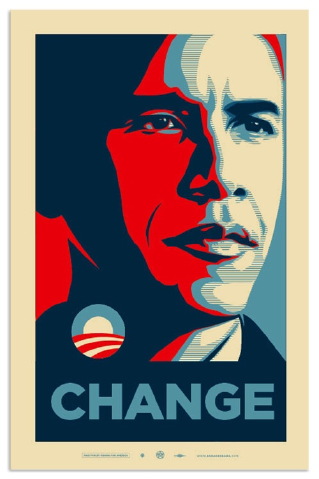
Truth and Reconciliation is the only chance for Hope and Change

2

Like most Americans, I’ve been fascinated by the news of Osama bin Laden’s death, although my reaction has been a strange mix of relief (at the fact that this monster is gone) and revulsion (that murdering our enemies has become so widely accepted). And after processing it for a couple days, I think that we as a country need to go back to the point where things went so horribly wrong and to try to figure out whether there’s a better path that we might take.

I realize that President Obama has demonstrated no appetite for such an undertaking, which could be done through a Truth and Reconciliation Commission like the ones used so effectively in South Africa, Chile, Argentina, Columbia, Peru, East Timor, and other countries looking to heal themselves after deep political strife that led to gross human rights abuses, and to engage with the world about the best way forward.

Particularly now that he’s riding so high as a decisive commander-in-chief, Obama isn’t likely to don Jimmy Carter’s old peacemaker garb. But he should, because we all know where this perilous path we’re on ends, right? With more terrorist attacks to avenge bin Laden’s death, followed by more U.S. commando and Predator drone strikes, while Afghanistan, Pakistan, Iraq, Libya, and Iran just get worse, and then pretty soon we get drawn into Yemen, Somalia, Syria, or some of other countries filled with Muslims who are filled with righteous hatred of the Great Satan. And on and on it goes, never stopping, as the Israel-Palestinian conflict demonstrates.

Meanwhile, domestically, the hawks and the doves get ever more divided and resentful of each other, and the tough-talking, corporate-sponsored politicians play them off against each other, with their angry clips endlessly churned by the media maw until the most sensitive souls each go postal or just tune out. “Victory,” whatever that means anymore, just isn’t possible in this context.

The Bay Area chapter of the anti-war group World Can’t Wait is sponsoring two upcoming protests against Bush Administration war criminals: outside a Condoleezza Rice speech in Room 290 of Stanford University Law School on May 6 at 3 pm and against John Yoo at the UC Berkley School of Law graduation ceremony at Boalt Hall on May 13 at 9 am.

As the protesters have said, the decisions by these two individuals and other top Bush Administration officials have caused more death and human rights violations than Al Qaeda, but I can no longer work up any more anger at these two than I could against bin Laden. They just seem like two sides of the same cruel coin, the twin jets that have propelled this country down a disastrous path.

And at this point, I’d sacrifice my sense of vengeance to change course as a country. As much as I’d like to see Rice, Yoo, Bush, Cheney, and Rumsfield hauled into the Haig and tried for what they’ve done – which would perhaps give me the same sense of satisfaction that many feel now over the death of bin Laden – I would rather give them all complete immunity from prosecution to let them testify truthfully about what’s happened in these last 10 years so that we can begin to atone for it and move on.

If Obama could bring that about, he’d go down in history as a truly great man. Instead, he’ll probably just choose to ride this current wave into a safe reelection campaign, nothing will change, and hope will die.

HOC farmers market bans live chicken sales

15

Feathers will cease to fly over alleged cruelty practices at the Heart of the City Farmers Market that we reported in February. The outdoor Civic Center market has announced it will no longer offer live poultry for sale as of May 27, a practice that had been grounds for a lawsuit and two years of fervent protesting from animal rights groups.

Raymond Young’s Poultry, a popular vendor, has been selling live chickens by the hundreds for nearly two decades at the HOC market every Wednesday and Sunday. In January, animal rights activist group LGBT Compassion filed a lawsuit alleging cruelty and civil rights violation against Young and the HOC after months of protesting and several attempts to get city agencies involved.

While the poultry stall remained popular with its largely Chinese clientele in spite of an ever-present throng of protesters, the practices caught the attention of Animal Care and Control and the Department of Public Health. Young had received hundreds of citations from ACC and warnings from the DPH, but they were essentially void due to an exemption in California law pertaining to poultry.

HOC market managers would not comment for this story, nor would Raymond Young. While the lawsuit is still pending, the announcement was perceived as a victory to the activist group.

“It sent a message to the city and to the public that animal cruelty and public health offenses is not acceptable and should not be endorsed or subsidized by the city,” said Andrew Zollman, founder of LGBT Compassion. “Having the market finally recognize that something like that should change is great.”

Zollman and fellow protestor Alex Felsinger filed the lawsuit with San Francisco attorney Matt Gonzalez. Zollman said that they had continued to protest in the months since filing the suit. Along with ACC, they said that Young had repeatedly violated animal cruelty laws and health codes even after the level of scrutiny on his stall had increased.

The ACC, which had cited Young hundreds of times for practices such as unsanitary conditions, lack of water, and improper handling of the chickens, viewed the decision by the market to ban sales as good news.

“Animals are food for a lot of people, but as Proposition 2 in California exhibited, people do care about the treatment of them,” said Rebecca Katz, director of the ACC, referring to the Prevention of Farm Cruelty Act of 2008. “If the vendors had been able to treat the animals appropriately, I don’t think it would have become this issue. This was profitable; he still could have made good money and done it properly.”

Bullfeathers Quail, the other live bird vendor at the market, had received significantly less attention from protesters and city agencies because it sold far fewer birds – about 350 per week – and had not been accused of nearly as many violations. Nonetheless, the vendor will also be banned.

Zollman said they will continue to protest the stall up until May 27, mainly because they fear the vendors will operate with a higher level of disregard since they have “nothing to lose.” Although they have received caustic criticism from groups who believe their protests are an attack on Chinese culture, they will plan to shift their attention north to Chinatown to live markets operating there.

“We are hoping that what we have learned and what city agencies have learned will pave the way,” said Zollman.

1964 all over again?

16

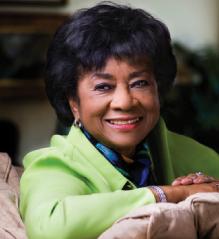
Outstanding piece on Calbuzz about the new Belva Davis book, “Never in My Wildest Dreams: A Black Woman’s Life in Journalism.” The Calbuzzers recount the vicious racist attacks Davis endured during the 1964 Republican convention in San Francisco, when the Goldwater forces were in control:


As we began our descent down the ramps of the Cow Palace, a self-appointed posse dangled over the railings, taunting. “Niggers!” “Get out of here, boy!” “You too, nigger bitch!” “Go on, get out!” “I’m gonna kill your ass!”


I stared straight ahead, putting one foot in front of the other like a soldier who would not be deterred from a mission. The throng began tossing garbage at us: wadded up convention programs, mustard-soaked hot dogs, half-eaten Snickers bars. My goal was to appear deceptively serene, mastering the mask of dispassion I had perfected since childhood to steel myself against any insults the outside world hurled my way.


Then a glass soda bottle whizzed within inches of my skull. I heard it whack against the concrete and shatter. I didn’t look back, but I glanced sideways at Louis and felt my lower lip began to quiver. He was determined we would give our tormentors no satisfaction.


“If you start to cry,” he muttered, “I’ll break your leg.”


Davis, of course, survived and when on to a storied career locally. The scary thing: There are a lot of parallels between the 1964 Goldwaterites and the tea partiers of today. Calbuzz:


Nearly 50 years later [the Goldwater platform] might serve as a manifesto for today’s Tea Party Republicans.


Attacking Democrats as “Federal extremists,” who have “enslaved” and “seek to master” ordinary Americans, the platform vowed , among other things, that Republicans would make deficit reduction their highest economic priority, oppose the “compulsory Democratic scheme” of Medicare and roll back actions of the Kennedy-Johnson Administration that “violently thrust Federal power into the free market.”


And race is still very much a part of what’s going on:


As evidence of the role that race still plays in conservative politics, Davis cited the Tea Party’s embrace of “birthers,” the slurs and spittle hurled by activists at Representatives and civil rights leaders John Lewis and James Clyburn at health care bill protests, and the recent email depicting Obama as a chimpanzee that was sent out by Tea Partier and Orange County Republican Central Committee member Marilyn Davenport.


 Back to the future. And it isn’t pretty.


What to watch

0

THURS/21

Beginners (Mike Mills, U.S., 2010) There is nothing conventional about Beginners, a film that starts off with the funeral arrangements for one of its central characters. That man is Hal (Christopher Plummer), who came out to his son Oliver (Ewan McGregor) at the ripe age of 75. Through flashbacks, we see the relationship play out — Oliver’s inability to commit tempered by his father’s tremendous late-stage passion for life. Hal himself is a rare character: an elderly gay man, secure in his sexuality and, by his own admission, horny. He even has a much younger boyfriend, played by the handsome Goran Visnjic. While the father-son bond is the heart of Beginners, we also see the charming development of a relationship between Oliver and French actor Anna (Melanie Laurent). It all comes together beautifully in a film that is bittersweet but ultimately satisfying. Beginners deserves praise not only for telling a story too often left untold, but for doing so with grace and a refreshing sense of whimsy. Thurs/21, 7 p.m., Castro. (Louis Peitzman)


FRI/22

The Good Life (Eva Mulvad, Denmark, 2010) Portraits of the formerly wealthy are often guilty of peddling secondhand nostalgia for some ancien regime while simultaneously stoking schadenfreude toward the now-deposed (just ask Vanity Fair). Eva Mulvad’s melancholy character study of 50-something Annemette Beckmann and her aged mother, Mette, avoids both traps even as her subjects — formerly wealthy Danish expats living on the dole in a cramped apartment in a coastal Portuguese town — offer few inroads for sympathy. Narcissistic and petulant, Annemette blames the loss of her family’s wealth on the 1974 nationalization of Portugal’s then-Communist government, and claims that her cosseted upbringing has made it hard to find a job (“Work doesn’t become me,” she gratingly protests at one point). Mette, who is more likeable, is a resigned realist whose sole comfort, aside from the pet dog, seems to be her knowledge that she is not long for this world. Comparisons to Grey Gardens (1975) are inevitable here, but the Beckmanns simply aren’t as interesting or possessed by as idiosyncratic a joie de vivre as the Beales, making The Good Life a tough slog. Fri/22, 3:45 p.m.; April 28, 6:45 p.m.; and May 1, 9:30 p.m., Kabuki. (Matt Sussman)

Hahaha (Hong Sang-soo, South Korea, 2010) Do you remember a time you behaved badly (not horribly, but bad enough that you felt ashamed) but you didn’t really think about it until long after the fact, say, when getting drinks with an old friend? If you can’t, than the latest from South Korean director Hong Sang-soo will probably jog your memory. As with many of Hong’s films, Hahaha’s premise is similar to the above scenario: two 30-something buds get together and reminisce about their recent trips to the same seaside town. Shown in episodic flashbacks, we start to realize that the incidents and players in their separate accounts overlap into one story filled with terrible poetry, domineering mothers, stalker-ish behavior, and poorly made choices. Hong’s films are primers in how not to treat your fellow human beings (straight dudes are usually the culprits), so take notes. Fri/22, 9:15 p.m.; Mon/25, 9 p.m.; and Tues/26, 3:30 p.m., Kabuki. (Sussman)

I’m Glad My Mother is Alive (Claude Miller and Nathan Miller, France, 2009) Codirected with his son Nathan, this latest by veteran French director Claude Miller is an about-face from his acclaimed 2007 period epic A Secret. Viscerally up-to-the-moment in content and handheld-camera style, it’s a small story that builds toward an enormous punch. Thomas (played by Maxime Renard as a child, then Vincent Rottiers) is a lifelong malcontent whose troubles are rooted in his abandonment at age five by an irresponsible mother (Sophie Cattani). Neither the attentions of well-meaning adoptive parents or the influence of his better-adjusted younger brother can quell Thomas’ mix of furious resentment and curiosity toward his mere, whom he finally develops a relationship with as a young adult. As usual, Miller doesn’t “explain” his characters or let them explain themselves, yet everything feels emotionally true — right up to a narrative destination both that feels both shocking and inevitable. Fri/22, 6:45 p.m., and Mon/25, 9:30 p.m., Kabuki. (Dennis Harvey)

Meek’s Cutoff (Kelly Reichardt, U.S., 2010) After three broke down road movies (1994’s River of Grass, 2006’s Old Joy, 2008’s Wendy and Lucy), Kelly Reichardt’s new frontier story tilts decisively toward socially-minded existentialism. It’s 1845 on the choked plains of Oregon, miles from the fertile valley where a wagon train of three families is headed. They’ve hired the rogue guide Meek to show them the way, but he’s got them lost and low on water. When the group captures a Cayeuse Indian, Solomon proposes they keep him on as a compass; Meek thinks it better to hang him and be done with it. The periodic shots of the men deliberating are filmed from a distance — the earshot range of the three women (Michelle Williams, Zoe Kazan, and Shirley Henderson) who set up camp each night. It’s through subtle moves like these that Meek’s Cutoff gives a vivid taste of being subject to fate and, worse still, the likes of Meek. Reichardt winnows away the close-ups, small talk, and music that provided the simple gifts of her earlier work, and the overall effect is suitably austere. Fri/22, 9 p.m., and Mon/25, 4:30 p.m., Kabuki. (Max Goldberg)

Stake Land (Jim Mickle, U.S., 2010) Not gonna lie — the reason I wanted to review this one was because of the film still in the SFIFF catalog. Rotten-faced vampire with a stake through its neck? Yes, please! But while Jim Mickle’s apocalyptic road movie does offer plenty of gore, it’s more introspective than one might expect, following an orphaned teenage boy, Martin (Connor Paolo, Serena’s little bro on Gossip Girl), and his gruff mentor, Mister (Snake Plissken-ish Nick Damici), on their travels through a ravaged America. As books, films, and comics have taught us, whenever a big chunk of the human race is wiped out (thanks to zombies, vampires, an unknown cataclysm, etc.), the remaining population will either be good (heroic, like Mister and Martin, or helpless, like the stragglers they rescue, including a nun played by Kelly McGillis), or evil — cannibals, rapists, religious nuts, militant survivalists, etc. Stake Land doesn’t throw many curveballs into its end-times narrative, but it’s beautifully shot and doesn’t hold back on the brutality. Larry Fessenden (director of 2006’s The Last Winter) produced and has a brief cameo as a helpful bartender. Fri/22, 11:30 p.m., and Mon/25, 9:45 p.m., Kabuki. (Cheryl Eddy)


SAT/23

The Autobiography of Nicolae Ceausescu (Andrei Ujica, Romania, 2010) Andrei Ujica’s three-hour documentary uses decades of propagandic footage to let the late Romanian dictator — who was overthrown by popular revolt and executed in 1989 — hang himself with his own grandiose image-making. While the populace suffered (off-screen, you might want to bone up on the facts before seeing this ironical, commentary-free portrait), the “great leader” and his wife Elena were constantly seen holding state dances, playing volleyball, hunting bear, and vacationing hither and yon. (We even see them on the Universal Studios tour.) There’s no surprise in seeing them greeted with enormous pageantry in China; but it’s a little shocking to see this tyrant welcome Nixon (in the first-ever U.S. presidential visit to a Communist nation), lauded by Jimmy Cartner, and hobnobbing with Queen Elizabeth. This grotesque parade of self-glorifying public moments has a happy ending, however. Sat/23, 12:45 p.m., Kabuki; Sun/24, 5:15 p.m., New People; May 1, 1:30 p.m., PFA. (Harvey)

Life, Above All (Oliver Schmitz, South Africa/Germany, 2010) It’s tough enough to simply grow up, let alone care for a parent with AIDS and deal with the suspicions and fears of the no-nothing adults all around you. Rising above easy preaching and hand-wringing didacticism, Life, Above All takes as its blueprint the 2004 best-seller by Allan Stratton, Chandra’s Secrets, and makes compelling work of the story of 12-year-old Chandra (Khomotso Manyaka) and her unfortunate family, unable to get effective help amid the thicket of ignorance regarding AIDS in Africa. After her newborn sister dies, Chandra finds her loyalty torn between her bright-eyed best friend Esther (Keaobaka Makanyane), who’s rumored to hooking among the truck drivers in their dusty, sun-scorched rural South African hometown, and her mother (Lerato Mvelase), who listens far too closely to her bourgie friend Mrs. Tafa (an OTT Harriet Manamela), for her own good. Cape Town native director Oliver Schmitz sticks close to the action playing across his actors’ faces, and he’s rewarded, particularly by the graceful Manyaka, in this life-affirmer about little girls forced to shoulder heart-breaking responsibility far too soon. Sat/23, 4 p.m., and April 28, 6 p.m., Kabuki. (Kimberly Chun)

The Mill and the Cross (Lech Majewski, Poland/Sweden, 2010) One of the clichés often told about art is that it is supposed to speak to us. Polish director Lech Majewski’s gorgeous experiment in bringing Flemish Renaissance painter Peter Bruegel’s sprawling 1564 canvas The Procession to Calvary to life attempts to do just that. Majeswki both re-stages Bruegel’s painting — which draws parallels between its depiction of Christ en route to his crucifixion and the persecution of Flemish citizens by the Spanish inquisition’s militia — in stunning tableaux vivant that combine bluescreen technology and stage backdrops, and gives back stories to a dozen or so of its 500 figures. Periodically, Bruegel himself (Rutger Hauer) addresses the camera mid-sketch to dolefully explain the allegorical nature of his work, but these pedantic asides speak less forcefully than Majeswki’s beautifully lighted vignettes of the small joys and many hardships that comprised everyday life in the 16th century. Beguiling yet wholly absorbing, this portrait of a portrait is like nothing else at the festival. Sat/23, 12:30 p.m., SFMOMA, and April 27, 9 p.m., Kabuki. (Sussman)

Mind the Gap Experimental film fans: come for the big names, but don’t miss out on the newcomers. Locals Jay Rosenblatt (melancholy found-footage bio The D Train), Kerry Laitala (psychedelic 3-D brain-dazzler Chromatastic), and Skye Thorstenson (mannequin-horror music video freak out Tourist Trap, featuring the acting and singing stylings of the Guardian’s Johnny Ray Huston) offer strong entries in an overall excellent program. International bigwigs Peter Tscherkassky (the 25-minute Coming Attractions, a layered study of airplanes, Hollywood, and Hollywood airplanes — not for the crash-phobic) and Jonathan Caouette (“Lynchian” has been used to describe the Chloë Sevigny-starring All Flowers In Time, though it contains a scary-faces contest that’d spook even Frank Booth) are also notable. New names for me were Zachary Drucker, whose Lost Lake introduces a transsexual, pervert-huntin’ vigilante for the ages, and my top pick: Kelly Sears’ Once it started it could not end otherwise, a deliciously sinister hidden-history lesson imagined via 1970s high-school yearbooks. Sat/23, 4:45 p.m., and May 1, 9:45 p.m., Kabuki. (Eddy)

The Troll Hunter (André Ovredal, Norway, 2010) Yes, The Troll Hunter riffs off The Blair Witch Project (1999) with both whimsy and, um, rabidity. Yes, you may gawk at its humongoid, anatomically correct, three-headed trolls, never to be mistaken for grotesquely cute rubber dolls, Orcs, or garden gnomes again. Yes, you may not believe, but you will find this lampoon of reality TV-style journalism, and an affectionate jab at Norway’s favorite mythical creature, very entertaining. Told that a series of strange attacks could be chalked up to marauding bears, three college students (Glenn Erland Tosterud, Tomas Alf Larsen, and Johanna Morck) strap on their gumshoes and choose instead to pursue a mysterious poacher Hans (Otto Jespersen) who repeatedly rebuffs their interview attempts. Little did the young folk realize that their late-night excursions following the hunter into the woods would lead at least one of them to rue his or her christening day. Ornamenting his yarn with beauty shots of majestic mountains, fjords, and waterfalls, Norwegian director-writer André Ovredal takes the viewer beyond horror-fantasy — handheld camera at the ready — and into a semi-goofy wilderness of dark comedy, populated by rock-eating, fart-blowing trolls and overshadowed by a Scandinavian government cover-up sorta-worthy of The Girl with the Dragon Tattoo (2009). Sat/23, 11:30 p.m., Kabuki; Mon/25, 6:15 p.m., New People. (Chun)

World on a Wire (Rainer Werner Fassbinder, Germany, 1973) The words “Rainer Werner Fassbinder” and “science fiction film” are enough to get certain film buffs salivating, but the Euro-trashy interior décor is almost reason enough to see this restored print of the New German Cinema master’s cyber thriller. Originally a two-part TV miniseries, World on a Wire is set in an alternate present (then 1973) in which everything seems to be made of concrete, mirror, Lucite, or orange plastic. When the inventor of a supercomputer responsible for generating an artificial world mysteriously disappears, his handsome predecessor must fight against his corporate bosses to find out what really happened, and in the process, stumbles upon a far more shattering secret about the nature of reality itself. Riffing off the understated cool of Godard’s Alphaville (1965) while beating 1999’s The Matrix to the punch by some 25 years, World on a Wire is a stylistically singular entry in Fassbinder’s prolific filmography. Sat/23, 8:45 p.m., Kabuki, and April 30, 2 p.m., PFA. (Sussman) SUN/24

A Cat in Paris (Alain Gagnol and Jean-Loup Felicioli, France/Belgium/Netherlands/Switzerland, 2010) Save your pocket poodles, please: Paris, as cities go, is most decidedly feline. From 1917’s silent serial Les Vampires to its uber-cool 1990s update Irma Vep, cat burglars and the Parisian skyline have gone together like café and au lait. Add actual cats and jazz to the mix for good measure (even Disney saw fit to set its jazzy 1970 Aristocats in the City of Light). At just over an hour long, the animated A Cat in Paris is an enjoyable little amuse-bouche that employs all the standards of the cats-in-Paris meme: Billie Holiday warbling on the soundtrack, a dashingly heroic antihero who scales the rooftops as if he studied parkour under Spider-Man, and the titular untamable black cat who serves as his partner in crime. Complete with a climatic Hitchcockian set piece on the rooftops of Notre Dame Cathedral, A Cat in Paris has a refreshingly angular and graphic, almost cubist, feel. Directors Alain Gagnol and Jean-Loup Felicioli’s work certainly doesn’t rank among that of countryman Sylvain Chomet (2010’s The Illusionist), but this family film is worth checking out if kitties up to no good in Purr-ree simply make you want to le squee. Sun/24, 12:30 p.m., Kabuki, and May 1, 12:30 p.m., New People. (Michelle Devereaux)


MON/25

Cave of Forgotten Dreams (Werner Herzog, U.S., 2010) The latest documentary from Werner Herzog once again goes where no filmmaker — or many human beings, for that matter — has gone before: the Chauvet-Pont-d’Arc Cave, a heavily-guarded cavern in Southern France containing the oldest prehistoric artwork on record. Access is highly restricted, but Herzog’s 3D study is surely the next best thing to an in-person visit. The eerie beauty of the works leads to a typically Herzog-ian quest to learn more about the primitive culture that produced the paintings; as usual, Herzog’s experts have their own quirks (like a circus performer-turned-scientist), and the director’s own wry narration is peppered with random pop culture references and existential ponderings. It’s all interwoven with footage of crude yet beautiful renderings of horses and rhinos, calcified cave-bear skulls, and other time-capsule peeks at life tens of thousands of years ago. The end result is awe-inspiring. Mon/25, 7 p.m., and Tues/26, 9:30 p.m., Kabuki. (Eddy)


TUES/26

Nostalgia for the Light (Patricio Guzmán, France/Chile/Germany, 2010) Chile’s Atacama Desert, the setting for Patricio Guzmán’s lyrically haunting and meditative documentary, is supposedly the driest place on earth. As a result, it’s also the most ideal place to study the stars. Here, in this most Mars-like of earthly landscapes, astronomers look to the heavens in an attempt to decode the origins of the universe. Guzmán superimposes images from the world’s most powerful telescopes — effluent, gaseous nebulas, clusters of constellations rendered in 3-D brilliance — over the night sky of Atacama for an even more otherworldly effect, but it’s the film’s terrestrial preoccupations that resonate most. For decades, a small, ever dwindling group of women have scoured the cracked clay of Atacama searching for loved ones who disappeared early in Augusto Pinochet’s regime. They take their tiny, toy-like spades and sift through the dirt, finding a partial jawbone here, an entire mummified corpse there. Guzmán’s attempt through voice-over to make these “architects of memory,” both astronomers and excavators alike, a metaphor for Chile’s reluctance to deal with its past atrocities is only marginally successful. Here, it’s the images that do all the talking — if “memory has a gravitational force,” their emotional weight is as inescapable as a black hole. Tues/26, 6:30 p.m., Kabuki, and April 28, 6:15 p.m., PFA. (Devereaux)

The Sleeping Beauty (Catherine Breillat, France, 2010) Fairytales are endemically Freudian; perhaps it has something to with their use of subconscious fantasy to mourn — and breathlessly anticipate — the looming loss of childhood. French provocateuse Catherine Breillat’s feminist re-imagining of The Sleeping Beauty carries her hyper-sexualized signature, but now she also has free reign to throw in bizarre and beastly metaphors for feminine and masculine desire in the form of boil-covered, dungeon-dwelling ogres, albino teenage princes, and icy-beautiful snow queens. The story follows Anastasia, a poor little aristocrat, who longs to be a boy (she calls herself “Sir Vladimir”). When her hand is pricked with a yew spindle (more of a phallic impalement, really), Anastasia falls into a 100-year adventurous slumber, eventually awakening as a sexually ripe 16-year-old. It all plays like an anchorless, Brothers Grimm version of Sally Potter’s 1992 Orlando. And while it’s definitely not for the kiddies, it’s hard to believe that many adults would find its overt symbolism and plodding narrative any more than a sporadically entertaining exercise in preciousness. Your own dreams will undoubtedly be more interesting — perhaps you can catch a few zzz’s in a theater screening this movie. Tues/26, 6:15 p.m., and April 27, 6:30 p.m., Kabuki. (Devereaux)

THE 54TH ANNUAL SAN FRANCISCO INTERNATIONAL FILM FESTIVAL runs April 21–May 5. Venues are the Sundance Kabuki, 1881 Post, SF; Castro, 429 Castro, SF; New People, 1746 Post, SF; San Francisco Museum of Modern Art, 151 Third, SF; and Pacific Film Archive, 2575 Bancroft, SF. For tickets (most shows $13) and complete schedule visit www.sffs.org>.


Preaching Tikkun

93

Michael Lerner recently endured death threats, attacks on his house, and a cyber attack that shut down the website of his beloved magazine Tikkun. But it’s nothing new for an outspoken outsider whom infamous former FBI director J. Edgar Hoover once dubbed “one of the most dangerous criminals in America.”

The 68-year-old rabbi jokes that his middle name is chutzpah (Yiddish for audacity, good or bad) and says he has been a magnet for controversy his entire life. But that doesn’t make the recent threats from Zionists and other strong advocates for Israel any less scary.

The latest controversy comes on the heels of Tikkun’s silver anniversary celebration, held March 14, when the progressive Jewish publication honored human rights advocate Judge Richard Goldstone, whose report condemning Israeli war crimes in Gaza was strongly criticized by Jewish leaders. The day after the Tikkun event, vandals plastered posters outside Lerner’s Berkeley home depicting him as a Nazi cooperating with an Islamic extremist to destroy Israel. Previously vandals broke into his home, wreaking havoc inside and leaving graffiti to communicate their message.

After all these years, Lerner bears the threats and accusations with eternal optimism and resilience, preaching the still-radical message of “peace, justice, nonviolence, generosity, caring, love, and compassion.” The message has been at center of the Berkeley-based magazine’s mission for 25 years.

Aside from being a vibrant spiritual community based on traditional Jewish and other humanistic values, Tikkun has deeply influenced the discourse in the wider Jewish community. It has challenged the Jewish community’s automatic support for Israel and Zionism and started a spirited debate, triggering an angry backlash in the process.

As its readership has diversified across religions, so has its mission, leading Lerner to found the Network of Spiritual Progressives in 2005. Dismayed by how conservatives use the notion of family values, Lerner has sought to create a progressive framework to address the human need for spiritual meaning.

“Tikkun is the major thing I did with my life,” Lerner tells us.

The recent celebration included an award ceremony for those Lerner’s team deems most “Tikkunish.” The title of the magazine comes from the old Hebrew phrase tikkun olam, a principle of shared responsibility to “heal, repair, and transform the world.” Previous winners include poet Allen Ginsberg and historian Howard Zinn.

Goldstone is known for helping to dismantle apartheid in South Africa and prosecuting war crimes in the former Yugoslavia and Rwanda. Most recently, Goldstone headed a U.N.-sponsored investigation into Israel’s attack on Gaza two years ago. The investigation concluded that indiscriminate bombing in densely populated areas by Israeli forces amounts to war crimes.

Israel and many Jewish leaders have harshly criticized Goldstone’s report on the Gaza attack for its purported biases, saying it unjustly jeopardizes Israel’s international standing and reputation. But at Tikkun’s award ceremony, Goldstone reaffirmed the findings of his investigation and said that he was compelled to act because he believes in the “right of civilians to be protected even in war.”

Lerner sees Goldstone’s actions as important and deeply Jewish, calling him “a person who takes seriously a central command of Torah: ‘Justice, justice shalt thou pursue.'” The two men have had a relationship since Lerner reached out to Goldstone a year ago. At the time, Goldstone was facing so much backlash that some members of South Africa’s Jewish community sought to bar him from attending his son’s bar mitzvah. That was when the first attack to Lerner’s home occurred.

Berkeley Police Department spokesperson Sgt. Mary Kusmiss said the police have “no leads or identified suspects.” She went on to say that the latest incident may be classified as a hate crime.

“When people start coming to attack your house, you don’t feel safe,” Lerner said. “You don’t know what these crazy people will do next.” But he insists he does not want to make a big deal out of the threats, saying extremists have never altered his actions or politics.

Lerner has always tried to challenge the American Jewish establishment, a term for organizations with an array of religious, cultural, and political concerns but a common hawkish stance on Israel and American foreign policy.

“Israel has been turned into God,” he explains. “You can walk into any synagogue in America and you can tell them ‘I don’t believe in God, I don’t like the Torah, and I’m not following the Ten Commandments’ and be welcomed. But if you go into that same synagogue and say, ‘I don’t support Israel,’ you are kicked out. People are worshiping Israel and God has been abandoned.”

But Lerner notes shifting public opinion, especially among younger Jews. Many are experiencing ethical dissonance between the righteous and heroic Israel commonly portrayed in the Jewish community and the increasingly visible reality of Israel’s military occupation of Palestinian lands, human rights abuses, and violations of international law.

While criticism of Israel coming from non-Jews is often dismissed as anti-Semitism, Jews who express dissent often get called “self-hating.” But Lerner said the illogical conclusion that Israel is the same thing as the Jewish people, and that if you criticize Israel you hate yourself has become less effective in silencing dissent. “It simply isn’t true that people are angry at Israel because of some internal psychological deformation,” Lerner said. “[Increasingly] people are saying ‘If being ethical is the same as being a self-hating Jew, then I choose to be ethical.’ “

But Lerner comes under fierce criticism from Jewish hardliners for his views. Attorney Alan Dershowitz, an outspoken supporter of Israel’s government, famously wrote a 2006 commentary in j., the Jewish news weekly of Northern California detailing Lerner’s “offense against decency and the Jewish people,” concluding that Lerner is a “rabbi for Hamas.” According to Dershowitz, “Tikkun is quickly becoming the most virulently anti-Israel screed ever published under Jewish auspices.”

But Lerner isn’t really on the radical edge in criticizing Israel. Although Tikkun courted controversy in 1988 by denouncing Israel’s occupation of Palestinian territories, the magazine today doesn’t support the movement that is pushing a policy of boycott, divestment, and sanctions of Israel initiated by Palestinian activists in 2005 as a nonviolent tactic to pressure Israel to change its policies. But Lerner still seeks to foster debate on the topic, as he did in the July/August 2010 issue, which featured Rebecca Vilkomerson of Jewish Voice for Peace arguing for at least a partial support of the tactic.

Lerner’s ire has always been directed at powerful institutions, from the military to the white Southern power structure. As a college student, Lerner directly engaged in the nonviolent protests of the 1960s. While working toward his first PhD (philosophy) at UC Berkeley, Lerner was president of Students for a Democratic Society. Later, while working on his second PhD (psychology) in Seattle, Lerner was arrested and found guilty of instigating a riot during a protest against the Vietnam War. The conviction was later overturned, but his reputation as a dangerous radical was solidified in the minds of Hoover and other establishment figures.

Lerner never abandoned his belief in the validity and power of protest. “I would like to see young Jews confront the Jewish institutions,” he said. “I want to see sit-ins and demonstrations to challenge those who are willing to give support to the right-wing governments of Israel.”

Yet he has also grown skeptical of many leftist groups. “As spiritual progressives, we are critical of progressives,” Lerner explains. Although he agrees that a major redistribution of political and economic power is necessary, he argues that something is missing on the left, with its focus on secular ideas and neglect of real spiritual needs.

Lerner says the left’s shortcoming has allowed the right to tap into popular discontent and win support by championing church and family.

While working toward his PhD in psychology, Lerner was part of a team that interviewed thousands of working Americans. “What we discovered was there was a spiritual crisis in peoples lives. There was a deep hunger for a framework of meaning and purpose to life that would transcend the individualism, selfishness, and materialism that people are working all day long in the workplaces,” he said. “People don’t like the message of the work world that the bottom line is to maximize money and power, and to do that you must look out for No. 1 and not care about others.”

His response was to found Tikkun, whose message can attract even agnostics. Alana Price does not describe herself as religious, but she has recently been promoted to be the co-managing editor of the magazine. “I knew Tikkun built a bridge between the religious left and the secular left, so I was excited about that,” Price said. “What drew me was the deeply humane quality of Tikkun.”

Smart meters, stupid company

9

news@sfbg.com

Smart meters seemed like a good idea at first glance — a little wireless device that, unlike it’s dumb analogous predecessor, would track precise readings of household energy usage in real time, identifying wasteful activities and helping consumers make informed choices about conservation and consumption.

Considered a crucial first step in enabling a smart grid that would modernize the existing power grid for the information age, the technology was touted as offering potential benefits such as cheaper service, fewer new power plants and transmission lines, cleaner air, and more reliable services.

But Pacific Gas & Electric Co.’s $2.2 billion program for installing smart meters has now become the subject of caustic criticism by thousands of customers and activists as the culprit for skyrocketing rates, adverse health effects, and threats to privacy.

Since deployment began in California in 2009, consumers have mobilized to halt the spread of the devices, demanding further studies of the technology and options for those who don’t want to join the rush toward a wireless world. Thirty-three local governments have called for moratoriums on the installation of the devices.

The California Public Utilities Commission, which in 2006 authorized the state’s investor-owned utility companies to install more than 10 million meters in California, has done little to quell the storm of protests and concerns. But that began to change March 10 when CPUC President Michael Peevey announced that the agency would require PG&E to develop an opt-out proposal for consumers within two weeks.

Prefacing the decision with an observation that almost every speaker against smart meters the CPUC heard from was a PG&E customer, Peevey called out Northern California residents as the main opponents to the program.

“I am directing PG&E to prepare a proposal for our consideration that will allow some form of opt-out for customers who object to these devices, at a reasonable cost to be paid by the customers who choose to opt-out,” Peevey said at the hearing. “Obviously I cannot prejudge how this commission will evaluate any such proposal by PG&E, nor can I predict what PG&E itself will propose. But I think it’s clear the time has come for some kind of movement in the direction of customer opt-outs.”

But the announcement did little to quell the opposition by the scores of customers, local governments, health professionals, and advocacy groups that claim it undercuts the true concerns while simultaneously opening another avenue the utility behemoth could profit from.

“Admitting to the problem is the first step to resolving it,” says Joshua Hart, executive director of grassroots organization Stop Smart Meters!, which has been at the forefront of the rebellion. “But we obviously think a ton of things were left out of this.”

The makeup of the meter haters spans interests and ideals, from Tea Party conservatives to liberal environmentalists. Their unifying trenchant criticism of Peevey, who was president of Edison International and Southern California Edison Company until 1995, has only increased with each meter installed. PG&E has already replaced 74 percent of its analog electrical meters and 83 percent of its gas meters.

Resolutions critical of PG&E’s smart meter deployment have been passed by many Bay Area cities and the counties of Santa Cruz and San Luis Obispo. Assemblymember Jared Huffman (D-San Rafael) introduced a bill in December 2010 that would create a statewide system for opting out.

Although PG&E officials didn’t return repeated Guardian calls about the controversy, they have told other media outlets that the meters are completely safe and installation is continuing as scheduled, despite the growing furor.


BABY STEPS

A total of 670,000 meters are planned for San Francisco, and installation has already begun in the Marina and Richmond districts, much to the dismay of many residents. During a series of public meetings at the CPUC since 2010, dozens of people regularly line up to ask for alternative options and conclusive, third-party studies on the technology.

Speakers mainly consist of those claiming to suffer from exposure to electromagnetic fields, a condition known as electrohypersensitivity (EHS) that causes headaches, nausea, fatigue, and ringing in the ears. Sufferers liken themselves to canaries in coal mines and say smart meters are just one aspect of larger problem: understudied, overhyped wireless technology.

“The bottom line is it’s a debacle that been rolled out without any public input, without any long-term study,” Hart said. “This is the wireless technology industry being too greedy and going too far.”

Smart meters emit less powerful electromagnetic fields than many smart phones, but activists worry about the effects, both cumulative and on those with EHS, a condition recognized by the Swedish government. But here in the United States, few experts outside of holistic and alternative health circles take it seriously as a health threat.

Hart pointed to the recent publication of a study by the National Institutes of Health finding cell phone emissions affect brain activity, calling it the “smoking gun.” But most scientists found the report inconclusive about how that stimulation affects the brain.

Yet the activists have held regular protests lambasting PG&E for endangering their health and invading their privacy. “This is forced installation of untested devices on an unwilling public,” Carol Page of Marin County told us at a large Feb. 24 protest outside the CPUC meeting in San Francisco. “It’s time this commission stopped enabling and started regulating.”

CPUC officials have said there was no need for additional analysis of the program, arguing that the meters are safe and that installation is a routine procedure allowed under existing utility contracts.

But the venerable consumer watchdog The Utility Reform Network (TURN) has long-opposed the program, focusing primarily on its cost and privacy threats from the data that is being transmitted. Hundreds of customers have contacted TURN to complain about the meters, and the group says Peevey’s policy change misses the mark.

“It’s certainly a step in the right direction, but the devil is going to be in the details,” TURN spokesperson Mindy Spatt told us. “We would review any proposal to charge customers very carefully. We don’t want to see them have pay again.”

She said PG&E’s consumer outreach efforts have been “abysmal,” and TURN supports a moratorium on smart meter installation.

“We are not hearing from any people who are benefiting from it,” Spatt said. “We are hearing from people who are upset about it, and we remain unconvinced that these meters offer any benefits commensurate with their costs.”

TURN’s website offers a flyer that reads “Do Not Install,” which customers can print and place on their analog meter. Wellington Energy, the company performing installations, has respected the signs, Spatt said.

“The flyer is still getting tons and tons of play,” Spatt said. “PG&E has done nothing to address customers who say that the smart meter is unwanted and unwelcome. We are very anxious to see what sort of an opt-out they can offer.”

Although the flyer conveyed a direct message to utilities, some chose the more radical route of blocking installation physically. In January, two women, one a grandmother, were arrested in Rohnert Park for blocking a Wellington truck carrying a load of smart meters.

Sandi Maurer, founder of the EMF Safety Network, believes the movement from the CPUC falls short of taking real action addressing the threat of harmful electromagnetic frequencies to the environment and human health.

“We really need a moratorium while we study the health impacts and have evidentiary hearings where we could determine whether they are safe,” she said. In December 2010, the EMF Safety Network’s request for the CPUC to open an investigation into smart meters was denied.


CUSTOMER DISSERVICE

One smart meter claim the CPUC did investigate was the allegation that the new meters weren’t accurate, following up on more than 600 complaints from customers that their energy bills shot up after the new meters were installed.

The Structure Group, a Houston-based consulting company, tested 750 smart meters and 147 electromechanical meters and concluded that they worked fine. But the study also found that PG&E didn’t properly handle the complaints.

“PG&E’s process did not address the customer concerns associated with the new equipment and usage changes,” the report said. “Some customers interviewed during this assessment did not consider their complaint resolved, despite indications from PG&E and the CPUC that the customer agreed with the resolution.”

As a demonstration of how the program could have been rolled out differently, one needs only to look up the road to Sacramento. The publicly owned Sacramento Municipal Utilities District has installed 184,000 meters and encountered little opposition.

“I’ve seen what’s happening in the Bay Area and we haven’t seen anything like that whatsoever,” SMUD spokesperson Chris Capra said. “I’m amazed at the difference in our customers compared with customers around the country. “

Capra credits the relative embrace of the meters to the method SMUD used to mobilize them. Before installing any meters, SMUD build its wireless network. Then SMUD installed 78,000 trial meters in two separate areas — one in close-quartered downtown and one in suburban areas — to see how the meters behaved under topographical and proximity challenges. Then it led the meters through automated trials doubled with traditional manual reads and found that they were 99 percent accurate.

“We wanted to be certain before we began with full deployment,” Capra said. “We had estimated reads, manual reads, and made sure everything is functional. “

But some problems go beyond customer service. Along with health and safety concerns, critics remain unconvinced that the smart meters live up to their purported benefits to consumers, even though they’re the ones paying for the program.

“If I wanted to monitor my usage, I could go buy an in-home electricity monitor myself and just plug it in,” Maurer said. “For utilities to say we absolutely need this technology to reduce energy costs is false.”

Privacy advocates warn the meters could erode the privacy of daily life unless regulators limit data collection and disclosure. In a joint filing in March 2010, the Center for Democracy and Technology and the Electronic Frontier Foundation urged the CPUC to adopt rules to protect consumer’s energy usage information.

“Smart meters generate more information in formats easier to share and analyze, which is part of the future of energy utilization,” said Jim Dempsey, vice president of public policy at CDT. “That being said, some significant questions remain.”

Smart meters collect 750 to 3,000 data points a month per household. This detailed energy usage data can indicate whether someone is at home or out, how many people are in the house, and if they are using particular appliances. In effort to stave off data mining by marketers or hackers, CDT and EFF urged the CPUC to adopt comprehensive privacy standards for the collection, retention, use and disclosure of consumers’ household energy data.

Smart meters represent a worst case scenario in terms of security, Dempsey warned. Not only do they lack sufficient power to execute strong security software, they are easily accessible and installed in numbers large enough that a few may not be missed if they are stolen. The safest way to protect cyber security is to assume from the outset that they will be attacked.

“You are not going to stop technology and the benefits,” said Dempsey. “It’s hard to say we should not take advantage of something that gives us more information, but you need corresponding security. It’s not too late to adopt the privacy rules, and we certainly hope that the commission will do that soon.”

CDT and EFF say that utilities collecting the data from smart meters must set rules specifying in advance how data will be used. Disclosing information to marketers and government agencies should be restricted.

“Smart meters really do penetrate into the ways we live in ways that no other technology is doing now,” said Lee Tien, senior staff attorney at EFF. “It’s a special circumstance because there isn’t anything else like this that is in everyone’s home.”


STUDYING METERS

As opposition increased along with the installations, further requests for investigation into the program were filed. In July 2010, Huffman asked the California Center for Science and Technology to analyze whether the federal safety standards were sufficiently protective of public health, a move that was supported by fellow Assemblymember Bill Monning (D-Carmel) and the City of Mill Valley.

In December, Huffman also introduced Assembly Bill 37, directing the CPUC to offer an opt out alternative to customers who did not want smart meters and to disclose important information to the public. However, like the ordinances passed throughout the state, the move was largely symbolic and wouldn’t be implemented until the time most installations would have been completed in 2012.

The report released by the CCST in January analyzed the threat posed by smart meters, concluding that additional research was needed to accurately gauge the potential threat and had found “no clear evidence that additional standards were needed to protect the public from smart meters or other common household devices.”

The report has since served as a reference point for both PG&E and the CPUC as evidence of safety of the meters. Nevertheless, consumer groups dispute the findings.

“We need investigations from a truly independent third party, not an industry-promoting group hired by PG&E,” Maurer said. “We need evidentiary hearings on the health impacts of microwave facilities. Every time someone buys a new wireless router on a cell phone, it’s a drop in the bucket of more wireless technology. But [with smart meters] we’re talking about a massive increase of the density of these wireless emissions.”

The CPUC’s Division of Ratepayer Advocates was also unconvinced by the CCST’s conclusion. It noticed that the report did not fully explore issues related to cumulative exposure or from multiple co-located meters, as would be the case on apartment buildings and close quarters typical in San Francisco.

A California Senate bill imposing restrictions and revisions on utilities regarding their handling of smart meter information passed in February 2010, and in June the CPUC announced it had adopted a framework requiring utilities to modernize security standards, but details on upgrades have not appeared.

For now, protesters remain focused on pressuring regulators to stop the installation and they plan to keep up the fight for as long as needed.

“It is shock and awe to get the meters installed before people figure out that they are being scammed,” Hart said. “Until there is a moratorium called, we are urging people to resist. Stopping smart meters is just one part of the battle against the telecommunications companies.”

If we hadn’t gone to war in Iraq

4

This is nothing new, but at a time when every state and local government is scrambling for spare change, it’s worth thinking about what what we could have done with the Iraq war money. For example:


We could have closed every single state’s FY2012 budget deficit—totaling nearly $112 billion — nearly seven times over. That means no protests in Wisconsin, no mass teacher firings, and no school closures.


And:


 We could have outfitted 31.2 million detached, single-family homes— about 45 percent of the detached, single-family homes in America—with solar paneling.


No more need for nuclear power plants.


Makes you want to cry.