protests

Finally, the Chron’s against nuclear power

17

Well, maybe not entirely against nuclear power, but in a rather surprising editorial, the paper noted:


Suddenly, nuclear doesn’t seem so safe. The truth is that it never has been. As we’re learning from Japan, it’s impossible to ensure full stability with the nuclear energy production process. Japan was known for being extraordinarily cautious with its nuclear energy plants and safety procedures, and disaster still struck. All that means is that there are too many contingencies and too many opportunities for things to go wrong.


Damn. I wish we’d had that sort of editorial support when we were fighting PG&E over Diablo Canyon. That plant was a serious mistake, is still a serious mistake and ought to be shut down. But in the long, long years of protests against the plant’s construction, licensing and operations, I don’t remember the Chronicle ever saying that nuclear power “has never been safe.” We were up against the pro-PG&E press as much as we were up against PG&E.


So now the paper has figured out that boiling water with a nuclear fission reaction to generate electricity is a bad idea. Now we need the Chron to come out in strong opposition to the relicensing of Diablo Canyon and start calling for the plant to be decomissioned. Starting now.


March to the rainbow

0

culture@sfbg.com

IRISH Whether you live in Dallas or settle in SoMa, March is the month when Americans throw out their stale V-Day candy hearts and bring out the greens. Not the ones you smoke, silly, we’re talking St. Patrick’s Day here. Along with the rest of the country, San Franciscans will bite into green bagels, take a swig of something Irish, and head down to the St. Patrick’s Day parade (ours is early this year, Saturday, March 12) to join in the Celtic revelry. But — typical — there’s something about our Irish celebrations that set SF apart — our St. Patrick’s Day parade is one of few in the country to welcome the LGBT community to the party.

While it’s easy to forget over here at the end of the rainbow, most St. Patrick’s Day celebrations in the U.S.A. have a strict no-gays policy when it comes to who is allowed to march — which is sad and ironic considering that Irish Americans once faced the same discrimination that their parade associations now seem to be condoning when it comes to gay Americans.

Three cities in the country allow gay groups to participate in their St. Paddy’s parades: Queens, N.Y., SF, and Key West, Fla. (editor’s note: not exactly true, as it turns out — check out our correction for the other bergs around the country to welcome the queer community into the St. Paddy’s fold) The Queens parade was created as an all-inclusive alternative to the New York City parade, which still does not allow LGBT groups to participate despite years of protests — after Irish pride, these demonstrations may be NYC’s second highest profile St. Paddy’s Day tradition. This year the president of Ireland, Mary McAleese, has refused to participate in the Big Apple’s march on account of the parade’s regrettable policy. She’s not the only one: Boston’s mayor has refused to march in his city’s parade for the past few years.

But here in the country’s queer mecca, we can shake our heads in smug, gay disapproval at the St. Patty’s wars of the rest of the country. SF has a history of hoisting our rainbow shamrock high: this city’s parade is all-inclusive, which the president of SF’s Irish Societies (the organization behind the parade and concurrent Civic Center Plaza festival), Dermot Philpot is glad about.

“We include everybody, and we look for them to be in the parade,” Philpot told us in a recent phone interview. “When we include LGBT groups and individuals in our parade, it shows that [the SF Irish community] is part of a larger community.” Although there are no nominally gay groups marching in the parade, unlike in years past, Philpot says he hopes “[the LGBT community] feels included and that they will be there.”

The San Francisco Lesbian/Gay Freedom Band is one LGBT group that has high-stepped for Irish pride, making its most recent St. Patrick’s Day parade appearance in 2000. Doug Litwin, who is the secretary for the band’s board of directors, says the band had been participating in the parade even before he and his clarinet joined the group in 1985. Although marching on St. Paddy’s Day is a subject of contention for queer groups in other parts of the country, for the SF Lesbian/Gay Freedom Band the parade is about as run-of-the-mill as any. “The bottom line is in San Francisco it’s just not that big of a deal to be openly gay anymore,” says Litwin. “Our band was declared the official band of San Francisco by two different mayors. Some of these parade organizers practically beg us to march.”

Openly gay senator Mark Leno is another familiar face on parade day. Leno is unable to attend the event this year because of an out-of-town speaking engagement, but says he’s been included in the parade as far back as 1998, when he was first elected to office. “I’ve always been proud of the fact that San Francisco’s parade is inclusive. And as long as I have been in office, I’ve always felt welcome in the parade.” Only once has he ever gotten negative reactions from the parade crowds. As Leno recalls, that year he had opted to ride through the parade in a Jaguar. “I heard booing and hissing right as I got up to Second Street.” At issue: red-blooded parade watchers were upset that Leno hadn’t chosen an American car for his cruise through the crowds.

ST. PATRICK’S DAY PARADE

Sat/12, 11:30 a.m., free

Begins at Market and Second streets, SF

(415) 203-1027

www.uissf.org

Dick Meister: Shades of the Thirties

4

Dick Meister, formerly labor editor of the SF Chronicle and KQED-TV Newsroom, has covered labor, politics and other matters for a half-century.

By now, there’s can be no doubting it: What’s happening in Wisconsin is one
of the most important labor developments in decades. It’s of major
importance to unions and their members, of major importance to working
people generally ­ of major importance to us all.

In  many ways, it’s the 1930s again. Just as then, workers and their
political allies and other  supporters are demonstrating, picketing,
marching, striking and otherwise forcefully demanding the basic civil right
of collective bargaining ­ the unfettered right for workers’ representatives
to negotiate with employers on setting their wages, hours and working
conditions.

Eventually, workers and their millions of supporters won the 1930s struggle.
Congress, acting closely with President Franklin D. Roosevelt, granted the
legal right of collective bargaining to most workers. Farm workers,
domestics and a few other groups were excluded from the law, but all others
finally had that vital right.

The 1930s struggle arose primarily because of the economic pressures of the
Great Depression that led to massive protests, just as today’s struggle can
be traced to the pressures of the Great Recession that also have led to
massive protests.

There are key differences between then and now, however. In the thirties,
the struggle was to win union rights for workers in the face of strong
opposition from large financial interests, powerful conservative politicians
and other anti-labor forces. Today, the struggle is to keep union rights
from being taken away from workers by today’s anti-union forces. Their main
targets are public employees and the pensions and other benefits they won in
past bargaining with their government employers.

The governments’ aim, of course, is to use the savings from that to make up
for budget shortfalls resulting from the recession and, in many cases, from
poor government management.

But there’s another important reason: Public employees have become the
vanguard of the labor movement. Their numbers and the percentage of them
belonging to unions have been growing steadily, while the number and
percentage of unionized workers in private employment have been shrinking.
That’s caused anti-union forces to shift their major efforts into attempting
to curb the escalating spread of unionization among public employees.

Which explains what’s happening in Wisconsin, where Republican Gov. Scott
Walker has moved to all but eliminate the bargaining rights of most state
employees.
Walker is pushing bills through the GOP-controlled Legislature that would
bar state employees from bargaining on anything except their pay, and limit
any pay increases to the level of Consumer Price Index increases.

Employees would have no say in determining  their benefits or working
conditions, although most would have to increase their contributions to
pension and health care funds by up to 50 percent. What’s more, their
contracts would have to be re-negotiated yearly, and union dues could no
longer be deducted from employee paychecks.  It’s hard to imagine a union
surviving under such restraints.

The pay and benefits of Wisconsin state workers may be too high, or too low,
depending on who’s measuring. But that could be addressed through
negotiations between Gov. Walker and union representatives. But like some
petty dictator, Walker insists, “I don’t have anything to negotiate.”

Peaceful negotiations are how it’s done in civil societies, but that’s not
the style of union-busting Walker and his cohorts.  And if anyone doesn’t
like Walker’s approach, look out! He’s alerted the National Guard to be
armed and ready should Wisconsin state workers strike, disrupt state
services or otherwise rise in protest.

Shades, again, of the 1930s. In fact, the last time the Guard was called out
to quell a labor dispute in Wisconsin was during a United Auto Workers
strike in 1934.

Workers eventually won that and many other struggles of the thirties, thanks
to their courage and fierce determination and the broad public support they
inspired. And that’s precisely what it will take to overcome today’s
anti-worker onslaught by Walker and others like him.

The good news ­ and it’s very good news ­ is that such help is here and
growing fast. Crowds of as many as 70,000 labor supporters have been
gathering daily outside the Wisconsin State Capital in Madison to demand
that Walker and his fellow reactionaries return to the 21st century.

But give Walker this: Like the anti-labor politicians of the 1930s, he has
aroused public outrage that has brought important new strength and
solidarity to the cause of working people and their unions nationwide.

Certainly they’ll need all the strength they can muster, with major efforts
similar to Walker’s in Wisconsin underway in at least 17 other states.  In
more than a dozen. , Republican anger over labor’s strong support for
Democrats in last year’s elections have led directly to measures curbing
union political activities.

President Obama is correct. There is indeed a nationwide “assault on
unions.” But as the assaults increase, so will the public outrage that’s
winning unions the broad support they so badly need ­ and so richly deserve.

Dick Meister is a San Francisco-based columnist who has covered labor and
politics for a half-century as a reporter, editor, author and commentator.
Contact him through his website, www.dickmeister.com

When radical protest works

18

It’s easy to get turned off by protests, to say that direct action, sit-ins, arrests are counterprodcutive and don’t make any difference. But then you read something like this and you realize that, over time, in-your-face activism can have a very direct impact.


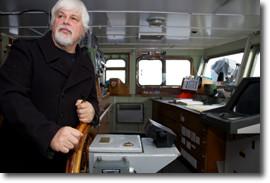
Paul Watson founded the Sea Shepherd Society in 1978, after he left Greenpeace (which he also help found) in a battle over tactics. Greenpeace was always scrupulously nonviolent; Watson wanted to take things a step further. He bought a boat and started hunting down whaling ships; his first victim was a pirate whaler called the Sierra. He rammed his boat repeatedly into the Sierra’s hull off the coast of Portugal in 1979, nearly sinking it. An anonymous bomber finished the job a year later, blowing a huge hole in the whaler’s hull while it was in port.


Since then, Watson and his crews have made life miserable for whaling ships (check out this picture of a Sea Shepherd crewmember tossing a bottle of butyric acid — which is harmless but stinks really, really bad and would make conditions on the boat almost intolerable).


And it’s working: It took years, but Japan is now pulling back its whaling fleet, blaming the Sea Shepherds in part for making whale hunting too costly.

Playing chicken

27

news@sfbg.com

The Heart of the City farmers market in U.N. Plaza may not exude the bourgeois foodie reputation of the Ferry Plaza farmers market. It doesn’t sell micro-roasted coffee or artisan cheeses, and its fountain may sometimes double as a public shower, but it does offer one product that no other San Francisco farmers market does: fresh, live poultry.

Raymond Young has sold live chickens here for two decades, showing up at dawn to set up shop and peddle his poultry to an eager throng of customers, mostly Chinese, who happily take home upwards of 600 birds per day.

But a group of animal rights activists is saying that the poultry stand is inhumane, violates health codes, and that Young’s employees have infringed on their civil rights as protestors. Since April 2010, members of LGBT Compassion have been showing up in the wee hours of the morning next to Young’s stand with banners, brochures, and signs promulgating the alleged cruelty of his business and seeking to block the sale of live birds. In January, protesters upped the ante when they slapped Young and the HOC market with a lawsuit alleging continuous abuse and negligence by those who supervise the market.

“For me, it was as simple as seeing the animal cruelty,” said Andrew Zollman, 43, the founder and organizer of LGBT Compassion. “The cages are dilapidated and cramped, there are feces everywhere, and the chickens are shoved in plastic bags, two at a time, while they scream in fear or pain. It was like walking down the street and seeing a dog beaten — and it’s really frustrating to see it happen here in San Francisco.”

Zollman and fellow protester Alex Felsinger, 25, filed the lawsuit with San Francisco attorney Matt Gonzalez after months of attempts to get city officials to intervene.

The allegations have Young and market management squawking, saying that the activists are opposing a practice that is both legal and routine. They claim the protesters are overly sensitive to the treatment of the chickens simply because they can see it, and decry their tactics as an attack on a small business and cultural traditions since almost all of his customers are Asian.

“These people just don’t seem to like other people’s culture of selling live chicken,” Young said. “”I think that what I do is right. I abide by all the health codes and animal care codes. I try to do everything I can to satisfy everyone. These protesters think they can override the law because they don’t like what they see.”


THE PATH TO COURT

Zollman and Felsinger have been encouraging the city to investigate Young’s stall, regularly sending videos and photos taken at Young’s stall to the Department of Public Health and Animal Care and Control. But their quest to protect the chickens has been complicated by the lack of city oversight and an inability to enforce animal cruelty laws due to provisions exempting poultry.

The clash between the vociferous vegans and the poultry purveyors reached its pinnacle in late December 2010, when Felsinger claimed he was punched in the side of the head, wrapped up in a tarp, and had the memory card from his camera stolen by one of Young’s employees. As painful as the altercation was, Felsinger’s scuffle has helped him garner support.

Felsinger doesn’t have footage of the December attack, but he and Zollman have documented several instances of alleged verbal and physical abuse by Young’s employees, including anti gay statements from Young’s daughter, which was the subject of a complaint to the Human Rights Commission.

“There is a long list of things being done to us over the past year,” Felsinger said. “I never expected them to take such a violent act against me. It’s not how I wanted to go about it. But it might have the end result we’re looking for.”

Christine Adams, manager of the HOC market since it first opened in 1981, has consistently defended Young and called the lawsuit “completely outrageous.”

“This is a market, and if they (Young’s crew) were illegal, they would have been booted,” she said. “I have done nothing wrong; Raymond has done nothing wrong. I’m not worried at all about the lawsuit.”

Adams said that while she had not been personally affected by the protesting in the past, she did not approve of Zollman and Felsinger’s actions and attributed a decline in live poultry sales to their presence.

“Their sales have gone down considerably,” Adams said. “They used to sell more than 1,000 birds a day and now it’s more like 600 or 700. I think it’s definitely because of the protesters. People don’t like to be followed through a market and have a camera shoved in their face just because they bought a live chicken.”


GATHERING EVIDENCE

Almost every market day, Zollman and Felsinger would show up to protest and take video and still photography of Young’s stall. They have posted numerous videos and photos to their group’s website (lgbtcompassion.org) — the same ones they say they send to DPH and ACC — documenting the conditions at Young’s stall.

The DPH makes routine inspections twice per year to the market. In November, Zollman, Young, and Adams held a meeting with principal environmental health inspector Lisa O’Malley to address issues of sanitation, handling, and guidelines for bringing live animals near food. The department says the vendor is operating within guidelines.

“There were some problems in the past, but they’ve been fixed,” O’Malley told us, naming a few instances of inadequate removal of chicken feces from the area and improper hand-washing as past problems. She said the challenge was maintaining the guidelines, the most difficult of which is making sure people do not walk through the market after purchasing their birds. Health codes prohibit animals from being within 20 feet of food. The primary concern is contamination from fecal matter, which could cause illnesses such as Salmonella poisoning.

O’Malley walks by the market regularly because of its proximity to her office and says all operations seem compliant. At the same time, official enforcement and inspection is limited to the Public Health Department’s semi-annual visits. This means the only people watching over the operations of the stall and customers are the security guards, who don’t start working until two and half hours after the market opens, long after prime time for buying live chickens.


CULTURE CLASH

Young stands by his actions and said he is not guilty of any wrongdoing. The activists criticize him for practices such as cutting off the tips of the chickens’ beaks, but Young said he only does this to prevent fighting injuries sustained when they are caged for transport and sale, a common practice for any chicken farmer.

In their pamphlets and the lawsuit, the activists claim that the poultry is a “collection of ‘spent’ live chickens (those who are no longer productive egg layers) from large Central Valley farms,” according to the suit. But Young contests that characterization and the activists can’t produce credible evidence of the birds’ age or origins.

“They don’t know how old my birds are. They don’t know how I care for them,” Young said, refusing to tell us how old the chickens are. “They just assume. What’s the difference between Safeway chicken and my chicken? They were all alive at one time, but you see mine.”

Young has three farms listed on his permit — in Modesto, Sacramento, and Manteca — that he runs with the help of his children and a few employees. Adams has visited his Modesto facility and reported that the chickens are free-range, seem to be in good health, and are treated no differently than they would be at any other farm. She also supported the accusation that the protests undermine cultural norms.

“How can it not be cultural? All their customers are Asian!” she said. “And why is it only the chicken man they harass? There is a guy who sells quail and pheasants and they aren’t bothering him.”

Zollman, Felsinger, and Gonzalez call that cultural criticism a diversionary tactic. “I don’t even want to dignify culture and race as an issue in this,” Zollman said. “I understand that people want to buy live chickens. Animal cruelty issues aside, this isn’t a live animal market like they have in most of Asia.”

Young and Adams stressed that Zollman could not possibly know about operations on the farm, and that his suggestion that the operation is extremely profitable is absurd. “Do you know how hard it is to work on a farm?” asked Young, a single father of three. “You don’t make any money except to put food on the table or send your kids to school. And now I have to pay for a lawyer.”


ARE CHICKENS ANIMALS?

Although the activists oppose factory farms and live animals for sale for human consumption in general, they have focused their attention on the HOC market because it is permitted by the city.

Gonzalez said the lawsuit aims to address three different issues. The first is violating his client’s free speech rights by Young and HOC market. The second seeks to compel the city to better identify and enforce alleged health code violations. The third and trickiest aspect deals with animal cruelty laws, which the activists hope will force more humane treatment of the birds.

Penal Code 597 outlines animal cruelty provisions, defining the word “animal” as “frogs, turtles, and birds sold for human consumption, with the exception of poultry.” That law was adopted in the early 1900s. Elsewhere the code defines animals as “every dumb creature.” But in 2000, the Fourth District California Court of Appeals analyzed the section and deemed that the definition should include birds.

But Gonzalez and ACC say city officials have allowed the poultry exemption to stick. “[The law] refers to live animals and makes a specific exemption for poultry,” Rebecca Katz, director of the Department of Animal Care and Control, told us. “I would venture to guess that poultry lobby was very strong at that time.”

The ACC, prompted by the protests, inspected Young’s facilities and cited him for 700 different violations, according to the lawsuit. Katz mentioned a few instances in which they observed chickens suffering to the point where they had to be euthanized. But most of the citations were for inadequate water supply or holding birds improperly.

“A lot of people eat animals for food, and that’s what it is,” Katz said. “I’m not a vegetarian, but the way they are being kept is not the way we would recommend they be cared for. Do we think there is some cruelty? Probably. But there is nothing we can do at this time until the law changes.”

Like his predecessors, newly appointed District Attorney George Gascón seems to believe that chickens are not protected by state law, regardless of perceived cruel treatment.

“To date, our position has been that there is a clear exception under the law for live poultry being sold for human consumption,” said Gascón spokesperson Erica Derryck. “As much as it appears that the treatment of these animals is inhumane, there is nothing we can do to prosecute these allegations under the current laws in California.”

Gonzalez disagrees, and his office referenced similar cases in the state in which poultry was protected from cruelty. “Frankly, it’s kind of embarrassing that they are taking the position they are taking,” Gonzalez told us. “They are trying to avoid a topic that would compel them to do what they need to do. Many in the Asian community and Mexican community see this as an attack on their cultural traditions, and that’s not the issue. We see it as a straight matter of misinterpretation.”


DAILY OPERATIONS

On a recent visit to the market, the stall appeared clean and the chickens were out of view. The stall features prominent signage in English and in Chinese languages of the ban on bringing live animals into the market, with additional signs throughout the plaza, but customers routinely step directly into the market after buying their chickens.

“This is not easy,” security guard Diana Ybarra said while trying to point a man carrying a bag with two chickens in the right direction. “Nobody wants to listen — most of them don’t speak English. Everyone wants to take a shortcut right back through the market.”

Ybarra and her coworker, Washington (who chose to be identified only by his last name), said that their entire day is consumed trying to get customers to abide by this rule. Prior to the November meeting, no signage was posted and customers just “walked all over the place as if it didn’t matter at all,” Ybarra said.

“Chinese New Year was bad,” Washington added.

The guards see enforcing the rule as an unnecessary waste of time that takes their focus off tasks such as preventing theft. Both said shoving birds in sacks was “messed up,” but they were also quick to criticize the protestors.

“Why are they bothering this man? This is a family business and people have to make money,” Washington said. “Those protestors came in and fucked everything up, if you ask me.”

Young said he resents getting caught up in this controversy. “We are so loyal to this city and to this market,” he said. “We have put up with drug dealers and crime just so we can serve the people. Maybe these protesters think differently.”

For now the activists are more focused on the lawsuit than remaining vigilant in their protests, hoping it will accomplish their goal.

“I wasn’t always so adamant about getting rid of them, it was having people notice something that is animal cruelty,” Felsinger said. “It had been good in some ways to have people exposed to this cruelty in San Francisco because it gave us a platform to speak on animal rights. These are egregious offenses and it’s hard to ignore when it is right in your back yard.”

Hyatt targeted as labor impasse drags on

0

Hundreds of Hyatt hotel workers and supporters represented by the UniteHere Local 2 union continued their 18-month long struggle against the Hyatt Corporation yesterday (Thu/10) by protesting outside the Hyatt Regency Hotel near the Embarcadero.

The Hyatt Regency was one of six hotels where demonstrations took place in a National Day of Action against Hyatt management. Local 2 said many issues still need to be negotiated, such as decreasing the current health care costs of $200 a month for a family plan, raising pensions from $900 to $1200 a month, and taking steps to reduce injuries to Hyatt employees.

“We want to draw attention to the injury rate that Hyatt has been witness to,” Local 2 spokeswoman Riddhi Mehta-Neugebauer said.

The protest, which started at 4:30 p.m., surrounded the front entrance of the Hyatt Regency on Drumm and Market Streets, with protestors sitting in front of its turnstile doors. About two dozen protestors were arrested, cited and released on charges of misdemeanor trespassing.

The Hyatt Corporation’s statement on yesterday’s actions tried to turn the blame on the union, stating they haven’t been willing to come to the bargaining table. “Once again, the leadership of UniteHere Local 2 is putting its own agenda ahead of the needs of its members,” the statement said.

Cynthia Reed, a telephone operator with the Hyatt for 22 years, who was a part of the protest, was angered that she has been without a fair contract since August 2009.

“I feel as though we are being oppressed,” she told the Guardian. “We, the workers, are living off $38,000 a year with $12,000 in taxes. We can’t live like this in San Francisco. We just want a living wage.”

Reed noted that some of her co-workers include parents of multiple children and cancer patients, while others are over retirement age. “If the union doesn’t stand up for us, who will?” Reed asked. “Why patronize these facilities when all the money is going to a few at the top?” she wondered before going back to a line of picketers chanting, “Union bustin’ is disgustin’!”

Peter Hillan, a spokesman that represents the Hyatt, was at the scene to give the corporation’s point of view. “It’s street theater,” he said of the event. “It’s taking revenue away from the business that could be going to the employees.”

Hillan said that over the past 18 months, the protests and the union’s call to boycott the hotels have taken about $10 million of convention business away from San Francisco’s Hyatts.

A meeting to discuss contract negotiations with the Hyatt Corporation and Local 2 is set for Feb. 24.

San Franciscans show solidarity with Egyptians

0

“Yesterday we were all Tunisian. Today we are all Egyptian. Tomorrow we will all be Free,” read one sign on at last weekend’s protest in solidarity with the wave of uprisings across the Arab world, an event drew thousands of people into the streets of San Francisco.

The crowd was diverse, from a variety of cultures and age groups. Sabreen Abdelnahmen is an 11-year-old Egyptian American who said she is “very proud there are people of many cultures and many religions fighting for the same thing.”

The events in the Middle East reverberate in San Francisco as well as many major cities, with everyone watching Egypt teeter toward democracy. To understand more about the events in Egypt, we spoke with local activist Yasmeen Daifallah, who helped organize the solidarity events and has connections in Egypt, where she attended Cairo University for six years. She is an activist, a political science doctoral student at UC Berkeley, and a singer in the Arabic music ensemble, ASWAT.

SFBG: Why protest in San Francisco?

YD: Two things were important to us. The first was to express solidarity… when [images of protests here] are transmitted to Tahrir Square [the central square where thousands of Egyptians have been remaining against government orders for two weeks]… it is definitely very uplifting. The second is to spread awareness in San Francisco…and in the U.S, to express a message to the American public and the American government. There should be respect for the people’s rights of self-determination and a cutting back on a strict consideration of self or national interest.

SFBG: Tell us about Tahrir Square, which has been at the heart of the protests, and who is leading the protests.

YD: I am amazed at the intensity of the steadfastness because many protestors are struggling to make a living. They all strike you as struggling to make a living and would not do anything to jeopardize making a living and these same people come out and say ‘we are staying here, we don’t care about bread, we care about dignity, we are not moving from here until [President Mubarak’s] regime falls.’

One of the most interesting things about this protest—there is no particular organization or person or even a group of organizations leading. Actually, the organizations are trying to piggy bag on the people and the momentum that is created by the public. For the leaderless nature that is has, it is remarkably organized.

SFBG: Why did the people rise up? Tell me a little about Egypt under Mubarak.

YD: The economic condition was abysmal and this is because when Mubarak came to power, the country started structural adjustment policies, which gave way to mass privatization. These have particularly intensified in the past 5-10 years. What this has translated into is massive unemployment and having to do several jobs in order to survive. On the day-to-day basis life under Mubarak is a life of economic hardship and social immobility.

When we start talking about the middle class, about politics and the political concerns probably [what is important] are fraudulent elections, rigging elections after people have actually voted but also preventing people from opposition movements from entering the ballot box to begin with. So this a very flagrant political repression. It takes place across the board. The second thing is the repression of the right to freedom of expression, whether in writing and the detention of journalists or in demonstrating. There is a law preventing the right to assemble. Then there is the bureaucracy and inefficiency, which all citizens suffer from on a daily basis. Their energies are exhausted in… getting their daily life going whether on the economic level, the bureaucratic level, or just the transportation level.

SFBG: You were just in Egypt and left 10 days before protests erupted. Do you wish you were there still? How does you feel as an Egyptian at this moment?

YD: Yes, very much so. I wish I were there—we all have a sense that there is something historic happening. We never had this number of people protesting against the regime and putting out demands that are this vocal and this radical. I wish I was more a part of this moment, I am just part of this moment from afar. I feel proud to be an Egyptian, which is a feeling you don’t get often, unfortunately.

On the one hand it feels bad because I wanted to be there to actually be a part of it. On the other hand, I have been convincing myself that there is a role that maybe I was destined to play being out here instead of out there.

SFBG: What do you think about the fears and concerns that democratic elections will lead to the rise of an Islamic government in Egypt?

YD: The question itself is unacceptable in the sense that fear and Islamic government put together should not be an issue. The issue is that people should have the right to determine who they want to govern them and whoever comes out of this is a legitimate leader.

The second thing is, you can easily see…this uprising is not an Islamic uprising—there is no foundation for this concern. The Islamic opposition, which has been among the most powerful if not the most powerful opposition movement will play a role and has to play, rightly, because they have been [part of the opposition]. There is no reason for concern, whether we look at it from the perspective that this is not an Islamic uprising or from the perspective that the nature of the Islamic opposition in Egypt is moderate in the sense that it is not militant and not violent and buys into a lot of democratic rhetoric and human rights rhetoric that is around.

SFBG: The other concerns have been around the lack of stability.

YD: This is not such a bad thing. The state of affairs in this point in time in the region is stability with no justice which in turn is bound to create instability and we have seen the instability of the intifada, we have the instabilities with the war on Gaza. Whatever we think of as stability in the Middle East is a fake and frail notion of stability. One would hope that if a new regime comes in Egypt that is more democratic that it would try to address some of the injustices that have been taking place so far regarding the Middle East peace process, but even this is not a guarantee.

At this point what one should focus on is who are the people at Tahrir, what are they demanding, and how can the international community help them get what they demand because this is not a violent uprising. This is not even an organized uprising. This is not a single actor uprising. It’s a crosscutting uprising and it is legitimate, which calls for respect and support and solidarity and anything less than that is betrayal.

SFBG: Where can people get the best information on what is happening in Egypt?

YD: Al Jazeera-English has been doing a good job at covering the events. It has definitely been the prime source of information to the extent that there is a huge campaign now demanding that Al Jazeera be available through satellite and cable providers in the United States. [For now,] you go online and click on live broadcast.

SFBG: Daifallah incorporates music into her politics through the Arabic musical ensemble ASWAT. Here’s a clip of their performance on Saturday:

http://www.youtube.com/watch?v=6fjZ0XjaJU8&feature=player_embedded


Dick Meister: Black Porters Led the Way

0

Dick Meister, formerly labor editor of the SF Chronicle and KQED-TV Newsroom, has covered labor, politics and other matters for a half-century.


February is Black History Month, a good time to honor the Brotherhood of Sleeping Car Porters, one of the most important yet too often overlooked leaders in the long struggle for racial equality.

The union, the first to be founded by African Americans, was involved deeply in political as well as economic activity. It joined with the NAACP to serve as the major political vehicle of African Americans from the late 1930s through the 1950s.

Together, the two organizations led the drives in those years against racial discrimination in employment, housing, education and other areas, and in doing so, laid the groundwork for the civil rights movement of the 1960s.

The need for a porters’ union was painfully obvious. Porters commonly worked 12 or more hours a day on the Pullman Company’s sleeping car coaches for less than $100 a month. And out of that, they had to pay for their meals, uniforms, even the polish they used to shine passengers’ shoes. They got no fringe benefits, although they could ride the trains for half-fare on their days off – providing they were among the very few with the time and money to do so. And providing they didn’t ride a Pullman coach.

In order to meet their basic living expenses, porters had to draw on the equally meager earnings of their wives, who were almost invariably employed as domestics.
 
It was a marginal and humiliating experience for porters. They were rightly proud of their work, a pride that showed in their smiling, dignified bearing. But porters knew that no matter how well they performed, they would never be promoted to higher-paying conductors’ jobs. Those jobs were reserved for white men.

Porters knew most of all that their white passengers and white employers controlled everything. It was they alone who decided what the porters must do and what they’d get for doing it.

When a passenger pulled the bell cord, porters were to answer swiftly and cheerfully. Just do what the passengers asked – or demanded. Shine their shoes, fetch them drinks, make their beds, empty their cuspidors. And more. No questions, no complaints, no protests. No rights. Nothing better epitomized the vast distance between black and white in American society.

Hundreds of porters who challenged the status quo by daring to engage in union activity or other concerted action were fired. But finally, the administration of President Franklin D. Roosevelt granted workers, black and white, the legal right to unionize. And finally, in 1937, the Brotherhood of Sleeping Car Porters won a union contract from Pullman.

The contract was signed exactly 12 years after union president and founder A. Philip Randolph had called the union’s first organizing meeting in New York City. It was a long arduous struggle, but it brought the porters out of poverty. It won them pay at least equal to that of unionized workers in many other fields , a standard workweek, and full range of fringe benefits. Most important, porters won the right to continue to bargain collectively with Pullman on those and other vital matters.

Union President Randolph and Vice President C.L. Dellums, who succeeded Randolph in 1968, led the drive that pressured President Roosevelt into several important actions against discrimination, including the creation of a Fair Employment Practices Commission in housing as well as employment. FDR agreed to set up the commission – a model for several state commissions – and take other anti-discrimination steps only after Randolph and Dellums threatened to lead a march on Washington by more than 100,000 black workers  and others who were demanding federal action against discrimination.

Dellums and Randolph struggled as hard against discrimination inside the labor movement, particularly against the practice of unions setting up segregated locals, one for white members, one for black members.

Randolph, elected in 1957 as the AFL-CIO’s first African-American vice president, long was known as the civil rights conscience of the labor movement, often prodding federation President George Meany and other conservative AFL-CIO leaders to take stands against racial discrimination.

The sleeping car coaches that once were the height of travel luxury have long since disappeared, and there are very few sleeping car porters in this era of less-than-luxurious train travel. The Brotherhood of Sleeping Car Porters is gone, too. But before the union disappeared, it had reached goals as important as any ever sought by an American union – or by any other organization anywhere.

Dick Meister, former labor editor of the SF Chronicle and KQED-TV Newsroom, has covered labor and politics for a half-century. Contact him through his website, www.dickmeister.com, which includes more than 250 of his columns.

Black history, local hire, living color

31

City Hall kicked off its annual Black History month celebrations with a talk by Los Angeles philanthropist and former Xerox Corp. VP Bernard Kinsey about the importance of debunking myths about the absence of blacks in American history. And Mayor Ed Lee, who had just met with five dozen unemployed black construction workers from the Bayview, revealed how, when he was growing up in the projects in Seattle, his neighbors were black, and an African American named Darnell was one of the most loyal patrons of the restaurant that Lee’s father was trying to make succeed.


“And when my dad suddenly died of a heart attack, Darnell was the first person to offer my brother a job at his gas station,” Lee said. “So, this is not just about recognizing African American history, but recognizing what they did for us, and  making sure that no there are jobs and we protect the family structure. I know what it is to be helped by the African American culture.”


Lee’s recollections of Darnell came less than an hour after he met with Aboriginal Blackmen United, a group that represents unemployed construction workers in the Bayview, to discuss how its members can get hired at UCSF’s $1.5 billion hospital complex at Mission Bay and other local building sites.


At that meeting, ABU President James Richards thanked Lee for getting UC to clarify the details of its voluntary local hire plan at the Mission Bay hospitals.
But he warned that the fight is just starting. “We’ve got the unions to deal with,” Richards told Lee, referring to the reality that the unions also want their members to get work at the UCSF site.


Lee said he’d do his best to help.
“The African American community in San Francisco has not got its fair share,” he said. “I can’t say that everyone in the room is going to get a job, but I’ll open up doors and do my best.”


And then Lee confirmed that local hire is one of his top five priorities.
“My top priorities are the budget, pension reform, the America’s Cup, finding a good police chief and local hire,” he said. “I said that directly to every union leader yesterday. Some unions will be there, others will resist.”


ABU’s Richards said the need to have a G.E.D. to get into the city’s ob training programs is a barrier to employment for many in the Bayview.
“We have a lot of people, who are not able to get into CityBuild because they don’t take folks anymore who don’t have their G.E.D,” he said.


And he warned that the city’s black community is in crisis.
“I know there is a budget crisis, but this is a life crisis,” Richards said. “Young people are dying and it’s not even newsworthy any more.”


Lee suggested ABU work with the City to avoid the need to hold protests at construction sites in future,
“Let’s plan together, so you don’t have to go to all the sites,” Lee said. “I am for people getting their GED. But if someone has evidence that they are making an attempt to get their GED, we need to reward that with jobs. So that the GED is not a barrier, it’s a hope.”


And then Lee was off to attend his next round of meetings, which included the city’s Black History month event, where speakers noted that during Bernard Kinsey’s career with Xerox, he helped increase the hiring of blacks, Latinos and women,


Kinsey told the audience that he and Shirley Kinsey, his wife of 44 years, share a passion for African-American history and art. And that their world-famous Kinsey Collection, which contains art, books and manuscripts documenting African American triumphs and struggles from 1632 to the present, is currently on display at the National Museum of American History in Washington D.C, and a number of pieces are at the San Francisco African American Historical and Cultural Society. He noted that the posters of African Americans in the Civil War were reproductions of some of the art in those exhibits. 


Sup. Malia Cohen noted that about 200,000 African Americans participated in that war. Sup. Ross Mirkarimi, who represents the city’s Western Addition, where redevelopment triggered massive displacement of the black community in the 1960s, noted that eight members of the current Board of Supervisors, who selected Lee as the city’s first Chinese American mayor, are people of color.


“This is true representation,” Mirkarimi said, noting that the fact that the city’s African American population continues to drop (reportedly down from 6 percent to 3.9 percent, according to the 2010 Census) to “is a reminder that even the most forward-thinking cities have a lot of work to do.”


And Kinsey urged African Americans to start describing their ancestors as “enslaved.”


‘It will change how you look at your ancestors,” he said, “You don’t have a clue about what they sacrificed to get you to where you are today. We don’t tell you the ‘ain’t-it-awful’ story about slavery. We tell you the story of how we overcame.”


“You need three things for a successful life,” Kinsey added “Something to do. Someone to love. And something to look forward to.”


Kinsey said he and his wife have espoused two life principles, ‘To whom much is given much is required” and live “A life of no regrets.” And then he told a story about an eagle who was raised by a chicken.


The eagle ended up ashamed of his feathers, because the chickens never told him he was an eagle because they were afraid he’d end up ruling the barnyard.“He even grew up ashamed of his daughters,” Kinsey said.


Eventually, the eagle met another eagle, who told him the truth. “You ain’t no chicken,” the other eagle said.


“And this is the message,” Kinsey said. “Don’t think chicken thoughts, or dream chicken dreams. Think like an eagle.”


He warned the audience to be careful of buying into myths that would have them believe that African Americans played no role in building the U.S.
“There are stories that made America and stories that America made up,” Kinsey said. “And too often, the myth becomes the choice.”


And then he concluded by expounding on “the myth of absence.”
‘”African Americans are not seen, not because of their absence, but because of the presence of a myth that prepares and requires their absence,” Kinsey said. “And the manipulation of the myth changes the color of the past. It’s no accident that the dominate images from the past are white. And many of us have swallowed the pill.”


Division of labor

0

sarah@sfbg.com


In the wake of a three-day protest by unemployed workers outside UCSF’s Mission Bay hospital construction site — and under pressure from city leaders — UC officials have announced voluntary local hiring targets at the $1.5 billion complex.


Targets start at hiring 20 percent of the project’s workers in San Francisco during 2011 and increase that by 5 percent each year until the hospital complex is completed, UCSF news director Amy Pyle told us. But she denies that UC was pressured into its decision. UC is a state agency that is exempt from local rules when it builds facilities for UCSF and other campuses.


“Our voluntary goals are not a result of their protest,” Pyle insisted. “We have been aware of the local hire concerns since before they were protesting.”


The protests have focused on the need to hire workers for southeast San Francisco, where unemployment rates are the highest in the city, particularly among the city’s African American population.


“Of course we are looking to be good neighbors and hire people from an area we know has been hard hit,” Pyle said, clarifying that under the University of California’s hiring program, “local residents mean people who live in San Francisco generally.”


Mission Bay Hospitals Projects executive director Cindy Lima said uproar at the site stemmed in part from perceptions that lots of work is available now, but she said that isn’t true.


“Job opportunities should ramp up in May, but right now, they are installing structural piles,” Lima said. “So if there is an opportunity for a carpenter or a laborer to get decks built, we call the union.” UC’s voluntary local hire announcement came after Mayor Ed Lee urged UC officials to formalize a community hiring plan for Mission Bay, and Aboriginal Blackmen United (ABU) president James Richards agreed to call off his group’s protest outside UC’s Mission Bay hospital complex, at least for now.


ABU member Fred Green, an unemployed construction worker who has lived in the Bayview for 50 years and has five children, said the protesters tried to remain peaceful. “But an empty belly makes you do strange things,” Green said. “If there’s enough work for everybody, why should we be stuck at home while someone comes into my community and takes food out of my kids’ mouths?”


Troy Moor, who has lived in the Bayview for 47 years and has two kids, speculated that if ABU blocked both gates to the project, it would cost UC thousands of dollars a day in lost productivity. “Here at the front gates, we are visible. But we figure that if by next week, nothing is happening, we’ll start making them lose money,” he said.


Michelle Carrington is a 58-year-old flagger and operating engineer from the Bayview who has been unemployed for 10 years. She said Dwayne Jones, who worked in the Mayor’s Office and helped her graduate from Young Community Developers, was “working to try and get us jobs.”


Jones, who is now with Platinum Advisors as a consultant to DPR Construction, UC’s prime contractor at its Mission Bay site, put in an appearance on day three of ABU’s protest. But he said his work with DPR had nothing to do with the ABU protest.


“UC is very committed to maximizing local hire where we can,” Lima told the Guardian. “It’s unfortunate there is a protest because it gives the sense we haven’t been working with the community when in fact we have been working with the Mayor’s Office, CityBuild, and every stakeholder interested in this project, including ABU.”


Richards said ABU mounted its protest to challenge UC’s claims that it has hired more local residents at the site. They were also angry over a flyer that encouraged residents interested in working at the site to sign up with the San Francisco Workforce Collaborative, in partnership with Rev. Arelious Walker’s BayView Hope Community Development Corporation, feeling as if the UC was trying to divide their community. Walker did not return our calls for comment.


“We were with Walker when he was fighting the Nation of Islam’s attempt to stop development at the shipyard, so it hurts so bad to see this,” Richards said. “Never again will we stand by and let people come into the southeast community and take our jobs. We’re going to fight until the end. If the community doesn’t work, no one works.”


But even as UC announced its voluntary Mission Bay goals, community advocates pressed UCSF to set higher targets, citing the city’s failure to attain 50 percent local hire goals under San Francisco’s decade-long policy of seeking to hit that goal.


Joshua Arce of the Brightline Defense Project said he is glad Lee expressed support for Sup. John Avalos’ local hire legislation, “but we are waiting to see if he implements the law as written or a watered-down version.”


Then-Mayor Gavin Newsom allowed Avalos’ legislation to become law without signing it, bowing to the veto-proof 8-3 majority that approved it. But in a 12/23/10 letter explaining his position, Newsom recommended modifications to accommodate the concerns of the building trades, whose members come from across the Bay Area.


“I know the passage of this policy has created high expectations among some residents of San Francisco,” Newsom wrote. “The city owes it to them to implement this policy in a way that will result in a successful program that is fiscally responsible and reflects the best thinking of the many stakeholders invested in San Francisco.”


But with Newsom moving to Sacramento, California Assembly member Tom Ammiano and Sens. Mark Leno and Leland Yee are urging legislators to support San Francisco’s newly approved local hire law as approved.


In a Jan. 25 letter that Leno and Yee signed, Ammiano encouraged Bay Area officials to work with the city to explore mutually beneficial “reciprocity agreements” in which local cities would support one another’s programs “aimed at providing disadvantaged job seekers opportunities in the construction sector.”


“In neighborhoods like the Bayview, the Mission, and the Western Addition, the promise of jobs — particularly living wage construction jobs — has been an unfulfilled promise for generations,” Ammiano wrote.


But in a Jan. 28 press release, UC officials clarified that “as one of 10 campuses of a statewide constitutional corporation and public trust,” UCSF is not subject to Avalos’ mandatory requirement and is prohibited from adopting mandatory requirements based upon residency.


Instead, UC promised to do more community outreach and try to carve out financial incentives to encourage contractors to hit UC’s targets at Mission Bay.


Lima said the hospital complex is a historic opportunity to put as many San Franciscans to work as possible. “We have set an ambitious hiring target but we recognize that the economic activity generated by the project can significantly benefit our neighbors and local residents,” she said


After his Jan. 27 meeting with UC, Richards told ABU members that “when DPR needs someone for a job, they’re gonna call Dwayne Jones, and then Dwayne will let us know. There are hundreds of jobs, but I don’t know if they are in every trade. So, I feel good. But not so good that I can say that 10 carpenters will be hired tomorrow. There’s not enough need for that right now. But the work that’s there, when they call, you’re going to know it.”


Lima said UC’s meeting with Richards was “positive”.


“We clarified some misunderstandings and made some progress,” Lima said, noting that work at the site will become increasingly available starting in May. “Our goal is still to create jobs for San Francisco residents and make this project happen. We are continuing to try and match people who need to go to work with available job opportunities. The bottom line is that there are a lot of people in this city who are out of work and a lot of groups with different intentions in mind and we get tangled in that process.”


Lima vowed to work closely with DPR Construction and major subcontractors to ensure qualified local residents — including those from neighborhoods closest to the site — can access the construction jobs. And she promised that results will be reported regularly and the size of the workforce will increase steadily, peaking with 1,000 workers in 2012.


“We are mindful that while these goals challenge us, they are also within reach,” Lima said, noting that UCSF has been engaged in creating job opportunities in the construction trades for San Franciscans since 1993. “Our success will depend on the participation and commitment of the broader community and the trade unions.”


UC’s move comes less than two weeks after Lee announced at the annual San Francisco Labor Council Martin Luther King Jr. Day breakfast that one of his top priorities is implementing Avalos’ mandatory local hire policy.


Lee’s comments suggest a different approach from Newsom’s, but it’s still not clear whether Lee intends to follow the “critical steps” that Newsom felt the city should take “to ensure the responsible and successful implementation of Avalos’ legislation.”


Arce said he was happy to see Lee address the issue at the MLK Day event. “Lee said that if we are using local dollars to create local jobs, those jobs should go to local workers,” Arce recalled, noting that the following week Lee started to coordinate with the Office of Economic and Workforce Development and CityBuild to engage community stakeholders and lay out a road map to implement Avalos’ legislation.


“They set a deadline of March 25 as the target date by which the language of Avalos’ mandatory legislation must be included in all public bids and contracts,” Arce said. “And it’s our understanding that Mayor Lee called UC Chancellor Susan Desmond-Hellmann directly on the morning of Jan. 27 [before ABU’s Richards met with UC officials] to ask that UCSF formalize a community hiring plan for Mission Bay as soon as possible.”


Avalos said he was “very encouraged” by Lee’s remarks. “To say that at the Martin Luther King Labor Breakfast was a big deal,” Avalos said, noting that the building trades were also in the room. “I feel Ed Lee wants to implement the legislation how it is written. He needs help doing that. He needs to create a process to make it happen, and I believe the folks who helped draft the legislation will be ready to do that. That’s not to say that this couldn’t go wrong, but I feel pretty confident that he will implement as strong a local hire model as possible.”

SFBG Radio: From Cairo to here

11

In today’s episode, Johnny points out that the protests in Egypt have been driven by young people — and that youth unemployment in the United States is at alarmingly high levels. So why aren’t young people out in the streets here? Check out the discussion after the jump.

sfbgradio1/30/2011 by endorsements2010

Can they shut off the Internet?

20

Proverbs for paranoids: If they can catch you asking the wrong questions, they don’t have to worry about answers.


— T. Pynchon


Indulge me here while I get a little paranoid and venture into a realm where it’s easy to get dismissed as a nutcase. And I’ll say this upfront: I really don’t know how much I ought to worry about this.


But: The Egyptian government just tried to decapitate the protests in the streets by shutting down the Internet, and it was relatively easy; four ISPs threw the switches at government command, and bingo — no more email or websites talking about how to toss the bums out. John Weber at the Bay Citizen (who is neither a nutcase nor a paranoid) says this is a first (although China and other countries have censored internet traffic and limited use, this is different; it’s a total sudden shutdown of what was an open service).


So it’s worth asking, anyway: Could that happen in other countries, including ours?


Well, you don’t have to be way out in loony land to be worried about the Lieberman Protecting Cyberspace as a National Asset Act. Yes, I realize all the talk of an Internet Kill Switch sounds batty. We talked about this today on sfbg radio, and Johnny told me I was way wacko: the Internet is so essential to commerce in this country that the corporate powers that be would never allow it to be throttled. Tens of billions of dollars would be lost in moments; the stock market and the banking system couldn’t function.


But the scary thing is that it wouldn’t be all the difficult. All you’d have to do is cut off the domain name servers and nobody could find anything. (Yeah, you can bypass that with website numbers — IP addresses — but most people don’t have those handy.) And one company, Sprint (I think) owns most of the switches that direct all the traffic in this country; shut them off and every city would be isolated.


The web was designed to be redundant; a natural (or unnatural) disaster in New York or Chicago wouldn’t cripple Internet traffic around the country. And I’m not saying that Obama (or his successors) would ever actually try to squelch protest in the U.S. by taking such a drastic step.


But the fact remains that technically, it wouldn’t be that hard to do what Egypt did, and shut things down for a while. And since so much of our political communication in this country is based on the web, it seems somehow that our ability to talk to each other in times of crisis is a wee bit fragile.


Or am I out of my mind here? It wouldn’t be the first time.


SFBG Radio: Egypt and the Internet

11

Protests erupting all over Egypt as democracy comes to life in North Africa — and the government’s response is to shut off the internet. Could that happen here? Johnny thinks Tim is just a delusional conspiracy nut. Check it out after the jump.

sfbgradio1282010 by endorsements2010

Don’t nobody still give a damn?

33

For the second day in a row, Aboriginal Blackmen United (ABU), a community organization that represents unemployed construction workers from Bayview Hunters Point, embarassed University of California officials by blocking the front gate of UC’s $1.7 billion Mission Bay hospital project.


ABU members claim UCSF is refusing to hire workers from local neighborhoods and they say they are prepared to go to jail if their demands aren’t met.

“At 6: 30 this morning, we were full of energy,” ABU President James Richards said on the first day of the protest. And ABU members recalled that they saw ” nothing but skunks”  when they arrived outside the construction site at 6 a.m.


“They’d locked up everything and guarded back fence, so we stopped everyone from coming in this front entrance, including management and cars,” Richards said, as he stood outside UC’s 16th Street and Fourth Street construction site, while ABU members chanted, “If we don’t work, nobody works.”


Richards said the police told employees to go around to the site’s back entrance, as they made calls, trying to figure out what was going on.

“We’ve been out here every day for almost a year and nothing has changed except the paperwork,” Richards continued. “We have qualified union workers standing outside the job site that are ready, willing, and able to work and if the community doesn’t work, no one works.”

But UC officials say they want the Mission Bay Hospitals project to be a model for the nation of how to put people to work, even though, as a state agency, they cannot mandate local hire requirements or give preference to any particular domicile.

“UC is very committed to maximizing local hire where we can,” Cindy Lima, executive director of the Mission Bay Hospitals project, said. “It’s unfortunate that there is a protest because it gives the sense that we haven’t been working with the community, when in fact we have been working with the Mayor’s Office, CityBuild and every stakeholder interested in this project, including ABU.”

Richards said ABU decided to mount their protest this week for two main reasons: to challenge UC’s claims that it has been hiring more local residents at the site, and to register anger over the distribution of a  flier that encouraged local residents interested in working at the UC site and other construction projects in town to sign up with a group called the San Francisco Workforce Collaborative.


The flier, which fueled suspicions that UC is trying to divide the city’s disadvantaged communities, named Dr. Arelious Walker as President of BayView Hope Community Development Corporation.


“We at the San Francisco Workforce Collaborative partnered with BayView Hope CDC are currently doing sign-ups in ALL trades to afford you the opportunity to work on these projects,” the flier stated.


Richards was particularly outraged that Walker was calling his group “the San Francisco Workforce Collaborative,” since this was the name UC used to describe its community outreach efforts last year.


“We guys were with Walker when he was fighting the Nation of Islam’s attempt to stop development at the shipyard, so it hurts so bad to see this,” he said, pointing to a copy of Walker’s flier, which listed Jan. 25 and Jan. 27 as sign-up dates at Walker’s Gilman Avenue building.

“All I know is that ABU is here for the long run and we’re prepared to go to jail,” Richards said. “Never again will we stand by and let people come into the southeast community and take our jobs. We’re going to fight until the end.”


“When Dwayne Jones was with the City, DPR [which is UC’s construction contractor] was trying to notify him about requirements for job hire, and Jones was supposed to notify ABU for job placements, but now we find out that they have brought in another consultant,” Richards said, noting that Jones has left the city and now works for Platinum Advisors. “And now all of a sudden, UC hires this company and is giving this list to DPR?” Richards continued, noting that UC has hired a consultant called Marinus Lamprecht to handle job submissions at its hospital site, but no one from ABU had been hired, despite the fact that Richards submitted five names to UC, months ago.


“We’ve been demonstrating at this site and marching down the street, and UC was telling us at that time, we’re gonna put some of your folks to work,” Richards said. ” All I know is that ABU is working diligently to try and get our people hired. We want to be the first organization, not the only organization to have people work here. After demonstrating and protesting for over a year, we feel that the people who brought UC to the table and supported the city’s new local hire legislation have the right to work first. But it always seems that the powers-that-be go outside our community to cause division amongst the community.”

“We’ve been here since 6 a.m. today and this is the community,” Richards continued. “No so-called community leaders have joined forces with us, including pastors and political leaders. And that’s why we say, don’t nobody give a damn about us, but us.”

Reached by phone, UCSF’s news director Amy Pyle clarified that in recent weeks UC has committed to voluntary hiring goals at the site. The goals start at 20 percent, and increase 5 percent each year until the completion of the project in 2014, Pyle said.

This means UCSF’s voluntary local hiring plan was put together shortly after the Board of Supervisors approved Sup. John Avalos’ mandatory local hire legislation for city-funded projects. Former Mayor Gavin Newsom refused to sign Avalos’ legislation, leaving Mayor Ed Lee to figure out how to implement Avalos’ legislation, which mandates 20 percent local hire this year, increasing 5 percent each year until mandatory 50 percent goals are reached. And UCSF officials stress that, as a state agency, UC can’t have quotas and isn’t subject to the city’s local hire mandates, since its hospital project is not city-funded. But they note that the university has set voluntary local hiring goals, held monthly meetings with stakeholders, and is currently working on carving out financial incentives to encourage contractors to achieve these voluntary goals.

“Our voluntary goals are not a result of their protest,” UCSF news director Pyle said. “We have been aware of the local hire concerns since before they were protesting. So, I don’t think people should expect there to be a quid pro quo.”

And Lima observed that UC has tried to maximize local hire on construction sites, since 1993. “It’s ranged from 7 to 24 percent, so the average has been about 12 percent,” she said, stressing that a lot has changed in recent years, regarding UCSF, local hire, and the overall economy.

“For a start, this project is six times larger than anything we’ve done,” Lima said. “There’s been a shift in capacity of community groups. The city has centralized its actions, concerning local hire efforts. And now it’s advancing its local hire goals, and then there’s the economy.”

Lima said that it’s because of this changed landscape that UCSF is ramping up its efforts to hire local residents.

“While we cannot mandate that our contractors hire locally, we are holding monthly meetings that are open to all community stakeholders,” she said. “We are doing extensive outreach to offer any stakeholders to submit names. We are keeping a list so as jobs become available. We are able to provide those names to unions for job call opportunities. And we have tried to carve out part of our payment to contractors to put it into an incentive program if they hit those goals.”

Lima said the final details of the incentive plan haven’t been worked out.
“But they are substantial,” she said.

She insisted that ABU did not succeed in completely shutting down UC Mission Bay Hospitals’ construction site in the last two days, and she claimed that if the goals of UCSF’s voluntary local hire program are reached, UC will double its historical local hire average, eventually.

Lima pointed to UC Mission Bay’s website where minutes of a Jan. 13 meeting between UCSF and representatives for the local workforce are posted.

Those minutes show that UCSF has agreed to work with its Mission Bay construction contractor DPR “to ensure that qualified San Francisco residents have access to jobs, Lima said, and that names can be submitted to consultant Marinus Lamprecht, using submission forms available here.

UCSF also intends to prepare trade-by-trade name call opportunities and has promised to report on actual local hiring progress at monthly community workforce meetings to be held the second Thursday of each month, she said.


UCSF’s news director Amy Pyle clarified that under UC’s voluntary local hire program,  “local residents mean people who live in San Francisco generally.”


“Of course we are looking to be good neighbors and hire people from an area we know has been hard hit,” Pyle said.

Meanwhile, Lima said UC has not entered into any contract with BayView Hope CDC and requested a copy of Walker’s flier to see if his group “overstepped.”
“For many years, UC did have a memorandum of understanding with the community and was working with a group called the San Francisco Workforce Collaborative,” Lima clarified. “The name has lasted, but the organization has changed. It was very successful historically, and there’s been an effort in the community to resurrect that group and make it stronger, but the landscape has changed, so we decided to open the doors to everybody.”

According to Lima, any interested party can now submit names to UC’s sign-up list.

“I carry that list around with me,” Lima said, promising folks will be hired in the order their names are received, if they match available opportunities.

“The contractors talk to the subcontractors who give them their best monthly estimates,” Lima said, noting that the subcontractors arrive with a core crew and then call the unions to fill their remaining needs.


Lima said part of the current uproar over local hire at UC Mission Bay’s hospital site stems from the misperception that there are lots of jobs available now.


“Job opportunities should ramp up in May, but right now, they are installing 1,052 structural piles,” she said. “So if there is an opportunity for a carpenter or a laborer to get decks built, we call the union.”

Lima added that folks are welcome to review data that UC’s compliance officer gathers.
‘It’s in our and the community’s best interest to put people to work,” she said.

But so far UCSF’s stance has continued to angered ABU members. They note that the university’s local hiring rates hovered at less than 10 percent until a series of ABU-led community protests in late 2010 forced UCSF and its contractor DPR  to request voluntary reporting of worker residency. 

And while UCSF claims that local employment is on the rise at the site, ABU questions the reliability of the university’s self-reported performance at the site. As a result, ABU imembers continued to protest at the site Jan. 26, even as efforts appeared to be underway to address their concerns.

“Dr. Walker called us, he was apologetic,” ABU’s Ashley Rhodes told the Guardian Jan. 26, referring to BayView Hope CDC’s flier. “And the Mayor’s Office just called, saying they wanted to talk with James [Richards, ABU’s leader]. So, that’s where he is right now. But tomorrow we may go to jail.”

Rhodes noted that on Jan. 26, DPR hired one carpenter from ABU’s list.  “And a female receptionist is being interviewed, but we still have three out of five names we submitted last year to bring in,” he said.

Outside UC’s Mission Bay construction site , Michelle Carrington, a 58-year-old Hunters Point resident, continued her protest for a second day straight.

“I’ve been out of work for ten years,” Carrington said, noting that she has over a decade of construction experience as a flagger and an operating engineer.
“I graduated from YCD in 1999,” she said, referring to Young Community Developers. “Dwayne Jones trained me. He just left the Mayor’s Office and now he is working to help us get jobs.”

Faces of debt

0

caitlin@sfbg.com

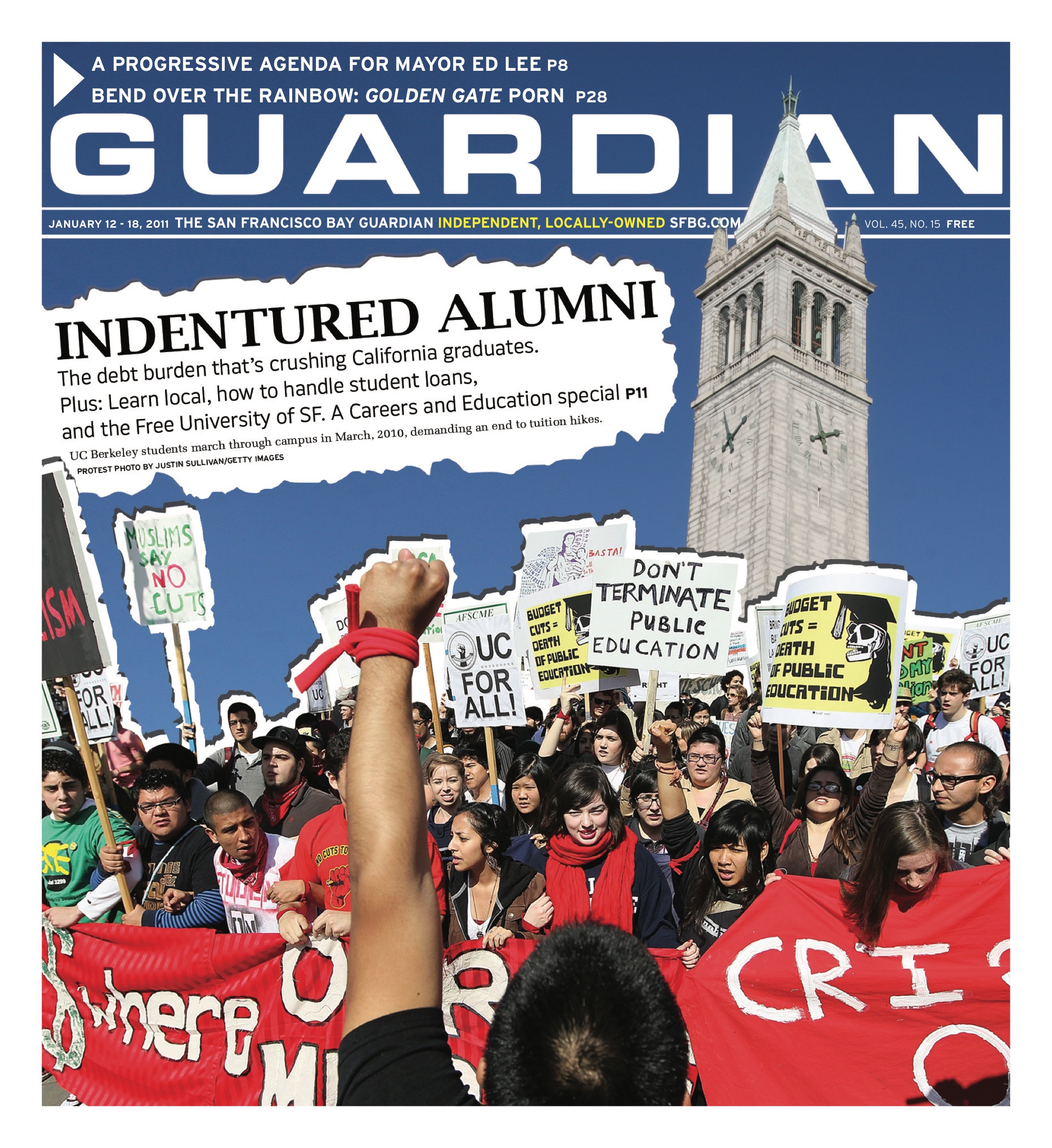
CAREERS AND ED In this weeks’ issue, Rebecca Bowe examines rising tuition and its effect on this generation of Californian students. Here, we profile three scholars that are dealing with very real repercussions from their student debt load.


BEN GLEASON, 31

Mills College, teaching credential

Oberlin College, American literature major

Total debt: $25,000

Ben Gleason remembers the day that he applied for his $10,000 student loan from Citibank to finance his teaching credential tuition. “I got it done online within a half hour. I didn’t have to talk to anybody or write an essay — easy money with severe consequences.” The consequences of such a serious financial decision — sans the aid of any counseling from either his school or bank? Gleason’s eventual decision to leave classroom teaching.

It’s not an uncommon story for this generation of teaching school graduates, in a state where teaching salaries are hardly keeping pace with rising tuition. Gleason started working as an ESL teacher in Richmond’s underfunded West Contra Costa Unified School District right after graduating from Mills College. His student loans were overwhelming — a problem that was exacerbated when he took a trip to Guatemala to work and improve his ability to communicate with his Spanish-speaking pupils. To remain afloat financially, Gleason applied for a forbearance on his loans and was surprised to return home after two years to a loan that had gone up by 25 percent due to interest. “I was really, really screwed,” he recalls.

Gleason didn’t feel like there was any way he could go back to his teaching salary, so to support his new wife (the two met in Guatemala) and daughter, he decided to start his own business with the help of an old boss — a private firm that helps reeducate state government workers on sustainability issues.

That means one less qualified teacher for low-income Californian children. And Gleason still has 15 to 20 years left of debt payments. “I wish that there was a more systemic way to solve this problem,” says the former public educator.


ANNE MOSTAD-JENSEN, 28

Santa Clara University, law degree

College of St. Catherine St. Paul, library sciences

Concordia University St. Paul, international studies and history major

Total debt (estimated at graduation): $120,000

Anne Mostad-Jensen and her twin sister grew up in a small Minnesota town. They attended the same college, Concordia St. Paul, where they both majored in history and international studies. After that, they went on to College of St. Catherine (also in St. Paul) to get their master’s degrees in library science. But then their paths diverged. Her sister traveled to Denmark in pursuit of her Danish citizenship — their father is Danish — and was able to complete her master’s in a country where the government pays for most of its citizens’ educations. Mostad-Jensen remained in Minnesota, to continue on in the American university system.

What kind of difference has the move made in these women’s lives? Try $65,000 of student debt. That’s because Mostad-Jensen’s sister, even after completing her master’s and attending one of the Icelandic languages programs she’s currently applying for, will only owe roughly $55,000 worth of loans — all from her time at American schools. Mostad-Jensen, who is now attending law school at Santa Clara University, will owe $120,000 by the time she graduates. “I’ve never had any consumer debt, but I’ve always told myself not to pass up educational opportunities just because I didn’t have the cash on hand,” she says.

Mostad-Jensen wants to work at the intersection of international copyright and technology law, possibly in a law library, a specialty career that benefits from degrees in multiple areas of study. She counts herself lucky that homeownership and a family aren’t her immediate goals. “Having a family — I just don’t understand how people do it with debt these days.” Her Midwestern community values come to the fore when she talks about the U.S. government’s inability to provide Americans with affordable education. “Isn’t the government an extension of the community? Europeans, the lack of stress they have by not having to pay out of pocket for health care and education — I mean they can actually live their lives.”


RAMON QUINTERO, 32

UC Berkeley, geography major

Total debt: $25,000

Ramon Quintero is a UC Berkeley student activist, but he wasn’t always radicalized around debt issues. “I didn’t come to Berkeley because of its activist reputation. I became an activist because of my situation,” he says. Quintero could no longer pay for his student housing and wound up living in his 1979 Toyota truck with camper shell on the streets of Berkeley, sending his baby daughter home to live with her grandmother.

Quintero came to Berkeley via Southern California, where his family landed after immigrating from Sinaloa, Mexico, when he was 11. He attended community college to get his core credits before coming to Berkeley, where rapidly rising tuition fees are putting a strain on the student community. Although he is a legal resident, Quintero was especially concerned about the effect that the rising cost of education was having on undocumented students.

And, of course, on his leaky camper shell roof. He sprang into action, driving a truck that he calls Santa Rita, to all nine UC campuses, encouraging fellow students to paint art on it that spoke to their concerns for the future of public education. Quintero was arrested twice for his roles in campus protests and he and Santa Rita were profiled in The New York Times and several California newspapers. Suddenly, the university found space for him in student housing.

“I saw the hypocrisy in the system,” says Quintero, who has fulfilled all his UC coursework for graduation but has convinced a professor to hold credit for one of his courses for another semester so he could go on a research fellowship to Madrid. The fellowship, he says, is crucial for his application to grad schools — another step toward fulfilling life goals he doesn’t think would be possible if he has to begin assuming the burden of his student debt. 


Alerts

0

alert@sfbg.com

WEDNESDAY, JAN. 12


Bradley Manning rally

Take the streets to protest the Berkeley City Council for backing down on plans to demand the freedom of Bradley Manning, the U.S. Army soldier imprisoned for exposing U.S. war crimes in Iraq by allegedly leaking documents to WikiLeaks. Legendary whistleblower Daniel Ellsberg speaks.

11:30 a.m.–1:30 p.m., free

Berkeley Old City Hall

2134 MLK Jr. Way, Berk.

THURSDAY, JAN. 13


Free the Hikers benefit

Lia Rose, a former classmate of one of the hikers still held hostage in Iran, chose to make her album release show a benefit to help free Josh Fattal and Shane Bauer. Joining her on stage will be Tim Marcus and Andrew Macguire, among others.

9:30 p.m., $12 (proceeds benefit Free the Hikers)

Roxie

3117 16th St., SF

www.roxie.com


Fiery Feminists of Color

Join Radical Women and the editors of Shout out! Women of Color Respond to Violence, as they discuss and analyze the violence against Native American, South Asian, and Afghan women. A winter buffet with a vegetarian option will be served.

6:15 p.m., $7.50 suggested donation

New Valencia Hall

625 Larkin, Suite. 202, SF

www.radicalwomen.org


Protesters fundraiser

Help JR Valrey and Holly Works, the last two of the Oakland 100 (those arrested during the protests following the murder of Oscar Grant last year) raise legal defense funds for their upcoming trials.

7 p.m., $10–$1,000 suggested donation

Black Dot Café

1195 Pine, Oakl.

SUNDAY, JAN. 16


Arrested protestors hearing

Show support for the dozens of protesters arrested at the recent rallies demanding justice for Oscar Grant as they attend their hearings.

9 a.m, free

Wiley M. Manuel Courthouse, Dept. 112

661 Washington, Oakl.


Capitalism doc

Richard Wolff explains in his documentary, Capitalism Hits the Fan: The Global Economic Meltdown and What to Do About It, how deep economic structures contributed to the global financial crisis and several depressions and recessions over the last 75 years.

7:30 p.m., $12 advance ($15 at the door)

Berkeley Hillside Club

2286 Cedar St, Berk.

www.hillsideclub.org

MONDAY, JAN. 17


Protest SFPD actions

Protest the San Francisco Police Department’s treatment of the disabled and people with mental health issues. Meet outside the SF Behavioral Health Center — where SFPD recently shot and killed a mentally disabled man in a wheelchair — and march to City Hall where a rally with speakers will be held by the Polk Street entrance.

12–3 p.m., free

Meet at 10th and Howard streets, SF

djasik87.9@gmail.com

TUESDAY, JAN. 18


Reigniting the Climate Justice Movement

Join environmentally focused nonprofits from around the Bay Area as they discuss climate change and what to expect in terms of U.S. legislation after the recent international climate negotiations in Cancun.

7 p.m., free

David Brower Center, Tamalpais Room

2150 Allston Way, Berk.

(510) 486-0286 

Mail items for Alerts to the Guardian Building, 135 Mississippi St., SF, CA 94107; fax to (415) 437-3658; or e-mail alert@sfbg.com. Please include a contact telephone number. Items must be received at least one week prior to the publication date.

In the red

5

rebeccab@sfbg.com

CAREERS AND ED When the University of California Board of Regents met Nov. 17, 2010 to approve an 8 percent tuition hike, roughly 300 UC students who were furious about the decision converged outside the University of California, San Francisco (UCSF) campus at Mission Bay to rally in opposition, some traveling from as far away as Los Angeles.

“We had been organizing with all the campuses to get students to come up because we really wanted to be there to let them know that it’s not what we want, and it’s something they can’t just get away with doing year after year,” said UC Student Association President Claudia Magana. The protests were raucous, and police cracked down by discharging pepper spray and making 13 arrests.

Despite the palpable fury outside and impassioned student opposition delivered to the Regents inside, the 8 percent fee increase was approved. It came on the heels of a 32 percent tuition increase imposed the year before, and the price was ratcheted up by 9 percent and 7 percent in the years prior to that.

The tuition hikes were steep, but hardly new. Indeed, the cost of attending UC schools has been rising steadily for quite a while. According to a study by economist Peter Donohue, student tuition and fees increased 277 percent from 1990-91 to 2008-09, and that was prior to the 40 percent increase that followed. That trend is repeated in rising costs at the California State University and California Community College systems (See “Access Denied,” April 6, 2010).

Student protesters have sought to make it clear that their outrage isn’t rooted in selfish unwillingness to shell out more money, but instead is linked to a broader concern about privatization and the increasingly limited accessibility of public education.

Magana expressed concern that the climbing cost of instruction at UC, though still a relative bargain compared with private institutions, would ultimately start to affect who could and couldn’t attain higher education through the public university system. The question isn’t limited to UC — tuition is increasing at public and private colleges across the board, and as income inequality sharpens, more students seek higher education.

“Students will always pay to be here,” she noted. “The issue is going to be, which students are here? That’s really the big problem — the huge class issue that’s going to come up. Although there are some forms of support for low-income students, it’s not easy.”


DEEPER IN DEBT

Rising costs at UC mirror the upward trend at private nonprofit and for-profit postsecondary institutions nationwide, and those higher prices have triggered a dramatic increase in student borrowing. While students from low- or medium-income families can access higher education at any institution they’re admitted to as long as they’re willing to take out significant sums in student loans, many find themselves at a serious disadvantage once they have to start repaying their debt.

A study conducted by the Public Interest Research Group (PIRG) noted that hefty debt burdens often dissuade graduates from pursuing careers in teaching, social work, the nonprofit sector, or other low-paying occupations that foster social justice. PIRG found that 23 percent of public four-year college grads and 38 percent of private four-year college grads were saddled with too much debt to manage paying back student loans on a starting teacher’s salary.

For students pursuing careers as social workers, the economic bind looked even worse: 37 percent of public school grads and 55 percent of private school grads with student loans wouldn’t be able to manage repayment with starting salaries in that field, the study concluded.

“Because students with lower incomes are more dependent on student loans than higher income students, students who already face significant challenges to attending college will more strongly feel the effect of loan debt on career choice,” the report points out.

“It’s a serious problem for so many young people to be starting out their working life so deep in debt,” said Edie Irons, spokesperson for The Institute on College Access and Success (TICAS), an Oakland-based research organization. “It really does limit people’s ability to take advantage of the opportunities education is supposed to provide. In concrete terms, it can make it really hard to buy a house, or start a business, or start a family, or go back to grad school, or to save for retirement or your own children’s education. And that’s all assuming you can keep up with the payments.”

Student loan debt has intensified over the past two decades. In 1993, just one third of all four-year college students graduated with debt, owing on average slightly more than $9,000, according to PIRG.

Today, the majority of college students take out loans to finance their education. Around 62 percent of public university students graduate with student loans, as do 72 percent of students attending private nonprofit institutions, and 96 percent of students attending for-profit institutions such as the University of Phoenix or the Academy of Art University, according to TICAS. Nationally, students graduate owing an average of $24,000, not counting debt associated with advanced degrees.

While young people must invest more than ever before to obtain higher education, the return on investment isn’t showing signs of improvement. The expected median income for UC graduates has stayed the same over the last decade, even as the cost of tuition has ballooned.

What’s more, says Bob Meister, president of the Council of UC Faculty Associations and professor of Political and Social Thought at UC Santa Cruz, is that an estimated 40 percent of public university students entering the workforce will either be unable to find a job, or will land in a lower-paying job that doesn’t require a college degree.

“For college graduates under 25, the unemployment rate is nearly as high as the national unemployment rate,” around 10 percent, Meister notes. “Over the past decade, what’s happened is that the median hasn’t risen. The top has risen very fast, and the bottom has fallen.”


IN A DIFFERENT CLASS

There’s no doubt that diminished state funding is affecting California’s public universities.

“A lot of departments are being eliminated, and a lot of professors who are really amazing are leaving to other universities,” Magana says. “And the waiting lists for classes are just ridiculous.” Academic goals are being compromised — for example, students had to abandon their push for an ethnic studies program at UCSC, she added, because the American studies department that would have partially supported it was slashed.

While diminished public funding has been used to explain the need to raise tuition, Meister has published numerous essays suggesting that the root cause of rising tuition costs at UC goes deeper than that, and he has gone so far as to publicly encourage students not to accept higher tuition without first demanding financial information.

Meister previously served on the UC budget committee and has observed the institution’s evolving financial policies for years. He doesn’t seem surprised that tuition is going up, regardless of what condition the economy is in or what amount of public funding is available because, as he puts it, “the universities will cost as much as they can.” UC had long sought to boost revenue by raising tuition, he noted, yet its leaders feared a rollback in state funding in response. But that changed under Gov. Arnold Schwarzenegger, who agreed to increase state support only on condition of that UC in turn require students to contribute more.

Around the same time that Schwarzenegger provided this new incentive to raise tuition, UC pooled its various revenue streams into a consolidated general revenue fund, Meister said, a departure from the old way of keeping separate accounts. This new fund, which included all non-state revenue and funding that wasn’t legally required to be used for certain purposes, could be pledged entirely as collateral for bonds for new construction projects, greatly increasing the institution’s borrowing power and boosting its revenue with the addition of new facilities.

To maintain its stellar bond rating, UC had to ensure an increase in revenues, according to Meister’s explanation, and to do that, UC ratcheted up the one source of revenue it had full control over: tuition. Meister laid bare this financial play in a 2009 open letter to students, titled “They Pledged Your Tuition.” Since it was published, a small corps of student activists has become deeply engaged in studying campus finance documents and airing criticism of financial policies.

Just before the Nov. 17 protests at UCSF Mission Bay, Meister published another open letter, this one addressed to UC President Mark Yudof. This one contemplated, “Why they think they can increase revenues regardless of how fast the economy grows … and regardless of whether the income of graduates is stagnant.”

His answer is somewhat surprising: “Their ability to raise tuition is a function of the growth of income inequality,” he told the Guardian. In the letter, Meister charges, “In the 21st century, when almost all income growth has been in the top 1 to 2 percent of California’s population, UC is still marketing income inequality to students as its most important product. It now expects all students to pay more for an ever-shrinking chance of reaping the ever-growing rewards that our economy makes available to the few. Your plan to increase revenue through tuition growth is feasible, of course, only because the federal government still allows students to borrow more for education despite the greater likelihood that they will not be able to repay — student loans may be the last form of subprime credit available in our economy.”

His theory highlights a paradox. “Being in the have-not category is increasingly worse,” he explains, “and so they are willing to take on more debt, which actually dampens their prospects for income growth.”

The question now is what will happen under Gov. Jerry Brown, who is likely to take a different stance toward rising tuition than Schwarzenegger but nonetheless is expected to unveil harsh cuts to education as a way to address a $26 billion budget deficit.

In a recent interview with the San Francisco Chronicle, UC Regent Richard Blum indicated that it probably would not be feasible to raise tuition again, so the message was that students should brace for more cuts to education.

When Brown unveiled his proposed budget on Jan. 10, he announced further cuts to higher education in California to balance the state budget. Brown’s revised 2010-11 budget decreases the state funding for UC, CSU, the community college system, and other higher education programs by $1.7 billion for the 2011-12 budget. The UC system would take a 13.3 percent hit in general fund support; the proposed cut to the CSU system is 12.5 percent; and the community college system would be cut by 6.9 percent.

Brown, who also wants to hold a special election to ask voters to maintain the current level of tax rates for income, sales, and vehicle license taxes for five years rather than let them expire later this year, expressed regret about making cuts to higher education. But he emphasized the need to make tough decisions in the face of a bleak financial outlook, saying, “We need to face the music.”

Saint Gravy

2

There is a certain faction of society — I think it’s pretty large, if you judge by NorCal standards — that regards Wavy Gravy as some sort of mystical deity from their parents’ generation. We’re not sure what he did, but you should probably address him as Mr. Gravy ’til he tells you not to.

This is a perception that is left unquibbled-with by director Michelle Esrick’s ten year labor of docu-love, Saint Misbehavin’: The Wavy Gravy Movie (opening Fri/3 in Bay Area theaters), and further untouched by my interview with Esrick and the man himself.

Saint Misbehavin’ opening scenes are an iteration of a tie-died holy man’s daily routine. We start out in Wavy’s corner bedroom, awash in sitting Buddha figurines, plastic Disney toys, beads, books, and other sacred objects. Wavy enters, and says a pray and a brief recitation of his heroes. 

This spoken list serves as a blueprint for the bio-pic to come: Jesus, Mohammed, Ghandi, MLK Jr., Jerry Garcia are among those name-dropped. They serve as a background compass for the movie’s neatly plotted trajectory of Wavy’s life: Gravy is born in New York, goes from folk-beatnik Greenwich Village, to acid be-ins with Kesey in California, to the Further Bus.

And then: a stint with the Hopi tribe, and later, off to the East: to Nepal to heal blindness (with the aide of his international medical non-profit Seva). Of course, his creation of Camp Winnarainbow, a summer camp that has been teaching West Coast flower children how to play for three generations now. Today, Wavy is an elder statesman of hippies and their descendents as well as a frozen dessert. His sold-out birthday spectaculars attract crowds like a Phish concert. 

A more recognizable Gravy. Photo Courtesy of Ripple Effect Films

But for our movie-viewing purposes those names at the start also essential because we don’t get to hear a whole lot about Wavy’s inner monolouge in the flick – he’s onstage here, clowning away as he does, well everywhere, not really dishing per se. Saint Misbehavin’ is no E! True Hollywood Story

So when I got the chance to sit face to face with the man (I wore a Ringling Brothers clown hat, he had on a blue bowler and carried his familiar fish on a leash), I thought maybe we’d talk a little about how he got so Gravy. “It’s not too many kids that grow up to be a seminal member of so many artistic scenes,” I say. “Washington Park in the early ’60s, SF during the ’60s, Woodstock… but what was special about Hugh Romney (that was his square name from before he was Wavy — even before his first nom de nonsense Al Dente), how’d you get to where you are today?”

Gravy, just a little sleepy-looking in the warm office building where our interview takes place, tells me “one thing just followed from another, listing off his general path across the world.” Such is the role of a tribe elder talking to a youngster: there are things that we are not to know. What more do we need to know, really? He quotes Thelonius Monk, a friend who stand-up comedian Hugh Romney opened for. “Everyone is a genius by just being themselves.”

That’s his deal: the rainbow he travels on is available to us all, if we can only see it and trust to it’s pretty suspended bands of color. Luckily, we do have Saint Misbehavin’ to get literal with. Esrick has put together a wild ride and the information it contains teaches about Wavy’s contributions to the hippie and anti-Vietnam war movement. He was on the front lines back then – Esrick tells me that the way he deals with the chronic pain he sustains from police beatings from those days is one of the most impressive things she learned about Wavy in the 10 years she spent researching for the film with him. 

I ask Wavy his reaction to seeing his epic life laid out on celluloid for thousands of strangers’ viewing pleasure. He refused to see early versions of the film when Esrick was still editing: what was it like to finally view the real thing? “You realize what a long strange trip it was – and continues to be,” he says after a moment’s pause. “It was the only time I’ve ever seen Wavy speechless,” Esrick smiles.

And so I leave our interview without really having gained any insider info on the life of Gravy. But I haven’t departed without a few gems, the primos being the story of meeting his wife (“she put peanuts in my hamburger and I fell in love,”) tips for graceful protests: “I always gave the best cop my rose. They were always very touched,” vegetarianism: “remember you are not what you eat, you are what you don’t shit,”and the truth about relations with the Middle East, spoken by a man who traveled through Iraq and Afghanistan on a rainbow bus in the 1970s: “They know the difference – there are ugly Americans that you see, and there are fellow travelers on the path of life. They recognized us as the latter.”

This from Michelle: “A full biography of Wavy’s would be 10 movies. I was interested in stringing a necklace of pearls together.” Maybe there are things we’re not supposed to know about those on high, or rather, that we don’t have to in order to know that they’re up there.

Epilogue: To gauge what maybe I am missing from the story of Wavy by virtue of not having been there in the glory days, I texted my mom today. “What did Wavy Gravy mean to you back in the day? Was he cool?” She wrote back “I don’t remember him!” Which of course, means she was really there. 


Saint Misbehavin’: The Wavy Gravy Movie opens Fri/3 in Bay Area theaters.  


Inside the UC protests

1

Hundreds of students showed up at the Mission Bay campus Nov. 17 to protest the eight percent tuition hike that UC Regents are expected to approve on Thursday, Nov.18.


The protests turned violent after police tried to prevent students – and members of the public – from attending a public meeting on the finances of a public university.


The latest hike would amount to a cumulative tuition increase of 40 percent this year alone, bringing the cost of what was once a free public education, and as recently as 1995 was just $1,300 a year, to more than $10,000 — pushing a lot of students out.


Nathan Brostom, vice president of UC business operations, told the Regents that although the university’s balance sheet looks good, its liabilities are growing. Future increases are a possibility, he said, in light of a state budget that leaves less and less for public education.


Of course, UC is also lot of money on campus expansion.


The students made it clear where they stand on this issue: they refuse to believe that tuition hikes are the only way. And there’s a strong case to be made that the university has other options; Bob Meister, a professor of political and social thought at UC Santa Cruz and president of the Council of UC Faculty Organizations, released a detailed letter to the Regents explaining several options for avoiding the increase. He spoke to the board during the public comment part of the meeting.


You can read his letter here (PDF)

At a press conference during the event, UCSF Police Chief Pamela Roskowski noted: “I want to acknowledge that tensions are high.” That was an understatement.


Protests lasted all day, leading to 13 arrests.


The first major police backlash happened when protestors attempted to rush a police barricade, which stood between them and the regents inside the community center. Police lined the barricade’s inner wall and pushed back as the wave of sign-holding students swelled against it.


Roskowski referred to the “angry, unruly, aggressive” protestors and said that they picked up a part of the barricade and used it as a weapon, injuring at least one officer. She also said that protestors tried to pull an officer over the railing and onto their own side. This was when police retaliated with pepper spray — and, by the looks of what was caught on camera, loads of the stuff.


Roskowski defended the use of pepper spray, saying it is the least lethal weapon that officers carry, and that police used it here “in lieu of a baton.” The video shows police spraying protesters with what looks like a hose.


In a separate confrontation, a large group of protestors apparently attempted to enter the community center from a walkway in the adjacent parking garage. Video shows protestors pushing against a wall of police officers, who stood as a human barricade.


In another video, one of the officers breaks away and enters the crowd. He then struggles with protesters momentarily before he regains his footing and stands in the crowd’s center — with his gun drawn and pointed at the crowd.


Roskowski said the officer attempted to fend off the protestors, but that they took his baton from him and struck his head with it, and he pulled out his gun in self-defense.


We’ve looked at the video a number of times, though, and while the scene is chaotic and it’s not always possible to see the officer every moment, and he does lose possession of his baton at one point, there’s no clear visible evidence of any protester taking it from him. And there’s no evidence at all of anyone hitting the helmeted officer with the baton.


In fact, it’s hard to figure out why he charged into the crowd in the first place.


Look for yourself.


The student who allegedly attacked the officer with his own baton has been charged with assault with a deadly weapon. The remainder have been charged with obstructing an officer from the discharge of his/her duties, which is a misdemeanor.


When asked whether there would be an investigation into whether today’s police response was appropriate, Roskowski said “There is always an investigation.”


The police force present at the Regents meeting consisted of 60 UC officers and 35 borrowed from the University of San Francisco.