Police

Alerts

0

WEDNESDAY 8

Speak up: stop and frisk Southeast Community Complex, 1800 Oakdale, SF; Stop and frisk — the controversial, pretty much definitely Fourth Amendment-violating policy that police in New York cling to despite protest and that Mayor Ed Lee recently proposed implementing in San Francisco — just won’t go away, despite opposition from pretty much everyone. This panel discussion and opportunity to debate issues relating to the proposed stop and frisk policy. The event is presented by the Osiris Coalition and filmmaker Kevin Epps.

First District 5 debate of the season Park Branch Library, 1833 Page, SF; District 5 is in the center of San Francisco, and much of the excitement of November’s city elections will center on its race for supervisor. A wide range of candidates will vie for the coveted spot that Ross Mirkarimi left to become sheriff. All of the candidates have promised to show up to this first debate in the hotly contested race. The debate is presented by District 5 Democratic Club, the District 5 Neighborhood Action Committee, and the Wigg Party.

THURSDAY 9

Occupy the Bay Berkeley Fellowship of Unitarian Universalists’ Hall, 1924 Cedar, Berk; www.bfuu.org. 7pm, $5-10 suggested donation. Filmmakers Name Name and Namey Namey have been documenting Occupy in the Bay Area since the fall. Come reminisce, learn, and be inspired by their film at its premier. You made this history happen, celebrate it, baby!

SATURDAY 11

Black Riders Liberation Party La Peña Cultural Center, 10pm, $5-10. The Black Riders Liberation Party considers itself the new generation of the Black Panther Party, organizing similar programs to stop police violence and gang violence and feed communities. This Saturday, the Party parties. Come celebrate the Black Riders and meet organizers, bring a canned food donation for a discount.

Pistahan Yerba Buena Gardens, Mission and Third St., SF; www.pistahan.net. 11am, free. This giant annual Filipino celebration goes all weekend. Start off the weekend with a parade from Beale and Market streets to Yerba Buena Gardens, where the festival of music, food, performance and education begins.

Foreclosure victory block party 376 Bradford, SF; www.occupybernal.org. 10am, free. Shortly after we named Ross Rhodes a Local Hero (Best of the Bay 2012) for his work protecting his home and those of his Bernal Heights neighbors from unjust foreclosure, he received a loan modification agreement. Come celebrate with Ross and others from Occupy Bernal with a block party at his house. There will be educational presentations about banks’ predatory role in the foreclosure crisis and efforts to fight back in the morning, followed by general partying.

SUNDAY 12

Lessons from Vermont Eric Quezada Center, 518 Valenica, SF; www.collectiveliberation.org. 3-5pm, free. Yes, we have the Affordable Care Act, but it leaves much to be desired, unless you’re in Vermont. There, Governor Peter Shumlin signed universal healthcare into law in May 2011. But of course, Shumlin didn’t do this alone. Come hear a presentation from some of the organizers who won this victory, all the way from the Vermont Workers’ Center.

MONDAY 13

Undocumented and unafraid Asian Law Caucus, 55 Columbus, SF; www.asianlawcaucus.org. 12-1:30pm, free. The Asian Pacific Islander undocumented student group ASPIRE will lead this talk on the immigration rights struggle. The last talk in the Asian Law Caucus-led summer brown bag series is especially timely as undocumented youth work on figuring out if and how they might benefit from President Obama’s policy directive giving limited amnesty to undocumented college students, and what it means for family and friends, especially those already in ICE custody. This talk on the issues youth without legal status face and how to keep building towards the DREAM Act, which would offer broader protections that Obama’s policy.

TUESDAY 14

Milk Club District 5 debate Eric Quezada Center, 518 Valencia, SF; www.milkclub.org. 7-8:30 p.m., free. A District 5 supervisors race debate hosted by the Harvey Milk Democratic Club. Milk Club President Glendon Hyde, aka Anna Conda, says candidates will cover drug policy, public space, sex worker rights, the housing crisis, queer seniors’ issues, and much more. As an extra special bonus, the debate will be hosted by transgender performer Ben McCoy and the Guardian Managing Editor Marke Bieschke.

Is the War on Fun over, or do we still need to fight for our right to party?

6

On Monday, the Entertainment Commission brings together a slew of City folk and party people at its fourth annual Nightlife Industry Summit. The three-hour affair includes speeches from Police Chief Greg Suhr, Sup. Scott Weiner, and perhaps Mayor Ed Lee, as well as a panel of speakers, and break-out sessions where club owners, security officers, and outdoor event planners can respectively brainstorm, said commission director Jocelyn Kane.

Past summits have resulted in legislation and policy changes, Kane said, pointing to loitering laws and Sup. David Chiu’s parking lot security legislation last year. This year, Kane thinks there aren’t any pressing problems to address or big controversies that have roiled the commission in past years.

“There’s very little violence and our security staff is much more professionalized than they’ve ever been,” she said. “For me, it’s a year when we can raise the bar in terms of programming inside venues and diversifying the patron experience.”

Club owners and event producers will have some free time to swap tips when the structured portion of the day ends. Kane thinks all neighborhoods should attempt to mimic the Mission, where the wide variety of venues allows a partyer to buy a “big fat martini at Blondies, roll down and eat a burritto, and catch some music at the Elbo Room” as opposed to those who spend the evening on Broadway, where “everyone’s offering the same thing.”

Though Kane couldn’t identify any negative issues on the Summit’s agenda, Opel event producer Syd Gris has plenty of grievances he plans to address on Monday. Gris, who will be speaking on the panel for the first time, said what the Guardian coined as the “War on Fun” in 2006 wages on in 2012.

Gris plans to bring up June’s Opulent Temple Massive on Treasure Island, which was designed to be for visitor aged 18 and over, but the San Francisco Police Department captain that oversaw the event insisted it only allow in those of drinking age, “despite ample precedence of events in the city being 18 and over.”

“For them to deny us the ability to do something that happens all the time in the city just because one captain didn’t like it was unfair and had a huge economic impact,” Gris said. “It’s a great example of what’s wrong with how certain things work in the city. Arbitrary decisions that are inconsistent, unfair, and have a deleterious impact on an event producer can be made by small groups of people.”

His was not a stand alone experience, but part of a broader, Gris said. The mellow Fillmore Jazz Festival had to have beer gardens for the first time this year, Power to the Peaceful was cancelled last September, as was LovEvolution this year after the SFPD places onerous restrictions on it.

“I am certainly glad that the conversation is happening with people that need to be hearing about it,” Gris said of the Summit. “Will a real change come out of it? I’m not optimistic but I certainly hope so.”

The event — held in the Main Library’s Koret Auditorium — is free and open to the public, so come fight for your right to party 1-4pm. 

Taser debate takes off once again at Police Commission

11

At a police commission meeting last night, commissioners delayed the vote on a controversial agenda item: adding tasers to the SFPD toolbelt. Specifically, Chief Greg Suhr proposed discussing a pilot program that would allow tasers for the 74 officers who have been trained through the department’s Crisis Intervention Team (CIT) program, created last year.

This is not the first time a police chief has introduced the possibility of tasers. In February of both 2010 and 2011, the police commission discussed adding the less-than-lethal weapon to the SFPD arsenal.  But community opposition, ACLU opinions, and commissioners concerned about the risks of tasers thwarted the effort.

Suhr says he brought up the issue in light of the July 18 killing of Pralith Pralourng. Suhr said he believes that if the officer involved had been equipped with a taser, Pralourng, who wielded only a boxcutter, may be alive today.

Several members of Proalong’s family attended the commission meeting last night. His sister, Savee Pralourng, read a statement asking that her brother’s death not be politicized for police department purposes.

“The SFPD wants to use his death to justify getting tasers,” said Pralourng.

She added other concerns about the police deparment’s handling of the death.“We have not been given any information about his last moments or how he died,” she said. “They need to know how to deal with mental illness, police need to address them differently.”

“This is an issue of the department having options available to them to mitigate the need for lethal force,” Commander Mikail Ali said at last night’s meeting.

But opponennents say that issuing tasers will lead to officers using them in questionable scenarios.

Tasers are called less-than-lethal, but can result in death. The risk of death is increased if the tased individual is child, elderly, pregrant, very thin, has acidoss, or on cocaine or methamphetamine. Police are trained to aim their guns for center mass, but with tasers the risk of death is increased if the subject is hit in the chest– the electric shock’s proxmimity to the heart can cause ventricular fibrillation.

“You have pepper spray, you have billy clubs, you have rubber bullets. What more do you need?” activist Debray “Fly Benzo” Carpenter admonished the police chief.

As a result of last year’s iteration of the year’s-long debate, the police department was tasked with preparing a report on the  potential use of tasers and what other less-lethal options were available.

The report was never completed.

This concerned several commissioners, as well as ACLU attorney Micaela Davis, who presented at the meeting. The ACLU sent a 12-page letter to Mayor Ed Lee outlinging their issues with tasers, and has reported in the past that police use of tasers in Northern California is dangerously unregulated and leads to death at a surprising rate.

Of the top 20 largest police departments in the coutry, San Francisco officers are the only ones without tasers. Even Memphis, the city with a police traning program for interacting with mentally ill people in crisis that has become a national model, recently voted to allow tasers. San Francisco’s CIT program is based on the Memphis model.

The conversation may have been happening for years but, commissioners decided, this new attempt was too hasty. Many were surprised to see the item on this week’s meeting agenda. Many members of the public were angered as well that no public comment period was sheduled for the item, and expressed their opposition to tasers during comment periods meant for other topics.

“The virtue of good government is patience and consideration,” said Commissioner Julius Turma. “I don’t feel fully informed on this issue.” Turman, along with Commissioner Angela Chan, called for a delay on the vote.

Commissioner Petra DeJesus said that if more notice had been given on the vote she would have “asked the city attorney’s office for an opinion on wheather we can tase just a certain population.” The proposed pilot program would put tasers in the hands of only officers who have been through CIT program, a training for interacting with mentally ill people.

Suhr said that was a false characterization. The police department would not be “singling out a demographic of people they might be used on,” he said. Instead, CIT officers simply “have done more training to deal with the mentally ill.”

The CIT program is meant to train officers who will be dispatched to respond to calls involving mentally ill people in crisis. However, these officers do not work exclusively in these situations.

The CIT training, whose formation marked a rare consensus between the police department, commission, community mental health organizations and advocacy groups, have begun but are running behind schedule. Davis argued that to distribute tasers to the officers in the training before they complete it would be premature– and that, if they know that at the end of the training they will get tasers, they may be less inclined to practice crisis intervention using other, less dangerous tools.

Carpenter, who was thrown out of the meeting after he and other activists shouted “he’s lying!” when Suhr reported the number of officer-involved shootings over the past year as well as other interuptions, said the prospect of tasers worries him. “I’ve been pepper sprayed for no reason before,” said Carpenter. “If they had tasers, would they have tased me?”

The comission will continue to research and discuss the issue, and, with more notice, public input into the issue promises to mount. The next police commission meeting will take place August 15. The controversial topic, which has produced what Police Commission Vice President Joe Marshall called “robust conversations” several times before, is likely to produce another in the next few weeks, both in and outside police comission meetings.

“The violence in the southeast sector over the past four days has been devastating to our City– we know we can do much better.  Let’s work together to and create San Francisco solutions to San Francisco problems. The Black Young Democratic Club is open to help facilitate this conversation,” reads a statement the club released yesterday in response to the taser proposal.

“I can guarantee you, you look at the communities of color, those are going to be the folks that are dealing with the police and the tasers,” said Theo Ellington, president of the San Francisco Black Young Democratic Club.

Guardian editorial: The real Mirkarimi question

67

EDITORIAL After more than five months of legal and political wrangling, after criminal prosecution and a guilty plea, misconduct charges that are costing both sides hundreds of thousands of dollars, and lengthy hearings at the Ethics Commission, the case against Ross Mirkarimi comes down to a simple question: Do you believe Eliana?

Because if you believe Eliana Lopez, and, tangentially, Linette Peralta Haynes, and take the testimony the two women have given under oath as credible, then the entire prosecution turns into something between a misguided disaster and a mean-spirited political vendetta.

That’s what the Ethics Commission and the Board of Supervisors need to consider as they decide Mirkarimi’s fate.

The way Lopez tells the story, Mirkarimi was never a wife-beater (as Mayor Ed Lee insisted). He didn’t have a history of physical violence or abuse. He grabbed her arm during an argument, and left a bruise. Inexcusable, for certain, but not necessarily a sign of serious assault — Lopez testified that she bruises so easily that just playing around with her three-year-old son can leave marks on her.

Lopez says that she made the infamous video purely as a tool to keep around in case the couple divorced and Mirkarimi attempted to use his status as a US citizen, whose son was born in the US, to gain custody of the child. She thought at the time that her neighbor, Ivory Madison, was a lawyer who would keep the video confidential. She testified that she never wanted to go to the police — and never felt afraid of or threatened by Mirkarimi.

She and Haynes also testified very clearly that Mirkarimi never even came close to trying to discourage witnesses from coming forward, to dissuade anyone from telling the truth to the authorities or in any way to try to interfere with a police investigation. That’s consistent with all of the phone and text records.

The sheriff pleaded guilty to misdemeanor false imprisonment, and that alone, the mayor argues, should be grounds to kick him out of office. But let’s remember: It’s common to plead to a crime you didn’t commit in order to avoid a trial on a more serious charge. Nobody really thinks Mirkarimi imprisoned his wife. The plea was the result of a deal that allowed him to keep his right to carry a handgun (necessary for his job) and to prevent all of this nastiness from coming out at a domestic violence trial at which a guilty verdict would have ended his career. (Although given Lopez’s dramatic testimony, it seems likely to us he might well have been acquitted.)

The primary witness on the mayor’s side is Ivory Madison, the couple’s neighbor, whose 22-page written statement was so full of hearsay and irrelevant information that the Ethics Commission tossed nearly all of it out.

Is it possible for someone who copped to a misdemeanor to remain in an office of public trust? Former Sheriff Mike Hennessey, who was a big fan of rehabilitation, thinks so — and it seems a stretch to say that Mirkarimi’s guilty plea, in and of itself, is grounds for removal.

No: The only way the commissioners and the board can reasonably call this official misconduct, and credibly determine that the sheriff is unfit for his job, is to dismiss the Lopez testimony and accept Madison’s competing narrative — one based on second-hand stories never subjected to cross-examination.

Lopez has an interest in her husband keeping his job (although she’s probably better off financially living in Venezuela and making movies). But it would have been hard for the two of them to conspire on her version of the story; Mirkarimi has been forbidden by court order from talking to his wife since February. And they have consistently given very similar accounts of the events.

If the commissioners and the supervisors agree with us — and we found Lopez the most believable witness to come forward in the entire affair — then there’s only one way to vote. And that’s to dismiss the official misconduct charge and restore Ross Mirkarimi to office.

Survivor recounts life of rape and abuse by Your Black Muslim Bakery leader

8

Editor’s Note: This story is part of the Chauncey Bailey Project, a collaboration of Bay Area media outlets (including the Guardian) to investigate Bailey’s murder by members of Your Black Muslim Bakery.

By Louise Rafkin, Center for Investigative Reporting

 In 2002, five years before journalist Chauncey Bailey was murdered by members of Your Black Muslim Bakery, a woman identified only as Jane Doe 1 stepped forward to report decades of sexual abuse, welfare fraud and violence by the bakery’s leader, Yusuf Bey Sr.

She was prepared to hand over to Oakland police DNA from three of her children evidence that Bey had impregnated her, the first time when she was 12 years old.

Given the history of violence by members of Your Black Muslim Bakery, this was a risky move. But the woman was fueled by a mother’s anger. Her daughter, then 18, alerted her that Bey was trying to abuse her – his own daughter.

Now a devout Christian, Jane Doe 1 has decided she no longer wants to be the nameless whistle-blower. Her name is Kowana Banks and, in her first public interview, she said she made the decision to come forward to help other children trapped in similar situations. She hopes to publish a book about her experiences.

“Abused people go one of two ways: Either they are going to self-destruct or they’re going to make a difference,” said Banks, 44. “I’m going to make a difference.”

The violent saga of Your Black Muslim Bakery is fading into Oakland history, but wounds remain among Bey’s victims and family members today marks the fifth anniversary of the murder of Bailey, the Oakland Post editor who had been investigating the bakery’s finances.

The facts behind Banks’ story have been outlined in court proceedings and depositions, but her decision to come forward allows her to detail her unique insider’s perspective as a victim and survivor.

Today, Banks is an optimistic, composed woman who has moved on as best she can. One of her three children by Bey, Yusuf V, 25, is in San Quentin State Prison for his part in the 2007 kidnapping of two Oakland women, one who was tortured, a crime related to the bakery’s demise. The other two are doing well.

Banks considers the three to be the “blessing out of what happened to me.”

Married for 18 years to a man she met after leaving the bakery, Banks says the bitterness and anger that grew from her childhood abuse dissolved when she fell in love. The couple have two children together.

“But it’s difficult to look back and know I was just a child then and that no one cared,” she said.

Throughout her childhood at the bakery, Banks said she felt abandoned by the social welfare system, invisible even to those at local hospitals where she – and many other underage girls at the bakery compound – gave birth to multiple children while still children themselves.

She delivered the first of three children by Bey at Alta Bates Hospital in Berkeley at 13. A social worker questioned Banks about the paternity of her son, she said, but under the watchful eye of one of Bey’s “wives,” Banks kept silent. Later, she said she told a child protection worker that she was working long hours and not going to school.

“She told me she would check into it, and I never saw her again,” Banks said.

Bey, a self-appointed minister who gave himself the title of “Dr.,” was formerly a hairdresser. He opened Your Black Muslim Bakery in the late 1970s, espousing black self-reliance and his own interpretation of Islam, which included racist attacks on whites. Nevertheless, in his more than 30 years in North Oakland, Bey gained the support of local business leaders, clergy and politicians eager to align with the underclass.

In 2003, Bey died before facing trial, setting off the struggle for power and control that escalated into mayhem and multiple murders. Banks said she saw the violence coming.

“You cut off the head,” Banks said, “and the body will go crazy.”

Molestations began at age 8

Banks, who was born in the East Bay, said her father was a drug addict who met Bey’s followers while doing jail time for drug-related crimes. Banks can’t remember her mother, who she said abandoned her as a toddler, along with a younger brother and older sister.

In 1976, Banks’ father brought the children to live at the bakery compound, where he’d gotten a job. A hive of single-family homes, retail storefronts and apartments clustered on the corner of San Pablo Avenue and 59th Street in North Oakland, the compound housed bakery workers and Bey’s sprawling family of children and women he called his wives.

One Sunday night in 1976, Bey invited Banks to spend the night in his apartment, telling her she could play with his baby daughter. Banks was nervous and thought it strange to spend time with Bey, then 41. But her older sister had spent the night there and returned toting candy and new clothes. She said that night marked the first time Bey molested her. She was 8.

Bey told her to tell no one, she said. If she did, she would be killed.

“But he didn’t stop with me,” she said. “He told me he’d murder my whole family, everyone.”

Banks believes her father did not know about the incident, but the family moved away soon after that first molestation. They lived in Hayward for a while, and later, Banks’ father left her and her siblings with a grandmother near Monterey.

In 1978, after another arrest, her father brought them back to the bakery and left them with Bey.

Not long after, Banks said, Bey came into her bedroom above the bakery while she was sleeping, and raped her. She was 10 and remembers wearing one-piece pink zip-up pajamas. After the assault, she sought help from Nora Bey, then 23, one of the minister’s many “wives.” Banks’ father had surrendered his paternal rights so Yusuf Bey could receive welfare for their care; the court appointed Nora Bey, later known as Esperanza Johnson, as their legal guardian.

“ ‘I need you to help me because he’s trying to do things to me,’ ” Banks recalls telling Nora Bey. “And her comment was, ‘Oh, girl, he’s not going to do anything to you that he hasn’t done to anyone else.’ ”

Living in various bakery-owned homes, Banks was kept out of public school. She was smart, though, and soon became an integral part of the bakery, which sold pies and sandwiches from its San Pablo Avenue storefront. She learned bookkeeping and taught basic math and reading at the bakery’s school. Her life was regimented; she baked from 4 to 8 a.m., taught in the bakery’s combined school and day care until 6 p.m., and then wrapped bakery products until 10 p.m.

It was not until several years later that Banks even received a wage, just $25 per week.

At the time, Banks remembers not understanding why those living in the compound all were so isolated from outsiders, why they were punished for sneaking out once to see a movie, “The Wiz.”

“But as an adult, I understand now,” she said, “because he had secrets, and he didn’t want those secrets to get out.”

Learning Bey’s doctrine

In the bakery’s school, Yusuf Bey’s doctrine was drilled into the children. Girls were taught to cover their heads; everyone was addressed as “brother” or “sister.” Bey preached the superiority of men over women and of blacks over whites. Whites, he said, were “the devil” and responsible for all the world’s problems.

“The men were the ceiling, and women were the floor,” Banks said, quoting Bey.

She, however, was hardly subservient, growing into a feisty and hardheaded young woman, often chastised for speaking out against unfair treatment.

“I was known for saying whatever was on my brain,” Banks said.

Once when Banks complained about the long hours of work, she said she was forced to get up even earlier. When one of the other women found Bey with Banks in his bedroom late at night, the woman’s questions were silenced with a beating. Banks was then given a beating herself.

Banks said Bey tried to turn others against her and, because her mother was white, called her “nobody but the devil.”

But he continued to rape her repeatedly. At 13, she gave birth to the first of the three children she would have with Bey.

All the while, Banks said, Bey received – and kept for himself – welfare payments and food stamps intended for Banks, her siblings, others and eventually the children born as a result of the rapes. Bey was said to have more than 40 children and called up to 100 women his wives.

The atmosphere of fear was total, Banks said. In 1986, a young man, Peter Kaufman, who’d spoken out about having seen Bey rape a boy in the bakery’s bathroom, turned up dead on a nearby side street, shot in the head. Beatings – for both women and men in the bakery community – were commonplace.

Bey, Banks said, was a persuasive man who used intimidation, violence and a flashy lifestyle to control his mostly down-and-out followers, many of whom were parolees. There were cameras in the bakery and microphones in every room to monitor conversations. Among the women, the abuse was ubiquitous and unspoken. It was some time before Banks realized that Bey was molesting her sister, too.

Banks said she was instructed by Nora Bey not to identify him as the father of her children on their birth certificates. And Banks wasn’t allowed to choose names for her kids. Particularly painful to Banks was that her second son was named Yusuf by Nora Bey.

Banks said she had nowhere to turn. She blames racism, fear and a hands-off attitude for the lack of oversight by welfare officials and police.

“They were fed Brother Bey’s line that he was doing a lot for the black community,” she said. “No one wanted to intervene.”

Escape from bakery life

For years, Banks dreamed of leaving. But under the constant threat of violence, she waited. She planned to leave at 18, but was again pregnant. In 1988, then 20, she became romantically interested in a man her own age she met at the bakery. Bey caught wind of this and held a meeting at which he directed his other women to teach Banks a lesson by beating her.

Warned of her impending punishment, Banks made her escape that night, Aug. 28, 1988. A cousin on her father’s side agreed to pick her up. As she was collecting her children, Bey confronted her and threw her belongings at her.

“I picked up as much as I could that he threw at me and packed it into the car,” said Banks, laughing at the memory. “I don’t think he realized he was helping me.”

At first, she “felt so free” in a world outside the bakery, but soon she began to live in fear that Bey would send someone to harm her.

“My fear was a stranger that I didn’t even know would walk up to me and do something, because of course they had pictures of me,” she said.

Moving forward with her life was difficult, and keeping hold of the children she had with Bey ultimately proved too much of a challenge. Banks found work at restaurants as a server, but money was always tight. Bey wouldn’t pay child support, and the welfare she received never seemed to be enough.

“I was just a child when my kids were born,” she said. “It would be different if today I was having children, or even 20 years ago.”

Soon, Bey, exerting his power, sent for the kids, and they returned to the bakery. The boys spent most of their childhood there. Banks said her daughter, despite spending some time at the bakery and with foster families, mainly grew up with her.

At the bakery, Bey tried to turn her kids against her, Banks said, telling them she wanted them only for their welfare checks. While still a child, her oldest asked why she didn’t live with them at the bakery, like the parents of the other kids. Banks explained to him that “it wasn’t a good place” for her.

“I felt it was a better environment for men than it was for women,” she said, noting that at the time, she assumed Bey would not molest his own children.

In 1989, she met her husband through an acquaintance. The couple had their two children in the ’90s.

More than a decade passed. Banks took community college classes, found work in restaurants, earned her GED diploma and occasionally visited her boys at the bakery. There was constant intimidation; she feared retribution for leaving and was always looking over her shoulder.

Concern for daughter prompts action

Banks never told her kids about her abuse. It was hard to watch her boys be lured in by Bey’s flashy lifestyle – a Mercedes or Cadillac was always parked curbside – but Banks held out hope that she had been right, that it really was a better place for boys than it was for girls.

In June 2002, her 18-year-old daughter, who was working at the bakery but living elsewhere, told Banks a story that suggested Bey had tried to molest her. Banks was devastated, unable to even ask her daughter for details.

“I prayed, asking God who was going to stop him,” said Banks, then 34. “And then, suddenly, I knew it was me.”

With DNA testing available, she could prove Bey’s paternity. It offered the proof she had always hoped to find. In an angry phone conversation with Bey, she told him her plan.

“You, sir, are a rapist and a child molester, and let me tell you what I’m going to do to you,” she recalls saying. “First, I’m going to go to the police, and I’m going to press charges against you, and then, when I’m done, I’m going to sue you and I’m going to take all your money. And then I won’t have to ask you to help your children, my children, with anything else, because I’m going to have all your money.”

Bey, she said, told her she’d soon be “floating in a river.”

To show Bey her determination, she called him again from a phone at the Oakland Police Department. “He knew from that day forth that it was over for him,” she said.

Three months later, Bey was taken into police custody. With DNA test results in hand, Banks pressed felony criminal charges of rape and assault. Bey posted bail, but died in the hospital a year later before facing the criminal trial.

Banks was disappointed that Bey never faced a trial but took pleasure in knowing that he had at least faced the charges.

“He lived a long life of getting away with it,” she said. “By the grace of Jesus, I know he’s boiling in hell.”

Another Jane Doe revealed

Along with two other women, Banks also filed a civil suit, alleging that Alameda County did nothing to protect them. The county eventually settled with Banks and the two other Jane Does, admitting no liability.

Another of the Jane Does in the suits, a former foster child who worked at the bakery between 1994 and 1996 and was raped by Bey, also has decided to publicly identify herself for the first time.

Malikha Hardy said she reported her abuse on three occasions to a county social worker, to a guidance counselor at juvenile hall and, in 1996, to the Oakland police. No one followed up until seven years later, she said, when an Oakland detective working on Banks’ case turned up at her door.

“The people feared Bey,” Hardy, now 32, said in a recent phone interview. “He had people who would do anything for him.”

To protect the two women, California Watch is not providing information about their current whereabouts or employment. During multiple interviews for this story, a family therapist was present to provide support.

Having wrestled with low self-worth, nightmares, and other aftereffects of childhood trauma, Banks is writing a book about her life with the therapist’s help. She credits her conversion to Christianity with making it possible for her to smile again.

“I’m resilient, and I’m positive,” Banks said. “I say, ‘If people are preying on you, God has chosen you.’ ”

Banks remains in contact with her son Yusuf V, who is imprisoned at San Quentin and serving a 10-year sentence as part of a plea agreement in the kidnapping incident.

“I’m trying to reform my son’s way of thinking,” Banks said. “Him sitting in one spot is the best time for me to do it, because his mind is open.”

During a recent visit to the former bakery compound, Banks said she thinks the reign of terror is now over. Many of the buildings have been sold or renovated; little is left to indicate what went on, outside or inside. The old bakery is a beauty supply store. The former school is a martial arts studio.

As Banks walked through memorable rooms and haunted hallways, she recounted stories both benign and horrific.

“I’ve seen stuff here,” she said, “that will scare me for the rest of my life.

This story was edited by Robert Salladay and Amy Pyle and copy edited by Nikki Frick and Christine Lee.


This story was produced by the independent, nonprofit Center for Investigative Reporting in collaboration with the Chauncey Bailey Project. For more, visit www.cironline.org and www.chaunceybaileyproject.org. Rafkin can be contacted at Louise.Rafkin@gmail.com.


 

The Friedkin connection

0

arts@sfbg.com

FILM Like many directors who emerged in the 1960s, William Friedkin started out in television before trying his luck on the big screen. Between 1967 and 1970 he directed four films from which it was difficult to perceive anything beyond a rather wild flexibility.

Two were offbeat quasi-musicals — Good Times (1967), a mod skit-based showcase for Sonny and Cher, and retro burlesque homage The Night They Raided Minsky’s (1968) — while two were vivid if inescapably stagy adaptations of plays by Harold Pinter (1968’s The Birthday Party) and Mart Crowley (groundbreaking 1970 gay drama The Boys in the Band).

Then Friedkin made two enormously popular movies that defined his career, and helped define the early 1970s as an era of unusually adventurous mainstream Hollywood product. The French Connection (1971) was an electric police thriller with a thuggish cop hero (Gene Hackman); it was both familiar as a genre piece and fresh as something harsher, more deeply cynical than before. Then there was 1973’s The Exorcist, a bona fide pop culture phenomenon that scared the pants off millions and somehow drained supernatural hocus-pocus of its usual comforting, campy silliness.

Suddenly Friedkin was a king of the New Hollywood. But four years later Sorcerer, his striking remake of 1953 French suspense classic Wages of Fear, was a disastrous, costly flop. The crown was revoked.

Hardly alone among directors of his generation, he went back to projects that seemed seldom of his choosing — some on TV, some beleaguered by studio or other inference, all hit-and-miss in both critical and popular appeal, none equaling the triumphs of his peak moment. Most have their defenders (I’ll take 1987’s Rampage; you can keep 1980’s Cruising), though not all — 1990’s The Guardian was about a sexy murderous ancient tree spirit, a subject fit perhaps for Apichatpong Weerasethakul but not for a mainstream American horror film.

After a couple biggish action movies, it seemed a step down for him to be doing Bug (2006), a claustrophobic stage adaptation with falling star Ashley Judd, never-was Harry Connick Jr., and as-yet-little-heard-of Michael Shannon. But while Bug had its limits as a psychological quasi-horror that perhaps belabored its narrow concept a bit too far, you could feel the cracking recognition of like minds between cast, director, and playwright Tracy Letts.

The latter two are back in Killer Joe, which was a significant off-Broadway success for Letts in 1998 (and more recently for Marin Theatre Company, in a production that transferred to the Magic Theatre), paving early road to the 2008 Pulitzer for August: Osage County. That last is quippily updated, three-act dysfunctional family “well-made play” par excellence, with Meryl Streep duly on board for the movie somebody else (not Friedkin) is making.

Killer Joe is its bastard cousin — short, violent, bracing, with no assurances that anything, let alone everything, will turn out all right in the end. Once again Friedkin gets the ghoulish jet-black-comedic tone just right, and his actors let themselves get pushed way out on a limb to their great benefit. (We’re informed that Gina Gershon suggested Popeye’s fried chicken be served after a recent promotional screening, an inside joke you won’t appreciate until you’ve seen the film, but one suggesting she is a very, very good sport.) It’s very NC-17, a nasty piece of narrative work just soberly presented enough to trouble you with the similarities to old yokelspoitation like Tobacco Road (1941), Poor White Trash (1957), and Shanty Tramp (1967) — rather than let you dismiss outright it as just a more graphically cruel update of the same.

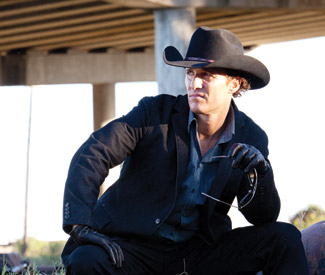
The Smith clan of Texas may pass many things from generation to generation, but brains are not among them. The current dimmest-bulb end product is Chris (Emile Hirsch), a yelping young fool whose solution to his temporary homelessness and a bungled drug deal is murdering the mother who just threw him out to collect her life insurance money. This scheme doesn’t particularly bother his pa, equally slow Ansel (Thomas Haden Church), or the latter’s somewhat sharper albeit slutty second wife Sharla (Gina Gershon). But none are capable or courageous enough to pull off such a stunt themselves, so an outside party is enlisted in the form of Joe (Matthew McConaughey), a corrupt police detective slash hit man for hire.

“Killer” Joe enters the Smith family mobile home like he owns it, cutting through their fumbling promises and excuses with bored, bullying impatience. When it becomes clear these yokels can’t possibly come up with his required $25,000 deposit, he announces he’ll accept as retainer the temporary possession of Dottie (Juno Temple) — Chris’ younger sister, an untouched innocent so wide-eyed she almost seems mentally deficient — with aforementioned to be forfeited entirely should they fail to come through.

Needless to say, almost nothing goes as planned, escalating mayhem to new heights of trailer-trash Grand Guignol. Things get fugly to the point where Killer Joe becomes one of those movies whose various abuses (physical and otherwise) are shocking enough to court charges of gratuitous violence and misogyny. Unlike the 2010 Killer Inside Me, for instance, it can’t really be justified as a commentary upon those very entertainment staples; Letts is highly skilled, but those looking for a message here will have to think one up for themselves.

Still, Friedkin and his cast do such good work that Killer Joe‘s grimly humorous satisfaction in its worst possible scenarios seems quite enough. He’s never been a moralizing director; The French Connection, The Exorcist, and Sorcerer remain great in part because they stare into spectacular voids with clinical, nonjudgmental fascination.

This latest is a more artificially contrived piece, but it still hits Friedkin’s sweet spot, with his actors more than rising to the occasion. In particular, McConaughey brings a snake’s cold-blooded sinuousness to the role of the most lethal weapon here. Coming on the heels of Bernie and Magic Mike, two movies in which he made deft fun of his own narcissism, this turn makes it a very good year for him — although Killer Joe is sure to be a little too much for awards notice, just as it is for MPAA tolerance. 


KILLER JOE opens Fri/3 in Bay Area theaters.

Protest song

0

arts@sfbg.com

MUSIC Woody Guthrie would have turned 100 this summer, and numerous centennial celebrations mean that hundreds of people probably have “This Land is Your Land” stuck in their heads at this exact moment. But Guthrie was as much a political icon as he was a catchy folk singer. His “Union Maid” was the anthem of countless labor struggles, and he wrote a regular column for a communist newspaper. “This Land is Your Land” itself was penned in response to the complacent patriotism of “God Bless America.”

Political movements, of course, have always had soundtracks. Before Guthrie was singing the working man’s songs, the Wobblies were writing their own. Slaves sung — or whispered — about freedom as they traveled the Underground Railroad, and civil rights activists bellowed “We Shall Overcome” on marches and in jail. And for several years, the folk music scene was synonymous with the anti-Vietnam War movement.

While there is no one quite like Bob Dylan on the radio right now, or hoards of activists (that we know of) crooning from jail cells, plenty of local musicians are keeping up the tradition of writing and performing protest songs. If you ask any of them whether they’re primarily musicians or primarily activists, they’ll answer that the two identities are inseparable — and that 100 years after Woodrow Guthrie was born in Okemah, Oklahoma, the intersection of art and politics is still a completely natural one.

For Bonnie Lockhart, a member of the East Bay group Occupella, music inspired her to become a lifelong activist, and politics later supported her career as a musician. Growing up in conservative Orange County, she listened to civil rights songs on the radio. “I remember being so moved by the music. I had no context in which to understand what was going on in the South but because that music moved me, I pursued it and found out,” she explained. “It drew me into understanding that something was terribly wrong in our country and that people were doing something incredibly exciting about it.” Later, her involvement in the Women’s Movement gave her courage to pursue a musical career.

Activists have long recognized the power of song to raise morale and create cohesion. “Music is a powerful force for unity,” said Arthur Holden of the Musicians Action Group (MAG).

The amorphous MAG emerged from the more organized Bay Area Progressive Musicians Association, and now consists of a small group of veteran activists and anyone else wants to join them at demonstrations. Initially, music was a crucial political tool. “The police were not happy having picket lines blocking things and nobody knew what to do with a bunch of people with instruments,” said MAG clarinetist Gene Turitz. “When we saw the police coming we would get between the strikers and the police. It would at least stymy them.”

Now, one of the group’s primary goals is to preserve the sounds of historical struggles. MAG is one of the rare groups that continues to perform the Communist anthem “The Internationale.”

“Whenever we do it at a demonstration, someone comes over to us with tears running down their cheeks [in recognition],” Turitz said. The classic pieces have equal importance for those hearing them for the first time, Turitz said, recalling playing “Bread and Roses,” a tune about the Triangle Shirtwaist Factory strike, at a march on Cesar Chavez Day. “A guy in a Latino union group comes over and says, ‘That’s the most beautiful song, what’s it about?’ When I tell him, he gets thrilled. It’s that kind of thing we’re trying to preserve.”

Today, the concept of political musicians achieving commercial success might sound oxymoronic, and groups like Peter, Paul and Mary might seem a thing of the progressive past. “When I was coming up in the ’70s, you could record for real companies,” said Lockhart. “It was still capitalism but it wasn’t this voracious. The record labels weren’t into being monopolies, they were into having a niche.”

Others pointed to a more fragmented, diffused political scene to explain the lack of politics on the radio. But many believe that music is just as integral in contemporary struggles as it was in the past, even if the audience it reaches is smaller and the format is more innovative.

“I think our younger generation is just as engaged in art for social change,” said Talia Cooper, a 26-year-old Oaklander who performs original political songs at rallies. Some current Bay Area groups, such as the Brass Liberation Orchestra, consist mostly of younger musicians.

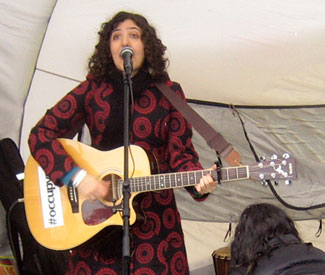
Cooper, who records under the name Entirely Talia, remembered going to long Occupy lectures at the beginning of the movement and watching the crowd become re-energized when she lead them in song.

“People go to demonstrations and passively listen to speakers. There’s just so much listening people can do,” said Occupella’s Hali Hammer. “When they’re singing, they’re directly involved.”

“I used to think it was cheesy for people to say that revolutions need art,” Cooper said. “But if you think about what gets people to show up, it’s the beautiful posters, or the flashmob with the dancers, or the singing.”

Occupella meets Mondays from 5-6pm at the weekly “Tax the Rich” demo on Solano Avenue at Fresno Avenue, Berkeley.

Bay Area activists join in anger over Anaheim police shootings

24

Last weekend in Anaheim, police shot and killed two young men. Every day since, protesters have taken to the streets. This weekend, a national day of protest following the killings helped spread the call for justice in Anaheim spread to the Bay Area. 

Manuel Diaz, 25, was unarmed when he was killed by Anaheim police July 21. When a crowd gathered at the scene as Diaz lay bleeding, police fired rubber bullets and pepper balls into the crowd. One police dog got loose, charged at a baby, and bit the child’s father. Police say they used crowd control because the people had grown rowdy, and that some were throwing rocks. The next day, police shot a 21-year-old, Joel Acevedo, who they say shot at officers while fleeing. 

Anaheim police shot another man the next day, a suspected burglar, marking the eighth officer-involved shooting in Anaheim so far this year. Five of the shootings resulted in death, and all but one of those killed were Latino.

“What’s going on here in Orange County is symbolic of a problem with the system,” Eduardo Perez, a 21-year-old student who attended Sunday’s protest told the Orange County Register. “This wouldn’t happen to white people. This is racism, simple as that.” 

Saturday was a designated a national day of action, and protests in New York, Oakland, Seattle, and Chicago took place, while a smaller group marched Friday in San Francisco. 

Tensions boiled over between protesters and Anaheim police Tuesday. Police say that protesters smashed windows and set fires. They shot at a crowd of hundreds with rubber bullets, beanbags and pepper balls, arresting 24 by the end of the night. That was what an Occupy Oakland medic, who preferred to be quoted as Elle, want to head down. 

“I saw an insane amount of force being used to disperse protesters who I think are rightfully angry. I noticed there was nobody there as a medic, reaching out to do first aid,” Elle said. 

On Sunday, protesters rallied at the APD headquarters and attempted a march to Disneyland. Law enforcement officers in camoflauge uniforms, toting tear gas launchers, blocked them the crowd from getting near Disneyland.

“They were stopped by the SWAT team that apparently wears desert camo,” said Elle, noting that Anaheim police and Orange County sheriff’s deputies, many on horseback, also confronted the march. 

Although Elle says that she did observe mounted police “using their horses almost as batons to shove and hit protesters onto the street,” she only treated minor injuries as a medic. 

”The unfortunate thing about being a medic is that these people who are being arrested need your help the most,” she said.

“The arrests they made were pretty violent, the ones that I saw. They hit one guy over the head with their baton as they were taking them to the van. They carried another woman out from a back alley, and she was crying and terrified. They were pretty brutal to the people they were arresting.”

Elle says she wanted to go help in Anaheim in part to help build a unified movement.

“We’re building a movement in Oakland around a really similar situation,” she said.

“If our state, community, country is going to make these murders stop all these communities need to rise up together and say this is unacceptable, we need to stop. It’s going to take a lot of people getting out there into the streets and building constant popular support to say this is an unacceptable use of our tax dollars.”

That “constant popular support” has been mounting in the Bay Area so far in 2012. Occupy Oakland started off the year with a march to the Oakland City Jail, and, the next day, joined with the Oscar Grant Committee for a march and rally commemorating his death. As officer-involved shootings have continued throughout the year, family and supporters have continued to take to the streets in response. 

“I also wanted to help build a bridge between Oakland and Anaheim,” Elle says of her trip. 

“If every community is issuing statements saying we want police to be held accountable for these deaths, we want to revoke the police officers’ bill of rights, we want active legislation preventing stop and frisk, active legislation to protect people’s fourth amendment rights, I think it could accomplish something,” Elle said.

Dick Meister: Good news–and bad–about jobs

2

By Dick Meister

Dick Meister, former labor editor of the SF Chronicle and KQED-TV Newsroom, has covered labor and politics for more than a half century. Contact him through his website, www.dickmeister.com

It’s of course good news that unemployment among workers in private industry has been steadily declining. But that comes along with the bad news that unemployment among public employees has been growing – and with it a decline in vital government services.

A recent  report in the New York Times has made that very clear.  Reporters Shaila Dewan and Motoko Rich noted that government payrolls grew in the early part of the recovery from the Great Recession in 2009, mainly because of federal stimulus measures. But they said that since then, “the public sector has shrunk by 706,000 jobs.  The losses appeared to be tapering off earlier this year, but have accelerated for the last three months, creating the single biggest drag on the recovery in many areas.”

Albeit slowly, the economy generally has been improving, with state tax revenues expected to go beyond pre-recession levels by next year.  Yet the Times’ reported that “governors and legislatures are keeping a tight rein on spending, whether to refill depleted rainy day funds or because of political inclination.”

Holding tight won’t be easy, with the costs of health care, social services, education and employee pensions steadily rising, and property taxes and other tax revenues steadily shrinking.  More than a dozen states have tried to do it by trimming their aid to local governments. And that will undoubtedly lead to more public worker layoffs, more unemployment and more reductions in important public services.

Local governments already have been making budget cuts that far outweigh the slight economic relief that’s come with a recent growth in state and federal jobs.  It’s certain to worsen, since more than 25 percent of municipalities are planning layoffs this year. 

President Obama has proposed easing the financial plight of states and their employees by providing $30 billion more for teachers, police officers and firefighters.  Such aid is essential if public services – and the compensation of those who provide them – are to be maintained at a significant yet reasonable level.

Predictably, the  conservatives who don’t really care for government are in a snit over Obama’s proposal.  The Times quoted Michael D. Tanner, a senior fellow at the Cato Institute, as complaining that the additional public sector jobs  “must be paid for with more debt and taxes borne by the private sector.”

Now, isn’t that a revelation! Imagine that, people taxing themselves and hiring people to provide services they and everyone else needs if they are to live a decent life, if they are to find meaningful work.

We need more, not less government, and we can provide it by employing for reasonable compensation many of the millions of Americans now suffering from unemployment. We need to open more government jobs for them so they may help provide essential services.

The lack of sufficient public workers, as the Times said, “can mean longer response times to fires, larger class sizes, and in some cases lawsuits when short-staffed agencies are unable to provide the required services.”

The Times quoted Mike Whited, president of the firefighters union local in Muncie, Ind., who said the area which could be reached within eight minutes after an alarm was sounded was cut in half.

The Times said, “Mr. Whited chafed at portrayals of public workers as overpaid or greedy, saying his union and others had made concessions, including paying more for their health insurance and forfeiting raises. I think a lot of people don’t understand what we do. They’re looking for somebody to blame, and I think they’re being led the wrong way.”

One of the hardest hit cities, Trenton, New Jersey, has laid off fully one-third of its police force, hundreds of school district workers and at least 150 other public employees, and now faces loss of 60 more firefighters.

More than half the job losses in local governments have come in education.  Thousands of teachers have been laid off throughout the country, and thousands more are being threatened with layoffs.

 Many teachers have agreed to help ease their school districts financial problems by taking unpaid “furlough days” or agreeing to less pay and benefits than they had sought or had been granted in contract negotiations.

The widespread teacher layoffs have nevertheless continued. In Cleveland, for instance, more than 500 teachers were laid off this spring because  of a claimed $66 million budget shortfall. That came after two years of cutbacks and $25 million in concessions, teachers union leader David Quolke told the Times’ reporters.

One consequence: Some classes will have more than 40 students, a serious hardship on students and teachers alike.

Relatively large teacher layoffs and cuts in public jobs and services generally have hit every state hard, including the largest, wealthiest and most influential states.  In California, for example, Gov. Jerry Brown is threatening to eliminate 15,000 state jobs.

The Times said Pennsylvania “has shed 5,400 government jobs this year, and many school districts and social service agencies are contemplating more layoffs.”

Yes, it will take higher taxes and more public debt in Pennsylvania, California and everywhere else to combat the severe economic problems that have left millions of Americans without the jobs  and public services they so badly need.

Dick Meister, former labor editor of the SF Chronicle and KQED-TV Newsroom, has covered labor and politics for more than a half century. Contact him through his website, www.dickmeister.com

Meet the finalists in Oakland’s youth poet laureate competition

4

Bay Area, our young people are wrapping words of wisdom around subjects like survival, poverty, oppression, community, life, and death. It’s time to listen up.

“Just like a picture is worth a thousand words, a word can provoke a thousand memories,” says Tele’Jon Quinn, one of seven 16 to 18-year-old Oakland youth poet laureate finalists. “Memorizing goes hand in hand with reflection. If my words can cause someone to reflect on an important issue or event in their life, then my words were worth sharing.” The East Bay bards are now preparing for the first group performance at the Art and Soul Festival in Oakland on Sat/4.

The Oakland Public Library teams up with Youth Speaks, the local youth spoken word nonprofit, to stage the competition. Like any poet laureate, the chosen versifier will officially represent his or her community via the media and public appearances.

A panel of celebrity judges including California poet laureate Juan Felipe Herrera, and Oakland-based poets Kenju Liu, Arisa White, Juliana Spahr, and Joshua Merchant, will select Oakland’s inaugural poet laureate in September. Every finalist will have their work published in an anthology that comes out in 2013, and the ultimate victor will receive a $5000 scholarship as well as the title of youth poet laureate for Oakland.

Take a moment to read up on seven of the most creative young wordsmiths around, and check out snippets from their creative works.

Oakland youth poet laureates at the Art and Soul Festival, festival entrances at 14th St. and Broadway; 16th St. and San Pablo; Promenade beside City Center West Garage, Oakl. www.oaklandpubliclibrary.orgwww.artandsouloakland.com. Performance at Rotunda Building, 300 Frank Ogawa Plaza. Sat/4 5pm – 7pm, $5-$8 seniors and kids, $10-$15 adults

Stephanie Yun, age 18, Skyline High School

Stephanie Yun has always been a writer. “To me, poetry is pure expression. It’s beautiful, and painful, and liberating, and frightening, all at once,” she tells the Guardian. “It’s being vulnerable, and teaches us to better understand things we never could.” Her poem “‘Til Death”, is infinitely more than your stereotypical love poem. Her lines tackle severe insecurities, body image issues, depression, cutting:

… Before my first and current relationship,

I wondered how potential suitors would react

when their fingertips wandered and read my wrists like Braille

Here lies emotionally unstable girl …

Describing her foray into love, her first boyfriend, her first romance, Yun slips in images of her internal battles, questions of existence, identity. 

… Everything may be fine as I speak this

but I’ve envisioned dream wedding

in the spring 

wearing tulle or lace ball gown

with three-tiered chocolate cake     

fewer times and in less detail

than my suicide … 

Yun says she started writing poetry in second grade, but became actively involved two years ago as a high school sophomore with Youth Speaks. She says writing is a release — she writes out of necessity and tells us doesn’t know if she would be alive today without the ability to lay her words down. “There is just something about letting things out, things we have kept so deep inside of us, or things that threaten to burst from our being,” Yun says. “It’s that transition from containing them within ourselves, to their manifestation into the outside world. We make ourselves vulnerable and are forced to face things head-on, and from there our ideas and feelings exist beyond us, and we can share them with others.”

Tele’jon Quinn, age 17, MetWest High School

Tele’jon Quinn is an activist and spoken word artist. He enjoys performing to large crowds, and uses his creative talents to raise consciousness in his community. His wordplay draws attention to social issues like police brutality, classism, poverty, and community. From his poem “Dialouge”: 

… Because Elites are never open minded unless there is lots for sell 

They have packaged us like we’re bots on shelves 

Robotically boxing each other and concocting diabolical plots 

To exile one another to hell …

Quinn says his poetry is not limited to his own emotions or feelings. He draws some of his material from the social programs he participates with, like Heal the Streets, Bay-Peace, and Youth Speaks. He says that for the past two years, poetry has been his outlet for everything he endures. He seeks to educate, liberate, and inspire members of the Oakland community with his words. In the final lines of “Dialogue” he writes:

So if my poetry could walk she’d walk right here

And tell you a story that gives you hope for the future of her home Oakland

The Navajo people once said you can’t wake a person that pretends to be asleep

So lets stop pretending that we do not see our reality

Open our eyes

And transform the reality we live in …

Robin Levy, age 16, Saint Joseph Notre Dame

Poetry, she says, allows Robin Levy to organize the helter-skelter thoughts that run rampant in her brain. Levy has written poetry in earnest for three years now, and says every time she writes a poem, she records another part of herself. 

“Poetry, for me, is collecting all the scraps of beauty or strangeness or whatever I can find and piecing them together so other people can see just how vivid everything is,” she tells the Guardian. Levy is a big fan of Robert Frost, but her favorite poet is a slam poet who calls herself Jasmine Luve. “The way she writes just seems so unthinkingly perfect, like she just wrote down everything she thought that day and it was already poetry,” Levy says. Her own subject matter evolves from little snippets she hears, reads, or thinks. “Just anything that is accidentally amazing, something that probably didn’t mean to be poetic but is,” she says. “The reason I write what I do is that whenever I read or hear something poetic, I just want to elaborate on it and make it into something more, weave that one thread into a full tapestry.”

In her poem “Before You Were You” Levy’s ability to turn a casual phrase into poetry is apparent. The first lines read:

you told me once

that before you were you

you were a stone.

heavy, immobile,

stranded at the ocean floor

by the cruel grip of gravity.

The poem runs full circle to explore questions of identity and shared existence. It ends with:

you told me once

that before you were you,

you poured from my mind

into the sand

you told me once

that before  you were you,

you were me

Levy asks anyone who reads this to write a poem today.

Kerby Lynch, age 17, Oakland School for the Arts

When asked if she reads poetry, Kerby Lynch responds, “Reading poetry is such an understatement. I live, breathe and eat poetry. Life is poetry. The sun, the moon and the truth is poetry. When one realizes that, life is on a path of divinity.” 

In the middle of this creative flight, she interrupts herself. “Enough of that, I’ll answer the question.” 

It turns out Lynch reads, watches, and listens to a whole gamut of poetry from traditional, to contemporary (particularly Ise Lyfe from Oakland), to spoken word (Def Jam Poetry, season 3), to rappers (Jay-Z, Andre 3000, Kendrick Lamar, Nas, and Lauryn Hill), and her teachers and peers at Oakland School for the Arts. Her favorite song, ever, he adds, is “Mathematics” by Mos Def—largely for the lyrics. 

http://www.youtube.com/watch?v=m5vw4ajnWGA

“These are all my favorite poets and people, because they are who I am,” she says. Lynch has written poetry since she was 14, and says she got heavily into the beauty and complexity of poetry and spoken word in the summer of 2011. “Poetry is me, but not in a pretentious way. Poetry is me in a way that it completes me and aides my purpose in life.” Lynch writes about issues of race and separation, class, social and political issues. Her words are progressive, like a call to action:

Watch your brother. Tell him 

no matter what he wears he will fit the description

tell him about Oscar

tell him about Aiyana

Sean

Carlos

Sergio

Danny 

Shaima

tell him about Trayvon and these statistics that define us…

She says she uses poetry to reflect the “messed up workings of the world,” insecurities and vulnerabilities of people, and as a tool to sway the masses. “I strive to write as if I am using political propaganda,” he says, noting the influences of Martin Luther King Jr., and Stokeley Carmichael. “I use words  for me, the same way words have been used against me. Whether it be in the constitution or in a hate speech. Words are the tools for the bigger machine. Who has access to that machine? We all do. Why don’t we all use it? We didn’t know we could.”

Euna Bonovich, age 16, International High School of San Francisco

Euna Bonovich is half-Korean, half-white. She says the confusion and frustration that goes along with finding herself split between two very different cultures and in the middle of adolescence can only be soothed by writing poetry. She wants to provide a voice for those who are prevented from speaking because of the depression and exhaustion of living, and spread the message that no one is emotionally alone. Her writing is hopeful, soulful, and gets to the roots of human connection. The lines of Bonovich’s “The Gossamer of Our Hope” tell of a connection that is able to reawaken feeling and soul. 

The poem begins:

My soul has slipped away like the fleeting moments of a nightingale

Distant memories that can only be recovered by the breath of the wind

Losing my existence within the grains of sand,

But when I sense the warmth of your fingertips 

I know I’ve found it once more

The song of my sleepless night 

The feeling of laying in cold grass as the sun spreads across my skin

The laughter of a falling snowflake

The fragility of a wet moth’s wing …

Bonovich says the importance of poetry is its ability to show someone beauty in the ugliest thing in existence: life.

Jose Saldona, age 18, Envision Academy of Arts and Technology

Jose Saldona says poetry is a piece of clay; it is up to the artisan to decid its shape, color, texture and size. “It’s up to the customer to figure out its use,” he says. “Words are another set of tools: another way to communicate. Another path to enter the untapped emotions of people. Another method to reach the doubts people have.” Saldona says poetry has always been a way for him to express himself, free from speech and grammatical rules. “Sometimes you can even sneak in a few spelling ‘mistakes’ for effect,” he says. Saldona has written poetry since sixth grade, and spoken poetry since he was three. His poetry speaks to life, truth—he describes his inspirations as, “anything from nature to human nature.” 

“I am a reflection of my community, and my community lives within no boundary,” says Saldona, who describes himself as half-Spaniard, half-Tarahumara, but recognizes himself as a whole-hearted, proud Mexican. “I was raised with the idea of corima, sharing and charity. As I approach this unliberated world, I see poetry as a way to remake that world.” Saldona says stories are shared among people to teach lessons in tribes to the younger folk. He views himself as a chief, the storyteller, the ‘back in Mexico’ kid, who in ninth grade refused to write essays because he felt it took the ideas of others. The 18-year-old messenger wrote he poem “Baby’s First Words” as a dedication to his unborn baby boy:

I’m enslaved to this holy string I pull

perhaps a chord that keeps me fed

I have not an idea what it is, but it keeps me alive.


I stretch and barrage my mommy with kicks.

It gets her to speak and I love hearing her distant, soothing voice.

Yes, that marvelous singing in the raindrops, drizzling

with echoes of angelic harmony,

lulling me to sleep … 


My mouth opens wide in a gaping yawn

that quickly closes around my thumb.

Siesta in my warm incubated cove..

Goodnight.

Victoria Kupu, age 18, Mills College

Victoria Kupu has written poetry since fifth grade, but did not tell anyone about it until her sophomore year in high school. The first-generation Polynesian-American says it is her means of self expression during stressful times, as well as a reflection of her experiences and culture. “I see poetry as seeing the beauty in struggles,” she says. “[It is] an art, a way of self expression.  It can be left up to the artist how they want to convey that to the audience.” Kupu writes to tackle issues that affect people of color, and her poem, “Roots”, is an example of the way her words explore generational and cultural gaps.  

… He whispered, Ou’a foki mai, Osi tala atu ka koi 

My love does not speak your language 

A Polynesian growing up in America left my identity an orphan 

Father America was a con-artist, selling the “American Dream”

Mother liberty stood on her pedestal made of sand and dressed herself up in Monopoly money

She sold herself to the white man, capitalism 

That left no nurturing time for this brown child

I turned my back on my roots, so he turned his back too

He spewed words of my biggest fear

Ou’a  foki Mai, Osi tala atu ka koi

Your heart no longer lives here …

Kupu says she is usually sitting on a bus or in class when a line pops into her head. She writes it down and it expands into a poem. “I also usually try to touch upon issues that are not talked about as much,” Kupu says. “One of my poems talks about colorism. I also like to write about issues or marginalized communities, such as the disabled community. … I am Polynesian-American. I am not only writing to represent other Polynesians but also many other people.”

Best of the Bay 2012: Local Heroes

9

2012 Local Heroes

Alex Tom and Shaw San Liu

Alex Tom and Shaw San Liu — the executive director and lead organizer for the Chinese Progressive Association, which celebrates its 40th anniversary on Aug. 4 — have laid the groundwork for a progressive resurgence in San Francisco by organizing Chinese immigrants and actively building close and mutually supportive relationships with working-class allies throughout the city.

The two have been involved in just about every recent effort to counter the pro-corporate neoliberalism that has come to dominate City Hall these days. They have seized space with Occupy San Francisco and they have supported labor unions and helped to create the Progressive Workers Alliance. They have fought foreclosures and pushed for affordable housing reforms, and they have protected vulnerable immigrant workers from wage theft by unscrupulous employers.

“Shaw San and Alex are incredibly talented organizers and movement builders who are managing to do the nearly impossible,” said N’Tanya Lee, who worked closely with the pair as the director of Coleman Advocates for Children and Youth. “They have built an authentic base of working-class Chinese immigrants who are interested in fighting for change in their community, and are creating a grassroots organization at the forefront of building multi-racial alliances to combat the divide-and-conquer strategies that are confronting us.”

Liu, who joined CPA six years ago, said she’s always inspired to see the old photographs on the walls of CPA’s office, and to read the history of CPA’s organizing and advocacy on behalf of working people. She said the organization has always understood the need to forge alliances with labor unions and other progressive interests.

“The organization itself has been, since its inception, playing a critical role in bridging the needs of Chinese interests with other communities,” Liu said. “I’ve always seen my role as bridge building.”

Today — with stagnant real wages, a deteriorating social safety net, and growing power by corporations that enjoy unprecedented political clout thanks to Citizens United and other court rulings — the need to organize people across cultural lines is more important than ever, even if that begins by addressing the individual needs of each community.

“Always at our core, it’s about empowering our folks to be able to voice their own struggles and visions,” Liu said.

Working to build that capacity within the Chinese immigrant community is hard and important work, Liu said, but it’s equally important to connect with the struggles of working class people from other communities, uniting to effectively counter the political dominance of employers and property owners.

Lui framed the struggle as: “How do we build unity and not have that be lip service?”

Tom and Liu have demonstrated that they know how to do just that, despite the diversity of sometimes-conflicting interests on the left and in a working class squeezed by recession and feelings of economic uncertainty.

“The issue that will unify people is good jobs that are accessible to everyone,” Liu said.

Yet she also said that working class organizing is needed to counter the simplistic “jobs” rhetoric coming from City Hall, which politicians are using to advocate for tax cuts to big corporations.

“More and more, it exposes itself as a total lie,” Liu said of the argument that the city should be facilitating private sector job creation with business tax cuts. “So much points to the fact that the US economic system doesn’t benefit everyone … When we talk about jobs, we talk about what kinds of jobs we want and for whom.”


2012 Local Heroes

Stardust and Ross Rhodes

Ross Rhodes and Stardust, like all of the people involved in Occupy Bernal, are neighbors. But until Stardust helped found the group — a local take on Occupy focused on stopping unjust foreclosures and evictions — they didn’t know each other.

Now they do, and if it wasn’t for Occupy Bernal, Rhodes is sure he would no longer have the house that his parents bought in 1964.

A former college football star, Rhodes injured his knees and back playing. He lives on disability payments, volunteering at the 100 Percent College Prep Club, and bringing home-cooked meals to seniors in his area. He also coached kids in the Junior 49ers program until it became too hard on his injuries.

Stardust, an ESL teacher and oboe player in the Bay Area Rainbow Symphony and the SF Lesbian/Gay Freedom Band, has been working for LGBT rights, women’s rights, and online civil rights for years. When Occupy took off, he gravitated toward the neighborhood fights against foreclosures.

Like people all over the US, Rhodes and his wife were fooled several years ago by a pick-a-payment loan plan. At the time, World Savings was peddling the deals through neighborhoods, promising potential borrowers that they could send their kids to college, buy a car, take vacations — and modify their loans after a year.

But when Rhodes started to apply for loan modifications, he was denied. He kept receiving letters asking for more information, often the same information he had already given — a common story that led to part of the Homeowners Bill of Rights that will guarantee a single point of contact from the bank. He was stumped when he was told he needed more income — the bank said it wouldn’t accept payments that were more than 30 percent of a borrower’s income, and Rhodes was getting a fixed disability check.

He found another income source as a homecare provider, but after all the time that the bank wouldn’t accept his payments, Rhodes was marked as someone who wasn’t making payments, and was tracked for foreclosure.

Meanwhile, Occupy Bernal was working on more than 100 similar cases in its neighborhood. The organizers hadn’t quite convinced Mayor Ed Lee to help at that point, but Rep. Pelosi’s staffers were on their side, getting banks to prioritize the cases of those working with Occupy Bernal. They worked with other community groups like Alliance of Californians for Community Empowerment (ACCE) to do physical occupations of homes. But for those who had received a notice of default and a notice of sale — two steps in the foreclosure process that precede the auction of a property — Stardust was there with another tactic.

He spearheaded Occupy the Auctions. He shows up at City Hall at 1:30 every day and tries to disrupt foreclosure auctions. He’s been there continuously since April 27, 2012, and has stopped dozens of home sales. When fighting the eviction of a neighbor, he is sometimes backed by more than 100 people. But many days it’s just Stardust.

Now, Rhodes is in a loan modification process. Rather than conflicting and confusing machine-generated paper work, he gets regular calls about the status of his modification from a point person in Wells Fargo’s executive complaint office. He testified in Sacramento in favor of the Homeowners Bill of Rights, which passed July 2. He’s also become an Occupy Bernal organizer on top of his other volunteer pursuits.

Stardust battles mega-banks and the city’s wealthiest in his work. But he says the biggest challenge is helping people to get over the shame they feel when they realize they are facing foreclosure. “It’s not their fault,” he says. “It’s the system.”

Friends of Ethics

In the summer of 2011, at the behest of the Ethics Commission, the Board of Supervisors put on the ballot a measure that would have loosened some of the rules for campaign consultant reporting, and would have allowed further changes in the city’s landmark ethics laws without a vote of the people. It had unanimous support on the board — and frankly, technical changes in campaign laws are not the kind of sexy stuff that gets the public angry.

But a small group, led in part by five former ethics commissioners, took on the task of defeating the measure. The activists also took on the challenge of defeating Prop. E, which would have allowed the supervisors to amend future measures passed by the voters.

Despite being outspent by tens of thousands of dollars, Friends of Ethics — a small grassroots operation — prevailed. Both measures were defeated (32 percent to 67 percent in the case of Prop. E, the worst loss of all the local measures on the ballot).

The group is great at forming coalitions: in the case of the No on E and F campaign, Friends of Ethics reached out to some 30 organizations that formally joined in opposing the measures after hearing presentations.

The members of FOE are a fractious group of organizers and shit-disturbers who don’t always get along or agree on other issues. But they’ve come together to do something nobody else does: make protecting and expanding political reform laws a front-line priority.

And the battle goes on. Not long after the November 2011 election, Supervisor Scott Wiener introduced legislation that would have led to less disclosure of political contributions before an election, and would have made it easier to conceal who was making contributions and paying for campaign mailers. The Wiener bill would weaken campaign contribution limit, giving the wealthiest donors greater power in elections.

When the amendments were heard at a well-attended Rules Committee in June (with plenty of public comment from Friends of Ethics), the supervisors sent the amendments back to the Ethics Commission to be rewritten.

The next step for the Friends of Ethics is to work with interested supervisors to push for changes to the city’s campaign laws that will actually benefit the public, such as increased transparency in election contributions and expanded campaign restrictions for those receiving contracts and other benefits from the city.

In an era defined by the US Supreme Court’s Citizens United case and a nationwide assault on fair elections, it’s critical work.

Friends of Ethics can be reached at sfethicsfriend@gmail.com

2012 Local Heroes

The Occupy movement

When Adbusters magazine called for people to show up on September 17, 2011, in New York City to protest the way Wall Street was holding the country hostage, no one could have predicted what would emerge.

It was the start of a movement, and San Francisco heeded the call. About 100 people gathered in the city’s Financial District. They started camping. And the effort exploded.

In the first few weeks, camps sprung up across the country. In Chicago and Los Angeles, in Bethel, Alaska and Tuscaloosa, Alabama, people were drawn together. But, unlike most protests, they stayed together. Night after night.

Along the way, a certain prevailing narrative from outside observers never quite got it right. First the camps were dismissed as nothing but bratty college students and hippies. Then they were called dirty and filled with homeless people. (Occupy challenged the whole idea of a monolithic homeless population. Once they had a home in the Occupy tent cities, homeless people were just — shocker — people.)

By December, when most of the campers had been kicked out, the narrative shifted. Occupy was resting, hibernating, many declared. Some snickered at the fair-weather activists who would only come out in the sunshine.

But in the Bay Area, at least, that hibernation story was simply false. On December 12, Occupy Oakland brought out thousands for its second port shutdown, in solidarity with port workers. On January 20, downtown banks were forced to close for the day and people in the streets celebrated Occupy San Francisco’s shutdown of the financial district. A week later, 400 were arrested when thousands tried to turn a vacant Oakland building into a community center. This was no hibernation.

Actions in some way inspired or fueled by Occupy have continued into the spring and summer. On March 1, Occupy, with a focus on student debt and accessible education, formed the 99 Mile March. Dozens marched from the Bay Area to Sacramento to join thousands of students and supporters in calling for an end to cuts to education; hundreds then occupied the Capitol building. On April 22, Occupy, with a focus on food justice, formed the Gill Tract Occupy the Farm action. Hundreds took a UC Berkeley-stewarded tract of land slated for a baseball diamond and a Whole Foods and planted it, turning it into a farm with rows of crops, a kids space, and a permaculture garden. On June 15, Occupy formed the Lakeview sit-in and Peoples School for Public Education, which taught day camp to children and refused to leave a beloved Oakland elementary school, one of five slated for closure.

Police eventually won the many-months battle with most Occupy groups in the Bay Area. The camps are mostly gone, though a tenacious group keeps its 24-hour protest in front of the Federal Reserve.

But because of Occupy — and its accompanying burst in resistance, creativity, and the belief that we really can, and must, come together to do something — dozens of Bay Area residents remain in homes that were facing foreclosure. Hundreds of people who felt forgotten and abandoned have found community. Thousands have been inspired to start their own projects and work with others.

When Adbusters called Occupy Wall Street to action, it was under the banner of “democracy not corporatocracy.” That ain’t an easy project. But it has already made the world a better and more hopeful place. 

Best of the Bay 2012: BEST PRIDE ON WHEELS

0

BEST PRIDE ON WHEELS

Though some may quibble with the presence of lowriders at Sunday Streets in the Mission — you can often find the hydraulic-enabled, candy-painted whips parked off 24th Street as they prepare to roll out in high-gloss fashion — the cars actually recall an important chapter of the neighborhood’s history that doesn’t get enough play. According to Roberto Hernandez of the SF Lowrider Council, lowriding the Mission’s main drags was so popular in the 1980s that tourist buses would come to check out the cars, causing traffic that led to police intervention and brutality. The Council was formed in response to the harassment, and is experiencing a rebirth these days as lowriding comes back into fashion. Nowadays, member clubs have five to 30 members of all genders and races. The only requirement to join, says Hernandez, is a “finished, tight, ready-to-roll lowrider.”

(415) 206-0577

Perspective and proportion

46

steve@sfbg.com

In the eyes of his critics, suspended Sheriff Ross Mirkarimi may never be able to recover from the portrayal by prosecutors and Mayor Ed Lee that he abused his wife, intimidated her with threats to use his power to take custody of their young son if they divorced, and used her and his campaign manager to try to dissuade witnesses and thwart a police investigation.

The tearful video of his wife, Venezuelan actress Eliana Lopez, displaying the bruise on her arm, and the fact that Mirkarimi pleaded guilty to a misdemeanor false-imprisonment charge in connection with the incident are all these critics need to condemn him. Indeed, it was all that Lee relied on when he suspended Mirkarimi without pay and launched unprecedented official misconduct proceedings to remove him from office.

But now that the Ethics Commission has gotten through the substance of its inquiry — and past the tedious work of creating from scratch systems and standards for gathering evidence and evaluating whether it warrants an elected official’s removal by the mayor — the testimony has told a very different story of what really happened.

Accusations of witness dissuasion (which had been one of three original criminal charges Mirkarimi faced before agreeing to a lesser plea deal) and abusing his official position haven’t been supported by any direct evidence or testimony, and as the hearings wore on, Deputy City Attorneys Peter Keith and Sherri Kaiser were looking increasingly vindictive as they fruitlessly pursued those angles with witnesses who seemed credible.

There is also no direct evidence that the abuse was anything more than a moment of frustration and bad judgment at noontime on Dec. 31, when Mirkarimi grabbed Lopez’s arm as she tried to walk away from their heated argument about divorce child custody, and she yanked it away, eight days before his swearing in as sheriff.

Whether that incident and its aftermath meets the City Charter’s broad and untested definition of official misconduct — including “conduct that falls below the standard of decency, good faith and right action impliedly required of all public officials” — will be up to the interpretation of the Ethics Commission, which has now accepted all the evidence that it has deemed relevant and credible. All that remains is the fight over its “finding of fact” at an Aug. 16 hearing and its subsequent recommendation to the Board of Supervisors, which could begin considering the matter in September.

There won’t be an inquiry into whether Mayor Lee committed perjury on June 29, as outside witnesses said he did on two separate issues. The commission July 19 rejected the argument by Mirkarimi’s attorneys that Lee’s alleged lies under oath would cast doubt over his reasons for launching these unprecedented proceedings and the discretionary judgment he exercised. Commissioners decided that was a tangential issue.

In the final hour of the commission’s laborious work in whittling down the voluminous evidence that the city has presented in this case — which both sides and the commission openly acknowledge will likely be considered by the courts as well as the board — it also made deep cuts into the written testimony of attorney Nancy Lemon, a domestic violence expert who drew damning conclusions about Mirkarimi based on how “batterers” typically behave.

That’s been a big part of the city’s case, reducing Mirkarimi down to a two-dimensional batterer whose every action can be predicted by that distinction, from the manner in which he relinquished his weapons to police to the reasons why Lopez has resisted cooperating with efforts to charge her husband with crimes and remove him from office.

Lemon’s testimony was based almost solely on second-hand descriptions of life in the Mirkarimi household in a 22-page written declaration by neighbor Ivory Madison, who was also the only witness that Lee said he spoke to before removing Mirkarimi from office. But most of Madison’s incredible and fantastical narrative — which painted Mirkarimi as a monster who repeatedly abused Lopez and their son and controlled every aspect of their domestic life, right down to what and whether they ate — had already been discredited and disallowed by skeptical commissioners in June.

“I was disappointed by the content of Ivory Madison’s declaration. A first-year lawyer should know that much of it is inadmissible and it should not have been given to us,” Commissioner Paul Renne told Keith in June. Renne called the declaration “clearly hearsay, clearly having the intention of poisoning the well of this hearing.”

Keith apologized and offered little resistance to much of the declaration’s removal, but the city has nonetheless continued to rely on the second-hand accounts of Madison and another neighbor, Callie Williams, in its descriptions of Mirkarimi’s conduct and the questioning of witnesses.

But that hearsay evidence and speculation was countered on July 18 and 19 with the extended cross examination of two key witnesses in the case: Lopez and Mirkarimi campaign manager Linnette Peralta Haynes, a woman with domestic violence training who Lopez reached out to on that pivotal day of Jan. 4 when Madison called the police. Each woman spent more than three grueling hours each on the stand, questioned by city attorneys and commissioners — and they painted a very different portrait of the events than Lee and Madison had.

As for Madison — having had most of her testimony stricken from the record, and with Lopez testifying about Madison’s sudden zeal for going after Mirkarimi and involving his political opponents in that process — Mirkarimi’s team decided not to call her to the stand for live cross-examination. Attorney Shepherd Kopp told reporters, “I think the neighbor’s testimony is suspect at best.”

The go-between

Haynes was central to the city’s allegation that Mirkarimi dissuaded witnesses and sought to thwart a police investigation. Phone and electronic records revealed that she communicated with both Lopez and Mirkarimi many times on Jan. 4, the day Mirkarimi learned that his wife had been confiding with neighbors about the Dec. 31 incident and that Madison had broken that confidence and called the police.

The city’s apparent theory was that Haynes acted as Mirkarimi’s agent in trying to cover up the incident and do damage control, including coaching Lopez on what to say to Madison and Williams.

But the city has never had any evidence to support its theory, and this was its first chance to question Haynes, who had been at the end of a high-risk pregnancy and resisted cooperating with the investigation.

Yet despite Kaiser and commissioners grilling Haynes for more than three hours — twice as long as she had told the commission that she would need — no smoking gun emerged. Haynes seemed calm and consistent as she described giving Lopez emotional support and probing to ensure that she wasn’t in danger. Kaiser fumbled through technical difficulties and maintained an accusatory and belittling tone even as the answers she was receiving seemed to destroy her line of questioning.

“I think the house of cards that mayor has been trying to establish about witness dissuasion was demolished by Linnette Peralta Haynes, who was absolutely credible,” Mirkarimi attorney Shepherd Kopp told reporters after the hearing.

Haynes has a background in domestic violence, undergoing a 40-hour certification training in the mid-90s when she went to work for a domestic violence center in San Mateo for almost two years, then later helping develop and teach a domestic violence curriculum for the jail in San Francisco.

She’s familiar with the Power and Control Wheel — the basis for many of Lemon’s conclusions — which indicates how physical abuse can be connected to other forms of abuse, such as emotional, verbal, and sexual abuse. It was with this background and training that Haynes questioned Lopez about whether she was in danger and being abused when she got an unexpected call on the morning of Jan. 4.

“She let me know she had an argument with Ross and wanted to talk to me,” Haynes said, later answering another question by saying, “She told me she was really worried about custody issues and she was talking to a friend who was an attorney.”

That friend turned out to be Madison, who Lopez maintains had represented herself as an attorney who would keep their conversation and the video they made of her injuries confidential, to be used only in the event of a custody battle. The city has sought to cast doubt on that claim — which the court rejected in Mirkarimi’s criminal case when it admitted the video as evidence — implying that Madison was simply a concerned friend and the attorney argument was developed weeks later.

Haynes said she asked Lopez whether there had been any prior incidents of physical abuse, whether Lopez felt unsafe, and whether she had been subjected to other forms of abuse — defining each form for Lopez — and that she was told “no” to each question.

“I asked if she thought she was in danger and she said no,” Haynes said.

Later on Jan. 4, Lopez told Haynes she had made the video: “She told me a friend had helped me do a video just in case I needed it for custody issues…She did tell me that she really wanted to work on her marriage, that she wanted to make to make it work, but that just in case she wanted to make sure she got custody of Theo.”

Lopez later testified that one reason she sought out Haynes was because Madison had suddenly become aggressive in trying to convince her that she was a domestic violence victim and the incident needed to be reported to the police, and Lopez wanted to get the perspective of someone with a background in domestic violence.

“I said, I have a person telling me this, I want your opinion about it,” Lopez testified.

Around 12:30pm that day, when Madison informed Lopez that she had called the police and they were on the way, she frantically called Haynes from Madison’s house and suddenly put the two women on the phone together, which Madison and the city have characterized as a witness dissuasion effort.

Haynes said she was confused when Lopez suddenly handed the phone to Madison: “She said, ‘help me, help me, help me,’ and I’m on the phone wondering what’s going on.”

“[Madison] told me, ‘I’ve been talking to Eliana for several days and I just called the police,’” Haynes said.

Haynes said she asked Madison if she had called any domestic violence agencies or if she just called the police “and she got very agitated” — adopting a defensive tone of voice — and that reaction seemed “fishy” to Haynes.

Asked whether she tried to dissuade Madison from talking to the police, she responded, “I told her she should maybe talk to her friend about what she wants.” She said that she could hear Lopez telling Madison, “This is not what I want, this is not what I want.”

So Haynes said she tried to extricate herself from the situation: “I told her I really think you need to get off the phone, talk to Eliana, and respect her.” And the phone conversation ended with Lopez getting back on the line and telling Haynes to call Mirkarimi to let him know what was going on.

But Mirkarimi was busy and not answering his phone, prompting Haynes to text at one point that he needed to answer ‘so I can protect you.” What did she mean by that, Kaiser asked.

“My thinking was that something sounded fishy, something wasn’t right, and they need legal help,” Haynes said.

“Your focus had been on Eliana up until then?” Kaiser asked.

“My focus has always been Eliana,” Haynes responded.

Later, asked about the nature of her repeated phone conversations with Lopez, she denied helping her strategize ways to dealing with witnesses or police. “I was just providing support for her, emotional support,” Haynes said, later adding “I wanted to be present for her.”

The victim

Lopez testified that while the grabbing incident was unacceptable and serious — which she conveyed to Mirkarimi — she didn’t consider herself to be in an abusive environment or in need of outside help, except perhaps the marriage counseling she had been seeking and which Mirkarimi finally agreed to.

“An abusive environment is when those kinds of think happen every day or every week,” she said, maintaining — in the face of repeated questioning — that this was the first and only instance of physical abuse.

“At the end of the day on Dec. 31, I told him, that cannot happen, this is wrong, we need counseling,” she said. “He realized it was wrong and he took it very seriously.”

But she said that Madison went from being a supportive friend and counselor on Jan. 1 to suddenly becoming increasingly insistent that Lopez report the incident to police in the days that followed.

“She started trying to convince me to call the police in that email,” Lopez said, answering a question about a Jan. 2 message from Madison, “but that wasn’t our conversation on Jan. 1.”

Lopez said Madison’s approach got more aggressive. “She said, ‘screw him, I have a lot of friends willing to help you,’” Lopez said, noting that Madison offered her the vacant homes of rich friends and offered to bring in journalist Phil Bronstein, DA George Gascon, Attorney General Kamala Harris, and Lieutenant Governor Gavin Newsom to help her.

“It looked to me suspicious…She was calling Ross’ political enemies,” Lopez said.

When Lopez finally made it clear she didn’t want police involvement, Madison called the police.

“I didn’t expect that my lawyer could call the police on her own. I thought that was my decision,” Lopez said.

Keith tried to tie Lopez’s custody concerns to his status as sheriff, driving at that point with many questions. But Lopez said her concern was that California family courts would favor Mirkarimi simply because he’s an American and she’s from a country that has bad relations with the US.

“In this country, I think he’s in a better position than me,” she said. After he again tried to make it about his official position, she said, “As a sheriff, no; as an American, yes.”

She denied the claim by the city and Madison that it was Mirkarimi who sought to improperly use his position, a key element of removing him for official misconduct. Lopez said her conclusions about Mirkarimi’s advantages in a potential custody battle were the result of conversation that happened much earlier.

“That conversation happened in March 2011. He wasn’t even thinking about running for sheriff at that point,” she said, denying that Mirkarimi ever raised his official position in their custody conversations and claiming the concerns about his power were her own. “He never said that, that was my conclusion of our conversations. He never said, ‘I am a powerful man.'”

Throughout hearings, Mirkarimi’s side has enjoyed strong shows of public support, with many of his supporters wielding signs that read, “I believe Eliana” and “I support Eliana,” both in Spanish and English.

During a recess in the July 18 hearing, Mirkarimi said he appreciated the outpouring of support: “There are scores of people showing their support who think this has gone way too far.”


President or no president, medical marijuana shows up in Oakland

2

So the President was late. Around the time the “Fire Melinda Haag” press conference (as it had been called in emails I’d received from the various cannabis advocacy groups) at downtown Oakland’s federally-threatened Oaksterdam University was starting, one attendee drily mentioned that Obama was reported to still be in Las Vegas.

“I mean, I know the private jets can get you places really quickly and all, but still.”

It didn’t matter — medical marijuana had assembled in Oakland, the world cannabis community was watching, and there was going to be a show of numbers, regardless of what Air Force One was doing or when the President’s scheduled appearance at the Fox Theater a block away would actually get going.

But first, the formal press conference at Oaksterdam. Grow lights warmed the pot plants on one side of the room as dispensary founders, politicians, and patients said their piece on stage. 

“Name the advantages of continuing the drug war,” said Oaksterdam University president Dale Sky Jones (OU founder Richard Lee on stage a few feet to her right.) “We continue the failed drug policy that targets young people of color.”

“This is simply not the right thing to do,” said Jim Gray, a retired Orange County superior court judge and former assistant US Attorney. “It will not result in less marijuana being sold or consumed in Oakland or anywhere else.” Later on, during the march that would take medical marijuana users on a lap around the Fox, some protesters were seen lofting signs with the ex-official’s name on it — he’s the Libertarian Party’s nomination for vice president. His crowd-pleasing efforts struck gold at Oaksterdam in the form of a quip. “I think going forward, the slogan should be ‘the hempire strikes back.”

Steve Deangelo, founder of Harborside Health Center, was adamant in his call for an immediate freeze on all enforcement actions until courts deemed them consistent with the Obama administration’s policy. Deangelo and the patients that depend on his dispensary have a lot to lose should their call go unheard: a recent letter sent to Harborside by US Attorney Melinda Haag ordered the collective’s closure based on the rationale that it is a “marijuana superstore.”

“If the US Attorneys can come after a dispensary like Harborside,” Deangelo told the assembled crowd, “No dispensary in this country is safe.” Commonly referred to as the best-known dispensary in the country, Deangelo’s dispensary and its staff were the subject of last year’s Discovery Channel reality series Weed Wars

Perhaps the most poignant voices from the day were those of the consumers who will be most affected by the loss of safe and accessible medical-grade marijuana. Yvonne Westbrook-White, a multiple sclerosis sufferer, credited cannabis with getting her out of the house that day and appealed to the President to keep his promise to leave state-legal dispensaries alone.

Jason David’s baby son has Dravet Syndrome, a rare disease with epilepsy-like symptoms. He told the crowd at Oaksterdam that a non-psychoactive cannabinoid tincture had made his boy go from acting like a zombie to being a bubbly kid that greets people at church and at home alike. His voice and hands trembled as he thought out loud about what he would do if Harborside went the way of so many other cannabis businesses in the Bay Area.

“What am, going to ask a drug dealer ‘do you have CBD?’ You’re going after the wrong drug.”

An hour later, feet from the massive Obama-as-cop “Dear Leader” design that members of Chalkupy had painstaking sketched out the same day, a crowd that police later estimated at 800 to 1000 people were ready to march for their cannabis rights. The route took us up Broadway, past the lines of Obama fans patiently waiting for their president to show, down 20th Avenue to San Pablo Avenue, and right back to Oakland’s City Hall.

Would things continue to go as peacefully through the President’s eventual visit? All signs pointed to yes when your Guardian journalist left around 4:30pm, but one protester put it rather succinctly. “Today’s not over yet,” he said. 

Guardian feminism panel calls for change, gang activity

31

In the interest of behaving badly, let us first say that we won’t apologize for the “roving feminist gangs” comment, nor the laughter that ensued at our July 11 “Bay Area Feminism Today” panel. In the light of the sexual attacks that have terrorized Mission District residents this year, Celeste Chan’s joke (actually a reference to comments made by Fox News in reference to the New Jersey Seven) has to be read as a self defense tactic — and source of comfort and strength to the women living in the neighborhood. Not a threat to men. Unless they’re commiting sexual assault, of course — but then, women commiting sexual assault will probably have the gang’s wrath to face as well. 

Seven women from all walks of Bay Area activism — arts, nightlife, immigrant advocacy, domestic violence organizations, and more — came together at City College’s Mission branch to discuss what our SF progressive community needs to work on, recent feminist victories, whether they even believe in the term “feminism,” and everything in between. Our “Faces of feminism” cover story announcing the event attracted a decent-sized crowd of around 120 (mainly young women, with zero male elected officials in attendance.) We laughed, we nearly cried, we came away with a lot to think about. Here’s some of the general topics that were discussed. And here’s to this being a spark for continued talks, however a Fourth Wave Bay feminism may take shape.

>>FOR THE FULL BIOS OF OUR PANELISTS, CHECK OUT THE EVENT ANNOUNCEMENT 

Reproductive justice

Reproductive justice has long been a feminist goal, but with the recent spate of attacks on birth control and abortion access it’s come up again. Are we here in the Bay Area isolated from the War On Women?Some panelists thought we can affect the country’s situation positively.

“Part of what we do here in the Bay Area is we send strong women to Washington,” the Drug Policy Alliance‘s Laura Thomas said. “We are responsible for a significant amount of women in Congress.” But California’s reproductive justice situation is more complicated than it may seem. St. James Infirmary‘s Stephany Ashley noted that reproductive health here is under attack with “criminalization of HIV-positive people,”  and that California “just cut all funding for HIV prevention for women.”

>>CHECK OUT REBECCA BOWE’S RECORDED LIVESTREAM OF THE EVENT HERE

Chan, founder of Queer Rebels Productions, added that California is cutting domestic violence services through slashing CalWORKS funding. Mujeres Unidas‘ Juana Flores noted that the Bay’s Latino communities can find it difficult to support aspects of reproductive health because of religion and tradition. But she said that people need to work together and realize that “it’s a real war. It’s a real war on us.” She warned that “politicians are not going to fix things just because they want to improve our lives. We need to fight back.”

Transgender activist and member of SF’s Youth Commission Mia Tu Mutch said that part of the war on women has been a wave of anti-trans legislation across the country, as well as a wave of hate crimes, especially against trans women of color. Some legislation in Tennessee is making it more difficult for trans people to go the bathroom, she said. “Reproductive justice is important, but we also need just the simple right to pee.”

But what about the word itself?

Does feminism have power as its own concept now, or has its work been rightly subsumed into the queer movement, the civil rights movement, and other forms of activism? “A lot of us can agree that there isn’t something you can point to and say, this is the feminist movement in San Francisco,” Ashley said. “But there are many important feminist projects happening.”
Alix Rosenthal, who created a controversial women’s slate in her bid for re-election on the SF Democratic County Central Committee recalled how “30 to 40 years ago, we all had to join together because there weren’t enough of us. Now people have splintered off.” Chan brought up the bicycle scene in 1983’s feminist sci-fi film Born in Flames, and quoted Audre Lourde: “for so long, we’ve been on the edge of each other’s battles.”

Tu Mutch said that she “would rather identify as fighting for LGBT rights, progressive rights” than as feminist. But, she continued that it is “under the system of patriarchy that we’re all getting screwed over.” She said that women are treated as second-class citizens, and trans and gender non-conforming people are treated as third class citizens in our society.  Edaj, longtime Bay Area DJ and director of the Women’s Stage at Pride for a decade, agreed that the word feminism “sparks a lot of emotion in people” and can create obstacles in growing support. Said Flores: “it’s a big word. People call me a feminist when I claim my rights. When I see another women who is suffering or being abused it’s unbearable to me,” Flores said. “When someone calls me a feminist, I feel proud.”

The inward gaze: how does the San Francisco progressive community do on feminist issues?

In a word: okay. But there’s work to be done even here, in “progressive” San Francisco. Thomas led the charge, talking about the state’s current legal ability to shackle women prisoners during childbirth. Tu Mutch expressed a need to stop “pitting groups against each other,” and to get rid of a City Hall attitude that says “my budget is more important than yours.” Tu Mutch said “there’s still rampant transphobia and gender essentialism,” that affects not just women, but the “countless people born with intersex conditions and who identify outside the binary.”

Ashley pointed out that “even some of our favorite male progressive politicians, you don’t see them cultivating leadership among women, queer people, trans people.” She talked about how that’s a traditional feminist organizing principle, “mentorship and meaningful participation, not just tokenizing participation.”

As a (not) side note, there wasn’t a single male politician in the audience that day. As Ashley put it, “patriarchy is really the problem.” Ashley and panel moderator, SFBG culture editor Caitlin Donohue shared the fact that they’ve felt diminished by remarks made by and in the company of the city’s so-called “progressive politicians.”

Recent feminist victories

But enough depressing stuff. How about recent feminist victories, asked an audience member.

This question was met with a disconcerting silence. Until Chan jumped in: “I’m really inspired by the place queer arts are at right now.” She told of the “lineage of resistance” of art that deals with questions like “how do people survive the unimaginable? How do people survive the truly horrific?” Disturbing incidents like that of transgender prisoner Cece McDonald beg the question, “is the perfect victim a dead victim? If you fight back, you’ll be criminalized? Now more than ever we need a movement. We really need to come together,” concluded Chan.

Rosenthal saw hope in surprising places. “Sarah Palin and Michelle Bachman,” she said. “These women are so incompetent. But they made it. They really made it.” She talked about how usually women have had to be five times better than the men they competed with, but “Sarah Palin and Michelle Bachman are not five times better than anyone. But they made it.”
Laura Thomas was inspired by Julia Bluhm, the 14-year old ballet dancer from Maine whose online petition led Seventeen to promise to stop using Photoshop to alter women’s body types. Ashley acknowledged Tu Mutch’s advocacy work, and said she was recently inspired by a “take back the plaza” event Tu Mutch had organized. Edaj was inspired by being named a Pride Grand Marshall, and the feeling that the Pride organization was acknowledging the importance of the space created at the Women’s Stage. She was also inspired by Morningstar Vancil, a Filipino vet who is a two-spirit drag king, and Vancil’s commitment to disabled veterans issues.

Action items

In response to a question that asked what the 2012 action plan for Bay Area feminists should involve, Ashley said “principles of intersectionality, anti-colonialism, anti-capitalism” had to be valued more than they have been in past feminist movements. They’re there in Third Wave feminism, Ashely said, only they are “wrapped up in theory and academia.” Those guiding principles should have “more on the ground” applicability. What needs to happen right now, speaking of on the ground? Back to 2012’s spate of sexual violence in the Mission, there’s a distinct necessity for “a perfect community response that doesn’t involve the police, so that we all of a sudden feel really comfortable taking a walk at 3 in the morning through our favorite neighborhood.”

Flores said that any new form of feminism would need to be about “mutual respect” and “against any form of injustice,” to which Thomas agreed, saying it needs to be “less theory, more practice.” It also, Thomas said “has to deal with gender in a different way. A new feminism needs to go beyond gender, or deal with gender differently” in the sense of respecting gender non-conforming identities. A tricky prospect, she admitted. “How you develop a gendered movement that doesn’t use gender as a defining construct, I don’t know.” More specifically, she underlined the importance of “progressive revenue measures,” and “an end to cuts to childcare and domestic violence programs.” “Our economy’s not coming back through more cuts. We need revenue, more taxes,” she said, to cheers from the crowd. Well this was a Guardian forum, after all. 

Edaj reiterated that “that word scares off a lot of people who might otherwise want to join.” Tu Mutch underlined that it would need to “take up the idea that men and women are opposites. That only serves to degrade women.” A new feminism, she said, would be about “turning away from that and realizing there’s lots of different genders.”

Tu Mutch said she would like to see success for her organization to fight for trans healthcare rights, FEATHER. “People have to spend ridiculous amounts of money to transition,” she said. “We need universal healthcare for all, including trans people.”

Chan pondered the question. In the end, she concluded, “roving feminist gangs,” inspiring at least one angry letter from a slighted middleaged white man in the crowd. Which wasn’t the only reason why we deemed the panel a success, but an important one.

Eliana Lopez is a victim, but of whom?

237

It’s been an eventful visit to San Francisco this week for Venezuelan actress Eliana Lopez, who spent the last two evenings on the witness stand testifying before the Ethics Commission as it considers removing her husband, Sheriff Ross Mirkarimi, from office for official misconduct for grabbing her arm on Dec. 31. And then today in court, she helped persuade Judge Garrett Wong to lift the stay-away order that has barred the couple from having any contact with each other since January, allowing this battle-weary couple to finally share an much-needed embrace.

Lopez didn’t want any of this – not the police and prosecutors going after her husband and getting an order to keep her family apart, not Mayor Ed Lee suspending Mirkarimi and taking away the salary the family needed now more than ever (compounding his failure to ask Lopez what really happened by refusing to allow the city to pay for her plane fare back from Venezuela, where she’s been staying with family and looking for acting jobs, to testify in his proceedings), not the hypocritical statements of concern that she’s been victimized, made by people who she considers to be the real abusers of her and her family.

Her perspective on this whole sordid affair became crystal clear while spending more than three hours on the stand being grilled by Deputy City Attorney Peter Keith and the commissioners, where she said that she’s never been scared of Mirkarimi but that San Francisco has become a scary place to her after being betrayed and victimized by the people entrusted to help her.

“At this point, I think he’s safer in Venezuela than San Francisco,” Lopez said of her three-year-old son when Keith condescendingly asked about how he’s doing in her home country. Keith’s belittling tone toward this supposed crime victim prompted Mirkarimi attorney Shepherd Kopp to tell reporters, “The questioning of Ms. Lopez, so far, I think is just offensive.”

Clearly, some of Lopez’s decisions helped create this mess. She said on the stand that she regrets telling her neighbors Callie Williams and Ivory Madison what happened on Dec. 31, even if she believes they should have kept her confidence as they promised. And there are good legal reasons why domestic violence victims shouldn’t be able to stop the prosecutions of their abusers, who they may still be scared to offend.

But none of that excuses the complete disregard for Lopez, her perspective, and her interests that has been shown by San Francisco’s law enforcement, political, and domestic violence advocacy communities – a point that Mirkarimi supporters have repeatedly made throughout the proceedings, emphasizing that they believe and support Lopez.

“I didn’t expect that my lawyer could call the police on her own,” Lopez said of Madison, whom she said had represented herself as a legal adviser who was helping her create evidence for a child custody case if her marital problems ended in divorce. “I thought that was my decision.”

Once Madison took a more aggressive posture in urging Lopez to go the police, including “calling Ross’s political enemies” to help her bring him down, Lopez testified, “I realized that I couldn’t trust her.” But it was too late. As soon as Lopez clearly said that she didn’t want police involvement, that was when Madison called them.

“I told her, ‘you don’t have my permission to do this. I trusted you,’” Lopez said she told Madison after being told the police were on the way, sending Lopez into a panic. “When I left Ivory Madison’s house, I was so shaking I couldn’t find my car…I was feeling betrayed and I was so angry.”

Toward the end of her testimony, she said, “After Ivory Madison called the police, I felt betrayed, I felt like I had betrayed Ross.”

Anyone who knows Lopez or watched her on the stand understands that this is a strong woman who is used to taking care of herself, not a shattered domestic violence victim incapable of acting on her own behalf.

“I said we have to think, Ross, we have to do something,” Lopez testified, explaining her reaction to the police involvement and her text message to “use your power” to do something, which Mirkarimi replied to by saying there was nothing he could do at that point, despite unproven accusations that he tried to dissuade witnesses and thwart the investigation. “It was me who was pushing him.”

Even after the controversy went public and threatened his career, Lopez said it her who told him not to resign and to fight for his job. “I told him, ‘you won the election, stay strong, we can win this,” she testified.

Nobody wants to minimize domestic violence, but let’s keep some perspective on what happened here. Lee may or may not really believe that Mirkarimi “beats his wife,” as he told reporters in justifying his overreaction, but the evidence that has emerged doesn’t dispute the consistent contention by Mirkarimi and Lopez that he grabbed her arm one time, for one moment, and that was the full extend of the abuse.

“I bruise really easily,” Lopez testified. “Just Theo playing with me, I get bruised.”

Some people do. And while that doesn’t excuse what Mirkarimi did – getting physical with a partner is never okay, as he said on the stand, accepting his fate – it does indicate that perhaps Mirkarimi’s critics have lost their perspective, sense of proportion, and realization that domestic violence laws are supposed to be about helping and protecting the victim.

Does anyone even want to try to make an argument that’s what’s happened in this case?

Killing of suspect with box cutter may have been legal. But was it necessary?

12

Police officers have dangerous jobs, and when confronted with subjects who may threaten their lives, they have to think fast under stress. When a subject has something classified as a “deadly weapon,” police are justified by law in shooting to stop the threat.

As SFPD spokesperson Carlos Manfredi explained to me for an article in this week’s paper, the official policy isn’t “shoot to kill.” But subjects are often killed, since officers are trained at the police academy to aim for the body’s center mass and to shoot until any threat to their life is neutralized.

It seems many tools and common items can fall under the “deadly weapon” category. The SFPD’s third fatal officer-involved shooting this year occurred July 18 when Pralith Pralourng apparently lunged at an officer. His deadly weapon? A box cutter.
 
In January 2011, Raheim Brown Jr. was shot by Oakland School Police. He was allegedly wielding a screw driver. Last July, Charles Hill was shot by BART police. He was drunk, lying on the ground, and hurled a pocketknife at police, missing them by 10 feet.

When used just right, a box cutter, a screwdriver, or a pocket knife can certainly be deadly weapons. But when a subject is exhibiting likely mental disability, drunk and lying on the ground, or 20 years old and in a car, isn’t there any other type of combat police could use to neutralize the threat?

At a press conference today Police Chief Greg Suhr said that police do take defensive tactical training, which trains officers in using less than lethal weapons. But the July 18 situation warranted the use of lethal weapons, Suhr said.

“The officer was facing a life or death situation. She had to do what she could to protect herself.,” Suhr said.

Suhr explained that the officer had been on the force 20 years, during which time she had received multiple trainings in crisis intervention training, which he called the “most progressive in the country.”

That training deals with psychology and teaches how to deescalate situations in which a subject is a “danger to himself,” Suhr said. But, since the subject had already allegedly attacked a co-worker, the the officer’s life was considered in danger.

Meanwhile, Occupy San Francisco activists who still protest and sleep outside the Federal Reserve on Market Street attained video and audio of people who claim to be witnesses who contradict the police story. One says that “he was on his back, then [paramedics from] the ambulance turned him facing downwards…they but a bag over his body and his head. Next thing, when everybody started looking at they got nervous and they started acting like they were doing CPR even though the guy was gone. It took the ambulance 20 minutes to get there.”

In a video that has been viewed more than 17,000 times on youtube, another man who claims to be a witness says “they had him in cuffs, and they shot him.” In another video shot by the same man, Robert Benson, another man says “he was in handcuffs and they shot him twice in the chest…I saw it.”

The Bay Guardian has not been able to confirm these accounts.

Pralourng’s death was likely legal. He could likely have injured an officer with the six-inch box cutter he carried, although it may have been difficult to kill her. But his crime did not merit the death penalty, and he now joins the ranks of Hill, Brown and others who’s small blades and screwdriver were considered weapons deadly enough to justify their deaths by the SFPD, BART Police, Oakland School Police respectively. It’s hard not to ask—did Pralourng have to die?

Charo talks flamenco guitar, San Francisco, and bulls

0

Unfortunately, Charo had to cancel all of her Yoshi’s shows this weekend due to illness. We enjoyed the conversation so thoroughly, we’re publishing it anyways. Get well soon Charo. 

Maria Rosario Pilar Martinez Molina Baeza. Charo. Cha-rrr-o (roll those Rs). The name brings to mind glittering sequined bodysuits, impossibly high hair, flashes of iconic moments sitting across from Johnny Carson or arms hooked with Dean Martin in the 1970s, and the perplexing catchphrase that made it into our shared lexicon: cuchi-cuchi.

Passionate, skilled flamenco guitar is the other thing that should be there in your conscious when you dream of Charo. The comedian-actress-drag icon has been playing guitar since before she hit puberty, back in ’50s Murcia, Spain.

These days, when she’s not grand marshaling pride parades or guest-starring on shows such as VH1’s Surreal Life, Charo is showcasing her variety talent at massive money venues: Las Vegas casinos, Southern California casinos, any dazzling commerce hotspot with slots and craps.

She was set to play far more intimate flamenco concerts at Yoshi’s this weekend and seemed beyond thrilled — or at least, that’s what she kept saying during a hyper half-hour conversation a few weeks back. Here are some of those interview highlights:

On San Francisco: “I’ve got a tremendous admiration for the city of San Francisco. There is nothing in these United States of America with the same light and energy. It’s a beautiful city, and there are a lot of cool people there.”

On performing: “To me, I’m never too happy with the success of yesterday. It’s always, what’s new? What can I do to improve? And what I discovered is that people really love and respect when I play guitar. I like comedy, and beautiful costumes and everything. But when I play the guitar, I feel like the audience is in disbelief and so respectful and appreciative.”

On flamenco guitar: “Flamenco is the spirit of excitement, passion, energy, and the position of the body; it’s telling you a story.

“In Spain, in the summer, the gypsies go to farms to help the owners take care of the animals. My grandma was nice and let them camp. They would say goodbye to the sun during sunset and make a bonfire and dance and play pure flamenco. It was so exciting around the campfire — no machine can produce what they do!

“So I began playing with them, and became part of their group. At ages 8 and 9 I knew buleria, rhumba, alegrías. Then when I auditioned for Andrés Segovia in Madrid, he was so impressed.”

On the media: “They were always a little ahead of the mentality. When I came to the United States in the 1950s, many audiences didn’t know the grandeur of musical flamenco or Latin salsa, but the media always knew it. So when I was playing heavy duty bulerias, the audience was thinking ‘okay, why doesn’t she do cuchi-cuchi?’ but the media would say, ‘this girl knows what the hell she’s doing.'”

On dealing with emotions: “When people say ‘ah, so beautiful! Everything is pink!’ that’s bullshit. Seriously, not every day is pink. But with my guitar, I try to make it easier. I go to a room with no telephones and no problems, pick up a guitar, and put my negative thoughts away.”

On reality TV: “When I appeared [on The Surreal Life], your generation had fun with me — the accent and energy, the guitar. So I’ve turned down two offers already for reality shows. One was to put cameras in my house. We are crazy! We would make the Kardashians look like they have a big case of diarrhea. I don’t know if you’ve seen the old reruns of The Beverly Hillbillies. But we are here in Beverly Hills with a bull.

“Jennifer Lopez was my neighbor; she probably is one of the people who have called the police department because, okay, I’ll bring mariachi at 10 o’clock, or we have big paella parties with flamenco. [But] the answer is, I do have a project coming, but it’s set in Hawaii where we have a house. It’s comedy, fun, and music.”

More on that bull: “His name is Manolo — it comes from the most famous matador in Spain, who was killed by a bull in the town where I was born. I hate bull fighting with a passion. They torture bulls before the fight. The young Spanish people hate it like me.

“I made a video complaining against the cruelty of bull fighting and I had a baby bull in the video — at the end of filming, I ended up with a baby bull. He didn’t know he was a bull. He’d be like ‘eh, mama mama!’

http://www.youtube.com/watch?v=5phOPenZV2g

The neighbors complained ‘we saw a bull’ and we said, ‘no! It’s a big dog!’ [laughs]. I made a deal that he also has a residence in Malibu on a huge ranch that belonged to the late Bob Hope. [Manolo] is officially supposed to live there, but he has visiting rights here.”

For refunds, contact the Yoshi’s Box Office at (415) 655-5600.

Oh, please

8

A “lewd act?” Isn’t that what you’re supposed to do in porn theaters? Why else would you go?

And why are the LA police conducting routine inspections of wank-houses and arresting people who wank?

Your tax dollars at work.


Lopez steals the show as the city’s case against Mirkarimi falters

117

This afternoon’s must-watch television is on the city’s SFGTV starting at 5pm when Venezuelan actress Eliana Lopez returns to the witness stand as the Ethics Commission considers Mayor Ed Lee’s effort to remove her husband, Sheriff Ross Mirkarimi, from office on official misconduct charges. Because after last night’s hearings, the city’s case has been severely weakened, making the standoff between a charming Lopez and flailing Deputy City Attorney Peter Keith even more pivotal.

For those with the patience and stomach to sit through these sordid and often tedious hearings – including a press gallery that has packed each hearing – there is a growing sense that the city is in trouble and getting desperate, largely because Keith and Deputy City Attorney Sherri Kaiser have been unable to support their speculative central charges, nonetheless grinding away at them, thus highlighting that lack of support.

That seemed especially true last night during Kaiser’s disastrous cross-examination of Mirkarimi campaign manager Linnette Peralta Haynes, a figure who was central to the city’s allegation that Mirkarimi dissuaded witnesses and sought to thwart a police investigation into a Dec. 31 incident in which he grabbed Lopez’s arm and left a bruise.

Haynes had communicated with Lopez and Mirkarimi via phone and text message throughout the day on Jan. 4, when neighbor and Lopez confidante Ivory Madison reported the incident to police, even briefly speaking to Madison that day when Lopez suddenly handed the phone to her. The city’s apparent theory was that Haynes acted as Mirkarimi’s agent in trying to cover up the incident and do damage control, including coaching Lopez on what to say to Madison and another neighbor, Callie Williams, as Lopez desperately tried to prevent the situation from spinning out of control.

But the city has never had any evidence to support its theory, and this was its first chance to question Haynes, who had been at the end of a high-risk pregnancy and resisted cooperating with the investigation, which seemed to only feed the city’s conviction that she had incriminating information that Kaiser would be able to pry loose on the witness stand.

Yet that didn’t happen, despite Kaiser and commissioners grilling Haynes for more than three hours, twice as long as she had told the commission that she would need. Whereas Haynes seemed calm and consistent as she described giving Lopez emotional support and probing to ensure that she wasn’t in danger, Kaiser fumbled through technical difficulties and maintained an accusatory and belittling tone even as the answers she was receiving seemed to destroy her line of questioning.

“I think the house of cards that mayor has been trying to establish about witness dissuasion was demolished by Linnette Peralta Haynes, who was absolutely credible,” Mirkarimi attorney Shepherd Kopp told reporters after the hearing.

But the star of last night’s show was Lopez, who had just returned from Venezuela, where she and her son have been staying with family since March because Lee stripped Mirkarimi of his salary and because the couple is barred from seeing one another by a restraining order they didn’t seek, but which has been extended by these proceedings.

Keith’s first line of questioning tried to use that separation against them, implying that Lopez was supporting Mirkarimi – which she has done since the beginning, claiming that he’s not abusive and that they are working on their problems – only so that he would continue to sign off in family court on his son remaining in Venezuela.

“Ms. Lopez has a thriving life in Venezuela and she wouldn’t want to do anything to upset the sheriff,” Keith proffered to a skeptical commission to justify his line of questioning about Lopez, who begins a 20-day film shoot on Monday.

But he seemed to score few points in that realm as Lopez – who was alternately resolute and playfully charming, sparking some of the only moments of levity and laughter during hearings that have dragged on for months – laid the blame for her family plight on Madison (“my nutty neighbor,” she Lopez once described her) and the investigators and prosecutors that she believes have misinterpreted her words and intentions and blown the incident out of proportion.

Keith also tried to find support for another key allegation against Mirkarimi – that he claimed to be a “powerful man” who could use his office to keep custody of their son in the event of a divorce – but he also seemed to hit a brick wall there. Based on statements by Madison – most of whose hyperbolic and unsupported written testimony has been disallowed by the commission – Keith tried to tie Lopez’s custody concerns to his status as sheriff, driving at that point with many questions.

But Lopez said her concern was that California family courts would favor Mirkarimi simply because he’s an American and she’s from a country that has bad relations with the US. “In this country, I think he’s in a better position than me,” she said. After he again tried to make it about his official position, she said, “As a sheriff, no; as an American, yes.”

It was that concern over custody that prompted Lopez to consult with Madison and make a tearful video of the bruise on her arm, something Lopez said Madison coached her through and promised would remain confidential, something Lopez believed because Madison had attended law school and presented herself as a lawyer.

When Keith confronted Lopez with a prior written statement that she was worried about Mirkarimi’s power as “an American and politician,” Lopez said that it was Madison who planted that idea in her head, not Mirkarimi. “After our conversation, she made me feel even more scared. She said it was an all boys network and they would protect themselves so you need evidence,” Lopez said.

But she denied the claim by the city and Madison that it was Mirkarimi who sought to improperly use his position, a key element of removing him for official misconduct. Lopez said her conclusions about Mirkarimi’s advantages in a potential custody battle were the result of conversation that happened much earlier.

“That conversation happened in March 2011. He wasn’t even thinking about running for sheriff at that point,” she said, denying that Mirkarimi ever raised his official position in their custody conversations and claiming the concerns about his power were her own. “He never said that, that was my conclusion of our conversations. He never said, ‘I am a powerful man.’”

Because the interrogation of Haynes dragged on so long, it was nearly 9pm when Lopez took the stand, and she only got through about 40 minutes of testimony before the hearing adjourned. Keith estimated that she would be on the stand for about two and a half hours – and so far, the city’s attorneys have underestimated how long they would question each witness – so there’s probably much more to come this afternoon.

A surprisingly sentimental evening with Chuck Palahniuk

0

“I write so that I don’t forget the fascinating and heartwarming things people tell me,” explained Chuck Palahniuk. He was at the Castro Theatre Mon/16 to chat about his newest book, Invisible Monsters Remix. Some audience members were disappointed that the event didn’t include a book signing — but no one could deny Palahniuk’s earnest nature and his deep connection to his fans.

To those who only know Palahniuk as the author of the cult hit Fight Club, one might think the man behind this contemporary classic of anarchy and disgust at our capitalist society could be a shady character. But the mind that concocted that (and other) twisted fables anchors his outlandish tales with an incredibly human element to his characters. If you look beyond Fight Club‘s bloody mayhem (vividly depicted in its popular film version), you’ll find a story of how a white-collar businessman combats loneliness and isolation, and finds fulfillment in embracing chaos. Palahniuk is certainly not afraid of being politically incorrect in his books, but he is a much more relatable guy than you might think.

He did not disappoint in entertaining the audience with his eccentric ways, but he also told many touching stories, and a few that incited guilty laughter. Palahniuk has been one of my favorite authors since I was 16, and listening to him read his short story “Romance” to the crowd was a complete dream come true. It was like Palahniuk was the coolest dad you’ve ever met, reading the kind of story you were never allowed to get your hands on. His pacing was impeccable, and he sat with his legs crossed and a giant stuffed tiger perched on his lap. (Anyone who asked a question received a tiger of his or her own, sometimes tossed into the audience by the author himself.)

Palahniuk has certainly had ample personal experiences that have shaped his explorations of the dark side of the human psyche — his grandfather murdered his grandmother before killing himself, and his father was killed by a vengeful ex of a woman he met through a personal ad in the newspaper. While completing an endless cycle of interviews and red carpet events with Fight Club stars Brad Pitt, Helena Bonham Carter, and Ed Norton, Palahniuk learned that his father had been killed and had to identify his body and deal with the proceedings.

He explained what a chaotic time it was — he loved the movie version of his novel, but his personal life was just too much to handle. He told us that while driving back home during the press onslaught of Fight Club, he decided he needed to pull over and get out of the car to lie down in the road. The audience at the Castro became incredibly silent as we all hoped this was not Palahniuk’s description of considering suicide.

Instead, he explained that all he wanted was for someone to notice him and call the police. When the policeman would arrive, Palahniuk imagined this figure of authority would carefully hold him and tell him everything was going to be all right.

“That’s all I wanted, for someone with authority to tell me everything was going to be OK, and then I could get up and move on. And so that’s what I did, I laid on the ground in my fancy suit … and I waited. And I waited … and no one came for a very long time. So I started to think, what would be an acceptable way that someone could be given a bit of affection in public, from a stranger. And that’s how I thought of choke: someone who would pretend to choke in public places to have that essential few moments of human connection. So I got up, dusted myself off and went home to begin writing Choke.” (Choke was made into a feature film in 2008.)

Fans were excited to learn that Fight Club was partially inspired by a group Palahniuk himself participated in called the “Cacophony Club,” made up of young professionals who needed a bit of organized chaos that could fit into a planned amount of time each week. (Their various pranks and shenanigans were, of course, to a much less violent degree than those enacted by Tyler Durden and his crew.) Another highlight of the night was the waves of laughter that greeted Palahniuk’s recounting of his struggle to get the book published, especially since it remains his biggest hit and became a ’90s classic.

During the question and answer period, Palahniuk gave this fantastic advice to a young man about becoming a writer: “Take the best part of a story idea you have and bring it to party. Tell all your friends and see what variations they have on it. That’s how most of my best work has grown. Friends can offer really interesting additions to the story, and you can make sure your idea has potential.”

At the end of the Q&A, tigers were distributed to those who could make baby shapes out of balloons. Popping balloons and pandemonium ensued as fans eagerly presented Palahniuk with their balloon children, or tried to snag a signature. Books were sold pre-signed, but Palahniuk graciously tried to sign a few books and agreed to a few photos with fans before being ushered off. He told us that the baby balloons will make sense next year — and with over 15 books so far in his highly successful career, I cannot wait to see what he has in store for us next.

Trust the police?

11

yael@sfbg.com

On July 16, 2011, Kenneth Harding Jr. lay bleeding on the ground. He was surrounded by San Francisco Police officers, who were in turn surrounded by neighbors and community members. The minutes ticked by and no ambulance arrived. After 28 minutes, Harding was dead at 19. The official story: after being stopped in a Muni fare check, Harding ran from police, drew a gun, and shot himself.

A year later, family members and community supporters maintain that the official story is a lie. A protest on his death’s anniversary this week shut down Muni service for an hour in his honor.

But protesters weren’t speaking of just Harding. Since he was killed by law enforcement officers, so were Charles Hill, Alan Blueford, and Derrick Gaines. All have led to varying degrees of protest that feed tensions between the cops and segments of the community.

Hill’s fatal shooting by a BART cop in San Francisco sparked last summer’s OpBART demonstrations, the energy from which flowed into early manifestations of the Bay Area’s Occupy movement, which was also marked by tense standoffs with cops that were followed by “fuck the police” marches throughout the Bay Area.

Despite such lingering tensions, Mayor Ed Lee recently suggested curbing gun violence by giving cops stop-and-frisk authority, a controversial idea that has been the subject of massive protest movements in New York City where what critics say is widespread racial profiling heightens tensions between police and communities of color.

Lee’s idea was widely criticized, triggering the Board of Supervisors to pass a resolution on July 10 criticizing the idea, urging Lee to abandon it, and saying it would destroy trust between the community and police.

There has always been tension in San Francisco between police and segments of the community, but a series of emotional, high-profile episodes and unsatisfying official responses over the last year has frayed that relationship even more than normal.


HARDING’S CASE

When Harding was killed, his mother Denika Chatman moved from Seattle to San Francisco. She wanted to convict the officers she believes murdered him. But the SFPD announced within weeks of the shooting that Harding had shot himself.

Now, Chatman and attorney John Burris have filed a federal lawsuit. “I know that it was murder,” she said. “I know his human rights had been violated.”

Chatman and other family members and friends maintain that when Harding was stopped while off-boarding the T train by SFPD officers and asked for proof of paying the $2 fair, he was unarmed. Harding ran, and those officers drew guns and shot him.

Police say that Harding had pulled out a gun as he ran and shot at police, prompting their return fire. They didn’t recover a gun at the scene, but after a weeklong “community effort,” police say a neighbor turned in a gun found at the scene.

The gun shot .38 caliber bullets, police reported—smaller than the .40 caliber bullets in a standard-issue SFPD weapon. The police crime lab then concluded Harding’s fatal wound was from a .38 caliber bullet, a finding confirmed later by the Office of the Medical Examiner.

A widely circulated video show’s Harding on the ground, bleeding to death, as police stand around him.

But as SFPD spokesperson Carlos Manfredi tells it, “The officers did not just stand around. Officers had just been involved in a violent confrontation, they were fearful for their lives…A hostile crowd began surrounding the officers.”

“It wasn’t until more officers arrived on scene to assist the primary officers and prevent them from being surrounded by a hostile crowd that could have potentially escalated the situation. Not to mention, the ambulance would not be able to enter a violent scene that could potentially put their lives at risk, until we feel it is safe,” he said. “Remember, the officers did not know if Harding was laying under the gun. Approaching an armed gunmen who was shooting at officers is extremely dangerous and life-threatening.”

But many say the police shouldn’t be afraid of the community it patrols. When Chatman moved to the Bay Area, she says, she found a community in Bayview-Hunters Point. She also found support in a movement against police violence, made up largely of grieving mothers.

When hundreds marched in San Francisco demanding that George Zimmerman be charged with murdering Trayvon Martin in Florida, Chatman joined other African American mothers in condemning police killings of their sons. Since Martin’s death, similar deaths have continued in the Bay Area.

Alan Blueford, 18, was killed May 6 in Oakland three weeks before he graduated high school. Derrrick Gaines was 15 when he was fatally shot June 5 in South San Francisco. Each case feeds anew the fears and resentments some communities feel toward the police.


POLICING THE COMMUNITY

Some Occupy reactions continued a tradition of a certain type of radical response to police: just get them out. For many, police are like foreign occupying forces in neighborhoods, afraid of locals they don’t understand and willing to shoot to kill in mildly threatening situations. Harding and Gaines were running away when they were shot; Blueford was allegedly wielding a screwdriver. In all these situations, shooting to wound likely would have sufficed for self-defense.

When asked how she would like to see police interact differently with Bayview-Hunters Point residents, Chatman didn’t see much potential. “Not at this point,” Chatman said. “There’s been too many murders. Things would have to change drastically. And the mayor trying to implement a stop and frisk? Kenny is a worst example of stop and frisk and racial profiling.”

Indeed, at the end of a tense year, Mayor Lee’s idea of adopting the stop-and-frisk tactics used in New York and Philadelphia has been met with intense dissent. Sup. Malia Cohen — whose District 10 includes Bayview-Hunters Point — and former Mayor Willie Brown, two of the mayor’s supporters, immediately came out against the idea.

“San Francisco should remain focused on community policing that values both law enforcement and building relationships with communities who live with gun violence. Anything less would undermine decades of hard work in building trust between local law enforcement and our neighborhoods,” she wrote in a San Francisco Chronicle op-ed.

Even the SFPD is wary of the idea.

“We are not passing stop and frisk,” Manfredi told the Guardian. “It’s not even an option on the table for the department. We’re using the same method we’ve been using this whole time: probable cause and reasonable suspicion.”


A TROUBLING PATTERN

The anniversary of Harding’s death comes a week after the Malcolm X Grassroots Movement released a highly circulated report that concluded an African American is killed by a police officer or someone “deputized to act in their name” every 40 hours.

“We call [the killings] ‘extrajudicial’,” the report notes, “because they happen without trial or any due process, against all international law and human rights conventions.” The report notes that only nine people have been charged in the 110 killings it looks at, and none convicted.

On paper, San Francisco isn’t having a particulary bad year. Manfredi said there have been “two officer-involved shootings and at least one was a fatality” so far in 2012. That’s compared to eight officer-involved shootings with three fatalities in 2011 and 14 officer-involved shootings with three fatalities in 2010.

But community perceptions and unease can linger for a long time when incidents don’t seem properly investigated or atoned for.

“It’s very alarming. Especially the rate that it’s happening at. And anybody is paying attention, they’re starting use all the same stories for all these young black teenage males that they’re murdering,” Chatman said.

Alan Blueford, 18, was killed by Oakland Police on May 6. He was confronted by police on suspicion of hiding a gun and ran away. Police first said he had drawn a gun and shot an officer as he ran; an investigation later revealed that the officer who was injured shot himself in the foot. There has been no evidence uncovered that Blueford had a gun.

A month later, Derrick Gaines, 15, was confronted by South San Francisco police, again for looking suspicious. Police say he ran away and drew a gun, and that they needed to fire in self-defense. At a community speak-out July 13, Gaines’ mother, Rachel Guido Red, said she had just received the coroner’s report. It’s conclusion? “Derrick was shot in the back.”

She related what she believes happened: “He was running. He was scared. He was tripped by the officer, and he didn’t have a chance to pick himself up because this man played judge, jury, and executioner.”

Over and over, police investigations clear the cops of wrongdoing, as an investigation of Hill’s shooting on a San Francisco BART platform recently did. Chatman said lawsuits like the one she filed are often the only way to seek justice.


DEMANDS FOR CHANGE

Chatman wants to see shoot-to-kill policies changed. “I would like to see a bill passed making these people responsible for murder,” she said. “And then maybe they’ll start going back to original ways, of maybe wounding somebody, firing a warning shot, or doing something to injure the person, instead of shooting to kill. Because now they all come with their guns drawn. How come every police man there has to shoot? Why do they all have to shoot? Why can’t one officer shoot, and just shoot to wound?”

Manfredi said the policy isn’t shoot-to-kill, but it isn’t shoot-to-wound either. Instead, it’s to aim for “center mass” (the torso area) and shoot until there is no longer a threat. “We never, ever had a shoot to kill policy,” he said. “We shoot to stop the threat. And once we assess the threat and realize there’s no longer a threat, then we stop.”

Sharen Hewitt, founder of the Community Leadership Academy and Emergency Response Project (CLAER) is also indignant about Harding’s murder. “I don’t think that I should pay for Kenneth Harding to be shot down in my streets because he didn’t have two dollars,” she said.

In her decade of work with CLAER, Hewitt has overseen many projects that improved conditions for families whose children were killed by police, from funding funerals for families who can’t pay to bury their dead to counseling for family members other than biological parents of murdered kids. CLAER also sends emergency responders to sites of murders.

“We thought it was important to deal with the immediacy of the homicide and provide support so we could mitigate the possibility of retaliation,” Hewitt said.

Hewitt also has ideas for how to increase trust in police. “They need to understand the nuances, so they see Johnny with the hoodie on and know, he’s a star quarterback. I’d like to see my cops, paid by my tax dollars, not going to Sonoma County to spend them. One day the officer might be out running and he’ll have a hood on, and he’ll understand the nuances of what people are going through,” Hewitt said. She also advocates for housing set-aside for police in every neighborhood, insuring that officers live in neighborhoods they patrol.

We asked Manfredi about this idea. “I’m a big proponent of having officers live in the community where they work, because then they can engage with the community,” he agreed. But, he said, “one of the major issues about San Francisco, the cost of living is extremely high. To buy a home out here, we’re talking in the millions of dollars. That’s just too expensive.”

He said that to make the idea work, the city would need to “implement some type of program or plan where they offer discounts for public officials so they can afford to live in the city.” He explained that even in less expensive areas like Bayview and Sunnydale, the cost of housing would be too high for police officers to raise a family.

The current entry-level salary for SFPD officers is $88,842 to $112,164. By comparison, the median household income in San Francisco is about $71,000. According to city-data.com, the median household income in Bayview is $47,147. In Sunnydale, Hewitt’s neighborhood, that figure is $33,641. “I would say, the police are part of the community,” Hewitt said. “And they must be held to community standards. What I’d like to do is make it part of common thought that they are perceived as community members.” She said the African American community has differing ideas on how to address police-related problem, but the tension is widely felt. “It’s not like the black community is monolithic,” she said, “although we are bearing the collective brunt.”

Gated communities of hate

32

OPINION “I have been arrested for 3 times in one day for sitting on the street in San Francisco” PoorNewsNetwork panhandler reporter and my fellow “poverty skolar” Papa Bear reported in our monthly community newsroom meeting last week.

As Papa Bear reported on yet another example of being arrested for the sole act of being poor, black and houseless in America, I received a text message from Berkeley that after a second round of seven hours of testimony against the proposal to put a sit-lie measure on the November ballot, it was approved anyway.

From Santa Monica to Santa Cruz, from Atlanta to San Francisco, cities across the US have been sliding towards fascism and the casual criminalization of poor people with the 21st century pauper law known as the sit-lie law.

As I have asked before — and I will ask again with the hope that readers will truly think this through: How did we all buy into the notion, without even realizing it, that emptiness equates with cleanliness, that public space should be empty to be clean and that public really doesn’t mean public anymore, if its filled with the “wrong” people?

When me and my poor Black/Indian mama dealt with houselessness and racist and classist profiling throughout my childhood, we were arrested multiple times for the sole act of sleeping in our car in certain neighborhoods, and eventually I was incarcerated for those poverty crimes — and no matter how many times I was arrested, cited, and incarcerated, my or my mama’s poverty didn’t go away. As a matter of fact, it got worse.

Berkeley, more than these other cities, is pretty ridiculous, because so many activists live there and work on issues of Palestine and immigration and anti-war and economic justice. It just shows the true colors of separatist, grant-guideline-fueled organizing that does not connect and conflate all of these struggles together.

As a poor indigenous mother who struggles on welfare and has been incarcerated and houseless for years for the sole act of being poor, my criminalization is completely connected to my migrant brothers and sisters fighting borders and to my sisters and brothers who struggle with colonization and globalization in the global south and beyond.

I cannot work against the false borders and occupation in Palestine and not work equally on the false borders and occupation by police and ICE in Mexico, Oakland, or Berkeley. I cannot work against the war in Iraq and not also work against the war on the poor.

But corporations and wanna-be corporations — not people — are in control of politricksters in these cities. So the racist and classist lies and mythologies about those dirty, crazy, and dangerous houseless people or young people of color flood the dialogue surrounding the issues of sit-lie, and gang injunctions, and increased police terrorism against poor folks of color. And the real issue — who defines what is public space and who can be considered the public? — is ignored.

I ask readers as this issue comes up on the ballot in Berkeley, as it did in San Francisco, to really think about the kind of world we are becoming, the ease with which we are thinking and incarcerating certain people and the borders and gates and locks we are putting in place that will eventually change our supposedly public and free society into smaller and smaller, gated, racist, communities of hate.

Tiny, aka Lisa Gray Garcia, runs POOR Magazine and is a poverty scholar and activist.