Police

City College fights back

19

news@sfbg.com

When your options are bad, terrible, and unthinkable, how do you choose which way to go? And should that decision be graded on a curve that takes into account the dire fiscal circumstances facing most public colleges in California these days?

City College of San Francisco (CCSF), which serves more than 90,000 students a year, last year did what some consider unthinkable: laying off administrators and leaving a reserve fund at dangerously low levels in order to save classes and stave off faculty layoffs. The current $187 million operating budget has a reserve of only $2.2 million, or just over 1 percent compared to the state-recommended 5 percent.

Such decisions may cost the college its accreditation and threaten its very existence, but they also represent legitimate differences over what role educational institutions should play in their communities.

In June, the college came under fire for administrative and financial mismanagement by the Accrediting Commission for Community and Junior Colleges, a private organization that evaluates K-12 schools and higher education institutions every six years.

Although the commission applauded the school for its commitment to students, it placed the school under its most severe sanction before accreditation is terminated: “show cause.”

It identified eight problem areas that the college has failed to address since 2006, which include measuring student learning outcomes, attaining financial solvency, and revising the college’s mission statement to reflect current fiscal realities.

“The team finds that the current, ongoing funding for San Francisco City College appears insufficient to fully fund the mission of the college as it is currently conceived,” the commission wrote in its June report. “The team advises the college to assure the mission of the college is obtainable based on accurate short-term and long-term funding assumptions.”

Essentially, the commission is recommending a refocusing of the school’s mission to prioritize college transfer classes. The report went on to say that too many people making decisions through a highly decentralized governance system slowed down or halted altogether the college’s ability to make cuts where it needed to — or where the state and commission thought cuts should be made.

These competing visions of how community colleges should continue to exist have driven a wedge between local college officials and state-level decision makers — a clash made clear through City College’s accreditation woes.

“It’s not that City College isn’t doing a good job, it’s that these are emerging trends we have,” former Student Trustee Jeffrey Fang said. “In the long run, it might actually improve City College. The bad part is that it came at a time when we are so strapped and mired neck deep in political games.”

Those games have starved funding for public education statewide, in the process redefining the role of community colleges.

“City College has a very ambitious mission. Part of that mission is that it’s a true community college,” CCSF spokesperson Larry Kamer said. “Now, decisions are being made de facto by the budget and we need to re-evaluate that mission.”


PUTTING THE “COMMUNITY” IN COLLEGE

Adult education used to be integrated into K-12 districts. But over the years, two-year “junior” colleges took over that responsibility, transforming them into today’s “community” colleges.

The newly minted community colleges began serving thousands of immigrants learning English, job seekers needing new skills, and elderly citizens looking to continue their education. But when California’s budget crisis hit a critical point, that all began to change.

Three years ago, the California Legislature said when the community colleges cut courses, they shouldn’t cut courses involving transfer, career technical education, and basic skills, State Community College Chancellor Jack Scott said in a phone interview.

Scott is responsible for overseeing all 112 community colleges in California, a quarter of all community colleges in the country. He’s on the cusp of retirement, and the end of his tenure has been marked with the changing mission of the colleges he oversees.

“I want it clearly understood that I personally want to see the community colleges offer all the classes it wants to,” he said. “But with scarcity, you have to prioritize. If you offer the same classes you did before, you’ll go bankrupt. Something has to give.”

The state agreed and asked community colleges to prioritize enrollment, with a focus on recent high school graduates who plan to transfer to a university in two years and anyone else seeking a degree or certificate.

If community colleges can’t afford to offer classes sought by their broader communities, and K-12 schools are ill-equipped to plug back into that task, does the notion of continuing adult education just fade away?

David Plank, executive director of policy analysis for California Education, a Stanford University-based research center, says it just may: “I don’t think that responsibility will be reimposed on K-12 districts because it was always seen as a sort of add-on supplementary responsibility.”


BUDGET WOES TRICKLE DOWN

California’s Master Plan for Higher Education — which mandates that community colleges provide classes for everyone — only worked as long as there was money to fund it. But Plank says that money has been steadily shrinking since 1978 when voters passed Proposition 13, which capped property tax increases and raised the voting threshold for the Legislature to increase other taxes.

As funding from Sacramento has been slashed by more than $500 million in the past year alone, California’s 112 community colleges have turned away more than 300,000 students trying to enter the system. If Governor Jerry Brown’s tax proposal wins in November, community college funding will stay at about the same level, but if it fails, the system will see further cuts of more than $340 million.

“The system now is breaking down,” Plank said. “We’ve finally reached a point where the state’s share is too small to hold things together. We see tuition going up at very rapid rates and a substantial deterioration both in access and affordability.”

In flush times, community colleges could serve everyone — rich and poor, those seeking new skills and others working toward a new degree. Now, the community college system faces two choices if it’s unable to find new sources of revenue: continue on the path of deep cuts, or change its priorities altogether.

City College Board member Steve Ngo cites new statistics that show enrollment in English as Second Language (ESL) classes are trending down, a sign that those classes should be cut first. “The community should lead. If the demand is down, you’re not serving your community,” he said.

Yet others say community colleges should strive to serve everyone who needs them.

“Some [classes] are really valued by our Pacific Islander population, but their enrollment may not be as high. Should those classes go away? I don’t think so. It’s something I feel like the whole college community needs to come to grips with” CCSF math instructor Hal Hunstman said.

City College ESL instructor Susan Lopez said her classes have been cut about 29 percent over a decade, which she considers drastic.

“Despite that large and somewhat intentional reduction, we still serve 20,000 annually throughout the city. By comparison with our very large ESL Department, the English Department serves only 7,000,” Lopez said. “How could we abandon those who are most educationally needy and often desperately poor in favor of those who are less needy?

“We need to step up adult education across the board,” she said. “The problem is all the pressure to do less and to fund less of this type of education.”


SMOTHERED ON ALL SIDES

The accreditation commission is an independent body, but it’s been pressured too.

“In the current climate of increased accountability, our regional accrediting associations find that tight spot to be more like a vice,” a commission newsletter said in 2006. “On one side are forces at the national level ready to throw out regional accreditation in favor of a federal approach; while at the local level, they are faced with institutions resistant to rapid change and increased scrutiny.”

In the past year, private entities ponied up thousands of dollars to help usher in a new numbers-based approach to education. In 2011, a 20-member body comprised of public and private representatives was charged with evaluating the community college system.

Called the California Community College Student Success Task Force, its creation was mandated by the state, but to many people it reeked of privatization.

Several private organizations funded the task force’s work, including the Lumina Foundation, an educational research and grant-making institution with ties to the American Legislative Exchange Council (ALEC), a controversial lobbying group for private interests that authored the Stand Your Ground gun law.

By fall 2011, students, faculty, and administrators across the state began to question the task force’s methods and recommendations, which initially included proposals to cut many non-credit and enrichment courses, restrict financial aid, prioritize transfer students, and cap the number of units one person could take.

Under the veil of increasing so-called “student success,” the task force was asking schools to prioritize limited funds and change their missions to once again become “junior” colleges — a fate that City College has refused to accept.

City College’s Board of Trustees passed a resolution in November 2011 opposing the task force, nearly unanimously, with Ngo the sole dissenting vote. Then-Chancellor Don Griffin warned that the task force’s agenda was a transparent attack on open access that would disproportionately affect poor people and people of color, imploring the board to reject its recommendations.

“They’re talking about taking over the vehicle of community colleges and turning it into something else,” Griffin said. “We have to take a hard stand because everybody around the state is watching City College of San Francisco.”

Students and faculty at City College joined the fight. They spoke out at Board of Governors meetings in Sacramento. They wrote letters, emails, and scathing editorials. The school’s student-run school newspaper, The Guardsman, led a statewide campaign opposing the task force.

Despite the public’s concerns, the California Community Colleges Board of Governors adopted the task force’s final report in January.

“As wonderful as open admissions is, if it’s a false promise to an objective, it fails,” Peter MacDougall, Board of Governors member and task force chair, said at the January meeting.

“Our objective is to have that promise realized, that’s what the recommendations are intended to achieve.”

Ultimately, the initiative succeeded, shifting priority enrollment to students who are freshly in the college system. The Task Force report is now Senate Bill 1456, sponsored by Sen. Alan Lowenthal and commonly known as the Student Success Act of 2012.


AHEAD OF THE PACK

As everyone waits with crossed fingers hoping for a favorable outcome at the ballot in November, City College officials are fighting keep the school open.

“Do we alter our mission slightly, or fundamentally? It’s not clear yet what we’re going to do,” Ngo said.

The trustees have until October to present the commission with a plan and then until March to prove they can achieve it. In the meantime, the commission requires that preparations be made for potential closure, which Interim Chancellor Pamila Fisher and other CCSF officials say won’t happen.

Only two other community colleges received a “show cause” order this year: College of the Redwoods and Cuesta College. Yet as of January, 25 percent of California’s community colleges are under sanctions, according to the accreditation commission documents.

Federal funding hinges on the certification and other educational institutions, such as the University of California and the California State University systems, only accept transfer credits from other accredited institutions.

Everyone seems to agree that City College is too big to fail — with more than 90,000 students, it’s the largest community college in the nation — but how it will look and operate in the future remains unknown.

City College already cut dozens of classes this year — including many with students already enrolled after the spring semester began. But City College isn’t alone in its plight.

Santa Monica Community College caused an uproar earlier this year when it proposed charging more for popular classes. As of July 1, classes cost $46 per unit but under Santa Monica’s proposal students would pay $180 per unit for courses in high demand.

When students protested this two-tiered payment system in April, police pepper-sprayed them, just five months after UC Davis students received the same brutal treatment for holding a non-violent Occupy-style action against their own tuition hikes.

“What we see is a move towards privatization, in the sense that we are now expecting students to pay a larger share of the cost,” Plank said. “Over certainly the last 40 years, California has been steadily disinvesting in post secondary education.” Whether tuition increases at the CSUs and UCs in the near future depends on whether voters approve Brown’s tax proposal this November. City College’s financial future hinges not only on the governor’s tax proposal, but a local parcel tax initiative as well. City College needs both to pass in November just to break even. “A lot of San Francisco’s workforce is educated at City College,” City College board member Chris Jackson said, adding that for poor and working class people, it’s the only affordable option. In addition, as veterans return from foreign conflicts, ex-offenders are released from prison and enrollment capped at the state universities, Jackson said, “We need local investment in City College.”

Black Young Democrats rally against stop and frisk

14

A group organized by the San Francisco Black Young Democrats rallied at City Hall today. Their message: no to stop and frisk.

Members of the group, as well as the ACLU and the Asian Law Caucus, said the policy would violate the civil rights of San Franciscans.

Supervisors Malia Cohen, along with Avalos, Campos, and Mar also attended the rally and expressed their support. They co-sponsored a non-binding resolution, introduced by Cohen,  that condemned the idea of implementing stop and frisk in San Francisco.

Mayor Ed Lee said he was considering implementing the controversial policy a few weeks ago.

Under a stop and frisk policy, police have the leeway to stop and search people that they consider suspicious. On average, 85 percent of those stopped in New York City are young African American and Latino men.

Opponents say racial profiling is inevitably involved and that, for people who may be carrying minor contraband but no dangerous weapons, this racial profiling leads to selective enforcement of laws. About 87 percent of those stopped in New York were completely innocent, according to numbers compiled by the New York Civil Liberties Union.

Lee said he suggested the idea after a spike of gun violence in June. But it has generated a backlash, and at today’s rally about 75 showed up to present a petition signed by more than 2,000 asking the mayor not to implement the policy.

Joaquin Torres, director of that office, accepted it on Lee’s behalf.

Lee himself didn’t engage with the protesters, but he did issue a statement not an hour after they left City Hall “clarifying his position” on stop and frisk.

“I want to be clear that I have not considered implementing a policy in San Francisco that would violate anyone’s constitutional rights or that would result in racial profiling,” the statement reads.

Ellington said the statement was not enough. “We want Mayor Ed Lee to say that he will not implement stop and frisk in San Francisco, nor any policies that are like stop and frisk. No policies that infringe upon our civil liberties,” Ellington told the Guardian.

“These are predatory policing practices that we don’t want in our city,” he said.

Morning Muni shutdown commemorates death of Kenneth Harding, Jr.

34

More than 50 protesters disrupted Muni service for about an hour this morning before peacefully leaving to march down Market, in commemoration of the death of Kenneth Harding, Jr., on July 16, 2011.

After gathering at 14th and Market, the group marched to the intersection of Duboce and Church, where Muni trains headed outbound exit the tunnel. Soon, at least four outbound trains and two inbound trains were backed up.

Buses replaced their service.

Some passengers were angered, while most took literature from protesters on their way to catch another train. A few joined in the picket line. Drivers, meanwhile, were mostly nonchalant. “I’m just enjoying the show,” said one driver.

“They shoot us down, we shut it down,” protesters chanted. They also mentioned the names of Raheim Brown Jr., Derrick Gaines, Oscar Grant, and other young African American Bay Area men killed by police.

As a police line closed in, one protester shouted at cops, “you are all complicit!” The group left the intersection around 7:30 without much confrontation with police.

Denika Chatman, Harding’s mother, has been organizing a movement demanding that the police who shot him be charged with murder since his death.

Harding, 19, was stopped by police last year as part of a ticket check while exiting the T train at third and Palou. He ran, and police shot at him. He fell and bled for about thirty minutes, while police surrounded him, before he was taken to a hospital.

Police say Harding pulled a gun out as he ran and shot at them, and that the fatal bullet in his neck was his own. They say that, since the bullet that killed him was from a .380-caliber handgun and police carry .40 caliber guns, Harding shot himself. No gun was found on Harding, but police acquired a gun a week after the shooting that they believe Harding used.

Police have pointed to a video which they say shows a man picking up the gun at the scene, while Harding’s family members and supporters say the object is a cell phone.

By no accounts did police know Harding’s identity before shooting.

Officers Richard Hastings and Matthew Lopez have recieved medals of valor for their handling of the incident.

Dorian Maxwell, a whistleblower former Muni driver who refused to operate his bus and made noise about unsafe conditions on Muni, attended the protest as well. He said Labor Black and Brown, one of the organizations who planned the protest, supported him after he risked his job.

“Your life is in danger if you’re riding the Muni,” Maxwell told the crowd, pointing out what he identified as partially flat tires on a nearby 22 Fillmore.

“We wanted to combine the brutality of the police with the workers getting victimized,” said protest organizer Charles Du Bois.

Chatman has also connected her demonstrations to the movement for free Muni tickets for youth.

“I wanted to organize a Muni shutdown, and it just started growing from there,” Chatman said. It was in honor of Kenny, and to unite the community as well. Because a lot of them witness these horrible murders and I wanted to do something to give back to a community that has supported me since this happened.”

After marching down Market stopping traffic every few blocks, the group ended with a speak-out in front of SFMTA headquarters. There were no arrests. A vigil is planned for 5pm at Third and Palou, in Mendell Plaza, the spot when Harding died. Supporters call the plaza Kenny’s Plaza in Harding’s honor.

Guardian Voices: My San Francisco

29

I’ve spent the last 12 years learning to love and sometimes hate San Francisco, and I’ve made it my home. A few months after my 31st birthday, I drove out here from the midwest to contribute to social change in a place where I could be Black, LGBT, and a community organizer – and not be forced to have my dyke identity matter quite so much. (More on that history somewhere else…) While doing grassroots community work in this city, I found love, made life-long friends, started a family and developed an incredible multi-ethnic community that has deeply enriched my life. Over the years, we’ve shared moments of tragedy and the sweetness of victory, and all of it together has defined a “San Francisco experience” quite different from what I expected. And quite different from what the tour guides sell.

Over these years, I developed an analysis of the political, economic and cultural life of this incredibly contradictory city. I’ve come to understand the structural roots of gentrification, the nature of corporate elite rule in a supposedly progressive town, and the challenges white activists face dealing with the complexities of politics in a “majority minority” city. But most of all, it’s the people in my particular San Francisco who I’ve come to love, and I’m now carrying all of their stories with me as I move in new directions. 

My San Francisco is the people rarely quoted in the local media and most often mentioned only in the context of one social problem or another. They are the mostly poor and working-class families of color I’ve been learning from all these years, people whose daily suffering goes mostly unnoticed, whose political leadership is rarely respected, and whose view of San Francisco is rarely taken into account. This is the San Francisco largely off the political and geographic map, where neither tour buses nor politicians tend to go.

My San Francisco has been in the southeast quarter, the Frisco where people work hard and do whatever is necessary to feed their families, have loud family BBQs in the park, and rock their Giants gear as much and as often as possible. The folks getting evicted, foreclosed on, and displaced by being priced out. They are Black and Latino folks who’ve joined grassroots organizations — mostly women — who make incredible daily sacrifices to change the world. They are volunteer community organizers, who might go to school or take care of other people’s children during the day, and organize for change one meeting at a time, at night. They face the threat of deportations, police harassment, and stressful low-wage work. When they join a membership-based organization, they get a community with shared values and support, but they don’t get money, status or personal power. The Frisco families I know and love don’t identify as “moderate” or “progressive,” but they know that rich people don’t have the right to rule the world, that public education and decent housing should be basic human rights, and that it makes no sense, in the middle of such deep unemployment, to raise bus fares and make it more expensive to take the bus to work. They have compassion, common-sense, critical thinking, and courage. They should be running the city.

The grassroots leaders, activists and organizers who’ve become such an intimate part of my life and whose stories now make up “my San Francisco” don’t align nicely with most dominant ideas about this place. They are not cool, cosmopolitan and carefree. But neither are they simply victims of downtown’s political power. Their leadership is the only hope for this city that I have.

It’s the young Black women with heartbreaking stories of brothers and cousins lost through gun violence, and with less public but equally horrifying private horrors of sexual violence and abuse that have traumatized them to their core.  But they are proud to be born and raised in this city and are leading community meetings, developing campaign strategies, educating their peers about Prop. 13 and their right to quality education. I have their tears, their youthful giggles, and their dreams for the future, all here in my head. 

I have the stories of undocumented Latina immigrant women, who too suffered sexual abuse when crossing the border, but now here in the US take incredible risks and do practically everything in their power to ensure their children have a better life than their own. I have the sound of their laughter together, often in Spanish —  of  these mamas, as they make plans to call 100 people for the next meeting, and the shaking in their voice when they rise to speak out in public against the racism they witness in our public schools. These women in my San Francisco have knocked on thousands of doors, talked to tens of thousands of people about the pressing issues of our times. But they are ignored on the streets of our city and in the halls of power, invisible to so many middle class, often white, professionals and activists who just don’t know, understand, or appreciate this ‘other’ San Francisco.

I love this San Francisco, and my hope is that this column can lift up these stories in coming weeks and months. San Francisco will never, ever, become the city of our dreams until the people doing the hard, often invisible work of grassroots organizing in the communities most impacted by city’s contradictions, play a more central role in defining the city’s politics. There is new leadership emerging in communities of color, and the future of San Francisco lies in their power.

Caught in the FBI’s net: the extended interview

15

From June 20 through June 23, the FBI and local police departments and district attorney’s offices throughout the United States were engaged in Operation Cross Country, three days of stings targeting pimps for arrest.

According to the FBI, the mission was successful. “Nationwide, 79 children were rescued and 104 pimps were arrested for various state and local charges,” a press statement released the following week reads.

In the Bay Area, the operation resulted in “the recovery of six children, who were being victimized through prostitution, and the arrest of seven individuals, commonly referred to as pimps.”

Also caught up in the Bay Area sweep: 61 adult prostitutes — ten consensual sex workers for every underage victim.

The Guardian caught up with one such consensual sex worker swept up in Operation Cross Country. “Maya,” 22, an escort in Richmond, was targeted because officers believed she looked under 18 in her ads.

This is an extended version of the interivew with “Maya” published in this week’s paper.

Bay Guardian: Tell me about the arrest.

Maya: I got a phone call. All he said to me was that he was nervous and had never done this before, and that he was looking for somebody to party with. So I never said anything sexual, and he didn’t either. There was absolutely no premise.

So I went to the hotel room. I walked in the door and I said, I’m glad that I found the right room. I put my bag down. I turned to the side and there was another man standing there, and my immediate thought was that I was going to get taken advantage of by another person. But then- I can’t even, I don’t know how many officers it was. Some came out of the bathroom, and they said Richmond PD, you’re under arrest, put your hands behind your back. They arrested me.
They had me in handcuffs, they questioned me for a while. Then they took me back to a different place where they read me my rights and questioned me, then they took me to a different police station to get booked. So all in all, I was in custody for about six hours. So I guess the way that it works with that is, the phone call is initiation and showing up to the hotel room is an act in furtherance. Entrapment is legal for that in California.

BG: What was the questioning like?

M: You know, I’ve been through a lot of things in my life. Family tragedies. Just like a lot of people. But that was definitely hands down, probably top five most traumatic events in my life.  I’ve never felt so degraded. Because of the questioning, because they really badgered me and broke me down. And I’ve always been such a strong person that I think that was the hardest part of it, they really took advantage of me and put me in a very vulnerable space. Because they were very, very adamant about, basically getting me to say that I have sex for money.

They didn’t read me my rights until about an hour and a half after I was in custody. And they were sitting there asking me, why do you have condoms in your bag? I had a vibrator, I had lube, and I had condoms with me. So they just sat there and asked me about it.

There were four men and one woman in the room, and they were all sitting there making jokes. One of the officers was very adamant about telling me that he would never pay me that much for my services.

BG: You’ve said they lied to you, what did they lie to you about?

M: They told me that that day they had caught an underage girl, but then I read the newspaper article about the sting about it, and they said the youngest girl that they got that day was 20. So they were trying to make it seem like they were helping all these women, helping all these girls get away from this lifestyle, when in reality they’re just busting girls like me. Who totally- this has made my life infinitely worse.

They looked through my phone and looked through my pictures, and questioned me about every picture in my phone. They were like, is this your pimp? They read my text messages, they listened to voice mails from my family. They don’t care.

BG: Did you tell them that you didn’t have a pimp?

M: Yes.

BG: And they didn’t believe you?

M: Well, not at first. Because when I got arrested- my boyfriend is my safety call. I call him after I get into the room to let him know that I’m OK, and then I call him when I’m leaving . And if I don’t call him and let him know that I’m OK, that means that there’s a problem. So I knew that he was going to call and I didn’t want him to have a heart attack worrying that I was hurt or something like that. So I had to tell them that he was going to call, and they assumed he was my pimp because of that. But after they talked to him and all that, they realized that he wasn’t. Like, I’m saying they- you know, they’re trying to deal with these girls who are completely not in the realm of who I work with and what I do. Whatsoever.

BG: Have you experienced an arrest before?

M: No, never been arrested before.

BG: The sting was for underage people being trafficked.  Do you think that’s a big problem? What do you think about that issue?

I do think that it’s a problem, absolutely. But this is the very unfortunate thing about what I do for work. Whether you want to call it prostitution or you want to call it escorting. So I do think absolutely it’s a problem, but it’s very important for people to know that it’s not the same thing, it’s really, really not.

I love my job, it’s unfortunate that this happened. I went to school for psychology, my main interest in human sexuality, and I was sort of doing this as a way to get into the field, essentially. I would absolutely consider it a form of therapy. Absolutely. Because I genuinely care. That’s why it’s the girlfriend experience. So yes, human trafficking is absolutely a problem. It’s not in my realm. I don’t support it, of course not. But there’s nothing that I can do about that unfortunately.

BG: Do you have any thoughts on how police could better track down trafficking in a way that doesn’t put you and other people who are in a totally different line of work in danger?

M: Yeah, I think that they need to not go after the girls, they need to go after the pimps. That’s it, period. It’s not fair to prosecute us…When it comes down to it, they say that they’re really trying to go after the pimps, but it sure doesn’t seem like it.

For me, for instance, I’m probably going to get two years’ probation, up to 60 days in jail and hundreds of dollars in fines. Now I’m out of work, can’t get a job, and I have prostitution on my record. You know, it’s just- it doesn’t help anybody.

BG: You’re out of work?

M: I can’t put ads up. I don’t have another job right now. So of course I can find work in the future, but it’s- it was abrupt. Basically everything that I’ve worked for. Because I’ve been doing sex work since I was 18. So people might not look at it this way, but its sales. It’s marketing. I’ve built my little empire with that. I’ve built the reviews, and I’ve built the experience, and essentially they just swiped it all away from me.

People I’m sure will read this article and either be completely unsympathetic or, if they take the time to really think about it, it’s a service, like any other service. This is the oldest profession in the world. If you, I’m a good and caring person. People give it such a bad name. Like the police, they think that us girls are just hustlers and pieces of shits and we’re just trying to make money and we don’t care. Which is absolutely not the case. Three quarters of the reason I do this job is because I care.

BG: It strikes me what you were saying about the police officer saying I wouldn’t pay that much. Were there other degrading things said?

M: In total I probably talked to about 10 different officers. Every single one of them, their first question was, how old are you? And when I said 22, they got this look of disgust, and they were like, oh, you’re so young. I had multiple officers tell me, you’re a victim and you don’t even know it. Just trying to break me down.

I don’t care if they’re officers, I don’t care what they do for a living. They’re still men.  And when you come in and you’re a prostitute, they look you up and down. And they’re thinking about that. And I had the officer asking me questions like oh, how do you clean your vibrator. Just unnecessary questions, where obviously they’re getting some sort of gratification out of it. My interest is human sexuality and psychology, and I know, also because of this job, I know how to read a man and how to read what they’re thinking. And like I said, when you get booked as a prostitute you just get treated like a piece of meat and they all look at you like one. They’re just completely unsympathetic, I had to sit in a jail cell in Richmond, there was blood on the walls and there’s MS-13 tags everywhere…. And they keep telling me, you did this to yourself, you put yourself in this position, and it’s your fault you’re here. And they kept telling me, you need to get out of this life.

They all just joked, they were all laughing and joking. I had an officer, I was telling them why I have condoms and he said “I call bullshit!” and they all fucking laughed at me. I was a joke to them. They were all just sitting around laughing the whole time. And they’re sitting there watching the A’s game, I’m just sitting in handcuffs in the corner crying.

It was bad enough that it took me about a week before I could even see people again. It was, yeah.  I couldn’t see anybody, I couldn’t tell anybody about it. Pretty much cried all the time.

BG: I was wondering if you could talk more about pimping, because people have told me that the definition of pimping has led to peoples boyfriends getting busted for pimping. Could you talk about pimping in general, what it means, what falls under it?

M: I can only tell you so much because I don’t have a pimp. But for the standard they use to evaluate if someone’s a pimp or not, I know they were asking my boyfriend if he set up dates for me. So I think it’s the setting you- I imagine if he had driven me to my appointment, he probably would have gotten in trouble also. So it’s the driving them, being the driver, setting up appointments. And I know they asked me a lot, and I heard them asking another girl who got arrested around the same time as me, they kept asking her if she gave him money for anything. So I think that’s it, if you give them money, if they drive you, if they set up your dates. They asked me, because my boyfriend got surgery recently and I’ve been helping him out with that. And they kept prying, asking if I gave him money for groceries, if I gave him money for anything. They try to trick you. But other than that I don’t have any thoughts on pimping, other than its terrible.

BG: Have you ever met people who were forced into what they’re doing?

M: No…I mean, we’ve all done things for money. You know, desperate times. Whether it’s working some shit job- I mean, I look at it as a job. So in the past when I was younger yeah, you know, trying to make rent. You know, maybe I’ll do something that I wouldn’t want to do as much, or not get paid as much for it. But it’s like shit, beats working at Taco Bell. You know, that’s the way you look at it. I’d rather have one appointment with a guy instead of making the same amount of money working 20 hours that week. Its’ just the way you look at. It takes a certain kind of person to do this kind of work, its now- people sometimes think it’s easy money. It’s not easy money. It takes a certain person, it takes an emotionally stable and sexually stable person to do this work sustainably. It’s definitely tolling. It’s tolling because its therapy. It’s tolling because I listen to people’s problems, it’s not tolling because of the sexual aspect at all. You know, that’s anatomy. It’s not the way that people think. People always concentrate on the physical attributes, when realistically there’s so many more psychological attributes that go into this kind of work.

BG: Have you gotten any help from sex workers rights organizations?

M: I did have a therapist that’s sex-worker friendly offer me free sessions. I might take him up on that, but- you know, the event was traumatizing. I’m not traumatized by my work. I can tell the story and that’s pretty much enough for me. I don’t really need therapy for being a sex worker. I love my job. It makes me happy, its great.

BG: What do you love about it?

M: I love meeting different people, I love the psychological aspects. I just have so many fantastic stories, and amazing people that I’ve met. I saw a guy recently who, after our session he was telling me that his wife had died about six months previous that he had married to for 42 years, and he started crying. And my mother passed away when I was younger, and so we were able to relate on that. And I gave him my lessons on how I dealt with it, and he had never really had somebody tell him that, and he was very touched. And I know that he will take those lessons that I taught him and use them for his grieving process.

So it’s things like that. People don’t realize how much therapy it really is, how many of these people just want some intimacy…we’re human beings, we need sexual outlets. That’s just the way that we are.

“Maya” invites anyone who has been in a similar situation or wants to talk to contact her at mayaarticle8719@yahoo.com.

Healing the Hood

3

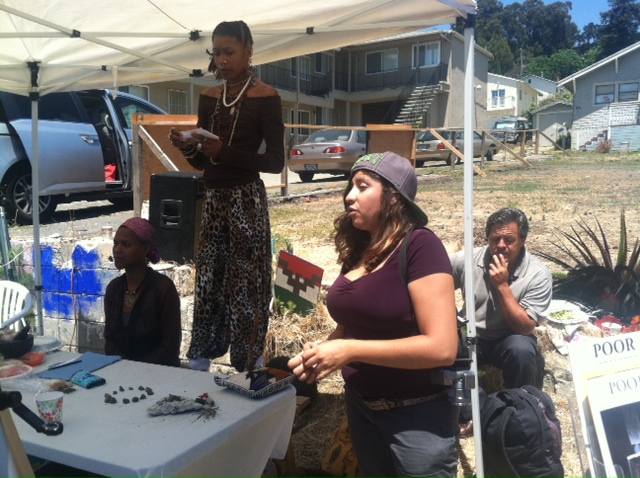
Fifty people were sitting in a circle July 8, talking about what was weighing on them that week. And the weight was heavy. Poverty, violence, addiction, racism. Crushed by debt, foreclosed and evicted. Seeing family members deported, imprisoned, and killed. Continued repression of the Ohlone and other Native peoples. After telling her story, Vivian Thorp said she got together the money to seek medical treatment.

“So I go to the doctor,” she said. “And they tell me, you’ve got anxiety. I go, no shit.”

The others in the circle understood. This was the second day of Healing the Hood, a weekend of workshops, art, cooking, biking, spirituality, and communtiy building. The Poor Magazine project is aimed at resisting corporate control of food, medicine, the environment, and other survival necessities.

For many of the people present, “anxiety” doesn’t quite describe the oppression caused by abuse and violence, by fear of police and prison, by having not enough money to feed their families, by injuries and stress incurred by working for that money. No pill can cure that anxiety, even if you can afford it.

Healing the Hood is supposed to be some part of the real cure. Day one was spent in the Mission district, where Poor Magazine has it’s office. Day two was in East Oakland on a plot of land that Poor has purchased as part of its Homefulness project.

I arrived around lunchtime. In the hot East Bay sun, Needa Bee was preparing a salad while teaching a workshop on food. As she chopped the lettuce and carrots, she talked about how Monsanto and other agricultural industry giants control most of the food that’s available in supermarkets. She discussed resistance movements to Monsanto, telling of farmers in India and China who burned their GMO fields lest they infect other plants. Her lesson ended at the same moment that she topped off the salad with sesame seeds and coconut vinegar.

“This is all fields, backyard, street, Halal markets, Southeast Asian markets,” she said of the feast, recommending those sources as places where GMOs and factory farmed products can be avoided.

Tiny Gray-Garcia, Poor Magazine’s co-founder, smiled as 50 people lined up to eat. Gray-Garcia helped bring together the many sages present at Healing the Hood. The event is steeped in a deep yearning to preserve and teach cultural and medicinal knowledge, made all the more difficult because, as Gray-Garcia put it, people must “try to do it within this capitalist society, whose oppression is in everything, even our food.”

The weekends teachers were more than cooks; herbalists and nutritionists, gardeners and mothers, poets and dancers. After the food demonstration, nutritionist Tanya Henderson and Poor Magazine scholar Estrella gave a presentation on native herbs and foods and their medicinal properties. Next, youth from 67 Suenos, an organization that rejects not just attempts at harsher immigration laws but the colonial notion of borders in the Americas itself, led a discussion.

“Borders aren’t real. They’re a construct. They’re part of the plantation system,” one of the members said. The group supports the concept of a path to legalization for young people embodied in the DREAM Act, but takes issue with policies that would help successful students– “good immigrants”– while still allowing for families to be torn apart and ignoring the reality of students who are delayed in their success, often by that very fear of deportation of themselves or family members.

“Sadly, no one’s talking about a path towards legalization for every undocumented person in this country,” one of the members noted, recalling protests in 2006 and 2007, when many groups demanded “legalize all.”

Luis Rodriguez, one of the weekend’s special guests, is an author and poet based in the Los Angeles area. He was in town partly to promote his new book, It Calls You Back, and will soon be heading to El Salvador for an event celebrating a gang truce that has more than halved the country’s homicides since it was brokered.

“Earth Mother” Iyalode Kinney, founder of the Richmond urban gardening project Communities United Restoring Mother Earth, passed around leaves of comfrey and sprigs of fragrant German chamomile, plucked from her garden that morning, explaining their medicinal properties. Attendants rode bikes and recited poetry as the sun set.

The Healing the Hood initiative didn’t end Sunday. Poor Magazine will be meeting again August 5 to plant the Pachamama Garden as part of Homefulness.

“We as poor peoples and indigenous peoples are in constant struggle to survive and resist the violence of poverty, racism and colonization and if we are to not only survive but thrive, we most focus some time on healing our bodies, minds and spirits with out lives and ancestral knowledge not tied to the Western Medical Industrial complex, big pharma and corporations,” the Healing the Hood event descriptions reads.

In their many publications and its everyday work, the folks at Poor Magazine speak a sort of revolutionary language. The US is Amerikkka, deals that gentrify and displace are devil-opment, and Mama Scholars and Poverty Scholars spread their knowledge while the merits of establishment “akkkademia” are questioned. It’s a the language of a culture of empowerment and resistance, whose people have found violence and destruction in the things most valued in capitalism.

Rodriguez closed out the healing circle. He said a prayer to the Earth, and each attendant named a suffering or dead loved one as he and ceremonially spilled water on a newly sprouting plant.

The preservance, the survival, the regeneration. The suffering and the healing. As Rodriguez said as he closed it out, “Capitalism can’t reconcile with this circle.”

Guardian Voices: A harsh city for queer youth

21

By Mia Tumutch

I moved to San Francisco at 19, having recently escaped small-town Texas because of ignorance and hatred associated with the fact that I am transsexual. I arrived on a Greyhound with a huge purse, a duffle bag, and big dreams for the queer wonderland.

Then life happened. Unable to find a job because I was too visibly trans, I ran out of money and ended up homeless.

Thousands of other young queers have runa way to San Francisco, but they still face daunting statistics once they arrive. Our city by the Bay has long been assumed a safe haven for the gays — however there’s more work to be done. It’s our responsibility, as San Franciscans and decent human beings, to ensure LGBTQ youth don’t face more violence and discrimination once they make it here.

LGBTQ youth face a disproportionate amount of obstacles to success, including bullying in school, family rejection, violence on the street, and job discrimination. After coming out of the closet, 26 percent of LGBTQ youth are kicked out of their homes by their parents. While LGBTQ youth account for only 5-10 percent of the population, we represent 40 percent of the homeless youth in San Francisco. The number of LGBTQ youth coming out and becoming homeless continues to increase, while funding for services to this very vulnerable population is cut back almost every budget season.

There are more than 94,000 LGB people living in San Francisco and approximately 6,000 LGBTQ youth, but there is still not a single queer homeless shelter. There are currently 36,000 vacant housing units in San Francisco, and only 6,000 homeless people; why can’t homeless people live there?

In recent years there have been a number of policy changes that have made life harder for the homeless. In 2010, proposition L, passed making it illegal to sit or lie on a sidewalk between 7am and 11pm. This law further demonizes homeless people who can be hit with $500 fines and even a month in jail for accessing public space.

In 2011, Scott Weiner, an out gay politician representing Harvey Milk’s former district, implemented a harsh new policy even further criminalizing homeless people in the Castro. This law makes sleeping, camping, cooking, creating a shelter, and using a four-wheel shopping cart all illegal at all times in Jane Warner and Harvey Milk plazas. The law goes further to ban the selling or bartering of merchandise without a permit.

In the 1970s, a similar sit-lie law in San Francisco was used to unjustly harass gay men. Harvey Milk crusaded against these laws until he was killed — and now the plaza named after him has the harshest sit-lie law in the city, and it’s driving LGBTQ youth out of the Castro.

“My queer friends are leaving the city because they feel run out of the Castro,” explains a homeless youth and active ally in the LGBTQ community. “We get harassed by cops at least three times a day, when we aren’t harming anyone at all. I was told by a police officer that me sitting on the benches in the Castro community was disrespectful of the hardworking people of the neighborhood. Then she told me to get a job.”

It’s our duty as citizens of a supposed sanctuary city to not turn a blind eye on the plight of homeless people, and especially not LGBTQ homeless youth. Let’s repeal sit-lie laws and stop cutting desperately needed funds for LGBTQ youth. Let’s create a shelter for LGBTQ people, and establish a permanent source of funds to make housing affordable for everyone. The solution to ending homelessness is not to increase criminalization and harassment; we need to expand our consciousness and compassion.

Caught in the FBI’s net

3

yael@sfbg.com

The mission: Rescuing sexually exploited children. Who can argue with that?

From June 20 through June 23, the FBI and local police departments and district attorney’s offices throughout the United States were engaged in Operation Cross Country, three days of stings targeting pimps for arrest.

According to the FBI, the mission was successful. “Nationwide, 79 children were rescued and 104 pimps were arrested for various state and local charges,” a press statement released the following week reads.

In the Bay Area, the operation resulted in “the recovery of six children, who were being victimized through prostitution, and the arrest of seven individuals, commonly referred to as pimps.”

Also caught up in the Bay Area sweep: 61 adult prostitutes — ten consensual sex workers for every underage victim.

Operation Cross Country was part of an ongoing effort called the Innocence Lost National Initiative, which the FBI describes as beginning in the Bay Area in 2005 with the Bay Area Innocence Lost Working Group. According to FBI spokesperson Julianne Sohn, this June’s crackdown was the sixth Operation Cross Country in the past several years.

“The FBI and our partners are looking for those who are exploiting minors for purposes of prostitution,” Sohn told the Guardian. “But in the process of doing this we also pick up pimps exploiting adults, and adult prostitutes along the way.”

“What we’re looking at are people who traffic children for prostitution and solicitation,” she said. But the pimping arrests under Operation Cross Country don’t necessarily have anything to do with children. “Those are just pimps, generally speaking,” said Sohn.

As Caitlin Manning, a sex workers rights advocate, put it, “This emotionally laden appeal to save children who are forced into sexual slavery is being used to further the criminalization of all sex work, these lines are being blurred. There are always a large number of consensual sex workers involved in these stings.”

The Guardian caught up with one such consensual sex worker swept up in Operation Cross Country. “Maya,” 22, an escort in Richmond, was targeted because officers believed she looked under 18 in her ads. After her entrapment, arrest and interrogation, she convinced them she was older. She says that sex trafficking is a terrible problem, but criminalizing working people like her is no solution.

Bay Guardian: Tell me about the arrest.

Maya: I got a phone call. All he said to me was that he was nervous and had never done this before, and that he was looking for somebody to party with. So I never said anything sexual, and he didn’t either. There was absolutely no premise.

So I went to the hotel room. I walked in the door and I said, I’m glad that I found the right room. I put my bag down. I turned to the side and there was another man standing there, and my immediate thought was that I was going to get taken advantage of by another person. But then- I can’t even, I don’t know how many officers it was. Some came out of the bathroom, and they said Richmond PD, you’re under arrest, put your hands behind your back.

They had me in handcuffs, they questioned me for a while. I was in custody for about six hours. So I guess the way that it works with that is, the phone call is initiation and showing up to the hotel room is an act in furtherance. Entrapment is legal for that in California.

BG: What was the questioning like?

M: You know, I’ve been through a lot of things in my life. Family tragedies. Just like a lot of people. But that was definitely hands down, probably top five most traumatic events in my life. I’ve never felt so degraded. They were sitting there asking me, why do you have condoms in your bag? I had a vibrator, I had lube, and I had condoms with me.

There were four men and one woman in the room, and they were all sitting there making jokes. One of the officers was very adamant about telling me that he would never pay me that much for my services.

BG: You’ve said they lied to you, what did they lie to you about?

M: They told me that that day they had caught an underage girl, but then I read the newspaper article about the sting about it, and they said the youngest girl that they got that day was 20. So they were trying to make it seem like they were helping all these women, helping all these girls get away from this lifestyle, when in reality they’re just busting girls like me.

They looked through my phone and looked through my pictures, and questioned me about every picture in my phone. They were like, is this your pimp? They read my text messages, they listened to voice mails from my family. They don’t care.

BG: The sting was for underage people being trafficked. Do you think that’s a big problem? What do you think about that issue?

M: I do think that it’s a problem, absolutely. But this is the very unfortunate thing about what I do for work. Whether you want to call it prostitution or you want to call it escorting. So I do think absolutely it’s a problem, but it’s very important for people to know that it’s not the same thing, it’s really, really not.

I’m probably going to get two years’ probation, up to 60 days in jail and hundreds of dollars in fines. Now I’m out of work, can’t get a job, and I have prostitution on my record. You know, it’s just … it doesn’t help anybody.

BG: It strikes me what you were saying about the police officer saying I wouldn’t pay that much. Were there other degrading things said?

M: I don’t care if they’re officers, I don’t care what they do for a living. They’re still men. And when you come in and you’re a prostitute, they look you up and down. And they’re thinking about that. And I had the officer asking me questions like oh, how do you clean your vibrator. Just unnecessary questions, where obviously they’re getting some sort of gratification out of it.

BG: Have you ever met people who were forced into what they’re doing?

M: No…I mean, we’ve all done things for money. You know, desperate times. Whether it’s working some shit job. I mean, I look at it as a job. So in the past when I was younger yeah, you know, trying to make rent, maybe I’ll do something that I wouldn’t want to do as much, or not get paid as much for it. But it beats working at Taco Bell.

People sometimes think it’s easy money. It’s not easy money. It takes a certain person, it takes an emotionally stable and sexually stable person to do this work sustainably. It’s definitely tolling. It’s tolling because its therapy. It’s tolling because I listen to people’s problems, it’s not tolling because of the sexual aspect at all.

BG: Have you gotten any help from sex workers rights organizations?

M: I did have a therapist that’s sex-worker friendly offer me free sessions. I might take him up on that, but — you know, the event was traumatizing. I’m not traumatized by my work. I can tell the story and that’s pretty much enough for me. I don’t really need therapy for being a sex worker. I love my job. It makes me happy, its great.

BG: What do you love about it?

M: I love meeting different people, I love the psychological aspects. I just have so many fantastic stories, and amazing people that I’ve met. I saw a guy recently who, after our session he was telling me that his wife had died about six months previous that he had been married to for 42 years, and he started crying. And my mother passed away when I was younger, and so we were able to relate on that. And I gave him my lessons on how I dealt with it, and he had never really had somebody tell him that, and he was very touched. And I know that he will take those lessons that I taught him and use them for his grieving process.

So it’s things like that. People don’t realize how much therapy it really is, how many of these people just want some intimacy…we’re human beings, we need sexual outlets. That’s just the way that we are. “Maya” invites anyone who has been in a similar situation or wants to talk to contact her at mayaarticle8719@yahoo.com. An extended version of this interview can be found at sfbg.com

Alerts

0

WEDNESDAY 11

Students organizing for CCSF Student Union upper level lounge, CCSF Ocean Campus, 50 Phelan, SF; www.ccsfwill.blogspot.com. 5-8pm, free. At an emergency community meeting concerning the threatened closure of City College of San Francisco July 9, many meetings were called, including the organizing to form a student union, to campaign for the parcel tax initiative to get money to CCSF, and to organize in solidarity with labor. This meeting is discussing support for the parcel tax, which could send $15 million City Colleges way if it passes in November. Come organize with labor on this issue. This meeting is a working group on student response to the accreditation report.

THURSDAY 12

It calls you back 826 Valencia, SF; www.826valencia.org. A book reading and film screening with Luis Rodriguez, a poet, journalist, and fiction writer and author of the best-selling memoir Always Running, La Vida Loca, Gang Days in L.A. He will read from his new sequel and screen Rushing Waters, Rising Dreams: How the Arts are Transforming a Community, documenting how Tia Chucha’s Centro Cultural and Bookstore is bringing art and community to the once devastated post-industrial San Fernando Valley.

Happiness Happiness Institute, 1720 Market, SF; www.meetup.com/SF-Free-School. An afternoon of yoga and a workshop on community building. This event is presented by a collaboration between the Bay Area Community Exchange Time Bank, the San Francisco Free School, and the Happiness Institute- three of the organizations that work on spending time and energy in the gift economy.

FRIDAY 13

4 days for Kenneth Harding Jr. around Bayview-Hunters Point, July 13-16; www.tinyurl.com/4days4kenny. On July 16, 2011, 19-year-old Kenneth Harding Jr. was killed. He was stopped by police and asked for his transfer when off-boarding the Muni T train—he ran, and police began shooting. As far as the SFPD is concerned, the case is settled; they say Harding drew a gun and shot back at them, and the fatal bullet was his own. His family, friends, and the movement resisting police murder of black youth disagree. On this anniversary of his death, commemorate Kenny with four days of events. On July 13, a community speak out at NOI Mosque at 26a 3rd & Revere at 7pm. On July 14th, a free community hip hop show. On July 15th a free community meal at 3rd and Palou St from 10am-2pm. And on July 16th, join Kenneth Harding’s mother and a broad coalition of community and labor to shut down Muni in honor of Kenneth Harding.

SATURDAY 14

Occupy Bohemian Grove Monte Rio Amphitheater, 9925 Main, Monte Rio; www.occupybohemiangrove.com. Noon, free. What, you’ve never heard of Bohemian Grove? It’s just the private club of CEOs, politicians, and their favorite performers that meet every year for debauchery and rituals such as the “Cremation of Care” at the Owl Shrine. The rich and powerful go camping among the redwoods every year, and although business talk is frowned upon, they often make deals, including, notoriously, a 1942 Manhattan Project planning meeting that led to the atomic bomb. Many anti-war activists and others who are pissed off that the 1 percent meets in this strange private camping party to plot acts of war and environmental destruction will be setting up their own protest encampment outside Bohemian Grove this year. The kick-off on Saturday will include musical performances and speakers, including the Fukushima Mothers and Cindy Sheehan.

Tardeada/ women’s social for women’s rights, 2969 Mission, SF; www.defendwomensrights.org. 2pm, $3-10. Women Organized to Defend and Resist are planning a nationwide protest August 26 to defend women’s rights. This Saturday, come share food, entertainment and political conversation to meet and bond with others who won’t stand for attacks on women’s rights.

Oakland families protest Oakland School Police killings and school closures

2

The Oakland School Police Department was the target of a protest today, as more than 100 marched to the department’s headquarters. The small department is devoted to patrolling and policing Oakland public schools. 

The protest group converged at the Oakland Police Department headquarters at 7th and Broadway, and several family members of young people killed by police officers spoke. 

Superintendent of the Oakland Unified School District Tony Smith sent Oakland School Police officers to shut down a sit-in and free school at Lakeview Elementary school July 3. Protesters say officer Barhin Bhatt, who issued the dispersal order at the Lakeview sit-in, should not be working in the schools; he is one of two Oakland School police involved in the killing 20-year-old student Raheim Brown last year.

“They’re no better than anyone else who’s out on the street, killing people,” Brown’s mother, Lori Davis, said at the rally. 

Brown was in a car with a friend, Tamisha Stewart, when he was shot to death. He was shot in the head and chest. Stewart, the only civilian witness, was beaten and jailed for a week.

Police say the car was stolen and that Brown tried to stab one of the officers with a screwdriver. 

Stewart recounted her experiences at the rally. “Seeing my friend get killed for no reason, and calling for help and me not being able to do anything. Being beaten, eyes swollen shut, for no reason. I’m living with the memory every day,” she said. “We need more people to come and stand with us, because we can’t do it alone.  We have single parents, mothers without children, fathers, brothers without their brothers and sisters.”

Brown’s young son and his mother were also present at the protest.

“Of course people make mistakes. And Raheim made mistakes, ” another protester, Jabari Shaw, said through a megaphone. “But what happened to him was police terrorism. What happened to him was murder.”

The group marched to the Oakland School Police headquarters at the former Cole Middle School in West Oakland. On the march, protesters chanted “justice for Raheim Brown” and carried banners that read “jail killer cops” and “stop school closures.”

At the Oakland School Police department headquarters, the group continued to rally. One protester, Jeremy Miller, expressed anger that Cole Middle School had been closed and the building turned into a police station. Earlier this month, the school district closed five elementary schools in order to save about $2 million.

“They don’t have enough money to keep schools open, but they have the money to police our schools,” Miller said. “We know that our children are safer with no police in their schools.”

Another speaker noted that Cole Middle School had an innovative restorative justice program in place, an alternative to zero-tolerance policies. The program cut down on suspensions by 87 percent.

“I feel like the police shutting down a school that had a model restorative justice program is a slap in our faces,”  she said. “This was such a wonderful program, and it could have been copied and duplicated and modeled all across our city”

Sgt. Bhatt was appointed interim chief of the Oakland School Police Department in August after the previous chief Pete Sarna resigned. Sarna had been accused of making racially disparaging remarks about other police officers while drunk after a golf tournament.

Bhatt has been acquitted of wrongdoing by Alameda County prosecutors. But now Brown’s death, as well as Sarna’s racist remarks, are the subject of a federal grand jury investigation of the Oakland School Police Department. The department received a letter from the FBI May 17 announcing that they as well would be looking into the police force.

“I’m so grateful that the federal grand jury got involved,” Davis said at the rally. She told of dealing with the Oakland Police Department the morning after her son’s death. 

“I called down to OPD to find out what happened,” Davis said. “They gave me the runaround. They didn’t want to tell me. And then when they finally did say something, they said that the police killed my son. I was in shock. And they said, oh no, it’s not OPD, it’s not us. It was the school police. That’s not our department, we’re two separate divisions.”  

Davis said that she had been denied victim compensation and other services usually offered to families of crime victims since her son’s death had been caused by a police officer. A community effort was launched to raise funds for Brown’s burial. But Davis hopes that the government will bring her family some justice.

“I’m praying that the federal grand jury,” along with, Davis said, her attorney John Burris, “will get justice for little Raheim.”

Dick Meister: “We want bread and roses, too”

0

By Dick Meister

Dick Meister, former labor editor of the SF Chronicle and KQED-TV Newsroom, has covered labor and politics for more than a half-century. Contact him through his website, www.dickmeister.com, which includes more than 350 of his columns.

 “Our lives shall not be sweated from birth until life closes;

Hearts starve as well as bodies, give us bread, but give us roses!”

–From a poem by James Oppenheim

Bread and roses. It was the battle cry of the thousands of striking women and their supporters who marched through the streets of Lawrence, Massachusetts, in 1912, in the heart of the textile industry. Although it’s been 100 years since they marched, their militancy and bravery remain among the brightest highlights in the long history of the American labor movement.

The three-months long strike in Lawrence, led by the Industrial Workers of the World (IWW) pitted the 25,000 workers – half of them women under 20, many as young as 14 – against the violently anti-labor textile mill owners, who were strongly backed by the press, politicians , school officials, and clergy.

Striking was difficult for the workers, who had only their poverty-level wages to live on. They had barely enough to pay the rent for the run-down, disease-ridden shacks and tenement flats where most of them lived. Many were constantly in debt, having to borrow money to meet their bare necessities. Health care and other fringe benefits were virtually unheard of, and more than one-third of the workers died in their mid-twenties.

Working conditions were brutal. They commonly worked 12 hours a day in the hot, dusty and dangerous textile mills for but $6 to $8 a week. The workers had neither the leisure time nor the means to improve the quality of their lives, no time or money to enjoy the good things of life – the roses.

They desperately needed the help that unionization could provide them, but that could come only through a strike that would impose even more hardships on the already extremely hard-hit workers.  They hesitated about actually walking off the job, but finally were convinced that striking would bring long-term benefits to them, their families and their communities.

The mill workers moved into action after employers unilaterally cut their already rock-bottom pay even more.  They marched to the mills and throughout Lawrence to the tune of militant labor songs by IWW bard Joe Hill and others, holding high  placards that declared ,”We Want Bread and Roses too,” a demand that soon would be taken up by labor and feminist groups nationwide.

It wasn’t easy, bringing the workers together. They belonged to two-dozen different national groups, speaking 72 languages. They had been purposely kept apart by employers, who kept them in ghettoes by setting up separate housing areas for different nationalities, lest they forget their ethnic differences and join together to challenge their miserable pay and unhealthy conditions.

Employers got their friends in City Hall to enact an ordinance preventing strikers from picketing individual mills, but strikers responded by the extraordinary act of forming a picket line around the perimeters of the entire textile mill district. Thousands of pickets were on the line 24 hours a day throughout the 10-week-long strike.

Some spent part of their evenings hoping to disturb the sleep of strikebreakers who employers had hired to replace them, loudly serenading them with IWW songs.

Thousands paraded through the streets of Lawrence regularly, until the city enacted an ordinance forbidding parades and mass meetings. They switched to sidewalk parades of up to four-dozen strikers and supporters, who locked arms, blocking shoppers and others from entering downtown businesses.

Eventually, martial law was declared, enforced by violent police and militiamen, who charged in to try to break up the marches and other demonstrations. They even tried to block strikers from putting their children on trains that would take them to safety with sympathizers in other cities.  The city called in the Army to block the trains from moving, which led to the killing of a woman striker and the beating of many others, including several children and two pregnant women who had miscarriages.

Then the authorities arrested two of the IWW’s principal leaders for murder, on grounds that their illegal acts had provoked police into the action that led them to kill a striker.

The widespread publicity about the strike finally helped pressure employers to settle. The terms were modest, primarily granting the workers union recognition, a 15 percent pay increase and a 54-hour workweek with overtime pay at double the regular rate.  But the mere recognition of the workers’ right to make and be granted any demands was crucial.  It inspired many other workers, especially women, to also assert their basic rights and brought strong support nationally for many workers who sought decent treatment.

What’s more, many textile mill owners, fearing they also might be struck, granted pay raises totaling almost $15 million to an estimated 438,000 workers throughout New England and elsewhere.

A much longer and lasting result was that the strike put the needs of working women on labor’s agenda for the first time and showed that women could very well provide decisive leadership and indeed win bread – and roses.

Dick Meister, former labor editor of the SF Chronicle and KQED-TV Newsroom, has covered labor and politics for more than a half-century. Contact him through his website, www.dickmeister.com, which includes more than 350 of his columns.


Perjury allegations against Lee gain more support

126

San Francisco Democratic Party Chair Aaron Peskin has confirmed his role in extending a city job offer from Mayor Ed Lee to Sheriff Ross Mirkarimi if Mirkarimi had been willing to resign in March, bolstering allegations that Lee may have committed perjury when testifying under oath before the Ethics Commission on Friday.

But even as more media outlets report the possible perjury (a story we broke first here), which is further complicating the already complicated official misconduct proceedings that Lee brought against Mirkarimi, the Mayor’s Office and key Lee allies have refused to comment on the perjury allegations or the strange circumstances surrounding the alleged bomb threat that temporarily got Lee off the hot seat.

As we reported in this week’s Guardian, Building Inspection Commissioner Debra Walker said Lee was lying when he said that he hadn’t spoken with any members of the Board of Supervisors before charging Mirkarimi with official misconduct. Walker said Sup. Christina Olague told her she had spoken with Lee about the matter, which Olague now denies.

Lee also responded “absolutely not” when asked by Mirkarimi attorney Shephard Kopp whether he authorized Peskin or development consultant Walter Wong, a close Lee ally, “to convey to Sheriff Mirkarimi if he would stop down, you’d get him another job.”

At press time for this week’s article, Peskin was backpacking in the Sierras and couldn’t be reached, but he has now confirmed to the Guardian that he met with Wong at 11:30am on March 19 – just hours before Lee met with Mirkarimi to say he would be removed from office unless he resigned – at Cafe Trieste.

In that meeting, Peskin said Wong asked him to convey to Mirkarimi an offer from the mayor of a job with the San Francisco Public Utilities Commission or the Airport Commission if Mirkarimi would voluntarily resign. Asked whether Wong indicated that he had discussed the offer with the mayor, Peskin told us, “He certainly left me with that impression.”

Mirkarimi refused to accept the offer, insisting on fighting to keep his job, which was one factor in Peskin’s subsequent public statement calling for Mirkarimi to resign. “There were a lot of things that factored into that,” Peskin said of his call for Mirkarimi to step down, although he wouldn’t discuss other factors on the record.

Efforts by both the Guardian and the Examiner to reach Wong have been unsuccessful, and messages to the Mayor’s Press Office on this and related issues also haven’t been answered. But just as Walker has offered to do, Peskin said he’s willing to testify under oath if asked.

“I am prepared, if subpoenaed, to tell the truth, the whole truth, and nothing but the truth,” Peskin told us.

Lee hasn’t had any public events or made any public comments on the matter since the scandal broke on Friday. The other unanswered mystery is why Lee was whisked from the hearing room just 15 minutes into his testimony, shortly after making the statements that Walker alleges amounted to perjury.

As we reported, neither the SFPD nor the Sheriff’s Department ordered the room evacuated, meaning that decision must have been made by someone within the Mayor’s Office. Press Secretary Christine Falvey’s last statement to the Guardian, on July 2, said, “Again, the mayor’s office did not recess the meeting. I still have to refer you to the Police Department which maintains Mayor Lee’s security or the Ethics Commission about the decision to recess the meeting for (I believe) about 90 minutes.”

Yet neither body seems to know who made the call, and follow-up questions asking the Mayor’s Office to disclose any information they have about that decision have gone unanswered. District Attorney George Gascon — whose office would need to pursue the perjury allegations considering the city’s official misconduct rules don’t apply to the mayor — also didn’t return our call asking generally how allegations of this fashion should be handled.

The official misconduct proceeding continue in front of the Ethics Commission on July 18 and 19 when Mirkarimi’s wife, Eliana Lopez, is scheduled to testify. But that has also been complicated by the Mayor’s Office’s refusal to authorize payment for a plane ticket for Lopez to return from her native Venezuela to testify. Mirkarimi and his legal team say they can’t afford to pay for that plane ticket after Lee suspended Mirkarimi without pay.

Guardian Voices: Stop and Frisk didn’t work last time

5

Mayor Lee’s musings before the Chronicle editorial board, in which he revealed his thoughts about instituting a “stop and frisk” policy in San Francisco, set off a very quick negative responses from two of his high-profile supporters in the African American community, Willie Brown and Supervisor Malia Cohen. But that’s only part of the surprise the mayor will face if he pursues this policy.

It wasn’t a real good week for Mayor Lee, who seemed to repeatedly trip himself up:

— In  the chat about stop and frisk;
— In the admission at a Board of  Supervisors hearing by Sutter/CPMC that the economic modeling of the hospital chain’s proposed  project so undermined key elements of the deal that Mayor Lee demanded that it be redone;
— And in his testimony before the Ethics Commission on the Mirkarimi case that brought specific charges of  perjury he has yet to answer.

But the stop and frisk was the most sobering of the three, for it shows a fundamental misunderstanding of the very nature of the city that he seeks to govern and an astounding insensitivity to its not-too-distant past.

The last time stop and frisk was implemented by the San Francisco Police Department was in 1974, at the height of the “Zebra” murders during which, over a six-month period from the end of 1973 to the beginning of 1974, 16 whites were murdered and another six wounded (one of whopm was a young Art Agnos) in shootings using a similar caliber hand gun. What made sensational headlines was the fact that the six survivors all agreed that the shooters were  black. 

Mayor Joe Alioto, facing a steep decline in tourist visits to the city and a drumbeat of headlines, surprised eferyone by announcing a stop and frisk policy aimed at young Black males. Within the first week some 500 stops were made. Not a single Zebra suspect was found.

The San Francisco NAACP and ACLU quickly filed suit in Federal Court where the policy was banned as being un-Constitutional racial profiling. The Zebra case was broken using the time tested technique of offering a reward for information. An informant stepped up, and in the summer of 1974, four men were arrested based upon his information. In 1976 the four men were convicted –and the stop and frisk policy had nothing to do with either their arrest or conviction.  Nothing remained of the failed policy for 38 years.

What did remain was a deep and bitter memory of stop and frisk in the San Francisco African-American community — a memory neither Willie Brown nor Malia Cohen forgot.

If the mayor really believes that stop and frisk will work in the face of deep seated community resentment, based on actual local historic experience – for his remarks were all about “getting the guns” off the street in African American neighborhoods — then he has a profound misunderstanding of the nature of San Francisco.

San Francisco is perhaps one of the two or three most humanly diverse cities in North America. There is a bewildering mix of humans in our city, which confronts any policy based upon appearances — such as stop and frisk — with complexities that often render its actual use on the street ineffective. Simply stated, people are not as they seem in San Francisco, and many San Franciscans prefer to live no other way. Good cops understand this and work hard to learn who is who on the street. That’s called community policing and it often works in San Francisco.  

But many times it doesn’t. Let me tell you a personal story.

During the school year, I try to pick up my two grandsons, Jalius and Jacob, every Tuesday. We spend some time together walking from their school, George Peabody, in the Inner Richmond, to the 33 Stanyan bus stop at Clement and Arguello for a bus ride back to the Haight-Ashbury. We walk and talk and then wait for the bus and talk some more.

A few months ago, we were waiting for the bus, the boys sitting on the bench, me standing and talking. I noticed a cop across the street doing a foot patrol, talking to merchants and customers. He kept looking at us. He was Chinese and my grandsons are half Chinese.  Finally, he walked over to us and with a polite smile asked me why was I talking to these children.

I had an idea that was why he came over so I was expecting the question. I smiled back to him and said, proudly, “these are my grandsons, Jalius and Jacob”.  He looked at me and then turned to the boys and said “is he?” They said “yes” and he looked back at me and said “just doing my job,”  and turned and walked away.

And what a tough job it is as people are often other than they look in San Francisco. Old white men are not always what they seem, and young black men are not always what they seem, no matter how low they ware their pants. Policies based upon things being exactly as they appear will be overwhelmed by the human reality of the City of St. Francis.

There is a connection between people in this physically compact city of ours that forms a foundation for a common political outlook when it comes to personal and group rights and freedoms. San Francisco is a center-left city on matters of civil and human rights. Local elections have shown time after time that on civil and human rights the usual political divisions between the various parts of San Francisco don’t obtain. Trying to push a center-right stop and frisk policy on San Francisco will politically isolate Ed Lee, making all other parts of his agenda that much more difficult to accomplish. And as a city we need to get some big things done, quickly. Let’s move on, together, and get them done.

Guardian Voices: A place for rage

23

Just a few weeks ago, my partner came home from work in South San Francisco to tell me some horrifying news. A cop had killed a boy she knew, a Black eighth grader named Derrick Gaines. We looked at each other in the way we do when there is too much to say, our eyes wet, our hearts racing, our rage too big for words. We held our son extra tight that night.

Ayoka went to the funeral last Thursday, and was finally able to shed a few of what felt like a mountain of tears inside of her. She supported family and friends who were overwhelmed with grief, and listened to people’s efforts to make sense of this madness. But for anyone who can see the humanity of this young Black man, there is no way for his murder to make any damn sense at all.

I don’t know and I don’t care if Derrick was what the news calls “a good kid” or a “troubled kid,” a “gangbanger” or a straight-A student. What I do know, what matters to my heavy heart, and what is at the source of my rage, is that Derrick was a human being, that he was a kid, that a cop killed him needlessly and that he will most likely get away with it. There will be no apologies, no accountability, no recognition that the cop had many other options than to shoot and kill. And the absence of all this will be another silent attack on our psyche, an unstated affirmation of Black inferiority, of the lesser value of Black lives.

Derrick’s tragic murder has captured less attention than that of Trayvon Martin, but they both have weighed especially heavily on my heart. Both young, Black and male, they were supposedly “looking suspicious” in a non-Black neighborhood. Both Derrick and Trayvon were teenagers minding their business. Neither was in the midst of committing a crime – which would not in any case justify their murder but does draw attention to the degree to which their Blackness itself was apparently the crime being committed.

Both Derrick and Trayvon are dead, no one is safer, and Derrick’s four-year-old brother is left to struggle with the reality that his big brother will never be coming home again. I’ve been to more than my fair share of police accountability protests. But today, on this 4th of July, something is rising up in me that is new. It has to do with the place for rage.

Anybody Black in America has a strategy, conscious or not, for dealing with rage. Some of us are lucky and stumble upon socially productive paths – we serve, we organize for change, we become leaders in our church. Others are less lucky and make choices that lead to violence and self-destruction. Some of us stay permanently in a place of rage, and become one kind of crazy or another.

I confess to having been, for all these years, a fairly reasonable sister, reticent to fully voice my heartbreak, pain and rage about the state of my people. But I’m reconsidering this path.

The moment clearly calls for a new way. We may have a Black president, but these are dark times. It’s Trayvon and Derrick. It’s the Supreme Court’s racist ruling on SB1070, allowing the blatant racial profiling of the “papers please” provision to move forward. All the talk about government agents stopping black and brown people in the street takes me back to slave times, when we needed papers to leave the plantation, when white men were paid to hunt for fugitive slaves, and why my great great great grandfather took his family to Canada after the passage of the Fugitive Slave Act of 1850. It was time to protect his family and leave the madness of the United States of America.

The Black Community faces Depression-level unemployment, a resurgence racist Right and a level of state violence in our everyday lives that is largely invisible to most non-Black people. We have the greatest number of Black people incarcerated of any time in American history; there are more Black men under the control of the criminal justice system today than there were in slavery in 1850. In supposedly progressive San Francisco, Mayor Lee is openly considering New York’s notoriously racist “stop and frisk” policing policy. And even without such a draconian measure, the data already tell us that the majority of Black boys in San Francisco have been stopped, harassed, or arrested by the local cops by the time they become adults.

In the face of what can only be considered extreme conditions, extreme violence and extreme disenfranchisement amongst my people, I confess that I have failed to take the extraordinary measures that are plainly necessary.

See, the thing is, I had good home training and was socialized to be a nice Black girl. I can code-switch and communicate with nearly anyone with a passion that generally gains respect. Even when in the midst of political battle I don’t scream and holler, and have allowed any number of white people to do and say racist things and get away unharmed. Like so many of us, I try to be a Black person with dignity, without losing my shit. As Michael Jackson would say, I’m a lover not a fighter. This strategy has helped me gain social status, an elite education, and some middle class comforts of American life.

So what to do with this rage? What’s the path beyond reasonableness that does not lead to self-destruction? On this 4th of July, I’m remembering our freedom fighters Frederick Douglass and Harriet Tubman, and asking them for wisdom. In my own way and in these times, I want to walk with faith and fearlessness as they did, and not be afraid to put my body on the line for freedom. What sacrifices will we all need to make? What creature comforts or career plans will we need to put aside? What will it take to build a movement that lifts up the value of Black life and our place in a better, more just society?

In Michelle Alexander’s stunning book The New Jim Crow, she makes a clear case that since we won the formal battle against Jim Crow in the 1960s, “We have not ended racial caste in America; we have merely redesigned it.” This contemporary, supposedly colorblind, system of mass incarceration and social control of Black people makes our work more complicated, our moral outrage less understandable and our courage ever more necessary.

Let’s build a movement for racial justice, honor our rage, and find a way to be the Frederick Douglass’ and Harriet Tubmans of the 21st century that these times require.

To support Derrick Gaines’ family, donations can be made at any Wells Fargo to the ‘Derrick Gaines Memorial Fund’ account #: 1636477653.

You can check out Michelle Alexander’s work on the New Jim Crow here. And stay tuned for community organizing against attempts to bring “Stop and Frisk” to SF.

Faces of feminism

7

Is San Francisco still on the cutting edge of women’s issues? I recently spent a sunny Saturday morning buried in the radical archives of Bolerium Books (www.bolerium.com) — which is by the way, an amazing resource for anyone researching labor, African American, First Peoples, and queer history, among other things. Me, I was looking into our city’s rich history of feminist activism, inspiration for our upcoming Guardian “Bay Area Feminism Today” panel discussion. The event will unite amazing females from across the city who have but one thing in common: they’re pushing the envelope when it comes to the definition of what a “women’s issue” is, in a time when very few people claim feminism as their primary crusade. We’ll be talking more about their exciting projects –- but also touching on more universal issues. What is San Francisco’s role in fighting the nationwide attack on reproductive rights? How is our progressive community doing in terms of supporting women and maintaining a feminist perspective on issues?

Women’s work: it’s alive and kicking, and it deserves its moment in the spotlight. Meet our panelists here, in preparation for the real deal. 

THE GUARDIAN PRESENTS: “BAY AREA FEMINISM TODAY”

Wed/11 6-8pm, free

City College of San Francisco Mission campus

1125 Valencia, SF

www.sfbg.com/bayareafeminismtoday


STEPHANY ASHLEY

St. James Infirmary programs director, ex-president of Harvey Milk LGBT Democratic Club


For me, sex worker rights are a feminist issue because they are about body autonomy. As much as reproductive choice is a feminist issue, so too is the right to determine the ways in which we use our bodies, change our bodies, and take care of our bodies. When people are criminalized for their HIV status, denied access to hormones and safe gender transitions, or are afraid to carry condoms because it might lead to police harassment or arrest — these are all feminist issues. At St. James Infirmary (www.stjamesinfirmary.org), we provide healthcare and social services from a peer-based model, so community is really the central aspect of the project. I was excited to chair the Harvey Milk LGBT Democratic Club (www.milkclub.org) last year, because I wanted to keep raising sex workers rights issues as part of the LGBT agenda. At St. James, nearly 70 percent of our community members are LGBTQ, so it’s really critical that sex workers rights are treated as a queer issue, a feminist issue, and a labor issue.

CELESTE CHAN

Artist and founder of Queer Rebels

My partner KB Boyce and I started our production company Queer Rebels (www.queerrebels.com) to honor the feminist and queer of color artists and elders who paved the way. Our main project is “Queer Rebels of the Harlem Renaissance,” a performance extravaganza which took place June 28-30. Such an exciting time! The Harlem Renaissance legacy remains with us to this day. It was an explosion of art, intellect, and sexual liberation led by queer Black artists. I’m also a board member at Community United Against Violence (www.cuav.org). CUAV was formed in the wake of Harvey Milk’s assassination and the White Night riots, and does incredible work to address violence within and against the LGBTQ community. Another way I’m involved with women’s issues is through Femme Conference (www.femme2012.com). In a culture where femininity is both de-valued and the expected norm, Femme Con creates a vital feminist space — this year it takes place in Baltimore, Maryland.

EDAJ

DJ and promoter of queer nightlife

I work in nightlife to provide space for communities that often don’t have spaces to come together. For 15 years, I have been providing music for women as the resident DJ at Mango (every fourth Sunday at El Rio, www.elriosf.com). I also work to support my fellow LGBT veterans by promoting their visibility through my nightlife projects. Ex-Filipino Marine and two-spirit drag king Morningstar Vancil’s story has inspired me to work on creating a space that raises awareness about LGBT veterans, especially women living with disabilities. I also think it’s important to do outreach in the Black LGBT community to help strengthen support for organizations such as the Bayard Rustin LGBT Coalition (www.bayardrustincoalition.com), a group that is not only fighting for Black LGBT equality, but is focused on social change for all oppressed people. After 10 years of executive producing the Women’s Stage at SF Pride, I was honored as a grand marshal this year at an event hosted by the BRC and Soul of Pride. It was beautiful to see so many Black LGBT people dedicated to moving global equality forward. Although there is a need to reach out to everyone in the Black LGBT community, naturally my goal is to first focus on connecting more women, a group that has always been less visible.

JUANA FLORES

Co-director of Mujeres Unidas y Activas

My organization Mujeres Unidas y Activas (www.mujeresunidas.net) is based on a double mission: personal transformation and community power for social justice. MUA is a place where women arrive through different challenges in their lives. We try to provide emotional support and references so that they don’t feel like they’re alone, so that they have strength to begin the process of healing and making changes. Those can include issues of domestic violence, problems with teenage children, labor or housing issues — when they arrive at MUA they begin the process of developing their self esteem and becoming stronger. They also begin to participate in trainings and making changes in their community and to the system through civic and political participation. At MUA, women find a home. They feel comfortable because they’re always welcome. We’re developing strong leadership, leadership that is at the table when it comes to making decisions about our campaigns, like our letter of labor rights and the help we give to victims of domestic violence through our crisis line. Every day our members are developing their ability to be involved in the organization and community, and making changes in their personal and familial lives.

ALIX ROSENTHAL

Attorney and elected member of the SF Democratic County Central Committee

As an elected member of the SF DCCC (www.sfdemocrats.org), the governing body of the SF Democratic Party, I am working to involve the party in recruiting more women to run for political office locally. In the June 2012 election, I assembled a slate of the female candidates for DCCC — we called ourselves “Elect Women 2012.” It was a controversial effort, because it included both progressives and moderates. In the wake of a highly contentious and factional term on the DCCC, we hoped to prove that moderates and progressives can work together to re-energize Democrats in this important presidential election cycle. Running for office in San Francisco is a high stakes game; it is costly and requires an extensive political network. And so the DCCC is where many future candidates get their start — it is where they build the connections necessary to run for higher office, and where they hone their fundraising abilities. By recruiting and supporting women candidates for the DCCC, I am hoping to build a “farm team” of female candidates within the party. This year, I am proud that the seven women incumbents on the DCCC retained our seats in the June election, and that we achieved parity by electing four new women to the party’s governing board. I look forward to seeing what these women can accomplish together.

LAURA THOMAS

Deputy state director of Drug Policy Alliance

Ending the failed war on drugs is a women’s issue because women are far too often bearing the brunt of that failure, losing their freedom, children, economic independence, safety, health, and sometimes their lives as victims of the war on drugs. Women in prison in California can be shackled during childbirth, lose custody of their children because they use legal medical marijuana. They’re vulnerable to HIV and hepatitis C because they or their partners don’t have access to sterile syringes for injecting drugs. My major project for the Drug Policy Alliance (www.drugpolicy.org) is mobilizing San Francisco to show the rest of the world how effective progressive drug policy can be. I want to see San Francisco open the first supervised injection facility in the United States, to end new HIV and hepatitis C infections among people who use drugs. I want us to truly have effective, culturally appropriate substance use treatment for everyone who requests it. I want San Francisco to end the cycle of undercover drug buys-incarceration-recidivism. I want us to address the appalling racial disparities in who gets arrested, convicted, and incarcerated for drug offenses here. I want us to aggressively defend our ground-breaking, well-regulated medical cannabis dispensary system against all federal intervention. San Francisco is leading the way in the United States in addressing the harms of drug use and drug prohibition but we have a lot more we can do.

MIA TU MUTCH

Transgender activist and SF Youth Commission officer

I’ve worked for a plethora of LGBTQ organizations and have been on several national speaking tours. I currently serve as media and public relations officer of the San Francisco Youth Commission, and use my position to promote LGBTQ safety and overall health. I’ve partnered with several city departments in order to create a cultural competency video that will train all service providers on best practices for working with LGBTQ youth. As a vocal advocate against hate crimes and sexual assaults, I’m working with local groups to create a community patrol in the Mission to prevent violence against women and transgender people. I’m also the founder of Fundraising Everywhere for All Transitions: a Health Empowerment Revolution! (FEATHER), a collective aimed at making gender-affirming transitions more affordable for low income transgender people. I work to create avenues of equality for those who benefit the least from patriarchy by creating a culture of safety and support for people of all genders.

Under oath

19

steve@sfbg.com

Mayor Ed Lee and suspended Sheriff Ross Mirkarimi each took some lumps on June 29 as they were cross-examined by opposing attorneys in front the Ethics Commission, which is conducting the official misconduct case that Lee brought against Mirkarimi over a Dec. 31 domestic violence incident. But the hearings proved unexpectedly dramatic when the room was suddenly cleared for an undisclosed security threat — following testimony by Lee that a city commissioner alleges included perjury.

The incident raises a number of issues that officials hadn’t yet answered by Guardian press time. Was the security threat real? If so, why wasn’t the room or the rest of City Hall properly secured after the mayor was whisked away? If not, who ordered the room cleared and why?

Undersheriff Paul Miyamoto, who ran against Mirkarimi last year, told the Guardian that the San Francisco Police Department notified his office that a caller claimed to have planted bombs outside of City Hall and on the Golden Gate Bridge. Deputies conducted a search and found nothing, and his office didn’t order the recess of the hearing. “We did not evacuate anyone,” he told us.

Speculation about the incident was heightened during the break when Debra Walker, a Mirkarimi supporter and longtime member of the city’s Building Inspection Commission, told the Guardian that Lee committed perjury when he denied speaking with any members of the Board of Supervisors before filing official misconduct charges. Lee was responding to a direct and pointed question from Mirkarimi attorney Shepherd Kopp — one that that Lee’s attorneys had unsuccessfully objected to.

Specifically, Walker said that her longtime friend and political ally Sup. Christina Olague — who Lee appointed to serve the last year of Mirkarimi’s term for the District 5 seat — had told her repeatedly that Lee had asked her advice before filing the charges against Mirkarimi, and that Olague’s advice was that Lee should ask for Mirkarimi’s resignation but drop the matter if he refused.

That allegation, which was first reported on the Guardian’s Politics blog shortly after the commission went into recess (Olague had not yet returned a call from the Guardian asking whether she had spoken to Lee about Mirkarimi), prompted reporters to confront Olague in the hallway outside her supervisorial office, where she tersely denied the allegation and then took refuge behind closed doors.

When the reporters lingered and persisted, waiting for a more complete answer, Olague finally emerged, reiterated her denial, refused to speculate about why her friend Walker would make that claim, and said, “We’re not allowed to discuss this matter with anyone before it comes to the board…I may have to recuse myself from voting on this.”

It was unclear why she thought recusal might be necessary, but if she does disqualify herself from voting on Mirkarimi’s removal later this summer after Ethics completes its investigation and makes its recommendations to the board, that would hurt Lee’s effort to get the nine votes needed to remove Mirkarimi.

When the Ethics Commission hearing resumed after a couple hours, Lee was again placed in a position of denying specific factual allegations that others have made, again raising the possibility that he committed perjury in his sworn testimony, which could expose him to felony criminal charges while undercutting his moral authority to remove Mirkarimi over the single misdemeanor count of false imprisonment that he pleaded guilty to in March.

The second instance was when Kopp asked Lee, “Did you ever extend any offer through third parties that you would find him another job if he resigned?”

“I don’t recall offering Sheriff Mirkarimi any job,” Lee replied.

Kopp specifically asked whether that job offer had been extended on Lee’s behalf by permit expediter Walter Wong or by San Francisco Democratic Party Chair Aaron Peskin, to which Lee replied, “Absolutely not.”

Mirkarimi supporters have told the Guardian that Peskin had made that offer, which Mirkarimi refused, shortly before the party chair publicly called for Mirkarimi’s resignation. The outgoing message on Peskin’s cell phone said he was unavailable and wouldn’t be checking his messages until July 5. Mirkarimi’s attorneys said they’re still figuring out how to respond to the developments and had no comment, but Walker said she’s willing to testify under oath.

But the dramas underscore the treacherous grounds opened up by these unprecedented proceedings, the first involving the Ethics Commission and the broadened definition of official misconduct placed into the City Charter in 1996. As baseball great Barry Bonds and former President Bill Clinton learned, being forced to testify under oath about sensitive topics can be a tough trap to negotiate.


MIRKARIMI TESTIMONY

Deputy City Attorney Peter Keith also seemed to be trying to spring that perjury trap on Mirkarimi as he took the stand on the morning of June 29 following an hour on the stand at the previous night’s hearing. Keith reminded Mirkarimi that he was advised not to discuss his testimony with anyone and asked, “Who have you spoken to since last night?”

“My attorneys,” Mirkarimi answered.

“What did you say to them?” Keith asked, drawing objections about attorney-client privilege that Commission Chair Benedict Hur sustained.

“Did you stop for coffee?” Keith then asked, seemingly concerned that Mirkarimi may have discussed his testimony with someone at the coffee shop that morning, which Mirkarimi denied. Keith let the allegation go but maintained an accusatory, hectoring tone throughout the next three hours that he had Mirkarimi on the stand, two more hours than he had told the commission he would need.

Much of the time was spent trying to establish support for the allegation that Mirkarimi had dissuaded witnesses and sought to thwart the police investigation, which was triggered by a call from Ivory Madison, a neighbor to whom Mirkarimi’s wife, Eliana Lopez, had confided. But the testimony yielded little more than the city’s unsupported inference that Mirkarimi must have directed Lopez and his campaign manager, Linnette Peralta Haynes, to contact Madison after she had called the police and urged her to stop cooperating with them.

Mirkarimi has maintained that he did nothing to dissuade Madison or anyone from talking to police, and that he wasn’t aware of the investigation or that Madison had made a videotape of Lopez showing a bruise on her arm until hours after the police were involved. He even sent a text to Lopez saying there was nothing he could do, as he noted.

“It was after 4pm on January 4 when I first learned of any of this,” Mirkarimi testified, later adding, “I was very clear to her in saying you can’t unring the bell, we have to follow through with this.”

Yet Lee and the deputy city attorneys who are representing him also maintain that they needn’t prove witness dissuasion or other allegations they have made, and that the Dec. 31 incident and Mirkarimi’s guilty plea to a single misdemeanor count of false imprisonment are enough to constitute official misconduct and warrant his removal, an interpretation that Mirkarimi’s attorneys dispute.

Keith sought to hammer home how Mirkarimi should have admitted to and publicly atoned for his crime right away rather than telling reporters it was a “private family matters” (which Mirkarimi admitted was a mistake) or fighting the charges by trying to discredit Madison publicly, an allegation he denies.

After unsuccessfully trying to get Mirkarimi to admit to directing efforts to question Madison’s credibility in local media accounts, Keith asked, “Did you ever direct anyone not to attack Ivory Madison?”

“I never directed anyone to attack or not attack,” Mirkarimi replied.

Keith also clarified that Mirkarimi denies the allegation Madison made that the physical abuse on Dec. 31 went beyond grabbing Lopez’s arm once in the car, as the couple has maintained. “It’s your testimony there was no punching, pulling, or grabbing in the house?” Keith asked, which Mirkarimi confirmed.

Yet Keith said that given the totality of what happened, Mirkarimi should have known he couldn’t continue on as sheriff. “Under those circumstances, wouldn’t resigning be the honorable thing to do?” Keith said, to which Mirkarimi replied that it’s a hard question and that he’s doing what he thinks is right.

Faced with friendlier questions from his own attorney, David Waggoner, Mirkarimi apologized for his actions, saying “I feel horrible and ashamed,” but that he was “sad and scared” to have his family torn apart against their will. He also said that he believes he can still be effective as sheriff because “what makes San Francisco special is our forward-thinking approach to criminal justice.”

Longtime Sheriff Michael Hennessey — who endorsed Mirkarimi and continues to support him — established a variety of programs emphasizing redemption and rehabilitation, hiring former convicts into top jobs in the department to emphasize a belief in restorative justice that Mirkarimi ran a campaign promising to continue.

“Never in my wildest dreams did I think I would be an example of what this redemption process looks like,” Mirkarimi said, choking back tears.

But Keith had the last word before Mirkarimi left the stand, belittling the idea that Mirkarimi offers an example to follow by noting how much probation time and court-ordered counseling he still has to undergo and asking, “The process of redemption doesn’t happen overnight, right?”


LEE ON THE STAND

Under questioning by Kopp, Mayor Lee admitted that he doesn’t have a written policy on what constitutes official misconduct, that his decisions are made on “a case by case basis,” and that he’s not sure whether conviction of a crime would always constitute official misconduct “because I’ve never confronted this before.”

“Were you aware that many members of the Sheriff Department have criminal convictions?” Kopp asked. Lee said he was not aware. Asked whether he was aware that Sheriff Hennessey had hired a convicted murderer into a top command staff position (see “The unlikely sheriff,” 12/21/11), Lee said he wasn’t.

Lee’s insistence that Mirkarimi’s crime makes him unable to deal effectively with other officials was also attacked by Kopp, who asked, “Isn’t it true that people get elected who have disagreements with other city officials?” He pointed out that City Attorney Dennis Herrera had nasty conflicts with Lee when they ran against each other for mayor last year, but that they’re working well together now.

Kopp also drilled into Lee about his decision to bring official misconduct charges before conducting an investigation or speaking with any witnesses besides Madison — an answer Lee blurted out just as city attorneys objected to the question. Much of Madison’s written testimony has been rejected by the commission as prejudicial hearsay evidence (see “Mayor vs. Mirkarimi,” July 27).

But the public’s perception of this case, if not it’s outcome, could turn on whether Lee is holding Mirkarimi to standards that he himself — as someone appointed mayor on a later-broken promise not to run for a full term — couldn’t meet. It was what Kopp seemed to be driving at before the bomb scare.

“You have asserted in your written charges that Sheriff Mirkarimi’s conduct fell below the standard of decency, good faith, and right action that is impliedly required of all public officials, correct?” Kopp asked.

“Yes,” Lee replied.

“We expect certain things of our elected officials, right?” Kopp asked.

After a long pause, in which Lee appeared to be thinking through his answer, he replied, “That’s generally true, yes.”

“And when the charter speaks of official misconduct, it doesn’t say we expect a certain standard for the sheriff, a different standard for the mayor, a different standard for the DA, a separate standard for the assessor, it just speaks in general terms about official misconduct for public officials, right?” Kopp asked.

Kaiser objected to the question on three counts, sustained on the grounds that it calls for a legal conclusion.

“Do you yourself believe there’s a separate standard for sheriff than for other elected officials?” Kopp asked, and this time the city’s objection was overruled and Lee replied, “It should be the same standard.”

“And would you agree with me that one of the things that is expected of elected officials is for them to be honest and forthright when dealing not only with their constituents, but with other elected officials?” Kopp asked, his final question before Chair Benedict Hur announced that the hearing would be suspended and the room would need to be cleared.

After the hearing reconvened, Kopp drew parallels to other city officials who remained on job after scandals, including former Mayor Gavin Newsom (who had an affair with a subordinate who was married to his campaign manager), former Sheriff Dick Hongisto (who was jailed for refusing to carry out a court’s eviction order), and current Fire Chief Joanne Hayes White (whose husband reported that she hit him in the head with a pint glass).

Asked about the latter case, Lee responded, “I don’t know all the circumstances around that and I don’t believe I was mayor at the time.”


The People’s School

0

yael@sfbg.com

Oakland elementary schools that were packed with kids until a few weeks ago are now closed for the summer — and five are closed for good. In October the school board voted to close them in a move that would save about $2 million per year.

But many Oakland Unified School District (OUSD) residents are not pleased. At the Oct. 26 meeting where the vote was cast, 500 protested. Concerned parents and teachers have been petitioning and meeting with school board members and Superintendent Tony Smith for months, trying to reverse the decision.

“No one wants to close schools, but the OUSD made this difficult decision because it’s in the best long-term interest of students,” reads a June 22 press release.

Resistance to that decision now continues at one school that was supposed to close June 18. To the dismay of the district, it remains open. Lakeview Elementary is the site of a sit-in and free school, orchestrated by parents and teachers.

“Lakeview has strengths,” the June 22 press release goes on to say. “It has shown improved academic performance in recent years and, boasts a strong sense of community and close alignment with its afterschool programs.” But low rankings in attendance and test scores overshadowed those strengths in the decision to close the school.

Yet it seems that “strong sense of community” seems to be more powerful than the school board thought.

SENSE OF COMMUNITY

Joel Velasquez, a parent of three and PTA member who has had children at Lakeview for 10 years, didn’t think it would come to this.

“I’ve watched everything that went on as a parent here for 10 years,” Velasquez said. When the school was threatened, “I probably spent 20 hours a week meeting, talking, emailing, researching, sending, forwarding — I mean, this is something that has been ongoing.”

“I met with Tony Smith for an hour,” Velasquez said. “I sat with board members.”

But as the end of the school year approached, he was growing more desperate, so he ended up making an announcement: “On the last day of school, I’m not going to leave. And I hope that people join me.”

They did. Lakeview’s building is slated to be turned into administrative offices, and that process was scheduled to begin two weeks ago.

Now, the school that should be filling up with district employees’ office supplies still has children running around its grounds. Organizers opened the People’s School for Public Education, and classes, taught by an army of credentialed teachers and qualified volunteers, run from 9am to 3pm, Monday through Friday.

At a June 27 visit, I toured the school and sat in during a Social Justice class. In the People’s School’s organic garden, a smiling gardening teacher had to stop an overzealous six-year-old from drowning the kale. “They love watering!” he shrugged. Another child, still mesmerized 30 minutes after the official end of music class, improvised on the djembe along with the drumming teacher. From a balcony, a volunteer called to him: “There’s ice cream!” he looked up, considered, and then kept drumming.

The group of kids has grown since the school opened June 15, as parents hear about the summer school and come see it for themselves. The Lakeview sit-in is unlike other recent occupations in the careful vetting process each visitor gets. After all, protecting the kids and their education is the most important goal of the project. But during school hours, parents are permitted to come inside and stay with their children as long as they want, seeing what the school is like.

Still, getting parents to send their children to a summer camp that isn’t technically legal isn’t always easy. “I think our society, not just parents, are really reluctant to do something like this,” Velasquez said. “But I see it as a positive service to the community. We’re using the building for what it’s intended to be used for.”

Julia Fernandez, a high school math teacher, got involved with the effort to save the schools through the Occupy Oakland Education Committee, and her two children, ages 2 and 4, are enrolled in the summer school.

As a nine-year resident of Oakland, Fernandez says, the cuts affect her and her family. She’s taking part in the demonstration partly “for my own kids,” Fernandez said. She said the cuts “affect the school where my kids would go. It’s likely that it’s going to be closed or turned into a charter school.”

“But the thing that motivates me the most is all these attacks that are happening against people,” Fernandez said. She guessed that it was adversity of many kinds, not just school closures, that motivated many parents to join the protest and send their kids to the People’s School.

“People are really upset about all the attacks that are being done on regular working class people. People are losing their homes, they’re getting laid off, and now their schools are closing. It just seems like all these services, all these rights people should have, are being taken away”

MORE THAN MONEY

Organizers emphasize that the money saved seems paltry, just $2 million for five functioning schools.

“Think about it, this is not very much,” Velasquez said. “And they’re wasting almost $4 million to do these transitions to close the schools. They’re spending more than the savings.”

OUSD spokesperson Troy Flint confirmed that the savings will be “in the $2 million range,” and that the total cost of the transition is about $3.7 million.

These expenses include about $117,000 one-time moving related costs and about $200,000 in staffing, including paying a transition director.

They also include $95,000 in transportation costs, which may not be one-time expenditures; they may “as needed for an additional year or more,” Flint said in an email.

Meanwhile, about 1,000 students will be displaced by the move. Many will move to Grass Valley and Burckhalter, and these school’s capacities will be expanded with portable classrooms.

“The promise that we made to students was that we would guarantee students at the closing school a place at a school that was higher performing than the one we were leaving. We were able to live up to that promise,” Flint said.

However, there was a problem: “Most of the schools that perform in the top tier are already subscribed to capacity, so we had to expand the capacity using portables.”

Will these high performing schools remain high-performing as an influx of new students show up at their doors in the fall? After all, Oakland has many more elementary schools than comparable districts, a result of the small schools movement, a policy adopted in 2000 that led to the closure of some larger schools, which were replaced by smaller ones. According to a study conducted by Brown University’s Annenburg Institute for Education Reform, Oakland small schools are “safer, calmer, and more welcoming to families” than the schools they replaced.

But as private donations from those excited about small schools, notably the Bill and Melinda Gates Foundation, run out — along with federal and state money — Oakland may be reverting to larger institutions.

And as the OUSD sees it, that may not be a bad thing.

“To build toward the day when every OUSD school is a high-quality school, we need to concentrate our time, attention and resources in a manageable number of sites instead of spreading ourselves too thin,” he said in an email. “Quality over quantity is the goal when we can’t do both and the current financial environment prevents us from properly caring for 101 schools.

THE NEIGHBORHOOD PROBLEM

One of the reasons for the stated school closure is that it ranked in “the bottom quarter of elementary schools in terms of the number of children living within a half-mile of the school or within the attendance area” and the “lowest percentage of neighborhood students attending the school (30 percent).”

The school is also 99 percent children of color.

As Oakland Tribune education reporter Katy Murphy has written, about half of students in Oakland attend schools outside their district. As a statement from the group Decolonize Oakland points out, “We have to question why the families of black and brown students who live outside of Adams Point have chosen Lakeview.”

Maybe it’s that strong sense of community? All of the other schools slated for closure are also in the flatlands and serve mostly African American and Latino students.

Root, formerly Occupy the Hood Oakland, has played a big part in the organizing. So has Education for the 99 Percent, Occupy Oakland’s education working group, and other Occupy Oakland volunteers.

“A lot of people from Occupy have been extremely supportive and we wouldn’t be able to do this action without that support,” Velasquez said. “For example, the food, they have come every single day to feed, not just breakfast, lunch and dinner, but snacks and drinks.”

The sit-in has also received support from labor groups. A letter signed by more than 50 teachers’ union leaders and local school employees declares, “An injury to one is an injury to all. Let’s seize this opportunity to fight alongside parents, students, and community. We will mobilize our members to support this struggle.”

LEADERSHIP?

The demonstration has not, however, received support from the city of Oakland. Officers from the OUSD Police Service has visited the school several times (and Velasquez says they have done so without warning, despite agreeing to call first to avoid scaring children). Oakland police have been on site as well, and the protesters have received warnings to leave.

“I still remain hopeful that the protesters will see that the most forward-looking resolution to the standoff is to disperse peacefully and to concentrate their efforts on improving the school district for the year 2012/2013 and beyond,” Flint told me. “Right now we still believe that if there’s a relatively prompt resolution to the standoff, we’ll be able to meet our targets to get the facilities ready.”

“It’s not clear why they’re doing this sit-in in Oakland, an overwhelmingly Democratic district where Republicans can’t get elected,” Flint said. “The fundamental problem with this issue is all the Republicans have taken a no taxes pledge.”

Velasquez agrees. “It’s criminal what the state of California is doing right now,” he said. “But we’re focusing our attention on Tony Smith and the board because they’re accepting these conditions, and they shouldn’t…So if they feel that way, why are they not doing something about it, instead of accepting the conditions, and hurting the families and the students? Most importantly the kids.” Flint said the board would be willing to work with the group, but that the sit-in is pointless. “I don’t view this current action as something that is providing us any additional leverage,” he said, though he noted that his office had not attempted to use the sit-in to pressure the state. “We’ve coordinated people across the state, sending in postcards and petitions,” he explained. But when asked what worked best, he said nothing has. “I can’t name a time we’ve been successful,” he said, “because I don’t think we’ve been successful.” As budget cuts sweep the country many governments are feeling this kind of defeatism. The Peoples School for Public Education may not last forever. But they’ve taught 30 kids for free for more than two weeks now, and despite limited time and resources, show no sign of stopping.

Stop ‘stop and frisk’

4

EDITORIAL If the San Francisco Police Department put up checkpoints and metal detectors all along lower Market Street and stopped and searched every person who walked by, they’d find some contraband. No question — a certain percentage of people on the city’s main downtown artery are carrying drugs or weapons. Some have warrants out. There would be multiple arrests and criminals taken off the streets.

And it’s hard to imagine that anyone would consider that a good idea.

So how about moving those checkpoints to the Mission and Bayview-Hunters Point? You might get even more weapons and drugs. And it would still be a profound violation of the civil liberties of every San Franciscan.

But what Mayor Ed Lee is now talking about — instituting some version of the notorious New York City “stop and frisk” law — isn’t much different. Under New York Mayor Michael Bloomberg, the police have been given the authority to search, without cause or a warrant, anyone who looks suspicious. The goal is to get guns off the street.

The result: The vast majority of people stopped are African American or Latino — and 88 percent are totally innocent.

It is, in other words, a huge waste of police resources as well as a systematic program or racial profiling and harassment.

Lee told the San Francisco’ Chronicle’s editorial board that he realized the problems with the New York system and wants a better model. And he said, correctly, that there are serious problems with gun violence, particularly in Bayview-Hunters Point. “I think we have to get to the guns,” Lee said. “I know we have to find a different way to get to these weapons, and I’m very willing to consider what other cities are doing.”

But San Francisco has spent huge amounts of time and resources trying (not always successfully) to build a community policing program that would increase trust between the police and communities of color — and any version of “stop and frisk” would instantly undermine that effort. It’s a terrible idea, and Lee should make it clear that he is dropping any discussion or consideration of it.

The mayor and his supporters insist that they’ll only pursue this approach if it can be done without profiling. But that’s almost impossible and it’s a fantasy to think the San Francisco cops, once empowered to stop anyone for any reason, would target white people the same way they do blacks and Latinos. There’s never been an example anywhere in the country where this kind of law was anything but a case study in racial profiling. Even Police Chief Greg Suhr sounds dubious.

The fact that Lee would even suggest this is a sign of how far he’s moved from his progressive roots. Moving even a step further toward this sort of wholesale civil-liberties violation would be a disaster for San Francisco.

Sit-in at Lakeview elementary raided, free classes continue, rally at 5pm

1

This post has been updated

A sit-in at Oakland’s Lakeview Elementary School ended early this morning as police from the Oakland School Police force entered the school building, making two arrests.

The dispersal was calm by all accounts, although protesters say that officers threatened to use chemical weapons to disperse the crowd, which included young children.


Officers from the Oakland School Police force, the Oakland Housing Authority Police force, Oakland Police Department, and California Highway Patrol were deployed to end the protest, according to a statement from OUSD Superintendent Tony Smith.

“There were children there, parents and teachers and a few occupiers,” said Lola, an organizer with Occupy Oakland who was supporting the sit-in on 4am security duty when police arrived.

There were 20-25 sit-in participants present when police arrived, according to Lola and another Occupy Oakland participant who was on the scene, Alyssa Eisenberg. “There were at least 15 police cars when I drove up,” Eisenberg said.

“The officers were saying, we’ve given you notices now we’re going to give you 15 minutes to leave. Then they gave an official dispersal order and they said, ‘If you do not disperse we’ll use chemical agents against you,’” Lola recounts.

Oakland parents, teachers, elementary school-aged children and supporters had been demonstrating at the school for 17 days. The school is one of five marked for closure by the Oakland School Board, a move that parents and teachers opposed.

The demonstration consisted of a free day camp for children called the People’s School for Public Education, a community garden, and a 24-hour sit-in involving half a dozen tents on the school property.

As protesters left the school, “it was very calm,” Lola said. “All the people that were there left willingly except two,” a parent organizer and an alum of the school who sat in a classroom rather than leave when police arrived. The two were cited for trespassing and released.

Police then erected a new fence outside the public school, and demonstrators went to a park across the street with the goal of continuing to teach free classes to children.

“Officers wouldn’t let [National Lawyers Guild] legal observers or journalists into the building,” said Lola, describing these observers standing on concrete structures outside the gates of the school in order to see what happened.

Organizers have planned a rally in protest of the raid and the ongoing school closures. They plan to meet today at 5pm outside of Lakeview Elementary.

“People who were occupying said this isn’t the end, they have more direct action civil disobedience plans,” Lola said.

The good old days in Rock Rapids, Iowa, the Fourth of July, 1940-1953

1

(Note: In July of 1972, when the Guardian was short a Fourth of July story, I sat down and cranked out this one for the front page on my trusty Royal Typewriter. I now reprint it each year on the Bruce blog, with some San Francisco updates and postscripts.)

Back where I come from, a small town beneath a tall standpipe in northwestern Iowa, the Fourth of July was the best day of a long, hot summer.

The Fourth came after YMCA camp and Scout camp and church camp, but before the older boys had to worry about getting into shape for football. It was welcome relief from the scalding, 100-degree heat in a town without a swimming pool and whose swimming holes at Scout Island were usually dried up by early July. But best of all, it had the kind of excitement that began building weeks in advance.

The calm of the summer dawn and the cooing of the mourning doves on the telephone wires would be broken early on July Fourth: The Creglow boys would be up by 7 a.m. and out on the lawn shooting off their arsenal of firecrackers. They were older and had somehow sent their agents by car across the state line and into South Dakota where, not far above the highway curves of Larchwood, you could legally buy fireworks at roadside stands.

Ted Fisch, Jim Ramsey, Wiener Winters, the Cook boys, Hermie Casjens, Jerry Prahl, Elmer Menage, and the rest of the neighborhood gang would race out of  their houses to catch the action. Some had cajoled firecrackers from their parents or bartered from the older boys in the neighborhood: some torpedoes (the kind you smashed against the sidewalk); lots of 2 and 3-inchers, occasionally the granddaddy of them all, the cherry bomb (the really explosive firecracker, stubby, cherry red, with a wick sticking up menacingly from its middle; the kind of firecracker you’d gladly trade away your best set of Submariner comics for).

Ah, the cherry bomb. It was a microcosm of excitement and mischief and good fun. Bob Creglow, the most resourceful of the Creglow boys, would take a cherry bomb, set it beneath a tin can on a porch, light the fuse, then head for the lilac bushes behind the barn.

“The trick,” he would say, imparting wisdom of the highest order, “is to place the can on a wood porch with a wood roof. Then it will hit the top of the porch, bang, then the bottom of the porch, bang. That’s how you get the biggest clatter.”

So I trudged off to the Linkenheil house, the nearest front porch suitable for cherry bombing, to try my hand at small-town demolition. Bang went the firecracker. Bang went the can on the roof. Bang went the can on the floor. Bang went the screen door as Karl Linkenheil roared out in a sweat, and I lit out for the lilacs behind the barn with my dog, Oscar.

It was glorious stuff – not to be outdone for years, I found out later, until the Halloween eve in high school when Dave Dietz, Ted Fisch, Ken Roach, Bob Babl, and rest of the Hermie Casjens gang and I made the big time and twice pushed a boxcar loaded with lumber across Main Street and blocked it for hours. But that’s another story for my coming Halloween blog.

Shooting off fireworks was, of course, illegal in Rock Rapids, but Chief of Police Del Woodburn and later Elmer “Shinny” Sheneberger used to lay low on the Fourth. I don’t recall ever seeing them about in our neighborhood and I don’t think they ever arrested anybody, although each year the Rock Rapids Reporter would carry vague warnings about everybody cooperating to have “a safe and sane Fourth of July.”

Perhaps it was just too dangerous for them to start making firecracker arrests on the Fourth – on the same principle, I guess, that it was dangerous to do too much about the swashbuckling on Halloween or start running down dogs without leashes (Mayor Earl Fisher used to run on the platform that, as long as he was in office, no dog in town would have to be leashed. The neighborhood consensus was that Fisher’s dog, a big, boisterous boxer, was one of the few that ought to be leashed).

We handled the cherry bombs and other fireworks in our possession with extreme care and cultivation; I can’t remember a single mishap. Yet, even then, the handwriting was on the wall. There was talk of cutting off the fireworks supply in South Dakota because it was dangerous for young boys. Pretty soon, they did cut off the cherry bomb traffic and about all that was left, when I came back from college and the Roger boys had replaced the Creglow boys next door, was little stuff appropriately called ladyfingers.

Fireworks are dangerous, our parents would say, and each year they would dust off the old chestnut about the drugstore in Spencer that had a big stock of fireworks and they caught fire one night and much of the downtown went up in a spectacular shower of roman candles and sparkling fountains.

The story was hard to pin down, and seemed to get more gruesome every year – but, we were told, this was why Iowa banned fireworks years before, why they were so dangerous and why little boys shouldn’t be setting them off. The story, of course, never made quite the intended impression; we just wished we’d been on the scene My grandfather was the town druggist (Brugmann’s Drugstore, “Where drugs and gold are fairly sold, since 1902″) and he said he knew the Spencer druggist personally. Fireworks put him out of business and into the poorhouse, he’d say, and walk away shaking his head.

In any event, firecrackers weren’t much of an issue past noon – the Fourth celebration at the fairgrounds was getting underway and there was too much else to do. Appropriately, the celebration was sponsored by the Rex Strait post of the American Legion (Strait, so the story went, was the first boy from Rock Rapids to die on foreign soil during World War I); the legionnaires were a bunch of good guys from the cleaners and the feed store and the bank who sponsored the American Legion baseball team each summer.

There was always a big carnival, with a ferris wheel somewhere in the center for the kids, a bingo stand for the elders, a booth where the ladies from the Methodist Church sold homemade baked goods, sometimes a hootchy dancer or two, and a couple of dank watering holes beneath the grandstand where the VFW and the Legion sold Grainbelt and Hamms at 30¢ a bottle to anybody who looked of age.

Later on, when the farmboys came in from George and Alvord, there was lots of pushing and shoving, and a fist fight or two.

In front of the grandstand, out in the dust and the sun, would come a succession of shows that made the summer rounds of the little towns. One year it would be Joey Chitwood and his daredevil drivers. (The announcer always fascinated me: “Here he comes, folks, rounding the far turn…he is doing a great job out there tonight…let’s give him a big, big hand as he pulls up in front on the grandstand…”)

Another year it would be harness racing and Mr. Hardy, our local trainer from Doon, would be in his moment of glory. Another year it was tag team wrestling and a couple of barrel-chested goons from Omaha, playing the mean heavies and rabbit-punching their opponents from the back, would provoke roars of disgust from the grandstand. ( The biggest barrel-chest would lean back on the ropes, looking menacingly at the crowd and yell, “ Aw, you dumb farmers. What the hell do you know anyway? I can beat the hell out of any of you.”   And the crowd  would roar back in glee.)

One year, Cedric Adams, the Herb Caen of Minneapolis and the Star-Tribune, would tour the provinces as the emcee of a variety show. “It’s great to be in Rock Rapids,” he would say expansively, “because it’s always been known as the ‘Gateway to Magnolia.” (Magnolia, he didn’t need to say, was a little town just over the state line in Minnesota which was known throughout the territory for its liquor-by-the-drink roadhouses. It was also Cedric Adams’ hometown: his “Sackamenna.”) Adams kissed each girl (soundly) who came on the platform to perform and, at the end, hushed the crowd for his radio broadcast to the big city “direct from the stage of the Lyon County Fairgrounds in Rock Rapids, Iowa.”

For a couple of years, when Rock Rapids had a “town team,” and a couple of imported left-handed pitchers named Peewee Wenger and Karl Kletschke, we would have some rousing baseball games with the best semi-pro team around, Larchwood and its gang of Snyder brothers: Barney the eldest at shortstop, Jimmy the youngest at third base, John in center field, Paul in left field, another Snyder behind the plate and a couple on the bench. They were as tough as they came in Iowa baseball.

I can remember it as if it were yesterday at Candlestick, the 1948 game with the Snyders of Larchwood. Peewee Wenger, a gawky, 17-year-old kid right off a high school team, was pitching for Rock Rapids and holding down the Snyder artillery in splendid fashion. Inning after inning he went on, nursing a small lead, mastering one tough Larchwood batter after another, with a blistering fastball and a curve that sliced wickedly into the bat handles of the right-handed Larchwood line-up.

Then the cagey Barney Snyder laid a slow bunt down the third base line. Wenger stumbled, lurched, almost fell getting to the ball, then toppled off balance again, stood helplessly holding the ball. He couldn’t make the throw to first. Barney was safe, cocky and firing insults like machine gun bullets at Peewee from first base.

Peewee, visibly shaken, went back to the mound. He pitched, the next Larchwood batter bunted, this time down the first base line. Peewee lurched for the ball, but couldn’t come up with it. A couple more bunts, a shot through the pitcher’s mound, more bunts and Peewee was out. He could pitch, but, alas, he was too clumsy to field. In came Bill Jammer, now in his late 30’s, but in his day the man who beat the University of Iowa while pitching at a small college called Simpson.

Now he was pitching on guts and beer, a combination good enough for many teams and on good days even to take on the Snyders. Jammer did well for a couple of innings, then he let two men on base, then came a close call at the plate. Jammer got mad. Both teams were off the bench and onto the field and, as Fred Roach wrote in the Rock Rapids Reporter, “fisticuffs erupted at home plate.” When the dust cleared, Jammer has a broken jaw, and for the next two weeks had to drink his soup through a straw at the Joy Lunch. John Snyder, it was said later, came all the way in from center field to throw the punch, but nobody knew for sure and he stayed in the game. I can’t remember the score or who won the game, but I remember it as the best Fourth ever.

At dusk, the people moved out on their porches or put up folding chairs on the lawn. Those who didn’t have a good view drove out to the New Addition or parked out near Mark Curtis’ place or along the river roads that snaked out to the five-mile bridge and Virgil Hasche’s place.

A hush came over the town. Fireflies started flickering in the river bottom and, along about 8:30, the first puff of smoke rose above the fairgrounds and an aerial bomb whistled into the heavens. BOOM! And the town shook as if hit by a clap of thunder.

Then the three-tiered sky bombs – pink, yellow, white, puff, puff, puff. The Niagara Falls and a gush of white sparks.

Then, in sudden fury, a dazzling display of sizzling comets and aerial bombs and star clusters that arched high, hung for a full breath and descended in a cascade of sparks that floated harmlessly over the meadows and cornfields. At the end, the flag – red, white and blue – would burst forth on the ground as the All-American finale in the darkest of the dark summer nights. On cue, the cheers rolled out from the grandstand and the cars honked from the high ground and the people trundled up their lawn chairs and everybody headed for home.

Well, I live in San Francisco now, and I drive to Daly City with my son, Danny, to buy some anemic stuff in gaudy yellow and blue wrapping and I try unsuccessfully each year to get through the fog or the traffic to see the fireworks at Candlestick. But I feel better knowing that, back where I come from, everybody in town will be on their porches and on the backroads on the evening of the Fourth to watch the fireworks and that, somewhere in town, a little boy will put a big firecracker under a tin can on a wood porch, then light out for the lilacs behind the barn.

P.S. Our family moved in l965 from Daly City to a house in the West Portal area of San Francisco. There are, I assure you, few visible fireworks in that neighborhood. However, down at the bottom of Potrero Hill, the professional and amateur action is spectacular.

 From any Potrero Hill height, you can see the fireworks in several directions: the waterfront fireworks in the city, fireworks on the Marin side of the Golden Gate bridge, fireworks at several points in the East Bay, fireworks along the Peninsula coast line.

And for the amateur action, parents with kids, kids of all ages, spectators in cars and on foot, congregate after dusk along Terry Francois Boulevard in San Francisco along the shoreline between the Giants ballpark and Kellys Mission Rock restaurant.

The action is informal but fiery, fast,  and furious: cherry bombs, clusters, spinning wheels, high flying arcs, whizzers of all shapes and sizes. The cops are quite civilized and patrol the perimeter but don’t bother anybody. I go every year. I think it’s the best show in town. B3.

Occupy brings the noise to the Canadian consulate for Quebec students

8

Activists with Occupy San Francisco, Occupy Education Northern California and other groups staged a small demonstration outside the building that houses the Canadian consulate to express solidarity with student strikes in Quebec.

Protesters brought pots and pans to the building at 580 California, banging them in tribute to the casserole marches that have characterized the Quebec strikes.

Students in Quebec province have been on strike since February. School has let out for the summer, but the uprising shows no sign of stopping- in a massive demonstration June 22, some reports showed 100,000 marching in the streets of Montreal, and recently teachers have pledged to join students. 

“Last Friday, they had 100,000 people in the streets,” cried Stephan Georgiou, a former CCSF and UC Berkeley student. “The students of Quebec have continued to take to the streets despite Bill 78.”

Bill 78, passed as an emergency measure May 18 by the National Assembly of Quebec, forbids protests on or near school grounds, requires that march organizers submit their route to police in advance of demonstrations, and attempts insure that all classes resume in late summer.

Security guards allowed two protesters into the building and representatives from the consulate came to the lobby to receive a list of demands written by the group, which included the release and dismissal of charges against imprisoned students, the repeal of Bill 78, and “the end of all austerity measures for students, because education is a human right.”

Protests in Quebec began over proposed tuition hikes, and at yesterday’s rally, students from area high school and colleges told stories of their student loan debt during the rally.

“I was a senior in high school in the 2011/2012 school year. I applied to SF State,” said Hannah Stutz, 17. “My parents are currently in debt, so I needed to apply for financial aid.”

With a loan offered by FAFSA, Stutz said, “I was awarded $70 if I take out a $30,000 loan.”

“I’m a single father, I have yet to graduate college, and I’m $60,000 in debt,” said another protester.

Last March, US total student loan debt surpassed $1 trillion.

“It’s approaching the amount of the bank bail outs,” said one protester. “They should have just bailed out all the student debt. The money would have gone to the banks anyway.”

Indeed, activists and polticians have thrown around the idea of widespread student loan debt forgiveness, as well as a debt strike– simply refusing to pay.

“The average debt people graduate with is now $25,000,” said Beezer de Martelly, a graduate student at UC Berkeley, “and we all know how quickly these prices are escalating.”

“On November 9, we were beaten in exchange for trying to keep dept down for future generations,” she said, recalling Occupy Cal protests against tuition hikes during which students were notoriously beaten by police.

“There is a large group of students here in California planning on forming our own student union,” said Georgiou.

After leaving the building’s lobby, satisfied with proof that the consulate had faxed the group’s demands to Canadian Premier Jean Charest, Occupy CCSF organizer Janice Suess thanked the crowd for coming out.

“Not only are we in solidarity with the students in Quebec,” said Suess, “but we’re building our own movement here.”

Ed Lee gets frisky

33

I knew Mayor Ed Lee was going to be more friendly to developers that I would have liked, and I knew he’d be a tough sell on new taxes, but I didn’t expect to see him talking about a program that has racial profiling and civil liberties issues written all over it.

Yeah, we could find some weapons if we simply gave up all rights to privacy. Yeah, if we put a metal detector on Market Street and strip-searched everyone who passed by we’d find some contraband. But seriously — I don’t think even my crazy trolls think this is a good idea.


Resisting the police state: Berkeley activists demand local control

17

Editor’s Note: This article supplements this week’s cover story on FBI surveillance

By Sasha Hippard

As the federal government battles presumed threats to national security in this post-9/11 world, once-important distinctions between local and national police agencies have been blurred. But as local officers get drawn into federal counterterrorism operations and immigration crackdowns, and as their departments beef up with tanks and other military hardware, citizens and civil libertarians are pushing back on the creeping police state.

In the last year, San Francisco, Portland, Ore., and other cities have set limits on the participation by local officers in FBI’s surveillance operations of law-abiding citizens. San Jose has refused to honor federal immigration holds, creating a model for other sanctuary cities. And in Berkeley, citizens and politicians have taken a deliberate approach to limit their police department’s cooperation with the feds on several fronts.

“I don’t think most people understand just how dramatically the balance between government power and individual liberties has shifted in the last 10 years,” says Shahid Buttar, executive director of the Bill of Rights Defense Committee, a Washington DC-based nonprofit that has worked with Berkeley, San Francisco, and other cities on the issue.

Local activist group Coalition for a Safe Berkeley, the city’s Peace and Justice Commission, and the ACLU of Northern California have asked the Berkeley City Council to bring police practices in line with local values and state constitutional standards.

They held a special town hall meeting on June 9 to discuss ways to limit the Berkeley Police Department’s cooperation with the larger police state, the latest step in a methodical political process that began last year (see “Policing the police,” 12/12/11).

Concerned citizens were joined by representatives from the Northern California Regional Intelligence Center (NCRIC), Berkeley Police Department, and the Berkeley Police Review Commission. The workshop highlighted how federal partnerships with local law enforcement take the power from the hands of the city and place it under the control of the federal government.

Activists urged the city to terminate its relationship with the NCRIC, a so-called “fusion center” that culls information gathered by local, state, and federal agencies in ways they believe violates the right to privacy that is enshrined in the California Constitution, at least until limits on the gathering and use of that information can be clearly established.

Like all fusion centers, NICRIC’s primary goal is to promote information-sharing between state and local government and various federal agencies such as the FBI, CIA, and Department of Homeland Security. Of particular concern are reports NICRIC issues about people who have caught the attention of authorities for one reason or another.

Suspicious Activity Reports, or SARs, serve as the primary source of information gathering for fusion centers, which ask law enforcement agents and civilians to report activity based on whether or not it would “rouse suspicion in a reasonable person.” NCRIC’s Mike Sean listed off a number of possible report-worthy actions that ranged from cyber attacks and theft to photographing a building and “questioning personnel beyond a level of curiosity.” SARs rely on the vague “reasonable suspicion standard” to determine whether or not there is criminal intent behind activities.

Buttar said many citizens assume that the federal police state excesses of old — such as the FBI’s notorious COINTELPRO program, which spied on and sabotaged people who were critical of the government — are no longer happening. But with technology making it easier to gather ever-more information about private citizens, “there’s even more reason to be concerned by this government surveillance now.”

State and local privacy protections, as well as court rulings interpreting them, generally require an “articulable criminal predicate” — or reasonable suspicion that the target is doing something illegal — before police agencies can conduct surveillance on people. 

But SARs flood local authorities with potentially false reports of criminal activity, opening the door to racial profiling and unwarranted surveillance and potentially pitting groups of citizens against one another, with implications that can last for years.

“What happens if my neighbor who really doesn’t like me makes a report and it makes it to the level of filing?” Berkeley City Council member Linda Maio asked at the meeting,  “How does that effect my future interactions with law enforcement?”

Civil libertarians say the answers to those questions are as unsettling as they are unclear, deliberately so, despite efforts to seek a fuller understanding on how the police state gathers and processes information.

“[The ACLU] has concerns about the plethora of information gathered by NICRIC” Julia Mass, an ACLU staff attorney, said at the hearing. She said police should be looking at reports of “reasonable suspicion of criminal activity, not reasonable suspicion of suspicious activity.”

The counterterrorism tactics taken on by local police forces are not limited to policy change. In Berkeley, a grant of $200,000 by the Department of Homeland Security’s Urban Areas Security Initiative (UASI) allowed the Berkeley Police Department to purchase a military-grade armored vehicle. This purchase went unnoticed by the City Council.

Berkeley Cop Watch, an all-volunteer organization that monitors police action, only discovered information about the purchase through a public records request. The police department’s request for the grant was a one-time cash request and therefore not presented to the council for approval.

While Police Chief Michael Meehan insisted the vehicle has “only defensive not offensive capabilities,” there is no difference between the tank in Berkeley and the tanks used by the military except that the weapons have been removed. As one audience member proclaimed during the meeting: “If they’ve got it, they’ll use it.”

The police chief went on to say that the decision to buy this vehicle was based on the “need to protect our officers” and an agreement between the city police and UC Berkeley Police Department has been made to store the tank on a campus with a history of clashes between police and peaceful protesters.

The purchase of the tank raises concerns not only about the increasing militarization of local police forces, but the lack of transparency in regards to agreements between federal agencies and local law enforcement. Sharon Adams of the Coalition for a Safe Berkeley said she feels “a level of betrayal that the police were doing this the whole time and we only found out through Cop Watch.”

The coalition seeks to terminate the relationship between Berkeley Police Department and UASI, which also funds NICRIC fusion centers. The increasingly close relationship between local police and federal agencies has had a particularly significant impact on immigration reform.

Through the Secure Communities database the federal government uses to track and hold detainees in local jails across the country, the Immigration and Customs Enforcement (ICE) essentially coopts local police to act as federal immigration agents.   works with local police authorities to target and detain suspected undocumented immigrants. The Department of Homeland Security has recently made ICE a requirement for all jurisdictions in the nation, but the increase in non-crime related deportations that have occurred have caused many communities in the Bay Area to resist the partnership.

In response, Assembly memeber Tom Ammiano has been pushing for the approval of the state-wide TRUST Act, which would allow communities to op-out of Secure Communities, undoing what Mass calls “the lynch pin between local law enforcement and federal immigration officials.”

The city is not reimbursed for the holding fees by the federal government and it unfairly targets individuals who are not be involved in any criminal activity. While the Coalition and ACLU recommend the Berkeley Police Department not enforce civil immigration detainers under any circumstances, the Police Review Commission suggests instead that enforcement would only occur where an arrestee has been charged with a serious or violent felony offense in the last five years.

Although the work session was intended to present Council members with enough information to vote on various motions of revision to the Berkeley Police Department’s mutual aid memoranda of understanding with federal agencies, no decisions were made during the later City Council meeting. All proposals will be revisited in September.

On the Cheap Listings

0

Submit items for the listings at listings@sfbg.com. For further information on how to submit items for the listings, see Picks.

WEDNESDAY 27

Swing in the Square Union Square Park, SF. www.unionsquarelive.org. Fourth Wednesdays, 6pm-8pm, free. All you jazzy cats can get your groove on in 1930s and ’40s style at this outdoor party. Move to the Western swing sounds of the B-Stars, who will play live all evening. If you show up early, professional dance instructors await to give you lessons.

San Francisco’s 236th birthday Presidio, SF. www.presidio.gov/calendar. 11am-midnight, free. Join Los Californianos in celebrating SF’s anniversary at the location of the city’s founding, the Presidio. Commemorate the people of early California with music and a horse riding ceremony performed by the Amigos de Anza drill team.

Music on the Main 12th Street and Macdonald, Richmond. www.richmondmainstreet.org. 5pm, free. Enjoy some classic rhythm and blues as it floats over the children’s activities and outdoor bazaar at the first installment of this annual concert series. Blues artist Jesse James will lay down his soul, R&B crooner Reed Fromer will make your hair stand tall, and pop performers from the Richmond Police Activities League will keep your feet tappin’

THURSDAY 28

“So You Think You Can Paint” art party Club Six, 60 6th St., SF. www.clubsix1.com. Thursdays, 6pm-11pm, free. All you have to bring is a friend to this self-titled “world’s most creative happy hour.” The venue will provide all the paint, brushes, tunes, and cheap drinks you need to paint a masterpiece on one of Club Six’s walls. The idea is to complete as many eight-foot-long walls as possible prior to the end of the night, as a party.

Jazz Summerfest Citizen Rhythm Project Stanford Shopping Center, 180 El Camino Real, Palo Alto. www.sfjazz.org. 6pm-7:30pm, free. Citizen Rhythm is an award winning Bay Area fusion group. Come jam with Bay Area fusion group Citizen Rhythm – they’ll be infusing the works of Mingus, Monk, Miles, and more with funk, hard rock, and hip-hop.

Costume roller disco party Mighty, 119 Utah, SF. www.mighty119.com. 9pm, $5. Ladies and gents rolling around in revealing disco outfits? Check. Saturday night classics all night long? Check. Bring a pair of quads or rent skates from David “Skate Godfather” Myles who will be at the front desk. Costumes are optional, boogie is mandatory.

Underground Market Public Works, 161 Erie, SF. www.publicsf.com. 5pm, $10. It’s been away for a year (dang health inspectors, let us live!) but ForageSF’s DIY market of mealtime is back, and better than ever. All food items – prepared by such rad local vendors as Rice Paper Scissors and Homeroom – will be under $5, and sustainable sweeties abound. A date auction will go off, another facet of the evening that’ll contribute to a drive for a new community kitchen space run by ForageSF.

FRIDAY 29

Circus Bella in the park Yerba Buena Gardens, Third St. and Mission, SF. www.circusbella.com. Noon, free. It was the shared dream of David Hunt and Abigail Munn to create this open air, one-ring circus, so in 2008 they made it come true. Ever since, lucky park-goers have been known to happen across Munn’s loping aerial acrobatics and ground-level clowning by the rest of Bella’s talented pack. Bring a blanket and enjoy a picnic lunch as you watch their antics set to live music.

Sonny and the Sunsets concert Amoeba Music, 1855 Haight, SF. www.amoeba.com. 6pm, free. Sonny Smith recorded his album Longtime Companion (out June 26 on Polyvinyl Records) directly onto tape in a musty basement that smelt of beer and tobacco. By way of acoustic guitars, intimate lyrics, and pedal steel, Smith explores love and heartache with songs that sound a little like the results of a Johnny Cash-Kinks-Gene Clark jam session. Hear him perform live today.

SATURDAY 30

Flickr photo walk Treasure Island, 1 Avenue of the Palms, SF. www.meetup.com/flickr. 2pm-4pm, $5. Snag your real camera and give Instagram a break for this photo walk through the man-made island in the middle of the Bay. Flickr peeps will guide you to spectacular views of the city, bay, and the construction that’s underway on the eastern span of the Bay Bridge.

Toothpick Golden Gate Bridge Exhibit final day Hyatt Regency, 5 Embarcadero, SF. www.sanfranciscoregency.hyatt.com. 9am-midnight, free. Ripley’s Believe It Or Not presents this 13-foot model of the Golden Gate Bridge, constructed out of 30,000 toothpicks. You can also gawk at a scale model of a cable car made from matchsticks, and enormous 3-D portraits of Jerry Garcia and legendary Spanish guitarist Carlos Santana made from chicken wire.

French cinema night with wine Alliance Francaise, 1345 Bush, SF. www.afsf.com. 6:45pm, $5 donation. This evening was designed to help non-French speakers discover French cinema. Enjoy wine, refreshments, and free popcorn — and learn to speak French through conversing with cinema buffs.

Russian River water carnival and fireworks show Monte Rio Public Beach, Monte Rio. www.mrrpd.org. Enjoy Independence Day in high California-style — at a beach crowded with people and BBQ. This annual event features a water boat parade, and a “water curtain” — patriotic images projected onto a curtain of water that flows from the Monte Rio bridge. Plus, yes, fireworks.

SUNDAY 1

Sonoma Winery charity classic car show B.R. Cohn Winery, 15000 Sonoma Highway, Glen Ellen. www.brcohn.com. Noon-5pm, free. Visitors can enjoy live music as they gaze at a hand-picked collection of vintage cars from various eras. Food from local vendors will be available, and B.R. Cohn wines will abound. Bring your wallet if you’d like to support Redwood Empire Food Bank of Santa Rosa, donations will be accepted on site.

Park electronic dance music party Pioneer Log Cabin picnic area, Stow Lake Dr. East, Golden Gate Park, SF. www.goldengateparkparty.com. 2pm, free. Bring dancing shoes, something to BBQ, face paint, beer to share, perhaps some earplugs, and boogie down with fellow house music fans at this all-day dance extravaganza.

Preservation Hall Jazz Band Stern Grove, 19th Ave. and Sloat, SF. www.sterngrove.org. 2pm, free. Have you gotten your Stern Grove Festival fix yet this summer? The Sunday free concert series is once more in glorious swing – pack up your hummus and homies and head to the leafy glade for Big Easy brass from Preservation Hall, headlining a bill that also includes bluesers the Stone Foxes.

Monday 2

Beatles karaoke night Café Royale, 800 Post, SF. www.caferoyale-sf.com. 8pm, free. Pianist Joshua Raoul Brody plays your blackbird singing in the dead of night – sit back and let the evening go with beer and cocktails at this Tenderloin neighborhood bar. Brody’s turning it into a Beatle-driven piano bar tonight.

Women of Jazz fan appreciation night Yoshi’s Jazz Club, 510 Embarcadero, Oakl. www.yoshis.com. 8pm, $5. Celebrate the female jazz world as you tap your feet (and enjoy delicious sushi, if you like) to the tunes of “Sweet” Sue Terry, an internationally-known soloist on the sax and clarinet. Then hear composer Peggy Stern riff on everything from her original work to re-harmonized standards.

TUESDAY 3

Colleen Green Brick and Mortar Music Hall, 1710 Mission, SF. www.brickandmortar.com. 8pm, free. Colleen Green sings catchy, heart-wrenching songs that range from psychedelic drone to ’80s pop goulash and ’90s power punk. She plays her Daniel Johnston-inspired live shows alone on stage with only an electric guitar and a drum machine to accompany her. Come down to this free show and see.

A’s post-game fireworks show Oakland Coliseum, 7000 Coliseum Way, Oakl. www.oakland.athletics.mlb.com. 10pm, free. As soon as the Athletics (hopefully) defeat the Boston Red Sox, just make sure you’re anywhere near the Coliseum. If you are, you can enjoy this spectacle of fireworks that will boom over the stadium following the game in celebration of our nation’s independence from Great Britain. And baseball, obviously baseball.