Police

Alerts

0

Thursday 13

Coalition on Homelessness 25 years SomArts Cultural Center, 934 Brannan, SF; www.cohsf.org. 5:30pm, $25-75. The Coalition on Homelessness has been working for the rights on the homeless for 25 years, always with a focus on people defining for themselves what their needs are and how to meet them. San Francisco has the Coalition on Homelessness to thank for more than a thousand supportive housing units, an expanded substance abuse treatment system, rental subsidy programs for poor families to access housing, and so much more. Show them some love back at their anniversary celebration., an art auction and benefit for the organization.

Friday 14

Human be-in Kezar Gardens, 780 Frederick, SF; www.humanbein.org. 3pm, free. Beginning Friday and spanning three days leading up the anniversary of Occupy on Sept. 17, this festival in Golden Gate Park celebrates coming together in pubic spaces and the commons. Musical performances are booked all weekend, a film festival will be screened in the evening, and workshops and skill-shares ranging from rainwater harvesting basics to bread baking to living without conventional currency fill the weekend, as well as yoga and meditation. But don’t just come to check out what the organizers and participants offer. As they put it, “you are invited to teach a workshop, facilitate a discussion, share a skill, play music, make art, cook a meal, or simply be.” They did it in 1967 — come create the modern Human Be-in this weekend.

Saturday 15

Odd couples Modern Times. Author Anna Muraco’s has done loads of interviews with “odd couples” — friends who don’t fit the norms of what genders go with which platonic and romantic relationships. “Odd Couples” examines friendships between gay men and straight women, and also between lesbians and straight men, and shows how these “intersectional” friendships serve as a barometer for shifting social norms, particularly regarding gender and sexual orientation,” say event organizers. So come here Muraco speak and examine the relationships and norms in your life.

Monday 17

Fight foreclosure Spear Tower, 1 Market Plaza, SF; www.occupybernal.org. 3pm, free. Occupy Bernal, Occupy Noe, and foreclosure fighters will rally at the offices of Peter Briger, board co-chair at Fortress Investment Group. These anti-foreclosure occupiers have zeroed in on Briger for involvement buying up distressed mortgage bond debt and selling it to turn a profit, a process Briger calls “Financial Services Garbage Collection.” As people resisting foreclosure with these Occupy groups put it, “we’re not garbage!”

Occuanniversary 555 California, SF; www.occupyactionsf.org. 5pm, free. One year ago, “Occupy the Financial District San Francisco” met at this spot, the massive Bank of America San Francisco headquarters and Goldman Sachs offices. The meeting was called in solidarity with Occupy Wall Street, and the first San Francisco occupiers began camping out at 555 that night. Celebrate a year of resisting the 1 Percent and taking back power with a debt burning. Organizers ask that participants bring copies of debt papers to burn symbolically, and pots and pans for a loud casserole march. There will also be music and guerrilla movie screenings.

Community Not Commodity 18th and Castro, SF; www.bayoccupride.com. 2pm, free. Community Not Commodity came together to protest commercialization and corporate greed at Gay Pride this year. Join the group today to celebrate the one-year anniversary of Occupy Wall Street. Protesters will march on the banks, hold a sit-in at Harvey Milk Plaza to protest the sit-lie ordinance that forbids San Franciscans from sitting or lying on sidewalks during the daylight hours, then meet up with other occupy anniversary events at 555 California at 5pm.

Tuesday 18

Connie Rice book reading Prevention Institute, 221 Oak, Oakl; preventioninstitute.org. 4:30-6:30 p.m., free. Civil rights attorney Connie Rice worked to reform the Los Angeles Police Department, filing case after case in an attempt to end police brutality against LA’s communities of color. She’s also Condoleezza Rice’s cousin. She will speak and read from her book, Power Concedes Nothing: One Woman’s Quest for Social Justice in America, from the Courtroom to the Kill Zones.

Slutwalk’s tomorrow! Whatcha not wearing?

1

It’s only a year old, but the international Slutwalk movement — born in Canada when a police officer affirmed that rape could be avoided if women could “avoid dressing like sluts” during a panel on crime prevention — has enraged the sexphobic, galvanized many feminists, and inspired thousands to yes, walk the streets. Tomorrow (Sat/8), the fun comes to Dolores Park.

Sick of the noise? Canadian organizers sure were — and their response to the officer’s comments led them to don fishnets, cake on the makeup, basically kit themselves out in whatever they were feeling that day, and take to the streets to show that women, and everyone else for that matter, should be able to wear anything they feel like without fear of being violated. 

The guest speakers at SF’s second Slut Walk tomorrow include Good Vibrations staff sexologist Carol Queen, queer activist Tommi Avicolli Mecca (who called out Pride on its lameness as a radical event this summer in the Guardian), and state assemblyperson Sally Leiber. You can catch the organized rally from 11am-noon, though there will be sluts all over Dolo from 9am-1pm. 

Slutwalk

Sat/8 9am-1pm

Dolores Park

19th St. and Dolores, SF

www.slutwalksfbay.org


Defending Richard Aoki — and the movement

0

By Steve Woo and Alex T. Tom

OPINION In a new book, Bay Area journalist Seth Rosenfeld publicly names longtime Asian American leftist Richard Aoki as an FBI informant during his time as a leader of the Third World Liberation Front movement and as a founding member of the Black Panther Party. As Asian American activists in the movement today, we denounce these claims as baseless and false and are shocked at the way Rosenfeld makes such unsubstantiated claims while promoting his book release. His allegations damage the movement and reinforce trite “yellow peril” stereotypes of Asian Americans.

The allegations against Richard come without any credible evidence. Rosenfeld provides one incomplete document that he claims identifies Richard as an informant called “SF T-2.” It reads: “SF T-2 was designated for [redacted] (Richard M. Aoki) for the limited purposes of describing his connections with the organization and characterizing him.” The FBI cover sheet associates names of informants with their “T” codes. All informants’ names have been redacted.

It is astounding to us that Rosenfeld concluded Richard was an informant from that scrap of evidence. Later in this document, Aoki’s name is used again in order to name an FBI file location. In the few pages available under his FBI file, the informant “SF T-2” goes on to inform about the readings, political thought, and organizational/party membership of Richard Aoki. It appears to us that an informant named “SF T-2” was assigned to inform about Richard.

Rosenfeld also cites a former agent named Burney Threadgill, who claims Richard was an informant; before his death in 2009, Richard denied that in an interview. Threadgill is hardly a credible source and was a major player at the height of COINTELPRO, implementing FBI policy that was designed to deter and divide the movement. Unfortunately, both men are now deceased and cannot defend their claims.

He also uses testimony of a former FBI agent, M. Wesley Swearington, who had no relation to Richard Aoki. Despite this, Swearington claims that Richard was a “perfect informant” because he was a Japanese person in an organization of Black Americans. That makes no sense because Richard stuck out while in the Black Panther Party, and again feeds into the divisive stereotypes of Asian Americans.

Rosenfeld implies that Richard worked as an instigator, pushing people toward violent action. In fact, Richard was cautious about the use of violence and was vigilant about it during mass actions. It’s true that Richard armed the Black Panthers; however, he did so in the name of self-defense and protecting the people against police brutality.

All in all, Seth Rosenfeld’s news story on Richard Aoki was poorly researched and only a small fraction of his new book. His public accusations are unfounded and sensationalist.

Richard advanced leftist political thought, mentored and developed new leaders, educated his working-class sisters and brothers, and built Black and Asian solidarity — and this was invaluable. Richard and other movement veterans inspired us and a new generation of young leaders to carry forward the work today. We are stronger because of them — and that is how people should be judged and remembered.
Steve Woo is an organizer in the Tenderloin and steering committee member of the Richard Aoki Fund. Alex T. Tom is the executive director of the Chinese Progressive Association.

Alerts

0

WEDNESDAY 29

Bernal Heights outdoor cinema Roccapulco Supper Club, 3140 Mission, SF; www.bhoutdoorcine.org. 7pm, $10 suggested donation. The first of five nights of film screenings in Bernal Heights. At this kickoff party, enjoy drinks, food and music from the Bernal Jazz Quintet before a lineup of short films celebrating community and organizing in the Bay Area. Films include Berkeley High School students on heritage and identity, "Occupy the Auctions Dance Party!" in which Occupy Bernal and ACCE stop evictions on the steps of City Hall, and a tour of Alemany Farm (also the beneficiary of the event’s ticket price), among others. The event also includes the announcement of winners of the Best of Bernal and Spirit of Bernal Awards and the first-year recipients of the Mauricio Vela Youth Film Scholarship.

Occupy, the state of the movement Mediterranean Café, 2475 Telegraph, Berk; www.occupyoakland.org. 7-10pm, free. Einar Stensson, a sociologist at Stockholm University and activist at Occupy Stockholm during the fall of 2011, studied Occupy Oakland for two months. Why did the movement start and spread so quickly around the globe? How is Occupy organized? Who matters in the movement and why? What is the future of Occupy? Come hear his perspectives on where Occupy is, locally and internationally.

FRIDAY 31

Occupy the Bay The 25th Street Collective, 477 25th St., Oakl; www.occupyoakland.org. 6pm, $25. "This week in Oakland, California will go down as a watershed moment. People across America were disgusted by what they saw here. Average Americans trying to stand up and peacefully assemble, to be brutally savaged and attacked by the police department that they pay for." So said Michael Moore to a fired up crowd in the wake of the Oct. 26 Occupy Oakland eviction that rained tear gas and rubber bullets on demonstrators. This is just one of the many historic events caught on tape by filmmakers Jonathan Riley and Kevin Pina, whose documentary Occupy the Bay is screening around the Bay Area before it starts showing in film festivals. On Friday, stick around for special musical performances from Jabari Shaw, Shareef Ali and Super Natural.

Enemies of the state: In their own words Station 40, 3030B 16th St., SF; station40events.wordpress.com. 7pm, free. After a year of Occupy and years more of struggle by people who are not down with the state, there are a lot of people in jail and prison. At this event, organizers will read writing from those locked up. Poems and statements from Truth and Kali of Occupy Oakland and a statement from Jesse Nesbitt, the May Day brick-thrower we profiled ("Who is the Brick Thrower?" 5/8/12). As the event description says, "Any effort at anti-repression in the face of lengthy prison terms must be aimed at bringing down separation at all costs." Come fight the separation and connect.

Original Plumbing birthday celebration Elbo Room, 647 Valencia, SF; www.originalplumbing.com. 10pm, $3-6. Original Plumbing, the trans male quarterly magazine, is throwing a party celebrating its third year on this planet. It now lives in the Brooklyn part of the planet, but it all started in San Francisco, and they’re coming back here to party. "We feel that there is no single way to sum up what it means to be a trans man because we each have different beliefs, life experiences, and relationships to our own bodies," say the organizers, and they started the magazine to document this diversity of experiences. Celebrate with the editors Amos Mac and Rocco Katastrophe, and performances by Rocco Katastrophe with special guests Billie Elizabeth, Nicky Click & Jenna Riot. Birthday cupcakes available!

TUESDAY 4

Rally to save City College City Hall steps, 1 Polk, SF; ProtectOurCityCollege@gmail.com. 12pm, free. A rally in support of Prop A, the local ballot measure that would create a parcel tax for revenue to City College of San Francisco. "If City College is to survive and maintain accessibility, educational quality and the mission of serving low-income and underrepresented students with the best educators and staff, we must pass Prop A," say organizers of the rally, which include students, teachers, staff and supporters.

No cheeseburger status updates

0

By Aaron Carnes

arts@sfbg.com

MUSIC Singer-songwriter Bryan McPherson had this nagging feeling three years ago, that he needed to leave Boston and relocate to the Bay Area. Even he didn’t understand from where this itch grew.

“I came out here to go west, just to go somewhere, go as far away as possible, for whatever reason,” McPherson explains.

He didn’t know it when he left, but the new environment would instantly fuel a whole album’s worth of new material — just as political and folk-oriented as his earlier work, but now with a new level of focus.

“I wrote ‘I See a Flag’ right when I got here. I started seeing flags everywhere. I noticed all this American shit. I got in touch with this whole American theme. Then I was in Oakland during the controversy of the Oscar Grant trial,” McPherson says.

“I See a Flag,” and the rest of the new songs would eventually become the aptly titled American Boy, American Girl, which was released on Stateline Records this spring. Like much of the album, the power of “I See a Flag” is in observation, which explores the contradictory nature of American culture. (“The police shot him down/He was laying on the ground/And now the whole damn town is going to burn to the ground/I don’t understand/But I see a flag blowing in the wind.”)

Playing political folk music is obviously reminiscent of icons like Woody Guthrie and Bob Dylan, but what distinguishes McPherson from these songwriters is how emotion-centric his music is. His words aren’t just cerebral ponderings about the state of the government. It is one man belting — at the top of his lungs — his honest, emotional impressions of the world, which in this case, just so happens to be America.

“I’m not some crazy nationalist. I just grew up in America. This record was written mostly over the course of the last couple years, being broke, just working hard, not getting by, barely making ends meet,” McPherson says. “There’s stories in there about people who are forgotten, not remembered and never were mentioned. It’s all true. It’s all me or someone I know. I’m not sitting there making shit up, wondering what it’s like in Bangladesh. I’m not imagining something. It comes from real experience.”

On the surface, the songs discuss the injustices of America and the contradictions its citizens must bear in order to have a successful, easy life. But underneath the surface, the record is about the McPherson’s alienation, both as he identifies himself as an American and is surrounded by other American’s apathy.

“Americans are so ignorant now. They have no idea what this country was founded on. They’re more concerned with updating their status and throwing a picture of a fucking cheeseburger on the internet than actually thinking they have a little bit of power,” McPherson says.

Of course, his feelings of alienation were compounded while writing these songs because of his relocation to the Bay Area from the vastly different political climate of Boston.

“It’s like being in another country. I felt self-conscious. I came out here with a thick Boston accent. The culture is different. People are way different,” McPherson says.

But being an outcast wasn’t something new to McPherson. Even in Boston, as a young musician from Dorchester, which is a working class neighborhood in Boston, McPherson would play open mic nights in Cambridge, where the art section is. He says the rich kids there immediately identified him as different.

“When I opened my mouth and started talking to people and they start to look at each other, kind of be weird because of the way I talk. I’m stupid because I have this accent. I’m poor. I’m probably dangerous. I’m not them. I definitely don’t have anything to offer. That’s the vibe that I consistently got, my first experiences dealing with the status quo, those sorts of people calling the shots,” McPherson says.

He recorded his first album, Fourteen Stories, while still in Boston in 2007. McPherson already has his third album written. He just needs to record it.

BRYAN MCPHERSON

With Lera Lyn, the Lady Crooners

Thu/30, 9pm, $8

Hotel Utah

500 Fourth St., SF

(415) 546-6300

www.hotelutah.com


Feeding a movement

0

yael@sfbg.com

Keith McHenry was in Tampa, feeding fed-up (and hungry) Republican National Convention protesters, when we spoke by phone. Next he’ll head to Charlotte to do the same for those protesting the Democrats, and then to New York for Occupy Wall Street’s anniversary on Sept. 17.

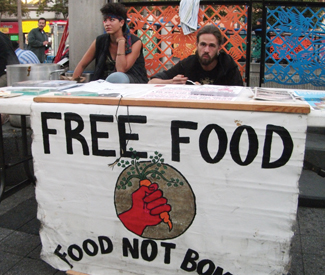
Everywhere he goes, he’ll feed the masses home-cooked vegetarian meals. But unlike the other protesters, McHenry helped invent the system that gets them fed. He helped to found Food Not Bombs, the organization that salvages food that would otherwise be thrown out, cooks it up, and serves free, tasty meals in public squares throughout the world.

McHenry served the first meal in Boston Common in 1980, then moved to San Francisco a few years later, bringing the movement with him. Now, there are 500 chapters in the United States and hundreds more throughout the world.

“We provided food for 100 days at the Orange Revolution in the Ukraine,” McHenry recalls. “We fed a two-year occupation in Sarajevo. We provided food at Camp Casey,” Cindy Sheehan’s anti-war stakeout at then-President George W. Bush’s ranch.

The FNB approach to hunger is pretty simple: There’s enough food to go around, it’s just not distributed right. So activists find ways to distribute food that would otherwise be thrown out. San Francisco FNB gets donations of extra, unsold food from places like Rainbow Grocery and Other Avenues food co-op.

It was started by anti-nuclear activists, thus the “Not Bombs” part. But there’s more to their analysis than a cry for peace. As the group states, “For over 30 years the movement has worked to end hunger and has supported actions to stop the globalization of the economy, restrictions to the movements of people, end exploitation and the destruction of the earth and its beings.”

A typical Food Not Bombs operation features a table with a vegetarian or vegan meal, maybe some produce, and anti-war and other leftist literature and banners. In 1988, this is what was on the table when the San Francisco Police Department cracked down on Food Not Bombs, arresting dozens for serving food at the entrance to Golden Gate Park at Haight and Stanyan.

“We had our sign such that when you walked in at the corner of Haight you would see the words Food Not Bombs for a block and a half,” McHenry recalls. “What was good about that was you had tourists, and local business people, and local workers, and you had the people in the Golden Gate Park, all coming together to eat at that place. It was really perfect.”

FNB still serves there on Saturdays, but that perfection was disrupted by a high profile series of arrests in 1988, then again a few weeks ago, when Parkwide, the Recreation and Parks Department’s new bike rental program, set up in their old spot.

Food Not Bombs still runs into conflicts with police and courts. Last year, McHenry was one of 24 arrested in Orlando, Florida, spending 19 days in jail after protesting an ordinance making it a crime to feed the homeless in the city’s downtown.

Last week, FNB held its world gathering at Occupy Tampa’s tent city, serving daily breakfast and dinner while planning the future of the movement. Occupy Tampa has only grown in recent weeks as it hosts people in town to protest the RNC. Sharing food and shelter, making art, and protesting politicians doing the bidding of greedy corporations is McHenry’s vision made reality — and one he got to see bloom last fall with the birth of Occupy.

As McHenry tells it, he and others from Food Not Bombs have been part of a decade-long buildup to the “occupy” tactics that erupted into the world in 2011. “I was promoting the idea of occupation ever since a meeting that was held in 2003 after Cancun,” he said. Protests at the World Trade Organization meeting in Cancun were part of a growing trend of disrupting international conventions in which political and business leaders make agreements that further exploitation and neo-liberalism. But McHenry says that more was needed.

“There was a group of us that got together and said these one-off events, like summits, were just becoming more disempowering rather than successful,” he said.

After years of calling for occupations, the notion clicked last fall. “We had seen the Arab Spring, so that made it that much easier to imagine the occupation concept. And the Spanish occupations were just then happening.”

“That’s a common thing,” McHenry said. “People try all these different ways of organizing and then all at the same time, the same thing will start to click. And there’s no real way to say, ‘oh, it started here, it started there, this person started it.'”

When Occupy encampments sprang up, Food Not Bombs was behind many of the kitchens and food sharing efforts — it even had a guide to building a tent city kitchen at foodnotbombs.net/occupy_supplies.

“In the beginning of some of the first occupations like Chicago, DC, Wall Street, we made peanut butter and jelly sandwiches, because we didn’t know if we would get busted,” McHenry said. “We ended up behind the scenes helping provide free meals to the occupations.”

McHenry said he hopes the spirit of occupying grows again. “It’s so important,” he said. “It would be great if we could regroup and retake public space.”


Alerts

0


Wednesday 29

Bernal Heights outdoor cinema Roccapulco Supper Club, 3140 Mission, SF; www.bhoutdoorcine.org. 7pm, $10 suggested donation. The first of five nights of film screenings in Bernal Heights. At this kickoff party, enjoy drinks, food and music from the Bernal Jazz Quintet before a lineup of short films celebrating community and organizing in the Bay Area. Films include Berkeley High School students on heritage and identity, “Occupy the Auctions Dance Party!” in which Occupy Bernal and ACCE stop evictions on the steps of City Hall, and a tour of Alemany Farm (also the beneficiary of the event’s ticket price), among others. The event also includes the announcement of winners of the Best of Bernal and Spirit of Bernal Awards and the first-year recipients of the Mauricio Vela Youth Film Scholarship.

Occupy, the state of the movement Mediterranean Café, 2475 Telegraph, Berk; www.occupyoakland.org. 7-10pm, free. Einar Stensson, a sociologist at Stockholm University and activist at Occupy Stockholm during the fall of 2011, studied Occupy Oakland for two months. Why did the movement start and spread so quickly around the globe? How is Occupy organized? Who matters in the movement and why? What is the future of Occupy? Come hear his perspectives on where Occupy is, locally and internationally.

Friday 31

Occupy the Bay The 25th Street Collective, 477 25th St., Oakl; www.occupyoakland.org. 6pm, $25. “This week in Oakland, California will go down as a watershed moment. People across America were disgusted by what they saw here. Average Americans trying to stand up and peacefully assemble, to be brutally savaged and attacked by the police department that they pay for.” So said Michael Moore to a fired up crowd in the wake of the Oct. 26 Occupy Oakland eviction that rained tear gas and rubber bullets on demonstrators. This is just one of the many historic events caught on tape by filmmakers Jonathan Riley and Kevin Pina, whose documentary Occupy the Bay is screening around the Bay Area before it starts showing in film festivals. On Friday, stick around for special musical performances from Jabari Shaw, Shareef Ali and Super Natural.

Enemies of the state: In their own words Station 40, 3030B 16th St., SF; station40events.wordpress.com. 7pm, free. After a year of Occupy and years more of struggle by people who are not down with the state, there are a lot of people in jail and prison. At this event, organizers will read writing from those locked up. Poems and statements from Truth and Kali of Occupy Oakland and a statement from Jesse Nesbitt, the May Day brick-thrower we profiled (“Who is the Brick Thrower?” 5/8/12). As the event description says, “Any effort at anti-repression in the face of lengthy prison terms must be aimed at bringing down separation at all costs.” Come fight the separation and connect.

Original Plumbing birthday celebration Elbo Room, 647 Valencia, SF; www.originalplumbing.com. 10pm, $3-6. Original Plumbing, the trans male quarterly magazine, is throwing a party celebrating its third year on this planet. It now lives in the Brooklyn part of the planet, but it all started in San Francisco, and they’re coming back here to party. “We feel that there is no single way to sum up what it means to be a trans man because we each have different beliefs, life experiences, and relationships to our own bodies,” say the organizers, and they started the magazine to document this diversity of experiences. Celebrate with the editors Amos Mac and Rocco Katastrophe, and performances by Rocco Katastrophe with special guests Billie Elizabeth, Nicky Click & Jenna Riot. Birthday cupcakes available!

Tuesday 4

Rally to save City College City Hall steps, 1 Polk, SF; ProtectOurCityCollege@gmail.com. 12pm, free. A rally in support of Prop A, the local ballot measure that would create a parcel tax for revenue to City College of San Francisco. “If City College is to survive and maintain accessibility, educational quality and the mission of serving low-income and underrepresented students with the best educators and staff, we must pass Prop A,” say organizers of the rally, which include students, teachers, staff and supporters.

Homeless camp raided

41

California Highway Patrol police, San Francisco police, Cal Trans workers, Department of Public Works, and workers from the mayor’s Homeless Outreach Team descended today on an encampment on Fourth and King.

Yesterday, 40-50 people lived on the sidewalk and under the freeway overpass next to the Caltrain tracks. The encampment had tents, mobile units, and other makeshift housing. One group of residents had a large tent with a well-maintained garden in the front yard.

Another, a woman who several residents said suffered from mental illness, had built a home out of metal that looked like parts of carts, wood, sheets and mattresses. After about four hours this morning, most other residents were moved out of the camp, but she remained, moving and packing suitcases. After Homeless Outreach Team members, police, workers, and humanitarian volunteers approached her, she took a single suitcase and walked to the sidewalk, then sat and watched as her other suitcases, mattresses, and the structures that constituted her house were thrown into a garbage truck.

The eviction began around 8am. Some residents said they were told they could take with them only what they could carry or, if they had something wheeled like a shopping or bike cart, what they could push. Others said they hadn’t been told one way or another what they could take, just that they had to get out.
 
The items in the dump trucks, said CHP Officer Sarah Wrathall, is “the stuff they said they don’t want.” Wrathall said people were given the chance to keep whatever they wanted to, and that items they wanted to keep but could not carry would be stored and tagged for retrieval later.

Jamie Crisco, a resident of the camp who was moving out, said that this was an unusual eviction. “There isn’t usually this dog and pony show,” said Crisco. A large amount of media was present at the eviction.

“Usually they will tell people to get out, and people will start packing. And in the process the workers will come and start taking stuff and throwing it away,” said Crisco, a veteran who had been living in a small trailer for a year.

“I don’t understand that,” added Crisco. “You’re creating a criminal element when you do that. You’re putting people in a position where they have to steal to acquire what just got taken from them.”

According to John Gallagher, an organizer with the Coalition on Homelessness who did outreach at the encampment before it was evicted, trash was pushed safely to the side and the camp was clean and peaceful before this morning’s “clean up.”

“We’re respectful, we’re quiet. Honestly, we keep this area cleaner than they ever could dream to,” agreed one person who was staying in the camp.

Wrathall described a very different situation, saying that the area under the overpass had amassed trash, waste and rats.

She said that the eviction was based on complaints from neighbors and other residents.

“People have a right to complain if they can’t walk down the sidewalk to get to Caltrain,” said Wrathall. She said that some people feared the dogs that lived in the camp.

She said illegal lodging and trespassing was reason enough to evict the camp’s residents. “It doesn’t have to be any other kind of crime.”

No citations were issued this morning.

Camp resident Margaret Stallings said that the camp was very peaceful and neighbors walked on the sidewalk and parked their cars in the adjacent parking lots without issues.

“This is a dead end street,” she said. The area under the freeway is out of the way of most city life and, according to Stallings, “Some people have been underneath there for eight years.”

In an outreach report written based on Gallagher’s observations, he stated that “This camp is so peaceful that I saw more that four people on their way to work walk unafraid right down the middle of camp.”

Patrice Perkins, who had been living in the camp for two and a half months, said that the encampment’s location was relatively tucked away. He expressed frustration that many of the residents will be pushed out towards other parts of SoMa and downtown.

“We found a place where you’re not in public. We’re not bothering anybody here,” he said. He pointed out the no parking signs along the street.

“See, no parking. It’s not being used.”

His neighbor in the camp, James Belcher, said that the eviction was causing him to miss two classes at Laney College. “I missed Civil War History this morning, and I’ll miss math at 10:30,” he said. Belcher said he has been studying for a few solid semesters and earning good  grades while looking for work, but struggling, based in part on issues associated with being a disabled veteran.

“It’s difficult for me to study in this little tent and stay in school,” he said.

One resident, who said she provided first aid at the camp, shared disinfectant wipes with a DPW worker when he expressed a need for them.

One of the city’s stated concerns with the camp was the presence of children, and in Gallagher’s outreach statement he said at least two children lived in the camp. None were present this morning, and Wrathall said that in her previous visits to the camp, she hadn’t seen any.

“I’ve never seen kids here, but if I did, I would take them to CPS [Child Protective Services]. Of if they’re older, 16 or 17, I would connect them to services like Huckleberry House. I would never walk away from someone who is 18 or under in the encampment. Its not safe,” she said.
 
“Homelessness is not a crime. People are afraid for the public to see their children because they will be taken away from them. And for what, the crime of being poor?” said Gallagher.

The Homeless Outreach Team secured rooms for several of the people who were evicted, including Stallings and Crisco.

“They’re housing me. I’ve been waiting on the VA list for housing for four and a half years,” said Crisco. “I’m a combat vet. I used to be a business owner. But life does things to you. Ends up putting you in places you didn’t plan on being.”

Crisco said he was happy to accept the room, but frustrated in general with the way the homeless are pushed around.

“I’m only human. I can only take so much pushing and prodding,” he said. “Sometimes, someone’s going to snap. And they’ll say, it’s the drugs. They never say, maybe it’s us. Maybe its what we’re doing to them.”

Bullets fly

25

When cops shoot their guns, sometimes they kill or injure bad guys. Sometimes it turns out that the person who was shot didn’t do anything wrong. And sometimes the majority of the carnage involves utterly innocent bystanters.

That’s a side of police shootings that doesn’t get talked about as much. But it’s real — and it’s a matter of concern when cops are firing off rounds in a crowded urban area, in particular when they’re near a school. Which is what happened in Noe Valley Aug. 27. According to my friends at the Ex:

A female officer caught up to the suspect as he tried to climb over a fence on Valley Street. He reportedly moved quickly toward the officer with his hands in the middle of his torso, prompting the officer to fire a single shot, which did not strike the suspect, police Chief Greg Suhr said.

So if the bullet didn’t hit the suspect, where did it go?

It went flying around Noe Valley. In the middle of the day. Near an elementary school. Lucky it didn’t hit anybody. Because officers are trained to fire at someone who they perceive as a lethal threat — but that training doesn’t include looking around behind the perp to see where the rounds will go if they miss.


Are free Golden Gate Park events fading away?

25

San Francisco’s countercultural community was built at least partly through free concerts and gatherings in Golden Gate Park, including the legendary Human Be-In and Grateful Dead and Jefferson Airplane concerts in the late-’60s. But these days, as corporations starve local government but seize public spaces, grassroots groups and populist performances are being forced out of the park.

Events without expensive tickets and corporate sponsorships (such as this month’s Outside Lands) or endowments from dead billionaires (Hardly Strictly Bluegrass Festival, coming up in early October) just can’t afford the rising fees charged by the Recreation and Parks Department, a reality that is quietly ending an important San Francisco tradition and legacy.

A few weeks ago, organizers of the Power to the Peaceful Festival – a free concert featuring Michael Franti and Spearhead and other big acts, which drew tens of thousands of people to the meadow formerly known as Speedway annually for more than a decade – announced that it was canceling next month’s event because of onerous fees.

“The only way to have produced the festival this year would have been to turn it into a ticketed event,” organizers wrote in their July 31 announcement. RPD officials were going to charge the event $77,000 in permit fees this year, dealing it a death blow after also forcing the cancellation of last year’s event by instituting a strict 40,000 attendee cap, which was nearly impossible to enforce for a free event.

If we accept the neoliberal perspective that has taken hold of San Francisco – which sees government’s role as facilitating whatever corporations want to do and hoping they share some of their profits, or at least create some good jobs – it makes sense. After all, the cash-strapped RPD made $1.7 million in profit-sharing off Outside Lands this year, up from $1.4 million last year.

The same logic has caused RPD, under the mercenary leadership of Director Phil Ginsburg, to rent out its recreation centers to the highest bidders and fire the recreation directors that used to treat them as public resources, and to let the private City Fields Foundation cover many parks in artificial turf. Again, through a strictly economic lens, it makes a certain amount of sense.

“As the steward of our parks, the Department works with event organizers to host diverse events in our parks, it is our shared responsibility to make sure the City and the event organizers have plans and resources in place to care for our park land and ensure public safety. The Department is always ready to work with all event organizers to modify their event planning for safe and successful events,” RPD spokesperson Connie Chan told us.

Power to the Peaceful – ironically, an event celebrating the plight of ordinary people against powerful political and economic interests around the world – just didn’t have the resources to meet the standard, so out they go. Same thing with the venerable Anarchist Book Faire, which was also forced from the park by rising fees this year after 17 years in the park’s County Fair Building.

Again, there’s a note of irony to this exodus, with city officials suddenly deciding the anarchists could no longer police themselves and needed to pay for four Park Police officers to watch over a festival that has been without violent incident throughout its history, unless you count a speaker getting pied last year (which the self-sufficient anarchists easily dealt with on their own).

“We had put this thing on for 17 years and there were no problems until this new guy came,” Joey Cain of Bound Together Bookstore, which puts on a free event whose fees have steadily risen to almost $14,000. “We’ve had to increase our rates every year, and we were starting to lose some vendors.”

On top of that, city officials had also cracked down on free offerings that surrounded the free event, banning Food Not Bombs from serving free meals to visitors and people from setting up information tables outside the main event.

So now the event, coming up in March, will be held at the Armory. Cain admitted that rent on the building they used in Golden Gate Park was still fairly cheap compared to similar sized venues around town, “as it should be, being owned by the city.”

But when city departments like RPD become dependent on corporate contributions, public spaces become commodified, and we begin to lose access to the last places in town where our creator endowed us with the right to assemble freely and pursue our happiness: our public parks.

Deltron 3030 is back

0

After releasing their self-titled debut LP to cultish acclaim in 2000, Bay Area hip-hop supergroup Deltron 3030 mysteriously dropped off the radar for over a decade, resulting in borderline Chinese Democracy levels of superfan speculation. Now, with their follow-up, Deltron Event II, finished and slated for release this fall, the trio is going all out on their first North American tour since the project’s revival.

This Sunday, rap icon Del the Funky Homosapien (or Del tha Funkee Homosapien), producer Dan the Automator, and turntablist Kid Koala, will descend upon Mountain View’s Shoreline Amphitheater on their second Rock the Bells tour stop as Deltron 3030, for a homecoming spectacular determined to exceed their devoted fan-base’s already lofty expectations.

As demonstrated by the triumphant live premiere of Deltron Event II in Toronto this past June, and in the YouTube videos that circulated in its aftermath, the trio’s comeback tour is anything but a low-key affair. “We’re literally bringing a string section, a horn section, and a choir,” Dan the Automator told the Guardian over the phone from his SF studio. “I mean, rap doesn’t do that. We’re in our own lane. There’s no actual comparative group to deal with, except ourselves.”

http://www.youtube.com/watch?v=bp5JK9YazVM

Dan’s assertion would recall Mike Tyson’s infamous post-prizefight gloating, if he weren’t totally right. Truth be told, Deltron 3030’s ambitious live approach presents a striking departure from hip-hop’s bare-bones, DIY origins.

“It’s an experience,” Del said from his home in Oakland. “It ain’t the same old walkin’ back and forth, two turntables, yelling in a microphone, not really doing nothing… This is an extravaganza.”

Having produced, recorded, and engineered a vast range of musical projects, from Kool Keith, to Gorillaz, to Primal Scream, Dan is no stranger to ambitious undertakings. However, the logistical planning of Deltron 3030’s current touring lineup stands tall as the mightiest accomplishment of his career thus far.

“I came up with the idea, and everybody else helped pull it off,” Dan explained. “Then, we had to do charts, score the music, get all the people, find how we can get that many people to a place. I don’t want to say it was a stupid idea, because it was a great idea. [Laughs] It was an incredibly naive undertaking, but it’s awesome that we got to do it.”

Del was similarly awestruck at the depth of Dan’s achievement. “It’s amazing, to me, how he had this vision, and really made it happen. Of course, it took some work, but he’s up there with the tuxedo on, with the baton in his hand, conducting. And I’m like, ‘Wow! OK, this is really happening.’ Plus, for some reason, I don’t know where his power comes from. I guess, because he’s the Automator.”

Whereas Dan functions as Deltron 3030’s chief organizer, and the primary force behind the project’s aesthetic foundation, Del is largely responsible for the underlying mythology. Set in an Orwellian dystopia, 1000 years in the future, and filtered through the observations of protagonist Deltron Zero, Deltron 3030 evoked the structure of rock operas such as Tommy, Ziggy Stardust, and The Wall, in its insistence upon narrative drive and the establishment of a distinctive universe all its own.

Partly in response to tumultuous changes in the real world since 2000 (9/11; the ensuing police state, and wars in the Middle East; Occupy Wall Street) Deltron Event II illustrates a society that has only grown bleaker and more demoralized.

“It’s a Mad Max type of world,” Del philosophized. “Everybody went too far, so to speak. Everything is just trashed; there’s no law; criminals just took over the streets, basically, so you just gotta get in where you can fit in, just make it happen however you gonna make it happen. It’s like anarchy, basically. It’s everybody for themselves.”

From his home in Montreal, Kid Koala discussed Deltron 3030’s futuristic approach, and its capacity to address the zeitgeist of 2012 more effectively than a narrative set in current times.

“Even though it’s set in the future,” he explained, “it’s not really about us being on some crazy laser quest… it’s actually talking about real issues. The economy, the class system… but, I guess, had we set it in the actual present day, it would just come off as more preachy, or something.”

Given the largely personal, apolitical nature of Del’s solo material, and his much celebrated work with Hieroglyphics, his resistance to heavy-handed politicking is understandable.

“Deltron is kind of separate from what I do with Del. With Del, I try to be more direct, to the ground, to the earth, try to talk directly to people. And it’s usually about real life situations. Just being able to deal and cope with personal types of problems or issues… and just striving. That’s what that’s about. With Deltron, I just tried to make a novel and put it in a musical format.”

Outlining his literary approach, Del cited Orwell’s 1984 as having a major effect on Deltron Event II’s conceptual framework, but the project’s key influence behind might come as a surprise.

“My main inspiration came from Megaman X,” Del explained. “It was the same game, basically, but the graphics were stepped up: more glossy, more futuristic, just looked real spiffy. It wasn’t as bubbly and cartoony as the first one. It looked modern. You had modern types of weapons and stuff. It really sent [me] a message, like, ‘Ok, that’s how you can do Del, too: put him in this future world, and he’ll be the same Del, but he’ll be able to do different little things that the regular Del can’t do.’”

High gloss, modern weapons, and a world gone down the tubes: that’s the state of affairs in the Deltron universe, circa 3040. But, despite the hopelessness of the world they’ve created, Dan, Del, and Koala are confident in Deltron Event II’s ability to justify a 12-year hiatus.

“I think it crushes the first one,” Kid Koala proclaimed. “The three of us, individually, are just better at our crafts now. We just tried to raise the bar on ourselves, really.”

A glance at the Rock the Bells lineup reveals a wealth of esteemed artists, and genuine game-changers in the world of hip-hop: Method Man and Redman, Ice Cube, Nas, Common. However, Deltron 3030’s almost absurdly ambitious live approach puts them in an entirely different league.

“As far as the artistic aspect, intrinsically, there’s nothing like this,” Dan insisted. “There never has been, and I doubt there ever will be.”

Deltron 3030
Sun/26, 6:45-7:45pm
Paid Dues Stage; Rock the Bells
$265 for two-day tickets
Shoreline Amphitheatre
1 Amphitheatre, Mountain View
www.rockthebells.net

Full circle

52

steve@sfbg.com

When Mayor Ed Lee suspended Sheriff Ross Mirkarimi in March, he publicly took the position that it was an act of official misconduct when Mirkarimi grabbed his wife’s arm during a Dec. 31 argument, subsequently pleaded guilty to false imprisonment, and was placed on probation for three years.

Lee and his allies said that under those conditions, Mirkarimi could no longer effectively function as the city’s top elected law enforcement officer and that his actions clearly violated the City Charter’s ban on "conduct that falls below the standard of decency, good faith and right action impliedly required of all public officers."

The City Attorney’s Office, through deputies Peter Keith and Sherri Kaiser, has maintained that position throughout the investigation and Ethics Commission proceedings over the last five months. On August 16, on a 4-1 vote, the commission agreed and recommend the Board of Supervisors find its former colleague guilty of official misconduct, which would almost certainly result in his removal from office.

But that simple set of facts and interpretations belies the ugly spectacle that Lee and the City Attorney’s Office actually decided to create — at great cost to taxpayers, Mirkarimi’s reputation, and the public’s faith in the proceedings — over the last five months.

Instead of sticking by their initial position, Lee and his attorneys decided to pile on a long list of other official misconduct charges: dissuading witnesses to his crime, impeding a police investigation, abusing his authority in several ways, engaging in a pattern of abuse of women, refusing to cooperate with a city investigation, lying to officers in a scheme to keep a gun, and other charges.

Almost all of those accusations were included in the original written charges that Lee filed on March 21 — before the city had actually begun its investigation to learn whether there was any evidence to support them. Keith and Kaiser continued to make all those accusations right up until the end.

When the Ethics Commission finally deliberated on August 16, going through each of the main factual allegations against Mirkarimi, one by one, it unanimously agreed that there wasn’t enough evidence to support any of those other charges, even using the "preponderance of evidence" standard that is lower than the "beyond reasonable doubt" standard used in criminal cases.

So in the end, the case against Mirkarimi ended at the same place where it began: with the question of whether pleading guilty to a misdemeanor act of domestic violence warrants the removal of an elected official. But the implications and repercussions of what has transpired over these last five months could be felt for many years, in ways that it’s impossible to predict today.

WHAT IS OFFICIAL MISCONDUCT?


With very few legal precedents to guide them, the commissioners spent most of the nine-hour hearing on Aug. 16 wrestling with how to interpret the city’s untested new official misconduct language, how directly the wrongful behavior must relate to the office, and whether broadly interpreting those two issues gives too much power to the mayor.

Underlying that discussion is the question of whether the statute and the city’s interpretation of it will eventually be struck down as unconstitutionally vague by the courts, which Mirkarimi will likely turn to if the board removes him from office. But the commission pointedly refused to enter that debate, with Commissioner Jamienne Studley saying, "I don’t think determining constitutionality is what I signed on for as a commissioner."

Chair Benedict Hur, the sole dissenter in recommending a finding of official misconduct, expressed far more concern about the precedent they were setting than with the fate of Mirkarimi, whose actions he strongly condemned as "clearly wrongful and unlawful."

"There has to be a direct relationship of the behavior to the office held," Hur said. "If we don’t find a nexus, we are opening this provision up to abuse down the road."

Commissioner Paul Renne led the charge in interpreting misconduct in the broadest possible way, arguing it didn’t even have to be related to his official duties. "There’s nothing in that clause that says the misconduct has to relate to the office," Renne said.

But Hur called that a "dangerous precedent," saying he has "grave concerns" about how such a broad interpretation could be applied in the future. "I have a lot of concerns about where you draw the line if you don’t relate it to official duties," he said.

For example, could members of the Board of Supervisors be removed after getting arrested at demonstrations — as has happened many times before in connections with labor and other disputes — or even for using colorful language with constituents or colleagues that might violate a future mayor’s "standard of decency?"

Mirkarimi attorney Shepherd Kopp said there’s a good reason why recall is the preferred means of removing an elected officials accused of wrongdoing, calling the charter "an imperfect document" that can’t cover all circumstances — indeed, it doesn’t allow for the removal of mayors, even those who commit serious crimes — noting that "this is a rarely brought proceeding and it can have the effect of contravening the will of the electorate."

"These proceedings," Kopp said, "are far too susceptible to the vagaries of politics."

THE PILE-ON


Lee’s decision to overcharge Mirkarimi could be a costly one. The City Attorney’s Office won’t release expenses associated with ongoing legal actions like this one, but most indications are that it will run into the millions of dollars, perhaps many millions depending on how Mirkarimi fares in the courts if he is removed and challenges the city’s actions.

According to the City Attorney’s Office, the official misconduct proceedings against former Sup. Ed Jew in 2007 cost the city $381,505 in legal fees, but that was a relatively short and simple proceeding, with just one Ethics Commission hearing and couple of state court appearances before the case was settled.

By contrast, the case against Mirkarimi has already entailed five months of detailed exchanges between the two sides’ attorneys, covering a wide array of legal issues, and months-long investigations of matters only tangentially related to the core charge. The city has paid out money for expert witness. Mayor Lee cast a wide net to catch the fish that he had already hooked before setting out to sea.

Even if the Jew case had played out to completion, it would likely have cost just a fraction of what Mirkarimi’s will, for a simple reason: Mayor Lee acted quickly and brought a broad array of charges before investigating them. Then-Mayor Gavin Newsom investigated whether Jew really lived in the city and then brought just that narrow charge.

The simple residency question was enough to warrant Jew’s removal, and Newsom didn’t even need to get into the far more serious corruption charges related to Jew being caught with $80,000 in marked bills as part of an FBI extortion sting, for which Jew is still serving a five-year term in federal prison.

Lee has refused to justify his decision to pile on the charges and introduce defamatory declarations unsupported by direct evidence, such as the long declaration of key witness Ivory Madison, most of which was stricken from the record after Commissioner Paul Renne called it "clearly hearsay, clearly having the intention of poisoning the well" and said "a first-year lawyer should know that much of it is inadmissible and it should not have been given to us."

Even though Keith apologized to Renne and the commission, Lee and his lawyers continued to defend much of that declaration and use it as the basis for many of their most incredible accusations.

"You received a great deal of evidence, most of it from the mayor and most of it unchallenged," Keith said in his closing statement, glossing over the multitude of challenges and the fact that most evidence doesn’t support the city’s charges.

Mayoral Press Secretary Christine Falvey wouldn’t address a list of Guardian questions about overcharging the case and continuing to rely on discredited evidence. Instead, the Mayor’s Office stands by this Aug. 16 prepared statement: "I am pleased that the members of the Ethics Commission, following a careful review of the evidence, and in the face of a sustained campaign to distract and misdirect them from the facts, agreed with me that Ross Mirkarimi’s actions constitute official misconduct and fall below the ethical conduct we expect of the sheriff."

City Attorney’s Office spokesperson Matt Dorsey said his office also stands by the process: "We respect Ethics Commissioners’ differing opinions about the remaining counts. But nothing about the commission’s conclusions would cause us to pursue these charges of official misconduct differently if we had to do it over again."

But Mirkarimi’s team says it is Lee who has repeatedly sought to distract and misdirect the public, whether through unsubstantiated claims in his charging documents or Lee’s public statements that Mirkarimi "beats his wife" and other comments that blow a single arm-grab out of proportion.

"What the commission has effectively done is agreed with us that’s the only issue," Mirkarimi attorney David Waggoner told reporters after the hearing, noting that he had offered to stipulate to those facts from the beginning and avoid a prosecution that his closing brief deemed "a dog and pony show." Mirkarimi also told reporters that "the piling on of these charges has weighted us down" and complicated his defense. He added, "I leave this process concerned that the will of the voters is being undermined."

THE PRICE OF OVERKILL


Perhaps it was understandable for the city to use over-the-top tactics on Mirkarimi, who has certainly been weakened by proceedings that generated reams of fodder to be used against him in future elections if he survives the board’s removal vote. But the tactic also seems to have hardened the stance of Mirkarimi’s supporters and fed their conviction that this was a politically motivated prosecution and misuse of public resources.

During more than three hours of public testimony on Aug. 16, with each speaker strictly limited to less than two minutes each, speakers overwhelmingly favored Mirkarimi and condemned the city case as overkill.

"Some of the things done in this case, and the levels this has gone to, is outrageous," said Brenda Barros, who works in the city’s public health clinic and said these resources could be better applied to help the "seriously abused women" she works with. Barros called the city’s case "a political witch hunt."

"I think Mayor Lee has overstepped his boundaries and I think you should find that as well," said Pedro Fernandez, a private investigator and former San Francisco Police officer.

David Elliott Lewis, a member of the city’s Mental Health Board, noted that the Sheriff’s Department has no civilian oversight, making the role of an elected sheriff who is progressive and independent of the city’s good-old-boy police culture all the more important. "Those who claim otherwise are really politically motivated," he said.

One issue left unresolved by the Ethics Commission is whether Mirkarimi should be removed even though the case against him was substantially whittled down. In fact, several commissioners indicated during the hearing that they thought the findings and punishment were separate issues.

"Do you agree that it is a two-step process we have to deal with?" Renne asked Keith, referring to the official misconduct finding and whether Lee abused his discretion by removing Mirkarimi.

"There is a determination of, are the consequences appropriate to the wrongful action," Keith replied.

But later, when attorney Scott Emblidge — who is volunteering his legal services to both the Ethics Commission and Board of Supervisors on this case — offered his interpretation that the charter language requires removal of officials found to have committed official misconduct, the commission accepted that and opted not to consider recommending a lesser punishment to the Board of Supervisors.

Mirkarimi’s team objected to the commission’s rewriting of new charges based on its evidentiary findings, and things got so confusing by the end that the commission decided to meet one more time in early September to finalize its recommendation.

So the case probably won’t get to the board until mid-September. Nine votes are required to remove Mirkarimi and the charter requires the board act within 30 days, meaning that final vote will be just a few weeks before the Nov. 6 election, timing that will only increase perceptions that politics will largely determine its outcome.

Farmville, for real

11

yael@sfbg.com

In the next few months, San Francisco will lose some of its most beloved urban farms.

The City Hall victory garden is now reduced to dirt. The grants that kept afloat Quesada Gardens Initiative, which creates community gardens in Bayview, were temporary and are now drying up. Kezar Gardens, funded by the Haight Asbury Neighborhood Council recycling center, is facing eviction by the city.

Time is up for Hayes Valley Farm, on the old freeway ramp, where developers are now ready to build condos.

St. Paulus Lutheran Church has also announced that it wants to sell the land that the Free Farm uses at Eddy and Gough.

“There’s the old joke about developers,” said Antonio Roman-Alcalá, co-founder of Alemany Farm and the San Francisco Urban Agriculture Alliance. “God must be a developer, because they always seem to get their way.”

At the same time, new urban agriculture projects have sprung up across San Francisco. Legislation authored by Sup. David Chiu will create a city Urban Agriculture Program, with the goal of coordinating efforts throughout the city.

So is the movement to grow food in the city progressing? It’s a tricky question that gets down to one of the oldest conflicts in San Francisco: The best use of scarce, expensive land.

THE VALUE OF FARMING

The San Francisco Planning and Urban Research Association lauds the value of community gardens. An April 2012 SPUR report notes that urban agriculture connects people “to the broader food system, offers open space and recreation, provides hands-on education, presents new and untested business opportunities, and builds community.”

According to the report, the city had “nearly 100 gardens and farms on both public and private land (not including school gardens),” two dozen of which started in the past four years.

But that’s nowhere near enough for the demand. “The last time waiting lists were surveyed, there were over 550 people waiting,” Eli Zigas, Food Systems and Urban Agriculture Program Manager at SPUR, told us. “That likely underrepresents demand because some people who are interested haven’t put their name down.”

Changes in zoning last year, and the recent ordinance to create the Urban Agriculture Program, show a measure of city support for urban farming and gardening.

“We have one of the most permissive zoning codes for urban agriculture that I know of in the country,” said Zigas.

One zoning change from 2011 makes it explicit that community gardens and farms less than one acre in size are welcome anywhere in the city, and that projects on larger plots of land are allowed in certain non-residential districts.

More recent legislation is meant to streamline the process of starting to grow food in the city. Applying to use empty public land for a garden can be an arduous process, and every public agency has a different approach. The hoops to jump through for land owned by the Police Department, for example, are entirely different than what the Public Utilities Commission requires. A new Urban Agriculture Program would coordinate efforts.

“The idea is to create a new program that will serve as the main point of entry. Whether it will be managed by existing agency or nonprofit is to be determined,” said Zigas.

If the timeline laid out in the ordinance is followed, the plan will be implemented by Jan.1, 2014.

By then, if all goes according to plan, no San Franciscan looking to garden will wait more than a year for access to a community garden plot.

NO NEW LAND

Roman-Alcalá said that efforts to clear the way for urban agriculture are much less controversial than for affordable housing and other tenets of anti-gentrification. But for all the good the latest legislation does, it doesn’t secure a single square foot of land for urban agriculture.

“If you look at the language, there’s nowhere in it that mandates or prioritizes urban agriculture on any site,” said Roman-Alcalá. “The closest thing is a call for an audit of city owned rooftops. That’s the closest it comes to changing land use.”

And it won’t be easy. “No matter how much support there is for urban agriculture, in the end, developers and their ability to make money is going to be prioritized,'” he said. “The only way to really challenge that right now is cultural. Social change is not an event but a process.”

Janelle Fitzpatrick, a member of the Hayes Valley Farm Resource Council and a neighborhood resident who has been volunteering at the farm since it started, is committed to that process.

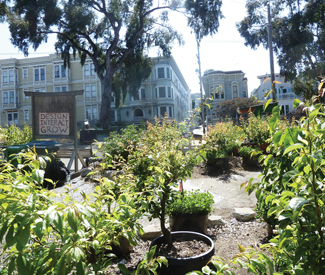
“Hayes Valley Farm proves that when the city, developers, and communities come together, urban agriculture projects can be successful,” Fitzpatrick said. She and dozens of other volunteers created the farm, which is now lush with food crops, flowers, and trees. The farm has a bee colony, a seed library, and a green house. It offers yoga and urban permaculture classes.

Hayes Valley Farm started on land that used to be ramps to the Central Freeway before that section was damaged in the Loma Prieta earthquake. The land under the freeway was toxic, but volunteers spent six months layering mulch and cardboard and planting fava beans to create soil. It took less than a year to create a productive farm on a lot that had been vacant and overgrown for nearly two decades.

“We’re producing food, we’re producing community, we’re producing education,” said Zoey Kroll, another volunteer and resource council member.

When they vacate their land in the winter, many Hayes Valley Farm team members will already be knee deep in new urban agriculture projects. These include Bloom Justice, a flower farm in the Lower Haight that Kroll says will teach job skills like forestry and landscaping. The farm has also built a relationship with Hunters Point Family, working together to offer organic gardening and produce at Double Rock Community Garden at the Alice Griffith Housing Development and Adam Rogers Community Garden.

As for the loss of the current site, Kroll says, “It’s an exercise in detachment.” Change in landscapes and ownership is part of urban life, she said — “We’re a city of renters.”

We’re also a city of very limited land. “Securing permanent public land for urban agriculture would be challenging,” said Kevin Bayuk, an instructor at the Urban Permaculture Institute. “And securing long-term tenure on anything significant, an acre or more of land in San Francisco, if it were on private land, would be cost prohibitive.”

Of the city’s three largest farms, only Alemany Farm seems secure in its future. The farm is on Recreation and Parks Department land, and has been working with the department since 2005 to create a somewhat autonomous governance structure.

Community gardens on Rec-Park land are subject to a 60-page rulebook, and according to Roman-Alcalá, Alemany Farm’s operations were restricted by the rules.

Last week, the group’s plan to be reclassified as a farm instead of a garden was approved, eliminating some of the rules and creating an advisory council of community stakeholders that will exert decision making power over the farm, although Rec-Park still has ultimate authority.

“Now it’s more secure,” said Roman-Alcalá. “We’ve finally reached this point where the city acknowledges it as a food production site.”

“I think the urban agriculture movement is still growing and burgeoning in the grassroots sense,” said Bayuk. “And I think some of the grassroots growth is reflected in the policy and code changes. “I’m optimistic for the idea of people putting land into productive use to meet human needs and be a benefit of all life.”

This article has been corrected to reflect information about the location and ownership of the Free Farm.

A week after police crack down, People’s Library still operating in East Oakland

13

The building where activists, some from Occupy Oakland, created a free library and garden August 13 was raided by police that night. But that was Monday, this is Friday– and the Biblioteca Popular Victor Martinez, or People’s Library, is still in full form.

The books and garden have moved from the building, which was built in 1918 in the Spanish Colonial Revival style, to the sidewalk. But it’s still a lively scene. Books are shelved the block in front of the old library’s entrace, and around the corner participants have built gadren beds. In the sidewalk library and garden, children browse books, play chess, dig holes for seeds, water plants, ride bikes and scooters, and casually work on the fence around the building with pliers. 

The building at 1449 Miller was donated to the city of Oakland as part of a grant from Andrew Carnegie, and functioned as a library until 1979. It was one of eight libraries closed by the City Librarian following the passage of Prop 13, according to Harry Hamilton, City of Oakland public information officer. It was subsequently used for the Emiliano Zapata Street Academy, an alternative high school that now operates on 29th street. It was owned by the Oakland Redevelopment Agency, whose members allocated money to it in their 2005 five-year plan, but no redevelopment of the building had begun when redevelopment agencies across California were dissolved last fall. It is now owned by the the Redevelopment Successor Agency housed within the City of Oakland’s Office of Neighborhood Investment, and, for all official purposes, remains vacant.

On Monday morning, activists entered the building, intent to revitalize it themselves. Empty wooden bookshelves covered the walls, and the floor was strewn with trash. A few mattresses indicated that the officially vacant building certainly hasn’t been.

Those building the People’s Library brought in brooms, sponges and trashbags. A few hours later, the place was cleaned up and hundreds of donated books lined the long-empty shelves. Neighbors came in through the open doors, helping to clean, checking out books, and reading to their kids. In the backyard, kids and adults built raised beds and started planting in them.

At 6:30, there was a potluck and a poetry reading. Most families had wandered off by 10pm. At 11:30, about a dozen people remained. That’s when 80 police arrived, blocked off the street for two blocks in all directions, and told them that they had 15 minutes to gather their books and exit the building, or risk arrest.

The creators of the Victor Martinez People’s Library did as they were told. But they didn’t go far. The next morning, they set up the library again, this time on the sidewalk outside the now-boarded up building. The kids and families came back. Police did, too, but they stayed in cars on corners around the building, watching.

Now, it’s been a week, and what organizer Jaime Yassin calls “the only 24-hour library in the US” is still here.

“That was on their agenda, at some point, to do this. What the people are doing now,” said Emji Spero, a poet who heard about the action from people invovled in Monday’s poetry reading. “But instead, they’re spending money on police to come shut it down. Someone said to me, I can see the dollar signs floating off the police cars as they run their engines.”

“This is the social reform that the city is supposed to be doing,” said Khalid Shakur, another Oakland resident who was involved in setting up the library.

On Wednesday Yassin, who had been researching the building’s history, sat down with me on a couch by the library. He explained that the clean sidewalk where the couch now sits was an unofficial garbage dump days earlier, covered in old clothes, drug paraphenalia, and other trash.

Yassin showed me a 2005 report from the Urban Ecology 23rd Avenue Working Group. the plan, a result of focus groups and surveys of people in the neighborhood of the People’s Library, includes a plan to “rehabilitate Miller Library” as a top priority for beneficial development in the neighborhood.

“Renovation, however, will be expensive and require the city’s help,” the report reads. “the city-owned library needs seismic reinforcement, repair to flood damage, asbestos removal and handicap accesibility improvements.”

As I spoke with Yassin, a 10-year-old who had been gardening and playing on the sidewalk scooted up. He handed some scissors, just retrieved from his home a block away, to one of the people making signs to organize the library.

“I never saw nobody use it using it since I got here,” he said when I asked him about the building.

“I liked it when you guys came,” he added to Yassin, smiling, before racing off on his scooter.

Juan Delgadillo, who owns Plaza Automotive, a business across the street from the library, said he plans to borrow some books from the People’s Library. “It’s a very good idea,” said Delgadillo. “I support it.”

The group has been holding nightly potlucks, and is planning to host a community barbecue tomorrow (August 18) at 2pm.

Eliana steals the show at Thursday’s dueling City Hall rallies

48

Eliana Lopez once again stole the show as the Ethics Commission Thursday debated the “ethical fate” of her husband Sheriff Ross Mirkarimi inside City Hall while the Stand With Ross forces and their opponents staged back to back rallies on the City Hall steps.

Eliana sat with and supported her husband during the morning at the hearing on the misconduct case and then made an early afternoon dramatic entrance to the Mirkarimi rally. (The commission later Thursday unanimously rejected most of Mayor Ed Lee’s official misconduct charges against the suspended sheriff but voted 4-l to recommend the Board of Supervisors find him guilty of official misconduct for grabbing his wife’s arm on Dec. 31 and pleading guilty to the resulting misdemeanor charge of false imprisonment.  See Steve Jones Guardian blog.)

Eliana was greeted with cheers as the tv cameras and reporters crowded in on her.  

She spoke with ease and authority, greeted many friends, spoke in Spanish to several Spanish language radio and television reporters, and walked easily through the crowd shaking hands and talking with supporters in two languages.

“We don’t want any more hate,” she said. “We want love.” She said the case was
“about democracy” and she said that the community stands behind her husband.

I asked her about her plans.  She said she had finished her movie in Venezuela and was back living with Ross in their home with their young son Theo.   “I have good feelings,” she said.

The two groups worked out an informal modus vivendi.  The Remove Ross group had a permit for using the steps so they went first with their press conference rally with banners saying “We stand with survivors” and “The facts do matter.” Their group was largely from the three organizations leading the charge against Ross, La Casa de las Madres, Domestic Violence Consortium and Futures Without Violence.

The Mirkarimi group initially gathered across Polk Street, waved signs and chanted “Stand With Ross.” The group then got a permit to use the City Hall steps and held its rally after the first rally ended.  Sharon Hewitt, executive director of the Community Leadership project, said that the city owed an “act of apology for the violence” that it had caused to Ross and his family.

The police officer on duty estimated to me that there were 40 or so in the domestic violence group. My count was about 50 or so.  The Stand With Ross group had more people and they were more spirited in their chants and marching.   

Commission narrows Mirkarimi charges to one but recommends removal

238

The Ethics Commission today unanimously rejected most of Mayor Ed Lee’s official misconduct charges against suspended Sheriff Ross Mirkarimi – including abuse of power, impeding a police investigation, and dissuading witnesses – but voted 4-1 to recommend the Board of Supervisors find him guilty of official misconduct for grabbing his wife’s arm on Dec. 31 and pleading guilty to the resulting misdemeanor charge of false imprisonment.

The sole dissenting vote, Chair Benedict Hur, said he had “grave concerns” that such as a broad interpretation of what behaviors constitute official misconduct would give mayors a “strong tool” to inappropriately remove their political adversaries (or at least invite charges that they were), as Mirkarimi supporters allege is happening now.

But the rest of the commission adopted a broad interpretation of what city officials and voters intended in 1995 when they overhauled the City Charter and added a new official misconduct clause banning “conduct that falls below the standard of decency, good faith and right action impliedly required of all public officers.”

“I have a lot of concerns about where you draw the line if you don’t relate it to official duties,” Hur said, appealing to his colleagues that, “I think this charter provision was meant to be narrow.”

Commissioner Paul Renne – who in earlier hearings had taken a strong role in excluding prejudicial evidence against Mirkarimi and was thought to be a possible vote in his favor – today led the charge in interpreting misconduct in the broadest possible way, arguing it didn’t even have to be related to his official duties, while the three other votes against Mirkarimi made the case that his conduct and conviction were related to a sheriff’s role overseeing the jail and its domestic violence programs.

“I think the voters would be shocked if we were to say a public official who pleaded guilty to domestic violence has not committed an act of official misconduct,” Renne said.

But Mirkarimi’s attorneys and supporters – who outnumbered those urging his removal (mostly domestic violence advocates) by more than 4-to-1 during the three hours of public testimony taken today – say the shocking thing is for a just-elected official to be unilaterally removed from office by a political adversary for reasons that today’s proceedings showed were tenuous.

“No case has ever been upheld in court to remove an elected official for a low-level misdemeanor,” said Paula Canny, the attorney for Mirkarimi’s wife, Eliana Lopez, who sat next to and supported his husband throughout today’s nine-hour proceedings.

Indeed, the city is wading into uncharted waters and the commission had few court precedents to draw from in making its findings. It’s also possible that the charter provision is unconstitutionally vague, as Mirkarimi’s attorneys have alleged, both here and in court, with an earlier judge opting to wait until after the city’s process plays out before ruling on the question.

But first, it will be up to the Board of Supervisors, where nine votes on the 11-member body are required to remove Mirkarimi. Today’s hearing got complicated at the end – as commissioners wrestled with what it means to essentially throw out the mayor’s charges and adopt their own more narrow accusation, and how to present everything to the board – that it decided to hold one more meeting in early September to adopt a summary and send everything to the board, which will then have 30 days to act.  

“I leave this process concerned that the will of the voters is being undermined,” Mirkarimi told reporters after the hearing. Holding his hand, Lopez said, “I’m shocked to see what happened today, but we are fighters.”


For complete coverage and analysis of what happened today, what it means, and what’s next, read next week’s Bay Guardian.

Dick Meister: The billionaire’s bill of rights

8

By Dick Meister

Dick Meister, former labor editor of the SF Chronicle and KQED-TV Newsroom, has covered labor and politics for more than a half-century. Contact him through his website, www.dickmeister, which includes more than 350 of his columns.

Billionaire corporate interests and other well financed anti-labor forces are waging a major drive to stifle the political voice of workers and their unions in California that is certain to spread nationwide if not stopped – and stopped now.

At issue is a highly deceptive measure, Proposition 32, on the November election ballot, that its anti-labor sponsors label as an even-handed attempt to limit campaign spending. But actually, it would limit – and severely – only the spending of unions while leaving corporations and other moneyed special interests free to spend as much as they like.

Unions would be prohibited from making political contributions with money collected from voluntary paycheck deductions authorized by their members, which is the main source of union political funds.

 But there would be no limits on corporations, whose political funds come from their profits, their customers or suppliers and the contributions of corporate executives. Nor would there be any limit on the political spending of the executives or any other wealthy individuals. What’s more, corporate special interests and billionaires could still give unlimited millions to secretive “Super PACs” that can raise unlimited amounts of money anonymously to finance their political campaigns.

The proposition would have a “devastating impact” on unions, notes Professor John Logan, director of labor and employment studies at San Francisco State University, writing in  the Hill’s Congress blog.  As he says, it would likely all but eliminate political spending by unions while greatly increasing political spending by business interests and wealthy individuals.

 Anti-labor interests are already outspending unions nationwide by a ratio of more than $15 for every $1 spent by unions. Between 2000 and 2011, that amounted to  $700 million spent by anti-labor forces, while unions spent just a little more than $284 million.

 Proposition 32 would even restrict unions in their communications with their own members on political issues. That’s because money raised by payroll deductions pays for the preparation and mailing of communications to union members, including political materials.

Unfortunately, there’s even more – much more –to Proposition 32. It also would prohibit unions from making contributions to political parties and defines public employee unions as “government contractors” that would be forbidden from attempting to influence any government agency with whom they have a contract.

That restriction applies not only to unions. It also would cover political action committees established by any membership organization,  “any agency or employee representation committee or plan,” such as those seeking stronger civil rights or environmental protections.

Proposition 32 seeks to weaken, that is, any membership group which might seek reforms opposed by wealthy individuals or corporations and their Republican allies.  It’s no wonder the measure is actively opposed, not only by organized labor, but also by the country’s leading good-government groups, including Common Cause and the League of Women Voters.

Yet the proposition’s sponsors have the incredible gall to bill their measure as genuine campaign finance reform. They obviously hope that claim, which Common Cause accurately describes as a “laughable deception,” will win over the many voters who have been demanding reforms and who, in their eagerness, will fail to recognize the measure’s true nature.

“This is not genuine campaign finance reform,” as San Francisco State’s John Logan says, “but a bill of rights for billionaires.”

The losers would include teachers, nurses, police, firefighters and other union members and those who benefit from the essential services they provide – students, the elderly, and the ailing, the poverty stricken, those who work and live in unsafe conditions and other needy citizens, and consumers, environmentalists and others who also are neglected by the profit-chasing corporate interests that dominate political and economic life.

Make no mistake: Lots of money is being funneled into the Proposition 32 campaign by some of the same wealthy backers who bankrolled such anti-labor efforts as the campaign that blocked the massive attempt to recall virulently anti-labor GOP Gov. Scott Walker of Wisconsin this year.

Should the anti-union forces also prevail, it will undoubtedly lead to what Logan says “will promote a tsunami of ballot initiatives in 2013 at the local level and in 2014 at the state level designed to drive down working conditions in both the public and private sectors.”

Logan adds, “Lacking the ability to oppose these reactionary measures under the new election rules, California’s workers could soon face the weakest labor standards in the country”. But if the measure is rejected, it “may slow the momentum behind other attempts to increase the corrosive impact of money in politics.”

It’s true that some states already have laws and regulations seriously limiting labor’s influence. But it’s certain that victory by the anti-labor forces in California will slow any attempts at reform in other states and lead as well to attempts to impose anti-union measures elsewhere, as well as expanding those that already exist.

The stakes are huge. If the 1 percent have their way in California, the country’s largest state, other states are certain to follow.

For more from John Logan, check his piece in the East Bay Express, “If you liked Citizen United, you’ll love Prop 32.” http://www.eastbayexpress.com/ebx/if-you-liked-citizens-united-youll-love-prop-32/Content?oid=330613

Dick Meister, former labor editor of the SF Chronicle and KQED-TV Newsroom, has covered labor and politics for more than a half-century. Contact him through his website, www.dickmeister, which includes more than 350 of his columns.

Why?

44

steve@sfbg.com

Just a couple years ago, it seemed like the golden age of marijuana in San Francisco, the birthplace of the movement to legalize medical pot and a national leader in creating an effective regulatory framework to govern an industry that had become a legitimate, respected member of the business community.

More than two dozen patient cooperatives jumped through a variety of bureaucratic hoops to become licensed dispensaries, most of them opening storefront businesses that were often the most attractive, clean, and secure retail outlets on their blocks, sometimes in gritty stretches of SoMa, the Tenderloin, or the Mission.

“Pretty much everyone involved agrees that San Francisco’s system for distributing marijuana to those with a doctor’s recommendation for it is working well: the patients, growers, dispensary operators, doctors, politicians, police, and regulators with the planning and public health departments,” I wrote in “Marijuana goes mainstream” (1/28/10).

Since then, San Francisco’s medical marijuana industry has only become more established and professional, complying with new city regulations (such as changing how edibles are packaged to avoid tempting children), paying taxes and fees — and making very few waves. According to city officials, there have been almost no complaints from anyone about the dispensaries — and in San Francisco, people complain about everything.

But in the last six months, the full force of the federal government has brought the hammer down hard on this budding business sector, forcing the closure of eight brick-and-mortar dispensaries and instilling paranoia and insecurity in those that remain.

In just the past few weeks, two of the city’s oldest and most respected dispensaries –- HopeNet and the Vapor Room -– were forced to close their doors.

There’s been little rhyme or reason to which clubs get those dreaded letters warning operators and landlords to shut it down or be subject to asset forfeiture and prison time — and the officials involved have refused to explain their actions, except with moralistic anti-drug statements or unsupported accusations.

“These are people who played by the rules and paid their taxes, and now they’re being punished for it,” said Assembly member Tom Ammiano, a leader in creating a state regulatory framework to govern the distribution of medical marijuana, which California voters legalized in 1996. “This is pure thuggery. They are ignoring due process out of blind prejudice and ambition.”

Ammiano met with Melinda Haag, the US Attorney for the Northern District of California, who has coordinated the local crackdown from her 11th floor office in the Federal Building near City Hall, shortly after she announced her intentions to go after medical marijuana. He said she was like a throwback to a less enlightened era.

“In talking to Haag, not only is she a bit of a bully, but she’s totally uneducated about the issue,” Ammiano told us. When she told him that her office has received many complaints about the dispensaries, he asked to see them -– even making a formal Freedom of Information Act document request –- but she has yet to produce them. “Her duplicity is very moralistic, it’s like going back 100 years.”

Neither Haag nor anyone from the White House or Justice Department would grant an interview to the Guardian to discuss the reasons for and implications of the crackdown, or to answer the list of written questions her office asked us to submit. Instead, Haag gave the Guardian this statement and refused to respond to our follow-up questions:

“Although all marijuana stores are illegal under federal law, I decided to use our limited resources to address those that are in close proximity to schools, parks and playgrounds and operations so large that they constitute marijuana superstores. I hope that those who believe marijuana stores should be left to operate without restriction can step back for a moment and understand that not everyone shares their point of view, and that my office has received many phone calls, letters and emails from people who are deeply troubled by the tremendous growth of the marijuana industry in California and its influence on their communities.”

But in San Francisco, where more than 80 percent of residents consistently support medical marijuana in polls and at the ballot box, most people don’t share Haag’s point of view. And city officials contest many of her claims, from saying the dispensaries are “left to operate without restriction” to her implication that they promote crime or endanger children to the haphazard way she has targeted dispensaries to the characterization that many people are “deeply troubled by the tremendous growth of the marijuana industry.”

In fact, to talk to city officials, virtually nothing Haag says is true.

“We’re not getting nuisance complaints [about the dispensaries],” Dr. Rajiv Bhatia, the city’s medical director who oversees regulation of the dispensaries by the Department of Public Health, told the Guardian. “We’ve had very few complaints over the years and good cooperation with the storefront part of the regulations.”

Almost across the board, city officials and club operators praise one another and the cooperative relationship they’ve established over the last four years. Some of San Francisco’s biggest dispensaries have somehow avoided Haag’s wrath, but their once-open operators are now afraid to speak publicly, warily checking the mailbox each day. A thriving industry eager to pay its taxes and submit to regulation is being driven back underground, with all the uncertainty and hazards that creates.

“The question everyone is asking: Why here, why now, why these businesses? Nobody knows the answer,” Bhatia said. “We’re left to speculate and guess about motives.”

MULTI-AGENCY ATTACK

The federal crackdown has been stunning in both its speed and breadth, with various federal agencies coordinating their attacks. The IRS is auditing the biggest clubs and denying write-offs for routine business expenses, the DEA is threatening asset forfeiture efforts, and Haag and the DOJ are threatening prison time and court injunctions.

Underlying all of that is President Barack Obama, who pledged not to use federal resources to go after those in compliance with state law in the 17 states where medical marijuana is legal. Then, last year, Attorney General Eric Holder suddenly announced a new policy: “It will not be a priority to use federal resources to prosecute patients with serious illnesses or their caregivers who are complying with state laws on medical marijuana, but we will not tolerate drug traffickers who hide behind claims of compliance with state law to mask activities that are clearly illegal.”

When we sought an explanation and clarification from the White House Communications Office about why well-established medical marijuana collectives carefully operating under California law were suddenly deemed “drug traffickers” that wouldn’t be tolerated, they refused to answer and referred us to a statement Obama made to Rolling Stone magazine.

“What I specifically said was that we were not going to prioritize prosecutions of persons who are using medical marijuana. I never made a commitment that somehow we were going to give carte blanche to large-scale producers and operators of marijuana -— and the reason is, because it’s against federal law. I can’t nullify congressional law,” Obama told the magazine.

That simplistic explanation – which conveniently ignores how people are supposed to get this medicine – has infuriated local growers and patients. It’s particularly galling for those who supported Obama and took him at his word in the last election, and who don’t understand why he is suddenly escalating the federal war on drugs, ignoring local laws and values, and re-criminalizing their communities.

FUNERAL PROCESSION

Hundreds of medical marijuana supporters gathered on Aug. 1 for a New Orleans-style funeral procession at the Lower Haight intersection near where Vapor Room had operated -– without incident and with praise as a model business from three successive district supervisors –- from 2004 until the previous day.

The mood was festive and defiant on that sunny afternoon, where advocates from both sides of the bay gathered to express solidarity with the closed clubs and resolve to battle through the recent setbacks.

“I’m feeling the fight,” Steve DeAngelo, star of the reality television show Weed Wars and head of Oakland’s Harborside Health Center, which received Haag’s shut-down-or-else letter last month, told the Guardian. “I don’t think we can allow taking a few hits to break our spirit….We started this struggle to win it and we’re not going to stop until we do.”

Local politicians and business leaders also came to offer their support.

“As president of the Lower Haight Merchants Association, I’m upset that Vapor Room had to shut down,” Thea Selby, who is also running for the District 5 supervisorial seat, told us. “The Vapor Room did a lot of good for this neighborhood and was a great business.”

Marchers, most clad in black, carried “Cannabis is Medicine: Let States Regulate” and other signs -– as well as a makeshift coffin and massive puppet depicting a scowling Haag -– and danced down the middle of the street as Brass Mafia horns belted out lively jazz tunes. By the time the procession reached Haag’s office at the Federal Building, a chill fog had darkened the skies and the mood.

DeAngelo took the bullhorn first and called out Obama directly: “Either you were lying, sir, or your employees are out of step with your policies.” Steph Sherer, executive director of the DC-based Americans for Safe Access, told the crowd, “We need to tell Obama to lose Haag or lose California.”

Ammiano and the other mostly Democratic Party politicians who spoke tried to avoid putting Obama directly into the crosshairs of the angry activists, although he did say those executing this crackdown “are harming Obama’s chances of winning.” He also urged activists to put the pressure on politicians in Sacramento and Washington DC: “We need to be a voice in reshaping what’s happened in these last few months.”

Ammiano said the crackdown “empowers the cartels and the people who use violence,” contrasting that with San Francisco’s civilized approach to regulating marijuana.

“We in San Francisco have been a model for how to regulate this industry and we have been successful. We are not going to let the federal government interfere with our rights in this city,” Sup. David Campos told the crowd.

Cathy Smith, the founder of HopeNet, who was still reeling from watching her club gutted and shuttered the day before, also sounded an angry and defiant tone, urging supporters to make their voices heard by Haag and others.

“Everybody that’s here needs to go up to this evil woman’s office tomorrow and tell them what we think,” Smith said.

The general feeling was that if the feds can target model clubs like HopeNet and Vapor Room –- which had deep community roots and generous compassionate care programs for low-income patients -– then all clubs are in danger.

“I’m very upset that we’re losing two great medical marijuana dispensaries where patients could medicate on site,” said David Goldman, a local ASA activist and member of the city’s Medical Cannabis Task Force, noting how important that is for patients who live in apartments that ban smoking.

HopeNet and Vapor Room were some of the only dispensaries in town where smoking was allowed on site, because they were more than 1,000 feet from schools, playgrounds, or day care facilities, the city’s standard. Bhatia said that’s a very strict standard in a city as dense as San Francisco, which is why only four clubs ever met it.

Yet the feds saw things differently, ostensibly targeting HopeNet because a small private school opened two blocks away last year, and the Vapor Room because the feds didn’t use the city’s standard of being more than 1,000 feet from the playground at Duboce Park, instead deciding the dispensary was a community menace because it was a little under 1,000 feet from that dog-friendly park’s nearest patch of grass.

LAST DAYS

Vapor Room founder Martin Olive was a bundle of complicated emotions on the club’s last day in business (it will still operates as delivery-only, just like HopeNet, Medithrive, and a few other shuttered clubs have done). Initially, he didn’t want to talk to us: “I’m trying to keep a lower profile because it’s scary out there now.”

But he slowly opened up and tried to describe the feeling of watching his proudest accomplishment so rapidly undone by the one-two punch of a letter from the merchant services company cutting off credit card access (just like every dispensary in the city, returning pot sales to a cash-only status) followed days later by Haag’s shut-down letter.

“It’s complicated emotions that I’m feeling -– let down, confused. At the end of the day, I don’t understand why this is happening,” Olive said. “It’s a community tragedy, it really is.”

Vapor Room was a welcoming gathering place for its members and a supporter of a variety of community events and causes.

“I’ve always treated this as if it were just a nice coffee house. I’m not an outlaw,” Olive said. “I almost forgot I was breaking federal law. It was so normal, so legitimate.”

In fact, some club owners say their establishments helped clean up rough streets. “We took care of the entire block. Before us, it was all dealers, so there’s a safety issue,” HopeNet’s Smith told me as the once-welcoming club on 9th Street near Howard was reduced to bare walls.

Patients were also feeling the pain, including a 48-year-old ex-con who said he was paroled two years ago after serving 25 years in prison for attempted murder. “I have anger issues, big time. The only thing that keeps me calm and quiet and not blowing up is medical marijuana,” he told us, seething, before praising HopeNet’s “homelike environment” and supportive community. “It’s important to sit and relax in an environment that is comfortable and safe. All this is doing is pushing us into the streets.”

DRIVEN UNDERGROUND

Before going through his latest official misconduct battles and fighting to return to his job as the elected sheriff, Ross Mirkarimi was the District 5 supervisor who sponsored the creation of the city’s medical marijuana regulatory system, the product of a long and arduous legislative process.

“We developed the system out of stark necessity because neither local government nor state government gave a roadmap to the dispensaries,” Mirkarimi said. “Prop. 215 legalized medical marijuana, but there were no rules around it.”

After an intensely collaborative process that lasted more than a year, the city in 2005 adopted a process for licensing dispensaries that balanced the needs of this nascent industry with concerns by police, patients, disability rights activists, neighborhood groups, and health officials. Mirkarimi said that maybe it’s time for city officials to consider an idea he floated a few years ago of having the city itself directly distribute medical marijuana through General Hospital.

“I still think that’s a good idea, particularly if the feds are going to force medical marijuana dispensaries back into the dark ages.” For all his praise of the city’s dispensaries, Dr. Bhatia will admit that the industry still needed better oversight -– dealing with issues such as standards for growing and transporting cannabis, fiscal transparency, and potency and dosage standards –- but the federal crackdown has scuttled his efforts to expand the city’s regulatory system.

“This DEA action stops us from making progress on the regulation of clubs that we need to make,” Bhatia said. “There are lots of issues, but we had just finished getting the clubs into their housing.” Now the industry is being driven back underground.

Ironically, Haag and other federal officials have accused dispensary operators of profiteering, which they’ll certainly be more free to do now that local officials have lost their leverage to begin regulating the finances of the supposedly nonprofit patient collectives that officially operate each dispensary.

“That was one of the areas that we never developed the tools or capacity to look at,” said Bhatia, who proposed more transparent record-keeping by dispensaries last year, only to have the operators express concern about how the feds might use that information, which turned out to be an understandable fear.


The cost of the death penalty

4

OPINION As a retired police officer, I believe deeply in safety and justice. As a father and a person who has devoted more than 30 years to working with young people, I know what our kids need to become positive members of our communities. I’ve seen the positive changes that come from resources, attention and education. I’ve seen it as a precinct service officer in East Harlem, New York, as a police officer and lieutenant in the Oakland Unified School District.

I can no longer stand by while we tell young people that we care about them while simultaneously undermining their future and safety with poor use of our resources. I can’t stay silent as we talk about tough times and budget cuts, but spend billions on death row inmates who will actually die in prison of illness or old age instead of execution. It’s not right, and it’s not effective.

California’s death penalty is suffocating our resources. A June 2011 study by former death-penalty prosecutor and federal judge Arthur L. Alarcón and law professor Paula Mitchell found that California has spent $4 billion dollars on the death penalty since 1978 and that death-penalty trials are 20 times more expensive than trials seeking a sentence of life in prison without the possibility of parole.

That money is wasted, because the system is so dysfunctional that those death row inmates actually end up serving the equivalent of life without the possibility of parole anyway. California is on track to spend $1 billion dollars in the next five years on the death penalty — all of this while risking the execution of an innocent person.

These irresponsible budget choices are undermining the safety of California families. Despite a horrific unsolved murder rate of 46 percent, we fire homicide investigators and take police off the streets. Even though a shocking 56 percent of reported rapes go unsolved, rape kits all over the state remain untested on shelves because of lack of funding. Budget cuts for crime labs and police mean evidence that can help find and convict criminals is sitting on a shelf while we waste millions on a death row that is broken beyond repair.

We also undermine crime prevention by firing teachers and taking away violence intervention programs — two things I know for sure keep kids out of a life of crime.

Proposition 34 will help us put our priorities into action by replacing the death penalty with life in prison without the possibility of parole. That will save California $130 million dollars a year. Prop. 34 would redirect a portion of those savings for three years to solve open murder and rape cases. By solving more cases and bringing more criminals to justice, we can keep our families and communities safer and hold these people accountable for what they have done.

Murderers deserve tough punishment. But I can tell you from my career as a police officer — lifetime incarceration in prison with no chance of parole is real punishment.

There is no fixing the death penalty, but Prop. 34 will help us fix the funding for our priorities. That is justice that works for young people, and for all of us.

Steve Fajardo is a former police officer.


Creating activist scholars: extended interview with Andrej Grubacic

16

For this week’s paper, we talked with with Andrej Grubacic, the new head of the anthropology department at the California Institute for Integral Studies. Here’s the extended interview with Grubacic, where he talks more about the new Anthropology and Social Change program, as well as the history of anarchist schools, how his grandmother influenced his politics growing up in Yugoslavia, and the state of the occupy movement.

San Francisco Bay Guardian: What’s the structure of the new program going to look like?

Andrej Grubacic: It’s going to be called Anthropology and Social Change, and we have two levels. One is MA, the other is PhD. Philosophically speaking and politically speaking, in the age of occupy and all of these movements, the great question for me was how to organize a department that’s actually going to be useful for all of these social struggles and that activism that’s happening outside of education. I’ve been in academia as a scholar-activist for a long time. And what I’ve discovered is the most painful thing in my experience is the separation. The fact of actual separation between the grassroots knowledges, produced outside of the academia, and academic knowledge produced within the universities. So the best things, the way that I was thinking about this was that what we should do on both levels, MA and PhD, is to construct a space of translation of different knowledge. So to put these two knowledges, one produced outside of academia and the other produced in the university, in dialogue.

So we have Boots Riley for example, he’s going to be teaching community organizing, or organizing for social justice. Then we’re going to have Sasha Lilley teaching an eminently practical course on how to create and produce radical radio. So you’re going to get activist media skills. Then we’re going to have a few other people teaching also different skills, and knowledge that’s inspired by art, bringing artists in, and knowledge that’s inspired by people who are thinking about social theory and social emancipation. We’re going to create something really exciting. 

SFBG: Do you think the students who attend are going to be the same kind of mix of academics, artists, activists, and people who want to organize within their own communities here in San Francisco?

AG: I think so. That’s the idea. The idea is to make this department work for the students, but also for the people in San Francisco Bay Area. And we can do that by bringing students who are interested in local work, and I think that’s going to be a pretty amazing. If we are of course able to do things right, but I think that we will be. So Chris Carlsson for example, he’s going to be teaching labor and ecological history of San Francisco, so a very local topic. We’re going to be teaching courses on activist ethnography, and activist ethnography is the center for the whole program, which is how can we relate to community– and this is where we’re also using the term integral– in an integral way? Meaning how do we integrate community into every step of the research process? And the traditional anthropology, as you probably know, is all about participant observation. We would like to have instead observant participants. People who are involved with the communities. People who are trying to dissolve the distinction between the researcher, between who’s on the outside, and who’s on the inside. And they’re creating something together. 

SFBG: I saw when you spoke at the University of the Commons launch. You were talking about how there’s a wave of radical activity going on at schools throughout the world.

AG: Oh yeah.

SFBG: This is obviously very different, because this is an institution putting out something radical, but do you think it fits into that trend right now?

AG: I think it does. Because if you know my biography, I’ve been travelling through all of these experiences in schools for many many years now. I had to leave Yugoslavia where I’m from because of my oppositional political activity and, you know, I finally arrived here to work at New College of California which was also a private institution, and I was very inspired by the department of Activism and Social Change, and I completely fell in love with the history of radical schools in San Francisco. Now I don’t know how much you know about them, but they’re, like, great stuff. There was a liberation school, there were Black Panther schools, of course. There is a great history of alternative schools and experiments. So New College was a private institution, but still, many of my activist friends, who became friends later, have actually been through New College and they got their MA s in activism and social change or media studies. So CIIS actually took many of these people, many of the professors from these programs, and invited them here. So in a certain sense, I think what was done in terms of Activism and Social Change, and orientation to social justice and emancipation, was that at New College we are still keeping that spirit alive. But, in communication- and I think this is the crucial thing for our department- we are doing this in communication with radical educational experiments, movement-based experiments from all over the world. Manolo Callahan, who is going to be teaching here next semester, he is one of the people involved in University of the Earth- Universidad de la Tierra in Oaxaca and in Chiapas, so we are creating relationships with them. Which you know are completely radical experiences outside of institutions, they call themselves deprofessionalized intellectuals. We have already relationships with the Activism and Social Change department in Leeds, in England, they have a great school there. With people in Brazil, the landless workers movements. We’re in touch with people from Ecuador and people form Bolivia. So it’s a whole network of educational, tendency of educational experiences that this department is now creating.

SFBG: Do you have economics courses here?

AG: Yeah.

SFBG: So are there classes that are non-capitalist economics?

AG: Yes, it’s called radical political economy. We are trying to understand political economy from a feminist perspective, from an anarchist perspective, from a post-colonialist- so in that sense we are engaging multiple emancipatory frameworks of understanding social reality. So I myself, I come from the anarchist experience in social science, in politics. We have people who are feminists- Roxanne Dunbar-Ortiz for example. She’s sort of a legend in San Francisco Bay Area and she’s teaching three courses. Roxane Dunbar-Ortiz is going to be teaching about Native American struggles. As it pains me to say, that kind of a focus is mostly missing not only in private but also in public universities now. 

SFBG: So could you tell me a little more about the anarchist background you come from?

AG: I became an anarchist fairly early on, I was 13 or something. Because I was living in Yugoslavia. At that time, Yugoslavia was a socialist state. And because it was a socialist state for me it was a very interesting place to grow up, because you see socialism, real existing socialism, and you see many things that are beautiful about socialism. But you also see many things that are not so beautiful. And I was thinking about the alternatives to it. And for me it was really, sounds cheesy, but a conversation with my grandmother that decided it. She was a communist; she was a Yugoslav revolutionary communist. And Yugoslavia was falling apart, Yugoslavia was in a series of really brutal ethnic wars back in the 90s, and my grandmother, this lifelong communist, told me– my question was, are you still a communist? Do you still believe in communism in the context of this country falling apart? And she said yes, I do, I think that we have chosen a path to communism that was wrong. But I think the responsibility of your generation is to find a different path. The ideal is OK, the ideal is good. It’s a different path that you’re generation needs to find, and you have a great responsibility to do so. And the alternative that I discovered that seemed to me, back when I was 13 years old, and it still does, rational– as an alternative to the Marxist-Leninst way of getting from here to there, right– is anarchism. So for me anarchism, or libertarian socialism is another name that people are using, is a way of organizing for social justice and creating an egalitarian system that takes democracy very seriously. It’s like democracy without a state. 

SFBG: What happened that made you leave Yugoslavia?

AG: I was raised a Yugoslav. So I was raised to be a citizen of a country that doesn’t exist anymore. And on one hand, you had people who were Serbian nationalists, and I couldn’t really get along with those. On the other hand you had people who were neoliberal capitalists, who thought that everything coming from Europe and the United States was great and I couldn’t really agree with those either. And being a young academic, I was a historian at the time and working within the university, there was a great deal of pressure to get me out of the university. So it became very unpleasant. So I already had a relationship with Noam Chomsky, and Chomsky was following everything that was happening to me in Yugoslavia. And he told me at some point OK, it’s time for you to go. So he got me out of Yugoslavia, moved me to the United States or helped me move to the United States, introduced me to a man whose name is Immanuel Wallerstein, a great, amazing sociologist, who helped me get to his program at the Center for the Study of Economics, Historical Systems, and Civilization at SUNY-Binghamton to finish my graduate studies. So that was a– it was a long journey. 

Let’s just say that it was an active disagreement with the political class active at that time in Yugoslav-Serbia. It was actually funnily enough still called Yugoslavia. We only had two countries of the former Yugoslavia, Serbia and Montenegro. But the political cultures and political groups in power were either Serbian nationalists or these hyper-capitalists, right. And going after them, because I was publishing and I was doing a lot of things, was– let’s say, not smart career choice. But it made it possible for me to meet people like Chomsky and some other people. And they liked what I was doing and they were concerned that, for health reasons, United States might be a better environment.

SFBG: Even within these more welcoming academic environments, do you feel your activism or anarchism is stifled in some way?

AG: I had a bad experience here at one university, a local university here in San Francisco, and it wasn’t a good experience. That felt unpleasant and it felt very stifling. CIIS is very different. Actually this is the first place where I think that I was hired because I was an anarchist, or I am an anarchist. It’s kind of funny. But in other places, in Yugoslavia and there was another institution here, I had problems because of my politics. Here, that was exactly the reason I was hired. So it gives you an idea that the school is very different than most other universities. 

SFBG: Could there be such a thing as an anarchist school?

AG: I hope University of the Commons can become something like an anarchist school. Anarchist schools actually used to exist. And they still exist. But the really big one was Francisco Ferrer in Spain. It was called Modern School. It was created in 1904. It became so huge– especially after Francisco Ferrer was killed by the Spanish state in 1909- that there were 60 schools only in Spain and there were I don’t know how many schools in the United States but the last one closed only in 1958 in New Jersey. Modern Schools were amazing places. One could also argue that Yasnaya Polyana of Leo Tolstoy was also an anarchist school. It was in many ways. 

But anarchist schools were schools where you had a few elements. Integral education was number one. Education of the whole person. You don’t only educate somebody as an intellectual but you aim at education of the whole person. The other thing was something that anarchists called reality of the encounter. Which means that all the questions in pedagogical practice needs to come from real questions posed by life itself. So you need to do something that’s practical. Another thing was the complementary role of the teacher, which means the teacher needs to be a facilitator who listens and who offers something in return. But the first thing, the first kind of show of interest, comes from the student. So the role of the teacher is complementary. Another huge thing was something Proudhon called démoédie, or self-government of the school. So school becomes a place where you teach students arts of self-government and self-management. Schools are organized in the spirit of direct democracy. Another thing which was Paul Goodman, famous anarchist educator, his idea was to organize decentralized “teeny schools,” as he called them. So to have a small teaching environment. To have students go to the bank to be taught about mathematics, to go to a museum and then to teach them about geography, to do these things. And then the most important thing for anarchist schools on all levels is the idea of natural motivation and natural learning which was first formulated by Tolstoy. The idea is the students have this natural motivation to learn. And what you do is basically you create an environment where that kind of learning becomes possible. And another thing for anarchist schools was the idea of spontaneous order. So there is no imposed order by the teacher, but there is a spontaneous order that the students themselves discover. In other words, discipline is– I think this is Tolstoy’s, the word that he used– discipline is being discovered, not imposed. What would that mean for a university is a different question. I think the one obvious thing would be that everybody, students and professors, there needs to be a horizontal relationship between them. There needs to be an atmosphere of collective production of knowledge in the classroom. There cannot be a curriculum that’s linear. It needs to be dialogical, it needs to be participatory, you need to talk about this and co-create a syllabus. You need to be as horizontal and participatory as possible. You need to be as imaginative as possible in diminishing your own role as a teacher, which is a very tricky thing, without becoming a populist in the classroom, you know. Empowering students, and finding appropriate structure together with students. Again we are coming back to the idea of listening. We need to listen to the students and together with them, create an atmosphere in the classroom that’s going to be genuinely transformative. 

SFBG: I’d love to ask you more about how this will relate to anarchism and occupy.

AG: In terms of anarchism, we are gonna have- this is going to be one of the few places where anarchism is going to be studied. So anarchist social theory, anarchist education, anarchist ideas in general. We are going to study them, seriously, because they need to be recognized seriously. They’re part of- it’s a beautiful history, it’s a beautiful tradition. How important it is, I think, is revealed, by the recent rediscovery or reinvention of anarchism at occupy. So I think that it’s more relevant than ever to create a space where anarchism will be studied. 

In terms of occupy, occupy is going through the process of fragmentation right now, and they are looking for a new political space of conversation I think. So the way that we can relate to occupy, I think, is to have our students participate in whatever different movements occupy helped. Because you know that occupy now how occupy patriarchy, there is decolonize, there are many different groups. So I expect our students to be involved in occupy, and I expect us to be able to offer a space where many of the debates related to occupy can happen. So, and you know there is an actual affinity. When Silvio Federici comes, or John Holloway, or Michael Hardt, or any of these people, these are the people that occupy people read, and these are some of the bibles of the occupy movement. So what are we going to do is, we are going to make them available and accessible to these people who come here, and we are going to bring here,  and we are going to take them to the occupy movements and we are going to invite people from the occupy movements to come here. But we are also going to do more I think. What we can do, and this is now only a plan an idea, is to invite the movement itself, not only occupy but different movements, and say, OK, please come here and tell us what would you like us to do. And one person from our department had this idea and I think it is brilliant. So to have the movement, different movements– is it food, is it the environment, is it one of the occupy-related movements- come here. We provide the space. And they tell us- social theorist, social scientists, people in the academia, they tell us what do they need us to do. It comes back to this idea of listening. So give a movement or movements a real possibility and opportunity to speak. Because usually academics, we are people who speak. Well we would like to see academics become people who actually listen. 

SFBG: I agree that occupy is basically an anarchist movement and a lot of the tenants of anarchism are being used in it. And I think this is a time when, in the mainstream, people are talking about anarchism more. But for a lot of people it has the image of people who wear black and smash stuff. So I’m curious, how does black bloc, or property damage, relate to the anarchism that’s going to be studied in the department?

AG: It doesn’t relate at all. The anarchism that we are going to study is– in Katrina, the Common Ground collective. That for me is a great example. Common Ground collective is a relief group of activists who went there from all over the place, they went to New Orleans, they were all anarchists and they said OK, we don’t believe in charity, we believe in solidarity. And they built a common ground center and they did relief work with the community for a couple of years. And there is a new book about it by a person who actually came here and spoke, one of the New Orleans activists, Scott Crow. And this is the kind of anarchism I am myself inspired by, the constructive side, not the destructive side. So how to build alternatives in the present for people, what sometimes referred to as prefigurative politics. How to think about positive stuff, constructive stuff. Building alternatives that are going to be persuasive enough– not about breaking windows. I don’t see any particular point in breaking windows. And I think it’s an unfortunate thing that people would reduce anarchism to that. If you think about it, the most important public intellectuals in the United States, one of them recently died, Howard Zinn, and Noam Chomsky thankfully is still alive, they’re both anarchists. So this is the kind of anarchism that I subscribe to, and both of them were my mentors. And I studied with Howard. I studied with Noam, he was the chair of my PhD committee. So these are the people whose anarchism I take very seriously, and this is the kind of anarchism that I like. 

SFBG: But it’s hard to ignore organizing tactics.

AG: But even orgnanizing tactics– black bloc as a tactic comes from the autonomen movement in Germany, which was not an anarchist movement. It comes from the 80s. People dressed in black in Germany, you know, doing property destruction thinking that property destruction is going to contribute to the tactical efficiency of a particular action. Then it went through the environmental movement in particular places, in the environmental movement here in the United States. And it’s being used not only by anarchists, it’s being used by people who would call themselves communists, left, anti-state communists, by different varieties, autonomous Marxists. So it’s not only a tactic that anarchists use. And, you know, it’s a tactic. Anarchism is far broader. 

SFBG: Than just tactics.

AG: Yes. If you would ask me what is the most distinguishing, for me, character of anarchism I would say prefigurative politics– creating the new within the shell of the old—the idea of direct democracy, and the idea of direct action. Direct action being producing alternatives within the present, and direct democracy, behaving in the way that general assemblies are being set up. So that is I think the greatest lesson that anarchism can teach, direct democracy and direct action. 

SFBG: Occupy Oakland, they only had their camp for less than two months, but so much happned.

AG: They did great things. I really feel bad when I read mainstream media completely dismissing that experience. I was there, and the amount of work that went into keeping the medical facilities there, to helping homeless, feeding homeless, helping people with medicine, with immediate healthcare, taking care of children, creating children-friendly spaces, I mean it was amazing. Sure there were problems, of course there are going to be problems. But the stuff that people did there was just incredible. And the general strike, and shutting the port, and all of that, these were great things.

SFBG: And part of the reason the city started cracking down on it was when police tried to enter the space, people wouldn’t let them in.

AG: And they shouldn’t let them in, because the way police behave in Oakland was just outrageous.

This interview has been edited for length.

Forum tonight cancelled after Mayor’s ‘no stop and frisk’ announcement

30

A community forum to discuss stop and frisk tonight has been cancelled, in the wake of Mayor Lee’s announcement yesterday that he would not be implementing the controversial policy.

“We will not be implementing the stop and frisk program, or variations of that, in San Francisco,” Lee said at a press conference yesterday that was well-attended by neighbors, faith leaders and other interested parties.

Before the announcement, a forum was planned tonight for a panel discussion about stop and frisk at the CCSF Southeast campus. It was organized by filmmaker Kevin Epps, known for Straight Outta Hunter’s Point and Straight Outta Hunter’s Point 2, and the Osiris Coalition.

“There’s still a problem,” Epps said. “But as far as what they had planned on doing, the mayor actually backed off of implementing any part of that.”

Instead of stop and frisk, Lee said, the police will use “interrupt, prevent and organize” (IPO). The program involves keeping tighter tabs and the city’s 200 parolees as well as formerly incarcerated people in general, using computer data to track and send police to high crime areas, and working with community groups to “liaison” between police and residents.

Many hope that the conversation continues, however. “Ed Lee needs to meet with some of the younger people in this community about how to stop this violence,” said Jameel Patterson, organizer with the Bayview-based Black Star Liner Coalition.