Opinion

Read music, speak Desaparecidos

1

When the first – and only – Desaparecidos full-length came out in 2002, it touched a raw nerve. Released a year after 9/11, with pro-Bush rhetoric still burning in our collective ears and mass confusion and fear still bubbling, Read Music / Speak Spanish took a specific Midwestern town, looked around, said, “what the fuck is going on?” and applied that rage to the rest of the country in a gleefully noisy Saddle Creek Records release. Omaha, Nebraska was home-base for both Saddle Creek and this group of riled up indie rock musicians.

And it still is; guitarist Denver Dalley, bassist Landon Hedges, drummer Matt Baum, keyboardist Ian McElroy, and perhaps most notably, vocalist-guitarist Conor Oberst, otherwise known as Bright Eyes – reunited in the past year in Omaha to start practicing again.

Though, as Dalley notes in our conversation, the band never officially broke up, it was just waiting for the chance to play together again. That ended up taking a decade, but what has emerged was worth the wait: two equally furious tracks, one (“MariKKKopa”) digging into villainous Sheriff Joe Arpaio of Maricopa County, Arizona, now on a federal civil rights trial for a “pattern of discriminatory policing,” and with another lawsuit on the way brought on by the Justice Department for similar charges. Arpaio is the man who created the controversial outdoor “tent city” jail in sweltering hot Arizona and forced inmates to wear pink underwear.

For a specific generation of Saddle Creek-obsessed fans, these two songs were a welcome relief, another breakdown of the so-called American dream. Even better, the original lineup is touring again, and rolls into San Francisco this week for two shows. Before they left, I talked to Dalley about all things Desaparecidos:

San Francisco Bay Guardian The big question is, what spawned this reunion?

Denver Dalley Even though we kind of went our separate ways back in the day, there wasn’t like an inner-band thing, like we weren’t getting along. It was just a timing thing. And I think there was starting to be expectations, and we were getting away from the whole reason we’d started.

But even back then we left it as “we’re on a hiatus.” Which I know a lot of bands say these days. But we really wanted to leave it open, we didn’t ever say that was the end, or that we’d never do it again. So for a long time it was a scheduling thing. We’d always say, ‘oh yeah, some day we’ll do it.’

Then when we did that Concert for Equality [in August 2010], we all had a lot of fun hanging out and doing that again. And then once they were done touring on the Bright Eyes record – because they did a pretty extensive world tour – the timing was right.

We started having band practice again. Not just rehearsing for a tour like a lot of us have started to do in more recent years, where you’re kind of a hired gun or there’s a purpose for something. We started having band practice again like we did when were 19, and it was a lot of fun.

http://www.youtube.com/watch?v=pC2m2IzHPVU

San Francisco Bay Guardian Everyone has gone off and done so many other projects, to get everyone back together a decade later…

DD When we were talking about getting back together we were saying like, the romantic ‘maybe it was just that time and that place, it wouldn’t be the same’ but once we started in the band room again it really did feel like it did 10 years ago, we picked up where we left off.

We still have the same energy for it. We were all joking, “oh we’re all old men now, we don’t want to look like old men up there.” But no, it totally sounds the same, if anything the songs are even more angry and energetic now.

SFBG It’s certainly a more aggressive sound than we’ve heard from Brights Eyes or [Dalley’s band] Statistics, was that an intentional direction?

DD Yeah, definitely. Some of that just happens when we’re all in the same room. We all have a lot of fun discussing issues and I think sometimes there’ll be…well you know, the lyrics are totally up to Conor, but we can all go into something and be like, “we should have a song about this particular issue,” and be all fired up about it.

It’s just a natural process, it’s not like “oh that song sounds too ballady” or “that songs not tough enough.”

SFBG You’re based in Omaha. How did you get interested in writing about what’s going on in Arizona, and Sheriff Joe?

DD Conor really does follow the whole issue, the whole debate, everything that’s going on. He must just spend a lot of time doing internet research. The Concert for Equality was to combat that law in Arizona. Sherif Joe is just kind of the prominent character, the figurehead for a lot of that stuff, and so blatant and ridiculous, and he’s kind of the poster-boy for a lot of unnecessary and weird stuff.

I still can’t get over that sample at the end of “MariKKKopa.” It’s just unreal to me, I just can’t wrap my mind around it.

SFBG He’s kind of a modern-day villain.

DD Yeah, man. Views aside, everyone’s obviously entitled to their own opinion and I can respect other people’s views, but a thing like that, how can that possibly be a matter?

http://www.youtube.com/watch?v=C5c3z0GubIQ

SFBG Something I often wonder  – what happens after a specific scene blows up? There was this huge watchful eye and media attention on the Omaha/Saddle Creek scene in the early 2000s, and it seems like a lot of that attention has gone away. So what’s the vibe like there now? Have bands returned to a more DIY sensibility, or is it forever changed?

DD In general, touring expenses have gone up so much we’ve all joked about how bands that went from crashing on couches to hotels, they’re going back to ‘hey, can we crash on your floor tonight?’ It is crazy how little it used to take to go out and tour and you could get by. But now to even fill up the van with gas, it’s just a different world.

But Omaha to me, I kind of equate it to when a group of friends – like that time when everything was on the up-and-up and there was all that buzz and attention that you were talking about – I felt like we were in high school; we were all there and in each others’ lives and at each others’ shows, then it was like we all went off to college. We all went our separate ways and did different things, moved to different places and had different projects.

Now it feels like a lot of people are coming back from school now, and meeting up again. It’s different, there’s a younger crowd here too, which is awesome. When you can come back and say, ‘I don’t know hardly anyone at this show,’ and before it was like, I could tell you everyone’s name at this show. It’s cool but it’s different.

SFBG So even though the band was on a hiatus and not technically broken up, it is kind of high school reunion?

DD Yeah! For sure. Definitely. [Laughs]

SFBG Have you seen a strong reaction from fans?

DD Obviously, a great deal of everything is because of Conor’s popularity. There’s no question. But I feel like that record came out a really important time. It was so close after 9/11 and everyone was being really careful and guarded and “God Bless America” everywhere, and I think it was almost a relief in some ways to have this record that was kind of, calling out what the American dream has become. It wasn’t anti-American but maybe anti-American Dream. And I think it was a relief for people to realize, “oh yeah, it’s not wildly inappropriate to have constructive criticism and say things at a time like this.”

It does have a cult following and people are definitely exciting. I feel like it’s half and half, where people are like, “I’m so excited, I have my tickets for the show!” or, “I had no idea you guys were playing again.”

SFBG Will there be a new full-length with the two new songs?

DD I don’t know? Honestly, when we were practicing, those songs came together and we were at the studio already and thought it’d be fun to have something new out there. While we would all love to do a new record and hope to, there’s no actual plans to. If I’ve learned anything from the past, it’s who knows when things will happen and when schedules are going to align. We’ll have to write them I guess.

Desaparecidos
With the Velvet Teen
Tue/28, 9pm, $25
Bottom of the Hill
1233 17th St., SF
(415) 621-4455
www.bottomofthehill.com

With the Velvet Teen
Regency Ballroom
Wed/29, 8pm, $25
Regency Ballroom
1290 Sutter, SF
(415) 673-5716
www.theregencyballroom.com

About the Mirkarimi poll

193

It’s no suprise that lawyers for suspended Sheriff Ross Mirkarimi are calling a recent poll biased. The poll, paid for by a group of local women, many of whom have been in the forefront of the efforts to remove Mirkarimi from office, found that 61 percent of people wanted the sheriff ousted. More significant, it broke the results down for the supervisorial districts where there are contested elections; the goal, of course, was to put pressure on the supes to support the mayor’s removal efforts.

But nobody has published the actual questions in the poll — although I got a call from Greg Kamin, a San Francisco resident who was among those contacted by the robo-poll, and he said it was unusual, to say the least.

“In a normal push poll, they ask you your opinion first, then give you information to see if it changes your view,” he told me. “In this one, there was just a barrage of negative information first, before they asked a single question.”

One question went more or less like this: Which factors would most convince you the sheriff should be removed — the fact that he pled guilty to false imprisonment, the fact that the Ethics Commission ruled against him, the fact that he was involved in domestic violence, or the fact that he’s on probation?

“There was no way to answer the question that didn’t say you wanted him removed,” Kamin said.

Given the way the poll was structured, Kamin told me, “it’s surprising Mirkarimi got as much support as he did.”

Worth considering.

Also worth considering: For all the talk about domestic violence and zero tolerance and the need to remove the sheriff, there’s been very little discussion about the impacts on the people in the county jail — who are overwhelmingly African American and Latino. It makes a difference who the sheriff is. Someone who really believes in rehabilitation and wants to treat inmates in a decent, humane way can change lives — and radically improve public safety in a state with a 70 percent recidivism rate.

Again: Just something that ought to be part of the discussion.


Drug peace

0

HERBWISE Author Doug Fine’s last book, Farewell My Subaru, is about the year he moved to a secluded New Mexico farm and attempted to live without petroleum. He’s just as creative about advocating against the War on Drugs as is his against fossil fuel dependency — for his new book Too High To Fail: Cannabis and the New Green Economic Revolution Fine spent a cannabis season living in a Mendocino grow town. He’s been getting love from his recent appearance on Conan, but we caught up with him via email for some real talk while he was en route from his home, a.k.a. the Funky Butte Ranch, “hurtling toward live events in Colorado in an ’87 RV.” He’ll be in town this week doing readings, so read up here and bring him questions to his Booksmith reading on Wed/22 and his event for cannabis patients at Harborside Health Center on Fri/24. 

SFBG: What are you adding to the discussion on cannabis legalization with Too High To Fail?

Doug Fine: I relocated to Mendocino County, and for 10 months covered the county’s successful efforts to permit sustainable cannabis farmers. I followed one flower named Lucille — for reasons that have to do with the neighbor of a farmer I followed — from farm to liver cancer battler. 

Mendocino’s “zip-tie” [cannabis farm permit] program was so successful in 2011 that it was about to be emulated in several other counties in the Emerald Triangle. With 100 tax-paying American small farmers coming above ground to declare themselves legitimate, the county raised $600,000 and saved seven deputy sheriff positions. The practitioners of a profession that generates 80 percent of the county’s revenue could now be part of society. Then, just before harvest, the DEA raided the most prominent zip-tie farmer, and the US Attorney threatened the county Board of Supervisors with arrest if they didn’t effectively cancel the program. Which they did. 

SFBG: Would you say you have a different writing style than others who have tackled the War on Drugs?

DF: It’s kind of comedic investigative journalism. Since I don’t only want to preach to the converted on any issue, I think the humor draws people in as they see I’m a regular guy, a dad, an American, and not some kind of radical pushing an agenda. I try to laugh my way to the truth. 

SFBG: In your opinion, why isn’t cannabis legal today?

DF: Pat Robertson wants to end the Drug War, my cowboy hat-wearing senior ladies at the post office in my New Mexico canyon want to end it. Everyone’s ready except Congress. Even a DEA spokesman said when I asked why the zip-tied farmer was raided, “If you don’t like the Controlled Substances Act ask Congress to change it.” And it’s up to us as voters to do just that: get cannabis out of the CSA and allow states to regulate it like alcohol. It’s win-win: a $30 billion infusion into the economy annually that will cripple the cartels. 

SFBG: Do you smoke weed?

DF: I have used it. I think it’s a good plant. My general take on it is a spiritual one. The Bible isn’t vague on this. It’s in Genesis, not bured way back in Numbers. Chapter 1, Verse 29 says: “You shall have all the plants and seed-bearing herbs to use.” Not “unless one day Richard Nixon decides he doesn’t like one of them.”

SFBG: I hear you live with goats?

DF: Yep, I generally see as many goats on a given day as I do humans. I meditate with my goats and live on their yogurt, cheese, and, most importantly, their honey-cardamom ice cream.


DOUG FINE

Wed/22 7:30pm, free

The Booksmith

1644 Haight, SF

www.thebooksmith.com


Fri/24 2-5pm, free, medical marijuana patients only

Harborside Health Center

1840 Embarcadero, Oakl.

www.harborsidehealthcenter.com

Lee appoints Santos, a staunch development advocate, to CCSF board

22

Rodrigo Santos, a structural engineer who heads the pro-development advocacy group San Francisco Coalition for Responsible Growth, had already raised an unheard of amount of money in his race for the City College of San Francisco Board of Trustees, $113,153 in just six months, mostly from real estate and development interests.

Today, he got another big boost when Mayor Ed Lee appointed Santos to fill the vacancy on that board created by the recent death of Milton Marks, giving the ambitious Santos a big advantage in the fall contest and perhaps signaling Lee’s support for making deep program cuts to satisfy the accrediting commission’s demand that CCSF cut expenditures and beef up its reserves.

“Tough decisions and reform are what City College needs at this time,” Lee said at a press conference this afternoon, calling Santos “someone who shares my vision of reform and will support the tough decisions ahead.”

Although Lee said Santos “is committed and passionate about education,” Santos hasn’t been active on education issues before running for this office. His passions seem to lie mostly with advocating for developers and opposing government regulations in front of the Planning Commission and other bodies, where he regularly testifies, and in helping fellow conservatives gain power on city boards and commissions.

The appointment continues Lee’s pattern of appointing and relying on controversial conservatives in key areas, from his chief fundraiser and economic adviser, venture capitalist Ron Conway, to his recent reappointment to the Planning Commission of Republican Michael Antonini, who gave Santos the maximum $500 contribution in his CCSF race.

“I join an institution that must be saved. I am absolutely committed to that goal,” Santos told a press conference in the Mayor’s Office. He said that he will work to “achieve consensus” around solutions to the troubled institution’s problems, while also declaring, “We must support the interim chancellor, Pamila Fisher.”

But rather than someone who seeks political compromise, Santos’ reputation is as more of polarizing and ideologically conservative firebrand who regularly criticizes government and progressives as part of the downtown alliance that includes Plan C, Committee on Jobs, Building Owners and Managers Association, the SF Chamber of Commerce, and the Board of Realtors PAC

“I actually find him to be pretty divisive in trying to work on issues at [the Department of Building Inspection],” Debra Walker, who served with Santos on the Building Inspection Commission. “He always seems to come into a situation attacking and I hope he doesn’t bring that to this board.”

Walker, a longtime progressive activist and former supervisorial candidate, said that she and her political allies have long endured nasty attacks from Santos and his CRG bretheren.

“They spend all of their time attacking progressives and he gets pretty intense about attacking rather than working with people,” she said. “CRG is about getting people elected who are conservative, that’s their whole reason for existence, perpetuating the real estate industry’s impact of city policies, which has had a negative impact on the middle class.”

Asked about that reputation by the Guardian, both Lee and Santos denied it and refused to answer follow-up questions. Santos said CRG has a “diverse membership” and told us, “I don’t know why you would cast that as polarizing.”

Yet its board is made up almost exclusively of real estate and development interests who have shown themselves to be politically ambitious, winning key mayoral appointments to the Building Inspection and Small Business commissions and working with mayoral staffers to hold onto key leadership positions, edging out supervisorial appointees in the process.

Sup. John Avalos, who was targeted by a CRG independent expenditure campaign in 2008, said that he researched Santos’ background on education issues and was a little surprised not to find anything. “More than anything, the appointment says more about Lee’s pro business leanings,” Avalos told us.

It was also telling that Lee included two of the most conservative CCSF trustees in his press conference, Natalie Berg and Anita Grier, but that more liberal trustees Chris Jackson and John Rizzo were neither consulted nor notified directly about the appointment. “I’m sorry the mayor didn’t involve us more or let us know,” Rizzo told us.

While Rizzo didn’t endorse Santos – instead backing Jackson, Steve Ngo, and Rafael Mandelman (who Rizzo said “really does have the best interests of the district at heart”) – he didn’t want to offer an opinion on Santos, saying that he wants to work constructively with him to solve the district’s problems: “I welcome him to the board and hope he will welcome the work we’ve been doing.”

Santos told reporters that he starts every work day with an “open house” at his office from 5:20-8am, discussing various issues with anyone who wants to stop by, before getting into his engineering and administrative work for his firm, Santos & Urrutia. “I will bring that same commitment to City College,” he pledged.

Hate (and free) speech

20

How far can you push free speech? Is it okay for Muni to run ads that are utterly, inexcusably offensive to Arabs and Muslims in the name of political expression?

I’m pretty much always on the side of the First Amendment. And we were furious when a Bay Guardian ad campaign accusing then-mayor WIllie Brown of political corruption suddenly vanished from the sides of the local buses. It’s hard to seek government limitations on any political statement. But if the ads that appeared Aug. 7 on Muni aren’t over the line, they’re pretty close to it.

Here you have an organization described not only by the Southern Poverty Law Center but by the Anti-Defamation League as a hate group buying space on San Francisco buses for ads that effectively disparage a vast religious, ethnic and cultural community as “savages.” The campaign is obviously designed to get publicity; not that many San Franciscans are going to be convinced to join the American Freedom Defense Initiative. Nobody’s opinion on the Middle East will be swayed by this shit.

But this tiny cadre of loonies, led by Pamela Geller, who is really fucking scary, wants attention. In New York, the anti-Muslim group sued when the city tried to take down the same bus ads, and you know they’d love it if that happened here. Muni says it can’t legally pull the ads, which is probably true — although BART has a more restrictive policy.

It’s not just idle rhetoric — this stuff frightens people. “We’re hearing from people that they’re uncomfortable riding Muni,” Zahra Biloo, executive director of the Bay Area office of the Council on American-Islamic Relations, told me.

Obviously, you can’t run ads that enourage someone to engage in violence. Is dehumanizing people and calling them “savages” the same thing? Biloo thinks it’s pretty close: “It’s important for progressive cities to say, ‘not in our city,'” she said.

A change.org petition condemning the ads has more than 2,000 signatures.

On the other hand, I don’t want to give Geller the pleasure of suing San Francisco and making this into a Free Speech cause. Because that’s exactly what she wants, and probably the reason she bought the ads in the first place. So how about this: The supervisors pass a resolution denouncing the ad and the message, and Muni agrees to give CAIR the same number of ads, free, in the same locations (gee, maybe even on the other side of the same buses) to present an alternative message.

At least it’s a start.


The cost of the death penalty

4

OPINION As a retired police officer, I believe deeply in safety and justice. As a father and a person who has devoted more than 30 years to working with young people, I know what our kids need to become positive members of our communities. I’ve seen the positive changes that come from resources, attention and education. I’ve seen it as a precinct service officer in East Harlem, New York, as a police officer and lieutenant in the Oakland Unified School District.

I can no longer stand by while we tell young people that we care about them while simultaneously undermining their future and safety with poor use of our resources. I can’t stay silent as we talk about tough times and budget cuts, but spend billions on death row inmates who will actually die in prison of illness or old age instead of execution. It’s not right, and it’s not effective.

California’s death penalty is suffocating our resources. A June 2011 study by former death-penalty prosecutor and federal judge Arthur L. Alarcón and law professor Paula Mitchell found that California has spent $4 billion dollars on the death penalty since 1978 and that death-penalty trials are 20 times more expensive than trials seeking a sentence of life in prison without the possibility of parole.

That money is wasted, because the system is so dysfunctional that those death row inmates actually end up serving the equivalent of life without the possibility of parole anyway. California is on track to spend $1 billion dollars in the next five years on the death penalty — all of this while risking the execution of an innocent person.

These irresponsible budget choices are undermining the safety of California families. Despite a horrific unsolved murder rate of 46 percent, we fire homicide investigators and take police off the streets. Even though a shocking 56 percent of reported rapes go unsolved, rape kits all over the state remain untested on shelves because of lack of funding. Budget cuts for crime labs and police mean evidence that can help find and convict criminals is sitting on a shelf while we waste millions on a death row that is broken beyond repair.

We also undermine crime prevention by firing teachers and taking away violence intervention programs — two things I know for sure keep kids out of a life of crime.

Proposition 34 will help us put our priorities into action by replacing the death penalty with life in prison without the possibility of parole. That will save California $130 million dollars a year. Prop. 34 would redirect a portion of those savings for three years to solve open murder and rape cases. By solving more cases and bringing more criminals to justice, we can keep our families and communities safer and hold these people accountable for what they have done.

Murderers deserve tough punishment. But I can tell you from my career as a police officer — lifetime incarceration in prison with no chance of parole is real punishment.

There is no fixing the death penalty, but Prop. 34 will help us fix the funding for our priorities. That is justice that works for young people, and for all of us.

Steve Fajardo is a former police officer.


Oh no they didn’t! Hilarious horror stories at Mortified

6

Why is it that I like myself most when looking back on my years as a college freshman, drunkenly spooning peanut butter into my mouth amid the squalor of my dirty kitchen? Why is it that I appreciate a boyfriend most when I see his elementary school photos and realize he used to look like a well-fed lizard in glasses?

I’m going to wager that it isn’t my own affinity for the less-than-socially acceptable and is actually a testament to the fact that humans often love that which is most, well, human. And humanity has the tendency to do some painfully embarrassing stuff.
 
This is the concept that drives Mortified, a collection of short readings and performances of the sometimes brilliant, sometimes artistic, sometimes sad, and always humiliating personal musings its performers created as children and teens. The brainchild of creators and producers Dave Nadelberg and Neil Katcher, Mortified has a constantly changing cast, mainly consisting of adults who have, fortunately, left most of their adolescent angst behind — but still have plenty of stories to tell about it.

The DNA Lounge is surprisingly conducive to theater, with its upper balcony offering unobscured views of the performers. On Aug. 10, the night’s first performance was by Orlando, Fla. native Jessica Wassil, reading from her teenage diaries. There isn’t much to do in Orlando, the edgy-looking brunette explained in her introduction, and thus her 14-year-old self saw no other alternative to the cultural void than to eat Butterfingers by the truckload and obsess over football players who didn’t know she existed.
 
Wassil’s excerpts treaded not-so-lightly on the line between funny and cringe-inducing, with her bellowing laments of insecurity and unrequited love making the audience members guffaw, but also tempting them to crawl under their seats. Her powerhouse opening excerpt, describing what indeed seemed to be the “worst Valentine’s day ever” (eating Snickers for breakfast and then soiling herself at school) had tears of ambiguous varieties streaming from the audience’s eyes.
 
But it’s okay, because now she’s totally cute. And kind of a hipster. And probably pretty awesome, given her confidence to stand alone on a stage and read almost grotesque confessions from her youth.
 
However, Heather Aronson’s accounts of a being an underage metalhead were anything but sad. Her diary entries read more like an epistolary novel addressed to the guitarist of Def Leppard, to whom a young Aronson’s commitment resembled a nun’s devotion to God. Kinda freaky. And such was the collective opinion of Aronson’s classmates in her first year at a new high school.
 
And yet, the admittedly girly but nonetheless badass actions of the head-banging teen were wholly awesome. She backed boys into corners, scored concert tickets, got drunk, made at least one friend, and — as the piece’s climax and finale went — cussed out the haughty girls at her school, kicked in her science classroom’s door, and ends her high school year of hell in appropriately metal fashion.
 
The “Worst Teen Poetry Slam,” for which Mortified creator Dave Nadelberg traveled from Los Angeles to San Francisco, offered some variety in the evening. The first contestant was businesswoman Lisa Ratner, who read adolescent love poetry directed toward one particular (and, it seemed, totally undeserving) young man.

Imagine any lovesick and slightly pathetic tween’s poetry, then add in a strong penchant for metaphors about kings, queens, stardust, and chariots, and you’ve got the general aesthetic of Ratner’s collection. Nadelberg was the night’s second contestant, and eventual winner, thanks to some awkwardly erotic poetry about “world music” just bizarre enough to offer a refreshing reminder that teens aren’t only pitiful … they’re also weird as hell.

“What’s in the bag, Mr. Pips?” began Nadelberg’s ode to bagpipes. He had me at that.
 
Lily Sloane’s confessions of a boy-crazy, coffee-shop working, rock’n’roll loving, and prematurely cynical teen girl were perhaps an unspoken dedication to all those 15-year-old girls who know they’re cool but, goddamn it, why doesn’t anyone else realize it? Covering her insecurities with swearwords yet always admitting to her own faults and adorably neurotic self-awareness, Sloane shared oodles of unwittingly fantastic one liners. (“That little fucker better call me” ended one entry about the boyfriend for whom she incessantly pined.)
 
Her piece, however, was best punctuated by the live performance of her fifth and sixth grade musical stylings, with which she angrily serenaded her parents: “I have to be cute when we have guests/I don’t want to wear my little pink dress.”
 
San Francisco show producers Scott Lifton and Heather Van Atta programmed wisely by choosing to end the night’s series of confessionals with Ezra Horne. His diary of an overweight, closeted Mormon boy read like a Daniel Pinkwater coming-of-age novel, with daily accounts of the number of times he looked at porn (which he coded as “P”) or masturbated (creatively delineated by the letter “M”).
 
He thought he was a fat, lazy, slob. He was jealous of his friends. He made secretly-self hating speeches at church. He knew he would never get into the celestial kingdom. And yet, by the end, there was some hope in Horne’s brash yet somehow whimsical musings. He ended his piece with an epilogue: his eventual coming-out was a well-supported, smooth transition by his family and community. Currently happy and in love, Horne said: “I was always hoping God would fix me. But God can’t fix me because I’m not broken.”
 
And that could be the moral for all the of night’s performers: despite horror-story, silly-stupid childhoods, they’d all moved on nicely.
 
Mortified officially began in 2002, and this is by no means the first Mortified SF installation. Speaking with audience members, it’s evident that every show is different. According to the unnamed gentleman on my right, this show “wasn’t even as funny” as the last.
 
And that may prove my thesis: the concept behind Mortified is brilliant to the point where I’m not quite sure where any Mortified show could go wrong, with its ability to lovingly yet bluntly look at personal and painful topics.
 
The series returns to the DNA Lounge Sept. 14; the group will also make a special performance at the SF Improv Festival Sat/18.

Shall we dance? Our review of Naked Sword’s SF sex party

1

“At this San Francisco sex party, service comes with a smile”

I watched his engorged, throbbing penis emerge at the opening of the glory hole. Staring felt awkward, but I couldn’t peel my eyes away. Men were all over the room, some casually looking on, some men lounging naked on the couch. One guy was doing a nude figure drawing of his next conquest.  

I hit pause on the video stream to cool down. Oh! I should mention I was watching Naked Sword’s newest release Private Party — the local production company’s stab at recreating a SF sex party. And as a queer local who has actually attended a SF sex party or two, I have to say Private Party is more of a fantasy of what an SF sex party would be like than a true-to-life recreation. 

Don’t get me wrong, you’ll definitely get off. Private Party all but guarantees it in its tagline: “At this San Francisco sex party, service comes with a smile.”And true enough, the shoot is chock-full of muscle-clad gay male porn stars with well-developed members in twosomes and threesomes, all happily ending.

The series welcomes you  into a home where sexual escapades are happening around every corner. The title sequence of each episode sets the scene. You have just arrived at the sex party — cut to scenes of men on top of hot men. This is unfortunately were the sex party motif ends. 

Because at this point, the episodes breaks off into more intimate scenes — a twosome in Episode One, a threesome in Episode Two. 

In my opinion, a more realistic tale would have included men in all the various combinations having sex together in the same room. The camera would be panning across their naked, sweat-drenched bodies, and you wouldn’t be able to tell which limbs belong to who. I guess you would call that an orgy. Where’s the orgy scene, Naked Sword? 

Perhaps Private Party is holding out for future episodes to give us the big “O” scene. One more thing I have to call foul on: there was a dance party at the last sex party I went to. Where’s the dance party? 

If you’re looking for a porn with built and attractive gay male porn stars in pretty intimate — I would almost call them romantic — scenes with great lighting and artistic cinematography Private Party may be the porn series for you. Just don’t expect a dance party.


Worship long-haired handsome at cult-museum on first Thursdays

3

I am used to vegetarian restaurants and churches being cults, but this is something new. I’m loathe to spoil the surprise for you, nonetheless: the International Art Museum of America on Sixth Street and Market? 90 percent full of works by the stunning gentleman-living Buddha pictured. Also, it is free on first Thursdays!

Perhaps you have walked by the place before. Surely, you would have noticed the superlative tree-house-in-moat out front. 

Upon entering the museum, one is escorted through a Rainforest Cafe-like entry room, only to double-back past two large wooden Chinese dragons flanking the entrance to a room that holds only a glass case with a large piece of coral. It is called “Sea Palace Monarch,” says the corresponding metal plaque. You will soon find that these plaques are a highlight of the International Art Museum.

Says plaque:

Presumably, your first feeling was that of surprise. Does such large coral exist in the world? If it is not a genuine coral, then why do its luster, texture, and appearance look so real and natural? From the bottom of your heart, you would happily accept it as genuine coral because it is so truly beautiful, so aesthetically pleasing. How beautiful your living room would be if it contained this sculpture.

It is not real coral. But this truly beautiful, aesthetically pleasing piece of ceramic was created by our man Dorje Chang Buddha the III, who it turns out made roughly 90 percent of all the art you are about to see. Dorje does coral ceramics, massive wax drippings, traditional-looking Japanese drawings of lion prides and pandas, Van Gogh-like sunflowers, psychedelic spacescapes, and even builds his own gingko bilboa-esque frames that often as not house large holograms of cave interiors. He also creates jade-inspired tiling, which is available for purchase in the gift shop. 

Hell yeah that frame is holding a hologram.

Dorje’s yellow period.

It’s not all Dorje — there are occasional works by Flemish masters and oil paintings of sailboats. This is because Dorje is humble. Says the IAMA website, the museum’s board of directors initially only wanted the living Buddha’s works but:

His Holiness the Buddha adamantly disagreed, expressing His opinion that the International Art Museum of America is a site for masters of art worldwide to showcase their artistic accomplishments and should embrace diversity in orde to provide the public with broader aesthetic enjoyment. the Board of Directors yielded to this suggestion of His Holiness the Buddha.  

That’s so Dorje, who has done a million amazing things and totally deserves his own museum if only he wasn’t so humble. He’s the recipient of the ambiguously awesome World Peace Prize and check out the guy’s resume (via this spectacular website):

Examples of such holy phenomena include the following. Both humans and non-humans have prostrated to H.H. Dorje Chang Buddha III and have listened to His Holiness’s discourses on the dharma. Sentient beings, non-sentient things, birds, aquatic animals, land animals, flowers, grass, trees, tiles, and stones have all expressed respect for His Holiness’s dharma discourses either verbally or through physical actions. His Holiness taught a disciple how to transmit dharma on His behalf. When the person who was transmitted dharma by that disciple passed away, that person’s body emitted light. Thunder rumbled in the sky in reaction to the voice of His Holiness. 

Researching Dorje is likely to through you into a k-hole of reincarnation debate and superlative 1990s web design. Tell me this isn’t the best website ever. Wish-fulfilling jewel mirrors, a digital prayer wheel that “sends out this peaceful prayer of compassion to all directions and to all beings, purifying the area.” That’s worth a perma-tab on your Google Chrome. Now compare to the museum’s site. What happened there, Board of Directors?

Still, new favorite museum. It has a treehouse, holograms, and I wasn’t abducted despite the fact that there was maybe one other visitor there on the first Thursday I was waved in from the sidewalk. The other visitor was a guy who talked loudly on his cell phone about how he was “just checking out some museum man, they like said it was free so I was like cool.”

International Art Museum of America

Open Tuesdays-Sundays 10am-7pm, $10

Open until 7pm and free on first Thursdays

1025 Market, SF

www.iamasf.org

Taser debate takes off once again at Police Commission

11

At a police commission meeting last night, commissioners delayed the vote on a controversial agenda item: adding tasers to the SFPD toolbelt. Specifically, Chief Greg Suhr proposed discussing a pilot program that would allow tasers for the 74 officers who have been trained through the department’s Crisis Intervention Team (CIT) program, created last year.

This is not the first time a police chief has introduced the possibility of tasers. In February of both 2010 and 2011, the police commission discussed adding the less-than-lethal weapon to the SFPD arsenal.  But community opposition, ACLU opinions, and commissioners concerned about the risks of tasers thwarted the effort.

Suhr says he brought up the issue in light of the July 18 killing of Pralith Pralourng. Suhr said he believes that if the officer involved had been equipped with a taser, Pralourng, who wielded only a boxcutter, may be alive today.

Several members of Proalong’s family attended the commission meeting last night. His sister, Savee Pralourng, read a statement asking that her brother’s death not be politicized for police department purposes.

“The SFPD wants to use his death to justify getting tasers,” said Pralourng.

She added other concerns about the police deparment’s handling of the death.“We have not been given any information about his last moments or how he died,” she said. “They need to know how to deal with mental illness, police need to address them differently.”

“This is an issue of the department having options available to them to mitigate the need for lethal force,” Commander Mikail Ali said at last night’s meeting.

But opponennents say that issuing tasers will lead to officers using them in questionable scenarios.

Tasers are called less-than-lethal, but can result in death. The risk of death is increased if the tased individual is child, elderly, pregrant, very thin, has acidoss, or on cocaine or methamphetamine. Police are trained to aim their guns for center mass, but with tasers the risk of death is increased if the subject is hit in the chest– the electric shock’s proxmimity to the heart can cause ventricular fibrillation.

“You have pepper spray, you have billy clubs, you have rubber bullets. What more do you need?” activist Debray “Fly Benzo” Carpenter admonished the police chief.

As a result of last year’s iteration of the year’s-long debate, the police department was tasked with preparing a report on the  potential use of tasers and what other less-lethal options were available.

The report was never completed.

This concerned several commissioners, as well as ACLU attorney Micaela Davis, who presented at the meeting. The ACLU sent a 12-page letter to Mayor Ed Lee outlinging their issues with tasers, and has reported in the past that police use of tasers in Northern California is dangerously unregulated and leads to death at a surprising rate.

Of the top 20 largest police departments in the coutry, San Francisco officers are the only ones without tasers. Even Memphis, the city with a police traning program for interacting with mentally ill people in crisis that has become a national model, recently voted to allow tasers. San Francisco’s CIT program is based on the Memphis model.

The conversation may have been happening for years but, commissioners decided, this new attempt was too hasty. Many were surprised to see the item on this week’s meeting agenda. Many members of the public were angered as well that no public comment period was sheduled for the item, and expressed their opposition to tasers during comment periods meant for other topics.

“The virtue of good government is patience and consideration,” said Commissioner Julius Turma. “I don’t feel fully informed on this issue.” Turman, along with Commissioner Angela Chan, called for a delay on the vote.

Commissioner Petra DeJesus said that if more notice had been given on the vote she would have “asked the city attorney’s office for an opinion on wheather we can tase just a certain population.” The proposed pilot program would put tasers in the hands of only officers who have been through CIT program, a training for interacting with mentally ill people.

Suhr said that was a false characterization. The police department would not be “singling out a demographic of people they might be used on,” he said. Instead, CIT officers simply “have done more training to deal with the mentally ill.”

The CIT program is meant to train officers who will be dispatched to respond to calls involving mentally ill people in crisis. However, these officers do not work exclusively in these situations.

The CIT training, whose formation marked a rare consensus between the police department, commission, community mental health organizations and advocacy groups, have begun but are running behind schedule. Davis argued that to distribute tasers to the officers in the training before they complete it would be premature– and that, if they know that at the end of the training they will get tasers, they may be less inclined to practice crisis intervention using other, less dangerous tools.

Carpenter, who was thrown out of the meeting after he and other activists shouted “he’s lying!” when Suhr reported the number of officer-involved shootings over the past year as well as other interuptions, said the prospect of tasers worries him. “I’ve been pepper sprayed for no reason before,” said Carpenter. “If they had tasers, would they have tased me?”

The comission will continue to research and discuss the issue, and, with more notice, public input into the issue promises to mount. The next police commission meeting will take place August 15. The controversial topic, which has produced what Police Commission Vice President Joe Marshall called “robust conversations” several times before, is likely to produce another in the next few weeks, both in and outside police comission meetings.

“The violence in the southeast sector over the past four days has been devastating to our City– we know we can do much better.  Let’s work together to and create San Francisco solutions to San Francisco problems. The Black Young Democratic Club is open to help facilitate this conversation,” reads a statement the club released yesterday in response to the taser proposal.

“I can guarantee you, you look at the communities of color, those are going to be the folks that are dealing with the police and the tasers,” said Theo Ellington, president of the San Francisco Black Young Democratic Club.

Don’t say mommy blogger, but mommies should be blogging

0

There is good and bad about the rise of the “mommy blog,” says mother and author Kate Hopper. Good: women should write! Writing spreads one’s voice, motherhood can be an intense time. Bad: why must we qualify them as something apart from any other blogger, memoirist, etc. Hopper promises to discuss these topics — and more saliently, how you can get started on a chapter of your own — at her upcoming appearance at Good Vibrations‘ mothers-specific hang-out, which also features Carol Queen speaking about post-natal nookie, on Wed/1. We caught up with her before she hit SF to get a sneak peek at her relationship with the written word.

SFBG: What’s with the current mommy blogger vogue? Haven’t women always been writing about parenthood? Why is it so popular right now, and why use that particular label?

KH: Women have been writing about parenthood for a long time, but not in [these] numbers and not so publicly. The Internet and blogging have given women a forum to write about their lives in a way that hasn’t happened before. Countless mother bloggers have really found a sense of community in the blogosphere. Motherhood can be so isolating, and blogging can help combat that isolation. And they can make money. I have never advertised on my blog, but I know it can be lucrative.

About the label: I really dislike the term “mommy blogger,” just as I dislike the term “momoir” to describe memoirs that have anything to do with motherhood. The names people use to describe literature or movies — or anything — have an impact on how those things are perceived. And when you categorize books as “chick lit,” “mommy lit,” “momoir,” and blogs as “mommy blogs” you make it easier for people to discard these books and blogs. They are viewed as less serious, less important. Once something is labeled “momoir” or a “mommy blog” people don’t take it seriously as literary venture. And there are some really amazing books and blogs being written by mothers right now.

The motherhood literature I read and review (and the motherhood blogs I read) deal with more than the minutiae of daily life with children. They are dealing with issues of identity, with loss and longing, neurosis and fear, ambivalence and joy. They are about transformation and how we see ourselves in relation to the world in which we live.

SFBG: At what point did you realize motherhood would become the primary thing you write about?

KH: I began writing about motherhood in 2004, a few months after my older daughter was born prematurely. Stella was born two months early and spent a month in the hospital, and the long winter months that followed home with me. At the time I was in the third year of the MFA program at the University of Minnesota, and I had to withdraw from school in order to stay home and care for my fragile and extremely fussy daughter. Up until that point, writing had been the way I processed what was happening in my life. But I couldn’t think much less write in those early months.

It was only when Stella was five months old that I finally realized I needed to find my way back into words. So I went to the coffee shop near our house and pulled out paper and a pen. And the images of my daughter — a miniature thing on an open warming bed, her legs splayed like a frog’s, a white ventilator tube taped over her mouth, purple veins tracking across her skull like spider webs — came spilling out. After an hour, words covered the page. And for the first time since Stella was born, I felt grounded and the world felt a little bigger. I felt less alone. I’ve been writing about motherhood ever since, though in recent years, I’ve spent more time helping other women get their motherhood stories down on paper.

SFBG: You teach women how to write. Is there a particular challenge that you see as being particularly difficult for your students?

KH: One thing that always comes up when you’re teaching creative non-fiction is the ethics of writing about the people in your life. This ethical dilemma is heightened for women writing about their children, because it’s our job as parents to protect these small people. I always tell my students not to worry about this as they are beginning to write. If they do, they will self-censor and might not get to the heart of the stories they need to write. But before they decide to send a piece of writing about their children out into the world, it’s important to acknowledge how their children might react to reading it. It’s a very personal decision and there is no right or wrong way to it, but it’s important to know what you feel comfortable with — what’s the line you won’t cross? — and then trust your gut.

SFBG: Who, in your opinion, are the best mommy bloggers in the game today?

KH: I’m not sure I can say who the “best” motherhood bloggers are, but I know whose writing resonates with me. A few of my favorites are Rachel Turiel, Kristen Spina, Jenn Mattern, Heather King, and Elizabeth Aquino. They are all very talented writers, and their posts are reflective and well thought out. They also all write from the heart and aren’t afraid to be honest. I really respect that.

Kate Hopper at Mommy’s Playdate

Wed/1 7-9pm, free

Good Vibrations

1609 Polk, SF

www.goodvibes.com

Best of the Bay 2012: BEST ALL-AMERICAN CONFECTIONARY OVERLOAD

0

BEST ALL-AMERICAN CONFECTIONARY OVERLOAD

What’s more American than apple pie? We’re of the informal opinion that it’s milkshakes, and no, we’re not being paid by the American Dairy Association to say that. Imagine our glee, then, when the quietly unassuming Chile Pies opened up and — in addition to tasty treats such as empanada-like tamale hand pies and green chile pot pies with cheddar cheese crusts — an extravagant decadence known as Chile Pies’ pie milkshake also made it onto the menu. That’s right. It’s pie. And milkshake. Any pie you want and any flavor of Three Twin’s truly superior ice cream, served in a generous glass mug and topped with a billowing drift of whipped cream. Share it with a loved one to prevent instant coronary arrest, or live dangerously and gobble down a whole one yourself. You’ll never look at pie à la mode with quite the same dotage, guaranteed.

601 Baker, SF. (415) 614-9411; 314 Church, SF. (415) 431-9411, www.chilepies.com

Perspective and proportion

46

steve@sfbg.com

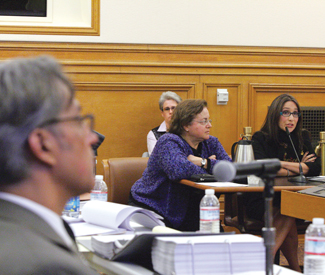
In the eyes of his critics, suspended Sheriff Ross Mirkarimi may never be able to recover from the portrayal by prosecutors and Mayor Ed Lee that he abused his wife, intimidated her with threats to use his power to take custody of their young son if they divorced, and used her and his campaign manager to try to dissuade witnesses and thwart a police investigation.

The tearful video of his wife, Venezuelan actress Eliana Lopez, displaying the bruise on her arm, and the fact that Mirkarimi pleaded guilty to a misdemeanor false-imprisonment charge in connection with the incident are all these critics need to condemn him. Indeed, it was all that Lee relied on when he suspended Mirkarimi without pay and launched unprecedented official misconduct proceedings to remove him from office.

But now that the Ethics Commission has gotten through the substance of its inquiry — and past the tedious work of creating from scratch systems and standards for gathering evidence and evaluating whether it warrants an elected official’s removal by the mayor — the testimony has told a very different story of what really happened.

Accusations of witness dissuasion (which had been one of three original criminal charges Mirkarimi faced before agreeing to a lesser plea deal) and abusing his official position haven’t been supported by any direct evidence or testimony, and as the hearings wore on, Deputy City Attorneys Peter Keith and Sherri Kaiser were looking increasingly vindictive as they fruitlessly pursued those angles with witnesses who seemed credible.

There is also no direct evidence that the abuse was anything more than a moment of frustration and bad judgment at noontime on Dec. 31, when Mirkarimi grabbed Lopez’s arm as she tried to walk away from their heated argument about divorce child custody, and she yanked it away, eight days before his swearing in as sheriff.

Whether that incident and its aftermath meets the City Charter’s broad and untested definition of official misconduct — including “conduct that falls below the standard of decency, good faith and right action impliedly required of all public officials” — will be up to the interpretation of the Ethics Commission, which has now accepted all the evidence that it has deemed relevant and credible. All that remains is the fight over its “finding of fact” at an Aug. 16 hearing and its subsequent recommendation to the Board of Supervisors, which could begin considering the matter in September.

There won’t be an inquiry into whether Mayor Lee committed perjury on June 29, as outside witnesses said he did on two separate issues. The commission July 19 rejected the argument by Mirkarimi’s attorneys that Lee’s alleged lies under oath would cast doubt over his reasons for launching these unprecedented proceedings and the discretionary judgment he exercised. Commissioners decided that was a tangential issue.

In the final hour of the commission’s laborious work in whittling down the voluminous evidence that the city has presented in this case — which both sides and the commission openly acknowledge will likely be considered by the courts as well as the board — it also made deep cuts into the written testimony of attorney Nancy Lemon, a domestic violence expert who drew damning conclusions about Mirkarimi based on how “batterers” typically behave.

That’s been a big part of the city’s case, reducing Mirkarimi down to a two-dimensional batterer whose every action can be predicted by that distinction, from the manner in which he relinquished his weapons to police to the reasons why Lopez has resisted cooperating with efforts to charge her husband with crimes and remove him from office.

Lemon’s testimony was based almost solely on second-hand descriptions of life in the Mirkarimi household in a 22-page written declaration by neighbor Ivory Madison, who was also the only witness that Lee said he spoke to before removing Mirkarimi from office. But most of Madison’s incredible and fantastical narrative — which painted Mirkarimi as a monster who repeatedly abused Lopez and their son and controlled every aspect of their domestic life, right down to what and whether they ate — had already been discredited and disallowed by skeptical commissioners in June.

“I was disappointed by the content of Ivory Madison’s declaration. A first-year lawyer should know that much of it is inadmissible and it should not have been given to us,” Commissioner Paul Renne told Keith in June. Renne called the declaration “clearly hearsay, clearly having the intention of poisoning the well of this hearing.”

Keith apologized and offered little resistance to much of the declaration’s removal, but the city has nonetheless continued to rely on the second-hand accounts of Madison and another neighbor, Callie Williams, in its descriptions of Mirkarimi’s conduct and the questioning of witnesses.

But that hearsay evidence and speculation was countered on July 18 and 19 with the extended cross examination of two key witnesses in the case: Lopez and Mirkarimi campaign manager Linnette Peralta Haynes, a woman with domestic violence training who Lopez reached out to on that pivotal day of Jan. 4 when Madison called the police. Each woman spent more than three grueling hours each on the stand, questioned by city attorneys and commissioners — and they painted a very different portrait of the events than Lee and Madison had.

As for Madison — having had most of her testimony stricken from the record, and with Lopez testifying about Madison’s sudden zeal for going after Mirkarimi and involving his political opponents in that process — Mirkarimi’s team decided not to call her to the stand for live cross-examination. Attorney Shepherd Kopp told reporters, “I think the neighbor’s testimony is suspect at best.”

The go-between

Haynes was central to the city’s allegation that Mirkarimi dissuaded witnesses and sought to thwart a police investigation. Phone and electronic records revealed that she communicated with both Lopez and Mirkarimi many times on Jan. 4, the day Mirkarimi learned that his wife had been confiding with neighbors about the Dec. 31 incident and that Madison had broken that confidence and called the police.

The city’s apparent theory was that Haynes acted as Mirkarimi’s agent in trying to cover up the incident and do damage control, including coaching Lopez on what to say to Madison and Williams.

But the city has never had any evidence to support its theory, and this was its first chance to question Haynes, who had been at the end of a high-risk pregnancy and resisted cooperating with the investigation.

Yet despite Kaiser and commissioners grilling Haynes for more than three hours — twice as long as she had told the commission that she would need — no smoking gun emerged. Haynes seemed calm and consistent as she described giving Lopez emotional support and probing to ensure that she wasn’t in danger. Kaiser fumbled through technical difficulties and maintained an accusatory and belittling tone even as the answers she was receiving seemed to destroy her line of questioning.

“I think the house of cards that mayor has been trying to establish about witness dissuasion was demolished by Linnette Peralta Haynes, who was absolutely credible,” Mirkarimi attorney Shepherd Kopp told reporters after the hearing.

Haynes has a background in domestic violence, undergoing a 40-hour certification training in the mid-90s when she went to work for a domestic violence center in San Mateo for almost two years, then later helping develop and teach a domestic violence curriculum for the jail in San Francisco.

She’s familiar with the Power and Control Wheel — the basis for many of Lemon’s conclusions — which indicates how physical abuse can be connected to other forms of abuse, such as emotional, verbal, and sexual abuse. It was with this background and training that Haynes questioned Lopez about whether she was in danger and being abused when she got an unexpected call on the morning of Jan. 4.

“She let me know she had an argument with Ross and wanted to talk to me,” Haynes said, later answering another question by saying, “She told me she was really worried about custody issues and she was talking to a friend who was an attorney.”

That friend turned out to be Madison, who Lopez maintains had represented herself as an attorney who would keep their conversation and the video they made of her injuries confidential, to be used only in the event of a custody battle. The city has sought to cast doubt on that claim — which the court rejected in Mirkarimi’s criminal case when it admitted the video as evidence — implying that Madison was simply a concerned friend and the attorney argument was developed weeks later.

Haynes said she asked Lopez whether there had been any prior incidents of physical abuse, whether Lopez felt unsafe, and whether she had been subjected to other forms of abuse — defining each form for Lopez — and that she was told “no” to each question.

“I asked if she thought she was in danger and she said no,” Haynes said.

Later on Jan. 4, Lopez told Haynes she had made the video: “She told me a friend had helped me do a video just in case I needed it for custody issues…She did tell me that she really wanted to work on her marriage, that she wanted to make to make it work, but that just in case she wanted to make sure she got custody of Theo.”

Lopez later testified that one reason she sought out Haynes was because Madison had suddenly become aggressive in trying to convince her that she was a domestic violence victim and the incident needed to be reported to the police, and Lopez wanted to get the perspective of someone with a background in domestic violence.

“I said, I have a person telling me this, I want your opinion about it,” Lopez testified.

Around 12:30pm that day, when Madison informed Lopez that she had called the police and they were on the way, she frantically called Haynes from Madison’s house and suddenly put the two women on the phone together, which Madison and the city have characterized as a witness dissuasion effort.

Haynes said she was confused when Lopez suddenly handed the phone to Madison: “She said, ‘help me, help me, help me,’ and I’m on the phone wondering what’s going on.”

“[Madison] told me, ‘I’ve been talking to Eliana for several days and I just called the police,’” Haynes said.

Haynes said she asked Madison if she had called any domestic violence agencies or if she just called the police “and she got very agitated” — adopting a defensive tone of voice — and that reaction seemed “fishy” to Haynes.

Asked whether she tried to dissuade Madison from talking to the police, she responded, “I told her she should maybe talk to her friend about what she wants.” She said that she could hear Lopez telling Madison, “This is not what I want, this is not what I want.”

So Haynes said she tried to extricate herself from the situation: “I told her I really think you need to get off the phone, talk to Eliana, and respect her.” And the phone conversation ended with Lopez getting back on the line and telling Haynes to call Mirkarimi to let him know what was going on.

But Mirkarimi was busy and not answering his phone, prompting Haynes to text at one point that he needed to answer ‘so I can protect you.” What did she mean by that, Kaiser asked.

“My thinking was that something sounded fishy, something wasn’t right, and they need legal help,” Haynes said.

“Your focus had been on Eliana up until then?” Kaiser asked.

“My focus has always been Eliana,” Haynes responded.

Later, asked about the nature of her repeated phone conversations with Lopez, she denied helping her strategize ways to dealing with witnesses or police. “I was just providing support for her, emotional support,” Haynes said, later adding “I wanted to be present for her.”

The victim

Lopez testified that while the grabbing incident was unacceptable and serious — which she conveyed to Mirkarimi — she didn’t consider herself to be in an abusive environment or in need of outside help, except perhaps the marriage counseling she had been seeking and which Mirkarimi finally agreed to.

“An abusive environment is when those kinds of think happen every day or every week,” she said, maintaining — in the face of repeated questioning — that this was the first and only instance of physical abuse.

“At the end of the day on Dec. 31, I told him, that cannot happen, this is wrong, we need counseling,” she said. “He realized it was wrong and he took it very seriously.”

But she said that Madison went from being a supportive friend and counselor on Jan. 1 to suddenly becoming increasingly insistent that Lopez report the incident to police in the days that followed.

“She started trying to convince me to call the police in that email,” Lopez said, answering a question about a Jan. 2 message from Madison, “but that wasn’t our conversation on Jan. 1.”

Lopez said Madison’s approach got more aggressive. “She said, ‘screw him, I have a lot of friends willing to help you,’” Lopez said, noting that Madison offered her the vacant homes of rich friends and offered to bring in journalist Phil Bronstein, DA George Gascon, Attorney General Kamala Harris, and Lieutenant Governor Gavin Newsom to help her.

“It looked to me suspicious…She was calling Ross’ political enemies,” Lopez said.

When Lopez finally made it clear she didn’t want police involvement, Madison called the police.

“I didn’t expect that my lawyer could call the police on her own. I thought that was my decision,” Lopez said.

Keith tried to tie Lopez’s custody concerns to his status as sheriff, driving at that point with many questions. But Lopez said her concern was that California family courts would favor Mirkarimi simply because he’s an American and she’s from a country that has bad relations with the US.

“In this country, I think he’s in a better position than me,” she said. After he again tried to make it about his official position, she said, “As a sheriff, no; as an American, yes.”

She denied the claim by the city and Madison that it was Mirkarimi who sought to improperly use his position, a key element of removing him for official misconduct. Lopez said her conclusions about Mirkarimi’s advantages in a potential custody battle were the result of conversation that happened much earlier.

“That conversation happened in March 2011. He wasn’t even thinking about running for sheriff at that point,” she said, denying that Mirkarimi ever raised his official position in their custody conversations and claiming the concerns about his power were her own. “He never said that, that was my conclusion of our conversations. He never said, ‘I am a powerful man.'”

Throughout hearings, Mirkarimi’s side has enjoyed strong shows of public support, with many of his supporters wielding signs that read, “I believe Eliana” and “I support Eliana,” both in Spanish and English.

During a recess in the July 18 hearing, Mirkarimi said he appreciated the outpouring of support: “There are scores of people showing their support who think this has gone way too far.”


High noon for CPMC

7

CPMC, the health-care giant owned by Sutter Health, has two weeks to convince some very reluctant city officials that its plan to build a flashy new hospital on Van Ness Avenue is at least marginally acceptable.

It might not be possible.

CPMC and Mayor Ed Lee had a deal back in June — a bad deal for the city, but one that the mayor was ready to push. Then internal documents showed that the hospital folks weren’t telling the truth and were looking for ways to shut down St. Luke’s, which provides care to the underserved population in the southeast part of the city.

The actual deal is in some kind of suspension now, since CPMC and the mayor aren’t anywhere near close to agreement — but the environmental impact report on the development came up on appeal to the supervisors, and it was clear that there weren’t enough votes to approve the document. Rejecting it would have set the project back at least 18 months, probably two years — and that would spell doom. CPMC is under a state mandate to upgrade the seismic safety of its facilities by 2015, and this Van Ness super-hospital is supposed to replace that aging California St. campus, which doesn’t meet state codes.

At the end of a seven-hour hearing, the supes agreed to continue the matter for two weeks after Michael Duncheon, Sutter’s general counsel, promised to maybe, sorta, kinda try to reopen talks with the city:

“In the intervening two weeks, CPMC commits to work with the mayor’s office and with you. … CPMC is ready to talk about a structure for future discussions as we all put our heads together.”

I other words, we’re ready to consider the shape of the bargaining table.

That doesn’t go very far, particularly since CEO Warren Browner has been a complete asshole throughout this process. He acts as if he’s entitled to do anything he wants with this project and he dismisses community benefits as nonsense. Oh, and guess what? He’s not even around right now. He’s on vacation.

Sup. Jane Kim made a good point in her remarks:

“The fundamental issue in certifying this EIR, in my humble opinion, is the elephant in the room, which is that there is no proposed project.  The only sponsor of this project, has himself stated that there is currently no project without greater assurance and agreement to stronger language from project sponsor on a commitment to the operation of St. Luke’s.”

And she said that if the matter hadn’t been continued, she would have voted not to certify the EIR. Sup. David Campos told me that he agreed: “We sent a very clear message that we can kill this thing if we want to,” he said.

So now we wait two weeks to see if Browner and his crew will come to their senses. “There’s hope,” Campos said, “but who knows?” And if CPMC doesn’t come back very quickly with a much-better plan, it will be time to start thinking about other options for saving St. Luke’s.

Gated communities of hate

32

OPINION “I have been arrested for 3 times in one day for sitting on the street in San Francisco” PoorNewsNetwork panhandler reporter and my fellow “poverty skolar” Papa Bear reported in our monthly community newsroom meeting last week.

As Papa Bear reported on yet another example of being arrested for the sole act of being poor, black and houseless in America, I received a text message from Berkeley that after a second round of seven hours of testimony against the proposal to put a sit-lie measure on the November ballot, it was approved anyway.

From Santa Monica to Santa Cruz, from Atlanta to San Francisco, cities across the US have been sliding towards fascism and the casual criminalization of poor people with the 21st century pauper law known as the sit-lie law.

As I have asked before — and I will ask again with the hope that readers will truly think this through: How did we all buy into the notion, without even realizing it, that emptiness equates with cleanliness, that public space should be empty to be clean and that public really doesn’t mean public anymore, if its filled with the “wrong” people?

When me and my poor Black/Indian mama dealt with houselessness and racist and classist profiling throughout my childhood, we were arrested multiple times for the sole act of sleeping in our car in certain neighborhoods, and eventually I was incarcerated for those poverty crimes — and no matter how many times I was arrested, cited, and incarcerated, my or my mama’s poverty didn’t go away. As a matter of fact, it got worse.

Berkeley, more than these other cities, is pretty ridiculous, because so many activists live there and work on issues of Palestine and immigration and anti-war and economic justice. It just shows the true colors of separatist, grant-guideline-fueled organizing that does not connect and conflate all of these struggles together.

As a poor indigenous mother who struggles on welfare and has been incarcerated and houseless for years for the sole act of being poor, my criminalization is completely connected to my migrant brothers and sisters fighting borders and to my sisters and brothers who struggle with colonization and globalization in the global south and beyond.

I cannot work against the false borders and occupation in Palestine and not work equally on the false borders and occupation by police and ICE in Mexico, Oakland, or Berkeley. I cannot work against the war in Iraq and not also work against the war on the poor.

But corporations and wanna-be corporations — not people — are in control of politricksters in these cities. So the racist and classist lies and mythologies about those dirty, crazy, and dangerous houseless people or young people of color flood the dialogue surrounding the issues of sit-lie, and gang injunctions, and increased police terrorism against poor folks of color. And the real issue — who defines what is public space and who can be considered the public? — is ignored.

I ask readers as this issue comes up on the ballot in Berkeley, as it did in San Francisco, to really think about the kind of world we are becoming, the ease with which we are thinking and incarcerating certain people and the borders and gates and locks we are putting in place that will eventually change our supposedly public and free society into smaller and smaller, gated, racist, communities of hate.

Tiny, aka Lisa Gray Garcia, runs POOR Magazine and is a poverty scholar and activist.


Guest opinion: RCV is good for progressives

52

Since San Francisco began using ranked choice voting in 2004 and public financing of campaigns in 2002, the city has been a leader in the types of political reform badly needed at state and national levels. People of color today have an unprecedented degree of representation and progressives are a dominant presence in city government. Elections are being decided in November, when turnout usually is highest, and the combination of public financing and deciding races in one election minimizes the impact of independent expenditures and Super PACs .

Yet progressive stalwart Calvin Welch, whose work we have long admired, recently authored a Bay Guardian oped against RCV. His charges against RCV are as wrong today as they were when he first made them 10 years ago when he opposed RCV on the ballot. And given the horrible Supreme Court ruling known as Citizens United, which has opened the floodgates on corporate campaign spending and did not exist when San Francisco last used separate runoff elections, returning to two elections is a direct threat to the future of San Francisco progressivism. 

The most serious of his claims is that RCV favors “moderate to conservative candidates” because “left-liberals do very well in run-off elections” since “in low-turnout elections, left-liberals vote more heavily than do conservatives.” He cites the 2000 supervisorial races and 2001 city attorney race, in which “the more liberal candidate for City Attorney, Dennis Herrera” bested “Chamber of Commerce functionary Jim Lazarus.” He asserts “that’s a verifiable San Francisco political fact.”

But San Francisco State University professor Richard DeLeon, author of the acclaimed book of Left Coast City about San Francisco politics, debunked that claim with real election data in his 2002 paper, “Do December runoffs help or hurt progressives?”

He found that in the November 2001 city attorney election, for every 100 voters who turned out in progressive precincts, 107 turned out in conservative precincts. But in the December 2001 runoff, for every 100 voters who turned out in the progressive precincts, 126 turned out in the conservative precincts, an 18 percent increase. Wrote DeLeon, “This dramatic increase in the ratio of conservative to progressive voters occurred despite (or perhaps because of) the 44 percent drop in voter turnout citywide between November and December.”

He continued: “If San Francisco had used [ranked choice voting] in November, Herrera most likely would have won by an even greater margin. In November, the liberal/progressive candidates for city attorney won a combined 60 percent of the vote…In the December runoff, however, Herrera won with only 52 percent of the vote. Thus, due to the proportionally greater decline in progressive voter turnout, Herrera probably lost approximately 8 percent of his potential vote, making the election close.”

DeLeon also rebutted Welch’s citation of the supervisorial races in 2000 as ones that demonstrated a progressive advantage in low-turnout runoffs, writing:

 “Progressive success that year was NOT due solely to a one-time surge in turnout among progressive voters…Many powerful forces converged in that election, not least the anti-Willie Brown backlash, the cresting of the dot-com invasion, and the return to district elections, which forced despised incumbents to stand trial before angry neighborhood electorates.”

DeLeon concluded:  “Based on the evidence presented, I conclude that December runoffs have hurt progressive voters, candidates and causes in the past and (absent same-day runoffs) will continue to do so in the future, even under district elections.”The Bay Guardian cited Professor DeLeon’s study in March 2002 (see  and scroll down to “A is OK”), and Mr. Welch is ignoring these results today just as he did then.

Certainly progressives haven’t won 100% of RCV elections — should any political perspective? — but they have done well nonetheless, electing  Bay Guardian-endorsed candidates like John Avalos, David Campos, Eric Mar, David Chiu and Ross Mirkarimi, despite those candidates not being incumbents. Other progressive incumbents first elected before RCV elections, like Aaron Peskin, Chris Daly, and others, were re-elected under RCV. And Mirkarimi was elected citywide in the sheriff’s race. On  the flip side, progressive Eileen Hansen most certainly would have beaten moderate Bevan Dufty in a November RCV contest for D8 supervisor; instead she lost in December after finishing first in November.

What’s actually at stake here is how we define progressivism. Since we began using RCV in 2004, 8 of the eleven members of the Board of Supervisors come from communities of color, a DOUBLING from pre-RCV days. At the citywide level, all seven officials elected by RCV come from communities of color. So out of the 18 elected officials in San Francisco, a whopping 15 out of 18 come from communities of color, the highest percentage for a major city in the United States.

The proposed repeal amendment would launch low-turnout September elections in San Francisco. In fact, the December 2001 city attorney race in which Welch cites as exemplary had a turnout of 15 percent of registered voters, the lowest in San Francisco’s history. New York City’s last September mayoral primary had a turnout of 11.4 percent. In Charlotte NC (population 750,000, similar to San Francisco) its last mayoral primary had a turnout of only 4.3 percent. Cincinnati had a September turnout of 15 percent, and Boston and Baltimore had September mayoral primaries with turnout in the low 20s. Many cities in Minnesota have September primaries with extremely low turnout; the two largest cities, Minneapolis and St. Paul, have switched to RCV largely to eliminate September primaries.

Research has demonstrated that voters in low turnout elections are disproportionately more conservative, whiter, older, and more affluent; those who don’t participate are people of color, young people, poor people — and progressives. So having a mayoral race in a low turnout September election has real consequences not only on voter turnout but on the demographics of the electorate.

While we share the priorities of Welch’s progressive economics, we believe progressivism must be more inclusive, especially if it wants to enjoy the support of these burgeoning demographics. While disappointed by the lack of progressive achievements of President Barack Obama, we still view the election of the first African American as president as a major progressive achievement.

Finally, we would assert that the ranked ballots used in RCV have been important for San Francisco democracy. Just look at the recent “top two” primary on June 5, and you can see the defects of the methods proposed to replace RCV. In many races across the state – including in the Marin County congressional race where progressive Democrat Norman Solomon lost by 0.2 percent — too many spoiler candidates split the field and candidates got into the top two with extremely low vote percentages, some as low as 15 percent of the vote. In one race where there was a Latino majority and a solid Democratic district, the Democrats ran so many candidates that the Democratic vote split and two white Republicans made the runoff with low vote percentages.

San Francisco risks such elections if we get rid of RCV. Think of the last mayoral election, and the choice for Asian voters if we used single-shot plurality voting instead of RCV. Which Asian candidate would they vote for with their single-shot vote — Lee, Chiu, Yee, Ting, Adachi? What kind of vote split might have occurred? And to avoid that, what kind of backroom dealing would have occurred BEFORE the election to keep that many candidates out of the race to prevent that vote-splitting?  We saw such vote splitting in the 2003 mayoral election as well, with various progressive candidates running and splitting the progressive vote. Going back to plurality elections would be damaging for constituencies that often run multiple candidates, such as the Asian and progressive communities.

RCV has been good for San Francisco, and we should keep it. For those who would like to see a runoff in mayoral races, Board president David Chiu has proposed a compromise that, while increasing the costs of running for mayor, is far better than the repeal measure for September elections. Chiu’s proposal would keep RCV to elect the mayor, but with a December runoff if no mayoral candidate won a majority of first rankings in November. The 2011 mayoral election would have gone to a runoff, with John Avalos as Ed Lee’s opponent.

San Francisco progressives should embrace a view of progressivism that is inclusive, promotes higher turnout and is based on a politics that is looking forward instead of backward to some golden age that never existed. Ranked choice voting and public financing are two parts of the puzzle for ensuring a vibrant progressivism.

Steven Hill led the campaign for ranked choice voting in San Francisco, and Matt Gonzalez was President of the Board of Supervisors and legislative author of the RCV charter amendment. See www.SFBetterElections.org for more information


A Republican feminist

13

caitlin@sfbg.com

LIT “Do you consider yourself sex-positive?”

If you have a chance to interview John McCain’s daughter, and she identifies as a feminist, and is demonstrably more comfortable in strip clubs than the “liberal comedian” with whom she has embarked on a tour with in promotion of their book America, You Sexy Bitch! (Da Capo Press, $26, 352pp), you have to seize your moment to ask the big questions.

The pause from the other end of the telephone line tells me Meghan McCain, however, does not know what this term refers to. “Do I consider myself sex-positive? I’m not sure what you mean.” See?

She and Michael Ian Black will be in conversation at the Castro Theatre on Tue/17 at an event sponsored by the Commonwealth Club, by the way.

“It’s a term that we use — keep in mind I’m calling from San Francisco,” I say. “To mean not ashamed of sex. Of the opinion that having sex with people is OK. Different kinds of sexualities?” Apparently I don’t know what sex-positive means either, or else I am awkward in explaining the term to Republicans.

McCain, having been raised in the belly of a well-oiled political machine, is wary of potentially loaded questions from reporters. But she has also built her adult career on being a fiscally conservative woman who delights in bucking the social mores of the Republican Party. As such, she is able to compose a categorical response that is still pretty charming to her commieweirdo interviewer.

“I’m a big supporter of the gay community, if that’s what you’re asking me. And when it comes to my personal life, I am not abstinent, if that’s what you’re asking me as well. I am straight, if that’s what you’re asking me. I only date men. But sex and sexuality, I’m not terribly prudish. I think it’s private in nature but as far as I’m concerned, everybody can do whatever they want as long as it’s legal. In the privacy of their own homes, that’s their business, literally. As long as they’re not hurting anybody, I don’t care. Do your thing.”

Despite the many pages McCain and Black spend casting themselves as a “real” conservative and liberal — McCain as a gun-loving war eagle, Black as a snarky priss — the secret-not-secret point made by America, You Sexy Bitch is: politics don’t make the person. To that end, readers are taken on a RV tour of the country with McCain and Black, a trip that threatens to reveal the real America. We learn that McCain is far more comfortable in strip clubs than Black and is happily single at 27, while the Ed veteran has been married since his early 20s, rarely gets drunk, and lives in the suburbs with the wife and kids.

One of my favorite aspects of McCain (and I have many), is the way she speaks out against the treatment of women in the media. Her fervor should come as no surprise: last year, she wrote a scathing open letter to Glenn Beck when he called her fat on his radio show. (“As a person known for his hot body, you must find it easy to judge the weight fluctuations of others, especially young women.”)

“I would have an entirely different career, an entirely different life if I were a man, which I think is just ridiculous,” she tells me. She laments the fact that women politicians have to deal with the “complete BS” that is appearance-driven mainstream media reportage.

She’s great! We’re best friends! Hang out with me, Meghan! But then, this, meant to be completely free of irony: “I hate this idea that the feminist movement has been caught up in the pro-choice movement and somehow the denial of femininity, which is something I don’t understand. For me being a feminist means giving women the choice to do whatever they want.”

Wa-wahhh. Still, I’ll take her over Beck any day.

MEGHAN MCCAIN AND MICHAEL IAN BLACK

Tue/17, 7pm, $15–$45

Castro Theatre

429 Castro, SF

www.commonwealthclub.org


Meanwhile, in Uruguay

1

caitlin@sfbg.com

HERBWISE Happy Independence Day hangover (yes, still)! I’ll leave aside all discussion regarding the wisdom of the mid-week holiday and head straight into the fact that I spent the evening of the Third of July very, very sadly.

It was for this reason: after work I tore over to my beloved neighborhood dispensary Shambhala Healing Center (www.shambhalasf.com), arriving ten minutes before closing time. It was closed. Peeved, I called in to lightly berate them for shuttering early.

But this was no early start to the staff’s holiday. Just hours after I posted last week’s Herbwise about the Vapor Room going kaput, I found out Shambhala’s brick and mortar location had shut its doors for the last time on June 30.

Now this should not have come as a surprise. I spent time with an indignant Shambhala founder Al Shawa in his dank-smelling dispensary backroom this spring, discussing the letter that US Attorney Melinda Haag sent to his landlord, proclaiming that his storefront was inappropriately close to a playground, and that this landlord faced decades of jail time if he wasn’t evicted (“Shambhala Healing Center next on the federal chopping block,” 3/5/12).

I should have been paying closer attention to Shawa’s predicament, especially since I buy my sativa from him. At least Shambhala will continue to deliver, a move that the last place I used to buy weed from in the Mission, Medithrive, also resorted to when it was forced to close in November. (For the Herbwise column on that mess see “For the kids?” 12/13/11)

For me, the Third of July was a moment when this to-do between the federal government and these local businesses (and more importantly, the patients that depend on cannabis to function) punched me in the gut. My plans for THC consumption over Independence Day had been foiled by the feds, and all at once the sheer idiocy of this whole cannabis crackdown was almost too much to bear. Work on real problems! Go!

(By the way, SF Chronicle columnists Philip Matier and Andrew Ross have it on good authority that Obama is coming back to town on July 23 for his seventh Bay Area fundraising trip this year, who is down for a protest?)

So this week, I’m giving it up for South America. Big ups to Uruguayan president Jose Mujica for proposing a plan to legalize marijuana so that adults could walk into government-run stores and buy weed. He presented it as an anti-crime measure, suggesting that the hundreds of millions of dollars spent on pot by consumers could be better funneled in the government’s pocket than those of illegal drug dealers.

President Mujica is blessed with one of his continent’s most stable countries — plus it’s tiny, at 3.3 million inhabitants — so his plan could prove more manageable to implement than elsewhere in South America. But he’s not the only leader south of Panama to call bullshit on this War on Drugs. This spring at the Summit of the Americas in Cartagena, Colombia, that country’s President Juan Manuel Santos called for an “in-depth discussion” on the War on Drugs’ utility, preferably one “without any biases or dogmas.” He suggested, as many have, that Prohibition has never worked before, and might not be working now.

Our president was there too. “Legalization is not the answer,” said Barack Obama to a conference full of Latin American leaders. Of those who remain focused on this issue, President Obama counseled perspective. He said that this kind of debate seemed “caught in a time warp, going back to the 1950s and gunboat diplomacy, and Yanquis, and the Cold War, and this, and that, and the other. That’s not the world we live in today.”

Anyways, I’m sure that when he gets here — July 23! — he’ll be looking for our opinion on the ways of the world. ¡Hasta pronto!


Mayor and Mirkarimi testify in Ethics probe before dramatic disruption

261

After Sheriff Ross Mirkarimi endured about four hours of questioning in his official misconduct proceedings, mostly from Deputy City Attorney Peter Keith, Mayor Ed Lee took the stand a little after 1pm. But just as Mirkarimi attorney Shepherd Kopp was beginning to pin Lee down on the selective manner in which he decided to launch these unprecedented proceedings, the commission suddenly announced the hearing was being suspended and the room would need to be cleared immediately.

There is speculation that there was a bomb threat or other security emergency, but officials have so far offered no explanation for the dramatic development or whether the hearing would reconvene today. Yet the room is still half-filled with journalists and audience members, some speculating that that the clearing of the room was simply an effort to get the unusually grim-faced Lee off the hot seat.

Kopp’s questioning included pointed questions about whether he consulted any members of the Board of Supervisors before deciding to bring official misconduct charges against Mirkarimi in March. The city’s objection was overruled after Kopp noted that the supervisors will ultimately decide Mirkarimi’s fate. Forced to answer under oath, Lee said no, he didn’t speak to any supervisors before filing charges.

But progressive activist Debra Walker says Sup. Christina Olague — women who are close political allies and speak regularly — has repeatedly told her that Mayor Lee asked her opinion before filing the charges. If true, that would mean Mayor Lee committed perjury, which is a felony. Yet as reporters confronted Olague outside her office, she denied ever speaking with Lee about the case and then barricaded herself in her office.

When the reporters lingered and persisted, she finally emerged, reiterated her denial, refused to speculate about why her friend Walker would make that claim, and said, “We’re not allowed to discuss this matter with anyone before it comes to the board…I may have to recuse myself from voting on this.”

It was unclear why she thought recusal might be necessary, but if she does that would hurt Lee’s effort to get the nine votes on the board needed to remove Mirkarimi.

We’ll have complete analysis of the testimony and other developments in next week’s Guardian.


Is the Obamacare ruling good news?

33

Chief Justice John Robert’s atypical alignment with the left of the bench today led the Supreme Court to uphold most of the Affordable Care Act—a move generally lauded by liberals. But we spoke with a number of progressives who see Obamacare’s victory as solely a victory for the corrupt health insurance industry, and just another step off the path to a successful single-payer solution.

“This bill was written by and for the health insurance industry,” Clark Newhall,a physician and lawyer who is executive director of Utah’s Health Justice, told us. “It’s always been a bailout. It creates a huge new market of people who are forced to buy a shoddy product from a smarmy industry.”

Newhall said insurance industry execs constantly get $200,000 bonuses while health insurance premiums increase two or threefold. The industry found “accomplices in Obama and the Democratic Congress to do its bidding. It creates a government subsidy for these people so in essence this is simply a transfer of government money to the private insurance industry, similar to the bank bailout,” he said.

Many left-of-center Democrats, in fact, called on the Court to strike down the individual mandate that requires all Americans to either have health insurance or pay a penalty—the penalty the Court determined to be a tax, and thus Constitutional.

“Obama said this is the only way to cover everyone,” Russell Mokhiber, the founder of Single Payer Action who joined with 50 doctors to file an amicus brief with the Court rejecting the individual mandate’s constitutionality based on the Commerce Clause. “There are Constitutional ways to cover everyone. Single-payer already exists in Medicare for those over 65 and Medicaid for poor people. There’s a simple fix, which most of the western industrialized world has. The only way to control costs and cover everyone is single-payer,” he said.

According to Mokhiber, millions of people will still be left lacking insurance. He pointed to his electrician, a 63-year-old postponing a major operation until he can get Medicare in two years. “One hundred and twenty Americans die every day from lack of insurance,” he said.

Twenty-six million people in the country are currently uninsured, and the number is expected to grow even with the upholding of individual mandate, physician and congressional fellow Margaret Flowers told us. Although the ACA includes federal subsidies for some low-income people, many don’t make the cut. For example, employers with more than 49 employees are required to provide affordable care — but only for individuals and not their family members. In turn, the family members are no longer eligible for government subsidies, because a member of their household receives insurance from his or her place of work.

The SCOTUS’s rejection of the portion of Obamacare that took federal funds away from states that refused to expand Medicaid further places a burden on low-income Americans. “Upholding the requirement that individuals buy private insurance while allowing states to opt out of Medicaid expansion is the worst possible outcome,” author Gwendolyn Mink told the Institute for Pubic Accuracy today. “Achieving universal coverage by compelling low income Americans to purchase private insurance may beef up health industry profits but at the expense of people most in need of health care for all.”

Over at the Daily Kos, blogger Armando says the nature of the Roberts opinion could have more long-term detrimental effects on federal power in the future. In fact, he said, it’s “a shot across the bow to the Supreme Court’s New Deal jurisprudence that underpins our modern national government.” Rather than simply explain why the individual mandate qualifies as a tax, Roberts additionally took care to describe why it does not fall under the Necessary and Proper Clause or the Commerce Clause.

“Such a conception of the Necessary and Proper Clause would work a substantial expansion of federal authority,” warned Roberts, causing Justice Ruth Bader Ginsburg to question why he should “strive so mightily to hem in Congress’ capacity to meet the new problems arising constantly in our ever developing modern economy.”

Seeking local control

0

news@sfbg.com

As a potentially troublesome court decision threatens the existence of cannabis dispensaries in cities throughout California, San Francisco City Attorney Dennis Herrera submitted an amicus brief last week urging the California Supreme Court to reverse the decision.

In October, the state Court of Appeal ruled in the case of Pack v. City of Long Beach that city ordinances regulating medical cannabis dispensaries are preempted by federal law. Local jurisdictions across the state have adopted discretionary rules for permitting cannabis dispensaries that vary by jurisdiction. The court decision throws out local ordinances, making it illegal for cities and counties to develop regulations.

“The Court of Appeal’s decision strips cities of an essential tool for protecting public health and welfare,” reads Herrera’s amicus brief, which is joined by Santa Cruz Counsel Dana McRae. An amicus brief is commonly filed in an appeal concerning broad public interest by parties not directly involved the court proceedings.

The ruling could have drastic consequences for cannabis dispensaries and the clients they serve. Most cities in the state, including San Francisco, rely on local ordinances to regulate the medical marijuana industry. Herrera says cities will be forced to choose between banning cannabis dispensaries altogether or allowing their operation without local controls, such as San Francisco’s extensive regulations on where and how dispensaries can operate.

In the absence of local regulations, he argues that ” dispensaries and cultivation sites have the potential to generate serious impacts on surrounding communities, including electrical fires, criminal activity, hazards to children’s safety, pollution, harm to wildlife, traffic, noise and odors.”

The appellate court ruled local ordinances go beyond Prop. 215, the California voter-approved decriminalization of medical marijuana, and cross into the realm of actually legalizing it, conflicts with the federal Controlled Substance Act.

In the wake of the court’s decision, the impact was felt immediately. Across the state, cities suspended all new permit activity.

Since the decision was sent to the state Supreme Court in January, where it is currently under review, San Francisco resumed its permitting process. Not all cities resumed. Herrera noted that as many as 12 jurisdictions continue to suspend or severely limit new cannabis dispensary permits, including Santa Cruz.

Rory Bartle, a lawyer at Pier 5 law offices and medical marijuana advocate, says that if the decision isn’t overturned, the entire industry could be upended. However, Bartle says the ruling isn’t widely supported, many counties have filed amicus briefs, and in his opinion the ruling will be overturned.

It is hard to imagine Ryan Pack and Anthony Gale, plaintiffs in the Pack v. City of Long Beach case and members of a cannabis collective that was shut down because of local ordinances, realized the implication of challenging such regulations. Long Beach required a $14,000 non-refundable application fee and annual $10,000 fee.

“Long Beach has some crazy regulations designed to pull as much money as they can out of the medical marijuana industry,” says Bartle. “It’s stupid and unfair.”

In San Francisco, the fees for an application permit are $8,656 and another $4,019 for a license and re-inspection.