Oil

Run over by a reindeer

0

culture@sfbg.com

EVENTS

Union Square ice-skating rink Union Square, SF. www.unionsquareicerink.com. Through Jan. 16, 10 a.m.-11:30 p.m. except for when closed for private parties, $10 for 90-minute session. Sweetheart, the rink is open, grab my hand and try not to twist an ankle as we glide in circles around downtown’s living room.

Westin St. Francis sugar castle Westin St. Francis, Landmark Lobby, 335 Powell, SF. www.westinstfrancis.com. Through Jan. 24, on view 24 hours/day. Don’t lick it. For although this ever-growing sweet behemoth which each holiday season occupies the lobby of downtown’s classic luxury digs with its 1,300 pounds, 20 towers, 30 rooms, and sugar replicas of 2012’s movers and shakers has a hold on our heart, its original dimensions were sugar-spun back in 2005. Incredibly made, undeniably festive, but altogether inappropriate for dietary purposes.

Jack London Square holiday tree lighting Jack London Square, Oakl. www.jacklondonsquare.com. Nov. 30, 4:30-7pm, free. Performances by Disney-approved pop stars! Reindeer petting zoo! Miss California 2012 and a kids dress-up station with costumes from the Oakland Ballet! You’ll be hard-pressed not to find some holiday cheer at this annual lighting of Jack London’s fir tree for the masses.

Oakland-Alameda Estuary Lighted Yacht Parade Visible from Jack London Square, Oakl. www.lightedyachtparade.com. Dec. 1, 5:30pm, free. Let those cheeks get rosy, it’s boat-watching time. This yearly tradition sees the yacht owners of the East Bay putting their aquatic rides on display, stringing bulbs galore across decks and sails.

Festival of lights Union between Van Ness and Steiner, Fillmore between Union and Lombard, SF. www.sresproductions.com. Dec. 1, 3-7pm, free. Wiggle your nose at Santa at this explosion of twinkly tinsel and Cow Hollow reindeer — today Union Street puts on the holiday glitz and lays out the welcome mat. Cudworth Mansion (2040 Union) will be hosting a cupcake-decorating session from 3:30-5:30pm, at which Old St. Nick himself will make an appearance out front.

Golden Gate Park holiday tree lighting McLaren Lodge, 501 Stanyan, SF. www.sfrecpark.org. Dec. 6, 5pm, free. A tradition started by Golden Gate Park grandfather and San Francisco’s first park superintendent John McLaren in 1929, the lighting of the tree returns to Fell Street for the 83rd year in a row. Accompanying fanfare includes live performances, carnival rides, and a visit from Saint Nick.

Great Dickens Christmas Fair Cow Palace, 2600 Geneva, SF. www.dickensfair.com. Fri/23 and Sat.-Sun. Sat/24-Dec. 23, 10am-7pm, $21-25. For an ace weekend drunk this holiday season, toodle over to the Cow Palace. Once ensconced in the warm period embrace of the Dickens Fair, you will have the run of five bars (absinthe!), a multitude of meat pie shoppes, hilarious accents, near-constant stage shows, and the company of “famous Victorians,” including Charles Dickens and Her Majesty, the queen herself.

Family holiday crafts day Randall Museum, 199 Museum Way, SF. (415) 554-9600, www.randallmuseum.org. Dec. 1, 10am-3pm, free admission, activities fees vary. Bring the kiddos to the always-free-admission Randall Museum so they can spend the morning making holiday decorations and gifts. Cap off the morning with a performance by Asian American performance troupe Eth-Noh-Tec and its fusion of ancient and contemporary movement.

Community Hanukkah candle lighting Jewish Community Center, 3200 California, SF. (415) 292-1200, www.jccsf.org. Dec. 8-14, 4:30pm, free. Join up with your neighbors for the Jewish Community Center’s daily lighting of the menorah in the building’s atrium. Attend the Shabbat celebration on Dec. 14 for a family storytelling session, grape juice, hallah, and Hanukkah gelt.

Bill Graham Menorah Day Union Square, SF. www.chabadsf.org. Dec. 9, festivities start at 3pm, menorah lighting at 5pm, free. Each day from December 8-15, a candle will be ceremoniously lit on the Bill Graham mahogany menorah, a gift from the famous San Francisco promoter to his city. But on the 9th, Bill Graham Menorah Day festivities will occupy Union Square, a beautiful beginning to the Festival of Lights in the city.

Public library winter celebration Bernal Heights Library, 500 Cortland, SF. www.sfpl.org. Dec. 12, 6:30-8:30pm, free. The library’s got all kinds of free holiday programming this year, from cupcake-decorating and card-making to a magic show with a winter wonderland theme. Today’s no exception: join the Bernal Heights community for a kid-friendly celebration featuring the Bernal Jazz Quintet, refreshments, and children’s movies.

Frosting the Conservatory Conservatory of Flowers, 100 John F. Kennedy, SF. (415) 831-2090, www.conservatoryofflowers.org. Dec. 15, 11am-3pm, $10. Make your own ginger-greenhouse at this event amid the hothouse blooms of the Conservatory of Flowers. This events gets our thumbs-up for guaranteed toastiness, because being warm and cozy is a pre-req for Christmas cheer.

Jewish Christmas with Broke Ass Stuart The Make-Out Room, 3225 22nd St., SF. www.makeoutroom.com. Dec. 25, 5-11pm, $10. Strip dreidel set to the tune of streaming Woody Allen, Larry David, and Sascha Baron Cohen footage sounds like our kind of Christmas. Such was the vision of DJ Matt Haze and host Broke Ass Stuart, who designed this kitschy extravaganza for all of you (Chosen and Left Behind alike) who can’t stomach staying in on a perfectly good day off. Did we mention there will be a Chinese food buffet?

Kwanzaa celebration Bay Area Discovery Museum, 557 McReynolds, Sausalito. www.baykidsmuseum.org. Dec. 26, 9am-5pm, free. A traditional Kwanzaa altar will greet you upon arriving at the kids museum’s celebration of African-American culture, featuring two performance (at 11am and 1pm) by African Roots of Jazz.

PERFORMANCE

The Christmas Ballet Various times and Bay Area locations. www.smuinballet.org. Nov. 23 — Dec. 23, $25-65. Back by popular demand, the Smuin Ballet Company returns with this annual production, split this year into two acts: “Classical Christmas” and “Cool Christmas.” Both promise eye-opening, energetic entertainment set to eclectic tunes from Elvis to klezmer.

A Christmas Carol American Conservatory Theatre, 415 Geary, SF. (415) 749-2228, www.act-sf.org. Nov. 30-Dec. 24, various times, $20–$160. Stressful election year and rumors of apocalypse tightened those purse strings? Exorcise your inner Scrooge at this classic stage production of Charles Dickens’ terrifying ode to generosity and kindness towards diminutive children.

The Golden Girls: The Christmas Episodes Victoria Theatre, 2961 16th St., SF. www.victoriatheatre.org. Dec. 6-30, Thu.-Sat. 8pm, Sun. 7pm, $30. Our cover girl Cookie Dough co-stars as Sophia Petrillo in this now-traditional SF holiday stage production of the classic sitcom that employs more shoulder pads, even, than the original TV show. You’ll never know a catty elderly network television star until you’ve seen her re-enacted by a drag queen. Buy tickets pronto, the shows usually sell out.

California Revels Oakland Scottish Rite Center, 1547 Lakeside, Oakl. (510) 452-8800, www.californiarevels.org. Dec. 7-9, 13-15. Fridays 8pm, Saturdays and Sundays 1 and 5pm, $20-55. Feast and family are cornerstones of this annual interactive period piece performance celebrating the winter solstice. Hoist your mead and turkey leg and sway to the music, friends, good times will be upon ye here.

The Nutcracker Palace of Fine Arts, 3301 Lyon, SF. www.cityballetschool.org. Dec. 8, 2pm & 7pm; Dec. 9, 2pm, $20. Yes, everyone does The Nutcracker. At this point, it’s like the Rocky Horror Picture Show of ballet. (Would that ballet patrons donned Rat King costumes to attend!) Embrace the tradition, and check out the City Ballet School’s production of a classic.

Charles Phoenix Retro Holiday Show Empress of China Ballroom, 838 Grant, SF. www.charlesphoenix.com. Dec. 12, 8pm, $25. The creator of the Cherpumple, a pie-stuffed cake concoction that rises to the dizzying heights of kitsch, humorist Charles Phoenix celebrates the retro in every occasion. Tonight, he regales the crowd with tales of his favorite SF landmarks, road trips, and yes, feats of food fantasy.

Holiday youth mariachi concert Mission Cultural Center for Latino Arts, 2868 Mission, SF. www.missionculturalcenter.org. Dec. 14, 7:30-9pm, $15. Three mariachi troupes made of young people join forces for this exciting holiday program. The hat-dropping, guitar plucking action will be highlighted by Zenon Barron’s Mexican youth folk dance class.

The Snowman Davies Symphony Hall, 201 Van Ness, SF. (415) 864-6000, www.sfsymphony.org. Dec. 22, 11am, $13.50-57. Even the smallest budding season ticket holder will find this film-symphony presentation of Joe Nesbø’s classic children’s book a welcome boost to their holiday cheer. The animated version of this story of a youg’n’ whose bud is a Frosty-like chap will soar when paired with the world-class musicians of the SF Symphony.

Kung Pao Kosher Comedy New Asia Restaurant, 772 Pacific, SF. www.koshercomedy.com. Dec. 22-25, various times, $44-64. There’s nothing like having dinner on Christmas to up your alterna (or simply, not pan-Christian) cred. Add stand up comedy and you have a winning formula, which is obvious from the longevity of Lisa Gedulig’s annual show. This year features yucks from Judy Gold, Mike Capozzola, and Adrianne Tolsch.

Clairdee’s Christmas Yoshi’s San Francisco, 1330 Fillmore, SF. (415) 655-5600, www.yoshis.com. Dec. 24, 8pm, $20. Everything could use a little soul in lives and the holidays are no exception. Come hear the sounds of soul-jazz vocalist Clairdee, and soak in her ensemble’s rhythmic takes on Christmas standards.

“Holiday Memories” double feature A rare 16mm showing of Dylan Thomas’ A Child’s Christmas in Wales will be accompanied by a screening of The Sweater, a tale of a young hockey player’s passion for the sport, and the dangers that come of wearing the wrong jumper. Dec. 22, 2pm, Exploratorium, 3601 Lyon, SF. (415) 563-7337, www.exploratorium.edu

PEACE ON EARTH

Darkness and Light: A Hanukkah Meditation Retreat Jewish Community Center, 3200 California, SF. (415) 292-1200, www.jccsf.org. Dec. 9, 10am-5pm, $50-60. No prior experience is needed for this day-long workshop on finding the light within during the Hanukkah season. Sitting and walking meditation will be covered — the perfect primer for a month that can try the patience of even the most festive reveler.

Winter solstice ceremony San Francisco Zen Center, 300 Page, SF. (415) 863-3136, www.sfzc.org. Dec. 21, 6:15pm, free. Recharge on the longest night of the year in the peaceful confines of the SF Zen Center. The crowd here promises to be made of meditation newbies, Zen Center students, and all those in-between. It will also be your best bet to avoid jingles and tinsel, if that’s what your body is craving at this point.

Reclaiming’s Sing Up The Sun ritual Inspiration Point parking lot, Tilden Park, Berk. www.reclaiming.org. Dec. 21, 6:30am, free. Wake up before the sun does to greet it on this, the day of the year when it spends the least time out of its bed. A pagan celebration, you’re welcome to bring musical instruments and a warm Thermos of liquid to the community gathering.

GIFTS

Celebration of Craftswomen Herbst Pavilion, Fort Mason Center, SF. (650) 615-6838, www.celebrationofcraftswomen.org. Nov. 24-25, Dec. 1-2, 10am-5pm, $9 or $12 two-day pass. The first edition of this alternative holiday fair took place 34 years ago at the now-defunct Old Wives’ Tales Bookstore on Valencia Street with 22 female makers-of-things. Today, the event fills the Herbst Pavilion, features 150 juried artists and a mini-film festival. It’s still the best place for feminist shopping, some things don’t change.

Holiday Design Bazaar Intersection for the Arts, 925 Mission, No. 109, SF. www.artsedmatters.org. Nov. 30, 5-8pm; Dec. 1, noon-6pm, free. An arts fair with 25 local creators, plus live music and refreshments that may well make a difference in our kids’ art education. The event is a benefit for Arts Ed Matters, a group that is looking to build community support for art in schools.

Creativity Explored holiday art sale Creativity Explored, 3245 16th St., SF. www.creativityexplored.org. Dec. 1-2, noon-5pm, free. Shop at this studio for developmentally-disabled artists and half of your bill will go straight into their pocket — standard practice for Creativity Explored, which has been the real-deal spot for outsider art in San Francisco since 1983.

Paxton Gate holiday party Dec. 1, 3-6pm at Paxton Gate’s Curiosities for Kids, 766 Valencia; 8-10pm at Paxton Gate, 824 Valencia, SF. (415) 824-1872, www.paxtongate.com. One of the city’s most beloved families of taxidermy/kid’s toys/nursery shops, Paxton Gate is turning two decades of age this weekend. What better time to shop there? And what better to get your face painted “Victorian-style” (?!), check out stilt walkers and an accordionist-ballerina duo, and eat snacks during the day at its kids location — then walk two doors down later that night for more circus freakery, door prizes and a Hendrick’s gin open bar at 826 Valencia’s pirate shop?

Palestinian Craft Fair Middle East Children’s Alliance office, 1101 Eighth St., Berk. www.mecaforpeace.org. Dec. 1-2, 10am-5pm, free. Sip Arabic coffee while you paw through painted ceramics from Gaza, children’s book, scarves, West Bank olive oil, and more at this chance to support a nonprofit benefiting craftspeople living in Palestine — a particularly salient cause in this year of war and turmoil.

Bazaar Bizarre Concourse Exhibition Center, East Hall, 620 Seventh St., SF. www.bazaarbizarre.org. Dec. 1-2, 11am-6pm, free. This traveling indie craft fair stocks all the twee and yippee you need to get your gift recipients in your pocket. New in 2012: a mini-version of Forage SF’s Underground market, for all your small biz-sourced holiday edible needs.

Muir Beach Quilters Holiday Arts Fair Muir Beach Community Center, 19 Seascape, Muir Beach. www.muirbeach.com/quiltersfair. Dec. 1, 10am-5pm, Dec. 2 10am-4pm, free. Make a blustery beach journey that has time to spare for handicraft browsing. This annual gift fair stocks locally-made knickknacks by local groups (Muir Beach Garden Club included), and has more than retail opportunities. Hands-on crafts bars will stoke the creative fire of kids and big person shoppers alike.

La Cocina Gift Bazaar Crocker Galleria, 50 Post, SF. www.giftbazaarsf.com. Dec. 7, 1-7pm, free. You’re not going to have problems finding foodie-friendly presents at this fair — but getting them safely to their intended destination sans bite marks might be a problem. La Cocina business incubator program graduates Clairesquares, Onigilly, Love & Hummus Co., Chiefo’s Kitchen, and more will all have their wares for sale.

East Bay Alternative Book and Zine Fest Berkeley City College, 2050 Center, Berk. Dec. 8, 10am-5pm, donations suggested. www.eastbayalternativebookandzinefest.com. For the indie comic nerds on your list, you’ll want to check out this expo of all things zine. Talks by New Yorker illustrator Erik Drooker and Go the Fuck to Sleep author Adam Mansbach spice up the fair’s schedule and there’s rumor of a dance party to take place at day’s end.

KPFA Crafts Fair Concourse Exhibition Center, 635 Eighth St., SF. www.kpfa.org/craftsfair. Dec. 8-9, 10am-6pm, $10. Our public radio station hosts 220 artists and their wares for this no-brainer shopping weekend. Pick up unique wrapables from leather fashion to gourmet snacks to lotions and creams to pamper your loved ones.

Mercado de Cambio/The Po’ Sto’ market and knowledge exchange 2940 16th St., SF. www.poormagazine.org. Dec. 15, 3-7pm, donations suggested. We can pretty much guarantee you that there is no other gift fair that will have better hip-hop music. The Mercado de Cambio organized by POOR Magazine aims to counterbalance the corporatization of our holiday season. Go here for aforementioned live beats, indigenous crafts, Occupy gear, and POOR-published literature.

Renegade Craft Fair holiday market Concourse Exhibition Center, 635 Eighth St., SF. www.renegadecraft.com. Dec. 15-16, 11am-6pm, free. A DIY gift wrap station is one of the attractions at this one stop for cute gift shopping, which makes one of its two yearly appearances in the Bay Area for the holiday season. The Oakland Museum of California will truck out its mobile “we/customize” exhibit, and of course, there will be crafters: over 250 will have booths hawking clothes, accessories, home stuff, kid stuff — most handmade, and most awesome.
 

Sea change

1

virgina@sfbayguardian.com

APPETITE Two unrelated seafood restaurants have quietly undergone chef and menu changes in the last year. I was less than impressed with both when they debuted; now they’ve taken a turn for the better. There’s a low-key Mission seafood outpost with vegan accents, Weird Fish (renamed Dante’s Weird Fish), and a Financial District restaurant catering to the FiDi set, Georges, with upscale-casual seafood.

Tiny Weird Fish (2193 Mission, SF. www.weirdfishsf.com) has been around a few years, pleasing vegans and hipsters alike with grilled fish and seitan tacos. Owner Tim Holt left in 2011 to focus on Roshambo Farms (www.roshambofarms.com) in Healdsburg, which still supplies the restaurant with much of its produce. Holt opened Weird Fish with Peter Hood, who is back as owner alongside Ryan Simas, returning to roots of fish and vegan options, infused with new life. Simas knows seafood as chef de cuisine at Farallon, where he’s worked for nine years, now simultaneously co-owner at Dante’s and its neighbor, The Perch, eventually supposed to open next door.

Dante’s all day hours and a playful, affordable menu (discounted during lunch hours) are its selling points. Portions are small, but it’s rare to see enticing fish entrees under $10 — think of it as piecing together a meal. I can’t say the hit-and-miss aspects of the former Weird Fish has entirely changed, but I notice greater consistency and higher “high points” than before. “Pete’s famous clam chowder” ($4.75 cup, $6.75 bowl) is one surprise. Unlike the bland tortilla soup, the creamy chowder is flavor-rich with spanking-fresh clams. Fish and chips ($11 for two pieces, $14 for three), filling all on its own, features fresh fish of the day, flaky and light in Speakeasy’s Big Daddy IPA beer batter. A mix of sweet potato and regular potato fries falls flat, but fried fish dissolves comfortingly.

The vegetarian Waco Taco ($5) is one of their best bites. Though I’m a fish taco fanatic, a tilapia fish taco tasted over-salted and lifeless under mango salsa compared to this lively Waco Taco, packed with mashed yams, spinach, pepitas (pumpkin seeds), and guacamole. Fried calamari ($9.50) is perked up by fried lemon and sage leaves, dipped in lemon aioli and oh! chipotle sauce. Among fish entrees, I’ve fared best with Dijon-almond encrusted rainbow trout ($9.50) alongside buttery mashed yams ($4.75) laced with coconut milk and curry.

Dante’s casual, rock-and-roll (sometimes blaring a bit loud in the small space) attitude is a bright spot on Mission Street, uncommon if not “weird,” amid a sea of taquerias and 99 cent stores. In its Dante’s incarnation since March, Weird Fish captures the quirk of former days with greater focus on the food.

Georges (415 Sansome, SF. www.georgessf.com) took over the Financial District’s classic London Wine Bar in 2010 (which lacked an impressive wine list but boasted dated charm), completely revamping the space from dim, old school to white and airy. I dined during opening weeks — but was immediately turned off by overcooked fish at high prices. I didn’t return until a couple months ago, having heard good things about Chef Michael Bilger who came on in early 2011 from Wayfare Tavern, and now defunct Moose’s and Vivande Porta Via. Bilger’s cooking is a marked improvement since my 2010 visit.

Serving sustainably-sourced seafood per Monterey Bay Aquarium Seafood Watch (www.montereybayaquarium.org) standards, Georges’ focuses on being environmentally responsible in numerous aspects, like crushing raw bar shells into fertilizer for the local farmers who provide its produce.

Lunch is a bustling, convivial time to dine. As with lobster rolls, a Dungeness crab roll is expensive ($21), but a real beauty. Lush white crab is packed between bread with basil, piquillo pepper, and pleasing Southern touches of fried green tomatoes and remoulade, and the whole thing is accompanied by housemade BBQ potato chips. A silky crudo ($15) of albacore tuna cleanses the palate alongside a crisp white wine. Six cuts of tuna rest on hearts of palm, reasonably doused in garum (a fermented fish sauce I’m seeing on many menus lately), McEvoy Ranch olive oil, and vivid Meyer lemon.

Mussels and frites ($16 for mussels, $20 with fries) comfort on a chilly day, particularly with beer. Bilger steams plump mussels in Ommegang Witte beer, the broth exhibiting notes of fall from Rubinstar apples, savory with smoked bacon and leeks. One seafood misstep on a follow-up visit, however, was an overcooked, dry albacore tuna confit in bucatini pasta, tossed with zucchini, Calabrian chilis, Castelvetrano olives, and dose of bread crumbs ($16 lunch, $19 dinner). An affogato, a robust shot of espresso drowning lush vanilla gelato, the glass covered with a waffle cone crisp, is an ideal finish and caffeine boost before returning to work.

Georges is pricey but not out of line with the FiDi or the quality of ingredients. It’s not the same restaurant I dined at when it opened… and for this the entire staff deserves kudos.

Subscribe to Virgina’s twice-monthly newsletter, The Perfect Spot, www.theperfectspotsf.com

Put some cream on it: Warming up the holiday kitchen with Studio of Good Living

0

Five yogis walk into a kitchen and prepare seven dishes made with heavy cream.

This sounds like the beginning of a ridiculous and hilarious joke, but in all honesty, it’s pretty much how Saturday morning started out, with the very first recipe being homemade Irish cream (note: it was 11am). Things were off to an awesome start at the Studio of Good Living, Phoebe Schilla’s school of experiential cooking.

After introducing ourselves in chef Schilla’s beautiful home kitchen (and finding out that we’re all yoga fanatics), we got down to the business of preparing a variety of holiday sides and desserts, excited to master a few new recipes before this weeks holiday cooking bonanza begins.

Our chef, who trained at the Cordon Bleu and the Culinary Institute of America, is a personal chef and cooking instructor whose goal is to teach people how to cook simple, delicious food — and also eat it. Phoebe teaches out of her home, combing cooking with a yoga session and trips to the spa or the Ferry Building Farmers Market for her “signature experiences” offerings. She usually keeps class size under five students, so the experience is intimate, informative, and very hands-on. We not only learned new recipes, but we also got instructions on how to properly hold a knife, the perfect way to dice an onion, and how to crack an egg with one hand (more practice at home may be required on this last item!)

For our holiday cooking class, our lessons included the art of the perfect pie crust, two delectable stuffing recipes (one made with chestnut, another with wild mushroom), a chocolate truffle tart that would make an chocaholic beg for more, and a creamy vegetable soup that came with the option of increased richness with the addition of some heavy cream.

Overall, it was extremely fun — and a wonderful way to explore your kitchen and feel confident for the holidaze.

To add something wonderful to your Thanksgiving table this year, consider baking up a pan of Phoebe’s wild mushroom bread pudding

STUDIO OF GOOD LIVING WILD MUSHROOM BREAD PUDDING

Ingredients (serves 10-12):

1 (1-pound) loaf crusty-style white bread

¼ cup olive oil

1 ½ tsp. dried thyme

2 garlic cloves, chopped

4 TBS. butter

1 pound assorted fresh mushrooms

2 oz. dried porcini mushrooms, rehydrated in 1 cup boiling water, strain, and chop.

Reserve the liquid.

3 cups heavy whipping cream

8 large eggs

2 tsp. salt

1 tsp. freshly ground black pepper

1/3 cup finely grated aged parmesan, pecorino or gouda.

Instructions:

Preheat over to 375 degrees F. Butter a 13x9x2-inch glass baking dish. Cut the crust and short ends off the bread. Cut remaining bread with crust into ½ inch cubes. Place cubes in very large bowl. Add oil, thyme, 1 tsp of salt and ½ tsp of pepper; toss to coat. Spread cubes out on large rimmed baking sheet. Bake until golden brown, about 15-20 minutes. Transfer the toasted cubes to a large bowl.

Melt butter in large skillet over medium-high heat. Add sliced fresh mushrooms. Saute until golden and juices have evaporated, about 15 minutes. Continue cooking and allow to brown – about 10 additional minutes. Deglaze the pan with the porcini mushroom soaking liquid. Add chopped porcini mushrooms and reduce the liquid until it is almost dry. Whisk heavy cream, eggs, salt and ground pepper in large bowl. Pour egg and cream mixture over the bread. Let the custard soak into the bread for 15 minutes. Fold in the mushrooms and grated cheese. Transfer stuffing to prepared baking dish. Bake stuffing uncovered until set and top is golden, about 45 minutes to 1 hour.


District surprises

1

tredmond@sfbg.com

EDITOR’S NOTES The Wall Street Journal, which ought to focus on stellar reporting and skip the political analysis, stuck its haughty little nose into California last week, announcing that the Democratic supermajorities in the state Legislature spell doom for us all.

“Liberals,” the paper noted, “will pick up enough seats to secure a supermajority. Governor Jerry Brown then will be the only chaperone for the Liberals Gone Wild video that is Sacramento.”

I guess I go to the wrong parties, but I’ve never seen that movie. In fact, a lot of the Dems in Sacramento would have to cough and gasp a bit to call themselves “liberals,” and that’s on a good day. Frankly, the majority party in the Assembly and Senate tends to be relatively conservative, with many of its members afraid to so much as talk about, say, amending Prop. 13 or legalizing marijuana.

The bigger danger is that the Democrats from the more moderate districts will so fear that loss of their seats that they’ll want to be even more cautious about raising taxes than the Republicans.

See, I don’t think either party quite realizes what happened Nov. 6 in California, and what it means for the future.

This election wasn’t an anomaly. It wasn’t a miraculous twist of fate driven by high Obama turnout or by labor’s GOTV efforts to defeat Prop. 32. It was the inevitable result of two forces — the demographic changes in the electoral map of this state, and the utter, complete collapse of the California Republican Party. Neither one is about to change any time soon.

For decades, the GOP has focused on older, white, suburban voters, and there was a time when that strategy worked. But the future of the state is younger, non-white urban voters who are less frightened by crime, less xenophobic about immigration, less likely to have kids in private schools, and largely uninterested in the traditional Republican social issues.

Brian Leubitz, the insightful blogger at Calitics.com, notes that almost 30 percent of the people who went to the polls Nov. 6 were between 18 and 29 years old. “The California GOP, like the greater national party, has lost young voters,” he writes. “If it hopes to return to a semblance of a statewide party, it will need to moderate itself back into a party that accurately represents some portion of California’s electorate.”

How likely is that? Anyone want to bet that the GOP is going to reject the Howard Jarvis Taxpayers Association the right-wing radio guys in Los Angeles and start promoting immigration reform and an overhaul of Prop. 13? You’ll have to give me pretty long odds.

No: The era of Democratic supermajorities in the California Legislature is here to stay for a while, and the Dems might as well use it. No need to be afraid of a backlash; there’s nothing out there to lash back with. The only real danger is that Democrats and independents will be so disappointed in the Legislature’s failure to act on the huge issues facing the state that they’ll stay home in two years.

Why not talk about a split-role property tax program? Why not an oil-severance tax? Why not let local government raise local taxes without a two-thirds majority? The Wall Street Journal can whine all it wants, but it can’t change reality — right now, the Democrats are the only game in town.


Editor’s notes

0

tredmond@sfbg.com

EDITOR’S NOTES The Wall Street Journal, which ought to focus on stellar reporting and skip the political analysis, stuck its haughty little nose into California last week, announcing that the Democratic supermajorities in the state Legislature spell doom for us all.

“Liberals,” the paper noted, “will pick up enough seats to secure a supermajority. Governor Jerry Brown then will be the only chaperone for the Liberals Gone Wild video that is Sacramento.”

I guess I go to the wrong parties, but I’ve never seen that movie. In fact, a lot of the Dems in Sacramento would have to cough and gasp a bit to call themselves “liberals,” and that’s on a good day. Frankly, the majority party in the Assembly and Senate tends to be relatively conservative, with many of its members afraid to so much as talk about, say, amending Prop. 13 or legalizing marijuana.

The bigger danger is that the Democrats from the more moderate districts will so fear that loss of their seats that they’ll want to be even more cautious about raising taxes than the Republicans.

See, I don’t think either party quite realizes what happened Nov. 6 in California, and what it means for the future.

This election wasn’t an anomaly. It wasn’t a miraculous twist of fate driven by high Obama turnout or by labor’s GOTV efforts to defeat Prop. 32. It was the inevitable result of two forces — the demographic changes in the electoral map of this state, and the utter, complete collapse of the California Republican Party. Neither one is about to change any time soon.

For decades, the GOP has focused on older, white, suburban voters, and there was a time when that strategy worked. But the future of the state is younger, non-white urban voters who are less frightened by crime, less xenophobic about immigration, less likely to have kids in private schools, and largely uninterested in the traditional Republican social issues.

Brian Leubitz, the insightful blogger at Calitics.com, notes that almost 30 percent of the people who went to the polls Nov. 6 were between 18 and 29 years old. “The California GOP, like the greater national party, has lost young voters,” he writes. “If it hopes to return to a semblance of a statewide party, it will need to moderate itself back into a party that accurately represents some portion of California’s electorate.”

How likely is that? Anyone want to bet that the GOP is going to reject the Howard Jarvis Taxpayers Association the right-wing radio guys in Los Angeles and start promoting immigration reform and an overhaul of Prop. 13? You’ll have to give me pretty long odds.

No: The era of Democratic supermajorities in the California Legislature is here to stay for a while, and the Dems might as well use it. No need to be afraid of a backlash; there’s nothing out there to lash back with. The only real danger is that Democrats and independents will be so disappointed in the Legislature’s failure to act on the huge issues facing the state that they’ll stay home in two years.

Why not talk about a split-role property tax program? Why not an oil-severance tax? Why not let local government raise local taxes without a two-thirds majority? The Wall Street Journal can whine all it wants, but it can’t change reality — right now, the Democrats are the only game in town.


D5 race displays key SF political dynamics

70

There’s so much to say about the District 5 supervisorial race, whose top five finishers’ parties I attended tonight, gathering interesting perspectives from each candidate. But given the late hour, I’m just going to run a few thoughts and quotes and save most of it for a more in-depth report tomorrow, because there’s a fascinating story to be told here.

Christina Olague, John Rizzo, and Julian Davis – respectively the second through fourth place candidates – each presented as more progressive than the likely winner, London Breed, who has an 8-point lead going into the final ballot tally and ranked choice tabulation. They and their allies raised concerns that renters were undermined by Breed’s victory in one of the city’s most progressive districts.

“It was a lie. I’m a renter, I live in a rent-controlled apartment,” she told us just before midnight outside in party at Nickie’s on Haight. “I will do everything to protect rent control. I will work with the Tenants’ Union. I’m here to be everybody’s supervisor.”

She pledged to work productively with all the progressive groups who opposed her, such at SEIU Local 1021, whose members “ take care of my mom at Laguna Honda,” while others are her friends.

“The pettiness of politics is over and it’s time to move forward,” Breed said.

It was a widely sounded theme among jubilant progressives tonight, but D5’s (likely) runner-up Olague sounded a bit of bitterness when we caught up with her a little after 11pm as she was leaving her party at Rassela’s on Fillmore. “The Left and the Right both came at me,” she told us.

She felt unfairly attacked by progressives after being appointed to the D5 seat by Mayor Ed Lee, saying her only bad vote was in favor of the 8 Washington luxury condo project, which Sup. Eric Mar also backed without losing progressive support. “From the beginning, people were hypercritical of me in ways that might not be completely fair.”

Then, this fall, Mayor Lee’s people – chief of staff Steve Kawa, tech point person Tony Winnicker, and billionaire backer Ron Conway – turned on her after a series of votes culminating in the one to reinstate Sheriff Ross Mirkarimi, resisting what she labeled “a power play” aimed at progressives.

Yet she believes her key vote in favor of CleanPowerSF, coming after her support for Sup. John Avalos getting new revenue out of the business tax reform Prop. E, was really what turned Conway and the downtown crowd against her and attracted outrageous attacks that she condoned domestic violence and supported Big Oil.

“They don’t want to say it, but it was the whole thing around CleanPowerSF. Do you think PG&E wanted to lose its monopoly?” she said. “It’s not about disloyalty, it’s about power.”

Julian Davis was similarly deflective about his campaign’s fourth place finish, despite having a strong presence on the streets today and lots of energy at his crowded campaign party at Club Waziema, after he weathered a loss of prominent progressive endorsements over his handling of sexual misconduct allegations.

“It’s been a challenging few weeks, but I’ve kept my head held high in this campaign,” Davis said, decrying the “self-fulfilling prophecy of the local media” that didn’t focus on the progressive endorsers who stayed with him, such as former D5 Sup. Matt Gonzalez and the SF Tenants Union.

Third place finisher John Rizzo, whose party at Murio’s Trophy Room party reflected his less-than-exuberant campaign, was generally positive about the night, although he expressed some concerns about the agenda of the “people putting up hundreds of thousands of dollars” into this race and the D1 contest, where progressive favorite Eric Mar won a strong victory.

I stopped by Breed’s party twice tonight: at the end, and a little before 10pm, when the results were coming over the television proclaiming that voters in Maryland approved same-sex marriage and Colorado voter legalized marijuana – and the room erupted in cheers – and Oregon voters rejected legalizing weed, drawing big boos.

Breed’s was a liberal crowd, a D5 crowd, and a largely African American crowd. Rev. Arnold Townsend, who is on the Elections Commission and local NAACP board, told me as I left Breed’s party the second time, “It’s a good election for my community. The black community was energized by this.”

New school board member Matt Haney, whose party at Brick & Mortar was my final stop of the night, also likes Breed and said her likely victory was another part of “a good night for progressive San Francisco,” which stands for important egalitarian values. “We are the ones about equity and compassion. That’s what this city is about.”

An icon’s icons

0

arts@sfbg.com

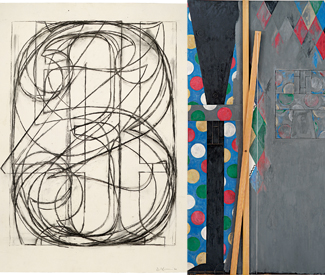
VISUAL ART The new Jasper Johns retrospective currently on view at the San Francisco Museum of Modern Art opens not with his seminal 1955 painting Flag, but with one much less well known from 1956, a painted object titled Canvas. That work is made from a wood stretcher frame and canvas panel turned around to face the wall, the entire back of the thing covered in gray encaustic. Above it on the wall is a quotation from Johns, “I’ve always considered myself a very literal artist.”

This greeting at the show’s entrance is meant to tell you two things: that you may not be seeing all the most iconic works by one of the world’s most famous living artists, and that you’ll want to take this one slowly, since you’re going to be presented with a methodical review of Johns’ handling of artworks as objects. The central narrative of this excellent show — comprising some 90-plus works, some new and never before exhibited — is Johns’ continuing inquiry into the relationship between what an artwork is as an object and what it depicts.

The first two galleries are dedicated to Johns’ Numbers works, which bookend his nearly 60-year career. The numbers stand in for the other early works, the flag and target paintings that made him an immediate star in the late 1950s and announced the arrival of the post-Abstract Expressionist era. The room is framed by a high key oil painting titled 0 through 9 (pun probably intended), in which a stack of superimposed numerals competes with loud bursts of brushed color. Also in the same room is 1959’s White Numbers, a large relief grid of ordered numerals painted in very thick white encaustic. That impasto grid, texture and all, recurs in a cast bronze wall work from 2005, and a silver sculpture from 2008. Likewise, 0 through 9 is shown also as a charcoal drawing, a lithograph, and a lead relief.

The thing about numbers, of course, is the same about targets or flags. Namely, a painting of a flag is in fact a flag (distinct from how, say, a painting of a tree is not actually a tree). Letting this sink in and acknowledging that Johns is interested in the literal facts (pun intended here, too) of painting and sculpture helps frame how you encounter the rest of the works on display. From start to finish of the show, Johns’ works slowly build in visual and textual intricacy, but tend to circle around this same main refrain.

Johns wants you to understand the complex objects he’s creating, but that doesn’t mean he’ll make it easy. Proceeding by a kind of diffracted metonymy, the various components in Johns’ artworks are both meant to be exactly whatever they are, and also to stand in for a set of other things that also might have been included. This is made explicit in the way Johns mulls over compositions, and transmutes them across media, recasting — sometimes literally — a work in different iterations. Compounding this self-reflexivity, you’ll find statements once proposed as standalone artworks recur later as motifs or referents.

In other hands, this activity might be inexcusably hermetic or academic, but in Johns’ best works the effect is to establish at once both a harmonic resonance between concepts and a continual scrutiny of his own conclusions. For example, in the 1970s-80s Crosshatch paintings, you notice that same numerical grid from 20 years prior, this time reintroduced as the underlying compositional structure of works like Usuyuki (1979-81) or Scent (1973-74). Or, beginning with his 80s Seasons series and continuing to his new Shrinky Dink and Bushbaby images, entire compositions from past works are miniaturized and sampled in new ones, in a highly complex virtualization that juxtaposes metonymy with metaphor. When it works it is astonishing.

It’s axiomatic that an artist will return to established precepts over the course or her career, but few have done so with the explicitness of Johns, who uses his own process as fodder for new deconstructions and assemblages. That the show contains several new works and two new series suggests that Johns, now 82, is not done yet. *

JASPER JOHNS: SEEING WITH THE MIND’S EYE

Through Feb. 3

SFMOMA

151 Third St., SF

www.sfmoma.org


ALSO RECOMMENDED:

MARIE BOURGET, KENNETH LO, AND DANIEL SMALL

Marie Bourget’s arabesque paintings take from tile work and ceramics and combine them with translations of Walt Whitman to lovely effect. Through Nov. 22, Johansson Projects, 2300 Telegraph, Oakl; www.johanssonprojects.com

JAMES STERLING PITT

Pitt’s painted wooden sculptures recall both Jonathan Lasker and Richard Tuttle. And that ain’t a bad thing. Through Dec. 8, Eli Ridgway Gallery, 172 Minna, SF; www.eliridgway.com

ROBERT SAGERMAN

Sagerman’s paintings reimagine Georges Seurat’s pointillism as luminous color field paintings. Through Dec. 22, Brian Gross Fine Art, 49 Geary, Fifth Flr., SF; www.briangrossfineart.com

So-called DV group doing PG&E’s dirty work

34

Any pretense that the group called San Francisco Women for for Responsibility and an Accountable Supervisor is anything more than a downtown sham vanished with the arrival in District 5 mailboxes Nov. 3 of a mailer attacking Sup. Christina Olague for supporting public power.

The mailer uses pictures of Olague and Julian Davis — and that alone is a not-so-subtle attack on Olague. Davis has lost all credibility in the race, thanks to a string of allegations that he groped women.

It then goes after the two for “support [ing] a $20 million taxpayer giveaway to Big Oil.” The utterly misleading line is based on Olague’s vote to support Clean Power SF, a community choice aggregation program that has the support of public power advocates all over California.

Olague’s not supporting Shell Oil; she just realized, as did a supermajority of the board (including both left stalwarts David Campos and John Avalos and the far more conservative Scott Wiener) that the program makes sense for San Francisco and will lead in the long term to much greater energy self-reliance. The only ones putting out the Shell Oil line are PG&E and its house union, IBEW Local 1245.

Oh, and now a group that supposedly advocates for domestic violence victims.

This is a disgrace, an embarassment to the district and the city. Ron Conway and Thomas Coates are attacking Olague because they’re afraid she’ll vote against their development and landlord interests, not because they care about domestic violence.

This election matters, a lot. It’s clear where the big-money interests are; I hope D5 residents reject this attempt to buy the election.


One fish, two fish

0

virginia@sfbg.com

APPETITE Sushi bars proliferate around SF, with two more brand new spots opening on Russian Hill and down in the Mission.

ELEPHANT SUSHI

Think of Elephant Sushi as on “island time” (read: chilled out) and you’ll enjoy your experience all the more. Reminiscent of early days at the original Sushi Bistro in the Inner Richmond when it first opened, dreadlocked wait staff and reggae tunes set a relaxed, island vibe at Elephant. It’s soft opening was in late August in the former Sushi Groove space, so Elephant is still in its infancy. Besides the Japan-meets-Jamaica spirit of the cozy space, the restaurant sets itself apart at first glance with real wasabi (which I love eating on its own), housemade soy sauce, and pots of intense, pickled ginger.

Winning points for doing what so few sushi restaurants do, even in our eco-conscious region, Elephant sources mostly wild or sustainably farmed fish, going the funky-fun route in their rolls and appetizers without sacrificing freshness and precision. Walu (Hawaiian term for escolar, the fish occasionally known to cause potentially unpleasant side effects in the… ahem… bathroom) is succulent and buttery here ($5 nigiri/$11 for five-piece sashimi), among the best walu I’ve ever tasted. Sizzling mango seabass ($12) wins on presentation, arriving on fire in a mini-cast iron skillet, thanks to sake and vodka, doused in masago aioli, Japanese chilis, and scallion. Unfortunately, the dish was bland, a let down after the flashy flame of its presentation.

Sipping sake and Sapporo on draft, I ordered crudo ($14) served in four spoons, two of young yellowtail in truffle oil, ponzu sauce, garlic chips and scallions, two of seared scallop in heirloom tomato, pickled wasabi stem, and a tangy yuzu vinaigrette.

If not quite the exquisite bites served at Bar Crudo, this crudo still pops with fresh flavor. Though varying in taste, maki (rolls) seems to be where their whimsical ethos best shines. Spicy king salmon ($9) rolled with cucumber, orange peel, and masago roe in chili sauce is heavy on the orange notes, while the White Out ($15) is a mix of hamachi and avocado draped in more of that luscious walu (seared in this case — I prefer it raw.)

The roll that stayed with me is the Boom Box ($10). I adore raw scallop, served here with avocado, crunchy garlic chips and English cucumber. A ripe banana drape with a sweet soy glaze sets it apart, a spanking fresh, of-the-sea dessert. The banana theme continues in neighboring Swensen’s banana ice cream ($3), all-in-all leaving Elephant Sushi firmly placed in the sleepy Hyde Street ‘hood, a welcome addition that I look forward to watching come into its own.

916 Hyde, SF. (415) 440-1905, www.elephantsushi.com

SUGOI SUSHI

The building formerly housing Spork and pop-up Rice Broker was too cool to stay empty for long. In August, Sugoi Sushi opened in the space serving nigiri ($4.25–$7 for two pieces), five-piece sashimi ($12-15), sushi rolls/maki ($6–$13), and a quite reasonable omakase tasting menu of roughly $40 for a few rounds of sushi. Mini-two person booths remain intact, while red walls, pillows of lime green and red brighten the space.

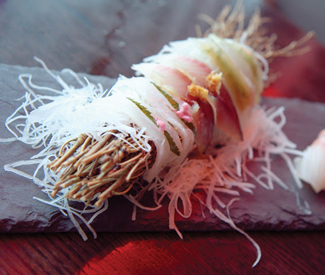
Friendly staff bring out plates that border on works of art — as fine sushi tends to do. In this case, the artistry goes a step beyond. Case in point: a sashimi platter as part of the omakase arrives on a stone slab with a bundle of twigs covered in shredded daikon radish and draped with cuts of fish: masaba, Japanese mackerel ($6); toro. blue fin fatty tuna ($10); and kanpachi, baby yellowtail ($6). Another trio — raw scallops, escolar dotted with lemon seed mustard, and albacore belly bin toro — is presented three ways: in a cup, on a shell, on a pile of daikon.

While presentation immediately impresses, on each of my visits there’s been a funky piece of fish or two, though the restaurant emphasizes sourcing fresh daily. Japanese mackerel on one visit was almost unbearably salty, while Japanese red snapper with truffle oil and sea salt was nearly gummy. Yakitori ($3) at times disappoints, namely the hot dog-like spicy pork sausage. Tender chicken thigh fares better.

Rolls are filling and bright, like the Golden Mountain ($14) packed with toasted salmon, scallop, crab, and avocado, in curry tempura, or the Hot and Cold Tuna ($12), deep-fried spicy tuna covered with maguro roe and seaweed salad. Sashimi-like slices of seared blue fin toro ($18) are a bit salty, but fresh in chili sesame sauce and curry onion tempura, which adds a rich, savory layer to the fish.

While Sugoi is still clearly on the hunt for its identity, suffering from consistency issues, the funky, relaxed space on Valencia Street and the artful eye of its sushi chefs hold promise — it’s still steps beyond the other sushi restaurants lining the street.

1058 Valencia, SF. (415) 401-8442, www.sugoisushisf.com

Subscribe to Virgina’s twice-monthly newsletter, The Perfect Spot, www.theperfectspotsf.com

Hakka in the home: An autumn side dish from one of our fave cookbooks

0

I’ve read few cookbooks as interesting as The Hakka Cookbook, Sunset Magazine recipe editor and food writer Linda Anusasananan’s exploration of her Hakka Chinese roots through the cuisine that the culture’s global diaspora has developed. Check out my interview with her in this week’s food and drink issue Feast for more on Hakka bites, and the journey that led her to write what may be the first cookbook that shares them with the rest of the world. Better yet, do that and then make the recipe below, an easily-prepared vegetarian dish that works as a fab autumn side dish. Spinach is in-season through the end of November here in the Bay Area.

Stir-Fried Spinach and Peanuts

At Lao Hanzi, in Beijing, we ate a platter of stir-fried spinach laced with peanuts. The nuts lend substance, texture, and a heartier flavor to the greens.

Makes 4 servings as part of a multi-course meal

10 to 12 ounces spinach

2 tablespoons vegetable oil

1/3 cup roasted, salted peanuts

1 tablespoon minced garlic

1/4 teaspoon salt, or to taste

1 tablespoon black vinegar or balsamic vinegar

1. Trim and discard the yellow leaves, tough stems and roots off the spinach. Wash the spinach thoroughly and drain well to make 8 to 10 cups.

2. Set a 14-inch wok or 12-inch frying pan over medium-high heat. When the pan is hot, about 1 minute, add the oil and rotate the pan to spread. Add the peanuts, garlic, and salt. Stir-fry until the peanuts are lightly browned, 30 seconds to 1 minute. Increase the heat to high and add the spinach. (If all the spinach doesn’t fit the frying pan, add about half and turn just until it slightly wilts and shrinks, then add the remainder.)  Stir-fry until the spinach is barely wilted, 1 to 2 minutes, then stir in the vinegar. Transfer to a serving dish.


Profiling those who rely on HANC, which the city is evicting (VIDEO)

6

The Haight Ashbury Neighborhood Council’s (HANC) Recycling Center has fought for the past decade to stay in its tiny corner of Golden Gate Park, behind Kezar stadium, and it may be days from closing. It’s been served with eviction notices from the city and weathered political tirades from politicians on pulpits, and most recently, saw its eviction appeal denied by California’s Supreme Court.

The recycling center, which has been in operation since 1974, wouldn’t be the only loss to the Haight either. Both a community garden and San Francisco native plant nursery are on the site, under the umbrella name of Kezar Gardens. After an eviction for the recycling center, all three would go.

So in what may be their last days, the Guardian decided to take a look at  who is a part of the recycling center’s community. What keeps them coming back – even in the face of eviction? While the final eviction date is nebulous, the reasons for it are not: as the Haight gentrified, more and more neighbors complained about the site’s surrounding homeless population, the noise the recycling center makes, and every other NIMBY complaint in the book.

Contrary to the usual complaints of the recycling center and gardens attracting numerous homeless people, the people detailed in the stories below reflect a diverse community. And there were far more stories that we didn’t include: the busy head of a nonprofit who gardens to keep his sanity, or the two brothers who bring in their recyclables every week as a way for their parents to teach them responsibility. And they’re not the only people who depend on the recycling center and gardens.

“One of the problems [with evicting HANC] is that the small businesses in the area depend on the service of the center,” Sup. Christina Olague, who representing the area, told us. “We don’t want to see it relocated out of the area.”

Olague said that although ideas for a mobile recycling center or a relocation have been batted around, nothing is concrete yet. The Mayor’s Office, the Recreations and Parks Department, and HANC were all going to have more meetings and try to come to a solution that would benefit all sides, she said.

The recycling center and gardens aren’t going down without their supporters making a clamor. They developed a feature documentary about their struggles, titled 780 Frederick. Directed by Soumyaa Kapil Behrens, the film will play at the San Francisco International Film Festivals “Doc Fest” on Nov. 11.

Until then, here’s a glimpse at some of the people who make up the community at the HANC Recycling Center and Kezar Gardens.


Greg Gaar, Native Plant Nursery Caretaker

Longtime groundskeeper and recycling guru Greg Gaar will soon be out of a job, only a year after single-handedly starting a native plant nursery in the Haight Ashbury that serves more than 100 people.

Gaar is the caretaker of the Kezar Garden nursery. He raises Dune Tansy, Beach Sagewort, Coast Buckwheat and Bush Monkey –  all plants originally born and bred from the dunes of old San Francisco.

“I do it because I worship nature, to me that’s god,” Gaar said. He spoke of the plants reverently.

The native plants aren’t as bombastically colorful as the rest of Golden Gate Park, he said, which Gaar calls “European pleasure gardens,” but they’re hearty and durable, like Gaar himself.

Gaar has a weathered face from years of working in the open air, and he grinned large as he talked about his plants. His grey beard comes down a few inches, giving him the look of a spry Santa Claus. Gaar has a history of embracing the counterculture, much like the Haight itself. In 1977, he made his first foray into activism.

At the time, wealthy developers in the city wanted to develop buildings and houses on Tank Hill, one of the few remaining lands of San Francisco with native growth. “Two percent of the city right now has native plants,” he said. It’s a travesty to him, but he did his part to prevent it.

Gaar led the charge against the redevelopers by putting up posters and flyers, and fighting them tooth and nail for the land through old fashioned San Francisco rallying.

In the end, the counterculture activists won, and the city of San Francisco bought the land back from the developers, keeping it for the public trust. The long-ago battle over Tank Hill was a victory, but the fight for the Haight Ashbury Recycling Center may already be lost.

Gaar has deep ties to the recycling center. Among his friends are two ravens, Bobbie and Regina, who recognize Gaar since the first time he fed them 16 years ago. Occasionally, he says, they’ll accompany him on his rounds around the park. The ravens aren’t the only friends he’s made through the recycling center.

They have many patrons looking to make a few bucks off of cans and bottles, many of which are poverty-struck or homeless. Gaar darkened as he spoke of them, because over the years he has lost many friends he’s made through work. The recycling center is a community, and those that are lost are often memorialized in the garden that Gaar grew with his own hands.

In the San Francisco Chronicle, columnist C. W. Nevius frequently calls out the nursery as a “last ditch effort” on the part of the recycling center to stave off closure and legitimize its own existence. In reality, the nursery was brainstormed years before the controversy through Gaar’s inspiration.

Though Nevius may not agree with the ethos Gaar has brought to the recycling center, the city of San Francisco must trust him. The Recreation and Parks Department has offered him a job planting native plants around Golden Gate Park, which is Gaar is welcome to after the recycling center closes. But taking care of native plants is more than a job to Gaar, it’s a calling.

“Isn’t it amazing that we exist on one of the sole planets we know of that supports life?” Gaar said with wide eyes. He sees his job as preserving the natural order, working to keep alive the plants that were part of the city before the first arrival of the spaniards.

Gaar, much like his plants, is part of a shrinking population of the city: the San Francisco native. When the recycling center closes, he’ll be able to spread native plants across Golden Gate Park, another rebel cause in a life of green activism.


Kristy  Zeng, loyal daughter

Kristy Zeng, 30,  talked about everything she does for her family in a matter of fact tone, as if none of it took effort, patience or loyalty.

As she talked, Zeng unloaded over six trash cans worth of recyclables into colored bins. At home, she has two young girls waiting for her, ages three and one, she said. The money she gets from the recyclables is small, but necessary – not for herself, but for her mother.

“My mom’s primary job is this one,” she said. Zeng’s mother is 62 and speaks no English. In the eight years she’s been in San Francisco since immigrating from China, she hasn’t been able to find a job.

“People look at her and say she’s too old,” Zeng said. “She’s too near retirement age.”

So Zeng’s mother hauls cans in her shopping cart every day to earn her keep. She’s one of the folks you can spot around town foraging in bins outside people’s homes, collecting recyclables from picnic-goers in parks, and asking for empties from local bars. The money she earns is just enough to pay for her food.

Even between her husband’s two jobs, Zeng said her family doesn’t have quite enough to fully support her mother. The recyclable collecting is vital income, Zeng said. She and her extended family all live in the Sunset and Outer Richmond, though she wishes they could find a place big enough to live together.

The Haight Ashbury Recycling Center is just close enough to make the chore worth the trip. Zeng was surprised to hear that the center was near closure.

“I would have to find a job,” she said. She usually watches her infant and toddler while her husband is at work. “Mom can’t babysit them, her back isn’t so good. It’s too hard.”

It’s not so bad though, she said, because at 30 years old, Zeng is still young and can handle the extra work. But if the recycling center closed, Zeng and her mom would both have to find a new way to make ends meet.


Steven and Brian Guan learn responsibility

At about five feet tall, wearing an oversized ball-cap and dwarfed by the man-sized jacket he wore, Brian Guan, 12,  definitely stood out at the Haight Ashbury Recycling Center. All around him, grisly old men hauled bins full of cans and bottles – but he didn’t pay them any mind.

Brian had his older brother Steven Guan, 14, to look out for him. Together they hauled in four bags worth of recyclables in plastic bags, walking straight to the empty bins as if it were a routine they’d done a dozen times before.

Which, of course, they had.

“I’ve been doing this for at least a year,” Steven said. Though he looks totally comfortable, the chore definitely introduced him to a different crowd than he’s used to.

The recycling center’s clientele of homeless folks, and people generally older than 14, don’t really bother him, he said. “It’s kinda weird, but it’s no big deal.” Besides, he said, he’s happy to help out his family, who spend a lot of time working.

“My mom works in a hotel, and she collects the cans and stuff there.” His dad does the same.

Their mom is a maid, and dad is a bellhop, working in separate hotels downtown. Steven didn’t know if the money they collect each week was vital for his family’s income, but he does know that the haul isn’t very much.

“It’s usually only like $10,” he said.

So was it even worth the trip? Steven said that if he wasn’t helping out his parents by bringing in recyclables, he’d probably be “at home doing nothing.” A Washington High School student, he doesn’t play on any sports teams and isn’t in any clubs. He spends the majority of his time helping out his family.

The way he figures it, he said, the chore is meant to teach him responsibility.

It looks like it worked.


Dennis Horsluy, a principled man

A lot of the patrons haul cans and bottles to the Haight Ashbury Recycling Center out of need: to feed themselves, clothe themselves, and live. Dennis Horsluy, 44, does not count himself as one of those people.

“It’s pocket change,” Horsluy said. But despite the cost, he’s going to get every red penny back from the government that he’s owed through the California Redemption Value charges on cans and bottles. “It’s just the right thing to do.”

Horsluy said that Sunset Scavenger, now known as Recology, has a stranglehold on San Francisco’s recycling and trash.

“If you leave your recyclables on the curb, it’s like taxation without representation,” he said. You pay for it whether you want to or not. In his own version of “sticking it to the man,” Horsluy makes sure his recycling dollars get back into his hands.

Horsluy is a displaced auto-worker who has only just recently found work again. “I made plenty, and now I make nothing,” he said.

A family man, he has a daughter at Lowell High School, and a son at Stuart Hall High School. He thinks San Francisco has problems much weightier than closing the recycling center, such as the school lottery system that almost had him sending his kids far across town for school.

Horsluy wasn’t surprised that some of the Haight locals had managed to finally oust the recycling center, considering they’ve been complaining for years about how it attracts many of the local homeless population to the area. “I’m sure it’s a problem for the neighbors with their million-dollar homes,” he said.

But the homeless were a problem long before the Haight Ashbury Recycling Center, Horsluy said. San Francisco has a history of generosity, and so it draws more of the needy. Horsluy will be fine without the recycling center, he said, but the more poverty stricken patrons of the center may not be.

“They’re just trying to survive.”


Chris Dye, gardening his troubles away

Some people drink to forget. Chris Dye, 44,  does something similar — he gardens to forget.

While watering the plot of greens he calls his own, Dye spun a yarn that sounded like a San Francisco version of a country song. His ex-wife bleeds his paychecks dry, and he had to leave his dream job at the National Parks Service to make ends meet in Information Technology, a job he pictures as the last place he’d like to be.

He regained a bit of peace in his ordeals through a hardcore passion for San Francisco native plants. “I found a rare kind of phacelia clinging to life in the cement at City College,” Dye said. “You know, down by the art building? When I saw it, I sketched it.”

A day later though it was gone, he said. He fell silent in what was almost a reverent moment for the rare native plant he spotted. Dye is on a personal mission to revive native San Franciscan plants.

The Kezar Gardens give Dye a chance to grow for himself all the interesting native plants he’s interested in. Inspired by the native plant nursery’s caretaker, Greg Gaar, he rattles off all the near-extinct species he’s been able to see and raise. “For me, it’s a personal experiment to figure all this out.”

It’s not all about leafy activism though. Sometimes, it’s just about a good meal. Dye snapped off a leaf and crushed it with his fingers. “This is Hummingbird Sage,” he said, holding it up to his nose for a sniff. “Mix this into a little olive oil, and rub it all over your pot roast, or whatever. It’s fucking amazing.”


Lael and Genevieve Dasgupta

Four-year-old Genevieve marched around the table by the garden, watching as a woman carves a pumpkin for Halloween.

Genevieve and her mother, Lael Dasgupta, recycle there in the Haight once a week, as part of Dasgupta’s hope to get her to learn at a young age about eco-responsibility. They don’t use one of the garden plots in the community garden, because they have a communal backyard at home. They do use some of Greg Gaar’s native plants in their garden, for decoration.

Dasgupta has mostly practical reasons for recycling. “It brings us about $40 to $50 a week… That’s a lot of money,” Dasgupta said.

But despite the location of several other recycling centers in the city, why does Dasgupta bring Genevieve here?

“Dirt, dirt dirt,” she said. “Its just good for her to play in the dirt, and build a healthy immune system. The other recycling centers aren’t as charming.”

Dasgupta said that if Kezar Gardens and the Haight Ashbury Recycling Center were to close, she wouldn’t relish taking her daughter out to the Bayview recycling center. She’s been there, and didn’t enjoy the experience. It’s easy to see that the two are comfortable at Kezar Gardens. Folks around the gardens all seem to know Genevieve, who marches around the place without fear.

The woman who was carving the pumpkins handed one to Genevieve for her to play with. The young girl promptly set to the pumpkin with a marker, making what could be either a set of incomprehensible squiggly lines, or the Milky Way galaxy, depending on your perspective.


Avast ye

3

CHEAP EATS Crawdad called me on speakerphone, like she does: in the car, with the childerns. “Will you tell us the story of Moby Dick?” she said.

“Moby Dick,” I said, about as meaningfully as one can say, into an Android, Moby Dick. As it happens, I had just hung up with my dad, who (as it further happens) is an actual, dyed-in-the-whale Melville scholar. Me, no. Not so much. I’ve read it, of course, but . . .

“Dang, is traffic that bad over there?” I asked.

“No. We’re going to get ice cream,” she said. As if that explained everything.

“OK,” I said. “Ice cream.”

I said, “Kids . . . listen up: Moby Dick.”

And while clearing the dishes I proceeded to abridge one of the substantialest-ever works of American literature into four sentences:

“This guy Ahab goes out in a boat to get some whales, and in particular this big old one name a Moby Dick. But Moby Dick is so big and so old that he outsmarts Ahab. Anyway, he outsizes him. He busts up Ahab’s boat and most if not all of his crew, The End.”

I forgot to mention Queemquack, or whatever his name was, but — no worries — I’m de la Cootersitting tomorrow, so I’ll have all day to bring them up to speed.

Poor kids. Even without any knowledge of Queemquack, they were speechless.

“Why did people fish for whales?” Crawdad asked.

“I think maybe they made lamp oil out of their fat, or something,” I said, rendering the kids even speechlesser.

“You have to understand, Chunks,” I added, “this was before the age of light bulbs. People couldn’t just flip a switch and see things; they had to go out and kill giant whales and split their heads open. There was this oil in there that they needed for their lamps, so they could stay up late and read Moby Dick.”

Without which — a century and a half later — my father would never have been able to feed his family. Which reminds me: I would love to tell you about the not-great hashbrowns and sold out “Millionaire’s bacon” at my new favorite restaurant in the Tenderloin, but after all I’m on strike, so …

CHEAP SPORTS

by Hedgehog

It’s been hard to rally any interest in the Giants lately in the Chicken Farmer and Hedgehog household, I’ll admit. It’s not that we wouldn’t be thrilled to hug and high five strangers on the street should they go All The Way, but it seems we left our baseball hearts in Oakland this season — somewhere under the cheap seats in the Coliseum.

It’s been looking like the Giants lost theirs somewhere other than San Francisco, too. Maybe in St. Louis? We went out tonight in search of a TV screen with 49ers on it, and at Hogs and Rocks on 19th they had two screens: one for the 49ers and one for the Giants.

By way of play-by-play, I eavesdropped on a conversation between a father and his small son, sitting across from us.

“The Giants have given up,” declared Father.

“What do you mean?” asked Son in an innocent little voice.

“They’re playing like a team that’s lost its heart,” Father said.

“There’s still time to win I know,” said Son (bottom of the seventh, Giants trailing 8-1). “I have never gaven up in baseball. Ever. I can steal home, it’s so easy. It’s how I make runs!”

I think maybe this kid has figured something out that grown-assed men who get paid way too much to play games haven’t. At least on this side of the bay.

Cheap Eats continued…

Yes, my dear, I just hope your cute little eavesdropee doesn’t grow up to be a whaler. Because in life as in Moby Dick, sometimes it is better to give up than to fight. Call me chicken.

No …

Call me Chicken Farmer.

TAYLOR STREET COFFEE HOUSE

Daily: 7am-2pm

375 Taylor St., SF

(415) 567-4031

MC,V

No alcohol


Appetite: Portland cocktailing

5

More than 50 places in one week…  I may not have covered all of Portland this May, but I certainly made a dent. So much so that my Portland reviews are broken up in a four part series. Soaking wet half the week, I biked out to neighborhoods East, West, and North with my usual (if grumpy, cold, and irritable) tenacity to dig in and taste the soul and breadth of a place rather than its veneer. Join me as I drink, and eat, my way through the rainy town up north.

As cocktail bars are required to serve food in Portland, cocktails and food are intertwined – and strong – at many a locale. Though I separate out cocktails and restaurants, there are numerous places where both are worth making your way to so you’ll see some restaurants listed here and in next issue’s Portland restaurant article.

Brendan Wise of Beaker & Flask filled me in on a couple cocktail projects launching just after my visit: Corazon from Chris Israel (chef-owner at Gruner, which I review next issue), and the Beaker & Flask team created a drink menu for popular PIX Patisserie http://www.pixpatisserie.com/ featuring cocktails and sherries to go with their sweets.

RIFFLE NW

Visiting Riffle NW in its opening week, I was struck immediately with fresh seafood, friendly service and some of the best drinks of my Portland week. It was opened by Dave Shenaut (former president of the Oregon Bartender’s Guild) with bartenders Emily Baker (formerly of Rum Club), and Ricky Gomez (formerly of Teardrop Lounge) – SF bartender Brandon Josie of Bloodhound recently moved to Portland to take over as bar manager for Gomez who is moving on to a new project. Riffle’s spare, modern decor displays seafaring inspiration in wood ceiling panels made of reclaimed shipping docks, while the name refers to a rocky shoal or sandbar below the surface of a waterway.

I came for the drinks but was not disappointed in the food. Black bass tartare ($10) is punctuated with dill, squid Carbonara ($17) is meaty with guanciale, while an overflowing, fresh crab roll ($21), and a huge cut of rare Copper River sockeye salmon ($32) is grilled, its salty skin subtly sweet with a bourbon maple glaze.

Emily Baker offered the best service of my entire time in Portland. After I was there a couple hours, we began talking industry connections and drink, but long before she knew I was a writer, she went out of her way to ascertain our taste preferences and make sure we were comfortable at the bar.

On the menu, a Riffle Collins ($11), made of gin, lemon, lime, celery, absinthe, salt, is the perfect starter, garden bright, light and appropriately savory with celery and salt. Room D ($9) delighted with rye whiskey, the spice of Becherovka, while quinine and citrus imparted punch.

Off menu, Baker suggested and created just what I was craving: Art of Choke (a Violet Hour creation by Kyle Davidson), mixing Cynar, mint, Bacardi white rum, and Green Chartreuse. Herbaceous, bitter, and vibrant, it hit all the right notes. Similarly, a Self Starter (a Jamie Boudreau drink) balanced Lillet with Old Tom gin, absinthe and Orchard apricot. Not too musky but crisp, sweet, boozy. All around, hand cut ice perfects each drink.

It was a treat sampling Jack Rudy Tonic from Charleston, a bottle I noticed on ice behind the bar and had to inquire about. A small batch syrup (available in SF at Bi-Rite Market), it makes a lovely tonic, set apart with lemongrass and orange peel.

CLYDE COMMON

So much has been said about Clyde Common and Jeffrey Morgenthaler since opening that it’s almost needless to point it out as a Portland “best”. In fact, for one who almost never repeats places in the same trip (ever with an aggressive agenda), I returned to Clyde Common three times in one week. Morgenthaler was only there one of three stops, offering cheeky, impeccable service. But service was warm and accommodating both evenings I dropped in – only during a weekday visit did I experience lackluster, abrupt service from one bartender.

Cocktails are a reasonable $7-9. Morgenthaler’s famed barrel aged cocktails ($10)  – his Negroni and one of my all time favorite cocktails, an Old Pal – rotate but were completely out all three visits. What pleased most were his bottled and carbonated cocktails ($8).

Though I’ve seen a lot of these the past year  – one was a basic Americano (Campari, Dolin Sweet vermouth, water and orange oil) – the Broken Bike was possibly my top drink on the menu, fizzy and vivaciously bitter with Cynar, white wine, water, lemon oil. Both were well balanced, refreshing and more importantly, fun.

Elsewhere on the menu, a Kingston Club exhibited subtle balance of fruit and herbaceous notes with Drambuie, pineapple, lime, Fernet, Angostura, and orange peel. The Nasturtium cocktail was unexpectedly too sweet for me, Domaine de Canton ginger liqueur hitting heavier than the Dolin Blanc vermouth and Bonal. A Spiced Dark & Stormy is a brilliant idea – and went down all too easy. Rum (Gosling’s dark, in this case) infused with Chinese five-spice, a spicy, house-brewed ginger beer, finished with lime, made for another winning drink.

Clyde Common was the Portland bar that for me most upheld its reputation: centrally located, serving understated drinks, strong on precision.

BEAKER & FLASK

It goes without saying that Beaker & Flask, opened by Kevin Ludwig of Park Kitchen, has been one of Portland’s hottest cocktail bars since debuting in 2009. Despite large groups in the spacious restaurant, bar seats free up often, even on a weekend, and we were able to chat, unhurried, with the bartenders, lingering over drinks.

Menu cocktails ($9) like a soft, woody Walk in the Woods (Old Tom Gin, Stone Pine liqueur, lemon, sage syrup, egg white) and elegant Cricket Club (Pimm’s, rose port, Bonal, amargo bitters, cucumber soda) please but going off menu in the hands of talented Chicago transplant Brandon Wise (now President of Oregon Bartenders Guild) and Neil Kopplin, who also makes Imbue Vermouth, is where the real action is.

Wise mixed a Rose Americano cocktail, bright with Martin Miller’s Westbourne Gin and grapefruit, earthy-sweet with Amontillado sherry. Kopplin goes with a recipe from neighboring Rum Club, the Begonia, utilizing his Imbue vermouth, aged Novo Fogo cachaca, Benedictine and velvet falernum. Sweet, spiced apple notes hit first, with a beautifully subtle bitter on the finish.

Seek out Neil’s new product, Petal & Thorn, a gorgeous gentian liqueur using homegrown beets for Campari color, cinnamon, menthol, and other intriguing elements.

RUM CLUB

Depending on which direction you’re approaching, enter Rum Club either on the front or back side of Beaker & Flask. The cozy bar is roughly one year old, conceived by Beaker & Flask’s Kevin Ludwig and Michael Shea of Doug Fir. Affordable $5-10 cocktails, chic wallpaper, low wood ceiling, the bar in the center, and a small patio you can smoke in if you’re nowhere near the door, make it an appealing place to gather with friends until the wee hours.

Though packed and noisy, I was won over by well-crafted drinks like the Hi-Lo Split ($8), vivid with Old Grand-Dad Bonded whiskey, Cynar, lemon, passion fruit syrup, grapefruit bitters – a stunner, actually. Also by Road to Ruin ($8), with a rye whiskey base, dry vermouth and bitters, set apart by cardamom notes from Cardamaro Amaro and texture from lemon oil.

TEARDROP LOUNGE

Despite the widespread respect garnered for this chic, centrally located bar in downtown Portland, Teardrop Lounge was the one disappointment of my bar excursions. It’s long hyped as being one of PDX’s best, and depending on the bartender, I’m sure it could be. The space centers around a dramatic round bar, open air windows ushering in a gentle breeze on a nice day. Even with well-prepared drinks, I found touristy clientele and disinterested bartenders during my visit soured the experience.

The menu reads well, including a glossary of terms educating non-cocktail geeks on terms like oleo-saccharum (a traditional punch base of lemon peels macerated in sugar to extract oils) and Batavia Arrack (an early 16th century, palm sugar-distilled spirit tasting of spice, citrus, anise – often used in punches).

There’s sections of House Cocktails, Classics (like Sky Rocket from 1919 or a Morning Glory Fizz – from the Savoy Cocktail Book, 1933), and one called Friends highlighting bartenders’ drinks from other cities, including SF locals: Kevin Diedrich’s Whiskey Wallbanger and Ryan Fitzgerald’s Rodriguez).

Though intriguing, a Wanderlust ($12), made of Banks white rum, a house sherry blend, Marolo chamomile grappa, medjool date bitters, orange bitters, and flamed absinthe was musky sweet without the hoped-for layers jumping out. However, Of Praise for Tulips ($9), was a brightly elegant aperitif, floral with Clear Creek pear brandy, dry and bitter with Cocchi Americano, Dolin Dry vermouth, Barenjager, Boston bitters and Pacifique absinthe.

THE DRIFTWOOD ROOM

They had me at ’70s wood-paneled walls, cocktails ($9-12) named after classic actors (e.g. Sydney Poitier, Elizabeth Taylor), and old school, Rat Pack bar vibe. When asking bartenders at “mixology” havens around Portland where they liked to drink off hours, more than one of them said The Driftwood Room. Granted, it’s in Hotel deLuxe (opened in 1912 – the bar opened in the ‘50s) and forget catching a cab from the hotel any time after 11:30pm when the train isn’t running (apparently, neither are cabs), but for a mellow, retro vibe with boozy-but-crafted drinks, Driftwood is a welcome respite.

Both Bittersweet Symphony ($10 – Temperance bourbon, Punt e Mes vermouth, Pelinkovac http://www.wineglobe.com/13047.html, Peychaud’s and Angostura bitters) and Old Tom Cocktail ($11 – Ransom gin, Agwa de Bolivia coca leaf liqueur, Krogstad Aquavit, lime juice, barrel aged bitters) pack a punch while maintaining balance.

CIRCA 33

Another bartender off-hours favorite is Circa 33 in Southeast Portland. For me, flat screens and sports interfered with a vaguely retro, laid back vibe. A library-like wall of American whiskey and bottles line the back wall with wood ladder for easy access. Easy-going bartenders can create cocktail classics, even if they don’t know them. I requested a simple but perfectly classic Old Pal, executed solidly per instruction. It’s the hidden back bar that draws industry folk, an intimate space ideal for conversation.

KASK

Though not overwhelmed with creative vision at Kask, the newer sister bar to neighboring Austrian restaurant Gruner, I enjoyed the corner casual chic in a small space with welcoming bartenders. Here can linger with friends, actually hear each other, and savor solid cocktails ($9-12).

Though my favorite drink was an off menu Del Maguey mezcal/citrus creation, I tasted the gamut, from Rabo de Galo, utilizing Novo Fogo’s barrel aged cachaca (a spirit popping up often on Portland menus), Gran Classico, Carpano Antica sweet vermouth, and Brazilian coffee bitters. The Black Lodge covered the whiskey/vermouth/bitter side with Wild Turkey Rye, Punt E Mes sweet vermouth, Combier Rouge, Cynar, Regan’s orange bitters, while another off menu creation, Leather Canary (a Chevy Chase reference), mixed up that profile with tart/sour: Combier Pamplemousse  – a grapefruit liqueur, rye whiskey, Gran Classico, Punt E Mes vermouth.

Kask’s service and relaxed vibe make it one of the better hangouts for cocktailians in my downtown Portland explorations.

Subscribe to Virgina’s twice-monthly newsletter, The Perfect Spot

SF Stories: Jessica C.Kraft

0

46TH ANNIVERSARY SPECIAL Everyone sees the neon signs on street posts over the weekend, but only a few types of people actually stop at estate sales. Early on Friday come the re-sellers—professionals intent on securing cheap, high quality goods that can be resold at pricey consignment shops and on eBay. On Saturdays come the casual shoppers, drawn by the novelty of IKEA prices on antique store treasures. And on Sundays, the hard-core hagglers and bargain hunters arrive, ready to seize upon whatever’s left for a few small bills.

My husband and I have gone “estate saling” all over the city for the past five years. While we’ve found plenty of cheap treasures, our real attraction to these final close-outs is their view into a hidden and historic San Francisco.

Walking into these properties, we marvel at the lush backyard gardens never visible from the street, and the secret views never seen from hilltop public parks. As in any scenic city, San Francisco builders smartly sited properties to maximize views, adding up to tens of thousands of private vistas that each offer a unique glimpse of the lambent sunsets, the columns of fog, or the itinerant Telegraph Hill parrots on parade.

We note how interior design styles have changed through the decades, and wonder how the elderly residents of these homes were able to put up with railroad hallways, stairways both too steep and too narrow, and the classic Doelger home’s miniature bathrooms.

There are always hordes of tchotchkes, outdated kitchenware, and piles of VHS tapes. But curious, bizarre objects also abound, mostly in mildewed basements where World War II veterans kept elaborate workbenches and harbored unconventional passions. An orthopedist in Forest Hill spent his free time jerry-rigging prosthetic devices in his basement, which, by the time of his sale, resembled a museum for medical patents. One dusty workbench was covered with scale models of world-famous buildings; the architect-collector had traveled to each of the sites and brought home a replica. Now his Hagia Sophia and Taj Mahal perch above our bathroom sink. My favorite find from one of these sub-floor collections was a drink stirrer with a pink, cheeky plastic butt affixed to the top. “Bottom’s Up!” the caption read.

Frequenting these sales allows visitors to paint a cultural map of the city that’s more nuanced than what you might learn on a City Guides walking tour. Headed out to the Sunset? You’ll likely find lacquered furniture, multiple tea sets and jade buddhas — but these might be surrounded by Guatemalan embroidery, Irish beer towels or French literature.

Who knew that Cow Hollow’s Union Street used to be a bohemian enclave? Amidst the posh wine bars and jewelry stores, we visited the apartment of a Life photographer and his oil painter wife who collected esoteric religious books, set their table with African textiles and, we imagined, spent evenings seated on the floor listening to sitar ragas. (We now use their Japanese gong to call our family to dinner.)

Stopping in at a sale in Noe Valley with other baby-clad parents, we’re delighted to discover a closet full of Carmen Miranda costumes, sequined carnival masks, fishnet tights and feather boas. A gay couple had lived there together since the ’50s, each year outdoing one another at Halloween. Thanks to them, our New Year’s party last year was extra sparkly.

At a sale just down the street from our house, at the foot of Grandview Heights in the inner Sunset, we inquired about an upright piano. We learned that its owner — a surgeon and well-known jazz photographer — had shot Duke Ellington and other jazz greats playing that very instrument. We never would have imagined that in our quiet hood of dog walkers and weekend gardeners, music history was made.

When we see these homes and prized collections being dismantled and dispersed, we become the last witnesses to episodes in San Francisco history. We get an intimate glimpse of the personalities that used to fill pockets of San Francisco real estate, before many of these neighborhoods became too costly for more than one privileged demographic.

Ultimately, though, we reckon with loss. Someone has died. Their family heirlooms are deracinated; a resale company makes some dough. A family grieves, and is compensated. The perpetual question that these sales seem to ask is: can we, should we, know a life by the objects left behind? When we bring an item home, we feel enriched, as if some facet of our inner world has been represented in solid substance. Yet we can’t help seeing these objects as memento mori. As my husband wistfully observed: when we’re gone, and after our kids have rifled through our dusty, obsolete books and tchotchkes, we’ll likely have one hell of an estate sale ourselves.

Jessica C. Kraft is a San Francisco writer.

Rich Table

3

virginia@sfbg.com

APPETITE Not since State Bird Provisions and AQ opened towards the end of 2011 have I been as excited about an opening. Evan and Sarah Rich’s new Rich Table is, kinks and all, even in the first month, well-rounded and satisfying. With efficient, informed service, reasonably priced wine list, few but well-crafted cocktails, a comfortable dining room with rustic-urban decor, and most importantly, a number of exquisite dishes, Rich Table is primed for greatness.

The Riches, a husband-and-wife chef duo, both worked at Bouley in New York and Coi here in San Francisco. Evan was also at Quince, Sarah at Michael Mina — and the couple hosted memorable pop-up dinners at Radius last fall. This fine dining pedigree infuses their mid-range menu. At other restaurants, dishes don’t often surprise beyond a menu reading. But here numerous dishes are more fascinating than their descriptions suggest. At AQ, dishes are works of art unfolding in layers of unexpected flavor. At Rich Table, there’s an approachable comfort elevated with refined nuances.

On the light bites side, everyone (and I mean everyone) has been buzzing about paper-thin potato chips ($7) with sardines interwoven through the center, dipped in horseradish cream. I’m a big sardine fan : these are not overrated, worth ordering every time. I brushed past Castelvetrano olives ($5) as common — thankfully a dining companion ordered them on one visit. Brightened by celery leaves and preserved lemon, the olives pop.

On an early visit, popcorn soup ($10) tasted like buttery, pureed popcorn in a bowl. Yuzu kosho (a fermented paste of chili peppers and yuzu rind) perks up the creamy bowl. Outstanding squid dishes ($14) morph with seasonal ingredients. The first incarnation wowed, the plump squid lively with watermelon yet simultaneously savory in black olive vinaigrette, dotted with crispy onions. This sweet-tangy, fresh-grilled dish was such a joy, I couldn’t help but be a little let down by its successor: squid with figs, crisp onions and lardon draped across the top. The breezy luminosity brought by the melon felt a bit weighted down with figs, though still a winning dish. Crushed peas ($14) with California yellowtail and saltine crackers to scoop up is vivaciously fresh, but comes in a slight (i.e. miniscule) serving.

The menu is not easily categorized nor a copycat of anyone, but is packed with pleasures peeking out in unforseen places. Case in point? The pasta. I could come here for pasta alone (one dinner I ordered all four pasta dishes on the ever-changing menu). None shines more than a divine duck lasagna ($19). A smile crosses my face just thinking of delicate, melting sheets of pasta, layered with braised duck, light béchamel, and tart Santa Rosa plums. It’s a glorious pasta dish with no equal in this town… or in any other. Other pasta dishes may not reach these heights but each is worthwhile, even excellent, whether rigatoni bolognese ($18) elevated by bone marrow and crispy kale or beets, or spaghetti ($18) tossed with Jimmy Nardello peppers and clams.

On the entree front, lichen-poached rabbit ($25) is heartwarming as it is gourmet, mingling with cippolini onions, radicchio leaves and broccoli raabe. Pork belly panzanella ($24) is the classic Italian bread salad of tomato, basil, cucumber and toasted bread cubes tossed with fatty pork belly, though I took to a hearty tomato-braised oxtail on toast ($25) even more. While accompanying grilled octopus and collard greens seemed disparate, the meaty toast alone makes it worthwhile, as satisfying as Southern BBQ.

Sarah Rich’s desserts (all $8) maintain the comfort-meets-craft spirit of the restaurant from a bright melange of chilled melon to caramelized olive oil cake in strawberries, a heightened strawberry shortcake. Panna cotta lovers shouldn’t miss Sarah’s silky rendition with changing seasonal accents.

Wines are priced by glass, carafe or bottle, conveniently grouped in three white and three red price categories, with strong options like 2010 Christian Moreau Chardonnay from Burgundy, or a 2011 COS Frappato from Sicily. The cocktail list ($10 each) is short — no more than four or five at a time — and I’ve sampled six different ones. While some fare better than others (the Barn Wood, with Buffalo Trace bourbon and bitters, was a bit too musky-sweet from stone fruits), most offer understated elegance, actually different than other cocktail menus in simple purity.

The star is the lush, green Big Night, which looks like a healthy, green veggie drink, but is subtly smoky Del Maguey Vida mezcal mixed with nasturtium and ginger, topped with an edible flower. It’s clean, strong, memorable. As is Land’s End, the Riches’ answer to a martini, using the incomparable St. George Terroir Gin, dry vermouth and foraged Monterey cypress. On the light, soft side, Let’s Go is a refreshing sipper of Encanto pisco, coconut water and lime.

Sarah, Evan, and the engaged staff serve a warm vibe at their table in Hayes Valley — and an ever unexpected menu that focuses simultaneously on flavorful comfort and elegant simplicity.

RICH TABLE

199 Gough, SF.

(415) 355-9085

www.richtablesf.com

Subscribe to Virgina’s twice-monthly newsletter, The Perfect Spot, www.theperfectspotsf.com

PROJECT CENSORED 2012

6

yael@sfbg.com

People who get their information exclusively from mainstream media sources may be surprised at the lack of enthusiasm on the left for President Barack Obama in this crucial election. But that’s probably because they weren’t exposed to the full online furor sparked by Obama’s continuation of his predecessor’s overreaching approach to national security, such as signing the 2012 National Defense Authorization Act, which allows the indefinite detention of those accused of supporting terrorism, even US citizens.

We’ll never know how this year’s election would be different if the corporate media adequately covered the NDAA’s indefinite detention clause and many other recent attacks on civil liberties. What we can do is spread the word and support independent media sources that do cover these stories. That’s where Project Censored comes in.

Project Censored has been documenting inadequate media coverage of crucial stories since it began in 1967 at Sonoma State University. Each year, the group considers hundreds of news stories submitted by readers, evaluating their merits. Students search Lexis Nexis and other databases to see if the stories were underreported, and if so, the stories are fact-checked by professors and experts in relevant fields.

A panel of academics and journalists chooses the Top 25 stories and rates their significance. The project maintains a vast online database of underreported news stories that it has “validated” and publishes them in an annual book. Censored 2013: Dispatches from the Media Revolution will be released Oct. 30.

For the second year in row, Project Censored has grouped the Top 25 list into topical “clusters.” This year, categories include “Human cost of war and violence” and “Environment and health.” Project Censored director Mickey Huff told us the idea was to show how various undercovered stories fit together into an alternative narrative, not to say that one story was more censored than another.

“The problem when we had just the list was that it did imply a ranking,” Huff said. “It takes away from how there tends to be a pattern to the types of stories they don’t cover or underreport.”

In May, while Project Censored was working on the list, another 2012 list was issued: the Fortune 500 list of the biggest corporations, whose influence peppers the Project Censored list in a variety of ways.

Consider this year’s top Fortune 500 company: ExxonMobil. The oil company pollutes everywhere it goes, yet most stories about its environmental devastation go underreported. Weapons manufacturers Lockheed Martin (58 on the Fortune list), General Dynamics (92), and Raytheon (117) are tied into stories about US prisoners in slavery conditions manufacturing parts for their weapons and the underreported war crimes in Afghanistan and Libya.

These powerful corporations work together more than most people think. In the chapter exploring the “Global 1 percent,” writers Peter Phillips and Kimberly Soeiro explain how a small number of well-connected people control the majority of the world’s wealth. In it, they use Censored story number 6, “Small network of corporations run the global economy,” to describe how a network of transnational corporations are deeply interconnected, with 147 of them controlling 40 percent of the global economy’s total wealth.

For example, Philips and Soeiro write that in one such company, BlackRock Inc., “The eighteen members of the board of directors are connected to a significant part of the world’s core financial assets. Their decisions can change empires, destroy currencies, and impoverish millions.”

Another cluster of stories, “Women and Gender, Race and Ethnicity,” notes a pattern of underreporting stories that affect a range of marginalized groups. This broad category includes only three articles, and none are listed in the top 10. The stories reveal mistreatment of Palestinian women in Israeli prisons, including being denied medical care and shackled during childbirth, and the rape and sexual assault of women soldiers in the US military. The third story in the category concerns an Alabama anti-immigration bill, HB56, that caused immigrants to flee Alabama in such numbers that farmers felt a dire need to “help farms fill the gap and find sufficient labor.” So the Alabama Department of Agriculture and Industries approached the state’s Department of Corrections about making a deal where prisoners would replace the fleeing farm workers.

But with revolutionary unrest around the world, and the rise of a mass movement that connects disparate issues together into a simple, powerful class analysis — the 99 percent versus the 1 percent paradigm popularized by Occupy Wall Street — this year’s Project Censored offers an element of hope.

It’s not easy to succeed at projects that resist corporate dominance, and when it does happen, the corporate media is sometimes reluctant to cover it. Number seven on the Top 25 list is the story of how the United Nations designated 2012 the International Year of the Cooperative, recognizing the rapid growth of co-op businesses, organizations that are part-owned by all members and whose revenue is shared equitably among members. One billion people worldwide now work in co-ops.

The Year of the Cooperative is not the only good-news story discussed by Project Censored this year. In Chapter 4, Yes! Magazine‘s Sarah Van Gelder lists “12 ways the Occupy movement and other major trends have offered a foundation for a transformative future.” They include a renewed sense of “political self-respect” and fervor to organize in the United States, debunking of economic myths such as the “American dream,” and the blossoming of economic alternatives such as community land trusts, time banking, and micro-energy installations.

They also include results achieved from pressure on government, like the delay of the Keystone Pipeline project, widespread efforts to override the US Supreme Court’s Citizens United ruling, the removal of dams in Washington state after decades of campaigning by Native American and environmental activists, and the enactment of single-payer healthcare in Vermont.

As Dr. Nafeez Mosaddeq Ahmed writes in the book’s foreword, “The majority of people now hold views about Western governments and the nature of power that would have made them social pariahs 10 or 20 years ago.”

Citing polls from the corporate media, Ahmed writes: “The majority are now skeptical of the Iraq War; the majority want an end to US military involvement in Afghanistan; the majority resent the banks and financial sector, and blame them for the financial crisis; most people are now aware of environmental issues, more than ever before, and despite denialist confusion promulgated by fossil fuel industries, the majority in the United States and Britain are deeply concerned about global warming; most people are wary of conventional party politics and disillusioned with the mainstream parliamentary system.”

“In other words,” he writes, “there has been a massive popular shift in public opinion toward a progressive critique of the current political economic system.”

And ultimately, it’s the public — not the president and not the corporations—that will determine the future. There may be hope after all. Here’s Project Censored’s Top 10 list for 2013:


1. SIGNS OF AN EMERGING POLICE STATE

President George W. Bush is remembered largely for his role in curbing civil liberties in the name of his “war on terror.” But it’s President Obama who signed the 2012 NDAA, including its clause allowing for indefinite detention without trial for terrorism suspects. Obama promised that “my Administration will interpret them to avoid the constitutional conflict” — leaving us adrift if and when the next administration chooses to interpret them otherwise. Another law of concern is the National Defense Resources Preparedness Executive Order that Obama issued in March 2012. That order authorizes the President, “in the event of a potential threat to the security of the United States, to take actions necessary to ensure the availability of adequate resources and production capability, including services and critical technology, for national defense requirements.” The president is to be advised on this course of action by “the National Security Council and Homeland Security Council, in conjunction with the National Economic Council.” Journalist Chris Hedges, along with co-plaintiffs including Noam Chomsky and Daniel Ellsberg, won a case challenging the NDAA’s indefinite detention clause on Sept. 1, when a federal judge blocked its enforcement, but her ruling was overturned on Oct. 3, so the clause is back.


2. OCEANS IN PERIL

Big banks aren’t the only entities that our country has deemed “too big to fail.” But our oceans won’t be getting a bailout anytime soon, and their collapse could compromise life itself. In a haunting article highlighted by Project Censored, Mother Jones reporter Julia Whitty paints a tenuous seascape — overfished, acidified, warming — and describes how the destruction of the ocean’s complex ecosystems jeopardizes the entire planet, not just the 70 percent that is water. Whitty compares ocean acidification, caused by global warming, to acidification that was one of the causes of the “Great Dying,” a mass extinction 252 million years ago. Life on earth took 30 million years to recover. In a more hopeful story, a study of 14 protected and 18 non-protected ecosystems in the Mediterranean Sea showed dangerous levels of biomass depletion. But it also showed that the marine reserves were well-enforced, with five to 10 times larger fish populations than in unprotected areas. This encourages establishment and maintenance of more reserves.


3. US DEATHS FROM FUKUSHIMA

A plume of toxic fallout floated to the US after Japan’s tragic Fukushima nuclear disaster on March 11, 2011. The US Environmental Protection Agency found radiation levels in air, water, and milk that were hundreds of times higher than normal across the United States. One month later, the EPA announced that radiation levels had declined, and they would cease testing. But after making a Freedom of Information Act request, journalist Lucas Hixson published emails revealing that on March 24, 2011, the task of collecting nuclear data had been handed off from the US Nuclear Regulatory Commission to the Nuclear Energy Institute, a nuclear industry lobbying group. And in one study that got little attention, scientists Joseph Mangano and Janette Sherman found that in the period following the Fukushima meltdowns, 14,000 more deaths than average were reported in the US, mostly among infants. Later, Mangano and Sherman updated the number to 22,000.


4. FBI AGENTS RESPONSIBLE FOR TERRORIST PLOTS

We know that FBI agents go into communities such as mosques, both undercover and in the guise of building relationships, quietly gathering information about individuals. This is part of an approach to finding what the FBI now considers the most likely kind of terrorists, “lone wolves.” Its strategy: “seeking to identify those disgruntled few who might participate in a plot given the means and the opportunity. And then, in case after case, the government provides the plot, the means, and the opportunity,” writes Mother Jones journalist Trevor Aaronson. The publication, along with the Investigative Reporting Program at the University of California-Berkeley, examined the results of this strategy, 508 cases classified as terrorism-related that have come before the US Department of Justice since the 9/11 terrorist attacks of 2001. In 243 of these cases, an informant was involved; in 49 cases, an informant actually led the plot. And “with three exceptions, all of the high-profile domestic terror plots of the last decade were actually FBI stings.”


5. FEDERAL RESERVE LOANED TRILLIONS TO MAJOR BANKS

The Federal Reserve, the US’s quasi-private central bank, was audited for the first time in its history this year. The audit report states, “From late 2007 through mid-2010, Reserve Banks provided more than a trillion dollars… in emergency loans to the financial sector to address strains in credit markets and to avert failures of individual institutions believed to be a threat to the stability of the financial system.” These loans had significantly less interest and fewer conditions than the high-profile TARP bailouts, and were rife with conflicts of internet. Some examples: the CEO of JP Morgan Chase served as a board member of the New York Federal Reserve at the same time that his bank received more than $390 billion in financial assistance from the Fed. William Dudley, who is now the New York Federal Reserve president, was granted a conflict of interest waiver to let him keep investments in AIG and General Electric at the same time the companies were given bailout funds. The audit was restricted to Federal Reserve lending during the financial crisis. On July 25, 2012, a bill to audit the Fed again, with fewer limitations, authored by Rep. Ron Paul, passed the House of Representatives. HR459 expected to die in the Senate, but the movement behind Paul and his calls to hold the Fed accountable, or abolish it altogether, seem to be growing.


6. SMALL NETWORK OF CORPORATIONS RUN THE GLOBAL ECONOMY

Reporting on a study by researchers from the Swiss Federal Institute in Zurich didn’t make the rounds nearly enough, according to Censored 2013. They found that, of 43,060 transnational companies, 147 control 40 percent of total global wealth. The researchers also built a model visually demonstrating how the connections between companies — what it calls the “super entity” — works. Some have criticized the study, saying control of assets doesn’t equate to ownership. True, but as we clearly saw in the 2008 financial collapse, corporations are capable of mismanaging assets in their control to the detriment of their actual owners. And a largely unregulated super entity like this is vulnerable to global collapse.


7. THE INTERNATIONAL YEAR OF COOPERATIVE

Can something really be censored when it’s straight from the United Nations? According to Project Censored evaluators, the corporate media underreported the UN declaring 2012 to be the International Year of the Cooperative, based on the coop business model’s stunning growth. The UN found that, in 2012, one billion people worldwide are coop member-owners, or one in five adults over the age of 15. The largest is Spain’s Mondragon Corporation, with more than 80,000 member-owners. The UN predicts that by 2025, worker-owned coops will be the world’s fastest growing business model. Worker-owned cooperatives provide for equitable distribution of wealth, genuine connection to the workplace, and, just maybe, a brighter future for our planet.


8. NATO WAR CRIMES IN LIBYA

In January 2012, the BBC “revealed” how British Special Forces agents joined and “blended in” with rebels in Libya to help topple dictator Muammar Gadaffi, a story that alternative media sources had reported a year earlier. NATO admits to bombing a pipe factory in the Libyan city of Brega that was key to the water supply system that brought tap water to 70 percent of Libyans, saying that Gadaffi was storing weapons in the factory. In Censored 2013, writer James F. Tracy makes the point that historical relations between the US and Libya were left out of mainstream news coverage of the NATO campaign; “background knowledge and historical context confirming Al-Qaeda and Western involvement in the destabilization of the Gadaffi regime are also essential for making sense of corporate news narratives depicting the Libyan operation as a popular ‘uprising.'”


9. PRISON SLAVERY IN THE US

On its website, the UNICOR manufacturing corporation proudly proclaims that its products are “made in America.” That’s true, but they’re made in places in the US where labor laws don’t apply, with workers often paid just 23 cents an hour to be exposed to toxic materials with no legal recourse. These places are US prisons. Slavery conditions in prisons aren’t exactly news. It’s literally written into the Constitution; the 13th Amendment, which abolished slavery, outlaws  slavery nor involuntary servitude, except as a punishment for crime whereof the party shall have been duly convicted.” But the article highlighted by Project Censored this year reveal the current state of prison slavery industries, and its ties to war. The majority of products manufactured by inmates are contracted to the Department of Defense. Inmates make complex parts for missile systems, battleship anti-aircraft guns, and landmine sweepers, as well as night-vision goggles, body army, and camouflage uniforms. Of course, this is happening in the context of record high imprisonment in the US, where grossly disproportionate numbers of African Americans and Latinos are imprisoned, and can’t vote even after they’re freed. As psychologist Elliot D. Cohen puts it in this year’s book: “This system of slavery, like that which existed in this country before the Civil War, is also racist, as more than 60 percent of US prisoners are people of color.”


10. HR 347 CRIMINALIZES PROTEST

HR 347, sometimes called the “criminalizing protest” or “anti-Occupy” bill, made some headlines. But concerned lawyers and other citizens worry that it could have disastrous effects for the First Amendment right to protest. Officially called the Federal Restricted Grounds Improvement Act, the law makes it a felony to “knowingly” enter a zone restricted under the law, or engage in “disorderly or disruptive” conduct in or near the zones. The restricted zones include anywhere the Secret Service may be — places such as the White House, areas hosting events deemed “National Special Security Events,” or anywhere visited by the president, vice president, and their immediate families; former presidents, vice presidents, and certain family members; certain foreign dignitaries; major presidential and vice presidential candidates (within 120 days of an election); and other individuals as designated by a presidential executive order. These people could be anywhere, and NSSEs have notoriously included the Democratic and Republican National Conventions, Super Bowls, and the Academy Awards. So far, it seems the only time HR 347 has kicked in is with George Clooney’s high-profile arrest outside the Sudanese embassy. Clooney ultimately was not detained without trial — information that would be almost impossible to censor — but what about the rest of us who exist outside of the mainstream media’s spotlight? A book release party will be held at Moe’s Books, 2476 Telegraph, in Berkeley, on Nov. 3. You can listen to Huff’s radio show Friday morning at 8pm on KPFA.

Endorsements 2012: State and national races

25

National races

PRESIDENT

BARACK OBAMA

You couldn’t drive down Valencia Street on the evening of Nov. 4, 2008. You couldn’t get through the intersection of 18th and Castro, either. All over the east side of the city, people celebrating the election of Barack Obama and the end of the Bush era launched improptu parties, dancing and singing in the streets, while the cops stood by, smiling. It was the only presidential election in modern history that create such an upwelling of joy on the American left — and while we were a bit more jaded and cautious about celebrating, it was hard not to feel a sense of hope.

That all started to change about a month after the inauguration, when word got out that the big insurance companies were invited to be at the table, discussing health-care reform — and the progressive consumer advocates were not. From that point on, it was clear that the “change” he promised wasn’t going to be a fundamental shift in how power works in Washington.

Obama didn’t even consider a single-payer option. He hasn’t shut down Guantanamo Bay. He hasn’t cut the Pentagon budget. He hasn’t pulled the US out of the unwinnable mess in Afghanistan. He’s been a huge disappointment on progressive tax and economic issues. It wasn’t until late this summer, when he realized he was facing a major enthusiasm gap, that he even agreed to endorse same-sex marriage.

But it’s easy to trash an incumbent president, particularly one who foolishly thought he could get bipartisan support for reforms and instead wound up with a hostile Republican Congress. The truth is, Obama has accomplished a fair amount, given the obstacles he faced. He got a health-care reform bill, weak and imperfect as it was, passed into law, something Democrats have tried and failed at since the era of FDR. The stimulus, weak and limited as it was, clearly prevented the recession from becoming another great depression. His two Supreme Court appointments have been excellent.

And the guy he’s running against is a disaster on the scale of G.W. Bush.

Mitt Romney can’t even tell the truth about himself. He’s proven to be such a creature of the far-right wing of the Republican Party that it’s an embarrassment. A moderate Republican former governor of Massachusetts could have made a credible run for the White House — but Romney has essentially disavowed everything decent that he did in his last elective office, has said one dumb thing after another, and would be on track to be one of the worse presidents in history.

We get it: Obama let us down. But there’s a real choice here, and it’s an easy one. We’ll happily give a shout out to Jill Stein, the candidate of the Green Party, who is talking the way the Democrats ought to be talking, about a Green New Deal that recognizes that the richest nation in the history of the world can and should be doing radically better on employment, health care, the environment, and economic justice. And since Obama’s going to win California by a sizable majority anyway, a protest vote for Stein probably won’t do any harm.

But the next four years will be a critical time for the nation, and Obama is at least pushing in the direction of reality, sanity and hope. We endorsed him with enthusiasm four year ago; we’re endorsing him with clear-eyed reality in 2012.

UNITED STATES SENATE

DIANNE FEINSTEIN

Ugh. Not a pleasant choice here. Elizabeth Emken is pretty much your standard right-wing-nut Republican out of Danville, a fan of reducing government, cutting regulations, and repealing Obamacare. Feinstein, who’s already served four terms, is a conservative Democrat who loves developers, big business, and the death penalty, is hawkish on defense, and has used her clout locally to push for all the wrong candidates and all the wrong things. She can’t even keep her word: After Willie Brown complained that London Breed was saying mean things about him, Feinstein pulled her endorsement of Breed for District 5 supervisor.

It’s astonishing that, in a year when the state Democratic Party is aligned behind Proposition 34, which would replace the death penalty with life without parole, Feinstein can’t find it in herself to back away from her decades-long support of capital punishment. She’s not much better on medical marijuana. And she famously complained when then-mayor Gavin Newsom pushed same-sex marriage to the forefront, saying America wasn’t ready to give LGBT couples the same rights as straight people.

But as chair of the Senate Intelligence Committee, Feinstein was pretty good about investigating CIA torture and continues to call for the closure of Guantanamo Bay. She’s always been rock solid on abortion rights and at least decent, if not strong, on environmental issues.

It’s important for the Democrats to retain the Senate, and Feinstein might as well be unopposed. She turns 80 next year, so it’s likely this will be her last term.

HOUSE OF REPRESENTATIVES, DISTRICT 8

NANCY PELOSI

The real question on the minds of everyone in local politics is what will happen if the Democrats don’t retake the House and Pelosi has to face two more years in the minority. Will she serve out her term? Will her Democratic colleagues decide they want new leadership? The inside scuttle is that Pelosi has no intention of stepping down, but a long list of local politicians is looking at the once-in-a-lifetime chance to run for a Congressional seat, and it’s going to happen relatively soon; Pelosi is 72.

We’ve never been happy with Rep. Pelosi, who used the money and clout of the old Burton machine to come out of nowhere to beat progressive gay supervisor Harry Britt for the seat in 1986. Her signature local achievement is the bill that created the first privatized national park in the nation’s history (the Presidio), which now is home to a giant office complex built by filmmaker George Lucas with the benefit of a $60 million tax break. She long ago stopped representing San Francisco, making her move toward Congressional leadership by moving firmly to the center.

But as speaker of the House, she was a strong ally for President Obama and helped move the health-care bill forward. It’s critical to the success of the Obama administration that the Democrats retake the house and Pelosi resumes the role of speaker.

HOUSE OF REPRESENTATIVES, DISTRICT 9

BARBARA LEE

Barbara Lee represents Berkeley and Oakland in a way Nancy Pelosi doesn’t represent San Francisco. She’s been a strong, sometimes lonely voice against the wars in Iraq and Afghanistan and a leader in the House Progressive Caucus. While Democrats up to and including the president talk about tax cuts for businesses, Lee has been pushing a fair minimum wage, higher taxes on the wealthy, and an end to subsidies for the oil industry. While Oakland Mayor Jean Quan was struggling with Occupy, and San Francisco Mayor Ed Lee was moving to evict the protesters, Barbara Lee was strongly voicing her support for the movement, standing with the activists, and talking about wealth inequality. We’re proud to endorse her for another term.

HOUSE OF REPRESENTATIVES, DISTRICT 12

JACKIE SPEIER

Speier’s an improvement on her predecessor, Tom Lantos, who was a hawk and terrible on Middle East policy. Speier’s a moderate, as you’d expect in this Peninsula seat, but she’s taken the lead on consumer privacy issues (as she did in the state Legislature) and will get re-elected easily. She’s an effective member of a Bay Area delegation that helps keep the House sane, so we’ll endorse her for another term.

State candidates

ASSEMBLY DISTRICT 13

TOM AMMIANO

Tom Ammiano’s the perfect person to represent San Francisco values in Sacramento. He helped sparked and define this city’s progressive movement back in the 1970s as a gay teacher marching alongside with Harvey Milk. In 1999, his unprecedented write-in mayoral campaign woke progressives up from some bad years and ushered in a decade with a progressive majority on the Board of Supervisors that approved landmark legislation such as the universal healthcare program Ammiano created. In the Assembly, he worked to create a regulatory system for medical marijuana and chairs the powerful Public Safety Committee, where he has stopped the flow of mindless tough-on-crime measures that have overflowed our prisons and overburdened our budgets. This is Ammiano’s final term in the Legislature, but we hope it’s not the end of his role in local politics.

STATE ASSEMBLY, DISTRICT 19

PHIL TING

Phil Ting could be assessor of San Francisco, with a nice salary, for the rest of his life if that’s what he wanted to do. He’s done a good job in an office typically populated with make-no-waves political hacks — he went after the Catholic Church when that large institution tried to avoid paying taxes on property transfers. He’s been outspoken on foreclosures and commissioned, on his own initiative, a study showing that a large percentage of local foreclosures involved at least some degree of fraud or improper paperwork.

But Ting is prepared to take a big cut in pay and accept a term-limited future for the challenge of moving into a higher-profile political position. And he’s the right person to represent this westside district.

Ting’s not a radical leftist, but he is willing to talk about tax reform, particularly about the inequities of Prop. 13. He’s carrying the message to homeowners that they’re shouldering a larger part of the burden while commercial properties pay less. He wants to change some of the loopholes in how Prop. 13 is interpreted to help local government collect more money.

It would be nice to have a progressive-minded tax expert in the Legislature, and we’re glad Ting is the front-runner. He’s facing a serious, well-funded onslaught from Michael Breyer, the son of Supreme Court Justice Breyer, who has no political experience or credentials for office and is running a right-wing campaign emphasizing “old-style San Francisco values.”

Not pretty. Vote for Ting.

SENATE DISTRICT 11

MARK LENO

Mark Leno wasn’t always in the Guardian’s camp, and we don’t always agree with his election season endorsements, but he’s been a rock-solid representative in Sacramento and he has earned our respect and our endorsement.

It isn’t just how he votes, which we consistently agree with. Leno has been willing to take on the tough fights, the ones that need to be fought, and shown the tenacity to come out on top in the Legislature, even if he’s ahead of his time. Leno twice got the Legislature to legalize same-sex marriage, he has repeatedly gotten that body to legalize industrial hemp production, and he’s twice passed legislation that would give San Francisco voters the right to set a local vehicle license fees higher than the state’s and use that money for local programs (which the governor finally signed). He’s also been laying an important foundation for creating a single-payer healthcare system and he played an important role in the CleanPowerSF program that San Francisco will implement next year. Leno will easily be re-elected to another term in the Senate and we look forward to his next move (Leno for mayor, 2015?)


BART BOARD DISTRICT 9


TOM RADULOVICH

San Francisco has been well represented on the BART Board by Radulovich, a smart and forward-thinking urbanist who understands the important role transit plays in the Bay Area. Radulovich has played leadership roles in developing a plan that aims to double the percentage of cyclists using the system, improving the accessibility of many stations to those with limited mobility, pushing through an admittedly imperfect civilian oversight agency for the BART Police, hiring a new head administrator who is more responsive to community concerns, and maintaining the efficiency of an aging system with the highest ridership levels in its history. With a day job serving as executive director of the nonprofit Livable City, Radulovich helped create Sunday Streets and other initiatives that improve our public spaces and make San Francisco a more inviting place to be. And by continuing to provide a guiding vision for a BART system that continues to improve its connections to every corner of the Bay Area, his vision of urbanism is helping to permeate communities throughout the region

BART BOARD, DISTRICT 7

ZACHARY MALLETT

This sprawling district includes part of southeast San Francisco and extends all the way up the I-80 corridor to the Carquinez Bridge. The incumbent, San Franciscan Lynette Sweet, has been a major disappointment. She’s inaccessible, offers few new ideas, and was slow to recognize (much less deal with) the trigger-happy BART Police who until recently had no civilian oversight. Time for a change.

Three candidates are challenging Sweet, all of them from the East Bay (which makes a certain amount of sense — only 17 percent of the district’s population is in San Francisco). Our choice is Zachary Mallett, whose training in urban planning and understanding of the transit system makes up for his lack of political experience.

Mallett’s a graduate of Stanford and UC Berkelely (masters in urban planning with a transportation emphasis) who has taken the time to study what’s working and what isn’t working at BART. Some of his ideas sound a bit off at first — he wants, for example, to raise the cost of subsidized BART rides offered to Muni pass holders — but when you look a the numbers, and who is subsidizing who, it actually makes some sense. He talks intelligently about the roles that the various regional transit systems play and while he’s a bit more moderate than us, particularly on fiscal issues, he’s the best alternative to Sweet.

Why do people have a problem with bikes?

68

I’ve always been perplexed at all negativity that gets directed at bicyclists in general, and those who ride on Critical Mass in particular. The people from around the world that I’ve met this week as I worked on our cover story about the 20th anniversary of Critical Mass have been some of the nicest and most positive and life-affirming people I’ve met in a long time, the exact opposite of the sometimes-voiced stereotype that they’re entitled or angry.

So I was interested to read a pair of dueling online posts this week analyzing why motorists and other non-cyclists feel such disproportionate and inexplicable anger and resentment toward a whole class of people who have made a transportation choice that helps everyone, reducing traffic congestion and transit costs while helping protect the environment and reduce dependence on oil.

Their answers range from the affect heuristic, which is the idea that emotional triggers like seeing a cyclist almost get splattered affect our perceptions far more than our reason, to the resentment many drivers feel about being stuck in traffic while cyclists zip past them and just the basic sense of how foreign and strange cycling seems to many who don’t do it.

Some of those arguments ring more true to me than others, but I think the entire discussion is a fascinating one to have in the days leading up to this Friday’s 20th anniversary Critical Mass ride, which will feature a rainbow of nationalities, ideologies, ethnic and class backgrounds, and other traits – their only real commonality being an affinity for bikes.

“I just really like to ride. It’s a meditative thing for me. All my epiphanies come to me on a bike,” Alix Avelen, a 25-year-old woman who just moved to San Francisco from Toronto, bike touring the final leg from Vancouver starting in July, told me during Sunday’s Art Bike/Freak Bike Ride, part of the CM20 celebration.

It was her very first Critical Mass, although she’s been a regular urban cyclist for the last six years, and she believes that it’s important to have events, communities, and cultural happenings that promote cycling: “It just makes sense in cities.”

“We’re going to end up riding bikes because oil is getting more expensive and the streets are becoming more crowded,” rRez, a San Francisco native and longtime supporter of the city’s cycling community, told me on that ride. “Things are changing partly because we want them to change and partly because the old world is not sustainable.”

We can continue to cling to the old ways in the face of evidence that neither local roads nor our taxed planet can accommodate an indefinitely growing number of cars. Or we can encourage more people to try riding bikes, and give us the infrastructure we need to do it safely, rather than seeing us as a hostile force trying to take over your roads.

Even grungy looking anarchists like Justin Hood of the Black Label Bike Club offer surprisingly clear-eyed assessments of the role of bikes and Critical Mass. “The point of Critical Mas is just to go out and ride your bike. It’s not supposed to be about confronting drivers and smashing cars,” Hood said, admitting that there are times and places for such aggressive resistance, just not during this ride. “The point of Critical Mass is that if there’s enough of us, we are traffic. And this Critical Mass coming up is going to be gigantic!”

Or if you’d rather talk than ride, there are some opportunities for that this week as well, including the Shift Happens: Critical Mass at 20 book release party and discussion at 5:45 this afternoon at the Main Library; and the International Critical Mass Symposium from 5-8pm on Saturday at the California Institute of Integral Studies.

In FiDi, a Turkish gem

3

virginia@sfbg.com

APPETITE With the Guardian’s recent move to the Financial District, I’ve frequented downtown haunts, returning to old favorites, discovering new gems. Humble, tiny spaces like La Fusion (475 Pine, SF. www.lafusion-sf.com) delight with Peruvian-influenced Nuevo Latino dishes, including rotisserie chicken and warm bread salad, vivid ceviches, cinnamon-clove inflected sangria, and fried empanadas dipped in huacatay sauce and piquillo pepper aioli. However, the biggest standout of new FiDi dining spots has been an upscale Turkish restaurant, Machka.

Walking up to Machka, directly across from the Transamerica Building behind a line of motorcycle and Vespa parking, you feel as if you’ve stumbled upon a chic cafe in Rome. In fact, Machka is Turkish, with a brick-walled dining room with massive chandelier, whose lighting casting an appealing glow on fellow diners, while a flat screen plays classic Turkish films, like Kirik Plak (1959), visible through a glass wall from inside the restaurant.

Machka was just opened in July by lawyer Farshad Owji and his wife Sibel. The chef is Reynol Martinez, who served those delightful duck confit tacos and some of SF’s best fish tacos at Potrero Hill hidden gem, Papito. (He also cooked at Globe, Aperto, and Epic Roasthouse.) Service is one of Machka’s strong suits, including the professionally engaging warmth of Jessica — who was a server at Nopa — or Gulhan, who recently moved here from Turkey, his gracious hospitality setting a familial tone. P.S. he’s also an inspiring reader of Turkish coffee grounds.

Starting with the SF standard — locally sourced, mostly organic ingredients — one journeys to Turkey in rare form. Although there have long been hole-in-the-wall treasures like A La Turca in the Tenderloin or the Mission’s mid-range Tuba, the Turkish list has been short. Machka fills a gap, faring well with both traditional and creative Turkish. In the meze-starter realm, pistachio-crusted goat cheese ($11) is easy to lap up. Spread the subtle, soft cheese, crunchy with pistachios, over toasts, sweet and savory with caramelized onions, golden raisins and wildflower honey. There’s only a handful of lamb tartare dishes in town (Gitane’s being one of the best), and Machka’s version ($13) is brightly gratifying, tossed in mint, grainy mustard and argan oil, with haricot verts.

Tender, grilled octopus ($13) is mixed with chickpeas and celery, doused in lemon and olive oil — it’s a delicate smattering of celery leaves that adds a garden-fresh aspect to my favorite invertebrate. Blue cheese and chorizo-stuffed dates ($9) are a crowd-pleaser, particularly wrapped in pastirma (Armenian cured beef) in a sherry wine-mustard vinaigrette. The only missteps seemed to be a bowl of fava beans ($10) which sounded like the ideal veggie dish, mixed with English peas, snap peas, cilantro, mint, sumac in lemon and a smoked paprika vinaigrette, but was surprisingly bland. A traditional fattoush salad ($11) was likewise humdrum, a mere couple tomatoes, cucumbers and pita crisps unable to bring the greens to life.

On the entree side, I crave the durum (flatbread) wrap ($12) to-go when I don’t have time sit down and savor the restaurant’s soothing setting. I love the falafel wrap (also available as a $9 starter), laced with cacik (light, seasoned yogurt), pickled cucumber, lettuce, grilled red onions, bell peppers, cherry tomatoes, and tahini sauce. The elements weave together into the ideal wrap: fresh, textured, filling — also available with chicken, lamb or beef. Speaking of lamb, Machka does it right: as a burger ($15), curry-marinated in a kebab over rice pilaf (one skewer $13, two $26), or in my top choice, a marinated ground beef and lamb sausage, the adana kebab.

Chef Martinez displays vision in entrees like a seared branzino ($25). The flaky fish is interspersed with roasted fennel and cherry tomatoes, which taste like another glorious fruit altogether — sweet, sour, fantastic — roasted in a balsamic pomegranate reduction. It’s an elegant entree that takes an unexpected turn with the tomatoes.

The wine list ($9 for a five ounce glass, $14 for eight ounce) includes interesting Turkish wines, like an acidic, zippy 2010 Kavaklidere Cankaya Emir from Ankara, and from the same producer, a balanced, fruity red: 2011 Kavaklidere Yakut Okuzgozu. Another wine that worked well with starters was a tropical fruit-laden 2011 Pinot Gris from New Zealand, The Ned.

You couldn’t do better than a dessert of kunefe (or kanafeh, an Arab cheese crusted in shredded pastry, often phyllo dough — Jannah in the Western Addition also makes a beauty of a version). Soft, white cheese oozes from crisp, shredded phyllo soaked in honey and rosewater syrup, a finish sweet and satisfying as the overall experience in this latest Turkish respite.

Matchka 584 Washington, SF. 415-391-8228 www.machkasf.com

Subscribe to Virgina’s twice-monthly newsletter, The Perfect Spot, www.theperfectspotsf.com

Fall wine, uncorked

0

virginia@sfbg.com

WINE Recommended bottles, fall events in Sonoma, urban wine classes … here are a few wine tips for true autumn flight. Check out my online Appetite column on the Pixel Vision blog at SFBG.com this week for restaurants making some of Napa’s best cocktails, a family vineyards wine-tasting report, and more Wine Country dining reviews.


URBAN EXPLORATIONS

An in-house wine club with storage facilities and a wine school launched in April, SF Wine Center (757 Bryant, SF. 415-655-7300, www.sfwinecenter.com) hosts intimate classes, held in owners Brian and Hillary McGonigle’s inviting City Room. With kitchen, library, and comfy leather chairs, it feels more like a friend’s home than a classroom. This room is available for private parties, as is a wood-lined, speakeasy-like room tucked away above the wine storage area — it feels ready for a cigar, a glass of Pinot, and a round of cards and good friends.

Recently, a class led by James Beard award-winning writer and Burgundy expert Jordan Mackay was a walk through regions and wines of Burgundy in the best way possible: by tasting a wide range side-by-side. We discussed styles and regions as we sipped nine different wines — a steal considering class price (generally $60-75) vs. costs of wines poured. Tastes ranged from a meaty 2009 Dujac Fils & Pere Cambolle Musigny ($65 a bottle) boasting excellent acidity and earthiness, to a rare 1976 Domaine Leroy Romanee St. Vivant Grand Cru ($500), with sediment and funkiness (it’s a whole cluster wine, after all), and notes of black tea, mushroom, leather, smoke, moss, tart cherry. Fall classes start up September 25th and sell out quickly. Watch the website for the fall schedule.

********

Bluxome Street Winery (53 Bluxome, SF. 415-543-5353, www.bluxomewinery.com) wins cool points just for being an urban winery whose product is actually made right here in the city with grapes from various Sonoma plots. It’s already a wine-tasting respite, and some change is afoot with new winemaker Web Marquez, who is also one of three winemakers at Anthill Farms and one of two at C. Donatiello. His early days interning at the excellent Williams Selyem — and in New Zealand and France — give him a balanced perspective on Old and New World wine styles.

While we have to wait until next year’s bottling to see the results of his approach with Bluxome’s wines, in the meantime we can enjoy a tart 2011 Rose of Pinot Noir, or the acidic, balanced 2010 Sauvignon Blanc, or a Chardonnay and three Pinots (all bottles under $45). Taste in the candlelit space while watching winemaking through glass windows under a projected movie (shining on a brick wall) showcasing San Francisco in pre-1906 quake days when winemaking in the city was common — there were no less than 120 wineries and commercial cellars in SoMa alone. Here’s to Bluxome reviving our rich urban wine history.


SUNNY SONOMA EVENTS

A foodie’s dream event: Slow Food’s Fresh Food Picnic (Sun/15, 11am-6pm, $40–$125. Rancho Mark West, Santa Rosa, www.slowfoodrr.org) is a picnic and then some. Carlo Petrini, the founder of Slow Food himself, flies out from Italy for a rare appearance, while Alice Waters and Nikki Henderson (of Oakland’s People’s Grocery) join him as speakers for the event. Then there’s the chef line-up. A family-style picnic will be served by Christopher Kostow (Meadowood), Dennis Lee (Namu Gaji), Ryan Farr (4505 Meats), Christopher Kronner (formerly Bar Tartine, Slow Club), Thomas McNaughton (flour+water, Central Kitchen), Christopher Thompson (A16), and more There will be tastes from farmers, food artisans and winemakers, local bands, a petting zoo, guided hikes and tours of Rancho Mark West, the event’s farm setting. Proceeds benefit A Thousand Gardens in Africa, a Slow Food International project, and California-based Slow Food initiatives focused on food and farm education. As a zero waste event, bring your own plates, flatware, and napkins — provide glassware will be provided.

********

Jordan Winery (1474 Alexander Valley Road, Healdsburg. www.jordanwinery.com) is a pioneer in Sonoma’s wine history, started by Tom and Sally Jordan in 1972. These Bordeaux wine lovers built a Bordelais inspired chateau on their 275-acre Alexander Valley vineyard in 1976, a gorgeous structure overseeing the winery’s soothing grounds (tastings by appointment only). With spectacular chateau apartments reserved for overnight guests, the 1100 acre grounds go beyond winery to full working ranch with cattle, chickens, gardens, olive oil groves, and fishing lake with Tiki bar and hammock. As from the beginning, Jordan stays refreshingly focused on only two varietals, a green apple-inflected Chardonnay ($29) and elegant Cabernet ($52 for a bold but balanced 2008 Cab). It’s a family business with son John as CFO, while Rob Davis has been Jordan’s head winemaker for 35 years, since the inaugural vintage in 1976.

Now is the time to shop for your holiday wine with them to earn a fabulous Jordan Winery harvest lunch. You must sign up for their email newsletter and purchase wines to earn the points which can be used towards winemaker tours, Christmas library tastings, and the coveted harvest lunches, which begin this week and run through mid-October. Harvest season is the most enchanting time in Wine Country, ideal for a family-style, weekday feast alongside winemaking staff and a tour of the grounds during crush season.


FALL BOTTLE RECOMMENDS

Where to shop for the below? K&L Wines, Jug Shop, Bi-Rite, Arlequin, Ferry Plaza Wine Merchant, SF Wine Trading Co., and D&M offer excellent wine selections in the city.

CALIFORNIA

Au Bon Climat “Hildegard” White Table Wine, Santa Maria Valley

Au Bon Climat’s is one of the state’s great, small wineries, and Hildegard ($35) is one of my top California whites. A blend of 55 percent Pinot Gris, 40 percent Pinot Blanc, 5 percent Aligoté, it’s layered and complex, unfolding with apple, almond, violet.

www.aubonclimat.com

Heitz Cellar Cabernet and Sauvignon Blanc, St. Helena

Heitz Cellar is one of my longtime Napa favorites for a beautifully balanced, lively Sauvignon Blanc ($19.75), and splurge-worthy Martha’s Vineyard Cabernet Sauvignon ($110-200) — the far more affordable 2007 Napa Valley Cab ($45) is a worthy substitution. This family-run winery has been going strong since 1964 with Old World balance, one of Napa’s true gems.

www.heitzcellar.com

Lucia Vineyards LUCY, Santa Lucia Highlands

Lucia Vineyards’ LUCY ($18) is a a beauty of a rosé boasting zippy acidity pairs well with a wide range of dishes — another Santa Lucia treasure.

www.luciavineyards.com

Tatomer Riesling Vandenberg, Santa Barbara

2008 Tatomer Riesling Vandenberg ($24.99), named for the neighboring air force base, is easily one of the best wines in the Santa Barbara region. Maintaining an Old World ethos, dry, crisp, it still boasts a New World uniqueness. Incredibly balanced, pear and apple skins shine with minerality that’s gorgeous with food.

www.tatomerwines.com

Amapola Creek’s 2009 Cuvee Alis, Sonoma Valley

Glen Ellen’s Amapola Creek, from Richard Arrowood (who founded Arrowood Winery), is a small, boutique winery. Cuvee Alis ($48) is named after Richard’s wife, a hand-harvested, unfined and unfiltered blend of 55 percent Syrah, 45 percent Grenache, organically grown on a slope of the Mayacamas Mountains on the Arrowood’s 100-acre ranch. The wine gives of a nose of cherry pie, gentle pepper, smoke, tasting of dark berries, spicy meat, with silky tannins and acidic balance.

www.amapolacreek.com

EUROPE

Viña Tondonia Rosé Gran Reserva Rosado, Rioja, Spain One of the best rosés I’ve ever had, 2000 Viña Tondonia Rosé Gran Reserva ($30) is not for novices. At 12 years of age, this blend of 60 percent Garnacha, 30 percent Tempranillo, 10 percent Viura exhibits a velvety, rosy hue, unfolding with damp, funky, mushroom notes dancing alongside bright blood orange, berries, hazelnuts, rhubarb. It’s so unusual, it pairs beautifully with spicy foods from a range of cuisines. Thanks to sommelier Ted Glennon of Restaurant 1833 in Monterey for introducing me to this stunner, available through K&L Wines. Every time I have it, it’s a pleasure.

www.lopezdeheredia.com

Vidal-Fleury Saint Joseph & Muscat, Rhone Valley, France

Vidal-Fleury is produced by winemaker and managing director Guy Sarton du Jonchay, who understands the balance between New and Old World having made wine in France, Chile, Argentina and Australia. “Old world is terroir… New World is winemakers”, he says, as he pursues a balance of both. Stand-outs are a 2007 Vidal-Fleury Saint Joseph Syrah ($28.99), full, bright, earthy, with dark berry, black tea, pepper, and meaty notes (he only releases best vintages so there will not be a 2008 — 2009 releases next); and 2009 Vidal-Fleury Muscat de Beaumes-de-Venise ($18.99), tasting of elderflower, dried apricot, lychee, nuts, with a balanced sweetness and minerality.

www.vidal-fleury.com