Occupy

Love on wheels

2

In honor of our annual bike issue, we wanted to highlight a few of the free-wheeling people that polished our spokes this year. Keep on pumpin’!

KAREN WEINER AND BRETT THURBER, NEW WHEEL

On a family-oriented strip of Cortland Avenue perched halfway up the precipitous heights of Bernal Hill, husband-wife team Karen Weiner and Brett Thurber have invested their all in an enterprise some would deem experimental: the first electric bike shop in San Francisco.

Photo by Mirissa Neff

“San Francisco is really the perfect place for these bikes,” said Thurber when we went on a test ride with him and Weiner around the city. Iron-thighed fixie fans notwithstanding, he’s right — there are some neighborhoods in this city where the average bear will only be able to bring a bike if he or she pushes it up the final blocks of incline. For older bikers, the e-bikes (as they are lovingly dubbed by their adherents) make it possible to zip around town, car and fancy-free. Plus, they are disturbingly fun — when else can you cruise up Twin Peaks and still be breathing easy when you reach that panoramic view?

Other stores around town do sell certain models of e-bikes, but Thurber and Weiner’s new New Wheel is the first place to specialize in them. It stocks European and Canadian-made models in addition to retrofitting kits so that normie bikes can be tricked out with motors capable of doubling one’s pedaling power.

Thurber says business has been steadily growing, and that he’s noticed that the electric bike is not a purchase taken lightly by consumers — often times a customer will come by the store six or seven times before taking that heady ride into pedal power (perhaps indicative of the bikes’ spendy pricetags.)

“People are really making this mindful shift instead of listening to us be like ‘just do it,'” says the man who hopes to be SF’s e-bike proselytizer. (Caitlin Donohue)

New Wheel, 420 Cortland, SF. (415) 524-7362, www.newwheel.net


PAUL JORDAN’S BIKE CAVALRY

Twenty years ago, Critical Mass began demonstrating the power and potential of mass bike rides to make a political statement by seizing space from cars and confounding the authorities. Almost 10 years ago, anti-war cyclists in San Francisco borrowed Critical Mass tactics to interfere with business as usual on daily Bikes Not Bombs rides that also proved effective and hard to police. Today, as the tides of protest again rise with the Occupy Wall Street and related movements, Paul Jordan and other founders of the new collective SF Bike Cavalry ( sfbikecavalry.org) are reviving and expanding the concept.

Photo by Tim Daw

“It’s all kinda new, definitely more of a buzzword at this point,” Jordan, a 38-year-old painting contractor, said when we caught up with him and his cycling comrades during last week’s May Day marches. “But the idea is to use bicycles for activism.”

As they demonstrated on May Day, even a dozen or so cyclists can send loud messages to passersby or nimbly create opportunities for marchers to safely seize the streets, all while riding more-or-less legally. And they can use whimsy — silly costumes, funny signs, big smiles, blowing bubbles — to defuse any tensions.

“It’s hard to be mad when you’re stuck in traffic if you see bubbles,” Jordan said as he reloaded the bubble machine on the back of his bike. “I see bubbles as a very good activist tool.”

The Cavalry is a fairly new venture, which Jordan first displayed for big Jan. 20 protests, but he sees it as something with enormous potential: “We want to figure out how to grow this bigger.” (Steven T. Jones)

SAM KROYER AND RENITA TAYLOR, ROLL SF

Sometimes it seems like the Mission has as many bike shops as taquerias, but the neighborhoods east of Potrero lacks the same double-wheelin’ bounty. Sam Kroyer and Renita Taylor met in their Bernal Heights neighborhood, where Kroyer used to run a repair shop out of his garage. Taylor is an avid biker, and the two decided to meld their respective strengths — Kroyer’s mechanical prowess and Taylor’s business know-how — and create a service-oriented shop near Potrero Hill for every type of rider.

Photo by Mirissa Neff

“We’re really trying to make it for everybody, from entry-level commuter bikers to bikers with really crazy exotic $20,000+ bikes,” Kroyer says. Kroyer has 25 year of experience as a bike mechanic, and Taylor is a sharp businesswoman who spent several years working in the entertainment industry.

Roll SF seems like an outpost in an area not known, for now, as a cycling nexus, but its atmosphere is friendly and accessible. A long wooden table runs through the center of the shop, welcoming guests to sit down and stay awhile — to use the shop’s free wi-fi while they wait, watch and ask questions, or eat dinner. Kroyer provides you with his utmost attention and quickly diagnoses your bike. If it’s a fast fix, he’ll handle it promptly with the grace cultivated by years spent engaging with a multifaceted machine. “We’re trying to make sure you come away with a great experience — that you feel like you’ve really gotten something taken care of properly,” Kroyer says. (Mia Sullivan)

275 Rhode Island, SF. (415) 701-ROLL, www.rollsanfrancisco.com


SONS OF SCIENCE

Are you on a motherfucking bike? Tell me you’re reading this on a motherfucking bike, doing the Tour de Fuck You. Sing with me, “No greenhouse gas! A tiny carbon footprint up your ass!” Then launch into the wickedest bike horn solo ever.

You know what I’m talking about. “Motherfucking Bike” by Sons of Science (sonsofscience.bandcamp.com), the profane viral hymn to SF peddlin’ that’s closing in on a million YouTube views and has been Tweeted liberally by the likes of Russell Crowe and Juliette Lewis. Sure it plays on every fixie hipster stereotype you can image — it’s the “Shit San Franciscans Say” for mutton-chopped, skinny-pantsed, non-fat latte-quaffing riders — but it’s pretty damn funny. (And catchy. It is maniacally catchy. So be warned.)

Sons of Science are a freewheeling trio: Ward Evans and John Benson, who direct for Sausage Films (www.sausagefilms.com), and Hector Perez, a.k.a. Horn Solo. “We’ve known each other for years and just recently decided to collaborate for fun, and it clicked. It was a great excuse to do a video. For this track we were also very lucky to feature Tim Brooks, formerly of the Young Offenders, who plays the ‘Angry Commuter’. He brought a pantsload of energy and genuine cyclist cred,” Evan told me. Also featured: the guys from that delicious new MASH shop (www.mashsf.com) near Duboce Park.

When asked about his own motherfucking bike heroes, Evans replied, “A guy named Joff Summerfield rode a penny farthing around the globe. He’d be right up there.” (Marke B.)


Who is the brick thrower?

14

Yael@sfbg.com

The brick-throwing man whose projectiles hit two protesters at the Occupy San Francisco takeover of a Turk Street building on May Day has helped spark intense internal debates in the movement about the use of violence.

But nobody has heard the alleged hurler’s side of the story.

Jesse Nesbitt, 34, was arrested on the scene, and is accused of felony assault, assault on a police officer, and vandalism. I interviewed Nesbitt in San Francisco County Jail May 3. He spoke of his associations with drug addicts and revolutionaries; his previous stints in jails, prisons and psych wards; and his countless arrests on the streets of San Francisco for illegal lodging.

What emerged was a picture of a homeless Army veteran who suffers from untreated mental illness and substance-abuse issues — someone who found a degree of help and solace in the Occupy movement but has never fully escaped his problems. His story is, unfortunately, not unusual — there are many thousands of vets who the system has utterly failed.

Nesbitt told me he was diagnosed as schizophrenic at 16. “From bad things happening, my mental illness has snowballed since then,” he explained.

Nesbitt said he grew up in the projects outside Pittsburgh, Pennsylvania during the 1980s. “It wasn’t too nice,” he explained. When he was 18, he joined the Army.

“I wanted to join the military all my life. That’s what I wanted to do,” he said. The schizophrenia could have stopped him — but “I lied my way in.”

His tour in Korea was during peace time, but he says he still saw combat. “We were supposed to be at peace with North Korea, in a ceasefire. But whenever they got a chance, they shot at us. And whenever we got a chance, we shot at them.

“It hardened my heart. And it gave me a sense of duty to uphold our Constitution.”

Nesbitt returned from South Korea in 1996. Afterward, “I hitchhiked from coast to coast twice. I got married three times. I have a kid in Pennsylvania. I went to jail in Pennsylvania for — being young and stupid,” he said.

Later in the interview, he expanded on his prison time in Pennsylvania. “I did four years and eight months for aggravated assault, theft, and possession of an instrument of crime,” said Nesbitt. “I also did time in Georgia for assault. And I did time in Alameda County for vandalism and weapons.”

In fact, as he tells it, Nesbitt’s time in Berkeley was spent mainly in jail, before he got involved with Occupy Berkeley.

“I don’t know how much time I did in total in Alameda County. I’d be in jail two, three weeks, get out five, six days, then get arrested again. That was from last April to July,” he says.

On the days when he was free, “I was doing what I normally do,” said Nesbitt. “I’d squat somewhere. In the daytime I’d panhandle, go to the library. I was doing a lot of drinking. Then I started getting arrested a lot when I started doing meth.”

That was his life before joining Occupy. “A friend of mine who was shooting heroin at the time said, let’s go join the revolution. It will help clean you up. It helped pull me out of a drug addiction and keep me healthy,” said Nesbitt.

But that wasn’t the only reason he joined.

“I’ve always had revolutionary beliefs,” he says. He spoke of his friends in Pittsburgh. They wouldn’t let him go the G20 protests in 2009, fearing he would be incited to violence.

“I’ve been involved with anarchists for a long time. They pointed out documentaries I should watch, things I should read,” said Nesbitt.

But the example he gave me isn’t your classic Emma Goldman. Nesbitt remembered “The Esoteric Agenda” — a conspiracy-theory film that connects stories about corporate greed with apocalyptic prophecies.

“The education was getting me ready for something,” he said.

At Occupy Berkeley, even while Nesbitt recovered from his meth addiction, he continued to live in a cycle of violence.

“It was in Berkeley out at the Occupy camp. I got into a fight with somebody, I was in a black out. It took six cops to hogtie 135-pound me, so I was talking shit. While I was hogtied, they dropped me on my head. I went from talking shit to unconscious. I slept for the next two weeks,” Nesbitt told me.

His involvement with Occupy San Francisco increased after the Occupy Berkeley encampment was taken down.

Occupy San Francisco, however, didn’t quite progress the way he had hoped. “When they started raiding us in December, I was hoping the numbers would go up. Instead they dwindled,” said Nesbitt.

He was part of a small group of people continuing the “occupation” tactic outside the Federal Reserve Building at 101 Market St. Back in the fall, that sidewalk was a spot where dozens of people held protest signs and meetings all day and many slept throughout the night. After a series of police raids, and as most of those organizing with Occupy moved on to different tactics and projects, some decided to remain there.

Even when the Justin Herman Plaza camp was in full functional form, it was derided as “nothing but a homeless camp.” There were homeless people there, but many found food and other resources, as well as security from both police and other people they feared on the street, leading many to devote themselves to the goals of the protest movement.

The 101 Market camp that emerged in February was mostly a homeless camp — and, although the people there remained fiercely political in their convictions, they certainly didn’t enjoy the safety that the Justin Herman camp once provided.

Nesbitt was one of those people. “The SFPD not letting us sleep, telling us sitting on cardboard was lodging, sitting under a blanket to stay warm was lodging, you can only take so much of it,” he said. “They slammed my head against the back of a paddy wagon last time they arrested me for sitting underneath a blanket.”

His story is not unusual.

“Veterans continue to lead the nation in homelessness,” explained Colleen Corliss, spokesperson for the veterans-aid nonprofit Swords to Plowshares. “There are a lot of factors at play. Those who go to war have a higher instance of mental illness and substance abuse, which ultimately can lead to a vicious cycle of homelessness,” she said. “Even if you serve during peace time, you can still have really traumatic experiences.”

Nesbitt’s experience with the city’s mental health facilities wasn’t enough to break this cycle. “I did get 5150-ed,” he said, describing the term for involuntary psychiatric commitment. “I was in the hospital less than 24 hours, they kicked me out.”

Why? “I threatened to kill a doctor,” said Nesbitt.

Nesbitt’s 24-hour stay was in the overburdened, short-staffed psych ward at San Francisco General Hospital. When the psych wards began closing beds in 2007, it was comprised of four units, each with 30 beds; it is now down to one unit, according to Ed Kinchley, a social worker in the medical emergency department at General.

There’s also a floor in the behavioral health center for psychiatric patients with 59 beds, but “they told the staff last week that they’re planning to close 29 of those beds.”

“Since [the beds] are full almost every day, the bar or the standard for who stays there or who goes in-patient is a lot higher than it used to be,” said Kinchley.

Whatever the reason, Nesbitt was not getting treatment the day of the alleged brick-throwing — and he was having problems. “I was getting an episode the day before it all happened,” he said. “I was afraid to go by myself to sleep because I was hearing voices. Normally those voices tell me to hurt people. I try to keep around people I love and trust that wouldn’t let me do anything.”

Mixed with his schizophrenia is a brand of Constitutionalism that’s not common on the left.

“When you join the military or the police department, you take an oath swearing to defend the United States Constitution against all enemies foreign and domestic,” Nesbitt said. “Now they’re passing the NDAA, Patriot Act, and other bills I don’t know about. They’re intentionally taking away our constitutional rights. We’re supposed to defend those rights, not lie down and take it.

“I think Abraham Lincoln said, if the government betrays us, we’re supposed to take them out.” Nesbitt insists he’s “not a terrorist. No matter what they might say about me in the Chronicle or whatnot, I’m not a terrorist. What is he, then? “I’m a freedom fighter,” said Nesbitt. “I’m fighting for the freedom of everyone.”

Only real change can avert more conflict

44

This week’s May Day events brought together immigrant groups, labor unions, and activists with the Occupy movement to confront gross inequities in our economic and political systems. That’s a healthy democratic exercise, even if it sometimes provokes tense standoffs with police and property interests. But the day was marred by violence that didn’t need to happen, and that’s a dangerous situation that could only get worse.

The Oakland Police Department debuted new crowd control policies to manage marches of several thousand people, and there were some improvements over its previous “military-type responses” that have placed the OPD under the oversight of federal courts. For example, when the decision was made to clear Frank Ogawa Plaza around 8:30 p.m., police allowed escape routes (instead of using dangerous kettle-and-arrest tactics), clearly visible public information officers were available to answer questions, and people were allowed to return shortly thereafter.

“We’re not attempting to permanently clear the plaza, we just want things to settle down,” OPD spokesperson Robyn Clark told me at the scene.

But the OPD continues to provoke conflicts and mistrust with its confrontational tactics, even as it argues that such tactics are actually intended to improve its approach to handling large demonstrations. “Today’s strategy focused on swiftly addressing any criminal behavior that would damage property or jeopardize public or officer safety. Officers were able to identify specific individuals in the crowd committing unlawful acts and quickly arrest them so the demonstration could continue peacefully,” OPD wrote in press release late Tuesday night.

That sounds nice, but it’s only partially true, and the entire situation is a lot more complicated and volatile than that. Clark and witnesses told me at the scene that the dispersal order came after police charged into a crowd of several hundred, perhaps more than 1,000, to arrest someone with a stay-away order and were met with an angry reaction from the crowd.

What did they expect? The city decided to seek stay-away orders against many Occupy Oakland protesters – a barely constitutional act that only fans divisions between the city and protesters – and then to execute them at a time when elements of both sides were itching for a fight anyway. Perceptions become reality in a scene like that, which can quickly escalate out of control (which is what happened – almost all the property damage in Oakland occurred after the plaza was cleared by police).

“These pigs can’t wait to come in here and bust us up,” speaker Robbie Donohoe told the crowd shortly before the sound permit ended at 8 pm, warning people to leave soon is they didn’t want to assume the risk of a violent confrontation with police.

It wasn’t an unreasonable expectation after watching police decked out in riot gear, loaded down with tear gas canisters, and gathered around an armored vehicle with military-style LRAD sound weapon since mid-afternoon. Donohoe wasn’t advocating violence, but an important revolutionary and constitutional principle: the right to assemble and seek redress of our grievances.

“They didn’t have a permit in Egypt, they didn’t have a permit in Tunisia, and we don’t need a permit here! If you want to stay, you stay!” he said.

Many Americans share that viewpoint, and they’re frustrated that political corruption and economic exploitation have continued unabated since the Occupy Wall Street movement began almost eight months ago. And many young people – particularly the Black Bloc kids who show up with shields and weapons, ready to fight – are prepared to take those frustrations out in aggressive ways, as we saw Monday night during their rampage through the Mission District.

Witnesses and victims of that car- and storefront-smashing spree are understandably frustrated both with the perpetrators and the San Francisco Police Department, whose officers watched it happen and did nothing to stop it or apprehend those who did it. SFPD spokesperson Daryl Fong told us it just happened too quickly, with less than 20 officers on hand to deal with more than 150 vandals.

“Obviously, you have people with hammers, crowbars, and pipes engaged in this kind of act, with the number of officers involved, it was challenging and difficult to control,” he told us.

In both Oakland and San Francisco, the reasons for the escalation of violence were the same: police officer safety. That’s why OPD asserts the right to use overwhelming force against even the slightest provocation, and it’s why the SFPD says they could do nothing even when the Mission Police Station came under attack.

Now, I’m not going to second-guess these decisions by police, even though we should theoretically have more control over their actions than any of us do those of angry Black Bloc kids, although I do think both of these sides are looking for trouble and invested in the paradigm of violent conflict.

Rather, I think it’s time for our elected leaders, from Mayor Ed Lee to President Barack Obama, to stop giving lip service to supporting the goals and ideals of the Occupy movement and start taking concrete actions that will benefit the 99 percent and diffuse some of these tensions. This is dangerous game we’re all planning, and we’re teetering on the edge of real chaos that will be difficult to reel back in once it begins.

“We are not criminals. We are workers, we pay rent, we own homes,” Alicia Stanio, an immigrant and labor organizer for the Pacific Steel Casting Company, told a crowd of thousands that had gathered in San Antonio Park in Oakland, where three marches converged on their way to City Hall, carefully monitored by a phalanx of cops.

She and thousands like her didn’t march or speak or risk violence on May Day just because they like being in the streets. They’re desperate for change, real change, and it’s time that our leaders begin to deliver it before things really get out of hand in this country.


Shawn Gaynor contributed to this report.

A seat in Congress for the 99 percent

0

For the first time in two decades, voters north of the Golden Gate will choose a new member of Congress. Given the overwhelming party registration, a Democrat will fill the open seat. But what kind of Democrat?

We need a truly independent, progressive Democrat — determined to support the party leadership when it upholds our principles, and just as willing to challenge when it doesn’t.

We can’t defeat a heartless Republican agenda by being spineless. Rather than letting the reactionary GOP define “national security” or “fiscal responsibility,” we’ve got to stand tall for our core beliefs.

That’s why I’m running for Congress.

The retirement of Lynn Woolsey, a stalwart champion for peace and social justice, means that an open seat is up for grabs — and corporate interests are eager to grab it.

I’m convinced that the only way to beat corporate AstroTurf is genuine grassroots. And that’s the ongoing commitment of the Solomon for Congress campaign in this new North Coast district, which stretches from Marin County to the Oregon border.

Our campaign has become the grassroots leader in the race. While refusing to accept a penny from corporate PACs or lobbyists, we’ve relied on thousands of individuals to build our campaign from the ground up.

That’s why more than 1,000 volunteers are engaged in our campaign, why more than 5,100 individuals have contributed — and why the latest poll shows me on track to advance to the general election under California’s new top-two primary system.

This is a deep-blue, very progressive district. We can — and must — do much better than just sending a check-the-box Democrat to Washington.

Like so many in our district, I’m outraged at perpetual war and misplaced federal priorities that bail out Wall Street banks while pushing millions of homeowners into foreclosure.

I insist that we must fully uphold habeas corpus and other precious civil liberties, not throw them under the bus.

Nuclear power plants, including Diablo Canyon and San Onofre, must be closed. We can’t afford a wait-and-see approach. Nuclear energy isn’t safe or green; it’s not sustainable, and its radioactive waste is not an acceptable legacy for future generations.

We need a serious commitment to conservation and renewable energy sources like wind and solar.

And we must reject the austerity program that has wrecked budgets and ripped vast holes in safety nets from Sacramento to Washington.

We need a Green New Deal that combines job-creating public investment with a deep commitment to sustainability — while defending the ecosystem instead of big corporations.

North of San Francisco, with an open congressional seat at stake, wealthy interests have put big money on my main opponents.

While I’m outpolling her, multimillionaire Stacey Lawson is dumping huge quantities of money into TV and radio commercials touting her “middle class” values — while declining to mention her enormous wealth, much less the fact that she couldn’t be bothered to vote in two-thirds of a dozen elections.

The elections when Lawson failed to vote included the historic November 2008 contest that decided on the presidency and the anti-gay-marriage Prop 8 as well as a state measure seeking to undermine young women’s right to choose — requiring parental consent, waiting periods and penalties for doctors.

Genuine social change requires fighting for our ideals. Please help me occupy a seat in Congress for the 99 percent. Let’s work together to make it happen. *


Norman Solomon is a candidate for Congress in the new North Coast district that stretches from the Golden Gate Bridge to the Oregon border. A longtime activist, educator and policy advocate, he’s the author of a dozen books including “War Made Easy: How Presidents and Pundits Keep Spinning Us to Death.” For more information: www.SolomonForCongress.com.

Reflecting on violence at the SF Commune

15

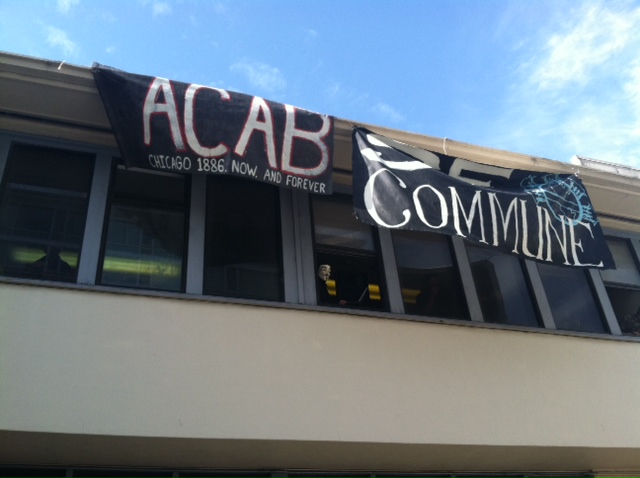
Occupy San Francisco protesters entered Catholic Church-owned properties at 888 Turk last night. This is the same building that a similar group occupied April 1, in a peaceful action that lasted about 24 hours. 

The successful reentry was a testament to the spread of skills and cultures surrounding building takeovers by groups like Homes Not Jails. The resulting “rebirth of the SF Commune” was a mellow and pleasant event at first, as protesters on a march from the celebratory Peoples Street Festival joined in the commune. Some held back in the street while others entered the building in hopes of building a “community center”—most remained outside the building, enjoying a free meal cooked and served by some of the same Occupy SF kitchen volunteers that once fed hundreds of people daily at Justin Herman Plaza.


The building occupation was meant to affirm a strong belief in the rights of people to gather and organize, or at the very least have a warm place to sleep at night. It was also an assertion from Occupy: we’re still here, your warnings to property owners to board up their vacant buildings and the chain-link fence you put up in front of 888 Turk (which protesters casually removed upon arrival) won’t stop us.

“The Catholic church owns it. They’re supposed to be doing charity, but they’re leaving it vacant until they can get high rent out of it,” said Jazzie Collins that afternoon, an organizer with Senior Action Network who was there to support the May Day actions.

“There’s too many vacant buildings in this city, while people sleep on the streets.”

Collins spoke only for herself, but her take on the situation matched the sentiments of many who questioned the importance of property rights in the light of unused building and homelessness throughout the city. That’s the same reason that the SF Commune had sprung up in the same building, exactly one month earlier.

Police spokesperson Sergeant Michael Andraychak seemed to believe that this repeat occupation would turn out the same way. “We’re putting up some barricades attempting to restrict access to the building,” said Andraychak around 5pm. “We’re opening traffic back up.”

But not half an hour later, when the police put up the final barricades sealing off access to the building, the dozen or so people who got caught inside pushed back at the barricade. Police responded with intimidating and striking a few with batons. Then, a man appeared on the roof.

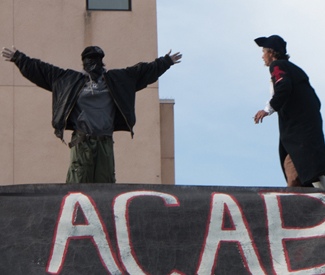
His face was covered in a black bandanna. He raised his arms, and in each hand, he held a brick. Onlookers began shouting, “don’t throw those!” He did though. He hit one man in the face, a fellow protester who, according to one source, has supported the Occupy SF effort since the camp.  

The mood of the crowd chilled. The brick-thrower held up more bricks, menacingly. 

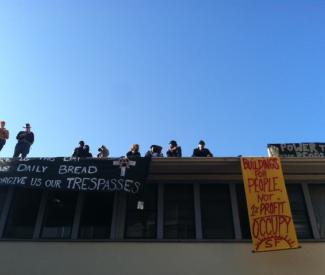
Police closed the street off to traffic. Soon most protesters, supporters, and interested bystanders were on the other side of Gough or in the park, watching the events. A few spoke to and yelled at police lined up on the corners. Hundreds more police stood ground on Turk in front of the building. A few dozen remained inside, including one who had appeared on the roof, taken the bricks from the assailant, and tossed them off, out of reach.

Police arrested a suspect for the brick throwing as he exited the building out the back. Jesse Nesbitt, 34, is in custody in San Francisco County jail on $150,000 bail. According to sheriff’s department spokesperson Susan Fahey, he has been charged with three penal code violations: felony assault with force likely to cause great bodily injury (245a), assault on a peace officer with force likely to cause great bodily injury (245c), and felony vandalism of more than $400, 594b1.
 
A dozen or so remained in the building during the stand-off. Some poked their faces out an open window, hung down peace sign painted on a piece of cardboard, and talked into a megaphone. “We are not armed, we are completely peaceful,” one man assured. Meanwhile, police told press that they estimated 200 were inside and were “stockpiling pipes, bricks.”

The stand-off continued for a few hours until, at 7:30pm, police cleared out of the area. Most activists had left- thousands were massing in Oakland. But 40 or so people remained and re-entered the building. Many stayed until police came around 5am, arresting 26. Seven remain in custody, and all have been charged with trespassing. (Indicating that the weapon stockpiling concern turned out to be false. Which, as far as I could tell inside the building, it certainly was).

At that point, I entered the building as well to speak with those that remained. How did they feel about the violence? Did they think it was connected to the previous night’s events, when mysterious protesters destroyed numerous Valencia St businesses and cars in what some Occupy SF protesters suspect was an act of provocateurs?

For a response to come from Occupy SF, it must be consented on at a general assembly, a long process. So all the respondents represent only themselves- though most chose to remain anonymous. This structure can lead to a troubling lack of accountability: if something harmful happens at an action, who can be expected to explain it and help to prevent it in the future if everyone is responsible for only themselves? At the same time, each personal answer is less riddled in spin than a form answer would be, since people speak honestly, and for only themselves.

The Valencia St destruction “was enough that I didn’t come out and do anything today, whether it was Occupy or not,” one woman who had been “pretty involved in camp, back when it was at JHP” told me. “They were there to piggy back off an Occupy event, to use the organization of Occupy to organize themselves,”

The brick incident, however, did not caution her against showing up, as she did later that night. “Incidents like this happen often with mentally ill or violent people, but they get more publicity when they’re at an Occupy event.”

D, a longtime Occupy SF organizer, said wearily that “we were all surprised” at the incident.
“We weren’t expecting any bricks to be thrown,” he said, “and we didn’t want anyone to get hurt.”

But in terms of preventing similar actions in the future, D said, “We can only do so much. Everybody’s an autonomous individual and we can’t control what they do.”

“We can try to clean up everything that could be thrown, we did that last time. This time we focused more on stopping graffiti in the building. There wasn’t any.”

“That’s my friend. When I saw the brick flying at his face, I was hurt. Half our crew is in the hospital with him right now,” said another organizer. “But the real violence is the system putting people on the street, and the cops enforcing that. I’ve seen [Nesbitt] beat up by police.”

“What should we do, just turn our backs on people with mental illnesses?” another piped up.

“This whole occupy thing at this point is so spread out and separated,” said a self-described Occupy SF supporter. “There are parts that are revolutionary and parts that are more reform, and they’re trying to bridge that. I don’t know what it is at this point anymore. But I know I support a movement to articulate the rage at what’s happening in our country right now.”

Bizarre development: Lone guy in black mask throws bricks at Occupy crowd

9

Yael Chanoff reports from the scene of the Occupy building takeover with a really strange development:.

Police had put up barricades in front of 888 Turk, and many of the protesters were out of the building, but some were still inside. Then, after the front door was completely sealed, a lone man, his face covered by a black bandana, appeared on the roof. He held a brick in each hand, and after a dramatic pause, hurled one of the bricks into the crowd below. It struck a protester in the face, causing a bloody injury. Paramedics are on the scene.

The brick-thrower kept up the barrage, hitting another protester in the leg, then moved to an adjacent building and began throwing pipes, hitting a police car.

Hundreds of police arrived on the scene; The brick thrower apparently vanished.


Occupy retakes Catholic Church building

11

The Occupy SF Commune is back.

More than 100 activists went from a march on Market Street to the building at 888 Turk, owned by the Catholic Church, that was occupied not long ago.

“This is our home,” said one OSF person. “A lot of folks love this spot.”

He added: “Any vacant building, people have the right to use it, just like with any vacant land. These are resouces of the commuinity and tney’re not being utilized.

“We’re offering medical care and serving food right now. Everyone is welcome here, and open space for the people, just like the camp at Justin Herman Plaza.”

Oakland protest: Tear gas, one arrest

0

Tuesday morning brought an eruption of protests though out downtown Oakland as Occupy activists marched and rallied in support of a national general strike day to mark May Day.

Though the action lacked the numbers of last fall’s Port of Oakland strike, three early morning marches of several hundred protesters made there way through Oakland drawing attention to issues of gentrification, patriarchy and what protesters characterized as the injustices of capitalism.

In a city still waiting for an economic recovery, the protests were a reminder that simmering tensions over economic disparities continue to cause major disruptions of business as usual in Oakland.

Activists focused attention on Child Protective Services and the family court system. The agency was criticizing the for dividing families and sharpening the financial strain on poor families.

“This is where lawyers get rich, where judges get rich, and everyone else suffers,” stated an Occupy Oakland activist on the steps of the courthouse on 13th and Oak.

By noon various marches and protests converged on Oscar Grant Plaza, as roughly 1,000 protesters blocking traffic at 14th and Broadway. Protester danced to a portable sound system carted around in wheel chair, and danced around a maypole erected in the intersection.

OPD’s new crowd-control tactics were in display as riot police entered the crowd to make an arrest as bystanders were moved away with tear gas, concussion grenades and batons.

One woman was arrested and a 19-year-old Oakland woman, was struck in the head with a police baton. Bleeding heavily from the blow, she was rushed to the hospital after Occupy medics determined her wound was beyond their capacity to treat.

It was unclear what provoked the arrest.

Further protests are planned for this afternoon.

UPDATE: Sergeant Jeff Thomason, OPD public affairs, told us there have been four arrests, related to an incident in which paint was allegedly thrown at a police officer. Oakland has summoned mutual aid from the California Highway Patrol, the Alameda County Sheriff’s Office and the Pleasanton and Hayward PDs.

May Day protests begin with ferry workers strike

1

[Editor’s Note: We’ll be covering May Day events in San Francisco and Oakland throughout the day, so check back for regular updates.]

May Day activities have begun with a strike by ferry workers and Golden Gate Transit workers, halting parts of the morning commute.

About 100 ferry workers picketed at the Ferry Building in San Francisco, as well as the Larkspur Ferry Terminal. In anticipation of the strike, the Golden Gate Bridge District announced that they would cancel morning ferry service yesterday. Service should resume at 2:15.

Workers from the Golden Gate Bridge Coalition say that they have offered concessions of more than $2 million and are still locked in labor disputes, prompting the strike for the traditional International Workers Day. 

“The last thing that bridge, bus, and ferry workers want to do is to inconvenience passengers, but what other option has management left us?” said Alex Tonisson, co-chair of the Golden Gate Bridge Labor Coalition, in a press release.

The strikes come after a rough start to May Day demonstrations in San Francisco. A plan for workers on the Golden Gate Bridge to strike and shut down traffic on the bridge was called off two days before the planned demonstration. Last night, protesters vandalized store windows, cars, and the Mission Police station in a march along Valencia St. Organizers with Occupy SF and Occupy Oakland were quick to distance themselves and condemn the destruction, both physically at the protest and in subsequent statements. 

We will continue to update as events unfold.

SEIU makes noise in City Hall

13

SEIU Local 1021 workers say ‘’our message was heard” after about 300 marched into City Hall April 30. The city workers marched around the rotunda and then visited the offices of Sups Mar, Campos and Kim and Mayor Ed Lee, demanding that health care costs do not increase in ongoing contract negotiations with the city.

The city has already taken pay cuts that the union had been loudly protesting off the table. 

“We’re making progress, but not enough progress,” said Local 1021 field organizer Frank Martin del Campo.

He added that “this is the first time to my knowledge a union has militarized during the arbitration process since the process was established in San Francisco.”

The union had stated that they planned to demonstrate until 7:30pm, and then attempt to stay the night in a “Wisconsin-style takeover.” But by 6:30pm, the workers had exited City Hall.

“Our goal was to come and reclaim City Hall,” said Local 1021 vice president Larry Bradshaw. “If they wouldn’t let us in we’d occupy City Hall. They let us in.”

He added that “our members aren’t afraid to get arrested,” referencing an April 18 protest that resulted in 23 arrests.

He said that SEIU will not be on strike for May Day, but many members will be calling in sick and supporting janitors with SEIU Local 87 in their picket at Westfield Mall, scheduled for 11am.

Bradshaw, however, a paramedic. won’t be calling in sick. “I’ll be in arbitration,” he said.

On eve of May Day, Valencia, Mission Police Station vandalized

37

A group of protesters left a trail of broken glass and paint tonight as they made their way from Dolores Park to Duboce on Valencia. Windows were broken, garbage cans overturned, paint bombs thrown, and messages saying “yuppies go home” as well as anarchist symbols were spray-painted on several restaurants, art galleries and cafes.

The façade of the police station on Mission and 17th was vandalized and broken.

A gathering at Dolores Park was advertised as a “a ruckus street party to counter gentrification, capitalism, and the policing of our communities.” About 200 attended, and chatted about their plans for the following day’s May Day activities while music played.

Shortly after 9pm, the group left the park and began to march on Dolores. Some overturned recycling bins and vandalized the windows at Farina restaurant minutes after turning the corner on 18th St, while others held back.

Dozens flocked to the sidewalk and began yelling, “this is not an Occupy SF action!”  while passers-by looked on, concerned.

The group turned on Valencia, continuing to shrink in size and break windows. Within half an hour there were less than 50 people in the march.

About 40 of police on foot followed the march along Valencia, trailing behind as vandalism continued. SFPD representatives were not immediately available for comment, but based on witness accounts there were no arrests.

Neighborhood residents were angered and confused by the destruction. One man who did not wish to be named said, “They kept doing it while other people in the march were trying to get them to stop. It was childish.”

Occupy Oakland protester Jesse Smith told CBS he was “more than a little shaken” by the events. 

“I know Occupiers,” Smith told CBS. “None of us have any idea who they were.”

A message on the Occupy SF website reads, “The march in the Mission Monday night was not an OccupySF event. OccupySF does not endorse this kind of destruction of the 99%’s property. The individuals involved in this destruction are not known to OccupySF, and we believe they are outside provocateurs sent in to tarnish the image of Occupy prior to the May Day actions.”

An absolute must-read on taxes (by Stephen King)

10

A lot of things drive me crazy (people making a left turn on 16th and Bryant at 5 p.m., backing up traffic for an entire block; people who get to park in the midde of the street on Sunday because the cops don’t ticket churchgoers; politicians who say “I’ll take a look at that” as a way to duck a question, dog owners who leave piles of shit in the middle of the sidewalk… don’t get me started). But one of the worst, on top of my list, is the claim that wealthy people who think the rich don’t pay enough taxes should just write the government a check.

George W. Bush loved that one. Every time taxes on the rich came up, he’d say: “If you think your taxes are too low, the IRS takes checks and money orders.” You can pay online, too.

So what’s wrong with that argument? Why doesn’t Warren Buffett just pay the taxes he thinks he ought to, and stop complaining? Because taxes don’t work that way, that’s why. And one of the best essays on this critical point just appeared on the Daily Beast. The author of this gem, called “tax me, for F@%&’s sake” is an author, Steven King, who is also part of the 1 percent, a man whose knack for telling horror stories has made him very wealthy. And he has harsh words for just about everyone who tries to get away with suggesting that high taxes ought to be voluntary:

I’ve known rich people, and why not, since I’m one of them? The majority would rather douse their dicks with lighter fluid, strike a match, and dance around singing “Disco Inferno” than pay one more cent in taxes to Uncle Sugar. It’s true that some rich folks put at least some of their tax savings into charitable contributions. My wife and I give away roughly $4 million a year to libraries, local fire departments that need updated lifesaving equipment (Jaws of Life tools are always a popular request), schools, and a scattering of organizations that underwrite the arts. Warren Buffett does the same; so does Bill Gates; so does Steven Spielberg; so do the Koch brothers; so did the late Steve Jobs. All fine as far as it goes, but it doesn’t go far enough.

What charitable 1 percenters can’t do is assume responsibility—America’s national responsibilities: the care of its sick and its poor, the education of its young, the repair of its failing infrastructure, the repayment of its staggering war debts. Charity from the rich can’t fix global warming or lower the price of gasoline by one single red penny. That kind of salvation does not come from Mark Zuckerberg or Steve Ballmer saying, “OK, I’ll write a $2 million bonus check to the IRS.” That annoying responsibility stuff comes from three words that are anathema to the Tea Partiers: United American citizenry.

More:

Most rich folks paying 28 percent taxes do not give out another 28 percent of their income to charity. Most rich folks like to keep their dough. They don’t strip their bank accounts and investment portfolios. They keep them and then pass them on to their children, their children’s children. And what they do give away is—like the monies my wife and I donate—totally at their own discretion. That’s the rich-guy philosophy in a nutshell: don’t tell us how to use our money; we’ll tell you. The Koch brothers are right-wing creepazoids, but they’re giving right-wing creepazoids. Here’s an example: 68 million fine American dollars to Deerfield Academy. Which is great for Deerfield Academy. But it won’t do squat for cleaning up the oil spill in the Gulf of Mexico, where food fish are now showing up with black lesions. It won’t pay for stronger regulations to keep BP (or some other bunch of dipshit oil drillers) from doing it again. It won’t repair the levees surrounding New Orleans. It won’t improve education in Mississippi or Alabama. But what the hell—them li’l crackers ain’t never going to go to Deerfield Academy anyway. Fuck ’em if they can’t take a joke.

He skewers the idea that giving the rich more money creates jobs (“At the risk of repeating myself, here’s what rich folks do when they get richer: they invest. A lot of those investments are overseas, thanks to the anti-American business policies of the last four administrations.”) He explains why the GOP tries so hard to defend tax cuts (“They simply idolize the rich. Don’t ask me why; I don’t get it either, since most rich people are as boring as old, dead dog shit. The Mitch McConnells and John Boehners and Eric Cantors just can’t seem to help themselves. These guys and their right-wing supporters regard deep pockets like Christy Walton and Sheldon Adelson the way little girls regard Justin Bieber … which is to say, with wide eyes, slack jaws, and the drool of adoration dripping from their chins.”) And he warns that life might not be so pretty for the uber-rich if this trend continues:

Last year during the Occupy movement, the conservatives who oppose tax equality saw the first real ripples of discontent. Their response was either Marie Antoinette (“Let them eat cake”) or Ebenezer Scrooge (“Are there no prisons? Are there no workhouses?”). Short-sighted, gentlemen. Very short-sighted. If this situation isn’t fairly addressed, last year’s protests will just be the beginning. Scrooge changed his tune after the ghosts visited him. Marie Antoinette, on the other hand, lost her head.

Think about it.

Yes, think about it: A society that gets more and more economically unequal is a society that won’t be stable for long.


What’s going on for Bay Area May Day?

6

UPDATE: The Golden Gate Labor Coalition has announced a change of plans. Instead of Golden Gate Bridge pickets, the coalition will be supporting a strike of ferry workers, who plan to bring all morning ferry service to a standstill. They have announced that the actions at the Golden Gate Bridge are cancelled, and instead workers will be demonstrating in solidarity with ferry workers in Larkspur- specific locations will be announced later today.

May 1, International Workers Day — May Day — used to strike fear into the hearts of bosses. The first May Day in 1867 was a fight for the eight-hour workday in Chicago (see more history at Citizen Radio at the Occupy Oakland Tribune). Since then, May 1 has remained a day when grievances are aired, when students and workers party in the street, when people strike in ways that shows whose really boss (you can’t have that work that keeps everything running without all those workers.) But mostly in other countries.

In the US, the day has diminished in importance, although it has resurged in recent years focused on immigrants rights. But what with Occupy Wall Street, labor and union organizing ramping up, and student strikes, and all these people working more and more closely together, May Day is coming back to the US.

The Bay Area certainly won’t be left out. Here is a list of May Day events, starting tonight and ending–well, who knows when. If you know of others, write them in the comments: it wouldn’t be a decentralized massive attempt at a full-on general strike without you!

THE NIGHT BEFORE (Mon/30)

5:30pm, San Francisco:

City workers from SEIU Local 1021 will gather at City Hall in a continued offensive surrounding their ongoing contract negotiations. The program runs until 7:30 pm, but the protest will go on “until they kick us out!”

8pm, San Francisco:

“The strike starts early” with a gathering at Dolores Park. According to a press release, demonstrators will meet “for a ruckus street party to counter gentrification, capitalism, and the policing of our communities.” www.strikemay1st.com/the-strike-starts-early

MAY DAY (Tue/1)

All day:

National Nurses United/California Nurses United is on strike at Sutter Health locations throughout the Bay Area. According to a press release, “some 4,500 RNs will be affected by the planned walk-out.”

ILWU Local 10, which worked in solidarity with Occupy Oakland in two port shutdowns last fall, is planning another one. They say that a work stoppage will halt the Port of Oakland’s operations all day.

7-10am, San Francisco:

The Golden Gate Bridge labor coalition, representing several unions of workers on the bridge, have been without a contract since April 2011. They originally called for a strike and resulting shut down of the bridge- and had massive support behind them. They’re now saying the protest will involve picketing at the bridge instead. So come join a picket, or if you cross the bridge don’t take the workers for granted- the bridge doesn’t work without them. www.occupythebridge.com

7am, San Francisco:

Meet at 16th st and Mission to be a part of the first SF Bike Cavalry of the day, a critical mass that will ride to the Golden Gate Bridge in solidarity with the picket. www.sfbikecavalry.org

8:30am – 12pm, Oakland:

Occupy Oakland will join others protesting, picketing, and generally striking at three (or four?) “action stations.” Meet at Snow Park for a “flying picket” that will “shut down banks and the Chamber of Commerce.” Meet at First and Broadway to “occupy Child Protective Services” in response to a decision they made to de-grant custody of one woman’s children based in part on her involvement in Occupy Oakland. Meet at 22nd and Telegraph to cause mayhem at uptown and downtown business associations. www.strikemay1st.com/119/

10am, San Francisco:

A rally and march for immigrants rights (the people who have been holding down US May Day for years.) Meet at 24th St Mission Bart for a march to 16th St. 

11am, San Francisco:

Janitors and retail workers at Westfield Mall are engaged in an ongoing labor dispute, and they’ll be picketing in solidarity at 5th and Market. 

11am, San Francisco:

A second SF Bike Cavalry will convene at Justin Herman Plaza to support the janitors strike, the immigrants’ rights march, and the Peoples Street Festival

11:30am, Hayward:

The Amalgameted Transit Union Local 192 will protest “substandard conditions” and “institutionalized racism” (according to a press release) at the operators of AC Transit, A-Para Transit Corporation, 22990 Clawiter Rd in Hayward.

12pm, San Francisco:

All the San Francisco students who walk out of school, workers who call in sick, people who usually do all the housework, who, for the day, say screw it, and other “general strike” participants will converge at Montgomery and Market for the People’s Street Festival. Music, performance, art and fun for the whole family. 

Noon-1pm, Oakland:

A mass rally in Oakland, at 14th and Broadway, with food, speakers, music, activities, and generally a lot to do that you can’t if you’re at work. 

1-3pm, Oakland:

According to Occupy Oakland “After the rally, those in attendance have the opportunity to stay downtown or join one of the autonomous actions that will be departing from 14th & Broadway to continue shutting down various capitalist institutions in the downtown area.”

3pm, Oakland:

Meet at Fruitvale Plaza (next to the Fruitvale Bart station) for likely the biggest action of the day. The March for Dignity and Resistance is being called the Bay Area’s regional protest and supporters will be there from all over the area. mayday2012.blogspot.com

6pm, San Francisco:

Celebrate workers rights at a fundraiser for Young Workers United, a self-described “multi-racial and bilingual membership organization dedicated to improving the quality of jobs for young and immigrant workers.” The party is at El Rio, 3158 Mission. www.occupysf.org

On May Day, local groups who have taken to occupying spaces in ways other than public square-camping will be ramping up their efforts. The occupied farm at Gill Tract will push on, and in a message from Occupy San Francisco: “On May Day, the SF Commune will open it’s doors and conduct another Open Occupation in solidarity with the May 1st General Strike.” So if you’re looking for someone to sleep while protesting a complex web of oppressive forces Tuesday night, you may be in luck.

For more information, see www.strikemay1st.com, a clearinghouse for Bay Area May Day plans.

Also see:

www.occupythebridge.com

www.occupysf.org

mayday2012.blogspot.com

www.decolonizeoakland.org

www.occupyoakland.org

Why three families, who never missed a rent payment, may face eviction

6

Alma Sierra has been living in her home at 490 Athens for three years. Sierra, her nine year old son, and two other mothers with their children share a rental unit. They have diligently paid their rent, and her son goes to school across the street. But last year, US Bank foreclosed on the small-time landlords that owned the property- now, the tenants face eviction.

“We’re three single mothers with children. We don’t have the means to just up and leave,” Sierra, a part-time domestic worker, told me through a translator from Causa Justa, an organization that works for tenants’ rights.

Their work helped pass the Just Cause eviction policy for which the organization is named last year.

Under city law, a landlord needs one of 14 reasons to justly evict a tenant. The reasons include failure to pay rent and trashing the property, as well as owner move-in and Ellis Act evictions.

But the foreclosure crisis has brought on a wave of bank-owned properties. These are tricky situations legally; banks generally want to sell the property, a task made more difficult if there are pesky tenants living there.

“The banks want to get rid of the tenants. The realtors for the banks always tell them they can get more money if there aren’t any tenants in it. Because that way they would have to do an owner move-in eviction,” said Tommi Mecca, a long-time tenants’ rights advocate in the city.

According to Mecca, US Bank has been pressuring the three families to leave the building, although no eviction papers have been filed yet. The Guardian is awaiting calls back from US Bank representatives.

In fact, it was only recently that the tenants even learned about the change of ownership, and contacted Causa Justa to ask for assistance.

The San Francisco Housing Rights Committee (SFHRC) got involved, as well- and discovered that the foreclosure had likely taken place in March of 2011.

“We got no notice about it,” said Sierra.

She added that she and the other tenants had continued to pay their rent to the former landlords for almost a year– even after the landlords no longer owned the property.

“It can take many months, in some cases longer, to actually sell property,” said Sarah Shortt, an organizer with the SFHRC.

“So in the meantime the bank is the landlord and they haven’t been responsible in lending or as landlords. They tend to disregard tenants’ rights and trample over the needs and concerns of renters.”

Even when tenants are made aware that the property they live in has been sold back to bank, it can often be difficult to determine who to turn to for repairs, complaints, or even the right address for rent checks.

“One of the things we see a lot of is, the bank acquires the property and then they’re just MIA. Tenants come to us and say, we don’t know who owns our building, where to pay rent, who to ask to fix leaky ceiling. We help them research to find who owner is,” said Shortt.

These situations often end with buy-outs, in which the bank pays the tenants to leave the property. The amount ranges, but according to Mecca, it can often be insubstantial.

“They start at $1,000, $3,000, something really insulting. And it’s only if tenants walk in somewhere like [the SFHRC] that we tell them, wait a minute, your tenancy is worth so much more than that.

As for Sierra and her roommates, they are determined not to leave.

“We don’t want to leave,” said Sierra. “We didn’t do anything wrong.”

At a press conference in front of a branch of US Bank on 16th and Mission today, more than 40 supporters came out to support the tenants in their attempts to stay in their home. In compliance with police, they left an aisle for pedestrians and blocked neither the sidewalk nor the street, and made efforts to allow customers room to enter and exit the bank. The manager opted to lock the doors anyway.

Once the door had been locked, some of the children who live in the unit taped letters they had hoped to deliver inside to the doors. One letter reads in part, “We have nowhere to go. None of our families can afford to move. And we shouldn’t have to. As tenants, we have rights in San Francisco.”

The letters cites a recent report which states that 2.3 million children in the United States have lost their homes to foreclosure  that one in eight children in the United States has been affected by foreclosure (based on data for loans that were made between 2004 and 2008.)

And supporters plan to keep up the pressure on banks in these and other cases of foreclosure and eviction- there’s hardly a lull before an “occupy the auctions dance party” planned for tomorrow.

For Shortt, the housing issue fits squarely into heightened protest activity launched by occupy protesters last fall.

“I think that’s one of the most important pieces of the occupy movement, starting to educate ourselves and each other about how ubiquitous the toll that’s been taken on cities, neighborhoods, communities by banking industry and one percent,” said Shortt.

“Any of these cases we talk about homeowners, renters, it’s the 99 percent we’re talking about, and tends to be the lower tier of the 99 percent, low income people are being disproportionately hit by this.”

Poll shows tax-the-rich measure hurt by Brown’s merger

9

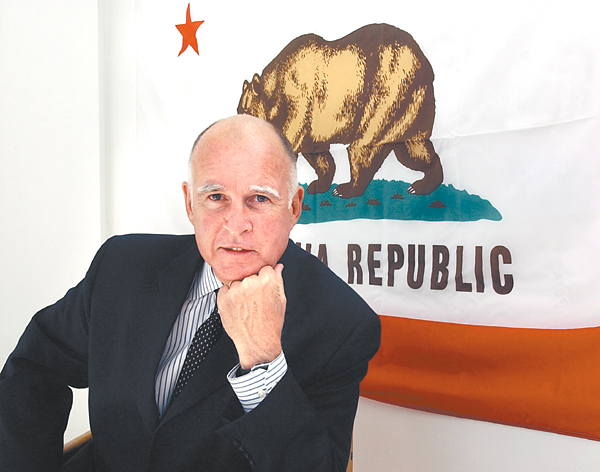
A new poll confirms a fear we’ve raised before – Gov. Jerry Brown’s insistence on coupling the popular tax on millionaires with an unpopular increase in the sales tax could doom the revenue package this November – putting pressure on the governor and his allies to step up their political games and save the schools from disastrous cuts.

The SF Chronicle’s story on the Public Policy Institute of California poll focused on the disconnect voters have between government services they support and their willingness to pay for them, which isn’t exactly news to anyone. A big reason for this state’s dire fiscal situation is that people want something for nothing.

Last year, thanks to the Occupy Wall Street movement highlighting how the richest 1 percent have amassed ever-greater wealth at the expense of the rest of us, that dynamic began to change. People started to openly and consistently advocate for increasing taxes on the wealthy, no longer cowed by accusations of “class warfare.”

The PPIC poll found that 65 percent of respondents like the idea of taxing millionaires and putting that money toward education, while 80 percent oppose the $5 billion in trigger cuts to schools that will occur if voters reject the tax measure. But only a slim majority of 54 percent favor the measure that Brown is pushing, mostly because 52 percent say they don’t like the sales tax increase, a regressive tax that will likely be highlighted repeatedly by opponents of the measure.

That’s a big challenge for the broad coalition that supports the measure, but it’s an especially big deal for Brown. He was the one who created this bad combination in the first place, and convinced the California Federation of Teachers to drop its Millionaires Tax – the clean measure that would have 65 percent support right now – in favor of a merged measure that’s a bit more progressive than Brown’s original idea.

Assembly member Tom Ammiano and other progressives we respect have said they like the compromise and worried that competing tax measures could sink them all in this make-or-break election (that’s because under state law, tax measures need a simple majority only during presidential elections, meaning it will be four more years until we have this opportunity again).

Maybe, but the sales tax increase was never a good idea, and these poll numbers show they’ve got a difficult challenge on their hands. In particular, Brown will need to finally prove his repeated campaign statements that he’s the one with the knowledge, skills, and experience to get things done in the dysfunctional, gridlocked state. It’s time to make good on those words, governor.

Pissed off shareholders, homeowners, and taxpayers converge on Wells Fargo meeting

12

Wells Fargo managed to hold its shareholder meeting April 24, but not without difficulty. A protest against the bank’s ongoing part in the foreclosure crisis, investments in the private prison industry, and record of tax dodging brought some 2,000 people to the West Coast Wells Fargo headquarters at 465 California St. for the meeting.

A broad coalition, including more than 180 Wells Fargo shareholders, as well as organized labor, students, immigrant rights advocates, and Occupy protesters, swarmed the building. Many entered the building, and others blocked its entrances and set up a stage on California, turning the block between Montgomery and Sansome into a combination alternative “stakeholders meeting” and block party.

Streets surrounding the headquarters were closed for more than four hours, as both protesters and some 200 police in riot gear stood their ground; there were 24 arrests, mostly for trespassing.

Participants hailed from across the country, from students from the University of Minnesota to steel workers from Redding, Penn. Demonstrators were explicitly and enthusiastically “non-violent.” One local organizer from the Alliance of Californians for Community Empowerment (ACCE) announced, “This is a non-violent direct action,” to an eruption of cheers from the crowd, at a rally preceding the march.

Police say organizers stuck to their tactical intentions. “I think it was a successful event,” said Sgt. Michael Andraychak, a spokesperson for the SFPD. “They have followed through with their stated objective: to have a peaceful protest.”

The organizers were somewhat less successful in a stated objective to get a large number of discontent Wells Fargo shareholders into the meeting to ask tough questions. More than 180 attended a training to prepare for the meeting on the night of April 23, but less than 30 made it inside.

However, the meeting was cut short, and organizers claim that in barring a number of shareholders, Wells Fargo acted illegally and the result of votes from meeting may be invalid.

Many shareholders were particularly incensed about public subsidies that the company took advantage of in 2008. In an amendment to the tax code that lasted only three months before Congress revoked it, the IRS gave tax breaks to healthy banks that acquired banks that were faring more poorly; Wells Fargo acquired Wachovia during the three month window. As a result, the company received $17.96 billion in tax breaks between 2008 and 2012, significantly more than the cost of the Wachovia deal.

Protesters hoped to disrupt the meeting to demand that the bank pay more taxes. Wells Fargo announced record profits this year, as well as a $19.8 million pay package for CEO John Stumpf. Stumpf has earned $60 million in the past three years.

“If they were paying their taxes, we wouldn’t have to do this” said Al Haggett, a retired San 911 worker who trained dispatchers and police.

Ron Colbert, another shareholder and a worker for Sacramento’s school district, also attempted to enter the meeting. “My sisters and brothers are suffering from foreclosure and they are pocketing our money instead of paying their taxes,” said Colbert.

“Tuition keeps going up every year. I have loans like you wouldn’t believe: $15,000, and it’s just my first year. But I pay my taxes, so why can’t they?” said Andrew Contstas, a psychology major at the University of Minnesota who traveled to San Francisco for the protest.

Determined to shut down the meeting, many groups of protesters entered the building at different times.

Around 10:30 am, about 75 were able to get in and sit down in the lobby, refusing to leave. “They said if we dispersed, they would let the shareholders in,” said SEIU Local 1021 organizer Gabriel Haaland, referring to the shareholders who came to protest and air their grievances. “They still didn’t. But they let shareholders in from either side.”

Many non-protester shareholders were able to enter through back entrances, escorted by police.

Workers from several unions who are currently locked in labor disputes, including janitors with SEIU Local 87 and AT&T technicians with local Communication Workers of America chapters, were also present at the protest. A stage set up in front of Wells Fargo turned California into an arena in which worker, student, homeowners, and immigrants told their stories.

Chris Drioane of CWA Local 9410 said that he is fed up after he worked 80-90 hours per week with no days off though the 2011 holiday season. “I worked from Thanksgiving to Valentine’s Day with no days off,” said Drioane.

The SFPD made 20 arrests, six for “chaining themselves to an object” and 14 for “some form of trespassing” after Wells Fargo asked them to make the arrests. Four were arrested by the Sheriff’s Department for interfering with an officer.

Ruth Schultz, a shareholder who was arrested inside the meeting, said that those who entered were able to speak. Several stood up and spoke individually before they were escorted out; afterward, the remaining protester-shareholders mic-checked the meeting and expressed their desire that Wells Fargo cease investment in private prisons, give principal reduction to all underwater homeowners, and pay “their fair share” of taxes. Police handcuffed them, and they were cited and released after spending 30 minutes in a room inside the Wells Fargo headquarters.

Schultz says the meeting lasted only 15 minutes after the group was detained, and was “ceremonial at best…They went on about their profits this year, how they’re sitting on the most capital they’ve ever had before.”

She says she was particularly frustrated from one statement made by CEO John Stumpf. “He said, ‘we’re proud of our mortgage business. In fact, I love our mortgage business.’”

A press releases from organizers explained that the protest was part of “99% Power, a national effort to mobilize well over 10,000 people, from all walks of life and representing the diversity of the 99%, to engage in nonviolent direct action at more than three dozen corporate shareholder meetings across the country.”

The national group plans to create similar chaos at a Bank of America shareholder meeting in Charlotte, NC May 6.

Guardian endorsements for June 5 election

34

>>OUR ONE-PAGE “CLEAN SLATE” PRINTOUT GUIDE IS HERE. 

As usual, California is irrelevant to the presidential primaries, except as a cash machine. The Republican Party has long since chosen its nominee; the Democratic outcome was never in doubt. So the state holds a June 5 primary that, on a national level, matters to nobody.

It’s no surprise that pundits expect turnout will be abysmally low. Except in the few Congressional districts where a high-profile primary is underway, there’s almost no news media coverage of the election.

But that doesn’t mean there aren’t some important races and issues (including the future of San Francisco’s Democratic Party) — and the lower the turnout, the more likely the outcome will lean conservative. The ballot isn’t long; it only takes a few minutes to vote. Don’t stay home June 5.

Our recommendations follow.

PRESIDENT

BARACK OBAMA

Sigh. Remember the hope? Remember the joy? Remember the dancing in the streets of the Mission as a happy city realized that the era of George Bush and The Gang was over? Remember the end of the war, and health-care reform, and fair economic policies?

Yeah, we remember, too. And we remember coming back to our senses when we realized that the first people at the table for the health-policy talks were the insurance industry lobbyists. And when more and more drones killed more and more civilian in Afghanistan, and the wars didn’t end and the country got deeper and deeper into debt.

Oh, and when Obama bailed out Wall Street — and refused to spend enough money to help the rest of us. And when his U.S. attorney decided to crack down on medical marijuana.

We could go on.

There’s no question: The first term of President Barack Obama has been a deep disappointment. And while we wish that his new pledge to tax the millionaires represented a change in outlook, the reality is that it’s most likely an election-year response to the popularity of the Occupy movement.

Last fall, when a few of the most progressive Democrats began talking about the need to challenge Obama in a primary, we had the same quick emotional reaction as many San Franciscans: Time to hold the guy accountable. Some prominent left types have vowed not to give money to the Obama campaign.

But let’s get back to reality. The last time a liberal group challenged an incumbent in a Democratic presidential primary, Senator Ted Kennedy wounded President Jimmy Carter enough to ensure the election of Ronald Reagan — and the begin of the horrible decline in the economy of the United States. We’re mad at Obama, too — but we’re realists enough to know that there is a difference between moderate and terrible, and that’s the choice we’re facing today.

The Republican Party is now entirely the party of the far right, so out of touch with reality that even Reagan would be shunned as too liberal. Mitt Romney, once the relatively centrist governor of Massachusetts, has been driven by Newt Gingrich and Rick Santorum so deeply into crazyland that he’s never coming back. We appreciate Ron Paul’s attacks on military spending and the war on drugs, but he also opposes Medicare and Social Security and says that people who don’t have private health insurance should be allowed to die for lack of medical care.

No, this one’s easy. Obama has no opposition in the Democratic Primary, but for all our concerns about his policies, we have to start supporting his re-election now.

U.S. SENATE

DIANNE FEINSTEIN

The Republicans in Washington didn’t even bother to field a serious candidate against the immensely well-funded Feinstein, who is seeking a fourth term. She’s a moderate Democrat, at best, was weak-to-terrible on the war, is hawkish on Pentagon spending (particularly Star Wars and the B-1 bomber), has supported more North Coast logging, and attempts to meddle in local politics with ridiculous ideas like promoting unknown Michael Breyer for District Five supervisor. She supported the Obama health-care bill but isn’t a fan of single-payer, referring to supporters of Medicare for all as “the far left.”

But she’s strong on choice and is embarrassing the GOP with her push for reauthorization of an expanded Violence Against Women Act. She’ll win handily against two token Republicans.

U.S. CONGRESS, DISTRICT 2

NORMAN SOLOMON

The Second District is a sprawling region stretching from the Oregon border to the Golden Gate Bridge, from the coast in as far as Trinity County. It’s home to the Marin suburbs, Sonoma and Mendocino wine country, the rough and rural Del Norte and the emerald triangle. There’s little doubt that a Democrat will represent the overwhelmingly liberal area that was for almost three decades the province of Lynn Woolsey, one of the most progressive members in Congress. The top two contenders are Norman Solomon, an author, columnist and media advocate, and Jared Huffman, a moderate member of the state Assembly from Marin.

Solomon’s not just a decent candidate — he represents a new approach to politics. He’s an antiwar crusader, journalist, and outsider who has never held elective office — but knows more about the (often corrupt) workings of Washington and the policy issues facing the nation than many Beltway experts. He’s talking about taxing Wall Street to create jobs on Main Street, about downsizing the Pentagon and promoting universal health care. He’s a worthy successor to Woolsey, and he deserves the support of every independent and progressive voter in the district.

U.S. CONGRESS, DISTRICT 12

NANCY PELOSI

Nancy Pelosi long ago stopped representing San Francisco (see: same-sex marriage) and began representing the national Democratic party and her colleagues in the House. She will never live down the privatization of the Presidio or her early support for the Iraq war, but she’s become a decent ally for Obama and if the Democrats retake the House, she’ll be setting the agenda for his second term. If the GOP stays in control, this may well be her last term.

Green Party member Barry Hermanson is challenging her, and in the old system, he’d be on the November ballot as the Green candidate. With open primaries (which are a bad idea for a lot of reasons) Hermanson needs support to finish second and keep Pelosi on her toes as we head into the fall.

U.S. CONGRESS, DISTRICT 12

BARBARA LEE

This Berkeley and Oakland district is among the most left-leaning in the country, and its representative, Barbara Lee, is well suited to the job. Unlike Pelosi, Lee speaks for the voters of her district; she was the lone voice against the Middle East wars in the early days, and remains a staunch critic of these costly, bloody, open-ended foreign military entanglements. We’re happy to endorse her for another term.

U.S. CONGRESS, DISTRICT 13

JACKIE SPEIER

Speier’s more of a Peninsula moderate than a San Francisco progressive, but she’s been strong on consumer privacy and veterans issues and has taken the lead on tightening federal rules on gas pipelines after Pacific Gas and Electric Company killed eight of her constituents. She has no credible opposition.

STATE SENATE, DISTRICT 11

MARK LENO

Mark Leno started his political career as a moderate member of the Board of Supervisors from 1998 to 2002. His high-profile legislative races — against Harry Britt for the Assembly in 2002 and against Carole Migden for the Senate in 2008 — were some of the most bitterly contested in recent history. And we often disagree with his election time endorsements, which tend toward more downtown-friendly candidates.

But Leno has won us over, time and again, with his bold progressive leadership in Sacramento and with his trailblazing approach to public policy. He is an inspiring leader who has consistently made us proud during his time in the Legislature. Leno was an early leader on the same-sex marriage issue, twice getting the Legislature to legalize same-sex unions (vetoed both times by former Gov. Arnold Schwarzenegger). He has consistently supported a single-payer health care system and laid important groundwork that could eventually break the grip that insurance companies have on our health care system. And he has been a staunch defender of the medical marijuana patients and has repeatedly pushed to overturn the ban on industrial hemp production, work that could lead to an important new industry and further relaxation of this country wasteful war on drugs. We’re happy to endorse him for another term.

STATE ASSEMBLY, DISTRICT 17

TOM AMMIANO

Ammiano is a legendary San Francisco politician with solid progressive values, unmatched courage and integrity, and a history of diligently and diplomatically working through tough issues to create ground-breaking legislation. We not only offer him our most enthusiastic endorsement — we wish that we could clone him and run him for a variety of public offices. Since his early days as an ally of Harvey Milk on gay rights issues to his creation of San Francisco’s universal health care system as a supervisor to his latest efforts to defend the rights of medical marijuana users, prison inmates, and undocumented immigrants, Ammiano has been a tireless advocate for those who lack political and economic power. As chair of Assembly Public Safety Committee, Ammiano has blocked many of the most reactionary tough-on-crime measures that have pushed our prison system to the breaking point, creating a more enlightened approach to criminal justice issues. We’re happy to have Ammiano expressing San Francisco’s values in the Capitol.

STATE ASSEMBLY, DISTRICT 19

PHIL TING

Once it became abundantly clear that Assessor-Recorder Phil Ting wasn’t going to get elected mayor, he started to set his eyes on the state Assembly. It’s an unusual choice in some ways — Ting makes a nice salary in a job that he’s doing well and that’s essentially his for life. Why would he want to make half as much money up in Sacramento in a job that he’ll be forced by term limits to leave after six years?

Ting’s answer: he’s ready for something new. We fear that a vacancy in his office would allow Mayor Ed Lee to appoint someone with less interest in tax equity (prior to Ting, the city suffered mightily under a string of political appointees in the Assessor’s Office), but we’re pleased to endorse him for the District 19 slot.

Ting has gone beyond the traditional bureaucratic, make-no-waves approach of some of his predecessors. He’s aggressively sought to collect property taxes from big institutions that are trying to escape paying (the Catholic Church, for example) and has taken a lead role in fighting foreclosures. He commissioned, on his own initiative, a report showing that a large percentage of the foreclosures in San Francisco involved some degree of fraud or improper paperwork, and while the district attorney is so far sitting on his hands, other city officials are moving to address the issue.

His big issue is tax reform, and he’s been one the very few assessors in the state to talk openly about the need to replace Prop. 13 with a split-role system that prevents the owners of commercial property from paying an ever-declining share of the tax burden. He wants to change the way the Legislature interprets Prop. 13 to close some of the egregious loopholes. It’s one of the most important issues facing the state, and Ting will arrive in Sacramento already an expert.

Ting’s only (mildly) serious opponent is Michael Breyer, son of Supreme Court Justice Breyer and a newcomer to local politics. Breyer’s only visible support is from the Building Owners and Managers Association, which dislikes Ting’s position on Prop. 13. Vote for Ting.

DEMOCRATIC COUNTY CENTRAL COMMITTEE

You can say a lot of things about Aaron Peskin, the former supervisor and retiring chair of the city’s Democratic Party, but the guy was an organizer. Four years ago, he put together a slate of candidates that wrenched control of the local party from the folks who call themselves “moderates” but who, on critical economic issues, are really better defined as conservative. Since then, the County Central Committee, which sets policy for the local party, has given its powerful endorsement mostly to progressive candidates and has taken progressive stands on almost all the ballot issues.

But the conservatives are fighting back — and with Peskin not seeking another term and a strong slate put together by the mayor’s allies seeking revenge, it’s entirely possible that the left will lose the party this year.

But there’s hope — in part because, as his parting gift, Peskin helped change state law to make the committee better reflect the Democratic voting population of the city. This year, 14 candidates will be elected from the East side of town, and 10 from the West.

We’ve chosen to endorse a full slate in each Assembly district. Although there are some candidates on the slate who aren’t as reliable as we might like, 24 will be elected, and we’re picking the 24 best.

DISTRICT 17 (EAST SIDE)

John Avalos

David Campos

David Chiu

Petra DeJesus

Matt Dorsey

Chris Gembinsky

Gabriel Robert Haaland

Leslie Katz

Rafael Mandelman

Carole Migden

Justin Morgan

Leah Pimentel

Alix Rosenthal

Jamie Rafaela Wolfe


DISTRICT 19 (WEST SIDE)

Mike Alonso

Wendy Aragon

Kevin Bard

Chuck Chan

Kelly Dwyer

Peter Lauterborn

Hene Kelly

Eric Mar

Trevor McNeil

Arlo Hale Smith

State ballot measures

PROPOSITION 28

YES

LEGISLATIVE TERM LIMITS

Let us begin with a stipulation: We have always opposed legislative term limits, at every level of government. Term limits shift power to the executive branch, and, more insidiously, the lobbyists, who know the issues and the processes better than inexperienced legislators. The current system of term limits is a joke — a member of the state Assembly can serve only six years, which is barely enough time to learn the job, much less to handle the immense complexity of the state budget. Short-termers are more likely to seek quick fixes than structural reform. It’s one reason the state Legislatures is such a mess.

Prop. 28 won’t solve the problem entirely, but it’s a reasonable step. The measure would allow a legislator to serve a total of 12 years in office — in either the Assembly, the Senate, or a combination. So an Assembly member could serve six terms, a state Senator three terms. No more serving a stint in one house and then jumping to the other, since the term limits are cumulative, which is imperfect: A lot of members of the Assembly have gone on to notable Senate careers, and that shouldn’t be cut off.

Still, 12 years in the Assembly is enough time to become a professional at the job — and that’s a good thing. We don’t seek part-time brain surgeons and inexperienced airline pilots. Running California is complicated, and there’s nothing wrong with having people around who aren’t constantly learning on the job. Besides, these legislators still have to face elections; the voters can impose their own term limits, at any time.

Most of the good-government groups are supporting Prop. 28. Vote yes.

PROPOSITION 29

YES

CIGARETTE TAX FOR CANCER RESEARCH

Seriously: Can you walk into the ballot box and oppose higher taxes on cigarettes to fund cancer research? Of course not. All of the leading medical groups, cancer-research groups, cancer-treatment groups and smoking-cessation groups in the state support Prop. 29, which was written by the American Cancer Society and the American Heart Association.

We support it, too.

Yes, it’s a regressive tax — most smokers are in the lower-income brackets. Yes, it’s going to create a huge state fund making grants for research, and it will be hard to administer without some issues. But the barrage of ads opposing this are entirely funded by tobacco companies, which are worried about losing customers, particularly kids. A buck a pack may not dissuade adults who really want to smoke, but it’s enough to price a few more teens out of the market — and that’s only good news.

Don’t believe the big-tobacco hype. Vote yes on 29.

San Francisco ballot measures

PROPOSITION A

YES

GARBAGE CONTRACT

A tough one: Recology’s monopoly control over all aspects of San Francisco’s waste disposal system should have been put out to competitive bid a long time ago. That’s the only way for the city to ensure customers are getting the best possible rates and that the company is paying a fair franchise fee to the city. But the solution before us, Proposition A, is badly flawed public policy.

The measure would amend the 1932 ordinance that gave Recology’s predecessor companies — which were bought up and consolidated into a single behemoth corporation — indefinite control over the city’s $220 million waste stream. Residential rates are set by a Rate Board controlled mostly by the mayor, commercial rates are unregulated, and the company doesn’t even have a contract with the city.

Last year, when Recology won the city’s landfill contract — which was put out to bid as the current contract with Waste Management Inc. and its Altamont landfill was expiring — Recology completed its local monopoly. At the time, Budget Analyst Harvey Rose, Sup. David Campos, and other officials and activists called for updating the ordinance and putting the various contracts out to competitive bid.

That effort was stalled and nearly scuttled, at least in part because of the teams of lobbyists Recology hired to put pressure on City Hall, leading activists Tony Kelley and retired Judge Quentin Kopp to write this measure. They deserve credit for taking on the issue when nobody else would and for forcing everyone in the city to wake up and take notice of a scandalous 70-year-old deal.

We freely admit that the measure has some significant flaws that could hurt the city’s trash collection and recycling efforts. It would split waste collection up into five contracts, an inefficient approach that could put more garbage trucks on the roads. No single company could control all five contracts. Each of those contracts would be for just five years, which makes the complicated bidding process far too frequent, costing city resources and hindering the companies’ ability to make long-term infrastructure investments.

It would require Recology to sell its transfer station, potentially moving the waste-sorting facility to Port property along the Bay. Putting the transfer station in public hands makes sense; moving it to the waterfront might not.

On the scale of corrupt monopolies, Recology isn’t Pacific Gas and Electric Co. It’s a worker-owned company and has been willing to work in partnership with the city to create one of the best recycling and waste diversion programs in the country. For better or worse, Recology controls a well-developed waste management infrastructure that this city relies on, functioning almost like a city department.

Still, it’s unacceptable to have a single outfit, however laudatory, control such a massive part of the city’s infrastructure without a competitive bid, a franchise fee, or so much as a contract. In theory, the company could simply stop collecting trash in some parts of the city, and San Francisco could do nothing about it.

As a matter of public policy, Prop. A could have been better written and certainly could, and should, have been discussed with a much-wider group, including labor. As a matter of real politics, it’s a messy proposal that at least raises the critical question: Should Recology have a no-bid, no contract monopoly? The answer to that is no.

Prop. A will almost certainly go down to defeat; Kopp and Kelly are all alone, have no real campaign or committee and just about everyone else in town opposes it. Our endorsement is a matter of principle, a signal that this longtime garbage deal has to end. If Recology will work with the city to come up with a contract and a bid process, then Prop. A will have done its job. If not, something better will be on the ballot in the future.

For now, vote yes on A.

PROPOSITION B

YES

COIT TOWER POLICY

In theory, city department heads ought to be given fair leeway to allocate resources and run their operations. In practice, San Francisco’s Department of Recreation and Parks has been on a privatization spree, looking for ways to sell or rent public open space and facilities as a way to balance an admittedly tight budget. Prop. B seeks to slow that down a bit, by establishing as city policy the premise that Coit Tower shouldn’t be used as a cash cow to host private parties.

The tower is one of the city’s most important landmarks and a link to its radical history — murals painted during the Depression, under the Works Progress Administration, depict local labor struggles. They’re in a bit of disrepair –but that hasn’t stopped Rec-Park from trying to bring in money by renting out the place for high-end events. In fact, the tower has been closed down to the public in the past year to allow wealthy patrons to host private parties. And the city has more of that in mind.

If the mayor and his department heads were acting in good faith to preserve the city’s public spaces — by raising taxes on big business and wealthy individuals to pay for the commons, instead of raising fees on the rest of us to use what our tax dollars have already paid for — this sort of ballot measure wouldn’t be necessary.

As it is, Prop. B is a policy statement, not an ordinance or Charter amendment. It’s written fairly broadly and won’t prevent the occasional private party at Coit Tower or prevent Rec-Park from managing its budget. Vote yes.


Utopia, mon amour

0

marke@sfbg.com

VISUAL ARTS With Occupy gearing up again and a fresh round of election hell full upon us, another cycle of protest — and the urge to engage with the problems of the world while somehow escaping them — is in the air. The Oakland Museum’s current “1968 Exhibit” (through August 19) offers a family-friendly, multimedia trip through the Bay Area’s most famous political and cultural upheaval. But here are three ongoing shows that look closely at individual creators from the past whose work transcends nostalgia, transmits a fair amount of beauty, and drums up some idealistic lessons for the present.


“ARTHUR TRESS: SAN FRANCISCO 1964”

A miracle to inspire cafe artists everywhere. In 1964, 23-year-old NYC photographer Arthur Tress winged through San Francisco for a season, shooting the populace at a particularly turbulent time: the Republican National Convention, the Beatles’ first North American tour, auto worker protests along Van Ness, the passage of the Civil Rights Act. He developed the negatives in the communal darkroom off Duboce Park, had an unremarkable show in the back of a cafe, packed the photos up at his sister’s, and moved on. After his sister died, he found them in a box of her effects, and realized their significance.

And what a find: Forget Mad Men, this is the real 1964, perched on the edge of a cultural unraveling, its existential beehive slowly loosening into flower child ideals. The 70 photographs on show at the de Young, curated by James Ganz, expertly play with composition to bring rough social patches to artful life. A distorted shot of a George Romney presidential campaign poster delivers Orwellian chills. Screaming girls hoisting “Ringo for President” banners intimate repressed political hysteria. Dashing union workers form impressive phalanxes. Patrons at a Fifth and Market diner embody an microcosm of economic disillusionment. A transgender woman suns her hairy legs on the Embarcadero, a plaid-shirted boy holds up a hand-drawn hammer and sickle.

All of it coated with the glamour of deconstructed nostalgia, in which one can indulge and critique at once. But there’s more: “You have throw into the mix a heavy dose of social commentary and criticism — the idea that the photograph can be a vehicle for social change,” Tress tells an interviewer in the show’s handsome if carelessly annotated catalogue. “You photographed street demonstrations, you photographed protests … it was a way of becoming part of the movement.”

Through June 3. De Young Museum, 50 Hagiwara Tea Garden Dr., deyoung.famsf.org

“THE UTOPIAN IMPULSE: BUCKMINSTER FULLER AND THE BAY AREA”

Inside the great Henry Ford automotive museum just outside of Detroit, you can tour an actual Dymaxion House, designed by preternaturally productive designer, philosopher, and dissembler R. Buckminster Fuller. It’s as perfect a realtime experience of walking around in someone’s 1940s sci-fi Utopian dream as one can ever have. A polished aluminum mushroom cap subdivided into tiny rooms bursting with ingenious “squee!”-worthy gadgetry to handle all of life’s projected needs, the Dymaxion House never took off as vernacular American architecture, despite its supposed ease of construction, light weight, and good intentions to house an expanding population. (Among its bland nemeses: rain, expense, and snarky architecture critics.)

But while it’s particularly poignant to see this polished dream deferred nestled among the many wheeled ones populating Henry Ford’s shrine to the former glories of the Motor City — and even though geodesic monument Spaceship Earth at Disney’s Epcot, another eerie graveyard of sleek Utopian ideals, remains Bucky Fuller’s only famous American architectural manifestation — the Dymaxion concept, and several other Bucky wonders, have had a profoundly positive and energizing effect on the Bay Area, as this visionary show at the SFMOMA reveals.

Curator Jennifer Dunlop Fletcher forewarned, “To be clear, it’s not so much a show about Fuller.” Indeed, but in the first rooms prepare to be blown away by gorgeous blow-ups of Massachusetts-born Bucky’s hyper-geometric blueprints, which will surely provide several indie electro bands with album cover inspiration for years to come, and a wall of insanely detailed notecards from “Everything I Know,” his late-life video-recorded brain dump.

Then the real magic of the show kicks in, as it opens up into displays of Bay Area movements and products directly traceable to Fuller, from glorious hippie artifacts like the Ant Farm architecture collective, the Whole Earth Catalog scene, and the iconic North Face “Oval Intention” dome-shaped tent (really!) to contemporary tech initiatives, like bright neon specimens from the “One Laptop One Child” campaign and the utterly transfixing “Local Code” by UC Berkeley Assistant Professor Nicholas de Monchaux, which digitally renders the transformation of all the unused public space in SF into “a common ecological infrastucture.”

Beyond reviving interest in Fuller, the ambitious project of SFMOMA here is to showcase the deep connection between the Bay Area’s brilliant tech legacy and its transcendental communal one, an audacious, successful synthesis that would bring Bucky joy — and one that only a full-size recreation of Steve Wozniak’s garage could probably best.

Through July 29. SFMOMA, 151 Third St., SF. www.sfmoma.org

“RADICALLY GAY: THE LIFE OF HARRY HAY”

Harry Hay seemed to drop almost effortlessly into so many essential 20th century ideal-driven environments — Hollywood, unions, the Communist Party, gay rights, naturism, really the list goes on. That this modest show at the SF Main Library, curated by Joey Cain, not only clearly distills Hay’s timeline and influence, but also manages to illuminate new corners of his life and sometimes bring on a few tears, is rather a sensation.

Seriously, the man was multitude. Hay is best known as the founder of one of the first gay rights organizations, the Mattachine Society — here revealed through documents, org charts, and touching photos to have been a sort of Moose Lodge for “homophiles.” In one of the show’s most astounding touches, the exquisite Edwardian tea set used by his mother Margaret to caffeinate the early Mattachine meetings is displayed in full.

But of course there was more for this Mad Hatter, including pleading the Fifth before the House Un-American Activities Committee in the 1950s for his Communist party membership and Marxist musicology studies, his 1930s radicalizing tryst with actor and union supporter Will Geer, a.k.a. Grandpa from The Waltons, the “Circle of Loving Friends” desert commune, the national campaign to stop the damming of the Rio Grande — all laced through with references to underground SF gay clubs and arts happenings. (Some things, like his controversial early support for NAMBLA, which could benefit from some honest contextualization, seem glossed over, perhaps due to space concerns.)

Hay’s creation in the 1970s of the Radical Faeries, a collective whose anti-assimilationist, Pagan aesthetic continue to influence and inform Bay Area style, is well-represented here, as is perhaps Hay’s most stable pursuit: his loving 40-year relationship with John Burnside. Two seemingly politically contradictory Utopian ideals, embodied in one mercurial spirit, revealed beautifully.

Through July 29. SF Main Library, 100 Larkin, SF. www.sfpl.org

Alerts

0

WEDNESDAY 25

Court support for Oaksterdam arrestees Oakland federal courthouse, 1301 Clay, Oak, 9:30 am, free. About 60 percent of Californians support medical marijuana, and a similar percentage are likely quite pissed off following federal raids on Bay Area businesses that dispense medical cannabis as well as the trade school that launched careers in the growing industry, Oaksterdam University. When property was seized and medical marijuana defenders arrested last week, there was an uproar, and that uproar continues Wednesday, when a handful of those detained have a court date. Show up to held support those arrested and continue the fight for safe access.

SATURDAY 28

Learn the Art of Seeding San Francisco Public Library- Parkside Branch, 1200 Taraval, SF, www.feeltheearth.org, 3-4pm, free. Join Jonathan Silverman (aka Victory Farmer), director of Feel the Earth, for a workshop teaching kids how to plant seeds and keep them growing. Anyone three years old and above is welcome to connect with their plants and learn to cultivate them at this engaging workshop. They will probably get to leave with some brand new peas.

Walk Against Rape The Women’s Building, 3548 18th St, SF www.sfwar.org 11am, free or fundraising optional. Every two minutes, a sexual assault occurs in the United States. Women Against Rape have long provided a crisis hotline and other services for people dealing with sexual assault, as well as a safe space to share stories. April is sexual assault awareness month, and WAR will conclude it with the Walk Against Rape- continuing the struggle against sexual abuse of all kinds.

Green Action Walkathon McLaren Lodge, 501 Stanyan, SF www.greenaction.givezooks.com 10:30am, free or $15 for T-shirt towards fundraising. A beautiful walk through Golden Gate Park, for a good cause. Green Action is an organization dedicated to fighting localized environmental hazards. It’s stopped toxic waste dumping from Hunters Point to indigenous land in Ward Valley. Now, it invites you to “Join communities and individuals affected by environmental pollution in the march toward a healthy planet.”

TUESDAY 1 May Day Many locations. See www.strikemay1st.com for round-up of Bay Area events. This is going to be big. A call for a May Day general strike has resonated throughout the world, and in the Bay Area everyone from labor to Occupy groups plan to heed that call, hard. There will be a slew of events as organizers tell everyone: no work, no school, no shopping, no housework. Instead, take to the streets for everything from a family-friendly street festival to a marches throughout Oakland and San Francisco to what Occupy SF has announced as a “rebirth of the San Francisco commune.” Some groups will even kick off the day early, with an April 30 “ruckus street party” in Dolores Park and SEIU protest at City Hall. So call in sick- you might not be able to get to work anyway, as a group plans to occupy the Golden Gate Bridge that morning.

Activists demonstrate, spend the night outside Wells Fargo

4

About 50 gathered for a demonstration April 23 outside the west coast Wells Fargo headquarters on Montgomery and California- and 20 stayed the night- in a plan to “Occupy Wells Fargo” for the bank’s shareholder meeting April 24.

Several organizers from non-profits and community groups aired their complaints about Wells Fargo, including their role in the foreclosure crisis as well as investments in the private prison and coal industries. 

Wells Fargo is a substantial investor in GEO Group, whose “operations include the management and/or ownership of 114 correctional, detention and residential treatment facilities encompassing approximately 80,000 beds,” according to its website. 

Amanda Starbuck of Rainforest Action Network decried Wells Fargo’s investments in the coal industry, especially mountaintop removal mining– a mining technique in which the top of a mountain is blown up, to attain access to coal. Many environmentalists oppose the practice, which leaves mountains flattened and barren, while allowing for the flow of sediment and mining chemicals into rivers and streams. 

“These projects would not be able to happen if banks like Wells Fargo didn’t invest in them,” said Starbuck to the group.

After the events ended around 10pm, protesters remained, serving food to passers-by and preparing for today’s events. One woman projected the word “shame” in glowing letters beneath Wells Fargo’s sign. 

“So John Stumpf [CEO of Wells Fargo] said, that’s a moral hazard to give principal reduction to people who are getting foreclosed on, but it’s not a moral hazard for Fannie Mae to buy up all these crap mortgages from us, and put the taxpayers on the hook,” Jane Smith, a longtime Occupy San Francisco organizer, explained enthusiastically to a small group of other protesters sitting on the sidewalk taking notes. 

Organizers say they expect at least 1,000 people to protest outside the company’s shareholder meeting.

20 remained over night outside the bank, about 16 lined up in sleeping bags. Police stood by throughout the night- there were no conflicts. 

Protesters plan to meet at Justin Herman Plaza at 10am for a march to the shareholder meeting.

Film Listings

0

Film listings are edited by Cheryl Eddy. Reviewers are Kimberly Chun, Max Goldberg, Dennis Harvey, Lynn Rapoport, and Matt Sussman. For rep house showtimes, see Rep Clock.

SAN FRANCISCO INTERNATIONAL FILM FESTIVAL

The 55th San Francisco International Film Festival runs April 19-May 3; most shows $13. Venues: Castro Theatre, 429 Castro, SF; Pacific Film Archive, 2575 Bancroft, Berk.; SF Film Society Cinema, 1746 Post, SF; and Sundance Kabuki Cinema, 1881 Post, SF. For additional info, visit www.sffs.org.

OPENING

*Attenberg Isolated in a seaside Greek hamlet, naive about the ways of the world, and committed to watching her brilliant, terminally ill father slowly ebb away, Marina (Ariane Labed) might be living in a kind of hell from the viewpoint of many of her 20-something peers. But as imagined by writer-director Athina Rachel Tsangari, Marina’s circumscribed life instead teems with small, fascinating moments and weird, awkward instances of intimacy — the kind that add up to a compelling portrait of a coming of age and a kind of arrival of wisdom. About to face a lonely future with the imminent passing of architect dad Spyros (Vangelis Mourikis), Marina works as a driver, tooling around town to the chilled anguish of Suicide, attempting to learn about the facts of life from sexually experienced chum Bella (Evangelia Randou, a ringer for musician Eleanor Friedberger), and sparring playfully with her father. “We built an industrial colony on top of sheep pens and thought we were making a revolution,” he says in one scene, looking out at the water. “I like it. It’s soothing, all this uniformity,” Marina replies. “That’s because deep down you’re an optimistic bourgeois modernist.” “Bonjour, bourgeois.” A ripple is sent through Marina’s insular existence with the arrival of an engineer (Yorgos Lanthimos) — a real candidate for an intimate social experiment. Aligning herself firmly with her protagonist, Tsangari is gifted with a unique voice and has a remarkable eye for a resonant, poetic image. She channels both into a quiet film reminiscent of indies an age away à la Stranger Than Paradise (1984), finding a vein of humanistic hope during end times. (1:35) Presidio. (Chun)

Chimpanzee Just in time for Earth Day, Tim Allen narrates this kid-friendly, Jane Goodall-approved nature doc. (2:00) Shattuck.

4:44 Last Day on Earth Abel Ferrara’s latest imagines what the end of the world might be like for a volatile Lower East Side couple — he’s an ex-junkie (Ferrara favorite Willem Dafoe), she’s a young painter (Shanyn Leigh, Ferrara’s real-life companion). The film’s title refers to the predicted instant that an environmental catastrophe will completely dissolve the ozone layer, but 4:44 is mostly set indoors, specifically within the headspace of Dafoe’s character. It’s a gritty film that veers between self-indulgence and stuff that honestly seems pretty practical (sure, there’s a lot of Skyping, but if the world were ending, wouldn’t you?); as far as inward-looking disaster movies go, anyone planning an apocalypse film festival could double-bill 4:44 nicely with 2011’s Melancholia. (1:25) Balboa. (Eddy)

Letters From the Big Man Don’t fear the yeti. Filmmaker Christopher Munch (1991’s The Hours and Times) gets back to nature — and a more benevolent look at the sasquatch — with the engrossing Letters From the Big Man. Sarah (Lily Rabe, Jill Clayburgh’s daughter, perhaps best known for her ghostly American Horror Story flapper) is a naturalist and artist determined to get off trail, immerse herself in her postfire wilderness studies in southwestern Oregon, and leave the hassles and heartbreak of the human world behind. She’s far from alone, however, as she senses she’s being tailed — even after she confronts another solo hiker, Sean (Jason Butler Harner), who seems to share her deep love and knowledge of the wild. What emerges — as Sarah lives off the grid, sketches soulful-eyed Bigfoots, and powers her laptop with her bike — is a love story that might bear a remote resemblance to Beauty and the Beast if Munch weren’t so completely straight-faced in his belief in the big guys. The question, the mystery, isn’t whether or not sasquatch exist, according to the filmmaker, who paces his tale as if it were as big and encompassing as an ancient forest — rather, whether we can hold onto a belief in nature and its unknowables and coexist. (1:44) Roxie, Smith Rafael. (Chun)

The Lucky One Iraq War veteran Logan (Zac Efron) beats PTSD by walking with his German shepherd from Colorado to the Louisiana bayou, in search of a golden-haired angel in cutoff blue jean short shorts (Taylor Schilling). His stated (in soporific voice-over) aim is to meet and thank the angel, who he believes repeatedly saved his life in the combat zone after he plucked her photograph from the rubble of a bombed-out building. The snapshot offers little in the way of biographical information, but luckily, there are only 300 million people in the United States, and he manages to find her after walking around for a bit. The angel, or Beth, as her friends call her, runs a dog kennel with her grandmother (Blythe Danner) while raising her noxiously Hollywood-precocious eight-year-old son (Riley Thomas Stewart) and fending off the regressive advances of her semi-villainous ex-husband (Jay R. Ferguson). Logan’s task seems simple enough, and he’s certainly walked a fair distance to complete it, but rather than expressing his gratitude, he becomes tongue-tied in the face of Beth’s backlit blondness and instead fills out a job application and proceeds to soulfully but manfully burrow his way into her affections and short shorts. Being an adaptation of a Nicholas Sparks novel, The Lucky One requires some forceful yanking on the heartstrings, but director Scott Hicks (1999’s Snow Falling on Cedars, 1996’s Shine) is hobbled in this task by, among other things, Efron’s wooden, uninvolved delivery of queasy speeches about traveling through darkness to find the light and how many times a day a given woman should be kissed. (1:41) Marina, Shattuck. (Rapoport)

*Marley Oscar-winning documentarian Kevin Macdonald (1999’s One Day in September; he also directed Best Actor Forest Whitaker in 2006’s The Last King of Scotland) takes on the iconic Bob Marley, using extensive interviews — both contemporary (with Marley friends and family) and archival (with the musician himself) — and performance and off-the-cuff footage. The end result is a compelling (even if you’re not a fan) portrait of a man who became a global sensation despite being born into extreme poverty, and making music in a style that most people had never heard outside of Jamaica. The film dips into Marley’s Rastafari beliefs (no shocker this movie is being released on 4/20), his personal life (11 children from seven different mothers), his impact on Jamaica’s volatile politics, his struggles with racism, and, most importantly, his remarkable career — achieved via a combination of talent and boldness, and cut short by his untimely death at age 36. (2:25) California, Embarcadero. (Eddy)

*My Way South Korean director Kang Je-gyu (2004 Korean War epic Taegukgi) returns to the battlefield for another bombastic action flick with a very complicated bro-down at its center. This time, it’s World War II, and the head-butting protagonists are not actually brothers, but lifelong frenemies: Japanese Tatsuo (mega-idol Joe Odagiri) and South Korean Joon-sik (Taegukgi star Jang Dong-gun). They meet in occupied South Korea, where class and country lines amp up their frequent confrontations as competitive long-distance runners. When WW2 breaks out, Joon-sik is forced to join the Japanese army, with guess who ordering him around; during My Way‘s meaty war-is-hell section, the men’s relationship endures a Soviet labor camp, knife (and fist) fights, blizzards, gunshot wounds, deafness, countless explosions (including lots of exploding bodies), sprints on the beach, bellowing arguments, runaway tanks, grenades, Nazis, D-Day, and moments of heroism, cowardice, insanity, weepy emotion, and dumb luck. Somehow, Kang keeps the pace between “frenetic” and “superfly TNT” for a solid two hours — the man may not care much for subtlety, but My Way is nothing if not insanely entertaining. (1:59) SF Center. (Eddy)

*Surviving Progress The very definition of a movie that most needs to be seen by the people least likely to see it — i.e. most folk the right of the political dial — this excellent documentary manages to interweave virtually all the leading planet threatening woes of our era in a succinct and entertaining fashion. Its thesis is author Ronald Wright’s notion that “We’re at the end of a failed experiment.” It’s been around a while, so you’ve doubtless heard of it: the Industrial Revolution. That shift from small-scale, self-sustaining agrarian communities to much larger ones dependent on mass production and import-export created pockets of enormous First World wealth and comfort. But the populations that benefitted used up resources wildly out of proportion to their number; now countries like China and India want their share of the industrialized pie, just as we’ve realized those resources might actually run out. Cue summaries of the harm global warming, overpopulation, consumption, soil depletion, “market fundamentalism,” etc. have done and will do, as duly noted here by a roster of A-list experts including Stephen Hawking and Jane Goodall. (The latter vividly contextualizes just how out of whack humanity has gone by opining that ours is the only species capable of terminating its future by destroying its own habitat.) While this may sound like a bitter pill to swallow, not to mention one you’ve swallowed many times before, Surviving Progress colorfully weaves together a vast assortment of audiovisual materials as well as information, to highly watchable results. Do the earth a favor: see this movie, and drag a skeptic you know along. (1:26) Lumiere, Shattuck. (Harvey)

Think Like a Man Based on Steve Harvey’s best-seller Act Like a Lady, Think Like a Man, this ensemble rom-com stars Romany Malco, Gabrielle Union, Kevin Hart, and Wendy Williams. (2:02) Shattuck.

ONGOING

American Reunion Care for yet another helping of all-American horn dogs? The original American Pie (1999) was a sweet-tempered, albeit ante-upping tribute to ’80s teen sex comedies, so the latest in the franchise, the older, somewhat wiser American Reunion, is obliged to squeeze a dab more of the ole life force outta the class of ’99, in honor of their, em, 13th high school reunion. These days Jim (Jason Biggs) is attempting to fluff up a flagging postbaby sex life with wife Michelle (Alyson Hannigan). Kevin (Thomas Ian Nicholas) yearns to get in touch with his buried bad boy. Oz (Chris Klein) has become a sportscaster-reality competition star and is seemingly lost without old girlfriend Heather (Mena Suvari). Stifler (Seann William Scott) is as piggishly incorrigible as ever—even as a low-hanging investment flunky, while scarred, adventuring biker Finch (Eddie Kaye Thomas) seems to have become “the most interesting man in the world.” How much trouble can the gang get into? About as much of a mess as the Hangover guys, which one can’t stop thinking about when Jim wakes up on the kitchen floor with tile burns and zero pants. Half the cast—which includes Tara Reid, John “MILF!” Cho, Natasha Lyonne, and Shannon Elizabeth — seems to have stirred themselves from their own personal career hangovers, interludes of insanity, and plastic surgery disasters (with a few, like Cho and Thomas, firmly moving on), and others such as parental figures Eugene Levy and Jennifer Coolidge continuing to show the kids how it’s done. Still, the farcical American franchise’s essentially benign, healthy attitude toward good, dirty fun reads as slightly refreshing after chaste teen fare like the Twilight and High School Musical flicks. Even with the obligatory moment of full-frontal penis smooshing. (1:53) Metreon, 1000 Van Ness. (Chun)

Bad Fever Dustin Guy Defa’s tiny, odd character study centers on one Eddie Cooperschmidt (Kentucker Audley, a director himself), who looks like Mr. February 1992 on a calendar of sensitive grunge band hunks, but acts more like Homer Simpson — the Nathanael West version, not Matt Groening’s. He still lives with mom (unsympathetically played by Annette Wright), doesn’t or can’t hold a job, has no friends, fumbles through an oddly formal vocabulary, and carries himself like a 13-year-old who’s just had all his growth spurts in one go. In other words, he’s the sort of character whose precise status — just socially inept, or developmentally disabled, or both? — is a mystery the film doesn’t bother clarifying. Nor do we find out what the story is behind Irene (Eleonore Hendricks), his hard-bitten antithesis, who seems to be staying in an empty school classroom as some sort of weird art experiment rather than because she’s “homeless,” and who manipulates the hapless Eddie into videotaped situations that are perverse but stop short of pornography. (Or rather he — almost certainly a virgin — stops short there.) As if more goofy pathos were needed here, Eddie’s dream is to be a stand-up comedian, a career he is about as well equipped for as brain surgeon. When Eddie plays his big first (and probably last) comedy gig, the onscreen audience appears to be wondering the same thing you might: is this just sad, or some kind of Andy Kaufman-type performance piece? Painstakingly low-key and realistic in execution, Bad Fever‘s success will depend on whether you can swallow it conceptually — these characters are surrounded by a real world, but they can seem unreal themselves. (1:24) Roxie. (Harvey)

*The Ballad of Genesis and Lady Jaye Once dubbed “the wickedest man in the world”, shock artist and cofounder of seminal industrial music pioneers Throbbing Gristle Genesis Breyer P-Orridge has softened somewhat with time. Her plunge into pandrogyny, an ongoing artistic and personal process embarked upon with the late Jacqueline “Lady Jaye” Breyer P-Orridge, is an attempt to create a perfectly balanced body, incorporating the characteristics of both. As artists, the two were committed to documenting their process, but as marriage partners, much of their footage is sweetly innocuous home video footage: Genesis cooking in the kitchen decked out in a little black dress, Lady Jaye setting out napkins at a backyard bar-b-que or helping to dig through Genesis’ archives of COUM Transmissions and Throbbing Gristle “ephemera,” the two wrapped in bandages after getting matching nose jobs. “I just want to be remembered as one of the great love affairs of all time,” Jaye tells Genesis. This whimsical documentary by Marie Losier will go a long way toward making that wish a reality. (1:12) Roxie. (Nicole Gluckstern)

Blue Like Jazz Tap or bottled water, rainy Portland, Ore. or dry Texas — how does a sincere, young Bible-thumping Baptist reconcile the two — a fish out of water nonetheless determined to swim upstream and make his way to adulthood. Based on the Donald Miller memoir-of-sorts, Blue Like Jazz may look like a Nicholas Sparks romantic opus from afar, but in the care of director-cowriter Steve Taylor, this tale of a young man coming to terms with the wider, wilder world apart from the strict confines of lock-in abstinence groups snatches a bit of the grace John Coltrane tapped in A Love Supreme. The earnest Donald (True Blood‘s Marshall Allman) is all set to go to his nearby Bible Belt Christian university until his bohemian jazz-loving dad pulls favors and enrolls him at free-form Reed College. Donald will have to closet his holy-roller background if, as his new lesbian pal (Tania Raymonde) cautions, he “plans on ever making friends or sharing a bowl or seeing human vagina without a credit card.” Donald finds his way back to meaning and spirit — and the fun is getting there, as he joins a civil-disobedience-club-for-credit (Malaysian cocktail tennis was canceled) and falls for passionate activist Penny (Claire Holt). Allman, who also co-executive produced, emerges as a thoughtful actor who can carry a potentially maudlin and ultimately lovable collegiate coming-of-age story on his own. (1:47) 1000 Van Ness, Opera Plaza. (Chun)

*Bully Anyone who’s ever been a kid on the wrong side of a bully — or was sensitive and observant enough not to avert his or her eyes — will be puzzling over the MPAA’s R rating of this doc, for profanity. It’s absurd when the gory violence on network and basic cable TV stops just short of cutting characters’ faces off, as one blurred-out bus bully threatens to do to the sweet, hapless Alex, dubbed “Fish Face” by the kids who ostracize him and make his life hell on the bus. It’s a jungle out there, as we all know — but it’s that real, visceral footage of the verbal (and physical) abuse bullied children deal with daily that brings it all home. Filmmaker Lee Hirsch goes above and beyond in trying to capture all dimensions of his subject: the terrorized bullied, the ineffectual school administrators, the desperate parents. There’s Kelby, the gay girl who was forced off her beloved basketball team after she came out, and Ja’Maya, who took drastic measures to fend off her tormenters — as well as the specters of those who turned to suicide as a way out. Hirsch is clearly more of an activist than a fly on the wall: he steps in at one point to help and obviously makes an uplifting effort to focus on what we can do to battle bullying. Nevertheless, at the risk of coming off like the Iowa assistant principal who’s catching criticism for telling one victim that he was just as bad as the bully that he refused to shake hands with, one feels compelled to note one prominent component that’s missing here: the bullies themselves, their stories, and the reasons why they’re so cruel — admittedly a daunting, possibly libelous task. (1:35) Metreon, Piedmont, Shattuck, Smith Rafael. (Chun)

*The Cabin in the Woods If the name “Joss Whedon” doesn’t provide all the reason you need to bum-rush The Cabin in the Woods (Whedon produced and co-wrote, with director and frequent collaborator Drew Goddard), well, there’s not much more that can be revealed without ruining the entire movie. In a very, very small nutshell, it’s about a group of college kids (including Chris “Thor” Hemsworth) whose weekend jaunt to a rural cabin goes horribly awry, as such weekend jaunts tend to do in horror movies (the Texas Chainsaw and Evil Dead movies are heavily referenced). But this is no ordinary nightmare — its peculiarities are cleverly, carefully revealed, and the movie’s inside-out takedown of scary movies produces some very unexpected (and delightfully blood-gushing) twists and turns. Plus: the always-awesome Richard Jenkins, and in-jokes galore for genre fans. (1:35) California, Metreon, 1000 Van Ness, Presidio. (Eddy)

*Casa de mi Padre Will Ferrell’s latest challenge in a long line of actorly exercises and comic gestures — from his long list of comedies probing the last gasps of American masculinity to serious forays like Stranger Than Fiction (2006) and Everything Must Go (2010) — is almost entirely Spanish-language telenovela-burrito Western spoof Casa de mi Padre. Here Ferrell tackles an almost entirely Spanish script (with only meager, long-ago high school and college language courses under his belt) alongside Mexican natives Gael García Bernal and Diego Luna and telenovela veteran Genesis Rodriguez. This clever, intriguing, occasionally very funny, yet not altogether successful endeavor, directed by Matt Piedmont and written by Andrew Steele, sprang from Ferrell’s noggin. Ferrell is nice guy Armando, content to stay at home at the ranch, hang with his buddies, and be dismissed by his father (Pedro Armendáriz Jr.) as a dolt. The arrival of his sleazy bro Raul (Luna) and Raul’s fiancée Sonia (Rodriguez) change everything, bringing killer narco Onza (Bernal) into the family’s life and sparking some hilariously klutzy entanglements between Armando and Sonia. All of this leads to almost zero improvisation on Ferrell’s part and plenty of meta, Machete-like spoofs on low-budget fare, from Sergio Leone to Alejandro Jodorowsky. Casa punctures padre-informed transmissions of Latin machismo, but it equally ridicules the idea of a gringo actor riding in and superimposing himself, badly or otherwise, over another country’s culture. (1:25) Four Star. (Chun)

*Damsels in Distress Whit Stillman lives! The eternally preppy writer-director (1990’s Metropolitan; 1994’s Barcelona; 1998’s The Last Days of Disco), whose dialogue-laden scripts have earned him the not-inaccurate descriptor of “the WASP Woody Allen,” emerges with this popped-collar take on girl-clique movies like Mean Girls (2004), Clueless (1995), and even Heathers (1988). At East Coast liberal-arts college Seven Oaks (“the last of the Select Seven to go co-ed”), frat guys are so dumb they don’t know the names of all the colors; the school newspaper is called the Daily Complainer; and a group of girls, lead by know-it-all Violet (Greta Gerwig), are determined to lift student morale using unconventional methods (tap dancing is one of them). After she’s scooped into this strange orbit, transfer student (Analeigh Tipton) can’t quite believe Violet and her friends are for real. They’re not, of course — they’re carefully crafted Stillman creations, which renders this very funny take on college life a completely unique experience. Did I mention the musical numbers? (1:38) SF Center. (Eddy)

*The Deep Blue Sea Caught between the devil and the deep blue sea, filmmaker Terence Davies, much like his heroine, chooses a mutable, fluid sensuality, turning his source material, Terence Rattigan’s acclaimed mid-century play, into a melodrama that catches you in its tide and refuses to let go. At the opening of this sumptuous portrait of a privileged English woman who gives up everything for love, Hester (Rachel Weisz) goes through the methodical motions of ending it all: she writes a suicide note, carefully stuffs towels beneath the door, takes a dozen pills, turns on the gas, and lies down to wait for death to overtake her. Via memories drifting through her fading consciousness, Davies lets us in on scattered, salient details in her back story: her severely damped-down, staid marriage to a high court judge, Sir William (Simon Russel Beale), her attraction and erotic awakening in the hands of charming former RF pilot Freddie Page (Tom Hiddleston), her separation, and her ultimate discovery that her love can never be matched, as she hazards class inequities and ironclad gender roles. “This is a tragedy,” Sir William says, at one point. But, as Hester, a model of integrity, corrects him, “Tragedy is too big a word. Sad, perhaps.” Similarly, Sea is a beautiful downer, but Davies never loses sight of a larger post-war picture, even while he pauses for his archetypal interludes of song, near-still images, and luxuriously slow tracking shots. With cinematographer Florian Hoffmeister, he does a remarkable job of washing post-war London with spots of golden light and creating claustrophobic interiors — creating an emotionally resonant space reminiscent of the work of Wong Kar-wai and Christopher Doyle. At the center, providing the necessary gravitas (much like Julianne Moore in 2002’s Far From Heaven), is Weisz, giving the viewer a reason to believe in this small but reverberant story, and offering yet another reason for attention during the next awards season. (1:38) Embarcadero, Smith Rafael. (Chun)

Detention The latest from A-list music video director turned B-movie helmer Joseph Kahn (2004’s Torque) realllllly wants to be a cult classic. Not sure that’s a certainty, but midnight would definitely be the appropriate hour to view this teen-slasher parody that also enfolds body-swapping, time travel, out-of-control parties, stuffed bears, accidental YouTube porn, unrequited love, the dreaded Dane Cook, and cinema’s most sledgehammer-heavy 1990s nostalgia to date — despite the fact that Detention‘s central homage is to The Breakfast Club, which came out in 1985. Nominally grounding the film’s garish look, broad humor, and breakneck pace are the charms of young leads Shanley Caswell (as klutzy tomboy Riley) and Hunger Games star Josh Hutcherson (as a Road House-worshiping skater), who displays questionable if admirable show biz aspirations by serving as one of Detention‘s executive producers. He was, after all, born in 1992, which in Detention‘s estimation was “like, the coolest year ever!” (1:30) Metreon. (Eddy)

Footnote (1:45) Albany, Clay.

*Friends With Kids Jennifer Westfeldt scans Hollywood’s romantic comedy landscape for signs of intelligent life and, finding it to be a barren place possibly recovering from a nuclear holocaust, writes, directs, and stars in this follow-up to 2001’s Kissing Jessica Stein, which she co-wrote and starred in. Julie (Westfeldt) and Jason (Adam Scott) are upper-thirtysomething New Yorkers with two decades of friendship behind them. He calls her “doll.” They have whispered phone conversations at four in the morning while their insignificant others lie slumbering beside them on the verge of getting dumped. And after a night spent witnessing the tragic toll that procreation has taken on the marriages of their four closest friends — Bridesmaids (2011) reunion party Leslie (Maya Rudolph), Alex (Chris O’Dowd), Missy (Kristen Wiig), and Ben (Jon Hamm), the latter two, surprisingly and less surprisingly, providing some of the film’s darkest moments — Jason proposes that they raise a child together platonically, thereby giving any external romantic relationships a fighting chance of survival. In no time, they’ve worked out the kinks to their satisfaction, insulted and horrified their friends, and awkwardly made a bouncing baby boy. The arrival of significant others (Edward Burns and Megan Fox) signals the second phase of the experiment. Some viewers will be invested in latent sparks of romance between the central pair, others in the success of an alternative family arrangement; one of these demographics is destined for disappointment. Until then, however, both groups and any viewers unwilling to submit to this reductive binary will be treated to a funny, witty, well crafted depiction of two people’s attempts to preserve life as they know it while redrawing the parameters of parenthood. (1:40) SF Center. (Rapoport)

*House of Pleasures Set in a fin de siècle French brothel, Bertrand Bonello’s lushly rendered drama is challenging and frequently unpleasant. Bonello sees the beauty and allure of his subjects, the many miserable women of this maison close, but rarely sinks to sympathy for their selfish and sometimes sadistic clients. Bound as they are by their debts to their Madame, the prostitutes are essentially slaves, held to strict and humiliating standards. All they have is each other, and the movie’s few emotional bright spots come from this connection. The filmmaking is wily and nouvelle vague-ish, featuring anachronistic music and inventive split-screen sequences. Additionally, there is a spidery complexity to the film’s chronology, wherein certain scenes repeat to reveal new contexts. This unstuck sense of newness is perhaps didactic — this could and does happen now as well as then — but it also serves to make an already compelling ensemble piece even richer and more engaging. (2:02) SF Film Society Cinema. (Sam Stander)

The Hunger Games Katniss Everdeen (Jennifer Lawrence) is a teenager living in a totalitarian state whose 12 impoverished districts, as retribution for an earlier uprising, must pay tribute to the so-called Capitol every year, sacrificing one boy and one girl each to the Hunger Games. A battle royal set in a perilous arena and broadcast live to the Capitol as gripping diversion and to the districts as sadistic propaganda, the Hunger Games are, depending on your viewpoint, a “pageant of honor, courage, and sacrifice” or a brutal, pointless bloodbath involving children as young as 12. When her little sister’s name comes up in the annual lottery, Katniss volunteers to take her place and is joined by a boy named Peeta Mellark (Josh Hutcherson), with whom she shares an old, unspoken bond. Tasked with translating to the screen the first installment of Suzanne Collins’s rabidly admired trilogy, writer-director Gary Ross (2003’s Seabiscuit, 1998’s Pleasantville) telescopes the book’s drawn-out, dread-filled tale into a manageable two-plus-hour entertainment, making great (and horrifying) use of the original work’s action, but losing a good deal of the narrative detail and emotional force. Elizabeth Banks is comic and unrecognizable as Effie Trinket, the two tributes’ chaperone; Lenny Kravitz gives a blank, flattened reading as their stylist, Cinna; and Donald Sutherland is sufficiently creepy and bloodless as the country’s leader, President Snow. More exceptionally cast are Woody Harrelson as Katniss and Peeta’s surly, alcoholic mentor, Haymitch Abernathy, and Stanley Tucci as games emcee Caesar Flickerman, flashing a bank of gleaming teeth at each contestant as he probes their dire circumstances with the oily superficiality of a talk show host. (2:22) Marina, 1000 Van Ness, Presidio, SF Center, Sundance Kabuki. (Rapoport)

*The Hunter Shot and set during Iran’s contentious 2009 Presidential campaign, The Hunter starts as a Kafka-esque portrait of quiet desperation in a cold, empty Tehran, then turns into a sort of existential thriller. The precise message may be ambiguous, but it’s no surprise this two-year-old feature has so far played nearly everywhere but Iran itself. Ali (filmmaker Rafi Pitts) is released from prison after some years, his precise crime never revealed. Told that with his record he can’t expect to get a day shift on his job as security guard at an automotive plant, he keeps hours at odds with his working wife Sara (Mitra Haijar) and six-year-old daughter Saba (Saba Yaghoobi). Still, they try to spend as much time together as possible, until one day Ali returns to find them uncharacteristically gone all day. After getting the bureaucratic runaround he’s finally informed by police that something tragic has occurred; one loved one is dead, the other missing. When his thin remaining hope is dashed, with police notably useless in preventing that grim additional news, Ali snaps — think Peter Bogdanovich’s 1968 Targets. He’s soon in custody, albeit in that of two bickering officers who get them all lost in the countryside. Pitts, a long-ago child performer cast here only when the actor originally hired had to be replaced, makes Ali seem pinched from the inside out, as if in permanent recoil from past and anticipated abuse. This thin, hunched frame, vulnerable big ears, and hooded eyes — the goofily oversized cap he wears at work seems a deliberate affront — seems so fixed an expression of unhappiness that when he flashes a great smile, for a moment you might think it must be someone else. He’s an everyman who only grows more shrunken once the film physically opens up into a natural world no less hostile for being beautiful. (1:32) Roxie. (Harvey)

*The Island President The titular figure is Mohamed Nasheed, recently ousted (by allies of the decades long dictator he’d replaced) chief executive of the Republic of Maldives — a nation of 26 small islands in the Indian Ocean. Jon Shenk’s engaging documentary chronicles his efforts up to and through the 2009 Copenhagen Climate Summit to gather greater international commitment to curbing greenhouse gas emissions. This is hardly do-gooderism, a bid for eco-tourism, or politics as usual: scarcely above sea level, with nary a hill, the Maldives will simply cease to exist soon if waters continue to rise at global warming’s current pace. (“It won’t be any good to have a democracy if we don’t have a country,” he half-jokes at one point.) Nasheed is tireless, unjaded, delightful, and willing to do anything, at one point hosting “the world’s first underwater cabinet meeting” (with oxygen tanks, natch) as a publicity stunt. A cash-strapped nation despite its surfeit of wealthy vacationers, it’s spending money that could go to education and health services on the pathetic stalling device of sandwalls instead. But do bigger powers — notably China, India and the U.S. — care enough about this bit-part player on the world stage to change their energy-use and economic habits accordingly? (A hint: If you’ve been mulling a Maldivian holiday, take it now.) Somewhat incongruous, but an additional sales point nonetheless: practically all the film’s incidental music consists of pre-existing tracks by Radiohead. (1:51) Smith Rafael. (Harvey)

*Jeff, Who Lives at Home The failure-to-launch concept will always thrive whenever and wherever economies flail, kids crumble beneath family trauma, and the seduction of moving back home to live for free with the parental units overcomes the draw of adulthood and individuation. Nevertheless brotherly writing and directing team Jay and Mark Duplass infuse a fresh, generous-minded sweetness in this familiar narrative arc, mainly by empathetically following those surrounding, and maybe enabling, the stay-at-home. Spurred by a deep appreciation of Signs (2002) and plentiful bong hits, Jeff (Jason Segel) decides to go with the signals that the universe throws at him: a mysterious phone call for a Kevin leads him to stalk a kid wearing a jersey with that name and jump a candy delivery truck. This despite the frantic urging of his mother (Susan Sarandon), who has set the bar low and simply wants Jeff to repair a shutter for her birthday, and the bad influence of brother Pat (Ed Helms), a striving jerk who compensates for his insecurities by buying a Porsche and taking business meetings at Hooters. We never quite find out what triggered Jeff’s dormancy and Pat’s prickishness — two opposing responses to some unspecified psychic wound — yet by Jeff, Who Lives at Home‘s close, it doesn’t really matter. The Duplass brothers convince you to go along for the ride, much like Jeff’s blessed fool, and accept the ultimately feel-good, humanist message of this kind-hearted take on human failings. (1:22) SF Center. (Chun)

Jiro Dreams of Sushi Celebrity-chef culture has surely reached some kind of zeitgeist, what with the omnipresence of Top Chef and other cooking-themed shows, and the headlines-making power of people like Paula Deen (diabetes) and Mario Batali (sued for ripping off his wait staff). Unconcerned with the trappings of fame — you’ll never see him driving a Guy Fieri-style garish sports car — is Jiro Ono, 85-year-old proprietor of Sukiyabashi Jiro, a tiny, world-renowned sushi restaurant tucked into Tokyo’s Ginza station. Jiro, a highly-disciplined perfectionist who believes in simple, yet flavorful food, has devoted his entire life to the pursuit of “deliciousness” — to the point of sushi invading his dreams, as the title of David Gelb’s reverential documentary suggests. But Jiro Dreams of Sushi goes deeper than food-prep porn (though, indeed, there’s plenty of that); it also examines the existential conflicts faced by Jiro’s two middle-aged sons. Both were strongly encouraged to enter the family business — and in the intervening years, have had to accept the soul-crushing fact that no matter how good their sushi is, it’ll never be seen as exceeding the creations of their legendary father. (1:21) Embarcadero, Piedmont, Shattuck, Smith Rafael. (Eddy)

*The Kid with a Bike Slippery as an eel, Cyril (Thomas Doret) is the bane of authorities as he tries to run away at any opportunity from school and a youth home — being convinced that the whole adult world is conspiring to keep his father away from him. During one such chase he literally runs into hair-salon proprietor Samantha (Cécile De France), who proves willing to host him on weekends away from his public facility, and is a patient, steadying influence despite his still somewhat exasperating behavior. It’s she who orchestrates a meeting with his dad (Jerémié Renier, who played the child in the Dardennes’ 1996 breakthrough La Promesse), so Cyril can confront the hard fact that his pa not only can’t take care of him, he doesn’t much want to. Still looking for some kind of older male approval, Cyril falls too easily under the sway of Wes (Egon Di Mateo), a teenage thug whom everyone in Samantha’s neighborhood knows is bad news. This latest neorealist-style drama from Belgium’s Dardenne Brothers treads on very familiar ground for them, both in themes and terse execution. It’s well-acted, potent stuff, if less resonant in sum impact than their best work. (1:27) Opera Plaza. (Harvey)

*The Lady Luc Besson directs Michelle Yeoh — but The Lady is about as far from flashy action heroics as humanly possible. Instead, it’s a reverent, emotion-packed biopic of Nobel Peace Prize winner Aung San Suu Kyi, a national hero in Burma (Myanmar) for her work against the country’s oppressive military regime. But don’t expect a year-by-year exploration of Suu’s every accomplishment; instead, the film focuses on the relationship between Suu and her British husband, Michael Aris (David Thewlis). When Michael discovers he’s dying of cancer, he’s repeatedly denied visas to visit his wife — a cruel knife-twist by a government that assures Suu that if she leaves Burma to visit him, they’ll never allow her to return. Heartbreaking stuff, elegantly channeled by Thewlis and especially Yeoh, who conveys Suu’s incredible strength despite her alarmingly frail appearance. The real Iron Lady, right here. (2:07) Bridge, Shattuck. (Eddy)

L!fe Happens Ah, another movie in the Juno-Knocked Up continuum of “Unplanned and totally ill-advised pregnancy? Welp, guess I’m having a baby!” We never know if a “shmishmortion” occurs to Kim (Krysten Ritter), because she has unprotected sex in the first scene and the next scene is “one year later,” with infant in tow. The wee babe’s dad, a surfer with neck tattoos, is out of the picture; Kim makes do with her job as a dog walker (Kristen Johnston plays her kid-hating, cheesy-diva boss) and the good graces of her roommates, sardonic budding self-help guru Deena (Kate Bosworth) and cheerful Laura (Rachel Bilson), whose only defining characteristic is that she’s a virgin (omg, the irony). As directed by Kat Coira (who co-wrote with Ritter), L!fe Happens lurches toward Hollywood conventionality by pairing Kim with a hunky guy (Geoff Stults) who doesn’t realize she’s a MILF. Fortunately, that storyline is frequently overshadowed — seriously, they might as well have named the baby “Plot Device” or “Conflict Generator” — by the remarkably realistic I-love-you-but-sometimes-I-want-to-kill-you relationship between BFFs Kim and Deena, which forms the film’s true emotional core. +100 for casting Weeds‘ Justin Kirk as an ascot-wearing weirdo who woos the icy Deena, with (not-so) surprising results. (1:40) 1000 Van Ness. (Eddy)

Lockout Just when you thought Luc Besson was turning over a new, serious-minded leaf with Aung San Suu Kyi biopic The Lady, Lockout arrives to remind you that this is the dude whose earliest efforts (1990’s La Femme Nikita, 1997’s The Fifth Element) have since been subsumed beneath piles of dispose-o-flicks that resemble outtakes from the Transporter movies (which he produced, natch). That’s not to say there aren’t certain pleasures to be found in tossed-off action flicks; Lockout, which inexplicably needed two directors (James Mather and Stephen St. Leger, who co-wrote with Besson), is enjoyable enough in the moment, in addition to being completely, consistently ludicrous throughout. Guy Pearce plays the wisecracking Snow, a wrongfully-convicted government agent who’s about to suffer the Punishment of the Future: being sedated and then blasted to space prison for 30 years. That is, until the First Daughter (Maggie Grace) finds herself trapped aboard the facility when a riot breaks out. Naturally, reluctant rescuer Snow is chosen for prison-break-in-reverse duties. The rest goes like this: Boom! Quip! Boom! Quip! Lockout purports to be from an “original idea” by exec producer Besson, a bold claim considering the movie is more or less Con Air (1997) pasted over the Die Hard series and John Carpenter’s Escape movies. (1:35) 1000 Van Ness, SF Center, Shattuck. (Eddy)

Mirror Mirror In this glittery, moderately girl-powery adaptation of the Snow White tale (a comic foil of sorts to this summer’s gloomier-looking Snow White and the Huntsman), Julia Roberts takes her turn as stepmom, to an earnest little ingenue (Lily Collins) whose kingly father (Sean Bean) is presumed dead and whose rather-teeny-looking kingdom is collapsing under the weight of fiscal ruin and a thick stratum of snow. Into this sorry realm rides a chiseled beefcake named Prince Alcott (Arnie Hammer), who hails from prosperous Valencia, falls for Snow White, and draws the attentions of the Queen (Roberts) from both a strategic and a libidinal standpoint. Soon enough, Snow White (Snow to her friends) is narrowly avoiding execution at the hands of the Queen’s sycophantic courtier-henchman (Nathan Lane), rustling up breakfast for a thieving band of stilt-walking dwarves, and engaging in sylvan hijinks preparatory to deposing her stepmother and bringing light and warmth and birdsong and perennials back into fashion. Director Tarsem Singh (2000’s The Cell, 2011’s Immortals) stages the film’s royal pageantry with a bright artistry, and Roberts holds court with vicious, amoral relish as she senses her powers of persuasion slipping relentlessly from her grasp. Carefully catering to tween-and-under tastes as well as those of their chaperones, the comedy comes in various breadths, and there’s meta-humor in the sight of Roberts passing the pretty woman torch, though Collins seems blandly unprepared to wield her power wisely or interestingly. Consider vacating your seats before the extraneous Bollywood-style song-and-dance number that accompanies the closing credits. (1:46) Metreon, 1000 Van Ness. (Rapoport)

*Monsieur Lazhar When their beloved but troubled teacher hangs herself in the classroom — not a thoughtful choice of location, but then we never really discover her motives — traumatized Montreal sixth-graders get Bachir Lazhar (Fellag), a middle-aged Algerian émigré whose contrastingly rather strict, old-fashioned methods prove surprisingly useful at helping them past their trauma. He quickly becomes the crush object of studious Alice (Sophie Nelisse), whose single mother is a pilot too often away, while troublemaker Simon (Emilien Neron) acts out his own domestic and other issues at school. Lazhar has his own secrets as well — for one thing, we see that he’s still petitioning for permanent asylum in Canada, contradicting what he told the principal upon being hired — and while his emotions are more tightly wrapped, circumstances will eventually force all truths out. This very likable drama about adults and children from Quebec writer-director Philippe Falardeau doesn’t quite have the heft and resonance to rate among the truly great narrative films about education (like Laurent Cantet’s recent French The Class). But it comes close enough, gracefully touching on numerous other issues while effectively keeping focus on how a good teacher can shape young lives in ways as incalculable as they are important. (1:34) Albany, Embarcadero, Smith Rafael. (Harvey)

People v. The State of Illusion Writer-producer-star Austin Vickers’ slice of self-help cinema is a motivational lecture illustrated by a lot of infomercial-type imagery, plus a narrative strand: when a stressed-out yuppie single dad’s carelessness results in a traffic death, he’s sent to prison. Naturally Aaron (played by J.B. Tuttle) hate, hate, hates it there, until the world’s most philosophically advanced janitor (Michael McCormick) gradually gets him to understand that the real “prison” is his mind — freedom requires only an “awareness shift.” The larger film, with Vickers addressing us directly and various experts chipping in, furthers that notion to suggest even cellular science supports the notion that reality is a matter of perception — and thus the roadblocks and limitations that gum us up on life’s paths (relationships, income, self-doubt, et al.) can be overcome if one believes so and acts accordingly. This elaborate pep talk isn’t really the sort of thing you can evaluate in art or entertainment terms, save to say it’s well-crafted for its type. As for value in other terms, well, odds are you’ve heard all this in one form or another before. But if you happen to be stuck in any kind of personal prison, who knows, People might be just the prod that gets you moving. (1:26) Opera Plaza. (Harvey)

*The Raid: Redemption As rip-roaring as they come, Indonesian import The Raid: Redemption (from, oddly, a Welsh writer-director, Gareth Huw Evans) arrives to reassure genre fans that action films are still being made without CG-embellished stunts, choppy editing, and gratuitous 3D. Fists, feet, and gnarly weapons do the heavy lifting in this otherwise simple tale of a taciturn special-forces cop (Iko Uwais) who’s part of a raid on a run-down, high-rise apartment building where all the tenants are crooks and the landlord is a penthouse-dwelling crime boss (Ray Sahetapy). Naturally, things go awry almost immediately, and floor-to-floor brawls (choreographed by Uwais and co-star Yayan Ruhian, whose character is aptly named “Mad Dog”) comprise nearly the entirety of the film; of particular interest is The Raid‘s focus on pencak silat, an indigenous Indonesian fighting style — though there are also plenty of thrilling gun battles, machete-thwackings, and other dangerous delights. Even better: Redemption is the first in a planned trilogy of films starring Uwais’ badass (yet morally rock-solid) character. Bring it! (1:40) Metreon. (Eddy)

*Salmon Fishing in the Yemen In Lasse Hallström’s latest film, a sheikh named Muhammed (Amr Waked) with a large castle in Scotland, an ardent love of fly-fishing, and unlimited funds envisions turning a dry riverbed in the Yemeni desert into an aquifer-fed salmon-run site and the surrounding lands into an agricultural cornucopia. Tasked with realizing this dream are London marketing consultant Harriet Chetwode-Talbot (Emily Blunt) and government fisheries scientist Alfred Jones (Ewan McGregor), a reluctant participant who refers to the project as “doolally” and signs on under professional duress. Despite numerous feasibility issues (habitat discrepancies, the necessity for a mass exodus of British salmon, two million irate British anglers), Muhammed’s vision is borne forward on a rising swell of cynicism generated within the office of the British prime minister’s press secretary (Kristin Scott Thomas), whose lackeys have been scouring the wires for a shred of U.K.-related good news out of the Middle East. Ecology-minded killjoys may question whether this qualifies. But putting aside, if one can, the possible inadvisability of relocating 10,000 nonnative salmon to a wadi in Yemen — which is to say, putting aside the basic premise — it’s easy and pleasant enough to go with the flow of the film, infected by Jones’s growing enthusiasm for both the project and Ms. Chetwode-Talbot. Adapted from Paul Torday’s novel by Simon Beaufoy (2009’s Slumdog Millionaire), Salmon Fishing is a sweet and funny movie, and while it suffers from the familiar flurried third-act knotting together of loose ends, its storytelling stratagems are entertaining and its characters compellingly textured, and the cast makes the most of the well-polished material. (1:52) California, Four Star, Opera Plaza, Piedmont. (Rapoport)

*The Salt of Life Gianni Di Gregorio is both a triumph over and cautionary illustration of the aging uomo, racking up decades of experience yet still infantilized by that most binding tie. He’s a late bloomer who’s long worked in theater and film in various capacities, notably as a scenarist for 2008’s organized crime drama Gomorrah. That same year he wrote and directed a first feature basically shot in his own Rome apartment. Mid-August Lunch was a surprise global success casting the director himself as a putz, also named Gianni, very like himself (by his own admission), peevishly trying to have some independence while catering to the whims of the ancient but demanding mother (Valeria De Franciscis) he still lives with. Lunch was charming in a sly, self-deprecating way, and The Salt of Life is more of the same minus the usual diminishing returns: the creator’s barely-alter ego Gianni is still busy doing nothing much, dissatisfied not by his indolence but by its quality. But his pint-sized, wig-rocking, nearly century-old matriarch has now moved to a plush separate address with full-time care — and Salt‘s main preoccupation is Gianni’s discovery that while he’s as available and interested in women as ever, at age 63 he is no longer visible to them. While Fellini confronted desirable, daunting womanhood with a permanent adolescent’s masturbatory fantasizing, Di Gregorio’s humbler self-knowledge finds comedy in the hangdog haplessness of an old dog who can’t learn new tricks and has forgotten the old ones. (1:30) Smith Rafael. (Harvey)

*A Separation Iran’s first movie to win Berlin’s Golden Bear (as well as all its acting awards), this domestic drama reflecting a larger socio-political backdrop is subtly well-crafted on all levels, but most of all demonstrates the unbeatable virtue of having an intricately balanced, reality-grounded screenplay — director Asghar Farhadi’s own — as bedrock. A sort of confrontational impartiality is introduced immediately, as our protagonists Nader (Peyman Moadi) and Simin (Leila Hatami) face the camera — or rather the court magistrate — to plead their separate cases in her filing for divorce, which he opposes. We gradually learn that their 14-year wedlock isn’t really irreparable, the feelings between them not entirely hostile. The roadblock is that Simin has finally gotten permission to move abroad, a chance she thinks she must seize for the sake of their daughter, Termeh (Sarina Farhadi). But Nader doesn’t want to leave the country, and is not about to let his only child go without him. Farhadi worked in theater before moving into films a decade ago. His close attention to character and performance (developed over several weeks’ pre-production rehearsal) has the acuity sported by contemporary playwrights like Kenneth Lonergan and Theresa Rebeck, fitted to a distinctly cinematic urgency of pace and image. There are moments that risk pushing plot mechanizations too far, by A Separation pulls off something very intricate with deceptive simplicity, offering a sort of integrated Rashomon (1950) in which every participant’s viewpoint as the wronged party is right — yet in conflict with every other. (2:03) Lumiere, Shattuck. (Harvey)

A Simple Life When elderly Ah Tao (Deanie Ip), the housekeeper who’s served his family for decades, has a stroke, producer Roger (Andy Lau) pays for her to enter a nursing home. No longer tasked with caring for Roger, Ah Tao faces life in the cramped, often depressing facility with resigned calm, making friends with other residents (some of whom are played by nonprofessional actors) and enjoying Roger’s frequent visits. Based on Roger Lee’s story (inspired by his own life), Ann Hui’s film is well-served by its performances; Ip picked up multiple Best Actress awards for her role, Lau is reliably solid, and Anthony Wong pops up as the nursing home’s eye patch-wearing owner. Wong’s over-the-top cameo doesn’t quite fit in with the movie’s otherwise low-key vibe, but he’s a welcome distraction in a film that can be too quiet at times — a situation not helped by its washed-out palette of gray, beige, and more gray. (1:58) Metreon. (Eddy)

*They Call it Myanmar: Lifting the Curtain Recent elections signal that Myanmar’s status as “the second-most isolated country on the planet,” per Robert H. Lieberman’s doc, may soon be changing. With that hopeful context, this insightful study of Myanmar (or Burma, depending on who’s referring to it) is particularly well-timed. Shot using clandestine methods, and without identifying many of its fearful interviewees — with the exception of recently-released-from-house-arrest politician Aung San Suu Kyi, a Nobel Peace Prize winner — They Call it Myanmar offers a revealing look at a country largely untouched by corporate influences and pop culture. Myanmar’s military dictatorship is the opposite of a cult of personality; it’s scarier, one subject reflects, because “it’s a system, not an individual,” with faceless leaders who can be quietly be replaced. The country struggles with a huge disconnect between the very rich and the very poor; it has a dismal health care system overrun by “quacks,” and an equally dismal educational system that benefits very few children. Hunger, disease, child labor — all prevalent. Surprisingly, though the conditions that surround them are grim, Myanmar’s people are shown to be generally happy and deeply spiritual as they go about their daily lives. A highlight: Lieberman’s interactions with excited Buddhist pilgrims en route to Kyaiktiyo Pagoda, with an up-close look at the miraculously teetering “Golden Rock.” (1:23) Lumiere. (Eddy)

The Three Stooges: The Movie (1:32) Metreon, 1000 Van Ness, Presidio.

Titanic 3D (3:14) Metreon, 1000 Van Ness.

*The Turin Horse Hungarian auteur Béla Tarr’s final cinematic statement is extrapolated from a climactic episode in the life of Friedrich Nietzsche, wherein the philosopher tearfully intervened in the beating of a horse on the streets of Turin. Tarr, working with frequent collaborators Ágnes Hranitzky and László Krasznahorkai, conjures the lives of a horseman and his daughter as they barely subsist amid a windswept wasteland. This glacial Beckettian dirge of a film, shot in black and white and composed of Tarr’s trademark long takes, doesn’t so much develop these two characters as wear them down. Their stultifying daily routines — cleaning the stable, fetching water from the well, changing and cleaning their numerous layers of clothing — occupy much of the film, so it is all the more unsettling when this wretched lifestyle is torn asunder by the whims of nature. (2:26) SF Film Society Cinema. (Sam Stander)

*21 Jump Street One of the more pleasant surprises on the mainstream comedy landscape has to be this, ugh, “reboot” of the late-’80s TV franchise. I wasn’t a fan of the show — or its dark-eyed, bad-boy star, Johnny Depp — back in the day, but I am of this unexpectedly funny rework overseen by apparent enthusiast, star, co-writer, and co-executive producer Jonah Hill, with a screenplay by Scott Pilgrim vs. the World (2010) co-writer Michael Bacall. There’s more than a smidge of Bacall’s other high school fantasy, Project X, in the buddy comedy premise of nerd (Hill’s Schmidt) meets blowhard (Channing Tatum’s Jenko), but 21 Jump Street thankfully leapfrogs the former with its meta-savvy, irreverent script and har-dee-har cameo turns by actors like Ice Cube as Captain Dickson (as well as a few key uncredited players who shall remain under deep cover). High school continues to haunt former classmates Schmidt and Jenko, who have just graduated from the lowly police bike corps to a high school undercover operation — don’t get it twisted, though, Dickson hollers at them; they got this gig solely because they look young. Still, the whole drug-bust enchilada is put in jeopardy when the once-socially toxic Schmidt finds his brand of geekiness in favor with the cool kids and so-called dumb-jock Jenko discovers the pleasures of the mind with the chem lab set. Fortunately for everyone, this crew doesn’t take themselves, or the source material, too seriously. (1:49) Metreon, 1000 Van Ness, Shattuck, Sundance Kabuki. (Chun)

We Have a Pope What if a new pope was chosen … but he didn’t want to serve? In this gentle comedy-drama from Italian writer-director Nanni Moretti (2001’s The Son’s Room), Cardinal Melville (veteran French actor Michel Piccoli) is tapped to be the next Holy Father — and promptly flips out. The Vatican goes into crisis mode, first calling in a shrink, Professor Brezzi (Moretti), to talk to the troubled man, then orchestrating a ruse that the Pope-elect is merely hiding out in his apartments as the crowds of faithful rumble impatiently outside. Meanwhile, Melville sneaks off on an unauthorized, anonymous field trip that turns into a soul-searching, existential journey; along the way he hooks up with a group of actors that remind him of his youthful dreams of the stage — and help him realize that being the next Pope will require a performance he’s not sure he can deliver. Back at the Vatican, all assembled are essentially trapped until the new Pope is publicly revealed; the bored Cardinals kill time by playing cards and, most amusingly, participating in a volleyball tournament organized by Brezzi. Irreverent enough, though I’m not sure what kind of audience this will draw. Papal humorists? (1:44) Embarcadero. (Eddy)

Wrath of the Titans Playing fast and loose with Greek myths but not agile enough to kick out a black metal jam during a flaming underworld power-grab, Wrath of Titans is, as expected, a bit of a CGI-crammed mess. Still, the sword-and-sandals franchise has attracted scads of international actorly talent — the cast is enriched this time by Édgar Ramírez (2010’s Carlos), Bill Nighy, and Rosamund Pike — and you do get at least one cool monster and paltry explication (Cerberus, which bolts from earth for no discernible reason except that maybe all hell is breaking loose). Just because action flicks like Cloverfield (2008) have long dispensed with narrative handlebars doesn’t mean that age-old stories like the Greek myths should get completely random with their titanic tale-spinning. Wrath opens on the twilight of the gods: Zeus (Liam Neeson) is practically groveling before Perseus (Sam Worthington) — now determined to go small, raise his son, and work on his fishing skills — and trying to persuade him to step up and help the Olympians hold onto power. Fellow Zeus spawn Ares (Ramírez) is along for the ride, so demigod up, Perseus. In some weird, last-ditch attempt to ream his bro Zeus, the oily, mulleted Hades (Ralph Fiennes) has struck a deal with their entrapped, chaotic, castrating fireball of a dad Cronus to let them keep their immortality, on the condition that Zeus is sapped of his power. Picking up Queen Andromeda (Pike) along the way, Perseus gets the scoop on how to get to Hell from Hephaestus (Nighy playing the demented Vulcan like a ’60s acid casualty, given to chatting with mechanical owl Bubo, a wink to 1981 precursor Clash of the Titans, which set the bar low for the remake). Though there are some distracting action scenes (full of speedy, choppy edits that confuse disorientation for excitement) and a few intriguing monsters (just how did the Minotaur make it to this labyrinth?), there’s no money line like “Release the Kraken!” this time around, and there’s way too much nattering on about fatherly responsibility and forgiveness —making these feel-good divinities sound oddly, mawkishly Christian and softheaded rather than mythically pagan and brattily otherworldly. Wasn’t the appeal of the gods linked to the fact that they always acted more like outta-hand adolescents than holier-than-thou deities? I guess that’s why no one’s praying to them anymore. (1:39) Metreon, 1000 Van Ness. (Chun)


Summer camp on wheels

1

emilysavage@sfbg.com

MUSIC While Rupa Marya of Rupa & the April Fishes and Gabe Dominguez of Shake Your Peace are crossing their fingers for cloudless, sunny days ahead during their joint week-long bicycle trek around the Bay Area, in some ways, they were brought together by a storm.

It was a storm both physical and figurative: the scattered downpours during their first encounter at the now-dispersed Occupy SF campsite at Justin Herman Plaza last November (11.11.11) during the Occupy Music Festival — where both bands played — and, the subsequent storm of ideas that lead to the bike tour agreement.

“So it was kind of like the perfect storm,” says Dominguez, sitting next to Marya in the Nervous Dog Coffee cafe on Mission Street in early April. “It was an auspicious day,” Marya later adds. “Oh my god, what a day.”

The fruit of that brainstorm, the Bay Rising Tour, will kick off tomorrow at Stanford University, with the ragtag bicycle caravan of around 15 core riders heading counterclockwise around the Bay, stopping in nine cities over 10 days, playing both conventional music venues and guerillas art spaces. The musicians on bikes piled high with gear will turn their final corner on to Divisadero to play the Independent April 28.

Marya and Dominguez had walked into the Nervous Dog that afternoon smiling, bubbling with expectations of the impending tour. The two are clearly platonically smitten with another other’s passion for social justice, global music, and good old-fashioned bike fun.

As Marya nibbles an empanada from the cafe, Dominguez continues their story. “We made the connection that both of our bands make multicultural dance rebel music, rock music for the ecotopian revolution. Bicycles, bioregionalism, now being the time — it all just coalesced.”

One key difference that’s soon to evaporate: Shake Your Peace has done many bike tours, but this will be Rupa & the April Fishes’ first (though they’ve done some trial runs in preparation).

Along with leading Shake Your Peace, and playing in Tiny Home with his girlfriend, Sonya Cotton, Dominguez is a co-founder of the yearly Bicycle Music Festival (since 2007) with Paul Freedman, who too plays a role in the Bay Rising Tour.

Freedman’s company is Rock the Bike, which built the pedal-powered audio system the groups will use in the open space and outdoor venues — San Jose Bike Party, Fremont Earth Day Grounds, Keller Beach Park.

Along with those mentioned, the tour will roll to A Place for Sustainable Living in Oakland for an Earth Day party (with food cooked by Marya’s urban farmer brother), a Beaver Liberation show in Martinez, and a Glen Cove ceremony by Ohlone Leaders in Vallejo.

Out on the road between venues, the caravan has three transportation strategies: people carrying their own instruments on bicycles, those packing larger instruments like guitars on Xtracycles — an Oakland company that sells an extension for the back of the bike — and lastly, a few riders on electric-hybrid bikes carrying six-to-eight foot trailers.

They also are encouraging other cyclists and Bay Area residents to come along for the day rides between shows — to help map out the flattest routes. There’s a real community effort feel to the plan.

“In the wake of where we find ourselves right now, economically, sociopolitically, we can’t wait for someone to hand us the reality we want. We have to build it, we have to create it. And that’s what’s so exciting about this way of touring,” Marya says.

She adds, “it’s not asking for permission, it’s just doing what you do as a musician, which is to mobilize yourselves…bring people on your journey, have a chance to interact with them in another way, which is so different than get on the tour bus, be isolated, be backstage. We’re going to create the stage, we’re going to create the experience.”

Both bands make the kind of music that invites interaction and discussion, so an interactive tour, flipping the tradition of a clear separation between artist and audience, seems the right direction.

Rupa & the April Fishes — now wrapping up their third studio album, Build — have long been fixtures on the global music scene, a Bossa nova bumping mix of Brazilian, Indian, Latin, and French influences, sung in three languages. While based out of San Francisco, they’re often out exploring the world, most recently Chiapas, Mexico; Amsterdam; and Athens, Greece.

Shake Your Peace started out in New York as folk trio, but now “Shake Your Peace 2.0” makes a style of music that Dominguez has dubbed “whup” — a melding of Afro-Latin beats with bluegrass instruments such as fiddle, and gospel harmonies.

“W-H-U-P, it’s a celebratory spirit with a philosophy, a political approach,” Dominguez explains excitedly. “We’re not just fighting for better wages, we’re fighting for life. It’s the spirit of your heart kicking. The scream when you come out of the womb. Life, yaow!”

He appears equally amped on the Bay Rising tour itself, adding again that others should join the rides with the bands — “they’re welcome to experience this rolling summer camp with us.” And they’ll both be Tweeting their locations along the way for the day rides.

As the effusive conversation in Nervous Dog comes to a close, Dominguez and Marya are still talking about the logistics of the trip, including where they’ll crash at night, and the importance of gathering tarps to cover all their gear, just in case of bad weather. 

BAY RISING TOUR

With Rupa & the April Fishes, Shake Your Peace

Thu/19-Sat/28

Various venues, Bay Area

www.theaprilfishes.com


Pushing back

0

Dexter Cato has no right to be here.

He’s standing on the corner outside the house he bought in 1990. His four kids, still teenagers, grew up here. He was living here when his wife, Christina, passed away following a car accident in 2009. Next door is the house he grew up in, having spent all his life on Quesada Avenue, in the wide streets and residential friendliness of the Bayview.

Still, the bank says Cato doesn’t belong here anymore, evicting him when his home went into foreclosure in August 2010. Yet Cato and his community not only fought back and reoccupied the home last month, they have turned it into a community center and base of operations from which to fight other foreclosures in the area.

The house, at the corner of Quesada and Jenning, is draped with banners, such as “Banks: no foreclosures!” and “keep families in our homes!” In the rain on March 16, when they were unfurled on the property that has remained vacant for nearly two years, surrounded by neighbors and friends, Cato moved back in. It was a gamble and an act of civil disobedience. Now they feel festive; it’s been a month, and no one has shown up to tell Cato he has to leave.

It has become a home base for a who’s who list of “foreclosure fighters,” the name taken on by Cato and others who have, in recent months, gone to extreme means to prevent banks from foreclosing on their homes. There’s Vivian Richardson, who got her foreclosure rescinded after 1,400 emails to her loan servicer. There’s Alberto Del Rio, who was ignored and told that his paperwork was lost during a Kafka-esque two-year loan modification attempt, only to win a meeting with top Wells Fargo executives last month after Occupy Bernal got behind his cause. There’s Carolyn Gage, who took a cue from protesters downtown and occupied her Bayview home in November.

Those taking on the foreclosure crisis certainly have a big task ahead of them. Since the market collapsed in 2008, there have been 12,410 foreclosures in San Francisco, according to data from RealtyTrac as compiled by the Alliance of Californians for Community Empowerment (ACCE). The neighborhoods with the most foreclosures are Ingleside-Excelsior/Crocker Amazon, Visitacion Valley/Sunnydale, and Bayview-Hunters Point, with more than 1,000 in each neighborhood. But the number of home foreclosures are in the hundreds in every neighborhood in San Francisco.

Despite the pandemic, many San Francisco residents say they felt distinctly alone in the events surrounding receiving notice of default.

“I’ve lived in Noe Valley since 1972,” said Kathy Galvess, an activist we spoke to Cato’s basement. “I didn’t know anybody who had been foreclosed on.”

When she got her eviction notice and, hooking up with ACCE and Occupy Bernal, faced her situation and the extent of the crisis, she wondered if her neighbors knew something she didn’t.

“I asked around the neighborhood, no one had any idea,” she said. “That’s how the banks get away with it. We suffer in silence.”

Carolyn Gage echoed that sentiment. “A while ago, foreclosure was shameful. But now it shouldn’t be. It’s happening in a systemic way, so people are getting over that shame,” she told me and several neighbors March 24 during a barbecue at Cato’s house.

This shame came in part from the illusion that the onslaught of seemingly affordable home loans from the housing bubble’s height were, in fact, affordable.

“The easy money fueled the ability for people to refinance every one or two years. A lot of people did that and just lived on it. Certain people used it, some abused it, others got caught up in it,” said CJ Holmes, a real estate broker in Santa Rosa who became interested in understanding the meanings of the crisis when the value of property she owned plummeted in 2008.

While President Bush signed on to Troubled Asset Relief Program (TARP) in 2008, and bailouts to Fannie Mae and Freddie Mac continued to roll out well into the Obama presidency, foreclosures were steadily clearing San Francisco of longtime residents, not to mention property tax and home values on foreclosure-stricken blocks.

There were advocates working on the behalf of those getting evicted. The Alliance of Californians for Community Empowerment looked into cases and worked to discern the complex chain of entitlement, talk to the right people, and try to get loans modified. HUD-certified organizations like the Mission Economic Development Agency (MEDA) and the San Francisco Housing Development Corporation (SFHDC) counseled homeowners and waded through paperwork.

“The modification process takes an average of 12 months to complete,” said Jose Luis Rodriguez, a foreclosure counselor with MEDA, in an email. The loan modification process can make or break a homeowners chances of keeping their home, leaving them in what he called “purgatory.”

Assessor-Recorder Phil Ting later concluded that in 84 percent of foreclosure cases, there was some kind of faulty paperwork.

“We’d fax documents to banks and they would habitually lose documents. We’d have to fax them sometimes up to 10 times,” said Jonathan Segarra, director of communications for MEDA.

Alberto Del Rio had the same issue. During his loan modification struggle, “we kept having to sign up for a new case,” Del Rio told me. “About every three months. Generally because they lost paperwork, or paperwork wasn’t properly transmitted.”

“There was no callback on their part,” he said. “We would have to call to get updates and they would say: oh, it’s closed, you have to start over with the paperwork now.”

But this lost paperwork epidemic, an emblem of the carelessness that ran rampant through the mad expansion of the subprime mortgage industry, has more than one face. It is likely due to lost paperwork, for example, that Cato has been living in the home that is, technically, no longer his.

No one seems to have the title.

At the time of sale, it was owned by Wells Fargo. According to transaction records, the foreclosure is being serviced by American Home Mortgage Servicers; they get a portion of the money, but do not own it. According to Wells Fargo representatives, that bank is now the trustee of the mortgage, also known as the beneficiary.

ACCE has claimed that Wells Fargo “sold the house back to itself,” and that American Home Mortgage Services, the company currently servicing the loan, is a subsidiary of Wells Fargo. Ruben Pulido, a Wells Fargo spokesperson, denies this.

“That’s incorrect. American Home mortgage services is completely different and separate from Wells Fargo,” Pulido told us.

But Martinez believes that “they’re different entities in that they work separately, but they’re the main servicer for Wells Fargo, they only service for Wells Fargo.”

Calls and emails to American Home Mortgage Services went unanswered.

Last fall, as an angry mass suddenly emerged from the American public, cries of “banks got bailed out, we got sold out” rang through the streets. Occupy Bernal and ACCE have had success in the city government, gaining support from Sups David Campos and John Avalos, who represent some of the hardest hit districts, helping facilitate meetings between Wells Fargo representatives and homeowners with foreclosure horror stories, with some success.

Activists also went for more civil disobedience-style tactics. These were on display Feb. 22, when dozens of supporters showed up at Monica Kenney’s Excelsior home. Kenney was in the midst of dealing with a foreclosure that didn’t seem right. She had received a forbearance agreement and made the first payment on it June 27, then was surprised to learn that, June 28, her house had been sold at auction.

“At this point I wrote Wells Fargo and I said, I have this paperwork, and I want you to honor it and rescind the foreclosure,” Kenney explained when she came to speak with us at the Guardian offices. She gave us copies of the forbearance agreement.

“Their response was, we did nothing wrong and the foreclosure will stand,” she said. “So at that point I decided I would fight to retain my home.”

After dishing out most of her savings in a lawsuit and eviction stays, the fight looked grim, and her house was slated for eviction. The plan — the last line of defense — was to simply bring as many people as possible to Kenney’s home and hope they could fend off eviction. Kenney remembers her nerves, huddled up that cold morning with veteran foreclosure fighter Vivian Richardson, worried that no one would show up.

“Then, at six in the morning, I had foreclosure fighters, neighbors, friends, Occupy Bernal, Occupy folks period, they just started showing up at the house, and just sat down, hunkered down with me and said, we’ll do whatever we can to at least dissuade the sheriff,” she recalls

It worked. And it hasn’t stopped working. Many people who have joined with Occupy Bernal and ACCE are still in their homes thanks to everything from lobbying politicians to civil disobedience. Some were evicted despite the protest movement’s best efforts but, thanks to newfound community, they avoided homelessness.

Kathy Galvess wasn’t able to keep her home, but her experience was made much more pleasant by Occupy Bernal. “Stardust got the moving truck and helped me move, out of the goodness of his heart,” she told me. “And if it wasn’t for Vivian, me and my sister would be wandering the streets in these storms we’ve been having.”

It’s that community, it’s that tireless work, it’s that victory in the midst of a sea of ongoing challenges that was celebrated at the barbecue at Cato’s house. It’s hard to know the future of the occupied home. The goal of the coalition supporting it was to keep it until April 24, the day of a Wells Fargo shareholders meeting that a large coalition of advocates are determined to shut down.

But for now, the place has become a community center and a symbol of hope and defiance. Politicians have certainly taken note. The Board of Supervisors passed a resolution last week urging banks to suspend foreclosures in San Francisco.

“It’s great,” Cato said. “That’s what the house is useful for right now. Everyone’s coming in and asking, how can we be a part of this, how can we help.”