Occupy

Students, parents, teachers march in support of Lakeview sit-in

7

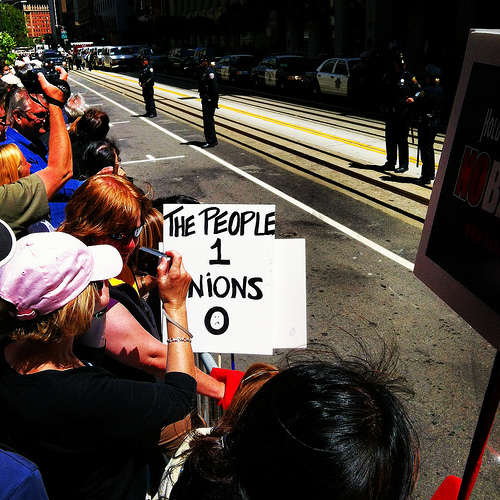
More than 100 gathered outside Oakland City Hall for a rally and march June 23 to celebrate the sit-in at Lakeview Elementary School. The school is one of five that the Oakland School Board voted to close last fall, in a move that would save the city $2 million per year. 

The school’s unofficial reopening was initiated by Lakeview parents, and since has been organized and led by Lakeview parents and teachers. Organizers have also run a People’s School for Public Education, with more than 20 elementary-age children enrolled. Classes ran for the past week from 9am to 3pm and include music, art, gardening, social justice, and PE. A daily picket and rally was held to support the sit-in and the Peoples School at 5pm.

Organizers may extend the people’s school for another week.

The children and students involved in the effort led the march yesterday, which left from City Hall around 1pm. Protesters marched to the school, where they held a community barbecue.

At an Oct. 26 Oakland School Board meeting, the board voted to close Lakeview, along with four other elementary schools, at the end of the school year. The Save Oakland Schools campaign has been working to stop these closures. Lakeview officially shut its doors at the end of this school year, but with the ongoing sit-in, organizers hope to keep it open as long as possible.

The city plans to use the school’s building for administrative offices.

Speakers at the rally included parents and teachers of Oakland elementary school teachers. 

On the march, demonstrators chanted “Whose schools? Our schools!” and “Education is a right! For our children we will fight!” In reaction to police at the kid-led march, some chanted “their kids! They’re cute! Get those guns up off your suit!”

“The Lakeview sit-in demands a stop to all school closure, or the resignation of Tony Smith, superintendent of the Oakland Unified School District. The Sit-In at Lakeview is held in solidarity with all parents and teachers struggling to demand quality public education across the country,” according to a press release.

The now week-long action is the result of collaboration between Occupy Oakland and its various offshoots and the parents and teachers of Lakeview, as parents and teachers lead the efforts.

Photo via Justin Beck

Free classes for all

0

Why should you need an expensive libereral arts education to ponder the question of realism, or pricey equipment to take a film making class? You don’t- the University of the Commons (UOTC) dove into its schedule of free, open to all classes a few weeks ago, and the effort is growing.

In a panel discussion at the summer session’s launch June 2, speakers placed the school in a radical context, mentioning other efforts such as D-Q University and Black Panther liberation schools like the Oakland Community School. 

The group’s mission statement says that the UOTC “aims to inspire participants to evolve more equitable and just societies and live more empowered and fulfilling lives.” The school isn’t accredited and students won’t get any formal acknowledgment of having taken classes there. 

It does, however, have some system-approved teachers. Dr. Barbara-Ann Lewis, who is teaching a class called Science Literacy to any and all who show up, is no newbie. She received her PhD in Soil Science from UC Berkeley in 1971, worked as a scientist at Argonne National Laboratory for seven years, and then taught environmental engineering at Northwestern for another 27. Since then she worked a stint as a violin-maker (“it’s good to have a trade,” she told me).

So what’s a pro like Lewis doing in a place like this? For her, its almost civic duty. “I want to teach the public,” she said. “The public votes, but has no idea about some of the real science behind the environmental issues.”

But in many of her university classes, “I had the standard students. They pay tuition, they come in, they don’t know too much about what’s going on in the world. They’ve lost their curiosity.”

She found students with that curiosity in her experience teaching with the Free University of San Francisco last year, Lewis says. “I had an 18-year-old and I had a 50-year-old in the class, lots of kinds of people, who all wanted to learn.”

Warren Lake of the San Francisco Free School, a similar effort that teaches free classes in the city, attended the launch in hopes of joining forces in some way with the UOTC. The Free School, Lake says, started with free yoga classes and has naturally offered movement, dance and other “right-brain pursuits,” compared to the UOTC’s heady academic offerings. Lake sees the Free School as “both a place to incubate teachers and for students to get together.” But when it comes to transferable skills and help along career paths, the picture is more complicated.

The Free School has been around for a few years now, and Lake says the accreditation issue is something he’s “thought about a lot.”

“There are different ways to show expertise,” said Lake. “Making a documentary or writing a book can often work as well as a college degree for showing you are interested of invested in something. There are different ways to market the experience.”

The University of the Commons is a great effort. But it brings up some questions. Who is it for? People who want an education but can’t afford one, now that the cost-free California community college system is a thing of the past? People who are already pretty well educated but always enjoy learning, not to mention generally fulfilling experiences? Students who want to supplement un-creative traditional schooling? People looking for friends and community who enjoy some learning on the side? Real change, liberation?

A Guardian article on a similar effort last year- the San Francisco Free University- pointed out that their effort was promising, admirable, and potentially very beneficial. It was also very white.

June 18, the pretty white- though, as members pointed out, also pretty female and queer- UOTC collective spent the majority of their meeting talking about “diversity and outreach.” They talked about teaching ethnic studies and women’s studies courses that are being cut out of public university curriculum. They talked about ideas for partnerships with organizations around the city that work with different groups, asking to see what kinds of free classes people there might want to participate in or teach. They talked about resources for classes in Mandarin and Spanish. They hope to plug in to existing efforts, and they hope to grow.

As of now, the classes range in the attendance. The students of Occupy U, a class discussing what worked and what didn’t in recent social justice efforts that focuses on Occupy, is about 11 mostly activist types, while From Mahler to the Music Video, a class tracing the history of music, has about 70 students that the instructor John Smalley says includes everyone from “professional musicians to homeless people.”

Next week will be the third week of classes, but you can still join in, although it might be a good idea to contact the instructor beforehand.

Science Literacy w/ Barbara-Ann Lewis

Tuesdays 5:30-7:30pm, Modern Times, 2919 24th St., SF

Responsive Cinema w/ Rand Crook

Tuesdays 7-9pm, the Emerald Tablet, 80 Fresno, SF

Intro to Western music: from Mahler to the music video w/ John Smalley

Saturdays 11am-1pm, Latino/Hispanic Community Meeting Room B, Main San Francisco Public Library, 100 Larkin, SF

History in digital culture w/ Molly Hankwitz

Sundays 6-8pm

Mutiny Radio Café, 2781 21st St

Occupy U w/ Stardust

Sundays 6-8pm, Modern Times, 2919 24th St., SF

www.uotc.org/wordpress

Glass on Glass: an extended interview with the composer

7

Few living composers can claim more influence over the landscape of modern classical music than Philip Glass. A glance at his expansive discography — comprised of symphonies, operas, ballets, film scores, and a broad range of collaborative efforts — reveals a restlessly creative artist, with little regard for categorization. Even after turning 75 earlier this year, Glass continues to work as prolifically as ever.

The latest installment in Glass’ storied career finds the composer joining forces with acclaimed singer-songwriter-harpist Joanna Newsom, for an exclusive, one-off performance Mon/25 to benefit Big Sur’s Henry Miller Memorial Library.

In a phone conversation with the Guardian last week, from his home in Manhattan, Glass detailed the evolution of his creative alliance with Newsom, his burning desire to work with Ornette Coleman and Wynton Marsalis, his likeness to Brian Eno, and his refusal to be labeled a “minimalist”, among a host of other topics.

Our interview was much too extensive for Wednesday’s feature to contain, so read on for more words of wisdom from Glass.

http://www.youtube.com/watch?v=N1C3FtvOZ4g

San Francisco Bay Guardian Are you working on any of your own material recently? Anything you can share with us, that you’re working on for your own purposes?

Philip Glass I finished an opera for Linz, Austria, based on a story about [Austrian novelist-playwright Peter Handke], and now I’m working on another opera, based on… well, that’s a Walt Disney. Besides that, I’m working with Godfrey Reggio on one of his new movies. He’s the one who made Koyaanisqatsi and Powaqqatsi. Besides that, I’m doing concerts. The one [in San Francisco] of course… and I have three in New York this week, and one in Chicago next weekend.

SFBG Solo piano performances?

PG They’re mostly ensemble concerts with my own group. There will be one in New York called the River to River Festival. That’s a group that’s been together for about 35 years or so, and we’re playing pieces that are retrospective of music from those years. Then, I will be doing some collaborative pieces. One concert I’m doing, I’m playing with Laurie Anderson. And I did one last night with Stephin Merritt. The concert in Chicago, which is next weekend, I’m doing with a wonderful violinist named Tim Fain [accompanying Glass and Newsom Mon/25], which is mostly chamber music of mine.

So, I tend to do a variety of things. It keeps everything very interesting for me. It means I’m always practicing and rehearsing [laughs], but it’s more fun to do that than to just play the same thing over and over again. I don’t do that very much.

SGBG Moving on to the show in San Francisco coming up: I spoke with [Magnus Toren, executive director of the Henry Miller Memorial Library] on the phone the other day, and said he’d heard that your rehearsals with Joanna Newsom and Tim Fain are going very well.

PG Yeah, we got along very well, and I’ve known Tim a long time. I knew Joanna from her records when we met for the first time. She spends a lot of time in New York. We met very recently, and we had two sessions here. We’re going to have another rehearsal out there.

What we’re doing, basically… it’s her music and my music. I’m playing one of her new songs, and then she and Tim are playing a number of songs together. Then, we’re playing some of my trios that I adapted for harp, piano, and violin. We’re also doing solo pieces. Violin, harp, and piano: it’s kind of a classic combination. They’re instruments that go very well together, and we found … she’s an excellent player, anyway, and a wonderful singer. But, we found that our music works very well together.

SFBG Are there any songs of [Newsom’s], or just elements of her music that you really connect to?

PG She has a unique way of approaching the harp. I’m not a harpist, so I can’t give you the technical details, but when you hear her play, she has her own style. The way that certain pianists have a certain way of playing the piano. You know, you hear them, you say, “Oh, that’s so-and-so.” You know right away who it is.

She has a bigger tonal range than harp players usually use, because she can change keys very easily, very rapidly. And so, that gives her a lot of flexibility in terms of the tonality. That’s the one thing that I noticed right away. She has a command of the whole range of the instrument, and she can adapt her voice to it very, very well.

SFBG In a recent interview, you said, “all the collaborations I’ve done, have been a way for me to put myself in a place where I haven’t been before.” Based on the time you’ve spent rehearsing with Joanna and Tim, where is this collaboration taking you, that you’ve never been before?

PG I’ve used the harp a lot in orchestral music, where it becomes part of the orchestra. It might not stand out that much. But now, with a harpist right in front of me, there were parts of the instrument that worked very well with parts of my music, and I was able to hear it. Although I knew the instrument, in terms of a large ensemble, I’ve never been in such an intimate relationship with it. It brings out a texture in the music I write, which I’m hearing almost for the first time.

SFBG Besides Newsom, are there any other new artists you’ve been listening to recently, or any currently working musicians who you admire, or take inspiration from?

PG I’m going back to working with a wonderful kora player named Foday Suso. He’s from the Gambia. We toured a lot in the late ’90s, and the early part of this decade, and we’re just trying to start touring again. We haven’t played in a few years. There will be a new percussion ensemble, and we’re going to be playing with them. But, we have concerts coming up in Seattle, and Mexico City, and actually one in Carmel.

I would guess, in terms of a new player, I think Joanna is the newest of the new, given the people I know. I just, last night, was doing a concert with, and played one piece with, Stephin Merritt. I liked playing with him. He’s a very good singer. Do you know his work?

SFBG Magnetic Fields, right?

PG Yeah, that’s right. So, he’s another person I’ve just worked with very recently, who I enjoyed working with.

SFBG So, you’re really known for your collaborations. You’ve done a lot of them. Is there any kind of consistent contribution that you feel you bring to collaborative projects?

PG One of the things that interests me the most is when I work with people who don’t have a background in Western music, as such. Wu Man, who is a wonderful pipa player (it’s like a Chinese mandolin, you could say), we’ve done work together. I’ve worked with Mark Atkins from Australia. He’s a didgeridoo player.

A percussion group from Brazil called Uakti. What I really like, is going outside of my home base. You know, my home base is basically central European art music, as it grew up in Europe and then took root in America. I find, when I’m playing with people from Africa, or Australia, or China, or Japan, or Korea, I find it very stimulating.

SFBG Are there any artists in particular who you’d love to collaborate with?

PG I did a very extensive piece with Leonard Cohen recently [The Book of Longing], and I liked that. I could go back to that collaboration again. But, it’s been four or five years since we did that piece. There are two people I’ve talked to, we’ve never had the time to do it: one is Ornette Coleman, and the other is Wynton Marsalis. We keep on talking about it, but you have to get in the same room long enough to do some work [laughs].

I’d love to go back and do some more pieces with Ravi Shankar, who is still alive, and still writing. I got to know his daughter, Anoushka. Wonderful sitar player. So, that’s a young person I would like to work with. But, she knows that. Ever since she was eight years old. She’s become a wonderful player, these days.

SFBG A few other questions about your music. You seem to reject the “minimalism” tag…

PG Well, here’s the problem: if you would like people to come to a concert of minimalism, and they come to the concert, you’re not going to hear it [laughs]. The reason I object to descriptions that are not going to be found [is that] instead of helping the audience, it creates a kind of obstacle.

The pieces I wrote in ’73, ’74, ’75, ’76: yeah, sure! But, I’m not playing any of those pieces in the concert in San Francisco. I can, and I have. I played Koyaanisqatsi with Godfrey Reggio’s film at the Hollywood Bowl last year. And, that’s close to that period. It was written in 1979. So, it wouldn’t be so outlandish to call it minimalist, but actually, the pieces I’m writing today … it’s misleading.

I don’t know what your situation is, but often, editors will try to find something to sum it up and make a headline of a piece: “Minimalist composer arrives with Joanna Newsom.” But, that’s not going to happen! [Laughs]. So, those are catchy lines, and they’re maybe good journalism, but they’re actually poor preparation.

Look: I’ve been writing music for 40 years. It’s not the same music. So, when people ask me about that, I say, “well, let’s talk about what the concert’s going to be.” Now, in this particular concert, I’m doing pieces with Joanna, and with Tim, that have been written in the last ten years. So, there’s no minimalism in it at all.

When people talk about [Einstein on the Beach]: of course. It resonates with reality. That was the heartland of minimalism in the mid-’70s, and Einstein was one of the apotheosis pieces of that time, that caught that spirit, caught that technique. But, we’re not doing Einstein. We will be doing Einstein at Berkeley, at the Zellerbach, in October.

SFBG Do you have a way, maybe a shorthand, to classify what you’re doing now?

PG You kind of brought it up, yourself. I work with musicians from many different areas, so I’ve become a collaborator. In a way, that informs more about what I do than almost anything else. I don’t care how I’m remembered, in a way, but how I might be remembered as someone who worked with a lot of different people, from Allen Ginsberg, to Twyla Tharp. [That’s the distinctive thing], and it’s definitely reflected in the form of the work.

SFBG A lot of people who were brought up on popular music, even jazz, see a certain exclusivity in classical music. But, looking at your body of work, in contrast, you’ve produced a wide range of work on commission, from operas…

PG Yeah, I got over that label right away! [Laughs].  I’m not even a new music composer anymore. I’m just a composer.

I mean, part of my agenda was to get out of the ghetto, get out of the new music ghetto, into a bigger musical world, where I could work with David Bowie, or Emmylou Harris, or Joanna Newsom. I could work with anybody, and it wouldn’t be a surprise. No one’s going to say “what is he doing now?” because I’ve done it so much that it’s more like, “there he goes again!” [laughs]

SFBG You’ve collaborated with Brian Eno in the past.

PG Yes, that was part of the collaboration with David Bowie, because during the days where they were doing pieces like Heroes and Low (I turned those into symphonies) Brian was a collaborator, for sure.

Also I had a record company at one time [Point Records], and we produced a new performance of Music for Airports [with Bang on a Can]. So, I’ve been involved with his music more than casually. I mean, I’ve actually been involved in recordings, and working on scores with his music. Very interesting composer. Very interesting guy.

SFBG Along those lines: he’s is another artist who’s really made a reputation on versatility, on working within a lot of musical settings. So, do you feel like you might have more in common with, perhaps, someone like Eno, than some of the more traditional figures in Western art music?

PG Well, I think that’s a very good point, because Eno crosses lines very casually, very easily. He wasn’t interested in being in any particular [genre]. I came up at Juilliard, and then [I had] a very high-end academic teacher in Paris called Nadia Boulanger. People who come from that background don’t usually do a lot.  [Pauses]. Trying to think. There was a great producer who produced some Michael Jackson [Quincy Jones]. He was a student of Nadia Boulanger as well. People turn up, but it’s not that common, to be truthful.

SFBG Another quotation from a recent interview, concerning your philosophy on music: you said, “music is a place, and is as real as Chicago, or Indianapolis, or the city you live in. It’s an absolute place, and once you know where that place is, you can go there.” Do you try to bring your audience, your listeners, to a certain place with your music?

PG Well, it’s not that I try to. I’m there already, so if they’re coming to my concerts, they’re going to be there, too. I think that it’s not so much the intention. It’s, more or less, a result of how I work, and who I am. If I tried to do it, I couldn’t do it any better than just, naturally doing what’s natural to me.

I think that’s not uncommon among musicians. We live in this world. It’s not a pastime. It amounts to, almost, an obsession for most musicians. They almost can’t think of anything else, to be truthful. They’re probably boring people to be around if you’re not a fellow musician [laughs]. But, the allure of the world of music is very powerful, and when you’re caught up in it, that’s what it is.

SFBG The place in music that you occupy: do you form any visual associations with it?

PG Not really, though in dreams, I can see things. The language of music is aural. It’s not about seeing; it’s about hearing.

SFBG Is there a piece, or even a section of a piece of yours, that you feel really succinctly encapsulates your approach to music, or what you strive for?

PG Einstein was the piece in the ’70s that captured that for me. But then, six years later, I was doing Koyaanisqatsi. Before Einstein, there was Music in Twelve Parts. Then, after that, there were three operas I did, to the work of Jean Cocteau. These are things that come up throughout my life. Certain pieces kind of sum up everything you’ve been thinking about, and you become aware of it afterwards. It’s hard to know it when it’s happening.

When I look back on certain pieces, [in the mid-’90s there was] Symphony No. 2, which, I didn’t think very much of when I wrote it. And the violin concertos from that time. They both became emblematic pieces of a certain kind.

I can see pieces that way: pieces that seem to sum up a period of search and work, and they seem to be the contestants of those ideas. And then, you move on to, then maybe three, four years of experimentation, of working through things. And then, another piece will pop up, that kind of sums it up. That happens to everybody.

A Benefit for Big Sur’s Henry Miller Memorial Library
Philip Glass and Joanna Newsom with Tim Fain
Mon/25, $62.50-$140
Warfield
982 Market, SF
(415) 345-0900
www.thewarfieldtheatre.com


Alerts

0

Wednesday 20

Pack the court for Kali
, Hayward Hall of Justice, 24405 Amador #108, Hayward; www.occupyoakland.org. 8-11am, free. Of all the outrageous and unjust arrests that have gone down at Occupy Oakland, Kali’s may be the worst. Kali was turning his life around at the Occupy Oakland camp when he was arrested in December for his “unpermitted” blanket. He was denied medication for a mental health issue for days in jail before getting in a conflict with a guard- which got him charged with assaulting a police officer. It was his third strike, and he may face life in prison. From organizers: “Wear red in support of Kali’s favorite color! Since he was an active member of the Kitchen Committee, there will be Coffee not Cops as well as a potluck afterwards.”

“Notes from a revolution
,” Booksmith, 1644 Haight, SF; www.booksmith.com. 6:30pm, free. In the Haight’s heyday, the Diggers were a cultural and political force to be reckoned with. The “community anarchist” collective served food in the Panhandle, ran free medical clinics, and generally cared for the large amount of people who flocked to the neighborhood in the 60s. They set up free stores and crash pads, and were known for absurd theater that makes you think. Now their broadsides have become a new book, Notes from a Revolution. Some of those involved in this recent San Francisco history will speak at the Booksmith for the books release, and there might even be some Diggers-style people-feeding afoot.

Thursday 21


Emiliano Donis
benefit concert, Brava Theater, 2781 24th St., SF; www.brava.org. 7:30pm, $15-20. Emiliano Donis had only been 18 for a few weeks when he was arrested for dating his underage partner. According to his mother, Denhi Donis, they had been together at ages 15 and 17 before his birthday last fall. He was arrested in November, and has been locked up since. His moher organized this benefit concert, featuring a pretty great lineup of local bands, to help raise money for his legal fees.

Friday 22


The Black Power Mixtape
room 304, Redstone building, 2940 16th St., SF; www.norcalsocialism.org. 7pm, $5-10 suggested donation. The Black Power Mixtape, 1967-1975, contains rare and powerful footage. There are scenes of Angela Davis being interviewed in prison, Stokely Carmicheal with his mother, and too many unnamed leaders spreading the revolution. The footage, shot by Swedish filmmakers who lacked a certain tendency to demonize those in the black liberation movement, is unique in its honesty. This screening is a fundraiser for local folks to get to the Socialism 2012 conference in Chicago next week.

Sunday 24

Queer prisoner letter-writing Station 40, 3030B 16th St., SF; www.tinyurl.com/station40. 4-6pm, free. It’s the monthly prisoner letter-writing campaign- the “post-pride (or hide from pride)” edition. From hate crime victims who fight back to sex workers to people who just don’t “look right,” LGBTQ people make up a disproportionate number of people in the criminal justice system. Come write letters to show them they’re not forgotten.

Monday 25

“The sky did not fall” Commonwealth Club, 595 Market, SF; www.commonwealthclub.org. 5:30pm, $7-20.  Don’t Ask, Don’t Tell was finally repealed last July. That hasn’t stopped people to argue for its reinstatement for reasons like“they’re in close quarters, they live with people, they obviously shower with people” (Rick Santorum in October.) Get the real story at this Commonwealth Club event, where soldiers will speak on the historic repeal’s effect on their lives. At least for these soldiers, the changes weren’t shower-related, but instead related to not fearing dishonorable discharge and hiding who they love while risking their lives in the military.

Guardian voices: Outside the Bay Area Bubble

7

This week I’m back in the midwest, where my roots are strong and my mother is approaching her retirement years. I’m thinking about the vast geographic and cultural distance –both real and imagined — between the San Francisco, California where I now live, and the great state of Iowa, which made me so much of who I am.

Here I am, sweating through a ridiculously muggy midwest summer heatwave, thinking about how it is that I am black, a lifelong social justice activist and organizer, and a married, dyke mama who hails from a small, working-class Iowa town where sweet corn and tomatoes once grew in my own backyard.

When I tell people that I’m from Cedar Rapids, Iowa, there is a kind of shocked silence I’ve become accustomed to. I’m used to people’s confusion about how I – given my politics and identities — could possibly be from such a place. And, while I find it extremely problematic, I’ve also gotten used to a dismissive arrogance about Iowa, a comfortable ignorance about the heartland, and a total failure to comprehend why I long for my Nana’s lilac-lined house at 1339 10th Street and why I have so much hope for middle America.

I work, organize and am raising a family in the “Bay Area bubble” but being from Iowa has developed in me core values that are decidedly anti-bubble, and deeply pro-working America. My ancestors built the wealth of this nation, and I consider the whole place mine – to love and rage over, to listen to and understand, to organize and to challenge. I have not committed my life to social change just for a privileged few on the East and West Coasts. This is, fundamentally about all of us, the 99 percent in San Francisco, through the heartland, down South and all the way to upper tip of Maine.

My four-year-old son was born in San Francisco, and he is a proud Frisco kid through and through. We have a multi-racial community that dances and organizes for justice together, he considers Salvadoran pupusas a special treat, and he loves remembering the day the Giants won the World Series and it seemed like everyone in the city was a member of the same big family.

But today, I’m writing from a cramped apartment in a seven-story public housing building in Michigan where my mother now lives with her scores of books, photography equipment and cute dresses from QVC. She and I are from a clan of Gibsons, black folks from working-class Iowa where my great grandparents worked on the railroads, and where my grandfather slaughtered pigs and went on strike with his white coworkers to defend the gains of their union.

We’re from the Iowa, where my mother attended black churches as a child and found Islam as an adult, and where she, as a struggling single mother, read black feminist poetry and first fought battles with Ronald Reagan’s backwards welfare policies.

We’re from the Iowa that is a center of agribusiness and everything that’s bad about corporate food production in this country. We’re from the Iowa that rallied for Jesse Jackson’s run for president, voted for same-sex marriage, and where Obama won the caucuses back in 2008.

But Iowa has also gone from unionized, inter-racial meatpacking plants to non-union poultry factories that exploit undocumented Latino workers from as far away as El Salvador and Guatemela. We’re from the Iowa that is indeed mostly white, where my first best friend grew up – a sweet white working class red head – and our mothers shared survival stories of single, working-poor motherhood. And I’m from the Cedar Rapids, Iowa that, unlike San Francisco, is actually growing its black population and is home to a thriving center of African American community history.

For most of my adult life, as I’ve been marching against war and racism, I’ve also been defending this Iowa, fighting against the tendency toward self-righteous superiority I’ve found among too many activists in the Bay and on the East Coast. It’s the same arrogance that the Right exploits in its scandalous but effective pseudo-populist campaigns against so-called liberal elitism.

It’s my experience that people on the left think they know what it means to be Iowan. Iowans are used as stand-in for a stereotypical idea of backwards, irrationally racist white America that ‘doesn’t vote its class interests’; Iowa is a convenient marker for everything less cool, hip, cosmopolitan and liberal than, well, San Francisco.

This kind of dismissive arrogance leads to a refusal to develop, in any meaningful, long-term way, an organizing agenda for the majority of the country, and has been one of the errors of progressive politics for a long time.

We can change this. When we are thinking about the politics of immigration policy, Occupy Wall Street, gay marriage, the movement against corporate food policy, or the politics of race, poverty and labor unions, we have to think about Iowa. Think about the white working class Republicans. Think about my mom’s friend in Iowa, raised on an old fashioned farm and now leading an organic farming collective there. Think about the proud struggle for small farms, union work, and participatory democracy there.

And think about what it will really take to make the Bay, Iowa and the whole nation a place where we can all develop our full human potential, have true mutual respect for one another, and are able to struggle through our deep divisions without exclusionary moral superiority, top-down “we know what’s best for you” politics and where all of us who want to live out our old age on a quiet lilac-lined porch in Iowa, can do so in peace and dignity.
As we make our plan to build a new progressive majority, let’s stay open-minded and take our organizing to a whole new level.

Chuckle connection: The Bay’s most diverse comedic line-up goes on tour

0

There’s no question that a childhood spent growing up Ethiopian in Haight-Ashbury made fertile ground in which to grow a stand-up career. That’s where Yanye Abeba is coming from. Abeba is performing in Kung Pao Kosher Comedy‘s second Color of Funny comedy tour on Thu/21 and Fri/22. Her schtick will be part of a unique line-up — and afterall, how many other people can pull on the interactions between their first generation African father and the homeless kids on Haight Street for their funny?

The divergent Color of Funny’s line-up can perhaps best be described as a comedic gumbo. Other performers include one of India’s few professional female stand-ups, venture capitalist turned storyteller Dhaya Lakshminarayanan. Joining her, award-winning broadcast journalist Maureen Langan (at the Thu/21 Berkeley show only) will bring tales of being the daughter of an Irish immigrant mother and garbage man father. Recent college graduate Nathan Habib (at the Fri/22 Santa Cruz) grew up in a Jewish-Israeli household with a Latvian mother and an Italian-raised dad. [Editor’s note: we interviewed Habib about pushy moms and Chinese restaurants back when he was a fresh-faced 21 years old.]


“There are so many points of view in this world,” Abeba says of this group of funny people in an interview with the Guardian. “Talking about our experiences in a comedic way gets people interested. They realize that even though their parents are from the ‘burbs and mine are from Africa, we have common experiences.”

Abeba’s acts recurrently discuss the clash between her Ethiopian and American backgrounds. “Ethiopian culture is so different from American culture and it makes for great comedy,” she says, adding that she is still shocked by how many people can’t find Ethiopia on a map but know the region was starving. “Inspired by Whoopie Goldberg,” Abeba employs comedy to combat cultural ignorance. Lately, she says her stand-up is focused increasingly on politics because she is concerned about this country. 

“I worry that people have become apathetic and aren’t really paying attention as their lives slip deeper into poverty,” says the comedian. 

So when the Occupy movement arrived in SF, Abeba was excited and began attending events. But she quickly became disenfranchised when she encountered people whose focus was on personal issues with parents and cops, not capitalism or the banking system. 

That disconnect became punchline fodder. “I just looked at it as another source for material,” she says. “Don’t get me wrong, I believe in the original message of the Occupy movement and I think that it is time things changed so that more people have opportunity. I think this country is for everyone, not just the Koch brothers.”

So she’s not diminished the Occupy ethos – but she is looping its reality in with her own activism of simply being a woman in stand-up. Because there are not many female comedians, and even less female comedians of color, Abeba has had to roll over several gender stereotypes. 

“I have a had a lot of men in this industry tell me that women have no place doing comedy, and that women aren’t funny,” she says. “They think all we do is talk about our periods and dating.”

She adds that if she had a nickel for every time she heard a man talk about anal sex and some hot chick, she would own a Range Rover. 

“Some of my favorite local comedians are different from the mold,” she says. “They are transgender, disabled, Indian, gay, and their point of view matters. As you get to know them through their comedy, you become more accepting of some one who is different because they touched you with their truth.”

“Kung Pao Kosher Comedy Presents the Second (Sorta-Annual) Color of Funny”

Thu/21 8pm, $20

Julia Morgan Theatre

 2640 College, Berk.

www.berkeleyplayhouse.org


Fri/22 8pm, $20

Kuumbwa Jazz Center

320 Cedar, Santa Cruz

www.kuumbwajazz.org

Prancing at the revolution

19

marke@sfbg.com

QUEER ISSUE “Right now it seems we have more in common with the Christian Right than the gay liberation movement. We’ve become so focused on marriage as the end-all and be-all of gay rights that it’s completely within the realm of possibility that the next leader of Focus on the Family could be a gay man. We all have to get married now for tax breaks, health care, or to stay in this country? Are you kidding me?” Mattilda Sycamore Bernstein spilled some truth into my hot pink Princess phone.

“I don’t know how we got to this position where we’re either agitating for more tax breaks for the rich via marriage, or we’re treating people like disposable objects on hookup sites because they don’t conform to certain standards. It’s really sickening. How does any of this further any agenda at all besides becoming what we’re supposed to be fighting against? I don’t get it.”

Sycamore Bernstein, who often writes for the Guardian, was speaking about the impetus behind her latest book, Why are Faggots So Afraid of Faggots? Flaming Challenges to Masculinity, Objectification, and the Desire to Conform (AK Press), an invigorating collection of essays from a vast variety of queer people that “challenges the assimilationist norms of a corporate-cozy lifestyle.” (Let’s just say that President Obama’s limp “evolution” on same-sex marriage was not going to be a topic of conversation.) From envisioning a more faggoty Internet and reclaiming perversity as a proud, queer norm to honestly exploring the complex cultural confusions that Western-originating political expressions of gayness can wreak on immigrant and native homos, Faggots goes there with inspiring directness.

“I wanted to put out something that captured the spectrum of radical queer thinking that’s been going on while it seems everyone else was in line to get married. There are so many topics that affect our lives that have just been completely bulldozed by the ‘gay rights’ corporate lobbying groups’ crazed marriagemania.

“For example, Chris Bartlett, in his contribution ‘Gravity and Levity’ talks about how the idea of ‘risk’ in the gay community has been so associated with AIDS that it may have pushed any aspiration towards risk — emotionally, politically, socially — right out of gay consciousness. Yet being gay used to be all about taking risks. It’s what got us so far in the first place!

“I think exploring how the medicalization of AIDS terminology may have numbed us from each other — or how race still defines us in the ‘community,’ or how every dollar sucked into the corporate marriage machine means less for those in need of actual life or death help, or how hate crimes legislation ridiculously puts more power and resources into the hands of the very system oppressing us — is something we desperately need right now. We’re raising an entire generation to think that marriage is the only fight. Meanwhile, we’re discriminating against ourselves in so many other ways.”

Faggots is no mere spitting into the wind, either. Although Sycamore Bernstein has been sounding the assimilationist alarm for years, the prolific author and activist, now living in Seattle, has been surprised by the tome’s positive reception. (“It’s quite shocking!” she says with a lilting laugh.) Edmund White, Samuel R. Delaney, and Mx Justin Vivian Bond offered blurbs, and younger readers and the press have been grabbing onto Faggots’ incendiary yet sophisticated tone. Could the recent wave of AIDS activist nostalgia and a Occupy-like disillusionment with big money Pride sponsorships (embodied locally, especially, by a Wells Fargo advertisement covering the entire front page of Bay Area Reporter’s Pride Issue and a Stoli-sponsored GLAAD Pride float) be buoying the book’s popularity?

“I think the re-emergence of interest in things like ACT UP is very interesting. When I came to San Francisco I was part of ACT UP, and — with everybody dying from drugs, suicide, and AIDS — there was a real drive to come together to confront this massive structural neglect and recognize how brutalities align themselves to bring about our annihilation. But nostalgia can be dangerous without recognizing the reality. There was a very real, very dangerous moment in the 1990s when activism suddenly became about discrimination in the military, of all things.

“It turned from trying to guarantee health care for all to being about whether or not we could go die faster in wars. Whose decision was that?”

Marke B. is the author of Queer: The Ultimate LGBT Gude for Youth (Zest)


OccuPride remembers

6

yael@sfbg.com

QUEER ISSUE “First of all, the parade wouldn’t have barricades, because that immediately creates an us versus them divide, and then you see the parade as just the groups and companies that can afford the fee, which is like $450. Anyone who wanted to march could march, regardless of what the sheriff or Fire Department says. There would be tents for connections to services that people desperately need. I’m not opposed to having companies there, but they shouldn’t be the be-all, end-all of Pride. And there should be more about the history, because people don’t know it. In the Holocaust, anywhere from 10,000 to 100,000 gays were worked to death in Dachau and other work camps. That’s where the pink triangle comes from. But people think Harvey Milk pulled it out of his ass or something.”

That’s what Scott Rossi, one of the organizers of San Francisco’s OccuPride march, told me when I asked him what his ideal SF Pride Parade would look like. The protest’s rallying cry is Community Not Commodity, and the group hopes to bring some rebellious spirit to the parade, which they say has become too watered down with corporate sponsors and assimiliation-lovin’ politics.

Some of the action’s organizers are from Occupy San Francisco and Occupy Oakland, but the majority are a coalition of radical queer groups like HAVOQ, Pride at Work, Act Up, and QUIT (Queers Undermining Israeli Terrorism).

Honestly, it would be weird if there wasn’t a group with an anti-capitalist critique of the parade disrupting Pride this year. It’s been a tradition since 1992 when Act Up members joined the parade and staged intermittent Die-Ins, collapsing every seven minutes, the frequency that people were dying from AIDS that year.

Act Up and related groups staged similar demonstrations practically every year. A decade later, two Gay Shame protesters were arrested when they attempted to enter the parade. That year’s parade was sponsored by Budweiser, and Gay Shame had created a seven-foot-tall cardboard Budweiser can that read “Vomit Out Budweiser Pride and the Selling of Queer Identities,” and other props to confront “the consumerism, blind patriotism and assimilationist agenda of the Pride Parade.”

And radical queers show no sign of stopping. Veteran gay rights warrior Tommi Mecca was at basically all of these disruptions, and he won’t be missing out on this year’s events. Mecca was 21 when he helped organize the first Pride March in Philadelphia in 1972.

“Pride used to be a protest,” Mecca recalls. “It was very free. There were no barricades on the street, there were very few rules. We didn’t have contingents, people just gathered, and at some point there were speeches, usually by activists…I don’t know when it started getting corporate sponsors.”

But the glitz! The glamour! The music enhanced by electricity! Today, Pride is a giant, televised affair — this year, sponsored by Wells Fargo.

“Don’t people in Pride realize how much we’re being used by Wells Fargo?” Mecca said. “It just reeks.”

So if you go to the parade, smell the sweet smell of protesters promoting “pride not profit, a movement not a market, and community not commodity.” After all, if it wasn’t for queer radicals in the ’70s, there wouldn’t be a Pride at all.

Bringing the heat

9

On June 13, more than 400 people, mainly from law enforcement and non-profits, gathered for a conference in downtown Oakland’s Marriott Hotel. Outside, a group of angry protesters gave impassioned speeches before trying to enter the hotel. The complex set of issues involved? The conference was organized to discuss tactics for arresting and charging child sex traffickers, but the protesters said that the conference would do nothing but further the state’s harmful impact on the lives of sex workers.

I wasn’t able to attend the conference itself; the Alameda County District Attorney’s office decided at the last minute that press would not be permitted inside. But from the conference’s description and a talk with Casey Bates, head of DA’s Human Exploitation and Trafficking Unit (HEAT), it seemed that the conference was mostly focused on improving efforts to by law enforcement to find people underage people who are having sex for money and prosecute their “traffickers,” a designation not much different than “pimps.”

According to Bates, the HEAT unit has focused on people selling sex on the street and online, and most are from California or nearby states, although he hopes the efforts can expand to people who are trafficked in from other countries.

Under the law, anyone selling sex under 18 years of age is classified as a CSEC- commercially sexually exploited child.

As DA Nancy O’Malley emphasizes on the HEAT unit website, “We have been fighting to shatter the perception of children as prostitutes and criminals undeserving of protection.  These young people are victims of child abuse.”

The sex workers rights movement, organized by people in the sex industry who see their work as legitimate, has largely called for decriminalization of prostitution and other forms of sex work since the movement off in the 1960s, with new concerns in the 21st century. Many groups have argued that police increase the violence in the lives of prostitutes, harassing and arresting them while not taking violence against sex workers seriously. The much older anti-trafficking movement, (or, as it was called at the beginning of the 20th century, anti- “white slavery,”) has many proponents who disagree, saying all prostitution involves some form of coercion. The two movements have a long history of conflict, and on June 13, this dynamic was thrust into the public eye.

Policing the problem

This conference was described as “comprehensive event designed to enhance the capacity of law enforcement and practitioners to combat commercial sex trafficking of children (CSEC).” 

“Of course we support refuges, housing, and other services for these children,” said Rachel West, an organizer with US Prostitutes Collective. “Why aren’t the police focused on that instead of spending hours on the net looking for women, or going out on the street doing street sweeps?”

But US Prostitutes Collective, part of the International Prostitutes Collective, which has been campaigning for decriminalization of prostitution since 1975, didn’t organize last week’s protest. This time it was Occupy Patriarchy, an Occupy Oakland affiliated group.

Occupy Oakland has not been shy about calling out police behaviors, from infamous incidents like the tear gas-heavy offensive on the Occupy Oakland camp last fall to shootings of local teenagers. The HEAT Conference, which was organized by the DA’s office and played host to law enforcement from across the country, was no exception.

“Whose inside this conference?” said one demonstrator who spoke during a 20-minute speak-out in front of the hotel that afternoon. “61 official speakers are law enforcement agents, DA workers, or politicians with anti-sex worker reputations. 39 speakers are individuals or representatives of non-profits. The vast majority of these work directly with law enforcement or politicians to criminalize sex workers. Where is the voice of the sex workers?” 

“What we find disturbing as anti-capitalists and anti-authoritarians is these police who, to sex workers, are oppressing us,” Clarissa McFaye, one of the demonstrators, told me in an interview. “We know that police are a very violent, fearsome presence in the lives of all sex workers, and we feel the only way that we can abolish child trafficking and exploitative forms of labor, which is all labor in actuality, is to abolish the police state.”

“They think working to enforce criminalization isn’t going to help child victims of sexual slavery. We know they exist, but we don’t feel this is a solution. We don’t think enhancing the ability to arrest people is a solution,” said McFaye.

“We really appreciate a lot of the effort that some of the non profits are doing,” McFaye continued, “We want to talk to them and form a sense of camaraderie with them and tell them that we don’t need the cops. We don’t want them. They’re bad for us.” 

Sex workers rights groups have long spoken out about police treatment of prostitutes. Stories of police harassing sex workers, going through with sexual acts while undercover before making prostitution arrests, and demanding sex in exchange for letting an arrest slide are fairly common. As McFaye told me, “they’re condoning child trafficking because they make deals with pimps.”

“Not to mention that hella cops are tricks,” she added.

Pimps and traffickers, children and minors

The HEAT Unit’s website lists 237 charges and 160 convictions made by the unit between 2006 and 2011. The statistics include trafficking as defined by California Penal Code Section 236.1, California’s Human Trafficking Statute. But they also include charges and convictions for pimping and pandering, sexual assault, kidnapping, and burglary, and the website specifies that “these statistics do not differentiate between child and adult victims, though the majority of HEAT victims are minors.”

The anti-trafficking statute defines a human trafficker as “Any person who deprives or violates the personal liberty of another with the intent to effect or maintain a felony violation of ” one of several anti-pimping, pandering, and solicitation Penal Code violations.

This includes Penal Code section 266 which defines a pimp as someone who, knowing another person has commercial sex, “lives or derives support or maintenance in whole or in part from the earnings or proceeds of the person’s prostitution.” 

But for Bates, “The way a pimp-prostitute relationship works is the pimp takes 100 percent of the cash.”

I brought up the pimp question with Cyd Nova, harm reduction services coordinator at San Francisco’s for sex workers-by sex workers health clinic, the St. James Infirmary.

“I know a lot of street-based sex workers who are totally independent,” said Nova. “Some do split their money with pimps or managers.”

Nova also said pimping’s legal definition can often have questionable consequences. “Legally that would be most peoples partners, children, friends.”

“I have met sex workers who have had their partners charged under pimping codes, which was not their relationship with that person,” Nova told me.

Many “pimping” relationships fall somewhere in between “peoples partners, children, and friends” and “the pimp takes 100 percent of the cash.” Sex workers, a criminalized class, often experience violence from both pimps and clients- but fear for their own consequenes if they report the crimes. I asked Bates his opinion on granting immunity from prostitution charges or a person who comes forward to report all too common violations committed against sex workers like rape, assault and theft.

“We do this all the time in the context of other types of crime that we work with. If it’s a murder, we may be willing to negotiate with our witness to determine whether or not is appropriate to give immunity for the person to testify against this other person, in exchange they won’t be prosecuted for the crime that they committed.”

But Nova said that striking that deal can be a major problem.

“One thing that is an issue for people forced into the industry is they are unable to receive services until they agree to testify against their trafficker. This doesn’t work for the majority of people, and it’s a major issue when you’re talking about services for trafficking victims,” he said.

At the St. James Infirmary, “We have people who have been in situations where they feel that they wanted to leave, but are not willing to bring criminal charges against the person,” he continued.

Nova also described a distinction between the terms “child” and “minor.”

“People have choices in how they use their bodies, and that includes youth. We are living in a world where sometimes people have to choose options that are not ideal,” he said. 

McFaye painted a similar picture, saying that “sex work is a form of work that all genders do sex work can make a lot more money than other options.”

“It allows me to do my political work as well as work a few times a week, instead of working at McDonalds. When I was 17 years old I tried to get a job, couldn’t find anything but shitty house cleaning jobs. Then some sex workers I knew showed me the ropes, and my life’s been a lot better ever since,” she said.

I described a similar situation, in which a minor chooses prostitution to make desperately needed money or escape an abusive situation, to Bates. “There are going to be people that make that claim,” he responded. “There’s no doubt about it. Part of the phenomenon is that a lot of people that are being abused, when they’re being abused, don’t even realize that they’re being abused. That’s a big issue,” said Bates. “People have made the claim, they did what they had to do in a difficult circumstance, and they don’t really see themselves as being a victim of crime. And what I’m suggesting is, that’s not uncommon, it’s part of the victimology actually.” 

He added, “I’m speaking specifically to people that are being trafficked. What you described doesn’t sound as much like a trafficking situation.”

But the law doesn’t allow for that kind of nuance. 

“That is a clear distinction that we want to draw. This is focused on commercial sexual exploitation of children,” Bates said. “When you become 18, you’re given a set of rights and you’re treated differently under the law.”

Solutions

The HEAT Unit’s model is unique, and if the conference has its intended consequences, it may be replicated throughout the country.

For minors that the HEAT unit identifies as CSEC, “The goal is to try to stabilize them, to figure out what services they need, what situation they came from and figure out how we can get that child back on track,” Bates told me.

“Sometimes, that requires that we detain them for a period of time so we can figure out what services are necessary. That’s somewhat controversial, because some people say that’s not appropriate. We believe that it’s in the interest of these girls initially, to figure out what’s necessary. That to turn them back on the street means to turn your back on them, period.”

Many sex workers’ rights groups, however, argue for antoher solution entirely- decriminalization of prostitution. Part of the argument for decriminalization is that sex workers would feel more comfortable coming to police with reports that they are their colleagues had been victims of crimes like rape, assault or theft. 

As Nova said, “California is currently using anti-trafficking federal funds to target all sex workers. They say, if we arrest a bunch of sex workers, some of them are going to be trafficked. This has not proven to be very effective, whereas decriminalization would result in people, who are in coercive work situations, feeling more comfortable coming forward and asking for help.

“They need an evaluation of what kind of practices are going on and what results they’re turning out,” Nova said. “A study where they have conversations with people who have been arrested and detained and talk about what their life was like, what was detrimental and what was beneficial.”

For some of the more anarchist-leaning protesters, however, the police should play no role in the solution.

“What we think would help is if we as sex workers come together is if we come together and combat this exploitation,” McFaye told me.

I asked if there was anything the police could do.

“No,” said McFaye. “They can turn in their badges. That’s what they could do.” 

When the sex workers’ rights movement took off in the ’60s, they joined the debate that had been going on surrounding prostitution and policing for a century. The movement continues- and on Wednesday, a distinctly anti-capitalist side of it made noise. These groups may be piping up more, as the Californians Against Sexual Exploitation (CASE) Act, which would increase funding and resources for policing sex traffickers, goes to the ballot this November.

Guardian Voices: On losing

80

I’m turning 43 today and feeling glad to be alive. I would love to be writing about the joy of raising children and the mysteries of the universe. But instead, today I’m thinking about last week’s elections, about losing and the nature of long-term struggle. I’m thinking about being born black in 1969, and how, in fact, our side has been losing my whole life. And while this sobering reality about the balance of forces in the nation could make a sane person completely despondent, today I’m considering it a challenge to radically rethink the way we progressives try to change the world. 

The truth is that despite historic victories and truly incredible grassroots organizing over the last several decades, we’ve been getting our asses kicked for a long, long time. Since the right and the state got together to crush people’s movements of the 1960s. Since the Republicans built this rightwing coalition, began pushing wedge politics, winning the hearts and minds of white working people, and winning elections all over the country. And since capitalism shifted gears in the 1970s – we call it neoliberalism now — and the war on poverty was pushed aside to make way for the war on poor people specifically and working people generally. Since then, our cities have lost good jobs, union members, safety net services, and in San Francisco, more than half of the entire black population.

Thanks to Fox News, billionaire Republicans, and fragmentation on the left, conservative ideas about government, about individual vs. institutional responsibility, and about the supposed virtues of free markets have taken a powerful hold over the thinking of most Americans. One result: Last week in Wisconsin, despite the truly historic mobilization against the right’s Scott Walker, labor and social justice forces lost a big one. And here in San Francisco, in the heart of the “left coast,” progressives lost control of the Democratic Party to that special brand of “moderate” big-business Democrats who are socially liberal but have been making me embarrassed to be a registered Democrat since – well, since Bill Clinton was in the White House.

Clinton’s “ending welfare as we know it” third-way politics made it ok to talk about ending poverty while at the same time helping people get rich at the expense of poor people all over the world. Gavin Newsom was our local version – more socially liberal, and therefore successfully confusing to a lot of people, but he was nonetheless made of the same cloth.

Are you ready for the good news? Well, not quite yet. I didn’t mention the economic crisis.

If this were a boxing match, I don’t think the referees would have trouble judging this one. The current economic crisis was indeed once a crisis for capitalists — some financial institutions were forced to close shop, other lost billions and Wall Street seemed for a while to be in complete disarray. At one point, one third of Americans supported the Occupy movement and thought socialism was something to consider.

But even taking the ongoing Eurozone crisis into account, the US corporate elites in 2012 are more like a dazed prize fighter momentarily wobbly on his feet than a boxer who’s down for the count. Now, four years after the financial crash, the crisis is primarily a crisis for the rest of us, and our suffering is real. Even the middle class has taken serious punches, and our communities are badly bruised.

Good political spin will not change these real conditions. And the problem is not that organizers and activists, here in the Bay and around the country, aren’t brave and brilliant and working just remarkably hard. And even creating new forms of activism and alliances for the 21st century. But we have to think differently about how we do politics.

Most fundamentally, after so many years of losing in one way or another, too many social justice activists have lost hope of ever winning a truly more just society. Too many of us have settled for short-term gains, defensive fights, and building organizational power.

Don’t get me wrong – I’m deeply committed to local organizing that builds leadership and political power and win’s concrete improvements in people’s lives. But we will certainly never see the society we hold in our dreams without a bold, audacious belief that we can in fact win and govern our city, our state, and the entire country. Like the right – which was, objectively speaking, once weak and playing defense — progressive forces have to share a common belief that we too can build a majority, that we can govern the entire country based on values of racial justice, equity, sustainability and the collective good.  There’s a big difference between losing and feeling, en masse, like losers.

There is so much already in motion to build upon, so much potential to seize the opportunities that this historic moment provides. Inspired by Arab Spring, we too can be bold and audacious in our visions of what’s possible. After we rally against what’s wrong, let’s make plans for how we are really going to solve the crises of the 21st century and make the world a better place. Local political battles are essential opportunities to build new leadership (especially in communities of color), to change everyday people’s consciousness, and defend the ground we’ve already won. Across the nation, more organizations should take lessons from efforts like the National Domestic Workers Alliance, San Francisco Rising, CA Calls, and the national Unity Alliance that are breaking the fragmentation of progressive forces, moving beyond organizational ego, and consolidating people power. But above all, we have to let go of the idea that it’s someone else’s role to run the world or that having power is just for self-serving politicians. Unafraid of power and determined to slug it out, let’s make my next forty years about how we turned it around, had the Right on the run, built a movement and a society that we are proud to leave our children.

We are not down for the count. We are still in the ring swinging. Our opponent is powerful, and we’re already weak from a long fight, but we have the capacity to regroup, take advantage of our opponent’s weaknesses and make the most of our strengths, plot a new offensive strategy, and win — and win decisively. Losing is part of political struggle, it’s part of history, but there are more rounds to go. And what’s even better, unlike boxing, in the real world of building a movement for social justice, we engage in the struggle together. What happens next is up for grabs, and history is ours to make.

N’Tanya Lee was formerly the director of Coleman Advocates and one of the founding members of San Francisco Rising. She’s a veteran organizer with racial justice and LGBT and youth movement struggles in New York City, Michigan and the Bay. She now works on national movement building projects, advises local social justice leaders and is raising a son with her wife in Southeastern San Francisco.

Alerts

0

yael@sfbg.com

THURSDAY 14

Solitary confinement at Pelican Bay, Audre Lourde Room, Women’s Building, 3548 18th St., SF; www.womensbuilding.org. 6:30pm, free. This panel discussion on the use of solitary confinement in the criminal justice system comes soon after a class action lawsuit challenging solitary confinement in California prisons. The Center for Constitutional Rights filed the lawsuit, Ruiz v. Brown, May 31 on behalf of prisoners at Pelican Bay State Prison. The plaintiffs have spent between 10 and 28 years in solitary confinement, generally spending at least 22 hours per day alone in windowless cells, and often denied letters, visits, any sunlight, or time spent outdoors. Many of the plaintiffs also participated in last year’s hunger strikes against inhumane conditions in prison, including solitary confinement. This lawsuit may be the crucial next step in their fight.

FRIDAY 15

India to Ireland, Sports Basement, 1590 Bryant, SF; www.indiatoireland.org. A brother and sister who rode bicylces12,000 km from India to Ireland are back with photos and stories. See what they saw and hear the tales at this fundraiser for Room to Read. The international nonprofit works “to promote literacy and gender equality in education by establishing libraries, constructing classrooms, publishing local-language children’s books, training educators and supporting girls’ education.”

SATURDAY 16

Art, culture and resistance, Redstone building, 2940 16th St., SF; www.norcalsocialism.org. 6pm, $5-10 suggested donation. What’s the music of today’s social justice movement? If it’s anyone, it’s The Coup, and frontman Boots Riley. Riley has written and performed powerful and revolutionary music for decades, from hip hop edutainment concerts that promoted efforts like the Women’s Economic Project Agenda and Copwatch to traveling guerilla hip hop concerts in protest of Prop 21 in 2000. Recently, he’s been organizing with Occupy Oakland. In July, he’ll be teaching a workshop at the Socialism 2012 conference in Chicago; the next month his book, Lyrics in Context, will be released. On Saturday he’ll discuss a tradition he helps to keep alive in Oakland: how art and resistance work together. Refreshments and mingling to follow.

Juneteenth festival, parade starts at African American Arts & Culture Complex, 762 Fulton St., SF; www.sfjuneteenth.org. Parade at 11am, festival runs through June 17. Start summer off right with the biggest Juneteenth festival on the West Coast. Juneteenth commemorates the announcement of the abolition of slavery and celebrates African American heritage, and this year will mark the 62nd annual Juneteenth in the Fillmore District. The two-day festival kicks off with a parade, followed by a family-friendly weekend complete with a classic car and motorcycle show, basketball games, fashion show, petting zoo, pony rides, live entertainment, community info booths and health fair, and more.

SUNDAY 17

African American veterans and the Civil Rights Movement, Niebyl-Proctor Marxist Library, 6501 Telegraph, Oakl; www.marxistlibr.org. 10:30am-12:30pm, free. Despite growing up in a United States that still had Jim Crow laws, African Americans fought in wars throughout the 20th century. When many of them returned and joined in civil rights and black liberation movements, however, they risked their lives once again. Perhaps best known is Medgar Evers, civil rights leader and World War II soldier who was assassinated by a Ku Klux Klan member in 1963. This event will explore the many veterans who joined civil rights struggles, their reasons for doing so, and how, in many cases, experiences in military service prompted involvement in the struggle back home. It will also feature a screening of the documentary Negroes With Guns, which follows the life of Army and Marine Corps veteran Robert F. Williams, who later took up arms against violent racist groups like the KKK as part of his work with the Black Armed Guard.

Occupy Caravan takes off to the National Gathering

12

This looks familiar!

Jan. 17, we proposed Occupy Nation, an idea that those energized and organized by Occupy come together on July 4, 2012 for a national gathering to get some planning done. We also proposed that the journey across the US be a part of the action, and that people get together in vans for a freedom-ride inspired experience. Well, it’s happening- although, of course, it wasn’t all our idea. But they are using our cover art!

The Occupy Caravan is an ever-expanding crew of people getting together for a two-week journey across the US. There are two starting points, Los Angeles and San Francisco- and the San Francisco caravan is taking off June 11. The caravans will stop at Occupy sites along the way for protests, education and entertainment, before arriving in Philadelphia for the June 30 Occupy National Gathering.

The poster declares, “bring tents!” But according to an Occupy Caravan organizer known as Buddy, sleeping arrangements that won’t risk police meddling are planned at every stop.

“We have a bunch of secure and fun locations- there’s a slumber party at one, a march and then staying at a church at another, a supporter’s camp ground where we can park the RVs,” said Buddy.

“We’re not risking people getting arrested,” he said. “Everything is legal and nonviolent.”

In theory, anyone who wants to can show up, on foot or with a vehicle, and join the caravan. But if you want to secure a spot, according to Buddy, it’s best to sign up online beforehand.

“We’re getting 30 to 50 calls and emails a day about rides,” Buddy told me of the last chaotic week before the trip launches.

The National Gathering isn’t the only nationwide Occupy plan for this summer. It isn’t the only one in Philadelphia either. Or for the July 4 weekend. There’s also the 99 Percent Declaration, billed as a “Continental Congress 2.0”

It looks like these big get-togethers are part of the form Occupy will take this summer. What with a big and chaotic May Day, an even more tumultuous anti-Nato convergence in Chicago, and continuing home defenses, occupations of public spaces, and innumerable local actions across the country, the Occupy movement is in a very different state than it was in the winter when the Gathering and the Caravan were in their beginning planning stages.

“The movement has grown,” Buddy told me. “It’s less than a year old. It was an infant early on, and grew very quickly, but its getting stronger. We’re going back to the simply core message of economic equality and justice.”

After the National Gathering, the caravan will join the Occupy Guitarmy for its “99 Mile March” to New York. The Guitarmy is a travelling group of musicians that bills itself as “the world’s first open source band,” best known for its march on May 1 in New York City, led by Tom Morello of Rage Against the Machine.

As we said in the Occupy America proposal: “The important thing is to let this genie out of the bottle, to move Occupy into the next level of politics, to use a convention, rally, and national event to reassert the power of the people to control our political and economic institutions — and to change or abolish them as we see fit.” One thing is clear: Occupy hasn’t given up yet.

A range of rage at Obama visit

0

Hundreds gathered in the financial district today as President Obama came through San Francisco for a brief visit, consisting of a high-priced fundraising lunch and no public events. A mostly silent crowd waited patiently to watch the president’s motorcade drive by this afternoon, first at 1 Market St and then at 456 California, before he went off to SFO. On the crowd’s sidelines, handfuls of dissenters from various groups held signs and spoke up with a diverse range of reasons for protesting the president.

On Market, the motorcade went past the Occupy SF campsite at 101 Market St, where a dozen protesters had gathered. Their signs and chants focused on the National Defense Authorization Act. Sections 1021 and 1022 of the act, which the president signed Dec. 31 2011, have been interpreted as allowing for indefinite detention of terrorism suspects in the United States without charge or trial.

National groups Code Pink and World Can’t Wait brought attention to what they called Obama’s war crimes. 

“Code Pink is asking Obama to kill the kill list,” said Nancy Mancias, an organizer with the womens’ peace organization, referring to a list of terror suspects targeted for US attacks that Obama personally oversees. “We want more transparency in the CIA drone program, and victim compensation to the families of those who have been killed in drone strikes.”

World Can’t Wait demonstrators emphasized that Guantanamo Bay detention facility is still open and housing almost 200 prisoners, despite President Obama signing an executive order to close it days after taking office.

For demonstrators from the Center for Biological Diversity and Greenpeace, it’s imperative that the president stop oil drilling in the Arctic.

“There are a couple small permits they still need to get, but Shell is ready to drill in the Arctic in July,” said Miyoko Sakashita, an attorney at the Center for Biological Diversity. 

Sakashita said that drilling there could be dangerous for residents of the region, as well as polar bears, walruses and seals. 

“The conditions are terrible for drilling,” said Sakashita, citing low visibility and icy terrain. “If they can’t stop an oil spill in the gulf of Mexico, how will they stop it in the Arctic?” 

If these conditons do indeed lead to a disastrous oil spill, Greenpeace volunteers will be there first hand to witness it, as the group plans to send vessels of their own to monitor the operations.

Tea party protesters and Ron Paul supporters also came out to see the president. 

“It’s an issue of competence,” said Charles Cagnon, a protester who held a sign calling President Obama a “bad hire.”

“A president is our employee, not a king.”

But Cognan wasn’t too pleased with the competition either. 

“I was a Ron Paul kind of guy,” he said, “but I’ll take Romney. He’s level-headed and competent, and he likes arithmetic.”

“Obama doesn’t like arithmetic,” he continued, as evidenced, according to Cagnon, by the senate rejection of Obama’s budget May 16.

“Bush was terrible,” Cagnon added. “Romney is uninspiring.”

Cagnon and his group sported “Nobama” gear, Code Pink protesters came with signature pink clothing and signs, and a Greenpeace volunteer was dressed as “Frostpaw the polar bear.” Focused for the day on a common enemy of sorts, no conflicts arose between the divergent protest groups. For his part, Cagnon added that despite his right leanings, he loves KPFA radio, and that he believes the tea party has a distrust of government in common with Occupy.

“I’m just glad there’s people out there dissenting,” he said. “We need people like that.”

Our Weekly Picks: June 6-12

0

WEDNESDAY 6

Church of Misery

A preternaturally crunchy, riff-savvy stoner rock band from Tokyo, Japan, whose influences are culled from the back catalogues of ’70s esoterica — think Mountain, Sir Lord Baltimore, and my beloved Captain Beyond, played through the kind of crustified old school black metal sensibilities that seem to inform a number of Japan’s most popular heavy metal exports. There’s also the serial killer thing — the vast majority of Church of Misery’s lyrics treat America’s most infamous murderers and sadists. A sly commentary on our obsession with the vaguely menacing sexuality of our cock rock icons? They do a mean cover of “Cities On Flame with Rock and Roll,” too. (Tony Papanikolas)

With Hail! Hornet, Gates of Slumber

9pm, $18

Elbo Room

647 Valencia, SF

(415) 552-7788

www.elbo.com


Teen Daze

Recalling the Balearic escapism of Air France and the Tough Alliance, Vancouver’s Teen Daze specializes in a blissed-out, beach-bound approach to DIY-electronica. His upcoming full-length, All of Us, Together (to be released June 5 on Lefse Records), sees the producer taking a cleaner, less hazy approach to his chillwavy pop aesthetic than ever before. Laptop-based sets can leave a whole lot to be desired, so let’s hope this one-man project has what it takes to translate its vision to the stage in a compelling way. (Taylor Kaplan)

With the One AM Radio, Giraffage, Slow Magic

8pm, $12

Rickshaw Stop

155 Fell, SF

(415) 861-2011

www.rickshawstop.com


THURSDAY 7

“BY Series”

In his new “BY Series,” Robert Moses formalizes a process he has engaged in over the years: inviting other choreographers to set work on his dancers. But why put Molissa Fenley, Ramon Ramos Alayo, and Sidra Bell — who probably have never even shared a cup of coffee, much less a stage — together? Like Moses, they speak with powerful 21st century voices from within the African Diaspora. Fenley spent formative years in Nigeria, Alayo in Cuba, and Bell, the youngest of the three, started her company as a community project in Harlem. Yet these artists couldn’t be more different from each other, and that’s the point. Also on the program will be the world premiere of Moses’ “Scrubbing the Dog.” (Rita Felciano)

Through June 17

Thu-Sat, 8pm; Sun, 2pm, $25

ODC Theater

3153 17th St., SF

(415) 863-9834

www.odcdance.org


The Polecats

Neo-rockabilly legends the Polecats formed in London in the late 1970s, and brought back the ’50s rock genre with classic tunes such as “Rockabilly Guy” and “Make A Circuit With Me.” Although the group fractured for several years, with singer Tim Worman performing with 13 Cats, and guitarist Boz Boorer going on to play guitar and write music with Morrissey, they still find time to reunite occasional and play a show here and there. Don’t miss this rare local appearance, a warm-up gig before the Polecats head south to perform at the Ink-N-Iron Festival in Long Beach this weekend. (Sean McCourt)

With This Charming Band, Texas Steve & the Tornadoes

9pm, $12–$15

Uptown

1928 Telegraph, Oakl.

(510) 451-8100

www.uptownnightclub.com


Sasha

Globe-trotting Welshman Alexander Coe (a.k.a. Sasha) went from underground acid house DJ in the late ’80s to worldwide icon in the early 90’s when he paired with English DJ and producer John Digweed. Sasha and Digweed would go on to become one of electronic music’s most celebrated acts, producing mix albums and performing live together for a decade. The duo broke ground with their ambitious Delta Heavy tour across the US in 2002, proving electronic musicians had gained critical mass stateside. After the pair split, Sasha continued to venture into unchartered territory, becoming among the first DJs to remix tracks during live performances. While he’s bounced around genres throughout his career, his live sets typically carry a 4/4 beat and occupy the space between driving techno and house. (Kevin Lee)

Base Seven-Year Anniversary

10pm, $25

Vessel

85 Campton, SF

(415) 433-8585

www.vesselsf.com


FRIDAY 8

The Shants

Plenty of Americana tunes will be offered at this Starry Plough show thanks to co-headliners the Shants and Sean McArdle. Sit back and enjoy the musical complexity and lyrical beauty of the Shants, then let their faster songs bring you to your feet to dance. Such classically rural sounds as the pedal steel guitar bring their sound a weary and rich twangy soul, and the use of harmonica gets the boots stomping. Their latest album Beautiful Was the Night features Brianna Lea Pruett and Quinn Deveaux on vocal harmonies, as well as violin by Howie Cockrill and horns by Ralph Carney; and in the past they’ve shared the stage with artists such as Canadian alterna-folk autoharpist Basia Bulat. This week they play both the Starry Plough tonight, and the Great American Music Hall Sat/9. (Shauna C. Keddy)

With Paige and the Thousand, Sean McArdle

9:30pm, $7–$10

Starry Plough

3101 Shattuck, Berk.

(510) 841-2082

www.starryploughpub.com

With Dirty Hand Family Band, the Famous, the Rogers, the Hot Pink Feathers

Sat/9, 8:30pm, $13

Great American Music Hall

859 O’Farrell, SF

(415) 885-0750

www.slimspresents.com

This Will Destroy You and A Place to Bury Strangers

Two headliners; two brands of face-melting guitar-rock. Hailing from San Marcos, Texas, self-described “doomgaze” outfit This Will Destroy You is sure to devastate, with its mountains of distortion and extreme dynamic range. A Place to Bury Strangers (a.k.a “The Loudest Band in NYC”) should overwhelm in equal measure, with its suffocating barrage of squalling guitars, insistent basslines, and unrelenting drums. With two distinct walls-of-sound to get lost in, this double-bill should offer up one of the most viscerally affecting evenings of music this town has seen in a while. Bring earplugs… or, don’t. (Kaplan)

With Dusted

10pm, $14

Bottom of the Hill

1233 17th St., SF

(415) 621-4455

www.bottomofthehill.com


SATURDAY 9

“I Call the Shots: New Works By Ben Venom”

Local artist Ben Venom’s signature quilts, stitched from chopped band tees, are spectacular to behold. A featured artist at the Yerba Buena Center for the Arts’ “Bay Area Now 6” exhibit last year, Venom combines traditional hesher motifs (skulls, wolves, Satan, Slayerrr!) with traditional crafting techniques. (As his artist’s statement points out, “even the beasts of metal need a warm blanket to sleep with.”) Venom’s new solo show, “I Call the Shots,” includes wing-themed quilts I Go Where Eagles Dare and War Bird West (you could spend hours staring at each, picking out all the band logos embedded within), plus embroidered jean jackets and pillows suitable for cradling lazy demon heads. And speaking of heads, they will bang: local rockers Hazzard’s Cure and Dalton perform live at the opening. (Cheryl Eddy)

Also featuring work by Adam Feibelman

Through July 7

Opening reception tonight, 7-11pm, free

Guerrero Gallery

2700 19th St., SF

www.guerrerogallery.com


Superman: The Movie

Ever had the urge to watch Christopher Reeve valiantly save a busload of helpless schoolchildren on Golden Gate Bridge… in front of the bridge itself? Well, here’s your chance. In commemoration of the SF landmark’s 75th anniversary, The Presidio Trust and the Walt Disney Family Museum are curating “The Bridge on the Big Screen,” a series of seven bridge-centric films to be screened outdoors over the coming weeks, and Superman: The Movie is the second installment. Stay tuned for Hitchcock’s Vertigo, to be shown next Saturday. And remember to bring a blanket or low lawn chair. (Kaplan)

6pm, free

Main Post Green

Presidio, SF

www.presidio.gov


Corrosion of Conformity

It’s not every band that can wear two hats, or wear them both as well as Corrosion of Conformity. The Raleigh, NC outfit began in 1982 as a frenzied hardcore band before evolving into a slower, fuzzier stoner rock beast, starting with 1991’s Blind. More than 20 years later, though, the frenzy is back, courtesy of a stripped-down, power trio lineup and a new, self-titled album. With bassist Mike Dean taking over vocal duties from guitarist Pepper Keenan (busy playing in Down), COC have returned to their hardcore roots. Expect high tempos and chaos in the pit. (Ben Richardson)

With Torche, Black Cobra, Gaza

8pm, $21

Slim’s

333 11th St., SF

(415)-255-0333

www.slimspresents.com


SUNDAY 10

Sunset Island

Now in its fourth year, this annual “electronic music picnic” from the generous party mavens at SUNSET comes with a fee for the first time. But given the music on offer — including live sets from Magda, the always enticing genre-crossing daughter of Berlin and Detroit, and shadowy UK producer BNJMN, who made a double album debut last year with Black Square and Plastic World — the tickets still are coming at a steal. And that’s not factoring in the possibility of nice weather, a pleasant crowd, and an unparalleled view from one of the best venues/lawns in the Bay Area. Just, uh, remember to pick up your trash. (Ryan Prendiville)

With Eddie C, Galen, Solar, J-Bird

Noon, $5–$15

Great Lawn, Treasure Island

www.sunsetmusicelectric.com


TUESDAY 12

Here We Go Magic

A four-piece band of Brooklynites, Here We Go Magic received a notable nod from one Thom Yorke in the summer of 2010 — he said the act was his favorite at Glastonbury that year. Since then, songwriter Luke Temple and friends have continued making saliently synthy music while touring the globe, and even picked up a hitchhiking John Waters along the way. The indie-poppers are performing in support of their third full-length album A Different Ship, a percussion-driven record that is also purely melodic in its nature. Here We Go Magic at the Independent will be a chance to catch this fast-rising band at a smaller venue before the summer festival season is upon us, and before several high-profile tour dates with Coldplay in July. (Julia B. Chan)

With Harriet

8pm, $15

Independent

628 Divisadero, SF

(415) 771-1421

www.theindependentsf.com

The Guardian listings deadline is two weeks prior to our Wednesday publication date. To submit an item for consideration, please include the title of the event, a brief description of the event, date and time, venue name, street address (listing cross streets only isn’t sufficient), city, telephone number readers can call for more information, telephone number for media, and admission costs. Send information to Listings, 71 Stevenson Street, Second Floor, SF, CA 94105 or email (paste press release into email body — no attachments, please) to listings@sfbg.com. Digital photos may be submitted in jpeg format; the image must be at least 240 dpi and four inches by six inches in size. We regret we cannot accept listings over the phone.

Oakland gets jilted

0

By Frank Artrage

news@sfbg.com

After a secret whirlwind courtship that lasted a mere five months, Mayor Ed Lee and the Golden State Warriors tied the knot May 22 at Piers 30-32, announcing their unexpected union at the site they intend to occupy with a new basketball arena by 2017.

The Warriors’ entrepreneurial new owners — Joe Lacob and Peter Guber — say they love this “iconic site” and promised to build a “spectacular sports and entertainment complex” that is “architecturally significant.”

But what about Oakland, the team’s unceremoniously jilted current homemaker? The perception from the East Bay is that Lacob and Guber were duplicitous and underhanded in their dealings with city officials that were desperately trying to retain the city’s three main sports franchises — the Oakland Athletics baseball club, the Oakland Raiders football team, and the Golden State Warriors basketballers — all of whom have recently signaled interest in moving.

Several sources told us that the Warriors’ new owners have been lying to Oakland officials about their intentions for months. For example, Oakland City Councilmember Larry Reid told me “that when our staff had conversations with the new owners, they always indicated they hadn’t yet come to a final decision.”

Reid told me what happened next. “I get a call Sunday night at 9:30 telling me about their move like a thief in the night.” Reid said. “It’s upsetting.”

On the fan site GoldenStWarriors, Lacob seemed to belittle Oakland. In an 18-minute video, Lacob predicts that Oakland will be left with only one sports team someday. “I think they’re challenged,” he said when asked what’s wrong with Oakland, adding the city is in “a difficult situation.”

Sports talk radio hosts, fan sites, and bloggers, however, seem to be evenly divided on the move. Even hardcore Oakland and Warriors blogger Ethan Sherwood Strauss prefers the San Francisco site. At his Warriorsworld site, Strauss wrote: “I’d never leave Oakland…. I have everything at arm’s length. There’s food from around the world, teeming farmers markets, lush green hills, Redwood trees, Mosswood Park, Grand Lake Theatre — this is all within two miles.”

But: “Guess which is the better place for the Golden State Warriors? It’s that west bay city national broadcasters keep showing during Warriors games while pretending Oakland doesn’t exist.”

Thus far, neither Oakland Mayor Jean Quan nor Mayor Lee have made any comments regarding the other side’s situation or whether their mutually reported “good relationship” has been strained. But it must be devastating to Quan, given all of her work and hoopla over her recent announcements surrounding her ambitious plans for the “Coliseum City” project.

Not unlike the Warriors’ “world class arena” planned for their new San Francisco home, Coliseum City, according to Quan, will be a “world-class sports and entertainment district.” Ryan Phillips, writing on the Oakland North blog in March, said that the project includes “building hotels, retail, office and residential space in the Coliseum complex…as well as building an Oakland Airport Business Park just across the freeway on the way to the airport. The business park will be developed to attract tech companies.”

Mayor Quan issued a press release following the Warriors’ bombshell to announce that she remains “bullish” on her Coliseum City project. Her new spin is that, “Coliseum City is a long-term development project that was never dependent on any one tenant. It was always a larger project than just one sports team.”

But if there’s even one team missing from the original trinity, then they have no choice but to lower their expectations and scale back their plans. Therefore, the Warriors’ move could trigger a complete unraveling of not only her recent plans to keep the Oakland A’s baseball team in Oakland, but also efforts to keep any team there.

For example, a case study published by the Airport Area Business Association (AABA) in conjunction with Coliseum City principal and manager Oakland-based JRDV Urban International, and students at UC Berkeley’s Haas School of Business found, The Coliseum complex presents a unique opportunity to prepare a pioneering business model that generates revenue for both public and private interests.”

Presciently, in the wake of this announced move by the Warriors and how that hurts Oakland, the study asked: “Are the withdrawal of redevelopment monies, the negative perception of Oakland (and especially Deep East Oakland) by investors and the soft commercial real estate market insurmountable? Can the City of Oakland and Alameda County garner the public support required to approve the necessary public financing and inspire investor confidence?”

Manning up, Councilmember Reid told me that Oakland bears some responsibility for this fiasco. “I’ve been agitating for 10 years to get this Coliseum project going. But let me tell you about two critical mistakes Oakland has made over the last decade,” he said. “One, Oakland has always taken the position that these teams had no place to go. Well, you see where that thinking got us today…Two, 10 years ago the decision was made to invest in the old [Oakland] Army Base. Yet, to this day, not one spade of dirt has been unearthed to symbolize any kind of progress is underway there. In fact, the whole project is at a standstill.”

Maybe, but Oakland and Warriors’ fans should not despair. It is not a done deal because a million things could go wrong. For example, this will be the fifth attempt to develop Piers 30-32 into something spectacular over the last several years.

Also, environmental groups and local activists are already squawking about the site. It has to pass a notoriously tough approval process of at least four major agencies. Financing might fall through, at least until Warriors ownership present to the press, government, and citizens some details: Tuesday’s press conference was basically a pep rally — the only thing missing were the pom-poms. Finally, Pier 30-32 and the site have yet to pass muster over the environmental and safety concerns and myriad other requirements of the California Environmental Quality Act (CEQA).

If any obstacle dooms the Warriors’ plans, Oakland’s Assistant City Administrator Fred Blackwell said they’d keep the door open for these prodigal owners: “And in the end, we will leave a space for the Warriors after they are exhausted from the CEQA litigation and cost increases required to be on the San Francisco Waterfront.”

“In a nutshell,” according to a City Hall press aide, Blackwell “means that waterfront development is expensive and requires an extensive and complex environmental review and permitting process involving review and approval by a number of local, state, and sometimes federal agencies.”

But what if it is a success? Oakland loses even more than just the Warriors. At least one politician pointed out, and I also heard this on 95.7 FM The Game, that what’s to stop circuses, ice shows, and major rock stars from ditching Oakland and following the Warriors to this splashy and scenic new entertainment venue?


Green presidential candidate seeks to energize the disenfranchised

6

After participating in last weekend’s Green Party presidential debate against Roseanne Barr in San Francisco, which we cover in this week’s paper, frontrunner candidate Jill Stein stopped by the Bay Guardian office to chat about her hopes for progressive change in this tumultuous political year.

“The political-corporate establishment should not be given a pass in the voting booth,” the Massachusetts physician told us. “Four more years of Wall Street rule is what we get if you give them your vote.”

She ticked off a litany of bipartisan failures from the Democratic and Republican parties, from reforming Wall Street and narrowing the wealth gap to seriously addressing climate change and this country’s wasteful wars, and said people are fed up and want fundamental reforms.

“The rebellion is in full swing, you just don’t hear about it from the press,” she said. “With the exception of the Bay Guardian, we don’t have a press. We have an o-press and a re-press.”

This is Stein’s first run for national office, but she already faced off against presumptive Republican nominee Mitt Romney in the 2002 Massachusetts governor’s race, garnering just 3.5 percent of the vote but winning praise in the Boston Globe for her debate performance. She thinks both Romney and Obama are vulnerable this year, although she said, “I’m not holding my breath that we’re going to win, but I’m not running to lose.”

Her plan is to wage an aggressive grassroots and social media campaign to capitalize on the discontent most Americans feel with both major political parties, and to hopefully catch enough fire to reach 15 percent support in national polls, the threshold for getting into the presidential debates. “If we can get into the debates, we can really change things.”

To get there, Stein plans to reach out to a wide variety of groups on the left and across the spectrum, including supporters of the Occupy Wall Street movement, which she toured last year, visiting 25 encampments across the country, most of them populated by people wary of modern electoral politics.

“When I go to Occupy, I go to support them and not ask for their support,” Stein said, saying that she understood their belief that the electoral system is broken, but that it’s important to participate in it as part of a multi-pronged movement for social change that includes presidential politics. “Can we beat back the predator without have an organization? No, we need a party.”

She thinks the Green Party best represents the values of disenfranchised Americans and has the best vision for where this county needs to go, and she said, “We’re finding all kinds of networks are really getting energized and promoting us.”

Alerts

0

WEDNESDAY 16

Occupy the Auction, City Hall steps, 1 Dr Carlton B Goodlett Pl, SF; www.occupytheauctions.org. 1:45pm, free. This event may not be a once-in-a-lifetime opportunity — organizers at Occupy the Auction have been showing up the City Hall every single weekday since April 27 — but its definitely worth checking out. Occupy the Auction works with people facing unjust evictions from their property, including homeowners that have been fraudulently foreclosed on and renters facing eviction because of their landlords mortgage issues. Talk about focused and effective: this campaign stops the majority of home auctions it targets.

THURSDAY 17

Beautiful Trouble & Organizing Cools, Planet Sub-mission, 2183 Mission, SF; www.tinyurl.com/pmpress. 7pm, free. This is a book launch for two books at once. Beautiful Trouble is part history and part manual for activism, art, and creative protest. Organizing Cools the Planet is a pamphlet on environmental organizing that has won praise with the likes of Vandana Shiva and Noam Chomsky. Celebrate the books and rock out to the Brass Liberation Orchestra at this event. There will also apparently be super special surprise happenings.

FRIDAY 18

Decolonized Yoga, 16th and Mission BART Station Plaza, SF. 5-7pm, free. The Occupy movement in San Francisco is tumultuous and ever-changing, but the yogis and radicals who host decolonized yoga have maintained a calm and consistent outdoor free yoga practice for months now. If you’ve ever wanted to do yoga for free with talented teachers and guides, and you don’t mind doing so on colorful rugs laid out next to the BART steps, decolonized yoga could be the best way for you to decompress Friday evening.

SATURDAY 19

Malcolm X Jazz Arts Festival, San Antonio Park, 1701 East 19th St, Oak; www.eastsideartsalliance.com. Free. Fun for the whole family at a truly grassroots festival by and for East Oakland. The annual festival honors Malcolm X on his birthday and features an impressive lineup of local musicians, dancers and performers and community activists, along with a childrens section and food stands.

SUNDAY 21

Straight Outta Hunters Point 2, Bayview Opera House, 4705 Third St, SF; www.tinyurl.com/kevinepps. 2-5pm, free. The film, a sequel to 2003’s Straight Outta Hunters Point, once again showcases filmmaker Kevin Epps’ ability to capture the mood and story of the neighborhood he grew up in. The film screened in theaters in February, but now Epps partners with the SF Arts Commission for a screening at the Opera House. As Epps said in a press release: “As a filmmaker and activist, this is the most important screening of all, premiering the film in the neighborhood where it all started.” The event will also showcase local organizations such as the San Francisco Black Film Festival and will be catered by Old Skool Café.

Eco-sexual hike, Redwood Park, 7867 Redwood Rd, Oak; www.tinyurl.com/sprinklemarks. 1pm, $25. Annie Sprinkle has helped shape San Francisco’s sex activist and cultural world for years. Now an advocate of eco-sexuality, Sprinkle will host Kim Marks, owner of a new all-green sex shop in Portland for an eco-sexual hike right here in SF. Explore the redwoods and your sexuality with this eco-sexy hike.

Long Haul oral history project: The Rodney King riots, Long Haul infoshop, 3124 Shattuck, Berk; www.thelonghaul.org. 7:30-9pm, free. The Long Haul provides a center for anarchist and radical media and organizing in the Bay Area, and produces the famous Slingshot newsletter. They also have an oral history series on the third Sunday of every month, discussing Bay Area events “with people who were there recalling what happened and how lessons we might have learned then could apply to the struggle now. This Sunday, the focus is on the Rodney King riots in the Bay Area, where 1400 were arrested and a 9pm citywide curfew declared all the way back in 1992.

Light meter

1

art@sfbg.com

FILM San Francisco Cinematheque artistic director Steve Polta balances familiar names with lesser known for the third annual “Crossroads” festival at the Victoria Theater, though Ken Jacobs’ Occupy-strength Seeking the Monkey King (2011) promises to unseat the image of a mellowing old master.

The festival’s only solo program, besides a tribute to Canyon Cinema co-founder Chick Strand (her 1979 film Soft Fiction is rarely screened and highly recommended), belongs to Laida Lertxundi. A former CalArts student with a sure handle on 16mm as a philosophical instrument, Lertxundi was recently featured in the Whitney Biennial. Where Strand made some of her most beautiful work far from Southern California, Bilbao-born Lertxundi brings an outsider’s eye and sharply turned cadence to the shifting landscape of Los Angeles: one has the sense of desert reclaiming city watching her short films.

A Lax Riddle Unit (2011) opens on the curled lip of James Carr’s soul number “Love Attack” and a cragged landscape view. The long take floods with softening light, but then a terrifically decisive cut deposits us in the flat light of an apartment. The sudden switch bears the imprint of both insight and displacement. Leafy potted plants reach for the natural light framed in a window, and Carr’s wail gives way to Robert Wyatt’s impressionism: a different emotional architecture entirely. The camera turns slow pirouettes through the apartment, passing over an amplifier (always this confusion about the relationship between sight and sound), a woman kneeling to play a keyboard, some records, and then catching up with her again sprawled in bed.

As is often the case in Lertxundi’s films, the composition does not settle on the human form in the usual way. The residue of the apartment, oddly reminiscent of Jean-Luc Godard’s Contempt (1963), develops until a few shots later we end with a bleeding red dusk spreading across Los Angeles — an image pitched on the edge of surrender.

My Tears are Dry (2009) is even more minimalist in its riddling structure. Lertxundi cuts between an image of a woman’s torso on a bed, playing and rewinding the same snip of Hoagy Lands’ title ballad, and another woman sitting on a couch strumming a dissonant chord. Out of this frustrated syntax comes blessed continuity. The song breaks through and sets in motion a weightless daydream borrowed from Bruce Baillie’s 1966 single-shot film, All My Life (included on the same program along with other antecedents by Hollis Frampton and Morgan Fisher): in place of his horizontal pan across flowers, Lertxundi tilts her camera up past palms towards the same pale blue sky. Poignant without object, the film delivers a gentle spiritual plea for persistence.

Several other “Crossroads” films successfully hone in on resonances specific to film stock. Curious Light (2011), Charlotte Pryce’s hand-processed illumination of Lewis Carroll’s Alice in Wonderland, provides a tactile 16mm equivalent to the absorption of reading. Scott Stark’s brilliant collage, One Way to Find Out (2012), stretches Hollywood ‘Scope images of desire like so much taffy. Rei Hayama’s A Child Burying Dead Insects (2009) decelerates a short fragment of film (a girl jogs into a leafy frame, tosses up a ball, kneels for the burial, and exits the frame) until the film itself begins to rebel in the frame. The Lumière-like simplicity of the action and swirling soundtrack music opens up a spry meditation on film’s still-startling capacity for reincarnation.

Ben Russell foregoes his “Trypps” film-series tag for River Rites (2011), but the concept of a single-roll invocation of ritual and trance remains. Curving cultural anthropology into the experience of time, Russell generates ontological fireworks and in situ reflection on filming other people. Ben Rivers builds on the fictive anthropology mode last seen in I Know Where I’m Going (2009) for his ambitious Slow Action (2010). His camera picks over “the ruins of ruins” of four island sites elaborated by voiceover narration (written by novelist and critic Mark von Schlegell) rich in invented ethnographic detail and philosophical speculation as to the true nature of utopia. The two Bens have collaborated on the forthcoming A Spell to Ward off Darkness, a film shot in Norway starring the musician Rob Lowe. Fingers crossed it’s ready for the next “Crossroads.” *

“CROSSROADS 2012”

Fri/18-Sun/20, $10 (festival pass, $50)

Victoria Theatre

2961 16th St., SF

www.sfcinematheque.org


Community college students convene to unite against cuts, state legislation

7

Students and staff from community colleges throughout California gathered at the City College of San Francisco (CCSF) Mission campus May 12 to discuss legislation, particularly the Student Success Act, that organizers feel threatens community college students.

The conference “was the first time that students from community colleges across California came together like this,” said Everic Dupuy, a student at CCSF. 

Dupuy participated in a panel with fellow students and teachers explaining the Student Success Act. The act would implement six recommendations made by the Student Success Task Force, a body created in January 2011 to investigate policy changes to increase graduation rates at community colleges.

Students have vehemently opposed the recommendations that the task force made. A December issue of the Guardsman, CCSF’s newspaper, was devoted to that opposition. 

The Student Success Act act includes policies that would prioritize class placement for newer students. Students who have been enrolled in community college for more than two years would find it more difficult to get into classes they need. The act would also create a system-wide standardized test to assess student success. 

“The task force’s recommendations will benefit higher-income students more, while students who attend part-time and work while attending school will be hit the hardest,” an editorial written collectively by students across the state claimed.

Members of the task force said that encouraging students to complete their coursework in a streamlined two years is necessary as community colleges have faced budget cuts. “Hundreds of thousands of first-time students, recent graduates of California’s high schools, have been turned away because they could not register for a single course,” said Peter MacDougall, chair of the Student Success Task Force, in an editorial.

But Dupuy says prioritizing new students is unacceptable. “It pits newer students against older students in a race for classes. It basically creates a situation where education is being rationed,” he told the Guardian. 

Teachers, staff and administrators at CCSF have also come out against the Student Success Task Force. At a rally in November, faculty and members of the CCSF board of trustees came out against the recommendations in the report published by the task force, saying they insert the state into local policies and reward students who study full-time and declare majors early at the expense of others.  

“The California Master Plan for Higher Education said education should be free and accessible to everyone,” said Dupuy. The plan, written in 1960, did “reaffirm the long established principle that state colleges and the University of California shall be tuition free to all residents of the state.”

It has since been altered several times, and in 1985, community colleges began charging fees for courses. In recent years those fees have rapidly increased, and will be increased by $10 this summer, when students will begin paying $46 per unit fees. 

Other sessions at the conference included presentations from students who organized with student movements in Chile and Canada.  Students in Quebec are revolting against college tuition hikes in a strike that has now lasted 13 weeks.  

Students from Santa Monica College also presented at an Occupy-style general assembly meeting that ended the conference. They proposed the formation of a statewide student union, and will be hosting another statewide conference to plan the student union May 19. Santa Monica College has been a site of conflict recently, as students protesting the implementation of a program that would have increased fees for more popular summer courses were pepper sprayed at a hearing on the program. Their campaign worked, and the college delayed the program for further examination. 

Organizers say the student union would play a role that existing student government structures can’t. “Our student governments are mostly administrating us instead of fighting for us in our districts” said Mikhail Pronilover, a Santa Monica College student. 

“The Student Success Act is a perfect example of why we need a statewide student union. Organizing in our districts isn’t enough- if we can’t come together, we won’t be able to defeat it,” said Claire Keating, an incoming student at UCLA. Keating is involved with the Southern California Education Organizing Coalition, formed recently to address the SSA and other perceived attacks on students. A similar group, Occupy Education Northern California, has also formed in recent months- students hope to continue the coalition-building trend across the state.

A massive student march on Sacramento has become a tradition in recent years. But students are ramping up efforts to keep year-long pressure on legislators.

Organizers hope Saturday’s conference, with reprsentatives from throughout the nation’s largest public education system, will prove an important step in that direction.

Rep Clock May 9-15, 2012

0

Schedules are for Wed/9-Tue/15 except where noted. Director and year are given when available. Double and triple features are marked with a •. All times pm unless otherwise specified.

ARTISTS’ TELEVISION ACCESS 992 Valencia, SF; www.atasite.org. $7. “Other Cinema:” “Occupy Cinema!,” works from and inspired by the Occupy movement, Sat, 8:30.

CASTRO 429 Castro, SF; (415) 621-6120, www.castrotheatre.com. $7.50-11. Check website for shows and times.

CHRISTOPHER B. SMITH RAFAEL FILM CENTER 1118 Fourth St, San Rafael; (415) 454-1222, www.cafilm.org. $6.75-10.25. Bully (Hirsch, 2012), call for dates and times. The Deep Blue Sea (Davies, 2011), call for dates and times. Letters From the Big Man (Munch, 2011), call for dates and times. Marley (Macdonald, 2012), call for dates and times. Monsieur Lazhar (Falardeau, 2011), call for dates and times. “World Ballet on the Big Screen:” The Bright Stream from the Bolshoi Ballet, Moscow, Tue, 6:30. This event, $15. First Position (Kargman, 2011), May 11-17, call for times. Lou Harrison: A World of Music (Soltes, 2012), Sun, 7.

ELMWOOD 10070 San Pablo, El Cerrito; www.rialtocinemas.com. Free. “Community Cinema:” Strong! (Wyman, 2012), Wed, 7.

PACIFIC FILM ARCHIVE 2575 Bancroft, Berk; (510) 642-5249, bampfa.berkeley.edu. $5.50-9.50. No screenings scheduled.

ROXIE 3117 and 3125 16th St, SF; (415) 863-1087, www.roxie.com. $6.50-10. Gerhard Richter Painting (Belz, 2011), Wed-Thu, 7, 9. Hit So Hard (Ebersole, 2011), Thu, 8:45. Jeff, Who Lives at Home (Duplass and Duplass, 2011), Thu, 7. “I Wake Up Dreaming 2012: The French Have a Name for It!”: •I, The Jury (Essex, 1953), Fri, 6:10, 9:45, and The Big Combo (Lewis, 1955), Fri, 8, 11:30; •Knock On Any Door (Ray, 1949), Sat, 4, 8, and Edge of Doom (Robson, 1950), Sat, 2, 6, 10; •Such a Pretty Little Beach (Allegret, 1949), Sun, 3, 8, and Detour (Ulmer, 1945), Sun, 4:45, 9; The Pretender (Wilder, 1947), Sun, 1:30, 6:30; •The Strange Mr. Gregory (Rosen, 1945), Mon, 6:40, 9:20, and Return of the Whistler (Lederman, 1948), Mon, 8; •Highway 13 (Berke, 1948), Tue, 6:40, 9:30, and The Devil’s Henchman (Friedman, 1949), Tue, 8.

SAN FRANCISCO STATE UNIVERSITY McKenna Theatre, Creative Arts Bldg, 1600 Holloway, SF; (415) 338-2467, creativearts.sfsu.edu. $5-9. “SF State’s 52nd Annual Film Finals,” Fri, 7.

“SAUSALITO FILM FESTIVAL” Various North Bay venues; www.sausalitofilmfestival.com. Fourth annual festival highlighting features, shorts, animation, and documentaries, Fri-Sun.

SF FILM SOCIETY CINEMA 1746 Post, SF. $10-11. The Day He Arrives (Hong, 2011), Wed-Thu, 3, 5, 7, 9. Here (King, 2011), May 11-17, 1:45, 6:30. Michael (Schleinzer, 2011), May 11-17, 4:15, 9.

SAN FRANCISCO MUSEUM OF MODERN ART 151 Third St, SF; www.sfcinematheque.org. $10. “Seconds of Eternity IV:” Galaxie (Markopoulos, 1966), Thu, 7.

SUNDANCE KABUKI 1881 Post, SF; www.sundancecinemas.com. “San Francisco Opera’s Grand Opera Cinema Series:” Il Trittico, Tue/15, 7 and May 19, 10:30am.

VORTEX ROOM 1082 Howard, SF; www.myspace.com/thevortexroom. $7 donation. “Starship Vortex:” •Dark Star (Carpenter, 1974), Thu, 9, and To the Stars By Hard Ways (Viktorov and Viktorov, 1982), Thu, 11.

YERBA BUENA CENTER FOR THE ARTS 701 Mission, SF; (415) 978-2787, www.ybca.org. $6-8. “Discovering Andrzej Zulawski:” The Third Part of the Night (1971), Thu, 7:30; The Devil (1972), Sat, 7:30; On the Silver Globe (1976/1988), Sun, 2.

On the Cheap May 9-15, 2012

0


WEDNESDAY 9

They Make Us Dangerous author reading and chitchat Modern Times Bookstore Collective, 2919 24 St., SF. (415) 282-9246, www.mtbs.com, 7-10pm, free. Step onto the Cold War battlefield that was Bolivia from 1964 to 1980, as you listen to the first hand account of a Catholic nun from the US’s Midwest whose doctoral research takes her to this mesmerizing but poverty-stricken region. As revolution clashes with oppression and boils over in dictatorship, author Frances Payne closes the book to answer and discuss your thoughts and inquiries.

Local Authors Night Hayward Area Historical Society, 22380 Foothill Blvd., Hayward. (510) 581-8172, www.haywardhistory.org, 7pm, free. Prepare your have your hairs stand on end as East Bay author Alec Nevala-Lee reads part of his thriller, The Icon Thief, and buckle up for an emotional ride as David Teves, also of the East Bay, reads his novel, A Matter of Time, and takes you one man’s journey through his own personal hell.


THURSDAY 10

Plantosaurus Rex prehistoric plant exhibition and time warp Conservatory of Flowers, 100 JFKennedy Dr., SF. (415) 831-2090, www.conservatoryofflowers.org, 10am-4pm Tuesdays-Sundays, $5 general for youth, seniors, students and those with proof of SF residency. $7 general. Today, the Conservatory kicks off a five-month exhibit (ending Oct. 21) that transports you 250-65 million years back in time on a journey through the living plant life and model animals of the Mesozoic Era.


FRIDAY 11

MFA Graduate Student Art Exhibition opening reception Phoenix Hotel, 601 Eddy St., SF. www.sfai.edu. noon-10pm, free. The San Francisco Art Institute introduces you to the love-labors of 100 MFA grad students to tantalize your senses with work from across the artistic disciplines, as you meander through the open guestrooms and poolside courtyard of this funky hotel.

SFAI MFA Student Film Screening SFMOMA, Phyllis Wattis Theater, 151 3 St., SF. www.sfai.edu. 1pm-3pm, free. From an experimental documentary about the Occupy movement to an animated short starring an otter and lemur living in a submarine, these works by graduating MFA film students will introduce you to the filmmakers of the future.


SATURDAY 12

Making Mothers Visible Pop-Up Photography Arts Event San Francisco Main Public Library, Civic Center, 100 Larkin St., SF. www.imow.org. 10am-3pm, free. Just in time for Mother’s Day, the International Museum of Women invites you to celebrate moms the world around. Watch as volunteers install more than 50 large-scale photographs of mothers and midwives on the exterior of the library. This family-friendly day also features free art activities including face painting for kids and a hands-on art workshop for adults.

Paradigm Shift Pagan Festival and Parade Martin Luther King Jr., Civic Center Park, 2151 Martin Luther King Jr. Way, Berkeley. www.thorncoyle.com. 10am-5:30pm, free. March amid belly dancers, storytellers, music, and merriment in the eleventh annual procession of the Pagan Festival. You and your brood could win a best costume award if you arrive decked out in your finest tribal attire.

Rocket Dog Rescue Happy Hour Benefit Bliss Bar, 4026 24 St., SF. (877) 737-3647, adopt@rocketdogrescue.org. 5pm-7:30pm, free with $10 recommended donation. Bliss out at the bar with fellow K-9 lovers as you enjoy the music of Bright Side Band. All proceeds will benefit dogs in need via Rocket


SUNDAY 13

How Weird Street Faire, Electronic Music Festival Howard and 2nd St., SoMa SF. www.HowWeird.org. 12pm-8pm, $10 donation requested. When the Dalai Lama was asked what the average person could do to promote world peace, he replied, “They can make festivals, bring people together.” So: 13 stages of music will dot 13 city blocks for this 13th annual party to celebrate peace and creativity via technical sounds, visual innovations and thousands of people.


MONDAY 14

Coit Tower celebrate historic murals at Booksmith The Booksmith, 1644 Haight St., SF. (415) 863-8688, www.booksmith.com. 7:30pm, free. On the June 5 ballot, local voters will consider Prop. B, an initiative asking the city to prioritize restoration and preservation of 27 New Deal-era murals at Coit Tower atop Telegraph Hill. This literary evening is dedicated to reading about and reliving the history of Coit Tower and its art-laden walls.

SHOUT Storytelling Grand Lake Coffee House, 440 Grand Ave., Oakl. www.theshoutstorytelling.com. 7:30pm, $5–<\d>$20, pay what you will. Listen to true but incredible 10-minute stories from the lives of local raconteurs in an informal coffee house setting that will feel like a party in your own living room (that you don’t have to clean up). Feeling the gift of gab? Throw your name into the hat in hopes of getting picked for one of the six-minute wild card slots.


TUESDAY 15

Feast of Words; A literary potluck to laugh with a funny lady SOMArts Cultural Center, 934 Brannan St, SF. Feastofwords.somarts.org, feastofwords@somarts.org. 7pm-9pm, $10 advance, $5 with potluck dish, $12 at door. Following a nationwide tour, Oakland-based funny girl writer, Cassie J. Sneider, reads from her new book Fine, Fine Music at this monthly potluck. This intimate party brings writers, foodies, and any combination of the two, together to — well — eat, write, and laugh.