Occupy

Mood setters

0

emilysavage@sfbg.com


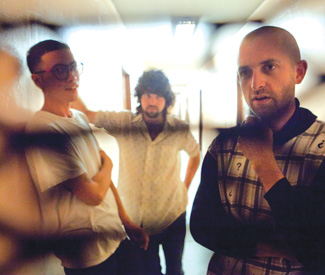
MUSIC Water Borders, a gloomy beat-driven San Francisco band with a new release (Harbored Mantras) on Tri Angle Records, spent the past few weekends practicing the art of creating atmosphere for obscure vintage films.


The band was picked for the first San Francisco installment of Celluloid Salon, a multimedia series that also takes place in cities such as New York, Chicago, and Austin, Texas. At the event — Nov. 15 at Public Works — the trio will live score four silent shorts from the 1920s and ’30s. “We’re good at soundscapes,” explains the group’s singer Amitai Heller, sitting amongst pedals, synths, stacked TVs, and laptops in the band’s Tenderloin practice space. “It’s kind of what we do best, is create moods.”


He’s right. The textured tracks on Harbored Mantras creep from black velvet-swaddled eerie (“What Wiwant”) to veiled ethereal (“Waldenpond.com”). Moody synths and drum machine beats are layered with cinematic samples that recall snake rattles, dragging chains, even bird chirps. The album — which is the band’s first full-length release after putting out a CD-R, a cassette, and a few records on labels such as Disaro — also takes hints from post-punk and experimental industrial, most notably, Coil.


Heller’s doomed, swallowed vocals are the most startling. “There’s definitely a lot of studio tricks with the vocals,” says Heller’s partner-in-sound, Loric Sih. “Our music is generally dense and cavernous, the vocals have to be mixed in a specific way to sound right sitting on top of that. There was a lot of experimenting, a lot of trial and error, a lot of long nights in here.” Here meaning the practice space, where a nearby metal act’s muffled guitar bleeds through the walls.


While this project arose in 2009, the two met 10 years back at UC Santa Cruz when Heller was the “flamboyantly dressed” singer of Gross Gang. After Gross Gang ended, Heller started New Thrill Parade and asked Sih to join. With Water Borders, Heller says they had a plan: “everything in reverse from how we did things in the previous band.” In the other band, they “self-promoted aggressively, toured insane, and lost tons of money.”


Says Heller, “With this, [Loric and I] decided that we wanted to get everything in order first, have concise direction…and not show people the evolution as it unfolded. So it’s record it, perfect it, show it.” While that was the theory, the reality was a bit more complicated. They had to work at bringing the synth-and-machine music to the stage in an engrossing way. “It’s taken us about this long to understand how to make electronic sound good live. I think the [record release] show we just played at Amnesia was probably the first time that nothing went wrong.”


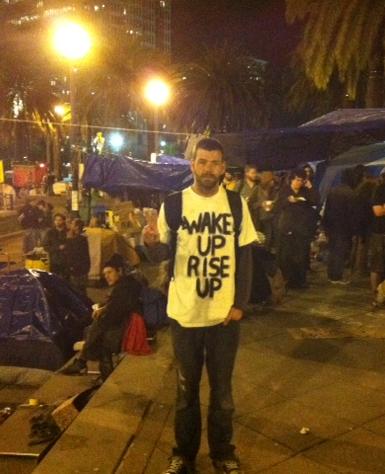
Part of that newfound live strength comes from the band’s newest member, Matt Rogers, a longtime friend and recent Seattle transplant. At shows, the multi-instrumentalist plays guitar, keyboard, and an electrical kalimba, among other pieces. The addition of Rogers, who joined in August, meant Heller could focus mainly on vocals. And those are important to him. While they’re murky, under a thick goth-y haze, the lyrics on Harbored Mantras touch on themes of dissatisfaction, systemic and institutional change, and colonialism. They come from Heller’s sociopolitical awareness; raised on a kibbutz in Israel, he’s now a volunteer counselor at the Tenants Union and frequents the Occupy SF grounds.


While likely not so in line with his personal politics, he once composed music for a documentary on the Seastedding Institute (which, he says, is basically an organization of rich libertarians who want to colonize the ocean by creating autonomous cities). The event at Public Works will be the first scoring for Water Borders as a band though. Sih and Heller seem stoked at the prospect. “I would be happy if this band was able to score films professionally,” enthuses Sih. The tones of the short films vary wildly, one even has a slapstick element — which seems worlds away from the Water Borders vibe. Says Heller, “It’s challenging in a good way.”


WATER BORDERS


Nov. 15, 7 p.m., free with RSVP


Public Works


161 Erie, SF


(415) 932-0955


www.myopenbar.com/celluloidsalon


www.publicsf.com

Homemade shaman

0

arts@sfbg.com

THEATER A rare event for rare times: Robert Steijn comes to San Francisco. The visit — which included a workshop Oct. 31-Nov. 2, and comes courtesy of THEOFFCENTER, Zero Performance, and Jorge Rodolfo De Hoyos — marks the first Bay Area show by this somewhat unexpected but internationally acclaimed figure in contemporary dance-performance.

A onetime dance critic who made a mid-career leap into performance, Steijn is at 53 defiantly not young, nor especially sleek despite a close working relationship with his spirit animal, a deer. But a graceful, probing, witty, and intriguing artist he certainly is. Known to collaborate widely — most consistently with compatriot Frans Poelstra, with whom he forms United Sorry — he’s also the creator of a handful of idiosyncratic solo works, one of which he performs Thursday night at the new Joe Goode Performance Annex in the Mission.

“I am reborn a smoker/Allowing myself to get high in the clouds of imagination” is billed as “a performance in the form of a lecture/demonstration,” but that’s a misleadingly dry description for a euphoric foray into the “invisible” places Steijn — who counts among his influences Jack Smith, Korean shaman-performer Hi-Ah Park, and ayahuasca rituals — has long pursued with a playful earnestness.

“Every time I do it, it changes a little bit,” Steijn says of the piece. “In a way, it’s my introduction about what I can do onstage, but it’s also a kind of showcase of how we use imagination. It’s really about belief systems.”

It’s also a piece where he channels a deer to communicate with the dead. “I dance a lot with a deer, and also it comes into my mind sometimes.” Of the title’s reference to a reborn smoker, Steijn explains, “I was working on shamanistic power animals, and I manifested the deer, and the deer was smoking a cigar.”

Steijn, who divides much of his time between Vienna and Amsterdam, spoke by phone last week from New York City, where he was at work on a new collaboration with choreographer Maria Hassabi (with whom he made a splash last year in an eye-locking duet at New York’s Danspace). Genial, thoughtful, self-effacing, and prone to shy laughter, Steijn remembers that as a lonely child he fantasized a guardian angel. “And it really worked,” he chuckles. It led him to consider “how you can comfort yourself with imagination; how imagination can open up a certain structure for reality.”

“I found I was interested in how the mind works,” he continues, “how we can put our self in a certain mind state, or in a way of thinking, or in a way of perceiving reality, and how that could be very truthful for theater, to show what happens when you are in this state of mind. Because I feel sometimes we’re too rational — or not even rational, but we think too much in the patterns we are used to thinking in.

William Forsythe [showed how] we can change the center of movement in the body; it can be in every body part almost, and you can [put it] also outside the body sometimes. I like to think in that way about the mind: how can you perceive or analyze reality from another center than you are used to? I felt that in shamanism it was very playful to go there, to still a little bit your logical mind. What I found is that when I imagine [myself] into a state, I look at the world with much more compassion and love. It’s a strategy to relate differently to the audience and to movement in the body, to a different imagination.”

Steijn had been in New York only a few days, but said he’d already visited Occupy Wall Street several times. Waxing enthusiastic about what he found there, he spoke of the dialogue and imagination opened up in this re-appropriated public square, and it seemed to recall much of his own work with “intensifying” a space, setting it free of the usual constraints to imagination and experience.

“You know when Joseph Boeys said everybody has to be an artist? I think it would be nice if everyone has to be a poet,” he says. “Perhaps there’s not so much difference between the two. But I like to think you meet with a situation and then you have to create how you want to deal with it, how you want to change it. It’s not to adapt yourself to a situation but really to make it your own. I think this empowerment is important.”

ROBERT STEIJN

Thurs/3, 8 p.m., $10-$20

Joe Goode Performance Annex

401 Alabama St., SF

www.brownpapertickets.com

SF supervisors support OccupySF’s 24/7 encampment

56

The San Francisco Board of Supervisors today approved a resolution supporting Occupy Wall Street and the right of OccupySF to maintain a 24/7 encampment in Justin Herman Plaza, although sponsors of the measure narrowly lost a fight over amending the measure to allow police to use force if “there is an objective threat to safety or health.”

The sponsors of the measure – Sups. John Avalos, David Campos, Eric Mar, and Jane Kim – noted that heath and safety concerns were used as a pretext for both police raids on OccupySF and for last week’s violent police crackdown on the Occupy Oakland encampment, something San Francisco officials uniformly say they want to avoid here. Those four sponsors were joined by Sup. Ross Mirkarimi in opposing the amendment by Sup. Scott Wiener, which passed on a 6-5 vote.

But the overall measure – which urges Mayor Ed Lee to drop his opposition to tents and other camping infrastructure and not order another police raid on the camp – was then approved on an 8-3 vote, with Sups. Mark Farrell, Carmen Chu, and Sean Elsbernd in dissent. Farrell and Chu both expressed support for the movement’s call for addressing severe economic inequities in the country, but they oppose the tactic of occupation.

Board President David Chiu, the swing vote on allowing the resolution to be watered down, said his vote was an effort to get as much support for the measure as possible. “For me, it was important to build consensus here at the board,” he said, praising the work that city officials and OccupySF participants have done to resolve their differences. “I have been very impressed with the behavior of individuals involved in this movement.”

Wiener had made a number of amendments to the resolution that Avalos accepted without objection, drawing the line only at the change that would specifically allow for police to use force to dislodge the protesters. While the nonbinding resolution doesn’t compel any action by Lee or the SFPD, Avalos praised the mayor for meeting privately with OccupySF members after he seemed to take a firm public stand again allowing camping.

“I do want to thank the mayor for coming to the table on how our public spaces can be used,” Avalos said. Kim echoed the point, noting that, “A ton of progress has been made.” The Mayor’s Office has not yet responded to Guardian requests for comment on the resolution or his current position on OccupySF, but we’ll update this post when we hear back.

Wiener and others also thanked Avalos for taking the lead role in addressing this issue. “I want to thank Sup. Avalos for being so open and collaborative,” Wiener said, noting that he’s been very impressed with how OccupySF has handled itself throughout the standoff. “I’m very supportive of OccupySF…It’s been incredibly peaceful and people have been friendly and passionate.”

On the Cheap Listings

0

On the Cheap listings are compiled by Lucy Schiller. Submit items for the listings at listings@sfbg.com. For further information on how to submit items for the listings, see Picks.

WEDNESDAY 2

Ecology, Ethics, and World Renewal lecture Northbrae Community Church, 941 Alameda, Berk. (510) 526-3805. 7:30 p.m., $5 suggested donation. Stephen Most, documentarian and dreamer, discusses the links between Aldo Leopold’s philosophies and those of the Klamath River tribes.

Alan Kaufman reading Booksmith, 1644 Haight, SF. www.booksmith.com. 7:30 p.m., free. San Franciscan Alan Kaufman, author of “Matches” and “Jew Boy,” has led a life as steeped in alcohol as that of a tequila worm. Somehow, he made it out of the bottle and has managed to write a harrowing account of the battle.

Ask a Scientist Science Trivia Atlas Café, 3049 20th St., SF. www.atlascafe.net. 7 p.m., free. Finally, a trivia night where no one has to name all the members of the Bangles. Join revelers for more cerebral concerns (and munch on an Atlas yam sandwich).

Day of the Dead procession 22nd St. and Bryant, SF. www.dayofthedeadsf.org. 7 p.m., free. With marigolds, stilts, drum-pounders, candles, and altars, SF’s annual Dia de los Muertos procession mixes reverence with neighborhood block party. Join thousands under cover of darkness for a thoughtful remembrance of friends, family, pets, and strangers.

Day of the Dead Festival of Altars Garfield Park, 26th St. and Harrison, SF. www.dayofthedeadsf.org. 6-11 p.m., free. Upwards of 80 altars commemorating the lives of loved ones light up Garfield Park. Break out your sugar skulls, candles, photos, and meaningful mementos, this is the time to celebrate the folks you love and miss.

Casa Bonampak Day of the Dead Fiesta Casa Bonampak, 1051 Valencia, SF. www.casabonampak.com. 7-10 p.m., free. Duck into the papel picado-bedecked nook for a break from the DOTD parade to dance, eat, drink, and browse.

THURSDAY 3

San Francisco Transgender Film Festival opening celebration CounterPULSE, 1310 Mission, SF. Also Fri/4, Sat/5. www.counterpulse.org. 8 p.m., $12 sliding scale. Honoring its tenth anniversary as a massive exhibition of short, trans-themed films, this year’s festival opens with a veritable extravaganza featuring some of the more creative names around: Fairy Butch and Kentucky Fried Woman, for starters.

FRIDAY 4

Pico Sanchez Tribute and Dia de los Muertos celebration Mission Arts Center, 745 Treat, SF. (415) 695-5014. 5-8 p.m, free. Kick off the opening of the new Mission Arts Center with a fitting Dia de los Muertos remembrance of formative Mission muralist Pico Sanchez.

Dance Palace Day of the Dead celebration Dance Palace Community Center, 5th St. and B St., Point Reyes. www.dancepalace.org. 6-8 p.m., free. Head North for a smaller-scale Dia de los Muertos, attended by Point Reyesians (Reyesites?) whose aim for the evening is constructing a communal altar celebrating the lives of their loved ones.

SATURDAY 5

Robin Hood and Occupy Wall Street lecture Green Arcade, 1680 Market, SF. www.thegreenarcade.com. 7 p.m., free. Paul Buhle, radical historian and illustrator extraordinaire, recently published a graphic exploration of the original populist hero: Robin Hood. Here he talks about the link between Occupy and men in tights.

Bay Area Star Party Thornton Hall, San Francisco State University, 1600 Holloway, SF. www.astrosociety.org. 8-10 p.m., free. Hubble, Hubble — SFSU opens its stellar planetarium and telescope to the public as part of a bay-wide celestial celebration and viewing. Because we’re all stars in our own right, right?

Cowgirl Tricks Performance Potrero Branch Library, 1616 20th St., SF. www.sfpl.org. 4 p.m., free. San Franciscan Karen Quest holds a rather vague prize from the Wild West Arts International Convention for “Most Unusual Trick” — quite a trophy to carry in this city, anyway. Quest whipcracks, yeehaws, and ropes in style among library bookshelves.

Rad Dad book release and reading Rock Paper Scissors Collective, 2278 Telegraph, Oakl. www.rpscollective.org. 7-9 p.m., free. The hip dads biking through SF with faux-hawked toddlers named things like “Orbison” are sweet alright, but there are also plenty of radical folks for whom politics and parenting go hand-in-hand. Zinesters and Rad Dad scenesters Tomas Moniz and Jeremy Adam Smith speak on activist parenting.

Hypothesis: An Art and Science Fair The Lab, 2948 16th St., SF. www.thelab.org. 7:30-11 p.m., free. For a certain high school subculture, science fairs were make-it-or-break-it happenings. Would your sputtering baking-soda-and-vinegar volcano land you that NYU scholarship? Now of legal drinking age, local artists vie for the blue ribbon at the Lab’s true-to-form exhibition, which was closed to any entries lacking the classic tripartite foam board.

Trail Ridge service day UCSF Mount Sutro Open Space Reserve, SF. www.ridgetrail.org. 8:30 a.m.-12:30 p.m., free. Register online. When completed, the ongoing trail work sponsored by the Bay Area Ridge Trail Council, Sutro Stewards, and REI will culminate in 550 miles of hikeable, bikeable horse-ridable glory. Make your mark this weekend restoring the Twin Peaks Connector Trail.

Illuminations: Dia de los Muertos 2011 closing reception, SOMArts, 934 Brannan, SF. www.somarts.org. 6-9 p.m., $10 sliding scale. Last chance to catch the upwards of 30 altars and installations covering death, from the gravely massive — Fukushima — to the highly personal. Pablo Picasso and beloved Casa Sanchez owner, Martha Sanchez, are among those honored.

SUNDAY 6

Come Out and Play Festival ending games The Go Game, 400 Treat, SF. www.comeoutandplaysf.org. Noon-6 p.m., free. Today marks the end of this week-long, maddeningly mysterious and impossibly brilliant festival challenging San Franciscans to step away from the laptop and onto the streets for games titled things like “Charge of the Rubber Ball Brigade”. Don’t forget to Daylight Savings-ify your reminder notification.

Leave the occupiers alone

0

EDITORIAL With all of the police raids and arguments over messages and demands and tactics, it’s easy to forget that the Occupy Wall Street movement has a clear political point — and it’s right.

The movement is about the devastating and unsustainable direction of the American economy, about the fact that a tiny elite controls much of the nation’s wealth, that virtually all of the income growth over the past 20 years has gone to the very top, about the collapse of the middle class and the rise of economic inequality that would have been unthinkable a generation ago. Those are the central issues facing the United States, the state of California and the cities of San Francisco and Oakland today — and instead of trying to crack down on the protests, city officials ought to be endorsing the occupy movement and talking about cracking down on the financial institutions and the wealthy.

A few things worth noting:

1. The protesters are almost entirely nonviolent. Although there have been a few isolated incidents in Oakland and SF, the overwhelming majority of the thousands of people at Justin Herman Plaza and Frank Ogawa Plaza are actively promoting and insisting on nonviolence. This is not a crowd that is a threat to anyone.

2. There’s a precedent for long-term political protest camps in San Francisco. The AIDS Vigil remained at U.N. Plaza — with tents, tarps, and cooking gear — for ten years, from 1985 to 1995.

3. The city of San Francisco’s citations — reported without question in the daily newspapers — about health and sanitation problems are way overblown. The OccupySF protesters are making extraordinary efforts to keep the place clean. When the city failed to live up to its promise to provide portable toilets, the protesters ordered (and paid for) their own. As state Sen. Leland Yee (not known as a crazy radical) noted after a visit Oct. 26: “While hundreds gathered, there was not one incident of violence. If the interim mayor thinks there are health issues, I certainly didn’t see them.” We visited Oct 31, and the place was clean and peaceful.

4. The cat-and-mouse game with the San Francisco police is the equivalent of psychological warfare; protesters have to be on edge at all times for fear of a crackdown that may or may not come.

5. Mayor Jean Quan made a bad mistake sending in the cops to roust Occupy Oakland. Nothing good at all can come of any further police eviction action.

Frankly, we don’t see why the protesters — who are well-behaved, represent no threat to anyone, and are doing a huge civic and national service by bringing attention to an issue that the powers that be in Washington, Sacramento and (sadly) San Francisco have largely ignored — can’t stay where they are. If there are health issues, let the Department of Public Health work with the occupiers. If there’s a problem with a portable kitchen, let the Fire Department show the protesters how to run it safely and legally (there are portable cooking devices at every street fair, in dozens of food trucks and in probably 100 other places around town).

The people at OccupySF and Occupy Oakland have done an amazing job of building a safe, respectful and inclusive community. They are the political heros of 2011. If there’s anyplace in America where the movement ought to be allowed to grow and thrive, it’s here in the Bay Area.

Editor’s notes

0

tredmond@sfbg.com

One cool October day in 1985, when I was a young reporter at the Guardian, a friend who was visiting from New York where she was working with Gay Men’s Health Crisis, called me with an urgent message:

City employees were out with water hoses, trying to force a couple of HIV-positive men from camping in front of a federal office building at U.N. Plaza. I ran down there; she had photos. I talked to the men, who were tired and wet, but determined not to leave — and within a few days after my story ran (“AIDS vigil under attack,” 11/6/85), they were joined by dozens more.

And as the months passed, the AIDS vigil grew and grew. It raised awareness of the federal government’s criminal lack of attention to the epidemic. It became a tent city, a small community in the middle of San Francisco with donated food and supplies. Every once in a while, a politician or a media celebrity would spend a night there.

The feds backed off with the hoses and the city figured out that the encampment was no danger to anyone and was making an important political statement. And it remained there — with tents and tarps — for ten years.

I was at the OccupySF camp Oct. 3rd to do a live KPFA broadcast with Mitch Jeserich, and the place was clean, peaceful and well-organized. A couple of cops walked through while we were on the air; they were smiling and chatting with the protesters, who were negotiation with the Department of Public Works about vacating the grassy areas to allow watering. I saw none of the filth that the daily newspapers have talked about.

The only real health and safety problem was the lack of portable toilets — the seven on site weren’t enough for the number of people there. So if the city wants to keep things sanitary, Mayor Ed Lee ought to send in some more. Oh, and the medical tent needs supplies, particularly ice packs and sterile gauze.

A woman from Occupy Vancouver was down visiting and showing solidarity; she said that protesters all over the continent were looking to San Francisco and Oakland for inspiration.

This is a good thing. The protests may not have an agenda, but they have a message, and it’s getting to big and too loud to ignore. I hope it doesn’t take ten years for politicians at the local, state and federal level to respond — but as long as nobody’s addressing economic inequality, OccupySF is and ought to be here to stay.

Alerts

0

alert@sfbg.com


WEDNESDAY 2

Occupy Oakland General Strike

In response to last week’s police crackdown, Occupy Oakland called for a general strike on Nov. 2, urging workers and students to shut the city down and join the movement. Convene with neighbors, community members .and affinity groups to take part at a moment when “the whole world is watching Oakland.” Banks and corporations that don’t close will be marched on. The Strike Coordinating Council will begin meeting every Wednesday at 5pm in Oscar Grant Plaza before the daily General Assembly at 7pm. All participants are welcome.

All Day, free

Oscar Grant Plaza

14th & Broadway, Oakland

www.occupyoakland.org


THURSDAY 3

Transgender Film Festival

This year at the 10th Annual Transgender Film Festival, watch the captivating collection on defiance, bullying, romance, relationships, sex, and so much more. International filmmakers journeyed from across the globe. Be sure to buy your tickets before they sell out, which it is expected to.

8-10 p.m., $12-15

CounterPULSE

1310 Mission, SF

Contact Eric Garcia: intern@freshmeatproductions.org

www.sftff.org


FRIDAY 4

Sacred Sites Peacewalk

The Berkeley Fellowship of Unitarian Universalists Social Justice Committee will provide overnight shelter space for participants in Sacred Sites Peacewalk for a Nuclear Free World. All are welcome for a potluck dinner, speak out and discussion featuring a Buddhist teacher and peace activist. The walk began Oct. 22 at Diablo Canyon and ends Nov. 6 at Glen Cove, Vallejo.

6-9 p.m.

Berkeley Fellowship of Unitarian Universalists’ Hall

1924 Cedar, Berkeley

(510) 841-4824

www.bfuu.org


SATURDAY 5

Occupy Wells Fargo

The marginalized in the 99 percent are fed up with austerity, especially these 67 Suenos, a collective of undocumented youth and allies that refuse to be passive about violence in the Bay Area community. Stand in solidarity against banks who aggressively invest and profit off anti-immigrant laws like Arizona’s AB 1070. Come and join in planning preparations.

10 am- 1 p.m., free

Contact: 67suenos@gmail

Oscar Grant Plaza/Downtown Wells Fargo 1 block away

14th St. and Broadway, Oakl.


Marxism Conference

From Athens to Cairo to San Francisco, capitalism has proven its instability and people are fighting back. With the Occupy Wall Street phenomenon, it’s the perfect time to further understand the Marxist philosophy on exploitation and how the working class can liberate the oppressed. Featured speakers include Alan Maass, editor of Social Worker newspaper and Keeanga Yamahtta Taylor, editorial board member of International Socialist Review.

10 am- 6 p.m., free

UC Berkeley

Rooms 220 Wheeler and 126 Barrows

Telegraph and Bancroft, Berk

iso@norcalsocialism.org

www.norcalsocialism.org


Mail items for Alerts to the Guardian Building, 135 Mississippi St., SF, CA 94107; fax to (415) 437-3658; or e-mail alert@sfbg.com. Please include a contact telephone number. Items must be received at least one week prior to the publication date.

Guardian editorial: Leave the occupiers alone!

2


As the world watches, San Francisco and Oakland should set the standard by supporting  Occupy San Francisco and Occupy Oakland and supporting  their goals and peaceful tactics.  B3

 With all of the police raids and arguments over messages and demands and tactics, it’s easy to forget that the Occupy Wall Street movement has a clear political point — and it’s right.

The movement is about the devastating and unsustainable direction of the American economy, about the fact that a tiny elite controls much of the nation’s wealth, that virtually all of the income growth over the past 20 years has gone to the very top, about the collapse of the middle class and the rise of economic inequality that would have been unthinkable a generation ago. Those are the central issues facing the United States, the state of California and the cities of San Francisco and Oakland today — and instead of trying to crack down on the protests, city officials ought to be endorsing the occupy movement and talking about cracking down on the financial institutions and the wealthy.

A few things worth noting:

1. The protesters are almost entirely nonviolent. Although there have been a few isolated incidents in Oakland and SF, the overwhelming majority of the thousands of people at Justin Herman Plaza and Frank Ogawa Plaza are actively promoting and insisting on nonviolence. This is not a crowd that is a threat to anyone.

2. There’s a precedent for long-term political protest camps in San Francisco. The AIDS Vigil remained at U.N. Plaza — with tents, tarps, and cooking gear — for ten years, from 1985 to 1995.

3. The city of San Francisco’s citations — reported without question in the daily newspapers — about health and sanitation problems are way overblown. The OccupySF protesters are making extraordinary efforts to keep the place clean. When the city failed to live up to its promise to provide portable toilets, the protesters ordered (and paid for) their own. As state Sen. Leland Yee (not known as a crazy radical) noted after a visit Oct. 26: “While hundreds gathered, there was not one incident of violence. If the interim mayor thinks there are health issues, I certainly didn’t see them.” We visited Oct 31, and the place was clean and peaceful.

4. The cat-and-mouse game with the San Francisco police is the equivalent of psychological warfare; protesters have to be on edge at all times for fear of a crackdown that may or may not come.

5. Mayor Jean Quan made a bad mistake sending in the cops to roust Occupy Oakland. Nothing good at all can come of any further police eviction action.

Frankly, we don’t see why the protesters — who are well-behaved, represent no threat to anyone, and are doing a huge civic and national service by bringing attention to an issue that the powers that be in Washington, Sacramento and (sadly) San Francisco have largely ignored — can’t stay where they are. If there are health issues, let the Department of Public Health work with the occupiers. If there’s a problem with a portable kitchen, let the Fire Department show the protesters how to run it safely and legally (there are portable cooking devices at every street fair, in dozens of food trucks and in probably 100 other places around town).

The people at OccupySF and Occupy Oakland have done an amazing job of building a safe, respectful and inclusive community. They are the political heroes of 2011. If there’s anyplace in America where the movement ought to be allowed to grow and thrive, it’s here in the Bay Area.


Superviors and labor leaders challenge Lee’s OccupySF stance

41

Mayor Ed Lee has put the city and its police force on a collision course with not only OccupySF, but also several members of the Board of Supervisors and top labor leaders who support the movement and want the city to allow its encampment to continue.

They spoke at a special hearing of the City Operations and Neighborhood Services Committee that was convened by Chair John Avalos this morning, supporting a resolution that Avalos created to allow OccupySF to have tents and other infrastructure that Lee opposes. The resolution – which is co-sponsored by Sups. Eric Mar, David Campos, and Jane Kim – was approved by the committee and is set to be considered by the full Board of Supervisors tomorrow (Tues/1).

“It is something I am wholeheartedly supporting because it is an expression of great frustration and concern about the economic system,” Avalos said. “We need to speak with a greater voice about changing our economic system so it works for the many and not just the few,” Avalos said, explaining why he is “wholeheartedly supporting” the OccupySF movement.

But Avalos said he’s been frustrated that Lee and the police have raided the camp twice and are threatening more, something that Avalos has been trying to mediate since the first raid on Oct. 5. He also said the city should learn from Oakland that using the police force to stop the movement only makes it stronger.

“If we were to try to stop it from happening, it would just encourage more people to take part in it,” he said, noting that more midnight raids are dangerous for both police and protesters. “We have to figure out as a city how we’re going to facilitate, encourage, and accommodate this movement.”

But instead, Avalos said Lee’s stand against allowing tents or an kind of encampment, while claiming to support the message OccupySF, has created a tense standoff. “I’ve seen very mixed messages come out of this administration,” Avalos said, adding that nobody believes police statements that the massing of SFPD cops in riot gear on Oct. 26 was only a training exercise.

Mar said OccupySF deserves tremendous credit for holding the space and being responsive to the health and safety concerns raised by city officials. “I’ve seen a transformation in the movement in the last three weeks that is truly impressive,” Mar said. “I’ve also seen, during the General Assemblies, an incredible exercise in democracy.”

He also disputed accusations that the camps are dirty and that the movement is unfocused. “Don’t believe the hype from the mainstream media but look at the messages coming out of this movement,” said Mar, who was wearing a “We are the 99 percent” sticker.

“We should allow OccupySF to do what they’re doing,” Campos said. “It’s good for San Francisco.”

Campos also called out Lee and Oakland Mayor Jean Quan for ordering violent raids on the peaceful encampment, disputing the idea that “somehow it’s okay for us to spend the limited resources we have on these kinds of police actions…I hope we don’t have Mayors Quan and Lee wasting resources that could be better spent elsewhere.”

During the public comment portion of the hearing, each of the more than two dozen speakers supported the resolution.

“What this resolution does is it calls on the other supervisors and the mayor to decide how they want to deal with OccupySF,” said Gus Feldman of SEIU Local 1021.

Representatives of several labor unions and the San Francisco Labor Council that have voted to endorse OccupySF spoke at the hearing, include Ken Tray with United Educators of San Francisco, who gave a rousing speech in support of the movement.

“The times have changed and the political landscape has shifted,” Tray said, ticking off a long list of reasons for supporting the movement, from San Francisco’s long tradition of advocating for progressive change to the fact that “the schoolchildren of San Francisco are being denied resources because the 1 percent refuse to pay their fair share.”

Frank Martin del Campo of the SF Labor Council displayed the bruises on his arm inflicted by police during the raid on the Occupy Oakland, saying “this was an attempt to criminalize dissent…It represents the politicization of the police.”

Labor Council Executive Director Tim Paulson said, “I just want to be clear that we are the 99 percent….We want Occupy San Francisco to be there 24/7.” He and others say the Occupy movement is highlighting deep economic inequities that the labor movement has long been raising as well. “OccupySF has called the question on really important issues we’ve been struggling with for years,” said Gabriel Haaland of SEIU Local 1021

“Here is a peaceful protest being answered with violence,” said Pilar Schiavo of California Nurses Association, which has been supporting the occupations. This is an important political struggle, she said, and “It’s time for the mayor to decide what side he’s on.”

Many speakers focused their criticism on Lee, such as Brad Newsham, who said, “Any official who would send in the riot police to deal with this camp does not deserve to be mayor of San Francisco.” He said the city should set an example for the country by formally allowing the encampment to continue, and he turned to the young protesters in the room and said, “Hold your ground and we’ll try to get your back.”

Sean Semans, an active member of OccupySF since the beginning, thanked Avalos and the other progressive supervisors for “saving us when nobody would,” and he expressed frustration with the Mayor’s Office.

“The mayor still doesn’t recognize us, he won’t come down and see the work we’re doing,” Semans said. “We can do all kinds of work when we’re not fighting to protect our First Amendment rights.”

He was part of an OccupySF delegation that met with Lee last week, and Semans said the mayor offered to help get the protesters rooms in SRO hotels or meals from local soup kitchens, showing that he has a fundamental misunderstanding about what this occupation is about.

As Semans said, “It shows what we’re dealing with here.”

CHP menaces the Halloween Critical Mass ride

14

The California Highway Patrol seems to be on high alert and itching to fight the people in the street, at least if a bizarre incident at last night’s Critical Mass is any indication. And that’s a scary prospect in the Bay Area, where the ongoing standoffs between police and the Occupy movements in San Francisco and Oakland are potential powder kegs that require cool heads on both sides.
Critical Mass was rolling through the warm streets of San Francisco, as it’s been doing on the last Friday of the month for 19 years, and it was a glorious night. The weather was nicer than it’s been in years for the Halloween ride and most of the large crowd wore costumes, many of them playing off Occupy Wall Street themes, from zombie bankers to the Glass Seagull (a reference to the gutted banking regulation Glass-Steagall Act).
Best of all, the San Francisco Police Department seemed to be standing down and allowing the ride to self-regulate, which it did with a minimum of conflicts with drivers. The mood was buoyant and many riders said it was the best Critical Mass they’d been on in a long time.
Then suddenly, as the ride headed up Market Street toward the Castro, crossing Octavia Boulevard, about a dozen CHP officers on motorcycle rapidly descended on the ride, aggressively cutting the dense ride in half to clear Octavia. Some used their motorcycles to push the cyclists back and tensions flared.
Angry words were exchanged back-and-forth between the cyclists and cops, some of whom seemed to be itching for a fight. One in particular pursued the cyclists up Market Street, playing the provocative tough guy or using his motorcycle to try to corral and menace the ride, long after the standoff had ended with enough green lights for the ride to get past Octavia and his fellow officers left.
This battle over public space and freedom of assembly isn’t going away anytime soon. There are resentments building and there will be bad apples on both sides of the barricades in the days and weeks to come. That’s one reason why Mayor Ed Lee is playing a dangerous game by threatening to raid OccupySF at any moment, and why the SFPD’s approach to this ride was far better than the CHP’s.
Just stand down and let the people police themselves.

Potrero Hill History Night: a special occasion for a special neighborhood

3

Scroll down for Potrero Hill History Night photos

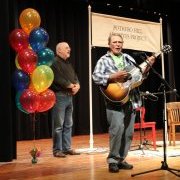
And so Country Joe McDonald ambled on to the stage Saturday night at the International Studies Academy on Potrero Hill and told an full auditorium full of history night groupies  that since he was playing in a school he would open with a spelling lesson.

“Give me an F,” he roared,  and the audience roared back with an F.

“Give me a U, give me a C, give me a K,” and the audience roared back again and again  with knowledge of the lyrics of the anti-war song “I Feel Like I’m Fixing To Die” that Country Joe made famous during the Vietnam war and has been singing as his trademark song ever since.

He would pause and the audience would continue on with the words. Country Joe was in top form, the audience loved him, and it was a stunning beginning to the 12th annual Potrero Hill History Night.  And the fact that Occupy SF and Occupy Oakland were fixing to explode sooner or later in nearby neighborhoods  only gave some timely poignancy to the occasion.

But Country Joe wasn’t at History NIght to perform as a singer or political activist. He explained that he was there as a turnaround artist to interview Joel Selvin, the veteran San Francisco Chronicle pop culture reviewer and author of “Smart Ass,” a collection of 40 years of Selvin’s music journalism. Significantly, Selvin also happens to be a longtime Potrero Hill resident. The latter phrase is the key, because the point of History Night is to focus on the rich history and colorful personalities of Potrero Hill and put them together into a lively program. In this segment, Joe the performer interviewed Joel the reviewer/reporter who had been writing about Joe for years.

The two made a splendid team and it turned out that Joel was as good onstage in this format as Country Joe. It was good fun, instructive at times, particularly with the stories about Bill Graham’s antics and angry outbursts and how each dealt with him. The audience had fun trying to figure out through questions just how rock n’ roll and Country Joe from Berkeley connected to the hill. Well, one answer was that Jann Wenner, the founder of Rolling Stone magazine, claimed three different addresses on Rhode Island Street.

The program this year was the best ever. A barbecue outside the building serviced by a platoon of History Night  groupies on a warm and wondrous Potrero Hill evening. And a program featuring a formal presentation of a chunk of goat hoofprints embedded in concrete, an interview with the woman who tended the goats decades ago, a surprise appearance by the lady who found and preserved the hoofprints for years, and a starring role by Phillip DeAndrade of Goat Hill Pizza who was given the goat hill hoofprints as a surprise gift because he once had goats in the back of his Goat Hill pizza parlor and because, well, he’s Phil DeAndrade.

DeAndrade is a Potrero Hill version of the Scarlett Pimpernel (he’s here, he’s there, he’s everywhere). For this evening, he was doing triple duty as the worthy receiver of goat hoofprints in concrete, as master of ceremonies, and as the Hot Interviewer of the Colorful Potrero Hill Veteran, the key finale of every history night event.

DeAndrade was specially eloquent in explaining the importance of history night. It is, he said, a special event (nobody else in town has one) that showcases Potrero Hill.as a special place and its people as special people who live in a special neighborhood with a special culture and a special history and such institutions as the Neighborhood House built in the 1920s  with Julia Morgan as the architect.

The goat hoofprints in cement  made his special point. The artifact dates from 1925 or so and was found and preserved by Rose Marie Ostler, a Potrero Hill native. She kept the hoofprints for years and then decided they should go to DeAndrade of Goat Hill for his historic connection with goats.  She presented them at the ceremony, with help from Dr. Frank Gilson, a local chiropractor wearing a Halloween type goat hill mask.

This year’s Potrero Hill veteran was Josephine Firpo Alioto, who was born on Potrero Hill 90 years ago, and now lives in San Jose.  She married Frank Alioto, son of Police Capt Calogero and Vincenza Alioto.  The Alioto family moved to 755 Carolina St. around 1930, just around the corner from Josephine’s house. There were no houses on the cornerin those days,  so they had a clear view of one another’s houses. Josephine and Frank were friends for 80 years and married for 65 and a half years.  They were married at nearby St. Theresa’s Church.  With expert coaching from DeAndrade, she was most articulate and provided the details of life and times of growing up on the hill in the 1920s and 1930s.

Perhaps the most “newsworthy” comment came when she took the audience by surprise when she mentioned that her cousin, Luis  Firpo, known as the Raging Bull of the Pampas in Argentina, knocked Jack Dempsey out of the ring in a  championship fight. (My google check showed she was right. Firpo did knock Dempsey out of the ring in the  famous 1923 heavyweight championship fight at the Polo Grounds in New York City and Dempsey’s head hit a reporter’s typewriter. But Dempsey got back in the ring on a contested long count and won the fight in the third round in what many think is the greatest fight of all time. It was Dempsey’s last successful defense of his title. The fight is on UTube and googleable under Firpo.)

As is the history night custom, there were lots of Firpos and Aliotos in the audience to help fill in Josephine Alioto’s story and answer questions from the audience and provide the evidence of a very special neighborhood.

All in all, it was a most memorable event and all to the credit of Peter Linenthal, the founder and impresario of Potrero Hill History Night. His event even got a nice writeup in Leah Garchik’s Chronicle column. UCSF at Mission Bay was the sponsor of the event and the Parkside, Chat’s Coffee, and Bottom of the Hill donated to the barbecue.  Linenthal  is also the curator of the Potrero Hill Archives project, assisted by Abigail Johnston. The two co-authored an excellent book on Potrero Hill.  For more on the archives project, go to potreroarchives.com.  You may find out more about Potrero Hill than you need to know.

I think Linenthal has done what every impresario dreams of doing:  making his event so special and so memorable that it will live on and on.  B3

history night 2

Rose Marie Ostler formally  presents the goat hoofprints in cement to Goat Hill Phi.

history night 4

The audience of History Night groupies.

history night 5

Selvin expands, Country Joe listen.

history night 6

Josephine and Phil,  a dynamic duo, 

history night 7

Josephine and Phil, getting ready for prime time.

history night 8

The Apollo  jazz group in concert at History Night.

history night 9

A student from the International Studies Academy selling tickets for the barbecue.  The money goes to the ISA student travel program.


Mayor Lee still moving toward showdown with OccupySF

22

Mayor Ed Lee continues to insist that OccupySF break down its encampment in Justin Herman Plaza and threaten to send in riot police if that doesn’t happen, even as this week’s violent police raid on Occupy Oakland has sparked international outrage, condemnation, and solidarity with other occupations.

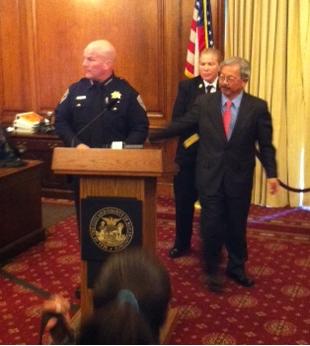
Reporters packed into the Mayor’s Office for a photo op with a good samaritan who recently helped rescue an injured truck driver, clearly waiting for the chance to interview Lee and Police Chief Greg Suhr about last night’s aborted police raid on the OccupySF encampment, asking repeated questions seeking to clarify Lee’s confusing political doublespeak before his communication staff shuffled him out of he room after about 10 minutes.

“I, like all of you, were watching in somewhat of very big deep concern as I saw things unveiled in Oakland, certainly in constant communication with not only our chief of police, Chief Suhr, but also all of our departments to say that’s not what we want to happen in San Francisco,” Lee began. “We’re trying to enforce all the laws here, and of course it’s public health stuff that we’re emphasizing. We need to make sure our public spaces are clean and healthy, and to protect their First Amendment rights. But we didn’t want to get into a situation where we’re just busting heads because then it’s all lost.”

Yet neither Lee nor Suhr could articulate why they think Oakland’s raid turned so violent or how to guard against a similar fate here in San Francisco, particularly because they reiterated their position that the encampment must go and held open the possibility that another police raid – there have been two so far, the second more violent than the first, and the camp has only grown in size since then – could come at any moment.

They also offered shifting explanations for last night’s massing of SFPD troops in riot gear in buses on Treasure Island, which protesters believe was turned back only because of the huge presence in the camp, which included five members of the Board of Supervisors and various labor leaders, a group that Lee says he would be meeting with shortly after the event (“We’re seeing if they’d like to propose some additional solutions,” Lee said).

When asked about plans for yesterday’s raid, Suhr initially said it was simply a normal Wednesday evening training exercise. “There were that many police amassed last Wednesday, there will be that many police amassed next Wednesday. Wednesday is a standard training day for the Police Department,” Suhr said.

But when reporters expressed skepticism – many aware of the busloads of police in riot gear massing on Treasure Island, the last minute changes in police staffing schedules, and the notices of possible police activity sent to businesses around Justin Herman Plaza – Suhr said police were preparing to either assist in Oakland or deal with trouble from OccupySF.

“Out of deference for what was going on in Oakland, we felt that the more pressing need was whether we needed to assist Oakland and/or whether that situation was going to come to us,” Suhr said. “I didn’t say it was a training exercise, we took advantage of the presence on what was training day and to train to what we may have to do down the line.”

Lee also raised the concern that violent agitators might come to San Francisco: “They had to get ready for what they saw in downtown Oakland. They had to get ready for hundreds of people coming to San Francisco, either walking over the bridge or coming through the BART system. So they were trying to get ready for that particular activity because we didn’t know what was going to happen. We saw a lot of anger and a lot of frustration by people who wanted to come over to San Francisco and we didn’t know what their intention was.”

But reporters noted that Lee ordered OccupySF to take down its encampment two weeks ago, that he told reporters this week that they must do so “within days,” and that Suhr circulated a memo in the camp yesterday entitled “You are Subject to Arrest” if they didn’t heed city codes regarding overnight camping. Given all that, we again asked if there was any intention to go into the camp last night?

“That was not our intention, but I’ve always asked the chief to be ready. I’ve been insistent that we have to be ready to enforce our laws so he’s been under that instruction for quite some time. But the tactical decisions are the chief’s responsibilities,” Lee said.

Yet later in the press conference, after Lee had left the room, Suhr made it clear that the decision about if and when to stage another raid on OccupySF is the mayor’s. “Make no mistake about it, Mayor Lee is in charge of this situation,” Suhr said.

In fact, when we asked Suhr about this constant threat of a violent police raid in the middle of the night hanging over the protesters – which is a wearying distraction from the main economic justice purpose at best, and at worst what some protesters told us was akin to psychological warfare – Suhr said that even he didn’t know when a raid might come.

“There’s nobody more anxious that I am because I don’t know when the raid is coming either, so I can attest to the fact that it makes me anxious. We are working painstakingly and patiently to make sure that area is safe and sanitary,” Suhr said.

But while Lee insists that dialogue and compromise could still avert another crackdown, he refuses to accept that occupation is a tactic that protesters aren’t likely to abandon anytime soon. So Lee’s insistence that the camp be broken down seems to be putting the city and OccupySF on a collision course that most members of the Board of Supervisors – including those sponsoring resolution urging the city to allow overnight camping – fear could be a disastrous stain on the city.

“Our message to OccupySF is we’re still wanting you to comply,” Lee said. “That’s been the consistent message we’ve been sending clearly these last couple weeks…We’re trying to ensure that [the ban on] overnight camping is still enforced, but also respecting their rights to protest.”

I and other reporters tried to push Lee on the potentially harmful standoff he was creating, and he tried to make it sound as if the OccupySF movement could avoid another police crackdown, something he said depends on protesters submitting to his demands.

“It’s optimistic on our part that we would get some sensible minds who want to help us find a way to clean up the area, because that ultimately what we want to do,” he said.

But for all his statements of support for the Occupy Wall Street movement and stated desire to avoid the violent confrontation in Oakland, he refuses to allow tents on the site.

“There’s a fine line between occupying public space within your First Amendment rights and sleeping overnight and causing health conditions that we’ve been very concerned about. So we’re going to take it step by step,” Lee said. When asked about whether tents would still be allowed if the camp was clean and otherwise compliant, he said, “We’re still saying no tents.”

So then when and how will you be enforcing that, reporters kept asking.

“Let’s see what can voluntarily be done through the dialogue that trying to establish. We’ve given them a lot of notices. I want to be sure that if we have to do things to enforce our laws, that we’re quite justified and that everybody knows,” Lee said.

Yet that was the same stance that Oakland Mayor Jean Quan took, and it’s one that she is reportedly backtracking on in the wake of the violence and international condemnation. And Lee couldn’t explain how a crackdown might go differently in San Francisco, particularly none that OccupySF has grown larger and more empowered by defying Lee’s edict for so long.

“Everyone agrees that we don’t want to Oakland situation to happen here,” Lee said, at which point Press Secretary Christine Falvey said he would take only two more questions.

“We’re putting a responsible burden on the occupiers to work with us so we can avoid situations like Oakland,” Lee said. “They have to take responsibilities for what they’ve done.”

“Frankly, it sounds like you’ve said nothing, and I think some other reporters are feeling the same way,” KCBS reporter Barbara Taylor, the senior journalist stationed at City Hall, said with a tone of exasperation. “So can you just outline, when you say to do the right thing, what is the right thing? Do you expect them to voluntarily take down the tents, clean up the camp, only be there within certain hours?”

“Yes. The right thing for them to begin showing responsibility,” Lee responded.

“But what does that mean?” Taylor persisted.

Lee said they need to clean up the camp, saying that “cleanliness has been our number one concern….They have to show signs that they’re willing to work with us.” But the protesters have been diligent about regularly cleaning the camp, and they have complied with other city requests such as no open flames. And when the city refused to make porta-potties available at night, supporters of the camp rented four of their own after the city and its daily newspapers complained about public urination and defecation.

“I’ve said all along that public safety is our number one concern,” Lee said.

Fire Chief Joanne Hayes-White reinforced Lee’s point, complaining about open flames, car batteries, and generally “unhealthy and unsafe conditions.” When we noted that the protesters have already addressed and abated many of these issues in recent days, she admitted that she hasn’t been to the site recently, but said, “The tarps and the tents are not something we’re going to tolerate.”

Suhr made it clear that police action would be done in support of other city departments who ordered hazards to be abated. As for when and how officers would do so: “If we believe we could go into the camp safely, if we think we can go in and support the agencies that will be doing the cleanup, without having to go past a measured response, we would do that,” Suhr said. “That opportunity did not present itself last night.”

And so the standoff continues.

Guardian editorial: Let OccupySF and Oakland stay

5

With all of the police raids and arguments over messages and demands and tactics, it’s easy to forget that the Occupy Wall Street movement has a clear political point — and it’s right.The movement is about the devastating and unsustainable direction of the American economy, about the fact that a tiny elite controls much of the nation’s wealth, that virtually all of the income growth over the past 20 years has gone to the very top, about the collapse of the middle class and the rise of economic inequality that would have been unthinkable a generation ago. Those are the central issues facing the United States, the state of California and the cities of San Francisco and Oakland today — and instead of trying to crack down on the protests, city officials ought to be endorsing the occupy movement and talking about cracking down on the financial institutions and the wealthy.

A few things worth noting:

1. The protesters are almost entirely nonviolent. Although there have been a few isolated incidents in Oakland and SF, the overwhelming majority of the thousands of people at Justin Herman Plaza and Frank Ogawa Plaza are actively promoting and insisting on nonviolence. This is not a crowd that is a threat to anyone.

2. The city of San Francisco’s citations — reported without question in the daily newspapers — about health and sanitation problems are way overblown. The OccupySF protesters are making extraordinary efforts to keep the place clean. When the city failed to live up to its promise to provide portable toilets, the protesters ordered (and paid for) their own. As state Sen. Leland Yee (not known as a crazy radical) noted after a visit Oct. 26: “While hundreds gathered, there was not one incident of violence. If the interim mayor thinks there are health issues, I certainly didn’t see them.”

3. The SF Mayor’s Office and the police have made no serious effort to work with or negotiate with the protesters. Even the five supervisors who arrived Oct. 26 (and good for them) when there were rumors of a police action, had no idea what the cops were up to — and Police Chief Greg Suhr wasn’t responding to their phone calls. It’s the equivalent of psychological warfare; protesters have to be on edge at all times for fear of a crackdown that may or may not come.

4. Mayor Jean Quan made a bad mistake sending in the cops to roust Occupy Oakland. Nothing good at all can come of any further police eviction action.

Frankly, we don’t see why the protesters — who are well-behaved, represent no threat to anyone, and are doing a huge civic and national service by bringing attention to an issue that the powers that be in Washington, Sacramento and (sadly) San Francisco have largely ignored — can’t stay where they are. If there are health issues, let the Department of Public Health work with the occupiers. If there’s a problem with a portable kitchen, let the Fire Department show the protesters how to run it safely and legally (there are portable cooking devices at every street fair, in dozens of food trucks and in probably 100 other places around town).

The people at OccupySF and Occupy Oakland have done an amazing job of building a safe, respectful and inclusive community. They are the political heros of 2011. If there’s anyplace in America where the movement ought to be allowed to grow and thrive, it’s here in the Bay Area.

Guardian editorial: Let OccupySF and Oakland stay

18

With all of the police raids and arguments over messages and demands and tactics, it’s easy to forget that the Occupy Wall Street movement has a clear political point — and it’s right.

The movement is about the devastating and unsustainable direction of the American economy, about the fact that a tiny elite controls much of the nation’s wealth, that virtually all of the income growth over the past 20 years has gone to the very top, about the collapse of the middle class and the rise of economic inequality that would have been unthinkable a generation ago. Those are the central issues facing the United States, the state of California and the cities of San Francisco and Oakland today — and instead of trying to crack down on the protests, city officials ought to be endorsing the occupy movement and talking about cracking down on the financial institutions and the wealthy.

A few things worth noting:

1. The protesters are almost entirely nonviolent. Although there have been a few isolated incidents in Oakland and SF, the overwhelming majority of the thousands of people at Justin Herman Plaza and Frank Ogawa Plaza are actively promoting and insisting on nonviolence. This is not a crowd that is a threat to anyone.

2. The city of San Francisco’s citations — reported without question in the daily newspapers — about health and sanitation problems are way overblown. The OccupySF protesters are making extraordinary efforts to keep the place clean. When the city failed to live up to its promise to provide portable toilets, the protesters ordered (and paid for) their own. As state Sen. Leland Yee (not known as a crazy radical) noted after a visit Oct. 26: “While hundreds gathered, there was not one incident of violence. If the interim mayor thinks there are health issues, I certainly didn’t see them.”

3. The SF Mayor’s Office and the police have made no serious effort to work with or negotiate with the protesters. Even the five supervisors who arrived Oct. 26 (and good for them) when there were rumors of a police action, had no idea what the cops were up to — and Police Chief Greg Suhr wasn’t responding to their phone calls. It’s the equivalent of psychological warfare; protesters have to be on edge at all times for fear of a crackdown that may or may not come.

4. Mayor Jean Quan made a bad mistake sending in the cops to roust Occupy Oakland. Nothing good at all can come of any further police eviction action.

Frankly, we don’t see why the protesters — who are well-behaved, represent no threat to anyone, and are doing a huge civic and national service by bringing attention to an issue that the powers that be in Washington, Sacramento and (sadly) San Francisco have largely ignored — can’t stay where they are. If there are health issues, let the Department of Public Health work with the occupiers. If there’s a problem with a portable kitchen, let the Fire Department show the protesters how to run it safely and legally (there are portable cooking devices at every street fair, in dozens of food trucks and in probably 100 other places around town).

The people at OccupySF and Occupy Oakland have done an amazing job of building a safe, respectful and inclusive community. They are the political heros of 2011. If there’s anyplace in America where the movement ought to be allowed to grow and thrive, it’s here in the Bay Area.
 

Quan’s legal advisor: “Which side are we on?”

The scene in Oakland was calm and peaceful around 9 p.m. last night as some 2,000 occupiers met in the amphitheater outside Oakland City Hall at Frank Ogawa Plaza. In sharp contrast with the war zone-like scene the previous evening, police did not mobilize to try and put a stop to the massive and highly organized general assembly meeting. Protesters have vowed to reconvene at 14th and Broadway at 6 p.m. every single day to continue organizing using a consenus process.

The night before, police in riot formations threatened “serious injury” if protesters did not disperse and assailed them with projectiles and blasts of teargas. But spirits were high as a fence blocking Frank Ogawa Plaza came down and the occupiers regrouped in the square, which they’d renamed Oscar Grant Plaza.

According to some news reports, Oakland Mayor Jean Quan had a change of heart. “Clearly, a decision was made last night not to involve the police,” Attorney Dan Siegel, a legal advisor to Quan, told the Guardian.

“My sense of things is that the city as a whole made a conclusion that it did not want to have another confrontation with Occupy Oakland.” Siegel said that when he was at City Hall in the early evening Oct. 26, before the General Assembly got underway, he was challenged by protesters who were angered by police actions the night before. “I said I didn’t agree with the decision of the police to break up the encampment,” he explained.

“I thought the police overreacted and committed actions of improper violence.”

In the heat of the confrontation, he even said he would think about resigning as Quan’s legal advisor.

But Siegel added that he hoped Quan was coming around. “I’ve been trying to convince her and others that there’s a different paradigm at issue here,” he said.

Instead of focusing on inconveniences and city ordinances about camping overnight in public parks, he said, Oakland could be taking the perspective that “we are really in a situation of crisis in the United States … and the Occupy movement is a response to that. It is very likely to be a longstanding movement.”

He added that problems could be mitigated without involving police or using force. “As a city and as individuals, which side are we on?” Siegel said.

The Guardian sent messages to Quan’s office a short time ago to find out what the mayor’s intentions are regarding Occupy Oakland, whether instances of police violence are being investigated, and whether the city planned to meet with Occupy Oakland organizers. We haven’t yet heard back.

How about Scott Olsen Plaza?

14

Occupy Oakland changed the name of Frank Ogawa Plaza; it’s time for OccupySF to do the same.

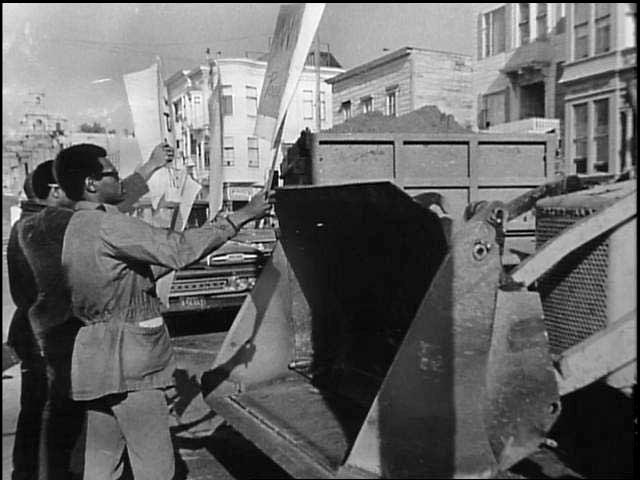
The place where the protesters are gathered is named for Justin Herman, the notorious director of San Francisco’s Redevelopment Agency in the terrible days of the 1950s and 1960s, when “redevelopment” meant removing black people from the Western Addition and removing poor people, particularly Filipinos, from South of Market and later the International Hotel. Herman once famously said that the SOMA land where he wanted to build hotels was “too valuable to permit poor people to park on it.”

In the 1960s, the battle against redevelopment was one of the defining political struggles in San Francisco, bringing Asians, African Americans, white progressives, young community organizers, affordable housing and tenant activists, poverty and civil rights lawyers … just about the whole spectrum of the city’s left. It’s been the subject of books and movies. The people who fought Justin Herman are part of a long political thread in San Francisco — as is OccupySF today.

I’ve always thought it was an abomination to have a downtown plaza named after a guy who did so much to destroy San Francisco. Maybe from now on we should all call it Scott Olsen Plaza.

How OccupySF thwarted a police raid

9

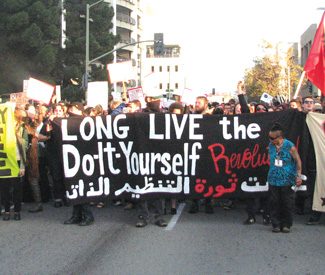
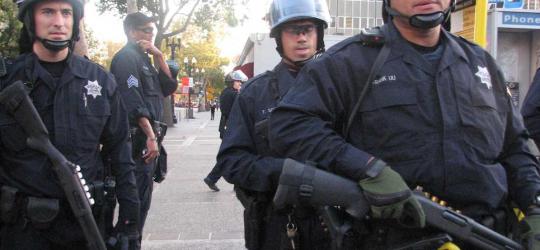
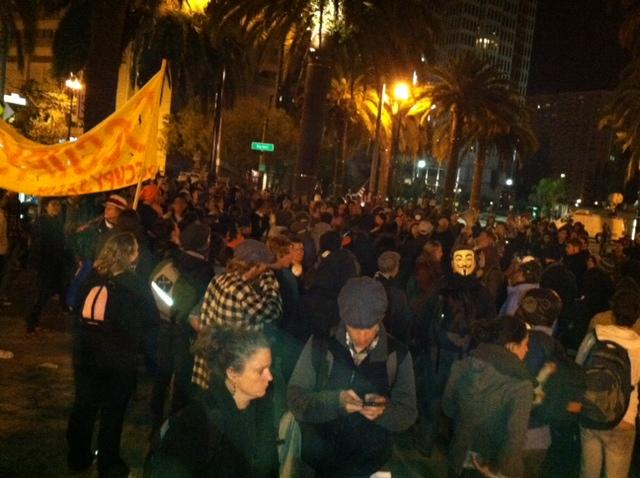
More than 1,000 people amassed at the OccupySF camp last night based on word that police would be raiding the camp. At 4:30 am, there were still 500 gathered in Justin Herman Plaza when OccupySF organizer Ryan Andreola finally announced: “We just got a report from an official police statement that the raid has been called off because there were not enough police for the number of people here,” as the crowd erupted in applause.

It was the end of what was for many protesters a long — and remarkably successful — day. Word began circulating of possible police altercation at 6 a.m. October 26, when police passed through the encampment handing out notices titled “You are subject to arrest,” which claimed that the protest was in violation of several city and state laws and had become a public health hazard.

On Oct 19, city officials had communicated to OccupySF that they would provide portable toilets, but a week later had not followed through; to deal immediately with public health concerns, protesters acquired them on their own.

Around 8:00, having received various tips and seen a document warning nearby businesses of police activity that night, OccupySF put out a call for supporters, saying police raid was confirmed. Justin Herman Plaza officially closes at 10 p.m., so protesters mobilized to be ready for an attack then.
At 9:00, hundreds of people were at the encampment and were meeting about tactics in case the raid occurred. For the next several hours, as hundreds more continued to pour into camp, supporters practiced formations to defend the camp and separate those who were willing to risk arrest from those who weren’t.

At 9:30, photos began circulating social media of scores of police in riot gear waiting with six muni buses near the police operations building in Potrero Hill. Many feared that they were gearing up to descend on Justin Herman Plaza.

Different groups, including a group of clergy, SF Labor Council representatives, a meditation circle and groups practicing blockade formations met throughout the camp. Drum circles continuously pounded, and the Brass Liberation Orchestra jammed throughout the night.

Nurses and medic volunteers distributed materials to protect from and relieve the effects of tear gas, and National Lawyers Guild volunteers scoured the camp making sure protesters had their legal hotline phone number. Talk of the violence and mass arrests at Occupy Oakland that had happened the past few days permeated the group.

The BART stations closest to the OccupySF and Oakland camps were closed last night due to “civil disturbance,” but many supporters still crossed the Bay to swell the OccupySF ranks.

At 10:00, between 500 and 600 people had gathered at the camp. Protesters danced to the constant music and chanted political cries to the beat: “This system has got to die, hella hella occupy!”

Others waited in defense formation around the camp. After spotting Supervisor John Avalos, many began imploring him to sit down in the ranks, which he did.

As the night went on, sightings of police with buses continued. Some protesters joked, “the police are on the way, but they’re taking Muni so it will be a few hours.”

At 12:40, though much of the camp’s kitchen supplies and food had been moved offsite, protesters continued to serve free food. A young man serving up salad and bread gestured to several cases of food, saying “this has all been donated within the last hour.”

At 1 a.m., the group had reached its peak numbers. All sides of Justin Herman Plaza were blocked by masses of people, who also spilled out into the street on Steuart and Market, attracting virtually all passers-by into the crowd. Organizers urged supporters to stay prepared, but as one woman emphasized on a bullhorn “Remember, 99 percent means we are all individuals. It’s your choice how you respond.”

At 1:30, an impromptu speak-out began as protesters, amplified by the Peoples Mic, explained who they were and why they were there that night. Ten minutes later the group decided to allow a makeshift press conference, giving a formal space for five city officials present to speak.

Supervisors John Avalos, Jane Kim, David Campos, David Chiu and Eric Mar, along with state Senator Leland Yee, professed their support for OccupySF and commitment to protecting it from raids. The group was met with mixed responses. Many cheered their support, and one woman said, “I’m from Oakland and I wish Oakland supervisors had done what San Francisco supervisors have done tonight.” Others were less receptive, crying “I don’t trust you!” and “remember, these are the same supervisors that helped pass sit-lie!”

After the politicians finished speaking at 2:00, many supporters left the camp. One man declared, “I’m glad they came, but they do not represent us.”
About 30 minutes later, new reports were coming in that police were massing at Treasure Island. Protesters surveyed their drastically reduced numbers, and voted on what new formations to practice. As the group discussed, drummers punctuated each point, keeping energy high.

Protesters organized new strategies, but by 3:38 there was still no sign of cops. Representatives of labor organizations began a spontaneous rally, speaking to why they supported OccupySF. Mentions of Occupy Oakland’s vote to call for a general strike on Wednesday November 2 circulated, and one labor rep recalled the 1934 general strike.

At 4 a.m., hundreds were still awake and prepared in the camp. Said protester Robert Duddy, “I’m tired. I stayed up last night until 5:30 after getting the notice that we might be evicted. I think they’re trying to wait us out and have our numbers dwindle.” Duddy added that he did not expect the police to show up that night.

Won-Yin Tang wasn’t convinced. “I won’t feel [that we’ve won] until 7 a.m. when they’re not waiting in riot gear anymore. We have to stay focused. When everyone leaves, that’s when they’ll come.”

At 4:30, the long-awaited announcement of victory came. The crowd cheered, and many headed to nearby Muni stations, now open for the morning. Said protester Sam Miller, waiting exhausted in Embarcadero Station, “Tonight was a great triumph of the human sprit. It was the middle class showing we can’t be beaten down anymore. We’re not the zombies that they think we are.”

Protester Sean Semans also celebrated. Said Semans, “We won tonight. Now we just have to sure, if we need to, we can do the same thing tomorrow.”
Staying up until 5 a.m. on weeknights is no easy call to action. But it seems thousands throughout the Bay Area are willing to step up to the plate.