Occupy

Big victory for OccupySF, Occupy Oakland reconvenes after crackdown (VIDEO)

36

(UPDATED/CORRECTED AT 11:30 AM)The Occupy movements in San Francisco and Oakland reportedly scored big victories last night, with huge numbers of people overcoming police crackdowns and the shutdown of public transit stations, turning back city efforts to clear the OccupySF encampment and voting in the General Assembly in Oakland to call a general strike for Nov. 2.

We’ll have a full reports later today. Occupy Oakland protesters showed up outside a cordoned-off Frank Ogawa Plaza to figure out how to respond to the previous day’s aggressive police raid, which made national news and left Iraq War veteran Scott Olsen in the hospital with a fractured skull after apparently being hit by a tear gas canister or some other projectile fired by police.

In San Francisco, Mayor Ed Lee and the SFPD threatened to shut down the OccupySF encampment over alleged public health problems – which the movement tried to address by bringing in their own porta-potties because the city refused to provide them at night – but the camp swelled with supporters. Among them were mayoral candidates John Avalos, Leland Yee, Jeff Adachi, and David Chiu, as well as Sups. Jane Kim, Eric Mar, and David Campos.

Video by Rebecca Bowe

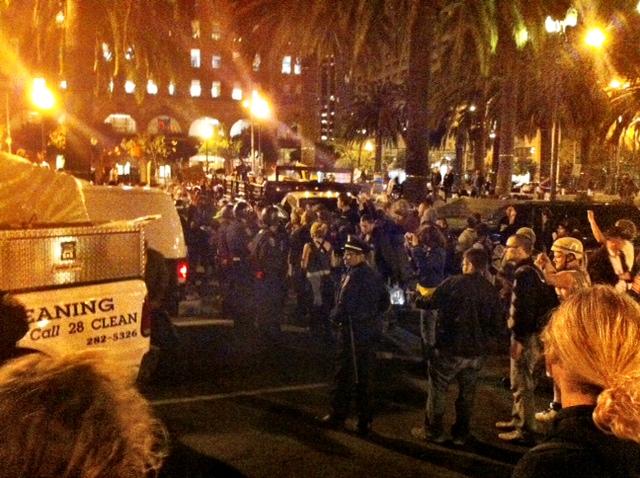
They spoke to the crowd around 2 a.m., expressing their support and saying that neither police nor Lee had responded to requests for information about the city’s intentions. Other notables on the scene included writer Rebecca Solnit, SF Democratic Party Chair Aaron Peskin, Shawn San Liu of the Chinese Progressive Association, and local labor leaders Tim Paulson, Gabriel Haaland, and Mike Casey. Spirits were high, and protesters were ready to link arms and form a human blockade in the event that police showed up.

SF police reportedly massed nearby in the early morning hours, preparing to clear Justin Herman Plaza, and there were rumors that hundreds more were on the way. BART stations in the area were shut down to prevent more arrivals, while police in Oakland also reportedly stopped protesters there who tried to cross the bay to support OccupySF. But the raid was then reportedly called off because police were outnumbered and possibly to avoid a repeat of the violence and mass arrests that have plagued Oakland since the decision to clear the encampment there, and protesters sent out jubilant messages of victory.

Check back later for video and eyewitness details of what went down, from the the Guardian’s Rebecca Bowe (who contributed to this report) and Yael Chanoff, as well as information on what comes next. Or follow the Oakland live stream here or San Francisco live stream here.

The richest 1 percent get richer

7

If there was any doubt in the message being sounded from the streets these days — that the richest 1 percent has been taking a disproportionate and growing share of the nation’s wealth — a long-awaited new study issued yesterday by the Congressional Budget Office makes it crystal clear.

Not only has their share of the nation’s income doubled in the last 30 years, but the report found that concentration was accelerated by a tax structure that has become steadily less progressive, allowing the very rich to keep more of the wealth that the rest of the country so desperately needs.

And the reason the tax code has become far less redistributive is because wealthy special interests have been rewriting it in their favor, and being allowed to do so by politicians in both major parties whose elections and post-service employment the wealthy sponsor.

These same politicians and the mainstream media have been trying to cast the Occupy movement as dirty, disorganized, and incoherent, but it central message — which is now being chanted in cities across the country — couldn’t be more clear and compelling.

“We are the 99 percent!” they’re shouting, a simple truth that highlights the biggest problem that our country is facing: an unfair and unsustainable consolidation of wealth, the central problem that spawns the myriad other problems we face, from underfunded schools and public infrastructure to corruption in our financial and political systems to the economic hardships that most of us face.

Politicians like Mayor Ed Lee, the clear choice of the 1 percent in this mayor’s race, can talk all he wants about “jobs” and the imperative of enforcing minor municipal codes against OccupySF, which is expecting its third raid by the police as soon as tonight. But those are meaningless abstractions compared to the simple truth that is being so clearly articulated by young people in streets.

We’re not the problem, they are. We are many, they are few. We know the truth and we aren’t giving up. Power to the people!

Occupy camps don’t create social ills, they showcase them

14

By Anna Lacey

OPINION When I entered the public square off Broadway and 14th on Oct. 17 — the site of the Occupy Oakland camp that police violently broke up this week — I immediately felt dazed by the atmosphere. But rather than seeing the squalor that has been highlighted by city officials and the media, I saw it as a place of real possibilities, particularly from my perspective as a social worker

Surrounded by tall buildings, the square is in the heart of downtown Oakland. It felt like I was in a commune of sorts. Walking through the rows of tents, I found myself amidst a sea of commotion; there were children of different ethnicities playing, a crowd was listening to some guy on a microphone talking about political freedom, a marching band was performing, and lines of people were dishing out and receiving free food. The energy in the air was almost tangible.

The police raided the square Monday night, October 24th, arguing that the occupiers were dangerous or directionless substance abusers. They had also been complaining about a rat infestation and other problems and about the camp being a magnet for homeless people. But when I visited the camp several times before it was raided, there were two important points that struck me about what has really been happening in Oakland’s occupation.

First: The occupation did not create new social problems. Instead, the movement has been making existing problems visible. Oakland is a city with an overwhelming crime problem and serious financial woes, a city known by many as “Oaksterdam” because of its many marijuana dispensaries as well as the presence of weed smokers on the streets. It’s a city with rats, gangs, unemployment, and school closures. Existing social problems have become more visible because people have congregated together, largely because they were sick of suffering from social ills in silence and isolation.

It should also be pointed out that the homeless population was in the square before the occupation. Yet only now are they able to receive free healthcare, learn about available social services, and enjoy respite from police harassment. The police were not allowed in the square for two weeks, and participants in the movement voiced extreme pride of the “liberated space.” As one organizer put it, “Here in Oakland we have a history that makes us unable to dialogue with the police. Occupy Oakland is unique due to the legacy of the Oscar Grant movement; we know the police are not on our side.”

It does seem quite clear that, instead of trying to resolve the problems being brought to light in the square, the police would prefer the protesters remain isolated from each other, so as not to bring attention to existing social problems. I suppose a gang of police in riot gear followed by the terrorizing and arrests of almost 100 peaceful organizers is easier, thanks to our flawed governmental system, than responding to the social issues put forth by the public.

Second: The occupation was never a party zone. Quite the opposite, for two weeks the participants functioned as an organized political and social union. By day, various presenters lectured the crowds on such things as the rights and responsibilities of political beings. One evening, several youth spoke of their hopes and dreams, saying things like, “I want to be the future of America, but I can’t if there’s no money to fund my school.”

Dusk would mark the start of the nightly General Assembly, a sort of lengthy debate giving all the opportunity to make propositions to influence the movement. The assembly would last until after midnight, and a 90 percent majority of votes was needed to pass any given proposition. One evening, the General Assembly closed with everyone chanting, “This isn’t Burning Man,” implying the seriousness of the movement and the need to leave the party in the desert.

At the same time, the square was far from utopian. There were a couple of fights, which were deescalated quickly. Another key issue remains how to manage the movement’s ethos of equality while still moving in a unified direction. However, as one organizer put it, “Our power is in the lack of a leader, and our diversity is a blessing. The media doesn’t know how to control the masses.” There are discussions of new occupations to bring attention not only to the recent jailing of many protestors but also to school closures, police brutality, prison hunger strikes, foreclosures, and other social and political injustices.

Obviously, the Occupy Oakland that I experienced was very different than what the media and police accounts would have you believe. I wish I could tell you to come and judge for your self, but unfortunately there is no longer any one identified place to congregate. Instead, following Monday night’s raid and Tuesday’s squirmishes, many involved in the movement have been scattered out on the streets, forced to defend themselves from the police without the sanctuary of a peaceful and supportive liberated space.

Snow Park, along Lake Merritt, originally an extension of the original camp, is currently one meeting place for those involved in the movement. While I think the police’s senseless and heartless behavior has, at least for the time being, destroyed much of the beauty taking place in Occupy Oakland, I still urge you to lend your support. As one occupier told me, “Be a part of the process. It’s not perfect. Then again, if it was so easy, it wouldn’t be worth it.”

Anna Lacey is MSW trainee and therapist with La Clínica de la Raza who lives in Oakland and is working on her master’s in social work at UC Berkeley

Dailies dutifully vomit out the city’s misleading portrait of OccupySF

8

Both the Examiner and the Chronicle reported this morning that the OccupySF encampment has become a public health hazard, setting the stage for what many believe is an imminent police raid. The newspapers’ only source: a notice that the Department of Public Health handed out to protesters, at their camp in Justin Herman Plaza, at 6am today. I have been reporting eyewitness accounts from OccupySF for several weeks, and if any reporters from these papers had bothered to go there themselves, they would be telling a very different story.

The Department of Public Health states that fecal matter, urine and vomit have been observed in Justin Herman Plaza and on surrounding streets. That’s accurate. Like many streets in San Francisco and in any city, members of the public sometimes relieve themselves on the streets. The difference is that at OccupySF, people from the 300-person community camped out there take it upon themselves to clean up any occurrences of waste as soon as it’s observed. Scheduled cleaning teams coordinated by the camp’s  Sanitation Committee sweep the streets three times per day, and wash when necessary. Late last night, even as protesters focused on plans in case of a police raid, which the city has been threatening everyday for most of the week, protesters went over the camp many times over with brooms.

Perhaps these issues could be resolved if the city were to provide the port-o-potties that Police Chief Greg Suhr and Mayor Ed Lee promised OccupySF last week. At last Wednesday’s Police Commissioner meeting, Suhr said, “We have no future plans to go into the demonstration. We know that it’s for the long haul…I’m actually working with the Mayor’s Office personally to put the port-o-potties and the handwashing stations down there to provide sanitation.”

In an Oct. 20 email to OccupySF, the deputy communications director for Mayor Ed Lee stated that “porta-potties are available by request.” A press release from OccupySF today claimed that “Port-o-potties are currently only available during daytime hours. OccupySF’s repeated requests for 24-hour port-o-potties have not been met.” When we asked mayoral Press Secretary Christine Falvey why the city hasn’t helped mitigate the public health issues they seem to be using as a pretext to break up the camp, she said, “There are porta-potties and hand washing stations at 101 Market Street, as the mayor directed, and are available for demonstrators to use. They are delivered in the morning and removed at night.”

I can confirm that port-o-potties for use at night, when no bathrooms on surrounding blocks are available, are yet to arrive. And police certainly have continued to “go into the demonstration”—making rounds and handing out notices from different city departments every day, “reminders” that protesters are illegally camping in a public park, violating sit/lie ordinances, and are now, apparently, a “public health hazard.” Today, a notice was circulated that cited all of these issues and informed protesters: “You are subject to arrest.” The camp is preparing for a possible police raid tonight.

These issues are not unique to San Francisco. Barbara Ehrenreich reported October 24 that, at Occupy demonstrations throughout the country, “for the individual occupier, one problem often overshadows everything else, including job loss, the destruction of the middle class, and the reign of the 1 percent. And that is the single question: Where am I going to pee?” In her piece in Mother Jones, “Why Homelessness is Becoming an Occupy Wall Street Issue,” Ehrenreich notes that “What the Occupy Wall Streeters are beginning to discover, and homeless people have known all along, is that most ordinary, biologically necessary activities are illegal when performed in American streets—not just peeing, but sitting, lying down, and sleeping.” San Francisco has some of the harshest laws in the country in this regard.

Many cities have accommodated Occupy protesters. Why won’t the city bring port-o-potties? And why are city publications reporting the city’s official statements without any perspective from the encampment itself? The people are speaking: that the powers that be won’t listen is what the Occupy movement is fighting against in the first place.

Mixed messages

0

steve@sfbg.com

In San Francisco — the first major city to launch a midnight police raid to break up an Occupy encampment, which it repeated Oct. 16 — city officials are struggling with contradictions between claims of supporting the movement but opposing its tactic of occupation. Protesters have reacted to those mixed messages by erecting a growing tent city in defiance of Mayor Ed Lee’s public statements on the issue.

The situation remained fluid at Guardian press time, with OccupySF members unsure when and whether to expect another raid. That sort of standoff has repeated itself in cities around the country. But it seems particularly fraught here in the final weeks of a closely contested mayor’s race as Lee’s stated belief that “a balance is possible” is put to the test.

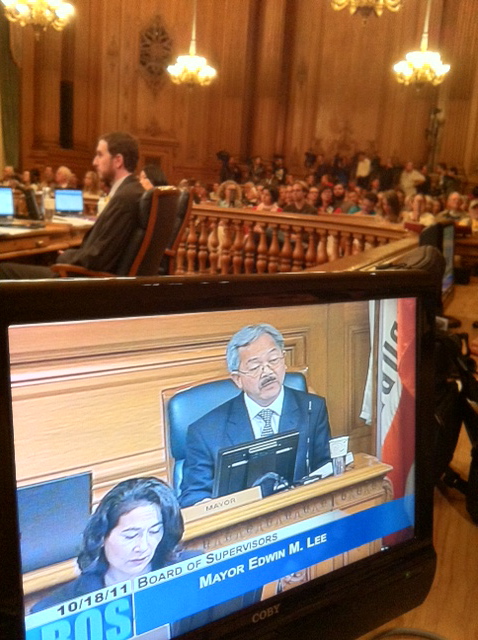
On Oct. 18, when hundreds of OccupySF protesters and their supporters entered City Hall to testify at the Board of Supervisors hearing — where Lee appeared for the monthly question time and was asked by Sup. Jane Kim to “describe the plan that our offices have been developing” to facilitate the OccupySF movement — it became clear there was no plan and that Lee was standing by the city’s ban on overnight camping.

“From the very beginning, I have fully supported the spirit of the Occupy movement…To those who have come today and who come day after day as part of this movement, let me say now that we stand with you in expressing anger and frustration at the so-called too big to fail and the big financial institutions,” Lee said at the hearing.

“Then don’t send the police in to destroy it,” yelled a woman from the crowd.

“Well, we are working with you,” Lee responded as Board President David Chiu banged his gavel at the interruption and said, “excuse me, you are out of order” and the packed hearing room erupted in shouts and applause at calling out the contradiction in the mayor’s position.

“Well, we are working with you. We are working with you to help raise your voice peacefully and will protect and defend your right to protest and your freedom of speech,” Lee continued, eliciting scattered groans from the crowd. “But that’s not the same thing as pitching tents and lighting fires in public places and parks that are meant for use by everyone in our city. But we can make accommodations and we have, and we can do this while not endangering public safety in any way.”

Afterward, as Lee was surrounded by a scrum of journalists asking about the issue, he made his stand even more clear. “We’re going to draw the line with overnight camping and especially structures,” Lee told reporters. Asked why the police raids have taken place in the middle of the night and why San Francisco is banning practices being allowed in other occupied cities, such as tents and kitchens, he offered only nonresponsive answers before being whisked away by his security detail.

Back inside the hearing room, Sup. John Avalos — who has led efforts to mediate the conflict and prevent police raids — called Lee’s comments “very frustrating. I’m alarmed that he is moving toward nightly standoffs with the Occupy movement.” After watching video of the chaotic Oct. 16 raid, at which several protesters were injured by police officers, Avalos called the situation “unsafe for both sides.”

Six of the 11 supervisors voiced support for OccupySF during the meeting, although Kim — who supports OccupySF and Lee’s mayoral campaign and whose District 6 includes the two protest encampments, in Justin Herman Plaza and outside the Federal Reserve — said at the hearing, “We’re all struggling to figure out the best way to accommodate it.”

Indeed, when the Guardian sought details on “the plan” Kim said she was developing with Lee, her staffers told us there was nothing in writing or major tenets they would convey. And mayoral Press Secretary Christine Falvey told us, “There’s not really a plan, per se, because the movement is so fluid,” although she confirmed that the city would not allow tents or other structures: “The tactic of camping overnight, he does not support.”

But OccupySF protesters were defiant as they streamed to the microphone by the dozens during public comment, decrying the city’s crackdown and claiming the right to occupy public spaces and to have the basic infrastructure to do so. As a woman named Magic proclaimed, “This can be a celebration or a battle, but we will not back down.”

The next afternoon, a large group of OccupySF protesters took their complaints about mistreatment by officers to the Police Commission meeting. Previously, Police Chief Greg Suhr had taken the same stance as Lee, with whom he had consulted before ordering the raid, claiming to support OccupySF but oppose overnight camping (see “Crackdown came from the top,” Oct. 11).

“We will surgically and as best as possible and with as much restraint as possible try to deal with the hazards while protecting people’s First Amendment rights,” Suhr had said, reiterating a ban on tents and infrastructure.

But by the end of the long Police Commission hearing — which was peppered by angry denunciations and chants of “SFPD where is your humanity?” — Suhr seemed to soften his position: “We have no future plans to go into the demonstration. We know that it’s for the long haul.”

OccupySF members interpreted Suhr’s remarks, which went on to raise concerns over potential future public health hazards that a growing encampment might present, as a change in the policy Lee had outlined a day earlier, erupting in the cheer, “Now that’s what I’m talking about!”

In the wake of that meeting, more than 40 tents — including a working kitchen and fully stocked medical tent — have been erected in Justin Herman Plaza, although neither the Police Department nor Mayor’s Office have answered Guardian inquiries seeking to clarify what current city policy is regarding OccupySF. But for now, protesters have declared victory over the city and are happy to be turning their full attention back toward powerful banks, corrupt corporations, and the rest of “the 1 percent.”

“I’m really proud of the OccupySF participants who went to the meeting today,” Zoe D’Hauthuille, a 19-year-old protester, told the Guardian after the Oct. 18 meeting. “I feel like they were really honest and super effective at getting people to realize that we need certain things, and that the city is violating our rights.”

24 hours of occupation

1

rebeccab@sfbg.com

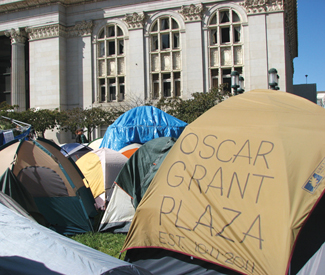
No sooner had I arrived at downtown Oakland’s Frank H. Ogawa Plaza — christened Oscar Grant Plaza by the activists who have established the Occupy Oakland encampment there –than the police showed up.

It was Oct. 18, and the ever-evolving occupation had been going strong for eight days. Oakland City Hall served as a backdrop for the bustling tent village, and the plaza steps were adorned with banners. “Welcome to Oscar Grant Plaza,” one proclaimed. “This is an occupation. We have not asked for permission. We do not allow the police. You are entering a LIBERATED SPACE.”

By press time, a standoff between Oakland police and the 300 to 400 occupiers hadn’t yet occurred, though a clash seemed imminent. City government had declared the autonomous village illegal and issued several eviction notices, citing health and safety concerns, while occupiers had made clear their intentions to stay put.

Around 5 p.m. on Oct. 18, two cops appeared at the camp. They weren’t in uniform, but black polo shirts emblazoned with the words “Tactical Negotiator.” Protesters immediately surrounded them, a customary response to police presence since the encampment was raised. The police said they’d come to “facilitate” a march scheduled to depart from the camp — but the protesters demurred. Occupy Oakland’s General Assembly had not consented to this, they replied.

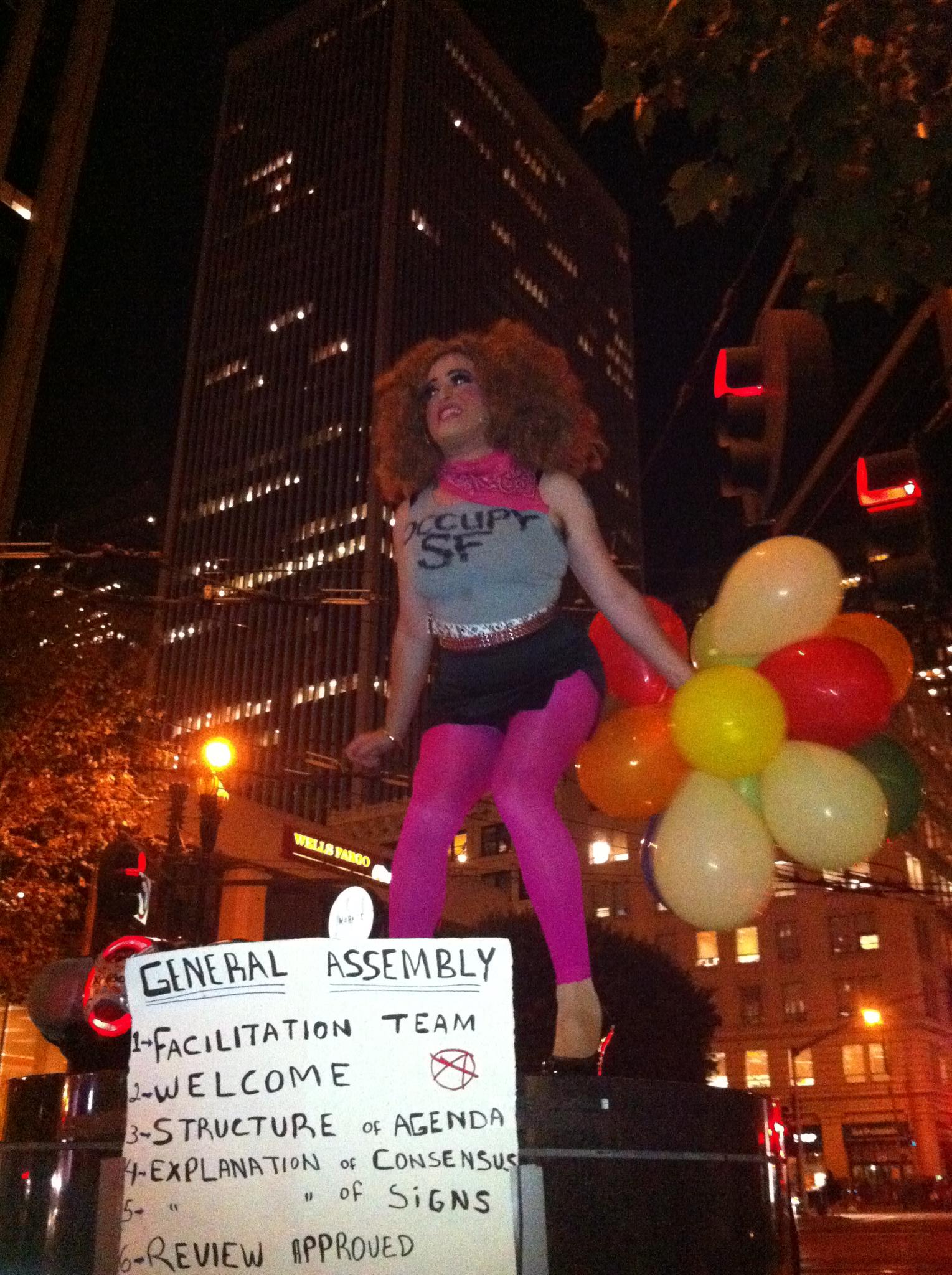
The impasse didn’t last long, because a group of about 50 tore into the intersection and headed up Broadway. The radical queer march had commenced. “We’re here! We’re queer!” They chanted. “Tax the banks and eat the rich!” Many donned fabulous costumes, and one skinny person clad in form-fitting leopard print carried a sign showing a unicorn bursting from a cage, with the words, “It’s time to break free.”

As the march passed Wells Fargo and Chase, a dozen police vehicles trailed slowly behind, occasionally sounding sirens. Apparently, this was what they’d meant by “facilitating.”

Despite the cat-and-mouse with the cops, the nonviolent demonstration concluded without incident. Protesters returned, flushed and energized, to home base — Occupy Oakland, a vortex of radical defiance against the ills of capitalism that had materialized Oct. 10 and showed no signs of fading. Intrigued, I decided to spend 24 hours there documenting it.


ORGANIZED OPPOSITION

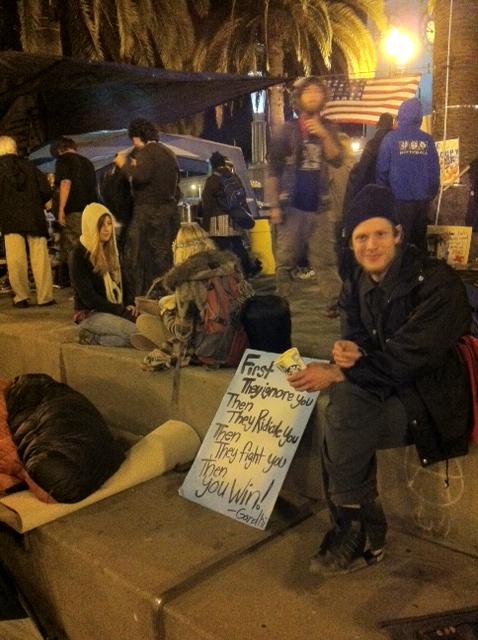
The camp encompassed a lively blend of projects that seemed to have materialized organically. There was a kitchen serving free food, a first aid tent, a media tent where one could power a laptop by bicycle, a free school named for police shooting victim Raheim Brown, an informational booth with stacks of radical literature, a container garden, portable toilets, an arts and crafts space, and a kids’ area. Committees had been set up to tackle safety, sanitation, finances, events, and other duties, replete with color-coded armbands. Regular workshops, political discussions, teach-ins, lectures from notable speakers, and live music performances had all been arranged. Taking it all in, a woman with long gray hair exclaimed, “The ’60s were never this organized!”

Occupy Oakland’s experimental community mushroomed up as part of the wave of encampments established in solidarity with Occupy Wall Street, part of a nationwide movement that has captured the public’s imagination and reinvigorated the left.

“We are reclaiming public space to use as a forum for the people to come together, meet one another, listen to each other, and build power for ourselves,” read a statement on the Occupy Oakland website. “[It] is more than just a speak-out or a camp out. The purpose of our gathering here is to plan actions, to mobilize real resistance, to defend ourselves from the economic and physical war that is being waged against our communities.”

The camp supported a wild and unlikely mix of people united in their disenchantment with the status quo — young and old, black and white, housed and homeless, queer and straight, credentialed and uneducated, vegan and omnivorous — and within this developing space, societal barriers seemed to be falling away.

“It’s an occupation that transcends what it was initially about,” reflected a protester named Miguel. “It’s feeding homeless people, and it’s giving people a place to sleep.”

Protesters didn’t rally around demands. “From my understanding, this is a movement of autonomy, and liberation from … the politics of representation, and the economics of capitalism,” said Bryan R., an organizer who helped plan the occupation. “To engage in dialogue with the power by means of demand is to acknowledge their power over us.”

All decisions were made by consensus in a General Assembly. The occupation had passed resolutions stating that it didn’t back any political parties, supported the Pelican Bay prisoners’ hunger strike, and was in solidarity with striking students and workers.

Rodrick Long, a 21-year-old Oakland native who’d been camped at the occupation for two days when I met him, said he felt he was participating in a piece of Oakland’s history.

“As far as Oakland goes, I just think we need more unity,” he said. “There’s a lot of gang violence, and a lot of poverty. A lot of people don’t show enough that they care about Oakland. But it’s a lot of people here. I didn’t expect this many people to come.”


MANAGING CONFLICT

Occupy Oakland seemed both serious and playful as it journeyed each day toward fomenting the revolution, or maybe just keeping the camp together, depending on who you asked. A tense General Assembly meeting was reportedly held after the city issued the first eviction notice on Oct. 20, and occupiers vowed to hold their ground. But the somber moment broke up when someone kept randomly shouting “Michael Jackson!” — prompting someone to blast the song “Smooth Criminal” over a loudspeaker, sparking an impromptu dance party before everyone got down to business again.

The occupiers were sculpting a self-governed, non-hierarchical mini society in the heart of Oakland as an affront to Wall Street bankers and capitalism itself — a complicated endeavor, to be sure. This was, after all, a mix of perfect strangers, some with mental-health issues (who’d been failed by the very system the occupation was opposing, several people pointed out to me), striving to coexist in a densely populated public park. Illegally.

There were ups and downs. Mainstream newspapers were running headlines about the occupation’s rat problems, television reporters had gotten into tiffs with protesters, and in the hours before I arrived, a man who went by Kali was forced out for starting arguments that eventually came to blows.

The outside world seemed separate from the occupation, though its presence was acutely felt. News vans were parked along the perimeter at all hours of the day, and a live stream sent raw footage directly to the Internet, making the surreal scene feel a bit like a fishbowl.

As night fell, around 150 people congregated in the plaza’s amphitheater for the evening’s General Assembly, which opened with general announcements. Ellen spoke about organizing actions against foreclosures. Jonathan urged a transition from mega-banks to credit unions. Someone proposed expanding the first aid tent into a free clinic that would operate out of an onsite RV. But just as a woman began describing the struggle of revolutionary youth in Uganda, shouts rang out from somewhere in the thicket of tents. Kali was back. Members of the “safer spaces” committee made a beeline toward him to try and deescalate the conflict, while others milled about in alarm and confusion.

Despite mediators’ efforts, Kali went on a rampage, triggering an emergency meeting to determine how best to handle this kind of aggression. Once he departed, however, the encampment’s emotional rollercoaster seemed to wind down.

“It’s up to us to figure out creatively how to maintain the health of this camp,” organizer Louise Michel told me later. “It’s really important for people here to figure out how to problem solve … Everyone has the commitment.”


LOOKING FOR REASONS

Dialogues had been started to address safety issues — but the city of Oakland was highlighting reports of assaults and sexual harassment as reasons the encampment would not be allowed to stay.

Security volunteers were regularly stationed around the plaza perimeter. Tim Simons began his shift around midnight, pacing the sidewalk and gazing out at the deserted downtown Oakland street while maintaining constant communication with his security crew via walkie-talkie.

“It’s been the most intense mixture of people coming together that I’ve ever seen,” reflected Simons, who’d watched the occupation grow since the beginning. “They’re camping here because they want this to become a revolutionary political force. The significant question is: How do we project outward from here? Is this going to become more than just a camp?”

He stressed its significance as a takeover of public space, saying it integrated all manner of people whose lives had been impacted by failed economic policies. Simons also acknowledged the anti-police attitude shared by many occupiers. “In Oakland, it’s really hard to play this game that the police are on our side,” he said. “There’s no real illusion here about what role the cops play.”

That sentiment wasn’t shared by everyone, though. “We’re trying to practice a nonviolent response toward police,” Mindy Stone, who was staying in a tent at the Occupy Oakland overflow camp at Snow Park, told me. “We want to try to make them feel like they are the 99 percent.”

It had been an eventful night. I drifted off to sleep in a borrowed tent, as the banter of people sitting and smoking on park benches floated in.

The next morning was sunny and warm, and the mood of the camp was buoyant. Kitchen volunteers busily prepared food, joking together as they listened to music. Donations flowed in daily from Arizmendi bakery, farmers’ markets, and other generous supporters.

In the arts and crafts area, people were painting a banner to urge people to withdraw their money from major banks by Nov. 5, Guy Fawkes Day. A redhead in a flowing silken outfit wound his way through camp with a garbage bag, asking people if they had pocket trash. A self-defense workshop was in swing, its participants partnered up, giggling, as they practiced holds and blocks.


INCUBATING IDEAS

Dallas Holland was tending wheatgrass, bok choy, herbs, and other edibles in a container garden. “I’ve been overwhelmed with the way the community has come together … It’s amazing to watch this transform into a Mecca of ideas,” she said. “People are having meetings and thinking of ways to perpetuate the movement.” An Alabama native, Holland graduated from college in 2006 and had been unemployed for a year.

Allen Adams, a 37-year-old Oakland native, told me he’d been sleeping outside regularly since before the occupation. “I quadruple up on the shirts. It gets to you,” he said.

He’d had little luck finding work, though he was constantly searching online. With him was Brandy, his well-loved, four-month old pit bull.

“I’ve been struggling all my life,” Adams said. “My dad did, my mom did, my grandmother did. And for what? To have no money.” But he said he was amazed and inspired by the occupation. “I like the fact that people can get together and discuss issues. How can we implement programs to do what California has failed to do? It’s a big task. We’re just working toward betterment. Lasting changes, not just temporary shit.”

Michel echoed these goals. “It’s really bold, and it’s really complex, but no one’s ever lived what we’re trying to do,” she said. “People feel a lot of ownership over what we have here. There’s a sense here of people having each other’s back. Politically, it’s huge.”

During my last hour at Occupy Oakland, David Hilliard, a founding member of the Black Panthers, delivered a speech, driving home the point that the occupation should be organized and focused.

“You’re here, which is a wonderful thing,” Hilliard told the occupiers. “Now we need to have some very basic programs dealing with desires and needs here in Oakland. It can’t be abstract. I can assure you, in a very short time, they’re going to run you out of here. Put something on paper that can help you address the basic desires — otherwise, you’re not going to last long. Get some concrete demands.” *

Alerts

0

alert@sfbg.com

Editor’s Note: Protests and other events connected to the Occupy Wall Street movement, include OccupySF and Occupy Oakland, have been developing quickly. To take part, follow our Politics blog or check with the websites associated with this important economic justice movement: occupysf.com, occupyoakland.org, or occupytogether.org. And you can send tips about what’s happening to news@sfbg.com.

WEDNESDAY 26

San Francisco’s budget crisis

Youth from the Bay Area Urban Debate League opine on solving the budget crisis in San Francisco. These electrifying young orators seek to engage the community in conversation and share their research about the current economic atmosphere.

6 p.m., free

SFUSD Board Room

555 Franklin St, 1st Floor

www.baudl.org


THURSDAY 27

Progressive prospects in fall election

Bay Guardian Executive Editor Tim Redmond holds a talk on how the upcoming election will effect the progressive community. Join in discussion, sponsored by Progressive Democrats of America, and ask questions regarding mayoral candidates and city politics.

7-9pm, free

Unitarian Universalist Center, Martin Luther King Room

1187 Franklin, SF

TGTGTGTGTG@aol.com

www.pdamerica.org


FRIDAY 28

White Picket Fences Reception

This multi-media visual and performance art exhibit highlights queer perspectives on the family unit and reflections of contemporary marriage and relationships. Artists like Midori, Monica Canilao, Harrison Bartlett, Mev Luna, Amelia Reiff Hill and Madison Young conjure dialogue in and out of the LGBT community on the dynamics of progressive life. This family oriented event is open to all ages and will be catered with food, wine and performances of featured artists.

7:30-10 p.m.

Michelle O’Connor Gallery

2111 Mission, SF

www.feminapotens.org


SUNDAY 30

Organize and fight back

The Party for Socialism and Revolution is holding its NorCal Regional Conference, with discussions on how big corporations avoid taxes, endless U.S. Wars, the cost of higher education, the prospects for capitalism and socialism, and other topics.

10 a.m.-5 p.m., $7-10

2969 Mission, SF

(415) 821-6171

sf@pwlweb.org


Making Democracy Work

Celebrate 17 years of social justice service with keynote speakers Rep. Andre Carson (D-IN) and Imam Siraj Wahhaj, religious director of At-Taqwa Mosque in NY, at a dinner banquet. This fundraiser supports the Council on American-Islamic Relations, the largest Islamic grassroots civil rights and advocacy group in the country.

5-10 p.m.

Santa Clara Marriott

2700 Mission College, Santa Clara

(408) 986-9874

www.ca.cair.com/sfba/event/17thannualbanquet


Mail items for Alerts to the Guardian Building, 135 Mississippi St., SF, CA 94107; fax to (415) 437-3658; or e-mail alert@sfbg.com. Please include a contact telephone number. Items must be received at least one week prior to the publication date.

Avalos offers resolution supporting OccupySF and its camp

57

In the wake of last night’s violent police raid on the Occupy Oakland encampment (a still-tense situation that we’re now on the scene covering) and two similar late-night police crackdowns on OccupySF in recent weeks, Sup. John Avalos and co-sponsors Eric Mar and David Campos are introducing a resolution at today’s San Francisco Board of Supervisors meeting that calls for the city to explicitly allow the OccupySF encampment and its related infrastructure to remain.

That resolution (the full text follows below), which Avalos legislative aide Raquel Redondiez says will be the subject of a special hearing on Monday before being considered by the full board on Tuesday, Nov. 1, grew out of testimony from OccupySF participants that Avalos solicited at last week’s board meeting following a late night police raid on Oct. 16 that resulted in five arrests and many injuries.

As we report in this week’s paper (see “Mixed messages,” to be posted this evening, Tues/25), at that Oct. 18 board meeting, Mayor Ed Lee took the position that no tents, kitchens, or other infrastructure would be permitted, a stance that Police Chief Greg Suhr seemed to soften slightly at a raucous Police Commission hearing the next day. In the face of those mixed messages, OccupySF grew into a full-blown tent city in Justin Herman Plaza and there have been no real conflicts with police since.

Both the San Francisco Police Department and the Mayor’s Office were slow to respond to messages we left all week seeking to clarify the city’s policy toward OccupySF, but both finally got back to us last night after the article had gone to press.

SFPD spokesperson Daryl Fong told us, “We’re still currently doing daily safety inspections at Justin Herman Plaza and continuing to provide leafletting…We’re educating the campers about violations and concerns for public safety,” such as unsanitary conditions or unsafe camping structures.

But he said OccupySF hasn’t been given any deadlines for removing structures and there are no current plans for another raid. “Our goal is to get compliance from the campers voluntarily,” he said. “This situation is being continually monitored as it progresses.”

When we asked the Mayor’s Office about the contradiction being Lee’s stance and the city’s reaction to the growing tent city, Press Secretary Christine Falvey wrote, “The mayor’s position on Occupy SF has not changed. He has directed his departments to facilitate peaceful protest, but not allow structures, tents, or a permanent campsite. He wants to ensure the area is safe for demonstrators and the general public. If you have been to the site, you may have seen the Fire and Public Health Departments conducting inspections for public health and safety concerns and you may have seen Recreation and Park and Police staff informing people of the parks and public safety codes that prohibit camping equipment. Individuals are being informed daily of this and the city’s Homeless Outreach Team is offering services to anyone in the area who may need it. The policy stands and departments are educating the group about what is and is not allowed and the mayor expects those who want to use the space to protest, to follow the rules.”

But OccupySF protesters say they have no intention of leaving the space, believing it’s their right to be there as part of a national movement spotlighting the greed and corruption of the wealthiest 1 percent of Americans. And when I told Falvey that the encampment seems to defy the mayor’s stated position, she wrote, “The mayor has asked several departments to enforce the existing codes, and I understand a number of informational contacts have gone out daily to educate those using the plaza about what is allowable in addition to Fire and Public Health inspections to make sure open flames or dangerous materials are not being used or stored at the site.”

I told her that didn’t address my question, and I asked for a reaction to the Avalos legislation that would explicitly allow “tents, tarps, First Aid supplies, environmentally clean and fire-safe energy sources, and the ability to store, prepare, and serve hot food,” which is the reality now on the ground. I’ll update this post when I get a response.

In the meantime, here’s the full text of the resolution:

[Expressing Support for Occupy Wall Street Protest Movement and the People’s Right to Peaceful Assembly in San Francisco]

Resolution Supporting the Occupy Wall Street Protest Movement and Urging Mayor Lee to Uphold People’s Right to Peaceful Assembly and Collaborate with Occupy SF to Ensure Safety of the Protestors, their Supporters, and the Greater Public.

WHEREAS, “Occupy Wall Street” was formed by a broad spectrum of people coming together to protest the corporate-serving economic and political system controlled by the 1 percent, profiting at the expense of 99 percent of the people; and

WHEREAS, Three years after the current financial crisis caused by Wall Street speculators and profiteers, the unemployment rate in the United States is still at the highest level since the Great Depression with the unemployment rate in San Francisco currently at 8.3 percent; and,

WHEREAS, The United States’ major banking institutions, which have been bailed-out by the government and United States taxpayers, have done little to prevent massive foreclosure of residential properties or support the revitalization of local economies by sustaining small businesses; and,

WHEREAS, Since 2008, there have been 1.2 million foreclosures in California, with 12,410 homes in San Francisco alone; and,

WHEREAS, The “Occupy Wall Street” protest movement has struck a chord with the people of the United States and around the world, inspiring over 900 similar protests and solidarity actions across the country, where tens of thousands of people have come out to express their deep indignation against Wall Street greed and systemic socio-economic injustices; and,

WHEREAS, The “Occupy” demonstrations are a rapidly growing movement of people from all walks of life with the goal of occupying public space in order to create a shared dialogue and assert demands for economic justice; and,

WHEREAS, The “Occupy” demonstrations have been supported by the California Nurses Association/ National Nurses Association, American Federation of Labor -Congress of Industrial Organizations, Change to Win, International Longshore and Warehouse Union-International, Teamsters Joint Council 7, Services Employees International Union, Laborers International Union of North America, and many others; and,

WHEREAS, The OccupySF demonstrations began in September with small gatherings of people and have since grown and gained supported from thousands of individuals, community and faith-based organizations, and unions; and,

WHEREAS, On October 12, a 500-person march and civil disobedience organized by local community groups received national media attention, exposing the struggles of San Francisco residents against foreclosure, corporate control, and spiraling unemployment; and,

WHEREAS, The October march and protest action culminated in civil disobedience and, despite the arrest of 11 people, lacked any antagonistic conflict between the police and protestors; and,

WHEREAS, Similar to demonstrations in hundreds of cities across the United States, OccupySF demonstrators are asserting their rights to free speech and peaceful assembly 24 hours a day, seven days a week, in order to create public dialogue around corporate control of the political process and public space; and,

WHEREAS, Numerous and various groups continue to join the protesters at OccupySF, including an interfaith clergy contingent and the California Nurses Association, which has set up a First Aid tent to support the protestors and help ensure public safety; and,

WHEREAS, The City of San Francisco has a right and duty to ensure the safety and security of the general public including the protestors and their supporters; and,

WHEREAS, Since the beginning of the protest, City actions have resulted in the confiscation of food, tents, sleeping bags, and other belongings from the OccupySF demonstrators as well as causing preventable injuries and arrests; and,

WHEREAS, The City has a lengthy and proud history of political protest and has upheld the rights of people to free speech, freedom of assembly, and peaceful protest; and,

WHEREAS, With clear leadership from the Mayor, City departments can set a tone of cooperation and collaboration with OccupySF protestors and supporters, help mitigate harm, and address any public safety, health and sanitation concerns, all while avoiding unnecessary conflict; now, therefore, be it

RESOLVED, That the Board of Supervisors supports the Occupy Wall Street protest movement and the rights of all who protest to assemble peacefully and enjoy free speech in the City and County of San Francisco; and, be it

FURTHER RESOLVED, That the Board of Supervisors recognizes that Free Speech and Freedom of Assembly should not be limited to daytime nor short-term activities and we deem the need of protesters to have tents, tarps, First Aid supplies, environmentally clean and fire-safe energy sources, and the ability to store, prepare, and serve hot food reasonable; and, be it

FURTHER RESOLVED, That the Board of Supervisors urges the Mayor, the Police Department, and other City agencies to uphold the rights of protestors to political speech and public assembly, and to recognize that the full exercise of such rights requires that participants are able to attend to the needs of everyday life, and have a space free from harassment; and, be it

FURTHER RESOLVED, That the Board of Supervisors urges Mayor Ed Lee to direct the Recreation and Park Department, the Department of Public Works, the Police Department, and other City agencies, as relevant, to be flexible and to collaborate with protestors for the safe sharing of public spaces, in which demonstrators can exercise their political rights and the City can address legitimate safety concerns while avoiding unnecessary antagonism; and, be it

FURTHER RESOLVED, That the Board of Supervisors urges Mayor Ed Lee, in order to prevent further harm and conflict to any members of the public, including protestors of OccupySF, to direct the Police Department to ensure that there will be no use of force to dislodge the OccupySF demonstrators and confiscate their belongings.

WTF, Chuck?

18

And now for a new installment in the ongoing saga of What the Fuck, Chuck?, our attempt to figure out the unfathomable positions of the Chron’s local columnist, C.W. Nevius. Today’s episode: Why is Nevius so determined to stir up a clash between the police and the OccupySF protesters?

Although the Oakland cops have rousted Occupy Oakland — with a nightime raid, arrests, and the works — things have been pretty mellow in San Francisco for the past week. Police Chief Greg Suhr has tried to avoid sending riot troops in to evict the camp. The campers are working with city officials to get a permit for a stove. The camp is largely peaceful; nobody’s hurting anyone or anything.

Oh, but Chuck is nervous:

Many of the city’s homeless residents have gravitated there, the sanitation is a nightmare, there are rats, and car batteries are neither a safe nor ecological energy source.

Well, there were rats there before the protesters arrived. City officials have offered to set up portable toilets. Car batteries aren’t perfect, but if you charge them by riding a stationary bicycle, the energy is pretty darn ecological. And really, unless you knock the battery over and it cracks and spills, car batteries are pretty safe; the don’t explode or emit fumes. The acid and lead are toxic, but they’re pretty well contained. There are more than 300,000 car batteries on the streets of San Francisco already; every car has one.

And so what if “many of the the city’s homeless residents” have gone to join the protests? Some are eager for the free food and shelter, which is fine — putting the more middle-class radicals side by side with homeless people isn’t a bad thing at all. In fact, it’s about the most radical thing that OccupySF is doing. Homeless people are the most visible victims of the economic injustict that the occupyers are protesting; shouldn’t they be part of the action?

I realize that some homeless people have mental health and substance abuse issues, but those didn’t start with OccupySF. Instead of whining about the situation, the city ought to be taking advantage of it — here’s a group of hard-to-reach folks who social workers can probably connect with more easily in an environment and community that’s supportive.

But Nevius can’t imagine anything good coming of any of this:

As Occupy SF gets bigger and louder, the potential for trouble only increases.

I guess Nevius doesn’t believe it’s possible for an alternative community that includes a wide range of activists and homeless people to grow and make its voice heard without “trouble.” And the only way out is to send in the troops.

What the Fuck, Chuck?


Oakland occupiers vow to fight back against police raid

The Occupy Oakland encampment, which was established Oct. 10 in solidarity with the Occupy Wall Street movement in Oakland’s Frank Ogawa Plaza, was dismantled by police in an early morning raid on Oct. 25. The city of Oakland had issued eviction notices over the last several days, and sent a strongly worded notice the night of Oct. 24.

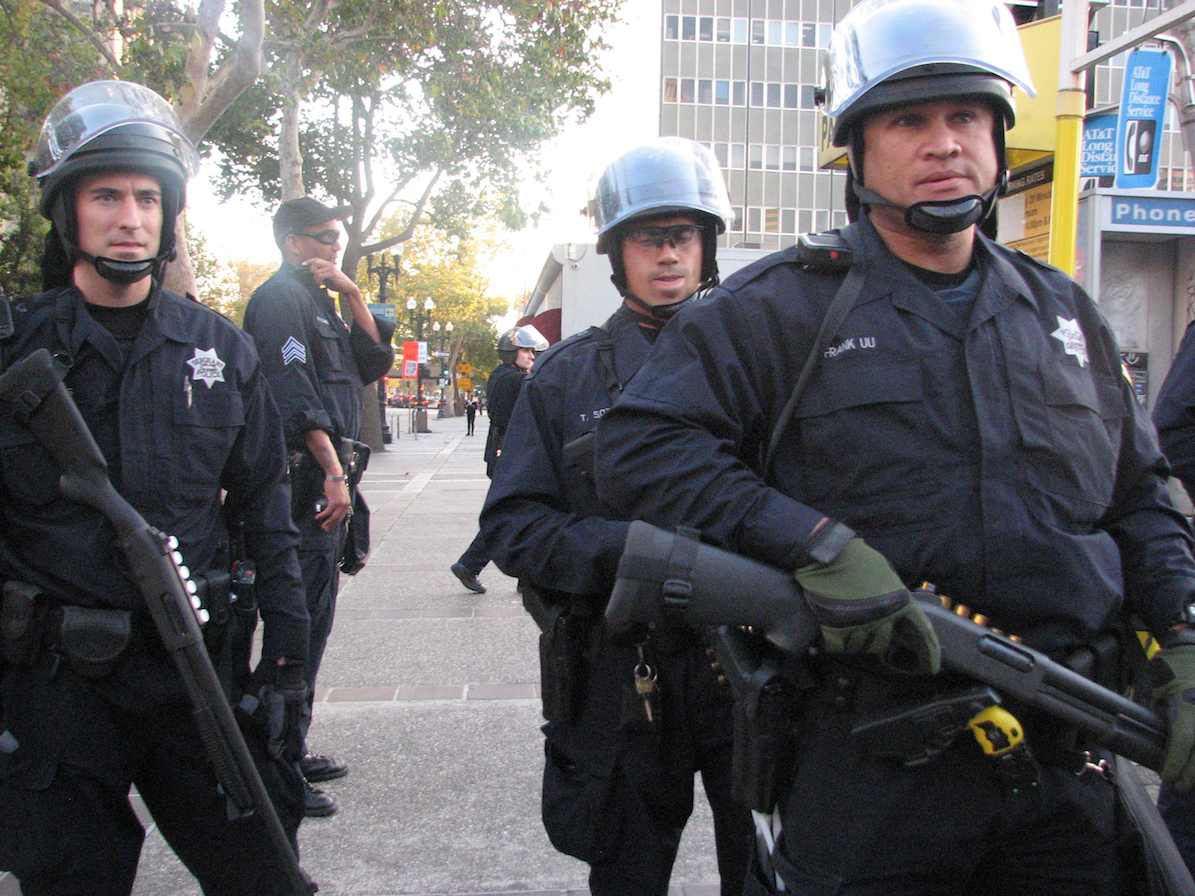
Police in full force descended upon the city park — christened Oscar Grant Plaza by the activists — at 4 a.m., clad in riot gear. They moved in swiftly, deployed teargas, and made mass arrests.

As of noon on Oct. 24, Frank Ogawa Plaza was still blocked off, with the remnants of the camp still scattered in the square. Oakland City Hall was closed to all but city employees.

Occupy Oakland protesters planned to respond to the raid with an emergency demonstration against police repression, scheduled to be held Oct. 25 at 4 p.m. at the Oakland library on 14th and Madison.

“Occupy Oakland is not finished, it has only begun,” a media statement from the occupiers said. “Our numbers will be larger than ever.” The statement also noted, “Occupy Oakland urges people to contact Oakland’s mayor and tell her what you think of her actions.”

Sue Piper, Special Assistant to Mayor Jean Quan, rejected the idea that the order had come from Quan alone. “It was a team effort,” Piper said. “We have the mayor, the City Administrator, the police chief, and the fire chief. The decision was made by that team to do it early this morning.”

Piper said the raid was carried out because “the people who were camping out were contributing to a health and safety issue.”

Asked how the city would respond to concerns that this appeared to be a crackdown on freedom of speech, Piper said protesters had the to right to assemble in public parks between the hours of 6 a.m. and 10 p.m.

“They cannot occupy our parks,” she said.

For an in-depth account of what it was like inside the camp at Occupy Oakland, pick up tomorrow’s issue of the Guardian.

SFPD allows OccupySF to grow into a tent city

14

Photos by Steven T. Jones, who also contributed to this report.

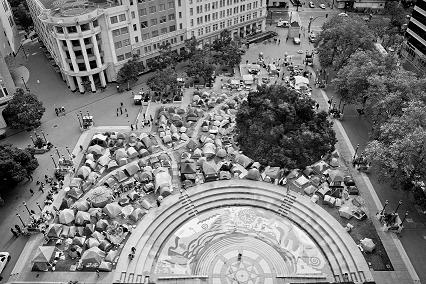
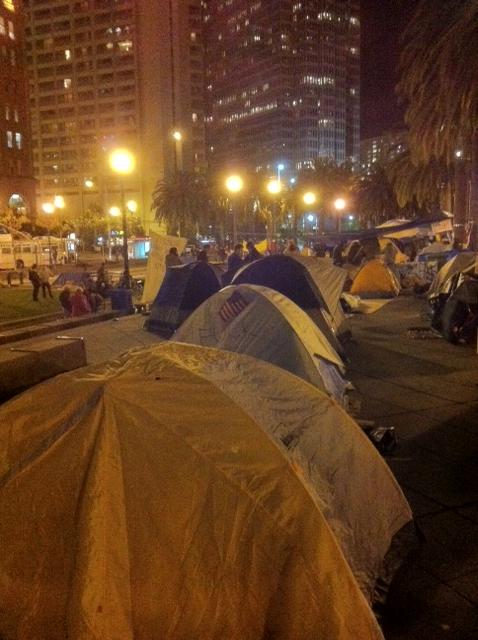
It seems the San Francisco Police Department is laying off the OccupySF encampment, at least for now. After top city officials sent mixed messages to the occupiers during a pair of high-profile hearings in City Hall this week, a full-blown tent city with working kitchen and medical tent has now been erected in Justin Herman Plaza.

During the Board of Supervisors meeting on Tuesday, Mayor Ed Lee voiced support for the movement’s message, but said that tents, tarps, and cooking in the plaza or in OccupySF’s presence on the sidewalk in front of the Federal Reserve wouldn’t be tolerated.

A string of protesters testified against the policy and the two recent police crackdowns, which was also criticized by John Avalos and other progressive supervisors who are working on a legislative solution to the standoff. But at the Police Commission hearing the next night, Police Chief Greg Suhr seemed to announce that police would stand  down and allow the encampment to continue.

Protesters packed the meeting and disrupted the proceedings with chants of “SFPD where is your humanity” and accusations of police brutality at several recent raids of their camp. Many representatives made public comments condemning police brutality and repression of the protests, and many speakers also connected it with a broader problem of police harassment, notably in Bayview-Hunters Point.

Said OccupySF protester Christopher Ray: “Obama himself does not have the right to come tell us to stop, to tell us to take down our tarps, to tell us we can’t eat, to cook food, to sleep there. Period. You would have change the Constitution of the United States in order to do that. We’re not leaving.”

By the end of the long meeting, Suhr expressed support in what seemed like a promise to OccupySF: “We have no future plans to go into the demonstration. We know that it’s for the long haul. We did work, or, I’m told that we were trying to work all day Sunday to take down the tarps and the structures. We did meet last week and I did provide a written notice that’s been provided wholesale since down there. We realize that this movement could go on indefinitely, and as such, I’m actually working with the Mayor’s Office personally to put the port-o-potties and the handwashing stations down there to provide sanitation. I don’t know that anybody’s doing that. And in other towns where this movement has grown and is very large, they’re already experiencing things like dogs that have bitten people, rats, sanitation issues, the lack of running water so I can assure you that our efforts are to keep it safe and to facilitate the First Amendment demonstration.”

His statement was meant with a cry of “Now that’s what I’m talking about!” and thunderous applause from the chamber, and the OccupySF movement has interpreted the remarks as permission for the encampment to continue without further police harassment. Guardian calls to the SFPD Public Affairs Office to clarify the policy have not yet been returned.

By last night, the encampment’s numbers and infrastructure had grown — with a kitchen producing group dinners and new tents being added throughout the evening — and there seemed to be only a cursory police presence. Many protesters were essentially declaring victory, telling the Guardian that the numbers only grew after each police raid, expressing hope that the city has now had a change of heart. 

This comes after a rocky history of SFPD relations with the protest. On October 5, police issued a notice requiring all tents at the encampment to be removed. Protesters complied, but police still moved in, confiscated all the protest’s materials, and ended up making one arrest in the ensuing altercation. Since, OccupySF has mostly refrained from erecting any structures; instead, the growing numbers, now an average of 200 per night, sleep on the sidewalk. When they put up two tarps when weather turned rainy on Sunday the 16th, the result was another nighttime police raid, this time with five arrests and several injuries to demonstrators.

Yet the next morning, protesters had strung up more tarps.  And in the past few days, many have pitched tents. Now, tents number over 40, and the police are yet to raid.

On Thursday, California Nurses Association and the National Nurses Association worked with OccupySF’s medic team to set up a medical tent. The tent has been sorely needed for a while, but it is only recently that supporters of the protest felt safe creating it.

When the tent was put up, police came and circulated a notice that had been issued on Oct. 1 stating, “Tents, overhead tarps, and/or wooden pallets are not to be within the demonstration area unless appropriate permits are obtained because of the potential hazard they present.” But police exited without attempting to enforce this notice, and as of now the medical tent, complete with a cot and a growing stock of supplies, is still in place.

Said Pilar Schiavo, an organizer with CNA who has been working with OccupySF: “We were able to provide treatment to a bunch of occupiers today.” She says there are many at OccupySF with no other access to health care besides the new tent. “It’s just basic first aid so far, but a little goes a long way here. One had a broken finger from Sunday’s raid.”

Schiavo says when they set up the tent early Thursday morning, protesters Tweeted, Facebooked, and otherwise put out calls for needed medical supplies. Shiavo was proud to report that “supplies started showing up an hour later.”

Just a short BART ride away, city officials in Oakland have accommodated Occupy Oakland and it has grown into a large tent city with ever-improving infrastructure and organization. Perhaps OccupySF is now headed down the same path.

Dick Meister: Unions can help bridge the income gap

2

By Dick Meister

Dick Meister, former labor editor of the SF Chronicle and KQED-TV Newsroom, has covered labor and politics for more than a half-century. Contact him through his website, www.dickmeister.com, which includes more than 350 of his columns.

There’s obviously no easy way to bridge the income gap between the rich and the rest of us or to combat the other serious economic problems raised by the Occupy Wall Street movement. But keep in mind the crucial – if not decisive – role that labor unions can play in righting our economic wrongs.

Union members earn a lot more than non-union workers overall and within particular occupations, and in age, gender and racial groups, and so spend more. They have more and greater fringe benefits, a greater voice in community and political affairs and otherwise are in a good position to span the income gap as well as contribute to the growth of the economy that’s so badly needed.


Unionized workers are paid nearly 30 percent more than non-union workers generally, a median of about $900 a week to about $700 a week. That’s an advantage of $4.95 an hour, or more than $10,000 a year, that can be spent to help boost the sagging economy.

The unionized workers’ much greater access to employer-financed health care helps, too, as does their invariably longer paid vacations, their sick pay and, among other key benefits, the pensions that go to more than three-fourths of unionized workers but to only about 20 percent of other workers.

Unions clearly provide the purchasing power needed to drive the economy and narrow the income gap between hugely paid corporate executives and the people who do the actual work of the country. Unions could very well do that, in part by helping improve working conditions that would attract more workers to particular employers and help the employers retain workers and compensate them well.

Although unions have been declining in numbers to the point that only about 13 percent of today’s workers are in unions, indications are that their numbers will be growing, thanks in part as a reaction to the current economic troubles.

The past practices of unions, in any case, indicate they’ll undoubtedly provide lots of help to ease the current crisis. They played a major role, for instance, in passage of the laws that set a minimum wage and a standard workweek, regulate on-the-job safety and provide workers’ compensation for on-the-job injuries.

What’s more, union members usually have more training and thus greater productivity. Their unions commonly work on local economic development in partnership with employers, community groups and local governments and commonly invest union pension funds to help rebuild declining communities and, among other local projects, help finance moderate–income housing.

Don’t forget, either, that non-union employers sometimes offer pay and benefits equal to union pay and benefits in their areas, in hopes of avoiding unionization.

Unions, which had much to do with pulling the nation out of the Great Depression and helping establish a true middle class, are in position to provide help that’s as necessary in 2011 as it was in the 1930s.

Dick Meister, former labor editor of the SF Chronicle and KQED-TV Newsroom, has covered labor and politics for more than a half-century. Contact him through his website, www.dickmeister.com, which includes more than 350 of his columns.

Editorial: Mayor Lee is tough as hell on Occupy SF protestors, but keeps City Hall safe for PG@E and the downtown gang

70

And so Mayor Ed Lee once again shows his true colors:  he is tough as hell on Occupy SF protestors and, unlike every other mayor in every other U.S. city,  sends in the cops to roust them out in  two midnight raids and trumpets the word  by bullhorn from the mayor’s office that he will harass them until the end of time. Meanwhile, he is is quietly sending  sending out the message that under his stewardship that City Hall will be safe for PG@E, the downtown gang, the big developers, the bailed banks, and the feds who are going after the dispensers of medical marijuana and the newspapers who run their ads.  (Full disclosure: that’s us at the Guardian.)  B3

EDITORIAL This is what civility and compromise looks like:

At a little after 10 P.m. Oct 16, a squadron of San Francisco police equipped with riot gear raided and attempted to shut down the OccupySF protest. It was the second time San Francisco has embarrassed itself, becoming the only major U.S. city to attempt to evict members of the growing Occupation movement — and this time, the cops used a lot more force.

The first crackdown, on Oct. 5, was supposedly driven by concerns that the activists were using an open flame for their communal kitchen without the proper permits. This time around, the alleged lawbreaking was confined to a Park Code section that bans sleeping in city parkland after 10 p.m. And since Justin Herman Plaza, where OccupySF is camped, is technically under the jurisdiction of the Recreation and Park Department, that ordinance could be enforced.

But let’s be serious: The encampment endangered nobody, and if any Rec-Park officials had actually complained, the police couldn’t provide their names. This was all about rousting a protest against corporate greed and economic injustice. It came with police batons, several beatings and five arrests.

And the mayor of what many call the most liberal city in America hasn’t said a word. Mayor Ed Lee was clearly consulted on the raid, clearly approved it — and now becomes unique among the chief executives of big cities across the country, most of whom have worked to find ways to avoid police confrontations.

David Chiu, the president of the Board of Supervisors, issued a ridiculous statement saying that “Both the Occupy SF protesters and the San Francisco Police Department need to redouble their efforts to avoid confrontations like the ones we saw last night.” No: The protesters didn’t start it, didn’t provoke it, didn’t want it — and frankly, did their best to avoid it. The crackdown is all about the folks at City Hall trying to get rid of one of the most important political actions in at least a decade — and doing it with riot police.

This is what the civility and compromise so touted by Mayor Lee and Board President Chiu looks like. And it’s a disgrace.

In Oakland, where the encampment at Frank Ogawa Plaza, renamed Oscar Grant Plaza for the event, has far more people than Occupy SF, city officials approached the activists and offered to issue whatever permits were needed. Mayor Jean Quan visited the general assembly, waited her turn to speak, and then politely asked the group not to damage the somewhat fragile old oak tree on the site. In deference to her wishes, the group surrounded the tree with a fence.

In New York, the private owner of the park where Occupy Wall Street is camped agreed not to evict the demonstrators — or even move some of them to all for a regular park cleaning.

Why is San Francisco acting so hostile? Is this not a city with a reputation for political activism and tolerance? Is it really that big a problem to allow activists to peacefully occupy public space to denounce the greatest corporate thievery in a generation?

San Francisco ought to be supporting the OccupySF movement, not harassing it. Lee should immediately call off the police raids. The Board of Supervisors should have a hearing on this, bring Police Chief Greg Suhr, Mayor Lee and representatives of Rec-Park and the Department of Public Health and work out a solution that doesn’t involve repeatedly rousting the protesters in the middle of the night. And if this continues, perhaps OccupySF should move to the plaza in front of City Hall.

Sup. John Avalos is the only person at City Hall who is making an outspoken effort to protect the protest; he needs some support.


The selling of Ed Lee

0

steve@sfbg.com

Ed Lee has gone through a remarkable makeover in the last year, transformed from the mild-mannered city bureaucrat who reluctantly became interim mayor to a political powerhouse backed by wealthy special interests waging one of the best-funded and least transparent mayoral campaigns in modern San Francisco history.

The affable anti-politician who opened Room 200 up to a variety of groups and individuals that his predecessor had shut out — a trait that won Lee some progressive accolades, particularly during the budget season — has become an elusive mayoral candidate who skipped most of the debates, ducked his Guardian endorsement interview, and speaks mostly through prepared public statements peppered with contradictions that he won’t address.

The old Ed Lee is still in there somewhere, with his folksy charm and unshakable belief that there’s compromise and consensus possible on even the most divisive issues. But the Ed Lee that is running for mayor is largely a creation of the political operatives who pushed him to break his word and run, from brazen power brokers Willie Brown and Rose Pak to political consultants David Ho and Enrique Pearce to the wealthy backers who seek to maintain their control over the city.

So we thought it might be educational to retrace the steps that brought us to this moment, as they were covered at the time by the Guardian and other local media outlets.

Caretaker mayor

The story begins quite suddenly on Jan. 4, when the Board of Supervisors convened to consider a replacement for Gavin Newsom, who had been elected lieutenant governor but delayed his swearing-in to prevent the board from choosing a progressive interim mayor who might then have an advantage in the fall elections. Newsom and other political centrists insisted on a “caretaker mayor” who pledged to vacate the office after serving the final year of the current term.

It was the final regular meeting of the old board, four days before the four newly elected supervisors would take office. What had been a bare majority of progressive supervisors openly talked about naming former mayor Art Agnos, or Sheriff Michael Hennessey, or maybe Democratic Party Chair Aaron Peskin as a caretaker mayor.

When then-Sup. Bevan Dufty said he would support Hennessey, someone Newsom had already said was acceptable, the progressive supervisors decided to coalesce around Hennessey. That was mostly because the moderates on the board had suddenly united behind a rival candidate who had consistently said didn’t want the job: City Administrator Ed Lee.

Board President David Chiu was the first in the progressive bloc to breaks ranks and back Lee, saying that had long been his first choice. Dufty became the swing vote, and he abstained from voting as the marathon meeting passed the 10 p.m. mark, at which point he asked for a recess and walked down to Room 200 to consult with Newsom.

At the time, Dufty said no deals had been cut and that he was just looking for assurances that Lee wouldn’t run for a full term (Dufty was already running for mayor) and that he would defend the sanctuary city law. But during his endorsement interview with the Guardian last month, he confessed to another reason: Newsom told him that Hennessey had pledged to get rid of Chief-of-Staff Steve Kawa, a pro-downtown political fixer from the Brown era who was despised by progressive groups but liked by Dufty.

Chiu and others stressed Lee’s roots as a progressive tenants rights attorney, the importance of having a non-political technocrat close the ideological gap at City Hall and get things done, particularly on the budget. So everyone just hoped for the best.

“Run, Ed, Run”

The drumbeat began within just a couple months, with downtown-oriented politicos and Lee supporters urging him to run for mayor in the wake of a successful if controversial legislative push by Lee, Chiu, and Sup. Jane Kim to give million of dollars in tax breaks to Twitter and other businesses in the mid-Market and Tenderloin areas.

In mid-May, Pak and her allies created Progress for All, registering it as a “general civic education and public affairs” committee even though its sole purpose was to use large donations from corporations with city contracts or who had worked with Pak before to fund a high-profile “Run, Ed, Run” campaign, which plastered the city with posters featuring a likeness of Lee.

Initially, that campaign and its promotional materials were created by Pak (who refuses to speak to the Guardian) and political consultant Enrique Pearce (who did not return calls for this article) of Left Coast Communications, which had just run Kim’s successful D6 victory over progressive opponent Debra Walker, along with Pak protégé David Ho.

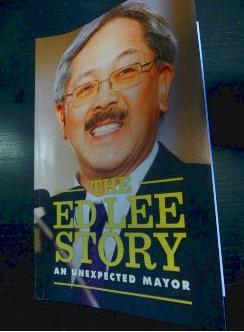
During that campaign, the Guardian and Bay Citizen discovered Pearce running an independent expenditure campaign called New Day for SF, funded mostly by Willie Brown, out of his office, despite bans of IEs coordinating with official campaigns. That tactic would repeat itself over the coming months, drawing criticism but never any sanctions from the toothless Ethics Commission. Pearce was hired by two more pro-Lee IEs: Committee for Effective City Management and SF Neighbor Alliance, for which he wrote the book The Ed Lee Story, a supposedly “unauthorized biography” filled with photos and personal details about Lee.

Publicly, the campaign was fronted by noted Brown allies such as his former planning commissioner Shelly Bradford-Bell, Pak allies including Chinatown Community Development Center director Gordon Chin, and a more surprising political figure, Christina Olague, a progressive board appointee to the Planning Commission. She had already surprised and disappointed some of her progressive allies on Feb. 28 when she endorsed Chiu for mayor during his campaign kickoff, and even more when she got behind Lee.

Olague recently told us the moves did indeed elicit scorn from some longtime allies, but she defends the latter decision as being based on Lee’s experience and willingness to dialogue with progressives who had been shut out by Newsom, noting that she had been asked to join the campaign by Chin. Olague also said the decision was partially strategic: “If we get progressives to support him early on, maybe we’ll have a seat at the table.”

Right up until the end, Lee told reporters that he planned to honor his word and not run. During a Guardian interview in July when we pressed him on the point, Lee said he would only run if every member of the Board of Supervisors asked him to, although about half the board publicly said that he shouldn’t, including Sup. Sean Elsbernd, who nominated him for interim mayor.

And then, just before the filing deadline in early August, Lee announced that he had changed his mind and was running for mayor, the powers of incumbency instant catapulting him into the frontrunner position where he remains today, according to the most recent poll by the Bay Citizen and University of San Francisco.

Lee the politician

With his late entry into the race and decision to forgo public financing and its attendant spending limits, one might think that Lee would have to campaign aggressively to keep his job. But most of the heavy lifting has so far been done by his taxpayer-financed Office of Communications (which issues press releases at least daily) and by corporate-funded surrogates in a series of coordinated “independent” groups (see Rebecca Bowe’s story, “The billionaires’ mayor”).

That has left Lee to simply act as mayor, where he’s made a series of decisions that favor the business community and complement the “jobs” mantra cited relentlessly by centrist politicians playing on people’s economic insecurities.

Yet Lee has been elusive on the campaign trail and to reporters who seek more detailed explanations about his stands on issue or contradictions in his positions, and his spokespersons sometimes offer only misleading doublespeak.

For example, Lee’s office announced plans to veto legislation by Sup. David Campos that would prevent businesses from meeting their city obligation to provide a minimum level of employee health benefits through health savings accounts that these businesses would then pocket at the end of the year, taking $50 million last year even though some of that money had been put in by restaurant customer’s paying 5 percent surcharges on their bills.

Although Campos, the five other supervisors who voted for the measure, four other mayoral candidates, and its many supporters in the labor and consumer rights movements maintained the money belonged to workers who desperately needed it to afford expensive health care, the San Francisco Chamber of Commerce said it was about “jobs” that would be protected only if businesses could keep that money.

Lee parroted the position but tried to push the political damage until after the election, issuing a statement entitled “Mayor Lee Convenes Group to Improve Health Care Access & Protect Jobs,” saying that he would seek to “develop a consensus strategy” on the divisive issue — one in which Campos said “we have a fundamental disagreement” — that would take weeks to play out.

After a frustrating back-and-forth with Lee Press Secretary Christine Falvey by email, it’s still unclear how to resolve the contradiction between whether businesses could seize these funds or whether they belonged to employees, with her latest statement being, “The Mayor absolutely wants these funds spent on providing access to quality primary and preventative health care because this is the business’s obligation under HCSO. Making sure that these funds go to pay for health care is the most important objective.”

Similarly, when police raided the OccupySF encampment on Oct. 5, Lee’s office issued a statement that was a classic case of politicians trying to have it both ways, expressing support for the movement and its goal to “occupy” public space, but also supporting the need to police to clear the encampment of those same occupiers.

But now, in the wake of a repeat raid on Oct. 16 that has inflamed passions on the issue, the question is whether Lee can run out the clock and retain the office he gained on the promise of being someone more than a typical politician.

The art and music of OccupySF: a work in progress

4

In a recent Super Ego clubs column, I challenged the San Francisco music, arts, and nightlife community to create a better OccupySF soundtrack than old Michael Franti tracks — and to perhaps update the slightly cliche V for Vendetta look of the movement a bit. (Not to mention throw a few hot-hot benefit parties.) We can do it!  

I was originally inspired by a bangin’ mix posted on Faceboook by former Bay Arean global funk DJ Tee Cardaci (see below). I was also stoked by news of amazing writer Hiya Swanhuyser’s “OccupySF: Art and Performance Series” which featured some major players performing at the ocupado camp downtown, like Heklina, Lil Miss Hot Mess, W. Kamau Bell, and Nato Green — and totally distraught that I had missed the series completely. (Although she just told me she’s got Michelle Tea and Brontez Purnell reading down there at 5pm on Thu/20 — check the series Tumblr for updated info.) In fact, there’s been so much Occupy SF art, music, and expression going on that it’s easy to miss quite a bit of it.

So I wanted to make a page that gathers together some of the stuff people are doing in solidarity with the OccupySF movement — DJ mixes, music tracks, guerilla artwork, unique performance, wild parties (oh hey, you should really hit up the rad Salsa Sunday OccupySF benefit at El Rio this Sunday, 10/23). 

I really want this page to grow and grow — and also help connect the activist-creative community that’s been mobilized and inspired by the #occupy movement in general. Rap tracks, recipes, animated gifs, spoken word, mixtapes, collages, mashups, whatever you’ve made and dedicated to the indignados. If you have something you’d like me to post, please email me at marke@sfbg.com and I’ll see about adding it (no attachments more than 2MB please). Let’s keep this thing rolling!

DJ Tee Cardaci’s #OccupyThisMixtape:

#OccupyThisMixtape – tee cardaci by OneLoveMassive

A great track composed by dread bass master Kush Arora last year in honor of Anonymous, rededicated here to the OccupySF folks hacking the system:

Kush Arora – The Hacker 2010 by KushArora

The group Classical Revolution performing as part of the Occupy SF: Arts and Performance Series:


Occupy Jello! (Biafra)

Brontez Purnell and Michelle Tea read at OccupySF

OccupySF appeals to City Hall, but the standoff continues

40

Frustrated by repeated late-night police raids on their encampments and empty statements of support by top city officials, hundreds of protesters with OccupySF entered City Hall today – under the watchful eyes of a large police presence with riot gear at the ready – to testify at today’s Board of Supervisors meeting.

The meeting began with the scripted monthly question time session with Mayor Ed Lee, who was asked by Sup. Jane Kim – whose District 6 includes the OccupySF encampment, which she visited for a couple hours last night – to “describe the plan that our offices have been developing” to facilitate the OccupySF movement.

But in Lee’s response and in exchanges with journalists after the meeting, as well as Guardian interviews with people in both offices, it doesn’t seem city officials have a coherent plan for carrying out Lee’s contradictory goals of supporting the Occupy movement and keeping sidewalks and parks clear of encampments.

Kim seemed to acknowledge as much later in the meeting when she said voiced support for OccupySF and for city officials who object to tents, kitchens, and other basic infrastructure that the month-old movement needs to continue. “We’re all struggling to figure out the best way to accommodate it,” she said.

Lee’s message was even more muddled, saying he supported the movement and agreed with its economic justice message. “From the very beginning, I have fully supported the spirit of the OccupySF movement,” Lee told the crowd, transitioning into reciting a litany of economic development efforts with little relevance to the demands of the movement.

“Then don’t send the police in to destroy it,” a protester shouted from the audience, which was filled to capacity and had a line out front and an overflow room. “We are working with you,” Lee responded, but then went on to complain about the lack of consistent contacts in the leaderless movement and emphasizing his bottom line that any kind of encampment with infrastructure is an impermissible violation of city codes.

“I need to make sure our public spaces are open to be used by anyone,” he said. Later, his Press Secretary Christine Falvey clarified the mayor’s stance by saying he supports the message but not the movement: “The tactic of camping overnight, he does not support.”  

Afterward, talking to reporters, Lee couldn’t really explain why the police needed to do their raids in the middle of the night, why San Francisco is cracking down on conditions that are being allowed in many other Occupy cities, or how the movement might be able to avoid future crackdowns if it continues, ignoring questions about where OccupySF might be able to go to avoid police raids.

Sup. John Avalos, who has been working to try to mediate the dispute between OccupySF and the city, responded to Lee’s speech by calling it “very frustrating. I’m alarmed that he is moving toward nightly standoffs with the Occupy movement.” Avalos says he supports protesters’ right to peacefully occupy public spaces and acknowledges their need for basic supplies to do so, calling the current standoff, “unsafe for both sides.”

“I’m proud to say that we are the 99 percent,” Sup. Eric Mar said, echoing the movement’s mantra and saying he would defer to Avalos’ leadership to create a “resolution strongly holding the police accountable for the crackdowns.”

Avalos had invited OccupySF participants to raise their concerns during the public comment portion of the meeting, and he said that he plans to use their input to form a resolution or plan for how the city should accommodate a movement that six of the 11 supervisors professed to support at the meeting.

When the long line of OccupySF protesters finally took to the microphone for public comment, they made it clear that the issue wasn’t as complicated as some city officials were trying to make it.
“It is outrageous and inhumane to see our camp raided in the middle of the night by San Francisco Police,” Magic, a middle-aged woman and lifelong activist, told the supervisors, closing with, “This can be a celebration or a battle, but we will not back down.”

Several speakers were dismissive of city claims to be protecting public health and safety, noting how dangerous the midnight confrontations have been, saying food and shelter are basic human needs, and noting how peaceful and cooperative OccupySF has been with the escalating series of city demands as the protest’s numbers have grown.

Michael Goldman said police have asked them to return to the sidewalk in front of the Federal Reserve, where they are densely packed in what he called unsafe conditions. “We have too many people to fit in front of 101 Market,” he said.

That was what prompted the move to nearby Justin Herman Plaza, where police cracked down Sunday night, citing a violation of the park’s 10 pm curfew. Another protester who works at the Ferry Building angrily noted that even before OccupySF began, he regularly watched city crews chase the homeless away from the site at 3 am with water trucks.

“We are a peaceful and nonviolent people and we do not deserve to be treated this way by our city and our country,” he said.  

“They were waiting to be talked to and not just run over by the police,” said iconic San Francisco activist Father Louie Vitale, who gestured to the waiting protesters and said, “We’re very proud of these people, very proud.”

It was a point echoed by others like local resident Andy Blue, who said, “They are doing a great service to this city and the world.”

The case against C and D

68

By Brenda Barros, Riva Enteen, Joe Jacskon, Renee Saucedo, Dave Welsh, David H. Williams and Claire Zvanski

OPINION The Guardian started out right on Proposition C and D:

“Our initial instinct was to oppose both of these measures… There’s a basic unfairness about all of this that bothers us … city workers are being asked to give up part of their pay — but the wealthiest individuals and big corporations in San Francisco are giving up nothing. It’s part of the national trend — the poor and middle class are shouldering the entire burden of the economic crisis, and the rich aren’t suffering a bit.”

It’s too bad that the Guardian editors didn’t stick to their guns.

We all know why decent pensions and health care cost so much: corporate greed. And the identity of the corporate criminals who are driving the economy into the ground is no secret. It’s the Wall Street banks and financial speculators. It’s Bank of America and Wells Fargo. It’s the corporate CEOs. It’s the insurance companies.

All workers, whether they work for the city or not, have a right to affordable medical care and a decent retirement.

Take Ethel, who retired 10 years ago after working for the city for more than 20 years and collects a pension of only $17,000 a year. Both Prop C and Prop D would take money out of her check. Some city workers qualify for section 8 housing — Prop C and D would take money out of their paychecks too.

None of this is rocket science. But the corporate media pounds away daily at public employees and ignores the shenanigans of their buddies in the corporate boardrooms. And far too many fall for this bait and switch, or are just too confused to stand up and fight back.

Now, with Propositions C and D, the downtown bigwigs and their lapdog politicians are taking advantage of this confusion to sock it to the victims, and make workers pay for the party the rich have been having at our expense.

Unfortunately, there are those among us who think we should concede many of our hard-fought rights in order to appear reasonable and fend off future attacks.

Making these kinds of concessions is like putting a little blood in the water, and hoping that the corporate sharks will be satisfied. But the reality is that when sharks taste blood, they just get hungry for more.

The editors of the San Francisco Chronicle, the mouthpiece for Wall Street and its minions, said pretty much the same thing in a recent editorial:

“San Franciscans should have no illusions,” wrote the Chronicle editors. “Props C and D offer only modest down payments on the reforms [sic] that must be pursued… The very fact that business and labor leaders are supporting Prop C… sets the stage for… further reforms [sic] that will almost certainly be needed…”

Of course the “reforms” that the Chronicle is demanding are just more attacks on workers’ rights. That’s why many political leaders, including former Supervisor Chris Daly and Ted Gullicksen of the Tenants Union — opposed both Propositions C and D.

Enough is enough. Let’s take heart from the Occupy Wall Street movement. After decades of Reaganomics, Bushonomics, and Democratonomics, it is high time to draw the line, stand up to Wall Street, and fight back.

Join former Supervisor Chris Daly and Tenant’s Union leader Ted Gullicksen, and: Vote NO on C! Vote NO on D! Tax the Rich! 

Brenda Barros is vice-chair, Social Economic Committee, SEIU 1021. Riva Enteen is a member of SEIU 1021. Joe Jackson is co-chair of the S.F. African American Employee Association. Renee Saucedo is a member of SEIU 1021. Dave Welsh is a delegate to the S.F. Labor Council. David H. Williams and Claire Zvanski are retiree members of SEIU 1021.

SF values and OccupySF

5

EDITORIAL This is what civility and compromise looks like:

At a little after 10 P.m. Oct 16, a squadron of San Francisco police equipped with riot gear raided and attempted to shut down the OccupySF protest. It was the second time San Francisco has embarrassed itself, becoming the only major U.S. city to attempt to evict members of the growing Occupation movement — and this time, the cops used a lot more force.

The first crackdown, on Oct. 5, was supposedly driven by concerns that the activists were using an open flame for their communal kitchen without the proper permits. This time around, the alleged lawbreaking was confined to a Park Code section that bans sleeping in city parkland after 10 p.m. And since Justin Herman Plaza, where OccupySF is camped, is technically under the jurisdiction of the Recreation and Park Department, that ordinance could be enforced.

But let’s be serious: The encampment endangered nobody, and if any Rec-Park officials had actually complained, the police couldn’t provide their names. This was all about rousting a protest against corporate greed and economic injustice. It came with police batons, several beatings and five arrests.

And the mayor of what many call the most liberal city in America hasn’t said a word. Mayor Ed Lee was clearly consulted on the raid, clearly approved it — and now becomes unique among the chief executives of big cities across the country, most of whom have worked to find ways to avoid police confrontations.

David Chiu, the president of the Board of Supervisors, issued a ridiculous statement saying that “Both the Occupy SF protesters and the San Francisco Police Department need to redouble their efforts to avoid confrontations like the ones we saw last night.” No: The protesters didn’t start it, didn’t provoke it, didn’t want it — and frankly, did their best to avoid it. The crackdown is all about the folks at City Hall trying to get rid of one of the most important political actions in at least a decade — and doing it with riot police.

This is what the civility and compromise so touted by Mayor Lee and Board President Chiu looks like. And it’s a disgrace.

In Oakland, where the encampment at Frank Ogawa Plaza, renamed Oscar Grant Plaza for the event, has far more people than Occupy SF, city officials approached the activists and offered to issue whatever permits were needed. Mayor Jean Quan visited the general assembly, waited her turn to speak, and then politely asked the group not to damage the somewhat fragile old oak tree on the site. In deference to her wishes, the group surrounded the tree with a fence.

In New York, the private owner of the park where Occupy Wall Street is camped agreed not to evict the demonstrators — or even move some of them to all for a regular park cleaning.

Why is San Francisco acting so hostile? Is this not a city with a reputation for political activism and tolerance? Is it really that big a problem to allow activists to peacefully occupy public space to denounce the greatest corporate thievery in a generation?

San Francisco ought to be supporting the OccupySF movement, not harassing it. Lee should immediately call off the police raids. The Board of Supervisors should have a hearing on this, bring Police Chief Greg Suhr, Mayor Lee and representatives of Rec-Park and the Department of Public Health and work out a solution that doesn’t involve repeatedly rousting the protesters in the middle of the night. And if this continues, perhaps OccupySF should move to the plaza in front of City Hall.

Sup. John Avalos is the only person at City Hall who is making an outspoken effort to protect the protest; he needs some support.

Alerts

0

alert@sfbg.com

Editor’s Note: Protests and other events connected to the Occupy Wall Street movement, include OccupySF and Occupy Oakland, have been developing quickly. To take part, follow our Politics blog or check with the websites associated with this important economic justice movement: occupysf.com, occupyoakland.org, or occupytogether.org. And you can send tips about what’s happening to news@sfbg.com.

WEDNESDAY 19

“Fast Times in Palestine”

Pamela Olson’s new memoir, Fast Times in Palestine, recounts her time in Ramallah as a young journalist from 2003-2005. It was described by Rebecca Vilkomerson, executive of the Jewish Voice for Peace, as, “a moving, inspiring account of life in Palestine that’s enormously informative yet reads like a novel.” Celebrate the publication with the program’s short presentation from the author, a Q&A session, and a book signing.

7-9 p.m., free

Stanford University

Building 160, Room 124


THURSDAY 20

Eat crab, fight AIDS

Support individuals living with HIV and help prevent this spreading epidemic by joining this crab feed fundraiser for AIDS Project East Bay. APEB provides free and confidential HIV and STD/STI testing with a scheduled appointment.

6-10 p.m., $45

8945 Golf Links, Oakl.

www.apeb.org


San Jose Short Film Festival

The 3rd annual San Jose Film Festival will present entertaining shorts from filmmakers around the world on Oct. 20-23rd. The weekend will be speckled with VIP events, parties and interesting forums and panels. San Jose will be taken over with Hollywood style. Each of the four days will be broken down into two-hour blocks of short films of various genres. Tickets are now online for sale.

7 p.m.- 12 a.m.

CineArts Theater @ Santana Row

3088 Olsen Drive, San Jose

www.sjshortfest.com


SATURDAY 22

Figth police brutality in the Central Valley

Remember Oscar Grant and join in the caravan of resistance standing in solidarity against police violence. Rain or shine, protest outside these city police stations and stand up against those who “shoot down innocent people” and “carry out raids on immigrant and harass those working to end this abuse”.

11 a.m., free

Outside the Stockton Police Station, 22 E. Market, Stockton

or

12:30 p.m., free  

Manteca Police Station, 1001 W. Center, Manteca

or  

2:00 p.m., free

Stanislaus County Jail, 1115 H St., Modesto

A community forum on state repression will take place in Cesar Chavez Park at 4 p.m. in Modesto

Contact Kat Williams at wearealloscargrant.cv@gmail.com


Mail items for Alerts to the Guardian Building, 135 Mississippi St., SF, CA 94107; fax to (415) 437-3658; or e-mail alert@sfbg.com. Please include a contact telephone number. Items must be received at least one week prior to the publication date.

When OccupySF occupied my car

13

By David Adler

I began the week a brooding and self-pitying writer, who was spending far too much time sucking on sour grapes until they were bitter raisins.  I even went back and forth via email with an editor who had rejected one of my stories.  This is not a good way to endear yourself with potential future patrons.  But it had been far too long a time since I’d torched a bridge (and, in this case, I’m fairly certain that I burned the fucker to the ground), and in that sort of “I love the smell of napalm in the morning” empty machismo way, well, I still didn’t feel better.  I felt like I do when I yell at the television while watching a Laker game, screaming at Andrew Bynum as if I were sitting courtside next to Jack Nicholson and sneaking out with him for blow during TV timeouts or just when we damn well wanted to.  I was a crazy man.  A loon in sweats and a Cal hoodie. 

Determined to regain a semblance of human dignity, and equally committed to acquiring as little of it as necessary (the stuff is pricey, I don’t care what my therapist says), I got on the BART last Wednesday, October 5th, at the cavernous and exposed Millbrae station, the end of the peninsula line. 

The electric train screeched and squealed and screamed north into the city, where a half hour later I emerged from the Embarcadero station on Market Street.  A motley camp came into view, pitched on the sidewalk in front of the Federal Reserve building.  It was the Occupy San Francisco Financial District camp.  In solidarity with the original Occupy Wall Street movement, and the dozens other others cropping up daily, which defibrillates my long spasming liberal heart into a peaceful rhythm. The 99% in action. Could’ve been 1969.  They had a kitchen, a library/bookstore, it was a little city of dissent, and the forces of everyday people were now gathering, enlarging the camp’s population, in anticipation of the noon march.  The police were mostly in the background, talking with a few suits and ties out for a smoke, or lunch, who observed with amused smiles on their faces as they looked at the Occupy camp and the crowd.  Stupid people, they seemed to be thinking, though I obviously can’t know.  Perhaps they just didn’t get it. But they didn’t have to.  It was getting itself just fine. 

There were old and young, every race and color and creed.  There were hippies in their seventies and students in their teens and twenties, nurses of all ages, punks and patriots of equal concern, workers and laborers and normal folkies of every stripe and sandal.  Yes there was a progressive and lefty and outsider’s insider vibe to the signs and the chants. Banks got BAILED out, we got SOLD out!! Banks got BAILED out, we got SOLD out!!  We ARE the 99 percent!!  We ARE the 99 percent!!  But that’s the whole friggin’ point. There was a tiny dog, a Puggle the owner told me, who was wearing a sign that said “Justice for the Little Guys.”  A woman who looked to be on lunch break held a small sign aloft: “I’m here because I can’t afford a lobbyist.”  End The Fed.  Tax the Rich.  So many more, so varied.  And my favorite, which was a bit longer:

The Amercian Paradox:
Unionized Public Employees
Cracking Down on Those
Seeking to Save Their Jobs & Pensions

Now, I may not agree with everything and everyone in this movement, not even close, but the fetid financial powercore as the center of this mass and evolving dissent?  Bring it on.  My wife works for a good little bank, worked for another one in Southern California that was shut down by regulators and sold off under dubious circumstances, and those kinds of community institutions have been run over by the too-big-too-fail Gods.  I loved it, in other words.  And we marched.  The official count, I read, was 800.  Horseshit.  No way.  I couldn’t give an exact number, but I know it was many more than that paltry figure.  Cabbies were honking at us, but in a rhythm, a beat that said they were with us and not annoyed.  I carried my sign, given by a representative of the nurse’s union, because their cause really resonates with me: Tax Wall Street Transactions – Heal America.  I waved it for a few miles, but my arms never got sore.  The spirit was grand and vital and patriotic and American.  We were engaged in the only thing freedom really means.  The right to say no to the powers that be, to protest without the fear of unjust reprisal.

And there’s the rub.

After marching, I had to hop the train home quickly and pick up my son from school.  I rode south toward Millbrae, while behind me in the city the ruckus remained and grew and settled back into camp for the night. 

The night.

Always the best time for the authorities to do their dirty work. The next morning, after being told by my wife that on the news they reported the police had busted up the Occupy camp, I watched the videos that had already been posted online.  And there they were, those unionized public employees, heading down the street in riot gear toward the Occupy Camp.  The irony is too rich.  And disturbing.  They came in riot gear, apparently, to protect themselves from a bunch of barefoot hippies and thread-thin vegan rebels. The police confiscated a lot of the stuff from camp, ordering the reluctant Department of Public Works employees to carry out the deed, without giving the kids time enough to gather it themselves.  Then the police got rough, nightsticks into ribs and arms and thighs. All of it, needless to say, completely unnecessary.  The only thing freedom means, and that’s what it gets you.  In America.  Didn’t those police want to set a better example, to be better than the police and soldiers we see all over the world stomping on their people’s hopes?  I guess not.  They’ll say it was a safety issue, a private property issue, that it was this or that, but none of it required riot gear and physical violence at all. Disgraceful and depressing.

On Thursday evening, the 6th, on the Occupy SF website I saw that they had put out a call for anyone with a car or truck to help them get their stuff back.  It had been taken to the Department of Public Works yard off Bayshore.  Friday morning, as I sat staring at my computer trying to write, I decided to do something to help these kids out.  I got in my Prius and headed into the city, to the DPW yard.  On the way there, in my idealistic mind (at least I still have one at my age), I envisioned a huge caravan of progressive minded people arriving on the scene in solidarity, ready to help get this stuff back to whom it rightfully belonged. I wished.  But when I got there a little after nine, I was the only one there.  Soon, however, a tiny old Japanese hatchback rumbled past with what I took to be three activists of various ages riding inside.  They had to be Occupy people, I thought. But they drove past, appearing lost, and turned out of sight at the far corner.  Hmm.  In a few seconds, however, they reappeared, the car pulling to a stop at the red curb where I was standing at what looked like the front door to the DPW offices.

“Are you with Occupy?” I asked the bearded young man in the passenger seat, who had a thick mane of wavy dark hair pulled back into a long ponytail.

Yes, they all answered, who are you?  Where do we park?  The driver was in her sixties, clad in black I noticed, with long gray hair.  The passenger in the back seat was a younger gal, heavy, a punk lesbian vibe about her, with her short cropped hair painted red, blonde, and blue.

“I’m just a guy,” I told them.  “Just someone who showed up to help you out.”  The young gal in the back looked at me oddly, with an expression of curious surprise, then pointed at me slowly, like a b-ball teammate acknowledging a sweet assist, as if thinking, “Yes, even the fake hippies in the Adidas gear are with us!”

“And you probably want to park anywhere you can,” I continued. “I just got lucky across the street there.”

Just then we got the attention of a DPW worker inside the glass door.  A big African-American guy in a yellow work vest, he asked if we were from Occupy and looking to get our stuff back.  He gladly directed us where to pull our cars, and he told us he’d instruct someone to meet us back there.  This is when I learned, from the kid with the ponytail, that the DPW workers were not happy about having to obey the police and confiscate the protesters’ stuff, their own union supporting the Occupy movement.  So the courtesy and patience of all these DPW workers was no surprise.

A few minutes later, as the four of us waited on the sidewalk, I realized I’d forgotten their names, or if we’d exchanged them at all.  I thought we had, but I’m terrible with names, which I told the young guy with the beard and ponytail.

“Chris,” he replied to my re-query. “You’re Dave, right?”

I felt guilty that he remembered and I didn’t. 
“I’m Diana,” the younger gal introduced herself, “And I really have to pee.  You think you guys could form a perimeter here for me so I can go in the bushes?”

I suggested she go behind the black van that was completely blocking some bushes about twenty feet away.  She nodded, good idea, and walked over to relieve herself.

“I’m Dagny,” the older woman said as she sat on the curb and lit a cigarette.  “And the name’s not from that useless fucking Ayn Rand book, thank you very much.”  Dagny seemed an experienced San Francisco hellraiser, and I would discover that she had little time for taking any shit or wasting any time. 

Returning from her bathroom bivouac, Diana was hopping mad.  “You’ll have to excuse me, I really got a fire in me today, after what went down last night.  I may be young, but I can get stuff done.  And today we’re going to.”

I told her I understood the fire she had in her.  When I asked how old she was, she replied twenty-two.  Exactly half my age, I told her.  She thought for a second and mouthed forty-four, barely audible enough to be heard.  Just then another DPW worker showed up and told us to follow him in our cars.  He led us through the sprawling yard, crowded with trucks and tankers and service vehicles of every odd variety and size, many in the repair bays, where workers crawled under and around and atop them like Lilliputians upon Gulliver.

We finally made it to a parking area, filled with more trucks, and with a storage area surrounded by a patchwork chain link fence.  The DPW guy unlocked the fence gate and led us in.  There was junk covered in blue tarps on both sides, with a cleared path in between. Everything on the left, he told us, was homeless stuff, which made sense once we saw how many bicycles and shopping carts poked out from under the tarps.  On the right side was the Occupy SF stuff.  It had rained the previous night, so it was a wet mess of backpacks and chairs and tarps and toolboxes, storage containers and tents and camp stoves, furniture and clothes and food. A lot of food.  They’d been living there, after all. Some of it had spoiled, some was still good.  Chris and Diana were kind of overwhelmed at first, but Dagny just laid it down: let’s just get all the food out first, and figure out what’s still good to keep, and what’s not, and we’ll put the good stuff here, and the bad stuff goes in this trash bag.  Wet clothes over there, office stuff here, tarps in a pile, Dagny continued like a former flower-child field general, until we were moving with as swift an organization as possible under the shorthanded circumstances.

A half-hour later my car had been designated as the de-facto catering truck.  It was full of all the canned food, as well as the fresh stuff that hadn’t gone bad.   Bread and bagels that stayed dry, tea and coffee, oats and nuts, produce that included a large crate of oranges and a box full of various types of squash.

We had my Prius packed tight and Dagny’s hatchback full to the brim, with at least several more trips worth ahead of us, if no other vehicles showed up to help with the rest. More importantly, we had no place to go.  Diana made a harried phone call.  Then Chris made another.  There was supposed to be a storage space rented, but no one could seem to figure out who to contact to find out where it was.  It was then that a pickup truck and an SUV showed up.  Cool, now we could at least get the rest of the stuff loaded, those two trucks should be big enough to hold it all.  The truck and SUV, as well, brought four or five other people.  A guy about my age from Marin, who had picked up a gal from the city, and three younger guys in their early twenties (or so I assumed).  These threee were thin and vegan and dressed in clothes that looked like they’d been living outside for a couple of weeks.  When I introduced myself to one of them, he told me that I could call him “Just One.”  After a few moments, I got it.  A leaderless movement.  He was just one. There was something poetic and beautiful about it.  Just One seemed a tad wary of me at first, but by the end of the day was thanking me profusely.

“I really appreciate it, man.  I was worried I was gonna be the only mule out here.”

With more hands to help and more trucks to load, Just One and his friends started to voice their own concerns about how we should be separating the stuff.  They started to disagree among each other while trying to come to a community decision.  Dagny took charge once again, overriding the consensus confusion.

“We’re packing it all up and just taking it to this damn storage space, if anyone can figure out where the hell it is.  Then we’ll deal with it all there.  These people who volunteered their cars and trucks have to get other places, so we need to waste as little of their time as possible.”
Focused by a veteran of many movements, we got the remaining stuff loaded into the trucks, cramming in furniture and containers and everything we could that seemed worth saving. Dagny had decided to take all the wet clothes that looked like they could be salvaged and washed.  She told the kids that she’d bring it clean and dry to camp the next day.  She even told Chris that she was going to lend him her car for the rest of the day, all he needed to do was drop her off and pick her up from a class she teaches.  Lefty teamwork gave us an energizing rush.  Unity flowed like fine, and rare, wine.  On the last sweep of the space, Chris found the handmade red and black OccupySF flag, that had flown at the campsite. It was under a tarp and was still attached to the end of its long bamboo pole, having survived relatively undamaged.

“Yes!” Chris declared, holding it up.  “The flag survived!”  The others shared his small victory enthusiasm.  “We’ll take it with us,” he told me.

Colors ready to fly again, trucks and cars loaded with recovered possessions, we nonetheless continued to wait.  No one, still, could figure out where this storage space was.  A few people made a few more harried phone calls to certain people, not leaders of course, but people in the movement who might know who else in the movement would know where to send us.

“Quite a lovely clusterfuck” Dagny said to me.  “And what the hell am I thinking?  I’m missing prime smoking time here.”

As the guy from Marin, who brought the truck, finally managed to pin down the location of the storage space, I told Diana she could ride over with me, I had a passenger seat free.  She said okay, but didn’t seem too enthused.  As directions to the storage space were given out, Diana hung out next to the passenger door of Dagny’s car.

“I think she’d be more comfortable riding with you,” I said in Dagny’s ear. 

“I think you’re right.  Take Chris and we’ll meet you there.  It’s easy to find, right down 3rd.”

In the Prius and on the way, Chris told me he’d been living at the camp since he got into San Francisco.  He was raised in New Jersey, then he spent some time in Florida, which he hated.  “So I just took off west, ended up here, and I don’t think I’ll ever leave.  I just love the whole spirit here.”  I told him that I’d just moved to the bay area, with my wife and son, from San Diego, and that I’d spent my whole live in Southern California until we moved up here.  When he asked what I did, I talked for a few minutes about being a Hollywood dropout (though I made some good money for a brief time), and that I was now trying to write some fiction.  After I described what made SoCal and NoCal seem like two separate states, Chris repeated his mantra. “I just love it here.”

“Dagny’s a character,” I said after a moment.

“Oh man, she’s hilarious, you shoulda heard the stuff she was saying on the way over here.”

I asked him about Wednesday night, when the police in riot gear had busted up the Occupy camp in front of The Fed.. 

“They were the instigators of the violence, they really were,” he said.  “I mean a couple people yelled some stupid stuff, but we weren’t violent at all, and they just come at you with those batons.  I got nice lump right here on my arm.”

I said I’d heard that some of the police didn’t want anything to do with it.

“Yeah, there were some who wouldn’t even look at you, and you knew they were just torn and didn’t want to be there.  And the female cops, as usual, were fine.”

“Never had a problem with a woman in uniform,” I told him.  “Never even that cop attitude you get if you have the nerve to politely question them.”

He agreed, his eyes looking for the street off Third where we’d find the storage place. 

“Here it is!”

I made a quick sharp right, and I heard several oranges spill out of the crate and juggle down onto the floor.

Pulling into the parking lot, Chris and I realized everyone had made it there before us, even though we’d left pretty much first.  “That’s how you know we haven’t been in the city long,” he smiled, getting out to help unload.

Most of the food packed into my car, it turned out, was headed for a charity called Food Not Bombs.  I was going to drive it over there, a task Dagny had assigned to me, but she couldn’t get Food Not Bombs to pick up their phone, and no one knew where it was.

“They kind of operate under the radar,” Just One told us.  “They really don’t want the authorities to know where they are, so they kind of move around.”

I was stuck with a carload of provisions with no charity to feed.  Damn.  As my time got short, Dagny saved me again and told the kids that they should unload the food from my car, and set it aside with everything else that wasn’t going to stay at the storage space.
“We’ll put it all into one truck, keep it as organized as we can.”
Good call.  I pulled out the bamboo pole with the OccupySF flag on it.  I waved it around for them, and everyone gave a cheer.  “Let it fly, man!” Chris exhorted.  I flew it from the Prius for my last few minutes there.

Chris and I exchanged cell phone digits, and I told him to keep me in mind if they ever needed a car during the week, that mornings and early afternoons are when I’m mostly free.  We shook hands, and he thanked me again, so genuinely, as did everyone else. 

I drove away, got onto 101 south and headed back to Millbrae.  And, in my swelling head, I heard the line from Jack Kerouac’s “October in the Railroad Earth”: …and here’s all these Millbrae and San Carlos neat-necktied producers and commuters of America and Steel civilization rushing by with San Francisco Chronicles and green Call-Bulletins not even enough time to be disdainful…

I cherish those words: …not even enough time to be disdainful. 

So many critics fit that suit perfectly.  It offends them simply to take the time to disdain it.  It bothers them to even bother.  The people, many young, who started this Occupy movement and continue it, deserve much better, as does the entire nation.  These free and peaceful Americans have made the time to do much more than disdain or merely talk. For now, until who knows when, they have made it their lives to act.

The positive vibes from that day must have carried over, because on Sunday I pulled off another online poker miracle.  (I say another because last year I turned thin air, literally nothing but a few bucks won in a free tournament, into more than ten grand in about four months.  All of it ended up in the bank, thankfully.)

This was an equally daunting assignment.  Two thousand and fifty-six players were entered in the tournament on ClubWPT dot com.  It was first place or nothing.

Four hours later, I had beaten them all.

And I had won the grand prize: a $3500 Main Event seat at the World Poker Tour Jacksonville event in November, plus another $1000 in travel money. 

Now what the hell do I do?  I never play live.  And the tournament is at a dog track, of all places.  Greyhound Rescue, condemn me now.

But I could win a bundle.  Or nothing, in which case I’m still on the hook for taxes on this $4500 package.

Wall Street has their casino, albeit a much more rigged one, and I have mine.  Stay tuned.

SFBG Radio: Has official SF lost its mind?

54

Today Johnny and Tim talk about the police raid on Occupy SF — and why San Francisco officials insist on making this the only large city in the nation that’s sending the cops to clear out Occupy Wall Street protesters. Listen after the jump.


RiotGoinOnCops by endorsements2011

Oakland is hella occupied

The Occupy Oakland encampment at Frank Ogawa Plaza is about 150 strong at any given time, and with a march, rally, and live musical performances on Oct. 15, the protest zone in the heart of Oakland was buzzing with energy.

Oakland is home to hundreds of seasoned activists who’ve made headlines in the past for organizing mass demonstrations against police violence, pushing back against cuts to public education, and moving to save Oakland public libraries from closing their doors in the face of budget cuts. Now, in solidarity with Occupy Wall Street and the Occupy movements that have sprouted up across the country in recent weeks, they’ve staked out a tent city in front of Oakland City Hall to join the national chorus condemning income inequality, corporate influence in government, and the role of major banks in unleashing a tide of unemployment and foreclosure that has swept working-class and middle-class Americans.

In just a week’s time, the occupiers have managed to create a community space governed by consensus that has the feeling of being an established space. Wooden pallets create walkways that criss-cross through the tents, which are staked close together. A kitchen area has been set up, with industrial-sized pots and pans piled high, and regular meals served to more than 100 people. There are portable toilets, portable outdoor sinks, a library supplied with zines and radical literature, an arts and crafts area, a kids’ area, a first-aid tent, and a makeshift stage in the plaza near the entrance of the 12th Street BART station.

The space is continually evolving, several activists told me when I chatted with various people at the camp. A few small arguments have broken out here and there, but on the whole things have been extraordinarily peaceful despite the close quarters and wide-open vibe. This past weekend, a tall structure with a pointed rooftop materialized overnight, adorned with colorful fabric and curtains. Tables and chairs had been brought in so people could play cards, hay bales served as structural dividers between encampment spaces, and the plaza was adorned with posters bearing statements like “The First American Revolution Since the First American Revolution.”

What sets the Oakland occupation apart in some ways is the diversity of people who’ve been drawn to participate. From black youth born and raised in Oakland, to Muslim women donning traditional headscarves, to white anarchists, to parents of young kids, to college students, to people in wheelchairs, to aging hippies, to transgender people, Occupy Oakland reflects the diversity of the city — and it’s bringing together a group of people who might not necessarily share the same space at the same time on a regular basis.

Boots Riley of The Coup performed at Occupy Oakland on Oct. 13, and other musicians have treated occupiers to live music as well. Shane Bauer, Sarah Shourd, and Josh Fattal — the three activists who were imprisoned in Iran and are now back on the West Coast — were scheduled to speak on Oct. 17. At one point just before dark on Oct. 15, a group of bikers blew past the camp in what seemed to be a show of support, performing tricks while everyone applauded.

On Oct. 15, Move On staged a Jobs Not Cuts rally at Occupy Oakland, but because activists decided by consensus beforehand that they did not want any politicians speaking at their encampment, several elected officials whom the group had invited to speak were struck from the roster. (However, a representative from the office of Congressional Representative Barbara Lee did deliver a prepared statement, which some occupiers characterized as going back on their agreement with Move On.)

Danny Glover delivered a passionate speech at the rally, telling the crowd, “We are here because it’s the right time to be here.” He spoke about transforming and reinventing the system so that it could work for the people and the planet, asking, “What does it mean to be a human being in the 21st Century?” He urged the activists to hold their ground, and then said, “What it’s going to look like, I don’t know.” But he asked people to believe that a new system could come out of this grassroots movement, “based on our faith in humanity.”

All photos by Rebecca Bowe