Oakland

Editor’s notes

13

tredmond@sfbg.com

I used to go to Grateful Dead shows at the Oakland Auditorium, which is now called the Kaiser Convention Center. One night I saw Bill Graham, the late concert promoter, ride a zip line from up near the ceiling to the stage in a giant paper mache joint called the “S.S. Columbian,” which looked like it was going to fall apart at any minute as he swung back and forth 50 feet over the crowd, trying to smile and wave in a bizarre promotional stunt that confused even the deadheads. I bet he shit his pants.

The place was a pretty good venue for a big concert, but it never worked out as a convention center, and the city shut it down in 2005. It needs seismic work and about $5 million in maintenance. It sits near Lake Merritt, on the edge of downtown Oakland, a giant empty building just waiting for something to happen to it.

It’s a perfect spot for an Occupy Oakland headquarters. I’m surprised it took the Occupy folks this long to figure it out.

Look: Oakland’s a working-class city, and it’s having severe financial problems, and sending hundreds of cops to arrest Occupy protesters is sucking up money that’s desperately needed for other things. Mayor Jean Quan complains that police were unable to respond to emergency calls in other parts of the city because they were all downtown dealing with the demonstration.

Understood — and it’s clear that the Oakland Police, whether the Occupy folks like it or not, are going to arrive in mass numbers to make sure that there’s no damage to local businesses or City Hall (where, oddly, there were no arrests, because the cops were elsewhere).

But the empty Kaiser Center, which isn’t even in the downtown center? Why bother?

Seriously: Why not just give it to Occupy Oakland? Tell the group that the city will strictly enforce fire and health codes, that the Occupy people will have to clean the place up and keep it clean, that they can’t damage the place … and hand over the keys?

It’s public property. Nobody using it now. Occupy might actually bring some excitement to the scene. If it became a center for political meetings and organizing, for education and performances, it could be a be a very positive thing.

Declare at truce in the Occupy wars. Let the cops go after murderers; give Occupy the vacant convention center. Nothing else is working. It’s worth a try.

Main Attrakionz

0

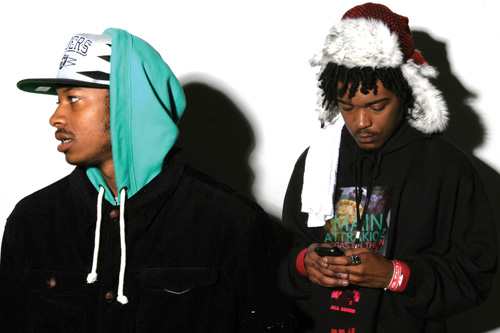
Why is Oakland’s Main Attrakionz (www.mainattrakionz.com) on the rise? It’s because everybody’s talking about it, and with good reason. Last year’s massive 808s & Dark Grapes II mixtape wowed the underground hip-hop world, and with every passing month the act — rapper-producer Squadda B and rapper Mondre M.A.N. — catches the attention of yet another publication, and yet another rising producer — there have been collaborations with A$AP Rocky, Clams Casino, Kool A.D. of Das Racist and Danny Brown, among others.

The cloud-rap duo got a write-up on the Guardian’s Noise blog in December in which writer Frances Capell effused, “Main Attrakionz is carving out its own place in hip-hop by pioneering a new sub-genre” and later, “a refreshing realness runs throughout Main Attrakionz’s lyrics.” In 2012 there will be solo mixtapes from both rappers, along with the collaborative effort Bossalini’s & Fooliyones. With all this skill and regard it’s easy to forget how young the crew really is, it got its start in high school — way back in 2007.

Description of sound: Really can’t describe it. All of our music sounds different.

What do you like most about the Bay Area music scene: The fact that only we know what they talking about.

What piece of music means the most to you and why: The beat to “Da Art of Storytellin” by Outkast featuring Slick Rick, produced by Mr. DJ. It just reminds me of my childhood staying up to watch Rap City countdown and the song was usually number one. Whenever I hear the beat, I think of the puppets in the video.

Favorite local eatery and dish: Buffet Fortuna in Downtown Oakland; chow fun noodles

Who would you most like to tour with: Lil Wayne; as far as performances go, he’s gotta be the top rapper who been performing 10+ years. I wanna learn how he stays ready and energetic for all these years.

Metal Mother

0

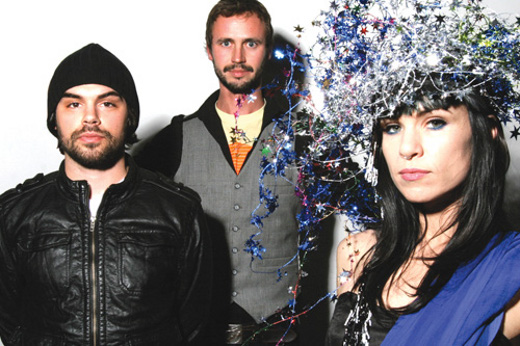
Like some sort of neon, acid-drenched wood nymph, Metal Mother’s (metalmother.bandcamp.com) Tara Tati wanders through the leafy, NSFW video for the haunting art-pop “Shake” off last year’s Bonfire Diaries and into the mind’s eye. In 2012, there will be a first trip to SXSW, more videos (yay!), a few remixes, and, fingers crossed, another full length out toward the end of this year. And as the shimmering Tati says, she’ll “Continue dismantling the mundane and mediocre thought systems that are ruling the planet.”

Tati and her band, which came together shortly after the release of Bonfire proved most theatrical of the Guardian photoshoot, with glittering headpieces and flexible posing. In setting up the right headspace for a photo Tati at one point explained, “I imagine we’re on a wind-torn beach in Scotland.” Appropriate given the band’s atmospheric sound. Before embarking on tour, Metal Mother will play Disco Volante on March 3 (347 14 St., Oakl. www.discovolanteoakland.com)

Description of sound: Post-apocalyptic-art-wave.

What do you like most about the Bay Area music scene: Oakland (where I live) has the feeling of being a fairly insulated city, and I think because it feels like we’re off the mainstream radar a bit, in combination with the massive artist population, there’s more support here for being ‘experimental’ and trying new things, than there is for being traditional. There’s this intense camaraderie, like it’s all for one and one for all, yet at the same time, there’s a crazy bullshit filter that really keeps us all in our most authentically creative place.

What piece of music means the most to you and why: The piece that’s recently gotten the most consistent play on my iPod is Sufjan Stevens’ latest album, Age of Adz. I’ve realized that most music that has lasting power for me usually has some symphonic, classical element to it, and he really nailed it with this album. Its masterfully produced; the arrangements are shockingly complex yet have this unyielding elegance that still gets me all emotional. To me, it’s a perfect blend of sweetness, humility, passion, and absurdity; there’s never a dull moment!

Favorite local eatery and dish: Tacubaya in Berkeley, all the vegetarian dishes are amazing. My favorite is probably the ‘seasonal vegetable’ tamales.

Who would you most like to tour with: It’s a tie between Sufjan Stevens and Bjork.

Occupy Oakland inmates at Santa Rita attacked- developing story

153

(THIS STORY HAS BEEN UPDATED)

In the aftermath of the mass arrests of Occupy Oakland protesters– and whoever else happend to be on the wrong street at the wrong time– on Jan. 28 in Oakland, there have been loads of reports and rumors about brutality inflicted on those arrested. Most of those arrested were held in Santa Rita jail.


My observations:

I spent 20 hours in jail, and I saw some cruel treatment. I saw people suffering after being denied medication. I saw people with allergies to the food that was provided refused any substitute and unable to eat, sometimes for more than 24 hours. I saw people crammed into holding cells meant for groups a third their size, so that some people had to remain standing, sometimes for more than 24 hours. As many arrestees were wearing clothing coated in tear gas and pepper spray, those chemicals continued to waft through cells and affect all present.

Reports:

I have reports directly from sources of arrested occupiers being beat up in jail with police batons. At least 20 people were ziptied, meaning their hands were cuffed behind their backs– and more often than not, if they happen to be cuffed too tightly and their hands go numb and even blue, police won’t loosen them– for more than eight hours. I know that some people who were denied access to a restroom ended up sitting in their own vomit and urine for at least four hours in some cases.

UPDATE Another report from Joshua Clover, a professor of English at UC Davis, who was released Monday night, :
“I was held for 53 hours for a misdemeanor charge which every single person here, and there, knows will never be brought, and indeed which will be met with a class action suit for wrongful arrest that the city of Oakland will be compelled to settle. I have a perforated peptic ulcer. Early on in the stay I requested non—prescription care — liquid antacid, which the jail keeps on hand — when I began to have an ulcer attack, which is to say, when I began to bleed internally. I was not given such care until an attorney was able to intervene by phone many hours later. I received one capful, which was mildly effective for about three hours. Further requests were ignored. As many will know, a bleeding ulcer attack is both painful and potentially fatal”

UPDATE When I questioned Alameda County Sheriff’s Department Public Information Officer Sergeant JD Nelson about this, he responded that “[Clover] was obviously seen by a medical person, and they said that was enough medicine.”

But accoridng to Clover, via an email, “The one time that I received medication, a deputy came to the cell door accompanied by someone who may have been a nurse, holding a capful of antacid. I asked for more but was not given it.” And was Clover seen by a medical professional to determine the correct amount of medication? He says, “Definitely not.”

Also according to Clover, “Food was often not provided for periods of up to 14 hours. For a long period I shared a cell with 27 other people; it was about ten by ten feet. For a period I was in a cell labeled ‘Maximum Occupancy: Two.’ There were ten of us, three very sick. We stood. One of the people slumped over on the toilet, that being the alternative to standing.”

UPDATE

“Three people I know were denied medication for HIV infections while being held for multiple days, which is a life-threatening choice made by the county”

“two women were denied anti-depressants that they had with them when they went to jail”

UPDATE According to an anonymous source, “My 12×12 cell had 28 people. There was a toilet, a concrete bench, and enough hard floor space for three or four of us to sleep at a time. A girl in the cell across from ours told the guards she needed Lexapro or she would go into withdrawl. They ignored the request. One of my cellmates was HIV-positive. When I last saw him at 2 a.m. on Monday morning he had not yet been given his medications. As I exited the jail I saw a woman who had just been released lying on the floor. She was having a seizure and being tended to by a couple of firemen.”

UPDATE From Alyssa Eisenberg, who has multiple sclerosis:
“I take my medication at least twice a day…without it, the pain is, everything kind of goes numb and tightens up. Somtimes I can’t even see without it. When  had to sign the booking form about noon i couldn’t even see it, my vision was so blurry…I was told they don’t give meds to people that are going to be cited and released, only to people that are going to stay and get charged.”

Unconfirmed reports:

Daily Kos quotes an anonymous source who reports that “prisoners from the Oakland Commune were being denied medications (some had seizures) while the guards said they didnt care if they died. Some people were brutally beaten. The put tear gas in the vents of my cell twice.”
According to Occupy Oakland media spokesperson Omar Yassin, a report that someone was tear gassed in the jail’s hallway is likely credible.

Then there’s the peolpe who were injured during the protests Jan. 28. Also according to Yassin:

At least a dozen people had welts on their faces or bodies from being beaten by clubs or shot with rubber bullets. One woman was shot in both arms with rubber bullet; one man was shot in the face with rubber bullets while holding a video camera to document the events. Several protesters were shoved to the ground and received wounds on their faces while being arrested. Police raised their rubber-bullet rifles to the faces of protesters throughout the day, threatening attacks– a rubber bullet to the face can cause brain damage and blindness.


A spokesperson for the Alameda County Sheriff’s Department refused to comment, although she did say that they’ve “been bombarded with calls about this all day.” Shocker.

UPDATE According to Alameda County Sheriff’s Department Public Information Officer Sergeant JD Nelson, no complaints of mistreatment at Santa Rita have been filed.

Nelson said that peanut butter was made avaliable to vegans those allergic to meat, in direct contrast to what I witnessed in jail.

In response to reports that some detainees were held on buses in the Santa Rita parking lot for up to eight hours, during which time they were refused bathroom access and in some cases made to sit in their own urine and vomit, Nelson said that “Generally when they come to the jail the buses are unloaded fairly quickly. Obviously some people are going to go first, some last.”

He told me that detainees were denied medication because “We do we allow them to take their medication in jail. People will try to smuggle stuff in.”

When asked about reported beating in jail, Nelson replied, “I haven’t gotten any reports of any skirmishes between officers and those arrested. We would report it if  there was any use of force,”

According to Nelson, the Alameda County Sheriff’s Office has video footage of all of the areas in the jail where arrestees were held, and, unless there was a lawsuit preventing its release, he would make the footage available to me soon. For now he said, “I don’t even know if they’ve been developed.” (Is this 1984? Not in the Orwellian sense. In the technology sense.)

More on this soon. Send me information that you have, yael@sfbg.com

Inside the Occupy Oakland protest

57

UPDATE: We’ve corrected a few factual mistakes. We originally reported that protesters forced open the door of the YMCA; in fact, they asked to be let in and they were. We regret the error.

An Occupy Oakland march that turned violent Jan. 28 led to the arrest of 400 people, including me.

The march, which peaked at about 2,000 protesters, was organized with the intention of entering a vacant building — the Kaiser Convention Center — and turning it into a new “Social Center” that participants in Occupy Oakland hoped to use to gather, teach, and organize.

The move was more than symbolic. Occupy activists have engaged in constant debate about tactics and goals, particularly when it comes to violence and property destruction, and it’s hard to argue at this point that Occupy Oakland is a nonviolent movement.

But many thought that the goal of occupying a vacant building made sense. When Occupy Oakland had a camp in Frank Ogawa Plaza, also known as Oscar Grant Plaza, commonly described as OGP, it created a strong community. It’s a community that bridged divides between the homeless and the housed, between students and labor organizers, and between Oakland residents of different races, genders and levels of ability in an unprecedented fashion.

Besides that, the camp had a kitchen that fed hundreds of people everyday. The camp had a network of shared tents and blankets that welcomed in hundreds who would have slept freezing on the streets, often feeling isolated from other residents of their city and made to feel inferior. Now, they had a place to stay that was warmer, more safe and secure, and was embedded in a community bound together by ties of solidarity.

That community was able to thrive in it’s centralized camp location.

That was the practical reason for wanting to occupy a vacant building: to have a social center for Occupy Oakland.

Of course, there are other reasons. There’s the question that many squatters and homeless advocacy groups have been making for decades: why let buildings lie vacant while people freeze on the street?

The march set off from OGP at 1 p.m. Jan. 28. There was no ambiguity about group’s goal: Many pushed carts stacked with furniture, hoping to furnish the new center; others held a large banner reading “Vacant? Take it!” 

Many other Occupy groups around the world, including protesters in Washington DC, London, England, and Belfast, Ireland, have taken over vacant buildings in an attempt to create social centers, house homeless community members and protest injustice symbolized by buildings lying vacant while people live on the street.

In Oakland, the attempts were staved off when riot police lined up in front of the march and declared unlawful assemblies.

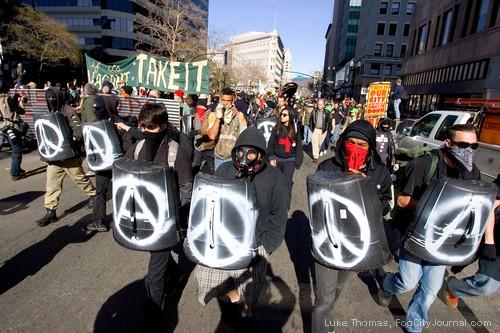
In front of the  Convention Center, police threw smoke bombs into the crowd and warned that those who refused to disperse would be arrested. The march continued around the corner to 12th St and Oak, where protesters and police were involved in another confrontation. Police shot smoke bombs and “pepper bombs,” canisters of pepper spray that explode on impact, into the crowd. Some in the march responded by throwing canisters, along with plastic bottles, back at police. Masked protesters in the front of the group brandished makeshift shields. Protesters say the shields were there to protect them from rubber bullets and bean bag rounds.

The cops had a different perspective. “It became clear that the objective of this crowd was not to peacefully assemble and march, but to seek opportunity to further criminal acts, confront police, and repeatedly attempt to illegally occupy buildings,” said Oakland Police Chief Howard Jordan in a press release.

In a tense moment, hundreds knelt to hide behind the frontline shields while police fired rubber bullets into the crowd.
When police began to advance at both the front and back end of the group, protesters retreated, marching on 12th St back to Ogawa/Grant Plaza.

As they marched on 12th street, Occupy Oakland-affiliated street medics treated injuries from tear gas, pepper spray, and rubber bullets. Police followed in the rear of the march, continuing to project exploding flash-bang grenades at the crowd.

At about 5:30, another march left from the plaza, again with the stated attention of occupying a building. Police marched behind protesters. When the march cut through Fox Square in Oakland’s Uptown neighborhood, police filled in all surrounding sides of the march. Protesters have used the term “kettling” to describe a situation in which police line up on all sides of a group, blocking anyone in the group from leaving.
After “kettling” hundreds of protesters at this location, police began to deploy tear gas. Some protesters with makeshift plastic and metal shields, many marked with the “circle-A” anarchy symbol, advanced towards police. Several police beat the shield back with batons and struck some protesters.

One 19-year-old woman who was struck with a baton to the kidneys was brought to the hospital and treated for internal bleeding.
At Fox Square, police announced that the gathering was an unlawful assembly. Minutes later, some protesters knocked over a line of chain-link fencing, allowing the march to exit the “kettle.” The march continued on Telegraph.

When the march arrived at Broadway between 22nd and 23rd streets, protesters asked to be let into the YMCA and someone who was in there opened the doors. Police later closed in on both sides until they had formed a line preventing the approximately 400 protesters from exiting.

On Broadway, there was no dispersal order issued. This is in violation of the Oakland Police Department’s crowd control policy, which states that “If after a crowd disperses pursuant to a declaration of unlawful assembly and subsequently participants assemble at a different geographic location where the participants are engaged in non-violent and lawful First Amendment activity, such an assembly cannot be dispersed unless it has been determined that it is an unlawful assembly and the required official declaration has been adequately given.”

About 6:30 p.m., police announced that all of the blocked-in group was under arrest.

It was more than six hours before the sidewalk was cleared of all detainees. Most are charged with failure to disperse. Some, such as those who entered the YMCA, have been charged with burglary.

Dozens of protesters who had avoided arrest marched back to City Hall. There, they illegally entered the building and committed several acts of vandalism. According to a press release, these included “breaking an interior window to a Hearing Room, tipping over and seriously damaging the historic model of City Hall, destroying a case containing a model of Frank Ogawa Plaza, and breaking into the fire sprinkler and elevator automation closet.” Protesters also report setting off fireworks in the counsel chambers.

Some protesters took an American flag from City Hall and burned it in front of the government building.

Oakland officials have complained about the cost of the protests. The city had reportedly spent $2.4 million policing Occupy Oakland protesters as of November 15, just weeks after announcing the decision to close down five elementary schools to save $2 million.
Occupy activists say the huge — expensive — police presence is an overreaction.

“The amount of property damage by protesters has been minimal next to Mayor Quan’s destruction of the humanitarian Occupy Oakland community and excessive force against peaceful people, said Wendy Kenin, an Occupy Oakland spokesperson. “The City of Oakland’s commitment to militarism far outweighs its investment in schools. 

Kenin said she was back at Occupy Oakland outside City Hall, with her four children, the day after the incidents.
There were no arrests made in the City Hall incident, partly because so many police resources were deployed at the YMCA.

Cities and counties that provided police reenforcements to handle the mass arrests include Alameda County, San Mateo County, Santa Clara County, San Francisco County and Marin County and the cities of Fremont, Hayward, Berkeley, Pleasanton, San Francisco and Union City/Newark; and the University of California-Berkeley, according to an Oakland Police Department press release. 

Dozens of those detained were brought to Glenn Dyer jail, which quickly filled up; the rest were brought to Santa Rita jail in Dublin.
Several members of the press, as well as passers-by who were on their way to work in the area, were swept up in the arrests.

In jail, those detained debated tactics involved in the day’s demonstrations and discussed the future of Occupy Oakland.

The number of injured protesters is unknown, but in the 19-person sampling of arrestees with whom I spent 20 hours, two had bruises from baton strikes, one suffered from an injured foot after a pepper-bomb exploded upon impact with her ankle, and most had irritation in their eyes, ears, and throat from exposure to tear gas and pepper spray.

Oakland police report that three officers were injured.

As of the morning of Jan. 30, about 100 remained in Santa Rita.

This is our country, too: Fred Korematsu’s daughter on her father’s civil rights legacy

1

“One never knows after someone dies what happens to their legacy. Sometimes it becomes a part of history and sometimes it grows,” Karen Korematsu -remarked in a phone interview with the Guardian this week. Her father, civil rights activist Fred Korematsu, will be honored statewide with his own official day on Mon/30. You can celebrate his legacy locally at the Oakland Museum of California’s Lunar New Year event on Sun/29, where Karen will be speaking about her dad’s contribution to our cultural heritage.

“In the case of my father, his legacy seems to be growing,” Karen continued. “His story resonates and remains important to people.” Last year was the first time California celebrated the Fred Korematsu Day of Civil Liberties and the Constitution. This year, events from a photo exhibition in the Smithsonian National Portrait Gallery, panel discussions, and teacher workshops in Humboldt, San Diego, Davis, San Francisco, and San Jose will commemorate his work.

The Oakland Museum of California’s celebration will be especially meaningful — Korematsu was born and raised in Oakland.  The event will include remarks from Oakland Mayor Jean Quan, a talk by Karen, performances by students from the Korematsu Discovery Academy in Oakland, vocalist Shirley Kazuyo Muramoto, and koto player Brian Mitsuhiro, and a screening of the Emmy Award-winning Of Civil Wrongs and Rights: the Fred Korematsu Story.

The elder Korematsu was a civil rights hero who refused to be incarcerated in the Japanese internment camps during World War II. When President Roosevelt signed Executive Order 9066 on February 19, 1942 requiring Japanese Americans to be placed in internment camps, the 23-year-old Korematsu refused to report. He attempted to continue his life as a normal American citizen, but was spotted and arrested in San Leandro three months later. Convicted for violating military orders, he lived for several months at the Tanforan assembly center in San Bruno and subsequently was transferred to Topaz, Utah — one of the 10 incarceration camps that were set up for Japanese Americans during WWII — where his family was also being held. 

Korematsu refused to let go of the belief that his civil liberties as guaranteed by the constitution were being directly violated. He appealed his case to the U.S. Supreme Court to no avail. 

That is, until 1983, when researcher Aiko Herzig-Yoshinaga and professor Peter Irons brought to light previously-suppressed documents detailing the FBI and military intelligence agencies’ conclusion that Japanese Americans were not threats to national security. 

Korematsu’s case was re-opened by a legal team of pro bono attorneys and at long last, his conviction was overturned in a federal court in San Francisco. In 2011, the U.S. Department of Justice released an admission of error in the case of the Japanese American internment camp. 

Karen is disappointed that her father didn’t live to see the apology. But she sees the confession as an important step towards bringing “accountability to people in government who need to take responsibility in making sure that decisions are always in the best interests of all Americans.”

She holds that actions like those of her father are especially relevant today, in these times of anti-immigrant sentiment. “He took a stance against racial profiling in issues such as national security and immigration,” she said. 

Following 9/11, Fred, along with the Japanese American Citizen League, spoke out against the national security measures the U.S. government was taking towards Muslim inmates being held at Guantanamo Bay. He became an active member of the National Coalition for Redress and Reparations. He assisted in the passage of a bill that prompted an official apology from the U.S. government, granting $20,000 for each surviving Japanese American who was incarcerated.

Today, Fred’s legacy lives on through the work of the Korematsu Institute. Founded in 2009 through the Asian Law Caucus, the institute’s mission is to advance pan-ethnic civil and human rights through education. 

Karen said that one of the many ventures of the institute is creating supplemental curriculum for K-12 schools to provide historical information that is missing in textbooks. She believes that her father’s story is an important lesson for children. “It tells the truth about American history, the Constitution, and their own backgrounds,” she said. 

Sensitive to the current financial troubles of California’s school system, the Korematsu Institute raises funds independently to create educational kits that it distributes to schools free-of-cost. 

Upon her father’s death, Karen believed that she had been passed on the torch in terms of challenging prejudice through education — so that nothing similar to the Japanese internment camps will ever happen again. “It’s heartwarming to tell my father’s story and see his legacy grow,” she concluded.


Lunar New Year celebration

Sun/29 noon-4:30 p.m., free with museum admission

Oakland Museum of California

1000 Oak, Oakl.

(510) 318-8400

www.museumca.org


Dome rock

2

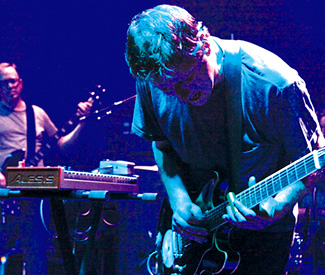
MUSIC “I don’t know if you’ve ever been in a geodesic dome,” says drummer-guitarist Andy Duvall, formerly of Zen Guerilla, and currently one third of the improvisational space rock outfit Carlton Melton. “But if you stand right in the middle, there’s a sweet spot.”

Carlton Melton records all its stripped down, lo-fi material in a dome house located a few hours north of here, though the three mainstays — Duvall, Rich Millman, and Clint Golden — call Oakland and San Francisco home. As for their process: “We just go up, hang out, and record all weekend. It’s very sloppy in many ways but I’ve always been a fan of slop. I think perfection can be a little boring.”

During recording other musician pals drop in and out. Live, the trio switches up the instrumentation mid-set. Duvall, a gifted, frenetic drummer influenced by Colm Ó Cíosóig of My Bloody Valentine among others (“[He’s] completely overlooked when people talk of their brilliance”), added guitar to his repertoire for Carlton Melton. The band will again show its live prowess locally this Saturday at El Rio.

In the few years since the vocal-less act formed in 2008 — I use “formed” tentatively, as it was more of a natural progression than the word implies — it’s released a cluster of DIY material on indie labels and its own, Mid-To-Late Records. There was the initial, 2008 “Live in Point Arena” CD-R, an Empty Shapes split LP, another split with Qumran Orphics and a few seven-inches on SF’s Valley King Records and the Irish Trensmat Records (which specializes in “transmitting drone, noise, oscillations and grooves”), both in 2011. In 2012 they’ll put out yet another long-player (already recorded), likely in spring, and are currently hammering out the details for a European tour.

Last year also saw the release of the swirling, spacey Country Ways LP, a record that begins with the 20-minute titular track, a slow-building stunner of dangling drums and psychedelic guitar with the irregular cosmic zap. A track that seemingly has no beginning or end, with the foggy vortex of pleasing chords hanging on for eternity, it’s trance-like, sensory, afferent. And something clicks when you remember they made this sound while cracking beers amongst friends over a few days in a specially-shaped structure.

The band actually came to be because of the dome. After Zen Guerrilla — a band that, should be noted, amassed many local fans and was a 2001 GOLDIES winner — split up in 2003, Millman was busy raising his two kids. Duvall was happily spending time with his girlfriend and their two cats, Gerard and Cheval. In 2008, Millman called Duvall, and asked if he’d want to start playing again. He agreed but it was mostly to jam with an old friend, the opposite of a definition band. The two, now both 44, who first began creating music together in 1990 when they lived in Delaware, talked to the owner of the dome and said “hey, we’re going to come up and bring some amps and make a bunch of noise at your place, do you mind?”

Back to that sweet spot — it naturally enriches sound. “If you’re talking, your voice just instantly amplifies. Same thing happens with music, you’re playing guitar and it’s just swirling around in the dome. It’s sort of ideal for psychedelic music.” says Duvall in a phonecall from his home in Oakland.

That first night up north was magic. They realized they needed name. Duvall, with all his genial charm recalls the conversation then whispers “Carlton Melton.” Melton was a cool guy he knew from junior high in Delaware, a real bad-ass. Strangely, Millman, who went to another school, also knew Melton in Delaware — they’d played one another in football. Years later, Duvall and Melton happen to meet another dude named Carlton Melton, and that last bit of coincidence seems to have sealed the name’s fate. “It’s bizarre but it really fits the band. I just hope the guy from Delaware’s not offended, because we named the band after him for all the right reasons.”

CARLTON MELTON

With Feral Ohms, and Glitter Wizard

Sat/28, 9 p.m., $8

El Rio

3158 Mission, SF

www.elriosf.com

How should San Franciscans vote?

36

The Board of Supervisors Rules Committee will consider competing proposals for changing how elections are conducted in San Francisco tomorrow (Thu/26) at 2 p.m., taking public testimony and voting on which ideas should go before voters in June.

Sups. Sean Elsbernd and Mark Farrell propose to end the ranked-choice voting (RCV) system and go back to runoff elections, while Sups. David Campos and John Avalos propose modifying RCV to allow more than three candidates to be ranked and changing the public campaign financing system to make qualifying more difficult and thus thin the electoral herd a bit. They would also consolidate odd-year elections for citywide offices into a single year, a proposal that Sup. Scott Wiener is also offering as a stand-alone measure.

“We believe our current election system fundamentally works. However, we heard concerns from voters during our last election that it was difficult to discern the different ideas and ideologies of the numerous candidates in the race. We are introducing an ordinance today that is designed to address this concern,” Avalos said in a public statement on Jan. 10 when their measure was introduced.

That package came in reaction to the proposal to repeal the RCV system that voters approved in 2002, a campaign that has been strongly promoted for years by political moderates, downtown groups such as the San Francisco Chamber of Commerce, and the San Francisco Chronicle and other mainstream media outlets.

During a forum at the San Francisco Planning and Urban Research Association last week, Elsbernd debated Steven Hill – the author and activist who created the city’s RCV system – on the issue. Much of it came down to differences over how to gauge the will of voters and allow them to make good decisions.

Hill’s argues that runoff elections – which have traditionally been held in December, although the current proposal could create either June/November or September/November elections – tend to have very low turnout of voters (who tend to be more white, rich, and conservative than in general elections). And they are usually dominated by nasty, corporate-funded independent expenditures campaigns designed to sully the more progressive candidate.

“Let’s face it, December was just a terrible time of year for an election,” Hill said, adding that September would be just as bad, June is too early, and both options would also likely have low turnouts.

Hill said that while RCV may have flaws, so does every electoral system, but that RCV is an accurate gauge of voter preference. He displayed charts and statistics showed that the winning candidate in every election since RCV started has won a majority of the continuing ballots, which are those that remain after a voter’s first three choices have been eliminated.

But Elsbernd seized on that idea to say, “Continuing ballots, that’s what this issue is all about.” He made the distinction between continuing ballots and total ballots cast, saying the latter is what’s important and that few winners under RCV receive a majority of total ballots cast.

“Our elected officials should be elected by a majority of the votes cast,” Elsbernd said.

He said that runoff elections offer voters a clear distinction between different candidates and their ideologies, and he even dangled a proposition that might have appealed to progressives in the last mayor’s race: “Wouldn’t we have loved our month of Ed Lee debating John Avalos about the future of San Francisco?”

Elsbernd cited crowded field free-for-all races like the District 10 race of 2010, in which Malia Cohen came from behind to win using RCV, saying they muddy up the contests. “The benefit of the runoff is you get that true one on one,” Elsbernd said, calling for “real discussion, real debates, about what San Franciscans want.”

Yet Hill said the crowded fields of candidates in some recent races wasn’t caused by RCV, a system that promotes real democracy by giving voters more than one choice of candidates rather than being stuck with the lesser of two evils. And rather than showing the problems with RCV, Hill said Cohen’s election (an African-American woman elected to serve a largely African-American district) and that of Mayor Jean Quan in Oakland (who came from behind to beat Don Perata, who many perceived as a corrupt party boss) show how RCV can help elevate minority and outsider candidates.

All those arguments – and many, many more – will likely be made during what’s expected to be a long afternoon of public testimony.

Hot sexy events: January 18-24

0

Thankful. I am thankful for San Francisco sex. Just got back from the AVN awards in Vegas this weekend and couldn’t get over the fake boobs (literally — mountainous cleavage), rubber ducky-esque lips, and rote couplings that took over the Hard Rock Hotel for the better part of the week. Don’t get me wrong, the weekend was all kinds of wonderful and there were buffets and penthouse hot tubs filled with Tina Horn, Princess Donna, and Akira Raine — salacious tweeting and rumors of Robin Leach and deep red carpet conversations about being forced to wear condoms. But for me, SF.

Also, the trailer for James Franco’s new movie based on the life of Kink.com actress-writer Lorelei is out: 

Why am I so stoked on this city? Read on about what San Francisco does best: weird, original, affirming sex events in the City By the Bay. Here’s four reasons that’ll make you glad you’re here (pervert).


Good Vibrations’ Lakeshore store opening

Once an employee-owned store in the Mission, Good Vibes has expanded into a nationwide business, powered by an Ohio sex toy corporation, and teaching everyone from Florida to Washington about the power of gadgets in the bedroom through an award-winning sales and education website. (Read our interview with the company’s C.O.O. and staff sexologist Carol Queen here.)The empire gets one bigger today, with the opening of Good Vibes’ first Oakland brick and mortar location. Kandi Burress of Real Housewives of Atlanta will be on hand to promote her superlative line of vibrators, Bedroom Kandi

Sat/28 6-9 p.m., free

Good Vibrations

3219 Lakeshore, Oakl.

(510) 788-2389

www.goodvibes.com


Perverts Put Out: Midwinter Edition

Accepting his honor at this year’s Guardian Goldies art awards, performance provacateur Philip Huang utilized a neti pot in ways surely frowned up by the Health Department. The man is inappropriateness, embodied — just ask those “God Hates Fags” people, he’s crashed their protests with a colander head, carrying a sign that says “No Fags on the Moon.” So what does a Huang do at a reading made for and by pervy weirdos? You’ll just have to attend the latest edition of Perverts Put Out, to find out. Tonight’s event also features sexy solliquies by horehound stillpoint, Sherilyn Connelly, and Jen Cross. 

Sat/28 7:30 p.m., $10-15

Center for Sex and Culture

1349 Mission, SF

www.sexandculture.org


John Leslie one-year memorial

Harken back to your best memories of golden age porn star John Leslie, who passed away in 2010. Center for Sex and Culture will be hosting this memory circle for friends of his work — which includes Talk Dirty To Me (1980), Nothing To Hide (1981), and Talk Dirty To Me, Part II (1982). One of the first actor-cum-director hyphenates in adult film, the man was big back in the days of well-budgeted productions. Perhaps this will also be a look back on the long, strange road the porn industry has traveled over the past few decades (after all, Leslie did finish out his career directing gonzo releases). 

Sun/29 5:30 p.m., free

Center for Sex and Culture

1349 Mission, SF

(415) 902-2071

www.sexandculture.org


[SSEX BBOX] premiere 

Name the sexiest cities in the world. Did Sao Paolo, Berlin, and San Francisco make it on there? They’re the obvious choices, of course — and fertile territory for this global documentary project. The team behind [SSEX BBOX] chased tail around the globe, chatting with all orientations and genders about what makes them tingle below (above) the equator.

Mon/30 8:30 p.m., free

Center for Sex and Culture

1349 Mission, SF

(415) 902-2071

www.ssexbbox.com


Occupy is back — with horns and glitter

8

yael@sfbg.com

On Jan. 20, hundreds of activists converged on the Financial District in a day that showed a reinvigorated and energized Occupy movement.

The day of action was deemed “Occupy Wall Street West.” Despite pouring rain, the numbers swelled to 1,200 by early evening.

Critics have said that the Occupy movement is disorganized and lacks a clear message. Some have decried its supposed lack of unity. Others have even declared it dead.

But the broad coalition of community organizations that came together to send a message focused on the abuses of housing rights by corporations and the 1 percent sent a clear message:

The movement is very much alive.


A FULL SCHEDULE

Protesters packed the day with an impressive line-up of marches, pickets, flash mobs, blockades, and everything in between.

The action began at 6:30 a.m., when dozens chained and locked themselves together, blocking every entrance to Wells Fargo’s West Coast headquarters at 420 Montgomery Street. The bank didn’t open for business that morning.

Another group of protesters did the same thing at the Bank of America Building around the corner. A dozen blockaded one of the bank’s entrances from 8:30 a.m. to 6 p.m., preventing its opening. A group organized by Act Now to Stop War and End Racism (ANSWER) closed down the Bank of America branch at Powell and Market for several hours.

The Bank of America branch at Market and Main was also closed when activists turned it into “the Food Bank of America.” Several chained themselves for the door, while others set up a table serving donated food to hundreds of people.

Meanwhile, activists with the SF Housing Rights Coalition and Tenants Union occupied the offices of Fortress Investments, a hedge fund that has overseen the destruction of thousands of rent controlled apartments at Parkmerced. Direct actions also took place at the offices of Bechtel, Goldman Sachs, and Citicorp.

Hundreds picketed the Grand Hyatt at Union Square in solidarity with UNITE HERE Local 2 hotel workers.

A group of about 600 left from Justin Herman Plaza at noon and marched to offices of Fannie Mae, Wells Fargo, and the Immigration and Customs Enforcement Agency (ICE) in a protest meant to draw attention to housing and immigrant-rights issues.

“It’s not just a corporate problem. The government has been complicit in these abuses as well,” said Diana Masaca, one of the protest’s organizers.

More than 100 activists from People Organized to Win Employment Rights (POWER) and the Progressive Workers Alliance “occupied Muni,” riding Muni buses on Market Street with signs and chants demanding free transit for youth in San Francisco.

Another 200 participated in an “Occupy the Courts” action at the Ninth Circuit Court of Appeals, in protest of the Citizens United Supreme Court decision and corporate personhood.


GLITTER AND BRASS

Exhausted, soaked protesters managed to keep a festive spirit throughout the day, with colorful costumes, loud music, and glitter — lots of glitter.

The Horizontal Alliance of Very Organized Queers (HAVOQ) and Pride at Work brought the sparkly stuff, along with streamers and brightly colored umbrellas, to several different actions. Many painted protest slogans onto their umbrellas, proclaiming such sentiments as “I’ll show you trickle down” and “Not gay as in happy, queer as in fuck capitalism.”

According to protester Beja Alisheva, “HAVOQ is about bringing fabulosity to the movement with glitter, queerness, and pride. All day we’ve been showing solidarity between a lot of different types of oppression.”

There was also the Occupy Oakland party bus — a decked-out former AC transit bus — and carnival, a roving party that shut down intersections and bank entrances in its path while providing passengers a temporary respite from rain.

The Brass Liberation Orchestra, a radical marching band that has been energizing Bay Area protests for a decade, showed up in full force with trumpets, drums, trombones, and a weathered sousaphone.

The Interfaith Allies of Occupy also used horns to declare their message. About 30 participated in a mobile service, sounding traditional rams’ horns and declaring the need to “lift up human need and bring down corporate greed.”

Said Rabbi David J. Cooper of Kehela Community Synagogue in Oakland: “Leviticus 19 says, do not stand idly by in the face of your neighbor’s suffering. Well, we’re all neighbors here. Ninety-nine percent of us are suffering in some way, economically or spiritually. And maybe that number is 100 percent.”


FOCUS ON HOUSING

A coalition called Occupy SF Housing called for and organized the day of action, but the messages ranged from environmental to anti-war to immigrant rights.

Many groups did focus in on housing-related issues — and a takeover of a vacant hotel building stressed the urgency and need to house homeless San Francisco residents.

Housing protests included an anti wage-theft occupation led by the Filipino Community Center and the National Alliance for Filipino Concerns at the offices of CitiApartments, an action at the offices of Fortress Investments to demand a halt to predatory equity, and an “Occupy the Auction” demonstration in which protesters with Occupy Bernal stopped the day’s housing auction (at which foreclosed homes are sold) at City Hall.

“A lot of the displacement in this city is happening because of banks and because of things that are out of peoples’ control,” said Amitai Heller, a counselor with the San Francisco Tenants Union. “People will live in a rent controlled apartment for 20 years thinking that they have their retirement planned. A lot of the critiques of the movement are, if you couldn’t afford it you should move. But these people moved here knowing they could afford it because of our rent controls.”


LIBERATE THE COMMONS

Most of the early protests drew a few hundred people. But when the 5 p.m. convergence time rolled around, many people got off work and joined the march. A rally at Justin Herman Plaza brought about 600; by the time the march joined up with others at Bank of America on Montgomery and California, the numbers had doubled.

The evening’s demonstration, deemed “liberate the commons,” was also more radical than other tactics throughout the day; organizers hoped to break into and hold a vacant building, the 600-unit former Cathedral Hill Hotel at 1101 Van Ness.

When protesters arrived at the site, police were waiting for them. Wearing riot gear and reinforced by barricades, the cops successfully blocked the Geary entrance to the former hotel.

The darkness, rain, and uncertainty created a chaotic environment as protesters decided how to proceed. Some attempted to remove barricades; others chanted anti-police slogans.

Soon, cries of “Medic! We need a medic!” pierced the air. A dozen or so protesters had been pepper sprayed.

Police Information Officer Carlos Manfredi later claimed that the pepper spray was in response to “rocks, bottles and bricks” thrown by protesters. He also claimed that one officer was struck in the chest by a brick, and another “may have broken his hand.”

But I witnessed the entire incident, and I can say that no rocks, bottles or bricks were thrown at police.

When protesters opted to march down Van Ness, apparently towards City hall, several broke windows at a Bentley dealership at 999 Van Ness.

The march then turned around and headed back up Franklin, ending at the former hotel’s back entrance. There, it became clear that some protesters had successfully entered the building; they unfurled a banner from the roof reading “liberate the commons.”

Soon, many other protesters streamed into the building. They held it, with no police interference, for several hours.

Around 9:30, police entered the building and arrested three protesters for trespassing. About 15 others remained in the building, but left voluntarily by midnight.

This building has been a target of protest campaigns in San Francisco since it was purchased by California Pacific Medical Center, which closed the hotel in 2009. There are plans underway for a hospital to open at the site in 2015.

The project has been met with opposition from unions such as SEIU United Healthcare Workers West and UNITE HERE Local 2. The California Nurses Association (CNA) has also come out against the hospital proposal. In fact, it was the target of a CNA protest earlier in the day Jan. 20, when protesters created a “human billboard” reading “CPMC for the 1 percent.”

At a Jan.18 press conference, CNA member Pilar Schiavo said that at the former Cathedral Hill Hotel site, “A huge hospital is being planned with is being likened by Sutter to a five-star hotel. At the same time, Sutter is gutting St. Lukes Hospital, which is essential to providing healthcare for residents in the Mission, the Excelsior and Bayview- Hunter’s Point.”

Homes Not Jails, a group that finds housing for the homeless, often without regard to property rights, was crucial to planning the “Liberate the Commons’ protest. The group insists that the 30,000 vacant housing units in San Francisco should be used to shelter the city’s homeless, which they estimate at 10,000.


RAINY REBIRTH

Wet and cold conditions were not what Occupy SF Housing Coalition organizers had in mind they spent weeks planning Occupy Wall Street West, which was billed as the reemergence of the Occupy Movement in San Francisco for 2012.

Yet for many, the day was still a success.

“The rain’s a downer. But I think it speaks to the power of the movement, the fact that all these people are still out getting soaked,” said Heller on Jan. 20.

Perhaps hundreds of “fair-whether activists” did forgo the day’s events to stay out of the cold. If that’s the case, then occupy protesters with big plans for the spring should be pleased.

At this rate, it seems that Occupy will survive the winter- and emerge with renewed energy in 2012.


This article has been to corrected. We originally reported that a demonstration at the offices of Citi Apartments was led by the Chinese Progressive Association (CPA). In fact, it was led by the Filipino Community Center and the National Alliance for Filipino Concerns, and supported by a number of organizations including the Progressive Workers Alliance, of which CPA is a member organization. We regret the error.

Whatever happened to Baby Jaymes?

1

arts@sfbg.com

MUSIC One day in November 2004, my then-girlfriend returned to our Oakland apartment all excited. “I just heard this on KMEL,” she said. She handed me a CD, Baby Jaymes, Ghetto Retro (Underground Soul), while she unwrapped the included Ghetto Retro EP and cued up “Nice Girl.” “He sounds like Prince,” she enthused—we were Prince geeks—”but he’s from East Oakland!”

Something in the way the vocals were layered, the tasty guitar and bass details under aloof keyboards, and the idiosyncratic, non-pimp, non-player personality that disclosed itself seemed to justify the comparison, particularly as we moved on to the LP. The hidden track “Ev’ry Nuance,” for example, could be a Lovesexy outtake, even as its more lo-fi aesthetic seemed to allude knowingly to 1999-era bootlegs.

http://www.youtube.com/watch?v=YJrO8GoozIE

Comparisons to Prince would be made in nearly every review of Ghetto Retro, though the insistence was a little misleading. While Prince is definitely an influence, BJ — as he’s known — isn’t especially well-versed in the Purple One’s catalog. Some of the resemblance stems from the common influence of 1960s and ’70s soul; Motown, particularly Smokey Robinson, and Stax loom much larger for Baby Jaymes, and in many ways, the similarly pint-sized singer is the anti-Prince, possessing no conventional technical musical ability, depending on collaborators to translate the melodies and arrangements he hears in his head.

In 2007, I had the experience of watching him cajole a string trio from blank incomprehension into a soaring, unscripted overdub reminiscent of a Paul Riser classic. Yet I’ve also seen the comparatively simple matter of a guitar overdub founder for want of a common vocabulary.

“It’s all about energy to me,” BJ says, “but I can’t always articulate it in a way that musicians understand. But if I articulate it emotionally they might be like, yes! and we’re there. I used to knock myself out because I can’t play, but that’s part of my gift. I’ve gotten to the place where I’m ok with that.”

The other major difference is the difference between Minneapolis and East Oakland, for while Prince has profoundly influenced hip-hop, he’s never known what to do with it, whereas it’s second nature to BJ, hailing from the notorious Rollin’ 100s (99th and MacArthur, to be exact).

Much of Ghetto Retro is built on heavily manipulated samples, augmented with instruments, and though he’s the furthest thing from a thug — I’ve never heard him cuss, though I have heard him say “my goodness” and even “golly”—Baby Jaymes sounds entirely natural with Turf Talk on his 2008 single “The Bizness” or The Jacka on his new EP, Whatever Happened to Baby Jaymes?, released late last year on Hiero-imprint Clear Label Records.

THE SHIFT

The EP’s title, BJ admits, was the brainchild of Souls of Mischief and Hieroglyphics member and Clear Label head Tajai Massey, both punning off the Bette Davis film and nodding to the seven-year wait since Ghetto Retro. BJ initially resisted.

“I disappeared,” he admits. “But I don’t want people to think I wasn’t doing anything.”

“I was bummed out with the artist thing,” he continues. “People remember me — which is a good thing. But I couldn’t imagine life not having anonymity. To this day I can’t go anywhere in the Town without seeing at least one person that knows me. It can be overwhelming.”

BJ’s local profile, elevated by airplay on KMEL, national press from Fader and XLR8R, and even a 2005 GOLDIE, was complicated by the chronic difficulty of making money as a Bay Area urban artist. In the mid-’00s, besides longstanding major label distinterest, Bay Area independent artists suddenly saw their financial foundations crumble with the decline of CD sales.

“You have to preserve your mystique,” he says, “but you don’t have money to be that guy all the time. I might really be on the bus and you see me on the bus and it just kills my whole thing for you. So I decided I just wanted to make music, not make music to be famous.”

Instead BJ moved to L.A. to pursue licensing deals in movies and TV. Even before Ghetto Retro, he’d already tapped into Hollywood money, writing a song (“Without a Daddy” by Touché) that appears in Oliver Stone’s Any Given Sunday (1999). (His own version appears on Ghetto Retro as “Black Girl/White Girl.”) Since relocating, he’s racked up an oddball assortment of screen credits, from a few seconds of music in a Nicole Kidman vehicle (2007’s The Invasion) to production work on Fox’s intro to the 2008-09 NFC Championship broadcast (apparently Cleatus the Robot’s first foray into hip-hop).

More recently NCIS used a snippet “so small and incidental, you can barely hear it,” but this brings in incomparably more money than dropping a Bay Area hip-hop soul classic. Essentially BJ makes the bulk of his modest income off five song placements and would like to bring that number up to around 40 reliable ones, which he estimates would bring in a comfortable enough existence to fulfill his artistic ambitions.


THE PROVERBIAL RETURN

For, despite his earlier discomfort, Baby Jaymes’s artistic ambitions remain, and Tajai was able to induce him to sign to Clear Label to record a new album, for which the seven-song Whatever Happened is simply a calling card. Still, after so long a hiatus, the EP is a joy to hear. I’d wondered if BJ and long-time collaborator, producer Marc Garvey, would shy away from the sound they’d crafted in favor of something more obviously commercial, but instead they’ve dug deeper, returning to the samples-plus-hip-hop-drums core that makes Ghetto Retro feel so warm and timeless.

The single, “Heart & Soul,” captures the throbbing drama of a kind of vintage R&B that concerns matters of deeper import than Bentleys and Belvedere, serving by turns as a declaration of love and an artistic manifesto. Yet BJ also shows off a new swag with an inventive reimagining of 50 Cent’s “21 Questions” over a live band, co-produced by Ledisi mastermind Sundra Manning.

This more than anything else gives a foretaste of the album to come, judging from the unreleased tracks he played me, all of which featured live instrumentation. This is a far more expensive way to make a record, but he hopes to have complete and release it sometime in 2012.

“Honestly, if Tajai hadn’t said, ‘We should do a record, I’ll help you pay for it,’ I probably wouldn’t have been able to do it,” he says, clearly relishing the new material. “I do it for the love of music, nothing else.” *


Stage Listings

0

Stage listings are compiled by Guardian staff. Performance times may change; call venues to confirm. Reviewers are Robert Avila, Rita Felciano, and Nicole Gluckstern. Submit items for the listings at listings@sfbg.com. For further information on how to submit items for the listings, see Picks.

THEATER

OPENING

Vice Palace: The Last Cockettes Musical Thrillpeddlers’ Hypnodrome, 575 10th St, SF; (415) 377-4202, www.thrillpeddlers.com. $30-35. Opens Fri/27, 8pm. Runs Fri-Sat, 8pm. Through March 3. Thrillpeddlers revives the Cockettes’ 1972 musical extravaganza.

BAY AREA

Arms and the Man Lesher Center for the Arts, Margaret Lesher Theater, 1601 Civic, Walnut Creek; (925) 943-7469, www.centerrep.org. $38-43. Previews Fri/27-Sat/28, 8pm; Sun/29, 2:30pm. Opens Tues/31, 7:30pm. Runs Wed, 7:30pm; Thurs-Sat, 8pm; Sun, 2:30pm. Through Feb 25. Center REPertory Company presents George Bernard Shaw’s classic romantic comedy.

Body Awareness Aurora Theatre, 2081 Addison, Berk; (510) 843-4822, www.auroratheatre.org. $34-55. Previews Fri/28-Sat/28 and Feb 1, 8pm; Sun/29, 2pm; Tues/31, 7pm. Opens Feb 2, 8pm. Runs Tues, 7pm; Wed-Sat, 8pm; Sun, 2 and 7pm. Through March 4. Aurora Theatre performs Annie Baker’s comedy.

ONGOING

Cabaret Young Performers Theatre, Fort Mason Center, Bldc C, Room 300, Marina at Laguna, SF; (415) 381-1638, cabaretsf.wordpress.com. $25-45. Thurs-Sat, 8pm; Sun, 7pm. Through Feb 19. Shakespeare at Stinson and Independent Cabaret Productions perform the Kander and Ebb classic in an intimate setting.

Food Stories: Pleasure is Pleasure Z Space, Theater Artaud, 450 Florida, SF; www.brownpapertickets.com. $20-55. Wed-Thurs, 7pm; Fri-Sat, 8pm; Sun, 2pm. Through Feb 5. Word for Word presents performances of short stories by T.C. Boyle and Alice McDermott.

Future Motive Power Old Mint, 88 Fifth St, SF; www.mugwumpin.org. $15-30. Fri/27-Sun/29, 8pm. Mugwumpin takes on the life of Nikola Tesla in its latest performance piece.

*Humor Abuse American Conservatory Theater, 415 Geary, SF; (415) 749-2228, www.act-sf.org. $10-85. Tues-Sat, 8pm (also Wed and Sat, 2pm); Sun, 2pm. Through Feb 5. “This is a show about clowning,” Lorenzo Pisoni advises his audience at the outset of his graceful solo performance, “and I’m the straight man.” It’s a funny line, actually — funny because it’s true, and not true. In the deft routines that follow, as well as in the snapshots cast on the atmospherically dingy curtain hung center stage, the career of this Pickle Family Circus brat (already alone in the spotlight by age two) never veers far from the shadow of his father. That fact remains central to the winning comedy and wistful reflection in Humor Abuse. Reared in the commotion and commitment of the famed San Francisco circus founded by his parents Larry Pisoni and Peggy Snider, Lorenzo had a childhood both enviable and unusually challenging. The fact that he shares his name with both a grandfather and his dad’s famous clown persona is instructive. His trials and his triumphs are further conflated — along with his father’s —in such elegant catastrophes as falling down a long flight of stairs. And in his good-humored and honest reflections, the existential poignancy at the heart of such artful buffoonery begins to rise to the surface. The spoken narrative feels a little pinched or abbreviated, in truth, but there are no shortcuts to the skill or wider perspective inculcated by the charming Pisoni and (under direction of co-creator Erica Schmidt) set enthralling in motion. (Avila)

*New Fire: To Put Things Right Again Brava Theater, 2781 24th St, SF; (415) 647-2822, www.brava.org. $10-30. Thurs/26-Sat/28, 8pm; Sun/29, 3pm. You hear a lot of lip service these days to “community-building,” even when that community might represent the merest sliver, unable to reach out or expand beyond its own narrow parameters. That is not the kind of community playwright Cherríe Moraga is interested in paying lip service to, and her latest work New Fire reaches out in all possible directions, most notably digging deep into sacred spaces frequently left out of the conversation altogether. Structured not as a conventional (by Western standards) play, but as a healing ceremony centered around the story’s single protagonist, Vero (Dena Martinez), Celia Herrera Rodriguez’ staging and design blend seamlessly with Alleluia Panis’ ecstatic choreography to create a world where the sacred and the mundane coexist, almost unremarked, but certainly remarkably. Combining new media such as video by Emily Encina, with ancient ritual, the most electrifying moments are those rendered wholly without spoken words — the steady heartbeat of percussion, the ululation of Charlene O’Rourke’s magnificent chanting, the stealthy creeping of spirit figures whose faces are hidden by the wide brims of vibrantly painted hats. But don’t go in expecting a woo-woo, earth mother love fest: New Fire, is heavy with dark moments. But as El Caminante (Robert Owens-Greygrass) points out, such darkness can be beautiful too. (Gluckstern)

Not Getting Any Younger Marsh San Francisco, Studio Theater, 1062 Valencia, SF; (415) 826-5750, www.themarsh.org. $15-50. Fri, 8pm; Sat, 5 and 8:30pm. Extended through Feb 25. Marga Gomez is back at the Marsh, a couple of too-brief decades after inaugurating the theater’s new stage with her first solo show — an apt setting, in other words, for the writer-performer’s latest monologue, a reflection on the inevitable process of aging for a Latina lesbian comedian and artist who still hangs at Starbucks and can’t be trusted with the details of her own Wikipedia entry. If the thought of someone as perennially irreverent, insouciant, and appealingly immature as Gomez makes you depressed, the show is, strangely enough, the best antidote. (Avila)

Olivia’s Kitchen Exit Theatre, 156 Eddy, SF; www.generationtheatre.com. $20-40. Fri-Sat, 8pm; Sun, 3pm. Through Feb 19. GenerationTheatre offers this “remix” of Shakespeare’s Twelfth Night.

“SF Sketchfest” Various venues, SF; www.sfsketchfest.com. $10-75. Through Feb 4. The 11th San Francisco Comedy Festival invades 15 venues in 17 days with local and celebrity-packed (and local-celebrity-packed) performances, film events, improv shows, and more.

Waiting for Godot Royce Gallery, 2901 Mariposa, SF; (415) 336-3522, www.tidestheatre.org. $20-38. Thurs-Sat, 8pm. Through Feb 18. Tides Theatre Company debuts with a bold interpretation of the Beckett classic.

BAY AREA

Ghost Light Berkeley Repertory Theatre, Thrust Stage, 2025 Addison, Berk; (510) 647-2949, www.berkeleyrep.org. $14.50-73. Tues, Thurs-Sat, 8pm (also Sat and Feb 16, 2pm); Wed and Sun, 7pm (also Sun, 2pm). Through Feb 19. Berkeley Rep performs Tony Taccone’s world-premiere play about George Moscone’s assassination, directed by the late San Francisco mayor’s son, Jonathan Moscone.

*The Kipling Hotel: True Misadventures of the Electric Pink ’80s New venue: Marsh Berkeley, 2120 Allston, Berk; (415) 282-3055, www.themarsh.org. $20-50. Sat, 8:30pm; Sun, 7pm. Through Feb 12. This new autobiographical solo show by Don Reed, writer-performer of the fine and long-running East 14th, is another slice of the artist’s journey from 1970s Oakland ghetto to comedy-circuit respectability — here via a partial debate-scholarship to UCLA. The titular Los Angeles residency hotel was where Reed lived and worked for a time in the 1980s while attending university. It’s also a rich mine of memory and material for this physically protean and charismatic comic actor, who sails through two acts of often hilarious, sometimes touching vignettes loosely structured around his time on the hotel’s young wait staff, which catered to the needs of elderly patrons who might need conversation as much as breakfast. On opening night, the episodic narrative seemed to pass through several endings before settling on one whose tidy moral was delivered with too heavy a hand, but if the piece runs a little long, it’s only the last 20 minutes that noticeably meanders. And even with some awkward bumps along the way, it’s never a dull thing watching Reed work. (Avila)

The Pitmen Painters TheatreWorks at Mountain View Center for the Arts, 500 Castro, SF; (650) 463-1960, www.theatreworks.org. $19-69. Tues-Wed, 7:30pm; Thurs-Sat, 8pm (also Sat, 2pm); Sun, 2 and 7pm. Through Feb 12. TheatreWorks performs a new comedy from the author of Billy Elliot about a group of British miners who become art world sensations.

The World’s Funniest Bubble Show Marsh Berkeley, TheaterStage, 2120 Allston, Berk; (415) 826-5750, www.themarsh.org. $8-50. Extended run: Feb 12, 19, 26, March 11, and 18, 11am. Louis “The Amazing Bubble Man” Pearl returns with this kid-friendly, bubble-tastic comedy.

PERFORMANCE/DANCE

“The Best of Times” Alcazar Theatre, 650 Geary, SF; www.42ndstmoon.org. Thurs/26, 7pm. $70. 42nd Street Moon salutes Tony-winning Broadway composer-lyricist Jerry Herman.

“The Eric Show” Milk Bar, 1840 Haight, SF; www.milksf.com. Tues, 8pm (ongoing). $5. Local comedians perform with host Eric Barry.

“Father Panic!” Garage, 975 Howard, SF; (415) 518-1517, www.975howard.com. Fri/27-Sat/28, 8pm, $15. Dan Carbone’s latest autobiographical performance piece.

“Hidden Classics Reading Series” Exit on Taylor, 277 Taylor, SF; www.cuttingball.com. Sun/29, 3pm. Free. Cutting Ball Theater presents two August Strindberg readings: Miss Julie and A Dream Play.

“Loved By You: A Self-Love Story” TJT, 470 Florida, SF; www.brownpapertickets.com. Sat/28-Sun/29, 8pm. $15. Lori Shantzis performs her solo show about self-acceptance.

“Musicircus” Walt Disney Family Museum, 104 Montgomery, the Presidio, SF; www.calartsf.net. Sat/28, 1:30-5:30pm and 6-9pm. Free. CalArts Alumni and the Walt Disney Family Museum present this marathon performance event and showcase concert.

Paufve Dance Dance Mission Theater, 3316 24th St, SF; www.brownpapertickets.com. Fri/27-Sat/28, 8pm; Sun/29, 7pm. $15-18. The company premieres the dance theater work So I Married Abraham Lincoln.

“The Rivalry” Kanbar Hall, Jewish Community Center of San Francisco, 3200 California, SF; www.jccsf.org. Sun/29, 4pm. $42-55. LA Theaterworks presents this performance of Norman Corwin’s depiction of the Lincoln-Douglas debates.

“The XXX Factor” Eureka Theater, 215 Jackson, SF; www.ticketweb.com. Tues/31, 8pm, $15. Comedy Noir performs a new show satirizing televised talent contests (with “mentors” Sarah Palin and John Wayne Gacy, among others).

BAY AREA

Company C Contemporary Ballet Castro Valley Center for the Arts, 19501 Redwood, Castro Valley; (510) 889-8961. Sat/28, 7:30pm and Sun/29, 2pm. $15-27. Also Feb 17, 8pm; Feb 18, 6:30pm (gala benefit); and Feb 19, 3pm, $23-175. Yerba Buena Center for the Arts, 701 Mission, SF; (415) 978-2787. The company opens its 10th anniversary season.

“The Gondoliers” Lesher Center for the Arts, 1601 Civic, Walnut Creek; www.lamplighters.org. Fri/27-Sat/28, 8pm (also Sat/28, 2pm); Sun/29, 2pm. $20-53. Lamplighters Music Theatre performs the Gilbert and Sullivan operetta.

“Lycanthropos: The Werewolf in Story and Song” Parish Hall, St. Alban’s Church, 1501 Washington, Albany; (510) 528-1685. Sun/29, 7pm. $25-30. Tim Rayborn uses spoken word, song, and exotic instruments to illuminate the werewolf legend, from the Middle Ages to the Renaissance.

“Saturday Night Special: Broken Resolutions” Nick’s Lounge, 3218 Adeline, Berk; www.nickslounge.com. Sat/28, 7-9:30pm. Free. Open mic featuring LJ Moore and Chanel Timmons.

“What’s Strunk and White, and Read All Over?: The Elements of Style” Pegasus Books Solano, 1855 Solano, Berk; www.1stpersonsingular.com. Wed/25, 7:30pm. Free. Calling all copy editors: First Person Singular dramatizes The Elements of Style.

On the Cheap Listings

0

Submit items for the listings at listings@sfbg.com. For further information on how to submit items for the listings, see Picks.

WEDNESDAY 25

Bring Me Men: Military Masculinity and the Benign Facade of American Empire author presentation University Press Books, 2430 Bancroft Way, Berk. (510) 548-0585, www.universitypressbooks.com. 6-7:30 p.m., free. Author Aaron Belkin explores the hyper-masculine construction of our armed forces, and the glaring contradictions that lie therein.

Ryan Boudinot’s Blueprints of the Afterlife reading Booksmith, 1644 Haight, SF. (415) 863-8688, www.booksmith.com. 7:30 p.m., free. The apocalypse is undeniably white-like-fire hot these days, what with it being about to happen in 11 months and all. Author Ryan Boudinot is happy to get your cognitive juices flowing on the matter – his new book Blueprints of the Afterlife takes place during the days when glaciers are ravaging the United States’ landscape and human beings’ nervous systems can be hacked.

THURSDAY 26

Author reading: James Martel on Walter Benjamin’s anti-sovereignty theories University Press Books, 2430 Bancroft Way, Berk. (510) 548-0585, www.universitypressbooks.com. 6-7:30 p.m., free. SF State associate professor of political science Martel has written a pair of books that look to dismantle the false choice we are presented between anarchy and sovereignty. His solution to these limited options: the divine game-changing forces presented in the works of German-Jewish intellectual Walter Benjamin.

“Picturing the Contemporary Arts in Ms. Magazine: A Chronological Journey” art exhibit Yerba Buena Center for the Arts, 701 Mission, SF. (415) 978-2700, www.ybca.org. Through Sun/29. Thu-Sat, noon-8 p.m.; Sun, noon-6 p.m. Since founding editor Gloria Steinham’s talk at Stanford University today is sold out, get your 40 years of Ms. Magazine fix at this free art exhibit, for which YBCA has bedecked its lobby with iconic images from the last four decades of the seminal feminist publication.

“Sex Work and Consent” conversation Center for Sex and Culture, 1349 Mission, SF. www.sexandculture.org. 8 p.m., $10 suggested, no one turned away for lack of funds. Sex workers and community leaders will gather round to discuss consent-rape culture in our society – and there will be a Good Vibrations swag raffle to boot.

Lily Renée, Escape Artist: From Holocaust Survivor to Comic Book Pioneer author presentation Cartoon Art Museum, 655 Mission, SF. (415) CAR-TOON, www.cartoonart.org. 7-9 p.m., free. Trina Robbins wrote (and drew) the book on Renée, a 14-year-old Austrian Jewish girl who fled the Nazis, only to become a dynamic member of the 1960s underground comic scene.

SATURDAY 28

“The Wisdom of Compassion: Teachings with Patrick Gaffney” Rigpa San Francisco Center, 111 New Montgomery, SF. (866) 200-5876, www.rigpabayarea.org. 10 a.m.-5 p.m., free-$50 sliding scale. Sogyal Rinpoche’s most senior student (co-editor of Rinpoche’s The Tibetan Book of Living and Dying) teaches on how to get meditation and compassion into your life in a meaningful way.

“All You Can Dance For $5” Alonzo King LINES dance marathon Alonzo King LINES Dance Center, 26 Seventh St., SF. (415) 863-3040 x221, www.linesballet.org. 1-5 p.m., $5. Never mind lapsed New Year’s resolutions: this afternoon-long event will get you sweating without all that silly gym-angst (or sign-up fees). The well-loved dance company is offering a sampling of its classes – from hip-hop and ballet, to modern and jazz.

Treasure Island Flea Market One Avenue of the Palms, Treasure Island. www.treasureislandflea.com. Also Sun/29. 10 a.m.- 5 p.m., free. Though it’s moved indoors until March, Treasure Island’s oasis of all things old and unique continues to be your go-to monthly spot for quirky home furnishings, bike, clothes, and all kinds of more.

Golden Gate Kennel Club Dog Show Cow Palace, 2600 Geneva, Daly City. www.goldengatekc.com. Also Sun/29. 8:30 a.m.-5 p.m., $12. A plethora of historic events fill the Cow Palace each year — the Grand National Rodeo, weed expos galore, Cirque Du Soliel – but few feature arenas full of fluffy yappers. This dog show is over 100 years old, but still has new tricks. Among the breeds that will be featured for the first time in 2012 are the Swedish valihund and the cane corso.

Good Vibrations Lakeshore Avenue opening party Good Vibrations, 3219 Lakeshore, Oakl. www.goodvibes.com. 6-9 p.m., free. If the born-in-SF sex toy brand’s continued world domination — and new Oakland store — isn’t enough cause for celebration, know that Kani Burress of Real Housewives of Atlanta will be in attendance today, hyping her toy line Bedroom Kandi.

SUNDAY 29

Oakland Museum of California’s Lunar New Year celebration Oakland Museum of California, 1000 Oak, Oakl. (510) 238-2200, www.museumca.org. Noon-4:30 p.m., free with $12 museum admission. Learn to pound mochi, take in Korean drumming and storytelling performances, and get educated on the meaning of Fred Korematsu Day through a presentation by the daughter of the civil rights activist who fled when the US government ordered all Japanese-Americans placed in internment camps during WWII. It’s all here at this event to celebrate the entering of (the year of) the dragon.

MONDAY 30

[SSEX BBOX] sexuality documentary premiere Center For Sex and Culture, 1349 Mission, SF. www.sexandculture.org. 7:30-10 p.m., free. Witness the culmination of this international film project’s world travels, in which its team talked about living and loving outside the box with sex educators, writers, and just plain old hotties. You’ll have the opportunity to meet the director and crew after the film’s screening.

Legal, not legal

4

caitlin@sfbg.com

HERBWISE It’s been a weird year to start a marijuana column. Shortly after we started Herbwise, which was intended to be our weekly look at marijuana culture and events, politics reared its ugly head, rendering it necessary to go to hearings at the State Building, call up California Assembly members, and occasionally wade through seas of legalese. Such is the state of cannabis under ongoing federal prohibition, but it’s been a particularly dramatic year.

And in some moments, news and culture reporting melded together in the marijuana world. Take, for example, the case of Oakland’s Harborside Health Center, which is often called the largest dispensary in the world (it is certainly the largest in California). After years of painstakingly crafting a working relationship with city government, the business was heavily audited by the IRS. The federal agency decided Harborside — and 40 other California dispensaries — fell under the jurisdiction of Section 280E of the Internal Revenue Code, which denies the right for businesses involved in illegal drug trafficking to claim standard business expenditures. The collective now owes $2.4 million in back taxes, an amount that founder Steve DeAngelo asserts will bankrupt it if his business is forced to pay up.

Despite the ever-growing acceptance of the plant in the United States — a Gallup poll put the number at 50 percent in the fall of 2011 — medical marijuana is under attack by the federal government. Last fall, US Attorney for Northern California Melinda Haag sent out letters to the landlords of roughly a dozen Bay Area dispensaries threatening them with civil forfeiture, or possibly four decades in prison, if they failed to move this “trafficking” off their property within 45 days. The letters targeted dispensaries considered to be in a school zone.

Most left without a fight. In San Francisco, the Tenderloin’s Divinity Tree Patients Wellness Cooperative, the Market Street Collective on Upper Market, and the Mission District’s Medithrive and Mr. Nice Guy were among the businesses that shut their doors, some completely and some to transition into delivery-only services. [UPDATE: Attorney Matt Kumin tells the Guardian that Divinity Tree and Medithrive have filed a “coordinated federal lawsuit” through his office in protestation of the closures]

Fairfax’s sole dispensary, Marin Alliance for Medical Marijuana, was forced to close after 15 years of legal operation overseen by long-time cannabis activist Lynette Shaw. The 7,500-person Marin County berg’s town council passed a resolution supporting the Alliance, which served as a symbol of popular support for legal cannabis in a county beset with some of the highest breast cancer rates in the country.

Assemblymember Tom Ammiano and Sen. Mark Leno have been the most outspoken California politicians in coming out against the federal government’s meddling with the state’s cannabis. At a press conference at San Francisco’s State Building in October 2011, Ammiano announced his frustration that the feds would “upset the will of the people” by curtailing safe patient access. Proud to be an elected gay official, he promised to continue to crusade for an issue that he says disproportionately affects the LGBTQ community.

One of the steps Ammiano took was to meet with Haag to discuss what could be done to assuage her concerns with the industry. “That was very, very disappointing,” Ammiano commented on this initial talk. In a recent phone interview with the Guardian, he remembered that Haag implied that the order was coming from above, from high up in the Obama Administration.

Ammiano doubts her assertion that she had little discretion in the matter. “She said she was only doing what the boss was telling her to do. We had a hard time with that.”

He does think that the Obama Administration is sending its attorneys mixed messages — case in point, US Attorney General Eric Holder’s repeated comments that federal interference in state-legal marijuana operations would be “a low priority.” Ammiano also makes the connection between the attacks on cannabis and the self-sustaining industries behind the War on Drugs. “The DEA, some of the diehards, this is like a jobs program for them,” he said.

His meeting with California Attorney General Kamala Harris went more smoothly. Ammiano says Harris, who voiced cautious support for the industry last fall, was eager for a more comprehensive regulatory system to be put into place, but she supported Proposition 215 — the 1996 measure that legalized medical marijuana in California — on principle.

Faced with an ambiguous future, medical cannabis’ proponents — politicians, activists, entrepreneurs, and patients — are putting forth plans for just such a system. This year will be the playing field for a passel of campaigns to take medical marijuana out of the under-supervised arena in which it’s found itself.

Three ballot initiative campaigns seek to address the issue. Two — Regulate Marijuana Like Wine and Repeal Prohibition — would legalize cannabis use for adults across the board. Another, which has perhaps the most likely chance to succeed in the $2 million process of getting onto the ballot, is being put forth by patient advocacy group Americans for Safe Access, the United Food and Commercial Workers (the union that represents many cannabis workers in California), and marijuana collectives. It’s called the Medical Marijuana Regulation, Control, and Taxation Act.

“We decided to focus on medical because we figured that taking that further step at this point is unwise given the federal government’s actions over the last months,” said attorney George Mull, who is part of the team that proposed the measure. If passed, the initiative would establish a 21-member state regulatory board comprised of doctors, industry folk, patients, activists, government officials, and others. A state supplemental tax on cannabis would be levied and local governments would be required to allow one dispensary per 50,000 residents. Ammiano said that he and Leno were also working on proposing legislation that would provide regulations.

But the future of medical marijuana in California remains somewhat cloudy. “I’m worried that even if we come up with the regulations, the feds will find something else,” said Ammiano. Complicating the matter, the California Supreme Court moved unanimously on Jan. 18 to review the power that cities and counties have to make their own laws concerning cannabis accessibility — plus, it plans to look at the old disconnect between state and federal law on the matter..

So much for the politics of marijuana in 2012. Away from the headlines, it’s plain to see that the plant is increasingly accepted in popular culture. On a local level, East Bay YouTube stoner Coral Reefer continues to tweet to thousands of followers every time she sparks a bowl, and on the national stage, Miley Cyrus admits to smoking “way too much fucking weed,” after seeing the birthday cake friends had gotten her. (It had Bob Marley’s face on it.)

On television, the United States is learning about Harborside’s travails — but not just from the news shows. Discovery Channel shot a season of reality TV following DeAngelo and his staff, telling the stories of patients and about the reality of running a dispensary for a show they entitled Weed Wars even before the final $20 million IRS ruling. As the collective is being persecuted by the feds, its fan base across the country grows.

Will Discovery Channel renew Weed Wars for a second season? Regardless of the network’s views on the protagonists’ profession, if the cameras are kept rolling they’re sure to capture another year of interesting times for California cannabis.


Local musicians reinterpret Nick Drake’s “Pink Moon” at the Rickshaw Stop

4

Had you been skeptical about the “UnderCover Presents: Nick Drake’s Pink Moon” event Sunday night at the Rickshaw Stop you wouldn’t have been alone. It had the potential to be disastrous. Coordinating the sound alone must have posed a considerable challenge. How do you get 11 eclectic local bands — 50 performers each with specific sound needs — to play one song from one album without frazzling intervals between each performance and each set up? And then of course there’s the album to consider, Nick Drake’s Pink Moon. How can the bands perform the covers without butchering the album?
 
In the case of coordination and sound, it was a flawlessly organized UnderCover event, co-produced by Faultline Studios. Band set ups were seamless, the sound was first-rate, and the visuals by Joe Case that projected behind the stage were diverting. There were also pre-recorded interviews with band members shown before each performance, which made for an altogether different concert experience. With regards to Pink Moon, if you had hoped to hear covers that faithfully honored the songwriter’s final album, the event was likely a let down, but not a catastrophe.
 
Pink Moon is an odd choice for this kind of an event. For one, it’s terse — with only 11 songs, it clocks in at 28 minutes, and so each band is on stage for only a moment. It’s essentially a bleak piece of songwriting as well, recorded with only guitar and vocals, aside from the light piano on the title track. As John Wood, who produced Pink Moon said in a 1979 radio interview, “[Drake] was very determined to make this very stark, bare record and he definitely wanted it to be him more than anything.” However, the event’s music director Darren Johnston saw this as an invitation. He in fact chose the album because of its sparseness and the endless ways to approach it. “It’s not even my favorite Nick Drake album,” he said in one of the pre-recorded interviews.
 
It’s worth noting that many of the bands did not seem to be Drake aficionados, nor did they pretend to be. A series of pre-recorded interviews showed that they were unaware that a “pink moon” or “bloody moon” represents imminent disaster in other cultures, and that Drake was possibly foretelling his antidepressant overdose, which happened two years after the album was released.
 
Needless to say then, the bands tweaked and reinvented the songs on Pink Moon. If the result wasn’t sensitive tributes to Nick Drake, it was still seasoned musicians putting on compelling performances. Music Director Darren Johnston’s own band, Brass Menažeri, started the night off with the title track, “Pink Moon” which was a rumpus of snorting tubas, trumpets, and French horns. It was followed by the Oakland pop band Kapowski who managed to churn out a memorable piano take on “Place to Be.” The Real Vocal Quartet turned some heads with their cover of “Road,” sticking to the song in the beginning, then veering into a blasting collage of strings before coming back up, rather reluctantly, for another verse.
 
The performance that best embodied Pink Moon was the saxophone player David Boyce’s rendition of — interestingly enough— the only instrumental on the album, a song called “Horn.” With an array of effect pedals, Boyce withdrew from with the original song, but managed to embody the whole album with it. He puffed away and evoked its desolation, adding layer upon layer of drifting, sometimes ear-splitting sounds that encapsulated something like panic and nausea.
 
In many ways, you wanted to hear these bands doing their own material and performing longer sets. It was a shame that we only got a taste of the Billie Holiday inspired voice of singer Kally Price, for instance, who was spell-binding in the very, very brief amount of time she was up on stage.

Brass Menažeri (“Pink Moon”)
Kapowski! (“Place to Be”)
Real Vocal String Quartet (“Road”)
Kally Price (“Which Will”)
David Boyce (“Horn”)
Pocket Full of Rye (“Things Behind the Sun”)
Broken Shadows Family Band (“Know”)
Freddi Price (“Parasite”)
Ramon and Jessica (“Free Ride”)
Aaron Novik (“Harvest Breed”)
Jazz Mafia (“From the Morning”)

All photos by Jessica Trimmer

Boxer, Feinstein both supported SOPA/PIPA

18

The grassroots and corporate tech rebellion against two Internet censorship bills was, by all accounts, a stunning success and a demonstration of the clout of online politics and web organizing — and the emergence of Big Tech as a potential counterbalance to Big Entertainment. But it’s worth noting as the dust settles that two of the biggest supporters of SOPA and PIPA were the senators from California, Barbara Boxer and Diane Feinstein.


Raw Story points out that Boxer was a major recipeint of Hollywood money:


Far and away, the top beneficiary in the Senate from interest groups that support PIPA is Sen. Barbara Boxer (D-CA), who’s taken in just short of a million dollars from those groups, according to data from OpenSecrets.org. She’s also the most recent Senator to co-sponsor PIPA, adding her name to the list on Dec. 12.


Most of the Bay Area delegation opposed the bill. S.F.’s Nancy Pelosi was against it early on, as was Barbara Lee of Oakland. Jackie Speier of San Mateo and the South Bay’s Pete Stark were also both opposed. If Lynn Woolsey, the retiring rep. from Marin, has taken a position, it’s not clear what it is; she’s listed by most of the anti-censorship groups as undecided.


But for the two senators, both from Northern California, the SoCal position carried the day.

We want the airwaves

12

MUSIC It was written in an email exchange more than two months before 90.3 FM, better known as KUSF, was abruptly taken off the air. “We expect there will be a vocal minority that will be unhappy with the sale.” That cold-corporate speak delivered plainly from one of the involved entities was an ominous and understated prediction.

One year has passed since Jan. 18, 2011, when the station eventually was silenced in a shrouded and complex deal involving conglomerates, brokers, and non-disclosure agreements. However, the University of San Francisco’s attempt to sell the station’s broadcast license to Public Radio Capital and the University of Southern California’s Classical Public Radio Network (CPRN) for $3.75 million is not a done deal.

The Federal Communications Commission (FCC) has yet to approve the sale that has thus far been thwarted by a collective of volunteers who secured legal counsel in order to preserve over 33 years of independent, community radio and to resume broadcasting at the 90.3 frequency.

According to attorney Peter Franck, co-counsel for Friends of KUSF, a hearing would be the next step in the flurry of legal action if all goes well in the effort to save the station. He’s optimistic that the chances are greater with every day that passes that the sale will be denied and is confident the FCC is taking the situation seriously.

“I think it’s a very important case and the trend of college stations disappearing isn’t good. It’s about keeping the airwaves public,” he said.

CPRN initially said the move to acquire the frequency was out of a genuine desire to preserve classical music. But according to the group Save KUSF, Entercom — one of the top five largest radio broadcasting companies in the U.S., is a for-profit entity that was instrumental in orchestrating the deal. Classical and formerly commercial programming, previously heard on KDFC 102.1, took over 90.3 while the ubiquitous sounds of classic rock (KFOX) began emanating from 102.1 and Entercom’s studios.

Dorothy Kidd, a media studies professor at USF, who has adamantly opposed the sale because the university kept faculty and students in the dark, speculated that Entercom is footing the bill to keep KDFC afloat, presumably losing hundreds of thousands of dollars.

The much larger issue of media consolidation of course goes beyond KUSF. Tracy Rosenberg from Oakland-based Media Alliance noted that colleges and universities are selling their non-commercial educational licenses for millions of dollars.

WRVU (Vanderbilt University, Nashville) and KTRU (Rice University, Houston) are going through similar struggles with corporate radio lusting after their licenses. But on a positive note, Rosenberg said smaller, independent stations are banding together and that a coalition has emerged from this issue. “San Francisco is not the same city or as culturally vital without KUSF,” she said.

The absence of the station immediately sparked the ire of the community who felt deceived by USF. The man in the middle of it all who claimed responsibility for the decision and took some heat for it was USF President Father Stephen A. Privett. A day after the deal was made public; he held an uncomfortable public meeting on campus. There he repeated that KUSF would continue in an “online only” format. In addition, a promise was made that a “teaching lab” would be put in place for students. Though he couldn’t guarantee the full $3.75 million in would-be revenue was going to the department.

After talking to faculty, students, and alumni it became clear that no such media lab for students was in place. “The online station is not up and running and most likely will not be until the legal battle is over,” said Chad Heimann, a graduate from the Media Studies Department who was also a KUSF volunteer. He added that he thinks USF doesn’t want to invest in the online station until they know that the station will be sold.

“As far as I know, students are not getting an equivalent educational experience. The new digital studio has not been set up,” Professor Kidd concurred. She called any lab offers “rhetoric” on the school’s part, and that the money has been held up, while USF spends on legal fees. According to Friends of KUSF lawyers, CPRN and USF are using FCC lawyers in Washington for their joint response to legal action.

With costly litigation involved in the pending decision, there are claims that CPRN and USF didn’t comply with FCC law and that KUSF’s studios were dismantled prematurely in May. Additionally, questions have been raised about the operating agreement between the potential buyer and seller and the legality of their fundraising practices.

When the FCC asked for copies of emails from the University’s President regarding the sale, they were told Father Privett deletes his emails. “The IT department keeps backup copies. Their claim that they’re gone is ridiculous,” Franck said.

Father Privett could not be reached for comment as he was in Africa on business, but according to USF’s media relations department, they, along with CPRN, maintain commitment to the transaction and await FCC action, hoping the matter is resolved in the near future.

The legalese may leave you asking, where have all the DJs gone? “One of the issues moving forward is going beyond a grass-roots effort,” said Friends of KUSF treasurer Damin Esper. They did reach the milestone of fundraising $50,000 by November, mostly by holding benefits, like their upcoming DJ night at Bender’s.

Last spring KUSF- in- Exile emerged as a web stream coming out of the Bayview District’s Light Rail Studios with assistance from WFMU. With roughly 80 volunteers, and a music library being re-built from scratch, they remain committed to the cause, protesting in front of Entercom and playing local music, cultural and independent programming in a nonprofit, commercial-free format, all in the name of community.

Andre Torrez is a longtime volunteer and DJ with KUSF and now KUSF-in-Exile.


SAVE KUSF BENEFIT

Fri/20, 9 p.m., $5–$10 donation

Bender’s Bar and Grill

806 S. Van Ness, SF

(415) 824-1800

www.savekusf.org

SF Sketchfest presents An Evening with Ann Magnuson: The Drawing Room Apocalypse

0

Because the Mayan calendar promises that the world shall end in late 2012, Ann Magnuson has decided to celebrate early. And, like Cher and Streisand before her, she shall begin the first of many ‘farewell’ tours to prepare for the aforementioned Apocalypse.

But because she wants to go out with neither a bang nor a whimper, she has chosen the route of Gentility, partly because of age but mostly because, in an increasingly vulgar world, it’s the most radical thing to do. A mashing up of ‘end of the world’ songs, appropriately themed spoken word stories and bona-fide poetry will be presented as a contemporary twist on the “Victorian Drawing Room Entertainment”.

With original songs by Ann Magnuson and Kristian Hoffman including material from the albums Pretty Songs & Ugly Stories, The Luv Show as well as golden nuggets from Ms. Magnuson’s former psycho-sexual-psychedelic alt-cult band, Bongwater.

Ms. Magnuson’s drawing room guests may also hear new variations on songs written by Jacques Brel, Kurt Weill, Bessie Smith, David Bowie, Skeeter Davis and the Doors (in a special Tribute to Occupy Oakland).

In keeping with Victorian Drawing Room tradition, Ms. Magnuson shall recite poetry both classical (by Percy Bysshe Shelley) and contemporary (by California’s own bard, The Lizard King himself, Jim Morrison) and premiere a new original spoken word piece.

With musical director Mr. Kristian Hoffman on grande pianoforte and Mr. Joseph Berardi demonstrating a variety of exotic primitive percussive instruments from cultures occidental, oriental, and accidental.

Celebrate the beginning of the end in true Victorian style.

To purchase tickets, follow this link.

Tuesday, January 24 & Wednesday, January 25 at 8pm @Yoshi’s Oakland, 510 Embarcadero West, Jack London Square, Oak. | $25 | Recommended for mature audiences


Check out this amazing video of a 1997 performance where Magnussun channels Kate Bush:


The Performant: World on fire

1

The Crucible’s “Machine: A Fire Opera” puts a blowtorch on it

First off let’s just all admit that fire is freaking cool. Or, rather, hot. And fire art? That’s about as hot as it gets. ‘Cause it’s art, see, but it’s also fire, and fire is awesome. Unless it’s busy burning down your apartment, then maybe not so much. But we are talking abut fire art right now, and if it’s fire art you want, then the first place you’re going to want to go is West Oakland’s Crucible, one of the most intriguing arts studios in the Bay Area.

With a focus on the industrial arts, The Crucible offers classes in all kinds of crafting, including blacksmithing, stoneworking, jewelry-making, and leather-working. But probably the most memorable pieces to come out of the Crucible are the signature large-scale sculptures and installations with flaming components that dominate its Fire Arts Festivals and stage productions. Currently lighting up the warehouse stage is their latest exploration of fire and art, “Machine,” an opera written by composer Clark Suprynowicz and librettist Mark Streshinsky, which — probably not incidentally — manages to showcase a large spectrum of Crucible-created work.

In fact, not long into the opera, it becomes apparent that the true star of the show may be the multi-level, interactive set, designed by Jean-François Revon, which gives a solid foundation to the abbreviated tale of a man enslaved by a great machine, which in turn sustains an imprisoned goddess. Solid metal scaffolding encloses an army of percussionists as well as the center stage, and the supertitles are displayed on a chunk of detritus emblazoned with the ghostly remnants of an EXIT sign. The rest of the musicians huddle beneath a large platform, above which a bare-chested strongman turns an enormous wheel, while beside them a cage of laser-like beams keeps the Goddess, Brigid (Dawn McCarthy) in her chamber. What appears to be a modified shipping container hulks in the background of the center platform, sliding open occasionally as a portal into memory. A scattered array of monitors display an understated video montage designed by Lucas Benjamin Krech, and the low throb of factory sounds and ambience by Phil Lockwood set the overall tone, sometimes more so than the actual score. Theatre design and industrial arts nerds will find much to praise.

Whether the opera nerds will concur is somewhat debatable, not least because the singers are all miked, and the libretto often seems at odds with the musical composition. But it seems safe to say that they’re probably not the target audience anyhow. Of the performers, the true standout is Eugene Brancoveanu, whose mellow baritone and expressive features serve the staging well, even during moments when the staging fails to serve him. Playing the role of a man awakening from a 10-year-long trance during which he has worked in the machine without memories of himself as a man, he is aided in his quest to escape by one of the only self-aware individuals in the establishment, the controller Sonya (Valentina Osinski), whose Thunderdome dominatrix gear brooks no subordination. Naturally they fall in love, and naturally there are unforeseen consequences for same, but really what’s important to know is that surrounding all the action is fire and fire—especially on a cold winter night—totally rules.

Through January 21
8:30 pm, $45-$65
The Crucible
1260 7th St., Oakl.
www.thecrucible.org

Last night with Michael: Cirque Du Soleil revives the King of Pop

3

I consider myself a casual Michael Jackson fan; I’ve long owned worn vinyl copies of Thriller and Off the Wall, and have fuzzy memories of attempting — painfully — to learn the dance moves in the videos for “Beat It” and “Scream” (oddly, a personal favorite). But I know I will never fully appreciate what Michael did for his fans, how much he obviously meant to the costumed group sitting in front of me at the Oracle Arena in Oakland on Tuesday evening during Cirque du Soleil’s thrilling new production, Michael Jackson: The Immortal World Tour. But I was there for the spectacle of it all, and spectacle I got.

It began with a whimper, as I suspect most Cirque du Soleil productions do, to impress with the thundering glittery expanse soon thereafter and to later highlight the true magnitude of the event. Start small, end gigantic. Tumbling on to the rounded area of the stage at the center of the arena, a few young Michaels in bright bell-bottoms and ‘fros stumbled around in a clowny dance routine. Drop the curtain, flash the lights, and shoot the pyrotechnics into electric showers of flickering white; and the stylized beauty of the production was on its way.

There were dozens of costume changes, impressive backdrops, and a few totems of MJ  (hearts, globes, a giant hot air balloon). The physical humming, lit-up red heart was a constant throughout the night, with dancers holding up flashing hearts during big important moments. Michael’s “Heal the World” sentiment was also a recurring theme; bulbous globes appeared in both dancers’ paws and hovering above, raised into the Oracle’s huge space, as contortionist acrobats spun on spindly hoops. Near the end dancers came marching out holding gigantic national flags. Throughout the evening there were taut bodies wearing light-up costumes – the bodysuits sometimes shone harsh and bright with severe neon curve-defining lines a la Tron, other times twinkled with sparkling stars during heartfelt numbers — those moments occasionally nearing schmaltzy.

Each number popped with Michaelian (Jacksonian?) intensity, be it by force or remembrance. From the bold, stomping silver heart-shaped military marching during “They Don’t Really Care About Us” to the sweet, earthy white-draped mid-air tumbling during the more somber songs. I suspect those more subdued, tender parts — “You Are Not Alone” et al. — were for the true, obsessed fans in the audience, of which there were many. They were for those who miss him dearly, eternally, and came out dressed in bright red military garb, a solitary sequin glove, liquid black eyeliner, and delicate Michael-style curls plastered to the nape of the neck (again I’m talking about the crew near me). I felt the devotion and melancholy of the impersonator in Harmony Korine’s Mr. Lonely. It was luck that I got to be so near these fans, I felt their heat, and I danced when they danced.

http://www.youtube.com/watch?v=VPP9wVmxtVk

I much enjoyed the clock-cranking steampunk dance number with brassy robots pulling dancers, tapdancers atop pedestals, and high-flying acrobats flipping over machines. “Thriller” was also properly awesome, a smoky graveyard filled with mummy-like zombies wrapped in sexy gauze. There were song montages, classic choreography, and videos throughout, along with a man-sized sequined glove dancing, a pair of giant loafers, and plenty of actual Michael clips and quotes.

The musicians on stage brought a sense of the present, playing over MJ’s own recordings. With live brass horns, an insanely awesome bikini-clad electric cellist, and a seriously shredding guitarist (along with a full backing band), the show was also very much an arena concert.

Cirque and Michael merged best when a cluster of expert dancers would move seamlessly from classic choreography to high-flying acrobat, shot to the roof on pulleys and chords while the live band played below. An expert breakdancer mime in a sequined b-boy cap, the ringmaster also provided a nice bridge between the late King of Pop and the French-Canadian company.

While celebrating Michael in likely the most spectacular way possible, the night also served as a sobering reminder of his untimely passing. I saw many wiping tears from their cheeks. I couldn’t help but feel the same. The touring show is not for just the eternally Michael obsessed (though they’ll be there), it’s for the casual fan as well, those who only pull out Off The Wall when it’s time to dance.

Stage Listings

0

Stage listings are compiled by Guardian staff. Performance times may change; call venues to confirm. Reviewers are Robert Avila, Rita Felciano, and Nicole Gluckstern. Submit items for the listings at listings@sfbg.com. For further information on how to submit items for the listings, see Picks.

THEATER

OPENING

Cabaret Young Performers Theatre, Fort Mason Center, Bldc C, Room 300, Marina at Laguna, SF; (415) 381-1638, cabaretsf.wordpress.com. $25-45. Previews Thurs/19-Fri/20, 8pm. Opens Sat/21, 8pm. Runs Thurs-Sat, 8pm; Sun, 7pm. Through Feb 19. Shakespeare at Stinson and Independent Cabaret Productions perform the Kander and Ebb classic in an intimate setting.

Olivia’s Kitchen Exit Theatre, 156 Eddy, SF; www.generationtheatre.com. $20-40. Opens Fri/20, 8pm. Runs Fri-Sat, 8pm; Sun, 3pm. Through Feb 19. GenerationTheatre offers this “remix” of Shakespeare’s Twelfth Night.

“SF Sketchfest” Various venues, SF; www.sfsketchfest.com. Jan 19-Feb 4. $10-75. The 11th San Francisco Comedy Festival invades 15 venues in 17 days with local and celebrity-packed (and local-celebrity-packed) performances, film events, improv shows, and more.

Waiting for Godot Royce Gallery, 2901 Mariposa, SF; (415) 336-3522, www.tidestheatre.org. $20-38. Opens Fri/20, 8pm. Runs Thurs-Sat, 8pm. Through Feb 18. Tides Theatre Company debuts with a bold interpretation of the Beckett classic.

BAY AREA

The Pitmen Painters TheatreWorks at Mountain View Center for the Arts, 500 Castro, SF; (650) 463-1960, www.theatreworks.org. $19-69. Previews Wed/18-Fri/20, 8pm. Opens Sat/21, 8pm. Runs Tues-Wed, 7:30pm; Thurs-Sat, 8pm (also Sat, 2pm); Sun, 2 and 7pm. Through Feb 12. TheatreWorks performs a new comedy from the author of Billy Elliot about a group of British miners who become art world sensations.

ONGOING

Food Stories: Pleasure is Pleasure Z Space, Theater Artaud, 450 Florida, SF; www.brownpapertickets.com. $20-55. Wed-Thurs, 7pm; Fri-Sat, 8pm; Sun, 2pm. Through Feb 5. Word for Word presents performances of short stories by T.C. Boyle and Alice McDermott.

Future Motive Power Old Mint, 88 Fifth St, SF; www.mugwumpin.org. $15-30. Fri-Sun, 8pm. Through Jan 29. Mugwumpin takes on the life of Nikola Tesla in its latest performance piece.

Humor Abuse American Conservatory Theater, 415 Geary, SF; (415) 749-2228, www.act-sf.org. $10-85. Tues-Sat, 8pm (Tues/24, show at 7pm; also Wed and Sat, 2pm; no matinee Wed/18); Sun, 2pm. Through Feb 5. ACT presents Lorenzo Pisoni and Erica Schmidt’s tale (based on Pisoni’s life; he is also the sole performer) of a child growing up amid San Francisco’s Pickle Family Circus.

*New Fire: To Put Things Right Again Brava Theater, 2781 24th St, SF; (415) 647-2822, www.brava.org. $10-30. Thurs-Sat, 8pm; Sun, 3pm. Through Jan 29. You hear a lot of lip service these days to “community-building,” even when that community might represent the merest sliver, unable to reach out or expand beyond its own narrow parameters. That is not the kind of community playwright Cherrie Moraga is interested in paying lip service to, and her latest work New Fire reaches out in all possible directions, most notably digging deep into sacred spaces frequently left out of the conversation altogether. Structured not as a conventional (by Western standards) play, but as a healing ceremony centered around the story’s single protagonist, Vero (Dena Martinez), Celia Herrera Rodriguez’ staging and design blend seamlessly with Alleluia Panis’ ecstatic choreography to create a world where the sacred and the mundane coexist, almost unremarked, but certainly remarkably. Combining new media such as video by Emily Encina, with ancient ritual, the most electrifying moments are those rendered wholly without spoken words — the steady heartbeat of percussion, the ululation of Charlene O’Rourke’s magnificent chanting, the stealthy creeping of spirit figures whose faces are hidden by the wide brims of vibrantly painted hats. But don’t go in expecting a woo-woo, earth mother love fest: New Fire, is heavy with dark moments. But as El Caminante (Robert Owens-Greygrass) points out, such darkness can be beautiful too. (Gluckstern) Not Getting Any Younger Marsh San Francisco, Studio Theater, 1062 Valencia, SF; (415) 826-5750, www.themarsh.org. $15-50. Fri, 8pm; Sat, 5 and 8:30pm. Extended through Feb 25. Marga Gomez is back at the Marsh, a couple of too-brief decades after inaugurating the theater’s new stage with her first solo show — an apt setting, in other words, for the writer-performer’s latest monologue, a reflection on the inevitable process of aging for a Latina lesbian comedian and artist who still hangs at Starbucks and can’t be trusted with the details of her own Wikipedia entry. If the thought of someone as perennially irreverent, insouciant, and appealingly immature as Gomez makes you depressed, the show is, strangely enough, the best antidote. (Avila)

BAY AREA

Ghost Light Berkeley Repertory Theatre, Thrust Stage, 2025 Addison, Berk; (510) 647-2949, www.berkeleyrep.org. $14.50-73. Tues, Thurs-Sat, 8pm (also Sat, Thurs/19, and Feb 16, 2pm; no matinee Sat/21); Wed and Sun, 7pm (also Sun, 2pm). Through Feb 19. Berkeley Rep performs Tony Taccone’s world-premiere play about George Moscone’s assassination, directed by the late San Francisco mayor’s son, Jonathan Moscone.

*The Kipling Hotel: True Misadventures of the Electric Pink ’80s New venue: Marsh Berkeley, 2120 Allston, Berk; (415) 282-3055, www.themarsh.org. $20-50. Sat, 8:30pm; Sun, 7pm. Through Feb 12. This new autobiographical solo show by Don Reed, writer-performer of the fine and long-running East 14th, is another slice of the artist’s journey from 1970s Oakland ghetto to comedy-circuit respectability — here via a partial debate-scholarship to UCLA. The titular Los Angeles residency hotel was where Reed lived and worked for a time in the 1980s while attending university. It’s also a rich mine of memory and material for this physically protean and charismatic comic actor, who sails through two acts of often hilarious, sometimes touching vignettes loosely structured around his time on the hotel’s young wait staff, which catered to the needs of elderly patrons who might need conversation as much as breakfast. On opening night, the episodic narrative seemed to pass through several endings before settling on one whose tidy moral was delivered with too heavy a hand, but if the piece runs a little long, it’s only the last 20 minutes that noticeably meanders. And even with some awkward bumps along the way, it’s never a dull thing watching Reed work. (Avila)

*The Wild Bride Berkeley Repertory Theatre, Roda Theatre, 2015 Addison, Berk; (510) 647-2949, www.berkeleyrep.org. $14.50-73. Wed/18, 7pm; Thurs/19-Sat/21, 8pm (also Sat/21, 2pm); Sun/22, 2pm. In the first act of Kneehigh Theatre’s The Wild Bride, the destinies of an innocent girl (Audrey Brisson), her moonshine-making father (Stuart Goodwin), and a predatory devil in a cheap suit (Stuart McLoughlin) become inextricably entwined by an ill-fated bargain. Steeped in European fairytale logic and American folk and blues music, Bride is inventively staged at the base of a giant tree, combining mime, puppetry, dance, live music, Cirque du Soleil-style vocals, acrobatics, and taut verse into a swooping, expressionistic fable. Accidentally promised to the devil by her doting but drink-dulled dad, “The Girl” suffers first the creepy indignity of being perved on by her preternatural suitor, and secondly the horror of having her hands chopped off by her own father, actions which drive her to flee into the woods, morphing into a character known only as “The Wild” (played by Patrycja Kujawska). After a stint as an unlikely, Edward Scissorhands-esque queen, The Wild too is driven from comfort and morphs a second time into a third character “The Woman” (Éva Magyar), an experience-toughened mother bear who kicks the devil’s ass (literally), and triumphs over adversity, without even uttering a single word. At turns dark, dexterous, fanciful, and fatal, Bride rises above the usual holiday fare with a timeless enchantment. (Gluckstern)

The World’s Funniest Bubble Show Marsh Berkeley, TheaterStage, 2120 Allston, Berk; (415) 826-5750, www.themarsh.org. $8-50. Extended run: Sat/21, Feb 12, 19, 26, March 11, and 18, 11am. Louis “The Amazing Bubble Man” Pearl returns with this kid-friendly, bubble-tastic comedy.

PERFORMANCE/DANCE

Caroline Lugo and Carolé Acuña’s Ballet Flamenco Peña Pachamama, 1630 Powell, SF; www.brownpapertickets.com. Sun/22, 6:15pm. $15-19. Flamenco song and dance from a mother-daughter team.

Davalos Dance Company CounterPULSE, 1310 Mission, SF; www.counterpulse.org. Fri/20-Sat/21, 8pm. $20. The contemporary dance company performs “A Wintry Mix.”

“The Gondoliers” Yerba Buena Center for the Arts, 701 Mission, SF; www.lamplighters.org. Fri/20-Sat/21, 8pm (also Sat/21, 2pm); Sun/22, 2pm. $15-48. Also Jan 27-28, 8pm (also Jan 28, 2pm); Jan 29, 2pm. $20-53. Lamplighters Music Theatre performs the Gilbert and Sullivan operetta.

“Nameless forest” Yerba Buena Center for the Arts, 701 Mission, SF; (415) 978-2787, www.ybca.org. Thurs/19-Sat/21, 8pm. $5-25. Multidisciplinary performance matching the talents of choreographer Dean Moss with sculptor-poet Sungmyung Chun.

San Francisco Cabaret Opera Café Royale, 800 Post, SF; (415) 641-6033. Wed/18, 8pm. Free. Performance of “The Kurt Weill Project.”

“The Screwtape Letters” War Memorial Opera House, 301 Van Ness, SF; (415) 392-4400, www.screwtapeonstage.com. Sat/21, 4 and 8pm; Sun/22, 3pm. $29-59. Adaptation of the C.S. Lewis novel about spiritual warfare from a demon’s POV.

BAY AREA

Company C Contemporary Ballet Lesher Center for the Arts, 1601 Civic, Walnut Creek; (925) 943-7469. Fri/20-Sat/21, 8pm (also Sat/21, 3pm). $23-45. Also Jan 28, 7:30pm and Jan 29, 2pm, $15-27. Castro Valley Center for the Arts, 19501 Redwood, Castro Valley; (510) 889-8961. Also Feb 17, 8pm; Feb 18, 6:30pm (gala benefit); and Feb 19, 3pm, $23-175. Yerba Buena Center for the Arts, 701 Mission, SF; (415) 978-2787. The company opens its 10th anniversary season.

Peking Acrobats Zellerbach Hall, Bancroft at Telegraph, UC Berkeley, Berk; www.calperformances.org. Fri/20-Sat/21, 8pm; Sun/22, 3pm. $20-52. The Chinese folk acrobatic company performs.

Chem Dawg to the rescue

17

caitlin@sfbg.com

HERBWISE The Kings of Destruction, more popularly known as KOD, were an hour and a half late for our interview. Being that the hip-hop-graff-clothing-medical-marijuana-advocacy collective is from the East Bay and we had arranged to meet at the Guardian Potrero Hill office, I figured I’d better look for them.

I didn’t have to go far: all five of the group’s members who had stopped by were sitting amid SF political activists in the Guardian conference room, mistakenly ensconced in a discussion of the new supervisoral district lines. They’d introduced themselves along with everyone else, but then faltered when the meeting’s facilitator asked to what he owed the pleasure of having Oakland residents at the table.

All good. Soon enough I have Dogz One, Lil’ Zane, Josh, Tase 1, and Don Juan assembled on the roof standing around a picnic table and talking about marijuana. They’ve brought some of their products for show ‘n’ tell; t-shirts emblazoned with characters culled from local marijuana strains. They’ve brought Grape Ape, a gorilla pulling on a joint with a purple berry-emblazoned baseball hat. Another shirt features Chem Dawg, a husky that figures in an upcoming KOD comic book in which the character (Dogz One is his alter-ego) will fight the government’s attempts to keep marijuana from the people. Pending designs include Girl Scouts Cookies, which will feature a woman wearing a midriff-bearing scout uniform in honor of the SF-specific strain rumored to smell of pastries (those buds available locally at the Green Door dispensary).

Kings of Destruction started out as a graffiti crew, and though members still throw up pieces on walls occasionally (“go down around the train tracks, you’ll see some things,” counsels Don Juan) now its focus is on — state — legal activities: music, clothing, and the catalyst for this interview, advocating for medical marijuana. Though I’m unable to hear samples of the tracks before press time, the group tells me members have been in the studio laying down tracks about their medicine, and they hope to join this spring’s Prohibition Tour (www.prohibitiontour.com), a California college event series that plans to raise awareness among students this spring with lectures and musical performances.

“Oakland has been on the forefront of the medical marijuana movement, so we’re trying to keep everything alive so that everyone can keep their medicine,” says Don Juan. Many in the group are patients and growers themselves who naturally find themselves in the activist role around friends and family who don’t use weed.

KOD sees marijuana as a healthy alternative to pharmaceuticals — many of which have adversely affected friends’ lives in their East Bay community. A prime example is bo, as the promethazine-codeine cough syrup that figures prominently in Bay Area hip-hop these days is popularly called. Compared to the dangers of that kind of drug, KOD members say, the federal government’s resistance to legalizing marijuana seems foolish. Not that there aren’t side effects of marijuana: “You might get a little hungry, might go to sleep,” says Don Juan. “You might just lay back instead of getting mad when somebody cusses you out,” adds Tase 1.

In closing, I ask KOD to tell me a story about the group and marijuana. They give each other looks and chuckle. Finally Tase 1 steps up to the plate. “One time, we were going to do something bad. And then we smoked some weed.” 

Find KOD clothing at www.kronicoverdose.com


Occupy Nation

15

news@sfbg.com

The Occupy movement that spread across the country last fall has already changed the national discussion: It’s brought attention to the serious, systemic problem of gross inequities of wealth and power and the mass hardships that have resulted from that imbalance.

Occupy put a new paradigm in the political debate — the 1 percent is exploiting the 99 percent — and it’s tapping the energy and imagination of a new generation of activists.

When Adbusters magazine first proposed the idea of occupying Wall Street last summer, kicking off on Sept. 17, it called for a focus on how money was corrupting the political system. “Democracy not Corporatocracy,” the magazine declared — but that focus quickly broadened to encompass related issues ranging from foreclosures and the housing crisis to self-dealing financiers and industrialists who take ever more profits but provide fewer jobs to the ways that poor and disenfranchised people suffer disproportionately in this economic system.

It was a primal scream, sounded most strongly by young people who decided it was time to fight for their future. The participants have used the prompt to create a movement that drew from all walks of life: recent college graduates and the homeless, labor leaders and anarchists, communities of colors and old hippies, returning soldiers and business people. They’re voicing a wide variety of concerns and issues, but they share a common interest in empowering the average person, challenging the status quo, and demanding economic justice.

We chronicled and actively supported the Occupy movement from its early days through its repeated expulsions from public plazas by police, particularly in San Francisco, Oakland, and Berkeley. We supported the right of the protesters to remain — even as we understood they couldn’t and shouldn’t simply stay forever. Occupy needed to evolve if it was to hold the public’s interest. The movement would ultimately morph into something else.

That time has come. This spring, Occupy is poised to return as a mass movement — and there’s no shortage of energy or ideas about what comes next. Countless activists have proposed occupying foreclosed homes, shutting down ports and blocking business in bank lobbies. Those all have merit. But if the movement is going to challenge the hegemony of the 1 percent, it will involve moving onto a larger stage and coming together around bold ideas — like a national convention in Washington, D.C. to write new rules for the nation’s political and economic systems.

Imagine thousands of Occupy activists spending the spring drafting Constitutional amendments — for example, to end corporate personhood and repeal the Citizens United decision that gave corporations unlimited ability to influence elections — and a broader platform for deep and lasting change in the United States.

Imagine a broad-based discussion — in meetings and on the web — to develop a platform for economic justice, a set of ideas that could range from self-sustaining community economics to profound changes in the way America is governed.

Imagine thousands of activists crossing the country in caravans, occupying public space in cities along the way, and winding up with a convention in Washington, D.C.

Imagine organizing a week of activities — not just political meetings but parties and cultural events — to make Occupy the center of the nation’s attention and an inspiring example for an international audience.

Imagine ending with a massive mobilization that brings hundreds of thousands of people to the nation’s capitol — and into the movement.

Occupy activists are already having discussions about some of these concepts (see sidebar). Thousands of activists are already converging on D.C. right now for the Occupy Congress, one of many projects that the movement can build on.


DEFINING MOMENTS

Mass social movements of the 20th Century often had defining moments — the S.F. General Strike of 1934; the Bonus Army’s occupation of Washington D.C.; the Freedom Rides, bus boycotts and Rev. Martin Luther King Jr.’s March on Washington; Earth Day 1970; the Vietnam War teach-ins and moratoriums. None of those movements were politically monolithic; all of them had internal conflicts over tactics and strategies.

But they came together in ways that made a political statement, created long-term organizing efforts, and led to significant reforms. Occupy can do the same — and more. At a time of historic inequities in wealth and power, when the rich and the right wing are stealing the future of generations of Americans, the potential for real change is enormous.

If something’s going to happen this spring and summer, the planning should get under way now.

A convention could begin in late June, in Washington D.C. — with the goal of ratifying on the Fourth of July a platform document that presents the movement’s positions, principles, and demands. Occupy groups from around the country would endorse the idea in their General Assemblies, according to procedures that they have already established and refined through the fall, and make it their own.

This winter and spring, activists would develop and hone the various proposals that would be considered at the convention and the procedures for adopting them. They could develop regional working groups or use online tools to broadly crowd-source solutions, like the people of Iceland did last year when they wrote a new constitution for that country. They would build support for ideas to meet the convention’s high-bar for its platform, probably the 90 percent threshold that many Occupy groups have adopted for taking action.

Whatever form that document takes, the exercise would unite the movement around a specific, achievable goal and give it something that it has lacked so far: an agenda and set of demands on the existing system — and a set of alternative approaches to politics.

While it might contain a multitude of issues and solutions to the complicated problems we face, it would represent the simple premise our nation was founded on: the people’s right to create a government of their choosing.

There’s already an Occupy group planning a convention in Philadelphia that weekend, and there’s a lot of symbolic value to the day. After all, on another July 4th long ago, a group of people met in Philly to draft a document called the Declaration of Independence that said, among other things, that “governments … deriv[e] their just powers from the consent of the governed … [and] whenever any Form of Government becomes destructive of these ends, it is the Right of the People to alter or to abolish it, and to institute new Government, laying its foundation on such principles and organizing its powers in such form, as to them shall seem most likely to effect their Safety and Happiness.”


ON THE ROAD

If the date is right and the organizing effort is effective, there’s no reason that Occupy couldn’t get close to a million people into the nation’s capital for an economic justice march and rally.

That, combined with teach-ins, events and days of action across the country, could kick off a new stage of a movement that has the greatest potential in a generation or more to change the direction of American politics.

Creating a platform for constitutional and political reform is perhaps even more important than the final product. In other words, the journey is even more important than the destination — and when we say journey, we mean that literally.

Occupy groups from around the country could travel together in zig-zagging paths to the Capitol, stopping and rallying in — indeed, Occupying! — every major city in the country along the way.

It could begin a week or more before the conference, along the coasts and the northern and southern borders: San Francisco and Savannah, Los Angeles and New York City, Seattle and Miami, Chicago and El Paso, Billings and New Orleans — Portland, Oregon and Portland, Maine.

At each stop, participants would gather in that city’s central plaza or another significant area with their tents and supplies, stage a rally and general assembly, and peacefully occupy for a night. Then they would break camp in the morning, travel to the next city, and do it all over again.

Along the way, the movement would attract international media attention and new participants. The caravans could also begin the work of writing the convention platform, dividing the many tasks up into regional working groups that could work on solutions and new structures in the encampments or on the road.

At each stop, the caravan would assert the right to assemble for the night at the place of its choosing, without seeking permits or submitting to any higher authorities. And at the end of that journey, the various caravans could converge on the National Mall in Washington D.C., set up a massive tent city with infrastructure needed to maintain it for a week or so, and assert the right to stay there until the job was done.

The final document would probably need to be hammered out in a convention hall with delegates from each of the participating cities, and those delegates could confer with their constituencies according to whatever procedures they prescribe. This and many of the details — from how to respond to police crackdowns to consulting of experts to the specific scope and procedures of this democratic exercise — would need to be developed over the spring.

But the Occupy movement has already started this conversation and developed the mechanisms for self-governance. It may be messy and contentious and probably even seem doomed at times, but that’s always the case with grassroots organizations that lack top-down structures.

Proposals will range from the eminently reasonable (asking Congress to end corporate personhood) to the seemingly crazy (rewriting the entire U.S. Constitution). But an Occupy platform will have value no matter what it says. We’re not fond of quoting Milton Friedman, the late right-wing economist, but he had a remarkable statement about the value of bold ideas:

“It is worth discussing radical changes, not in the expectation that they will be adopted promptly, but for two other reasons. One is to construct an ideal goal, so that incremental changes can be judged by whether they move the institutional structure toward or away from that ideal. The other reason is very different. It is so that if a crisis requiring or facilitating radical change does arrive, alternatives will be available that have been carefully developed and fully explored.”

After the delegates in the convention hall have approved the document, they could present it to the larger encampment — and use it as the basis for a massive rally on the final day. Then the occupiers can go back home — where the real work will begin.

Because Occupy will wind up spawning dozens, hundreds of local and national organizations — small and large, working on urban issues and state issues and national and international issues.


WASHINGTON’S BEEN OCCUPIED BEFORE

The history of social movements in this country offers some important lessons for Occupy.

The notion of direct action — of in-your-face demonstrations designed to force injustice onto the national stage, sometimes involving occupying public space — has long been a part of protest politics in this country. In fact, in the depth of the Great Depression, more than 40,000 former soldiers occupied a marsh on the edge of Washington D.C., created a self-sustaining campground, and demanded that bonus money promised at the end of World War I be paid out immediately.

The so-called Bonus Army attracted tremendous national attention before General Douglas Macarthur, assisted by Major George Patton and Major Dwight Eisenhower, used active-duty troops to roust the occupiers.

The Freedom Rides of the early 1960s showed the spirit of independence and democratic direct action. Raymond Arsenault, a professor at the University of South Florida, brilliantly outlines the story of the early civil rights actions in a 2007 Oxford University Press book (Freedom Rides: 1961 and the Struggle for Racial Justice) that became a national phenomenon when Oprah Winfrey devoted a show and a substantial online exhibition to it.

Arsenault notes that the rides were not popular with what was then the mainstream of the civil rights movement — no less a leader than Thurgood Marshall thought the idea of a mixed group of black and white people riding buses together through the deep south was dangerous and could lead to a political backlash. The riders were denounced as “agitators” and initially were isolated.

The first freedom ride, in May, 1961, left Washington D.C. but never reached its destination of New Orleans; the bus was surrounded by angry mobs in Birmingham, Alabama, and the drivers refused to continue.

But soon other rides rose up spontaneously, and in the end there were more than 60, with 430 riders. Writes Arsenault:

“Deliberately provoking a crisis of authority, the Riders challenged Federal officials to enforce the law and uphold the constitutional right to travel without being subjected to degrading and humiliating racial restrictions … None of the obstacles placed in their path—not widespread censure, not political and financial pressure, not arrest and imprisonment, not even the threat of death—seemed to weaken their commitment to nonviolent struggle. On the contrary, the hardships and suffering imposed upon them appeared to stiffen their resolve.”

The Occupy movement has already shown similar resolve — and the police batons, tear gas, pepper spray, and rubber bullets have only given the movement more energy and determination.

David S. Meyer, a professor at U.C. Irvine and an expert on the history of political movements, notes that the civil rights movement went in different directions after the freedom rides and the March on Washington. Some wanted to continue direct action; some wanted to continue the fight in the court system and push Congress to adopt civil rights laws; some thought the best tactic was to work to elect African Americans to local, state and federal office.

Actually, all of those things were necessary — and Occupy will need to work on a multitude of levels, too, and with a diversity of tactics.

Single-day events have had an impact, too. Earth Day, 1970, was probably the largest single demonstration of the era — in part because it was so decentralized. A national organization designed events in some cities — but hundreds of other environmentalists took the opportunity to do their own actions, some involving disrupting the operations of polluters. The outcome wasn’t a national platform but the birth of dozens of new organizations, some of which are still around today.

There’s an unavoidable dilemma here for this wonderfully anarchic movement: The larger it gets, the more it develops the ability to demand and win reforms, the more it will need structure and organization. And the more that happens, the further Occupy will move from its original leaderless experiment in true grassroots democracy.

But these are the problems a movement wants to have — dealing with growth and expanding influence is a lot more pleasant than realizing (as a lot of traditional progressive political groups have) that you aren’t getting anywhere.

All of the discussions around the next step for Occupy are taking place in the context of a presidential election that will also likely change the makeup of Congress. That’s an opportunity — and a challenge. As Meyer notes, “social movements often dissipate in election years, when money and energy goes into electoral campaigns.” At the same time, Occupy has already influenced the national debate — and that can continue through the election season, even if (as is likely) neither of the major party candidates is talking seriously about economic justice.

That’s why a formal platform could be so useful — candidates from President Obama to members or Congress can be presented with the proposals, and judged on their response.

Some of the Occupy groups are talking about creating a third political party — a daunting task, but certainly worth discussion.

But the important thing is to let this genie out of the bottle, to move Occupy into the next level of politics, to use a convention, rally, and national event to reassert the power of the people to control our political and economic institutions — and to change or abolish them as we see fit.

OCCUPY AMERICA IS ALREADY UNDERWAY

All across the country, Occupy organizers are developing and implementing creative ways to connect and come together, many of which we drew from for our proposal. We hope all of these people will build on each other’s ideas, work together, and harness their power.

From invading the halls of Congress to “occutripping” road trips to ballot initiatives, here is a list of groups already working on ways to Occupy America:


OCCUPY CONGRESS

Occupy Congress is an effort to bring people from around the country — and, in many cases, from around the world — to Washington DC on Jan. 17. The idea is to “bring the message of Occupy to the doorstep of the capital.” The day’s planned events include a “multi-occupation general assembly,” as well as teach-ins, idea sharing, open mics, and a protest in front of the Capitol building.

A huge network of transportation sharing was formed around Occupy Congress, with a busy Ridebuzz ridesharing online bulletin board, and several Occupy camps organizing buses all around the country, as well as in Montreal and Quebec.

There are still two Occupy tent cities in DC, the Occupy DC encampment at McPherson Square and an occupation called Freedom Plaza, just blocks from the White House. Both will be accepting hundreds of new occupiers for the event, although a poster on the Occupy Congress website warns that “the McPherson Square Park Service will be enforcing a 500 person limit.”

www.occupyyourcongress.info


OCCUPY BUS

The Occupy Bus service was set up for Occupy Congress, but organizers say if the idea works out, it can grow and repeat for other national Occupy calls to action. They have set up buses leaving from 60 cities in 28 U.S. states as well as Canada’s Quebec province. The buses are free to those who can’t afford to pay, and for those who pay, all profits will be donated to Occupy DC camps.

If all goes to plan, buses will be packed with passengers, their gear, and bigger donations for the event, as the “undercarriages of a bus are voluminous.” What gear do they expect each occupier to bring? “One large bag, one small bag, and a tent.”

congress.occupybus.com


DENVER OCCUTRIP

Many occupations have put together car and busloads of people to road trip to other occupations, hoping to learn, teach, network, and connect the movement across geographic barriers. One example is the Denver Occutrip, in which a handful of protesters toured West Coast occupations. The tenacious Occupy Denver recently made headlines when, rather than allow police to easily dismantle their encampment, a couple of occupiers set the camp on fire. It sent delegates to Occupations in Las Vegas, Los Angeles, Long Beach, Oakland, San Francisco, Berkeley, and Sacramento.

Sean Valdez, one of the participants, said the trip was important to “get the full story. What I’d been told by the media was that Occupy Oakland was pretty much dead, but we got there and saw there are still tons of dedicated, organized people working on it. It was important to see it with our own eyes, and gave a lot of hope for Occupy.”

Like lots of road-tripping Occupiers, they made it to Oakland for the Dec. 12 West Coast Port Shutdown action there. In fact, “occutrippers” from all around the country have flocked to Bay Area occupations in general, and especially the uniquely radical Occupy Oakland.

www.occupydenver.org/denver-occutrip-road-trip/


OCCUPY THE CONSTITUTION

An Occupy Wall Street offshoot — Constitution Working Group, Occupy the Constitution — argues that many of the Occupy movements concerns stem from violations of the constitution. They hope to address this with several petitions on issues such as corporate bailouts, war powers, public education, and the Federal Reserve bank. The group hopes to get signatures from 3-5 percent of the United States population before the list of petitions is “formally served to the appropriate elected officials.”

www.givemeliberty.org/occupy


THE 99% DECLARATION

This is a super-patriotic take on the Occupy movement, described on its website as an “effort run solely by the energy of volunteers who care about our great country and want to bring it back to its GLORY.” The group’s detailed plan includes holding nationwide elections on the weekend of March 30 to choose two delegates from “each of the 435 congressional districts plus Washington, D.C. and the U.S. Territories.”

These delegates would write up lists of grievances with the help of their Occupy constituents, then convene on July 4, 2012 in Philadelphia for a National General Assembly. They plan to present a unified list of grievances to Congress, the President, and the Supreme Court. If the grievances are not addressed, they would “reconvene to organize a new grassroots campaign for political candidates who publicly pledge to redress the grievances. These candidates will seek election for all open Congressional seats in the mid-term election of 2014 and in the elections of 2016 and 2018.”

www.the-99-declaration.org/


MOVE TO AMEND/OCCUPY THE COURTS

Move to Amend is a coalition focusing on one of the Occupy movement’s main concerns: corporate personhood. The group hopes to overturn the Citizens United vs. Federal Elections Commission ruling and “amend our Constitution to firmly establish that money is not speech, and that human beings, not corporations, are persons entitled to constitutional rights.”

The group has drafted a petition, signed so far by more than 150,000 people, and established chapters across the country. Its next big step is a national day of action called Occupy the Courts on Jan. 20. On the anniversary of the Citizens United ruling, the group plans to “Occupy the US Supreme Court” and hold solidarity occupations in federal courts around the country.

www.movetoamend.org/


THE OCCUPY CARAVAN

The Occupy Caravan idea originated at Occupy Wall Street, but the group has been coordinating with occupations across the country. If all goes according to plan, a caravan of RVs, cars, and buses will leave Los Angeles in April and take a trip through the South to 16 different Occupations before ending up in Washington DC.

Buddy, one of the organizers, tells us that the group already has “a commitment right now of 10 to 11 RVs, scores of vehicles, and a bio-diesel green machine bus. This caravan will visit cities, encircle city halls, and visit the local Occupy groups to assert their presence, and move on to the next, not stopping for long in each destination.”

This caravan is all about the journey, calling itself a “civil rights vacation with friends and family” and planning to gather “more RVs, more cars, more supporters…and more LOVE” along the way.

occupycaravan.webs.com

OCCUPY WALL STREET WEST

The Occupy movement in San Francisco has been relatively quiet for the past few weeks, but it’s planning to reemerge with a bang on Jan. 20, with an all-day, multi-event rally and march that aims to shut down the Financial District.

The protest is an effort to bring attention to banks’ complicity in the housing crisis plaguing the United States, and how that process manifests itself here in San Francisco.

At least 20 events are planned, centered in the Financial District. The plans range from teach-ins at banks to “occupy the Civic Center playground” for kids to a planned building takeover where hundreds are expected to risk arrest. A list of planned events can be found at www.occupywallstwest.org/wordpress/?page_id=74.

The day is presented by the Occupy SF Housing Coalition, which includes 10 housing rights and homeless advocacy groups. Dozens of other organizations will be involved in demonstrations throughout the day. “We’re asking the banks to start doing the right thing,” said Gene Doherty, a media spokesperson for the Occupy SF Housing Coalition. “No more foreclosures and evictions for profits. On the 20th, we will bring this message to the headquarters of those banks.”