Oakland

Trust the police?

11

yael@sfbg.com

On July 16, 2011, Kenneth Harding Jr. lay bleeding on the ground. He was surrounded by San Francisco Police officers, who were in turn surrounded by neighbors and community members. The minutes ticked by and no ambulance arrived. After 28 minutes, Harding was dead at 19. The official story: after being stopped in a Muni fare check, Harding ran from police, drew a gun, and shot himself.

A year later, family members and community supporters maintain that the official story is a lie. A protest on his death’s anniversary this week shut down Muni service for an hour in his honor.

But protesters weren’t speaking of just Harding. Since he was killed by law enforcement officers, so were Charles Hill, Alan Blueford, and Derrick Gaines. All have led to varying degrees of protest that feed tensions between the cops and segments of the community.

Hill’s fatal shooting by a BART cop in San Francisco sparked last summer’s OpBART demonstrations, the energy from which flowed into early manifestations of the Bay Area’s Occupy movement, which was also marked by tense standoffs with cops that were followed by “fuck the police” marches throughout the Bay Area.

Despite such lingering tensions, Mayor Ed Lee recently suggested curbing gun violence by giving cops stop-and-frisk authority, a controversial idea that has been the subject of massive protest movements in New York City where what critics say is widespread racial profiling heightens tensions between police and communities of color.

Lee’s idea was widely criticized, triggering the Board of Supervisors to pass a resolution on July 10 criticizing the idea, urging Lee to abandon it, and saying it would destroy trust between the community and police.

There has always been tension in San Francisco between police and segments of the community, but a series of emotional, high-profile episodes and unsatisfying official responses over the last year has frayed that relationship even more than normal.


HARDING’S CASE

When Harding was killed, his mother Denika Chatman moved from Seattle to San Francisco. She wanted to convict the officers she believes murdered him. But the SFPD announced within weeks of the shooting that Harding had shot himself.

Now, Chatman and attorney John Burris have filed a federal lawsuit. “I know that it was murder,” she said. “I know his human rights had been violated.”

Chatman and other family members and friends maintain that when Harding was stopped while off-boarding the T train by SFPD officers and asked for proof of paying the $2 fair, he was unarmed. Harding ran, and those officers drew guns and shot him.

Police say that Harding had pulled out a gun as he ran and shot at police, prompting their return fire. They didn’t recover a gun at the scene, but after a weeklong “community effort,” police say a neighbor turned in a gun found at the scene.

The gun shot .38 caliber bullets, police reported—smaller than the .40 caliber bullets in a standard-issue SFPD weapon. The police crime lab then concluded Harding’s fatal wound was from a .38 caliber bullet, a finding confirmed later by the Office of the Medical Examiner.

A widely circulated video show’s Harding on the ground, bleeding to death, as police stand around him.

But as SFPD spokesperson Carlos Manfredi tells it, “The officers did not just stand around. Officers had just been involved in a violent confrontation, they were fearful for their lives…A hostile crowd began surrounding the officers.”

“It wasn’t until more officers arrived on scene to assist the primary officers and prevent them from being surrounded by a hostile crowd that could have potentially escalated the situation. Not to mention, the ambulance would not be able to enter a violent scene that could potentially put their lives at risk, until we feel it is safe,” he said. “Remember, the officers did not know if Harding was laying under the gun. Approaching an armed gunmen who was shooting at officers is extremely dangerous and life-threatening.”

But many say the police shouldn’t be afraid of the community it patrols. When Chatman moved to the Bay Area, she says, she found a community in Bayview-Hunters Point. She also found support in a movement against police violence, made up largely of grieving mothers.

When hundreds marched in San Francisco demanding that George Zimmerman be charged with murdering Trayvon Martin in Florida, Chatman joined other African American mothers in condemning police killings of their sons. Since Martin’s death, similar deaths have continued in the Bay Area.

Alan Blueford, 18, was killed May 6 in Oakland three weeks before he graduated high school. Derrrick Gaines was 15 when he was fatally shot June 5 in South San Francisco. Each case feeds anew the fears and resentments some communities feel toward the police.


POLICING THE COMMUNITY

Some Occupy reactions continued a tradition of a certain type of radical response to police: just get them out. For many, police are like foreign occupying forces in neighborhoods, afraid of locals they don’t understand and willing to shoot to kill in mildly threatening situations. Harding and Gaines were running away when they were shot; Blueford was allegedly wielding a screwdriver. In all these situations, shooting to wound likely would have sufficed for self-defense.

When asked how she would like to see police interact differently with Bayview-Hunters Point residents, Chatman didn’t see much potential. “Not at this point,” Chatman said. “There’s been too many murders. Things would have to change drastically. And the mayor trying to implement a stop and frisk? Kenny is a worst example of stop and frisk and racial profiling.”

Indeed, at the end of a tense year, Mayor Lee’s idea of adopting the stop-and-frisk tactics used in New York and Philadelphia has been met with intense dissent. Sup. Malia Cohen — whose District 10 includes Bayview-Hunters Point — and former Mayor Willie Brown, two of the mayor’s supporters, immediately came out against the idea.

“San Francisco should remain focused on community policing that values both law enforcement and building relationships with communities who live with gun violence. Anything less would undermine decades of hard work in building trust between local law enforcement and our neighborhoods,” she wrote in a San Francisco Chronicle op-ed.

Even the SFPD is wary of the idea.

“We are not passing stop and frisk,” Manfredi told the Guardian. “It’s not even an option on the table for the department. We’re using the same method we’ve been using this whole time: probable cause and reasonable suspicion.”


A TROUBLING PATTERN

The anniversary of Harding’s death comes a week after the Malcolm X Grassroots Movement released a highly circulated report that concluded an African American is killed by a police officer or someone “deputized to act in their name” every 40 hours.

“We call [the killings] ‘extrajudicial’,” the report notes, “because they happen without trial or any due process, against all international law and human rights conventions.” The report notes that only nine people have been charged in the 110 killings it looks at, and none convicted.

On paper, San Francisco isn’t having a particulary bad year. Manfredi said there have been “two officer-involved shootings and at least one was a fatality” so far in 2012. That’s compared to eight officer-involved shootings with three fatalities in 2011 and 14 officer-involved shootings with three fatalities in 2010.

But community perceptions and unease can linger for a long time when incidents don’t seem properly investigated or atoned for.

“It’s very alarming. Especially the rate that it’s happening at. And anybody is paying attention, they’re starting use all the same stories for all these young black teenage males that they’re murdering,” Chatman said.

Alan Blueford, 18, was killed by Oakland Police on May 6. He was confronted by police on suspicion of hiding a gun and ran away. Police first said he had drawn a gun and shot an officer as he ran; an investigation later revealed that the officer who was injured shot himself in the foot. There has been no evidence uncovered that Blueford had a gun.

A month later, Derrick Gaines, 15, was confronted by South San Francisco police, again for looking suspicious. Police say he ran away and drew a gun, and that they needed to fire in self-defense. At a community speak-out July 13, Gaines’ mother, Rachel Guido Red, said she had just received the coroner’s report. It’s conclusion? “Derrick was shot in the back.”

She related what she believes happened: “He was running. He was scared. He was tripped by the officer, and he didn’t have a chance to pick himself up because this man played judge, jury, and executioner.”

Over and over, police investigations clear the cops of wrongdoing, as an investigation of Hill’s shooting on a San Francisco BART platform recently did. Chatman said lawsuits like the one she filed are often the only way to seek justice.


DEMANDS FOR CHANGE

Chatman wants to see shoot-to-kill policies changed. “I would like to see a bill passed making these people responsible for murder,” she said. “And then maybe they’ll start going back to original ways, of maybe wounding somebody, firing a warning shot, or doing something to injure the person, instead of shooting to kill. Because now they all come with their guns drawn. How come every police man there has to shoot? Why do they all have to shoot? Why can’t one officer shoot, and just shoot to wound?”

Manfredi said the policy isn’t shoot-to-kill, but it isn’t shoot-to-wound either. Instead, it’s to aim for “center mass” (the torso area) and shoot until there is no longer a threat. “We never, ever had a shoot to kill policy,” he said. “We shoot to stop the threat. And once we assess the threat and realize there’s no longer a threat, then we stop.”

Sharen Hewitt, founder of the Community Leadership Academy and Emergency Response Project (CLAER) is also indignant about Harding’s murder. “I don’t think that I should pay for Kenneth Harding to be shot down in my streets because he didn’t have two dollars,” she said.

In her decade of work with CLAER, Hewitt has overseen many projects that improved conditions for families whose children were killed by police, from funding funerals for families who can’t pay to bury their dead to counseling for family members other than biological parents of murdered kids. CLAER also sends emergency responders to sites of murders.

“We thought it was important to deal with the immediacy of the homicide and provide support so we could mitigate the possibility of retaliation,” Hewitt said.

Hewitt also has ideas for how to increase trust in police. “They need to understand the nuances, so they see Johnny with the hoodie on and know, he’s a star quarterback. I’d like to see my cops, paid by my tax dollars, not going to Sonoma County to spend them. One day the officer might be out running and he’ll have a hood on, and he’ll understand the nuances of what people are going through,” Hewitt said. She also advocates for housing set-aside for police in every neighborhood, insuring that officers live in neighborhoods they patrol.

We asked Manfredi about this idea. “I’m a big proponent of having officers live in the community where they work, because then they can engage with the community,” he agreed. But, he said, “one of the major issues about San Francisco, the cost of living is extremely high. To buy a home out here, we’re talking in the millions of dollars. That’s just too expensive.”

He said that to make the idea work, the city would need to “implement some type of program or plan where they offer discounts for public officials so they can afford to live in the city.” He explained that even in less expensive areas like Bayview and Sunnydale, the cost of housing would be too high for police officers to raise a family.

The current entry-level salary for SFPD officers is $88,842 to $112,164. By comparison, the median household income in San Francisco is about $71,000. According to city-data.com, the median household income in Bayview is $47,147. In Sunnydale, Hewitt’s neighborhood, that figure is $33,641. “I would say, the police are part of the community,” Hewitt said. “And they must be held to community standards. What I’d like to do is make it part of common thought that they are perceived as community members.” She said the African American community has differing ideas on how to address police-related problem, but the tension is widely felt. “It’s not like the black community is monolithic,” she said, “although we are bearing the collective brunt.”

Gated communities of hate

32

OPINION “I have been arrested for 3 times in one day for sitting on the street in San Francisco” PoorNewsNetwork panhandler reporter and my fellow “poverty skolar” Papa Bear reported in our monthly community newsroom meeting last week.

As Papa Bear reported on yet another example of being arrested for the sole act of being poor, black and houseless in America, I received a text message from Berkeley that after a second round of seven hours of testimony against the proposal to put a sit-lie measure on the November ballot, it was approved anyway.

From Santa Monica to Santa Cruz, from Atlanta to San Francisco, cities across the US have been sliding towards fascism and the casual criminalization of poor people with the 21st century pauper law known as the sit-lie law.

As I have asked before — and I will ask again with the hope that readers will truly think this through: How did we all buy into the notion, without even realizing it, that emptiness equates with cleanliness, that public space should be empty to be clean and that public really doesn’t mean public anymore, if its filled with the “wrong” people?

When me and my poor Black/Indian mama dealt with houselessness and racist and classist profiling throughout my childhood, we were arrested multiple times for the sole act of sleeping in our car in certain neighborhoods, and eventually I was incarcerated for those poverty crimes — and no matter how many times I was arrested, cited, and incarcerated, my or my mama’s poverty didn’t go away. As a matter of fact, it got worse.

Berkeley, more than these other cities, is pretty ridiculous, because so many activists live there and work on issues of Palestine and immigration and anti-war and economic justice. It just shows the true colors of separatist, grant-guideline-fueled organizing that does not connect and conflate all of these struggles together.

As a poor indigenous mother who struggles on welfare and has been incarcerated and houseless for years for the sole act of being poor, my criminalization is completely connected to my migrant brothers and sisters fighting borders and to my sisters and brothers who struggle with colonization and globalization in the global south and beyond.

I cannot work against the false borders and occupation in Palestine and not work equally on the false borders and occupation by police and ICE in Mexico, Oakland, or Berkeley. I cannot work against the war in Iraq and not also work against the war on the poor.

But corporations and wanna-be corporations — not people — are in control of politricksters in these cities. So the racist and classist lies and mythologies about those dirty, crazy, and dangerous houseless people or young people of color flood the dialogue surrounding the issues of sit-lie, and gang injunctions, and increased police terrorism against poor folks of color. And the real issue — who defines what is public space and who can be considered the public? — is ignored.

I ask readers as this issue comes up on the ballot in Berkeley, as it did in San Francisco, to really think about the kind of world we are becoming, the ease with which we are thinking and incarcerating certain people and the borders and gates and locks we are putting in place that will eventually change our supposedly public and free society into smaller and smaller, gated, racist, communities of hate.

Tiny, aka Lisa Gray Garcia, runs POOR Magazine and is a poverty scholar and activist.


Batter up

1

le.chicken.farmer@gmail.com

CHEAP EATS Hedgehog and me are on the road again. Mount Rushmore, Yellowstone Park, and the Mission lie ahead — by mere days! — and shrinking in the rearview mirror are both our families, several old priced-out-of-SF pals, 10 big states, four or five completely different kinds of barbecue, and many, many baseball games. Including big league ones, a minor league one, a semi-pro one, and a little league all-star game.

The American pastime, you will be happy to know, is alive and well on the other side of the bay. At PNC Park in Pittsburgh, for example, there are Polish Hill dogs, which are hot dogs with pierogi on them.

Earlier today, in a desperate attempt to be healthy, we both ordered grilled tilapia at a little family restaurant in Chenoa, Illinois. Make note, in case you are ever out Chenoa-way: “grilled,” in Chenoese, means breaded and fried.

You know me: I love these kinds of curveballs. But Hedgehog, who is still smoldering from the ears over a grilled pork chop disguised as a fried ham steak that occurred to her in Georgia three years ago, was less amused.

She has antiquated notions about the things she eats. She wants them to be what they are. That’s why I was surprised a couple nights ago in Youngstown, Ohio, my hometown, when she wanted to go to C. Staples barbecue.

The last time we were in Youngstown, a year ago or so, I took Hedgehog to C. Staples so she could experience the barbecue I lost my barbecue virginity to, which (and I warned her) isn’t barbecue so much as fried chicken slathered in a tangy, gritty sauce and served on white bread.

As I recall, she wasn’t amused.

So why did she insist on a do-over this year, on our way to the ballpark (Connecticut Tigers 5, Mahoning Valley Scrappers 4)? And why was C. Staples’ unbarbecued barbecue so freaking delicious this go-round?

I don’t have an answer.

And Youngstown was not the biggest barbecued revelation of our last thousand miles. That would be Pittsburgh, where, before the game, Moonpie and her man took us to Union Pig and Chicken. There, the truly smoked chickens and ribs and ohmigod the pork shoulder rocked my little world harder than it’s been rocked in a long time — by barbecue anyway. The brisket was only so-so, but that’s OK, cow being merely a special guest at Pig and Chicken.

San Francisco Giants 6, Pittsburgh Pirates 5.

We tend to root root root for the home team, so that game was kind of confusing for us. Not so Cleveland, where the Indians spanked the Tampa Bay Devil Rays 7-3. We met Kiz and her man beforehand at Hodge’s — a place fancy enough to bring out amuse bouches and unfancy enough for the amuse bouches to be tater tots. Crème fraiche for dipping.

There were lobster corn dogs with banana ketchup too, but that’s neither here nor there. Well, it’s there.

Here, we have the wonderfully fluorescent and blue collar Vientiane Cafe, on Allendale in East Oakland — which may as well be Des Moines to most City dwellers, I realize. But that’s OK. Go stand in line at San Tung.

We first discovered Vientiane last fall during our desperate search for a replacement for San Tung’s dry fried chicken wings. Angel wings, Vientiane calls them, and they come crispy and piled up on the plate, all second joints — which, as it happens, is both of our favorite joints, mini-drumstick be damned. Speaking for myself, I just like sticking my tongue between those two little bones, and getting the goods.

That joint reminds me of eating crawfish and crabs, and some other things. Vientiane’s dark, sticky sauce, according to Hedgehog, tasted like it belonged on Cracker Jacks.

Berwick 8, Danville 7.

Besides these angelic cracker jack wings, I love the papaya salad, which is almost too spicy and fish saucy, even for me. The menu has probably a hundred Lao, Thai, and Vietnamese dishes, and I hope to eventually try all of them. New favorite restaurant!

VIENTIANE CAFE

Daily 11am-9pm

3801 Allendale Ave., Oakl.

(510) 535-2218

AE,D,MC,V

No alcohol


Lunch hour

0

arts@sfbg.com

MUSIC What’s your idea of a productive lunch break? Mine involves returning a failed online shopping purchase to FedEx with just enough time to grab a sandwich to shove into my face back at my desk.

DJ Matt Haze, of the Slayers Club collective, hates this. “A lot of my friends work in the tech industry or in finance,” he explains. “Even though they’re eating a nice gourmet lunch, they’re eating it at their desks. They’re not taking a moment to breathe or take their eyes off the monitor… I want to provide an outlet for people during the day.”

That outlet is RECESS, a new monthly (for now) midday party Haze is organizing with Sunset Promotions. The goal: to get as many young, San Francisco office workers to take full advantage of that magical allotted free hour during their day by getting sweaty with like-minded PYTs on the dance floor.

The daytime lunch party idea isn’t entirely new. The Swedes have been doing it with wild success since 2010, under the name Lunch Beat, but Matt is quick to point out that his idea for RECESS came independently. He first shared the idea of a lunchtime party with friend and Scoutmob Community Manager Lauryn McCarthy.

She was the one who told him about the Lunch Beat phenomenon, which he credits for motivating him to make RECESS a reality. “I was spurred into action,” he says, “knowing that someone else had a similar idea and was making it work in Europe. I thought if any city in the US should have a lunchtime dance party, surely it’s San Francisco.”

Surely indeed. Last week, my coworker and I headed to the RECESS launch party (NOTE: future installments will be dubbed bEATs for Lunch out of respect to an already-existing Oakland Recess party that was just brought to the organizers’ attention).

That kickoff event was held at Monarch, a club at the lively intersection of Sixth and Mission Streets.

We passed a small crowd standing on the side of the Monarch building, eating sandwiches in the sunshine (RECESS provided free, vegetarian sandwiches from Ike’s to the crowd, but we were too late to snag a bite — alas, they looked pretty good).

With our IDs checked, we headed into the small bar and lounge area. Less than 10 people were scattered around the bar and a few couches, chatting and eating. House music bumped from the basement. I wondered if the dance floor was experiencing the same sparse attendance.

We ventured toward the music, passing two sweaty girls who were laughing and fanning their faces on their way up. I was shocked when we hit the basement.

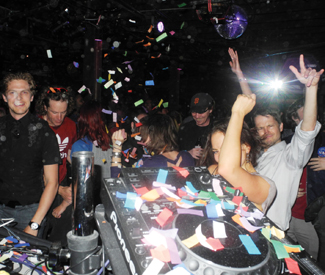
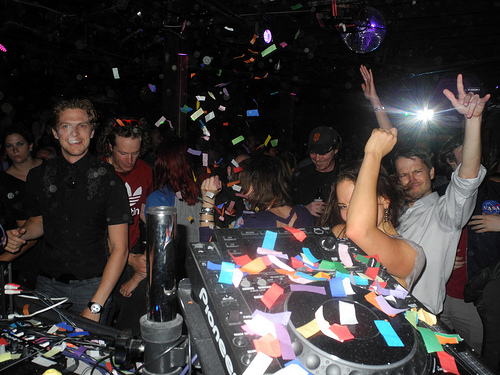
Here was the party. Not the daytime awkward-fest I’d been imaging. It was a party-party with club lighting and projectors splashing trippy footage of abstract art and bare boobs and squiggly lines across the walls. Haze was dancing behind his turntables, spinning an electrifying set of house music mixed with the likes of Depeche Mode and eclectic world music.

And because everyone was coming from work, they were dressed casually. No guys in shiny button-down shirts or girls with torture-devices strapped to their feet.

The vibe was fun, inclusive, and warm. Maybe because we were all doing something a bit out of the norm, everyone was smiling and jumping, laughing and making real eye contact with each other. It was a genuinely positive atmosphere without dreaded pretension.

My coworker and I stayed for 45 minutes. We pounded a drink at the bar — this is another way the SF event differs from the strictly non-alcohol-offering Lunch Beat — and danced with abandon. People began trickling out around 1:45pm.

Back at the office, I was noticeably less tense and in a fantastic mood. It’s hard to pinpoint why RECESS feels so exciting and illicit. Yes, you’re sneaking off to a club in the middle of the workday, but it’s your lunch break. No broken rules there. Still, there’s a rush that comes with using that time to do something just for you.

The next bEATs for Lunch (formerly RECESS) will take place Aug. 8 at Monarch.

Like an Eric Andre in a china shop

4

What’s to be anticipated when Adult Swim’s most degenerate program hits the road? On Monday night, a sold-out crowd filled the Rickshaw Stop, ready for just about anything short of a Mitt Romney endorsement.

A love letter to the Reddit-surfing, bong-ripping, Flying Lotus-bumping demographic, The Eric Andre Show stampedes through its weekly, 15-minute time-slot with reckless abandon and utter perversity, hanging onto its “talk-show” descriptor by a single Funyun. If Pete & Pete, Hype Williams, and Gary Busey invested in a sleazy public-access channel, transmitted from the bowels of Suave Ben’s house in Blue Velvet, The Eric Andre Show would be its flagship broadcast.


MF Doom’s Special Herbs played over the soundsystem as the doors opened, aptly reflecting the intoxicated, Bohemian crowd shuffling in. The show kicked off with three stand-up routines, starting with co-host and Andre-sidekick Hannibal Buress, followed by local comics Stroy Moyd and Chris Garcia.

Buress was by far the funniest, transitioning from scrambled eggs to Eddie Griffin without the slightest thread of contrivance. Moyd’s set, while mostly successful, was hindered by a sense of forced confrontation, while Garcia uncannily recalled every schtick-dependent, guitar-equipped comedian you’ve ever seen on Comedy Central at 1am.

After a short break, Andre stormed the stage impolitely and unapologetically, ketchup and mustard bottles in hand, dousing the feverish crowd in red and yellow corn-syrup sludge, with GWAR-like contempt for social etiquette. After plopping down behind his big-kahuna desk, Andre invited Buress on stage, trading quips like Letterman and Paul Shaffer all fucked up on Ween’s Scotchgard.

Despite its chaotic pretense, the show barreled forward with an astute sense of rhythm and timing, flipping between stand-up bits, video clips, live music from the delightfully inept house band, and fake celebrity appearances, in a fast-paced spectacle, tailor-made for the goldfish-like attention spans of Adult Swim’s viewership.

The audience was treated to guest appearances from Tatyana Ali (Will Smith’s little cousin from Fresh Prince, remember?) and a very fake Russell Brand. Counterfeit TV commercials were shown, the most memorable of which involved Andre, dressed as Ronald McDonald, slamming whiskey and sobbing uncontrollably. In the most gut-bustingly hilarious moment of the night, a clown of the childrens’-parties variety took the stage, fashioning balloon animals with Seal’s “Kiss From a Rose” playing seductively in the background.

After the unrestrained, brain-frying energy of Andre’s set, acclaimed Oakland hip-hop duo Main Attrakionz cooled things down beautifully with their balance between rugged, hard-boiled lyricism and luminous, electronic soundscapes. Taking the stage with great authority, Squadda B and Mondre delivered a steadily compelling set that, at a short-and-sweet 30 minutes, never overstayed its welcome.

Sauntering back onto Fell Street, with mustard-caked belongings, the audience was visibly gratified, and for good reason. Given the scarcity of live events that merge stand-up comedy, live hip-hop, and whatever the hell Eric Andre does, Monday night’s show was as satisfyingly complete as it was totally unpredictable.

Step away from the desk and dance

2

What’s your idea of a productive lunch break? Mine involves returning a failed online shopping purchase to FedEx with just enough time to grab a sandwich to shove into my face back at my desk. 

DJ Matt Haze, of the Slayers Club collective, hates this. “A lot of my friends work in the tech industry or in finance,” he explains. “Even though they’re eating a nice gourmet lunch, they’re eating it at their desks. They’re not taking a moment to breathe or take their eyes off the monitor… I want to provide an outlet for people during the day.”

That outlet is RECESS, a new monthly (for now) midday party Haze is organizing with Sunset Promotions. The goal: to get as many young, San Francisco office workers to take full advantage of that magical allotted free hour during their day by getting sweaty with like-minded PYTs on the dance floor.

The daytime lunch party idea isn’t entirely new. The Swedes have been doing it with wild success since 2010, under the name Lunch Beat, but Matt is quick to point out that his idea for RECESS came independently. He first shared the idea of a lunchtime party with friend and Scoutmob Community Manager Lauryn McCarthy.

She was the one who told him about the Lunch Beat phenomenon, which he credits for motivating him to make RECESS a reality. “I was spurred into action,” he says, “knowing that someone else had a similar idea and was making it work in Europe. I thought if any city in the US should have a lunchtime dance party, surely it’s San Francisco.”

Surely indeed. On Wednesday, my coworker and I headed to the RECESS launch party (NOTE: future installments will be dubbed bEATs for Lunch out of respect to an already-existing Oakland Recess party that was just brought to the organizers’ attention).

That kickoff event was held at Monarch, a club at the lively intersection of Sixth and Mission Streets.

We passed a small crowd standing on the side of the Monarch building, eating sandwiches in the sunshine (RECESS provided free, vegetarian sandwiches from Ike’s to the crowd, but we were too late to snag a bite — alas, they looked pretty good).

With our IDs checked, we headed into the small bar and lounge area. Less than 10 people were scattered around the bar and a few couches, chatting and eating. House music bumped from the basement. I wondered if the dance floor was experiencing the same sparse attendance.

We ventured toward the music, passing two sweaty girls who were laughing and fanning their faces on their way up. I was shocked when we hit the basement.

Here was the party. Not the daytime awkward-fest I’d been imaging. It was a party-party with club lighting and projectors splashing trippy footage of abstract art and bare boobs and squiggly lines across the walls. Haze was dancing behind his turntables, spinning an electrifying set of house music mixed with the likes of Depeche Mode and eclectic world music.

And because everyone was coming from work, they were dressed casually. No guys in shiny button-down shirts or girls with torture-devices strapped to their feet.

The vibe was fun, inclusive, and warm. Maybe because we were all doing something a bit out of the norm, everyone was smiling and jumping, laughing and making real eye contact with each other. It was a genuinely positive atmosphere without dreaded pretension.

My coworker and I stayed for 45 minutes. We pounded a drink at the bar — this is another way the SF event differs from the strictly non-alcohol-offering Lunch Beat — and danced with abandon. People began trickling out around 1:45pm.

Back at the office, I was noticeably less tense and in a fantastic mood. It’s hard to pinpoint why RECESS feels so exciting and illicit. Yes, you’re sneaking off to a club in the middle of the workday, but it’s your lunch break. No broken rules there. Still, there’s a rush that comes with using that time to do something just for you.

The next bEATs for Lunch (formerly RECESS) will take place Aug. 8 at Monarch.

Churches wants you to sing on its LGBT anthem

0

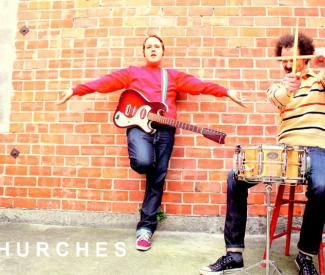
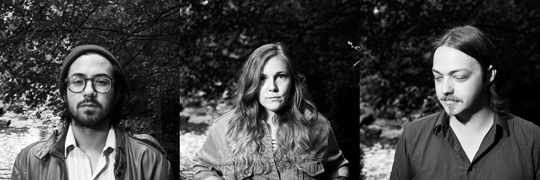
Caleb Nichols is impatient. Long part of the Bay Area music scene in bands such as Port O’Brien and his own Grand Lake, he’s perhaps forgotten that his new project with Rogue Wave drummer Pat Spurgeon and bassist Dominic East, Churches, is still in its infancy.

That restless feeling might come from the initial burst of interest in the act when its first song, chilling power-pop anthem “Save Me,” went up on Bandcamp. Recorded with close Nichols pal Van Pierszalowski of Port O’Brien and Waters at Tiny Telephone, the song was just the seedling of a new project Nichols came up with while on tour with Waters.

Nichols long knew he wanted to work with East Bay-based Spurgeon, but the drummer was often too busy with Rogue Wave. With that band on hiatus (though now, excitingly, back in the studio), Churches formed at the beginning of 2012. It was the positive response to “Save Me” that spurred Nichols and Spurgeon to put together a live show, hooking in East on bass and cementing the trio by February of this year.

“I’ll be like ‘why aren’t we doing this and this already?’ and then be like, ‘oh, because we’ve only been playing shows since February,” Nichols laughs over the phone from his apartment in Santa Cruz. “We’ve played like 10 shows, chill out.” The trio adds another show to that list next week opening for Waters at Brick and Mortar Music Hall.

Nichols adds, “We’ve all been in bands for so long, it’s hard to remember that this particular band is brand new.”

Despite its newness, the act already put up a free six-song EP on Bandcamp in April (which includes “Save Me”), and entered the 48-hour music video race in May. It also is about to get working on yet another EP, this time at the Hangar in Sacramento with Bryce Gonzalez. This next one will be “a little darker., more cynical…a little more aggressive” Nichols says, a bit more raw.

http://www.youtube.com/watch?v=Dztzf2Z8Nw8

But before that, and currently at the forefront of their collective mind, is the Kickstarter project with a goal of $3,000 that ends July 19. If the goal is met, the project will fund the vinyl recording of a song called “LOVELIFE” that the band hopes will become something of an anthem for the LGBT community.

I’ll let the Kickstarter description do the explaining here: “It’s a song about the important issue of marriage equality. We believe in this song and its message so strongly that we’ve decided to launch this Kickstarter campaign to help the song get properly recorded and pressed on 7″ vinyl…As a gay Californian, and American, I find it increasingly disturbing that so many people in my home-state and country have gone to their polling places and voted against my right to marry whomever I choose – voted against my right to fully participate and engage in a meaningful relationship – voted against my right to have the same rights as everybody else.”

The kicker: at the $100 level, donors will be able to come to the studio and contribute their voice to the chorus of the song. Said chorus goes, “Some folks think it’s not right / That I should have the right / To love my man and marry him / And live out in the light / Well I think that it’s a sin / To hate your kith and kin / I was born this way, now hear me say / I am just what I am.”

The chorus was written during a long drive back to Santa Cruz after an awkward dinner in Oakland.

Nichols says they added that bonus of bringing in funders to sing as a way to get the community involved – and as a way for him to personally connect more with the gay community. “I’m not a famous person, so it probably doesn’t carry as much weight as like, Anderson Cooper or Frank Ocean. I respect those people for coming out…just from where I’m at, in my career, I feel like it’s good to be very loud about these kinds of things. I’m tired of our personal lives being subject to political whims.”

He adds, “I don’t write a lot of political music…but this song has a purpose, it has a point for me.”

Nichols may not often write expressly about politics, but he is often writing from a highly personal place. Churches channels reflections of the past, those rough, alienating, fresh hell years of high school in the loud grunge angst of the ’90s. Growing up in tiny Los Osos, Nichols struggled with isolation, and “general outcastishness” – and he says these feelings have persisted into adulthood, though far less intensely. Still, thankfully, he can tap into those dark emotions to write the passionately distorted music of Churches.

Musically, he first picked up bass in early high school – he says another testament to his impatience as he thought it’d be easier than guitar – and played in Nirvana-esque bands in a local San Luis Obispo County music scene that included Van Pierszalowski and Myles Cooper, who were both in other nearby bands back then and have of course gone on to form SF projects.

When Nichols eventually moved to the Bay Area, he joined Port O’Brien, later forming Grand Lake in Oakland with his soon-to-be boyfriend, John Pomeroy. They just celebrated their three-year anniversary in Santa Cruz, where Pomeroy is going back to school and Nicholas occasionally works at the local record store. Pomeroy has slowly and steadily been making his new own music while Nicholas works on Churches, yet to show any to the public. “He’s the opposite of me, I do things really quickly but he takes his time,” Nichols laughs, forever a teenager at heart.

Churches
With Waters, Tijuana Panthers, Chasms

Wed/18, 9pm, $10-$12
Brick and Mortar Music Hall
1710 Mission, SF
(415) 800-8782
www.brickandmortarmusic.com

Oakland councilperson responds to Harborside Health Center targeting by feds

19

Have you heard the news about our most Hollywood dispensary getting put on notice by the feds? Harborside Health Center staff, stars of everyone’s favorite marijuana reality show Weed Wars, arrived to work July 9 to a letter from US Attorney Melinda Haag.

She’s no one’s favorite pen pal in the medical cannabis industry these days. (xoxo) In the letter, she filed civil forfeiture actions against Harborside, despite the fact that unlike most of her office’s previous targets, the two Harborside dispensaries are not within 1,000 feet of a school or park. After the federal raid of educational institution Oaksterdam University in April it seems that now, all dispensaries are fair game for federal targeting. This could be curtains for patients’ safe and easy access to cannabis. 

Haag explained her office’s reasoning in a statement released yesterday.

This office has used its limited resources to address those marijuana dispensaries that operate close to schools, parks and playgrounds. As I have said in the past, this is a non-exclusive list of factors relevant to whether we should commence civil forfeiture actions against marijuana properties, and circumstances may require us to address other situations. 

I now find the need to consider actions regarding marijuana superstores such as Harborside. The larger the operation, the greater the likelihood that there will be abuse of the state’s medical marijuana laws, and marijuana in the hands of individuals who do not have a demonstrated medical need.

The filing of the civil forfeiture complaints against the two Harborside properties is part of our measured effort to address the proliferation of illegal marijuana businesses in the Northern District of California.

Basically, no rationale for targeting Harborside besides the fact that it’s a big operation (probably the largest in California.) The situation echoes the recent federal raid of cannabis educational institution Oaksterdam University. Harborside has struggled in the past with castigating audits by the IRS, which declared that the collective was unable to claim simple business expenses on its taxes. 

Oakland city councilperson Rebecca Kaplan recently released a statement in response. Here is the full text:

We are disappointed to learn that yet another licensed, legal and locally regulated medical cannabis facility has come under federal attack.

The last time that the federal government used its resources to go after a permitted facility with no history of crime or violence, there was a school shooting taking place across town while federal agents tagged and bagged medical marijuana plants.

We can’t let this happen again.

The Justice Department has said in the past that it wouldn’t target medical marijuana.

They went back on their word – starting to target medical cannabis facilities allowed under California law.  Then, the U.S. Attorney’s Office said they are specifically targeting cannabis facilities located within 1,000 feet of parks and schools.

Let’s be clear: Harborside Health Center is in compliance with our democratically-enacted laws – and is not near either a park or a school.

During the raid on Oaksterdam University, the federal government used cops – this time they’re using lawyers.

If federal prosecutors have extra time available, I ask – on behalf of my constituents all across the city – that they instead prosecute the illegal gun dealers who are the source of death and violence in Oakland.

Federal agents have worked successfully with local law enforcement this year to go after guns and violence – and we are deeply thankful and appreciative of that help.

That’s what we need more of.

If there are federal resources available, we need them directed against the violent perpetrators and co-conspirators of the senseless gun violence on our streets. 

Local news media reported recently that, on the day of the federal raid and the school shooting, local law enforcement said the federal raid against Oaksterdam University ‘drained the vast majority of [the department’s] west-end staffing thus resulting in several priority calls being stacked — something that might have [been] prevented.

Wasting resources going after legal, licensed and locally regulated medical marijuana facilities is not only inappropriate, but directly harms our ability to fight crime and respond to violence in our city.

We respectfully ask the Justice Department to devote any available resources to fight gun crime and stop the interstate flow of illegal guns into our city.

Thank you.

Healing the Hood

3

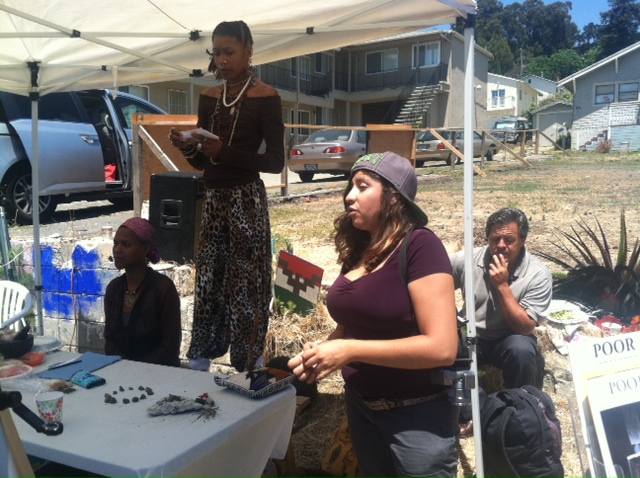
Fifty people were sitting in a circle July 8, talking about what was weighing on them that week. And the weight was heavy. Poverty, violence, addiction, racism. Crushed by debt, foreclosed and evicted. Seeing family members deported, imprisoned, and killed. Continued repression of the Ohlone and other Native peoples. After telling her story, Vivian Thorp said she got together the money to seek medical treatment.

“So I go to the doctor,” she said. “And they tell me, you’ve got anxiety. I go, no shit.”

The others in the circle understood. This was the second day of Healing the Hood, a weekend of workshops, art, cooking, biking, spirituality, and communtiy building. The Poor Magazine project is aimed at resisting corporate control of food, medicine, the environment, and other survival necessities.

For many of the people present, “anxiety” doesn’t quite describe the oppression caused by abuse and violence, by fear of police and prison, by having not enough money to feed their families, by injuries and stress incurred by working for that money. No pill can cure that anxiety, even if you can afford it.

Healing the Hood is supposed to be some part of the real cure. Day one was spent in the Mission district, where Poor Magazine has it’s office. Day two was in East Oakland on a plot of land that Poor has purchased as part of its Homefulness project.

I arrived around lunchtime. In the hot East Bay sun, Needa Bee was preparing a salad while teaching a workshop on food. As she chopped the lettuce and carrots, she talked about how Monsanto and other agricultural industry giants control most of the food that’s available in supermarkets. She discussed resistance movements to Monsanto, telling of farmers in India and China who burned their GMO fields lest they infect other plants. Her lesson ended at the same moment that she topped off the salad with sesame seeds and coconut vinegar.

“This is all fields, backyard, street, Halal markets, Southeast Asian markets,” she said of the feast, recommending those sources as places where GMOs and factory farmed products can be avoided.

Tiny Gray-Garcia, Poor Magazine’s co-founder, smiled as 50 people lined up to eat. Gray-Garcia helped bring together the many sages present at Healing the Hood. The event is steeped in a deep yearning to preserve and teach cultural and medicinal knowledge, made all the more difficult because, as Gray-Garcia put it, people must “try to do it within this capitalist society, whose oppression is in everything, even our food.”

The weekends teachers were more than cooks; herbalists and nutritionists, gardeners and mothers, poets and dancers. After the food demonstration, nutritionist Tanya Henderson and Poor Magazine scholar Estrella gave a presentation on native herbs and foods and their medicinal properties. Next, youth from 67 Suenos, an organization that rejects not just attempts at harsher immigration laws but the colonial notion of borders in the Americas itself, led a discussion.

“Borders aren’t real. They’re a construct. They’re part of the plantation system,” one of the members said. The group supports the concept of a path to legalization for young people embodied in the DREAM Act, but takes issue with policies that would help successful students– “good immigrants”– while still allowing for families to be torn apart and ignoring the reality of students who are delayed in their success, often by that very fear of deportation of themselves or family members.

“Sadly, no one’s talking about a path towards legalization for every undocumented person in this country,” one of the members noted, recalling protests in 2006 and 2007, when many groups demanded “legalize all.”

Luis Rodriguez, one of the weekend’s special guests, is an author and poet based in the Los Angeles area. He was in town partly to promote his new book, It Calls You Back, and will soon be heading to El Salvador for an event celebrating a gang truce that has more than halved the country’s homicides since it was brokered.

“Earth Mother” Iyalode Kinney, founder of the Richmond urban gardening project Communities United Restoring Mother Earth, passed around leaves of comfrey and sprigs of fragrant German chamomile, plucked from her garden that morning, explaining their medicinal properties. Attendants rode bikes and recited poetry as the sun set.

The Healing the Hood initiative didn’t end Sunday. Poor Magazine will be meeting again August 5 to plant the Pachamama Garden as part of Homefulness.

“We as poor peoples and indigenous peoples are in constant struggle to survive and resist the violence of poverty, racism and colonization and if we are to not only survive but thrive, we most focus some time on healing our bodies, minds and spirits with out lives and ancestral knowledge not tied to the Western Medical Industrial complex, big pharma and corporations,” the Healing the Hood event descriptions reads.

In their many publications and its everyday work, the folks at Poor Magazine speak a sort of revolutionary language. The US is Amerikkka, deals that gentrify and displace are devil-opment, and Mama Scholars and Poverty Scholars spread their knowledge while the merits of establishment “akkkademia” are questioned. It’s a the language of a culture of empowerment and resistance, whose people have found violence and destruction in the things most valued in capitalism.

Rodriguez closed out the healing circle. He said a prayer to the Earth, and each attendant named a suffering or dead loved one as he and ceremonially spilled water on a newly sprouting plant.

The preservance, the survival, the regeneration. The suffering and the healing. As Rodriguez said as he closed it out, “Capitalism can’t reconcile with this circle.”

Stage Listings

0

Performance times may change; call venues to confirm. Reviewers are Robert Avila, Rita Felciano, and Nicole Gluckstern. Submit items for the listings at listings@sfbg.com. For further information on how to submit items for the listings, see Picks.

THEATER

OPENING

Marat/Sade Brava Theatre, 2781 24th St, SF; (415) 863-0611, www.ticketfly.com. $20-38. Previews Wed/11-Thu/12, 8pm. Opens Fri/13, 8pm. Runs Wed-Sat, 8pm; Sun, 7pm (also July 22, 1:30pm). Through July 29. Marc Huestis and Thrillpeddlers present Peter Weiss’ macabre Tony-winner.

Sweeney Todd: The Demon Barber of Fleet Street Eureka Theatre, 215 Jackson, SF; www.rayoflighttheatre.com. $25-36. Opens Thu/12, 8pm. Runs Thu-Sat, 8pm (also Sat, 2pm); Sun, 2pm. Through Aug 11. Ray of Light Theatre performs Stephen Sondheim’s sexy, sinister musical.

BAY AREA

Ma Rainey’s Black Bottom Sister Thea Bowman Memorial Theater, 920 Peralta, Oakl; www.lowerbottomplayaz.com. $10-25. Opens Fri/13, 7pm. Runs Fri-Sat, 7pm; Sun, 2pm. Through July 22. Lower Bottom Playaz perform August Wilson’s music-industry expose.

The Marvelous Wonderettes Fox Theatre, 2215 Broadway, Redwood City; www.broadwaybythebay.org. $20-48. Opens Thu/12, 8pm. Runs Thu-Sat, 8pm (also July 21 and 28, 2pm); Sun, 2pm. Through July 29. Broadway By the Bay performs Roger Bean’s retro musical, featuring classic tunes of the 1950s and ’60s.

Roald Dahl’s Willy Wonka and the Chocolate Factory Julia Morgan Theatre, 2640 College, Berk; www.berkeleyplayhouse.org. $17-35. Previews Sat/14, 2pm. Opens Sat/14, 7pm. Runs Thu, Sat, and July 25, 7pm (also Sat, 2pm); Sun, noon and 5pm. Through Aug 19. Berkeley Playhouse performs a musical based on the candy-filled book, with songs from the 1971 movie adaptation.

Upright Grand TheatreWorks at Lucie Stern Theatre, 1305 Middlefield, Palo Alto; www.theatreworks.org. $24-73. Previews Wed/11-Fri/13, 8pm. Opens Sat/14, 8pm. Runs Tue-Wed, 7:30pm; Thu-Sat, 8pm (also Sat, 2pm); Sun, 7pm. Through Aug 10. TheatreWorks launches its 43rd season with the world premiere of Laura Schellhardt’s play about a musical father and daughter.

ONGOING

Absolutely San Francisco Alcove Theater, 414 Mason, Ste 502, SF; www.thealcovetheater.com. $32-50. Thu-Sat, 8pm. Through Aug 18. A multi-character solo show about the characters of San Francisco.

Duck Lake The Jewish Theater, 470 Florida, SF; www.duck-lake.com. $17-35. Fri-Sat, 8pm. Through July 28. By terns gross and engrossing, PianoFight’s Duck Lake — written and produced by associated sketch comedy locals Mission Control — proves a gangling but irresistible flight, a ballet-horror-comedy-musical with fair helpings of each. By the shore of the eponymous watery resort with a mysterious past as an animal testing site, a perennially “up-and-coming” theater director named Barry Canteloupe (poised and sassy Raymond Hobbs) marshals a pair of prosthetic teats and other trust-building paraphernalia in a cultish effort to bring off yet another reimagining of Swan Lake. His cast and crew include a rebounding TV starlet (a sure and winsome Leah Shesky), a lazy leading man (delightfully dude-ish Duncan Wold), a supremely confident and just god-awful tragedian (a duly expansive Alex Boyd), and a gleeful misfit of a tech guy (an innocently inappropriate, very funny Joseph Scheppers). When the thespians come beak-to-beak with a handsome local gang leader (a nicely multifaceted Sean Conroy) and his rowdy band of sun-addled jet-skiers (the awesome posse of Daniel Burke, David Burke, and Meredith Terry), a star-crossed college reunion ensues between the tattooed tough and the hapless production’s white swan. Meanwhile, “scary fucked-up super ducks” go on a killing rampage under tutelage of some cave-bound weirdo (an imposing, web-footed Rob Ready), leading to love, mayhem, and shameless appropriation of timeless musical numbers. It’s all supported by four tutu’d mallards (the po-faced, limber ensemble of Christy Crowley, Caitlin Hafer, Anne Jones, and Emma Rose Shelton) and flocks of murderous fellow fowl (courtesy of Crowley’s fine puppet design). And don’t worry about the convoluted plot, all will be niftily explained by an old codger of a groundskeeper (a hilariously persuasive Evan Winchester). If the action gets attenuated at times across two-plus hours, a beguilingly agile cast and robust concept more than compensate for the loosey-goosey. (Avila)

5 Lesbians Eating a Quiche Phoenix Theatre, 414 Mason, SF; www.tidestheatre.org. $20-38. Thu-Sat, 8pm (also Sat, 10pm). Through July 21. Tides Theatre performs Evan Linder and Andrew Hobgood’s comedy about five women forced into a bomb shelter during a mid-breakfast nuke attack.

Fwd: Life Gone Viral Marsh San Francisco, 1062 Valencia, SF; (415) 282-3055, www.themarsh.org. $20-50. Sat, 8:30pm; Sun, 7pm (Sun/15, show at 7:30pm). Extended through July 22. The internet becomes comic fodder for creator-performers Charlie Varon and Jeri Lynn Cohen, and creator-director David Ford.

Jip: His Story Marsh San Francisco, MainStage, 1062 Valencia, SF; www.themarsh.org. $8-50. Thu/12-Fri/13, 7:30pm; Sat/14, 2pm; Sun/15, 3pm. Marsh Youth Theater remounts its 2005 musical production of Katherine Paterson’s historical novel.

Proof NOHspace, 2840 Mariposa, SF; www.proofsf.com. Wed/11-Sat/14, 8pm. $28. Expression Productions performs David Auburn’s Pulitzer-winning play about a mathematician and his daughter.

“Risk Is This…The Cutting Ball New Experimental Plays Festival” Exit on Taylor, 277 Taylor, SF; (415) 525-1205, www.cuttingball.com. Free ($20 donation for reserved seating; $50 donation for five-play reserved seating pass). Fri/13-Sat/14, 8pm. Cutting Ball’s annual fest of experimental plays features two new works and five new translations in staged readings.

The Scottsboro Boys American Conservatory Theater, 415 Geary, SF; www.act-sf.org. $20-95. Tue-Sat, 8pm (also Wed and Sat, 2pm). Extended through July 22. American Conservatory Theater presents the Kander and Ebb musical about nine African American men falsely accused of a crime they didn’t commit in the pre-civil rights movement South.

Vital Signs Marsh San Francisco, 1062 Valencia, SF; (415) 282-3055, www.themarsh.org. $15-50. Sat, 8:30pm. Through July 21. The Marsh San Francisco presents Alison Whittaker’s behind-the-scenes look at nursing in America.

Waiting… Larkspur Hotel Union Square, 525 Sutter, SF; www.brownpapertickets.com. $49-75. Thu-Sat, 8pm; Sun, 2pm. Through Aug 5. Comedy set behind the scenes at a San Francisco restaurant.

The Waiting Period MainStage, Marsh San Francisco, 1062 Valencia, SF; (415) 282-3055, www.themarsh.org. $15-50. Fri, 8pm; Sat, 5pm. Extended through August 4. Brian Copeland (comedian, TV and radio personality, and creator-performer of the long-running solo play Not a Genuine Black Man) returns to the Marsh with a new solo, this one based on more recent and messier events in Copeland’s life. The play concerns an episode of severe depression in which he considered suicide, going so far as to purchase a handgun — the title coming from the legally mandatory 10-day period between purchasing and picking up the weapon, which leaves time for reflections and circumstances that ultimately prevent Copeland from pulling the trigger. A grim subject, but Copeland (with co-developer and director David Ford) ensures there’s plenty of humor as well as frank sentiment along the way. The actor peoples the opening scene in the gun store with a comically if somewhat stereotypically rugged representative of the Second Amendment, for instance, as well as an equally familiar “doood” dude at the service counter. Afterward, we follow Copeland, a just barely coping dad, home to the house recently abandoned by his wife, and through the ordinary routines that become unbearable to the clinically depressed. Copeland also recreates interviews he’s made with other survivors of suicidal depression. Telling someone about such things is vital to preventing their worst outcomes, says Copeland, and telling his own story is meant to encourage others. It’s a worthy aim but only a fitfully engaging piece, since as drama it remains thin, standing at perhaps too respectful a distance from the convoluted torment and alienation at its center. (Avila)

BAY AREA

Bloody Bloody Andrew Jackson The Stage, 490 S. First St, San Jose; www.thestage.org. $25-$50. Wed-Thu, 7:30pm; Fri-Sat, 8pm; Sun, 2pm. Through July 29. An overrated president and rock musical at once, the 2010 Broadway hit by Alex Timbers (book) and Michael Friedman (music, lyrics) takes its first Bay Area bow in San Jose Stage’s ho-hum production, directed by Rick Singleton. In this proudly irreverent but rarely very witty take on mob-democracy and the pack of jackals that are our illustrious political forefathers, a vicious and ambitious cornpone Jackson (David Colston Corris, subbing for Jonathan Rhys Williams) takes his Indian-hating ways to the top of the political establishment on a wave of backwoods resentments and Tea Party-style populism. Present-day parallels should run deep here, but the play is so shallow in its humor that it feels one-note for the most part, while its South Park-like insouciance has an unintentional way of making jokes about the Trail of Tears feel “too soon.” This American Idiocy and the 13 accompanying musical numbers are gamely if not always smoothly essayed by cast and band alike (under musical direction by Allison F. Rich), but dumb satire lines up with a generally unappealing score, straining after saucy eloquence while sounding derivative of the emo fare served up by the likes of Spring Awakening and that lot. A tack away from sheer vulgarity and buffoonery toward moralizing history lesson comes late in the hour and its guilty pretention — along with earlier gratuitous, vaguely uncomprehending references to Susan Sontag and Michel Foucault — only makes matters worse. (Avila)

Emotional Creature Berkeley Repertory Theatre, Roda Theatre, 2025 Addison, Berk; www.berkeleyrep.org. $14.50-73. Wed/11 and Sun/15, 7pm (also Sun/15, 2pm); Thu/12 and Sat/14, 8pm (also Sat/14, 2pm). It’s not easy being a girl, and Eve Ensler’s newest play Emotional Creature leaves no scenario unexplored: from high school shaming rituals to ritual clitorectomies. If that sounds like a jarring juxtaposition, you’d be right. It’s difficult theatrically to transition seamlessly from a deeply affecting monologue about being a teenage sex slave in the Democratic Republic of Congo to a cute song about wearing miniskirts, and it’s equally difficult for the audience to change emotional gears rapidly enough to be able to adequately absorb the impact of each individual segment. Instead, the play comes off as an earnest but awkward Girl Scout Jamboree variety show — attempting to address as wide a variety of social ills as possible (from teen suicide to industrial pollution) — despite the strong and savvy acting chops of the six performers. In contrast to Ensler’s most popular work, The Vagina Monologues, which effectively “humanized” a part of the body by giving it something highly personal to say, Emotional Creature weirdly depersonalizes its girls by putting lines in their mouths (“I’m not the life you never lived”) that clearly come from an adult perspective. And as for those girls who don’t particularly identify as “emotional creatures” at all? For them, there are no words. (Gluckstern)

For the Greater Good, Or The Last Election This week: Cedar Rose Park, 1300 Rose, Berk; www.sfmt.org. Free (donations accepted). Sat/14-Sun/15, 2pm. Various venues through Sept. 8. SF Mime Troupe launches its annual political musical (this year’s theme: one percenters behaving badly); the show travels around NorCal parks and other venues throughout the summer.

King John Forest Meadows Amphitheater, 890 Belle, Dominican University of California, San Rafael; www.marinshakespeare.org. $20-35. Opens Fri/13, 8pm. Runs Sun/15, July 21, 27, 29, Aug 4, 10-12, 8pm; July 22 and Aug 5, 4pm. Marin Shakespeare Company kicks off its 2012 outdoor summer festival season with this history play.

The Kipling Hotel: True Misadventures of the Electric Pink ’80s New venue: Marsh Berkeley, 2120 Allston, Berk; (415) 282-3055, www.themarsh.org. $20-50. Sat/14, 8:30pm; Sun/15, 7pm. This new autobiographical solo show by Don Reed, writer-performer of the fine and long-running East 14th, is another slice of the artist’s journey from 1970s Oakland ghetto to comedy-circuit respectability — here via a partial debate-scholarship to UCLA. The titular Los Angeles residency hotel was where Reed lived and worked for a time in the 1980s while attending university. It’s also a rich mine of memory and material for this physically protean and charismatic comic actor, who sails through two acts of often hilarious, sometimes touching vignettes loosely structured around his time on the hotel’s young wait staff, which catered to the needs of elderly patrons who might need conversation as much as breakfast. On opening night, the episodic narrative seemed to pass through several endings before settling on one whose tidy moral was delivered with too heavy a hand, but if the piece runs a little long, it’s only the last 20 minutes that noticeably meanders. And even with some awkward bumps along the way, it’s never a dull thing watching Reed work. (Avila)

Salomania Aurora Theatre, 2081 Addison, Berk; www.auroratheatre.org. $30-55. Tue, 7pm; Wed-Sat, 8pm; Sun, 2 and 7pm. Through July 22. The libel trial of a politically opportunistic newspaper publisher (Mark Andrew Phillips) and the private life of a famous dancer of the London stage — San Franciscan Maud Allan (a striking Madeline H.D. Brown) — become the scandalous headline-grabber of the day, as World War I rages on in some forgotten external world. In Aurora’s impressive world premiere by playwright-director Mark Jackson, the real-life story of Allan, celebrated for her risqué interpretation of Oscar Wilde’s Salomé, soon gets conflated with the infamous trial (20 years earlier) of Wilde himself (a shrewdly understated Kevin Clarke). But is this case just a media-stoked distraction, or is there a deeper connection between the disciplining of “sexual deviance” and the ordered disorder of the nation state? Jackson’s sharp if sprawling ensemble-driven exploration brings up plenty of tantalizing suggestions, while reveling in the complexly intermingling themes of sex, nationalism, militarism, women’s rights, and the webs spun by media and politics. A group of trench-bound soldiers (the admirable ensemble of Clarke, Alex Moggridge, Anthony Nemirovsky, Phillips, Marilee Talkington, and Liam Vincent) provide one comedy-lined avenue into a system whose own excesses are manifest in the insane carnage of war — yet an insanity only possible in a world policed by illusions, distractions and the fear of unsettled and unsettling “deviants” of all kinds. In its cracked-mirror portraiture of an era, the play echoes a social and political turmoil that has never really subsided. (Avila)

Truffaldino Says No Ashby Stage, 1901 Ashby, Berk; www.shotgunplayers.org. $18-25. Wed-Thu, 7pm; Fri-Sat, 8pm; Sun, 5pm. Through July 22. For centuries, stock characters have insidiously demonstrated to the working classes the futility of striving against type or station with broadly comedic pratfalls, doomed to play out their already-written destinies with no hope for a change in script. Truffaldino (William Thomas Hodges) is one such pitiable character. Longing for his airheaded mistress, Isabella (Ally Johnson), playing second fiddle to his father, the iconic Commedia dell’Arte fool Arlecchino (Stephen Buescher), Truffaldino becomes increasingly dissatisfied with the monotony of the “old world” and strikes out for the new one — eventually washing up in Venice Beach. Despite their dayglo California veneer and sitcom-appropriate shenanigans, the new world characters he meets quickly come to resemble the stock commedia characters Truffaldino has left behind, and he finds himself similarly trapped in their incessantly recurring cycle — pining predictably for valley girl waitress, Debbie (Johnson again). What thankfully cannot be predicted is how Truffaldino manages to rewrite his destiny after all while reconciling his two worlds in a raucous comedy of errors anchored by the solid physical comedy of its stellar cast, particularly that of Stephen Buescher as both Arlecchino and Hal, who bounces, prances, tumbles, and falls down the stairs with the kind of rubber-jointed dexterity that should come with a “kids, don’t try this at home” warning label. (Gluckstern)

PERFORMANCE/DANCE

“Ballroom With a Twist” Marines’ Memorial Theatre, 609 Sutter, Second Flr, SF; www.marinesmemorialtheatre.com. $49-79. Thu-Sat, 8pm (also Sat, 2pm); Sun, 2 and 6pm. Through July 29. Dancing With the Stars pros and contestants from American Idol and So You Think You Can Dance perform pumped-up ballroom dance and music.

BATS Improv Bayfront Theater, B350 Fort Mason Center, SF; www.improv.org. Fri, 8pm, through July 27: “Naked” Theatresports, $17. Sat, 8pm, through July 28: “Spontaneous Broadway,” $20.

“Elect to Laugh” Studio Theater, Marsh San Francisco, 1062 Valencia, SF; (415) 282-3055, www.themarsh.org. Tue, 8pm. Through Nov 6. $15-50. Veteran political comedian Will Durst emphasizes he’s watching the news and keeping track of the presidential race “so you don’t have to.” No kidding, it sounds like brutal work for anyone other than a professional comedian — for whom alone it must be Willy Wonka’s edible Eden of delicious material. Durst deserves thanks for ingesting this material and converting it into funny, but between the ingesting and out-jesting there’s the risk of turning too palatable what amounts to a deeply offensive excuse for a democratic process, as we once again hurtle and are herded toward another election-year November, with its attendant massive anticlimax and hangover already so close you can touch them. Durst knows his politics and comedy backwards and forwards, and the evolving show, which pops up at the Marsh every Tuesday in the run-up to election night, offers consistent laughs born on his breezy, infectious delivery. One just wishes there were some alternative political universe that also made itself known alongside the deft two-party sportscasting. (Avila)

“Expiration Date: Still Good” Jewish Theater, 470 Florida, SF; www.pianofight.com. Thu, 8pm. Through July 19. $20. PianoFight’s female-driven comedy group ForePlays performs fan-fave sketches.

“The Front Row: Live at the Dark Room!” Dark Room, 2263 Mission, SF; www.thefrontrow4.com. Sat/14, 8:30pm. $8. The all-girl sketch comedy troupe performs.

Keith Lowell Jensen San Francisco Punch Line, 444 Battery, SF; www.punchlinecomedyclub.com. July 17-18, 8pm. $15. The comedian performs and tapes a new CD for Stand Up! Records.

“Jillarious Tuesdays” Tommy T’s Showroom, 1000 Van Ness, SF; www.jillarious.com. Tue, 7:30. Ongoing. $20. Weekly comedy show with Jill Bourque, Kevin Camia, Justin Lucas, and special guests.

“Majestic Musical Review Featuring Her Rebel Highness” Harlot, 46 Minna, SF; www.herrebelhighness.com. Sun, 5pm. Through Aug 12. $25-65. Cocktails and hors d’oeuvres, performers in Baroque-chic gowns, music, and more.

“Mediate presents Soundwave ((5)) Humanities: Human Bionic” Lab, 2948 16th St, SF; www.projectsoundwave.com. Sat/14, 8pm. $12-25. Multimedia and interactive performances by Joe Cantrell, Kadet Kuhne, and Les Struck + Sonsherée Giles.

“Mediate presents Soundwave ((5)) Humanities: Sonicplace Exhibition” Intersection for the Arts, SF Chronicle Building, 925 Mission, SF; www.projectsoundwave.com. Opening night event Fri/16, 6-10pm, free. Exhibit runs Tue-Sat, noon-6pm. Through Sept 28. Innovative sound installations and exhibits presented by UC Santa Cruz’s OpenLab/Mechatronics Group.

“Stripping Down to Story” Garage, 715 Bryant, SF; www.brownpapertickets.com. Fri/13-Sat/14, 8pm. $10-20. Comedian and performance artist Jovelyn Richards performs her solo show.


 

Oakland families protest Oakland School Police killings and school closures

2

The Oakland School Police Department was the target of a protest today, as more than 100 marched to the department’s headquarters. The small department is devoted to patrolling and policing Oakland public schools. 

The protest group converged at the Oakland Police Department headquarters at 7th and Broadway, and several family members of young people killed by police officers spoke. 

Superintendent of the Oakland Unified School District Tony Smith sent Oakland School Police officers to shut down a sit-in and free school at Lakeview Elementary school July 3. Protesters say officer Barhin Bhatt, who issued the dispersal order at the Lakeview sit-in, should not be working in the schools; he is one of two Oakland School police involved in the killing 20-year-old student Raheim Brown last year.

“They’re no better than anyone else who’s out on the street, killing people,” Brown’s mother, Lori Davis, said at the rally. 

Brown was in a car with a friend, Tamisha Stewart, when he was shot to death. He was shot in the head and chest. Stewart, the only civilian witness, was beaten and jailed for a week.

Police say the car was stolen and that Brown tried to stab one of the officers with a screwdriver. 

Stewart recounted her experiences at the rally. “Seeing my friend get killed for no reason, and calling for help and me not being able to do anything. Being beaten, eyes swollen shut, for no reason. I’m living with the memory every day,” she said. “We need more people to come and stand with us, because we can’t do it alone.  We have single parents, mothers without children, fathers, brothers without their brothers and sisters.”

Brown’s young son and his mother were also present at the protest.

“Of course people make mistakes. And Raheim made mistakes, ” another protester, Jabari Shaw, said through a megaphone. “But what happened to him was police terrorism. What happened to him was murder.”

The group marched to the Oakland School Police headquarters at the former Cole Middle School in West Oakland. On the march, protesters chanted “justice for Raheim Brown” and carried banners that read “jail killer cops” and “stop school closures.”

At the Oakland School Police department headquarters, the group continued to rally. One protester, Jeremy Miller, expressed anger that Cole Middle School had been closed and the building turned into a police station. Earlier this month, the school district closed five elementary schools in order to save about $2 million.

“They don’t have enough money to keep schools open, but they have the money to police our schools,” Miller said. “We know that our children are safer with no police in their schools.”

Another speaker noted that Cole Middle School had an innovative restorative justice program in place, an alternative to zero-tolerance policies. The program cut down on suspensions by 87 percent.

“I feel like the police shutting down a school that had a model restorative justice program is a slap in our faces,”  she said. “This was such a wonderful program, and it could have been copied and duplicated and modeled all across our city”

Sgt. Bhatt was appointed interim chief of the Oakland School Police Department in August after the previous chief Pete Sarna resigned. Sarna had been accused of making racially disparaging remarks about other police officers while drunk after a golf tournament.

Bhatt has been acquitted of wrongdoing by Alameda County prosecutors. But now Brown’s death, as well as Sarna’s racist remarks, are the subject of a federal grand jury investigation of the Oakland School Police Department. The department received a letter from the FBI May 17 announcing that they as well would be looking into the police force.

“I’m so grateful that the federal grand jury got involved,” Davis said at the rally. She told of dealing with the Oakland Police Department the morning after her son’s death. 

“I called down to OPD to find out what happened,” Davis said. “They gave me the runaround. They didn’t want to tell me. And then when they finally did say something, they said that the police killed my son. I was in shock. And they said, oh no, it’s not OPD, it’s not us. It was the school police. That’s not our department, we’re two separate divisions.”  

Davis said that she had been denied victim compensation and other services usually offered to families of crime victims since her son’s death had been caused by a police officer. A community effort was launched to raise funds for Brown’s burial. But Davis hopes that the government will bring her family some justice.

“I’m praying that the federal grand jury,” along with, Davis said, her attorney John Burris, “will get justice for little Raheim.”

Five for summer

2

virginia@sfbg.com

APPETITE Time to dive into summer — at least nominally. These five playful dishes recently made an impression, and brought a little sunshine to the table.


BREAKFAST BISCUIT SANDWICH AT 15 ROMOLO

Brunch at one of the city’s best bars, 15 Romolo, is a pleasure, and blessedly unmobbed. Arrive at opening (11:30am), and you’re likely to secure a table instantly. Greeted with complimentary waffle shots — yes, rounds of waffle bites resting in a mini-pool of maple syrup and boozy rum — you’re then guaranteed impeccable mid-day cocktails ($9–$10), like zippy, frothy absinthe showcase (not for the anise or licorice averse) Famous Fizz, made with St. George absinthe, shaken with strawberry-thyme shrub, cream, egg white, finished with seltzer. Or try a Breakfast of Champions # 2, rich with Manzanilla sherry, Nocino walnut liqueur, maple syrup, coffee tincture and house banana cordial — warmly gratifying, not cloying. Exciting drinks are a given here, but the menu’s no slouch. This has been true at night and it’s likewise true at brunch. The one that makes me salivate is the breakfast biscuit sando ($9). In keeping with other brunch dishes, portions are generous: a moist, green chile biscuit filled with crispy fried chicken, the perfect kind of bacon (not too crispy, fatty), fried egg, house pickles, and a vivid arugula walnut pesto. Hash browns accompany, and after adding on a hefty, savory house rye sausage patty ($3), I practically rolled out post-meal, blissfully fattened.

15 Romolo Pl., SF. (415) 398-1359, www.15romolo.com


SMOKED BRISKET MEATLOAF AT PICAN

Though one can experience both highs and lows at downtown Oakland’s upscale Southern sanctuary Pican (like uneven desserts or cocktails — oh, would that that sweet Mint Julep be less syrupy and served in a proper Julep cup), staff are eager to please and the American whiskey list is extensive. New executive chef Sophina Uong (Waterbar, 900 Grayson) continues introducing vibrant dishes to the menus. Even as I begin digging into new menu items like playful blue crab profiteroles, my heart belongs to classic smoked brisket meatloaf ($21). It’s genius, really: shaved slices of Creekstone natural beef brisket are baked into a meaty-yet-light loaf, served with BBQ tomato jam, on roasted sweet corn salad with Cajun cheddar aioli. Mom’s home cooking, upscale Southern treatment, California creative-fresh spin — a veritable mash-up of cuisines.

2295 Broadway, Oakl. (510) 834-1000, www.picanrestaurant.com


MANGO SALAD AT RANGOON RUBY

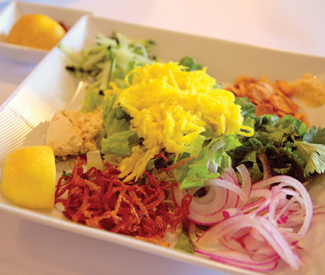
Merely a couple weeks old, downtown Palo Alto’s Rangoon Ruby boasts chefs Win Aye and Win Tin, formerly of Burma Superstar, serving fresh, vivid Burmese dishes. The chic, clean space boasts a nice spirits collection (all three St. George gins can be found here, along with Camus Cognac) and tiki-focused cocktail menu, including lava and scorpion bowls for two or four. While still working out opening and service kinks, owner and Burma native John Lee presents a gracious, hard-working aesthetic grown from his own experience working in the restaurant at San Francisco’s Fairmont. Beloved Burmese salads ($10-13), from tea leaf to ginger, are done right here — brightly generous and served in its superior version: strips of mango atop greens, that fantastic hint of savory imparted by fried onions and garlic, accented with cucumber and dried shrimp. Also try nan gyi nok ($12), a heartwarming mound of rice noodles doused in coconut milk chicken and yellow bean powder, accented with a squeeze of lemon and a hard-boiled egg.

445 Emerson, Palo Alto. (650) 323-6543 www.rangoonruby.com


PICKLED HOT LINK AT SHOWDOGS

Showdogs corners dogs in a space that continues to improve Market Street’s less culinary-inclined blocks, adding on old school sign and sidewalk seating enclosed by hedges since they opened. I have a number of go-to sausages (plus a rocked-out corn dog), but it’s the pickled hot link ($6.95) that remains truly different. A hot link, plump and pickled in apple-cider vinegar for a couple weeks: it’s tangy, slightly blackened as it’s grilled to order, topped with Crater Lake blue cheese sauce and arugula leaves.

1020 Market, SF. (415) 558-9560, www.showdogssf.com


CHAWAN MUSHI AT NOMBE

As part of an affordable seven-course Kaiseki dinner ($39.95) at Nombe, chawan mushi or Japanese savory egg custard has been prfected by chef Noriyuki Sugie. Though numerous izakayas, particularly Nojo, make memorable versions, I was recently hooked on Sugie’s uni chawan mushi, lush with uni’s seaworthy, umami notes, woven into a silky, custard, topped with more fresh uni, served traditionally in a covered dish. Order a pour from Nombe’s impressive sake list — ask co-owner and sake sommelier Gil Payne to recommend a pairing for you — and settle into black booths in the quirky, comfy Mission diner space.

2491 Mission, SF. (415) 681-7150, www.nombesf.com

Subscribe to Virgina’s twice-monthly newsletter, The Perfect Spot, www.theperfectspotsf.com


Win a pair of tickets to the classic Paramount movie, Apollo 13

0

This riveting space exploration film has yet to be equaled by any other for its depiction of courage in the face of danger – and for sheer nail biting suspense. As astronauts Jim Lovell (Tom Hanks), Fred Haise (Bill Paxton), and Jim Swigert (Kevin Bacon) prepare to embark on the third manned moon shot in 1970, the public already was beginning to regard lift-offs at Cape Canaveral as routine. But everything changed when three-quarters of the way to the moon, an explosion sent the Apollo 13 craft into an uncontrolled spin and left the astronauts with a rapidly dwindling supply of oxygen and power. Director Ron Howard’s dramatic account of the astronauts’ bravery and their ship’s rescue is fraught with action, anxiety and emotion, as the plight of the astronauts is linked to the fears and hopes of their earthbound colleagues and families. Paramount Movie Classics include live Wurlitzer organ serenade, Dec-O-Win raffle, newsreel, cartoon and previews.

Enter to win a pair of tickets by emailing sfbgpromos@sfbg.com with “Apollo 13” as the subject and provide your name in the message. Six lucky winners will win a pair of tickets to the viewing on Friday, July 13. Winners will be announced Wednesday, July 11.

Friday, July 13 at 8p.m., @ Paramount Theatre, 2028 Broadway, Oakland | $5

Our Weekly Picks: July 4-10

0

WEDNESDAY 4

“For the Greater Good, Or The Last Election”

Real quick, if you’re new here: San Francisco Mime Troupe productions do not contain any mimes of the painted-face-and-striped-shirt variety. The company’s first performances (in 1959) were silent, but since those early days, SFMT has evolved into its current, much-loved form: presenting lively political musicals at parks and other venues across NorCal every summer. Previous plays have feasted on such satire-ready topics as big oil, religious fanatacism, and the corporate takeover of America; this year, the headlines once again supply a ripe subject: one percenters behaving badly. For the Greater Good, Or The Last Election is actually a re-working of The Poor of New York, a soapy drama written in 1857 with greedy themes that still ring true in the good ol’ 21st. (Cheryl Eddy)

Various venues through Sept. 8

Wed/4 and Sat/7-Sun/8, 2pm, free (donations accepted)

Dolores Park, 18th St. at Dolores, SF

www.sfmt.org


THURSDAY 5

Skerik’s Bandalabra

For those of you bitching about jazz’s irrelevance in the 21st century: meet Skerik. The Seattle-based saxophonist performs with total abandon, filtering his horn through a tangle of effects pedals as he solos with incendiary force. Resembling a rock frontperson as much as a jazz bandleader, Skerik has spearheaded a handful of projects, from Garage a Trois, to the Tortoise-y Critters Buggin. He describes his latest outfit, Skerik’s Bandalabra, as conjuring “Fela Kuti meeting Steve Reich in rock’s backyard,” and with a lineup of several of Seattle’s hottest session players in tow, it’s one of his tightest, most funkified ensembles yet. Ever had the urge to hear a sax fed through a wah-wah pedal? Well then, look no further. (Taylor Kaplan)

With Wil Blades Trio

9:30pm, $10

Boom Boom Room

1601 Fillmore, SF

(415) 673-8000

www.boomboomblues.com


Smokey Robinson with the San Francisco Symphony

R&B legend Smokey Robinson got his start in the music business back in the 1950s, forming the Miracles while he was still in high school and eventually leading the band to stardom: they were Motown Records’ first million-selling artists on the strengths of hit songs such as “Shop Around,” “You’ve Really Got A Hold On Me,” “I Second That Emotion,” and “Ooh Baby Baby.” The velvet-voiced Robinson has continued to write and perform ever since, and has earned a host of well-deserved awards and accolades, including being honored by the Kennedy Center in 2006. Fans won’t want to miss the music icon tonight when he performs a special show with the San Francisco Symphony. (Sean McCourt)

7:30pm, $15–$115

Davies Symphony Hall

201 Van Ness, SF

(415) 864-6000

www.sfsymphony.org


Liars

Based in LA, then Jersey, then Berlin, then NYC, Liars change locales as often as they switch musical directions. The three-piece has come a long way since their early days in the “dance-punk” compartment, but since the brawny, percussive Drum’s Not Dead (2006) they’ve struggled a bit to deliver a definitive statement. This year’s WIXIW (say wish-you) finds Liars reinventing the wheel again, to produce their most synthified affair yet; picture the rocktronic fusion of Kid A-era Radiohead, approached with the finely calibrated ambience of Bjork’s Vespertine, Trent Reznor’s swagger, and Tom Waits’ lumbering dynamics. How will this abrupt switch in instrumentation affect their live setup? Will the band approach their older work with an electronic edge? Liars thrive on this sense of uncertainty. (Kaplan)

With Cadence Weapon 8pm, $22.50 Great American Music Hall 859 O’Farrell, SF

(415) 885-0750

www.slimspresents.com


FRIDAY 6

“Kung Fu Double-Feature”

Summer programming at the Roxie ain’t nothing to fuck with. Witness the kung fu double punch of 1979’s The Mystery of Chessboxing, a.k.a. Ninja Checkmate, featuring a villain named Ghost Face Killer who inspired you-know-which Staten Island hip-hop star; and Five Elemental Ninjas, a.k.a. Chinese Super Ninjas, which came out in 1982 and is therefore a late-ish entry from director Chang Cheh, superstar helmer for Hong Kong’s powerhouse Shaw Brothers Studio. What you won’t get: CG, 3D, Oscar-caliber acting, logic. What you can expect: rare 35mm prints of both films, supernatural ninjas cloaked in gold lamé, blood-squirting violence, an overabundance of unnecessary camera zooms, and some of the most hilariously stilted dubbing ever committed to celluloid. (Eddy)

Five Element Ninjas, 7:30pm; The Mystery of Chess Boxing, 9:30pm, $6.50–$10

Roxie Theater

3117 16th St., SF

www.roxie.com


Paper Bird

With seven members and no leader, Paper Bird should be a logistical nightmare, but this native Denver band has been making seamlessly joyful noise for five years. Contributions from nearly 10 different songwriters make its work, fresh, eclectic, and unpredictable. And despite the size of the group, Paper Bird exudes a charming sense of intimacy. Focused on vocal harmony, banjo, and brass, the band plays danceable folk music for all ages. These hometown heroes have been voted in Colorado’s top 10 underground bands for three years running by the Denver Post and were recently featured in NPR’s All Things Considered and now they’ve come to win the heart of the Bay Area. (Haley Zaremba)

With Muralismo, Corpus Callosum

9:30pm, $10

Hotel Utah

500 Fourth St., SF

(415) 546-6300

www.hotelutah.com


Foxtails Brigade

Laura Weinbach is a creative force to be reckoned with. Her band Foxtails Brigade spins whimsical tales woven with violin accompaniment by Anton Patzner (Judgement Day). The band just released the third episode of their “Farmhouse Sessions” series on Youtube — revel in Weinbach’s on-point articulation of the chorus, “I am not my, I am not myself/ We are not our, we are not ourselves” over the rhythmic picking of Patzner’s violin, Joe Lewis jamming on the guitar, and a steady drumbeat provided by Josh Pollack. For her springtime release, The Bread and the Bait, Weinbach was inspired by narratives of the Victorian Era, resulting in a lush and intricate sound. Check out her unabashedly romantic cover of Edith Piaf’s “La Vie in Rose,” a fan favorite,. If that doesn’t get you hooked, well then I’ll eat my Victorian Era laced bonnet. (Shauna C. Keddy)

With La Dee Da, Missing Parts

9:30pm, $10

Starry Plough

3101 Shattuck, Berk.

(510) 841-2082

www.starryploughpub.com


Swing U Benefit Ball

Modern city dwellers: it’s time to head out to the middle of the bay and swing back in time to an era that saw the glamorous Golden Gate International Exposition of 1939 hosting visitors from around the world on Treasure Island, greeted by local pirate pin-up queen Zoe Dell Lantis. Tonight’s classic USO-themed “Swing U Benefit Ball” will feature live music, dancing, pirate pin-up contests, vintage vendors, historical presentations, and more, all paying tribute to the important role that Treasure Island played in the development of the San Francisco Bay Area, and raising funds for the Treasure Island Museum. (McCourt)

7pm, $15–$30

Winery SF

200 California Ave., Building 180 North, Treasure Island, SF

www.sfswingfest.com


SATURDAY 7

All My Friends Are Still Dead

What would your survival chances be if you were a poor fish in a bowl, watching your fellow fish friends die off thanks to an irresponsible owner? How would it feel to try to make friends if you were the Grim Reaper? Enjoy a hilarious take on these predicaments and more in All My Friends Are Dead, an illustrated book by Jory John (contributor to NY Times, SF Chronicle, and Believer Magazine) and actor-writer Avery Monsen. John will read from the book’s sequel, All My Friends Are Still Dead, at bookstore-museum Paxton Gate’s Curiosities for Kids today. Reminiscent of Lemony Snicket (A Series of Unfortunate Events) and his morbid childrens’ tales, their book is an ironic yet endearing anti-fable — each page is cringe-worthy yet laughter-inducing. (Keddy)

Paxton Gate’s Curiosities for Kids

1pm, free

766 Valencia, SF

(415) 252-9990

www.paxtongate.com


Y La Bamba

Indie-folk rockers Y La Bamba have been steadily making a name for themselves over the past couple of years, earning praise from the likes of NPR and musically popping up in television programs such as “Bones.” The latter is a fine example of a creative producer seizing upon the Portland-based band’s haunting and ethereal, yet rich and full sound, which is propelled by singer-songwriter Luzelena Mendoza, whose vocals float and weave above and throughout Latin-inspired rhythms and unique backing vocals. The band’s new album, Court The Storm, was produced by Los Lobos member Steve Berlin, and released this February — catch Y La Bamba in an intimate setting while you still can. (McCourt)

9pm, $16

Great American Music Hall

859 O’Farrell St., SF

(415) 885-0750

www.slimspresents.com


Blackalicious

This Sacramento rap duo has a lot more going for it than just an awesome name. Rapper Gift of Gab and DJ Chief Xcel, who met in high school, have been spinning catchy hip-hop tracks for more than a decade. Like fellow West Coast Rappers Jurassic 5 and Pharcyde, Blackalicious eschews the misogyny and violence too often synonymous with rap music. Their multi-syllabic rhymes are both complex and uplifting. Their debut album Nia is Swahili for “purpose” and spirituality is an important feature of their lives and work. When they hit the stage these down-to-earth, self-described “everyday brothers” will make your head bob, your feet tap, and your mind expand. (Zaremba)

With Richie Cunning, Raw-G

9pm, $25

The Independent

628 Divisadero, SF

(415) 771-1421

www.theindependentsf.com


MONDAY 9

The Eric Andre Show

If David Lynch were given his own late-nite program on a public-access channel in Pete & Pete’s basement, it might look and feel somewhat like The Eric Andre Show. Hosted by the LA-based stand-up comic, Adult Swim’s perverse, unhinged excuse for a talk show makes it way to the live stage with real/fake celebrity appearances (fake-George Clooney chugging coffee, perhaps?), charmingly incompetent house band, and incredibly seedy production values in full force. Beloved Oakland hip-hop duo Main Attrakionz will bring their hazy, lo-fi productions to the show as well, rounding out an evening of deranged, unpredictable, and supremely stoned entertainment. No Visine required. (Kaplan)

With Main Attrakionz, Stroy Moyd, Chris Garcia 8pm, $10 Rickshaw Stop 155 Fell, SF (415) 861-2011 www.rickshawstop.com

Stage Listings

0

Stage listings are compiled by Guardian staff. Performance times may change; call venues to confirm. Reviewers are Robert Avila, Rita Felciano, and Nicole Gluckstern. Submit items for the listings at listings@sfbg.com. For further information on how to submit items for the listings, see Picks.

THEATER

OPENING

Duck Lake The Jewish Theater, 470 Florida, SF; www.duck-lake.com. $17-35. Opens Fri/6, 8pm. Runs Fri-Sat, 8pm. Through July 28. PianoFight’s resident sketch comedy group, Mission CTRL, performs its new "ballet-horror-comedy."

For the Greater Good, Or The Last Election This week: Dolores Park, 18th St at Dolores, SF; www.sfmt.org. Free (donations accepted). Opens Wed/4, 2pm. Runs Sat/7-Sun/8, 2pm. Various venues through Sept. 8. SF Mime Troupe launches its annual political musical (this year’s theme: one percenters behaving badly); the show travels around NorCal parks and other venues throughout the summer.

BAY AREA

King John Forest Meadows Amphitheater, 890 Belle, Dominican University of California, San Rafael; www.marinshakespeare.org. $20-35. Previews Fri/6-Sun/8, 8pm. Opens July 13, 8pm. Runs July 15, 21, 27, 29, Aug 4, 10-12, 8pm; July 22 and Aug 5, 4pm. Marin Shakespeare Company kicks off its 2012 outdoor summer festival season with this history play.

ONGOING

Absolutely San Francisco Alcove Theater, 414 Mason, Ste 502, SF; www.thealcovetheater.com. $32-50. Thu-Sat, 8pm (no show Fri/6). Through Aug 18. A multi-character solo show about the characters of San Francisco.

5 Lesbians Eating a Quiche Phoenix Theatre, 414 Mason, SF; www.tidestheatre.org. $20-38. Thu-Sat, 8pm (also Sat, 10pm). Through July 21. Tides Theatre performs Evan Linder and Andrew Hobgood’s comedy about five women forced into a bomb shelter during a mid-breakfast nuke attack.

Fwd: Life Gone Viral Marsh San Francisco, 1062 Valencia, SF; (415) 282-3055, www.themarsh.org. $20-50. Sat, 8:30pm; Sun, 7pm (July 15, show at 7:30pm). Extended through July 22. The internet becomes comic fodder for creator-performers Charlie Varon and Jeri Lynn Cohen, and creator-director David Ford.

Hedwig and the Angry Inch Boxcar Playhouse, 505 Natoma, SF; www.boxcartheatre.org. $25. Wed/4-Thu/5, 8pm; Fri/6-Sat/7, 7 and 9:30pm; Sun/8, 5pm. Boxcar Theatre performs John Cameron Mitchell’s musical about a transgendered glam rocker.

Jip: His Story Marsh San Francisco, MainStage, 1062 Valencia, SF; www.themarsh.org. $8-50. Thu-Fri, 7:30pm; Sat, 2pm; Sun, 3pm. Through July 15. Marsh Youth Theater remounts its 2005 musical production of Katherine Paterson’s historical novel.

The Magic Flute War Memorial Opera House, 301 Van Ness, SF; www.sfopera.com. $31-340. Fri/6, 8pm; Sun/8, 2pm. San Francisco Opera adds some unexpected vitality to its new star-studded production of one of the world’s most popular operas, Mozart’s whimsical but philosophical tale of a romance and (Mason-inspired) spiritual evolution. Prince Tamino (poised tenor Alek Shrader) and sidekick Papageno (fine baritone Nathan Gunn in a blithe comedic performance) are on a quest to rescue from sorcerer Sarastro (imposing bass Kristinn Sigmundsson) the lovely Pamina (appealing soprano Heidi Stober), daughter of the Queen of the Night (the rousingly virtuosic Russian soprano Albina Shagimuratova). The battle royal between the Queen and Sarastro is one between darkness and light, but the emphasis of this joyful production is rightly on the latter, even as Tamino and Papageno’s journey takes them through the ritual rite of passage in Sarastro’s order, the Temple of Light. Visual artist Jun Kaneko (responsible for the giant ceramic heads on view outside the War Memorial Opera House until November) marshals a brightly extensive color palette and some state-of-the-art 3D software to create a mise-en-scène out of parallel planes of patterned line and color. These enveloping and fascinating geometric flights of fancy — animated by a drawn, human touch and organic trickles and blushes of color throughout — come complimented by wildly playful costumes, including a host of wonderfully oddball brightly painted birds, that make for some pleasantly cackling entrances. David Gockley’s English-language translation of the libretto, meanwhile, adds a zesty colloquial freshness whose tinge of irony contributes to an intellectual roominess that matches the aesthetic one, both together offering some necessary reflective space to the contemporary audience vis-à-vis the certainties of this Enlightenment fairytale. (Avila)

Proof NOHspace, 2840 Mariposa, SF; www.proofsf.com. Wed-Sat, 8pm. Through July 14. $28. Expression Productions performs David Auburn’s Pulitzer-winning play about a mathematician and his daughter.

"Risk Is This…The Cutting Ball New Experimental Plays Festival" Exit on Taylor, 277 Taylor, SF; (415) 525-1205, www.cuttingball.com. Free ($20 donation for reserved seating; $50 donation for five-play reserved seating pass). Fri-Sat, 8pm. Through July 14. Cutting Ball’s annual fest of experimental plays features two new works and five new translations in staged readings.

The Scottsboro Boys American Conservatory Theater, 415 Geary, SF; www.act-sf.org. $20-95. Tue-Sat, 8pm (also Wed and Sat, 2pm; no matinee Wed/4); Sun/8, 7pm. Extended through July 22. American Conservatory Theater presents the Kander and Ebb musical about nine African American men falsely accused of a crime they didn’t commit in the pre-civil rights movement South.

Vital Signs Marsh San Francisco, 1062 Valencia, SF; (415) 282-3055, www.themarsh.org. $15-50. Sat, 8:30pm. Through July 21. The Marsh San Francisco presents Alison Whittaker’s behind-the-scenes look at nursing in America.

Waiting… Larkspur Hotel Union Square, 525 Sutter, SF; www.brownpapertickets.com. $69-75. Thu-Sat, 8pm; Sun, 2pm. Through Aug 5. Comedy set behind the scenes at a San Francisco restaurant.

The Waiting Period MainStage, Marsh San Francisco, 1062 Valencia, SF; (415) 282-3055, www.themarsh.org. $15-50. Fri, 8pm; Sat, 5pm. Extended through August 4. Brian Copeland (comedian, TV and radio personality, and creator-performer of the long-running solo play Not a Genuine Black Man) returns to the Marsh with a new solo, this one based on more recent and messier events in Copeland’s life. The play concerns an episode of severe depression in which he considered suicide, going so far as to purchase a handgun — the title coming from the legally mandatory 10-day period between purchasing and picking up the weapon, which leaves time for reflections and circumstances that ultimately prevent Copeland from pulling the trigger. A grim subject, but Copeland (with co-developer and director David Ford) ensures there’s plenty of humor as well as frank sentiment along the way. The actor peoples the opening scene in the gun store with a comically if somewhat stereotypically rugged representative of the Second Amendment, for instance, as well as an equally familiar "doood" dude at the service counter. Afterward, we follow Copeland, a just barely coping dad, home to the house recently abandoned by his wife, and through the ordinary routines that become unbearable to the clinically depressed. Copeland also recreates interviews he’s made with other survivors of suicidal depression. Telling someone about such things is vital to preventing their worst outcomes, says Copeland, and telling his own story is meant to encourage others. It’s a worthy aim but only a fitfully engaging piece, since as drama it remains thin, standing at perhaps too respectful a distance from the convoluted torment and alienation at its center. (Avila)

BAY AREA

Emotional Creature Berkeley Repertory Theatre, Roda Theatre, 2025 Addison, Berk; www.berkeleyrep.org. $14.50-73. Tue and Thu-Sat, 8pm (also Sat, 2pm; no show July 13); Wed, 7pm (no show Wed/4); Sun, 2 and 7pm. Through July 15. It’s not easy being a girl, and Eve Ensler’s newest play Emotional Creature leaves no scenario unexplored: from high school shaming rituals to ritual clitorectomies. If that sounds like a jarring juxtaposition, you’d be right. It’s difficult theatrically to transition seamlessly from a deeply affecting monologue about being a teenage sex slave in the Democratic Republic of Congo to a cute song about wearing miniskirts, and it’s equally difficult for the audience to change emotional gears rapidly enough to be able to adequately absorb the impact of each individual segment. Instead, the play comes off as an earnest but awkward Girl Scout Jamboree variety show — attempting to address as wide a variety of social ills as possible (from teen suicide to industrial pollution) — despite the strong and savvy acting chops of the six performers. In contrast to Ensler’s most popular work, The Vagina Monologues, which effectively "humanized" a part of the body by giving it something highly personal to say, Emotional Creature weirdly depersonalizes its girls by putting lines in their mouths ("I’m not the life you never lived") that clearly come from an adult perspective. And as for those girls who don’t particularly identify as "emotional creatures" at all? For them, there are no words. (Gluckstern)

The Kipling Hotel: True Misadventures of the Electric Pink ’80s New venue: Marsh Berkeley, 2120 Allston, Berk; (415) 282-3055, www.themarsh.org. $20-50. Sat, 8:30pm; Sun, 7pm. Extended through July 15. This new autobiographical solo show by Don Reed, writer-performer of the fine and long-running East 14th, is another slice of the artist’s journey from 1970s Oakland ghetto to comedy-circuit respectability — here via a partial debate-scholarship to UCLA. The titular Los Angeles residency hotel was where Reed lived and worked for a time in the 1980s while attending university. It’s also a rich mine of memory and material for this physically protean and charismatic comic actor, who sails through two acts of often hilarious, sometimes touching vignettes loosely structured around his time on the hotel’s young wait staff, which catered to the needs of elderly patrons who might need conversation as much as breakfast. On opening night, the episodic narrative seemed to pass through several endings before settling on one whose tidy moral was delivered with too heavy a hand, but if the piece runs a little long, it’s only the last 20 minutes that noticeably meanders. And even with some awkward bumps along the way, it’s never a dull thing watching Reed work. (Avila)

Salomania Aurora Theatre, 2081 Addison, Berk; www.auroratheatre.org. $30-55. Tue, 7pm; Wed-Sat, 8pm; Sun, 2 and 7pm. Through July 22. The libel trial of a politically opportunistic newspaper publisher (Mark Andrew Phillips) and the private life of a famous dancer of the London stage — San Franciscan Maud Allan (a striking Madeline H.D. Brown) — become the scandalous headline-grabber of the day, as World War I rages on in some forgotten external world. In Aurora’s impressive world premiere by playwright-director Mark Jackson, the real-life story of Allan, celebrated for her risqué interpretation of Oscar Wilde’s Salomé, soon gets conflated with the infamous trial (20 years earlier) of Wilde himself (a shrewdly understated Kevin Clarke). But is this case just a media-stoked distraction, or is there a deeper connection between the disciplining of "sexual deviance" and the ordered disorder of the nation state? Jackson’s sharp if sprawling ensemble-driven exploration brings up plenty of tantalizing suggestions, while reveling in the complexly intermingling themes of sex, nationalism, militarism, women’s rights, and the webs spun by media and politics. A group of trench-bound soldiers (the admirable ensemble of Clarke, Alex Moggridge, Anthony Nemirovsky, Phillips, Marilee Talkington, and Liam Vincent) provide one comedy-lined avenue into a system whose own excesses are manifest in the insane carnage of war — yet an insanity only possible in a world policed by illusions, distractions and the fear of unsettled and unsettling "deviants" of all kinds. In its cracked-mirror portraiture of an era, the play echoes a social and political turmoil that has never really subsided. (Avila)

PERFORMANCE/DANCE

"Channels: An Evening of Cross-Disciplinary Performance" Shotwell Studios, 3252-A 19th St, SF; www.ftloose.org. Fri/6-Sun/7, 8pm. $10-20. Dancers Daria Kaufman, Bianca Brzezinski, and musician-composer Richard Warp perform Arti Ulate, a dance-theater piece; Brzezinski also performs a solo, Non-self.

"Comedy Bodega" Esta Noche Nightclub, 3079 16th St, SF; www.comedybodega.com. Thu/5, 8pm. Free (one drink minimum). Weekly free stand-up show. This week: Yayne Abeba, David Hawkins, Anna Seregina, Veronica Porras, Baruch P. Hernandez, and George Chen.

"Comedy Returns to El Rio" El Rio, 3158 Mission, SF; www.brownpapertickets.com. Mon/9, 8pm. $7-20. With Joe Klocek, Josh Healey, Regina Stoops, Johan Miranda, Shanti Charan, and Lisa Geduldig.

"Elect to Laugh" Studio Theater, Marsh San Francisco, 1062 Valencia, SF; (415) 282-3055, www.themarsh.org. Tue, 8pm. Through Nov 6. $15-50. Will Durst and friends perform in this weekly political humor show that focuses on the upcoming presidential election.

"The Eric Andre Show" Rickshaw Stop, 155 Fell, SF; www.rickshawstop.com. Mon/9, 8pm. $10. Adult Swim-spawned, SF Sketchfest-presented faux-cable access variety show with musical guests and "real and fake celebrity appearances," hosted by actor Eric André.

"The Fag Hag Comedy Show" Deco Lounge, 510 Larkin, SF; www.brownpapertickets.com. Sun/8, 8pm. $10. Charlie Ballard hosts this stand-up comedy extravaganza, with headliner Glamis Rory and more.

"A Funny Night for Comedy" Actors Theatre of San Francisco, 855 Bush, SF; www.natashamuse.com. Sun/8, 7pm. $10. Natasha Muse and Ryan Cronin host stand-up comedians, including headliner Jason Wheeler, at their monthly talk show.

"Jillarious Tuesdays" Tommy T’s Showroom, 1000 Van Ness, SF; www.jillarious.com. Tue, 7:30. Ongoing. $20. Weekly comedy show with Jill Bourque, Kevin Camia, Justin Lucas, and special guests.

Carolina Lugo and Carolé Acuña’s Café Flamenco Peña Pachamama, 1630 Powell, SF; www.carolinalugo.com. Sun/8, 6:15pm. $15-19. Mother-daughter flamenco dance and music company.

"Majestic Musical Review Featuring Her Rebel Highness" Harlot, 46 Minna, SF; www.herrebelhighness.com. Sun, 5pm. Through Aug 12. $25-65. Cocktails and hors d’oeuvres, performers in Baroque-chic gowns, music, and more.

"Schwabacher Summer Concert" Herbst Theatre, 401 Van Ness, SF; www.sfopera.com. Thu/5, 7:30pm. $25-40. The young talent of the Merola Opera Program performs scenes from works by Bizet, Stravinsky, and more.

The People’s School

0

yael@sfbg.com

Oakland elementary schools that were packed with kids until a few weeks ago are now closed for the summer — and five are closed for good. In October the school board voted to close them in a move that would save about $2 million per year.

But many Oakland Unified School District (OUSD) residents are not pleased. At the Oct. 26 meeting where the vote was cast, 500 protested. Concerned parents and teachers have been petitioning and meeting with school board members and Superintendent Tony Smith for months, trying to reverse the decision.

“No one wants to close schools, but the OUSD made this difficult decision because it’s in the best long-term interest of students,” reads a June 22 press release.

Resistance to that decision now continues at one school that was supposed to close June 18. To the dismay of the district, it remains open. Lakeview Elementary is the site of a sit-in and free school, orchestrated by parents and teachers.

“Lakeview has strengths,” the June 22 press release goes on to say. “It has shown improved academic performance in recent years and, boasts a strong sense of community and close alignment with its afterschool programs.” But low rankings in attendance and test scores overshadowed those strengths in the decision to close the school.

Yet it seems that “strong sense of community” seems to be more powerful than the school board thought.

SENSE OF COMMUNITY

Joel Velasquez, a parent of three and PTA member who has had children at Lakeview for 10 years, didn’t think it would come to this.

“I’ve watched everything that went on as a parent here for 10 years,” Velasquez said. When the school was threatened, “I probably spent 20 hours a week meeting, talking, emailing, researching, sending, forwarding — I mean, this is something that has been ongoing.”

“I met with Tony Smith for an hour,” Velasquez said. “I sat with board members.”

But as the end of the school year approached, he was growing more desperate, so he ended up making an announcement: “On the last day of school, I’m not going to leave. And I hope that people join me.”

They did. Lakeview’s building is slated to be turned into administrative offices, and that process was scheduled to begin two weeks ago.

Now, the school that should be filling up with district employees’ office supplies still has children running around its grounds. Organizers opened the People’s School for Public Education, and classes, taught by an army of credentialed teachers and qualified volunteers, run from 9am to 3pm, Monday through Friday.

At a June 27 visit, I toured the school and sat in during a Social Justice class. In the People’s School’s organic garden, a smiling gardening teacher had to stop an overzealous six-year-old from drowning the kale. “They love watering!” he shrugged. Another child, still mesmerized 30 minutes after the official end of music class, improvised on the djembe along with the drumming teacher. From a balcony, a volunteer called to him: “There’s ice cream!” he looked up, considered, and then kept drumming.

The group of kids has grown since the school opened June 15, as parents hear about the summer school and come see it for themselves. The Lakeview sit-in is unlike other recent occupations in the careful vetting process each visitor gets. After all, protecting the kids and their education is the most important goal of the project. But during school hours, parents are permitted to come inside and stay with their children as long as they want, seeing what the school is like.

Still, getting parents to send their children to a summer camp that isn’t technically legal isn’t always easy. “I think our society, not just parents, are really reluctant to do something like this,” Velasquez said. “But I see it as a positive service to the community. We’re using the building for what it’s intended to be used for.”

Julia Fernandez, a high school math teacher, got involved with the effort to save the schools through the Occupy Oakland Education Committee, and her two children, ages 2 and 4, are enrolled in the summer school.

As a nine-year resident of Oakland, Fernandez says, the cuts affect her and her family. She’s taking part in the demonstration partly “for my own kids,” Fernandez said. She said the cuts “affect the school where my kids would go. It’s likely that it’s going to be closed or turned into a charter school.”

“But the thing that motivates me the most is all these attacks that are happening against people,” Fernandez said. She guessed that it was adversity of many kinds, not just school closures, that motivated many parents to join the protest and send their kids to the People’s School.

“People are really upset about all the attacks that are being done on regular working class people. People are losing their homes, they’re getting laid off, and now their schools are closing. It just seems like all these services, all these rights people should have, are being taken away”

MORE THAN MONEY

Organizers emphasize that the money saved seems paltry, just $2 million for five functioning schools.

“Think about it, this is not very much,” Velasquez said. “And they’re wasting almost $4 million to do these transitions to close the schools. They’re spending more than the savings.”

OUSD spokesperson Troy Flint confirmed that the savings will be “in the $2 million range,” and that the total cost of the transition is about $3.7 million.

These expenses include about $117,000 one-time moving related costs and about $200,000 in staffing, including paying a transition director.

They also include $95,000 in transportation costs, which may not be one-time expenditures; they may “as needed for an additional year or more,” Flint said in an email.

Meanwhile, about 1,000 students will be displaced by the move. Many will move to Grass Valley and Burckhalter, and these school’s capacities will be expanded with portable classrooms.

“The promise that we made to students was that we would guarantee students at the closing school a place at a school that was higher performing than the one we were leaving. We were able to live up to that promise,” Flint said.

However, there was a problem: “Most of the schools that perform in the top tier are already subscribed to capacity, so we had to expand the capacity using portables.”

Will these high performing schools remain high-performing as an influx of new students show up at their doors in the fall? After all, Oakland has many more elementary schools than comparable districts, a result of the small schools movement, a policy adopted in 2000 that led to the closure of some larger schools, which were replaced by smaller ones. According to a study conducted by Brown University’s Annenburg Institute for Education Reform, Oakland small schools are “safer, calmer, and more welcoming to families” than the schools they replaced.

But as private donations from those excited about small schools, notably the Bill and Melinda Gates Foundation, run out — along with federal and state money — Oakland may be reverting to larger institutions.

And as the OUSD sees it, that may not be a bad thing.

“To build toward the day when every OUSD school is a high-quality school, we need to concentrate our time, attention and resources in a manageable number of sites instead of spreading ourselves too thin,” he said in an email. “Quality over quantity is the goal when we can’t do both and the current financial environment prevents us from properly caring for 101 schools.

THE NEIGHBORHOOD PROBLEM

One of the reasons for the stated school closure is that it ranked in “the bottom quarter of elementary schools in terms of the number of children living within a half-mile of the school or within the attendance area” and the “lowest percentage of neighborhood students attending the school (30 percent).”

The school is also 99 percent children of color.

As Oakland Tribune education reporter Katy Murphy has written, about half of students in Oakland attend schools outside their district. As a statement from the group Decolonize Oakland points out, “We have to question why the families of black and brown students who live outside of Adams Point have chosen Lakeview.”

Maybe it’s that strong sense of community? All of the other schools slated for closure are also in the flatlands and serve mostly African American and Latino students.

Root, formerly Occupy the Hood Oakland, has played a big part in the organizing. So has Education for the 99 Percent, Occupy Oakland’s education working group, and other Occupy Oakland volunteers.

“A lot of people from Occupy have been extremely supportive and we wouldn’t be able to do this action without that support,” Velasquez said. “For example, the food, they have come every single day to feed, not just breakfast, lunch and dinner, but snacks and drinks.”

The sit-in has also received support from labor groups. A letter signed by more than 50 teachers’ union leaders and local school employees declares, “An injury to one is an injury to all. Let’s seize this opportunity to fight alongside parents, students, and community. We will mobilize our members to support this struggle.”

LEADERSHIP?

The demonstration has not, however, received support from the city of Oakland. Officers from the OUSD Police Service has visited the school several times (and Velasquez says they have done so without warning, despite agreeing to call first to avoid scaring children). Oakland police have been on site as well, and the protesters have received warnings to leave.

“I still remain hopeful that the protesters will see that the most forward-looking resolution to the standoff is to disperse peacefully and to concentrate their efforts on improving the school district for the year 2012/2013 and beyond,” Flint told me. “Right now we still believe that if there’s a relatively prompt resolution to the standoff, we’ll be able to meet our targets to get the facilities ready.”

“It’s not clear why they’re doing this sit-in in Oakland, an overwhelmingly Democratic district where Republicans can’t get elected,” Flint said. “The fundamental problem with this issue is all the Republicans have taken a no taxes pledge.”

Velasquez agrees. “It’s criminal what the state of California is doing right now,” he said. “But we’re focusing our attention on Tony Smith and the board because they’re accepting these conditions, and they shouldn’t…So if they feel that way, why are they not doing something about it, instead of accepting the conditions, and hurting the families and the students? Most importantly the kids.” Flint said the board would be willing to work with the group, but that the sit-in is pointless. “I don’t view this current action as something that is providing us any additional leverage,” he said, though he noted that his office had not attempted to use the sit-in to pressure the state. “We’ve coordinated people across the state, sending in postcards and petitions,” he explained. But when asked what worked best, he said nothing has. “I can’t name a time we’ve been successful,” he said, “because I don’t think we’ve been successful.” As budget cuts sweep the country many governments are feeling this kind of defeatism. The Peoples School for Public Education may not last forever. But they’ve taught 30 kids for free for more than two weeks now, and despite limited time and resources, show no sign of stopping.

Real swell year

0

emilysavage@sfbg.com

MUSIC In Jimmie Rodgers’ 1930s-era song “The One Rose,” the country music pioneer wistfully croons “So blue, so lonesome too, but still true/Rosie haunts me, makes me think of you/You’re the one rose that’s left in my heart.”

Midway through Mornin’ Old Sport’s surreptitiously upbeat, plucky country-folk ditty “Katie” — off the contemporary band’s debut self-titled full-length, released July 10 on Misery Loves Co. — singer-guitarist Scott Nanos harmonizes with fiance-bandmate Kate Smeal about their complex love story. “The shadows are calling my number/I know I’m just waiting in line/but I’ll sing my vows as I’m pulled underground/I’m Katie’s and Katie is mine.”

Complicated love, it seems, is universal. While the song is toe-tapping fun, like a candlelit county fair square dance with checkered tablecloths and corked bottles of homemade moonshine at the ready, the message is a bit deeper: I’m in burning love, but eternal commitment could drag me to an untimely death of spirits.

And yet, “It is very loving,” Nanos insists over a pitcher of beer near Embarcadero, mere weeks before the band’s summer tour. “It doesn’t really sound that happy to me,” Smeal laughs after repeating the hook. “Fatalism and love are the same,” Nanos returns.

“It’s just a really sad love song,” Smeal concedes.

Mornin’ Old Sport is not solely based on this core romantic relationship, there are other types of connections in the now-Oakland based band, those of the blood-brother variety. Like the one between Nanos and fellow Berklee College of Music classmate Jeff Price — the band’s drummer who helped produce the album, which Price’s real brother mastered in their parent’s Colorado recording studio. The Price family runs the small Misery Loves Co. record label (the father was a session musician beginning in the 1960s).

Nanos and Price have been making music together since the first day of college in Boston in 2006, and have been living together just as long. There, at the Massachusetts music school, the band began in earnest — but with a twist. While it started with a few more members, the name Wiffle Bat, and a wholly different sound (Smeal describes it as “circus indie rock”), it eventually whittled to the Mornin’ Old Sport trio.

The three say they organically fell into the music they make now, which is reminiscent of pre-war Americana, early country, jazzy standards, the vaudevillian spirit of Tin Pan Alley, and twangy folk, with influences like Gene Autry, June Carter and Johnny Cash, Lefty Frizzell, Doris Day, the aforementioned Jimmie Rodgers, and Hank Williams. But have they wedged themselves into a vintage corner?

“I was thinking about this the other day, because it is something that mentally I’ve confronted within myself,” says Nanos. “But everything that’s coming out right now is derivative; it’s derivative of the ’80s, or chillwave is slightly derivative of the late ’70s psychedelia, and late ’60s. It’s just a matter of what you’re using as a jumping-off point.”

Nanos’ major at Berklee — music therapy — was one factor leading to these earlier eras as jumping points.

“My field work in music therapy stirred up a romance with 1930s, ’40s, and even ’50s music because I was doing a lot of work with older adults, ages 60 to 90. So I’d do Tin Pan Alley songs, and maybe some Hank Williams, Patsy Cline, Ella Fitzgerald,” says Nanos. “I really started to fall in love with those styles, of which Kate was already a huge, avid fan.”

Adds Smeal, “My parents always sang to me, and then I started studying jazz in early high school — that lead the way for me because I really enjoy old throwback country music that has jazz elements to it.”

“I think our relationship and also music therapy made me enamored with vintage music,” Nanos concludes.

Now there’s yet another relationship to take into consideration: Mornin’ Old Sports’ new connection with the Bay Area. Nanos, Smeal, and Price moved out West this February and fell in love with Oakland. “We moved for romantic reasons…” Nanos says. Smeal smiles, “and now we’re staying for the same.” They tend to do that, finish each other thoughts. Price often laughs, nodding along.

In playing Oakland and Berkeley co-ops, house parties, and warehouses, they’ve just begun absorbing the local scene, and through the shows recently added two new members to the group — bassist Jack Kodros and guitarist Mike Schlenoff. Currently, the five musicians are out on the road for their first big tour, lugging those brand new vinyl records in the hot van. The debut was officially released this week, while the band makes its way through the Midwest.

Recorded mostly live in Price’s family studio just north of Aspen last year, the record is a promising and pleasurable debut, straddling vintage genres, and mixing up vocal duties. Nanos often leads, but Smeal shines on jazzy torch songs, “Over the Moon” and “My Lips,” along with swooshing if maudlin country track “Clementine.”

Standout track, “When the Bomb” boasts some icky lyrical imagery “when the bomb finally drops/I’ll splatter on the wall/But when that bomb finally drops/It won’t hurt me at all,” yet musically remains sticky-lemonade-sweet and cheery.

There’s a timelessness to all this. “When the Bomb” has such a nostalgic tug, it’s difficult to believe it’s not a cover. But that’s part of the charm in these songs, the reverence to the past and the relative simplicity of those feisty chords.

“If you took a Beach House song or something and wrote out chord changes for it, melody line, someone would [still] have a really tough time recreating it,” says Nanos. “Whereas I feel like the kind of song we’re aiming to write, we can write a chart for someone and be like, ‘here you go, just go play it.’ I like the social values of that.”

As for band hopes of that nature, Smeal has a lofty one: “The ultimate goal of the band is to make art that will stay alive years and years after we’re dead.”

“And that will most likely never happen,” Nanos interjects as Price chuckles, “but that’s the goal.” *

Sit-in at Lakeview elementary raided, free classes continue, rally at 5pm

1

This post has been updated

A sit-in at Oakland’s Lakeview Elementary School ended early this morning as police from the Oakland School Police force entered the school building, making two arrests.

The dispersal was calm by all accounts, although protesters say that officers threatened to use chemical weapons to disperse the crowd, which included young children.


Officers from the Oakland School Police force, the Oakland Housing Authority Police force, Oakland Police Department, and California Highway Patrol were deployed to end the protest, according to a statement from OUSD Superintendent Tony Smith.

“There were children there, parents and teachers and a few occupiers,” said Lola, an organizer with Occupy Oakland who was supporting the sit-in on 4am security duty when police arrived.

There were 20-25 sit-in participants present when police arrived, according to Lola and another Occupy Oakland participant who was on the scene, Alyssa Eisenberg. “There were at least 15 police cars when I drove up,” Eisenberg said.

“The officers were saying, we’ve given you notices now we’re going to give you 15 minutes to leave. Then they gave an official dispersal order and they said, ‘If you do not disperse we’ll use chemical agents against you,’” Lola recounts.

Oakland parents, teachers, elementary school-aged children and supporters had been demonstrating at the school for 17 days. The school is one of five marked for closure by the Oakland School Board, a move that parents and teachers opposed.

The demonstration consisted of a free day camp for children called the People’s School for Public Education, a community garden, and a 24-hour sit-in involving half a dozen tents on the school property.

As protesters left the school, “it was very calm,” Lola said. “All the people that were there left willingly except two,” a parent organizer and an alum of the school who sat in a classroom rather than leave when police arrived. The two were cited for trespassing and released.

Police then erected a new fence outside the public school, and demonstrators went to a park across the street with the goal of continuing to teach free classes to children.

“Officers wouldn’t let [National Lawyers Guild] legal observers or journalists into the building,” said Lola, describing these observers standing on concrete structures outside the gates of the school in order to see what happened.

Organizers have planned a rally in protest of the raid and the ongoing school closures. They plan to meet today at 5pm outside of Lakeview Elementary.

“People who were occupying said this isn’t the end, they have more direct action civil disobedience plans,” Lola said.

Heads Up: 8 must-see concerts this week

0

You’ve got a midweek day off? You’re stoked. Go see some live music with that hard-earned free time. Oh, and happy independence, America. That’s what we’re celebrating, correct?

Eat a barbecued tofu dog slathered in relish and drink some park beers in celebration of such things as country pride and days without responsibility. Then fill those Bay Area music venues, checking in on America’s favorite proto-punk troubadour, Mali’s favorite virtuoso progeny, the Big Time Freedom Fest, woozy dream poppers, a punk rock museum benefit, and more.

Here are your must-see Bay Area concerts this week/end:

Jonathan Richman
Last time the Modern Lover cult hero Jonathan Richman did a slew of shows at the Make-Out Room, he brought drummer Tommy Larkins to the outings, performed for hours on end, sang in multiple languages, chatted awkwardly, mixed up his pacing and flipped his set list so time floated by without a lull. He also danced samba-like solo – twisting his thin frame as a contortionist. Who’s to say this round should be any different? We know Larkins is back at least.
Mon/2-Tue/3, 7:30pm, $15
Make-Out Room
3225 22nd St., SF
(415) 647-2888
www.themakeoutroom.com
http://www.youtube.com/watch?v=XjFU98mEem4

Vieux Farka Toure
The son of Ali Farka Toure, Malian singer-guitarist is legend in his own right. Oft referenced as a “guitar virtuoso” or more specifically  “The Hendrix of the Sahara,” Vieux’s graceful, quick-fingered guitar skills rival those of the rock’n’roller regime, yet he blends in traditional West African influences. Fresh off the Touré-Raichel Collective (his collaborative album and tour with Israeli musician Idan Raichel), Vieux this time swings into town solo, his strumming again center stage.
Mon/2, 8pm, $22
Yoshi’s SF
1330 Fillmore, SF
(415) 655-5600
www.yoshis.com
http://www.youtube.com/watch?v=IecSMEH9ZVg

“Big Time Freedom Fest”
What’s more deliciously new America than the string-lit back patio at El Rio? That’s where dreams are made and shattered. People fall in momentary beat-fueled lust, cheap beers with lime wedges are sipped en masse, and fried food is gobbled up without a second thought. It’s tradition, years in the making. This seventh annual Big Time Freedom Fest features some awesome local heavy-hitters: Religious Girls, Tartufi, Finn Riggins, Battlehooch, and Night Call, all for $8, in the outdoor heavy-hung fog.
Wed/4, 3:30pm, $8
El Rio
3158 Mission, SF
(415) 282-3325
www.elriosf.com
http://www.youtube.com/watch?v=7mMUsyZY4kA

Giraffage, James & Evander
“Glitchy” seems to be the key word for San Francisco’s electronically-constructed solo project, Giraffage. I’m on board. Those little glitchy effects break up otherwise endless ambient affairs, spinning the act from dream-pop to hip-hop in a cotton candy pillow. Tonight’s a co-headlining set with fellow Bay Area suspected Ambien-poppers, James & Evander. That “synth/stoner pop” Oakland act released magical debut LP Bummer Pop last month. How many more pops can we squeeze in this show description? Pop.
With Astronautica, Young Pharaohs
Thu/5, 9pm, $6
Milk Bar
1840 Haight, SF
(415) 387-6455
www.milksf.com
http://www.youtube.com/watch?v=MrrL0sYLgA0

Liars
“This year’s WIXIW (say wish-you) finds Liars reinventing the wheel again, to produce their most synthified affair yet; picture the rocktronic fusion of Kid A-era Radiohead, approached with the finely calibrated ambience of Bjork’s Vespertine, Trent Reznor’s swagger, and Tom Waits’ lumbering dynamics.” – Taylor Kaplan 
With Cadence Weapon
Thu/5, 8pm, $22.50
Great American Music Hall
859 O’Farrell, SF
(415) 885-0750
www.slimspresents.com
http://www.youtube.com/watch?v=ggR6RuBh8I0

Shana Falana
Formerly of San Francisco, the now New York-based psychedelic dream popper Shana Falana returns to her beloved Bay in support of new In the Light EP, bringing along a new multimedia show. Falana’s lilting church choir-like vocals matched to looping guitar and percussion gives the impression of a surreal religious experience deep in the X-Files woods. I want to believe.
With Kelley Stoltz, the She’s, B and Not B
Fri/6, 9pm, $15
Cafe Du Nord
2170 Market, SF
(415) 861-5016
www.cafedunord.com
http://www.youtube.com/watch?v=MUqgXal-knk

Punk Rock Museum Benefit
Given punk’s lasting impact on so many musical branches, and influence on the raw sounds of countless beloved acts, a Punk Rock Museum seems absolutely necessary. Why didn’t we think of this? The new museum – spearheaded by Taquila Mockingbird and based in LA – has been established to “further preserve the punk rock genre.” For this show, parts of the museum travel to San Francisco. There will be a mix pieces (photographs, old fliers, art by the likes of Winston Smith, etc.) from the permanent museum collection, and of course, live music to carry on the legend: Debora Iyall (of Romeo Void), Metal Circus (A tribute to Husker Du), and Meri St. Mary and the Housecoats. Also, DJ Big Nate will be spinning classic punk cuts.
Sat/7, 9pm, $15
Thee Parkside
1600 17th St., SF
(415) 252-1330
www.theeparkside.com
http://www.youtube.com/watch?v=ePIImGMjn_8

Cool Ghouls
Local psych-rockers Cool Ghouls seem to be everywhere lately, opening up Noise Pop retrospective shows, making appearances at lots of local venues, playing Save KUSF benefits; a.k.a traveling around town with beer-fueled, good-time rock’n’roll in tow. They’ve got a bright and free EP currently up for grabs on their Tumblr, an upcoming slot at the Independent before Sonny and the Sunsets, and a full-length LP coming in the fall; this Hemlock show is a good chance to check out the five-piece in smallish setting.
With LA Witch, the Sister Ruby Band
Sun/8, 9pm
Hemlock Tavern
1131 Polk Street, SF
(415) 923-0923
www.hemlocktavern.com

Guardian voices: The labor agreement that changed SF

18

This year marks the 53rd anniversary of the beginnings of  negotiations between the International Longshoreman’s and Warehouseman’s Union and the Pacific Maritime Association over what came to be known as the “Mechanization and Modernization Agreement.”  Signed in October, 1960, after months of talks,  the “M and M agreement” transformed San Francisco’s economy forever, moving its founding industry — shipping and trans shipping — to the East Bay, opening up the land once devoted to maritime uses to real estate development, and setting off the modern political era of San Francisco.

The agreement allowed containerization to come into the San Francisco Bay, making obsolete  the finger piers along San Francisco’s waterfront and the ILWU’s “gangs” that worked on them, hand-loading “break bulk” cargo into the holds of cargo ships. The new technology of shipping cargo in a single  container that could be transported by truck, train, and ship without unloading  transformed maritime trade.

During World War II, shipbuilding and shipping were  fundamental in the effort to move billions of tons of supplies and millions of troops across the global battlefield. In both cases the  San Francisco Bay was ground zero in that in that effort.

Kaiser and Bechtel, two Bay Area-based construction companies, wildly successful in undertaking huge construction projects during the New Deal, were urged to build ships during the war. Kaiser in Richmond and Bechtel in Sausalito constructed  huge shipyards that  built cargo ships by the hundreds, bringing tens of thousands of workers to the Bay Area and changing the demographics of the region for ever. These huge industrial centers didn’t last after the war, and while they transformed who lived in the region, they didn’t really have a lasting economic impact.

But wartime changes in cargo handling did.

For as long as San Francisco had been a city, it depended on its port as the base of its economy. The Gold Rush happened here in part because we had a port and the world rushed in on ships. The enduring fortunes were made during that period by merchants and shipping companies were totally dependent on shipping and cargo handling.

At the heart of the maritime economy was the longshoreman who, by hand, loaded and unloaded ships’ holds. The demand for speed during WWII saw the then-revolutionary introduction of the fork lift truck on the piers of San Francisco, replacing hands with a machine for the first time in the history of the San Francisco waterfront.

But that was only the beginning. New ship designs and new shipping techniques were invented to meet the needs of global war. Since most of the Pacific islands that were the military objectives of the war had no ports or piers, ships were designed that could land directly on a beach and unload preloaded trucks.  Preloaded containers were simply stacked on the decks of Liberty ships, avoiding the need to load the cargo below decks.  By the Korean War these containers were in such regular use by the Army that ships were modified to carry only them, replacing below-deck cargo entirely.

Since ports and piers had been major targets during the war and required extensive rebuilding in both Europe and Asia,  new cargo handling techniques were built into these new facilities, making US ports, undamaged by the war, outmoded and old fashioned.  If US ports were to keep up they had to be modernized.  But who would pay for these new facilities: the shipping business or the government?

San Francisco was still governed by an unbroken line of Republican Mayors during this key period: the anti-New Deal, pro-Mussolini Angelo Rossi; the shipping line owner and anti- ILWU leader Roger Lapham; the pro-real-estate development Elmer Robinson; and finally, the last Republican Mayor of San Francisco, the pro-urban-renewal stalwart George Christopher. These four had no desire to rebuild the waterfront and make the ILWU even stronger. Indeed, Robinson and his successor Christopher had a vision of the waterfront as prime real estate, not working waterfront.

And so, with no commitment to the maritime industry from the city’s leadership and with technological change making the status quo impossible to maintain, Harry Bridges and the leadership of the ILWU cut the best deal they could for their existing members: the 1960 M and M agreement, which gave all existing longshore workers lifetime jobs and very good pay — but sealed the fate of San Francisco waterfront.

By 1962 the Port of Oakland had built its first container facility, and that same year, the first containership, the S.S. Elizabethport, docked and begin loading. By the mid 1970’s, the ILWU was no longer a force in the San Francesco labor movement, its leadership taken by the Building Trades unions  whose  numbers increased as the development boom, fueled by land made vacant by the loss of the maritime industry, grew.

For the rest of the Bay Area, it was San Francisco’s model of waterfront as real estate development that was followed, not Oakland’s investment in cargo shipping. By 1965, development of the Bay was so intense that the McAteer-Petris Act was passed, creating the Bay Conservation and Development Commission, a regional body aimed at limiting the powers of local governments (like San Francisco) in filling and over-developing the Bay.

The 8 Washington battle, the struggle over the Hunters Point shipyard, and the looming battle over the use of a port pier for the Warriors arena all have their history deeply rooted in the 1960 M and M agreement.

In this second decade of the 21st century, our greatest challenge is creating and sustaining meaningful employment. Would our prospects be better if we had somehow been able to keep some maritime uses at the port? Would families in Bay View-Hunters Point be more able to buy homes in their own neighborhood if the same kinds of jobs that allowed their grandparents to buy theirs still existed? Would the boom-or-bust cycle of our real-estate dependent local economy been so disruptive if we had a more steady state base of a maritime sector — which kept the Great Depression from being so devastating in San Francisco in the1930s?

These questions are real — and should show that the shape of our economy is made by us and the decisions we make, locally, not solely by techological change, global trends or the far-too-palsied invisible hand of the free market.