FILM “Go look in the refrigerator.” Normally, that’s not a particularly sinister phrase. But if the fridge in question happens to be sitting in Jeffrey Dahmer’s Milwaukee kitchen, circa 1991, it contains the following: a box of Arm & Hammer, condiments (mustard, ketchup, steak sauce), and a freshly severed human head.
With details like that, there’s no wonder the Dahmer case continues to fascinate, 22 years after his capture (and 19 years after he was bludgeoned to death by a fellow inmate). Chris James Thompson’s The Jeffrey Dahmer Files, a documentary with narrative re-enactments, is savvy to the fact that lurid outrageousness never gets old. It also plays off the contrast between Dahmer’s gruesome crimes and his seemingly mild-mannered personality.
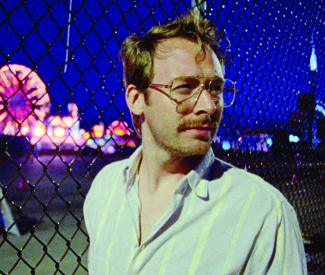
And thankfully, these aren’t cheesy, America’s Most Wanted-style re-enactments. We see Jeffrey (Andrew Swant) going about a mix of mundane and fraught-with-meaning tasks: being fitted for new glasses, eating a hamburger, shopping for 10-gallon drums, and buying way more bleach than one man could possibly ever need. We never see him kill, though we do witness him entering a hotel with another young man — and leaving with a suspiciously heavy suitcase. Swant isn’t a dead ringer for Dahmer, but he has the same “serial killers look like everybody else” quality. It’s unsettling, and goes a long way toward explaining why, as real-life Dahmer neighbor Pamela Bass recalls here, the Jeff she knew (“kinda friendly, but introverted,” Bass says) hardly seemed like a murdering cannibal.
https://www.youtube.com/watch?v=hSzeu6ohgeA
But Wisconsin’s most passionate body-part hoarder (since Ed Gein, anyway) was 100 percent authentic, a fact made abundantly clear to the homicide detective assigned to the case, Pat Kennedy (who made that stomach-turning fridge peek), and medical examiner Dr. Jeffrey Jentzen, tasked with identifying Dahmer’s torn-asunder victims. “We were dismantling someone’s museum,” Jentzen remembers of the crime scene, a tidy one-bedroom in a rough part of town where, months earlier, flippant cops had ushered a dazed teenager back into Dahmer’s clutches, believing his tale that the younger man had stormed out after a domestic spat. Oops.
Since Dahmer is dead and his crimes have been well-documented — in books by Dahmer’s father and others, true-crime specials, and the 2002 narrative film that gave future Oscar nominee Jeremy Renner his breakout role — The Jeffrey Dahmer Files does well to concentrate on people whose lives have been forever changed by the case, two because of their jobs and one due to an unfortunate coincidence. Though Kennedy and Jentzen offer compelling interviews, Bass’ participation is key; unlike the two men, who’ve no doubt told their stories dozens of times before, her emotions still feel raw.
She speaks about getting to know her across-the-hall neighbor — he stood out for being the only white guy living in the Oxford Apartments, a fact made more notable when it was revealed he killed mostly men of color, many of whom were also gay. (As his victims’ families would no doubt agree, if Dahmer’d had a taste for rich white girls, his story would certainly have played out differently.)
Not only did Bass have to deal with the revelation that she’d been living next to a killer (“I remember a stench, an odor”), she found herself surrounded by a media circus, harassed by gawkers, and blamed by strangers for “not doing anything.” Even after she’d moved — the entire apartment building was torn down — the stigma of having been Dahmer’s neighbor lingered.
Kind of like the killer’s own notoriety. Speaking of, the Akron, Ohio house where Jeffrey Dahmer grew up (and committed his first murder) has been on the market for six months. Refrigerator included.
The phenomenal house DJ and experimental musicmaker on mainstream visibility, transgender globalism, Bay Area queer culture, and the “shopping mall diversity” of the current dance music scene.
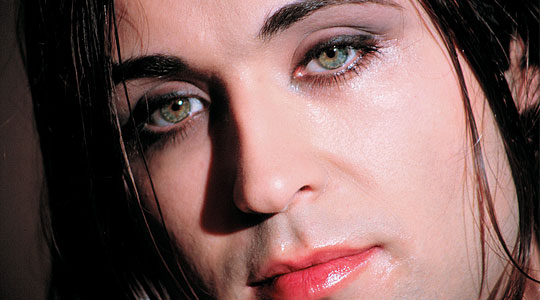
Techno has always had room for theorists and intellectuals, from Derrick May to the Mille Plateaux label roster, and social activists, like Moodymann and Underground Resistance. Most of that discourse usually takes place musically, however, with concepts emerging from the vinyl itself. The celebrated DJ Sprinkles, a.k.a. Terre Thaemlitz, the American head of Japan-based label Comatonse, tops all that by making intellectually grounded music glimmering with poetic touches and expounding in interviews and writing on such heady, heated topics as essentialism, gender idenitity, surveillance, and authenticity. She leads workshops, goes on speaking engagements, and isn’t afraid to let loose in interviews. (For example — see below — rather than “born this way” platitudes, she considers her queer identity “beat this way.”)
It’s a beautiful thing, especially in the rare context of controversial truth and radical opinion pouring from the mouth and keyboard of an outspoken transgender major player on the stubbornly homogenous global house-techno DJ scene. Of course, it all comes down to the music — we’ll get a treat when Sprinkles (who chose the name because he wanted something that sounded “totally pussy” in opposition to macho DJ culture, to buck the testosteronal scene) performs Sun/24 at Honey Soundsystem — and Sprinkles certainly has the goods. He’s released umpteen pieces in an astoundng breadth of genres under multiple pseudonyms over the past 20 years. Masterpiece deep house album “Midtown 120 Blues” siezed the top of several best of 2009 charts and was, typically, followed by Soulnessless, a 30-hour “mp3 album” of music and video. Because why the hell not?
I got a chance to exchange emails with Sprinkles before her appearance here. It’ll be an interesting return to the Bay Area, where she lived for several years before decamping to Japan. Here’s all she had to say.
http://www.youtube.com/watch?v=UY79cyv8pH8
SFBGIt’s been 13 years since you lived in Oakland, is that correct? Can you tell me why you decided to leave and what it was like to live here then, with regards to the music, political, and queer scene?
DJ SPRINKLES Yes, it’s been a long time. I used to live across the street from a hotel where the Unabomber once stayed. Honestly, I can’t say I miss California. I never really connected with any queer or transgendered communities in SF or Oakland. Whenever I tried, they seemed immersed in West Coast spiritualism and zodiac bullshit, which I found completely alienating. Most of the transgendered people I met there were prone to metaphysics — by which I mean they were ideologically (and economically and medically) invested in defining their transgenderism in relation to a perceived split between their “physical bodies” and their “true inner selves.” I’m an anti-essentialist, non-op, materialist, anti-spiritualist… so that clearly wasn’t a match with my own transgendered identity.
There was also a weird conservatism in SF’s queer scenes that I associated with the fact a lot of people in SF had been raised in conservative Midwestern towns, so they were in SF to “live the life.” I felt there was a lot of unacknowledged parody and role play going on — people trying to overcome a life of repression and closets by wrapping themselves in rainbow flag culture. Yet, when going to buy groceries or such, I still found myself being harassed as a “fag” on the street like in any other town in the US. I felt my four years there was all quite standard. I don’t really think of the Bay Area as a “special place” for being queer and transgendered.
US identity politics have a particularly inextricable link to the concept of the ghetto — not only as a place of economic strife and forced communal ostracization from a “white middle-class mainstream,” but also as a self-invested “safe space” for non-mainstream social movements. This is part of migrant culture. For example, after my grandparents passed through Ellis Island, they immediately moved to a place where people spoke the same language as their homeland, etc. The Castro, New York’s West Village, Little Italy, China Town… these are all migrant-based communities formed by people seeking safety in numbers in the face of not being welcome elsewhere — these two dynamics of “safety” and “alienation” are inseparable to most US identity politics. So these communal zones all display the problems and contradictions of cultural identification that plague mainstream US culture as an “immigrant nation” that is simultaneously “anti-immigrant” – because the “immigrant” is a brutal reminder that there are no “real Americans” beyond Native Americans, which the majority are not. And of course, the fact that recent generations of immigrants are primarily people of color does not jibe with conventional black/white US race discourse, which continues to be largely devoid of other browns, as well as the concept of the person of color as a willing immigrant (as opposed to the descendant of a slave). This history and context is peculiar to the US social landscape, and it creates a lot of weird identity essentialisms and hostilities around gender, sexuality, race, ethnicity, class…
Not to say other countries don’t have their own fucked up ways of causing and dealing with social problems, but moving to Japan and realizing that pretty much the entirety of Western identity politics did not function here was a big life experience. It was like leaving the Earth’s gravitational pull — it didn’t mean gravity no longer existed, but almost everything I had internalized and believed I understood about my relationship to gravity was no longer helpful in understanding the dynamics of dominations at work in this other context. I wasn’t freed of gravity, but lost in weightlessness. I had to learn to feel weight in a completely different way. This is why so many of my projects dealing with my own immigration and cultural issues consistently invoke the rather limited and problematic US language of black/white race relations. It is a critical gesture intended to highlight the limitations of my having been raised amidst that US language and social conditioning, yet now living within a non-US context with few tools to work with.
Because music’s value is so often tied to an essentialist concept of racial authenticity, it becomes difficult and risky to ask an audience to question their relationships to the very value systems through which they likely purchased the album – but that is also why I choose to work with audio. Not because of its possibilities, but its all-too-clear limitations. Since I am unable to believe in the authenticity or purity of identities of any kind, when I invoke “identifiable” sounds (a “queer” sound, a “black” sound, etc.) I am doing so to question the social relationships around their construction, proliferation, and distribution. The moment we become lazy about our use of those “identifiable” sounds — the minute we take it for granted that the essentialist associations they have come to carry are unquestionable and real reflections of material social experiences — everything becomes one-dimensional and shallow. This is why almost all music is one-dimensional and shallow! [Laughs.] For example, if I can beat a dead horse, my problem with Madonna’s “Vogue” is not that it was “inauthentic,” but that its terms of discourse misrepresented its relationship to vogueing by actively erasing the very contexts of Latina and African-American transgendered culture that inspired it (via lyrics about “It makes no difference if you’re black or white, a boy or a girl”… it TOTALLY made a difference, and THAT SOCIAL REALITY is where any real discussion on vogueing BEGINS.). So I’m interested in these other directions of audio discourse that cannot even occur if one is preoccupied with conflated essentializations of identity and sound. There is never a true point of origin for anything. It’s all referential and contextual. In my opinion, there is no point in discussions focussing on identifying the source of a sound or style — that is a hopelessly futile exercise, although it is the dominant exercise! It’s a distraction from the real discussions needing to be held, and those are discussions on relations of domination.
As a DJ in the late ’80s and early ’90s, there were a lot of drag queens asking me to play Madonna’s “Vogue” when it first came out. I refused, but I could understand their requests. We all have very complicit and complex relationships to dominations, and a perverse desire to celebrate our visibility within the dominant mainstream, no matter how unfamiliar or distorted that reflection may be… often because we are conditioned to feel so unhappy with what we see in the mirror to begin with. Mainstream visibility is like getting approval of the Father. It’s a mental and abusive process. It is also totally standard. So I get it… But there is also that which remains unrepresented and invisible to most. That which existed, and may have already been lost, but did so without seeking approval of the Father. And again, this is generally not a freed or liberated space, but a space of intense hatred for the Father. These are difficult things to speak of and represent, because any act of representation has the potential to be a violation of the cultural site it wishes to speak of. So to speak of them requires obfuscating or complicating the usual functions of language – not through vague poetry, but unexpected flashes of clarity coming from unexpected vectors.
http://www.youtube.com/watch?v=R2iKF_11WbY
SFBGYou left during the first Internet boom I believe, and now SF is in the middle of a second one (although a bit different than the first — the first wave seemed to have much more geeks and freaks in it, while this one seems much more regimented and Ivy League, even while many longtime residents are still feeling the results of “global recession”). When was the last time you were back here? And what are some of your recent thoughts on how house music is being affected by economic circumstances?
DJ SPRINKLES I was only back once about 10 years ago, visiting friends for a few days. When I moved away at the end of 2000, internet and web development had already undergone a rigid formalization. Years earlier, a web designer did a bit of everything. By 2000, developers were already split into specific teams focussing on interface, coding, page flow, etc… all processes were specialized, departmentalized, corporatized. I hadn’t heard about the “second internet boom” there, but the way you describe it doesn’t surprise me since it would surely be an extension of that regimentation that took place in the first boom.
And in a way, the same can be said of this “second boom” (third?) around house music. In the same way almost all websites have taken on the same continuity and feel, so has electronic dance music. You buy an album, and all the tracks sound similar — as opposed to the old days when an electronic dance track like Donna Summer’s “I Feel Love” was tacked on to the end of an otherwise standard soul-band album that didn’t sonically match it at all. Today’s music consumer experience is much more streamlined and organized, which affects how people produce an album as well. Younger generations — 20-somethings — grew up amidst this homogenization, so I am fairly sure they do not feel what I am speaking of… although they may recognize it as a historical process.
I try to play with discontinuity and mixing things up, like in my K-S.H.E album, “Routes not Roots,” which had monologues and ambient tracks interspersed between house cuts. But I once made the mistake of reading people’s blog comments, and they really seemed upset about this kind of thing. “Way to ruin the mix,” or “Why the fuck didn’t you put that monologue at the end of the album?” They have no patience for non-homogeneity. The same goes for my Comatonse Recordings website itself — people seem utterly confused and helpless. If one doesn’t do everything completely standard and at the same level, people get disoriented. It’s a kind of cultural compression going on, similar to audio compression, where everything has to be “punched up” to the same intensity or people feel lost. What the fuck is so wrong with being lost? Why would you expect — let alone insist — your interactions with non-mainstream media to be completely mainstream in process?
http://www.youtube.com/watch?v=B8iF7JQiz50
SFBGI’ve been hanging out recently with the new, young generation of ACT-UP activists who are transcending mere ’90s revival and undertaking a lot of energizing political discourse and action. Were you involved in the queer activist movement back then — or now? Would you characterize your musical project as a form of activism, especially in its more intellectual and challenging aspects?
DJ SPRINKLES That’s nice to hear. Although you use the term “action,” I assume the real interesting stuff has little to do with demos and “direct actions,” and more to do with communal education initiatives, etc.? My direct action days were mostly during the late ’80s and early ’90s, while living in New York. Most of those activities were in conjunction with various caucuses in ACT-UP, and WHAM! (Women’s Health Action & Mobilization).
I do consider my audio and other projects “political” — in theme, and also in their attempts to (dis)engage with standard industry practices. But clearly this is something different than direct action “activism” or community outreach, because my main social engagements are with people working for labels, distributors, music festivals, museums, and other culture industries. Maybe “culture jamming” is a better way to put this kind of political activity. Personally, I found myself distanced from direct action groups because the terms of identification they cultivated out of strategic necessity so often folded back into essentialisms that excluded me on a personal level. So I was always advocating for the recognition and acceptance of something other than myself (like the way “born this way” ideologies take over discussions of LGBT rights… I consider myself more “beat this way,” my queer identity being primarily informed by material ostracism and harassment than by some mythological self-actualization and pride). That, combined with the mid-’90s move away from direct action toward CBO’s (Community Based Organizations) — largely because the tactics of direct action had been so thoroughly coopted by mainstream media – was pretty much the end of my serious direct action involvements. Over the years, enunciating this process has become the core political act of my projects and activities. I do not do this to discourage people from forms of direct action, but as a simultaneous form of critical analysis that hopefully contributes in other ways to our various attempts to react to dominations.
SFBGDo you feel that, as the means of production and distribution have been more and more democratized in the past decade, house and techno music-making and DJing have been living up to their potential as a form of resistance to mainstream capitalism and culture, or do you feel they’ve become more homogenized and/or annexed by neoliberal, bourgeois culture?
DJ SPRINKLES I do not believe the means of production and distribution have become more democratized. I take issue with the way people always confuse “commercial accessibility” with “democratization.” The breadth and variation of today’s music production strategies is no more than a shopping mall diversity. We are all working with similar software on similar platforms. Mac, Windows, Unix… Banana Republic, Abercrombie & Fitch, The Gap… Having said that, if these musics had a potential, I believe it was lost back in the ’90s when anti-sampling legislation (mostly focusing on hip-hop) laid the groundwork for today’s electronic music. It basically reinvigorated house with “musicianship,” “authorship,” and all that crap which used to play far less of a role in this genre’s early days. And the younger generation – basically, today’s 20-somethings who grew up after the whole sampling debates — really don’t seem to understand how record label legal departments work.
So they list up all the samples they recognize in a track in the comment fields of music websites, which is putting the producers they wish to support at risk. There is no sense of how we can cultivate — let alone protect — “underground” media and information in this online era. Everything is about “sharing,” when in fact we need to be developing a parallel discourse around meaningful information distribution patterns, including strategically withholding information from the web. The cliché idea of making “everything accessible for everyone” is not only naîve, but negates the social and cultural specificities that give certain forms of media their alternative values, in particular collage and sampling. Anyone who has used a random image taken from a Google image search on their blog page, and then gotten an email from Getty Images’ legal department asking for back royalties, knows what I’m talking about. Treating subcultural musics as though they are meant for “everyone” — whether this is being done by fans, or the labels and online distributors themselves — is the biggest sign of people not understanding the media they are dealing with. And since all of that is SOP these days, it’s pretty much a sign that the sample-based genres of house is dead. Is talking about house’s political potential in 2013 really all that different than the trend of talking about the radical politics of ’60s rock during the ’80s?
http://www.youtube.com/watch?v=v4M3-t9lw7o
SFBGI feel like, with parties like Honey Soundsystem, there is a huge resurgence of interest in an underground queer dance music culture — a kind of new underground opposed to corporate or low-quality dance music (yet still taking place in corporate spaces). Is this phenomenon occurring in Japan as well? Do you feel there are specific possibilities with this, not just in terms of opportunity for queer DJs to travel but of transformation of queer discourse and politically actualizing a new generation?
DJ SPRINKLES Hey, low-quality is where it’s at. It’s what it’s all about. What was Chicago house if not low quality? It’s important to place value within the “low” in order to counter conventional associations between the terms “good,” “high quality” and “upper class.” I’m not talking about celebrating kitsch, or that kind of petit-bourgeois trivialization of the “low.” I’m talking about finding other values in the “low” that cannot find expression within a language developed to express everything in terms of “low vs. high.” This is ultimately about the identification of other values amidst class struggle.
I don’t think house resonates as a queer medium anymore. Those days are over. Today it is primarily a white, heterosexual, European phenomenon. That was the case early on. I mean, how many Americans became aware of house music in the ’80s by buying Chicago house sold back to us on UK compilations? The US has always treated its own history of electronic music like utter shit… The US is such a fucking rock’n’roll shithole. So I think for people to appreciate house music’s queer roots, and to actively invest in those themes today, requires people becoming deliberate and explicit about those interests. But whether that deliberate action would focus on “queer visibility” or not is another issue. It doesn’t have to focus on “visibility” — especially since visibility has become such an oppressive aspect of dominant LGBT movements. Explicitness can also be about closets. Not only the usual closets born of heterosexism, but less considered closets around sexuality and gender that have been formed by the actions of the “born this way” LGBT mainstream. Well, that’s the direction I try to take it… reflecting on, and constructing, queer and transgendered histories that are as skeptical of Pride[TM] as they are angry about violence. And I do believe, globally speaking, queer and transgendered experiences are much more informed by violence than pride. So this should be reflected in how and where we make noise. In my opinion, music that functions in completely standard ways – socially and economically – does not have much potential for reflecting queer or transgendered contexts in politically precise, helpful or meaningful ways. You end up with essentialist, humanist shit like Lady Gaga’s, “Born This Way.” She is not somebody I would consider an ally.
You know, American media is so fixated on the idea that sexuality and gender must either be biologically predetermined, or a personal choice. The “it’s not a choice” argument is a common theme in television shows, etc. Both of these options revolve around a fiction of free will. Like, if it’s not a choice, then the only other possibility must be some supra-social, biological reason that cannot be questioned. Both of these conclusions preserve the status quo brutality of how culture forces gender and sexual binaries upon us. The thought that our absence of choice might be rooted in social tyrannies – not biological predispositions – remains unthinkable. The mainstream has it half right when they say, “it’s not a choice,” but it’s a half-truth that has been twisted into a decoy from the real issues at hand – the inescapability of the hetero/homo and female/male paradigms. We are given no other choices through which to understand our genders and sexualities. Sexuality is far greater than two or three. The same goes for gender — and yes, I’m speaking biologically, human bodies are way more diverse than A or B. To argue that the reason you deserve rights under a humanist democratic system is because of genetics is a retreat into feudalist logic. It’s the same as an aristocrat arguing that their rights and privileges were deserved because of their family blood-line and DNA. “Born this way” is antithetical to any democratic argument for rights rooted in a social capacity for understanding and transformation. It is astounding that the majority of people cannot comprehend that any “born this way” argument is a complete obliteration of their social agency. “I can’t help it, so give me the same rights as you…” Fuck that. We shouldn’t be asking to participate in the rights and privileges of those who have oppressed us. We should be trying to divest those groups of privileges. That is the best way to help ourselves and minimize the violence we enact on others.
Humanist legislative practices are still rooted in feudal ideologies, and I am convinced the long-term repercussions of this is a cultural entrenchment that makes any democratic project (including US-brand democracy, socialism or communism) an impossibility. We can already see how the post-Cold War world is retreating into clan-based, privatized, anti-state organization structures. Capitalism is increasingly liberated of democratic agendas because — surprise! — capitalism works better with slavery. Capitalism is not about the distribution of wealth, and everyone’s equal chance to partake in a petit-bourgois lifestyle. It is about the isolation of wealth. There is no doubt in my mind that today’s moral insistence that all people must work at whatever job society throws them, and the accompanying presumption that all lower-class unemployed people are “lazy” (which is perpetuated by many lower-class peoples themselves), is an argument for slavery: forced labor in return for base subsistence at best. How is that not the reality of poverty under globalized capitalism?
…and that’s why I hate Lady Gaga. [Laughs.]
http://www.youtube.com/watch?v=y-JtoRxqK8s
SFBGYou have some fascinatingly poetic thoughts about the intersection of transgender issues and immigration, the idea of “living as a ghost” in politicized and police-monitored spaces. Do you have any current thoughts on how globalization continues to affect transgender issues?
DJ SPRINKLES I think the fact that the world’s two largest economies around gender transitioning are in Thailand and Iran, yet the aesthetics of those economies follow largely western models of beauty and body, says a lot about how globalization affects transgendered issues. Thailand’s dominant transgendered culture revolves around the “Ladyboy” — a very essentialist transgendered model that is rooted in heterosexism and the cultural/ideological necessity for some men to “unbecome-man” in order for “straight men” to have sex with other men. Western transgendered discourses love to fetishize the “Ladyboy” as some kind of locally celebrated and accepted third-world transgendered native other, but this is patent orientalism. It refuses to envision how the strict regimentation of social codes for those transgendered people can be oppressive, or how the mythical “transgendered native’s special place at the edge of the village, possibly as a shaman” is a form of segregation. People also never address how such cultures are invariably patriarchies, and their models for transgenderism almost exclusively revolve around the MTF paradigm. And far as I know, Thailand has still not lifted their government prohibition on homosexual government employees, which is relatively new legislation passed just a few years back. This is all part of that context of transgendered production.
Meanwhile, Iran is a country where Islamic law prohibits homosexuality by fatwah. Since the ’70s, gender transitioning has been promoted as a way for men who have sex with men to avoid the death penalty, although many transitioned people still face the possibility of being murdered by their families or local communities. The cost of their procedures is partially subsidized by the Iranian government itself. While some Westerners have attempted to portray that as “progressive,” clearly it is the opposite. Many post-op transsexuals find themselves ghettoized, unemployed and cut off from the family structures that play such important roles in Iran’s social structure.
In both Thailand and Iran one can see how the global growth of gender-transitioning economies is connected to heterosexism and homophobia — something current Western gender analyses attempt to separate from gender transitioning through clear ideological divisions between gender and sexuality. While I believe these divisions between gender and sexuality are important and do have social value in the West, it is clear that the West is not the world. And the West has surely not overcome its heterosexism and homophobia, either. I believe it is more than coincidence that the global proliferation of gender transitioning technologies is happening parallel to medical industries’ attempts to divest of their previously blatant attempts to cure homosexuality, due to such methods falling out of cultural favor in the West and elsewhere. I also believe it is more than coincidence that today’s inescapable “born this way” arguments serve and justify today’s medical agendas so well.
For sure, my stance on medical transitioning has always been that I support peoples’ abilities to transform their bodies as they see necessary. Considering how few options for gender identification are offered to us, I can understand how a person can become no longer able to live within one’s body as it has been defined and shaped by social gender constraints. But, for obvious reasons, I am unable to believe those medical systems which propagated today’s gender binary are capable or willing to offer us a way out of our gender crises. Those industries move us further and further away from cultural environments that enable transgendered people to build medically unmediated relationships to our bodies. I just can’t accept that the medical industry’s methods for mediating our suffering are the only way. It really angers me… particularly since so many transgendered people are impoverished and without health care…
Hmm, you’re probably getting an idea as to why I am never invited to perform my more thematic projects in the US — just to DJ some house and go back home to Japan. [Laughs.]
SFBG Speaking of essentialism, ha: Any food or restaurants you miss from living here?
DJ SPRINKLES Mexican food…! It’s shockingly absent in Japan… and when you do find some, you generally wish you hadn’t. But what a weak note upon which to end this interview. [Laughs.]
UC Berkeley basketball coach Mike Montgomery’s spur of the moment shove of star Cal player Allen Crabbe during Sunday’s game against USC has garnered quite a bit of attention from the sports media. It also elicited a strong written condemnation from Senator Leland Yee, who is calling for Montgomery’s suspension. Yee, who got a degree in psychology from UC Berkeley, said the following in a press release:
While I have a lot of respect for Coach Montgomery and I appreciate his apology, his actions at last night’s game were completely unacceptable. As a psychologist, I can assure the university and Coach Montgomery that physically pushing a student-athlete does nothing to motivate them. We do not accept such behavior by our professors and administrators, and we should not tolerate it with our coaches.
The game was an emotional one, but representatives of UC – especially adults – need to be able to control their emotions and refrain from physical altercations with students. I urge the university to take swift disciplinary action of at least a one-game suspension and I wish the Cal basketball program the very best as they enter the final games of the season.
It’s unclear whether UC officials are likely to cave to pressure from Yee. So far the matter rests with a reprimand from Pac-12 Commissioner Larry Scott. Lee has made it clear that he thinks such a response is inadequate. He told the media that he would be calling UC officials personally on Tuesday.
Yee’s chief of staff, Adam Keigwin, confirmed that Yee did indeed spend about 30 minutes yesterday talking with Athletic Director Sandy Barbour.
“He expressed why he was concerned with the situation—as an alum, and as a father who has sent his kids to the UC, and as a grandfather who hopes to send his grandkids to the UC,” Keigwin explained. “As a psychologist, he has seen these cases where kids get pushed around, and that just leads to more aggressive behavior and eventually violence.”
Keigwin said that Barbour seemed to agree with Yee, although regarding a harsher punishment she made no promises. Yee would like to see a one-game suspension, or a redaction of his pay for the USC game.
“We’re still waiting to see what she’ll do with that,” said Keigwin. “We’ll give her a day or two to determine what the outcome is going to be.”
The magnitude of Yee’s response might seem odd, but in fact he rarely misses an opportunity to criticize the UC administration. In the past, he has very publicly battled with UC officials over issues of transparency and a controversial nomination to the Board of Regents.
“Trying to get into kids’ faces every now and again just to get them going is kind of what you need to be able to do.” said Montgomery. “[It was] just a bad choice of motivational techniques on my part.”
FILM San Francisco is a town of many film festivals: SF IndieFest wraps up Thu/21, and the Center for Asian American Media Festival (formerly the San Francisco International Asian American Film Festival) kicks off March 14. Lest you suffer fest withdrawal, the gap between is filled nearly end-to-end by Cinequest — San Jose’s 23rd annual salute to cinema that has a Silicon Valley-appropriate focus on technological innovations.
One example of that focus: Sony-sponsored 4K digital screenings of Taxi Driver (1976), Dr. Strangelove (1964), and Lawrence of Arabia (1962). While there’s no replacing the experience of seeing these classics projected on film, these restorations promise to render even Travis Bickle’s grimy apartment in eye-poppingly sharp relief. (“You talkin’ to me, or you checkin’ out my dirty dishes?”)
If the idea of burning highway miles to see movies you’ve already snagged on Blu-ray doesn’t appeal, Cinequest has corralled a genuine Hollywood icon for its Maverick Spirit Award: Harrison Ford. He’ll attend in person to discuss his career and, no doubt, field many a question about his rumored involvement in the upcoming Star Wars sequel-reboot-spinoff-thing — to be directed by J.J. Abrams, a past Maverick recipient himself. Other 2013 Maverick winners include Salman Rushdie, who’ll receive his award after the closing-night screening of Deepa Mehta’s Midnight’s Children, based on Rushdie’s 1981 Booker Prize-winning novel; and Chuck Palahniuk, who’ll be honored after a screening of a short film he scripted, Romance (one theme: Britney Spears), among others.
Cinequest’s largest component is, of course, its actual film programming, with a wide array of shorts, narratives, and docs. The fest kicks off with Sally Potter’s downbeat coming-of-age tale Ginger & Rosa. It’s the 1960s, nuclear war is a real possibility, and nuclear-family war is an absolute certainty, at least in the London house occupied by Ginger (Elle Fanning), her emotionally wounded mother (Mad Men‘s Christina Hendricks), and her narcissistic-intellectual father (Alessandro Nivola). Ginger’s teenage rebellion quickly morphs into angst when her BFF Rosa (Beautiful Creatures‘ Alice Englert) wedges her sexed-up neediness between Ginger’s parents. Hendricks (playing the accordion — just like Joan!) and Annette Bening (as an American activist who encourages Ginger’s political-protest leanings) are strong, but Fanning’s powerhouse performance is the main focus — though even she’s occasionally overshadowed by her artificially scarlet hair.
Horror fans: the number one reason to haul your carcass to Cinequest is Year of the Living Dead, a ghoulishly delightful look back at the making of 1968’s Night of the Living Dead. Rob Kuhns’ doc skews more cultural-legacy than fanboy, deploying a variety of talking heads (critics Mark Harris and Elvis Mitchell, Walking Dead producer Gale Anne Hurd, filmmaker Larry Fessenden) to explain why Night — offering just as much social commentary as any film from the Vietnam and Civil Rights era, except with way more squishy entrails — endures on so many levels. The best part, though, is the extended interview with George A. Romero, grinning and chuckling his way through anecdotes and on-set memories. On directing his amateur actors: “Just do your best zombie, man!”
Also highly enjoyable is Tom Bean and Luke Poling’s Plimpton! Starring George Plimpton as Himself, an affectionate portrait of the longtime Paris Review editor and “professional collector of experiences” who wrote books, articles, and made TV specials about his delight in being “the universal amateur.” His endeavors included playing football with the Detroit Lions, hockey with the Boston Bruins, and the triangle with the New York Philharmonic, among even more unusual pursuits. Some called him a dilettante (to his face while he was alive, and in this doc, too), but most of the friends, colleagues, and family members here recall Plimpton — born to an upper-crust New York family, he was friends with the Kennedys and worshipped Hemingway — as an irrepressible adventurer who more or less tailored a journalism career around his talents and personality.
Less upbeat but just as fascinating is Clayton Brown and Monica Long Ross’ The Believers, which starts in 1989 as University of Utah scientists Martin Fleischmann and Stanley Pons hold a press conference to announce they’ve discovered cold fusion — a way to make clean, cheap, plentiful power by fusing atoms instead of splitting them. But the initial excitement over their announcement soon gave way to skepticism and widespread dissent; eventually, their careers were in ruins, and by 1996, cold fusion was reduced to being a plot device for Keanu Reeves in Chain Reaction.
With new input from nearly everyone who was involved in the controversy (save the intensely private Pons, who’s seen in archival footage), The Believers captures cold fusion’s slow and spectacular fall from favor, while giving equal screen time to visionaries who believe it may still be possible. More importantly, its broader message explores what happens — or more pointedly, what doesn’t happen — when a radical idea appears, seemingly out of nowhere, to challenge an established way of thinking.
Not so much the disease itself — although the rate of HIV infections has been rising again in young gay men, according to a report last year by the Centers for Disease Control and Prevention, and African Americans continue to be the hardest hit population in the US. And California, especially the Internet of California, has been gripped by another paroxysm of debate about barebacking porn, one that reached all the way to the ballot box in November with the passage of Measure B in Los Angeles, requiring all porn actors to wear condoms when filming in the city.
However, it’s the vibrant culture that grew up in resistance to the disease in the 1980s and ’90s that’s capturing the attention of a new generation, sparking a revival of interest that goes beyond typical retro-cycle nostalgia. For many young queers and allies frustrated by HIV discrimination, evictions, predatory pharmaceutical companies, sex-work criminalization, and immigration policy failures, it’s a newfound inspiration.
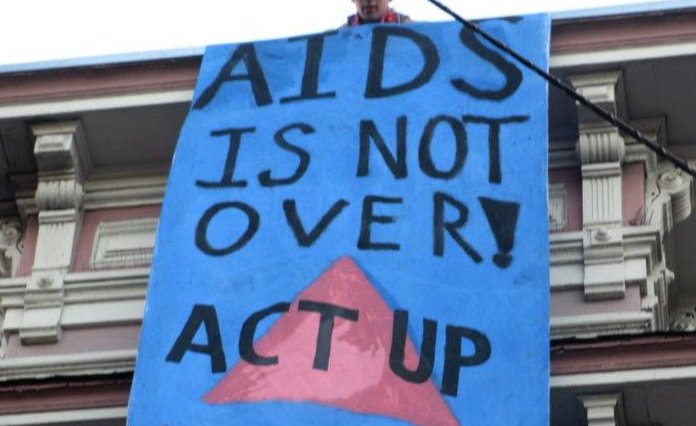
Rowdy AIDS resistance, defined by the loud-mouthed, street-closing, bridge-blocking, cathedral-occupying international AIDS Coalition to Unleash Power activist network, has been thrust back in the cultural spotlight after being overshadowed by more recent, conservative fights for marriage equality and military service rights. Initiated by NYC rabblerouser Larry Kramer in 1987, ACT UP defined queer politics for almost a decade and successfully changed the way government policy and the medical industry approached AIDS. (There would be no life-sustaining HIV drug combination therapy without ACT UP’s in-your-face civil disobedience.)
In San Francisco, the homegrown AIDS Action Pledge organization, started in 1985, laid the foundation for nonviolent yet radically confrontational AIDS activism, before partnering with ACT UP/New York and changing its name to ACT UP/San Francisco, helping to create a coast-to-coast juggernaut of information- and strategy-sharing. In its early ’90s heyday, thousands of virile ACT UPpers (and participants in related groups like Queer Nation, Gran Fury, and Boy With Arms Akimbo) from Kansas City to Copenhagen took to the streets, scaled walls, pilloried politicians, got arrested, and yes, got laid, too — it was a heady, cruisey time.
https://www.youtube.com/watch?v=wwhFS1mUaVY
During the past two years four documentaries about the period have been released to critical acclaim — How to Survive a Plague, nominated for a 2013 Academy Award, which documents the enormous influence ACT UP and its offshoot Treatment Action Group had on the development of life-saving combination drug therapies by major pharmaceutical companies; United in Anger, director Jim Hubbard’s eye-opening ode to the diverse membership, complex infrastructure, and social issue agenda of ACT UP in New York, which draws on the immense ACT UP Oral History Project archives Hubbard started 10 years ago with writer Sarah Schulman; Vito, an HBO documentary about outspoken AIDS activist and Celluloid Closet author Vito Russo; and We Were Hereby director David Weissman (currently being Ellis Act evicted from his Castro apartment), which focuses on San Francisco at the very beginning of the epidemic leading up to ACT UP’s founding, and the development here of innovative treatments.
Kramer’s own polemical, overwhelming 1985 play about the dawn of the disease in New York, The Normal Heart, was revived on Broadway in 2011 (it played here at A.C.T. last year), snagged three top Tony Awards, and is being made into a movie with Mark Ruffalo, Alec Baldwin, and possibly Julia Roberts. The artwork of hyperkinetic grafitti artist Keith Haring, who designed some of the most recognizable anti-AIDS iconography before succumbing to the disease in 1990, was everywhere in 2012, from Google Doodles and iPhone cases to collectible sex toys and a retrospective at the Brooklyn Academy of Music. Dangly pink triangle earrings and “Silence = Death” t-shirts and buttons, emblems of ACT UP, are popping up on hipsters all over.
And, um, Justin Bieber wore an ACT UP T-shirt to the 2012 CMT Country Music Awards?
FANNING THE FLAMES
Last year, a 28-year-old sex worker and activist named Cyd Nova, along with others who had been involved with the Occupy movement, started contacting ACT UP veterans about the upcoming 25th anniversary of ACT UP that March.
“My friend Kentaro and I had developed a common obsession with ACT UP because we saw it as reflection of what is missing in our community,” he told me. Nova had discovered ACT UP when he was 17, as he made an attempt to “understand who I was in the world I was living in.” When he began researching the ACT UP Oral History Project online and watching New Queer Cinema classics like the 1993 HIV-themed musical Zero Patience he “found it all incredible.”
“The emergence of ACT UP represented to us this time when queers stood together when faced with a genocide of indifference, devoting their lives to fighting for the those of their friends, lovers, family and themselves. This stands in contrast to gay and lesbian culture of the 2000s — the focus on marriage and class climbing. For people of color, sex workers, drug users, and transgender people HIV still exists. I wanted to get involved in some deeper way.”
Kentaro updated ACT UP graphics with a new “Act the Fuck Up” design, and there was enough traction about the anniversary idea among curious young people and elders to plan a “NOT OVER: 25 Years of ACT UP” panel at the Women’s Building in March, followed by a march in April through the Castro and Mission protesting the evictions of people living with HIV/AIDS, condoms being used as evidence to prosecute sex workers, and the Catholic Church’s homophobic and sex-phobic policies.
Both the panel and the march were well-attended, and another panel — this time featuring ACT UP veteran Sarah Schulman reading from The Gentrification of the Mind, her impassioned memoir of how queer rebellion to the AIDS crisis vanished into conservatism and consumerism, — overflowed its Luggage Gallery setting. Several of the attendees decided to start holding regular meetings and full-on reactivate the movement, reviving the name ACT UP/San Francisco.
The new ACT UP/SF joining with OccuPride at the 2012 Pride Parade. Photo by Liz Highleyman
These events were followed by more old school-style ACT UP actions: slogan-bearing banner drops at Pink Saturday in the Castro, guerilla street art bombs, a “Cumdumpsters of the GOP” condom toss at Folsom Street Fair. A nexus of affiliation emerged among fellow radical queer groups like OccuPride, Homonomixxx, and active ACT UP chapters in other cities. In December, a small group managed to enter Bay Area-based pharmaceutical giant Gilead’s headquarters to protest the exorbitant pricing — $28,500 per year — of its new, more convenient HIV drug Stribild. An action is planned for February 25 to deliver letters protesting Stribild’s price to Gilead, and another for ACT UP’s 26th anniversary in March.
One of the less-emphasized aspects of ACT UP was its reverence for procedure and attention to order, its organization into multiple affinity groups and action committees: a trick learned from classical anarchism and the Civil Rights Movement. The young ACT UP/SF members I’ve met — there are about 25-30 core members — seem to have absorbed these techniques: they speak calmly and deliberately but candidly, seeking out consensus but unafraid to disagree. Their actions, too, seem deliberately organized and calmly executed.
The delicately butch-featured Nova joined me at Church Street Cafe, along with fellow ACT UP/San Francisco revivalists Mayra Lopez, 24, a poised yet vivacious nonprofit worker with striking red lips, and Alan Guttirez, 23, the kind of soft-voiced, sharply intelligent sex worker who somehow survives Dennis Cooper novels.
“I was 18 and taking a summer sociology class at SF State with this flaming faggot professor,” Guttirez told me. “Usually queer teachers like to talk about themselves a lot, and at some point he mentioned ACT UP. No one knew what he was talking about, that there was this whole radical movement here that had been almost completely buried. I was immediately curious about the possibilities.”
Lopez told me, “I grew up in Sonoma — for half my life, HIV wasn’t even on my radar. You never talked about sex in the Latino community I’m from, nevermind queer issues or HIV. Then, in high school, I watched a documentary about HIV and wanted to do a history of the disease for a project. I picked up a book of posters, included ones from ACT UP, that’s how I found out about it. From there I went to work for a nonprofit — but nonprofits have a problem with being able to address issues about migrant workers and HIV, which is my focus. They have to be so P.C. I feel like ACT UP is a tool to address those issues openly.”
A 2012 ACT UP/SF die-in outside Mission Dolores Basilica, protesting the Catholic Church’s homophobic and sexphobic policies. Photo by Liz Highleyman
Is any of the motivation for the ACT UP renewal a matter of trendy nostalgia? “We’re too busy for nostalgia,” Guttirez says. “We wish the people wearing ACT UP things or looking back at the ’90s would dig deeper into the meanings to know what those things stood for, that we’re still fighting against the same shit. Categorizing people on hookup sites as ‘clean’ or ‘dirty’ according to their HIV status or making fun of poor people is just perpetuating behaviors that were once used against us, and killed us.”
A BROADER AGENDA
One of the original ACT UP’s main goals was access to life-sustaining drugs. What’s the agenda of a new ACT UP? Besides addressing the prohibitively high costs of AIDS meds — something most HIV-positive people with insurance may take for granted, a lack of awareness that drug companies can take advantage of by price gouging or delaying more cost-effective treatments, and leaving uninsured people scrambling and dangerously stressed as public programs are increasingly cut — and the lack of an HIV safety net for many immigrants, the new ACT UP/SF also gives priority to sex worker and housing issues.
ACT UP/SF joined a coalition of local organizations, including Nova’s employer St. James Infirmary, to successfully demand that the San Francisco Police Department ban the use of condoms found on someone suspected of prostitution from being used evidence against them. (On January 14, however, Police Chief Greg Suhr announced that the ban would remain “temporary” for 90 days.)
And ACT UP/SF is also agitating around a provision in the $15 billion, George W. Bush-initiated PEPFAR international AIDS relief program, which forces organizations to pledge to oppose prostitution in order to receive funds. The US Supreme Court has agreed to hear a case against the provision this year.
A more local, immediate concern, however, one that ACT UP/SF places at the top of its list, is the skyrocketing cost of rent in San Francisco and the increasing numbers of evictions and stressful threat of evictions that many people living with HIV/AIDS face today.
“Evictions are killing us, they’re murder,” Lopez said, as Guttirez and Nova voiced their agreement. “People think medication is the number one priority for people with HIV — but it’s not, it’s housing. SROs are being pushed out, affordable housing stock is shrinking, people are being forced to leave. Without stability, it’s very hard to comply with your drug regimen, which is already complicated enough.
“I hear people all the time say, well if you can’t afford it here, then just move. They don’t understand that San Francisco is still one of the few places where queer people feel safe, that there’s a network of services here with proven results that you can’t find anywhere else, especially places many people living with HIV can afford to live. And there are support networks here, too, that aren’t available anywhere else.”
In fact, one of the most valuable things ACT UP/SF may be doing right now is offering a community for people, especially young people, with HIV to connect beyond the isolation of computer screens, to share information, enter into a positive dialogue, and receive support in a sympathetic environment geared toward changing the status quo.
Guttirez sums it up: “We’re for people who realize an angry Facebook post isn’t enough.”
BACK IN THE DAY
Have any old-guard feathers been ruffled by the ACT UP revival?
“The only real resistance we’ve had is to the name ACT UP/San Francisco — our intention is to reclaim the name from the mess that happened in the past,” Cyd told me. He’s referring to perhaps the most acrimonious legacy of local queer history. In 1990, after a phenomenally successful year of protest and media attention, several people left ACT UP/San Francisco to form ACT UP Golden Gate, intending to focus specifically on advocating for drug development and treatment, rather than address broader social issues like economic justice and gay equality.
The split was amenable at first, until things got really weird. Two men, David Pasquarelli and Michael Bellefountaine, moved here from Florida in 1993 and took over Act Up San Francisco. They quickly went from questioning the wisdom of poisoning one’s body with chemicals from the medical industry to flat out denying that HIV was the cause of AIDS, telling HIV-positive followers to forego medications altogether, saying that’s what was really killing them. Many panicked young people were swept into the new ACT UP/SF’s cultlike atmosphere, and to their doom.
“They were whackadoos!” old school ACT UP member Waiyde Palmer exclaimed when I brought up Pasquarelli and Bellefountiane. “They killed hundreds of people — and now they’re dead. Of AIDS. But the bitterness still lingers.”
I met the svelte and sassy Palmer, contributing editor of the Castro Biscuit news website and longtime survivor of AIDS, at Church Street Cafe, along with other ACT UP veterans Dean Ouellette, bushy-bearded gardener and musician, and respected journalist and activist Liz Highleyman. The three formed an uncanny, silver-haired mirror image of their younger counterparts I’d met with earlier.
A lively conversation careened among several milestones of queer radical AIDS activist history. The major early, roof-climbing takeover of pharmaceutical giant Burroughs Wellcome’s Burlingame office in 1987. The packed week of successful demonstrations around the sixth International AIDS Conference in 1990. Protesting a 1989 episode of NBC program “Midnight Caller,” which featured a murderous bisexual HIV-positive character. The 1989 day that Stop AIDS Now or Else blockaded the Golden Gate Bridge, two weeks after members of ACT UP/SF chained themselves to the Pacific Stock Exchange.
Juicy tidbits dropped: owner Marty Blecman of Megatone Records, Sylvester’s label, bankrolled ACT UP until he died in 1991; a fresh-faced Rachel Maddow, member of the AIDS Legal Referral Panel in 1994, stole some other cute dyke’s look. We tried to pin down a timeline of everything, but memories were fuzzy, exact dates had faded.
“I’m pleased to be a part of what’s happening, and I’m glad that it’s so intergenerational,” said Palmer (all three are active in the new ACT UP/SF) “but we need to maintain a momentum, and the motivation is different than when people were dying around you every day. Back then, the movement had members from every walk of life — yuppies, deadheads, people I never would have dreamed of associating with as a punk — united by this life-threatening illness.”
Highleyman agreed. “HIV has been taken over by the medical industry, we’re narcotized. A lot of ACT UP was based on exchanging information on these bewildering scientific things. Now people just ask their doctor what medicine to take. But who’s monitoring the doctors or watching the drug companies?”
“And the economics of the city have changed so much,” she continued. “I wonder if there are the resources anymore to support a protest movement. It’s just so expensive to live here, who has time to organize and follow through? The fact that these kids are taking it on is incredible and rare.”
“Back then we all worked three jobs, too” Palmer said. “But our rent was only $300 dollars — and if you had to leave one job to go to a protest, something else would pop up. I’m not sure if that can happen now.”
TIME PASSAGES
What happened to ACT UP? Leafing through the mesmerizing ACT UP Golden Gate files in the GLBT Historical Society archives in SoMa (especially those of its young star activist, Edward Zold, who succumbed to AIDS in 2009 at 38), a blizzard of drug names zips past: liposomal, foscarnet, fluconzole, sp-pg, TNP470, D4t, clarithromycin, AZT, Deovythymidine, xylocaine.
Every week it seemed, a new hope rose with a new drug name, only to be quashed when that drug failed. As several of the recent AIDS movies posit, the overwhelming amount of death just became too much, people couldn’t handle it anymore. Activists began turning on each other, the movement faded, and activist queer culture sank into despair. Until 1997, that is, when everyone began to realize the new anti-retroviral drug therapies would actually work. They were going to live, and then it was the best Folsom Street Fair ever.
Maybe more importantly, whatever happened to radical queer activism in general? I met with writer K.M. Soehnlein, who’s working on a novel based on his experiences of the ACT UP period — he was there from the very beginning in New York. He’s featured in United in Anger, and Queer Nation, an ACT UP offshoot formed to combat gay-bashing and promote queer visibility through renegade tactics, began in his living room in 1990.
“Occupy was a blip on the everyday gay person’s radar screen — and the police response to it was enormously more brutal and scary than when we protested in the ’90s and police usually worked with us,” he said. “But honestly, most gay people now are happy to see their president onscreen saying the word ‘gay’ before the word ‘marriage’ and that’s good enough for them.”
Soehnlein also has thoughts about why ACT UP may be resonating again. “There’s been talk about AIDS PTSD, and it really was a war. ACT UP felt like the only thing you could do to stay sane. Many people had to shut themselves off from that time in order to move on, and activism may be included in that.
“But 20, 25 years is a long time. It could just be a matter of waking people back up.”
ACT UP/SF meets at 7pm every first, third, and fifth Thursday — including Thu/21 at Alley Cat Books, 3036 24th St., SF. www.facebook.com/ACTUPSF
There are few things that San Franciscans love more than Thin Mints, and local Girl Scouts found out what those were on Sunday when a troop conviniently posted up in front of the deceased Diesel store at Castro and Market. The whippersnappers paid witness not only to another nude-y demonstration against the city’s new ban on public nudity, but also to said demonstration’s infiltration by dapper members (ahem) of local porn outfit Naked Sword [as Castro Biscuit reported.] They’re making a send-up of the nudity ban starring an ambitious politician, surname: Cox. Wink.
The flick will star Guardian cover boy Leo Forte, Dale Cooper as Cox, Christian Wilde as Officer Dick — who, we will note, was the only “cop” making arrests at the porn shoot-protest. Though there were six members of SFPD there by Castro Biscuit’s count and many exposed sets of genitalia, not a single arrest was made. If you’re going to have a nudity ban, might as well be a selectively-enforced one — all the better for climate-of-fear creating, amiright?
Adult Entertainment Virtual Convention
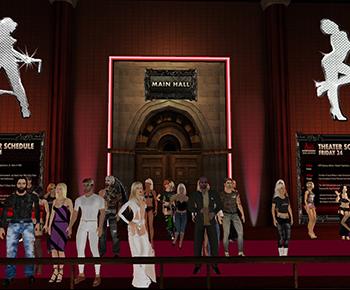
Perhaps you were unable to attend the AVN porn awards in Vegas this year, or last weekend’s transgender version, the Tranny Awards in Los Angeles. How will you supplant the opportunities you forewent to rub elbows with your favorite adult stars in a vast, drafty hotel conference room? Might we recommend this peculiar, multi-day event hosted by porn critics Xbiz and sex-only Second Life-esque world Red Light Social Center. Now in its second year, you can prowl the halls of the convention avatar-like, taking in a Q&A with James Deen (Sat/23, 10am), daily industry networking hours, and expert panels on social media and branding for adult brands (Wed/27, 2pm) and online possibilities for sex work (Fri/22, 2pm).
It’s another edition of this XXX storytelling series’ amateur hour — not in a bad way! We’re just trying to say the field is open to all comers. Come at 7:30pm to sign up for a five-minute slot, all for you to lay bare your tale of one-off sexual shenanigans. The winner gets to compete in an upcoming championship round of some sort. Good luck, truth teller.
Rachel Maines was actually researching a different kind of poke entirely when she came across the world of vibrator history — the scholar, who is currently a visiting scientist at Cornell University’s School of Electrical and Computer Engineering, first saw mention of old school vibes in antique needlepoint magazines. Her interest piqued, Maines embarked on a study of the vibrator’s origins in private homes and as a tool used by doctors to treat “hysteria” among the female population. Today, she gives a talk surrounded by Good Vibrations founder Jodi Blanks’ formidable collection of vibrators throughout history — and of course, alongside some modern-day versions you can buy for your newly-educated self.
Fri/22, 6:30pm, free. Good Vibrations, 1620 Polk, SF. www.goodvibes.com
Sex Worker Outreach Project meeting
Current and former sex workers are invited over to talk justice at SWOP’s regular meeting of the minds. The national organization fights for social justice for sex workers, working particularly on anti-violence issues. SWOP was behind a failed bid to decriminalize prostitution in 2004, and every year leads the way with the International Day to End Violence Against Sex Workers — check it out.
… Speaking of SWOP, if you didn’t make it to that meeting — or aren’t a current or former sex worker, but still want to support the group’s work — or just like lit, get over to this evening of spoken word performances about the world’s oldest profession. Contributing to the program: Apaulo Hart, Carol Queen, Chad Litz, Cho Whoreingsly Prancypants, Daphne Gottlieb, Jacques LeFemme, Janetta Johnson, Miss Lola Sunshine, and Shelley “Muffie” Mays.
Sat/23, 8pm, $10-20 sliding scale. Center for Sex and Culture, 1349 Mission, SF. www.sexandculture.org
During what one official called the “show-and-tell” portion of a public hearing held yesterday by a committee of the Alameda County Board of Supervisors, a representative from the Sheriff’s Office held up a drone so the crowd of 100 or so attendees could have a look. The small, lightweight device consisted of a plastic box to house technical equipment, a camera, and four spidery legs affixed with tiny black propellers.
“It’s cuute!” someone exclaimed. But that was likely a sarcastic wisecrack – concerned citizens had packed the board chambers in hopes of convincing the two-person Public Protection Committee that the civil liberties implications of surveillance drones were too great to justify flying them over Oakland and other cities.
Last summer, Alameda County Sheriff Gregory Ahern submitted a Department of Homeland Security (DHS) grant request for an “unmanned aircraft system” (UAS), police-speak for drone. The agency intends to purchase one or two, depending on the manufacturer, for uses ranging from thermal imagery to crime detection.
The Sheriff now seeks supervisors’ approval, and is working to secure a Certificate of Authorization (COA) from the Federal Aviation Administration, required for aircraft flown at 400 feet. But the Sheriff’s plan has been met with strong resistance from civil liberties advocates worried that drones would open the gates to aerial surveillance and runaway data collection.
Concerns revolve around surveillance
Representatives from the Northern California chapter of the American Civil Liberties Union (ACLU), the Electronic Frontier Foundation (EFF) and the grassroots Alameda County Against Drones voiced myriad concerns about what they viewed as flimsy privacy protections put forward by the department. “The potential concerns with drones are too great to justify any use of drones at all in Alameda County,” said Nadia Kayyali of Alameda County Against Drones.
In turn, Sheriff representatives sought to defend its plan to use the devices, at one point practically asking critics to think of the children.
“We get several hundred calls a year for search and rescue, and deployment of our teams, to find lost children, lost hikers, or elderly persons,” Capt. Tom Madigan explained, and his co-presenter even referenced the case of famed kidnap victim Jaycee Dugard as a possible scenario where a drone could have been deployed. Commander Tom Wright assured supervisors that the drones would not be equipped with weapons, and stated that UAS devices would “not be used for indiscriminate mass surveillance.”
Yet the use of drones for surveillance and intelligence gathering lies at the heart of the controversy. “Data collected in the name of search and rescue could be retained for intelligence gathering and analysis,” ACLU staff attorney Linda Lye warned in comments delivered to the Public Protection Committee. “In conjunction with other existing policies, this would lead to the submission of UAS-collected data to the Northern California Regional Intelligence Center, also known as a ‘fusion center,’ where data – in some instances, about constitutionally protected activity –are stockpiled and analyzed in the name of so-called terrorism prevention.”
According to documents obtained by EFF and MuckRock News, the Sheriff’s Office indicated in its grant request that the unmanned aircraft could be used for “surveillance (investigative and tactical),” “intelligence gathering,” “suspicious persons” or “large crowd control disturbances,” the latter bringing to mind street clashes that flared up in downtown Oakland in 2011 when riot police sought to crush protests organized under the banner of Occupy Oakland.
If the Alameda County Sheriff’s Department obtains drones, the unmanned aircraft could be deployed anywhere from Monterey to the Oregon border, Madigan noted, if regional law enforcement agencies determined that emergency circumstances warranted jurisdictional waivers.
Technology advancing
Unlike helicopters, drones can gather high-resolution footage and other kinds of data without detection, transmitting live video feed to a command post for real-time viewing. While the Sheriff’s Department is eyeing drones that travel a quarter of a mile from base with a 25-minute flight time capacity, the technology is advancing quickly. It’s technically possible for drones to be equipped with facial recognition technology, radar, or license-plate readers.
Those growing capabilities are part of the reason civil liberties advocates are so focused on hammering out strong privacy safeguards. “We’re wading into uncharted waters here,” Lye cautioned, noting that any privacy safeguards established for these drones would apply to more advanced models down the line. “We have to bake in the privacy safeguards into this template.”
The Alameda County Board of Supervisors held off on approving a drone purchase by the Sheriff Department late last year when faced with controversy. It was originally included as an agenda item before any public meeting had been scheduled, but was later removed after civil liberties advocates intervened. At a December meeting, Undersheriff Richard Lucia told supervisors that including drone approval on the agenda had been “an oversight.”
If Alameda County obtains a drone, it will be the first California law enforcement agency to do so. Several other cities are proceeding cautiously: Last week, for example, Mayor Mike McGinn of Seattle canceled a drone program amid heated controversy.
San Francisco also sought a drone
Meanwhile, the Alameda County Sheriff’s Department is not the only Bay Area law enforcement agency eyeing unmanned aircraft devices. According to a document unearthed by an EFF and MuckRock News, the San Francisco Police Department (SFPD) submitted a $100,000 funding request to the Bay Area Urban Areas Security Initiative for a “remote pilot video camera,” basically a drone, that could be outfitted to “transmit real-time, geo-coded data to command centers.” The SFPD initially hoped to clear the FAA approval process by June of 2013, according to the document. However, its funding request was rejected. (It is unclear why San Francisco’s funding request for a drone was more than three times the funding request submitted by Alameda County.)
The grant request form notes that Lieutenant Thomas Feledy of the SFPD’s Homeland Security Unit sought funding for “the deployment of mobile compact video cameras in the visual and infrared spectrum … to provide live overhead views of critical infrastructure” in the event of a terrorist attack or natural disaster.
“It was rejected,” Officer Albie Esparza told the Guardian when we called SFPD media relations to ask about it. “And we have no plans of getting a drone.”
If I hear another journalist ask anyone involved in hip-hop incredulously, reverently, portentously about Frank Ocean and that Tumblr post someone may lose their digital recorder. Frank I love you, I love your ambiguous Internet warblings, your endearingly awful Grammy performances — and kudos on Willy Carter, damn — but obvs you’re not the first queer person to be involved with your musical genre.
The Bay Area knows this — in 2007 the PeaceOUT World Homo Hop Festival, already six years old at that point, took over deFremery Park with Oakland’s Deep Dickollective and co. And like, Cazwell? Hey.
This list goes on — but this post is more about future, specifically the Hip-Hop: Beyond Gender event series that kicks off at La Peña Cultural Center on Fri/15 with “Here Me Roar”, a lineup of queer and feminist spoken word MCs set to wrecking speed. I caught up with a couple of the artists to talk about how hip-hop came to them, and where they want it to go.
Hopefully, their events in the La Peña series — which include concerts, panel discussions, and breakdance battles — will advance the conversation about hip-hop and gender-sexuality inclusivity that Le1f, Freedia, Nicky, Mykki, Double Duchess, Syd, YES Frank Ocean, and a bajillion other awesome artists are helping to create.
A child of Oakland, this playwright, poet, and author of Girls With Hips will perform at “Hear Me Roar” at La Peña on Fri/15.
First hip-hop album: The Roots, Illadelph Halflife. Up until that point, I’d just stolen hip-hop music from my parents. The first album of any genre that I learned all of the words to was Arrested Development’s debut, 3 Years, 5 Months & 2 Days in the Life Of…
First hip hop concert/party: Tough. Hmmm. There’s an MC out of Oakland, originally from Queens, named Rico Pabon. When I was in high school, Rico was probably my favorite act. He used to headline a series of all-ages shows at La Peña called “Collective Soul”, alongside Company of Prophets, Lunar Heights, a bunch of the indie staples in hip-hop at the time. I think those were probably my first parties. Glad to see we’re coming full circle, and I’ll get to rock the stage at La Peña this Friday — I used to beg mom to let me attend back in the day.
First time I thought about what gender meant in hip-hop: Listening to Digable Planets. Everyone used to refer to Ladybug Mecca as “the girl” in the group. I saw that trope carry over as I listened to Blunted on Reality, the Fugees’ first album. To me, sonically, I just identified Ladybug and Lauryn as the best of the three. It wasn’t until older male relatives and friends pointed out gender that I first started to note and notice differences.
One question I’d like to see addressed “Hip-Hop: Beyond Gender”: I’d like to see us address the issue of why female-identified emcees are consistently asked to talk about gender and sex — both onstage and off — when our male identified counterparts are not.
In addition to having their own music label — Emergence Media — this Michigan MC is active with Detroit Summer, an intergenational inner-city group that links up community members in projects to change the future of their neighborhood. Invincible’s organizing the “Event Horizon” night on March 15, which promises “transcending the gender binary and entering parallel multiverses of holistic complex identities.” Ooo.
First hip-hop album: First vinyl, Paid In Full (Eric B and Rakim). First tape, Check The Rhime (maxi single!) followed by Low End Theory (A Tribe Called Quest). First CD (in the tall cardboard package): Sleeping With The Enemy (Paris).
First hip hop concert/party: When I was 15 I had a secret knock at the back door of a few local clubs where bouncers got me in to watch shows and get on the open mic. I got caught one too many times so that led to the first show I threw, which was at an abandoned hotel that me and my first DJ transformed into an all-ages venue, ’til the cops broke it up at our second event. I think the first time I actually bought a ticket was for Xzibit and Big Pun but that show sadly got shot up and shut down too soon.
First time I thought about what gender meant in hip-hop: I remember when “Ladies First” by [Queen] Latifah came out. It made an impression on me, but I was too young to understand the power of it. I first fully saw the role gender justice plays in reviving hip-hop when I met and joined the anti-misogyny all-elements hip hop collective ANOMOLIES. They made me reflect on all the hardships i had witnessed and experienced, and realize how important it is to support each other as people whose voices are marginalized in this culture.
One question I’d like to see addressed “Hip-Hop: Beyond Gender”: How do we create space for more transgender and gender non-conforming hip-hop artists to develop skills, bring new perspectives, and be heard? How can gender justice in this music and culture benefit all marginalized voices in hip-hop?
Tru Bloo started performing hip-hop when they were 11, played Angela Davis’ induction into the La Peña hall of fame in 2011, and has dabbled in classical guitar and piano among a million other projects. They’re curating the May 10 “Wo(MB) Manifest” night of breakdancing, graffiti, and performance at La Peña.
First hip-hop album: I found a 2 Live Crew rap tape on my school bus in fourth grade and memorized the entire album. Also danced a lot to Rob Base & DJ E-Z Rock.
First hip hop concert/party: MC Hammer
First time I thought about what gender meant in hip-hop: When groups like TLC, Salt ‘N Pepa and Queen Latifah’s U.N.I.T.Y. anthem came out in late ’80s/early ’90s, I realized women had a different story to tell via hip-hop.
One question I’d like to see addressed “Hip-Hop: Beyond Gender”: Do female, trans, and gender non-conforming hip-hop artists have the power to change the social discourse around patriarchy, misogyny, homophobia, and transphobia within our communities and mainstream pop culture, if given a voice?
If anything threatened to overshadow the attention around Wax Idols’ epic new album and front person Hether Fortune’s stage presence, it might have been Fortune’s social media-documented quickie Reno wedding to rocker Tim Gick of TV Ghost earlier this month. But from another angle, it just adds to her appeal. The dominatrix/singer seems full of passion, lust, and complicated relationships, and they bleed out of her any way she lets them, be it through her robust Twitter flow, her personal relations, or her beautiful, darkly maturing music.
Sample tweet: “I want all of the people that I love & admire to take charge of their inner worlds & wreak glorious havoc on the world we share.” Sample lyric: “Let’s turn down the static world/listen to the sound of a void.”
The latter is from “Sound of a Void” off Wax Idols’ upcoming second full-length Discipline & Desire, out March 26 on Slumberland Records, a surprising departure from 2011’s equally enticing, yet far punkier, No Future (Hozac). This new darkwave record sees Fortune — along with Jennifer Mundy, Amy Rosenoff, and Rachel Travers — exploring the dungeons of orgasm addict sexuality and violence with wry lyrics, bolder Siouxsie Sioux vocals, and Joy Division and Love and Rockets-honoring riffs.
If you’re concerned Fortune will no longer be as tough as a wifey (you sexist jerk, you), consider this: following her Nevada wedding, she played the Uptown the very next night, had a blast, and smashed a glass.
Description of sound: Morbid classics.
http://www.youtube.com/watch?v=KiRE_7JpRdM
What you like most about the Bay Area music scene: HETHER: I like the diversity and the constant evolution I’ve seen in my five years here thus far. I’ve met some truly legendary artists and characters.
JEN: I like the diversity of bands and the feeling of camaraderie in the local music community. It’s a really exciting time for music in the Bay Area and I’ve seen some excellent bands. And it’s great that you can catch a show just about any night of the week.
AMY: Recently, there have been a lot of new, dark bands that don’t have the typical “rock” sound. I don’t think the dark music scene here has had this much going on for quite a while. It’s really nice to have a good group of local musicians whose music and style I can find inspiring and relate to.
RACHEL: That it has actually progressed into something viable!
What piece of music means a lot to you: HETHER: “The Mercy Seat” by Nick Cave and the Bad Seeds. Never has a song filled me with such an immense feeling of anxiety, tension and fear and then released those feelings in such a cathartic, overwhelming and beautiful way…That and “Heroes” by David Bowie/Brian Eno (greatest song of all time — don’t argue with me).
JEN: “Sunday Morning” by the Velvet Underground, and pretty much the entire VU and Nico album.
AMY: The album Pornography by The Cure.
RACHEL: The Cure’s Head on the Door.
Who would you most like to tour with: HETHER: Nick Cave
JEN: Savages from London.
AMY: I would love to tour with the Raveonettes.
RACHEL: If I had a time machine, Mozart — because who wouldn’t want to tromp around European high society? But really, Chelsea Wolfe.
Wax Idols at Noise Pop with DIIV, Sisu, Lenz. March 2, 8pm, $15 (sold out). Brick and Mortar Music Hall, 1710 Mission, SF. www.brickandmortarmusichall.com. facebook.com/waxidols.
This is the year we’ll finally get to spend some QT with Trilingual, which will technically be Trails and Ways’ debut LP. Though there’s still no release date or label, it will be coming out in 2013. It seems like we’ve been hearing about this much-anticipated release for ages, given all the buzzy blog love thrust on the Oakland indie-pop quartet.
And when I say anticipated, I mean it. Trails and Ways even made it on Hype Machine’s list of the “Most Blogged About Artists of 2012,” partially due to chatter about Trilingual, but likely more to the ingenious covers of Miike Snow, M83, and the like by guitarist-synth master Hannah Van Loon, rhythm guitarist Keith Brower Brown, bassist Emma Oppen, and drummer Ian Quirk.
The band is savvy, and knows how to keep up the momentum for its own projects. It’s posted dreamy official videos for tracks off the upcoming record, including “MTN Tune” and “Border Crosser.” And since December 2012, Trails and Ways have been slowly releasing songs for a remix EP, including one for “Border Crosser” by another On the Rise 2013 act: the Seshen.
Of course there’s more to T&W than a media-hold; the root reason for the frenzy is the music itself. Along with tropical synths, technical guitarwork, and Afro-pop inspired rat-a-tat drums, there’s the four glorious female-male multi-part harmonies that warm and come together like a picturesque sunrise on any given white sand beach (with or without tequila). It’s snark-proof, globally inspired pop, with hints of Brazilian tones, Spanish language snippets, and the occasional whistle, or group ooh-ooh.
Description of sound: You say bossa nova dream pop, I say Brazilian shoegaze.
What you like most about the Bay Area music scene: Our friends Bells Atlas, Astronauts Etc., the Bilinda Butchers, Waterstrider, the Seshen, and the widespread non-commercial ethos of groove.
What piece of music means a lot to you: Pat Metheny Group ft. David Bowie, “This Is Not America”; This song sounds like the boundary waters of dream pop and smooth jazz and it was my favorite song from my dad’s whole CD collection and I think I learned how to use a stereo by hitting repeat for this song.
Favorite local eatery and dish: Oasis Food Market falafel sandwich.
Using just her laptop and live vocal processing, Holly Herndon creates alternate universes. The PhD student at Stanford’s Center for Computer Research in Music and Acoustics manipulates programs into heart-racing, thumping, brain dripping compositions that methodically carry the listener away, then jerk it back with startling shots of noise. The best case example of this is “Movement,” the title track off last fall’s experimental RVNG Intl. release.
Like the others, the song surprises with impact, despite Herndon’s hushed, layered vocals trailing off into an unseen world. While it’s robotically tied to electronics, the track has a base in the natural, which makes sense for a former choir girl from Johnson City, Tennessee who spent her summers in the Berlin club scene. It’s the two halves of her worlds coming together.
She just got back from a brief European tour — which included a stop in underground music mecca, the Boiler Room — and is planning a new single for a spring release. For it, she says she’s “inspired to get more abstract while remaining approachable,” which sounds like a worthy challenge. There also will be a collaboration with Hieroglyphic Being this year, another with Reza Negarestani and Mat Dryhurst that will unfold in an art institution, a few remixes, and her doctoral exams. And likely plenty more media gushing if these first few months have been good indicators of the future.
Description of sound: I make computer music with a focus on live vocal processing and physical sound.
What you like most about the Bay Area music scene: We are literally at the end of the world, and the lack of attention focused here allows for artists to develop their own identities outside of hype bubbles.
What piece of music means a lot to you: I got deep with Trevor Wishart’s “Globalia” last summer and still cannot get over how well his concept of exploring (and collapsing) the diversity of language is executed. It is a gorgeous piece.
Favorite local eatery and dish: Bagel and latte at Java Supreme on Guerrero and 19th; I am there every day and the owners are wonderful.
Who would you most like to tour with: Mat Dryhurst, he is my life and creative partner and touring alone is exhausting.
Holly Herndon at Future|Perfect with Nguzunguzu, DJs Marco de la Vega, Loric Sih. Thu/14, 9pm, $10–$15. Public Works, 161 Erie, SF. www.publicsf.com, hollyherndon.tumblr.com
How Do I Look? asks a seminal weighty tome addressing queer film and video theory from 1991. “Dirty!” I always wanted to shout back to my dusty bookshelf when it caught my eye. Well, hey — 22 years later along comes NYC’s Dirty Looks collective, which showcases queer experimental film and video with startling freshness. The edgy gems on offer in its two-night visit to SF may have slipped through your Youtube crack. Thu/14’s “Yesterday Once More” at SFMOMA, www.sfmoma.org, gives you contemporary coolness from Matt Wolf, Zachary Drucker, Mariah Garnett, and Chris E. Vargas. Then check out Fri/15’s “Pickle Surprise! The Eyes of Tom Rubnitz” at Artists Television Access, www.atasite.org, which has me jumping for joy — this ’80s underground clubkid, filmmaker, and musician caught the spirit of one of our civilizations most vividly glorious times before he died of AIDS. Legendary drag queens and trashy foodstuffs galore! (Marke B.)
As the name subtlety implies, this event will showcase humor. Hosted by the sardonic upstart comic Cameron Vannini, this event, billed as a standup show for comics and by comics, will be the first ever comedic event at the nascent Chapel, signaling more standup shows in its future. Going up to bat tonight will be an all-local slate featuring Kevin O’Shea, Clare O’Kane, Jules Posner, Sean Keane, Brendan Lynch, and Kevin Camia. O’Shea, O’Kane, Posner, Keane, and Vannini will all be coming fresh off recent gigs at Sketchfest. The blunt and jabbing Camia, whose record Kindness was voted among the top 10 best comedy albums on iTunes in 2010, is a stalwart of the local scene and recently has been rumored to be making “the move” down to LA. A night like this should be the perfect respite for those still pining for Sketchfest. (George McIntire)
Remember rock’n’roll? You know, that dynamic and gritty music before the age of synthesizers? The Stone Foxes show at the New Parish might jog your memory. Launching into experimentation from strong roots in blues, the band plays a range from the catchy interpretation of Edgar Allen Poe’s gothic, “The Tell-Tale Heart,” (“Everybody Knows”) to the elegy in minor, “Battles, Blades and Bones,” which repeats, “We need someone to sing/’Cause we’ve turned everything/To battles, blades, and bones.” In their third album, Little Fires (which came out Feb. 12), collaboration with Girls’ producer Doug Boehm proves that polish doesn’t mean sterility, that good production doesn’t mean overproduction, and that good old rock’n’roll lives on. (Laura Kerry)
Sam Yagan might be as qualified as anyone to decipher the formula for love. Yagan and his three Harvard classmates founded the online dating site OKCupid as a spin off from the Spark Notes study guides they created at the turn of the millennium. Since then, Internet matchmaking has become a booming business, and Yagan and Co. capitalized in 2011 by selling OKCupid to rival Match.com. Yagan, now Match.com’s CEO, uses data from 8 million users to quantify the unquantifiable, to dissect what exactly goes into fuzzy feelings and unexplainable attractions. Bay Area matchmaker Joy Nordenstrom and SFGate blogger Beth Spotswood will be on hand to help translate the love equation. (Kevin Lee)
The Wooster Group/New York City Players: Early Plays
However it pans out as a performance, this has to be one of the theatrical events of the year: A rare Bay Area appearance by the famed Wooster Group in collaboration with another NY-based contemporary experimental theater company of renown, Richard Maxwell’s New York City Players. Maxwell directs members of both companies in a trio of “Early Plays” by Eugene O’Neill —three one-acts also known as the Glencairn plays, after the ship on which work the men of Moon of the Caribbees, Bound East for Cardiff, and The Long Voyage Home. Each unfolds in the director’s emblematic affectless style, which seeks out the unfamiliar beneath layers of received theatricality and, in the case of these young yet also experimental plays, lingering melodrama. (Robert Avila)
Britain’s Jon Gooch has many alter egos. He’s a producer and a DJ, he’s Spor and he’s Feed Me. No matter what the role or the moniker, however, Gooch remains constant and consistent in his creation of unrelentingly catchy electro and yes, dubstep. Teeth, Gooch’s newest creation, is the element that pushes Feed Me’s act over the line from just another EDM act and into the realm of a truly spectacular performance that’s going to keep you talking about it for quite a while. The Teeth are comprised of 20 jagged LED screens that create a huge, crooked grin that flashes and pulses in sync with Feed Me’s expert mixing. Dancing shoes required, party provided. (Haley Zaremba)
Last time Olive Bieringa and Otto Ramstad’s Body Cartography Project performed locally downtown, it was difficult to tell the dancers apart from the mingling pedestrians. Shortly after that the company left its home turf of SF for greener pastures, Minneapolis, as it turned out. From there Body Cartography has taken its expanded investigations of physicality — both geographically and the mediums within which it works — around the globe. For its return engagement as part of CounterPULSE’s Queer Series (running through March), Body Cartography is bringing a relatively small group, Ramstad with sibling Emmett. One is a dancer, the other a visual artist. They look very much alike; they are even dressed alike. They have called what they do Symptom, a work they say is “sculpture, drawing, movement and text.” (Rita Felciano)
Here are some of the themes that the sculptures of Rachel Mica Weiss undertake: human vulnerability, large-scale disasters, self-inflicted limitations. Does an image come to mind? I’m guessing that it does not resemble Weiss’s black net installations. But when you see the twisted rope, the rough stones, and the tarnished wood that comprise Weiss’s previous work, idea and object click. The artist condenses so much conceptual work into physical pieces of inexplicable poignancy. Let’s throw a few more themes in: boundaries, environmental change, cultural constructs. All of it will be on view in the windows of the Arts Commission Gallery. (Kerry)
The metal life isn’t for everyone. Constant touring, an over-crowded industry, and headbang whiplash causes many bands to give up their brutal dream early into their career. Buffalo, NY’s Every Time I Die isn’t one of those bands. ETID has been churning out its distinctive Southern-tinged hardcore since 1998. Six studio albums, a billion bassists, and a tour with Steve-O later, the Buckley brothers are still going strong. Incredibly, their high-energy live show has shown no signs of fatigue in well over a decade, and their reputation for intensity continues to be well-earned. Come for the snarky lyrics and clever songwriting, stay for the circle pit. (Zaremba)
With the Acacia Strain, Vanna, Hundreth, No Bragging Rights
My first compact disc was Salt ‘N Pepa’s masterful ode to minding one’s business, safe sex, and superlative/godawful male companions, 1993’s Very Necessary. Imagine my confusion, then, upon my discovery that the rest of the hip-hop world was hardly as empowering for females as that power-sass had led me to believe. But hip-hop has always been a site of subversion, where societal rules are flipped, and so it makes perfect since that some day, its lovers would take back the form from the silly misogynists on the Billboard charts. So, yay: tonight, nu-world griots Aya De Leon, Raquel Gutierrez, Chinaka Hodge, Carrie Leilam Love, Dawn Robinson, and Kity Yan examine hip-hop’s queer-feminist revolutionary potential through spoken word. It’s the first of five La Peña events in 2013 focused on breaking down hip-hop’s gender barriers. (Caitlin Donohue)
If you’re into dub, electronic, Middle Eastern, and psychedelic sounds, you must meet Ott. Ott — a veteran electronic British musician-producer who has worked with big names like Sinéad O’Connor, Brian Eno, and Simon Posford (Shpongle) — makes rich, ambient, trancey electronic dub jams under the moniker Ott and the All-Seeing I. “Owl Stretching Time,” one of the band’s signature tracks, could just as easily be the anthem to a Jamaican surf trip as the soundtrack to a night out in Berlin. Ott handles electronics alongside Naked Nick (guitars, synths, percussion), bassist Chris Barker, and drummer Matt White. (Mia Sullivan)
Before we begin, let’s establish a few definitions. Buke: an altered six-string baritone banjo. Gase: a blend of a guitar and bass. Surely, a band that carries its own invented glossary approaches music differently. Arone Dyer and Aron Sanchez, the duo that with its homemade instruments manages to sound more like an offbeat orchestra, alters language, genre, and the overall assumptions of the listener. The driving cacophony in the recently released General Dome shouldn’t make sense. Somehow, though, with Dyer’s expressive singing, the building repetition of sounds, and the band’s confidence in its own inventiveness, it all comes together. See Dyer and Sanchez create their own rules at Café Du Nord. (Kerry)
The Guardian listings deadline is two weeks prior to our Wednesday publication date. To submit an item for consideration, please include the title of the event, a brief description of the event, date and time, venue name, street address (listing cross streets only isn’t sufficient), city, telephone number readers can call for more information, telephone number for media, and admission costs. Send information to Listings, the Guardian, 225 Bush, 17th Flr., SF, CA 94105; or e-mail (paste press release into e-mail body — no attachments, please) to listings@sfbg.com. Digital photos may be submitted in jpeg format; the image must be at least 240 dpi and four inches by six inches in size. We regret we cannot accept listings over the phone.
Norman Solomon is co-founder of RootsAction.org and founding director of the Institute for Public Accuracy. His books include “War Made Easy: How Presidents and Pundits Keep Spinning Us to Death.” He writes the Political Culture 2013 column
With the tenth anniversary of the Iraq invasion coming up next month, we can expect a surge of explanations for what made that catastrophe possible. An axiom from Orwell — “who controls the past controls the future” — underscores the importance of such narratives.
I encountered a disturbing version last week while debating Col. Lawrence Wilkerson, former chief of staff to Secretary of State Colin Powell. Largely, Wilkerson blamed deplorable war policies on a “bubble” that surrounds top officials. That’s not just faulty history; it also offers us very misleading guidance in the present day.
During our debate on Democracy Now, Wilkerson said: “What’s happening with drone strikes around the world right now is, in my opinion, as bad a development as many of the things we now condemn so readily, with 20/20 hindsight, in the George W. Bush administration. We are creating more enemies than we’re killing. We are doing things that violate international law. We are even killing American citizens without due process. . .”
But why does this happen?
“These things are happening because of that bubble that you just described,” Colonel Wilkerson told host Amy Goodman. “You can’t get through that bubble” to top foreign-policy officials, “penetrate that bubble and say, ‘Do you understand what you’re doing, both to American civil liberties and to the rest of the world’s appreciation of America, with these increased drone strikes that seem to have an endless vista for future?’”
Wilkerson went on: “This is incredible. And yet, I know how these things happen. I know how these bubbles create themselves around the president and cease and stop any kind of information getting through that would alleviate or change the situation, make the discussion more fundamental about what we’re doing in the world.”
Such a “bubble” narrative encourages people to believe that reaching the powerful war-makers with information and moral suasion is key — perhaps the key — to ending terrible policies. This storyline lets those war-makers off the hook — for the past, present and future.
Hours after my debate with Wilkerson, I received an email from Fernando Andres Torres, a California-based journalist and former political prisoner in Chile under the dictatorship of General Augusto Pinochet. Referring to Wilkerson as “that bubble guy,” the email said: “Who they think they are? No accountability? Or do they think the government bubble gives them immunity for all the atrocities they commit? Not in the people’s memory.”
Later in the day, Torres sent me another note: “Not sure if we can call it a bubble, ’cause a bubble is easy to break; they were in a lead bunker from where the bloody consequences of their action can pass unnoticed.”
Wilkerson’s use of the bubble concept is “a tautology, a contradiction implicit,” wrote the co-editor of DissidentVoice.org, Kim Petersen, in an article analyzing the debate. “Often people escape culpability through being outside the loop. After all, how can one be blamed for what one does not know because one was not privy to the information. Can one credibly twist this situation as a defense? Wilkerson and other Bush administration officials were in the loop — privy to information that other people are denied — and yet Wilkerson, in a strong sense, claims to be a victim of being in a bubble.”
In that case, the onus is shared by those inside and outside the bubble. Wilkerson said as much when I mentioned that a decade ago, during many months before the invasion, my colleagues and I at the Institute for Public Accuracy helped to document — with large numbers of news releases and public reports — that the Bush administration’s claims about Iraqi weapons of mass destruction were full of holes.
From there, our debate swiftly went down a rabbit hole, as Wilkerson took me to task for not getting through the bubble that surrounded him as chief of staff for Secretary of State Powell. “I didn’t see a single one of your reports,” Wilkerson said. “So, nobody called me from your group. Nobody tried to get in — nobody tried to get into my office and talk to me from your group. Other groups did, but your group never got into my office, never called me on the phone — never talked to me. Other groups did. Why didn’t you?. . . You didn’t call. . . You didn’t call. . . You did not call.”
Non-apology apologies have been a forte of former impresarios of the Iraq war. It speaks volumes that Col. Wilkerson has been more apologetic than most of them. The scarcity of genuine public remorse is in sync with the absence of legal accountability or political culpability.
The partway apologies are tethered to notable narcissism. It’s still mainly about them, the seasoned ones who have worked in top echelons of government, whose self-focus is enduring. At the same time, scarcely a whisper can be heard about renouncing the prerogative to launch aggressive war.
So, when faced with occasional media questions about Powell’s WMD speech to the U.N. Security Council six weeks before the Iraq invasion, both Wilkerson and Powell routinely revert to the same careful phrasing about their own life sagas. Interviewed by CNN in 2005, after his three years as Secretary of State Powell’s chief of staff, Wilkerson described his key role in preparing that speech as “the lowest point in my life.” Last week, in our debate, he called the U.N. presentation “the lowest point in my professional and personal life.”
As for Colin Powell, guess what? That U.N. speech was “a low point in my otherwise remarkable career,” he told AARP’s magazine in 2006. Yet the U.N. speech gave powerful propaganda support for the invasion that began the Iraq war — a war that was also part of Powell’s “otherwise remarkable career.”
So, too, a dozen years earlier, was the Gulf War that Powell presided over as chairman of the Joint Chiefs of Staff in early 1991. On the same day that the Associated Press cited estimates from Pentagon sources that the six-week war had killed 100,000 Iraqi people, Powell told an interviewer: “It’s really not a number I’m terribly interested in.”
The illustrious and sturdy bow on the entire political package is immunity — a reassuring comfort to retired and present war leaders alike. Former Bush officials and current Obama officials have scant reason to worry that their conduct of war might one day put them in a courtroom dock. They’ve turned their noses up at international law, lowered curtains on transparency and put some precious civil liberties in a garbage compactor with the president’s hand on the switch.
Normalizing silence and complicity is essential fuel for endless war. With top officials relying on their own exculpatory status, a grim feedback loop keeps spinning as the increasingly powerful warfare state runs roughshod over the principle of consent of the governed. Top officials dodge responsibility — and pay no penalty — for lying the country into, and into continuing, horrendous wars and other interventions.
Without an honest reckoning of what did and didn’t happen in the lead-up to the Iraq war, a pernicious message comes across from Wilkerson, Powell and many others: of course we stuck it out and followed orders, we had private doubts but fulfilled our responsibilities to maintain public support for the war.
It’s a kind of role modeling that further corrodes the political zeitgeist. The upshot is that people at the top of the U.S. government — whether in 2003 or 2013 — have nothing to lose by going along with the program for war. In a word: impunity.
Norman Solomon is co-founder of RootsAction.org and founding director of the Institute for Public Accuracy. His books include “War Made Easy: How Presidents and Pundits Keep Spinning Us to Death.” He writes the Political Culture 2013 column.
The media and blogosphere have given us plenty to chew on lately as columnists, subversive Tweeters, and mischievous YouTube producers take to the Internet to examine issues of tech, race, class and gentrification in the Bay Area. To wit:
Chronicle muttering about Oakland Art Murmur San Francisco Chronicle columnist Chip Johnson is making noise about clamping down on the Oakland Art Murmur, saying Oakland is “asking for trouble” if it doesn’t rein in the popular, freewheeling monthly street festival that draws young creative types to the city center for art, food truck delights, street dance parties and the occasional African drum circle or impromptu magic show. “The street fair should be pared down to a manageable size,” Johnson proclaimed, pointing to a shooting that occurred at the last one to argue his point. It’s sad that an act of violence marred the latest Art Murmur, but we hope Johnson’s column isn’t a harbinger of some forthcoming campaign to sanitize the wildly successful, organically flourishing event. And for some reason, Johnson’s latest diatribe reminds us of this hilarious video we found on the Internet.
Using technology to examine issues of race and technology Jamelle Bouie, a journalist and blogger for The Nation, started a conversation about race and Silicon Valley in a thought-provoking article for The Magazine, revving up the Twittersphere by wondering out loud: “Why is tech writing so white?” Which promptly set off an online debate between Bouie, Silicon Valley entrepreneur Jason Calacanis, and a host of others who piled on to voice their own strong opinions on Silicon Valley and racial diversity. That exchange, in turn, was Storified by Buzz Feed staff writer Matt Buchanan, who also blogged it. Here’s how Buchanan distills the digital debate: “One of the side effects of the Valley’s belief in its own progressiveness is an occasional blindness to the gap between its belief and its reality. Spanning that disconnect for some is a myth that the Valley is a total meritocracy that isn’t subject to wider systematic problems of racism and sexism; that it is, in some ways, a truly hermetically sealed bubble.”
“Anti capitalist comrades” headed to court Remember when San Francisco prosecutors subpoenaed the Twitter account information of two activists who attended a Columbus Day protest that led to an ugly clash when the police showed up? The request for Twitter account information was abandoned after a host of civil liberties organizations challenged it on First Amendment grounds, but the protesters are still scheduled for a Feb. 8 court appearance on charges ranging from unlawful assembly to battery on a uniformed officer. On a website set up in support of the ACAC19 (the 19 arrestees identify as “anti-colonial, anti-capitalist comrades”), organizers say prosecutors’ demand for Twitter records should be regarded as “evidence that the SFPD is using the case to map and surveil radical political networks in the Bay area.” We don’t know the extent to which San Francisco cops are engaging in such surveillance, but if Twitter’s transparency report is any indication, police have shown a growing interest in social media interactions across the board. To Twitter’s credit, the company logs all law enforcement information requests and tallies them in regular reports. The most recent data shows that law enforcement agencies have filed 1,858 user information requests with the San Francisco-based tech company since Jan. 1, 2012. During the second half of last year alone, U.S. law enforcement agencies filed 815 user information requests.
Google Bus invasion As we mentioned in this week’s cover story, San Francisco author Rebecca Solnit’s 3,900-word meditation on the Google Bus as it relates to San Francisco’s housing affordability crisis is a must-read.
“Creative class” expert: Service workers should get paid more Today’s Morning Edition on NPR featured an interview with Richard Florida, an urban scholar who has studied the rise of the “creative class” in cities like London, Sydney and, yes, San Francisco. Apparently, Florida has arrived at the groundbreaking conclusion that in order to maintain healthy economic balance, cities ought to find ways to boost the pay of service workers. Here’s an excerpt:
“A city or a metro region is much better off – if it has a large share of knowledge workers, of innovators, entrepreneurs, artists, professionals that make up the creative class, the wages and income of that city go up. The problem is that others have said this has a trickle-down effect, that these wages benefit everyone. And I’ve been skeptical of that from the beginning … I’ve pointed out that places that have large creative class concentrations have a greater level of inequality.
“We actually looked at the amount of wages and salaries people have left after housing. If you do that, the creative class, they do better … but everybody else does worse. The point I’m trying to make with all this is that you’re better off with more knowledge workers, but sooner or later, we’re going to have to develop strategies in our country to boost the wages and salaries of the more than 60 million workers who deliver our services, who prepare our food, take care of our homes, wait on us in stores. We’re going to have to make their wages higher if everyone’s going to prosper.”
Norman Solomon is the author of “War Made Easy: How Presidents and Pundits Keep Spinning Us to Death.” He is the founding director of the Institute for Public Accuracy and co-founder of RootsAction.org.
When Secretary of State Colin Powell spoke to the U.N. Security Council on February 5, 2003, countless journalists in the United States extolled him for a masterful performance — making the case that Saddam Hussein’s Iraq had weapons of mass destruction. The fact that the speech later became notorious should not obscure how easily truth becomes irrelevant in the process of going to war.
Ten years later — with Powell’s speech a historic testament of shameless deception leading to vast carnage — we may not remember the extent of the fervent accolades. At the time, fawning praise was profuse across the USA’s mainline media spectrum, including the nation’s reputedly great newspapers.
The New York Times editorialized that Powell “was all the more convincing because he dispensed with apocalyptic invocations of a struggle of good and evil and focused on shaping a sober, factual case against Mr. Hussein’s regime.” The Washington Post was more war-crazed, headlining its editorial “Irrefutable” and declaring that after Powell’s U.N. presentation “it is hard to imagine how anyone could doubt that Iraq possesses weapons of mass destruction.”
Yet basic flaws in Powell’s U.N. speech were abundant. Slanted translations of phone intercepts rendered them sinister. Interpretations of unclear surveillance photos stretched to concoct the worst. Summaries of cherry-picked intelligence detoured around evidence that Iraq no longer had WMDs. Ballyhooed documents about an Iraqi quest for uranium were forgeries.
Assumptions about U.S. prerogatives also went largely unquestioned. In response to Powell’s warning that the U.N. Security Council would place itself “in danger of irrelevance” by failing to endorse a U.S.-led invasion of Iraq, the adulation from U.S. media embraced the notion that the United Nations could only be “relevant” by bending to Washington’s wishes. A combination of cooked intelligence and geopolitical arrogance, served up to rapturous reviews at home, set the stage for what was to come.
The invasion began six weeks after Powell’s tour de force at the United Nations. Soon, a search for Iraqi weapons of mass destruction was in full swing. None turned up. In January 2004 — 11 months after Powell’s U.N. speech — the Carnegie Endowment for International Peace released a report concluding that top officials in the Bush administration “systematically misrepresented the threat from Iraq’s WMD and ballistic missile programs.”
Left twisting in the wind was Powell’s speech to the U.N. Security Council, where he’d issued a “conservative estimate” that Iraq “has a stockpile of between 100 and 500 tons of chemical weapons agent.” The secretary of state had declared: “There can be no doubt that Saddam Hussein has biological weapons and the capability to rapidly produce more, many more.”
Nineteen months after the speech, in mid-September 2004, Powell made a terse public acknowledgment. “I think it’s unlikely that we will find any stockpiles,” he said. But no gingerly climb-down could mitigate the bloodshed that continued in Iraq.
A decade ago, Powell played a starring role in a recurring type of political dramaturgy. Scripts vary, while similar dramas play out on a variety of scales. Behind a gauzy curtain, top officials engage in decision-making on war that gives democracy short shrift. For the public, crucial information that bears on the wisdom of warfare remains opaque or out of sight.
Among the powerful and not-so-powerful, in mass media and on Capitol Hill, the default position is still to defer to presidential momentum for war. Public candor and policy introspection remain in short supply.
The new secretary of state, John Kerry — like the one he just replaced, Hillary Clinton — voted for the Iraq war resolution in the Senate, nearly four months before Powell went to the U.N. Security Council. During the crucial lead-up months, Senator Kerry was at pains to show his avid support for an invasion. In early October 2002, appearing for an hour on MSNBC’s “Hardball” program live from The Citadel as an audience of young cadets filled the screen, Kerry said: “I’m prepared to go. I think people understand that Saddam Hussein is a danger.”
Since then, Kerry has publicly said that he would have voted for the war resolution even if he’d known that Iraq actually had no weapons of mass destruction. But on the Senate floor, Kerry prefaced his vote for war by rhetorically demanding to know why Saddam Hussein was “attempting to develop nuclear weapons when most nations don’t even try.” The senator emphasized that “according to intelligence, Iraq has chemical and biological weapons.”
Months later, when Powell trumpeted that theme at the United Nations, the landslide of testimonials included this one from a future U.S. ambassador to the U.N., Susan Rice: “I think he has proved that Iraq has these weapons and is hiding them, and I don’t think many informed people doubted that.”
Meanwhile, the Washington Post edition with the editorial headlined “Irrefutable” also included unanimous agreement from each of the opinion columns on the facing page.
Longtime Post columnist Richard Cohen attested to Powell’s unquestionable veracity with these words: “The evidence he presented to the United Nations — some of it circumstantial, some of it absolutely bone-chilling in its detail — had to prove to anyone that Iraq not only hasn’t accounted for its weapons of mass destruction but without a doubt still retains them. Only a fool — or possibly a Frenchman – could conclude otherwise.”
Inches away, another venerable pundit held forth. Powell managed to “present the world with a convincing and detailed X-ray of Iraq’s secret weapons and terrorism programs yesterday,” wrote Jim Hoagland, a Post foreign-policy specialist. He concluded: “To continue to say that the Bush administration has not made its case, you must now believe that Colin Powell lied in the most serious statement he will ever make, or was taken in by manufactured evidence. I don’t believe that. Today, neither should you.”
Fast forward to the current era. What are Richard Cohen and Jim Hoagland writing — about Iran?
On February 6, 2012, exactly nine years after proclaiming that “only a fool” could doubt Iraq had weapons of mass destruction, Cohen’s column declared flatly: “The ultimate remedy is Iranian regime change.” Four months ago, Cohen wrapped up a column by observing “there is still time for Iran to back down before President Obama’s red line — no nuclear weapon — is crossed. This is a war whose time has not yet come.” Not yet.
Hoagland — a decade after telling readers they should put their trust in Colin Powell’s “convincing and detailed X-ray of Iraq’s secret weapons” — is now making clear that his patience with Iran is wearing thin. “Until recently,” Hoagland wrote five weeks ago, “I had been relatively comfortable with Obama’s assertions that there is time to reach a peaceful resolution with Iran.” Hoagland’s column went on to say that military strikes on Iran “threaten disastrous political and economic consequences for the world,” so diplomatic efforts should try to avert the need for such strikes — before they become necessary.
So goes the dominant spectrum of opinionating and policymaking for war, from eagerness to reluctance. Propaganda lead-ups to warfare are as varied as wars themselves; and yet every style of such propaganda relies on deception, and every war is unspeakable horror.
After jumping onto ghastly bandwagons for one war after another, the nation’s media establishment is available to do it again. So is the current U.S. ambassador to the United Nations. So is the new secretary of state. They’re old hands, dripping with blood. They have not had enough.
Norman Solomon is the author of “War Made Easy: How Presidents and Pundits Keep Spinning Us to Death.” He is the founding director of the Institute for Public Accuracy and co-founder of RootsAction.org.
Antiviral (Brandon Cronenberg, Canada, 2012) Yes, that Cronenberg. The spawn of veteran filmmaker David makes an auspicious feature debut with this, uh, Cronenberg-esque body-horror tale. In the stark, gloomy near-future, celebrity worship has become so out of control that healthy people visit special clinics to be injected with diseases gathered from superstars. When he’s not offering “biological communion” via shared flu germs plucked from blonde goddess Hannah Geist (Sarah Gadon of Cronenberg Sr.’s 2012 Cosmopolis), medical technician Syd (Friday Night Lights’ Caleb Landry Jones) is working black-market deals on the side, peddling illnesses to a sketchy broker who works out of a butcher shop that sells steaks grown from celebrity muscle cells. And if that sounds gross, just know that as Antiviral‘s clever, sci-fi noir plot twists itself into ever-darker (and gorier) contortions, there’s plenty more stomach-turning mad science ahead. You done good, son. Sat/9, 7:15pm; Tue/12, 9:30pm, Roxie.
Berberian Sound Studio (Peter Strickland, UK, 2012) It’s the 1970s, and frumpy British sound designer Gilderoy (a flawless Toby Jones) has, somewhat inexplicably, been hired by a flamboyant Italian filmmaker to work on his latest lurid genre piece, The Equestrian Vortex — about a girl who realizes her riding academy is haunted by witches. Any resemblance to 1977’s Suspiria is entirely intentional, as writer-director Peter Strickland crafts a meta-horror film that’s both tribute to Argento and co. and a freaky number all its own, as Gilderoy begins to realize that the “vortex” he’s dealing with isn’t merely confined to the screen. Fans of vintage Euro horror will appreciate the behind-the-scenes peek at the era’s filmmaking process, as well as Strickland’s obvious affection for one of cinema’s most oddly addictive genres. Bonus points for the Goblin reference. Fri/8, 9:30pm; Feb. 13, 7:15pm, Roxie.
Bound By Flesh (Leslie Zemeckis, US, 2012) Following up her 2010 burlesque doc Behind the Burly Q, Leslie Zemeckis (wife of Robert, director of 2012’s Flight) tackles another subject sprinkled with the tarnished glitter of a bygone era: conjoined twins Violet and Daisy Hilton, vaudeville and film (1932’s Freaks) stars who were exploited from birth by a series of shady guardians. When they finally earned their freedom in a landmark emancipation trial, their triumph was short-lived; not only were they ill-equipped to negotiate the perils of show biz on their own, they also suffered from grown-up-child-star syndrome, having tasted a level of fame early in life that they’d never reach again, though not for lack of trying. And, of course, they were conjoined twins — so amplify every possible life obstacle by about a million. Though Bound By Flesh suffers a bit from its limited source materials — be prepared to see the same photos of the Hiltons used over and over throughout the film — it nonetheless tells a tragic, fascinating, and utterly unique tale. Feb. 16, 5pm; Feb/ 17, 2:45pm, Roxie.
Iceberg Slim: Portrait of a Pimp (Jorge Hinojosa, US, 2012) Ice-T presents this study of a man (real name: Robert Beck) whose early years dabbling in “the second oldest profession” led him first to prison, and then — rather improbably — to the top of best-seller lists, as books like Pimp: The Story of My Life and Trick Baby (which became a 1972 blaxsploitation film) achieved cult status. Though the film’s first 30 minutes lay on the hero worship a bit thick (yeah, pimps are cool cats as far as movies and hip-hop’s concerned, but the real Beck is described as someone who “got a thrill out of degrading women”), the author’s talkative first wife and three daughters soon appear to offer some perspective. Archival interviews with Beck, and a detailed examination of his publisher, Holloway House (which employed only whites but specialized in African American literature), only add to this vivid biography. Sat/9, 5pm; Mon/11, 7:15pm, Roxie.
The Life and Times of Paul the Psychic Octopus (Alexandre Philippe, US, 2012) Eight correct predictions, eight tentacled arms, millions of enraptured cephalopod admirers: who could forget Paul, whose apparent ESP earned him nearly as much vuvuzela-blaring fanfare as the 2010 World Cup itself? This “fairytale” from the director of 2010’s The People vs. George Lucas begins with Paul’s death — he was young for an oracle, but old for an octopus, explains an employee at Sea Life Oberhausen, Paul’s German home. The doc then doubles back to examine how a publicity stunt involving acrylic boxes with taped-on flags and food tucked inside, plus one hungry octopus, could incite a global frenzy: epic lines at the aquarium, scrambling bookmakers, a full-scale media blitz, death threats, a rich Russian offering to buy Paul for a cool million Euros, an “Ask the Octopus” app, YouTube tributes, and more. At 90 minutes the doc stretches a little thin (fellow psychic animal Punxsutawney Phil even puts in an appearance), but this is fun stuff nonetheless. Sat/9, 2:45pm; Sun/10, 5pm, Roxie.
Sightseers (Ben Wheatley, UK, 2012) Ooh, yes, it’s the US premiere of the latest from rising star Ben Wheatley, who exceeds even 2011’s very fine hitman-goes-bananas Kill List with the sick and hilarious Sightseers. Awkward, nerdy couple Tina and Chris (Alice Lowe and Steve Oram, comedians who wrote the script with Amy Jump) pile into an RV and burn rubber toward some of Britain’s lesser-known attractions: Crich Tramway Village, the Cumberland Pencil Museum, etc. But it’s clear from the start that all’s not well in this relationship, and it doesn’t take long before their “erotic odyssey” also includes screaming fights, dognapping, and multiple homicides. So wrong, and yet so right — the evocative Sightseers manages to invent, and perfect, its own genre: the serial-killer road-tip rom-com. Sat/9 and Mon/11, 9:30pm, Roxie.(Cheryl Eddy) *
Norman Solomon is co-founder of RootsAction.org and founding director of the Institute for Public Accuracy. His books include “War Made Easy: How Presidents and Pundits Keep Spinning Us to Death.” He writes the Political Culture 2013 column.
A lot of what we say and do becomes habit-forming. Groundhog Day 2013 could serve as a reminder that some political habits should be kicked. Here are a few:
** “Defense budget”
No, it’s not a defense budget. It’s a military budget.
But countless people and organizations keep saying they want to cut “the defense budget” or reduce “defense spending.”
Anyone who wants to challenge the warfare state should dispense with this misnomer. We don’t object to “defense” — what we do oppose, vehemently, is military spending that has nothing to do with real defense and everything to do with killing people, enforcing geopolitical control and making vast profits for military contractors. And no, they’re not “defense contractors.”
President Eisenhower’s farewell address didn’t warn against a “defense-industrial complex.”
The fact that there’s something officially called the Department of Defense — formerly the Department of War, until 1947 — doesn’t make its huge budget a “defense budget,” any more than renaming the Bureau of Prisons “the Bureau of Love” would mean we should talk about wanting to cut the “love budget.”
** “Pro-life”
Last week, midway through a heated debate on the PBS “NewsHour,” the president of NARAL Pro-Choice America said that some politicians get elected while hiding their extreme anti-abortion positions — but would be rejected at the ballot box “if they ran on their pro-life values.”
“Pro-life” values? Not a label that abortion-rights advocates should use for opponents of a woman’s right to choose an abortion. One of the main reasons those opponents keep calling themselves “pro-life” is they want to imply that supporters of abortion rights are anti-life. Why help?
** “Globalization”
In many realms, globalization can be positive, even essential. For instance, wonderful results flow from globalizing solidarity among workers around the world. Likewise, the planetary spread of awareness and cooperation among people taking action to protect the environment, stop human-rights abuses and end war.
Corporate globalization is another matter. Its destructive effects are lashing every continent with voracious commercialization along with exploitive races to the bottom for cheap labor, extraction of raw materials, privatization, flattening of protective tariffs, overriding of national laws that protect workers and replacement of democratic possibilities with the rule of big money.
Putting “corporate” before “globalization” may seem cumbersome, but it’s worth another three syllables. There’s a world of difference between globalization for human cooperation and corporate globalization. Blurring it all together misses the chance to clarify the distinct possibilities.
** “Moderates”
Fifty-five years ago, in his book “The Causes of World War Three,” sociologist C. Wright Mills wrote about what he called “crackpot realism” — policy nostrums widely touted by mass media outlets and other powerful institutions as wisely reasonable, yet actually disastrous.
In a similar groove, these days, we hear about how certain elected officials are “moderates.” And we might refer to them that way ourselves. But the grim results of crackpot moderation — climate change and environmental degradation, incessant warfare, more poverty, widening economic inequities, abuse of civil liberties and so much more — are all around us. So-called “moderates” fuel the infernos of catastrophe.
What’s moderate about the extreme injustices and destructiveness of the status quo?
** Skimming the headlines
We all do it sometimes — glancing at headlines and scarcely reading the stories — one of the reasons why, all too often, what we think we know actually isn’t so.
Case in point: a headline at the top of the New York Times front page days ago, no doubt leaving many quick readers with the belief that President Obama is getting tough on Wall Street.
Well, that’s what the headline conveyed. “SIGNAL TO STREET IN OBAMA’S PICK FOR REGULATORS,” it began, followed by an elaboration in big type just below: “A Renewed Resolve to Hold Financial Firms Accountable.”
Mostly focusing on the appointment of Mary Jo White to chair the Securities and Exchange Commission, the article offered a fleeting indication in its eighth paragraph that the “renewed resolve” might actually be wobbly. “While Ms. White is best known as an aggressive prosecutor,” the article noted, “she also built a lucrative legal practice defending Wall Street executives, a potential concern for consumer advocates.”
The basis for that potential concern, however, did not gain any further elucidation until the article’s twenty-sixth paragraph, which provided the other mention of why consumer advocates might be concerned: “Ms. White could face additional questions about her career, a revolving door in and out of government. In private practice, she defended some of Wall Street’s biggest names, including Kenneth D. Lewis, a former chief of Bank of America. As the head of litigation at Debevoise & Plimpton, she also represented JPMorgan Chase and the board of Morgan Stanley.”
So much for headlines
Norman Solomon is co-founder of RootsAction.org and founding director of the Institute for Public Accuracy. His books include “War Made Easy: How Presidents and Pundits Keep Spinning Us to Death.” He writes the Political Culture 2013 column.
DANCE The Bebe Miller Company’s A History at Yerba Buena Center for the Arts last weekend proved to be both exhilarating and frustrating. First, the good: watching two gorgeous dancers engage each other in one encounter after another — both huge and tiny — for over an hour. Gradually, they emerged as two completely different and yet ever-so-compatible characters.
Angie Hauser can look almost demure, but there is such fierceness to her presence that you don’t want to get on the wrong side of that intensity. Darrell Jones, a tall, lanky dancer with limbs that can (and do) shoot in all directions simultaneously, is unstoppable — yet he also has teasing sense of humor about him. If Hauser could be almost earnest in her focus, Jones brought an often relaxed, quasi-casual quality to their work.
In the program notes, Miller says that History is a work about making work, specifically about having worked with Hauser and Jones for the last decade. On video Miller is a tiny figure, planted like a tree in a lush meadow, telling us that her body — and by implication that of her dancers — is "possessed by past dances." So History is a piece about excavating shards, remembering, or as one of the texts says, "remember remembering," everything that goes into the creative process. That’s a tough assignment. While conceptually intriguing, the 70-minute work didn’t completely convince because it didn’t stand as its own artifact with its own parameters. Hence the frustration.
History‘s collaborators, including the choreographer and her long-time dramatist Talvin Wilks, conceived of the work as a multi-media experience in which spoken and projected text, video images, and live dance would collide with each other. Unfortunately, the co-existence of these elements too often didn’t spark, proving to be more distracting than illuminating. Viewing History thus became an exercise in both reveling in and rebelling against the experience.
Even as History continued to slip one’s grasp, it was beautiful to watch. Mimi Lien’s semi-transparent panels enveloped the dancers in a neutral yet luminous space. At its best moments, Lily Skove’s video ran alongside the dancers and sometimes almost reached to grab them. The opening and closing images resonated particularly well. Michael Wall and Darren Morze’s score ranged from soft humming to a dance-y tune that sent the performers into paroxysms of joyous.
But it was Hauser and Jones who carried History. Their rich interactions were in a constant state of flux. Some were funny, some contentious; others were intimate, still others playful. Their sense of ease with each other may have developed over the last decade, but on stage it didn’t make any difference where it came from. Hauser is the verbal dynamo to Jones’ high-speed physicality; when she exploded into one of her speed monologues, he responded with a tease, or by simply rolling off their shared bed. They wearily watched each other using space, but also companionably loped around the periphery and engaged in hand games at the table. They did things as ordinary as taking off a partner’s shoe, or kneading one another like a piece of rising dough. If he came close, she flipped him off with a gesture. In an extended contact-improv inspired section, their bodies attempted to fuse almost to the point of eroticism. But they didn’t go all the way there.
One of History’s ingenuous devices was the use of headphones — the big, old-fashioned kind. The dancers raced to them periodically for a kind of grounding. Were they gateways to the past or did the simple act of listening — or yakking back — offer a respite from the physicality of moving? The headphones also highlighted the differences between the two dancers. Hauser devoured whatever she got from them, while Jones’ reactions were a lot more nonchalant.
Ultimately one walks away from History, imperfect vehicle that it is, with a sense of two dancers whose humanity is so closely integrated with what they do that you couldn’t tell the difference between the person and the persona. It was a rich idea to take home.
Bay Area thrash metal legend Testament has been unleashing its sonic assault, and inspiring untold legions of fans, for nearly 30 years now. Propelled by the powerful lead single “Native Blood,” which draws from singer Chuck Billy’s Native American roots and experiences, the band’s newest album, Dark Roots of Earth (Nuclear Blast) was released last summer, and features the band’s signature frenzied formula for pit-inducing anthems. With longtime members Eric Peterson, Greg Christian, and Alex Skolnick joined by former Death drummer Gene Hoglan, don’t miss the band as it kicks off a new titanic tour right here in the city. (Sean McCourt)
Local Natives stole our collective hearts in 2009 with their self-funded debut Gorilla Manor, an irresistible slice of unearthly folk rock, before cruelly fading into the background. Finally, four years later, they’ve resurfaced with a sophomore effort, Hummingbird. Though the Orange Country-bred group recorded the album in Brooklyn, the California sunshine still shines through its meandering, ethereal soundscapes. The band’s songs draw heavily from indie peers Grizzly Bear and Fleet Foxes, but manage to add a refreshing, summery glow to the reverb-heavy pop murk. The album, which was produced by Aaron Dessner of the National, promises to translate well to a live format, keeping the band’s trademarked harmonies in place while also allowing vocalist Kelcey Ayer’s dreamy falsetto to soar. (Haley Zaremba)
“The Eyes: San Francisco Beat Film” If you’ve already read Dharma Bums, had a drink at Vesuvio’s, or paid homage to Beat culture in the number of other ways available in San Francisco, here’s something different. Beat artists such as Bruce Conner, Wallace Berman, and ruth weiss made movies that captured the living, breathing world of their generation. Complementing the Jay DeFeo retrospective (on view until February 2), the five short films that SFMOMA will screen tonight are intriguing not only as historical documents, but also as an expansion of the artistic vocabulary of dislocation and spontaneity that contribute to the Beat Generation’s continuing allure. (Laura Kerry)
As a fiercely dedicated San Franciscan, I often feel obligated to rep local acts and tout their worth over artists from, say, Los Angeles. Out of all our hometown heroes, however, few deserve my praise as much as the wonderfully spaced-out indie outfit Geographer. The trio combines digital, analog, and a bit of experimentation to create gorgeous, lush pop songs that break the mold while still managing to stick in your head. Though Geographer has racked up a fair amount of buzz both locally and nationally over five years, it somehow continues to be one of the Bay Area’s best-kept secrets. So throw on your Niners jersey, pedal your fixie to the Fillmore, and show your SF pride by shoegazing your heart out. (Zaremba)
It’ll be like a Lisa Frank trapper-keeper, come to life. Paint Pens in Purses, an all-female urban art collective, will present its newest collection this weekend: “Ice Cream Girl” — a blend of “urban, contemporary, and low-brow artwork” created by lady-artists from across the country. There will be Lauren Max’s photography, works by Tofusquirrel, who brings vibrant, cartoonish ice cream critters (with cheeky names like Mr. Pattymint Cone, and Sherby Sprinkles); and colorful drawings by curator Shayna Yasuhara, among works by other artists. Oh, and Paint Pens in Purses will raffle off four of Dayna Gilbert and Yasuhara’s two-foot-tall ice cream buddies. Plush! Plus, this thing has free drinks. (Emily Savage)
Don’t go to see Killers if you want a smoothly polished performance. Do go to observe two deeply-thinking artists, Jesse Hewit and Laura Arrington, work on finding a vehicle to tackle questions as fundamental as living and dying. The performance is likely to be rough, messy, and fierce. Don’t be surprised if some of it also looks fragile, that’s the nature of living — and performing. Hewit and Arrington —calling themselves Jarry for this project — have worked alongside one another, but separately for several years. Now their energies are flowing together for what at this point is a two-act creation: first a funeral, than a killing. Originally, they had called the project Adult — perhaps not very sexy, but accurately describing the two of them and what they do. (Rita Felciano)
I spent a couple weeks of the new year coveting Mexico’s BPM festival; not just the beaches of Playa del Carmen, but some talent-packed, label-centric showcases. Particularly the one from Italy’s Life and Death, an upstart label that’s forging a deep-dug sound somewhere between the soulful, well-paced grooves of NYC’s Wolf+Lamb collective, and the smart, deep tech of Germany’s Kompakt. Luckily, label founder DJ Tennis is taking a scenic trip back to Rome, stopping in town for a stacked lineup that includes ever-playful Thugfucker, Berlin’s rising duo Tale of Us, and SF’s own PillowTalk. With each act individually known for putting its own spin on the party, expectations here are high. (Ryan Prendiville)
Geeks were picked on for generations. With the advent of the 21st century computer age and mainstream successes of all manner of tech-related products, and even the acceptance of watching sci-fi and reading comic books, we can now proudly come together for a celebration of our collective nerdiness! Join Adam Savage from Mythbusters, Wil Wheaton from Star Trek: The Next Generation, and singers Paul and Storm for a night of comedy, music, readings, and much more — all embracing geek pride. Be sure to think of clever cover band names and prepare for double-entendre sing-alongs about sailors, because when it comes to being one of the funniest groups of geeks around, they sure ARRGHH! (McCourt)
In Fences IV, Algerian artist Driss Ouadahi depicts a hazy sky with pink-tinted clouds behind the delicate geometry of a fence. Sounds picturesque, right? But the chain-links expand to the borders of the canvas, trapping and disorienting the viewer. In “Trans-Location,” the artist’s latest show largely comprised of cityscape paintings, Ouadahi builds on this tension between promise and enclosure. The gridded and abstracted architectural spaces invite the viewer in but ultimately fail to allow them passage or clarity. Viewable from the comparatively accessible architectural space of Hosfelt Gallery, the works enacts an elegant commentary on modernity’s failure to deliver its political and social promises. And the paintings look cool too. (Kerry)
Opposites do attract. Adam Green is a so-called “anti-folk” Manhattanite with an extensive catalog of foul-mouthed, tongue-in-cheek ballads and admirably humble beginnings as Kimya Dawson’s counterpart in the Moldy Peaches. Binki Shapiro hails from LA, is a retro fashion icon and former member of Brazilian-American supergroup Little Joy, along with her ex-boyfriend and Strokes drummer Fabrizio Moretti. The duo’s vastly different backgrounds and musical leanings don’t seem compatible at first glance, but in practice they blend beautifully. During the writing of the record, both Green and Shapiro were going through romantic rough patches, which ultimately pushed the musicians to help write each other’s breakup albums, creating a finished product rife with earnestness and vulnerability. (Zaremba)
It should be enough to say that Vieux Farka Touré follows the footsteps of his father, the late, Grammy-winning Ali, or that he’s known as “the Hendrix of the Sahara.” But not quite. In “Gido (featuring John Scofield)” — yes, of jazz-rock fame — an acoustic guitar expertly noodles in a Malian scale, a bend on an electric cues bass and drums, then the two guitars continue to converse. It’s tempting to fashion this into some metaphor about the melding of African music and Western rock, and though this wouldn’t be misplaced, the main takeaway from “Gido” and the whole album, The Secret (2011), is that it sounds great. As Yoshi’s will prove, Touré creates his own breed of music, and he does it well. (Kerry)
The Guardian listings deadline is two weeks prior to our Wednesday publication date. To submit an item for consideration, please include the title of the event, a brief description of the event, date and time, venue name, street address (listing cross streets only isn’t sufficient), city, telephone number readers can call for more information, telephone number for media, and admission costs. Send information to Listings, the Guardian, 225 Bush, 17th Flr., SF, CA 94105; or e-mail (paste press release into e-mail body — no attachments, please) to listings@sfbg.com. Digital photos may be submitted in jpeg format; the image must be at least 240 dpi and four inches by six inches in size. We regret we cannot accept listings over the phone.
City Attorney Dennis Herrera has stepped up his efforts to ensure San Francisco restaurants aren’t committing consumer fraud with their healthcare surcharges – by pocketing money collected from diners ostensibly to cover their city obligation to provide health coverage to employees – offering an amnesty period for following city law.
At a City Hall press conference on Friday – flanked by Sups. David Campos and David Chiu, Assembly member Tom Ammiano, and local restaurant employees – Herrera announced an investigation and enforcement effort targeting dozens of local business who have reported spending less on employee health care than they collect from customers for that purpose. They will receive letters this week urging voluntarily compliance during an amnesty period, after which they could be hit with lawsuits and civil penalties.
“The enforcement program we’re launching today isn’t simply to protect employees and consumers from surcharge fraud – it’s also to protect the vast majority of competing restaurants that follow the law and provide health care benefits to their workers,” said Herrera. “We San Franciscans take great pride in a vibrant local restaurant scene that enriches our neighborhoods, employs thousands of our residents, and serves millions of tourists each year. And it’s unfortunate that the illegal business practices of a relative handful of bad actors require the creation of this enforcement initiative.”
The City Attorney’s Office is refusing to release the list of restaurants that will receive the letters, calling it an ongoing investigation that exempts the list from public disclosure. But the office did furnish reporters who asked with a spreadsheet from the city’s Office of Labor Standards Enforcement, which ensures compliance with the landmark Health Care Security Ordinance that Ammiano authored as a supervisor, going into effect in 2008 and creating the Healthy San Francisco program.
That list includes many well-known restaurants. Topping the list is Mina Group LLC (which includes restaurants Michael Mina, RN74, Bourbon Steak, and Clock Bar) collecting $539,806 and spending $211,809, Wayfare Tavern collecting $303,207 and spending $68,018, Layers LLC (owners of Paxti’s Pizza, which Herrera’s reached a settlement with two weeks ago), Squat & Gobble collecting $160, 498 and spending nothing on employee health care. Others on the list include Cheesecake Factory, Max’s Opera Cafe, Asia SF, Burgermeister, Folsom Pie, Cafe Bellini, and One Market Restaurant.
Golden Gate Restaurant Association Executive Director Rob Black lashed out at Herrera’s office for releasing that list and media outlets for publishing it, claiming that he’s talked to many of those restaurateurs and that they had filled out the forms wrong or that they simply hadn’t yet spent the surcharges collected even though the funds may be set aside for employee health care.
“They aren’t committing fraud, which is the accusation by the city attorney, just because of errors in filling out a form,” Black said, urging the public to reserve judgment until the investigation is complete.
But it’s hard to feel too bad for GGRA or the member restaurants that aggressively contested and then sued the city over the health care law, appealing it all the way to the Supreme Court, then turned around when they lost and used deceptive (and sometime fraudulent) surcharges to single out those costs for customers.
According to a press release put out by Herrera’s office:
“The City Attorney’s target letter outlined conditions worst-offender restaurants must take steps to meet by a deadline of April 10, 2013 to come into legal compliance, and avoid civil litigation by Herrera’s office for pocketing customer surcharge money intended to fund employee health care benefits. * Worst-offenders must provide an accounting to City Attorney investigators for all health care surcharges collected during the period from 2009 to 2011, along with health care expenditures pursuant to the Health Care Security Ordinance, or HCSO, for that time period. * Worst-offenders must distribute 50 percent of unallocated health care surcharge funds to employees who worked for the company during the time surcharges were imposed on customers, covering the years 2009 to 2011, in accordance with City Attorney instructions. * Worst-offenders must remit amounts unredeemed by their eligible employees to the San Francisco City Attorney’s Office for the purpose of funding future enforcement of the HCSO and other consumer protection laws. * Worst-offenders must attest that they will refrain from committing further consumer fraud and remain in full compliance in good faith with the HCSO going forward, in accordance with City Attorney instructions.”
In his press conference, Herrera emphasized the “relative handful” of restaurants targeted by his office, just a few dozen in a city with thousands of restaurants. But he also said that his office is aware of restaurants that use the surcharge without even reporting to the OLSE as required, so both the amnesty program and his investigation goes beyond just the restaurants who get letters.
“I’m tremendously gratified by this very statesmanlike and generous gesture by the City Attorney’s Office, Mr. Herrera in particular,” Ammiano said. “I feel somewhat parental toward this program, the Health San Francisco program. It was a hard fight to get it and it’s been successful, so any attempts to sully it, minimize it, or water it down get my dander up.”
A Letter I Wish Progressive Groups Would Send to Their Members
By Norman Solomon
Norman Solomon is co-founder of RootsAction.org and founding director of the Institute for Public Accuracy. He co-chairs the Healthcare Not Warfare campaign organized by Progressive Democrats of America. His books include “War Made Easy: How Presidents and Pundits Keep Spinning Us to Death.” He writes the Political Culture 2013 column. b3
Dear Progressives,
With President Obama’s second term underway and huge decisions looming on Capitol Hill, consider this statement from Howard Zinn: “When a social movement adopts the compromises of legislators, it has forgotten its role, which is to push and challenge the politicians, not to fall in meekly behind them.”
With so much at stake, we can’t afford to forget our role. For starters, it must include public clarity.
Let’s face it: despite often nice-sounding rhetoric from the president, this administration has continued with a wide range of policies antithetical to progressive values.
Corporate power, climate change and perpetual war are running amok while civil liberties and economic fairness take a beating. President Obama has even put Social Security and Medicare on the table for cuts.
Last fall, the vast majority of progressives voted for Obama to prevent the presidency from going to a Republican Party replete with racism, misogyny, anti-gay bigotry and xenophobia. Defeating the right wing was cause for celebration. And now is the time to fight for genuine progressive policies.
But let’s be real about our current situation. Obama has led the Democratic Party — including, at the end of the legislative day, almost every Democrat on Capitol Hill — deeper into an abyss of corporate-driven austerity, huge military outlays, normalization of civil-liberties abuses and absence of significant action on climate change. Leverage from the Oval Office is acting as a brake on many — in Congress and in progressive constituency groups — who would prefer to be moving legislation in a progressive direction.
Hopefully we’ve learned by now that progressive oratory is no substitute for progressive policies. The soaring rhetoric in Obama’s inaugural address this week offered inspiring words about a compassionate society where everyone is respected and we look out for each other. Unfortunately and routinely, the president’s lofty words have allowed him to slide by many progressives despite policies that often amount to a modern version of “social liberalism, fiscal conservatism.”
The New York Times headline over its front-page coverage, “Obama Offers a Liberal Vision in Inaugural Address,” served up the current presidential recipe: a spoonful of rhetorical sugar to help the worsening austerity go down. But no amount of verbal sweetness can make up for assorted policies aligned with Wall Street and the wealthy at the expense of the rest of us.
“At their inaugurals,” independent journalist I.F. Stone noted long ago, our presidents “make us the dupes of our hopes.”
Unlike four years ago, Obama has a presidential record — and its contrasts with Monday’s oratorical performance are stark. A president seeking minimally fair economic policies, for instance, would not compound the disaster of four years of Timothy Geithner as Secretary of the Treasury by replacing him with Jack Lew — arguably even more of a corporate flack.
On foreign policy, it was notably disingenuous for Obama to proclaim in his second inaugural speech that “enduring security and lasting peace do not require perpetual war” — minutes after completing a first term when his administration launched more than 20,000 air strikes, sharply escalated the use of weaponized drones and did so much else to make war perpetual.
Meanwhile, the media hype on the inaugural speech’s passage about climate change has lacked any indication that the White House is ready to push for steps commensurate with the magnitude of the real climate crisis.
The founder of the Sustainable Energy and Economy Network, Daphne Wysham, points out that the inaugural words “will be meaningless unless a) the Obama administration rejects the Keystone XL tar sands pipeline; b) Obama selects a new EPA administrator who is willing to take action under the Clean Air Act to rein in CO2 emissions from all sources; c) he stops pushing for dangerous energy development deep offshore in the Gulf, in the Arctic and via continued fracking for oil and gas; d) he pursues a renewable energy standard for the entire country; and e) he directs our publicly financed development banks and export credit agencies to get out of fossil fuels entirely.”
The leadership we need is certainly not coming from the White House or Congress. “A genuine leader is not a searcher for consensus but a molder of consensus,” Martin Luther King Jr. observed. The leadership we need has to come, first and foremost, from us.
Some members of Congress — maybe dozens — have shown commitment to a progressive agenda, and a larger number claim a progressive mantle. In any event, their role is not our role. They adhere to dotted lines that we should cross. They engage in Hill-speak euphemisms that we should bypass. Routinely, they decline to directly confront wrong-headed Obama administration policies. And we must confront those policies.
If certain members of Congress resent being pushed by progressives to challenge the White House, they lack an appreciation for the crucial potential of grassroots social movements. On the other hand, those in Congress who “get” progressive social change will appreciate our efforts to push them and their colleagues to stand progressive ground.
When we’re mere supplicants to members of Congress, the doors that open on Capitol Hill won’t lead very much of anywhere. Superficial “access” has scant impact. The kind of empowered access we need will come from mobilizing grassroots power.
We need to show that we’ll back up members of Congress who are intrepid for our values — and we can defeat others, including self-described “progressives,” who aren’t. Building electoral muscle should be part of building a progressive movement.
We’re in this for the long haul, but we’re not willing to mimic the verbiage or echo the silences from members of Congress who fail to challenge egregious realities of this administration’s policies. As Howard Zinn said, our role is to challenge, not fall in line.
Norman Solomon is co-founder of RootsAction.org and founding director of the Institute for Public Accuracy. He co-chairs the Healthcare Not Warfare campaign organized by Progressive Democrats of America. His books include “War Made Easy: How Presidents and Pundits Keep Spinning Us to Death.” He writes the Political Culture 2013 column. b3
If you’re looking for a San Francisco-based band to adore in the new year, keep your eye on the Tambo Rays. The punkish young chillwave foursome released Kaleidoscope, its debut EP, last summer and has speedily garnered an enthusiastic audience. The group — a collaboration between brother and sister Brian and Sara DaMert along with friends Greg Sellin and Bob Jakubs — makes catchy, introspective pop music characterized by B. DaMerts’ crooning vocals and a hazy wall of dissonance. The Tambo Rays played Café du Nord, Rickshaw Stop, and the Hemlock last year, but they still might be down to play your house party. (Mia Sullivan)
Last year treated The Mallard well. Aside from winning recognition in the Guardian’s 2012 GOLDIES, the band’s dynamic garage-psych-rock also earned it a spot on MTV Hive’s list of “Five Indie-Rock Records to Look Forward to in 2013.” Evidently, this year promises more. LENZ, another Bay Area favorite, is also preparing for a fruitful 2013, with the release of its first full-length LP, Ways to End a Day, which it will celebrate at the New Parish. Containing punk influences, ’80s synth, and the self-identification “ice-pop,” the band promises intriguing music and a good time. And with both bands poised for greatness in 2013 (and $3 Trumer Pils), there’s no better time to see them then at this free show. (Laura Kerry)
Consider this fact: many kids love to play with ants. The insect evokes some innate fascination that leads to prolonged observation (and frequently an unfortunate end by magnifying glass or the filling in of an ant hole). At Southern Exposure’s “How to Move a Mountain,” Dr. Deborah Gordon, a celebrated Stanford biologist, will elevate this fascination as she presents her studies on collaboration in the colonies of harvester ants, in this first installment of a three-part series. Thursday’s ends with a discussion led by conceptual artist Brad Borovitz and a responding art piece, the education-meets-art event will approach larger notions of societal organization and collectivism. It seems that those kids are on to something. (Kerry)
Fantastically prolific soul-snapper Dan Dion has been the house photographer for the Fillmore for 20 years and the Warfield for 15 — which gives him the kind of access to famous and intriguing subjects many would claw their own lenses out to get. For the past couple months he’s had a show of his eye-popping portraits of musical fascinators — from Johnny Cash, John Lee Hooker, Tony Bennett, James Brown, even Katy Perry — up at the hoppin’ Madrone on Divisadero. This closing party brings down on the curtain on the punchy exhibition, but there’s no rest for Dion, of course: along with his continued musician pics (check out www.dandion.com for an index of legends), he’s hard at work on a new project: 365 days of Comedian Portraits. (Marke B.)
Here’s a sweet early Valentine’s Day gift for your favorite dude or dame: a “passport” ticket good for admission to all of Noir City’s 27 films (many of which will sell out in advance), plus a chance to hang with opening-night special guest Peggy Cummins before a screening of her 1950 breakout Gun Crazy. Way cooler than a box of chocolates, and at $120, way cheaper than diamond jewelry. Billed as “the most popular film noir festival in the world,” Eddie Muller’s annual event flies the flag of 35mm projection proudly as it spotlights a host of classics and not-available-on-DVD rareties. Look for themed double-features like “Showbiz Noir” (can’t go wrong with 1950’s Sunset Boulevard on the big screen), “San Francisco Noir,” “African American Noir,” and — a Noir City first — “3D Noir.” (Cheryl Eddy)
San Francisco fashion encompasses more than just glamor, style, and grit; it is an art of ideas and principles, creativity, and personality. Photographer Liz Caruana captures these many dimensions in her new book, The Bay: Creators of Style, a collection of black-and-white portraits of many of the Bay Area’s most distinguished designers. With an opening reception, an artist talk, and an exhibit of selected images from the book on view for three weeks, Carte Blanche has supplied an excellent opportunity to see prints that testify both to the skill of Liz Caruana and the originality and range of the Bay Area’s fashion community. (Kerry)
“Longtime no see” used to be a common greeting among friends. It has such an old-fashioned, convivial quality about it, yet sounds out of tune for our modern 24/7 being-connectedness. So why not say, “great to see you, what are you up to?” to the Joffrey Ballet, which used to regularly make the trip from New York, having made its reputation with showing ballet as a distinctly contemporary art. Now located in Chicago and under the artistic directorship of former SFB Principal Ashley Wheater, the Joffrey is bringing Kurt Jooss’ superb The Green Table, a seminal work of modern dance that thematically, unfortunately, is as up-to-date as it was in 1932. Edwaard Liang’s 2008 Age of Innocence and Christopher Weeldon’s After the Rain — two of today’s hottest choreographers complete this intriguing program. (Rita Felciano)
Grace Cathedral is a non-traditional movie theater — obviously, you wouldn’t head to the Nob Hill landmark to see the latest superhero epic. But what it lacks in Dolby surround sound, it more than makes up for with its major league pipe organ, which provides the perfect accompaniment when the cathedral (which hosts concerts and events between services) screens silent films. Tonight, renowned musician Dorothy Papadakos provides the soundscape for two silent-era classics: Sergei Eisenstein’s 1925 propaganda film Battleship Potemkin (7pm), which elevated film editing with scenes like its tense “Odessa Staircase” sequence; and F.W. Murnau’s 1922 Nosferatu (9pm), the long-fingernailed granddaddy of all vampire films. (Eddy)
Santa Cruz rockers Stellar Corpses have been around for the part of a decade, mixing psychobilly, punk, rockabilly, surf guitar and much more into their sound. Having toured across the US and Europe as an independent act, the band released its third record last year, Dead Stars Drive-In (Santa Carla Records), which showcases an uncanny talent for meshing horror film imagery and addictive sing-along anthems into a monstrous creation that even Dr. Frankenstein would be proud of. With MTV recently featuring the group’s video for “Vampire Kiss,” things are looking up more than ever — these children of the night, what music they make! (Sean McCourt)
In a section of the music industry where club promoters and marketers all too frequently rely on glamor headshots layered over photoshopped neon clouds, London based, Montreal bred Anstascia D’elene and Vivie Ann Bakos have smartly chosen a name that immediately undercuts appearances. (Plus the tag-line: “not all dumbs are blonde.”) With that out of the way, this posh, Kompakt-approved duo has spent the last couple of years making a real name for itself, releasing credible 4×4 house sets and EPs with callbacks to ’60s psychedelia and ’80s new wave, while providing remixes for Todd Terje, Pete Tong, and Tomas Barfod. (Ryan Prendiville)
Stephen Tobolowsky will always be an honorary member of the “that guy” character actor club, (you’ve seen him in the margins of Groundhog Day, Memento, and HBO’s Deadwood) but lately, his podcast The Tobolowsky Files has become his signature project, revealing his depths as a storyteller. Whether he’s recounting a collaboration with David Byrne, his constant effort to balance Hollywood with family life, or the time he was held hostage at the supermarket, Tobolowsky’s tales of life, love, and showbiz engage the listener effortlessly. Presented by SF Sketchfest, Sunday’s event will feature new stories, as well as selections from his newly released book, The Dangerous Animals Club. (Taylor Kaplan)
Yes, Steve Reich is probably the most influential composer alive. And yes, his legendary mid-’70s output irreversibly mechanized the dynamics of Western music. Still, his greatest gift to the music world remains his ability to breathe life into minimalist structures, making room for dynamic, grooving rhythms, rich, warm tonal colors, and catchy, arpeggiated melodies that sound almost club-friendly in 2012. On Monday, the SF Contemporary Music Players will treat our fair city to a rare performance of Reich’s flagship composition, Music for 18 Musicians (1976), bookended by Clapping Music (1972) and Electric Counterpoint (1987). Essential, for devotees and newcomers, alike. (Kaplan)
When I started listening to The Bomb Shelter Sessions — Vintage Trouble’s 2012 release — I was pretty certain its authors could not be of this century. (And looking at photos of this old-timey quartet, might I add, only reinforced my initial contention.) Well, I was wrong. This blues rock group, comprised of vocalist Ty Taylor, guitarist Nalle Colt, drummer Richard Danielson, and bassist Rich Barrio Dill, formed in Los Angeles in 2010 and has achieved success and international renown not least for Taylor’s deep, rambling vocals that bring to mind mid-century legends like Otis Redding and Ray Charles. (Sullivan)
The Guardian listings deadline is two weeks prior to our Wednesday publication date. To submit an item for consideration, please include the title of the event, a brief description of the event, date and time, venue name, street address (listing cross streets only isn’t sufficient), city, telephone number readers can call for more information, telephone number for media, and admission costs. Send information to Listings, the Guardian, 225 Bush, 17th Flr., SF, CA 94105; or e-mail (paste press release into e-mail body — no attachments, please) to listings@sfbg.com. Digital photos may be submitted in jpeg format; the image must be at least 240 dpi and four inches by six inches in size. We regret we cannot accept listings over the phone.
On the Cheap listings by Cortney Clift. Submit items for the listings at listings@sfbg.com. For further information on how to submit items for the listings, see Picks.
WEDNESDAY 23
“From Vision to Icon: Building the Golden Gate Bridge” Sports Basement, 1590 Bryant, SF. www.sfwalksandtalks.com. 7pm, free. Local writer, producer, and narrator Peter Moylan presents the story of the Golden Gate Bridge, exploring all the triumphs and challenges encountered throughout its creation The lecture will be told with over 120 historic photos in the live documentary style SF Walks and Talks is known for.
THURSDAY 24
“Pixilated Drift” Johansson Projects, 2300 Telegraph, Oakl. www.johanssonprojects.net. Through March 16. Noon-6pm, free. The show will feature Andrew Benson’s hypnotic pixel prints, David O’ Brien’s explosive and abstract video stills, and Tamara Albaitis’ sound sculptures, sure to be as entrancing and mysterious to look at as they are to listen to.
FRIDAY 25
“Full Wolf Moon” Cotton Mill Studios, 1091 Calcot, Oakl. www.f3oakland.com. 6-10pm, free. F3 at the Cotton Mill will be showing off resident and guest artists’ new work in the collective’s eighth event. The evening will be a bit of a cultural smorgasbord with various galleries and studios open throughout the building, live music, dance, and spoken word in the “Wolf Den,” a design bazaar, and food trucks. Free shuttle transportation will be provided to the Cotton Mill Studios from the Fruitvale BART station from 6-10:30pm.
Fundraiser for KPOO Radio Mercury Café, 201 Page, SF. 7-10pm, free. For over 40 years local nonprofit radio station has been discussing issues facing underserved communities such as GLBT folks, low-income families and young people as well as playing music largely absent in mainstream media. But KPOO has recently lost a significant source of funding due to budget cuts. Head over to Mercury Café for a night of food, drinks, and music to help keep the station on the air. 10 percent of all sales will go to KPOO.
“Deviant Type Press Benefit Show” Temescal Arts Center, 511 Eighth St., Oakl. 7pm, $10 donation suggested. Hosted by Jezebel Delilah X, this evening will consist of readings by Mia McKenzie, fat activist Virgie Tovar, Sister Spit-Valencia queer author Michelle Tea, and Manish Vaidya. After the readings Bay Area band Gaymous rocks.
SATURDAY 26
“All You Can Dance” Alonzo King LINES Dance Center, 26 Seventh St., fifth floor, SF. www.linesballet.org. 1-5pm, $5. Whether you’ve been itching to brush up on your ballet skills or wanting to test your talent in Zimbabwean dance, the $5 entry fee allows you try out any and all classes on today’s schedule. Offering everything from Bollywood dance to Pilates to Argentinean tango, you’re free to dance ’til you drop.
Roe Vs. Wade 40th anniversary celebration Justin Herman Plaza, SF. www.oursilverribbon.org. 10am-noon, free. Reproductive rights pioneer Pat Maginnis, president of the San Francisco Board of Supervisors David Chiu, and other speakers will be addressing women’s issues today in remembrance of the legendary court case that gave us our reproductive rights. It may not technically be a carnival, but there will be face-paining, airbrush tattoos, balloon artists, a bubble artist, and a performance by One Billion Rising, a radical gang of flash mobbers.
SUNDAY 27
“San Francisco Poet Laureate Alejandro Murguía’s Inaugural Address” San Francisco Main Library, Koret Auditorium, 100 Larkin, SF. www.sfpl.org. 1-3pm, free. Murguía will give his inaugural address as the city’s sixth poet laureate and speak about the connection Latino history and San Francisco history have to one another as well as how poetry has affected the local Latino community. A reception will follow his wise words, so you’ll have ample time to chew them over.
“Drunken Spelling Bee” Café Royal, 800 Post, SF. www.caferoyale-sf.com. 6pm, free. Hosted by Jimi Moran, this event is exactly what it sounds like. Maybe you dominated in your sixth grade spelling bee, but how are your skills after a few beers? No iPhone spell checks allowed.
“Oakland Youth Orchestra ‘Russian Romance’ Winter Concert” Holy Names University, 3500 Mountain, Oakl. www.oyo.org. 3pm, free. Get classy Sunday afternoon at what is sure to be something far better than an average high-school music recital. The 75 musicians who make up the Oakland Youth Orchestra range from ages 12 to 22 but possess musical skills far beyond their years. The concert will include festive pieces by Dimitri Shostakovich, Pyotr Ilyich Tchaikovsky, and Sergei Rachmaninov.
MONDAY 28
Berkeley Arts & Letters presentsAdam Mansbach’s Rage is Back The Marsh Berkeley, 2120 Allston, Berk. www.berkeleyarts.org. 7:30pm, $5/students, $12/advance. The author of the No. 1 New York Times bestseller Go the F**k to Sleep is back to tell the story of a clever kid, the father who left him, and the greatest graffiti stunt New York City has ever seen in his new book titled Rage is Back. Today Mansbach will read and discuss his new release. The Marsh Cabaret Bar will be open before, during, and after the program.
TUESDAY 29
Recology art exhibit and panel discussion Reception at 503 Tunnel, SF. 5-7pm, free. Panel discussion at 401 Tunnel, SF. 7pm, free. Exhibition also on display Fri/25, 5-9pm; Sat/26, 1-3pm. www.recologysf.com. Recology’s artist in residence program will exhibit work created by Michael Damm, Julia Goodman, and Jeff Hantman over the past four months, made from scavenged materials found at the dump. After the exhibit, head a few doors down to catch the artists talking about their experience working to create art in trashland.
TOFU AND WHISKEY You should know how significant the forthcoming sentence is for me. Like, when I think about it, my heart speeds up a tick. I get that fluttery, crush-style, first-discovering-feminism blood pumping something fierce. Here it is: so, I was talking to Kathi Wilcox, of Bikini Kill, the Frumpies, the Casual Dots, and Julie Ruin…that’s about as far into it as I can get for now.
Take a breath. I’ll start again. The music that Wilcox helped create in the early 1990s riot grrrl scene along with Toby Vail and Kathleen Hanna deeply affected, empowered, and inspired a generation of women — and continues to do so. Bikini Kill technically existed from ’90 through ’97, now however, there’s a new chapter. The former Kill Rock Stars group started its own label — Bikini Kill Records, naturally (www.bikinikill.com) — and it recently began re-releasing albums, beginning with the 20th anniversary reissue of the band’s debut 12-inch EP. As a fan who became aware of the band the very year Bikini Kill fizzled (I was 13), it’s been my cruel fate to forever be indebted to a dormant group. Until late last year.
You can now perhaps grasp my Tiger Beat-sized fawning over Wilcox, who’s chatting with me from her home in Brooklyn, which she shares with Guy Picciotto of Fugazi and their 7-year-old daughter. In the interest of journalistic integrity, I’ll have you know that I steadied my voice, and never let on to the Bikini Kill tattoo on my left shoulder.
The creation of the Bikini Kill label came after Vail and her sister Maggie were laid off from Kill Rock Stars.”If there’s loyalty and it’s your community and you want to support that, or the other bands on the label feel like your scene, I can understand wanting to stay, but for us it didn’t really make sense. We were just like, well we should just do this ourselves,” says Wilcox.
Plus, they wanted to make sure the records stayed in print, and there was that 20th anniversary of the first record milestone. I ask if there’s any nostalgia in excavating youthful sonic archives of one’s past.
“I’m not sure if nostalgia is right the word,” she says. “It’s surprising to me, going back over a lot of this, not that people are still interested — although, in some ways, I do feel a little bit surprised about that. Like, I’m surprised that we’re having this conversation 20 years later.” Boom-boom, my heart beats faster thinking of myself as part of this conversation. “Maybe it’s just because there’s been so much ’90s nostalgia in the air that I feel like I’ve sort of worked it all out of my system?”
We talk about that moment in ’92 when a leery fascination with riot grrl and its Olympia and DC hotspots was all over the mainstream media for a blip.
“We had seen what had happened with Nirvana…We watched the media take this band we knew — and they were good, we thought they were great — but we had no frame of reference for what happened to them. Then they trained their eyes on us. We were weary of that whole process. We had no desire to be like, on the cover of Rolling Stone. That was not our goal at all. We’re just the next piece of chum thrown in the water there.”
Their actual goals and desires were in plain sight, in their zines, lyrics, written across Hanna’s stomach in permanent marker.
“We were trying to create a community where women and girls felt like they had a scene; we wanted young women to start bands. That was our scene: an underground women’s, feminist network.”
Though the decades between now and then seem to have softened her views of the unwanted attention.
“In hindsight, probably there were some good things that came out of [the media attention], because I’ve met a lot of girls who’ve been like, oh I heard about your band through an article in Newsweek. So as much as it bothered us to be misrepresented, I understand now that a lot of positive probably came out of it for other people.”
One project that came after BK was Julie Ruin, Hanna’s pre-Le Tigre lo-fi solo project for which she released just one full-length album, recorded in her bathroom. In 2011, she resurrected that project with Wilcox in Brooklyn, along with guitarist Sara Landau, keyboardist Kenny Mellman, and drummer Carmine Covelli. The new Julie Ruin record will see release in the spring, and the band will likely be touring this summer.
Lastly, we talked about bands that were influenced by Bikini Kill’s positive feminist agenda. There were the somewhat obvious, more linear answers such as contemporaries Sleater-Kinney and the Gossip, and a surprising one.
“The only thing I can think of is kind of ridiculous, but Lady Gaga. She’s obviously not influenced by us at all, right?…But I was reading an article about her that she’s offering counseling to her fans on her next tour. I have no idea how that’s going to work. But I was like, she must be having that dynamic because she’s so queer-positive and got a lot of people coming to her shows that are working through issues and coming against the bullshit of society. That seems like a parallel of what we went through. I was like, we should have had a counselor with us! Of course, that was Kathleen.”
GOING GAGA
Speaking of Lady Gaga, I found myself at her Born This Way Ball Tour show at the HP Pavilion in San Jose last week. Purely from the entertainment angle, it was eye-popping madness, a glittering frenzy of spectacle, antics, costume changes, and showmanship. A fairytale castle on the stage housed all the secrets, bursting open on command with sculpted dancers, surrounding their alien queen, alien she — Gaga.
After the lights snapped off and lasers began darting towards the crowd of costumed little monsters, Gaga rode out on a human-pony encased in a diamond-crusted, insect-creature body of armor, shielding her face and draggy blonde ponytail. From there out, there were hovering Victorian ghosts, inflatable pregnant bellies birthing dancers, human-motorcycles, floating alien heads, a rotating closet in what looked to be a teenage girl’s bedroom, meat curtains, meat grinders, meat couches, guitarists in turrets, and a keyboardist in the center of a circular synth.
But beyond all that, there was Gaga herself, a perfectly gritty, makeup-smeared, loud-as-hell, pop megastar who seems like a sugared-up theater kid. She told the crowd on numerous occasions that, like her, they were born this way. And like her, they shouldn’t give a fuck what people think. “Right, Black Jesus?” she asked her dancer, Black Jesus. “And no fucks were given.”
At one point she told all to check their phones, and called up a random audience member. The spotlights found a 42-year-old mother of twins. Gaga gifted her an inspirational piano ballad, invited her backstage for a shot of whiskey, then said she’d (along with a corporate cell phone sponsor) be donating $5,000 to a local, LGBTQ-friendly homeless shelter because she’d picked up the call.
Clad in a Gaultierish yellow beekeeper costume, she reminded, “tonight is about individuality, uniqueness, and acceptance!” Ungodly screams. “I am not a woman, I am not a man, I am…you!” The lights rose to show a thousand beaming faces.
I’m no cynic. Despite the overwrought theatrics and pomp, I can get with the message. She’s Madonna for the everywoman.
CODY CHESNUTT
The soul troubadour returns. Aside from his debut double-album, The Headphone Masterpiece (Ready Set Go), Roots collaboration, and brief 2010 EP Black Skin No Value (Vibration Vineyard), singer-songwriter Cody ChesnuTT just hasn’t been on the radar enough, given his powerful pipes. He brought it all back in late 2012, releasing socially-conscious soul gem, Landing on a Hundred (Redeye Label), which he’s touring on now.
East Bay punk trio High Castle announced its amicable split on Facebook: “…High Castle decided to call it quits. No juicy gossip or drama. Shaggy is playing around town with her new project May B Knot and solo shindig, Sunny Reaper. Erin started this new band called Straight Crimes. Wilson should be playing trumpet, bassssss or geetar soon in something very rad. Very xtra mucho kudos to anyone that helped us out in any way!!!!!! We might still do a final show in the Bay Area and we will probably be releasing 3 final songs that we recorded.”