Mayor

Competing claims mark the final pension reform ballot push

43

Public Defender Jeff Adachi held a press conference on the steps of City Hall this afternoon, talking about how his pension reform measure is on track to qualify for the November ballot, calling for the Board of Supervisors to strengthen a rival measure so he can drop his, and wielding a series of colorful charts showing how his measure would save the city far more money.

But those involved with crafting the measure that has come out of City Hall – including Mayor Ed Lee and Sup. Sean Elsbernd – tell the Guardian that Adachi is misrepresenting the numbers in a way that amounts to lying, and that he’s employing a legally risky strategy that could either sink pension reform for the year or set a troubling legal precedent that diminishes the vested rights of all public employees.

The conflict – with its complex claims and counter-claims and dizzying array of big numbers derived from speculative actuarial tables and predictions of future economic realities – offers a preview of what is likely to be a bruising yet bewildering battle if both measures make the ballot.

“We have to have real reform,” Adachi told assembled journalists and activists. “If we had real reform coming from this building, City Hall, I wouldn’t be standing here right now.”

But Elsbernd and Lee each told us that the event had more to do with grabbing headlines with sensational yet misleading claims during the final six days of signature-gathering than it did with Adachi’s claim that his measure will save $138 million annually by 2014-15 compared to a $84 million in the city’s plan.

“It is critical people understand the difference in these costs,” Adachi said.

Lee called the event “weak antics in trying to get a headline,” and said, “His claims are false.” Elsbernd said he spoke with Adachi on the phone for an hour yesterday trying to convince him that his fiscal claims were wrong, but to no avail. “Facts don’t seem to matter to him anymore,” Elsbernd said. “He’s not playing straight with the facts.”

Two issues are central to Adachi’s claims of a big cost savings: his plan’s requirement that employees pay more into their pensions without the city’ plan’s promise of lessening that burden during good years – which city officials say is legally dubious because it simply takes away something to which current employees are entitled to under their contracts – and the deal that the city cut last week with public safety unions to give them the 4 percent raise they were scheduled to receive this year but to increase their pension contributions by a similar amount.

“It’ll cost taxpayers even more than the amount of the raise,” Adachi argued, wielding charts and figures to show that the higher pension payouts due to the increased salaries of cops and firefighters will cost the city $45 million over the next 10 years, and as much as $381 million by 2042.

But Elsbernd said that the raises were part of a contract approved back in 2007 and can’t be just unilaterally taken away. “The raises have been incorporated into pension projections,” Elsbernd said, accusing Adachi of essentially double-counting them in his calculations. “He’s saying this action increases the costs, and that’s just wrong. This deal lowers those costs.”

When we asked Adachi about that point during the press conference, he argued that in these dire fiscal times, all public employee contracts should be renegotiated from scratch and therefore his fiscal claims were correct. “Why should we be talking about a 4 percent raise for anyone when we’re cutting basic services?” Adachi asked.

But simply invalidating approved contracts puts Adachi’s measure on shaky legal ground, Elsbernd said. But it’s ground that the wealthy funders of Adachi’s measure are anxious to plow because if the measure survives a legal challenge, it will weaken the ability of current employees to get the benefits they were promised.

“He wants to challenge the issue of vested rights, and in the end, that’s what this is about,” Elsbernd said, noting that if Adachi’s measure gets more votes and is invalidated, as he thinks it will be by the courts, than the city’s pension problem gets worse as the solution gets pushed back a year.

Adachi claimed during the press conference that he has privately been offered support by some union leaders who are attracted to the big cost savings and what it would mean to the city’s future fiscal health, but he wouldn’t name them or indicate whether they will go public at some point. But Lee said Adachi is just desperately looking for allies.

“He’s looking for someone to support his view of this, but we’re very confident that our proposal is better,” Lee told us, noting how important it was to develop the measure with input and help from the unions. “We’ve done it the right way. You do it with people, not to people.”

But Elsbernd also said Adachi’s pushing of pension reform last year and again this year is a big factor in the union givebacks that the city has received: “We would not be in the place we are with labor if not for Jeff Adachi.”

The board is set to consider the city plan next week, while Adachi says he has 60,000 signatures and plans to gather 5,000 more by the deadline of Monday at 5 pm, which should be enough meet the threshold of about 47,000 valid signatures.

Mayor Lee’s budget deal

0

The way the daily newspapers are presenting it, the budget that Mayor Ed Lee and the Board of Supervisors Budget and Finance Committee negotiated represents a new era of civility and cooperation at City Hall. The committee, after marathon negotiations, approved the $6.8 billion deal unanimously. Both sides called it a good process and a good result.

And indeed, by any standard, the way Lee worked with community groups was a huge breakthrough. After 16 years of essentially being cut out of the process under mayors Willie Brown and Gavin Newsom, the stakeholders — the people who provide the essential city services — were actually at the table. And the final blueprint isn’t as bad as it could be.

But it’s still a budget that does nothing to restore the roughly $1 billion of General Fund cuts over the past five years, that seeks no new taxes from big business or the wealthy, and that includes spending on a new Police Academy class that even the mayor doesn’t think the city needs.

And from the start, the mayor and his staff were absolutely determined to privatize security at the city’s two big public hospitals — even when it makes no political or fiscal sense.

The privatization plan was the centerpiece of what became a 13-hour shuttle diplomacy session, as staffers and supervisors sought to reach a deal they could all accept. The Mayor’s Office — particularly Steve Kawa, the chief of staff — put immense pressure on the committee members to accept a plan to replace deputy sheriffs with private security guards at San Francisco General and Laguna Honda hospitals. In the grand scheme of things, the $3 million in projected savings wasn’t a huge deal — but the politics was unnecessarily bloody. It’s as if Lee and Kawa were determined to privatize something, whatever the cost.

In the end, Sup. Jane Kim deserves considerable credit for holding firm and refusing to accept the proposal — and since Sup. David Chiu went along with her, they joined Sup. Ross Mirkarimi as a three-vote majority on the five-member panel and shot it down.

Police Chief Greg Suhr pushed for funding for a new police academy class to train 35 officers at a cost of $3.5 million (that’s $100,000 a cop). “I don’t think the department has looked hard enough at how we deploy the existing officers,” Sup. John Avalos told us.

And some key issues are still up in the air — for example, whether the mayor will adequately fund public financing of the November campaigns. With at least eight serious candidates running for mayor (not counting Lee), and most of them looking for the public financing that will help level the playing field, the city’s going to have to come up with at least several million dollars. That’s critical to the fairness of the election.

The bottom line remains: This city has been deeply damaged by years of cuts. And the next budget needs to start with a plan to repair that.

Editor’s Notes

tredmond@sfbg.com

I had, as they say, a spirited and frank discussion last week with Enrique Pearce, the political consultant working on the Run Ed Run campaign. I chided Pearce, whose firm is called Left Coast Communications, for leading an effort that, at the very least, involves some touchy legal and ethical issues. (After all, the group is raising money for a campaign for a candidate who hasn’t filed as a candidate. There are reasons why federal, state, and local laws mandate that people who are running for office declare that they want the office before they start raising money.)

Pearce insisted he was doing nothing illegal. (Okay, if he says so.) He also argued that his firm is the most progressive consulting operation in the city. (Whatever.) But the real focus of our discussion — and the reason it’s worth talking about — was the question of whether corruption really matters.

I think sleaze — and the appearance of sleaze — is a defining progressive issue. If Pearce agrees, he’s got some ‘splainin’ to do.

Let’s back up here. When Willie Brown was speaker of the state Assembly, he passed some good legislation, and allowed some very bad legislation to become law. But his greatest legacy is term limits — and the terrible public perception of what was once one of the best state legislatures in the nation.

Brown was the epitome of corruption, a guy who actively flouted the notion of honest, open government. Among other things, he had a private law practice on the side — and clients would pay him big money because of his influence on state legislation. Of course, we never knew who the clients were; he wouldn’t release the list.

When he was mayor, his sleazy ways continued — and left even progressive San Franciscans believing that you can’t trust City Hall with your money. Which means, of course, that it’s harder to convince anyone to pay more taxes.

There’s no question that Brown and Chinatown powerbroker Rose Pak (don’t get me started) were key players in putting Mayor Ed Lee in office, and that they’re playing a big role in this new effort. Which means, as far as I’m concerned, that it’s utterly untrustworthy — and that progressives should be miles and miles away.

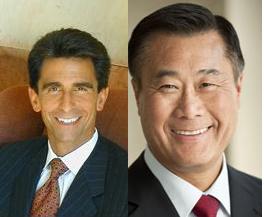
I’m not arguing that Ed Lee is a bad mayor (he’s way better than the last guy). He might even turn into a good mayor if he runs for a full term. Pearce thinks he’d be better for progressives than state Sen. Leland Yee. We can argue that later.

But as long as his campaign is directly linked to people whose standard practices undermine the heart of the progressive agenda (which depends on a belief that government can be trusted to take on social problems), then you can count me out.

Is LEED really green?

news@sfbg.com


The archangel of sustainable development has arrived, promising much needed city housing that will add to the “social fabric of the waterfront community” with its glamorous green rooftops and unheard-of bay views. This is going to be the greenest building of them all, or so we’ve been told, but the truth is a bit more complicated.


A condominium development 25-plus years in the making, 8 Washington would transform the site of the Golden Gateway Tennis and Swim Club near Pier 39. The developer plans to renovate the recreation center with a larger fitness facility, provide two new waterfront parks with public access, and supply 30,000 feet of ground-floor retail stores and restaurants beneath its 165 new luxury apartments.


Sounds nice, doesn’t it? The problem with this $345 million project is that it’s being touted, with its “green building” LEED certification, as the most sustainable structure it can possibly be.


But there’s nothing sustainable about building high-end condos in San Francisco, a city with too many high-end condos and not enough affordable housing. And LEED (Leadership in Energy and Environmental Design), the most popular sustainable development certification system in the country, is a lie — at least as your friendly neighborhood building developer is marketing it.


LEED, the baby of the U.S. Green Building Council (USGBC) is a great marketing tool for developers in San Francisco, the city with the single most LEED certified buildings in the United States. San Francisco was just named the “greenest” city in North America at the 2011 Aspen Ideas Festival, largely due to its extensive representation of green buildings — which normally means structures built with recycled materials, near a transportation hub, featuring some solar panels or other renewable energy sources.


“LEED is certainly a positive thing,” Planning Commission President Christina Olague told us. “There’s this whole push toward green sustainability.”


The project’s “platinum” LEED status is all a San Francisco developer could hope for to attract the green — and more important, the city’s approval.


“LEED certification is part and parcel to the vision for the project,” said PJ Johnston of PJ Johnston Communications, speaking for the developer. “The city, neighborhood, and waterfront deserve healthy, sustainable structures, living spaces, public spaces, and amenities. That’s exactly what 8 Washington will bring.”


LEED has become the final word in green building — if your building is LEED certified, you’re golden. But all this green they’ve been feeding us is really a misleading, incomplete rating system.


The first thing to consider is that sustainable development, even if it uses recycled materials and 10 percent sun-powered electricity, is still development. Any time a structure is torn down, “the energy and materials in that [original structure] are going to get sent to landfills somewhere. You gotta calculate all that,” said sustainable development activist Brad Paul, a former SF deputy mayor, who believes in considering the entire “life cycle of a building” in determining its sustainability.


Even the Environmental Protection Agency sometimes discounts essential considerations of sustainable building. When it sought a new SF office space in 2009, its intention was to find a home that was “a model of sustainable development,” the SF Biz Times reported. But its first choice was to build new development, at the site at 350 Bush Street — with its environmental costs of demolition, throwing out old materials, and starting from scratch.


Last month, the EPA decided to remain at 75-95 Hawthorne Street instead of moving to a new building, but not because it was the sustainable choice. No deal was reached for 350 Bush, and as Regional Public Affairs Officer Traci Madison said, “There was no other option to choose from.”


Although it’s a measure of a structure’s material sustainability, LEED does not consider a building’s life cycle, or even its use. Consider 8 Washington. The developer has boasted that it’s the most expensive housing project in San Francisco history, with a hefty price tag of $3 million to $10 million per apartment.


“Who can afford these luxury condos, and what do they use them for?” Paul asks. “These guys who work for hedge funds on Wall Street,” who use the condo as a second or third home and commute on their private jets to get there.


Johnston said 8 Washington will be marketed to a “mix of buyers, including young professionals, empty-nesters looking to move back to San Francisco, and families … The project has many two- and three-bedroom units, encouraging family living,” he said. But it’s unlikely that those who can afford a condo of this luxury will make it their only home.


“[Board President] David Chiu says he’s worried about SF becoming a bedroom community for Silicon Valley,” said Paul. “I’m more worried about this being a bedroom community for New York, Boston, L.A.”


Instead of providing the affordable housing that San Francisco so needs, projects like 8 Washington attract the wealthy, who aren’t using public transportation. Instead, Paul said, they burn tons of fossil fuels using their new condos as weekend getaways.


LEED FOR THE RICH


LEED certifies buildings as “sustainable developments” based on the following categories: sustainable sites, water efficiency, energy and atmosphere, materials and resources, indoor environmental quality, and innovation in design and regional priority.


Earning points in each category brings a building closer to LEED certification, which requires at least 40 points. Above “silver” and “gold” status, a “platinum” LEED certification requires 80 points. But how builders get the points is what matters. For example, a developer might skimp on the insulation to install extra solar panels and get more points for a less efficient building.


Does LEED consider a building’s actual use? “The short answer is no,” said Jennifer Easton, a communications associate at the USGBC who added, “We want [LEED] to be used by every type of project.” But despite its billing, LEED tells an incomplete story.


“It’s just green drapery,” said SF attorney Sue Hestor, a slow growth advocate. “They’ve really had a PR machine. They keep touting all this greenness.”


LEED certification has value, Paul said, but it doesn’t turn multimillion dollar condos green. “There is absolutely no need for high-end luxury housing in the city right now,” he said.


Building luxury condos in place of affordable housing encourages the “Manhattanization” phenomenon, attracting wealthy out-of-towners to expend fuel on their private jets to get to their new crash pads.


“They aren’t gonna be living there all year,” Olague said of residents of luxury housing. “We hear a lot of, ‘We need more housing.’ If you keep building housing for the top 2 percent, how does it lessen the demand on your average workforce?”


But not everyone sees luxury condo-building as counterproductive. “Building that project actually allows for more affordable housing,” said Gabriel Metcalf, executive director of SPUR (San Francisco Planning + Urban Research Association). “It’ll provide housing for some people, and that can only be helpful to the housing market. If you don’t build new condos, then people just compete for the crumbs, and that means people who are rich push the rest of us out.”


In other words, if you give the rich housing, then they won’t take over your flat in the Mission — if they ever really wanted it in the first place. “I don’t think we can impose some kind of hipster elitism that they’re not our kind of people so they’re not allowed in,” Metcalf said of the wealthy out-of-towners.


LEED agrees. “We don’t want [LEED] to be for one specific group of people,” Easton said. “We have LEED-certified homeless shelters, but having a LEED certified luxury condo building is an advantage. We can’t control if someone is flying across the country in a jumbo jet every day — but we can control their energy efficiency in a building.”


WHO RIDES BUSES?


For the typical working class San Franciscan, living modestly is a must and public transportation is essential. So there’s an inherent environmental advantage to attracting residents who don’t rely on polluting planes and cars.


“There’s a definite need for workforce housing, middle class housing in San Francisco,” Paul says. “I guarantee you none of those people get there by private jet. The less income people have, the more likely they’re going to be to use public transit.”


But 8 Washington and luxury developments like it don’t foster public transit. The more wealthy people who move in, the more low-income residents get displaced — to the East Bay or other areas with more affordable housing. It’s another strike against sustainability when these workers opt to drive back into the city for work instead paying for BART, says Paul, particularly when they drive older, less-efficient cars.


“LEED was a way to spell an environmentally friendly product, but you have to figure in the extra driving,” said Paul.


But 8 Washington gets LEED points for building on a site close to public transit in an attempt to discourage individual car pollution. But will wealthy condo owner actually take the infrequent F-line with all the tourists instead of parking their $150,000 car in the underground parking garage right below their feet?


“When you’re talking about sustainable practices and reducing greenhouse gas emissions and how it relates to land use planning, it makes you wonder if that’s supposed to [solely] relate to housing people near transit corridors,” said Olague. “It seems to me you have to look at equity.”


The garage at 8 Washington, to be built below sea level under the condos, will house 415-plus parking spaces. The developer says that 250 of the spaces will be offered as public parking for the busy Ferry Building down the street, but the 165 additional spaces guarantee one parking space for each residential unit.


“Given the larger size of the residential units and the fact that the majority of the units are two to three bedrooms, we believe that one parking space per dwelling is appropriate,” said Johnston. Appropriate, maybe, but not environmentally friendly.


PROMISES AND REALITY


Wealthy people and affordable housing aside, LEED doesn’t actually measure the energy used in a building, says New York City-based architectural associate Henry Gifford. He filed a $100 million class action lawsuit against LEED last October for gaining a monopoly on the sustainable development market by making false claims about buildings’ energy savings.


“They say that the building is required to be energy efficient. But the building doesn’t have to be energy efficient — it just has to earn points, to promise it’s going to be energy efficient,” Gifford said.


It’s up to the developer what computer software is used to predict a building’s energy efficiency, and Gifford says that computer diagrams can easily be manipulated and do not consider inconsistent factors, like weather.


“California is the promise land,” said Gifford. “All you’re required to do is provide a promise. The sad thing is that it removes all the integrity from the process — it encourages lying.”


Furthermore, once the building is built and has achieved LEED certification, the building’s actual energy use in its life cycle isn’t considered. The only way you can truly know if a building is energy efficient is by looking at the utility bills, says Gifford. But once it’s LEED-certified, who cares?


There is a voluntary program called Building Performance Partnership (BPP) that tracks a building’s energy and water use over time. “The idea is we want LEED to be a system where it enacts change in the actual building,” said Easton. But the problem is the building has already gained LEED certification before the first utility bill is even mailed.


“We publish baseball scores. With everything in life, people get scored,” said Gifford, who operates with transparency in developing energy efficient buildings in New York, hosting open houses after buildings are built with printouts of their recent utility bill history.


LEED was never intended to have the final say on sustainable building, to be a seal of green approval, according to a New York Times op-ed by Alec Appelbaum last year (“Don’t LEED us astray,” 5/19/10). “Rather it was to be a set of guidelines for architects, engineers, and others who want to make buildings less wasteful. However, developers quickly realized that its ratings — certified, silver, gold, or platinum — were great marketing tools, allowing them to charge a premium on rents.”


Therein lies the issue. Yes, 8 Washington will “allow for more ‘eyes on the street’ at all hours of the day” and provide two or three-bedroom units for families who can afford them, as it promises. But a sustainable structure is far different than the promise of a sustainable life cycle of a building. And a promise is just that. *


UPDATE: Jennifer Easton at LEED wrote to inform us that, although the 8 Washington website clearly states that the project will include LEED certified buidlings, “We would like to clarify that 8 Washington is not a LEED-certified project, nor a LEED-registered project.”


PLANNING COMMISSION HEARINGS


July 7: Community Vision for San Francisco’s Northeast Waterfront


July 14: City demographics and sustainability; the need for low-income housing; presentation of “jet fuel burn rate” argument.


July 21: 8 Washington’s EIR approval hearing


All hearings to be held at 12 p.m. in the Commission Chambers, Room 400, City Hall, 1 Dr. Carlton B. Goodlett Place.


JET FUEL BURN RATE FOR LUXURY CONDOS


Let’s assume that just five of the 165 condo buyers at 8 Washington (3 percent) are Wall Street hedge fund traders or venture capitalists using them as second or third homes. Let’s also assume they’ll use them 1.5 times a month and commute to SF aboard their business jet, a reasonable assumption for Wall Street execs making tens of millions in salary and bonuses. Why would they fly by private jet rather than take Southwest or Amtrak? Because they can. This must be factored into any environmental analysis of a project that explicitly markets to this demographic and include the following:


Mid to large size business jets used to fly cross country (Hawker 800XP, Gulfstream G2/ G3, Bombardier Global Express) on average burn 400 gallons of jet fuel/hour, take 6 hours to fly New York to SFO and 5 hours for return trip. Therefore, a single round trip burns:


11 hours X 400 gallons per hour = 4,400 gallons of jet fuel per trip. A typical family car uses 1,200 gallons of gas per year, so one flight from NYC to 8 Washington equals almost four years of driving a family car.


1.5 trips/mo. = 6,600 gallons X 12 months = 79,200 gallons of jet fuel/year or the equivalent of driving a family car for 66 YEARS each month.


Using our example of five residents, the numbers over one year and 20 years are:


5 X 79,200 gallons/per year = 396,000 GALLONS OF JET FUEL A YEAR or equal to driving a family car 330 years, A THIRD OF A MILLENNIUM, each year.


396,000 gal. X 20 yrs. = 7,920,000 gallons of jet fuel, equivalent of driving family car 6,600 years, OVER 6 MILLENNIUM, in 20 years.


Given this reality, the 8 Washington environmental impact report must analyze such questions as:


How many solar panels are needed compensate for burning 396,000 gallons of jet fuel/year? How many low flow toilets would make up for burning 396,000 gallons of jet fuel/year? Etc.


Editorial: Mayor Lee’s budget deal

1

The way the daily newspapers are presenting it, the budget that Mayor Ed Lee and the Board of Supervisors Budget and Finance Committee negotiated represents a new era of civility and cooperation at City Hall. The committee, after marathon negotiations, approved the $6.8 billion deal unanimously. Both sides called it a good process and a good result.

And indeed, by any standard, the way Lee worked with community groups was a huge breakthrough. After 16 years of essentially being cut out of the process under mayors Willie Brown and Gavin Newsom, the stakeholders — the people who provide the essential city services — were actually at the table. And the final blueprint isn’t as bad as it could be.

But it’s still a budget that does nothing to restore the roughly $1 billion of General Fund cuts over the past five years, that seeks no new taxes from big business or the wealthy, and that includes spending on a new Police Academy class that even the mayor doesn’t think the city needs.

And from the start, the mayor and his staff were absolutely determined to privatize security at the city’s two big public hospitals — even when it makes no political or fiscal sense.

The privatization plan was the centerpiece of what became a 13-hour shuttle diplomacy session, as staffers and supervisors sought to reach a deal they could all accept. The Mayor’s Office — particularly Steve Kawa, the chief of staff — put immense pressure on the committee members to accept a plan to replace deputy sheriffs with private security guards at San Francisco General and Laguna Honda hospitals. In the grand scheme of things, the $3 million in projected savings wasn’t a huge deal — but the politics was unnecessarily bloody. It’s as if Lee and Kawa were determined to privatize something, whatever the cost.

In the end, Sup. Jane Kim deserves considerable credit for holding firm and refusing to accept the proposal — and since Sup. David Chiu went along with her, they joined Sup. Ross Mirkarimi as a three-vote majority on the five-member panel and shot it down.

Police Chief Greg Suhr pushed for funding for a new police academy class to train 35 officers at a cost of $3.5 million (that’s $100,000 a cop). “I don’t think the department has looked hard enough at how we deploy the existing officers,” Sup. John Avalos told us.

And some key issues are still up in the air — for example, whether the mayor will adequately fund public financing of the November campaigns. With at least eight serious candidates running for mayor (not counting Lee), and most of them looking for the public financing that will help level the playing field, the city’s going to have to come up with at least several million dollars. That’s critical to the fairness of the election.

The bottom line remains: This city has been deeply damaged by years of cuts. And the next budget needs to start with a plan to repair that.


Everybody loves parklets

20

The Chronicle’s urban design writer John King, consistently one of the paper’s best writers, today took a celebratory look at the parklets that have been springing up around town, calling them, “the most intriguing urban design innovation in today’s San Francisco.” I agree with that sentiment, and so does the crowd that showed up on Sunday to dedicate “the Deeplet,” the first such parklet in front of a residential property.

It was a collaboration between homeowner Amandeep “Deep” Jawa, his girlfriend Kimberly Conley, and designer Jane Martin, who King quotes in his piece (which only Chron subscribers and read until Sunday when it goes public). The idea is to take underutilized space from automobiles and give it back to people.

Livable City director Tom Radulovich also spoke at the event, talking about how the streets were traditionally the gathering and social spaces in cities, until transportation planners started to value the efficient movement and storage of automobiles over a more inclusive view of streets. But the parklets – along with temporary street seizures like the Sunday Streets events – are part of a movement back to a more holistic view of city spaces.

We at the Guardian have been sympathetically covering this trend for years, and it is notably one of the few areas of agreement that we’ve had with the Chronicle and former Mayor Gavin Newsom, whose administration cleared the way for the permitted creation of parklet. And on this beautiful summer day, agreeing on the importance of having places to lounge and to just be seems like a great starting point for more discussions on the future of this great city.

The Fourth of July in Rock Rapids, Iowa, 1940-53

5

(Note: In July of l972, when the Guardian was short a Fourth of July story, I sat down and cranked out this one for the front page on my trusty Royal Typewriter. I now reprint it each year on the Bruce blog (by popular demand, of course), with some San Francisco updates and postscripts. My update for  this year’s Fourth  is the story on  today’s Chronicle front page that reports sadly, “Leaner budgets douse fireworks shows.” But, if you read to the end of this piece, I will point you to a little known spot in town where the amateurs and semi-pros  and parents with children will go to fire off their cherry bombs and Roman candles.

Back where I come from, a small town beneath a tall standpipe in northwestern Iowa, the Fourth of July was the best day of a long, hot summer.

The Fourth came after YMCA camp and Scout camp and church camp, but before the older boys had to worry about getting into shape for football. It was welcome relief from the scalding, 100-degree heat in a town without a swimming pool and whose swimming holes at Scout Island were usually dried up by early July. But best of all, it had the kind of excitement that began building weeks in advance.
The calm of the summer dawn and the cooing of the mourning doves on the telephone wires would be broken early on July Fourth: The Creglow boys would be up by 7 a.m. and out on the lawn shooting off their arsenal of firecrackers. They were older and had somehow sent their agents by car across the state line and into South Dakota where, not far above the highway curves of Larchwood, you could legally buy fireworks at roadside stands.

Ted Fisch, Jim Ramsey, Wiener Winters, the Cook boys, Hermie Casjens, Jerry Prahl, and the rest of the neighborhood would race out of their houses to catch the action. Some of them had cajoled firecrackers from their parents or bartered from the older boys in the neighborhood: some torpedoes (the kind you smashed against the sidewalk); lots of 2 and 3-inchers, occasionally the granddaddy of them all, the cherry bomb (the really explosive firecracker, stubby, cherry red, with a wick sticking up menacingly from its middle; the kind of firecracker you’d gladly trade away your best set of Submariner comics for).

Ah, the cherry bomb. It was a microcosm of excitement and mischief and good fun. Bob Creglow, the most resourceful of the Creglow boys who lived next door,  would take a cherry bomb, set it beneath a tin can on a porch, light the fuse, then head for the lilac bushes behind the barn.

“The trick,” he would say, imparting wisdom of the highest order, “is to place the can on a wood porch with a wood roof. Then it will hit the top of the porch, bang, then the bottom of the porch, bang. That’s how you get the biggest clatter.”

So I trudged off to the Linkenheil house, the nearest front porch suitable for cherry bombing, to try my hand at small-town demolition. Bang went the firecracker. Bang went the can on the roof. Bang went the can on the floor. Bang went the screen door as Karl Linkenheil roared out in a sweat, and I lit out for the lilacs behind the barn with my dog, Oscar.

It was glorious stuff – not to be outdone for years, I found out later, until the Halloween eve in high school when Dave Dietz, Ted Fisch, Ken Roach, Bob Babl, and rest of the Hermie Casjens gang and I made the big time and twice pushed a boxcar loaded with lumber across Main Street and blocked it for hours. But that’s another story in my annual  Halloween blog.

Shooting off fireworks was, of course, illegal in Rock Rapids, but Chief of Police Del Woodburn and later Elmer “Shinny” Sheneberger used to lay low on the Fourth. I don’t recall ever seeing them about in our neighborhood and I don’t think they ever arrested anybody, although each year the Rock Rapids Reporter would carry vague warnings about everybody cooperating to have “a safe and sane Fourth of July.” My father, a bit of a law and order sort, would take Jimmy DeYoung and me  five miles north of town and across the state line to Minnesota where it was legal to shoot off fireworks. 

Perhaps it was just too dangerous for them to start making firecracker arrests on the Fourth – on the same principle, I guess, that it was dangerous to do too much about the swashbuckling on Halloween or start running down dogs without leashes (Mayor Earl Fisher used to run on the platform that, as long as he was in office, no dog in town would have to be leashed. The neighborhood consensus was that Fisher’s dog, a big, boisterous boxer, was one of the few that ought to be leashed).

We handled the cherry bombs and other fireworks in our possession with extreme care and cultivation; I can’t remember a single mishap. Yet, even then, the handwriting was on the wall. There was talk of cutting off the fireworks supply in South Dakota because it was dangerous for young boys. Pretty soon, they did cut off the cherry bomb traffic and about all that was left, when I came back from college and the Roger boys had replaced the Creglow boys next door, was little stuff appropriately called ladyfingers.

Fireworks are dangerous, our parents would say, and each year they would dust off the old chestnut about the drugstore in Spencer that had a big stock of fireworks and they caught fire one night and much of the downtown went up in a spectacular shower of roman candles and sparkling fountains.

The story was hard to pin down, and seemed to get more gruesome every year – but, we were told, this was why Iowa banned fireworks years before, why they were so dangerous and why little boys shouldn’t be setting them off. The story, of course, never made quite the intended impression; we just wished we’d been on the scene.
My grandfather was the town druggist (Brugmann’s Drugstore, “where drugs and gold are fairly sold,” since 1902) and he said he knew the Spencer druggist personally. Fireworks put him out of business and into the poorhouse, he’d say, and walk away shaking his head.

In any event, firecrackers weren’t much of an issue past noon – the Fourth celebration at the fairgrounds was getting underway and there was too much else to do. Appropriately, the celebration was sponsored by the Rex Strait post of the American Legion (Strait, so the story went, was the first boy from Rock Rapids to die on foreign soil during World War I); the legionnaires were a bunch of good guys from the cleaners and the feed store and the bank who sponsored the American Legion baseball team each summer.

There was always a big carnival, with a ferris wheel somewhere in the center for the kids, a bingo stand for the elders, a booth where the ladies from the Methodist Church sold homemade baked goods, sometimes a hootchy dancer or two, and a couple of dank watering holes beneath the grandstand where the VFW and the Legion sold Grainbelt and Hamms beer  at 30¢ a bottle to anybody who looked of age.

Later on, when the farmboys came in from George and Alvord, there was lots of pushing and shoving, and a fist fight or two.

In front of the grandstand, out in the dust and the sun, would come a succession of shows that made the summer rounds of the little towns. One year it would be Joey Chitwood and his daredevil drivers. (The announcer always fascinated me: “Here he comes, folks, rounding the far turn…he is doing a great job out there tonight…let’s give him a big, big hand as he pulls up in front on the grandstand…”)

Another year it would be harness racing and Mr. Hardy, our local horse trainer from nearby  Doon, would be in his moment of glory. Another year it was tag team wrestling and a couple of barrel-chested goons from Omaha, playing the mean heavies and rabbit-punching their opponents from the back, would provoke roars of disgust from the grandstand. ( The biggest barrel-chest would lean back on the ropes, looking menacingly at the crowd and yell, “ Aw, you dumb farmers. What the hell do you know anyway?” And the grandstand would roar back in glee.)

One year, Cedric Adams, the Herb Caen of Minneapolis and the Star-Tribune, would tour the provinces as the emcee of a variety show. “It’s great to be in Rock Rapids,” he would say expansively, “because it’s always been known as the ‘Gateway to Magnolia.” (Magnolia, he didn’t need to say, was a little town just over the state line in Minnesota which was known throughout the territory for its liquor-by-the-drink roadhouses. It was also Cedric Adams’ hometown: his “Sackamenna.”) Adams kissed each girl (soundly) who came on the platform to perform and, at the end, hushed the crowd for his radio broadcast to the big city “direct from the stage of the Lyon County Fairgrounds in Rock Rapids, Iowa.”

For a couple of years, when Rock Rapids had a “town team,” and a couple of imported left-handed pitchers named Peewee Wenger and Karl Kletschke, we would have some rousing baseball games with the best semi-pro team around, Larchwood and its gang of Snyder brothers: Barney the eldest at shortstop, Jimmy the youngest at third base, John in center field, Paul in left field, another Snyder behind the plate and a couple on the bench. They were as tough as they came in Iowa baseball.

I can remember it as if it were yesterday at Candlestick, the 1948 game with the Snyders of Larchwood. Peewee Wenger, a gawky, 17-year-old kid right off a high school team, was pitching for Rock Rapids and holding down the Snyder artillery in splendid fashion. Inning after inning he went on, nursing a small lead, mastering one tough Larchwood batter after another, with a blistering fastball and a curve that sliced wickedly into the bat handles of the right-handed Larchwood line-up.

Then the cagey Barney Snyder laid a slow bunt down the third base line. Wenger stumbled, lurched, almost fell getting to the ball, then toppled off balance again, stood helplessly holding the ball. He couldn’t make the throw to first. Barney was safe, cocky and firing insults like machine gun bullets at Peewee from first base.

Peewee, visibly shaken, went back to the mound. He pitched, the next Larchwood batter bunted, this time down the first base line. Peewee lurched for the ball, but couldn’t come up with it. A couple more bunts, a shot through the pitcher’s mound, more bunts and Peewee was out. He could pitch, but, alas, he was too clumsy to field. In came Bill Jammer, now in his late 30’s, but in his day the man who beat the University of Iowa while pitching at a small college called Simpson.

Now he was pitching on guts and beer, a combination good enough for many teams and on good days even to take on the Snyders. Jammer did well for a couple of innings, then he let two men on base, then came a close call at the plate. Jammer got mad. Both teams were off the bench and onto the field and, as Fred Roach wrote in the Rock Rapids Reporter, “fisticuffs erupted at home plate.” When the dust cleared, Jammer has a broken jaw, and for the next two weeks had to drink his soup through a straw at the Joy Lunch. John Snyder, it was said later, came all the way in from center field to throw the punch, but nobody knew for sure and he stayed in the game. I can’t remember the score or who won the game, but I remember it as the best Fourth ever.

At dusk, the people moved out on their porches or put up folding chairs on the lawn. Those who didn’t have a good view drove out to the New Addition or parked out near Mark Curtis’ place or along the river roads that snaked out to the five-mile bridge and Virgil Hasche’s place.

A hush came over the town. Fireflies started flickering in the river bottom and, along about 8:30, the first puff of smoke rose above the fairgrounds and an aerial bomb whistled into the heavens. BOOM! And the town shook as if hit by a clap of thunder.

Then the three-tiered sky bombs – pink, yellow, white, puff, puff, puff. The Niagara Falls and a gush of white sparks.

Then, in sudden fury, a dazzling display of sizzling comets and aerial bombs and star clusters that arched high, hung for a full breath and descended in a cascade of sparks that floated harmlessly over the meadows and cornfields. At the end, the flag – red, white and blue – would burst forth on the ground as the All-American finale in the darkest of the dark summer nights. On cue, the cheers rolled out from the grandstand and the cars honked from the high ground and the people trundled up their lawn chairs and everybody headed for home.

Well, I live in San Francisco now, and I drive to Daly City with my son, Danny, to buy some anemic stuff in gaudy yellow and blue wrapping and I try unsuccessfully each year to get through the fog or the traffic to see the fireworks at Candlestick. But I feel better knowing that, back where I come from, everybody in town will be on their porches and on the backroads on the evening of the Fourth to watch the fireworks and that, somewhere in town, a little boy will put a big firecracker under a tin can on a wood porch, then light out for the lilacs behind the barn.

P.S. Our family moved in l965 from Daly City to a house in the West Portal area of San Francisco. There are, I assure you, few visible fireworks in that neighborhood. However, down where we work at the Guardian building at the bottom of Potrero Hill, the professional and amateur action is spectacular.

From the roof of the Guardian building at 135 Mississippi, and from any Potrero Hill height, you can see the fireworks in several directions: the waterfront fireworks in the city, fireworks on the Marin side of the Golden Gate bridge, fireworks at several points in the East Bay, fireworks along the Peninsula coast line.

And for the amateur action, parents with kids, kids of all ages, spectators in cars and on foot, congregate after dusk along Terry Francois Boulevard in San Francisco along the shoreline between the Giants ballpark and Kellys Mission Rock restaurant.

The action is informal but fiery and furious: cherry bombs, clusters, spinning wheels, high flying arcs, whizzers of all shapes and sizes. The cops are quite civilized and patrol the perimeter but don’t bother anybody. I go every year. I think it’s the best show in town. B3.

The way forward

0

sarah@sfbg.com

Two days before President Obama announced his plan to begin withdrawing 33,000 troops from Afghanistan over the next 15 months, Peace Action West’s political director Rebecca Griffin delivered a box containing thousands of toy soldiers to Sen. Dianne Feinstein’s office in downtown San Francisco.

Tied to each soldier were handwritten messages that gave reasons for demanding a large and swift withdrawal. Many of the petitions came from folks whose loved ones are in the military or are veterans of Afghanistan and Iraq.

Unlike most Democratic Party leaders, Feinstein has not demanded a significant draw-down of combat troops, despite polls showing that Americans increasingly support leaving Afghanistan, particularly after the killing of Osama bin Laden. There’s good reason for the public’s growing restlessness. This 10-year war has already surpassed Vietnam as the longest conflict in U.S. history.

According to the online database icasualities.org, 1,637 U.S. soldiers have died in Afghanistan and 4,463 soldiers have died in Iraq. Another 11,722 service members have been wounded in Afghanistan, and 32,100 in Iraq, primarily by improvised explosive devices. And that’s not counting the thousands who are suffering from depression, posttraumatic stress disorder, and other ailments.

Griffin said her goal was to draw attention to the political organizing in support of ending the war. But even as she made her delivery, Feinstein was on MSNBC maintaining that draw-down decisions should be left to the military generals.

In the wake of President Obama’s June 22 announcement, which went way farther than the generals wanted, many of Feinstein’s colleagues such as Sen. Barbara Boxer and Rep. Nancy Pelosi, the house minority leader, expressed disappointment that the pace of withdrawal isn’t quicker.

“I am glad this war is ending, but it’s ending at far too slow a pace,” Boxer said.

“We will continue to press for a better outcome,” Pelosi stated.

Rep. John Garamendi (D-Concord), who visited the troops over Memorial Day weekend, told us that a different strategy is needed. “Our troops are incredible, dedicated, and skilled. But every minute of every day, they are in a very dangerous situation, and many of them are dying. There is no recognition that we are caught in the middle of a five-way civil war.”

And Rep. Barbara Lee (D-Oakland) vowed to offer defense appropriations amendments to cut all funding for combat operations. “History shows there is no military solution in Afghanistan,” she said. “We’ve got to engage with the Taliban and engage with those in the region to find some stability.”

But where does Obama’s plan leave the peace movement as the election nears?

Griffin said activists should take credit for getting Obama to withdraw 33,000 troops rather than the smaller number his generals wanted. She sees his plan as a sign that activists need to keep pushing for more, including a concrete timeline for when he will bring all the troops home.

Under Obama’s plan, 68,000 troops will still be on the ground in September 2012, and 2014 is identified as the deadline for completing the transition to Afghan control and ending the U.S.’s combat mission.

“This means there’ll be a significant military presence in Afghanistan for at least another three-and-a-half years,” Griffin said. “By the end of Obama’s first term, the war will be 11 years old and there will be nearly double the American troops on the ground as there were when [George W.] Bush left office.”

Progressive activist and author Norman Solomon, who is running in the 2012 race to replace Rep. Lynn Woolsey (D-Marin County), noted that a recent New York Times’ headline read “Obama Opts for Faster Afghan Pullout.”

“But faster than what?” Solomon said, noting that “10,000 troops are only 10 percent of our force. This is a pattern we saw in Iraq, where the withdrawal was too slow and the numbers remaining doubled when you factored in all the private contractors.”

Solomon said that when Nixon pulled 500,000 troops from Vietnam in the late 1960s, the conflict actually increased in terms of the tonnage of weaponry used. “And the U.S. is now engaged in wars in Libya, Yemen, and a Pakistan air war.”

But longtime antiwar activist and former Democratic state legislator Tom Hayden saw a number of clues in Obama’s speech for how to push for a faster, bigger, more significant draw-down.

“Obama said 33,000 troops will be withdrawn by next summer, followed by a steady pace of withdrawal. So that gets you to 50,000 troops by the election, and all combat troops out by 2014,” Hayden told us. “If he could be pushed by the peace movement, that would break the back of the warmongers’ planning.”

In his speech, Obama noted that the U.S. will host a summit with our NATO allies and partners to shape the next phase of this transition next May in Chicago, where Obama’s former chief of staff is mayor.

“Get ready, Rahm Emanuel, for big demonstrations,” warned Hayden, who was a member of the Chicago Seven group tried for inciting riots during the 1968 Democratic National Convention. “But do you imagine Obama would do that if he were going to escalate the war? No — he’s wrapping a ribbon of unity to transfer control to Afghanistan on a timetable.”

He also noted that Obama’s allies aren’t exactly pushing him to stay. “They may not have an exit strategy, but they are heading for the exits,” Hayden said. “So if you organize demonstrations with international support, that gives you an organizational opportunity in multiple governments to press Obama to leave.”

Hayden predicts that Obama is moving toward a diplomatic settlement, led by Secretary of State Hillary Clinton, that is pro withdrawal and pro women.

“But Obama’s got a genuine problem of his own making. He escalated the damn war,” Hayden said. “He doesn’t want the military to be attacking his plan. But if he wants to be in the center, he’s going to offend the generals.

Hayden noted that in his speech Obama said, “America, it is time to focus on nation building here at home.” It was a statement that sounded in line with a recent U.S. Conference of Mayors resolution calling on Congress “to bring these war dollars home to meet vital human needs, promote job creation, rebuild our infrastructure, aid municipal and state governments.”

But Richard Becker, western regional coordinator of the antiwar ANSWER Coalition, described Obama’s draw-down as “a minimal pledge.”

“Given the growing discontent with the war, it’s hard to see how you can claim that this is a step forward,” he told us.

Becker said it has been difficult to mobilize the antiwar movement under a Democratic administration. He also stressed the importance of people coming out in San Francisco for a “protest, march, and die-in” on Oct. 7, the 10th anniversary of the war, and for a major action in Washington. D.C., on Oct. 6. “What’s going to get the U.S. out is a combination of what’s going on in Afghanistan — and what kind of antiwar movement we have here.”

Editor’s notes

5

tredmond@sfbg.com

I’m not going to tell Ed Lee he can’t run for mayor. I know he promised he wasn’t going to. I know that if he hadn’t made that promise, he wouldn’t have had the six votes to win the office. I think Lee believed at the time that he didn’t want to run in November, and he may believe it now.

But this is still a democracy, and if Lee thinks the situation has changed and he’s the only person who can properly lead the city over the next four years, he ought to put his name forward.

Right now, though, he’s allowing the “draft Ed Lee” movement to get out of control.

Chinatown powerbroker Rose Pak and political consultant Enrique Pierce (who runs the clearly misnamed Left Coast Campaigns and loves to tout his progressive credentials) have set up an office, are raising money, and have hatched this plan to get Lee to agree to put his name on the ballot and not actively campaign.

The operation — which, let’s remember, carries Ed Lee’s name on it — has already run afoul of the law. The Ethics Commission — hardly an aggressive political watchdog — says the campaign had improperly filed as a political action committee. That’s not Lee’s fault — he has nothing to do with this. But it already taints his reputation.

Lee, by all accounts, has done a far better job with the budget than his immediate predecessor. He’s actually been talking to people. He listens; he accepts logic; he tries to make thing work. I admit, the bar is pretty low — Gavin Newsom was a complete asshole. Still: Lee’s a decent guy.

But he has some heavy political baggage — and most of it has to do with his connections to sleazy operators like Pak and Willie Brown. As long as he’s linked to people who treat campaign finance laws, lobbying rules, and political ethics with disdain bordering on hostility, he’s going to have trouble keeping the public trust.

And right now, those same people are raising money — money that is already being spent on a political campaign — and the noncandidate is letting it happen.

Run if you want, Ed. But if you’re going to keep your promise, then it’s time to call Pak, Pierce and company and tell them to quit.

Three good initiatives for the fall

2

The progressive wing of the Board of Supervisors (including, to her credit, Sup. Jane Kim) has placed three important reform measures on the November ballot. That the measures are headed for the voters is a clear indication of the shift of power at the board — progressives no longer have a reliable six votes. But the progressives still have the ability to push issues — and in an mayoral election year, these measures will provide a valuable gauge for the candidates and create broad-based organizing opportunities.

The measures include a ban on the demolition of more than 50 units of rent-controlled housing; a ban on further admissions charges at parks or leasing park facilities to private companies; and a requirement that participants in the Care Not Cash program get an actual housing unit — not just a shelter bed — before their welfare grants are cut.

The supervisors are under immense pressure to back off from those proposals, and if two of the five supporters pull their names before the final deadline of July 14, the measures won’t make the ballot. Some argue that the controversy over the measures could threaten the mayoral campaign of progressive standard-bearer John Avalos. But Avalos told us he supports all three measures and has no interest in turning back. He’s right — the supervisors should hold firm and insist on a public vote on all three.

The Care Not Cash reform has already generated a lot of controversy. Mayor Ed Lee has denounced it, saying it will destroy the entire program, and two mayoral candidates, former Sup. Bevan Dufty and Assessor-Recorder Phil Ting, have come out against it. But the measure is pretty simple and straightforward: it says that a bed in a shelter doesn’t count as “housing.”

That’s a critical definition, because under Care Not Cash, the city tries to put homeless welfare recipients into housing, mostly single-room-occupancy hotels — and in exchange, takes back most of the welfare grants. But by law, a bed in a shelter counts as a home — so the minute the city finds someone a cot to sleep on in a noisy, sometimes dangerous shelter with no privacy and arbitrary curfews and rules, that person loses most of his or her welfare grant. Along the way, the city locks up shelter beds for people in the CNC program — so when other homeless people show up for a place to sleep, they’re told there’s no room. That’s a sign of a broken system.

The housing demolition measure comes as a response to a badly flawed proposal to rebuild Parkmerced — tearing down hundreds of rent-controlled housing units in the process. The parks measure is an attempt to stop Phil Ginsburg, head of the Recreation and Parks Department, from turning public property over to private for-profit firms in an effort to raise cash.

The community groups and grassroots sponsors of these measures have a responsibility to organize and mount serious campaigns; there’s going to be big-money opposition. But it’s worth having all three on the ballot in November.

Smooth sailing for developers

3

rebeccab@sfbg.com

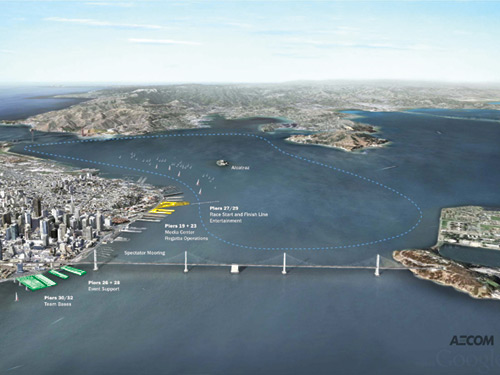
It’s a mad dash at San Francisco City Hall to put all the pieces together in preparation for the America’s Cup, the prestigious regatta that will culminate in the summer of 2013 along the city’s northern waterfront. But once that spectacle is over, the biggest impact of the event will be a massive, lasting, and quite lucrative transformation of the city’s waterfront by a few powerful players, a deal that has been modified significantly since it was approved by the Board of Supervisors.

As negotiations on the fine terms of the development agreements continue to unfold, the future landscape of a huge section of the San Francisco waterfront is in play. If the America’s Cup Event Authority (ACEA) — the race management team controlled by billionaire Oracle CEO Larry Ellison — aims high in its investments into port-owned infrastructure, it has the potential to lock-in leases and long-term development rights for up to nine piers for 66 years, with properties ranging from as far south as Pier 80 at Islais Creek to as far north as Pier 29, home of the popular dinner theater Teatro ZinZanni.

The possibility of securing long-term leases and development rights to Piers 19, 23, and 29 — provided race organizers sink more money into infrastructure improvements — was added to the deal in the last two weeks of 2010, just before San Francisco won its bid to host the world-famous sailing match. The possibility of obtaining rights to portions of two additional piers, 27 and 80, were also added at the last minute. Race organizers and city officials negotiated the final modifications after the Board of Supervisors signed off on the Host City Agreement on Dec. 14, 2010.

Not all board members knew that three additional city-owned piers were being added as possible extensions of the land deal, and those properties weren’t mentioned in any of the earlier documents that went through a public review process in the months leading up to the approval of the agreement. Yet Board President David Chiu was evidently appraised of how the last-minute negotiations were unfolding and he quietly offered his support.

On Dec. 22, 2010, Chiu sent a letter to Russell Coutts, CEO of Oracle Racing, the team that won the 33rd America’s Cup and is an integral player in laying plans for the 34th. “I understand that Mayor Newsom and the city’s team have been working directly with you since the board’s approval of the Host City Agreement to make the necessary adjustments and clarifications to the agreement to ensure it meets your needs. I am aware of these changes and support them,” Chiu wrote in a letter that was not shared with his fellow supervisors.

Quoting from a section of the agreement that explains that ACEA is ensured long-term development opportunities in exchange for funding improvements and upgrades, Chiu’s letter went on, “This section specifically applies to … Piers 30-32 and Seawall Lot 330, as well as Piers 26 and 28, and if mutually agreeable could apply to Piers 19, 23, and 29. To obtain the community’s support and agreement for future development rights to piers on the northern waterfront, you will need to invest in a strong partnership with the community … I am prepared to help facilitate that relationship.”

Former Board President and Democratic County Central Committee Chair Aaron Peskin, who has closely followed the America’s Cup land deal and has for decades been actively involved in land-use issues along the northern waterfront, interpreted Chiu’s letter to Coutts as a backroom deal.

“There is no question that the president of the board, without the authorization of the majority of the Board of Supervisors, went behind closed doors, out of view of the public, and committed to [long-term development] for three piers,” Peskin said, highlighting the fact that no other supervisors were copied on Chiu’s letter. “That he has done this unilaterally, without the consent of a board’s vote at a board meeting, is not good governance. If there’s one body that’s supposed to do all of its work for the public, it’s the Board of Supervisors.”

Chiu defended the letter by emphasizing the part that asked for a partnership with the community. “This was all within the broader framework of the Host City Agreement that we signed in the middle of December,” he told the Guardian when presented with the letter during an interview and asked to comment. “They had questions about, well, can we develop on these other piers? And what I said was, ‘Well, as I think the language here specifically says if mutually agreed upon … you could possibly do this.’ And we specifically said you’ll need to invest in a strong partnership with the community.”

He added that specific development plans would still have to be approved by the Board of Supervisors. Proposals for each parcel will be made in separate Disposition and Development Agreements, subject to board approval.

On hearing Chiu’s response, Peskin was still critical of the lack of transparency in this deal: “My position is, if it walks like a duck and quacks like a duck, it’s a duck.”

Meanwhile, an analysis prepared by Budget Analyst Harvey Rose in mid-March suggests that the final amendments did reflect new commitments for the city that go well beyond what was discussed publicly. “No city approval of the Event Authority’s selection of Pier 29 for a long-term lease is required in the agreement, as modified by the Mayor’s Office and other city officials,” the Budget Analyst’s report notes. “This entire provision … was not included in the agreement of Dec. 14, 2010 as previously approved by the Board of Supervisors.”

Brad Benson, special projects manager at the Port of San Francisco, explained the Pier 29 provision slightly differently. “The city would have to be acting in its reasonable discretion to say no,” he said, emphasizing that ACEA would have to invest well above the $55 million threshold to obtain rights to Pier 29.

At a time when a new era of civility is being hailed at City Hall, two elements of the city family are essentially agreeing to disagree on the broader question of whether the 11th-hour modifications to the deal resulted in a greater hit to city coffers than supervisors approved. While Rose stated in public hearings that the modifications would deal a greater blow to city revenues, City Attorney Dennis Herrera, a mayoral candidate, has stood with the Office of Economic and Workforce Development in his assessment that the changes did not significantly exceed the scope of what was approved by the board. Fred Brousseau of the Budget & Legislative Analyst chalked it up to “a difference in opinion,” reflecting “the auditor’s standard for materiality versus the city attorney’s.”

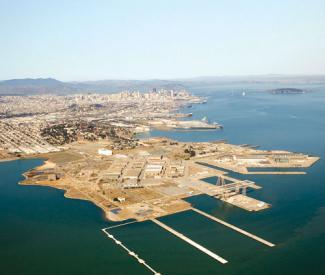
Legalese aside, it’s clear that the race organizers stand to gain some highly desirable waterfront property in exchange for investing in the piers and bringing an event to the city that is expected to generate substantial economic activity. If ACEA invests a minimum threshold of $55 million for infrastructure improvements, it can likely secure long-term development rights for Piers 30-32, a 13-acre waterfront parking lot where Red’s Java House is located, plus win the title to Seawall Lot 330, a two-acre triangular parcel along the Embarcadero that has been discussed as the site of a future luxury condo tower that has already cleared city approval for that use.

A high-rise next door to Seawall Lot 330, called the Watermark, currently has condos going for $1.2 million apiece on average, according to a calculation of online listings. Under the America’s Cup deal approved by the board, the port would have received 1 percent of each condo sale plus 15 percent of transfers or subleases made by ACEA. “Such required payments … have been entirely removed from the agreement as modified by the Mayor’s Office and other city officials,” the budget analyst’s report points out.

Waterfront real estate in San Francisco, always expensive, has recently soared to even higher values. According to a June 22 article in the San Francisco Business Times, Farallon Capital Management recently put up for sale a 3.36-acre parcel in Mission Bay zoned for life science and tech office space — and it’s expected to fetch around $90 million. This past April, BRE Properties shelled out $41.4 million for two Mission Bay residential development sites entitled for 360 residential units, and last year, Salesforce.com acquired a 14-acre Mission Bay property for $278 million, or $140 per buildable square foot.

By comparison, the $55 million that ACEA must invest to be granted a two-acre waterfront parcel on the Embarcadero, plus long-term rights to lease and develop an additional 13 acres across the street, sounds like a good deal. “We’re using an appraisal approach. It’s not going to ridiculously undervalue the property,” Benson said. Under changes made to the deal after the board signed off, base rent for Piers 30-32 will be $4 per square foot of building area. Rent for all other possible piers will be $6 per square foot of building area.

The ability to transfer city-owned Seawall Lot 330 outright to the ACEA is predicated on the approval by the State Lands Commission to strip that property of constraints placing it, like all coastal properties, in the public trust. Lt. Gov. Gavin Newsom, who pushed the deal as mayor, is one of the three members of that commission.

Under a provision in the agreement, the ACEA’s $55 million investment will be applied toward rent credits on city-owned parcels — and depending on how much the company puts in, that credit balance can increase by 11 percent every year. Benson described this as a typical arrangement, saying, “It’s not out of the line with other rent-credit deals the port has done.”

Two former mayoral advisors from OEWD, Kyri McClellan and Alexandra Lonne, have since gone to work for the America’s Cup Organizing Committee (ACOC), a nonprofit entity working in tandem with the city and the ACEA to secure financial commitments for hosting the race. Newsom has also been named ambassador at large for the America’s Cup effort.

Meanwhile, an OEWD budget proposal includes $819,000 in staffing costs for four management-level positions relating to America’s Cup planning. A refund is expected in the form of $12 million that the ACOC has committed to fundraise by the end of 2011, with an ultimate target of $32 million by 2013. So far, ACOC has only raised $2 million, but plans to seek higher donations once it gains tax-exempt status. “I think the $2 million is a really good start,” said Mike Martin, who transferred in February from the San Francisco Public Utilities Commission to OEWD to direct the America’s Cup effort. “They’re building a foundation for an effective pitch.”

For now, city departments are scrambling toward completing the environmental review process for the infrastructure improvements, expected to be complete sometime in November. “It’s incredibly compressed,” Martin said. “There’s a lot to be done in a very short time.”

Peskin, for his part, seemed be keeping a watchful eye on the unfolding America’s Cup plans. “What we, the citizens of San Francisco, have to watch out for is that we’re not being taken advantage of,” he said. “We’ve got to be vigilant that we don’t get taken to the cleaners.”

Editorial: Three good initiatives for the fall ballot

16

The progressive wing of the Board of Supervisors (including, to her credit, Sup. Jane Kim) has placed three important reform measures on the November ballot. That the measures are headed for the voters is a clear indication of the shift of power at the board — progressives no longer have a reliable six votes. But the progressives still have the ability to push issues — and in an mayoral election year, these measures will provide a valuable gauge for the candidates and create broad-based organizing opportunities.

The measures include a ban on the demolition of more than 50 units of rent-controlled housing; a ban on further admissions charges at parks or leasing park facilities to private companies; and a requirement that participants in the Care Not Cash program get an actual housing unit — not just a shelter bed — before their welfare grants are cut.

The supervisors are under immense pressure to back off from those proposals, and if two of the five supporters pull their names before the final deadline of July 14, the measures won’t make the ballot. Some argue that the controversy over the measures could threaten the mayoral campaign of progressive standard-bearer John Avalos. But Avalos told us he supports all three measures and has no interest in turning back. He’s right — the supervisors should hold firm and insist on a public vote on all three.

The Care Not Cash reform has already generated a lot of controversy. Mayor Ed Lee has denounced it, saying it will destroy the entire program, and two mayoral candidates, former Sup. Bevan Dufty and Assessor-Recorder Phil Ting, have come out against it. But the measure is pretty simple and straightforward: it says that a bed in a shelter doesn’t count as “housing.”

That’s a critical definition, because under Care Not Cash, the city tries to put homeless welfare recipients into housing, mostly single-room-occupancy hotels — and in exchange, takes back most of the welfare grants. But by law, a bed in a shelter counts as a home — so the minute the city finds someone a cot to sleep on in a noisy, sometimes dangerous shelter with no privacy and arbitrary curfews and rules, that person loses most of his or her welfare grant. Along the way, the city locks up shelter beds for people in the CNC program — so when other homeless people show up for a place to sleep, they’re told there’s no room. That’s a sign of a broken system.

The housing demolition measure comes as a response to a badly flawed proposal to rebuild Parkmerced — tearing down hundreds of rent-controlled housing units in the process. The parks measure is an attempt to stop Phil Ginsburg, head of the Recreation and Parks Department, from turning public property over to private for-profit firms in an effort to raise cash.

The community groups and grassroots sponsors of these measures have a responsibility to organize and mount serious campaigns; there’s going to be big-money opposition. But it’s worth having all three on the ballot in November.


DREAM Act would reduce deficit, strengthen military…and perhaps save the world

23

Last December, when the DREAM (Development, Relief, and Education for Alien Minors) Act came up five votes short in the Senate, advocates began to worry that this seemingly modest piece of immigration reform, which offers a pathway to citizenship for undocumented youth who do well in college and/or serve in the military would not be able to get the necessary votes, even with Barack Obama as President. Rahm Emanuel, who served as Obama’s Chief of Staff up until last October, was reportedly criticized by some for allegedly not doing enough to support immigration reform. And frustration was high, as the community was forced to petition U.S. Immigration and Customs Enforcement (ICE) each and every time they heard that a well-performing student, with no criminal record, like Steve Li or Mandeep was about to be sent to a country that they barely knew–taking their education and knowledge of the United States with them.

But six months later, the DREAMers (undocumented students who want to serve their adopted country) are refusing to take “no” for an answer. (In December, Steve Li won a reprieve, and last week ICE decided not to deport Mandeep, who was voted in high school as “most likely to save the world.” ) And now Emanuel, who was sworn in as Chicago’s mayor in May, is raising his voice in support of the DREAM Act, which Sen. Dick Durbin (D-IL), who has been fighting for immigration reform for more than a decade, is sponsoring. And they are hoping to turn the tide and get Republicans to vote for legislation they say will reduce the deficit, build up the military and perhaps, by not deporting young U.S. trained geniuses, even save the world.

“The DREAM Act is consistent and reinforces the values of citizenship,” Emanuel said during a June 27 telephone call with reporters on the eve of the U.S. Senate’s first-ever hearing on the DREAM, which Durbin will chair June 28. “Having a DREAM Act pass at the national level will help us reinforce the right type of values,” Emanuel continued, noting that Colin Powell, a retired four-star general who was Secretary of State under President G.W. Bush, and Obama’s retiring Sec. of Defense Robert Gates, both support Durbin’s bill

Rahm was joined by Obama’s Education Secretary Arne Duncan and Margaret Stock, a former professor at the U.S. Military Academy at West Point, in arguing that the DREAM Act will stimulate the economy and benefit themilitary, by allowing thousands of top-performing U.S.-educated youth to give back to their adopted country rather than face deportation to countries they barely remember, where they could fall victim of forces that don’t have America’s interests at heart.

As former head of Chicago Public Schools, Duncan said he met plenty of students who “happened not to be born in America” but had excelled in public schools, only to find the door slammed shut, when it was time to go to college. “We need to summon the courage and political will to do the right thing for our country,” he said.

Duncan pointed to Pulitzer Prize-winning journalist Jose Vargas, whose story about his life as an undocumented immigrant was turned down by the Washington Post, before the New York Times magazine published it this weekend. “How many other Pulitzer Prize winners are there out there?” he asked.

And former West Point professor Margaret Stock explained that many of the DREAMers have great potential as military recruits, but are barred from enlisting, even though some of them try to anyway, under the current system.  “They are patriotic, honorable and want to serve the country,” Stock said.

Some of these potential recruits won’t qualify, because they have asthma or physical impairments, Stock noted. But she predicted that those that do, will do very well, based on a Pentagon study that showed that legal immigrants who enlist outperform U.S. citizens. And that, Stock added, could help fill the recruitment gap that is coming, as the economy recovers, and the U.S.-born population continues to age.

Records show that the military hasn’t had any difficulty meeting its goals since the economy tanked, a few years ago. But Stock predicted that the U.S. Armed Forces will face a difficult recruitment climate, as the recession ends. Unless the DREAM Act, which would dramatically enlarge the number of potential military recruits, passes.  “It would allow us to tap into a pool of homegrown talent that is highly motivated to join,” she said.

Asked what the point of the June 28 hearing is, given that the Republican votes for the DREAM Act still don’t seem to be there, Secretary Duncan, who will testify June 28 on behalf of the DREAM Act with Homeland Security Secretary Janet Napolitano, and Clifford Stanley, the Pentagon Undersecretary for Personnel and Readiness, replied,” to continue to raise awareness and build a groundswell of support.”

“I don’t think anyone has given up hope that we can do the right thing,” Stock added. “What may have changed is the serious talk about reducing the debt. “
.
According to a December 2010 Congressional Budget Office report, enacting the DREAM Act would save an estimated $1.3 billion over the next ten years. Supporters say that in addition to helping the military, the legislation would help fill 3 million job vacancies in the fields of stem cell, science and mathematics.
And as Stock pointed out, it makes no sense to deport large numbers of U.S. educated youth to foreign countries, where they risk being recruited to work for foreign governments against the U.S.’s best interests.

Asked whether new military recruits are really needed, now that Obama has announced a troop draw down in Afghanistan, Stock said that taking troops out of Afghanistan and Iraq doesn’t really reduce the global situation. “We constantly face crises in which we need the intervention of the U.S. military,” Stock said.

“We’re not turning into an era of full peace, and we expect to see a ten percent decline in pool of eligible recruits,” she said, noting that 35 percent of the U.S. citizens who sign up for the military fail medical fitness tests, another 18 percent fail because of drug and alcohol abuse, and 5 percent have criminal conduct problems.

“So, a crisis is coming, even with the draw down,” Stock continued, noting that the population of legal green card holders remains “relatively flat” even as the numbers of those who are legally here but can’t get a green card, and the numbers of those without documents but willing to serve, grows.

Stock noted that when you deport young people to countries they barely know and where they have no social safety net, they are in danger of being recruited by folks who might be at cross purposes with the United States. “The rise of MS-13 is directly related to our deportations to Central America,” Stock said. “The gang became their social network.”

Stock acknowledged that DREAM Act eligible students are “highly educated, high quality Americanized people,” and aren’t likely to become members of a gang. But they could be of interest to foreign militaries and intelligence organizations, she warned.

Asked how many non-citizens who are in the U.S. legally enlist in the military each year, Stock said about 9,000 non-citizens. But she noted that while documented non-citizens can join the military, they are however barred from becoming officers or attending West Point. “Most jobs are not open to them,” she said.  In other words, the DREAM Act doesn’t change the military’s requirements. But it would allow a much bigger number of non-citizens to join the military and eventually become citizens, which, in turn, would open more doors to them in the military, too.

And so ended the press conference ahead of Tuesday’s first-ever Senate hearing on the DREAM Act, which reportedly is being held in a large hearing room to accommodate at least 200 student supporters, including the daughter of a family of Albanian immigrants who was valedictorian of her Michigan high school class and is currently fighting deportation.

“These are young people who have that kind of exciting look in their eyes that they want to be part of the world,” Durbin, whose mother was a Lithuanian immigrant, recently said. “But they can’t make that first move toward the life that they want to live because they are undocumented.”

Predictably, the DREAM Act is being used as a recruiting tool for conservative groups, who argue that the DREAM is tantamount to amnesty for folks whose parents broke the law. These groups are already battling state-level Dream Act legislation in Maryland, which does not provide a pathway to citizenship but provides in-state tuition for qualified undocumented students. But a poll from Opinion Research Corporation in June 2010 found that 70 percent of likely voters support the DREAM, including 60 percent of Republican likely voters.

With the next election already looming, DREAMers aren’t likely to let up the pressure any time soon…so this could be an interesting political ride. Let’s hope it ends well for all the young people who are currently stuck in the middle of this Catch 22-like situation.
 

Ethics chief says “Run, Ed, Run” must register honestly

24

As the pseudo-campaign to convince Mayor Ed Lee to change his mind and run for mayor prepares to open a campaign office tomorrow morning – an event with all the trappings of a real campaign but without the candidate or the regulatory controls – the Ethics Commission is asking it to re-register in a less deceptive way.

As the Examiner reported this morning, Progress for All, the group behind the Run, Ed, Run campaign – which has set up a website, bought advertising, and printed and circulated campaign materials around the sole purpose of promoting a mayoral campaign – registered as a political action committee (one not subject to campaign contribution limits or other controls) even though Ethics Director John St. Croix said it is clearly formed around a primary purpose.

Today, St. Croix tells the Guardian that he has asked Progress for All to re-register as a committee formed around the specific purpose of promoting Lee for mayor, but that “I don’t know that they responded completely in the affirmative.” Guardian calls to the group’s main contract Gordon Chin, who also runs the Chinatown Community Development Center, were not returned.

Despite statements to the Examiner by Progress for All campaign consultant Enrique Pearce that this campaign isn’t unprecedented (he cited the 1999 mayoral write-in campaign of Tom Ammiano, who was a willing participant in the effort and formed a campaign committee), St. Croix said it is unprecedented and his office is figuring out how to regulate it.

“There aren’t regulations specifically designed for a scenario like his,” he told us. “They can’t operate in the absence of regulations.”

Right now, while Progress for All lists five co-chairs of the committee, the public has no way of knowing who’s funding the group, how much individual donors have given, or how much is being spent to make the campaign appear to have popular support. That will become more clear at the end of July when the semi-annual campaign finance reports are due, and St. Croix said his office plans to “carefully examine” those filings in order to decide how to proceed.

The group’s current filings list its purpose as “general civic education and public affairs,” but St. Croix said the public has a right to know that it has actually formed around a single candidate. While the courts have struck down fundraising limits for committees like this, the group’s website seems to limit contributions to the maximum individual contribution of $500, apparently acknowledging that there are potential legal problems with its current approach.

Lee has repeatedly said that he doesn’t want to run for mayor and has not encouraged this effort, but he has done little to discourage the efforts by a group led by his closest political allies, so he could be sullied by group’s tactics if he eventually decides to run. St. Croix says that if Lee runs and his campaign has any overlap with the current efforts, it will raised troubling issues of whether there has been any collusion between the two campaigns, which is illegal.

Despite the concerns expressed by Ethics, the agency doesn’t have a great track record of being tough with powerful campaign finance violators, as a Grand Jury report released this week argues. For example, although the Guardian and Bay Citizen each reported back in October about an independent expenditure (partially funded by Willie Brown) on behalf of Jane Kim’s supervisorial campaign that was done through Pearce’s Left Coast Communications, which was Kim’s campaign consultant, that apparently illegal action was never followed up by the Ethics Commission. St. Croix has said he can’t comment on that incident, and he responded to the grand jury report by noting that its recommendations were mild even though “the report itself uses some fighting words,” and he said he was preparing a formal response.

Although some activists have argued that those expressing concerns about this stealth campaign are somehow being undemocratic, the reality is that Progress for All is the only mayoral campaign not playing by the rules. And there are rules that govern elections, rules set up precisely so the public knows who’s really behind the campaign propaganda.

Civil Grand Jury slams shipyard development project

5

“The Civil Grand Jury concludes that the Hunter’s Point Shipyard redevelopment project will require more communication, more transparency, and more commitment from the City in order to achieve its goals of providing housing, jobs and economic development, tax revenue and open spaces to San Francisco and its residents, particularly those residing in the surrounding neighborhoods.”

So reads the conclusion of the Civil Grand Jury’s 2010-2011 report, which is titled, “Hunters Point Shipyard: a shifting landscape.” The report makes six findings and seven recommendation that city departments and the Board will have to respond to within the next 60-90 days. And some of these recommendations reflect problems the Guardian unearthed and highlighted during in its coverage of the development.

The jury found that the San Francisco Department of Public Health (SFDPH) is not in compliance with its pledge to the California Department of Public Health to keep residents informed of developments at the Hunters Point Shipyard. As the report’s authors note, the SFDPH’s website “is not regularly updated.”

The jury also found that the City has placed itself in a potentially compromising situation with developer Lennar where in essence, “the wolf is paying the shepherd to guard the flock.”

The jury further noted that by having developer Lennar reimburse the city for monitoring expenses associated with the shipyard project, SFDPH has created a situation that “could raise doubt in the public’s mind about its commitment to proactively and impartially enforce environmental health regulations even when it might adversely impact Lennar.”

Public trust in the SFPDH has been further jeopardized by its failure to update its website in a timely manner, and its apparent reluctance to comment publicly on the best method to deal with the clean-up of Parcel E-2, which is the site of a former dump and deemed one of the most polluted parcels of land on the shipyard.

The jury found that the above concerns were “further reinforced by the recent release of email messages that purportedly showed inappropriate communications between senior officials at the SFDPH and the U.S. Environmental Protection Agency and Lennar.”

The jury found that with the exception of Parcel A, the City has no legal control over the remaining shipyard property. “Consequently, in a technical sense, the City has no authority over matters dealing with deadlines and deliverables for environmental clean-up. However, the City does in fact have some standing in these matters via the 2004 conveyance agreement between the San Francisco Redevelopment Agency (SFRA) and the Navy. The agreement stipulates that the Navy will work collaboratively with the SFRA and share information about cleanup work.”

Last but not least, the jury found the previous efforts by the City to implement workforce policies at city-funded construction projects such as the shipyard have “largely proved ineffective” as they only require contractors to make good-faith efforts, but that earlier this year, a new local hire ordinance was implemented with stricter requirements and mandates.

Based on these findings, the jury recommended that SFDPH needs to update its shipyard project website on a weekly or monthly basis, immediately stop accepting money from Lennar to pay for monitors at the shipyard and cover the costs from its own resources, rigorously enforce conflict of interest guidelines governing deals between its officials and the companies they are monitoring, and conduct its own environmental assessment of the issue of capping Parcel E-2 and make its findings available to the public for comment.

The jury also recommended that because the Navy still owns the majority of the shipyard land and therefore the city has no direct control over deadlines and deliverables, it is critical that the Bay Area Air Quality Management District and SFDPH be “particularly vigilant in monitoring clean-up activities at the shipyard.”

The jury further recommended that the City and the SFRA should have “contingency plans in place” for continuing Redevelopment-related projects, including the shipyard, “in the event State redevelopment plans are cut or eliminated.”

Last but not least, the jury recommended that to ensure that promised job creation goals for the shipyard are realized, “the City should ensure that the Office of Labor Standards Enforcement has sufficient resources to allow it to effectively enforce the provisions of the new workforce laws.”

According to the conditions of the Civil Grand Jury’s report, for each finding the responding parties must report if the recommendation has been implemented or not, whether it requires further analysis, or was not implemented because it is either unwarranted or not reasonable.

So, expect to see some fireworks in the coming weeks, given that the Mayor’s Office, the Board, the Office of Economic and Workforce Development, SFDPH, the Office of Labor Standards Enforcement, the Redevelopment Agency and the BAAQMD have been named as the responding parties in this report…

Fixing Care not Cash

18

I will admit to a bias up front: I was against Care Not Cash in 2002, when Gavin Newsom used it as a cynical play to get elected mayor by bashing the homeless. I always argued that the city would be taking away the already-tiny welfare payments from people in exchange for housing that isn’t there. Imagine living on $422 a month in San Francisco. Now imagine that’s been cut to $59 a month — because the city’s determined that you can sleep in a shelter bed. Great fucking deal.


And that’s what happens. Care not Cash allows the city to reduce a homeless person’s general assistance grant to $59 a month as soon as the city finds housing for the person. And a shelter counts as housing.


There are lots of problems with the scenario — like this and and this. In essence, the city sets aside a certain number of shelter beds for people in the CNC program, but they don’t all show up, so there are empty beds — and people who need a place to sleep can’t get them because they’re earmarked as “housing” for an anti-homeless program.


So five supervisors have come up with a ballot initiative that would make one small, but significant change in the Care Not Cash legislation. It would specify that shelters don’t count as housing. That’s it. That’s the entire amendment. (You can read the proposed law here (pdf)


It makes perfect logical sense. You want to tell a homeless person that instead of giving you welfare payments, we’re going to give you housing? Fine. Then make it housing. Wasn’t that the premise of CNC from the start?


But somehow, CNC stalwarts (including those who make money off the program) are outraged, claiming this will gut the entire effort. In the Chronicle story, Mayor Ed Lee notes that


“By removing the shelter system from the available benefits provided to Care Not Cash recipients, we dismantle this path to getting people housed, ultimately undermining the success of the nationally recognized, award-winning program.”


Of course, the proposal doesn’t remove the shelter system from the available benefits. Sup. Jane Kim, the sponsor, and her colleagues aren’t talking about shutting down shelters or kicking homeless people out. The measure just says you can’t take someone’s welfare grant away just because you found him or her a temporary cot in a noisy, often unsafe shelter that offers no privacy and operates under random rules that at lot of us would find intolerable. 


Again, my bias is against the entire premise of Care Not Cash. I think the city (and the state and the feds) ought to be providing homeless people with enough money to get a place to live and enough to eat. That’s the way it used to work — when I arrived in San Francisco, you could actually afford to rent a room in a shared house with General Assistance money, and you could live reasonably — not in luxury, but reasonably — on federal SSI payments. But the cost of housing has so outstripped the increase in welfare payments that people wind up on the streets. 


But if we’re going to do the Care Not Cash thing, shouldn’t the city be required to provide real housing before the grants get cut off?


Randy Shaw, who runs a bunch of Care Not Cash hotels under city contract, doesn’t think so. He argues that


[T]he measure repeals CNC’s central premise that homeless single adults on welfare should not get $422 per month if they refuse SRO housing. The initiative also dramatically reverses San Francisco homeless policy: it replaces a system designed to get homeless people housed with one subsidizing homeless people to live permanently in shelters. The measure increases homelessness and provides no alternative funding to make up for the millions of CNC dollars that would be eliminated from the city’s supportive housing budget.


 I understand the concern about the CNC money (some of which, again, goes to Shaw’s operation). If the city starts paying $422 a month to some people who are now only getting $59, that money will have to come from someplace. But this whole notion that the proposed change will allow the city to give cash grants to people who “refuse SRO housing” seems a bit off.


“We haven’t changed that part at all,” Jennifer Freidenbach, who runs the Coalition on Homelessness and was involved in drafting the measure, told me. “People who refuse SRO housing would still get their grants cut.”


I asked Shaw about this — and also about my understanding that there isn’t enough SRO housing for every homeless person who wants a place to live. Should people on the waiting list get their grants cut off because the city can stick them in a shelter in the meantime?


For whatever reason, my old pal Randy hasn’t responded. (I continue to be boggled by two things — Shaw never calls people before he trashes them, and he seems unwilling to have substantive debates with me when I want to talk to him. That last time I emailed him to ask why he didn’t call people for comment, he responded: “I see the issue very differently and disagree with your premise.” How is that helpful? This time he didn’t answer at all.)


The oddest thing is that Shaw — a longtime housing advocate who has spent 30 years working to help low-income people — has adopted a remarkably strident, even harsh tone that reminds me of the rhetoric that Newsom and his allies used to use. Consider:


Understand we are talking about people who have the option of accepting permanent housing but refuse. People who want to get a full city grant, live in a city-funded shelter, but want the right to pay nothing.


Jeez. Those lazy welfare bums who want “the right” to a place to live and a miniscule, tiny cash grant.


There was a time when liberals used to talk about a guaranteed national income. Now the debate in progressive San Francisco involves bashing poor people. Wow. 


Will partisan agendas shape the redrawing of political lines? — UPDATED

14

UPDATED BELOW In the midst of a political realignment at City Hall that is still shaking out, the Board of Supervisors Rules Committee is today (Thurs/23) considering appointments to the Redistricting Task Force, the body that will redraw supervisorial districts using the latest census data. And its choices will say a great deal about the role of integrity and impartiality in the new “politics of civility.”

This commission will arguably have more influence on the city’s political dynamics over the next decade than any other, so overtly partisan appointees should be viewed with great suspicion. Larry Bush at CitiReport did a nice rundown of the applicants and their backgrounds, but the Rules Committee will be where the real action is.

President David Chiu stacked the committee with a conservative majority (Sups. Mark Farrell and Sean Elsbernd) and named a chair (Sup. Jane Kim) whose political loyalties are tough to peg right now. Will she seek an appointee who doesn’t have a political agenda, or will she seek to reward a partisan ally like applicant Paul Hogarth, who worked on her campaign and writes for BeyondChron.org, a propaganda outlet for Kim-backers Randy Shaw and the Willie Brown/Rose Pak/David Ho cabal that elevated Ed Lee into Room 200 and is desperately trying to keep him there.

There are other problematic applicants as well, including Potrero View Publisher Steven Moss, who ran for supervisor in D10 last year and has shown a penchant for seeking payback against his perceived enemies (including the Guardian, which ran articles questioning his residency status). Applicant Ron Dudum has also shown a vindictive streak – following up his failed D2 supervisorial campaigns with an unsuccessful lawsuit challenging the ranked-choice voting system – that would make him a worrisome figure to have on this task force.

So far, three people have been named to the body by the Elections Commission: gadfly/policy wonk David Pilpel, Google attorney Melissa Tidwell, and Mark Schreiber, the managing general partner of Cooper White & Cooper. So already, this is tilting toward a business community bias that will probably get worse once Mayor Ed Lee makes his three appointments to the nine-member commission.

Given how the Rules Committee is stacked, its three recommendations are likely to raise questions that the full board will need to put to rest when it takes the matter up on Tuesday. Voters need to have faith that partisan agendas aren’t shaping the city’s most important political lines, and now is the moment to ensure they have that confidence.

UPDATE: The committee voted unanimously to recommend Eric McDonnell, the chief operating officer of United Way of the Bay Area; Jenny Lam, director of community initiatives for Chinese for Affirmative Action and a board member of Chinatown Community Children’s Center; and Mike Alonso, a “security professional” with Corporate Security Services who got his law degree from New College in 2007 but never worked as a lawyer.

Measure would make getting a shelter bed easier and more fair

3

More than three years after a Guardian investigation found that San Francisco’s homeless shelter system is an unnecessarily confusing, difficult to navigate, and inequitable boondoggle that routinely denies people use of even vacant shelter beds, voters in November will get a chance to change a system created largely by former Mayor Gavin Newsom’s Care Not Cash program.

Care Not Cash was sold to voters in 2002 as a program that reduced the general assistance payments to homeless individuals in exchange for the city giving them housing and support services. But that housing often turned out to be simply a shelter bed, and after years of city budget cutting closed homeless shelters, nearly half the remaining beds were set aside for Care Not Cash clients whether they used them or not.

So Sup. Jane Kim and four progressive supervisors, working with the Coalition on Homelessness, yesterday approved the creation of a “Fair Shelter” ballot measure to require that Care Not Cash clients get more than simply a shelter bed and that shelter beds be opened up to all who need them on a more equitable and sensible basis.

But Mayor Ed Lee and others who helped create the current system are criticizing the measure and using the same deceptive claims that have masked the problem for years. “Care Not Cash is premised on providing a path to housing and services. That path begins with shelter for those who need it. By removing the shelter system from the available benefits provided to Care Not Cash recipients, we dismantle this path to getting people housed, ultimately undermining the success of this nationally recognized, award-winning program,” Lee said in a statement issued yesterday.

Human Services Agency Director Trent Rhorer, Newsom’s point person in creating the system, told the Chronicle that the measure would threaten Care Not Cash and attract more homeless people to the city by making it easier to get into shelters. He also denied there was a problem, noting that about 100 of the city’s 1,100 shelter beds are vacant each night.

But there’s a gaping contradiction at the heart of Rhorer’s rhetoric, demonstrating that the city’s real intention is to make life as difficult as possible for the homeless in the hopes that they’ll simply leave the city, as Guardian reporters found when they spent a week trying to sleep in the shelters. Vacant beds are only made available late at night, and claiming one often involves long uncertain waits and crosstown run-arounds between where people register and where they might ultimately sleep.

It’s a dehumanizing and deceptive system that COH and the city’s Homeless Shelter Monitoring Committee have long been seeking to change. “The inclusion of shelter in the original ordinance has resulted in an unintended negative consequence of wreaking havoc on the city’s publicly funded shelter system. People with disabilities, seniors, working homeless people and undocumented people have a disadvantage in garnering access to shelter beds under the current system,” Shelter Monitoring Committee Chair LJ Cirilo said in a statement put out by COH, which noted that 43 percent of shelter beds are reserved by Care Not Cash recipients, although they represent only about 14 percent of the city’s homeless population.

Beyond the Ford severance scandal

0

Supervisor John Avalos and state Senator Leland Yee, who are both running for mayor, picked up on a populist issue last week, blasting away at Muni for paying outgoing chief Nathaniel Ford a whopping $384,000 severance. “With $384,000,” Yee’s website lamented, “the entire city of San Francisco could park free of charge for three days. Muni could be entirely free for a whole day. We could stripe seven miles of new bike lanes.”

In reality $384,000 is a fraction of Muni’s budget — less than half of 1 percent. And it’s a trivial amount compared to what CEOs get in the private sector — Peter Darbee, whose firm killed eight people and wiped out a neighborhood, walked away with $35 million when he left Pacific Gas and Electric Co. in disgrace.

But this is exactly the sort of deal that infuriates the public. When the cost of parking meters and tickets keep rising, and Muni’s on-time performance lags, why is the guy in charge, who’s leaving in part because he isn’t doing the job, getting such a nice golden parachute, courtesy of the taxpayers?

In the end, there’s not a lot Yee or Avalos can do about it. For one thing, the decision was made not by the supervisors but by the San Francisco Municipal Transportation Agency. Beyond that, SFMTA had only limited choices — Ford has an employment contract. And it’s hard to fire someone in the middle of a term of contracted employment without buying out at least part of the deal.

That’s the larger issue here, one that the mayoral candidates ought to be talking about. Why does the head of Muni get a special employment contract? The heads of the Police Department and Fire Department don’t get one. In fact, most department heads don’t get contracts specifying a term of office and including severance pay.

Those contracts can be expensive — Susan Leal got $400,000 when she was dismissed as head of the SF Public Utilities Commission. Arlene Ackerman got $375,000 when she left the San Francisco Unified School District.

No rank-and-file city employees get severance if they’re fired for cause (or if they negotiate a resignation to avoid disciplinary action). City department heads shouldn’t either.

We understand why school superintendents and Muni managers want those sorts of deals: If you work for a political agency, there’s always a chance that the people who hired you will be gone at some point and you’ll be working for people with different visions and political positions. But none of these department heads are paupers — they’re well paid, and, like anyone who takes a management job, they know that their job security depends on performance.

It’s akin, in a much more limited way, to what’s been happening in the private sector, where the top people get compensation that vastly exceeds what even the people immediately below them get. Muni’s assistant general managers don’t get employment contracts with golden parachutes.

San Francisco needs a city policy on special employment contracts — and rules barring excessive severance pay for management-level employees. The supervisors ought to ask the budget analyst for a report on which city employees have contracts, what they call for, and how they compare to what similar-level employees without contracts are paid. There should be hearing on this and legislation that clears up what is now an expensive — and disheartening — hodgepodge of private deals.


Yearbook of heartbreak and outrage

0

news@sfbg.com

The giant commemorative AIDS ribbon that was up on Twin Peaks during the first half of June has been taken down, but the 30th anniversary of the epidemic, and how it changed San Francisco, is still reverberating throughout the city.

“It was like paradise,” Mark Ottman said as he guided me through the high-ceiling lobby, quiet as a library, of Union Bank on 400 California St. “For a few years. Then things got really scary.”

Ottman, the vice president of personal trust and estate services at the bank, recalled arriving in the city in 1981 as a 22-year-old Montana transplant. That year, the gay newspaper the Bay Area Reporter published the word AIDS for the very first time.

Although the paper has been at the forefront of reporting gay news for its 40 years — from White Night Riots of the 1970s through the Lavender Sweep of the 1990s, the Bowers vs. Hardwick decision through the “don’t ask, don’t tell” repeal — the way it straightforwardly handled the heartbreak of AIDS and the outrage that followed has become its lasting legacy.

“This was not stuff that was shown on the nightly news,” Ottman continued. “The B.A.R. was three or four months ahead in covering AIDS. In that sense, it was really the leader.”

This month, those with a thirst for history will need to look no further than newsprint. Union Bank’s LGBT Alliance has commissioned a retrospective exhibit highlighting the Bay Area Reporter’s coverage of the gay and lesbian community.

When the B.A.R. started in 1971, founders and friends Paul Bentley and Bob Ross had the intention of making it more than just a gossipy guide to bars and bathhouses. The newspaper focused on serious local news — even recruiting Harvey Milk as a political columnist.

“The founders weren’t journalists,” said Rick Gerharter, the longtime freelance photographer who curated the photo- and front page-filled exhibit at Union Bank. “But as the paper grew, it certainly became more professional.”

In 1981, when AIDS first appeared, the B.A.R. had no choice but to undergo a journalistic coming of age as it struggled to be first and be fair covering the mysterious disease that had begun to mow down gay men.


UNEASY EARLY AIDS COVERAGE

Yet the newspaper was not immune to the confusion and uneasiness that enveloped the community during the early days of the “gay cancer.”

“Me and my boyfriend both laughed — it must be another Anita Bryant plot against homosexuals,” said Robert Julian, recalling his first response to talk of the “gay-related immunodeficiency” or GRID.

“Gay people are united by sexual orientation, not genetics,” said Julian. Initially, the former B.A.R. entertainment editor and author of But the Show Went On: San Francisco 1987-1988 had his suspicions, thinking that a “physical ailment confined solely to gay people was a practical impossibility.”

It didn’t take long before the B.A.R. began reporting on the latest research, medical resources, and information about financial services available to the hundreds of gay men in San Francisco who had contracted the HIV virus.

Once researchers discovered that AIDS was being transmitted sexually, public opinion divided. Then-Mayor Diane Feinstein and Director of Public Health Mervyn Silverman wanted to close the bathhouses, but some members of the gay community considered this a violation of personal rights.

“There was this repression around gay people and sex, this hysteria around bathhouses,” said Gerharter. And the B.A.R. was hesitant to feed into that frenzy at first. “When it was clear what was really happening, how this thing was being spread around, then it clicked — and the paper really jumped to the forefront of covering what had tuned into an epidemic.”


STEAMY BATHHOUSE DEBATE

The paper not only began to cover the AIDS crisis extensively, but did it with an editorial slant that fostered debate in the community. Paul Lorch, then-managing editor, became a prominent voice arguing to keep the bathhouses open. Bathhouses don’t give you AIDS; unprotected sex gives you AIDS, Lorch expressed in strongly-penned editorials. Sometimes he even answered back to Letters to the Editor.

“Lorch and the publishers didn’t believe closing the bathhouses would solve it,” said Wayne Friday, who took over the paper’s political column after Harvey Milk was assassinated and continued it for 27 years. “But no one had an alternative. Diane [Feinstein] would call me at 5 a.m. asking me what we should do about this thing.”

The community was split. Some, including Friday, believed that the bathhouses were a public health hazard while others accused Feinstein of scapegoating. “Those people were being selfish and foolish,” Friday said. “Closing the bathhouses saved lives.”

In 1984 the San Francisco Health Department asked for a court order forbidding renting out private rooms in bathhouses. Without the luxury of privacy, most closed within months. “San Francisco became a blueprint of how to handle AIDS on the city level for the rest of the country,” Friday said.


OBITUARIES KEPT SAD TALLY

During this time, the B.A.R. was also keeping a more morbid type of tally: the obituaries. Each week the paper published two pages — 30 to 50 obituaries — until 1998.

“When you picked it up, it was the first thing you turned to,” Gerharter said. “It was just a name and a face. Maybe you recognized the person. Maybe someone you tricked with.”

In 1989, art director Richard Burt became so overwhelmed by the number of obituaries that had been turned in to the B.A.R. within the first 10 months that he wanted to convey the sinking feeling in the pages of the paper. The Nov. 16 issue included a four-page collage of everyone who had passed away due to AIDS that year. Just a name and a face.

“It was heartbreaking,” Julian said, “to see my friends and lovers pictured there.”

Through the efforts of Tom Burtch and the San Francisco GLBT Historical Society, a massive searchable online database of B.A.R. obituaries since 1979 was launched in 2009 (www.leifkerdesigns.com/olo/index.jsp).

During his tenure at the paper, Julian chose not to cover AIDS, feeling that the point of entertainment news was to distract away “from the soul-crushing presence of the grim reaper stalking our neighborhoods.”

Though AIDS was a heavily political newsbeat, Friday removed himself from covering it for different reasons. “I knew every elected official. I sat in on all the City Hall meetings about the bathhouses,” Friday said. “But I just couldn’t do it every week. It was too damned personal.”

“Thinking about turning the page to those obituaries even now is making me shiver,” Ottman said. “It’s like a high school reunion, except you don’t know which half made it.”


COVERING THE RISE OF ACTIVISM

The B.A.R. was also instrumental in covering the various political and protest actions that accompanied the disease, including the bloody police sweep of ACT-UP protesters the Castro and the Stop AIDS Now or Else blockade of the Golden Gate Bridge, both in 1989.

Gerharter remembers the blockade. “They arranged it for the morning commute. And thank God it was foggy or else the surveillance cameras would have stopped us.”

Gerharter would often be trusted with information about an upcoming demonstration and be the only photographer allowed to tag along. “You can document history better when you become a part of it. You get closer to the people — they’re not posing,” he said. “It was our job to be advocates and watchdogs.”

After consistently seeing the tragedy of AIDS on the front page for almost a decade, the B.A.R. became more active itself, inciting its readers to action. “We’d read the B.A.R. to find out about the rallies were happening so we could skip work and take a road trip to Sacramento,” Ottman said. “The Chronicle would never cover that.”

When the fight against AIDS became a war, the B.A.R.’s writers often felt like they had become war correspondents, complete with all the outsize personality conflict and drama of the classic stereotype.

“[Bob] Ross was a nightmare boss, a pain in the ass, and complete rageaholic,” Julian said of B.A.R.’s often conservative cofounder, who died in 2003. “But he was committed to keeping the paper and us running.”

THE BAY AREA REPORTER 40TH ANNIVERSARY EXHIBIT

Through June 30, 9 a.m.–5 p.m.

Union Bank Main Branch

400 California, SF


Editorial: Beyond the Ford severance scandal

4

Supervisor John Avalos and state Senator Leland Yee, who are both running for mayor, picked up on a populist issue last week, blasting away at Muni for paying outgoing chief Nathaniel Ford a whopping $384,000 severance. “With $384,000,” Yee’s website lamented, “the entire city of San Francisco could park free of charge for three days. Muni could be entirely free for a whole day. We could stripe seven miles of new bike lanes.”

In reality $384,000 is a fraction of Muni’s budget — less than half of 1 percent. And it’s a trivial amount compared to what CEOs get in the private sector — Peter Darbee, whose firm killed eight people and wiped out a neighborhood, walked away with $35 million when he left Pacific Gas and Electric Co. in disgrace.

But this is exactly the sort of deal that infuriates the public. When the cost of parking meters and tickets keep rising, and Muni’s on-time performance lags, why is the guy in charge, who’s leaving in part because he isn’t doing the job, getting such a nice golden parachute, courtesy of the taxpayers?

In the end, there’s not a lot Yee or Avalos can do about it. For one thing, the decision was made not by the supervisors but by the San Francisco Municipal Transportation Agency. Beyond that, SFMTA had only limited choices — Ford has an employment contract. And it’s hard to fire someone in the middle of a term of contracted employment without buying out at least part of the deal.

That’s the larger issue here, one that the mayoral candidates ought to be talking about. Why does the head of Muni get a special employment contract? The heads of the Police Department and Fire Department don’t get one. In fact, most department heads don’t get contracts specifying a term of office and including severance pay.

Those contracts can be expensive — Susan Leal got $400,000 when she was dismissed as head of the SF Public Utilities Commission. Arlene Ackerman got $375,000 when she left the San Francisco Unified School District.

No rank-and-file city employees get severance if they’re fired for cause (or if they negotiate a resignation to avoid disciplinary action). City department heads shouldn’t either.

We understand why school superintendents and Muni managers want those sorts of deals: If you work for a political agency, there’s always a chance that the people who hired you will be gone at some point and you’ll be working for people with different visions and political positions. But none of these department heads are paupers — they’re well paid, and, like anyone who takes a management job, they know that their job security depends on performance.

It’s akin, in a much more limited way, to what’s been happening in the private sector, where the top people get compensation that vastly exceeds what even the people immediately below them get. Muni’s assistant general managers don’t get employment contracts with golden parachutes.

San Francisco needs a city policy on special employment contracts — and rules barring excessive severance pay for management-level employees. The supervisors ought to ask the budget analyst for a report on which city employees have contracts, what they call for, and how they compare to what similar-level employees without contracts are paid. There should be hearing on this and legislation that clears up what is now an expensive — and disheartening — hodgepodge of private deals.


Keep San Francisco odd!

2

The Redistricting Commission maps will be finalized in the next few weeks, and the big news for San Francisco is the loss of a state Senate seat. (That, and the fact that the Assembly and Senate may both become more centrist, thanks to the new lines and the top-two primary system.) You can check out the maps here.


There’s not a lot anyone can do about the loss of the Senate seat; the population growth in California is in the Central Valley and the Southland. But there’s another story that San Franciscans need to pay attention to, and it’s all about numbers. Odd and even numbers.


Here’s how it works:


San Francisco now has two senators, Leland Yee and Mark Leno. Leno represents the East side and Marin, Yee the West side and parts of San Mateo. Leno’s district is Number 3; Yee’s is Number 8.


Yee’s term runs until 2014, Leno’s until 2012.


The commission hasn’t put numbers on all the new districts yet. But the way the law works, if the new Senate district has an even number, then Yee stays in office — reopresenting his current district — until 2014 (unless he gets elected mayor), Leno’s gone in 2012 and can’t run for the new seat until 2014. Which means for two years, half of San Francisco has no representation in the state Senate.


On the other hand, if the district gets an odd number, Leno runs again in 2012 for what will be his seat, Yee either gets electred mayor this fall (in which case there’s a special election for his seat) or he stays in office until 2014 (when he would be termed out anyway) and for the next three years, San Francisco still has two senators.


Remember that among Leno’s East side constituents are a disproportionate number of people of color, low-income people and LGBT people. That simple decision — on a seat number — could cut them out of representation.


For the record: This isn’t about Leno vs. Yee. If we had to choose one of the two of them for our state Senator, I suspect I’d go with Leno — but that’s not going to happen. It’s Yee AND Leno or Yee alone.


And it’s not about saving Leno’s seat, either. If he gets the bad number, he’ll find something else to do — Gov. Brown needs help, Nancy Pelosi’s going to retire soon, the filing deadline for the mayor’s office isn’t until August … if you like Leno, he’ll still be around. If you don’t like him, he’ll still be around.


It’s a question of the better deal for the city, and an odd number is clearly the better deal. The commission is having a hearing at Fort Mason June 27, 6 p.m. to 9 p.m., so it might be worth showing up and saying: Keep San Francisco odd!


So an even-number designation screws the poorer half of San Francisco — and an odd-number designation hurts nobody.

Reminder: Guardian forum tonight

0

Come by the Local 2 hall, 209 Golden Gate, tonight for the second Guardian Forum on issues in the mayor’s race. We’ll be talking about budget, healthcare and social services, with a great lineup of speakers. And it’s all about audience participation — so bring your ideas. There will be plenty of time for discussion.


Panelists:


Gabriel Haaland, SEIU 1021


Brenda Barros, health care worker, SF General


Debbi Lerman, Human Services Network


Jenny Friedenbach, Budget Justice Coalition


the Unite Here Local 2 hall is at 209 Golden Gate, at Leavenworth. Couple of blocks from Civic Center BART. We start at 6 p.m. and run until 8 p.m. See you there.