Mayor

Easy steps to open government

1

I missed the mayoral candidates forum on open government and technology, but sfist had a lively and fun report on it. I like David Chiu’s idea of lighting up all the city’s fiber optic cable — but why not go further, and lay cable everywhere that we’re tearing up the streets for sewer replacement? The biggest cost of laying cable is trenching and filling — and we’re already doing that. Mayor Lee wants a big street-repair bond for the fall, but a bond act to run public fiber under all the city streets would be far more valuable in the long term.


Here’s an even easier one: Make the basic city finance and property records available on a searchable database.


Our reporter Rebecca Bowe has been trying for a week to get the SFPD or the controller’s office to give her salary and overtime information for a couple of cops. Everyone’s too busy. It’s too much of a hassle. They can’t get to the records. We hear that all the time.


So why do city employees have to bother with this sort of request? Why isn’t there a public database of all the salaries of all city employees? The Chronicle did its own in 2009. How hard would it be for the city to post that data?


Same goes for Assessor’s Office records. I can pay a private company like LexisNexis a monthly fee, and get instant, searchable access to public records of property ownership and transfers, but why should I have to? Why isn’t all that data on line, too?


The Health Department has a nifty database to search for restaurant inspection records. There’s a fun GIS system that lets you look an a parcel of land and find out who owns it and track all the building permits. But there’s no place to simply type in a name and get a list of all the property that person owns, or track ownership transfers or any of that other stuff that can be done easily with a paid service.


Some sunshine advocates, including Kimo Crossman, have gone even further, suggesting that every document that a city employee creates (with the exception of certain personnel, law-enforcement and other exempt records) be automatically stored in a publicly accessible database. 


There’s some expense, obviously, in setting this all up and maintaining it — but considering how overworked and harried the staff at SFPD and the Controller’s Office seem to be, the savings in the long run in worker time would be well worth it. 

Guardian Forum June 21: Budget, healthcare and social services

5

We’re doing the second in a series of Guardian forums on issues in the mayor’s race June 21. This one will focus on the budget, healthcare and social services. We’re looking for ideas — progressive approaches to the policy and process of setting the city budget, priorities in healthcare and social services, how to balance reveue and cuts, where new revenue should come from etc. The panelists will make some suggestions and outline some issues, but this is a community process and we want to hear from you. So come by, listen — and participate.

It’s at the Unite Here Local 2 hall, 209 Golden Gate. 6 pm. June 21.

panelists:


Gabriel Haaland, SEIU 1021

Brenda Barros, health care worker, SF General

Debbi Lerman, Human Services Network

Jenny Friedenbach, Budget Justice Coalition


The Local 2 hall is easy to get to, right near Civic Center. Join us.


Candidates land punches in first D.A. debate

5

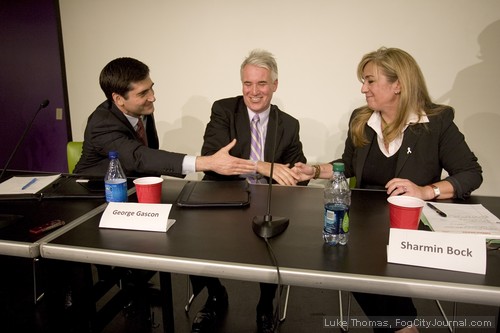
District Attorney and former SFPD Chief George Gascón, Alameda County Deputy District Attorney Sharmin Bock, and former San Francisco Police Commissioner David Onek all landed solid punches during a three-way District Attorney debate that was co-hosted by the San Francisco Young Democrats and the Alice B. Toklas LGBT Democratic Club, and moderated by Recorder editor Scott Graham. The primary sponsor of the debate was the City Democratic Club, according to CDC President Jim Reilly. So, thanks CDC for helping to pull off a great event.

The debate was framed as a choice between Bock, a veteran prosecutor with leadership experience, Gascón, a career cop with managerial experience, and Onek, a former San Francisco Police Commissioner and criminal justice reform expert. And above all it proved that if you lock three attorneys in the same room and pit them in a three-way fight, you’ll be rewarded with a blood sport spectacle.

Bock kicked off by noting that there are many similarities between the three candidates—except when it comes to independence and experience “Experience matters,” Bock said, throwing a one-two punch at Gascón and Onek. “The job of the District Attorney is not a management job, a police job or a job for someone with just a law degree. It needs a veteran prosecutor,” she said—remarks that resonated well with the crowd, judging from the applause.

But after a few niceties, Gascón shot right back at Bock and Onek. “I am the only one who has led large organizations and pushed public policy forward in an effective manner,” he said.

And Gascón struck a home run when he revealed that when he took the job of Chief of Police in Mesa, Arizona, he was “facing one of the most toxic environments” in terms of hatred towards people of color and the LGBT community–and that he did something about it, by standing up to anti-immigrant Sheriff Joe Arpaio of Maricopa County, and protecting the local LGBT community’s right to protest.

When it was his turn to speak, Onek fired off his own rounds at Bock and Gascón, noting that the state’s criminal justice system is broken—and claiming that it will take an outsider to fix it.
“This is a once-in-a-lifetime opportunity to reform the criminal justice system,” Onek said, laying out his reform-minded track record.

And then he stuck it to both Bock and Gascón by stating that the death penalty does not work. “I will never seek it in San Francisco under any circumstances,” Onek said, earning excited applause, as he noted that he’ll look at all policy question through the prism of three questions: ‘Does it make us safer, is it cost effective and is it fair and equitable?”

Onek also noted that neither the Supreme Court’s ruling that California must reduce its prison population by 30,000, nor Gov. Jerry Brown’s call for prisoner realignment, come with any money.
‘That’s a disaster,” observed Onek, as he stressed the need to demand resources to help deal with the upcoming load of prisoners that about to return to San Francisco.

Gascón fielded questions about whether they are enough people of color and LGBT background in management in the D.A.’s Office. “Well, I think there’s definitely always room for improvement in any organization,” he said, noting that he has a history in the Los Angeles Police Department, the Mesa, Arizona Police Department and the SFPD, “of pushing very aggressively to have diversity within the office.”
But he started a bit of a buzz when he said it was “really a surprise to me that I promoted the first male, black, police captain to the San Francisco Police Department.”
“You would think that there have been, you know, male African-Americans in that department for many years. It was hard for me to believe that actually in 2009 we had not had one,”  Gascón continued, a remark that got some debate observers asking afterwards, if this meant that Gascón really did not know that former SFPD Chief Earl Sanders was a black male.

Meanwhile, Bock was happily trampling all over the sit-lie legislation that then SFPD Chief Gascón and Mayor Newsom backed last fall, as she noted that more foot patrols and community policy are what’s actually needed. “Political hot-button measures don’t work,” Bock said. “Both sides agree it hasn’t worked. It’s the wrong response to the real problem.

Asked if he had a conflict of interest, when it comes to investigating allegations of police misconduct, Gascón claimed the problem is limited to a small number of officers, adding, “if the allegations are true.”

“In reality the majority of the SFPD are hard-working people doing the right thing,” he said. “And there has been only one challenge—and our office has prevailed,” Gascón said. “However, there have been a finite number of cases where I personally adjudicated the bad conduct—and those will be handled by the Attorney General’s office.”

Bock stressed that she was not in favor of sending drug offenders to prison and would focus on restorative justice, instead. Asked if she would have a panel on her staff review potential death penalty cases, Bock confirmed that she is committed to having a Special Circumstances Committee, as D.A. Kamala Harris did, to get input around the facts and from lawyers involved in such cases.“The ultimate decision is mine, and I oppose the death penalty,” Bock said, noting that she does not believe that 12 jurors will return a unanimous death penalty verdict. “But I do think as prosecutor you need to go case by case.”

Asked if he would have sought the death penalty in a case like the L.A. Night Stalker, who murdered 13 people, many of them elderly, Gascón said, “Probably not. All of us agree that the death penalty is not a good tool. But it is part of our system, and I continue to have the system Kamala Harris had in place. At the end of the day, it’s my decision, and I’m the only one in the room, who can say I’ve already turned down the death penalty.”

Agreeing with Bock that a jury is unlikely to go for the death penalty, Gascón maintained that the death penalty is “an illusory issue,” and that the real question is, “How do we rewrite the State Constitution [so the death penalty is not on the books]?”

Asked how he felt about marijuana, Gascón said he doesn’t believe folks should be incarcerated for use—and that folks are already being diverted to community courts in those instances.

But when Onek tried to wrap up by positioning himself as a the reformist-minded outsider, Gascón pounced, reminding folks that Onek was a Police Commissioner, when the Police Commission recommended Gascón to Mayor Newsom as the next SFPD Chief. “While David is someone I respect—and one of those who hired me, David has painted himself as an outsider, when the Police Commission is the policy-making body for the SFPD. There are no outsiders here. The question is, what have you done? There’s a difference between calling yourself a reformer and having other people call you a reformer.”

Bock for her part used her closing remarks to remind folks that there has been a crime lab scandal, alleged police misconduct, a DNA backlog, and about 100 cases dismissed as a result of these scandals, and a bunch of prisoners are about to be sent back to the community because of realignment. “We’re in challenging times, at a critical crossroads, with stormy weather ahead,” she said. “I’m not going to be trying things out at your expense. As a veteran progressive prosecutor, I’m fully prepared.”

Tribes author burrows into the Big Apple

0

Thanks to the help of burners from at least five different tribes that I’ve covered or camped with at Burning Man, my New York City book tour was a successful adventure in art and community, from the Figment festival on scenic Governors Island to exotic eating and drinking in the East Village and Queens to a great underground party at an old Catholic school in Brooklyn to getting canonized by Rev. Billy and his 25-person choir into the Church of Earthalujah along with SF-based performance artist Guillermo Gómez-Peña.

The June 7-13 trip was in support of The Tribes of Burning Man: How an Experimental City in the Desert is Shaping the New American Counterculture, my book chronicling how an event born in San Francisco has spawned a vast, well-developed culture and ethos that is affecting life in cities around the world, even seemingly impervious megalopolises like the Big Apple.

I arrived on the red eye Wednesday morning just as a heat wave was peaking in New York, showing up mid-morning at the Upper East Side apartment of Jax, a recent transplant from SF who I worked with on last year’s Temple of Flux project. Her air conditioner hadn’t arrived yet, so I sweated through a needed nap before surrendering myself to exploring the city.

That night was my Tribes launch party in a great spot called Casa Mezcal on Orchard Street on the Lower East Side. Fellow Shadyvil campmate Wylie Stecklow had not only arranged the venue, which is owned by one of his law clients, but he moved the weekly Big Apple Burners happy hour and the final planning meeting for Figment (an event he co-founded four years ago) to the venue, giving me a built-in audience of interested burners who seemed to really appreciate my reading and discussion.

Also joining the party were two NYC figures who appear in my book: Not That Dave, Burning Man’s NYC regional contact and a Figment director, and Billy Talen, the former San Francisco performance artist who transformed himself into NYC’s Reverend Billy, pastor of the Church of Stop Shopping, which evolved into the Church of Life After Shopping before becoming the Church of Earthalujah to reflect a mission that expanded from economic justice and anti-consumerism to environmentalism and a holistic way of looking at the perils of our economic system.

As I’ve been doing at some of my Bay Area book events, I read chapters that introduced them and then let them speak, and they each had lively, weird, heart-warming things to say. Several other New Yorkers who I know through Burning Man showed up at the event to join the discussion, wish me well, and buy books. The most surprising guest was Mike Farrah, former Mayor Gavin Newsom’s old right-hand man who did more to facilitate the temporary placement of burner artworks in SF than anyone in City Hall. He now lives in NYC and showed up late, so after talking SF politics and BRC art over beers, we wandered past some of the oldest tenement buildings in the city together as we headed toward the subway.

The city was sweltering the next day (although Jax’s air conditioner had blessedly arrived), so I spent over three hours in the Metropolitan Museum of Art, which makes SF’s museums seem like mere gallery spaces. I walked through Central Park between the reservoir and the Great Lawn, which was being set up for that evening’s Black Eyed Peas concert, all the way to the Upper East Side and my reading at the Columbia University Bookstore (which nobody showed up for, a combination of school being out, the heat, and a freak thunderstorm that was just rolling in as my event began – my first flop after more than a dozen bookstore events).

But New York is a city for nightowls, as I was just beginning to appreciate, particularly after I made my way down to the East Village that night to meet a Garage Mahal campmate who I’ve known for years simply as Manhattan. He’s been living in his apartment for 15 years and the city for 25, developing a detailed knowledge of the best places to eat, drink, and otherwise indulge.

Manhattan won’t go to the Upper East Side, preferring to remain in “civilization,” as he calls the East Village, which earned its storied reputation as the center of the nightlife universe. We ate Japanese curry at Curry Ya, drank hard-to-find German Kolsch beer at Wechsler’s Currywurst, danced with saucy Armenian women on Avenue C, drank cold sake underground at Decibel, indulged in the most decadent fried pork sandwiches at Porchetta, mingled with beautiful young people in the Penny Farthing, and then drank cocktails on his stoop until dawn, the streets never going to sleep in this lively neighborhood.

On Friday in the early afternoon, I met Wylie at The Cube, a public art piece near the 8th Street subway stop, and we hopped a train down to the southern tip of Manhattan to catch the free ferry to Governors Island for the opening day of Figment, an art festival started there by burners in 2007 that has since expanded to Detroit, Boston, and Jackson.

Mayor Michael Bloomberg and other city officials have embraced and facilitated the popular three-day event, which now includes art projects such as a treehouse built of old doors, massive steel sculptures, and an elaborate miniature golf course that will remain on the island through the summer. Most of the projects featured the interactivity that is the hallmark of burner art, such as a sound project in an enclosed courtyard in which passerby had to figure out how they were controlling the sounds they heard.

Wylie and I pedaled on borrowed rental bikes to cover all the projects on a large island that is a decommissioned military base with gorgeous views of the Manhattan and New Jersey skylines. Out on the Picnic Point lawn, with the Statue of Liberty looking on from the bay, the venerable NYC-based Burning Man sound camp Disorient hosted a rocking set of DJs under a massive wooden sculpture that they built for Figment and the playa this year.

Unfortunately, Figment is permitted only as a daytime event that ends at 6 pm, because the energy of the 100-plus organizers and volunteers could have driven this party well into the wee hours. Instead, they all gathered after the event at the 340-year-old White Horse Tavern to discuss the day, celebrate, and share endless ideas for new art projects and ways of measuring and directing all the creative energy that flows through their event and city.

After partying until dawn again, Manhattan and I climbed into his car (yes, a car, in Manhattan, the better to cover more ground, he says) Saturday mid-afternoon, picked up a friend near Wall Street, and crossed the Brooklyn Bridge headed toward Astoria, Queens. There, we drank pitchers of rich Czech beer at the 100-year-old Bohemian Hall and Beer Garden, run by the nonprofit Bohemian Citizens’ Benevolent Society, a fraternal order open only to those with Czech blood. With an outdoor capacity of almost 1,000 people, this place was like my beloved Zeitgeist on steroids.

On the way back to the East Village that night, Manhattan did a sudden U-turn and parked in a bus zone in front of a crowded outdoor eatery called Tavern Kyclades, muttering something about needing octopus and telling us he’d just be a minute. The wait for tables at this amazing Greek seafood spot was 90 minutes, but after less than 10 he was back with a to-go container with three long octopus legs, grilled, tender, and just insanely good.

That night, the plan was to hit an underground party in Brooklyn, thrown in a former Catholic school by Rubulad, a venerable party crew. It was after 1 am when we finally left Manhattan’s apartment for the party, catching the subway at Union Square and arriving to find the party in full swing, with more than a dozen rooms with different offerings: DJ dance parties, avante garde films, a piano bar, live music from a trio that had the beautiful crowd dancing hard and smiling. As the party wound down, I headed to Queens with a new friend and we watched a new day dawn on the Empire State building standing tall in the distance.

Sunday might be a day of rest for some, but not for me, not with the kind of roll I was on. So I caught the last ferry to Governors Island at 3 pm and spent the afternoon at Figment with some other burner friends, Shanthi and Patty, who came back to the East Village with me afterward for my third and final Tribes event: being canonized by Reverend Billy during the Church of Earthalujah’s regular Sunday evening performance at Theatre 80 on St. Marks Place.

I’ve been covering Billy and his crew for years, from their performances in San Francisco’s Castro Theater and other local venues to their film “What Would Jesus Buy?” to their work at Burning Man, including their touching sendoff of burner work crews to the Gulf Coast in 2005 to do cleanup and rebuilding work after Hurricane Katrina, an effort that became Burners Without Borders.

As I write in my book, Billy and his choir of several dozen were transformed by Burning Man, and they have returned that embrace of a culture that magnifies and perpetuates their values. And after being called from the audience and walking toward the stage during a rousing rendition of the “When the Saints Go Marching In,” I was warmly embraced by the entire 25-member chorus – actually, it was probably closer to a group grope – and I became Saint Scribe.

And after that, it’s all a bit of a blur, and a vibrant, decadent, Big Apple blur. Thanks, everyone, for a truly memorable trip.

Ford says goodbye at Golden Wheel Awards

2

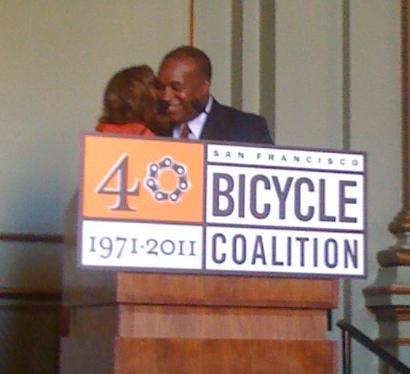
Just hours after being asked to leave the San Francisco Municipal Transportation Agency, director Nat Ford was at the San Francisco Bicycle Coalition’s annual Golden Wheels Awards accepting an award for the MTA’s Livable Streets Team. But that potentially awkward moment was eased by the universal political support for making the streets of San Francisco safer and more inviting for pedestrians and bicyclists.

Coming from car-centric Atlanta in 2006, Ford admitted he was an unlikely champion of turning San Francisco into one of the country’s best cities for biking. But he said the SFBC was “very persistent and worked with us.” While the bike injunction hurt progress, Ford said the support of SFBC and city officials allowed the agency to beef up the program from just a couple of staffers to “a dozen of the best bike planning and engineering folks in this country.”

“It was great working with all of you to get the MTA where it is today in terms of biking,” Ford told the capacity crowd in the War Memorial Building’s second floor event space, where the balcony overlooked City Hall and a sea of hundreds of bikes parked on the sidewalk out front.

Mayor Ed Lee spoke next, pledging to continue the progress and telling the crowd, “I want to give my very special thanks to Nat Ford for his five years of very dedicated service.”

Both Ford and MTA members told the Guardian that the split was a “mutual decision.” Ford told us, “Now’s a good time to go,” and that he’s still figuring out his next move. MTA board chair Tom Nolan told us, “It’s something we arrived at together. It’s good for his family and him.”

Indeed, it seems very good for Ford. The board approved a $385,000 severance package to go with its request that he resign before his contract expires, a payout that is drawing some criticism. “I am deeply disappointed that MTA would approve a nearly $400,000 golden parachute for an outgoing city executive. At a time when our budget is cutting critical social services for our kids and the most vulnerable in our city, we can ill-afford to be paying excessive payouts to administrators who are no longer working for the public. I have fought these exorbitant sweetheart deals at UC and CSU, and as mayor I will reform these practices,” Sen. Leland Yee, a candidate for mayor, said in a prepared statement.

Nolan says it’s time to restore the agency. “I’ve talked about wanting to restart what we do,” he told us. While Ford’s reported job hunting was one reason for the split, Nolan also alluded to mismanagement of the agency and the mistrust of its administration by Transport Workers Union Local 250A and other employees.

“We clearly have a problem when the drivers turn down a contract two-to-one,” Nolan said of the union’s rejection of its latest contract, which has since been approved by an outside arbitrator. “We can do a lot better.”

But the Ford saga was just a sideshow during an evening devoted to celebrating the improvements to the city’s bicycle network and selling the SFBC’s vision of what’s next, which it calls “Connecting the City.” The plan calls for three, green, separated bikeways (like those now on a stretch of Market Street) bisecting the city by 2015 (with the first Bay To Beach route done by next year) and a fully connected network of 100 miles of bikeways by 2020.

“Safe, comfortable, crosstown bikeways for everyone,” was how MTA Commissioner Cheryl Brinkman put it in slick video that the SFBC premiered at the event to promote the plan.

SFBC Director Leah Shahum told the crowd the idea is to connect and promote the city’s various neighborhoods and encourage “regular San Franciscans” to take more frequent trips by bike. “Seven in 10 of us, that’s how many people are already riding a bike,” she said, citing a survey of how many city residents own or have access to bikes. “We’re developing a vision where people are connected by safe, family-friendly bikeways.”

Shahum praised how engaged Mayor Lee has been with the plan and the need to improve the city’s cycling infrastructure. “Let me tell you how impressed I am with the level of involvement from Room 200,” she said.

Lee pledged to make cycling safer on dangerous sections of Oak and Fell streets that connect the Panhandle with the Lower Haight – sections Shahum took Lee on during Bike to Work Day this year – and to complete a new green bike lane on JFK Drive this year.

“We can get a lot of the goals of the Bicycle Coalition done together. We need your help in November,” Lee told the crowd, calling for them to support a street improvement bond measure on the fall ballot. He said the bicycling community has made the streets more fun and inviting, telling the crowd that at this weekend’s Conference of Mayors, he is “going to brag about our bike lanes and our way of living.”

The mayoral poll: No surprises

18

The David Chiu campaign has released a poll that isn’t really all that surprising. It shows that the two candidates who have run citywide races — State Sen. Leland Yee and City Attorney Dennis Herrera — are a little tiny bit ahead, and Chiu is a little tiny bit behind, but all of them are well within the margin of error of a poll sample of only 500 people. Yee is out in front at 17 percent (I’m actually surprised he’s not further ahead at this point, since so much of this is name recognition and he’s been elected so many times, to so many jobs, over so many years that he has by far the best name rec in the race). Chiu and Herrera are tied at 13 and 12 percent (but with a plus-or-minus five percent MOE, all three are statistically in a dead heat).


I would have thought John Avalos would be closer to the top at this point, since he’s doing a good job consolidating the left, but he’s never run citywide, and the campaigns have barely started. Again: It’s name recognition right now.


The bottom line: There is no front runner (with the possible exception of Yee). There may never be a front-runner among the three men bunched in the center of the pack. It’s all going to come down to who gets the second- and third-place votes — which is why ranked-choice voting is so valuable in a race like this. In a traditional race, two candidates who combined might have 35 percent of the vote would be in a runoff, and a candidate who missed the cut by half a percentage point would be out of the running.


One thing we do know: This poll is going to drive Rose Pak and Willie Brown nuts, and increase dramatically the pressure on Ed Lee to run. the more powerful Yee appears, the more likely it is that the center of power in the Asian community will shift away from Pak’s Chinatown operations. Yee’s base is west side, not Chinatown; always has been. Pak despises him (and the feeling is no doubt at least somewhat mutual).


The other fact that weighs in Yee’s favor: He’s doing a better job than anyone of expanding his base. He’s racking up leftside endorsements (unions, the Sierra Club) and aiming hard at the Avalos Number Twos.


As for the questions about what people want in a mayor? Again, these are poll-tested platitudes that we hear every year, and we’re going to hear more of them. “Together.” “Shared values.” “Making the city work.” If it weren’t such a beautiful day, I’d want to puke out my window.

Daly: SFBG profiled the wrong guy

88

When I interviewed Chris Daly for this week’s cover story on David Chiu and the political realignment at City Hall, Daly said we were putting the wrong guy on the cover.

“If the story is about political realignment, it’s about David Ho,” Daly told me of the political consultant who once worked on his and other progressive campaigns, but who helped engineer a split in the progressive movement with the help of consultant Enrique Pearce and District 3 Sup. Jane Kim, whose campaign they worked on together last year, beating early progressive favorite Debra Walker.

Daly said the political realignment that has taken place at City Hall has more to do with Kim and Ho – in collusion with former Mayor Willie Brown, Chinatown Chamber head Rose Pak, and Tenderloin power broker Randy Shaw – than it does with Chiu, who Daly considers simply a pawn in someone else’s game. Ho is seeking to be Pak’s successor as Chinatown political boss, and he and Pearce have been out there doing the ground work Pak’s effort to convince Lee to remain mayor.

“Any realignment that exists is about David Ho and I think it has more to do with the District 6 race than the District 3 race,” Daly said. “As far as David Chiu and realignment, they are separate things.”

While Ho and Pearce have traditionally worked on progressive campaigns – particularly in high-profile contests like this year’s mayor’s race, where John Avalos is the clear progressive favorite – they are now some of the strongest behind-the-scenes backers of the campaign to convince Ed Lee to run. Neither Ho nor Pearce returned our calls for comment.

“That’s the whole realignment,” Daly said, explaining that it was the peeling of entities like Chinatown Community Development Corporation and the Tenderloin Housing Clinic away from the progressive coalition of the last decade that has cast progressive supervisors into the wilderness and empowered Chiu and Kim, who in turn brought Lee to power.

“It’s not a seismic realignment, it’s a minor realignment, it just happens to be who’s in power,” Daly said. “It was a minor political shift that caused a big change at City Hall.”

Power has now consolidated around Mayor Lee, as well as those who convinced Chiu to put him there, including the powerful players who helped elect Kim. “These people, as far I can tell, have disowned Chiu,” Daly said. “He did what they wanted but he failed the loyalty test in the process.”

Chiu has so quickly fallen from favor that even Planning Commission President Christina Olague, who spoke at Chiu’s campaign launch event on the steps of City Hall just two months ago, is now one of the co-chairs of a committee pushing Lee to run, along with others connected to CCDC and the Pak/Brown power center.

Kim has also notably withheld her mayoral endorsement. She tells us that she’s waiting until after budget season, but the real reason is likely to wait and see whether Lee gets into the race. Daly said this new political power center has been playing the long game, starting with supporting Chiu back in 2008.

“Peskin kind of brought him up, and then I – tactically or a strategic blunder – I made the mistake of not bringing someone up,” Daly said, insisting that he’s always questioned Chiu’s political loyalties. “I had doubts from the beginning. Ultimately, it was Jane Kim and David Ho who tag teamed me and got me on board.”

Daly said Chui’s last-minute move to cross his progressive colleagues and back Lee for mayor “irreparably harmed him with progressives,” while doing little to win over a new political base. “He miscalculated the damage it would do to him,” Daly said.

Chiu’s dependability was also called into question when he was openly considering a deal with Gavin Newsom to be named district attorney, which would have allowed Newsom to appoint his replacement in D3, a move that he didn’t check with Pak.

“He gave control of his political base to someone else,” Avalos told us, offering that if Chiu was going to be so narrowly ambitious then he should have taken Newsom’s offer to become district attorney.

Even those around Chiu have emphasized his independence from Pak, who has desperately been looking for someone she could count on to back and prevent Leland Yee from winning the mayor’s office. And if Lee doesn’t run, sources say she’s likely to back another political veteran such as Dennis Herrera or Michela Alioto-Pier.

But given how deftly Ho and his allies have grabbed power at City Hall, I’d say they have a pretty good chance of convincing Lee to run, despite the mayor’s resistance. And if Lee runs, Daly, USF Professor Corey Cook, and others we interviewed say he would probably win.

Treasure Island: 11 ayes, no sight

6

On June 7, the San Francisco Board of Supervisors voted 11-0 to reject an appeal of the Treasure Island environmental impact report. The appeal was brought by Arc Ecology and our colleagues the Sierra Club, Golden Gate Audubon Society, Wild Equity, former Sup. Aaron Peskin, and Yerba Buena Island resident Ken Masters.

The board will tell you that the Department of City Planning and the Mayor’s Office of Economic and Workforce Development found the appeal lacking in merit.

In the appeal, we claimed the EIR lacked the specificity to qualify as a project EIR, which means that after it passes, the city will have substantially limited the ability of any future Board of Supervisors to address the project’s actual environmental impacts. But these impacts cannot and will not be known until actual development proposals, none of which presently exist, are made.

Sup. Jane Kim and city planning staffers argued that the EIR had almost too much specificity. For example, without showing a single confirming diagram, project sponsors claimed they could cut as many as 100 stories off the proposed skyscrapers — yet keep the same number of condos without increasing the bulk, height, or number of buildings in the overall project. How? Through the Harry Potter-like magic of “flex buildings and zones.”

The board will tell you that this project presents a vision of a new community unrivaled in the Bay Area and nation — a new Athens. But the supervisors don’t seem to realize that it’s a development with a population larger than Emeryville, about the size of Albany. Indeed, the separate dedicated buildings of affordable homes truly make Treasure Island like Athens of old, with poorer people segregated from the rich.

They don’t see that this is a self-reflecting vision blithely unconcerned about the impacts it will have on the greater Bay Area region, and that it’s a bloated project that will vastly exceed the region’s capacity to support it. It’s a project whose impacts will enslave legions of people to longer commutes as more cars flood the bridge, pushing traffic like rising sea levels into the upper reaches of East Bay freeways. Nor are project proponents particularly concerned about the impacts of air pollution blowing from the bridge and the region’s freeways into Berkeley, Emeryville, and Oakland.

Finally, neither the supervisors, nor the city planners, nor the Office of Economic and Workforce Development seem to be aware that San Francisco currently has 30,000 vacant housing units. It will cost a projected $577,000 to build each Treasure Island unit. But more units could be built on San Francisco’s mainland with almost no impact, simply by allowing rental units in the basements of some of our stock of 130,000 single-family homes.

That kind of housing isn’t as luxurious as a 45-story view of the bay from Treasure Island perhaps — but at a cost of $100,000 to $200,000 per unit, more than half of those in-law apartments could be rented at or below market rate. Infill housing of that sort would also mean greater stability for established home owners, more jobs and business opportunities, and more riders for Muni.

Still, the appellants weren’t trying to halt any project at Treasure Island. The appeal was about was fixing the deficiencies in the EIR and right-sizing the project so it can move forward with its benefits intact.

In the Tarot, the Five of Cups depicts an individual so besotted by that possibilities floating before his eyes that he stands mesmerized, believing they are at hand — of course, in reality he’s fooling himself. In the case of Treasure Island, the supervisors and city officials are intoxicated by the visions floating in the bay — and are thus blinded to the better options of making this city and region more sustainable and affordable.

CPMC’s stunning arrogance

0

The San Francisco City Planning Commission hearing June 9 on California Pacific Medical Center’s expansion plans was remarkable — both in the comments that the commissioners had and in the mind-boggling arrogance of the giant hospital chain.

CPMC wants to build a massive new hospital and medical office building on Van Ness Avenue and rebuild St. Luke’s Hospital in the Mission. The plans aren’t even close to complying with city planning codes — the Sutter Health affiliate will need city approval to exceed height limits on Van Ness (by more than 100 feet); a modification of the housing construction requirement for new offices; permission to demolish existing housing units; permission to take over a part of San Jose Avenue — and a lot more. In other words, CPMC is asking a lot from the city.

And since this nonprofit controls four major hospitals in the city, its future development decisions need to be considered in the context of San Francisco’s overall health care needs.

It’s entirely reasonable that the city ask CPMC for a development agreement that provides benefits to city residents. Mayor Ed Lee has made it clear that the approval of this project will depend on whether CPMC can address affordable housing, healthcare access for low-income people, a secure future for St. Luke’s, workforce development, and transportation impacts. Lee’s proposals are more than reasonable: he’s asking that CPMC pay the standard fee for affordable housing required of any major commercial developer; increase its level of charity care (now an abysmal 0.99 percent) to the average of other regional hospitals (2.3 percent); increase its Medical acceptance rate; and maintain St. Luke’s as an acute care facility with an emergency room. Union nurses are asking that Sutter deal with them in good faith.

But Dr. Warren Browner, CEO of CPMC, showed little interest in working with the city. The demands are way too high, he told the commissioners, insisting that it was unreasonable to ask the hospital to contribute that much to affordable housing. He acted as if CMPC was somehow entitled to move forward — at its own proposed schedule — and that all of these city demands were nonsense.

That’s not going to work.

A clear majority of the commissioners got the point. As Ron Miguel pointed out, Sutter is a nonprofit — and its tax-exempt status mandates a certain level of social responsibility. Every big commercial developer has to pay for housing and transit impacts. Gwyneth Borden and Bill Sugaya noted that hospital officials knew full well what the planning rules were when they bought the Van Ness site.

This is a $2.5 billion project. Community benefits need to be a significant part of the final plan. If anything, Lee’s proposals are too limited (Sutter should agree to protect St. Luke’s for 50 years, not 20). The planning commissioners should stick to their positions — this project is out of control, and if Browner wants to see it built, he needs to come back with a new set of numbers, and a new attitude.

Editorial: CPMC’s stunning arrogance

3

The San Francisco City Planning Commission hearing June 9 on California Pacific Medical Center’s expansion plans was remarkable — both in the comments that the commissioners had and in the mind-boggling arrogance of the giant hospital chain.

CPMC wants to build a massive new hospital and medical office building on Van Ness Avenue and rebuild St. Luke’s Hospital in the Mission. The plans aren’t even close to complying with city planning codes — the Sutter Health affiliate will need city approval to exceed height limits on Van Ness (by more than 100 feet); a modification of the housing construction requirement for new offices; permission to demolish existing housing units; permission to take over a part of San Jose Avenue — and a lot more. In other words, CPMC is asking a lot from the city.

And since this nonprofit controls four major hospitals in the city, its future development decisions need to be considered in the context of San Francisco’s overall health care needs.

It’s entirely reasonable that the city ask CPMC for a development agreement that provides benefits to city residents. Mayor Ed Lee has made it clear that the approval of this project will depend on whether CPMC can address affordable housing, healthcare access for low-income people, a secure future for St. Luke’s, workforce development, and transportation impacts. Lee’s proposals are more than reasonable: he’s asking that CPMC pay the standard fee for affordable housing required of any major commercial developer; increase its level of charity care (now an abysmal 0.99 percent) to the average of other regional hospitals (2.3 percent); increase its Medical acceptance rate; and maintain St. Luke’s as an acute care facility with an emergency room. Union nurses are asking that Sutter deal with them in good faith.

But Dr. Warren Browner, CEO of CPMC, showed little interest in working with the city. The demands are way too high, he told the commissioners, insisting that it was unreasonable to ask the hospital to contribute that much to affordable housing. He acted as if CMPC was somehow entitled to move forward — at its own proposed schedule — and that all of these city demands were nonsense.

That’s not going to work.

A clear majority of the commissioners got the point. As Ron Miguel pointed out, Sutter is a nonprofit — and its tax-exempt status mandates a certain level of social responsibility. Every big commercial developer has to pay for housing and transit impacts. Gwyneth Borden and Bill Sugaya noted that hospital officials knew full well what the planning rules were when they bought the Van Ness site.

This is a $2.5 billion project. Community benefits need to be a significant part of the final plan. If anything, Lee’s proposals are too limited (Sutter should agree to protect St. Luke’s for 50 years, not 20). The planning commissioners should stick to their positions — this project is out of control, and if Browner wants to see it built, he needs to come back with a new set of numbers, and a new attitude.


The Guardian Forum: Issues for the next mayor

0

A series of panel discussions and participatory debates framing the progressive issues for the mayor’s race and beyond

Forum Two: Budget, Healthcare and Social Services
• Gabriel Haaland, SEIU 1021
• Brenda Barros, Health Care Worker, SF General Hospital
• Debbi Lerman, Human Services Network
• Jenny Friedenbach, Budget Justice Coalition
And others to be confirmed!

June 21 • 6 pm – 8 pm
UNITE HERE Local 2, 209 Golden Gate

Outline of Programs:
June 9: Economy, Jobs and the Progressive Agenda
June 21: Budget, Healthcare and Social Services
July 14: Tenants, Housing and Land Use
July 28: Immigration, Education and Youth
Aug. 25: Environment, Energy and Climate Change

Cosponsors:
• Harvey Milk LGBT Democratic Club
• San Francisco Tenants Union
• SEIU Local 1021
• San Francisco Rising
• San Francisco Human Services Network
• Council of community housing organizations
• Community congress 2010
• Center for Political Education

All events are free. Sessions will include substantial time for audience participation and discussion.
Please join us!

Guardian forum 6/8 (Thursday) — join us

1

The Guardian, with the support of numerous progressive political groups, is holding a series of forums this summer on issues in the SF mayor’s race. The idea is to get a discussion going on what a progressive agenda looks like, what issues the candidates ought to be talking about and how that could be implemented. The first session — focusing on economy and jobs — takes place Thursday June 9, from 6-8 pm, at the USF Lone Mountain campus, room LM 100. That’s at Turk and Parker, the Balboa bus stops right in front and we’ll have vans to help people with mobility issues get up the hill. Check out the details after the jump.

Tipping point

3

sarah@sfbg.com

On June 14, members of the Board of Supervisors will vote to appoint a new member of the Police Commission — in the wake of a messy string of alleged police misconduct scandals that, progressives argue, underscore why having strong civilian oversight is critical to ensuring a transparent, accountable police department the public can trust.

The appointment comes less than two months after San Francisco native Greg Suhr was sworn in as chief in the wake of Mayor Gavin Newsom’s decision to appoint former Chief George Gascón as the next district attorney — a move that has served to muddy the D.A. Office’s efforts to investigate the alleged police misconduct.

Further complicating the board’s choice is the heated battle that erupted over the appointment, led in part by members of two Democratic clubs that represent lesbian, gay, bisexual, and transgender communities.

The Alice B. Toklas LGBT Democratic Club has officially endorsed Julius Turman, a gay attorney and community activist who was a former assistant U.S. attorney and the first African American president of the Alice club. Turman currently works for Morgan, Lewis & Bockius, where he represents companies in actions for wrongful termination, employment discrimination, and unfair competition. He is also state Sen. Mark Leno’s (D-SF) proxy to the San Francisco Democratic County Central Committee and serves on the Human Rights Commission.

On the other side, members of the Harvey Milk LGBT Democratic Club, the voice of the city’s queer left, are supporting David Waggoner, an attorney and community activist who is a former Milk Club president. Waggoner has worked on police use-of-force policy and as a pro bono attorney for the National Lawyers Guild at the Oakland Citizen’s Police Review Board, and been a passionate advocate for the LGBT community, immigrants’ rights, people with disabilities, and the homeless.

The other two applicants for the post are Vanessa Jackson, a staffer at a women’s shelter with experience in counseling ex-offenders; and Phillip Hogan, a former police officer who serves on the board of the Nob Hill Association and has been trying to get on a commission for years.

Although both Jackson and Hogan have diverse experience with law enforcement — Jackson as an African American woman who claims the police have “no respect for people of color” and Hogan as a former police officer of Lebanese-Irish descent who manages real estate — neither has the support of the LGBT community. The position occupied by Deputy District Attorney James Hammer for the last two years, and Human Rights Commission director Theresa Sparks occupied before that, is widely considered to be an LGBT seat.


WHO’S THE REFORMER?

So now the fight is about whether Turman or Waggoner would be the strongest reformer.

In a recent open letter, former Board Presidents Harry Britt, Aaron Peskin. and Matt Gonzalez expressed support for Waggoner. “While most hardworking police officers perform their jobs admirably, insufficient oversight and poor management systems have led to significant problems,” their letter stated. “Despite these widely reported problems, the Police Commission has failed to adequately address these issues. San Francisco needs real reform, not more of the same. We believe David Waggoner will be that voice at this critical time.”

At the June 2 Rules Committee hearing, Waggoner proposed taking away master keys to single-resident occupancy (SRO) hotels from the police. “Significant abuse of that resulted in seriously tarnishing the department,” he said.

Turman made an equally impassioned — if less stridently reformist-sounding — speech. “Why would we allow an officer to enter a home, regardless of the master key rule, which I’m not a fan of?” Turman asked. He also said Tasers are dangerous weapons with unintended consequences. “I fear communities of color will suffer more from Taser use.”

Waggoner’s supporters noted that their candidate has more than 15 years of police accountability experience. Turman’s supporters vouched for his integrity, maturity, ability to build consensus, and “belief in strategically serving his community.”

In the end, Sups. Sean Elsbernd and Mark Farrell voted for Turman, while Rules Committee Chair Sup. Jane Kim voted for Waggoner.

That means Turman’s name has been forwarded to the full board with a recommendation. But because the Rules Committee interviewed all the candidates, the board can still appoint any of them.

At the Rules Committee, Sup. Scott Wiener voiced support for Turman. And Board President David Chiu recently told the Guardian that he has known Turman for years, has worked with him professionally, and will vote for him. “I found him to be fair, thoughtful, and compassionate,” Chiu said, noting that he believes the role of the commission is “to provide oversight and set policy.”

Sup. David Campos, one of the solid progressive votes on the board and a longtime Milk Club member, believes Waggoner would make an excellent commissioner but is a friend of Turman, and believes he’ll be a strong voice for reform. “Sean [Elsbernd] and Mark [Farrell] could be in for a big surprise if Julius gets appointed,” Campos mused shortly after Elsbernd and Farrell voted for Turman.

Campos recalled how he and Turman started working at the same firm years ago. “So I got to know him well,” he said, adding he is “like a family member.

“By virtue of his involvement with Alice, some folks think Julius will be a certain way,” Campos added. “But I believe he’ll take a progressive point of view on the issues. He has both the knowledge and the experience with the police, he understand the important role that police oversight and the Police Commission play in making the SFPD accountable.”

Kim told us that she primarily voted for Waggoner because she knows him the best, and not out of concern that Turman wouldn’t do a good job. “I’m more familiar with David and that’s what tipped the scale,” Kim said. “It’s great to have two strong LGBT attorneys who have a clear understanding of public safety issues, the law, and are advocates for the community.”

But Debra Walker, who ran against Kim last November, steadfastly supports Waggoner. “Julius has been active in the Alice B. Toklas club for a while, he’s a prosecutor, while David is more of a citizen’s defense attorney,” she said.

Turman continues to be dogged by reports of domestic violence, thanks to a lawsuit that Turman’s former domestic partner Philip Horne filed in March 2006 alleging that Turman came into his house when he was sleeping on New Year’s Day 2006 and tried to strangle him.

Horne claimed he “was terrified that the lack of air supply would cause him to pass out and potentially die at the hands of such a jealous and unmerciful former lover.” He alleged he was able to calm Turman down only to see him get enraged again and punch Horne in the face seven to 10 times. When Horne decided he needed to go to the emergency room, the complaint states, Turman grabbed his phone and keys saying, “If you leave, you’ll never see the cats (alive) again,” and “I will report you to the state bar.”

Horne claimed he ran outside screaming for help and that when SFPD arrived, they arrested Turman for domestic violence and called an ambulance for Horne.

Turman responded in July 2006 to what he described as Horne’s “unverified complaint,” arguing he acted in “self-defense” and that the conduct Horne complained of “constituted mutual combat.” He added that “damages, if any, suffered by Horne were caused in whole or in part by entities or persons other than Turman.”

In the end, no criminal charges were ever filed against Turman and the case was settled out of court. Turman now says “I’ve done nothing wrong and these allegations are false.”

Campos warns people not to jump to conclusions. “We need to remember that there is a presumption of innocence,” Campos said. “Yes, there was a court case, but there was never a conviction. Yes, there was a settlement, but people do that for a lot of reasons.”

Turman told the Rules Committee that the incident was from “an extremely difficult time that is now being used against me as a political sideshow.”

Meanwhile, Campos notes that without a reform-minded mayor, there will be only so much any board-appointed police commissioners can do. “What we really need to implement police reform is a mayor who is willing to do that,” he said. “Otherwise it’s going to be very difficult because the mayor still gets to appoint four commissioners and mayor still gets to control who is in charge of the police department.”


WHAT DIRECTION?

Civil liberties advocates praised as a “first step in the right direction” Suhr’s May 18 decision to issue an order clarifying that SFPD officers assigned to the FBI’s joint terrorism taskforce should adhere to SFPD policies and procedures set by the Police Commission, not FBI guidelines.

But in the coming months, the commission will have to decide whether to push a Portland-style resolution around SFPD involvement with the FBI. The commission also will be dealing with fallout from the other scandals, including the crime lab, the use of force against mentally ill suspects, and videos that allegedly show police conducting warrantless search and seizure raids in single residential occupancy hotels.

These scandals have progressives arguing that it’s critical that the board’s three seats on the commission are occupied by applicants with proven track records of reform.

Waggoner notes that in 2003, voters approved Prop. H., which changed the composition of the commission from five to seven members. Four are appointed by the mayor; three by the board.

Last year, he said, the commission made significant progress in the right direction when it adopted new rules after the Jan. 2 shooting of a man in a wheelchair in SoMa. “That was not the first time an unarmed person with a disability was killed,” he said. “After Prop. H and a crisis, the commission finally took steps. It remains to be seen if Chief Suhr will implement that.”

Waggonner said the current arrangement “creates tension between people who are more willing to defer to the chief on policy issues and being in an advisory capacity, as opposed to people who want to be in the forefront of setting policy.”

That tension played out when Commissioners James Hammer, Angela Chan, and Petra DeJesus tried to find consensus on the Taser controversy last year. “Overall they worked well together. But there’s been no progress yet on Tasers,” he said, noting that the commission eventually decided on a pilot project.

Waggoner said he would be in favor of the commission having a more active role and exerting its authority under the city charter to set policy, but in collaboration with the chief.

The Police Commission’s May 18 joint hearing with the Human Rights Commission about FBI spying concerns was a symbol of the broader issue at the Police Commission. The majority of the commission didn’t see any major problems — but the progressives were highly critical. “Is the commission there to set policy and take leadership, or is it there in an advisory capacity?” Waggoner asked.

With Hammer’s departure, Chan and DeJesus, both board-appointed women of color, are the most progressive members of the commission. Chan hopes Hammer’s replacement believes in strong civilian oversight. “We should never be a rubber stamp for the police department,” he said. “We need to take community concerns very seriously. When the police department is doing great things, we should support them — but if we see something wrong, we should not be afraid to speak out.”

Turman told the Guardian that “being the voice for reform and advising are not mutually exclusive roles — and an effective police commissioner needs to be both.

“I would advocate for series of meetings with representatives from the Arab community, the SFPD, and the FBI to increase communication and understanding of each side’s perspective on exactly what we need to implement in San Francisco,” Turman said.

Asked more about Tasers, Turman said that “one of the things I would be interested in pursuing is a recognition by some that female officers are less likely to incapacitate during an arrest, which could lead to learning for the larger police force.”

But does this means Turman will turn out to be a swing vote for Tasers? Only time — and the board’s June 14 vote — will tell.

Lee should veto Parkmerced

0

EDITORIAL Mayor Ed Lee got his start as a lawyer working on tenant issues. He understands the city’s rent laws and the shortage of affordable housing. He also knows — or ought to know — that when the city’s tenant groups are unanimously opposed to a project, elected officials who care about tenant rights should pay attention.

The Parkmerced project will be a clear test: Does he follow his activist roots, stick with the people he started with and show his independence — or side with the big out-of-town developer and allow the project to move forward?

The supervisors approved the project by the narrowest of margins, 6-5. All of the progressives voted to reject the development agreement and rezoning — and for good reason. The deal would lead to the demolition of 1,500 units of rent-controlled housing. And while the developer says it will abide by the rent laws for the newly built replacement units, that’s a shaky legal guarantee. The larger point, tenant advocates say, is that demolishing existing affordable housing is always a bad idea.

In the end, 1,500 people will have to leave the homes they’ve lived in for years — in some cases, many years. They will be offered replacement units in a high-rise — very different from the garden apartments (with, yes, gardens) that they’ve occupied. And if the developer decides that there’s more money to be made by jacking up the rents on those units, it’s a safe bet that an army of lawyers will arrive attempting to undermine the questionable guarantees now in the deal.

There’s also the problem of transportation and traffic. The project will include a new parking space for every new unit, meaning 6,000 new cars in an area already overwhelmingly congested. Since the vast majority of the units will be market-rate (the developer will provide 15 percent affordable units, under city law, which means 85 will be sold or rented to rich people) the development will transform what is now still something of a working-class neighborhood into another enclave for the wealthy.

When we talked to Mayor Lee, he was noncommittal on the deal. At the same time, he noted that the garden apartments are old and will have to be replaced at some point. We don’t dispute that there are ways to add more density at Parkmerced. But wholesale demolition of affordable housing isn’t the answer.

This deal is bad for tenants and bad for the city. Mayor Lee ought to recognize that then tenant groups opposing this have analyzed it carefully and come to an entirely reasonable conclusion.

Sup. David Chiu, the swing vote in favor of the project, did serious damage to his reputation as a progressive and lost thousands of tenant votes by siding with the developer. Lee, who insists he isn’t running in November, ought to demonstrate that he hasn’t forgotten his roots, that he listens to activists, and doesn’t simply go along with poorly conceived development projects. He should veto the development agreement and zoning changes and send this thing back to the drawing board.

Behind the all-smiles budget

2

news@sfbg.com

When Mayor Ed Lee released his 2011-12 budget proposal June 1, all was sweetness and light at City Hall.

The mayor delivered the document in person, to the supervisors, in the board chambers. Sup. Carmen Chu, chair of the Budget Committee, was standing to the mayor’s right. Board President David Chiu was to his left. There was none of the imperious attitude we’d come to expect in the Gavin Newsom era — and little of the typical hostility from the board.

As Sup. David Campos, who was elected in November 2008, remarked afterward: “It’s the first time since I’ve been elected that the mayor has taken the time to come to chambers. It’s reflective of how this has been a lot more of an inclusionary process.”

Lee went even further. “This is a pretty happy time,” he said. “There are no layoffs, and instead of closing libraries we’ll be opening them.” That earned him an ovation from assembled city leaders, including mayoral candidates City Attorney Dennis Herrera and Assessor-Recorder Phil Ting along with District Attorney George Gascón. “I think this budget represents a lot of hope.”

It’s true that this year’s cuts won’t be as bad as the cuts over the past five years. It’s also true that the pain is spread a bit more — the police and fire departments, which Newsom, always the ambitious politician, wouldn’t touch, are taking their share of cuts.

But before everybody stands up and holds hands and sings “Kumbaya,” there’s some important perspective that’s missing here.

Over the past half-decade, San Francisco has cut roughly $1 billion out of General Fund spending. The Department of Public Health has eliminated three- quarters of the acute mental health beds. Six homeless resource centers have closed. The waiting list for a homeless family seeking shelter is between six and nine months. Muni service has been reduced and fares have been raised. Recreation centers have been closed. Library hours have been reduced.

In other words, services for the poor and middle class have been slashed below acceptable levels, year after year — and Mayor Lee’s budget doesn’t even begin to restore any of those cuts.

“We’re not ready yet to restore old cuts,” Lee told the Guardian in a June 2 interview. “It was enough for us to accomplish a pretty steady course and keep as much. Particularly with the critical nonprofits that provide services to seniors and youth and homeless shelters, we kept them as close as we could to what last year’s funding was.”

But the current level of funding is woefully inadequate. As Debbi Lerman, administrator of the Human Services Network, noted, the people who work in the nonprofits Lee was talking about haven’t had a pay raise in four years — even though the cost of living continues to rise. “Our costs have gone up with cost of inflation,” she noted.

She said the cuts over the past few years have deeply eroded services for children, homeless people, substance abuse programs, and others. “There have been significant cuts to every area of health and human services.”

And in a city with 14 billionaires and thousands more very wealthy people, Lee’s budget is distinctly lacking in significant new ways to find revenue.


THE GOOD NEWS

Just about everyone agrees that the budget process this year has been far better than anything anyone experienced under Newsom. “He [Mayor Lee] listened to everybody,” Lerman said. “That doesn’t mean they fixed everything. Mayor Lee fixed as much as he could.”

At his press conference announcing the release of the budget, Lee thanked Police Chief Greg Suhr for having already made significant cuts through management restructuring and for considering an additional proposed cut of $20 million.

“We want to thank you for that great sacrifice,” Lee said, addressing Suhr, who sat in front row of public benches, dressed in uniform. Lee next acknowledged that adequate funding for social services also helps public safety. “Without those services, officers on the street would have a harder job,” he said.

Lee also praised the departments of Public Health and Human Services for helping to identify $39 million in federal dollars and $16 million in state dollars, to help keep services open and the city safer.

Lee noted that San Francisco no longer has a one-year budget process and has just released its first five-year financial plan as part of its decision to go in five-year planning cycles.

“To address this, I’ve asked for shared sacrifice, ” Lee continued, adding that he recently released his long-awaited pension reform charter amendment, emphasizing that it was built through a consensus and collaborative-based approach.

Lee also said he would consider asking voters to approve what he called “a recovery sales tax” in November if Gov. Jerry Brown is unable to extend the state’s sales tax. That would bring in $60 million — but it is only on the table as a way to backfill further state budget cuts.

Lee observed that San Francisco is growing, the economy is looking brighter, and unemployment is down from more than 10 percent last January to 8.5 percent today. He plugged the America’s Cup, the city’s local hire legislation, the Department of Public Works’ apprenticeship programs, and tourism, both in terms of earmarking funding in the budget for these programs and their potential to boost city revenues.

He said his budget proposed $308 million in infrastructure investments that include enhanced disability access, rebuilding jails, and energy efficiency, and is proposing a $248 million General Obligation bond for the November ballot to reduce the street repair backlog.

“We will get these streets repaired,” he promised.

“This submission of a budget is not an end at all, it’s the beginning of the process,” he continued, going on to recognize Chu for her work getting the process rolling and thanking Budget Analyst Harvey Rose in advance. “I do know his cooperation is critical.”

And he concluded by thanking each of the supervisors. “I will continue enjoying working with you — we need to keep the city family tight and together.”

The sentiment was welcomed by supervisors. “As he said, this is the beginning of the process, and it’s an important and symbolic step” Campos said. “The budget shows that a lot of good programs have been saved. But there is still work to do.

“There are still gaps in the safety network,” he added, singling out cuts to violence-prevention programs. “It’s my hope they will be restored.”


THE BAD NEWS

But even if the cuts for this year are restored, the city budget is nowhere near where it ought to be. “We still had to make cuts,” Lee acknowledged.

“We did consider very seriously a whole host of revenue ideas that we had,” he said. “They were not off the agenda at all.” At the same time, he noted that state law requires a two-thirds vote for new taxes (although that threshold drops to 50 percent in presidential election years). “We decided that it’s not that they were bad ideas, but that we wouldn’t be able to sell them at this time.”

Lee praised some of the revenue ideas that have been suggested in the past year, including the alcoholic beverage fee proposal by Sup. John Avalos, which Lee called “a pretty good idea.” He said that “a year or two from now” an additional sales tax and a parcel tax (for the police or for schools and open space) might be on the agenda.

The city now has a multiyear budget process and projections are supposed to go beyond a single year. But what’s missing — and what nobody is talking about — is a long-term plan to restore critical city services to a sustainable level. That means talking — now — about tax proposals for 2012 and beyond and including those revenue streams in long-term budget planning.

Because the city parks, the public health system, the libraries, the schools, affordable housing programs, and the social safety net are in terrible condition today, the result of year after year of all-cuts budgets. And while the supervisors and the mayor wrangle over the final details, and advocates try to win back a few dollars here and a few dollars there, it’s important to recognize that this budget does nothing to fix the damage.

“We’re about $10 million short of what we need right now to keep service providers at current levels,” noted Jennifer Freidenbach, who runs the Coalition on Homelessness. “But we also need to restore the health and human services system that was slaughtered under Gavin Newsom.”

Around the bay, around the world

0

arts@sfbg.com

DANCE “When one door closes, another opens” is the kind of cliché that drives you batty when you’ve been fired, or your lover has literally showed you the door. But once in a while even clichés prove their right to exist. Take the San Francisco Ethnic Dance Festival, which last year faced homelessness when Caltrans requisitioned the Palace of Fine Arts’ parking lot for the duration of the Doyle Drive reconstruction. With poor access to MUNI and no parking lot, EDF had no choice but to start a frantic search for another venue. The crisis challenged them to rethink a format that has worked for them since 1989 — potentially very risky, because, to quote another cliché: “Don’t mess with success.”

With a need to move from one temporary shelter to another, EDF took the opportunity to reshape its offerings in a way that might yet prove beneficial to both audiences and performers.

For one group of dancers, however, this year’s EDF is a homecoming. For the first time in more than 200 years, dancers and musicians from the Rumsen Ohlone Tribe will perform on their own land. Decimated by disease and dispersed because of persecution and discrimination, most live in a diaspora in their own country. But they did not, as popular history and the federal government would have it, die out; the tribe is 2,000 members strong. Many, including tribal chief Tony Cerda have settled in the Pomona area. But their ancestors are buried below what is now Yerba Buena Center for the Arts.

On Friday, June 3, in the presence of tribal dancers and musicians, San Francisco Mayor Ed Lee presented Cerda with the EDF’s annual Malonga Casquelourd Lifetime Achievement Award. The homecoming festivities continue on June 18, when a half-dozen other California tribes join the Ohlones for an all-day “California Indian Big Time Gathering” at Yerba Buena Gardens.

Two other aspects of this year’s program deserve special attention. June 11 and 12, eight companies will perform at Zellerbach Hall in Berkeley for the first time. For dancers used to showing their work in community halls, stepping onto a generous professional stage (and in front of a potential audience of 2,000) will be both a challenge and a delight. In January, EDF held its auditions at Zellerbach to an enthusiastic response from the primarily East Bay crowd. The word clearly had gotten out about how much fun these auditions are. In previous years at the Palace, the events regularly sold out.

The Zellerbach lineup aims to offer a similarly broad perspective of world dance. The eight companies will present taiko and Bharatanatyam contextualizing each other; African music and dance as practiced in Benin and Ghana; ancient belly dancing with a modern twist; and theatrically appropriate rituals from the Philippines and Bali. It also includes a barefoot version of flamenco, dances from a multicultural Veracruz, and, to top off the evening, a premiere for 100 celebrating Tahitian culture.

This year’s other innovation relates to performances June 19, 25, and 26 at YBCA’s Forum, where audience members will have the opportunity to enter the world of these dances. It makes sense. Culturally-rooted dance is integral to a community’s sense of well-being. It enhances milestones — courting, funerals, the changing of seasons, coming-of-age ceremonies, and thanksgiving practices.

These dances are not primarily meant to entertain — although of course they do — and many are participatory. When divorced from their contexts and put on a proscenium stage, something is inevitably lost. The Forum performances will restore some of the communal aspect of world dance. Each program offers a different quartet of companies that will perform a short piece, then invite the audience to join them in one aspect of their practice. You can choose among Balinese, Polish, square, Filipino, capoeira or African dance.

Or how about a piece of poppy seed cake served on a sword?

SAN FRANCISCO ETHNIC DANCE FESTIVAL

Through July 3, $18–$58

Various venues

www.sfethnicdancefestival.org


Hall blasts Treasure Island deal

27

Mayoral candidate Tony Hall, who also happens to be a former executive director of the Treasure Island Development Authority, just blasted Mayor Ed Lee’s endorsement of the Treasure Island deal:

“This deal will never benefit San Franciscans because no banker will advance a billion dollars in pre-development costs that are necessary to shore up and detoxify a man-made island that sits in the middle of a bay on top of one of the strongest earthquake faults in Northern California,” Hall claimed in a June 7 press release. “The developers themselves are nearly bankrupt. I’m very disappointed in Mayor Lee for promoting this deal. As an administrator, he should know better and be strong enough to tell the people the truth.”

Hall went on to vent about the “City Family,” referring to a phrase that Mayor Ed Lee seems to be fond of using anytime he is trying to build consensus at City Hall.

“In the past few weeks, we have seen a trend developing from the so-called ‘City Family,’” Hall observed. “In May, they proposed a hasty pension deal that barely scratches the surface of the problem. Now in June they are ready to pass a phony Treasure Island deal that benefits the connected developers and their consultants, but will probably never benefit San Franciscans. All these celebrated agreements seem timed to paper over important issues with hasty solutions right before the Mayoral election.  What’s next for July? An agreement to build a permanent rainbow across the Bay? The ‘City Family’ might try to take these issues off the table, but my mayoral campaign is going to put these issues right back squarely in front of the voters.”

Will SF lose a senate seat?

7

The new draft lines for state Assembly and Senate seats are out, and it’s not good news for San Francisco. It’s particularly bad news for Sen. Mark Leno, who could potentially be reapportioned out of a seat.


It’s a tricky process, but here’s how I understand it will work. The draft lines now, which put Leno and Sen. Leland Yee in the same seat (covering all of San Francisco and some of San Mateo County, down to Colma), will be updated June 9th. At some point a few weeks later, the redistricting commission will also decide whether to give the San Francisco seat (just one, we used to have two) an even or an odd number. If it’s an even number, it’s Yee’s seat — and as of Jan. 1, 2013, Leno is out of office for two years, at which point he could run again for the new seat.


Of course, if it’s an odd number, then it’s Leno’s seat, and Yee would finish his term representing his old seat — assuming he’s not elected mayor, which would create a vacancy in a seat that might only exist for a year.


More important in the long run than the individuals is the harsh reality that this will be a more conservative seat (tougher, say, for Tom Ammiano to win). The Marin County seat will be more conservative, too. And San Francisco will have only one state senator.


Ammiano still has an Assembly seat, but it includes more of the Peninsula.


The whole process is going to turn the state Legislature more conservative. We’ll likely get more Republicans in a state that has an overwhelming Democratic majority. And it’s not as if the new maps are free of what used to be called gerrymandering: “When voters get a look at the new districts, they’ll see as much modern art as Phil Burton ever created,” Leno said.


OPINION: The “people’s seat” on the Police Commission

68

Editor’s note: School Board member Kim-Shree Maufas submitted this opinion piece on the upcoming Police Commission appointment.


On Friday, October 11, 2002, what began as an early morning school fight turned into a uniformed police officer-driven melee against students and teachers at Thurgoom Marshall High School. A total of 126 cops (some in SWAT/Riot gear) and sheriff’s deputites (tactical training was nearby) with firefighter and helicopter air support occupied the campus into the late afternoon.


That was so awful — but the real crime and shame for San Francisco was the subsequent behavior of the then Police Commission, which ignored hundreds of requests (delivered in writing and in person at commission meetings) for accountability, transparency, and reform to address ongoing police misconduct and bad practices so that San Francisco and its youth could actually feel safe and secure – not just from the criminals but from the city’s police force. 


I recall that one woman, who lived in Pacific Heights, asking the commission to “deal with what happened at that high school across town because we all want to know what happened.” 


After attending Police Commission meeting after Police Commission meeting with staff from the Ella Baker Center, Coleman Advocates for Youth and their Families and the ACLU of Northern California, the only response that I ever heard from that commission about the incident was: “We handle things in our own time.” 


These painful memories had me in tears as I walked home after attending the recent Board of Supervisor’s Rules Committee meeting on June 2, 2011, where I watched the recommendation for the board’s appointment to the commission go forward.


Back in October 2002, I was the Parent Teacher Student Association president at Marshall, my daughter was a student, and I suddenly thrust forward to a public podium over and over again to demand justice for our families … goodbye fundraising and bake sales.


My social justice journey to the Board of Education is closely tied to the 2003 Proposition H, the police reform measure that gave people a voice for reform and accountability by expanding the  Police Commission from five to seven, three to be selected by the Board of Supervisors and four by the mayor.  San Franciscans slapped the old Police Commission squarely in the face, screaming that the people MUST have a VOICE.


Because of what my family and countless others have been through and died for, I will forever consider the seats appoinnted by the board as “the People’s Seats for the People’s Voice,” meaning that those seats are for people who openly fight on behalf of disenfranchised community members, for people who stand as unashamed/outspoken advocates for common sense police policies and practices — and as seats for those who don’t get mayoral appointments because they’re a part of the in crowd.


On June 14, 2011, the entire Board of Supervisors will vote for the Police Commission appointment — and it doesn’t have to be the recommendation from the Rules Committee. The supervisors can take a different position – they can stand with the people on this one.


With all due serious respect to the other applicants, this opening on the Police Commission belongs to David Waggoner, who represents that “People’s Voice for the People’s Seat” — and I believe all those voters who reformed the commission in 2003 would say so too.


How Recology will attack the garbage initiative

4

We got an interesting call June 5 from a polling company. These folks typically ask if any member of the household works for the news media, and we have to figure out whether to lie and hear the questions or tell the truth and save 20 minutes. This time, the caller didn’t bother. So we agreed to answer “a few questions about the upcoming mayor’s race.”

Except the questions weren’t about the mayor’s race at all. They were about the proposal to mandate competitive bidding in the city’s garbage contract. And the poll, which was clearly testing different pro and con arguments, gave a good sense of how Recology, which holds the current monopoly, will try to frame the issues.

For starters, the pollster kept saying — without any evidence — that the proposal was the work of Waste Management Inc., a giant national garbage company. Among the arguments he presented: “This initiative is pushed by WMI, which puts profits ahead of customer service.” The pollster also charged that WMI had broken environmental laws and had a bad labor record.

Among the other arguments: “San Francisco should stick with a home-grown company that has done a good job.”

“The recycling system works.”

“A multinational Houston-based conglomerate wants to take over San Francisco’s recycling program.”

“Workers would lose their jobs.”

“Garbage rates would go up, and recycling would go down.”

“Politicians would have control over your garbage rates.”

That’s a nice snapshot of the campaign we’re going to see in the fall — and it’s utter bullshit.

The initiative is the work of retired Judge Quentin Kopp, Potrero Hill activist Tony Kelly and a few others. And it’s all about bringing competitive bidding to the city’s garbage contract. Waste Management Inc. has zero involvement.

“They haven’t give us a dime,” Kelly told me. “Nobody from Waste Management was involved in any way in our meetings or discussions. This isn’t about Waste Management Inc.; this has to do with the city and competitive bidding.”

In fact, the original idea came from the board’s budget analyst, Harvey Rose.

David Tucker, Waste Management’s community and public relations director, was happy to go on the record and “let the world know that WM has not contributed any funding to this effort.”

“While it would be nice to be able to compete in San Francisco, the truth is that our focus is on the city’s landfill disposal and facilitation agreements,” Tucker said, referring to the battle that WM has been waging for several years now to have a fair chance at being selected as the company that disposes San Francisco’s trash in a landfill outside city limits. (Right now, WM disposes the city’s trash at its Altamont Landfill near Livermore, and Recology hauls the city’s trash across the Bay Bridge to Livermore. But the city’s Department of Environment has tentatively awarded the landfill disposal AND the facilitation (which refers to transporting the trash) to Recology, essentially giving them a monopoly over the city’s entire waste stream, starting in 2016.)

Kelly told us he has nothing against Recology: “If Recology wins the competitive bid for the next century, it’s fine with me.”

Fine with us, too — and the odds are that’s exactly what will happen. The initiative states clearly that the bids have to include zero waste goals and worker protections — and the city already gives preference to locally owned companies. (You can read the text here (pdf)).

But in the process, Recology will have to accept better controls on rates — and will no doubt have to pay a franchise fee. So the city will get a better deal.

Recology knows that if the question on the ballot is framed as whether the garbage contract should be up for competitive bidding, about 90 percent of the voters will say yes. So the only way to block this initiative is to muddy the waters and make it about another company that has no role in the campaign.

Recology’s got a sweet deal, a no-bid $220 million deal that dates back to the 1930s. The company wants to protect it — and apparently is prepared to use whatever misinformation is necessary to do that.

Avalos introduces SF-San Mateo Local Hire agreement

7

Last year, when Sup. John Avalos introduced and eventually won passage of the city’s landmark local hiring ordinance, a number of battles broke out, as folks in neighboring municipalities began fretting that the new law could shut them out of construction jobs in San Francisco. Avalos worked hard to make sure their concerns were addressed, but he continued to encounter resistance from San Mateo County.
And in February Assemblymember Jerry Hill (D-San Mateo) who is facing term limits and reapportionment, introduced a bill in Sacramento that was intended to limit the reach of the Avalos legislation, which aimed to put more San Francisco residents to work on city-funded construction projects.
Hill’s legislation, AB 356, sought to prohibit the use of state money on local-hire projects and prevent Avalos’ legislation from being applied to the city’s projects in counties within 70 miles of San Francisco, including upgrades to the Hetch Hetchy water system on the Peninsula.
“San Francisco can use its own money any way it wants,” Hill said at the time, “Taxpayers from San Mateo, Ventura, Solano and other California counties shouldn’t have to pay for the increased construction costs that will result from San Francisco’s local-hire ordinance.”
Plus, he said the city should be thinking regionally, not hyper-local.
But, as Avalos repeatedly pointed out, his local hire law doesn’t apply to projects funded with state money, and it only mandates 20 percent local hire this year, gradually increasing to 50 percent local hire over the next seven years.
At the time, the Guardian predicted that Hill’s bill would “probably go down the crapper because the San Francisco legislators, who have a fair amount of clout up in Sacramento these days, aren’t going to support it. Assemblymember Tom Ammiano and state Sens. Mark Leno and Leland Yee have all signed a letter supporting the city’s local hire law.”
And sure enough, after the mayors of San Francisco and Los Angeles, not to mention organizations from San Francisco, Oakland, Los Angeles and San Diego, and the State Building Trades Council made their views known, Assemblymember Charles Calderon requested June 3 that Hill’s legislation by ordered to the inactive file.
Local supporters of Avalos’ legislation say Hill’s bill got pulled because there was no chance in hell that it would ever get out of the State Assembly.
But Hill’s office claims it was because San Francisco and San Mateo reached a deal last week, and that this outcome was Hill’s intention all along.
“What happened was that the Assemblymember Jerry Hill put together a bill and his intention was to get his constituents in San Mateo a memorandum of understanding with San Francisco—and that MOU was signed last Friday (June 3) by San Francisco Mayor Ed Lee and San Mateo County Board President Carole Groom,” Hill’s legislative aide Aurelio Rojos told the Guardian.
And according to a statement that Hill’s office released June 3, Hill welcomed the signing of a reciprocity agreement that “ends a dispute between the counties of San Mateo and San Francisco by creating a level playing field for San Mateo County residents working on construction  projects in the county funded by San Francisco.”
Hill’s press release claims the MOU was “forged following weeks of negotiations that began in February after Hill introduced legislation that would have limited San Francisco’s recently enacted local hire ordinance to its geographic boundaries. The agreement allows contractors working on San Francisco public works projects located in San Mateo County to hire an equal number of workers from the two counties.  As a result of the agreement, Hill has agreed not to move forward with his legislation, Assembly Bill 356.”
 “San Mateo County construction workers will no longer be penalized by San Francisco’s local hire ordinance as a result of the agreement,” Hill said.  “I applaud Mayor Lee and Supervisor Groom for creating a level playing field that will enable San Mateo residents to work on construction projects within their county.”
 Hill claims that  with San Francisco scheduled to award $27 billion in public contracts during the next decade, the city’s local hire  provision would have impacted the ability of San Mateo County residents to work on construction projects in their county, including the San Francisco International Airport, the jail in San Bruno, Hetch Hetchy waterworks and other facilities on the Peninsula.”
Either way, today, Avalos, who has long maintained that Hill either didn’t understand his legislation or was refusing to understand the legislation, and Mayor Ed Lee are introducing a resolution, “approving a local hiring agreement between San Francisco and San Mateo County,” and reinforcing equal opportunity guaranteed under San Francisco’s Local Hire Policy and community-labor partnerships
Avalos, who is running for mayor, apparently led the negotiations alongside Lee to forge the agreement which allows contractors performing San Francisco public works projects in San Mateo County to equally draw workers from San Francisco and San Mateo to meet required staffing levels under the local hiring ordinance.
The agreement covers San Francisco-funded projects located in San Mateo County, including the San Francisco airport.  Under the agreement, San Mateo workers are included by the local hiring requirement for projects  in San Mateo County, and will be able to fill up to half of the local hiring requirement.
“This is a win-win for workers in San Francisco and San Mateo. Whatever we can do to support job creation in the Bay Area region during this very long recession is going to be very meaningful to the families that are struggling to stay in this area,” Avalos said.
“The achievement in securing this resolution is really a testament to the strength of communities united,” said Brightline executive director Joshua Arce. “Sup. Avalos always intended that his legislation would expand, in terms of opportunities on city-funded projects, outside San Francisco. On San Francisco-funded work in San Mateo, San Francisco and San Mateo workers will be working side by side, taking advantage of the local and regional aspects of the legislation.”
Or as Avalos put it,  “The local hiring ordinance is about making sure we create job opportunities in San Francisco when the city invests taxpayer dollars in construction projects. We included the flexibility to craft reciprocal agreements with other cities and counties, and that’s exactly what was accomplished in the deal that was reached between San Francisco and San Mateo.”