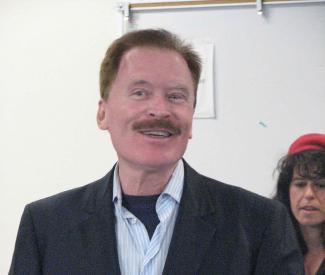
Mayor

Editorial: Mayor Ed Lee should veto the Parkmerced development agreement

20

 Mayor Ed Lee got his start as a lawyer working on tenant issues. He understands the city’s rent laws and the shortage of affordable housing. He also knows — or ought to know — that when the city’s tenant groups are unanimously opposed to a project, elected officials who care about tenant rights should pay attention.

The Parkmerced project will be a clear test: Does he follow his activist roots, stick with the people he started with and show his independence — or side with the big out-of-town developer and allow the project to move forward?

The supervisors approved the project by the narrowest of margins, 6-5. All of the progressives voted to reject the development agreement and rezoning — and for good reason. The deal would lead to the demolition of 1,500 units of rent-controlled housing. And while the developer says it will abide by the rent laws for the newly built replacement units, that’s a shaky legal guarantee. The larger point, tenant advocates say, is that demolishing existing affordable housing is always a bad idea.

In the end, 1,500 people will have to leave the homes they’ve lived in for years — in some cases, many years. They will be offered replacement units in a high-rise — very different from the garden apartments (with, yes, gardens) that they’ve occupied. And if the developer decides that there’s more money to be made by jacking up the rents on those units, it’s a safe bet that an army of lawyers will arrive attempting to undermine the questionable guarantees now in the deal.

There’s also the problem of transportation and traffic. The project will include a new parking space for every new unit, meaning 6,000 new cars in an area already overwhelmingly congested. Since the vast majority of the units will be market-rate (the developer will provide 15 percent affordable units, under city law, which means 85 will be sold or rented to rich people) the development will transform what is now still something of a working-class neighborhood into another enclave for the wealthy.

When we talked to Mayor Lee, he was noncommittal on the deal. At the same time, he noted that the garden apartments are old and will have to be replaced at some point. We don’t dispute that there are ways to add more density at Parkmerced. But wholesale demolition of affordable housing isn’t the answer.

This deal is bad for tenants and bad for the city. Mayor Lee ought to recognize that the tenant groups opposing this have analyzed it carefully and come to an entirely reasonable conclusion.

Sup. David Chiu, the swing vote in favor of the project, did serious damage to his reputation as a progressive and lost thousands of tenant votes by siding with the developer. Lee, who insists he isn’t running in November, ought to demonstrate that he hasn’t forgotten his roots, that he listens to activists, and doesn’t simply go along with poorly conceived development projects. He should veto the development agreement and zoning changes and send this thing back to the drawing board.


Treasure Island goes to the Board

37

There’s three reasons I’ll always remember the Chronicle’s Phil Bronstein: he used to be married to Sharon Stone, he got bitten by a Komodo Dragon at the L.A. zoo, and he had the audacity to write a column in the Chronicle that was titled “Treasure Island eco-dream is bad choice for funds.”
Now it’s true that Bronstein was a 1986 Pulitzer Prize finalist for his work in the Philippines. But that was 25 years ago, and I didn’t read what he wrote, so I can’t comment on the quality of his work  then. But now I live in the East Bay and drive past Treasure Island most days of the week—and I have been waiting for someone at the Chronicle to finally voice something other than their usual preppy praise for this increasingly large development in the middle of the Bay.
 
And Bronstein certainly did have plenty to say about Treasure Island. And it wasn’t the usual upbeat pap about “bold and robust visions” that the Chron usually serves up when it concerns anything that involves Lennar and public-private development. Instead,  Bronstein began by describing T.I.  as a “onetime secretive Navy base filled with deer, political patronage and who knows what buried in the ground.”

Now, part of Bronstein’s fire may have been a result of him writing his column in April, a few weeks after a massive earthquake and tsunami hit Japan, triggering a nuclear meltdown. Or two or three.

Bronstein’s infamous rant even mentioned some of the radiologically impacted things at Treasure Island that, as he put it, “leached into the soil from weaponry or other deadly items: radium and PCBs 100,000 times the acceptable levels.”
And then he compared Lennar and billionaire Ron Burkle to “contemporary development pirates.” Believe me, that was a surprise to read in the Chronicle.

“This year, they’re scheduled to break ground on a huge multibillion-dollar public-private ecotopia mini-city built upon toxic waste and landfill,” Bronstein wrote. “This glorious contradiction might become a triumph of super-green living and high-end dreams. But it also represents something else: bad choices about how to spend public money in ever tighter times.”

Bronstein noted that the Board has a brief panic in April when they considered whether a Japan-style disaster could wipe out the T.I. plan, but that Rich Hills of the Mayor’s Office said the “disaster potential has already been addressed.”
“Unless we have what Hills called ‘a freak disaster,’” Bronstein added with a cutting bite that his Komodo dragon would have been proud of, including Bronstein’s inclusion of the fact that Treasure Island is on the California Emergency Management Agency’s tsunami inundation map, and that while we are coughing up $105 million to developers who want to profit from high-density living on T. I, all of us are neglecting aging infrastructure that we already have.

“While T.I. developers are busy putting some kind of shower cap-like cover over the land so trees and foundations don’t touch toxic ground that can’t and won’t be cleaned up, our children stand a pretty good chance of being flattened like pancakes in existing structures while they’re learning math and history during the next, inevitable big quake,” Bronstein concluded.
Meanwhile, those of us who drive the seismically-compromised Bay Bridge each day can’t help wondering how folks who decide to move to the development that’s being planned for Treasure Island will ever get off the island—unless they have a pirate ship.

That’s because every morning, we get to see a long line of drivers waiting—without much success—for drivers on the Bay Bridge to slow down and let them into the traffic.

Those of us who sometimes commute by ferry also know how tricky it is try and catch the last ferry, which leaves the San Francisco Ferry Building at 8:25 p.m. That’s way earlier than most commission meetings end. And earlier than most nightlife begins.

And then there’s the question of what happens when you get back to Treasure Island–and realize you forgot to buy milk, collect the dog, or pick up the kids from day care.

Now, maybe the city and the developers believe they have thoroughly considered and answered all these questions. But have they done any outreach to East Bay commuters, whose journey will likely be further impacted by the T.I. plan? If so, I certainly haven’t heard about it. And what about the folks in Berkeley who likely won’t be able to see San Francisco once a bunch of high-rises pop up in the Bay? Have they been consulted?

This Tuesday (June 7) at 5 p.m., the Board will hear an appeal of the city’s Treasure Island environmental impact report and consider a huge batch of related documents. (And I’m willing to bet that most current supervisors don’t know too much about this plan, and probably have only flipped through the thousands of pages of documentation related to it)

The appeal was filed by the Sierra Club, Golden Gate Audubon Society, and Arc Ecology, who last year filed an appeal around the city’s EIR for Lennar’s massive Hunters Point Shipyard/Candlestick Project. Only this time, this trio is being joined by a group of Treasure Island residents—and former Board President Aaron Peskin.

Which reminds me: Three weeks after Bronstein wrote his amazing Treasure Island hit, piece, his fellow columnists at the Chronicle, Phillip Matier and Andy Ross, were back, sounding much more like the Chronicle’s attack dogs usually do, when it comes to anyone who dares to find the city and Lennar’s massive plans less than perfect: “Peskin, who as a supervisor was notorious for his middle-of-night phone rants to department heads, called the proposed high-rise plan that just squeaked by the Planning Commission a ‘laughingstock mistake,’” M& R crowed.

But in the end, they quoted the very thought that Peskin wants M&R to print and Chronicle readers to consider about the city’s current Treasure Island plan:

“It will horrify San Francisco and the Bay Area for decades to come,” Peskin said.

Now, as the folks joining Peskin in opposing the city’s current plan note, they aren’t trying to stop the development of Treasure Island. They are simply fighting the latest plan.

“The developer and the city already have an approved EIR and project plan for a 6,000 unit smaller scale, more transit friendly project that was passed in 2006,” Arc Ecology states in a flier that it plans to distribute at the June 7 hearing. “Environmentalists and many of the appellants supported that plan. Don’t be fooled by the rhetoric. It was the earlier plan that won all the awards for sustainability.”

And as Arc points out, the city’s latest EIR and the plan currently before the Board is an entirely different animal from the city’s 2006 plan.

“It’s 25 percent bigger than the 2006 plan, tipping the scales on its impacts,” Arc states. “It increases the housing by 25 percent to 8,000 units, decreases transit service and affordable housing and competes with hotels and businesses that already exist downtown.”

“What can you do? Tell the Board to go back to the 2006 plan,” Arc advises.

The flier also lists a bunch of bullet points that outline some of the coalition’s objections.

“It’s unsustainable,” the flier states, claiming that under the new plan, there will be, “too many cars, too much traffic, too much air pollution.”

Under the new plan, there is also a seven percent reduction on the affordable housing set aside and a 17 percent reduction in overall affordable housing units, Arc notes. That’s another way of saying, “There is not enough affordable housing.”

And Arc claims the island will remain contaminated (see Bronstein’s rant about radionuclides and PCBs at the beginning of this post) even after the Navy completes its toxic and radiological cleanup. That the 40-story high-rise towers will obstruct views of San Francisco from the East Bay, and vice versa. And that the project financing plan will drive the city further into debt for at least another 15 years.

Arc’s flier concludes by asserting that the whole plan is undemocratic.
“Once approved, there will be no further environmental review of project plans—ever!” Arc claims. “Once approved the project will be implemented by an unelected nonprofit corporation. There has been no outreach or involvement of East Bay residents despite traffic and view impacts. The plan repays $55 million in additional developer costs to purchase this island with hundreds of millions of dollars of impacts on Bay Area residents.”

Now, I’m sure officials for the City and the developer will have plenty of counter arguments–and possibly busloads of low-income T.I. residents/unemployed SF workers, who will be shipped into the Board’s Chambers to argue that they need the Board to approve this plan so they can have new homes and jobs. Because that’s what happened last year, when Arc and the Sierra Club and Golden Gate Audubon expressed their concerns about plans to carve up the Candlestick State Park Recreation Area and build a bridge over the Yosemite Slough. And suddenly found themselves cast as the big bad villains, when it came to the city and Lennar’s wish to ram through the Candlestick/Shipyard plan.

But regardless of whether you believe in the project, oppose it, or don’t know much about it, make sure you show up at 5pm in Room 250 at City Hall on June 7, if you want to hear what actually goes down. Especially if you work in San Francisco, and live in the East Bay, because much of the Treasure Island traffic will directly impact the East Bay. 

Or as Arc puts it, “This new project is 25 percent larger than the prior one and like the difference between a 75 degree day and a 100 degree day – this increase in size makes all the difference. The new project will overdrive bridge capacity, create too much traffic, not enough transit, reduced levels of affordable housing, and vests enormous public power in an unaccountable, unelected development authority.  Please tell the Board they don’t have to go back to the drawing board – just to the 2006 plan and recirculate the EIR.”
 

Sneaky campaign to draft Lee sullies political environment

92

At a time when City Hall is taking on several important issues – from the budget and pension reform to massive projects such CPMC’s mega hospital and housing project and the redevelopment of Parkmerced and Treasure Island – an ambitious cabal of political operators bent of convincing Mayor Ed Lee to break his word and run for office is poisoning the environment under the dome.

A series of unfolding events over the last week makes it clear that Sup. Jane Kim’s campaign team – political consultants Enrique Pearce and David Ho, Tenderloin shot-caller Randy Shaw, and their political benefactors Willie Brown and Rose Pak – are orchestrating another campaign to convince Lee to run for office, apparently abandoning the mayoral campaign of Board President David Chiu.

The Bay Citizen reported that Pearce was pursuing creation of a mayoral campaign that Lee could simply step into, while blogger Michael Petrelis caught Pearce creating fake signs of a grassroots groundswell for Lee over the weekend. That effort joins another one by the Chronicle and a couple of downtown politicos to create the appearance of popular demand for Lee to run despite a large field of well-qualified mayoral candidates representing a wide variety of constituencies.

And then today, Shaw joined the effort with a post in his Beyond Chron blog that posed as political analysis, praising the John Avalos campaign – an obvious effort to ingratiate himself to the progressive movement that Shaw alienated by aggressively pushing the Twitter tax break deal and Kim’s candidacy – while trying to torpedo the other mayoral campaigns, calling for Lee to run, and offering a logic-tortured take on why the public wouldn’t care if Lee breaks his word.

Pearce and Ho – who sources say have been aggressively trying to drum up support for Lee in private meetings around town over the last couple weeks – didn’t return our calls. Kim, who is close to both Chiu and Avalos, told us she is withholding her mayoral endorsement until after the budget season – which, probably not coincidentally, is when Lee would get into the race if he runs.

Fog City Journal owner Luke Thomas, who Petrelis caught taking photos for Pearce over the weekend – told us Pearce’s Left Coast Communications, “hired me in my capacity as a professional photographer to take photographs of people holding ‘Run Ed Run!’ signs and should not be construed as an endorsement of the effort to draft Ed Lee into the mayor’s race.”

In an interview with the Guardian last week, Lee reiterated his pledge not to run for mayor – which was the basis for his appointment as a caretaker mayor to finish the last year of Gavin Newsom’s term – but acknowledged that Pak and others have been actively trying to convince him to run. Pak has an open disdain for candidate Leland Yee and fears his ascension to Room 200 would end the strong influence that Pak and Brown have over the Mayor’s Office and various department heads.

“I am not running. I’ve told people that. Obviously, there is a group of good friends and people who would be happy for me to make a different decision, so they’re going to use their time trying to persuade me. I’ve told them I’m not interested and I have my personal reasons for doing that but they’re not convinced that someone who has held this office for five months and not fallen into a deep abyss would not want to be in this office and run for mayor. I’ve been honest with people that I’m not a politician. I’ve never really run for office nor have I ever indicated to people that I’d like to run for mayor of San Francisco. That’s just not in my nature so it’s been a discussion that is very foreign to me that has been very distracting for me in many ways because I set myself a pretty aggressive piece of work that this office has to get to. The way I do it is very intensely. I do meet a lot of people and seek their input before I made a decision,” Lee told us.

Even Sup. Sean Elsbernd, who nominated Lee for mayor, told the Chronicle that he doesn’t support the effort to pressure Lee into running and he feels like it could hurt sensitive efforts to craft compromises on the budget and pension reform. When asked by the Guardian whether he would categorically rule out a run for mayor, Lee told us he would.

“I’ve been very adamant about that yet my friends will still come up to me and they’ll spend half their time talking to me about it. And I say thank you, I’m glad you’re not calling me a bum and trying to kick me out,” Lee told us, noting that Pak – a longtime ally who helped engineer the deal to get Lee into office, for which Chiu was the swing vote, parting from his five one-time progressive supervisorial allies in the process – has been one of the more vociferous advocates on him running.

Asked whether there are any conditions under which he might change his mind, Lee told us, “If every one of the current supervisors in office asked me to run and those supervisors who are running voluntarily dropped out.” But Avalos says he’s committed to remain in the race, and his campaign has been endorsed by three other progressive supervisors.

A rather odd endorsement

94

I got a press release today from the Dennis Herrera for Mayor campaign proudly announcing the endorsement of … Frank Jordan.


Jordan was mayor of San Francisco once. Back in the 1990s. His term ran from 1992 to 1996, and was, to be polite, mediocre. Nice guy; awful mayor. He was one of the more conservative mayors in memory, left office pretty unpopular, and a lot of people don’t even remember him. Those who do, particularly progressives, don’t remember him fondly at all.


Ah, but Herrera does.


“I’m deeply honored by Mayor Jordan’s praise for my leadership, and grateful for his endorsement for my mayoral candidacy,” said Herrera.  “Few can claim to have done as much to serve our City with such integrity, skill and courage as Frank Jordan.”


While Leland Yee is out trying to get support on the left, which might actually help him win, Herrera seems to be moving, if anything, to the right (which is what Jordan’s endorsement represents). Very odd. Very odd indeed.


I couldn’t reach Herrera today to ask him about it, but I’m sure he’ll call me and I’ll update this post. Meanwhile: WTF?  


UPDATE: I heard from Herrera late in the day. He told me that “there are only six people alive who have ever held the office of mayor of San Francisco and know what it’s really like to manage this city, and I would be proud to have the endorsement of any of them.” I asked: Including Willie Brown? Herrera: “He’s a columnist now so he doesn’t do endorsements.”


Herrera also pointed out, correctly, that he has the endorsement of Mike Hennessey, the progressive sheriff. And he’ll wind up with some more leftish endorsements, too. Still: Frank Jordan?

A different Mayor’s Office

10

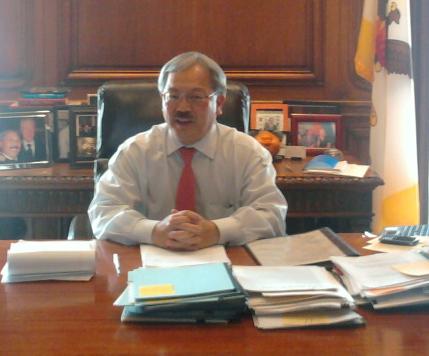
A group of Guardian reporters and editors met with Mayor Ed Lee June 2, and while the mayor and I don’t agree on everything, I have to say: It was refreshing.


Refreshing because the mayor has a sense of humor and doesn’t act like an infallible monarch. Refreshing because his office looks like, well, a working office. Refreshing because he smiled, was polite and never said “I dispute the premise of your question.”


What a difference.


Under Willie Brown, the mayor’s office was an imperial sanctum. If His Royal Williness deigned to favor one of his servants or subjects with the boon of a royal visit, you were expected to crawl on your hands and knees and kiss the floor. 


When Gavin Newsom was the occupant, the place was a cross between a museum and an Architectural Digest showplace — not a scrap of paper on the desk, every hair perfectly in place, the Robert Kennedy pictures and books lined up perfectly for the visitor to admire.


Both mayors treated the press with hostility. Both expected to be treated as potentates. The mayor was better than you and I — and you needed to understand that right away, or risk disdain and dimissal.


Ed Lee isn’t doing what I want with the budget. He’s not talking about raising taxes on the rich. He’s probably going to go along with ParkMerced and maybe even Treasure Island. He signed the Twitter tax break. I worry (a lot) about his ties to past corrupt regimes.


But he’s happy to have reporters in his office. He’s got stacks of reports on his desk and a notepad that suggests he’s actually reading them. He showed us his private “man cave” in the back, and offered us walnuts. He’s not always right on policy, and I don’t think he should run in the fall … but he’s not a jerk. And given the recent history of San Francisco mayors, that’s pretty radical.


HANC gets a new eviction notice

The City and County of San Francisco voluntarily dismissed an eviction notice it had issued to the Haight Ashbury Neighborhood Council Recycling Center, but then the Recreation & Parks Department promptly sent a new one with a deadline of June 30.

The HANC recycling center and native plant nursery has continued operating in Golden Gate Park’s Kezar Triangle despite an effort initiated last year under former Mayor Gavin Newsom to evict the facility. The recycling center, which also offers compost for urban gardeners and a place to drop off used veggie oil, has been in Golden Gate Park for decades and has formed partnerships with community gardening projects throughout the city.

Rec & Park started making plans to replace it with a community garden last year amid concerns about “quality of life” issues. Some neighbors were bothered by recyclers filling up shopping carts with containers plucked from their sidewalk recycling bins, to trade in for small amounts of cash. Members of HANC, meanwhile, saw the eviction as political payback from Newsom, who encountered stiff opposition from the progressive neighborhood group when he led the charge to place San Francisco’s sit / lie ordinance on the ballot. 

The request for dismissal, filed May 26 in San Francisco Superior Court and signed by Attorney David Ammons in the office of City Attorney Dennis Herrera, doesn’t provide a clear reason for the move. But Robert De Vries, HANC’s attorney, said the tactic was likely meant to avert legal entanglement by dissolving the first, and more legally problematic, attempt at eviction and replacing it with a new one that may be harder to challenge in court. In a letter to Rec & Park commissioners dated Dec. 2, 2010, De Vries wrote that the first eviction notice was illegal under the structure of the lease that HANC had signed with the city, and asserted that HANC could legally possess the property until June 30, 2011.

Because the dismissal of the first eviction was done “without prejudice,” there was nothing preventing Rec & Park from issuing a new eviction notice, which it did the same day. Rec & Park did not respond to an email seeking comment.

“Your attorney has argued in court that the notice was not effective to terminate the lease,” notes a May 26 letter from Rec & Park General Manager Phil Ginsburg. “While we continue to believe that we gave you more than adequate notice of the Lease termination and to disagree with the assertion that the Lease has continued on a year-to-year basis, to avoid that dispute, we are superseding the earlier notice with this one.”

HANC’s Jim Rhoads told the Guardian that he wasn’t very surprised by Rec & Park’s latest move. “We knew this would happen,” he said. “We’re going to meet with our lawyers, and decide on the legal front what we do next.”

De Vries said he could not discuss all the possible legal angles that HANC could use to try and fight the eviction, but he hinted that the eviction could be considered retaliatory. “This … termination was initiated under Newsom as payback for my client [for opposing] sit / lie,” he said.

Waggoner for Police Commission

6

By Harry Britt, Matt Gonzalez, and Aaron Peskin

OPINION Given the escalating scandals in the San Francisco Police Department, the time is ripe to appoint a police commissioner who understands the recurring problems and the need for reform.

The supervisors have the opportunity to appoint such a commissioner: David Waggoner. Waggoner’s extensive background in policy reform, community policing, and criminal justice issues will be a valuable asset to the commission.

Waggoner has worked as a pro bono attorney before the Oakland Civilian Police Review Board and has earned the respect and admiration of people from highly diverse political and social backgrounds. His integrity and sense of justice and fairness inspire trust and confidence — and frankly, we could use a lot more of that in this city.

Credibility with historically marginalized communities — including people of color, new immigrants, the homeless, people with disabilities and the LGBT community — is essential in developing the kind of mutual respect that makes the department’s work effective or even possible. David Waggoner has that credibility.

In 2003, in response to years of strained relations between the SFPD and the community, the voters approved Proposition H. Prop. H gave the Police Commission more authority to adjudicate cases of officer misconduct and changed the makeup of the commission by giving the board three appointments to balance the mayor’s four.

Despite these significant steps toward reform, eight years later we have a Police Department that is under investigation by the Justice Department and the FBI and struggling to overcome serious credibility and morale problems.

Case in point: in the last year alone, the department’s credibility was undermined by a major crime lab scandal, the disclosure of Fourth Amendment violations in SRO hotels, use of excessive force on the mentally ill, and widespread withholding of evidence of officer misconduct from attorneys. These scandals resulted in the dismissal of hundreds of cases.

A number of outstanding policy issues remain in need of serious attention. In 2005, the Civil Grand Jury published a report on compensation in the Police Department, finding that officers receive greater salary increases than other city employees while San Francisco is in a state of fiscal stress. In 2007, the grand jury recommended filling significant numbers of desk jobs with civilians. When the department finally rolled out a pilot program this year, it called for only 15 civilians.

The San Francisco Police Department needs to improve its training of officers, including fostering a respect for the civil liberties that San Franciscans cherish. This should be basic to all police work. However, last year San Francisco paid $11.5 million in lawsuits because of police misconduct.

San Francisco needs police commissioners who understand the challenges of police work but who also are willing to explore the nature of endemic problems that have led to embarrassing scandals. We need commissioners who have a broader understanding of criminal justice policy and how it can be changed to promote public safety.

We join with the San Francisco La Raza Lawyers Association, Community United Against Violence, the Harvey Milk LGBT Democratic Club, and a host of other elected officials, community activists, attorneys, and local leaders in wholeheartedly supporting the appointment of David Waggoner to the San Francisco Police Commission. It’s about time. 


Harry Britt is a former president of the Board of Supervisors and the author of the landmark 1982 legislation that created the Office of Citizen Complaints. Matt Gonzalez is chief attorney in the Public Defender’s Office, a former president of the Board of Supervisors, and a co-sponsor of Prop. H. Aaron Peskin is chair of the San Francisco Democratic Party, a former president of the Board of Supervisors, and a co-sponsor of Prop H.


Editor’s Notes

7

tredmond@sfbg.com

Three weeks before the June 25-26 Pride Weekend — which is the unofficial opening of the official fall mayoral race — there are two front-runners: state Sen. Leland Yee and Sup. John Avalos.

I’m not saying either is going to win. Things change quickly in this town. We don’t even know for sure if the incumbent, Ed Lee, is going to be in the final scrum.

But here’s what we do know: Yee and Avalos — right now, today — are doing the things they need to do to emerge from a crowded pack. And the others are either hanging back or flailing around.

Avalos had more than 400 people at his kickoff. State Assemblymember Tom Ammiano was there to endorse him. He’s got window signs all over the east side of town. He’s showing momentum, energy; he’s on track to solidify the progressive base and start moving west. He has agreed to cosponsor the mayor’s pension reform plan (but only if SEIU Local 1021 gets the amendments the union wants).

Yee has figured out a very smart strategy: He realizes that he’s already got name recognition and a west-side base, that he’s never going to get the support of the Chinatown establishment (powerbroker Rose Pak hates him), and that he’s one of at least five candidates fighting over the center. So he’s trying to grab a share of the left.

Yee’s people were thrilled that he and Avalos got the Sierra Club. The more groups that endorse the two together (in any order), the more Yee becomes associated with the progressive standard-bearer. And the more second-place votes he gets on the left. (Don’t kid yourself; this race may well come down to who gets second-place votes on the left.)

And Sup. David Chiu just gave Yee a great big gift. Chiu defied every single tenant group in town and became the swing vote in favor of the Parkmerced project. Now the tenants are pissed — and you know Yee is going to try to take advantage of it.

The frustrating part of that scenario is that Yee was never a good tenant vote when he was a supervisor. That’s his Achilles’ heel on the left — but it’s old history, and the anger at Chiu is here today.

Would Chiu be a better mayor for tenants than Yee? Quite possibly. Is any tenant group thinking that right now? No.

Chiu’s in a tricky spot. He’s trying to be the centrist progressive — and that’s a hard thing to sell to either the center (where he’s one of five candidates) or the left (where Yee is edging him out in cozying up to Avalos).

City Attorney Dennis Herrera hasn’t recovered from the political consultant lobbying mess (not a new story, he’s hardly the only, or even remotely, the worst offender, but damn, it makes him look bad). Former Sup. Bevan Dufty’s doing great at the candidate forums but doesn’t have a breakout move. Assessor Phil Ting is awfully quiet.

It’s only June. But it won’t be “only” anything much longer.

Don’t undo ballot measures

0

EDITORIAL The California initiative process is broken. The state’s too big, and it costs too much to gather signatures and mount a media campaign for or against a ballot measure.

But in San Francisco, the initiative process has traditionally been, and for the most part continues to be, a check on corrupt or ineffective political leaders and a chance for progressive reforms that can’t make it through City Hall. That’s why Sup. Scott Wiener’s proposal to allow the supervisors to amend (or, in theory, abolish) laws passed by the voters is a bad idea.

Since 1968, the San Francisco voters have approved 96 ordinances; that’s an average of about two a year. Obviously the pace has picked up since the 1970s. In 2008, there were eight measures approved; in 2010 there were four. The length and complexity of the ballot makes it appear that the supervisors aren’t doing their work, Wiener says. He notes that when he was campaigning, one of the most common complaints was that the voters were being asked to decide too many things that should have been handled at City Hall.

Some of that is the result of an unwieldy City Charter. Benefits for police and firefighters, for example, are specified in the charter, and any change needs voter approval. Wiener’s measure, aimed only at initiatives and not charter amendments, wouldn’t change that situation.

But some of it relates to the political alignments in San Francisco. For much of the past decade, the supervisors and the mayor were at odds over major issues. The mayor couldn’t get his (bad) proposals, like a ban on sitting on the sidewalks, through the board, and the progressives couldn’t get their proposals past a mayoral veto. So both sides went directly to the voters.

That’s a lot better than the paralysis we’re seeing in Sacramento. At least the issues are getting decided.

And over the years, some of the most important legislation in San Francisco — growth controls, tenant protections, protections for children’s programs, the city’s landmark open-government law — has come through ballot initiatives. The only way public power advocates have been able to get the issue on the agenda has been through ballot initiatives.

Those were issues that generations of supervisors and mayors wouldn’t take on — the developers and landlords and secrecy lobbyists and Pacific Gas and Electric Co. had too much power at City Hall. And those protections for the public, the environment, and the most vulnerable residents only survive today because they’re set in law and can’t easily be changed.

If Wiener’s measure has been in effect a decade ago, for example, Proposition M — the 1986 law that set neighborhood planning priorities and limits on office development, would have been summarily scrapped by Mayor Willie Brown and a pro-developer board. Key rent-control laws would have been repealed or amended to death. The ban on buildings that cast shadows on parks would be gone. Killing the Sunshine Ordinance would have been Brown’s first act.

Today’s district-elected board is far more accountable to the voters — but there’s hardly a reliable progressive majority. And the point of ballot initiatives is that you can’t predict who will control City Hall next year, or in 10 years.

We don’t think the initiative process in San Francisco is out of control. Sure, big money wins the day too often — but on balance, it’s a check that the Board of Supervisors should leave alone.

Not in our neighborhood

6

news@sfbg.com

San Francisco faces an enormous shortage of affordable housing for young people at risk of homelessness, but a pair of projects intended to address the issue are under fire from neighborhood activists in supervisorial District 2, home to the city’s wealthiest residents.

The proposed conversion of the defunct Edward II Hotel and the major overhaul at the Booker T. Washington Community Service Center (BTWCSC) could create a combined 74 units of affordable housing for vulnerable youth, complete with services and support systems to help young people coming from foster or homeless families.

“We are building houses for young people who are getting their start in life,” said Julian Davis, president of the board of BTWCSC. “There was a great need for foster youth housing that has been studied ad nauseam … Our center wanted to contribute.”

But both projects have run into strong neighborhood opposition that appears to have turned D2 Sup. Mark Farrell against the projects as proposed, despite initial support for the BTWCSC project by both Farrell and his predecessor, Michela Alioto-Pier. Farrell’s approach has frustrated project opponents and caused the representative of a neighboring district, Sup. Ross Mirkarimi, to sponsor the project.

“The project emanated from Michela Alioto-Pier and she supported the original project, which is why I joined her in support and it initially appeared that Sup. Farrell was joining that support,” Mirkarimi told us, noting that he is continuing to champion the project because it borders his district and because “the Booker T center has a long reach and serves clients from throughout city.”

After hearing from constituents concerned about parking, the size of the five-story building that is proposed, and other issues, Farrell dropped his sponsorship of the project and submitted alternative legislation that cut the building to four stories, presenting it to project proponents without their input as a take-it-or-leave-it proposal.

“The thing I find most puzzling about this is the lack of communication with me personally,” BTWCSC Executive Director Pat Scott said of Farrell, noting how helpful Alioto-Pier and Farrell’s staff had been before opponents convinced him to drop his support for the project. “I was a little taken aback, quite frankly. I would just assume that he’d talk to me.

But Farrell said he was simply trying to heed neighborhood concerns and craft a compromise that would get neighbors to drop their lawsuit threats and appeal of the Planning Commission’s 6-1 vote to approve the project. “I can’t control what happened in the past, I’m only here to make sure everyone is happy now,” Farrell told us. “I absolutely support the project, I think the community center is great … We’re arguing over a story.”

Yet Scott noted that project proponents already had compromised on a project that was initially proposed for eight stories, and she said that even at five stories, it isn’t coming anywhere near what the city actually needs. So while Farrell casts it as a fight over one story, Scott said, “10 units is a big thing in a city that has nothing for these kids.”

That need was outlined in a 2007 report by the Mayor’s Transitional Youth Task Force. The group of city officials and nonprofit providers, convened by then-Mayor Gavin Newsom, studied issues affecting at-risk youth between the ages 16 and 24 and one of the major needs identified was housing.

A follow-up study found that 4,500 to 6,800 young people are “homeless or marginally housed each year.” The citywide affordable housing stock for this population sat at meager 314 units at the time.

“We are not doing a good enough job as a city and as a state [to help at-risk youth],” Davis said. “Once they leave the foster care system, there is very little support for them.”

The report called for 400 new affordable housing units for this population to be completed or under construction by 2012. Edward II and BTWCSC are located in the Marina and the Western Addition, respectively, in proximity to affluent neighborhoods in a district with a dearth of affordable housing.

“With supportive housing [going] into neighborhoods that never had affordable housing, there is a certain unknown and it makes people uncomfortable,” said Gail Gilman, Executive Director of Community Housing Partnership, which owns and manages the Edward II project.

Patricia Vaughey, a resident of the Marina-Cow Hollow area since 1976, is perhaps the most vocal critic of the project. She has used the neighborhood associations and every other city forum she can find as platforms to lambaste the plans. “It just kills my soul to see this project,” she told us, voicing a variety of concerns about how the project would be managed. “I am so worried about the kids … We are asking for the best program in the country and we are not getting it.”

Yet Gilman said that considerable energy and many resources have been invested in designing Edward II and that she trusts Larkin Street Youth Service, a respected nonprofit agency, to do the programming. “We chose to partner with Larkin Street because they are the experts in this area,” she said.

Vaughey characterized the stretch of Lombard Street between Divisadero and Van Ness streets, where Edward II will be located, as marred by crime and prostitution and unsuitable for this project. “We have a little Tenderloin down here,” she said.

Gilman disputed that characterization and said the building was chosen after an extensive search and that it met the criteria of having the right sized building in a safe neighborhood with good access to public transit and open space.

But many residents have expressed concern over the pending change to zoning for the building. And if the BTWCSC project couldn’t win Farrell’s support, the Edward II project faces an even more uphill battle because Farrell told us, “There’s an even stronger level of neighborhood concern over that project…. It’s going to be a tough hill to climb.”

The contentious issue under review by the Planning Department is an application to expand the density limit from 16 units to 24.

John Miller, president of the Marina Community Association, said that “from a neighborhood dynamic perspective,” a change to density is problematic. He said changing the density for one building is a slippery slope that could hurt the entire neighborhood. “Higher density is inconsistent with the neighborhood. It could work beautifully at lower density.”

Miller said potential renters in the vicinity would be concerned with “loitering that could occur when people are coming and going … With so many people there is no sense of community”

Yet as with BTWCSC, proponents say simply slashing the project to a smaller size would kill it because then it wouldn’t pencil out financially. Making an issue of density is therefore obstruction of the project because compromise cannot be reached on the issue.

Farrell, a venture capitalist, said he ran the numbers on BTWCSC and believes it would still be a viable project at four stories if the Mayor’s Office of Housing is able to offer some unspecified assistance, as he said the officials there have pledged to him they would. “I know we need more affordable housing,” Farrell said, rejecting suggestions that D2 residents tend to oppose all affordable housing projects. “I don’t think that should be a part of this conversation.”

Farrell criticized the outreach done by Edward II proponents, telling us, “I don’t think it was done in a tactful way.” But Miller said a recent meeting with Gilman and others was positive. “It was an effort on their part to respond to the neighborhood concerns as best they can,” Miller said.

“We are confident we can partner with the community in a proactive way to address the concerns that are addressable,” Gilman said. “If we diligently work with the community, we can have positive project.”

Edward II is on track to come before the Planning Commission in mid-July, while the appeal of the BTWCSC project is scheduled to be heard by the Board of Supervisors Land Use Committee on June 6 at 1 p.m. Neither Mirkarimi nor Farrell offered predictions, but both said the issue of whether the project should be four or five stories will likely be a key part of the discussion.

“Coming through the process has made me super supportive of all plans for transition age housing. I was already a supporter but this made me a fervent supporter,” Scott said. “The amount of opposition by people who don’t care what happens to our children — it makes you want to fight.”

Awaiting consensus

5

news@sfbg.com

Mayor Ed Lee’s pension reform proposal was unveiled May 24 with support from some of those who helped develop it, including investment banker Warren Hellman, Rebecca Rhine from the Municipal Executives Association, San Francisco Chamber of Commerce head Steve Falk, and San Francisco Labor Council Executive Director Tim Paulson.

The plan would dramatically alter the way the city manages employee retirement benefits, starting July 2012, while exempting employees who earn less than $50,000. Lee described it as “serious,” “comprehensive,” and a plan that “reflects consensus.”

Already the legislation to place it on the fall ballot has secured the cosponsorship of Board President David Chiu and Sup. John Avalos, rival candidates for mayor. Other mayoral candidates also offered their support, including former Sup. Bevan Dufty and City Attorney Dennis Herrera.

But there is one notable exception to the support for this plan, a party that has been at the negotiating table where it was crafted: Service Employees International Union Local 1021, which represents about half of the city’s 26,000 employees. The union claims the plan disproportionately affects 500 SEIU members, who are mostly women and people of color and already took large pay cuts last year to avoid layoffs.

Avalos, who described Lee’s proposal as “a sensible approach” and “the right way to go,” has said that if SEIU’s concerns aren’t adequately addressed, he’ll withdraw his sponsorship.

“I’d like to get to a consensus, but if we don’t and 10,000 union workers don’t sign on, I’m going to take my name off as a sponsor,” Avalos said. “We have to find ways to pay for pension benefits without decimating jobs and social services.”

Lee’s measure also didn’t win over Public Defender Jeff Adachi, who claims the proposal won’t make deep enough or fast enough cost savings in the next few years, so he will continue gathering signatures to place a rival measure on the ballot.

So rather than the consensus product Lee hoped the whole city family would be able to convince voters to support, it’s looking like pension reform could again be a divisive issue and one that spills over into this year’s mayor’s race.

Chiu thanked “our brothers and sisters from the labor community” when Lee announced his pension measure, noting that “each city worker that makes more than $50,000 would have to give thousands every year.” He supports the pension deal and hopes SEIU will eventually back it. Avalos and Sen. Leland Yee, another mayoral candidate, seem to be waiting for SEIU to sign on before offering their full support.

Mayoral spokesperson Christine Falvey told us that Lee views SEIU’s concerns as separate from the pension reform proposal. “He appreciates SEIU’s input in the pension reform talks and has committed to sitting down with them and trying to resolve this issue.”

Then there’s Adachi, who helped qualify Measure B, a 2010 pension reform proposal that united labor and city leaders in opposition. He continues to gather signatures to qualify a competing pension measure, needing about 50,000 signatures by early July unless Lee amends his plan to secure greater cost savings in less time.

“My focus is on this issue,” Adachi said, praising Lee’s efforts at achieving consensus. “But is this going to solve this problem so we don’t have to come back within two to three years? It comes down to a math problem.”

Adachi says Lee’s plan doesn’t adequately address the city’s need to save money now.

“The stress period is really in the next four years, so my hope is that the mayor’s proposal could be strengthened,” Adachi said, noting that his proposal yields $90 to $144 million in annual savings, compared to $60 to $90 million annually under Lee’s plan.

“SEIU is right that Mayor Lee’s proposal is inequitable,” Adachi added, noting that Measure B was criticized for being unfair to lower-income workers. “That’s why my new proposal increases pension contribution rates in $10,000 graduations. But under Lee’s plan, a person who earns $100,000 contributes the same rate as someone who makes $50,000.”

He criticized Lee’s plan for requesting only modest increases from safety workers. “Police and fire cost two to three times as much as everyone else’s retirement. They pay 17 percent of what’s in the fund and take out 36 percent. So that means SEIU folks are subsidizing the costs of safety workers’ retirement.”

Adachi acknowledged it would be better to have one measure everyone can support. “But I don’t agree that we should put ineffective reform on the ballot,” he said.

Adachi took a lead role on the issue in 2010 when he qualified Measure B mostly with backing from a few wealthy sponsors, including venture capitalist Michael Moritz, a financial supporter of Republican Ohio Gov. John Kasich and the Ohio Republican Party. Adachi took lots of political heat for the move, but he shrugs off the criticisms.

“It comes down to making sure people understand the issue,” he said. “A year ago, no one was acknowledging that it was a problem, but now everyone does. I’m hoping the board strengthens the proposal. It’s going to take supervisors really looking at this to see if works, not just jumping on the bandwagon.”

According to the Department of Human Resources, Lee’s plan would yield an estimated savings of $800 million to $1 billion over 10 years, with the bulk coming from increased employee retirement fund contributions of up to 6 percent for future and current employees. The proposal raises the retirement age from 62 to 65 for most city workers and from 55 to 58 for public safety workers. It also imposes caps on pensions for new employees.

Lee’s proposal must now make its way through the Rules Committee and win the approval of the full board by July 12, the deadline for supervisors to submit charter amendments. According to the Department of Human Resources, 89 percent of San Francisco’s 26,000 city workers earn more than $50,000. That means only 3,000 city workers fall below the $50,000 cut-off that exempt them from paying extra, under Lee’s plan.

But Larry Bradshaw, a bargaining unit member of SEIU 1021, said that members who make slightly more than that threshold will face pay cuts under the plan, on top of the pay cuts they took last year to avoid being laid off by Mayor Gavin Newsom.

For certified nursing assistants, the shift would amount to a roughly $12,000 annual pay cut, Bradshaw said. Security guards would face an estimated $5,000 per year cut, and clerical workers could face anywhere from $1,000 to $11,000 per year.

These workers faced getting fired and rehired at lower-paid classifications to make up for a revenue shortfall, but the union reached an agreement to stave off the worst pay cuts for those “de-skilled” employees by imposing a one percent across-the-board cut for all members in order to restore the salary cuts.

As SEIU workers take the pay cut to fund pensions, he said union members won’t be able to continue subsidizing the salaries of these deskilled workers.

“So we’re not going to have that option of asking our members to keep funding these workers who have taken this 20 percent pay cut,” he said. “And these are primarily women and people of color.”

But Sup. Sean Elsbernd and other supporters of the pension deal say the plight of these workers is an unrelated issue. “They aren’t a pension issue, so wouldn’t it be more appropriate to discuss them in the collective bargaining context?”

Elsbernd believes Lee’s measure is “fair and equitable,” partly because employees’ pension contributions would be reduced in boom years when tax revenue and stock market gains swell the city’s coffers.

“But Jeff Adachi is throwing a big roll of the legal dice,” Elsbernd said. He noted that city employees have long paid 7.5 percent toward their pensions. “But now, along come two pension reform plans that both challenge that notion.

“And every case in California shows you have to provide a commensurate benefit to change that kind of right,” he continued, arguing that Lee’s proposal is more legally sound because it lowers employees’ contributions during boom years. “So the $60 million that our plan would save is a hell of a lot more secure than the $90 million Jeff claims his plan would save.”

Sup. David Campos has yet to take a position on Lee’s plan, but hopes there is a way to address legitimate concerns about lower-income workers. “There’s no question that we have to do something about pension reform,” he said. “I don’t know if there’s a perfect proposal. But I’m especially intrigued by Mayor Lee’s plan. It recognizes that low-wage workers should not be expected to contribute at a higher rate than higher-wage workers. But we have to put the mayor’s proposal in the context of what else is happening, which is why SEIU’s de-skilling concerns are legitimate.” Campos credited Adachi for highlighting pension reform. “My hope is that we can come up with something that we can all be supportive of, where the mayor and Jeff’s proposals are combined. And while we have to be careful that the balance that has been constructed is maintained, this allows for a dialogue at the board, and for Jeff to be involved, so we can come up with a unified proposal. Because if we are going to address pension reform, we need to do so with a united front.”

FBI spying will be an issue for new Police Commissioner

1

When Police Chief Greg Suhr got sworn in at City Hall a month ago, reporters each got to ask one question during a hastily convened media roundtable inside Mayor Ed Lee’s office. And since the Guardian’s story about the FBI’s secret agreement with the San Francisco Police Department had just hit the streets, I asked the new Chief, if he would welcome clarification around the duties of SFPD officers assigned to the FBI’s Joint Terrorism Taskforce.

Chief Suhr said he believed an examination of the wording of the FBI’s most recent memorandum of understanding (MOU) with the department was already under way. “I believe that the MOU is being revisited,” Suhr said. “I have not been a part of that, but again I think we have a real good policy with regard to our intelligence gathering and that does supercede any ask of any other agency. The officers are bound by policies and procedures. And that policy was well thought out with tremendous community and group input years and years ago, from situations that have not since repeated themselves. I think a lot of people back then couldn’t believe they happened in the first place, but I think measures were well thought out and put in place to make sure we don’t have a problem again.”

Fast forward three weeks, and Suhr found himself in the hot seat at a May 18 joint meeting of the Human Rights Commission and the Police Commission, where commissioners got an update about the Police Department’s response to community concerns about surveillance, racial and religious profiling of Arab, Middle Eastern, Muslim, and South Asian Communities and the potential reactivation of SFPD Intelligence Gathering.

After Suhr introduced his new Command Staff—and stressed their great diversity–Police Commission President Thomas Mazzucco, who was Suhr’s football coach in high school, tried to assure folks that the Police Commission, the Human Rights Commission, the FBI, the SFPD, the American Civil Liberties Union and the Asian Law Caucus had already addressed the community’s intelligence-gathering concerns, in part through a bureau order that Chief Suhr then introduced during the hearing, in which Suhr clarified that SFPD policies trump FBI guidelines every time.

And Mazzucco,  a former Assistant U.S. Attorney for the Northern District of California and a former Assistant District Attorney for San Francisco, before Mayor Gavin Newsom appointed him to the Commission in 2008, noted that the community’s concerns were based on allegations. not factual findings.

But his comments got folks wondering whether Mazzucco’s prior involvement with the feds left him with a blind spot that is preventing the Police Commission from dealing with the issue in a timely and effective manner, particularly since Commissioner Jim Hammer’s term has expired, and the rest of the Commission is waiting for the Board’s Rules Committee to decide between nominating David Waggoner, L. Julius Turman, Phillip Hogan or Vanessa Jackson as the next new Police Commissioner.

For, as members of the public observed during the meeting, if the Police Commission President himself expresses no outrage at finding that the Commission’s policies have been undercut for the past four years by secret agreements between SFPD and the FBI, how can San Francisco claim to have a credible system of civilian oversight?

Instead, they felt that Mazzucco seemed more concerned about defending federal practices and officials, who were unwilling to show up at the May 18 hearing, than worrying about the role and authority of the civilian oversight body he now represents. And attorneys with the ACLU and the Asian Law Caucus noted that though Suhr characterized his new order as being based on the Portland resolution and a prior proposal from community advocates, they believe Suhr’s approach can only work with the written consent of the FBI, (which SFPD doesn’t have) if the FBI’s 2007 contract is left in place.

“That’s why there is a need for a transition to a non-MOU, Portland-style resolution,” ACLU’s John Crew told the Guardian, noting that ACLU’s willingness to work collaboratively with the commissioners and the new Chief should not be confused with a willingness on ACLU’s part to roll over and accept an approach that is based on wishful thinking rather than the realities of the MOU that’s still in place.

During the May 18 joint hearing, Chief Suhr acknowledged “the validity of the perceptions raised by the community,” even as he insisted that SFPD has “very strict policies” in place to ensure appropriate oversight for investigation- involving activities.

Suhr summarized the history of those policies, including ACLU’s John Crew’s involvement in creating Department General Order (DGO) 8.10, which establishes that there must be reasonable suspicion before SFPD intelligence gathering can occur.

Suhr noted that SFPD joined FBI’s Joint Terrorism Taskforce (JTTF) after the September 11, 2001 attacks, and SFPD officers assigned to the JTTF subsequently came under control of the Department of Homeland Security unit, but starting now, they are back under SFPD’s special investigations.

“I gave the order today that JTTF will be moved back under SFPD’s special investigation unit,” Suhr said. “They will have the security clearance necessary to oversee the activities. The members are required to comply with all department policies, even if they can conflict with FBI policies. Simply said, San Francisco policies, procedures, laws, and statute trump any federal policy or procedure. Our officers are bound by those.”

Suhr said that to ensure everyone is clear about the chain of command, he’d drafted his May 18 bureau order. “It essentially turns back the clock and emphasizes that officers are responsible for our policies and procedures first, and our officers are bound to identify themselves as San Francisco police officers,” Suhr said, further noting that he’d be happy to further amend his new order as needed.

And Mazzucco noted that SFPD has absolutely no jurisdiction whatsoever over the Transportation Security Administration’s activities at the airport.

But while Human Rights Commission Chair Michael Sweet said Suhr’s new bureau order,  “goes a long way toward helping to alleviate some of the concerns,” he and many commissioners noted that this was their first chance to read the order. And Sweet said he saw the May 18 joint hearing “as by no means the end of the discussion.”

HRC director Theresa Sparks, who was on the Police Commission when the FBI drafted its 2007 JTTF MOU, noted that the issue is not whether we should opt out, but what we can do to ensure that officers involved in activities have “strong civilian oversight of their activities and report activities through the established civilian oversight mechanisms and procedures defined in DGO 8.10.”

” Our approach to achieve this objective is to publish internal directives ensuring our officers only participate in activities that meet our local standards of reasonable suspicion,” Sparks stated, claiming that Suhr’s order will “ give the city control over misconduct charges and allegations of misconduct charges.”

Sparks noted that the May 18 hearing was a status report about “alleged violations by the FBI and SFPD, as well as airport police,” and that the HRC “did no independent investigation” to verify these allegations.

Sparks added that HRC and the Immigrant Rights Commission has a tentative agreement to move forward with townhall meetings to address community concerns, and will encourage the Board to appoint a special prosecutor to determine if the prosecution of terrorism cases is valid and fair, and discuss the need for an Ombudsman at the airport. And she talked about the need for SFPD to establish legal safeguards, mechanisms for greater transparency and oversight, and conduct more detailed yearly audits.

“Tonight was a real dialogue about the issues,” Sparks said, further noting that civilian oversight of local JTTFs is also a popular discussion in Oakland and in Portland, Oregon, which has decided to rejoin its local JTTF after opting out in March 2005. But she didn’t mention that Portland had entered into a resolution with the FBI, instead of signing a new MOU with the feds.

That explanation was left to Veena Dubal of the Asian Law Caucus and ACLU’s Crew– in between explaining why they believe Suhr’s Bureau Order isn’t enough. “The good news is that we all collectively agree that SFPD policies should apply to SFPD officers assigned to the JTTF,” Dubal said. “The bad news is that the recently released MOU, which was secret for four years, doesn’t reflect our collective desires.”

Dubal stated that the FBI won’t amend its 2007 MOU with the SFPD.
“And that is why the Chief issued the bureau order,” Dubal stated, claiming that the FBI Special Agent in Charge of JTTF involvement recently told ALC and the ACLU that the FBI will continue to block key parts of local policy central to accountability and oversight.

“But there’s a solution and it doesn’t necessitate a divorce from the joint terrorism task force,” Dubal continued, noting that there are now two ways for local law enforcement officers to participate in JTTFs: an MOU, in which SFPD resources are put into the hands of FBI with relatively no local control, as in the SFPD’s 2007 agreement with the FBI. Or via a resolution which the federal government just approved in Portland, which allows participation in the JTTF, but provides much better protection for civil rights and gives the police department and the police commission more control of the relationship.

Dubal noted that in the decade since 9/11, the FBI has expanded its intelligence powers, and its agents are now allowed to conduct intelligence without a factual connection to criminal activity.

“Given these massive shifts in FBI activity, the question is, what should the relationship between the SFPD and the FBI look like?” Dubal said.

“Unlike the FBI, the SFPD is not a national security organization, “ Dubal continued, noting that when SFPD signed up to work with the JTTF under an MOU that preserved local control and policies, “it wasn’t assuming that some of its officers, paid for by San Francisco taxpayers, could be transformed into national security agents.”

”The SFPD signed on without telling anyone, not even the police commission,” Dubal said, noting that SFPD cannot afford to participate in these practices. “We need community trust to keep all of our communities safe.”

ACLU’s Crew noted that the FBI came to the SFPD in 2007 with a new MOU. “And perhaps inadvertently, there was no review by the City Attorney, and no notice to the police commission,” Crew said. “And it’s a drastically different MOU, unfortunately.”

“Now, we didn’t know about that MOU because it was kept secret at the insistence of the FBI for four years,” Crew continued, further noting that when ACLU and ALC met with the SFPD in 2010, they were suddenly told that the police department couldn’t talk about these issues without FBI permission.

“That set off a warning sign,” Crew observed, noting that in early April, when the ACLU and ALC finally got the MOU released, their worst suspicions were confirmed.

“There was no public discussion of transforming the SFPD into a national intelligence gathering association,” Dubal said. “The problem is that the FBI changed the deal, and the SFPD signed it, without telling anyone.”

Dubal noted stark differences between the FBI’s 2002 MOU and the one the SFPD signed in 2007, along with stark changes to FBI guidelines that occurred in 2008, in the dying days of the Bush administration, and that now allow a new assessment category, that does not require reasonable suspicion and has been criticized by civil liberties groups.

And according to Crew, the FBI’s new MOU “puts at risk the very concept of civilian control.” As Crew noted, between the mid 1990s, when the SFPD developed DGO 8.10, which governs its officers’ intelligence-gathering policies and procedures, and 2007, when the FBI prepared a new JTTF MOU, there’d been little controversy over intelligence-gathering in San Francisco.

 “And then, perhaps inadvertently, the SFPD signed that MOU and it was drastically different and kept secret at the insistence of the FBI for four years,” Crew observed.

And in 2010, the SFPD suddenly said it couldn’t talk about the issue without the permission of the FBI, Crew added, noting that “Unnecessary secrecy breeds suspicion.”

“We don’t think the Bureau Order is sufficient,” Crew concluded. “This is an issue that has to be dealt with at the Police Commission level.”

Crew noted that the Portland City Council chose not to enter into an MOU, “specifically because it restricts the ability to provide local control and local oversight. “

“So, we are not saying opt out, but we are saying there needs to be a transition to a resolution that maintains local control over the assignment of officers and provides all these elements of civilian oversight,” Crew continued.

He claimed that the federal government says a resolution is possible, as long as you’re not doing it under an MOU.
“So the question is, if that level of protection is available now to the people in Oregon, why would San Francisco not take the same deal?” Crew said. “All you have to do is give 60 days’ notice to the FBI that are you going to start this transition to a resolution. That notice period allows the FBI to have any comments or express any concerns they want, I think it’s very regrettable that they chose not to participate tonight and unfortunately I think it says something in terms of how seriously they take these concerns.”

Crew concluded that such a transition would be a win-win situation.

”If we went to a resolution that merely asserted local policy, then they could keep doing exactly what they’re doing now,” Crew said. “On the other hand, if it turns out that there’s activities SFPD is involved in that they shouldn’t be involved in, don’t we want those stopped?

“The one comment I will make of the bureau of general order is that I’m thankful to hear it’s a work in progress,” Crew added, noting that ACLU and ALC “don’t think a bureau order is sufficient. That’s because it can be changed at any time without the notice of the police commission, without a public hearing.”

But Mazzucco disagrees with ACLU and ALC’s claims that FBI intelligence-gathering guidelines have been relaxed since 2008.
 “There are no random assessments, and there has to be a predicate of a criminal violation,” Mazzucco told commissioners, noting that ” with honorable people like Bob Mueller” (Mazzucco’s former boss) “running the FBI, there should be a level of confidence that there will not be any violations.

And in a follow-up call, Mazzucco told the Guardian that he thought Suhr’s bureau order clarifies that “local officers follow SFPD rules.”

Mazzucco also suggested that Police Commission oversight, “is more over policy and procedures and less about operations,” by way of explaining how the SFPD’s 2007 MOU  with the FBI never came before the Commission.
“But I suggested that we see the next MOU in this area,” Mazzucco added.

And he proposed “a simple solution” moving forward, namely transparency and educating the public,” about the JTTF.

“SFPD is probably the most diverse police department in the country,” Mazzucco said. “And there is civilian oversight. We won’t let anything untoward happen.”

And he praised the new US Attorney for Northern California Melinda Haag, and FBI Special Agent Stephanie Douglas for their participation in recent meetings with city officials about the community’s intelligence-gathering concerns.
“The good news is that nothing controversial is going on here,” he said, noting that out of the broad array of community advocates who showed up at the May 18 joint hearing, there were maybe five citizens who spoke about encounters with the FBI, and only one from the Bay Area. ”My goal is to make everyone feel comfortable,” he said.
 
But HRC Chair Sweet acknowledged at the May 18 joint hearing that it was “very difficult” to know from a first reading of Suhr’s Bureau Order if it fully addressed the community’s intelligence-gathering concerns. “I think a great deal of discussion really needs to take place on that particular issue,” he said.

And HRC Vice Chair Douglas Chan dug into the details, starting with the apparently now classified question of how many SFPD officers are currently assigned as deputized FBI officers.
”We don’t generally discuss the specific numbers, but I will tell that you we’ve never had less than two officers assigned to the JTTF,” Suhr replied.

And he told Chan more work can be done on the Bureau Order. 
“The intent of the order was to align it with DGO 8.10 and to close any gap that was in the 2007 MOU,” Suhr said.

Chan asked if SFPD has in mind “ a framework or an approach” if a case arises, wherein an officer, in order to defend himself against an allegation of misconduct, or a citizen seeking to discover facts and other evidence relating to an incident, bumps up against this need to know and the fact that apparently JTTF activities are, “under a federal classified information.”

“I think that would probably need to be flushed out in subsequent drafts of the bureau order,” Suhr replied. “I think we could turn the clock back to where the officers are ultimately accountable to the police department, the commission and the citizens of San Francisco.  I think that the most recent MOU, as has been discussed, there was somehow a mishap where it was not reviewed.”

 And while Police Commissioner Petra DeJesus said Suhr’s Bureau Order was, “a step in the right direction,” she added that she felt it needs to be amended to clarify how the Police Commission would truly have oversight of SFPD officers’ JTTF activities.
‘Even though a commissioner is going to look at what’s been done monthly, that commissioner doesn’t have the clearance, and we’d only see a sanitized version of the events,” she observed. “And we need to look at the auditing report part of it.”
 
 And Police Commissioner R. James Slaughter said he thought everyone was “frustrated that the FBI is not here to answer some of these questions.” I think that would help us.”

And now, with four candidates vying to replace Jim Marshall as the seventh Police Commissioner, it’s not clear what the Police Commission will do beyond Suhr’s Bureau Order. But clearly that question now becomes part of the commission selection process.

And so here is the basic direction of Suhr’s new Bureau Order:

 
Under Suhr’s new Bureau Order (not to be confused with an FBI order) SFPD officers assigned to the FBI’s terrorism task force must abide by local policies protecting civil rights rather than looser federal rules.

 “It is the responsibility of the Federal Bureau of Investigations (FBI) to prevent, investigate and respond to terrorism in the United States.” Suhr’s May 18 order states. “The FBI has established local Joint Terrorism Task Forces (JTTF) to share resources and coordinate among federal, state, tribal and local governments. It is the policy of the [San Francisco Police] Department to help prevent and investigate acts of terrorism, protect civil rights and civil libertes under United States and California law, and promote San Francisco as an open and inclusive community by participating in the FBI Joint Terrorism Task Force.”

“The Chief may assign SFPD offices to work on JTTF investigations that comply with the requirements stated above regardless of whether or not the investigation is based in the City & County of San Francisco,” Suhr’s order, which was issued by Deputy Chief Kevin Cashman, continued.

 “SFPD offices shall work with the JTTF only on investigations of suspected terrorism that have a criminal nexus,” Suhr’s Bureau Order concludes. “In situations where the statutory law of California is more restrictive of law enforcement than comparable federal law, the investigative methods employed by SFPD officers working on JTTF investigations shall conform to the requirements of such California statutes. While cross-designated and deputized as federal officers for the purposes of their JTTF assignments, when not operating in a covert or undercover capacity, SFPD officers shall always identify themselves to members of the public as SFPD officers.”

Or as Suhr told commissioners May 18, “Our officers will follow our department orders.”
.


Editorial: Don’t undo ballot measures

3


The California initiative process is broken. The state’s too big, and it costs too much to gather signatures and mount a media campaign for or against a ballot measure.

But in San Francisco, the initiative process has traditionally been, and for the most part continues to be, a check on corrupt or ineffective political leaders and a chance for progressive reforms that can’t make it through City Hall. That’s why Sup. Scott Wiener’s proposal to allow the supervisors to amend (or, in theory, abolish) laws passed by the voters is a bad idea.

Since 1968, the San Francisco voters have approved 96 ordinances; that’s an average of about two a year. Obviously the pace has picked up since the 1970s. In 2008, there were eight measures approved; in 2010 there were four. The length and complexity of the ballot makes it appear that the supervisors aren’t doing their work, Wiener says. He notes that when he was campaigning, one of the most common complaints was that the voters were being asked to decide too many things that should have been handled at City Hall.

Some of that is the result of an unwieldy City Charter. Benefits for police and firefighters, for example, are specified in the charter, and any change needs voter approval. Wiener’s measure, aimed only at initiatives and not charter amendments, wouldn’t change that situation.

But some of it relates to the political alignments in San Francisco. For much of the past decade, the supervisors and the mayor were at odds over major issues. The mayor couldn’t get his (bad) proposals, like a ban on sitting on the sidewalks, through the board, and the progressives couldn’t get their proposals past a mayoral veto. So both sides went directly to the voters.

That’s a lot better than the paralysis we’re seeing in Sacramento. At least the issues are getting decided.

And over the years, some of the most important legislation in San Francisco — growth controls, tenant protections, protections for children’s programs, the city’s landmark open-government law — has come through ballot initiatives. The only way public power advocates have been able to get the issue on the agenda has been through ballot initiatives.

Those were issues that generations of supervisors and mayors wouldn’t take on — the developers and landlords and secrecy lobbyists and Pacific Gas and Electric Co. had too much power at City Hall. And those protections for the public, the environment, and the most vulnerable residents only survive today because they’re set in law and can’t easily be changed.

If Wiener’s measure has been in effect a decade ago, for example, Proposition M — the 1986 law that set neighborhood planning priorities and limits on office development, would have been summarily scrapped by Mayor Willie Brown and a pro-developer board. Key rent-control laws would have been repealed or amended to death. The ban on buildings that cast shadows on parks would be gone. Killing the Sunshine Ordinance would have been Brown’s first act.

Today’s district-elected board is far more accountable to the voters — but there’s hardly a reliable progressive majority. And the point of ballot initiatives is that you can’t predict who will control City Hall next year, or in 10 years.

We don’t think the initiative process in San Francisco is out of control. Sure, big money wins the day too often — but on balance, it’s a check that the Board of Supervisors should leave alone.


Bliss Dance grooves on Treasure Island

0

Dancing against the San Francisco skyline, perhaps looking even more vibrant and beautiful that she did at Burning Man last year, Bliss Dance – a 40-foot steel sculpture by Marco Cochrane and company of a nude woman feeling her musical bliss – was feted by city leaders and residents during a reception at its temporary new home on Treasure Island last night.

Mayor Ed Lee thanked the Black Rock Arts Foundation, a nonprofit offshoot of Burning Man that helps place art in San Francisco and other cities, for its work on this and other local projects. “You’re really helping us revitalize so many areas,” Lee said, adding, “I know there will be many more sculptures on this island.”

Lee pledged to extend the six-month temporary placement, telling the crowd of hundreds, “It will go beyond October out here,” And he even expressed an interest in visiting Black Rock City when he said, “Perhaps I will join you one day at Burning Man.”

Cochrane and his crew built Bliss Dance for Burning Man right there in a Treasure Island warehouse, where an increasing number of projects for the event have been built in recent years. His latest piece, Truth and Beauty, is now under construction on the island, as is artist Peter Hudson’s latest work, Charon, and many others.

After being introduced by Lee, Cochrane said he appreciated being raised in California by hippie parents who encouraged his “puppy-like optimism…And I was fortunate enough to be able to keep it.” They encouraged him to “follow your bliss to the fullest” and “to believe that you have an inherent nature and to believe that it’s good.”

Cochrane was drawn to express his artistic vision by conveying the mysterious beauty and fire of women because “their energy is difficult to quantify in this world.” It is also difficult to explain the impact this sculpture has on those who see it, particularly during an event like last night’s when it spectacular lighting effects were on full display, a vivid and inspiring image when set against our scenic city.

“Follow your bliss and it will open doors where you didn’t know doors existed,” Cochrane told the crowd before restarting the dance party with a musical performance by Deja Solis, the model for both Bliss Dance and Cochrane’s latest work, Truth and Beauty, in which the nude woman will be stretching her arms to the sky, 55-feet into the air.

Guardian poll: Top issues in the mayor’s race

25

What’s the most important issue in the mayor’s race? I mean, there are so many, and it’s hard to rank them or to choose one, but just for fun (and some insight into how Guardian readers see the city’s political priorities) I thought we’d do a poll on the top issues. Sadly, you can only vote for one (my polling software isn’t that sophisticated). But give it a shot after the jump.


Free polls from Go2poll.com

David Chiu helps Leland Yee

118

It’s nice, sometimes, to be in Sacramento. You can run for local office without having to vote on local issues. Witness State Sen. Leland Yee, who didn’t have to take a formal position on the Park Merced project — and now can bask in the wonder of seeing David Chiu hand him thousands of tenant votes.


Here’s the deal: Chiu and Yee are both fighting for progressive voters in the mayor’s race. Most progressive groups will endorse John Avalos, but Yee and Chiu want those second-place votes, badly. Yee’s already got his West-side base, and getting a number two nod from, say, the Milk Club or SEIU 1021 won’t hurt him a bit with those voters. But he’s not strong with Chinatown leaders (Rose Pak despises him) and he’s in a race with three (so far) Asian candidates. He’s also contending with a bunch of other center-moderate types (Dennis Herrera, Bevan Dufty) in a very crowded race.


His strategy — and it’s smart — is to court the left, get those second- and third-place nods on the East side of town and emerge from the pack when all the votes are counted. Problem is, that’s Chiu’s natural constituency (or should be) — he talks about “our shared progressive values,” was elected as a progressive and, frankly, can’t win this race just by sticking to the center. It’s just too crowded there with too many people who have won citywide races.


And Chiu just gave up a huge chunk of the city’s left by alienating every tenant group in town.


As Dean Preston of Tenants Together put it in BeyondChron (which is generally quite friendly to Chiu):


 Chiu reached a backroom deal with the developer and provided the crucial sixth vote to approve the largest demolition of rent-controlled housing in San Francisco since the redevelopment of the Fillmore. Despite a good record on tenant rights issues before his work on Parkmerced, Chiu has now earned the distrust of tenants across the city.


The tenants aren’t always a solid bloc. Mitchell Omerberg of the Affordable Housing Alliance and Ted Gullicksen at the Tenants Union don’t always agree on candidates or issues. But there was no division or dissent on this one. Omerberg, who has been known to slide to the center, was adamant that Chiu’s vote — the swing vote to move the project forward — was “deeply disappointing.” He told us: “In general it’s an unwise, immoral plan to demolish a neighborhood. When you demolish people’s homes, you always regret it later.”


So now Yee can go to progressives and say — as he did at the Democratic County Central Committee — that he has all kinds of concerns about Park Merced and make it sound as if he opposes it, and use that leverage to peel some endorsements and votes away from Chiu. It’s ironic: When he was on the Board of Supervisors, Yee was hardly known as a pro-tenant vote. His record on tenant issues, while ancient history in political terms, was going to haunt him with some progressives (and still may). But now he’s gotten a boost — if only because he and Chiu are the ones most agressively working to get endorsements from progressive groups, and Chiu just shot himself in both feet.


Sit-lie isn’t working. Imagine that.

14

Guess what? The much-hyped sit-lie law ins’t working. That’s what the Bay Citizen reports today in a story that should surprise nobody who has any sense.


When the measure was headed for the ballot, I had this discussion with then-Chief Gascon, with then-Mayor Gavin Newsom’s staff, with other supporters of sit-lie and anyone else who would listen. My point: Even beyond the civil liberties issues (which are huge), this was going to be a waste of time. Why? Because if there are people sitting on the sidewalk, and they’re told they can’t, they’ll …. stand up. No more violation. Still people on the street.


And guess what Lt. Belinda Kerr from Park Station has to report?


There has been “a prolific amount of arrests, citations and warnings … but I haven’t seen that it’s done a whole lot,” Kerr said.


She said the transients will often get up when they see officers drive by in their patrol cars, but “unfortunately are getting up and going around the block and then sitting down again.”


See? Tell people they can’t sit down and they’ll stand up. Then sit down again.


You want to deal with street crime? Deal with crime. Don’t make sitting on the street a crime.


When Gascon and I talked about this, I told him that two uniformed beat cops walking up and down Haight Street from 10 a.m. to 10 p.m. every day would solve any street crime problem without a new law. He agreed. Then he said it would be too expensive. I wonder what all these pointless citations — and the legal work of prosecuting and defending them — is going to cost. I suspect foot patrols would be cheaper.


SEIU 1021 withholds support for newly unveiled pension proposal

San Francisco’s largest labor union, Service Employees International Union 1021, is not on board with a proposed charter amendment that would reform the city’s pension system for public employees.

The pension reform proposal was unveiled by a coalition of city officials, labor representatives, and business leaders at a press conference in the mayor’s office in City Hall this morning, May 24. The plan would yield an estimated savings of $800 million to $1 billion in savings over the course of a decade, the bulk of it coming from increased employee contributions to retirement funds of up to six percent for future and current employees. The proposal would raise the retirement ages from 62 to 65, or 55 to 58 for public-safety workers, and impose caps on pensionable salaries for new employees. Mayor Ed Lee described the plan as “a serious, comprehensive plan and one that reflects the consensus.” The proposed charter amendment must go through the Board of Supervisors’ Rules Committee and win the approval of the full board before it can be placed on the ballot in November.

Lee emphasized that the pension plan had been crafted with a consensus-building approach over the course of several months, which brought business, labor, and city officials together. Billionaire Warren Hellman delivered comments about the historic nature of the proposal, and Rebecca Rhine from the Municipal Executives Association and Steve Falk from the San Francisco Chamber of Commerce each voiced support for the plan.  Sups. Sean Elsbernd and Board President David Chiu spoke of the collaborative and democratic process that had brought everyone in the city family under one tent.

Well, almost everyone.

“We’re stuck on one issue,” noted SEIU 1021 Vice President Larry Bradshaw. Under the plan, a pay cut would go into effect for three groups of lower-paid workers on the same date that they would be responsible for making new pension contributions, July 1, 2012, he explained. The affected workers include nursing assistants, security guards, and clerical workers, he said. While the mayor’s proposal requiring new pension contributions builds in an exemption for city workers making less than $50,000 per year, many of these SEIU employees would fall just above that cutoff mark, Bradshaw said.

“We’ve got workers that are just about at the $50,000 threshold … so they’re going to be paying about $2,000 a year out of their pocket,” toward new pension contributions, he said. “So the mayor’s plan has these workers, who are our lowest-paid workers, taking this huge pay cut, and then they want us to agree to this increase in contributions. And the scale of these pay cuts are just enormous. For someone who’s making $50,000 a year, to ask them to take $2,000 or $3,000 on top of $12,000 in a pay cut, is impossible.”

The pay cut is a leftover from the administration of former Mayor Gavin Newsom. For certified nursing assistants, the shift would amount to a roughly $12,000 annual pay cut, Bradshaw said. Security guards would face an estimated $5,000 per year cut, and clerical workers could face anywhere from $1,000 to $11,000 per year. Bradshaw estimated that a total of about 570 city employees would be affected. The workers faced getting fired and re-hired at lower-paid classifications in a prior budget year to make up for a revenue shortfall, but the union reached an agreement to stave off the worst pay cuts for those “de-skilled” employees by imposing a one percent across-the-board cut for all members in order to restore the salary cuts.

“This was such a sore point with our membership, the membership would not allow us to turn our backs on these workers, and we couldn’t get the city to restore the pay cuts,” Bradshaw said. “So we voluntarily took a one percent pay cut for every member to make up the loss in pay that these workers suffered.”

This arrangement would no longer be possible under the pension reform proposal, he said, because most union members would be asked to contribute 3.5 to 5 percent toward their pensions. “We’re already paying one percent more, so we’re not going to have that option of asking our members to keep funding these workers who have taken this 20 percent pay cut,” he said. “So the same day this goes into effect, these people take this horrible hit in their pay. And these are primarily women and people of color. Our problem is, we can’t leave these workers behind.”

Until that issue is resolved, the union cannot get on board with the plan, he said. “We’ve been waiting three weeks to meet with the mayor, and we can’t fix the problem if we can’t sit down with the mayor and talk about it,” he said, noting that  union representatives had been able to sit down with mayoral chief of staff Steve Kawa. Restoring the pay cut would have an estimated financial impact of $5 to $6 million.

Bradshaw said SEIU 1021 had hoped to fix the problem in order to be able to get on board and voice their support during the announcement this morning. “We were at the table until 11:30 last night,” he said. “We called the mayor, we had Tim Paulson at the [San Francisco Labor Council] text the mayor, we asked the city team to ask the mayor to come in. The mayor was a no show.” The Guardian has placed calls to the mayor’s office seeking comment, but hasn’t yet heard back.

Asked what he thought the outcome might be, Bradshaw said, “We think this situation cries out for justice. We think there are lots of ways to solve this problem, and we keep putting ideas on the table that are rejected by the mayor’s office. We’re hopeful. But, until we sit down with the mayor, it’s kind of a big question mark.”

SEIU 1021 represents around 17,000 city workers, making it the largest and one of the most politically powerful labor unions in the city.

Pattie Tamura attended the press conference on behalf of SEIU 1021, but stopped short of voicing support for the proposal when reporters questioned whether the union was on board with the plan, saying only that negotiations were ongoing. Bradshaw said they sent a representative as a sign of respect for the collaborative process that had been spearheaded by coalition leaders, particularly Warren Hellman.

The secret life of Michael Peevey

11

rebeccab@sfbg.com

Inside a legislative hearing room at the state capitol, things were beginning to get uncomfortable. Roughly five weeks had passed since a Pacific Gas & Electric Co. pipeline explosion killed eight and leveled an entire San Bruno neighborhood, and this California Senate committee hearing was an early attempt to get answers.

San Bruno residents who lost loved ones in the deadly explosion huddled in the front row, their eyes fixed on company representatives and agency bureaucrats as they spoke. At the back of the room, a band of immaculately dressed PG&E executives and utility lawyers sat clustered together.

Richard Clark, director of the consumer protection and safety division of the California Public Utilities Commission (CPUC), fielded questions from visibly frustrated state legislators. Sen. Dean Florez (D-Shafter) wanted know why the CPUC hadn’t done anything when PG&E ignored an impaired section of the ruptured pipeline even after it was granted $5 million to fix it.

“Did the PUC do any accounting when you gave them $5 million?” Florez demanded. “Do we just give them money and cross our fingers and hope they fix it? Is that what we do? Until some terrible tragedy occurs?”

Sen. Mark Leno (D-San Francisco) said the CPUC needed to step it up and start practicing serious hands-on oversight. He recalled a tragedy that occurred in 2008 when a gas leak in Rancho Cordova triggered a pipeline explosion, killing one person and injuring several others. Although an investigation determined that PG&E was at fault, the CPUC hadn’t yet gotten around to fining the company.

“We’ve got a pattern here,” Leno said. “And we’re not doing anything differently.”

Less than three weeks after CPUC staff members were grilled in Sacramento, Michael Peevey — president of the CPUC and the top energy official in the state — boarded an airplane for Madrid. He was embarking on a 12-day travel-study excursion, with stops in Sevilla and Barcelona, sponsored by the California Foundation on the Environment and the Economy (CFEE).

Peevey’s wife, California Sen. Carol Liu (D-Glendale), was along for the trip. So were two other state senators, several members of the state Assembly, CPUC commissioner Nancy Ryan, and a host of representatives from the energy industry. The group included executives from Chevron, Mirant (now GenOn, the owner of the Potrero power plant), Covanta Energy Corporation, Shell Energy North America, and engineering giant AECOM. High-ranking executives of the state’s investor-owned utilities also participated, including Fong Wan, the senior vice president of energy procurement for PG&E.

Although strict rules normally govern commissioners’ interactions with parties that have a financial stake in the outcomes of commission rulings, there wasn’t anything especially unusual about Peevey traveling internationally with a group that included representatives from the same companies his regulatory commission oversees. CFEE trips happen every year. The nonprofit has footed the bill to fly groups of regulators, legislators, and utility executives to prime vacation destinations like Italy, Brazil, and South Africa in recent years, excursions organizers say are critical for educating top-level stakeholders about worldwide best practices for sustainable systems. However, groups such as The Utility Reform Network (TURN) have decried CFEE trips as “lobbying junkets.”

As PG&E and the CPUC both work to win back the public’s confidence after their latest deadly failure, it’s worth analyzing whether their relationship — shaped by vacations together at exotic locales — has grown too cozy.


THE BUDDY SYSTEM

CFEE isn’t the only nonprofit that regularly flies Peevey overseas for green travel tours with high-ranking utility executives, and the 12 days he spent in Spain wasn’t the only time he spent away from official duties and in the company of the corporations his commission regulates.

These controversial getaways are just a small part of Peevey’s involvement with private-sector interests. He also chairs the board of a nonprofit investment fund created as part of a $30 million settlement agreement with PG&E. Called the California Clean Energy Fund, it funnels money into private venture-capital funds that invest in green start-ups, plus a few companies in the fossil-fuel sector.

While legislators have voiced frustration that lax CPUC oversight of PG&E on pipeline-safety issues opened the door to disaster in San Bruno, inside observers are critical of the outright favors Peevey has granted utilities, such as guaranteeing an unprecedented, higher-than-ever profit margin for PG&E as part of the company’s 2004 bankruptcy settlement.

The CPUC is set up to perform as a watchdog agency, yet social and professional ties running deep within California’s insular energy community mean regulators sometimes run in the same circles as the executives who answer to them, making for cozier relationships than the general public might anticipate. It’s an old-fashioned insider game that one longtime observer wryly characterizes as “the buddy system.” But the buddy system can bring consequences.

As the public face of the CPUC, Peevey repeatedly has been thrust into the spotlight. He has absorbed advocates’ concerns about pipeline safety, rising electricity rates, SmartMeters, missed targets for energy efficiency, and municipalities’ David-vs.-Goliath battles with PG&E to implement community choice aggregation (CCA), to name a few. He’s a magnet for public scrutiny while occupying the center seat at commission meetings, but Peevey’s behind-the-scenes engagements with private-sector organizations bent on shaping statewide energy policy demonstrate how power is wielded in California’s energy world, a system in which regulators seem to be partnering with utilities rather than policing them.

Based at Pier 35 in San Francisco, CFEE’s board of directors is composed of a small group of officers, plus a long list of members who hail from some of the most prominent businesses nationwide. Shell, Chevron, J.P. Morgan, Goldman Sachs, AT&T, and PG&E all hold positions on CFEE’s membership board, and each entity chips in to fund the foundation’s activities and travel excursions.

The group also includes representatives from labor organizations like the International Brotherhood of Electrical Workers and mainstream environmental groups such as the Natural Resources Defense Council. Among the emeritus members of CFEE’s governing board are some high-ranking figures, such as CIA director-turned-Pentagon boss Leon Panetta. CFEE received $45,000 in donations from PG&E in 2009 (the most recent year available) and was granted similar amounts in prior years.

CFEE spokesperson P.J. Johnston, the son of former state senator and CFEE officer Patrick Johnston and the press secretary under former Mayor Willie Brown, described the trips as valuable opportunities for top-level stakeholders to gain insight on best practices and engage in noncombative dialogue on key issues.

“The idea for us was that it made sense to have someplace where it was nonconfrontational to engage in policy, work-type discussions,” Johnston explained. He added that the trips are “all about policy, on the 30,000-foot level,” and emphasized that discussions aren’t about specific decisions pending before the CPUC.

Loretta Lynch, a former president of the CPUC who brought a reformist spirit to the agency and was never shy about rebuking utilities, is skeptical of CFEE’s stated program goals. When she was first appointed to the commission, Lynch said, CFEE contacted her to ask where she wanted to travel. If the trips are arranged to fly regulators to destinations they’ve been itching to visit, she reasoned, must-see green innovations probably aren’t dictating the itineraries. “To me,” Lynch said, “they don’t have anything to study in mind.”


“PARTYING WITH THE JUDGE”

The CFEE trip to Spain included a briefing on developing wind energy from AES, a company working on wind and solar development in California that also operates polluting, gas-fired power plants in Huntington Beach, Long Beach, and Redondo Beach. There was a round table on solar energy featuring a presentation from the Independent Energy Producers Association, a trade group that regularly files petitions and comments on CPUC proceedings. The trip included a tour of a desalination plant, a talk from the president of the Madrid Chamber of Commerce, and discussions about California’s energy market. Scheduled activities ended by midafternoon on some days, and the itinerary left a Friday afternoon, Saturday, and Sunday in Sevilla wide open.

Asked to comment on concerns about inappropriate lobbying, Johnston said: “We’re not guarding against anyone’s potential behavior any more than we would be on the streets of Sacramento. We’re not setting ourselves up as the guardians. We’re not facilitating that, per se, either.” He added, “I realize there are critics of any kind of travel and any kind of commingling. But it is wise for us not to close our eyes to the rest of the world, and there’s not a great appetite for spending taxpayer money on these trips.”

Yet Lynch countered that there is an important distinction between the roles of Sacramento legislators and that of utility commissioners. “Regulators are not legislators,” Lynch said. “They’re more like judges. Their decisions have the power of a judge’s decision.” By inviting commissioners along on these lavish getaways, she said, “it’s as if you’re partying with the judge.”

Mindy Spatt, a spokesperson for TURN, echoed Lynch’s concerns. “These ostensibly educational trips are essentially lobbying junkets, where utilities … wine and dine legislators,” Spatt said. TURN raised the issue several years ago, she said, when Peevey joined a CFEE trip attended by a representative of Southern California Edison “just coincidentally at the exact same time that he was penning an alternate decision in Edison’s rate case.” She added: “In TURN’s perspective, the commissioners need to be more in touch with what actual utility customers are experiencing, rather than in touch with the top restaurants in Brazil.”

While Peevey is only one of a host of officials who attend CFEE trips, he has more than just a casual tie to the nonprofit. From 1973 to 1983, he served as president of the California Coalition for Environment and Economic Balance (CCEEB), an organization CFEE grew out of and whose membership shares some overlap with CFEE.

Based in San Francisco, CCEEB was founded by Edmund G. “Pat” Brown (Gov. Jerry Brown’s father) in 1973. CCEEB backed a late-1970s proposal to construct a series of nuclear power plants along the California coastline. More recently, the group honored BP with a 2009 award for environmental education — shortly before the company and lax federal regulators were responsible for the worst oil spill in U.S. history.


A YEAR IN THE LIFE

Spain wasn’t the only country Peevey jetted off to with complimentary airfare in 2010. According to a Form 700 filing with the Fair Political Practices Commission, he also traveled to Germany from Aug. 1–5 for a sustainable energy study tour organized by the Energy Coalition. Joining that trip were representatives from investor-owned utilities PG&E, Southern California Edison, and Sempra, plus various city officials and energy experts from the Swedish Energy Agency.

The group stayed at the Radisson Blu Berlin Hotel, which is famous for its AquaDom. “Standing at 25 meters high, it is the world’s largest cylindrical aquarium containing 1 million liters of saltwater,” according to the hotel website. All Radisson Blu Berlin guests have free access to “the hotel’s well-being area,” called Splash, which features a pool, sauna, steam bath, and fitness room.

Based in Irvine, the Energy Coalition’s Board of Directors is chaired by Warren Mitchell, a retired chair of the Southern California Gas Co. and San Diego Gas & Electric Co.. Another director is a utility lawyer who also sits on the board of directors of the Northeast Gas Association, a consortium of natural gas companies in the northeastern U.S.

Founded in the late 1970s by John Phillips to get large businesses to reduce energy consumption in partnership with utilities, the Energy Coalition has arranged excursions for years to bring energy regulators, city officials, and utility executives to Sweden (where Phillips’ wife was born) to exchange ideas on energy issues. The nonprofit organizes an annual summit called the Aspen Accord, “an energy policy forum where cities, utilities, regulators, and end-users collaborate to identify problems and propose solutions to our most pressing energy issues,” according to a 2009 tax filing. While it used to be held in Aspen, Colo., the most recent Aspen Accord was held at San Francisco’s Westin St. Francis. Peevey gave introductory remarks, and the conference featured talks from PG&E, among others.

Craig Perkins, executive director, told the Guardian that the Aspen Accord and study trips are designed to create a venue for major stakeholders to arrive at outside-the-box solutions. “What we try to do is get everybody out of their comfort zone, if you will — that’s the best way to support more creative thinking,” he said. Official regulatory proceedings are “so rigidly legalistic and bureaucratic that it almost prevents any creative thought from happening,” he added. “We’re not in San Francisco, we’re not in Sacramento, we’re not in corporate offices — let’s just talk about these really big issues, and really big challenges.”

The Germany tour included meetings with the Berlin Energy Agency, talks about climate policy, and a tour of an eco-community in Freiburg. Perkins said utility companies must to pay their own way on the trips, but costs are covered for governmental officials.

An Energy Coalition tax filing reveals that board members receive a monthly retainer of $1,000, quarterly meeting fees of $1,000, plus $500 for each board committee meeting. Teleconferences also result in $500 meeting fees.

Several years ago, the Energy Coalition partnered with PG&E to create the Business Energy Coalition, which paid businesses including Bank of America and the Westin St. Francis $50 per KW of energy savings for banding together to reduce energy during peak load hours. According to a tax filing, total annual Energy Coalition revenue dropped from $10.7 million in 2008 to $3.75 million in 2009 “due to large revenue receipts for participant incentives” for the Business Energy Coalition program, as “revenues were used for direct pass-through payments to program participants and contractors.” In 2006, according to a CPUC filing, PG&E paid the Energy Coalition $227,373 for unspecified consulting services.

In addition to the $8,880 trip to Spain (comped), and the $6,583 trip to Germany last year (comped), Peevey’s 2010 disclosure form shows that he also went to Australia May 14-19 to participate in a conference hosted by the Sydney-based Total Environment Center called “Smart Metering to Empower the Smart Grid” ($12,577, comped). And while it doesn’t show up on his FPPC filing, an agenda for CFEE’s Energy Roundtable Summit from Dec. 9-10 at the Carneros Inn in Napa lists Peevey as a participant. A glance through past filings suggests that 2010 was no anomaly; it’s a typical year in the life of a jet-setting utilities regulator.


GREEN CAPITALISM

Peevey once served as president of the Southern California Edison, an investor-owned utility, and was president of NewEnergy, Inc., an electricity company that later was sold to Williams Energy. Yet his professional image is that of a forward-thinker on climate change. According to a bio on the CPUC website, he’s received awards for achievements on green and sustainable energy from various organizations throughout California.

In 2005, speaking in Berkeley at an annual conference for the California Climate Action Registry, Peevey touted a list of his accomplishments on sustainable energy. My final example of PUC actions on climate change is related to PG&Es bankruptcy, he said. When they emerged from bankruptcy last year, one of many conditions of our support for their reorganization plan was that they create a $30 million Clean Energy Fund, devoted to investing in California businesses developing and producing clean technologies.

What Peevey didnt mention is that he chairs the board of directors of that fund. As a nonprofit venture capital fund, the obscure, San Francisco-based CalCEF sounds like an oxymoron. Based on the terms of the PG&E bankruptcy settlement, its governed by a nine-member board consisting of three CPUC appointees, three PG&E appointees, and the rest selected jointly by the CPUC and PG&E appointees. Other board members include past PG&E executives, a former member of the California Energy Commission, and a former chair of the board of governors of the California Independent System Operator (Cal-ISO), the body that ensures statewide grid reliability and blocked the closure of the Mirant Potrero Power Plant for years.

The nonprofit’s stated mission is to catalyze clean energy investment to aid in the state’s transition away from fossil fuels. CalCEF president Dan Adler described it as a sort of seasoned guide for fledgling green companies that might otherwise fail to navigate the murky, complicated clean-energy sector. CalCEF is in a position to usher start-ups toward success with a combination of funding, networking, and insider wisdom on state energy policy.

Among the challenges that the clean-energy sector faces, Adler said, are the utilities themselves. “They are effectively monopoly, or oligopoly, controllers of the energy industry,” he said. “And they don’t like outside innovation coming and disrupting their work process or their relationship with their customers.”

CalCEF aims to guide the finance community “to be partners with what public policy is doing around clean tech and clean energy,” Adler went on. “There’s a tremendous amount of money to be made, but there’s also a lot of opportunity for money to be wasted. If you don’t have a private-sector investment community that understands these rules and can put their money alongside these rules in a collaborative framework, we’re very unlikely to achieve the really aggressive energy targets that California has set.”

Yet as one skeptical energy insider noted, “there are 15 to 20 other funds, with 10 times as much money, an hour south in the same field,” referring to the burgeoning clean-tech hub in Silicon Valley. It’s questionable whether the CPUC is actually fulfilling some dire need with CalCEF, this person said.

Lynch, not surprisingly, takes a dim view of CalCEF. The former CPUC president questions what business the CPUC has creating a private foundation to guide venture capital investment. “It is a fundamental distortion of the PUC’s authority,” she charged, “all in service of Peevey’s ambitions.”

Peevey’s economic disclosure showed that he holds more than $1 million in a private family trust, without disclosing whether private investments contributed to that fund.

Adler stressed that there is arms-length relationship between CalCEF board members and the companies that benefit from the fund’s investments. “Because we are a nonprofit, and because we have on our board members of the regulatory community, we recognized quickly that we can’t be making direct investments into companies,” said Adler, a former CPUC staff member who was highly regarded even by the critics of CalCEF. “So … we’ve picked the venture-capital funds that we wanted to partner with.”

CalCEF funnels its capital into three different for-profit investment firms, which in turn select the companies that will be included in CalCEF’s investment portfolio. Several directors of the partnering investment firms also sit on the boards of directors of the companies they invest in. The startups run the gamut, from carbon-offset outfits, to energy-efficient lighting manufacturers to solar and wind companies, to biofuels startups to various kinds of technology firms related to the smart grid.

But CalCEF has also poured money into companies that bolster the fossil-fuel industry. One of its first investments was CoalTek, a company developing technology for so-called “clean coal.” Asked to explain why, Adler told the Guardian, “We don’t have veto power on every deal that goes down.”

Adler said he personally believes that “there’s no such thing as clean coal,” but tempered this by adding, “there are some very smart people in our community who will tell you that there’s no future … without coal.”

Another CalCEF investment, DynaPump, is developing technology to make it more energy efficient to pump oil and gas. Asked about this decision, Adler responded: “I will say that when we were approached with this investment by the venture partner that ultimately undertook it, we had our misgivings. If you can save energy in the production of oil and gas, then you’re definitely making a contribution to overall energy efficiency.”


TAX-EXEMPT TESLA

There appear to be some closer-than-arms-length links between CalCEF board members and the investment fund’s beneficiaries. A bio for CalCEF director Nancy Pfund, for example, notes that in her capacity as manager of an outside investment fund, she had “worked closely” with Tesla Motors, a CalCEF investment. Tesla provided CalCEF’s first investment return earlier this year after Tesla went public. A principal of one of the investment firms that works with CalCEF, Stephen Jurvetson of Draper Fisher Jurvetson, holds Tesla shares in a personal trust, according to a filing with the U.S. Securities and Exchange Commission.

Tesla manufactures sleek, electric, zero-emission sports cars with prices in the six-figures, and it’s gearing up to roll out a model that will cost somewhere closer to $50,000. The company’s success was helped by a sales-and-use-tax exclusion granted by the state of California last year. Peevey had a hand in that, too. Few Californians may have heard of the California Alternative Energy and Advanced Transportation Financing Authority (CAEATFA), a state body within the Office of the Treasurer, which has the power to authorize sales-tax exclusions for companies that are developing alternative energy technologies. Peevey has a seat on it.

In October 2009, according to a CAEATFA document, Tesla was granted a sales tax exclusion from that financing authority. The sports car manufacturer had received a tax break of $3.3 million as of December 2010, and stands to gain a tax break as large as $29.1 million, depending on its property purchases. As a CAEATFA member, Peevey approved the deal by proxy.

A central question is whether the CalCEF dollars that benefited Tesla and other CalCEF portfolio investments were originally derived from PG&E shareholder profits or ratepayer funds. Adler was careful to note that the initial $30 million came from company shareholders, not PG&E customers. But Lynch pointed out that every dime in PG&E coffers originates with the millions of customers who pay utility bills.

Lynch noted another provision of the bankruptcy settlement agreement, which guarantees PG&E a minimum annual profit of 11.2 percent, catapulting it forever into a higher rate of return than the 8 percent to 11 percent profit traditionally granted by the CPUC in prior decades. “They’re manipulating how big this bucket is to siphon off funds into programs like CalCEF,” Lynch said. “It’s all to give Peevey and his friends access — and to greenwash what was a very stinky deal for the ratepayer.”


ELUSIVE CLEAN ENERGY FUTURE

In California, a national leader in addressing climate change, the stakes are high in the energy sector. The CPUC is tasked not only with shoring up transmission-pipeline safety to prevent another San Bruno disaster, but helping to chart a course away from reliance on fossil fuel-powered energy sources.

CFEE, the Energy Coalition, and CalCEF share a common thread — their missions relate to advancing the cause of a clean energy future in California. And while utility funding and partnership is evident in all three operations, the overarching goal is understood to be green.

But as Adler observed, the utilities themselves present one of the greatest obstacles to progress on a clean-energy transition. While California has increased renewable energy sources, it’s done a poor job at supplanting fossil fuel generation with green alternatives, in part because the CPUC has allowed for increasing fossil fuel power generation even as renewable energy expands. According to a listing on the California Energy Commission website, nine natural gas power plants have won approval statewide and are moving toward construction, while six new ones are under review.

The CalCEF approach to addressing climate change, rather than aggressively targeting polluting industries, is to encourage the fledgling green industry in hopes of facilitating success in partnership with the financial sector. In many cases, the backers of the clean-tech companies are the same players behind the big energy giants.

Environmental advocates are critical. “If anyone thinks the CPUC is set up to serve public interests, forget that,” says Al Weinrub, executive director of the Local Clean Energy Alliance, a group that organized against PG&E’s ill-fated Proposition 16 last year. “They never have and they never will.”

Weinrub said he viewed proponents of green energy as falling into two camps: Moneyed interests motivated by a growing new market sector, and activists motivated by environmental and social justice causes. Major green investment firms “want to de-carbonize capitalism,” he observed. “But everything else stays the same.”

Peevey is considered a major driver behind the state’s climate change legislation, and he’s highly regarded for his dedication to green energy. Yet as long as the interlocking dynamic between energy regulators and California’s largest utilities goes unchallenged, change will only come in a way that’s as comfortable, profitable, and manageable for the state’s top polluters as they wish. And in a state with an aging energy infrastructure that’s vulnerable to the impacts of climate change, that pace isn’t nearly quick enough. 



Fatal stance

7

sarah@sfbg.com

Ever since Mayor Gavin Newsom appointed Police Chief George Gascón district attorney in January — when Gascón said he was “not categorically opposed to the death penalty and would consider it in appropriate cases” — capital punishment has become a big issue in a town where the last death penalty case was in 1989.

Gascón is running against former San Francisco Police Commissioner David Onek, who is the founding director of the Berkeley Center for Criminal Justice and has consistently promised since entering the race last summer that he will not seek the death penalty.

Both men also face a serious challenge from Alameda County Deputy D.A. Sharmin Bock, who opposes capital punishment but won’t categorically state that she would never seek it, as former DAs Kamala Harris and Terence Hallinan both did while running for office.

Bock said that Harris eventually formed a committee to review each capital case but never filed for the death penalty, including in the 2004 murder of San Francisco police officer Isaac Espinoza, the same approach Bock would take. But she doesn’t think it’s legally wise to make a categorical statement opposing the death penalty, saying it could be challenged in court, as some attorneys tried to do with Harris.

“But capital punishment is unjust, and can say that categorically,” she said.

In the week since Bock’s May 17 campaign launch, Gascón challenged her credibility on the issue by noting that Bock used the threat of the death penalty to secure a guilty plea from a sexual predator who tortured and killed women in Alameda County last year.

But Bock used that case to draw a distinction in their positions on the issue, telling us, “George Gascón says he’d use it for the most heinous cases, and I’ve seen the most heinous cases and I haven’t use it,” Bock said, emphasizing that she’s the only prosecutor in the race.

In a May 1 Chronicle op-ed, Gascón tried to neutralize Onek and those opposed to the death penalty by noting that he also has “serious misgivings” about capital punishment, including the potential for wrongful convictions, the disproportionate application on racial minorities, the roller-coaster the victims’ families endure as they wait decades for closure, and the financial impact on an already overburdened justice system.

But Gascón also tried to hide behind the “death penalty is state law” defense, even though prosecutors have extensive discretion in such matters. “Rather than refuse to enforce our laws, I believe the more appropriate approach is to accept the law and work to change it,” Gascón wrote. “I don’t believe district attorneys should be allowed to supplant the views of the state with those of their own.”

Bock criticized Gascón’s deferential stance, which was in sharp contrast to Sheriff Mike Hennessey, who recently announced that he will stop cooperating with federal immigration officials and start releasing undocumented immigrants jailed for minor offenses before they can be picked up for deportation, to comply with San Francisco’s sanctuary ordinance.

Gascón appeared to be trying to cast his position as a courageous stand. “Some have given me the political advice to simply say I will not seek the death penalty in San Francisco,” he wrote. “While I am not prepared to say that at this time, I can say that I do intend to be a district attorney committed to San Francisco values.”

And he promised that if he believes a case merits the death penalty, he would seek the advice and counsel of a panel of local prosecutors. “Ultimately, the decision will always rest on my shoulders, and it is a decision that I will not take lightly,” Gascón wrote.

But Onek accused Gascón of giving a politician’s answer. “Gascón is trying to have it both ways,” Onek told the Guardian. “The voters have the right to hear a clear answer to a fundamental question. And my answer is clear — I will not seek the death penalty in San Francisco and I will continue to work to change the law statewide. To me, it’s a yes or no question, and I won’t seek it. Period.”

Onek says his stance is informed by his belief that the death penalty solves nothing. “It doesn’t make us safer; it’s not fair and equitable; and it wastes enormous resources,” he said. “We are much better off spending our precious resources on things that actually make us safer, like more cops on the streets, more programs in our communities, and better services for victims.”

Gov. Jerry Brown made a similar comparison last month when he canceled a $356 million project for a new death row at San Quentin. “At a time when children, the disabled, and seniors face painful cuts to essential programs, the state of California cannot justify a massive expenditure of public dollars for the worst criminals in our state,” Brown said.

A recent David Binder research poll found 63 percent support statewide for commuting all of the 700 sentences of California’s death row inmates to life in prison without parole and requiring them to pay restitution to the victims’ families, while 70 percent of Bay Area voters support the plan, which would save the state $1 billion over five years.

At a May 18 panel discussion on the death penalty, Public Defender Jeff Adachi’s criminal justice summit offered panel moderator Matt Gonzalez, a chief attorney in Adachi’s office, a timely opportunity to grill Gascón about his death penalty stance.

“Folks felt it might be a step backward,” Gonzalez said, noting that former D.A. Terence Hallinan pledged not to seek the death penalty when he ran for reelection in 2000, and Harris followed suit when she first ran for district attorney in 2003. “So — are you pro death?” Gonzalez asked.

“No, but I am a public official,” Gascón replied, even as he repeated his misgivings about the death penalty, including the fact that 62 percent of those on death row are minority populations, especially from African American and Latino communities.

The panel also provided a chance to see Gascón debate exonerated death row inmate JT Thompson, watch American Civil Liberties Union of Northern California attorney Natasha Minsker explain why the death penalty system is dysfunctional, and witness former San Quentin prison warden Jeanne Woodford describe how the impacts of the four executions that she reluctantly oversaw motivated her to sign on as director of Death Penalty Focus, a nonprofit dedicated to abolishing capital punishment.

“Who is responsible for the prosecutors that go bad?” asked Thompson, an African American man who spent 14 years on death row in Louisiana, and another four facing life without parole, because a prosecutor suppressed exculpatory evidence.

“When I was sentenced to death in 1985, for a crime I didn’t commit, I thought this would be rectified right away. But it took 18 years, and I watched 12 inmates being executed while I was there,” Thompson said, noting that he was holed up 23 hours a day.

Gascón said he would terminate prosecutors who withheld exculpatory evidence, but said he didn’t know if he could charge them with murder.

Thompson, founder of the New Orleans-based nonprofit Resurrection after Exoneration, argued that the debate needs to be recast from its current public safety frame.

“People need to be asked, ‘Under what conditions do you support giving the state the right to kill you?’ ” Thompson said.

Woodford recalled how she got sick after the last execution she presided over. “I focused on what my responsibility was. But in hindsight, I realize it had had much more of an impact,” she said. “These executions happen in California at least 20 years after the crime. And they don’t bring victims back.”

Minsker noted that 16 states do not have the death penalty, and that every day brings people closer to ending the practice in California. “People once thought opposing the death penalty would end political careers, but Kamala Harris showed that it is no longer a liability,” she said.

Reached by phone after the debate, Onek said ending capital punishment makes sense morally and financially. “We would have $1 billion to invest in things that actually make us safer,” Onek said. “The D.A. is given discretion around requesting the death penalty, and I will use my discretion to reflect San Francisco values. That’s why people in the trenches working on these issues, including Jeanne Woodford, support me in this race.” 


On the chopping block in Oakland

162

news@sfbg.com

What exactly is on the chopping block in Oakland these days? If one proposal goes through, it could be a live animal’s neck.

Oakland recently called for public input to clarify the urban agriculture language in its planning code. There are questions about the legality of activities such as growing and selling veggies from your urban farm, which could serve our community with nutritious, local, sustainable food. The current code is unclear on the legality of many of these things, so clarifying it to allow people to grow healthy, sustainable food is a positive step forward for the city’s fight against food insecurity.

One small catch.

Among other things in a 73-page report titled “Transforming the Oakland Food System” is a proposal to deregulate raising and slaughtering animals. No distinction is made between urban plant farming and urban animal farming — but the difference between the two is as blatant as the sound each respective product makes when you chop its head off.

Deregulating urban animal farming would create problems that multiply as the population of animals being farmed increases. Consider the most popular animal kept among the new wave of backyard egg farmers: the laying hen.

A backyard chicken spends its first days in a factory farm hatchery, where it is packed up with other chickens and shipped to the buyer in a box with no food or water. About half the chicks are male, and thus worthless to a backyard chicken hobbyist. Many end up at Oakland Animal Services, where they are euthanized.

New chicken hobbyists are often surprised that veterinary bills for a single chicken can average $300 a year if ailments are treated properly rather than ignored. These “free” eggs now are very expensive. Chicken food and poop attracts rodents, which causes complaints to the Health Department. After two years, the hen is “spent” and no longer gives eggs. And what to do with Chicken Little when she stops laying?

Picture a warm Saturday afternoon in mid-May. You are sitting on a lawn chair unwinding from a long week at work. Then you are jolted out of your chair — your lemonade spilling down the front of your shirt.

It’s the sound of a hen on the other side of the fence suffering a botched hatchet job. “Squaaaawwwkkk!” Welcome to Oakland — the slaughterhouse with glass walls.

According to according to a 2006 Oakland Food System Assessment by the Mayor’s Office of Sustainability, approximately 9,000 acres are needed to feed 30 percent of Oakland’s population using vegetable-based farming. But once you include urban meat with your veggie garden, the land needed to feed that same 30 percent of Oakland residents explodes to 19,000 acres. So if all our potential land can only provide 30 percent of our food, do we really need to create more meat, eggs and dairy?

Chickens, goats and rabbits make great companions. But for growing sustainable, local and organic food, let’s tell Oakland loud and clear: think about chard instead. 

Ian Elwood is an animal rescuer and volunteers with Harvest Home Animal Sanctuary, the Central Valley Chapter of House Rabbit Society and is a former volunteer at Oakland Animal Services. He also works a day job as web producer at International Rivers.


Lee needs to make a decision

2

news@sfbg.com

The moment Ed Lee accepted the job as interim mayor — with the strong support of former Mayor Willie Brown and Chinatown powerbroker Rose Pak — we knew that the word “interim” would soon be in play.

Lee promised he wouldn’t run in November, and for some supervisors (particularly Sean Elsbernd, who nominated Lee) that was a deal breaker: Elsbernd told us he wouldn’t vote for anyone who wanted to seek a full term. But immediately some of Lee’s supporters began pushing him — quietly and not-so-quietly — to go back on his word and announce his candidacy.

Last week, a fake “draft Ed Lee” campaign emerged and got front-page treatment in the San Francisco Chronicle, despite the fact that it was orchestrated entirely by two political consultants. And word around City Hall is that Lee faces immense pressure to get in the race — and hasn’t entirely ruled it out.

That’s a problem. Lee is heading into a crucial budget season and will be negotiating with, and making deals with, a wide range of constituency groups. Everyone in town needs to know, now, what sort of mayor is running the show — a caretaker trying to get San Francisco through a rough time until a duly elected replacement can take office, or an ambitious politician looking at how to leverage this appointment into a four-year gig.

Lee has every right to run for mayor, and the filing deadline isn’t until August. By law, and political tradition, he can wait until the last minute to tell the city how he plans to spend the fall. And the fact that he promised not to run shouldn’t be an absolute bar: we never endorsed the idea of a caretaker mayor in the first place. What if Lee does a great job? What if the voters overwhelmingly want him to stick around? Why should that be off the table?

Still, this waiting game and this ongoing round of rumors and back-room discussions isn’t good for the city. If Lee wants to run, he needs to announce it now. If he’s not going to run, he needs to tell everyone — starting with Brown, Pak, and his other top backers — that he’s simply not going to do it, that he’s not changing his mind, and that they have to stop pushing him and making noise about it.

There are other candidates in the race, some directly involved in making city policy. When Sup. David Chiu talks about his budget priorities, we know exactly whom we’re dealing with — a board president who wants to be mayor. When City Attorney Dennis Herrera takes on the tricky job of running for mayor while serving as an impartial city legal officer, we know what the conflicts are. It’s not fair to them, or to anyone else, to be dealing with a mayor who may have secretly promised his supporters (who are also players and lobbyists at City Hall) that he’s getting into the race.

Lee may be personally undecided — but he can’t manage the city this way. He has to give San Franciscans a straight, and final, answer: is he running or not? Otherwise all these behind-the-scenes whispers, involving some very shady political operators, will fatally undermine his credibility. 


Editorial: Lee needs to make a decision

8


 The moment Ed Lee accepted the job as interim mayor — with the strong support of former Mayor Willie Brown and Chinatown powerbroker Rose Pak — we knew that the word “interim” would soon be in play.

Lee promised he wouldn’t run in November, and for some supervisors (particularly Sean Elsbernd, who nominated Lee) that was a deal breaker: Elsbernd told us he wouldn’t vote for anyone who wanted to seek a full term. But immediately some of Lee’s supporters began pushing him — quietly and not-so-quietly — to go back on his word and announce his candidacy.

Last week, a fake “draft Ed Lee” campaign emerged and got front-page treatment in the San Francisco Chronicle, despite the fact that it was orchestrated entirely by two political consultants. And word around City Hall is that Lee faces immense pressure to get in the race — and hasn’t entirely ruled it out.

That’s a problem. Lee is heading into a crucial budget season and will be negotiating with, and making deals with, a wide range of constituency groups. Everyone in town needs to know, now, what sort of mayor is running the show — a caretaker trying to get San Francisco through a rough time until a duly elected replacement can take office, or an ambitious politician looking at how to leverage this appointment into a four-year gig.

Lee has every right to run for mayor, and the filing deadline isn’t until August. By law, and political tradition, he can wait until the last minute to tell the city how he plans to spend the fall. And the fact that he promised not to run shouldn’t be an absolute bar: we never endorsed the idea of a caretaker mayor in the first place. What if Lee does a great job? What if the voters overwhelmingly want him to stick around? Why should that be off the table?

Still, this waiting game and this ongoing round of rumors and back-room discussions isn’t good for the city. If Lee wants to run, he needs to announce it now. If he’s not going to run, he needs to tell everyone — starting with Brown, Pak, and his other top backers — that he’s simply not going to do it, that he’s not changing his mind, and that they have to stop pushing him and making noise about it.

There are other candidates in the race, some directly involved in making city policy. When Sup. David Chiu talks about his budget priorities, we know exactly whom we’re dealing with — a board president who wants to be mayor. When City Attorney Dennis Herrera takes on the tricky job of running for mayor while serving as an impartial city legal officer, we know what the conflicts are. It’s not fair to them, or to anyone else, to be dealing with a mayor who may have secretly promised his supporters (who are also players and lobbyists at City Hall) that he’s getting into the race.

Lee may be personally undecided — but he can’t manage the city this way. He has to give San Franciscans a straight, and final, answer: is he running or not? Otherwise all these behind-the-scenes whispers, involving some very shady political operators, will fatally undermine his credibility.


Big launch for Avalos, emphasizing unity and integrity

69

John Avalos launched his mayoral campaign yesterday with a spirited event in a sunny SoMa park that drew several hundred enthusiastic supporters, ranging from elected officials such as Assemblymember Tom Ammiano and Sups. Ross Mirkarimi and Eric Mar to representatives of a wide variety of progressive and community organizations.

There was also an unlikely supporter: Sen. Leland Yee, who is also running for mayor but spoke to reporters wearing an Avalos sticker and said he was pleased that Avalos is in the race. The two men were each endorsed by the SF Bay chapter of the Sierra Club over weekend, and Yee’s campaign appears to be trying to court the second place votes from supporters of Avalos, the only solid progressive in the race.

But political sideshows aside, this was a day for Avalos and his supporters to shine, and they demonstrated a larger and more energetic event than other mayoral candidates have managed to pull together so far. And the crowd took the opportunity to emphasize Avalos’ progressive values of integrity and collaboration, in the process taking subtle swipes at the ambitions and egocentrism of other mayoral candidates.

“We are for John Avalos because John Avalos is for all of us,” was the repeated refrain in a strong speech by “progressive Christian pastor” and blogger Bruce Reyes-Chow.

Ammiano noted that it was the birthday of Harvey Milk and said that Avalos is the heir to Milk’s legacy of promoting progressive change through community organizing. “Harvey Milk knew the secret and the secret was grassroots…Without that tethering together, we never move forward,” said Ammiano, whose endorsement of Avalos could be a significant factor in the race, particularly as Bay Area Reporter writers and other LGBT entities support other candidates.

Ammiano offered a few reasons for his endorsement, joking that, “He has the best hair of all the candidates.” But even more important was the issue of integrity and trustworthiness, where Ammiano said Avalos really shines. “Trust is a significant attribute and you don’t see a lot of that [in public life]. And John is honorable,” Ammiano said.

Other speakers from labor and progressive organizations emphasized how Avalos has been fighting for progressive causes his entire adult life. “John cares about the issues we care about and he listens,” said Andrea Buffa of Global Exchange, who also worked with Avalos on campaigns against corporate dominance when she worked for Media Alliance.

“I’m here to fight for John because John fights for all of us,” was the conclusion of the fifth-grade student from San Francisco Community School, who introduced Avalos.

During his speech, Avalos said he was touched by the huge turnout and display of enthusiasm. “It’s such a joy to see you here. My heart is swollen,” he said, before introducing his family and telling a story of his father’s lifetime of union activism on behalf of Los Angeles dock workers. “I learned from him the value of hard work and devotion to something much greater than yourself,” Avalos said.

And the main cause that Avalos has devoted himself to in San Francisco has been the progressive movement, with its commitment to workers rights and social and economic justice. “We see that wealth is accumulating into fewer and fewer hands,” Avalos said, one of several core problems that he said his candidacy is committed to addressing, later adding, “I’m running for mayor to even the playing field.”

While he advocated for creating safe streets for pedestrians and cyclists, stimulating job growth, and adopting a housing policy designed to promote diversity by creating more homes for low- and middle-income San Franciscans, he devoted much of his address to addressing the core problem of wealthy special interests getting their way at City Hall.

“We cannot have the same business as usual that greases the wheels with lobbyists,” Avalos said. “I’ll put the interests of the collective above the interests of the few, day in and day out.”

Avalos cast this year’s mayoral election as pivotal to San Francisco’s future. “As a city, we are at the crossroads and only we can turn the tide,” Avalos told a crowd from which almost 400 people signed up to volunteer on his campaign, closing with a line that echoed Milk’s refrain from almost 40 years ago: “I want to recruit you to this movement.”