Mayor

Should Occupy pull back and reinvent itself?

14

Maybe it’s time for the Occupy movement to simply take a bow, step off the national stage for now, and start planning its next big production. Because at this point, Occupy has been a smashing success – winning over its audiences and key critics, influencing the national debate – but it’s in danger of losing that luster if its lingers too long in its current form.

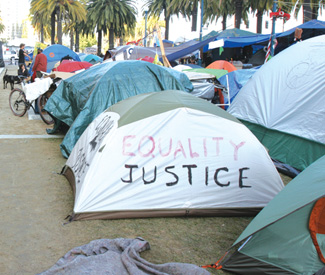
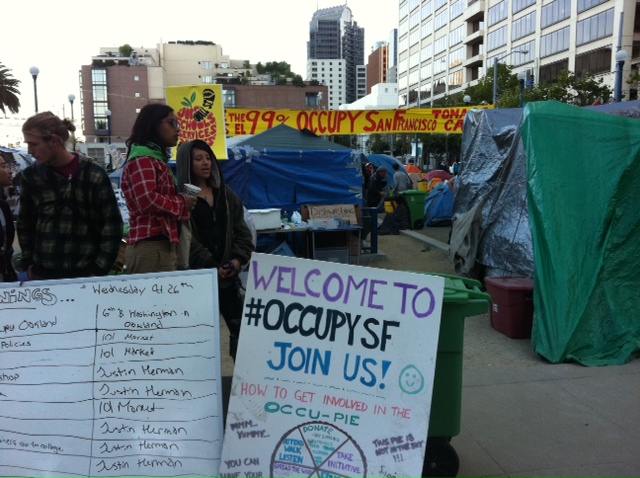
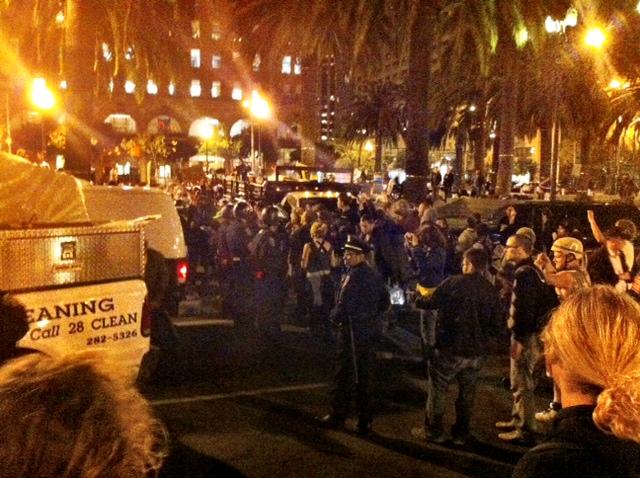
Consider the events of this week. When OccupySF’s long-standing encampment was finally removed by police and city workers, the general public barely noticed or reacted. Unlike during previous police raids, hundreds of supporters didn’t pour in to defend the camp and social media sites didn’t light up with messages of indignation and solidarity.

Why? Well it’s not because people don’t support the movement. Polls have consistently shown most people back Occupy, and even higher percentages support its basic message that the 99 percent are being screwed over by the 1 percent. Top political leaders at every level – Mayor Ed Lee, Gov. Jerry Brown, and President Barack Obama – made statements and speeches this week that echo the themes and ideas that Occupy has injected into the national dialogue.

But the tactic of occupation was only going to get us so far. It was a great way to start a conversation and demonstrate a broad discontent with this country’s inequities and plutocratic excess. Finally, the people have started to challenge those who are exploiting them, and it’s been particularly exciting to see young people fighting to reclaim their stolen futures.

That energy hasn’t dissipated, and it’s interesting to see it morphing into other campaigns, such as the recent takeovers of vacant foreclosed homes, the human rights march planned for tomorrow, and West Coast port shutdown scheduled for Monday. But I predict the crowds blockading the Port of Oakland will be a fraction of the size of the tens of thousands who took to the streets during the Oakland General Strike on Nov. 2.

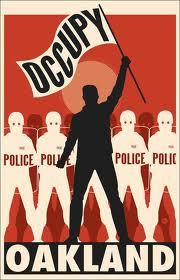
Then, people were reacting to police violently crushing Occupy Oakland’s peaceful political assembly on Oct. 25, a galvanizing event, much like the raid on Occupy Wall Street and the abusive police tactics against occupiers on the UC Berkeley and UC Davis campuses. Each example showcased the police state’s willingness to use a heavy hand against peaceful protesters, demonstrating for a global audience what an important struggle this is and what we’re up against.

Yet it was hard to summon up much indignation over this week’s raid on OccupySF, even as protesters complained about being given just five minutes to get out and having their belonging seized and destroyed. Mayor Lee had been threatening the raid for weeks and had offered the group a free new home in the Mission – an offer they probably should have taken, one that would have allowed the group to declare victory and have a base of operations throughout the winter.

But unlike my cranky, “you kids get off my lawn” colleagues in the mainstream press, who have consistently derided the movement and valued anti-camping laws over the core constitutional right to peaceably assemble to petition for a redress of grievances, I think Occupy has been extremely important and effective. My desire is to see it evolve and continue.

Mayor Lee and other city officials have praised the goals and worldview of Occupy at every turn, even as they oppose the tactic of camping. As Police Chief Greg Suhr raided OccupySF, he told reporters that “part of the 99 percent removed part of the 99 percent to give the other part of 99 percent some relief,” tipping his hat to Occupy’s basic paradigm. Gov. Brown echoed Occupy’s economic inequity language in his call for higher taxes on the rich this week.

“I’m here in Kansas to reaffirm my deep conviction that we’re greater together than we are on our own. I believe that this country succeeds when everyone gets a fair shot, when everyone does their fair share, when everyone plays by the same rules. These aren’t Democratic values or Republican values. These aren’t 1 percent values or 99 percent values. They’re American values. And we have to reclaim them,” Obama said in his big speech this week, embracing the Occupy paradigm even as he tried to transcend it. But go back and read the whole speech and you’ll see that it would have fit right in during any Occupy General Assembly, with its regular calls to tax the rich, something this movement has given him the political cover to more forcefully advocate.

So the conversation has now begun, thanks largely to this movement. But, as most supporters of Occupy already know, our elected officials won’t simply enact the reforms we need on their own. They will need to be pushed and prodded relentlessly by a restive public, so the supporters of Occupy still have a lot of work to do.

How will they do that and what will it look like? I don’t know, but after watching these smart, creative, courageous, and committed young people and their supporters change the political dynamics of this country over the last three months, I’m anxious to see what they come up with and I stand read to chronicle and support the next phase, whatever it’s called and whenever it begins.

Progressives split on bag ban, ex-cons

12

A couple of interesting votes at the Board of Supes Dec. 6. Sup. Ross Mirkarimi lost two pieces of legislation — a mandate that stores charge for bags at checkout counters and a tax credit for companies that hire ex-offenders.

The bag ban went down 7-4. Well, actually, it was continued to February, by which time Mirkarimi will be gone. Sup. Jane Kim said she wanted to see more outreach to minority businesses, and was quoted in the press saying she would support it at a future date, but I suspect the delay marks the end of the bill. Without Mirkarimi around to push it, the measure will probably just die. It’s odd because San Francisco used to be on the cutting edge of environmental issues; the bag ban is getting picked up by other cities and will probably be law all over the country in a decade.

Voting for the continuation were three supes who said they supported the “concept” — Scott Wiener, David Chiu and Kim.

The ex-offender tax credit went down 6-5 — and on this one, Sup. Malia Cohen, who is not always with the progressives but whose district has the largest number of parolees in the city, supported Mirkarimi. So did Kim, Eric Mar, and David Campos. The swing vote: Sup. John Avalos, the progressive leader in the mayor’s race and one of the most solid left votes on the board.

Avalos told me that he doesn’t support tax breaks; he’s been consistent on that, and I understand. I don’t support tax breaks, either. I don’t think they’re very effective and they cost the city money. But there are two elements that make this unusual — for one, if anyone actually used the tax credit and hired an ex-offender, the money the city would likely save by keeping that person from going back to jail would greatly exceed the amount of the tax reduction.

Besides, I was waiting to see Lee come up with an excuse to veto the bill — particularly at a time when more and more ex-offenders are going to be released in San Francisco. I know this is just petty politics and all that, but this was a tough decision involving a very unpopular group (nobody wants to be nice to former criminals) — and Lee got off easy.

The Phil Ting for Assembly campaign is under way

11

Just a few days after the race for mayor of San Francisco ended, Assessor-Recorder (and mayoral candidate) Phil Ting began his next campaign — for state Assembly.

The Westside district now represented by Fiona Ma opens up in 2012, when Ma will be termed out. And Ting was moving to set himself up as the frontrunner almost as soon as the ink had dried on on the final results from the mayoral election (where he finished a disappointing 11th, behind even Green Party candidate Terry Baum). Philting.com, which had been the official website for Phil Ting for Mayor, has been switched over to Phil Ting for state Assembly. I got an email Dec. 7 inviting me to a reception for his Assembly campaign; several prominent local politicians told me Ting had called even earlier than that to ask for support.

And he’s getting it — both state Sen. Mark Leno and Assemblymember Tom Ammiano are on his already-impressive list of endorsments.

Which is no surprise: The 12th District (which will become the 19th under the new redistricting) is the more conservative side of San Francisco, and by the standards of the state Assembly, Ting would be a pretty solid progressive. He actually understands tax policy, and he’s made a huge issue of removing the commercial property loophole from Prop. 13.

So now comes the interesting part: Who’s going to run against him?

Ting has a relatively cordial relationship with Mayor Ed Lee, and didn’t spend much time in the campaign attacking the appointed incumbent. He’s a former executive director of the Asian Law Caucus, where Lee worked in his early days as a tenant and civil-rights lawyer. There shouldn’t be any reason for the mayor or his pals to try to drum up a candidate to take on Ting … or should there?

Ting is not an enemy of the Willie Brown-Rose Pak folks. But he’s not a loyal ally, either. The most obvious conservative/pro-downtown candidate, one the mayor and his big-business pals could count on, would be Sup. Carmen Chu. I couldn’t get her on the phone, but in the past she’s been only lukewarm about running. The other strong potential candidate would be Sup Sean Elsbernd, but he told me he’s absolutely not running. “I was very interested during my first few years on the Board, but since my son was born, there’s no way I would consider it,” he said. “I am not a candidate and shouldn’t be talked about as a candidate.”

So will we see a “Run, Carmen, Run” campaign? Or will Brown and Pak think about it and realize that giving the mayor an appointment to Ting’s office might be a real advantage? Would they rather control a state Assemblymember — of the county assessor?

Stayed tuned to this one.


State of the occupations

0

news@sfbg.com, rebeccab@sfbg.com


STUDENTS TARGET THE 1 PERCENT

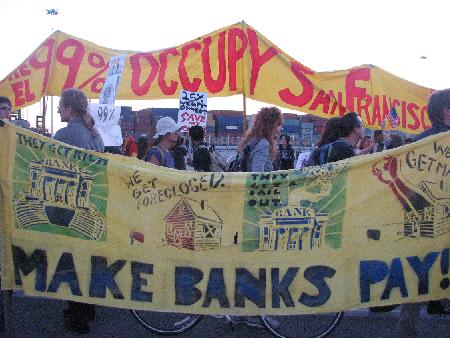
Another Occupy offshoot sprung up at San Francisco State University Dec. 1 when about 150 students attended a march and rally that culminated at Malcolm X Plaza, now the site of the San Francisco’s newest Occupy camp.

Students symbolically blocked off ATMs, wrapped Chase Bank machines in cellophane and plastered nearby Wells Fargo and Bank of America ATMs with “meet the one percent” flyers profiling wealthy University of California Trustee Monica Lozano and California State University Regent Bill Hauck.

The highlight of the action came when SF State President Robert Corrigan arrived on the scene. The group was using the people’s mic to read a letter addressed to Corrigan, penned by the Occupy SF State General Assembly, demanding that he write two letters. One should be directed to the school’s chancellor and CSU Board of Trustees, “urging them to repeal the 9 percent tuition fee increase” that the board passed Nov. 16, and another should go to “the presidents of every other CSU campus asking them to also contact the chancellor and Board of Trustees regarding a repeal of the 9 percent tuition fee increase.”

Corrigan listened, then participated in a frank question-and-answer session with protesters, urging them to contact Sacramento legislators. Yet he refused to write those letters or declare support for Occupy SF State.

Afterwards, the students returned to Malcolm X Plaza and erected about 15 tents, which organizers said would contain “books, food, and homework help” along with providing shelter for sleeping protesters.


OCCUPY LA MISIÓN

In the Mission, where city officials have been encouraging OccupySF to relocate from its current home in the Financial District, a separate new Occupy effort could be underway.

Organizer Enrique Del Valle says he and other organizers have been distributing flyers and talking to people and organizations throughout the neighborhood. “We’re getting it together to have a General Assembly,” he told us.

The effort is unrelated to the OccupySF General Assembly’s Nov. 29 decision to decline the city’s offer to utilize an abandoned lot at 1950 Mission Street, he added. Before the city made that offer, Del Valle, a community volunteer with connections with many Mission groups, says he was already working on forming a neighborhood occupation.

If Occupy SF had set up shop in the space offered by the city, “We would have worked with them,” he explained, “but set up somewhere else.”

Meanwhile, Mayor Ed Lee and OccupySF are still waiting for one another’s next moves. On the evening of Dec. 1, when San Francisco Police officers surrounded the camp in steel barricades, protesters felt another raid was underway. But they resisted and took down some barricades, causing police to suddenly back down and remove the rest.

“They’ve just been mindfucking us,” OccupySF protester Markus Destin told us. “As soon as they spend all that money breaking us down, we’ll just come back in a week and re-encamp.”

Mayoral Press Secretary Christine Falvey said Lee wasn’t aware OccupySF rejected his offer: “We haven’t heard back one way or another from the group. The offer is still out there and the group has all of the information they need from us. We are awaiting a decision. Mayor Lee has made it very clear to the group that he supports their first amendment rights and their right to assemble, but that overnight camping at Justin Herman Plaza is not an option for the long term because of the health and safety problems it creates.”


OCCUPY AGAINST FORECLOSURE

Community members rallied outside a foreclosed Visitacion Valley home Dec. 1 before moving their protest to the offices of the company that purchased the property.

At 11 a.m., dozens gathered in front of the residence where 75-year-old Josephine Tolbert had lived for nearly 40 years. A day earlier, Tolbert had arrived home with three young grandchildren in tow to find her locks changed. Organizers say the evicted resident needs to access the house to retrieve food and medicine.

The crowd — which included neighbors, friends, and members of Alliance of Californians for Community Empowerment (ACCE), Service Employees International Union (SEIU), OccupySF, and Occupy the Hood — demanded that Tolbert be let back in. According to Bayview resident and self-proclaimed “foreclosure fighter” Vivian Richardson, “They would not let her in to get food, diapers, or her diabetes medicine.”

Tolbert had run a daycare business from her home for 20 years. One of her regular clients, a mother with two young children, arrived during the rally. She was surprised to find that Tolbert was locked out of her home and unable to care for her children that day.

“I want to get in my home so I can resume my business,” Tolbert said. “That’s my occupation there, I don’t have any other way of caring for myself.”

The group then headed to the offices of True Compass Loan Services, LLC, the new owners of Tolbert’s home. About 20 supporters gathered at the Ocean Ave office, where ACCE organizer Grace Martinez singled out True Compass owner Ashok Gujral, who owns a $2.75 million home and multiple restaurants, according to a press release from a group calling itself the Foreclosure Fighters.

“The man is worth $10 million, and he has a bunch of limited liability companies,” said Martinez. “Everyone has been shocked at how this man could do this, he knows she is a senior.”

According to Martinez, Gujral personally refused to let Tolbert into her home Nov. 30. He and others from the company “don’t want her in there because they say she’ll refuse to leave,” Martinez added. Calls to Gujral’s office were referred to attorney Jak Marques, who did not return Guardian requests for comment.

A True Compass representative informed protesters “there’s no one here to talk to you,” then swiftly shut the door. But when a few protesters went around through a side entrance and let everyone else in, the group took their protest to the hallway inside.

They remained there for almost an hour, chanting, pounding rhythmically on the walls, and flooding the office on the other side of a locked door with phone calls, demanding Tolbert be allowed to return to her home to retrieve her medicine and belongings.

Five police officers arrived almost immediately as protesters entered company offices. One explained to the protesters that if they didn’t leave, they would face arrest for trespassing. A heated but measured back-and-forth ensued, in which protesters insisted that if Tolbert was his mother, the officer would feel differently. The officer, Lieutenant C. Johnson, responded, “If it was my mother — I don’t know. I have a house for my mother. But I feel for Josephine, and for the millions of other Americans in the same situation.”

Martinez quieted groans from protesters, replying, “You’re part of the 99 percent, and we’re not going to shoot the messenger.”

Organizers conferred and decided to leave the building voluntarily. Sergeant R. Young, who was also at the scene, told the Guardian, “It’s heartbreaking to do this. Their freedom of speech is a constitutional right that we take a sworn oath to protect.”


THE SEEDS OF A NEW AMERICA?

Does the Occupy movement signify a new beginning for America? Is history repeating itself? Is violence inevitable? These were some of the big questions pondered by a handful of prominent Bay Area writers, thinkers, artists, and activists Dec. 1 during a panel discussion organized by Salon.com.

Dan Siegel, who most recently made headlines for resigning as Oakland Mayor Jean Quan’s legal advisor because he disagreed with her decision to order a police raid of the Occupy Oakland encampment, was a panelist. “The perspective of Mayor Quan and other mayors, besides reflecting the 1 percent, reflects a misguided paradigm,” Siegel said. “The nation’s clearly in an economic crisis that this country has not seen since the 1930s. The mayors should be on the side of the 99 percent. They ought not be the lapdogs of Wall Street.”

Renowned author Rebecca Solnit also participated in the panel discussion. Asked if she thought Occupy symbolized a new beginning, she reflected on the past. “Huge mistakes were made on the left,” in past social movements, she said. “It was supposed to be the revolution, but the women were still expected to make the coffee.” She offered that Occupy represented an evolved manifestation that had benefitted from lessons learned over the years.

“It’s a culmination of decades of refining, searching, and building coalitions,” Solnit said. “It’s the beginning in the sense that summer’s the beginning. We’re reaping the fruit of … what’s been imagined.”

It’s also provided a spark for campus-based organizing. “The Occupy movement has given a tremendous amount of wind to the sails of the student movement and had a consciousness-raising aspect,” said Matt Haney, executive director of the University of California Student Association. “Now they are prepared in a new way to join all of those other folks who are also suffering.”

A key question put to panelists was whether Occupy ought to consider running candidates for office. In response, panelist Melanie Cervantes, an artist and activist, got to the heart of the issue. “What is political power? Is it just representation?” she asked.

Cervantes pointed out that autonomous social movements in Latin America have given rise to leftist political leaders, and she spoke of the past successes of mass-based organizations. “There were things that preceded us generationally, and they worked,” she pointed out. “There’s a lot of different ways people are experienced in trying to change things.”

Panelist Peter Coyote, an actor, activist, and founder of a radical underground group called The Diggers, offered an analogy in response to the idea of Occupy running candidates for office. “If you take a healthy goldfish and throw it into polluted water, it’s gonna get sick,” he said.

Solnit framed her answer as an analogy, too. “We live in a really crummy house with roaches and a leaky roof … Occupy is saying, let’s try to build a better house,” she said. “Our demand is for a better world, isn’t that obvious? We’re building a whole new political vocabulary, a whole new sense of possibility.”

As to the question of whether violence is inevitable as the movement continues to unfold, some panelists discussed nonviolence as a protest tactic, while others focused on the violent behavior of law enforcement officers against protesters. “You don’t hear students talk about using violence,” Haney said. “It’s more like how do we deal with violence that’s being used against us?”

Siegel stressed that the protests ought to be disruptive, yet nonviolent. “The question for our society is, who has the power?” he said. “At the end of the day, we live in a nation state, and people control things. And if they continue to control things, we’re screwed.”


WEST COAST PORT BLOCKADE

Occupy Oakland organizers have been engaged in planning yet another shutdown of the Port of Oakland on Dec. 12, which will coincide with attempts to shut down West Coast ports in San Diego, Los Angeles, Portland, Seattle, Longview, Tacoma, and Anchorage. “On December 12, the Occupy movements in different cities will … effectively shutdown the hubs of commerce, in the same fashion that Occupy Oakland shut down the Port of Oakland on November 2nd, the day of our general strike,” according to a Call to Action on WestCoastPortShutdown.org. “The message to you from Occupy Oakland in the face of police raids and continued disruptions of workers lives by the 1 percent is the following: The Occupy movement will strike back and rise again! We will blockade all of the West Coast Ports on December 12th in solidarity with longshoremen, port workers and truckers in their struggle against the 1 percent!” Steven T. Jones contributed to this report.


Editor’s notes

0

tredmond@sfbg.com

The private sector that Republicans see as our economic savior has been creating jobs. Not a lot, a few hundred thousand a month, but some. And yet the unemployment rate remains stubbornly high.

There’s a reason for that, one politicians from San Francisco to Washington D.C. don’t want to talk about. But the New York Times put it nicely in a Dec. 5 editorial:

“While the private sector has been adding jobs since the end of 2009, more than half a million government positions have been lost since the recession…”

“The cutbacks hurt more than just services. As Timothy Williams of the Times reported last week, they hit black workers particularly hard. Millions of African Americans — one in five who are employed — have entered the middle class through government employment, and they tend to make 25 percent more than other black workers. Now tens of thousands are leaving both their jobs and the middle class.”

Remember: Most of the biggest employers in this city are not corporations; they’re government agencies. The City and County of San Francisco, the University of California, the State of California, the United States Postal Service, City College and the San Francisco Unified School District drive the local economy more than any one private company. Between them, those public-sector operations employ more than 60,000 people. The largest single private employer, Wells Fargo, has fewer than one sixth of that number.

Most of the those public-sector jobs are unionized and offer decent benefits. They are such an important part of the city’s economic development future that it’s impossible to talk about jobs in San Francisco unless you start the conversation with the public sector.

Mayor Ed Lee is about to enter negotiations with unions representing 24,000 city employees. His office is already indicating that cost savings will be a big part of the discussion. I know there are cost savings out there — you can’t spend $2 billion on payroll and not have some waste somewhere in the package.

But if he’s serious about his campaign mantra — jobs, jobs, jobs — I hope he remembers what the Republicans don’t: Government jobs count, too.

A new name in District 5

73

There’s a new name popping up in the cattle call that is the District Five supervisorial appointment. He’s not terribly well known in city political circles (his chief claim to local fame is serving on the Library Commission), but he’s got a powerful patron: U.S. Senator Dianne Feinstein.

His name is Michael Breyer. Yes, from that Breyer family.

In a Nov 30 letter to Mayor Ed Lee, Feinstein lauds Breyer and says he has her endorsement for the job. You can read the letter here (pdf).

Feinstein notes that Breyer’s grandfather, Irving, was chief counsel for the San Francisco Unified School District and that his aunt was a president of SEIU. She doesn’t mention his closer, and better-known, political connections. Nor does she mention that his uncle was a partner in a law firm that was once among the most politically connected in the city, run by William Coblentz, who when Feinstein was mayor was routinely considered one of the two or three most powerful people in San Francisco.

Among the great qualities the senator sees in Michael Breyer? He can raise money. “He can count on financial support from the high tech community and others,” Feinstein notes.

Would Ed Lee seriously consider someone who has this little local political experience and no real history of activism in the district — but really, really strong family political ties? I can’t imagine it. But Senator Feinstein isn’t doing this just for fun.

Homeless families still waiting for a meeting … and housing

San Francisco Mayor Ed Lee still has not met with homeless parents organized by the Coalition on Homelessness to discuss their proposed solutions to combat the growing problem of youth homelessness. Nor has the mayor’s office responded to multiple Guardian phone calls inquiring why a meeting hasn’t been scheduled.

Homeless parents organized by the Coalition entered City Hall last Wednesday to raise awareness about a growing problem of San Francisco families lacking a permanent home, and to request a meeting with mayor, whom advocates first contacted Oct. 26.

Coalition on Homeless executive director Jennifer Friedenbach said the mayor’s office had offered to schedule a meeting with a mayoral representative, but not with Lee. “Why would we meet with a representative?” she asked. “We want a meeting with the mayor himself. It should be important for the mayor to meet with parents in a crisis.”

As the Guardian reported last week, the number of homeless families on shelter waitlists citywide has risen to an unprecedented high of 267, while the number of homeless students in public schools identified by San Francisco Unified School District stands at a high of 2,167. Both figures suggest homelessness is on the rise in a city where rents are well above average and the recession has given rise to job loss, evictions, and foreclosures. A nationwide Occupy Our Homes day of action scheduled for today, Dec. 6, is meant to draw attention to tenant evictions and homeowners losing their properties to bank foreclosure.

Part of the problem facing newly homeless families in San Francisco is the lack of availability in public housing and other housing assistance programs such as Section 8 rental assistance vouchers. The waitlist for public housing units in San Francisco stands at between 24,000 and 25,000 — enough would-be tenants to fill the roughly 6,500 units in the city’s public housing system nearly four times over. The San Francisco Housing Authority closed its waitlist for public housing several years ago. The waitlist for Section 8, a separate program administered by the federal government, is also closed.

“Why do waiting lists close? The demand for low-income housing so far outweighs the available vacancy,” said San Francisco Housing Authority (SFHA) spokesperson Rose Dennis. “A number of housing authorities have had to close their waitlists, because we cannot serve the people who are not on the waitlist right now. This is not unique to San Francisco.”

Nevertheless, advocates with the Coalition on Homelessness say part of their strategy is to pressure the mayor to revamp units sitting empty in housing authority properties so they can be used for housing.

Asked about this, Dennis responded that there are relatively few vacancies, and that all vacant units are already in the process of being prepared for new tenants — some of whom have already been identified and promised a unit, and others who are part of a pool of applicants undergoing a screening and selection process.

Housing Rights Committee executive director Sara Shortt, however, told the Guardian public housing tenants she’s worked with have long observed boarded-up units on SFHA properties. She added that they’ve raised concerns about the tendency for empty units to attract rodents, graffiti, or squatters engaged in drug sales or use, which can lead to violence.

Friedenbach said she’d heard from multiple people seeking public housing units who said they’d been promised a unit only to experience delay after delay, for weeks on end. Dennis said it takes SFHA between one and 45 days to move a tenant into a unit once the housing has become available, depending on the status of the tenant.

In addition to the conflicting accounts, another complicating factor is that the actual number of vacancies in housing authority property seems difficult to pin down. Dennis told the Guardian that the occupancy rate in SFHA property typically stands at around 93 percent. Since there are roughly 6,500 units total, this would imply that there are about 450 vacant units. Yet Dennis also stressed that the number of vacant units is always around 225, give or take, and has hovered consistently around that level without any dramatic spikes in vacancy.

A SFHA report to its federal parent agency, the Housing and Urban Development (HUD), which housing advocates received as part of a Freedom of Information request, listed a total of 847 vacant public housing units as of May 2011. That’s nearly twice as high as a 7 percent vacancy rate, and almost four times as high as the 225 vacant units Dennis said the authority consistently has in its system.

“That’s not a vacancy rate,” Dennis explained after we sent her a copy of the document. “That’s a cumulative, historic count that HUD has that is different from day-to-day management. These are not numbers that accurately represent what you would go out and see on a site. These numbers have a lot of other aspects to them.” She added, “The numbers that I gave you are accurate and true.”

The Guardian has placed a call to the Human Services Agency, as well, in hopes of sorting out some of these issues. We’ll update this post if we hear back.

Sup. Elsbernd ducks more Impertinent Questions

4

Well, I am sad to report that my neighborhood supervisor, Sean Elsbernd, has once again refused to answer my Impertinent Questions and to say if he voted for Ed Lee for mayor. Perhaps I will tell you, he says, perhaps not and he chose to perhaps not. He has thus refused to shed light on his role in one of the most fateful nominations in San Francisco history.

 Here’s the latest version of the almost famous Que Syrah correspondence between Elsbernd and me on these critical Impertinent Questions. (As attentive readers of this blog know, I have been trying for months to get Elsbernd to meet me to talk about these questions at Que Syrah, a nifty little wine bar in the West Portal area of Elsbernd’s district. I am still trying.)

 When Willie Brown, Rose Pak, and the downtown gang were plotting their move  to outfox the progressives in City Hall in January  and install Ed Lee as the interim mayor, they chose Sean Elsbernd to take the lead and nominate Lee for this crucial job.

 He intoned at the time and later in writing to me that he was nominating Lee only on condition that Lee would serve as an interim mayor to fulfill the vacancy created by then Mayor Newsom who was off to Sacramento as the newly elected lieutenant governor. Lee, Elsbernd emphasized, thumping the lectern, would not run for mayor.

 Well, the Guardian and many progressives and I said at the time that this was just the Willie and Rose play, to get Lee in as interim mayor and then roll him over to run for mayor in the fall with the major advantage of incumbency.

 And so when Lee as we expected changed his mind and ran for mayor, Elsbernd was left in the position of being a key player in the plot to put Lee into the mayor’s office under false pretenses. And of course in the process he would ace out two more qualified candidates, former Mayor Art Agnos, and retiring sheriff Mike Hennessey.. Both were ready to serve as interim mayor and both pledged they would not run for mayor and most important neither would operate as enablers for Willie, Rose, and their undisclosed clients. (Willie, for starters, is on a  $200,000 plus a year retainer for PG&E, according to PG&E filings with the California Public Utilities Commission.)

 When the tide of sleaze started rising in the mayor’s office and Willie, Rose, and the gang were pounding on Lee to run, I asked Elsbernd another Impertinent Question: Would he have nominated Lee if he knew Lee was going to reverse field and run for mayor?

Elsbernd replied that he had not endorsed anyone, but that “I have been most attracted to the candidacies of City Attorney Dennis Herrera and former Supervisors Alioto-Pier and Bevan Dufty.” He said that these three have the “right combination of qualifications, experience, intelligence, skills and integrity to serve as mayor. Should Mayor Lee run for election, I would only consider endorsing his effort under one circumstance—if, and only if, I was convinced that without his candidacy, Sen. Leland Yee would be elected. That is, if I see that no one else can beat Sen, Yee other than Mayor Lee, then I would support a Mayor Lee campaign. At this point, I’m not convinced of that—I still think any one of the three I mentioned above could beat Sen.Yee.”

Just before election day when Lee was running solidly ahead in the polls, I posed more Impertinent Questions to Elsbernd: who did he support for mayor and why? He replied that he had not yet voted and had not endorsed a candidate and then stated, “Talk to me on November 9 and perhaps I’ll tell you who I voted for. Rest assured, the Bay Guardian’s endorsements will certainly influence my decision-making process.”

And again,  after Lee won handily thanks in large part to the decisive advantage that Elsbernd helped give him, I took Elsbernd up on his promises and emailed him more Impertinent Questions: Who  did he vote for and why? He ducked again and asked me to read his “original email” and to note the significance of the word “perhaps.”

Perhaps he would tell me, perhaps he wouldn’t tell me. He chose not to tell me, and the rest of his constituents,  why he made the nomination as a “neighborhood” supervisor  that helped return Willie, Rose, and the downtown gang to power in City Hall.

His explanation was classic Elsberndese and I quote it in full in all of its elegance.

”Another e-mail?  Another entry in your blog? And now a deadline?  At what point am I going to start receiving a byline in the “Guardian?” I am not going to share with you and your readers for whom I voted.  I’ll keep that one between me and my ballot.  I voted for 3 candidates who I believed had integrity, intelligence , and some grasp of the daunting fiscal challenges facing the State and the City.

“Am I happy with the results?  Again, I’m going to deflect that question because I have learned in the short time I’ve been around here, that focussing on wins and losses of past elections can take you down a rabbit hole from which you’ll never recover.  Rather, the most pragmatic thing I can do for my constituents, which is, after all, what I am here to do, is to recognize the result, accept it, and move forward with it.  Ed Lee is now San Francisco’s Mayor-elect, and I am very excited about being able to work with him during my remaining 13 months in office.  He and I worked extremely well together in developing Proposition C, which the voters overwhelmingly endorsed (and, yes, thank you to the Guardian for your endorsement – you actually got a few right this year).

“We have had some policy disagreements (e.g.  Proposition B), but I have always found him to be open to dialogue, extremely deliberate and thoughtful, and, most importantly, honest.  When we have disagreed, he has explained why and has done so with a logical argument.  While that may sound simple, I can assure you, that is a rare characteristic in this building and it is one I very much appreciate. Have fun parsing this e-mail apart.”

Final Impertinent Questions: If Elsbernd really finds Lee “open to dialogue, extremely deliberate and thoughtful and most importantly honest” and Lee explains his disagreements with Elsbernd with “a logical argument,” how in the world does Elsbernd explain the months of lies and deceptions by Lee before he decided, gosh, golly, gee, that he changed his mind and  was running for mayor after all? How does Elsbernd explain how the sleaze continues to rise in Lee’s office?  How does Elsbernd explain why, as a “neighborhood” supervisor, that he has once again followed the Willie Brown/RosePak/downtown gang agenda by introducing a June 2012 charter amendment to repeal rank choice voting, with public financing and perhaps even district elections in his gun sights? Wasn’t this all part of the master plan to gut progressive measures to level the playing field on local  elections?

Sean? Sean? Let’s talk about all of this this over flights of the wondrous wines from small, locally owned wineries and the Barcelona -style tapas served up  at Que Syrah. To that end, I will keep sending you the notices of Que Syrah special events. B3


Lt. Gov. Press Release

2

We used to call Gavin Newsom Mayor Press Release because he was always ready to go before the cameras and announce some bold plan that never amounted to anything. And now he’s at it again.

Newsom — to his credit, I must admit — was the only member of the Board of Regents who didn’t flee when the protesters arrived. Instead, he sat down with some of them and announced that “you have my support.”

In fact, he’s happy to denounce the cuts to higher education:

In an interview Thursday, Newsom said he was deeply alarmed by what he called the dismantling of the UC and CSU systems and gently criticized the budget deal struck by Gov. Jerry Brown last year that included steep cuts to financing for both institutions.

“You can’t cut $650 million from both systems and tell me you value the system,” he said. “I believe we could’ve avoided a substantial portion of these cuts.”

Yes: you could have avoided those cuts by raising taxes. But that’s something Newsom refused to do as mayor. He mentions nothing on his website about tax increases on the rich. He said nothing in his campaign about taxes. And unless I’ve missed something, he hasn’t endorsed any of the possible tax measures that might be headed for the November ballot.

So he’s going to go after the student vote in his next campaign — but without alienating big corporate supporters who don’t want to pay more taxes. And with that approach, nothing will happen to improve higher education in the state.

California, meet Lt. Gov. Press Release.

PS: I called and emailed Newsom’s media person, Francisco Castillo, to see if the Lite Gov was going to support any of the November tax measures. If they get back to me, I’ll let you know.

More backroom policy talks with the California Public Utilities Commission

On Dec. 8 and 9, high-ranking state government officials will attend a private conference with executives from Pacific Gas & Electric Co. (PG&E), Chevron, AECOM, and other major energy industry players at Cavallo Point, a luxury resort in Marin County to talk about distributed generation, a decentralized system for renewable power. It’s a gathering of top governmental officials and industry leaders to talk about policy issues with far-reaching effects on California’s energy future, but members of the general public are not invited.

As officials pack their bags for the conference at the plush resort, California Sen. Leland Yee is preparing two separate pieces of legislation designed to promote transparency within the California Public Utilities Commission (CPUC) and to make it harder for energy company executives to transition seamlessly into posts at the CPUC, the governing body that regulates utilities.

The conference is being organized by the California Foundation for the Environment and the Economy (CFEE), a nonprofit funded by investor-owned utilities and other corporations that wield tremendous influence in the Bay Area.

The Guardian spotlighted CFEE in an article about California Public Utilities Commission (CPUC) President Michael Peevey, who regularly participates in educational travel excursions funded indirectly by the companies his commission oversees.

When CFEE spokesperson PJ Johnston was interviewed for that article, he justified CFEE events by saying, “The idea for us was that it made sense to have someplace where it was nonconfrontational to engage in policy, work-type discussions,” and added they’re “all about policy, on the 30,000-foot level.”

Peevey will be attending this conference, according to a list of participants posted on CFEE’s website. So will PUC commissioners Mark Ferron, Michael Florio, and Nancy Ryan. By press time, the CPUC had not returned calls seeking comment about why commissioners are participating.

More than a dozen California senators and assembly members are listed as conference participants, as are the director and deputy director of Gov. Jerry Brown’s Office of Planning and Research, Ken Alex and Wade Crowfoot. (Crowfoot previously served in former Mayor Gavin Newsom’s administration as an environmental advisor. Newsom now serves at the state’s lieutenant governor.) Executives from Shell Energy North America, the Alliance of Automobile Manufacturers, Southern California Edison, and other heavy hitters in the industry will attend the conference too.

The conference agenda features educational sessions on distributed generation and state renewable energy goals. Several environmental and consumer advocacy groups will be present as well.

Mark Toney, executive director of The Utility Reform Network (TURN), a consumer advocacy group, also plans to attend. “Events like this give the utility industry and energy regulators an opportunity to have policy discussions and to influence policy decisions outside of the political process. It’s a privileged space,” Toney acknowledged. “We don’t think this is a good way to make policy.”

Yet he said advocacy groups like his own face a dilemma when deciding whether to participate in such events. “On one hand, we could decide we want to have nothing to do with it. But if TURN isn’t represented, then the view of ratepayers and consumers won’t be represented by anybody.” He stressed that while TURN attends daylong conferences hosted by CFEE in order to gain access and hopefully have a positive influence within that priveleged space, the group does not participate in travel excursions organized by the organization, which have drawn controversy in the past. “It’s kind of a judgment call,” he added.

Closed-door, backroom policy discussions aren’t the only CPUC transparency problem drawing scrutiny lately. Recent press reports have spotlighted instances of the CPUC denying public access to safety reports, a highly sensitive issue given the fatal pipeline explosion that destroyed a neighborhood in San Bruno last year.

On Nov. 29, Sen. Yee announced he would introduce legislation in early 2012 to subject the CPUC to the California Public Records Act, by stripping away provisions that allow the commission to block the release of information. It would place the body on the same footing as other state agencies with regards to information sharing.

“If you want anything out of the PUC, it takes an affirmative vote of the commission,” explained Adam Keigwin, Yee’s legislative aide. Secretary of State and former Assembly Member Debra Bowen initiated a similar push for transparency at the CPUC in 2006, but the effort did not go anywhere. On Nov. 30, Yee sent a letter to Peevey, the CPUC president, asking for the results of a study on transparency issues that the commission was supposed to undertake nearly six years ago when Bowen was pushing for the bill.

Keigwin added that Yee is also looking at legislation that would bar utility executives from serving on the PUC for a certain length of time, so as to prevent undue influence.

Public health and Occupy

8

By Sasha J. Cuttler

OPINION On November 17, Mayor Ed Lee’s administration declared OccupySF a "public health nuisance." The mayor and other city officials are using this declaration as a justification to evict the OccupySF camps.

But rather than being a nuisance, the Occupy camps are reclaiming public space and voices while making health disparities more visible. Dozens of health organizations are making statements of solidarity, including the American Public Health Association, with more than 30,000 members, which recently passed a resolution with overwhelming support of the Occupy movement.

San Francisco officials say that overcrowding and inadequate sanitation are causing a threat to public health and safety. But as noted by public health nurse Martha Hawthorne, "When is the last time city department heads have left their offices and taken a walk through the Tenderloin, just minutes away from the San Francisco Occupy site? Smells of human waste? Evidence of street drug use? Garbage on the street? It’s there and has been for years, the inevitable consequence of the lack of affordable housing and years of cutbacks to mental health and substance abuse funding in San Francisco."

As far as overcrowding of tents, Hawthorne goes on to note: "Overcrowding? Go anywhere in the city with a public health nurse. You’ll see multiple families living in one flat, sharing a kitchen, having their own tiny room if they are lucky and can afford it. People sleep in shifts and live elbow-to-elbow in garages, basements, closets, old office spaces — and they are the ones we nurses can see, because at least they have an address. "

The one percent is attempting to maintain control by blaming the victim. Rather than blame the marginalized for their misery, the Occupy movement opens an opportunity for dialogue and mass mobilization while providing tangible assistance to those in need of help right now. Homeless and mentally ill individuals have been receiving food and shelter at Occupy encampments everywhere.

The Occupy movement is making visible the public health consequences of insatiable corporate greed. Income inequality is closely paralleled, unsurprisingly, by poorer health outcomes. The rich are not only getting richer, they are living longer, healthier lives than the majority of us in the 99 percent.

Despite months of Occupy experience world-wide, the only evidence of ill health and injury directly related to the camps can be found in the hundreds of nonviolent activists exposed to clouds of tear gas, fountains of pepper spray, myriads of beatings, and volleys of rubber bullets. These incidents of state-sponsored violence can cause lasting health impacts on the individuals who are exercising their right to free speech and assembly.

We can do better than this. We need to use this gathering as a reminder that health care is a human right and do everything in our power to help, not hinder, the populations we serve.

Like thousands of other public health workers, I believe that the Occupy movement is creating an incredible opportunity that needs to be protected and expanded. Public health does need to be protected — and one of the best ways is through engagement with the Occupy movement, not through its eviction. 2

Sasha J. Cuttler, R.N., Ph.D, is a nurse and SEIU Local 1021 activist

The problem of the UC police

0

EDITORIAL Twenty years from now, when people look back on the Occupy movement, one of the indelible images will be the video of the University of California police officer casually dousing a group of peaceful, seated students in Davis with pepper spray. It’s a video that’s been seen millions of times around the world. It reflects a serious problem not just with one officer but with the way officials at all levels have responded to the protests — and with the way institutional police forces operate in this state.

In the video, a group of students involved in the OccupyUC movement are seated on the ground with arms linked. Lt. John Pike walks up and down the row, indiscriminately shooting the orange spray — which causes severe pain and breathing problems — over the students, who make no move to resist. It’s horrifying and stunning, the sort of thing that you wouldn’t believe unless you saw it yourself.

The Davis chancellor, Linda Katehi, has been reeling from the incident and is facing calls for her resignation. Pike and the chief of the U.C. Davis police have been put on administrative leave pending an investigation.

But now Assemblymember Tom Ammiano of San Francisco wants to go a step further — he wants to hold hearings in Sacramento not just on this incident but on how police agencies across the state have dealt with mostly nonviolent protesters. He’s absolutely right — and his hearings should also raise a critical question: Why does the University of California need its own armed police force?

The problems with the police at Davis mirror problems with the behavior of the UC Berkeley police — which mirror problems with the BART police. And all of them stem from a central problem: These little police fiefdoms have poor supervision, poor training and limited civilian oversight.

The chancellor of UC Davis doesn’t know anything about running a police department; she’s an electrical engineer and an academic. If she resigns, she’ll be replaced by another academician who knows nothing about law enforcement. And if the UC police misbehave, where do people go to complain? There’s no independent auditor, no office of citizen complaints.

If the Oakland police ran rampant — and they have been known to do exactly that — at least the elected mayor can be held accountable. Same for any city that has a municipal force. But when campus and transit security operations turn into armed paramilitary agencies, it’s a recipe for trouble.

At the very least, the UC police — like the BART police — need an independent oversight agency to handle complaints. But it might be time to discuss whether campuses can best be protected with unarmed security guards supported by local municipal police. The University of California will never take that step on its own, so the state Legislature needs to evaluate whether lawmakers should force the issue.

Millionaires eyeing Potrero Hill

60

I hate to harp on this (well, no I don’t) but when people tell me that we don’t have to worry so much about gentrification these days, that we’re living in a different world than the days of the dot-com boom, I have to wonder: Am I the only one reading the business pages?

Because in the real world of San Francisco business, the real-estate boom is on and housing prices — particularly in the southeast part of the city — are about to start soaring again.

In fact, according to the Chron, the market is already flying high — and dealing with the influx of new wealth and the continuing change in the demographics of the city will be very much a serious issue for Mayor Lee over the next year:

ZipRealty just completed a study on the millennial home buyer, pointing out that this generation, born after 1982,  is the largest in American history, larger even than the Baby Boomer generation. To these buyers, walkability and a vibrant urban community are huge draws in a home purchase. The ZipRealty study seems confirmed by this recent mini-boom in neighborhoods close to SoMa’s flourishing tech industry: newly minted millionaires in their 20s and 30s have the buying power to drive prices up.

Want proof? We’ve got it. The median price of a single-family home in San Francisco County was $745,000 in October, up $10K from October of 2010. In the neighborhoods in question though, the increase is more striking. In Noe Valley this October, the average price-per-square-foot was up 5% from last year for the third month in a row; in SoMa, up 11%; in eastern Potrero Hill, up 16%.

So: When Zynga goes public in a few months, a whole lot of young millionaires will want to buy houses in Potrero Hill. Dogpatch, and the southern end of SOMA. Oh, and the Mission. Rents will go way up. Housing prices will go even further beyond the level that ordinary, non-millionaire working people can afford.

I’m happy for all the Zyngites, and I’m glad the company is here in SF and generating economic activity. But one of the lessons of the dot-com boom is that the city, as a matter of policy, has to protect existing neighborhoods and residents (and existing industrial blue-collar businesses and jobs) from displacement. Otherwise the horrors of the late 1990s will start creeping back.


Guardian editorial: The problem of U.C. police

7

GUARDIAN EDITORIAL Twenty years from now, when people look back on the Occupy movement, one of the indelible images will be the video of the University of California police officer casually dousing a group of peaceful, seated students in Davis with pepper spray. It’s a video that’s been seen millions of times around the world. It reflects a serious problem not just with one officer but with the way officials at all levels have responded to the protests — and with the way institutional police forces operate in this state.

In the video, a group of students involved in the OccupyUC movement are seated on the ground with arms linked. Lt. John Pike walks up and down the row, indiscriminately shooting the orange spray — which causes severe pain and breathing problems — over the students, who make no move to resist. It’s horrifying and stunning, the sort of thing that you wouldn’t believe unless you saw it yourself.

The Davis chancellor, Linda Katehi, has been reeling from the incident and is facing calls for her resignation. Pike and the chief of the U.C. Davis police have been put on administrative leave pending an investigation.

But now Assemblymember Tom Ammiano of San Francisco told us he  wants to go a step further — he  he plans  to hold hearings in Sacramento not just on this incident but on how police agencies across the state have dealt with mostly nonviolent protesters. He’s absolutely right — and his hearings should also raise a critical question: Why does the University of California need its own armed police force?

The problems with the police at Davis mirror problems with the behavior of the U.C. Berkeley police — which mirror problems with the BART police. And all of them stem from a central problem: These little police fiefdoms have poor supervision, poor training,  and limited civilian oversight.

The chancellor of U.C. Davis doesn’t know anything about running a police department; she’s an electrical engineer and an academic. If she resigns, she’ll be replaced by another academician who knows nothing about law enforcement. And if the U.C. police misbehave, where do people go to complain? There’s no independent auditor, no office of citizen complaints.

If the Oakland police ran rampant — and they have been known to do exactly that — at least the elected mayor can be held accountable. Same for any city that has a municipal force. But when campus and transit security operations turn into armed paramilitary agencies, it’s a recipe for trouble.

At the very least, the U.C. police — like the BART police — need an independent oversight agency to handle complaints. But it might be time to discuss whether campuses can best be protected with unarmed security guards supported by local municipal police. The University of California will never take that step on its own, so the state Legislature needs to evaluate whether lawmakers should force the issue.

Postscript: STOP SHOOTING STUDENTS:  The real problem for U.C. Davis’s Kotehi and other U.C. chancellors was illustrated by  this classic J’Accuse open letter by Nathan Brown,  U.C/Davis.assistant professor in the Department of English.

Occupy standoffs continue as poll finds public support for the movement

11

As OccupyOakland moves to reoccupy Frank Ogawa/Oscar Grant Plaza today and the burgeoning OccupySF encampment braces for another long-threatened raid by police, a new Field Poll finds that about half of registered California voters identify with the Occupy movement and support its goals, which include taxing the rich and limiting the ability of large corporations to corrupt the political and economic systems.

As the San Francisco Chronicle reports, 46 percent of respondants said they identified with the Occupy movement and 58 percent agree with the cause that prompted it, compared with 32 percent who say they disagree with it. Unsurprisingly, those on the left were more likely to support Occupy while those on the right were more likely to oppose it. A previous Field Poll at the height of the right-wing Tea Party movement found it had only about half as much support as Occupy now enjoys.

Still, as it enters its third month and winter descends on the encampments, Occupy faces myriad challenges. In San Francisco, the mainstream media — particularly curdmugeonly Chronicle columnist CW Nevius — has regularly highlighted conflicts and other conditions in the camps and pushed Mayor Ed Lee to follow-through on his threats to clear the tents from Justin Herman/Bradley Manning Plaza. Rumors abound that a raid could come on Wednesday night, when SFPD beefs up its staffing for training exercises.

In Oakland, the site of some of the most violent police crackdowns on Occupy encampments, OccupyOakland members are right now (noon, Tues/29) marching back into their former home and pledging to set up a 24/7 protest in defiance of city officials. While they seem to be stopping short of a full-blown occupation and tent city, they claim to be setting up a model for the next phase of the Occupy movement.

The group’s press release follows:


FOR IMMEDIATE RELEASE:

Contact:

Phil Horne, Esq., Occupy Oakland Vigil Committee

415-874-9800; occupylaw@riseup.net

www.occupyoakland.org

OCCUPY OAKLAND— RE-OCCUPYING OSCAR GRANT a.k.a. FRANK OGAWA PLAZA

On Tuesday, November 29, 2011 at noon, Occupy Oakland activists will retake Frank Ogawa a.k.a. Oscar Grant Plaza in downtown Oakland with a 24-hour, 7 day-a-week vigil.  Occupiers hope to create a model for a new wave of “Occupation” protest throughout the United States. With the vigil, Occupiers will continue asserting rights guaranteed by the United States Constitution to assemble, speak, and petition government for redress of grievances.  The vigil is not the product of a bargain with Mayor Quan, nor is it negotiated with law enforcement–permission from the city is not required to exercise these constitutionally guaranteed rights.

The structures in the plaza will be symbolic and part of the vigil protest. A teepee will remind the public of the former Occupy camp and historic struggles of the Sioux Indians on the Plains of the U.S.; homeless workers in Hoovervilles during the Great Depression; the “Bonus March” to Washington D.C. by unpaid and unemployed veterans in 1932; Resurrection City following the assassination of Martin Luther King; the AIDS vigil of 1980s San Francisco; and the redwood occupations of Judi Bari and Running Wolf.

Occupy Oakland continues its occupation because residents of Oakland and across the US are still fighting for food, shelter, medical care, school, childcare, and other necessities.  The 1% enjoy 40% of U.S. wealth and 50% ownership of Wall Street stocks and bonds.  The bottom 80% split 7% of the former and just 5% of the latter.  The average 35-year-old in the 99% has a net worth less than $3,000.00.  Occupiers ask the public to consider, “How long does it take an unemployed member of the 99% to go through $3,000.00 and become homeless.” In Oakland, the unemployment rate is nearly double that of the national average. These are issues of crucial relevance to our city.

Occupy Oakland’s vigil declares, “If the 1% won’t share voluntarily through a sense of morality and concern for the well-being of all, then through protest and direct action, we will force change!  Occupy the Plaza!  De-colonize the 99%!”

Occupy Oakland will have sign-up sheets starting Tuesday at 11 am. at the Plaza, but sign up is not a prerequisite for participation in the vigil. Supporters are encouraged to come out day or night to participate.  The Plaza is fully accessible to the differently-abled.

About OccupyOakland:

Occupy Oakland is an emerging social movement without leaders or spokespeople. It is one of 1,570 occupations currently occurring around the world in solidarity with Occupy Wall St. For more information about the other occupations, see: http://www.occupytogether.org/

An up-to-date calendar announcing Oakland actions, and more information can be found at:

http://www.occupyoakland.org/


About that “acrimonious fall”

Catch this. Mayor Ed Lee’s mayoral victory had nothing to do with millions of dollars in campaign contributions from private interests, a sophisticated get-out-the vote effort targeting Lee supporters, the advantage of incumbency, some funny business, or a calculated campaign strategy concentrating efforts on absentee ballots.

Instead, the fact that Lee triumphed over voters’ second pick, the significantly less well-funded progressive candidate Sup. John Avalos, is proof that the left in San Francisco has plummeted into a dark abyss. In fact, the progressive movement has descended so far into disarray and become so irrelevant that its condition warrants front page news.

That’s essentially the narrative that Benjamin Wachs and Joe Eskenazi of the San Francisco Weekly offer in their cover article, “Progressively Worse: The Tumultuous Rise and Acrimonious Fall of the City’s Left,” in which they refer to the Guardian as “the movement’s cajoling ward boss, kingmaker, and sounding board.” Gosh, I feel so goddamn important right now.

Once the blood pressure returned to normal, my initial reaction to this piece was that Wachs and Eskenazi seem to misunderstand who and what progressives actually are. They portray the city’s left as a caricature, a brash bunch of power mongers now on the losing end that can be easily summed up with pithy video game references, Happy Meal toy bans, and bikes.

Witness the contrast between the Weekly’s portrayal of progressives (helped along by former Newsomite Eric Jaye), and the portrait of the left the Guardian offers this week with an Op-Ed written by NTanya Lee — an actual progressive who volunteered for the Avalos for Mayor campaign.

Here’s the Weekly on the left:

“This is an eclectic group, one often bound not by mutual interests as much as mutual enmity — toward Brown, his successors, and the corporate interests of ‘downtown.’ As a result, progressive principles are often wildly inconsistent. Progressives favor more government control over people’s lives for their own good, as when they effectively banned McDonald’s Happy Meals. But sometimes progressives say the government needs to let people make their own choices … Progressives believe government should subsidize homeless people who choose to drink themselves to death, while forbidding parents from buying McNuggets because fast food is bad for us. … Without consistent principles, it’s easy to associate progressives with the craziest ideas to come out of City Hall, and the movement’s bad ideas are memorable. … Daly’s pledge to say ‘Fuck’ at every public meeting makes a killer Internet meme. Hey, let’s legalize prostitution and outlaw plastic bags!”

Here’s Lee on the left:

“The Avalos coalition was largely community forces: SF Rising’s base in working class Black, Latino, Filipino and Chinese communities; the Bike Coalition’s growing base of mostly white bike riders; affinity groups like Filipinos, Queers, Latinos and Arabs for Avalos; progressive Democrats; social networks of creative, young progressive activists affiliated with the League of Young Voters; and loyal families and neighborhood leaders from John’s own District 11. The campaign prioritized communicating to voters in four languages, and according to the Chinese press, John Avalos was the only non-Chinese candidate with a significant Chinese outreach program. There were stalwarts from progressive labor unions (most notably SEIU 1021 and USWW) who threw down — but overall, labor played it safe and invested resources in other guys. And then, in the great surprise development of the race, supporters of the new national occupy movement came to be a strong part of the Team Avalos base because the campaign was so well positioned to resonate with the call to take on the one percent.”

When it comes to takeaways from the November election, the Weekly’s conclusion is essentially opposite that of progressives. While many on the left see themselves as regaining momentum and building the power to rise even in the face of defeat by the established powers-that-be, the Weekly casts San Francisco’s left as deflated and out-of-touch.

Speaking of out-of-touch, the SF Weekly refers to San Francisco’s “increasingly imaginary working class.”  But in reality, 61 percent of students attending public schools in S.F. Unified School District qualify for free or reduced lunch, and a majority of San Franciscans cannot afford market-rate housing.

However, the Weekly is correct in pointing out that shifting demographics have dealt a blow to the progressive base.

“Between 2000 and 2010, the city grew older (every age group over 50 increased), wealthier (there are now 58 percent more households earning $125,000 or more), and more heavily Asian (up from around 30 to nearly 35 percent of the city’s population): exactly the groups progressives don’t win with. These voters don’t respond well to campaigns against developments or for city services, because they’re often living in those developments and don’t need city services.”

I take issue with the Asian part of that statement as a sweeping generalization, however, having witnessed the solid organizing work of the Chinese Progressive Association, for example.

The Weekly also says progressives and the Guardian never called out former Mayor Gavin Newsom for ripping off their best ideas. Oh, they didn’t?  That’s news to me.

The Weekly article implies that progressives got trounced by moderates because jobs are priority No. 1 for voters, and the left has no feasible economic plan — but at the same time, the article completely dismisses ideas that the Guardian has put forth, like creating a municipal bank, implementing Avalos’ Local Hire legislation, or taxing the rich.

Taxing the rich is precisely the kind of economic solution the international Occupy movement is clamoring for, and the concept has even attracted a few unlikely supporters, like billionaires Warren Buffet and Sean Parker, who is not some conservative a*hole by the way.

“The Guardian … stays on the progressive agenda because they put it there, along with taxing the rich, tapping downtown to subsidize Muni, and other measures … Proposing the same old solutions to every new problem turns policies into punch lines.”

Speaking of predictable, no profile authored by the Weekly mentioning the Guardian would be complete without some dig about public power. “The Guardian has been flogging public power since Tesla invented the alternating-current generator,” the S.F. Weekly squawks. Those clever reporters, turning policies into punch lines.

But wait, I thought the problem was that progressives couldn’t get it together on the job creation thing. Consider the CleanPower SF program, which has been strongly advocated for by progressive Sup. and Sheriff-elect Ross Mirkarimi (who it turns out is “not toxic,” according to the Weekly, since he was elected citywide and all). According to an analysis by the Local Clean Energy Alliance, CleanPowerSF will create 983 jobs — 4,357 jobs when indirect job creation is factored in — over the course of three years, assuming the 51 percent renewable energy target is met. Presented with this kind of information, the Weekly will only yawn and say, “Are we on that again?”

That being said, our friends’ article might actually have a pearl of wisdom or two buried somewhere in that nauseating sea of sarcasm. Everyone needs to engage in self-reflection. So right after you’re done throwing up, think about how to take advantage of the opportunity this article presents for a citywide dialogue about progressivism in San Francisco.

Lessons of the Avalos campaign

157

By N’Tanya Lee

It’s the middle of the night. His two kids and wife are home in bed. Supervisor John Avalos, candidate for mayor, heads downtown in his beat-up family car. He parks and walks over to 101 Market Street, and casually starts talking to members of OccupySF. He’s a city official, but folks camped out are appreciative when they see he’s there to stand with them, to try to stop the cops from harassing them, even though its 1 a.m. and he should be in bed.

John Avalos was the first elected official to personally visit Occupy SF. It wasn’t a publicity stunt — his campaign staff didn’t even know he was going until it was over. He arrived and left without an entourage or TV cameras. This kind of moment — defined by John’s personal integrity and the strength of his personal convictions — was repeated week after week, and provides a much-needed model of progressive political leadership in the city.

John Avalos is more than “a progressive standard bearer,” as the Chronicle likes to call him. He’s also a Spanish-speaking progressive Latino, rooted in community and labor organizing, with a racial justice analysis and real relationships with hundreds of organizers and everyday people outside of City Hall. He’s demonstrated an authentic accountability to the disenfranchised of the city, to communities of color and working people, and he knows that ultimately the future of the city is in our hands.

Some accomplishments of John’s campaign for mayor are already clear: He consolidated the progressive-left with 19%, or nearly 40,000, first-place votes, despite the confusion of a crowded field; he came in a strong second to incumbent Ed Lee despite being considered a long shot even weeks before the election; after RCV tallies, he finished with an incredible 40% of the vote, demonstrating a much wider base of support across the city than he began with, and much broader than former frontrunners Leland Yee and David Chiu, who outspent him 3-1. He won the Castro, placed third in Chinatown (ahead of Yee), and actually won the election-day citywide vote. Not bad. In fact, remarkable, for a progressive Latino from a working class district in the southern part of town, running in his first citywide race.

I believe John Avalos demonstrated what can be accomplished with a new kind of progressive leadership — and suggests the elements of a new progressive coalition that can be created to win races in 2012, and again, in 2015.

It’s Monday afternoon, 1:35pm, time for our weekly Campaign Board meeting. John rushes in, after a dozen appointments already that day. The rest of us file into the ‘cave’ — the one private room in Campaign headquarters, with no windows, a makeshift wall and furniture that looks to be third-hand. The board makes the key strategy, message, and financial decisions. There are no high paid political consultants here. Most of us are, or have been, organizers. Today, we need to approve the campaign platform. Finally. We’ve decided to get people excited about our ideas, an agenda for change. We leave the meeting excited and nervous, wondering if anyone will get excited about the city creating its own Municipal Bank.

We were an unlikely crew to lead a candidate campaign — even a progressive one in San Francisco. We come from membership based community and labor organizations, and share a critique of white progressive political players and electeds who spend too few resources on building power through organizing and operate without accountability to any base. We are policy and politics nerds, but we hate traditional politics. Seventy percent of us are people of color — Black, Filipina, Latino, and Chinese. We are all women except John, the candidate, and nearly half of us are balancing politics with parenting.

The campaign board — including John himself—shared a vision for building progressive power. The campaign plan was explicit and specific about achieving outcomes that included winning room 200 but went beyond that central goal. We set out to strengthen progressive forces, to build towards the 2012 Supervisor races, and increase the capacity of the community-based progressive electoral infrastructure so we can keep building our collective power year-round, for the long-term.

We hope these victories will shape progressive strategy moving forward:

1. In just a few months, Team Avalos consolidated a new and unique progressive bloc. We brought together people and organizations who’d never worked together before — white bike riders and Latino anti-gentrification organizers, queer activists and African American advocates for Local Hire. The Avalos coalition was largely community forces: SF Rising’s base in working class Black, Latino, Filipino and Chinese communities; the Bike Coalition’s growing base of mostly white bike riders; affinity groups like Filipinos, Queers, Latinos and Arabs for Avalos; progressive Democrats; social networks of creative, young progressive activists affiliated with the League of Young Voters; and loyal families and neighborhood leaders from John’s own District 11. The campaign prioritized communicating to voters in four languages, and according to the Chinese press, John Avalos was the only non-Chinese candidate with a significant Chinese outreach program. There were stalwarts from progressive labor unions (most notably SEIU 1021 and USWW) who threw down — but overall, labor played it safe and invested resources in other guys. And then, in the great surprise development of the race, supporters of the new national occupy movement came to be a strong part of the Team Avalos base because the campaign was so well positioned to resonate with the call to take on the one percent.

2) Team Avalos built popular support for key progressive ideas. We used the campaign to build popular support for a citywide progressive agenda. Instead of leading with our candidate we led with bold, distinctive issues that provided a positive alternative vision to the economic crisis: Progressive taxation, municipal banking, and corporate accountability for living wage jobs instead of corporate tax breaks. By the end of the campaign, at least three other candidates came to support the creation of a city-owned bank, and the idea had enough traction that even the San Francisco Business Times was forced to take a position against it.

3) Team Avalos built the electoral capacity of grassroots organizations whose members have the most at stake if progressives gain or lose power in SF: poor and working-class communities of color. We developed the electoral organizing skills of a large new cohort of grassroots leaders and organizers of color with no previous leadership experience in a candidate campaign. They are ready for the next election.

For the last few months, I had the privilege of working with an unusual but extraordinary Avalos campaign team, who were exactly the right people for the right moment in history, to lead a long shot campaign to an unlikely, remarkable and inspiring outcome. Let’s build on these gains. In the coming weeks and months, we must be thorough in our analysis of this election, engage and expand the Avalos coalition base, and build unity around one or more collective demands of Mayor Lee from the left. And in time, we will have a progressive voting majority and a governing bloc in City Hall. We will win, with the mass base necessary to defend gains, hold our own electeds accountable, and truly take on the city’s one percent.

NTanya Lee was the Executive Director of Coleman Advocates for Children & Youth, and served as a volunteer chair of the Avalos for Mayor campaign board. You can find her now at USF or working on her new project about a long-term vision for left governance called Project 2040.


The one percent on the waterfront

10

EDITORIAL While Mayor Ed Lee struggles with the OccupySF encampment, another, very different group has its eyes on the city’s waterfront. On the edges of the ground where protesters are talking about the one percent of Americans that control the vast majority of the nation’s wealth, two major development projects aimed entirely at that very wealthy sliver are starting to move forward.

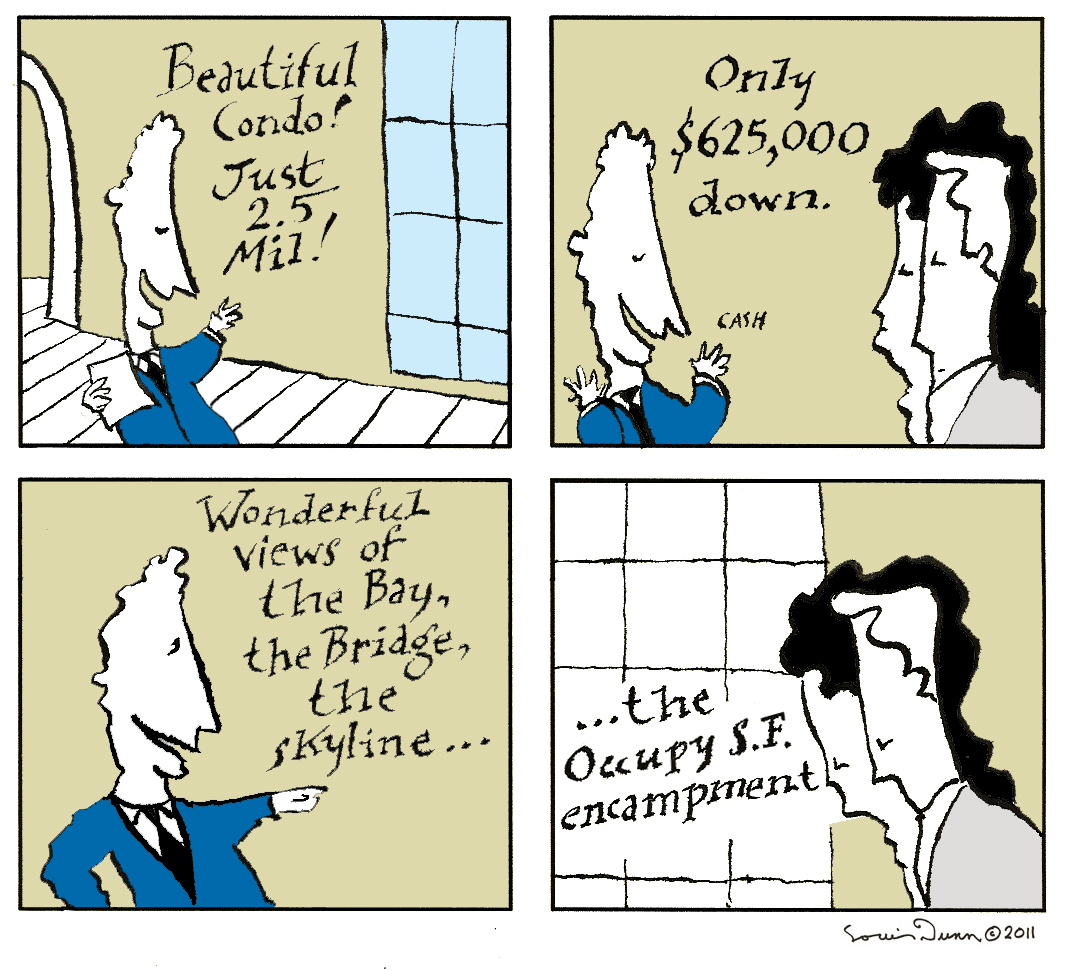
At 8 Washington and 75 Howard, developers want to build a total of 365 condominiums aimed at people with incomes that place them in the top sliver of the richest Americans. It will be a key test for the Ed Lee administration: Will he evict the Occupy protesters and allow the One Percent to claim choice property on the waterfront?

The 8 Washington project calls for 165 of what developer Simon Snellgrove says will be the most expensive condos ever built in San Francisco. The 12-story building, sitting on the edge of the Embarcadero, would include units selling for as much as $10 million, and even the low-end places would go for $2.5 million or more.

At 75 Howard, the Paramount Group and Morgan Stanley want to demolish a parking garage and erect a 284-foot tower with units that the San Francisco Business Times predicts would sell for at least $1,000 a square foot.

Just to be clear what we’re talking about here, a $2.5 million condo, according to real estate experts, would require that a buyer have $625,000 cash to put down and an income of more than $450,000 a year. Either that or millions in spare cash to plunk down.

That, needless to say, is not the majority of the working people in San Francisco.

There’s no conceivable planning or housing-policy rationale for either of these projects. They offer nothing that the city needs; there is absolutely no shortage of housing for people with that kind of income. In fact, allowing these two projects to proceed would directly violate the city’s own General Plan and every regional planning proposal for San Francisco’s housing mix. The General Plan states that some 60 percent of all the new housing built in San Francisco should be below market rate. Environmental sanity suggests that the city ought to be building housing for people who work here — high housing costs have driven thousands of local workers to live in the East Bay or further out, leading to long, energy-intensive commutes. And the more of this ultra-luxury housing the city builds, the more the housing balance gets disrupted — and the more rapidly San Francisco becomes a city of, by and for the One Percent.

The two projects have powerful support — among other things, Lee’s friend and ally Rose Pak is promoting 8 Washington, as is lobbyist Marcia Smolens. If Lee has any scrap of independence he’ll make it clear that both of these projects are dead on arrival.

Guardian editorial: The one per cent on the waterfront

27

EDITORIAL While Mayor Ed Lee struggles with the OccupySF encampment, another, very different group has its eyes on the city’s waterfront. On the edges of the ground where protesters are talking about the one percent of Americans that control the vast majority of the nation’s wealth, two major development projects aimed entirely at that very wealthy sliver are starting to move forward.

At 8 Washington and 75 Howard, developers want to build a total of 365 condominiums aimed at people with incomes that place them in the top sliver of the richest Americans. It will be a key test for the Ed Lee administration: Will he evict the Occupy protesters and allow the One Percent to claim choice property on the waterfront?

The 8 Washington project calls for 165 of what developer Simon Snellgrove says will be the most expensive condos ever built in San Francisco. The 12-story building, sitting on the edge of the Embarcadero, would include units selling for as much as $10 million, and even the low-end places would go for $2.5 million or more.

At 75 Howard, the Paramount Group and Morgan Stanley want to demolish a parking garage and erect a 284-foot tower with units that the San Francisco Business Times predicts would sell for at least $1,000 a square foot.

Just to be clear what we’re talking about here, a $2.5 million condo, according to real estate experts, would require that a buyer have $625,000 cash to put down and an income of more than $450,000 a year. Either that or millions in spare cash to plunk down.

That, needless to say, is not the majority of the working people in San Francisco.

There’s no conceivable planning or housing-policy rationale for either of these projects. They offer nothing that the city needs; there is absolutely no shortage of housing for people with that kind of income. In fact, allowing these two projects to proceed would directly violate the city’s own General Plan and every regional planning proposal for San Francisco’s housing mix. The General Plan states that some 60 percent of all the new housing built in San Francisco should be below market rate. Environmental sanity suggests that the city ought to be building housing for people who work here — high housing costs have driven thousands of local workers to live in the East Bay or further out, leading to long, energy-intensive commutes. And the more of this ultra-luxury housing the city builds, the more the housing balance gets disrupted — and the more rapidly San Francisco becomes a city of, by and for the One Percent.

The two projects have powerful support — among other things, Lee’s friend and ally Rose Pak is promoting 8 Washington, as is lobbyist Marcia Smolens. If Lee has any scrap of independence,  he’ll make it clear that both of these projects are dead on arrival.


Labor ready to fight Occupy eviction

5

Tim Paulson, director of the San Francisco Labor Council, just told me that he’s got as many as 500 union members on alert to stand with the OccupySF encampment if the city attempts to evict the protesters. The Labor Council has put together a communications system to let members who have volunteered to help know when a showdown with the police is coming, and the volunteers are ready to spend as much as 24 hours at Justin Herman Plaza, and if necessary, in jail.

“We mobilized for last night, but nothing happened,” he said. “We’re in a state of constant vigilance.”

Paulson noted that the San Francisco encampment “is the symbol of the Occupy Movement.”

The solidarity of San Francisco labor will make it considerably more difficult for Mayor Ed Lee to send in the police and break up the camp. The idea that he would be ordering the arrests not only of several hundred Occupy protesters but a large contingent of local labor leaders and union members has to be giving him second (and third, and fourth) thoughts.

And whatever the outcome, the connenctions between labor and Occupy are critical to building and sustaining a national movement to demand economic justice. It’s great to see the SF Labor Council in the heart of the fight.

OccupySF is worth the investment

30

Thirteen labor and community leaders wrote to Mayor Ed Lee Nov. 17 asking him not to evict the OccupySF protesters. The message of the hand-delivered letter: It’s worth the time and effort the city will have to make to allow the encampment to remain. It was signed by Conny Ford, OPEIU Local 3, Bob Offer-Westord, Coalition on Homelessness, Pilar Sciavo, California Nurses Association, Elizabeth Alexander, SEIU 1021, Rev. Carol Been, Clergy and Laity United for Economic Justice, Steve Williams, POWER, Gabriel Haaland, SEIU 1021, Tim Paulson, San Francisco Labor Council, Kate Huge, La Raza Centro Legal, Gordon Mar, Jobs with Justice, Forrest Schmidt, ANSWER, Shaw-San Liu, Chinese Progressive Association, and Mike Casey, UNITED-HERE Local 2.

Here’s the full letter:

Dear Mr. Mayor:

Occasionally a movement takes hold of the imagination of a people, resulting in major social and economic shifts in public policy. Thirty to forty years ago, such a movement driven by a coalition of the religious right and corporate America and spearheaded by the National Chamber of Commerce and the National Association of Manufacturers, changed the course of our nation for the worse.

With the election of Ronald Reagan and scores of corporate-backed politicians since then, our nation has seen a reversal of the progressive gains made in the decades immediately preceding 1980, from the New Deal to the War on Poverty.

In yesterday’s meeting, you and several city department heads questioned whether it is “worth the investment” to meet and work with the SF Occupy movement to address certain health and safety issues. We think it is.

The national Occupy Wall Street movement has brought dramatic focus to the disproportionate concentration of wealth and power held by the top 1% of America.  They have drawn broad attention to the devastation wrought by Wall Street upon communities throughout the country:  home foreclosures, record unemployment, attacks on immigrants, union busting, school closures, social service cutbacks, etc.

Over the years, in our own city, a number of legendary movements and causes have led to meaningful and lasting progressive change. The 1934 General Strike and the I-Hotel are but two examples. These and other struggles such as the Civil Rights movement are iconic not based on whether they resulted in victory or defeat, but because these struggles inspired and trained a new generation of organizers and activists committed to economic and social change.

Whether the Occupy movement is helping usher in yet another shift remains to be seen. But of this we are certain: the City of San Francisco working with Occupy SF to support their vision and work is “worth the investment.”

Provocative police actions in Oakland resulted in unnecessary injuries and threatened the very safety of the community they’ve sworn to protect.

We appeal that you not shut down the occupation of Justin Herman Plaza and continue to meet, daily if necessary, in order to work through the issues connected with Occupy SF.