Mayor

Wells Fargo lawsuit against city of Richmond dismissed

5

Richmond, 1, Wells Fargo, zip. 

In the first round of what may become a long and protracted legal battle, US Distict Judge Charles Breyer dismissed Wells Fargo’s lawsuit against the city of Richmond today, and the reason for dismissal was clear: nothing has happened yet. 

Wells Fargo’s suit attacked the constintutionality of Richmond’s plan to use eminent domain to seize about 600 mortgage loans, a controversial program meant to save residents from losing their homes. The judge pointed out that not only had Richmond not yet enacted the plan, but it hadn’t even been voted on by the Richmond City Council. 

In legalese, the case is not “yet ripe for adjudication.” Translation? You can’t sue someone for something that hasn’t happened, or may not ever happen, Breyer wrote in his decision. He also explained why he dismissed the case, rather than putting it in abeyance (a kind of “pause button” for cases).

“The Court further concludes that it must dismiss the case rather than hold it in abeyance,” he wrote. “Ripeness of these claims does not rest on contingent future events certain to occur, but rather on future events that may never occur. Because there is no point at which it will be determined that Plaintiffs’ claims are not ripe and will never become ripe, the matter could linger in abeyance for an indefinite period of time. Under these circumstances, a stay is not appropriate.”

Wells Fargo declined to comment on the decision, and a spokesperson referred us to legal counsel representing investors in the mortgage market (of which Wells Fargo is a trustee). Mayor Gayle McLaughlin also was unavailable for comment as she is out of the country on a business trip.

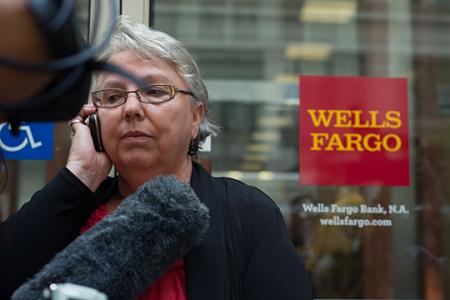
protesters march outside of Wells Fargo

Speaking to the Guardian a few weeks ago about her eminent domain plan, McLaughlin said she would be willing to battle Wells Fargo “all the way to the Supreme Court,” to defend the community of Richmond. And she may have to, as Wells Fargo does have the opportunity to appeal to a higher court. 

For clarification, Breyer did indicate in the hearing last week that he would seek abeyance or dismissal in the case, but did not issue his final decision until today.  

For our coverage of Richmond’s city council meeting where the plan was almost voted down by city councilmember Nathaniel Bates, click here. Look out for our full coverage of the newest in Richmond’s battle for homeowners in our September 18 issue, this Wednesday.  


Below is the full text of Breyer’s decision.

On its fifth anniversary, Sunday Streets offers a lesson in urban experimentation

48

It’s hard to believe that Sunday Streets — San Francisco’s version of the ciclovia, or temporary closure of streets to cars as a way of opening up more urban space for pedestrians, cyclists, skaters, performers, and loungers — is five years old. It’s even harder to believe that this family-friendly event was once controversial, especially feared by the businesses that now clamor to hold them in their neighborhoods.

But it was, and that’s a great reminder that ideas that disrupt the status quo and seem quite radical and unsettling can embody just what The City needs to feel like, well, a city, a place with people mix and mingle and get to know one another in the streets, strips that can become important social spaces and not simply conduits for cars.

“Sunday Streets provides the opportunity for recreation and activity in neighborhoods all across San Francisco,” Sunday Streets Director Susan King of Livable City told us. “Each community it’s in is helped with health and economic benefits and the easing of community cohesion.”

This Tuesday, Sept. 17, the folks from Sunday Streets will be hosting a fundraiser and celebration at Cityview, atop the Metreon, in honor of the hard work that has been put into various Sunday Streets events around the city throughout the years. The event will feature speeches, snacks, an open bar, a raffle, live entertainment, and other hoopla.

Among those being honored at the event will Lt. Gov. Gavin Newsom, who as mayor worked with alternative transportation activists from Livable City (the event’s main sponsor), the San Francisco Bicycle Coalition, and other groups — including a large contingent that attended the first ciclovia in the US, in Portland, during the Toward Carfree Cites conference in 2008 (which we at the Guardian covered) — to create Sunday Streets.

At the time, the business-friendly Newsom stood up to opposition from merchants in Fishermans Wharf and Pier 39, and both progressive and conservative supervisors looking for a way to tweak the mayor, to help become one of the first cities in the US adopt the ciclovia model that had been pioneered in Bogota, Columbia, and which has now spread to cities around the world.
“We really have to thank former Mayor Gavin Newsom for instigating Sunday Streets,” King said. “Without him, Sunday Streets in San Francisco wouldn’t exist.”

First hosted in the late summer of 2008, King has overseen Sunday Streets since its inception, hustling up fiscal sponsors and volunteer support like a whirling dervish the whole time. 

“There’s so much that goes into Sunday Streets,” King said. “I had no idea that it would get to where it is now.”

The anniversary event costs $50 and lasts from to 6 to 10 p.m. Proceeds will go to future Sunday Streets events.

This year there have been Sunday Streets in a handful of neighborhoods, making appearances in the Embarcadero, Mission, Bayview, Great Highway, Tenderloin, and Western Addition. There are two more Sunday Streets scheduled this year in the Excelsior (Sept. 29) and the Richmond (Oct. 27) districts.


Senate OKs Bay Bridge name change, lawsuit seeks to overturn it

28

The California Senate gave its blessing to the rename the western span of the Bay Bridge after former San Francisco Mayor Willie Brown on Sept. 12, blatantly disregarding mounting local opposition to the proposal. Since ACR 65 is a nonbinding resolution, Gov. Jerry Brown cannot veto it even though he went on record earlier this week saying the 77-year-old bridge should keep the same name it’s always had.

San Francisco Sens. Mark Leno and Leland Yee both voted in favor of the resolution.

The same day, Attorneys G. Whitney Leigh and Lee Hepner filed a complaint seeking injunctive relief to overturn the resolution on behalf of their client, good government advocate Bob Planthold.

At a press conference, Planthold said the lawsuit “has nothing to do with Willie,” but rather sought to remedy what he perceived as state lawmakers ignoring their own rules, a state of affairs he characterized as “Orwellian.” Here’s an excerpt of his comments to reporters:

For his part, Leigh questioned why Sacramento legislators were in such a rush to rename part of the Bay Bridge when construction of the eastern span had only just been completed, following long delays and overruns. “There is a shadiness and irregularity to this procedure,” he said.

The suit, directed at the California Senate and the Assembly and all the lawmakers responsible for pushing it through, alleges “arbitrary suspension and/or violation of legislative rules and policies” to fast track the legislation.

Specifically, Hepner said, lawmakers ignored an established timeline for introducing new proposals, instead allowing ACR 65 to be submitted four months after the formal deadline. Additionally, he said, the Senate Committee on Transportation and Housing was technically barred from meeting between Sept. 3 and 13 – a rule likely meant to keep lawmakers focused on more pressing issues, like approving 400+ bills before a Sept. 13 deadline – but nevertheless, ACR 65 passed out of that committee on Sept. 9 on an 8-1 vote.

Planthold previously served on the city’s Sunshine Ordinance Task Force and was previously an officer on the San Francisco Ethics Commission. Leigh is the former law partner of Matt Gonzalez, a former president of the San Francisco Board of Supervisors who joined two other former board presidents to formally call on Senate pro Tem Darrell Steinberg to stop the resolution from going forward.

Despite Gov. Brown’s opposition to renaming the Bay Bridge, it remains unclear exactly what he’ll do about it now that it has formally passed. In response to a query about whether he would take steps to halt implementation, spokesperson Evan Westrup responded in an email: “Got your message. Don’t expect we’ll be providing further comment today.”

Mayor Lee distorts reality in defending CleanPowerSF obstruction by his appointees

151

Mayor Ed Lee yesterday answered a series of five questions from the Board of Supervisors about CleanPowerSF, the renewable energy program it approved last year on a veto-proof 8-3 vote, but which three of Lee’s appointees on the San Francisco Public Utilities Commission are now blocking.

Lee reaffirmed his opposition to the program and support for the three commissioners who are refusing to approve a maximum rate for the program, while making a series of statements that were misleading, contradictory, and, according to Sup. John Avalos, some outright falsehoods.

CleanPowerSF would group tens of thousands of city residents into a renewable energy buying pool, a system called Community Choice Aggregation authorized by state legislation, which would compete against Pacific Gas & Electric’s illegal local monopoly. Initally, the energy would be purchased under a contract with Shell Energy, but the main goal of the program is to build city-owned renewable energy facilities by issuing revenue bonds supported by the program’s ratepayers.

Yet the program Lee described has little resemblance to CleanPowerSF — and his statements of support for the concept belie his longstanding opposition to the program and support for PG&E, whose union is leading the campaign to kill CleanPowerSF.

“I know that many members of the Board of Supervisors are upset,” Lee began in his first answer to similar questions posed by Sups. Eric Mar, David Chiu, London Breed, David Campos, and John Avalos, who all represent the odd-numbered districts whose turn it was to submit questions to the mayor for this month’s appearance.

Lee then explained that one of the duties of  the SFPUC is to protect ratepayers, which he called “the overriding concern they have when faced with any issue,” adding that, “The commission ultimately decided that the rate wasn’t a fair rate.”

Ironically, the top rate that the commission is being asked to approve in order to finally launch CleanPowerSF was just 11.5 cents per kilowatt-hour, only slightly more than current PG&E rates and a substantial reduction from the rate that was discussed last year when supervisors approved the program.

PG&E, Lee, and other critics of the program had attacked its high cost, so SFPUC staffers tweaked the program to allow the initial use of Renewable Energy Credits, which support the creation of renewable energy projects, rather than being purely juice directly from solar, wind, and other renewable sources, which is more expensive.

So Lee criticized that change as a departure from what the board approved last year, telling the supervisors that the program should be at least “95 percent renewable on day one,” saying that, “This is what a green power program should look like.”

Yet when it did look like that, Lee opposed it, something he didn’t mention yesterday. And yet he still made the argument that the SFPUC was simply exercising its fiduciary responsibility in blocking a program that has gotten cheaper than when the board approved it.

“The San Francisco Public Utilities Commission did its job in protecting ratepayers,” Lee said. “I agree with the majority of the PUC.”

So, on one hand, Lee said that CleanPowerSF has “gotten progressively more expensive as time goes on,” citing statements made years ago about the goal of trying to meet-or-beat PG&E’s rates, which have been subsidized by taxpayers over the years.

And when the program then got close to matching those rates, he criticized the use of RECs to get there, saying the climate change benefits “need to be real and tangible and not based on vague promises.”

Yet even city-commissioned studies have shown that San Francisco won’t meet its own greenhouse gas reduction goals without substantially changing the energy portfolio of city residents, and CleanPowerSF is the only plan on the table to get there, except for PG&E’s vague promises to offer more renewable energy in the future.

While Lee touted city efforts to improve the energy efficiency of commercial buildings and the recent launch of a regional bike share program — neither of which will come close to meeting city climate change goals — even he acknowledged the “need to expand our in-city renewable energy generation,” citing the $4 million SolarSF as an example.

But Lee never made reference to CleanPowerSF’s plan to build up to $1 billion in renewable energy projects whose impacts would be far more impactful. Instead, he said the program “creates no local jobs,” which wouldn’t be true during the buildout phase.

While praising PG&E, Lee also glossed over the fact that a majority of supervisors still support CleanPowerSF, and that the SFPUC vote was supposed to be on the rate and not these ancillary issues, raising fundamental democratic issues when three mayoral appointees can override the decision of elected supervisors who represent all city residents.

“When a final project is so vastly different than the original intent, the San Francisco Public Utilities Commission has to intervene,” Lee said.

Avalos called many of Lee’s statements “lies,” so I followed Mayor Lee back to his office after the hearing and we had the following conversation as several reporters from other media outlets listened in:   

SFBG: Supervisor Avalos just said that you’ve made a number of statements that are not factually accurate, and certainly misleading, including saying that the program has changed substantially. Given that you opposed the program initially, and you seem to make statements that criticize those changes, and clearly the majority still supports it, how can you make the argument that the PUC is acting against it because the program has changed?

Mayor Lee: Well, you know, I know that elements of this are somewhat complicated cause you have to actually read a lot of volumes of materials to understand the choice aggregation program, cause it has those three aspects and I would….

SFBG: As guidelines, not as rates….

Mayor Lee: I would point to those numbers that were discussed at the board and presented to the [SF] Public Utilities Commission, because that’s what I’m quoting from. I’m taking it, not from even verbiage, I’m taking it exactly from facts that were presented at the commission at the Board of Supervisors and I specifically lifted quotes from the board about their comments about local jobs and all the other things, so, I don’t think I’m inaccurate at all. I think I’m actually quite on point.

SFBG: But the rates have come down from when they approved it and you made it sound like the rates have gone up.

Mayor Lee: The rates were up and they came down in trade off with less green.

SFBG: Right…

Mayor Lee: That’s about the point I was trying to make is that we wanted these other goals to happen and they couldn’t happen cause people were trading off things in order to set the rates and that was going to become a bigger and bigger gap as to what the original goals were. That’s the way…

SFBG: But the board clearly wants this program. Why, as a matter of policy, as a matter of city procedure, why isn’t the elected body the one to make this decision, instead of your appointees?

Mayor Lee: Well, I think that’s the whole reason why they presented it to the Public Utilities Commission. They’re charter mandated to set these rates. It’s not just an automatic acceptance of what the board says. They also independently review what the board has said. And in their independent review, they said they had gone well beyond what they stated their goals were and so they couldn’t set the rates and still honor all the goals that the board was suggesting.

SFBG: But those rates are less than what the Board has approved. How can they be exercising fiscal oversight… I mean, it doesn’t make any sense.

Mayor Lee: I think we have a big disagreement there. They’re mandated by the charter to set those rates responsibly, not just to follow what the board has stated and so, in their independent review, they went and reviewed all the goals that the board has said and said ‘This is not the program that they have stated should be fulfilled.’

SFBG: Even though the majority of the Board of Supervisors disagree with that statement that you just made?

Mayor Lee: Well, you know, then again, are we not respecting peoples’ right to disagree over what is being done here?

SFBG: But your argument that the program changed from what they approved, a  majority is saying ‘that’s not true,’ that you’re misrepresenting that.

Mayor Lee: No, I don’t think that I’m misrepresenting that. I disagree with that.

SFBG: A majority of the Board of Supervisors who approved it says you are.

Mayor: Well, I disagree with that assessment.


Proposal to rename Bay Bridge draws controversy

50

The proposal to rename the western span of the Bay Bridge after former San Francisco Mayor Willie Brown is generating more controversy as it hurtles through the approval process in Sacramento, where lawmakers are staring down a Sept. 13 deadline before the legislative session ends.

Gov. Jerry Brown has expressed opposition to the idea, and the proposed name change prompted yet another scathing editorial from the San Francisco Chronicle. Former Mayor Brown, who also served as Assembly Speaker, publishes a weekly column in the Chronicle.

Chronicle columnists Matier and Ross reported Sept. 10 that Gov. Brown had met with Alice Huffman, a key supporter of the proposal and president of the California NAACP, about the proposed name change.

The partial renaming of the 77-year-old Bay Bridge has seen very little opposition in the state legislature, and backing from the NAACP might be a key reason why there has been such broad support from lawmakers. As it happens, Huffman has long been described as a friend of Willie Brown’s – she briefly worked for him when he was Assembly Speaker and later served as a political advisor, according to Los Angeles Times coverage.

Assembly Member Tom Ammiano opted to stay out of the fray and abstained from voting, a decision his spokesperson Carlos Alcalá explained by saying, “he’s hesitant to vote against it, because of course Willie Brown was a very important figure” in the California Legislature.

At the same time, Alcalá said Ammiano couldn’t support renaming the bridge, because “it has significant opposition,” and “he thought it was inappropriate to name it after a living person.”

Formal Assembly criteria states that clear community consensus must be in place when a major piece of public infrastructure is renamed. Yet in the case of the Willie L. Brown Jr. Bridge, no such consensus exists. 

On Aug. 29, former Board of Supervisors presidents Matt Gonzalez, Aaron Peskin and Quentin Kopp fired off an open letter to Senate pro Tem Darrell Steinberg in an attempt to halt the proposal from going any further. They urged him not to hear the resolution in the Senate Rules Committee, because the proposal appeared to conflict with Senate rules and “there exists significant concern in our community that naming the Bay Bridge for him is not appropriate.”

So far, the former elected officials haven’t gotten much in the way of a response.

“The state Senate has always been a club, and all those elected officials hope that someday things will be named after them,” Peskin told the Guardian. “I think they should name the old eastern span, that they’re demolishing, after him,” he added with a chuckle. “You know why? Because it’s old and crooked and a danger to society.”

Expand protections for small businesses

40

EDITORIAL Corporations and chain stores are crafty, and they can always find creative ways to get around whatever barriers that cities and counties erect to protect their local small businesses. And such barriers are important because most large corporations enjoy economies of scale, the ability to absorb sustained losses while gaining market share, and other unfair competitive advantages.

San Francisco voters and legislators have approved and expanded so-called formula retail legislative protections over the last decade, requiring stores with 11 or more locations that want to open in neighborhood commercial districts to obtain a conditional use permit, allowing the public to weigh in and city officials to reject disfavored projects.

But as we observed in last month’s saga involving chain store men’s clothier Jack Spade’s planned move into the old Adobe Bookstore space on 16th Street near Valencia, it’s still too easy for deep-pocketed corporations to make stealthy inroads into some of San Francisco’s most beloved and sensitive commercial districts.

First, Jack Spade disguised its corporate connections in pulling a building permit, then it won over the zoning administrator by claiming only 10 stores (despite the fact that it’s a national chain owned by Fifth & Pacific, aka Liz Claiborne, which also has a string of Kate Spade women’s clothing stores), and then, even when activists and small businesses won the argument and a 3-2 vote by the Board of Appeals on Aug. 21, that wasn’t the supermajority needed to overturn the flawed decision.

As they say in the neighborhood: That shit ain’t right.

Clearly, something needs to change because Jack Spade isn’t the first, and it won’t be the last, corporate-owned chain store that wants to move into the Mission and other gentrifying commercial districts in the city, including Western SoMa (where development forces have been unleashed by the city’s approval of its local area plan earlier this year), Hayes Valley, Polk Gulch, and the Divisidero corridor.

And when one deep-pocketed chain store moves in — a corporation that is willing to invest early in an up-and-coming neighborhood — it creates a strong upward pressure on commercial rents that forces out small businesses, nonprofits, and community-based organizations. And then residential rents follow suit.

Only governmental and political will can break this pattern, and it’s a pattern that must be broken if San Francisco is going to retain its economic vitality. Study after study shows that small businesses circulate their revenues within the community instead of siphoning them off to Wall Street and the corporate headquarters, and that helps the overall local economy.

Flawed ideas about consumer choice and the supposed wisdom of the supposedly free market shouldn’t distract San Francisco and other cities from focusing their economic development efforts on local small businesses, a sympathetic symbol that gets disingenuously trotted out in the rhetoric of Mayor Ed Lee and his allies even as he stacks the Small Business Commission with bankers and right-wing ideologues.

Now, with the Board of Supervisors back from its summer recess, is the time to redouble our efforts to resist corporate dominance. That should include support for Sup. Eric Mar’s legislation to change the metrics for what’s considered “formula retail,” support for Sup. London Breed’s efforts to expand protections in Hayes Valley and Sup. Jane Kim’s similar efforts along Market Street, and consideration of changing the vote threshold for the Board of Appeals and giving neighborhoods more tools to resist stores like Jack Spade.

Nothing less than the soul and face of San Francisco is at stake, and it’s up to all of us to fight for it and not be fooled by self-serving and simplistic “jobs” rhetoric. We need to call a Spade a Spade, and a corporation a corporation, and defend what makes San Francisco special: real, local people serving real, local people, not the interests of Wall Street.


Waiting for BRT

18

By Joe Fitzgerald Rodriguez

joe@sfbg.com

You’re on Muni’s underground line, the train stalled just shy of your stop, just stuck there, the light at the end of the tunnel right in front of you. It’s a frustrating feeling, right?

With more than six years worth of delays in three major transit overhauls — the Van Ness, Geary and Geneva Bus Rapid Transit Projects — it’s beginning to feel just like that.

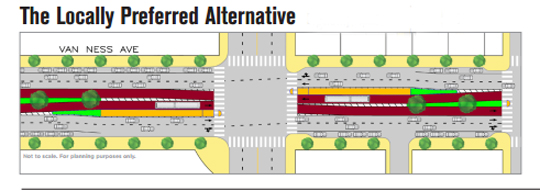
The projects are designed to speed up the most trafficked transit routes in the city by making the buses run like trains. For the Van Ness Bus Rapid Transit, the 47 and 49 would drive in dedicated bus-only lanes shuttling riders north and south, reducing travel time by a third, according to project estimates.

Van Ness BRT was initially announced in 2004 with a planned unveiling of 2012. Eight years later, the new debut is set for 2018. The Geary Project is even worse, with a completion date slated for 2020.

The Van Ness BRT is finally getting its wheels turning this month, with the Environmental Impact Report set to be approved by a number of governmental bodies: the Van Ness BRT Citizen’s Advisory Committee, the Transit Authority board, and the San Francisco Municipal Transportation Authority.

Why the hell has this bus project taken nearly a decade to start its engine? As is customary in politics, fingers are pointed at all sides.

At a citizen’s meeting for the Van Ness BRT on Sept. 4, two angry factions gathered in the Old First Church Fellowship Hall on Van Ness. The SFMTA’s spokesperson for the project, Lulu Feliciano, wrapped up her presentation to the crowd of about 100, and that’s when they pounced.

“Van Ness’ three lanes will be limited to two, but it’s a highway, isn’t it?” asked Carole Holt, owner of Russian Hill Upholstery. “Why do cars have no consideration?” She told the Guardian she worried her customers from Marin would have trouble getting to her store.

Another Polk Street activist, Kelly Gerber, walked right up to Feliciano’s face and gestured with his hand like an angry schoolteacher. “Why has no one ever heard of this?” he bellowed, telling us he opposes the loss of parking spaces.

Ironically, transit planners say car traffic would move faster, partially because of the elimination of all left turns along Van Ness except Broadway.

“They’re just angry and zooming in on every little detail,” Mario Tanez, spokesperson for the SF Transit Riders Union, said of BRT’s opponents.

The mostly younger crowd of transit activists showed up in equal force to counter the Polk Street merchants, hoping to stem the tide of NIMBYism.

“We’re the generation that will actually see these improvements,” Teo Wickland told us. He’s an urban planning student who hopes to see Muni running on time.

Feliciano said the project was complicated by having to coordinate multiple city agencies, all with their own goals.

Instead of digging up the same stretch of concrete a dozen times in a decade, San Francisco tries to include as many agencies as possible when cement is broken in any part of the city, she said. Since the Van Ness project is a two-mile stretch between Lombard and Mission streets, many are involved.

infographic showing different city agencies involved in the reconstruction of Van Ness

Graphic by Brooke Robertson

Peter Gabancho, the project manager for Van Ness BRT, said that the San Francisco Public Utilities Commission will put in new water lines, institute a rainwater catch system, and do sewer work. The Department of Public Works plans to repave, and the SFMTA will replace overhead bus lines and light poles.

When asked how much the city would save by combining work, he couldn’t give an exact dollar amount but said it was in the tens of millions, at least.

He also said that the process requires community meetings at many steps in the process. City officials visited Mexico City to see how they planned and built its BRT in just three years, and Gabancho said it’s because that city didn’t really consult the community.

“We can’t do business like that in San Francisco and I don’t think we want to do that in San Francisco,” he said.

All of that governmental insanity had a member of the Geary BRT’s Citizen Advisory Council calling it quits in a fury — he even wrote about it in his blog.

“What I’ve seen in the past six years has been a severe disappointment during which I have lost trust in America’s regulatory framework to enact effective transit improvements,” Kieran Farr, the CEO and co-founder of VidCaster, wrote. He described the process as fraught with starts and restarts, slips and delays, mostly due to a lack of leadership. And that’s the rub: There is no point person on this project with strong political will, according the SFTRU. “The mayor is not saying this is high priority,” Tanez told us. “He’s at all the Central Subway events, but getting political clout behind this by writing to our supervisors is the only way to do this.” The Van Ness project runs through the districts of Sups. Mark Farrell and David Chiu, who were both unavailable at press time. The SFMTA is slated to approve the Van Ness BRT EIR on Tue/17 at 1pm in City Hall, Room 400.

Campos urges SF to explore using Richmond’s eminent domain plan

170

Sup. David Campos is urging the board of supervisors to explore using eminent domain to save San Francisco resident’s underwater mortgages, a plan pioneered by the city of Richmond and its mayor Gayle McLaughlin.

The plan uses the power of eminent domain to seize underwater mortgage loans from banks and investors, saving homeowners from being booted out onto the street when they’re behind on their ballooning payments. The plan is controversial and under attack by Wells Fargo and other Wall Street interests, which we explored in last week’s cover story, “Not For Sale.” They say that the plan puts money into the pockets of Richmond and Mortgage Resolution Partners, the group that engineered the plan. 

Campos plans to introduce his resolution at tomorrow’s board meeting, but importantly it only asks The City to explore whether or not the plan could work in San Francisco. The resolution would not enact a plan at this point in time.

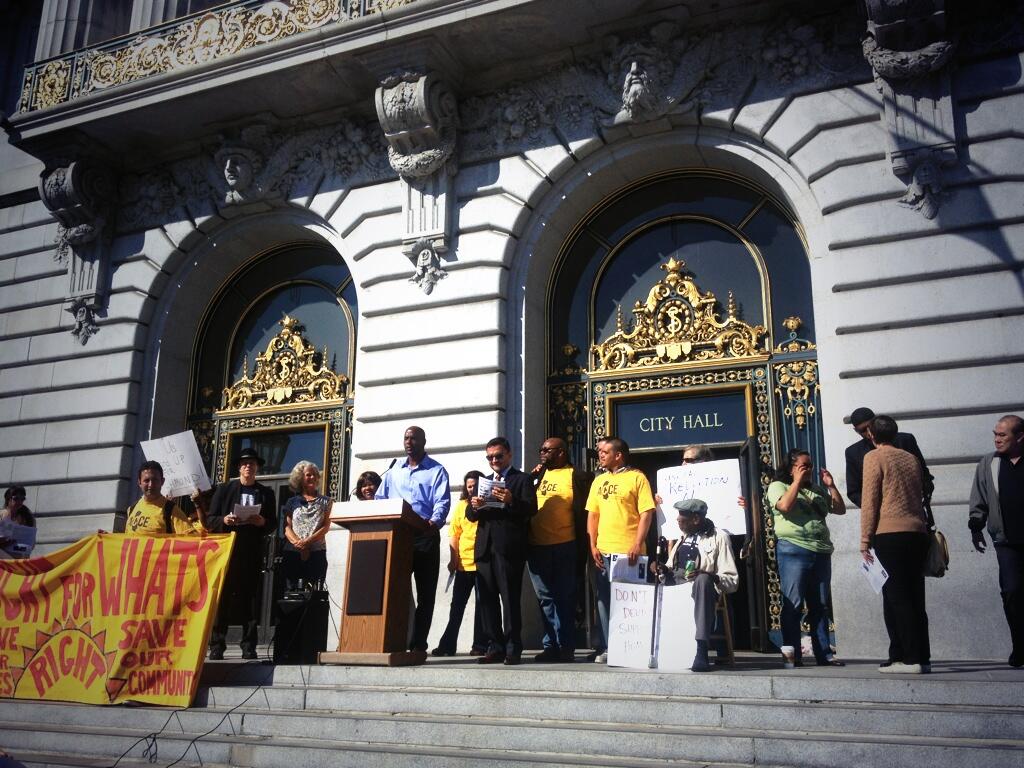
At a press conference this morning, housing activists and Campos trumpeted the plan as a way to save the homes of San Franciscans. Often those targeted with predatory loans have been people of color, they noted. 

“Our strategies have been, lets be honest, ‘Let’s see what the federal government or the banking industry will do to help these folks,’” Campos said at the steps of City Hall. “We’ve waited long enough.”

Campos rattled off surprising numbers, saying 58 homeowners in his district alone had underwater mortgages at risk of foreclosure, and that 16 percent of homeowners in neighborhoods like Visitacion Valley were underwater. 

Bernal Heights homeowner and activist Ross Rhodes was there supporting the action.

“Dave (Campos) helped me save my home when I was getting nowhere with the banks but frustration,” Rhodes said. 

He was making his payments which were up to $3,500 a month, but while on disability and going through a divorce, it was tough. Campos got Rep. Nancy Pelosi’s office involved, and they talked to the banks on his behalf. In the end, he finally got a principal reduction and what he calls a “real good” modification. “I’m not asking for a handout, I’m asking for help,” he said. 

Now his payments are $1,600 a month. “It just shows the banks can do what they want to do, they control it all, they can work with if you if they want to.”

Campos’ resolution also proclaims San Francisco’s support for Richmond’s eminent domain effort.

The bank asked him why he went to Pelosi and Campos for help, instead of going through them. He was incredulous, as he’d been fighting for a principal reduction on his own for two years. “I’ve been trying to work with you for months,” he told them. “It took that political muscle to get you to move. I went through five different loan agents.” 

The victory made him a convert, going to rallies and speaking to help others suffering with their loans. 

The hounds are coming for Richmond though, and the political muscle needed to enact the controversial plan is at risk. 

Wells Fargo already filed suit against Richmond over its use of eminent domain, saying the plan puts money in the pockets of the city and would put a chill on investments. A Richmond bond with an A- rating was already rejected by Wall Street, finding no financiers, putting Richmond in a possible bind when it comes to public works projects. 

In response, Richmond councilmember Nathaniel Bates has a resolution for tomorrow’s Richmond city council meeting to stall the plan. If it’s voted in, Richmond will withdraw all the offers to buy underwater loans and withdraw the plan to use eminent domain to seize them. 

If Bates’ resolution is approved, the whole plan would tank. 

A petition from the Home Defenders League to sand with Richmond’s eminent domain effort has over 7,000 signatures. 

To contact Wells Fargo’s CEO yourself, follow the link here.

The Guardian wrote to the Mayor Ed Lee’s office to see if he is in support of Campos’ plan, but didn’t hear back before press time, which was admittedly quick. 

Update 2:20 pm: We asked supervisor Campos’ aide Hilary Ronen if San Francisco would be at risk for a lawsuit from Wells Fargo, similar to Richmond, if the city enacted an eminent domain plan. In response, she said “All that we’re doing is asking the city attorney’s office as well as the budget and legislative analyst, ‘if we did something similar, what does it look like? What are the financial risks for the city?’ This way we can make an educated assessment. After having that information he’ll have to balance what the risks are. We’re not there yet.”

Supervisors to grill Mayor Lee over CleanPowerSF sabotage

112

Mayor Ed Lee will be on the hot seat for his unqualified support of Pacific Gas & Electric Co. and his related opposition to the CleanPowerSF renewable energy program, which his appointees to the San Francisco Public Utilities Commission are trying to sabotage, when he shows up for the monthly mayoral question time at the Board of Supervisors meeting on Tuesday.

Hopefully the boring, scripted question time format that Lee created in collaboration with Board President David Chiu will finally give way to what the voters intended when they required the mayor to engage with the legislative branch: an actual, substantive, back-and-forth policy discussion meant to illuminate issues of public concern.

Because that’s what’s needed on this important issue. After more than a decade in the making, the board last year cast a historic vote to create the project on a veto-proof 8-3 vote. But the SFPUC is now refusing to set the maximum rate for the program, which should be a fairly technical and pro forma action, instead raising unrelated issues that the supervisors have already considered. In other words, unelected mayoral appointees have decided to veto a hard-won democratic gain, creating something akin to a constitutional crisis in a city that values public process and input. 

So for the first time ever, all the of the supervisors scheduled to ask questions (it rotates because odd- and even-numbered districts each month) have focused various aspects of a single important issue. Even though Lee has mastered the politicians’ dark art of speaking without saying anything, this one should still be a doozy as supervisors ask the following questions:

1. Mayor Lee – As you know, San Francisco has set ambitious goals to combat climate change. In many ways, the City is making great strides in this direction, from increasing bicycling, to pursuing zero waste goals, to hiring a new, excellent environmental policy advisor in Rodger Kim who has a strong background in environmental justice and community engagement. However, the Public Utilities Commission has repeatedly failed to set rates for CleanPowerSF, the most impactful local proposal yet designed to curb carbon emission. This program was adopted by the Board of Supervisors, the legislative body of the City. However, there are some allegations that your office is stalling its implementation. What specifically are you doing, as the City’s head executive, to implement this policy in a timely fashion? (Supervisor Mar, District 1)

2. Mr. Mayor, can you please outline your objections to the CleanPowerSF program as approved last year on an vote 8-3 by the Board of Supervisors? (Supervisor Chiu, District 3)

3. Recognizing the constraints imposed by state law, particularly with respect to opt-out provisions, how would a clean power program need to be structured in order for you to support it? Are you willing to work with the Board of Supervisors, and have your staff and commissioners work with the Board of Supervisors, to revise CleanPowerSF so that you can support it? Can we come to the table and make clean power a reality without any further delay? (Supervisor Breed, District 5)

4. The Board of Supervisors has been very supportive of CleanPowerSF. Do you think it is appropriate for a City Commission to go against the policy the Board of Supervisors set when it approved CleanPowerSF? (Supervisor Campos, District 9)

5. Days after the one-year anniversary of the 2010 PG&E San Bruno pipeline explosion, you called PG&E a “great local corporation” and a “great company that gets it.” However, the examples of PG&E’s immoral, illegal, and greedy behavior are legion:

– PG&E avoided admitting fault in the San Bruno explosion, failed to cooperate with the investigation, fought against paying a fair fine, and hopes to make ratepayers pay for the fine.

– PG&E’s current electric mix is only 20% California-certified renewable.

– Outages of PG&E-owned streetlights have increased over 400% in recent years, and PG&E wants to increase by $600,000 a year the amount it charges the City for streetlight maintenance without committing to improved service.

– Despite the fact that PG&E already has some of the highest electric rates in the country, PG&E is seeking to further increase rates in each of the next three years.

– While PG&E has proposed a new Green Tariff program, it remains only a vague proposal and there is no guarantee that it will ever be implemented.

– PG&E’s previous green campaigns-such as ClimateSmart and “Let’s Green This City”-have proven to be short lived and ineffective public relations stunts. Multiple public surveys conducted by the PUC to gauge the level of support for CleanPowerSF have all found that a substantial number of San Franciscans want the opportunity to pay a slight premium for a 100% renewable alternative to PG&E.

Why does your office continue to oppose providing City ratepayers with an alternative to PG&E’s monopoly by implementing CleanPowerSF? (Supervisor Avalos, District 11) 

Still secret

22

news@sfbg.com
A high-profile local civil rights ordinance passed last year to shine light on the San Francisco Police Department’s joint activities with the FBI has been undermined by the SFPD’s refusal to disclose its surveillance activities. This comes at a time when the public is learning more than ever about the federal government’s intrusion into the privacy of law-abiding US citizens.

In May 2012, the Board of Supervisors unanimously passed the Safe San Francisco Civil Rights Ordinance, which Mayor Ed Lee signed in a photo-op ceremony with Police Chief Greg Suhr and the activists who supported it. They claimed the board’s passage of the ordinance ushered in a new era of transparency over the SFPD’s previously secretive work with the FBI-led Joint Terrorism Task Force.

“The ordinance basically requires three things,” Nasrina Bargzie, a civil rights attorney at the Asian Law Caucus who worked on the measure, told the Bay Guardian. “The first part requires that the Police Department work with the JTTF has to follow the California constitutional rights of privacy, so they’re not following the lax standards of the [US] Department of Justice. The second part is that they can no longer enter into any secret agreements with the FBI; it has to go before the Police Commission in a public setting. The final part of the ordinance exists to make sure the rules are being followed, so there is a requirement for a yearly report.”

At the time of its passage, activists told the Guardian that the ordinance was only as strong as the SFPD’s willingness to disclose its activities (see “Mayor Lee signs watered-down limits on SFPD spying,” 5/9/12). But the SFPD’s refusal to disclose even minimal, basic information calls into question the ordinance’s value.

After the release of multiple reports earlier this year that activists called inadequate, Suhr is now maintaining silence regarding the JTTF, while claiming the department is in full compliance with the ordinance. According to Bargzie, Suhr told her the FBI is barring him from disclosing the requested information.

Following multiple efforts by the Guardian to get a comment out of SFPD about the ordinance and whether the department was indeed taking a subservient role to the FBI, SFPD Sgt. Dennis Toomer told us, “We’re not talking about that at all.”

LACK OF RESPONSE

Activists have sparred with Chief Suhr over implementation of the ordinance and its required annual report since at least the beginning of 2013.

Deputy Chief John Loftus presented the first report to the Police Commission on Jan. 23, which claimed the SFPD was in “full compliance” with the ordinance without providing any details. Activists and the public quickly demanded a real response.

“The commission presented this short oral report, which was a little short of two minutes long,” Bargzie told us. “There was no data that we were not already aware of. It was just basic statements claiming that they were complying with the ordinance.”

Suhr apologized for the omissions while stating his department was still in compliance with the ordinance’s guidelines, pledging to be more forthcoming. At this time, SFPD Sgt. Michael Andraychak told the Guardian: “The Chief’s Office is in the process of scheduling meetings with Nasrina Bargzie [of the Asian Law Caucus] to develop a report with more detail so those concerned and the public can be as informed as possible. Chief Suhr is committed to remain in compliance with the ordinance.”

The Coalition for Safe San Francisco, an activist group consisting of Muslim Legal Fund of America, Asian Law Caucus, and dozens of other groups, met with Suhr to discuss setting up a template for the reports.

Suhr then released a second report, which contained more relevant information, stating that SFPD officers did not act as informants in 2012 and three full-time SFPD officers were assigned to the JTTF.

But the report still omitted key oversight information, such as whether any prosecutions resulted from JTTF and SFPD investigations, which would allow the Muslim Legal Fund of America and other groups to determine who the SFPD is arresting and why.

Last year, Suhr told a San Francisco Examiner reporter that his officers followed up on 2,000 tips regarding counterterrorism activities. However, this information curiously did not make it into the official report.

“We contacted the chief to let him know we were not okay with this. We had another meeting with him and he said he’d think about it and get back to us and now he is claiming he cannot honor a basic component of the ordinance,” Bargzie told us. “He asserts in writing this is because the FBI will not let him share the basic information.”

WEAKENED LEGISLATION

The weak efforts behind the implementation of the SSFCRO date back to Mayor Lee’s veto of a stronger ordinance in April 2012, which would have codified privacy protections and given the Police Commission more power to stop FBI-SFPD activities that did not comply with Department General Order (DGO) 8.10, the 1990 policy aimed at protecting First Amendment activities. After Lee’s veto, the Board of Supervisors passed a weaker version. Both were sponsored by Sup. Jane Kim.

John Crew, a former police practices expert with the Northern California American Civil Liberties Union, raised concerns to the Guardian about the weakened legislation. “It is a step in the right direction, there’s no doubt it’s progress,” Crew told us at the time. “But whether it’s real progress depends on the implementation. Ultimately, it will come down to political will at the Police Commission to enforce privacy protections.”

Much of the ordinance’s failure stems from the apparent lack of real intent to disclose what the activists sought. Critics painted the SSFCRO signing ceremony as a hollow symbolic act, a way for Mayor Lee and Chief Suhr to publicly promote civil rights and progressive ideals with an ordinance they purposefully weakened.

“My sense is that [the SFPD] is not taking this seriously,” Bargzie told us. “I think they probably believe that they are providing as much information as the FBI will let them and Chief Suhr thinks it’s fine that the FBI can tell him to share what they tell him to.”

The lack of transparency regarding the JTTF’s work with the SFPD requires the public to trust the federal government to safeguard civil liberties. But in the wake of whistleblower Edward Snowden’s leak exposing the expansive surveillance system by the National Security Agency and the SFPD’s notorious history of illegal surveillance and racial profiling, the public has little reason to trust the authorities.

HISTORY OF SPYING
The passage of the SSFCRO is the latest effort to counter a long history of racial profiling, spying on radical political groups, and other constitutional violations, episodes that have been followed by progressive reforms in San Francisco.
Prior to the passage of DGO 8.10 in 1990, the SFPD notoriously participated in the surveillance of non-criminal, pacifist political organizations. During the 1984 Democratic National Convention, the SFPD carried out surveillance on law-abiding organizations and, throughout the 1980s, it created files on civil, labor, and special interest groups in the Bay Area, revelations that led to the adoption of DGO 8.10.
But even after that, disclosures surfaced showing that the SFPD was blatantly violating its own rules. They included then-Police Chief Tony Ribera admitting that files on non-criminal political activity were not destroyed (as required by the ’90s reforms), the selling of confidential intelligence material to foreign governments and private entities, and the actions of SFPD Intelligence Officer Tom Gerad, who informed on local political groups for the FBI.
In the subsequent years following the Gerad scandal, San Francisco sought to strengthen DGO 8.10, requiring more transparency and oversight. But this progress was undercut in 2007 when the SFPD secretly signed a secret JTTF Memorandum of Understanding (MOU) undermining DGO 8.10.
San Francisco’s Human Rights Commission held hearings in which the community voiced concerns over illegal police and federal surveillance. In response, the SFPD said they were unable to discuss arrangements with the JTTF without the permission of the FBI.
In 2011, the previously secret MOU was unearthed by the ACLU (see “Spies in blue,” 4/26/11), prompting Suhr to issue Bureau Order #2011-07, which reinforced that SFPD personnel were under the jurisdiction of local and state privacy protections and did not spy on law-abiding groups. SFPD Public Information Officer Albie Esparza said the order reversed the language of the 2007 memo.
Part of Suhr’s amendment to SFPD policy at the time included the necessity of a predicate offense in all SFPD investigations. Thus, the SFPD could not investigate or spy on those who were not suspected of violating the California Penal Code or federal law.
Activists wanted those protections enshrined in city law, which resulted in last’s vetoed ordinance and passage of the watered down Safe San Francisco Civil Rights Ordinance in 2012, which activists now say they feel duped by.
“We have been extremely disappointed at the lack of information that has been included in the reports,” Summer K. Hararah, Regional Director for the Greater San Francisco Area Muslim Legal Fund of America told us. “If the SFPD is going to violate rights of Arab-Americans, the police chief has a responsibility to stand up to the FBI.”

POST 9/11 WORLD
Lax federal guidelines for counterterrorism have been building since the Bush Administration began implementing emergency measures after 9/11 terrorist attacks in 2001. In San Francisco’s case, the FBI has subjected local law enforcement to these rules.
Since 9/11, both the ACLU of Northern California and the Human Rights Commission have publicized cases of racial profiling and surveillance of pacifist, non-criminal Muslim and Middle-Eastern groups in San Francisco. A 2007 FBI memorandum illustrated a prominent instance of this profiling in which FBI agents attended Ramadan Iftar dinners in San Francisco purportedly as part of the FBI’s mosque outreach program. Under this guise, the agents collected data on certain attendants, including names, the content of conversations, and other information covered by the First Amendment. According to the FBI Domestic Investigations and Operations Guide, the JTTF is permitted to conduct surveillance of this nature, by identifying “locations of concentrated ethnic communities in the Field Office’s domain, if these locations will reasonably aid in the analysis of the potential threats and vulnerabilities, and, overall assist domain awareness for the purpose of performing intelligence analysis.” These policies directly contradict SSFCO, DGO 8.10, and the California Constitution’s privacy protections. In Portland, Ore., the local government successfully fought this issue by bifurcating local law enforcement from the JTTF after the public and the ACLU raised concerns over similar constitutional violations and racial profiling. This Portland model is now a precedent for activist groups nationwide, seeking to end the lack of oversight permeating their local police departments. “Portland has been a great model,” Hararah told us. “When the FBI began to interview Muslim men in mass after 9/11, Portland was one of the few that said ‘absolutely not.'” But in San Francisco, Lee (whose office also didn’t respond to our request for comment) and Suhr’s symbolic promotion of civil rights has diminished into a case of them basically bullshitting the public. “Civil rights is not a symbolic issue,” Hararah told us. “The mayor backed this legislation and we want to see that the commitment is put forth with global insurance. The first step is having info about what the JTTF is doing to be sure it abides by human rights protections and is appropriate.”

Forget the Willie Brown Bay Bridge

73

EDITORIAL As the California Legislature prepares to wrap up before fall recess, a resolution is working its way through the approval process to rename the western span of the Bay Bridge the “Willie L. Brown Jr. Bridge.”

Brown, who formerly served as mayor of San Francisco and speaker of the California Assembly, is known for boasting about his hobnobbing with the rich and famous in his San Francisco Chronicle column, “Willie’s World.” But to longtime progressive San Franciscans who spent decades trying to stem the tide of gentrification, he was the powerful figure that rolled out the welcome mat for high-end developers and corporate interests, whose interests in San Francisco revolved around profit alone.

As mayor, Brown presided over land-use policies that resulted in high-end developments at a time when evictions were rampant, a trend that rings familiar in today’s tech-saturated San Francisco. Once, when pressed on the idea that his approach was making the city increasingly unaffordable, Brown’s famous retort was: “If you don’t make $50,000 a year in San Francisco, then you shouldn’t live here.”

It’s not just Brown’s insensitivity to struggling tenants, deep ties to corporate interests and high-end real-estate developers, or continued behind-the-scenes influence in San Francisco politics that cause us to squirm when we think about the San Francisco-Oakland Bay Bridge bearing this politician’s name. There’s also the key question of whether Bay Area residents actually want to see this happen — and, given Brown’s historic role as a divisive figure, the idea that there is universal support for such an idea is laughable.

A legislative analysis presented to the Assembly Committee on Transportation a few weeks ago noted that lawmakers actually came up with ground rules for big decisions like whether a bridge ought to be named after someone, to “promote fairness.” The rules stipulate that such a proposal “must reflect a community consensus” — and guess what? Even Brown’s editors over at the Chronicle issued a June editorial opposing the idea.

Not only that, but proposals like this are only supposed to come from representatives of the district where the thing being renamed is located — yet this scheme came from Assemblymember Isadore Hall, a Democrat from Compton. But despite clear failure to adhere to these basic rules, only a single committee member voted against naming the bridge after Brown.

Interestingly enough, the bill even includes a request for Caltrans to determine the cost of posting signs commemorating Brown, which would evidently be funded by donations from unspecified private sources.

If the San Francisco-Oakland Bay Bridge is going to be named after anyone, we agree that the honor should be reserved for beloved 19th-century San Francisco eccentric Joshua Abraham Norton, the Scotsman who proclaimed himself Emperor of the United States in 1859 and printed his own currency.

So far, a Change.org petition calling on Gov. Jerry Brown to name it the Emperor Norton Bay Bridge has garnered 1,800 signatures. “He was a champion of racial and religious unity, an advocate for women’s suffrage [and] a defender of the people,” the petition notes. That sounds more like something motorists can be proud of when they drive back and forth across the bay.


Chronicle: Don’t question the City College takeover, just submit to the flawed ACCJC

71

I have very low expectations from editorials in the San Francisco Chronicle, which generally share a worldview with the Chamber of Commerce and carry water for some powerful Establishment figure or another. But today’s editorial on City Attorney Dennis Herrera’s lawsuit defending City College is so bad and illogical that it reads like an Onion parody of a Chronicle editorial.

Clearly put up to it by some of the most reactionary figures in the Mayor’s Office, Chronicle Editorial Page Editor John Diaz or one his lackeys parrot the submissive stance that Mayor Ed Lee has taken toward outsiders with corporatist agenda that have seized control of City College and sought to make a high-profile example of it.

“The city’s leaders should be calling for tough love, not coddling dysfunction. Fortunately, Mayor Ed Lee has done just that – but, regrettably, the city attorney is going in the opposite direct [sic],” the Chronicle wrote.

And by “tough love,” they apparently mean obedient and unquestioning compliance with an obscure accrediting agency’s demand that City College slash community-based curriculum; close facilities relied on by both students and local nonprofit groups; rip up contracts with faculty and force instructors to live on part-time wages; distill course offerings down to just what serve corporations, universities, and banking interests; and other aspects of an educational agenda that hasn’t been properly vetted in public hearings or approved by any elected body.

Herrera is to be applauded for pointing out the overreach and conflicts-of-interest on the Accrediting Commission of Community and Junior Colleges, which were also recently criticized by the US Department of Education. And we’re excited to see what Herrera uncovers during the discovery process in his lawsuit against a secretive, corporate-connected, document-shredding agency that broke its own internal rules in its treatment of City College.

The Chronicle graciously refers to these unavoidable facts in a brief paragraph, writing that the ACCJC “is not without flaws. It’s secretive, and its internal policies drew a rebuke from the U.S. Department of Education after City College faculty filed complaints about its conduct.”

But then it dimisses that and shows a suspicious incuriosity about why the ACCJC is being so secretive and what its agenda might be, instead doubling down on criticizing City College in a way that is so over-the-top that this fine institution is unrecognizable to anyone who is actually familiar with it, which Diaz and company clearly aren’t.   

“The needed changes include hiring a comptroller to organize financial controls, making sure students pay for classes, and overhauling a loose-fit governance system that puts faculty, students and staff in charge of operations with inadequate administrative controls. Lee has strongly endorsed an overhaul of City College’s ramshackle operations,” the Chronicle writes.

Unlike us here at the Guardian, where I’ve written two recent editorials in support of democracy and local control and critical of Lee and others who have been too quick to cooperate with the toppling of the locally elected Board of Trustees, the Chronicle apparently believe in more authoritarian methods of governance.

“The first repairs are now under way. The powers of the elected community college board are on hold, and a special trustee dispatched by state Community College Chancellor Brice Harris is in charge,” the Chronicle writes.

And as we report in our upcoming issue, that special trustee also has no interest in questioning the ACCJC’s process or methods or even allowing the public to review internal communications. It’s a shame that bootlickers like Lee and the Chronicle have sold out such an important local institution to their corporate masters, but luckily for San Francisco, Herrera, the California Federation of Teachers, the Guardian, other progressive media voices, and hundreds of our community partners aren’t giving up so easily, instead pushing for an open, truthful, democratic, and transparent discussion about City College’s mission and its future.

Fizzling energy

129

A plan for a municipal power program that would offer 100 percent green energy to San Francisco customers was stalled on Aug. 13, prompting Sup. John Avalos to explore what legal options might be available to bring the program to fruition without further delay.

Prior to that San Francisco Public Utilities Commission hearing, supporters of CleanPowerSF rallied on the steps of City Hall, urging Mayor Ed Lee and members of the commission to approve a not-to-exceed rate, a technical hurdle that must be cleared before the program can advance. SFPUC staff cannot formalize a contract for purchasing power on the open market until that maximum rate has been formally established, so as long as it goes unapproved, CleanPowerSF lingers in limbo.

“We call on the Mayor’s Office to stop impeding progress with heavy-handed politics,” said Shawn Marshall, executive director of Local Energy Aggregation Network (LEAN) — a group that assists with clean-energy municipal power programs. “And we ask the San Francisco Public Utilities Commission to stay focused on its job of implementing a program that was approved by the San Francisco Board of Supervisors last September. That’s almost a year ago, folks.”

But after more than two hours of public comment in which dozens of advocates voiced support for moving ahead with the program, SFPUC commissioners voted down a motion to approve the rate, leaving CleanPowerSF in limbo with no clear path forward.


COMMISSIONER CONCERNS

Commissioners Francesca Vietor and Anson Moran were the only ones on the commission to favor the rate approval, while Ann Moller Caen, Vince Courtney, and President Art Torres shot it down.

“I feel like today is a historic moment for the SFPUC as well as the city of San Francisco,” Vietor said as she introduced the motion at the beginning of the meeting, “to become a leader in combating climate change.”

Rather than focus on the question of whether or not to establish a top rate of 11.5 cents per kilowatt-hour (a reduced price from an earlier proposal that sparked an outcry from critics because of the sticker shock), Torres and Caen criticized CleanPowerSF before casting “no” votes.

Caen said she’d “always had problems with the opt-out situation,” referring to a system that will automatically enroll utility customers into the program, while Torres criticized the project for changing shape since its inception, saying, “at the end of the day, this is not what San Franciscans had anticipated.”

But after straying well beyond the scope of a discussion about the not-to-exceed rate, commissioners who shot down CleanPowerSF didn’t provide SFPUC staff with any hints on how to allay their concerns. Some might interpret the hearing outcome as a death knell for CleanPowerSF, but Avalos has taken up the cause of pushing for implementation.

Unable to attend the hearing in person, Avalos sent legislative aide Jeremy Pollock to convey his concerns. “We all understand the politics of the situation,” his statement noted. “The Board of Supervisors and every major environmental group in the City support this program. The Mayor, PG&E, and its union oppose it. I know you are feeling a lot of pressure from both sides. But we cannot afford further political gamesmanship to cause additional delays in an attempt to kill this program.”

The effort to implement CleanPowerSF is mired in politics. For Pacific Gas & Electric Co., Northern California’s largest utility, the enterprise represents an encroachment into prime service territory and a threat to the power company’s monopoly.

PG&E has long been highly influential at San Francisco City Hall. It has funded many political campaigns and curried favor with powerful figures (former San Francisco Mayor Willie Brown, known to be a frequent dining companion of the mayor, has been richly rewarded for his consulting services, for instance). Mayor Ed Lee opposes the program, and holds the authority to appoint commissioners to the SFPUC.


CLASH OF CITY BODIES

The City Charter gives the SFPUC the responsibility of establishing fair and sufficient rates for the city’s utility operations. But Avalos charged that “any further delay will essentially show that we are in a constitutional crisis caused by a city department failing to carry out a policy approved by a veto-proof supermajority of the Board of Supervisors.”

The supervisor added that if the rate failed to win approval at the hearing, he would call upon the City Attorney to explore legal options “to resolve this type of stalemate—including the possibility of drafting a Charter Amendment. CleanPowerSF is too important and the threat of climate change is too significant to allow this program to die on the vine. It is time for leadership.”

Pollock said on Aug. 15 that Avalos was still awaiting a response from City Attorney Dennis Herrera’s office.

Meanwhile, activists who’ve attended countless meetings with SFPUC staff to move the program forward expressed frustration in the aftermath of the vote. “Things are in this holding pattern, and the dissenting commissioners did not provide a way forward,” noted Jed Holtzman, an advocate with climate group 350 Bay Area. “They just kind of said, ‘no.'”

The weekend before the hearing, mailers paid for by International Brotherhood of Electrical Workers Local 1245, a union representing PG&E employees, blanketed Noe Valley residences with fliers. Depicting seashells besmirched with oil, the mailers seized on the involvement of Shell Energy North America, an oil giant with a contract pending with the SFPUC to administer power purchases for the first four and a half years of the program.

Shell’s involvement presents something of a challenge for advocates, who have long advocated for a program that would be run entirely by the SFPUC with a centerpiece of renewable power generation facilities that could double as a source of local job creation.

The initial program phase looked quite different: Shell would purchase green power on the open market, making CleanPowerSF significantly more expensive than PG&E. To address that concern and lower rates, SFPUC staff recently allowed the use of Renewable Energy Credits (RECs), more affordable units accounting for green power produced somewhere in California as opposed to electricity coming straight over the power lines.

Despite the drawbacks of a more watered down start to the program and the involvement of a notorious fossil fuel company, progressives and major environmental organizations strongly advocated for moving forward with the Shell contract to give the SFPUC a shot at positioning itself financially to float revenue bonds for build-outs of a local green energy infrastructure.

“The plan is to completely replace this with the build-out,” noted John Rizzo, who sits on the executive committee of the San Francisco Bay Chapter of the Sierra Club.


BUILDING LOCAL PROJECTS

A 134-page report prepared by Local Power Inc. described in careful detail how the city could use wind, solar, geothermal, energy efficiency, and other measures for a viable program. While SFPUC representatives have indicated that some of those recommendations will still be implemented, the agency is no longer working with Local Power.

“Our draft model was 1,500 jobs per year,” Paul Fenn, founder and president of Local Power, wrote in an email to the Guardian. “But earlier runs show as many as twice that many jobs, and we projected the higher end for the final model.” In the end, though, “SFPUC declined to continue with completion of this work, so we are in limbo — apparently an organization without allies,” Fenn added. Asked about this, Kim Malcom, the SFPUC’s director of CleanPowerSF, told the Guardian that Fenn’s analysis was based on the assumption that the agency would issue bonds totaling $1 billion. “We have no confidence that we could issue a billion dollars worth of bonds in the first few years of the program,” she said, noting that the highest the agency expected to go was closer to $200 million. And at this point, it remains to be seen whether CleanPowerSF will move ahead at all. “One of the difficulties we face is that we can’t move forward without a rate,” SFPUC spokesperson Charles Sheehan noted. “In terms of launching and implementing, we can’t do that until we have a rate structure,” and now that the utility board has blocked that from happening, there is no clear path forward. Still, activists who are serious about CleanPowerSF believe it’s key for positioning San Francisco as a leader in the fight against climate change. “CleanPowerSF is a crucial step for achieving California’s 2020 greenhouse gas goals,” Bill Reilly, chairman emeritus of the World Wildlife Fund and a former EPA administrator, wrote in a letter to Lee. “It’s also an essential model &ldots; as cities and communities are compelled to address the problems fueled by climate change.”

Waiting to connect

10

news@sfbg.com

Eight years ago, San Francisco almost gave away an enormously lucrative public utility to Google and Earthlink: a citywide Wi-Fi connection. The hastily drawn up plan was championed by then-Mayor Gavin Newsom after a Google executive pitched him on the idea of citywide wireless Internet access at a dinner party.

Google’s Wi-Fi scheme would have blanketed the city with coverage, but it would also have required users to obtain Google accounts to sign in, thereby facilitating the company’s vacuum-like data harvesting practices that suck up everything from search queries and emails to the geographic locations of smartphones and tablets. Google’s Wi-Fi plan would have allowed the tech giant to insert “prioritized placement” of ads and brands into a Wi-Fi user’s feed, limiting choice of content through profit-driven algorithms.

The Electronic Frontier Foundation, ACLU of Northern California, Electronic Privacy Information Center, and we at the Bay Guardian all criticized the plan (see “Tech Disconnect,” 11/9/05). Earthlink, Google’s partner in the privatization deal, nearly went bankrupt in 2007 and the company bailed on the Wi-Fi proposal. That was the end of the city’s first Wi-Fi scheme. Thousands of free networks in cafes and hotels popped up in the meantime, leading many to question the purpose of building municipal Wi-Fi.

But municipal Wi-Fi is back. Sup. Mark Farrell and Mayor Ed Lee announced recently that free Wi-Fi is coming to 31 San Francisco parks. Google is involved yet again, but officials in the city’s Department of Technology say that the network will be not be controlled by Google, nor directly susceptible to privacy invasions by the “don’t be evil” company or its affiliates. In short, it will be a public utility.


PUBLIC UTILITY

“I think a lot of the prior debate around free Wi-Fi in San Francisco that never moved forward was because of different questions around business models,” Farrell told us. “To emphasize, this is a free gift [from Google] of financial benefit to the city of San Francisco with no strings attached.”

For the parks, Google has agreed to give a $600,000 contribution to fund Wi-Fi installation and two years of operation. Farrell said this is the company’s only role. There will be no Google hardware or software allowing the company to devour user data or steer traffic.

San Francisco’s reinvigorated push to build out public Wi-Fi comes just as major telecom companies and Internet giants like Google are again targeting large Wi-Fi networks for privatization. In the late 2000s, many tech companies abandoned Wi-Fi services as unprofitable. Telecom companies were busy expanding their cellphone infrastructure.

But thanks to the proliferation and technical advances of smartphones, cellular networks are now choking on megabits of traffic. Telecom companies see Wi-Fi as a means of offloading mobile traffic onto broadband infrastructure. Google and other companies see Wi-Fi networks as vast troves of consumer data, and airwaves on which to advertise.

Google’s grant for Wi-Fi in San Francisco’s parks comes after months of bad press for the company and the tech sector, including revelations that all of Silicon Valley’s top companies readily cooperated with the NSA’s electronic surveillance programs.

Google also recently paid out $7 million to settle state investigations into its “Wi-Spy” data collection activities: wireless receivers hidden in Google’s Street View vehicles sopped up communications data, including passwords and even email content, from millions of networks in the United States and Europe. Beside Google’s numerous spying scandals, the company has also come under criticism for aggressively avoiding federal taxes, and locally for its impact on San Francisco’s transportation and housing problems.

If the $600,000 gift is designed to bolster Google’s image as a good corporate citizen, it probably also makes good business sense. “Thousands of Googlers live and work in SF,” said Jenna Wandres, a spokesperson for the company replied to our inquiries by email.

Marc Touitou, director of the city’s Department of Technology, told us the park Wi-Fi system will be entirely the city’s, and that no third party corporation will determine who can use the service or under what terms.

“It’s not a Google network, it’s not a Wi-Fi name from Google. It’s a donation, a gesture,” said Touitou. He added that talks with AT&T to let the company roll out a Wi-Fi network for all of Market Street were recently cut off because his office has decided to build the system as a fully municipal network instead.


CORPORATE GIFTS

Touitou’s office has plans to light up free municipal Wi-Fi along the Embarcadero, in the Castro, Noe Valley, and perhaps even on Muni buses in the near future. With the parks, Touitou said the idea is to gain back the confidence of the public, to show that the city can do this on its own. Touitou also said that he hopes the city will budget funds for these Wi-Fi systems so that they’re not reliant on corporate gifts.

“We reserve right to leverage this model where companies can put money in because it’s in their interest,” Touitou said. “They don’t care what name is on the network so long as they can dump their traffic on it.”

A public utility model will allow San Francisco to own and operate Wi-Fi across the city and to allow telecom companies to funnel mobile traffic through the city’s infrastructure, likely for a fee. Touitou said it doesn’t make sense for the city to give away its Wi-Fi infrastructure as it is a limited and increasingly valuable asset.

“The day we sell it would be a sad day,” Touitou added.

He described the city’s two radio towers, 200 buildings, thousands of utility poles, and the fiber optic grid that can connect these as the backbone of a robust municipal wireless network. Telecom and Internet companies will pay to use the infrastructure under this model. Most privacy experts who examined San Francisco’s prior Wi-Fi plans have yet to weigh in on the parks network. Revelations about the NSA’s vast spying programs have consumed the attention of groups like EFF and the ACLU.

Touitou said, however, that the city’s Wi-Fi privacy policies will be strong. “This isn’t a third party network trying to market to you,” explained Touitou. “It’s a city network that wants to facilitate traffic, and we want to have the privacy respected.”

Even as San Francisco plans its next steps with city Wi-Fi, Google is rapidly expanding its own wireless network operations. Already the company controls the citywide Wi-Fi network for Mountain View where the “Googleplex” is located. Google also has Wi-Fi networks scooping up communications in Boston’s South Station and New York’s Chelsea neighborhood. The terms of Google’s Mountain View deal do not limit Google from collecting data, and users are required to sign in with a Google account. Google also recently announced that it will take control over Starbucks’ thousands of Wi-Fi networks, creating a potentially vast trove of consumer data and a marketing platform for both companies. Starbucks has 50 locations in San Francisco.

AT&T, which lost the Starbucks contract to Google, and also lost its bid to take over Market Street’s airwaves, has its own data mining projects that tap the company’s Wi-Fi networks in 30 countries for personal information, and to route telecom traffic.

So even with municipal Wi-Fi, tech and telecom companies will still have ample ability to siphon off communications data straight from wireless networks and hand it to the feds or to advertisers.

Protect local power and control

30

EDITORIAL There’s a growing stench of political corruption — or, at the very least, hidden agendas aimed at subverting popular will in favor of entrenched corporate interests — emanating from the Mayor’s Office these days. And it’s undermining projects and institutions that are vital to the future of San Francisco.

In the last week, a pair of important developments illuminated the shady way business gets done in San Francisco. The first instance concerned City College of San Francisco, which had its accreditation rashly revoked last month, prompting Mayor Ed Lee to enthusiastically support the disbanding of the locally elected Board of Trustees and the takeover of City College by state-appointed outsiders bent on shutting down community-based facilities and classes.

While Lee and the San Francisco Chronicle have been cheerleading this loss of local control and the corporatist agenda behind it — CCSF was criticized for resisting the narrowing of its mission to focus on job training and college prep — we at the Guardian have questioned this process and the motives behind it.

In a cover story (“Who killed City College?” July 9), editorial (“Why democracy matters,” July 23), and other coverage, we’ve highlighted how the attack on CCSF is part of national movement to focus schools on job training rather than broad-based education, and questioned the haste with which CCSF’s local leadership was usurped.

Critics mocked these concerns, as they did those of the California Federation of Teachers, which formally challenged the actions by the Accrediting Commission of Community and Junior Colleges, with Lee and others saying that we need to just accept the death threats against CCSF and do whatever these outsiders are asking.

So on Aug. 13, when the US Department of Education sustained the CFT appeal and found the ACCJC in violation of federal regulations and its own internal standards in its approach to City College, it validated our concerns and called into question Lee’s hair-trigger abandonment of City College’s local leaders.

Frankly, we’re puzzled by Lee’s approach to City College — from his appointment of right-wing ideologue Rodrigo Santos as a trustee last year (who subsequently got trounced in the election) to his resistance to helping the college before the state takeover — but we suspect it’s connected to Lee’s focus on “jobs, jobs, jobs” to the exclusion of other issues and values.

But Lee only counts private sector jobs, not those created to serve the public interest like the thousands of jobs that would be created by CleanPowerSF, a program that Lee opposes and that his appointees to the SF Public Utilities Commission are actively subverting.

As we report in this issue, CleanPowerSF is a renewable energy program approved last year by a veto-proof majority on the Board of Supervisors, but it’s being blocked by the SFPUC’s refusal to approve the rates and sign the contracts, with commissioners raising concerns that go well beyond their purview at this point.

It’s time for Mayor Lee to start serving the people of San Francisco instead of the corporate titans and political benefactors who elevated this loyal career bureaucrat into the big chair in Room 200.


“Greyhound therapy” is wrong for Nevada, and San Francisco

22

It’s horribly inhumane and indefensible for Nevada to ship its mentally ill homeless to San Francisco, and City Attorney Dennis Herrera is right to go after that state with a lawsuit aimed at changing that policy and recovering the city’s costs, which he discussed today in a press release and San Francisco Chronicle article.

But San Francisco should have greater moral authority to make this stand than it does, thanks to the Homeward Bound program started by then-Mayor Gavin Newsom and continued by Mayor Ed Lee, a program that gives local homeless individuals a one-way bus ticket out of town.

The Chronicle took pains to say how different San Francisco’s exportation of its homeless is from Nevada’s, noting that we make sure our homeless are stable enough to travel alone and that there’s someone waiting for them on the other side before we send them to the bus station.

Sure, that’s better, but the basic concept is the same and it’s consistent with San Francisco basic approach toward much of its homeless population, for whom the city intentionally limits shelter beds and makes it difficult to get one and treats the resulting street population as a law enforcement issue.

Newsom was elected on his Care Not Cash promise to provide shelter and social services to the homeless, and it certainly did get many people who needed it into supportive housing. But the actual homeless problem is far worse and more systemic than that program (or feel-good gimmicks like Project Homeless Connect) can really address.

San Francisco should be leading the way in calling for this country to address the root causes of homelessness, as well as the related problems of poverty, exploitation of workers and natural resources, and a wasteful economic system that is cooking the planet and its biodiversity.

Instead, we’re leading the way in pushing unsustainable, technology-fueled economic growth with no regard for the byproducts of wealth generation by the privileged few, whether it be giving our homeless one-way bus tickets out of town, forcing our workers and nonprofits to seek reasonable rents elsewhere, undermining hard-won social compromises, or missing our own greenhouse gas reduction goals (today’s Examiner cover story).

We can — and we should — take greater responsibility for our city’s policies and prejudices and work to regain  the moral authority that we need to be an example for other cities and begin to advocate for needed reforms on the national and international levels.  

America’s Cup organizers sell small-scale naming rights at Pier 27 to pay their debt to the city

0

The Port Commission has approved a proposal by the America’s Cup Organizing Committee (ACOC) to sell bricks, benches, and other assets at Pier 27 to offset budget shortfalls, but community activists fear that corporate naming rights are undermining plans for a public recreation space.

A presentation at the Tuesday meeting by Kyri McClellan, the former city staffer who now serves as CEO of the ACOC, and Mike Martin of the Office of Economic and Workforce Development outlined the sale of up to 1,000 bricks to be set in pathways and 72 benches to dot the Northeast Wharf Plaza, which will bear the names of donors. Benches will be priced at $25,000, which McClellan cited as the going rate at other high-profile locations throughout the city.

McClellan emphasized that “none of what we’re proposing today as a pilot program includes what may previously have been alluded to as naming rights for this particular park, the piers, or the buildings.”

Milo Hanke and Alex Walker of San Francisco Beautiful, a local advocacy organization, didn’t have a problem with the smaller scale elements of the ACOC proposal. “The tiles and the bricks that are being offered here for $150, $300, for instance,” Hanke told the crowd, “that’s a gratifying opportunity for ordinary citizens who have already invested in our port to volunteer to express additional support for this proud port.”

But Hanke and Walker expressed concern about bigger ticket items that McClellan addressed with less specificity. “We want to make sure that this is a thing that’s going to be place-making and not place-taking,” commented Walker.

In addition to bricks and benches, the wharf’s lawn and adjacent walkway, an open plaza area, and a point at the pier’s end are earmarked for recognition of donors. So too are an event space and an exterior concourse on the second floor of the James R. Herman Passenger Cruise Terminal, slated to open at Pier 27 next spring.

“Corporate naming rights,” explained Hanke, “come with an intangible cost and I think that, given San Franciscans’ historic aversion to excess commercialization of our public realm, corporate naming rights are well worth taking a bypass on.”

Diagrams presented by ACOC did not include detailed renderings of larger donor fulfillments or clarification as to whether recognition would be restricted to individual and foundational donors and off limits to more commercial interests. “There is concern,” said Hanke, “of a creeping naming rights program if large areas are named for corporations.”

Pulling in $500,000 to $2.5 million a piece, however, bigger structures may be the revenue drivers ACOC is desperately seeking. As part of its host agreement with San Francisco, the organization is obligated to help offset the city’s expenses incurred in event preparations and operations.

Luckily, the race’s outsized budget is expected to be less than the $32 million originally projected, due to the paltry number of teams competing (four at last count) and the resulting decrease in spectatorship. Still, the ACOC needs to come up with as much as $20 million – a debt burden that’s got Mayor Ed Lee personally stumping in the fundraising effort. The fundraising flop belies early promises that the city would make money hosting the event.

San Francisco voters approved Proposition B last November, authorizing the city to apply public funds towards repairs and redevelopment of recreational spaces. The fact that the Northeast Wharf Plaza was a named site in that bond measure isn’t the only reason community activists are demanding to know what assets on its piers are being auctioned off and who’s buying them.

According to Jon Golinger, a spokesman for the Northeast Waterfront Advisory Group, the San Francisco Waterfront Special Area Plan limited development on the Pier 27 plaza until a 2000 amendment lifted port restrictions in exchange for guarantees of public recreation areas.

Since then, “we’ve been paying close attention to this park. It’s particularly needed and a long time coming,” explained Golinger, who said there’s been no citizen review of the ACOC’s donor recognition program proposal.

Neighborhood organizations hope ACOC’s tag sale of infrastructure doesn’t torpedo use plans for land long ago promised as a public recreation area. Golinger would like to see features like a kids’ play area, a dog run, and exercise equipment for seniors included in the final design – whether or not they are lucrative to race organizers now.

“After the Cup is done in October, it should look, feel, and be used like a true public park,” Golinger said of the plaza. “This corner of town is the most densely packed part of San Francisco with the fewest recreation areas per capita…. [the plaza] should be part of the neighborhood as opposed to a corporate event venue.”

The promise of infrastructure improvements was one reason the city of San Francisco agreed to host the America’s Cup race in the first place. Residents are now left to hope that ACOC won’t forgo investments of lasting civic value for single-use vanity projects intended to float its budget deficit.

Concluding the discussion of the ACOC’s proposal on Tuesday, Port Commissioner Leslie Katz offered assurances that, “we’ll definitely oversee and be mindful of the aesthetics of anything going forward… This is not a selling off of the port, but really an opportunity to thank and acknowledge those that have allowed us to move forward.”

This opportunity, of course, assumes that donors actually surface. Mayoral spokesperson Christine Falvey said, “We will learn from [this] effort about how we can raise private dollars to improve our waterfront and engage city residents in the effort.”

If ACOC’s efforts to court private dollars from city residents aren’t fruitful, however, taxpayers-turned-debt-collectors may have no option but to sign former District 3 Supervisor Aaron Peskin’s online petition and to demand that America’s Cup billionaire defending champion Larry Ellison pick up the tab for his boat race all by himself.

SF Democratic Party opposes developers’ 8 Washington initiative

On Wed/14, members of the San Francisco Democratic County Central Committee voted 14-6 to oppose Proposition B, a San Francisco ballot measure backed by the developers of a luxury waterfront development project, 8 Washington. Ten DCCC members abstained, while two voted “no endorsement.” Prop. B seeks voter approval for the waterfront development, which has become a flashpoint in San Francisco politics.

The 134-unit condominium complex, which will offer units in the $5 million range, already won approval from the San Francisco Board of Supervisors last June. But 8 Washington developers launched the Prop. B initiative in response to Prop. C, a referendum backed by oppositional campaign “No Wall on the Waterfront.” In May, the DCCC made an early endorsement against Prop. C, essentially siding with project opponents in declaring opposition to 8 Washington.

It’s easy to get Props. B and C confused. The campaign against 8 Washington is called “No Wall on the Waterfront,” while the developer-backed campaign favoring construction has been dubbed “Open up the Waterfront.” From opponents’ perspective, it almost doesn’t matter if voters bother to sort out which is which. Now with the support of the DCCC, they are urging a “no” vote on each.

Last week we told you about a campaign video produced by 8 Washington developers that had attracted some controversy. Here’s a campaign video produced by 8 Washington opponents, featuring former San Francisco Mayor Art Agnos. The pitch makes sound like the San Francisco waterfront will morph into Miami Beach if 8 Washington moves forward. You have to admit it’s a stretch.

Backward on climate

After a hearing lasting several hours on Tue/13, members of the San Francisco Public Utilities Commission voted down a motion to approve electricity rates for CleanPowerSF, a municipal energy program designed to offer a 100 percent green energy mix to San Francisco customers.

The approval of that “not-to-exceed” rate, set at 11.5 cents per kilowatt-hour, would have cleared the path to set CleanPowerSF in motion after almost a decade of politically charged debates and setbacks.

“I feel like today is a historic moment for the SFPUC as well as the city of San Francisco,” commissioner Francesca Vietor said as she introduced her motion to approve the rate. “Even though I understand this is only a vote to approve the not-to-exceed rate,” she added, it was a critical first step toward a long-term vision in which “we will also be able to create a new generation of green collar workers and build our own renewable power system.”

In the end, Vietor and Commissioner Anson Moran were the only ones to favor the rate approval, while Ann Moller Caen, Vince Courtney and President Art Torres shot it down. So once again, CleanPowerSF has been kicked back in limbo.

“This is not just about rates today,” Torres said. “If we approve these rates, that would authorize the General Manager [of the SFPUC] to authorize a contract with Shell.”  

Oil giant Shell Energy North America was tapped by the SFPUC to purchase green energy on the open market during the first phase of the program. Although Shell is a fossil fuel company with a disgraceful human rights track record, progressives and environmentalists stand behind a speedy approval of that contract, because they say it is a crucial first step toward realizing the ultimate project vision of constructing city-owned and operated renewable energy facilities while creating local green jobs.

“The deal is that you cannot do that until you move forward, and launch the program,” said Shawn Marshall, executive director of LEAN – a group that assists with clean-energy municipal power programs – speaking at a rally just before the hearing. “You have to live to go local. We call on the mayor’s office to stop impeding progress with heavy-handed politics and we ask the San Francisco Public Utilities Commission to stay focused on its job of implementing a program that was approved by the San Francisco Board of Supervisors last September.”

Rather than focusing on the question of whether or not to approve the rate, Torres and Caen voiced generally negative sentiments about the CleanPowerSF endeavor before casting “no” votes on the rate approval. Caen said she’d “always had problems with the opt-out situation,” referring to a system of automatic enrollment in the program, and Torres criticized the project for having changed shape, saying, “at the end of the day, this is not what San Franciscans had anticipated.”

The bid to establish CleanPowerSF is mired in charged politics. Because the program threatens Pacific Gas & Electric Co.’s monopoly in San Francisco, the utility giant is prepared to shell out whatever it takes to stop the forward momentum. PG&E is deeply influential in San Francisco City Hall, having richly rewarded former San Francisco Mayor Willie Brown, known to be a frequent dining companion of Mayor Ed Lee, for his consulting services, for instance. Lee opposes the program, and the mayor appoints the SFPUC commissioners.

Torres, the commission president, bristled at suggestions from the public that he was merely carrying the mayor’s water, saying, “I do my own homework, and I make up my own mind.”

But Sup. John Avalos has made up his own mind too, and he sent legislative aide Jeremy Pollock to convey the message to the SFPUC that enough is enough. Avalos plans to go to the City Attorney to find out what can be done about the relentless foot-dragging of a commission that just won’t approve a fair rate for a program that was approved by the Board of Supervisors last fall.

During the public comment session of the hearing, Pollock read Avalos’ statement, which characterized the commission’s refusal to approve the rate as a “constitutional crisis” with regard to the body’s responsibilities.

“Any further delay will essentially show that we are in a constitutional crisis caused by a city department failing to carry out a policy approved by a veto-proof supermajority of the Board of Supervisors,” Avalos’ statement noted. “The Board stands ready to approve these rates, but nothing more can happen until you take action. The City Charter is silent on the possibility of the Public Utilities Commission failing to act on a proposed utility rate. Therefore if there is further delay, I feel I have no choice but to request that the City Attorney explore our options to resolve this type of stalemate—including the possibility of drafting a Charter Amendment. CleanPowerSF is too important and the threat of climate change is too significant to allow this program to die on the vine. It is time for leadership. And this vote will be long remembered for the action you take today.”

But instead of just approving that rate – which is lower, by the way, than originally proposed – the commissioners just seized the opportunity to halt the program from moving forward, since CleanPowerSF cannot advance without a contract, and the contract cannot be signed until a rate has been formally approved.

“It seems as if they are essentially refusing to establish a fair rate, so we’re going to ask the city attorney, you know, what’s the recourse if the PUC is failing to carry out their duties?” Pollock noted.

Just before the votes were cast, Vietor, who had urged her colleagues to go forward and approve the rate at the outset of the meeting, was asked to re-state her motion. She returned to the bright and optimistic prepared statement she’d read at the beginning, only this time with a note of frustration because it was clear that the votes weren’t there. “Today is a historic moment for the San Francisco public utility commission,” she read out loud, “to become a leader in combating climate change.”

Note: This post has been updated from an earlier version.

Shareable, smearable

25

After writing critically about problems in the business models of so-called “shareable economy” companies in last week’s issue — including our cover story on Airbnb and other companies that facilitate short-term home rentals (“Into thin air“) and a story on the rideshare company Lyft (“Driven to take risks“) — the topic continued to dominate the sfbg.com Politics blog, with fresh posts and lots of reader comments:

AIRBNB PILE-ON

The excellent bilingual newspaper El Tecolote covered some of the same ground we did in its Aug. 1 cover story, “Unregulated Rental Business Takes Over Housing,” focused on how Airbnb is contributing to gentrification and displacement in the Mission District.

Reporter Jackson Ly found a couple that turned a rent-controlled apartment on 24th St. into a $249 per month de facto hotel room, booking it for 24 nights in August and making $5,976 in just one month, on top of the $3,069 they’re making in August renting out the guest room in the apartment where they actually live for $99 per night.

“It’s cheating the people that pay taxes,” Maria, who lives in the unit below this couple’s investment apartment and is tired of the rotating stream of tourists in her building, told the newspaper.

I got ahold of El Tecolote Managing Editor Iñaki Fdez. de Retana, who said that housing issues like this one are extremely important to the Latino community that lives in the Mission, and he’s been surprised that Mayor Ed Lee has been unwilling to address the impacts of Airbnb and other tech community contributors to the problem.

“It is very important,” he told us, noting that visiting European tourists are changing the character of the neighborhood. “In particular on 24th Street, which was once seen as the heart of the Mission, it’s changing overnight and [Airbnb and other housing rental websites] is a big part of that.” (Steven T. Jones)


UBER UGLY CRASH

Uber’s policy on insuring its drivers will soon be taken for a test drive, as the company that runs the mobile app-based ride requesting service and a driver were served with a court summons last week from a woman severely injured after a crash near a San Francisco intersection.

Those insurance policies were said to meet brand new regulatory requirements on rideshare services introduced by the California Public Utilities Commission on July 30, which was meant to solve the longtime regulatory battle between rideshare services and local governments.

The plaintiff in the suit, Claire Farhbach, was a bystander, not a customer, and that unique twist in the injury suit has experts from the taxi industry waiting to see if Uber will step up to the plate to pay for Farhbach’s injuries, or if Uber will leave driver Djamol Gafurov on the hook for the bill.

Fahrbach was walking up Divisadero street near Hayes at quarter of midnight March 12 when Gafurov’s black town car, operating as a private taxi, collided with another car on Divisadero while turning left. One of the cars then collided with a fire hydrant, and in the words of the civil suit, “this impact caused the fire hydrant to be violently sheared from its base and propelled through the air a number of feet northbound…when the fire hydrant struck (Farhbach) with a tremendous amount of force.”

Gafurov’s private taxi was operating as a “partner” of Uber, which is how the company defines its relationship to the network of drivers on its website. No private taxis or drivers are considered to be employees of Uber, as the company has repeatedly maintained, claiming that the drivers, and their actions, are not its responsibility.

Uber spokesperson Andrew Noyes told us repeatedly that drivers are not employees of the rideshare company: “Our legal team took a look at the files you sent. This is not an ‘Uber’ driver, they’re not employed by us. They’re employed by their licensed and insured limousine company.” (Joe Fitzgerald)


MAKING CABS BETTER

For all the (justified) grumbling about the business models of ridesharing services like Lyft and Uber, the so-called ridesharing revolution may prove to be a catalyst for a taxi industry overhaul.

“We’re adding hundreds more taxis, and our board has approved regulations for each vehicle to provide real-time locational information,” San Francisco Municipal Transportation Agency spokesperson Paul Rose told us.

“One of our goals is to move forward with making the data available to our customers to hail a cab with an app,” Rose added, referencing a plan unveiled by the transit agency several weeks ago. Faced with stiff competition from random vehicles adorned with garish pink mustaches, the taxi industry is taking a stab at evolution, or at least imitation.

To be a cab driver right now, paying off the pricey medallion they must purchase in order to operate while oblivious new transplants rake in the cash without following the same set of rules, must be infuriating.

At the same time, let’s be honest here: There’s a reason people are ditching conventional cabs and climbing into cars with random strangers who may be beckoned with the tap of a smartphone. And it has nothing to do with passengers’ sentiments about government regulation or newly minted tech millionaires.

The taxi industry lags far behind the lightning-speed reality many Bay Area residents have come to inhabit, but if it weren’t for the competition, they might not have any incentive to change.

Rideshare services might be your quintessential rogue tech companies backed by nauseating sums of venture capital, but at the end of the day, people also want taxi service that does not suck. (Rebecca Bowe)

Dream deferred

3

news@sfbg.com

Nearly 50 years ago, hundreds of thousands of people marched at our nation’s capital to demand racial equality and respect. And half a century later, people are still fighting for that same cause.

In July, when George Zimmerman was found not guilty of any crimes for fatally shooting 17-year-old Trayvon Martin, racial tensions flared in the Bay Area and abroad. Martin’s death brought the issue of racial profiling to the surface, energizing a new generation of activists just in time for Aug. 28, the 50th anniversary of the Great March on Washington and Martin Luther King Jr.’s “I Have a Dream” speech.

Rev. Arnold Townsend, vice president of San Francisco’s chapter of the National Association for the Advancement of Colored People, is a veteran of the Civil Rights Movement. Townsend told the Guardian that Martin’s death triggered memories of Emmett Till, a 14-year-old African-American who was lynched in 1955 for flirting with a white woman.

Townsend was 12 when Till was murdered, and he says seeing the pictures of Till’s disfigured body in a casket posted in Jet magazine was what inspired him to be actively involved in the movement for racial justice.

“What happens in the world finds ways of bringing people together. What happened to Trayvon Martin isn’t so different from what happened to Emmett Till,” Townsend told us. “I knew that people could come for my father, my uncle, but from this I learned that they could come for me.”

The Zimmerman verdict resulted in large demonstrations of anger and outrage all across the country, including Oakland and San Francisco. The verdict inspired Zack Aslanian-Williams, a 24-year-old San Francisco resident, and others to join the NAACP and become activists.

“There is something about the Trayvon Martin case that definitely impacted my willingness to get involved,” Aslanian-Williams told us. “The case caught fire, and I have a sense of urgency to get involved in any way I can.”

In the wake of the verdict, many new and veteran activists targeted National Night Out, a neighborhood watch program event that African American activists fear fosters the kind of racist vigilantism they say motivated Zimmerman to kill Martin.

Jesse Strauss and more than a dozen other Oakland residents fanned out all over Oakland during the Aug. 6 event, visiting dozens block parties in an attempt to educate people as to why they should be wary of police and wannabe cops.

“We’re doing this to build community and talk to people about real safety,” Strauss said. “I think that the way that police function has been steady, and from that we have so many black and brown people locked up. This is a reflection of the struggles that have been going on and this shows that racism has not stopped at all.”

Rev. Amos Brown, president of the San Francisco NAACP chapter, said he wants to see people come together around racial equality and he fears the targeting of neighborhood watch programs may hinder that goal.

“We don’t need extreme provocateurs,” Brown said of anti-police activists. “The movement is like an airplane, and if one wing is too heavy, the whole thing goes down”

But Brown is just as critical of police, saying the 52 hours of sensitivity training that all personnel at San Francisco Police Department have to undergo isn’t enough.

“If relations were good between them, we would not have numerous calls coming in from people who were profiled by police, immediately being asked if they were on parole when they were approached,” Brown said.

Many San Franciscans are sensitive to the racial profiling issue. Last year, when Mayor Ed Lee proposed a stop-and-frisk policy to combat the proliferation of guns — despite studies showing a similar policy in New York City disproportionately targets African Americans — the community rose up and forced Lee to abandon the idea.

“Being a person of color who has been racially profiled, I couldn’t stand back and let this happen,” says Theo Ellington, president of Black Young Democrats of San Francisco, which organized people against the idea.

But activists say it’s not enough to play good defense. Fifty years after the strong show of support for racial justice, there is still much progress to be made.

“We need to keep pushing forward,” Townsend said. “Success is not measured by what you have done, it’s measured by what you’re going to do next.”

On Aug. 24, the San Francisco chapter of the NAACP plans to head over to Mosswood Park in Oakland for a rally commemorating the march put on by the Coalition of Black Trade Unionists.

The University of San Francisco will also be hosting an event on Aug. 20 to discuss the progress and setbacks in the march toward racial equality since the 1960s. Speakers at the event will include Clarence B. Jones, Martin Luther King Jr.’s former lawyer and adviser, and Mayor Ed Lee.

“It’s important to pause and see what’s happened in the past 50 years. It is the 50th anniversary of the dream and it is important to recognize that there’s been some unraveling of the dream,” USF Vice Provost Mary Wardell-Ghiraduzzi said.

Ellington said he’s still waiting for his own generation’s Great March on Washington. “The death of Trayvon Martin was a wakeup call. It proved that my life, as a person of color, is not as valuable as my counterparts,” Ellington said. “We have to be the ones to turn the tide. There’s still a lot more work to do to fulfill Martin Luther King Jr.’s dream. We are still fighting the same social ills we faced 50 years ago.”