Local

Stroll tide

0

arts@sfbg.com

DANCE The third Walking Distance Dance Festival — basically three programs of two pieces over two days — was modest in scale. Audience members may have traveled only half a block between venues for this fringe-style event, yet as curated by ODC Theater Director Christy Bolingbroke, these short trips became adventures.

Running through the festival was a simple question: What do we do with what we have? Dance works used to be considered moments in time that left behind only fading footprints. No longer. Dance historians have unearthed huge chunks of the past, and the Internet, with YouTube at its core, opens much of it at the click of a key. Besides, like it or not, the past is part of who we are. We can’t get away from it.

In the festival’s opener, the question for Lionel Popkin became how he, with an Indian mother, was supposed to look at Ruth St. Denis, the pioneering modern dancer who dabbled in what she saw as Indian dance. With the brilliant and sharp Ruth Doesn’t Live Here Anymore, Popkin attacked the complexities of these issues with humor, much of it self-effacing, and vigorous dancing for himself, Emily Beattie, and Carolyn Hall. They pushed along the floor and rolled over each other; they also dived into the unholy mess of St. Denis’ fixation on veils as they subverted her pedantic instructions for Nautch, her most famous work. Master accordionist Guy Klucevsek’s score, performed live, was superb.

The festival ended with Amy O’Neal’s cheekily titled solo The Most Innovative, Daring, and Original Piece of Dance/Performance You Will See this Decade. O’Neal is a stunningly captivating performer who slides in and out of hip-hop, club, modern, and even some balletic dancing. She may have been alone on stage, but with her are Dorothy’s red slippers and choreography from music videos by Ciara and Janet Jackson, freely adapted but still recognizable. An accompanying projected text addressed issues of influences (borrowed, stolen, honoring, or accidental) on the creative process. Make them your own, O’Neal asserted. She did.

So did Doug Elkins Choreography, Etc.’s high wire comedy act Hapless Bizarre, in which voguing and musical theater ran smack into vaudeville and physical clowning. The superb Mark Gindick played the clueless outsider who wormed his way into an haute monde — in every sense of that term since all but one of the other performers towered over him. Starting with an elaborate hat trick, the dancers marvelously picked up on voguing’s haughty and competitive struts and poses. As Hapless moved on to romance, the intensity of pratfalls, rejections, and increasingly hopeless entanglements become even more frantic. Glad to say that Gindick finally got the girl.

Three local groups also participated in this fine festival. Garrett + Moulton Productions reprised its A Show of Hands, which premiered last October in the Jewish Community Center of San Francisco’s airy lobby. Dan Becker’s excellent score, performed live, still sounded wonderful.

At ODC, Show, inspired by Charles Moulton’s drawing of hand gestures that were projected as a backdrop, looked tighter and more focused. Hand gestures — so often neglected in Western dancing — came into their own. They poked, touched, and reached. With the dancers stacked on pedestals, their fingers resembled trembling butterflies. But the hands also lifted and carried three of the musicians in a funeral procession, leaving an elegiac cellist behind.

Show offered marvelously full-bodied and fluid dancing with phrases that flew, sank, or simply disappeared into the wings. Nol Simonse injected a comedian’s touch into his duet with Dudley Flores. Newly blond Vivian Aragon, a fiercely balletic dancer, attacked every move as if it were her last. No wonder she could grab and lift Simonse like a puppet.

Show was paired with an excerpt of Bhakti: Women’s Liberation of Love by Kathak dancer Rachna Nivas, in which she attempted to portray Hindu mystic and poet Meerabai as a proto-feminist. An exquisite dancer with a refined sense of rhythmic acuity who is well-schooled in male-female roles, Nivas charmed as the girl devoted to Krishna, but her telling of other aspects of Meerabai’s life needed more complexity.

The festival’s most haunting dancing came from Headmistress dancers Amara Tabor-Smith and Sherwood Chen. Shame the Devil explored the process of what Tabor-Smith calls becoming a crone. Hopping in place and becoming very still, her intensity mesmerized as she called up several lifetimes’ worth of states of being. She should, however, ditch her auxiliary performers.

Mummified in layers and layers of clothing, Chen’s Mongrel channeled Dervish dancing — until he stripped down to acquire a more authentic but also more vulnerable identity. Though it’s a borrowed metaphor, Mongrel convinced because of the rigor and consistency that Chen imposed on his dance making. Replacing Moroccan with Brazilian music, however, seemed just a touch too simplistic. *


Alerts: June 4 – 10, 2014

0

WEDNESDAY 4


Transportation planning: District 8 open house

LGBT Center, 1800 Market, SF. sftransportation2030.com 5:30-7pm, free. District 8 Sup. Scott Wiener, representatives of the San Francisco Municipal Transportation Agency (SFMTA), and representatives from San Francisco Public Works will hold this District 8 community meeting about Transportation 2030, a strategic infrastructure investment program proposed for the November’s general election ballot. The night includes a presentation of the plan and a question and answer session.

THURSDAY 5


St. James Infirmary’s 15 year anniversary

Temple Nightclub, 540 Howard, SF. inticketing.com. 9pm-3am, $20 general admission. St. James Infirmary Presents its XV Dirty Dance Party Fundraiser. St. James Infirmary is the first occupational safety and health clinic for sex workers in the United States, providing free, confidential, nonjudgmental medical and social serves for current or former sex workers of all genders and sexual orientations and their partners. $40 VIP admission includes one free lap dance.

SATURDAY 7


Annual Fillmore summer kick-off fest

Hamilton Recreation Center, 1900 Geary, SF. noon-5pm, free. This year’s Grillin’ in the Mo’ will jump off with legendary blues singer Freddie Hughes (Bring My Baby Back) and the House of Hughes Band. The annual Fillmore Summer Fest Kick-Off is a free blues concert and family BBQ celebrating the start of summer events in the Fillmore District and summer enrichment programs for Western Addition youth. Grab some food, fly a kite, make gigantic bubbles, and enjoy some blues with Freddie Hughes and jazz by Fillmore’s own Bay Area Jazz Trio.

TUESDAY 10


Voices from the Edge

Mission Workshop, 40 Rondel Place, SF. tinyurl.com/voicedge. 6-9pm, free. This is a local arts and media showcase sponsored by Independent Arts & Media (IAM). Mix and mingle with local art and media makers, and celebrate the indy creative spirit IAM helps keep alive and well in San Francisco. Independent Arts & Media’s mission is to support independent, non-commercial arts and media projects and producers for the purpose of building community and civic participation, and facilitating cultural engagement and free expression. Featuring music, art, video, food, drink and community.


The anti-sunshine gang intensifies its attacks on the Sunshine Ordinance Task Force in City Hall

15

By Bruce B. Brugmann   (with special sunshine vendetta chronology by Richard Knee) 

The Guardian story in the current issue demonstrates in 96 point tempo bold how important the glare of sunshine and publicity is in City Hall in keeping the public’s business public. Yet, the anti-sunshine gang in City Hall is intensifying  its savage attack on the Sunshine Ordinance Task Force.

The Sunshine Ordinance established the Sunshine Task Force to serve as the people’s court for hearing citizen complaints on public access, thus giving  citizens a way to get secret records, open secret meetings, and hold government officials accountable. It empowers citizens to be watchdogs on issues they care about.  It is the first and best ordinance of its kind in the country, if not in the world, and its effectiveness is shown by the fact that the anti-sunshine gang regularly tries  to bounce strong members and gut the task force.

Terry Francke, then the executive director of the California First Amendment Coalition and author of the ordinance, and I as a founder anticipated this problem in trhe early 1990s and put a mandate  into the original ordinance for the task force to have representatives from the local chapter of the Society of Professional Journalists (a journalist and media attorney) and the San Francisco League of Women Voters, two organizations with experience and tradition with open government issues. Later, the mandate included a representative from New America Media, to insure a member of color for the task force.

 I served for 10 years on the task force and then Mayor Willie Brown made the point about City Hall interference by targeting me for extinction.  He tried several times  to kick me off the task force.  I refused to budge, on the principle that neither the mayor nor any other city official should be able to arbitrarily kick off a member of the task force for doing his/her job. When Willie left office, I left the task force when my term was up  and the principle was intact.

Today, as Richard Knee writes in his timeline and chronology below, the principle is once again under city hall attack. Knee replaced me as the journalist representative  of SPJ and has served under fire  for a record 12 years. He writes that the latest attack is retaliation for a unanimous finding by the task force in September 2011 when Board President David Chiu and Supervisors Scott Wiener, Malia Cohen, and Eric Mar violated  local and state open meeting laws by ramming through the monstrous Park Merced redevelopment contract with 14 pages of amendments that Chiu slipped in “literally minutes” before the committee vote.

This was a historic task force vote in the public interest, and a historic vote for open government and for all the good causes. But instead it prompted a smear- dilute-and- ouster campaign by the Board of Supervisors, with timely assists from the city attorney’s office.  The ugly play by play follows. The good news is  that the sunshine forces inside and outside city hall are fighting back, hard and fast, and with a keen eye on all upcoming elections.   Stay tuned. On guard. :

 Special  chronology and timeline detailing the anti-sunshine gang attack on  the Sunshine Ordinance Task Force. By Richard Knee)

1. In April 2011, the Task Force voted to change its bylaws to declare that approval of substantive motions required “yes” votes from a simple majority of members present rather than a simple majority of all members, as long as a quorum was present. The quorum threshold remained at six. The bylaws change went against the advice of the city attorney’s office, which pointed to city Charter Sec. 4.104. Suzanne Cauthen and I cast dissenting votes on the bylaw change. David Snyder was absent from that meeting but made it clear that, reluctantly, he could find no reason to disagree with the city attorney’s opinion.

2. In September 2011, the Task Force voted, 8-0, to find that Board of Supervisors President David Chiu and Supervisors Eric Mar, Scott Wiener and Malia Cohen had violated the Sunshine Ordinance and the state’s open-meeting law (Brown Act). Mar, Wiener and Cohen served on the board’s Land Use and Economic Development Committee, which voted to recommend approval of a Parkmerced redevelopment contract. Literally minutes before the committee voted, Chiu introduced 14 pages of amendments to the contract. The deputy city attorney at the meeting opined that the amendments did not substantially alter the contract and therefore the description of the item on the meeting agenda was still apt and the committee could act on it. The full board approved the contract the same day.

Wiener tried to intimidate the Task Force from hearing the case. His legislative aide Gillian Gillette (now the mayor’s director of transportation policy) told us we had no business telling the board how to vote and that in taking up the matter, we would be overstepping our authority. Her tone of voice, facial expression and body language were clearly confrontational. We pushed back. Bruce Wolfe told her it was inappropriate to prejudge the Task Force’s vote before the hearing had begun. I told her that we were not interested in the LUED Committee’s or the board’s substantive vote on the contract, but we were concerned about the procedural aspect. A complaint alleging sunshine violations had been brought before us and we were duty-bound to hear it. I pointedly suggested she review the ordinance, especially Sec. 67.30, which defines the Task Force’s, duties, powers and composition. She skulked back to her seat, seething.

Chiu’s legislative aide Judson True told us that Chiu’s office had made a mad scramble to get the amendments printed and properly distributed to allow enough time for review by the supervisors and members of the public before the committee’s vote. He and Gillette, citing the city attorney’s opinion, reiterated that the committee and the board had followed proper procedure.

We were incredulous toward their claims that (a) 14 pages of amendments did not substantially alter the contract and (b) there was sufficient time to review the amendments before the committee’s vote. We consensed that there was no reason the committee could not have delayed its vote in order to allow adequate review time.

3. Wiener surreptitiously asked the Budget and Legislative Analyst in late 2011 to survey every city department on how much sunshine compliance was costing it. When we learned about it, Task Force Chair Hope Johnson sent a strongly worded letter objecting to the attempt at secrecy and to the form that the survey took; we felt many of the questions were vague or vacuous.

4. In May 2012, the Rules Committee (Jane Kim, Mark Farrell, David Campos) interviewed Task Force applicants. Committee members pointedly asked incumbents Suzanne Manneh (New America Media’s nominee), Allyson Washburn (League of Women Voters’ nominee), Hanley Chan, Jay Costa and Bruce Wolfe if it wouldn’t have been wise to follow the city attorney’s advice in order to avoid violating the Charter. They responded that while they deeply appreciated having a deputy city attorney at Task Force meetings and certainly gave due weight to the DCA’s counsel, such advice did not have the force of law, they had a right to disagree with it and they believed the bylaw change they had enacted in April 2011 did not violate the Charter.

The Rules Committee voted unanimously to recommend the appointments of newcomers Kitt Grant, David Sims, Chris Hyland and Louise Fischer, and returnee David Pilpel. Campos and Kim voted to recommend Wolfe’s reappointment; Farrell dissented.

Then, citing concerns about lack of “diversity,” Farrell and Kim said the Society of Professional Journalists, NAM and the LWV should have submitted multiple nominations for each of their designated seats. They pointed to language in ordinance Sec. 67.30(a) stipulating that the respective members “shall be appointed from … names” – and they emphasized the plural, “names” – “submitted by” the organizations. And the committee voted unanimously to continue those four appointments to the call of the chair.

It is important to note that this was the first time ever that the committee had made a multiple-nominations demand. Previously, the committee and the board had invariably accepted the single nominations from the three organizations.

The “diversity” argument was a smokescreen. They had already voted to bounce Chan, who is Chinese-American, and Manneh is a Palestinian-American fluent in Arabic and Spanish.

The truth was, they didn’t like the nominees. SPJ had nominated attorney Ben Rosenfeld and Westside Observer editor Doug Comstock. Both as a Task Force member and as a political consultant, Comstock had been a thorn in lots of local politicians’ and bureaucrats’ sides. And Manneh and Washburn had participated in the Task Force’s unanimous finding of violation against Chiu, Wiener, Mar and Cohen.

Upshot: By continuing those appointments, the committee and the board ensured that Manneh, Washburn and I would remain as “holdovers” and the SPJ-nominated attorney’s seat would stay vacant (Snyder had formally resigned). Manneh, citing an increased professional and academic workload, stepped aside a few months later, meaning two of the 11 seats were vacant, and it now took only four absences instead of five to kill a quorum.

5. At the subsequent meeting of the full board, after Campos moved to reappoint Wolfe, Wiener moved to replace his name with that of Todd David. In making his motion, Wiener delivered a scorching, mendacious attack on what was then the current Task Force. Details of the tirade are available on request. The board voted, 6-5, in favor of Wiener’s motion (ayes: Wiener, Chiu, Farrell, Cohen, Carmen Chu and Sean Elsbernd; noes: Campos, Kim, Mar, John Avalos and Christina Olague). The board then voted unanimously to appoint Grant, Sims, Hyland, Fischer, Pilpel and David.

6. Ordinance Sec. 67.30(a) stipulates that the Task Force shall at all times have at least one member with a physical disability. Wolfe was the only applicant in 2012 to meet that criterion. So when the board ousted him, the Task Force no longer had a physically disabled member. The city attorney advised the new Task Force that to take any actions before a new physically disabled member was appointed could land land the Task Force and its individual members in serious legal trouble. So the Task Force was sidelined for five months, finally resuming business in November 2012 following the appointment of Bruce Oka — who, by the way, is solidly pro-sunshine.

            7. After interviewing 12 of the 13 task force applicants on May 15, 2014, Rules Committee members Norman Yee and Katy Tang complained about a lack of racial/ethnic diversity among the candidates, but that didn’t stop them from voting to recommend the reappointments of members David, Fischer and Pilpel, all Anglos (Campos was absent). Nor were they deterred by the fact that David has missed six task force meetings since March 2013, including those of last January, February and April. They continued consideration of additional appointments to a future meeting, possibly June 5.

At the board meeting on May 20, Wiener repeated his slander of the 2012-14 task force and heaped praise on David, Fischer and Pilpel without offering a shred of corroborating evidence. The board voted to confirm their reappointments, again ignoring David’s porous attendance record.

8. To be seen: whether Rules and/or the board will continue insisting on multiple nominations, and whether it will move forward on other possible appointments. Including Grant’s resignation and the possibility of holdovers, there is a risk that as few as eight of the 11 seats will be filled, meaning three absences would kill a quorum. Sims is moving to Los Angeles but remaining as a holdover for the moment. If he resigns, that could pull the number of fill seats down to seven, meaning two absences would kill a quorum.

The foregoing commentary is strictly personal and not intended to reflect the views of any other individual or organization.

Respectfully submitted,

Richard Knee

Member (since July 2002) and past chairman of the Sunshine Ordinance Task Force

Member of the Society of Professional Journalists, Northern California Chapter, Freedom of Information Committee

San Francisco-based freelance journalist

(The Bruce blog is written and edited by Bruce B. Brugmann, editor at large of the San Francisco Bay Guardian. He is the former editor and co-founder and co-publisher of the Guardian with his wife Jean Dibble, 1966-2012). In San Francisco, the citizens are generally safe, except when the mayor is in his office and the board of supervisors is in session. You can quote me.  B3

Where evil grows

0

cheryl@sfbg.com

FILM For film fans, there’s a delight that comes from charting a talented director’s progress from obscurity to cult fame to “next-big-thing” status. I remember settling in to watch Jim Mickle’s 2010 breakout Stake Land (his first feature was 2006’s micro-budget creature feature Mulberry Street, which played multiple festivals on the genre circuit). I knew it was a vampire movie, a weary subject thanks to Twilight mania, but it soon became clear that Stake Land was not a by-the-numbers affair: Within the first five minutes, a crusty fang-slinger devours a human infant. “This is not a film to be fucked with,” I scribbled in my review, and filed away the name “Jim Mickle” for future consideration.

Last year, he returned with We Are What We Are, a remake of a Mexican chiller about cannibals fighting to keep their secret traditions alive despite pesky interference from the modern world. It was his third film with writing partner Nick Damici — also the lead in Mickle’s first two films, though he moved to a supporting role in We Are, which focused mostly on the teen sisters at its core. Set in rural upstate New York, We Are had its share of gore, but it also went deeper, teasing out a macabre and surprisingly detailed history of its flesh-eating family.

“To me, it’s more of a dark story about faith and religion,” he told me in an interview at the time. “I was much more interested in the girls’ story, and the story of a family trying to hold together after a tragic event.”

Now comes Mickle’s most accomplished film to date, and it’s even less overtly horror (though it contains a multitude of terrifying moments): Cold in July, a thriller ranging across East Texas, circa 1989. The script by Team Mickle-Damici is adapted from the novel by Joe R. Lansdale, who — buckle up, cultists — also penned the short story which spawned 2002’s Bubba Ho-Tep. That said, there are no supernatural elements afoot here; all darkness springs entirely from the coal-black hearts beating in its characters.

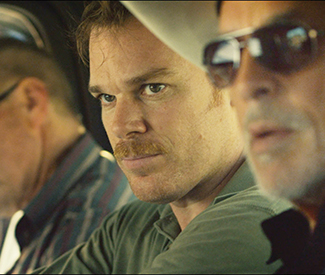
Well, some of its characters. Cold in July begins with a killing, but the trigger hand is attached to mild-mannered frame-store owner Richard Dane (Dexter‘s Michael C. Hall, rocking a splendid mullet). The masked man he shot was breaking into the Dane family home; Richard was just protecting his wife (Vinessa Shaw) and young son (Brogan Hall). That he accidentally, kinda, nailed the burglar — spraying brains everywhere, necessitating amusing later scenes of weary clean-up and furniture replacement — is breezed over by the police (including a cowboy-hatted Damici). “Sometimes, the good guy wins,” they assure him.

The good guy/bad guy dynamic is twisted, tested, and taken to extremes as Cold in July continues; it’s the sort of film best viewed without much knowledge of its plot twists, which are numerous and cleverly plotted. (Which is to say: You may read on, genre junkie, without fear of spoilers, because I don’t wanna ruin anyone’s viewing enjoyment.) The day after his run-in with vigilante justice, Richard realizes he’s the number one conversation topic in his small town, and his shiny local-hero status has attracted the attention of the dead robber’s father (Sam Shepard), just out of the clink and skilled in the art of Cape Fear-style menace.

What happens next is best left a surprise, though it does involve Don Johnson as a flamboyant, convertible-driving pig farmer; plenty more bloodshed; a meeting at a drive-in that just happens to be screening Night of the Living Dead (1968); and the line “You don’t wanna fuck with the Dixie Mafia.” Throughout, Cold in July expertly works its 1980s setting as both homage to and embodiment of the era’s gritty thrillers; its synth-heavy score and neo-noir lensing (by frequent Mickle collaborators Jeff Grace and Ryan Samul, respectively) and the casting of Wyatt Russell (son of Kurt; he was also in We Are What We Are) in a key role add to the feeling that Cold in July was crafted after much time spent in the church of St. John Carpenter. There’s humor, too, deployed with careful timing that doesn’t compromise the slow-burning tension that builds throughout — as when Richard celebrates some good news by headbanging to period-perfect power rock in his enormous, wood-paneled station wagon.

Most intriguingly, and for all its retro trappings, Cold in July offers a very modern exploration of masculinity via all of its leads, though Richard is obviously the embodiment of this theme. “I’ve been waiting for something big like this,” he says to his wife before slithering away on a secret road trip (she thinks he’s talking about landing an important new client). Unlike Viggo Mortensen’s secret gangster in 2005’s A History of Violence, which begins with a similar premise (family guy shoots someone in self-defense, opening a can of worms in the process), Richard has zero past aggression to draw on; dude’s got a history of mildness — with a heretoforth untapped curiosity about the wilder side of life awakened by a sudden bloody act. Once again, Mickle has delivered an unfuck-with-able film. Can’t wait to see what he does next. *


COLD IN JULY opens Fri/30 in Bay Area theaters.

Eternal beauty

1

arts@sfbg.com

FILM Hollywood in the 1920s was shameless about inventing fictitious back stories for its stars, especially those “exotics” exploited for their allegedly foreign-bred mystery and sexual magnetism. The enormous success of Rudolph Valentino — whose 1921 breakthrough feature The Four Horsemen of the Apocalypse opens this year’s San Francisco Silent Film Festival — sparked a particular craze for “Latin lover” types whose true ethnicity was often disguised. (One such heartthrob, Ricardo Cortez, was in fact Jewish New Yorker Jacob Krantz — and when word got out that he was no Spaniard, the studio “confessed” that he was “really” Viennese.)

Yet the era’s leading Latina actress required little such invention, because her biography already sounded like a studio press release. Dolores del Rio was born Maria Dolores Asúnsolo y López Negrete to a wealthy, well-connected Mexico City family of Spanish ancestry. Convent-educated, she married at age 16 a patron of the arts over twice her age, with whom she honeymooned in Europe for two years. Upon returning home, she attended a wedding at which her beauty caught the eye of Edwin Carewe — a Hollywood producer, director, agent, and manager who in all those capacities soon began making her a star. Her first hit was as the main girl fought over by ever-sparring BFF Marines in World War I comedy-adventure What Price Glory?, a 1926 smash.

Her exquisite three-quarter-moon face, framed by long jet-black hair, then graced a series of romances in which she played Russian peasants, tropical maidens, hot-blooded gypsies, Carmen (of operatic fame), and Ramona (1928) — the latter a gorgeous half-caste in old Spanish California. She’s yearned over by the genteel master of the ranchero (Roland Drew), but prefers virile Indian shepherd Alessandro (Ohioan Warner Baxter, shirtless but wearing plenty of shiny bronzer). This third screen version of a hugely popular 1884 novel was boosted at the box office by an original title song recorded by many (including trilling soprano del Rio herself), and featured in the 1928 film’s synchronized-sound version (which offered sound effects and music but no dialogue).

Ramona was assumed lost for decades until a Czech-market print was discovered recently, its restoration premiering in Los Angeles just two months ago. The 2014 SF Silent Film Festival is full of movies that belie their age in one way or another — yet this hunk of overripe hooey feels a thousand years old. It’s surely the worst film in the festival, what with its mean-crone stepmother (“If you marry without my consent, the jewels will go to the church!”), teetering pileup of melodramatic crises, and particularly howl-worthy happy ending. Nor has del Rio’s heavily gestural performance aged well, with nary a genuine note to be found in an emotional gamut that galumphs from cow-eyed innocence to amnesiac shock. Still, she’s gorgeous. Whether cast as prole or grande dame, her looks were so striking it was natural for del Rio to become a beauty icon, promoting cosmetics and fashion as “the perfect feminine figure” — a title she won in leading movie mag Photoplay’s 1933 poll of industry glamour experts.

Del Rio was very conscious of her image — and of her responsibility representing Mexican culture to the world. Unlike rival Lupe Velez, she preferred projecting a more languorous, refined persona than the stereotypically comic, tantrum-throwing “hot mama” Latina. She disliked skimpy costumes and risqué scenes (though one of her biggest hits would be 1932’s Bird of Paradise, a charming bauble of pure eye-candy in which her island princess and Joel McCrea’s sailor pitch woo wearing as little as possible). She turned down the female lead in 1934’s Viva Villa!, suspecting that film’s take on recent Mexican history would be controversial at home. (Indeed, it was banned there.)

Her public character was invariably elegant and dignified — never mind that sometimes her affairs preceded her divorces. One high-profile lover was 10-years-younger Orson Welles. He took her to Citizen Kane‘s 1941 premiere and starred her in 1943’s spy intrigue Journey Into Fear. But when their relationship flamed out, and Hollywood’s affection too had cooled, del Rio at last returned to Mexico. There, she soon established herself as the local film industry’s leading female star — exclusively playing suffering, virtuous heroines — winning a total of four Ariels (Mexico’s Oscar) and very rarely returning to English-language features. When she did, it was no longer as the hothouse object of desire, but as a sacrificing mother, notably to Elvis in Flaming Star (1960) and to Sal Mineo in Cheyenne Autumn (1964), both times playing Native Americans à la the half-Indian Ramona. Such semi-color blind casting and “proud matriarch” roles provided a logical last act to a career that was honorable and iconic — if seldom quite so impressive in, y’know, the acting department.

Ramona may survive primarily as a somewhat campy cultural artifact, but nearly everything else in this year’s Silent Fest remains outstanding artistically, including 1928 German heartbreaker Under the Lantern, and the same year’s fine British working-class drama Underground. There’s also 1923’s The Sign of Four, an excellent Sherlock Holmes adventure, so long as you can overlook some very dated race and class attitudes; atypical early works by Ozu (1933 gangster saga Dragnet Girl) and Dreyer (sprightly 1920 The Parson’s Widow); a goofy Soviet science fiction (1936’s Cosmic Voyage); mountain climbing documentary The Epic of Everest (1924); plus vehicles for Douglas Fairbanks, Buster Keaton, and pioneering French comedian Max Linder (1921’s Seven Years Bad Luck). *

SAN FRANCISCO SILENT FILM FESTIVAL

Thu/29-Sun/1, most shows $15-20

Castro Theatre

429 Castro, SF

www.silentfilm.org


Stage Listings: May 28-June 3, 2014

0

Stage listings are compiled by Guardian staff. Performance times may change; call venues to confirm. Reviewers are Robert Avila, Rita Felciano, and Nicole Gluckstern. Submit items for the listings at listings@sfbg.com.

THEATER

OPENING

Devil Boys From Beyond New Conservatory Theatre Center, 25 Van Ness, SF; www.nctcsf.org. $25-45. Previews Wed/28-Fri/30, 8pm. Opens Sat/31, 8pm. Runs Wed-Sat, 8pm; Sun, 2pm. Through June 28. New Conservatory Theatre Center performs Buddy Thomas and Kenneth Elliot’s campy sci-fi saga.

Each and Every Thing Marsh San Francisco Main Stage, 1062 Valencia, SF; www.themarsh.org. $20-50. Previews Thu/29-Fri/30, June 5-6, and 12-13, 8pm; Sat/31 and June 7, 8:30pm. Opens June 14, 8:30pm. Runs Thu-Fri, 8pm; Sat, 8:30pm. Through July 12. Dan Hoyle presents his latest solo show, about the search for real-world connections in a tech-crazed world.

Homo File CounterPULSE, 1310 Mission, SF; www.counterpulse.org. $20-35. Opens Fri/30, 8pm. Runs Fri-Sat, 8pm; Sun, 7pm. Through June 15. Eye Zen and CounterPULSE present Seth Eisen’s interdisciplinary performance about queer author and tattoo artist Sam Steward.

Macbeth Fort Point (beneath the Golden Gate Bridge), SF; www.weplayers.org. $30-75. Previews Fri/30-Sun/1, 7pm. Opens Thu/5, 7pm. Runs Thu-Sun, 7pm. Through June 29. We Players performs the Shakespeare classic at the historic fortress at Fort Point.

“Savage in Limbo” Phoenix Theatre, 414 Mason, SF; www.brownpapertickets.com. $25. Previews Thu/29, 8pm. Opens Fri/30, 8pm. Runs Sat/31, Sun/1, June 3-6, 8pm (also Sun/1, 2pm); June 7, 2pm. Through June 7. Rabbit Hole Theater Company performs John Patrick Shanley’s Bronx-set drama.

Triassic Parq Eureka Theater, 215 Jackson, SF; www.rayoflighttheatre.com. $25-36. Previews Thu/29, 8pm. Opens Fri/30, 8pm. Runs Wed-Sat, 8pm (also June 21 and 28, 2pm). Through June 28. Ray of Light Theatre presents the Bay Area premiere of Marshall Pailet’s musical involving “dinosaurs, show tunes, and sex changes.”

Walk Like A Man Costume Shop, 1117 Market, SF; www.therhino.org. $15-35. Previews Wed/28-Fri/30, 8pm. Opens Sat/31, 8pm. Runs Wed-Sat, 8pm; Sun, 3pm. Through June 15. Theatre Rhinoceros performs Laurinda D. Brown’s dramedy centered around issues in the African American lesbian community.

ONGOING

Chasing Mehserle Z Space, 450 Florida, SF; theintersection.org/chasing-mehserle. $15-25. Thu/29-Sat/31, 8pm. Intersection for the Arts, Campo Santo, and the Living Word Project present Chinaka Hodge’s performance piece about Oakland in the aftermath of the Oscar Grant killing.

The Crucible Gough Street Playhouse, 1620 Gough, SF; www.custommade.org. $10-35. Thu-Sat, 8pm; Sun, 7pm. Through June 15. Custom Made Theatre Co. performs Arthur Miller’s drama.

Dracula Shelton Theater, 533 Sutter, SF; sfdracula.blogspot.com. $35. Thu/29-Sat/31, 8pm. Kellerson Productions presents a new adaptation of the Bram Stoker classic.

Feisty Old Jew Marsh San Francisco Main Stage, 1062 Valencia, SF; www.themarsh.org. $25-100. Sat-Sun, 5pm. Extended through July 13. Charlie Varon performs his latest solo show, a fictional comedy about “a 20th century man living in a 21st century city.”

Foodies! The Musical Shelton Theater, 533 Sutter, SF; www.foodiesthemusical.com. $32-34. Fri-Sat, 8pm. Open-ended. AWAT Productions presents Morris Bobrow’s musical comedy revue all about food.

The Homosexuals New Conservatory Theatre Center, Decker Theatre, 25 Van Ness, SF; www.nctcsf.org. $25-45. Wed-Sat, 8pm; Sun, 2pm. Through June 28. New Conservatory Theatre Center performs Philip Dawkins’ play about a young man struggling with his identity amid a new group of friends.

Lovebirds Marsh San Francisco Studio, 1062 Valencia, SF; www.themarsh.org. $20-100. Fri/30, 8pm; Sat/31, 8:30pm. Award-winning solo theater artist Marga Gomez brings her hit comedy back for a limited run before taking it to New York in June.

Pearls Over Shanghai Hypnodrome Theatre, 575 10th St, SF; www.thrillpeddlers.com. $30-35. Thu-Sat, 8pm. Extended through June 28. Five years ago, Thrillpeddlers breathed new life into a glitter-dusted piece of Sixties flotsam, beautifully reimagining the Cockettes’ raunchy mock-operetta Pearls Over Shanghai (in collaboration with several surviving members of San Francisco’s storied acid-drag troupe) and running it for a whopping 22 months. Written by Cockette Link Martin as a carefree interpretation of a 1926 Broadway play, the baldly stereotyped Shanghai Gesture, it was the perfectly lurid vehicle for irreverence in all directions. It’s back in this revival, once again helmed by artistic director Russell Blackwood with musical direction by Cockette and local favorite Scrumbly Koldewyn. But despite the frisson of featuring some original-original cast members — including “Sweet Pam” Tent (who with Koldewyn also contributes some new dialogue) and Rumi Missabu (regally reprising the role of Madam Gin Sling) — there’s less fire the second time around as the production straddles the line between carefully slick and appropriately sloppy. Nevertheless, there are some fine musical numbers and moments throughout. Among these, Zelda Koznofsky, Birdie-Bob Watt, and Jesse Cortez consistently hit high notes as the singing Andrews Sisters-like trio of Americans thrown into white slavery; Bonni Suval’s Lottie Wu is a fierce vixen; and Noah Haydon (as the sultry Petrushka) is a class act. Koldewyn’s musical direction and piano accompaniment, meanwhile, provide strong and sure momentum as well as exquisite atmosphere. (Avila)

Seminar San Francisco Playhouse, 450 Post, Second Flr, SF; www.sfplayhouse.org. $20-100. Tue-Thu, 7pm; Fri-Sat, 8pm (also Sat, 3pm); Sun/1 and June 8, 2pm. Through June 14. San Francisco Playhouse performs Theresa Rebeck’s biting comedy.

Shit & Champagne Rebel, 1772 Market, SF; shitandchampagne.eventbrite.com. $25. Fri-Sat, 8pm. Open-ended. D’Arcy Drollinger is Champagne White, bodacious blond innocent with a wicked left hook in this cross-dressing ’70s-style white-sploitation flick, played out live on Rebel’s intimate but action-packed barroom stage. Written by Drollinger and co-directed with Laurie Bushman (with high-flying choreography by John Paolillo, Drollinger, and Matthew Martin), this high-octane camp send-up of a favored formula comes dependably stocked with stock characters and delightfully protracted by a convoluted plot (involving, among other things, a certain street drug that’s triggered an epidemic of poopy pants) — all of it played to the hilt by an excellent cast that includes Martin as Dixie Stampede, an evil corporate dominatrix at the head of some sinister front for world domination called Mal*Wart; Alex Brown as Detective Jack Hammer, rough-hewn cop on the case and ambivalent love interest; Rotimi Agbabiaka as Sergio, gay Puerto Rican impresario and confidante; Steven Lemay as Brandy, high-end calf model and Champagne’s (much) beloved roommate; and Nancy French as Rod, Champagne’s doomed fiancé. Sprawling often literally across two buxom acts, the show maintains admirable consistency: The energy never flags and the brow stays decidedly low. (Avila)

The Speakeasy Undisclosed location (ticket buyers receive a text with directions), SF; www.thespeakeasysf.com. $65-100 (gambling chips, $7-10 extra; after-hours admission, $10). Wed-Sat, 7:30, 7:40, 7:50, 8pm, and 9pm admittance times. Extended through June 21. Boxcar Theater’s most ambitious project to date is also one of the more involved and impressively orchestrated theatrical experiences on any Bay Area stage just now. An immersive time-tripping environmental work, The Speakeasy takes place in an “undisclosed location” (in fact, a wonderfully redesigned version of the company’s Hyde Street theater complex) amid a period-specific cocktail lounge, cabaret, and gambling den inhabited by dozens of Prohibition-era characters and scenarios that unfold around an audience ultimately invited to wander around at will. At one level, this is an invitation to pure dress-up social entertainment. But there are artistic aims here too. Intentionally designed (by co-director and creator Nick A. Olivero with co-director Peter Ruocco) as a fractured super-narrative — in which audiences perceive snatches of overheard stories rather than complete arcs, and can follow those of their own choosing — there’s a way the piece becomes specifically and ever more subtly about time itself. This is most pointedly demonstrated in the opening vignettes in the cocktail lounge, where even the ticking of Joe’s Clock Shop (the “cover” storefront for the illicit 1920s den inside) can be heard underscoring conversations (deeply ironic in historical hindsight) about war, loss, and regained hope for the future. For a San Francisco currently gripped by a kind of historical double-recurrence of the roaring Twenties and dire Thirties at once, The Speakeasy is not a bad place to sit and ponder the simulacra of our elusive moment. (Avila)

36 Stories by Sam Shepard Z Below, 470 Florida, SF; www.36stories.org. $35-55. Wed-Thu, 7pm; Fri-Sat, 8pm; Sun, 3pm. Through June 22. Word for Word performs director Amy Kossow’s original adaptation of Shepard’s poetry and fiction.

BAY AREA

Candida Town Hall Theatre, 3535 School, Lafayette; www.townhalltheatre.com. $20-32. Fri-Sat and June 12, 8pm; Sun, 2pm. Through June 14. Town Hall Theatre performs the Shaw classic.

The Color Purple Hillbarn Theatre, 1285 East Hillsdale, Foster City; www.hillbarntheatre.org. $23-38. Thu/29-Sat/31, 8pm; Sun/1, 2pm. Hillbarn Theatre closes its 73rd season with the musical adaptation of Alice Walker’s classic novel.

The Crazed Berkeley City Club, 2315 Durant, Berk; www.centralworks.org. $15-28. Thu-Sat, 8pm; Sun, 5pm. Through June 23. Central Works performs Sally Dawidoff’s play, based on Ha Jin’s novel about coming of age in Communist China.

Daylighting: The Berkeley Stories Project Ashby Stage, 1901 Ashby, Berk; www.shotgunplayers.org. $20-35. Previews Wed/28-Thu/29, 7pm. Opens Fri/30, 8pm. Runs Wed-Thu, 7pm; Fri-Sat, 8pm; Sun, 5pm (June 22, show at 2pm). Through June 22. Shotgun Players present Dan Wolf’s new play inspired by real-life tales from Berkeley residents past and present.

“Fringe of Marin” Angelico Concert Hall, Dominican University, 20 Olive, San Rafael; www.fringeofmarin.com. $10-20. Schedule varies. Through Sun/1. Fringe of Marin celebrates its 33rd season with 11 original one-act plays presented in two programs.

The Intelligent Homosexual’s Guide to Capitalism and Socialism with a Key to the Scriptures Berkeley Repertory Theatre, Roda Theatre, 2015 Addison, Berk; www.berkeleyrep.org. $14.50-89. Tue, Thu-Sat, 7:30pm (also Thu/29, June 26, and all Saturdays in June, 2pm); Wed and Sun, 7pm (also Sun, 2pm). Through June 29. Berkeley Rep performs the West Coast premiere of Tony Kushner’s latest play.

The Letters Harry’s UpStage, Aurora Theatre Company, 2081 Addison, Berk; www.auroratheatre.org. $28-32. Wed-Sat, 8pm; Sun, 2pm. Extended through June 8. American playwright John W. Lowell’s The Letters harkens back to Stalinist days and some unspecified ministry, where a dutiful staff goes about censoring the personal and openly homoerotic correspondence of an iconic Russian composer (Tchaikovsky). Directed by Mark Jackson for Aurora Theater’s new upstairs black box, the two-hander unfolds in the small but tidy and dignified office belonging to the ministry’s director (an imposing Michael Ray Wisely). He has summoned one of his employees, a widow named Anna (a taut Beth Wilmurt), for reasons not immediately clear to her or us. A careful dance around a minefield of protocol, sexual innuendo, and hidden agendas ensues, as a dangerous and deadly scandal surrounding the aforementioned letters makes itself felt. Given the Ukraine crisis, the ramping up of Cold War II, and Russia’s increasing authoritarianism — including its new law against homosexual “propagandizing” in the cultural realm, and a Ministry of Culture vowing to withhold funding from art lacking in “spiritual or moral content” — it’s all a remarkably timely little time warp. And Lowell’s story is cleverly crafted for the most part. Unfortunately, the production’s two capable actors have a hard time conveying a lifelike (if however strained) relationship or the perspiration-inducing tension the drama purports to carry. At the same time, the drama’s dialogue, at least as played here, can stretch the bounds of verisimilitude by veering from flinty, cagey ducks and jabs to outright insubordination, sarcasm, and ineffectual blustering — the latter outbursts seeming to leave the pressure pot of the Great Terror far behind. It’s still a long way from Tom and Jerry, but as a cat and mouse game the stakes, and the arc of the story, feel more fantastical then pressingly contemporary. (Avila)

Mutt: Let’s All Talk About Race La Val’s Subterranean, 1834 Euclid, Berk; www.impacttheatre.com. $10-20. Thu-Sat, 8pm; Sun, 7pm. Through June 8. Impact Theatre and Ferocious Lotus Theatre Company present the world premiere of Christopher Chen’s political satire.

Nantucket Marsh Berkeley MainStage, 2120 Allston, Berk; www.themarsh.org. $25-100 (all tickets include a picnic dinner). Thu and Sat, 7pm. Through June 14. Acclaimed solo performer Mark Kenward presents his “haunting yet hilarious” autobiographical show about growing up on Nantucket.

Not a Genuine Black Man Osher Studio, 2055 Center, Berk; www.berkeleyrep.org. $30-45. Thu/29-Sat/31, 8pm. Brian Copeland brings his acclaimed, long-running solo show to Berkeley Rep for a 10th anniversary limited run.

Other Desert Cities Barn Theatre, 30 Sir Francis Drake, Ross; www.rossvalleyplayers.com. $10-26. Thu, 7:30pm; Fri-Sat, 8pm; Sun, 2pm. Through June 15. Ross Valley Players perform Jon Robin Baitz’s Pultizer-nominated drama about a tense family holiday.

South Pacific Cushing Memorial Amphitheater, 801 Panoramic Hwy, Mill Valley; www.mountainplay.org. $20-60. Sun and June 7, 2pm (arrive one hour prior to showtime). Through June 15. Mountain Play Association performs the classic Rodgers and Hammerstein musical.

The 25th Annual Putnam County Spelling Bee Lesher Center for the Arts, 1601 Civic, Walnut Creek; www.centerrep.org. $37-65. Wed, 7:30pm; Thu-Sat, 8pm (also Saturdays in June, 2:30pm); Sun, 2:30pm. Through June 21. Center REP performs the Tony-winning musical by William Finn and Rachel Sheinkin.

PERFORMANCE/DANCE

“Alaska is a Drag” Intersection for the Arts, 925 Mission, SF; www.theintersection.org. Wed/28, 7pm. $5-15. The Big Table Read hosts this staged reading of Shaz Bennett’s screenplay.

“The Amazing Acro-Cats” Fort Mason Center, Southside Theater, Marina at Laguna, SF; www.circuscats.com. Thu/29-Sat/31, 8:30pm; Sun/1, 2 and 5pm. $24. Samantha Martin and her performing cat troupe, including “the only cat band in existence” (with a chicken on tambourine), take the stage. As its press release insists, “Yes, this is real!”

“Auto(SOMA)tic: Creative Responses to the SOMA” Arc Studio and Gallery, 1246 Folsom, SF; www.kearnystreet.org. Sat/31, 10am and 2pm. $30. Kearny Street Workshop and Shaping San Francisco present Allan S. Manalo’s interactive performance bus tour.

Caroline Lugo and Carolé Acuña’s Ballet Flamenco Peña Pachamama, 1630 Powell, SF; www.carolinalugo.com. June 17, 22, 29, July 12, 19, and 27, 6:15pm. $15-19. Flamenco performance by the mother-daughter dance company, featuring live musicians.

“Dash: Improv in a Flash” Un-Scripted Theater Company, 533 Sutter, Second Flr, SF; www.un-scripted.com. Sat, 10pm. $15. Ongoing through Aug 30. A late-night, free-form improv show with Un-Scripted Theater Company.

“Dogeaters” ACT’s Costume Shop, 1119 Market, SF; www.magictheatre.org. Mon/2, 7pm. Free. Magic Theatre’s 2014 Martha Heasley Cox Virgin Play Series presents this staged reading of Jessica Hagedorn’s satirical soap opera.

“Dream Queens Revue” Aunt Charlie’s Lounge, 133 Turk, SF; www.dreamqueensrevue.com. Wed/28, 9:30pm. Free. Drag with Collette LeGrande, Ruby Slippers, Sophilya Leggz, Bobby Ashton, and more.

Feinstein’s at the Nikko 222 Mason, SF; www.feinsteinssf.com. This week: “Michael Feinstein with Paula West, in Celebration of Feinstein’s at the Nikko’s One-Year Anniversary,” Sun/1, 7pm, $80.

“Gender Assimilation: A Rebuttal” Stage Werx, 446 Valencia, SF; www.theygobythey.com. Thu/29, 7:30pm. $10. Jaq Victor performs a cheeky coming-out tale as part of the United States of Asian America Festival.

“Hysteria” Dance Mission Theater, 3316 24th St, SF; www.dancemission.org. Fri/30-Sat/31, 8pm; Sun/1, 7pm. $20. BodiGram takes on Dissociative Identity Disorder in this satirical performance work.

“Magic at the Rex” Hotel Rex, 562 Sutter, SF; www.magicattherex.com. Sat, 8pm. Ongoing. $25. Magic and mystery with Adam Sachs and mentalist Sebastian Boswell III.

“Mais Oui” 2946 Third St, SF; www.sanfranciscobicycleballet.org. Sat/41, 6:45-10m. $8. The San Francisco Bicycle Ballet performs.

“Out of Line Improv” Stage Werx, 446 Valencia, SF; outoflineimprov.brownpapertickets.com. Sat, 10:30pm. $12. Ongoing. A new, completely improvised show every week.

“San Francisco Comedy College” Purple Onion at Kells, 530 Jackson, SF; www.purpleonionatkells.com. $5-10. “New Talent Show,” Wed-Thu, 7. Ongoing. “The Cellar Dwellers,” stand-up comedy, Wed-Thu, 8:15pm and Fri-Sat, 7:30pm. Ongoing.

“Spring: Water Ritual” Yerba Buena Center for the Arts, Grand Lobby, 701 Mission, SF; www.ybca.org. Sat/31, 1-2:30pm. Free. Artist Dohee Lee performs a celebration of “the regenerative power of the ocean.”

“Threepenny Opera” Phoenix Annex Theater, 414 Mason, Ste 406, SF; www.waffleopera.com. Sat/31, 7:30pm; Sun/1, 2pm. $15-25. Waffle Opera performs the Weill and Brecht classic.

“Walking Distance Dance Festival — SF” ODC Theater, 3153 17th St, SF; www.odcdance.org. Fri/30-Sat/31, 7:30pm (also Sat/31, 3, 4, 6, and 9:30pm). $25 (festival pass, $65). ODC Theater’s fringe-style fest presents samplings of contemporary dance from around the world.

“Yerba Buena Gardens Festival” Yerba Buena Gardens, 760 Howard, SF; www.ybgfestival.org. Free. Through Oct 26. This week: Will Magid Trio, Wed/29, 12:30-1:30pm; Ensemble Mik Nawooj, Sat/31, 1-2:30pm.

BAY AREA

“After Juliet” Flight Deck, 1540 Broadway, Oakl; www.grittycityrep.org. Thu/29-Sat/31, 8pm; Sun/1, 2pm; June 8, 2 and 8pm. $5-25. Gritty City Repertory Youth Theatre performs Sharman Macdonald’s drama.

“MarshJam Improv Comedy Show” Marsh Berkeley, 2120 Allston, Berk; www.themarsh.org. Fri, 8pm. Ongoing. $10. Improv comedy with local legends and drop-in guests.

“The Expulsion of Malcolm X” Laney College Theater, 900 Fallon, Oakl; www.brownpapertickets.com. Thu/29-Sat/31, 7:30pm (also Sat/31, 2:30pm). $30-40. A play exploring the rocky relationship between Malcolm X and Elijah Muhammad.

Risa Jaroslow and Dancers, Peiling Kao Shawl-Anderson Dance Center, 2704 Alcatraz, Berk; www.brownpapertickets.com. Fri/30-Sat/31, 8pm; Sun/1, 4pm. $15-18. The choreographers present What’s the Upshot and Ludic Numerologies.

“34th Annual Planetary Dance” Santos Meadow, Mt. Tamalpais State Park, Mill Valley; www.planetarydance.org. Sun/1, 11am. Free. This year’s theme of Anna Halprin’s annual participatory performance is “Remember the Children.” *


Our Weekly Picks: May 28-June 3, 2014

0

WEDNESDAY 28

Rodriguez

In 1970, a singer-songwriter called Rodriguez, who had been discovered by a couple of music producers in a downtown Detroit bar, cut an album called Cold Fact. It bombed. After an equally-disappointing follow-up record, Rodriguez abandoned his musical career and faded into obscurity. Meanwhile, in South Africa, a bootleg copy of Cold Fact had become the soundtrack to the Anti-Apartheid movement. Rodriguez was completely unknown in the United States, and more famous than Elvis in South Africa. Decades later, two Rodriguez fans travelled from Cape Town to find out what happened to Rodriguez and research the rumors of his onstage suicide. Instead they found him working in construction and ready to continue his musical dreams. Rodriguez’ story is chronicled in the Oscar-winning documentary Searching for Sugarman. His incredible story, however, is not what makes him worth seeing: As a performer he is tender, compelling, and well worth the 40-year wait. (Haley Zaremba)

With LP

$40, 8pm

The Warfield

982 Market, SF

www.thewarfieldtheatre.com


Exclusive screening: The Pink Room

Never mind Elizabeth Raine, the med student who auctioned her virginity for a six-figure price tag. In many cases, prostitution is not a luxury, it’s slavery. In a country ravaged by genocide, many Cambodian children became orphans and forced into a life of child slavery and prostitution. The Pink Room documentary exposes the human trafficking and child sex slavery that runs rampant in Cambodia, threading together first-person accounts of those held captive and those helping to change the country where over 1 million children are sexually abused. One of the accounts comes from a Cambodian woman who was forced into the industry at a very young age, illustrating how Mien’s virginity was sold at a high price, but her value becomes lower with each purchase. After years of torture, she’s become a voice of hope and compassion in a country plagued by darkness. This screening will be followed by a Q&A with the film’s directors and producers. (Laura B. Childs)

7pm, $25

Letterman Digital Arts Center

Chestnut & Lyon, SF

(415) 897-2123

www.onelettermandrive.com


THURSDAY 29


SF’s Power Women of Eventbrite, ModCloth & One Kings Lane

Talk about co-founders with cache — three local startup champions will share their success stories, including tales from the trenches of the e-commerce realm and insights on how they’ve won followers’ hearts. Julia Hartz’s Eventbrite has become the ticketing standard-bearer for events; Susan Gregg Koger’s ModCloth merges online couture shopping with a growing social network of fashionistas; and Alison Pincus’s One Kings Lane provides high-end furnishings and home decor directly to trendy tastemakers. They’ll converse with a fourth entrepreneur, BlogHer cofounder and media strategist Jory Des Jardins. (Kevin Lee)

6:30pm, $15-$45

The Fairmont Hotel, Gold Room

950 Mason, SF

(415) 597-6700

www.commonwealthclub.org


Bloody Beetroots

With a real name like Sir Bob Cornelius Rifo, it’s hard to see why you would opt for a pseudonym, but the Italian producer has been successfully producing infectious and inspired dance and electronic music under the Bloody Beatroots moniker since 2006. Rifo was classically trained on guitar, learning to read by the solfege method and studying Chopin, Beethoven, and Debussy. His fascination with punk, new wave, and ’70s-era comic strips, however, pulled him out of this straight-laced territory and into a new musical world of his own creation. Rifo and his right-hand-man and sampler Tommy Tea are known for their rowdy, energized live shows, and the black Venom masks they wear throughout, never showing their faces. Dirty, fun, and hard to predict, the Bloody Beetroots guarantee a great, sweaty night. (Zaremba)

With J Boogie

$25, 8pm

The Regency

1290 Sutter, SF

www.theregencyballroom.com


SF Green Film Festival

San Franciscans are no strangers to tackling the subject of global warming. Whether we’re discussing the drought or trying to solve climate change by working less, the well-being of the planet is foremost on our minds. But starting tonight, we’ll let the pros take over: The Green Film Festival is a weeklong affair that will consist of environmentally-conscious documentaries, panel discussions with filmmakers and activists, and workshops with non-profits. The 4th annual festival kicks off with the San Francisco premiere of DamNation, an award-winning documentary that explores sea change and reveals how removing dams would bring rivers back to their natural state, helping to stabilize the ecosystem. Explore marine life, meet the filmmakers, and discuss the environment over sustainable food and drinks at the opening night reception, held at the Aquarium of the Bay. (Childs)

6pm, $50

Aquarium of the Bay & Bay Theater

Embarcadero at Beach, SF

(415) 742-1394

www.sfgreenfilmfest.org


FRIDAY 30


Animal Collective (DJ set)

Animal Collective guitarist Panda Bear is jamming on a nationwide tour solo, so some of the other members have elected to show off their digital record collections in select venues. What to expect from a set? Actual recorded footage of the band’s mixmastery is rare, but Soundcloud and YouTube have a two-hour tablets-and-mixer session that serves as an especially encouraging primer — a catchy blend of funk, psychedelic, uplifting vocal house, and brooding techno. The Collective members stitched together their tasteful selections through different techniques, alternating between tried-and-true beat-matching and masterfully weaving melodies. Much of the two-hour mix came off as both carefully curated and effortlessly engaging; hopefully there is more to come. (Lee)

With Slow Magic, Sophie

10 pm, $25

1015 Folsom, SF

(415) 431-1200

www.1015.com


Risa Jaroslow’s What’s the Upshot?

Having moved here barely a year ago, Risa Jaroslow is not yet a household name even within the local dance community. Yet she has brought with her a long, well-respected career of creating choreography in which movement — whether from highly trained dancers or common folks — has stories to tell about what it means to be alive today. “I always start with a question that has resonance for me,” she recently explained. The new What’s the Upshot? may well have been provoked by her move across the country. Here she is working with Sophie Stanley, about to join AXIS; Jordan Stout, who comes from contact improv; and Patrick Barnes, who brings a strong athletic background to dance. On Friday and Sunday, Peiling Kao’s Ludic Numerologies will join Jaroslow’s premiere. (Rita Felciano)

May 30 and 31, 8pm, June 1, 4pm, $15-$18

Shawl Anderson Dance Center

2704 Alcatraz, Berk.

(510) 654-5921

www.shawl-anderson.org


SATURDAY 31


SPIRIT: Queer Asian, Arab, and Pacific Islander Artivism

The National Queer Arts Festival and San Francisco’s own community leaders Queer Rebels present the untold stories of queers, from Angel Island to the Arab Spring, in a two-day celebration of performance art and film. Saturday’s performances include drag performance duo BELLOWS, who opened Queer Rebels’ Liberating Legacies show earlier this month; Elena Rose, co-curator of Girl Talk: A Cis and Trans Woman Dialogue, which has run at the National Queer Arts Festival for five years; Modern Arabic Stage Style dancer Heaven Mousalem, and many more. Come back Sunday for an afternoon of films by a variety of artivists, including Queer Rebels co-founder and host Celeste Chan herself. SPIRIT is an opportunity to honor histories, talents, and intersections of identity that don’t make it to our televisions sets. Tickets for Saturday’s performances are available on Brown Paper Tickets, and tickets for Sunday’s films can be purchased at the door. (Kirstie Haruta)

Sat., 8pm, $12-20

African American Art & Culture Complex

762 Fulton, SF

(415) 922-2049

www.aaacc.org


Sun., 3pm, $7-10

Artists’ Television Access

992 Valencia, SF

(415) 824-3890

www.atasite.org


SF Silent Film Festival

Fans of classic cinema are in for a treat this week with the return of the San Francisco Silent Film Festival, the annual celebration of the early years of film. Opening up the fete this year is a screening of 1921’s The Four Horseman of the Apocalypse — the film that propelled Rudolph Valentino to Hollywood stardom — which will be presented with live musical accompaniment by the Mont Alto Motion Picture Orchestra. Other highlights include Douglas Fairbanks’ The Good Bad Man and comedy legend Buster Keaton’s The Navigator. Don’t miss your chance to see these films in one of the last surviving movie palaces from that time period. (Sean McCourt)

May 29 – June 1, times and prices vary

Castro Theatre

429 Castro, SF

(415) 621-6120

www.castrotheatre.com

www.silentfilm.org


SUNDAY 1


Fantasia

Growing out of what was originally just going to be a “Silly Symphonies” short in the late ’30s, Walt Disney’s 1940 masterpiece Fantasia broke new ground in animation on a variety of levels, employing some of the finest artists and musicians of the day to bring his vision to life. Combining the magic of cartoons and classical music, the film featured famous conductor Leopold Stokowsi leading the Philadelphia Orchestra. This weekend the San Francisco Symphony will be performing live to screenings of selections from both the original classic and Fantasia 2000, including the beloved and iconic piece “The Sorcerer’s Apprentice.” (Sean McCourt)

8pm Sat.; 4pm Sun., $41-$156

Davies Symphony Hall

201 Van Ness, SF

(415) 864-6000

www.sfsymphony.org


MONDAY 2


Kelis


Perhaps today’s young’uns will come to know her for her relatively tame show on the Cooking Channel (Saucy & Sweet), but for the rest of us, Kelis will always be one of the bossiest, baddest ladies in radio R&B — not to mention that whole milkshake thing. The un-self-consciously sexy singer/rapper/larger-than-life-persona kicks off her first national tour in four years with this show in San Francisco, performing songs off her April release and sixth studio album, the straightforwardly-titled Food, which features rootsy, funky, electro-tinged tracks like “Breakfast,” “Cobbler,” “Jerk Ribs,” and “Friday Fish Fry.” Maybe eat before you go. (Emma Silvers)

With Son Little

8pm, $22.50

The Fillmore

1805 Geary, SF

www.thefillmore.com


TUESDAY 3  


Invisible Hands: Voices from the Global Economy

“Ziola said that the students would leave for the fields after breakfast, around 7 a.m., and would come back around 5:30 p.m. There were no days off. They were working on Sundays and holidays as well.” This is how a seamstress from Uzbekistan describes her daughter being forced by school officials to pick cotton for meager wages in a new book from McSweeney’s, Invisible Hands: Voices from the Global Economy. Her account is among 16 first-hand oral histories documenting the poor working conditions and hidden human rights abuses that laborers encounter in the U.S. and abroad. Invisible Hands‘ editor and San Diego-based immigration lawyer Corinne Goria will talk with Mother Jones editor Maddie Oatman about how the collection of stories came together. (Lee)

7pm, free

826 Valencia

826 Valencia, SF

(415) 642-5905

www.826valencia.org


The Guardian listings deadline is two weeks prior to our Wednesday publication date. To submit an item for consideration, please include the title of the event, a brief description of the event, date and time, venue name, street address (listing cross streets only isn’t sufficient), city, telephone number readers can call for more information, telephone number for media, and admission costs. Send information to Listings, the Guardian, 225 Bush, 17th Flr., SF, CA 94105; or e-mail (paste press release into e-mail body — no attachments, please) to listings@sfbg.com. Digital photos may be submitted in jpeg format; the image must be at least 240 dpi and four inches by six inches in size. We regret we cannot accept listings over the phone.

PrEP school

32

Two weeks ago, the Centers for Disease Control and Prevention announced that it was recommending physicians consider Truvada, a medication used to treat HIV/AIDS, to prevent infection for high-risk patients who are HIV negative. Seen as a miracle drug by some and a “party drug” by others, Truvada has struggled to take off as a preventative measure and, prior to the CDC’s endorsement, foundered under its own controversy.

The drug regimen is known as pre-exposure prophylaxis, or PrEP, and involves taking one pill of Truvada daily. The most common side effects are initial nausea and headaches, but even those generally subside after a couple of weeks. Most impressive is the efficacy rate: Studies point to a reduction in risk of contracting HIV that is higher than 90 percent for individuals who take the medicine daily as recommended.

Additionally, the CDC has recommended PrEP only for high-risk patients — meaning gay men who have sex without condoms; intravenous drug users; and couples, gay or straight, where one partner is HIV positive and the other is negative.

“While a vaccine or cure may one day end the HIV epidemic, PrEP is a powerful tool that has the potential to alter the course of the U.S. HIV epidemic today,” said Dr. Jonathan Mermin, director of CDC’s National Center for HIV/AIDS, in a press release.

But PrEP comes with its detractors, the most vocal of whom have come from within the HIV/AIDS and gay community. PrEP users often carry the stigma of being hypersexual gay men, looking to justify their promiscuous sex lives and disavowal of condoms with a daily pill. The label “Truvada whore” soon emerged as a means to shame PrEP users (though the term is now being reclaimed by PrEP activists as a source of pride through hashtags and T-shirts).

However, the loudest critic by far has been the AIDS Healthcare Foundation, a nonprofit organization based in Los Angeles that provides care to HIV positive patients around the globe.

“This is a position I fear the CDC will come to regret,” said AHF President Michael Weinstein in a public statement. “By recommending widespread use of PrEP for HIV prevention despite research studies amply chronicling the inability to take it as directed, and showing a limited preventive effect at best, the CDC has abandoned a science-driven, public health approach to disease prevention — a move that will likely have catastrophic consequences in the fight against AIDS in this country.”

The push for PrEP is playing out like a grand battle between two formidable foes. On one side is the multi-billion dollar pharmaceutical company that produces Truvada, Gilead Sciences, headquartered just a few miles south in Foster City. On the other is AHF, the largest provider of HIV/AIDS medical care in the US. While on the surface it may seem like a massive corporation taking on the not-for-profit underdog, the reality is much more complex.


THE TRUVADA TRAIN

When Truvada was first approved by the Food and Drug Administration 10 years ago, it was a revolutionary new pill used in combination with other drugs to help control the virus in HIV-positive patients. At a time when most HIV medications required taking pills throughout the day and carried intolerable side effects, Truvada was a once-a-day godsend.

Since then, Gilead has established itself as one of the leading companies for HIV medications, producing or helping to produce many top drugs, such as Atripla, Complera, and Stribild, all of which use components of Truvada in their formulas.

But Truvada’s truly revolutionary moment came in July 2012, when it became the first drug approved by the FDA to reduce the risk of HIV infection in negative individuals.

Controversy immediately ensued.

Medicating healthy people is not a popular approach, especially when those drugs cost $13,000 annually per patient (most insurance companies, as well as Medicare and Medicaid, cover PrEP). In comparison, the CDC estimates that the annual cost to treat someone who already has HIV is $23,000. If all of the 500,000 high-risk Americans who the CDC recommends use PrEP were to begin the therapy, the gross revenue for Gilead would be $6.5 billion — all for people who aren’t even sick.

Despite the potential for astronomical profits, as of September 2013 only 2,319 unique individuals had been prescribed Truvada as PrEP, according to Gilead. Half of those patients are women, suggesting that gay men are not being aggressively targeted for PrEP. When PrEP users who are part of research studies are included, the total number of patients is still estimated to be under 10,000.

One reason for the slow start is a lack of awareness. Outside of big cities, there is less dialogue surrounding HIV and prevention techniques. And even in metropolitan areas, familiarity with Truvada is often limited to the HIV specialist doctors treating patients who already have HIV and wouldn’t benefit from PrEP.

“We get a fair number of patients here who are rejected for PrEP from other physicians in the city,” said Dr. John Nienow of One Medical Group in the Castro. “I haven’t heard about widespread adoption in other offices, but I have heard of other physician groups not wanting to prescribe Truvada for PrEP.”

When asked whether the recent CDC announcement endorsing PrEP would change that, Nienow was hopeful.

The CDC announcement “will educate and legitimize PrEP’s use on a widespread basis,” he said. “I think physicians might be uncomfortable prescribing it, and this will make them more comfortable.”

Another reason PrEP has failed to gain traction is that Gilead has spent virtually no money on advertising its own drug. Well, sort of. It is true that Gilead has avoided advertising campaigns — drug companies that push their own drugs tend to stir up controversy — but many of the organizations that have come out publicly in favor of PrEP have received grants from Gilead. According to tax forms, Project Inform and the San Francisco AIDS Foundation, two prominent local nonprofits that support PrEP, have both received large donations from the pharmaceutical company.

One such grant was awarded to Project Inform, for the group to produce videos about PrEP targeted toward young gay men, particularly men of color, according to David Evans, director of research advocacy.

Was this donation a part of Gilead’s marketing strategy? It’s tough to say for sure; Gilead did not return Bay Guardian calls seeking comment.

Regardless of money, it is clear that a new approach is needed for combating HIV. New infections in the US have stubbornly hovered at around 50,000 incidences per year since the ’90s, despite pushes for condom usage and education efforts.

“Yes, PrEP is working. It works when it’s adhered to,” Nienow said. “It’s been extensively studied in populations at risk for HIV, and the conclusion was that it is dramatically successful. So much so that one expert even said that the debate about efficacy is now over.”


FROM SELF-PROTECTION TO “SLUT”

It’s true that the AIDS Healthcare Foundation is no billion dollar corporation such as Gilead. But with an operating budget this year of $904 million and a presence in 28 countries, AHF is still a force to be reckoned with.

Though the list of organizations that are loyal exclusively to condoms as a method of prevention is dwindling, AHF has been one of the most powerful and resolute allies of latex protection since the very beginning. Even before Truvada was approved by the FDA as PrEP in 2012, AHF campaigned to prevent it from happening. Even though AHF may be growing more and more isolated in its anti-PrEP stance, it is anything but ready to give way.

Though the efficacy rate for using PrEP is upwards of 90 percent reduction in risk, AHF and other critics consistently cite a drastically lower 40 percent reduction. The difference between these two figures lies in patient behavior: When Truvada is taken correctly, that is, every day without skipping doses, then it’s been shown to reduce new HIV infections by over 90 percent. However, when research studies publish data they must include all participants, regardless of whether they took the dosage as instructed. Average out the effectiveness of the drug between participants who adhered religiously and those who didn’t take it at all, and you arrive at about a 40 percent reduction in risk.

But as AHF points out, the outcome for the participants who did not follow instructions is an important reality that should not be overlooked.

“When you read these studies carefully, what they say is that research modeling can be whatever percent effective, but research modeling is not real-world applicable,” said Ged Kenslea, AHF director of communications. “In every study participants were given incentives and paid to participate,” yet still didn’t adhere to instructions consistently.

“We can’t even get people who already have HIV to take their pills as prescribed,” Kenslea added.

Even amid legitimate concerns about health risks associated with improper use of PrEP or its inability to act as a safeguard against other STDs, much of the debate has become infused with anti-PrEP rhetoric rooted in stereotypical assumptions about the promiscuity of gay men. Patients who use it to protect themselves are reduced to “Truvada whores,” men who live capriciously and are always on the lookout for their next fuck.

“The last couple of years that we’ve been prescribing [Truvada], there have been reports from patients who have received negative reactions from some people,” said Nienow. “Some people, particularly online, regard it as a marker for whores and promiscuity, and others as a marker for self-protection. The stigma kind of ranges from, ‘Great, you’re protecting yourself,’ to, ‘Horrible, you’re a slut.’ My patients have seen all of those.”

Just last month, AHF President Michael Weinstein referred to Truvada as a “party drug,” setting off such a fury that a petition to remove him as head of the organization is now circulating around the Internet. It has amassed nearly 4,000 signatures.

AHF’s policy of championing condoms above any other method is strange, considering that it cites poor adherence to Truvada as the drug’s primary downfall. While the efficacy of the drug clearly drops when it is not taken correctly, AHF critics point out that condoms are not used consistently either, and having multiple methods of protection is better than one.

After viewing donations by Gilead to HIV/AIDS groups, the Bay Guardian requested a list of donors from the AHF as well, but the organization provided a 2012 tax form that did not include a donor list.

PrEP does have some efficacy, Kenslea said, and AHF clinicians are free to prescribe Truvada as a preventative drug.

“If an AHF physician feels that prescribing PrEP is appropriate, then we do not stop that,” Kenslea said.

Still, AHF’s uncompromising reluctance to consider endorsing PrEP is puzzling. AHF leaders repeatedly list reasons that the drug will not work, despite mounting scientific evidence stating the contrary. There is no doubt that PrEP should not be taken lightly or with a blasé attitude, but why eschew it with such fervor?

“We are not refuting the science,” Kenslea said. “We are disagreeing on the understanding of human nature.”


A DAILY ROUTINE

When Damon Jacobs re-entered the dating game in 2011, it was a completely different playing field from what he remembered. At first, he wasn’t sure what to expect after coming out of a seven-year relationship with his boyfriend, but he quickly realized there were some significant differences since he had last played the field.

“For me, getting back into the dating world and the cruising world, I was realizing that people were not using condoms as they were a decade earlier,” Jacobs said. “And I wasn’t using them like I was in 1990’s San Francisco either.”

But even scarier than Jacobs’ risky behavior was the reasoning behind it.

“I noticed that my thinking had changed,” he admitted. “I started thinking of HIV as a ‘when,’ not an ‘if.'”

It was during that time when the PrEP studies were just beginning to be published. After attending a forum about using an HIV treatment drug to prevent HIV, Jacobs gathered all of the information he could on this unconventional approach and ran back to his doctor. He knew he wasn’t being as diligent to prevent HIV as he once had, and PrEP seemed like an effective way to stay negative.

His physician had never heard of giving Truvada to a patient without HIV, but Jacobs showed him the research and promising results. He began taking PrEP in July 2011, exactly one year before its FDA approval for HIV-negative individuals.

“Those of us using PrEP now, we were the first ones asking for this, so we’ve had to be the educators and the advocates,” Jacobs said. “We even educate the doctors. Some doctors take that and say, ‘yes, I want to work with you.’ Others give tacit dismissal, and then some tell outright lies about it.”

In the past three years, Jacobs has never missed one of his daily pills. He has built it into his everyday routine: eat breakfast, brush teeth, take PrEP. If you can remember to brush your teeth, he postulates, you can remember to take your pills.

Unfortunately, Jacobs has dealt with the stigma that surrounds PrEP as well.

“If I’m on a date with someone who is negative and he finds out, he’ll ask me, ‘Oh, so you’re a whore? Do you have sex with everybody?'” Jacobs lamented. “It’s not a common reaction, but it stems from a misunderstanding of what PrEP is.”

Instead of being offended, embarrassed, or angry, he takes the time to educate, often resorting to the same analogy: that it’s very similar to women taking birth control; it reduces the unwanted consequences of condom-less sex.

Even though Jacobs disagrees with today’s critics of PrEP, he seems to understand where they are coming from. He volunteered with the Stop AIDS Project in San Francisco in 1992, while HIV was crippling the gay community and condoms were considered the only safeguard from a then-fatal virus.

“Michael Weinstein’s message has been that people should use condoms,” said Jacobs. “When I started volunteering at Stop AIDS [Project], we had a marketing campaign where we gave out pins and T-shirts at local bars and clubs that said, ‘100%’ because we knew that if everybody used condoms 100 percent of the time, we could eradicate AIDS by 2000. “Well I ask you, how did that pan out?”

Fool me once…

8

rebecca@sfbg.com

As any job seeker knows, it’s tough to compete for a desirable gig if you can’t point to a solid track record. You might think this would be especially true for city contractors who stand to make a killing on lucrative construction projects.

Take, for instance, a $283.2 million San Francisco Public Utilities Commission contract awarded to perform an absolutely essential service: making seismic and hydraulic retrofits to water-treatment units.

With close to $300 million in taxpayer dollars on the line, not to mention the general importance of having a properly functioning water treatment system in the event of an earthquake, you might think the city would kick some tires and make a few inquiries about the company’s track record before signing a deal.

But according to the results of an audit issued May 20 by the Office of the Controller, local agencies do not “consider past performance in the construction contract award process.”

Which is to say, there is no mechanism preventing city agencies from awarding high-paying construction gigs — over and over again — to bidders who have done a terrible job in the past.

For the water-treatment fixes, the SFPUC wound up selecting what the controller’s audit charitably termed a “poor-performing” contractor. It didn’t go well: The company “delivered poor quality control, and applied poor project management,” according to the audit.

It issued 87 “change orders” — adding work beyond what was outlined in the original contract — consequently padding the bill by an additional $2.1 million. And this contractor was hit with 70 noncompliance notices, issued when a contractor isn’t following the obligations spelled out in the contract. Sending out those notices eats up city resources, auditors noted, while following up on them necessitates further inspections and site visits.

Although the audit didn’t name the contractor, the amount allocated and work described suggests that it was Keiwit Infrastructure West Co., hired to take on a water treatment plant retrofit project at the SFPUC’s Harry Tracy facility, which treats drinking water that originates at the Crystal Springs Reservoir System.

According to the project website, “Seismic retrofits and electrical upgrades will allow us to reliably provide up to 140 million gallons of water per day, for 60 days, within 24 hours of a major earthquake. Harry Tracy serves several communities on the Peninsula in addition to San Francisco.” The company didn’t return a call from the Guardian seeking comment.

Why was a problematic contractor entrusted with such a critical project? According to the audit, city law does in fact require a contractor to have “a record of prior timely performance,” and a history of dealing with the city “in good faith.”

But there’s no system for holding contractors to these standards. Since the city has no system in place for evaluating bids based on a contractors’ past performance, it’s anyone’s guess whether this contractor had a poor track record before being hired — and there is nothing to prevent the firm from being hired yet again despite the problems encountered by the SFPUC.

The city contracting process follows a scoring system to ensure that the contract award is impartial and equitable — but since it doesn’t factor in a contractor’s prior track record, that’s never formally considered.

And because the city doesn’t require contractor evaluations, or maintain any centralized database of records showing how well contractors have carried out their duties in the past, “poor-performing contractors — even contractors incapable of performing the work on which they bid — can secure additional city contracts,” auditors found.

This SFPUC contract was just one example. The report also highlighted a case study from the San Francisco International Airport, in which a construction crew botched a welding job performed as part of a $15 million contract to build a pedestrian bridge and mezzanine to an airport terminal. The report outlines what went wrong, citing “inadequate installation and missed steps in the welding procedures; bolt holes were misaligned and measured incorrectly.” As a result, SFO issued 59 noncompliance notices.

A contractor hired by the Department of Public Works, for a $5.2 million neighborhood branch library project, was reportedly “aggressive and argumentative … focused on preparing a claim instead of the project,” and “left the job midway through the project,” the audit notes. After that went south, the city spent $85,000–$100,000 on litigation, finally completing the job with the city’s own workforce.

The coming decade promises to be golden for city contractors who work in the construction sector. San Francisco has budgeted more than $25 billion for ambitious projects under its capital improvement plan, so many lucrative construction opportunities will arise.

The Controller’s City Services auditor has kept a watchful eye on construction over the past couple years, Director of City Audits Tonia Lediju told the Guardian. That led to the discovery that the city lacks a process for tracking contractors’ past performance when making hiring decisions.

“Given what we learned from our previous audits, not to mention … our reliance on contractors to accomplish our city’s capital plan, the Controller’s Office decided to conduct this audit to more formally assess the adequacy of the departments’ contractor evaluation processes,” Lediju explained.

As part of the audit, the Controller’s Office surveyed construction management staff at various city agencies, finding that a full 70 percent of them reported encountering poor-performing contractors “at least occasionally.”

To address the gaping problems in the construction contracting system, the Office of the Controller recommended that city agencies work with the Mayor’s Office, the Board of Supervisors, and the City Attorney’s Office to strengthen the law by requiring contractor performance evaluations to be completed — and to consider those evaluations when awarding contracts. With $25 billion in spending over the next 10 years, this might be a wise move.

Memorial Day: Remembering the good old days in Rock Rapids, Iowa, circa 1940s to 1950s

0

 Bruce B. Brugmann

(Reprinted and updated by popular demand)

When I was growing up in my hometown of Rock Rapids, Iowa, a farming community of 2,800 in the northwest corner of the state, Memorial Day was the official start of summer.

We headed off to YMCA camp at Camp Foster on West Okiboji Lake and Boy Scout camp at Lake Shetek in southwestern Minnesota. The less fortunate were trundled off to Bible School at the Methodist Church.

As I remember it, Memorial Day always seemed to be a glorious sunny day and full of action for Rock Rapids. The high school band in black and white uniform would march down Main Street under the baton of the local high school band teacher (in my day, Jim White.) A parade would feature floats carrying our town’s veterans of the First and Second World wars, young men I knew who suddenly were wearing their old uniforms. And there was for many years a veteran of the Spanish American War named Jess Callahan prominently displayed in a convertible. Lots of flags would be flying and the Rex Strait American Legion Post and Veterans of Foreign Wars would be out in force. We never really knew who Rex Strait was, except that he was said to be the first Rock Rapids boy to die in World War I and the post was named after him.

After the parade, we would make our way to our picture post card cemetery, atop a knoll just south of town overlooking the lush green of the trees and the fields along the lazy Rock River.A local dignitary would give a blazing patriotic speech. A color guard of veterans would move the flags into position and then at the command fire their rifles off toward the river. I remember this was the first time I ever saw a color guard in action, with a sergeant who moved his men with rifles into position with strange “hut, hut, hut” commands.

After the ceremony, everyone would go to the graves of their family and friends and people they knew and look at the flowers that would be sitting in bouquets and little pots by the headstones. The cemetery was and is a beautiful spot and many of us who are natives have parents, friends, and relatives buried here. It is one of the wonderful things that connects us to the town, no matter where we end up.

And so this year I got my annual telephone call from Dorothy Bosch, at the Flower Village florist in Rock Rapids, reminding me about the flowers I always place on Memorial Day  on the graves of my relatives in the Brugmann plot. I always get a kick out of doing business with Flower Village because it once was in the Brugmann Drugstore building on Main Street that had housed our family drug store. (“C.C. Brugmann and Son, where drugs and gold are fairly sold, since 1902.”)  Flower Village  later moved across the street to the building that once housed the Bernstein Department store and is now known as Home-ology.  Dorothy always fills me in on the latest Rock Rapids news, which is particularly important this year because I will be back in Rock Rapids in June for Heritage Days, the annual celebraton for the town and county and the alumni for high school reunions Last year was my 60th reunion of the dream class of 1953, a class of 32 with 16 girls and 16 boys. 

I always ask Dorothy to get the most colorful flowers of the season and she then sees that they are displayed near the headstones in the Brugmann plot a couple of days ahead of Memorial Day. This year, I called Pauline Knobloch to pick up the flowers and put them in her garden.  Pauline and I go back to 1947, when she was a young clerk, just in from Lester, in the store.  I started clerking at age 12  that year, selling stamps and peanuts in the front of the store.  Pauline and I worked together all my school years and she continued on until my dad sold the store in the late 1970s. Pauline at 92 is still going strong, as they say in Rock Rapids.

Ours is an unusual plot, because it holds the graves of my four grandparents, my parents, my aunt and uncle and someday my wife and I. My grandfather C.C.Brugmann and my father C.B.Brugmann spent their entire working lives in Brugmann’s drugstore, which my grandfather started in l902. My father (and my mother Bonnie) came into the store shortly after the depression.
My grandfather A. R. Rice (and his wife Allie) was an eloquent Congregational minister who had parishes throughout Iowa in Waverly, Eldora, Parkersburg,  and Rowan. He retired in Clarion. My aunt Mary was my father’s sister and her husband was her Rock Rapids high school classmate, Clarence Schmidt. He was a veterinarian and a reserve army officer who was called up immediately after Pearl Harbor and ordered to report to Camp Dodge in Des Moines within 48 hours. He did and served in Calcutta, India, as an inspector of meat that was flown over the hump to supply the Chinese forces under Generalissimo Chiang Kai-Shek in Kunming. 

Through the years, Elmer “Shinny” Sheneberger, the police chief when I was in school, would say to me, “Well, Bruce, you and I have to get along. We’ll be spending lots of time together someday.” I never knew what he meant until one day, visiting the Brugmann plot, I noticed that the Sheneberger family plot was next to the Brugmann plot. Every Memorial Day, Shinny took pictures in color of the flowers on the Brugmann and Sheneberger family graves and would send them to me in San Francisco.  I would send on them on to my sister Brenda in Sun City, Arizona, and the families of the three Schmidt boys John in Cedar Falls, Iowa, and Conrad and Robert in Worthington, Minnesota. Well, Shinny died three years ago and alas I no longer get his annual batch of pictures. But he was right. We will be together for a long, long time.

Every year the rep from our American Legion Post puts a small American flag on the grave of every person buried in the cemetery who served in the Armed Forces. Chip Berg, who was three years ahead of me in school, performed this chore every year. My uncle gets one. And, Chip assured me, I will get one someday. I earned it, I am happy to report, as an unhappy ROTC soldier for two years at the University of Nebraska at Lincoln (1953-55), as a cold war veteran (1958-60), as an advanced infantryman at Ft. Carson, Colorado, as a survivor of two weeks of miserable winter bivouac in the foothills of the Rockies, and as bureau chief of the Korea Bureau of Stars and Stripes (carrying my favorite byline: SP5 Bruce B. Brugmann,  S and S Korea bureau, Yongdongpo, Korea.) I am proud of the flag already. B3, who never forgets how lucky he is to come from the best small town in the country.

P.S.1: As the years went by, I became more curious about how my uncle Schmitty, as he was known, could leave his three young boys and his veterinary practice in nearby Worthington, Minnesota,  and get to Camp  Dodge so fast and serve throughout the entire war. I asked him lots of questions. How, for example, did he handle his veterinary practice? Simple, he said, “my partner just said let’s split our salaries. You give me half of what you make in the Army and I’ll give you half of what I make in veterinary practice.” And that’s what they did and that’s how the veterinary practice kept going throughout the war. Schmitty returned to a healthy practice, retired in the 1960s, and turned it over to his second son Conrad.

P.S.2: Confession: I was not drafted. I enlisted in the federal reserve in the summer of 1958, which amounted to the same thing. Two years of active duty, two years of active reserve, and two years of inactive reserve. I did this maneuver so that I could formally say that I beat Elmer Wohlers. Elmer was the local draft board chief who had spent a little time in World War I, “the big one,” as he would say. The word around town was that he never got out of Camp Dodge in Des Moines but you would never know it by his rhetoric. He had a bit of black humor about his job and we had a running skirmish for years.

Whenever he would see me on the street in Rock Rapids, he would say, ” Bruce, I’m going to get you, I’m going to get you.” And I would reply, “No, no, Elmer, you’ll never get me.”  I think he was particularly annoyed when I escaped his grasp and went off for a year to graduate school at the Columbia University Graduate School of Journalism in New York City. I would send him cards through the years, from an ATO  fraternity party at the University of Nebraska, or from my hangout bar in New York City (the West End Bar, across from the Columbia Journalism building.) I would write in effect, but with elegant variations, “Elmer, having a wonderful time. Keep up the good work. Wish you were here.” When I was in town and we would spar on the street,  I would invite Elmer over to the Sportsmen’s Club for a martini, but he always refused, most testily. 

And so I joined the federal reserve and ended up with the initials FR instead of  US on my dog tags that hung around my neck for two years. I was officially FR17507818 and rose from lowly  recruit in the 60th infantry at Ft Carson, Colorado, to the lofty position of  E-5 and bureau chief of the Korea edition of Stars and Stripes bureau. But my big accomplishment was that Elmer didn’t get me. I still feel good about beating Elmer at his own game.

P.S. 3 Here’s how things work in Rock Rapids.  One year, in sending my annual Memorial Day drill in an email note to Rock Rapids alumni of my era,  I recounted the Shinny anecdote and placed the Brugmann and Sheneberger plots in the southeastern corner of the cemetery. I promptly got an email note back from Joanne Schubert Vogel (class of ’49). She wrote that she had sent my note to her brother Dale Schubert in Rock Rapids (class of ’55, who was a halfback when I was a quarterback on the celebrated Rock Rapids Lions football team. Dale called her and said that I had made an error and that the Brugmann and Sheneberger plots were in the southwestern corner of the cemetery, not in the southeast corner. Amazing. He was right and I was wrong. Joanne softened the blow by saying she was sure that this was the first error I had ever made.

(Bruce B. Brugmann, or B3 as he signs his emails and blogs, writes and edits the Bruce Blog on the Guardian website at SFBG.com   He is the editor at large of the San Francisco Bay Guardian and the editor and co-founder and co-publisher of the Bay Guardian with his wife Jean Dibble, 1966-2012, now retired. He can be contacted atBruce@sfbg.com [1].)

Source URL: http://www.sfbg.com/bruce/2013/05/26/memorial-day-remembering-good-old-days-rock-rapids-iowa-circa-1940s-1950s

Links:
[1] mailto:Bruce@sfbg.com

The strange, unique power of San Francisco mayors

64

Mayor Ed Lee wields a strange and unique power in San Francisco politics, passed down from Mayor Gavin Newsom, and held by Mayor Willie Brown before him.

No, we’re not talking magic, though mayors have used this ability to almost magically influence the city’s political winds. 

When elected officials leave office in San Francisco and a seat is left vacant, the mayor has the legal power to appoint someone to that empty seat. A study by San Francisco’s Local Agency Formation Commission conducted March last year shows out of 117 jurisdictions in California, and ten major cities nationwide, only seven jurisdictions give their executives (governors, mayors) the ability to appoint an official to a vacant seat. The other jurisdictions hold special elections or allow legislative bodies to vote on a new appointment. 

The power of a San Francisco mayor then is nearly singularly unique, the report found, but especially when seen in the context of the nation’s major cities.

“Of the 10 cities surveyed here,” the study’s authors wrote, “no other city among the most populous grants total discretion for appointments.” 

The study is especially relevant now, as Sup. John Avalos introduced a charter amendment to change this unqiuely San Franciscan mayoral power, and put the power back in the hands of the electorate.

His amendment would require special elections when vacancies appear on public bodies like the community college board, the board of education, or other citywide elected offices. He nicknamed it the “Let’s Elect our Elected Officials Act,” and if approved by the Board of Supervisors it will go to this November’s ballot.

Avalos touched on the LAFCo study while introducing his amendment at the board’s meeting on Tuesday [5/20]. 

“One of the striking results is how unique San Francisco’s appointment process is,” Avalos said. “There’s no democratic process or time constraint when the mayor makes these appointments.”

He pointed to then-Assessor Recorder Phil Ting’s election to California Assembly in 2012. Camen Chu, his successor, was not appointed by the mayor until February 2013, he said, a longstanding vacancy.

So what’s the big deal? Well, voters notoriously tend to vote for the incumbents in any race, so any official with their name on the slot as “incumbent” come election time has a tremendous advantage. In fact, only one supervisor ever appointed by a mayor was ever voted down in a subsequenet district-wide (as opposed to city-wide) election. This dataset of appointed supervisors was culled from the Usual Suspects, a local political-wonk blog:

Supervisor

Appointed

Elected


Terry Francois

1964

1967


Robert Gonzalez

1969

1971


Gordon Lau

1977

1977


Jane Murphy

1977

Didn’t run


Louise Renne

1978

1980


Donald Horanzy

1978

Lost in 1980

Switched from District to

Citywide elections.

Harry Britt

1979

1980


Willie B. Kennedy

1981

1984


Jim Gonzalez

1986

1988


Tom Hsieh

1986

1988


Annemarie Conroy

1992

Lost in 1994


Susan Leal

1993

1994


Amos Brown

1996

1998


Leslie Katz

1996

1996


Michael Yaki

1996

1996


Gavin Newsom

1997

1998


Mark Leno

1998

1998


Alicia D. Becerril

1999

Lost in 2000

Switched from Citywide to

District elections.

Michela Alioto-Pier

2004

2004


Sean Elsbernd

2004

2004


Carmen Chu

2007

2008


Christina Olague

2012

Lost in 2012

Only loss by a district

appointed supervisor.

Katy Tang

2013

2013


So mayoral appointments effectively sway subsequent elections, giving that mayor two prongs of power: the power to appoint someone who may agree with their politics, and the power to appoint someone who will then owe them.

A San Francisco Chronicle article from 2004 describes the power derived from appointees former Mayor Willie Brown infamously enjoyed.

Once at City Hall, Brown moved quickly to consolidate power, and using the skills he honed during his 31 years in the state Assembly, gained control of the Board of Supervisors. Before the 2000 election, he appointed eight of the 11 members, filling vacancies that he helped orchestrate, as supervisor after supervisor quit to run for higher office or take other jobs.

The board majority was steadfastly loyal, pushing through Brown’s policies and budget priorities with little debate. In a 1996 magazine article, he was quoted as likening the supervisors to “mistresses you have to service.”

Voters may soon choose what elected officials they want in offices. The mistresses of the mayor, or the mistresses of the people.

Graph of the LAFCo study produced by Guardian intern Francisco Alvarado. LAFCo looked at California jurisdictions as well as ten major cities nationwide.

San Franciscans join international Ride of Silence to honor fallen cyclists

70

Nearly 100 San Francisco bicyclists joined thousands of pedal-powered citizens from more than 300 cities around the world yesterday [Wed/21] evening for the Ride of Silence, honoring cyclists killed by motorists by riding to the collision spots to leave flowers and signs noting their deaths.

The event started in Dallas in 2003 and it has grown into a global phenomenon in an age when global warming, air pollution, and a mounting death toll have done little to change the dynamics on city streets, where bad design, impatient attitudes, and biased law enforcment continue to give a pass to dangerous, automobile-centered conditions.

San Francisco’s ride came at a particularly poignant moment following a year when a modern record-tying four cyclists were killed by drivers in San Francisco last year: Dylan Mitchell, Diana Sullivan, Cheng Jin Lai, and Amelie Le Moullac. None of their killers faced criminal charges, with the District Attorney’s Office deciding just last week not to charge the delivery truck driver who ran over 24-year-old Le Moullac, despite high-profile attention on the case and a recommendation of criminal charges by the San Francisco Police Department.

Local Ride of Silence organizers Devon Warner and Robin Wheelwright called for greater public awareness of cyclists on the roadways and for drivers to slow down and drive carefully — particularly the commercial vehicle drivers who are responsible for 66 percent of the 34 cyclist fatalities in San Francisco since 2007.

“These are precious humans who are no longer with us, and we want to advocate for change,” Wheelwright said during a pre-ride presentation in the basement at Sports Basement.  

Also speaking at the event was Karen Allen, the mother of Derek Allen, a 22-year-old San Franciscan who was run over and killed by a Muni bus on Oct. 7, 2010. “I’m so honored to be here tonight. I’m honored by the people who put this together,” Allen said.

Escorted by a phalanx of 15 SFPD motorcycle cops, who Wheelwright told us had been tasked for the occasion by an officer who supports cyclists and had heard about the event, the mass of cyclists rode through SoMa, the Mission District, and the mid-Market area to make more than a half-dozen stops honoring fallen cyclists, including some where memorial bicycles or other signage already marked what had happened there. 

Supes won’t let mayor raid CleanPowerSF without a fight

20

The Board of Supervisors Budget and Finance Committee today voted to reject the San Francisco Public Utilities Commission budget, an effort by Sup. John Avalos and others to force Mayor Ed Lee to the bargaining table over the city’s neglected sustainable energy infrastructure needs.

“I wanted to get the mayor’s attention and to find a practical way to let the mayor know the Power Enterprise infrastructure needs help, as well as CleanPowerSF,” Avalos told the Guardian. CleanPowerSF would provide electricity derived from renewable sources to enrollees in the municipal program.

After CleanPowerSF was approved by a veto-proof majority on the Board of Supervisors last year, Lee’s appointees to the SFPUC blocked implementation of the program during what should have been a routine vote to set a maximum rate. Then Lee this year raided those funds and transferred them to his GoSolar program.

“Because he raided our funds, I worked with [fellow Budget Committee members Sups.] Eric Mar and London Breed to kill his budget,” Avalos told us, noting that he alerted Lee on Sunday of his intention to do so and never got a response. “It was remarkable that he thought he could just bring this to committee and thought everything was hunky-dory.”

Christine Falvey, the mayor’s spokesperson, said the mayor hadn’t had time yet to develop his next step but “the mayor is committed to funding GoSolar, a program that can start immediately, help us reach our agressive environmental goals and employ San Francisco residents.”

The tendrils of the mayor’s power could be felt even in the SFPUC’s Citizens’ Advisory Committee meeting last night. The committee makes recommendations to the PUC with no authority for mandate, but rather for long-term strategic, financial and capital improvement plans.

As the committee considered a vote to recommend the PUC move forward with CleanPowerSF, the tussle between the mayor and the supervisors reverberated through their frank discussions.

The problem is the mayor is violently against this program,” said Walt Farrell, a committee member from Supervisor Norman Yee’s District 7. He added, “How will you convince them?”

Director of Policy and Administration at Power Enterprise Kim Malcolm was slated to be the Director of CleanPowerSF, but she deflected, saying it wasn’t up to her.

We view our job as, we do what the policy makers tell us to do,” she said.

Jason Fried, executive director of the Local Agency Formation Commission, told the CAC most of the mayor’s concerns regarding CleanPowerSF have since been addressed. 

The mayor critiqued the program for relying on Shell for energy, Fried said, but now Shell is out of the picture.

cacsfpuc

Kim Malcolm presents information on CleanPowerSF to the SFPUC Citizens’ Advisory Committee.

He said the program could also possibly provide extra money for Power Enterprise, the city’s Hetch Hetchy powered hydroelectric system. 

Highlighting all the benefits of CleanPowerSF, Jess Derbin-Ackerman, a conservation organizer speaking on behalf of the Sierra Club, urged action.

This program was in the works for ten years,” she said, and “it’s largely been fought because of political attachments to PG&E.”

She noted more than four other counties in Northern California are now shifting to clean power, and San Francisco lags behind.

“Get with it,” she said, “the rest of the Bay Area is.” 

Ultimately the CAC opted to push the vote backing CleanPowerSF until its next meeting, due to absent members. The CAC’s chair, Wendolyn Aragon, supported the supervisors stalling the PUC budget.

“CleanPowerSF has been proven time and time again as a viable source of clean energy,” she told the Guardian. “But if Mayor Lee and the SFPUC Commissioners (whom he appoints) want to keep denying that … it’s time to draw a line in the sand.”

Now that the PUC’s budget has been formally rejected, the agency has $20 million in reserves that it can spend until it comes up with a budget that meets the approval of the Board of Supervisors, as the City Charter requires. In the meantime, Avalos called on Lee to negotiate in good faith with the board.

“The path forward is to negotiate,” Avalos told us. “The mayor has overstepped his bounds on this issue. He is not taking the leadership to convene us together to find a solution.”